Domain Specific IoTs
Outline
• Introduction
• Home
Automation
• Cities
• Environment
• Energy
• Retail
• Logistics
• Agriculture
• Industry
• Health &
Lifestyle
Introduction –
Applications ofIoT
Home
Automation
Home Automation (2/2)
• Smart Lighting
• Control lighting by remotely (mobile or web applications)
• SmartAppliances
• Provide status information to the users remotely
• Intrusion Detection
• Use security cameras and sensors (PIR sensors and door
sensors)
• Detect intrusions and raise alerts
• The alerts form: an SMS or an email sent to the user
• Smoke/Gas Detectors
• Use optical detection, ionization, or air sampling
techniques to detect the smoke
• Gas detectors can detect harmful gases
• Carbon monoxide (CO)
• Liquid petroleum gas (LPG)
• Raise alerts to the user or local fire safety department
Cities
(1/2)
Cities
(2/2)
• Smart Parking
• Detect the number of empty parking slots
• Send the information over the internet and accessed by
smartphones
• Smart Roads
• Provide information on driving conditions, traffic congestions,
accidents
• Alert for poor driving conditions
• Structural Health Monitoring
• Monitor the vibration levels in the structures (bridges and
buildings)
• Advance warning for imminent failure of the structure
• Surveillance
• Use the large number of distributed and internet connected
video surveillancecameras
• Aggregate the video in cloud-based scalable storagesolutions
• Emergency Response
Environment
(1/2)
Environment
(2/2)
• Weather Monitoring
• Collect data from several sensors (temperature, humidity, pressure, etc.)
• Send the data to cloud-based applications and storage back-ends
• Air Pollution Monitoring
• Monitor emission of harmful gases (CO2, CO, NO, NO2, etc.)
• Factories and automobiles use gaseous and meteorological sensors
• Integration with a single-chip microcontroller, several air pollution sensors,
GPRS-modem, and a GPS module
• Noise Pollution Monitoring
• Use a number of noise monitoring stations
• Generate noise maps from data collected
• Forest Fire Detection
• Use a number of monitoring nodes deployed at different locations in a forests
• Use temperature, humidity, light levels, etc.
• Provide early warning of potential forest fire
• Estimates the scale and intensity
• River Floods Detection
• Monitoring the water level (using ultrasonic sensors) and flow rate (using the flow
velocity sensors)
• Raise alerts when rapid increase in water level and flow rate is detected
Energy
(1/2)
Energy
(2/2)
• Smart Grids
• Collect data regarding electricity generation,
consumption, storage (conversion
of energy into other forms), distribution, equipment
health data
• Control the consumption of electricity
• Remotely switch off supply
• Renewable Energy Systems
• Measure the electrical variables
• Measure how much the power is fed into the grid
• Prognostics
• Predict performance of machines or energy systems
Retail
(1/2)
Retail
(2/2)
• Inventory Management
• Monitoring the inventory by the RFID readers
• Tracking the products
• Smart Payments
• Use the NFC
• Customers store the credit card information in their NFC-
enabled
• Smart Vending Machines
• Allow remote monitoring of inventory levels
• Elastic pricing of products
• Contact-less payment using NFC
• Send the data to the cloud for predictive maintenance
• The information of inventory levels
• The information of the nearest machine in case a product goes
out of stock in a machine
Logistics
(1/2)
Logistics
(2/2)
• Route Generation & Scheduling
• Generate end-to-end routes using combination of
route patterns
• Provide route generation queries
• Can be scale up to serve a large transportation
network
• Fleet Tracking
• Track the locations of the vehicles in real-time
• Generate alerts for deviations in planned routes
• Shipment monitoring
• Monitoring the conditions inside containers
• Using sensors (temperature, pressure, humidity)
• Detecting food spoilage
• Remote Vehicle Diagnostics
• Detect faults in the vehicle
• Warn of impending faults
• IoT collects the data on vehicle (speed, engine RPM,
coolant temperature)
• Generate alerts and suggest remedial actions
Agriculture
(1/2)
Agriculture
(2/2)
• Smart Irrigation
• Use sensors to determine the amount of moisture in
the soil
• Release the flow of water
• Using predefined moisture levels
• Water Scheduling
• Green House Control
• Automatically control the climatological conditions
inside a green house
• Using several sensors to monitor
• Using actuation devices to control
• Valves for releasing water and switches for controlling fans
• Maintenance of agricultural production
Industry
(1/2)
Industry
(2/2)
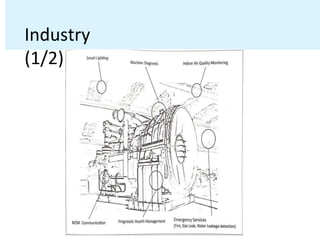
• Machine Diagnosis
• Sensors in machine monitor the operating conditions
• For example: temperature & vibration levels
• Collecting and analyzing massive scale machine
sensor data
• For reliability analysis and fault prediction in machines
• Indoor Air Quality Monitoring
• Use various gas sensors
• To monitor the harmful and toxic gases (CO, NO, NO2, etc.)
• Measure the environmental parameters to determine
the indoor air quality
• Temperature, humidity, gaseous pollutants, aerosol
Health &
Lifestyle
• Health & Fitness Monitoring
• Collect the health-care data
• Using some sensors: body temperature, heart rate, movement
(with accelerometers), etc.
• Various forms : belts and wrist-bands
• Wearable electronic
• Assists the daily activities
• Smart watch
• Smart shoes
• Smart wristbands

Unit -V IoT.pptx

  • 1.
  • 2.
    Outline • Introduction • Home Automation •Cities • Environment • Energy • Retail • Logistics • Agriculture • Industry • Health & Lifestyle
  • 3.
  • 4.
  • 5.
    Home Automation (2/2) •Smart Lighting • Control lighting by remotely (mobile or web applications) • SmartAppliances • Provide status information to the users remotely • Intrusion Detection • Use security cameras and sensors (PIR sensors and door sensors) • Detect intrusions and raise alerts • The alerts form: an SMS or an email sent to the user • Smoke/Gas Detectors • Use optical detection, ionization, or air sampling techniques to detect the smoke • Gas detectors can detect harmful gases • Carbon monoxide (CO) • Liquid petroleum gas (LPG) • Raise alerts to the user or local fire safety department
  • 6.
  • 7.
    Cities (2/2) • Smart Parking •Detect the number of empty parking slots • Send the information over the internet and accessed by smartphones • Smart Roads • Provide information on driving conditions, traffic congestions, accidents • Alert for poor driving conditions • Structural Health Monitoring • Monitor the vibration levels in the structures (bridges and buildings) • Advance warning for imminent failure of the structure • Surveillance • Use the large number of distributed and internet connected video surveillancecameras • Aggregate the video in cloud-based scalable storagesolutions • Emergency Response
  • 8.
  • 9.
    Environment (2/2) • Weather Monitoring •Collect data from several sensors (temperature, humidity, pressure, etc.) • Send the data to cloud-based applications and storage back-ends • Air Pollution Monitoring • Monitor emission of harmful gases (CO2, CO, NO, NO2, etc.) • Factories and automobiles use gaseous and meteorological sensors • Integration with a single-chip microcontroller, several air pollution sensors, GPRS-modem, and a GPS module • Noise Pollution Monitoring • Use a number of noise monitoring stations • Generate noise maps from data collected • Forest Fire Detection • Use a number of monitoring nodes deployed at different locations in a forests • Use temperature, humidity, light levels, etc. • Provide early warning of potential forest fire • Estimates the scale and intensity • River Floods Detection • Monitoring the water level (using ultrasonic sensors) and flow rate (using the flow velocity sensors) • Raise alerts when rapid increase in water level and flow rate is detected
  • 10.
  • 11.
    Energy (2/2) • Smart Grids •Collect data regarding electricity generation, consumption, storage (conversion of energy into other forms), distribution, equipment health data • Control the consumption of electricity • Remotely switch off supply • Renewable Energy Systems • Measure the electrical variables • Measure how much the power is fed into the grid • Prognostics • Predict performance of machines or energy systems
  • 12.
  • 13.
    Retail (2/2) • Inventory Management •Monitoring the inventory by the RFID readers • Tracking the products • Smart Payments • Use the NFC • Customers store the credit card information in their NFC- enabled • Smart Vending Machines • Allow remote monitoring of inventory levels • Elastic pricing of products • Contact-less payment using NFC • Send the data to the cloud for predictive maintenance • The information of inventory levels • The information of the nearest machine in case a product goes out of stock in a machine
  • 14.
  • 15.
    Logistics (2/2) • Route Generation& Scheduling • Generate end-to-end routes using combination of route patterns • Provide route generation queries • Can be scale up to serve a large transportation network • Fleet Tracking • Track the locations of the vehicles in real-time • Generate alerts for deviations in planned routes • Shipment monitoring • Monitoring the conditions inside containers • Using sensors (temperature, pressure, humidity) • Detecting food spoilage • Remote Vehicle Diagnostics • Detect faults in the vehicle • Warn of impending faults • IoT collects the data on vehicle (speed, engine RPM, coolant temperature) • Generate alerts and suggest remedial actions
  • 16.
  • 17.
    Agriculture (2/2) • Smart Irrigation •Use sensors to determine the amount of moisture in the soil • Release the flow of water • Using predefined moisture levels • Water Scheduling • Green House Control • Automatically control the climatological conditions inside a green house • Using several sensors to monitor • Using actuation devices to control • Valves for releasing water and switches for controlling fans • Maintenance of agricultural production
  • 18.
  • 19.
    Industry (2/2) • Machine Diagnosis •Sensors in machine monitor the operating conditions • For example: temperature & vibration levels • Collecting and analyzing massive scale machine sensor data • For reliability analysis and fault prediction in machines • Indoor Air Quality Monitoring • Use various gas sensors • To monitor the harmful and toxic gases (CO, NO, NO2, etc.) • Measure the environmental parameters to determine the indoor air quality • Temperature, humidity, gaseous pollutants, aerosol
  • 20.
    Health & Lifestyle • Health& Fitness Monitoring • Collect the health-care data • Using some sensors: body temperature, heart rate, movement (with accelerometers), etc. • Various forms : belts and wrist-bands • Wearable electronic • Assists the daily activities • Smart watch • Smart shoes • Smart wristbands