ManagingInnovation
MBA 6103
Unit 6
Disruptive Innovation
& Implementation
• A product/service in alignment with the organizations existing strategy and core
competencies
• Dedicated development team
• Functional structure
• Lightweight product manager structure
• Heavyweight product manager structure
• Project execution teams
• Concept generation
• Project selection
• Product development
• Product commercialization and review
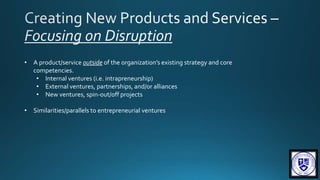
• A product/service outside of the organization’s existing strategy and core
competencies.
• Internal ventures (i.e. intrapreneurship)
• External ventures, partnerships, and/or alliances
• New ventures, spin-out/off projects
• Similarities/parallels to entrepreneurial ventures
• Growth
• Effective use of resources
• Leverage supply chain/value chain relationships
• Prepare for divestiture
• Leverage the ambitions of personnel
• Leverage economies of scale in product development
• Smooth out cyclical products/markets
• Diversification
• Develop new competencies
• Example:GE
• Direct Integration
• Integrated BusinessTeams
• NewVenture Department
• NewVenture Division
• Special Business Unit
• Independent Business Unit
• Nurtured Divestment
• Complete Spin-off
• Example PepsiCo andYum! Brands
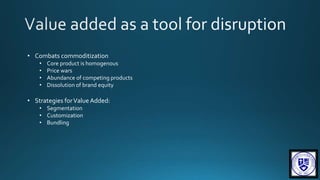
• Combats commoditization
• Core product is homogenous
• Price wars
• Abundance of competing products
• Dissolution of brand equity
• Strategies forValue Added:
• Segmentation
• Customization
• Bundling
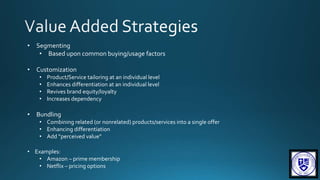
• Segmenting
• Based upon common buying/usage factors
• Customization
• Product/Service tailoring at an individual level
• Enhances differentiation at an individual level
• Revives brand equity/loyalty
• Increases dependency
• Bundling
• Combining related (or nonrelated) products/services into a single offer
• Enhancing differentiation
• Add “perceived value”
• Examples:
• Amazon – prime membership
• Netflix – pricing options

Unit Six- (MGT 6103)

  • 1.
  • 3.
    • A product/servicein alignment with the organizations existing strategy and core competencies • Dedicated development team • Functional structure • Lightweight product manager structure • Heavyweight product manager structure • Project execution teams • Concept generation • Project selection • Product development • Product commercialization and review
  • 4.
    • A product/serviceoutside of the organization’s existing strategy and core competencies. • Internal ventures (i.e. intrapreneurship) • External ventures, partnerships, and/or alliances • New ventures, spin-out/off projects • Similarities/parallels to entrepreneurial ventures
  • 5.
    • Growth • Effectiveuse of resources • Leverage supply chain/value chain relationships • Prepare for divestiture • Leverage the ambitions of personnel • Leverage economies of scale in product development • Smooth out cyclical products/markets • Diversification • Develop new competencies • Example:GE
  • 6.
    • Direct Integration •Integrated BusinessTeams • NewVenture Department • NewVenture Division • Special Business Unit • Independent Business Unit • Nurtured Divestment • Complete Spin-off • Example PepsiCo andYum! Brands
  • 7.
    • Combats commoditization •Core product is homogenous • Price wars • Abundance of competing products • Dissolution of brand equity • Strategies forValue Added: • Segmentation • Customization • Bundling
  • 8.
    • Segmenting • Basedupon common buying/usage factors • Customization • Product/Service tailoring at an individual level • Enhances differentiation at an individual level • Revives brand equity/loyalty • Increases dependency • Bundling • Combining related (or nonrelated) products/services into a single offer • Enhancing differentiation • Add “perceived value” • Examples: • Amazon – prime membership • Netflix – pricing options