Foreign Policy
Unit 2
Realism and Foreign
Policy
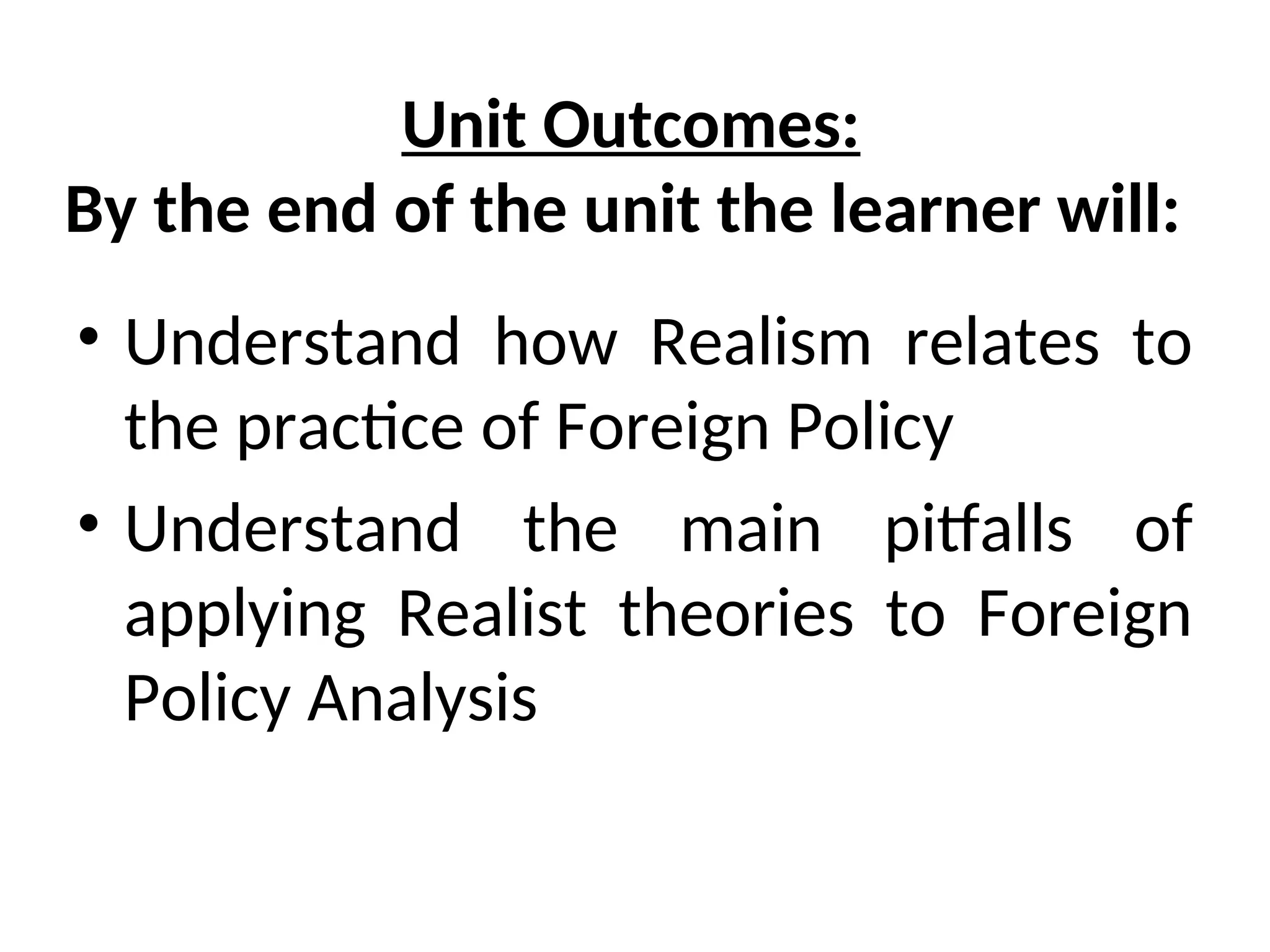
Unit Outcomes:
By the end of the unit the learner will:
• Understand how Realism relates to
the practice of Foreign Policy
• Understand the main pitfalls of
applying Realist theories to Foreign
Policy Analysis
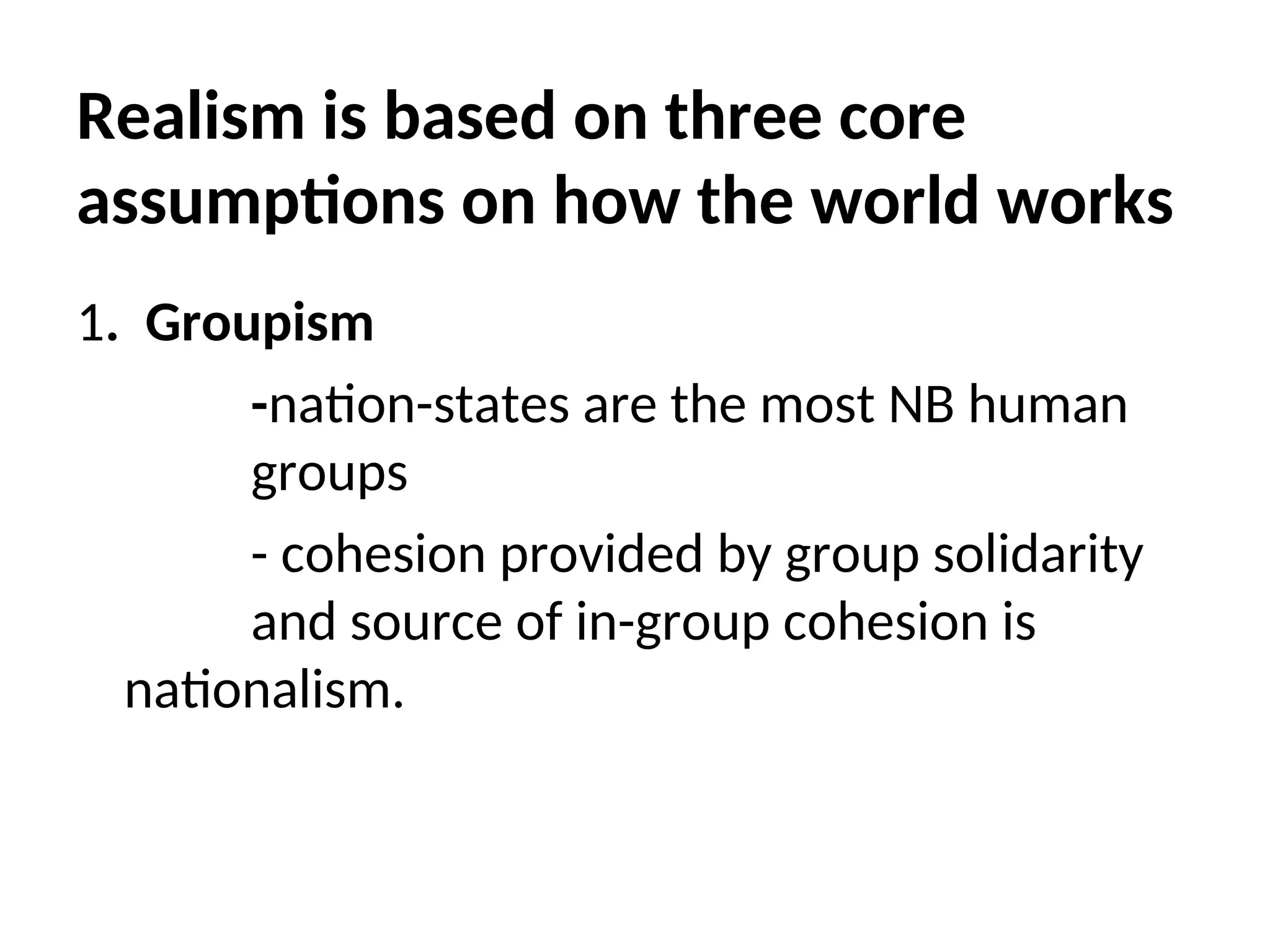
Realism is based on three core
assumptions on how the world works
1. Groupism
-nation-states are the most NB human
groups
- cohesion provided by group solidarity
and source of in-group cohesion is
nationalism.
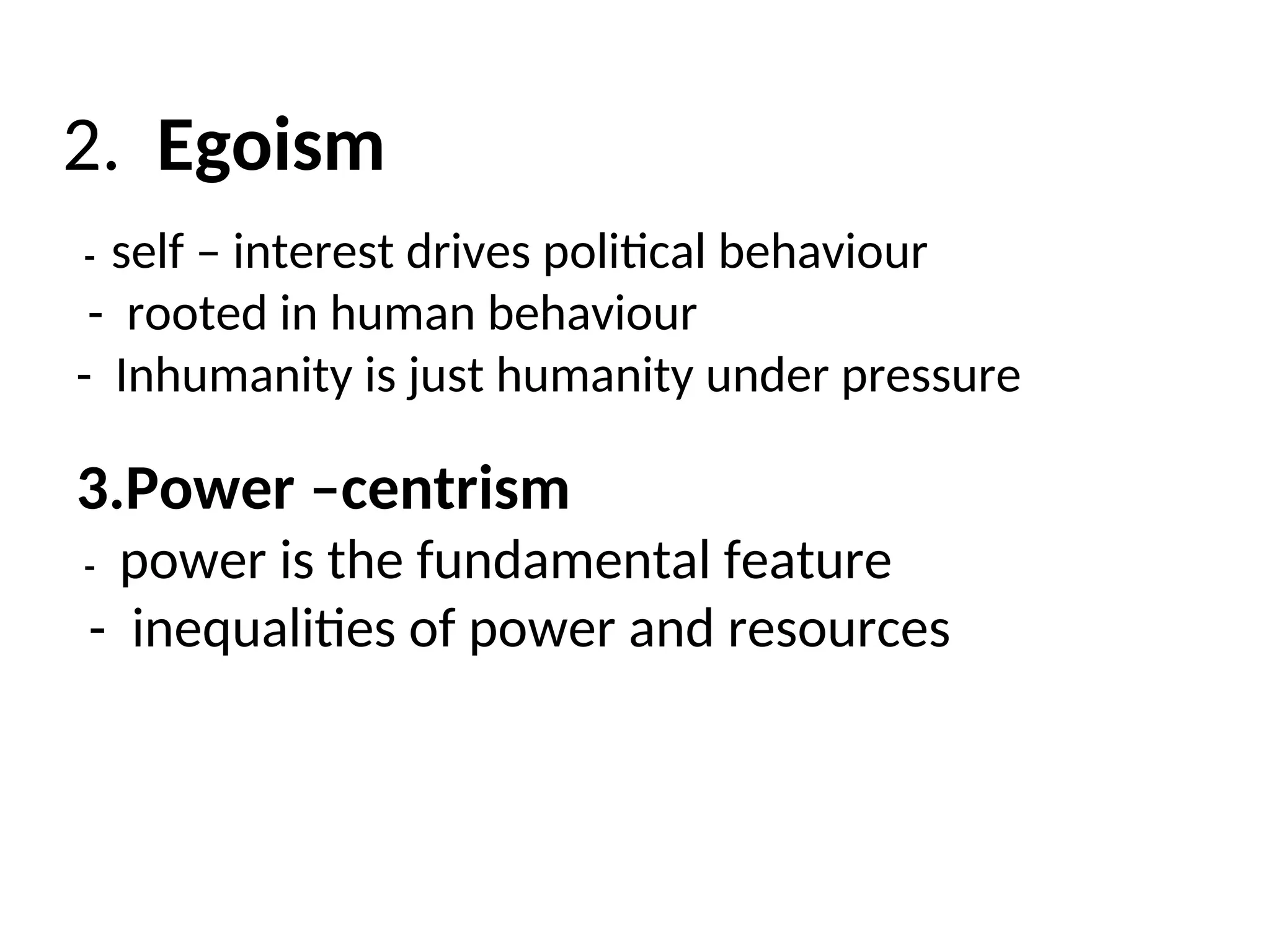
2. Egoism
- self – interest drives political behaviour
- rooted in human behaviour
- Inhumanity is just humanity under pressure
3.Power –centrism
- power is the fundamental feature
- inequalities of power and resources
• Politics is likely to be conflictual unless
there is some central authority to
enforce order.
• Anarchy – no authority exists, state can
resort to force to get what it wants
• This creates a security dilemma
Theoretical Schools within
Realism
• Classical Realism
• Neorealism
– Defensive Realists
– Offensive Realists
• Neoclassical realism
Classical Realism
• Thucydides – middle years of the Cold War
• Egoism, nature of man
• Kenneth Waltz translated core themes -
deductive top down theoretical framework
known as neorealism
• The mere existence of groups in anarchy can
lead to powerful competitive pressure
Defensive Realists
• Under very common conditions the war –
causing potential of anarchy is attenuated.
• The stronger group identity is (nationalism)
the harder it is to conquer other groups
• The harder the conquest the more secure the
state will be.
• Conquest may seem hard today due to
technology, geography and national identity
• Look inside states for causes of war and peace
Offensive Realists
• More persuaded by conflict-generating,
structural potential of anarchy itself.
• With no authority – could never be certain
that any peace-causing condition today would
remain operative in the future
• Reinforce classical realist argument about the
competitive nature of life under anarchy
Neoclassical Realism
• The actions of a state in the international
system can be explained by domestic variables
affecting the power of the decision-makers
within a state.
• States' mistrust and inability to perceive one
another accurately can result in an imbalance.
• Defensive and Offensive make it easier to
perform key metal experiments in FPA
Theories within Realism
• Balance of power – internal balancing and
external balancing
• Balance of Threat – states will balance against
threats (aggregate capabilities, geography and
perceptions of aggressive intentions)
• E.g. After the end of WWII the US started
internal and external balancing
• Hegemonic Stability Theory – powerful states
tend to seek dominance - hierarchy
• E.g. globalisation order is sustained by US
power
• Power Transition theory – explain how orders
break down into war
• E.g. As China gets stronger, the more likely it
will oppose the US led global order and a Cold
War style rivalry will become likely.

Unit realism in world politics nnnn2.ppt

  • 1.
  • 2.
    Unit Outcomes: By theend of the unit the learner will: • Understand how Realism relates to the practice of Foreign Policy • Understand the main pitfalls of applying Realist theories to Foreign Policy Analysis
  • 3.
    Realism is basedon three core assumptions on how the world works 1. Groupism -nation-states are the most NB human groups - cohesion provided by group solidarity and source of in-group cohesion is nationalism.
  • 4.
    2. Egoism - self– interest drives political behaviour - rooted in human behaviour - Inhumanity is just humanity under pressure 3.Power –centrism - power is the fundamental feature - inequalities of power and resources
  • 5.
    • Politics islikely to be conflictual unless there is some central authority to enforce order. • Anarchy – no authority exists, state can resort to force to get what it wants • This creates a security dilemma
  • 6.
    Theoretical Schools within Realism •Classical Realism • Neorealism – Defensive Realists – Offensive Realists • Neoclassical realism
  • 7.
    Classical Realism • Thucydides– middle years of the Cold War • Egoism, nature of man • Kenneth Waltz translated core themes - deductive top down theoretical framework known as neorealism • The mere existence of groups in anarchy can lead to powerful competitive pressure
  • 8.
    Defensive Realists • Undervery common conditions the war – causing potential of anarchy is attenuated. • The stronger group identity is (nationalism) the harder it is to conquer other groups • The harder the conquest the more secure the state will be. • Conquest may seem hard today due to technology, geography and national identity • Look inside states for causes of war and peace
  • 9.
    Offensive Realists • Morepersuaded by conflict-generating, structural potential of anarchy itself. • With no authority – could never be certain that any peace-causing condition today would remain operative in the future • Reinforce classical realist argument about the competitive nature of life under anarchy
  • 10.
    Neoclassical Realism • Theactions of a state in the international system can be explained by domestic variables affecting the power of the decision-makers within a state. • States' mistrust and inability to perceive one another accurately can result in an imbalance. • Defensive and Offensive make it easier to perform key metal experiments in FPA
  • 11.
    Theories within Realism •Balance of power – internal balancing and external balancing • Balance of Threat – states will balance against threats (aggregate capabilities, geography and perceptions of aggressive intentions) • E.g. After the end of WWII the US started internal and external balancing
  • 12.
    • Hegemonic StabilityTheory – powerful states tend to seek dominance - hierarchy • E.g. globalisation order is sustained by US power • Power Transition theory – explain how orders break down into war • E.g. As China gets stronger, the more likely it will oppose the US led global order and a Cold War style rivalry will become likely.