Online Education
Class: B.Sc. Second Year III Semester
Paper name: Advance C Programming CS07
By
Mr. Sanjay R Kale
(Assistant Professor)
Department of Computer Science
Swa. Sawarkar Arts, Science and Commerce College, Beed
kalesrssm@gmail.com
Pointers in c
• Introduction
• Memory organization
• Declaration &Initialization of Pointers
• The pointer operator * & dereferencing
• Pointer expression and pointer arithmetics
• Pointer to pointers
• Link for reference :
https://fresh2refresh.com/c-programming/c-
pointer/
https://www.tutorialspoint.com/cprogramming/c_poi
nters.htm
Introduction:
Pointers in C language is a variable that stores/points
the address of another variable. A Pointer in C is
used to allocate memory dynamically i.e. at run
time. The pointer variable might be belonging to any
of the data type such as int, float, char, double, short
etc.
Pointer Syntax : data_type *var_name;
Example : int *p; char *p;
Where, * is used to denote that “p” is pointer variable
and not a normal variable.
KEY POINTS TO REMEMBER ABOUT POINTERS IN C:
• Normal variable stores the value whereas pointer variable
stores the address of the variable.
• The content of the C pointer always be a whole number i.e.
address.
• Always C pointer is initialized to null, i.e. int *p = null.
• The value of null pointer is 0.
• & symbol is used to get the address of the variable.
• * symbol is used to get the value of the variable that the
pointer is pointing to.
• If a pointer in C is assigned to NULL, it means it is pointing to
nothing.
• Two pointers can be subtracted to know how many elements
are available between these two pointers.
• But, Pointer addition, multiplication, division are not allowed.
• The size of any pointer is 2 byte (for 16 bit compiler).
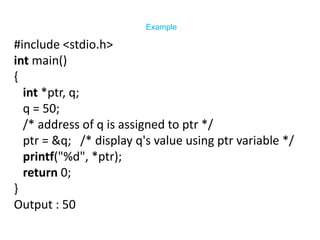
Example
#include <stdio.h>
int main()
{
int *ptr, q;
q = 50;
/* address of q is assigned to ptr */
ptr = &q; /* display q's value using ptr variable */
printf("%d", *ptr);
return 0;
}
Output : 50
Memory Organization for Pointer Variable
:
• When we use variable in program then
Compiler keeps some memory for that
variable depending on the data type
• The address given to the variable is Unique
with that variable name
• When Program execution starts the variable
name is automatically translated into the
corresponding address.
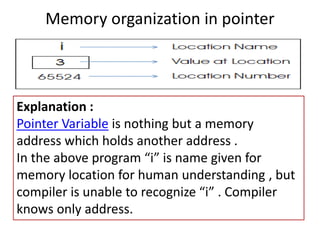
Memory organization in pointer
Explanation :
Pointer Variable is nothing but a memory
address which holds another address .
In the above program “i” is name given for
memory location for human understanding , but
compiler is unable to recognize “i” . Compiler
knows only address.
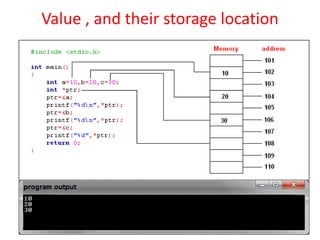
Value , and their storage location
Web link : Pointer Variable
http://www.c4learn.com/c-programming/c-
pointer-variable-memory-required/
UNIT III POINTERS IN C

UNIT III POINTERS IN C

  • 1.
  • 2.
    Class: B.Sc. SecondYear III Semester Paper name: Advance C Programming CS07 By Mr. Sanjay R Kale (Assistant Professor) Department of Computer Science Swa. Sawarkar Arts, Science and Commerce College, Beed kalesrssm@gmail.com
  • 3.
    Pointers in c •Introduction • Memory organization • Declaration &Initialization of Pointers • The pointer operator * & dereferencing • Pointer expression and pointer arithmetics • Pointer to pointers • Link for reference : https://fresh2refresh.com/c-programming/c- pointer/ https://www.tutorialspoint.com/cprogramming/c_poi nters.htm
  • 4.
    Introduction: Pointers in Clanguage is a variable that stores/points the address of another variable. A Pointer in C is used to allocate memory dynamically i.e. at run time. The pointer variable might be belonging to any of the data type such as int, float, char, double, short etc. Pointer Syntax : data_type *var_name; Example : int *p; char *p; Where, * is used to denote that “p” is pointer variable and not a normal variable.
  • 5.
    KEY POINTS TOREMEMBER ABOUT POINTERS IN C: • Normal variable stores the value whereas pointer variable stores the address of the variable. • The content of the C pointer always be a whole number i.e. address. • Always C pointer is initialized to null, i.e. int *p = null. • The value of null pointer is 0. • & symbol is used to get the address of the variable. • * symbol is used to get the value of the variable that the pointer is pointing to. • If a pointer in C is assigned to NULL, it means it is pointing to nothing. • Two pointers can be subtracted to know how many elements are available between these two pointers. • But, Pointer addition, multiplication, division are not allowed. • The size of any pointer is 2 byte (for 16 bit compiler).
  • 6.
    Example #include <stdio.h> int main() { int*ptr, q; q = 50; /* address of q is assigned to ptr */ ptr = &q; /* display q's value using ptr variable */ printf("%d", *ptr); return 0; } Output : 50
  • 7.
    Memory Organization forPointer Variable : • When we use variable in program then Compiler keeps some memory for that variable depending on the data type • The address given to the variable is Unique with that variable name • When Program execution starts the variable name is automatically translated into the corresponding address.
  • 8.
    Memory organization inpointer Explanation : Pointer Variable is nothing but a memory address which holds another address . In the above program “i” is name given for memory location for human understanding , but compiler is unable to recognize “i” . Compiler knows only address.
  • 9.
    Value , andtheir storage location
  • 10.
    Web link :Pointer Variable http://www.c4learn.com/c-programming/c- pointer-variable-memory-required/