© 2008 Wayne Wolf
Overheads for Computers as
Components 2nd ed.
Program design and
analysis
Software components.
Representations of programs.
Assembly and linking.
© 2008 Wayne Wolf
Overheads for Computers as
Components 2nd ed.
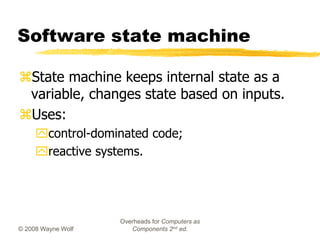
Software state machine
State machine keeps internal state as a
variable, changes state based on inputs.
Uses:
control-dominated code;
reactive systems.
© 2008 Wayne Wolf
Overheads for Computers as
Components 2nd ed.
State machine example
idle
buzzer seated
belted
no seat/-
seat/timer on
no belt
and no
timer/-
no belt/timer on
belt/-
belt/
buzzer off
No Belt/buzzer on
no seat/-
no seat/
buzzer off
© 2008 Wayne Wolf
Overheads for Computers as
Components 2nd ed.
C implementation
#define IDLE 0
#define SEATED 1
#define BELTED 2
#define BUZZER 3
switch (state) {
case IDLE: if (seat) { state = SEATED; timer_on = TRUE; }
break;
case SEATED: if (belt) state = BELTED;
else if (timer) state = BUZZER;
break;
…
}
© 2008 Wayne Wolf
Overheads for Computers as
Components 2nd ed.
Models of programs
Source code is not a good representation
for programs:
clumsy;
leaves much information implicit.
Compilers derive intermediate
representations to manipulate and optiize
the program.
© 2008 Wayne Wolf
Overheads for Computers as
Components 2nd ed.
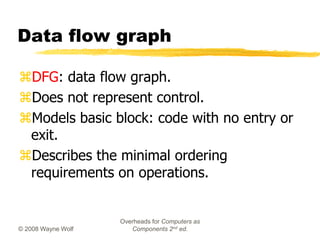
Data flow graph
DFG: data flow graph.
Does not represent control.
Models basic block: code with no entry or
exit.
Describes the minimal ordering
requirements on operations.
© 2008 Wayne Wolf
Overheads for Computers as
Components 2nd ed.
Single assignment form
x = a + b;
y = c - d;
z = x * y;
y = b + d;
original basic block
x = a + b;
y = c - d;
z = x * y;
y1 = b + d;
single assignment form
© 2008 Wayne Wolf
Overheads for Computers as
Components 2nd ed.
Data flow graph
x = a + b;
y = c - d;
z = x * y;
y1 = b + d;
single assignment form
+ -
+
*
DFG
a b c d
z
x
y
y1
© 2008 Wayne Wolf
Overheads for Computers as
Components 2nd ed.
DFGs and partial orders
Partial order:
a+b, c-d; b+d x*y
Can do pairs of
operations in any
order.
+ -
+
*
a b c d
z
x
y
y1
© 2008 Wayne Wolf
Overheads for Computers as
Components 2nd ed.
Control-data flow graph
CDFG: represents control and data.
Uses data flow graphs as components.
Two types of nodes:
decision;
data flow.
© 2008 Wayne Wolf
Overheads for Computers as
Components 2nd ed.
Data flow node
Encapsulates a data flow graph:
Write operations in basic block form for
simplicity.
x = a + b;
y = c + d
© 2008 Wayne Wolf
Overheads for Computers as
Components 2nd ed.
Control
cond
T
F
Equivalent forms
value
v1
v2 v3
v4
© 2008 Wayne Wolf
Overheads for Computers as
Components 2nd ed.
CDFG example
if (cond1) bb1();
else bb2();
bb3();
switch (test1) {
case c1: bb4(); break;
case c2: bb5(); break;
case c3: bb6(); break;
}
cond1 bb1()
bb2()
bb3()
bb4()
test1
bb5() bb6()
T
F
c1
c2
c3
© 2008 Wayne Wolf
Overheads for Computers as
Components 2nd ed.
for loop
for (i=0; i<N; i++)
loop_body();
for loop
i=0;
while (i<N) {
loop_body(); i++; }
equivalent
i<N
loop_body()
T
F
i=0
© 2008 Wayne Wolf
Overheads for Computers as
Components 2nd ed.
Assembly and linking
Last steps in compilation:
HLL compile assembly
assemble
HLL
HLL assembly
assembly
link
executable
link
© 2008 Wayne Wolf
Overheads for Computers as
Components
Multiple-module programs
Programs may be composed from several
files.
Addresses become more specific during
processing:
relative addresses are measured relative to
the start of a module;
absolute addresses are measured relative to
the start of the CPU address space.
© 2008 Wayne Wolf
Overheads for Computers as
Components 2nd ed.
Assemblers
Major tasks:
generate binary for symbolic instructions;
translate labels into addresses;
handle pseudo-ops (data, etc.).
Generally one-to-one translation.
Assembly labels:
ORG 100
label1 ADR r4,c
© 2008 Wayne Wolf
Overheads for Computers as
Components 2nd ed.
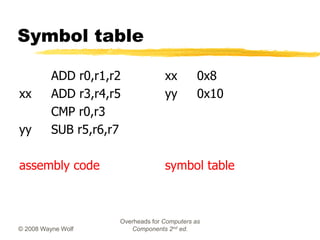
Symbol table
ADD r0,r1,r2
xx ADD r3,r4,r5
CMP r0,r3
yy SUB r5,r6,r7
assembly code
xx 0x8
yy 0x10
symbol table
© 2008 Wayne Wolf
Overheads for Computers as
Components 2nd ed.
Symbol table generation
Use program location counter (PLC) to
determine address of each location.
Scan program, keeping count of PLC.
Addresses are generated at assembly
time, not execution time.
© 2008 Wayne Wolf
Overheads for Computers as
Components 2nd ed.
Symbol table example
ADD r0,r1,r2
xx ADD r3,r4,r5
CMP r0,r3
yy SUB r5,r6,r7
xx 0x8
yy 0x10
PLC=0x7
PLC=0x7
PLC=0x7
PLC=0x7
© 2008 Wayne Wolf
Overheads for Computers as
Components 2nd ed.
Two-pass assembly
Pass 1:
generate symbol table
Pass 2:
generate binary instructions
© 2008 Wayne Wolf
Overheads for Computers as
Components 2nd ed.
Relative address
generation
Some label values may not be known at
assembly time.
Labels within the module may be kept in
relative form.
Must keep track of external labels---can’t
generate full binary for instructions that
use external labels.
© 2008 Wayne Wolf
Overheads for Computers as
Components 2nd ed.
Pseudo-operations
Pseudo-ops do not generate instructions:
ORG sets program location.
EQU generates symbol table entry without
advancing PLC.
Data statements define data blocks.
© 2008 Wayne Wolf
Overheads for Computers as
Components 2nd ed.
Linking
Combines several object modules into a
single executable module.
Jobs:
put modules in order;
resolve labels across modules.
© 2008 Wayne Wolf
Overheads for Computers as
Components 2nd ed.
Module ordering
Code modules must be placed in absolute
positions in the memory space.
Load map or linker flags control the order
of modules.
module1
module2
module3
© 2008 Wayne Wolf
Overheads for Computers as
Components 2nd ed.
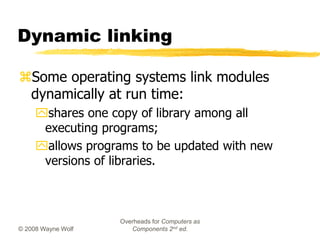
Dynamic linking
Some operating systems link modules
dynamically at run time:
shares one copy of library among all
executing programs;
allows programs to be updated with new
versions of libraries.

unit 4-II.ppt

  • 1.
    © 2008 WayneWolf Overheads for Computers as Components 2nd ed. Program design and analysis Software components. Representations of programs. Assembly and linking.
  • 2.
    © 2008 WayneWolf Overheads for Computers as Components 2nd ed. Software state machine State machine keeps internal state as a variable, changes state based on inputs. Uses: control-dominated code; reactive systems.
  • 3.
    © 2008 WayneWolf Overheads for Computers as Components 2nd ed. State machine example idle buzzer seated belted no seat/- seat/timer on no belt and no timer/- no belt/timer on belt/- belt/ buzzer off No Belt/buzzer on no seat/- no seat/ buzzer off
  • 4.
    © 2008 WayneWolf Overheads for Computers as Components 2nd ed. C implementation #define IDLE 0 #define SEATED 1 #define BELTED 2 #define BUZZER 3 switch (state) { case IDLE: if (seat) { state = SEATED; timer_on = TRUE; } break; case SEATED: if (belt) state = BELTED; else if (timer) state = BUZZER; break; … }
  • 5.
    © 2008 WayneWolf Overheads for Computers as Components 2nd ed. Models of programs Source code is not a good representation for programs: clumsy; leaves much information implicit. Compilers derive intermediate representations to manipulate and optiize the program.
  • 6.
    © 2008 WayneWolf Overheads for Computers as Components 2nd ed. Data flow graph DFG: data flow graph. Does not represent control. Models basic block: code with no entry or exit. Describes the minimal ordering requirements on operations.
  • 7.
    © 2008 WayneWolf Overheads for Computers as Components 2nd ed. Single assignment form x = a + b; y = c - d; z = x * y; y = b + d; original basic block x = a + b; y = c - d; z = x * y; y1 = b + d; single assignment form
  • 8.
    © 2008 WayneWolf Overheads for Computers as Components 2nd ed. Data flow graph x = a + b; y = c - d; z = x * y; y1 = b + d; single assignment form + - + * DFG a b c d z x y y1
  • 9.
    © 2008 WayneWolf Overheads for Computers as Components 2nd ed. DFGs and partial orders Partial order: a+b, c-d; b+d x*y Can do pairs of operations in any order. + - + * a b c d z x y y1
  • 10.
    © 2008 WayneWolf Overheads for Computers as Components 2nd ed. Control-data flow graph CDFG: represents control and data. Uses data flow graphs as components. Two types of nodes: decision; data flow.
  • 11.
    © 2008 WayneWolf Overheads for Computers as Components 2nd ed. Data flow node Encapsulates a data flow graph: Write operations in basic block form for simplicity. x = a + b; y = c + d
  • 12.
    © 2008 WayneWolf Overheads for Computers as Components 2nd ed. Control cond T F Equivalent forms value v1 v2 v3 v4
  • 13.
    © 2008 WayneWolf Overheads for Computers as Components 2nd ed. CDFG example if (cond1) bb1(); else bb2(); bb3(); switch (test1) { case c1: bb4(); break; case c2: bb5(); break; case c3: bb6(); break; } cond1 bb1() bb2() bb3() bb4() test1 bb5() bb6() T F c1 c2 c3
  • 14.
    © 2008 WayneWolf Overheads for Computers as Components 2nd ed. for loop for (i=0; i<N; i++) loop_body(); for loop i=0; while (i<N) { loop_body(); i++; } equivalent i<N loop_body() T F i=0
  • 15.
    © 2008 WayneWolf Overheads for Computers as Components 2nd ed. Assembly and linking Last steps in compilation: HLL compile assembly assemble HLL HLL assembly assembly link executable link
  • 16.
    © 2008 WayneWolf Overheads for Computers as Components Multiple-module programs Programs may be composed from several files. Addresses become more specific during processing: relative addresses are measured relative to the start of a module; absolute addresses are measured relative to the start of the CPU address space.
  • 17.
    © 2008 WayneWolf Overheads for Computers as Components 2nd ed. Assemblers Major tasks: generate binary for symbolic instructions; translate labels into addresses; handle pseudo-ops (data, etc.). Generally one-to-one translation. Assembly labels: ORG 100 label1 ADR r4,c
  • 18.
    © 2008 WayneWolf Overheads for Computers as Components 2nd ed. Symbol table ADD r0,r1,r2 xx ADD r3,r4,r5 CMP r0,r3 yy SUB r5,r6,r7 assembly code xx 0x8 yy 0x10 symbol table
  • 19.
    © 2008 WayneWolf Overheads for Computers as Components 2nd ed. Symbol table generation Use program location counter (PLC) to determine address of each location. Scan program, keeping count of PLC. Addresses are generated at assembly time, not execution time.
  • 20.
    © 2008 WayneWolf Overheads for Computers as Components 2nd ed. Symbol table example ADD r0,r1,r2 xx ADD r3,r4,r5 CMP r0,r3 yy SUB r5,r6,r7 xx 0x8 yy 0x10 PLC=0x7 PLC=0x7 PLC=0x7 PLC=0x7
  • 21.
    © 2008 WayneWolf Overheads for Computers as Components 2nd ed. Two-pass assembly Pass 1: generate symbol table Pass 2: generate binary instructions
  • 22.
    © 2008 WayneWolf Overheads for Computers as Components 2nd ed. Relative address generation Some label values may not be known at assembly time. Labels within the module may be kept in relative form. Must keep track of external labels---can’t generate full binary for instructions that use external labels.
  • 23.
    © 2008 WayneWolf Overheads for Computers as Components 2nd ed. Pseudo-operations Pseudo-ops do not generate instructions: ORG sets program location. EQU generates symbol table entry without advancing PLC. Data statements define data blocks.
  • 24.
    © 2008 WayneWolf Overheads for Computers as Components 2nd ed. Linking Combines several object modules into a single executable module. Jobs: put modules in order; resolve labels across modules.
  • 25.
    © 2008 WayneWolf Overheads for Computers as Components 2nd ed. Module ordering Code modules must be placed in absolute positions in the memory space. Load map or linker flags control the order of modules. module1 module2 module3
  • 26.
    © 2008 WayneWolf Overheads for Computers as Components 2nd ed. Dynamic linking Some operating systems link modules dynamically at run time: shares one copy of library among all executing programs; allows programs to be updated with new versions of libraries.