Visual Thinking &
Cartography
Unit -2
Visual Thinking Strategies (VTS)
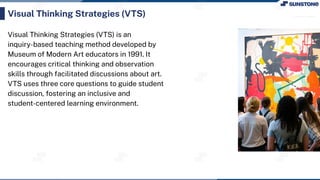
Visual Thinking Strategies (VTS) is an
inquiry-based teaching method developed by
Museum of Modern Art educators in 1991. It
encourages critical thinking and observation
skills through facilitated discussions about art.
VTS uses three core questions to guide student
discussion, fostering an inclusive and
student-centered learning environment.
Visual Thinking Strategies (VTS)
Core VTS Questions
1 What’s going on in
this picture?
Encourages initial
observations and
broad interpretations.
2 What do you see that
makes you say that?
Prompts students to
provide evidence for
their claims, fostering
analytical skills.
3 What more can we
find?
Invites further
exploration and
encourages diverse
perspectives.
These questions create an open dialogue where all observations are valued, and there are no
right or wrong answers, promoting a safe space for expression.
Enhances critical thinking and evidence-based
reasoning skills.
Boosts student engagement and
communication abilities.
Supports diverse learners, including English
Language Learners (ELL) and students with
special needs.
Integrates seamlessly with writing and various
content area learning objectives.
Benefits of VTS in Education
Visual Diagrams
Concept maps are graphical tools that
visually organize and represent knowledge.
They help link ideas, concepts, or processes
in a structured way.
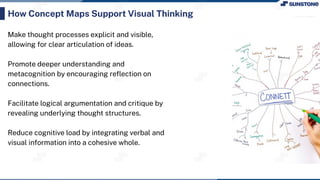
Nodes & Connections
They use nodes (circles or boxes) to
represent concepts and connecting lines
or arrows with labels to show
relationships between them.
Clarity & Organization
These maps aid in organizing, chunking,
and clarifying complex information,
making it easier to comprehend and
retain.
Visual Learning
Concept maps are particularly useful for
all learners, especially those who process
information best through visual means.
What Are Concept Maps?
Make thought processes explicit and visible,
allowing for clear articulation of ideas.
Promote deeper understanding and
metacognition by encouraging reflection on
connections.
Facilitate logical argumentation and critique by
revealing underlying thought structures.
Reduce cognitive load by integrating verbal and
visual information into a cohesive whole.
How Concept Maps Support Visual Thinking
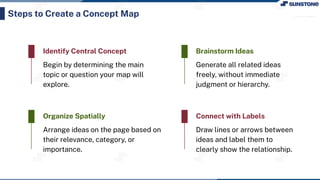
Steps to Create a Concept Map
Identify Central Concept
Begin by determining the main
topic or question your map will
explore.
Brainstorm Ideas
Generate all related ideas
freely, without immediate
judgment or hierarchy.
Organize Spatially
Arrange ideas on the page based on
their relevance, category, or
importance.
Connect with Labels
Draw lines or arrows between
ideas and label them to
clearly show the relationship.
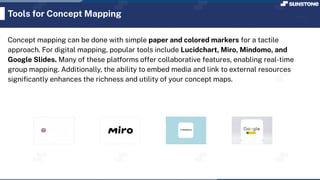
Tools for Concept Mapping
Concept mapping can be done with simple paper and colored markers for a tactile
approach. For digital mapping, popular tools include Lucidchart, Miro, Mindomo, and
Google Slides. Many of these platforms offer collaborative features, enabling real-time
group mapping. Additionally, the ability to embed media and link to external resources
significantly enhances the richness and utility of your concept maps.
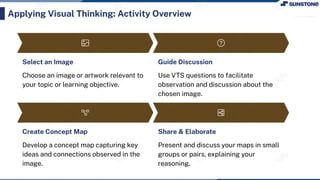
Select an Image
Choose an image or artwork relevant to
your topic or learning objective.
Guide Discussion
Use VTS questions to facilitate
observation and discussion about the
chosen image.
Create Concept Map
Develop a concept map capturing key
ideas and connections observed in the
image.
Share & Elaborate
Present and discuss your maps in small
groups or pairs, explaining your
reasoning.
Applying Visual Thinking: Activity Overview
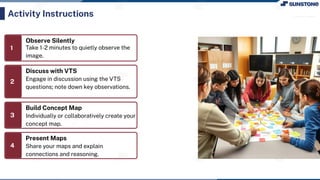
1
Observe Silently
Take 1-2 minutes to quietly observe the
image.
2
Discuss with VTS
Engage in discussion using the VTS
questions; note down key observations.
3
Build Concept Map
Individually or collaboratively create your
concept map.
4
Present Maps
Share your maps and explain
connections and reasoning.
Activity Instructions
Summary & Takeaways
VTS fosters critical thinking through guided visual inquiry and evidence-based reasoning.
Concept maps organize and deepen understanding by visually representing complex
ideas and their relationships.
Combining VTS and concept maps significantly enhances learning impact and retention.
Encourage regular use of these strategies for a more active, inclusive, and effective
classroom engagement.

Unit 2 - Visual Thinking Strategies (VTS).pdf

Unit 2 - Visual Thinking Strategies (VTS).pdf

  • 1.
    Visual Thinking & Cartography Unit-2 Visual Thinking Strategies (VTS)
  • 2.
    Visual Thinking Strategies(VTS) is an inquiry-based teaching method developed by Museum of Modern Art educators in 1991. It encourages critical thinking and observation skills through facilitated discussions about art. VTS uses three core questions to guide student discussion, fostering an inclusive and student-centered learning environment. Visual Thinking Strategies (VTS)
  • 3.
    Core VTS Questions 1What’s going on in this picture? Encourages initial observations and broad interpretations. 2 What do you see that makes you say that? Prompts students to provide evidence for their claims, fostering analytical skills. 3 What more can we find? Invites further exploration and encourages diverse perspectives. These questions create an open dialogue where all observations are valued, and there are no right or wrong answers, promoting a safe space for expression.
  • 4.
    Enhances critical thinkingand evidence-based reasoning skills. Boosts student engagement and communication abilities. Supports diverse learners, including English Language Learners (ELL) and students with special needs. Integrates seamlessly with writing and various content area learning objectives. Benefits of VTS in Education
  • 5.
    Visual Diagrams Concept mapsare graphical tools that visually organize and represent knowledge. They help link ideas, concepts, or processes in a structured way. Nodes & Connections They use nodes (circles or boxes) to represent concepts and connecting lines or arrows with labels to show relationships between them. Clarity & Organization These maps aid in organizing, chunking, and clarifying complex information, making it easier to comprehend and retain. Visual Learning Concept maps are particularly useful for all learners, especially those who process information best through visual means. What Are Concept Maps?
  • 6.
    Make thought processesexplicit and visible, allowing for clear articulation of ideas. Promote deeper understanding and metacognition by encouraging reflection on connections. Facilitate logical argumentation and critique by revealing underlying thought structures. Reduce cognitive load by integrating verbal and visual information into a cohesive whole. How Concept Maps Support Visual Thinking
  • 7.
    Steps to Createa Concept Map Identify Central Concept Begin by determining the main topic or question your map will explore. Brainstorm Ideas Generate all related ideas freely, without immediate judgment or hierarchy. Organize Spatially Arrange ideas on the page based on their relevance, category, or importance. Connect with Labels Draw lines or arrows between ideas and label them to clearly show the relationship.
  • 8.
    Tools for ConceptMapping Concept mapping can be done with simple paper and colored markers for a tactile approach. For digital mapping, popular tools include Lucidchart, Miro, Mindomo, and Google Slides. Many of these platforms offer collaborative features, enabling real-time group mapping. Additionally, the ability to embed media and link to external resources significantly enhances the richness and utility of your concept maps.
  • 9.
    Select an Image Choosean image or artwork relevant to your topic or learning objective. Guide Discussion Use VTS questions to facilitate observation and discussion about the chosen image. Create Concept Map Develop a concept map capturing key ideas and connections observed in the image. Share & Elaborate Present and discuss your maps in small groups or pairs, explaining your reasoning. Applying Visual Thinking: Activity Overview
  • 10.
    1 Observe Silently Take 1-2minutes to quietly observe the image. 2 Discuss with VTS Engage in discussion using the VTS questions; note down key observations. 3 Build Concept Map Individually or collaboratively create your concept map. 4 Present Maps Share your maps and explain connections and reasoning. Activity Instructions
  • 11.
    Summary & Takeaways VTSfosters critical thinking through guided visual inquiry and evidence-based reasoning. Concept maps organize and deepen understanding by visually representing complex ideas and their relationships. Combining VTS and concept maps significantly enhances learning impact and retention. Encourage regular use of these strategies for a more active, inclusive, and effective classroom engagement.