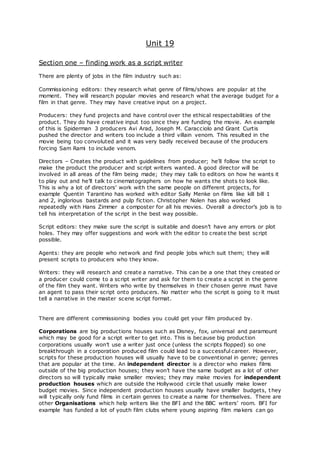
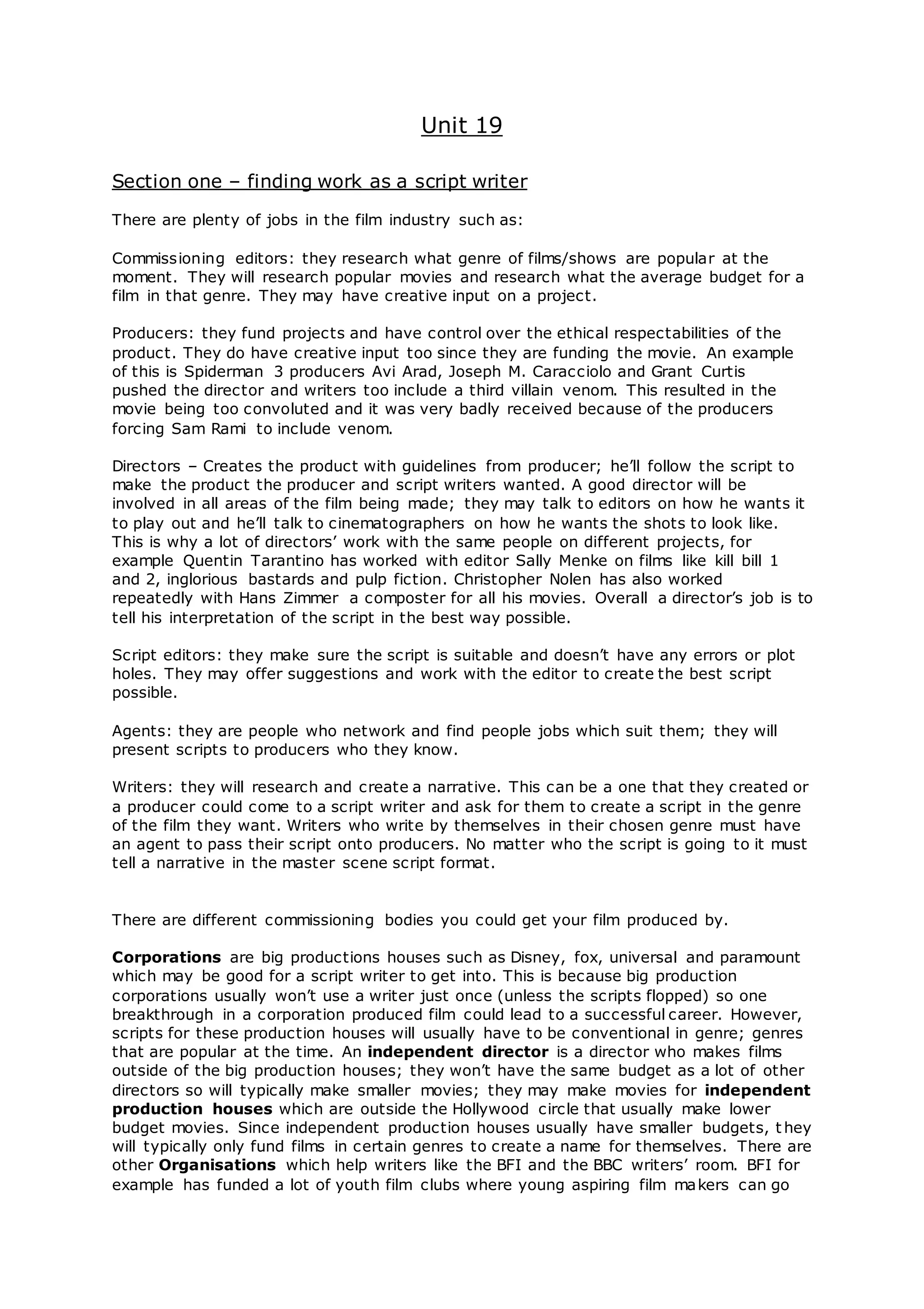
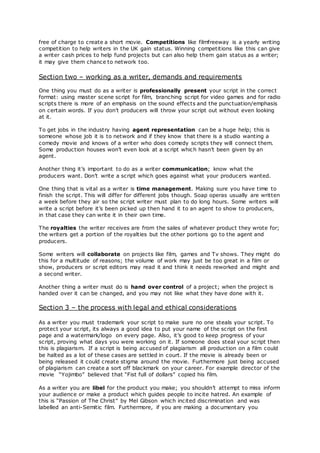
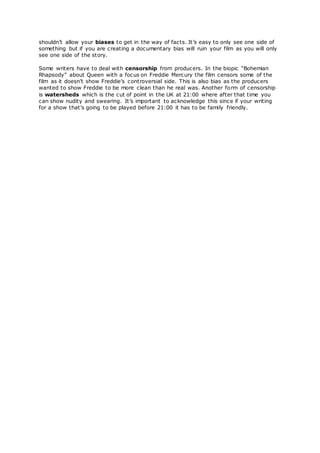
Unit 19
Section one – finding work as a script writer
There are plenty of jobs in the film industry such as:
Commissioning editors: they research what genre of films/shows are popular at the
moment. They will research popular movies and research what the average budget for a
film in that genre. They may have creative input on a project.
Producers: they fund projects and have control over the ethical respectabilities of the
product. They do have creative input too since they are funding the movie. An example
of this is Spiderman 3 producers Avi Arad, Joseph M. Caracciolo and Grant Curtis
pushed the director and writers too include a third villain venom. This resulted in the
movie being too convoluted and it was very badly received because of the producers
forcing Sam Rami to include venom.
Directors – Creates the product with guidelines from producer; he’ll follow the script to
make the product the producer and script writers wanted. A good director will be
involved in all areas of the film being made; they may talk to editors on how he wants it
to play out and he’ll talk to cinematographers on how he wants the shots to look like.
This is why a lot of directors’ work with the same people on different projects, for
example Quentin Tarantino has worked with editor Sally Menke on films like kill bill 1
and 2, inglorious bastards and pulp fiction. Christopher Nolen has also worked
repeatedly with Hans Zimmer a composter for all his movies. Overall a director’s job is to
tell his interpretation of the script in the best way possible.
Script editors: they make sure the script is suitable and doesn’t have any errors or plot
holes. They may offer suggestions and work with the editor to create the best script
possible.
Agents: they are people who network and find people jobs which suit them; they will
present scripts to producers who they know.
Writers: they will research and create a narrative. This can be a one that they created or
a producer could come to a script writer and ask for them to create a script in the genre
of the film they want. Writers who write by themselves in their chosen genre must have
an agent to pass their script onto producers. No matter who the script is going to it must
tell a narrative in the master scene script format.
There are different commissioning bodies you could get your film produced by.
Corporations are big productions houses such as Disney, fox, universal and paramount
which may be good for a script writer to get into. This is because big production
corporations usually won’t use a writer just once (unless the scripts flopped) so one
breakthrough in a corporation produced film could lead to a successful career. However,
scripts for these production houses will usually have to be conventional in genre; genres
that are popular at the time. An independent director is a director who makes films
outside of the big production houses; they won’t have the same budget as a lot of other
directors so will typically make smaller movies; they may make movies for independent
production houses which are outside the Hollywood circle that usually make lower
budget movies. Since independent production houses usually have smaller budgets, t hey
will typically only fund films in certain genres to create a name for themselves. There are
other Organisations which help writers like the BFI and the BBC writers’ room. BFI for
example has funded a lot of youth film clubs where young aspiring film makers can go
free of charge to create a short movie. Competitions like filmfreeway is a yearly writing
competition to help writers in the UK gain status. Winning competitions like this can give
a writer cash prices to help fund projects but can also help them gain status as a writer;
it may give them chance to network too.
Section two – working as a writer, demands and requirements
One thing you must do as a writer is professionally present your script in the correct
format: using master scene script for film, branching script for video games and for radio
scripts there is more of an emphasis on the sound effects and the punctuation/emphasis
on certain words. If you don’t producers will throw your script out without even looking
at it.
To get jobs in the industry having agent representation can be a huge help; this is
someone whose job it is to network and if they know that there is a studio wanting a
comedy movie and knows of a writer who does comedy scripts they will connect them.
Some production houses won’t even look at a script which hasn’t been given by an
agent.
Another thing it’s important to do as a writer communication; know what the
producers want. Don’t write a script which goes against what your producers wanted.
One thing that is vital as a writer is time management. Making sure you have time to
finish the script. This will differ for different jobs though. Soap operas usually are written
a week before they air so the script writer must plan to do long hours. Some writers will
write a script before it’s been picked up then hand it to an agent to show to producers,
in that case they can write it in their own time.
The royalties the writer receives are from the sales of whatever product they wrote for;
the writers get a portion of the royalties but the other portions go to the agent and
producers.
Some writers will collaborate on projects like film, games and Tv shows. They might do
this for a multitude of reasons; the volume of work may just be too great in a film or
show, producers or script editors may read it and think it needs reworked and might and
a second writer.
Another thing a writer must do is hand over control of a project; when the project is
handed over it can be changed, and you may not like what they have done with it.
Section 3 – the process with legal and ethical considerations
As a writer you must trademark your script to make sure no one steals your script. To
protect your script, its always a good idea to put your name of the script on the first
page and a watermark/logo on every page. Also, it’s good to keep progress of your
script, proving what days you were working on it. If someone does steal your script then
this is plagiarism. If a script is being accused of plagiarism all production on a film could
be halted as a lot of these cases are settled in court. If the movie is already been or
being released it could create stigma around the movie. Furthermore just being accused
of plagiarism can create a sort off blackmark on your career. For example director of the
movie “Yojimbo” believed that “Fist full of dollars” copied his film.
As a writer you are libel for the product you make; you shouldn’t attempt to miss inform
your audience or make a product which guides people to incite hatred. An example of
this is “Passion of The Christ” by Mel Gibson which incited discrimination and was
labelled an anti-Semitic film. Furthermore, if you are making a documentary you
shouldn’t allow your biases to get in the way of facts. It’s easy to only see one side of
something but if you are creating a documentary bias will ruin your film as you will only
see one side of the story.
Some writers have to deal with censorship from producers. In the biopic “Bohemian
Rhapsody” about Queen with a focus on Freddie Mercury the film censors some of the
film as it doesn’t show Freddie’s controversial side. This is also bias as the producers
wanted to show Freddie to be more clean than he real was. Another form of censorship
is watersheds which is the cut of point in the UK at 21:00 where after that time you
can show nudity and swearing. It’s important to acknowledge this since if your writing
for a show that’s going to be played before 21:00 it has to be family friendly.

Unit 19 learning aim

  • 1.
    Unit 19 Section one– finding work as a script writer There are plenty of jobs in the film industry such as: Commissioning editors: they research what genre of films/shows are popular at the moment. They will research popular movies and research what the average budget for a film in that genre. They may have creative input on a project. Producers: they fund projects and have control over the ethical respectabilities of the product. They do have creative input too since they are funding the movie. An example of this is Spiderman 3 producers Avi Arad, Joseph M. Caracciolo and Grant Curtis pushed the director and writers too include a third villain venom. This resulted in the movie being too convoluted and it was very badly received because of the producers forcing Sam Rami to include venom. Directors – Creates the product with guidelines from producer; he’ll follow the script to make the product the producer and script writers wanted. A good director will be involved in all areas of the film being made; they may talk to editors on how he wants it to play out and he’ll talk to cinematographers on how he wants the shots to look like. This is why a lot of directors’ work with the same people on different projects, for example Quentin Tarantino has worked with editor Sally Menke on films like kill bill 1 and 2, inglorious bastards and pulp fiction. Christopher Nolen has also worked repeatedly with Hans Zimmer a composter for all his movies. Overall a director’s job is to tell his interpretation of the script in the best way possible. Script editors: they make sure the script is suitable and doesn’t have any errors or plot holes. They may offer suggestions and work with the editor to create the best script possible. Agents: they are people who network and find people jobs which suit them; they will present scripts to producers who they know. Writers: they will research and create a narrative. This can be a one that they created or a producer could come to a script writer and ask for them to create a script in the genre of the film they want. Writers who write by themselves in their chosen genre must have an agent to pass their script onto producers. No matter who the script is going to it must tell a narrative in the master scene script format. There are different commissioning bodies you could get your film produced by. Corporations are big productions houses such as Disney, fox, universal and paramount which may be good for a script writer to get into. This is because big production corporations usually won’t use a writer just once (unless the scripts flopped) so one breakthrough in a corporation produced film could lead to a successful career. However, scripts for these production houses will usually have to be conventional in genre; genres that are popular at the time. An independent director is a director who makes films outside of the big production houses; they won’t have the same budget as a lot of other directors so will typically make smaller movies; they may make movies for independent production houses which are outside the Hollywood circle that usually make lower budget movies. Since independent production houses usually have smaller budgets, t hey will typically only fund films in certain genres to create a name for themselves. There are other Organisations which help writers like the BFI and the BBC writers’ room. BFI for example has funded a lot of youth film clubs where young aspiring film makers can go
  • 2.
    free of chargeto create a short movie. Competitions like filmfreeway is a yearly writing competition to help writers in the UK gain status. Winning competitions like this can give a writer cash prices to help fund projects but can also help them gain status as a writer; it may give them chance to network too. Section two – working as a writer, demands and requirements One thing you must do as a writer is professionally present your script in the correct format: using master scene script for film, branching script for video games and for radio scripts there is more of an emphasis on the sound effects and the punctuation/emphasis on certain words. If you don’t producers will throw your script out without even looking at it. To get jobs in the industry having agent representation can be a huge help; this is someone whose job it is to network and if they know that there is a studio wanting a comedy movie and knows of a writer who does comedy scripts they will connect them. Some production houses won’t even look at a script which hasn’t been given by an agent. Another thing it’s important to do as a writer communication; know what the producers want. Don’t write a script which goes against what your producers wanted. One thing that is vital as a writer is time management. Making sure you have time to finish the script. This will differ for different jobs though. Soap operas usually are written a week before they air so the script writer must plan to do long hours. Some writers will write a script before it’s been picked up then hand it to an agent to show to producers, in that case they can write it in their own time. The royalties the writer receives are from the sales of whatever product they wrote for; the writers get a portion of the royalties but the other portions go to the agent and producers. Some writers will collaborate on projects like film, games and Tv shows. They might do this for a multitude of reasons; the volume of work may just be too great in a film or show, producers or script editors may read it and think it needs reworked and might and a second writer. Another thing a writer must do is hand over control of a project; when the project is handed over it can be changed, and you may not like what they have done with it. Section 3 – the process with legal and ethical considerations As a writer you must trademark your script to make sure no one steals your script. To protect your script, its always a good idea to put your name of the script on the first page and a watermark/logo on every page. Also, it’s good to keep progress of your script, proving what days you were working on it. If someone does steal your script then this is plagiarism. If a script is being accused of plagiarism all production on a film could be halted as a lot of these cases are settled in court. If the movie is already been or being released it could create stigma around the movie. Furthermore just being accused of plagiarism can create a sort off blackmark on your career. For example director of the movie “Yojimbo” believed that “Fist full of dollars” copied his film. As a writer you are libel for the product you make; you shouldn’t attempt to miss inform your audience or make a product which guides people to incite hatred. An example of this is “Passion of The Christ” by Mel Gibson which incited discrimination and was labelled an anti-Semitic film. Furthermore, if you are making a documentary you
  • 3.
    shouldn’t allow yourbiases to get in the way of facts. It’s easy to only see one side of something but if you are creating a documentary bias will ruin your film as you will only see one side of the story. Some writers have to deal with censorship from producers. In the biopic “Bohemian Rhapsody” about Queen with a focus on Freddie Mercury the film censors some of the film as it doesn’t show Freddie’s controversial side. This is also bias as the producers wanted to show Freddie to be more clean than he real was. Another form of censorship is watersheds which is the cut of point in the UK at 21:00 where after that time you can show nudity and swearing. It’s important to acknowledge this since if your writing for a show that’s going to be played before 21:00 it has to be family friendly.