Units 4, 5, 24, 31
Task 2
Lauren Rosenfeld
Job Roles
Once a scriptwriter is ready to publish a script, they must decide whether they want to
work with an independent company or a corporation. If they choose to go with a
corporation, they will be in frequent contact with a commissioning editor, who works
for the corporation, in order to pitch their idea. Producers will meet with
commissioning editors to make them aware of what the corporation is looking for in a
new television show. A scriptwriter can also go through an independent company,
which is much smaller than a corporation, and it is likely that the commissioning
editor will have the same role as the producer. Independent companies also do not
actively advertise that they want scriptwriters/scripts, and therefore the screenwriter
has to contact them directly or hire an agent to do so.
Job Roles - Commissioning Editor
Commissioning editors select ideas that they feel will work well on television and
meet with producers to discuss what programmes to air, and when to air them
(discussing available time slots). Once they have decided what programme they want,
they will publicly advertise to find scriptwriters to pitch their ideas. If a scriptwriter
has a suitable idea, which meets the criteria, they will contact the commissioning
editor in order to pitch. There are usually different commissioning editors for specific
genres of film/TV. For example, one person would select ideas for dramas, and another
would be selecting ideas comedies. Once the commissioning editor has chosen an idea
and given the production team a budget they follow the production until it is aired on
television.
Job Roles - Commissioning Editor
If the pitch is a success, the screenwriter and commissioning editor will work together to
develop a treatment to show to the producers. The commissioning editor will also discuss
how much they will pay the scriptwriter, and any other details to do with the potential
television show, such as the amount of episodes and seasons that will be produced. One
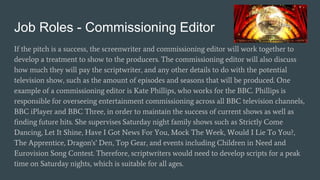
example of a commissioning editor is Kate Phillips, who works for the BBC. Phillips is
responsible for overseeing entertainment commissioning across all BBC television channels,
BBC iPlayer and BBC Three, in order to maintain the success of current shows as well as
finding future hits. She supervises Saturday night family shows such as Strictly Come
Dancing, Let It Shine, Have I Got News For You, Mock The Week, Would I Lie To You?,
The Apprentice, Dragon's’ Den, Top Gear, and events including Children in Need and
Eurovision Song Contest. Therefore, scriptwriters would need to develop scripts for a peak
time on Saturday nights, which is suitable for all ages.
Job Roles - Commissioning Editor
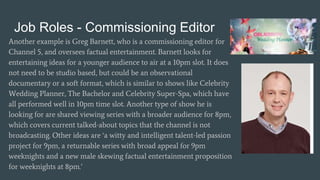
Another example is Greg Barnett, who is a commissioning editor for
Channel 5, and oversees factual entertainment. Barnett looks for
entertaining ideas for a younger audience to air at a 10pm slot. It does
not need to be studio based, but could be an observational
documentary or a soft format, which is similar to shows like Celebrity
Wedding Planner, The Bachelor and Celebrity Super-Spa, which have
all performed well in 10pm time slot. Another type of show he is
looking for are shared viewing series with a broader audience for 8pm,
which covers current talked-about topics that the channel is not
broadcasting. Other ideas are ‘a witty and intelligent talent-led passion
project for 9pm, a returnable series with broad appeal for 9pm
weeknights and a new male skewing factual entertainment proposition
for weeknights at 8pm.’
Job Roles - Producers
Producers have a lot of responsibility when producing a television show. They oversee each
project from the start to completion and are likely to be involved in the marketing and
distribution processes. Producers work closely with directors and other production staff on
the shoot and arrange funding for each project in order to keep the production within the
allocated budget. Producers regularly communicate with the commissioning editor, to
discuss what type of programmes the channel wants to air, including what genre it will be,
the style and the timeslot of it. The producer ultimately has the final decision on whether
they will commision the script, and any adjustments they want to make, before they decide
to officially produce it, and begin pre production. One skill a producer must have is
understanding finance, in order to properly budget and create a successful production that
brings in profit. They must also be able to work with a team and motivate others to ensure
the production runs smoothly, and it is helpful if they have prior experience within the TV
and/or film industry.
Job Roles - Producers
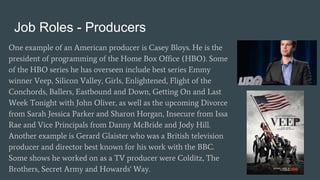
One example of an American producer is Casey Bloys. He is the
president of programming of the Home Box Office (HBO). Some
of the HBO series he has overseen include best series Emmy
winner Veep, Silicon Valley, Girls, Enlightened, Flight of the
Conchords, Ballers, Eastbound and Down, Getting On and Last
Week Tonight with John Oliver, as well as the upcoming Divorce
from Sarah Jessica Parker and Sharon Horgan, Insecure from Issa
Rae and Vice Principals from Danny McBride and Jody Hill.
Another example is Gerard Glaister who was a British television
producer and director best known for his work with the BBC.
Some shows he worked on as a TV producer were Colditz, The
Brothers, Secret Army and Howards' Way.
Job Roles - Scriptwriters
Screenwriters create screenplays for films. Screenplays set out how the film works on
screen. The screenwriter must produce highly creative writing to strict deadlines.
Sometimes, they work with a script development team to create a finished product.
Other times, producers hire an additional Screenwriter to improve certain aspects of
the screenplay. In this case, the Screenwriter shares a credit with the original
Screenwriter. Screenwriters are almost always freelancers, and pitch their original
ideas to Producers to be sold. Or they are commissioned by a Producer to create a
screenplay from a concept, true story, existing screen work or a novel, poem, play,
comic book or short story. Woody Allen is a famous screenwriter, who has produced
several classic films, such as Annie Hall (1977) and Manhattan (1979). Vince Gilligan is
another famous screenwriter, for TV. He is most famous for producing episodes of
Breaking Bad.
Job Roles - Scriptwriters
There are no set qualifications to become a screenwriter, but it is useful to take courses to
develop skills and understand dramatic structure. Courses to improve writing include
creative writing and scriptwriting. It may also be useful to have experience in journalism
and advertising copywriting. Individuals can also start by coming up with their own
screenplays and ideas, and trying to sell them to agents and producers. If ideas are good,
then they may be sold, thus building a professional reputation. Therefore, several producers
may begin to ask for scripts. There are also screenwriting competitions, in order to get
noticed by broadcasters and regional screen agencies, and work can be submitted to
professionals directly, such as through the BBC Writers Room. Several skills are needed to
become a screenwriter. These include having an excellent writing ability, being creative,
having storytelling skills and an understanding of dramatic structure and be willingness to
accept criticism and rejection of work.
Job Roles - Agents
Agents represent performers and creative team members who work across different
industries, including film, television, radio and theatre. Their clients range from actors,
singers, and dancers to comedians, presenters, choreographers, designers and directors.
Agents find work for their clients, creating relationships with industry professionals in
order to persuade them to take their clients on. They must establish and maintain
relationships, so that they create more contacts and have a larger network, to ensure
work for their clients. Agents must keep up to date with what's happening in the
entertainment industry and find out what productions are in development, and which
have been given a green light. They negotiate contracts and secure deals for clients,
keep up to date with industry rates and agreements and support their artists' careers.
Job Roles - Agents
Having an agent represent you means that you have a higher
chance of getting corporations to invest in your script. This is
due to the agent having a relationship with big production
companies and producers after years of building networks
with them. One agency is Endeavor Talent Agency, who
merged with The William Morris Agency to become William
Morris Endeavor. Some of their screenwriter clients include
Greg Berlanti, Linwood Boomer and Robert Carlock. They
also represent actors, including Amy Adams, Ben Affleck,
Casey Affleck, Jessica Alba, Kevin Bacon and Christian Bale.
For example, Patrick Whitesell is Ben Afflecks agent and co-
CEO of WME, an entertainment and media agency.
Commissioning Body - Corporations
A film corporation is a company that releases several films yearly and
typically owns other subsidiaries, meaning they have a lot more
money than independent companies. Their income comes from box
office revenue of the film and sales of the film. Therefore, a
corporation cannot afford to create bad movies, because if it fails to
make a profit at the box office, the corporation will make massive
losses for a lot of work. There are currently six major film
corporations, which are Warner Brothers, Paramount, Sony, NBC,
Fox, Disney. A commissioning corporation for TV is the BBC and
they take on all kinds of new programmes to be aired, they also have
broadcasting rights for TV. BBC Three has a more specific
commissioning process, and is a mixed genre channel for young
audiences.
Commissioning Body - Corporations
They state that ‘the channel needs to be disciplined about focusing on the young – its
centre of gravity will be 16-34 year-olds: people who are young in spirit and mindset.’
BBC Three is ‘never afraid to try new stuff and that’s why we will continue to innovate
with breakthrough comedy, stand-out entertainment, brave documentary and
intelligent factual formats.’ BBC Three should ‘provide an environment for the
development of new ideas and talent and for existing talent to take risks, becoming a
genuine laboratory for BBC One and BBC Two.’ Therefore, BBC Three is good to get a
programme commissioned, as long as it is aimed at the 16-34 age group. A scriptwriter
will likely get a higher wage when going through a corporation, as they have more
money. It is also impressive to add to a CV to have worked for a corporation, as it
means the person is highly skilled in the role and have competed against other people.
Commissioning Body - Independents
These are films that are produced outside major film corporations
and typically Independent Production companies create low budget
films. Bigger companies usually are not interested in low budget
films because they may not yield as much profit at the box office.
Independent companies are a good opportunity for beginner
directors to build a reputation by creating a hit movie with limited
resources. Some examples of Independent Production Companies
are The Weinstein Company, Interscope Pictures, Liberty Media,
Sony Pictures Classics, Fox Searchlight Pictures and Mirabai Films.
Commissioning Body - Independents
Due to independent companies being much smaller, they do not own broadcasting
rights for TV. For a scriptwriter that is just starting out it is much easier and better to
find an independent company. Due to there being less competition, a screenwriter is
more likely to have their script commissioned. However, due to it being considerably
smaller than a corporation, the screenwriter is likely to receive a smaller fee. An
example of an independent production company in the UK is All3Media, which is
known for commissioning and distributing several successful television shows. These
include Embarrassing Bodies, Fifth Gear and Hollyoaks. A separate production
company is New Pictures, which have produced hit drama series, including The
Missing (BBC One and Starz) and Indian Summers (Channel 4 and WGBH).
The Role of the Writer
The screenwriter has several roles. For starters, they have to create a script for a
television show or film. A screenplay should clearly show the writer's vision, in order
for it to play out correctly on screen. Therefore, It is important that the writer follows
the basic principles of dramatic construction. To become a screenwriter, it is useful to
write original, short and feature screenplays to try to attract the attention of Producers
and Agents. A qualification from a respected institution shows ability and can make a
development executive, producer or agent more inclined to consider a submission. It is
also practical to have a network of readers, who are capable of giving constructive
feedback on works-in-progress.
The Role of the Writer
Individuals can then start to send out scripts, such as to the BBC writersroom, who
give feedback on work that shows promise. Amatuer screenwriters can begin
networking, and show possible employers screenplays, by getting work experience and
interning. Here, they can get close to the actors and director to see how they work with
the script. Screenwriters will also need to prepare pitches, synopses and outlines, for
producers. Most screenwriters are freelance, however, they may also have an agent to
negotiate fees for a script and set up meetings with commissioning editors. Abi
Morgan is a British playwright and screenwriter known for her works for television,
such as Sex Traffic and The Hour, and the films Brick Lane, The Iron Lady, Shame and
Suffragette.
Legal and Ethical consideration - Copyright
The Copyright, Designs and Patents Act 1988 was introduced in order to protect intellectual
property, and gives the creators of literary, dramatic, artistic and musical works rights. These
rights prevent others from copying an individual's work without permission. Thus, a
screenwriter must make sure that they do not copy another person's work, when writing a
script, and they should also ensure that their script is copyrighted, so that another does not
copy their script. A screenwriter can copyright their script by registering. The Matrix franchise
has been sued twice, for copyright infringement. The first came from a woman named Sophie
Stewart who claimed the Wachowski brothers stole her screen treatment called The Third Eye,
and that she was robbed of over $200 million dollars. She also claimed that The Terminator
was based on her treatment. She filed a lawsuit against the makers of the film, seeking over $1
billion in damages, but the case was dismissed in June 2005 when she failed to show up for a
preliminary hearing of her case
Legal and Ethical consideration - Censorship and Watershed
The watershed (censorship) is the time when TV programmes which might be unsuitable for
children can be broadcast, essentially it is suppressing freedom of speech until after 9pm. It is
enforced by Ofcom from 9pm to 5:30 am, and is designed to protect children from harmful
material that may otherwise influence them. For instance, material that shows violence,
graphic or distressing imagery and swearing will be shown during the watershed, in order for
young children not to witness it. Tv shows or films with frequent use of offensive language
must not be shown before the watershed, and if it is shown then the offensive language is to
be cut out. However, mature adult material is not to be shown instantly at 9pm, and should
instead appear later in the evening. But, Ofcom’s rules still apply during this time to protect
viewers from offensive and harmful content. If a commissioning editor states in a brief that a
programme they are after will air before the watershed, the scriptwriter must not add in
anything inappropriate, otherwise they will not have a chance of having their script
commissioned.
Legal and Ethical consideration - Censorship and Watershed
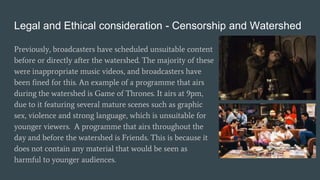
Previously, broadcasters have scheduled unsuitable content
before or directly after the watershed. The majority of these
were inappropriate music videos, and broadcasters have
been fined for this. An example of a programme that airs
during the watershed is Game of Thrones. It airs at 9pm,
due to it featuring several mature scenes such as graphic
sex, violence and strong language, which is unsuitable for
younger viewers. A programme that airs throughout the
day and before the watershed is Friends. This is because it
does not contain any material that would be seen as
harmful to younger audiences.
Legal and Ethical consideration - Libel
The defamation act exists to protect an individual's reputation from being damaged.
Libel is a written or published defamatory statement, while slander is defamation that is
spoken. If a person's reputation is damaged as a result of another person's statements,
they can then proceed to sue them for defamation. You can defame someone by
publishing material in various forms, such as through newspapers or other printed
media, broadcasting on radio and the internet (online forums, social media and blogs),
or by email. People can sue so long as the material can be reasonably understood to be
referring to them. Therefore, a screenwriter must make sure that when they write a
script they do not damage someone's reputation and/or make a false claim, as the
screenwriter may be sued for damaging that person's reputation, and in turn the writers
reputations may be damaged, resulting in them possibly not getting their scripts
commissioned anymore.
Legal and Ethical consideration - Libel
To avoid legal issues, a writer will often use 'fake' characters and settings exaggerating
them to make the point. A good example is seen in George Orwell's Animal Farm
where Russian politicians are depicted as farm animals, the best known is the pig
'Napoleon' who was based around Russian dictator Joseph Stalin.

Units 4, 5, 24, 31 task 2

  • 1.
    Units 4, 5,24, 31 Task 2 Lauren Rosenfeld
  • 2.
    Job Roles Once ascriptwriter is ready to publish a script, they must decide whether they want to work with an independent company or a corporation. If they choose to go with a corporation, they will be in frequent contact with a commissioning editor, who works for the corporation, in order to pitch their idea. Producers will meet with commissioning editors to make them aware of what the corporation is looking for in a new television show. A scriptwriter can also go through an independent company, which is much smaller than a corporation, and it is likely that the commissioning editor will have the same role as the producer. Independent companies also do not actively advertise that they want scriptwriters/scripts, and therefore the screenwriter has to contact them directly or hire an agent to do so.
  • 3.
    Job Roles -Commissioning Editor Commissioning editors select ideas that they feel will work well on television and meet with producers to discuss what programmes to air, and when to air them (discussing available time slots). Once they have decided what programme they want, they will publicly advertise to find scriptwriters to pitch their ideas. If a scriptwriter has a suitable idea, which meets the criteria, they will contact the commissioning editor in order to pitch. There are usually different commissioning editors for specific genres of film/TV. For example, one person would select ideas for dramas, and another would be selecting ideas comedies. Once the commissioning editor has chosen an idea and given the production team a budget they follow the production until it is aired on television.
  • 4.
    Job Roles -Commissioning Editor If the pitch is a success, the screenwriter and commissioning editor will work together to develop a treatment to show to the producers. The commissioning editor will also discuss how much they will pay the scriptwriter, and any other details to do with the potential television show, such as the amount of episodes and seasons that will be produced. One example of a commissioning editor is Kate Phillips, who works for the BBC. Phillips is responsible for overseeing entertainment commissioning across all BBC television channels, BBC iPlayer and BBC Three, in order to maintain the success of current shows as well as finding future hits. She supervises Saturday night family shows such as Strictly Come Dancing, Let It Shine, Have I Got News For You, Mock The Week, Would I Lie To You?, The Apprentice, Dragon's’ Den, Top Gear, and events including Children in Need and Eurovision Song Contest. Therefore, scriptwriters would need to develop scripts for a peak time on Saturday nights, which is suitable for all ages.
  • 5.
    Job Roles -Commissioning Editor Another example is Greg Barnett, who is a commissioning editor for Channel 5, and oversees factual entertainment. Barnett looks for entertaining ideas for a younger audience to air at a 10pm slot. It does not need to be studio based, but could be an observational documentary or a soft format, which is similar to shows like Celebrity Wedding Planner, The Bachelor and Celebrity Super-Spa, which have all performed well in 10pm time slot. Another type of show he is looking for are shared viewing series with a broader audience for 8pm, which covers current talked-about topics that the channel is not broadcasting. Other ideas are ‘a witty and intelligent talent-led passion project for 9pm, a returnable series with broad appeal for 9pm weeknights and a new male skewing factual entertainment proposition for weeknights at 8pm.’
  • 6.
    Job Roles -Producers Producers have a lot of responsibility when producing a television show. They oversee each project from the start to completion and are likely to be involved in the marketing and distribution processes. Producers work closely with directors and other production staff on the shoot and arrange funding for each project in order to keep the production within the allocated budget. Producers regularly communicate with the commissioning editor, to discuss what type of programmes the channel wants to air, including what genre it will be, the style and the timeslot of it. The producer ultimately has the final decision on whether they will commision the script, and any adjustments they want to make, before they decide to officially produce it, and begin pre production. One skill a producer must have is understanding finance, in order to properly budget and create a successful production that brings in profit. They must also be able to work with a team and motivate others to ensure the production runs smoothly, and it is helpful if they have prior experience within the TV and/or film industry.
  • 7.
    Job Roles -Producers One example of an American producer is Casey Bloys. He is the president of programming of the Home Box Office (HBO). Some of the HBO series he has overseen include best series Emmy winner Veep, Silicon Valley, Girls, Enlightened, Flight of the Conchords, Ballers, Eastbound and Down, Getting On and Last Week Tonight with John Oliver, as well as the upcoming Divorce from Sarah Jessica Parker and Sharon Horgan, Insecure from Issa Rae and Vice Principals from Danny McBride and Jody Hill. Another example is Gerard Glaister who was a British television producer and director best known for his work with the BBC. Some shows he worked on as a TV producer were Colditz, The Brothers, Secret Army and Howards' Way.
  • 8.
    Job Roles -Scriptwriters Screenwriters create screenplays for films. Screenplays set out how the film works on screen. The screenwriter must produce highly creative writing to strict deadlines. Sometimes, they work with a script development team to create a finished product. Other times, producers hire an additional Screenwriter to improve certain aspects of the screenplay. In this case, the Screenwriter shares a credit with the original Screenwriter. Screenwriters are almost always freelancers, and pitch their original ideas to Producers to be sold. Or they are commissioned by a Producer to create a screenplay from a concept, true story, existing screen work or a novel, poem, play, comic book or short story. Woody Allen is a famous screenwriter, who has produced several classic films, such as Annie Hall (1977) and Manhattan (1979). Vince Gilligan is another famous screenwriter, for TV. He is most famous for producing episodes of Breaking Bad.
  • 9.
    Job Roles -Scriptwriters There are no set qualifications to become a screenwriter, but it is useful to take courses to develop skills and understand dramatic structure. Courses to improve writing include creative writing and scriptwriting. It may also be useful to have experience in journalism and advertising copywriting. Individuals can also start by coming up with their own screenplays and ideas, and trying to sell them to agents and producers. If ideas are good, then they may be sold, thus building a professional reputation. Therefore, several producers may begin to ask for scripts. There are also screenwriting competitions, in order to get noticed by broadcasters and regional screen agencies, and work can be submitted to professionals directly, such as through the BBC Writers Room. Several skills are needed to become a screenwriter. These include having an excellent writing ability, being creative, having storytelling skills and an understanding of dramatic structure and be willingness to accept criticism and rejection of work.
  • 10.
    Job Roles -Agents Agents represent performers and creative team members who work across different industries, including film, television, radio and theatre. Their clients range from actors, singers, and dancers to comedians, presenters, choreographers, designers and directors. Agents find work for their clients, creating relationships with industry professionals in order to persuade them to take their clients on. They must establish and maintain relationships, so that they create more contacts and have a larger network, to ensure work for their clients. Agents must keep up to date with what's happening in the entertainment industry and find out what productions are in development, and which have been given a green light. They negotiate contracts and secure deals for clients, keep up to date with industry rates and agreements and support their artists' careers.
  • 11.
    Job Roles -Agents Having an agent represent you means that you have a higher chance of getting corporations to invest in your script. This is due to the agent having a relationship with big production companies and producers after years of building networks with them. One agency is Endeavor Talent Agency, who merged with The William Morris Agency to become William Morris Endeavor. Some of their screenwriter clients include Greg Berlanti, Linwood Boomer and Robert Carlock. They also represent actors, including Amy Adams, Ben Affleck, Casey Affleck, Jessica Alba, Kevin Bacon and Christian Bale. For example, Patrick Whitesell is Ben Afflecks agent and co- CEO of WME, an entertainment and media agency.
  • 12.
    Commissioning Body -Corporations A film corporation is a company that releases several films yearly and typically owns other subsidiaries, meaning they have a lot more money than independent companies. Their income comes from box office revenue of the film and sales of the film. Therefore, a corporation cannot afford to create bad movies, because if it fails to make a profit at the box office, the corporation will make massive losses for a lot of work. There are currently six major film corporations, which are Warner Brothers, Paramount, Sony, NBC, Fox, Disney. A commissioning corporation for TV is the BBC and they take on all kinds of new programmes to be aired, they also have broadcasting rights for TV. BBC Three has a more specific commissioning process, and is a mixed genre channel for young audiences.
  • 13.
    Commissioning Body -Corporations They state that ‘the channel needs to be disciplined about focusing on the young – its centre of gravity will be 16-34 year-olds: people who are young in spirit and mindset.’ BBC Three is ‘never afraid to try new stuff and that’s why we will continue to innovate with breakthrough comedy, stand-out entertainment, brave documentary and intelligent factual formats.’ BBC Three should ‘provide an environment for the development of new ideas and talent and for existing talent to take risks, becoming a genuine laboratory for BBC One and BBC Two.’ Therefore, BBC Three is good to get a programme commissioned, as long as it is aimed at the 16-34 age group. A scriptwriter will likely get a higher wage when going through a corporation, as they have more money. It is also impressive to add to a CV to have worked for a corporation, as it means the person is highly skilled in the role and have competed against other people.
  • 14.
    Commissioning Body -Independents These are films that are produced outside major film corporations and typically Independent Production companies create low budget films. Bigger companies usually are not interested in low budget films because they may not yield as much profit at the box office. Independent companies are a good opportunity for beginner directors to build a reputation by creating a hit movie with limited resources. Some examples of Independent Production Companies are The Weinstein Company, Interscope Pictures, Liberty Media, Sony Pictures Classics, Fox Searchlight Pictures and Mirabai Films.
  • 15.
    Commissioning Body -Independents Due to independent companies being much smaller, they do not own broadcasting rights for TV. For a scriptwriter that is just starting out it is much easier and better to find an independent company. Due to there being less competition, a screenwriter is more likely to have their script commissioned. However, due to it being considerably smaller than a corporation, the screenwriter is likely to receive a smaller fee. An example of an independent production company in the UK is All3Media, which is known for commissioning and distributing several successful television shows. These include Embarrassing Bodies, Fifth Gear and Hollyoaks. A separate production company is New Pictures, which have produced hit drama series, including The Missing (BBC One and Starz) and Indian Summers (Channel 4 and WGBH).
  • 16.
    The Role ofthe Writer The screenwriter has several roles. For starters, they have to create a script for a television show or film. A screenplay should clearly show the writer's vision, in order for it to play out correctly on screen. Therefore, It is important that the writer follows the basic principles of dramatic construction. To become a screenwriter, it is useful to write original, short and feature screenplays to try to attract the attention of Producers and Agents. A qualification from a respected institution shows ability and can make a development executive, producer or agent more inclined to consider a submission. It is also practical to have a network of readers, who are capable of giving constructive feedback on works-in-progress.
  • 17.
    The Role ofthe Writer Individuals can then start to send out scripts, such as to the BBC writersroom, who give feedback on work that shows promise. Amatuer screenwriters can begin networking, and show possible employers screenplays, by getting work experience and interning. Here, they can get close to the actors and director to see how they work with the script. Screenwriters will also need to prepare pitches, synopses and outlines, for producers. Most screenwriters are freelance, however, they may also have an agent to negotiate fees for a script and set up meetings with commissioning editors. Abi Morgan is a British playwright and screenwriter known for her works for television, such as Sex Traffic and The Hour, and the films Brick Lane, The Iron Lady, Shame and Suffragette.
  • 18.
    Legal and Ethicalconsideration - Copyright The Copyright, Designs and Patents Act 1988 was introduced in order to protect intellectual property, and gives the creators of literary, dramatic, artistic and musical works rights. These rights prevent others from copying an individual's work without permission. Thus, a screenwriter must make sure that they do not copy another person's work, when writing a script, and they should also ensure that their script is copyrighted, so that another does not copy their script. A screenwriter can copyright their script by registering. The Matrix franchise has been sued twice, for copyright infringement. The first came from a woman named Sophie Stewart who claimed the Wachowski brothers stole her screen treatment called The Third Eye, and that she was robbed of over $200 million dollars. She also claimed that The Terminator was based on her treatment. She filed a lawsuit against the makers of the film, seeking over $1 billion in damages, but the case was dismissed in June 2005 when she failed to show up for a preliminary hearing of her case
  • 19.
    Legal and Ethicalconsideration - Censorship and Watershed The watershed (censorship) is the time when TV programmes which might be unsuitable for children can be broadcast, essentially it is suppressing freedom of speech until after 9pm. It is enforced by Ofcom from 9pm to 5:30 am, and is designed to protect children from harmful material that may otherwise influence them. For instance, material that shows violence, graphic or distressing imagery and swearing will be shown during the watershed, in order for young children not to witness it. Tv shows or films with frequent use of offensive language must not be shown before the watershed, and if it is shown then the offensive language is to be cut out. However, mature adult material is not to be shown instantly at 9pm, and should instead appear later in the evening. But, Ofcom’s rules still apply during this time to protect viewers from offensive and harmful content. If a commissioning editor states in a brief that a programme they are after will air before the watershed, the scriptwriter must not add in anything inappropriate, otherwise they will not have a chance of having their script commissioned.
  • 20.
    Legal and Ethicalconsideration - Censorship and Watershed Previously, broadcasters have scheduled unsuitable content before or directly after the watershed. The majority of these were inappropriate music videos, and broadcasters have been fined for this. An example of a programme that airs during the watershed is Game of Thrones. It airs at 9pm, due to it featuring several mature scenes such as graphic sex, violence and strong language, which is unsuitable for younger viewers. A programme that airs throughout the day and before the watershed is Friends. This is because it does not contain any material that would be seen as harmful to younger audiences.
  • 21.
    Legal and Ethicalconsideration - Libel The defamation act exists to protect an individual's reputation from being damaged. Libel is a written or published defamatory statement, while slander is defamation that is spoken. If a person's reputation is damaged as a result of another person's statements, they can then proceed to sue them for defamation. You can defame someone by publishing material in various forms, such as through newspapers or other printed media, broadcasting on radio and the internet (online forums, social media and blogs), or by email. People can sue so long as the material can be reasonably understood to be referring to them. Therefore, a screenwriter must make sure that when they write a script they do not damage someone's reputation and/or make a false claim, as the screenwriter may be sued for damaging that person's reputation, and in turn the writers reputations may be damaged, resulting in them possibly not getting their scripts commissioned anymore.
  • 22.
    Legal and Ethicalconsideration - Libel To avoid legal issues, a writer will often use 'fake' characters and settings exaggerating them to make the point. A good example is seen in George Orwell's Animal Farm where Russian politicians are depicted as farm animals, the best known is the pig 'Napoleon' who was based around Russian dictator Joseph Stalin.