Name: Andy Patterson
Candidate Number: 4113
Center Name: St. Andrew’s Catholic School
Center Number: 64135
Contents
• Q Magazine
• Bauer Media Group (Slide 3)
• Purpose (Slide 4)
• Format/Size (Slide 5)
• Contents Page Analysis (Slide 6)
• Circulation Figures (Slide 7)
• Layout, Content & Style (Slide 8)
• Q Front Cover Connotations (Slide 9)
• Q Interview (Slide 10)
• Genre (Slide 11)
• Target Audience (Slide 12-17)
• Frequency (Slide 18)
• Production Process (Slide 19-20)
• Contacting Q Magazine (Slide 21)
• Digital Research (Slide 22)
• Website (Slide 23)
• Advertising in Q Magazine (Slide 24-25)
• Mojo Magazine
• Purpose of this Magazine (Slide 27)
• Bauer Media Group (Slide 28)
• Form and Style (Slide 29)
• Content (Slide 30)
• Genre (Slide 31)
• Target Audience (Slide 32-35)
• Frequency (Slide 36)
• Production Process (Slide 37-38)
• Front Cover Annotations (Slide 39)
• DPS Annotations (Slide 40)
• Conclusion (Slide 41)
Bauer Media Group
• Bauer Media Group first started in 1953 with Angling Times, and
since then, has grown from printing only magazines to distributing
music channels and radio stations.
• The company is Europe’s largest privately owned publishing groups.
It provides over 300 magazines in 15 different countries, along with
TV channels, radio stations and websites. It has made some top
selling music magazines including Q, Mojo, Kerrang, Heat and many
more for every audience.
• Bauer’s slogan is “We Think Popular” which connotes that they are
one of the top media publishing groups due to their products such
as Q and Kerrang.
• It’s key people include Yvonne Bauer who serves as the main
publisher and Jorg Hausendorf and Andreas Schoo who are both
part of the executive board.
• http://www.bauermedia.co.uk/about
• The media group EMAP started in 1953, publishing Angling Times
and was one of Britain’s most successful publishing groups. EMAP
launched Q Magazine on 1st October 1986. It became one of the
most iconic and successful music monthlies of the 1990s. In 2007,
Bauer Media Group bought EMAP magazines and EMAP’s radio
division becoming the largest private publishing group in Europe.
• The German owners, Bauer, allowed the EMAP publishing staff to
carry on as normal. The publications, which Bauer bought,
included Kerrang!, Mojo, Heat and FHM to name a few.
• Bauer used EMAP’s radio stations to publicize their magazines and
even created a Kerrang! Radio and TV channel. The even created a
TV and radio station for the defunct Smash Hits magazine.
• http://www.bauermedia.co.uk/about
Purpose
Format/Size
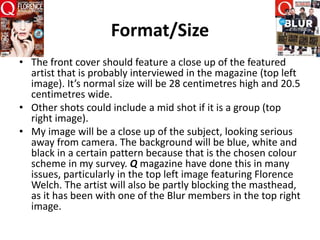
• The front cover should feature a close up of the featured
artist that is probably interviewed in the magazine (top left
image). It’s normal size will be 28 centimetres high and 20.5
centimetres wide.
• Other shots could include a mid shot if it is a group (top
right image).
• My image will be a close up of the subject, looking serious
away from camera. The background will be blue, white and
black in a certain pattern because that is the chosen colour
scheme in my survey. Q magazine have done this in many
issues, particularly in the top left image featuring Florence
Welch. The artist will also be partly blocking the masthead,
as it has been with one of the Blur members in the top right
image.
Contents Page Analysis
• The contents pages in Q tells the readers what the primary parts of the magazine issue are and where they can be read. The numbers
are each in different coloured circles and in bold to stand out from the rest of the text.
• Underneath or next to the numbers are the music artists that are featured in the articles. This gives the readers the impression that
they will quickly know where to read about their favourite music and want to read more about them. They may consist of articles
about a certain artist, for example Sam Smith, or an interview with for example Nick Cave. There may even be articles about
groups/singers who are not around any more such as Oasis. Within Q, the articles will focus on artists from the pop and rock genres that
they target. Also in Q, the interviews will focus on music artists from the same genres, such as the Foo Fighters or Nick Cave, who fall
into the rock genre and pop artists like Sam Smith or Sinead O’Connor. This allows the readers to keep up to date with these types of
music and gives them new information about the artists that they enjoy listening to. For example it would be very unlikely for Q to
feature an article on a classical music artist such as John Adams as he does not fit in with the target audience of the magazine
• The contents page in my magazine will be different to Q’s own as they will just feature the article names for each page number and a
strap line to go with them to give the reader a hint as to what the article will be about.
Circulation Figures
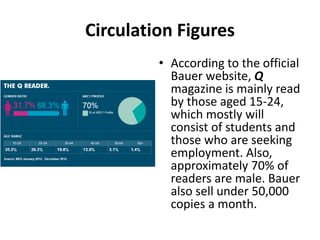
• According to the official
Bauer website, Q
magazine is mainly read
by those aged 15-24,
which mostly will
consist of students and
those who are seeking
employment. Also,
approximately 70% of
readers are male. Bauer
also sell under 50,000
copies a month.
Layout, Content and Style
• The chosen genre for my magazine is going to be pop music
because my own ideas and the ideas from my inspiration
magazines, Smash Hits and Q, both connect with what I plan to do.
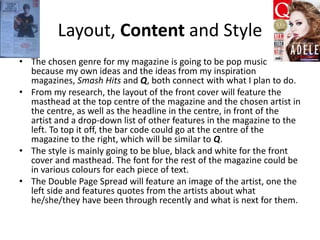
• From my research, the layout of the front cover will feature the
masthead at the top centre of the magazine and the chosen artist in
the centre, as well as the headline in the centre, in front of the
artist and a drop-down list of other features in the magazine to the
left. To top it off, the bar code could go at the centre of the
magazine to the right, which will be similar to Q.
• The style is mainly going to be blue, black and white for the front
cover and masthead. The font for the rest of the magazine could be
in various colours for each piece of text.
• The Double Page Spread will feature an image of the artist, one the
left side and features quotes from the artists about what
he/she/they have been through recently and what is next for them.
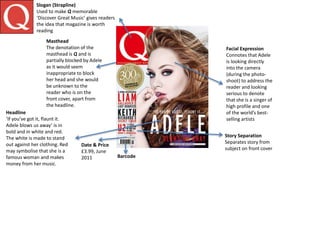
Headline
‘If you’ve got it, flaunt it.
Adele blows us away’ is in
bold and in white and red.
The white is made to stand
out against her clothing. Red
may symbolise that she is a
famous woman and makes
money from her music.
Masthead
The denotation of the
masthead is Q and is
partially blocked by Adele
as it would seem
inappropriate to block
her head and she would
be unknown to the
reader who is on the
front cover, apart from
the headline.
Date & Price
£3.99, June
2011
Story Separation
Separates story from
subject on front cover
Slogan (Strapline)
Used to make Q memorable
‘Discover Great Music’ gives readers
the idea that magazine is worth
reading
Barcode
Facial Expression
Connotes that Adele
is looking directly
into the camera
(during the photo-
shoot) to address the
reader and looking
serious to denote
that she is a singer of
high profile and one
of the world’s best-
selling artists
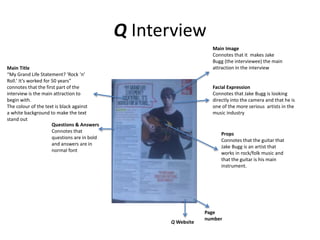
Q Interview
Page
number
Main Image
Connotes that it makes Jake
Bugg (the interviewee) the main
attraction in the interviewMain Title
“My Grand Life Statement? ‘Rock ‘n’
Roll.’ It’s worked for 50 years”
connotes that the first part of the
interview is the main attraction to
begin with.
The colour of the text is black against
a white background to make the text
stand out
Questions & Answers
Connotes that
questions are in bold
and answers are in
normal font
Q Website
Facial Expression
Connotes that Jake Bugg is looking
directly into the camera and that he is
one of the more serious artists in the
music industry
Props
Connotes that the guitar that
Jake Bugg is an artist that
works in rock/folk music and
that the guitar is his main
instrument.
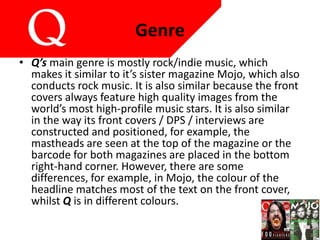
Genre
• Q’s main genre is mostly rock/indie music, which
makes it similar to it’s sister magazine Mojo, which also
conducts rock music. It is also similar because the front
covers always feature high quality images from the
world’s most high-profile music stars. It is also similar
in the way its front covers / DPS / interviews are
constructed and positioned, for example, the
mastheads are seen at the top of the magazine or the
barcode for both magazines are placed in the bottom
right-hand corner. However, there are some
differences, for example, in Mojo, the colour of the
headline matches most of the text on the front cover,
whilst Q is in different colours.
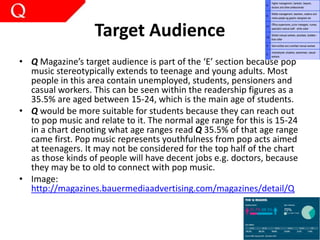
Target Audience
• Q Magazine’s target audience is part of the ‘E’ section because pop
music stereotypically extends to teenage and young adults. Most
people in this area contain unemployed, students, pensioners and
casual workers. This can be seen within the readership figures as a
35.5% are aged between 15-24, which is the main age of students.
• Q would be more suitable for students because they can reach out
to pop music and relate to it. The normal age range for this is 15-24
in a chart denoting what age ranges read Q 35.5% of that age range
came first. Pop music represents youthfulness from pop acts aimed
at teenagers. It may not be considered for the top half of the chart
as those kinds of people will have decent jobs e.g. doctors, because
they may be to old to connect with pop music.
• Image:
http://magazines.bauermediaadvertising.com/magazines/detail/Q
Target Audience Continued
• Hartley’s 7 Subjectivities
• Age Group – The age group is mainly for those aged 16-30, because my magazine
is aimed at teenagers and young adults, like Smash Hits but older
• Gender – The gender for this magazine is for both genders, but I think that it will
be a 50/50 division of the majority of the gender that reads magazines. I am very
encouraged by my SurveyMonkey research which shows that women like my
offering. I think that is because Smash Hits had a very high female readership and I
am hoping to catch the grown up Smash Hits/Q reader.
• Self-Image – May offer readers advice on how to be famous
• Family – Place in the family, most likely to be child.
• Nation – The nationality will be English, as the magazine will initially not be sold
anywhere else other than the UK.
• Ethnicity – The ethnic group can be for any race that is familiar to pop music
• Class – Some stars might be living rough, after being successful for a few years e.g.
having lost everything
• http://www.slideshare.net/Jesss21/audience-identification-research-9359908
Target Audience Continued
• Katz’ Uses and Gratifications
• Information – Provides readers with information they didn’t
know about their favourite artist
• Personal Identity – Gives the readers an artist that they can
fully relate to
• Integration and Social Interaction – Artist offers advice to
the readers on what to do and how it would help out for
them
• Entertainment – If the readers hears more about their
favourite artist, they are interested in what they will be
doing next.
• http://visual-
memory.co.uk/daniel/Documents/short/usegrat.html
Target Audience Continued
• Socio-Economic Needs
• My magazine is mostly aimed at the ‘C2’, ‘D’ and ‘E’
categories in the ABC1 chart because my target
audience is teenagers and young adults who are
unemployed, still at school or working casually. This
group is very hard to reach in magazines these days,
however my SurveyMonkey shows that they are
prepared to pay £1.99 of their own money to buy
Music 4 the Mind.
• Other members of that group are pensioners or
widows, but my magazine doesn’t appeal to them
• http://www.abc1demographic.co.uk/
Target Audience Continued
• Maslow’s Hierarchy of Needs
• Explorers – Q readers can read about how artists are influenced social
change in what a musician has done to make their name, for example in
the front cover on slide 9, the headline is “Adele blows us away”, the
connotes that she has made her mark as an icon in the music industry.
This will encourage readers to know how she has made that mark.
• Social Climbers – Makes reader materialistically driven, for example like
“Exclusives” and something that will improve their knowledge and
understanding of the music industry, for example in the front cover on
slide 9, once of the cover stories include “Keith Richard’s Secret Stash”
which connotes that readers want to know what his “secret stash” and tell
others about it on social media, such as Twitter.
• http://www.simplypsychology.org/maslow.html
Target Audience Continued
• Psychographics
• Mainstreamer – keeps up with what is going
on the music industry because of the articles
available.
• Explorer – engages the reader what is new
with their favourite music artist through
articles/interviews in the magazine or online.
• http://moneyterms.co.uk/psychographics/
Frequency
• I have decided that my magazine is going to be a
monthly because a majority of music magazines
in the UK such as Q, Mojo, etc., are also monthly
magazines, so I figured I would also do the same
with mine.
• Some music magazines like Kerrang! Are weekly
magazines but I thought that there was no need
to do a magazine with an issue that is only
around for one week. Q is the UK’s best-selling
music magazine and I thought that could be just
as popular if it was a monthly.
Production Process
• Date of publication – the first thing to do is to set up a date of publication.
• Managing the schedule – this is a really important step that you should not take for granted
when it comes to the production of a magazine.
• Editorial and budgetary decision – the next step that is taken during the production process
of a magazine is the editorial decision.
• Content Acquisition – the most important step because without content we can’t have the
magazine in the first place. Content therefore is the main piece.
• Sub-editing – this focuses on one major thing, which is quality control.
• Page Layout – in big publications, there is a special team responsible for page layouts called
the layout staff.
• Proofreading – once the above stage has been completed, the next stage is the proofreading.
• File emailed to printer – After the proofreading stage, the desktop publishing file of the
entire magazine is sent to the printer whose job will be to print the magazine.
• Distribution – the printing company, having finished with the printing of the magazines, will
package them neatly and send them to a warehouse.
• http://hosbeg.com/the-magazine-production-process/
Production Process Continued
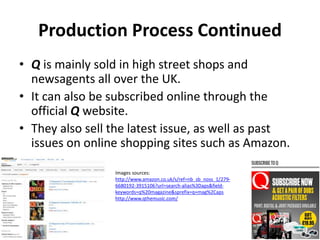
• Q is mainly sold in high street shops and
newsagents all over the UK.
• It can also be subscribed online through the
official Q website.
• They also sell the latest issue, as well as past
issues on online shopping sites such as Amazon.
Images sources:
http://www.amazon.co.uk/s/ref=nb_sb_noss_1/279-
6680192-3915106?url=search-alias%3Daps&field-
keywords=q%20magazine&sprefix=q+mag%2Caps
http://www.qthemusic.com/
Contacting Q Magazine
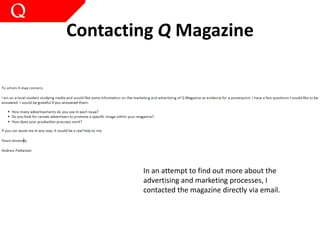
In an attempt to find out more about the
advertising and marketing processes, I
contacted the magazine directly via email.
Digital Research
• Digital copies of Q are available through Google Play or Apple Newsstand. The
magazine is the same from the print copy as you can turn each page by swiping a
smartphone screen.
• “Promotional pricing for a monthly subscription is for the first 3 months only.
Subscribers will be charged the regular price in the month following the promotion
end.*Q magazine is inventive, insightful, irreverent, the UK's biggest selling music
magazine and the world's best music guide. The reason is simple : Q gets the
interviews and exclusives that no other magazine can. Couple this with the famous
Q magazine Review section and our new Entertainment section, featuring
everything you need to know about films, DVDs, radio, books, games and gadgets,
and you've got what amounts to the most essential music/entertainment guide
there is.” - https://play.google.com/store/newsstand/details/Q?id=CAowq_yOBw
Website
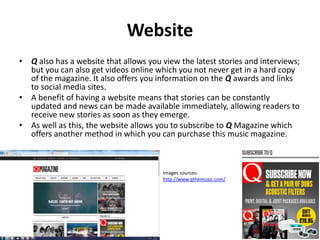
• Q also has a website that allows you view the latest stories and interviews;
but you can also get videos online which you not never get in a hard copy
of the magazine. It also offers you information on the Q awards and links
to social media sites.
• A benefit of having a website means that stories can be constantly
updated and news can be made available immediately, allowing readers to
receive new stories as soon as they emerge.
• As well as this, the website allows you to subscribe to Q Magazine which
offers another method in which you can purchase this music magazine.
Images sources:
http://www.qthemusic.com/
Advertising of Q Magazine
YouTube channel
Twitter page
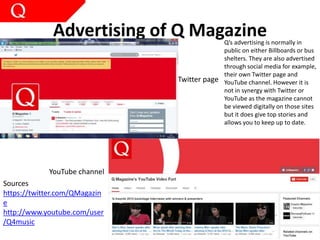
Q’s advertising is normally in
public on either Billboards or bus
shelters. They are also advertised
through social media for example,
their own Twitter page and
YouTube channel. However it is
not in synergy with Twitter or
YouTube as the magazine cannot
be viewed digitally on those sites
but it does give top stories and
allows you to keep up to date.
Sources
https://twitter.com/QMagazin
e
http://www.youtube.com/user
/Q4music
Advertising in Q Magazine
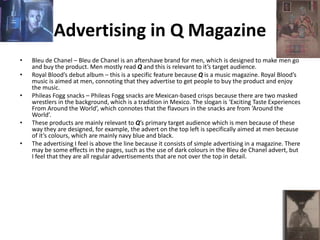
• Bleu de Chanel – Bleu de Chanel is an aftershave brand for men, which is designed to make men go
and buy the product. Men mostly read Q and this is relevant to it’s target audience.
• Royal Blood’s debut album – this is a specific feature because Q is a music magazine. Royal Blood’s
music is aimed at men, connoting that they advertise to get people to buy the product and enjoy
the music.
• Phileas Fogg snacks – Phileas Fogg snacks are Mexican-based crisps because there are two masked
wrestlers in the background, which is a tradition in Mexico. The slogan is ‘Exciting Taste Experiences
From Around the World’, which connotes that the flavours in the snacks are from ‘Around the
World’.
• These products are mainly relevant to Q’s primary target audience which is men because of these
way they are designed, for example, the advert on the top left is specifically aimed at men because
of it’s colours, which are mainly navy blue and black.
• The advertising I feel is above the line because it consists of simple advertising in a magazine. There
may be some effects in the pages, such as the use of dark colours in the Bleu de Chanel advert, but
I feel that they are all regular advertisements that are not over the top in detail.
Mojo Magazine
2nd Magazine of Research
Purpose of this Magazine
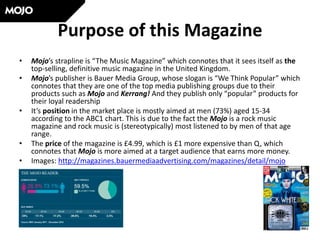
• Mojo’s strapline is “The Music Magazine” which connotes that it sees itself as the
top-selling, definitive music magazine in the United Kingdom.
• Mojo’s publisher is Bauer Media Group, whose slogan is “We Think Popular” which
connotes that they are one of the top media publishing groups due to their
products such as Mojo and Kerrang! And they publish only “popular” products for
their loyal readership
• It’s position in the market place is mostly aimed at men (73%) aged 15-34
according to the ABC1 chart. This is due to the fact the Mojo is a rock music
magazine and rock music is (stereotypically) most listened to by men of that age
range.
• The price of the magazine is £4.99, which is £1 more expensive than Q, which
connotes that Mojo is more aimed at a target audience that earns more money.
• Images: http://magazines.bauermediaadvertising.com/magazines/detail/mojo
Bauer Media Group
• Bauer Media Group first started in 1953 with Angling Times, and
since then, has grown from printing only magazines to distributing
music channels and radio stations.
• The company is Europe’s largest privately owned publishing groups.
It provides over 300 magazines in 15 different countries, along with
TV channels, radio stations and websites. It has made some top
selling music magazines including Q, Mojo, Kerrang, Heat and many
more for every audience.
• Bauer’s slogan is “We Think Popular” which connotes that Bauer
want they’re products to be popular with their chosen target
audiences.
• It’s key people include Yvonne Bauer who serves as the main
publisher and Jorg Hausendorf and Andreas Schoo who are both
part of the executive board.
• http://www.bauermedia.co.uk/about
Form and Style
• The format (size) of the magazine is 29.5 cm tall and 21.5cm wide. This
connotes that in size, Mojo is 1.5cm taller than Q.
• The language of the magazine is very similar to Q Magazine as it is very
informative and grown-up sounding for it’s target audience, for example
on the front cover of the July 2015 issue, the cover stories are “Faith No
More – We turned into cockroaches” connoting that Faith No More
suffered a decline in their success and “The Birth of The Clash by Keith
Levene” connotes that Keith Levene was a founding member of The Clash
and that he was the main person behind that.
• The colour scheme of Mojo is almost similar to Q as it has black and white
in the colour scheme, but it also has a different third colour for every
issues, for example in the July 2015 issue of Mojo, the third colour is red.
This connotes that the colour scheme is somewhat changeable, compared
to Q which maintains it’s red, black and white colour scheme.
Content
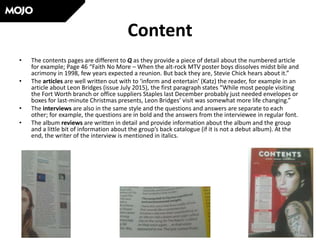
• The contents pages are different to Q as they provide a piece of detail about the numbered article
for example; Page 46 “Faith No More – When the alt-rock MTV poster boys dissolves midst bile and
acrimony in 1998, few years expected a reunion. But back they are, Stevie Chick hears about it.”
• The articles are well written out with to ‘inform and entertain’ (Katz) the reader, for example in an
article about Leon Bridges (issue July 2015), the first paragraph states “While most people visiting
the Fort Worth branch or office suppliers Staples last December probably just needed envelopes or
boxes for last-minute Christmas presents, Leon Bridges’ visit was somewhat more life changing.”
• The interviews are also in the same style and the questions and answers are separate to each
other; for example, the questions are in bold and the answers from the interviewee in regular font.
• The album reviews are written in detail and provide information about the album and the group
and a little bit of information about the group’s back catalogue (if it is not a debut album). At the
end, the writer of the interview is mentioned in italics.
Genre
• Mojo’s primary genre is rock music because Bauer want the
magazine to appeal to their target audience by having old and new
rock musicians on their front cover and in their content, for
example on the July 2015 issue, the front cover features Fleetwood
Mac, one of the best-selling rock bands of all time, and their cover
stories include such rock legends as Donovan, Faith No More and
The Clash.
• Other Bauer magazines have followed that genre, for example
Kerrang!’s main genre is rock but mostly focusing on hard rock and
heavy metal. Mojo’s genre is rock but mostly fused with some
classic rock because of who is in the content.
Target Audience
• Socio-Economic Needs
• Mojo’s Magazine’s target audience is part of the ‘D’ section because rock music
stereotypically extends to teenage and young adults. Most people in this area
contain semi-skilled and unskilled manual workers. This can be seen within the
readership figures as a 24% are aged between 15-24, which is the main age of new
workers.
• Mojo would be more suitable for students because they can reach out to rock
music and relate to it. The normal age range for this is 15 - 24 in a chart denoting
what age ranges read Mojo 24% of that age range came first. Rock music is a
mature version of pop and appeals to adults who have listened to classic rock
artists in their teen years. It may not be considered for the top half of the chart as
those kinds of people will have decent jobs such as doctors, because they may be
to old to connect with pop music.
• Image: http://magazines.bauermediaadvertising.com/magazines/detail/mojo
Target Audience Continued
• Hartley’s 7 Subjectivities
• Age Group – The age group is mainly for those aged 15-34, because my
magazine is aimed at teenagers and young adults.
• Gender – The gender for this magazine is for mostly for men although
both sexes can read it as well.
• Self-Image – May offer readers advice on how to be famous.
• Family – Place in the family, most likely to be child.
• Nation – The nationality will be English, as the magazine will initially not
be sold anywhere else other than the UK.
• Ethnicity – The ethnic group can be for any race that is familiar to rock
music.
• Class – Some stars might be living rough, after being successful for a few
years for example having lost everything.
• http://www.slideshare.net/Jesss21/audience-identification-research-
9359908
Target Audience Continued
• Katz’ Uses and Gratifications
• Information – Provides readers with information they didn’t know about their favourite artist
• Personal Identity – Gives the readers an artist that they can fully relate to, for example in the
bottom-left front cover, the headline quotes “The birth of a legend…” which connotes that The
Smiths were at the their peak in the 1980’s but broke up due to a falling out between it’s members.
This connotes that some readers my have fallen out the same way.
• Integration and Social Interaction – Artist offers advice to the readers on what to do and how it
would help out for them, for example one of the cover stories quotes “Tom Waits speaks”, which
connotes that Tom Waits may be offering advice to the reader and will want to read what he is
going to say.
• Entertainment – If the readers hears more about their favourite artist, they are interested in what
they will be doing next.
• http://visual-memory.co.uk/daniel/Documents/short/usegrat.html
Image sources
http://www.johnnymarrplaysguitar.com/wp-
content/uploads/2010/11/634814033854539471.jpeg
https://create-
cdn.net/siteimages/5/5/8/55872/40/0/2/4002159/260x366.jp
g?1
Target Audience Continued
• Psychographics
• Mainstreamer – keeps up with what is going
on the music industry because of the articles
available.
• Explorer – engages the reader what is new
with their favourite music artist through
articles/interviews in the magazine or online.
• http://moneyterms.co.uk/psychographics/
Frequency
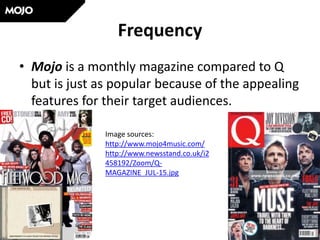
• Mojo is a monthly magazine compared to Q
but is just as popular because of the appealing
features for their target audiences.
Image sources:
http://www.mojo4music.com/
http://www.newsstand.co.uk/i2
458192/Zoom/Q-
MAGAZINE_JUL-15.jpg
Production Process
• Date of publication – the first thing to do is to set up a date of publication.
• Managing the schedule – this is a really important step that you should not take for granted
when it comes to the production of a magazine.
• Editorial and budgetary decision – the next step that is taken during the production process
of a magazine is the editorial decision.
• Content Acquisition – the most important step because without content we can’t have the
magazine in the first place. Content therefore is the main piece.
• Sub-editing – this focuses on one major thing, which is quality control.
• Page Layout – in big publications, there is a special team responsible for page layouts called
the layout staff.
• Proofreading – once the above stage has been completed, the next stage is the proofreading.
• File emailed to printer – After the proofreading stage, the desktop publishing file of the
entire magazine is sent to the printer whose job will be to print the magazine.
• Distribution – the printing company, having finished with the printing of the magazines, will
package them neatly and send them to a warehouse.
• http://hosbeg.com/the-magazine-production-process/
Production Process Continued
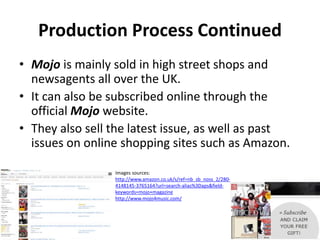
• Mojo is mainly sold in high street shops and
newsagents all over the UK.
• It can also be subscribed online through the
official Mojo website.
• They also sell the latest issue, as well as past
issues on online shopping sites such as Amazon.
Images sources:
http://www.amazon.co.uk/s/ref=nb_sb_noss_2/280-
4148145-3765164?url=search-alias%3Daps&field-
keywords=mojo+magazine
http://www.mojo4music.com/
Front Cover Annotations
Masthead
The denotation of the masthead
Is Mojo and is partially blocked by
Paul Weller as it would seem
inappropriate to block his head as
he would be unknown to the reader
who is on the front cover, apart
from the headline.
Headline
“My guitar was like an alien” is
in bold and in black. The black
is used to stand out against the
white background of this front
cover as it would be
unreadable in bright colours.
Image source: http://www.mojo4music.com/media/MOJO221_PaulWeller.jpg?2cf8b9
Barcode
Date & Price
April 2012,
£4.99
Slogan (Strapline)
Used to make Mojo memorable
“The Music Magazine” doesn’t just
connote what kind of product it is
but what it stands out as.
Puff Promotion
Connotes that there is a free CD
exclusively from the subject of the
headline (Paul Weller)
Story Separation
Separates the stories from
the subject on the front
cover (Paul Weller).
DPS Annotations
Image source: https://ryantinsley75.files.wordpress.com/2012/01/mojo-double-page-spread1.jpg
Main Title
“American Gothic”
connotes that the first
part of the interview is the
main attraction to begin
with.
The text colour is
white/brown against a
black background to make
it stand out.
Image Capture
Connotes that it makes
Justin Vernon (pictured)
is the main attraction of
the article.
Facial Expression
Connotes that Justin
Vernon is an easy-
going musician and is
looking directly into
the camera.
Content
Connotes that the
introduction of the article
is in a bigger font size than
the rest of the text, bar
the drop capital.
Portrait
Connotes that Justin
Vernon has had his
picture taken behind a
church. This looks like
this wasn’t edited with
the quick selection tool
on Photoshop, but it has
been adjusted into black
and white on Photoshop.
Conclusion
• This PowerPoint is about analysing a magazine
like Q and Mojo on what it’s primary features
are, how the pages are laid out, what is
advertised, how it is advertised, how it is
distributed and most importantly, how it
connects with it’s target audience.
• What I am trying to do is make notes on its
features and use them for my own magazine
which will be a rival to Q and will have almost the
same features and also start a new market leader.

Unit 13 - LO 1 - Understand existing print-based media products and how they are created

  • 1.
    Name: Andy Patterson CandidateNumber: 4113 Center Name: St. Andrew’s Catholic School Center Number: 64135
  • 2.
    Contents • Q Magazine •Bauer Media Group (Slide 3) • Purpose (Slide 4) • Format/Size (Slide 5) • Contents Page Analysis (Slide 6) • Circulation Figures (Slide 7) • Layout, Content & Style (Slide 8) • Q Front Cover Connotations (Slide 9) • Q Interview (Slide 10) • Genre (Slide 11) • Target Audience (Slide 12-17) • Frequency (Slide 18) • Production Process (Slide 19-20) • Contacting Q Magazine (Slide 21) • Digital Research (Slide 22) • Website (Slide 23) • Advertising in Q Magazine (Slide 24-25) • Mojo Magazine • Purpose of this Magazine (Slide 27) • Bauer Media Group (Slide 28) • Form and Style (Slide 29) • Content (Slide 30) • Genre (Slide 31) • Target Audience (Slide 32-35) • Frequency (Slide 36) • Production Process (Slide 37-38) • Front Cover Annotations (Slide 39) • DPS Annotations (Slide 40) • Conclusion (Slide 41)
  • 3.
    Bauer Media Group •Bauer Media Group first started in 1953 with Angling Times, and since then, has grown from printing only magazines to distributing music channels and radio stations. • The company is Europe’s largest privately owned publishing groups. It provides over 300 magazines in 15 different countries, along with TV channels, radio stations and websites. It has made some top selling music magazines including Q, Mojo, Kerrang, Heat and many more for every audience. • Bauer’s slogan is “We Think Popular” which connotes that they are one of the top media publishing groups due to their products such as Q and Kerrang. • It’s key people include Yvonne Bauer who serves as the main publisher and Jorg Hausendorf and Andreas Schoo who are both part of the executive board. • http://www.bauermedia.co.uk/about
  • 4.
    • The mediagroup EMAP started in 1953, publishing Angling Times and was one of Britain’s most successful publishing groups. EMAP launched Q Magazine on 1st October 1986. It became one of the most iconic and successful music monthlies of the 1990s. In 2007, Bauer Media Group bought EMAP magazines and EMAP’s radio division becoming the largest private publishing group in Europe. • The German owners, Bauer, allowed the EMAP publishing staff to carry on as normal. The publications, which Bauer bought, included Kerrang!, Mojo, Heat and FHM to name a few. • Bauer used EMAP’s radio stations to publicize their magazines and even created a Kerrang! Radio and TV channel. The even created a TV and radio station for the defunct Smash Hits magazine. • http://www.bauermedia.co.uk/about Purpose
  • 5.
    Format/Size • The frontcover should feature a close up of the featured artist that is probably interviewed in the magazine (top left image). It’s normal size will be 28 centimetres high and 20.5 centimetres wide. • Other shots could include a mid shot if it is a group (top right image). • My image will be a close up of the subject, looking serious away from camera. The background will be blue, white and black in a certain pattern because that is the chosen colour scheme in my survey. Q magazine have done this in many issues, particularly in the top left image featuring Florence Welch. The artist will also be partly blocking the masthead, as it has been with one of the Blur members in the top right image.
  • 6.
    Contents Page Analysis •The contents pages in Q tells the readers what the primary parts of the magazine issue are and where they can be read. The numbers are each in different coloured circles and in bold to stand out from the rest of the text. • Underneath or next to the numbers are the music artists that are featured in the articles. This gives the readers the impression that they will quickly know where to read about their favourite music and want to read more about them. They may consist of articles about a certain artist, for example Sam Smith, or an interview with for example Nick Cave. There may even be articles about groups/singers who are not around any more such as Oasis. Within Q, the articles will focus on artists from the pop and rock genres that they target. Also in Q, the interviews will focus on music artists from the same genres, such as the Foo Fighters or Nick Cave, who fall into the rock genre and pop artists like Sam Smith or Sinead O’Connor. This allows the readers to keep up to date with these types of music and gives them new information about the artists that they enjoy listening to. For example it would be very unlikely for Q to feature an article on a classical music artist such as John Adams as he does not fit in with the target audience of the magazine • The contents page in my magazine will be different to Q’s own as they will just feature the article names for each page number and a strap line to go with them to give the reader a hint as to what the article will be about.
  • 7.
    Circulation Figures • Accordingto the official Bauer website, Q magazine is mainly read by those aged 15-24, which mostly will consist of students and those who are seeking employment. Also, approximately 70% of readers are male. Bauer also sell under 50,000 copies a month.
  • 8.
    Layout, Content andStyle • The chosen genre for my magazine is going to be pop music because my own ideas and the ideas from my inspiration magazines, Smash Hits and Q, both connect with what I plan to do. • From my research, the layout of the front cover will feature the masthead at the top centre of the magazine and the chosen artist in the centre, as well as the headline in the centre, in front of the artist and a drop-down list of other features in the magazine to the left. To top it off, the bar code could go at the centre of the magazine to the right, which will be similar to Q. • The style is mainly going to be blue, black and white for the front cover and masthead. The font for the rest of the magazine could be in various colours for each piece of text. • The Double Page Spread will feature an image of the artist, one the left side and features quotes from the artists about what he/she/they have been through recently and what is next for them.
  • 9.
    Headline ‘If you’ve gotit, flaunt it. Adele blows us away’ is in bold and in white and red. The white is made to stand out against her clothing. Red may symbolise that she is a famous woman and makes money from her music. Masthead The denotation of the masthead is Q and is partially blocked by Adele as it would seem inappropriate to block her head and she would be unknown to the reader who is on the front cover, apart from the headline. Date & Price £3.99, June 2011 Story Separation Separates story from subject on front cover Slogan (Strapline) Used to make Q memorable ‘Discover Great Music’ gives readers the idea that magazine is worth reading Barcode Facial Expression Connotes that Adele is looking directly into the camera (during the photo- shoot) to address the reader and looking serious to denote that she is a singer of high profile and one of the world’s best- selling artists
  • 10.
    Q Interview Page number Main Image Connotesthat it makes Jake Bugg (the interviewee) the main attraction in the interviewMain Title “My Grand Life Statement? ‘Rock ‘n’ Roll.’ It’s worked for 50 years” connotes that the first part of the interview is the main attraction to begin with. The colour of the text is black against a white background to make the text stand out Questions & Answers Connotes that questions are in bold and answers are in normal font Q Website Facial Expression Connotes that Jake Bugg is looking directly into the camera and that he is one of the more serious artists in the music industry Props Connotes that the guitar that Jake Bugg is an artist that works in rock/folk music and that the guitar is his main instrument.
  • 11.
    Genre • Q’s maingenre is mostly rock/indie music, which makes it similar to it’s sister magazine Mojo, which also conducts rock music. It is also similar because the front covers always feature high quality images from the world’s most high-profile music stars. It is also similar in the way its front covers / DPS / interviews are constructed and positioned, for example, the mastheads are seen at the top of the magazine or the barcode for both magazines are placed in the bottom right-hand corner. However, there are some differences, for example, in Mojo, the colour of the headline matches most of the text on the front cover, whilst Q is in different colours.
  • 12.
    Target Audience • QMagazine’s target audience is part of the ‘E’ section because pop music stereotypically extends to teenage and young adults. Most people in this area contain unemployed, students, pensioners and casual workers. This can be seen within the readership figures as a 35.5% are aged between 15-24, which is the main age of students. • Q would be more suitable for students because they can reach out to pop music and relate to it. The normal age range for this is 15-24 in a chart denoting what age ranges read Q 35.5% of that age range came first. Pop music represents youthfulness from pop acts aimed at teenagers. It may not be considered for the top half of the chart as those kinds of people will have decent jobs e.g. doctors, because they may be to old to connect with pop music. • Image: http://magazines.bauermediaadvertising.com/magazines/detail/Q
  • 13.
    Target Audience Continued •Hartley’s 7 Subjectivities • Age Group – The age group is mainly for those aged 16-30, because my magazine is aimed at teenagers and young adults, like Smash Hits but older • Gender – The gender for this magazine is for both genders, but I think that it will be a 50/50 division of the majority of the gender that reads magazines. I am very encouraged by my SurveyMonkey research which shows that women like my offering. I think that is because Smash Hits had a very high female readership and I am hoping to catch the grown up Smash Hits/Q reader. • Self-Image – May offer readers advice on how to be famous • Family – Place in the family, most likely to be child. • Nation – The nationality will be English, as the magazine will initially not be sold anywhere else other than the UK. • Ethnicity – The ethnic group can be for any race that is familiar to pop music • Class – Some stars might be living rough, after being successful for a few years e.g. having lost everything • http://www.slideshare.net/Jesss21/audience-identification-research-9359908
  • 14.
    Target Audience Continued •Katz’ Uses and Gratifications • Information – Provides readers with information they didn’t know about their favourite artist • Personal Identity – Gives the readers an artist that they can fully relate to • Integration and Social Interaction – Artist offers advice to the readers on what to do and how it would help out for them • Entertainment – If the readers hears more about their favourite artist, they are interested in what they will be doing next. • http://visual- memory.co.uk/daniel/Documents/short/usegrat.html
  • 15.
    Target Audience Continued •Socio-Economic Needs • My magazine is mostly aimed at the ‘C2’, ‘D’ and ‘E’ categories in the ABC1 chart because my target audience is teenagers and young adults who are unemployed, still at school or working casually. This group is very hard to reach in magazines these days, however my SurveyMonkey shows that they are prepared to pay £1.99 of their own money to buy Music 4 the Mind. • Other members of that group are pensioners or widows, but my magazine doesn’t appeal to them • http://www.abc1demographic.co.uk/
  • 16.
    Target Audience Continued •Maslow’s Hierarchy of Needs • Explorers – Q readers can read about how artists are influenced social change in what a musician has done to make their name, for example in the front cover on slide 9, the headline is “Adele blows us away”, the connotes that she has made her mark as an icon in the music industry. This will encourage readers to know how she has made that mark. • Social Climbers – Makes reader materialistically driven, for example like “Exclusives” and something that will improve their knowledge and understanding of the music industry, for example in the front cover on slide 9, once of the cover stories include “Keith Richard’s Secret Stash” which connotes that readers want to know what his “secret stash” and tell others about it on social media, such as Twitter. • http://www.simplypsychology.org/maslow.html
  • 17.
    Target Audience Continued •Psychographics • Mainstreamer – keeps up with what is going on the music industry because of the articles available. • Explorer – engages the reader what is new with their favourite music artist through articles/interviews in the magazine or online. • http://moneyterms.co.uk/psychographics/
  • 18.
    Frequency • I havedecided that my magazine is going to be a monthly because a majority of music magazines in the UK such as Q, Mojo, etc., are also monthly magazines, so I figured I would also do the same with mine. • Some music magazines like Kerrang! Are weekly magazines but I thought that there was no need to do a magazine with an issue that is only around for one week. Q is the UK’s best-selling music magazine and I thought that could be just as popular if it was a monthly.
  • 19.
    Production Process • Dateof publication – the first thing to do is to set up a date of publication. • Managing the schedule – this is a really important step that you should not take for granted when it comes to the production of a magazine. • Editorial and budgetary decision – the next step that is taken during the production process of a magazine is the editorial decision. • Content Acquisition – the most important step because without content we can’t have the magazine in the first place. Content therefore is the main piece. • Sub-editing – this focuses on one major thing, which is quality control. • Page Layout – in big publications, there is a special team responsible for page layouts called the layout staff. • Proofreading – once the above stage has been completed, the next stage is the proofreading. • File emailed to printer – After the proofreading stage, the desktop publishing file of the entire magazine is sent to the printer whose job will be to print the magazine. • Distribution – the printing company, having finished with the printing of the magazines, will package them neatly and send them to a warehouse. • http://hosbeg.com/the-magazine-production-process/
  • 20.
    Production Process Continued •Q is mainly sold in high street shops and newsagents all over the UK. • It can also be subscribed online through the official Q website. • They also sell the latest issue, as well as past issues on online shopping sites such as Amazon. Images sources: http://www.amazon.co.uk/s/ref=nb_sb_noss_1/279- 6680192-3915106?url=search-alias%3Daps&field- keywords=q%20magazine&sprefix=q+mag%2Caps http://www.qthemusic.com/
  • 21.
    Contacting Q Magazine Inan attempt to find out more about the advertising and marketing processes, I contacted the magazine directly via email.
  • 22.
    Digital Research • Digitalcopies of Q are available through Google Play or Apple Newsstand. The magazine is the same from the print copy as you can turn each page by swiping a smartphone screen. • “Promotional pricing for a monthly subscription is for the first 3 months only. Subscribers will be charged the regular price in the month following the promotion end.*Q magazine is inventive, insightful, irreverent, the UK's biggest selling music magazine and the world's best music guide. The reason is simple : Q gets the interviews and exclusives that no other magazine can. Couple this with the famous Q magazine Review section and our new Entertainment section, featuring everything you need to know about films, DVDs, radio, books, games and gadgets, and you've got what amounts to the most essential music/entertainment guide there is.” - https://play.google.com/store/newsstand/details/Q?id=CAowq_yOBw
  • 23.
    Website • Q alsohas a website that allows you view the latest stories and interviews; but you can also get videos online which you not never get in a hard copy of the magazine. It also offers you information on the Q awards and links to social media sites. • A benefit of having a website means that stories can be constantly updated and news can be made available immediately, allowing readers to receive new stories as soon as they emerge. • As well as this, the website allows you to subscribe to Q Magazine which offers another method in which you can purchase this music magazine. Images sources: http://www.qthemusic.com/
  • 24.
    Advertising of QMagazine YouTube channel Twitter page Q’s advertising is normally in public on either Billboards or bus shelters. They are also advertised through social media for example, their own Twitter page and YouTube channel. However it is not in synergy with Twitter or YouTube as the magazine cannot be viewed digitally on those sites but it does give top stories and allows you to keep up to date. Sources https://twitter.com/QMagazin e http://www.youtube.com/user /Q4music
  • 25.
    Advertising in QMagazine • Bleu de Chanel – Bleu de Chanel is an aftershave brand for men, which is designed to make men go and buy the product. Men mostly read Q and this is relevant to it’s target audience. • Royal Blood’s debut album – this is a specific feature because Q is a music magazine. Royal Blood’s music is aimed at men, connoting that they advertise to get people to buy the product and enjoy the music. • Phileas Fogg snacks – Phileas Fogg snacks are Mexican-based crisps because there are two masked wrestlers in the background, which is a tradition in Mexico. The slogan is ‘Exciting Taste Experiences From Around the World’, which connotes that the flavours in the snacks are from ‘Around the World’. • These products are mainly relevant to Q’s primary target audience which is men because of these way they are designed, for example, the advert on the top left is specifically aimed at men because of it’s colours, which are mainly navy blue and black. • The advertising I feel is above the line because it consists of simple advertising in a magazine. There may be some effects in the pages, such as the use of dark colours in the Bleu de Chanel advert, but I feel that they are all regular advertisements that are not over the top in detail.
  • 26.
  • 27.
    Purpose of thisMagazine • Mojo’s strapline is “The Music Magazine” which connotes that it sees itself as the top-selling, definitive music magazine in the United Kingdom. • Mojo’s publisher is Bauer Media Group, whose slogan is “We Think Popular” which connotes that they are one of the top media publishing groups due to their products such as Mojo and Kerrang! And they publish only “popular” products for their loyal readership • It’s position in the market place is mostly aimed at men (73%) aged 15-34 according to the ABC1 chart. This is due to the fact the Mojo is a rock music magazine and rock music is (stereotypically) most listened to by men of that age range. • The price of the magazine is £4.99, which is £1 more expensive than Q, which connotes that Mojo is more aimed at a target audience that earns more money. • Images: http://magazines.bauermediaadvertising.com/magazines/detail/mojo
  • 28.
    Bauer Media Group •Bauer Media Group first started in 1953 with Angling Times, and since then, has grown from printing only magazines to distributing music channels and radio stations. • The company is Europe’s largest privately owned publishing groups. It provides over 300 magazines in 15 different countries, along with TV channels, radio stations and websites. It has made some top selling music magazines including Q, Mojo, Kerrang, Heat and many more for every audience. • Bauer’s slogan is “We Think Popular” which connotes that Bauer want they’re products to be popular with their chosen target audiences. • It’s key people include Yvonne Bauer who serves as the main publisher and Jorg Hausendorf and Andreas Schoo who are both part of the executive board. • http://www.bauermedia.co.uk/about
  • 29.
    Form and Style •The format (size) of the magazine is 29.5 cm tall and 21.5cm wide. This connotes that in size, Mojo is 1.5cm taller than Q. • The language of the magazine is very similar to Q Magazine as it is very informative and grown-up sounding for it’s target audience, for example on the front cover of the July 2015 issue, the cover stories are “Faith No More – We turned into cockroaches” connoting that Faith No More suffered a decline in their success and “The Birth of The Clash by Keith Levene” connotes that Keith Levene was a founding member of The Clash and that he was the main person behind that. • The colour scheme of Mojo is almost similar to Q as it has black and white in the colour scheme, but it also has a different third colour for every issues, for example in the July 2015 issue of Mojo, the third colour is red. This connotes that the colour scheme is somewhat changeable, compared to Q which maintains it’s red, black and white colour scheme.
  • 30.
    Content • The contentspages are different to Q as they provide a piece of detail about the numbered article for example; Page 46 “Faith No More – When the alt-rock MTV poster boys dissolves midst bile and acrimony in 1998, few years expected a reunion. But back they are, Stevie Chick hears about it.” • The articles are well written out with to ‘inform and entertain’ (Katz) the reader, for example in an article about Leon Bridges (issue July 2015), the first paragraph states “While most people visiting the Fort Worth branch or office suppliers Staples last December probably just needed envelopes or boxes for last-minute Christmas presents, Leon Bridges’ visit was somewhat more life changing.” • The interviews are also in the same style and the questions and answers are separate to each other; for example, the questions are in bold and the answers from the interviewee in regular font. • The album reviews are written in detail and provide information about the album and the group and a little bit of information about the group’s back catalogue (if it is not a debut album). At the end, the writer of the interview is mentioned in italics.
  • 31.
    Genre • Mojo’s primarygenre is rock music because Bauer want the magazine to appeal to their target audience by having old and new rock musicians on their front cover and in their content, for example on the July 2015 issue, the front cover features Fleetwood Mac, one of the best-selling rock bands of all time, and their cover stories include such rock legends as Donovan, Faith No More and The Clash. • Other Bauer magazines have followed that genre, for example Kerrang!’s main genre is rock but mostly focusing on hard rock and heavy metal. Mojo’s genre is rock but mostly fused with some classic rock because of who is in the content.
  • 32.
    Target Audience • Socio-EconomicNeeds • Mojo’s Magazine’s target audience is part of the ‘D’ section because rock music stereotypically extends to teenage and young adults. Most people in this area contain semi-skilled and unskilled manual workers. This can be seen within the readership figures as a 24% are aged between 15-24, which is the main age of new workers. • Mojo would be more suitable for students because they can reach out to rock music and relate to it. The normal age range for this is 15 - 24 in a chart denoting what age ranges read Mojo 24% of that age range came first. Rock music is a mature version of pop and appeals to adults who have listened to classic rock artists in their teen years. It may not be considered for the top half of the chart as those kinds of people will have decent jobs such as doctors, because they may be to old to connect with pop music. • Image: http://magazines.bauermediaadvertising.com/magazines/detail/mojo
  • 33.
    Target Audience Continued •Hartley’s 7 Subjectivities • Age Group – The age group is mainly for those aged 15-34, because my magazine is aimed at teenagers and young adults. • Gender – The gender for this magazine is for mostly for men although both sexes can read it as well. • Self-Image – May offer readers advice on how to be famous. • Family – Place in the family, most likely to be child. • Nation – The nationality will be English, as the magazine will initially not be sold anywhere else other than the UK. • Ethnicity – The ethnic group can be for any race that is familiar to rock music. • Class – Some stars might be living rough, after being successful for a few years for example having lost everything. • http://www.slideshare.net/Jesss21/audience-identification-research- 9359908
  • 34.
    Target Audience Continued •Katz’ Uses and Gratifications • Information – Provides readers with information they didn’t know about their favourite artist • Personal Identity – Gives the readers an artist that they can fully relate to, for example in the bottom-left front cover, the headline quotes “The birth of a legend…” which connotes that The Smiths were at the their peak in the 1980’s but broke up due to a falling out between it’s members. This connotes that some readers my have fallen out the same way. • Integration and Social Interaction – Artist offers advice to the readers on what to do and how it would help out for them, for example one of the cover stories quotes “Tom Waits speaks”, which connotes that Tom Waits may be offering advice to the reader and will want to read what he is going to say. • Entertainment – If the readers hears more about their favourite artist, they are interested in what they will be doing next. • http://visual-memory.co.uk/daniel/Documents/short/usegrat.html Image sources http://www.johnnymarrplaysguitar.com/wp- content/uploads/2010/11/634814033854539471.jpeg https://create- cdn.net/siteimages/5/5/8/55872/40/0/2/4002159/260x366.jp g?1
  • 35.
    Target Audience Continued •Psychographics • Mainstreamer – keeps up with what is going on the music industry because of the articles available. • Explorer – engages the reader what is new with their favourite music artist through articles/interviews in the magazine or online. • http://moneyterms.co.uk/psychographics/
  • 36.
    Frequency • Mojo isa monthly magazine compared to Q but is just as popular because of the appealing features for their target audiences. Image sources: http://www.mojo4music.com/ http://www.newsstand.co.uk/i2 458192/Zoom/Q- MAGAZINE_JUL-15.jpg
  • 37.
    Production Process • Dateof publication – the first thing to do is to set up a date of publication. • Managing the schedule – this is a really important step that you should not take for granted when it comes to the production of a magazine. • Editorial and budgetary decision – the next step that is taken during the production process of a magazine is the editorial decision. • Content Acquisition – the most important step because without content we can’t have the magazine in the first place. Content therefore is the main piece. • Sub-editing – this focuses on one major thing, which is quality control. • Page Layout – in big publications, there is a special team responsible for page layouts called the layout staff. • Proofreading – once the above stage has been completed, the next stage is the proofreading. • File emailed to printer – After the proofreading stage, the desktop publishing file of the entire magazine is sent to the printer whose job will be to print the magazine. • Distribution – the printing company, having finished with the printing of the magazines, will package them neatly and send them to a warehouse. • http://hosbeg.com/the-magazine-production-process/
  • 38.
    Production Process Continued •Mojo is mainly sold in high street shops and newsagents all over the UK. • It can also be subscribed online through the official Mojo website. • They also sell the latest issue, as well as past issues on online shopping sites such as Amazon. Images sources: http://www.amazon.co.uk/s/ref=nb_sb_noss_2/280- 4148145-3765164?url=search-alias%3Daps&field- keywords=mojo+magazine http://www.mojo4music.com/
  • 39.
    Front Cover Annotations Masthead Thedenotation of the masthead Is Mojo and is partially blocked by Paul Weller as it would seem inappropriate to block his head as he would be unknown to the reader who is on the front cover, apart from the headline. Headline “My guitar was like an alien” is in bold and in black. The black is used to stand out against the white background of this front cover as it would be unreadable in bright colours. Image source: http://www.mojo4music.com/media/MOJO221_PaulWeller.jpg?2cf8b9 Barcode Date & Price April 2012, £4.99 Slogan (Strapline) Used to make Mojo memorable “The Music Magazine” doesn’t just connote what kind of product it is but what it stands out as. Puff Promotion Connotes that there is a free CD exclusively from the subject of the headline (Paul Weller) Story Separation Separates the stories from the subject on the front cover (Paul Weller).
  • 40.
    DPS Annotations Image source:https://ryantinsley75.files.wordpress.com/2012/01/mojo-double-page-spread1.jpg Main Title “American Gothic” connotes that the first part of the interview is the main attraction to begin with. The text colour is white/brown against a black background to make it stand out. Image Capture Connotes that it makes Justin Vernon (pictured) is the main attraction of the article. Facial Expression Connotes that Justin Vernon is an easy- going musician and is looking directly into the camera. Content Connotes that the introduction of the article is in a bigger font size than the rest of the text, bar the drop capital. Portrait Connotes that Justin Vernon has had his picture taken behind a church. This looks like this wasn’t edited with the quick selection tool on Photoshop, but it has been adjusted into black and white on Photoshop.
  • 41.
    Conclusion • This PowerPointis about analysing a magazine like Q and Mojo on what it’s primary features are, how the pages are laid out, what is advertised, how it is advertised, how it is distributed and most importantly, how it connects with it’s target audience. • What I am trying to do is make notes on its features and use them for my own magazine which will be a rival to Q and will have almost the same features and also start a new market leader.