Block 4

Unit 11 Wired

Action Plan

5
min.

In this unit, you will learn:
• To read blogs, manuals, and articles to find
information.
• To identify general or specific statements.
• To infer the meaning of unknown phrases.
• To understand and use expressions with enough,
besides, and apart from.
• To understand and use words for the phone and
being online.
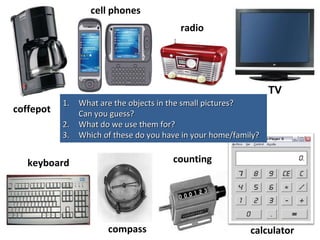
cell phones
radio

TV
coffepot

1. What are the objects in the small pictures?
Can you guess?
2. What do we use them for?
3. Which of these do you have in your home/family?

counting

keyboard

compass

calculator
Lesson A Cell Phone Debate

3
min.
Vocabulary

On the phone

Complete the definitions with words from the box. Then listen and
check your answers.

hang up
dial

switch on
get through to

get hold of
hold on

8
min.

switch off
engaged

1.

If you want to get through to someone, you want to contac them.

2.

If you want to get hold of someone, you want to contac them by phone.

3.

When the other person is already using their phone, their phone is
engaged.

4.

When you switch off your phone, the power goes off.

5.

When the other person is busy on the phone, you have to hold on.

6.

When you hang up the phone, you stop talking to someone.

7.

When you switch on your phone, the power comes on.

8.

When you press the numbers to make a call, you dial them.
Speaking

Decide which of these are the pros and which are the cons of
having a cell phone. State your reasons.
They are convenient.
They have many features.
They are expensive.
People always know where you are.
They can lead to less interaction.
You can carry them anywhere.
It’s easy to get hold of friends.
Using the keyboard too much can lead to injury.
They can store data, names, addresses and music.
The signal may be weak and you can’t get through.

Pre-reading

a. Look at the article on page 125. Predict what you think the article will be
about.

Is the cell phone a necessary evil?

b. Quickly read the article on the page 125. then answer the questions.
Skim
1. Where in this article from? The Internet/blog
2. What is the article about? Cell phones
Scan
3. How many people contributed to the page? Four
4. Which user contributes the most messages? Sk8tr
5. Which brand of phone is discussed? The mePhone

6
min.
Comprehension

Choose the best word or phrase to complete
each sentence.

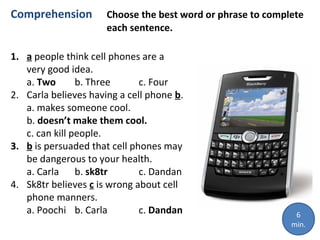
1. a people think cell phones are a
very good idea.
a. Two
b. Three
c. Four
2. Carla believes having a cell phone b.
a. makes someone cool.
b. doesn’t make them cool.
c. can kill people.
3. b is persuaded that cell phones may
be dangerous to your health.
a. Carla b. sk8tr
c. Dandan
4. Sk8tr believes c is wrong about cell
phone manners.
a. Poochi b. Carla
c. Dandan

6
min.
Skills Work

Inferring the meaning of phrases

Sometimes the meaning of a phrase is different from the meaning of its individual
words. In the following sentence, can’t stand does not refer to standing; it means
really don’t like.
I can’t stand cell phones. They are nothing but trouble.
a. Write the meaning of the underlined phrases in the sentences from the text on
page 125. use expressions from the box.
be careful

main focus

make things easy

is very good

in touch

research this again

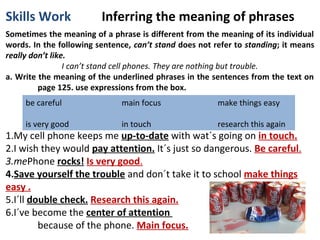
1.My cell phone keeps me up-to-date with wat´s going on in touch.
2.I wish they would pay attention. It´s just so dangerous. Be careful.
3.mePhone rocks! Is very good.
4.Save yourself the trouble and don´t take it to school make things
easy .
5.I´ll double check. Research this again.
6.I´ve become the center of attention
because of the phone. Main focus.
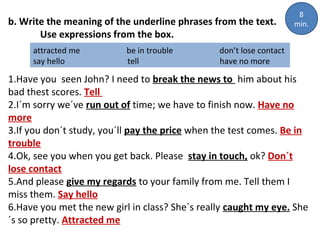
b. Write the meaning of the underline phrases from the text.
Use expressions from the box.
attracted me
say hello

be in trouble
tell

8
min.

don’t lose contact
have no more

1.Have you seen John? I need to break the news to him about his
bad thest scores. Tell
2.I´m sorry we´ve run out of time; we have to finish now. Have no
more
3.If you don´t study, you´ll pay the price when the test comes. Be in
trouble
4.Ok, see you when you get back. Please stay in touch, ok? Don´t
lose contact
5.And please give my regards to your family from me. Tell them I
miss them. Say hello
6.Have you met the new girl in class? She´s really caught my eye. She
´s so pretty. Attracted me
Lenguage work

Except (for), besides, apart from

5
min.

Study how except (for), besides, and apart from are used in these sentences. Then
complete the sentences below.
I like many sports but not baseball
I like all sports except (for) baseball.
Apart from baseball, I like all sports.
Besides baseball, I like all sports.

I only like baseball
I don’t like sports, except (for)
baseball.
Apart from baseball, I don’t like
sports.
Besides baseball, I don’t like sports.

1.I can use all the features on this phone except for this one.
2.I work every day apart from Sunday.
3.Besides my monthly phone bill, I have to pay for the Internet.
4.She can eat anything apart from beans and rice.
5.This phone gives me everything except for access to the Internet.
6.Apart for his sister, none of his family came to watch him play.
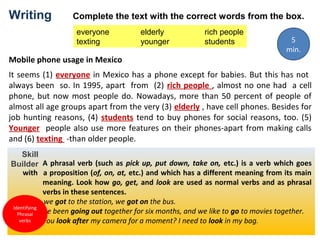
Writing

Complete the text with the correct words from the box.
everyone
texting

Mobile phone usage in Mexico

elderly
younger

rich people
students

5
min.

It seems (1) everyone in Mexico has a phone except for babies. But this has not
always been so. In 1995, apart from (2) rich people , almost no one had a cell
phone, but now most people do. Nowadays, more than 50 percent of people of
almost all age groups apart from the very (3) elderly , have cell phones. Besides for
job hunting reasons, (4) students tend to buy phones for social reasons, too. (5)
Younger people also use more features on their phones-apart from making calls
and (6) texting -than older people.
Skill
Builder A phrasal verb (such as pick up, put down, take on, etc.) is a verb which goes
with a proposition (of, on, at, etc.) and which has a different meaning from its main
meaning. Look how go, get, and look are used as normal verbs and as phrasal
verbs in these sentences.
When we got to the station, we got on the bus.
Identifying
We
Phrasal have been going out together for six months, and we like to go to movies together.
verbs
Could you look after my camera for a moment? I need to look in my bag.
Lesson B

Getting uniwired

Vocabulary Online
Complete the definitios with words from the box. Then listen and check your
answers.

spam
download

virtual
upload

social networking
update

Web browser
mailbox

1.The virtual world one that does not exist in reality, but exists on the Internet.
2.When you update your web site, you change it by adding or taking away
information.
3.When you download something from the internet, you put it onto your
computer.
4.A social networking web site is a place where you go to meet other
people.
5.Your mail box is the place where e-mail arrives for you to read.
6.Whet you upload something you make it available on the internet.
7.Spam is unwanted e-mail. It is sometimes called junk e-mail.
8.Your Web browser is the software program you use to access Web pages.
Listening
a. Listen and check  the features the social networking site
blogosphere has.
www.blogosphere.com.mx allows you to:
_unload pictures and movies
_download images and movies
_play music
_play on line games

b. Discuss which features of
social networking sites are best.

_create your own user name
_have multiple mailboxes
_leave messages for others
_add links to your homepage
Pre-reading
a. Look at the title of article on page 129. Predict what you think the
article will be about.

Unwiring my life
b. Quickly read the article on page 129. Then answer the questions.
Skim

1. What is the article about? Geting control over Internet usage.

2. Who is this article about? Monica and Dr. Tosic.
Scan

3. What was Monica’s problem? She was using the Internet too
much.
4. Which country does Dr. Tosic mention? Korea
5. Who does more homework, people who have cell phones, or
people who don’t? People who don’t

8
min.
Comprehension

Answer the questions about the
text.

1. How did Monica’s feelings towards Internet usage
change? She felt the Internet was controlling her life
so she now uses it much less.
2. What did Monica feel about the communication she was
having with others? It was not real comunicaton.
3. How does Dr. Tosic show that Monica is not an isolated
case? He mentions research and statistics from
Korea.

5
min.
Skills work

Identifying general or specific statements

Texts often start with general information, which then becomes more specific.
Some statements are very broad, while others are more specific and give a
lot more detail.
most general

Mexico has a large transportation system.

general

Many Mexicans have cars.

specific

Mexico City has the most cars per head of population.

most specific Thirty-three percent of Mexico City residents use cars
as a form of transport.

a. Write the level of generality that the sentences show.
1. Most general Many researchers work in the U. S.
2. Most specific

Dr. Tosic’s lab at the university is very large.

3. Specific

Dr. Tosic works st the University of Santa Barbara in the
U. S.

4. General

Dr. Tosic is a researcher in the U. S.

5. Most specific

Monica has six blogs and four web sites to maintain.

6. Specific

Some people have many blogs and Web sites to
maintain.

7. General

Many people now read blogs and Web sites.

8. Most general Many people use the Internet every day.
b. Underline the most specific sentence in each section.

8
min.

1.The Internet is widely used in Mexico. There were approximately 25
million Internet users in Mexico in 2008.
2.Social networking sites are beconmig more and more popular.
Approximately 10 percent of Web users have a social network
homepage.
3.Mexico’s first university was established about 460 years ago. The
National Autonomous University of Mexico was established in 1910
and has produced many of Mexico’s most famous scientistis and
engineers.
4.Mexico has many world famous scientists and some of them have won
prestigious prizes. Mario Molina was Mexico’s first Nobel Prize winner
in 1995.

In Mexico
How often do people in Mexico use the
Internet? What do they use it for?
Language work

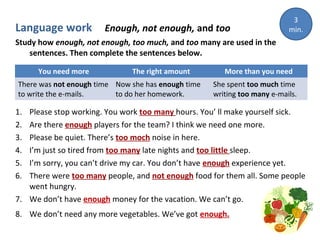
Enough, not enough, and too

3
min.

Study how enough, not enough, too much, and too many are used in the
sentences. Then complete the sentences below.
You need more

The right amount

There was not enough time Now she has enough time
to write the e-mails.
to do her homework.

More than you need
She spent too much time
writing too many e-mails.

1.
2.
3.
4.
5.
6.

Please stop working. You work too many hours. You’ ll make yourself sick.
Are there enough players for the team? I think we need one more.
Please be quiet. There’s too moch noise in here.
I’m just so tired from too many late nights and too little sleep.
I’m sorry, you can’t drive my car. You don’t have enough experience yet.
There were too many people, and not enough food for them all. Some people
went hungry.
7. We don’t have enough money for the vacation. We can’t go.
8. We don’t need any more vegetables. We’ve got enough.
Writing

Complete the paragraph using a verb and a noun
from each box and enough or not enough.
be (neg.)
have
be (neg.)
get
obtain

food
clean water
people
technology
resources

In many developing countries, some people can’t (1) obtain enough
food and they are hungry all the time. Some people can’t (2) get
enough clean water drink, either. Part of this problem is that
there (3) is not enough technology help them to grow food and
get water. There (4) are not enough people connected to the
Internet and there are not enough phones. But the future is
bright. They (5) have enough resources such as land and people
to build their countries and their economies.
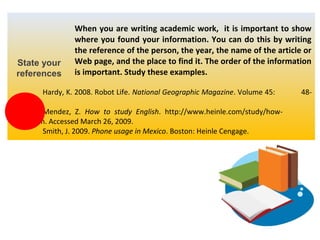
State your
references

When you are writing academic work, it is important to show
where you found your information. You can do this by writing
the reference of the person, the year, the name of the article or
Web page, and the place to find it. The order of the information
is important. Study these examples.

Hardy, K. 2008. Robot Life. National Geographic Magazine. Volume 45:
56.
Mendez, Z. How to study English. http://www.heinle.com/study/howto.htm. Accessed March 26, 2009.
Smith, J. 2009. Phone usage in Mexico. Boston: Heinle Cengage.

48-
Real-life reading

5
Read the text on page 132 and
min.
answer the questions.

1. Where does this text probably
come from? A manual
2. What do the five central
buttons do? Control the setup
menu on the TV
3. Which keys allow you to close
the SETUP? SETUP and OK
4. Which four keys control the
DVD? PREV, NEXT,
PLAY/PAUSE and STOP.
5. Which key do you press if you
want to watch but not listen to
the DVD? MUTE
My Learning Experience

Look at the list of language objectives in the unit. Draw ,  or .
Language
I can read blogs, manuals, and articles to find information and
listen to radio advertisements.
I can identify general or specific statements.
I can infer the meaning of unknown phrases.
I can understand and use expressions with enough, besides, and
apart from.
I can understand and use words for the phone and being online.

Closing Task
Look at the photos on pages 122 and 123 and
say which technologies you could live
without and which ones you couldn’t live
without. State your reasons.

Agree?
Word builder

Word roots: viv, vit, bio, and geo

Study how these word roots are used to make words. Then
complete the sentences below with the correct words.

5
min.

viv, vit (life or birth)

bio (life or living things)

geo (about the Earth)

survive-to stay alive
vitality-full of life
revive-make alive again
vitamins-life helping
medicines

biometrics-measurements of
the human body
biography-writing about a
life
biodiversity- a wide range of
biological things

geography-study of the
Earth
geocentric-centered on the
Earth
geopolitics-world politics

1.My History teacher is writing a biography of Emiliano Zapata.
2.I´m not very healthy, so I´d better take some vitamins.
3.One of the things that worries me is that Mexico´s biodiversity is disappearing.
4.The government is trying to revive the economy by creating jobs.
5.I´m amazed by her vitality. She has just so much energy.
6.How did he survive on the mountain all night in the dead of winter?
7.Making sure the world has enough food and water is an issue of geopolitics.
8.My favorite subjec at school has always bee Geography.
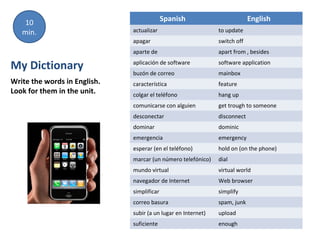
10
min.

Spanish

English

actualizar

to update

apagar

switch off

aparte de

apart from , besides

My Dictionary

aplicación de software

software application

Write the words in English.
Look for them in the unit.

buzón de correo

mainbox

característica

feature

colgar el teléfono

hang up

comunicarse con alguien

get trough to someone

desconectar

disconnect

dominar

dominic

emergencia

emergency

esperar (en el teléfono)

hold on (on the phone)

marcar (un número telefónico)

dial

mundo virtual

virtual world

navegador de Internet

Web browser

simplificar

simplify

correo basura

spam, junk

subir (a un lugar en Internet)

upload

suficiente

enough
Fuentes
Bibliográficas:
Chapman, J. (2009). Sequences, Teacher’s Resource Book 5. México: Heinle
Cengage Learning.
Waring, R., Woodall, P. y Thomlinson, J. (2009). Sequences, Student Book 5.
México: Heinle Cengage Learning.
Electrónicas:
http://images.google.es/images?hl=es&source=hp&q=wired&gbv=2&aq=f&oq=
Elaborado por: Ing. Sonia Margarita Osuna Rodríguez

Unit 11 Wired

  • 1.
    Block 4 Unit 11Wired Action Plan 5 min. In this unit, you will learn: • To read blogs, manuals, and articles to find information. • To identify general or specific statements. • To infer the meaning of unknown phrases. • To understand and use expressions with enough, besides, and apart from. • To understand and use words for the phone and being online.
  • 2.
    cell phones radio TV coffepot 1. Whatare the objects in the small pictures? Can you guess? 2. What do we use them for? 3. Which of these do you have in your home/family? counting keyboard compass calculator
  • 3.
    Lesson A CellPhone Debate 3 min.
  • 4.
    Vocabulary On the phone Completethe definitions with words from the box. Then listen and check your answers. hang up dial switch on get through to get hold of hold on 8 min. switch off engaged 1. If you want to get through to someone, you want to contac them. 2. If you want to get hold of someone, you want to contac them by phone. 3. When the other person is already using their phone, their phone is engaged. 4. When you switch off your phone, the power goes off. 5. When the other person is busy on the phone, you have to hold on. 6. When you hang up the phone, you stop talking to someone. 7. When you switch on your phone, the power comes on. 8. When you press the numbers to make a call, you dial them.
  • 5.
    Speaking Decide which ofthese are the pros and which are the cons of having a cell phone. State your reasons. They are convenient. They have many features. They are expensive. People always know where you are. They can lead to less interaction. You can carry them anywhere. It’s easy to get hold of friends. Using the keyboard too much can lead to injury. They can store data, names, addresses and music. The signal may be weak and you can’t get through. Pre-reading a. Look at the article on page 125. Predict what you think the article will be about. Is the cell phone a necessary evil? b. Quickly read the article on the page 125. then answer the questions. Skim 1. Where in this article from? The Internet/blog 2. What is the article about? Cell phones Scan 3. How many people contributed to the page? Four 4. Which user contributes the most messages? Sk8tr 5. Which brand of phone is discussed? The mePhone 6 min.
  • 6.
    Comprehension Choose the bestword or phrase to complete each sentence. 1. a people think cell phones are a very good idea. a. Two b. Three c. Four 2. Carla believes having a cell phone b. a. makes someone cool. b. doesn’t make them cool. c. can kill people. 3. b is persuaded that cell phones may be dangerous to your health. a. Carla b. sk8tr c. Dandan 4. Sk8tr believes c is wrong about cell phone manners. a. Poochi b. Carla c. Dandan 6 min.
  • 7.
    Skills Work Inferring themeaning of phrases Sometimes the meaning of a phrase is different from the meaning of its individual words. In the following sentence, can’t stand does not refer to standing; it means really don’t like. I can’t stand cell phones. They are nothing but trouble. a. Write the meaning of the underlined phrases in the sentences from the text on page 125. use expressions from the box. be careful main focus make things easy is very good in touch research this again 1.My cell phone keeps me up-to-date with wat´s going on in touch. 2.I wish they would pay attention. It´s just so dangerous. Be careful. 3.mePhone rocks! Is very good. 4.Save yourself the trouble and don´t take it to school make things easy . 5.I´ll double check. Research this again. 6.I´ve become the center of attention because of the phone. Main focus.
  • 8.
    b. Write themeaning of the underline phrases from the text. Use expressions from the box. attracted me say hello be in trouble tell 8 min. don’t lose contact have no more 1.Have you seen John? I need to break the news to him about his bad thest scores. Tell 2.I´m sorry we´ve run out of time; we have to finish now. Have no more 3.If you don´t study, you´ll pay the price when the test comes. Be in trouble 4.Ok, see you when you get back. Please stay in touch, ok? Don´t lose contact 5.And please give my regards to your family from me. Tell them I miss them. Say hello 6.Have you met the new girl in class? She´s really caught my eye. She ´s so pretty. Attracted me
  • 9.
    Lenguage work Except (for),besides, apart from 5 min. Study how except (for), besides, and apart from are used in these sentences. Then complete the sentences below. I like many sports but not baseball I like all sports except (for) baseball. Apart from baseball, I like all sports. Besides baseball, I like all sports. I only like baseball I don’t like sports, except (for) baseball. Apart from baseball, I don’t like sports. Besides baseball, I don’t like sports. 1.I can use all the features on this phone except for this one. 2.I work every day apart from Sunday. 3.Besides my monthly phone bill, I have to pay for the Internet. 4.She can eat anything apart from beans and rice. 5.This phone gives me everything except for access to the Internet. 6.Apart for his sister, none of his family came to watch him play.
  • 10.
    Writing Complete the textwith the correct words from the box. everyone texting Mobile phone usage in Mexico elderly younger rich people students 5 min. It seems (1) everyone in Mexico has a phone except for babies. But this has not always been so. In 1995, apart from (2) rich people , almost no one had a cell phone, but now most people do. Nowadays, more than 50 percent of people of almost all age groups apart from the very (3) elderly , have cell phones. Besides for job hunting reasons, (4) students tend to buy phones for social reasons, too. (5) Younger people also use more features on their phones-apart from making calls and (6) texting -than older people. Skill Builder A phrasal verb (such as pick up, put down, take on, etc.) is a verb which goes with a proposition (of, on, at, etc.) and which has a different meaning from its main meaning. Look how go, get, and look are used as normal verbs and as phrasal verbs in these sentences. When we got to the station, we got on the bus. Identifying We Phrasal have been going out together for six months, and we like to go to movies together. verbs Could you look after my camera for a moment? I need to look in my bag.
  • 11.
    Lesson B Getting uniwired VocabularyOnline Complete the definitios with words from the box. Then listen and check your answers. spam download virtual upload social networking update Web browser mailbox 1.The virtual world one that does not exist in reality, but exists on the Internet. 2.When you update your web site, you change it by adding or taking away information. 3.When you download something from the internet, you put it onto your computer. 4.A social networking web site is a place where you go to meet other people. 5.Your mail box is the place where e-mail arrives for you to read. 6.Whet you upload something you make it available on the internet. 7.Spam is unwanted e-mail. It is sometimes called junk e-mail. 8.Your Web browser is the software program you use to access Web pages.
  • 12.
    Listening a. Listen andcheck  the features the social networking site blogosphere has. www.blogosphere.com.mx allows you to: _unload pictures and movies _download images and movies _play music _play on line games b. Discuss which features of social networking sites are best. _create your own user name _have multiple mailboxes _leave messages for others _add links to your homepage
  • 13.
    Pre-reading a. Look atthe title of article on page 129. Predict what you think the article will be about. Unwiring my life b. Quickly read the article on page 129. Then answer the questions. Skim 1. What is the article about? Geting control over Internet usage. 2. Who is this article about? Monica and Dr. Tosic. Scan 3. What was Monica’s problem? She was using the Internet too much. 4. Which country does Dr. Tosic mention? Korea 5. Who does more homework, people who have cell phones, or people who don’t? People who don’t 8 min.
  • 14.
    Comprehension Answer the questionsabout the text. 1. How did Monica’s feelings towards Internet usage change? She felt the Internet was controlling her life so she now uses it much less. 2. What did Monica feel about the communication she was having with others? It was not real comunicaton. 3. How does Dr. Tosic show that Monica is not an isolated case? He mentions research and statistics from Korea. 5 min.
  • 15.
    Skills work Identifying generalor specific statements Texts often start with general information, which then becomes more specific. Some statements are very broad, while others are more specific and give a lot more detail. most general Mexico has a large transportation system. general Many Mexicans have cars. specific Mexico City has the most cars per head of population. most specific Thirty-three percent of Mexico City residents use cars as a form of transport. a. Write the level of generality that the sentences show. 1. Most general Many researchers work in the U. S. 2. Most specific Dr. Tosic’s lab at the university is very large. 3. Specific Dr. Tosic works st the University of Santa Barbara in the U. S. 4. General Dr. Tosic is a researcher in the U. S. 5. Most specific Monica has six blogs and four web sites to maintain. 6. Specific Some people have many blogs and Web sites to maintain. 7. General Many people now read blogs and Web sites. 8. Most general Many people use the Internet every day.
  • 16.
    b. Underline themost specific sentence in each section. 8 min. 1.The Internet is widely used in Mexico. There were approximately 25 million Internet users in Mexico in 2008. 2.Social networking sites are beconmig more and more popular. Approximately 10 percent of Web users have a social network homepage. 3.Mexico’s first university was established about 460 years ago. The National Autonomous University of Mexico was established in 1910 and has produced many of Mexico’s most famous scientistis and engineers. 4.Mexico has many world famous scientists and some of them have won prestigious prizes. Mario Molina was Mexico’s first Nobel Prize winner in 1995. In Mexico How often do people in Mexico use the Internet? What do they use it for?
  • 17.
    Language work Enough, notenough, and too 3 min. Study how enough, not enough, too much, and too many are used in the sentences. Then complete the sentences below. You need more The right amount There was not enough time Now she has enough time to write the e-mails. to do her homework. More than you need She spent too much time writing too many e-mails. 1. 2. 3. 4. 5. 6. Please stop working. You work too many hours. You’ ll make yourself sick. Are there enough players for the team? I think we need one more. Please be quiet. There’s too moch noise in here. I’m just so tired from too many late nights and too little sleep. I’m sorry, you can’t drive my car. You don’t have enough experience yet. There were too many people, and not enough food for them all. Some people went hungry. 7. We don’t have enough money for the vacation. We can’t go. 8. We don’t need any more vegetables. We’ve got enough.
  • 18.
    Writing Complete the paragraphusing a verb and a noun from each box and enough or not enough. be (neg.) have be (neg.) get obtain food clean water people technology resources In many developing countries, some people can’t (1) obtain enough food and they are hungry all the time. Some people can’t (2) get enough clean water drink, either. Part of this problem is that there (3) is not enough technology help them to grow food and get water. There (4) are not enough people connected to the Internet and there are not enough phones. But the future is bright. They (5) have enough resources such as land and people to build their countries and their economies.
  • 19.
    State your references When youare writing academic work, it is important to show where you found your information. You can do this by writing the reference of the person, the year, the name of the article or Web page, and the place to find it. The order of the information is important. Study these examples. Hardy, K. 2008. Robot Life. National Geographic Magazine. Volume 45: 56. Mendez, Z. How to study English. http://www.heinle.com/study/howto.htm. Accessed March 26, 2009. Smith, J. 2009. Phone usage in Mexico. Boston: Heinle Cengage. 48-
  • 20.
    Real-life reading 5 Read thetext on page 132 and min. answer the questions. 1. Where does this text probably come from? A manual 2. What do the five central buttons do? Control the setup menu on the TV 3. Which keys allow you to close the SETUP? SETUP and OK 4. Which four keys control the DVD? PREV, NEXT, PLAY/PAUSE and STOP. 5. Which key do you press if you want to watch but not listen to the DVD? MUTE
  • 21.
    My Learning Experience Lookat the list of language objectives in the unit. Draw ,  or . Language I can read blogs, manuals, and articles to find information and listen to radio advertisements. I can identify general or specific statements. I can infer the meaning of unknown phrases. I can understand and use expressions with enough, besides, and apart from. I can understand and use words for the phone and being online. Closing Task Look at the photos on pages 122 and 123 and say which technologies you could live without and which ones you couldn’t live without. State your reasons. Agree?
  • 22.
    Word builder Word roots:viv, vit, bio, and geo Study how these word roots are used to make words. Then complete the sentences below with the correct words. 5 min. viv, vit (life or birth) bio (life or living things) geo (about the Earth) survive-to stay alive vitality-full of life revive-make alive again vitamins-life helping medicines biometrics-measurements of the human body biography-writing about a life biodiversity- a wide range of biological things geography-study of the Earth geocentric-centered on the Earth geopolitics-world politics 1.My History teacher is writing a biography of Emiliano Zapata. 2.I´m not very healthy, so I´d better take some vitamins. 3.One of the things that worries me is that Mexico´s biodiversity is disappearing. 4.The government is trying to revive the economy by creating jobs. 5.I´m amazed by her vitality. She has just so much energy. 6.How did he survive on the mountain all night in the dead of winter? 7.Making sure the world has enough food and water is an issue of geopolitics. 8.My favorite subjec at school has always bee Geography.
  • 23.
    10 min. Spanish English actualizar to update apagar switch off apartede apart from , besides My Dictionary aplicación de software software application Write the words in English. Look for them in the unit. buzón de correo mainbox característica feature colgar el teléfono hang up comunicarse con alguien get trough to someone desconectar disconnect dominar dominic emergencia emergency esperar (en el teléfono) hold on (on the phone) marcar (un número telefónico) dial mundo virtual virtual world navegador de Internet Web browser simplificar simplify correo basura spam, junk subir (a un lugar en Internet) upload suficiente enough
  • 24.
    Fuentes Bibliográficas: Chapman, J. (2009).Sequences, Teacher’s Resource Book 5. México: Heinle Cengage Learning. Waring, R., Woodall, P. y Thomlinson, J. (2009). Sequences, Student Book 5. México: Heinle Cengage Learning. Electrónicas: http://images.google.es/images?hl=es&source=hp&q=wired&gbv=2&aq=f&oq= Elaborado por: Ing. Sonia Margarita Osuna Rodríguez