Unit 1
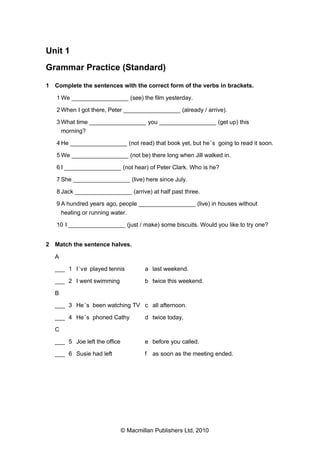
Grammar Practice (Standard)
1 Complete the sentences with the correct form of the verbs in brackets.
1 We _________________ (see) the film yesterday.
2 When I got there, Peter _________________ (already / arrive).
3 What time _________________ you _________________ (get up) this
morning?
4 He _________________ (not read) that book yet, but he’s going to read it soon.
5 We _________________ (not be) there long when Jill walked in.
6 I _________________ (not hear) of Peter Clark. Who is he?
7 She _________________ (live) here since July.
8 Jack _________________ (arrive) at half past three.
9 A hundred years ago, people _________________ (live) in houses without
heating or running water.
10 I _________________ (just / make) some biscuits. Would you like to try one?
2 Match the sentence halves.
A
___ 1 I’ve played tennis a last weekend.
___ 2 I went swimming b twice this weekend.
B
___ 3 He’s been watching TV c all afternoon.
___ 4 He’s phoned Cathy d twice today.
C
___ 5 Joe left the office e before you called.
___ 6 Susie had left f as soon as the meeting ended.
© Macmillan Publishers Ltd, 2010
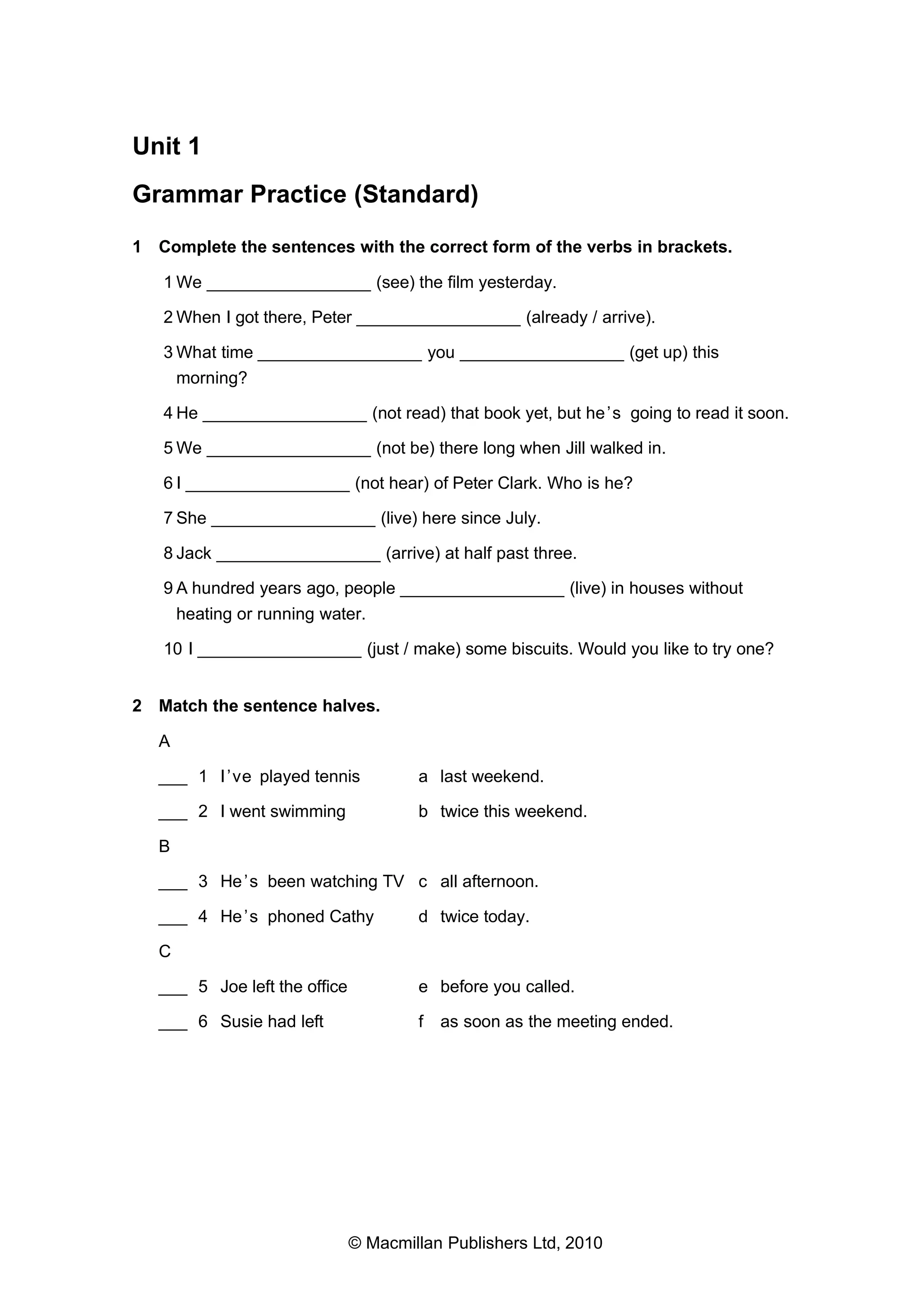
3 Circle the correct alternatives.
1 I’ve known/been knowing Paula for ages.
2 Jack’s ears were cold because he had forgotten/been forgetting his hat.
3 We have waited/been waiting for you for ages.
4 Tim has told/been telling that joke at least three times.
5 I hadn’t had/been having my lunch so I felt very hungry.
6 How long have you lived/been living in that old house?
4 Complete the sentences with the correct form of the verbs in brackets.
1 Thomas _________________ (stay) at our house for three weeks now.
2 When we arrived, Bill _________________ (already / leave). It was
disappointing not to see him.
3 Tim _________________ (work) at home that morning and didn’t know
anything about the fire that took place later in the day at his office.
4 How long _________________ the children _________________ (watch) TV?
It’s time they did something else.
5 I _________________ (visit) Paris twice in my life.
6 We _________________ (sunbathe) on this beach all morning. It’s wonderful.
© Macmillan Publishers Ltd, 2010
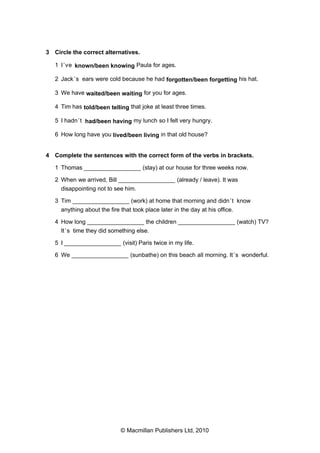
5 Write sentences using the prompts to make a dialogue.
1 When / you first meet / Samantha?
___________________________________________________________
2 I / meet / her / in 2008.
___________________________________________________________
3 How long / she / work / as a journalist / before then?
___________________________________________________________
4 She / already / work / as a journalist / for two years / when I / meet / her.
___________________________________________________________
5 you / be / in touch / lately?
___________________________________________________________
6 We / meet / last month / for a coffee.
___________________________________________________________
6 Translate the sentences into your own language.
1 Rebecca hadn’t been to a zoo before.
___________________________________________________________
2 We’ve been working here all afternoon.
___________________________________________________________
3 I haven’t had my lunch yet.
___________________________________________________________
4 Jim had been waiting for ages when we finally got there.
___________________________________________________________
5 How long have you been studying English?
___________________________________________________________
© Macmillan Publishers Ltd, 2010
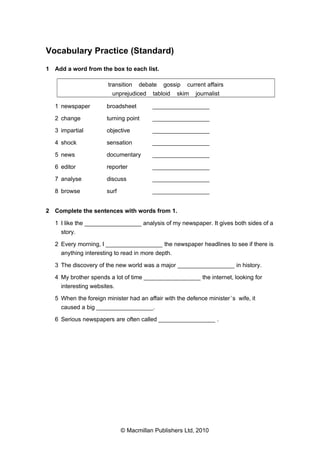
Vocabulary Practice (Standard)
1 Add a word from the box to each list.
transition debate gossip current affairs
unprejudiced tabloid skim journalist
1 newspaper broadsheet _________________
2 change turning point _________________
3 impartial objective _________________
4 shock sensation _________________
5 news documentary _________________
6 editor reporter _________________
7 analyse discuss _________________
8 browse surf _________________
2 Complete the sentences with words from 1.
1 I like the _________________ analysis of my newspaper. It gives both sides of a
story.
2 Every morning, I _________________ the newspaper headlines to see if there is
anything interesting to read in more depth.
3 The discovery of the new world was a major _________________ in history.
4 My brother spends a lot of time _________________ the internet, looking for
interesting websites.
5 When the foreign minister had an affair with the defence minister’s wife, it
caused a big _________________.
6 Serious newspapers are often called _________________ .
© Macmillan Publishers Ltd, 2010
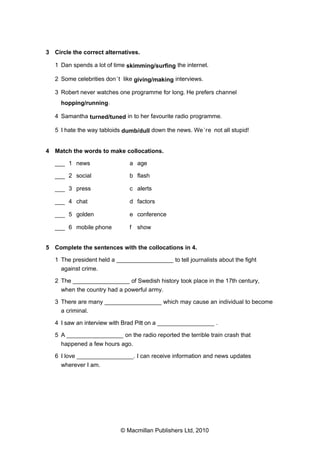
3 Circle the correct alternatives.
1 Dan spends a lot of time skimming/surfing the internet.
2 Some celebrities don’t like giving/making interviews.
3 Robert never watches one programme for long. He prefers channel
hopping/running.
4 Samantha turned/tuned in to her favourite radio programme.
5 I hate the way tabloids dumb/dull down the news. We’re not all stupid!
4 Match the words to make collocations.
___ 1 news a age
___ 2 social b flash
___ 3 press c alerts
___ 4 chat d factors
___ 5 golden e conference
___ 6 mobile phone f show
5 Complete the sentences with the collocations in 4.
1 The president held a _________________ to tell journalists about the fight
against crime.
2 The _________________ of Swedish history took place in the 17th century,
when the country had a powerful army.
3 There are many _________________ which may cause an individual to become
a criminal.
4 I saw an interview with Brad Pitt on a _________________ .
5 A _________________ on the radio reported the terrible train crash that
happened a few hours ago.
6 I love _________________. I can receive information and news updates
wherever I am.
© Macmillan Publishers Ltd, 2010
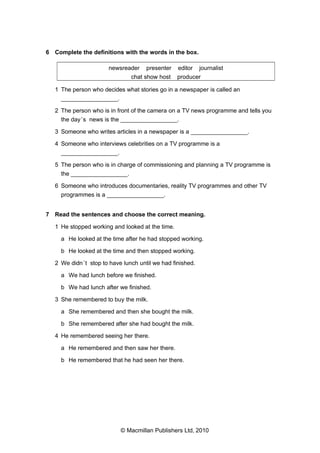
6 Complete the definitions with the words in the box.
newsreader presenter editor journalist
chat show host producer
1 The person who decides what stories go in a newspaper is called an
_________________.
2 The person who is in front of the camera on a TV news programme and tells you
the day’s news is the _________________.
3 Someone who writes articles in a newspaper is a _________________.
4 Someone who interviews celebrities on a TV programme is a
_________________.
5 The person who is in charge of commissioning and planning a TV programme is
the _________________.
6 Someone who introduces documentaries, reality TV programmes and other TV
programmes is a _________________.
7 Read the sentences and choose the correct meaning.
1 He stopped working and looked at the time.
a He looked at the time after he had stopped working.
b He looked at the time and then stopped working.
2 We didn’t stop to have lunch until we had finished.
a We had lunch before we finished.
b We had lunch after we finished.
3 She remembered to buy the milk.
a She remembered and then she bought the milk.
b She remembered after she had bought the milk.
4 He remembered seeing her there.
a He remembered and then saw her there.
b He remembered that he had seen her there.
© Macmillan Publishers Ltd, 2010
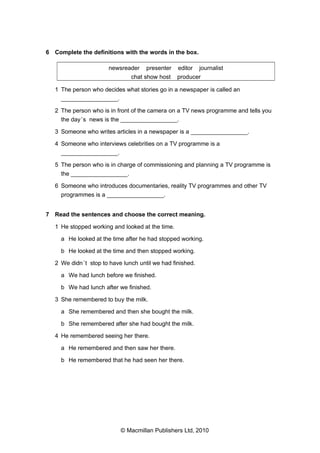
6 Complete the definitions with the words in the box.
newsreader presenter editor journalist
chat show host producer
1 The person who decides what stories go in a newspaper is called an
_________________.
2 The person who is in front of the camera on a TV news programme and tells you
the day’s news is the _________________.
3 Someone who writes articles in a newspaper is a _________________.
4 Someone who interviews celebrities on a TV programme is a
_________________.
5 The person who is in charge of commissioning and planning a TV programme is
the _________________.
6 Someone who introduces documentaries, reality TV programmes and other TV
programmes is a _________________.
7 Read the sentences and choose the correct meaning.
1 He stopped working and looked at the time.
a He looked at the time after he had stopped working.
b He looked at the time and then stopped working.
2 We didn’t stop to have lunch until we had finished.
a We had lunch before we finished.
b We had lunch after we finished.
3 She remembered to buy the milk.
a She remembered and then she bought the milk.
b She remembered after she had bought the milk.
4 He remembered seeing her there.
a He remembered and then saw her there.
b He remembered that he had seen her there.
© Macmillan Publishers Ltd, 2010

Unit 1 standard

  • 1.
    Unit 1 Grammar Practice(Standard) 1 Complete the sentences with the correct form of the verbs in brackets. 1 We _________________ (see) the film yesterday. 2 When I got there, Peter _________________ (already / arrive). 3 What time _________________ you _________________ (get up) this morning? 4 He _________________ (not read) that book yet, but he’s going to read it soon. 5 We _________________ (not be) there long when Jill walked in. 6 I _________________ (not hear) of Peter Clark. Who is he? 7 She _________________ (live) here since July. 8 Jack _________________ (arrive) at half past three. 9 A hundred years ago, people _________________ (live) in houses without heating or running water. 10 I _________________ (just / make) some biscuits. Would you like to try one? 2 Match the sentence halves. A ___ 1 I’ve played tennis a last weekend. ___ 2 I went swimming b twice this weekend. B ___ 3 He’s been watching TV c all afternoon. ___ 4 He’s phoned Cathy d twice today. C ___ 5 Joe left the office e before you called. ___ 6 Susie had left f as soon as the meeting ended. © Macmillan Publishers Ltd, 2010
  • 2.
    3 Circle thecorrect alternatives. 1 I’ve known/been knowing Paula for ages. 2 Jack’s ears were cold because he had forgotten/been forgetting his hat. 3 We have waited/been waiting for you for ages. 4 Tim has told/been telling that joke at least three times. 5 I hadn’t had/been having my lunch so I felt very hungry. 6 How long have you lived/been living in that old house? 4 Complete the sentences with the correct form of the verbs in brackets. 1 Thomas _________________ (stay) at our house for three weeks now. 2 When we arrived, Bill _________________ (already / leave). It was disappointing not to see him. 3 Tim _________________ (work) at home that morning and didn’t know anything about the fire that took place later in the day at his office. 4 How long _________________ the children _________________ (watch) TV? It’s time they did something else. 5 I _________________ (visit) Paris twice in my life. 6 We _________________ (sunbathe) on this beach all morning. It’s wonderful. © Macmillan Publishers Ltd, 2010
  • 3.
    5 Write sentencesusing the prompts to make a dialogue. 1 When / you first meet / Samantha? ___________________________________________________________ 2 I / meet / her / in 2008. ___________________________________________________________ 3 How long / she / work / as a journalist / before then? ___________________________________________________________ 4 She / already / work / as a journalist / for two years / when I / meet / her. ___________________________________________________________ 5 you / be / in touch / lately? ___________________________________________________________ 6 We / meet / last month / for a coffee. ___________________________________________________________ 6 Translate the sentences into your own language. 1 Rebecca hadn’t been to a zoo before. ___________________________________________________________ 2 We’ve been working here all afternoon. ___________________________________________________________ 3 I haven’t had my lunch yet. ___________________________________________________________ 4 Jim had been waiting for ages when we finally got there. ___________________________________________________________ 5 How long have you been studying English? ___________________________________________________________ © Macmillan Publishers Ltd, 2010
  • 4.
    Vocabulary Practice (Standard) 1Add a word from the box to each list. transition debate gossip current affairs unprejudiced tabloid skim journalist 1 newspaper broadsheet _________________ 2 change turning point _________________ 3 impartial objective _________________ 4 shock sensation _________________ 5 news documentary _________________ 6 editor reporter _________________ 7 analyse discuss _________________ 8 browse surf _________________ 2 Complete the sentences with words from 1. 1 I like the _________________ analysis of my newspaper. It gives both sides of a story. 2 Every morning, I _________________ the newspaper headlines to see if there is anything interesting to read in more depth. 3 The discovery of the new world was a major _________________ in history. 4 My brother spends a lot of time _________________ the internet, looking for interesting websites. 5 When the foreign minister had an affair with the defence minister’s wife, it caused a big _________________. 6 Serious newspapers are often called _________________ . © Macmillan Publishers Ltd, 2010
  • 5.
    3 Circle thecorrect alternatives. 1 Dan spends a lot of time skimming/surfing the internet. 2 Some celebrities don’t like giving/making interviews. 3 Robert never watches one programme for long. He prefers channel hopping/running. 4 Samantha turned/tuned in to her favourite radio programme. 5 I hate the way tabloids dumb/dull down the news. We’re not all stupid! 4 Match the words to make collocations. ___ 1 news a age ___ 2 social b flash ___ 3 press c alerts ___ 4 chat d factors ___ 5 golden e conference ___ 6 mobile phone f show 5 Complete the sentences with the collocations in 4. 1 The president held a _________________ to tell journalists about the fight against crime. 2 The _________________ of Swedish history took place in the 17th century, when the country had a powerful army. 3 There are many _________________ which may cause an individual to become a criminal. 4 I saw an interview with Brad Pitt on a _________________ . 5 A _________________ on the radio reported the terrible train crash that happened a few hours ago. 6 I love _________________. I can receive information and news updates wherever I am. © Macmillan Publishers Ltd, 2010
  • 6.
    6 Complete thedefinitions with the words in the box. newsreader presenter editor journalist chat show host producer 1 The person who decides what stories go in a newspaper is called an _________________. 2 The person who is in front of the camera on a TV news programme and tells you the day’s news is the _________________. 3 Someone who writes articles in a newspaper is a _________________. 4 Someone who interviews celebrities on a TV programme is a _________________. 5 The person who is in charge of commissioning and planning a TV programme is the _________________. 6 Someone who introduces documentaries, reality TV programmes and other TV programmes is a _________________. 7 Read the sentences and choose the correct meaning. 1 He stopped working and looked at the time. a He looked at the time after he had stopped working. b He looked at the time and then stopped working. 2 We didn’t stop to have lunch until we had finished. a We had lunch before we finished. b We had lunch after we finished. 3 She remembered to buy the milk. a She remembered and then she bought the milk. b She remembered after she had bought the milk. 4 He remembered seeing her there. a He remembered and then saw her there. b He remembered that he had seen her there. © Macmillan Publishers Ltd, 2010
  • 7.
    6 Complete thedefinitions with the words in the box. newsreader presenter editor journalist chat show host producer 1 The person who decides what stories go in a newspaper is called an _________________. 2 The person who is in front of the camera on a TV news programme and tells you the day’s news is the _________________. 3 Someone who writes articles in a newspaper is a _________________. 4 Someone who interviews celebrities on a TV programme is a _________________. 5 The person who is in charge of commissioning and planning a TV programme is the _________________. 6 Someone who introduces documentaries, reality TV programmes and other TV programmes is a _________________. 7 Read the sentences and choose the correct meaning. 1 He stopped working and looked at the time. a He looked at the time after he had stopped working. b He looked at the time and then stopped working. 2 We didn’t stop to have lunch until we had finished. a We had lunch before we finished. b We had lunch after we finished. 3 She remembered to buy the milk. a She remembered and then she bought the milk. b She remembered after she had bought the milk. 4 He remembered seeing her there. a He remembered and then saw her there. b He remembered that he had seen her there. © Macmillan Publishers Ltd, 2010