Chapter :1
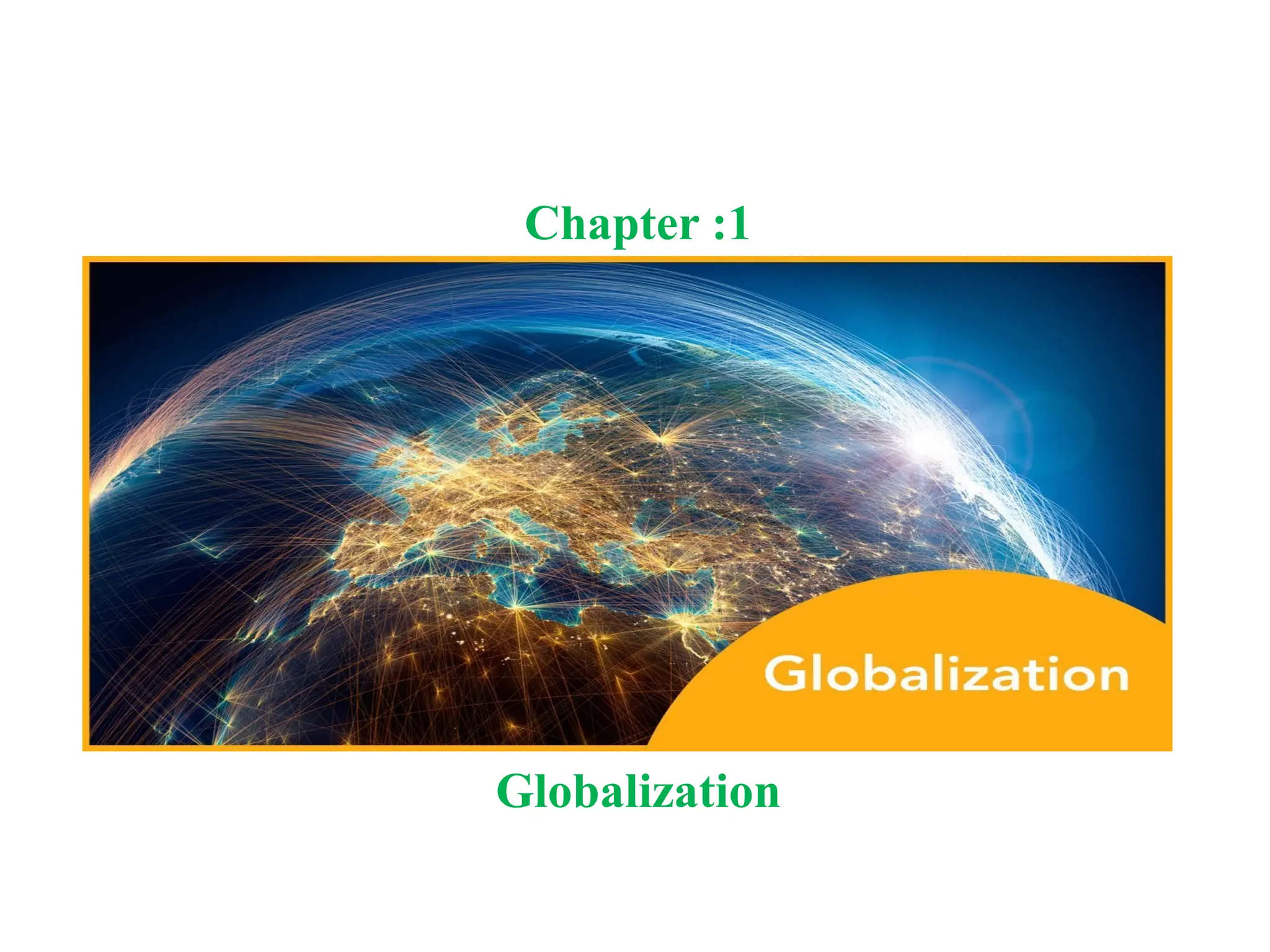
Globalization
Learning objectives
After reading this lesson, students will be able to-
1. Understand what is meant by the term globalization.
2. Recognize the main drivers of globalization.
3. Describe the changing nature of the global economy.
4. Explain the main arguments in the debate overs the impact of
globalization.
5. Understand how the process of globalization is creating
opportunities and challenges for management practices.
Lesson Contents
1. What is globalization?
2. Factors in increased globalization
3. What is international business?
4. Why firms go international?
5. Basic concepts of international business
6. Reasons for international business
7. Barriers to international trade
8. Forms of international business.
9. Advantages of international business.
10. Disadvantages of international business.
11. The emergences of global institutions.
12. Drivers of globalization.
13. Declining trade and investment barriers.
14. The role of technological changes.
Lesson Contents
15. Changing demographics of the global economy.
16. Changing foreign direct investment picture.
17. Changing multinational enterprises.
18. The Changing world order.
19. The globalization debate.
20. Ant globalization protests.
21. Globalization, jobs and income.
22. Globalization and national sovereignty
23. Globalization, Labor Policies, and the Environment
24. Globalization and world’s poor
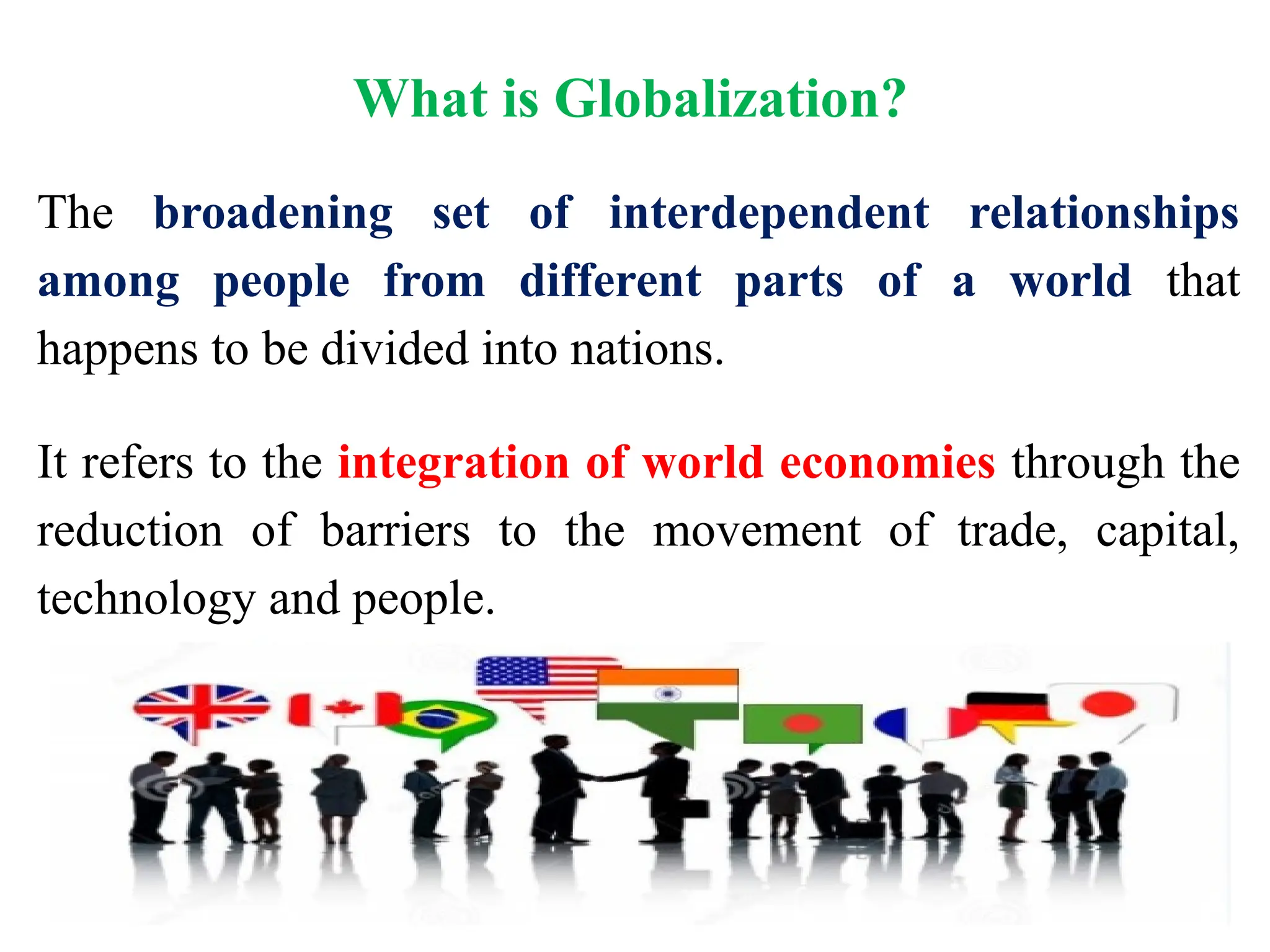
What is Globalization?
The broadening set of interdependent relationships
among people from different parts of a world that
happens to be divided into nations.
It refers to the integration of world economies through the
reduction of barriers to the movement of trade, capital,
technology and people.
What is Globalization?
Globalization has two main components:
Historically distinct and separate national markets are merging and
creating the “global market”
 Falling trade barriers make it easier to sell globally
 Consumers’ tastes and preferences are converging on some
global norm
 Firms promote the trend by offering the same basic products
worldwide
What is Globalization?
Globalization has two main components:
• Firms source goods and services from locations around the globe
to capitalize on national differences in the cost and quality of
factors of production like land, labor, energy, and capital
• Companies can
olower their overall cost structure
oimprove the quality or functionality of their product offering
Factors in increased Globalization
1. Increase and expansion of technology
2. Liberalization of cross border trade and resource movement
3. Development of services that support international business
4. Growing consumer pressures
5. Increased global competition
6. Changing political situations
7. Expanded cross national cooperation
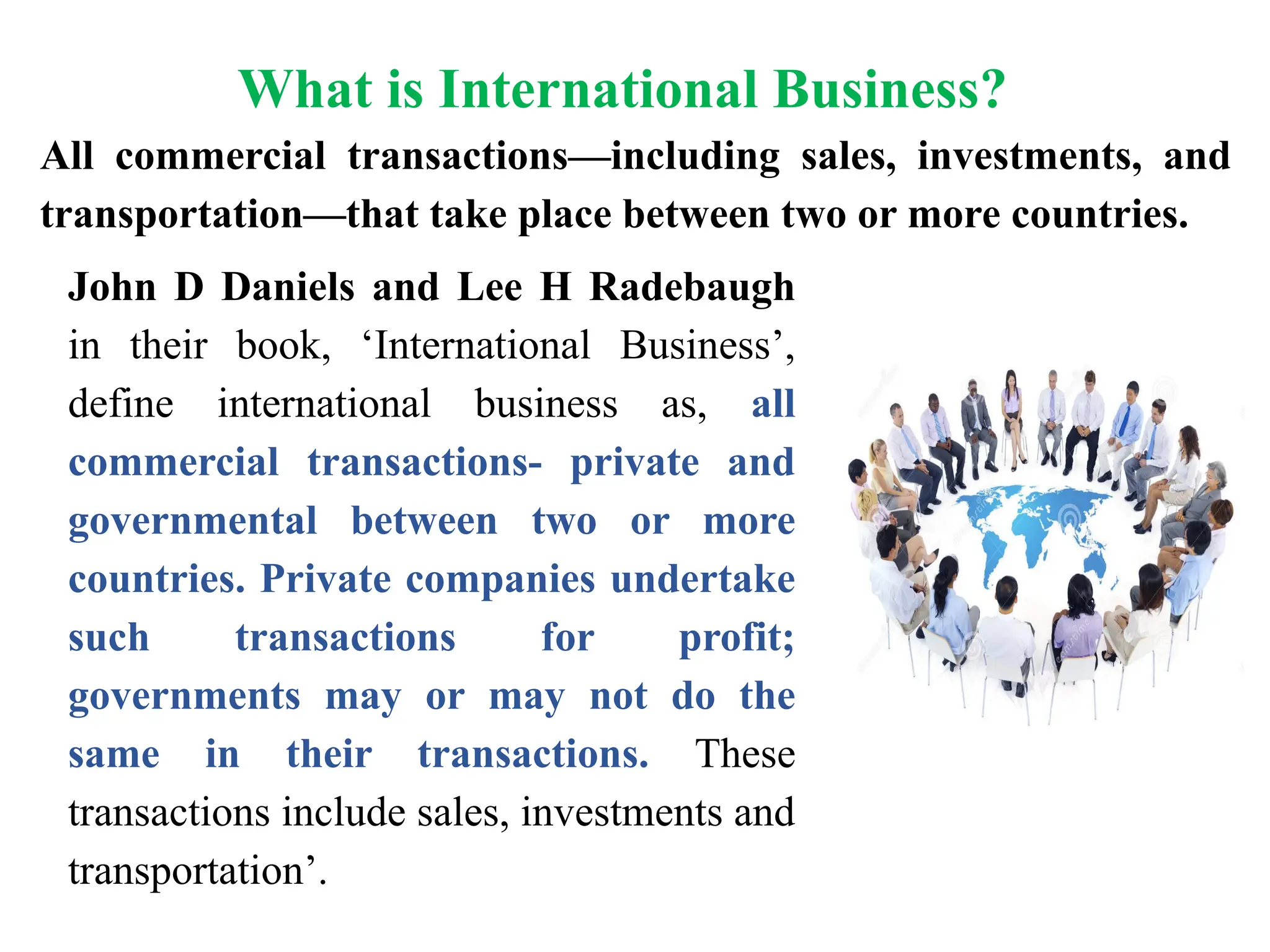
What is International Business?
John D Daniels and Lee H Radebaugh
in their book, ‘International Business’,
define international business as, all
commercial transactions- private and
governmental between two or more
countries. Private companies undertake
such transactions for profit;
governments may or may not do the
same in their transactions. These
transactions include sales, investments and
transportation’.
All commercial transactions—including sales, investments, and
transportation—that take place between two or more countries.
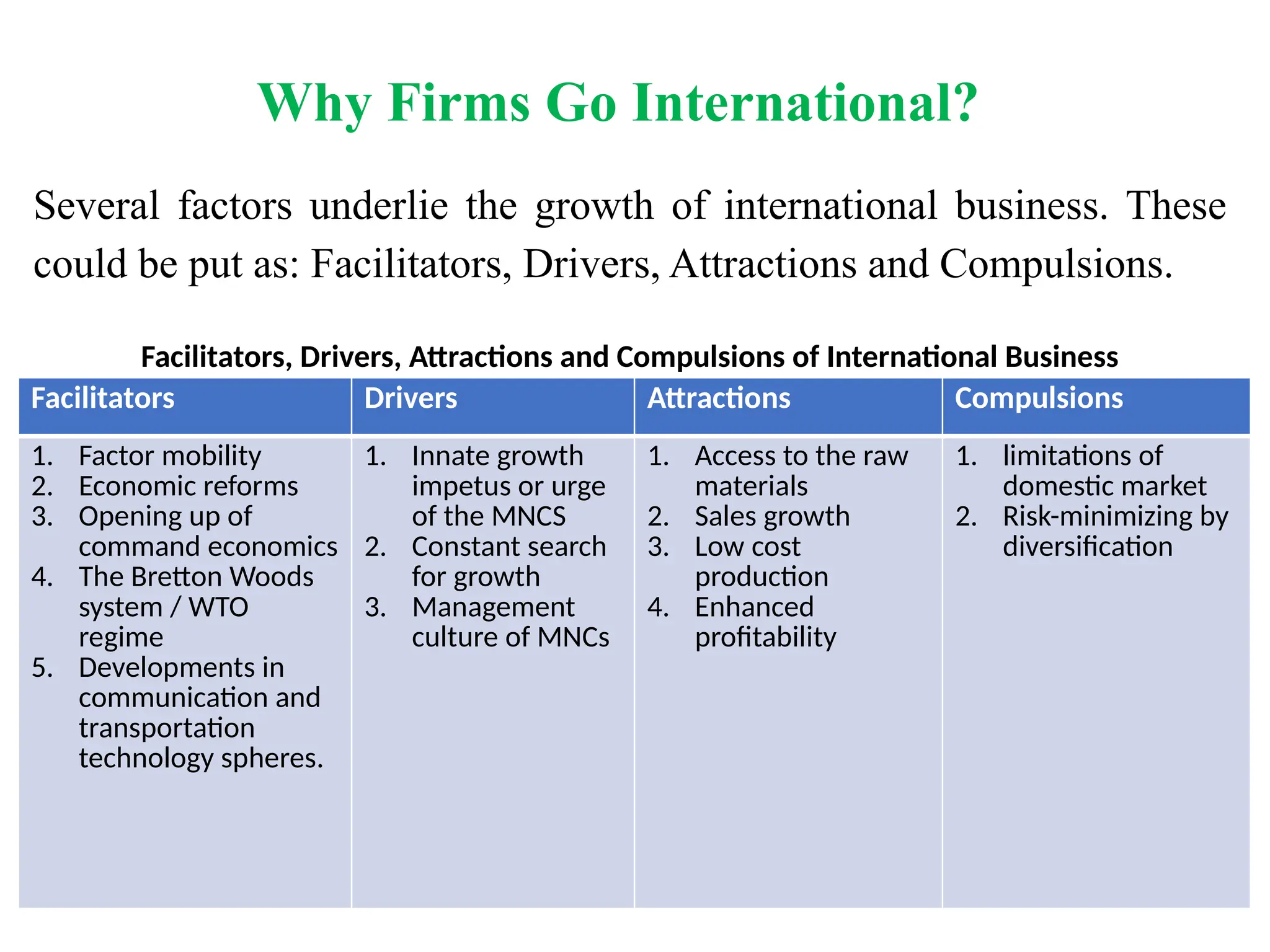
Several factors underlie the growth of international business. These
could be put as: Facilitators, Drivers, Attractions and Compulsions.
Facilitators Drivers Attractions Compulsions
1. Factor mobility
2. Economic reforms
3. Opening up of
command economics
4. The Bretton Woods
system / WTO
regime
5. Developments in
communication and
transportation
technology spheres.
1. Innate growth
impetus or urge
of the MNCS
2. Constant search
for growth
3. Management
culture of MNCs
1. Access to the raw
materials
2. Sales growth
3. Low cost
production
4. Enhanced
profitability
1. limitations of
domestic market
2. Risk-minimizing by
diversification
Why Firms Go International?
Facilitators, Drivers, Attractions and Compulsions of International Business
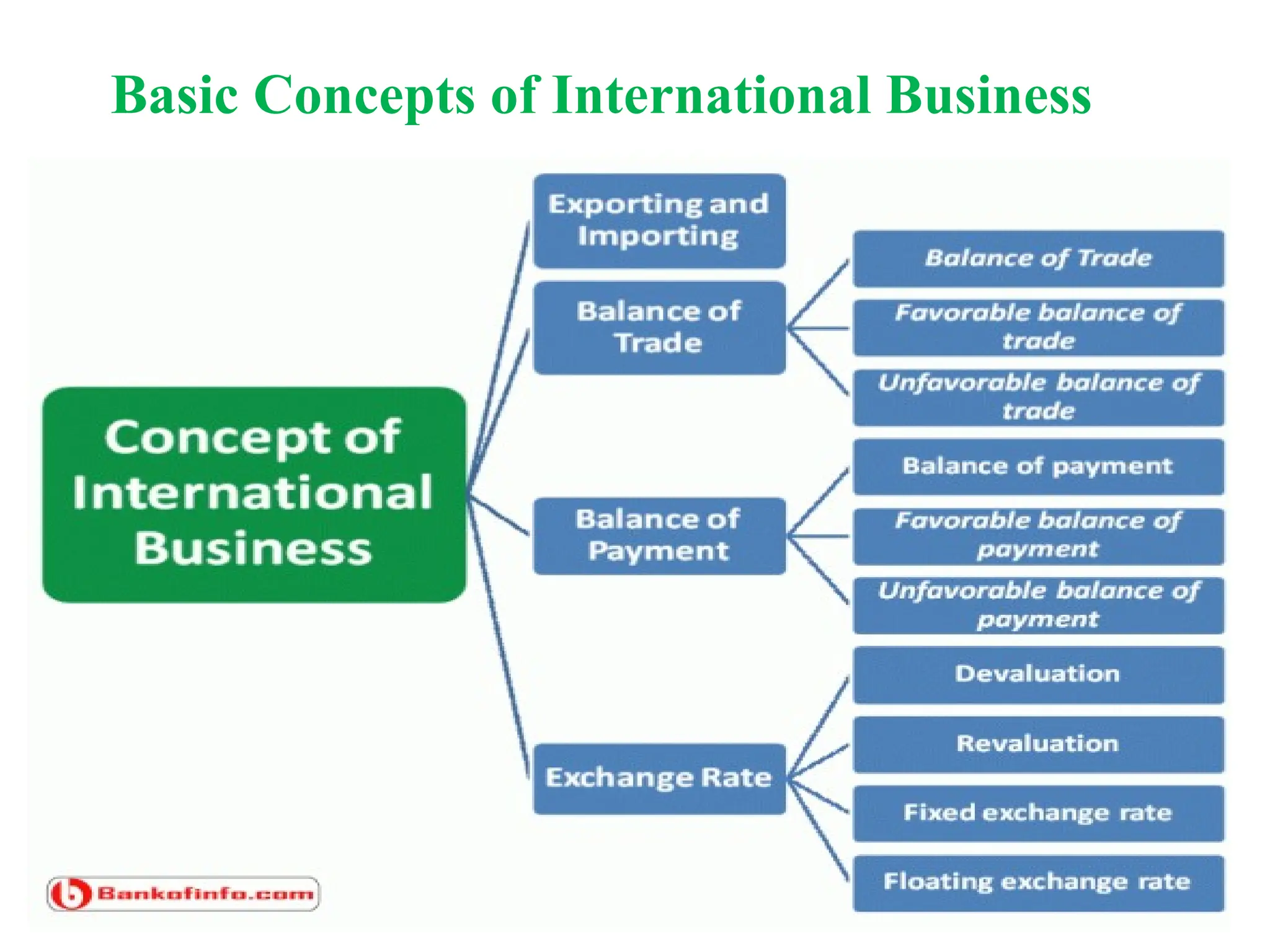
Basic Concepts of International Business
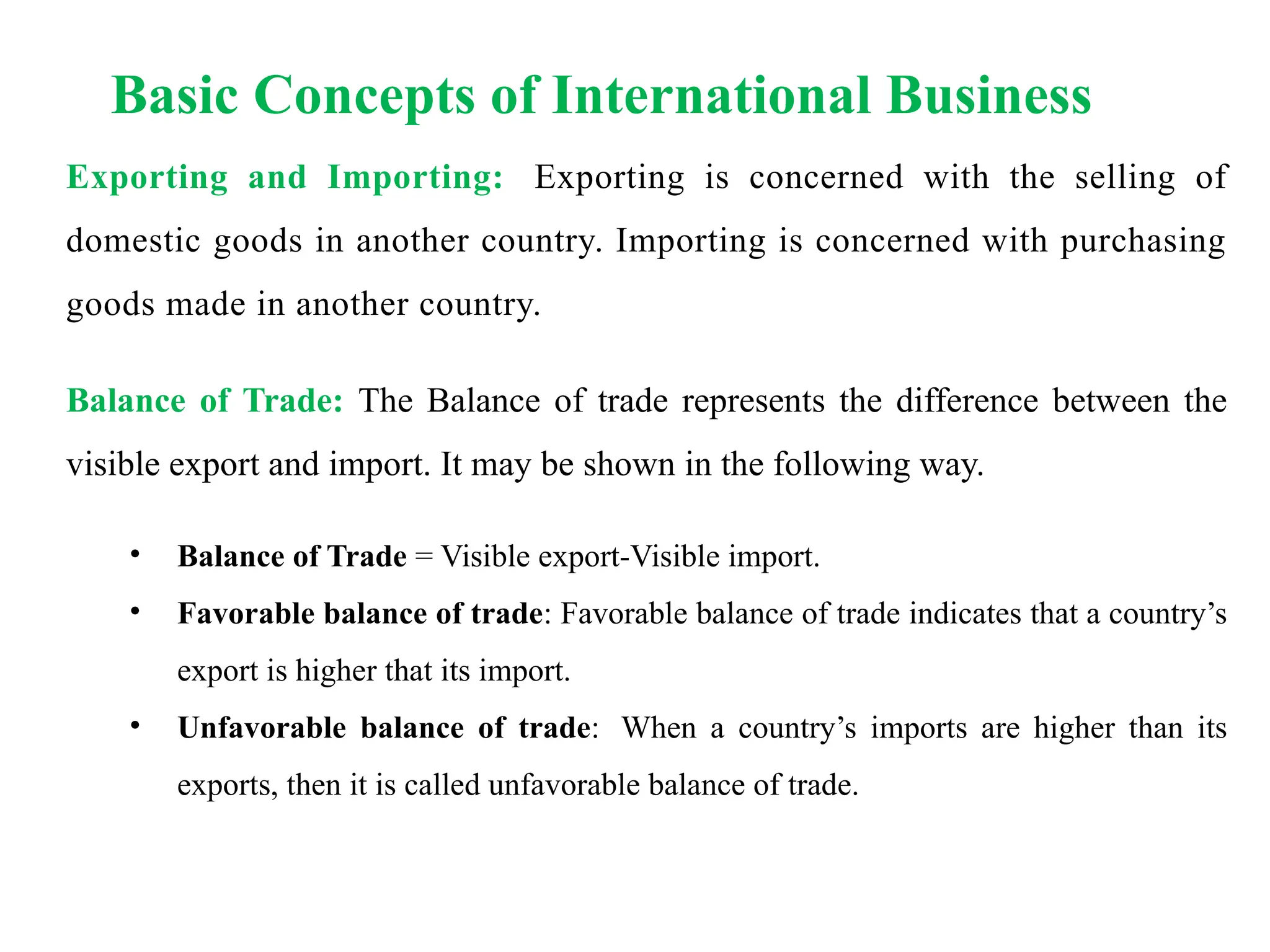
Exporting and Importing: Exporting is concerned with the selling of
domestic goods in another country. Importing is concerned with purchasing
goods made in another country.
Balance of Trade: The Balance of trade represents the difference between the
visible export and import. It may be shown in the following way.
• Balance of Trade = Visible export-Visible import.
• Favorable balance of trade: Favorable balance of trade indicates that a country’s
export is higher that its import.
• Unfavorable balance of trade: When a country’s imports are higher than its
exports, then it is called unfavorable balance of trade.
Basic Concepts of International Business
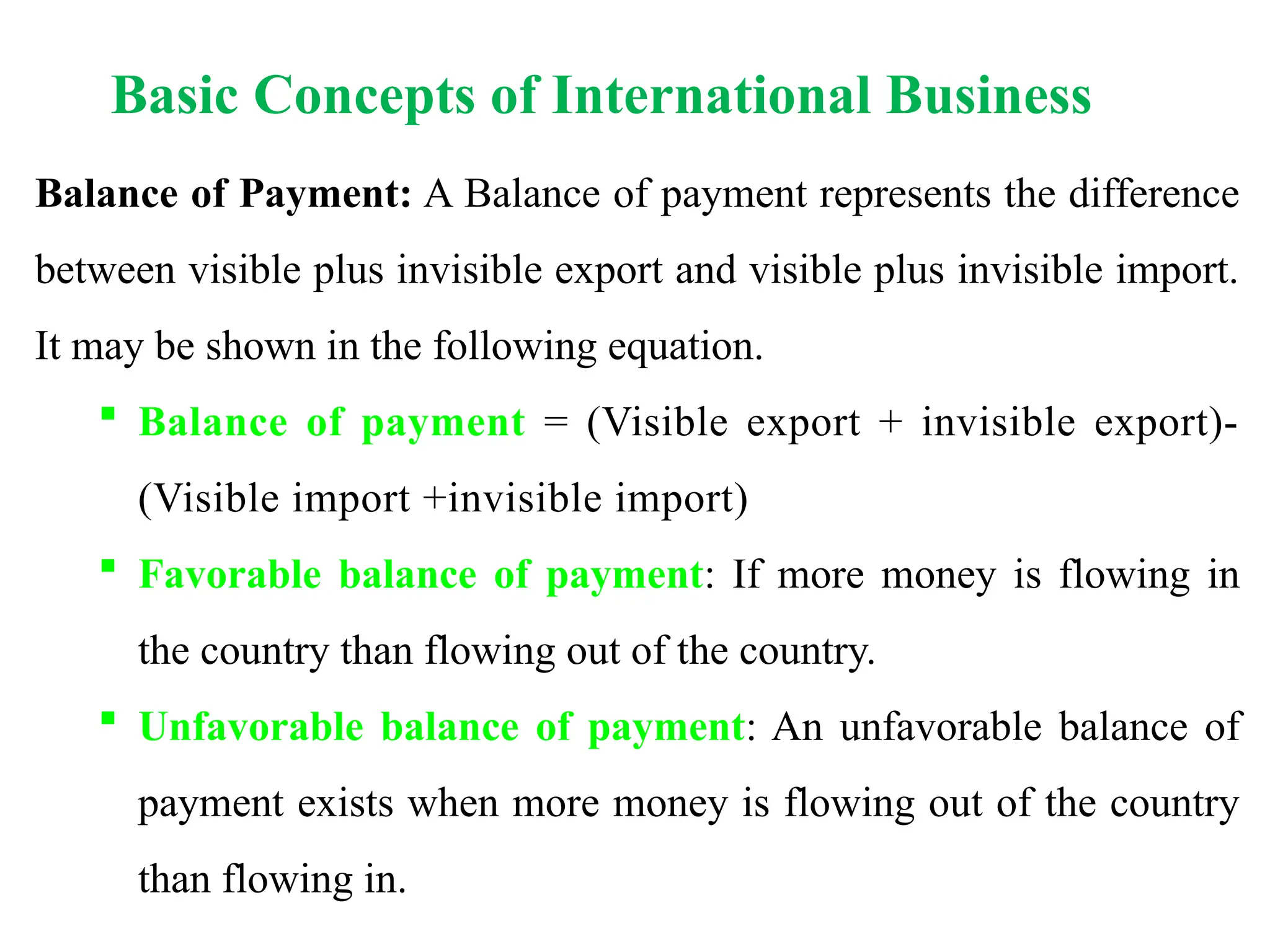
Balance of Payment: A Balance of payment represents the difference
between visible plus invisible export and visible plus invisible import.
It may be shown in the following equation.
 Balance of payment = (Visible export + invisible export)-
(Visible import +invisible import)
 Favorable balance of payment: If more money is flowing in
the country than flowing out of the country.
 Unfavorable balance of payment: An unfavorable balance of
payment exists when more money is flowing out of the country
than flowing in.
Basic Concepts of International Business
Exchange Rate: It is the rate at which one country can exchange its
currency with other country’s currency. Exchange rate is of four
types:
Devaluation: Reducing the value of nation’s currency in relation to
currencies of other nations.
Revaluation: Revaluation increased the value of a country’s currency
in relation to that of the other countries.
Fixed exchange rate: It is an unvarying exchange rate, which is set
by the government.
Floating exchange rate: An exchange rate that fluctuates with
market conditions.
Reasons for International Business
 No nation in the world can produce all of the products that its
people need and want.
 Some nations have an abundance of natural resources and lack
of technological know-how, like Saudi Arabia and some there
countries have sufficient technology but few natural resources, like
Japan.
 If a country becomes self-sufficient then other nations would like
to trade with that country in order to meet their people’s want.
Two (2) main reasons for international business are:
1. Absolute advantage
2. Comparative advantage
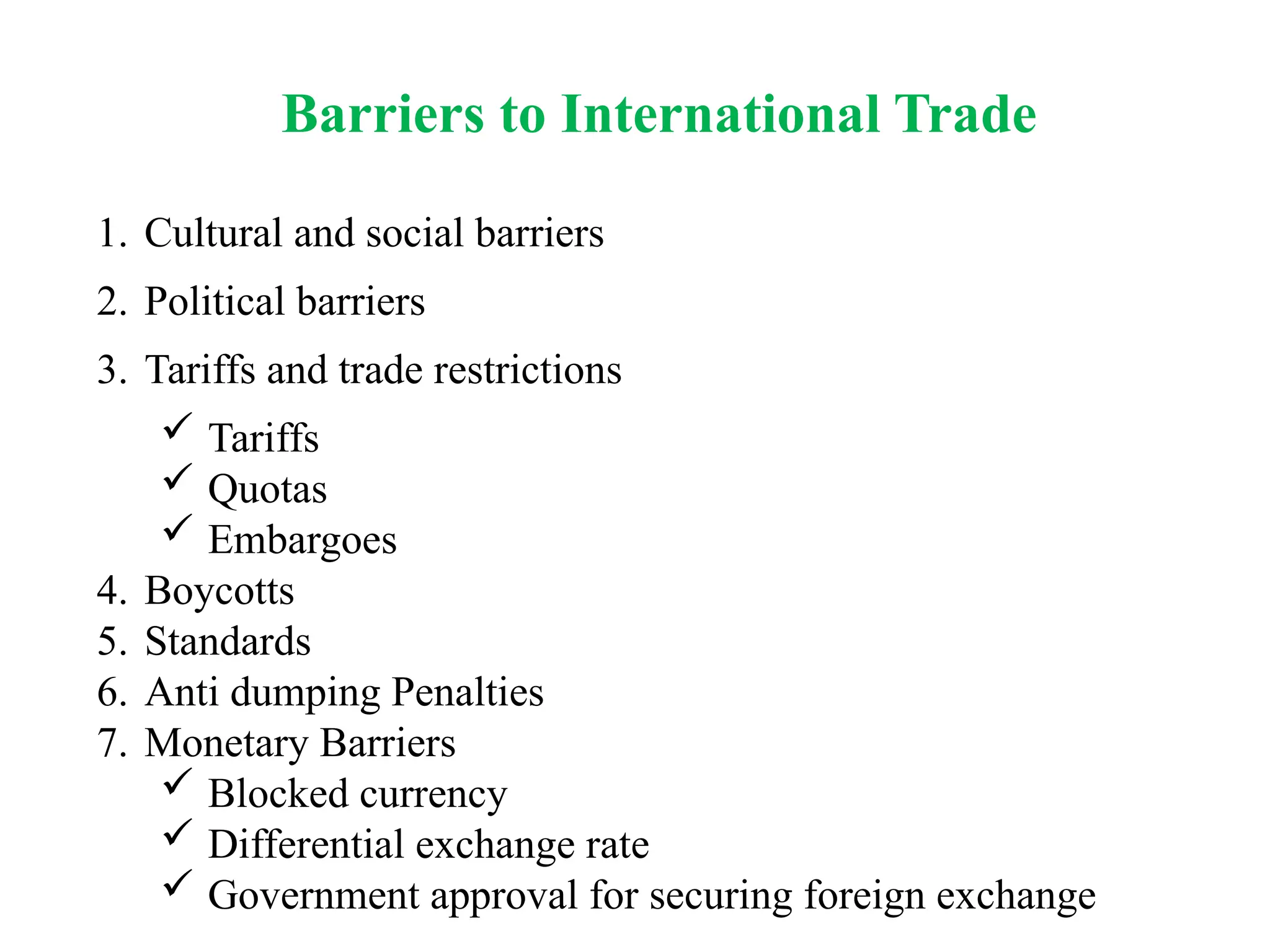
Barriers to International Trade
1. Cultural and social barriers
2. Political barriers
3. Tariffs and trade restrictions
 Tariffs
 Quotas
 Embargoes
4. Boycotts
5. Standards
6. Anti dumping Penalties
7. Monetary Barriers
 Blocked currency
 Differential exchange rate
 Government approval for securing foreign exchange
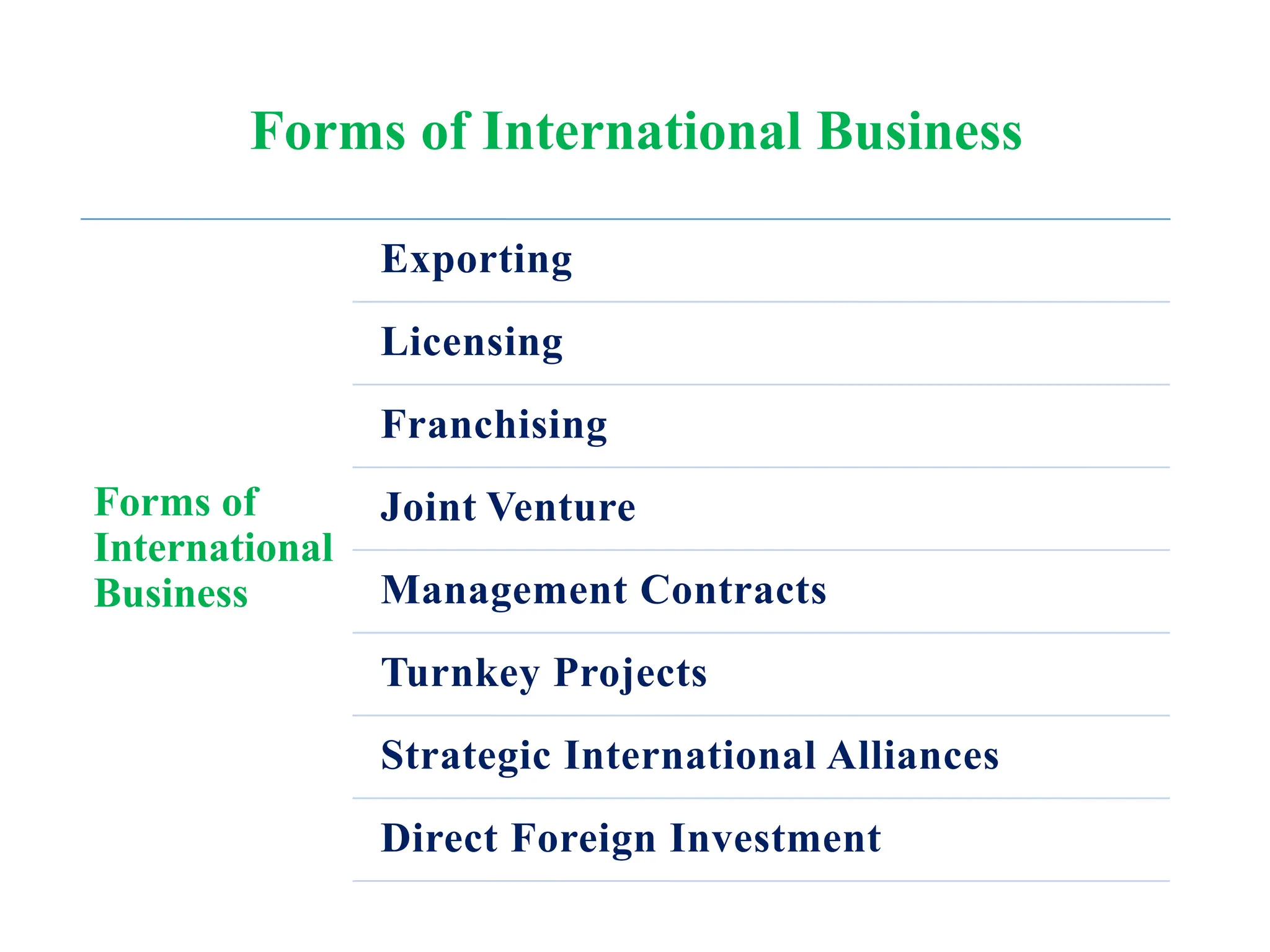
Forms of International Business
Forms of
International
Business
Exporting
Licensing
Franchising
Joint Venture
Management Contracts
Turnkey Projects
Strategic International Alliances
Direct Foreign Investment
1. Earning valuable foreign currency
2. Division of labor
3. Optimum utilization of available resources
4. Increase in the standard of living of people
5. Benefits to consumers
6. Encouragement to industrialization
7. International peace and harmony
Advantages of International Business
• Cultural development
• Economies of large-scale production
• Stability in prices of product
• Widening the market for products
• Advantageous in emergencies
• Creating employment opportunities
• Increase in Government revenue
Advantages of International Business
Disadvantages of International Business
• Adverse effects on economy
• Competition with developed countries
• Rivalry among nations
• Colonization
• Exploitation
• Legal problems
• Publicity of undesirable fashions
• Language problems
• Dumping policy
• Complicated technical procedure
• Shortage of goods in the exporting country
• Adverse effects on home industry
The Emergence of Global Institutions
Global institutions
• manage, regulate, and police the global market place
• promote the establishment of multinational treaties to govern the
global business system
• the World Trade Organization (WTO) - polices world trading
system and ensures nations adhere to the rules established in WTO
treaties
• In 2010, its 154 members accounted for 97% of world
trade
• the International Monetary Fund (IMF) - maintains order in the
international monetary system
• the World Bank - promotes economic development
• the United Nations (UN) - maintains international peace and
security, develops friendly relations among nations, cooperates in
solving international problems and promotes respect for human
rights, and is a center for harmonizing the actions of nations.
The Emergence of Global Institutions
Drivers of Globalization
Question: What is driving the move toward greater globalization?
Answer:
1. declining trade and investment barriers
2. technological change
Declining Trade and Investment Barriers
• International trade occurs when a firm exports goods or services to
consumers in another country
• Foreign direct investment (FDI) occurs when a firm invests
resources in business activities outside its home country
• During the 1920s and 1930s, many nations erected barriers to
international trade and FDI to protect domestic industries from
foreign competition.
• After WWII, advanced Western countries began removing trade
and investment barriers
• Under GATT (the forerunner of the WTO), over 159 nations
negotiated further decreases in tariffs and made significant
progress on a number of non-tariff issues
• Under the WTO, a mechanism now exists for dispute resolution
and the enforcement of trade laws, and there is a push to cut tariffs
on industrial goods, services, and agricultural products
• Lower trade barriers help companies view the world as a single
market and establish production activities in optimal locations
around the globe
• This has led to an acceleration in the volume of world trade and
investment since the early 1980s
Declining Trade and Investment Barriers
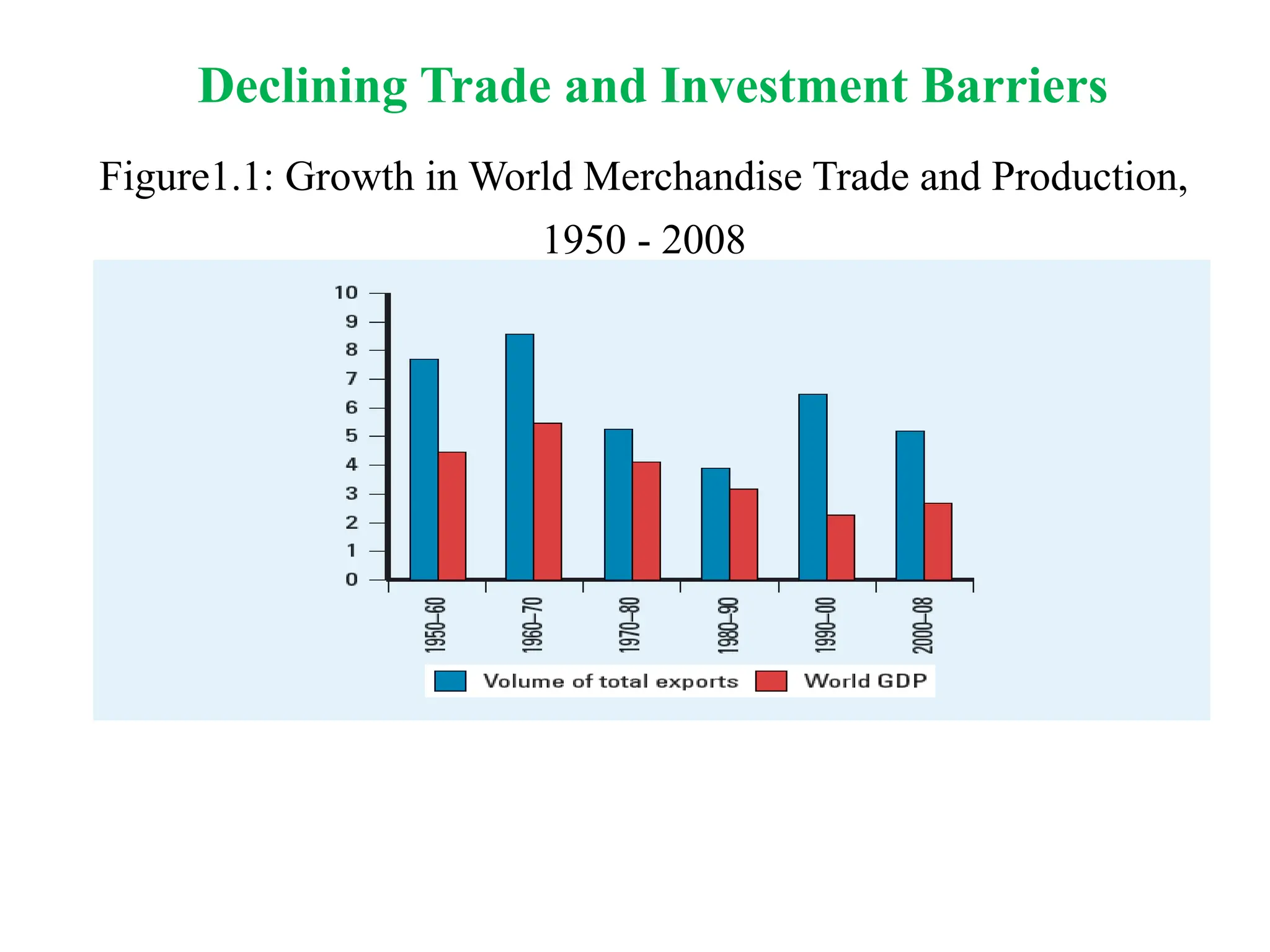
Figure1.1: Growth in World Merchandise Trade and Production,
1950 - 2008
Declining Trade and Investment Barriers
The Role of Technological Change
• Since World War II, there have been major advances in
communication, information processing, and transportation
• The microprocessor - lowered the cost of global communication
and the cost of coordinating and controlling a global organization
• U.S. web-based transactions - $133 billion in 2008
• 1.6 billion Internet users in 2009
• Commercial jet aircraft and super freighters and the introduction
of containerization - simplify trans-shipment from one mode of
transport to another
Question: What are the implications of technological change for the
globalization of production?
Answer: Lower transportation costs make a geographically dispersed
production system more economical and allow firms to better
respond to international customer demands.
The Role of Technological
Change
Question: What are the implications of technological change for the
globalization of markets?
Answer:
• Low cost communications networks help create electronic global
marketplaces
• Low cost transportation enable firms to create global markets, and
facilitate the movement of people from country to country
promoting a convergence of consumer tastes and preferences
The Role of Technological Change
Changing Demographics of the Global Economy
In the 1960s:
• the U.S. dominated the world economy and world trade and world
FDI
• U.S. multinationals dominated the international business scene
• about half the world-- the centrally planned economies of the
communist world-- was off limits to Western international business
Today, much of this has changed.
• In the early 1960s: U.S. - dominant industrial power accounting for
about 40.3% of world manufacturing output
• By 2008:
 U.S. accounted for only 20.7%
 Other developed nations experienced a similar decline
 Rapid economic growth now in countries like China, India, and Brazil
 Further relative decline by the U.S. is likely
• So companies may find both new markets and new competitors in the
developing regions of the world
Changing Demographics of the Global
Economy
Table 1.2: The Changing Demographics of World GDP
and Trade
Changing Demographics of the Global
Economy
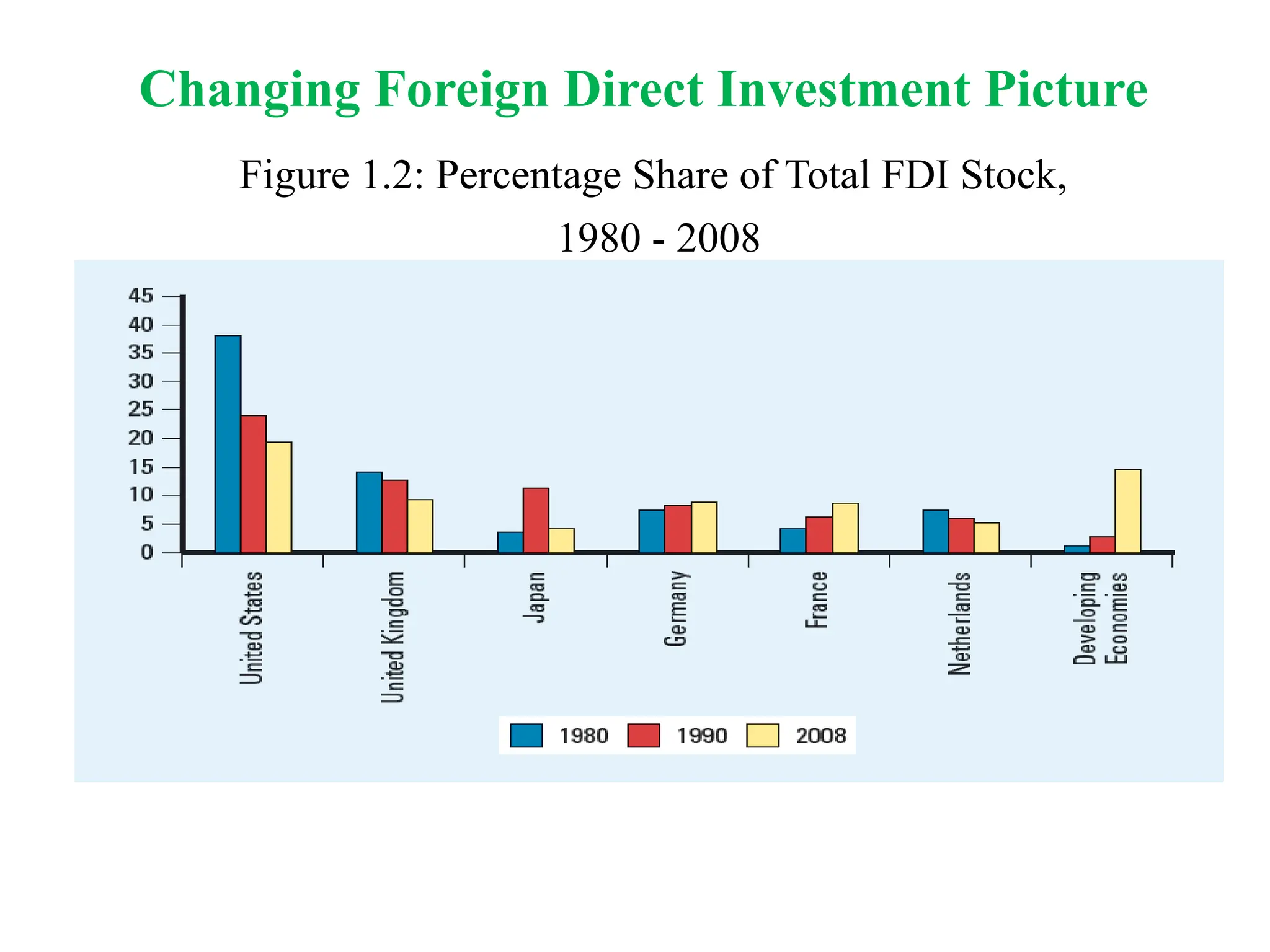
Changing Foreign Direct Investment Picture
Figure 1.2: Percentage Share of Total FDI Stock,
1980 - 2008
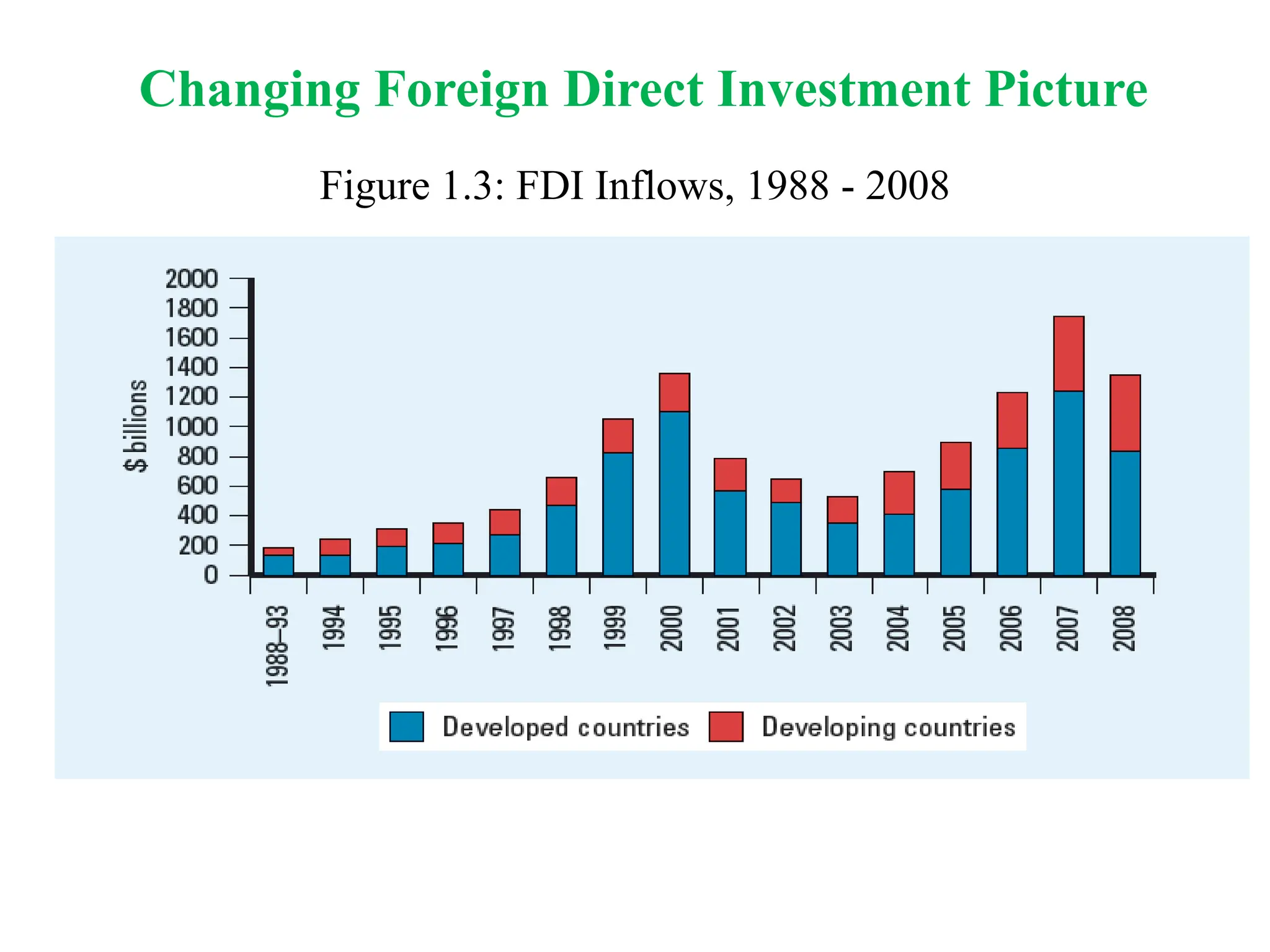
Figure 1.3: FDI Inflows, 1988 - 2008
Changing Foreign Direct Investment Picture
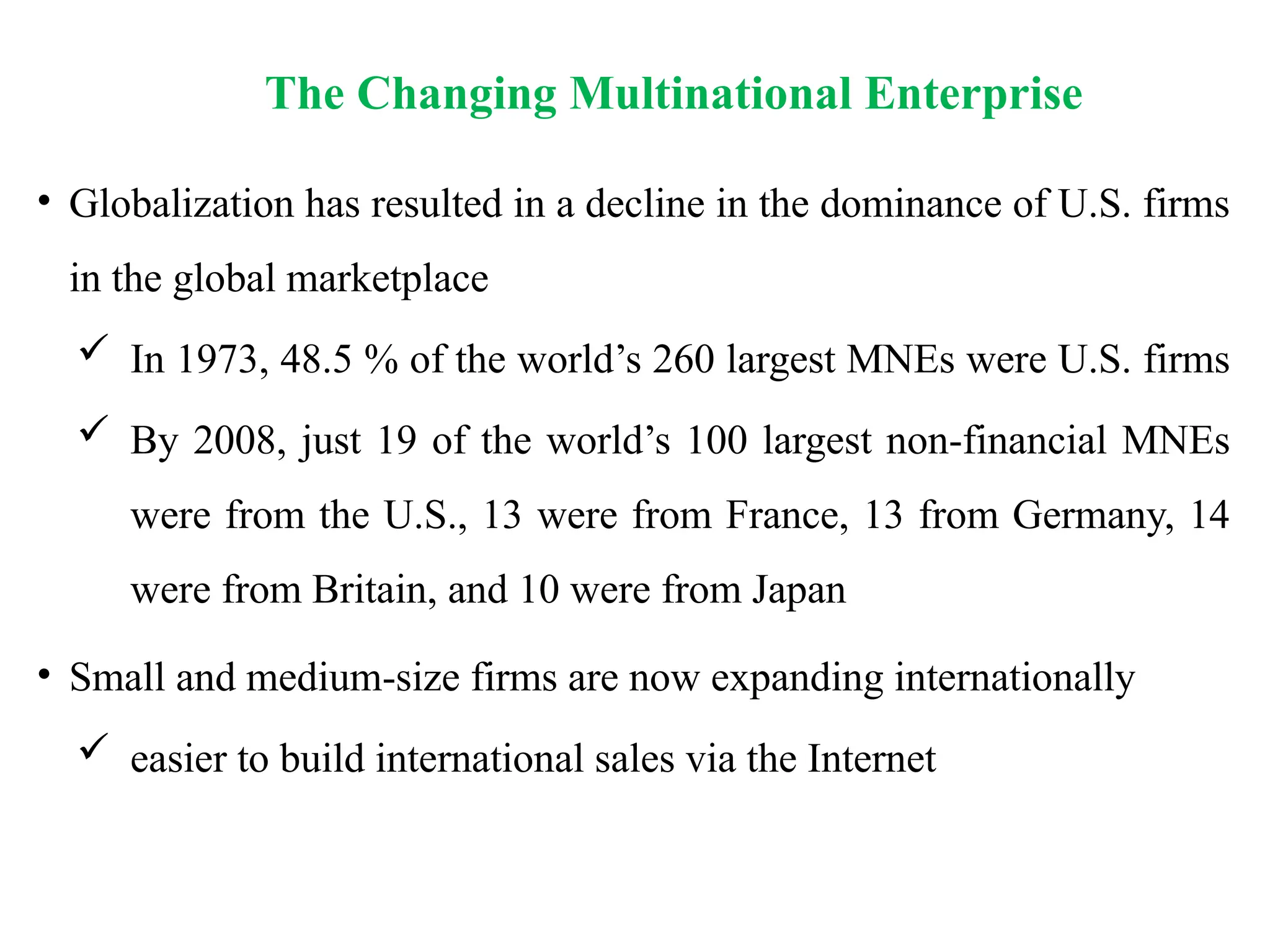
The Changing Multinational Enterprise
• Globalization has resulted in a decline in the dominance of U.S. firms
in the global marketplace
 In 1973, 48.5 % of the world’s 260 largest MNEs were U.S. firms
 By 2008, just 19 of the world’s 100 largest non-financial MNEs
were from the U.S., 13 were from France, 13 from Germany, 14
were from Britain, and 10 were from Japan
• Small and medium-size firms are now expanding internationally
 easier to build international sales via the Internet
The Changing World Order
• The collapse of communism in Eastern Europe
export and investment opportunities
• Economic development in China
huge opportunities despite continued Communist control
• Free market reforms and democracy in Latin America
new markets and new sources of materials and production
The Globalization Debate
Question: Is the shift toward a more integrated and interdependent
global economy a good thing?
Answer:
• Many experts believe that globalization is promoting greater
prosperity in the global economy, more jobs, and lower prices for
goods and services
• Others feel that globalization is not beneficial
Ant globalization Protests
Question: What are the concerns of critics of globalization?
Answer:
• Anti-globalization protesters now turn up at almost every major
meeting of a global institution
• Protesters fear that globalization is forever changing the world in a
negative way
Globalization, Jobs, and Income
• Critics claim jobs in advanced economies are being lost to low-wage
nations
• Supporters claim while some jobs may be lost, the economy as a
whole is better off
• free trade will result in countries specializing in the production
of those goods and services that they can produce most
efficiently, while importing goods and services that they cannot
produce as efficiently, and that in doing so, all countries will
gain
Globalization, Labor Policies, and the Environment
• Critics argue free trade encourages firms from advanced nations
to move manufacturing facilities offshore to less developed
countries with lax environmental and labor regulations
• Supporters claim tougher environmental regulation and stricter
labor standards reflect economic progress
 as countries get richer as a result of globalization, they raise
their environmental and labor standards
 free trade does not lead to more pollution and labor
exploitation, it leads to less
Globalization and National Sovereignty
• Critics worry economic power is shifting away from national
governments and toward supranational organizations such as the
WTO, the European Union (EU), and the UN
• Supporters argue that the power of these organizations is limited to
what nation-states collectively agree to grant
 the organizations must be able to persuade members states to
follow certain actions
 without the support of members, the organizations have no power
Globalization and the World’s Poor
• Critics argue the gap between rich and poor has gotten wider and
the benefits of globalization have not been shared equally
• Supporters suggest that the actions of governments have made
limited economic improvement in many countries
many of the world’s poorest nations are under totalitarian
regimes, suffer from endemic corruption, have few property
rights, are involved in war, and are burdened by high debt
Thank you for you nice cooperation
Any Question?????

Chapter-1 (Globalization).pptx management

  • 1.
  • 2.
    Learning objectives After readingthis lesson, students will be able to- 1. Understand what is meant by the term globalization. 2. Recognize the main drivers of globalization. 3. Describe the changing nature of the global economy. 4. Explain the main arguments in the debate overs the impact of globalization. 5. Understand how the process of globalization is creating opportunities and challenges for management practices.
  • 3.
    Lesson Contents 1. Whatis globalization? 2. Factors in increased globalization 3. What is international business? 4. Why firms go international? 5. Basic concepts of international business 6. Reasons for international business 7. Barriers to international trade 8. Forms of international business. 9. Advantages of international business. 10. Disadvantages of international business. 11. The emergences of global institutions. 12. Drivers of globalization. 13. Declining trade and investment barriers. 14. The role of technological changes.
  • 4.
    Lesson Contents 15. Changingdemographics of the global economy. 16. Changing foreign direct investment picture. 17. Changing multinational enterprises. 18. The Changing world order. 19. The globalization debate. 20. Ant globalization protests. 21. Globalization, jobs and income. 22. Globalization and national sovereignty 23. Globalization, Labor Policies, and the Environment 24. Globalization and world’s poor
  • 5.
    What is Globalization? Thebroadening set of interdependent relationships among people from different parts of a world that happens to be divided into nations. It refers to the integration of world economies through the reduction of barriers to the movement of trade, capital, technology and people.
  • 6.
    What is Globalization? Globalizationhas two main components: Historically distinct and separate national markets are merging and creating the “global market”  Falling trade barriers make it easier to sell globally  Consumers’ tastes and preferences are converging on some global norm  Firms promote the trend by offering the same basic products worldwide
  • 7.
    What is Globalization? Globalizationhas two main components: • Firms source goods and services from locations around the globe to capitalize on national differences in the cost and quality of factors of production like land, labor, energy, and capital • Companies can olower their overall cost structure oimprove the quality or functionality of their product offering
  • 8.
    Factors in increasedGlobalization 1. Increase and expansion of technology 2. Liberalization of cross border trade and resource movement 3. Development of services that support international business 4. Growing consumer pressures 5. Increased global competition 6. Changing political situations 7. Expanded cross national cooperation
  • 9.
    What is InternationalBusiness? John D Daniels and Lee H Radebaugh in their book, ‘International Business’, define international business as, all commercial transactions- private and governmental between two or more countries. Private companies undertake such transactions for profit; governments may or may not do the same in their transactions. These transactions include sales, investments and transportation’. All commercial transactions—including sales, investments, and transportation—that take place between two or more countries.
  • 10.
    Several factors underliethe growth of international business. These could be put as: Facilitators, Drivers, Attractions and Compulsions. Facilitators Drivers Attractions Compulsions 1. Factor mobility 2. Economic reforms 3. Opening up of command economics 4. The Bretton Woods system / WTO regime 5. Developments in communication and transportation technology spheres. 1. Innate growth impetus or urge of the MNCS 2. Constant search for growth 3. Management culture of MNCs 1. Access to the raw materials 2. Sales growth 3. Low cost production 4. Enhanced profitability 1. limitations of domestic market 2. Risk-minimizing by diversification Why Firms Go International? Facilitators, Drivers, Attractions and Compulsions of International Business
  • 11.
    Basic Concepts ofInternational Business
  • 12.
    Basic Concepts ofInternational Business Exporting and Importing: Exporting is concerned with the selling of domestic goods in another country. Importing is concerned with purchasing goods made in another country. Balance of Trade: The Balance of trade represents the difference between the visible export and import. It may be shown in the following way. • Balance of Trade = Visible export-Visible import. • Favorable balance of trade: Favorable balance of trade indicates that a country’s export is higher that its import. • Unfavorable balance of trade: When a country’s imports are higher than its exports, then it is called unfavorable balance of trade.
  • 13.
    Basic Concepts ofInternational Business Balance of Payment: A Balance of payment represents the difference between visible plus invisible export and visible plus invisible import. It may be shown in the following equation.  Balance of payment = (Visible export + invisible export)- (Visible import +invisible import)  Favorable balance of payment: If more money is flowing in the country than flowing out of the country.  Unfavorable balance of payment: An unfavorable balance of payment exists when more money is flowing out of the country than flowing in.
  • 14.
    Basic Concepts ofInternational Business Exchange Rate: It is the rate at which one country can exchange its currency with other country’s currency. Exchange rate is of four types: Devaluation: Reducing the value of nation’s currency in relation to currencies of other nations. Revaluation: Revaluation increased the value of a country’s currency in relation to that of the other countries. Fixed exchange rate: It is an unvarying exchange rate, which is set by the government. Floating exchange rate: An exchange rate that fluctuates with market conditions.
  • 15.
    Reasons for InternationalBusiness  No nation in the world can produce all of the products that its people need and want.  Some nations have an abundance of natural resources and lack of technological know-how, like Saudi Arabia and some there countries have sufficient technology but few natural resources, like Japan.  If a country becomes self-sufficient then other nations would like to trade with that country in order to meet their people’s want. Two (2) main reasons for international business are: 1. Absolute advantage 2. Comparative advantage
  • 16.
    Barriers to InternationalTrade 1. Cultural and social barriers 2. Political barriers 3. Tariffs and trade restrictions  Tariffs  Quotas  Embargoes 4. Boycotts 5. Standards 6. Anti dumping Penalties 7. Monetary Barriers  Blocked currency  Differential exchange rate  Government approval for securing foreign exchange
  • 17.
    Forms of InternationalBusiness Forms of International Business Exporting Licensing Franchising Joint Venture Management Contracts Turnkey Projects Strategic International Alliances Direct Foreign Investment
  • 18.
    1. Earning valuableforeign currency 2. Division of labor 3. Optimum utilization of available resources 4. Increase in the standard of living of people 5. Benefits to consumers 6. Encouragement to industrialization 7. International peace and harmony Advantages of International Business
  • 19.
    • Cultural development •Economies of large-scale production • Stability in prices of product • Widening the market for products • Advantageous in emergencies • Creating employment opportunities • Increase in Government revenue Advantages of International Business
  • 20.
    Disadvantages of InternationalBusiness • Adverse effects on economy • Competition with developed countries • Rivalry among nations • Colonization • Exploitation • Legal problems • Publicity of undesirable fashions • Language problems • Dumping policy • Complicated technical procedure • Shortage of goods in the exporting country • Adverse effects on home industry
  • 21.
    The Emergence ofGlobal Institutions Global institutions • manage, regulate, and police the global market place • promote the establishment of multinational treaties to govern the global business system • the World Trade Organization (WTO) - polices world trading system and ensures nations adhere to the rules established in WTO treaties • In 2010, its 154 members accounted for 97% of world trade • the International Monetary Fund (IMF) - maintains order in the international monetary system
  • 22.
    • the WorldBank - promotes economic development • the United Nations (UN) - maintains international peace and security, develops friendly relations among nations, cooperates in solving international problems and promotes respect for human rights, and is a center for harmonizing the actions of nations. The Emergence of Global Institutions
  • 23.
    Drivers of Globalization Question:What is driving the move toward greater globalization? Answer: 1. declining trade and investment barriers 2. technological change
  • 24.
    Declining Trade andInvestment Barriers • International trade occurs when a firm exports goods or services to consumers in another country • Foreign direct investment (FDI) occurs when a firm invests resources in business activities outside its home country • During the 1920s and 1930s, many nations erected barriers to international trade and FDI to protect domestic industries from foreign competition. • After WWII, advanced Western countries began removing trade and investment barriers
  • 25.
    • Under GATT(the forerunner of the WTO), over 159 nations negotiated further decreases in tariffs and made significant progress on a number of non-tariff issues • Under the WTO, a mechanism now exists for dispute resolution and the enforcement of trade laws, and there is a push to cut tariffs on industrial goods, services, and agricultural products • Lower trade barriers help companies view the world as a single market and establish production activities in optimal locations around the globe • This has led to an acceleration in the volume of world trade and investment since the early 1980s Declining Trade and Investment Barriers
  • 26.
    Figure1.1: Growth inWorld Merchandise Trade and Production, 1950 - 2008 Declining Trade and Investment Barriers
  • 27.
    The Role ofTechnological Change • Since World War II, there have been major advances in communication, information processing, and transportation • The microprocessor - lowered the cost of global communication and the cost of coordinating and controlling a global organization • U.S. web-based transactions - $133 billion in 2008 • 1.6 billion Internet users in 2009 • Commercial jet aircraft and super freighters and the introduction of containerization - simplify trans-shipment from one mode of transport to another
  • 28.
    Question: What arethe implications of technological change for the globalization of production? Answer: Lower transportation costs make a geographically dispersed production system more economical and allow firms to better respond to international customer demands. The Role of Technological Change
  • 29.
    Question: What arethe implications of technological change for the globalization of markets? Answer: • Low cost communications networks help create electronic global marketplaces • Low cost transportation enable firms to create global markets, and facilitate the movement of people from country to country promoting a convergence of consumer tastes and preferences The Role of Technological Change
  • 30.
    Changing Demographics ofthe Global Economy In the 1960s: • the U.S. dominated the world economy and world trade and world FDI • U.S. multinationals dominated the international business scene • about half the world-- the centrally planned economies of the communist world-- was off limits to Western international business Today, much of this has changed.
  • 31.
    • In theearly 1960s: U.S. - dominant industrial power accounting for about 40.3% of world manufacturing output • By 2008:  U.S. accounted for only 20.7%  Other developed nations experienced a similar decline  Rapid economic growth now in countries like China, India, and Brazil  Further relative decline by the U.S. is likely • So companies may find both new markets and new competitors in the developing regions of the world Changing Demographics of the Global Economy
  • 32.
    Table 1.2: TheChanging Demographics of World GDP and Trade Changing Demographics of the Global Economy
  • 33.
    Changing Foreign DirectInvestment Picture Figure 1.2: Percentage Share of Total FDI Stock, 1980 - 2008
  • 34.
    Figure 1.3: FDIInflows, 1988 - 2008 Changing Foreign Direct Investment Picture
  • 35.
    The Changing MultinationalEnterprise • Globalization has resulted in a decline in the dominance of U.S. firms in the global marketplace  In 1973, 48.5 % of the world’s 260 largest MNEs were U.S. firms  By 2008, just 19 of the world’s 100 largest non-financial MNEs were from the U.S., 13 were from France, 13 from Germany, 14 were from Britain, and 10 were from Japan • Small and medium-size firms are now expanding internationally  easier to build international sales via the Internet
  • 36.
    The Changing WorldOrder • The collapse of communism in Eastern Europe export and investment opportunities • Economic development in China huge opportunities despite continued Communist control • Free market reforms and democracy in Latin America new markets and new sources of materials and production
  • 37.
    The Globalization Debate Question:Is the shift toward a more integrated and interdependent global economy a good thing? Answer: • Many experts believe that globalization is promoting greater prosperity in the global economy, more jobs, and lower prices for goods and services • Others feel that globalization is not beneficial
  • 38.
    Ant globalization Protests Question:What are the concerns of critics of globalization? Answer: • Anti-globalization protesters now turn up at almost every major meeting of a global institution • Protesters fear that globalization is forever changing the world in a negative way
  • 39.
    Globalization, Jobs, andIncome • Critics claim jobs in advanced economies are being lost to low-wage nations • Supporters claim while some jobs may be lost, the economy as a whole is better off • free trade will result in countries specializing in the production of those goods and services that they can produce most efficiently, while importing goods and services that they cannot produce as efficiently, and that in doing so, all countries will gain
  • 40.
    Globalization, Labor Policies,and the Environment • Critics argue free trade encourages firms from advanced nations to move manufacturing facilities offshore to less developed countries with lax environmental and labor regulations • Supporters claim tougher environmental regulation and stricter labor standards reflect economic progress  as countries get richer as a result of globalization, they raise their environmental and labor standards  free trade does not lead to more pollution and labor exploitation, it leads to less
  • 41.
    Globalization and NationalSovereignty • Critics worry economic power is shifting away from national governments and toward supranational organizations such as the WTO, the European Union (EU), and the UN • Supporters argue that the power of these organizations is limited to what nation-states collectively agree to grant  the organizations must be able to persuade members states to follow certain actions  without the support of members, the organizations have no power
  • 42.
    Globalization and theWorld’s Poor • Critics argue the gap between rich and poor has gotten wider and the benefits of globalization have not been shared equally • Supporters suggest that the actions of governments have made limited economic improvement in many countries many of the world’s poorest nations are under totalitarian regimes, suffer from endemic corruption, have few property rights, are involved in war, and are burdened by high debt
  • 43.
    Thank you foryou nice cooperation Any Question?????

Editor's Notes

  • #21 As more business activities takes place across national borders, several global institutions have emerged to manage, regulate, and police the global marketplace, and to promote the establishment of multinational treaties to govern the global business system. We’ll talk more about these institutions in later chapters, but for now, let’s take a quick look at some of them. One of the most important global institutions is the World Trade Organization, or WTO, which is responsible for policing the world trading system, and making sure that members adhere to trade treaties. The 154 nations that account for about 97 percent of the world’s trade are all WTO members, so the organization is very influential in working toward an open business system where goods can cross national borders without barriers to trade and investment. The International Monetary Fund, or IMF, is responsible for maintaining order in the international monetary system, and as we’ll see in later chapters, is a significant player in the global economy.
  • #22 The World Bank promotes economic development by making loans to cash-strapped nations wishing to make significant infrastructure improvements like building dams or roads. Finally, the United Nations, or UN, is committed to preserving peace through international cooperation and collective security. Nearly every country in the world belongs to the UN, and accepts its basic principles of international relations.
  • #23 You might be wondering what prompted the move toward globalization. Two macro factors are important: first, the decline in trade and investment barriers that has taken place since World War II, and second, technological change, specifically dramatic improvements in communication, information processing, and transportation technologies. Let’s talk about each of these.
  • #24 It wasn’t always so easy to trade with other countries. During the 1920s and 1930s, many countries erected barriers to the free flow of goods across borders, and also limited the ability of firms to invest. When a firm invests resources in business activities outside its home country, we say foreign direct investment or FDI has taken place.
  • #25 At the end of World War II, nations, learning from mistakes made in the 1920s and 1930s, worked toward removing barriers that prevented the free flow of goods, services, and capital between countries. The process was formalized using the General Agreement on Tariffs and Trade, or GATT. The GATT was replaced by the WTO which, like the GATT, provides a forum for dispute resolution and the enforcement of trade laws, and has set new goals for further reducing trade barriers on industrial goods, services, and agricultural products.
  • #26 As you can see, world trade and production was very limited in the early 1950s, but thanks to the GATT and its role in promoting a reduction in trade barriers, the volume of world trade and world production has increased dramatically, especially since the 1980s. Because trade barriers are lower, firms like Boeing and Nike are now able to view the world, rather than a single country, as their market, and as a result, the world as a whole is significantly wealthier. Production and sales now take place in multiple markets creating interdependency between countries for goods and services.
  • #27 The role of technological change has also been critical to the globalization of markets. Major advances in communication, information processing, and transportation technology have made what had been possibilities into tangible realities! The cost of global communication has fallen because advances in telecommunications and information processing help firms coordinate and control global organizations at a fraction of what it might have cost even a decade ago. The microprocessor that facilitates high-power, low-cost computing is perhaps the most important of these developments. The Internet has made it possible for even small companies to play a role in the global economy. Yet, less than twenty years ago, this technology didn’t even exist. Growth in Internet usage has gone from fewer than 1 million users in 1990 to more than 1.6 billion users in 2009—a quarter of the world’s population! Improvements in transportation such as containerization and the development of super freighters have also facilitated the growth of globalization. The time it takes people and products to get from one place to another has shrunk, as has the cost.
  • #28 What does all of this mean? These technological innovations have facilitated the globalization of production. Dell for example, takes advantage of these innovations to control its globally dispersed production system. When a customer submits an order via the company’s web site, it’s immediately transmitted to the suppliers of the various components, wherever they are located in the world. Suppliers have real time access to Dell’s order flows, and can then adjust their production accordingly. Dell uses inexpensive airfreight to transport its products to meet demand as needed. The company maintains a customer service operation in India where English speaking personnel handle calls from the U.S.
  • #29 The globalization of markets has also been facilitated by these technological innovations which have helped create global, electronic marketplaces. Ecuador for example, has become a global supplier of roses thanks to falling transportation costs that make it possible to ship flowers while they’re still fresh. Similarly, television networks like MTV and CNN are received in many countries and are contributing to the development of a sort of global culture that transcends national borders.
  • #30 Let’s move on to look at how the demographics of the global economy have changed over the last 50 years. In the 1960s, the U.S. dominated the world economy and world trade picture. U.S. multinational companies were powerful, and because of the Cold War, a significant portion of the world was off limits to the Western companies. Today, this picture has changed.
  • #31 By 2008, the U.S. had gone from its position in the 1960s of accounting for more than 40 percent of the world’s manufacturing output, to accounting for just over 20 percent. Countries like China, Brazil, and India have emerged as global economic players. Most experts expect that similar trends will continue. Countries like the U.S., the U.K., Germany, and Japan that were among the first to industrialize, will continue to see their standings in world exports and world output slip, while developing nations like China, India, and Brazil will see their economies and role in global trade and investment increase.
  • #32 As you can see from the Table, the U.S., despite its decline, is still the world’s largest exporter. However, China has emerged to challenge the U.S. for this position.
  • #33 Figure 1.2 shows that the stock of foreign direct investment by the world’s six most important sources has changed significantly from 1980 to 2008. In particular, notice the decline by the U.S., and the increase by France, and the world’s developing countries.
  • #34 In Figure 1.3, you can see the growth in cross-border flows of foreign direct investment and also the importance of developing nations as destinations for investment. These two trends reflect the internationalization of companies that we have discussed.
  • #35 In the 1960s, global business activity was dominated by large, U.S. multinational firms. Today, however, things have shifted significantly. Multinational firms from France, Germany, Britain, and Japan have become more important, and there has been a notable decline in the role of U.S. firms. Firms from developing countries such as China and South Korea have also emerged as important players. So, in addition to thinking of American companies like Ford and Microsoft, we now think of South Korea’s Samsung and Hong Kong’s Hutchison Whampoa. We have also seen an increase in the number of small and medium-sized multinationals, or mini-multinationals. China’s Lenovo for example, acquired IBM’s PC division in 2004, in an effort to become a global player in the PC industry. Lenovo even moved its headquarters to the U.S. as part of its strategy. Traditionally, global markets have been the venue for large firms, but today, thanks to advances in technology like the Internet, international sales can account for a significant share of revenues for small companies, too.
  • #36 Finally, the significant change in world order has affected the global economy. The collapse of communism has brought about new opportunities in Eastern Europe, and China’s economic development and enormous population presents huge opportunities for companies. Mexico and Latin America have also emerged both as new markets, and as source and production locations.
  • #37 So far, we’ve focused primarily on the benefits of globalization. But is the shift toward a more integrated and interdependent global economy always a good thing? Not everyone thinks so.
  • #38 Anti-globalization protesters who fear that globalization is forever changing the world in a negative way now turn up at almost every major meeting of global institutions like the WTO and IMF. In some cases, for example in Seattle in 1999, and France in 1999, the protests have been violent. You can learn more about what occurred in France in the Country Focus in your text. Let’s talk about some of the protesters’ concerns.
  • #39 Critics of globalization worry that jobs are being lost to low-wage nations. They argue that falling trade barriers are allowing companies to move manufacturing jobs to countries where wage rates are low. For example, clothing manufacturing has increasingly shifted away from the U.S. where workers might earn $9 per hour to countries like Honduras where wages are less than 50 cents per hour. Critics believe that this leads to falling wages and living standards in the U.S. Supporters however, claim that free trade will prompt countries to specialize in what they can produce most efficiently, and to import everything else. They argue that the whole economy will be better off as a result. In other words, if you can buy an imported shirt that was made for pennies in Honduras, you’ll have more money to spend on products the U.S. can produce efficiently like software.
  • #40 Another concern raised by protesters is that free trade encourages firms from advanced nations, where there are costly environmental standards, to move manufacturing facilities offshore to less developed countries with lax environmental and labor regulations. However, advocates of globalization claim that environmental regulation and stricter labor standards go hand in hand with economic progress, so foreign direct investment actually encourages countries to raise their standards. Studies support this claim with the exception of carbon dioxide emissions which appear to rise along with income levels. Advocates of globalization argue that by tying free trade agreements to the implementation of tougher environmental and labor laws, economic growth and globalization can occur together with a decrease in environmental pollution.
  • #41 A third concern raised by critics of globalization is the worry that economic power is shifting away from national governments and towards supranational organizations like the WTO and the European Union, or EU. However, globalization’s supporters argue that the power of these organizations is limited to what they are granted by their members. They also point out that the organizations are designed to promote the collective interests of members, and they won’t gain support for policies that don’t achieve this goal.
  • #42 Finally, critics of globalization worry that the gap between rich and poor is growing and that the benefits of globalization haven’t been shared equally. While supporters of globalization concede the gap between rich and poor has gotten wider, they also contend that it has more to do with the policies countries have followed than with globalization. For example, many countries have chosen to pursue totalitarian regimes, or have failed to contain population growth, and many countries have huge debt loads that are stagnating economic growth.