UNIT-I, LECTURE 1
HISTORY OF
PHARMACOPOEIAS
[CO1, PO1]
Course Name: Pharmaceutical Inorganic Chemistry (Theory)
[BP104T]
B.Pharm; I Semester
Course Coordinator:-
Name: Yogesh Matta
Designation: Associate Professor
Mail ID: yogesh.matta@mygyanvihar.com
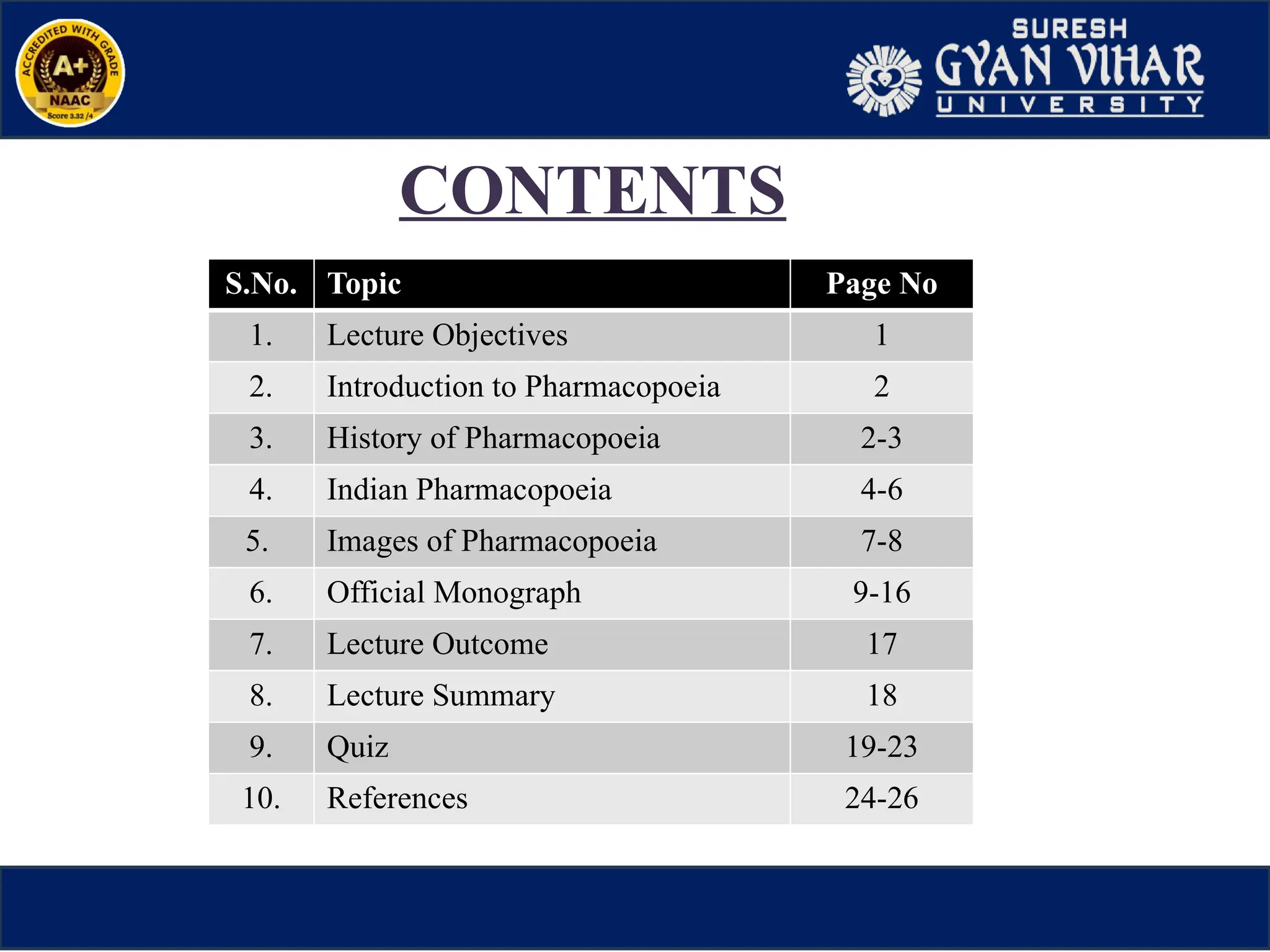
S.No. Topic Page No
1. Lecture Objectives 1
2. Introduction to Pharmacopoeia 2
3. History of Pharmacopoeia 2-3
4. Indian Pharmacopoeia 4-6
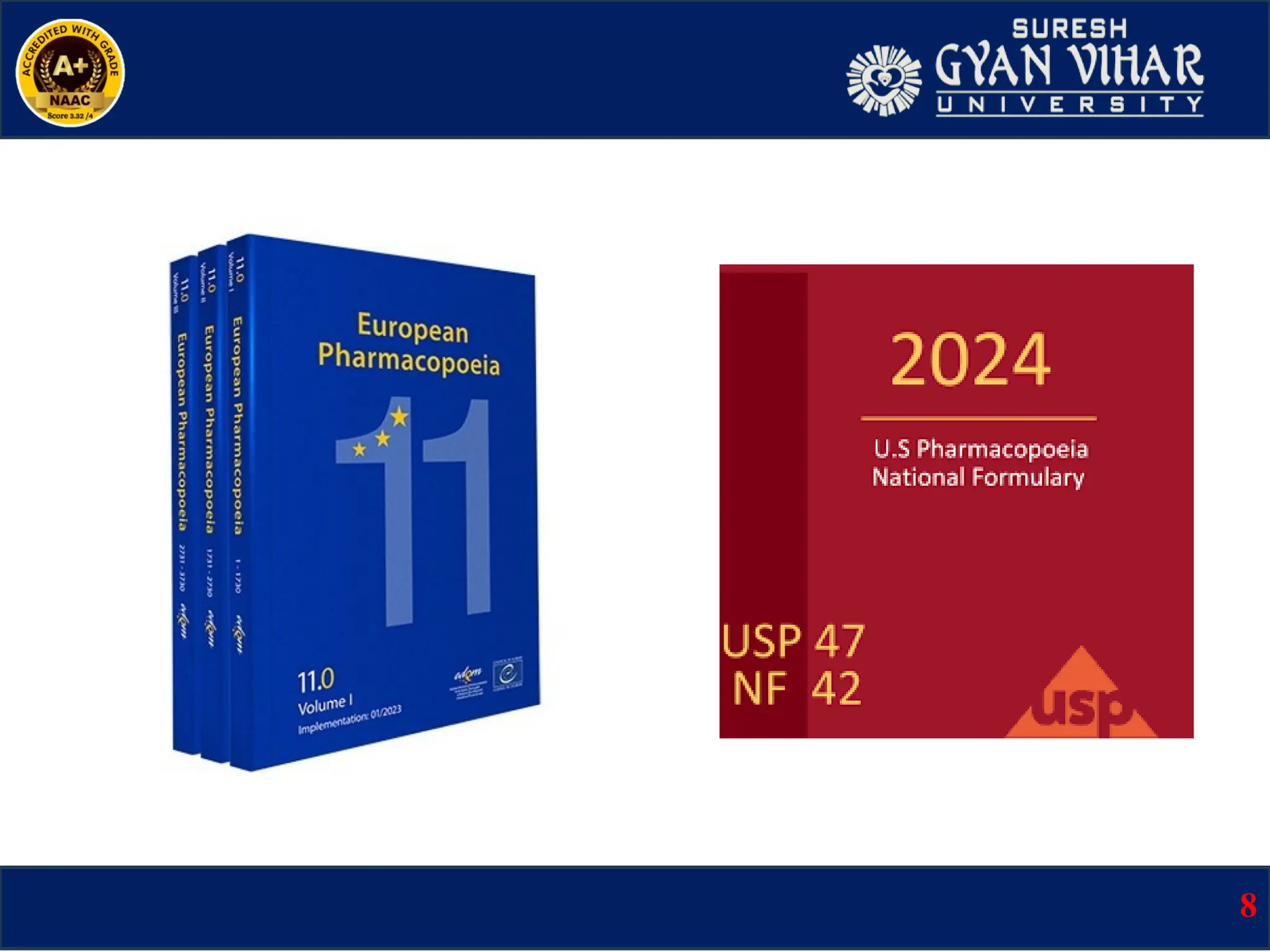
5. Images of Pharmacopoeia 7-8
6. Official Monograph 9-16
7. Lecture Outcome 17
8. Lecture Summary 18
9. Quiz 19-23
10. References 24-26
CONTENTS
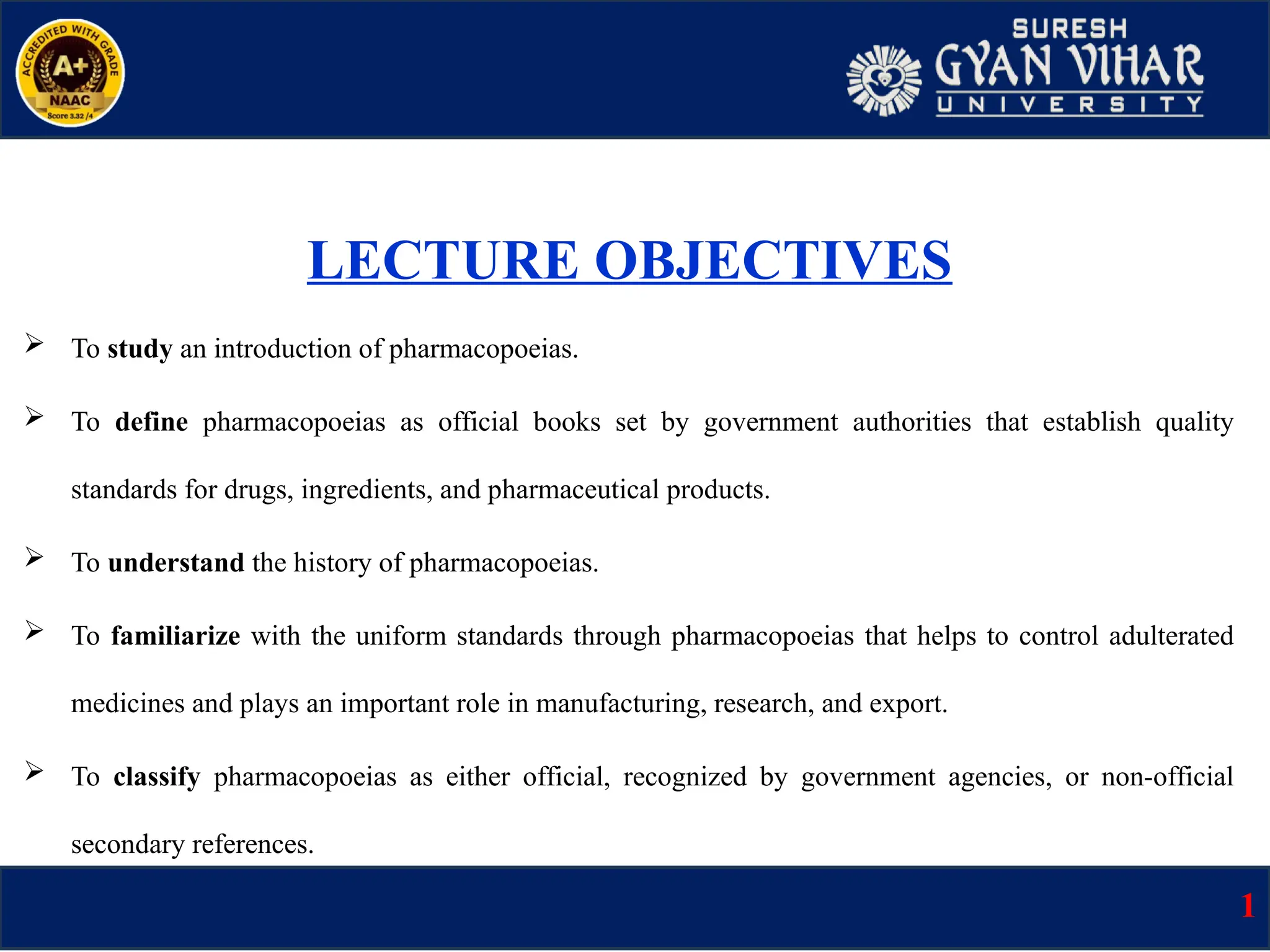
LECTURE OBJECTIVES
 To study an introduction of pharmacopoeias.
 To define pharmacopoeias as official books set by government authorities that establish quality
standards for drugs, ingredients, and pharmaceutical products.
 To understand the history of pharmacopoeias.
 To familiarize with the uniform standards through pharmacopoeias that helps to control adulterated
medicines and plays an important role in manufacturing, research, and export.
 To classify pharmacopoeias as either official, recognized by government agencies, or non-official
secondary references.
1
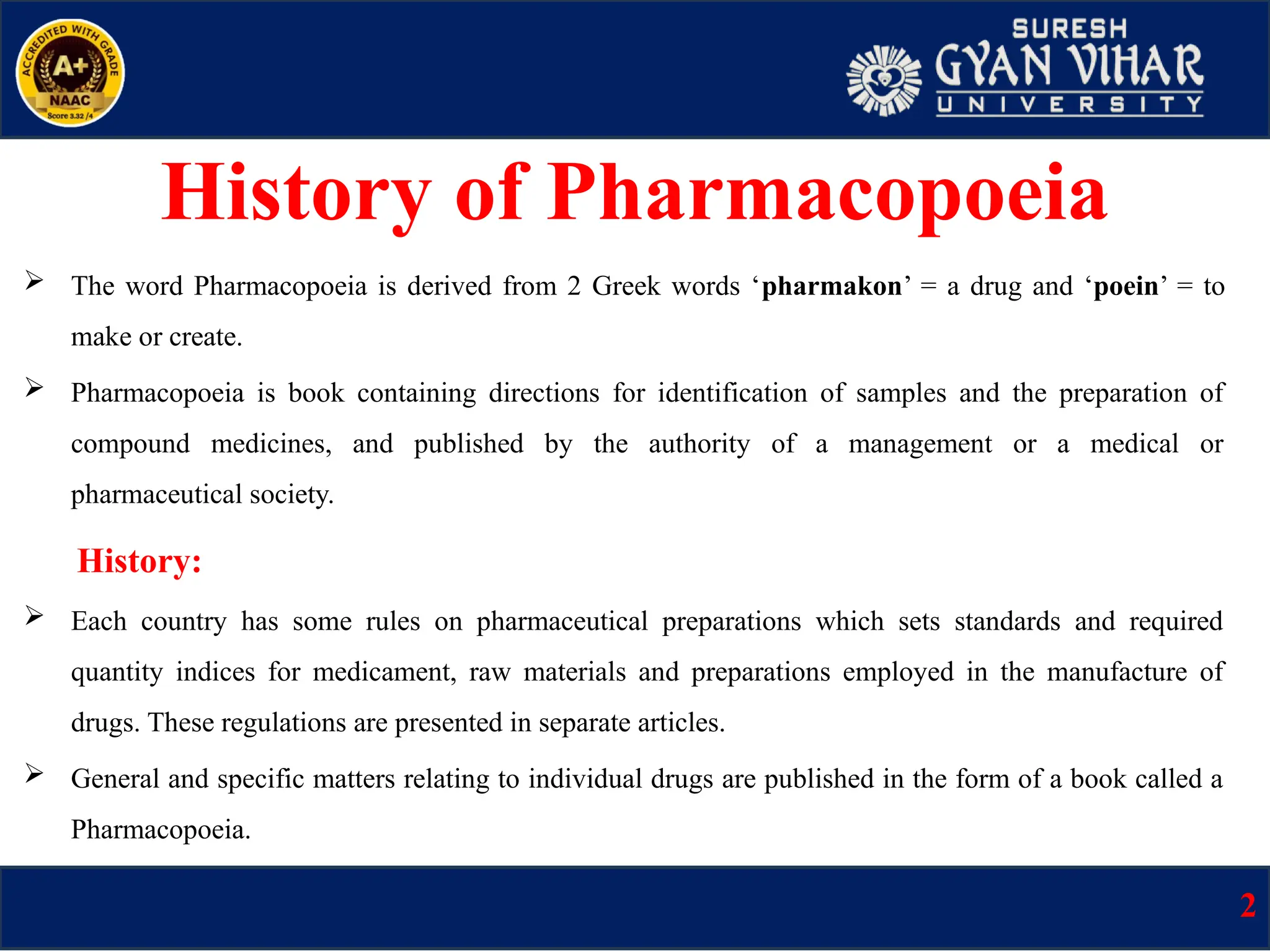
History of Pharmacopoeia
 The word Pharmacopoeia is derived from 2 Greek words ‘pharmakon’ = a drug and ‘poein’ = to
make or create.
 Pharmacopoeia is book containing directions for identification of samples and the preparation of
compound medicines, and published by the authority of a management or a medical or
pharmaceutical society.
History:
 Each country has some rules on pharmaceutical preparations which sets standards and required
quantity indices for medicament, raw materials and preparations employed in the manufacture of
drugs. These regulations are presented in separate articles.
 General and specific matters relating to individual drugs are published in the form of a book called a
Pharmacopoeia.
2
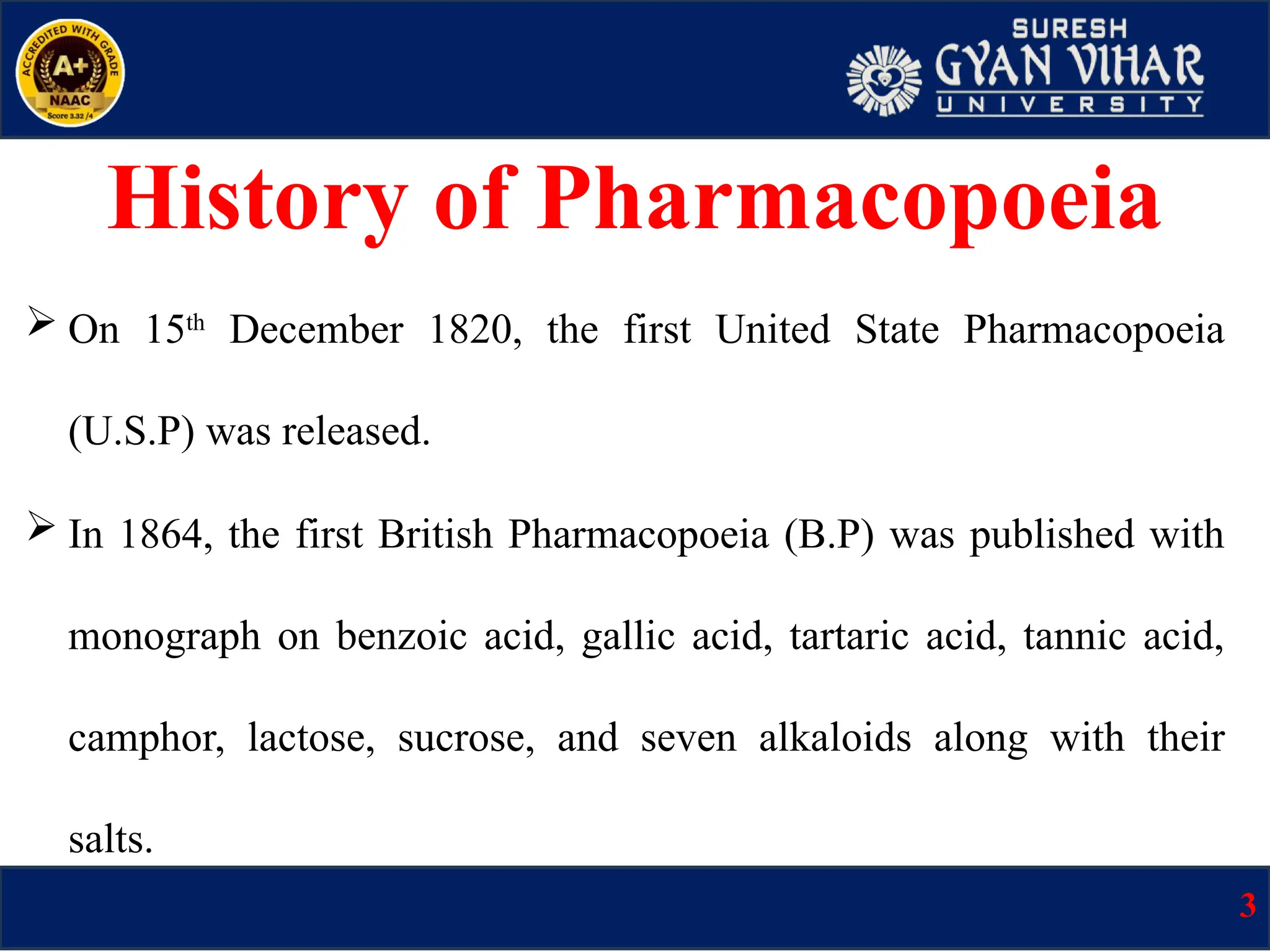
 On 15th
December 1820, the first United State Pharmacopoeia
(U.S.P) was released.
 In 1864, the first British Pharmacopoeia (B.P) was published with
monograph on benzoic acid, gallic acid, tartaric acid, tannic acid,
camphor, lactose, sucrose, and seven alkaloids along with their
salts.
History of Pharmacopoeia
3
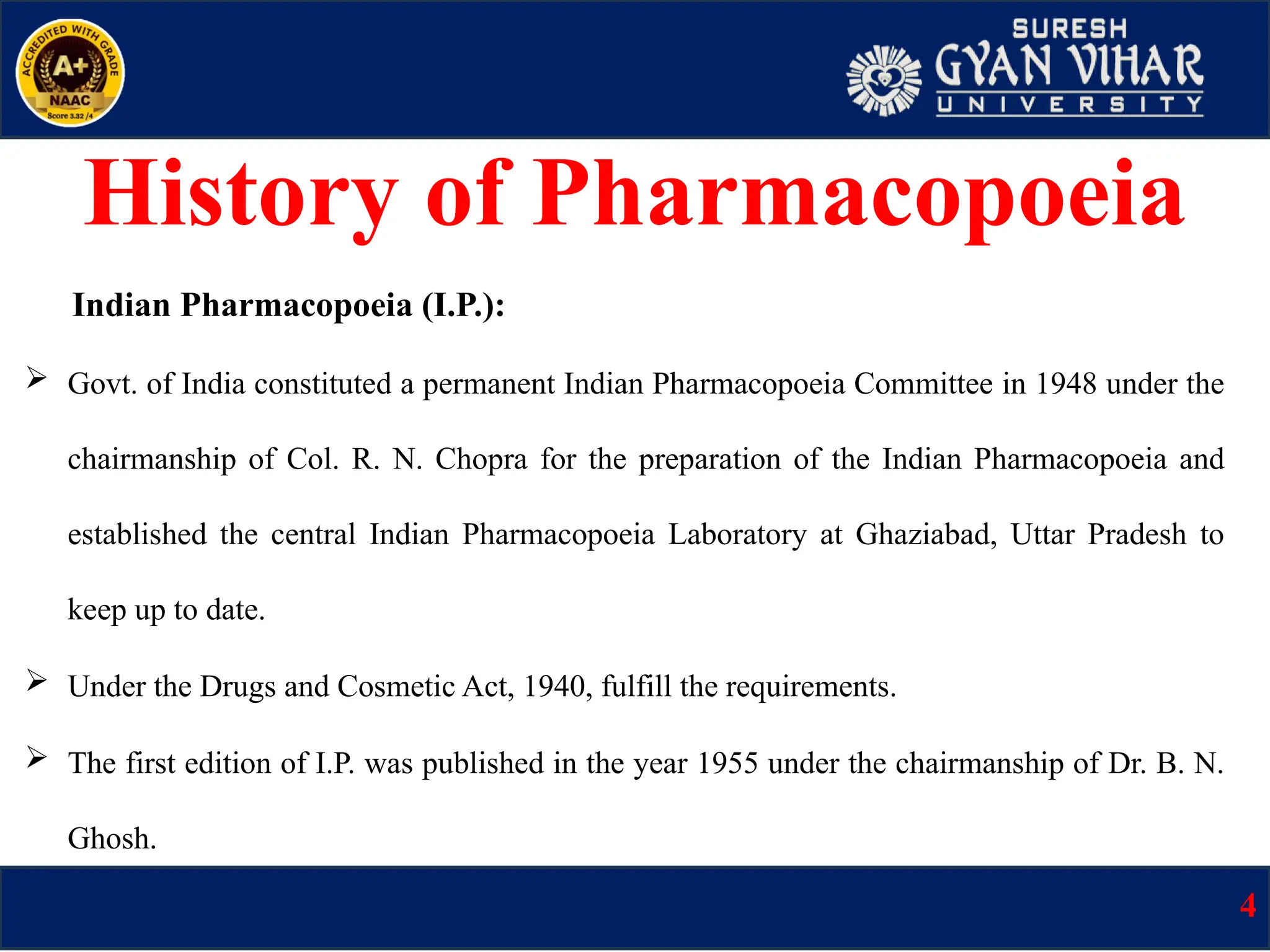
Indian Pharmacopoeia (I.P.):
 Govt. of India constituted a permanent Indian Pharmacopoeia Committee in 1948 under the
chairmanship of Col. R. N. Chopra for the preparation of the Indian Pharmacopoeia and
established the central Indian Pharmacopoeia Laboratory at Ghaziabad, Uttar Pradesh to
keep up to date.
 Under the Drugs and Cosmetic Act, 1940, fulfill the requirements.
 The first edition of I.P. was published in the year 1955 under the chairmanship of Dr. B. N.
Ghosh.
4
History of Pharmacopoeia
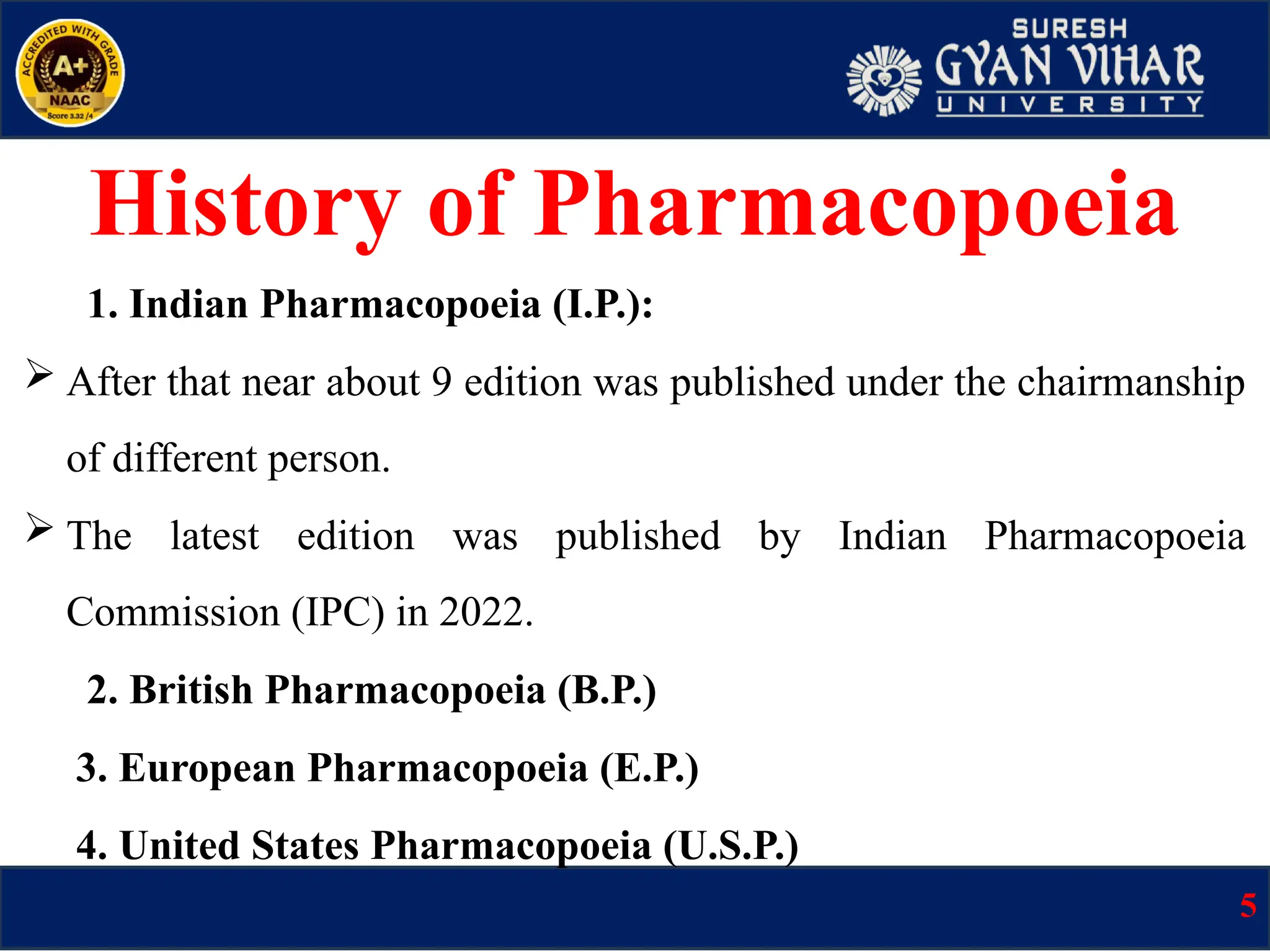
1. Indian Pharmacopoeia (I.P.):
 After that near about 9 edition was published under the chairmanship
of different person.
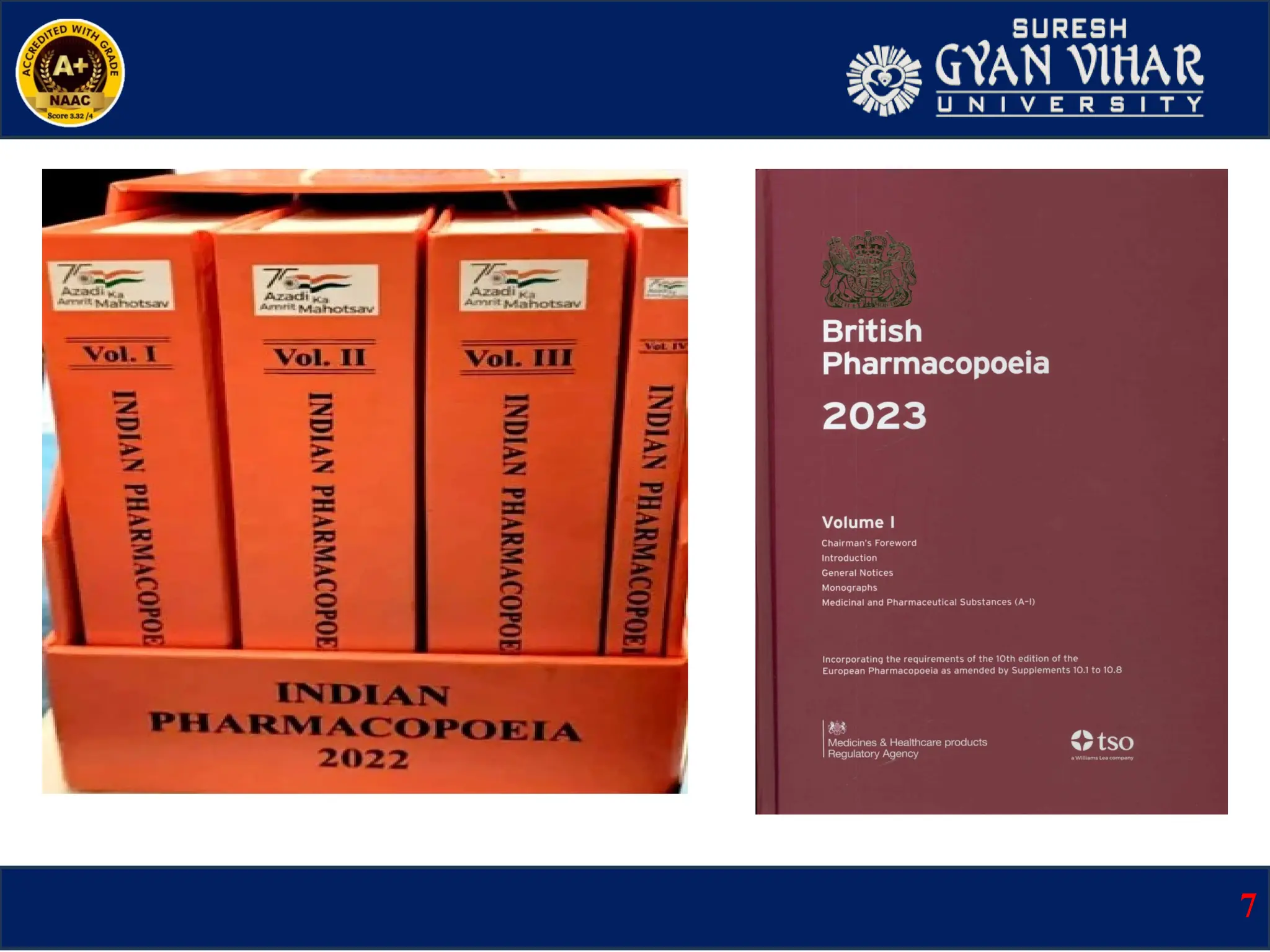
 The latest edition was published by Indian Pharmacopoeia
Commission (IPC) in 2022.
2. British Pharmacopoeia (B.P.)
3. European Pharmacopoeia (E.P.)
4. United States Pharmacopoeia (U.S.P.)
History of Pharmacopoeia
5
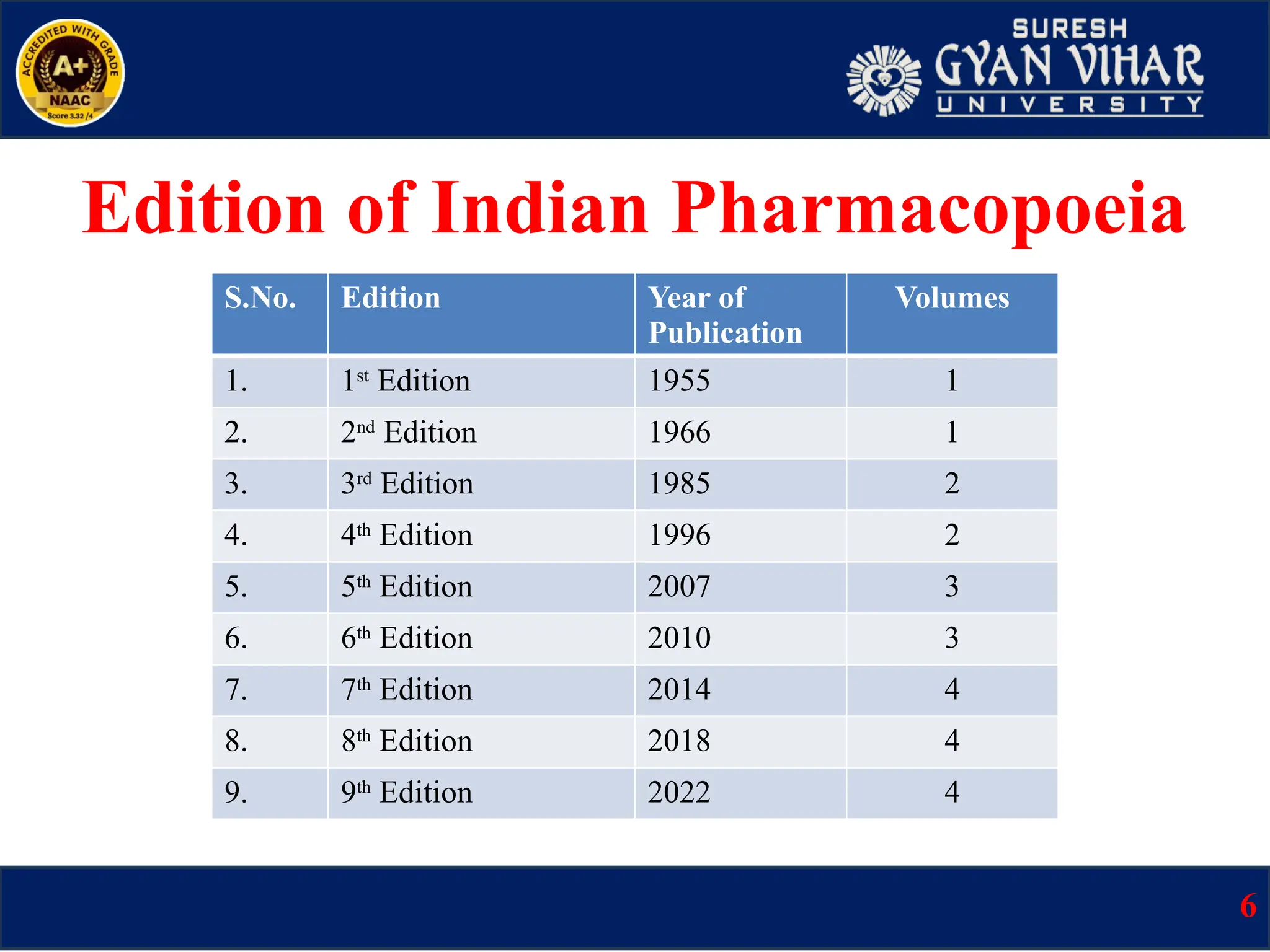
S.No. Edition Year of
Publication
Volumes
1. 1st
Edition 1955 1
2. 2nd
Edition 1966 1
3. 3rd
Edition 1985 2
4. 4th
Edition 1996 2
5. 5th
Edition 2007 3
6. 6th
Edition 2010 3
7. 7th
Edition 2014 4
8. 8th
Edition 2018 4
9. 9th
Edition 2022 4
Edition of Indian Pharmacopoeia
6
7
8
Official Monograph:
 The monograph in a pharmacopoeia are the treaties on drug and formulations,
which give description, assay, assay limits and other details necessary for
maintaining requisite standards.
A monograph in I.P. includes the following.
1. Title: The main title for a drug substance is the International Non-proprietary
Name (INN) approved by WHO.
2. Chemical formulae: Chemical structure, molecular formulae and International
Union of Pure and Applied Chemists (IUPAC) name.
9
History of Pharmacopoeia
Official Monograph:
3. Atomic and molecular weight: It is shown at top right hand corner of the monograph.
4. Definition: The opening statement of a monograph is definition of the substance.
5. Category: It express the pharmacological, therapeutic, pharmaceutical application of
the compound.
6. Dose: The average range of quantity which is suitable for adult.
7. Usual strength: Indicates the strength (s), information of pharmacists.
8. Description: Substance nature, colour, odour and taste etc.
History of Pharmacopoeia
10
Official Monograph:
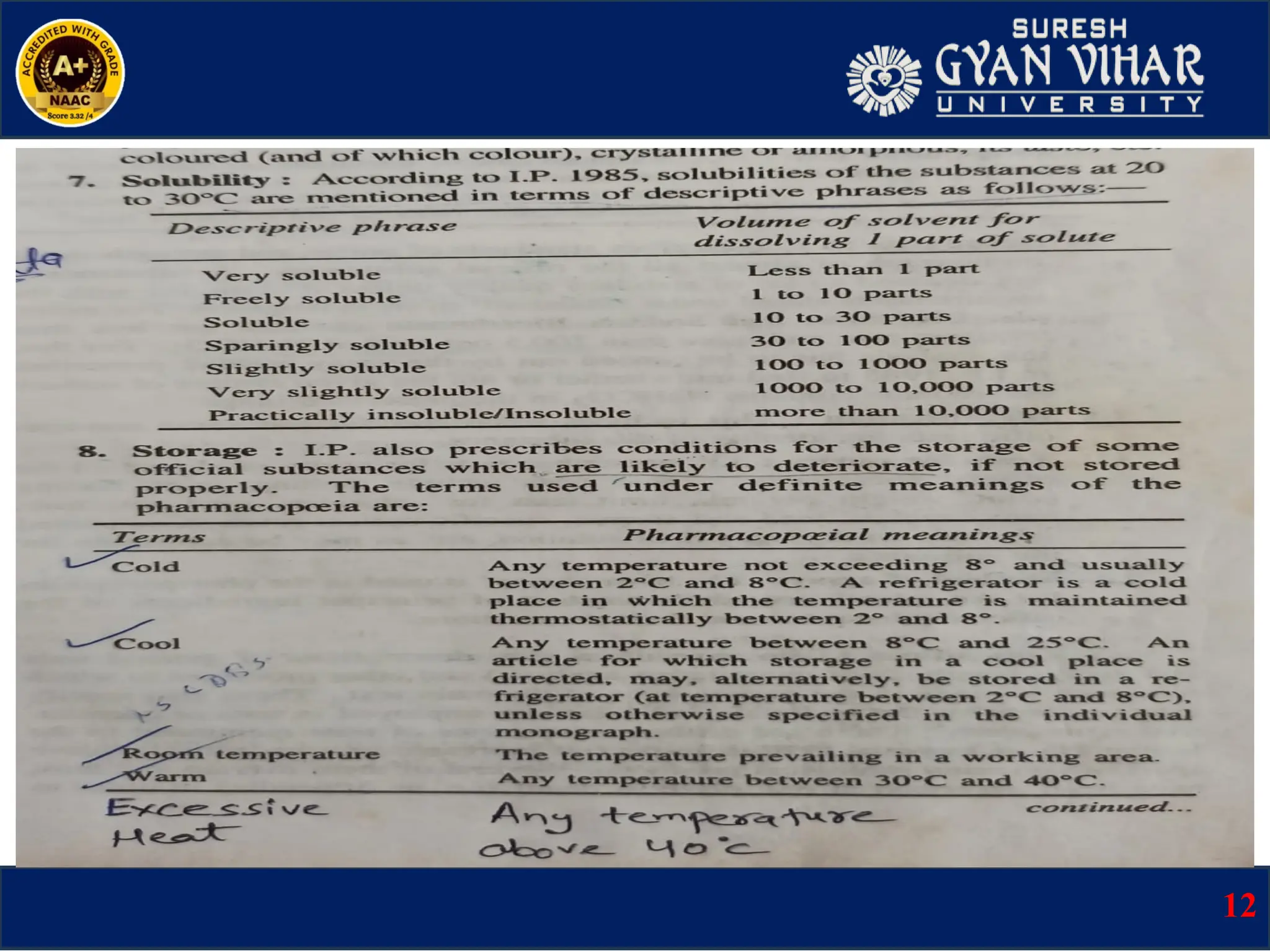
9. Solubility: The approximate solubility mentioned at temp between 15 to 300
C.
10. Identification Test: IR absorption spectroscopy, UV, MP or BP, chemical test.
11. Limits: Designed for identify and control small quantities of impurities, which
are likely to be present in the substance.
12. Assay: Detail the analytical method for substance in order to determine
percentage content of a particular chemical in given test sample.
13. Storage: Necessary for preserving the activity of the chemical.
11
History of Pharmacopoeia
12
Official Monograph:
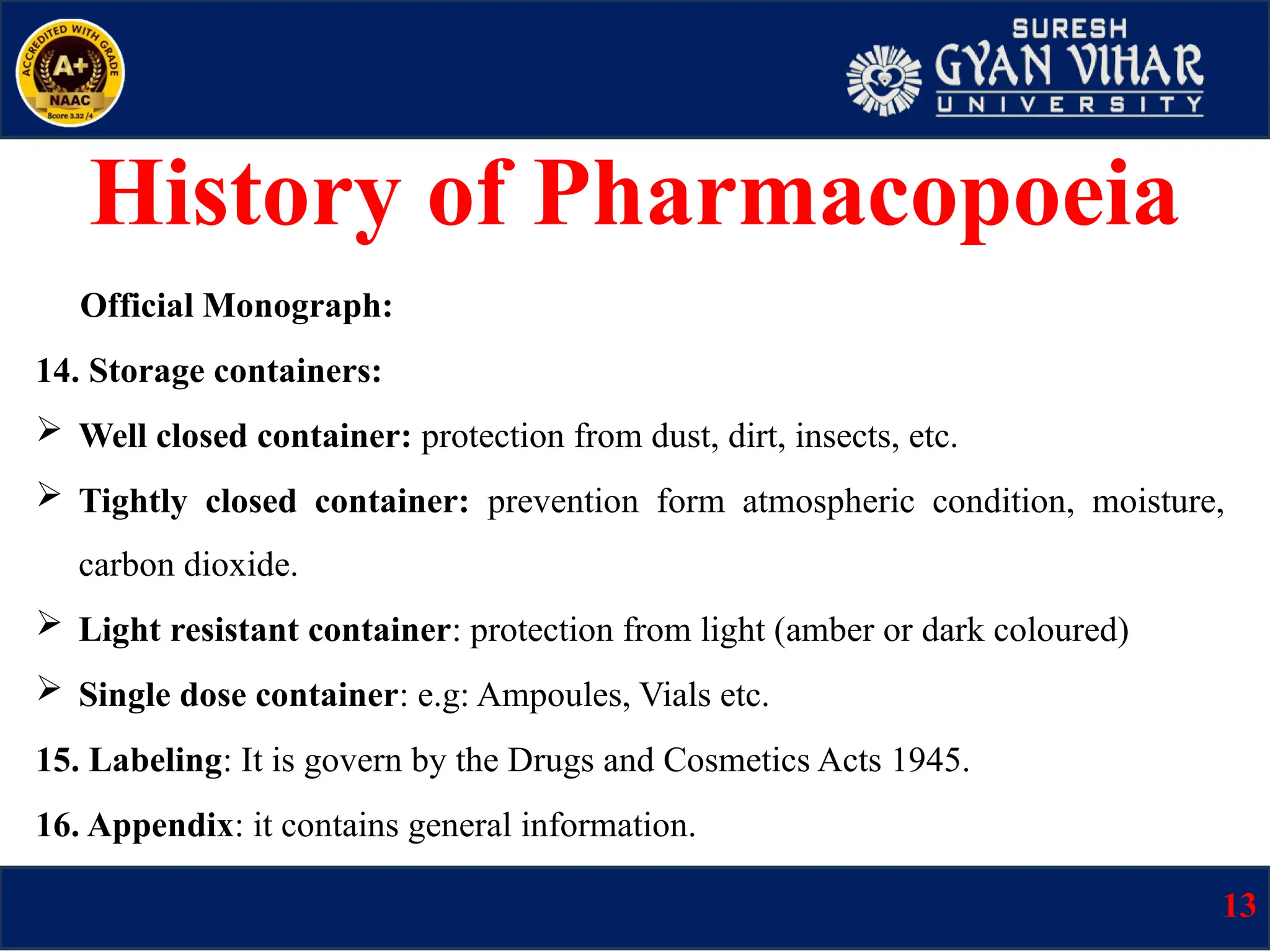
14. Storage containers:
 Well closed container: protection from dust, dirt, insects, etc.
 Tightly closed container: prevention form atmospheric condition, moisture,
carbon dioxide.
 Light resistant container: protection from light (amber or dark coloured)
 Single dose container: e.g: Ampoules, Vials etc.
15. Labeling: It is govern by the Drugs and Cosmetics Acts 1945.
16. Appendix: it contains general information.
13
History of Pharmacopoeia
What are Impurities..........?
 Impurities may defined as a foreign matter or particle present in a compound.
Impurities in pharmaceuticals are the unwanted chemicals that remain with the
Active Pharmaceutical Ingredients (APIs) or develop during formulation or upon
aging of both API and formulated APIs to medicines. The presence of these
unwanted chemicals even in small amounts may influence the efficacy and safety
of the pharmaceutical products.
 Impurities can have unwanted pharmacological or toxicological effects that
seriously impact product quality and patient safety. The International Conference
on Harmonization (ICH) has formulated a workable guideline regarding the
control of impurities.
14
 According to ICH guidelines, an impurity in a drug substance is defined as-“any
component of a new drug substance or product that is not the drug substance or an
excipient.
There is an ever increasing interest in impurities present in APIs recently, not only purity
profile but also impurity profile has become essential as per various regulatory
requirements.
 The presence of the unwanted chemicals, even in small amount, may influence the
efficacy and safety of the pharmaceutical products.
 In the pharmaceutical world, an impurity is considered as any other organic material,
besides the drug substance, or ingredients, arise out of synthesis or unwanted chemicals
that remains with API’s.
What are Impurities..........?
15
 Effects of Impurities on Pharmaceuticals:
1. Some impurities if present beyond certain tolerance limits can cause untoward side effects that can
lead to unpleasant reactions.
2. Some impurities may be able to catalyse the degradation, thereby shortening the shelf life of the drug
substance.
3. Some impurities by their chemical nature can interact with the drug substance to affect its purity and
potency.
4. Some impurities by virtue of their unstable nature like hygroscopic nature, oxidisable nature etc., can
bring about change in the physical properties like appearance, taste, odour, stability, etc., of drug
causing technical difficulties in its use as well as formulation.
Source and Types of Impurities…
16
 Impurities may enter or are formed in a drug substance
during any of the following three stages:
1. During manufacturing.
2. During purification and processing.
3. During storage.
Source and Types of Impurities…
17
LECTURE OUTCOME
Upon completion of the lecture student shall be able to:
 study the introduction of pharmacopoeias.
 describe pharmacopoeias as official books set by government authorities.
 explain the history of pharmacopoeias.
 understand the uniform standards through pharmacopoeias that helps to control adulterated
medicines.
 comprehend pharmacopoeias as either official, recognized by government agencies, or non-official
secondary references.
18
Following topics were covered during the lecture:
 Introduction to Pharmacopoeia
 History of Pharmacopoeia
 Indian Pharmacopoeia
 Monograph
 Various parts of Monograph
LECTURE SUMMARY
19
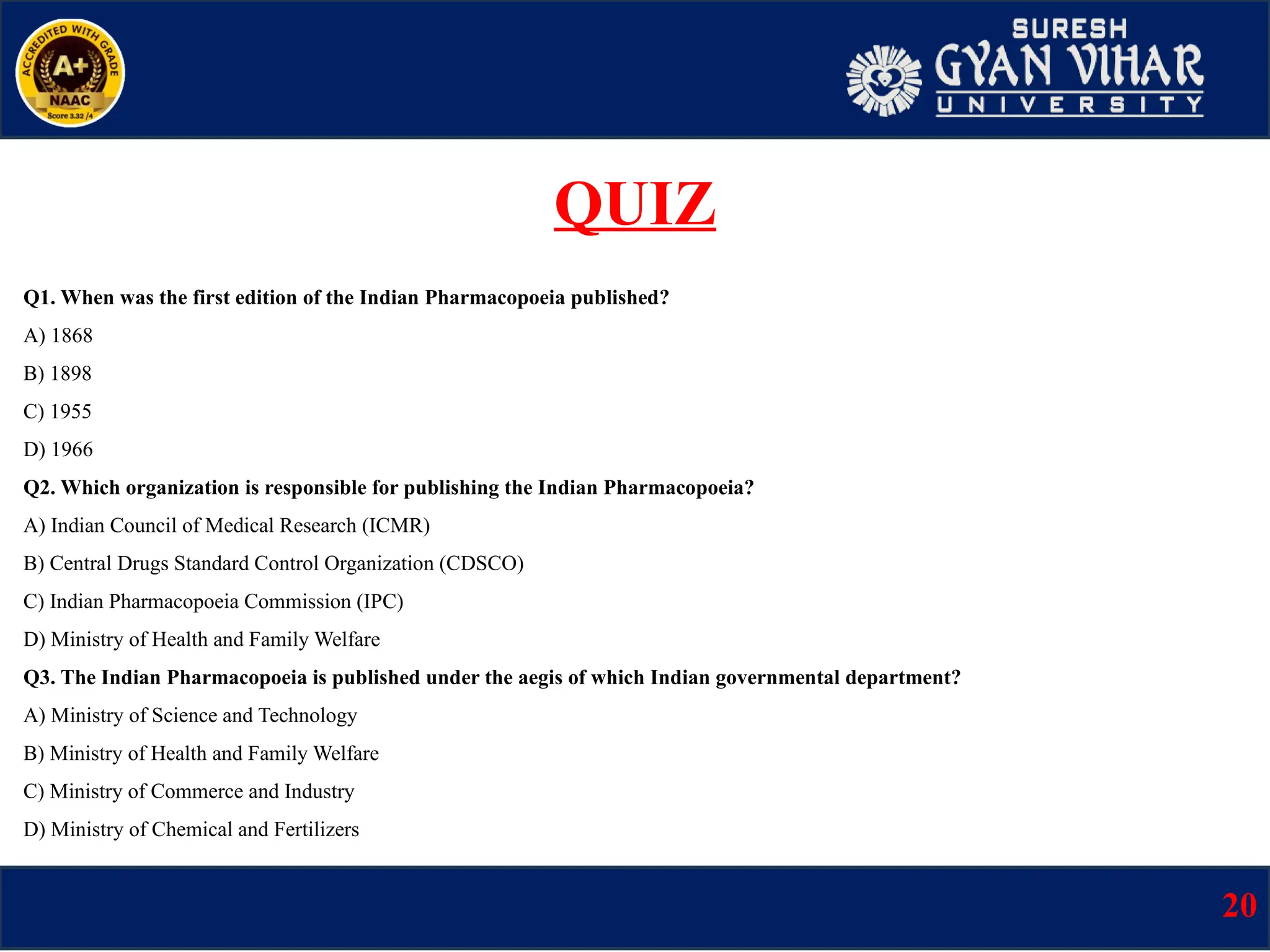
Q1. When was the first edition of the Indian Pharmacopoeia published?
A) 1868
B) 1898
C) 1955
D) 1966
Q2. Which organization is responsible for publishing the Indian Pharmacopoeia?
A) Indian Council of Medical Research (ICMR)
B) Central Drugs Standard Control Organization (CDSCO)
C) Indian Pharmacopoeia Commission (IPC)
D) Ministry of Health and Family Welfare
Q3. The Indian Pharmacopoeia is published under the aegis of which Indian governmental department?
A) Ministry of Science and Technology
B) Ministry of Health and Family Welfare
C) Ministry of Commerce and Industry
D) Ministry of Chemical and Fertilizers
20
QUIZ
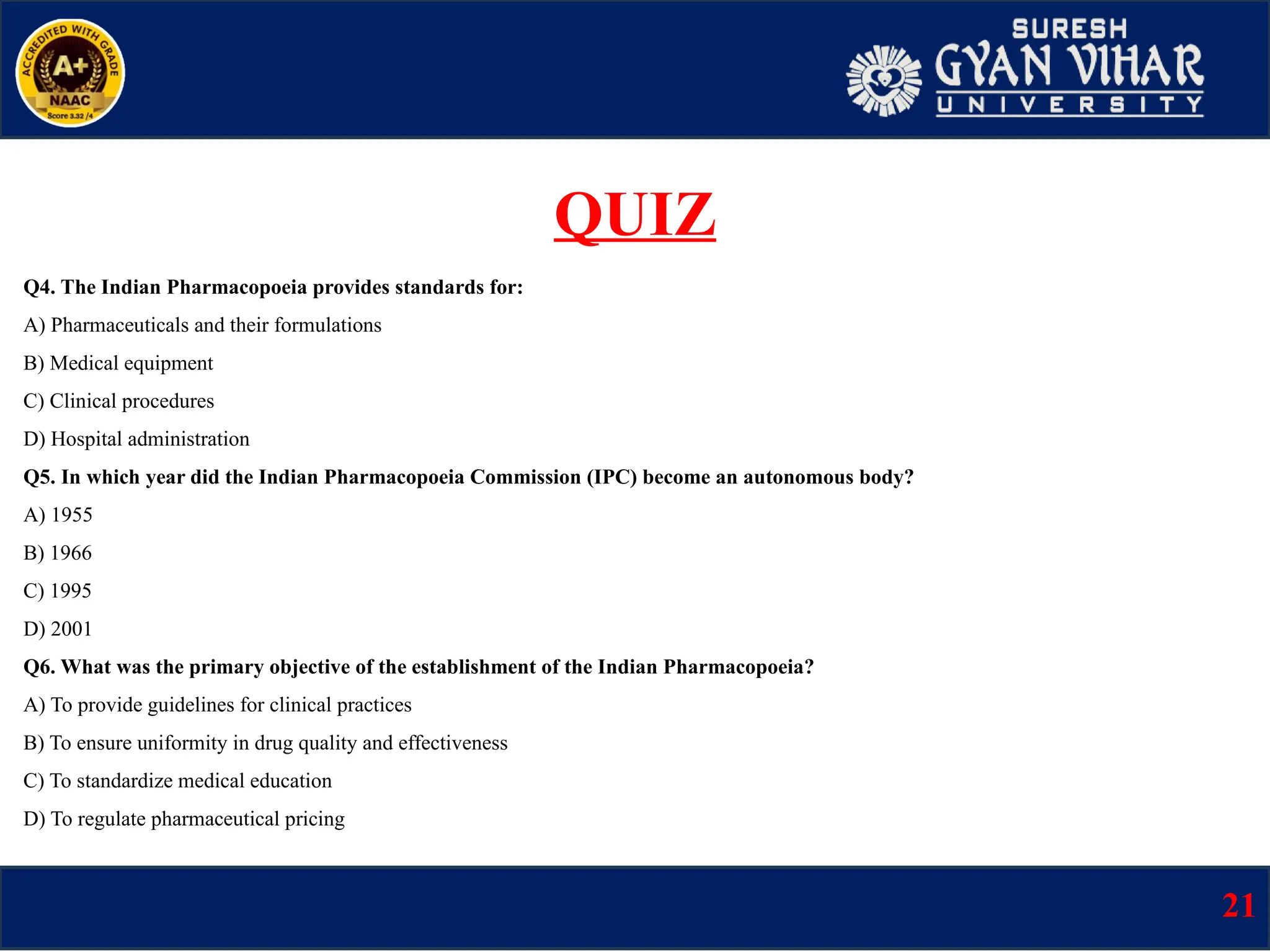
Q4. The Indian Pharmacopoeia provides standards for:
A) Pharmaceuticals and their formulations
B) Medical equipment
C) Clinical procedures
D) Hospital administration
Q5. In which year did the Indian Pharmacopoeia Commission (IPC) become an autonomous body?
A) 1955
B) 1966
C) 1995
D) 2001
Q6. What was the primary objective of the establishment of the Indian Pharmacopoeia?
A) To provide guidelines for clinical practices
B) To ensure uniformity in drug quality and effectiveness
C) To standardize medical education
D) To regulate pharmaceutical pricing
21
QUIZ
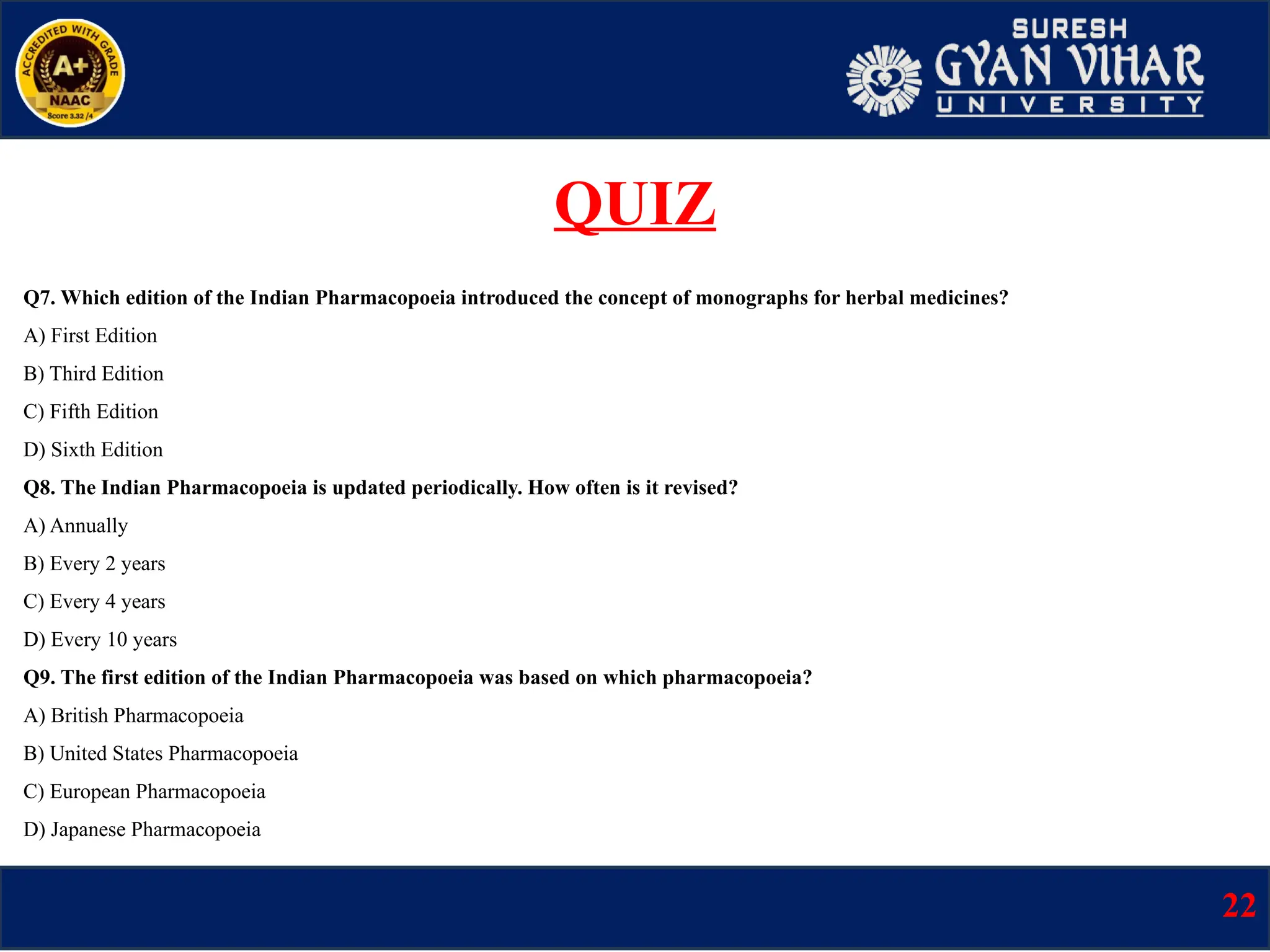
Q7. Which edition of the Indian Pharmacopoeia introduced the concept of monographs for herbal medicines?
A) First Edition
B) Third Edition
C) Fifth Edition
D) Sixth Edition
Q8. The Indian Pharmacopoeia is updated periodically. How often is it revised?
A) Annually
B) Every 2 years
C) Every 4 years
D) Every 10 years
Q9. The first edition of the Indian Pharmacopoeia was based on which pharmacopoeia?
A) British Pharmacopoeia
B) United States Pharmacopoeia
C) European Pharmacopoeia
D) Japanese Pharmacopoeia
22
QUIZ
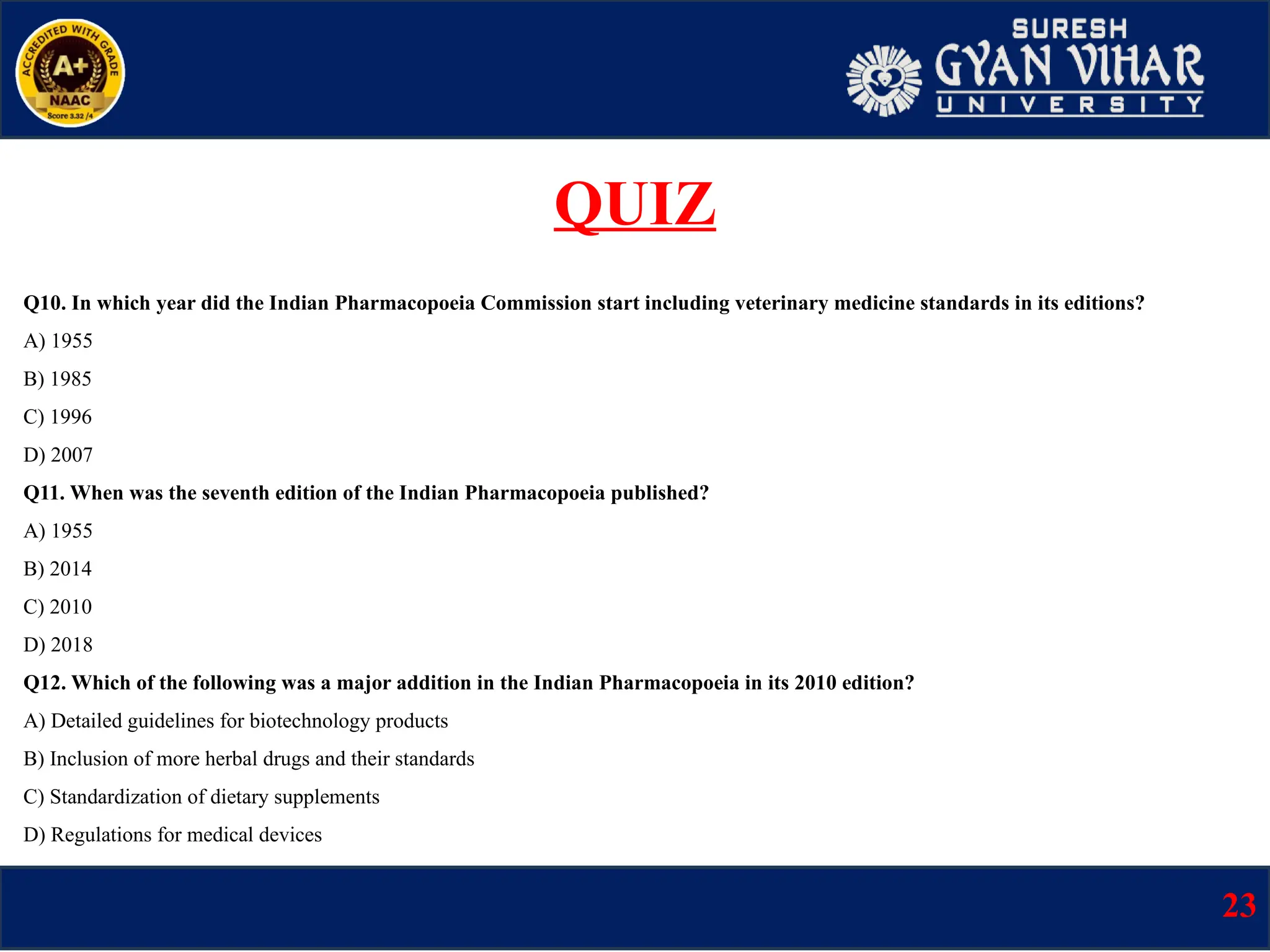
Q10. In which year did the Indian Pharmacopoeia Commission start including veterinary medicine standards in its editions?
A) 1955
B) 1985
C) 1996
D) 2007
Q11. When was the seventh edition of the Indian Pharmacopoeia published?
A) 1955
B) 2014
C) 2010
D) 2018
Q12. Which of the following was a major addition in the Indian Pharmacopoeia in its 2010 edition?
A) Detailed guidelines for biotechnology products
B) Inclusion of more herbal drugs and their standards
C) Standardization of dietary supplements
D) Regulations for medical devices
23
QUIZ
Q13. The Indian Pharmacopoeia Commission is headquartered in which city?
A) Mumbai
B) Delhi
C) Kolkata
D) Ghaziabad
Q14. What is the main purpose of a monograph in the Indian Pharmacopoeia?
A) To describe clinical uses of drugs
B) To provide detailed standards for drug quality
C) To outline drug interactions
D) To list drug marketing strategies
Q15. Which of the following is a key feature of the Indian Pharmacopoeia revisions over the years?
A) Expansion of content to include traditional and herbal medicines
B) Reduction in the number of drugs listed
C) Exclusive focus on synthetic drugs
D) Limiting standards to only international practices
24
QUIZ
Answers:
Q1. C) 1955
Q2. C) Indian Pharmacopoeia Commission (IPC)
Q3. B) Ministry of Health and Family Welfare
Q4. A) Pharmaceuticals and their formulations
Q5. D) 2001
Q6. B) To ensure uniformity in drug quality and effectiveness
Q7. D) Sixth Edition
Q8. C) Every 4 years
Q9. A) British Pharmacopoeia
Q10. B) 1985
Q11. B) 2014
Q12. B) Inclusion of more herbal drugs and their standards
Q13. D) Ghaziabad
Q14. B) To provide detailed standards for drug quality
Q15. A) Expansion of content to include traditional and herbal medicines
25
QUIZ
REFERENCES
Books:
1.Gundu Rao P; Inorganic Pharmaceutical Chemistry, 4th
Edition, Page no-10.
2.Anand & Chatwal; Inorganic Pharmaceutical Chemistry, 6th
Edition, Page no-
12.
3.Chaudhry N.C & Gurbani N.K; Inorganic Pharmaceutical Chemistry, 8th
Edition, Page no-10.
4.A.I. Vogel; Text Book of Quantitative Inorganic Analysis, 4th
Edition, Page no-
14.
5.M.L. Schroff; Inorganic Pharmaceutical Chemistry, 7th
Edition, Page no-16.
26
REFERENCES
Paper:
1.https://
www.pharmtech.com/view/brief-history-pharmacopoeias-global-perspective-
1
2.https://www.sciencedirect.com/science/article/abs/pii/S0378874118343617
3.https://
www.hilarispublisher.com/open-access/the-history-and-evolution-of-pharma
copoeias.pdf
4.https://
cdn.who.int/media/docs/defaultsource/medicines/pharmacopoeia/review_qas
13-512rev1_25032013.pdf?sfvrsn=d67325b9_3
27
REFERENCES
Video Link:
1.https://youtu.be/TOuya9Ff_5Q?si=Zc3UfiCTeVW7E4GA
2.https://youtu.be/__AhBdYwjjM?si=I__EefLNl5m0tVj1
3.https://youtu.be/5F_HeyWAs98?si=QfA6wD4z0_geMsnH
4.https://youtu.be/aKL6d5TueoY?si=y1cQzSutUkeIoS4N
5.https://youtu.be/IImkZpaIEtY?si=UPp7QviFqBdYg9rl
28
THANK YOU

Unit 1, Lecture 1.pptx Pharmacopoeia & Histroy

  • 1.
    UNIT-I, LECTURE 1 HISTORYOF PHARMACOPOEIAS [CO1, PO1] Course Name: Pharmaceutical Inorganic Chemistry (Theory) [BP104T] B.Pharm; I Semester Course Coordinator:- Name: Yogesh Matta Designation: Associate Professor Mail ID: yogesh.matta@mygyanvihar.com
  • 2.
    S.No. Topic PageNo 1. Lecture Objectives 1 2. Introduction to Pharmacopoeia 2 3. History of Pharmacopoeia 2-3 4. Indian Pharmacopoeia 4-6 5. Images of Pharmacopoeia 7-8 6. Official Monograph 9-16 7. Lecture Outcome 17 8. Lecture Summary 18 9. Quiz 19-23 10. References 24-26 CONTENTS
  • 3.
    LECTURE OBJECTIVES  Tostudy an introduction of pharmacopoeias.  To define pharmacopoeias as official books set by government authorities that establish quality standards for drugs, ingredients, and pharmaceutical products.  To understand the history of pharmacopoeias.  To familiarize with the uniform standards through pharmacopoeias that helps to control adulterated medicines and plays an important role in manufacturing, research, and export.  To classify pharmacopoeias as either official, recognized by government agencies, or non-official secondary references. 1
  • 4.
    History of Pharmacopoeia The word Pharmacopoeia is derived from 2 Greek words ‘pharmakon’ = a drug and ‘poein’ = to make or create.  Pharmacopoeia is book containing directions for identification of samples and the preparation of compound medicines, and published by the authority of a management or a medical or pharmaceutical society. History:  Each country has some rules on pharmaceutical preparations which sets standards and required quantity indices for medicament, raw materials and preparations employed in the manufacture of drugs. These regulations are presented in separate articles.  General and specific matters relating to individual drugs are published in the form of a book called a Pharmacopoeia. 2
  • 5.
     On 15th December1820, the first United State Pharmacopoeia (U.S.P) was released.  In 1864, the first British Pharmacopoeia (B.P) was published with monograph on benzoic acid, gallic acid, tartaric acid, tannic acid, camphor, lactose, sucrose, and seven alkaloids along with their salts. History of Pharmacopoeia 3
  • 6.
    Indian Pharmacopoeia (I.P.): Govt. of India constituted a permanent Indian Pharmacopoeia Committee in 1948 under the chairmanship of Col. R. N. Chopra for the preparation of the Indian Pharmacopoeia and established the central Indian Pharmacopoeia Laboratory at Ghaziabad, Uttar Pradesh to keep up to date.  Under the Drugs and Cosmetic Act, 1940, fulfill the requirements.  The first edition of I.P. was published in the year 1955 under the chairmanship of Dr. B. N. Ghosh. 4 History of Pharmacopoeia
  • 7.
    1. Indian Pharmacopoeia(I.P.):  After that near about 9 edition was published under the chairmanship of different person.  The latest edition was published by Indian Pharmacopoeia Commission (IPC) in 2022. 2. British Pharmacopoeia (B.P.) 3. European Pharmacopoeia (E.P.) 4. United States Pharmacopoeia (U.S.P.) History of Pharmacopoeia 5
  • 8.
    S.No. Edition Yearof Publication Volumes 1. 1st Edition 1955 1 2. 2nd Edition 1966 1 3. 3rd Edition 1985 2 4. 4th Edition 1996 2 5. 5th Edition 2007 3 6. 6th Edition 2010 3 7. 7th Edition 2014 4 8. 8th Edition 2018 4 9. 9th Edition 2022 4 Edition of Indian Pharmacopoeia 6
  • 9.
  • 10.
  • 11.
    Official Monograph:  Themonograph in a pharmacopoeia are the treaties on drug and formulations, which give description, assay, assay limits and other details necessary for maintaining requisite standards. A monograph in I.P. includes the following. 1. Title: The main title for a drug substance is the International Non-proprietary Name (INN) approved by WHO. 2. Chemical formulae: Chemical structure, molecular formulae and International Union of Pure and Applied Chemists (IUPAC) name. 9 History of Pharmacopoeia
  • 12.
    Official Monograph: 3. Atomicand molecular weight: It is shown at top right hand corner of the monograph. 4. Definition: The opening statement of a monograph is definition of the substance. 5. Category: It express the pharmacological, therapeutic, pharmaceutical application of the compound. 6. Dose: The average range of quantity which is suitable for adult. 7. Usual strength: Indicates the strength (s), information of pharmacists. 8. Description: Substance nature, colour, odour and taste etc. History of Pharmacopoeia 10
  • 13.
    Official Monograph: 9. Solubility:The approximate solubility mentioned at temp between 15 to 300 C. 10. Identification Test: IR absorption spectroscopy, UV, MP or BP, chemical test. 11. Limits: Designed for identify and control small quantities of impurities, which are likely to be present in the substance. 12. Assay: Detail the analytical method for substance in order to determine percentage content of a particular chemical in given test sample. 13. Storage: Necessary for preserving the activity of the chemical. 11 History of Pharmacopoeia
  • 14.
  • 15.
    Official Monograph: 14. Storagecontainers:  Well closed container: protection from dust, dirt, insects, etc.  Tightly closed container: prevention form atmospheric condition, moisture, carbon dioxide.  Light resistant container: protection from light (amber or dark coloured)  Single dose container: e.g: Ampoules, Vials etc. 15. Labeling: It is govern by the Drugs and Cosmetics Acts 1945. 16. Appendix: it contains general information. 13 History of Pharmacopoeia
  • 16.
    What are Impurities..........? Impurities may defined as a foreign matter or particle present in a compound. Impurities in pharmaceuticals are the unwanted chemicals that remain with the Active Pharmaceutical Ingredients (APIs) or develop during formulation or upon aging of both API and formulated APIs to medicines. The presence of these unwanted chemicals even in small amounts may influence the efficacy and safety of the pharmaceutical products.  Impurities can have unwanted pharmacological or toxicological effects that seriously impact product quality and patient safety. The International Conference on Harmonization (ICH) has formulated a workable guideline regarding the control of impurities. 14
  • 17.
     According toICH guidelines, an impurity in a drug substance is defined as-“any component of a new drug substance or product that is not the drug substance or an excipient. There is an ever increasing interest in impurities present in APIs recently, not only purity profile but also impurity profile has become essential as per various regulatory requirements.  The presence of the unwanted chemicals, even in small amount, may influence the efficacy and safety of the pharmaceutical products.  In the pharmaceutical world, an impurity is considered as any other organic material, besides the drug substance, or ingredients, arise out of synthesis or unwanted chemicals that remains with API’s. What are Impurities..........? 15
  • 18.
     Effects ofImpurities on Pharmaceuticals: 1. Some impurities if present beyond certain tolerance limits can cause untoward side effects that can lead to unpleasant reactions. 2. Some impurities may be able to catalyse the degradation, thereby shortening the shelf life of the drug substance. 3. Some impurities by their chemical nature can interact with the drug substance to affect its purity and potency. 4. Some impurities by virtue of their unstable nature like hygroscopic nature, oxidisable nature etc., can bring about change in the physical properties like appearance, taste, odour, stability, etc., of drug causing technical difficulties in its use as well as formulation. Source and Types of Impurities… 16
  • 19.
     Impurities mayenter or are formed in a drug substance during any of the following three stages: 1. During manufacturing. 2. During purification and processing. 3. During storage. Source and Types of Impurities… 17
  • 20.
    LECTURE OUTCOME Upon completionof the lecture student shall be able to:  study the introduction of pharmacopoeias.  describe pharmacopoeias as official books set by government authorities.  explain the history of pharmacopoeias.  understand the uniform standards through pharmacopoeias that helps to control adulterated medicines.  comprehend pharmacopoeias as either official, recognized by government agencies, or non-official secondary references. 18
  • 21.
    Following topics werecovered during the lecture:  Introduction to Pharmacopoeia  History of Pharmacopoeia  Indian Pharmacopoeia  Monograph  Various parts of Monograph LECTURE SUMMARY 19
  • 22.
    Q1. When wasthe first edition of the Indian Pharmacopoeia published? A) 1868 B) 1898 C) 1955 D) 1966 Q2. Which organization is responsible for publishing the Indian Pharmacopoeia? A) Indian Council of Medical Research (ICMR) B) Central Drugs Standard Control Organization (CDSCO) C) Indian Pharmacopoeia Commission (IPC) D) Ministry of Health and Family Welfare Q3. The Indian Pharmacopoeia is published under the aegis of which Indian governmental department? A) Ministry of Science and Technology B) Ministry of Health and Family Welfare C) Ministry of Commerce and Industry D) Ministry of Chemical and Fertilizers 20 QUIZ
  • 23.
    Q4. The IndianPharmacopoeia provides standards for: A) Pharmaceuticals and their formulations B) Medical equipment C) Clinical procedures D) Hospital administration Q5. In which year did the Indian Pharmacopoeia Commission (IPC) become an autonomous body? A) 1955 B) 1966 C) 1995 D) 2001 Q6. What was the primary objective of the establishment of the Indian Pharmacopoeia? A) To provide guidelines for clinical practices B) To ensure uniformity in drug quality and effectiveness C) To standardize medical education D) To regulate pharmaceutical pricing 21 QUIZ
  • 24.
    Q7. Which editionof the Indian Pharmacopoeia introduced the concept of monographs for herbal medicines? A) First Edition B) Third Edition C) Fifth Edition D) Sixth Edition Q8. The Indian Pharmacopoeia is updated periodically. How often is it revised? A) Annually B) Every 2 years C) Every 4 years D) Every 10 years Q9. The first edition of the Indian Pharmacopoeia was based on which pharmacopoeia? A) British Pharmacopoeia B) United States Pharmacopoeia C) European Pharmacopoeia D) Japanese Pharmacopoeia 22 QUIZ
  • 25.
    Q10. In whichyear did the Indian Pharmacopoeia Commission start including veterinary medicine standards in its editions? A) 1955 B) 1985 C) 1996 D) 2007 Q11. When was the seventh edition of the Indian Pharmacopoeia published? A) 1955 B) 2014 C) 2010 D) 2018 Q12. Which of the following was a major addition in the Indian Pharmacopoeia in its 2010 edition? A) Detailed guidelines for biotechnology products B) Inclusion of more herbal drugs and their standards C) Standardization of dietary supplements D) Regulations for medical devices 23 QUIZ
  • 26.
    Q13. The IndianPharmacopoeia Commission is headquartered in which city? A) Mumbai B) Delhi C) Kolkata D) Ghaziabad Q14. What is the main purpose of a monograph in the Indian Pharmacopoeia? A) To describe clinical uses of drugs B) To provide detailed standards for drug quality C) To outline drug interactions D) To list drug marketing strategies Q15. Which of the following is a key feature of the Indian Pharmacopoeia revisions over the years? A) Expansion of content to include traditional and herbal medicines B) Reduction in the number of drugs listed C) Exclusive focus on synthetic drugs D) Limiting standards to only international practices 24 QUIZ
  • 27.
    Answers: Q1. C) 1955 Q2.C) Indian Pharmacopoeia Commission (IPC) Q3. B) Ministry of Health and Family Welfare Q4. A) Pharmaceuticals and their formulations Q5. D) 2001 Q6. B) To ensure uniformity in drug quality and effectiveness Q7. D) Sixth Edition Q8. C) Every 4 years Q9. A) British Pharmacopoeia Q10. B) 1985 Q11. B) 2014 Q12. B) Inclusion of more herbal drugs and their standards Q13. D) Ghaziabad Q14. B) To provide detailed standards for drug quality Q15. A) Expansion of content to include traditional and herbal medicines 25 QUIZ
  • 28.
    REFERENCES Books: 1.Gundu Rao P;Inorganic Pharmaceutical Chemistry, 4th Edition, Page no-10. 2.Anand & Chatwal; Inorganic Pharmaceutical Chemistry, 6th Edition, Page no- 12. 3.Chaudhry N.C & Gurbani N.K; Inorganic Pharmaceutical Chemistry, 8th Edition, Page no-10. 4.A.I. Vogel; Text Book of Quantitative Inorganic Analysis, 4th Edition, Page no- 14. 5.M.L. Schroff; Inorganic Pharmaceutical Chemistry, 7th Edition, Page no-16. 26
  • 29.
  • 30.
  • 31.