I CAN DO IT 2
Joko Daryanto – E Rahayu – P. Darini
Would You Tell Me the Story Please
Unit 1
Learning Objectives
Spoken Cycle
After studying this unit, you are expected to be able to:
• give opinion,
• ask opinion,
• fulfill request,
•understand and respond to the dialogues of asking
and
giving opinion,
• understand and respond to the dialogues of giving
permission,
• tell stories orally.
Written Cycle
After studying this unit, you should be able to:
• identify the narrative texts,
• comprehend the use of gerund correctly,
• write good simple narrative texts.
Study and say the expressions below
Expressions of asking for opinion:
• How did you enjoy your trip?
• How did you like the meals?
• What do you think of ... ?
• What’s your opinion about ... ?
• What do you think about ... ?
• What are your views on ... ?
• Are you aware of ... ?
• What would you say to ... /if we ... ?
Expressions of giving opinion:
• I liked it very much.
• They’re tasteful.
• It’s boring.
• I think it’s great.
• In my opinion, ....
• I feel that ....
• As far as I’m concerned ....
• As I see it ....
• I have no doubt that ....
• I’m sure that ....
Spoken Cycle
Study the expressions below
Making Request
• Could you help me, please?
• Can you take scissors from the table?
• Can I have a glass of tea, please?
• Would you give me a little ink?
• Do you mind if I have the copy?
Fulfilling Request
• Yes, certainly.
• Yes, of course.
• Sure.
• Why not?
• With my pleasure.
• OK.
• All right.
Study and practise the dialogue below then answer the questions
Ega : Could you lend me your mobile phone,
Arjun?
Arjun : Certainly, here it is.
Ega : Can you get me the telephone directory,
please?
Arjun : Sure. Are you going to make a call?
Ega : Yes, I’ll call my old friend. She was my
classmate when we were in the
Junior High School. We are going to have
a reunion next month.
Arjun : Who will you invite?
Ega : We plan to invite as many as we can
connect, but I have a problem.
Make your own monologue telling a story based
on the following summary
The Hose
 There are plants and flowers in Bobo’s garden.
 He loves watering them.
 Bobo was watering his plants.
 Suddenly water from the hose stopped flowing.
 He saw Giga’s standing on the hose. It broke.
 Bobo was upset; and Giga felt very sorry.
 Giga went to a small pond. He was filling his trunk with water. Then he
came back.
 He sprayed Bobo’s garden with water from his trunk.
 Bobo felt happy and forgave Giga’s mistake.
 Giga promised to get Bobo a new watering hose.
Read the following short storyWritten Cycle
Read the following short story
Read the following text carefully
Pay attention to the explanation.
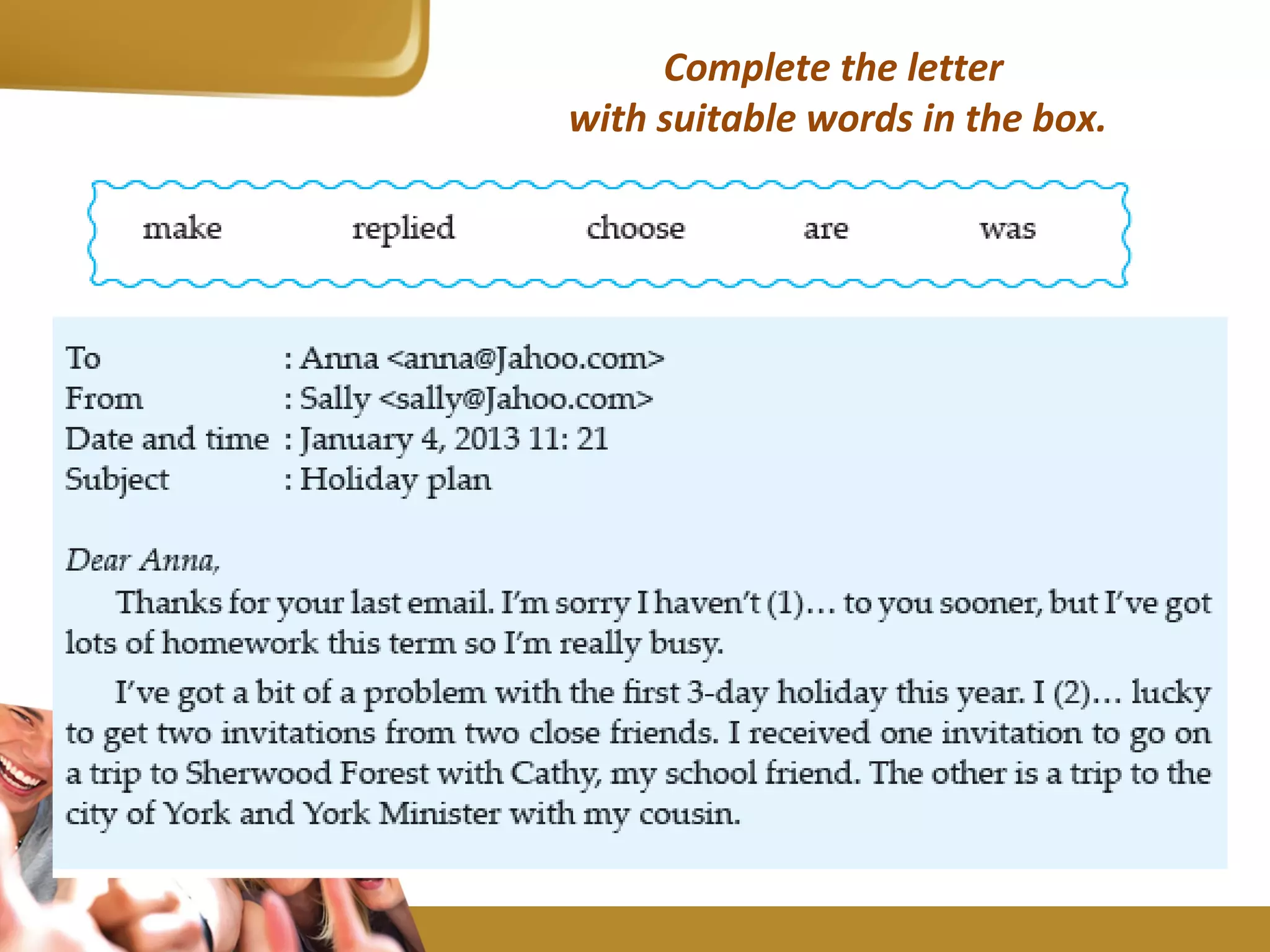
Email is similar with letter. It is a means of
communication. You send letter via
post while you send an email via internet. Let’s pay
attention to the form of email
below
Complete the letter
with suitable words in the box.
Write the possible reply based on the
email above
Study the table below
Expressions of asking for
opinions:
• How did you enjoy the ……………?
• How do you like …………………………?
• What do you think of ………………?
• What’s your opinion about………?
Expressions of giving
opinions:
• I like it very much.
• They are tasteful/nice/delicious.
• It’s boring/interesting/amazing/amusing/
frightening.
• I think it’s great/fantastic/marvelous
/excellent.
Expressions of fulfilling
request:
• Yes, certainly.
• Why not?
• By all means.
• It’s OK.
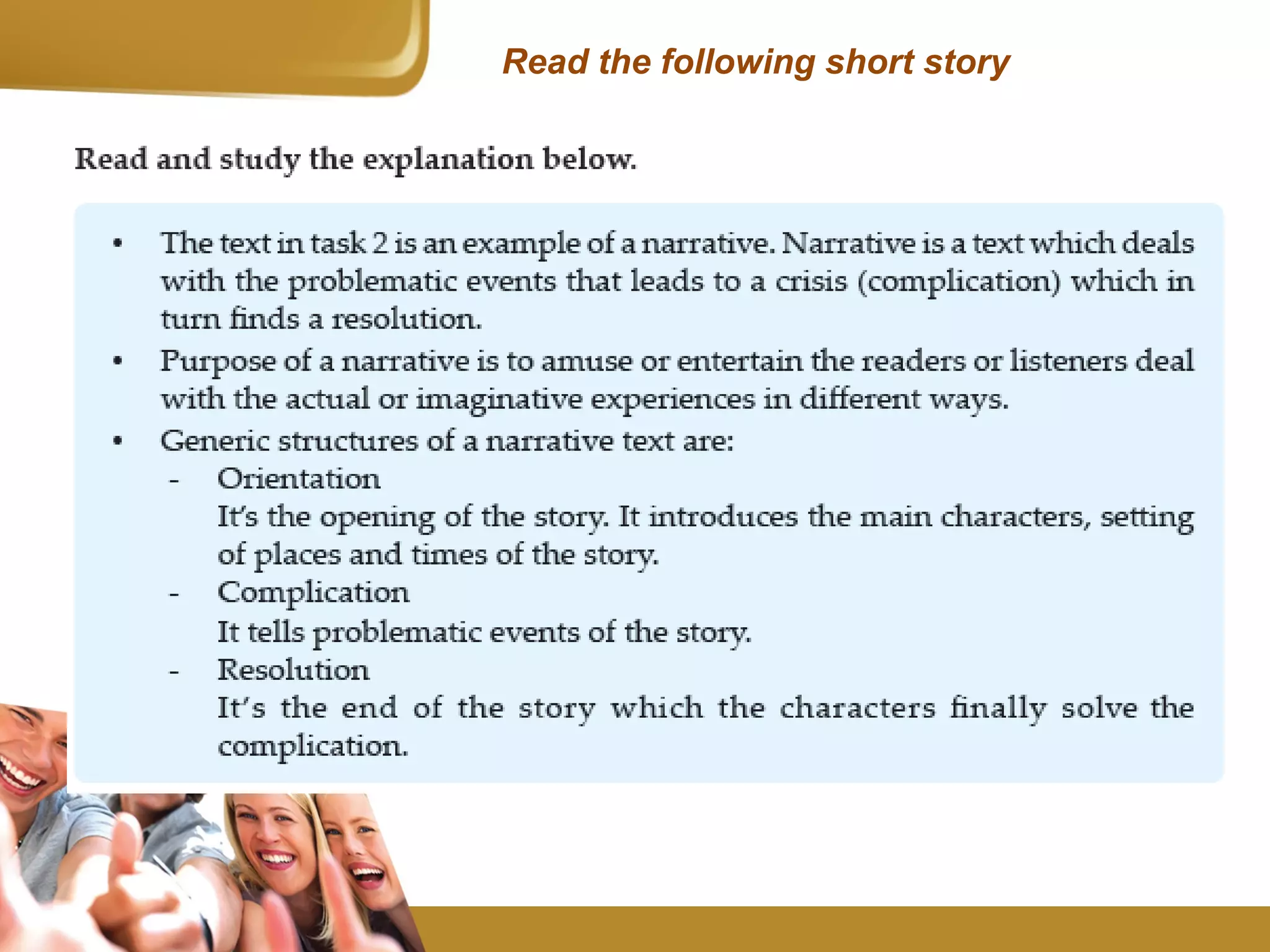
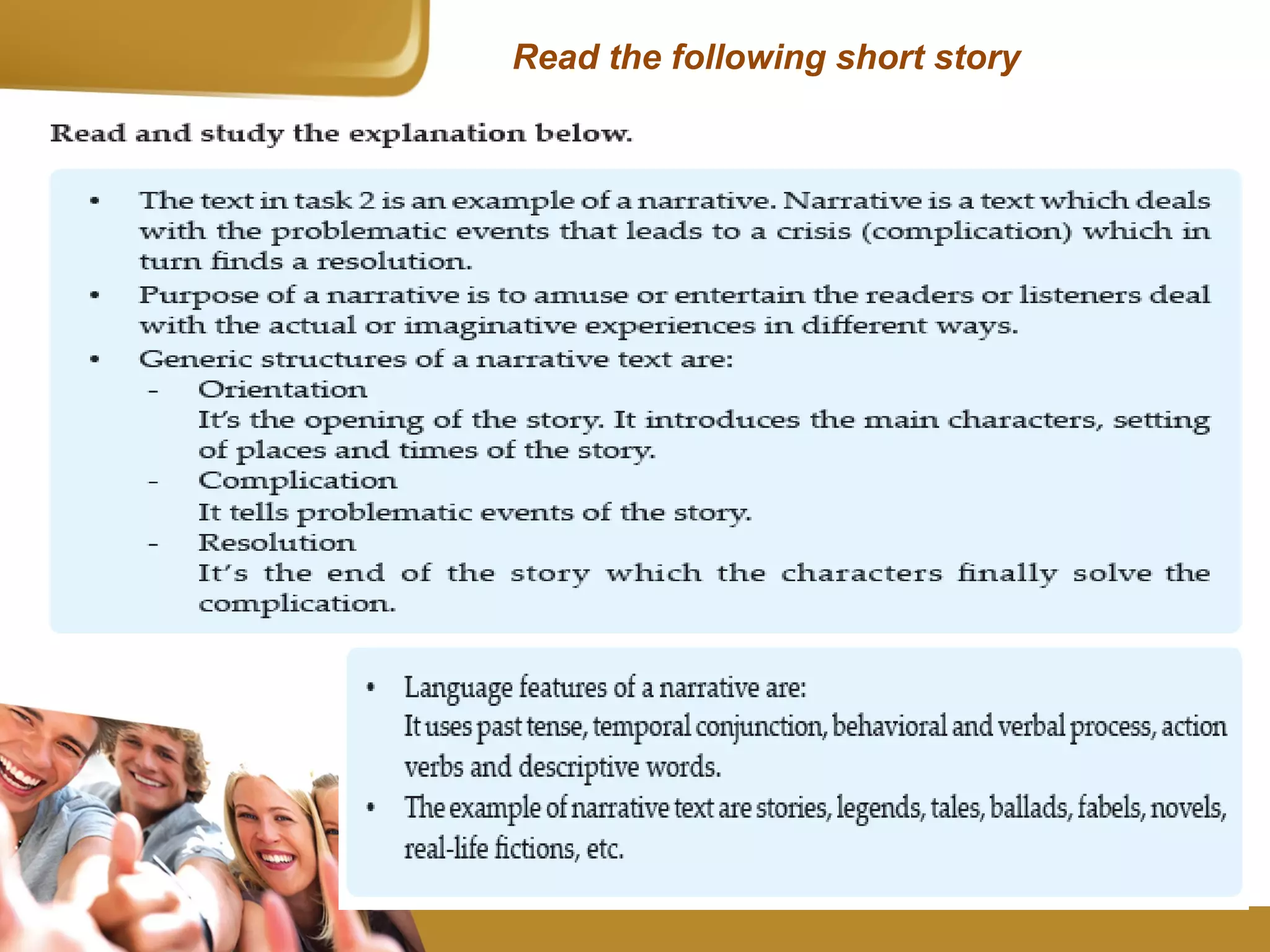
The kinds of narrative texts are
folktales, legends, fables, fairy tales,
short
stories, slice of one’s life.
Generic structures of a narrative
text are:
• Orientation (it introduces the participant of the
story, where and when the story happened).
• Complication (it presents problematic events of
the story).
• Resolution (how the problematic events are
solved).
Unit 1

Unit 1

  • 1.
    I CAN DOIT 2 Joko Daryanto – E Rahayu – P. Darini
  • 2.
    Would You TellMe the Story Please Unit 1 Learning Objectives Spoken Cycle After studying this unit, you are expected to be able to: • give opinion, • ask opinion, • fulfill request, •understand and respond to the dialogues of asking and giving opinion, • understand and respond to the dialogues of giving permission, • tell stories orally. Written Cycle After studying this unit, you should be able to: • identify the narrative texts, • comprehend the use of gerund correctly, • write good simple narrative texts.
  • 3.
    Study and saythe expressions below Expressions of asking for opinion: • How did you enjoy your trip? • How did you like the meals? • What do you think of ... ? • What’s your opinion about ... ? • What do you think about ... ? • What are your views on ... ? • Are you aware of ... ? • What would you say to ... /if we ... ? Expressions of giving opinion: • I liked it very much. • They’re tasteful. • It’s boring. • I think it’s great. • In my opinion, .... • I feel that .... • As far as I’m concerned .... • As I see it .... • I have no doubt that .... • I’m sure that .... Spoken Cycle
  • 4.
    Study the expressionsbelow Making Request • Could you help me, please? • Can you take scissors from the table? • Can I have a glass of tea, please? • Would you give me a little ink? • Do you mind if I have the copy? Fulfilling Request • Yes, certainly. • Yes, of course. • Sure. • Why not? • With my pleasure. • OK. • All right. Study and practise the dialogue below then answer the questions Ega : Could you lend me your mobile phone, Arjun? Arjun : Certainly, here it is. Ega : Can you get me the telephone directory, please? Arjun : Sure. Are you going to make a call? Ega : Yes, I’ll call my old friend. She was my classmate when we were in the Junior High School. We are going to have a reunion next month. Arjun : Who will you invite? Ega : We plan to invite as many as we can connect, but I have a problem.
  • 5.
    Make your ownmonologue telling a story based on the following summary The Hose  There are plants and flowers in Bobo’s garden.  He loves watering them.  Bobo was watering his plants.  Suddenly water from the hose stopped flowing.  He saw Giga’s standing on the hose. It broke.  Bobo was upset; and Giga felt very sorry.  Giga went to a small pond. He was filling his trunk with water. Then he came back.  He sprayed Bobo’s garden with water from his trunk.  Bobo felt happy and forgave Giga’s mistake.  Giga promised to get Bobo a new watering hose.
  • 6.
    Read the followingshort storyWritten Cycle
  • 7.
    Read the followingshort story
  • 8.
    Read the followingshort story
  • 9.
    Read the followingshort story
  • 10.
    Read the followingtext carefully
  • 11.
    Pay attention tothe explanation. Email is similar with letter. It is a means of communication. You send letter via post while you send an email via internet. Let’s pay attention to the form of email below
  • 12.
    Complete the letter withsuitable words in the box.
  • 13.
    Write the possiblereply based on the email above
  • 14.
  • 15.
    Expressions of askingfor opinions: • How did you enjoy the ……………? • How do you like …………………………? • What do you think of ………………? • What’s your opinion about………? Expressions of giving opinions: • I like it very much. • They are tasteful/nice/delicious. • It’s boring/interesting/amazing/amusing/ frightening. • I think it’s great/fantastic/marvelous /excellent. Expressions of fulfilling request: • Yes, certainly. • Why not? • By all means. • It’s OK. The kinds of narrative texts are folktales, legends, fables, fairy tales, short stories, slice of one’s life. Generic structures of a narrative text are: • Orientation (it introduces the participant of the story, where and when the story happened). • Complication (it presents problematic events of the story). • Resolution (how the problematic events are solved).