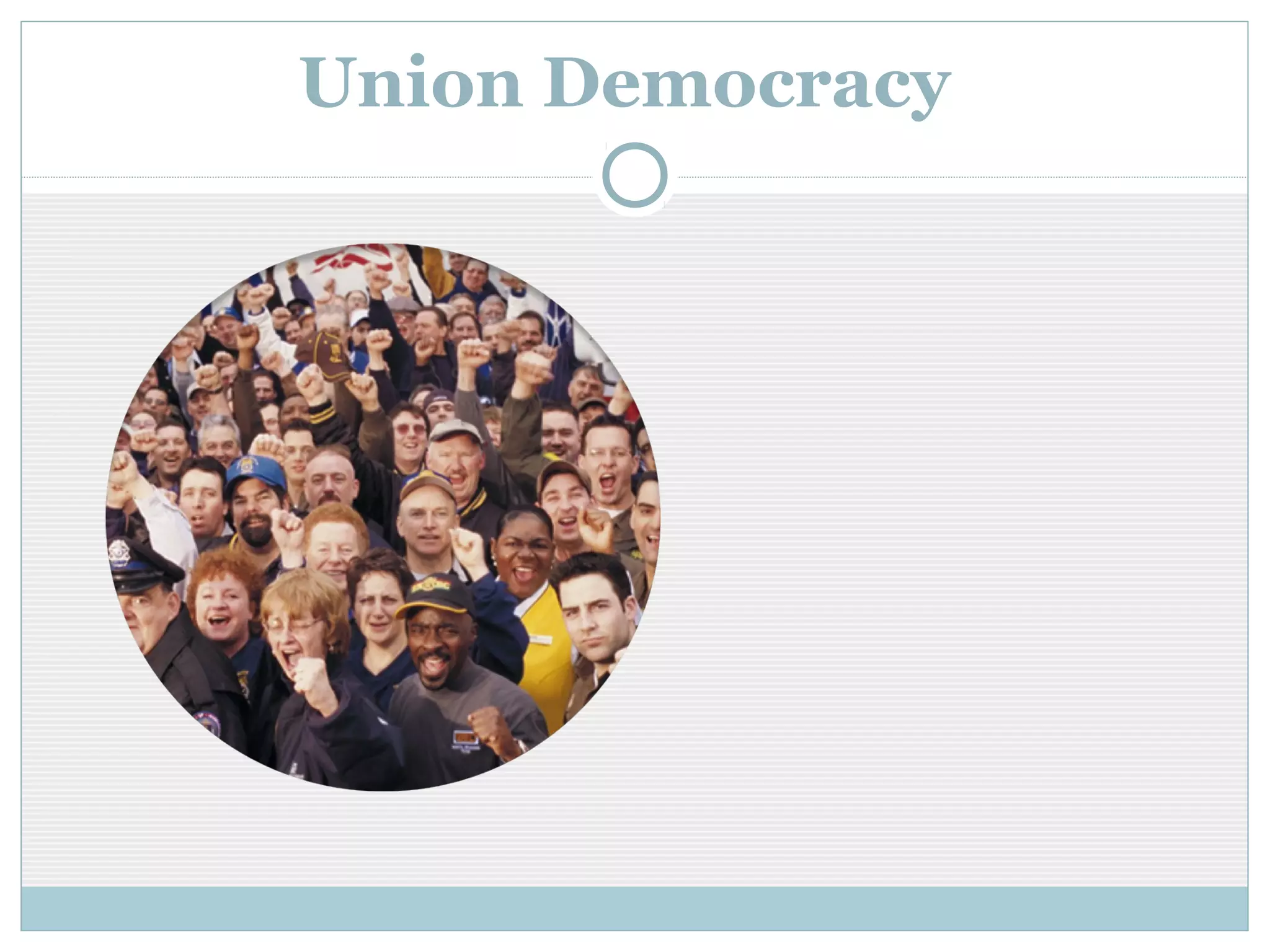
Union Democracy
Essence of Unionism
                          2


Driving Force for establishing common purpose
Builds community of committed members
It is the keystone that protects the foundation of
 the Labor Union
Remove Democracy and it destroys the spirit of
 the membership thus destroying the strength of
 the union
Purpose of Union Democracy


Promote participation in union activities

Promote fair elections

Promote communication-free speech

Promote transparency
Union Democracy
                          4


Process that keeps union leaders responsive to the
 majority of members

Protects the rights of the minority

Recognizes the importance of the individual

Governance my persuasion – not by command
LMRDA
                         5


Labor-Management Reporting and Disclosure Act
 (1959)
 Protects the democratic rights of union members.
Includes “Bill of Rights”
Creates democratic rights and practices
Bill of Rights


Equal rights and privileges
Freedom of speech and assembly
Right to secret ballot vote
Right to sue the union
Protection from improper discipline
Right to receive copy of the contract
Equal Rights and Privileges


Nominate candidates
Vote in elections or referendums
Attend union meetings
Participate in union meetings
Vote on union business at meetings
Subject to reason rules in union
 constitution/bylaws
Freedom of Speech


Right to criticize union officials
Right to express viewpoint at union meeting
Right to distribute literature outside the union
 meeting
Right to hold separate meetings without
 interference
Right to Secret Ballot


Right to vote on dues


Right to vote on initiation fees


Right to vote on assessments
Union Discipline Protection


The right to specific, written charges
The right to confront and cross-examine accusers
Requires adequate time to prepare defense
Right to a fair and full hearing
Decision is based only on evidence
Examples of Discipline Causes


Participating in wildcat strikes
Advocating decertification
Non-payment of dues
Crossing a picket line
Interfere with union’s legal/contractual obligations
Union Officer Responsibilities


Manage funds, and property, solely for benefit of
 union and its members
Officers that embezzle or steal union assets commit a
 Federal crime
Must be bondable if assets exceed $5000
File Forms (LM 2/3/4) annually
File reports concerning loans and benefits
LMRDA - Reporting
                            13


File with Department of Labor
Constitution and bylaws
Financial Reports on (LM forms)
Report includes assets, liabilities, receipts,
Also includes officer and staff salaries, loans
LM reports available to the public
Officer Election


Hold elections at least every 3 years
Elections conducted per constitution/bylaws
Preserve records minimum 1 year
Mail election notice – 15 days in advance
Prohibited from using union funds to campaign
Permit observers and inspection of vote list
Restrictions


Crime conviction - prohibited holding office 13
 years

Outstanding loan may not exceed $2000

Union may not pay fines for LMRDA violations
Conclusion

Union democracyls12 l3_s13

  • 1.
  • 2.
    Essence of Unionism 2 Driving Force for establishing common purpose Builds community of committed members It is the keystone that protects the foundation of the Labor Union Remove Democracy and it destroys the spirit of the membership thus destroying the strength of the union
  • 3.
    Purpose of UnionDemocracy Promote participation in union activities Promote fair elections Promote communication-free speech Promote transparency
  • 4.
    Union Democracy 4 Process that keeps union leaders responsive to the majority of members Protects the rights of the minority Recognizes the importance of the individual Governance my persuasion – not by command
  • 5.
    LMRDA 5 Labor-Management Reporting and Disclosure Act (1959)  Protects the democratic rights of union members. Includes “Bill of Rights” Creates democratic rights and practices
  • 6.
    Bill of Rights Equalrights and privileges Freedom of speech and assembly Right to secret ballot vote Right to sue the union Protection from improper discipline Right to receive copy of the contract
  • 7.
    Equal Rights andPrivileges Nominate candidates Vote in elections or referendums Attend union meetings Participate in union meetings Vote on union business at meetings Subject to reason rules in union constitution/bylaws
  • 8.
    Freedom of Speech Rightto criticize union officials Right to express viewpoint at union meeting Right to distribute literature outside the union meeting Right to hold separate meetings without interference
  • 9.
    Right to SecretBallot Right to vote on dues Right to vote on initiation fees Right to vote on assessments
  • 10.
    Union Discipline Protection Theright to specific, written charges The right to confront and cross-examine accusers Requires adequate time to prepare defense Right to a fair and full hearing Decision is based only on evidence
  • 11.
    Examples of DisciplineCauses Participating in wildcat strikes Advocating decertification Non-payment of dues Crossing a picket line Interfere with union’s legal/contractual obligations
  • 12.
    Union Officer Responsibilities Managefunds, and property, solely for benefit of union and its members Officers that embezzle or steal union assets commit a Federal crime Must be bondable if assets exceed $5000 File Forms (LM 2/3/4) annually File reports concerning loans and benefits
  • 13.
    LMRDA - Reporting 13 File with Department of Labor Constitution and bylaws Financial Reports on (LM forms) Report includes assets, liabilities, receipts, Also includes officer and staff salaries, loans LM reports available to the public
  • 14.
    Officer Election Hold electionsat least every 3 years Elections conducted per constitution/bylaws Preserve records minimum 1 year Mail election notice – 15 days in advance Prohibited from using union funds to campaign Permit observers and inspection of vote list
  • 15.
    Restrictions Crime conviction -prohibited holding office 13 years Outstanding loan may not exceed $2000 Union may not pay fines for LMRDA violations
  • 16.

Editor's Notes

  • #2 This topic, "Union Democracy" will review the importance and legal requirements of democracy in a union. This review will include an examination of the Union Member Bill of Rights provided within the Labor-Management Reporting and Disclosure Act (LMRDA). Officer responsibility and union financial reporting and record keeping legal obligations will also be studied. First, their will be a discussion about the importance and benefits of union democracy before we move into the more technical aspects of the LMRDA.
  • #3 Democracy is the essence of unionism, it is the driving force that establishes common purpose. Practiced and effective democracy builds a community of committed members. Union democracy is the keystone that protects the foundation of a labor union. Remove democracy and it destroys the spirit of the membership thus destroying the strength of the union.
  • #4 Union democracy is intended, among other things, to promote participation in union activities, including decision making. It serves to promote fair elections and provides for open communication, or in other words, free speech. An important part of union democracy is its intention to eliminate secretive, corrupt or greedy actions by ensuring transparency of union actions, activities, and financial transactions.
  • #5 Union Democracy keeps union leaders responsive to the majority of members while protecting the rights of the membership minority. It recognizes the importance of the individual. Most importantly, union democracy provides governance by persuasion, not by command.
  • #6 In 1959, Congress passed the Labor-Management Reporting and Disclosure Act. Its intention was to protect the democratic rights of members. Included in this law was a provision known as the “Bill of Rights”, which will be discussed in more detail later in this lecture. This bill of rights creates democratic rights and practices that apply to union members and officials.
  • #7 The LMRDA contains the union member Bill of Rights. These legal rights are essential in ensuring and protecting union democracy. This listing of rights includes having equal rights and privileges. In other words a union members rights and privileges are the same as an officer of the union. Union members enjoy the freedom of speech and assembly. Members have the right to participate in a secret ballot vote, sue the union, be protected from improper discipline and receive a copy of the collective bargaining agreement. These rights are discussed further in the next few slides.
  • #8 Under equal rights and protections a union member may nominate candidates, vote in elections and vote on referendums. A union member may attend union meetings, participate in the union meetings, and vote on union business at the meetings. A union may establish reasonable rules within its constitution and bylaws in order to effectively administrate the application of the bill of rights. Any constitutional or bylaw provision may not abridge these rights.
  • #9 Under the the LMRDA bill of right to freedom of speech includes, the rights to criticize union officers or officials. Union members have the right to express their viewpoint at union meetings. This expression my be subject to reasonable meeting conduct rules of conduct, such as the Robert Rules of Order. However, these rules may not in any way limit free speech. Union members have the right to distribute literature outside the union meeting place. For instance a union member could distribute handbills that discourage members to vote down a contract. Union members also have the right to separate meetings without interference. An example could be a meeting of interested members to discuss support for a candidate running for a union office, or a group of members that meet to form a union democracy reform group.
  • #10 The LMRDA Bill of Rights includes the right to vote on dues, initiation fees and assessment.
  • #11 Discipline by the union requires the union member be provided detailed guarantees in the event discipline is imposed. Discipline could include removal from office or membership or both. Discipline of a union member is a very serious action. If this action is imposed it requires the union to provide specific and written charges. The member is entitled to confront and cross-examine accusers at a hearing. The member is guaranteed adequate time to prepare a defense. For instance it will a violation of the LMRA if the union delivered charges to a member one day and called for a hearing the next day. Any discipline requires the member be provided a fair and full hearing and the decision must be based only on the evidence presented. The union may not discipline a union member for exercising their protected rights.
  • #12 As stated earlier discipline is a serious action. It should never be used because a member exercised their legal rights. There are causes where disciplinary action would be considered legally permissible. Such examples include participating a wildcat strike, advocating for the decertification of the union, non payment of dues, crossing a picket line or interference of the union ’s legal or contractual obligation.
  • #13 The LMRDA requires specific responsibilities of union officers. Financial responsibility includes managing the union ’s funds and its property solely for the benefit of the union and its members. Any officer that embezzles union funds commits a Federal crime for doing so, and is subject to fines and/or imprisonment. Any union that has assets or receipts in excess of $5000 must bonds its officers to provide protection against any losses. Unions are required to required LM-2, LM-3 or LM-4, depending on the income of the union. These reports are filed with the Office of Labor-Management Standards (OLMS), a division of the Department of Labor (DOL). Finally union officers and employees must file reports concerning any loan and benefits received from the union.
  • #14 Provisions of the LMRDA also requires specific documents be filed with the Department of Labor which include the union ’s constitution and by-laws and financial reports. The financial report is filed annually and must include details about the union’s assets, liabilities and receipts. Also, included is the disclosure of officer and staff salaries along any loans made to them. These reports are available to the public and are online. In fact, you will be researching financial information about your union.
  • #15 Elections require detailed governance in order to protect the rights of the candidate and the voting membership. Officer elections must be held at least every 3 years and the election must be conducted in accordance with the constitution and bylaws of the union. Election records must be kept in the possession of the union for a minimum of one year. Election notice must be provided to the membership at least 15 days in advance of the election date. Candidates are prohibited from using union funds in order to campaign for office. Candidates are permitted to have an observer during the conduct of the election and they permitted to inspect the voter list at least 30 days in advance of the election.
  • #16 A union officer or employee is prohibited from holding office or employment for a period of 13 years in the event they are convicted of certain crimes. These crimes, would of course, include theft, embezzlement, or willful lending or borrowing of union funding for personal benefit. The union is also restricted from paying any fines that are imposed as a result of a willful violation of the LMRDA.
  • #17 This concludes this lecture. The next topic will be “Union Effectiveness.”