‘UNION BUDGET – 2013’
effect on Indian automotive sector
Parvez
Onkar
Mithilesh
Chandani
Binod
2
Layout of presentation
Automobile evolution
Current scenario
conclusion
SWOT analysis
Budget impact
Future growth
Key players
3
4
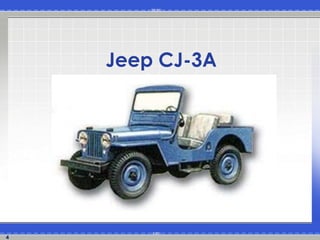
Jeep CJ-3A
5
Indian automobile history
Before independence car
were imported in India
In 1942 Hindustan Motors Ltd
incorporated
In 1944 Premier Automobiles
Ltd incorporated
In 1983 Maruti Udyog ltd was
started in collaboration with
Suzuki
6
Post globalization
In 1991 new industrial
policy was announced
radical changes being
made bearing on
trade, foreign
investment, exchange
rate, industry, fiscal
affairs
death of the License
Raj and the
Automobile Industry
was allowed to
expand
Mass
Emission
standard
National
Highway
policy
7
8
Current market situation
The Indian automotive industry has emerged as a
'sunrise sector' in the Indian economy
India is the second fastest growing automobile
market in the world after China
Car segment is growing @ 19% annually
but is now seeing flat or negative growth rate
Stands 1 in two-wheeler sector
9
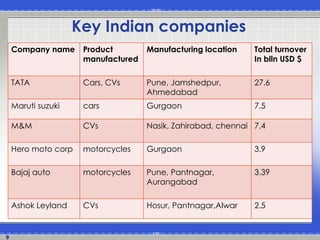
Key Indian companies
Company name Product
manufactured
Manufacturing location Total turnover
In blln USD $
TATA Cars, CVs Pune, Jamshedpur,
Ahmedabad
27.6
Maruti suzuki cars Gurgaon 7.5
M&M CVs Nasik, Zahirabad, chennai 7.4
Hero moto corp motorcycles Gurgaon 3.9
Bajaj auto motorcycles Pune, Pantnagar,
Aurangabad
3.39
Ashok Leyland CVs Hosur, Pantnagar,Alwar 2.5
10
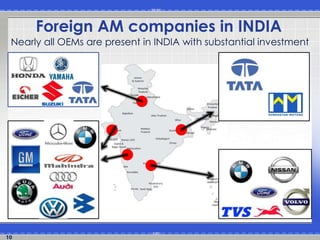
Foreign AM companies in INDIA
Nearly all OEMs are present in INDIA with substantial investment
11
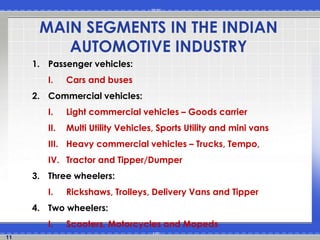
MAIN SEGMENTS IN THE INDIAN
AUTOMOTIVE INDUSTRY
1. Passenger vehicles:
I. Cars and buses
2. Commercial vehicles:
I. Light commercial vehicles – Goods carrier
II. Multi Utility Vehicles, Sports Utility and mini vans
III. Heavy commercial vehicles – Trucks, Tempo,
IV. Tractor and Tipper/Dumper
3. Three wheelers:
I. Rickshaws, Trolleys, Delivery Vans and Tipper
4. Two wheelers:
I. Scooters, Motorcycles and Mopeds
12
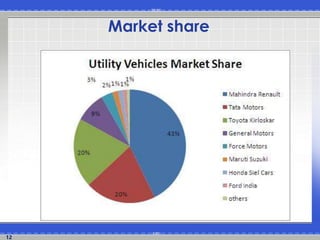
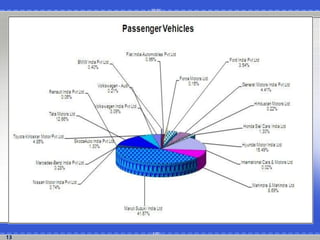
Market share
13
14
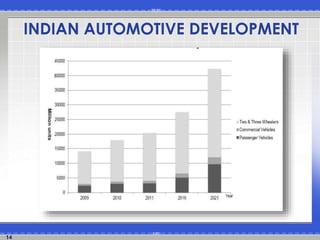
INDIAN AUTOMOTIVE DEVELOPMENT
15
16
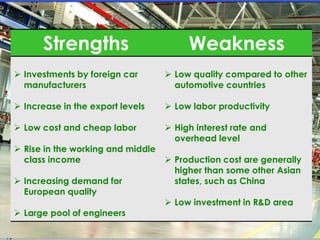
Strengths Weakness
 Investments by foreign car
manufacturers
 Increase in the export levels
 Low cost and cheap labor
 Rise in the working and middle
class income
 Increasing demand for
European quality
 Large pool of engineers
 Low quality compared to other
automotive countries
 Low labor productivity
 High interest rate and
overhead level
 Production cost are generally
higher than some other Asian
states, such as China
 Low investment in R&D area
17
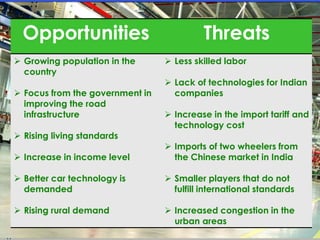
Opportunities Threats
 Growing population in the
country
 Focus from the government in
improving the road
infrastructure
 Rising living standards
 Increase in income level
 Better car technology is
demanded
 Rising rural demand
 Less skilled labor
 Lack of technologies for Indian
companies
 Increase in the import tariff and
technology cost
 Imports of two wheelers from
the Chinese market in India
 Smaller players that do not
fulfill international standards
 Increased congestion in the
urban areas
18
19
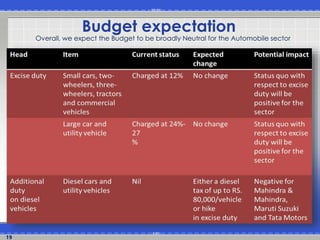
Budget expectation
Overall, we expect the Budget to be broadly Neutral for the Automobile sector
20
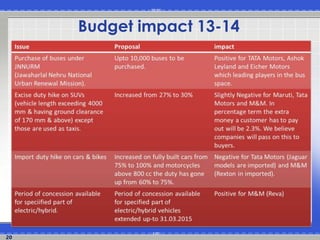
Budget impact 13-14
21
Budget impact - negative
I. Budget 2013‐14 disappointed automobile sector.
II. It was clearly ignored by the policy makers.
III. It was expecting some relief in terms of:-
a) Export soaps.
b) Reduction in excise duty.
c) Higher depreciation allowance.
d) Deduction for R&D expenses.
IV. Automobile sector is a job multiplier sector.
V. Apart from OEMs, auto component industry, motor insurance industry
and other related industries provide millions of job.
VI. Opportunities:-important sector to focus and give incentive in
domestic market
but also to be competitive from export point of view.
22
BUDGET 2012-13 – OVER ALL
POSITIVE FOR GROWTH
No levy of additional specific excise duty on diesel vehicles, contrary to
the expectations.
Basic excise duty hiked from 10% to 12%.
Excise duty on large cars (SUV’s & MUV’S ) increased by 2% to 24%.
Removal of specific duty of Rs.15000, set off with an additional duty of 3%,
taking the total duty for large cars at 27%.
Hike on imported duty from 60% - 75% for assembled SUV’s and MUV
costing more than Rs 20 lakhs.
Increase in custom duty from 10% - 30% on bicycles and from 10% - 20%
on bicycle parts.
23
UNION BUDGET 2012-13: Impact
Analysis
24
25
CONCLUSION:
The industry has recorded phenomenon
growth during the last decade.
Contributing 4.5% to GDP
Third largest exporter of automobile
 resource availability , skilled manpower huge
pool of middle class are major driver’s
Employing more than 10 million people
26
CONCLUSION:
 Challenges
-petrol price hikes
-regulatory policies
-infrastructure
Stands 128 on doing business index
 In 2020 India will produce 40000 vehicle, &
become worlds largest manufacturer
 Renewable resources can be used
27

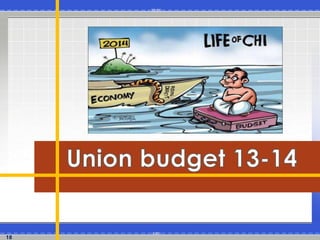
Union budget presentation

  • 1.
    ‘UNION BUDGET –2013’ effect on Indian automotive sector Parvez Onkar Mithilesh Chandani Binod
  • 2.
    2 Layout of presentation Automobileevolution Current scenario conclusion SWOT analysis Budget impact Future growth Key players
  • 3.
  • 4.
  • 5.
    5 Indian automobile history Beforeindependence car were imported in India In 1942 Hindustan Motors Ltd incorporated In 1944 Premier Automobiles Ltd incorporated In 1983 Maruti Udyog ltd was started in collaboration with Suzuki
  • 6.
    6 Post globalization In 1991new industrial policy was announced radical changes being made bearing on trade, foreign investment, exchange rate, industry, fiscal affairs death of the License Raj and the Automobile Industry was allowed to expand Mass Emission standard National Highway policy
  • 7.
  • 8.
    8 Current market situation TheIndian automotive industry has emerged as a 'sunrise sector' in the Indian economy India is the second fastest growing automobile market in the world after China Car segment is growing @ 19% annually but is now seeing flat or negative growth rate Stands 1 in two-wheeler sector
  • 9.
    9 Key Indian companies Companyname Product manufactured Manufacturing location Total turnover In blln USD $ TATA Cars, CVs Pune, Jamshedpur, Ahmedabad 27.6 Maruti suzuki cars Gurgaon 7.5 M&M CVs Nasik, Zahirabad, chennai 7.4 Hero moto corp motorcycles Gurgaon 3.9 Bajaj auto motorcycles Pune, Pantnagar, Aurangabad 3.39 Ashok Leyland CVs Hosur, Pantnagar,Alwar 2.5
  • 10.
    10 Foreign AM companiesin INDIA Nearly all OEMs are present in INDIA with substantial investment
  • 11.
    11 MAIN SEGMENTS INTHE INDIAN AUTOMOTIVE INDUSTRY 1. Passenger vehicles: I. Cars and buses 2. Commercial vehicles: I. Light commercial vehicles – Goods carrier II. Multi Utility Vehicles, Sports Utility and mini vans III. Heavy commercial vehicles – Trucks, Tempo, IV. Tractor and Tipper/Dumper 3. Three wheelers: I. Rickshaws, Trolleys, Delivery Vans and Tipper 4. Two wheelers: I. Scooters, Motorcycles and Mopeds
  • 12.
  • 13.
  • 14.
  • 15.
  • 16.
    16 Strengths Weakness  Investmentsby foreign car manufacturers  Increase in the export levels  Low cost and cheap labor  Rise in the working and middle class income  Increasing demand for European quality  Large pool of engineers  Low quality compared to other automotive countries  Low labor productivity  High interest rate and overhead level  Production cost are generally higher than some other Asian states, such as China  Low investment in R&D area
  • 17.
    17 Opportunities Threats  Growingpopulation in the country  Focus from the government in improving the road infrastructure  Rising living standards  Increase in income level  Better car technology is demanded  Rising rural demand  Less skilled labor  Lack of technologies for Indian companies  Increase in the import tariff and technology cost  Imports of two wheelers from the Chinese market in India  Smaller players that do not fulfill international standards  Increased congestion in the urban areas
  • 18.
  • 19.
    19 Budget expectation Overall, weexpect the Budget to be broadly Neutral for the Automobile sector
  • 20.
  • 21.
    21 Budget impact -negative I. Budget 2013‐14 disappointed automobile sector. II. It was clearly ignored by the policy makers. III. It was expecting some relief in terms of:- a) Export soaps. b) Reduction in excise duty. c) Higher depreciation allowance. d) Deduction for R&D expenses. IV. Automobile sector is a job multiplier sector. V. Apart from OEMs, auto component industry, motor insurance industry and other related industries provide millions of job. VI. Opportunities:-important sector to focus and give incentive in domestic market but also to be competitive from export point of view.
  • 22.
    22 BUDGET 2012-13 –OVER ALL POSITIVE FOR GROWTH No levy of additional specific excise duty on diesel vehicles, contrary to the expectations. Basic excise duty hiked from 10% to 12%. Excise duty on large cars (SUV’s & MUV’S ) increased by 2% to 24%. Removal of specific duty of Rs.15000, set off with an additional duty of 3%, taking the total duty for large cars at 27%. Hike on imported duty from 60% - 75% for assembled SUV’s and MUV costing more than Rs 20 lakhs. Increase in custom duty from 10% - 30% on bicycles and from 10% - 20% on bicycle parts.
  • 23.
    23 UNION BUDGET 2012-13:Impact Analysis
  • 24.
  • 25.
    25 CONCLUSION: The industry hasrecorded phenomenon growth during the last decade. Contributing 4.5% to GDP Third largest exporter of automobile  resource availability , skilled manpower huge pool of middle class are major driver’s Employing more than 10 million people
  • 26.
    26 CONCLUSION:  Challenges -petrol pricehikes -regulatory policies -infrastructure Stands 128 on doing business index  In 2020 India will produce 40000 vehicle, & become worlds largest manufacturer  Renewable resources can be used
  • 27.