UNDERSTANDING TRAUMA AND
ITS IMPACT
E-RESOURCE COMPANION TRAINING
DISCLAIMER
This training package was designed and written under the U.S. Department of Education
(Department) Contract Numbers ED-ESE-12-O-0035 and ED-ESE-16-A-0002 by the National
Center on Safe and Supportive Learning Environments (NCSSLE) operated by American
Institutes for Research®. Rita Foy Moss served as the contracting officer’s representative (COR)
for the NCSSLE technical assistance center. The content and views expressed herein do not
necessarily represent the policies of the Department and should not assume endorsement by the
Federal government. No official endorsement by the Department of any product, commodity,
service, or enterprise mentioned in this publication is intended or should be inferred. For the
reader’s convenience, this publication contains information about and from outside organizations,
including material obtained by way of hyperlinks and URLs. Inclusion of such information does not
constitute the Department’s endorsement.
May 2018
This training package is in the public domain. Authorization to reproduce it in whole or in part is
granted. While permission to reprint this product is not necessary, the following is the preferred
citation:
Guarino, K. & Chagnon, E. (2018). Trauma-sensitive schools training package. Washington, DC:
National Center on Safe Supportive Learning Environments.
TRAUMA-SENSITIVE SCHOOLS TRAINING PACKAGE
• Implementation Guide
Provides overview of the purpose and components of the training package.
• Understanding Trauma and Its Impact
An interactive e-resource to provide all staff with general information about trauma
and companion slide presentation and activity packet for in-person training.
• Building Trauma-Sensitive Schools
An online module to help all staff learn how they can build a trauma-sensitive school
in their role. Includes a series of handouts to help reinforce concepts.
• Leading Trauma-Sensitive Schools
An online module to provide school leaders with a vision and strategies for adopting a
whole-school approach to trauma.
• Action Guide
A tool for helping school leaders and work groups create a custom roadmap for
adopting a trauma-sensitive approach school-wide.
UNDERSTANDING TRAUMA AND
ITS IMPACT
E-RESOURCE COMPANION TRAINING
UNDERSTANDING TRAUMA AND ITS IMPACT
• Part 1: What is Trauma and Who is Affected?
• Part 2: How Does the Stress Response
System Work?
• Part 3: What is the Impact of Exposure
to Trauma?
• Part 4: What Does This Mean for Schools?
LEARNING OBJECTIVES
• Understand trauma in a broad and
inclusive way.
• Learn how the brain and body respond to
stress and trauma.
• Recognize the effects of trauma on
students, staff, and schools.
• Apply trauma knowledge to your daily work.
PART 1
What is Trauma and Who is Affected?
Definition of trauma | Types of trauma | Prevalence of childhood trauma
DEFINITION OF TRAUMA
The three “E’s” of trauma:
An event, series of events, or set of
circumstances that is experienced by an
individual as physically or emotionally
harmful or life threatening and that has
lasting adverse effects.
TYPES OF TRAUMA
• Natural disasters: hurricanes, fires, floods
• Human-caused disasters: accidents, wars,
environmental disasters, acts of terrorism
• Community violence: robberies, shootings, assault,
gang-related violence, hate crimes, group trauma
affecting a particular community
• School violence: threats, fights, school shootings,
bullying, loss of a student or staff member
• Family trauma: abuse, neglect, experiencing or
witnessing domestic violence, incarceration of family
members, family substance abuse, sudden or expected
loss of a loved one
• Refugee and Immigrant trauma: exposure to war,
political violence, torture, forced displacement, migration
and acculturation stressors, fears of deportation
• Medical trauma: pain, injury and serious illness;
invasive medical procedures or treatments
• Poverty: lack of resources, support networks, or
mobility; financial stressors; homelessness
TYPES OF TRAUMA
Complex trauma:
1) Exposure to multiple traumatic events from
an early age; and
2) The immediate and long-term effects of these
experiences over development.
TYPES OF TRAUMA
TYPES OF TRAUMA
Historical Trauma: “The cumulative emotional and
psychological wounding across generations, including
the lifespan, which emanates from massive group
trauma.” – Maria Yellow Horse Brave Heart
Examples:
• American Indian and Alaska Native communities
• Communities of color
• Holocaust survivors
• Japanese-American survivors of internment camps
• LGBTQ communities
Racial trauma: Potentially traumatic
experiences resulting from
• Direct experiences of racial harassment;
• Witnessing racial violence toward others; and
• Experiencing discrimination and
institutional racism.
TYPES OF TRAUMA
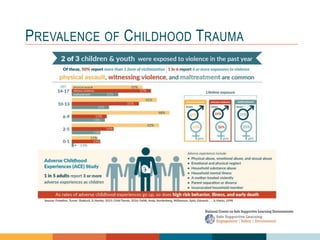
PREVALENCE OF CHILDHOOD TRAUMA
• Groups at increased risk of exposure to trauma include:
• Youth of color ages 12 to 19;
• African American youth living in urban, low-income
communities;
• American Indian/Alaska Native (AI/AN) children and youth;
• Children and youth who have disabilities;
• Refugees;
• Children and youth who are homeless and living in poverty; and
• LGBTQ children and youth.
SUMMARY: PART 1
• Experiences become traumatic when they
overwhelm our ability to cope.
• Traumatic experiences come in many forms,
ranging from one-time events to experiences that
are chronic or even generational.
• Exposure to trauma in childhood is common.
• Risk for exposure to more than one type is high.
• Contextual factors increase risk for trauma.
PART 1: ACTIVITY/DISCUSSION
PART 2
How Do We Respond to Stress?
The Stress Response System | The Stress Response and Trauma |
Common Responses to Trauma for Youth | Triggers
1
3
2
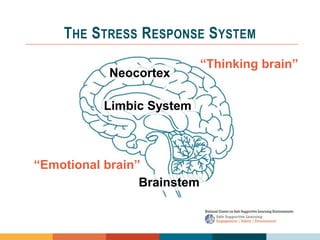
THE STRESS RESPONSE SYSTEM
Limbic System
Neocortex
Brainstem
“Thinking brain”
“Emotional brain”
1 4
3
2
THE STRESS RESPONSE SYSTEM
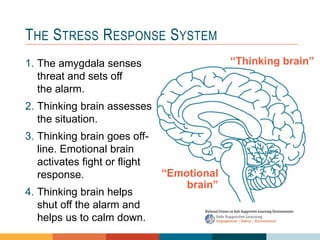
1. The amygdala senses
threat and sets off
the alarm.
2. Thinking brain assesses
the situation.
3. Thinking brain goes off-
line. Emotional brain
activates fight or flight
response.
4. Thinking brain helps
shut off the alarm and
helps us to calm down.
“Thinking brain”
“Emotional
brain”
1 4
3
2
THE STRESS RESPONSE AND TRAUMA
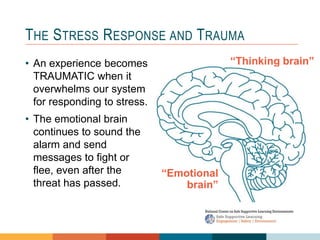
• An experience becomes
TRAUMATIC when it
overwhelms our system
for responding to stress.
• The emotional brain
continues to sound the
alarm and send
messages to fight or
flee, even after the
threat has passed.
“Thinking brain”
“Emotional
brain”
1 4
3
2
COMMON RESPONSES TO TRAUMA
Young Children
• Fear, anxiety, worry
• Changes in sleeping and eating
• Difficulty separating from caregivers
• Regressed behaviors (losing speech, wetting the bed)
• Reenacting aspects of the traumatic event in play
1 4
3
2
COMMON RESPONSES TO TRAUMA
School-age Children
• Fear, anxiety, worry
• Feelings of guilt, shame, and self-blame
• Headaches, stomachaches
• Nightmares, disrupted sleep
• Difficulty concentrating
• Angry outbursts, aggression, and withdrawal
• Over- or under-reactions to situations in the environment
(e.g., sudden movements, loud noises, physical contact)
1 4
3
2
COMMON RESPONSES TO TRAUMA
Adolescents
• Fear, anxiety, worry
• Concerns about how others will view them after the event
• Shame, guilt, responsibility, embarrassment
• Withdrawal from family, peers, activities
• Avoid reminders of the event
• More intense mood swings
• Decline in school performance
• Increase in risk-taking behaviors (e.g., alcohol/drug use,
sexual behaviors, fights, self-harm)
1 4
3
2
CULTURE AND TRAUMA
Cultural factors influence:
• Risk and type of trauma exposure
• How a person describes their experience
• How distress is expressed
• Which topics are acceptable to discuss
• How a person makes meaning of experiences and
heals from trauma
1 4
3
2
TRIGGERS
• Reminders of past traumatic experiences
that automatically cause the body to react as
if the traumatic event is happening again in
that moment.
• Responses can appear confusing and out of
place and be misunderstood by others.
1 4
3
2
TRIGGERS
Youth
• Loud noises
• Physical touch
• Threatening gestures
• Authority figures and limit-setting
• Chaos or uncertainty
• Particular spaces (e.g., bathrooms or areas that are less monitored)
• Changes in routine
• Witnessing violence between others, such as peers fighting
• Emergency vehicles and police or fire personnel
• Certain smells
• Particular times of year
1 4
3
2
TRIGGERS
Common responses to trauma triggers include:
• Fight responses: yelling, swearing, posturing,
aggressive behavior;
• Flight responses: running away, refusing to talk,
avoidance, substance use; and
• Freeze responses: spacing out; appearing numb,
disconnected, confused, or unresponsive.
1 4
3
2
TRIGGERS
Parents
• The school environment
• Shame and embarrassment
• Confusion in meetings
• Fear of other system involvement
• Situations that trigger feelings of helplessness and loss
of control
• The brain has a built-in alarm system designed to
detect threats and keep us safe.
• When faced with a threat, the emotional brain
takes over.
• A stress becomes traumatic when it overwhelms our
stress response system.
• A range of acute post-trauma responses are common.
• Triggers are trauma reminders that set off the alarm.
• Responses to triggers may seem out of place and can
be misunderstood by others.
SUMMARY: PART 2
PART 2: ACTIVITY/DISCUSSION
PART 3
What is the Impact of Exposure to Trauma?
Risk and Protective Factors | Post-Trauma Pathways | Effects of Complex
Trauma
RISK AND PROTECTIVE FACTORS
• Individual Factors
• Environmental Factors
1 4
3
2
RISK AND PROTECTIVE FACTORS
Individual Factors
• History of previous exposure to trauma
• Age of exposure
• Gender
• Cognitive ability
• Self-efficacy
• Biological factors (e.g., flexibility in thinking,
emotional regulation)
1 4
3
2
RISK AND PROTECTIVE FACTORS
Environmental Factors
• Nature of the traumatic event
• Proximity to the traumatic event
• Culture and ethnicity
• Level of social support
• Quality of parent-child relationships, parent mental
health, and parental history of trauma
• Health of the broader community
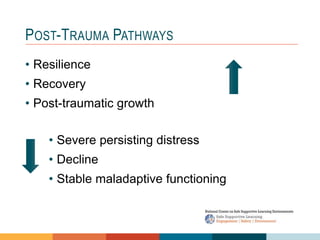
POST-TRAUMA PATHWAYS
• Resilience
• Recovery
• Post-traumatic growth
• Severe persisting distress
• Decline
• Stable maladaptive functioning
1 4
3
2
POST-TRAUMA PATHWAYS
Resilience, Recovery, Growth
Resilience: A positive, adaptive response to
significant adversity.
• Adaptable, caring, and supportive relationship with
an adult
• A sense of mastery over life circumstances
• Strong executive function and self-regulation skills
• Safe and supportive environments (schools and
communities)
• Affirming faith or cultural traditions
1 4
3
2
POST-TRAUMA PATHWAYS
Resilience, Recovery, Growth
Resilience
• Children may demonstrate resilience in one type of situation
but not another.
• Coping skills that support resilience can be developed at
any age.
• Children do not develop the capacity to positively adapt to
adversity in isolation.
• Regardless of resources, children who face extreme
adversity are likely to be significantly impacted.
• Schools play an important role in fostering student
resilience.
1 4
3
2
POST-TRAUMA PATHWAYS
Resilience, Recovery, Growth
Recovery
• Longer period of disruption
• Return to earlier level of functioning
1 4
3
2
POST-TRAUMA PATHWAYS
Resilience, Recovery, Growth
Post-traumatic growth: Positive change or transformation
as a result of a traumatic experience
1 4
3
2
POST-TRAUMA PATHWAYS
Distress, Decline, Stable Maladaptive
Functioning
Severe Distress
• Severe, persisting distress after a traumatic event.
• Body’s attempts to adjust are not effective.
• Requires more intensive, individualized supports.
1 4
3
2
POST-TRAUMA PATHWAYS
Distress, Decline, Stable Maladaptive
Functioning
Decline
• Child may initially appear to be managing the strain of a
traumatic experience.
• Over time they are unable to maintain a healthy level of
functioning.
• Difficulties can begin months or years after the event.
1 4
3
2
POST-TRAUMA PATHWAYS
Distress, Decline, Stable Maladaptive
Functioning
Stable Maladaptive Functioning
• Poor functioning before and after a traumatic event
• History of exposure to adversity
• Vulnerable to continued negative effects
POST-TRAUMA PATHWAYS
Post-Traumatic Stress Disorder
Symptoms include:
• Re-experiencing (nightmares, flashbacks, reactions to
trauma reminders)
• Avoidance of trauma reminders
• Changes to the stress response system (on alert danger,
reactive)
• Negative changes in beliefs about self and others and mood
Consider cultural factors related to PTSD symptoms.
1 4
3
2
EFFECTS OF COMPLEX TRAUMA
• Exposure to trauma that starts early in life can alter
how the brain develops.
• Need to review key concepts related to brain
development.
1
3
2
EFFECTS OF COMPLEX TRAUMA
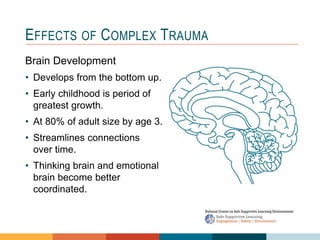
Brain Development
• Develops from the bottom up.
• Early childhood is period of
greatest growth.
• At 80% of adult size by age 3.
• Streamlines connections
over time.
• Thinking brain and emotional
brain become better
coordinated.
1
3
2
EFFECTS OF COMPLEX TRAUMA
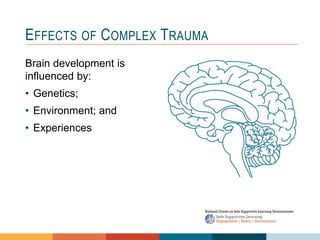
Brain development is
influenced by:
• Genetics;
• Environment; and
• Experiences
1
3
2
EFFECTS OF COMPLEX TRAUMA
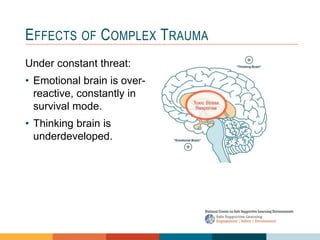
Under constant threat:
• Emotional brain is over-
reactive, constantly in
survival mode.
• Thinking brain is
underdeveloped.
EFFECTS OF COMPLEX TRAUMA
• Relationships
• Emotional regulation
• Behavior
• Cognition
• Dissociation
• Self-concept and future orientation
SUMMARY: PART 3
• Key environmental and individual factors impact a child’s
response to trauma and risk for negative effects.
• There are a number of possible trajectories for youth
following a traumatic event.
• Most youth who experience a traumatic event do not
develop significant mental health issues; however, some
continue to struggle.
• Chronic interpersonal trauma that begins early changes the
way the brain develops and can impact all areas of
functioning into adulthood.
• Adults play a critical role in preventing and reducing the
negative effects of stress on children.
PART 3: ACTIVITY/DISCUSSION
PART 4
What Does This Mean for Schools?
Impact of Trauma on Students, Parents, Staff and Schools |
Trauma-Sensitive Schools: A Universal Response
1 4
3
2
IMPACT OF TRAUMA ON STUDENTS
• Physical symptoms such as headaches, stomachaches,
poor appetite, and decline in self-care
• Intense feelings of fear, anxiety, and concern for their safety
• Difficulty identifying how they are feeling and controlling
their emotional reactions
• Angry or aggressive outbursts
• A desire to withdraw from peers and adults
• A tendency to engage in risk-taking behaviors
• Trouble trusting adults and peers, reading social cues, and
building relationships
1 4
3
2
IMPACT OF TRAUMA ON STUDENTS
• Difficulty paying attention and learning
• More time out of the classroom
• Increased isolation
• School absences
• More suspensions or expulsions
• Higher referral rates to special education
• Poor test scores and an increased risk of failing grades
1 4
3
2
IMPACT OF TRAUMA ON PARENTS
• Difficulty managing emotions and controlling behaviors
when interacting with school staff
• Difficulty forming relationships
• Increased risk for substance abuse, depression, and
PTSD that negatively impact parenting
• Trouble managing stress related to their child’s difficult
behaviors
• Feelings of embarrassment, shame, fear, or guilt about
their child’s behaviors or needs
• Difficulty helping their children cope
1 4
3
2
IMPACT OF TRAUMA ON STAFF
• Increased anxiety
• Reduced energy and focus
• Trouble regulating emotions
• Difficulty managing responses to students and parents
• Diminished capacity to maintain positive teacher-
student and teacher-parent relationships
• Poor attendance or work performance
1 4
3
2
IMPACT OF TRAUMA ON STAFF
Secondary traumatic stress: The presence of PTSD
symptoms caused by indirect exposure to other people’s
traumatic experiences.
Vicarious trauma: The cumulative effect of working with
traumatized students and their families that leads to
negative changes in how staff view themselves, others,
and the world.
1 4
3
2
IMPACT OF TRAUMA ON SCHOOLS
• Students more likely to escalate
• Adults more reactive, controlling, and punitive
• Negative impact on school safety and culture
• Increased risk for harm
• Decrease in academic achievement
1 4
3
2
TRAUMA-SENSITIVE SCHOOLS:
A UNIVERSAL RESPONSE
• In a trauma-sensitive school, all school staff recognize
and understand student responses to trauma, and
practices that support healing and resilience are
embedded schoolwide.
• May require changes to mission, vision, practices,
policies, and culture.
• Ensures support for all students and enhances
identification of students with more intensive needs.
• Encourages partnerships with community
organizations to ensure needed resources.
PART 4: ACTIVITY/DISCUSSION
TRAUMA-SENSITIVE SCHOOLS TRAINING PACKAGE
• Implementation Guide
Provides overview of the purpose and components of the training package.
• Understanding Trauma and Its Impact
An interactive e-resource to provide all staff with general information about trauma
and companion slide presentation and activity packet for in-person training.
• Building Trauma-Sensitive Schools
An online module to help all staff learn how they can build a trauma-sensitive school
in their role. Includes a series of handouts to help reinforce concepts.
• Leading Trauma-Sensitive Schools
An online module to provide school leaders with a vision and strategies for adopting a
whole-school approach to trauma.
• Action Guide
A tool for helping school leaders and work groups create a custom roadmap for
adopting a trauma-sensitive approach schoolwide.
THANK YOU

Understanding_Trauma_and_Its_Impact_Slide_Presentation.pptx

  • 1.
    UNDERSTANDING TRAUMA AND ITSIMPACT E-RESOURCE COMPANION TRAINING
  • 2.
    DISCLAIMER This training packagewas designed and written under the U.S. Department of Education (Department) Contract Numbers ED-ESE-12-O-0035 and ED-ESE-16-A-0002 by the National Center on Safe and Supportive Learning Environments (NCSSLE) operated by American Institutes for Research®. Rita Foy Moss served as the contracting officer’s representative (COR) for the NCSSLE technical assistance center. The content and views expressed herein do not necessarily represent the policies of the Department and should not assume endorsement by the Federal government. No official endorsement by the Department of any product, commodity, service, or enterprise mentioned in this publication is intended or should be inferred. For the reader’s convenience, this publication contains information about and from outside organizations, including material obtained by way of hyperlinks and URLs. Inclusion of such information does not constitute the Department’s endorsement. May 2018 This training package is in the public domain. Authorization to reproduce it in whole or in part is granted. While permission to reprint this product is not necessary, the following is the preferred citation: Guarino, K. & Chagnon, E. (2018). Trauma-sensitive schools training package. Washington, DC: National Center on Safe Supportive Learning Environments.
  • 3.
    TRAUMA-SENSITIVE SCHOOLS TRAININGPACKAGE • Implementation Guide Provides overview of the purpose and components of the training package. • Understanding Trauma and Its Impact An interactive e-resource to provide all staff with general information about trauma and companion slide presentation and activity packet for in-person training. • Building Trauma-Sensitive Schools An online module to help all staff learn how they can build a trauma-sensitive school in their role. Includes a series of handouts to help reinforce concepts. • Leading Trauma-Sensitive Schools An online module to provide school leaders with a vision and strategies for adopting a whole-school approach to trauma. • Action Guide A tool for helping school leaders and work groups create a custom roadmap for adopting a trauma-sensitive approach school-wide.
  • 4.
    UNDERSTANDING TRAUMA AND ITSIMPACT E-RESOURCE COMPANION TRAINING
  • 5.
    UNDERSTANDING TRAUMA ANDITS IMPACT • Part 1: What is Trauma and Who is Affected? • Part 2: How Does the Stress Response System Work? • Part 3: What is the Impact of Exposure to Trauma? • Part 4: What Does This Mean for Schools?
  • 6.
    LEARNING OBJECTIVES • Understandtrauma in a broad and inclusive way. • Learn how the brain and body respond to stress and trauma. • Recognize the effects of trauma on students, staff, and schools. • Apply trauma knowledge to your daily work.
  • 7.
    PART 1 What isTrauma and Who is Affected? Definition of trauma | Types of trauma | Prevalence of childhood trauma
  • 8.
    DEFINITION OF TRAUMA Thethree “E’s” of trauma: An event, series of events, or set of circumstances that is experienced by an individual as physically or emotionally harmful or life threatening and that has lasting adverse effects.
  • 9.
    TYPES OF TRAUMA •Natural disasters: hurricanes, fires, floods • Human-caused disasters: accidents, wars, environmental disasters, acts of terrorism • Community violence: robberies, shootings, assault, gang-related violence, hate crimes, group trauma affecting a particular community • School violence: threats, fights, school shootings, bullying, loss of a student or staff member
  • 10.
    • Family trauma:abuse, neglect, experiencing or witnessing domestic violence, incarceration of family members, family substance abuse, sudden or expected loss of a loved one • Refugee and Immigrant trauma: exposure to war, political violence, torture, forced displacement, migration and acculturation stressors, fears of deportation • Medical trauma: pain, injury and serious illness; invasive medical procedures or treatments • Poverty: lack of resources, support networks, or mobility; financial stressors; homelessness TYPES OF TRAUMA
  • 11.
    Complex trauma: 1) Exposureto multiple traumatic events from an early age; and 2) The immediate and long-term effects of these experiences over development. TYPES OF TRAUMA
  • 12.
    TYPES OF TRAUMA HistoricalTrauma: “The cumulative emotional and psychological wounding across generations, including the lifespan, which emanates from massive group trauma.” – Maria Yellow Horse Brave Heart Examples: • American Indian and Alaska Native communities • Communities of color • Holocaust survivors • Japanese-American survivors of internment camps • LGBTQ communities
  • 13.
    Racial trauma: Potentiallytraumatic experiences resulting from • Direct experiences of racial harassment; • Witnessing racial violence toward others; and • Experiencing discrimination and institutional racism. TYPES OF TRAUMA
  • 14.
  • 15.
    PREVALENCE OF CHILDHOODTRAUMA • Groups at increased risk of exposure to trauma include: • Youth of color ages 12 to 19; • African American youth living in urban, low-income communities; • American Indian/Alaska Native (AI/AN) children and youth; • Children and youth who have disabilities; • Refugees; • Children and youth who are homeless and living in poverty; and • LGBTQ children and youth.
  • 16.
    SUMMARY: PART 1 •Experiences become traumatic when they overwhelm our ability to cope. • Traumatic experiences come in many forms, ranging from one-time events to experiences that are chronic or even generational. • Exposure to trauma in childhood is common. • Risk for exposure to more than one type is high. • Contextual factors increase risk for trauma.
  • 17.
  • 18.
    PART 2 How DoWe Respond to Stress? The Stress Response System | The Stress Response and Trauma | Common Responses to Trauma for Youth | Triggers
  • 19.
    1 3 2 THE STRESS RESPONSESYSTEM Limbic System Neocortex Brainstem “Thinking brain” “Emotional brain”
  • 20.
    1 4 3 2 THE STRESSRESPONSE SYSTEM 1. The amygdala senses threat and sets off the alarm. 2. Thinking brain assesses the situation. 3. Thinking brain goes off- line. Emotional brain activates fight or flight response. 4. Thinking brain helps shut off the alarm and helps us to calm down. “Thinking brain” “Emotional brain”
  • 21.
    1 4 3 2 THE STRESSRESPONSE AND TRAUMA • An experience becomes TRAUMATIC when it overwhelms our system for responding to stress. • The emotional brain continues to sound the alarm and send messages to fight or flee, even after the threat has passed. “Thinking brain” “Emotional brain”
  • 22.
    1 4 3 2 COMMON RESPONSESTO TRAUMA Young Children • Fear, anxiety, worry • Changes in sleeping and eating • Difficulty separating from caregivers • Regressed behaviors (losing speech, wetting the bed) • Reenacting aspects of the traumatic event in play
  • 23.
    1 4 3 2 COMMON RESPONSESTO TRAUMA School-age Children • Fear, anxiety, worry • Feelings of guilt, shame, and self-blame • Headaches, stomachaches • Nightmares, disrupted sleep • Difficulty concentrating • Angry outbursts, aggression, and withdrawal • Over- or under-reactions to situations in the environment (e.g., sudden movements, loud noises, physical contact)
  • 24.
    1 4 3 2 COMMON RESPONSESTO TRAUMA Adolescents • Fear, anxiety, worry • Concerns about how others will view them after the event • Shame, guilt, responsibility, embarrassment • Withdrawal from family, peers, activities • Avoid reminders of the event • More intense mood swings • Decline in school performance • Increase in risk-taking behaviors (e.g., alcohol/drug use, sexual behaviors, fights, self-harm)
  • 25.
    1 4 3 2 CULTURE ANDTRAUMA Cultural factors influence: • Risk and type of trauma exposure • How a person describes their experience • How distress is expressed • Which topics are acceptable to discuss • How a person makes meaning of experiences and heals from trauma
  • 26.
    1 4 3 2 TRIGGERS • Remindersof past traumatic experiences that automatically cause the body to react as if the traumatic event is happening again in that moment. • Responses can appear confusing and out of place and be misunderstood by others.
  • 27.
    1 4 3 2 TRIGGERS Youth • Loudnoises • Physical touch • Threatening gestures • Authority figures and limit-setting • Chaos or uncertainty • Particular spaces (e.g., bathrooms or areas that are less monitored) • Changes in routine • Witnessing violence between others, such as peers fighting • Emergency vehicles and police or fire personnel • Certain smells • Particular times of year
  • 28.
    1 4 3 2 TRIGGERS Common responsesto trauma triggers include: • Fight responses: yelling, swearing, posturing, aggressive behavior; • Flight responses: running away, refusing to talk, avoidance, substance use; and • Freeze responses: spacing out; appearing numb, disconnected, confused, or unresponsive.
  • 29.
    1 4 3 2 TRIGGERS Parents • Theschool environment • Shame and embarrassment • Confusion in meetings • Fear of other system involvement • Situations that trigger feelings of helplessness and loss of control
  • 30.
    • The brainhas a built-in alarm system designed to detect threats and keep us safe. • When faced with a threat, the emotional brain takes over. • A stress becomes traumatic when it overwhelms our stress response system. • A range of acute post-trauma responses are common. • Triggers are trauma reminders that set off the alarm. • Responses to triggers may seem out of place and can be misunderstood by others. SUMMARY: PART 2
  • 31.
  • 32.
    PART 3 What isthe Impact of Exposure to Trauma? Risk and Protective Factors | Post-Trauma Pathways | Effects of Complex Trauma
  • 33.
    RISK AND PROTECTIVEFACTORS • Individual Factors • Environmental Factors
  • 34.
    1 4 3 2 RISK ANDPROTECTIVE FACTORS Individual Factors • History of previous exposure to trauma • Age of exposure • Gender • Cognitive ability • Self-efficacy • Biological factors (e.g., flexibility in thinking, emotional regulation)
  • 35.
    1 4 3 2 RISK ANDPROTECTIVE FACTORS Environmental Factors • Nature of the traumatic event • Proximity to the traumatic event • Culture and ethnicity • Level of social support • Quality of parent-child relationships, parent mental health, and parental history of trauma • Health of the broader community
  • 36.
    POST-TRAUMA PATHWAYS • Resilience •Recovery • Post-traumatic growth • Severe persisting distress • Decline • Stable maladaptive functioning
  • 37.
    1 4 3 2 POST-TRAUMA PATHWAYS Resilience,Recovery, Growth Resilience: A positive, adaptive response to significant adversity. • Adaptable, caring, and supportive relationship with an adult • A sense of mastery over life circumstances • Strong executive function and self-regulation skills • Safe and supportive environments (schools and communities) • Affirming faith or cultural traditions
  • 38.
    1 4 3 2 POST-TRAUMA PATHWAYS Resilience,Recovery, Growth Resilience • Children may demonstrate resilience in one type of situation but not another. • Coping skills that support resilience can be developed at any age. • Children do not develop the capacity to positively adapt to adversity in isolation. • Regardless of resources, children who face extreme adversity are likely to be significantly impacted. • Schools play an important role in fostering student resilience.
  • 39.
    1 4 3 2 POST-TRAUMA PATHWAYS Resilience,Recovery, Growth Recovery • Longer period of disruption • Return to earlier level of functioning
  • 40.
    1 4 3 2 POST-TRAUMA PATHWAYS Resilience,Recovery, Growth Post-traumatic growth: Positive change or transformation as a result of a traumatic experience
  • 41.
    1 4 3 2 POST-TRAUMA PATHWAYS Distress,Decline, Stable Maladaptive Functioning Severe Distress • Severe, persisting distress after a traumatic event. • Body’s attempts to adjust are not effective. • Requires more intensive, individualized supports.
  • 42.
    1 4 3 2 POST-TRAUMA PATHWAYS Distress,Decline, Stable Maladaptive Functioning Decline • Child may initially appear to be managing the strain of a traumatic experience. • Over time they are unable to maintain a healthy level of functioning. • Difficulties can begin months or years after the event.
  • 43.
    1 4 3 2 POST-TRAUMA PATHWAYS Distress,Decline, Stable Maladaptive Functioning Stable Maladaptive Functioning • Poor functioning before and after a traumatic event • History of exposure to adversity • Vulnerable to continued negative effects
  • 44.
    POST-TRAUMA PATHWAYS Post-Traumatic StressDisorder Symptoms include: • Re-experiencing (nightmares, flashbacks, reactions to trauma reminders) • Avoidance of trauma reminders • Changes to the stress response system (on alert danger, reactive) • Negative changes in beliefs about self and others and mood Consider cultural factors related to PTSD symptoms.
  • 45.
    1 4 3 2 EFFECTS OFCOMPLEX TRAUMA • Exposure to trauma that starts early in life can alter how the brain develops. • Need to review key concepts related to brain development.
  • 46.
    1 3 2 EFFECTS OF COMPLEXTRAUMA Brain Development • Develops from the bottom up. • Early childhood is period of greatest growth. • At 80% of adult size by age 3. • Streamlines connections over time. • Thinking brain and emotional brain become better coordinated.
  • 47.
    1 3 2 EFFECTS OF COMPLEXTRAUMA Brain development is influenced by: • Genetics; • Environment; and • Experiences
  • 48.
    1 3 2 EFFECTS OF COMPLEXTRAUMA Under constant threat: • Emotional brain is over- reactive, constantly in survival mode. • Thinking brain is underdeveloped.
  • 49.
    EFFECTS OF COMPLEXTRAUMA • Relationships • Emotional regulation • Behavior • Cognition • Dissociation • Self-concept and future orientation
  • 50.
    SUMMARY: PART 3 •Key environmental and individual factors impact a child’s response to trauma and risk for negative effects. • There are a number of possible trajectories for youth following a traumatic event. • Most youth who experience a traumatic event do not develop significant mental health issues; however, some continue to struggle. • Chronic interpersonal trauma that begins early changes the way the brain develops and can impact all areas of functioning into adulthood. • Adults play a critical role in preventing and reducing the negative effects of stress on children.
  • 51.
  • 52.
    PART 4 What DoesThis Mean for Schools? Impact of Trauma on Students, Parents, Staff and Schools | Trauma-Sensitive Schools: A Universal Response
  • 53.
    1 4 3 2 IMPACT OFTRAUMA ON STUDENTS • Physical symptoms such as headaches, stomachaches, poor appetite, and decline in self-care • Intense feelings of fear, anxiety, and concern for their safety • Difficulty identifying how they are feeling and controlling their emotional reactions • Angry or aggressive outbursts • A desire to withdraw from peers and adults • A tendency to engage in risk-taking behaviors • Trouble trusting adults and peers, reading social cues, and building relationships
  • 54.
    1 4 3 2 IMPACT OFTRAUMA ON STUDENTS • Difficulty paying attention and learning • More time out of the classroom • Increased isolation • School absences • More suspensions or expulsions • Higher referral rates to special education • Poor test scores and an increased risk of failing grades
  • 55.
    1 4 3 2 IMPACT OFTRAUMA ON PARENTS • Difficulty managing emotions and controlling behaviors when interacting with school staff • Difficulty forming relationships • Increased risk for substance abuse, depression, and PTSD that negatively impact parenting • Trouble managing stress related to their child’s difficult behaviors • Feelings of embarrassment, shame, fear, or guilt about their child’s behaviors or needs • Difficulty helping their children cope
  • 56.
    1 4 3 2 IMPACT OFTRAUMA ON STAFF • Increased anxiety • Reduced energy and focus • Trouble regulating emotions • Difficulty managing responses to students and parents • Diminished capacity to maintain positive teacher- student and teacher-parent relationships • Poor attendance or work performance
  • 57.
    1 4 3 2 IMPACT OFTRAUMA ON STAFF Secondary traumatic stress: The presence of PTSD symptoms caused by indirect exposure to other people’s traumatic experiences. Vicarious trauma: The cumulative effect of working with traumatized students and their families that leads to negative changes in how staff view themselves, others, and the world.
  • 58.
    1 4 3 2 IMPACT OFTRAUMA ON SCHOOLS • Students more likely to escalate • Adults more reactive, controlling, and punitive • Negative impact on school safety and culture • Increased risk for harm • Decrease in academic achievement
  • 59.
    1 4 3 2 TRAUMA-SENSITIVE SCHOOLS: AUNIVERSAL RESPONSE • In a trauma-sensitive school, all school staff recognize and understand student responses to trauma, and practices that support healing and resilience are embedded schoolwide. • May require changes to mission, vision, practices, policies, and culture. • Ensures support for all students and enhances identification of students with more intensive needs. • Encourages partnerships with community organizations to ensure needed resources.
  • 60.
  • 61.
    TRAUMA-SENSITIVE SCHOOLS TRAININGPACKAGE • Implementation Guide Provides overview of the purpose and components of the training package. • Understanding Trauma and Its Impact An interactive e-resource to provide all staff with general information about trauma and companion slide presentation and activity packet for in-person training. • Building Trauma-Sensitive Schools An online module to help all staff learn how they can build a trauma-sensitive school in their role. Includes a series of handouts to help reinforce concepts. • Leading Trauma-Sensitive Schools An online module to provide school leaders with a vision and strategies for adopting a whole-school approach to trauma. • Action Guide A tool for helping school leaders and work groups create a custom roadmap for adopting a trauma-sensitive approach schoolwide.
  • 62.