UNDERSTANDING DISABILITY
LUIS G. CULABA, JR.
Division SPED Coordinator
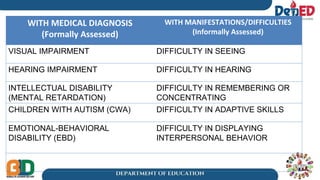
WITH MEDICAL DIAGNOSIS
(Formally Assessed)
WITH MANIFESTATIONS/DIFFICULTIES
(Informally Assessed)
VISUAL IMPAIRMENT DIFFICULTY IN SEEING
HEARING IMPAIRMENT DIFFICULTY IN HEARING
INTELLECTUAL DISABILITY
(MENTAL RETARDATION)
DIFFICULTY IN REMEMBERING OR
CONCENTRATING
CHILDREN WITH AUTISM (CWA) DIFFICULTY IN ADAPTIVE SKILLS
EMOTIONAL-BEHAVIORAL
DISABILITY (EBD)
DIFFICULTY IN DISPLAYING
INTERPERSONAL BEHAVIOR
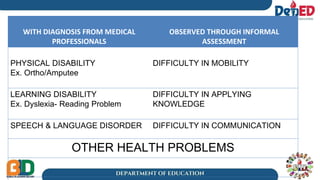
WITH DIAGNOSIS FROM MEDICAL
PROFESSIONALS
OBSERVED THROUGH INFORMAL
ASSESSMENT
PHYSICAL DISABILITY
Ex. Ortho/Amputee
DIFFICULTY IN MOBILITY
LEARNING DISABILITY
Ex. Dyslexia- Reading Problem
DIFFICULTY IN APPLYING
KNOWLEDGE
SPEECH & LANGUAGE DISORDER DIFFICULTY IN COMMUNICATION
OTHER HEALTH PROBLEMS
DISABILITY - refers to a permanent physical, mental, intellectual or
sensory impairment, in interaction with various barriers that may hinder a
person’s social participation.
Impairment Barriers Disability
1
MODELS OF DISABILITY
• Charity
• Medical
• Economic
• Social
• Rights-based
1
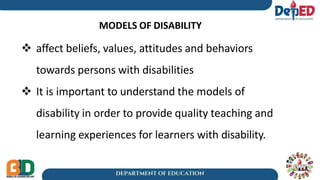
MODELS OF DISABILITY
1
 affect beliefs, values, attitudes and behaviors
towards persons with disabilities
 It is important to understand the models of
disability in order to provide quality teaching and
learning experiences for learners with disability.
MODELS OF DISABILITY
1
MODEL DESCRIPTION
Charity Model
Person with
disability is a
recipient of care,
cure or protection
MODELS OF DISABILITY
1
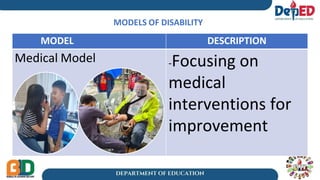
MODEL DESCRIPTION
Medical Model -Focusing on
medical
interventions for
improvement
MODELS OF DISABILITY
1
MODEL DESCRIPTION
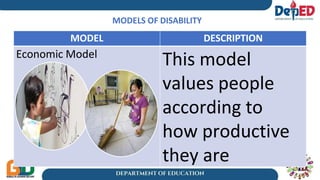
Economic Model
This model
values people
according to
how productive
they are
MODELS OF DISABILITY
1
MODEL DESCRIPTION
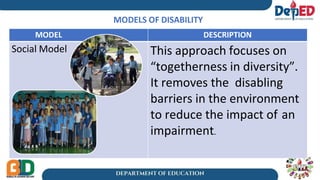
Social Model This approach focuses on
“togetherness in diversity”.
It removes the disabling
barriers in the environment
to reduce the impact of an
impairment.
MODELS OF DISABILITY
1
MODEL DESCRIPTION
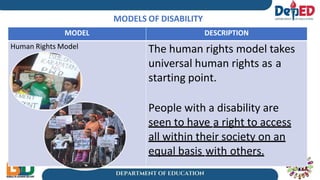
Human Rights Model The human rights model takes
universal human rights as a
starting point.
People with a disability are
seen to have a right to access
all within their society on an
equal basis with others.
CAUSES OF EDUCATIONAL BARRIERS
1. Policy barrier (e.g. lack of financial support for
children with a disability to get to school, a policy that
directs students with a disability into SPED schools)
1
CAUSES OF EDUCATIONAL BARRIERS
2. Attitudinal barrier (eg: negative / false /
discriminatory attitudes towards people with a disability,
reduced expectations about the learning potential of
students with a disability),
1
CAUSES OF EDUCATIONAL BARRIERS
3. Communication barrier (eg: spoken or written access
barrier such as no Braille books for students who are blind
or the absence of a sign language interpreter for a student
who is deaf)
1
4. Physical barrier (e.g., the absence of a wheelchair
accessible toilet, stairs into a classroom, no ramp or
lift access).
1
CAUSES OF EDUCATIONAL BARRIERS
Talk about and celebrate
differences.
1
Impairment
Accessible
Environment
Inclusion
1
1

Understanding-Disability.pptx

  • 1.
    UNDERSTANDING DISABILITY LUIS G.CULABA, JR. Division SPED Coordinator
  • 2.
    WITH MEDICAL DIAGNOSIS (FormallyAssessed) WITH MANIFESTATIONS/DIFFICULTIES (Informally Assessed) VISUAL IMPAIRMENT DIFFICULTY IN SEEING HEARING IMPAIRMENT DIFFICULTY IN HEARING INTELLECTUAL DISABILITY (MENTAL RETARDATION) DIFFICULTY IN REMEMBERING OR CONCENTRATING CHILDREN WITH AUTISM (CWA) DIFFICULTY IN ADAPTIVE SKILLS EMOTIONAL-BEHAVIORAL DISABILITY (EBD) DIFFICULTY IN DISPLAYING INTERPERSONAL BEHAVIOR
  • 3.
    WITH DIAGNOSIS FROMMEDICAL PROFESSIONALS OBSERVED THROUGH INFORMAL ASSESSMENT PHYSICAL DISABILITY Ex. Ortho/Amputee DIFFICULTY IN MOBILITY LEARNING DISABILITY Ex. Dyslexia- Reading Problem DIFFICULTY IN APPLYING KNOWLEDGE SPEECH & LANGUAGE DISORDER DIFFICULTY IN COMMUNICATION OTHER HEALTH PROBLEMS
  • 4.
    DISABILITY - refersto a permanent physical, mental, intellectual or sensory impairment, in interaction with various barriers that may hinder a person’s social participation. Impairment Barriers Disability 1
  • 5.
    MODELS OF DISABILITY •Charity • Medical • Economic • Social • Rights-based 1
  • 6.
    MODELS OF DISABILITY 1 affect beliefs, values, attitudes and behaviors towards persons with disabilities  It is important to understand the models of disability in order to provide quality teaching and learning experiences for learners with disability.
  • 7.
    MODELS OF DISABILITY 1 MODELDESCRIPTION Charity Model Person with disability is a recipient of care, cure or protection
  • 8.
    MODELS OF DISABILITY 1 MODELDESCRIPTION Medical Model -Focusing on medical interventions for improvement
  • 9.
    MODELS OF DISABILITY 1 MODELDESCRIPTION Economic Model This model values people according to how productive they are
  • 10.
    MODELS OF DISABILITY 1 MODELDESCRIPTION Social Model This approach focuses on “togetherness in diversity”. It removes the disabling barriers in the environment to reduce the impact of an impairment.
  • 11.
    MODELS OF DISABILITY 1 MODELDESCRIPTION Human Rights Model The human rights model takes universal human rights as a starting point. People with a disability are seen to have a right to access all within their society on an equal basis with others.
  • 12.
    CAUSES OF EDUCATIONALBARRIERS 1. Policy barrier (e.g. lack of financial support for children with a disability to get to school, a policy that directs students with a disability into SPED schools) 1
  • 14.
    CAUSES OF EDUCATIONALBARRIERS 2. Attitudinal barrier (eg: negative / false / discriminatory attitudes towards people with a disability, reduced expectations about the learning potential of students with a disability), 1
  • 16.
    CAUSES OF EDUCATIONALBARRIERS 3. Communication barrier (eg: spoken or written access barrier such as no Braille books for students who are blind or the absence of a sign language interpreter for a student who is deaf) 1
  • 19.
    4. Physical barrier(e.g., the absence of a wheelchair accessible toilet, stairs into a classroom, no ramp or lift access). 1 CAUSES OF EDUCATIONAL BARRIERS
  • 21.
    Talk about andcelebrate differences. 1
  • 22.
  • 23.