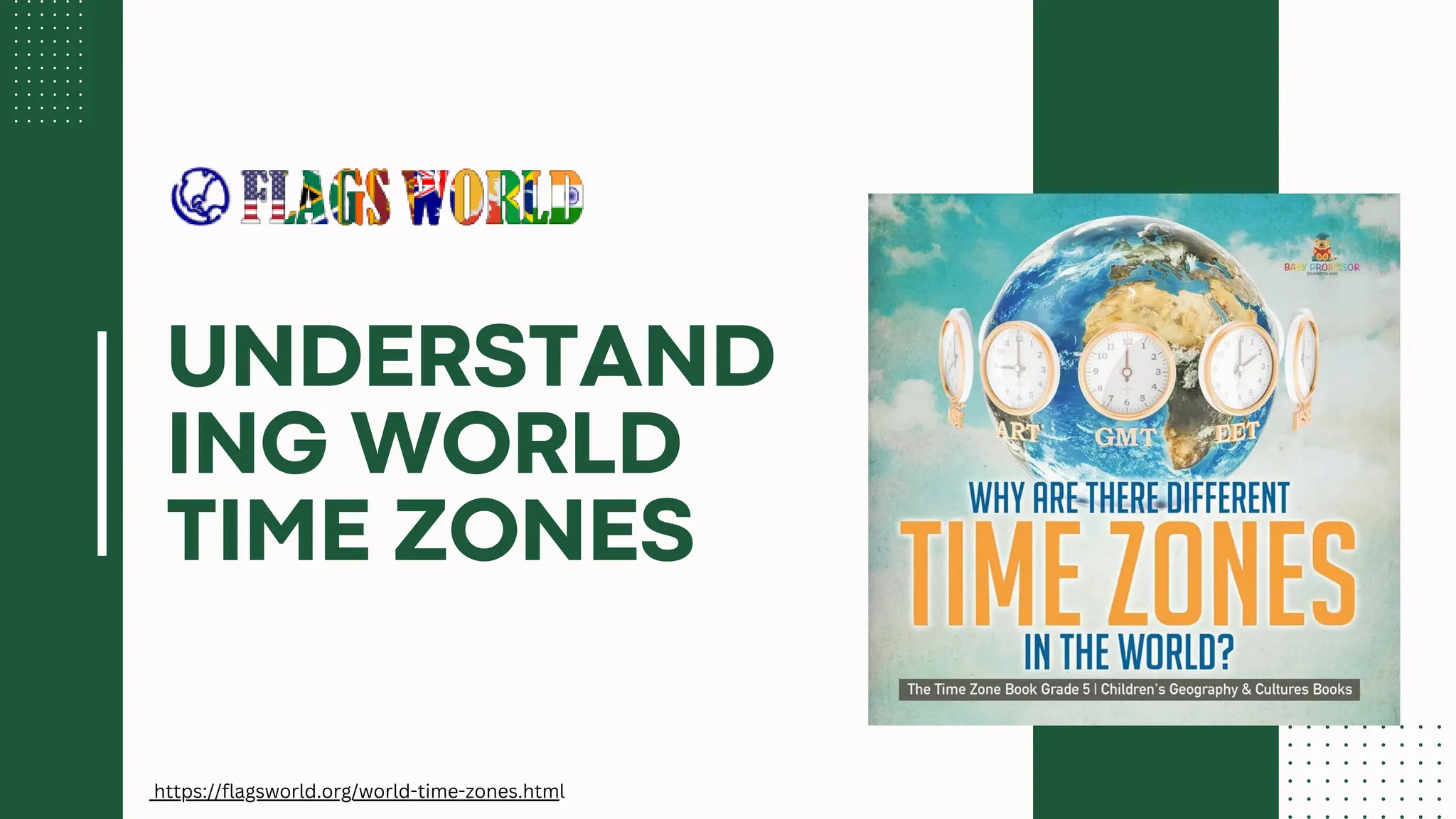
UNDERSTAND
ING WORLD
TIME ZONES
https://flagsworld.org/world-time-zones.html
Content
01
02
03
04
05
06
07
Introduction
Importance of Time Zones
The Origin of Time Zones
How Time Zones are Calculated
Major World Time Zones
Daylight Saving Time (DST)
Time Zone Challenges
https://flagsworld.org/world-time-zones.html
08
09
10
Unique Time Zones
The International Date Line
Conclusion
Introduction
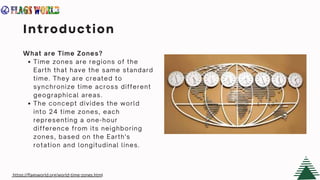
What are Time Zones?
Time zones are regions of the
Earth that have the same standard
time. They are created to
synchronize time across different
geographical areas.
The concept divides the world
into 24 time zones, each
representing a one-hour
difference from its neighboring
zones, based on the Earth's
rotation and longitudinal lines.
https://flagsworld.org/world-time-zones.html
Importance of Time
Zones
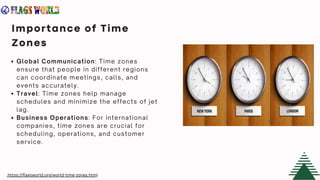
Global Communication: Time zones
ensure that people in different regions
can coordinate meetings, calls, and
events accurately.
Travel: Time zones help manage
schedules and minimize the effects of jet
lag.
Business Operations: For international
companies, time zones are crucial for
scheduling, operations, and customer
service.
https://flagsworld.org/world-time-zones.html
The Origin of
Time Zones
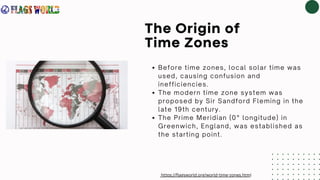
Before time zones, local solar time was
used, causing confusion and
inefficiencies.
The modern time zone system was
proposed by Sir Sandford Fleming in the
late 19th century.
The Prime Meridian (0° longitude) in
Greenwich, England, was established as
the starting point.
https://flagsworld.org/world-time-zones.html
How Time Zones are
Calculated
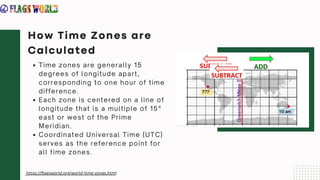
Time zones are generally 15
degrees of longitude apart,
corresponding to one hour of time
difference.
Each zone is centered on a line of
longitude that is a multiple of 15°
east or west of the Prime
Meridian.
Coordinated Universal Time (UTC)
serves as the reference point for
all time zones.
https://flagsworld.org/world-time-zones.html
Major World Time
Zones
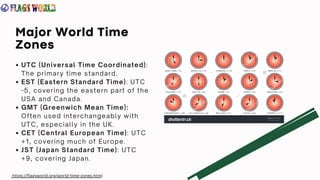
UTC (Universal Time Coordinated):
The primary time standard.
EST (Eastern Standard Time): UTC
-5, covering the eastern part of the
USA and Canada.
GMT (Greenwich Mean Time):
Often used interchangeably with
UTC, especially in the UK.
CET (Central European Time): UTC
+1, covering much of Europe.
JST (Japan Standard Time): UTC
+9, covering Japan.
https://flagsworld.org/world-time-zones.html
Daylight
Saving Time
(DST)
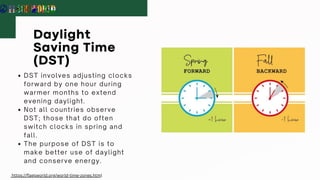
DST involves adjusting clocks
forward by one hour during
warmer months to extend
evening daylight.
Not all countries observe
DST; those that do often
switch clocks in spring and
fall.
The purpose of DST is to
make better use of daylight
and conserve energy.
https://flagsworld.org/world-time-zones.html
Time Zone
Challenges
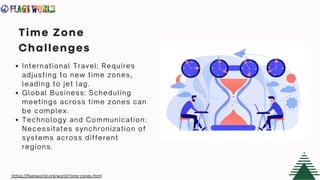
International Travel: Requires
adjusting to new time zones,
leading to jet lag.
Global Business: Scheduling
meetings across time zones can
be complex.
Technology and Communication:
Necessitates synchronization of
systems across different
regions.
https://flagsworld.org/world-time-zones.html
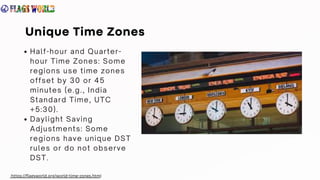
Unique Time Zones
Half-hour and Quarter-
hour Time Zones: Some
regions use time zones
offset by 30 or 45
minutes (e.g., India
Standard Time, UTC
+5:30).
Daylight Saving
Adjustments: Some
regions have unique DST
rules or do not observe
DST.
https://flagsworld.org/world-time-zones.html
The
International
Date Line
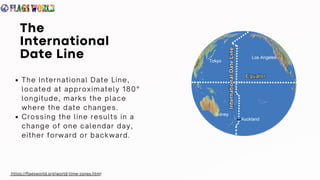
The International Date Line,
located at approximately 180°
longitude, marks the place
where the date changes.
Crossing the line results in a
change of one calendar day,
either forward or backward.
https://flagsworld.org/world-time-zones.html
CONCLUSION
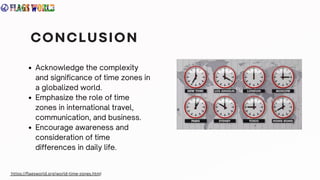
Acknowledge the complexity
and significance of time zones in
a globalized world.
Emphasize the role of time
zones in international travel,
communication, and business.
Encourage awareness and
consideration of time
differences in daily life.
https://flagsworld.org/world-time-zones.html

Understanding World Time Zones

  • 1.
  • 2.
    Content 01 02 03 04 05 06 07 Introduction Importance of TimeZones The Origin of Time Zones How Time Zones are Calculated Major World Time Zones Daylight Saving Time (DST) Time Zone Challenges https://flagsworld.org/world-time-zones.html 08 09 10 Unique Time Zones The International Date Line Conclusion
  • 3.
    Introduction What are TimeZones? Time zones are regions of the Earth that have the same standard time. They are created to synchronize time across different geographical areas. The concept divides the world into 24 time zones, each representing a one-hour difference from its neighboring zones, based on the Earth's rotation and longitudinal lines. https://flagsworld.org/world-time-zones.html
  • 4.
    Importance of Time Zones GlobalCommunication: Time zones ensure that people in different regions can coordinate meetings, calls, and events accurately. Travel: Time zones help manage schedules and minimize the effects of jet lag. Business Operations: For international companies, time zones are crucial for scheduling, operations, and customer service. https://flagsworld.org/world-time-zones.html
  • 5.
    The Origin of TimeZones Before time zones, local solar time was used, causing confusion and inefficiencies. The modern time zone system was proposed by Sir Sandford Fleming in the late 19th century. The Prime Meridian (0° longitude) in Greenwich, England, was established as the starting point. https://flagsworld.org/world-time-zones.html
  • 6.
    How Time Zonesare Calculated Time zones are generally 15 degrees of longitude apart, corresponding to one hour of time difference. Each zone is centered on a line of longitude that is a multiple of 15° east or west of the Prime Meridian. Coordinated Universal Time (UTC) serves as the reference point for all time zones. https://flagsworld.org/world-time-zones.html
  • 7.
    Major World Time Zones UTC(Universal Time Coordinated): The primary time standard. EST (Eastern Standard Time): UTC -5, covering the eastern part of the USA and Canada. GMT (Greenwich Mean Time): Often used interchangeably with UTC, especially in the UK. CET (Central European Time): UTC +1, covering much of Europe. JST (Japan Standard Time): UTC +9, covering Japan. https://flagsworld.org/world-time-zones.html
  • 8.
    Daylight Saving Time (DST) DST involvesadjusting clocks forward by one hour during warmer months to extend evening daylight. Not all countries observe DST; those that do often switch clocks in spring and fall. The purpose of DST is to make better use of daylight and conserve energy. https://flagsworld.org/world-time-zones.html
  • 9.
    Time Zone Challenges International Travel:Requires adjusting to new time zones, leading to jet lag. Global Business: Scheduling meetings across time zones can be complex. Technology and Communication: Necessitates synchronization of systems across different regions. https://flagsworld.org/world-time-zones.html
  • 10.
    Unique Time Zones Half-hourand Quarter- hour Time Zones: Some regions use time zones offset by 30 or 45 minutes (e.g., India Standard Time, UTC +5:30). Daylight Saving Adjustments: Some regions have unique DST rules or do not observe DST. https://flagsworld.org/world-time-zones.html
  • 11.
    The International Date Line The InternationalDate Line, located at approximately 180° longitude, marks the place where the date changes. Crossing the line results in a change of one calendar day, either forward or backward. https://flagsworld.org/world-time-zones.html
  • 12.
    CONCLUSION Acknowledge the complexity andsignificance of time zones in a globalized world. Emphasize the role of time zones in international travel, communication, and business. Encourage awareness and consideration of time differences in daily life. https://flagsworld.org/world-time-zones.html