Understanding the
Professional Capabilities
Framework (PCF) in
Social Work
The Professional Capabilities Framework (PCF) is a cornerstone of
social work practice in England. It provides a comprehensive framework
outlining the knowledge, skills, and values necessary for effective social
work at all stages of a career.
Key Elements of the PCF
Domains
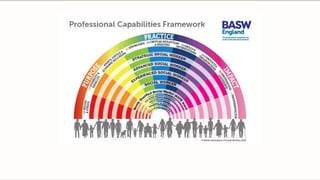
Nine core domains that encompass the essential
knowledge, skills, and values required for competent social
work practice. These include Professionalism, Values and
Ethics, Diversity and Equality, Rights, Justice, and Economic
Wellbeing, Knowledge, Critical Reflection and Analysis, Skills
and Interventions, Contexts and Organizations, and
Professional Leadership.
Super Domains
Three overarching themes that provide a broader context
for understanding the PCF: Purpose, Practice, and Impact.
These highlight the interconnectedness of social work
values, interventions, and outcomes.
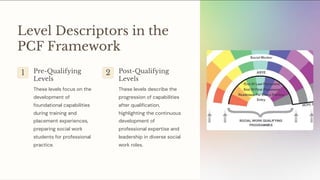
Level Descriptors in the
PCF Framework
1 Pre-Qualifying
Levels
These levels focus on the
development of
foundational capabilities
during training and
placement experiences,
preparing social work
students for professional
practice.
2 Post-Qualifying
Levels
These levels describe the
progression of capabilities
after qualification,
highlighting the continuous
development of
professional expertise and
leadership in diverse social
work roles.
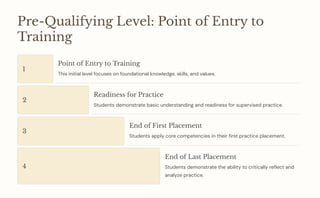
Pre-Qualifying Level: Point of Entry to
Training
1
Point of Entry to Training
This initial level focuses on foundational knowledge, skills, and values.
2
Readiness for Practice
Students demonstrate basic understanding and readiness for supervised practice.
3
End of First Placement
Students apply core competencies in their first practice placement.
4
End of Last Placement
Students demonstrate the ability to critically reflect and
analyze practice.
Pre-Qualifying Level: Point of Entry to
Training
Focus
Evaluating readiness for social work training, ensuring
students possess the necessary foundation for success in
their studies.
Expectations
Awareness of social work's societal context, self-
awareness, ability to build rapport, and potential to acquire
relevant knowledge, skills, and values through training.
Pre-Qualifying Level: Readiness for Practice
Focus
Establishing fundamental skills for fieldwork, ensuring
students can confidently engage in practice settings.
Expectations
Effective communication, ability to engage with service
users, willingness to learn from supervision, and
demonstration of core social work values, theories, and
skills for their first placement.
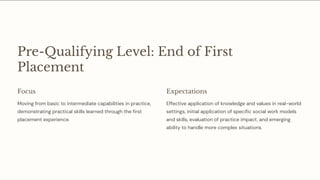
Pre-Qualifying Level: End of First
Placement
Focus
Moving from basic to intermediate capabilities in practice,
demonstrating practical skills learned through the first
placement experience.
Expectations
Effective application of knowledge and values in real-world
settings, initial application of specific social work models
and skills, evaluation of practice impact, and emerging
ability to handle more complex situations.
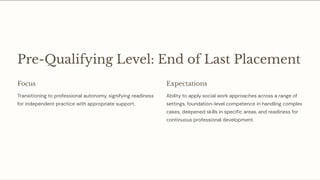
Pre-Qualifying Level: End of Last Placement
Focus
Transitioning to professional autonomy, signifying readiness
for independent practice with appropriate support.
Expectations
Ability to apply social work approaches across a range of
settings, foundation-level competence in handling complex
cases, deepened skills in specific areas, and readiness for
continuous professional development.
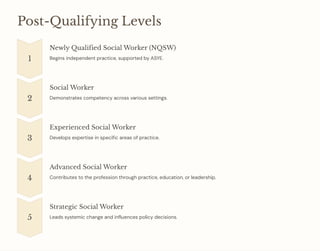
Post-Qualifying Levels
1
Newly Qualified Social Worker (NQSW)
Begins independent practice, supported by ASYE.
2
Social Worker
Demonstrates competency across various settings.
3
Experienced Social Worker
Develops expertise in specific areas of practice.
4
Advanced Social Worker
Contributes to the profession through practice, education, or leadership.
5
Strategic Social Worker
Leads systemic change and influences policy decisions.
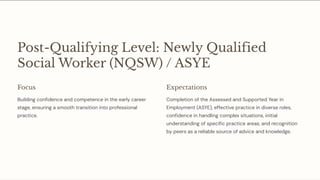
Post-Qualifying Level: Newly Qualified
Social Worker (NQSW) / ASYE
Focus
Building confidence and competence in the early career
stage, ensuring a smooth transition into professional
practice.
Expectations
Completion of the Assessed and Supported Year in
Employment (ASYE), effective practice in diverse roles,
confidence in handling complex situations, initial
understanding of specific practice areas, and recognition
by peers as a reliable source of advice and knowledge.
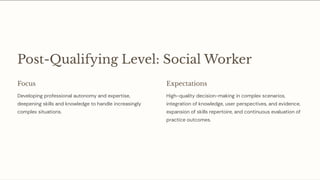
Post-Qualifying Level: Social Worker
Focus
Developing professional autonomy and expertise,
deepening skills and knowledge to handle increasingly
complex situations.
Expectations
High-quality decision-making in complex scenarios,
integration of knowledge, user perspectives, and evidence,
expansion of skills repertoire, and continuous evaluation of
practice outcomes.
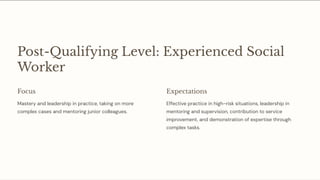
Post-Qualifying Level: Experienced Social
Worker
Focus
Mastery and leadership in practice, taking on more
complex cases and mentoring junior colleagues.
Expectations
Effective practice in high-risk situations, leadership in
mentoring and supervision, contribution to service
improvement, and demonstration of expertise through
complex tasks.
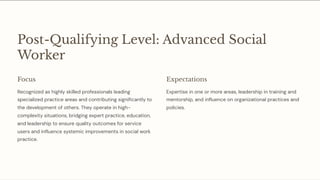
Post-Qualifying Level: Advanced Social
Worker
Focus
Recognized as highly skilled professionals leading
specialized practice areas and contributing significantly to
the development of others. They operate in high-
complexity situations, bridging expert practice, education,
and leadership to ensure quality outcomes for service
users and influence systemic improvements in social work
practice.
Expectations
Expertise in one or more areas, leadership in training and
mentorship, and influence on organizational practices and
policies.
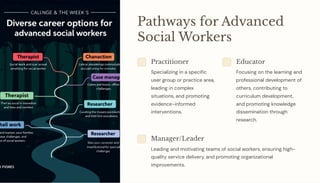
Pathways for Advanced
Social Workers
Practitioner
Specializing in a specific
user group or practice area,
leading in complex
situations, and promoting
evidence-informed
interventions.
Educator
Focusing on the learning and
professional development of
others, contributing to
curriculum development,
and promoting knowledge
dissemination through
research.
Manager/Leader
Leading and motivating teams of social workers, ensuring high-
quality service delivery, and promoting organizational
improvements.
Expectations of Advanced
Social Workers
Integration of
Knowledge and
Evidence-Based
Practices
Consistent integration of
professional knowledge, user
perspectives, and research
evidence into their practice.
Leadership in
Reflective Practice
Modeling and facilitating
reflective practice,
encouraging colleagues and
teams to critically evaluate
their work and its impact on
service users.
Knowledge
Dissemination and
Capacity Building
Contributing to the growth of
social work knowledge
through research, publication,
and mentoring of peers and
students.
High-Complexity
Practice and
Innovation
Handling cases involving
significant complexity and
driving innovation in their field
by introducing and evaluating
new approaches.
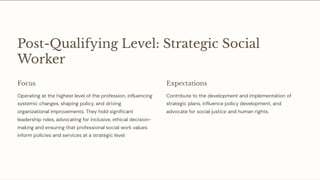
Post-Qualifying Level: Strategic Social
Worker
Focus
Operating at the highest level of the profession, influencing
systemic changes, shaping policy, and driving
organizational improvements. They hold significant
leadership roles, advocating for inclusive, ethical decision-
making and ensuring that professional social work values
inform policies and services at a strategic level.
Expectations
Contribute to the development and implementation of
strategic plans, influence policy development, and
advocate for social justice and human rights.
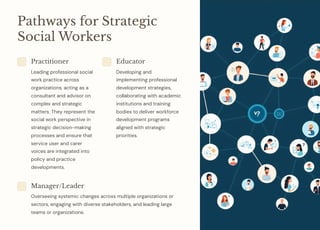
Pathways for Strategic
Social Workers
Practitioner
Leading professional social
work practice across
organizations, acting as a
consultant and advisor on
complex and strategic
matters. They represent the
social work perspective in
strategic decision-making
processes and ensure that
service user and carer
voices are integrated into
policy and practice
developments.
Educator
Developing and
implementing professional
development strategies,
collaborating with academic
institutions and training
bodies to deliver workforce
development programs
aligned with strategic
priorities.
Manager/Leader
Overseeing systemic changes across multiple organizations or
sectors, engaging with diverse stakeholders, and leading large
teams or organizations.
Expectations of Strategic Social Workers
Representation of Service User and
Carer Perspectives
Advocate for service user and carer voices to be central
to decision-making processes, ensuring policies and
practices reflect the lived experiences and needs of
diverse communities, fostering empowerment and
inclusivity.
Advocacy for Ethical Practices and
Policy Improvements
Promote and uphold ethical principles, using their
influence to challenge practices or policies that are
discriminatory, oppressive, or unethical. Ensure that
organizational and systemic decisions align with the
values of social justice, human rights, and professional
integrity.
Leadership in Cross-Organizational
Partnerships
Build and sustain partnerships across sectors,
facilitating collaboration to address complex social
issues. Engage with local, regional, and national networks
to identify and implement best practices and emerging
innovations in social work.
Research-Driven Innovations
Lead research initiatives, analyzing data to inform
strategic decisions and improve service outcomes.
Disseminate findings to shape practices and policies,
ensuring that innovations are grounded in evidence and
ethical considerations.
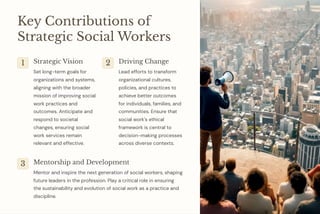
Key Contributions of
Strategic Social Workers
1 Strategic Vision
Set long-term goals for
organizations and systems,
aligning with the broader
mission of improving social
work practices and
outcomes. Anticipate and
respond to societal
changes, ensuring social
work services remain
relevant and effective.
2 Driving Change
Lead efforts to transform
organizational cultures,
policies, and practices to
achieve better outcomes
for individuals, families, and
communities. Ensure that
social work's ethical
framework is central to
decision-making processes
across diverse contexts.
3 Mentorship and Development
Mentor and inspire the next generation of social workers, shaping
future leaders in the profession. Play a critical role in ensuring
the sustainability and evolution of social work as a practice and
discipline.
Understanding the PCF in Practice
Application of Knowledge
The PCF encourages a holistic understanding of social work
principles, emphasizing the integration of knowledge, skills,
and values in practice.
Reflective Practice
It promotes self-awareness, critical reflection, and
continuous learning, encouraging social workers to evaluate
their practice and adapt their approaches based on
individual needs and contexts.
The PCF and Professional Development
Continuous Learning
The PCF provides a framework for lifelong learning,
encouraging social workers to stay abreast of new
research, evidence-based practices, and policy
developments.
Skill Development
It outlines specific skills and competencies required at
various stages of a career, guiding social workers in their
development and growth.
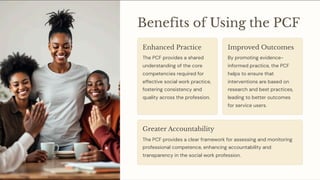
Benefits of Using the PCF
Enhanced Practice
The PCF provides a shared
understanding of the core
competencies required for
effective social work practice,
fostering consistency and
quality across the profession.
Improved Outcomes
By promoting evidence-
informed practice, the PCF
helps to ensure that
interventions are based on
research and best practices,
leading to better outcomes
for service users.
Greater Accountability
The PCF provides a clear framework for assessing and monitoring
professional competence, enhancing accountability and
transparency in the social work profession.
The PCF and the Social Work Code of Ethics
Ethical Framework
The PCF is grounded in the values and principles of the
BASW Code of Ethics, emphasizing human rights, social
justice, and anti-discriminatory practices.
Ethical Decision-Making
It guides social workers in making ethical decisions,
ensuring they prioritize the well-being and rights of service
users and uphold professional standards.
The PCF and the Employers' Standards for
Social Work
Alignment with Standards
The PCF is aligned with the Employers' Standards for Social
Work, ensuring that professional competence meets the
expectations of employers and stakeholders.
Quality Assurance
It provides a framework for quality assurance, helping
employers to monitor and evaluate the performance of
social workers and ensure the delivery of high-quality
services.
Implications for Social Work Education
Curriculum Design
The PCF informs the design of social work curricula,
ensuring that students are equipped with the necessary
knowledge, skills, and values for effective practice.
Assessment and Evaluation
It provides a framework for assessing student learning and
evaluating the effectiveness of social work education
programs.
Future of the PCF
Continuous Review
The PCF is subject to ongoing review and adaptation to
ensure it remains relevant and responsive to the evolving
needs of the social work profession.
Future Developments
Future developments may include incorporating new
technologies, emerging social issues, and the increasing
diversity of service users and communities.
The PCF as a Guide for
Professional Excellence
The Professional Capabilities Framework (PCF) serves as a vital guide
for professional excellence in social work. It promotes ethical practice,
fosters continuous learning, and ensures that social workers are
equipped with the knowledge, skills, and values necessary to meet the
diverse needs of service users and communities.

Understanding-the-Professional-Capabilities-Framework-PCF-in-Social-Work (1).pdf

  • 1.
    Understanding the Professional Capabilities Framework(PCF) in Social Work The Professional Capabilities Framework (PCF) is a cornerstone of social work practice in England. It provides a comprehensive framework outlining the knowledge, skills, and values necessary for effective social work at all stages of a career.
  • 3.
    Key Elements ofthe PCF Domains Nine core domains that encompass the essential knowledge, skills, and values required for competent social work practice. These include Professionalism, Values and Ethics, Diversity and Equality, Rights, Justice, and Economic Wellbeing, Knowledge, Critical Reflection and Analysis, Skills and Interventions, Contexts and Organizations, and Professional Leadership. Super Domains Three overarching themes that provide a broader context for understanding the PCF: Purpose, Practice, and Impact. These highlight the interconnectedness of social work values, interventions, and outcomes.
  • 4.
    Level Descriptors inthe PCF Framework 1 Pre-Qualifying Levels These levels focus on the development of foundational capabilities during training and placement experiences, preparing social work students for professional practice. 2 Post-Qualifying Levels These levels describe the progression of capabilities after qualification, highlighting the continuous development of professional expertise and leadership in diverse social work roles.
  • 5.
    Pre-Qualifying Level: Pointof Entry to Training 1 Point of Entry to Training This initial level focuses on foundational knowledge, skills, and values. 2 Readiness for Practice Students demonstrate basic understanding and readiness for supervised practice. 3 End of First Placement Students apply core competencies in their first practice placement. 4 End of Last Placement Students demonstrate the ability to critically reflect and analyze practice.
  • 6.
    Pre-Qualifying Level: Pointof Entry to Training Focus Evaluating readiness for social work training, ensuring students possess the necessary foundation for success in their studies. Expectations Awareness of social work's societal context, self- awareness, ability to build rapport, and potential to acquire relevant knowledge, skills, and values through training.
  • 7.
    Pre-Qualifying Level: Readinessfor Practice Focus Establishing fundamental skills for fieldwork, ensuring students can confidently engage in practice settings. Expectations Effective communication, ability to engage with service users, willingness to learn from supervision, and demonstration of core social work values, theories, and skills for their first placement.
  • 8.
    Pre-Qualifying Level: Endof First Placement Focus Moving from basic to intermediate capabilities in practice, demonstrating practical skills learned through the first placement experience. Expectations Effective application of knowledge and values in real-world settings, initial application of specific social work models and skills, evaluation of practice impact, and emerging ability to handle more complex situations.
  • 9.
    Pre-Qualifying Level: Endof Last Placement Focus Transitioning to professional autonomy, signifying readiness for independent practice with appropriate support. Expectations Ability to apply social work approaches across a range of settings, foundation-level competence in handling complex cases, deepened skills in specific areas, and readiness for continuous professional development.
  • 10.
    Post-Qualifying Levels 1 Newly QualifiedSocial Worker (NQSW) Begins independent practice, supported by ASYE. 2 Social Worker Demonstrates competency across various settings. 3 Experienced Social Worker Develops expertise in specific areas of practice. 4 Advanced Social Worker Contributes to the profession through practice, education, or leadership. 5 Strategic Social Worker Leads systemic change and influences policy decisions.
  • 11.
    Post-Qualifying Level: NewlyQualified Social Worker (NQSW) / ASYE Focus Building confidence and competence in the early career stage, ensuring a smooth transition into professional practice. Expectations Completion of the Assessed and Supported Year in Employment (ASYE), effective practice in diverse roles, confidence in handling complex situations, initial understanding of specific practice areas, and recognition by peers as a reliable source of advice and knowledge.
  • 12.
    Post-Qualifying Level: SocialWorker Focus Developing professional autonomy and expertise, deepening skills and knowledge to handle increasingly complex situations. Expectations High-quality decision-making in complex scenarios, integration of knowledge, user perspectives, and evidence, expansion of skills repertoire, and continuous evaluation of practice outcomes.
  • 13.
    Post-Qualifying Level: ExperiencedSocial Worker Focus Mastery and leadership in practice, taking on more complex cases and mentoring junior colleagues. Expectations Effective practice in high-risk situations, leadership in mentoring and supervision, contribution to service improvement, and demonstration of expertise through complex tasks.
  • 14.
    Post-Qualifying Level: AdvancedSocial Worker Focus Recognized as highly skilled professionals leading specialized practice areas and contributing significantly to the development of others. They operate in high- complexity situations, bridging expert practice, education, and leadership to ensure quality outcomes for service users and influence systemic improvements in social work practice. Expectations Expertise in one or more areas, leadership in training and mentorship, and influence on organizational practices and policies.
  • 15.
    Pathways for Advanced SocialWorkers Practitioner Specializing in a specific user group or practice area, leading in complex situations, and promoting evidence-informed interventions. Educator Focusing on the learning and professional development of others, contributing to curriculum development, and promoting knowledge dissemination through research. Manager/Leader Leading and motivating teams of social workers, ensuring high- quality service delivery, and promoting organizational improvements.
  • 16.
    Expectations of Advanced SocialWorkers Integration of Knowledge and Evidence-Based Practices Consistent integration of professional knowledge, user perspectives, and research evidence into their practice. Leadership in Reflective Practice Modeling and facilitating reflective practice, encouraging colleagues and teams to critically evaluate their work and its impact on service users. Knowledge Dissemination and Capacity Building Contributing to the growth of social work knowledge through research, publication, and mentoring of peers and students. High-Complexity Practice and Innovation Handling cases involving significant complexity and driving innovation in their field by introducing and evaluating new approaches.
  • 17.
    Post-Qualifying Level: StrategicSocial Worker Focus Operating at the highest level of the profession, influencing systemic changes, shaping policy, and driving organizational improvements. They hold significant leadership roles, advocating for inclusive, ethical decision- making and ensuring that professional social work values inform policies and services at a strategic level. Expectations Contribute to the development and implementation of strategic plans, influence policy development, and advocate for social justice and human rights.
  • 18.
    Pathways for Strategic SocialWorkers Practitioner Leading professional social work practice across organizations, acting as a consultant and advisor on complex and strategic matters. They represent the social work perspective in strategic decision-making processes and ensure that service user and carer voices are integrated into policy and practice developments. Educator Developing and implementing professional development strategies, collaborating with academic institutions and training bodies to deliver workforce development programs aligned with strategic priorities. Manager/Leader Overseeing systemic changes across multiple organizations or sectors, engaging with diverse stakeholders, and leading large teams or organizations.
  • 19.
    Expectations of StrategicSocial Workers Representation of Service User and Carer Perspectives Advocate for service user and carer voices to be central to decision-making processes, ensuring policies and practices reflect the lived experiences and needs of diverse communities, fostering empowerment and inclusivity. Advocacy for Ethical Practices and Policy Improvements Promote and uphold ethical principles, using their influence to challenge practices or policies that are discriminatory, oppressive, or unethical. Ensure that organizational and systemic decisions align with the values of social justice, human rights, and professional integrity. Leadership in Cross-Organizational Partnerships Build and sustain partnerships across sectors, facilitating collaboration to address complex social issues. Engage with local, regional, and national networks to identify and implement best practices and emerging innovations in social work. Research-Driven Innovations Lead research initiatives, analyzing data to inform strategic decisions and improve service outcomes. Disseminate findings to shape practices and policies, ensuring that innovations are grounded in evidence and ethical considerations.
  • 20.
    Key Contributions of StrategicSocial Workers 1 Strategic Vision Set long-term goals for organizations and systems, aligning with the broader mission of improving social work practices and outcomes. Anticipate and respond to societal changes, ensuring social work services remain relevant and effective. 2 Driving Change Lead efforts to transform organizational cultures, policies, and practices to achieve better outcomes for individuals, families, and communities. Ensure that social work's ethical framework is central to decision-making processes across diverse contexts. 3 Mentorship and Development Mentor and inspire the next generation of social workers, shaping future leaders in the profession. Play a critical role in ensuring the sustainability and evolution of social work as a practice and discipline.
  • 21.
    Understanding the PCFin Practice Application of Knowledge The PCF encourages a holistic understanding of social work principles, emphasizing the integration of knowledge, skills, and values in practice. Reflective Practice It promotes self-awareness, critical reflection, and continuous learning, encouraging social workers to evaluate their practice and adapt their approaches based on individual needs and contexts.
  • 22.
    The PCF andProfessional Development Continuous Learning The PCF provides a framework for lifelong learning, encouraging social workers to stay abreast of new research, evidence-based practices, and policy developments. Skill Development It outlines specific skills and competencies required at various stages of a career, guiding social workers in their development and growth.
  • 23.
    Benefits of Usingthe PCF Enhanced Practice The PCF provides a shared understanding of the core competencies required for effective social work practice, fostering consistency and quality across the profession. Improved Outcomes By promoting evidence- informed practice, the PCF helps to ensure that interventions are based on research and best practices, leading to better outcomes for service users. Greater Accountability The PCF provides a clear framework for assessing and monitoring professional competence, enhancing accountability and transparency in the social work profession.
  • 24.
    The PCF andthe Social Work Code of Ethics Ethical Framework The PCF is grounded in the values and principles of the BASW Code of Ethics, emphasizing human rights, social justice, and anti-discriminatory practices. Ethical Decision-Making It guides social workers in making ethical decisions, ensuring they prioritize the well-being and rights of service users and uphold professional standards.
  • 25.
    The PCF andthe Employers' Standards for Social Work Alignment with Standards The PCF is aligned with the Employers' Standards for Social Work, ensuring that professional competence meets the expectations of employers and stakeholders. Quality Assurance It provides a framework for quality assurance, helping employers to monitor and evaluate the performance of social workers and ensure the delivery of high-quality services.
  • 26.
    Implications for SocialWork Education Curriculum Design The PCF informs the design of social work curricula, ensuring that students are equipped with the necessary knowledge, skills, and values for effective practice. Assessment and Evaluation It provides a framework for assessing student learning and evaluating the effectiveness of social work education programs.
  • 27.
    Future of thePCF Continuous Review The PCF is subject to ongoing review and adaptation to ensure it remains relevant and responsive to the evolving needs of the social work profession. Future Developments Future developments may include incorporating new technologies, emerging social issues, and the increasing diversity of service users and communities.
  • 28.
    The PCF asa Guide for Professional Excellence The Professional Capabilities Framework (PCF) serves as a vital guide for professional excellence in social work. It promotes ethical practice, fosters continuous learning, and ensures that social workers are equipped with the knowledge, skills, and values necessary to meet the diverse needs of service users and communities.