Understanding
Steroids and NSAIDs
Mechanisms, Uses, and Considerations
Steroids Overview -
Mechanism of Action
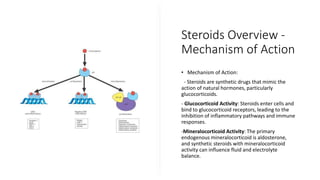
• Mechanism of Action:
- Steroids are synthetic drugs that mimic the
action of natural hormones, particularly
glucocorticoids.
- Glucocorticoid Activity: Steroids enter cells and
bind to glucocorticoid receptors, leading to the
inhibition of inflammatory pathways and immune
responses.
-Mineralocorticoid Activity: The primary
endogenous mineralocorticoid is aldosterone,
and synthetic steroids with mineralocorticoid
activity can influence fluid and electrolyte
balance.
Steroids Overview -
Indications
• Indications:
- Inflammatory Conditions: Rheumatoid
arthritis, inflammatory bowel diseases
(Crohn's disease, ulcerative colitis).
- Allergic Reactions: Severe allergies,
anaphylaxis.
- Autoimmune Disorders: Lupus, multiple
sclerosis.
- Organ Transplantation: Prevention of
rejection.
Steroids Overview - Contraindications and
Side Effects
• Contraindications:
• - Active Infections: Steroids can suppress the immune system, worsening infections.
• - Peptic Ulcer Disease: May exacerbate gastric ulcers.
• - Live Vaccines: Contraindicated due to immunosuppressive effects.
• Side Effects:
• - Short-term: Increased appetite, mood changes.
• - Long-term: Osteoporosis, Cushing's syndrome, increased susceptibility to infections.
• Examples:
• - Prednisone: Commonly used, available in various oral doses.
• - Dexamethasone: Often used for its anti-inflammatory and immunosuppressive properties.
• - Methylprednisolone: Used for inflammatory conditions and allergic reactions.
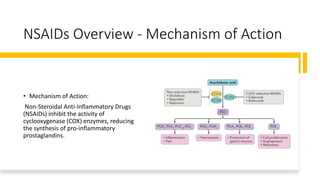
NSAIDs Overview - Mechanism of Action
• Mechanism of Action:
Non-Steroidal Anti-Inflammatory Drugs
(NSAIDs) inhibit the activity of
cyclooxygenase (COX) enzymes, reducing
the synthesis of pro-inflammatory
prostaglandins.
NSAIDs Overview - Indications
• Indications:
- Pain Management: Acute and chronic pain
conditions.
- Inflammation: Arthritis (osteoarthritis,
rheumatoid arthritis), tendonitis, bursitis.
- Fever Reduction: Symptomatic relief.
NSAIDs Overview - Contraindications and Side
Effects
• Contraindications:
• - Gastrointestinal Issues: Peptic ulcer disease, gastrointestinal bleeding.
• - Renal Impairment: May worsen kidney function.
• - Cardiovascular Disease: Increased risk of events, especially with long-term use.
• Side Effects:
• - Gastrointestinal: Gastric ulcers, bleeding.
• - Renal: Impaired kidney function.
• - Cardiovascular: Increased risk of heart attack and stroke.
• Examples:
• - Ibuprofen: Commonly used for pain and inflammation, available over-the-counter.
• - Naproxen: Longer duration of action, also available over-the-counter.
• - Aspirin: Besides anti-inflammatory properties, it has antiplatelet effects.

Understanding Steroids and NSAIDs 2.pptx

  • 1.
  • 2.
    Steroids Overview - Mechanismof Action • Mechanism of Action: - Steroids are synthetic drugs that mimic the action of natural hormones, particularly glucocorticoids. - Glucocorticoid Activity: Steroids enter cells and bind to glucocorticoid receptors, leading to the inhibition of inflammatory pathways and immune responses. -Mineralocorticoid Activity: The primary endogenous mineralocorticoid is aldosterone, and synthetic steroids with mineralocorticoid activity can influence fluid and electrolyte balance.
  • 3.
    Steroids Overview - Indications •Indications: - Inflammatory Conditions: Rheumatoid arthritis, inflammatory bowel diseases (Crohn's disease, ulcerative colitis). - Allergic Reactions: Severe allergies, anaphylaxis. - Autoimmune Disorders: Lupus, multiple sclerosis. - Organ Transplantation: Prevention of rejection.
  • 4.
    Steroids Overview -Contraindications and Side Effects • Contraindications: • - Active Infections: Steroids can suppress the immune system, worsening infections. • - Peptic Ulcer Disease: May exacerbate gastric ulcers. • - Live Vaccines: Contraindicated due to immunosuppressive effects. • Side Effects: • - Short-term: Increased appetite, mood changes. • - Long-term: Osteoporosis, Cushing's syndrome, increased susceptibility to infections. • Examples: • - Prednisone: Commonly used, available in various oral doses. • - Dexamethasone: Often used for its anti-inflammatory and immunosuppressive properties. • - Methylprednisolone: Used for inflammatory conditions and allergic reactions.
  • 5.
    NSAIDs Overview -Mechanism of Action • Mechanism of Action: Non-Steroidal Anti-Inflammatory Drugs (NSAIDs) inhibit the activity of cyclooxygenase (COX) enzymes, reducing the synthesis of pro-inflammatory prostaglandins.
  • 6.
    NSAIDs Overview -Indications • Indications: - Pain Management: Acute and chronic pain conditions. - Inflammation: Arthritis (osteoarthritis, rheumatoid arthritis), tendonitis, bursitis. - Fever Reduction: Symptomatic relief.
  • 7.
    NSAIDs Overview -Contraindications and Side Effects • Contraindications: • - Gastrointestinal Issues: Peptic ulcer disease, gastrointestinal bleeding. • - Renal Impairment: May worsen kidney function. • - Cardiovascular Disease: Increased risk of events, especially with long-term use. • Side Effects: • - Gastrointestinal: Gastric ulcers, bleeding. • - Renal: Impaired kidney function. • - Cardiovascular: Increased risk of heart attack and stroke. • Examples: • - Ibuprofen: Commonly used for pain and inflammation, available over-the-counter. • - Naproxen: Longer duration of action, also available over-the-counter. • - Aspirin: Besides anti-inflammatory properties, it has antiplatelet effects.