+

The Importance of
School Attendance
Laws
Consequences
&
Proactive Ideas

D.E.L.A.C
District English Learners
Advisory Committee

2013 –
2014

13 November 2013
+

2

Absences & the Law
California Education Code
Minor Consequences

HUSD EL Dept 2013-14
+Why must my child attend school?
 It’s

an essential part of the formal educational
learning process

 It’s

essential for his/her academic success

 It’s

the law!

HUSD EL Dept 2013-14

3
+Student Attendance Expectations

4

per California Education Code

Reasons for allowable/excusable absences:
1.Illness
a.

(If absent for more than 2 consecutive days, a doctor’s note
may be required)

2.Medical,
3.Funeral
a.
b.

optical or dental services

services for an immediate family member

one day is allowed if the service is in California,
three days are allowed if the service is outside California

4.Quarantine
5.Others

personal justifiable reasons (for examplo, to observe
a religious ceremony or festivity)
HUSD EL Dept 2013-14
+

Absences
Unallowable Reasons
 Going

shopping

 Minor

sickness

 The

student’s birthday

 Slept

in

 Visiting
 Taking
 Not

relatives

care of siblings at home

having a school uniform

 Transportation
HUSD EL Dept 2013-14

problems

5
+



6

The Law & Absences
Rights of the Student & Family
Under the law, a student absent from school must
be…


Allowed to complete any homework and tests missed
missed during the absence that can be reasonably
provided



Awarded credit upon satisfactory completion
within a reasonably agreed upon period of time

HUSD EL Dept 2013-14
The Law & Absences
Parent Responsibility


A note and/or phone
call to the school to
clear the absence



Have 3 days (72 hours)
to clear the absence

HUSD EL Dept 2013-14

7
Classroom Level Consequence
 Not

justifying an absence
shall result in a notation of
unexcused absence in the
homeroom teacher’s role
book (primary) or in those of
all missed courses (secondary)

HUSD EL Dept 2013-14

8
+

School Level Consequences

 School

staff may call for a meeting or SST when
your child has been absent for many days
without an excuse

 The

school may send a formal letter to parents
of students who accumulate 3 or more days of
unexcused absences warning of a further
potential consequence that…

 After

10 days of consecutive unexcused
absences, the student may be removed from
the attendance roster if parents have not
contacted the school

HUSD EL Dept 2013-14

9
+

10

Major
Consequences
Chronic Absences
The SARB

HUSD EL Dept 2013-14
What is chronic absenteeism?
A student is “chronically
“absent” when s/he
 is

absent without a valid excuse
during at least 3 days within a
school year; or

 Is

absent for more than a period of
30 minutes during the school day
(which includes tardies) without a
valid excuse on 3 ocassions during a
school year, or

 any

combination of the above

HUSD EL Dept 2013-14

11
+ The SARB Process Established by Law

12

 After

the third day of unexcused absences the student
is officially identified as “truant”




These absences are recorded by the office manager (primary)
or attendance clerk (secondary)
A first letter (warning) is sent home

 At



the 4th unexcused absence a second letter is sent

The student continues to be truant
A School Attendance Review Team is convened (SART) to discuss the
student’s attendance

 After

the fifth unexcused absence the student is identified as
“habitually truant”


And is now subject to receive a summons to appear at a SARB hearing

HUSD EL Dept 2013-14
+


13

What is the SARB?

School Attendance Review Board
A

legal body Established by Education Code 48260
 Its main objective is to enforce parents’ legal (and moral)
obligation to ensure that their children attend school in
cases where there is a history of the parent not fulfilling
this duty

HUSD EL Dept 2013-14
+

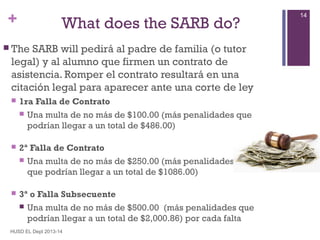
What does the SARB do?

 The

SARB will pedirá al padre de familia (o tutor
legal) y al alumno que firmen un contrato de
asistencia. Romper el contrato resultará en una
citación legal para aparecer ante una corte de ley


1ra Falla de Contrato
 Una multa de no más de $100.00 (más penalidades que
podrían llegar a un total de $486.00)



2ª Falla de Contrato
 Una multa de no más de $250.00 (más penalidades que
que podrían llegar a un total de $1086.00)



3ª o Falla Subsecuente
 Una multa de no más de $500.00 (más penalidades que
podrían llegar a un total de $2,000.86) por cada falta

HUSD EL Dept 2013-14

14
More Laws

+
 13202.7


P.C. (Penal Code) PARENT CONSEQUENCE

Not enrolling your child in an approved educational program could
result in a fine of $2,500.00 + 1 year in County Jail + up to 5 years
probation

 48200


V.C. (Vehicle Code) STUDENT CONSEQUENCE

Any minor less than 18 years of age, but older than 13 who is
legally “habitually truant”
 May have his driving right/privilege suspended for 1 year or
 May have the privilege of taking driving tests deferred for the same
period of time

 270.1


15

E.C. (Education Code) THE LAW

All parents/tutors are legally responsible in ensuring that their children
attend school from the age of 6 to 18

HUSD EL Dept 2013-14
+

16

Absences as a
Symptom of
Something More
Challenges to Student Attendance
Proactive Ideas
The Role of ELAC
HUSD EL Dept 2013-14
+

Comprendiendo la Ausencia
Síntoma de Algo Más…


Necesitamos entender por qué los estudiantes
se alejan de la escuela antes de llegar al punto
del SARB



La ausencia crónica e injustificada no es el
problema- es un indicador de otros problemas

HUSD EL Dept 2013-14

17
Ask yourself…
Why do students decide not to attend
school or a course?

HUSD EL Dept 2013-14

18
+ Challenges to Student Attendance

19

1.

Peer pressure

2.

Problems with authority figures

3.

Holding a job to earn money for him/herself
or his/her family

4.

Drug or alcohol abuse

5.

Having problems relating to other youth

HUSD EL Dept 2013-14
+

Further Challenges…

20

6.

Being a victim of bullying

7.

Having poor support at home or enduring
conflicts in the home

8.

Believing that the school does not offer a rigorous
program or courses that are engaging

9.

Being constantly reminded they are at a “low”
reading and math level

10.

Other personal challenges:
a. Language
b raciale or cultural conflicts
c. Shame due to appearance (e.g. Clothing)
d. pregnancy

HUSD EL Dept 2013-14
+

21

Important things to remember…
It is critical that parents assume
responsibility for their children’s unexcused
absence from an early age



The school can take a proactive role by
being a safe and welcoming place



And encourage both staff and parents to
establish regular contact BEFORE major
attendance problems manifest



HUSD EL Dept 2013-14
+ The most important factor determining
whether a student will attend school is

22

MOTIVATION


What motivates students to attend school?



When you continue to speak about
attendance at your ELACs, consider the
following…
1.
2.
3.

Review the challenges students face
Offer ideas on how to overcome them
Think of other ideas that might keep students at school

HUSD EL Dept 2013-14
Proactive Mesaures
Possible Ideas for Primary

+
 Share






23

attendance data and policy with parents

Focus on grade levels that need support
Review the Parent Student Compact
Review Ed Code on attendance, the SARB and chronic attendance

ELAC can recommend starting an “improve attendance campaign”




make it visible
make sure there is a clear message
link it to a contest or incentives (e.g. certificates)

 Inicien



concursos o incentivos de asistencia

El ELAC puede ayudar a crear o participar en incentivos
El ELAC puede ayudar a crear lienzos con negocios en la comunidad
que donen incentivos

HUSD EL Dept 2013-14
Proactive Mesaures
Possible Ideas for Secondary

+

 Strengthen




24

the Home-School Connection

The ELAC can sponsor attendance clinics at the Parent Center,
especially for incoming parents of 7th & 9th graders
Identify who these families are, reach out to them on the school’s behalf
 Advocate for outreach resources for these families (Parent Liaison,
counselors, etc.)
 Invite community groups (e.g. Tiburcio Vasquez to help out)

 Strengthen


the student-to-student connection

Start a mentor program wherein 8th and 11th/12th graders can “adopt”
students with attendance issues early on

 Advocate

so that local businesses do not “house” students
during school hours

 Incentives

also work at this level, but the emphasis can be on
improved, not perfect attendance
HUSD EL Dept 2013-14

Understanding school attendance 2013

  • 1.
    + The Importance of SchoolAttendance Laws Consequences & Proactive Ideas D.E.L.A.C District English Learners Advisory Committee 2013 – 2014 13 November 2013
  • 2.
    + 2 Absences & theLaw California Education Code Minor Consequences HUSD EL Dept 2013-14
  • 3.
    +Why must mychild attend school?  It’s an essential part of the formal educational learning process  It’s essential for his/her academic success  It’s the law! HUSD EL Dept 2013-14 3
  • 4.
    +Student Attendance Expectations 4 perCalifornia Education Code Reasons for allowable/excusable absences: 1.Illness a. (If absent for more than 2 consecutive days, a doctor’s note may be required) 2.Medical, 3.Funeral a. b. optical or dental services services for an immediate family member one day is allowed if the service is in California, three days are allowed if the service is outside California 4.Quarantine 5.Others personal justifiable reasons (for examplo, to observe a religious ceremony or festivity) HUSD EL Dept 2013-14
  • 5.
    + Absences Unallowable Reasons  Going shopping Minor sickness  The student’s birthday  Slept in  Visiting  Taking  Not relatives care of siblings at home having a school uniform  Transportation HUSD EL Dept 2013-14 problems 5
  • 6.
    +  6 The Law &Absences Rights of the Student & Family Under the law, a student absent from school must be…  Allowed to complete any homework and tests missed missed during the absence that can be reasonably provided  Awarded credit upon satisfactory completion within a reasonably agreed upon period of time HUSD EL Dept 2013-14
  • 7.
    The Law &Absences Parent Responsibility  A note and/or phone call to the school to clear the absence  Have 3 days (72 hours) to clear the absence HUSD EL Dept 2013-14 7
  • 8.
    Classroom Level Consequence Not justifying an absence shall result in a notation of unexcused absence in the homeroom teacher’s role book (primary) or in those of all missed courses (secondary) HUSD EL Dept 2013-14 8
  • 9.
    + School Level Consequences School staff may call for a meeting or SST when your child has been absent for many days without an excuse  The school may send a formal letter to parents of students who accumulate 3 or more days of unexcused absences warning of a further potential consequence that…  After 10 days of consecutive unexcused absences, the student may be removed from the attendance roster if parents have not contacted the school HUSD EL Dept 2013-14 9
  • 10.
  • 11.
    What is chronicabsenteeism? A student is “chronically “absent” when s/he  is absent without a valid excuse during at least 3 days within a school year; or  Is absent for more than a period of 30 minutes during the school day (which includes tardies) without a valid excuse on 3 ocassions during a school year, or  any combination of the above HUSD EL Dept 2013-14 11
  • 12.
    + The SARBProcess Established by Law 12  After the third day of unexcused absences the student is officially identified as “truant”   These absences are recorded by the office manager (primary) or attendance clerk (secondary) A first letter (warning) is sent home  At   the 4th unexcused absence a second letter is sent The student continues to be truant A School Attendance Review Team is convened (SART) to discuss the student’s attendance  After the fifth unexcused absence the student is identified as “habitually truant”  And is now subject to receive a summons to appear at a SARB hearing HUSD EL Dept 2013-14
  • 13.
    +  13 What is theSARB? School Attendance Review Board A legal body Established by Education Code 48260  Its main objective is to enforce parents’ legal (and moral) obligation to ensure that their children attend school in cases where there is a history of the parent not fulfilling this duty HUSD EL Dept 2013-14
  • 14.
    + What does theSARB do?  The SARB will pedirá al padre de familia (o tutor legal) y al alumno que firmen un contrato de asistencia. Romper el contrato resultará en una citación legal para aparecer ante una corte de ley  1ra Falla de Contrato  Una multa de no más de $100.00 (más penalidades que podrían llegar a un total de $486.00)  2ª Falla de Contrato  Una multa de no más de $250.00 (más penalidades que que podrían llegar a un total de $1086.00)  3ª o Falla Subsecuente  Una multa de no más de $500.00 (más penalidades que podrían llegar a un total de $2,000.86) por cada falta HUSD EL Dept 2013-14 14
  • 15.
    More Laws +  13202.7  P.C.(Penal Code) PARENT CONSEQUENCE Not enrolling your child in an approved educational program could result in a fine of $2,500.00 + 1 year in County Jail + up to 5 years probation  48200  V.C. (Vehicle Code) STUDENT CONSEQUENCE Any minor less than 18 years of age, but older than 13 who is legally “habitually truant”  May have his driving right/privilege suspended for 1 year or  May have the privilege of taking driving tests deferred for the same period of time  270.1  15 E.C. (Education Code) THE LAW All parents/tutors are legally responsible in ensuring that their children attend school from the age of 6 to 18 HUSD EL Dept 2013-14
  • 16.
    + 16 Absences as a Symptomof Something More Challenges to Student Attendance Proactive Ideas The Role of ELAC HUSD EL Dept 2013-14
  • 17.
    + Comprendiendo la Ausencia Síntomade Algo Más…  Necesitamos entender por qué los estudiantes se alejan de la escuela antes de llegar al punto del SARB  La ausencia crónica e injustificada no es el problema- es un indicador de otros problemas HUSD EL Dept 2013-14 17
  • 18.
    Ask yourself… Why dostudents decide not to attend school or a course? HUSD EL Dept 2013-14 18
  • 19.
    + Challenges toStudent Attendance 19 1. Peer pressure 2. Problems with authority figures 3. Holding a job to earn money for him/herself or his/her family 4. Drug or alcohol abuse 5. Having problems relating to other youth HUSD EL Dept 2013-14
  • 20.
    + Further Challenges… 20 6. Being avictim of bullying 7. Having poor support at home or enduring conflicts in the home 8. Believing that the school does not offer a rigorous program or courses that are engaging 9. Being constantly reminded they are at a “low” reading and math level 10. Other personal challenges: a. Language b raciale or cultural conflicts c. Shame due to appearance (e.g. Clothing) d. pregnancy HUSD EL Dept 2013-14
  • 21.
    + 21 Important things toremember… It is critical that parents assume responsibility for their children’s unexcused absence from an early age  The school can take a proactive role by being a safe and welcoming place  And encourage both staff and parents to establish regular contact BEFORE major attendance problems manifest  HUSD EL Dept 2013-14
  • 22.
    + The mostimportant factor determining whether a student will attend school is 22 MOTIVATION  What motivates students to attend school?  When you continue to speak about attendance at your ELACs, consider the following… 1. 2. 3. Review the challenges students face Offer ideas on how to overcome them Think of other ideas that might keep students at school HUSD EL Dept 2013-14
  • 23.
    Proactive Mesaures Possible Ideasfor Primary +  Share     23 attendance data and policy with parents Focus on grade levels that need support Review the Parent Student Compact Review Ed Code on attendance, the SARB and chronic attendance ELAC can recommend starting an “improve attendance campaign”    make it visible make sure there is a clear message link it to a contest or incentives (e.g. certificates)  Inicien   concursos o incentivos de asistencia El ELAC puede ayudar a crear o participar en incentivos El ELAC puede ayudar a crear lienzos con negocios en la comunidad que donen incentivos HUSD EL Dept 2013-14
  • 24.
    Proactive Mesaures Possible Ideasfor Secondary +  Strengthen   24 the Home-School Connection The ELAC can sponsor attendance clinics at the Parent Center, especially for incoming parents of 7th & 9th graders Identify who these families are, reach out to them on the school’s behalf  Advocate for outreach resources for these families (Parent Liaison, counselors, etc.)  Invite community groups (e.g. Tiburcio Vasquez to help out)  Strengthen  the student-to-student connection Start a mentor program wherein 8th and 11th/12th graders can “adopt” students with attendance issues early on  Advocate so that local businesses do not “house” students during school hours  Incentives also work at this level, but the emphasis can be on improved, not perfect attendance HUSD EL Dept 2013-14

Editor's Notes

  • #2 Dar la bienvenida y gracias por la participación de los padres de familia. Otro personal o documentos que se puede usar para presentar esta información son: Secretaria de asistencia escolar de su escuela- invita a esta persona para compartir con los participantes acerca de los requisitos de las ausencias. (donde llamar, cuando es necesario etc..) O usted como facilitador de la junta puede hacer una entrevista, ante mano, de la secretaria de asistencia y componer una hoja de las preguntas mas comunes para repasar y repartir a los participantes. Proveer a los participantes un directorio telefónica de los nombres y números de teléfono del profesorado escolar quien debe llamar. Pro
  • #4 Hacer esta pregunta al grupo y tomar unos 2-3 respuestas luego hacer “CLIC” para que aparece la información.
  • #5 La imagen demuestra las excusas perdonables
  • #8 Por favor de proveer el numero telefónico que los padres deben llamar en su escuela
  • #23 Los alumnos se motiven si… La escuela es segura y sana Emplean un currículo reto con máximo esperanzas Son divertidos y agradables Sentirse que pertenezcan a una comunidad de la escuela