Gail S. Owen, Regional
Superintendent
gowen@roe53.net
Patrick Durley,Assistant
Regional Superintendent
pdurley@roe53.net
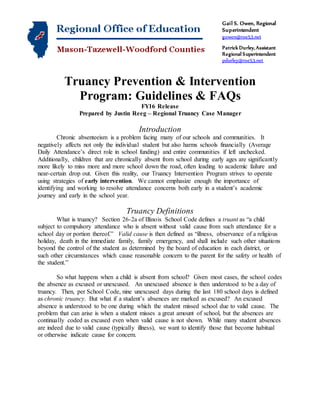
Truancy Prevention & Intervention
Program: Guidelines & FAQs
FY16 Release
Prepared by Justin Reeg – Regional Truancy Case Manager
Introduction
Chronic absenteeism is a problem facing many of our schools and communities. It
negatively affects not only the individual student but also harms schools financially (Average
Daily Attendance’s direct role in school funding) and entire communities if left unchecked.
Additionally, children that are chronically absent from school during early ages are significantly
more likely to miss more and more school down the road, often leading to academic failure and
near-certain drop out. Given this reality, our Truancy Intervention Program strives to operate
using strategies of early intervention. We cannot emphasize enough the importance of
identifying and working to resolve attendance concerns both early in a student’s academic
journey and early in the school year.
Truancy Definitions
What is truancy? Section 26-2a of Illinois School Code defines a truant as “a child
subject to compulsory attendance who is absent without valid cause from such attendance for a
school day or portion thereof.” Valid cause is then defined as “illness, observance of a religious
holiday, death in the immediate family, family emergency, and shall include such other situations
beyond the control of the student as determined by the board of education in each district, or
such other circumstances which cause reasonable concern to the parent for the safety or health of
the student.”
So what happens when a child is absent from school? Given most cases, the school codes
the absence as excused or unexcused. An unexcused absence is then understood to be a day of
truancy. Then, per School Code, nine unexcused days during the last 180 school days is defined
as chronic truancy. But what if a student’s absences are marked as excused? An excused
absence is understood to be one during which the student missed school due to valid cause. The
problem that can arise is when a student misses a great amount of school, but the absences are
continually coded as excused even when valid cause is not shown. While many student absences
are indeed due to valid cause (typically illness), we want to identify those that become habitual
or otherwise indicate cause for concern.
Gail S. Owen, Regional
Superintendent
gowen@roe53.net
Patrick Durley,Assistant
Regional Superintendent
pdurley@roe53.net
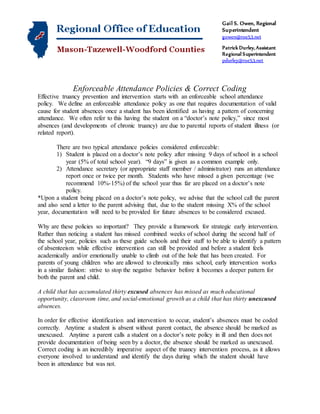
Enforceable Attendance Policies & Correct Coding
Effective truancy prevention and intervention starts with an enforceable school attendance
policy. We define an enforceable attendance policy as one that requires documentation of valid
cause for student absences once a student has been identified as having a pattern of concerning
attendance. We often refer to this having the student on a “doctor’s note policy,” since most
absences (and developments of chronic truancy) are due to parental reports of student illness (or
related report).
There are two typical attendance policies considered enforceable:
1) Student is placed on a doctor’s note policy after missing 9 days of school in a school
year (5% of total school year). “9 days” is given as a common example only.
2) Attendance secretary (or appropriate staff member / administrator) runs an attendance
report once or twice per month. Students who have missed a given percentage (we
recommend 10%-15%) of the school year thus far are placed on a doctor’s note
policy.
*Upon a student being placed on a doctor’s note policy, we advise that the school call the parent
and also send a letter to the parent advising that, due to the student missing X% of the school
year, documentation will need to be provided for future absences to be considered excused.
Why are these policies so important? They provide a framework for strategic early intervention.
Rather than noticing a student has missed combined weeks of school during the second half of
the school year, policies such as these guide schools and their staff to be able to identify a pattern
of absenteeism while effective intervention can still be provided and before a student feels
academically and/or emotionally unable to climb out of the hole that has been created. For
parents of young children who are allowed to chronically miss school, early intervention works
in a similar fashion: strive to stop the negative behavior before it becomes a deeper pattern for
both the parent and child.
A child that has accumulated thirty excused absences has missed as much educational
opportunity, classroom time, and social-emotional growth as a child that has thirty unexcused
absences.
In order for effective identification and intervention to occur, student’s absences must be coded
correctly. Anytime a student is absent without parent contact, the absence should be marked as
unexcused. Anytime a parent calls a student on a doctor’s note policy in ill and then does not
provide documentation of being seen by a doctor, the absence should be marked as unexcused.
Correct coding is an incredibly imperative aspect of the truancy intervention process, as it allows
everyone involved to understand and identify the days during which the student should have
been in attendance but was not.
Gail S. Owen, Regional
Superintendent
gowen@roe53.net
Patrick Durley,Assistant
Regional Superintendent
pdurley@roe53.net
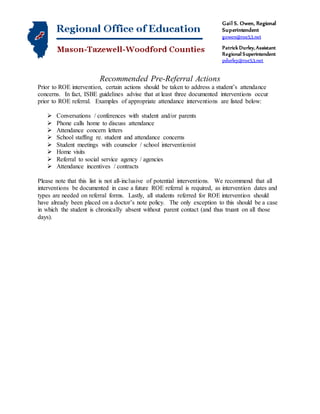
Recommended Pre-Referral Actions
Prior to ROE intervention, certain actions should be taken to address a student’s attendance
concerns. In fact, ISBE guidelines advise that at least three documented interventions occur
prior to ROE referral. Examples of appropriate attendance interventions are listed below:
 Conversations / conferences with student and/or parents
 Phone calls home to discuss attendance
 Attendance concern letters
 School staffing re. student and attendance concerns
 Student meetings with counselor / school interventionist
 Home visits
 Referral to social service agency / agencies
 Attendance incentives / contracts
Please note that this list is not all-inclusive of potential interventions. We recommend that all
interventions be documented in case a future ROE referral is required, as intervention dates and
types are needed on referral forms. Lastly, all students referred for ROE intervention should
have already been placed on a doctor’s note policy. The only exception to this should be a case
in which the student is chronically absent without parent contact (and thus truant on all those
days).
Gail S. Owen, Regional
Superintendent
gowen@roe53.net
Patrick Durley,Assistant
Regional Superintendent
pdurley@roe53.net
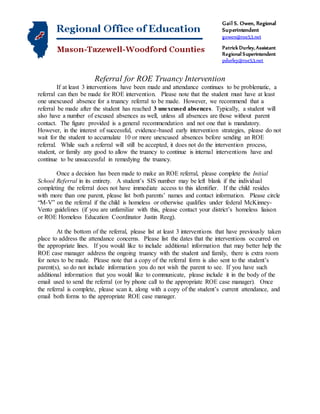
Referral for ROE Truancy Intervention
If at least 3 interventions have been made and attendance continues to be problematic, a
referral can then be made for ROE intervention. Please note that the student must have at least
one unexcused absence for a truancy referral to be made. However, we recommend that a
referral be made after the student has reached 3 unexcused absences. Typically, a student will
also have a number of excused absences as well, unless all absences are those without parent
contact. The figure provided is a general recommendation and not one that is mandatory.
However, in the interest of successful, evidence-based early intervention strategies, please do not
wait for the student to accumulate 10 or more unexcused absences before sending an ROE
referral. While such a referral will still be accepted, it does not do the intervention process,
student, or family any good to allow the truancy to continue is internal interventions have and
continue to be unsuccessful in remedying the truancy.
Once a decision has been made to make an ROE referral, please complete the Initial
School Referral in its entirety. A student’s SIS number may be left blank if the individual
completing the referral does not have immediate access to this identifier. If the child resides
with more than one parent, please list both parents’ names and contact information. Please circle
“M-V” on the referral if the child is homeless or otherwise qualifies under federal McKinney-
Vento guidelines (if you are unfamiliar with this, please contact your district’s homeless liaison
or ROE Homeless Education Coordinator Justin Reeg).
At the bottom of the referral, please list at least 3 interventions that have previously taken
place to address the attendance concerns. Please list the dates that the interventions occurred on
the appropriate lines. If you would like to include additional information that may better help the
ROE case manager address the ongoing truancy with the student and family, there is extra room
for notes to be made. Please note that a copy of the referral form is also sent to the student’s
parent(s), so do not include information you do not wish the parent to see. If you have such
additional information that you would like to communicate, please include it in the body of the
email used to send the referral (or by phone call to the appropriate ROE case manager). Once
the referral is complete, please scan it, along with a copy of the student’s current attendance, and
email both forms to the appropriate ROE case manager.
Gail S. Owen, Regional
Superintendent
gowen@roe53.net
Patrick Durley,Assistant
Regional Superintendent
pdurley@roe53.net
What Happens After a Referral is Made?
Within 1-2 school days of receiving the referral, the case manager will send a truancy
notice along with a copy of the school referral to the parent via regular mail. The case manager
will also attempt to call the parent(s) of the student to further inquire about and discuss the
student’s ongoing truancy concerns along with providing guidance on improving the student’s
attendance. We conduct interventions from a very strength-based approach – we seek to identify
and capitalize on the positive aspects of the student and family in order to achieve positive
results. As such, the initial conversation with a student’s parents are aimed at being empathetic
in nature while also ensuring that the parents understand what is expected of them with regard to
attendance and related academic concerns. Potential court-related consequences are never
threatened or even initially discussed unless the parent specifically inquires about them.
From this point forward, the ROE case manager will monitor the student’s attendance on
a near-daily basis as long as feasible. Case managers will make phone calls, conduct home and
school visits, and make referrals to other social service agencies as needed. Please understand
that FY16 is the first year of the newly consolidated ROE #53. Two truancy case managers are
assigned to cover 30 school districts over 3 large, separate counties. As such, case managers will
work diligently to attend to the needs of both schools and students but will occasionally be
spread very thin over the region given the scope of targeted interventions. Please understand and
work with us to make the first year of the new ROE #53 one of great success!
2nd & 3rd Referrals
The initial truancy referral is, by far, the most important referral, as it allows for near-
immediate intervention to be made by an ROE case manager. If the truancy persists despite
ROE intervention, your assigned case manager may ask that the Second School Referral be
completed and submitted. Much less information is required on additional referral forms, but
current attendance must again be scanned and emailed to the case worker. The Third School
Referral should be completed in a similar fashion as necessary.
Gail S. Owen, Regional
Superintendent
gowen@roe53.net
Patrick Durley,Assistant
Regional Superintendent
pdurley@roe53.net
Truancy Hearings & Recommendations for Court Action
If, despite both school interventions and ROE interventions, the student’s truancy
persists, the student’s ROE case manager may schedule a truancy hearing. Those in attendance
at the hearing must include the following: parent(s), ROE case manager, regional superintendent
of schools, school administrator familiar with student (or counselor / interventionist if desired),
and the student. Truancy hearings in the interest of young students who are at little or no fault
for their poor attendance will not be advised to attend; parents of these students will be advised
to send them to school on the day of the hearing. Hearings will most likely be held in the
county’s courthouse within which the student attends school. If multiple siblings from the same
parents are involved in the truancy process, the hearing will be scheduled in the interest of both
minors.
The truancy hearing is intended to be utilized as yet another intervention in the interest of
improving the given student(s) attendance. It is not intended to be punitive and is run from a
strengths-based approach. While underlying negative factors may still be discussed, the goal and
execution of the hearing is one of trying to capitalize on the student and family’s strength’s
and/or positive, pro-social goals rather than treating the parent(s) or student as a delinquent or
criminal. With that being noted, the ROE case manager and regional superintendent will make
the potential consequences for noncompliance very clear should the student’s attendance not
improve.
Should the truancy still persist after the hearing, the case may be referred to the State’s
Attorney’s Office (SAO) with a recommendation for court action based on educational neglect.
Please note that the SAO may decline to pursue court action. Should the SAO accept to pursue
court action, the family then typically goes through family court proceedings that often have
multiple stages. The Court will typically mandate that attendance improve along with mandating
other stipulations for parents and students as necessary, such as involvement in mental health
treatment, parenting classes, etc. These are just examples, and every case is different, but we felt
that schools and those that work should have a general understanding of what occurs after a case
if referred to the SAO.

truancy manual

  • 1.
    Gail S. Owen,Regional Superintendent gowen@roe53.net Patrick Durley,Assistant Regional Superintendent pdurley@roe53.net Truancy Prevention & Intervention Program: Guidelines & FAQs FY16 Release Prepared by Justin Reeg – Regional Truancy Case Manager Introduction Chronic absenteeism is a problem facing many of our schools and communities. It negatively affects not only the individual student but also harms schools financially (Average Daily Attendance’s direct role in school funding) and entire communities if left unchecked. Additionally, children that are chronically absent from school during early ages are significantly more likely to miss more and more school down the road, often leading to academic failure and near-certain drop out. Given this reality, our Truancy Intervention Program strives to operate using strategies of early intervention. We cannot emphasize enough the importance of identifying and working to resolve attendance concerns both early in a student’s academic journey and early in the school year. Truancy Definitions What is truancy? Section 26-2a of Illinois School Code defines a truant as “a child subject to compulsory attendance who is absent without valid cause from such attendance for a school day or portion thereof.” Valid cause is then defined as “illness, observance of a religious holiday, death in the immediate family, family emergency, and shall include such other situations beyond the control of the student as determined by the board of education in each district, or such other circumstances which cause reasonable concern to the parent for the safety or health of the student.” So what happens when a child is absent from school? Given most cases, the school codes the absence as excused or unexcused. An unexcused absence is then understood to be a day of truancy. Then, per School Code, nine unexcused days during the last 180 school days is defined as chronic truancy. But what if a student’s absences are marked as excused? An excused absence is understood to be one during which the student missed school due to valid cause. The problem that can arise is when a student misses a great amount of school, but the absences are continually coded as excused even when valid cause is not shown. While many student absences are indeed due to valid cause (typically illness), we want to identify those that become habitual or otherwise indicate cause for concern.
  • 2.
    Gail S. Owen,Regional Superintendent gowen@roe53.net Patrick Durley,Assistant Regional Superintendent pdurley@roe53.net Enforceable Attendance Policies & Correct Coding Effective truancy prevention and intervention starts with an enforceable school attendance policy. We define an enforceable attendance policy as one that requires documentation of valid cause for student absences once a student has been identified as having a pattern of concerning attendance. We often refer to this having the student on a “doctor’s note policy,” since most absences (and developments of chronic truancy) are due to parental reports of student illness (or related report). There are two typical attendance policies considered enforceable: 1) Student is placed on a doctor’s note policy after missing 9 days of school in a school year (5% of total school year). “9 days” is given as a common example only. 2) Attendance secretary (or appropriate staff member / administrator) runs an attendance report once or twice per month. Students who have missed a given percentage (we recommend 10%-15%) of the school year thus far are placed on a doctor’s note policy. *Upon a student being placed on a doctor’s note policy, we advise that the school call the parent and also send a letter to the parent advising that, due to the student missing X% of the school year, documentation will need to be provided for future absences to be considered excused. Why are these policies so important? They provide a framework for strategic early intervention. Rather than noticing a student has missed combined weeks of school during the second half of the school year, policies such as these guide schools and their staff to be able to identify a pattern of absenteeism while effective intervention can still be provided and before a student feels academically and/or emotionally unable to climb out of the hole that has been created. For parents of young children who are allowed to chronically miss school, early intervention works in a similar fashion: strive to stop the negative behavior before it becomes a deeper pattern for both the parent and child. A child that has accumulated thirty excused absences has missed as much educational opportunity, classroom time, and social-emotional growth as a child that has thirty unexcused absences. In order for effective identification and intervention to occur, student’s absences must be coded correctly. Anytime a student is absent without parent contact, the absence should be marked as unexcused. Anytime a parent calls a student on a doctor’s note policy in ill and then does not provide documentation of being seen by a doctor, the absence should be marked as unexcused. Correct coding is an incredibly imperative aspect of the truancy intervention process, as it allows everyone involved to understand and identify the days during which the student should have been in attendance but was not.
  • 3.
    Gail S. Owen,Regional Superintendent gowen@roe53.net Patrick Durley,Assistant Regional Superintendent pdurley@roe53.net Recommended Pre-Referral Actions Prior to ROE intervention, certain actions should be taken to address a student’s attendance concerns. In fact, ISBE guidelines advise that at least three documented interventions occur prior to ROE referral. Examples of appropriate attendance interventions are listed below:  Conversations / conferences with student and/or parents  Phone calls home to discuss attendance  Attendance concern letters  School staffing re. student and attendance concerns  Student meetings with counselor / school interventionist  Home visits  Referral to social service agency / agencies  Attendance incentives / contracts Please note that this list is not all-inclusive of potential interventions. We recommend that all interventions be documented in case a future ROE referral is required, as intervention dates and types are needed on referral forms. Lastly, all students referred for ROE intervention should have already been placed on a doctor’s note policy. The only exception to this should be a case in which the student is chronically absent without parent contact (and thus truant on all those days).
  • 4.
    Gail S. Owen,Regional Superintendent gowen@roe53.net Patrick Durley,Assistant Regional Superintendent pdurley@roe53.net Referral for ROE Truancy Intervention If at least 3 interventions have been made and attendance continues to be problematic, a referral can then be made for ROE intervention. Please note that the student must have at least one unexcused absence for a truancy referral to be made. However, we recommend that a referral be made after the student has reached 3 unexcused absences. Typically, a student will also have a number of excused absences as well, unless all absences are those without parent contact. The figure provided is a general recommendation and not one that is mandatory. However, in the interest of successful, evidence-based early intervention strategies, please do not wait for the student to accumulate 10 or more unexcused absences before sending an ROE referral. While such a referral will still be accepted, it does not do the intervention process, student, or family any good to allow the truancy to continue is internal interventions have and continue to be unsuccessful in remedying the truancy. Once a decision has been made to make an ROE referral, please complete the Initial School Referral in its entirety. A student’s SIS number may be left blank if the individual completing the referral does not have immediate access to this identifier. If the child resides with more than one parent, please list both parents’ names and contact information. Please circle “M-V” on the referral if the child is homeless or otherwise qualifies under federal McKinney- Vento guidelines (if you are unfamiliar with this, please contact your district’s homeless liaison or ROE Homeless Education Coordinator Justin Reeg). At the bottom of the referral, please list at least 3 interventions that have previously taken place to address the attendance concerns. Please list the dates that the interventions occurred on the appropriate lines. If you would like to include additional information that may better help the ROE case manager address the ongoing truancy with the student and family, there is extra room for notes to be made. Please note that a copy of the referral form is also sent to the student’s parent(s), so do not include information you do not wish the parent to see. If you have such additional information that you would like to communicate, please include it in the body of the email used to send the referral (or by phone call to the appropriate ROE case manager). Once the referral is complete, please scan it, along with a copy of the student’s current attendance, and email both forms to the appropriate ROE case manager.
  • 5.
    Gail S. Owen,Regional Superintendent gowen@roe53.net Patrick Durley,Assistant Regional Superintendent pdurley@roe53.net What Happens After a Referral is Made? Within 1-2 school days of receiving the referral, the case manager will send a truancy notice along with a copy of the school referral to the parent via regular mail. The case manager will also attempt to call the parent(s) of the student to further inquire about and discuss the student’s ongoing truancy concerns along with providing guidance on improving the student’s attendance. We conduct interventions from a very strength-based approach – we seek to identify and capitalize on the positive aspects of the student and family in order to achieve positive results. As such, the initial conversation with a student’s parents are aimed at being empathetic in nature while also ensuring that the parents understand what is expected of them with regard to attendance and related academic concerns. Potential court-related consequences are never threatened or even initially discussed unless the parent specifically inquires about them. From this point forward, the ROE case manager will monitor the student’s attendance on a near-daily basis as long as feasible. Case managers will make phone calls, conduct home and school visits, and make referrals to other social service agencies as needed. Please understand that FY16 is the first year of the newly consolidated ROE #53. Two truancy case managers are assigned to cover 30 school districts over 3 large, separate counties. As such, case managers will work diligently to attend to the needs of both schools and students but will occasionally be spread very thin over the region given the scope of targeted interventions. Please understand and work with us to make the first year of the new ROE #53 one of great success! 2nd & 3rd Referrals The initial truancy referral is, by far, the most important referral, as it allows for near- immediate intervention to be made by an ROE case manager. If the truancy persists despite ROE intervention, your assigned case manager may ask that the Second School Referral be completed and submitted. Much less information is required on additional referral forms, but current attendance must again be scanned and emailed to the case worker. The Third School Referral should be completed in a similar fashion as necessary.
  • 6.
    Gail S. Owen,Regional Superintendent gowen@roe53.net Patrick Durley,Assistant Regional Superintendent pdurley@roe53.net Truancy Hearings & Recommendations for Court Action If, despite both school interventions and ROE interventions, the student’s truancy persists, the student’s ROE case manager may schedule a truancy hearing. Those in attendance at the hearing must include the following: parent(s), ROE case manager, regional superintendent of schools, school administrator familiar with student (or counselor / interventionist if desired), and the student. Truancy hearings in the interest of young students who are at little or no fault for their poor attendance will not be advised to attend; parents of these students will be advised to send them to school on the day of the hearing. Hearings will most likely be held in the county’s courthouse within which the student attends school. If multiple siblings from the same parents are involved in the truancy process, the hearing will be scheduled in the interest of both minors. The truancy hearing is intended to be utilized as yet another intervention in the interest of improving the given student(s) attendance. It is not intended to be punitive and is run from a strengths-based approach. While underlying negative factors may still be discussed, the goal and execution of the hearing is one of trying to capitalize on the student and family’s strength’s and/or positive, pro-social goals rather than treating the parent(s) or student as a delinquent or criminal. With that being noted, the ROE case manager and regional superintendent will make the potential consequences for noncompliance very clear should the student’s attendance not improve. Should the truancy still persist after the hearing, the case may be referred to the State’s Attorney’s Office (SAO) with a recommendation for court action based on educational neglect. Please note that the SAO may decline to pursue court action. Should the SAO accept to pursue court action, the family then typically goes through family court proceedings that often have multiple stages. The Court will typically mandate that attendance improve along with mandating other stipulations for parents and students as necessary, such as involvement in mental health treatment, parenting classes, etc. These are just examples, and every case is different, but we felt that schools and those that work should have a general understanding of what occurs after a case if referred to the SAO.