Understanding Operating Systems 8th Edition
McHoes Solutions Manual install download
https://testbankfan.com/product/understanding-operating-
systems-8th-edition-mchoes-solutions-manual/
Download more testbank from https://testbankfan.com
We believe these products will be a great fit for you. Click
the link to download now, or visit testbankfan.com
to discover even more!
Understanding Operating Systems 7th Edition McHoes
Solutions Manual
https://testbankfan.com/product/understanding-operating-
systems-7th-edition-mchoes-solutions-manual/
Understanding Operating Systems 5th Edition McHoes
Solutions Manual
https://testbankfan.com/product/understanding-operating-
systems-5th-edition-mchoes-solutions-manual/
Understanding Operating Systems 5th Edition McHoes Test
Bank
https://testbankfan.com/product/understanding-operating-
systems-5th-edition-mchoes-test-bank/
Understanding Operating Systems 7th Edition McHoes Test
Bank
https://testbankfan.com/product/understanding-operating-
systems-7th-edition-mchoes-test-bank/
Operating Systems 3rd Edition Nutt Solutions Manual
https://testbankfan.com/product/operating-systems-3rd-edition-
nutt-solutions-manual/
Operating Systems 3rd Edition Deitel Solutions Manual
https://testbankfan.com/product/operating-systems-3rd-edition-
deitel-solutions-manual/
Modern Operating Systems 4th Edition Tanenbaum
Solutions Manual
https://testbankfan.com/product/modern-operating-systems-4th-
edition-tanenbaum-solutions-manual/
Survey of Operating Systems 5th Edition Holcombe
Solutions Manual
https://testbankfan.com/product/survey-of-operating-systems-5th-
edition-holcombe-solutions-manual/
Operating Systems Design And Implementation 3rd Edition
Tanenbaum Solutions Manual
https://testbankfan.com/product/operating-systems-design-and-
implementation-3rd-edition-tanenbaum-solutions-manual/
Understanding Operating Systems, Eighth Edition 9-1
© 2018 Cengage Learning. All Rights Reserved. May not be copied, scanned, or duplicated, in whole or in part, except for use as permitted in a
license distributed with a certain product or service or otherwise on a password-protected website for classroom use.
Chapter 9
Network Organization Concepts
At a Glance
Instructor’s Manual Table of Contents
• Overview
• Learning Objectives
• Teaching Tips
• Quick Quizzes
• Class Discussion Topics
• Additional Projects
• Additional Resources
• Key Terms
Understanding Operating Systems, Eighth Edition 9-2
© 2018 Cengage Learning. All Rights Reserved. May not be copied, scanned, or duplicated, in whole or in part, except for use as permitted in a
license distributed with a certain product or service or otherwise on a password-protected website for classroom use.
Lecture Notes
Overview
When computer resources are connected together by data communication components, they
form a network to support the many functions of the organization. Networks provide an
essential infrastructure for the members of an information-based society to process,
manipulate, and distribute data and information to each other. This chapter introduces the
terminology and basic concepts of networks.
Learning Objectives
After completing this chapter, the student should be able to describe:
• Several network topologies and how they connect hosts
• Several types of networks: LAN, MAN, WAN, and wireless LAN
• How circuit switching and packet switching compare
• How conflicts are resolved to allow a network to share common transmission hardware
and software effectively
• Two transport protocol models and how the layers of each one correspond to each other
Teaching Tips
Definitions and Concepts
1. Begin the discussion by introducing the terms network, network operating system
(NOS), and distributed operating system.
2. Note that at a minimum, a distributed operating system must provide the following
components: process or object management, memory management, file management,
device management, and network management. Use Figure 9.1 to aid the discussion.
3. Discuss the advantages of a distributed operating system.
4. In a distributed system, each processor classifies the other processors and their resources
as remote and considers its own resources local. Note that processors are referred to as
sites, hosts, and nodes, depending on the context in which they are mentioned. Use
Figure 9.2 to aid the discussion.
Network Topologies
1. Introduce the term topology.
Understanding Operating Systems, Eighth Edition 9-3
© 2018 Cengage Learning. All Rights Reserved. May not be copied, scanned, or duplicated, in whole or in part, except for use as permitted in a
license distributed with a certain product or service or otherwise on a password-protected website for classroom use.
2. Note that in each topology, there are trade-offs among the need for fast communication
among all sites, the tolerance of failure at a site or communication link, the cost of long
communication lines, and the difficulty of connecting one site to a large number of
other sites. Point out that the physical topology of a network may not reflect its logical
topology.
3. For the network designer, there are many alternatives available, all of which will
probably solve the customer’s requirements. When deciding which configuration to use,
designers should keep in mind four criteria: basic cost, communications cost, reliability,
and user environment.
Star
1. Use Figure 9.3 to introduce the star topology.
2. Note that the star topology permits easy routing because the central station knows the
path to all other sites.
Ring
1. In the ring topology, all sites are connected in a closed loop, with the first site connected
to the last. Use Figure 9.4 to aid the discussion.
2. Introduce the term protocol.
3. Use Figures 9.5 and 9.6 to discuss variations of the ring topology.
4. Note that although ring topologies share the disadvantage that every node must be
functional for the network to perform properly, rings can be designed that allow failed
nodes to be bypassed - a critical consideration for network stability.
Bus
1. In the bus topology, all sites are connected to a single communication line running the
length of the network. Use Figure 9.7 to aid the discussion.
2. Note that because all sites share a common communication line, only one of them can
successfully send messages at any one time. Therefore, a control mechanism is needed
to prevent collisions.
Tree
1. Use Figure 9.8 to introduce the tree topology.
2. Point out that one advantage of bus and tree topologies is that even if a single node fails,
message traffic can still flow through the network.
Understanding Operating Systems, Eighth Edition 9-4
© 2018 Cengage Learning. All Rights Reserved. May not be copied, scanned, or duplicated, in whole or in part, except for use as permitted in a
license distributed with a certain product or service or otherwise on a password-protected website for classroom use.
Hybrid
1. The objective of a hybrid configuration is to select from the strong points of each
topology and combine them to meet that system’s communications requirements most
effectively. Use Figures 9.9 and 9.10 to aid the discussion.
Teaching
Tip
To learn more about network topologies, visit:
https://www.lifewire.com/computer-network-topology-817884
Network Types
1. Networks are generally divided into local area networks, metropolitan area networks,
and wide area networks. Note however, that as communications technology advances,
the characteristics that define each group are blurring. In recent years, the wireless local
area network has become ubiquitous.
Personal Area Network
1. Explain that a personal area network (PAN) includes information technology that
operates within a radius of approximately 10 meters of an individual and is centered
around that one person.
2. Also called body area networks (BANs), PANs include networks for wearable
technology (gloves, caps, monitors, and so on) that use the natural connectivity of the
human body to communicate.
Local Area Network
1. Introduce the terms bridge and gateway.
2. Note the factors that should be considered when selecting a transmission medium: cost,
data rate, reliability, number of devices that can be supported, distance between units,
and technical limitations.
Metropolitan Area Network
1. A MAN is a high-speed network often configured as a logical ring. Depending on the
protocol used, messages are either transmitted in one direction using only one ring or in
both directions using two counter-rotating rings. Use Figures 9.4 and 9.5 to aid the
discussion.
Wide Area Network
1. A wide area network (WAN) defines a configuration that interconnects communication
facilities in different parts of the world, or that is operated as part of a public utility.
Point out that WANs use the communications lines of common carriers, which are
Understanding Operating Systems, Eighth Edition 9-5
© 2018 Cengage Learning. All Rights Reserved. May not be copied, scanned, or duplicated, in whole or in part, except for use as permitted in a
license distributed with a certain product or service or otherwise on a password-protected website for classroom use.
government- regulated private companies, such as telephone companies that already
provide the general public with communication facilities.
Wireless Local Area Network
1. A wireless local area network (WLAN) is a local area network that uses wireless
technology to connect computers or workstations located within the range of the
network. Use Table 9.1 to aid the discussion.
2. For wireless nodes (workstations, laptops, and so on), a WLAN can provide easy access
to a larger network or the Internet, as shown in Figure 9.12. Emphasize that a WLAN
poses security vulnerabilities because of its open architecture and the inherent difficulty
of keeping out unauthorized intruders.
Teaching
Tip
To learn about wireless network security, visit:
http://searchsecurity.techtarget.com/WLAN-security-Best-practices-for-wireless-
network-security
Quick Quiz 1
1. A(n) ____ provides good control for distributed computing systems and allows their
resources to be accessed in a unified way.
Answer: distributed operating system
2. The term ____ is used to describe a specific set of rules used to control the flow of
messages through the network.
Answer: protocol
3. A(n) ____ is a data-link layer device used to interconnect multiple networks using the
same protocol.
Answer: bridge
4. A(n) ____ translates one network’s protocol into another, resolving hardware and
software incompatibilities.
Answer: gateway
Software Design Issues
1. Examine four software issues that must be addressed by network designers in this
section:
▪ How do sites use addresses to locate other sites?
▪ How are messages routed, and how are they sent?
▪ How do processes communicate with each other?
Understanding Operating Systems, Eighth Edition 9-6
© 2018 Cengage Learning. All Rights Reserved. May not be copied, scanned, or duplicated, in whole or in part, except for use as permitted in a
license distributed with a certain product or service or otherwise on a password-protected website for classroom use.
▪ How are conflicting demands for resources resolved?
Addressing Conventions
1. Discuss the difference between local and global names.
2. Introduce the Domain Name Service (DNS) protocol. Use the example on page 305 to
aid the discussion.
3. Point out that not all components need to be present in all Internet addresses.
Nevertheless, the DNS is able to resolve them by examining each one in reverse order.
Routing Strategies
1. A router is an internetworking device, primarily software driven, which directs traffic
between two different types of LANs or between two network segments with different
protocol addresses.
2. Discuss the role of routers.
3. Routing protocols must consider addressing, address resolution, message format, and
error reporting. Note that most routing protocols are based on an addressing format that
uses a network and a node number to identify each node.
4. Introduce the term address resolution.
5. Briefly discuss the most widely used routing protocols in the Internet:
▪ Routing Information Protocol (RIP): In this protocol, selection of a path to
transfer data from one network to another is based on the number of intermediate
nodes, or hops, between the source and the destination. The path with the smallest
number of hops is always chosen.
▪ Open Shortest Path First (OSPF): In this protocol, selection of a transmission
path is made only after the state of a network has been determined. This way, if an
intermediate hop is malfunctioning, it is eliminated immediately from consideration
until its services have been restored.
Connection Models
1. A communication network is not concerned with the content of data being transmitted
but with moving the data from one point to another. Note that because it would be
prohibitive to connect each node in a network to all other nodes, the nodes are
connected to a communication network designed to minimize transmission costs and to
provide full connectivity among all attached devices.
2. The following topics should be discussed:
▪ Circuit Switching: This is a communication model in which a dedicated
communication path is established between two hosts. The path is a connected
Understanding Operating Systems, Eighth Edition 9-7
© 2018 Cengage Learning. All Rights Reserved. May not be copied, scanned, or duplicated, in whole or in part, except for use as permitted in a
license distributed with a certain product or service or otherwise on a password-protected website for classroom use.
sequence of links; the connection between the two points exists until one of them is
disconnected.
▪ Packet Switching: This is basically a store-and-forward technique in which a
message is divided into multiple equal-sized units called packets, which are then
sent through the network to their destination where they are reassembled into their
original long format. Use Figure 9.13 to aid the discussion. Note that there is no
guarantee that after a message has been divided into packets that they will all travel
along the same path to their destination or that they will arrive in their physical
sequential order. Note also, that packets from one message may be interspersed with
those from other messages as they travel toward their destinations.
Discuss the differences between circuit switching and packet switching. Use Table
9.2 to aid the discussion. Datagrams and virtual circuits should also be discussed.
Conflict Resolution
1. Introduce some medium access control techniques: round robin, reservation, and
contention. Then briefly examine three common medium access control protocols used
to implement access to resources: carrier sense multiple access (CSMA); token passing;
and distributed-queue, dual bus (DQDB).
2. The following topics should be discussed:
▪ Access Control Techniques: In networks, round robin allows each node on the
network to use the communication medium. If the node has data to send, it is given
a certain amount of time to complete the transmission. If the node has no data to
send, or if it completes transmission before the time is up, then the next node begins
its turn. The reservation technique is well-suited for lengthy and continuous traffic
while the contention technique is better for short and intermittent traffic.
▪ CSMA: Carrier sense multiple access (CSMA) is a contention-based protocol that is
easy to implement. Carrier sense means that a node on the network will listen to or
test the communication medium before transmitting any messages, thus preventing a
collision with another node that is currently transmitting. Introduce the terms
multiple access, carrier sense multiple access with collision detection
(CSMA/CD), and CSMA with collision avoidance (CSMA/CA).
▪ Token Passing: In a token passing network, a special electronic message, called a
“token,” is generated when the network is turned on. The token is then passed along
from node to node. Only the node with the token is allowed to transmit, and after it
has done so, it must pass the token on to another node. These networks typically
have either a bus or ring topology and are popular because access is fast and
collisions are nonexistent. Introduce the term token bus network.
▪ DQDB: The distributed-queue, dual bus (DQDB) protocol is intended for use with a
dual-bus configuration, where each bus transports data in only one direction and has
been standardized by one of the IEEE committees as part of its MAN standards.
Transmission on each bus consists of a steady stream of fixed-size slots, Use Figure
9.14 to aid the discussion.
Understanding Operating Systems, Eighth Edition 9-8
© 2018 Cengage Learning. All Rights Reserved. May not be copied, scanned, or duplicated, in whole or in part, except for use as permitted in a
license distributed with a certain product or service or otherwise on a password-protected website for classroom use.
Transport Protocol Standards
1. This section compares the OSI reference model with the TCP/IP model.
OSI Reference Model
1. This model provides the basis for connecting open systems for distributed applications
processing. Note that the word “open” means that any two systems that conform to the
reference model and the related standards can be connected, regardless of the vendor.
2. Use Figure 9.15 to illustrate the seven-layer OSI model.
3. Briefly discuss the function of each of the layers:
▪ Layer 1-Physical Layer: Layer 1 is at the bottom of the model. This is where the
mechanical, electrical, and functional specifications for connecting a device to a
particular network are described.
▪ Layer 2-Data Link Layer: Bridging between two homogeneous networks occurs at
this layer. On one side, the data link layer establishes and controls the physical path
of communications before sending data to the physical layer below it. It takes the
data, which has been divided into packets by the layers above it, and physically
assembles the packet for transmission by completing its frame.
▪ Layer 3-Network Layer: Layer 3 provides services such as addressing and routing
that move data through the network to its destination. Basically, the software at this
level accepts blocks of data from Layer 4, the transport layer, resizes them into
shorter packets, and routes them to the proper destination.
▪ Layer 4-Transport Layer: Software for this layer contains facilities that handle
user addressing; it ensures that all the packets of data have been received and that
none have been lost.
▪ Layer 5-Session Layer: While the transport layer is responsible for creating and
maintaining a logical connection between end points, the session layer provides a
user interface that adds value to the transport layer in the form of dialogue
management and error recovery.
▪ Layer 6-Presentation Layer: Layer 6 is responsible for data manipulation
functions common to many applications, such as formatting, compression, and
encryption. Data conversion, syntax conversion, and protocol conversion are
common tasks performed in this layer.
▪ Layer 7-Application Layer: This layer provides the interface to users and is
responsible for formatting user data before passing it to the lower layers for
transmission to a remote host. It contains network management functions and tools
to support distributed applications.
Teaching
Tip
To learn more about the OSI model, visit:
http://computer.howstuffworks.com/osi.htm
Understanding Operating Systems, Eighth Edition 9-9
© 2018 Cengage Learning. All Rights Reserved. May not be copied, scanned, or duplicated, in whole or in part, except for use as permitted in a
license distributed with a certain product or service or otherwise on a password-protected website for classroom use.
TCP/IP Model
1. The Transmission Control Protocol/Internet Protocol (TCP/IP) reference model is
probably the oldest transport protocol standard. It is the basis for Internet
communications and is the most widely used network layer protocol today. Note that it
was developed for the U.S. Department of Defense’s ARPANET and provides
reasonably efficient and error-free transmission among different systems.
2. The TCP/IP model organizes a communication system with three main components:
processes, hosts, and networks. Processes execute on hosts, which can often support
multiple simultaneous processes that are defined as primary units that need to
communicate. These processes communicate across the networks to which hosts are
connected. Use Figure 9.16 to aid the discussion.
3. The following topics should be discussed:
▪ Layer 1-Network Access Layer: Protocols at this layer provide access to a
communication network.
▪ Layer 2-Internet Layer: The Internet layer is equivalent to the portion of the
network layer of the OSI model that is not already included in the previous layer,
specifically the mechanism that performs routing functions.
▪ Layer 3-Host-Host Layer: This layer supports mechanisms to transfer data
between two processes on different host computers.
▪ Layer 4-Process/Application Layer: This layer includes protocols for computer-
to-computer resource sharing.
Quick Quiz 2
1. The ____ is the most widely used protocol for ring topology.
Answer: token ring
2. The ____ makes technical recommendations about data communication interfaces.
Answer: International Organization for Standardization (ISO)
3. The term ____ refers to the name by which a unit is known within its own system.
Answer: local name
4. The term ____ refers to the name by which a unit is known outside its own system.
Answer: global name
Class Discussion Topics
1. Discuss the advantages and disadvantages of the different network topologies.
2. Which network topology do you think your school employs, and why? Give reasons to
support your answer.
Understanding Operating Systems, Eighth Edition 9-10
© 2018 Cengage Learning. All Rights Reserved. May not be copied, scanned, or duplicated, in whole or in part, except for use as permitted in a
license distributed with a certain product or service or otherwise on a password-protected website for classroom use.
3. Which communication model do you think is most commonly used on the Internet?
Additional Projects
1. What is the most popular transmission media used in today’s high-speed LANs? Submit
a report that details its key characteristics.
2. Submit a report that discusses the steps involved in setting up a local area network in
Windows 10.
Additional Resources
1. Wi-Fi: http://www.gsmarena.com/glossary.php3?term=wi-fi
2. Network topologies: https://www.lifewire.com/computer-network-topology-817884
3. The OSI Model's Seven Layers Defined and Functions Explained:
https://support.microsoft.com/en-us/kb/103884
4. Circuit Switching vs. Packet Switching: https://www.lifewire.com/circuit-switching-vs-
packet-switching-3426726
5. Setting up a Local Area Network:
http://www.ibm.com/developerworks/library/l-lan/index.html
Key Terms
➢ bridge: a data-link layer device used to interconnect multiple networks using the
same protocol.
➢ bus topology: network architecture to connect elements together along a single
line.
➢ circuit switching: a communication model in which a dedicated communication
path is established between two hosts and on which all messages travel.
➢ distributed operating system: an operating system that provides control for a
distributed computing system, allowing its resources to be accessed in a unified
way.
➢ Domain Name Service (DNS): a general-purpose, distributed, replicated data
query service. Its principal function is the resolution of Internet addresses based
on fully qualified domain names.
➢ gateway: a communications device or program that passes data between
networks having similar functions but different protocols.
Understanding Operating Systems, Eighth Edition 9-11
© 2018 Cengage Learning. All Rights Reserved. May not be copied, scanned, or duplicated, in whole or in part, except for use as permitted in a
license distributed with a certain product or service or otherwise on a password-protected website for classroom use.
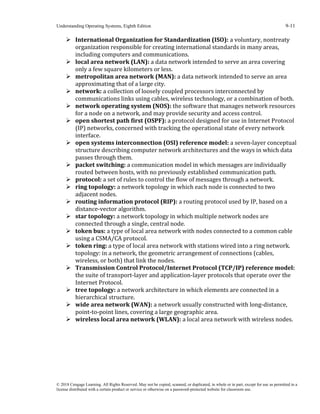
➢ International Organization for Standardization (ISO): a voluntary, nontreaty
organization responsible for creating international standards in many areas,
including computers and communications.
➢ local area network (LAN): a data network intended to serve an area covering
only a few square kilometers or less.
➢ metropolitan area network (MAN): a data network intended to serve an area
approximating that of a large city.
➢ network: a collection of loosely coupled processors interconnected by
communications links using cables, wireless technology, or a combination of both.
➢ network operating system (NOS): the software that manages network resources
for a node on a network, and may provide security and access control.
➢ open shortest path first (OSPF): a protocol designed for use in Internet Protocol
(IP) networks, concerned with tracking the operational state of every network
interface.
➢ open systems interconnection (OSI) reference model: a seven-layer conceptual
structure describing computer network architectures and the ways in which data
passes through them.
➢ packet switching: a communication model in which messages are individually
routed between hosts, with no previously established communication path.
➢ protocol: a set of rules to control the flow of messages through a network.
➢ ring topology: a network topology in which each node is connected to two
adjacent nodes.
➢ routing information protocol (RIP): a routing protocol used by IP, based on a
distance-vector algorithm.
➢ star topology: a network topology in which multiple network nodes are
connected through a single, central node.
➢ token bus: a type of local area network with nodes connected to a common cable
using a CSMA/CA protocol.
➢ token ring: a type of local area network with stations wired into a ring network.
topology: in a network, the geometric arrangement of connections (cables,
wireless, or both) that link the nodes.
➢ Transmission Control Protocol/Internet Protocol (TCP/IP) reference model:
the suite of transport-layer and application-layer protocols that operate over the
Internet Protocol.
➢ tree topology: a network architecture in which elements are connected in a
hierarchical structure.
➢ wide area network (WAN): a network usually constructed with long-distance,
point-to-point lines, covering a large geographic area.
➢ wireless local area network (WLAN): a local area network with wireless nodes.
Exploring the Variety of Random
Documents with Different Content
I look around to see whose is the voice
Whose cadence falls so sweetly on my ear
As thus to make my hating heart rejoice,
But vain my quest, no living soul is near.
XIII
A spirit voice I know, it needs must be
That sounds upon the air with silv’ry tone
And yet, withal, no fears arise in me,
Though midst the ruins here I am alone.
XIV
The voice now cautions me to listen well,
And in harmonious tones with lightning speed
This story he narrates for me to tell,
And thus I write it down that all may read.
XV
“That fatal morn, when Richmond felt secure,
With many more I ran to yonder hill
To watch the burning ship, all feeling sure
That nothing round could do us harm or ill.
XVI
“And why should aught around fill us with fears
Did we not know: The flag that braves the breeze
On land and sea for full one thousand years,
Flew o’er our city still and o’er our seas?
XVII
“The scene was bright and beautiful and grand,
With florid streamers shooting far on high,
And none who viewed the scene from sea or land
Were cognizant they were so soon to die.
XVIII
“Whose was the fault is not for me to tell.—
The Judge of All shall surely justice mete
To those who prematurely rang our knell
When they are come to His just judgement seat.
XIX
“You wonder why I wander ’neath the vault
Of heaven here and fain would ask—
’Tis but to beg forgiveness of a fault
And do again another ill-done task.
XX
“Though young in life, in wisdom now I’m old,
For I’ve passed through the chast’ning purge of fire;
My harp, though silver now, will soon be gold,
When time has passed and I have mounted higher.
XXI
“Along the path with slow increasing pace
Into the realms of peace where all is light;
’Till I have reached my time allotted seat,
There, to enjoy the beatific sight.
XXII
“Of God for aye and His hosannas sing,
Amidst the saints of His twice chosen few,
Before the treble throne of God, our King,
The vision of whose glory’s ever new.
XXIII
“The path is long, yet shorter may be made
By alms and prayers and other deeds of worth;
The happy day may, too, long be delayed
By thoughtless unforgiving hearts on earth.
XXIV
“Then do good deeds while in the flesh, my friend
And trespassers forgive, lest you forget
Such charity, till you have reached the end
Of life with some one unforgiven yet.
XXV
“Take heed that you will e’er remember this,
Lest you, as others did so oft before,
May cross that cold and ever dark abyss
Which separates earth from the spirit shore.
XXVI
“Which lieth far beyond the farthest sun,
And trembling stand before high Heaven’s court
With unforgiven thought and task undone;
No camouflage to which you can resort.
XXVII
“Be ye a man of lore, unlearned or youth,
Will there, as here on earth, avail you aught;
Nor will forensic speech conceal the truth
In your account of deed and word and thought.
XXVIII
“In stilly night I’ve often wandered here
Far from those realms beyond the starry sky,
O’er that long way, so lonely, dark and drear,
But now the hour of bliss for me draws nigh.
XXIX
“For soon the pearly gates, which now bar me,
Through which the sainted souls have ever trod
Will open wide and I shall ever see
The pristine glory of the throne of God.”
THE COTTAGE SCHOOL.
I
Summer time was in the waning,
Vesper Sun was wending low,
And reminiscences brought me
Back to school days long ago
There the school-house stood before me,
And I was on hallowed ground,
Where each old association
Inspiration breathed around.
II
Full in view the school was standing
Near the road and yet aloof,
Four square walls in ochre painted,
Topped off with a cottage roof.
In the distance old Atlantic
Glistened as in days of yore,
While upon his glimmering bosom,
White caps rolled towards the shore.
III
On the diamond boys were playing
Base-ball, with eclat and shout;
Saw the batter three times fanning,
Heard the umpire’s “Batter’s out.”
Saw some other hit a grounder,
Speed away like a winged bird;
Heard the rooters merry shouting,
As he landed safe on third.
IV
Heard the maidens merry laughter,
As they played upon the green,
And the rythm of their footfalls,
Skipping o’er the hard terrene,
Saw the little boys and maidens
Drinking at the nearby well:
And upon the air vibrating
Heard again the master’s bell.
V
Plainly heard the foot-step sounding
On the floor with measured beats,
While the boys and girls were filing
Through the aisles towards their seats.
Saw the whole class sitting upright,
In position, one and all;
Heard distinctly “Here” and “Absent,”
Answered to the master’s call.
VI
I could see the master’s visage,
With its look of learned lore,
While Sol’s summer shadows lengthened
Slowly o’er the school house floor;
O’er his head there hung a motto
With the words, “God Bless Our School”
Standing in the left-hand corner
Was the oft-used Dunces’ stool.
VII
Heard him from the Holy Bible
Read from some New Testament,
And to each and every passage,
Young and old, attention lent.
Heard once more the school repeating
Earnestly the Saviour’s prayer,
While around a holy stillness
Floated on the ev’ning air.
VIII
Saw the school take first position
At the sound of warning gong,
Heard the master’s voice intoning
Some old school or college song;
Saw all in position standing
With demeanour calm and still;
Saw them going through the movements
Of the military drill.
IX
On the walls the maps were hanging,
Colored in blue, red and gold,
Ornamented with the pictures
Of the noted men of old.
Moral maxims, plainly written
On the board in plain relief,
“Order Is First Law of Heaven,”
With some others terse and brief.
X
Summaries of all the home-work
By to-morrow to be learned;
Saw, too, some make interchanges
When the master’s back was turned.
On their slates the younger pupils
Strove to make their cranes and hooks,
While the older ones were busy
Writing in their copy books.
XI
Heard them spell and give the meaning,
And pronounce in unison;
Heard them too, in concert reading,
Reading also, one by one.
Saw them, on the Black-board, parsing
With and without formal line;
Use of “a” and “n” explaining
“These” and “those” and “thy” and “thine.”
XII
Heard them drill at combinations,
Learn to multiply and add,
Now subtracting, now dividing,—
Doing as the master bade;
Saw them on the map locating
Chiefest places of the earth;
Heard them give events in History,
’Fore and since our Saviour’s birth.
XIII
Heard them, too, at Nature lessons,
Saw the card within their hands,
With the Flora and the Fauna
Of our own and other lands;
Heard the master talk on Civics,
And our duties to the State,
And on Etiquette and Hygiene,
Heard him, too, at length dilate.
XIV
Not an incident was missing
Of those school days long since fled,
Though so many of its members
Now were numbered with the dead.
And too swiftly passed the vision
Retrospective of the past,
And upon my soul its setting
Fleeting specks of sadness cast.
DECEMBER SIXTH, 1917.
I
It was a clear and cool December dawn,
And bright the Sun in all his glory rose
And shed his radiant rays in plenty on
The lovely arm which by our city flows,
And on the hills and dales and distant trees
By Nature robed in early winter mien:
All Labour was awake; the docks and quays
Were all astir and formed a busy scene;
The flag flung to the breeze o’er Citadel
Gave heart to all: last night the sentry cried,
As o’er his beat he trod, that all was well,
And old and young thought but of Christmas-tide.
“Lord God of Hosts,” what is that awful roar
Upon all ears rolls from the Richmond shore;
II
I’ll ever hear that death-portending sound
And see the dead as side by side they lie,
And see the desolation wrought around
And hear the dying’s dissolution cry;
And see the houses bursting into flame
And those within consumed in tongues of fire,
And that long line of young, and old, and lame
Move slowly on when ordered to retire
From their wrecked homes to seek some safe retreat.
With falt’ring step and slow and wearied gait;
And see the motor cars whirl down the street
Full laden with their bloody, human freight:
For not, till in my breast the spirit dies
Will these sad scenes evanish from my eyes.
III
And ever see the op’ning hour of school,
And hear the bell sound on the morning air,
And see each little one with reticule
And well-trained poise and step assembling there,
And each pale-faced teacher in her place
And all the children there on bended knees,
With innocence imprinted on each face,
And hear their prayer borne on the morning breeze,
And hear the glass and falling timbers crash,
And see the children through the windows leap
With blood fast flowing from each gaping gash
Upon their heads and faces, long and deep;
And fain am I to fall into despair
That scenes so sad should follow children’s prayer.
IV
And ever see the blinded lying low
At Bellevue, Camp Hill, and College Hall;
And ever see the corpses, row on row,
Their mangled faces covered with a pall:
And curses such as tongue could never speak
Rise in my heart and flutter through my mind
Upon the man who did such ruin wreak
And leave such grief and misery behind;
And then a change comes o’er my angry thought
And I can see outlined upon the Cross
The Man of Sorrows, and I think of what
He did that Death be not our loss;
And bowing down I cry on bended knee
My Lord, my God, I yet have faith in Thee.
LIFE IS BUT ONE DARN THING AFTER
ANOTHER.
I
Whether in childhood or when you grow older,
Whether in summer or when it grows colder,
Whether in sunshine or lightning and thunder,
Be it on land or sea over or under,
Whether winter frosts freeze you or summer heat smother,
This you will find until life’s cord will sunder,
Life is but one darn thing after another.
II
Whether you cry from grief or smile with laughter,
Think of the present or past or hereafter,
Whether you’re rooming or whether house-keeping,
Sewing or darning or dusting or sweeping,
Dreaming of yours or some other girl’s brother,
This you will find whether waking or sleeping,
Life is but one darn thing after another.
III
If you have peace of mind or if you worry,
If things move slowly or if in a hurry,
If you make hasty steps or if you tarry,
If you stay single or if you marry,
Whether you barren be, whether a mother,
This you will find whate’er hap or miscarry,
Life is but one darn thing after another.
COURCELLETTE.
Early on an autumn morning,
Facing famous Courcellette,
Lay the Twenty-fifth battalion,
In the trenches damp and wet;
Far away from home and kindred,
Near the far-famed river Somme,
Here and there a man lay dying,
Stricken by a shell or bomb.
Men of every trade and calling,
Of each company formed a part,
Downy youth and bearded manhood
From the farm and from the mart,
Miners, farmers, sailors, tradesmen,
From each hamlet, town and glen,
Born of Nova Scotian mothers
From the breed of manly men.
All alert and ever watching,
On the guard both day and night,
Each one ever his part doing,
In the struggle for the right;
Thinking always of the homeland
Far away in Acadie,
Of a mother, wife, or sister
Whom they never more might see.
On the high hills overlooking,
All the country down below,
In their deep concreted dugouts,
Lay the ever watchful foe;
With artillery commanding
All the hills for miles around,
Through which, like a thread of silver,
River Somme its free way wound.
There were Saxons and Bavarians
In the Hun’s embattled host,
And the fierce and bloody Uhlans
Whom the Kaiser loves to toast;
Where they stood in close formation
Like a solid human block
Fronted by the famous fighters
Called the troops of battle shock.
When upon the morn in question,
Just about the break of day,
Word the Twenty-fifth was given
To make ready for the fray;
And they sprang up from their trenches
Like the wild lynx with a bound,
And they rushed without a falter
Right across the barrage ground;
And they fell upon the Germans
Like an avalanche of hail,
And the Teutons bent before them
Like the grain before the gale.
And with irresisting fury
They assailed the faltering Hun,
And before the day was over
Famous Courcellette was won.
Then let mothers tell their babies
Whom they nurse upon their breasts,
And the teachers tell the children
In our schools from east to west,
How at Courcellette’s fierce battle,
An undying name was made
By the Twenty-fifth battalion
Of the fighting fifth brigade.
VIMY RIDGE.
For days the cannon roaring
With loud incessant peal,
The terrane and the trenches
Had torn with lead and steel;
Which told the boys in khaki
Of fighting near at hand,
And eagerly all waited
The long wished for command.
Within the first line trenches,
The highland laddies lay,
Their thoughts were of their mothers
Or sweethearts far away;
Each one of them was thinking
Of home and native sod,
And like a Christian soldier
Had made his peace with God.
The morn broke dark and stormy
With hail and snow and sleet,
Which made for many soldiers
Ere night, their winding sheet;
The shrapnel bits were flying,
Like swarms of summer midge,
When Borden’s highland laddies
Charged up the Vimy Ridge.
On the top of this famed mountain,
Nearby the city Lens,
The enemy in dugouts
Lay like lions in their dens;
The mountain strong by nature,
The Germans stronger made
With cannon and with mortar,
On concrete bases laid.
And thousands of machine guns,
In their allotted place,
And thousands of their snipers,
With rifle and with brace;
And lines of barbed wire fencing
Of every strength and size,
And aught else which their science
Or cunning could devise.
Their seeming sense of safety,
The Teutons did elate,
And all were glibly chanting
The Kaiser’s hymn of hate,
When, lo! the pibroch’s skirling
Their first line did astound
And Donald, Rod and Angus
Came on them with a bound.
And ere they had recovered
From their astonishment
The foremost of their gleemen
To sing elsewhere were sent;
And midst the cry of Kam’rade
In broken English spoke,
Both Prussian and Bavarian
Went down from bayonet stroke.
And furious was the struggle,
’Twixt Highlander and Hun,
For hand to hand the fighting
On Vimy Ridge was done.
The shock troops of the Kaiser,
And all his proud array,
Fled fast before the Bluenose
On that eventful day.
And when the war is over
And when the war is over,
And peace again is come,
We’ll give our gallant laddies
A highland welcome home;
With flags and banners waving,
With singing and with cheer,
We’ll celebrate the glory
Of Vimy day each year.
GOD SAVE OUR EMPIRE GREAT.
God save our empire great,
And to her board of state,
Wise Counsel bring;
May we in union free,
Mother and daughters be,
Ever one family:
God save the king.
Grant that there will arise,
Beneath Canadian skies,
Freedom’s offspring;
May we be always free,
From hate and bigotry,
Co-heirs of liberty:
God save the king.
THE VETERAN
A veteran too was there with shoulders broad
As is the marsh in Amherst’s neighborhood;
Of stature high and of a kingly stride,
And in his face there shone a noble pride.
His eyes bespoke a soul to never yield
In fair fought fight at home or battle field.
A civic man before the war began
And since its end again a civic man.
Beloved by all his comrades, young and old,
For wise decisions and for action bold;
His head was cool but kindly was his heart,
In every act of war he did his part—
In digging in to use the lowly spade,
In battle field to wield the bloody blade,
In trench, in rest, to eat the soldiers’ fare,
A man of manly breed, his wounds to bear.
Three years he served where colored poppies grow
Between the wooden “crosses, row on row,”
Observing all, so well could tell a tale
of Bourlon Wood or bloody Pachendaele.
Typographical errors corrected by the etext
transcriber:
An Elegy Writtne in Richmond=> An Elegy Written in
Richmond
Burnihing in colors=> Burnishing in colors
now ’Im old=> now I’m old
The Tuetons did elate=> The Teutons did elate
Of lovliness divine=> Of loveliness divine
perfect ecastasy=> perfect ecstasy
A sweet momoriam for aye=> A sweet memoriam for
aye
*** END OF THE PROJECT GUTENBERG EBOOK POEMS ***
Updated editions will replace the previous one—the old editions
will be renamed.
Creating the works from print editions not protected by U.S.
copyright law means that no one owns a United States
copyright in these works, so the Foundation (and you!) can copy
and distribute it in the United States without permission and
without paying copyright royalties. Special rules, set forth in the
General Terms of Use part of this license, apply to copying and
distributing Project Gutenberg™ electronic works to protect the
PROJECT GUTENBERG™ concept and trademark. Project
Gutenberg is a registered trademark, and may not be used if
you charge for an eBook, except by following the terms of the
trademark license, including paying royalties for use of the
Project Gutenberg trademark. If you do not charge anything for
copies of this eBook, complying with the trademark license is
very easy. You may use this eBook for nearly any purpose such
as creation of derivative works, reports, performances and
research. Project Gutenberg eBooks may be modified and
printed and given away—you may do practically ANYTHING in
the United States with eBooks not protected by U.S. copyright
law. Redistribution is subject to the trademark license, especially
commercial redistribution.
START: FULL LICENSE

Understanding Operating Systems 8th Edition McHoes Solutions Manual

  • 1.
    Understanding Operating Systems8th Edition McHoes Solutions Manual install download https://testbankfan.com/product/understanding-operating- systems-8th-edition-mchoes-solutions-manual/ Download more testbank from https://testbankfan.com
  • 2.
    We believe theseproducts will be a great fit for you. Click the link to download now, or visit testbankfan.com to discover even more! Understanding Operating Systems 7th Edition McHoes Solutions Manual https://testbankfan.com/product/understanding-operating- systems-7th-edition-mchoes-solutions-manual/ Understanding Operating Systems 5th Edition McHoes Solutions Manual https://testbankfan.com/product/understanding-operating- systems-5th-edition-mchoes-solutions-manual/ Understanding Operating Systems 5th Edition McHoes Test Bank https://testbankfan.com/product/understanding-operating- systems-5th-edition-mchoes-test-bank/ Understanding Operating Systems 7th Edition McHoes Test Bank https://testbankfan.com/product/understanding-operating- systems-7th-edition-mchoes-test-bank/
  • 3.
    Operating Systems 3rdEdition Nutt Solutions Manual https://testbankfan.com/product/operating-systems-3rd-edition- nutt-solutions-manual/ Operating Systems 3rd Edition Deitel Solutions Manual https://testbankfan.com/product/operating-systems-3rd-edition- deitel-solutions-manual/ Modern Operating Systems 4th Edition Tanenbaum Solutions Manual https://testbankfan.com/product/modern-operating-systems-4th- edition-tanenbaum-solutions-manual/ Survey of Operating Systems 5th Edition Holcombe Solutions Manual https://testbankfan.com/product/survey-of-operating-systems-5th- edition-holcombe-solutions-manual/ Operating Systems Design And Implementation 3rd Edition Tanenbaum Solutions Manual https://testbankfan.com/product/operating-systems-design-and- implementation-3rd-edition-tanenbaum-solutions-manual/
  • 4.
    Understanding Operating Systems,Eighth Edition 9-1 © 2018 Cengage Learning. All Rights Reserved. May not be copied, scanned, or duplicated, in whole or in part, except for use as permitted in a license distributed with a certain product or service or otherwise on a password-protected website for classroom use. Chapter 9 Network Organization Concepts At a Glance Instructor’s Manual Table of Contents • Overview • Learning Objectives • Teaching Tips • Quick Quizzes • Class Discussion Topics • Additional Projects • Additional Resources • Key Terms
  • 5.
    Understanding Operating Systems,Eighth Edition 9-2 © 2018 Cengage Learning. All Rights Reserved. May not be copied, scanned, or duplicated, in whole or in part, except for use as permitted in a license distributed with a certain product or service or otherwise on a password-protected website for classroom use. Lecture Notes Overview When computer resources are connected together by data communication components, they form a network to support the many functions of the organization. Networks provide an essential infrastructure for the members of an information-based society to process, manipulate, and distribute data and information to each other. This chapter introduces the terminology and basic concepts of networks. Learning Objectives After completing this chapter, the student should be able to describe: • Several network topologies and how they connect hosts • Several types of networks: LAN, MAN, WAN, and wireless LAN • How circuit switching and packet switching compare • How conflicts are resolved to allow a network to share common transmission hardware and software effectively • Two transport protocol models and how the layers of each one correspond to each other Teaching Tips Definitions and Concepts 1. Begin the discussion by introducing the terms network, network operating system (NOS), and distributed operating system. 2. Note that at a minimum, a distributed operating system must provide the following components: process or object management, memory management, file management, device management, and network management. Use Figure 9.1 to aid the discussion. 3. Discuss the advantages of a distributed operating system. 4. In a distributed system, each processor classifies the other processors and their resources as remote and considers its own resources local. Note that processors are referred to as sites, hosts, and nodes, depending on the context in which they are mentioned. Use Figure 9.2 to aid the discussion. Network Topologies 1. Introduce the term topology.
  • 6.
    Understanding Operating Systems,Eighth Edition 9-3 © 2018 Cengage Learning. All Rights Reserved. May not be copied, scanned, or duplicated, in whole or in part, except for use as permitted in a license distributed with a certain product or service or otherwise on a password-protected website for classroom use. 2. Note that in each topology, there are trade-offs among the need for fast communication among all sites, the tolerance of failure at a site or communication link, the cost of long communication lines, and the difficulty of connecting one site to a large number of other sites. Point out that the physical topology of a network may not reflect its logical topology. 3. For the network designer, there are many alternatives available, all of which will probably solve the customer’s requirements. When deciding which configuration to use, designers should keep in mind four criteria: basic cost, communications cost, reliability, and user environment. Star 1. Use Figure 9.3 to introduce the star topology. 2. Note that the star topology permits easy routing because the central station knows the path to all other sites. Ring 1. In the ring topology, all sites are connected in a closed loop, with the first site connected to the last. Use Figure 9.4 to aid the discussion. 2. Introduce the term protocol. 3. Use Figures 9.5 and 9.6 to discuss variations of the ring topology. 4. Note that although ring topologies share the disadvantage that every node must be functional for the network to perform properly, rings can be designed that allow failed nodes to be bypassed - a critical consideration for network stability. Bus 1. In the bus topology, all sites are connected to a single communication line running the length of the network. Use Figure 9.7 to aid the discussion. 2. Note that because all sites share a common communication line, only one of them can successfully send messages at any one time. Therefore, a control mechanism is needed to prevent collisions. Tree 1. Use Figure 9.8 to introduce the tree topology. 2. Point out that one advantage of bus and tree topologies is that even if a single node fails, message traffic can still flow through the network.
  • 7.
    Understanding Operating Systems,Eighth Edition 9-4 © 2018 Cengage Learning. All Rights Reserved. May not be copied, scanned, or duplicated, in whole or in part, except for use as permitted in a license distributed with a certain product or service or otherwise on a password-protected website for classroom use. Hybrid 1. The objective of a hybrid configuration is to select from the strong points of each topology and combine them to meet that system’s communications requirements most effectively. Use Figures 9.9 and 9.10 to aid the discussion. Teaching Tip To learn more about network topologies, visit: https://www.lifewire.com/computer-network-topology-817884 Network Types 1. Networks are generally divided into local area networks, metropolitan area networks, and wide area networks. Note however, that as communications technology advances, the characteristics that define each group are blurring. In recent years, the wireless local area network has become ubiquitous. Personal Area Network 1. Explain that a personal area network (PAN) includes information technology that operates within a radius of approximately 10 meters of an individual and is centered around that one person. 2. Also called body area networks (BANs), PANs include networks for wearable technology (gloves, caps, monitors, and so on) that use the natural connectivity of the human body to communicate. Local Area Network 1. Introduce the terms bridge and gateway. 2. Note the factors that should be considered when selecting a transmission medium: cost, data rate, reliability, number of devices that can be supported, distance between units, and technical limitations. Metropolitan Area Network 1. A MAN is a high-speed network often configured as a logical ring. Depending on the protocol used, messages are either transmitted in one direction using only one ring or in both directions using two counter-rotating rings. Use Figures 9.4 and 9.5 to aid the discussion. Wide Area Network 1. A wide area network (WAN) defines a configuration that interconnects communication facilities in different parts of the world, or that is operated as part of a public utility. Point out that WANs use the communications lines of common carriers, which are
  • 8.
    Understanding Operating Systems,Eighth Edition 9-5 © 2018 Cengage Learning. All Rights Reserved. May not be copied, scanned, or duplicated, in whole or in part, except for use as permitted in a license distributed with a certain product or service or otherwise on a password-protected website for classroom use. government- regulated private companies, such as telephone companies that already provide the general public with communication facilities. Wireless Local Area Network 1. A wireless local area network (WLAN) is a local area network that uses wireless technology to connect computers or workstations located within the range of the network. Use Table 9.1 to aid the discussion. 2. For wireless nodes (workstations, laptops, and so on), a WLAN can provide easy access to a larger network or the Internet, as shown in Figure 9.12. Emphasize that a WLAN poses security vulnerabilities because of its open architecture and the inherent difficulty of keeping out unauthorized intruders. Teaching Tip To learn about wireless network security, visit: http://searchsecurity.techtarget.com/WLAN-security-Best-practices-for-wireless- network-security Quick Quiz 1 1. A(n) ____ provides good control for distributed computing systems and allows their resources to be accessed in a unified way. Answer: distributed operating system 2. The term ____ is used to describe a specific set of rules used to control the flow of messages through the network. Answer: protocol 3. A(n) ____ is a data-link layer device used to interconnect multiple networks using the same protocol. Answer: bridge 4. A(n) ____ translates one network’s protocol into another, resolving hardware and software incompatibilities. Answer: gateway Software Design Issues 1. Examine four software issues that must be addressed by network designers in this section: ▪ How do sites use addresses to locate other sites? ▪ How are messages routed, and how are they sent? ▪ How do processes communicate with each other?
  • 9.
    Understanding Operating Systems,Eighth Edition 9-6 © 2018 Cengage Learning. All Rights Reserved. May not be copied, scanned, or duplicated, in whole or in part, except for use as permitted in a license distributed with a certain product or service or otherwise on a password-protected website for classroom use. ▪ How are conflicting demands for resources resolved? Addressing Conventions 1. Discuss the difference between local and global names. 2. Introduce the Domain Name Service (DNS) protocol. Use the example on page 305 to aid the discussion. 3. Point out that not all components need to be present in all Internet addresses. Nevertheless, the DNS is able to resolve them by examining each one in reverse order. Routing Strategies 1. A router is an internetworking device, primarily software driven, which directs traffic between two different types of LANs or between two network segments with different protocol addresses. 2. Discuss the role of routers. 3. Routing protocols must consider addressing, address resolution, message format, and error reporting. Note that most routing protocols are based on an addressing format that uses a network and a node number to identify each node. 4. Introduce the term address resolution. 5. Briefly discuss the most widely used routing protocols in the Internet: ▪ Routing Information Protocol (RIP): In this protocol, selection of a path to transfer data from one network to another is based on the number of intermediate nodes, or hops, between the source and the destination. The path with the smallest number of hops is always chosen. ▪ Open Shortest Path First (OSPF): In this protocol, selection of a transmission path is made only after the state of a network has been determined. This way, if an intermediate hop is malfunctioning, it is eliminated immediately from consideration until its services have been restored. Connection Models 1. A communication network is not concerned with the content of data being transmitted but with moving the data from one point to another. Note that because it would be prohibitive to connect each node in a network to all other nodes, the nodes are connected to a communication network designed to minimize transmission costs and to provide full connectivity among all attached devices. 2. The following topics should be discussed: ▪ Circuit Switching: This is a communication model in which a dedicated communication path is established between two hosts. The path is a connected
  • 10.
    Understanding Operating Systems,Eighth Edition 9-7 © 2018 Cengage Learning. All Rights Reserved. May not be copied, scanned, or duplicated, in whole or in part, except for use as permitted in a license distributed with a certain product or service or otherwise on a password-protected website for classroom use. sequence of links; the connection between the two points exists until one of them is disconnected. ▪ Packet Switching: This is basically a store-and-forward technique in which a message is divided into multiple equal-sized units called packets, which are then sent through the network to their destination where they are reassembled into their original long format. Use Figure 9.13 to aid the discussion. Note that there is no guarantee that after a message has been divided into packets that they will all travel along the same path to their destination or that they will arrive in their physical sequential order. Note also, that packets from one message may be interspersed with those from other messages as they travel toward their destinations. Discuss the differences between circuit switching and packet switching. Use Table 9.2 to aid the discussion. Datagrams and virtual circuits should also be discussed. Conflict Resolution 1. Introduce some medium access control techniques: round robin, reservation, and contention. Then briefly examine three common medium access control protocols used to implement access to resources: carrier sense multiple access (CSMA); token passing; and distributed-queue, dual bus (DQDB). 2. The following topics should be discussed: ▪ Access Control Techniques: In networks, round robin allows each node on the network to use the communication medium. If the node has data to send, it is given a certain amount of time to complete the transmission. If the node has no data to send, or if it completes transmission before the time is up, then the next node begins its turn. The reservation technique is well-suited for lengthy and continuous traffic while the contention technique is better for short and intermittent traffic. ▪ CSMA: Carrier sense multiple access (CSMA) is a contention-based protocol that is easy to implement. Carrier sense means that a node on the network will listen to or test the communication medium before transmitting any messages, thus preventing a collision with another node that is currently transmitting. Introduce the terms multiple access, carrier sense multiple access with collision detection (CSMA/CD), and CSMA with collision avoidance (CSMA/CA). ▪ Token Passing: In a token passing network, a special electronic message, called a “token,” is generated when the network is turned on. The token is then passed along from node to node. Only the node with the token is allowed to transmit, and after it has done so, it must pass the token on to another node. These networks typically have either a bus or ring topology and are popular because access is fast and collisions are nonexistent. Introduce the term token bus network. ▪ DQDB: The distributed-queue, dual bus (DQDB) protocol is intended for use with a dual-bus configuration, where each bus transports data in only one direction and has been standardized by one of the IEEE committees as part of its MAN standards. Transmission on each bus consists of a steady stream of fixed-size slots, Use Figure 9.14 to aid the discussion.

  • 11.
    Understanding Operating Systems,Eighth Edition 9-8 © 2018 Cengage Learning. All Rights Reserved. May not be copied, scanned, or duplicated, in whole or in part, except for use as permitted in a license distributed with a certain product or service or otherwise on a password-protected website for classroom use. Transport Protocol Standards 1. This section compares the OSI reference model with the TCP/IP model. OSI Reference Model 1. This model provides the basis for connecting open systems for distributed applications processing. Note that the word “open” means that any two systems that conform to the reference model and the related standards can be connected, regardless of the vendor. 2. Use Figure 9.15 to illustrate the seven-layer OSI model. 3. Briefly discuss the function of each of the layers: ▪ Layer 1-Physical Layer: Layer 1 is at the bottom of the model. This is where the mechanical, electrical, and functional specifications for connecting a device to a particular network are described. ▪ Layer 2-Data Link Layer: Bridging between two homogeneous networks occurs at this layer. On one side, the data link layer establishes and controls the physical path of communications before sending data to the physical layer below it. It takes the data, which has been divided into packets by the layers above it, and physically assembles the packet for transmission by completing its frame. ▪ Layer 3-Network Layer: Layer 3 provides services such as addressing and routing that move data through the network to its destination. Basically, the software at this level accepts blocks of data from Layer 4, the transport layer, resizes them into shorter packets, and routes them to the proper destination. ▪ Layer 4-Transport Layer: Software for this layer contains facilities that handle user addressing; it ensures that all the packets of data have been received and that none have been lost. ▪ Layer 5-Session Layer: While the transport layer is responsible for creating and maintaining a logical connection between end points, the session layer provides a user interface that adds value to the transport layer in the form of dialogue management and error recovery. ▪ Layer 6-Presentation Layer: Layer 6 is responsible for data manipulation functions common to many applications, such as formatting, compression, and encryption. Data conversion, syntax conversion, and protocol conversion are common tasks performed in this layer. ▪ Layer 7-Application Layer: This layer provides the interface to users and is responsible for formatting user data before passing it to the lower layers for transmission to a remote host. It contains network management functions and tools to support distributed applications. Teaching Tip To learn more about the OSI model, visit: http://computer.howstuffworks.com/osi.htm
  • 12.
    Understanding Operating Systems,Eighth Edition 9-9 © 2018 Cengage Learning. All Rights Reserved. May not be copied, scanned, or duplicated, in whole or in part, except for use as permitted in a license distributed with a certain product or service or otherwise on a password-protected website for classroom use. TCP/IP Model 1. The Transmission Control Protocol/Internet Protocol (TCP/IP) reference model is probably the oldest transport protocol standard. It is the basis for Internet communications and is the most widely used network layer protocol today. Note that it was developed for the U.S. Department of Defense’s ARPANET and provides reasonably efficient and error-free transmission among different systems. 2. The TCP/IP model organizes a communication system with three main components: processes, hosts, and networks. Processes execute on hosts, which can often support multiple simultaneous processes that are defined as primary units that need to communicate. These processes communicate across the networks to which hosts are connected. Use Figure 9.16 to aid the discussion. 3. The following topics should be discussed: ▪ Layer 1-Network Access Layer: Protocols at this layer provide access to a communication network. ▪ Layer 2-Internet Layer: The Internet layer is equivalent to the portion of the network layer of the OSI model that is not already included in the previous layer, specifically the mechanism that performs routing functions. ▪ Layer 3-Host-Host Layer: This layer supports mechanisms to transfer data between two processes on different host computers. ▪ Layer 4-Process/Application Layer: This layer includes protocols for computer- to-computer resource sharing. Quick Quiz 2 1. The ____ is the most widely used protocol for ring topology. Answer: token ring 2. The ____ makes technical recommendations about data communication interfaces. Answer: International Organization for Standardization (ISO) 3. The term ____ refers to the name by which a unit is known within its own system. Answer: local name 4. The term ____ refers to the name by which a unit is known outside its own system. Answer: global name Class Discussion Topics 1. Discuss the advantages and disadvantages of the different network topologies. 2. Which network topology do you think your school employs, and why? Give reasons to support your answer.
  • 13.
    Understanding Operating Systems,Eighth Edition 9-10 © 2018 Cengage Learning. All Rights Reserved. May not be copied, scanned, or duplicated, in whole or in part, except for use as permitted in a license distributed with a certain product or service or otherwise on a password-protected website for classroom use. 3. Which communication model do you think is most commonly used on the Internet? Additional Projects 1. What is the most popular transmission media used in today’s high-speed LANs? Submit a report that details its key characteristics. 2. Submit a report that discusses the steps involved in setting up a local area network in Windows 10. Additional Resources 1. Wi-Fi: http://www.gsmarena.com/glossary.php3?term=wi-fi 2. Network topologies: https://www.lifewire.com/computer-network-topology-817884 3. The OSI Model's Seven Layers Defined and Functions Explained: https://support.microsoft.com/en-us/kb/103884 4. Circuit Switching vs. Packet Switching: https://www.lifewire.com/circuit-switching-vs- packet-switching-3426726 5. Setting up a Local Area Network: http://www.ibm.com/developerworks/library/l-lan/index.html Key Terms ➢ bridge: a data-link layer device used to interconnect multiple networks using the same protocol. ➢ bus topology: network architecture to connect elements together along a single line. ➢ circuit switching: a communication model in which a dedicated communication path is established between two hosts and on which all messages travel. ➢ distributed operating system: an operating system that provides control for a distributed computing system, allowing its resources to be accessed in a unified way. ➢ Domain Name Service (DNS): a general-purpose, distributed, replicated data query service. Its principal function is the resolution of Internet addresses based on fully qualified domain names. ➢ gateway: a communications device or program that passes data between networks having similar functions but different protocols.
  • 14.
    Understanding Operating Systems,Eighth Edition 9-11 © 2018 Cengage Learning. All Rights Reserved. May not be copied, scanned, or duplicated, in whole or in part, except for use as permitted in a license distributed with a certain product or service or otherwise on a password-protected website for classroom use. ➢ International Organization for Standardization (ISO): a voluntary, nontreaty organization responsible for creating international standards in many areas, including computers and communications. ➢ local area network (LAN): a data network intended to serve an area covering only a few square kilometers or less. ➢ metropolitan area network (MAN): a data network intended to serve an area approximating that of a large city. ➢ network: a collection of loosely coupled processors interconnected by communications links using cables, wireless technology, or a combination of both. ➢ network operating system (NOS): the software that manages network resources for a node on a network, and may provide security and access control. ➢ open shortest path first (OSPF): a protocol designed for use in Internet Protocol (IP) networks, concerned with tracking the operational state of every network interface. ➢ open systems interconnection (OSI) reference model: a seven-layer conceptual structure describing computer network architectures and the ways in which data passes through them. ➢ packet switching: a communication model in which messages are individually routed between hosts, with no previously established communication path. ➢ protocol: a set of rules to control the flow of messages through a network. ➢ ring topology: a network topology in which each node is connected to two adjacent nodes. ➢ routing information protocol (RIP): a routing protocol used by IP, based on a distance-vector algorithm. ➢ star topology: a network topology in which multiple network nodes are connected through a single, central node. ➢ token bus: a type of local area network with nodes connected to a common cable using a CSMA/CA protocol. ➢ token ring: a type of local area network with stations wired into a ring network. topology: in a network, the geometric arrangement of connections (cables, wireless, or both) that link the nodes. ➢ Transmission Control Protocol/Internet Protocol (TCP/IP) reference model: the suite of transport-layer and application-layer protocols that operate over the Internet Protocol. ➢ tree topology: a network architecture in which elements are connected in a hierarchical structure. ➢ wide area network (WAN): a network usually constructed with long-distance, point-to-point lines, covering a large geographic area. ➢ wireless local area network (WLAN): a local area network with wireless nodes.
  • 15.
    Exploring the Varietyof Random Documents with Different Content
  • 16.
    I look aroundto see whose is the voice Whose cadence falls so sweetly on my ear As thus to make my hating heart rejoice, But vain my quest, no living soul is near. XIII A spirit voice I know, it needs must be That sounds upon the air with silv’ry tone And yet, withal, no fears arise in me, Though midst the ruins here I am alone. XIV The voice now cautions me to listen well, And in harmonious tones with lightning speed This story he narrates for me to tell, And thus I write it down that all may read. XV “That fatal morn, when Richmond felt secure, With many more I ran to yonder hill To watch the burning ship, all feeling sure That nothing round could do us harm or ill. XVI
  • 17.
    “And why shouldaught around fill us with fears Did we not know: The flag that braves the breeze On land and sea for full one thousand years, Flew o’er our city still and o’er our seas? XVII “The scene was bright and beautiful and grand, With florid streamers shooting far on high, And none who viewed the scene from sea or land Were cognizant they were so soon to die. XVIII “Whose was the fault is not for me to tell.— The Judge of All shall surely justice mete To those who prematurely rang our knell When they are come to His just judgement seat. XIX “You wonder why I wander ’neath the vault Of heaven here and fain would ask— ’Tis but to beg forgiveness of a fault And do again another ill-done task. XX
  • 18.
    “Though young inlife, in wisdom now I’m old, For I’ve passed through the chast’ning purge of fire; My harp, though silver now, will soon be gold, When time has passed and I have mounted higher. XXI “Along the path with slow increasing pace Into the realms of peace where all is light; ’Till I have reached my time allotted seat, There, to enjoy the beatific sight. XXII “Of God for aye and His hosannas sing, Amidst the saints of His twice chosen few, Before the treble throne of God, our King, The vision of whose glory’s ever new. XXIII “The path is long, yet shorter may be made By alms and prayers and other deeds of worth; The happy day may, too, long be delayed By thoughtless unforgiving hearts on earth. XXIV
  • 19.
    “Then do gooddeeds while in the flesh, my friend And trespassers forgive, lest you forget Such charity, till you have reached the end Of life with some one unforgiven yet. XXV “Take heed that you will e’er remember this, Lest you, as others did so oft before, May cross that cold and ever dark abyss Which separates earth from the spirit shore. XXVI “Which lieth far beyond the farthest sun, And trembling stand before high Heaven’s court With unforgiven thought and task undone; No camouflage to which you can resort. XXVII “Be ye a man of lore, unlearned or youth, Will there, as here on earth, avail you aught; Nor will forensic speech conceal the truth In your account of deed and word and thought. XXVIII
  • 20.
    “In stilly nightI’ve often wandered here Far from those realms beyond the starry sky, O’er that long way, so lonely, dark and drear, But now the hour of bliss for me draws nigh. XXIX “For soon the pearly gates, which now bar me, Through which the sainted souls have ever trod Will open wide and I shall ever see The pristine glory of the throne of God.”
  • 21.
    THE COTTAGE SCHOOL. I Summertime was in the waning, Vesper Sun was wending low, And reminiscences brought me Back to school days long ago There the school-house stood before me, And I was on hallowed ground, Where each old association Inspiration breathed around. II Full in view the school was standing Near the road and yet aloof, Four square walls in ochre painted, Topped off with a cottage roof. In the distance old Atlantic Glistened as in days of yore, While upon his glimmering bosom, White caps rolled towards the shore. III
  • 22.
    On the diamondboys were playing Base-ball, with eclat and shout; Saw the batter three times fanning, Heard the umpire’s “Batter’s out.” Saw some other hit a grounder, Speed away like a winged bird; Heard the rooters merry shouting, As he landed safe on third. IV Heard the maidens merry laughter, As they played upon the green, And the rythm of their footfalls, Skipping o’er the hard terrene, Saw the little boys and maidens Drinking at the nearby well: And upon the air vibrating Heard again the master’s bell. V Plainly heard the foot-step sounding On the floor with measured beats, While the boys and girls were filing Through the aisles towards their seats. Saw the whole class sitting upright, In position, one and all; Heard distinctly “Here” and “Absent,” Answered to the master’s call.
  • 23.
    VI I could seethe master’s visage, With its look of learned lore, While Sol’s summer shadows lengthened Slowly o’er the school house floor; O’er his head there hung a motto With the words, “God Bless Our School” Standing in the left-hand corner Was the oft-used Dunces’ stool. VII Heard him from the Holy Bible Read from some New Testament, And to each and every passage, Young and old, attention lent. Heard once more the school repeating Earnestly the Saviour’s prayer, While around a holy stillness Floated on the ev’ning air. VIII
  • 24.
    Saw the schooltake first position At the sound of warning gong, Heard the master’s voice intoning Some old school or college song; Saw all in position standing With demeanour calm and still; Saw them going through the movements Of the military drill. IX On the walls the maps were hanging, Colored in blue, red and gold, Ornamented with the pictures Of the noted men of old. Moral maxims, plainly written On the board in plain relief, “Order Is First Law of Heaven,” With some others terse and brief. X Summaries of all the home-work By to-morrow to be learned; Saw, too, some make interchanges When the master’s back was turned. On their slates the younger pupils Strove to make their cranes and hooks, While the older ones were busy Writing in their copy books.
  • 25.
    XI Heard them spelland give the meaning, And pronounce in unison; Heard them too, in concert reading, Reading also, one by one. Saw them, on the Black-board, parsing With and without formal line; Use of “a” and “n” explaining “These” and “those” and “thy” and “thine.” XII Heard them drill at combinations, Learn to multiply and add, Now subtracting, now dividing,— Doing as the master bade; Saw them on the map locating Chiefest places of the earth; Heard them give events in History, ’Fore and since our Saviour’s birth. XIII
  • 26.
    Heard them, too,at Nature lessons, Saw the card within their hands, With the Flora and the Fauna Of our own and other lands; Heard the master talk on Civics, And our duties to the State, And on Etiquette and Hygiene, Heard him, too, at length dilate. XIV Not an incident was missing Of those school days long since fled, Though so many of its members Now were numbered with the dead. And too swiftly passed the vision Retrospective of the past, And upon my soul its setting Fleeting specks of sadness cast.
  • 27.
    DECEMBER SIXTH, 1917. I Itwas a clear and cool December dawn, And bright the Sun in all his glory rose And shed his radiant rays in plenty on The lovely arm which by our city flows, And on the hills and dales and distant trees By Nature robed in early winter mien: All Labour was awake; the docks and quays Were all astir and formed a busy scene; The flag flung to the breeze o’er Citadel Gave heart to all: last night the sentry cried, As o’er his beat he trod, that all was well, And old and young thought but of Christmas-tide. “Lord God of Hosts,” what is that awful roar Upon all ears rolls from the Richmond shore; II
  • 28.
    I’ll ever hearthat death-portending sound And see the dead as side by side they lie, And see the desolation wrought around And hear the dying’s dissolution cry; And see the houses bursting into flame And those within consumed in tongues of fire, And that long line of young, and old, and lame Move slowly on when ordered to retire From their wrecked homes to seek some safe retreat. With falt’ring step and slow and wearied gait; And see the motor cars whirl down the street Full laden with their bloody, human freight: For not, till in my breast the spirit dies Will these sad scenes evanish from my eyes. III And ever see the op’ning hour of school, And hear the bell sound on the morning air, And see each little one with reticule And well-trained poise and step assembling there, And each pale-faced teacher in her place And all the children there on bended knees, With innocence imprinted on each face, And hear their prayer borne on the morning breeze, And hear the glass and falling timbers crash, And see the children through the windows leap With blood fast flowing from each gaping gash Upon their heads and faces, long and deep; And fain am I to fall into despair That scenes so sad should follow children’s prayer.
  • 29.
    IV And ever seethe blinded lying low At Bellevue, Camp Hill, and College Hall; And ever see the corpses, row on row, Their mangled faces covered with a pall: And curses such as tongue could never speak Rise in my heart and flutter through my mind Upon the man who did such ruin wreak And leave such grief and misery behind; And then a change comes o’er my angry thought And I can see outlined upon the Cross The Man of Sorrows, and I think of what He did that Death be not our loss; And bowing down I cry on bended knee My Lord, my God, I yet have faith in Thee.
  • 30.
    LIFE IS BUTONE DARN THING AFTER ANOTHER. I Whether in childhood or when you grow older, Whether in summer or when it grows colder, Whether in sunshine or lightning and thunder, Be it on land or sea over or under, Whether winter frosts freeze you or summer heat smother, This you will find until life’s cord will sunder, Life is but one darn thing after another. II Whether you cry from grief or smile with laughter, Think of the present or past or hereafter, Whether you’re rooming or whether house-keeping, Sewing or darning or dusting or sweeping, Dreaming of yours or some other girl’s brother, This you will find whether waking or sleeping, Life is but one darn thing after another. III
  • 31.
    If you havepeace of mind or if you worry, If things move slowly or if in a hurry, If you make hasty steps or if you tarry, If you stay single or if you marry, Whether you barren be, whether a mother, This you will find whate’er hap or miscarry, Life is but one darn thing after another.
  • 32.
  • 33.
    Early on anautumn morning, Facing famous Courcellette, Lay the Twenty-fifth battalion, In the trenches damp and wet; Far away from home and kindred, Near the far-famed river Somme, Here and there a man lay dying, Stricken by a shell or bomb. Men of every trade and calling, Of each company formed a part, Downy youth and bearded manhood From the farm and from the mart, Miners, farmers, sailors, tradesmen, From each hamlet, town and glen, Born of Nova Scotian mothers From the breed of manly men. All alert and ever watching, On the guard both day and night, Each one ever his part doing, In the struggle for the right; Thinking always of the homeland Far away in Acadie, Of a mother, wife, or sister Whom they never more might see. On the high hills overlooking, All the country down below, In their deep concreted dugouts, Lay the ever watchful foe; With artillery commanding All the hills for miles around, Through which, like a thread of silver, River Somme its free way wound.
  • 34.
    There were Saxonsand Bavarians In the Hun’s embattled host, And the fierce and bloody Uhlans Whom the Kaiser loves to toast; Where they stood in close formation Like a solid human block Fronted by the famous fighters Called the troops of battle shock. When upon the morn in question, Just about the break of day, Word the Twenty-fifth was given To make ready for the fray; And they sprang up from their trenches Like the wild lynx with a bound, And they rushed without a falter Right across the barrage ground; And they fell upon the Germans Like an avalanche of hail, And the Teutons bent before them Like the grain before the gale. And with irresisting fury They assailed the faltering Hun, And before the day was over Famous Courcellette was won. Then let mothers tell their babies Whom they nurse upon their breasts, And the teachers tell the children In our schools from east to west, How at Courcellette’s fierce battle, An undying name was made By the Twenty-fifth battalion Of the fighting fifth brigade.
  • 35.
  • 36.
    For days thecannon roaring With loud incessant peal, The terrane and the trenches Had torn with lead and steel; Which told the boys in khaki Of fighting near at hand, And eagerly all waited The long wished for command. Within the first line trenches, The highland laddies lay, Their thoughts were of their mothers Or sweethearts far away; Each one of them was thinking Of home and native sod, And like a Christian soldier Had made his peace with God. The morn broke dark and stormy With hail and snow and sleet, Which made for many soldiers Ere night, their winding sheet; The shrapnel bits were flying, Like swarms of summer midge, When Borden’s highland laddies Charged up the Vimy Ridge. On the top of this famed mountain, Nearby the city Lens, The enemy in dugouts Lay like lions in their dens; The mountain strong by nature, The Germans stronger made With cannon and with mortar, On concrete bases laid.
  • 37.
    And thousands ofmachine guns, In their allotted place, And thousands of their snipers, With rifle and with brace; And lines of barbed wire fencing Of every strength and size, And aught else which their science Or cunning could devise. Their seeming sense of safety, The Teutons did elate, And all were glibly chanting The Kaiser’s hymn of hate, When, lo! the pibroch’s skirling Their first line did astound And Donald, Rod and Angus Came on them with a bound. And ere they had recovered From their astonishment The foremost of their gleemen To sing elsewhere were sent; And midst the cry of Kam’rade In broken English spoke, Both Prussian and Bavarian Went down from bayonet stroke. And furious was the struggle, ’Twixt Highlander and Hun, For hand to hand the fighting On Vimy Ridge was done. The shock troops of the Kaiser, And all his proud array, Fled fast before the Bluenose On that eventful day. And when the war is over
  • 38.
    And when thewar is over, And peace again is come, We’ll give our gallant laddies A highland welcome home; With flags and banners waving, With singing and with cheer, We’ll celebrate the glory Of Vimy day each year.
  • 39.
    GOD SAVE OUREMPIRE GREAT. God save our empire great, And to her board of state, Wise Counsel bring; May we in union free, Mother and daughters be, Ever one family: God save the king. Grant that there will arise, Beneath Canadian skies, Freedom’s offspring; May we be always free, From hate and bigotry, Co-heirs of liberty: God save the king.
  • 40.
    THE VETERAN A veterantoo was there with shoulders broad As is the marsh in Amherst’s neighborhood; Of stature high and of a kingly stride, And in his face there shone a noble pride. His eyes bespoke a soul to never yield In fair fought fight at home or battle field. A civic man before the war began And since its end again a civic man. Beloved by all his comrades, young and old, For wise decisions and for action bold; His head was cool but kindly was his heart, In every act of war he did his part— In digging in to use the lowly spade, In battle field to wield the bloody blade, In trench, in rest, to eat the soldiers’ fare, A man of manly breed, his wounds to bear. Three years he served where colored poppies grow Between the wooden “crosses, row on row,” Observing all, so well could tell a tale of Bourlon Wood or bloody Pachendaele. Typographical errors corrected by the etext transcriber: An Elegy Writtne in Richmond=> An Elegy Written in Richmond Burnihing in colors=> Burnishing in colors now ’Im old=> now I’m old
  • 41.
    The Tuetons didelate=> The Teutons did elate Of lovliness divine=> Of loveliness divine perfect ecastasy=> perfect ecstasy A sweet momoriam for aye=> A sweet memoriam for aye
  • 42.
    *** END OFTHE PROJECT GUTENBERG EBOOK POEMS *** Updated editions will replace the previous one—the old editions will be renamed. Creating the works from print editions not protected by U.S. copyright law means that no one owns a United States copyright in these works, so the Foundation (and you!) can copy and distribute it in the United States without permission and without paying copyright royalties. Special rules, set forth in the General Terms of Use part of this license, apply to copying and distributing Project Gutenberg™ electronic works to protect the PROJECT GUTENBERG™ concept and trademark. Project Gutenberg is a registered trademark, and may not be used if you charge for an eBook, except by following the terms of the trademark license, including paying royalties for use of the Project Gutenberg trademark. If you do not charge anything for copies of this eBook, complying with the trademark license is very easy. You may use this eBook for nearly any purpose such as creation of derivative works, reports, performances and research. Project Gutenberg eBooks may be modified and printed and given away—you may do practically ANYTHING in the United States with eBooks not protected by U.S. copyright law. Redistribution is subject to the trademark license, especially commercial redistribution. START: FULL LICENSE