Understanding Operating Systems 5th Edition McHoes
Solutions Manual download pdf
https://testbankfan.com/product/understanding-operating-systems-5th-
edition-mchoes-solutions-manual/
Visit testbankfan.com today to download the complete set of
test banks or solution manuals!
We believe these products will be a great fit for you. Click
the link to download now, or visit testbankfan.com
to discover even more!
Understanding Operating Systems 5th Edition McHoes Test
Bank
https://testbankfan.com/product/understanding-operating-systems-5th-
edition-mchoes-test-bank/
Understanding Operating Systems 7th Edition McHoes
Solutions Manual
https://testbankfan.com/product/understanding-operating-systems-7th-
edition-mchoes-solutions-manual/
Understanding Operating Systems 8th Edition McHoes
Solutions Manual
https://testbankfan.com/product/understanding-operating-systems-8th-
edition-mchoes-solutions-manual/
Understanding Psychology 11th Edition Feldman Solutions
Manual
https://testbankfan.com/product/understanding-psychology-11th-edition-
feldman-solutions-manual/
Algebra and Trigonometry 10th Edition Larson Solutions
Manual
https://testbankfan.com/product/algebra-and-trigonometry-10th-edition-
larson-solutions-manual/
Calculus for Scientists and Engineers Early
Transcendentals 1st Edition Briggs Test Bank
https://testbankfan.com/product/calculus-for-scientists-and-engineers-
early-transcendentals-1st-edition-briggs-test-bank/
Systems Analysis and Design 11th Edition Tilley Solutions
Manual
https://testbankfan.com/product/systems-analysis-and-design-11th-
edition-tilley-solutions-manual/
Java Foundations 3rd Edition Lewis Solutions Manual
https://testbankfan.com/product/java-foundations-3rd-edition-lewis-
solutions-manual/
Psychology 6th Edition Nairne Test Bank
https://testbankfan.com/product/psychology-6th-edition-nairne-test-
bank/
Physical Geology 15th Edition Plummer Test Bank
https://testbankfan.com/product/physical-geology-15th-edition-plummer-
test-bank/
Understanding Operating Systems, Fifth Edition 8 -1
Chapter 8
File Management
At a Glance
Instructor’s Manual Table of Contents
• Overview
• Objectives
• Teaching Tips
• Quick Quizzes
• Class Discussion Topics
• Additional Projects
• Additional Resources
• Key Terms
Understanding Operating Systems, Fifth Edition 8 -2
Lecture Notes
Overview
The File Manager controls every file in the system. The chapter begins with an introduction
to this file management system. This is followed by a presentation on definitions for
commonly used terms. The chapter explains how files are organized logically, how they are
stored physically, how they are accessed, and who is allowed to access them. The chapter
also describes the interaction between the File Manager and the Device Manager. The
efficiency of the File Manager depends on how the system’s files are organized (sequential,
direct, or indexed sequential); how they are stored (contiguously, noncontiguously, or
indexed); how each file’s records are structured (fixed-length or variable-length); and how
access to these files is controlled. The chapter concludes with a discussion on data
compression.
Learning Objectives
After completing this chapter, the student should be able to describe:
• The fundamentals of file management and the structure of the file management system
• File-naming conventions, including the role of extensions
• The difference between fixed-length and variable-length record format
• The advantages and disadvantages of contiguous, noncontiguous, and indexed file
storage techniques
• Comparisons of sequential and direct file access
• The security ramifications of access control techniques and how they compare
• The role of data compression in file storage
Teaching Tips
The File Manager
1. Provide students with an overview of the File Manager, outlining its responsibilities.
Note that the File Manager is also called the file management system. Explain that it is
software responsible for creating, deleting, modifying and controlling access to files.
Point out that it also manages the resources used by the files.
2. Explain how the File Manager provides support for libraries of programs and data to
online users for spooling operations and for interactive computing.
3. Explain that the File Manager performs its functions in collaboration with the Device
Manager.
Understanding Operating Systems, Fifth Edition 8 -3
Teaching
Tip
Refer to the following Web site in order to learn more about File Manager tasks:
http://publib.boulder.ibm.com/iseries/v5r2/ic2924/index.htm?info/ddm/rbae5mst
02.htm
Responsibilities of the File Manager
1. Discuss how the File Manager’s responsibilities are quite complex and involve the
physical components and information resources of the system, as well as its policies
for storing and distributing files.
2. Outline the four tasks that the File Manager follows to carry out its responsibilities:
a. Keep track of where each file is stored.
b. Use a policy that will determine where and how the files will be stored, making
sure to efficiently use available storage space and provide efficient access to files.
c. Allocate each file when a user has been cleared for access to it, and then record
its use.
d. Deallocate the file when the file is to be returned to storage, and communicate its
availability to others who may be waiting for it.
3. Point out that the File Manager’s policy determines where each file is stored and how
the system and users will be able to access them through commands that are
independent from device details.
4. Discuss the two factors the File Manager’s policy utilizes to determine who may have
access to what material: flexibility of access to the information and its subsequent
protection. Explain that the File Manager allows access to shared files, provides
distributed access, and allows users to browse through public directories. Additionally,
the operating system must protect its files against system malfunctions and provide
security checks through account numbers, passwords, and lockwords to preserve the
integrity of the data and safeguard against tampering.
5. Describe the steps involved in the file allocation and deallocation processes.
Definitions
1. Define the term field: a group of related bytes that can be identified by the user with a
name, type, and size.
2. Define the term record: a group of related fields.
3. Define the term file: a group of related records that contains information used by
specific application programs to generate reports.
4. Use Figure 8.1 on page 253 in the text to illustrate these terms.
Understanding Operating Systems, Fifth Edition 8 -4
5. Discuss how a database appears to the File Manager to be a type of file. Emphasize that
databases are more complex, because they are actually groups of related files that are
interconnected at various levels to give users flexibility of access to the stored data.
6. Explain that a program file contains instructions and a data file contains data.
7. Discuss how directories are special files with listings of filenames and their attributes.
Teaching
Tip
Point out that the File Manager treats all files exactly the same way as far as
storage is concerned.
Interacting with the File Manager
1. Explain how the user communicates with the File Manager. There are two methods. The
first is to embed commands in the user’s program. The second is to submit them
interactively.
2. Provide examples of embedded commands (OPEN, CLOSE, READ, WRITE
MODIFY). Note that OPEN and CLOSE pertain to the file availability for the program
working on it. READ and WRITE are Input/Output (I/O) commands. MODIFY is a
specialized command.
3. Provide examples of interactive commands (OPEN, DELETE, RENAME, COPY).
Note that files may be created with other system-specific terms and provide examples.
4. Use Figure 8.2 on page 255 in the text to demonstrate common interactive commands.
5. Emphasize that these commands are designed to be simple and devoid of detailed
instructions required to run the device. Note that the details are found in the device
driver so the commands are device independent.
6. Discuss how due to device independence and command simplicity, the user does not
need to know a file’s exact physical location on the disk pack, the medium type, or
network specifics.
7. Explain how logical commands are broken down into a sequence of lower-level signals.
These signals trigger the systematic actions performed by the device. These signals also
supervise the progress of the operation by testing the device status.
8. Review the example on page 255 of the decomposed steps taken when a user program
issues a READ command.
9. Describe the need for error checking and how the File Manager handles this on behalf
of the user for every device. Emphasize that this is important because users do not have
to include these error checking instructions for every possible device (terminal,
keyboard, printer, disk drive, etc.) within their own programs.
Understanding Operating Systems, Fifth Edition 8 -5
Typical Volume Configuration
1. Provide students with an overview of the concept of a volume, which is a secondary
storage unit (removable or non-removable). Explain the concept of multifile volumes.
Explain the concept of multivolume files.
2. Explain the volume descriptor using Figure 8.3 on page 256 in the text. Note that it is
stored at the beginning of each volume and includes the volume name and other vital
information about the storage unit.
3. Discuss briefly the master file directory (MFD), which is stored immediately after the
volume descriptor. Outline what it lists. Point out the fact that early operating systems
supported only a single directory per volume.
4. Outline the disadvantages of a single directory per volume as supported by early
operating systems, using the bullet points listed on pages 256 and 257 in the text as a
guide.
About Subdirectories
1. Discuss how in newer File Manager components, the MFD for each volume contains
entries for both files and subdirectories. Explain that a subdirectory is created when the
user opens an account to access a computer. Note that this subdirectory is treated as a
file in the MFD and the entry is flagged to indicate that this file is really a subdirectory
and has unique properties. Specifically, its records are filenames pointing to files.
2. Emphasize that this is an improvement from a single directory scheme but still
precludes users from grouping their files in a logical order to improve the accessibility
and efficiency of the system.
3. Provide an overview of the subdirectories created by today’s File Managers. Point out
that this structure is an extension of the previous two-level directory organization and is
implemented as an upside-down tree. Use Figure 8.4 on page 258 in the text to illustrate
this concept.
4. Outline the information that is included in the file descriptor following the bullet points
listed on page 258 in the text.
Teaching
Tip
Today’s sophisticated File Managers allow their users to create their own
subdirectories so related files can be grouped together. Many computer users call
these subdirectories “folders.”
File-Naming Conventions
1. Explain to the students that there are two components comprising a filename: a relative
filename and an extension. Review the difference between the complete filename
(absolute filename) and the relative filename.
Understanding Operating Systems, Fifth Edition 8 -6
2. Discuss different types of extensions. Explain that an extension identifies a file type or
its contents. Provide examples. Note that if an extension is not known, the system asks
the user for intervention. Use Figure 8.5 on page 259 in the text to demonstrate this.
3. Point out that every operating system has specific rules that affect the length of the
relative name and the types of characters allowed. Illustrate with the operating systems
presented on page 260, and note how the names tend to grow in length as the File
Managers grow in flexibility.
File Organization
1. Provide students with an overview of file organization. Remind students that all files are
composed of records and that when a user gives a command to modify the contents of a
file, it is actually a command to access the records within the file.
Record Format
1. Explain to students that within each file, records are all presumed to have the same
format. They may be (1) fixed length or (2) variable length. Use Figure 8.6 on page 261
in the text to illustrate these two types pictorially.
2. Discuss the two types of record formats and the characteristics of each. Note that these
records, regardless of their format, can be blocked or not blocked. Use examples as
shown in Figure 8.4 on page 258 in the text to explain both fixed-length and variable-
length records.
3. Discuss the advantages and disadvantages of fixed-length and variable-length records.
Provide examples to show where these are useful. For example, fixed-length records are
ideal for data files, whereas the variable-length formats are used in files accessed
sequentially (text files, program files), or in files that use an index to access records.
Physical File Organization
1. Discuss the physical organization of a file, which involves how records are arranged,
and the characteristics of the medium used to store it.
2. Remind students of the ways in which files can be stored on magnetic disks, such as
sequential, direct, or indexed sequential. Discuss practical characteristics that the
programmer or analyst usually considers when selecting the ideal file organization.
3. Discuss sequential record organization, pointing out how records are stored and
retrieved in this scheme. Explain how selecting a key field speeds up the record
searching process. Discuss the advantages and disadvantages of this scheme. For
example, it is easy to implement; however, it complicates maintenance algorithms, as
the original order must be preserved every time records are added or deleted.
Understanding Operating Systems, Fifth Edition 8 -7
4. Discuss the direct record organization, which uses direct access files that can be
implemented only on direct access storage devices. Explain how records are identified
in direct record organization. Discuss the concepts of relative address, logical address,
and hashing algorithms. Note that the problem with hashing algorithms is that several
records with unique keys (such as customer numbers) may generate the same logical
addresses, and then there’s a collision. Use Figure 8.7 on page 264 in the text to
illustrate the collision problem with the hashing algorithm.
5. Discuss the advantages of direct record organization over sequential record
organization. For example, it allows accessing of any record in any order without having
to begin the search from the beginning of the file, and the files can be updated more
quickly than sequential files.
6. Discuss the indexed sequential record organization, which is created and maintained
through an Indexed Sequential Access Method (ISAM) software package. Point out the
advantages of using this software package.
7. Explain how records are retrieved in the indexed sequential record organization. Discuss
its advantages over the previous two organizations, including that it does not create
collisions, the overflow area can be used to store records added during the lifetime of
the file, and it allows both direct access to a few requested records and sequential access
to many records.
Teaching
Tip
Refer to the following Web site to learn more about file organization:
www.cim.mcgill.ca/~franco/OpSys-304-427/lecture-notes/node53.html
Quick Quiz 1
1. Which of the following is an embedded command?
a. Create
b. Delete
c. Copy
d. Open
Answer: d
2. Which of the following information is contained in the volume descriptor? (Choose all
that apply.)
a. Creation date
b. User’s name
c. File system code
d. Volume length
Answer: a and c
Understanding Operating Systems, Fifth Edition 8 -8
3. Which of the following organization schemes uses a hashing algorithm?
a. Direct record organization
b. Sequential record organization
c. Indexed sequential record organization
d. Indexed direct record organization
Answer: a
Physical Storage Allocation
1. Provide students with an overview of physical storage allocation. Remind students that
the File Manager works with files not just as whole units, but also as logical units or
records. Be sure to mention that records within a file must have the same format;
however, they can vary in length. Also mention that file storage actually refers to record
storage.
2. Use Figure 8.8 on page 266 in the text to explain the most common record formats.
Contiguous Storage
1. Explain the contiguous storage scheme, which was used in early operating systems.
Discuss its advantages and disadvantages, such as that it is easy to implement but files
cannot be expanded easily, and that it leads to fragmentation.
2. Use Figure 8.9 on page 266 in the text to illustrate contiguous file storage.
Noncontiguous Storage
1. Explain the noncontiguous storage scheme, outlining its advantages over a contiguous
storage scheme.
2. Use Figure 8.10 on page 267 and Figure 8.11 on page 269 in the text to explain the two
ways through which file extents are usually linked. These include linking occurring at
the storage level and at the directory level. Discuss the advantages and disadvantages of
these two methods.
Indexed Storage
1. Explain the indexed storage scheme, which allows direct record access by bringing
together the pointers linking every extent of that file into an index block.
2. Use Figure 8.12 on page 269 in the text to illustrate the concept of an index storage
allocation with one block.
3. Discuss the advantages and disadvantages of this scheme. Point out that it supports both
sequential and direct record access; however, it does not necessarily improve the use of
storage space because each file must have an index block.
Understanding Operating Systems, Fifth Edition 8 -9
Teaching
Tip
Refer to the following Web site in order to learn more about physical storage
allocation:
www.unet.univie.ac.at/aix/aixprggd/genprogc/file_space_allocation.htm
Access Methods
1. Provide students with an overview of access methods. Point out that access methods are
dictated by a file’s organization. That is, a file that has been organized in sequential
fashion can support only sequential access to its records and these records can be of
either fixed or variable length.
2. Explain how the File Manager uses the address of the last byte read to access the next
sequential record. Therefore, the current byte address (CBA) must be updated every
time a record is accessed.
3. Use Figure 8.13 on page 270 to illustrate the difference between the storage of fixed-
length and of variable-length records.
Sequential Access
1. Explain how the CBA is updated for sequential access of fixed-length records and
sequential access of variable-length records.
Direct Access
1. Explain how the CBA is updated for direct access with fixed-length records.
2. Explain why it is virtually impossible to access a record directly if the file is organized
for direct access with variable-length records. Discuss the alternatives.
3. Explain how an indexed sequential file can be accessed. Point out that the index file
must be searched for the pointer to the block where the data is stored.
Levels in a File Management System
1. Explain that the efficient management of files cannot be separated from the efficient
management of the devices housing them. Note that for an I/O system to perform
efficiently, there are a wide range of functions that have to be organized and managed.
Point out that hierarchies are used to perform these functions.
2. Discuss the levels in a file management system, and explain how information is passed
from the File Manager at the top of the hierarchy to the Device Manager at the bottom.
Understanding Operating Systems, Fifth Edition 8 -10
3. Use Figure 8.14 on page 272 in the text to illustrate the typical modules of the file
management system. Point out that the highest-level module is called the “basic file
system,” and it passes information to the logical file system, which, in turn notifies the
physical file system, which works with the Device Manager.
4. Explain that each level of the file management system is implemented using structured
and modular programming techniques that set up the hierarchy. Explain that in the
hierarchy, higher-level modules pass information to the lower-level modules, and the
process continues down the chain until the lowest module that communicates with the
physical device and interacts with the Device Manager is reached.
5. Note that each module is subdivided into tasks that are more specific. Walk through the
example provided on page 273 with the students to follow an I/O instruction through the
file management system. Refer to Table 8.1 on page 273 of the text.
6. Discuss the various levels at which verification occurs in the file management system.
First, verification occurs in the directory level. Second, verification occurs in the access
control verification module. Third, it happens in the logical file system. Fourth,
verification occurs in the device interface module. Emphasize the coordinated effort
required by every part of the file management system for correct operation.
Access Control Verification Module
1. Provide students with an overview of the need for an access control verification module,
discussing early operating systems and today’s operating systems from the file-sharing
capabilities point of view. Note that all files may be shared. Point out the advantages
and disadvantages of file sharing and the need for access control.
2. Outline five possible actions that can be performed on a file. They include the ability to
READ only, WRITE only, EXECUTE only, DELETE only, or some combination of the
four. Point out that each file management system has its own method to control file
access.
3. Outline the four methods to control file access. They include the access control matrix,
access control lists, capability lists, and lockword control.
Access Control Matrix
1. Explain the access control matrix method using Table 8.2 on page 275 and Table 8.3 on
page 276 in the text. Discuss the advantages of this method, such as the fact that it is
easy to implement and works well for systems with few files and few users. Discuss the
disadvantages, noting that as the number of files and users increases, the matrix
becomes larger, perhaps too large to fit into main memory. In addition, it results in
wasted space because of null entries.
Understanding Operating Systems, Fifth Edition 8 -11
Access Control Lists
1. Explain the access control lists method using Table 8.4 on page 276 in the text. Point
out that this method requires less storage space than an access control matrix and that it
explicitly names each user allowed access to each file.
2. Explain how some systems shorten the access control list even more by putting every
user into different categories. Examples of categories include system, owner, group, and
world. Explain each of these categories briefly as described on page 277 in the text.
Capability Lists
1. Explain the capability lists method using Table 8.5 on page 277 in the text. Point out its
advantages. For example, it requires less storage space than an access control matrix,
and it is easier to maintain than an access control list when users are added or deleted
from the system. Moreover, it can control access to devices as well as to files.
Lockwords
1. Provide students with an overview of the use of a lockword, a protection technique
similar to a password. Note that it protects a single file. Discuss its advantages and
disadvantages. For example, it requires the smallest amount of storage for file
protection; however, it can be guessed by hackers or passed on to unauthorized users.
Moreover, it does not control the type of access to a file. That is, anyone who knows the
lockword can read, write, execute, or delete the file.
Data Compression
1. Explain data compression techniques briefly, which are used to save space in files.
Text Compression
1. Discuss different methods that are used in text compression. These include compressing
text records with repeated characters, with repeated terms, or by using a front-end
compression scheme. Provide examples as shown in the text on page 278 to clarify each
of these methods.
2. Point out that there is always a trade-off in data compression. For example, storage
space is gained but processing time is lost. Be sure to mention that for all data
compression schemes, the system must be able to distinguish between compressed and
uncompressed data.
Other Compression Schemes
1. Inform the students that there are other compression standards for large files such as
video, music, and photograph files. Explain to the students that the International
Organization for Standardization has a mission to issue standards that all systems and
users may abide by when working with these files.
Understanding Operating Systems, Fifth Edition 8 -12
Teaching
Tip
Refer to the following Web site to learn more about data compression
techniques: www.vectorsite.net/ttdcmp.html
Teaching
Tip
For more on the International Organization for Standardization, go to
www.iso.org.
Quick Quiz 2
1. Which of the following storage allocation schemes results in the problem of
fragmentation?
a. Contiguous storage
b. Noncontiguous storage
c. Indexed storage
d. Direct storage
Answer: a
2. Which of the following methods can control access to files as well as to devices?
a. Capability list
b. Access control list
c. Access control matrix
d. All of the above
Answer: a
3. Which of the following data compression techniques compresses text, using symbols to
represent most commonly used words?
a. Records with repeated characters
b. Repeated terms
c. Front-end compression
d. All of the above
Answer: b
Class Discussion Topics
1. Have students discuss different types of file organization schemes. If they were
approached by a hospital to maintain the data records of the patients, which file
organization would they prefer? Why?
2. Have students discuss different access control verification methods. What are the
advantages and disadvantages of each method? Which of these methods would they
prefer for a highly secure system with several files and several users? Have students
substantiate their choices with reasons.
Understanding Operating Systems, Fifth Edition 8 -13
Additional Projects
1. Have students research multiple file systems for hard disks supported in Windows, such
as MS DOS’s FAT file system, the 32-bit FAT file system, and the NTFS file
management system.
2. Have students perform research to compile a list of various data-compression
techniques that are commonly employed in today’s computer systems. Which of these
techniques provides the best efficiency – that is, the maximum gain in storage space
with the least effect on processing time?
Additional Resources
1. Microsoft.com:
www.microsoft.com
2. IBM.com:
www.ibm.com
3. A History of Operating Systems:
www.osdata.com/kind/history.htm
4. Intel.com:
www.intel.com
5. Freescale.com:
www.freescale.com
6. Sun Microsystems:
www.sun.com/
7. International Organization for Standardization:
www.iso.org
Key Terms
➢ Absolute filename: a file’s name, as given by the user, preceded by the directory (or
directories) where the file is found and, when necessary, the specific device label.
➢ Access control list: an access control method that lists each file, the names of the users
who are allowed to access it, and the type of access each is permitted.
➢ Access control matrix: an access control method that uses a matrix with every file,
every user, and the type of access each user is permitted on each file.
➢ Capability list: an access control method that lists every user, the files to which each
has access, and the type of access allowed to those files.
➢ Contiguous storage: a type of file storage in which all the information is stored in
adjacent locations in a storage medium.
Understanding Operating Systems, Fifth Edition 8 -14
➢ Current byte address (CBA): the address of the last byte read. It is used by the File
Manager to access records in secondary storage and must be updated every time a
record is accessed.
➢ Current directory: the directory or subdirectory in which the user is working.
➢ Data compression: a procedure used to reduce the amount of space required to store
data by reducing, encoding, or abbreviating repetitive terms or characters.
➢ Data file: a file that contains only data.
➢ Database: a group of related files that are interconnected at various levels to give users
flexibility of access to the data stored.
➢ Device independent: programs that are devoid of the detailed instructions required to
interact with any I/O device present in the computer system.
➢ Direct record organization: files stored in a direct access storage device and organized
to give users the flexibility of accessing any record at random, regardless of its position
in the file.
➢ Directory: a storage area in a secondary storage volume (disk, disk pack, etc.)
containing information about files stored in that volume.
➢ Extension: in some operating systems, it’s the part of the filename that indicates which
compiler or software package is needed to run the files. In UNIX and Linux, it is
optional and called a suffix.
➢ Extents: any remaining records and all other additions to the file that are stored in other
sections of the disk.
➢ Field: a group of related bytes that can be identified by the user with a name, type, and
size. A record is made up of fields.
➢ File: a group of related records that contains information to be used by specific
application programs to generate reports.
➢ File descriptor: information kept in the directory to describe a file or file extent.
➢ Fixed-length record: a record that always contains the same number of characters.
➢ Hashing algorithm: the set of instructions used to perform a key-to-address
transformation in which a record’s key field determines its location.
➢ Indexed sequential record organization: a way of organizing data in a direct access
storage device. An index is created to show where the data records are stored. Any data
record can be retrieved by consulting the index first.
➢ Key field: (1) a unique field or combination of fields in a record that uniquely identifies
that record; or (2) the field that determines the position of a record in a sorted sequence.
➢ Lockword: a sequence of letters and/or numbers provided by users to prevent
unauthorized tampering with their files.
➢ Logical address: the result of a key-to-address transformation.
➢ Master file directory (MFD): a file stored immediately after the volume descriptor. It
lists the names and characteristics of every file contained in that volume.
➢ Noncontiguous storage: a type of file storage in which the information is stored in
nonadjacent locations in a storage medium.
➢ Program file: a file that contains instructions for the computer.
➢ Record: a group of related fields treated as a unit. A file is a group of related records.
➢ Relative address: in a direct organization environment, it indicates the position of a
record relative to the beginning of the file.
➢ Relative filename: a file’s name and extension that differentiates it from other files in
the same directory.
➢ Sequential record organization: the organization of records in a specific sequence.
Records in a sequential file must be processed one after another.
Understanding Operating Systems, Fifth Edition 8 -15
➢ Subdirectory: a directory created by the user within the boundaries of an existing
directory. Some operating systems call this a folder.
➢ Variable-length record: a record that isn’t of uniform length, doesn’t leave empty
storage space, and doesn’t truncate any characters, thus eliminating the two
disadvantages of fixed-length records.
➢ Volume: any secondary storage unit, such as hard disks, disk packs, CDs, DVDs,
removable disks, or tapes.
➢ Working directory: the directory or subdirectory in which the user is currently
working.
Random documents with unrelated
content Scribd suggests to you:
203
CHAPTER XIX
PRINCESS FORTUNATA
What happened to George in the magician's castle. A story
which is like a patchwork counterpane. How difficult it was to
remember the charm! Alexander barks just in time. The Chinese
box-trick. The Princess Fortunata! "The magician is coming!"
211
CHAPTER XX
ANOTHER PARTY
What had become of everybody? The dream-music again.
The little house changes. "George is home at last!" The party
and supper which George had never heard about before. How
each of the guests gave him a present, and the beautiful Queen
gave him the best of all. "Of course, you've guessed it, too!"
223
CHAPTER XXI
BACK TO THE WORLD
Alexander's bark again. How George and the doctor talked
about Fairyland. What they all said about George's adventures.
How Mother has a little house in the wood, too, and why she
goes there. How George began to understand why his fortune
lay right under his very nose.
235
CHAPTER XXII
WHAT THE FAIRIES THOUGHT
How the old frog actually laughed! Why George Henry was a
wonder-child after all, and why Puck was delighted.
PAGE
Frontispiece
70
122
220
ILLUSTRATIONS
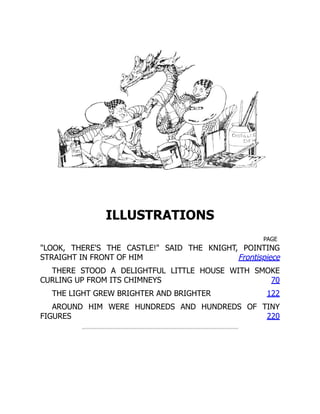
"LOOK, THERE'S THE CASTLE!" SAID THE KNIGHT, POINTING
STRAIGHT IN FRONT OF HIM
THERE STOOD A DELIGHTFUL LITTLE HOUSE WITH SMOKE
CURLING UP FROM ITS CHIMNEYS
THE LIGHT GREW BRIGHTER AND BRIGHTER
AROUND HIM WERE HUNDREDS AND HUNDREDS OF TINY
FIGURES
THIS is a true story.
It all happened through George Henry not believing in the
fairies, just as some boys but very few girls would do.
Boys believe in Red Indians and pirates, and think fairies are all
stuff and nonsense; but they are quite wrong, for Puck can turn
himself into anybody or anything he chooses. So if one day when
you are ploughing the foaming main you sight a pirate ship flying
the skull and crossbones at the masthead, it may not be a pirate at
all, but only Puck himself.
Beware! If he catches you he will make you walk the fairy plank,
and you will fall off it splash! right into Fairyland, and find yourself
turned into a cross old frog or something quite as disagreeable.
This story should be read aloud. You should seat yourselves in a
ring—that will please the fairies—and look happy, even if you aren't
as happy as you might be. Sour looks curdle cream and stories as
well.
"What!" you say. "Dragons and witches and giants! Do you
expect us to believe in them?"
Well, why not? Do you only believe in what you have seen? All
the best books are full of wonders like these, and everything
wonderful must be true.
So, once again, this is a true story.
Now turn to the next page and begin!
G
CHAPTER I
George Arrives
EORGE HENRY was born under a lucky star, which means that a
star laughed when he came into the world. This happens to
very, very few of us; perhaps it is because we are born naughty
and ready to be stood in the corner at once.
The fairies knew all about George Henry, however, and were
delighted, for he was a darling boy. Puck brought them the news
wrapped up in a leaf and packed inside a nutshell in order to keep it
dry.
Of course you have heard of Puck. He is the little fairy who often
plays mischievous tricks upon people; but if children behave nicely
he is always ready to be their friend.
Santa Claus often pays him a visit about Christmas-time in order
to find out if any children have not been as good as gold during the
past year. Then the naughty children find their stockings empty on
Christmas morning, and wish and wish—too late—that they had
thought in time of what Father and Mother had told them.
Well, the fairies danced that night in the greenwood to the music
of the cricket, the grasshopper, and the frog. Puck told them all
about George Henry and what a very fine boy he was going to be.
George's father and mother thought so too, and Nurse said that
he was the finest child she had ever seen. Nurses always know.
The birds and animals soon heard the news too, and there was
such a chattering, jabbering, twittering, squeaking, and I really don't
know how to tell you what other curious noises in the wood that
night.
This 'wonder-child,' as the fairies called him, was named George
Henry—'George' after his grandfather, who gave him a large silver
drinking-mug as a christening present, and 'Henry' after his father.
His mother would have liked to add 'Alexander' as a third name, but
it was given, after all, to a new black, woolly puppy which came into
the house about this time; so that was all right. It is a great pity to
waste fine names like Alexander.
George Henry and Alexander grew up together and were great
friends. Alexander learned to walk long before his little playmate,
who used to toddle along holding on to the dog's tail, and very often
falling over on top of him when his legs grew tired.
As soon as he got past his toddle-days he loved to walk about
everywhere and see everything.
The world was full of the most wonderful things; there was a
pigsty in which lived a family of little pigs with curly tails. They used
to squeak "Good-morning" to him every time he passed by.
He loved their curly tails, and often tried to make Alexander's tail
like theirs, but it was of no use. It either stood straight up on end or
else disappeared between his legs.
It was fine, too, to see the geese marching along like soldiers
with the old gander at their head; to watch the old hen fussing and
clucking after her little fluffy chicks, who would never come home
when they were told—"Like naughty little boys, you know," said
Nurse.
It would take hours to tell you all the things Alexander and he
saw together—the animals, the birds, the trees, the flowers; and
they all loved him. But he never saw the fairies—though they often
waved their little hands to him; and Puck sometimes rode on
Alexander's back through the woods and led them to all the prettiest
spots—but George never knew.
By and by, when they had grown up a little more, and George
was in sailor trousers, while Alexander had a great big bark which
quite made you jump the first time you heard it, Father and Mother
began to wonder what George would be when he became a man.
He loved playing at soldiers, and had boxes and boxes full of
them which Grandfather and Grandmother, uncles and aunts, and
other kind people gave him from time to time. He played with them
on the nursery floor, up and down stairs until the housemaid, Anne,
fell over them, on his bed when he ought to have been asleep, until
Father said: "Ah, the boy will be a general and win great battles
when he grows up!"
"No!" answered Mother. "George is born for something better
than that."
He knew all about everything in the shop windows, better than
even the people to whom the shops belonged.
"He will be a great merchant!" said his grandfather.
"Pooh!" answered Mother. "Buying and selling? My little George
was not born for that."
He began to use paper and pencil, and then a paint-box.
"Ah!" said the aunt who had given him all these things. "George
will be a great artist who will draw and paint most wonderful
pictures."
"Rubbish!" replied Mother. "George was born to do something
great. He can always draw pictures to amuse himself."
Then he learned to write, and wrote the most wonderful stories
which no one except himself could understand.
"He will be a great writer and write stories which everybody will
read," said his grandmother.
"I never heard such nonsense!" cried his mother, quite vexed.
"Don't I tell you that he is going to do great things? Anybody can
write stories; besides, he might sit up late at night and catch colds
and I don't know what else if he began writing stories!"
Puck was delighted to hear them all guessing in this way, and
laughed until he fell off the top of a big sunflower on which he was
sitting.
"Oh, dear!" he cried. "How funny these big people are!" And he
flew away into the wood to tell the fairies all about it.
They laughed and laughed for days and days, and were never
tired of hearing Puck talk like Grandfather, Father, Mother, and Aunt.
Even the old bull-frog in the large pond, right in the middle of the
darkest part of the wood, croaked "Ker-ek!" which was his way of
laughing. He always had a cold, poor fellow, because his feet were
never, never dry, and nobody ever thinks of giving frogs medicine.
Perhaps they have neither nurses nor aunts.
And so the days and months went by, and presently George was
big enough to go to school. It was quite a nice school, so Puck said,
for he went there when he had time. Puck liked to listen to the fairy
stories best of all, and often sat on the teacher's shoulder and
whispered in her ear. You would have been surprised and delighted
to hear what splendid stories she told the children on those days,
and she could never imagine how they came into her head.
Now, it is a very sad thing to have to tell you, but Puck soon
found out that George did not believe that there were any fairies,
nor—worse still—that there ever had been any.
One day he actually fell asleep when the very best story of all
was being told! Puck didn't know what was to be done, and the
fairies couldn't help him, for they had never heard of a boy like this
before. "Dear me!" they said. "If there were no fairies how could
there be any fairy stories? How stupid of little George not to believe
in us! We believe in him, and he is only a boy and not a fairy at all."
So Puck set to work to think what to do, and went wandering
through the woods, asking all the birds, all the beasts, and even the
insects if they knew what to do with a boy called George who didn't
believe in the fairies. None of them were able to help him. An old
horned beetle said, "I should pinch him!" but Puck didn't think that
pinching was of much use.
When George went to bed, Puck used to sit on his pillow and tell
him the most beautiful dreams, but George forgot all about them
when he woke up. What can one do with a boy like that?
Nurse, however, just nodded her head wisely and said: "Wait and
see!" There are thousands of nurses saying the same thing all over
the world. They just know what will happen later on, and that is all.
They never tell anyone else. If they do they are not real nurses, and
should be given a month's notice.
George's nurse was what people called a 'comfortable' person.
She was big and round, and her shoes creaked just now and again—
quite a lady-like creak. She did not often smile, but when she did
you felt sure the sun was shining and that the world was a jolly
place to live in. Nurses—real nurses—know everything; very likely
they have been taught by the fairies, but if you asked your nurse
this question she would never tell you. Oh no!
Nurse always spoke of Alexander as "that black imp," but he
knew how to coax a piece of biscuit from her whenever he wished.
He used to sit down on the nursery hearth-rug with his head on one
side, thump gently with his tail on the floor, and bark very gently,
"Wuff! Wuff!" without stopping, for ever so long.
It must be a grand thing to be a dog like Alexander whenever
one wants a biscuit.
George was very busy just now, for he had made up his mind to
be an aviator. An aviator is a man who flies up in the air on a
machine which looks something like a large bird, and makes a noise
like ever so many cats quarrelling. It flies straight up, and then
before you can say "Knife!" it is out of sight. There are no tunnels or
stations, no tickets such as you have on the railway. You just go
straight ahead until you get there.
No wonder George didn't think about the fairies when his head
was full of such wonderful things.
But Father said: "Time enough to fly when you are grown up."
Mother said: "An aviator? No, George, darling! You can come for
a ride in the carriage with me this afternoon."
And Nurse said—of course, the same as before.
And so the months and the years went by; George grew bigger,
Alexander grew fatter, Nurse grew more and more comfortable, and
Puck grew crosser and crosser. At last, one day, everybody woke up
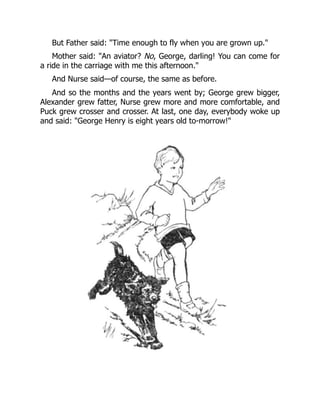
and said: "George Henry is eight years old to-morrow!"
THE FAIRY RIDE
HAVE you seen the fairies ride
All down the magic glen?
Green jackets, red caps,
Teeny, weeny men!
Hearken to their music,
The winding of the horn!
Ta-tan-ta-ra-ta!
A fairy boy is born!
Mind you keep the doors shut
When they're riding by,
Lest you get some fairy dust
In your little eye.
If that were to happen,
In a flash you'd be
Changed into a fairy.
Goodness gracious me!
Green jackets, red caps,
See them trooping past.
Hear their bridles jingling—
Shut the door fast!
I
CHAPTER II
George Grows Up
T was not long before everybody knew all about it. George was
going to have a party! Not an ordinary party, but a splendid one.
There were invitations for all George's friends, both boys and girls;
for Grandfather, Grandmother, uncles, aunts, and all kinds of grown-
ups who could help to hand round the tea and cakes and let off
fireworks when it grew dark.
George was quite ready to have the fireworks first thing in the
morning as soon as he woke up; but Father said, "No!" Mother said,
"No!" and Nurse said nothing, but just looked. Nurses don't like
fireworks, though they sometimes pretend they do.
Everybody—except Alexander—must have been getting ready for
this birthday for weeks and weeks, for when George woke up a little
earlier than usual on the great day there was quite a stir and bustle
in the house. The postman could hardly carry his bag along the path
up to the front door. It was packed full of presents.
Alexander had a big red silk bow fastened round his neck, and
nearly fell all the way downstairs through twisting his head round to
try and bite it off. Even Nurse, for once, almost ran, she was in such
a hurry.
It is a wonderful thing to have a birthday if you have enough
kind uncles and aunts to help. Uncles must be strong enough to
carry you on their shoulders like a never-tiring horse, then to change
into bears which you can shoot at, and, almost before they have
finished dying under the sofa, they must be ready to change into
anything else you may want.
Aunts are best when they smile all the time and bring out sweets
and chocolates from some hidden part of their dresses, like
conjurers, just when you are tired and want to rest for a minute.
Alexander liked aunts, and was always ready to beg for biscuits even
when he met one of them in the middle of the street or in a shop.
Uncles were all right, but rather tiring. Dogs don't always want to
play games.
Well, the number of presents was perfectly delightful, and
everybody had sent exactly what George wanted. But in the middle
of breakfast he looked up suddenly and said: "It's Alexander's
birthday too. Hasn't he got any presents?"
"What?" said Father, turning quite red in the face and forgetting
that he was holding a piece of bacon on the end of his fork.
"Dear me!" said Mother, looking as if she were going to cry. "Oh,
where's Nurse?"
Nurse appeared in the room at once, and when she heard that it
was Alexander's birthday, do you think that she said "What?" or
"Dear me?" Not at all.
She just went to the door and called: "Alex—ander!"
Alexander arrived with a rush and a bang, looking as if nothing in
the world would ever surprise him.
"Alexander," said Father solemnly, "I have great pleasure in
telling you that this is your birthday. I wish you many happy returns
of the day!"
"Wuff!" replied Alexander, wagging his tail, and looking at Father
as much as to say: "Don't keep me waiting any longer. You know
how hungry I am!"
Father smiled, and suddenly in his hand he held a most beautiful
silver collar, on which was written Alexander's name. He took off the
red bow and put the collar round Alexander's neck. Alexander said
nothing, but sat and waited.
Mother wished him 'many happy returns' too, and then—where
had she hidden it?—there was a pretty tin of sugary biscuits with 'A'
printed on the top.
"Wu—uff!" said Alexander, and wagged his tail so hard that he
nearly fell over.
George looked quite pleased. "I'm so glad he wasn't forgotten,"
he said; "it didn't seem fair for me to get such lots of things, and
Alexander nothing at all."
It was soon four o'clock, and the guests began to arrive, first in
ones and twos and then in threes and fours.
It was a lovely summer day, and after games in the garden there
was a Punch and Judy which everybody liked, especially Father and
the uncles. Alexander sat quite still until Punch's dog appeared, and
then he had to be led indoors and shut up, for he grew quite fierce,
and was just getting ready to bite Punch's nose off.
Punch without a nose wouldn't be a Punch at all, and then the
man who keeps him would never be able to go to parties again. But
Alexander never thought about that.
By this time everybody was ready for tea, which was served in a
large tent in the garden. On the middle of the table stood a very
large cake stuffed full of plums. Nurse had made this with her own
hands, and there were no cakes like hers. One could eat two and
even three large-sized slices and scarcely feel a little bit
uncomfortable afterward.
No one could eat any of this cake, however, until most of the
white and brown bread and butter—you were allowed to have jam
spread on it—scones, tea cakes, cream cakes, ice cakes, jam puffs,
tartlets, and oh! heaps of other things had disappeared. Then Father
stood up with a large knife in his right hand, and made a little
speech. Everybody clapped their hands and laughed—even the
uncles and aunts who had had no tea at all.
George sat in a high chair looking as proud as a king. Kings
always look proud, and queens, their wives, look proud too, but in
quite a nice way. If you have ever seen them riding by in a carriage
drawn by six white horses in gold harness you will understand
exactly why you cannot really look proud in a cab with one horse, or
in a taxi-cab which flies along with a fizz and a bang. You only just
have time to get the eighteenpence ready for the driver. If you were
a king you wouldn't ever have to do that.
After the speech George cut the cake and Father helped, so that
everybody, grown-ups and all, had a slice.
Then George had to speak. "Thank you very much," he said. "I
hope you've enjoyed the party. I know I have, and so has Alexander.
Now we're going to have the fireworks!"
It was not dark yet, so there were games and races, followed by
a little rest, during which Mother told them stories. Then Uncle
William, the funny man of the party, gave an imitation of all the
animals in a farmyard, which was even better than the real thing, of
a railway train coming out of a tunnel, and, last of all, of Father
getting up in the morning.
Father laughed so much at this that Mother had to pat him very
hard on the back for several minutes. Uncle William was not allowed
to tell the story of the two cats on the wall, because Alexander did
not like cats—even cats which weren't real.
At last it was time for the fireworks, and all the children seated
themselves at one end of the garden and waited patiently. Suddenly
bang! up went a red star, then a green one; then showers and
showers of little green ones. Then bang! bing! bang! fizz! crack!
jumped the crackers. Rrrrrrr! whirled the Catherine wheels, slowly at
first, then fast, faster, and so fast that they made your eyes quite
sore watching them.
Hiss! Whizz! Bang! went a rocket with a tail as long as from here
to the end of the next street. Higher and higher it flew, until, all of a
sudden, just as you thought it was quite out of sight, it burst, and—
ah!—hundreds of little stars lit up the sky and made it look lighter
than even the lightest day.
But there was something better to come still. At the end of the
shrubbery a light shone faintly and then went out. Then shone more
and more lights, until you could see that great big letters as tall as
yourself were growing up. And then—all of a sudden—in a blaze of
light there was spelt out for all to see, GEORGE.
Such crackings and bangings, such shouts and cheers from all
over the garden you never heard, nor anyone else either.
That was a real surprise.
Just as people were getting ready to put on their coats and say
"Thank you very much for your delightful party," another light shone
out over the high tree near the garden gate.
"Hullo!" said Father. "Hullo, what's this? A surprise from Uncle
William, I expect," and he stood still and watched.
Brighter and brighter grew the light, longer and longer, until it
looked like a great tongue of fire. Then it swept along over the trees,
under the trees, in and out and round about, until it looked as if
thousands of little lanterns were shining everywhere.
"It sounds as if there were music somewhere, quite far off," said
Mother. "Well, I don't know what it can be."
Uncle William, who was supposed to know all about it, said that
he hadn't done it, but nobody believed him.
Little by little the lights died out, and then it was time to go
home to bed.
George was quite sleepy, and was very glad to find his head
resting on a soft pillow. After he had said his prayers and said
"Good-night," he called out to Nurse: "Do you know who made those
jolly little lights, right at the end of the fireworks?"
Nurse stood silent for a moment: "Perhaps I do; perhaps I don't,"
she replied.
"Oh," said George, "tell me, then!"
"Good-night, Master George." Out went the light, and if George
hadn't been so sleepy and tired he might have found out all about it
then and there; but that would have meant that all kinds of things
which were just going to happen wouldn't have happened at all,
which would have been a pity.
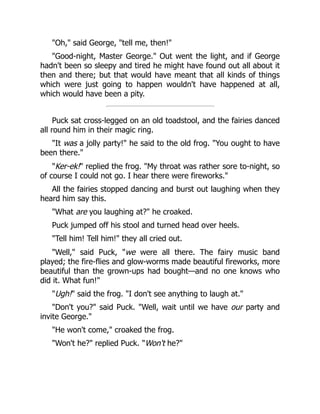
Puck sat cross-legged on an old toadstool, and the fairies danced
all round him in their magic ring.
"It was a jolly party!" he said to the old frog. "You ought to have
been there."
"Ker-ek!" replied the frog. "My throat was rather sore to-night, so
of course I could not go. I hear there were fireworks."
All the fairies stopped dancing and burst out laughing when they
heard him say this.
"What are you laughing at?" he croaked.
Puck jumped off his stool and turned head over heels.
"Tell him! Tell him!" they all cried out.
"Well," said Puck, "we were all there. The fairy music band
played; the fire-flies and glow-worms made beautiful fireworks, more
beautiful than the grown-ups had bought—and no one knows who
did it. What fun!"
"Ugh!" said the frog. "I don't see anything to laugh at."
"Don't you?" said Puck. "Well, wait until we have our party and
invite George."
"He won't come," croaked the frog.
"Won't he?" replied Puck. "Won't he?"
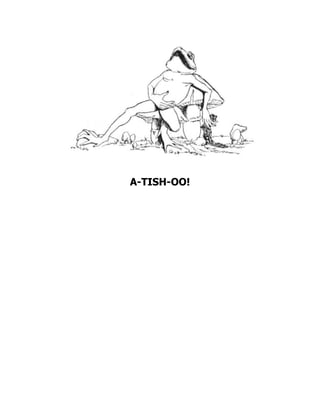
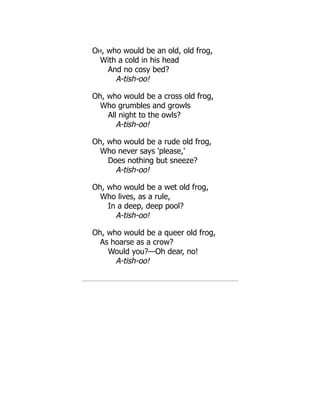
A-TISH-OO!
OH, who would be an old, old frog,
With a cold in his head
And no cosy bed?
A-tish-oo!
Oh, who would be a cross old frog,
Who grumbles and growls
All night to the owls?
A-tish-oo!
Oh, who would be a rude old frog,
Who never says 'please,'
Does nothing but sneeze?
A-tish-oo!
Oh, who would be a wet old frog,
Who lives, as a rule,
In a deep, deep pool?
A-tish-oo!
Oh, who would be a queer old frog,
As hoarse as a crow?
Would you?—Oh dear, no!
A-tish-oo!
I
CHAPTER III
Midsummer Eve
N a few days' time it would be Midsummer Eve, and then the little
fairies have a dance and supper all to themselves. Very few people
have ever been there, and even fewer know anything at all about
it. Only the very best people receive invitations, and, of course,
there are never very many of the best people in the world.
It is very hard indeed to be good, but—oh dear!—to be best!
Why, it means being good, and going on being good, until you are
so good that Mother thinks something must be the matter with you
and sends for the doctor.
Anyway, the fairies sent George an invitation, but he didn't
understand what it meant, for it was written on an oak leaf which
Puck blew in through the bedroom window. George thought it was
only a common leaf and never picked it up.
"Well, has George answered his invitation yet?" said the old frog
to Puck a few days before the dance.
"No," replied Puck, "he hasn't, but he's coming."
"Coming, indeed!" croaked the frog, who had just caught a worse
cold than ever. "Well, I'll believe it when I see him, and not before."
"All right," said Puck. "You'd better go home, or else you won't be
able to come to the party with that cold of yours."
There was such a bustling, a running about, a flying here and a
flying there in the wood all day and all night getting ready for
Midsummer Eve. Such a brushing and combing, such a sewing and
darning, polishing and scrubbing, and I don't know what else! Such
a baking and brewing, cooking, stewing, and such nice smells! Puck
carried bits of these away in his pocket, and George had the most
delightful dreams of all the things he liked best to eat and drink.
Nurse smiled when he told her, and Alexander listened with his
head a little on one side, hoping to hear the word 'biscuit' or 'bone.'
His idea of a really good party was a pile of bones and biscuits, with
leave to eat them on the drawing-room carpet. This is just as good
fun as waiting outside on the stairs for the jellies and creams when
there is a dinner-party at your house.
George had already forgotten about aeroplanes, and was very
proud of being in trousers. When he first wore them he could not
help looking down almost every minute to see if they were still
there. The worst of wearing trousers is that you have to be so
careful. Dogs like Alexander will jump and bump against them,
leaving dirty paw-marks, just when you are not looking. Directly one
begins to grow up there are really such a number of things one must
think about.
George used to stand with his legs wide apart and his hands in
his pockets like Father, until Nurse sewed the pockets up tight one
night when he was fast asleep. Trousers without pockets are like jam
tarts without jam.
George said nothing when he found it out, but in the garden
after breakfast he remarked to Alexander: "When I grow up—really
grow up—I am going to have pockets all over me, just as many as
ever you can imagine. There will be so many that no one will ever be
able to sew them up again."
Alexander nodded. After all, he might be able to keep his bones
in a suit with as many pockets as that!
Midsummer Eve came at last. Everything was ready in the wood;
even the old frog's cold was better, though he was still rather
hoarse. The fairy ring was as smooth as velvet, and the fairy band
had learned quite a number of new tunes.
Puck was as busy as he could be, and whenever there was a
moment to spare he brought another piece of moss for the seat
which he had been making for George. It was right in the middle of
the wood in a little open space with high trees all round it.
Whenever the wind came the trees rustled softly, and it sounded just
as if they were putting their heads together and whispering secrets.
Most of these trees were very old; so old that they had grown quite
bent, and their long, twisted boughs hung down almost to the
ground.
On Midsummer Eve the moon always shines brightly, and lights
up the fairy ring with a soft, silvery light. No one knows whether
Puck asks her to do it, but if you will look out of your window—if you
can wake up at the right moment—you will see for yourself that it is
quite true, for so many of the best things always happen while we
are fast asleep in bed.
George went to bed as usual. Alexander flopped down on the
mat outside the door and curled himself up. One by one the lights in
the house went out, and soon everybody was fast asleep. It was as
still as still can be.
Far, far off sounded the first notes of the fairy music. Alexander
pricked up one ear for a second, then sighed and fell fast asleep
again.
George turned over in his bed and began to snore. Puck flew in
through the half-open window and rested for a moment on his
pillow.
"It's all ready, George," he whispered. "We're only waiting for
you!"
George snored a little louder.
"George!" cried Puck, "George, come along! Don't be late!"
George was dreaming. He was dreaming that he was in school
saying the multiplication table, twice times, three times, and some of
four times. He actually wasn't thinking about the fairies at all!
Puck sat for a moment thinking what he should do; then he flew
out through the window and back to the wood.
The multiplication table, indeed! No one ever thinks of such
things on Midsummer Eve. It is a time to dream of dancing, music,
light, laughter, the wind in the trees, the tinkle, tinkle of water in the
little brooks, the song of birds—they are all awake then—of almost
anything else, but not twice times two.
The fairies were just beginning to dance when Puck flew into the
middle of the ring, and he looked so angry that they all stopped,
wondering what could have happened.
He could say nothing at first but "twice times four is ten," which
is nonsense, but he had never learned his tables and never wanted
to. He said this over and over again, just as if it were a rhyme, and
they all listened, though they did not understand a bit what it
meant.
"Oh, ho!" said the old frog, who was sitting there puffing himself
out as if he were trying to turn himself into a toy balloon. "Oh, ho! I
see what it is. George won't come after all. I told you so. Oh, ho!
Oh, ho!"
"For shame!" all the fairies cried out. "For shame! Nasty old
thing! You're quite glad he isn't coming."
Puck sat with his head in his hands, thinking and whispering to
himself, "Three times four are seven," which was worse than ever.
The fairies felt so sorry for him. They all came and sat round him
in a ring with their little heads in their hands. They did not know
why he was doing this, but they did it to cheer him up. The old frog
sat puffing, just as if some one had wound him up like a clockwork
toy and he wasn't able to stop.
After a long time Puck looked up and said: "Well, it's no use
waiting. He won't come to-night."
The old frog was so pleased when he heard this that he opened
his mouth to say "I told you so," but he had puffed himself out to
such a size that he fell over backward suddenly into a pool with a
Welcome to our website – the perfect destination for book lovers and
knowledge seekers. We believe that every book holds a new world,
offering opportunities for learning, discovery, and personal growth.
That’s why we are dedicated to bringing you a diverse collection of
books, ranging from classic literature and specialized publications to
self-development guides and children's books.
More than just a book-buying platform, we strive to be a bridge
connecting you with timeless cultural and intellectual values. With an
elegant, user-friendly interface and a smart search system, you can
quickly find the books that best suit your interests. Additionally,
our special promotions and home delivery services help you save time
and fully enjoy the joy of reading.
Join us on a journey of knowledge exploration, passion nurturing, and
personal growth every day!
testbankfan.com

Understanding Operating Systems 5th Edition McHoes Solutions Manual

  • 1.
    Understanding Operating Systems5th Edition McHoes Solutions Manual download pdf https://testbankfan.com/product/understanding-operating-systems-5th- edition-mchoes-solutions-manual/ Visit testbankfan.com today to download the complete set of test banks or solution manuals!
  • 2.
    We believe theseproducts will be a great fit for you. Click the link to download now, or visit testbankfan.com to discover even more! Understanding Operating Systems 5th Edition McHoes Test Bank https://testbankfan.com/product/understanding-operating-systems-5th- edition-mchoes-test-bank/ Understanding Operating Systems 7th Edition McHoes Solutions Manual https://testbankfan.com/product/understanding-operating-systems-7th- edition-mchoes-solutions-manual/ Understanding Operating Systems 8th Edition McHoes Solutions Manual https://testbankfan.com/product/understanding-operating-systems-8th- edition-mchoes-solutions-manual/ Understanding Psychology 11th Edition Feldman Solutions Manual https://testbankfan.com/product/understanding-psychology-11th-edition- feldman-solutions-manual/
  • 3.
    Algebra and Trigonometry10th Edition Larson Solutions Manual https://testbankfan.com/product/algebra-and-trigonometry-10th-edition- larson-solutions-manual/ Calculus for Scientists and Engineers Early Transcendentals 1st Edition Briggs Test Bank https://testbankfan.com/product/calculus-for-scientists-and-engineers- early-transcendentals-1st-edition-briggs-test-bank/ Systems Analysis and Design 11th Edition Tilley Solutions Manual https://testbankfan.com/product/systems-analysis-and-design-11th- edition-tilley-solutions-manual/ Java Foundations 3rd Edition Lewis Solutions Manual https://testbankfan.com/product/java-foundations-3rd-edition-lewis- solutions-manual/ Psychology 6th Edition Nairne Test Bank https://testbankfan.com/product/psychology-6th-edition-nairne-test- bank/
  • 4.
    Physical Geology 15thEdition Plummer Test Bank https://testbankfan.com/product/physical-geology-15th-edition-plummer- test-bank/
  • 5.
    Understanding Operating Systems,Fifth Edition 8 -1 Chapter 8 File Management At a Glance Instructor’s Manual Table of Contents • Overview • Objectives • Teaching Tips • Quick Quizzes • Class Discussion Topics • Additional Projects • Additional Resources • Key Terms
  • 6.
    Understanding Operating Systems,Fifth Edition 8 -2 Lecture Notes Overview The File Manager controls every file in the system. The chapter begins with an introduction to this file management system. This is followed by a presentation on definitions for commonly used terms. The chapter explains how files are organized logically, how they are stored physically, how they are accessed, and who is allowed to access them. The chapter also describes the interaction between the File Manager and the Device Manager. The efficiency of the File Manager depends on how the system’s files are organized (sequential, direct, or indexed sequential); how they are stored (contiguously, noncontiguously, or indexed); how each file’s records are structured (fixed-length or variable-length); and how access to these files is controlled. The chapter concludes with a discussion on data compression. Learning Objectives After completing this chapter, the student should be able to describe: • The fundamentals of file management and the structure of the file management system • File-naming conventions, including the role of extensions • The difference between fixed-length and variable-length record format • The advantages and disadvantages of contiguous, noncontiguous, and indexed file storage techniques • Comparisons of sequential and direct file access • The security ramifications of access control techniques and how they compare • The role of data compression in file storage Teaching Tips The File Manager 1. Provide students with an overview of the File Manager, outlining its responsibilities. Note that the File Manager is also called the file management system. Explain that it is software responsible for creating, deleting, modifying and controlling access to files. Point out that it also manages the resources used by the files. 2. Explain how the File Manager provides support for libraries of programs and data to online users for spooling operations and for interactive computing. 3. Explain that the File Manager performs its functions in collaboration with the Device Manager.
  • 7.
    Understanding Operating Systems,Fifth Edition 8 -3 Teaching Tip Refer to the following Web site in order to learn more about File Manager tasks: http://publib.boulder.ibm.com/iseries/v5r2/ic2924/index.htm?info/ddm/rbae5mst 02.htm Responsibilities of the File Manager 1. Discuss how the File Manager’s responsibilities are quite complex and involve the physical components and information resources of the system, as well as its policies for storing and distributing files. 2. Outline the four tasks that the File Manager follows to carry out its responsibilities: a. Keep track of where each file is stored. b. Use a policy that will determine where and how the files will be stored, making sure to efficiently use available storage space and provide efficient access to files. c. Allocate each file when a user has been cleared for access to it, and then record its use. d. Deallocate the file when the file is to be returned to storage, and communicate its availability to others who may be waiting for it. 3. Point out that the File Manager’s policy determines where each file is stored and how the system and users will be able to access them through commands that are independent from device details. 4. Discuss the two factors the File Manager’s policy utilizes to determine who may have access to what material: flexibility of access to the information and its subsequent protection. Explain that the File Manager allows access to shared files, provides distributed access, and allows users to browse through public directories. Additionally, the operating system must protect its files against system malfunctions and provide security checks through account numbers, passwords, and lockwords to preserve the integrity of the data and safeguard against tampering. 5. Describe the steps involved in the file allocation and deallocation processes. Definitions 1. Define the term field: a group of related bytes that can be identified by the user with a name, type, and size. 2. Define the term record: a group of related fields. 3. Define the term file: a group of related records that contains information used by specific application programs to generate reports. 4. Use Figure 8.1 on page 253 in the text to illustrate these terms.
  • 8.
    Understanding Operating Systems,Fifth Edition 8 -4 5. Discuss how a database appears to the File Manager to be a type of file. Emphasize that databases are more complex, because they are actually groups of related files that are interconnected at various levels to give users flexibility of access to the stored data. 6. Explain that a program file contains instructions and a data file contains data. 7. Discuss how directories are special files with listings of filenames and their attributes. Teaching Tip Point out that the File Manager treats all files exactly the same way as far as storage is concerned. Interacting with the File Manager 1. Explain how the user communicates with the File Manager. There are two methods. The first is to embed commands in the user’s program. The second is to submit them interactively. 2. Provide examples of embedded commands (OPEN, CLOSE, READ, WRITE MODIFY). Note that OPEN and CLOSE pertain to the file availability for the program working on it. READ and WRITE are Input/Output (I/O) commands. MODIFY is a specialized command. 3. Provide examples of interactive commands (OPEN, DELETE, RENAME, COPY). Note that files may be created with other system-specific terms and provide examples. 4. Use Figure 8.2 on page 255 in the text to demonstrate common interactive commands. 5. Emphasize that these commands are designed to be simple and devoid of detailed instructions required to run the device. Note that the details are found in the device driver so the commands are device independent. 6. Discuss how due to device independence and command simplicity, the user does not need to know a file’s exact physical location on the disk pack, the medium type, or network specifics. 7. Explain how logical commands are broken down into a sequence of lower-level signals. These signals trigger the systematic actions performed by the device. These signals also supervise the progress of the operation by testing the device status. 8. Review the example on page 255 of the decomposed steps taken when a user program issues a READ command. 9. Describe the need for error checking and how the File Manager handles this on behalf of the user for every device. Emphasize that this is important because users do not have to include these error checking instructions for every possible device (terminal, keyboard, printer, disk drive, etc.) within their own programs.
  • 9.
    Understanding Operating Systems,Fifth Edition 8 -5 Typical Volume Configuration 1. Provide students with an overview of the concept of a volume, which is a secondary storage unit (removable or non-removable). Explain the concept of multifile volumes. Explain the concept of multivolume files. 2. Explain the volume descriptor using Figure 8.3 on page 256 in the text. Note that it is stored at the beginning of each volume and includes the volume name and other vital information about the storage unit. 3. Discuss briefly the master file directory (MFD), which is stored immediately after the volume descriptor. Outline what it lists. Point out the fact that early operating systems supported only a single directory per volume. 4. Outline the disadvantages of a single directory per volume as supported by early operating systems, using the bullet points listed on pages 256 and 257 in the text as a guide. About Subdirectories 1. Discuss how in newer File Manager components, the MFD for each volume contains entries for both files and subdirectories. Explain that a subdirectory is created when the user opens an account to access a computer. Note that this subdirectory is treated as a file in the MFD and the entry is flagged to indicate that this file is really a subdirectory and has unique properties. Specifically, its records are filenames pointing to files. 2. Emphasize that this is an improvement from a single directory scheme but still precludes users from grouping their files in a logical order to improve the accessibility and efficiency of the system. 3. Provide an overview of the subdirectories created by today’s File Managers. Point out that this structure is an extension of the previous two-level directory organization and is implemented as an upside-down tree. Use Figure 8.4 on page 258 in the text to illustrate this concept. 4. Outline the information that is included in the file descriptor following the bullet points listed on page 258 in the text. Teaching Tip Today’s sophisticated File Managers allow their users to create their own subdirectories so related files can be grouped together. Many computer users call these subdirectories “folders.” File-Naming Conventions 1. Explain to the students that there are two components comprising a filename: a relative filename and an extension. Review the difference between the complete filename (absolute filename) and the relative filename.
  • 10.
    Understanding Operating Systems,Fifth Edition 8 -6 2. Discuss different types of extensions. Explain that an extension identifies a file type or its contents. Provide examples. Note that if an extension is not known, the system asks the user for intervention. Use Figure 8.5 on page 259 in the text to demonstrate this. 3. Point out that every operating system has specific rules that affect the length of the relative name and the types of characters allowed. Illustrate with the operating systems presented on page 260, and note how the names tend to grow in length as the File Managers grow in flexibility. File Organization 1. Provide students with an overview of file organization. Remind students that all files are composed of records and that when a user gives a command to modify the contents of a file, it is actually a command to access the records within the file. Record Format 1. Explain to students that within each file, records are all presumed to have the same format. They may be (1) fixed length or (2) variable length. Use Figure 8.6 on page 261 in the text to illustrate these two types pictorially. 2. Discuss the two types of record formats and the characteristics of each. Note that these records, regardless of their format, can be blocked or not blocked. Use examples as shown in Figure 8.4 on page 258 in the text to explain both fixed-length and variable- length records. 3. Discuss the advantages and disadvantages of fixed-length and variable-length records. Provide examples to show where these are useful. For example, fixed-length records are ideal for data files, whereas the variable-length formats are used in files accessed sequentially (text files, program files), or in files that use an index to access records. Physical File Organization 1. Discuss the physical organization of a file, which involves how records are arranged, and the characteristics of the medium used to store it. 2. Remind students of the ways in which files can be stored on magnetic disks, such as sequential, direct, or indexed sequential. Discuss practical characteristics that the programmer or analyst usually considers when selecting the ideal file organization. 3. Discuss sequential record organization, pointing out how records are stored and retrieved in this scheme. Explain how selecting a key field speeds up the record searching process. Discuss the advantages and disadvantages of this scheme. For example, it is easy to implement; however, it complicates maintenance algorithms, as the original order must be preserved every time records are added or deleted.
  • 11.
    Understanding Operating Systems,Fifth Edition 8 -7 4. Discuss the direct record organization, which uses direct access files that can be implemented only on direct access storage devices. Explain how records are identified in direct record organization. Discuss the concepts of relative address, logical address, and hashing algorithms. Note that the problem with hashing algorithms is that several records with unique keys (such as customer numbers) may generate the same logical addresses, and then there’s a collision. Use Figure 8.7 on page 264 in the text to illustrate the collision problem with the hashing algorithm. 5. Discuss the advantages of direct record organization over sequential record organization. For example, it allows accessing of any record in any order without having to begin the search from the beginning of the file, and the files can be updated more quickly than sequential files. 6. Discuss the indexed sequential record organization, which is created and maintained through an Indexed Sequential Access Method (ISAM) software package. Point out the advantages of using this software package. 7. Explain how records are retrieved in the indexed sequential record organization. Discuss its advantages over the previous two organizations, including that it does not create collisions, the overflow area can be used to store records added during the lifetime of the file, and it allows both direct access to a few requested records and sequential access to many records. Teaching Tip Refer to the following Web site to learn more about file organization: www.cim.mcgill.ca/~franco/OpSys-304-427/lecture-notes/node53.html Quick Quiz 1 1. Which of the following is an embedded command? a. Create b. Delete c. Copy d. Open Answer: d 2. Which of the following information is contained in the volume descriptor? (Choose all that apply.) a. Creation date b. User’s name c. File system code d. Volume length Answer: a and c
  • 12.
    Understanding Operating Systems,Fifth Edition 8 -8 3. Which of the following organization schemes uses a hashing algorithm? a. Direct record organization b. Sequential record organization c. Indexed sequential record organization d. Indexed direct record organization Answer: a Physical Storage Allocation 1. Provide students with an overview of physical storage allocation. Remind students that the File Manager works with files not just as whole units, but also as logical units or records. Be sure to mention that records within a file must have the same format; however, they can vary in length. Also mention that file storage actually refers to record storage. 2. Use Figure 8.8 on page 266 in the text to explain the most common record formats. Contiguous Storage 1. Explain the contiguous storage scheme, which was used in early operating systems. Discuss its advantages and disadvantages, such as that it is easy to implement but files cannot be expanded easily, and that it leads to fragmentation. 2. Use Figure 8.9 on page 266 in the text to illustrate contiguous file storage. Noncontiguous Storage 1. Explain the noncontiguous storage scheme, outlining its advantages over a contiguous storage scheme. 2. Use Figure 8.10 on page 267 and Figure 8.11 on page 269 in the text to explain the two ways through which file extents are usually linked. These include linking occurring at the storage level and at the directory level. Discuss the advantages and disadvantages of these two methods. Indexed Storage 1. Explain the indexed storage scheme, which allows direct record access by bringing together the pointers linking every extent of that file into an index block. 2. Use Figure 8.12 on page 269 in the text to illustrate the concept of an index storage allocation with one block. 3. Discuss the advantages and disadvantages of this scheme. Point out that it supports both sequential and direct record access; however, it does not necessarily improve the use of storage space because each file must have an index block.
  • 13.
    Understanding Operating Systems,Fifth Edition 8 -9 Teaching Tip Refer to the following Web site in order to learn more about physical storage allocation: www.unet.univie.ac.at/aix/aixprggd/genprogc/file_space_allocation.htm Access Methods 1. Provide students with an overview of access methods. Point out that access methods are dictated by a file’s organization. That is, a file that has been organized in sequential fashion can support only sequential access to its records and these records can be of either fixed or variable length. 2. Explain how the File Manager uses the address of the last byte read to access the next sequential record. Therefore, the current byte address (CBA) must be updated every time a record is accessed. 3. Use Figure 8.13 on page 270 to illustrate the difference between the storage of fixed- length and of variable-length records. Sequential Access 1. Explain how the CBA is updated for sequential access of fixed-length records and sequential access of variable-length records. Direct Access 1. Explain how the CBA is updated for direct access with fixed-length records. 2. Explain why it is virtually impossible to access a record directly if the file is organized for direct access with variable-length records. Discuss the alternatives. 3. Explain how an indexed sequential file can be accessed. Point out that the index file must be searched for the pointer to the block where the data is stored. Levels in a File Management System 1. Explain that the efficient management of files cannot be separated from the efficient management of the devices housing them. Note that for an I/O system to perform efficiently, there are a wide range of functions that have to be organized and managed. Point out that hierarchies are used to perform these functions. 2. Discuss the levels in a file management system, and explain how information is passed from the File Manager at the top of the hierarchy to the Device Manager at the bottom.
  • 14.
    Understanding Operating Systems,Fifth Edition 8 -10 3. Use Figure 8.14 on page 272 in the text to illustrate the typical modules of the file management system. Point out that the highest-level module is called the “basic file system,” and it passes information to the logical file system, which, in turn notifies the physical file system, which works with the Device Manager. 4. Explain that each level of the file management system is implemented using structured and modular programming techniques that set up the hierarchy. Explain that in the hierarchy, higher-level modules pass information to the lower-level modules, and the process continues down the chain until the lowest module that communicates with the physical device and interacts with the Device Manager is reached. 5. Note that each module is subdivided into tasks that are more specific. Walk through the example provided on page 273 with the students to follow an I/O instruction through the file management system. Refer to Table 8.1 on page 273 of the text. 6. Discuss the various levels at which verification occurs in the file management system. First, verification occurs in the directory level. Second, verification occurs in the access control verification module. Third, it happens in the logical file system. Fourth, verification occurs in the device interface module. Emphasize the coordinated effort required by every part of the file management system for correct operation. Access Control Verification Module 1. Provide students with an overview of the need for an access control verification module, discussing early operating systems and today’s operating systems from the file-sharing capabilities point of view. Note that all files may be shared. Point out the advantages and disadvantages of file sharing and the need for access control. 2. Outline five possible actions that can be performed on a file. They include the ability to READ only, WRITE only, EXECUTE only, DELETE only, or some combination of the four. Point out that each file management system has its own method to control file access. 3. Outline the four methods to control file access. They include the access control matrix, access control lists, capability lists, and lockword control. Access Control Matrix 1. Explain the access control matrix method using Table 8.2 on page 275 and Table 8.3 on page 276 in the text. Discuss the advantages of this method, such as the fact that it is easy to implement and works well for systems with few files and few users. Discuss the disadvantages, noting that as the number of files and users increases, the matrix becomes larger, perhaps too large to fit into main memory. In addition, it results in wasted space because of null entries.
  • 15.
    Understanding Operating Systems,Fifth Edition 8 -11 Access Control Lists 1. Explain the access control lists method using Table 8.4 on page 276 in the text. Point out that this method requires less storage space than an access control matrix and that it explicitly names each user allowed access to each file. 2. Explain how some systems shorten the access control list even more by putting every user into different categories. Examples of categories include system, owner, group, and world. Explain each of these categories briefly as described on page 277 in the text. Capability Lists 1. Explain the capability lists method using Table 8.5 on page 277 in the text. Point out its advantages. For example, it requires less storage space than an access control matrix, and it is easier to maintain than an access control list when users are added or deleted from the system. Moreover, it can control access to devices as well as to files. Lockwords 1. Provide students with an overview of the use of a lockword, a protection technique similar to a password. Note that it protects a single file. Discuss its advantages and disadvantages. For example, it requires the smallest amount of storage for file protection; however, it can be guessed by hackers or passed on to unauthorized users. Moreover, it does not control the type of access to a file. That is, anyone who knows the lockword can read, write, execute, or delete the file. Data Compression 1. Explain data compression techniques briefly, which are used to save space in files. Text Compression 1. Discuss different methods that are used in text compression. These include compressing text records with repeated characters, with repeated terms, or by using a front-end compression scheme. Provide examples as shown in the text on page 278 to clarify each of these methods. 2. Point out that there is always a trade-off in data compression. For example, storage space is gained but processing time is lost. Be sure to mention that for all data compression schemes, the system must be able to distinguish between compressed and uncompressed data. Other Compression Schemes 1. Inform the students that there are other compression standards for large files such as video, music, and photograph files. Explain to the students that the International Organization for Standardization has a mission to issue standards that all systems and users may abide by when working with these files.
  • 16.
    Understanding Operating Systems,Fifth Edition 8 -12 Teaching Tip Refer to the following Web site to learn more about data compression techniques: www.vectorsite.net/ttdcmp.html Teaching Tip For more on the International Organization for Standardization, go to www.iso.org. Quick Quiz 2 1. Which of the following storage allocation schemes results in the problem of fragmentation? a. Contiguous storage b. Noncontiguous storage c. Indexed storage d. Direct storage Answer: a 2. Which of the following methods can control access to files as well as to devices? a. Capability list b. Access control list c. Access control matrix d. All of the above Answer: a 3. Which of the following data compression techniques compresses text, using symbols to represent most commonly used words? a. Records with repeated characters b. Repeated terms c. Front-end compression d. All of the above Answer: b Class Discussion Topics 1. Have students discuss different types of file organization schemes. If they were approached by a hospital to maintain the data records of the patients, which file organization would they prefer? Why? 2. Have students discuss different access control verification methods. What are the advantages and disadvantages of each method? Which of these methods would they prefer for a highly secure system with several files and several users? Have students substantiate their choices with reasons.
  • 17.
    Understanding Operating Systems,Fifth Edition 8 -13 Additional Projects 1. Have students research multiple file systems for hard disks supported in Windows, such as MS DOS’s FAT file system, the 32-bit FAT file system, and the NTFS file management system. 2. Have students perform research to compile a list of various data-compression techniques that are commonly employed in today’s computer systems. Which of these techniques provides the best efficiency – that is, the maximum gain in storage space with the least effect on processing time? Additional Resources 1. Microsoft.com: www.microsoft.com 2. IBM.com: www.ibm.com 3. A History of Operating Systems: www.osdata.com/kind/history.htm 4. Intel.com: www.intel.com 5. Freescale.com: www.freescale.com 6. Sun Microsystems: www.sun.com/ 7. International Organization for Standardization: www.iso.org Key Terms ➢ Absolute filename: a file’s name, as given by the user, preceded by the directory (or directories) where the file is found and, when necessary, the specific device label. ➢ Access control list: an access control method that lists each file, the names of the users who are allowed to access it, and the type of access each is permitted. ➢ Access control matrix: an access control method that uses a matrix with every file, every user, and the type of access each user is permitted on each file. ➢ Capability list: an access control method that lists every user, the files to which each has access, and the type of access allowed to those files. ➢ Contiguous storage: a type of file storage in which all the information is stored in adjacent locations in a storage medium.
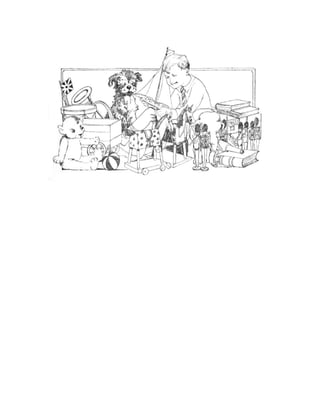
  • 18.
    Understanding Operating Systems,Fifth Edition 8 -14 ➢ Current byte address (CBA): the address of the last byte read. It is used by the File Manager to access records in secondary storage and must be updated every time a record is accessed. ➢ Current directory: the directory or subdirectory in which the user is working. ➢ Data compression: a procedure used to reduce the amount of space required to store data by reducing, encoding, or abbreviating repetitive terms or characters. ➢ Data file: a file that contains only data. ➢ Database: a group of related files that are interconnected at various levels to give users flexibility of access to the data stored. ➢ Device independent: programs that are devoid of the detailed instructions required to interact with any I/O device present in the computer system. ➢ Direct record organization: files stored in a direct access storage device and organized to give users the flexibility of accessing any record at random, regardless of its position in the file. ➢ Directory: a storage area in a secondary storage volume (disk, disk pack, etc.) containing information about files stored in that volume. ➢ Extension: in some operating systems, it’s the part of the filename that indicates which compiler or software package is needed to run the files. In UNIX and Linux, it is optional and called a suffix. ➢ Extents: any remaining records and all other additions to the file that are stored in other sections of the disk. ➢ Field: a group of related bytes that can be identified by the user with a name, type, and size. A record is made up of fields. ➢ File: a group of related records that contains information to be used by specific application programs to generate reports. ➢ File descriptor: information kept in the directory to describe a file or file extent. ➢ Fixed-length record: a record that always contains the same number of characters. ➢ Hashing algorithm: the set of instructions used to perform a key-to-address transformation in which a record’s key field determines its location. ➢ Indexed sequential record organization: a way of organizing data in a direct access storage device. An index is created to show where the data records are stored. Any data record can be retrieved by consulting the index first. ➢ Key field: (1) a unique field or combination of fields in a record that uniquely identifies that record; or (2) the field that determines the position of a record in a sorted sequence. ➢ Lockword: a sequence of letters and/or numbers provided by users to prevent unauthorized tampering with their files. ➢ Logical address: the result of a key-to-address transformation. ➢ Master file directory (MFD): a file stored immediately after the volume descriptor. It lists the names and characteristics of every file contained in that volume. ➢ Noncontiguous storage: a type of file storage in which the information is stored in nonadjacent locations in a storage medium. ➢ Program file: a file that contains instructions for the computer. ➢ Record: a group of related fields treated as a unit. A file is a group of related records. ➢ Relative address: in a direct organization environment, it indicates the position of a record relative to the beginning of the file. ➢ Relative filename: a file’s name and extension that differentiates it from other files in the same directory. ➢ Sequential record organization: the organization of records in a specific sequence. Records in a sequential file must be processed one after another.
  • 19.
    Understanding Operating Systems,Fifth Edition 8 -15 ➢ Subdirectory: a directory created by the user within the boundaries of an existing directory. Some operating systems call this a folder. ➢ Variable-length record: a record that isn’t of uniform length, doesn’t leave empty storage space, and doesn’t truncate any characters, thus eliminating the two disadvantages of fixed-length records. ➢ Volume: any secondary storage unit, such as hard disks, disk packs, CDs, DVDs, removable disks, or tapes. ➢ Working directory: the directory or subdirectory in which the user is currently working.
  • 20.
    Random documents withunrelated content Scribd suggests to you:
  • 21.
    203 CHAPTER XIX PRINCESS FORTUNATA Whathappened to George in the magician's castle. A story which is like a patchwork counterpane. How difficult it was to remember the charm! Alexander barks just in time. The Chinese box-trick. The Princess Fortunata! "The magician is coming!"
  • 22.
    211 CHAPTER XX ANOTHER PARTY Whathad become of everybody? The dream-music again. The little house changes. "George is home at last!" The party and supper which George had never heard about before. How each of the guests gave him a present, and the beautiful Queen gave him the best of all. "Of course, you've guessed it, too!"
  • 23.
    223 CHAPTER XXI BACK TOTHE WORLD Alexander's bark again. How George and the doctor talked about Fairyland. What they all said about George's adventures. How Mother has a little house in the wood, too, and why she goes there. How George began to understand why his fortune lay right under his very nose.
  • 24.
    235 CHAPTER XXII WHAT THEFAIRIES THOUGHT How the old frog actually laughed! Why George Henry was a wonder-child after all, and why Puck was delighted.
  • 25.
    PAGE Frontispiece 70 122 220 ILLUSTRATIONS "LOOK, THERE'S THECASTLE!" SAID THE KNIGHT, POINTING STRAIGHT IN FRONT OF HIM THERE STOOD A DELIGHTFUL LITTLE HOUSE WITH SMOKE CURLING UP FROM ITS CHIMNEYS THE LIGHT GREW BRIGHTER AND BRIGHTER AROUND HIM WERE HUNDREDS AND HUNDREDS OF TINY FIGURES
  • 26.
    THIS is atrue story. It all happened through George Henry not believing in the fairies, just as some boys but very few girls would do. Boys believe in Red Indians and pirates, and think fairies are all stuff and nonsense; but they are quite wrong, for Puck can turn himself into anybody or anything he chooses. So if one day when you are ploughing the foaming main you sight a pirate ship flying the skull and crossbones at the masthead, it may not be a pirate at all, but only Puck himself. Beware! If he catches you he will make you walk the fairy plank, and you will fall off it splash! right into Fairyland, and find yourself turned into a cross old frog or something quite as disagreeable. This story should be read aloud. You should seat yourselves in a ring—that will please the fairies—and look happy, even if you aren't as happy as you might be. Sour looks curdle cream and stories as well.
  • 27.
    "What!" you say."Dragons and witches and giants! Do you expect us to believe in them?" Well, why not? Do you only believe in what you have seen? All the best books are full of wonders like these, and everything wonderful must be true. So, once again, this is a true story. Now turn to the next page and begin!
  • 29.
    G CHAPTER I George Arrives EORGEHENRY was born under a lucky star, which means that a star laughed when he came into the world. This happens to very, very few of us; perhaps it is because we are born naughty and ready to be stood in the corner at once. The fairies knew all about George Henry, however, and were delighted, for he was a darling boy. Puck brought them the news wrapped up in a leaf and packed inside a nutshell in order to keep it dry. Of course you have heard of Puck. He is the little fairy who often plays mischievous tricks upon people; but if children behave nicely he is always ready to be their friend. Santa Claus often pays him a visit about Christmas-time in order to find out if any children have not been as good as gold during the past year. Then the naughty children find their stockings empty on Christmas morning, and wish and wish—too late—that they had thought in time of what Father and Mother had told them. Well, the fairies danced that night in the greenwood to the music of the cricket, the grasshopper, and the frog. Puck told them all about George Henry and what a very fine boy he was going to be. George's father and mother thought so too, and Nurse said that he was the finest child she had ever seen. Nurses always know. The birds and animals soon heard the news too, and there was such a chattering, jabbering, twittering, squeaking, and I really don't know how to tell you what other curious noises in the wood that night.
  • 30.
    This 'wonder-child,' asthe fairies called him, was named George Henry—'George' after his grandfather, who gave him a large silver drinking-mug as a christening present, and 'Henry' after his father. His mother would have liked to add 'Alexander' as a third name, but it was given, after all, to a new black, woolly puppy which came into the house about this time; so that was all right. It is a great pity to waste fine names like Alexander. George Henry and Alexander grew up together and were great friends. Alexander learned to walk long before his little playmate, who used to toddle along holding on to the dog's tail, and very often falling over on top of him when his legs grew tired. As soon as he got past his toddle-days he loved to walk about everywhere and see everything. The world was full of the most wonderful things; there was a pigsty in which lived a family of little pigs with curly tails. They used to squeak "Good-morning" to him every time he passed by. He loved their curly tails, and often tried to make Alexander's tail like theirs, but it was of no use. It either stood straight up on end or else disappeared between his legs. It was fine, too, to see the geese marching along like soldiers with the old gander at their head; to watch the old hen fussing and clucking after her little fluffy chicks, who would never come home when they were told—"Like naughty little boys, you know," said Nurse. It would take hours to tell you all the things Alexander and he saw together—the animals, the birds, the trees, the flowers; and they all loved him. But he never saw the fairies—though they often waved their little hands to him; and Puck sometimes rode on Alexander's back through the woods and led them to all the prettiest spots—but George never knew. By and by, when they had grown up a little more, and George was in sailor trousers, while Alexander had a great big bark which
  • 31.
    quite made youjump the first time you heard it, Father and Mother began to wonder what George would be when he became a man. He loved playing at soldiers, and had boxes and boxes full of them which Grandfather and Grandmother, uncles and aunts, and other kind people gave him from time to time. He played with them on the nursery floor, up and down stairs until the housemaid, Anne, fell over them, on his bed when he ought to have been asleep, until Father said: "Ah, the boy will be a general and win great battles when he grows up!" "No!" answered Mother. "George is born for something better than that." He knew all about everything in the shop windows, better than even the people to whom the shops belonged. "He will be a great merchant!" said his grandfather. "Pooh!" answered Mother. "Buying and selling? My little George was not born for that." He began to use paper and pencil, and then a paint-box. "Ah!" said the aunt who had given him all these things. "George will be a great artist who will draw and paint most wonderful pictures." "Rubbish!" replied Mother. "George was born to do something great. He can always draw pictures to amuse himself." Then he learned to write, and wrote the most wonderful stories which no one except himself could understand. "He will be a great writer and write stories which everybody will read," said his grandmother. "I never heard such nonsense!" cried his mother, quite vexed. "Don't I tell you that he is going to do great things? Anybody can write stories; besides, he might sit up late at night and catch colds and I don't know what else if he began writing stories!"
  • 32.
    Puck was delightedto hear them all guessing in this way, and laughed until he fell off the top of a big sunflower on which he was sitting. "Oh, dear!" he cried. "How funny these big people are!" And he flew away into the wood to tell the fairies all about it. They laughed and laughed for days and days, and were never tired of hearing Puck talk like Grandfather, Father, Mother, and Aunt. Even the old bull-frog in the large pond, right in the middle of the darkest part of the wood, croaked "Ker-ek!" which was his way of laughing. He always had a cold, poor fellow, because his feet were never, never dry, and nobody ever thinks of giving frogs medicine. Perhaps they have neither nurses nor aunts. And so the days and months went by, and presently George was big enough to go to school. It was quite a nice school, so Puck said, for he went there when he had time. Puck liked to listen to the fairy stories best of all, and often sat on the teacher's shoulder and whispered in her ear. You would have been surprised and delighted to hear what splendid stories she told the children on those days, and she could never imagine how they came into her head. Now, it is a very sad thing to have to tell you, but Puck soon found out that George did not believe that there were any fairies, nor—worse still—that there ever had been any. One day he actually fell asleep when the very best story of all was being told! Puck didn't know what was to be done, and the fairies couldn't help him, for they had never heard of a boy like this before. "Dear me!" they said. "If there were no fairies how could there be any fairy stories? How stupid of little George not to believe in us! We believe in him, and he is only a boy and not a fairy at all." So Puck set to work to think what to do, and went wandering through the woods, asking all the birds, all the beasts, and even the insects if they knew what to do with a boy called George who didn't believe in the fairies. None of them were able to help him. An old
  • 33.
    horned beetle said,"I should pinch him!" but Puck didn't think that pinching was of much use. When George went to bed, Puck used to sit on his pillow and tell him the most beautiful dreams, but George forgot all about them when he woke up. What can one do with a boy like that? Nurse, however, just nodded her head wisely and said: "Wait and see!" There are thousands of nurses saying the same thing all over the world. They just know what will happen later on, and that is all. They never tell anyone else. If they do they are not real nurses, and should be given a month's notice. George's nurse was what people called a 'comfortable' person. She was big and round, and her shoes creaked just now and again— quite a lady-like creak. She did not often smile, but when she did you felt sure the sun was shining and that the world was a jolly place to live in. Nurses—real nurses—know everything; very likely they have been taught by the fairies, but if you asked your nurse this question she would never tell you. Oh no! Nurse always spoke of Alexander as "that black imp," but he knew how to coax a piece of biscuit from her whenever he wished. He used to sit down on the nursery hearth-rug with his head on one side, thump gently with his tail on the floor, and bark very gently, "Wuff! Wuff!" without stopping, for ever so long. It must be a grand thing to be a dog like Alexander whenever one wants a biscuit. George was very busy just now, for he had made up his mind to be an aviator. An aviator is a man who flies up in the air on a machine which looks something like a large bird, and makes a noise like ever so many cats quarrelling. It flies straight up, and then before you can say "Knife!" it is out of sight. There are no tunnels or stations, no tickets such as you have on the railway. You just go straight ahead until you get there. No wonder George didn't think about the fairies when his head was full of such wonderful things.
  • 34.
    But Father said:"Time enough to fly when you are grown up." Mother said: "An aviator? No, George, darling! You can come for a ride in the carriage with me this afternoon." And Nurse said—of course, the same as before. And so the months and the years went by; George grew bigger, Alexander grew fatter, Nurse grew more and more comfortable, and Puck grew crosser and crosser. At last, one day, everybody woke up and said: "George Henry is eight years old to-morrow!"
  • 35.
    THE FAIRY RIDE HAVEyou seen the fairies ride All down the magic glen? Green jackets, red caps, Teeny, weeny men! Hearken to their music, The winding of the horn! Ta-tan-ta-ra-ta! A fairy boy is born! Mind you keep the doors shut When they're riding by, Lest you get some fairy dust In your little eye. If that were to happen, In a flash you'd be Changed into a fairy. Goodness gracious me! Green jackets, red caps, See them trooping past. Hear their bridles jingling— Shut the door fast!
  • 37.
    I CHAPTER II George GrowsUp T was not long before everybody knew all about it. George was going to have a party! Not an ordinary party, but a splendid one. There were invitations for all George's friends, both boys and girls; for Grandfather, Grandmother, uncles, aunts, and all kinds of grown- ups who could help to hand round the tea and cakes and let off fireworks when it grew dark. George was quite ready to have the fireworks first thing in the morning as soon as he woke up; but Father said, "No!" Mother said, "No!" and Nurse said nothing, but just looked. Nurses don't like fireworks, though they sometimes pretend they do. Everybody—except Alexander—must have been getting ready for this birthday for weeks and weeks, for when George woke up a little earlier than usual on the great day there was quite a stir and bustle in the house. The postman could hardly carry his bag along the path up to the front door. It was packed full of presents. Alexander had a big red silk bow fastened round his neck, and nearly fell all the way downstairs through twisting his head round to try and bite it off. Even Nurse, for once, almost ran, she was in such a hurry. It is a wonderful thing to have a birthday if you have enough kind uncles and aunts to help. Uncles must be strong enough to carry you on their shoulders like a never-tiring horse, then to change into bears which you can shoot at, and, almost before they have finished dying under the sofa, they must be ready to change into anything else you may want.
  • 38.
    Aunts are bestwhen they smile all the time and bring out sweets and chocolates from some hidden part of their dresses, like conjurers, just when you are tired and want to rest for a minute. Alexander liked aunts, and was always ready to beg for biscuits even when he met one of them in the middle of the street or in a shop. Uncles were all right, but rather tiring. Dogs don't always want to play games. Well, the number of presents was perfectly delightful, and everybody had sent exactly what George wanted. But in the middle of breakfast he looked up suddenly and said: "It's Alexander's birthday too. Hasn't he got any presents?" "What?" said Father, turning quite red in the face and forgetting that he was holding a piece of bacon on the end of his fork. "Dear me!" said Mother, looking as if she were going to cry. "Oh, where's Nurse?" Nurse appeared in the room at once, and when she heard that it was Alexander's birthday, do you think that she said "What?" or "Dear me?" Not at all. She just went to the door and called: "Alex—ander!" Alexander arrived with a rush and a bang, looking as if nothing in the world would ever surprise him. "Alexander," said Father solemnly, "I have great pleasure in telling you that this is your birthday. I wish you many happy returns of the day!" "Wuff!" replied Alexander, wagging his tail, and looking at Father as much as to say: "Don't keep me waiting any longer. You know how hungry I am!" Father smiled, and suddenly in his hand he held a most beautiful silver collar, on which was written Alexander's name. He took off the red bow and put the collar round Alexander's neck. Alexander said nothing, but sat and waited.
  • 39.
    Mother wished him'many happy returns' too, and then—where had she hidden it?—there was a pretty tin of sugary biscuits with 'A' printed on the top. "Wu—uff!" said Alexander, and wagged his tail so hard that he nearly fell over. George looked quite pleased. "I'm so glad he wasn't forgotten," he said; "it didn't seem fair for me to get such lots of things, and Alexander nothing at all." It was soon four o'clock, and the guests began to arrive, first in ones and twos and then in threes and fours. It was a lovely summer day, and after games in the garden there was a Punch and Judy which everybody liked, especially Father and the uncles. Alexander sat quite still until Punch's dog appeared, and then he had to be led indoors and shut up, for he grew quite fierce, and was just getting ready to bite Punch's nose off. Punch without a nose wouldn't be a Punch at all, and then the man who keeps him would never be able to go to parties again. But Alexander never thought about that. By this time everybody was ready for tea, which was served in a large tent in the garden. On the middle of the table stood a very large cake stuffed full of plums. Nurse had made this with her own hands, and there were no cakes like hers. One could eat two and even three large-sized slices and scarcely feel a little bit uncomfortable afterward. No one could eat any of this cake, however, until most of the white and brown bread and butter—you were allowed to have jam spread on it—scones, tea cakes, cream cakes, ice cakes, jam puffs, tartlets, and oh! heaps of other things had disappeared. Then Father stood up with a large knife in his right hand, and made a little speech. Everybody clapped their hands and laughed—even the uncles and aunts who had had no tea at all.
  • 40.
    George sat ina high chair looking as proud as a king. Kings always look proud, and queens, their wives, look proud too, but in quite a nice way. If you have ever seen them riding by in a carriage drawn by six white horses in gold harness you will understand exactly why you cannot really look proud in a cab with one horse, or in a taxi-cab which flies along with a fizz and a bang. You only just have time to get the eighteenpence ready for the driver. If you were a king you wouldn't ever have to do that. After the speech George cut the cake and Father helped, so that everybody, grown-ups and all, had a slice. Then George had to speak. "Thank you very much," he said. "I hope you've enjoyed the party. I know I have, and so has Alexander. Now we're going to have the fireworks!" It was not dark yet, so there were games and races, followed by a little rest, during which Mother told them stories. Then Uncle William, the funny man of the party, gave an imitation of all the animals in a farmyard, which was even better than the real thing, of a railway train coming out of a tunnel, and, last of all, of Father getting up in the morning. Father laughed so much at this that Mother had to pat him very hard on the back for several minutes. Uncle William was not allowed to tell the story of the two cats on the wall, because Alexander did not like cats—even cats which weren't real. At last it was time for the fireworks, and all the children seated themselves at one end of the garden and waited patiently. Suddenly bang! up went a red star, then a green one; then showers and showers of little green ones. Then bang! bing! bang! fizz! crack! jumped the crackers. Rrrrrrr! whirled the Catherine wheels, slowly at first, then fast, faster, and so fast that they made your eyes quite sore watching them. Hiss! Whizz! Bang! went a rocket with a tail as long as from here to the end of the next street. Higher and higher it flew, until, all of a sudden, just as you thought it was quite out of sight, it burst, and—
  • 41.
    ah!—hundreds of littlestars lit up the sky and made it look lighter than even the lightest day. But there was something better to come still. At the end of the shrubbery a light shone faintly and then went out. Then shone more and more lights, until you could see that great big letters as tall as yourself were growing up. And then—all of a sudden—in a blaze of light there was spelt out for all to see, GEORGE. Such crackings and bangings, such shouts and cheers from all over the garden you never heard, nor anyone else either. That was a real surprise. Just as people were getting ready to put on their coats and say "Thank you very much for your delightful party," another light shone out over the high tree near the garden gate. "Hullo!" said Father. "Hullo, what's this? A surprise from Uncle William, I expect," and he stood still and watched. Brighter and brighter grew the light, longer and longer, until it looked like a great tongue of fire. Then it swept along over the trees, under the trees, in and out and round about, until it looked as if thousands of little lanterns were shining everywhere. "It sounds as if there were music somewhere, quite far off," said Mother. "Well, I don't know what it can be." Uncle William, who was supposed to know all about it, said that he hadn't done it, but nobody believed him. Little by little the lights died out, and then it was time to go home to bed. George was quite sleepy, and was very glad to find his head resting on a soft pillow. After he had said his prayers and said "Good-night," he called out to Nurse: "Do you know who made those jolly little lights, right at the end of the fireworks?" Nurse stood silent for a moment: "Perhaps I do; perhaps I don't," she replied.
  • 42.
    "Oh," said George,"tell me, then!" "Good-night, Master George." Out went the light, and if George hadn't been so sleepy and tired he might have found out all about it then and there; but that would have meant that all kinds of things which were just going to happen wouldn't have happened at all, which would have been a pity. Puck sat cross-legged on an old toadstool, and the fairies danced all round him in their magic ring. "It was a jolly party!" he said to the old frog. "You ought to have been there." "Ker-ek!" replied the frog. "My throat was rather sore to-night, so of course I could not go. I hear there were fireworks." All the fairies stopped dancing and burst out laughing when they heard him say this. "What are you laughing at?" he croaked. Puck jumped off his stool and turned head over heels. "Tell him! Tell him!" they all cried out. "Well," said Puck, "we were all there. The fairy music band played; the fire-flies and glow-worms made beautiful fireworks, more beautiful than the grown-ups had bought—and no one knows who did it. What fun!" "Ugh!" said the frog. "I don't see anything to laugh at." "Don't you?" said Puck. "Well, wait until we have our party and invite George." "He won't come," croaked the frog. "Won't he?" replied Puck. "Won't he?"
  • 43.
  • 44.
    OH, who wouldbe an old, old frog, With a cold in his head And no cosy bed? A-tish-oo! Oh, who would be a cross old frog, Who grumbles and growls All night to the owls? A-tish-oo! Oh, who would be a rude old frog, Who never says 'please,' Does nothing but sneeze? A-tish-oo! Oh, who would be a wet old frog, Who lives, as a rule, In a deep, deep pool? A-tish-oo! Oh, who would be a queer old frog, As hoarse as a crow? Would you?—Oh dear, no! A-tish-oo!
  • 46.
    I CHAPTER III Midsummer Eve Na few days' time it would be Midsummer Eve, and then the little fairies have a dance and supper all to themselves. Very few people have ever been there, and even fewer know anything at all about it. Only the very best people receive invitations, and, of course, there are never very many of the best people in the world. It is very hard indeed to be good, but—oh dear!—to be best! Why, it means being good, and going on being good, until you are so good that Mother thinks something must be the matter with you and sends for the doctor. Anyway, the fairies sent George an invitation, but he didn't understand what it meant, for it was written on an oak leaf which Puck blew in through the bedroom window. George thought it was only a common leaf and never picked it up. "Well, has George answered his invitation yet?" said the old frog to Puck a few days before the dance. "No," replied Puck, "he hasn't, but he's coming." "Coming, indeed!" croaked the frog, who had just caught a worse cold than ever. "Well, I'll believe it when I see him, and not before." "All right," said Puck. "You'd better go home, or else you won't be able to come to the party with that cold of yours." There was such a bustling, a running about, a flying here and a flying there in the wood all day and all night getting ready for Midsummer Eve. Such a brushing and combing, such a sewing and darning, polishing and scrubbing, and I don't know what else! Such a baking and brewing, cooking, stewing, and such nice smells! Puck
  • 47.
    carried bits ofthese away in his pocket, and George had the most delightful dreams of all the things he liked best to eat and drink. Nurse smiled when he told her, and Alexander listened with his head a little on one side, hoping to hear the word 'biscuit' or 'bone.' His idea of a really good party was a pile of bones and biscuits, with leave to eat them on the drawing-room carpet. This is just as good fun as waiting outside on the stairs for the jellies and creams when there is a dinner-party at your house. George had already forgotten about aeroplanes, and was very proud of being in trousers. When he first wore them he could not help looking down almost every minute to see if they were still there. The worst of wearing trousers is that you have to be so careful. Dogs like Alexander will jump and bump against them, leaving dirty paw-marks, just when you are not looking. Directly one begins to grow up there are really such a number of things one must think about. George used to stand with his legs wide apart and his hands in his pockets like Father, until Nurse sewed the pockets up tight one night when he was fast asleep. Trousers without pockets are like jam tarts without jam. George said nothing when he found it out, but in the garden after breakfast he remarked to Alexander: "When I grow up—really grow up—I am going to have pockets all over me, just as many as ever you can imagine. There will be so many that no one will ever be able to sew them up again." Alexander nodded. After all, he might be able to keep his bones in a suit with as many pockets as that! Midsummer Eve came at last. Everything was ready in the wood; even the old frog's cold was better, though he was still rather hoarse. The fairy ring was as smooth as velvet, and the fairy band had learned quite a number of new tunes. Puck was as busy as he could be, and whenever there was a moment to spare he brought another piece of moss for the seat
  • 48.
    which he hadbeen making for George. It was right in the middle of the wood in a little open space with high trees all round it. Whenever the wind came the trees rustled softly, and it sounded just as if they were putting their heads together and whispering secrets. Most of these trees were very old; so old that they had grown quite bent, and their long, twisted boughs hung down almost to the ground. On Midsummer Eve the moon always shines brightly, and lights up the fairy ring with a soft, silvery light. No one knows whether Puck asks her to do it, but if you will look out of your window—if you can wake up at the right moment—you will see for yourself that it is quite true, for so many of the best things always happen while we are fast asleep in bed. George went to bed as usual. Alexander flopped down on the mat outside the door and curled himself up. One by one the lights in the house went out, and soon everybody was fast asleep. It was as still as still can be. Far, far off sounded the first notes of the fairy music. Alexander pricked up one ear for a second, then sighed and fell fast asleep again. George turned over in his bed and began to snore. Puck flew in through the half-open window and rested for a moment on his pillow. "It's all ready, George," he whispered. "We're only waiting for you!" George snored a little louder. "George!" cried Puck, "George, come along! Don't be late!" George was dreaming. He was dreaming that he was in school saying the multiplication table, twice times, three times, and some of four times. He actually wasn't thinking about the fairies at all! Puck sat for a moment thinking what he should do; then he flew out through the window and back to the wood.
  • 49.
    The multiplication table,indeed! No one ever thinks of such things on Midsummer Eve. It is a time to dream of dancing, music, light, laughter, the wind in the trees, the tinkle, tinkle of water in the little brooks, the song of birds—they are all awake then—of almost anything else, but not twice times two. The fairies were just beginning to dance when Puck flew into the middle of the ring, and he looked so angry that they all stopped, wondering what could have happened. He could say nothing at first but "twice times four is ten," which is nonsense, but he had never learned his tables and never wanted to. He said this over and over again, just as if it were a rhyme, and they all listened, though they did not understand a bit what it meant. "Oh, ho!" said the old frog, who was sitting there puffing himself out as if he were trying to turn himself into a toy balloon. "Oh, ho! I see what it is. George won't come after all. I told you so. Oh, ho! Oh, ho!" "For shame!" all the fairies cried out. "For shame! Nasty old thing! You're quite glad he isn't coming." Puck sat with his head in his hands, thinking and whispering to himself, "Three times four are seven," which was worse than ever. The fairies felt so sorry for him. They all came and sat round him in a ring with their little heads in their hands. They did not know why he was doing this, but they did it to cheer him up. The old frog sat puffing, just as if some one had wound him up like a clockwork toy and he wasn't able to stop. After a long time Puck looked up and said: "Well, it's no use waiting. He won't come to-night." The old frog was so pleased when he heard this that he opened his mouth to say "I told you so," but he had puffed himself out to such a size that he fell over backward suddenly into a pool with a
  • 50.
    Welcome to ourwebsite – the perfect destination for book lovers and knowledge seekers. We believe that every book holds a new world, offering opportunities for learning, discovery, and personal growth. That’s why we are dedicated to bringing you a diverse collection of books, ranging from classic literature and specialized publications to self-development guides and children's books. More than just a book-buying platform, we strive to be a bridge connecting you with timeless cultural and intellectual values. With an elegant, user-friendly interface and a smart search system, you can quickly find the books that best suit your interests. Additionally, our special promotions and home delivery services help you save time and fully enjoy the joy of reading. Join us on a journey of knowledge exploration, passion nurturing, and personal growth every day! testbankfan.com