Understanding OER
Zach Welhouse // zachw@bigbend.edu
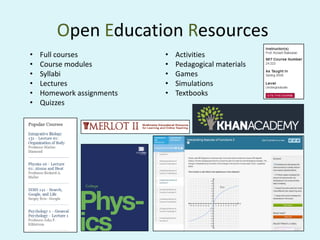
Open Education Resources
•
•
•
•
•
•

Full courses
Course modules
Syllabi
Lectures
Homework assignments
Quizzes

•
•
•
•
•

Activities
Pedagogical materials
Games
Simulations
Textbooks
Benefits
• They’re free.

• Access multimodal resources legally.
• Pre-load for courses.

• Gain alternate, vetted points of view.
• The online format is convenient.

$ ? $ ? $ ? $ ?
$ ! $ ! $ ! $ !
Issues
• There’s no such thing as a free lunch.

• Some fields are more vibrant than others.
• Understanding licenses takes time.

• Grant-based resources can be limited.
• “Free education? What?!”
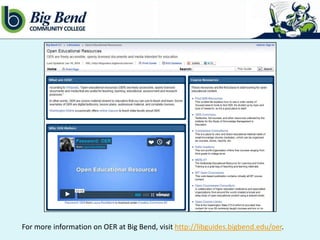
For more information on OER at Big Bend, visit http://libguides.bigbend.edu/oer.
Attribution
•
•

•
•

Slide 1: OER Global Logo by Jonathas Mello under CC BY 3.0.
Slide 2: List from OER Commons Wiki by OER Commons under CC BY-NC-SA 3.0. Khan
Academy Press Kit. All Khan Academy content is available for free at khanacademy.org.
College Physics by Open Textbook Library under CC BY 3.0. Screenshot from
http://webcast.berkeley.edu used under fair use. Screenshot from http://ocw.mit.edu/
used under fair use. Merlot logo from http://www.merlot.org used under fair use.
Slide 4: Citation needed by futureatlas.com under CC BY 2.0.
Slide 5: Header from http://libguides.bigbend.edu/oer. Thor the Viking, his likeness, and
the Big Bend Community College logo are owned by Big Bend Community College.

Since this PowerPoint presentation uses Creative Commons material, including
ShareAlike content, it would be boorish not to share. Therefore: Understanding
OER is created by Zach Welhouse under CC BY-NC-SA 4.0.

Understanding OER

  • 1.
    Understanding OER Zach Welhouse// zachw@bigbend.edu
  • 2.
    Open Education Resources • • • • • • Fullcourses Course modules Syllabi Lectures Homework assignments Quizzes • • • • • Activities Pedagogical materials Games Simulations Textbooks
  • 3.
    Benefits • They’re free. •Access multimodal resources legally. • Pre-load for courses. • Gain alternate, vetted points of view. • The online format is convenient. $ ? $ ? $ ? $ ? $ ! $ ! $ ! $ !
  • 4.
    Issues • There’s nosuch thing as a free lunch. • Some fields are more vibrant than others. • Understanding licenses takes time. • Grant-based resources can be limited. • “Free education? What?!”
  • 5.
    For more informationon OER at Big Bend, visit http://libguides.bigbend.edu/oer.
  • 6.
    Attribution • • • • Slide 1: OERGlobal Logo by Jonathas Mello under CC BY 3.0. Slide 2: List from OER Commons Wiki by OER Commons under CC BY-NC-SA 3.0. Khan Academy Press Kit. All Khan Academy content is available for free at khanacademy.org. College Physics by Open Textbook Library under CC BY 3.0. Screenshot from http://webcast.berkeley.edu used under fair use. Screenshot from http://ocw.mit.edu/ used under fair use. Merlot logo from http://www.merlot.org used under fair use. Slide 4: Citation needed by futureatlas.com under CC BY 2.0. Slide 5: Header from http://libguides.bigbend.edu/oer. Thor the Viking, his likeness, and the Big Bend Community College logo are owned by Big Bend Community College. Since this PowerPoint presentation uses Creative Commons material, including ShareAlike content, it would be boorish not to share. Therefore: Understanding OER is created by Zach Welhouse under CC BY-NC-SA 4.0.

Editor's Notes

  • #3 There are lots of definitional quibbles about the boundaries of OER, but this one works for now.
  • #4 1. The most immediate benefit of OER content is the cost. It’s free. Separating the wheat from the chaff takes time and practice, but that’s part of being an educator. Even if you don’t use a free textbook for your class—and your students will thank you if you do—you can raid it for ideas. 2. Reaching out to different learning styles is hard. It takes lots of different materials. “Fair use” and “educational use” of licensed materials is confusing. OER contain videos, activities, images, and diagrams that you can feel confident in using legally.3. Students who take a free course before heading into your classroom are better prepared. They’ll have familiarity with terms and concepts. If they identify problems with the challenge level of the content ahead of time, they’ll be better prepared.4. Students may learn better with multiple voices explaining concepts to them in different ways. You can see how your peers in other areas of the country are approaching similar topics.5. OER has been formatted for online display and distribution. It’s well-suited to linking from Canvas sites. Students far away from campus—and community members—can access a lot of OER from any computer with Internet access.
  • #5 1. There are many great OER out there. However, there isn’t a standardized way to sort or search them. Moreover, not everything you find is going to be up to your standards or usable within your class without some modification. As a result, finding the perfect material requires sifting through several repositories of information—or asking a librarian to do it for you. 2. Core undergraduate courses have the most resources available: math, biology, introduction to English literature and composition, etc. Aviation and advanced physics resources, for example, are less richly represented.3. Not all OER is licensed equally. Most are upfront about how you can use them, but it’s another step to go through.4. Creating OER isn’t free. Often the money comes from limited-term grant programs. When the money runs out, so does the support. Relatedly, support for OER production ebbs and swells based on a institution’s political climate. 5. Finally, there’s the possibility of devaluing the perceived worth of educators. I’m not convinced by this argument, since instructors are necessary to answer questions, provide motivation, and authorize certification. However, the concern is worth mentioning.*. I can’t address all of these concerns. Many of them are just the nature of the beast. However, I have prepared a resource to help with the first bullet point…