Understanding
FDA’s Priority
Review Voucher
System
Introductions
Senior Research Scientist
Kelly Roney, PhD, RAC
Integrated Product
Development Associate
Sheila Bello-Irizarry, PhD
Research Scientist
Devin Rosenthal, PhD, RAC
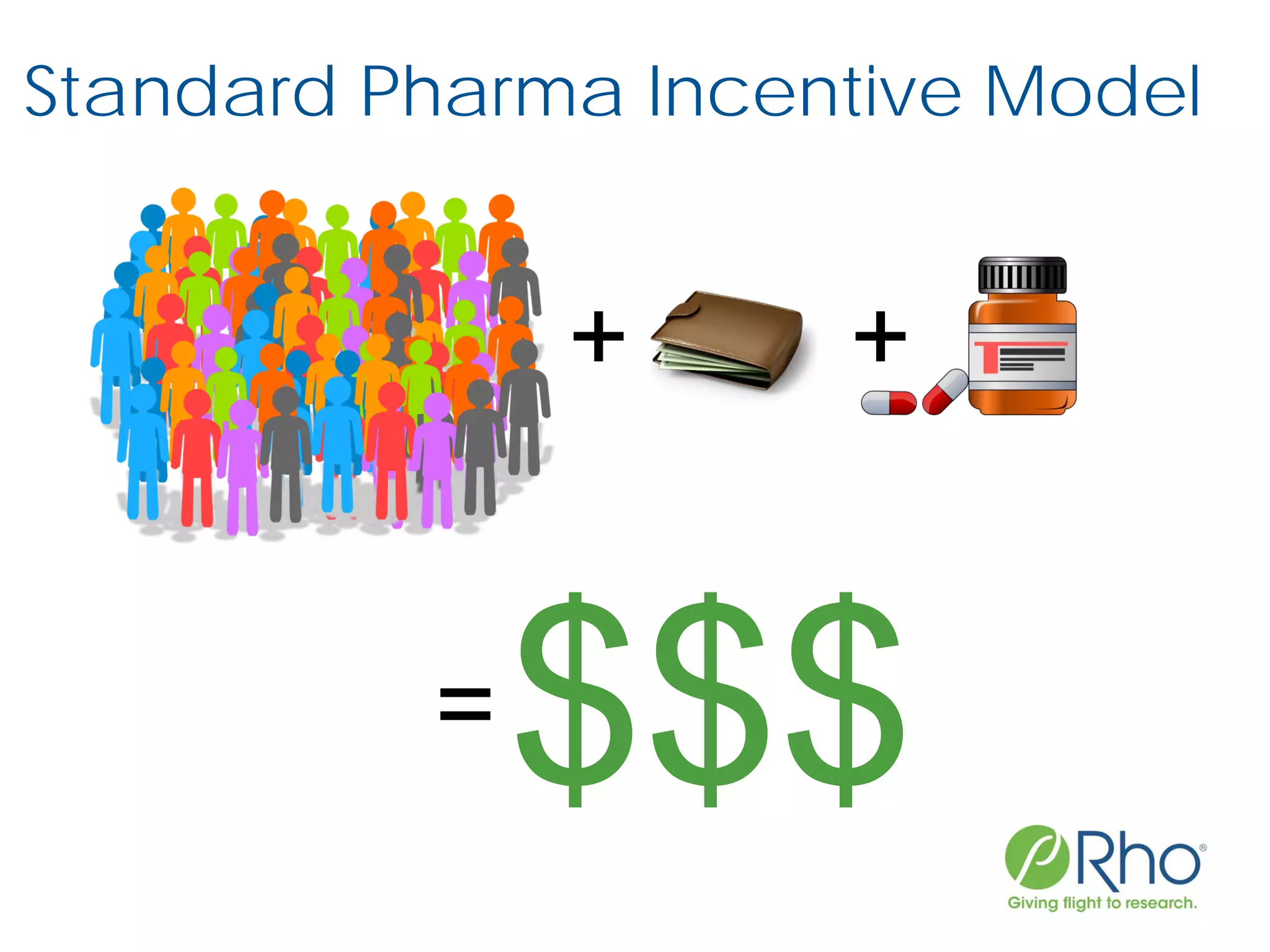
Standard Pharma Incentive Model
+
$$$=
+
+ +
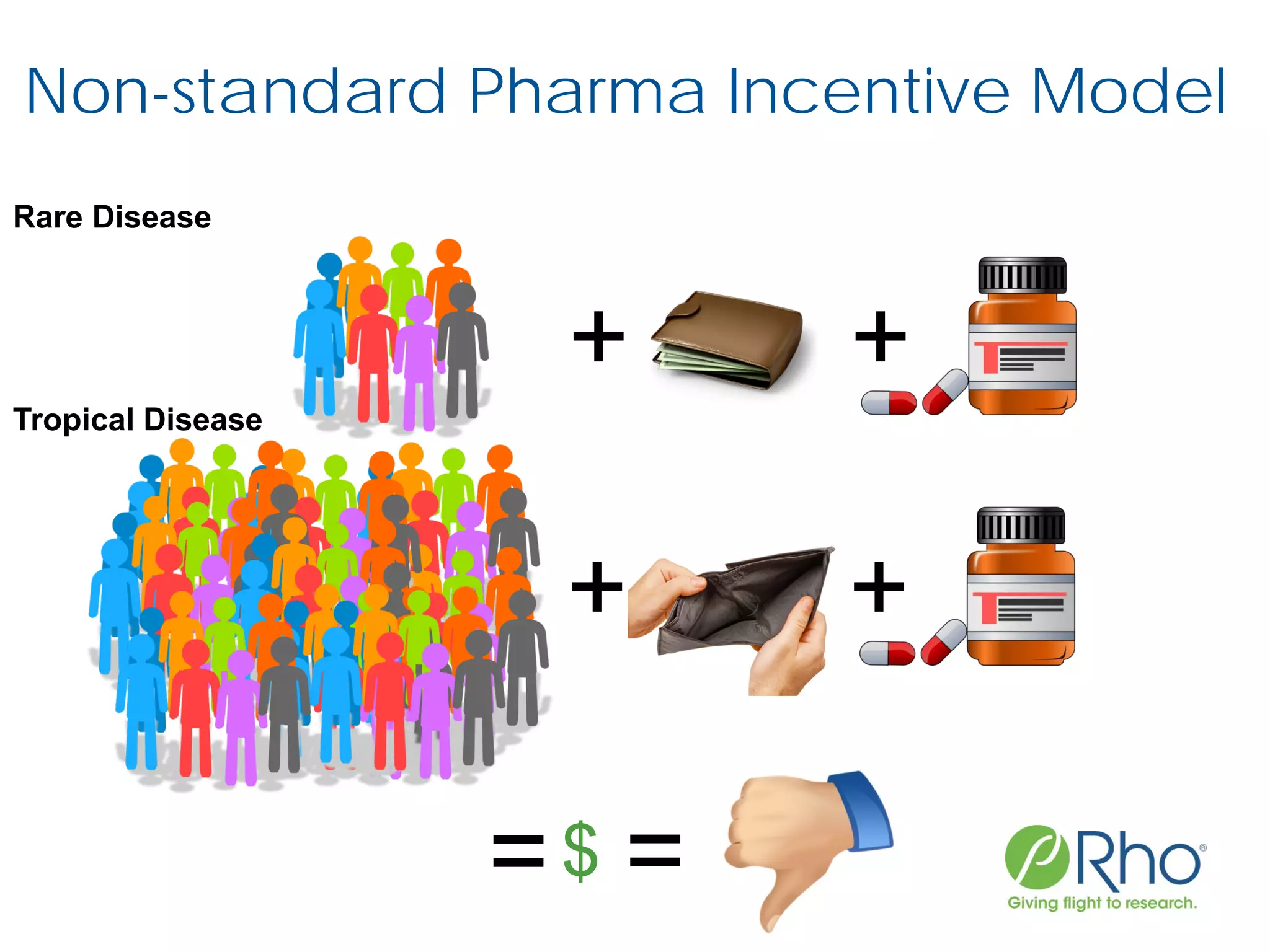
+ +
$= =
Rare Disease
Tropical Disease
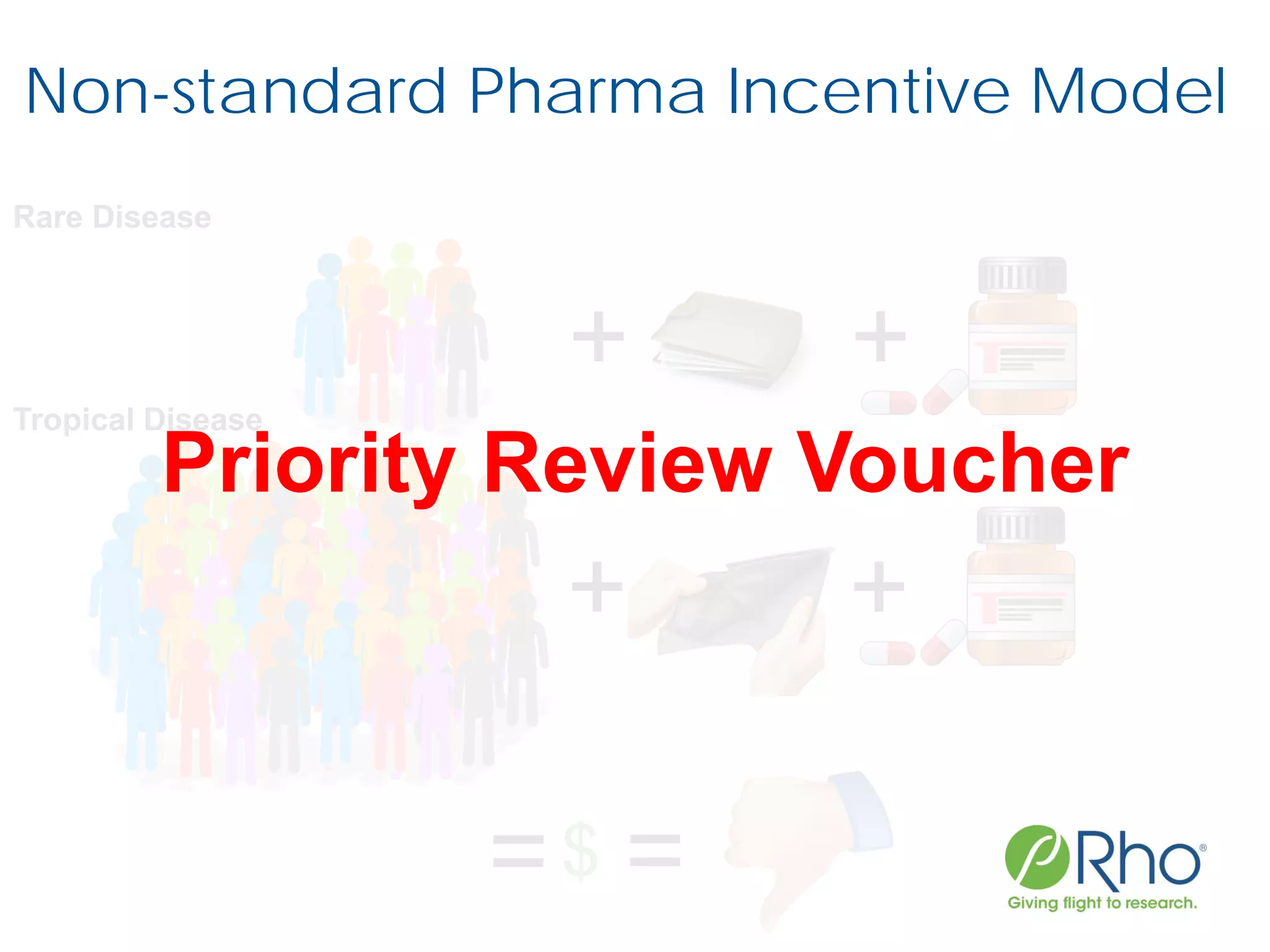
Non-standard Pharma Incentive Model
+ +
+ +
$= =
Rare Disease
Tropical Disease
Non-standard Pharma Incentive Model
Priority Review Voucher
• Tropical disease
• Rare pediatric disease Priority
Review
Voucher
Company Therapy
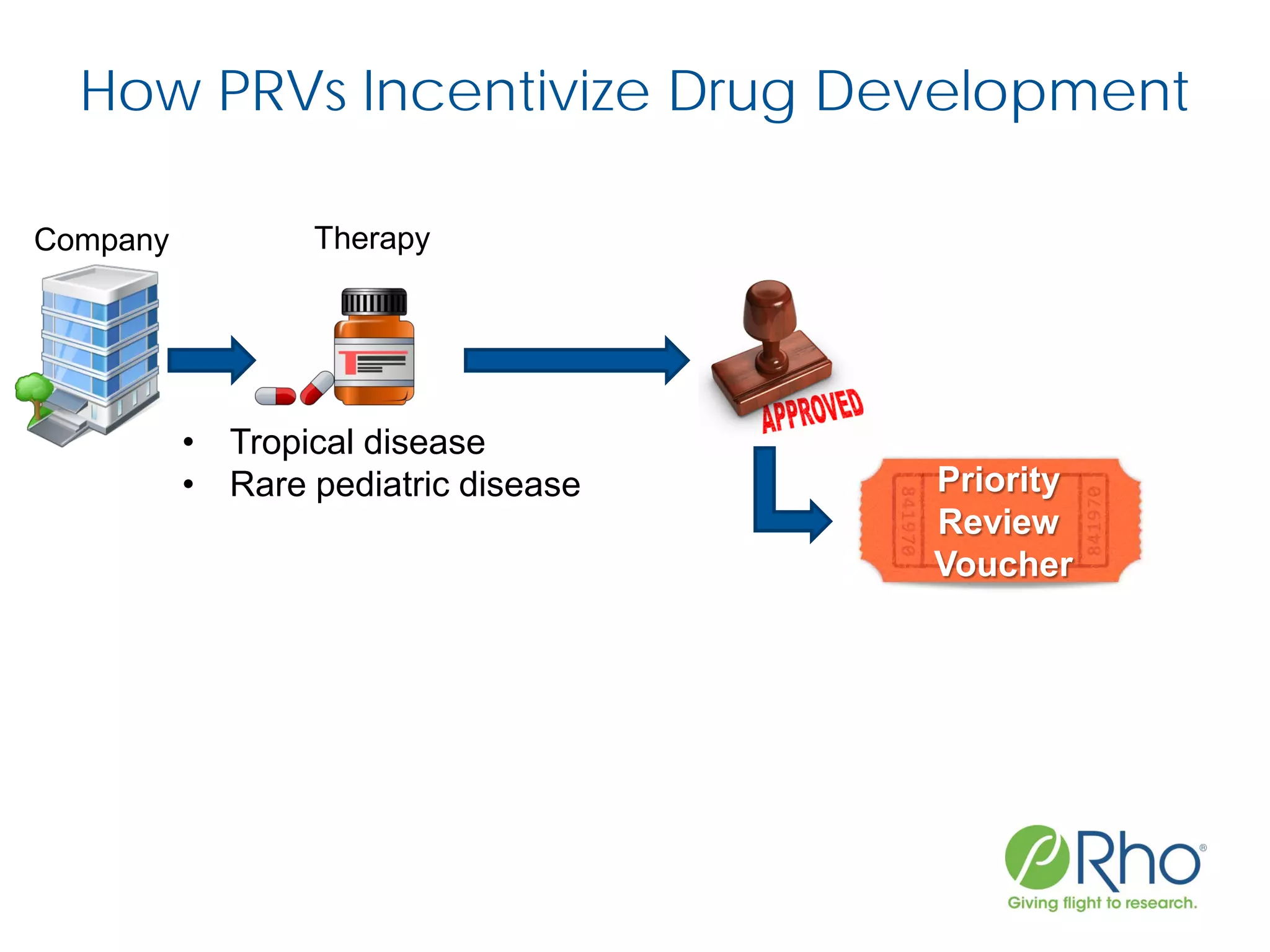
How PRVs Incentivize Drug Development
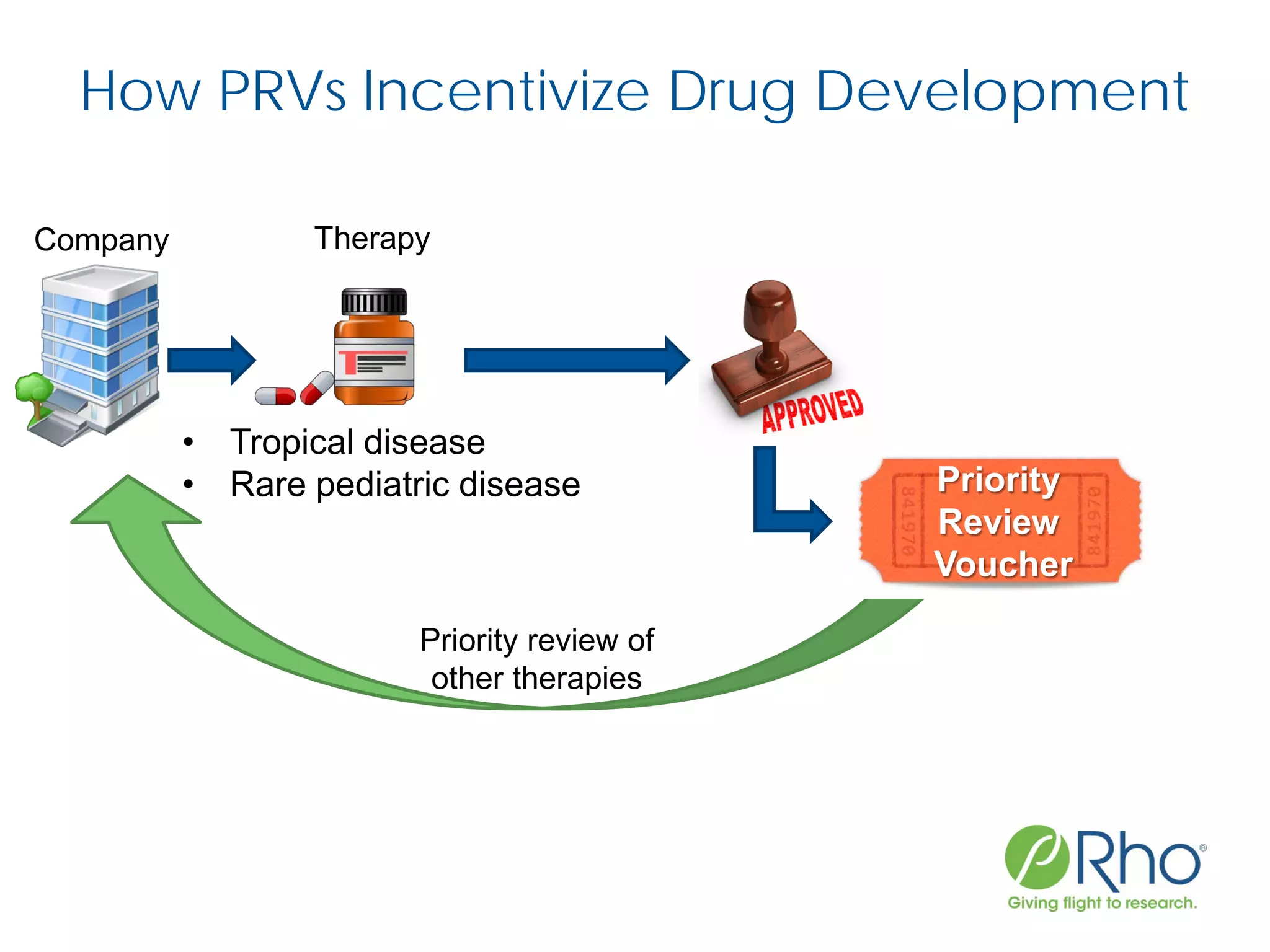
• Tropical disease
• Rare pediatric disease Priority
Review
Voucher
Company Therapy
Priority review of
other therapies
How PRVs Incentivize Drug Development
Priority review of
other therapies
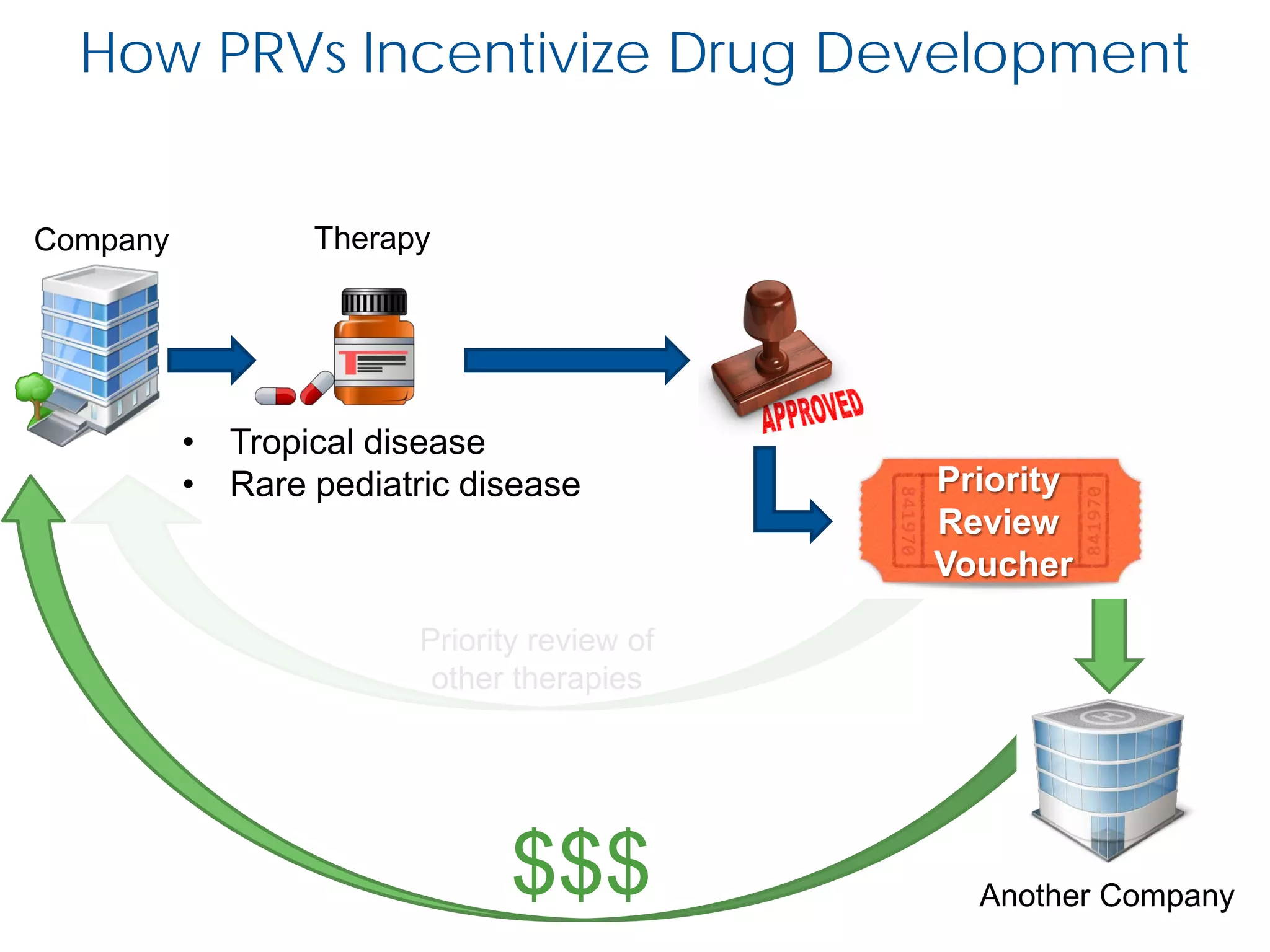
How PRVs Incentivize Drug Development
• Tropical disease
• Rare pediatric disease Priority
Review
Voucher
Company Therapy
$$$ Another Company
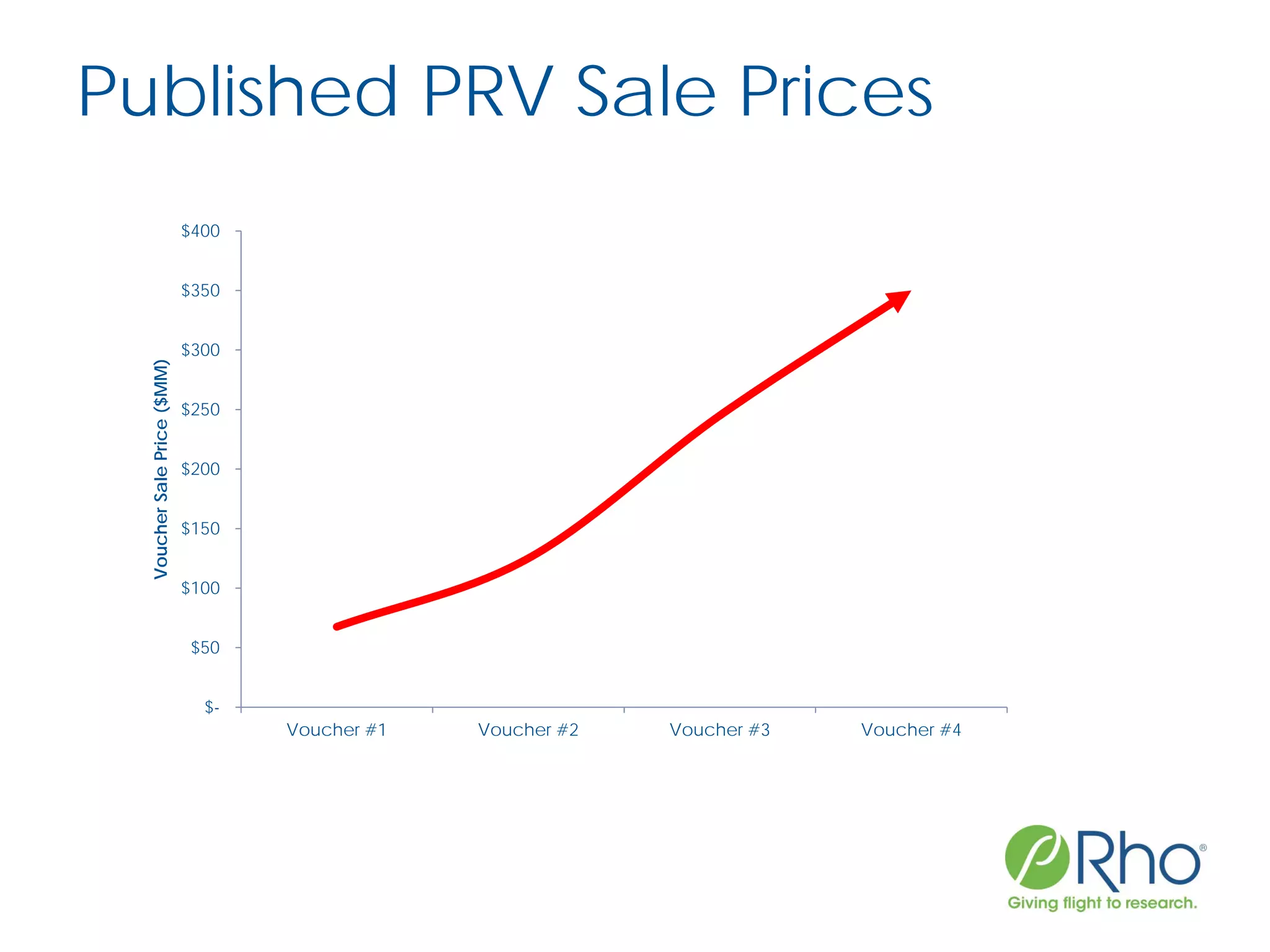
Published PRV Sale Prices
$-
$50
$100
$150
$200
$250
$300
$350
$400
Voucher #1 Voucher #2 Voucher #3 Voucher #4
VoucherSalePrice($MM)
What Are Priority Review Vouchers?
Priority Review Vouchers Reduce
Approval Time
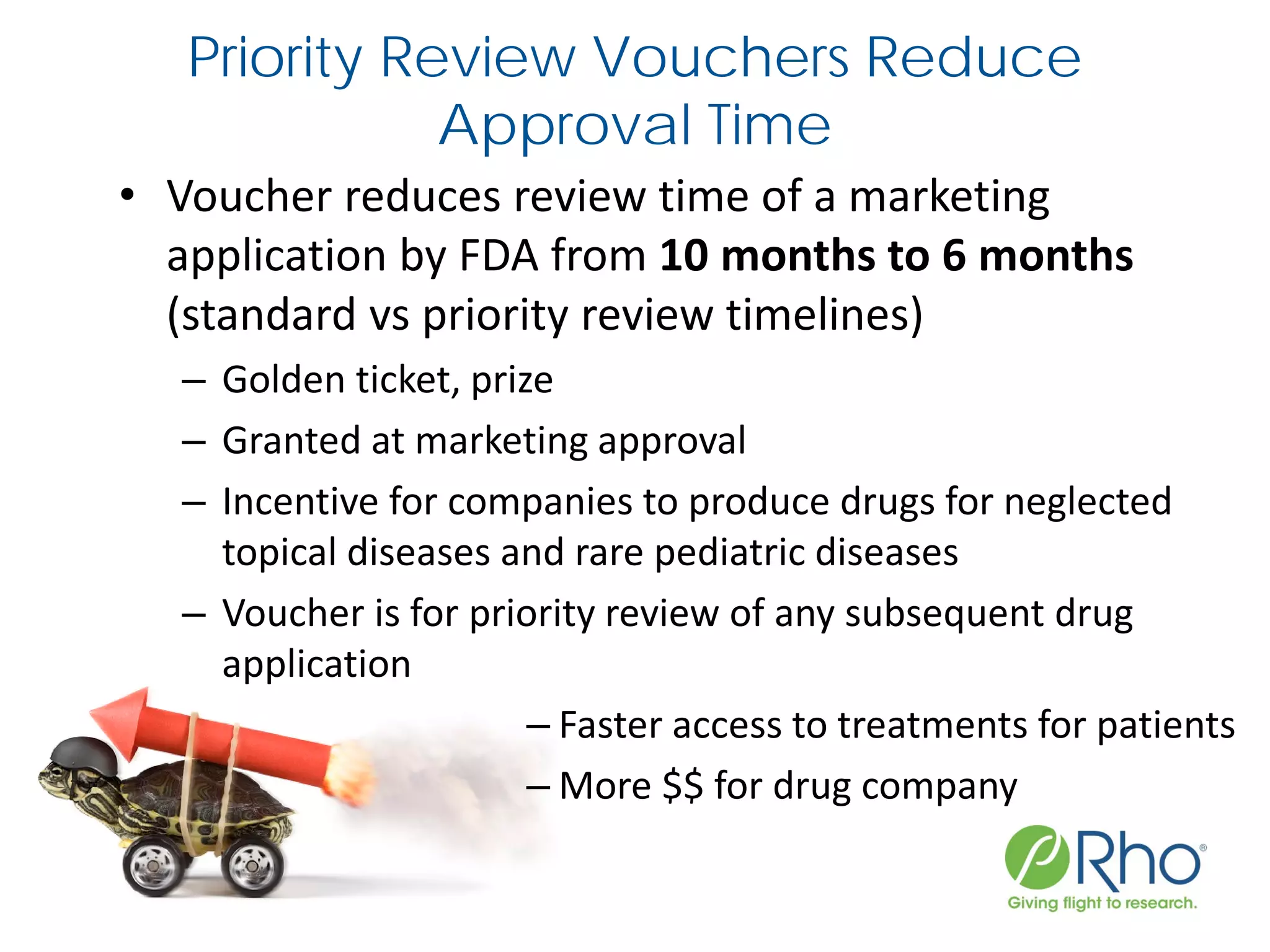
• Voucher reduces review time of a marketing
application by FDA from 10 months to 6 months
(standard vs priority review timelines)
– Golden ticket, prize
– Granted at marketing approval
– Incentive for companies to produce drugs for neglected
topical diseases and rare pediatric diseases
– Voucher is for priority review of any subsequent drug
application
– Faster access to treatments for patients
– More $$ for drug company
FDA Priority Review Vouchers
• David Ridley, Henry Grabowski, and Jeffrey Moe –
Duke University
• Proposed in “Developing Drugs For Developing
Countries” (Health Affairs, 2006)
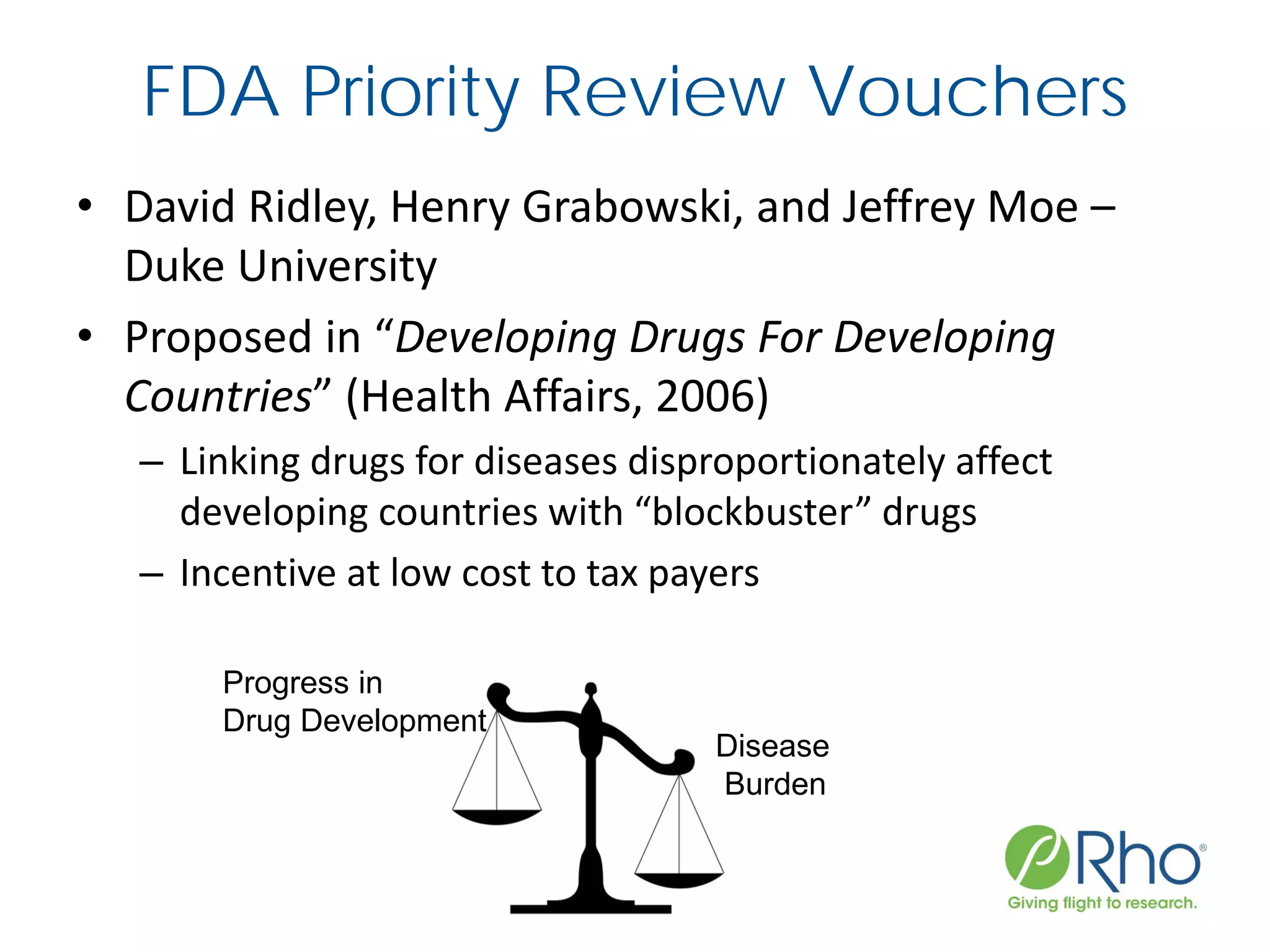
– Linking drugs for diseases disproportionately affect
developing countries with “blockbuster” drugs
– Incentive at low cost to tax payers
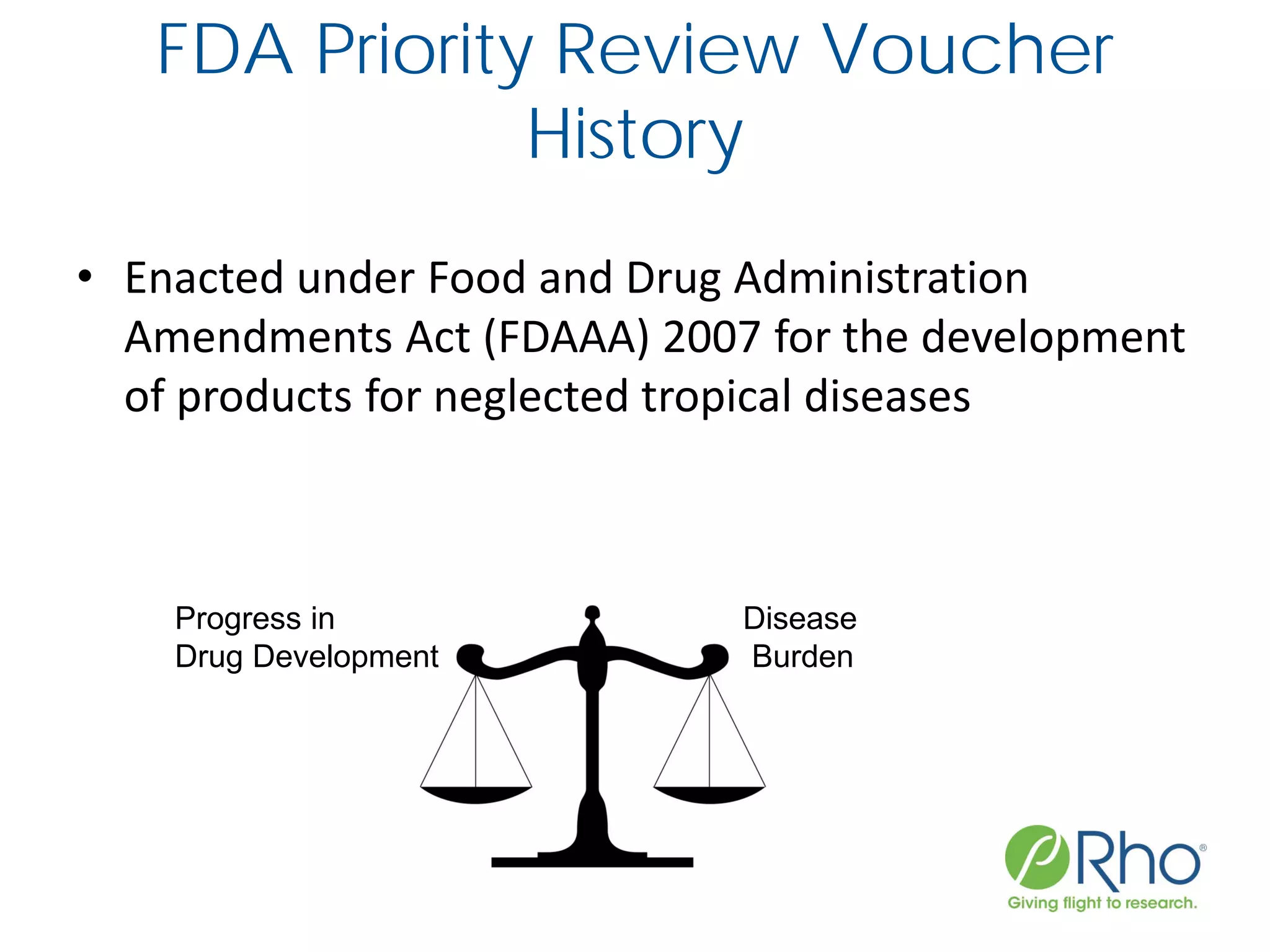
Disease
Burden
Progress in
Drug Development
FDA Priority Review Voucher
History
• Enacted under Food and Drug Administration
Amendments Act (FDAAA) 2007 for the development
of products for neglected tropical diseases
Disease
Burden
Progress in
Drug Development
Eligibility Criteria for a PRV
• Drug or vaccine that qualifies for the voucher must:
– Be an NDA for a new molecular entity (NME), or
original biologic
– Merit priority review on its own in order to qualify
for the voucher
– Treat a qualifying disease
– Voucher must be used on a NME, or novel biologic
Two Types of FDA Priority Review
Vouchers
• Tropical Disease Priority Review
Voucher
• Rare Pediatric Disease Priority
Review Voucher
Tropical Disease Voucher
• Part of Food and Drug Administration Amendments
Act of 2007
• FDAAA authorized FDA to award priority review
vouchers to sponsors of marketing applications of
new drugs or biologics intended to treat certain
tropical diseases
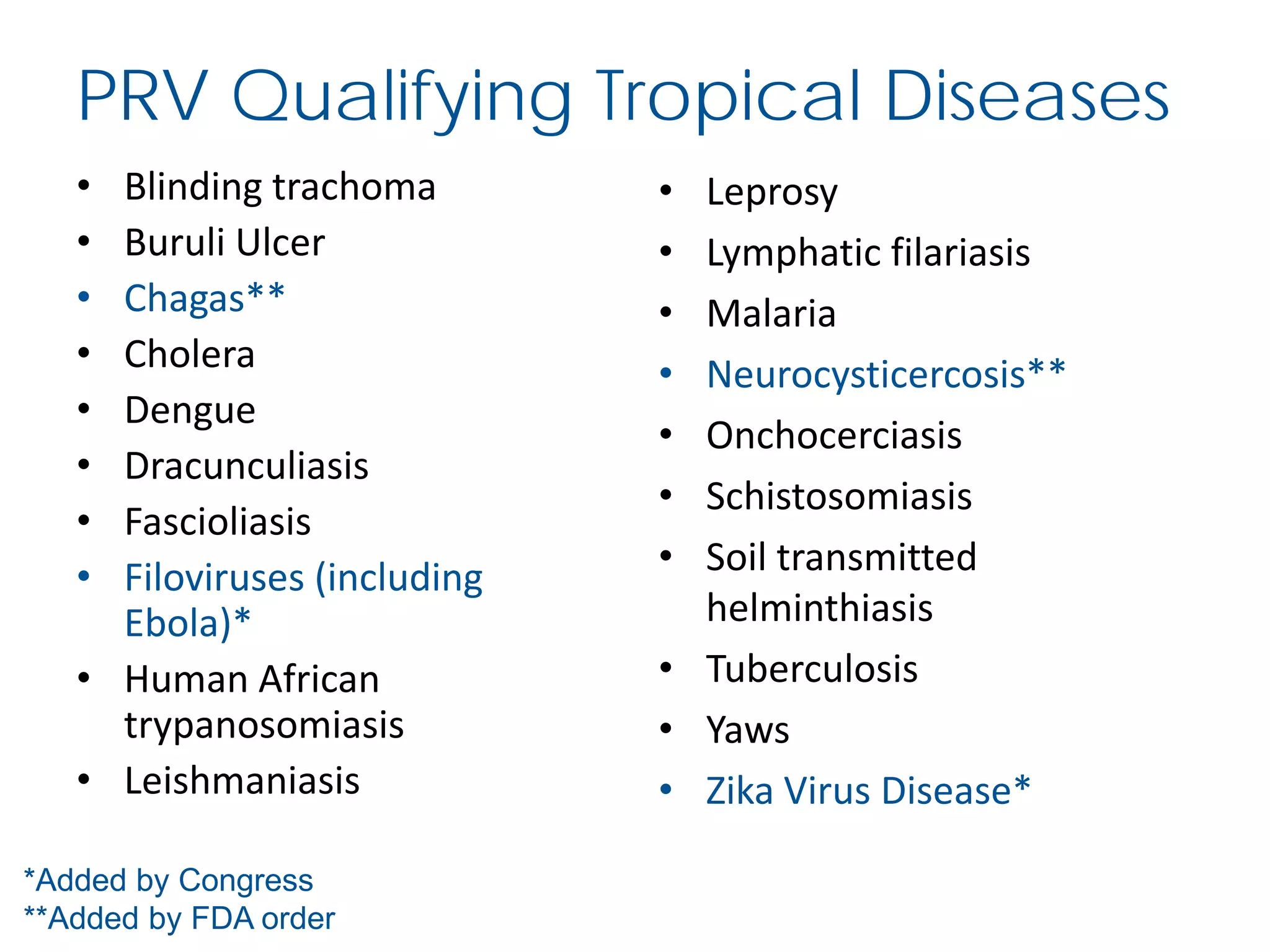
• Blinding trachoma
• Buruli Ulcer
• Chagas**
• Cholera
• Dengue
• Dracunculiasis
• Fascioliasis
• Filoviruses (including
Ebola)*
• Human African
trypanosomiasis
• Leishmaniasis
• Leprosy
• Lymphatic filariasis
• Malaria
• Neurocysticercosis**
• Onchocerciasis
• Schistosomiasis
• Soil transmitted
helminthiasis
• Tuberculosis
• Yaws
• Zika Virus Disease*
PRV Qualifying Tropical Diseases
*Added by Congress
**Added by FDA order
Tropical Disease Voucher
• Tropical diseases in this program are rare in the
United States, yet affect millions of people
throughout the world
• Many of the diseases on the list are found in poor or
developing countries
• Goal of program: Encourage development of new
and innovative therapies
How Does a Company Obtain a
Tropical Disease PRV?
• Develop a new therapy for the prevention, detection,
or treatment of one of the listed tropical diseases
• Submit a marketing application under 505(b)(1) of
FD&C Act (NDA-Drug) or under 351(a) of PHS Act
(BLA-biologic)
• Request/state why your drug is eligible to receive a
PRV in the marketing application
How Does a Company Obtain a
Tropical Disease PRV?
• Must not contain any active ingredient that has been
approved in other 505(b)1 (drug) or 351(a) (biologic)
marketing applications
– Combination product with at least one new active moiety
is permitted
• Must be eligible for the priority review
program
– Serious condition, significant improvement in safety or
effectiveness
How Does a Company Obtain a
Tropical Disease PRV?
• Priority Review Voucher is granted at the
time of marketing approval
– Possible that a drug meeting the criteria for
priority review voucher at the time of marketing
application submission would not meet criteria at
time of approval of the marketing application
= no voucher granted
Neglected Tropical Disease
Voucher Granted by FDA
• 4 Tropical Disease vouchers granted (since 2007)
• Therapeutic areas granted
– Malaria (drug) 2009
– Tuberculosis (drug) 2012
– Leishmaniasis (drug) 2014
– Cholera (vaccine) 2016
Tropical PRV Redemption
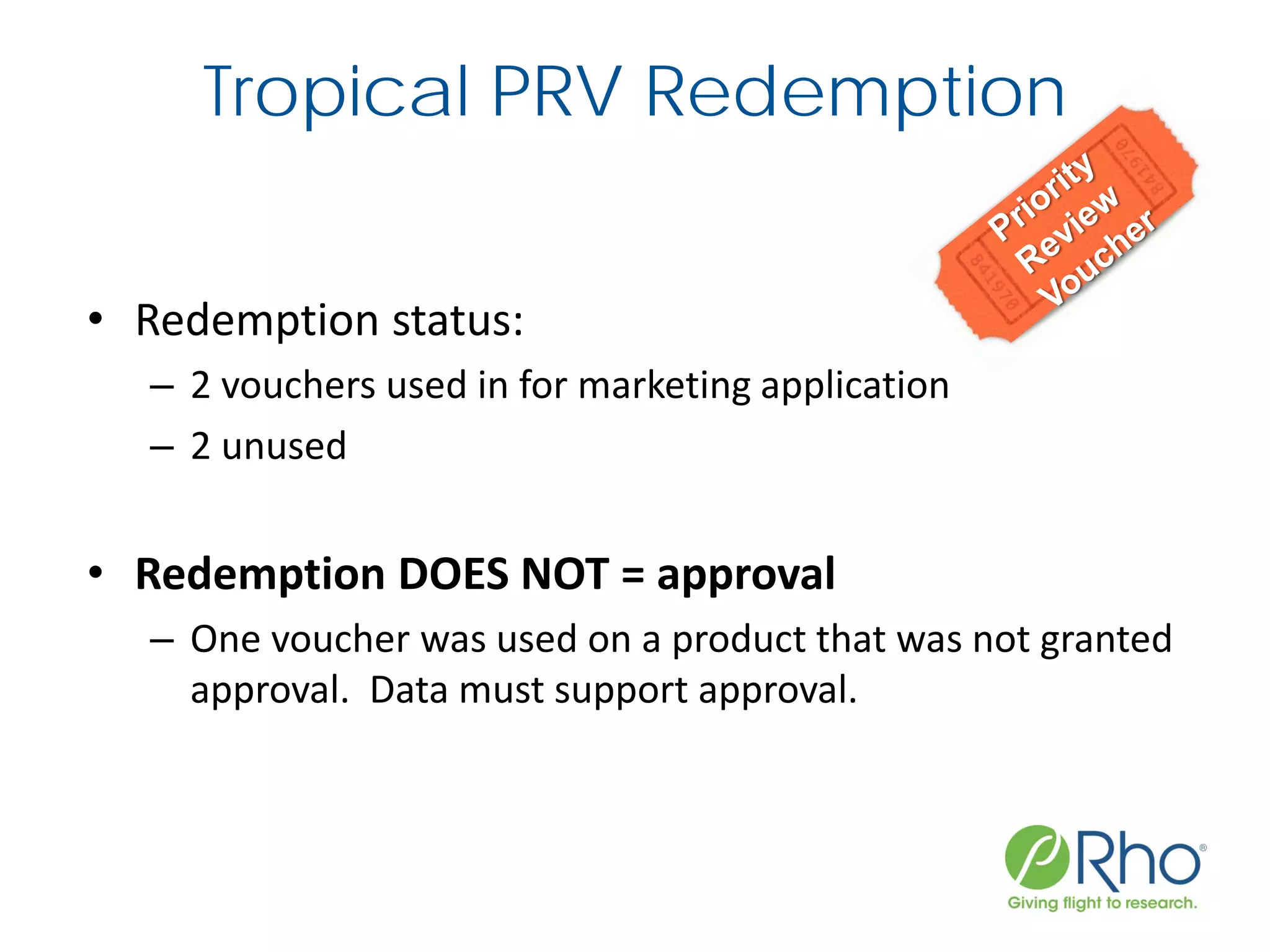
• Redemption status:
– 2 vouchers used in for marketing application
– 2 unused
• Redemption DOES NOT = approval
– One voucher was used on a product that was not granted
approval. Data must support approval.
Additions to the Tropical Priority
Review Voucher
Adding Ebola to the FDA Priority Review
Voucher Program Act
• Signed into law on 16 December 2014
• The law adds Filoviruses—a family of viruses that includes
– 5 strains of Ebola virus
– 2 strains of Marburgvirus
– Only strain of Cuevavirus, known as Lloviu virus.
• Other notable changes made to the law
• In April 2016, Zika Virus Disease was added, and technical
modification from“Filoviruses” to “Filovirus Diseases”
• FDA Guidance was updated in October 2016 Tropical Disease
Priority Review Vouchers
Additional changes to the law
(Tropical disease PRV)
Adding Ebola to the FDA Priority Review Voucher Program Act
(2014)
1. Allows a tropical PRV to be redeemed by its intended user in
just 90 days.
– Previously, a company needed to give FDA a full 365 days'
notice prior to sending the agency an application.
2. Allows a voucher to be transferred (or sold) an unlimited
number of times.
– Previously, a voucher could only be sold once, which made
it potentially risky to purchase
Additional changes to the law
(Tropical disease PRV)
Adding Ebola to the FDA Priority Review Voucher Program Act
(2014)
3. Allows the Secretary of Health and Human Services (FDA) to
add any new infectious diseases to the list of tropical diseases
eligible for a voucher "by order" instead of "by regulation."
– Avoid the lengthy notice and comment provisions of
federal regulation.
In August 2015, FDA added 2 more diseases designated as a
“tropical disease”, and qualify for the PRV program
 Chagas disease
 Neurocysticercosis
Rare Pediatric Disease
Priority Review Voucher
Rare Pediatric Disease PRV History
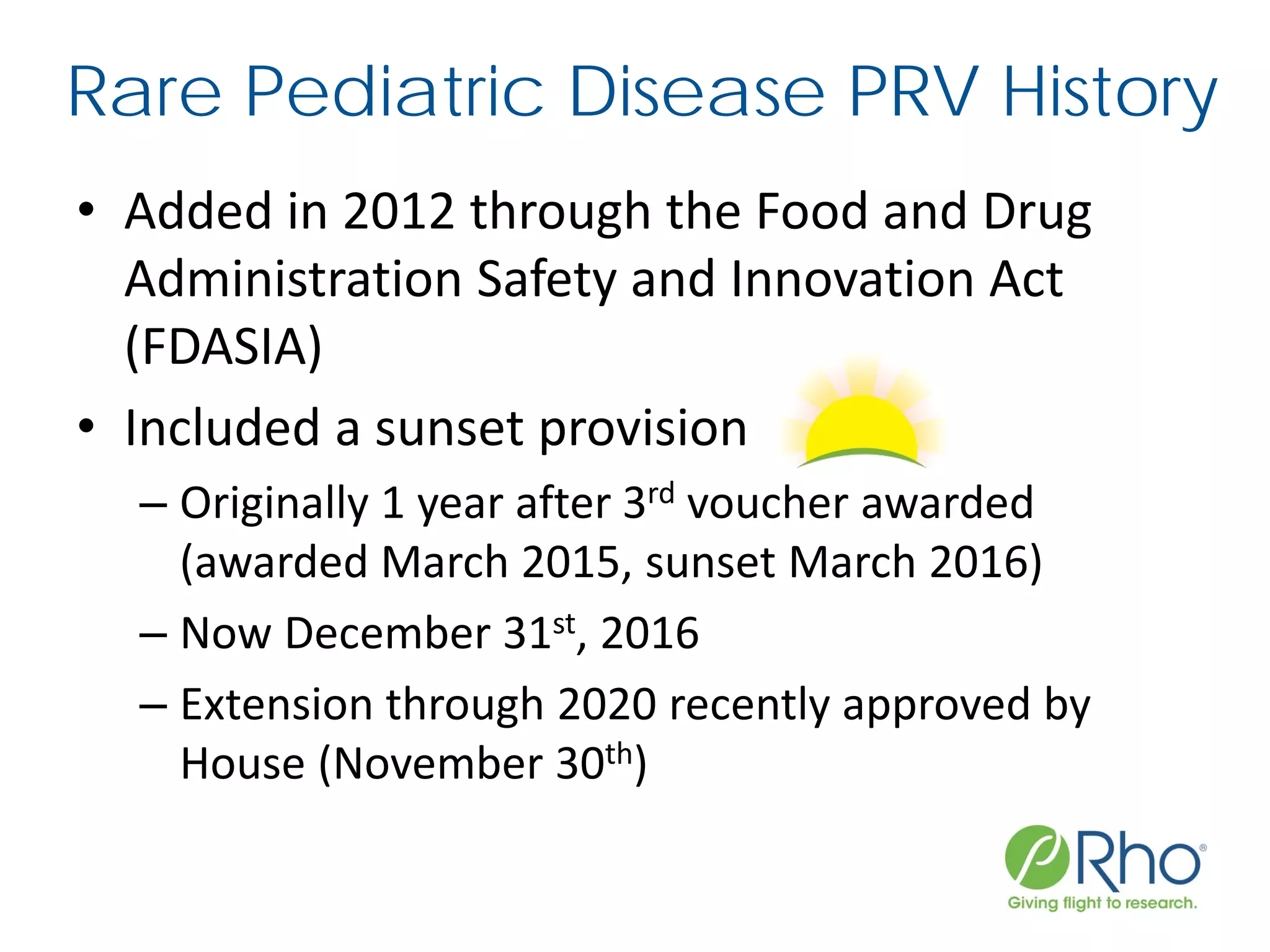
• Added in 2012 through the Food and Drug
Administration Safety and Innovation Act
(FDASIA)
• Included a sunset provision
– Originally 1 year after 3rd voucher awarded
(awarded March 2015, sunset March 2016)
– Now December 31st, 2016
– Extension through 2020 recently approved by
House (November 30th)
Rare Pediatric Disease PRV
Rare Pediatric Disease qualifications:
Pediatric
Serious or life-threatening
Rare
Rare Pediatric Disease PRV
Rare Pediatric Disease qualifications:
Pediatric: 0-18 y/o are >50% of affected US population
Serious or life-threatening
Rare
Rare Pediatric Disease PRV
Rare Pediatric Disease qualifications:
Pediatric: 0-18 y/o are >50% of affected US population
Serious or life-threatening
Rare
– Affects <200,000 people currently in the US OR
– Affects an “orphan subset” of a more prevalent
disease OR
– Affects >200,000 people but for which there is no
reasonable expectation that development costs
can be recouped through US sales
Rare Pediatric Disease PRV
• Rare pediatric disease designation request:
– Submit at the same time as orphan-drug
designation or fast-track designation request
• Can submit separately prior to NDA/BLA submission
Rare Pediatric Disease PRV
• Rare pediatric disease designation request:
– Submit at the same time as orphan-drug
designation or fast-track designation request
• Can submit separately prior to NDA/BLA submission
– FDA issues decision within 60 days (does not apply
if submitted separate from orphan/fast track)
• Rare pediatric disease designation
• Conditional rare pediatric disease product application
designation
• Deficiency letter
Rare Pediatric Disease Voucher
Examples
• 7 Rare Pediatric Disease vouchers granted since 2014
Rare Pediatric Disease Voucher
Examples
• 7 Rare Pediatric Disease vouchers granted since 2014
• Utilization to date
– 3 unused
– 3 sold
– 1 transferred based on prior agreement
Rare Pediatric Disease Voucher
Examples
• 7 Rare Pediatric Disease vouchers granted since 2014
• Utilization to date
– 3 unused
– 3 sold
– 1 transferred based on prior agreement
• Redemption status
– One sold voucher used to successfully speed approval of
Praluent (PCSK9 inhibitor, high cholesterol;
Sanofi/Regeneron)1
– One sold voucher used “successfully” for Soliqua (insulin +
GLP-1, type 2 diabetes; Sanofi)2
1http://priorityreviewvoucher.org/
2http://www.fiercepharma.com/pharma/it-s-simultaneous-fda-nods-sanofi-and-novo-to-vie-for-combo-med-supremacy
How to Use PRVs
How to Use the Priority Review
Voucher?
 Sponsor that received the priority voucher may transfer/sell it
to another sponsor
 Application using the voucher must also be submitted under
section 505(b)(1) of FD&C Act (NDA-Drug) or under 351 of
PHS Act (BLA-biologic)
How to Use the Priority Review
Voucher?
 Sponsor that received the priority voucher may transfer/sell it
to another sponsor
 Application using the voucher must also be submitted under
section 505(b)(1) of FD&C Act (NDA-Drug) or under 351(a) of
PHS Act (BLA-biologic)
 Notify FDA of intent to use voucher at least 90 days in
advance of the NDA or BLA application
 Discuss at Pre-NDA/BLA meeting
 Pay the priority review voucher user fee
 FDA implemented additional fee in 2011
 FY 2017: $2,706,000 (-$21,000)
 Total fee is PDUFA fee ($2,038,100) + Voucher fee
= $4,744,000
Challenges and Limitations
• Timing: Do not receive voucher incentive until after NDA or
BLA approval
• Cost: voucher fee
• Some products not included: Devices, blood components and
certain other biological products (e.g., allergen extracts)
• Innovation: Drugs already approved in outside of the US can
receive the voucher if marketing application is new in the US =
no innovation
• Patient perspective: Does not necessarily change access and
affordability
• Uncertainty of voucher program future- does this program
incentivize development?
The Future of PRVs…..?
• FDA and others concerned with effectiveness
of the program. Some do not support
continuation
– Strains agency resources
– Focuses on potentially less-beneficial/impactful
approvals from a public health perspective
• However, new legislation proposed to
reauthorize pediatric program through 2020
and add new vouchers (neonatal, medical
countermeasures, some generics)
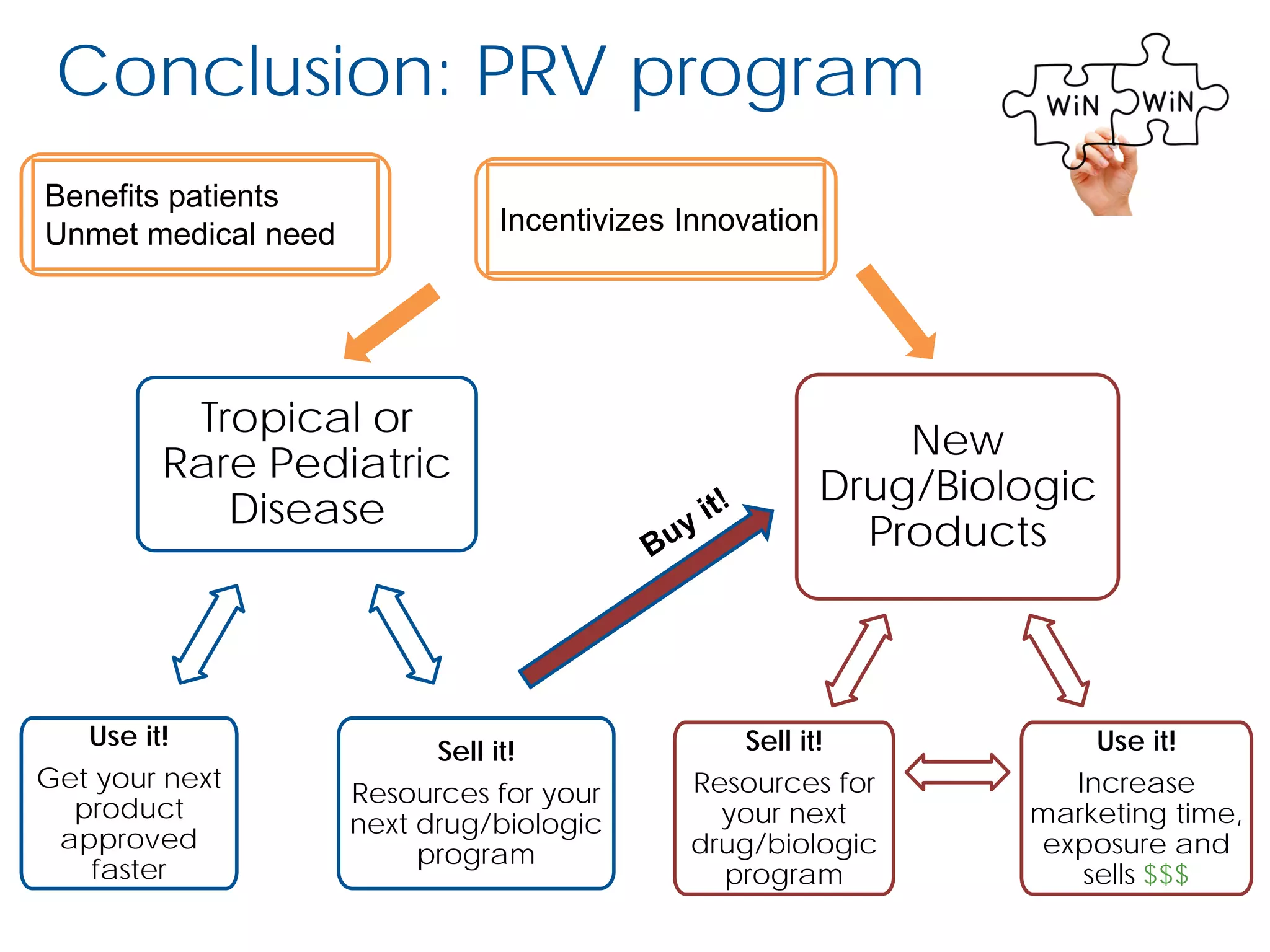
Conclusion: PRV program
Tropical or
Rare Pediatric
Disease
Sell it!
Resources for your
next drug/biologic
program
Use it!
Get your next
product
approved
faster
New
Drug/Biologic
Products
Use it!
Increase
marketing time,
exposure and
sells $$$
Sell it!
Resources for
your next
drug/biologic
program
Incentivizes Innovation
Benefits patients
Unmet medical need
QUESTIONS?
Email: info@rhoworld.com

Understanding FDA’s Priority Review Voucher System

  • 1.
  • 2.
    Introductions Senior Research Scientist KellyRoney, PhD, RAC Integrated Product Development Associate Sheila Bello-Irizarry, PhD Research Scientist Devin Rosenthal, PhD, RAC
  • 3.
  • 4.
    + + + + $== Rare Disease Tropical Disease Non-standard Pharma Incentive Model
  • 5.
    + + + + $== Rare Disease Tropical Disease Non-standard Pharma Incentive Model Priority Review Voucher
  • 6.
    • Tropical disease •Rare pediatric disease Priority Review Voucher Company Therapy How PRVs Incentivize Drug Development
  • 7.
    • Tropical disease •Rare pediatric disease Priority Review Voucher Company Therapy Priority review of other therapies How PRVs Incentivize Drug Development
  • 8.
    Priority review of othertherapies How PRVs Incentivize Drug Development • Tropical disease • Rare pediatric disease Priority Review Voucher Company Therapy $$$ Another Company
  • 9.
    Published PRV SalePrices $- $50 $100 $150 $200 $250 $300 $350 $400 Voucher #1 Voucher #2 Voucher #3 Voucher #4 VoucherSalePrice($MM)
  • 10.
    What Are PriorityReview Vouchers?
  • 11.
    Priority Review VouchersReduce Approval Time • Voucher reduces review time of a marketing application by FDA from 10 months to 6 months (standard vs priority review timelines) – Golden ticket, prize – Granted at marketing approval – Incentive for companies to produce drugs for neglected topical diseases and rare pediatric diseases – Voucher is for priority review of any subsequent drug application – Faster access to treatments for patients – More $$ for drug company
  • 12.
    FDA Priority ReviewVouchers • David Ridley, Henry Grabowski, and Jeffrey Moe – Duke University • Proposed in “Developing Drugs For Developing Countries” (Health Affairs, 2006) – Linking drugs for diseases disproportionately affect developing countries with “blockbuster” drugs – Incentive at low cost to tax payers Disease Burden Progress in Drug Development
  • 13.
    FDA Priority ReviewVoucher History • Enacted under Food and Drug Administration Amendments Act (FDAAA) 2007 for the development of products for neglected tropical diseases Disease Burden Progress in Drug Development
  • 14.
    Eligibility Criteria fora PRV • Drug or vaccine that qualifies for the voucher must: – Be an NDA for a new molecular entity (NME), or original biologic – Merit priority review on its own in order to qualify for the voucher – Treat a qualifying disease – Voucher must be used on a NME, or novel biologic
  • 15.
    Two Types ofFDA Priority Review Vouchers • Tropical Disease Priority Review Voucher • Rare Pediatric Disease Priority Review Voucher
  • 16.
    Tropical Disease Voucher •Part of Food and Drug Administration Amendments Act of 2007 • FDAAA authorized FDA to award priority review vouchers to sponsors of marketing applications of new drugs or biologics intended to treat certain tropical diseases
  • 17.
    • Blinding trachoma •Buruli Ulcer • Chagas** • Cholera • Dengue • Dracunculiasis • Fascioliasis • Filoviruses (including Ebola)* • Human African trypanosomiasis • Leishmaniasis • Leprosy • Lymphatic filariasis • Malaria • Neurocysticercosis** • Onchocerciasis • Schistosomiasis • Soil transmitted helminthiasis • Tuberculosis • Yaws • Zika Virus Disease* PRV Qualifying Tropical Diseases *Added by Congress **Added by FDA order
  • 18.
    Tropical Disease Voucher •Tropical diseases in this program are rare in the United States, yet affect millions of people throughout the world • Many of the diseases on the list are found in poor or developing countries • Goal of program: Encourage development of new and innovative therapies
  • 19.
    How Does aCompany Obtain a Tropical Disease PRV? • Develop a new therapy for the prevention, detection, or treatment of one of the listed tropical diseases • Submit a marketing application under 505(b)(1) of FD&C Act (NDA-Drug) or under 351(a) of PHS Act (BLA-biologic) • Request/state why your drug is eligible to receive a PRV in the marketing application
  • 20.
    How Does aCompany Obtain a Tropical Disease PRV? • Must not contain any active ingredient that has been approved in other 505(b)1 (drug) or 351(a) (biologic) marketing applications – Combination product with at least one new active moiety is permitted • Must be eligible for the priority review program – Serious condition, significant improvement in safety or effectiveness
  • 21.
    How Does aCompany Obtain a Tropical Disease PRV? • Priority Review Voucher is granted at the time of marketing approval – Possible that a drug meeting the criteria for priority review voucher at the time of marketing application submission would not meet criteria at time of approval of the marketing application = no voucher granted
  • 22.
    Neglected Tropical Disease VoucherGranted by FDA • 4 Tropical Disease vouchers granted (since 2007) • Therapeutic areas granted – Malaria (drug) 2009 – Tuberculosis (drug) 2012 – Leishmaniasis (drug) 2014 – Cholera (vaccine) 2016
  • 23.
    Tropical PRV Redemption •Redemption status: – 2 vouchers used in for marketing application – 2 unused • Redemption DOES NOT = approval – One voucher was used on a product that was not granted approval. Data must support approval.
  • 24.
    Additions to theTropical Priority Review Voucher
  • 25.
    Adding Ebola tothe FDA Priority Review Voucher Program Act • Signed into law on 16 December 2014 • The law adds Filoviruses—a family of viruses that includes – 5 strains of Ebola virus – 2 strains of Marburgvirus – Only strain of Cuevavirus, known as Lloviu virus. • Other notable changes made to the law • In April 2016, Zika Virus Disease was added, and technical modification from“Filoviruses” to “Filovirus Diseases” • FDA Guidance was updated in October 2016 Tropical Disease Priority Review Vouchers
  • 26.
    Additional changes tothe law (Tropical disease PRV) Adding Ebola to the FDA Priority Review Voucher Program Act (2014) 1. Allows a tropical PRV to be redeemed by its intended user in just 90 days. – Previously, a company needed to give FDA a full 365 days' notice prior to sending the agency an application. 2. Allows a voucher to be transferred (or sold) an unlimited number of times. – Previously, a voucher could only be sold once, which made it potentially risky to purchase
  • 27.
    Additional changes tothe law (Tropical disease PRV) Adding Ebola to the FDA Priority Review Voucher Program Act (2014) 3. Allows the Secretary of Health and Human Services (FDA) to add any new infectious diseases to the list of tropical diseases eligible for a voucher "by order" instead of "by regulation." – Avoid the lengthy notice and comment provisions of federal regulation. In August 2015, FDA added 2 more diseases designated as a “tropical disease”, and qualify for the PRV program  Chagas disease  Neurocysticercosis
  • 28.
  • 29.
    Rare Pediatric DiseasePRV History • Added in 2012 through the Food and Drug Administration Safety and Innovation Act (FDASIA) • Included a sunset provision – Originally 1 year after 3rd voucher awarded (awarded March 2015, sunset March 2016) – Now December 31st, 2016 – Extension through 2020 recently approved by House (November 30th)
  • 30.
    Rare Pediatric DiseasePRV Rare Pediatric Disease qualifications: Pediatric Serious or life-threatening Rare
  • 31.
    Rare Pediatric DiseasePRV Rare Pediatric Disease qualifications: Pediatric: 0-18 y/o are >50% of affected US population Serious or life-threatening Rare
  • 32.
    Rare Pediatric DiseasePRV Rare Pediatric Disease qualifications: Pediatric: 0-18 y/o are >50% of affected US population Serious or life-threatening Rare – Affects <200,000 people currently in the US OR – Affects an “orphan subset” of a more prevalent disease OR – Affects >200,000 people but for which there is no reasonable expectation that development costs can be recouped through US sales
  • 33.
    Rare Pediatric DiseasePRV • Rare pediatric disease designation request: – Submit at the same time as orphan-drug designation or fast-track designation request • Can submit separately prior to NDA/BLA submission
  • 34.
    Rare Pediatric DiseasePRV • Rare pediatric disease designation request: – Submit at the same time as orphan-drug designation or fast-track designation request • Can submit separately prior to NDA/BLA submission – FDA issues decision within 60 days (does not apply if submitted separate from orphan/fast track) • Rare pediatric disease designation • Conditional rare pediatric disease product application designation • Deficiency letter
  • 35.
    Rare Pediatric DiseaseVoucher Examples • 7 Rare Pediatric Disease vouchers granted since 2014
  • 36.
    Rare Pediatric DiseaseVoucher Examples • 7 Rare Pediatric Disease vouchers granted since 2014 • Utilization to date – 3 unused – 3 sold – 1 transferred based on prior agreement
  • 37.
    Rare Pediatric DiseaseVoucher Examples • 7 Rare Pediatric Disease vouchers granted since 2014 • Utilization to date – 3 unused – 3 sold – 1 transferred based on prior agreement • Redemption status – One sold voucher used to successfully speed approval of Praluent (PCSK9 inhibitor, high cholesterol; Sanofi/Regeneron)1 – One sold voucher used “successfully” for Soliqua (insulin + GLP-1, type 2 diabetes; Sanofi)2 1http://priorityreviewvoucher.org/ 2http://www.fiercepharma.com/pharma/it-s-simultaneous-fda-nods-sanofi-and-novo-to-vie-for-combo-med-supremacy
  • 38.
  • 39.
    How to Usethe Priority Review Voucher?  Sponsor that received the priority voucher may transfer/sell it to another sponsor  Application using the voucher must also be submitted under section 505(b)(1) of FD&C Act (NDA-Drug) or under 351 of PHS Act (BLA-biologic)
  • 40.
    How to Usethe Priority Review Voucher?  Sponsor that received the priority voucher may transfer/sell it to another sponsor  Application using the voucher must also be submitted under section 505(b)(1) of FD&C Act (NDA-Drug) or under 351(a) of PHS Act (BLA-biologic)  Notify FDA of intent to use voucher at least 90 days in advance of the NDA or BLA application  Discuss at Pre-NDA/BLA meeting  Pay the priority review voucher user fee  FDA implemented additional fee in 2011  FY 2017: $2,706,000 (-$21,000)  Total fee is PDUFA fee ($2,038,100) + Voucher fee = $4,744,000
  • 41.
    Challenges and Limitations •Timing: Do not receive voucher incentive until after NDA or BLA approval • Cost: voucher fee • Some products not included: Devices, blood components and certain other biological products (e.g., allergen extracts) • Innovation: Drugs already approved in outside of the US can receive the voucher if marketing application is new in the US = no innovation • Patient perspective: Does not necessarily change access and affordability • Uncertainty of voucher program future- does this program incentivize development?
  • 42.
    The Future ofPRVs…..? • FDA and others concerned with effectiveness of the program. Some do not support continuation – Strains agency resources – Focuses on potentially less-beneficial/impactful approvals from a public health perspective • However, new legislation proposed to reauthorize pediatric program through 2020 and add new vouchers (neonatal, medical countermeasures, some generics)
  • 43.
    Conclusion: PRV program Tropicalor Rare Pediatric Disease Sell it! Resources for your next drug/biologic program Use it! Get your next product approved faster New Drug/Biologic Products Use it! Increase marketing time, exposure and sells $$$ Sell it! Resources for your next drug/biologic program Incentivizes Innovation Benefits patients Unmet medical need
  • 44.