Agenda
• Overview ofMarketing Dimension
• Thematic overview of contemporary marketing practices
• Relationships between marketing practices and strategy,
organisational dynamics, innovation, leadership,
organisational development.
• Assessment 2 – Task discussion
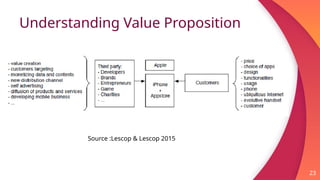
• Understanding Value Proposition and Types of Value
3
4.
Reflect & Share
●Apple has created a brand personality
and culture that's cool, fun, and
friendly — the opposite of some of its
competitors. Apple's
marketing strategies include making
customers want to belong to that
community. Their market share shows
just how successful they have been.
● How do they do it? 4
5.
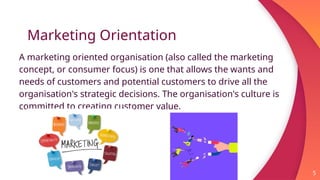
Marketing Orientation
A marketingoriented organisation (also called the marketing
concept, or consumer focus) is one that allows the wants and
needs of customers and potential customers to drive all the
organisation's strategic decisions. The organisation's culture is
committed to creating customer value.
5
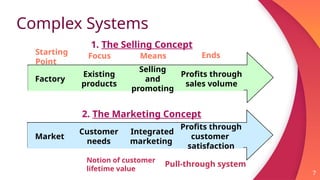
Complex Systems
7
1. TheSelling Concept
2. The Marketing Concept
Pull-through system
Notion of customer
lifetime value
Factory
Existing
products
Selling
and
promoting
Profits through
sales volume
Market
Customer
needs
Integrated
marketing
Profits through
customer
satisfaction
Starting
Point
Focus Means Ends
Contemporary trends in
marketingpractices
Focus on product orientation has become tempered by:
• Relationship marketing where marketing seeks to
develop relationship between company and customer.
This requires developing the trust and commitment of
the customer.
• Guerrilla marketing where goods/services are promoted
in more personal and memorable ways. Began with
activities done exclusively on the streets and other
public places with maximum people access.
• Internet marketing is the promotion of a company and
its products or services through online tools that
generate leads, drive traffic, and boost sales
13
Share your veiw
OnThursday last week, OneUnited Bank announced a new
limited-edition Black History Month version of its Visa debit
card. The card features a rendition of famed American
abolitionist and Underground Railroad member Harriet
Tubman with her arms folded across her chest,
commissioned work by Miami-based artist Addonis Parker.
15
16.
Complexity Science andMarketing
16
● Marketing attempts to identify and moderate client/customer
attractors.
● Marketing relationships between company and customer exist at
edge of chaos.
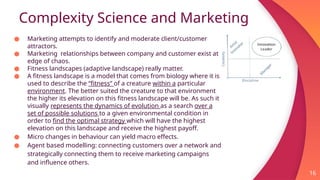
● Fitness landscapes (adaptive landscape) really matter.
● A fitness landscape is a model that comes from biology where it is
used to describe the “fitness” of a creature within a particular
environment. The better suited the creature to that environment
the higher its elevation on this fitness landscape will be. As such it
visually represents the dynamics of evolution as a search over a
set of possible solutions to a given environmental condition in
order to find the optimal strategy which will have the highest
elevation on this landscape and receive the highest payoff.
● Micro changes in behaviour can yield macro effects.
● Agent based modelling: connecting customers over a network and
strategically connecting them to receive marketing campaigns
and influence others.
17.
Complexity Science andMarketing
17
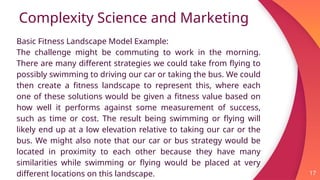
Basic Fitness Landscape Model Example:
The challenge might be commuting to work in the morning.
There are many different strategies we could take from flying to
possibly swimming to driving our car or taking the bus. We could
then create a fitness landscape to represent this, where each
one of these solutions would be given a fitness value based on
how well it performs against some measurement of success,
such as time or cost. The result being swimming or flying will
likely end up at a low elevation relative to taking our car or the
bus. We might also note that our car or bus strategy would be
located in proximity to each other because they have many
similarities while swimming or flying would be placed at very
different locations on this landscape.
18.
Implications of contemporary
marketingrelationship oriented
practices
18
● Can blur boundary between marketing and pseudo
advice (ie. health care advertisements – toddler milk,
Kids Mistake Apples for French Fries in Fast Food Ads
● Can blur boundary between marketing and friendship
● Can blur boundary between marketing and community
development ( ie. Marimekko Village; various Facebook
sites)
● Other blurred boundaries? E.g. McDonald’s
19.
Assessment 2
19
Based onyour analysis of the two corporate business cases presented in
week 2, discuss and contrast the value propositions of these
organisations and explain how your organisational designs, set out in
assessment 1, support these value propositions. To answer this question,
you will:
– Delineate your understanding of how these organisations create value;
– Explain how the key aspects of each dimension (structure, people
management, marketing, financial management) and their interactions
support the value propositions;
– Identify these organisations’ internal and external stakeholders and
discuss how the value propositions relate to each of them.
– Use relevant management and organisational theory to support your
discussion. Submission requirements
– The document with coversheet should be uploaded into Turnitin – A
penalty of 10% per day shall apply to late submissions.
– Refer to the link in Learning Resources to ’E-Resources page for
Management’ for independently sourced references.
Types of Value
24
1.Functional/instrumental value: the attributes of the
product itself; the extent to which a product is useful
and fulfills a customer’s desired goals
2. Experiential/hedonic value: the extent to which a
product creates appropriate experiences, feelings, and
emotions for the customer
3. Symbolic/expressive value: the extent to which
customers attach or associate psychological meaning
to a product
4. Cost/sacrifice value: the cost or sacrifice that would
be associated with the use of the product
25.
Next Week Readings
25
1.Bovee, C & Thill, J 2017, ’Chapters 17 and 18 in Business in
Action, Pearson, New York.
2. Gittens, D & Pilgrim, S 2013, ’Foreign direct investment and
human capital: A dynamic paradox for developing countries’
in Journal of Finance, Accounting and Management, 4(2) pp.
26-49
3. Reddy, K, Locke, S & Scrimgeour, F 2010, ’The efficacy of
principle-based corporate governance practices and firm
financial performance’, International Journal of Managerial
Finance, vol. 6, no. 3, pp. 190-219.
4. Tilley, C 2012, ”Organisations must make the most of their
finance functions’, Financial Management (14719185), pp. 65.
Editor's Notes
#3 Housekeeping Rule : Attendance, In class participation and going through learning guide (Please : go through key aspects of LG)
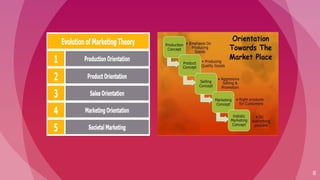
#6 Marketing Concept :
Developed in 19th century along with scientific revolution, evolution of economics as a science and intensification of consumerism.
Focus of marketing as a discipline was at first on products (goods and services) and sales.
After sales service not at first part of focus.
At first little interest in social responsibility.
Later drew on range of disciplines including behavioral science and sociology.
#7 Marketing and Sales Concept Contrasted
Corresponds to material on pp. 19-20.
Comparisons and Contrasts
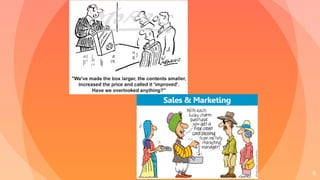
The Selling Concept takes an inside-out perspective - looking at the company’s needs and wants in terms of existing products and ways to find customers for them. The Marketing Concept takes an outside-in perspective - identifying the needs and wants of a clearly defined market and adjusting company efforts to make products that meet these needs.
Discussion note: Promotional tone may help indicate whether a company practices the selling or the marketing concept. Selling involves persuasion - convincing the customer of a need to buy existing products. Marketing, at its best, involves information - bringing the developed product to the awareness of a target market that recognises need-satisfying products.
As noted in the text, companies can let success lock them into a rigid selling structure. As times change, those companies can fail to see the need for meeting new and emerging consumer needs. The marketing concept helps companies to focus on customer need satisfaction, leading to long-term success from customer retention.
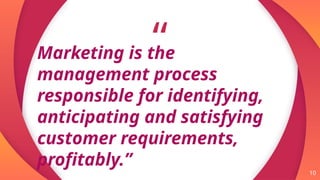
#10 Philip Kotler defined marketing as "Satisfying needs and wants through an exchange process". ...
The official definition of marketing of the American marketing Association: ‘an activity, a set of institutions and processes for creating, communicating, delivering and exchanging offerings that have value for customers, clients, partners and society at large’.
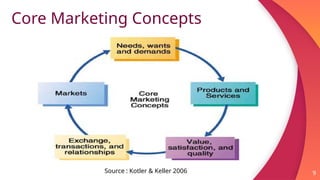
Marketing is the link between a society's material requirements and its economic patterns of response. Marketing satisfies these needs and wants through exchange processes and building long term relationships. It is the process of communicating the value of a product or service through positioning to customers.
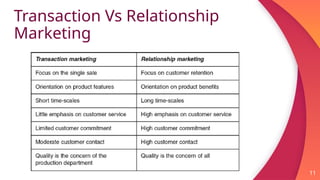
#11 Theodore Levitt first outlined the principles of relationship marketing, suggesting that marketers should focus on the lifetime value of the customer rather than on the single transaction (Levitt, 1983).
Relationship marketing is the paradigm under which customers are valued for their lifetime potential, rather than for a single transaction or even a series of transactions.
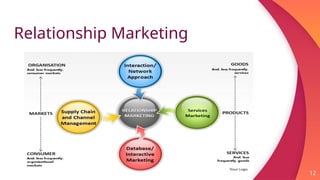
#12 Theodore Levitt first outlined the principles of relationship marketing, suggesting that marketers should focus on the lifetime value of the customer rather than on the single transaction (Levitt, 1983).
Relationship marketing is the paradigm under which customers are valued for their lifetime potential, rather than for a single transaction or even a series of transactions.
#13
using for example: social media; pay-per-click; search engine optimization
Re Guerrilla marketing: Lena G. Goldberg, Marcel Saucet and Christine Snively, Taryn Rose Launches Dresr:2014;http://www.hbs.edu/faculty/Pages/item.aspx?num=48201%20
#19 Critique if each organisation’s structure is appropriate for optimal delivery of its value proposition. If not, what changes would you suggest and why?
https://www.westernsydney.edu.au/__data/assets/pdf_file/0006/1082382/Critical_Thinking.pdf
https://www.westernsydney.edu.au/studysmart/home/assessment_guides/essays
https://www.westernsydney.edu.au/__data/assets/pdf_file/0016/1082500/Essay_Structure.pdf
#22 https://knowledge.insead.edu/node/2791/pdf
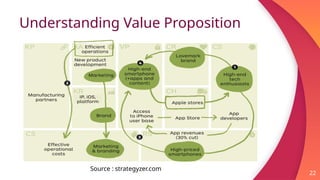
https://www.strategyzer.com/business-model-examples/apple-business-model
VP : Good Dominant Logic to Service Dominant Logic
#24 https://knowledge.insead.edu/node/2791/pdf
https://www.strategyzer.com/business-model-examples/apple-business-model
Types of Value given by Smith and Colgate (2007) - https://d1wqtxts1xzle7.cloudfront.net/56693047/40470272-4-with-cover-page-v2.pdf?Expires=1634041885&Signature=e06hO0FhdgJzImjFnf0a7Xvt7wsf6DyzXg4Nf6izfkPPQw2aypsK9S5gGI8j0X0AlDqjayVRkfilEeHaqNa5dPeXOhiwIu7sST0wn-nHuIQXkBGMZe7ClJ~NySCJBHdrp69Pfj5QjPVmCWXB6ig0OFSi4o5kgsOjvKI4TxJHBnhsR08~i35vzteNcPu14~dP0JA9rqSPIqxpOYWjzyQl3p217dFpI5HNqM6Nzjv--sBEaUtTRWaWDREQatx3RTotM0RIrlQbxQe3iIioENd~KR0B5Ero0K6NZQ~v81L94LakgwAADtfo7SI0QhV1SzKu6V9s7pjVILQ7smZzBe7olg__&Key-Pair-Id=APKAJLOHF5GGSLRBV4ZA
#25 Please follow the in-class instructions relating to readings.
Prior reading is must. In-class time is for discussion and debate and not for assigned weekly readings.





![Principles_of_Marketing__-_Acct-1-1-1-1(0)[1].pdf](https://cdn.slidesharecdn.com/ss_thumbnails/principlesofmarketing-acct-1-1-1-101-240527112754-13f21ef1-thumbnail.jpg?width=640&height=640&fit=bounds)


