Understanding Complex
Adaptive Systems and Their
Assessment in Integral Agile
Methodology
What are Complex
Adaptive Systems (CAS)?
• CAS are characterized by their ability to
self-organize, adapt, and evolve in response
to changing environments.
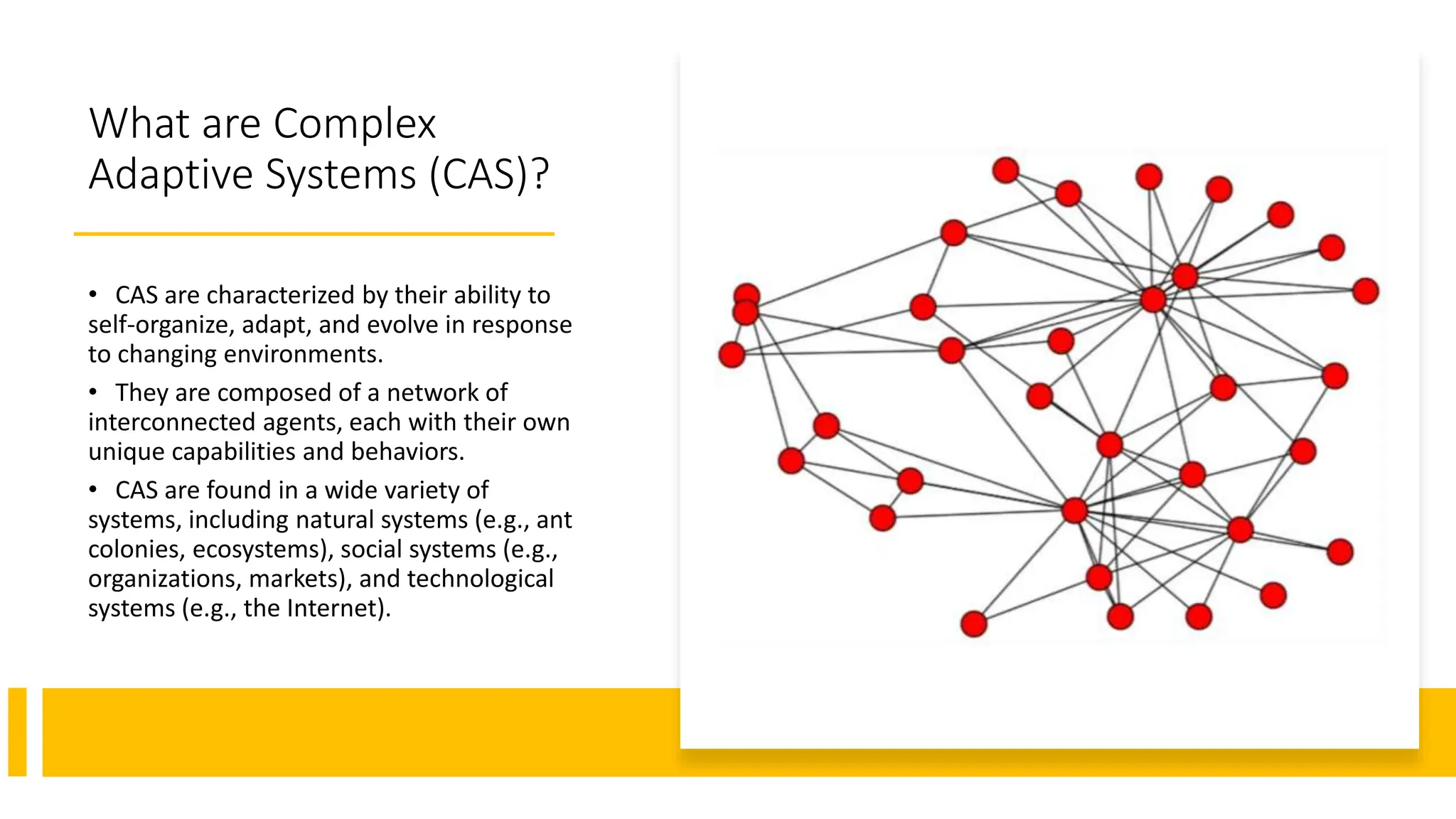
• They are composed of a network of
interconnected agents, each with their own
unique capabilities and behaviors.
• CAS are found in a wide variety of
systems, including natural systems (e.g., ant
colonies, ecosystems), social systems (e.g.,
organizations, markets), and technological
systems (e.g., the Internet).
Key Characteristics of
Complex Adaptive
Systems
• Emergence: CAS exhibit emergent
properties, which are characteristics
that arise from the interactions of
individual agents rather than being
explicitly programmed or designed.
• Self-Organization: CAS possess the
ability to organize themselves without
external direction, demonstrating
adaptability and resilience in the face of
uncertainty.
• Non-Linearity: Cause-and-effect
relationships in CAS are often non-
linear and difficult to predict, making
traditional planning and control methods
less effective.
Integral Agile
Methodology: Assessing
CAS
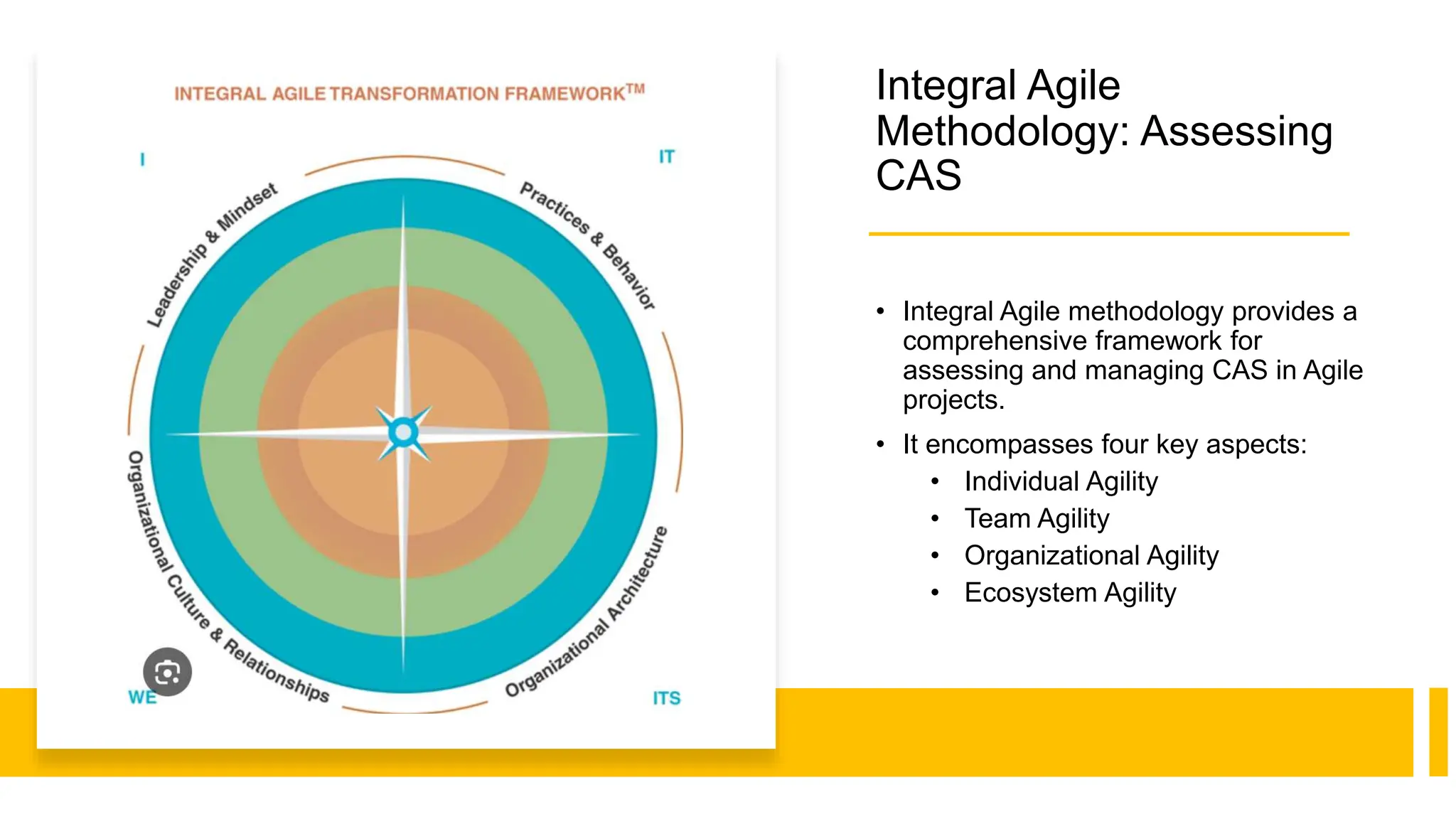
• Integral Agile methodology provides a
comprehensive framework for
assessing and managing CAS in Agile
projects.
• It encompasses four key aspects:
• Individual Agility
• Team Agility
• Organizational Agility
• Ecosystem Agility
Assessing CAS
Maturity
• Integral Agile methodology provides a
structured approach to assessing the
maturity of CAS in Agile projects.
• This involves evaluating the
organization's ability to demonstrate
the following characteristics:
• Transparency
• Continuous Learning
• Empowerment
• Resilience
• Sustainability
Conclusion
• CAS are a fundamental aspect of
the Agile world.
• By understanding and applying
Integral Agile methodology,
organizations can effectively assess
and manage CAS, leading to
increased project success and
organizational agility.

Understanding Complex Adaptive Systems and Integral.pptx

  • 1.
    Understanding Complex Adaptive Systemsand Their Assessment in Integral Agile Methodology
  • 2.
    What are Complex AdaptiveSystems (CAS)? • CAS are characterized by their ability to self-organize, adapt, and evolve in response to changing environments. • They are composed of a network of interconnected agents, each with their own unique capabilities and behaviors. • CAS are found in a wide variety of systems, including natural systems (e.g., ant colonies, ecosystems), social systems (e.g., organizations, markets), and technological systems (e.g., the Internet).
  • 3.
    Key Characteristics of ComplexAdaptive Systems • Emergence: CAS exhibit emergent properties, which are characteristics that arise from the interactions of individual agents rather than being explicitly programmed or designed. • Self-Organization: CAS possess the ability to organize themselves without external direction, demonstrating adaptability and resilience in the face of uncertainty. • Non-Linearity: Cause-and-effect relationships in CAS are often non- linear and difficult to predict, making traditional planning and control methods less effective.
  • 4.
    Integral Agile Methodology: Assessing CAS •Integral Agile methodology provides a comprehensive framework for assessing and managing CAS in Agile projects. • It encompasses four key aspects: • Individual Agility • Team Agility • Organizational Agility • Ecosystem Agility
  • 5.
    Assessing CAS Maturity • IntegralAgile methodology provides a structured approach to assessing the maturity of CAS in Agile projects. • This involves evaluating the organization's ability to demonstrate the following characteristics: • Transparency • Continuous Learning • Empowerment • Resilience • Sustainability
  • 6.
    Conclusion • CAS area fundamental aspect of the Agile world. • By understanding and applying Integral Agile methodology, organizations can effectively assess and manage CAS, leading to increased project success and organizational agility.

Editor's Notes

  • #2 In this presentation, we will explore the concept of complex adaptive systems (CAS) and how they relate to Agile practices. We will also discuss the Integral Agile methodology, which provides a framework for assessing and managing CAS in Agile projects.
  • #3 CAS are complex and dynamic systems that are difficult to predict or control. However, they also exhibit remarkable resilience and adaptability, making them well-suited for operating in uncertain environments.
  • #4 These characteristics make CAS fundamentally different from traditional systems, which are typically designed to be linear, predictable, and controllable.
  • #5 Integral Agile methodology recognizes that CAS are complex and dynamic, and that traditional approaches to project management are not well-suited for managing them. Instead, it emphasizes the need for flexibility, adaptability, and continuous learning.
  • #6 By assessing the organization's maturity against these criteria, we can identify areas for improvement and develop strategies to enhance the organization's ability to manage CAS effectively.
  • #7 As the Agile landscape continues to evolve, the importance of understanding and managing CAS will only grow. By embracing Integral Agile methodology, organizations can position themselves for success in the increasingly complex and dynamic world of Agile projects.