Pang Wei Koh
Stanford University,
Stanford, CA.
Percy Liang
Stanford University,
Stanford, CA.
Presented by,
Zabir Al Nazi
Roll : 1409016
Department of Electronics and Communication Engineering,
Khulna University of Engineering and Technology,
Khulna-9203, Bangladesh.
Mentored by,
Tasnim Azad Abir
Lecturer,
Department of Electronics and Communication Engineering,
Khulna University of Engineering and Technology,
Khulna-9203, Bangladesh.
Proceedings of the 34th International Conference on Machine Learning
1
Agenda
 Introduction
 Objectives/Research Questions
 Methodology
 Scaling Up
 Results
 Conclusion and Future Work
 Acknowledgements
2
Introduction (1/2)
Error(%)
Figure 1. ImageNet Large Scale Visual Recognition Challenge top 5 error
Human
ImageNetDataset
TeslaK80
GPU
+
3
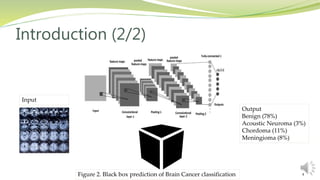
Introduction (2/2)
Output
Benign (78%)
Acoustic Neuroma (3%)
Chordoma (11%)
Meningioma (8%)
Input
Figure 2. Black box prediction of Brain Cancer classification 4
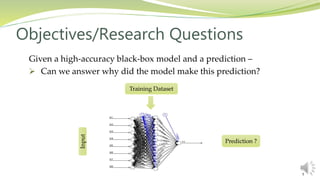
Objectives/Research Questions
Given a high-accuracy black-box model and a prediction –
 Can we answer why did the model make this prediction?
Training Dataset
Prediction ?
Input
5
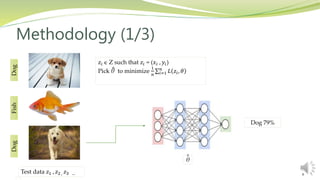
Methodology (1/3)
𝑧𝑖 є Z such that 𝑧𝑖 = (𝑥𝑖 , 𝑦𝑖)
Pick θ to minimize
1
𝑛 𝑖=1
𝑛
𝐿 𝑧𝑖, 𝜃^
Test data 𝑧1 , 𝑧2 , 𝑧3 …
DogFishDog
Dog 79%
θ
6
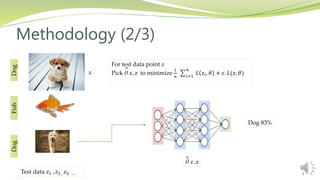
Methodology (2/3)
For test data point z
Pick θ 𝜀, 𝑧 to minimize
1
𝑛 𝑖=1
𝑛
𝐿 𝑧𝑖, 𝜃 + 𝜀. 𝐿(𝑧, 𝜃)
^
Test data 𝑧1 , 𝑧2 , 𝑧3 …
DogFishDog
Dog 83%
z
θ 𝜀. 𝑧
7
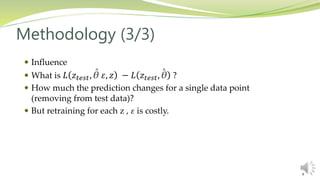
Methodology (3/3)
 Influence
 What is 𝐿 𝑧𝑡𝑒𝑠𝑡, θ 𝜀, 𝑧 − 𝐿 𝑧𝑡𝑒𝑠𝑡, θ ?
 How much the prediction changes for a single data point
(removing from test data)?
 But retraining for each z , 𝜀 is costly.
8
Scaling Up (1/3)
 Influence Function
 Robust Statistics, 1970
 Consider an estimator T which will act on a distribution F
 How much does T change if we perturb F?
9
Scaling Up (2/3)
 𝜃 𝜀, 𝑧 = arg minθ
1
𝑛 𝑖=1
𝑛
𝐿 𝑧𝑖, 𝜃 + 𝜀. 𝐿(𝑧, 𝜃)
 Influence of upweighting z on parameters 𝜃 is given by –
 𝐼 𝑢𝑝, 𝑙𝑜𝑠𝑠 =
𝜕𝐿(𝑧𝑡𝑒𝑠𝑡, 𝜃𝜀,𝑧)
𝜕 𝜀
= 𝛻𝜃 𝐿 𝑧𝑡𝑒𝑠𝑡 , 𝜃
𝑇
𝐻 𝜃
−1
𝛻𝜃 𝐿 𝑧 , 𝜃 [1]
 𝐻 𝜃 =
1
𝑛 𝑖=1
𝑛
𝛻𝜃
2 𝐿 𝑧𝑖, 𝜃
[1] Cook & Weisberg, 1982
10
Scaling Up (3/3)
 Don’t explicitly form 𝐻 𝜃
−1
, instead compute 𝐻 𝜃
−1
𝑣
𝑣 𝐻 𝜃 𝑣 𝐻 𝜃
−1
𝑣
Pearlmutter trick [1] CG [2]
Taylor [3]
[1] Pearlmutter, 1994
[2] Martens, 2010
[3] Agarwal, Bullins, 2016
11
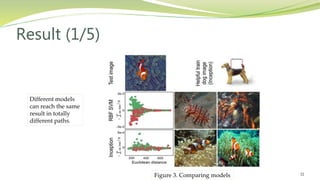
Result (1/5)
Figure 3. Comparing models
Different models
can reach the same
result in totally
different paths.
12
Result (2/5)
 ML systems get their training data from outside world which is
vulnerable to attack
 Can we create adversarial training examples?
Dog (97%) Dog (98%) Dog (98%)
Dog(99%)
Dog(98%)
Label: Fish
13
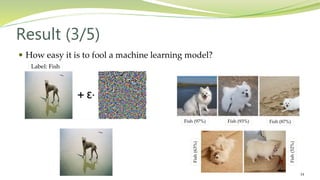
Result (3/5)
 How easy it is to fool a machine learning model?
Fish (97%) Fish (93%) Fish (87%)
Fish(63%)
Fish(52%)
Label: Fish
14
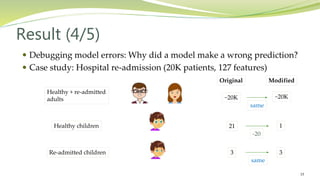
Result (4/5)
 Debugging model errors: Why did a model make a wrong prediction?
 Case study: Hospital re-admission (20K patients, 127 features)
Healthy + re-admitted
adults
Healthy children
Re-admitted children
Original Modified
~20K ~20K
21 1
3 3
same
-20
same
15
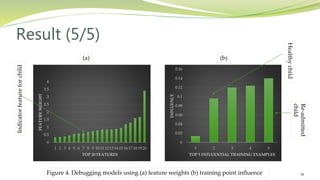
Result (5/5)
0
0.5
1
1.5
2
2.5
3
3.5
4
1 2 3 4 5 6 7 8 9 10 11 12 13 14 15 16 17 18 19 20
FEATUREWEIGHT
TOP 20 FEATURES
Indicatorfeatureforchild
0
0.02
0.04
0.06
0.08
0.1
0.12
0.14
0.16
1 2 3 4 5
INFLUENCE
TOP 5 INFLUENTIAL TRAINING EXAMPLES
Healthychild
Re-admitted
child
(a) (b)
Figure 4. Debugging models using (a) feature weights (b) training point influence 16
Conclusion and Future Work
 A new way of looking at high performing, complex, black box
models diagnostics
 Applications such as creating training set attacks, debugging,
fixing labels
 Underlying each of the applications is a common tool, simple
idea of Influence function
 Influence function assumes very small perturbation in the
model.
 Open problem – coming up with closed form with global
change in model
17
Acknowledgements
 The authors of the conference paper ‘Understanding Black-box
Predictions via Influence Functions’ Pang Wei Koh et al.
 I am grateful to my supervisor Tasnim Azad Abir sir, for his guidance
18
19
20

Understanding Black-box Predictions via Influence Functions

  • 1.
    Pang Wei Koh StanfordUniversity, Stanford, CA. Percy Liang Stanford University, Stanford, CA. Presented by, Zabir Al Nazi Roll : 1409016 Department of Electronics and Communication Engineering, Khulna University of Engineering and Technology, Khulna-9203, Bangladesh. Mentored by, Tasnim Azad Abir Lecturer, Department of Electronics and Communication Engineering, Khulna University of Engineering and Technology, Khulna-9203, Bangladesh. Proceedings of the 34th International Conference on Machine Learning 1
  • 2.
    Agenda  Introduction  Objectives/ResearchQuestions  Methodology  Scaling Up  Results  Conclusion and Future Work  Acknowledgements 2
  • 3.
    Introduction (1/2) Error(%) Figure 1.ImageNet Large Scale Visual Recognition Challenge top 5 error Human ImageNetDataset TeslaK80 GPU + 3
  • 4.
    Introduction (2/2) Output Benign (78%) AcousticNeuroma (3%) Chordoma (11%) Meningioma (8%) Input Figure 2. Black box prediction of Brain Cancer classification 4
  • 5.
    Objectives/Research Questions Given ahigh-accuracy black-box model and a prediction –  Can we answer why did the model make this prediction? Training Dataset Prediction ? Input 5
  • 6.
    Methodology (1/3) 𝑧𝑖 єZ such that 𝑧𝑖 = (𝑥𝑖 , 𝑦𝑖) Pick θ to minimize 1 𝑛 𝑖=1 𝑛 𝐿 𝑧𝑖, 𝜃^ Test data 𝑧1 , 𝑧2 , 𝑧3 … DogFishDog Dog 79% θ 6
  • 7.
    Methodology (2/3) For testdata point z Pick θ 𝜀, 𝑧 to minimize 1 𝑛 𝑖=1 𝑛 𝐿 𝑧𝑖, 𝜃 + 𝜀. 𝐿(𝑧, 𝜃) ^ Test data 𝑧1 , 𝑧2 , 𝑧3 … DogFishDog Dog 83% z θ 𝜀. 𝑧 7
  • 8.
    Methodology (3/3)  Influence What is 𝐿 𝑧𝑡𝑒𝑠𝑡, θ 𝜀, 𝑧 − 𝐿 𝑧𝑡𝑒𝑠𝑡, θ ?  How much the prediction changes for a single data point (removing from test data)?  But retraining for each z , 𝜀 is costly. 8
  • 9.
    Scaling Up (1/3) Influence Function  Robust Statistics, 1970  Consider an estimator T which will act on a distribution F  How much does T change if we perturb F? 9
  • 10.
    Scaling Up (2/3) 𝜃 𝜀, 𝑧 = arg minθ 1 𝑛 𝑖=1 𝑛 𝐿 𝑧𝑖, 𝜃 + 𝜀. 𝐿(𝑧, 𝜃)  Influence of upweighting z on parameters 𝜃 is given by –  𝐼 𝑢𝑝, 𝑙𝑜𝑠𝑠 = 𝜕𝐿(𝑧𝑡𝑒𝑠𝑡, 𝜃𝜀,𝑧) 𝜕 𝜀 = 𝛻𝜃 𝐿 𝑧𝑡𝑒𝑠𝑡 , 𝜃 𝑇 𝐻 𝜃 −1 𝛻𝜃 𝐿 𝑧 , 𝜃 [1]  𝐻 𝜃 = 1 𝑛 𝑖=1 𝑛 𝛻𝜃 2 𝐿 𝑧𝑖, 𝜃 [1] Cook & Weisberg, 1982 10
  • 11.
    Scaling Up (3/3) Don’t explicitly form 𝐻 𝜃 −1 , instead compute 𝐻 𝜃 −1 𝑣 𝑣 𝐻 𝜃 𝑣 𝐻 𝜃 −1 𝑣 Pearlmutter trick [1] CG [2] Taylor [3] [1] Pearlmutter, 1994 [2] Martens, 2010 [3] Agarwal, Bullins, 2016 11
  • 12.
    Result (1/5) Figure 3.Comparing models Different models can reach the same result in totally different paths. 12
  • 13.
    Result (2/5)  MLsystems get their training data from outside world which is vulnerable to attack  Can we create adversarial training examples? Dog (97%) Dog (98%) Dog (98%) Dog(99%) Dog(98%) Label: Fish 13
  • 14.
    Result (3/5)  Howeasy it is to fool a machine learning model? Fish (97%) Fish (93%) Fish (87%) Fish(63%) Fish(52%) Label: Fish 14
  • 15.
    Result (4/5)  Debuggingmodel errors: Why did a model make a wrong prediction?  Case study: Hospital re-admission (20K patients, 127 features) Healthy + re-admitted adults Healthy children Re-admitted children Original Modified ~20K ~20K 21 1 3 3 same -20 same 15
  • 16.
    Result (5/5) 0 0.5 1 1.5 2 2.5 3 3.5 4 1 23 4 5 6 7 8 9 10 11 12 13 14 15 16 17 18 19 20 FEATUREWEIGHT TOP 20 FEATURES Indicatorfeatureforchild 0 0.02 0.04 0.06 0.08 0.1 0.12 0.14 0.16 1 2 3 4 5 INFLUENCE TOP 5 INFLUENTIAL TRAINING EXAMPLES Healthychild Re-admitted child (a) (b) Figure 4. Debugging models using (a) feature weights (b) training point influence 16
  • 17.
    Conclusion and FutureWork  A new way of looking at high performing, complex, black box models diagnostics  Applications such as creating training set attacks, debugging, fixing labels  Underlying each of the applications is a common tool, simple idea of Influence function  Influence function assumes very small perturbation in the model.  Open problem – coming up with closed form with global change in model 17
  • 18.
    Acknowledgements  The authorsof the conference paper ‘Understanding Black-box Predictions via Influence Functions’ Pang Wei Koh et al.  I am grateful to my supervisor Tasnim Azad Abir sir, for his guidance 18
  • 19.
  • 20.