UNDERSTANDING BENCHMARKING
IN A WEEK
AUTHORS
➢ John macdonald
➢ Steve tanner
BOOK REVIEW BY
CH.KARTHIK
BIFAAS ROLL NO. 06
SSIM
ABOUT THE BOOK
Book Name: UNDER STANDING BENCHMARKING
Language: English
Author's Name: JOHN MACDONALD
STEVE TANNER
Publisher: Hodder & Stoughton Ltd
Published in the year: 1998
No of pages: 96
ABOUT THE AUTHER:
JOHN MACDONALD AND STEVE TANNER
John macdonald and Dr steve tannner are both recognized as major
contributors to worldwide quality movement. They are consultants,
authors, and a speaker of international repute.it was collaborated on
other books in week series. They have collaborated on other book in the
in a week series. John is also author of understanding knowledge
management, global quality; call a halt to mindless change. Steve is the
co-author of assessing business excellence.
CONTENTS
➢ INTRODUCTION
➢ Sunday- What is benchmarking
➢ Monday- Where do we start
➢ Tuesday- The benchmarking roadmap
➢ Wednesday- Planning the study
➢ Thursday- Collecting the data
➢ Friday- analyzing and using the data
➢ Saturday- Maintaining leadership
INTRODUCTION:
Benchmarking is changing perspectives of executives and managers
around its world. It shows on company good, bad, mediocre of their own
company. It applies to manufacturing services and small and large scale
organizations. It provides step-by-step guidelines for understanding
benchmark. It reveals the practice behind the company performance. The
growth of benchmarking is so rapid.
WHAT IS BENCHMARKING? - SUNDAY
Benchmarking is the process of comparing the own organization or
operations against other organizations. Benchmarking can be applied
against any product, process, function or approach in business.
Measures of time, quality, cost and effectiveness (or satisfaction).
The intent of benchmarking is to compare the own operations versus
competitors. To generate ideas for improving processes, approaches and
technologies to reduce costs, increase profits and strengthen customer
loyalty and satisfaction.
Benchmarking is an important component of continuous improvement
initiatives.
Reasons for benchmarking
It focus on the business imperatives involved in consumer satisfaction
Strategic planning: developing short and long term plans
Product comparison: comparing with competitors
Forecasting: predicting trends in relevant areas
Goal setting: establishing performance goals
TYPES OF BENCHMARKING
Comparative analysis- Stratic and Tactical
Best price making – Internal, Comparative, Functional, Generic
Benefits of the benchmarking
It shows various types of benchmark available.it can be concentrate on
the best practice benchmarking
Develops realistic stretch and strategic targets.
Establishes realistic action for implementation
Encourages a striving for excellence
Creates a better understanding of competitors
Emphasizes sensitivity to change
WHY DO WE START? - MONDAY
Benchmarking, they have to know the level of effort and key element of
effort
National benchmarking clearing house was surveyed 80 leading
organizations,
Average on benchmark study on last six months
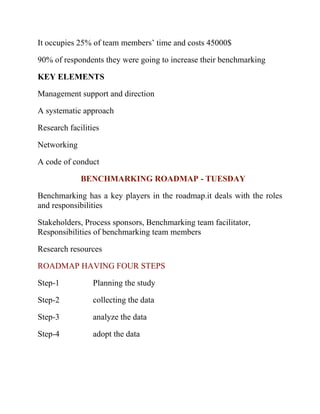
It occupies 25% of team members’ time and costs 45000$
90% of respondents they were going to increase their benchmarking
KEY ELEMENTS
Management support and direction
A systematic approach
Research facilities
Networking
A code of conduct
BENCHMARKING ROADMAP - TUESDAY
Benchmarking has a key players in the roadmap.it deals with the roles
and responsibilities
Stakeholders, Process sponsors, Benchmarking team facilitator,
Responsibilities of benchmarking team members
Research resources
ROADMAP HAVING FOUR STEPS
Step-1 Planning the study
Step-2 collecting the data
Step-3 analyze the data
Step-4 adopt the data
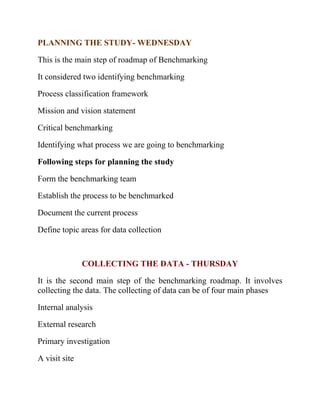
PLANNING THE STUDY- WEDNESDAY
This is the main step of roadmap of Benchmarking
It considered two identifying benchmarking
Process classification framework
Mission and vision statement
Critical benchmarking
Identifying what process we are going to benchmarking
Following steps for planning the study
Form the benchmarking team
Establish the process to be benchmarked
Document the current process
Define topic areas for data collection
COLLECTING THE DATA - THURSDAY
It is the second main step of the benchmarking roadmap. It involves
collecting the data. The collecting of data can be of four main phases
Internal analysis
External research
Primary investigation
A visit site
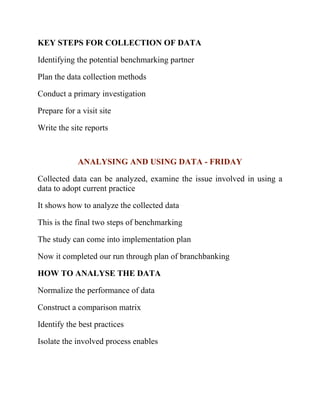
KEY STEPS FOR COLLECTION OF DATA
Identifying the potential benchmarking partner
Plan the data collection methods
Conduct a primary investigation
Prepare for a visit site
Write the site reports
ANALYSING AND USING DATA - FRIDAY
Collected data can be analyzed, examine the issue involved in using a
data to adopt current practice
It shows how to analyze the collected data
This is the final two steps of benchmarking
The study can come into implementation plan
Now it completed our run through plan of branchbanking
HOW TO ANALYSE THE DATA
Normalize the performance of data
Construct a comparison matrix
Identify the best practices
Isolate the involved process enables
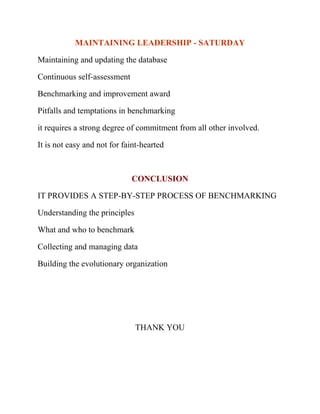
MAINTAINING LEADERSHIP - SATURDAY
Maintaining and updating the database
Continuous self-assessment
Benchmarking and improvement award
Pitfalls and temptations in benchmarking
it requires a strong degree of commitment from all other involved.
It is not easy and not for faint-hearted
CONCLUSION
IT PROVIDES A STEP-BY-STEP PROCESS OF BENCHMARKING
Understanding the principles
What and who to benchmark
Collecting and managing data
Building the evolutionary organization
THANK YOU

UNDERSTANDING BENCHMARKING IN A WEEK

  • 1.
    UNDERSTANDING BENCHMARKING IN AWEEK AUTHORS ➢ John macdonald ➢ Steve tanner BOOK REVIEW BY CH.KARTHIK BIFAAS ROLL NO. 06 SSIM
  • 2.
    ABOUT THE BOOK BookName: UNDER STANDING BENCHMARKING Language: English Author's Name: JOHN MACDONALD STEVE TANNER Publisher: Hodder & Stoughton Ltd Published in the year: 1998 No of pages: 96 ABOUT THE AUTHER: JOHN MACDONALD AND STEVE TANNER John macdonald and Dr steve tannner are both recognized as major contributors to worldwide quality movement. They are consultants, authors, and a speaker of international repute.it was collaborated on other books in week series. They have collaborated on other book in the in a week series. John is also author of understanding knowledge management, global quality; call a halt to mindless change. Steve is the co-author of assessing business excellence. CONTENTS ➢ INTRODUCTION ➢ Sunday- What is benchmarking ➢ Monday- Where do we start ➢ Tuesday- The benchmarking roadmap ➢ Wednesday- Planning the study
  • 3.
    ➢ Thursday- Collectingthe data ➢ Friday- analyzing and using the data ➢ Saturday- Maintaining leadership INTRODUCTION: Benchmarking is changing perspectives of executives and managers around its world. It shows on company good, bad, mediocre of their own company. It applies to manufacturing services and small and large scale organizations. It provides step-by-step guidelines for understanding benchmark. It reveals the practice behind the company performance. The growth of benchmarking is so rapid. WHAT IS BENCHMARKING? - SUNDAY Benchmarking is the process of comparing the own organization or operations against other organizations. Benchmarking can be applied against any product, process, function or approach in business. Measures of time, quality, cost and effectiveness (or satisfaction). The intent of benchmarking is to compare the own operations versus competitors. To generate ideas for improving processes, approaches and technologies to reduce costs, increase profits and strengthen customer loyalty and satisfaction. Benchmarking is an important component of continuous improvement initiatives. Reasons for benchmarking It focus on the business imperatives involved in consumer satisfaction Strategic planning: developing short and long term plans
  • 4.
    Product comparison: comparingwith competitors Forecasting: predicting trends in relevant areas Goal setting: establishing performance goals TYPES OF BENCHMARKING Comparative analysis- Stratic and Tactical Best price making – Internal, Comparative, Functional, Generic Benefits of the benchmarking It shows various types of benchmark available.it can be concentrate on the best practice benchmarking Develops realistic stretch and strategic targets. Establishes realistic action for implementation Encourages a striving for excellence Creates a better understanding of competitors Emphasizes sensitivity to change WHY DO WE START? - MONDAY Benchmarking, they have to know the level of effort and key element of effort National benchmarking clearing house was surveyed 80 leading organizations, Average on benchmark study on last six months
  • 5.
    It occupies 25%of team members’ time and costs 45000$ 90% of respondents they were going to increase their benchmarking KEY ELEMENTS Management support and direction A systematic approach Research facilities Networking A code of conduct BENCHMARKING ROADMAP - TUESDAY Benchmarking has a key players in the roadmap.it deals with the roles and responsibilities Stakeholders, Process sponsors, Benchmarking team facilitator, Responsibilities of benchmarking team members Research resources ROADMAP HAVING FOUR STEPS Step-1 Planning the study Step-2 collecting the data Step-3 analyze the data Step-4 adopt the data
  • 6.
    PLANNING THE STUDY-WEDNESDAY This is the main step of roadmap of Benchmarking It considered two identifying benchmarking Process classification framework Mission and vision statement Critical benchmarking Identifying what process we are going to benchmarking Following steps for planning the study Form the benchmarking team Establish the process to be benchmarked Document the current process Define topic areas for data collection COLLECTING THE DATA - THURSDAY It is the second main step of the benchmarking roadmap. It involves collecting the data. The collecting of data can be of four main phases Internal analysis External research Primary investigation A visit site
  • 7.
    KEY STEPS FORCOLLECTION OF DATA Identifying the potential benchmarking partner Plan the data collection methods Conduct a primary investigation Prepare for a visit site Write the site reports ANALYSING AND USING DATA - FRIDAY Collected data can be analyzed, examine the issue involved in using a data to adopt current practice It shows how to analyze the collected data This is the final two steps of benchmarking The study can come into implementation plan Now it completed our run through plan of branchbanking HOW TO ANALYSE THE DATA Normalize the performance of data Construct a comparison matrix Identify the best practices Isolate the involved process enables
  • 8.
    MAINTAINING LEADERSHIP -SATURDAY Maintaining and updating the database Continuous self-assessment Benchmarking and improvement award Pitfalls and temptations in benchmarking it requires a strong degree of commitment from all other involved. It is not easy and not for faint-hearted CONCLUSION IT PROVIDES A STEP-BY-STEP PROCESS OF BENCHMARKING Understanding the principles What and who to benchmark Collecting and managing data Building the evolutionary organization THANK YOU