Understanding Balance Sheet Ratios 1
Sample Formulas
ratio high  low
too much cash stable income
not using short‐term debt good short‐term credit
inventory too high good inventory turnover
receivables too high good credit management
ratio high  low
$400,000
$446,000
Total Asset Turnover = .8969
Larger values equals efficiency.
Older assets have accumulated 
depreciation and tend to have 
higher ratios.
$400,000
$250,000
Fixed Asset Turnover = 1.6
High ratio may signify a firm is 
underinvested in assets
high inventory turnover suggests 
brisk sales and well‐managed 
inventories
low inventory turnover ratio 
may refl ect idle resources that 
are tied up in excess inventories
$60,000
$30,000
Inventory turnover = 2.00
Sample Formulas
Larger ratios mean more 
efficiency. E.g. a 2.0 ratio means $2 
per sale for $1 of assest.
Lower number represent lower 
sales and each sale cost more to 
obtain.
high inventory turnover ratio 
might also indicate inadequate 
inventories and thus lost sales.
A low ratio could represent a 
large obsolete inventory 
component.
Newer assets and more tech 
efficient assets, tend to have few 
accumulated depreciation, and 
produce low ratios.
$125,000
$40,000
Current ratio = 3.125
$ 15,000 + $32,000
$40,000
Quick ratio = 1.175
Activity Ratios or Efficiency Ratios
Total Asset Turnover
Net sales
total assets
Fixed Asset Turnover
net sales
net fixed assets
Inventory Turnover
cost of goods sold
average yearly inventory
Current ratio
current assets
current liabilities
Quick Ratio or Acid Ratio
cash + receivable  
currentl liabilities
Liquidity Ratios
Inventory not selling Good cash flow
By Van Richards
Advice 4 Life Insurance / Advice 4 Retirement www.AskAFinancialAdviser.com
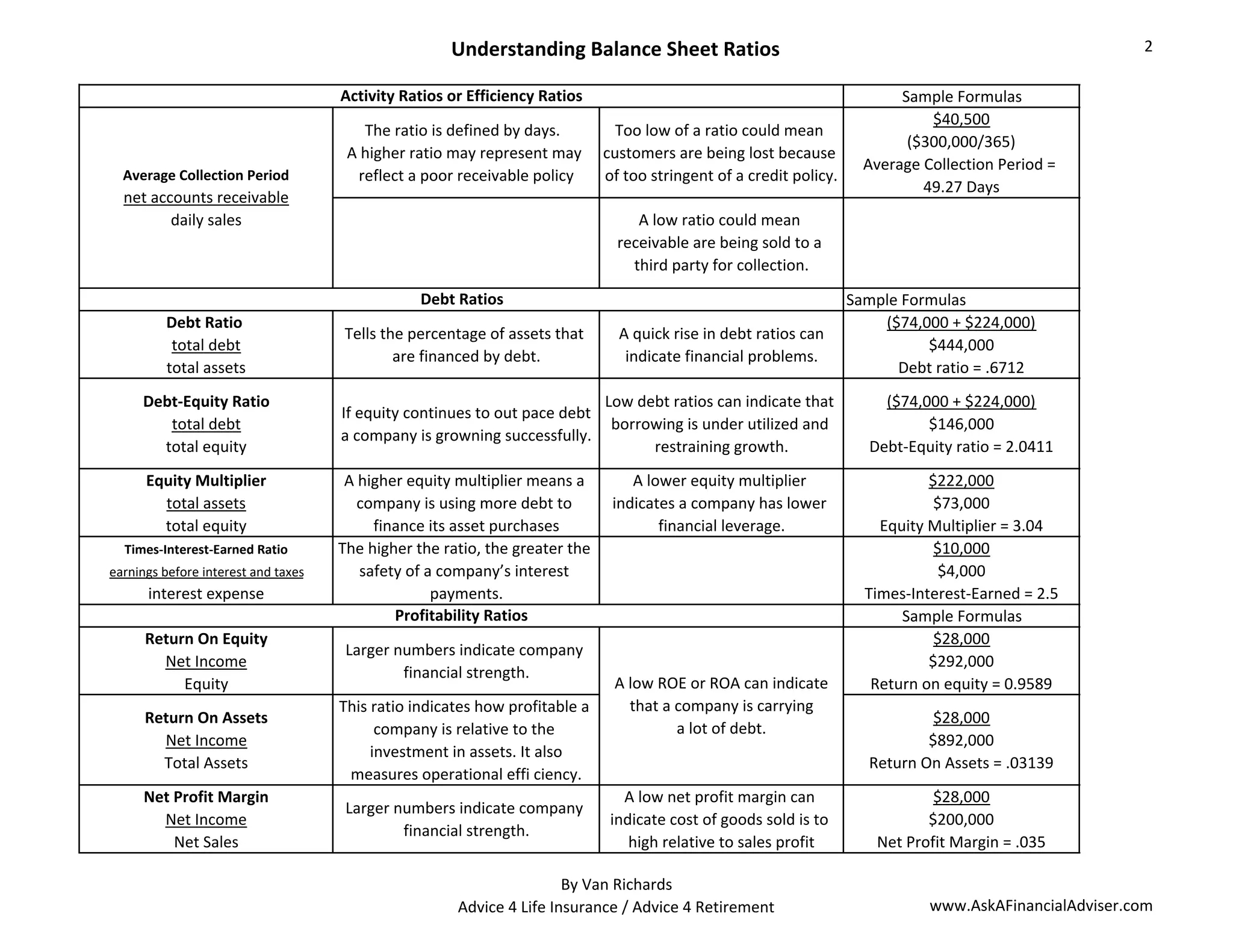
Understanding Balance Sheet Ratios 2
Sample Formulas
The ratio is defined by days.  
A higher ratio may represent may 
reflect a poor receivable policy
Too low of a ratio could mean 
customers are being lost because 
of too stringent of a credit policy.
$40,500
($300,000/365)
Average Collection Period = 
49.27 Days
Sample Formulas
Debt Ratio 
total debt
total assets
Tells the percentage of assets that 
are financed by debt.
A quick rise in debt ratios can
indicate financial problems.
($74,000 + $224,000)
$444,000
Debt ratio = .6712
Debt‐Equity Ratio
total debt
total equity
If equity continues to out pace debt
a company is growning successfully.
Low debt ratios can indicate that 
borrowing is under utilized and 
restraining growth.
($74,000 + $224,000)
$146,000
Debt‐Equity ratio = 2.0411
Equity Multiplier
total assets
total equity
A higher equity multiplier means a 
company is using more debt to 
finance its asset purchases
A lower equity multiplier 
indicates a company has lower 
financial leverage.
$222,000
$73,000
Equity Multiplier = 3.04
Times‐Interest‐Earned Ratio
earnings before interest and taxes
interest expense
The higher the ratio, the greater the 
safety of a company’s interest 
payments.
$10,000
$4,000
Times‐Interest‐Earned = 2.5
Sample Formulas
Return On Equity
Net Income
Equity
Larger numbers indicate company 
financial strength.
$28,000
$292,000
Return on equity = 0.9589
Return On Assets
Net Income
Total Assets
This ratio indicates how profitable a 
company is relative to the 
investment in assets. It also
measures operational effi ciency.
$28,000
$892,000
Return On Assets = .03139
Net Profit Margin
Net Income
Net Sales
Larger numbers indicate company 
financial strength.
A low net profit margin can 
indicate cost of goods sold is to 
high relative to sales profit
$28,000
$200,000
Net Profit Margin = .035
Profitability Ratios
 A low ROE or ROA can indicate 
that a company is carrying
a lot of debt.
A low ratio could mean 
receivable are being sold to a 
third party for collection.
Average Collection Period
net accounts receivable
daily sales
Debt Ratios
Activity Ratios or Efficiency Ratios
By Van Richards
Advice 4 Life Insurance / Advice 4 Retirement www.AskAFinancialAdviser.com

Understanding Balance Sheet Ratios