Understanding Auditing:
Objectives, Importance,and
Principles
Auditing is a systematic and independent examination of books,
accounts, statutory records, documents, and vouchers of an
organization to ascertain how far the financial statements present a
true and fair view of the concern. It aims to ensure the integrity and
reliability of financial information.
by Samundeeswari D
2.
Auditing: Definition andCore Objectives
Definition
Auditing is a systematic process of objectively examining
and evaluating evidence to ascertain whether assertions
about economic actions and events are fairly stated, in
accordance with established criteria, and to communicate
the results to interested users.
Objectives
• Verification of financial statements.
• Detection and prevention of errors and fraud.
• Ensuring compliance with accounting standards.
• Providing credibility to financial reports.
3.
Primary vs. Secondary
Objectives
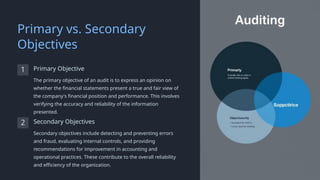
1Primary Objective
The primary objective of an audit is to express an opinion on
whether the financial statements present a true and fair view of
the company's financial position and performance. This involves
verifying the accuracy and reliability of the information
presented.
2 Secondary Objectives
Secondary objectives include detecting and preventing errors
and fraud, evaluating internal controls, and providing
recommendations for improvement in accounting and
operational practices. These contribute to the overall reliability
and efficiency of the organization.
4.
Importance, Advantages,
and Disadvantages
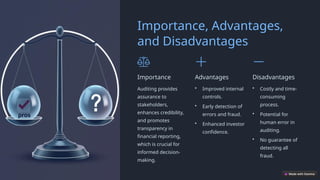
Importance
Auditingprovides
assurance to
stakeholders,
enhances credibility,
and promotes
transparency in
financial reporting,
which is crucial for
informed decision-
making.
Advantages
• Improved internal
controls.
• Early detection of
errors and fraud.
• Enhanced investor
confidence.
Disadvantages
• Costly and time-
consuming
process.
• Potential for
human error in
auditing.
• No guarantee of
detecting all
fraud.
5.
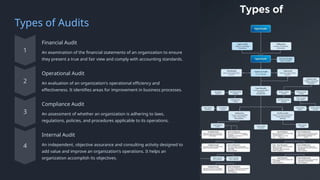
Types of Audits
FinancialAudit
An examination of the financial statements of an organization to ensure
they present a true and fair view and comply with accounting standards.
Operational Audit
An evaluation of an organization's operational efficiency and
effectiveness. It identifies areas for improvement in business processes.
Compliance Audit
An assessment of whether an organization is adhering to laws,
regulations, policies, and procedures applicable to its operations.
Internal Audit
An independent, objective assurance and consulting activity designed to
add value and improve an organization's operations. It helps an
organization accomplish its objectives.
6.
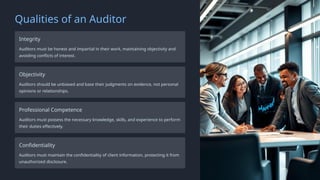
Qualities of anAuditor
Integrity
Auditors must be honest and impartial in their work, maintaining objectivity and
avoiding conflicts of interest.
Objectivity
Auditors should be unbiased and base their judgments on evidence, not personal
opinions or relationships.
Professional Competence
Auditors must possess the necessary knowledge, skills, and experience to perform
their duties effectively.
Confidentiality
Auditors must maintain the confidentiality of client information, protecting it from
unauthorized disclosure.
7.
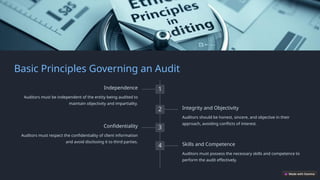
Basic Principles Governingan Audit
1
Independence
Auditors must be independent of the entity being audited to
maintain objectivity and impartiality.
2 Integrity and Objectivity
Auditors should be honest, sincere, and objective in their
approach, avoiding conflicts of interest.
3
Confidentiality
Auditors must respect the confidentiality of client information
and avoid disclosing it to third parties.
4 Skills and Competence
Auditors must possess the necessary skills and competence to
perform the audit effectively.
8.
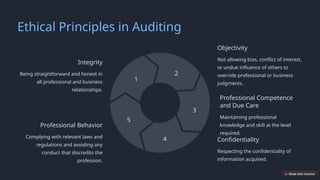
Ethical Principles inAuditing
Integrity
Being straightforward and honest in
all professional and business
relationships.
1
Objectivity
Not allowing bias, conflict of interest,
or undue influence of others to
override professional or business
judgments.
2
Professional Competence
and Due Care
Maintaining professional
knowledge and skill at the level
required.
3
Confidentiality
Respecting the confidentiality of
information acquired.
4
Professional Behavior
Complying with relevant laws and
regulations and avoiding any
conduct that discredits the
profession.
5
9.
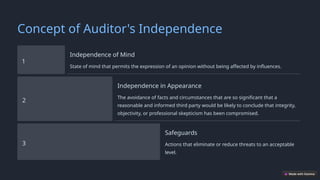
Concept of Auditor'sIndependence
1
Independence of Mind
State of mind that permits the expression of an opinion without being affected by influences.
2
Independence in Appearance
The avoidance of facts and circumstances that are so significant that a
reasonable and informed third party would be likely to conclude that integrity,
objectivity, or professional skepticism has been compromised.
3
Safeguards
Actions that eliminate or reduce threats to an acceptable
level.
10.
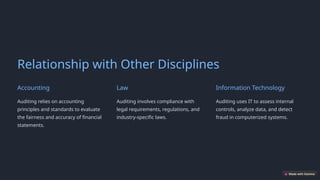
Relationship with OtherDisciplines
Accounting
Auditing relies on accounting
principles and standards to evaluate
the fairness and accuracy of financial
statements.
Law
Auditing involves compliance with
legal requirements, regulations, and
industry-specific laws.
Information Technology
Auditing uses IT to assess internal
controls, analyze data, and detect
fraud in computerized systems.