Presentation on Auditing(Unit-1)
Mr. Ganesh Prasad Panda
Lecturer,
Department of Commerce,
S.G. College, Jajpur, Odisha
Presentation on
Auditing
ORIGINS OFAUDITING
● The origin of auditing may be traced back to the 18th
century when the practice of large-scale production was
developed as a result of Industrial Revolution.
● It is found that some systems of checks and counter-checks
were applied for the purpose of maintaining public accounts,
rather accounts of public institutions as early as the days of
the ancient Egyptians, the Greeks and the Romans.
● The history of auditing in India dates back to April 1, 1914
when the Indian Companies Act, 1913 came into force.
Presentation on
Auditing
Meaning and Definition of Auditing
● As per Spicer and Pegler: “An audit may be said to be such
an examination of the books, accounts and vouchers of a
business as will enable the auditor to satisfy that the Balance
Sheet is properly drawn up, so as to give a true and fair view of
the profit or loss for the financial period according to the best
of his information and the explanation given to him and as
shown by the books, and if not, in what respects he is not
satisfied. ”
● Statement on Standard Auditing Practices (SAP) 1
by ICAI
“Auditing is the independent examination of financial information of
any entity, whether profit oriented or not, and irrespective of its size
or legal form, when such an examination is conducted with a view to
expressing an opinion thereon.”
Presentation on
Auditing
Therefore, audit may be defined as:
1. Systematic and Scientific examination of the books of accounts of
a business, which
2. Is done by an independent person or body of persons qualified for
the job,
3. With the help of vouchers, documents, information and
explanation received from the authorities, so that
The auditor may satisfy himself with the authenticity of financial
accounts prepared for a fixed term and ultimately report that
 Balance Sheet exhibits the true and fair view of the state of affairs.
 Profit and Loss accounts reveals the true and fair view of the profit
or loss for the financial period; and
 The accounts have been prepared in conformity with the law.
Presentation on
Auditing
Duties of an
Auditor
● To check the arithmetical accuracy of the accounts.
● To check the books of accounts with the help of all the
relevant vouchers, invoices, correspondence, minute books
etc.
● To verify Profit & Loss a/c and assets and liabilities in
balance sheet show the true and fair view.
● To report to the client on the basis of his findings.
Presentation on
Auditing
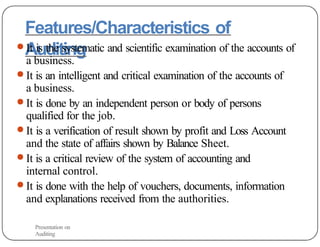
Features/Characteristics of
Auditing
● It is the systematic and scientific examination of the accounts of
a business.
● It is an intelligent and critical examination of the accounts of
a business.
● It is done by an independent person or body of persons
qualified for the job.
● It is a verification of result shown by profit and Loss Account
and the state of affairs shown by Balance Sheet.
● It is a critical review of the system of accounting and
internal control.
● It is done with the help of vouchers, documents, information
and explanations received from the authorities.
Presentation on
Auditing
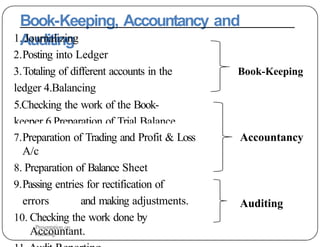
Book-Keeping, Accountancy and
Auditing
Book-Keeping
1. Journalizing
2.Posting into Ledger
3.Totaling of different accounts in the
ledger 4.Balancing
5.Checking the work of the Book-
keeper 6.Preparation of Trial Balance
Accountancy
Auditing
7.Preparation of Trading and Profit & Loss
A/c
8. Preparation of Balance Sheet
9.Passing entries for rectification of
errors and making adjustments.
10. Checking the work done by
Accountant.
Presentation on
Auditing
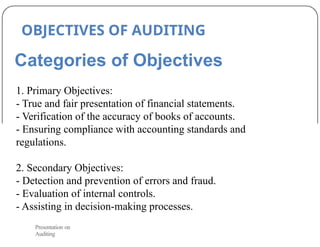
Categories of Objectives
1. Primary Objectives:
- True and fair presentation of financial statements.
- Verification of the accuracy of books of accounts.
- Ensuring compliance with accounting standards and
regulations.
2. Secondary Objectives:
- Detection and prevention of errors and fraud.
- Evaluation of internal controls.
- Assisting in decision-making processes.
OBJECTIVES OF AUDITING
Presentation on
Auditing
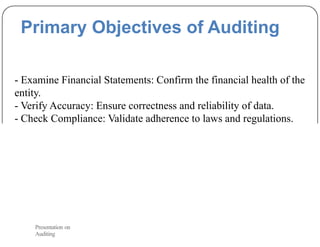
Primary Objectives of Auditing
- Examine Financial Statements: Confirm the financial health of the
entity.
- Verify Accuracy: Ensure correctness and reliability of data.
- Check Compliance: Validate adherence to laws and regulations.
Presentation on
Auditing
Secondary Objectives of Auditing
● Detection of Errors
The errors may occur because of the carelessness of the staff or
their ignorance of the principles of accounts. These errors, may
be of the following types: -
(a) Clerical or Technical Errors
 Error of omission (when any transaction is omitted wholly or
partly)
 Error of Duplication (when same transaction has been
recorded twice)
 Error of Commission (becauseof incorrect records in
books of accounts)
 Compensating error (when error counteract each other)
(b) Error of Principle
These arise when transactions are not recorded
in books according to fundamental and accepted
principles of accountancy.
Presentation on
Auditing
Secondary Objectives of Audit
Cont…
● Detection of Frauds
 Frauds connected with the accounts may take place either (1) by
the misappropriation of cash and goods, or (2) by the
falsification of accounts without any misappropriation
 Misappropriation of cash may take place in two ways:
 By omissionof receipts and acknowledginga lesser amount
than actually received.
 By inclusionof fictitiouspayments or recording more payments
than actually made
 Misappropriation of goods are greater in case of goods which are
less bulky but more valuable.
 Falsification of accounts is undertaken to conceal the true position
of the concern.
Presentation on
Auditing
Secondary Objectives of Audit
Cont…
● Prevention of errors and frauds
 Prevention of errors and frauds is possible only by the
application of sound system of internal check and efficient
management of the concern.
 Such moral check is imposed on the employees of the client
automatically since they would be always alert and would not
carry on any dishonest transactions.
 He should make the detailed study, analysis and evaluation of
the internal control system of the enterprise and find out its
weakness.
Presentation on
Auditing
Basic Principles and
Techniques of Auditing in India
Presentation on
Auditing
Basic Principles of Auditing
1. Integrity, Objectivity, and Independence: Ensuring honesty and
impartiality.
2. Confidentiality: Maintaining client information security.
3. Skills and Competence: Conducting audits with qualified
expertise.
4. Work Performed by Others: Supervising and ensuring quality in
delegated tasks.
5. Documentation: Maintaining evidence supporting the audit
opinion.
6. Planning and Supervision: Systematic approach to ensure
effective audits.
Presentation on
Auditing
Basic Principles of Auditing
7. Evidence: Collecting sufficient and appropriate audit evidence.
8. True and Fair View: Ensuring financial statements reflect
accuracy.
9. Risk Assessment: Identifying risks of material misstatements.
10. Compliance with Standards: Adhering to ICAI standards and
legal frameworks.
Presentation on
Auditing
Techniques of Auditing
1. Vouching: Examining documents like invoices and receipts.
2. Verification: Physically checking assets and liabilities.
3. Analytical Procedures: Using trends and ratios to spot anomalies.
4. Internal Control Review: Evaluating system reliability.
5. Sampling: Testing a representative sample of transactions.
6. Confirmation: Communicating with third parties to confirm
balances.
7. Recalculation: Rechecking computations for accuracy.
8. Inquiry: Discussing with management and staff.
9. Observation: Watching processes like inventory counts.
10. Audit Trail Examination: Following transactions from initiation
to reporting.
Presentation on
Auditing
Types of Audit
There are various types of Audit which are mentioned below: -
Based on Organizational Structure
● Statutory Audit
● Non-Statutory Audit
● Govt. Audit
Non-Statutory Audit is further classified as:-
● Private Audit which includes Sole Proprietorship ,
Partnership firm and Non- Profit Organization.
Based on Scope
● Complete Audit
● Partial Audit
● Detailed Audit
Presentation on
Auditing
Types of Audit
Cont…
Based On Time
● Continuous Audit
● Final Audit
● Interim Audit
Based on
Object
● Special Audit
● Cost Audit
● Management
Audit
● Internal Audit
● Social Audit
● Tax Audit
● Proprietory Audit
 Environmental
Audit
Presentation on Auditing
Presentation on
Auditing
Auditing Based on
Organizational
Structure
● Statutory Audit:
Statutory Audit is compulsory audit prescribed under statute i.e.
law. Appointments of auditors, removal, remuneration, rights,
duties, liabilities are governed as per the Provisions of the
respective law applicable to the organization. Scope of the
audit work and all others terms are as laid down by the law. It
can be conducted only by a qualified Chartered Accountant.
Statutory audit is conducted after preparation of final
accounts. Statutory auditor has to report whether the balance
sheet and profit and loss A/c are drawn upon conformity
with law and whether they show true and fair view. Statutory
auditor has to submit report to the shareholder. His
remuneration is fixed by
shareholder.
Presentation on
Auditing
Presentation on
Auditing
● Government Audit
The government maintains a separate department in the name
of Accounts and Audit Department which performs the audit of its
different department and offices . This department is headed by the
Comptroller and Auditor-General of India who is assisted by
different officials at various levels.
They are meant for Government departments and such, they
work according to the departmental rules and instructions.
Presentation on Auditing
Presentation on
Auditing
● Non-Statutory Audit
Non-Statutory Audit is voluntary audit. They are not compulsory
under any law. It is carried at the discretion of the proprietor
terms and conditions of the audit are determined as per the
agreement made between the auditor and proprietor. Example:
Financial audit of the sole trader and partnership firm.
Voluntary audit also covers non- financial audit. Internal audit,
management audit, social audit, operational audit etc.
● Private Audit
The institutions which are private in character also get their
accounts audited by some qualified auditors. Such an audit is not
required by statue. Hence, it is known as private audit. These bodies
have their own arrangements for audit and run for their own
interest so that their accounts may be subject to a close scrutiny to
be made by a professional accountant.
Presentation on
Auditing
Auditing Based on
Scope
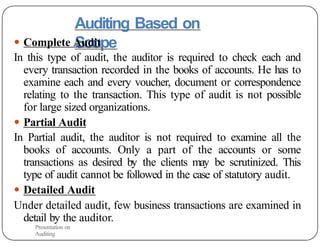
● Complete Audit
In this type of audit, the auditor is required to check each and
every transaction recorded in the books of accounts. He has to
examine each and every voucher, document or correspondence
relating to the transaction. This type of audit is not possible
for large sized organizations.
● Partial Audit
In Partial audit, the auditor is not required to examine all the
books of accounts. Only a part of the accounts or some
transactions as desired by the clients may be scrutinized. This
type of audit cannot be followed in the case of statutory audit.
● Detailed Audit
Under detailed audit, few business transactions are examined in
detail by the auditor.
Presentation on
Auditing
Auditing Based on
Time
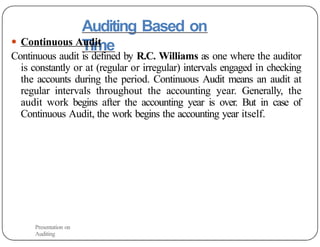
● Continuous Audit
Continuous audit is defined by R.C. Williams as one where the auditor
is constantly or at (regular or irregular) intervals engaged in checking
the accounts during the period. Continuous Audit means an audit at
regular intervals throughout the accounting year. Generally, the
audit work begins after the accounting year is over. But in case of
Continuous Audit, the work begins the accounting year itself.
Presentation on
Auditing
19
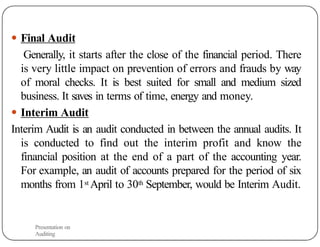
● Final Audit
Generally, it starts after the close of the financial period. There
is very little impact on prevention of errors and frauds by way
of moral checks. It is best suited for small and medium sized
business. It saves in terms of time, energy and money.
● Interim Audit
Interim Audit is an audit conducted in between the annual audits. It
is conducted to find out the interim profit and know the
financial position at the end of a part of the accounting year.
For example, an audit of accounts prepared for the period of six
months from 1st April to 30th September, would be Interim Audit.
Presentation on
Auditing
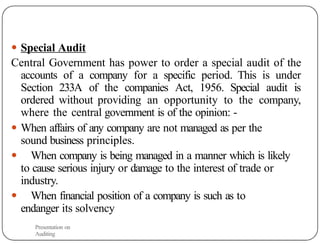
● Special Audit
Central Government has power to order a special audit of the
accounts of a company for a specific period. This is under
Section 233A of the companies Act, 1956. Special audit is
ordered without providing an opportunity to the company,
where the central government is of the opinion: -
● When affairs of any company are not managed as per the
sound business principles.
● When company is being managed in a manner which is likely
to cause serious injury or damage to the interest of trade or
industry.
● When financial position of a company is such as to
endanger its solvency
Presentation on
Auditing
Auditing Based on
Object
● Cost Audit
It is a type of audit which involves verification of cost records
maintained by the organization u/s 233(B) of the Companies
Act 1956. The Central Government may direct an audit of cost
records by a person who is qualified. Appointment of auditor is
done by the board of directors subject to the approval of the
Central Government. The auditor reports to the government the
copy of the report sent to the company. Cost audit is prescribed for
certain types of industries with a view to achieve the following
objects: -
✓ to grant the price concession of the company;
✓ to fix up selling price;
✓ to safeguard interest of customers;
✓ to consider the question of protection to be granted to the
company;
✓ to ascertain the causes of loss suffered by the company.
Presentation on
Auditing
● Management Audit
Management audit involves examines of the plans, policies,
procedure, method and strategies and evaluates the performance of
management with a view to improve organizational effectiveness. It
does not look into the past, present but also in the future.
● Internal Audit
Internal Auditing is a continuous, critical review of financial and
other operating activities by a staff of auditors, functioning as full time
salaried employees.
Guidance Note by ICAI: Internal Audit is an independent
appraisal activity within an enterprise for the review of accounting,
financial and other operation and controls as a basis for service to
management. It involves a specialized application of the techniques of
auditing
Presentation on
Auditing
● Social Audit
Social Audit is a recent development in the field of auditing. It is based on
the modern concept of social responsibility of business. Social audit
examines to what extent the business is discharging its social
responsibilities. It examines the contribution of the concern to the society at
large. It reviews and evaluates the performance of the concern in the
following areas of social welfare and awareness.
● Contribution to natural economic growth through expansion,
employment generation etc.
● Welfare of Employees e.g. training to employees, employment to
handicapped or backward people, provision of education, housing and health
facilities to employees and their families.
● Product relations including quantity, quality and price of
product supplied.
● Care for environment e.g. shifting to industrially undeveloped
regions, control of pollution.
Presentation on
Auditing
24
● Tax Audit
The new concept of tax audit has been evolved
lately under the Income Tax Act, 1961. In India,
the Indian Income Tax Act, 1961, provides for
compulsory audit of accounts of certain assesses
whose turnover or receipts exceed the specified
limit. The accounts are required to be audited
for determination of tax payable by an individual
assessee or organization.
Presentation on
Auditing
Other Types of Audit
● Environmental Audit
In recent times, new type of audit has emerged which is known as
Environmental Audit. The objective of such an audit is to examine
the effect of the activities of an organization on environment.
Environment audit is a management tool comprising a systematic,
periodic and objective evaluation of how well organization,
management and equipment are performing to safeguard the
environment
● Propriety Audit
Under propriety audit, the auditor not only examine the
transactions from the books of accounts with the help of vouchers
and documents, but he verifies also as to how far transactions effected
from the decisions or actions are proper or reasonable. The
propriety audit is concerned with examining that there is no leakage
of revenue or wastage of funds by mistake or fraud. I
Presentation on
Auditing
Audit
Procedure
The Procedure of audit ca be classified as :
1. Preparation before audit
Involves the following steps: -
● Scope of work to be determined : Before determining exactly the
scope of his duties, the auditor should discuss the nature, purpose etc
of audit.
● Knowledge about business: It includes : -
 Go through rules and regulations
 Examine the methods of maintaining accounts.
 Ask for a list of books of accounts maintained.
 Examine the system of internal check in operation.
 Technical details about the business.
 Go through the Profit and loss account and Balance Sheet of the
previous
year.
Presentation on
Auditing
27
Presentation on
Auditing
28
● Instructions to clients: auditor should ask the client to direct
the staff with regard to the following:
 The books of accounts should be totalled up.
 All the vouchers should be serially arranged and filed.
 The schedules of debtors and creditors should be prepared.
 A list of bad and doubtful debts should be prepared.
 Stock sheet should be drawn up.
 Name and address of managing directors and managers should be
kept ready.
● Preparation by the auditor: auditor must prepare the
following:
 Distribution of work.
 Audit Programme (it is an auditor’s plan of action)
 Audit files and Audit note book.

Presentation on
Auditing
Procedure of Audit during work
It includes following steps: -
1. Adoption of distinctive ticks. Auditor must use distinctive
ticks of various colours while auditing the books.
2. Routine checking: it involves checking of casts, sub-casts,
carry- forward and other calculations. Checking of posting into
ledger, checking of casts and balances of various accounts in the
ledger and checking of transfer of balances from the ledger to the
trial balance.
3. Test checking (or selective verification) : here the auditor
through the process of sampling, selects the few items and
if they are found correct, presumes that remaining are also
correct.
4. Audit in depth : In this the auditor examines thoroughly
selected transactions right from their origin to the
conclusions. The basic purpose of this type of audit is to see
whether the system of internal check or control system is
29
Presentation on
Auditing
Presentation on
Auditing
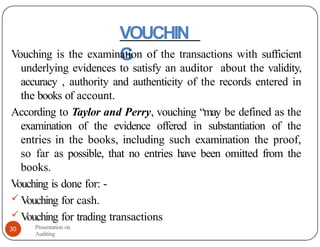
VOUCHIN
G
Vouching is the examination of the transactions with sufficient
underlying evidences to satisfy an auditor about the validity,
accuracy , authority and authenticity of the records entered in
the books of account.
According to Taylor and Perry, vouching “may be defined as the
examination of the evidence offered in substantiation of the
entries in the books, including such examination the proof,
so far as possible, that no entries have been omitted from the
books.
V
ouching is done for: -
 V
ouching for cash.
 V
ouching for trading transactions
Presentation on
Auditing
30
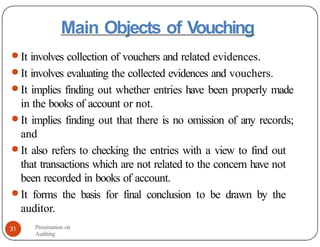
Main Objects of Vouching
● It involves collection of vouchers and related evidences.
● It involves evaluating the collected evidences and vouchers.
● It implies finding out whether entries have been properly made
in the books of account or not.
● It implies finding out that there is no omission of any records;
and
● It also refers to checking the entries with a view to find out
that transactions which are not related to the concern have not
been recorded in books of account.
● It forms the basis for final conclusion to be drawn by the
auditor.
Presentation on
Auditing
31
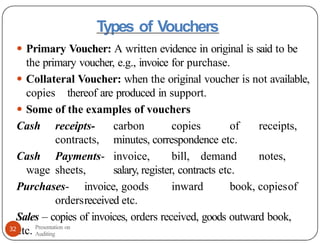
Types of Vouchers
● Primary Voucher: A written evidence in original is said to be
the primary voucher, e.g., invoice for purchase.
● Collateral Voucher: when the original voucher is not available,
copies thereof are produced in support.
● Some of the examples of vouchers
Cash receipts- carbon copies of receipts,
contracts, minutes, correspondence etc.
Cash Payments- invoice, bill, demand notes,
wage sheets, salary, register, contracts etc.
Purchases- invoice, goods inward book, copiesof
ordersreceived etc.
Sales – copies of invoices, orders received, goods outward book,
etc. Presentation on
Auditing
32
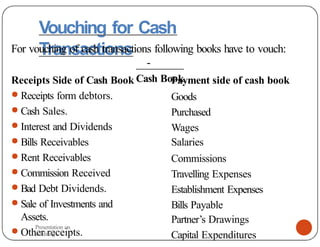
Vouching for Cash
Transactions
For vouching of cash transactions following books have to vouch:
-
Cash Book
Receipts Side of Cash Book
● Receipts form debtors.
● Cash Sales.
● Interest and Dividends
● Bills Receivables
● Rent Receivables
● Commission Received
● Bad Debt Dividends.
● Sale of Investments and
Assets.
● Other receipts.
Payment side of cash book
Goods
Purchased
Wages
Salaries
Commissions
Travelling Expenses
Establishment Expenses
Bills Payable
Partner’s Drawings
Capital Expenditures
Presentation on
Auditing
Vouching of Cash Transactions
Cont…
Petty Cash Book
 The Cheques drawn for petty cash should be vouched from the
credit side of cash book to debit side of petty cash book.
 Auditor should see that petty cash book has been maintained on
Imprest System properly.
Bank Pass Book
 Auditor should see that dates of deposits as entered into the
passbook and cash book does not differ materiality.
 He should be alert specially with regard to deposits made into the
bank prior to the date of closing the accounts.
 Withdrawls and payments from banks should be vouched
with counterfoils of the cheque book.
 Reconciliation statement prepared should be examined
carefully.
Presentation on
Auditing
Vouching of Trading
Transactions
It involves the vouching of: -
● Purchases Book
● Purchase Return Book
● Sales Book
● Sales return Book
● Bills Receivables book
● Bills Payable.
● Journal Proper (where various subsidiary books are
maintained, journal is used for recording those which items
cannot passed through any other book.)
Presentation on
Auditing
Verification
36
Verification is a process by which the auditor satisfies himself, by
actual inspection or otherwise, as to the existence, ownership,
valuation and accuracy of the various items appearing in the balance
sheet.
Spicer and Pegler have defined verification in the following words:
“The verification of assets implies an enquiry into the value ,
ownership and title ; existence and possession ; the presence of any
charge on the assets”.
● Thus, verification means to prove the truth about and the correctness
and authenticity of assets and liabilities.
● Very often, vouching and verification are considered to be one and
the same thing. It is not so.
● A clear line of demarcation can be drawn between the two.
● Vouching is to examine the correctness and authenticity of the
transactions recorded in the books of prime entry while verification
is to confP
ir
res
menta
tti
hon
eon
vA
au
ld
uiti
eng
of assets and liabilities as shown
Presentation on
Auditing
Thus , an auditor has to perform the four types of functions in
verifying the assets:
● To see that they are clearly stated in the Balance Sheet.
● To ensure that they are in existence on the day of the Balance Sheet.
● To verify that they are the property of the business and as such, they
are
free from any charge or mortgage.
● To satisfy himself that they are properly valued.
At the very outset it would be apt to remark that the valuation
of assets is an important part of their verification.
In auditing various assets and Liabilities are verified such as: -
Assets: Land and Building, Plant and Machinery , Furniture, Fitting
and Fixtures, small tools, motor lorries and vans, patterns and
drawings etc.
Liabilities: shares, debentures, Bills Payable,
Loans,Outstanding Expenses etc
Presentation on
Auditing
37
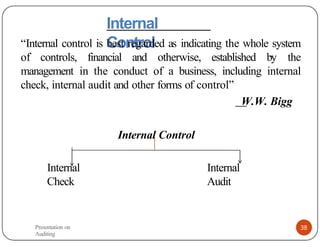
Internal
Control
“Internal control is best regarded as indicating the whole system
of controls, financial and otherwise, established by the
management in the conduct of a business, including internal
check, internal audit and other forms of control”
W.W. Bigg
Internal Control
Internal
Check
Internal
Audit
Presentation on
Auditing
38
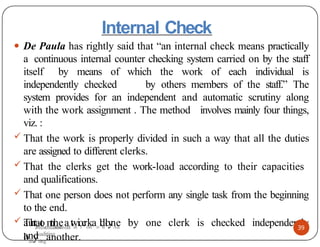
Internal Check
● De Paula has rightly said that “an internal check means practically
a continuous internal counter checking system carried on by the staff
itself by means of which the work of each individual is
independently checked by others members of the staff.” The
system provides for an independent and automatic scrutiny along
with the work assignment . The method involves mainly four things,
viz. :
 That the work is properly divided in such a way that all the duties
are assigned to different clerks.
 That the clerks get the work-load according to their capacities
and qualifications.
 That one person does not perform any single task from the beginning
to the end.
 That the work done by one clerk is checked independently
and
39
autPormesenattatiiconaolnlyAu
bdiytinganother.
Presentation on
Auditing
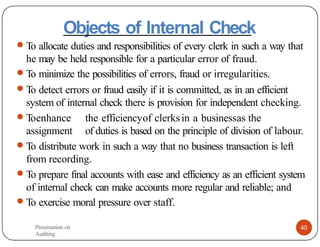
Objects of Internal Check
● To allocate duties and responsibilities of every clerk in such a way that
he may be held responsible for a particular error of fraud.
● To minimize the possibilities of errors, fraud or irregularities.
● To detect errors or fraud easily if it is committed, as in an efficient
system of internal check there is provision for independent checking.
● Toenhance the efficiencyof clerksin a businessas the
assignment of duties is based on the principle of division of labour.
● To distribute work in such a way that no business transaction is left
from recording.
● To prepare final accounts with ease and efficiency as an efficient system
of internal check can make accounts more regular and reliable; and
● To exercise moral pressure over staff.
Presentation on
Auditing
40
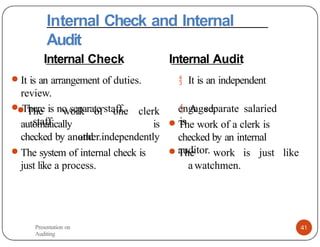
Internal Check and Internal
Audit
Internal Check Internal Audit
● It is an arrangement of duties.  It is an independent
review.
● There is no separate staff.  A separate salaried
staff is
automatically
● The work of one clerk
is
and independently
checked by another.
● The system of internal check is
just like a process.
engaged.
● The work of a clerk is
checked by an internal
auditor.
● The work is just like
a watchmen.
Presentation on
Auditing
41
Fundamental Principles of Internal
Check
42
The following are some important rules of making the system of
internal check efficient and successful.
● The work of business should be allocated amongst various clerks
that their duties, rights and responsibilities may be clearly and
judiciously divided and there may not be left any room for
interference.
● The distribution of work should be so done that no single person
is allowed to do a job solely by himself from beginning to the end.
● One person should be entrusted with the similar nature of work. It
is necessary for efficiency and specialization.
● An efficient system of internal check must provide for an
automatic checking of the work of an assistant by another.
● The division of work should not be expensive.
● No P
cr
le
ese
rn
ktati
oon
fo
tn
hA
eudi
btin
ug
siness should be relied upon too much.
Presentation on
Auditing
Fundamental Principles of Internal
Check
● For making the system of internal check efficient and successful,
use of self-balancing system should be invariably made.
● Labour-saving devices, as cash register, calculating machines,
time recording clocks, etc., should be made use of.
● There should be a proper system of filing vouchers,
correspondence etc, in the business.
● It is also necessary that no clerk should be engaged on particular
job for long. Change in duties would become essential but it
will absolutely depend upon the circumstances prevailing
before a business. Nevertheless, such a change in duties should
be made without making it known to those concerned.
Presentation on
Auditing
Internal Audit
● The Institute of Internal Auditors has defined internal audit as given below:
“Internal Auditing is the independent appraisal activity within an
organization for the review of the accounting, financial and other operations
as a basis for protective and constructive service to the management. It is a
type of control which functions by measuring and evaluating the effectiveness
of Internal check. ”
Characteristics of Internal Audit are: -
1. The system of internal audit has got an independent status in the
organization. The system, therefore, maintains its independent position.
2. Internal audit is totally free from the managerial or executive
functions. However, it may help in formulating executive decisions
without actually taking part in such decisions.
3. It maintains its regular watch and constant review over the accounting
and financial matters. Thus, it can make investigations into any phase of
activities of organization.
4. Internal audit is a system of audit by the internal auditor who is an employee
of the organization. But he does not work under any sort of managerial
pressure.
Presentation on
Auditing
Auditor’s Report
● Under Section 227(2) of the Companies Act, 1956, the auditor
is required to make a report to the members of the company on
the accounts examined by him and on every Balance Sheet and
Profit and Loss Account and on every other document declared
by the Act to be annexed to the Balance Sheet or Profit and Loss
account which are laid before the company in General Meeting
during his tenure of office. Such a report is known as the
Auditor’s report.
● According to Lancaster
“A report is a statement of collected and considered facts,
so drawn up as to give clear and concise information to persons
who are not already in possession of the full facts of the subject-
matter of the report.”
Presentation on
Auditing
50
Contents of the Audit
Report
According to Section 227(3) of the Companies Act, 1956, the
auditor’s report shall state:
1. “Whether, in his opinion and to the best of his information and
according to the explanations given to him, the said accounts
give the information required by this act in the manner so
required and give a true and fair view:
 In the case of Balance Sheet, of the state of the company’s affairs as at
the end of its financial year; and
 In the case of the profit and loss account, of the profit or loss for
its financial year.”
2. “whether he has obtained all the information and
explanations which to the best oh his knowledge and belief
were necessary for the purpose of his audit.”
Presentation on
Auditing
51
Contents of the Audit
Report
3. “Whether in his opinion, proper books of accounts as required by
law have been kept by the company so far as appears from the
examination of those books and proper returns adequate for the
purpose of his audit have been received from branches not visited by
him.”
4. “Whether the report on the accounts of any branch Office audited
under section 228 by a person other than the company’s auditor
has been forwarded to him as required by clause (c) of sub-section
(3) of that section and he has dealt with the same in preparing the
report.”
5. “Whether the company’s Balance Sheet and Profit and Loss Account
dealt with by the report are in agreement with the books of
accounts and returns.”
6. “Whether, in his opinion, the profit and loss account and balance
comply with the accounting standards referred to in sub-section (3C)
of section 211.”
Presentation on
Auditing
Types of Auditor’s
Report
● The auditor’s report may be of two types:
(1) Clean or unqualified report (2) Qualified report
Clean or unqualified report : A Clean or unqualified report is one in which
the auditor does not insert any qualification or modification or
reservation.
Qualified Report: A qualified report is one in which the matters referred to
in section 227 (2).
Before giving qualifications, the auditor should note the following:
 For which item is it necessary to qualify report?
 Whether the auditor is not satisfied with a particular matter of the company
or he is unable to express his proper opinion on a particular matter.
 Whether certain matters are so important that they affect the true and
fair presentation of the affairs of the company?
 Whether the matter relating to the qualification is concerned with the
violation of an important provision of the Companies Act, 1956
Presentation on
Auditing
THANK
YOU
Presentation on
Auditing

auditing is the checking and verifiactaiopn

  • 1.
    Presentation on Auditing(Unit-1) Mr.Ganesh Prasad Panda Lecturer, Department of Commerce, S.G. College, Jajpur, Odisha Presentation on Auditing
  • 2.
    ORIGINS OFAUDITING ● Theorigin of auditing may be traced back to the 18th century when the practice of large-scale production was developed as a result of Industrial Revolution. ● It is found that some systems of checks and counter-checks were applied for the purpose of maintaining public accounts, rather accounts of public institutions as early as the days of the ancient Egyptians, the Greeks and the Romans. ● The history of auditing in India dates back to April 1, 1914 when the Indian Companies Act, 1913 came into force. Presentation on Auditing
  • 3.
    Meaning and Definitionof Auditing ● As per Spicer and Pegler: “An audit may be said to be such an examination of the books, accounts and vouchers of a business as will enable the auditor to satisfy that the Balance Sheet is properly drawn up, so as to give a true and fair view of the profit or loss for the financial period according to the best of his information and the explanation given to him and as shown by the books, and if not, in what respects he is not satisfied. ” ● Statement on Standard Auditing Practices (SAP) 1 by ICAI “Auditing is the independent examination of financial information of any entity, whether profit oriented or not, and irrespective of its size or legal form, when such an examination is conducted with a view to expressing an opinion thereon.” Presentation on Auditing
  • 4.
    Therefore, audit maybe defined as: 1. Systematic and Scientific examination of the books of accounts of a business, which 2. Is done by an independent person or body of persons qualified for the job, 3. With the help of vouchers, documents, information and explanation received from the authorities, so that The auditor may satisfy himself with the authenticity of financial accounts prepared for a fixed term and ultimately report that  Balance Sheet exhibits the true and fair view of the state of affairs.  Profit and Loss accounts reveals the true and fair view of the profit or loss for the financial period; and  The accounts have been prepared in conformity with the law. Presentation on Auditing
  • 5.
    Duties of an Auditor ●To check the arithmetical accuracy of the accounts. ● To check the books of accounts with the help of all the relevant vouchers, invoices, correspondence, minute books etc. ● To verify Profit & Loss a/c and assets and liabilities in balance sheet show the true and fair view. ● To report to the client on the basis of his findings. Presentation on Auditing
  • 6.
    Features/Characteristics of Auditing ● Itis the systematic and scientific examination of the accounts of a business. ● It is an intelligent and critical examination of the accounts of a business. ● It is done by an independent person or body of persons qualified for the job. ● It is a verification of result shown by profit and Loss Account and the state of affairs shown by Balance Sheet. ● It is a critical review of the system of accounting and internal control. ● It is done with the help of vouchers, documents, information and explanations received from the authorities. Presentation on Auditing
  • 7.
    Book-Keeping, Accountancy and Auditing Book-Keeping 1.Journalizing 2.Posting into Ledger 3.Totaling of different accounts in the ledger 4.Balancing 5.Checking the work of the Book- keeper 6.Preparation of Trial Balance Accountancy Auditing 7.Preparation of Trading and Profit & Loss A/c 8. Preparation of Balance Sheet 9.Passing entries for rectification of errors and making adjustments. 10. Checking the work done by Accountant. Presentation on Auditing
  • 8.
    Categories of Objectives 1.Primary Objectives: - True and fair presentation of financial statements. - Verification of the accuracy of books of accounts. - Ensuring compliance with accounting standards and regulations. 2. Secondary Objectives: - Detection and prevention of errors and fraud. - Evaluation of internal controls. - Assisting in decision-making processes. OBJECTIVES OF AUDITING Presentation on Auditing
  • 9.
    Primary Objectives ofAuditing - Examine Financial Statements: Confirm the financial health of the entity. - Verify Accuracy: Ensure correctness and reliability of data. - Check Compliance: Validate adherence to laws and regulations. Presentation on Auditing
  • 10.
    Secondary Objectives ofAuditing ● Detection of Errors The errors may occur because of the carelessness of the staff or their ignorance of the principles of accounts. These errors, may be of the following types: - (a) Clerical or Technical Errors  Error of omission (when any transaction is omitted wholly or partly)  Error of Duplication (when same transaction has been recorded twice)  Error of Commission (becauseof incorrect records in books of accounts)  Compensating error (when error counteract each other) (b) Error of Principle These arise when transactions are not recorded in books according to fundamental and accepted principles of accountancy. Presentation on Auditing
  • 11.
    Secondary Objectives ofAudit Cont… ● Detection of Frauds  Frauds connected with the accounts may take place either (1) by the misappropriation of cash and goods, or (2) by the falsification of accounts without any misappropriation  Misappropriation of cash may take place in two ways:  By omissionof receipts and acknowledginga lesser amount than actually received.  By inclusionof fictitiouspayments or recording more payments than actually made  Misappropriation of goods are greater in case of goods which are less bulky but more valuable.  Falsification of accounts is undertaken to conceal the true position of the concern. Presentation on Auditing
  • 12.
    Secondary Objectives ofAudit Cont… ● Prevention of errors and frauds  Prevention of errors and frauds is possible only by the application of sound system of internal check and efficient management of the concern.  Such moral check is imposed on the employees of the client automatically since they would be always alert and would not carry on any dishonest transactions.  He should make the detailed study, analysis and evaluation of the internal control system of the enterprise and find out its weakness. Presentation on Auditing
  • 13.
    Basic Principles and Techniquesof Auditing in India Presentation on Auditing
  • 14.
    Basic Principles ofAuditing 1. Integrity, Objectivity, and Independence: Ensuring honesty and impartiality. 2. Confidentiality: Maintaining client information security. 3. Skills and Competence: Conducting audits with qualified expertise. 4. Work Performed by Others: Supervising and ensuring quality in delegated tasks. 5. Documentation: Maintaining evidence supporting the audit opinion. 6. Planning and Supervision: Systematic approach to ensure effective audits. Presentation on Auditing
  • 15.
    Basic Principles ofAuditing 7. Evidence: Collecting sufficient and appropriate audit evidence. 8. True and Fair View: Ensuring financial statements reflect accuracy. 9. Risk Assessment: Identifying risks of material misstatements. 10. Compliance with Standards: Adhering to ICAI standards and legal frameworks. Presentation on Auditing
  • 16.
    Techniques of Auditing 1.Vouching: Examining documents like invoices and receipts. 2. Verification: Physically checking assets and liabilities. 3. Analytical Procedures: Using trends and ratios to spot anomalies. 4. Internal Control Review: Evaluating system reliability. 5. Sampling: Testing a representative sample of transactions. 6. Confirmation: Communicating with third parties to confirm balances. 7. Recalculation: Rechecking computations for accuracy. 8. Inquiry: Discussing with management and staff. 9. Observation: Watching processes like inventory counts. 10. Audit Trail Examination: Following transactions from initiation to reporting. Presentation on Auditing
  • 17.
    Types of Audit Thereare various types of Audit which are mentioned below: - Based on Organizational Structure ● Statutory Audit ● Non-Statutory Audit ● Govt. Audit Non-Statutory Audit is further classified as:- ● Private Audit which includes Sole Proprietorship , Partnership firm and Non- Profit Organization. Based on Scope ● Complete Audit ● Partial Audit ● Detailed Audit Presentation on Auditing
  • 18.
    Types of Audit Cont… BasedOn Time ● Continuous Audit ● Final Audit ● Interim Audit Based on Object ● Special Audit ● Cost Audit ● Management Audit ● Internal Audit ● Social Audit ● Tax Audit ● Proprietory Audit  Environmental Audit Presentation on Auditing Presentation on Auditing
  • 19.
    Auditing Based on Organizational Structure ●Statutory Audit: Statutory Audit is compulsory audit prescribed under statute i.e. law. Appointments of auditors, removal, remuneration, rights, duties, liabilities are governed as per the Provisions of the respective law applicable to the organization. Scope of the audit work and all others terms are as laid down by the law. It can be conducted only by a qualified Chartered Accountant. Statutory audit is conducted after preparation of final accounts. Statutory auditor has to report whether the balance sheet and profit and loss A/c are drawn upon conformity with law and whether they show true and fair view. Statutory auditor has to submit report to the shareholder. His remuneration is fixed by shareholder. Presentation on Auditing Presentation on Auditing
  • 20.
    ● Government Audit Thegovernment maintains a separate department in the name of Accounts and Audit Department which performs the audit of its different department and offices . This department is headed by the Comptroller and Auditor-General of India who is assisted by different officials at various levels. They are meant for Government departments and such, they work according to the departmental rules and instructions. Presentation on Auditing Presentation on Auditing
  • 21.
    ● Non-Statutory Audit Non-StatutoryAudit is voluntary audit. They are not compulsory under any law. It is carried at the discretion of the proprietor terms and conditions of the audit are determined as per the agreement made between the auditor and proprietor. Example: Financial audit of the sole trader and partnership firm. Voluntary audit also covers non- financial audit. Internal audit, management audit, social audit, operational audit etc. ● Private Audit The institutions which are private in character also get their accounts audited by some qualified auditors. Such an audit is not required by statue. Hence, it is known as private audit. These bodies have their own arrangements for audit and run for their own interest so that their accounts may be subject to a close scrutiny to be made by a professional accountant. Presentation on Auditing
  • 22.
    Auditing Based on Scope ●Complete Audit In this type of audit, the auditor is required to check each and every transaction recorded in the books of accounts. He has to examine each and every voucher, document or correspondence relating to the transaction. This type of audit is not possible for large sized organizations. ● Partial Audit In Partial audit, the auditor is not required to examine all the books of accounts. Only a part of the accounts or some transactions as desired by the clients may be scrutinized. This type of audit cannot be followed in the case of statutory audit. ● Detailed Audit Under detailed audit, few business transactions are examined in detail by the auditor. Presentation on Auditing
  • 23.
    Auditing Based on Time ●Continuous Audit Continuous audit is defined by R.C. Williams as one where the auditor is constantly or at (regular or irregular) intervals engaged in checking the accounts during the period. Continuous Audit means an audit at regular intervals throughout the accounting year. Generally, the audit work begins after the accounting year is over. But in case of Continuous Audit, the work begins the accounting year itself. Presentation on Auditing 19
  • 24.
    ● Final Audit Generally,it starts after the close of the financial period. There is very little impact on prevention of errors and frauds by way of moral checks. It is best suited for small and medium sized business. It saves in terms of time, energy and money. ● Interim Audit Interim Audit is an audit conducted in between the annual audits. It is conducted to find out the interim profit and know the financial position at the end of a part of the accounting year. For example, an audit of accounts prepared for the period of six months from 1st April to 30th September, would be Interim Audit. Presentation on Auditing
  • 25.
    ● Special Audit CentralGovernment has power to order a special audit of the accounts of a company for a specific period. This is under Section 233A of the companies Act, 1956. Special audit is ordered without providing an opportunity to the company, where the central government is of the opinion: - ● When affairs of any company are not managed as per the sound business principles. ● When company is being managed in a manner which is likely to cause serious injury or damage to the interest of trade or industry. ● When financial position of a company is such as to endanger its solvency Presentation on Auditing
  • 26.
    Auditing Based on Object ●Cost Audit It is a type of audit which involves verification of cost records maintained by the organization u/s 233(B) of the Companies Act 1956. The Central Government may direct an audit of cost records by a person who is qualified. Appointment of auditor is done by the board of directors subject to the approval of the Central Government. The auditor reports to the government the copy of the report sent to the company. Cost audit is prescribed for certain types of industries with a view to achieve the following objects: - ✓ to grant the price concession of the company; ✓ to fix up selling price; ✓ to safeguard interest of customers; ✓ to consider the question of protection to be granted to the company; ✓ to ascertain the causes of loss suffered by the company. Presentation on Auditing
  • 27.
    ● Management Audit Managementaudit involves examines of the plans, policies, procedure, method and strategies and evaluates the performance of management with a view to improve organizational effectiveness. It does not look into the past, present but also in the future. ● Internal Audit Internal Auditing is a continuous, critical review of financial and other operating activities by a staff of auditors, functioning as full time salaried employees. Guidance Note by ICAI: Internal Audit is an independent appraisal activity within an enterprise for the review of accounting, financial and other operation and controls as a basis for service to management. It involves a specialized application of the techniques of auditing Presentation on Auditing
  • 28.
    ● Social Audit SocialAudit is a recent development in the field of auditing. It is based on the modern concept of social responsibility of business. Social audit examines to what extent the business is discharging its social responsibilities. It examines the contribution of the concern to the society at large. It reviews and evaluates the performance of the concern in the following areas of social welfare and awareness. ● Contribution to natural economic growth through expansion, employment generation etc. ● Welfare of Employees e.g. training to employees, employment to handicapped or backward people, provision of education, housing and health facilities to employees and their families. ● Product relations including quantity, quality and price of product supplied. ● Care for environment e.g. shifting to industrially undeveloped regions, control of pollution. Presentation on Auditing 24
  • 29.
    ● Tax Audit Thenew concept of tax audit has been evolved lately under the Income Tax Act, 1961. In India, the Indian Income Tax Act, 1961, provides for compulsory audit of accounts of certain assesses whose turnover or receipts exceed the specified limit. The accounts are required to be audited for determination of tax payable by an individual assessee or organization. Presentation on Auditing
  • 30.
    Other Types ofAudit ● Environmental Audit In recent times, new type of audit has emerged which is known as Environmental Audit. The objective of such an audit is to examine the effect of the activities of an organization on environment. Environment audit is a management tool comprising a systematic, periodic and objective evaluation of how well organization, management and equipment are performing to safeguard the environment ● Propriety Audit Under propriety audit, the auditor not only examine the transactions from the books of accounts with the help of vouchers and documents, but he verifies also as to how far transactions effected from the decisions or actions are proper or reasonable. The propriety audit is concerned with examining that there is no leakage of revenue or wastage of funds by mistake or fraud. I Presentation on Auditing
  • 31.
    Audit Procedure The Procedure ofaudit ca be classified as : 1. Preparation before audit Involves the following steps: - ● Scope of work to be determined : Before determining exactly the scope of his duties, the auditor should discuss the nature, purpose etc of audit. ● Knowledge about business: It includes : -  Go through rules and regulations  Examine the methods of maintaining accounts.  Ask for a list of books of accounts maintained.  Examine the system of internal check in operation.  Technical details about the business.  Go through the Profit and loss account and Balance Sheet of the previous year. Presentation on Auditing 27 Presentation on Auditing
  • 32.
    28 ● Instructions toclients: auditor should ask the client to direct the staff with regard to the following:  The books of accounts should be totalled up.  All the vouchers should be serially arranged and filed.  The schedules of debtors and creditors should be prepared.  A list of bad and doubtful debts should be prepared.  Stock sheet should be drawn up.  Name and address of managing directors and managers should be kept ready. ● Preparation by the auditor: auditor must prepare the following:  Distribution of work.  Audit Programme (it is an auditor’s plan of action)  Audit files and Audit note book.  Presentation on Auditing
  • 33.
    Procedure of Auditduring work It includes following steps: - 1. Adoption of distinctive ticks. Auditor must use distinctive ticks of various colours while auditing the books. 2. Routine checking: it involves checking of casts, sub-casts, carry- forward and other calculations. Checking of posting into ledger, checking of casts and balances of various accounts in the ledger and checking of transfer of balances from the ledger to the trial balance. 3. Test checking (or selective verification) : here the auditor through the process of sampling, selects the few items and if they are found correct, presumes that remaining are also correct. 4. Audit in depth : In this the auditor examines thoroughly selected transactions right from their origin to the conclusions. The basic purpose of this type of audit is to see whether the system of internal check or control system is 29 Presentation on Auditing Presentation on Auditing
  • 34.
    VOUCHIN G Vouching is theexamination of the transactions with sufficient underlying evidences to satisfy an auditor about the validity, accuracy , authority and authenticity of the records entered in the books of account. According to Taylor and Perry, vouching “may be defined as the examination of the evidence offered in substantiation of the entries in the books, including such examination the proof, so far as possible, that no entries have been omitted from the books. V ouching is done for: -  V ouching for cash.  V ouching for trading transactions Presentation on Auditing 30
  • 35.
    Main Objects ofVouching ● It involves collection of vouchers and related evidences. ● It involves evaluating the collected evidences and vouchers. ● It implies finding out whether entries have been properly made in the books of account or not. ● It implies finding out that there is no omission of any records; and ● It also refers to checking the entries with a view to find out that transactions which are not related to the concern have not been recorded in books of account. ● It forms the basis for final conclusion to be drawn by the auditor. Presentation on Auditing 31
  • 36.
    Types of Vouchers ●Primary Voucher: A written evidence in original is said to be the primary voucher, e.g., invoice for purchase. ● Collateral Voucher: when the original voucher is not available, copies thereof are produced in support. ● Some of the examples of vouchers Cash receipts- carbon copies of receipts, contracts, minutes, correspondence etc. Cash Payments- invoice, bill, demand notes, wage sheets, salary, register, contracts etc. Purchases- invoice, goods inward book, copiesof ordersreceived etc. Sales – copies of invoices, orders received, goods outward book, etc. Presentation on Auditing 32
  • 37.
    Vouching for Cash Transactions Forvouching of cash transactions following books have to vouch: - Cash Book Receipts Side of Cash Book ● Receipts form debtors. ● Cash Sales. ● Interest and Dividends ● Bills Receivables ● Rent Receivables ● Commission Received ● Bad Debt Dividends. ● Sale of Investments and Assets. ● Other receipts. Payment side of cash book Goods Purchased Wages Salaries Commissions Travelling Expenses Establishment Expenses Bills Payable Partner’s Drawings Capital Expenditures Presentation on Auditing
  • 38.
    Vouching of CashTransactions Cont… Petty Cash Book  The Cheques drawn for petty cash should be vouched from the credit side of cash book to debit side of petty cash book.  Auditor should see that petty cash book has been maintained on Imprest System properly. Bank Pass Book  Auditor should see that dates of deposits as entered into the passbook and cash book does not differ materiality.  He should be alert specially with regard to deposits made into the bank prior to the date of closing the accounts.  Withdrawls and payments from banks should be vouched with counterfoils of the cheque book.  Reconciliation statement prepared should be examined carefully. Presentation on Auditing
  • 39.
    Vouching of Trading Transactions Itinvolves the vouching of: - ● Purchases Book ● Purchase Return Book ● Sales Book ● Sales return Book ● Bills Receivables book ● Bills Payable. ● Journal Proper (where various subsidiary books are maintained, journal is used for recording those which items cannot passed through any other book.) Presentation on Auditing
  • 40.
    Verification 36 Verification is aprocess by which the auditor satisfies himself, by actual inspection or otherwise, as to the existence, ownership, valuation and accuracy of the various items appearing in the balance sheet. Spicer and Pegler have defined verification in the following words: “The verification of assets implies an enquiry into the value , ownership and title ; existence and possession ; the presence of any charge on the assets”. ● Thus, verification means to prove the truth about and the correctness and authenticity of assets and liabilities. ● Very often, vouching and verification are considered to be one and the same thing. It is not so. ● A clear line of demarcation can be drawn between the two. ● Vouching is to examine the correctness and authenticity of the transactions recorded in the books of prime entry while verification is to confP ir res menta tti hon eon vA au ld uiti eng of assets and liabilities as shown Presentation on Auditing
  • 41.
    Thus , anauditor has to perform the four types of functions in verifying the assets: ● To see that they are clearly stated in the Balance Sheet. ● To ensure that they are in existence on the day of the Balance Sheet. ● To verify that they are the property of the business and as such, they are free from any charge or mortgage. ● To satisfy himself that they are properly valued. At the very outset it would be apt to remark that the valuation of assets is an important part of their verification. In auditing various assets and Liabilities are verified such as: - Assets: Land and Building, Plant and Machinery , Furniture, Fitting and Fixtures, small tools, motor lorries and vans, patterns and drawings etc. Liabilities: shares, debentures, Bills Payable, Loans,Outstanding Expenses etc Presentation on Auditing 37
  • 42.
    Internal Control “Internal control isbest regarded as indicating the whole system of controls, financial and otherwise, established by the management in the conduct of a business, including internal check, internal audit and other forms of control” W.W. Bigg Internal Control Internal Check Internal Audit Presentation on Auditing 38
  • 43.
    Internal Check ● DePaula has rightly said that “an internal check means practically a continuous internal counter checking system carried on by the staff itself by means of which the work of each individual is independently checked by others members of the staff.” The system provides for an independent and automatic scrutiny along with the work assignment . The method involves mainly four things, viz. :  That the work is properly divided in such a way that all the duties are assigned to different clerks.  That the clerks get the work-load according to their capacities and qualifications.  That one person does not perform any single task from the beginning to the end.  That the work done by one clerk is checked independently and 39 autPormesenattatiiconaolnlyAu bdiytinganother. Presentation on Auditing
  • 44.
    Objects of InternalCheck ● To allocate duties and responsibilities of every clerk in such a way that he may be held responsible for a particular error of fraud. ● To minimize the possibilities of errors, fraud or irregularities. ● To detect errors or fraud easily if it is committed, as in an efficient system of internal check there is provision for independent checking. ● Toenhance the efficiencyof clerksin a businessas the assignment of duties is based on the principle of division of labour. ● To distribute work in such a way that no business transaction is left from recording. ● To prepare final accounts with ease and efficiency as an efficient system of internal check can make accounts more regular and reliable; and ● To exercise moral pressure over staff. Presentation on Auditing 40
  • 45.
    Internal Check andInternal Audit Internal Check Internal Audit ● It is an arrangement of duties.  It is an independent review. ● There is no separate staff.  A separate salaried staff is automatically ● The work of one clerk is and independently checked by another. ● The system of internal check is just like a process. engaged. ● The work of a clerk is checked by an internal auditor. ● The work is just like a watchmen. Presentation on Auditing 41
  • 46.
    Fundamental Principles ofInternal Check 42 The following are some important rules of making the system of internal check efficient and successful. ● The work of business should be allocated amongst various clerks that their duties, rights and responsibilities may be clearly and judiciously divided and there may not be left any room for interference. ● The distribution of work should be so done that no single person is allowed to do a job solely by himself from beginning to the end. ● One person should be entrusted with the similar nature of work. It is necessary for efficiency and specialization. ● An efficient system of internal check must provide for an automatic checking of the work of an assistant by another. ● The division of work should not be expensive. ● No P cr le ese rn ktati oon fo tn hA eudi btin ug siness should be relied upon too much. Presentation on Auditing
  • 47.
    Fundamental Principles ofInternal Check ● For making the system of internal check efficient and successful, use of self-balancing system should be invariably made. ● Labour-saving devices, as cash register, calculating machines, time recording clocks, etc., should be made use of. ● There should be a proper system of filing vouchers, correspondence etc, in the business. ● It is also necessary that no clerk should be engaged on particular job for long. Change in duties would become essential but it will absolutely depend upon the circumstances prevailing before a business. Nevertheless, such a change in duties should be made without making it known to those concerned. Presentation on Auditing
  • 48.
    Internal Audit ● TheInstitute of Internal Auditors has defined internal audit as given below: “Internal Auditing is the independent appraisal activity within an organization for the review of the accounting, financial and other operations as a basis for protective and constructive service to the management. It is a type of control which functions by measuring and evaluating the effectiveness of Internal check. ” Characteristics of Internal Audit are: - 1. The system of internal audit has got an independent status in the organization. The system, therefore, maintains its independent position. 2. Internal audit is totally free from the managerial or executive functions. However, it may help in formulating executive decisions without actually taking part in such decisions. 3. It maintains its regular watch and constant review over the accounting and financial matters. Thus, it can make investigations into any phase of activities of organization. 4. Internal audit is a system of audit by the internal auditor who is an employee of the organization. But he does not work under any sort of managerial pressure. Presentation on Auditing
  • 49.
    Auditor’s Report ● UnderSection 227(2) of the Companies Act, 1956, the auditor is required to make a report to the members of the company on the accounts examined by him and on every Balance Sheet and Profit and Loss Account and on every other document declared by the Act to be annexed to the Balance Sheet or Profit and Loss account which are laid before the company in General Meeting during his tenure of office. Such a report is known as the Auditor’s report. ● According to Lancaster “A report is a statement of collected and considered facts, so drawn up as to give clear and concise information to persons who are not already in possession of the full facts of the subject- matter of the report.” Presentation on Auditing 50
  • 50.
    Contents of theAudit Report According to Section 227(3) of the Companies Act, 1956, the auditor’s report shall state: 1. “Whether, in his opinion and to the best of his information and according to the explanations given to him, the said accounts give the information required by this act in the manner so required and give a true and fair view:  In the case of Balance Sheet, of the state of the company’s affairs as at the end of its financial year; and  In the case of the profit and loss account, of the profit or loss for its financial year.” 2. “whether he has obtained all the information and explanations which to the best oh his knowledge and belief were necessary for the purpose of his audit.” Presentation on Auditing 51
  • 51.
    Contents of theAudit Report 3. “Whether in his opinion, proper books of accounts as required by law have been kept by the company so far as appears from the examination of those books and proper returns adequate for the purpose of his audit have been received from branches not visited by him.” 4. “Whether the report on the accounts of any branch Office audited under section 228 by a person other than the company’s auditor has been forwarded to him as required by clause (c) of sub-section (3) of that section and he has dealt with the same in preparing the report.” 5. “Whether the company’s Balance Sheet and Profit and Loss Account dealt with by the report are in agreement with the books of accounts and returns.” 6. “Whether, in his opinion, the profit and loss account and balance comply with the accounting standards referred to in sub-section (3C) of section 211.” Presentation on Auditing
  • 52.
    Types of Auditor’s Report ●The auditor’s report may be of two types: (1) Clean or unqualified report (2) Qualified report Clean or unqualified report : A Clean or unqualified report is one in which the auditor does not insert any qualification or modification or reservation. Qualified Report: A qualified report is one in which the matters referred to in section 227 (2). Before giving qualifications, the auditor should note the following:  For which item is it necessary to qualify report?  Whether the auditor is not satisfied with a particular matter of the company or he is unable to express his proper opinion on a particular matter.  Whether certain matters are so important that they affect the true and fair presentation of the affairs of the company?  Whether the matter relating to the qualification is concerned with the violation of an important provision of the Companies Act, 1956 Presentation on Auditing
  • 53.