Underinsurance: What We’ve LearnedTopeka, Kansas • April 6, 2010 Sharon T. Barfield, MSW, LSCSW   Andrew Ward, PhD, MPH Kansas Health Institute
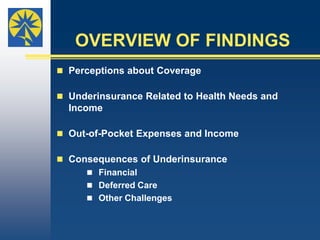
OVERVIEW OF FINDINGSPerceptions about Coverage
Underinsurance Related to Health Needs and Income
Out-of-Pocket Expenses and Income
Consequences of Underinsurance
Financial
Deferred Care
Other ChallengesDEFINITIONBeing underinsured means someone has inadequate health insurance coverage to address the financial expenses associated with health care services, resulting in financial strain, medical debt or postponing needed care due to cost.
METHODSSurvey We administered surveys by phone to 100 underinsured Kansans to obtain a “snapshot” of their experiences.Interviews We conducted face-to-face interviews with 10     additional underinsured Kansans to gain a     better understanding of how underinsurance     affects their families and daily lives.
Perceptions about Coverage Eight of 10 persons interviewed didn’t realize     their health insurance was inadequate until     they had trouble paying medical bills or were     denied coverage.Some said at that point their insurance and the sense of security it had afforded seemed to disappear.Perceptions about Coverage (Cont’d) Four people interviewed considered their plans inadequate:One didn’t cover the knee component of a prosthetic leg that made it functional.One stopped paying for care of degenerative disc disease. One provided catastrophic coverage but paid for a limited number of physician office visits.
Perceptions about Coverage (Cont’d)One excluded a pre-existing condition. “I pay a monthly premium for nothing really    because I still have to pay for all my insulin and     doctor visits,”  Bob said… “I can’t live without my     insulin. I would literally die without it.”
Six of 10 Kansans interviewed described their     coverage as “pretty good,” “good,” “very     good” or “really good.”They initially  thought it would adequately      cover their health care expenses, but the reality      turned out to be very different. However, even after realizing they were      underinsured, participants still described their      plans the same way – variations of “good.”Perceptions About Coverage (Cont’d)
Health Care Needs and IncomePeople’s insurance failed to protect them from financial distress when their health care needs were high or their incomes were low to moderate.In some instances, interview participants’ plans were inadequate in proportion to their health care needs.In others, their benefits were inadequate in relation to their income.
Health Care Needs and Income (Cont’d)Carol’s coverage was inadequate relative to her  health care needs. She described her insurance as “really good.” But what she was paying to treat her multiple, chronic conditions was more than she could afford. “It is really good coverage. It’s just that I have    many conditions and when you go [to the doctor]    constantly,  it really starts adding up.”
Health Care Needs and Income (Cont’d)Leonard and Jan’s policy was inadequate relative to their budget.Living on a fixed retirement income, the couple  struggled with small, unexpected increases in their share of premiums and cost-sharing requirements.If their income had been higher, their insurance would likely have been adequate since their health needs were not great.
Out-of-Pocket ExpensesPeople are responsible for paying portions of their health care services not paid by insurance.  Interview participants said their health care expenditures ranged from roughly $420 to $1,500 monthly.Slightly more than one-third of survey respondents spent at least $400 per month on out-of-pockets health care expenses.Nearly one in 10 survey respondent spent at least $1,000 monthly.These expenses are considerable since the average gross family income was about $45,700.
Out-of-Pocket Expenses (Cont’d)Out-of-pocket expenses are made up of the following:PremiumsDeductiblesCopaymentsCoinsurance
Out-of-Pocket ExpensesPremiums: Premiums are the monthly cost for purchasing health insurance. Many employers pay a portion of their employees premiums.Among survey respondents reporting monthly      costs:Nearly one-third spent $400 or more in premiumsAnother third spent $100 or less
Out-of-Pocket Expenses (Cont’d)Deductibles: Deductibles are fixed dollar amounts that the insured has to pay before their insurance begins to pay for covered benefits.Among survey respondents reporting monthly costs:Approximately one-third paid $200 or more in     deductiblesAlmost half paid $100 or less
Out-of-Pocket Expenses (Cont’d) Copayments: A copayment is the amount that an insured person must pay each time they receive a health care service (e.g., $10 for a prescription, $25 for a doctor’s office visit).Among survey respondents reporting monthly costs:Nearly one-fifth paid at least $100 in copaymentsAlmost  six in 10 paid less than $100
Cost of CareIndividuals interviewed did not know how much     their health care would cost before receiving it. When people are in need of care, many don’t ask, as illustrated by John’s comment:“When they said, ‘you need bypass surgery today’         you don’t stop and ask how much it is. You just        say fix me.”
Consequences of UnderinsuranceFinancial StrainDeferred CareIndividual, Family and Community Challenges
Financial StrainBecause Tracy, like others, thought  her family’s coverage was adequate, she seemed surprised by the amounts the family became responsible for and how fast they added up.   “We felt comfortable taking care of his health [needs]    because we thought we were covered. Then we    realized that what you think is not such a big deal    adds up quickly. It becomes astronomical.”
Financial Strain (Cont’d)Difficult ChoicesMedical DebtCollectionsBad CreditBankruptcy
Difficult ChoicesInterviewees said they had trouble paying billsand trying to balance their growing health care costs with daily living expenses, as Marie explained.“You are juggling between, ‘Okay are we going to      pay our mortgage this month or are we going to      buy medicine?’ You’re pitted between those      things and that’s a hard place to be in because a      person’s health is priceless.”
Difficult Choices (Cont’d) Karen had withdrawn $30,000 from retirement  savings to make a lump-sum payment for an  uncovered prosthesis and will need another one  in four years. “While I waited, my leg atrophied. And I was      absolutely exhausted… Finally, when I realized      my health was in the balance, for my own health       and to protect my mental and physical well-being,      I bought the prosthesis myself.”
Difficult Choices (Cont’d)To pay their medical debt, people tightened their budgets. In some cases, the need to stretch their grocery dollars as far as possible made it difficult to make healthy food choices, as Bob described.“We want to get the right kind of food. You can     buy cheap pastas and things but it’s not good for     you. It certainly isn’t good for someone with type     1 diabetes because pastas are full of     carbohydrates. The healthiest food is expensive.”
 Medical DebtFinancial distress manifested itself in medical debt for five of the10 underinsured Kansas families interviewed.“He [my husband] went to doctor after doctor that    ran test after test after test. And by the time we got    all the bills we realized there was no way we could    pay the premium and the deductibles and the    coinsurance... We were absolutely overwhelmed with    medical debt,” Tracy said.
Medical Debt (Cont’d)Survey respondents reported that owing money for health care/medical expenses led to the following difficulties:Paying mortgage or rent Paying utility billsPaying  for foodQualifying for credit Retiring
Medical Debt (Cont’d) People interviewed said they did what they could to pay their medical debt:  Attempted to make payment plans with providers and made payments Sought financial counseling
Tried bill consolidation
Took second jobs
Used retirement and life savings
Returned to work after retirementCollectionsSome health care providers eventually turned     bills people couldn’t pay over to collections,     which stressed those people financially and emotionally.Some reported that then the bills kept coming and so did the phone calls from collectors. John recalled this as a “miserable time.”
Bad CreditFive of 10 persons said collections had ruined their credit ratings, dampening hopes for the future. For one couple, this meant delaying their dream to take over the family farm.“We farm with my husband’s parents, who want to retire     but they can’t until we’re financially stable. So they     have to keep working until we get this medical debt     paid and a bank will fund us to farm. Our credit is     ruined, absolutely ruined. It will take us 10 to 15 years     to rebuild.”
BankruptcyDespite their efforts to pay what they owed, four of 10 families eventually filed for bankruptcy because of medical debt. “Payments are not much help if you owe [large      amounts in medical debt]… Payments weren’t       good  enough for the collectors. This is how I      ended up in bankruptcy,” John said.
Deferred Care Like others who are underinsured,10 of 100 survey respondents said they or another family member had postponed at least one of these needed health care services:SurgeryPhysician office visits
Laboratory work
PrescriptionsDeferred Care (Cont’d)Like others with medical debt, those we interviewed had to balance costs with what was best for their health.For example, some didn’t fill prescriptions. Carol made month-to-month decisions about which of her many prescriptions she could afford to fill.A few participants cut pills in half.Some changed to generics that they believed didn’t work as well as brand name drugs.
Deferred Care (Cont’d)Interview participants, like Sam, described postponing this needed care.“We’ve had to triage my care just to focus on those   things that are most immediately dangerous and  more long term trying not [to treat] my   cardiovascular system because I see that as less of   an immediate threat [than diabetes]. There’s a lot   of heart disease in my family, so that worries me.”
Deferred Care (Cont’d)Insurance doesn’t cover all types of medical care. Sowhen their plans didn’t pay for certain services, someinterview participants couldn’t access care, which disrupted theirdaily lives.   “I really wish insurance companies understood that    while they’re dealing with the bottom dollar, we’re    dealing with daily life. I have an 18-month old and   I have to carry him around. I have to cook and clean   and work on the farm. When I’m in so much pain that    I can’t get out of bed, that makes life tough.”
ChallengesPsychologicalPhysicalWorkFamilySystem
Psychological ChallengesAllthose interviewed faced psychological     challenges. Paramount among the challenges were worry and     stress, which some said worsened their health     conditions.“The stress [from having inadequate health insurance]        is just so… awful on the entire body, your immune        system, your psychology, the way the brain works,        your heart. It worsens everything,” Sam said.
Psychological Challenges (Cont’d)Survey respondents reported negative effects      resulting from stress such as feelings of      helplessness.In addition to stress, interview participants      talked about helplessness and depression.
Psychological Challenges (Cont’d)When interview participants sought care for psychological challenges, they discovered that their mental health coverage was inadequate.  “I was receiving therapy for my depression but I     fell behind on my payments and discontinued it. I     have mental health coverage but the out-of-pocket     expenses have been heavy,” Sam said.
Physical ChallengesSurvey respondents reported changes in appetite resulting from stress. Four persons interviewed said that to cope with stress, they overate and gained weight, as one explained.      “My husband didn’t eat, and I ate myself into 	   oblivion. That’s how we deal with stress…The       depression caused me to eat and put on a lot of        weight.”
Physical Challenges (Cont’d)Survey respondents reported changes in sleep     patterns. Seven interview participants told us about their     sleeplessness.

Underinsurance: What We've Learned

  • 1.
    Underinsurance: What We’veLearnedTopeka, Kansas • April 6, 2010 Sharon T. Barfield, MSW, LSCSW Andrew Ward, PhD, MPH Kansas Health Institute
  • 2.
  • 3.
    Underinsurance Related toHealth Needs and Income
  • 4.
  • 5.
  • 6.
  • 7.
  • 8.
    Other ChallengesDEFINITIONBeing underinsuredmeans someone has inadequate health insurance coverage to address the financial expenses associated with health care services, resulting in financial strain, medical debt or postponing needed care due to cost.
  • 9.
    METHODSSurvey We administeredsurveys by phone to 100 underinsured Kansans to obtain a “snapshot” of their experiences.Interviews We conducted face-to-face interviews with 10 additional underinsured Kansans to gain a better understanding of how underinsurance affects their families and daily lives.
  • 10.
    Perceptions about CoverageEight of 10 persons interviewed didn’t realize their health insurance was inadequate until they had trouble paying medical bills or were denied coverage.Some said at that point their insurance and the sense of security it had afforded seemed to disappear.Perceptions about Coverage (Cont’d) Four people interviewed considered their plans inadequate:One didn’t cover the knee component of a prosthetic leg that made it functional.One stopped paying for care of degenerative disc disease. One provided catastrophic coverage but paid for a limited number of physician office visits.
  • 11.
    Perceptions about Coverage(Cont’d)One excluded a pre-existing condition. “I pay a monthly premium for nothing really because I still have to pay for all my insulin and doctor visits,” Bob said… “I can’t live without my insulin. I would literally die without it.”
  • 12.
    Six of 10Kansans interviewed described their coverage as “pretty good,” “good,” “very good” or “really good.”They initially thought it would adequately cover their health care expenses, but the reality turned out to be very different. However, even after realizing they were underinsured, participants still described their plans the same way – variations of “good.”Perceptions About Coverage (Cont’d)
  • 13.
    Health Care Needsand IncomePeople’s insurance failed to protect them from financial distress when their health care needs were high or their incomes were low to moderate.In some instances, interview participants’ plans were inadequate in proportion to their health care needs.In others, their benefits were inadequate in relation to their income.
  • 14.
    Health Care Needsand Income (Cont’d)Carol’s coverage was inadequate relative to her health care needs. She described her insurance as “really good.” But what she was paying to treat her multiple, chronic conditions was more than she could afford. “It is really good coverage. It’s just that I have many conditions and when you go [to the doctor] constantly, it really starts adding up.”
  • 15.
    Health Care Needsand Income (Cont’d)Leonard and Jan’s policy was inadequate relative to their budget.Living on a fixed retirement income, the couple struggled with small, unexpected increases in their share of premiums and cost-sharing requirements.If their income had been higher, their insurance would likely have been adequate since their health needs were not great.
  • 16.
    Out-of-Pocket ExpensesPeople areresponsible for paying portions of their health care services not paid by insurance. Interview participants said their health care expenditures ranged from roughly $420 to $1,500 monthly.Slightly more than one-third of survey respondents spent at least $400 per month on out-of-pockets health care expenses.Nearly one in 10 survey respondent spent at least $1,000 monthly.These expenses are considerable since the average gross family income was about $45,700.
  • 17.
    Out-of-Pocket Expenses (Cont’d)Out-of-pocketexpenses are made up of the following:PremiumsDeductiblesCopaymentsCoinsurance
  • 18.
    Out-of-Pocket ExpensesPremiums: Premiumsare the monthly cost for purchasing health insurance. Many employers pay a portion of their employees premiums.Among survey respondents reporting monthly costs:Nearly one-third spent $400 or more in premiumsAnother third spent $100 or less
  • 19.
    Out-of-Pocket Expenses (Cont’d)Deductibles:Deductibles are fixed dollar amounts that the insured has to pay before their insurance begins to pay for covered benefits.Among survey respondents reporting monthly costs:Approximately one-third paid $200 or more in deductiblesAlmost half paid $100 or less
  • 20.
    Out-of-Pocket Expenses (Cont’d)Copayments: A copayment is the amount that an insured person must pay each time they receive a health care service (e.g., $10 for a prescription, $25 for a doctor’s office visit).Among survey respondents reporting monthly costs:Nearly one-fifth paid at least $100 in copaymentsAlmost six in 10 paid less than $100
  • 21.
    Cost of CareIndividualsinterviewed did not know how much their health care would cost before receiving it. When people are in need of care, many don’t ask, as illustrated by John’s comment:“When they said, ‘you need bypass surgery today’ you don’t stop and ask how much it is. You just say fix me.”
  • 22.
    Consequences of UnderinsuranceFinancialStrainDeferred CareIndividual, Family and Community Challenges
  • 23.
    Financial StrainBecause Tracy,like others, thought her family’s coverage was adequate, she seemed surprised by the amounts the family became responsible for and how fast they added up. “We felt comfortable taking care of his health [needs] because we thought we were covered. Then we realized that what you think is not such a big deal adds up quickly. It becomes astronomical.”
  • 24.
    Financial Strain (Cont’d)DifficultChoicesMedical DebtCollectionsBad CreditBankruptcy
  • 25.
    Difficult ChoicesInterviewees saidthey had trouble paying billsand trying to balance their growing health care costs with daily living expenses, as Marie explained.“You are juggling between, ‘Okay are we going to pay our mortgage this month or are we going to buy medicine?’ You’re pitted between those things and that’s a hard place to be in because a person’s health is priceless.”
  • 26.
    Difficult Choices (Cont’d)Karen had withdrawn $30,000 from retirement savings to make a lump-sum payment for an uncovered prosthesis and will need another one in four years. “While I waited, my leg atrophied. And I was absolutely exhausted… Finally, when I realized my health was in the balance, for my own health and to protect my mental and physical well-being, I bought the prosthesis myself.”
  • 27.
    Difficult Choices (Cont’d)Topay their medical debt, people tightened their budgets. In some cases, the need to stretch their grocery dollars as far as possible made it difficult to make healthy food choices, as Bob described.“We want to get the right kind of food. You can buy cheap pastas and things but it’s not good for you. It certainly isn’t good for someone with type 1 diabetes because pastas are full of carbohydrates. The healthiest food is expensive.”
  • 28.
    Medical DebtFinancialdistress manifested itself in medical debt for five of the10 underinsured Kansas families interviewed.“He [my husband] went to doctor after doctor that ran test after test after test. And by the time we got all the bills we realized there was no way we could pay the premium and the deductibles and the coinsurance... We were absolutely overwhelmed with medical debt,” Tracy said.
  • 29.
    Medical Debt (Cont’d)Surveyrespondents reported that owing money for health care/medical expenses led to the following difficulties:Paying mortgage or rent Paying utility billsPaying for foodQualifying for credit Retiring
  • 30.
    Medical Debt (Cont’d)People interviewed said they did what they could to pay their medical debt: Attempted to make payment plans with providers and made payments Sought financial counseling
  • 31.
  • 32.
  • 33.
  • 34.
    Returned to workafter retirementCollectionsSome health care providers eventually turned bills people couldn’t pay over to collections, which stressed those people financially and emotionally.Some reported that then the bills kept coming and so did the phone calls from collectors. John recalled this as a “miserable time.”
  • 35.
    Bad CreditFive of10 persons said collections had ruined their credit ratings, dampening hopes for the future. For one couple, this meant delaying their dream to take over the family farm.“We farm with my husband’s parents, who want to retire but they can’t until we’re financially stable. So they have to keep working until we get this medical debt paid and a bank will fund us to farm. Our credit is ruined, absolutely ruined. It will take us 10 to 15 years to rebuild.”
  • 36.
    BankruptcyDespite their effortsto pay what they owed, four of 10 families eventually filed for bankruptcy because of medical debt. “Payments are not much help if you owe [large amounts in medical debt]… Payments weren’t good enough for the collectors. This is how I ended up in bankruptcy,” John said.
  • 37.
    Deferred Care Likeothers who are underinsured,10 of 100 survey respondents said they or another family member had postponed at least one of these needed health care services:SurgeryPhysician office visits
  • 38.
  • 39.
    PrescriptionsDeferred Care (Cont’d)Likeothers with medical debt, those we interviewed had to balance costs with what was best for their health.For example, some didn’t fill prescriptions. Carol made month-to-month decisions about which of her many prescriptions she could afford to fill.A few participants cut pills in half.Some changed to generics that they believed didn’t work as well as brand name drugs.
  • 40.
    Deferred Care (Cont’d)Interviewparticipants, like Sam, described postponing this needed care.“We’ve had to triage my care just to focus on those things that are most immediately dangerous and more long term trying not [to treat] my cardiovascular system because I see that as less of an immediate threat [than diabetes]. There’s a lot of heart disease in my family, so that worries me.”
  • 41.
    Deferred Care (Cont’d)Insurancedoesn’t cover all types of medical care. Sowhen their plans didn’t pay for certain services, someinterview participants couldn’t access care, which disrupted theirdaily lives. “I really wish insurance companies understood that while they’re dealing with the bottom dollar, we’re dealing with daily life. I have an 18-month old and I have to carry him around. I have to cook and clean and work on the farm. When I’m in so much pain that I can’t get out of bed, that makes life tough.”
  • 42.
  • 43.
    Psychological ChallengesAllthose interviewedfaced psychological challenges. Paramount among the challenges were worry and stress, which some said worsened their health conditions.“The stress [from having inadequate health insurance] is just so… awful on the entire body, your immune system, your psychology, the way the brain works, your heart. It worsens everything,” Sam said.
  • 44.
    Psychological Challenges (Cont’d)Surveyrespondents reported negative effects resulting from stress such as feelings of helplessness.In addition to stress, interview participants talked about helplessness and depression.
  • 45.
    Psychological Challenges (Cont’d)Wheninterview participants sought care for psychological challenges, they discovered that their mental health coverage was inadequate. “I was receiving therapy for my depression but I fell behind on my payments and discontinued it. I have mental health coverage but the out-of-pocket expenses have been heavy,” Sam said.
  • 46.
    Physical ChallengesSurvey respondentsreported changes in appetite resulting from stress. Four persons interviewed said that to cope with stress, they overate and gained weight, as one explained. “My husband didn’t eat, and I ate myself into oblivion. That’s how we deal with stress…The depression caused me to eat and put on a lot of weight.”
  • 47.
    Physical Challenges (Cont’d)Surveyrespondents reported changes in sleep patterns. Seven interview participants told us about their sleeplessness.