Fundamentals of Pediatric Palliative Care California’s Pediatric Palliative Care Benefit Leslie Adams MSW, LICSW Lori Butterworth Devon Dabbs Gay Walker RN, CHPC
Medicaid Waiver Section 1915(c)  Home and Community-Based Services Waivers   Supports services provided in home and community based settings An alternative to institutional or long-term care facility placement Cost neutrality  Enrollment caps required   In today’s web-conference we will:  Talk about the basic principles and fundamentals of pediatric palliative care for about 15 minutes.  Present the two components of California’s Pediatric Palliative Care Benefit:  Numbered Letter and Waiver for about 30 minutes. Let you know how to get involved in the movement to improve care for children with life-threatening conditions. Give contact information and links to more information about the waiver, the coalition and the Department of Healthcare Services. Q and A
Ā 
World Health Organization (1998) Care of child’s  body, mind, and spirit Starting at the   point of diagnosis and  continuing regardless of whether curative therapies are pursued Expertise of a  multidisciplinary  team along with family and community resources
Institute of Medicine: When Children Die (2002) Palliative care seeks to prevent and relieve the physical and emotional  distress produced by a life threatening medical condition  or its treatment Help patients and their families live as normally as possible Provide timely and accurate information and  support in decision-making
Pediatric palliative and/or hospice care is both a  philosophy  and an  organized method  for delivering competent, compassionate and consistent care to children with chronic, complex and/or life-threatening conditions and their families. This care focuses on  enhancing quality of life ,  minimizing suffering , optimizing function and providing opportunities for personal and spiritual growth.  National Hospice and Palliative Care Organization (2009)
Pediatric palliative care can be  delivered concurrently  with life-prolonging care or as the main focus of care and is treatment that should be  started early  in the trajectory of the condition. It preserves the integrity  of the family during the disease progression, addressing anticipatory grief and  bereavement support  following the death.  Children’s Hospice and Palliative Care Coalition (2007)
PPC within the context  of California’s Benefit Concurrent with curative therapies Family-centered communication Focus on quality of life and relief of suffering   Use of multidisciplinary team
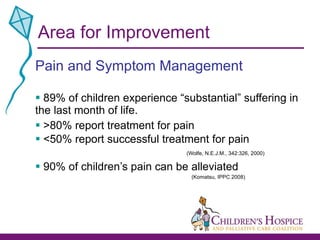
Area for Improvement Pain and Symptom Management 89% of children experience ā€œsubstantialā€ suffering in  the last month of life. >80% report treatment for pain <50% report successful treatment for pain    (Wolfe, N.E.J.M., 342:326, 2000) 90% of children’s pain can be alleviated (Komatsu, IPPC 2008)
Area for Improvement Parents consider communication key. (Meyer, Pediatrics, March 2006)   Parents understand prognosis nearly 200 days after  physician recognition. This disparity hampers end of life care.  (Wolfe, JAMA, 2000) Parents carry clinician’s words and behavior with them forever.   Communication, Relating humanely
Area for Improvement End of Life Choices, Continuity of Care Most children die in the hospital, many in ICU If death is from a treatment related cause,    chance of dying at home is almost zero. (Wolfe, NEJM, 2000) Previously, no organized system to track    children and their care between hospital    and home
Curative  treatment Palliative treatment D E A T H Bereavement Historical Model of Palliative Care Diagnosis
Curative  treatment Palliative treatment D E A T H Bereavement Alternative Model of Palliative Care Diagnosis
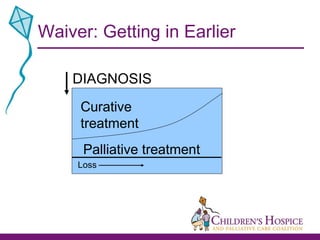
Curative  treatment Palliative treatment Death Pediatric Model of Palliative Care DIAGNOSIS Loss
Curative  treatment Palliative treatment Waiver: Getting in Earlier DIAGNOSIS Loss
Palliative Care, Hospice, Home Health Home health provides skilled care and is rehab oriented. The philosophy is to empower patient toward independence through intermittent visits at home.   Hospice care provides interdisciplinary team expertise at end of life, including pain and symptom management. The philosophy is to focus on quality of life.   Palliative Care may include both of these services.
When we get in earlier, there is time for… Relationship building--Trust Address family’s unique needs Relationship building between teams
Patient and Family Outcomes Child receives expert pain and symptom  management With End of Life Choices, parents are better prepared. (Dussel, Journal of Pain and Symptom Management, 2009) Better communication, parents have better understanding, feel better understood (Hays, JPM, 2006) Increased continuity of care  (Hays, JPM, 2006)
Provider Outcomes   Increased comfort level in communicating life-limiting clinical findings and treatment options  (Hays, JPM, 2006) Increased satisfaction in coordination and communication between providers  (Hays, JPM, 2006)
Ā 
Community Based Palliative Care Coordination California’s Pediatric Palliative Care Benefit Lori Butterworth and Devon Dabbs
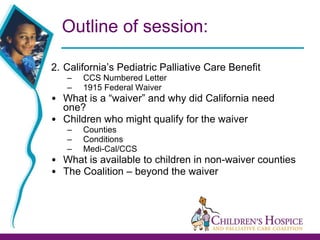
Outline of session: California’s Pediatric Palliative Care Benefit  CCS Numbered Letter 1915 Federal Waiver What is a ā€œwaiverā€ and why did California need one? Children who might qualify for the waiver Counties Conditions Medi-Cal/CCS What is available to children in non-waiver counties The Coalition – beyond the waiver
California’s Pediatric Palliative Care Benefit  Part 1 – Numbered Letter  What palliative care services are currently available under the State Plan? What are the barriers to making these services available to children?  Solution :  Pediatric Palliative Care  Numbered Letter  issued to all counties in California.
California’s Pediatric Palliative Care Benefit  Part 1 – Numbered Letter  You can download a copy of the  ā€œCCS Palliative Care Numbered Letter ā€ on our website:  http://www.childrenshospice.org/benefit/numbered-letter/   All counties in California can use this numbered letter.  Now!  This is independent of the waiver.
California’s Pediatric Palliative Care Benefit  Part 2 – The Waiver Why wasn’t the numbered letter enough? It only allows for home-health agencies to bill for services – not hospices.  Therefore, the experts in pain and symptom management and end-of-life care were left out of the care continuum.  CHPCC felt very strongly that without hospice expertise, children would continue to suffer unnecessarily at great expense to the State.
More facts and figures Children with complex, chronic conditions spend most of the last year of their lives at home This means that high quality pain and symptom management needs to be able to be delivered in their communities, where they are  (Feudtner, JAMA, 2008)
More facts and figures A major complaint from parents of children who die is fragmentation of care Children receive care at many different sites Health care providers rely heavily on parents/caregivers to provide continuity Families have to tell their stories over and over Quality and accuracy become the family’s burden
How Did This Happen? Federal hospice eligibility regulations: were developed in 1970s for adult cancer patients require that a doctor and patient/parent sign an agreement stating that the patient has  less than 6-months to live  (if the disease follows its normal course) require that patients  stop  all treatment intended specifically to cure their disease or prolong their lives
The Nick Snow Act  What is the Nick Snow Act and why did we need it? Assembly Bill 1745 mandated that: The State of California apply for a federal waiver allowing for pediatric hospice and palliative care services to be delivered concurrently with curative treatment, No child enrolling in the waiver would lose any of their CCS benefits (as long as they are not duplicative), Waiver content had to be developed with stakeholder input and approval.
The Nick Snow Act  You can download a copy of the Nick Snow Act and read about it in more detail:  http://www.childrenshospice.org/coalition/ab-1745-the-nick-snow-childrens-hospice-palliative-care-act-of-2006/   ā€œ I don’t see why we need to give up all of these services just because we want to get better.ā€ Nick Snow, the boy who flunked hospice…twice!
California’s Pediatric Palliative Care Benefit  Part 2 – The Waiver What is the waiver?  A federally approved Medi-Cal demonstration project that enables children with certain CCS eligible medical conditions to: receive curative treatments AND home and community-based palliative care services provided by hospice agencies along with home health and other appropriate service providers
California’s Pediatric Palliative Care Benefit  Part 2 – The Waiver The waiver contains additional services not currently available under the state plan like care coordination, respite, expressive therapies, and bereavement The waiver allowed us to add services provided by hospices while children are still receiving curative therapies.
California’s Pediatric Palliative Care Benefit  Part 2 – The Waiver Child must meet all of the following: Be under 21 yrs of age Have ā€œfull scope,ā€ ā€œno share of costā€  Medi-Cal Reside in a participating county Have a CCS eligible medical condition Choose to participate (patient or parent/legal guardian)
California’s Pediatric Palliative Care Benefit  Part 2 – The Waiver Year 1 (300) July 2009 Alameda Monterey San Diego Santa Clara Santa Cruz Year 2 (801) January 2010 Alameda Monterey San Diego Santa Clara Santa Cruz Humboldt Marin Orange Sacramento San Francisco Sonoma Year 3 (1802) January 2011 Alameda Monterey San Diego Santa Clara Santa Cruz Humboldt Marin Orange Sacramento San Francisco Sonoma Fresno Los Angeles
California’s Pediatric Palliative Care Benefit  Part 2 – The Waiver Eligible Medical Conditions: Cancer Cystic Fibrosis Brain or head injuries Spinal muscular atrophy Duchenes’ muscular dystrophy dependent on a ventilator Intestinal problems and dependent on IV nutrition Liver or bowel transplant Heart defects or conditions Problems following a transplant Leukodystrophies
California’s Pediatric Palliative Care Benefit  Part 2 – The Waiver 2 new positions Care Coordinator (Social Worker or Nurse) – employed or contracted with hospice or home health agency CCS Nurse Liaison – at county CCS office
The Case for Coordinated Care  Identified by Waiver Advisory Group as the most critical unmet need for children with life-threatening conditions and their families.  Goal:  Developing a reimbursable Care Coordination service CCS Case Managers – average 1 case manager to 700/1,000 children - Agency Based Case Managers work within institution/agency CCS Nurse Liaison – New Position Community Based Care Coordinator – New Position – average caseload 1/20
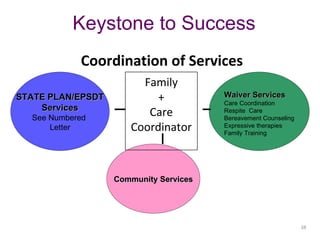
Keystone to Success STATE   PLAN/EPSDT Services See Numbered  Letter Waiver Services Care Coordination Respite  Care Bereavement Counseling Expressive therapies Family Training Community Services Family + Care Coordinator Coordination of Services
Children’s Hospice and Palliative Care Coalition  For more information:  ChildrensHospice.org  This presentation, numbered letter and waiver materials are available to download.  Join a regional collaborative  Northern, Central, Southern California http://www.dhcs.ca.gov/provgovpart/initiatives/ppc/Pages/ProgramOverview.aspx
Children’s Hospice and Palliative Care Coalition  Mission Statement The mission of Children’s Hospice and Palliative Care Coalition is to ensure compassionate, comprehensive care for children with life-threatening conditions. Together with their families, we speak out for those too little or too sick to speak for themselves, and create programs that directly improve the quality of their lives. We need your voice!  Join us…everyone is welcome!
Children’s Hospice and Palliative Care Coalition  We need your voice!  Join us…everyone is welcome! Individual Membership $50 Organizational Membership $500 Legislative Advocate:  Terri Cowger Hill, Cowger and Associates A voice for children in Sacramento!
Children’s Medical Services Branch  California Children’s Services  Waiver Analysis Branch Jill M Abramson, MD MPH FAAP,  Section Chief, Program Development  Children's Medical Services, DHCS 1515 K St. , Ste 400 Sacramento, CA 95814 916-327-2487 Ā Ā Ā Ā Ā Ā Ā Ā Ā Ā Ā Ā Ā Ā Ā Ā  [email_address]   California State Department of Healthcare Services
To find the best in others; To give of one's self;  To leave the world a bit better, To know even one life has breathed easier because  you have lived - This is to have succeeded. Ralph Waldo Emerson
Benefit Education Support and Training – BEST in Pediatrics

Chpccwebconference50109

  • 1.
    Fundamentals of PediatricPalliative Care California’s Pediatric Palliative Care Benefit Leslie Adams MSW, LICSW Lori Butterworth Devon Dabbs Gay Walker RN, CHPC
  • 2.
    Medicaid Waiver Section1915(c) Home and Community-Based Services Waivers Supports services provided in home and community based settings An alternative to institutional or long-term care facility placement Cost neutrality Enrollment caps required In today’s web-conference we will: Talk about the basic principles and fundamentals of pediatric palliative care for about 15 minutes. Present the two components of California’s Pediatric Palliative Care Benefit: Numbered Letter and Waiver for about 30 minutes. Let you know how to get involved in the movement to improve care for children with life-threatening conditions. Give contact information and links to more information about the waiver, the coalition and the Department of Healthcare Services. Q and A
  • 3.
  • 4.
    World Health Organization(1998) Care of child’s body, mind, and spirit Starting at the point of diagnosis and continuing regardless of whether curative therapies are pursued Expertise of a multidisciplinary team along with family and community resources
  • 5.
    Institute of Medicine:When Children Die (2002) Palliative care seeks to prevent and relieve the physical and emotional distress produced by a life threatening medical condition or its treatment Help patients and their families live as normally as possible Provide timely and accurate information and support in decision-making
  • 6.
    Pediatric palliative and/orhospice care is both a philosophy and an organized method for delivering competent, compassionate and consistent care to children with chronic, complex and/or life-threatening conditions and their families. This care focuses on enhancing quality of life , minimizing suffering , optimizing function and providing opportunities for personal and spiritual growth. National Hospice and Palliative Care Organization (2009)
  • 7.
    Pediatric palliative carecan be delivered concurrently with life-prolonging care or as the main focus of care and is treatment that should be started early in the trajectory of the condition. It preserves the integrity of the family during the disease progression, addressing anticipatory grief and bereavement support following the death. Children’s Hospice and Palliative Care Coalition (2007)
  • 8.
    PPC within thecontext of California’s Benefit Concurrent with curative therapies Family-centered communication Focus on quality of life and relief of suffering Use of multidisciplinary team
  • 9.
    Area for ImprovementPain and Symptom Management 89% of children experience ā€œsubstantialā€ suffering in the last month of life. >80% report treatment for pain <50% report successful treatment for pain (Wolfe, N.E.J.M., 342:326, 2000) 90% of children’s pain can be alleviated (Komatsu, IPPC 2008)
  • 10.
    Area for ImprovementParents consider communication key. (Meyer, Pediatrics, March 2006) Parents understand prognosis nearly 200 days after physician recognition. This disparity hampers end of life care. (Wolfe, JAMA, 2000) Parents carry clinician’s words and behavior with them forever. Communication, Relating humanely
  • 11.
    Area for ImprovementEnd of Life Choices, Continuity of Care Most children die in the hospital, many in ICU If death is from a treatment related cause, chance of dying at home is almost zero. (Wolfe, NEJM, 2000) Previously, no organized system to track children and their care between hospital and home
  • 12.
    Curative treatmentPalliative treatment D E A T H Bereavement Historical Model of Palliative Care Diagnosis
  • 13.
    Curative treatmentPalliative treatment D E A T H Bereavement Alternative Model of Palliative Care Diagnosis
  • 14.
    Curative treatmentPalliative treatment Death Pediatric Model of Palliative Care DIAGNOSIS Loss
  • 15.
    Curative treatmentPalliative treatment Waiver: Getting in Earlier DIAGNOSIS Loss
  • 16.
    Palliative Care, Hospice,Home Health Home health provides skilled care and is rehab oriented. The philosophy is to empower patient toward independence through intermittent visits at home. Hospice care provides interdisciplinary team expertise at end of life, including pain and symptom management. The philosophy is to focus on quality of life. Palliative Care may include both of these services.
  • 17.
    When we getin earlier, there is time for… Relationship building--Trust Address family’s unique needs Relationship building between teams
  • 18.
    Patient and FamilyOutcomes Child receives expert pain and symptom management With End of Life Choices, parents are better prepared. (Dussel, Journal of Pain and Symptom Management, 2009) Better communication, parents have better understanding, feel better understood (Hays, JPM, 2006) Increased continuity of care (Hays, JPM, 2006)
  • 19.
    Provider Outcomes Increased comfort level in communicating life-limiting clinical findings and treatment options (Hays, JPM, 2006) Increased satisfaction in coordination and communication between providers (Hays, JPM, 2006)
  • 20.
  • 21.
    Community Based PalliativeCare Coordination California’s Pediatric Palliative Care Benefit Lori Butterworth and Devon Dabbs
  • 22.
    Outline of session:California’s Pediatric Palliative Care Benefit CCS Numbered Letter 1915 Federal Waiver What is a ā€œwaiverā€ and why did California need one? Children who might qualify for the waiver Counties Conditions Medi-Cal/CCS What is available to children in non-waiver counties The Coalition – beyond the waiver
  • 23.
    California’s Pediatric PalliativeCare Benefit Part 1 – Numbered Letter What palliative care services are currently available under the State Plan? What are the barriers to making these services available to children? Solution : Pediatric Palliative Care Numbered Letter issued to all counties in California.
  • 24.
    California’s Pediatric PalliativeCare Benefit Part 1 – Numbered Letter You can download a copy of the ā€œCCS Palliative Care Numbered Letter ā€ on our website: http://www.childrenshospice.org/benefit/numbered-letter/ All counties in California can use this numbered letter. Now! This is independent of the waiver.
  • 25.
    California’s Pediatric PalliativeCare Benefit Part 2 – The Waiver Why wasn’t the numbered letter enough? It only allows for home-health agencies to bill for services – not hospices. Therefore, the experts in pain and symptom management and end-of-life care were left out of the care continuum. CHPCC felt very strongly that without hospice expertise, children would continue to suffer unnecessarily at great expense to the State.
  • 26.
    More facts andfigures Children with complex, chronic conditions spend most of the last year of their lives at home This means that high quality pain and symptom management needs to be able to be delivered in their communities, where they are (Feudtner, JAMA, 2008)
  • 27.
    More facts andfigures A major complaint from parents of children who die is fragmentation of care Children receive care at many different sites Health care providers rely heavily on parents/caregivers to provide continuity Families have to tell their stories over and over Quality and accuracy become the family’s burden
  • 28.
    How Did ThisHappen? Federal hospice eligibility regulations: were developed in 1970s for adult cancer patients require that a doctor and patient/parent sign an agreement stating that the patient has less than 6-months to live (if the disease follows its normal course) require that patients stop all treatment intended specifically to cure their disease or prolong their lives
  • 29.
    The Nick SnowAct What is the Nick Snow Act and why did we need it? Assembly Bill 1745 mandated that: The State of California apply for a federal waiver allowing for pediatric hospice and palliative care services to be delivered concurrently with curative treatment, No child enrolling in the waiver would lose any of their CCS benefits (as long as they are not duplicative), Waiver content had to be developed with stakeholder input and approval.
  • 30.
    The Nick SnowAct You can download a copy of the Nick Snow Act and read about it in more detail: http://www.childrenshospice.org/coalition/ab-1745-the-nick-snow-childrens-hospice-palliative-care-act-of-2006/ ā€œ I don’t see why we need to give up all of these services just because we want to get better.ā€ Nick Snow, the boy who flunked hospice…twice!
  • 31.
    California’s Pediatric PalliativeCare Benefit Part 2 – The Waiver What is the waiver? A federally approved Medi-Cal demonstration project that enables children with certain CCS eligible medical conditions to: receive curative treatments AND home and community-based palliative care services provided by hospice agencies along with home health and other appropriate service providers
  • 32.
    California’s Pediatric PalliativeCare Benefit Part 2 – The Waiver The waiver contains additional services not currently available under the state plan like care coordination, respite, expressive therapies, and bereavement The waiver allowed us to add services provided by hospices while children are still receiving curative therapies.
  • 33.
    California’s Pediatric PalliativeCare Benefit Part 2 – The Waiver Child must meet all of the following: Be under 21 yrs of age Have ā€œfull scope,ā€ ā€œno share of costā€ Medi-Cal Reside in a participating county Have a CCS eligible medical condition Choose to participate (patient or parent/legal guardian)
  • 34.
    California’s Pediatric PalliativeCare Benefit Part 2 – The Waiver Year 1 (300) July 2009 Alameda Monterey San Diego Santa Clara Santa Cruz Year 2 (801) January 2010 Alameda Monterey San Diego Santa Clara Santa Cruz Humboldt Marin Orange Sacramento San Francisco Sonoma Year 3 (1802) January 2011 Alameda Monterey San Diego Santa Clara Santa Cruz Humboldt Marin Orange Sacramento San Francisco Sonoma Fresno Los Angeles
  • 35.
    California’s Pediatric PalliativeCare Benefit Part 2 – The Waiver Eligible Medical Conditions: Cancer Cystic Fibrosis Brain or head injuries Spinal muscular atrophy Duchenes’ muscular dystrophy dependent on a ventilator Intestinal problems and dependent on IV nutrition Liver or bowel transplant Heart defects or conditions Problems following a transplant Leukodystrophies
  • 36.
    California’s Pediatric PalliativeCare Benefit Part 2 – The Waiver 2 new positions Care Coordinator (Social Worker or Nurse) – employed or contracted with hospice or home health agency CCS Nurse Liaison – at county CCS office
  • 37.
    The Case forCoordinated Care Identified by Waiver Advisory Group as the most critical unmet need for children with life-threatening conditions and their families. Goal: Developing a reimbursable Care Coordination service CCS Case Managers – average 1 case manager to 700/1,000 children - Agency Based Case Managers work within institution/agency CCS Nurse Liaison – New Position Community Based Care Coordinator – New Position – average caseload 1/20
  • 38.
    Keystone to SuccessSTATE PLAN/EPSDT Services See Numbered Letter Waiver Services Care Coordination Respite Care Bereavement Counseling Expressive therapies Family Training Community Services Family + Care Coordinator Coordination of Services
  • 39.
    Children’s Hospice andPalliative Care Coalition For more information: ChildrensHospice.org This presentation, numbered letter and waiver materials are available to download. Join a regional collaborative Northern, Central, Southern California http://www.dhcs.ca.gov/provgovpart/initiatives/ppc/Pages/ProgramOverview.aspx
  • 40.
    Children’s Hospice andPalliative Care Coalition Mission Statement The mission of Children’s Hospice and Palliative Care Coalition is to ensure compassionate, comprehensive care for children with life-threatening conditions. Together with their families, we speak out for those too little or too sick to speak for themselves, and create programs that directly improve the quality of their lives. We need your voice! Join us…everyone is welcome!
  • 41.
    Children’s Hospice andPalliative Care Coalition We need your voice! Join us…everyone is welcome! Individual Membership $50 Organizational Membership $500 Legislative Advocate: Terri Cowger Hill, Cowger and Associates A voice for children in Sacramento!
  • 42.
    Children’s Medical ServicesBranch California Children’s Services Waiver Analysis Branch Jill M Abramson, MD MPH FAAP, Section Chief, Program Development Children's Medical Services, DHCS 1515 K St. , Ste 400 Sacramento, CA 95814 916-327-2487 Ā Ā Ā Ā Ā Ā Ā Ā Ā Ā Ā Ā Ā Ā Ā Ā  [email_address] California State Department of Healthcare Services
  • 43.
    To find thebest in others; To give of one's self; To leave the world a bit better, To know even one life has breathed easier because you have lived - This is to have succeeded. Ralph Waldo Emerson
  • 44.
    Benefit Education Supportand Training – BEST in Pediatrics

Editor's Notes

  • #13Ā The historical or traditional model of palliative care was described and made popular by the Canadian board of health in 1989. It describes attempts to cure and palliative care as separate and distinct entities, or two separate worlds that are mutually exclusive. This has often been referred to as a switch from curative or life prolonging care to palliative care.
  • #16Ā Hope and Hope can live imperceptively a long side of loss. .
  • #25Ā Please send us your stories of its use – successful and unsuccessful