UNDERGROUND CABLE FAULT
ABSTRACT
• Underground power cables are vulnerable to various faults due to environmental conditions, wear and
tear, and external factors such as rodents. Detecting faults in underground cables is challenging, often
requiring extensive excavation to locate and repair the damaged section. This project presents an
automated cable fault detection system that efficiently identifies the exact fault location, reducing time,
cost, and labor involved in repairs.
• The proposed system utilizes a potential divider network to detect faults in the cable by measuring
voltage variations caused by line shorting. An ARDUINO microcontroller processes these signals and
determines the fault distance, displaying the information on an alphanumeric display. This allows
maintenance teams to excavate only the specific section affected, rather than inspecting the entire cable
length.
• Additionally, the system integrates line-to-line fault detection to enhance accuracy and employs an
ultrasonic sensor for straight-line detection, ensuring precise localization of faults. By implementing this
system, underground cable faults can be diagnosed and addressed swiftly, leading to improved power
distribution reliability and reduced downtime.
INTRODUCTION
• Underground power cables play a crucial role in modern electrical distribution systems,
offering advantages such as reduced exposure to environmental factors and increased
safety. However, these cables are susceptible to various faults caused by underground
conditions, wear and tear, moisture, rodents, or accidental damage. Detecting faults in
underground cables is a challenging and time-consuming task, as it traditionally requires
extensive excavation to inspect and repair the damaged section.
• To address this issue, an efficient underground cable fault detection system is proposed to
pinpoint the exact fault location, minimizing the need for unnecessary digging. This system
is designed to enhance maintenance efficiency, reduce costs, and ensure faster servicing
of underground cables.The proposed system utilizes a voltage drop principle based on a
potential divider network. When a fault occurs, such as a short circuit between two lines,
a corresponding voltage change is detected and processed by an Arduino microcontroller.
The system calculates the fault location and displays it on an alphanumeric display,
providing precise information for repair teams. Additionally, an ultrasonic sensor is
incorporated to ensure accurate straight-line detection of cable faults.
• By implementing this system, underground cable faults can be identified quickly and
accurately, reducing downtime and improving the reliability of power distribution
networks.
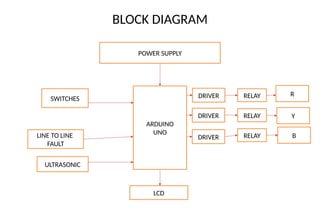
BLOCK DIAGRAM
POWER SUPPLY
ARDUINO
UNO
LCD
DRIVER RELAY R
DRIVER RELAY Y
DRIVER RELAY B
SWITCHES
LINE TO LINE
FAULT
ULTRASONIC
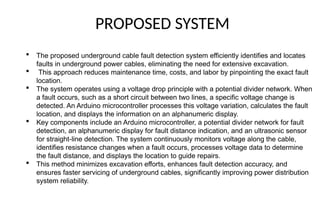
PROPOSED SYSTEM
 The proposed underground cable fault detection system efficiently identifies and locates
faults in underground power cables, eliminating the need for extensive excavation.
 This approach reduces maintenance time, costs, and labor by pinpointing the exact fault
location.
 The system operates using a voltage drop principle with a potential divider network. When
a fault occurs, such as a short circuit between two lines, a specific voltage change is
detected. An Arduino microcontroller processes this voltage variation, calculates the fault
location, and displays the information on an alphanumeric display.
 Key components include an Arduino microcontroller, a potential divider network for fault
detection, an alphanumeric display for fault distance indication, and an ultrasonic sensor
for straight-line detection. The system continuously monitors voltage along the cable,
identifies resistance changes when a fault occurs, processes voltage data to determine
the fault distance, and displays the location to guide repairs.
 This method minimizes excavation efforts, enhances fault detection accuracy, and
ensures faster servicing of underground cables, significantly improving power distribution
system reliability.
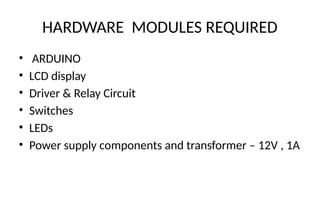
HARDWARE MODULES REQUIRED
• ARDUINO
• LCD display
• Driver & Relay Circuit
• Switches
• LEDs
• Power supply components and transformer – 12V , 1A
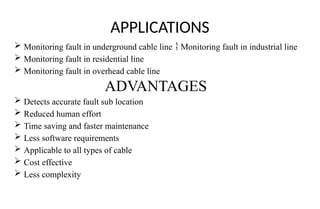
APPLICATIONS
 Monitoring fault in underground cable line Monitoring fault in industrial line

 Monitoring fault in residential line
 Monitoring fault in overhead cable line
ADVANTAGES
 Detects accurate fault sub location
 Reduced human effort
 Time saving and faster maintenance
 Less software requirements
 Applicable to all types of cable
 Cost effective
 Less complexity

underground cable fault explanation for UG

  • 1.
  • 2.
    ABSTRACT • Underground powercables are vulnerable to various faults due to environmental conditions, wear and tear, and external factors such as rodents. Detecting faults in underground cables is challenging, often requiring extensive excavation to locate and repair the damaged section. This project presents an automated cable fault detection system that efficiently identifies the exact fault location, reducing time, cost, and labor involved in repairs. • The proposed system utilizes a potential divider network to detect faults in the cable by measuring voltage variations caused by line shorting. An ARDUINO microcontroller processes these signals and determines the fault distance, displaying the information on an alphanumeric display. This allows maintenance teams to excavate only the specific section affected, rather than inspecting the entire cable length. • Additionally, the system integrates line-to-line fault detection to enhance accuracy and employs an ultrasonic sensor for straight-line detection, ensuring precise localization of faults. By implementing this system, underground cable faults can be diagnosed and addressed swiftly, leading to improved power distribution reliability and reduced downtime.
  • 3.
    INTRODUCTION • Underground powercables play a crucial role in modern electrical distribution systems, offering advantages such as reduced exposure to environmental factors and increased safety. However, these cables are susceptible to various faults caused by underground conditions, wear and tear, moisture, rodents, or accidental damage. Detecting faults in underground cables is a challenging and time-consuming task, as it traditionally requires extensive excavation to inspect and repair the damaged section. • To address this issue, an efficient underground cable fault detection system is proposed to pinpoint the exact fault location, minimizing the need for unnecessary digging. This system is designed to enhance maintenance efficiency, reduce costs, and ensure faster servicing of underground cables.The proposed system utilizes a voltage drop principle based on a potential divider network. When a fault occurs, such as a short circuit between two lines, a corresponding voltage change is detected and processed by an Arduino microcontroller. The system calculates the fault location and displays it on an alphanumeric display, providing precise information for repair teams. Additionally, an ultrasonic sensor is incorporated to ensure accurate straight-line detection of cable faults. • By implementing this system, underground cable faults can be identified quickly and accurately, reducing downtime and improving the reliability of power distribution networks.
  • 4.
    BLOCK DIAGRAM POWER SUPPLY ARDUINO UNO LCD DRIVERRELAY R DRIVER RELAY Y DRIVER RELAY B SWITCHES LINE TO LINE FAULT ULTRASONIC
  • 5.
    PROPOSED SYSTEM  Theproposed underground cable fault detection system efficiently identifies and locates faults in underground power cables, eliminating the need for extensive excavation.  This approach reduces maintenance time, costs, and labor by pinpointing the exact fault location.  The system operates using a voltage drop principle with a potential divider network. When a fault occurs, such as a short circuit between two lines, a specific voltage change is detected. An Arduino microcontroller processes this voltage variation, calculates the fault location, and displays the information on an alphanumeric display.  Key components include an Arduino microcontroller, a potential divider network for fault detection, an alphanumeric display for fault distance indication, and an ultrasonic sensor for straight-line detection. The system continuously monitors voltage along the cable, identifies resistance changes when a fault occurs, processes voltage data to determine the fault distance, and displays the location to guide repairs.  This method minimizes excavation efforts, enhances fault detection accuracy, and ensures faster servicing of underground cables, significantly improving power distribution system reliability.
  • 6.
    HARDWARE MODULES REQUIRED •ARDUINO • LCD display • Driver & Relay Circuit • Switches • LEDs • Power supply components and transformer – 12V , 1A
  • 7.
    APPLICATIONS  Monitoring faultin underground cable line Monitoring fault in industrial line   Monitoring fault in residential line  Monitoring fault in overhead cable line ADVANTAGES  Detects accurate fault sub location  Reduced human effort  Time saving and faster maintenance  Less software requirements  Applicable to all types of cable  Cost effective  Less complexity