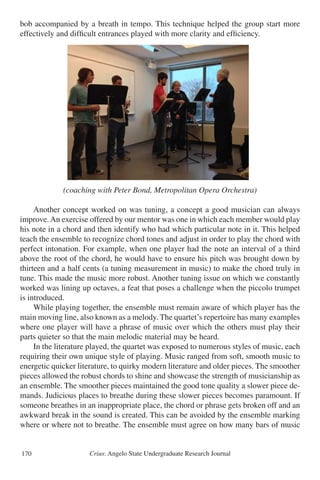
Crius: Angelo State Undergraduate Research Journal 1
CRIUS:
Undergraduate Research
Journal
Volume 2.1
Fall 2014
John Wegner, Editor
A publication of Angelo State University
(funded by ASU Undergraduate Research Initiative)
Crius: Angelo State Undergraduate Research Journal 3
Table of Contents
Geometry of Dagger Mountain intrusion, Big Bend National Park, Texas
	 Mario Mata and Heather L. Lehto, PhD	 1
Subsurface 3-D Modeling of the Concho River Watershed, Texas
	 Brooke A. Schlemeyer and James W. Ward, Ph.D., P.G.	 9
A PreliminaryInvestigation into the use of Environmental DNA to Detect the
Presence of Rare Eurycea Salamanders in the Devils River, Texas
	 Tara C. Serio and T. Michael Dixon, PhD	 17
Isolation, Sequence, and Characterization of p53 mRNA in Various Bat Species
	 Alexis Mobley and Loren K. Ammerman, PhD	 35
Using DNA Barcoding to Identify Seeds in Fecal Samples of Fruit Eating Bats
	 Aimee N. Denham and Loren K. Ammerman, PhD	 45
A re-examination of the fossil land snail Lysinoe breedlovei
(Gastropoda: Pulmonata) from west Texas using X-Ray Computed Tomography
	 Mary Jones and Ned Strenth, PhD	 51
Creating a Poker Playing Program Using Evolutionary Computation
	 Simon Olsen and Rob LeGrand, PhD	 61
Portfolio Diversifications: Investment Decisions
	 Aubrey Antle and Biqing Huang, PhD	 71
Sex and Gender Dimensions of Neglected Tropical Diseases in Women’s Health
in Sub-Saharan Africa
	 Sean Motl and David Sanders, PhD	 79
Idealism, Relativism, and Moral Priorities
	 Joshua Hansen and Crystal Kreitler, PhD	 95
Assessing the Convergence of a Cognitive Tool for Ethical Decision-Making
and a Scale of Perceived Moral Intensity
	 Jazmine Huereca and Cheryl Stenmark, PhD	 105
Feminist Literature in the Time of Victorian Male Domination
	 Phylicia Ulibarri and Mary Ellen Hartje, PhD	 115
Crius: Angelo State Undergraduate Research Journal 5
The History and Mediatization of the Brothers Grimm Fairy Tales
in American Culture
	 Justin Hall and Christine Muelsch, PhD	 135
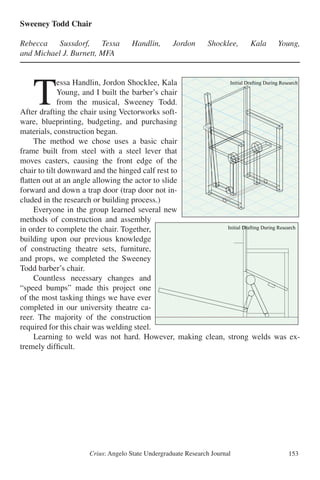
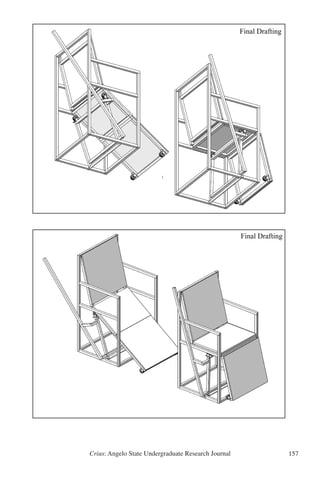
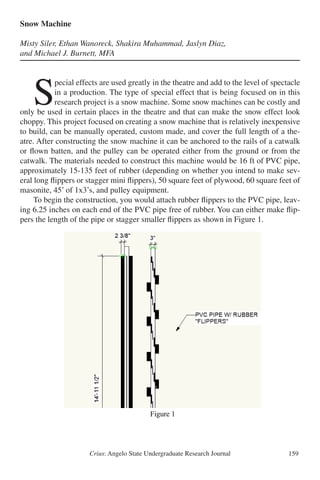
Sweeney Todd Chair
	 Rebecca Sussdorf, Tessa Handlin, Jordon Shocklee, Kala Young, 	
	 and Michael J. Burnett, MFA	 153
Snow Machine
	 Misty Siler, Ethan Wanoreck, Shakira Muhammad, Jaslyn Diaz, 	
	 and Michael J. Burnett, MFA	 159
The Labour Reserve Army in Karl Marx’s Das Kapital, Vol. 1
	 Jarred A. Luján and John Glassford, PhD	 163
ASU Trumpet Quartet: Exploring the Possibilities
A Performance-based Research Project
	 Ethan Huffman, Brandon Batten, Adam Coffman, John Irish, D.M.A.	 167
Prohibition and its Effects on Texas
	 Kimberly Kullberg and Christine Lamberson, PhD	 179
The Poor laws of Texas
	 Joshua Logsdon and David Dewar, PhD	 189
What’s in a Face? Perceptions of Women Who Wear Make-up
	 Lynette Carrillo, Barbara Coleman, and Tay Hack, PhD	 197
“Arraignment of the Little, Little Men”: A Rhetorical Analysis of the
Feminist Strategies of Sor Juana Ines de la Cruz and Alfonsina Storni*
	 Suzanna Tolboom and Adria Battaglia, PhD	 199
Crius: Angelo State Undergraduate Research Journal 1
Geometry of Dagger Mountain intrusion, Big Bend National Park, Texas
	
Mario Mata and Heather L. Lehto, PhD
Abstract
	 Dagger Mountain located in Big Bend National Park (BBNP), TX is a structurally
complex area, making it a prime area of research. Previous work in Dagger Mountain
(Poppeliers, in prep) notes that the igneous rocks observed around Dagger Mountain
are limited in extent and not voluminous enough to create any significant, map-scale de-
formation. The Laramide orogeny (~70-50 Ma in BBNP) along with Basin and Range
extension (~31 Ma) caused major deformation to the area including emplacement of
Tertiary(?) mafic intrusions into Cretaceous limestone. My study aims to determine
the overall geometry of one igneous intrusion in hopes of constraining the deformation
timing.
	 The study area contains an apparently folded sill within the Cretaceous Boquillas
limestone. If this sill is related to the nearby Dagger Flats intrusions, the age is ~32
Ma. Field observations suggest folding of the sill with surrounding country rock. This
implies that Laramide deformation in the area occurred much later than is proposed
for BBNP. Using a proton-procession magnetometer, I conducted a magnetic survey
over this feature to define the geometry of the intrusion. Modeling of the data suggests
a shallow flat sill, not a sill folded with the surrounding limestone. This suggests that
the intrusion was emplaced after Laramide deformation of the surrounding Cretaceous
units. Other models of sill geometry were attempted including a folded sill and possi-
ble ring dikes; however, these models did not fit the observed data. Magnetic modeling
supports the idea that the sill intruded after Laramide deformation of the Cretaceous
limestone.
*****
Introduction
	D
agger Mountain located in the Northeastern part of the BBNP, Texas (Fig-
ure 1) contains geologic features formed from repetitive cycles of rift-
ing, mountain building, basin development, faulting and folding, and
volcanism and plutonism (Page et al., 2008). The rock formations that make up this
doubly-plunging anticline include the Boquillas Formation (limestone and shale), the
Buda Limestone, the Santa Elena Limestone, the Del Rio Clay, and Tertiary(?) sills.
Throughout Dagger Mountain, mafic sills appear in the Boquillas Formation. Em-
placement of these Tertiary(?) mafic intrusions into Cretaceous aged Boquillas Lime-
stone are believed to have formed during Laramide deformation; however, the age of
Crius: Angelo State Undergraduate Research Journal2
these sills has not been confirmed (Cullen et al., 2013). The Laramide orogeny (~70-50
Ma in BBNP) caused basement uplift, producing two phases of folds, and ultimately
creating the doubly-plunging anticline known as Dagger Mountain. Basin and Range
extension (~31 Ma) also caused major changes to the area including normal faults that
cross-cut both the Laramide folds and the Tertiary(?) sills.
	 In Dagger Flat, 3 km east of Dagger Mountain, sills become more abundant and are
part of a ~75 km² oval-shaped intrusion in the shallow subsurface identified by a posi-
tive anomaly on an aeromagnetic survey (Morgan and Shanks, 2008). The Dagger Flat
sills were dated at ~32 Ma (Morgan and Shanks, 2008) and are believed to be similar
to Dagger Mountain sills due to their similar composition. If the Dagger Mountain sills
are related to the nearby Dagger Flat sills, then the Dagger Mountain sills were also
likely intruded as a result of Basin and Range faulting.
	 The emplacement mechanism of the sills at Dagger Mountain remains a funda-
mental problem despite detailed mapping by ASU students and faculty (Cullen et al.,
2013). Forceful emplacement of sills occurs when magma supply exceeds the rate
of space creation achieved by tectonic deformation (tectonic opening) and magma is
therefore required to shoulder aside the country rocks (Stevenson, 2009). Evidence
of forceful emplacement would include further compression and deformation of the
country rocks. On the other hand, passive emplacement occurs when there is ample
space in the country rock for the intruded magma. The magma expands in the space
passively with no alteration of the country rock. In Dagger Mountain there is no evi-
dence that the intrusions reoriented existing structures (Satterfield et al., 2007). Other
work in Dagger Mountain (Poppeliers, in prep) notes that the igneous rocks observed
around Dagger Mountain are limited in extent and not voluminous enough to create
any significant, map-scale deformation.
	 In the southern portion of Dagger Mountain, just southeast of Trailhead 2 (Figure
1), there is a sill that appears to be folded along with surrounding Boquillas limestone.
At both outcrop and map scale the sill can be traced from one limb, through the hinge
of the fold, and through to the other limb. This study aims to understand the emplace-
ment mechanisms by defining the geometry of the sill; this was achieved by conducting
a magnetic survey across the sill believed to be folded during Laramide deformation.
Crius: Angelo State Undergraduate Research Journal 3
Figure 1. Geologic Map of Dagger Mountain (study area) with relation to state of
Texas. Map includes transect line used for models A-A’ (Cullen et al., 2013).
Methods
	 In January of 2014, a magnetic survey was conducted over an apparently folded
sill (Figure 1). A proton-procession magnetometer (chosen for its ease of use and reli-
ability (Burger, 2006)), borrowed from the University of South Florida, and a handheld
GPS unit were used to conduct the survey. The survey was completed by walking along
each transect carrying both the magnetometer and the GPS unit. Each instrument was
set to obtain a reading every second. A total of 6 transects running in a NE-SW trend
were used with a spacing of 20 meters between each transect. The first transect was
north of the exposed sill, while the remaining transects ran across both limbs of the sill.
This style of survey was used to show the extent as well as depths of the sill both at and
beyond the exposed portions. Once the survey was conducted, readings were exported
from the magnetometer and GPS unit and stored in Excel files. Data was cleaned up
and prepared for computer modeling to be completed at the end of January.
	 Modeling of the data consisted of using the program Oasis Montaj at the Univer-
sity of South Florida. The magnetic readings and the GPS coordinates were entered
Figure 1
Crius: Angelo State Undergraduate Research Journal4
into the program along with the total field strength (46,448.4 nT), declination (6.85°E),
and the inclination (57.13°). A grid was produced from the magnetic readings and co-
ordinates, which showed the extent of a magnetic presence in relation to the study area
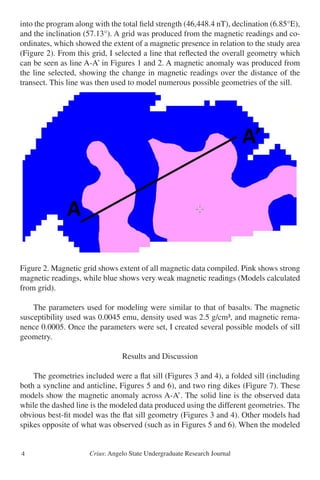
(Figure 2). From this grid, I selected a line that reflected the overall geometry which
can be seen as line A-A’ in Figures 1 and 2. A magnetic anomaly was produced from
the line selected, showing the change in magnetic readings over the distance of the
transect. This line was then used to model numerous possible geometries of the sill.
Figure 2. Magnetic grid shows extent of all magnetic data compiled. Pink shows strong
magnetic readings, while blue shows very weak magnetic readings (Models calculated
from grid).
	 The parameters used for modeling were similar to that of basalts. The magnetic
susceptibility used was 0.0045 emu, density used was 2.5 g/cm³, and magnetic rema-
nence 0.0005. Once the parameters were set, I created several possible models of sill
geometry.
Results and Discussion
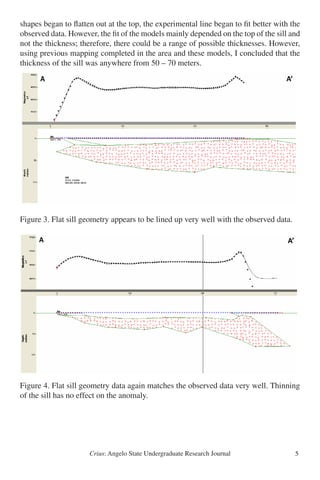
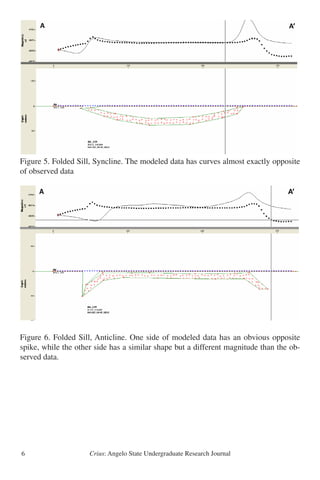
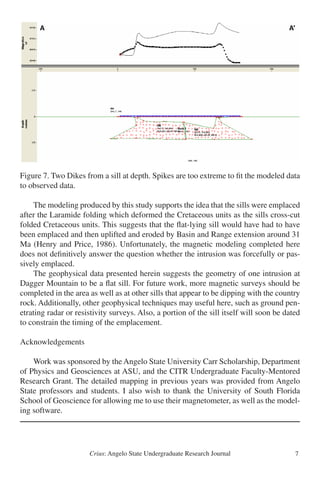
	 The geometries included were a flat sill (Figures 3 and 4), a folded sill (including
both a syncline and anticline, Figures 5 and 6), and two ring dikes (Figure 7). These
models show the magnetic anomaly across A-A’. The solid line is the observed data
while the dashed line is the modeled data produced using the different geometries. The
obvious best-fit model was the flat sill geometry (Figures 3 and 4). Other models had
spikes opposite of what was observed (such as in Figures 5 and 6). When the modeled
Figure 2
Crius: Angelo State Undergraduate Research Journal 5
shapes began to flatten out at the top, the experimental line began to fit better with the
observed data. However, the fit of the models mainly depended on the top of the sill and
not the thickness; therefore, there could be a range of possible thicknesses. However,
using previous mapping completed in the area and these models, I concluded that the
thickness of the sill was anywhere from 50 – 70 meters.
Figure 3. Flat sill geometry appears to be lined up very well with the observed data.
Figure 4. Flat sill geometry data again matches the observed data very well. Thinning
of the sill has no effect on the anomaly.
Figure 3
Figure 4
Crius: Angelo State Undergraduate Research Journal6
Figure 5. Folded Sill, Syncline. The modeled data has curves almost exactly opposite
of observed data
Figure 6. Folded Sill, Anticline. One side of modeled data has an obvious opposite
spike, while the other side has a similar shape but a different magnitude than the ob-
served data.
Figure 5
Figure 6
Crius: Angelo State Undergraduate Research Journal 7
Figure 7. Two Dikes from a sill at depth. Spikes are too extreme to fit the modeled data
to observed data.
	 The modeling produced by this study supports the idea that the sills were emplaced
after the Laramide folding which deformed the Cretaceous units as the sills cross-cut
folded Cretaceous units. This suggests that the flat-lying sill would have had to have
been emplaced and then uplifted and eroded by Basin and Range extension around 31
Ma (Henry and Price, 1986). Unfortunately, the magnetic modeling completed here
does not definitively answer the question whether the intrusion was forcefully or pas-
sively emplaced.
	 The geophysical data presented herein suggests the geometry of one intrusion at
Dagger Mountain to be a flat sill. For future work, more magnetic surveys should be
completed in the area as well as at other sills that appear to be dipping with the country
rock. Additionally, other geophysical techniques may useful here, such as ground pen-
etrating radar or resistivity surveys. Also, a portion of the sill itself will soon be dated
to constrain the timing of the emplacement.
Acknowledgements
	 Work was sponsored by the Angelo State University Carr Scholarship, Department
of Physics and Geosciences at ASU, and the CITR Undergraduate Faculty-Mentored
Research Grant. The detailed mapping in previous years was provided from Angelo
State professors and students. I also wish to thank the University of South Florida
School of Geoscience for allowing me to use their magnetometer, as well as the model-
ing software.
Figure 7
Crius: Angelo State Undergraduate Research Journal8
References
Burger, Henry Robert (2006), Introduction to Applied Geophysics; Exploring the
	 Shallow Subsurface: W.W. Norton & Company, Inc. p. 429 - 497, p. 265 – 347.
Cullen, J.; Knox, N. K.; Crouch, J.; and Satterfield, J. I. (2013), Polyphase Laramide
	 Structures and Possible Folded Tertiary(?) Sills at Dagger mountain, Big Bend	
	 National Park, Texas, The Compass: Earth Science Journal of Sigma Gamma
	 Epsilon: Vol. 85: Iss. 3, Article 3.
Henry, C.D, and Price, J.G., (1986), Early Basin and Range development inTrans-Pecos
	 Texas and adjacent Chihuahua : Magmatism and orientation, timing, and style of	
	 extension, Journal of Geophysical Research, v. 91, p. 6213 – 6224.
Maxwell, R.A., Lonsdale, J.T., Hazzard, R. T., and Wilson, J.A., (1967), Geology of Big
	 Bend National Park, Brewster County, Texas: Bureau of Economic Geology
	 Publication 6711.
Milsom,John.(2003)FieldGeophysics:TheGeologicalFieldGuideSeries.GreatBritain:
	 Wiley.
Morgan, L. A., and Shanks, W. C., (2008), Where Magma meets Limestone: Dagger
	 Flats, an example of Skarn Deposits in Big Bend National Park. USGS Bulletin,
	 1327: p. 43–55.
Page, W.R., Turner, K. J., and Bohannon, R. G., (2008), Tectonic history of Big Bend
	 National Park in Gray, J.E. and W. R. Page, eds. Geological, geochemical and
	 geophysical studies by the U.S. Geological Survey in Big Bend National Park,	
	 Texas. Reston, Virginia: U.S. Geological Survey Circular 1327: p. 3 – 13.
Poppeliers, C., (in prep), High Resolution, Ground-Based Magnetic Surveys Over
	 Exposed and Buried Tertiary Intrusions within Laramide Folds and Faults, Big	
	 Bend Region, TX.
Satterfield, J. I., and Dyess, J. E., (2007), Polyphase folds and faults in a wrench fault
	 zone, northern Big Bend National Park. West Texas Geological Society Bulletin
	 46: p. 8-19.
Wetmore, Paul H., Connor C. B., Kruse, S. E., and Callihan, S., (2009), Geometry of the
	 Trachyte Mesa intrusion, Henry Mountains, Utah: Implications for the emplacement	
	 of small melt volumes into the upper crust, G3 an Electronic Journal of the Earth
	 Sciences, Article Number 8, Volume 10, August 2009.
Crius: Angelo State Undergraduate Research Journal 9
Subsurface 3-D Modeling of the Concho River Watershed, Texas
Brooke A. Schlemeyer and James W. Ward, Ph.D., P.G.
Abstract
	 In West Texas, the Concho River Watershed spans 14 counties and includes 3 ma-
jor and 4 minor aquifers. Those counties are Coke, Concho, Crockett, Glasscock, How-
ard, Irion, Menard, Midland, Reagan, Runnels, Schleicher, Sterling, Tom Green, and
Upton. The major aquifers in the area are the Edwards-Trinity, the Ogallala, and the
Pecos Valley aquifers. The minor aquifers include the Dockum, Ellenberger-San Saba,
the Hickory, and Lipan aquifers. Tom Green County will be the main focus, as well
as the Edwards-Trinity and Lipan aquifers. Using water well data from Tom Green
County, water chemistries and ion concentrations, ion exchange reaction points, and
the recharge zones of each aquifer were analyzed. Data from the Texas Water Develop-
ment Board was acquired and input into ArcGIS to create the Triangular Irregular Net-
works (TIN) used to represent the topography, the Edwards-Trinity aquifer, and Lipan
aquifer. The overall goal is to produce an interactive 3-D model of aquifers within the
Concho River Watershed using ArcGIS that can be used with a touch screen interface
for educational purposes. The 3-D aquifer models will also be displayed in the foyer of
the department as a showcase of the geology of our area for students and the general
public to interact with via touch screen interface.
*****
Introduction
	W
ater is a precious resource, without which there would be no life on
Earth (Hiscock, 2005). Water is essential to maintaining our health, to
producing our food, and to sustaining our quality of life (Chen, et al.,
2012). In today’s world, and definitely in west Texas, there is growing concern for the
future of our water supply. Many believe that steps need to be taken now in order to
help prevent the shortage or contamination of our world’s fresh water supply (Drever,
1997). As a source of water, groundwater obtained from beneath the Earth’s surface
is often cheaper (in some instances), more convenient, and less vulnerable to pollu-
tion than surface water (Hiscock, 2005). Understanding and managing groundwater re-
sources require the integration of a large amount of high-quality data from a variety of
sources (Chesnaux, et al., 2011). The most common source comes from drilling moni-
toring wells or by adding monitoring tools to wells that are already in existence (Fetter,
2001). Data from the wells can then be used in a variety of different ways (Schwartz
and Zhang, 2003). Modeling spatial variables is a data intensive task for which Geo-
Crius: Angelo State Undergraduate Research Journal10
graphic Information Systems (GIS) have become powerful tools (Carrera-Hernandez,
2006). One of the best ways to monitor, track, and display this data is through the use
of ESRI’sArcGIS software programs (Shellito, 2012).ArcGIS is a platform for design-
ing and managing solutions through the application of geographic knowledge (ESRI,
2013). For most of this project, ArcGIS programs will be heavily used in the creation
of diagrams, maps, and models.
Geographic and Geologic Setting
	 The Concho River Watershed is located in the western-central part of Texas. It en-
compasses 14 counties: Coke, Concho, Crockett, Glasscock, Howard, Irion, Menard,
Midland, Reagan, Runnels, Schleicher, Sterling, Tom Green, and Upton. The Concho
River Watershed lies between Interstate 20 to the North, and Interstate 10 to the South.
The major population in the Concho River Watershed is the city of San Angelo, Texas.
Numerous small towns, municipalities, and communities make up the rest of the popu-
lated areas in the watershed. The three main river bodies in the watershed are the North,
Middle, and South Concho Rivers. These rivers converge in San Angelo, Texas and
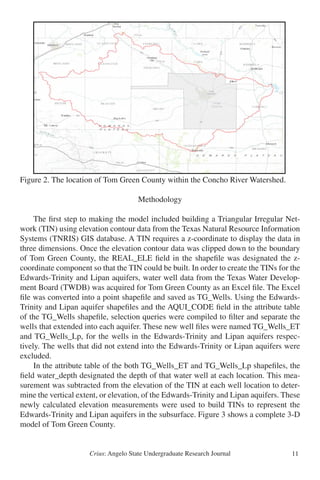
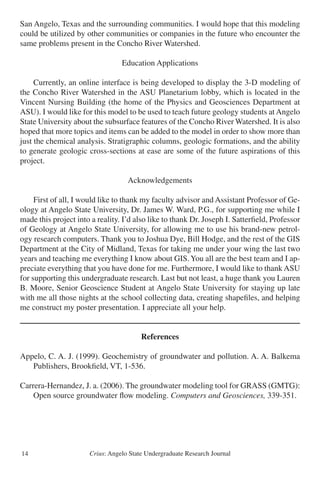
flow east into the Colorado River in Paint Rock, Texas. Figure 1 shows the area encom-
passed by the Concho River Watershed in Texas. Figure 2 shows a more detailed view
of the Concho River Watershed. Tom Green County is shaded to show its location in
relation to the 3 main rivers, the city of San Angelo, and the headwaters of the Concho
River.
Figure 1. The location of the Concho River Watershed relative to the state of Texas.
Figure 1
Crius: Angelo State Undergraduate Research Journal 11
Figure 2. The location of Tom Green County within the Concho River Watershed.
Methodology
	 The first step to making the model included building a Triangular Irregular Net-
work (TIN) using elevation contour data from the Texas Natural Resource Information
Systems (TNRIS) GIS database. A TIN requires a z-coordinate to display the data in
three dimensions. Once the elevation contour data was clipped down to the boundary
of Tom Green County, the REAL_ELE field in the shapefile was designated the z-
coordinate component so that the TIN could be built. In order to create the TINs for the
Edwards-Trinity and Lipan aquifers, water well data from the Texas Water Develop-
ment Board (TWDB) was acquired for Tom Green County as an Excel file. The Excel
file was converted into a point shapefile and saved as TG_Wells. Using the Edwards-
Trinity and Lipan aquifer shapefiles and the AQUI_CODE field in the attribute table
of the TG_Wells shapefile, selection queries were compiled to filter and separate the
wells that extended into each aquifer. These new well files were named TG_Wells_ET
and TG_Wells_Lp, for the wells in the Edwards-Trinity and Lipan aquifers respec-
tively. The wells that did not extend into the Edwards-Trinity or Lipan aquifers were
excluded.
	 In the attribute table of the both TG_Wells_ET and TG_Wells_Lp shapefiles, the
field water_depth designated the depth of that water well at each location. This mea-
surement was subtracted from the elevation of the TIN at each well location to deter-
mine the vertical extent, or elevation, of the Edwards-Trinity and Lipan aquifers. These
newly calculated elevation measurements were used to build TINs to represent the
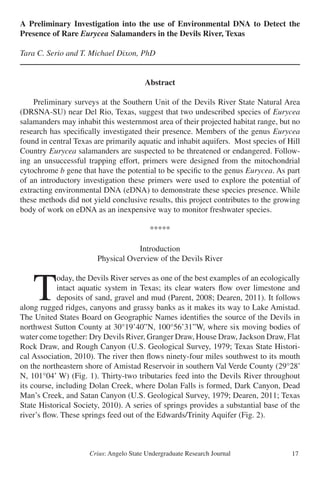
Edwards-Trinity and Lipan aquifers in the subsurface. Figure 3 shows a complete 3-D
model of Tom Green County.
Figure 2
Crius: Angelo State Undergraduate Research Journal12
Subsurface 3-D Modeling
	 The purpose of this project is to produce a functional 3-D model of the Concho
River Watershed so that models can be made to solve groundwater problems and issues
in the Concho River Watershed. The main focus is Tom Green County, Texas because
the North, South, and Middle Concho rivers all flow into the county’s most heavily
populated area, San Angelo, Texas. The main branch of the Concho River flows east
from San Angelo to Paint Rock, Texas where it connects with the Colorado River.
Figure 3 shows a completed 3-D model of Tom Green County, including the Edwards-
Trinity and Lipan aquifers and the water wells that were chemically analyzed by the
Texas Water Development Board. Due to the way ArcScene displays shapefiles, the
water wells are shown from underneath the model of Tom Green County in Figure 4.
	 There are many applications of this 3-D model. Particle tracking, contaminant
tracking, groundwater flow, chemical ion analysis, and many more can be displayed
and calculated using a 3-D model. For example, Figure 5 shows a contaminant plume
in the subsurface of Tom Green County using chemically analyzed data from the Texas
Water Development Board. The Total Dissolved Solids (TDS) field in the attribute
table was narrowed down to the wells with a TDS greater than 3000 part per million
(ppm). Using tools in ArcScene, a buffer was created representing the contaminant
plume in the subsurface that is related to the high concentration of dissolved solids in
the water.
Figure 3. A completed groundwater model in ArcScene of Tom Green County, Texas.
Figure 3
Crius: Angelo State Undergraduate Research Journal 13
Figure 4. Looking beneath the surface, the water wells can be seen extruding into the
subsurface from the topography above.
Figure 5. A dissolved solids contaminate plume in the subsurface of Tom Green
County, Texas.
Discussion and Conclusion
	 It is apparent that the door is wide open when it comes to 3-D modeling and the
potential aspects that can be displayed to solve specific problems. For an area like a
watershed, the possibilities are endless. Particle tracking, flow direction, and chemical
analysis can all be modeled in a visually pleasing and easily understandable way. The
Concho River Watershed was a perfect candidate to model three dimensionally due to
the importance of fresh water in a semi-arid climate and the need to keep it clean for
Figure 4
Figure 5
Crius: Angelo State Undergraduate Research Journal14
San Angelo, Texas and the surrounding communities. I would hope that this modeling
could be utilized by other communities or companies in the future who encounter the
same problems present in the Concho River Watershed.
Education Applications
	 Currently, an online interface is being developed to display the 3-D modeling of
the Concho River Watershed in the ASU Planetarium lobby, which is located in the
Vincent Nursing Building (the home of the Physics and Geosciences Department at
ASU). I would like for this model to be used to teach future geology students at Angelo
State University about the subsurface features of the Concho River Watershed. It is also
hoped that more topics and items can be added to the model in order to show more than
just the chemical analysis. Stratigraphic columns, geologic formations, and the ability
to generate geologic cross-sections at ease are some of the future aspirations of this
project.
Acknowledgements
	 First of all, I would like to thank my faculty advisor and Assistant Professor of Ge-
ology at Angelo State University, Dr. James W. Ward, P.G., for supporting me while I
made this project into a reality. I’d also like to thank Dr. Joseph I. Satterfield, Professor
of Geology at Angelo State University, for allowing me to use his brand-new petrol-
ogy research computers. Thank you to Joshua Dye, Bill Hodge, and the rest of the GIS
Department at the City of Midland, Texas for taking me under your wing the last two
years and teaching me everything I know about GIS.You all are the best team and I ap-
preciate everything that you have done for me. Furthermore, I would like to thank ASU
for supporting this undergraduate research. Last but not least, a huge thank you Lauren
B. Moore, Senior Geoscience Student at Angelo State University for staying up late
with me all those nights at the school collecting data, creating shapefiles, and helping
me construct my poster presentation. I appreciate all your help.
References
Appelo, C. A. J. (1999). Geochemistry of groundwater and pollution. A. A. Balkema
	 Publishers, Brookfield, VT, 1-536.
Carrera-Hernandez, J. a. (2006). The groundwater modeling tool for GRASS (GMTG):
	 Open source groundwater flow modeling. Computers and Geosciences, 339-351.
Crius: Angelo State Undergraduate Research Journal 15
Chen, Y., Khan, S., Rana, T., Abbas, A., & Buettikofer, H. (2012). Three Dimensional
	 Conceptualisation of Hydrogeological Environment to Underpin Groundwater
	 Management in Irrigation Area. Water Resource Management, 3077-3093.
Chesnaux, R., Lambert, M., Walter, J., Fillastre, U., Hay, M., Rouleau, A. (2011).
	 Building a geodatabase for mapping hydrogeological features and 3D modeling
	 of groundwater systems: Application to the Saguenay-Lac-St.-Jean region,
	 Canada. Computers and Geosciences, 1870-1882.
Drever. J. I. (1997). The Geochemistry of Natural Waters: Surface and Groundwater 	
	 Environments, Third Edition. Prentice Hall, Upper Saddle River, NJ, 1-436.
ESRI. (2013, March 2). Features. Retrieved from ESRI: Understanding Our World:
	 http://www.esri.com/software/arcgis/features
Fetter, C. W. (2001). Applied Hydrogeology, Fourth Edition. Prentice Hall, Upper
	 Saddle River, NJ., 1-598.
Hiscock, K. (2005). Hydrology Principles and Practices. Malden: Blackwell Publishing.
Richter, B. C., Dutton, A.R., and Fisher, W. L. (1990). Identification of Sources and
	 Mechanisms of Salt-Water Pollution affecting Ground-Water Quality: A Case
	 Study, West Texas Bureau of Economic Geology Report No. 191, the University of
	 Texas at Austin, Austin, TX, 1-43.
Schwartz, F. W., and Zhang, H. (2003). Fundamentals of Groundwater. John Wiley and
	 Sons, Inc., New York, NY, 1-583.
Shellito, B. A. (2012). Introduction to Geospatial Technologies, W. H. Freeman and
	 Company, New York, NY, 1-469.
Walther, J. V. (2009). Essentials of Geochemistry. Jones and Barrlett Publishers,
	 Sundbury, MA, 1-797.
Crius: Angelo State Undergraduate Research Journal16
Crius: Angelo State Undergraduate Research Journal 17
A Preliminary Investigation into the use of Environmental DNA to Detect the
Presence of Rare Eurycea Salamanders in the Devils River, Texas
Tara C. Serio and T. Michael Dixon, PhD
Abstract
	 Preliminary surveys at the Southern Unit of the Devils River State Natural Area
(DRSNA-SU) near Del Rio, Texas, suggest that two undescribed species of Eurycea
salamanders may inhabit this westernmost area of their projected habitat range, but no
research has specifically investigated their presence. Members of the genus Eurycea
found in central Texas are primarily aquatic and inhabit aquifers. Most species of Hill
Country Eurycea salamanders are suspected to be threatened or endangered. Follow-
ing an unsuccessful trapping effort, primers were designed from the mitochondrial
cytochrome b gene that have the potential to be specific to the genus Eurycea. As part
of an introductory investigation these primers were used to explore the potential of
extracting environmental DNA (eDNA) to demonstrate these species presence. While
these methods did not yield conclusive results, this project contributes to the growing
body of work on eDNA as an inexpensive way to monitor freshwater species. 	
*****
Introduction
Physical Overview of the Devils River
	T
oday, the Devils River serves as one of the best examples of an ecologically
intact aquatic system in Texas; its clear waters flow over limestone and
deposits of sand, gravel and mud (Parent, 2008; Dearen, 2011). It follows
along rugged ridges, canyons and grassy banks as it makes its way to Lake Amistad.
The United States Board on Geographic Names identifies the source of the Devils in
northwest Sutton County at 30°19’40”N, 100°56’31”W, where six moving bodies of
water come together: Dry Devils River, Granger Draw, House Draw, Jackson Draw, Flat
Rock Draw, and Rough Canyon (U.S. Geological Survey, 1979; Texas State Histori-
cal Association, 2010). The river then flows ninety-four miles southwest to its mouth
on the northeastern shore of Amistad Reservoir in southern Val Verde County (29°28’
N, 101°04’ W) (Fig. 1). Thirty-two tributaries feed into the Devils River throughout
its course, including Dolan Creek, where Dolan Falls is formed, Dark Canyon, Dead
Man’s Creek, and Satan Canyon (U.S. Geological Survey, 1979; Dearen, 2011; Texas
State Historical Society, 2010). A series of springs provides a substantial base of the
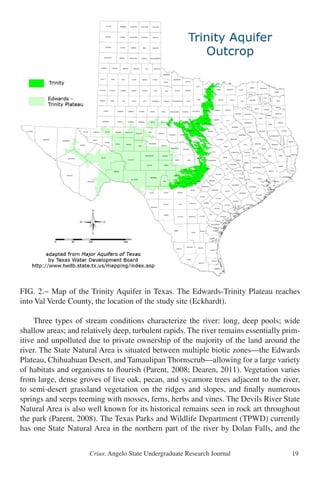
river’s flow. These springs feed out of the Edwards/Trinity Aquifer (Fig. 2).
Crius: Angelo State Undergraduate Research Journal18
FIG. 1.−Map illustrating the Devils River from where it leaves Sutton County through
Val Verde County and into Lake Amistad. The Devils River Ranch is an older name for
the Southern Unit and refers to the land prior to its acquisition by the Texas Parks and
Wildlife Department (TPWD). http://www.tpwd.state.tx.us/state-parks/devils-river
 
Figure 1 
14 
 
Crius: Angelo State Undergraduate Research Journal 19
FIG. 2.− Map of the Trinity Aquifer in Texas. The Edwards-Trinity Plateau reaches
into Val Verde County, the location of the study site (Eckhardt).
	 Three types of stream conditions characterize the river: long, deep pools; wide
shallow areas; and relatively deep, turbulent rapids. The river remains essentially prim-
itive and unpolluted due to private ownership of the majority of the land around the
river. The State Natural Area is situated between multiple biotic zones—the Edwards
Plateau, Chihuahuan Desert, and Tamaulipan Thornscrub—allowing for a large variety
of habitats and organisms to flourish (Parent, 2008; Dearen, 2011). Vegetation varies
from large, dense groves of live oak, pecan, and sycamore trees adjacent to the river,
to semi-desert grassland vegetation on the ridges and slopes, and finally numerous
springs and seeps teeming with mosses, ferns, herbs and vines. The Devils River State
Natural Area is also well known for its historical remains seen in rock art throughout
the park (Parent, 2008). The Texas Parks and Wildlife Department (TPWD) currently
has one State Natural Area in the northern part of the river by Dolan Falls, and the
Figure 2 
 
15 
 
Crius: Angelo State Undergraduate Research Journal20
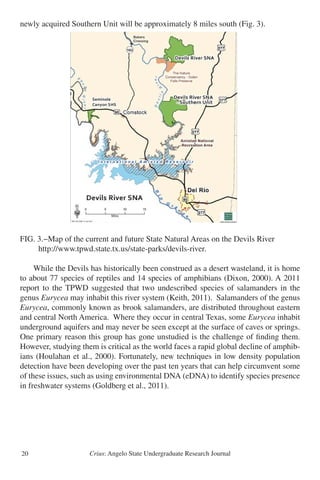
newly acquired Southern Unit will be approximately 8 miles south (Fig. 3).
FIG. 3.−Map of the current and future State Natural Areas on the Devils River
http://www.tpwd.state.tx.us/state-parks/devils-river.
	 While the Devils has historically been construed as a desert wasteland, it is home
to about 77 species of reptiles and 14 species of amphibians (Dixon, 2000). A 2011
report to the TPWD suggested that two undescribed species of salamanders in the
genus Eurycea may inhabit this river system (Keith, 2011). Salamanders of the genus
Eurycea, commonly known as brook salamanders, are distributed throughout eastern
and central North America. Where they occur in central Texas, some Eurycea inhabit
underground aquifers and may never be seen except at the surface of caves or springs.
One primary reason this group has gone unstudied is the challenge of finding them.
However, studying them is critical as the world faces a rapid global decline of amphib-
ians (Houlahan et al., 2000). Fortunately, new techniques in low density population
detection have been developing over the past ten years that can help circumvent some
of these issues, such as using environmental DNA (eDNA) to identify species presence
in freshwater systems (Goldberg et al., 2011).
 
Figure 3 
 
Crius: Angelo State Undergraduate Research Journal 21
Family Plethodontidae
	 The family Plethodontidae, or the lungless salamanders, is a unique group that
contains some of the smallest members of the salamander family that can be found
worldwide (Vieites et al., 2011). As their common name suggests, they have no in-
ternal lung structure and breathe through their skin. Researchers have proposed that
the loss of lungs is an adaptation for their life in the water; in larval stages, having an
air sac like a lung could cause the salamander to float, displacing it from its primary
food source and threatening its survival (Fong et al., 1995). Adults reach a maximum
size between 2.5-30.5 cm depending on the species, and the larval stages are generally
much smaller than the mature form (Welsh and Droege, 2001). With a large portion of
these salamanders living in moving water, oxygen is constantly turned over and there
is little selection for keeping lungs (Fong et al., 1995). Another physical characteristic
of the family Plethodontidae is having four toes on the front limbs and four or five toes
on the hind limbs with a medium length tail. The head is modified for wedging under
rocks and burrowing in silt on the streambeds. Plethodontids also have a modified long
tongue that can be flicked quickly to capture prey (Welsh and Droege, 2001).
	 As for their diet, most of the lungless salamanders eat small crustaceans, insects,
and sometimes worms. Larger species have been known to eat smaller salamanders as
well (Holomuzki, 1980). On the whole, little is known about Plethodontid reproduc-
tion and their daily behaviors. It is known that they like to live in groups and some
species are highly territorial. For the terrestrial species, they are hidden during the day
and active at night, with peak movement at sunset (Holomuzki, 1980). They rely on
covertness as opposed to speed to avoid capture. Contrastingly, water-dwelling species
have more speed than their land-dwelling cousins. Depending on where they live dur-
ing their adult life and if they have a larval stage or not, females will lay their eggs in
shallow water along streams or on land, hidden under rocks or in moss layers. Several
species in the family also demonstrate parental care and females will remain to protect
the clutch and will not eat during this maternal stage (Jaeger and Forester, 1993).
Genus Eurycea
	 Within the family Plethodontidae, there exists the genus of Eurycea. The online
reference Amphibian Species of the World 6.0 currently recognizes 28 species of Eu-
rycea (Frost, 2014). Of these 28 species, 15 species live their entire lives underground,
have little to no skin pigmentation, and may or may not have vestigial eye structures
(Fong et al., 1995; Frost, 2014). These cave salamanders are all neotenic, or remain
in a larval form for their entire lives (Baker, 1961). The range of Eurycea in Texas is
confined to about fourteen counties, all a part of the Edwards Plateau (Fig. 4). The
easternmost county where specimens of Eurycea have been collected is Williamson
County and the westernmost is Val Verde County.
Crius: Angelo State Undergraduate Research Journal22
FIG. 4.−Distribution map of 28 species of subterranean Eurycea salamanders in Texas
(Salamanders of Texas)
	 Baker (1961) published an “updated” key to the neotenic Eurycea in the Edwards
Plateau region and lamented the fact that the morphological differences between spe-
cies are so similar it is nearly impossible to key them out. At the time when the article
was published, scientists were only just beginning to grasp that these Plethodontids
were separated in different caves long enough for the species to diverge through the
process of allopatric speciation (Baker, 1961).
	 In more recent times, the phylogenetic tree of Eurycea has been scrutinized using
allozyme loci and mitochondrial DNA studies (Chippindale et al., 2000). The work
was done to characterize genetic variation and diversity, isolate species boundaries,
and assemble the phylogenetic history of Plethodontidae in central Texas. From this
study, researchers discovered that the genus Typhlomolge, a group previously separate
from Eurycea, was actually phylogenetically nested within the central Texas Eurycea.
Furthermore, they concluded that species in the northern counties of the Edwards Pla-
teau such as Bell, Williamson, Travis, Blanco and Hays County diverged earlier than
the southeast and southwest regions (E. troglodytes complex). The complex found in
the southwestern counties (e.g. Val Verde, Edwards, Kinney, Uvalde and Real) are sus-
pected to be most closely related with the southeast group, which is comprised of the
Figure 4 
 
17 
Crius: Angelo State Undergraduate Research Journal 23
remaining counties of Kerr, Bandera, Medina, Gillespie, Kendall, Comal and Bexar
(Fig. 5). By examining the caves, researchers found that while there was some potential
for gene flow to occur, all the populations were essentially isolated (Chippindale et al.,
2000). The results of the allozyme studies on specific populations revealed that intra-
population homozygosity levels were significantly high, possibly due to the founder
effect, which is characterized by a loss of diversity when a portion of a larger popula-
tion establishes a new population in a new area.
FIG. 5.−Phylogenetic tree of central Texas plethodontid salamanders based on com-
bined cytochrome b and allozyme sequence data (Chippindale et al., 2000). Eurycea
sp. 7 and Eurycea sp. 10 are expected to be within the E. troglodytes complex.
	 Another project was undertaken recently to reevaluate the phylogenetic tree of
all plethodontids. The results of the work done by Vieites et al. (2011) found a close
relationship between the subclade containing Eurycea and a subclade comprised of
tropical plethodontids, demonstrating that New World Plethodontids are more related
to each other than to Old World groups (Vieites et al., 2011). While Vieites et al. (2011)
studied plethodontids from around the world, the information they gathered regarding
 
Figure 5 
 
18 
Crius: Angelo State Undergraduate Research Journal24
North American Eurycea validated prior studies done by Chippindale et al. (2000),
placing Eurycea in one of the more recently diverged groups.
	 Because lungless salamanders breathe through their skin, they suffer dramatic ef-
fects from water pollution. Without a protective skin layer, nearly any trace amounts of
toxins will be absorbed by the salamanders. The International Union for Conservation
of Nature (IUCN) lists one species of lungless salamander as Extinct, 31 as Critically
Endangered, 83 as Endangered, 54 as Vulnerable, and 36 as Near Threatened (IUCN,
2013). As habitat fragmentation/destruction, climate change, UV-B radiation and dis-
ease threaten amphibians as a group, salamanders may be lost in the mix (Kiesecker et
al., 2001).
	 With concern for their survival rising, the study of salamanders has increased
across the board. Being at the edge of the Edwards Plateau, which is one of the most
species rich areas for cave-dwelling salamanders in the world, the Devils River holds
great promise to be home to aquatic salamanders. Val Verde County is currently listed
as the westernmost and southernmost end of the range of these salamanders; however,
there is some evidence to support their presence. First, the report by Keith (2011) to
the TPWD suggested two species of Eurycea may inhabit the river. Then even more
compelling evidence can be found in the work published by Chippindale et al. (2000),
where they state that Eurycea specimens were collected by a man named Riley Nelson
and his team north of Del Rio in springs in the Devils River drainage. Unfortunately,
this discovery followed previous unsuccessful attempts to collect specimens and was
too late to be included in the molecular study (Chippindale et al., 2000). There was
no citation in the paper specifically referring to this capture and no mention if Riley
Nelson published any work regarding the supposed Eurycea specimen: it was only
mentioned that the specimens seemed consistent with other surface populations from
the southwest. The Devils River has one of the greatest base flows of any Texas river,
owing to the many springs that bubble up from underneath the river (Brune, 2002).
The TPWD Element Occurrence Report for August 30, 2011, and the TPWD Wildlife
Diversity Tracked Animals published that the Dolan Falls salamander, which was re-
ferred to as Eurycea sp. 10, and the Edwards Plateau spring salamander, which was re-
ferred to as Eurycea sp.7, may be present or have been found in the Devils River State
Natural Area South Unit (Keith, 2011). This area will soon be turned into a public use
area, so knowledge of the presence of these species is critical for wildlife management
planning. Both species are scientifically undescribed, and if specimens were collected,
all morphological data should be analyzed and tissues taken in an effort to describe
these species. Furthermore, studies should be conducted to gain better understanding
of the life cycle and behavior of cave salamanders in the genus Eurycea.
Extracting DNA from Water
	 Several studies from the last five years have implemented a new technique for
locating rare species that are in low density in freshwater environments. These papers
Crius: Angelo State Undergraduate Research Journal 25
have extracted environmental DNA (eDNA) from water samples and successfully am-
plified the fragments. Goldberg et al. (2011) emphasized that research into the ecology
and range of several stream species can be extremely challenging due to a multitude of
reasons such as complexity of topography and vegetation, water flow rates, low density
populations, and use of microhabitats, which are areas that are limited in size and have
a character that separate them from the larger surrounding terrain. Cave-dwelling Eu-
rycea use microhabitats found at the mouth of caves or springs and exist on the surface
at low densities. Goldberg et al. (2011) go on to suggest that detection of species using
eDNA could increase accuracy by comparing sequenced samples to a database and de-
crease field collection costs because researchers are simply collecting water samples.
Thomsen et al. (2012) suggest that eDNA may be the method by which researchers
can get to large-scale comparative validation of species distribution and abundance
in a quick, cost-effective and standardized way. However, Goldberg et al. (2011) cau-
tion that sampling design should be guided by the ecology of the target organism to
maximize chances of detection. In the case of this research, for example, water samples
were collected near the mouths of springs to increase detection chances. Pilliod et al.
(2014) explored several environmental factors that could influence eDNA detection:
different light and temperature conditions; the rate and amount of eDNA produced by
individuals; the effects of animal density and the amount of time the population has
spent in the area of detection. Their results supported what most other papers have sug-
gested, that detection of species is possible even after a species has only been present
for a few hours and that eDNA degrades beyond the point of detection within one to
two weeks and that rate is correlated to the condition of the environment. Ultimately,
all the literature examined suggests that eDNA methods have great promise to become
a standardized, sensitive tool that is widely used to document abundance and distribu-
tion of aquatic species over time and location (Goldberg et al., 2011; Thomsen et al.,
2012; Pilliod et al., 2014).
Purpose
	 After discovering that low density populations could be detected in fresh water
ecosystems by extracting eDNA from water, it was hypothesized that by designing
primers specific to the genus Eurycea and using eDNA procedures conducted by Fice-
tola et al. (2008) the presence or absence of the threatened salamander species Eurycea
sp.7 and Eurycea sp. 10 could be determined in the Devils River through detection and
sequencing of eDNA of the target species.
Materials and Methods
Field Methods
	 In the summer of 2013, three trips were taken to DRSNA-SU to capture live speci-
mens. Prior to entering the field, an effort was made to find a source that mapped all
Crius: Angelo State Undergraduate Research Journal26
the springs throughout the river, but there was no such document readily available. The
general strategy was to observe the river and look for potential spring sites, followed by
swimming to feel for colder water and look for potential spring openings with swim-
ming goggles. Once a potential site was identified, usually defined as having a rela-
tively slower flow rate, some sort of rocks or foliage for coverage, and a different soil
type than the surrounding area, standard minnow traps were set as suggested by Heyer
et al. (1994). The traps were baited with either pistachios, earthworms, or amphibian
food purchased from Walmart.
On the first trip, five traps were set for three nights, or fifteen trap nights. On the sec-
ond trip, only three traps were set for two nights, or six trap nights. The same methods
were used but in different locations, all which were found after setting out from the
Summer House (29°41’02.0”N, 101°00’05.9”W). On the final trip, an approximately
35 ft. deep hole that was about 7 ft. wide (29°40’46.4”N, 101°00’07.7”W) was identi-
fied as a potential site because of the change in soil at the bottom and the fact that there
appeared to be a side entrance to the bottom of the hole. Four traps were set at various
depths along one string baited with only the amphibian food for four nights or sixteen
trap nights. It was hypothesized that finding positive eDNA results in areas of DRSNA
would help future capture attempts and trapping efforts ceased.
Primer Design
	 Multiple sources found the cytochrome-b mitochondrial gene (cyt-b) useful to
identify salamander species using PCR methods (Chippindale et al., 2000; Hillis et
al., 2001; Ficetola et al., 2008; Thomsen et al., 2012). Partial sequences of the begin-
ning of the cyt-b gene of about 12 Eurycea salamander samples were downloaded
from GenBank, all starting from base pair one and ending somewhere near 1,000 base
pairs. These sequences were aligned in the software Molecular Evolutionary Genetics
Analysis (MEGA) 5.2.1 (Tamura et al., 2011). New primers were created by selecting
various sequences between 23-27 bp in length at various distances from the forward
primer in order to create fragments that were less than 100 bp long (Goldberg et al.,
2011). The sequences were then compared to NCBI’s Nucleotide BLAST to see if the
sequence was unique to Eurycea. NCBI’s Primer BLAST was utilized by inputting
the cyt-b gene of a sample of Eurycea neotenes (GenBank accession: AY528400) and
selecting for the results to be specific to Eurycea. After this first round of elimination,
the primer pairs were analyzed in OligoAnalyzer 3.1 (Integrated DNA Technologies,
USA). This program shows important information for primers such as GC content,
melting temp, hairpins, and self-dimers. After checking all these variables, 5 primers
were designed and ordered: Forward 3, Forward 7, Forward 10, Reverse 7, and Reverse
10 (Table 1).
Crius: Angelo State Undergraduate Research Journal 27
TABLE 1.− Primers designed from the mitochondrial cyt-b gene for the genus Eurycea
Water Collection and eDNA Extraction
	 Following the collection procedures set by Ficetola et al. (2008), water was col-
lected from Barton Springs Pool in Austin, Texas, which is home to the Barton Springs
Salamander (Eurycea sosorum) as a positive control. Water was taken from the Barton
Springs diving board (DB1 and DB2) and the deep end of the Barton Springs pool
(DEEP1 and DEEP2). For a negative control, water was collected from two tanks in
the Biology Department at Angelo State University. The first was Dr. Michael Dixon’s
office tank, which contained a Barred Tiger Salamander (Ambystoma mavortium) and
guppies (Poecilia reticulata) [DIXON1 and DIXON2]. The second was a tank in the
Angelo State zoology laboratory, which contained assorted native fish (Lepomis sps)
[ZOO1 and ZOO2]. The Barred Tiger Salamander and fish served as negative controls
because they are outside the genus Eurycea. Water was collected in 15 ml samples from
each location and labeled (Table 3). The water from the Devils River was collected in
two locations, one towards the north of the Southern Unit and one towards the south of
the Southern Unit. The northern sample (DRSNA-N) was collected by the “Take-Out
Point” (29°43’01.1” N, 101°01’18.4” W) and the southern sample (DRSNA-S) was
collected by the Summer House (29°41’02.0”N, 101°00’05.9”W). Immediately after
collection each sample was treated with 1.5 ml sodium acetate 3 M and 33 ml absolute
ethanol (Ficetola et al., 2008). Treated samples were then frozen at -20° C until DNA
extraction. For extraction, samples were centrifuged at 6° C at 5500 g for 35 min. Fol-
lowing this step, the supernatant was discarded and the pellet underwent a classical
DNA extraction using DNeasy Blood & Tissue Kit (Qiagen, Valencia, CA).
	 The products from the extraction were separated on a 0.8% agarose gel by elec-
trophoresis and analyzed, and this step was performed to verify the methods and to
compare concentrations of DNA collected from the tank samples to the Barton Springs
samples. Following electrophoresis, the samples were analyzed using a Qubit® fluo-
rometer (Life Technologies, CA) with a High Sensitivity (HS) assay to quantify the
concentration of DNA extracted.
Table 1 
Primer Name DNA Sequence (5’-3’) Location on
gene (bp)
Euryc CytB Forward 3 CATACCTCAAAGCACCGAAGCAT 905-927
Euryc CytB Forward 7 AAAGCACCGAAGCATGTCATTTC 913-935
Euryc CytB Forward 10 ACCTCAAAGCACCGAAGCATGTC 908-930
Euryc CytB Reverse 7 TACCTGGCTGACCCCCAATTCAA 1007-991
Euryc CytB Reverse 10 CTTGGCTGACCCCCAATTCAAGT 1005-989
 
19 
 
Crius: Angelo State Undergraduate Research Journal28
PCR
	 Two primers were selected at random and six samples (DIXON1, DIXON2, ZOO1,
ZOO2, DEEP1, DEEP2, DB1, DB2) underwent PCR with an annealing temperature
of 55° C. The profile for PCR consisted of a denaturation step at 95° C for 10 min, and
then the samples were cycled for 55 times at 95° C for 30 sec, 55° C for 30 sec, and
72° C for 2 min. The final step was at 72° C for 10 min (Ficetola et al., 2008). Products
were separated on a 1% agarose gel. PCR was performed again using an annealing tem-
perature of 48° C, as opposed to 55° C. From the primer combinations used, the best
two pairs were selected (Forward 3 and Reverse 7; Forward 7 and Reverse 7) and used
for another PCR reaction that included the negative controls along with all other previ-
ously used samples, and this reaction was followed by gel electrophoresis and quanti-
fied with an HS assay in Qubit® (Life Technologies, CA). The four most prominent
bands that had sufficient product from this gel were sequenced twice with the Forward
7 and Reverse 7 primers using the DTCS Quick Start Master Mix (Beckman-Coulter)
in a Beckman-Coulter CEQ8000 Genetic Analysis System DNA sequencer (Pasadena,
CA). Sequencing was carried out in accordance with manufacturer’s specifications for
a half volume reaction.
Results
Trapping
	 Collection of the minnow traps during the first and second trips revealed that only
fish were captured. During the final trip, nothing was caught in any of the traps.
Primer Design
	 New primers were designed in an attempt to make primer sets that were specific
to the mitochondrial cyt-b gene in the genus Eurycea. Partial initial sequences of 12
species of Eurycea were studied and submitted to NCBI’s Prime BLAST, generating
10 primer pairs. Primers that were between 23-27 bp, had minimal chance of self-
dimerization, heterodimerization, hairpinning, and relatively low GG content after be-
ing analyzed through Integrated DNA Technologies’ OligoAnalyzer were considered
(Table 1).
	 Only those primer pairs that were less than 100 bp apart were ultimately selected
(Table 2). There was concern that eDNA from the water would most likely be short
fragments due to all the agents in the environment that can damage DNA so a short
primer pair was preferable (Ficetola et al. 2008). The results of this effort yielded five
primers: Forward 3, Forward 7, Forward 10, Reverse 7, and Reverse 10 (Table 1, Fig.
6).
Crius: Angelo State Undergraduate Research Journal 29
Extraction of eDNA from Water
	 Very low yields of environmental DNA were obtained from all water collected
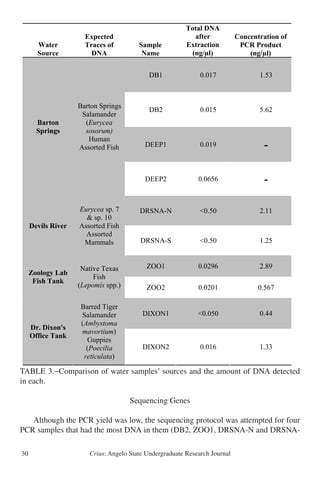
(Table 3). The most DNA was obtained from sample DEEP2 (0.0656 ng/µl).
PCR
	 The primer pairs that produced the most prominent bands were Forward 3 and
Reverse 7, and Forward 7 and Reverse 7. All samples produced products very close
to 100 bp in length except for DEEP1 and DEEP2, although the bands were somewhat
diffuse.
FIG. 6.−Illustration of the location of the designed primers where numbers correspond
to base pairs in the cytochrome b gene in Eurycea.
TABLE 2.−Expected length of PCR products with each possible primer combination.
			
 
Figure 6 
 
ble 2 
Possible Primer
Combination
Length of Product
(# of base pairs)
Forward 3-Reverse 7 64
Forward 7-Reverse 7 56
Forward 10-Reverse 7 61
Forward 3-Reverse 10 62
Forward 7-Reverse 10 54
Forward 10-Reverse 10 59
Crius: Angelo State Undergraduate Research Journal30
TABLE 3.−Comparison of water samples’ sources and the amount of DNA detected
in each.
Sequencing Genes
	 Although the PCR yield was low, the sequencing protocol was attempted for four
PCR samples that had the most DNA in them (DB2, ZOO1, DRSNA-N and DRSNA-
Table 3 
Water
Source
Expected
Traces of
DNA
Sample
Name
Total DNA
after
Extraction
(ng/µl)
Concentration of
PCR Product
(ng/µl)
DB1 0.017 1.53
DB2 0.015 5.62
DEEP1 0.019 -
Barton
Springs
Barton Springs
Salamander
(Eurycea
sosorum)
Human
Assorted Fish
DEEP2 0.0656 -
DRSNA-N <0.50 2.11
Devils River
Eurycea sp. 7
& sp. 10
Assorted Fish
Assorted
Mammals DRSNA-S <0.50 1.25
ZOO1 0.0296 2.89
Zoology Lab
Fish Tank
Native Texas
Fish
(Lepomis spp.) ZOO2 0.0201 0.567
DIXON1 <0.050 0.44
Dr. Dixon's
Office Tank
Barred Tiger
Salamander
(Ambystoma
mavortium)
Guppies
(Poecilia
reticulata)
DIXON2 0.016 1.33
 
22 
 
Crius: Angelo State Undergraduate Research Journal 31
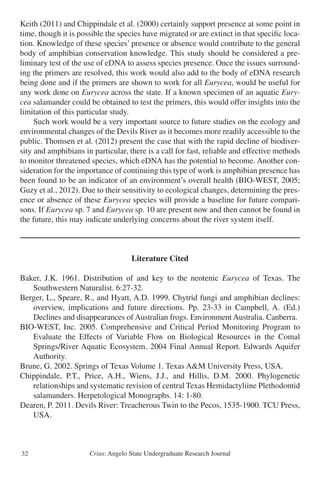
S). The results of this sequencing step did not produce good quality sequence despite
repeated attempts.
Discussion
	 The results of this study were inconclusive. From the first PCR reaction, trace
amounts of DNA was detected in all samples, which could imply that the primers were
never specific to Eurycea as they should have been; however, the values were so low
that they probably are not significantly different from zero. Unfortunately, with no suc-
cessful sequences isolated and by not working with a known specimen, many unknown
variables could not be accounted for. The next step in this work would be to systemati-
cally alter and change the conditions of extraction and PCR to optimize DNA concen-
trations. With such a small amount of DNA extracted and amplified through PCR, there
probably was never enough for successful sequencing. It is possible, though unlikely,
the conditions of the sequencer were not correct or that the solutions were contami-
nated in some way, but if there was not a sufficient amount of DNA to sequence this
would not have impacted the results. Potentially, the samples could be sent away to be
sequenced in another lab, but the small amount of DNA will probably not be enough.
Without sequencing, it is extremely difficult to demonstrate species presence.
	 An additional concern regarding this study may tie back to the water collection
itself. Goldberg et al. (2011) and Pilliod et al. (2014) both mention in their respective
works that collection of eDNA can be greatly impacted by seasonal changes in the tar-
get species. If they have a reduced metabolism or are less active in the winter, this may
skew detection rates. Getting as close to the habitat as possible may decrease some of
these concerns.
	 Future researchers may want to consider optimizing the PCR protocol to generate
higher amounts of PCR product and should also include a known Eurycea specimen
for a positive control. Performing this research without a known positive control did
not allow certainty that the primers were selectively amplifying the cytochrome b gene
from Eurycea.
	 The only certain result of this study is that the storage methods and extraction
methods proposed by Fiectola et al. (2008) were effective in protecting the DNA from
complete degradation for months and allowed extraction for this study. It was also
certain that the primers designed for this study were binding to DNA as shown through
successful PCR trials, though the source of the DNA remains unclear.
Conclusion
	 As stated previously, there unfortunately was no conclusive evidence from this
study, though it does contribute to the growing body of work on eDNA and highlights
some of the potential pitfalls that researchers can encounter. However, the lack of de-
tection of this species does not necessarily demonstrate its absence. The literature of
Crius: Angelo State Undergraduate Research Journal32
Keith (2011) and Chippindale et al. (2000) certainly support presence at some point in
time, though it is possible the species have migrated or are extinct in that specific loca-
tion. Knowledge of these species’ presence or absence would contribute to the general
body of amphibian conservation knowledge. This study should be considered a pre-
liminary test of the use of eDNA to assess species presence. Once the issues surround-
ing the primers are resolved, this work would also add to the body of eDNA research
being done and if the primers are shown to work for all Eurycea, would be useful for
any work done on Eurycea across the state. If a known specimen of an aquatic Eury-
cea salamander could be obtained to test the primers, this would offer insights into the
limitation of this particular study.
	 Such work would be a very important source to future studies on the ecology and
environmental changes of the Devils River as it becomes more readily accessible to the
public. Thomsen et al. (2012) present the case that with the rapid decline of biodiver-
sity and amphibians in particular, there is a call for fast, reliable and effective methods
to monitor threatened species, which eDNA has the potential to become. Another con-
sideration for the importance of continuing this type of work is amphibian presence has
been found to be an indicator of an environment’s overall health (BIO-WEST, 2005;
Guzy et al., 2012). Due to their sensitivity to ecological changes, determining the pres-
ence or absence of these Eurycea species will provide a baseline for future compari-
sons. If Eurycea sp. 7 and Eurycea sp. 10 are present now and then cannot be found in
the future, this may indicate underlying concerns about the river system itself.
Literature Cited
Baker, J.K. 1961. Distribution of and key to the neotenic Eurycea of Texas. The
	 Southwestern Naturalist. 6:27-32.
Berger, L., Speare, R., and Hyatt, A.D. 1999. Chytrid fungi and amphibian declines:
	 overview, implications and future directions. Pp. 23-33 in Campbell, A. (Ed.)
	 Declines and disappearances of Australian frogs. Environment Australia. Canberra.
BIO-WEST, Inc. 2005. Comprehensive and Critical Period Monitoring Program to
	 Evaluate the Effects of Variable Flow on Biological Resources in the Comal
	 Springs/River Aquatic Ecosystem. 2004 Final Annual Report. Edwards Aquifer
	 Authority.
Brune, G. 2002. Springs of Texas Volume 1. Texas A&M University Press, USA.
Chippindale, P.T., Price, A.H., Wiens, J.J., and Hillis, D.M. 2000. Phylogenetic
	 relationships and systematic revision of central Texas Hemidactyliine Plethodontid
	 salamanders. Herpetological Monographs. 14: 1-80.
Dearen, P. 2011. Devils River: Treacherous Twin to the Pecos, 1535-1900. TCU Press,
	 USA.
Crius: Angelo State Undergraduate Research Journal 33
Dixon, J. R. 2000. Amphibians and Reptiles of Texas, 2nd edition. Texas A&M Press,
	 USA.
Eckhardt, G. The Trinity Aquifer. c1995-2014. The Edwards Aquifer Website.
	 Available at http://www.edwardsaquifer.net/trinity.html. Archived by WebCite at
	 http://www.webcitation.org/6PrxpCywR on 20 May 2014.
Ficetola, G.F., Miaud, C, Pompanon, F, and Taberlet, P. 2008. Species detection using
	 environmental DNA from water samples. Biology Letters. 4: 423-425.
Fong, D.W., Kane, T.C., and Culver, D.C. 1995. Vestigialization and loss of
	 nonfunctional characters. Annual Review of Ecology and Systematics.
	 26:249-268.
Frost, D.R. 2014. Amphibian species of the world: an online reference. Available at:
	 http://research.amnh.org/herpetology/amphibia/index.html. Archived by WebCite
	 at http://www.webcitation.org/6PqO4B1Ao on 20 May 2014.
Goldberg, C.S., Pilliod, D.S., Arkle, R.S., and Waits, L.P. 2011. Molecular detection
	 of vertebrates in stream water: a demonstration using Rocky Mountain Tailed Frogs
	 and Idaho Giant Salamanders. PLoS ONE 6: 1-5.
	 DOI: 10.1371/journal.pone.0022746
Guzy, J. C., McCoy, E. D., Deyle, A. C., Gonzalez, S. M., Halstead, N., and
	 Mushinsky, H. R. 2012. Urbanization interferes with the use of amphibians as
	 indicators of ecological integrity of wetlands. Journal of Applied Ecology.
	 49: 941-952.
Heyer, W.R., Donnelly, M.A., McDiarmid, R.W., Hayek, L.C., and Foster, M.S.,
	 editors. 1994. Measuring and Monitoring Biological Diversity: Standard Methods
	 for Amphibians. Smithsonian Institution Press, USA and UK.
Hillis, D.M., Chamberlain, D.A., Wilcox, T.P., and Chippindale, P.T. 2001. A
	 new species of subterranean blind salamander (Plethodontidae: Hemidactyliini:
	 Eurycea:Typhlomolge) from Austin, Texas, and a systematic revision of central
	 Texas paedomorphic salamanders. Herpetologica. 57: 266-280.
Holomuzki, J. R. 1980. Synchronous foraging and dietary overlap of three species of
	 plethodontid salamanders. Herpetologica. 36:109-115.
Houlahan, J. E., Findlay, C.S., Schmidt, B.R., Meyer, A.H., and Kuzmin, S.L. 2000.
	 Quantitative evidence for global amphibian population declines. Nature. 404:752-
	 755.
IUCN. 2013. International Union for Conservation of Nature Red List of Threatened
	 Species. Version 2013.2. Available at www.iucnredlist.org. Archived by WebCite
	 at http://www.webcitation.org/6Ps3WKgdv on 20 May 2014.
Jaeger, R. G., and Forester, D. C. 1993. Social behavior of plethodontid salamanders.
	 Herpetologica. 49:163-175.
Keith, E.L. 2011. Plant community, fuel model, and rare species assessment and
	 baseline establishment of twenty vegetation monitoring plots at Devils River state
	 natural area—Devils River ranch unit in Val Verde County, Texas. Report to Texas
	 Parks and Wildlife.
Crius: Angelo State Undergraduate Research Journal34
Kiesecker, J.M., Blaustein, A.R., and Belden, L.K. 2001. Complex causes of
	 amphibian population declines. Nature. 410:681-684.
Parent, L. 2008. Official guide to Texas State Parks and historic sites. University of
	 Texas Press, USA.
Pilliod, D. S., Goldberg, C. S., Arkle, R. S., and Waits, L. P. 2014. Factors influencing
	 detection of eDNA from a stream‐dwelling amphibian. Molecular Ecology Re
	 sources. 14:109-116.
Salamanders of Texas. Available at http://www.herpsoftexas.org. Archived by WebCite
	 at http://www.webcitation.org/6PryD4Yok on 20 May 2014.
Tamura, K., Peterson, D., Peterson, N., Stecher, G., Nei, M., and Kumar, S. 2011.
	 MEGA5: Molecular Evolutionary Genetics Analysis using Maximum Likelihood,
	 Evolutionary Distance, and Maximum Parsimony Methods. Molecular Biology
	 and Evolution. 28: 2731-2739.
Texas Natural Diversity Database. 2012. TPWD Wildlife Diversity Tracked Animals.
	 Texas Parks and Wildlife. Available at http://www.tpwd.state.tx.us/huntwild/wild/
	 wildlife_diversity/txndd/documents/texas_tracked_animals_bygroup.pdf.
	 Archived by WebCite at http://www.webcitation.org/6Prxgpt8N on 20 May 2014.
Texas State Historical Association. 2010. Devils River. Handbook of Texas Online.
	 Available at https://www.tshaonline.org/handbook/online/articles/rnd03. Archived
	 by WebCite at http://www.webcitation.org/6PqP2EvQ8 on 20 May 2014.
Thomsen, P.F., Kielgast, J., Iverson, L.L., Wiuf, C., Rasmussen, M., Gilbert, T.P.,
	 Orlando, L., and Willerslev, E. June 2012. Monitoring endangered freshwater
	 biodiversity using environmental DNA. Molecular Ecology. 21: 2565-2573.
U.S. Geological Survey. 1979. Feature Detail Report for: Devils River.
	 Geographic Names Information System. Available at http://geonames.usgs.gov/
	 apex/f?p=gnispq:3:0::NO::P3_FID:1373388. Archived by WebCite at http://www.
	 webcitation.org/6Ps3l0zIz on 20 May 2014.
Vieites, D.R., Román, S.N., Wake, M.H., and Wake, D.B. 2011.A multigenic perspective
	 on phylogenetic relationships in the largest family of salamanders, the Plethodontidae.
	 Molecular Phylogenetics and Evolution. 59: 623-635.
Welsh, H. H., and Droege, S. 2001. A case for using plethodontid salamanders for
	 monitoring biodiversity and ecosystem integrity of North American forests.
	 Conservation Biology. 15:558-569.
Whittaker, K., Koo, M.S., Wake, D.B., and Vredenburg, V.T. 2013. Global Declines of
	 Amphibians. Pp. 691-699 in S.A. Levin (Ed.), Encyclopedia of Biodiversity.
	 2nd ed. Academic Press, USA.
Young, B.E., Lips, K.R., Reaser, J.K., Ibanez, R., Salas, A.W., Cedeno, J.R.,
	 Coloma, L.A., Ron, S., Marca, E.L., Meyer, J.R., Muñoz, A., Bolaños, F., Chaves,
	 G., and Romo, D. 2001. Population Declines and Priorities for Amphibian
	 Conservation in Latin America. Conservation Biology. 15: 1213-1223.
Crius: Angelo State Undergraduate Research Journal 35
Isolation, Sequence, and Characterization of p53 mRNA in Various Bat Species
Alexis Mobley and Loren K. Ammerman, PhD
Abstract
	 Bats (Order Chiroptera) have been known to live substantially long lives compared
to other mammals of similar size. There has also been no known incidence of cancer
observed in bat species. Current research has led to the discovery of various functional
isoforms of the p53 protein. Our objective was to characterize the p53 gene in bat spe-
cies. In this experiment, two different bat species were captured and samples of mRNA
extracted from their tissue. Primers were designed based on an alignment of multiple
species of mammals and used for reverse transcriptase PCR (rtPCR). Although some
PCR product was generated, no PCR products could be sequenced. Instead, a bioin-
formatics approach was taken and the p53 gene from 5 species of bats was extracted
from a sequence database and aligned with 26 other mammal sequences representing
9 orders of mammals. We identified a unique insertion of 21 nucleotides in 4 of the 5
species of bats examined (all vespertilionids). The biological importance of this extra
region in the gene remains to be determined. 	
*****
Introduction
	C
ancer is uncontrolled cell growth with a lack of regulation, cell adhesion,
and normal karyotype and is a possibility in all multicellular organisms.
So far, it has not been documented in any scientific literature that bats de-
velop cancer, even though they live an average of 20 years, much longer compared to
other animals of their size (Ammerman et al., 2012; Barclay and Harder, 2003). The
bat community has taken special interest in looking at different immunological genes
in the bat genome. Zhang et al (2013) examined immunologically important genes
as well as different apoptosis-associated genes and different cell signaling molecules.
Their study also was able to show positive selection for p53 gene. Because of this study
and the fact that p53 is the most commonly mutated gene in human cancer genomes
(Vogelstein et al., 2010), p53 may be one of several different molecular mechanisms
that contribute to the long lifespan in bats.
	 The purpose of this study was to characterize mRNA of the p53 gene from two
different bat species (Order Chiroptera) and compare them to other mammals found in
Genbank. We hypothesized that bats share a unique mRNA compared to that of other
mammals that could contribute to their longer life span than other small mammals. Al-
ternatively, the p53 mRNA might be highly conserved among all mammalian species.
Crius: Angelo State Undergraduate Research Journal36
Methods
	 Two bats, one Tadarida brasiliensis (Mexican free-tail bat) and one Antrozous
pallidus (Pallid bat), were sacrificed and the heart, lungs, liver, kidney, and spleen
tissues placed in RNAlater (Life Technologies, Grand Island, NY) to preserve the
RNA. The two bats were cataloged in the Angelo State Natural History Collection
under ASK10538 and ASK7445, respectively. Primers were designed for the reverse
transcriptase polymerase chain reaction (rtPCR) to target similar mammalian p53
mRNA by using Canis lupis familiaris TP53 cDNA sequence (GenBank Accession:
NM_001003210). A consensus sequence was made with the mammalian sequences in
Sequencher (GeneCodes Corp., Ann Arbor, MI) then placed in Primer3 (Untergrasser
et al. 2012) to design and analyze potential primers for this experiment. There were a
total of 22 primers designed (11 forward and 11 reverse). Only 3 forward and 3 reverse
primers were used in experimentation. All 9 primer pair combinations (1 forward and
1 reverse) were tried in reverse transcription reactions as well as PCR experiments to
find a primer pair that would amplify the target sequence.
	 Total RNA was isolated from the tissues using RNAqueous-4PCR (Life Technolo-
gies, Grand Island, NY) and treated with DNase I. The reverse transcription reaction
was performed in a separate tube from the PCR. Forward primer 3 (5’ – GGTGACAC-
GCTTCCCTGAGGATTGG) and 5μL of RNA sample were used in the reverse tran-
scription. Aliquots of the reverse transcription reactions were separated on a 0.8%
agarose ethidium bromide gel at 150V for 25 minutes and a separate aliquot was
quantified using Qubit fluorometer (Life Technologies, Grand Island, NY). The 50μL
PCR reactions were performed with 1X PCR Buffer (New England Biolabs, Ipswich,
MA), 0.8mM dNTPs, 2mM MgCl2
(BioRad), 0.2μM forward primer 6 (5’– GACGGT-
GACACGCTTCCCTGAGGAT), 0.2μM reverse primer 6 (5’ – CTGTAGAAACTAC-
CAACCCACCGACC), and 0.5 units Taq polymerase (New England Biolabs, Ipswich,
MA). The PCR protocol was as follows: 94°C for 2 minutes; 92°C for 1 minute, 48°C
for 1 minute with a 0.2°C temperature increase each cycle, 72°C for 2 minutes for a
total of 45 cycles; 72°C for 5 minutes. Nested PCR was utilized to help increase the
concentration of cDNA in the PCR reactions. Aliquots were quantified as described
above. Sequencing reactions were not attempted.
	 Because of inconsistent results from the rtPCR experiments, next a bioinformatics
approach was used to compare the p53 gene of bats to other mammals. We took the
predicted tumor protein p53 mRNA sequence (as cDNA copies) of Myotis brandtii
(GenBank Accession: XM_005878763.1) and utilized BLAST analysis to find other
mammals with tumor protein p53 cDNA sequences or to find gene regions in whole
genome shotgun sequences. These analyses were conducted in Molecular Evolution-
ary Genetics Analysis (MEGA; Tamura et al., 2011). Several of the cDNA sequences
were annotated as “predicted.” A total of 31 mammalian sequences were acquired and
aligned using Muscle alignment analysis (Table 1). A p53 cDNA neighbor-joining tree
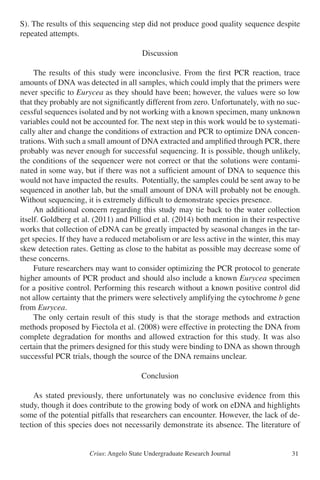
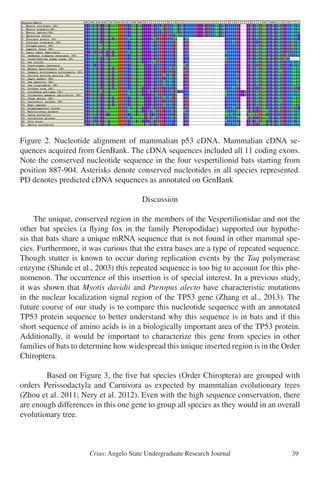
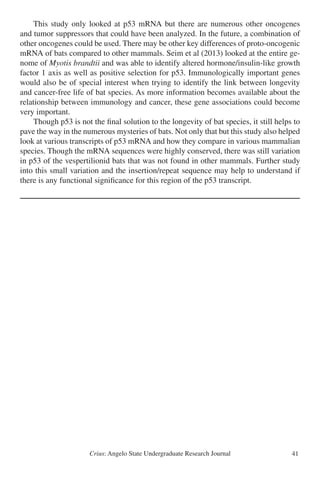
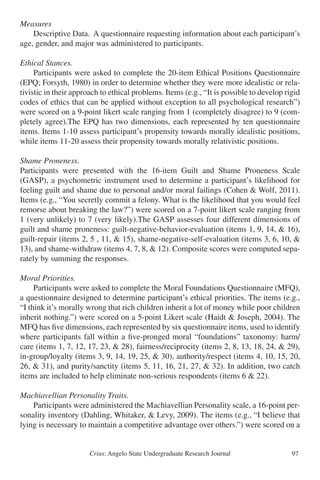
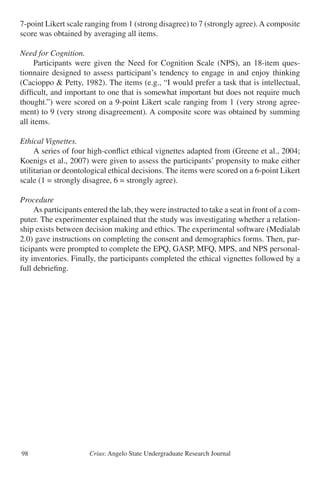
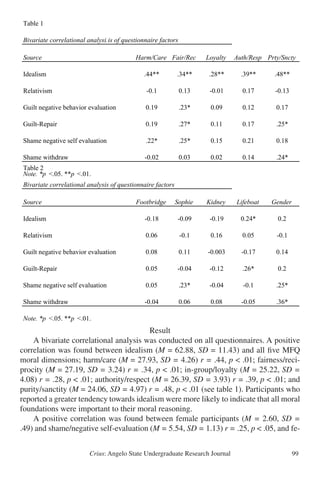
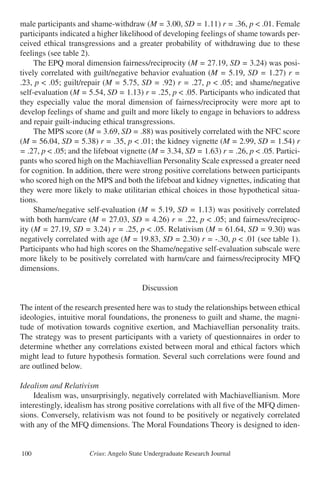
was also produced using the Neighbor-Joining methods in MEGA.
Crius: Angelo State Undergraduate Research Journal 37
Table 1. Scientific names, common names, and GenBank accession numbers of all
mammalian cDNA sequences for p53 used in the alignment and neighbor-joining tree
Results
	 Nine different primer pair combinations were used to optimize p53 mRNA ampli-
fication. The final primer pair used was forward 6 and reverse 6 (Figure 1). The PCR
protocol was optimized and ultimately helped minimize primer interactions. There are
still primer interactions as seen in all lanes with samples. The primer interaction clouds
are sized at approximately 100 bases. There were inconsistent PCR amplification re-
sults in which gel separation yielded smeared, multiple banding patterns. If there was
bright, prominent banding as in Figure 1, the fragment sizes observed by using the
MidRange Ladder were significantly less than that predicted for the primer pair. Be-
cause of this, sequencing was not attempted.
Crius: Angelo State Undergraduate Research Journal38
Figure 1. Electrophoretic separation of PCR products. A 1% agarose gel was run and
stained with ethidium bromide after RT PCR reactions for p53 using Forward 6 and
Reverse 6 primers. Contents of the lanes were FastRuler MidRange Ladder (Lanes 1
and 5), rtPCR product from ASK7445 heart tissue (Lane 2), from ASK7445 lung tissue
(Lane 3), from ASK10538 liver tissue (Lane 4), from ASK10538 heart tissue (Lane 6),
from ASK10538 lung tissue (Lane 7). Lane 8 is the negative control. Lanes 9 and 10
were empty.
	 The aligned cDNA was found to correspond to the 11 coding exons in the p53 gene
(Belyi et al., 2010), though some sequences are transcript variants (Tursinops trunca-
tus, Oricuns orca, Saimiri boliviensis boliviensis, Callithrix jacchus, Macaca fascicu-
laris, Papio anubis, Homo sapiens, Pan paniscus, and Pan troglodytes). With the gaps
included, there were a total of 1331 nucleotides aligned. Without gaps, there was an
average of 1169 nucleotides with a range of 1038-1242 nucleotides aligned. The over-
all similarity in the nucleotide alignment was about 80%. Note the conserved sequence
of nucleotides from position 887-904 in the vespertilionid bats (at the top of the align-
ment). This conserved region also contains a sequence (AGTCCCAAGCAGCCCCCT-
GGG) repeated twice (Figure 2). The mammalian p53 cDNA neighbor-joining tree
clusters all of the bat species together (Figure 3).
Crius: Angelo State Undergraduate Research Journal 39
Figure 2. Nucleotide alignment of mammalian p53 cDNA. Mammalian cDNA se-
quences acquired from GenBank. The cDNA sequences included all 11 coding exons.
Note the conserved nucleotide sequence in the four vespertilionid bats starting from
position 887-904. Asterisks denote conserved nucleotides in all species represented.
PD denotes predicted cDNA sequences as annotated on GenBank
Discussion
	 The unique, conserved region in the members of the Vespertilionidae and not the
other bat species (a flying fox in the family Pteropodidae) supported our hypothe-
sis that bats share a unique mRNA sequence that is not found in other mammal spe-
cies. Furthermore, it was curious that the extra bases are a type of repeated sequence.
Though stutter is known to occur during replication events by the Taq polymerase
enzyme (Shinde et al., 2003) this repeated sequence is too big to account for this phe-
nomenon. The occurrence of this insertion is of special interest. In a previous study,
it was shown that Myotis davidii and Pteropus alecto have characteristic mutations
in the nuclear localization signal region of the TP53 gene (Zhang et al., 2013). The
future course of our study is to compare this nucleotide sequence with an annotated
TP53 protein sequence to better understand why this sequence is in bats and if this
short sequence of amino acids is in a biologically important area of the TP53 protein.
Additionally, it would be important to characterize this gene from species in other
families of bats to determine how widespread this unique inserted region is in the Order
Chiroptera.
		 Based on Figure 3, the five bat species (Order Chiroptera) are grouped with
orders Perissodactyla and Carnivora as expected by mammalian evolutionary trees
(Zhou et al. 2011; Nery et al. 2012). Even with the high sequence conservation, there
are enough differences in this one gene to group all species as they would in an overall
evolutionary tree.
Crius: Angelo State Undergraduate Research Journal40
Figure 3. Neighbor-joining tree of mammalian p53 cDNA. A total of 1331 aligned
nucleotides from p53 transcripts (see Table 1 for GenBank accession numbers) were
used to construct this phenogram. PD denotes predicted cDNA sequences as annotated
on GenBank.
Crius: Angelo State Undergraduate Research Journal 41
	 This study only looked at p53 mRNA but there are numerous other oncogenes
and tumor suppressors that could have been analyzed. In the future, a combination of
other oncogenes could be used. There may be other key differences of proto-oncogenic
mRNA of bats compared to other mammals. Seim et al (2013) looked at the entire ge-
nome of Myotis brandtii and was able to identify altered hormone/insulin-like growth
factor 1 axis as well as positive selection for p53. Immunologically important genes
would also be of special interest when trying to identify the link between longevity
and cancer-free life of bat species. As more information becomes available about the
relationship between immunology and cancer, these gene associations could become
very important.
	 Though p53 is not the final solution to the longevity of bat species, it still helps to
pave the way in the numerous mysteries of bats. Not only that but this study also helped
look at various transcripts of p53 mRNA and how they compare in various mammalian
species. Though the mRNA sequences were highly conserved, there was still variation
in p53 of the vespertilionid bats that was not found in other mammals. Further study
into this small variation and the insertion/repeat sequence may help to understand if
there is any functional significance for this region of the p53 transcript.
Crius: Angelo State Undergraduate Research Journal42
References
Ammerman LK, Hice CL, Schmidly DJ (2012). Bats of Texas. Texas A&M University
	 Press, College Station.
Barclay RMR, Harder LD (2003). Life histories of bats: life in the slow lane. Pg 209-
	 253 in Bat ecology (T.H. Kunz and M.B. Fenton, eds.). University of Chicago
	 Press, Chicago.
Belyi VA, Ak P, Markert E, Wang H, Hu W, Puzio-Kuter A, Levine AJ (2010). The
	 orgins and evolution of the p53 family of genes. Cold Spring Harb Perspect Biol
	 2(6): 1-17.
Nery MF, Gonzalez DJ, Hoffman FG, Opazo JC (2012). Resolution of the Laurasiatherian
	 phylogeny: Evidence from genomic data. Molecular Phylogenetics and Evolution
	 64(3): 685-689.
Seim I, Fang X, Xiong Z, Lobanov AV, Huang Z, Ma S, Feng Y, Turanov AA, Zhu Y,
	 Lenz TL, Gerashchenko MV, Fan D, Yim SH, Yoa X, Jordan D, Xiong Y, Ma Y,
	 Lyapunov AN, Chen G, Kulakova OI, Sun Y, Lee S, Bronson RT, Moskalev AA,
	 Sunyaev SR, Zhang G, Krogh A, Wang J, Gladyshev VN (2013). Genome analysis
	 reveals insights into physiology and longevity of the Brandt’s bat Myotis brandtii.
	 Nature Communication 4:1-8.
Shinde D, Lai Y, Sun F, Arnheim N (2003). Taq DNA polymerase slippage mutation
	 rates measured by PCR and quasi-likelihood analysis: (CA/GT)n and (A/T)n mic
	 rosatellites. Nucleic Acids Res 31(3): 974-980.
Tamura K, Peterson D, Peterson N, Stecher G, Nei M, Kumar S (2011). MEGA5:
	 Molecular evolutionary genetics analysis using maximum likelihood, evolutionary
	 distance, and maximum parsimony methods. Molecular Biology and Evolution 28:
	 2731-2739.
Untergrasser A, Cutcutache I, Koressaar T, Ye J, Faircloth BC, Remm M, Rozen SG
	 (2012). Primer3 - new capabilities and interfaces. Nucleic Acids Research
	 40(15):e115.
Vogelstein B, Sur, S Prives C (2010). p53: the most frequently altered gene in
	 human cancers. Nature Education (9): 6.
Zhang G, Cowled C, Shi Z, Huang Z, Bishop-Lilly KA, Fang X, Wynne JW, Xiong
	 Z, Baker ML, Zhoa W, Techedijian M, Zhu Y, Zhou P, Jiang X, Ng J, Yang L, Wu
	 L, Xiao J, Feng Y, Chen Y, Sun X, Zhang Y, March GA, Crameri G, Broder CC,
	 Frey KG, Wang L, Wang J (2013). Comparative analysis of bat genomes provides
	 insight into the evolution of flight and immunity. Science 339(6118): 456-460.
Zhou X, Xu S, Xu J, Chen B, Zhou K,Yang G (2011). Phylogenomic analysis resolves
	 the interordinal relationship and rapid diversification of the Laurasiatherian
	 mammals. Systematic Biology 61(1):150-164.
Crius: Angelo State Undergraduate Research Journal 43
Acknowledgements
	 We would like to thank theAngelo State University Center for Innovation in Teach-
ing and Research as well as the National Beta Beta Beta Biology Honor Society for
funding of this project.
Crius: Angelo State Undergraduate Research Journal44
Crius: Angelo State Undergraduate Research Journal 45
Using DNA Barcoding to Identify Seeds in Fecal Samples of Fruit Eating Bats
Aimee N. Denham and Loren K. Ammerman, PhD
Abstract
	 DNA barcoding identifies DNA sequences in an organism’s genome that are spe-
cific to one particular species, and it is a useful method to determine an organism’s
taxonomic classification. DNA extracted from seeds can potentially be used to amplify
specific barcoding genes. These genes can be amplified using polymerase chain reac-
tion (PCR) and their identity can be determined by comparison to a database. I pro-
posed to develop a protocol for identifying specific seeds from fecal samples of fruit
eating bats using barcoding genes. This information is important for describing the
role of frugivorous bats in rainforest regeneration as a result of seed dispersal within
fecal matter. The objective of this research was to see if plant DNA barcodes could
be used to identify seeds in the fecal samples of fruit eating bats. DNA was extracted
from seeds of three genera of plants (Ficus, Piper, and Cecropia). PCR amplification
revealed strong banding in the rbcLa primer sequence region for Ficus and weak band-
ing for both Piper and Cecropia. The protocol for PCR amplification will need to be
refined further before comparisons can be made to sequence databases.
*****
Introduction
	I
solation of DNA from seeds found in bat fecal samples can be used to deter-
mine the taxonomic classification of the fruits they consume by examining
specific barcoding regions. This type of research is important for describing
the role of frugivourous bats in rainforest regeneration as a result of seed dispersal by
fecal matter. The process of DNA barcoding involves sequencing one or a few standard
loci which will result in a comparable set of data that can allow species to be distin-
guished from one another (Hollingsworth et al., 2011). Fortunately, a large database of
neotropical plant barcodes exist (Barcode of Life database; Ratnasingham and Hebert,
2007) for comparisons to be made. Plants, similar to many different organisms, exhibit
a very low rate of genetic diversity in their genome. Due to the low rate of nucleotide
substitution within the plant genome, the analysis of multilocus DNA barcodes has
been used successfully to identify plants (Kress et al., 2009). Furthermore, DNA bar-
codes have been used to identify insect fragments in feces of insectivorous bats (Zeale
et al., 2011) to learn more about their diets. By examining multiple barcoding regions
within the seed samples collected from the bat fecal matter, several areas within the
diverse genome of the seeds can be used to determine the species level identification
of the samples. In a study conducted by Hollingsworth et al., (2011) it was found that
Crius: Angelo State Undergraduate Research Journal46
the rbcLa and matK regions are two of the core barcoding regions that have the high-
est recovery and discriminatory power within the plant genome. Therefore, multiple
barcoding regions including rbcLa and matK should be able to be used to determine
species level identification of seed samples found in bat fecal samples.
	 The objective of this research was to develop a protocol to generate plant DNA
barcodes to identify seeds in the fecal samples of fruit eating bats. After reviewing
literature on what is currently known about the classification of plants using barcoding
regions, I hypothesized that seeds collected from fruit eating bat fecal samples could
be analyzed using specific DNA barcoding regions in order to determine the taxonomic
identification of the seed samples. With success in determining the classification of the
seed samples, many other research opportunities could be pursued. For example, this
method could serve as a tool for determining dietary preferences of various bat species
and seed dispersal patterns in different geographic regions or at different times of the
year.
Methods
	 DNA was extracted from the selected seed samples (Ficus seeds from a fresh fig,
Piper and Cecropia seeds from bat fecal samples stored dry) and fresh baby spinach
leaves (Spinacia oleracea) using the Qiagen DNeasy Plant Mini Kit (Qiagen Inc., Va-
lencia, CA) following the manufacturer’s protocol. Spinach leaves were used as a posi-
tive control. Seeds were ground into a powder using liquid nitrogen and a mortar and
pestle for the initial step and spinach was ground in a mortar and pestle with the initial
400µl of Buffer AP1 found in the kit. DNA concentration levels were determined using
a Qubit Fluorometer (Life Technologies, Grand Island, NY) following the manufactur-
er’s protocol for dsDNA BR Assay Kit and the dsDNA HS Assay Kit. Short regions of
the barcoding genes rbcLa (554 base pairs) and matK (850 base pairs) were amplified
using polymerase chain reaction (PCR) following the protocol outlined by Kress et al.
(2009). We used the following primer pairs referenced by Kress et al. (2009):
For the rbcLa gene: SI_For 5’ATGTCACCACAAACAGAGACTAAAGC3’
SI_Rev 5’GTAAAATCAAGTCCACCRCG3’.
For the matK gene we used: KIM3F 5’CGTACAGTACTTTTGTGTTTACGAG3’
KIM1R 5’ACCCAGTCCATCTGGAAATCTTGGTTC3’.
	 PCR cycling began with an initial denaturation step at 95°C for three minutes.
The cycling series was cycled 33 times and consisted of denaturation at 94°C for 30
seconds, annealing at 55°C for 30 seconds, and elongation at 72°C for one minute. The
final elongation was at 72°C for 10 minutes. Negative controls containing sterile water
in place of template DNA were included in each experiment.
	 An aliquot from each PCR reaction was separated on a 1% sodium borate agarose
gel containing ethidium bromide and photographed on a UV transilluminator using
UVP DigiDocIT software. Mid-range DNA ladder (5µl, Fermentas ThermoScientific)
was used to estimate size of the PCR products. The electrophoresis was run for 15 min-
Crius: Angelo State Undergraduate Research Journal 47
utes at 150V for all trials. Successful PCR products were sequenced using GenomeLab
DTCS-Quick Start Mix in a Beckman Coulter CEQ8000 automated sequencer follow-
ing the manufacturer’s protocol. DNA sequences were intended to be compared to the
Barcode of Life Database for taxonomic classification (www.barcodeoflife.org).
Results
	 Ficus seed DNA was successfully extracted with a Qubit reading of 2.47 ng/µl.
The barcoding genes matK and rbcLa were then amplified resulting in a strong band
for rbcLa at around 550 base pairs and no band for matK (Figure 1). The strong rbcLa
banding region from the Ficus sample was used as a positive control throughout the
experiment.
Figure 1. Electrophoresis analysis of the Ficus seed sample. Lane 1 is the mid-range
DNA ladder, Lane 2 contains the barcoding gene rbcLa and lane 4 contains the barcod-
ing gene matK. Lane 4 and 5 were negative controls for rbcLa and matK. Sizes are
in nucleotides.
	 DNA extracted from putative Piper and Cecropia seed samples was amplified to
examine the barcoding genes following the same protocol used for the known Ficus
sample. The Ficus DNA template at amounts of 4µl, 8µl, and 12µl all showed strong
product for rbcLa at around 550 base pairs and no product for matK at any DNA con-
centration level examined. Piper DNA template at amounts of 4µl and 12µl revealed
faint banding for rbcLa at around 550 base pairs and no band for matK. The Cecropia
reaction using 12µl revealed faint banding for rbcLa at around 550 base pairs and no
banding for matK at any DNA concentration level (Figure 2). The samples with PCR
product were further amplified by an additional PCR reaction which resulted in faint
banding for most samples, but there was a high level of smearing. In an effort to re-
duce the smeared banding pattern, the samples were run at two different PCR condi-
tions where the annealing temperature was reduced from 55°C to 50°C for one set of
Crius: Angelo State Undergraduate Research Journal48
samples and the number of PCR cycles was reduced from 33 cycles to 25 cycles for the
second set of samples. The Ficus samples were the only samples that showed strong
banding for rbcLa at around 550 base pairs (data not shown).
Figure 2. Electrophoresis analysis of rbcLa from Ficus (lane 3,7, and 15), Piper (lane
5 and 13), and Cecropia (lane 14). Lane 2, 4, 8, 12 and 16 were negative controls and
lane 1 and 11 contain the mid-range DNA ladder. Sizes are in nucleotides.
Table 1. Concentration of DNA in PCR product (rbcLa) identified by Qubit analysis.
Crius: Angelo State Undergraduate Research Journal 49
	 The samples with the strongest banding patterns shown throughout the experi-
ments were analyzed for DNA levels by Qubit analysis (Table 1). The samples with
the highest detectable DNA levels were used for sequencing. After Qubit analysis, four
samples were chosen to be used for sequencing. The sequencing protocol was not suc-
cessful, so comparisons to the Barcode of Life Database could not occur.
Spinach leaves were used as a control in order to determine if the barcoding gene matK
could be amplified. Electrophoresis analysis of the spinach sample revealed strong
banding for rbcLa at around 550 base pairs and positive banding matK at around 850
base pairs (Figure 3). The positive samples were not sequenced due to the low concen-
tration of DNA present after Qubit analysis.
Figure 3. Electrophoresis analysis of spinach samples. Lanes 3 and 4 contain positive
banding for barcoding gene rbcLa. Lanes 6 and 7 contain positive banding for the
barcoding gene matK. Negative controls are in lanes 2 and 5 and lane 1 contains the
mid-range DNA ladder. Sizes are in nucleotides.
Discussion
	 The DNA extraction protocol using the Qiagen DNeasy Plant Mini Kit was suc-
cessful due to the quantifiable amounts of DNA present after Qubit analysis for each
seed type. The specific barcoding gene rbcLa was successfully amplified through PCR
following the outlined protocol by Kress et al. (2009). The barcoding gene matK was
never amplified from seeds despite numerous changes in annealing temperature, num-
ber of cycles, and annealing time throughout multiple trials.
Crius: Angelo State Undergraduate Research Journal50
	 Although the DNA extraction protocol was shown to work, strong banding patterns
were not associated with the seeds collected from the bat fecal samples. This could be
due to the low amount of starting material present since there was a large amount of
Ficus seeds present and a lower amount of seeds that were collected from the bat fecal
matter. Another possibility is that the fecal samples were originally stored in 95% etha-
nol before being allowed to dry. The ethanol treatment may have affected the success
of the DNA extraction protocol. In future studies, higher amounts of starting material
may provide higher quantities of DNA present which could result in samples that could
be sequenced to determine species level classification. The barcoding gene matK was
never amplified during the research process with the seed samples despite multiple
efforts in changing several steps in the PCR protocol. However, DNA extracted from
spinach leaves resulted in positive banding for both rbcLa and matK that indicate that
the primers used are successful in producing positive amplifiable product. Future test-
ing needs to be done to determine the reason why this is occurring in the seed samples
and to see if additional changes can be made to the protocol. Although there were high
enough concentrations of DNA present in several samples, the sequencing resulted in
inconclusive data.
References
Hollingsworth, P. M., Grahm, S. W., and Little, D. P. (2011) Choosing and using a plant
	 DNA barcode. PLos ONE, 6(5): e19254. doi:10.1371/journal.pone.0019254
Kress, W., Erickson, D. L., Jones, F., Swenson, N. G., Perez, R., Sanjur, O., and
	 Bermingham, E. (2009). Plant DNA barcodes and a community phylogeny of a
	 tropical forest dynamics plot in Panama. Proceedings of the National Academy of
	 Sciences, 106 (44): 18621-18626.
Ratnasingham, S. and Hebert, P. D. N. (2007). BOLD: The Barcode of Life Data
	 System (www.barcodinglife.org). Molecular Ecology Notes 7: 355-364.
Zeale, M. K., Butlin, R. K., Barker, G. A., Lees, D. C., and Jones, G. (2011). Taxon-
	 specific PCR for DNA barcoding arthropod prey in bat feces. Molecular Ecology
	 Resources, 11(2): 236-244.
Crius: Angelo State Undergraduate Research Journal 51
A re-examination of the fossil land snail Lysinoe breedlovei (Gastropoda: Pulmo-
nata) from west Texas using X-Ray Computed Tomography
Mary Jones and Ned Strenth, PhD
Abstract
	 This study examined fossil land snail specimens of Lysinoe breedlovei using High
Resolution X-Ray Computed Tomography. Specimens of the type series of Lysinoe
breedlovei from the Colmena Tuff (Vieja Group) at the mouth of Capote Creek, Presi-
dio County, Texas were analyzed. Analysis compared these fossils to recently collected
material from the Devil’s Graveyard Formation of Brewster County as well as a single
specimen from the Middle Oligocene sandstone of Nuevo Leon, Mexico. Results based
on multi-variate analysis support removal of the paratypic specimen TMM 40276-32,
the “Helix” sp. [sic] specimen from Nuevo Leon, as well as the recently collected
specimens from the Devil’s Graveyard from their current status within Lysinoe breed-
lovei. Pending further investigation, these specimens should be returned to their origi-
nal taxonomic assignments. 	
*****
	R
eports of large helicoid gastropod fossils from West Texas date back to the
1930s. Upon their initial discovery, most specimens were assigned to exist-
ing species from other regions of western North America. The first known
published record of fossil land snails in west Texas appears to be that of Henderson
(1935). He noted the presence of material from the O-2 Ranch, south of Alpine, which
he assigned to Helix? hesperarche [sic], an existing species described from the Eo-
cene of New Mexico by Cockerell (1914). Both Henderson and Cockerell (Henderson
1935) supported the similarity in morphology and matrix of the Texas material to that
of the type specimen of Helix hesperarche. However, Henderson (1935) addressed the
questionable assignment of the specimens as he stated that the group is “almost cer-
tainly not a true Helix” (1935: 134). J.A. Wilson et al. (1968) and Stevens et al. (1969)
noted and collected numerous fossil gastropods during early paleontological studies
in the Vieja Group of the Trans-Pecos region. Work by Pampe (1974) represents the
first major attempt at an overall coverage of the invertebrate fossil fauna of the Trans-
Pecos region of west Texas. Pampe (1974) examined and assigned those specimens
collected by Wilson to the existing species Helix leidyi, from the Eocene of Nebraska,
and Oreohelix grangeri from the Eocene of Wyoming. Roth (1984) then re-assigned
the material of Helix leidyi and Oreohelix grangeri as paratypes to his new species Ly-
sinoe breedlovei. He also referred material from additional collections from the Texas
Memorial Museum holdings as well as the Helix hesperarche material from the O-2
Crius: Angelo State Undergraduate Research Journal52
Ranch and material assigned to Helix sp. from Nuevo Leon, Mexico (Gardner 1945).
	 Following a preliminary investigation, it appears apparent that there are multiple
different morphological types within this group. Definitive species identification for
this series of gastropods is complicated as many of the specimens are damaged. One
specific challenge is the absence of an aperture and outer lip of the shell. Typically,
the shape of the aperture plays an important role in identifying gastropods. Without
the aperture, comparisons are restricted to external measurements such as diameter
and height. This study will utilize the capabilities of using High Resolution X-Ray
Computed Tomography (HRXCT) to analyze the internal morphology. If there are
unique internal characteristics that can be viewed using CT scanning, they may present
additional measurement parameters and offer a new method of comparison for these
specimens. The specimens of this study are large internal casts (endocasts, steinkerns),
in which the shell has been filled with matrix and most of the shell material has recrys-
tallized, although in most of the specimens the external shell has been broken off and
lost. If there is any shell material inside it will be visible on the CT images due to the
difference in densities between the recrystallized shell and the sediment matrix (Carl-
son et al 2003).
Methods & Materials
	 Fossils examined in this study were obtained on loan from museums and then were
analyzed using traditional measurements as well as HRXCT scanning. Specimens were
obtained from the United States Natural History Museum (USNM) and from the Ver-
tebrate Paleontology Lab of the Texas Memorial Museum at the University of Texas at
Austin (TMM). For traditional external measurements, an electronic caliper was used
and measurements taken to the hundredth of a millimeter. Following external analysis,
select specimens were scanned using the ACTIS ultra-high resolution subsystem at the
University of Texas CT scanning lab in Austin (Table 1). The scanning process results
in a series of image “slices” or thin cross sections of the specimen, in this case approxi-
mately 0.1331 mm thick. The images were then compiled and imported as a stack in
the computer software program Image J. Image J allows one to set the scale and then
take measurements directly from the scans. Measurements from the scanned images
included height, diameter, diameter to height ratio, angle of penultimate whorl, width
of last whorl, umbilicus diameter, and ratio of umbilicus diameter to total diameter.
Three-dimensional images were rendered using the 3-D viewer plugin of Image J.
Crius: Angelo State Undergraduate Research Journal 53
Table 1. Specimens examined by High Resolution X-Ray Computed Tomography
(HRXCT). Note: TMM 40276-31 = TMM 40276-18A & TMM 40276-32 = TMM
40276-18B (Pampe 1974 & Roth 1984). 1
Specimens from the type locality: Capote
Creek, 2
specimens from the Devil’s Graveyard Formation, 3
specimens from Nuevo
Leon, Mexico. (TMM: Texas Memorial Museum, USNM: United States National Mu-
seum of Natural History.)
	 Examination of the fossils using CT scanning confirmed that recrystallized shell
material was still intact and visible within the specimens. The internal columella shows
enough contrast from the surrounding matrix to be distinguishable. This internal view
allowed for extensive measurements to be taken for statistical analysis.
Results & Discussion
	 To better understand the degree of variation present within the species Lysinoe
breedlovei, comparisons were made within the type series, between the type series and
a referred specimen, and between the type series and recently collected unexamined
material (Kirk 2008). The first comparison was an analysis of the variation within the
five specimens of the type series. Measurements for seven characteristics were taken
directly from the CT scans using Image J and were analyzed using a principle com-
ponents analysis. This was used to determine the similarities between each specimen
of the type series (Figure 1). The greater relative distance between TMM 40276-32
and the four other specimens of the type series indicates that paratype TMM 40276-
32 does not share close similarities among the seven characteristics examined in this
analysis. However, upon physical examination, it appears that the specimen may have
been distorted (see Pampe 1974: 293). Therefore, it appears prudent to remove it from
any additional analysis in order to more closely view the variation due to morphologi-
cal differences instead of variation due to this distortion. A multivariate comparison of
TMM 40276-32 with the type specimen of Oreohelix grangeri from Wyoming would
also appear warranted.
Museum Specimens Examined by HRXCT
TMM 40276-16 (holotype)1
TMM 40276-32 (paratype) 1
TMM 40276-28 (paratype) 1
TMM 41672-406 (sub-locality 8)2
TMM 40276-29 (paratype) 1
TMM 41672-406 (sub-locality 1)2
TMM 40276-31 (paratype) 1
USNM 497132 (Helix sp.)3
ble 1.
Crius: Angelo State Undergraduate Research Journal54
Figure 1. Scaled principle components analysis of similarities within the type series of
Lysinoe breedlovei. 16 (TMM 40276-16), holotype; 28 (TMM 40276-28), 29 (TMM
40276-29, 31 (TMM 40276-31), 32 (TMM 40276-32), paratypes. (H: height, D: diam-
eter, D.H: diameter to height ratio, A.A: angle of penultimate whorl, A.W: width of last
whorl, uD: umbilicus diameter, uD.D: ratio of umbilicus diameter to total diameter.)
	 The second analysis compares the type series, with the exception of TMM 40276-
32, to the referred specimen, Helix sp. from Neuvo Leon, Mexico. The same seven
measurements were taken for this specimen using Image J directly from the CT scans.
Measurements were analyzed using the same technique as those from analysis of the
type series. Figure 2 reveals that the Helix sp. specimen (USNM 497132) falls sep-
arately from the remaining specimens of the type series (with removal of paratype
40276-32). This suggests that similarities within the type series are greater than those
between all specimens. Therefore, results support the removal of USNM 497132 from
its referred status and the return to Helix sp. as designated by Gardner (1945) until
further comparison can be made to other fossil species of Helix.
igure 1.
Crius: Angelo State Undergraduate Research Journal 55
Figure 2. Scaled principle components analysis of the similarities between the type
series of Lysinoe breedlovei and Helix sp. 16 (TMM 40276-16), holotype; 28 (TMM
40276-28), 29 (TMM 40276-29, 31 (TMM 40276-31), paratypes; USNM (USNM
497132, Helix sp.), referred. (H: height, D: diameter, D.H: diameter to height ratio,
A.A: angle of penultimate whorl, A.W: width of last whorl, uD: umbilicus diameter,
uD.D: ratio of umbilicus diameter to total diameter.)
	 The next analysis compares the type specimens to a recently collected series of
fossils from the Devil’s Graveyard Formation (DGF). The means of height to diameter
ratios for the DGF (n=37) and (n=4) were tested using a randomization test (to account
for the large sample size discrepancy) and were found to be significantly different
(p<0.008). Figure 3 depicts an ordination plot that separates the specimens based on
their similarity in height to diameter ratio. This figure would appear to support the
premise that although the type material falls on the outer margin of the DGF specimens
and there is a difference in means of the height to diameter ratio, there exists a close
relationship. It should be noted that an increased sample size from the type locality
could produce greater overlap.
Figure 2.
Crius: Angelo State Undergraduate Research Journal56
Figure 3. Ordination plot displaying the similarities between the type series of Lysinoe
breedlovei (without TMM 40276-32) and specimens of the DGF using physical mea-
surements of the height to diameter ratio. Black represents the DGF specimens, red
represents the type specimens.
	 A final comparison uses the CT scans from all members of the type series, Helix
sp., and the two specimens of the DGF. A permutational multivariate analysis of vari-
ance was run using the statistical program R. This seven parameter analysis compared
71.6% of the variation and supports the separation of the specimens into four distinct
grouping highlighted by the circles in Figure 4 (ADONIS, F4,2
=5.043, p<0.01). The re-
sults of this analysis supports the removal of paratype TMM 40276-32 from the assign-
ment proposed by Roth (1984) and the removal of Helix sp. from its referred status.
Figure 3.
Crius: Angelo State Undergraduate Research Journal 57
Figure 4. Scaled principle components analysis of the similarities between the type
series of Lysinoe breedlovei (16, 28, 29, 31), Helix sp. (USNM), and specimens from
the Devil’s Graveyard (DGFa, DGFb). 16 (TMM 40276-16), holotype; 28 (TMM
40276-28), 29 (TMM 40276-29, 31 (TMM 40276-31), 32 (TMM 40276-32), para-
types; USNM (USNM 497132), referred; DGFa, (TMM 41672-406 sub-locality 8),
DGFb (TMM 41672-406 sub-locality 1). (H: height, D: diameter, D.H: diameter to
height ratio, A.A: angle of penultimate whorl, A.W: width of last whorl, uD: umbilicus
diameter, uD.D: ratio of umbilicus diameter to total diameter.)
Conclusions
	 The statistical analyses support the following conclusions. The paratypic series
should be reduced from the current five specimens to four with the removal of TMM
40276-32. The specimen should be re-assigned back to Oreohelix grangeri pending
a multivariate analytical comparison with the original type specimen. The Helix sp.
specimen should be removed from its referred status. Also, the Devil’s Graveyard ma-
terial should be removed from the referred status pending a more complete analysis
of additional specimens from the region, including the material from the O2 Ranch.
A comparison of shell characteristics of extant species of Lysinoe would appear war-
ranted based on the wide degree of variation observed in this study.
Figure 4.
Crius: Angelo State Undergraduate Research Journal58
Discussions
	 To continue comparison of Lysinoe breedlovei, specimens from all referred lo-
calities should be analyzed. Based on the results of this study, it would be appropriate
to use external measurements for further investigation. X-ray scanning could also be
investigated as an alternative to CT scanning. Although the X-Ray images would not
provide the three dimensional analytical capabilities, they could provide an internal
view and image that would facilitate more measurements and a more extensive analysis
than external measurements alone.
	 The extant members of the genus Lysinoe currently range from the Mexican state
of Chiapas, Guatemala, Honduras, and El Salvador of Central America (Thompson
2011). Future study should include examination of the range of variation that exists
within and between each extant species. Comparing this to the amount of variation
found in the fossils examined will help determine the significance of the variation
found in this study. It would also be relevant to investigate the importance of the ap-
erture in comparing each shell. Determining how heavily the aperture measurements
weigh for comparison of the extant shells will reveal how the grouping of the fossil
specimens is affected since they do not have any fully intact apertures. Using CT scan-
ning on the extant shells can also reveal if there is any significant differences in the
internal morphology between each species of Lysinoe.
Acknowledgements
	 The authors wish to extend gratitude to all who contributed to this project: Dr.
Negovetich for statistical guidance, Drs. Satterfield and Ward for geological expertise.
Mr. Rigel Rilling, Mrs. Barbara Strenth, and Mr. Chris Montag for much appreciated
assistance. Dr. Kirk at the Vertebrate Paleontology Lab (UT Austin) and Midwestern
State for access to fossil specimens. Dr. Jessie Maisano, Dr. Matt Colbert, and Ms. Ju-
lia Holland at the X-ray CT scanning facility at UT Austin for all of the scanning and
images. Many thanks also to the Head of the River Ranch Research Grant, Tri-Beta
Research Grant, and the Center for Innovation in Teaching and Research for funding
the CT scanning.
Literature Cited
Carlson, W. D., Rowe, T., Ketcham, R. A., and M. W Colbert. 2003. Applications of
	 high-resolution X-ray computed tomography in petrology, meteoritics, and
	 palaeontology. Pages 7-22 in F. Mees, R. Swennen, M. Van Geet, and P. Jacobs,
	 eds. Applications of X-ray computed tomography in the geosciences. Geological
	 Society, London, Special Publications. 215 pp.
Crius: Angelo State Undergraduate Research Journal 59
Cockerell, T.D.A 1914. Tertiary Mollusca from New Mexico and Wyoming. Amer.
	 Mus. Nat. Hist. Bull., v. 33(6), p. 101-107.
Gardner, J. 1945. Mollusca of the Tertiary formations of northeastern Mexico.
	 Geological Society of America Memoir 11. 267 pp.
Henderson, J. 1935. Fossil non-marine Mollusca of North America. Geol. Soc. Amer.
	 Spec. Pap. 3. 313 pp.
Pampe, W.R. 1974. A preliminary survey of fresh-water early Tertiary invertebrates
	 from Trans-Pecos Texas. Trans. Gulf Coast Assoc. Geol. Soc. 24:291-302.
Roth, B. 1984. Lysinoe (Gastropoda: Pulmonata) and other land snails from Eocene-
	 Oligocene of Trans-Pecos Texas, and their paleoclimatic significance. The
	 Veliger 27 (2):200-218.
Stevens, M.S., J.B. Stevens, and M.R. Dawson. 1969. New early Miocene formation
	 and vertebrate local fauna, Big Bend National Park, Brewster County, Texas: The
	 Pearce-Sellards Series, Texas Memorial Mus., No.15, 53 p.
Thompson, F. G. 2011. An annotated checklist and bibliography of the land and
	 freshwater snails of Mexico and Central America. Florida Museum of Natural
	 History, University of Florida 50(1): 243 pp.
Williams, B. & Kirk, E. 2008. New Uintan primates from Texas and their implications
	 for North American patterns of species richness during the Eocene. Journal of
	 Human Evolution 55: 927-954.
Wilson, J., Twiss, P., DeFord, R., and Clabaugh, S., 1968.Stratigraphic succession,
	 potassium-argon dates, and vertebrate faunas, Vieja Group, Rim Rock country,
	 Trans-Pecos, Texas. American Journal Science 266:590-604.
Crius: Angelo State Undergraduate Research Journal60
Crius: Angelo State Undergraduate Research Journal 61
Creating a Poker Playing Program Using Evolutionary Computation
Simon Olsen and Rob LeGrand, PhD
Abstract
	 Artificial intelligence is a rapidly expanding technology. We are surrounded by
technology that uses AI and areas of application are spreading. We use AI for direc-
tions (GPS), in search engines, computer translation between languages, non-playable
characters in video games, and much more.
	 In 2001 Dr. David Fogel published impressive results by combining artificial neu-
ral networks with genetic algorithms to create a checkers playing program. We have
applied the same approach to poker. The idea is to use artificial neural networks to
compute bets, and then use genetic algorithms to search for the optimal artificial neural
network setting. The genetic algorithm will, through simulated evolution, generate bet-
ter versions of the poker program by playing against itself.
	 After evolving, the agents evaluated their performance by matching them against
other poker programs and human players. These agents will be evolved without do-
main knowledge (human knowledge) about poker, and, while evaluating them, the
main focus is to see what the computer was able to learn about poker.
	 Poker proved to be a difficult challenge for this approach, and currently there has
not been evolved a really strong agent. However, the results do provide some pointers
on what steps to take for future work, and I am certain that this approach could produce
really interesting results given some more time.
*****
Introduction
	A
rtificial intelligence (AI) is no longer exclusive to high-tech labs and sci-
ence fiction movies. AI is a rapidly expanding technology and there are a
lot of practical applications of AI in our world today, such as a GPS pro-
viding directions, computer translation between languages, characters in a video game,
and search engines. We have just scratched the surface of AI and more research in this
field is essential.
	 Artificial neural networks can be used to compute values based on inputs, and
genetic algorithms are useful to search for optimal solutions. Combining artificial neu-
ral networks and genetic algorithms have provided exceptional results for a checkers-
playing AI and we wanted to see if the same approach could be applied to poker. The
plan was to see whether we could evolve a good poker-playing agent without the use
of domain knowledge. While creating poker-playing agents might seem trivial by it-
Crius: Angelo State Undergraduate Research Journal62
self, development in this approach of AI might lead to computers that are able to find
answers to problems that human experts have not been able to solve.
Literature Review
	 There are several definitions of AI. One of the early challenges in AI was the Tur-
ing test. In this test, a human would communicate with a computer, and the computer
would respond. If the human could not tell if the response came from another human
or from a computer, the AI would be successful. In other words, if a computer was able
to imitate a human, it would be considered intelligent (Warwick, 1991). This approach
to AI assumes we can make a computer act (and perhaps think) humanly. However,
many people have tried to solve the Turing test without any great success. It turns out
a computer’s “brain” works very different than a human brain. A more modern ap-
proach to AI is to make a computer act rationally. Some scientists have defined this as
“[a] rational agent is one that acts so as to achieve the best outcome or, when there is
uncertainty, the best expected outcome” (Russell & Norvig, 2010, p. 4).
	 One of the most challenging and intriguing problems in artificial intelligence is
machine learning. How can we make a computer learn from previous iterations of
solving a task? It was not long ago that computers could not learn how to perform a
task by examples. Instead of learning from past mistakes, experts where required to
tell the computer how to act in every possible scenario of the task. Strides in machine
learning have made it possible for computers to solve complicated tasks without long
and exhausting pieces of hand-code (Anderson, 1986). One very interesting method to
achieve machine learning is combining genetic algorithms with artificial neural net-
works.
	 Artificial neural networks are inspired by the biological nervous system found in
a brain. They compute a value by feeding inputs through a system of connected per-
ceptrons (artificial neurons). Each input is multiplied with a connected weight before
they are added together and passed through a sigmoid function. The output of this sig-
moid perceptron is used as input for neurons in the next layer of the network (Azadeh,
Negahban & Moghaddam, 2012).
Crius: Angelo State Undergraduate Research Journal 63
Figure 1: A sample layout of an artificial neural network
	 A computer can use a genetic algorithm to search for the optimal solution to a task.
This is an evolutionary search algorithm and takes use of concepts such as reproduc-
tion (crossover) and mutation (Ozcelik, 2012). A set of artificial genes decides how
the computer solves a given task. A computer searches for the optimal gene set by
generating several random sets and, after evaluating how well each set performed, the
computer discards the weakest genes and uses the strong genes for reproduction. Some
mutation on genes is common as it allows for a broader search.
	 One of the leading computer scientists working with machine learning, and espe-
cially by using artificial neural networks and genetic algorithms, is Dr. David B. Fogel.
When IBM’s Deep Blue beat the world champion Garry Kasparov in chess, Dr. Fogel
heard the news on the radio. The radio host proclaimed this as the moment when com-
puters where officially more intelligent chess players than humans. While Dr. Fogel
was impressed by the feat accomplished by the IBM team, he did not agree with the
radio host. For him, Deep Blue was more like a really fast and expensive calculator
than an actually smart computer. IBM spent millions of dollars building a computer
with hardware fast enough to look at over 200 million positions a second and, based
on human knowledge about chess, Deep Blue could decide which of these positions
were desirable or not. Dr. Fogel wanted to design a program able to play at a really high
level but without this human knowledge about the game. He started a research project
called Blondie24. Blondie24 is an expert checkers player and is self-taught. Through
Figure 1
Crius: Angelo State Undergraduate Research Journal64
evolution, Blondie24 obtained a rating of 2048, which is better than 99% of the playing
population of the web site Blondie24 played on (Fogel, 2001).
	 A big difference between previous poker agents and the approach that we have
used is the exclusion of domain knowledge. Previous AI research in poker has focused
on making computers play as optimally as possible. A research group at the University
of Alberta has developed a poker program named Polaris that is already able to beat
top human players in limit Texas hold ’em (Fleming, 2008). The focus on optimization
and triumph over humans is much like what IBM did with Deep Blue and chess. My
approach focuses on figuring out what a computer is capable of learning by itself, very
similar to what Dr. Fogel did with Blondie24. However, because of random factors
and probability, poker is a much more complicated game to solve for a computer than
checkers.
Methods
	 There were three components necessary for this research. The first essential piece
was the poker environment where the agents could play against each other. Here the
agents played Texas hold ‘em, no-limit, multiplayer poker. Each agent started out with
$1,000 and the game continued until one agent controlled all the money. The number
of agents at each table could vary. Since only one agent had any money left when the
game was over, the agents were ranked on how long they were able to stay in the game.
At the start of each round, each agent was dealt two cards that only they could see.
There are also five community cards that any agent could use in combination with his
two cards to create the best possible five card combination. There were four rounds of
betting: the first round after the two private cards have been dealt, the second after three
community cards have been revealed, the third round of betting after the fourth com-
munity card has been revealed, and finally the last after the fifth and final community
card.
	 Artificial neural networks were used to make the agents’ decisions while play-
ing poker. Information about the poker game (cards, money, amount of players in the
hand, etc.) is used as inputs for the first layer of neurons in the network. Each input is
multiplied with a connected weight before they are added together and passed through
a sigmoid function ( ). The output of this sigmoid perceptron, which is always
between 0 and 1, is being used as input for neurons in the next layer. When the inputs
have been fed all the way through, the value computed by the network will be how
much the agent is willing to bet. Ultimately, it is the different weights in the neural
network that determine how the agent is going to play.
	 The genetic algorithm allows agents to evolve and become better poker players
over time. Each agent was created with a random set of genes (in our case the weights
in the neural network). Through playing poker, we discovered, stored, and reproduced
strong genes, and discarded the weak genes. The reproduction consisted of taking
1
----------
1 + e-x
Crius: Angelo State Undergraduate Research Journal 65
genes from two strong agents, and combining them to create a new agent, while the
weak agents were discarded. To broaden the search for strong genes, there was also a
slight chance for gene mutation. The reproduction of genes and the games were local.
100 players (10×10 grid) all got their turn to host a game. They invited their neighbors
to play, and during evolution genes were only spread to neighboring agents.
Figure 2: Layout for the population of agents
	 Different sizes and shapes of artificial neural network determine what an agent is
capable of learning. Bigger networks allow more complex agents to emerge but also
take more time to evolve. Several different neural networks were tested against each
other to see which one produced the best agents within a set time-frame. The agents
were then studied against human opponents to better recognize what the agents taught
themselves.
Experiment
After setting up the poker environment, we had to decide what information to give to
the agents. We came up with 16 inputs we thought would be beneficial without giving
too much information to the agents.
Figure 2
Crius: Angelo State Undergraduate Research Journal66
Input 1: Rank of 1st card in hand.
Input 2: Rank of 2nd card in hand.
Input 3: Rank of 1st community card.
Input 4: Rank of 2nd community card.
Input 5: Rank of 3rd community card.
Input 6: Rank of 4th community card.
Input 7: Rank of 5th community card.
Input 8: Money already in the pot.
Input 9: Number of pairs.
Input 10: Number of pairs of suits.
Input 11: Cost to stay in the hand.
Input 12: How many players are still in the hand.
Input 13: Agent money.
Input 14: The amount of money of the other agents.
Input 15: The amount of money the agent has already invested in the hand.
Input 16: The number of cards the agent has.
	 The rank is the numerical value of the card (2 – ace). All agents got the same in-
puts, regardless of neural network structure.
	 At first, in the interest of time, the agents only hosted one game in each evolution
generation. They scored points based on how they placed in the games. They got 10
points for a win, 5 points for 2nd place, 3 points for 3rd place, 1 point for 4th place,
and 0 points if they came in last. During evolution the genes’ probability to spread was
based on the agent’s points. The agent with the most points would not change at all,
while the four other agents would all get their genes changed. For each gene in the
agents, the genes swapped to another agent’s gene, based on a probability calculated
by taking the score of an agent and dividing that number by the score of all agents. Af-
ter the gene crossover there was a 5% chance for each gene to mutate. Gene mutation
used the following formula: Mutated gene = 2x
• old gene, where x = a random number
between −1 and 1.
	 The first neural network structure created was the simplest possible: just one neu-
ron. While we did not expect this network to be able to produce any good agents, it
would be interesting to see how it valued the different inputs. The final output was not
sent through the sigmoid function and would directly represent what the agent wanted
to bet. To our surprise the evolution did not seem to settle, and after 10,000 generations
we decided to run some tests. It seemed like it had not learned anything useful and the
values of the weights were not consistent. For example, the average agent would value
one of the two cards in the hand positively and the other card negatively. When we tried
to play against the average agent, it ended up going all in every time. We decided to try
to expand the neural network a little bit. The new network consisted of two layers, with
2 neurons in the first layer and 1 neuron in the second layer.
Crius: Angelo State Undergraduate Research Journal 67
Figure 3: 2-1 Layout for the new neural network
	 However, this network followed the same patterns as the network with only one
neuron. The weights seemed arbitrary, and it played just as aggressively. It seemed like
the agents played all in all the time, which left everything to chance and luck.
	 We decided to make some changes before continuing to evolve agents. We had the
agents host each table four times instead of just one. This increased the running time
of the program, but perhaps just playing one game left too much up to luck. To stop the
agents from playing all in all the time, we now used the sigmoid function even in the
last neuron. Since the final output would now always be between 0 and 1, it now repre-
sented a fraction of that agent’s money, so an output of 0 would indicate a decision to
fold and a 1 output would go all in. To slow down the evolution and to try to make it a
little bit more stable, we lowered the mutation rate. The new rate was now . We started
over with the simple one-neuron network, the 2-1 layout, and also a larger 3-2-1 net-
work. Once again neither of the populations seemed to settle at an average agent, and
while they were not playing all in like before, they seemed to make random decisions.
Perhaps hosting the game four times still was not enough, so we increased this number
to twenty. This significantly hurt the running time of the program, but seemed neces-
sary to even out the luck because of all the random factors in poker.
	 This time we created six different neural networks, and after evolving them for a
set amount of time, we were going to play them against each other to see which setup
produced the best agent. There were two one-neuron networks, two 5-1 networks, and
Figure 3
Crius: Angelo State Undergraduate Research Journal68
two 3-2-1 networks. Each pair had one network with a sigmoid threshold on the final
output and one without this threshold. The six different setups were allowed roughly
the same evolution time, but due to different playing speeds they finished wildly differ-
ent numbers of generations.
Table 1: Agent information
	 We created a table where all six agents competed against each other; they played
10,000 rounds and ended up with these results:
Table 2: Agent scores
	 We also played all agents against each other one on one. They played 100 games
where the winning agents get 1 point for a win and the losing agent gets 0.
Agent number  Layers  Neuron structure 
Threshold on 
output 
Numbers of 
generations 
1  1  1  No  599 
2  1  1  Yes  499 
3  2  5‐1  No  299 
4  2  5‐1  Yes  2499 
5  3  3‐2‐1  No  399 
6  3  3‐2‐1  Yes  2699 
Table 1
Agent number  Points 
1  40970 
2  30629 
3  44047 
4  42572 
5  45116 
6  36656 
Table 2
Crius: Angelo State Undergraduate Research Journal 69
Table 3: Agent one-on-one scores
	 While the agents without threshold on the final output did a little bit better than
the agents with this threshold on the six-player table, these results were extremely
even, and they got crushed in the one-on-one games against agents with the threshold.
Agents without this threshold were actually unable to win a single game against agents
with the threshold. Based on these results, the most successful agent so far is agent
number 6. It is possible that it outperformed agent number 4 because it had been able
to run more generations. After seeing these results we wanted to test agent 6 against
human opponents. However, the agent was still playing very aggressively, and a novice
human opponent could easily beat the AI.
Conclusion
	 Poker proved to be a difficult challenge for this approach, and currently a really
strong agent has not evolved. Perhaps the random nature of the game rewards bad deci-
sions and punishes the good decisions too often. However, the results do provide some
pointers on what steps to take for future work.
	 The first step would be to further increase the number of games played between
generations. While this would increase the running time of the program, it would help
to eliminate the luck factor. It would also be interesting to see what results a larger neu-
ral network could produce. A 16-10-1 structure would require longer time to run, but
could also learn more complex poker concepts. It may be interesting to see which in-
Agent (Points)  Agent (Points)  Winning Agent 
1 (  0  )  2 (100)  2 
1 ( 23 )  3 ( 77 )  3 
1 (  0  )  4 (100)  4 
1 ( 15 )  5 ( 85 )  5 
1 (  0  )  6 (100)  6 
2 (100)  3 (  0  )  2 
2 ( 59 )  4 ( 41 )  4 
2 (100)  5 (  0  )  2 
2 ( 43 )  6 ( 57 )  6 
3 (  0  )  4 (100)  4 
3 ( 15 )  5 ( 85 )  5 
3 (  0  )  6 (100)  6 
4 (100)  5 (  0  )  4 
4 ( 37 )  6 ( 63 )  6 
5 (  0  )  6 (100)  6 
Table 3
Crius: Angelo State Undergraduate Research Journal70
puts the best neural networks are using and which they are essentially ignoring. Also,
currently the agents will not and cannot adapt to an opponents’ play style. Having an
input indicating how aggressive opponents are playing could turn out to be very useful.
In theory, in the long run, it should not matter if the final output of the neural network
has a threshold or not. However, it seems to put the agents on the right path quicker,
since it eliminates a lot of the all in and fold plays.
References
Anderson, J. R. (1983). Machine learning: An Artificial Intelligence Approach.
	 R. S. Michalski, R. S. Michalski, J. G. Carbonell, & T. M. Mitchell (Eds.). Tioga
	 Pub. Co.
Azadeh, A., Negahban, A., & Moghaddam, M. (2012). A Hybrid Computer
	 Simulation-Artificial Neural Network Algorithm for Optimisation of Dispatching
	 Rule Selection in Stochastic Job Shop Scheduling Problems. International Journal
	 of Production Research, 50(2), 551-566.
Fleming, N. (2008). Game-playing Bots Take on Poker. New Scientist, 200(2682),
	 28-29.
Fogel, D. B. (2001). Blondie24: Playing at the Edge of AI. Morgan Kaufmann.
Ozcelik, F. (2012). A Hybrid Genetic Algorithm for the Single Row Layout Problem.
	 International Journal of Production Research, 50(20), 5872-5886.
Russell, S. J., & Norvig, P. (2010). Artificial Intelligence: A Modern Approach, 3rd
	 edition. Englewood Cliffs: Prentice Hall.
Warwick, K. (1991). Applied artificial intelligence. Institution of Electrical Engineers.
Crius: Angelo State Undergraduate Research Journal 71
Portfolio Diversifications: Investment Decisions
Aubrey Antle and Biqing Huang, PhD
Abstract
	 By using a maximizing method, this paper constructs an efficient portfolio for
small investors, who cannot afford to hold a large well-diversified portfolio, and the
high transactions costs. Results show that the performance of the constructed portfolio
beats that of the major U.S. markets.
*****
I. Introduction and literature review
	T
he traditional capital asset pricing models (CAPM) argue that only system-
atic (market) risk should be incorporated into asset prices and not the total
risk (Berk 1997). Investors do not require to be compensated for unique
risk (idiosyncratic risk) because it can be diversified away by holding a large portfolio.
Malkiel and Xu (2006) also show that if some investors do not hold the market port-
folio, which is assumed to be the largest well-diversified portfolio, idiosyncratic risk
will be priced. Figure 1 indicates the relationships between total number of assets in
a portfolio and the total risk of the portfolio return. The above discussions advise the
investors to diversify their portfolios as to minimize their (idiosyncratic) risk.
	 However, a separate literature addresses the impact of idiosyncratic risk on asset
returns. While traditional capital asset pricing models argue that only systematic risk
matters, a number of papers (Lehmann 1990; Goyal and Santa-Clara 2003; Brown and
Ferreira 2004; Malkiel and Xu 2006; and Fu 2009) find a positive relation between
idiosyncratic risk and returns. On the other hand, some studies find a negative relation
between idiosyncratic risk and returns (Ang et al. 2006, 2009), while other studies
(Wei and Zhang 2005, Bali et al. 2005, Jiang and Lee 2006, Guo et al. 2010, and Fink
et al. 2010) find no robust relation between idiosyncratic risk and returns.
	 While some of the above studies argue that investors should diversify their port-
folio in order to eliminate the impact of idiosyncratic risk, other studies suggest that
investors should under-diversify. Stoddard (2012) finds that a big portfolio of twenty
or forty leads to weak returns. He suggests that the investors should choose less risky
securities, and it is more rewarding to own just several carefully chosen stocks. The
best results are achieved through concentration. Liu (2009) finds that investors under-
diversify when wealth is low, and some investors may under-diversify regardless their
wealth. Less wealthy investors under-diversify more, and a less diversified portfolio is
less risky than a more diversified one. Investors select stocks solely by expected returns
and covariance. Uppal and Wang (2003) suggest that investors may under-diversify due
to differential ambiguity aversion across stocks.
Crius: Angelo State Undergraduate Research Journal72
II. Objective
	 Studies discussed in Section I suggest mixed findings. Some studies suggest the
investors should diversify to eliminate the impact of idiosyncratic risk, while other
studies suggest the investors should under-diversify their portfolio. The objective of
this paper is to design an efficient portfolio of four stocks for small investors. A small
investor is considered one with less than $10,000 to invest. We compare the portfo-
lio’s performance to that of the three major U.S. indices before, during, and after the
financial crisis. This research is appealing because there are numerous small investors
who cannot afford to hold a large-diversified portfolio. They cannot afford the high
transaction costs either. This research will also provide evidence on whether the inves-
tors should diversify or not. This research is to maximize the investors’ return, while
minimizing the costs and risk. We take into account that the investors will hold the
portfolio passively for at least six months but no longer than one year. This means that
the investor will not be making trades daily/weekly/monthly, as to minimize the trans-
actions costs.
III. Data
	 We gather data from finance.yahoo.com for each company and the three major
U.S. indices (Nasdaq, Dow Jones Industrial Average, and S&P 500). We use monthly
price data and calculate the monthly return from December 31, 2004 to December 31,
2013. The time range is significant because it covers the period of before, during, and
after the financial crisis of 2008-2009. We make analysis during each (before, during,
and after) time period to see whether the financial crisis affects the performance of our
constructed portfolio and that of the three indices. Using the Federal Reserve Bank of
St. Louis Crisis Time Line, we define December 31, 2004- Aug 1 2008 as the period
before the crisis, September 1, 2008 – March 2, 2009 as the period during the crisis,
and April 1, 2009- December 1, 2013 as the period after the crisis.
IV. Country Analysis
	 We decide to acquire the stocks from the U.S market and the Chinese market for
several reasons. The U.S. has a competitive advantage over many countries, having the
size, the innovation, and the power to propel forward. “The U.S. economy is the largest
and most productive in the world” (www.businessinsider.com, 2013). This shows that
the U.S. is a leader for the world. Therefore, it is reasonable that people should invest
in the best economy in the world. “America has the top global brands” (www.busines-
sinsider.com, 2013). The U.S. is the only country in the world that has all the popular
brands that everybody loves, and everybody wants to stay up-to-date with the latest
trends. “The U.S. is the world leader in technology” (www.businessinsider.com, 2013).
This proves that the U.S. is growing faster than any other country (in technological
terms). All of these facts support why the U.S. market is a prime candidate to in which
to invest.
	 China is the largest manufacturer in the world. Internationally, China exports more
Crius: Angelo State Undergraduate Research Journal 73
than any other country. “China is the workshop to the world” (www.economist.com,
2013). This confirms that China is always able to supply the world with what they
need. One of the greatest advantages of China is that it “has a more developed and
balanced industry than many developing countries” (www.solidarity.com, 2007). This
makes Chinese stocks more attractive to invest in than other foreign stocks.
V. Company Analysis
	 We chose a list of candidate stocks from the blue chip stocks, the financial sector,
technology, and foreign stocks (specifically China). We use the return per unit of risk
as the primary measure to evaluate the performance of each stock. Assuming all the
investors are risk-averse, the highest return per unit of risk of the stock indicates the
best performance because this indicates that the investor is getting the highest return
per unit of risk. We use standard deviation as the measure of risk. Table I presents the
lists of the candidates stocks, their stocks return, standard deviation, and return per unit
of risk of each stock, and the three U.S. indices.
VI. Method
	 We first calculate the return per unit of risk for each stock. Since Apple has the
highest return per unit of risk, we use it as the base stock. We then use the correlation
coefficient to help determine the other stocks that had a negative or low-positive corre-
lation with Apple as to reduce the risk of our portfolio. The correlation coefficient mea-
sures how the stocks move relative with each other. A negative correlation coefficient
is the best combination between the stocks. If a negative correlation is not present, then
a zero or low-positive coefficient is desirable. The benchmark that determines if the
correlation coefficient is low-positive is 0.5. If the correlation coefficient between the
stocks is lower than 0.5, they are ideal to form a portfolio. After we evaluate the return
per unit of risk for each stock and the correlation coefficients, we narrow down the list
to four stocks to construct our portfolio.
	 Table II presents the correlation coefficient table. We can see that Walmart has a
correlation coefficient of negative 0.008 with Apple, which indicates a great combina-
tion. McDonalds has a correlation coefficient of 0.362, and Baidu has a correlation
coefficient of 0.487 with Apple (which are both under the benchmark of 0.5). The
correlation coefficients of the four stocks are also very low with each other. The return
per unit of risk of Apple, Walmart, McDonald and Baidu are 0.317, 0.140, 0.305, and
0.275, respectively, which are very high compared to other stocks.
Crius: Angelo State Undergraduate Research Journal74
	 After creating the optimal portfolio of stocks, we calculate the return and standard
deviation of the portfolio. We use the formula (1) to calculate the portfolio return, and
formula (2) to calculate the standard deviation of the portfolio.
(1)
(2)
	 After we get the return and standard deviation of the portfolio, we use the Sharpe
Ratio to measure the performance. Formula (3) presents the Sharpe Ratio. We divide
the mean return by the standard deviation, which measures the return per unit of risk.
(3)
	 Again, for risk-averse investors, we would like to maximize the Sharpe Ratio. We
achieve this by adjusting the appropriate weights of each stock in the portfolio.
VII. Empirical Results
	 The four companies we determined from our analysis are Apple, McDonalds, Wal-
Mart, and Baidu. Apple is currently the world leader in technology. McDonald’s cur-
rent earnings per share (EPS) is $5.50. The earnings per share ratio is an indicator of
a company’s profitability. Therefore, the higher the EPS, the better off the company is
doing. Wal-Mart is the most common super center globally. Their most famous motto
is: “Always guarantees low-prices.” Baidu is the Chinese version of Google. Baidu
offers various international products and services in languages appropriate to users in
other countries.
	 We evaluate the performance of the portfolio against the three major indices be-
fore, during, and after the financial crisis. Table III presents the results. The results
show that our constructed portfolio has a Sharpe Ratio of 0.449 before the financial
crisis, -0.344 during the financial crisis, 0.618 after the financial crisis and 0.407 for
the whole period. The performance of our portfolio is amazing and definitely beats the
After creating the optimal portfolio of stocks, we calculate the return and standard d
of the portfolio. We use the formula (1) to calculate the portfolio return, and formula (2
calculate the standard deviation of the portfolio.
44332211 ****)( RwRwRwRwRE port +++=
(1)
434,343424,242323,232
41313,131212,121
2
4
2
4
2
3
2
3
2
2
2
2
2
1
2
1
222
222
σσγσσγσσγ
σσγσσγσσσσ
σ
wwwwww
wwwwwwwwww
port
++
++++++
=
(2)
After we get the return and standard deviation of the portfolio, we use the Sharpe R
measure the performance. Formula (3) presents the Sharpe Ratio. We divide the mean
the standard deviation, which measures the return per unit of risk.
p
Max
σ
)E(R
S p
p =
 
After creating the optimal portfolio of stocks, we calculate the return and standard deviation
of the portfolio. We use the formula (1) to calculate the portfolio return, and formula (2) to
calculate the standard deviation of the portfolio.
44332211 ****)( RwRwRwRwRE port +++=
(1)
434,343424,242323,232
414,141313,131212,121
2
4
2
4
2
3
2
3
2
2
2
2
2
1
2
1
222
222
σσγσσγσσγ
σσγσσγσσγσσσσ
σ
wwwwww
wwwwwwwwww
port
++
+++++++
=
(2)
After we get the return and standard deviation of the portfolio, we use the Sharpe Ratio to
measure the performance. Formula (3) presents the Sharpe Ratio. We divide the mean return by
the standard deviation, which measures the return per unit of risk.
p
Max
σ
)E(R
S p
p =
6 
 
(1)
434,343424,242323,232
1313,131212,121
2
4
2
4
2
3
2
3
2
2
2
2
2
1
2
1
222
222
σσγσσγσσγ
σσγσσγσσσσ
σ
wwwwww
wwwwwwwww
port
++
++++++
=
(2)
After we get the return and standard deviation of the portfolio, we use the Sharpe
measure the performance. Formula (3) presents the Sharpe Ratio. We divide the mea
the standard deviation, which measures the return per unit of risk.
p
Max
σ
)E(R
S p
p =
 
Crius: Angelo State Undergraduate Research Journal 75
markets every time.
VIII. Conclusion
The best portfolio would include the stocks from Apple, Wal-Mart, McDonalds, and
Baidu. The analysis proves that with the appropriate weight of these stocks, the small
investor will get the highest return per unit of risk and beat the market performances.
This study provides empirical evidence that investors do not need to hold a large, well-
diversified portfolio to achieve a performance that beats the market. Under-diversifi-
cations would be the ideal choice for small investors. For future research, we would
like to take the transaction costs into account because we would like to see whether an
aggressive trading strategy is good for the small investors or not.
References
Ang, Andrew, Robert. J. Hodrick,Yuhang Xing, and Xiaoyan Zhang, 2006. The Cross-
	 Section of Volatility and Expected Returns. The Journal of Finance 61, 259-299.
Ang, Andrew. Robert. J. Hodrick, Yuhang Xing, and Xiaoyan Zhang, 2009. High
	 Idiosyncratic Volatility and Low Returns: International and Further U.S. Evidence.
	 Journal of Financial Economics 91 (1), 1-23.
Bali, Turan G, Nusret Cakici, Xuemin Yan, and Zhe Zhang, 2005. Does Idiosyncratic
	 Risk Really Matter? The Journal of Finance 60, 905-929.
Berk, Jonathan B., 1997. Necessary conditions for the CAPM. Journal of Economic
	 Theory 73, 245-257.
Brown, David. and Miguel A. Ferreira, 2004. Information in the Idiosyncratic
	 Volatility of Small Firms. University of Wisconsin Working Paper.
Fink, Jason, Kristin Fink, and Hui He, 2010. Idiosyncratic Volatility Measures and
	 Expected Return. James Madison University Working Paper.
Fu, Fangjian. 2009. Idiosyncratic Risk and the Cross-Section of Expected Stock
	 Returns, Journal of Financial Economics 91. 24-37.
Goyal, Amit. and Pedro Santa-Clara, 2003. Idiosyncratic Risk Matters! The Journal of
	 Finance 58 (3), 975-1008.
Guo, Hui, Hamanot Kassa, and Michael F. Ferguson, 2010. On the Relation between
	 EGARCH Idiosyncratic Volatility and Expected Stock Returns. Journal of Financial
	 and Quantitative Analysis, forthcoming.
Haley, George and Usha. China’s Economy: Perverse Advantage.http://www.econo
	 mist.com/news/finance-and-economics/21576680-new-book-lays-out-scale-chi
	 nas-industrial-subsidies-perverse-advantage. April 2013.
Hughes, John S., Jing Liu, and Jun Liu, 2007. Information Asymmetry, Diversification,
	 and Cost of Capital. The Accounting Review 82, 705-729.
Jiang, Xiaoquan. and Bong-Soo Lee, 2006. The Dynamic Relation between Returns
	 and Idiosyncratic Volatility. Financial Management 35, 43-65.
Crius: Angelo State Undergraduate Research Journal76
Lehmann, Bruce N, 1990. Fads, Martingales, and Market Efficiency. Quarterly Journal
	 of Economics 105, 1-28.
Loong-Yu, Au. The China Advantage, Part 2.http://www.solidarity-us.org/node/312.
	 Jan 2007.
Malkiel, Burton G. and Yexiao Xu, 2006, Idiosyncratic Risk and Security Returns.
	 Princeton University Working Paper.
Perlberg, Steven. 10 Reasons Why America Will Continue To Dominate the Global
	 Economy for Years. http://www.businessinsider.com/10-ways-us-competitive-
	 advantage-2013-6. June 2013.
Stoddard, Scott. Concentration, Not Diversification, Brings Big Profits.
	 www.investors.com. Oct 2013.
The Financial Crisis: A Timeline of Events and Policy Actions. Federal Reserve Bank
	 of St. Louis Crisis Time Line.
Uppal, R. and Wang, T. (2003), Model Misspecification and Underdiversification. The
	 Journal of Finance, 58: 2465–2486.
Wei, Steven X., and Chu Zhang, 2005. Idiosyncratic Risk Does Not Matter: A Re-
	 examination of the Relationship between Average Returns and Average
	 Volatilities., Journal of Banking & Finance, 29, 603-621.
Figure I. Number of Stocks in a Portfolio and the Standard Deviation of Portfolio Return
Source: Investment Analysis and Portfolio Management, 10th Edition, Frank K. Reilly; Keith C.
Brown.
Crius: Angelo State Undergraduate Research Journal 77
Table I Mean Monthly Return, Standard Deviation, and Return per Unit of Risk for each company, and the three major indices.
 
COMPANIES  MEAN MONTHLY RETURN  STANDARD DEVIATION  RETURN PER UNIT OF RISK 
DOW JONES  0.005  0.041  0.118 
S&P 500  0.005  0.044  0.111 
NASDAQ  0.007  0.052  0.142 
ALCOA INC.  ‐   ‐0.002  0.111 0.014 
APPLE  0.033  0.103  0.317 
MICROSOFT  0.007  0.07  0.104 
AMERICAN EXPRESS CO.  0.012  0.115  0.108 
THE BOEING CO.  0.014  0.076  0.182 
UNITED TECHNOLOGIES CORP.  0.011  0.056  0.192 
BANK OF AMERICA  0.003  0.15  0.022 
CITIGROUP INC.  ‐   ‐0.006  0.156 0.037 
GOLDMAN SACHS  0.01  0.095  0.109 
JP MORGAN CHASE & CO.  0.01  0.089  0.112 
CATERPILLAR INC.  0.013  0.101  0.128 
CHEVRON CORP.  0.012  0.058  0.215 
EXXON MOBIL CORP.  0.01  0.054  0.179 
E. I. DU PONT DE NEMOURS & CO.  0.009  0.077  0.112 
DISNEY  0.013  0.064  0.196 
GENERAL ELECTRIC CO.  0.004  0.085  0.049 
3M COMPANY  0.009  0.058  0.151 
GENERAL MOTORS CO.  0.009  0.095  0.096 
GOOGLE  0.021  0.095  0.218 
14 
 
15 
 
COMPANIES  MEAN MONTHLY RETURN  STANDARD DEVIATION  RETURN PER UNIT OF RISK 
INTERNATIONAL BUSINESS MACHINES CORP. (IBM)  0.009  0.055  0.161 
NETEASE INC.  0.024  0.117  0.201 
THE HOME DEPOT INC.  0.01  0.066  0.157 
TARGET  0.006  0.07  0.079 
WAL‐MART  0.006  0.046  0.14 
HEWLETT‐PACKARD CO.  0.008  0.088  0.087 
INTEL CORP.  0.006  0.073  0.082 
JOHNSON & JOHNSON  0.007  0.04  0.167 
MERCK & CO. INC.  0.01  0.068  0.147 
PFIZER INC.  0.006  0.059  0.11 
THE COCA‐COLA COMPANY  0.01  0.044  0.22 
MCDONALDS  0.014  0.045  0.305 
MONDELEZ INTERNATIONAL INC.  0.008  0.052  0.149 
THE PROCTOR & GAMBLE CO.  0.007  0.044  0.155 
AT&T INC.  0.009  0.051  0.169 
VERIZON  0.008  0.053  0.158 
BAIDU  0.043  0.156  0.275 
SINA CORP.  0.018  0.134  0.132 
SOHU.COM INC.  0.025  0.157    
Crius: Angelo State Undergraduate Research Journal78
Table II Correlation Coefficient Matrix for the four stocks. 
 
AAPL WMT MCD BIDU  
AAPL 1 -0.01 0.36 0.49  
WMT -0.01 1 0.21 0.12  
MCD 0.36 0.21 1 0.23  
BIDU 0.49 0.12 0.23 1  
Note: The whole correlation coefficient matrix for all of the analyzed stocks is available upon request.
 
16 
 
 
Table III The comparison of the constructed portfolio and the three major indices by the 
Sharpe Ratio before, during, and after the financial crisis, as well as the whole period. 
 
Sharpe Ratio Before During After Whole
DOW 0.067 -0.681 0.363 0.118
S&P 0.06 -0.747 0.384 0.111
Nasdaq 0.067 -0.588 0.396 0.142
Optimal portfolio 0.449 -0.344 0.618 0.407
 
Crius: Angelo State Undergraduate Research Journal 79
Sex and Gender Dimensions of Neglected Tropical Diseases in Women’s Health
in Sub-Saharan Africa
Sean Motl and David Sanders, PhD
Abstract
	 With over a billion people infected worldwide, neglected tropical diseases (NTDs)
are so named not just because of inadequate research and resources but also because
of the populations they infect. These are often the poorest of the poor, living on less
than US $2 a day. NTDs cripple the poor through social and economic oppression,
creating a vicious cycle of neglect. As a particularly vulnerable population, women
(both as a sex and as a gender) have distinct challenges. While these diseases have a
physical impact on a woman’s body, women’s roles and expectations within a society
can further exacerbate the burden of NTDs. With proposals focused on human rights,
the cycle of neglect can be broken through empowering women medically, politically,
economically, and socially. This project presents an analysis of the literature regarding
the relationship of women, poverty, and neglected tropical diseases.	
*****
Introduction
	G
lobally, one billion people are infected with neglected tropical diseases
(NTDs), killing approximately 534,000 people every year (Médecins Sans
Frontières [MSF], 2012). Mortality rates alone do not reflect the true bur-
den of these diseases. Increased risk of HIV/AIDS, blindness, stigma, and deformities
has devastating effects, perpetuating a cycle of neglect (Rilkoff, Tukahebwa, Fleming,
Leslie, & Cole, 2013). Composed of a variety of pathogens including bacteria, viruses,
protozoa, and helminthes, these diseases are so named not just because of inadequate
research and resources but also because of the population they infect, often the poorest
of the poor, living on less than US $2 a day (Hotez & Kamath, 2009). While this degree
of poverty can certainly exist in the city, this population is more commonly found in the
rural areas that have inadequate resources. Neglected tropical diseases (NTDs) act as a
clear demarcation between the rich and the poor, disproportionately affecting those in
poverty and suggesting a deeper injustice rooted in structural violence. These diseases
physically, politically, economically, and socially cripple the poor.
	 As a sub-set of this vulnerable population, women—both as a sex and as a gen-
der—have distinct challenges in the face of NTDs. While sex is a biological deter-
minant, gender is a social construct that develops and evolves over time (Vlassoff &
Moreno, 2002). Some of these diseases have particular, biological relevance to the sex
Crius: Angelo State Undergraduate Research Journal80
of women. For example, lymphatic filariasis is often manifested in the breast or vulva
of women (Hotez, 2009), and certain drugs are unsafe when women are pregnant or
breastfeeding (Rilkoff et al., 2013). In addition to the biological factors, the roles and
expectations of women in society can compound their health outcomes, much like
social class (Vlassoff & Moreno, 2002). Women may be expected to suffer in silence
(Vlassoff & Moreno, 2002), to purchase bed nets for their entire household (Clemmons
et al., 2009), or to merely bear children (World Health Organization Regional Office
for Africa [WHO Africa], 2012). With these vulnerabilities in mind, medical interven-
tions can take a more defined and targeted approach. As men and women have different
social determinants of health, solutions for effectively eradicating neglected tropical
diseases in Sub-Saharan Africa (SSA) depend on a clear understanding and evaluation
of the risks and impact of gender inequalities.
Cycle of Neglect: Poverty and Disease
	 Appropriately, neglected tropical diseases are considered “neglected” for two ma-
jor reasons: (1) the majority of the population affected are vulnerable populations liv-
ing in conditions of poverty, and (2) research and development initiatives are relatively
underfunded and underdeveloped compared to more popular diseases. This creates a
vicious cycle of neglect. NTDs act as oppressive forces that prevent individuals from
obtaining higher social or economic statuses, constraining them to the conditions of
poverty. Meanwhile, the social and economic elements of poverty create a feedback
loop that allows NTDs to thrive.
	 As poverty is the leading cause of mortality and suffering, efforts in eradicating
NTDs must also contribute to the deracination of poverty. While eradicating NTDs
may relieve suffering, it does not treat the underlying, root problem. As these deaths
are concentrated within the lowest socioeconomic group, something must be said of
the larger context and system that is allowing these persistent injustices to occur. This
larger oppressive force is known as structural violence.
	 Poverty is often defined in terms of absolute or relative poverty lines, which largely
depend upon one’s income status. However, economic deprivation only represents a
portion of the definition. The United Nations defined poverty much more broadly. In
May 1998, the Administrative Committee on Coordination (ACC) issued the following
as part of a “Statement of Commitment for Action to Eradicate Poverty”:
	 ACC emphasizes that fundamentally, poverty is a denial of choices and
	 opportunities, it is a violation of human dignity. It means lack of basic capacity
	 to participate effectively in society. It means not having enough to feed and
	 clothe a family, not having a school or a clinic to go to, not having the land on
	 which to grow one’s food or a job to earn one’s living, nor having access to
	 credit. It means insecurity, powerlessness and exclusion of individuals, house-
	 holds and communities. It means susceptibility to violence and it often implies
Crius: Angelo State Undergraduate Research Journal 81
	 living on marginal and fragile environments, not having access to clean
	 water and sanitation.
	 (Administrative Committee on Coordination [ACC], 1998)
	 TheACC is now known as the Chief Executives Board for Coordination, and it acts
as the principal coordinator for the United Nations with executive heads representing
every UN agency, organization, and fund. While this definition does contain connota-
tions of one’s economic status, the language also indicates a certain amount of social
oppression. In fact, it can be argued that this definition contains up to 13 different com-
ponents of poverty. However, definitions of words like “choice,” “dignity,” “powerless-
ness,” and “exclusion” remain almost impossible to operationalize.
	 Whether social or economic, all of these components are intricately intertwined
with neglected tropical diseases (NTDs). In fact, many of the conditions that define
poverty are the same conditions that place individuals at particular risk for contract-
ing NTDs, such as unclean water, poor hygiene, inadequate housing, lack of nutrition,
and weak immune systems (Gazzinelli et al., 2012). Of the one billion people who are
infected by NTDs, poverty is the common link between all of these infections, acting
as a sort of co-requisite for the existence of NTDs (Bergquist & Whittaker, 2012).
	 NTDs place a huge burden on the poor. The WHO and scholarly journals reference
the disability-adjusted life year (DALY), which is a tool to measure the overall burden
of disease. In its most simple form, one DALY is the equivalent to the loss of one year
of healthy life, which can be due to either disability or premature death (WHO, 2014).
In Sub-Saharan Africa, 8.6 to 21.2 million DALYs are lost annually due to NTDs (Ho-
tez & Kamath, 2009). Using data from the WHO’s Global Health Observatory Data
Repository (2013), Africa lost almost 13.5 times as many DALYs as North and South
America combined and over 1,000 times as many DALYs as Europe due to “tropical
diseases” in 2004. It is important to note that this category does not even include all
NTDs, as diseases such as trachoma and hookworm have their own category.
	 While it would be easy to assume that poverty is the cause of NTDs, the relation-
ship is far more complicated. Which came first, poverty or disease? Was it the condi-
tions of poverty, like poor sanitation and lack of clean drinking water, which caused
the disease? Or was it the symptoms of the disease, such as blindness or cognitive
impairment, which inhibited people from thriving and forced them into poverty? In
this sense, NTDs and poverty are best understood as correlational, not causal. While a
lower income may contribute to a greater rate of NTD infection, it is just as likely that
a greater rate of NTD infection may contribute to a lower income.
	 Figure 1 best simplifies the complexity of poverty and neglected tropical diseases,
as both seem to be defined and connected by social and/or economic oppression. The
cycle of neglect is similar to that of a circle: it has no beginning or end. Individuals
may enter into this cycle at any point and then continue in any direction. Accordingly,
individuals should be able to exit the cycle at any point. Trying to funnel one billion
people out of a single exit would take too much time, and too many people would die
Crius: Angelo State Undergraduate Research Journal82
trying to get to the front of the line. Elimination of poverty and NTDs require not just
a break in the cycle but a complete shattering of it, allowing for exits at any point.
Figure 1. This cycle of neglect demonstrates that both social and economic oppression
contribute equally to poverty and neglected tropical diseases.
Women are especially at risk of entering into this cycle. The ACC (1998) identifies
women as a particularly vulnerable population who are often the main victims of pov-
erty. Bergquist and Whittaker (2012) also make the point to emphasize gender bias as a
risk factor for NTDs. Finally, Peter Hotez (2009) states the need and urgency for social
science research in regards to gender inequalities and NTDs. Thus, this research will
specifically analyze the risk factors and impacts of this cycle on women.
	 Of the most common 17 NTDs identified by the WHO, the Centers for Disease
Control and Prevention (CDC, 2011) recognizes six as “tool-ready,” meaning that from
detection to treatment, every level necessary to effectively complete mass drug admin-
istration (MDA) has been developed. The remaining 11 NTDs are considered “tool-de-
ficient,” which means at least one of these levels is not fully developed. The USAID’s
NTD Program focuses on these tool-ready diseases (CDC, 2011) and emphasizes the
importance of controlling these diseases through an integrated approach because of
the geological overlap for co-infections (USAID, 2012). However, a limited focus on
only six diseases hardly seems integrated. Meanwhile, MSF has taken the opposite ap-
proach, claiming that tool-deficiency should not and cannot stop quality care from be-
ing delivered to patients infected by one of these diseases (MSF, 2012). Unfortunately,
MSF only recognizes four NTDs, a small fraction of all the identified diseases.
re 1
Crius: Angelo State Undergraduate Research Journal 83
	 At the treatment level, pharmaceutical companies have also underinvested in the
battle with NTDs. Between 1975 and 2004, of the 1556 new drugs developed, only 10
treated neglected tropical diseases (MSF, 2012). As pharmaceutical drugs exist in a
market-driven economy, these companies often develop products that will guarantee
them a large return on investment (Moran, 2011). Furthermore, these products are of-
ten developed with the intent of being delivered in resource-rich conditions, which is
hardly effective in developing countries (DNDi & MSF, 2012). However, in the case
of NTDs, the target population cannot afford expensive medications or complicated
treatment plans. As a result, pharmaceutical companies have little incentive to increase
investments in research and development for a market that cannot pay.
	 Pharmaceutical companies donate and deliver millions of drugs annually. A large
component of current strategies to control NTDs is through the delivery of these drugs,
known as mass drug administration (MDA). As an example of the scale of MDA, every
year since 2012, approximately 700 million children received preventative medicine
for trachoma and helminthiases (WHO NTD, 2013). Conventional MDA may look
good on paper because of its ability to deliver large amounts of preventative medicine
to a vast amount of people at once, but they are also a cause for concern. While a fairly
cost-effective method, it often relies on unpaid, local volunteers, who receive not much
more than a brief training, to deliver medicines to outlying villages and schools (Al-
len & Parker, 2011). With incomplete or inaccurate information, community members
may be less likely to take medications that they think are unsafe. In its current state,
NTD management at the treatment and delivery level is ineffective and insufficient. Ul-
timately, this mismanagement feeds into the cycle of neglect and perpetuates poverty.
Sex and Gender Dimensions
Though gender biases and expectations vary greatly across cultures, their social burden
cannot and should not be underestimated. Gender roles in a society can determine if a
woman will receive higher education, inherit land, or be susceptible to violence (WHO
Africa, 2012). It is important to note that the Administrative Committee on Coordina-
tion’s (ACC, 1998) definition of poverty includes all of these potential consequences.
Ultimately, sex and gender can play an influential role in the way that women access
healthcare, their vulnerability to diseases, and the impact of that disease on their life—
physically and socially (Gazzinelli et al., 2012).
	 First, some neglected tropical diseases (NTDs) manifest their symptoms on the
primary and secondary sex characteristics of females. For example, a symptom of lym-
phatic filariasis is lymphedema, or swelling caused by the buildup of fluid, which can
affect the breast and vulva (Hotez, 2009). Schistosomiasis is another NTD that can
cause infection in the reproductive and urinary systems. About 93% of the global cases
of schistosomiasis are localized in Sub-Saharan Africa (SSA), particularly near bodies
of water, as snails are the intermediate host of the parasitic worms that cause infec-
tion (Hotez & Kamath, 2009). For women, lesions and infections commonly occur on
Crius: Angelo State Undergraduate Research Journal84
the vagina, Fallopian tubes, and cervix, the latter of which is thought to be the main
site of acquisition for HIV (Kjetland et al., 2012). Indeed, associations of co-infection
between schistosomiasis and HIV have been found, and in the case of female genital
schistosomiasis, the risk of HIV transmission is three-times as likely (Hotez, 2009).
	 Treatment of certain NTDs become difficult for women who are breastfeeding or
currently pregnant because of the side-effects from current medications. For example,
the WHO has deemed Zithromax, used to treat trachoma, and Ivermectin, used to treat
onchocerciasis and lymphatic filariasis, to be unsafe for pregnant women (Rilkoff et
al., 2013). This complicates the typical delivery method for NTD preventive medica-
tions through MDA.
	 Social constructs of the way women should behave and interact with their envi-
ronment also impact their health outcomes. Many factors contribute to gender roles.
For women in SSA, family, community, and education are particularly defining, over-
arching many areas of life. Concerning health more specifically, traditional medical
practices, stigmatization, and gender-based violence also play important roles. All of
these factors have direct and clear implications for the cycle of neglect. By the same
token, social oppression is more difficult to solve because it is a long-term issue built
into the fabric of society. Unlike the biological factors, simply increasing resources and
information is not going to break the cycle. These constructs solidified over time, and
therefore they must be broken down incrementally.
	 According to a WHO report on “Addressing the Challenge of Women’s Health in
Africa” (2012), women are the foundation for family and community life, but they may
be vulnerable to decreased healthcare if viewed as mere child bearers or household
maidens. Indeed, women play a crucial role in informally managing the health of their
children and other household members, particularly in the areas of nutrition, sanitation,
and immunizations. However, immunizing her children or rehydrating a child with
diarrhea are time consuming and burdensome tasks, which can prevent women from
seeking jobs outside of the house (Vlassoff & Moreno, 2002). Furthermore, women do
not have to be the sole caretaker in a family. A study in Ghana found that when fathers
take an active role in the immunization of children, more children were immunized in
a time-efficient manner (Vlassoff & Moreno, 2002). While raising children and attend-
ing to a family is no doubt a noble and respectable cause, it can interfere with or even
limit other opportunities, especially if women are expected to be the primary caregivers
of a family.
	 In the larger community, men are often in charge of the village meetings that make
decisions about the control of diseases, while women are more often selected as the
actual distributer and executer of these decisions (Clemmons et al., 2009). It is impor-
tant to note that even though women are left out of the decision-making process, they
largely agree with the men and do not voice dissatisfaction in their decisions (Clem-
mons et al., 2009). However, their lack of voice may extend into other areas of life.
Women in rural parts of Kenya, Nigeria, and Sierra Leone are expected to labor in the
fields in silence and without complaint despite health problems (Vlassoff & Moreno,
Crius: Angelo State Undergraduate Research Journal 85
2002). Without a voice, women are left powerless and in subordinate positions.
	 A hierarchy also exists within the healthcare system and workforce. Men often
inhabit the highest ranked positions, such as doctors or journal editors, while women
occupy subordinate positions, such as nurses and authors of journal articles (Vlassoff
& Moreno, 2002). Women thus receive less financial and transportation support than
their male counterparts, even though they may have a more direct responsibility to the
people in their care (Clemmons et al., 2009).
	 Even though these general gender roles have some similarities to those of the de-
veloped world, the implications of these roles still affect women’s health and risk of
poverty. Whether by choice or not, women are often left out of participating within
their community, and women’s voicelessness in society is symbolic of their lack of
power. Taken together, women are expected to be quietly complicit to the word of men;
their authority within the community is undermined. Furthermore, with denied access
to land rights, women rely on their male counterparts. Women may bear the brunt of
the work in the field, but they cannot own the field. In all, these gender roles act as
components of the ACC’s definition of poverty and are a violation of human dignity.
	 Women also lag behind men in opportunities for higher education—another quali-
fying component for ACC’s definition. In a statistical report compiled by the World
Health Organization Regional Office for Africa (WHO Africa, 2014), only nine out of
43 African nations surveyed had a higher literacy rate among women than men. In the
same report, women consistently showed lower enrollment in all levels of education
(WHO Africa, 2014). According to the United Nations International Children’s Emer-
gency Fund (UNICEF, 2014), barriers of gender equality in education exist because of
school fees, cultural favoritism towards boys, and inadequate or non-existent sanitation
facilities for girls.
	 Education also plays a role in the way one communicates. With higher education,
language becomes more sophisticated and grammatical. As a result, those who can
manipulate language are perceived to be more powerful. In Nigeria, Cameroon, and
Tanzania, a study by Clemmons et al. (2009) found that the language men and women
use to describe their encounters with their diagnosis and treatment had larger implica-
tions on their autonomy. While men often used an active voice, women used a passive
voice, indicating that men adhere and that women comply with medical advice.
	 Perhaps as a result of an education gap, women and men often seek treatment for
their diseases from different sources. Women try to self-heal and utilize traditional
medicine more often than men (Vlassoff & Moreno, 2002). In and of itself, this cul-
tural practice may not have a bearing on the overall health of an individual. Multiple
approaches to healthcare exist, and just as not all traditional methods are harmful, not
all modern methods are beneficial (WHO Africa, 2012). In Western cultures, disease
and health are often viewed under the lens of a microscope, quite literally. Individuals
displaying certain symptoms and who test positive for specific pathogens are deemed
diseased, while those who are asymptomatic and negative are healthy. The definition
of health is based on the biology of the individual. Physicians thus diagnose and treat
Crius: Angelo State Undergraduate Research Journal86
accordingly. African cultures, on the other hand, view health through the lens of a tele-
scope. Looking outward, individuals place themselves within a larger social context.
One achieves true health by not only finding the balance between the mind and the
body but also between the individual and the community (WHO Africa, 2012).
	 As women are considered primary caregivers and the center of family life, they
seek the advice of the community or cultural tradition, rather than an individualized
diagnosis. Women often do not go to health centers for the diagnosis and treatment of
many of their health problems, which has the added issue of underestimating the total
burden and morbidity of a disease (Vlassoff & Moreno, 2002). As Peter Berger and
Thomas Luckmann pointed out, health and illness are as much part of the physical real-
ity of disease as part of the socially and culturally constructed idea of them (Kleinman,
2010).
	 Stigmatization and the exclusion of individuals is another social factor that feeds
into the cycle of neglect and the definition of poverty. Onchocerciasis, which is a skin
disease transmitted by blackflies that can also cause blindness or skin disease, exem-
plifies this process. Men and women perceive the impact of onchocerciasis differently
(Vlassoff & Moreno, 2002). Women are often concerned about their appearance and
opportunities in life with the visible skin disease, while men tend to focus on the sexual
and reproductive implications of the disease (Vlassoff & Moreno, 2002). For women,
this concern is not unmerited as onchocerciasis can cause disfigurement, threatening
marriage prospects (Rilkoff et al., 2013). Even if onchocerciasis, hookworm, or schis-
tosomiasis do not cause immediate mortality, the social death from the disease’s stigma
has far reaching consequences.
	 Women are particularly susceptible to violence, another component of the defi-
nition of poverty. Structural violence is defined as causing harm to an individual or
population via a normalized social structure, such as political, economic, cultural, re-
ligious, or even gender systems (Farmer, Nizeye, Stulac, & Keshavjee, 2006). Within
the framework of structural violence, the distribution of NTDs is not random but rather
systematic, targeting those with little political voice, marginalized from society, and
in an impoverished environment (Farmer, 2004). When women cannot participate in
society, attend school, own land, or have a voice, violence is happening. Disease itself
is violent. Blindness, disfigurement, and intestinal bleeding all become acts of violence
perpetuated by society when the women of Africa carry a larger portion of global dis-
ease (WHO Africa, 2012).
	 With poverty as the common factor, these diseases clearly discriminate against the
marginalized, and women are particularly vulnerable to this discrimination. In the end,
no matter how clever and wonderful medical treatments may be, if the social and eco-
nomic determinants of these diseases are not understood and addressed, the medicine
will fail (Farmer et al., 2006). In Sub-Saharan Africa, achieving health equality goes
beyond just the eradication of disease and must address poverty and structural violence
as deeper pathologies.
Crius: Angelo State Undergraduate Research Journal 87
Proposals: Breaking the Cycle of Neglect
	 Action plans should also address short and long term problems. Dr. Paul Farmer
(2004), a physician-anthropologist and co-founder of Partners in Health, emphasizes
the importance of pragmatic solidarity, which is not only identifying the needs of peo-
ple and empathizing with them but also taking practical steps to fulfill those needs.
Through a two-pronged approach, pragmatic solidarity can be achieved by addressing
the immediate medical concerns of NTDs and the larger issue of socioeconomic in-
equalities. Addressing the immediate medical need and the long-term socioeconomic
need should not be viewed as competing approaches, but as complementary (Farmer
et al., 2006). It is important to note that the following proposals are hardly exhaustive.
Numerous other possibilities may exist. These “solutions” are simply suggestions that
offer potential for breaking the cycle of neglect.
	 Instead of simply waiting for countries to develop in order to see a decline in NTDs,
an active approach to NTD control can contribute to the development of countries by
increasing socioeconomic growth and upholding MDGs (Allen & Parker, 2011). Co-
intervention will yield the best results of breaking the cycle of neglect. If NTDs cause
poverty and that poverty causes NTDs, then no solution will work by focusing on ei-
ther one separately. The dynamic between NTDs and poverty interconnect to such an
extent with political voice, economic opportunities, and environmental hardships that
they may best be understood as inseparable (Kleinman, 2010). Therefore, it is only
appropriate for policies to have a wide-range approach in terms of medicine, politics,
economics, and society.
	 In the spirit of pragmatic solidarity, actions must be taken to immediately address
the issue of disease. Essentially, access to healthcare is access to life. The convention-
al mass drug administration (MDA) method of delivery must be reconsidered. While
MDA certainly reaches millions of people annually, others are still left out of the pro-
cess. MDA can create pressure on pathogens to mutate and develop resistance against
widely used drugs (WHO NTD, 2013). Therefore, strategies based on the individual
may provide more targeted treatment, reducing the risk of drug-resistance and reaching
populations, such as pregnant and breastfeeding women, that miss the annual drug dis-
tribution day. Door-to-door delivery of medications is an effective way to target women
who spend part of their day at home completing household chores, but may be ineffec-
tive for men who work outside of the house (Rilkoff et al., 2013). As a compromise,
women in one village suggested a centralized location replace the door-to-door model,
which would allow community members to take a more active approach and seek pre-
ventative treatment themselves on their own time under their own terms (Clemmons et
al., 2009).
	 Preventative medicine can go a long way, but other practical medical approaches
can also be taken. For example, water, sanitation and hygiene (WASH) are key fac-
tors in the prevention and elimination of diseases such as trachoma, schistosomiasis,
and helminth infections, yet mass drug administration dominates the focus of current
Crius: Angelo State Undergraduate Research Journal88
strategies (Freeman et al., 2013). Without proper control and maintenance of water
sources, reinfections will continue to occur, reliance on MDA will develop, and these
diseases will begin to resist treatment of current medications. By ensuring water is free
of contaminates such as human feces or urine, the rate of infection could be reduced.
In fact, through implementation of a WASH program, one village in Ghana completely
eradicated three water-borne NTDs: schistosomiasis, yaws, and scabies (Fisher, 2006).
As the primary caregivers of a household, women and girls in the developing world
can spend up to 40 billion hours every year fetching water, often at the risk of their per-
sonal safety and at the cost of educational and vocational opportunities (Fisher, 2006).
Thus, women play a vital role in the development of these programs. With women’s
participation in the planning, controlling, and educating stages, these programs are six
to seven times more likely to succeed than programs without women’s participation
(Fishcer, 2006).
	 Without proper vector control, reinfection will continue to happen (WHO NTD,
2013). Despite this, in 2008, research and development on vector-control for kineto-
plastics, pathogens that cause human African typanosomiasis, visceral leishmaniasis,
and Chagas disease, received no reported funding (Moran, 2011). Pesticides may large-
ly eliminate vectors in the field, but women have different risks in the home. Women
raising children are three to four times more likely than men to develop trachoma, and
the burden of domestic chores, such as collecting water, places women at high risk for
contracting dracunculiasis (WHO NTD, 2013). Bed nets, polystyrene beads, and re-
sidual spraying in the home seem to have tremendous value in reducing transmission of
lymphatic filariasis and the overall density of the mosquito population (Ottesen, 2006).
By encouraging women to use bed nets in their house and increasing their understand-
ing of the transmission of diseases, women may be in a position to move vector-borne
neglected tropical diseases from elimination to eradication.
	 Political will and commitment are prerequisites for the success of any widespread
initiative or program (WHO Africa, 2012). Government involvement can provide in-
vestment, sustainability, and at the very least, a symbolic blessing for a program. Po-
litical action should first be developed in countries where these diseases are endemic.
Health policies must specifically address gender equality with reference to the status of
women and their access to healthcare in order to reduce the gender gap and improve ef-
ficiencies of health resources (Gazzinelli et al., 2012). As previously discussed, women
differ from men in their expectations of and interactions with the healthcare system. As
their societal roles are often defined differently, it follows that health policies should
also target these populations separately. In terms of health, equality does not neces-
sarily mean “the same.” In order to have equal outcomes, the inputs may be different
(Vlassoff & Moreno, 2002).
	 Despite this, women remain consistently underrepresented in the political pro-
cess across Africa. Due to social stereotyping and gender discrimination that leaves
girls uneducated and at home, women represent less than 10% of the parliament in
most countries (WHO Africa, 2012). In order for women’s issues to be on the agenda,
Crius: Angelo State Undergraduate Research Journal 89
women need to be represented.
	 Government spending on healthcare across Africa is also dismal. Each year Af-
rican governments continually spend a smaller portion of their budget on healthcare
expenditures than the rest of the world (WHO Africa, 2014). In 2008, only 21 countries
in the African Region were spending the recommended US $44 per capita on health
(WHO Africa, 2012). Even though the African Union agreed in 2001 to raise their
government health expenditure to 15%, only six out of 47 countries met this goal ten
years later (WHO Africa, 2014). As mass drug administration and similar programs are
largely planned, coordinated, and financed by the national governments, these sorts of
programs cannot succeed without proper funding.
	 Rwanda exemplifies the power of pro-poor, pro-women policies in government.
Rwanda not only spends the highest percentage—at 23.8%—of its total government
spending on healthcare compared to all other African countries, but its parliament con-
tains more women than men—at 56% (WHO Africa, 2014). The Ministry of Health
and the Ministry of Gender and Family Promotion are both under the direction of
women ministers. As a woman and public servant, Dr. Agnes Binagwaho (2012),
Rwanda’s Minister of Health, specifically mentions gender and health policies in her
mission statement as a mechanism for political strength and engagement. Rwanda
has also largely eliminated their out-of-pocket fees in favor of community insurance
schemes that share the burden of payment, which has allowed coverage for about 90%
of the population (WHO Africa, 2012). These community-based insurance schemes
have shown remarkable improvement in the health and lives of Rwandans. While not
all countries may benefit from the same policies, the outcomes in Rwanda symbolize
to the rest of Sub-Saharan Africa—and the entire world—the critical role that women
play in governance.
	 Economic solutions must address and finance both neglected tropical diseases and
poverty. First, research on NTDs is poorly resourced and underfunded. Only about
10% of global research funding is given to health concerns that affect 90% of the
world’s population (Hunt, 2007). In effect, research and development itself is in a state
of impoverishment. Thus, incentives must be provided to help spur research in the
areas of prevention, diagnostics, prognostics, treatment, and delivery. In addition to
research on NTDs specifically, research is also needed in women’s health and gender’s
role in medicine.
	 As such, research on NTDs must be separated from the market-driven model and
adopt a “health needs” model (MSF, 2012). Tax credits, subsidies, and grants could
provide motivation to the private-sector to increase R&D for NTDs (Hunt, 2007). Tax
credits could be given to companies that focus on the highest priority, global health
needs, while reducing the tax credits already given to companies that focus on low pri-
ority, lifestyle drugs, as market demands provide enough incentives for this latter class
(Mackey & Liang, 2012). Prize schemes could also be created to reward researchers
that produce a product under a certain price (MSF, 2012). This would create a competi-
tive atmosphere that would allow for only the best ideas to flourish without creating
Crius: Angelo State Undergraduate Research Journal90
products that are too expensive or too high-tech for developing countries.
	 Though economic resources need to be directed to the research of NTDs and wom-
en’s health, economic resources can also directly benefit women by means of micro-
loans and credit access. Currently, women in Sub-Saharan Africa have limited access
to credit, and as a result, they cannot effectively participate in the market place (WHO
Africa, 2012). However, micro-credit allows for women and the poor to take an active
role in poverty eradication by taking initiatives in innovation and entrepreneurship
(ACC, 1998).
	 Additionally, women could stand to benefit economically through the granting of
land rights. Though women in Sub-Saharan Africa complete about 70% of the labor
on agriculture land, they only own 1% of that land (WHO Africa, 2012). The right to
own land empowers women and combats one of the components of poverty by grant-
ing women access to their own land to grow food to feed their family. Credit access
and land ownership can also increase women’s effective participation in society by
raising their status within their home and community (WHO Africa, 2012). Women
move from their subordinate position to positions of value and authority. Perhaps one
of the most important resources available for the development of Africa is the human
resource. As women make up roughly 50% of the population, it stands to reason that
investment in the empowerment of women is a cost-effective measure, providing a
positive feedback loop in health and economic development (WHO Africa, 2012).
	 Finally, education stands as perhaps the most significant component of empower-
ment and ultimately leads to the improvement of health and socioeconomic status.
In fact, the ACC (1998) specifically pointed out in their statement that education and
women’s empowerment are critical to the eradication of poverty. It has even been sug-
gested that education and women’s empowerment are invaluable to the overall health
of a country (Fongwa, 2002). Ultimately, as women increase their social status, they
become assets to their community, and their vulnerability—both for poverty and
NTDs—drastically decreases. In fact, women are the “key agents of change” when it
comes to community health and the control of NTDs (Hotez, 2009).
Conclusions
	 Poverty, human rights, and neglected tropical diseases are intricately intertwined.
Thus, eradication of NTDs and global poverty are complex problems that will not be
solved with any one approach. Poverty is a state of constant social and economic op-
pression, where lack of adequate food, water, healthcare, and education prevents peo-
ple from self-actualizing and reaching their full potential. It is a symptom of a larger
pathology, namely structural violence. Progress towards the elimination of NTDs acts
as a “powerful equalizer,” bridging gaps in social and economic disparity (WHO NTD,
2013). By viewing NTDs through the lens of human rights, the movement is advanced
towards equal dignity and respect for every person.
	 Healthcare and empowerment are not commodities: they are rights. If concerns of
Crius: Angelo State Undergraduate Research Journal 91
cost-effectiveness prevent a person from receiving essential medicines, then society
is guilty of normalizing the death of that person. Furthermore, in this light, when the
rights of an individual is violated, as is the case when women or the poor bear an un-
even burden of disease, then the rights of everyone is violated.
	 Humans are not just connected by their rights and their dignity: they are also con-
nected by their biology. Dr. Nathan Wolfe, an epidemiologist, said in a public lecture at
Angelo State University that airplane flight patterns are a mixing vessel of microbes on
the planet: bacteria in the Amazon can be transported to Southeast Asia and viruses in
Africa are not so far from North America anymore. Pathogens do not respect national
boundaries. In a globalized world, society is only as healthy as its vulnerable popula-
tions.
	 On a final note, the success and sustainability of these proposals ultimately depend
upon on-the-ground partnerships (Allen & Parker, 2011). Community partnerships
prevent blanket approaches to solving issues like public health and poverty by encour-
aging individuality and specificity to meet the needs of a village, region, or country.
Grassroots efforts cannot be underestimated. Whereas large, international agencies can
miss the nuances of a community, grassroots organizations are deeply aware of the
specific concerns of a community.
	 As Her Excellency Mrs. Ellen Johnson Sirleaf, the President of the Republic of
Liberia, stated so eloquently, “a nation thrives when mothers survive; we must strive
to keep them alive” (WHO Africa, 2012). Feminism may be thought to be mainly
a Western idea; however, developing countries are playing key roles in international
politics by promoting gender-sensitive policies (Vlassoff & Moreno, 2002). In fact, all
46 countries in the African Region are signatories to the United Nations Convention on
the Elimination of All Forms of Discrimination Against Women, which includes provi-
sions for women’s health (WHO Africa, 2012). The next step is to move this political
will to political commitment and action. Women stand at the center of it all, acting as a
valuable yet untapped resource in Sub-Saharan Africa. In essence, the cycle of neglect
can be shattered from the inside out through the empowerment of women.
Crius: Angelo State Undergraduate Research Journal92
References
Administrative Committee on Coordination [ACC]. (1998). Statement of Commitment
	 for Action to Eradicate Poverty. Retrieved from http://unsceb.org/content/acc-
	 statement-commitment-action-eradicate-poverty-22-june-1998
Allen, T., & Parker, M. (2011). The ‘Other Diseases’ of the Millennium Development
	 Goals: rhetoric and reality of free drug distribution to cure the poor’s parasites.
	 Third World Quarterly 32(1): 91-117. doi: 0.1080/01436597.2011.543816
Bergquist, R., & Whittaker M. (2012). Control of neglected tropical diseases in Asia
	 Pacific: implications for health information priorities. Infectious Diseases of
	 Poverty 1(3). doi:10.1186/2049-9957-1-3
Binagwaho, A. (2012). Minister’s Vision. Republic of Rwanda Ministry of Health.
	 Retrieved from http://www.moh.gov.rw/index.php?id=49
Clemmons, L., Amazigo, U.V., Bissek, A.-C., Noma, M., Oyene, U., Ekpo, U.,...
	 Sékétéli, A. (2002). Gender issues in the community-directed treatment with
	 ivermectin (CDTI) of the African Programme for Onchocerciasis
	 Control (APOC). Annals of Tropical Medicine & Parasitology 96(1): 59-74. doi:
	 10.1179/000349802125000655
Centers for Disease Control and Prevention [CDC]. (2011). Neglected tropical
	 diseases: Other NTDs. Retrieved from http://www.cdc.gov/globalhealth/ntd/
	 diseases/ otherNTDs.html
Drugs for Neglected Diseases Initiative & Médecins Sans Frontières [DNDi & MSF].
	 (2012). Medical Innovation for Neglected Patients: Important Progress Over Past
	 TenYears,But“FatalImbalance”Persists.Retrievedfromhttp://www.msfaccess.org/
	 sites/default/files/ MSF_assets/Innovation/Docs/MedInno_Report_
	 MedInnforNegPatients_ENG_2012.pdf
Farmer, P. (2004). Pathologies of Power: Health, Human Rights, and the New War on
	 the Poor. Los Angeles: University of California Press.
Farmer P., Nizeye B., Stulac S., & Keshavjee S. (2006). Structural Violence and
	 Clinical Medicine. PLoS Med 3(10): e449. doi:10.1371/journal.pmed.0030449
Fongwa, M.N. (2002). International Health Care Perspectives: The Cameroon Example.
	 Journal of Transcultural Nursing 13(4): 325-330. doi:10.1177/104365902236708
Freeman, M.C., Ogden, S., Jacobson, J., Abbott, D., Addiss, D.G., Amnie, A.G.,
	 Utzinger, J. (2013). Integration of Water, Sanitation, and Hygiene for the Prevention
	 and Control of Neglected Tropical Diseases: A Rationale for Inter-Sectoral
	 Collaboration. PLoS NTD 7(9): e2439. doi:10.1371/journal.pntd.0002439
Gazzinelli, A., Correa-Oliveira, R., Yang, G.J., Boatin, B.A., Kloos, H. (2012). A
	 Research Agenda for Helminth Diseases of Humans: Social Ecology, Environmental
	 Determinants, and Health Systems. PLoS NTD 6(4): e1603. doi:10.1371/journal.
	 pntd.0001603
Hotez, P.J. (2009). Empowering Women and Improving Female Reproductive Health
	 through Control of Neglected Tropical Diseases. PLoS NTD 3(11): e559. doi:
Crius: Angelo State Undergraduate Research Journal 93
	 10.1371/journal.pntd.0000559
Hotez, P.J., & Kamath A. (2009). Neglected Tropical Diseases in Sub-Saharan Africa:
	 Review of Their Prevalence, Distribution, and Disease Burden. PLoS NTD 3(8):
	 e412. doi:10.1371/journal.pntd.0000412
Hunt, P. (2007). Neglected diseases: A human rights analysis. Geneva: WHO
Kjetland, E.F., Leutscher, P.D.C., & Ndhlovu, P.D. (2012). A review of female genital
	 schistosomiasis. Trends in Parasitology 28(2): 58-65. doi:10.1016/j.pt.2011.10.008
Kleinman, A. (2010). Four social theories for global health. The Lancet 375(9725):
	 1518-1519. doi:10.1016/S0140-6736(10)60646-0
Mackey, T.K., & Liang, B.A. (2012). Global health policy coordination to address
	 neglected tropical diseases. Tropical Medicine and International Health 17(9):
	 1053-1056. doi:10.1111/j.1365-3156.2012.03049.x
Médecins Sans Frontières [MSF]. (2012). Fighting Neglect: Finding ways to manage
	 and control visceral leishmaniasis, human African trypanosomiasis and	
	 Chagas disease. Retrieved from http://www.msf.org/shadomx/apps/fms/fmsdown
	 l o a d . c f m ? f i l e _ u u i d = D 7 5 5 3 4 1 5 - 1 8 A 9 - 4 A 4 4 - A D 6 2
	 F70397DD583E&siteName=msf
Moran, M. (2011). Global Funding of New Products for Neglected Tropical Diseases.
	 In: Institute of Medicine (US) Forum on Microbial Threats. The Causes and
	 Impacts of Neglected Tropical and Zoonotic Diseases: Opportunities for Integrated	
	 Intervention Strategies. Washington DC: National Academies Press. Available
	 from: http://www.ncbi.nlm.nih.gov/books/NBK62528/
Ottesen, E.A. (2006). Lymphatic Filariasis: Treatment, Control, and Elimination. In
	 D.H. Molyneux (Ed.), Advances in Parasitology: Vol. 61. Control of Human
	 Parasitic Diseases. (pp. 395-441). Oxford, UK: Academic Press.
Rilkoff, H., Tukahebwa, E.M., Fleming, F.M., Leslie, J., & Cole, D.C. (2013).
	 Exploring Gender Dimensions of Treatment Programmes for Neglected Tropical
	 Diseases in Uganda. PLoS NTD 7(7): e2312. doi:10.1371/journal.pntd.0002312
United Nations International Children’s Emergency Fund [UNICEF]. (2014). Basic
	 education and gender equality: Girls’ education and gender equality. Retrieved
	 from http://www.unicef.org/education/bege_70640.html
United States Agency for International Development’s Neglected Tropical Disease
	 Program [USAID]. (2012). Targeted Diseases. Retrieved from http://www.neglect
	 eddiseases.gov /target_diseases/index.html
Vlassoff, C., & Moreno, C.G. (2002). Placing gender at the centre of health
	 programming: challenges and limitations. Social Science & Medicine 54(11):
	 1713-1723.
World Health Organization [WHO]. (2014). Health statistics and information systems:
	 Metrics: Disability-Adjusted Life Year (DALY). Retrieved from http://www.who.
	 int/healthinfo/ global_burden_disease/metrics_daly/en/
World Health Organization [WHO]. (2013). Global Health Observatory Data
	 Repository: No frills DALYs (no discounting, no age weights), 2004: DALYs.
Crius: Angelo State Undergraduate Research Journal94
	 Retrieved from http://apps.who.int/gho/data/node.main.949?lang=en
World Health Organization Department of Control of Neglected Tropical Diseases
	 [WHO NTD]. (2013). Sustaining the drive to overcome the global impact of
	 neglected tropical diseases: Second WHO report on neglected tropical diseases.
	 David WT Crompton (Ed.). (WHO reference number: WHO/HTM/NTD/2013.1).
	 Retrieved from http://www.who.int/neglected_diseases/9789241564540/en/
World Health Organization Regional Office for Africa [WHO Africa]. (2014). Atlas
	 of African Health Statistics 2014: Health situation analysis of the African Region.	
	 Retrieved from http://www.aho.afro.who.int/profiles_information/images/ a/ab/
	 AFRO-Statistical_Factsheet.pdf
World Health Organization Regional Office for Africa [WHO Africa]. (2012).
	 Addressing the Challenge of Women’s Health in Africa: Report of the Commission
	 on Women’s Health in the African Region. Retrieved from http://www.afro.who.
	 int/en/clusters-a-programmes/frh/gender-womens-health-a-ageing/
	 highlights/3741-addressing-the-challenge-of-womens-health-in-africa.html
Crius: Angelo State Undergraduate Research Journal 95
Idealism, Relativism, and Moral Priorities
Joshua Hansen and Crystal Kreitler, PhD
Abstract
	 Within the field of moral psychology, much attention has been paid to moral rea-
soning and character. Many researchers have attempted to construct a moral taxonomy
that adequately covers the wide range of moral agency. In this study, we administered
a series of previously established moral questionnaires in order to determine whether
there are any interesting correlations which might provide direction for future research.
Data analysis revealed that there are significant positive correlations between idealism
and all five of the moral foundation dimensions. Interestingly, moral relativism held
no correlations, either positive or negative, with any of the MFQ dimensions. Further-
more, relativism and age were negatively correlated. Female participants were more
likely to indicate a capacity for negative self-evaluation due to shame, and a higher
likelihood to socially withdraw as a consequence of shame than their male counter-
parts. In addition, gender was negatively correlated with the Ingroup/loyalty moral
dimension among participants.
*****
Introduction
	I
n the ever increasing attempt to achieve the ideal of an ‘objective’ science, the
scientific community must examine the methodological assumptions and pre-
suppositions which underlie the enterprise of scientific research. Particularly,
in the psychological research regarding morality and ethical decision making, sorting
through a series of tacit presumptions regarding ethical priorities, as well as discarding
the pervasive absolutist ethics employed in the study of the human animal is of great
importance.
One of these tacit presuppositions which is well known within the field of psychol-
ogy is Kohlberg’s presumption that there are certain ethical priorities held between
genders, thus establishing a universal ethical profile which he believed to encompass
the entirety of human moral engagement and ethical behavior. Carol Gilligan (1982)
argued that there were marked differences in the ethical approaches employed by the
differing genders. She posited that the masculine ethic was more concerned with jus-
tice while women prioritized care and equality. Similarly, in the past few decades there
has been a concerted effort, especially within the social sciences, to distance research
from rigid western ethnocentric conceptions of ethics and moral agency.
	 More recently Jonathan Haidt, building upon his social intuitionist model of moral
reasoning, has designed a moral “foundations” taxonomy (Haidt & Joseph, 2004; Haidt
Crius: Angelo State Undergraduate Research Journal96
& Graham, 2007) designed to identify the differing ethical priorities and values that ex-
ist prior to the ad hoc moral reasoning employed in ethical evaluations. This system has
a certain objective advantage, as it is designed to investigate the values of participants,
while avoiding subtle implications of “moral” vs. “non-moral” ethical behaviors. This
enhanced inclusivity allows for greater evaluative detachment, while maximally en-
hancing the ethical umbrella in which moral-agents are subsumed. Initially designed to
identify the differing intuitionist dimensions across cultures, Haidt would later apply
his Moral Foundations Theory (MFT) to determine the differences in ethical profiles
between liberals and conservatives (Haidt, Graham, & Nosek, 2009). As hypothesized,
participants who identified with liberal ideals were more likely to value the harm/care
and fairness/reciprocity dimensions, while those of a politically conservative disposi-
tion were more apt to value all five moral dimensions.
	 A cursory glance might lead one to believe that conservatives are more moral,
since they seemingly possess a greater array of ethical concerns. Nowhere does Haidt
make such a claim. However, an inference can be drawn that liberals are not too terribly
concerned with values such as loyalty, patriotism, respect, obedience, purity, or sanc-
tity, and that conservatives have greater moral balance. Even the word balance can be
charged with serious ideological implications. In a world in which scientific illiteracy
is endemic, this unintended consequence could have serious political ramifications.
What initially seemed to be a step towards greater social inclusion and representation
within moral psychology can easily be spun in the battle over social policy deepening
the ideological divide. Here again, a continued effort should be made to safeguard
moral psychology from making prescriptive and proscriptive claims. The role of re-
search in the domain of ethics and morality should be one of simple articulation.
	 Indeed, within many of the social sciences (especially sociology and anthropol-
ogy), a relativistic detachment is often seen as ideal (Latour & Woolgar, 1979; Bloor,
1976). Dispassionate appraisal and critical thinking are lauded and promoted as posi-
tive characteristics to be instilled in young and eager minds in the pursuit of higher
education (Mulnix, 2012). If an initial skepticism and relativistic cautiousness can be
cultivated amongst young scholars, should this ethical disposition be viewed as an ad-
ditional moral foundation? The current research seeks to explore whether relationships
exist between relativism and the MFQ moral foundations.
Method
Participants
	 Eighty-one undergraduate students (50 females and 33 males; average age = 19.83,
SD = 2.29) from a mid-sized university in the southwest were recruited. The sample
consists of 48.2% Caucasians, 39.8% Latinos, 6.0% African Americans, 2.4% Asians,
and 3.6% “Other.” Participants volunteered to participate in this research to fulfill a
course requirement or receive extra credit for a class.
Crius: Angelo State Undergraduate Research Journal 97
Measures
	 Descriptive Data. A questionnaire requesting information about each participant’s
age, gender, and major was administered to participants.
Ethical Stances.
	 Participants were asked to complete the 20-item Ethical Positions Questionnaire
(EPQ; Forsyth, 1980) in order to determine whether they were more idealistic or rela-
tivistic in their approach to ethical problems. Items (e.g., “It is possible to develop rigid
codes of ethics that can be applied without exception to all psychological research”)
were scored on a 9-point likert scale ranging from 1 (completely disagree) to 9 (com-
pletely agree).The EPQ has two dimensions, each represented by ten questionnaire
items. Items 1-10 assess participant’s propensity towards morally idealistic positions,
while items 11-20 assess their propensity towards morally relativistic positions.
Shame Proneness.
Participants were presented with the 16-item Guilt and Shame Proneness Scale
(GASP), a psychometric instrument used to determine a participant’s likelihood for
feeling guilt and shame due to personal and/or moral failings (Cohen & Wolf, 2011).
Items (e.g., “You secretly commit a felony. What is the likelihood that you would feel
remorse about breaking the law?”) were scored on a 7-point likert scale ranging from
1 (very unlikely) to 7 (very likely).The GASP assesses four different dimensions of
guilt and shame proneness: guilt-negative-behavior-evaluation (items 1, 9, 14, & 16),
guilt-repair (items 2, 5 , 11, & 15), shame-negative-self-evaluation (items 3, 6, 10, &
13), and shame-withdraw (items 4, 7, 8, & 12). Composite scores were computed sepa-
rately by summing the responses.
Moral Priorities.
	 Participants were asked to complete the Moral Foundations Questionnaire (MFQ),
a questionnaire designed to determine participant’s ethical priorities. The items (e.g.,
“I think it’s morally wrong that rich children inherit a lot of money while poor children
inherit nothing.”) were scored on a 5-point Likert scale (Haidt & Joseph, 2004). The
MFQ has five dimensions, each represented by six questionnaire items, used to identify
where participants fall within a five-pronged moral “foundations” taxonomy: harm/
care (items 1, 7, 12, 17, 23, & 28), fairness/reciprocity (items 2, 8, 13, 18, 24, & 29),
in-group/loyalty (items 3, 9, 14, 19, 25, & 30), authority/respect (items 4, 10, 15, 20,
26, & 31), and purity/sanctity (items 5, 11, 16, 21, 27, & 32). In addition, two catch
items are included to help eliminate non-serious respondents (items 6 & 22).
Machiavellian Personality Traits.
	 Participants were administered the Machiavellian Personality scale, a 16-point per-
sonality inventory (Dahling, Whitaker, & Levy, 2009). The items (e.g., “I believe that
lying is necessary to maintain a competitive advantage over others.”) were scored on a
Crius: Angelo State Undergraduate Research Journal98
7-point Likert scale ranging from 1 (strong disagree) to 7 (strongly agree).A composite
score was obtained by averaging all items.
Need for Cognition.
	 Participants were given the Need for Cognition Scale (NPS), an 18-item ques-
tionnaire designed to assess participant’s tendency to engage in and enjoy thinking
(Cacioppo & Petty, 1982). The items (e.g., “I would prefer a task that is intellectual,
difficult, and important to one that is somewhat important but does not require much
thought.”) were scored on a 9-point Likert scale ranging from 1 (very strong agree-
ment) to 9 (very strong disagreement). A composite score was obtained by summing
all items.
Ethical Vignettes.
	 A series of four high-conflict ethical vignettes adapted from (Greene et al., 2004;
Koenigs et al., 2007) were given to assess the participants’ propensity to make either
utilitarian or deontological ethical decisions. The items were scored on a 6-point Likert
scale (1 = strongly disagree, 6 = strongly agree).
Procedure
	 As participants entered the lab, they were instructed to take a seat in front of a com-
puter. The experimenter explained that the study was investigating whether a relation-
ship exists between decision making and ethics. The experimental software (Medialab
2.0) gave instructions on completing the consent and demographics forms. Then, par-
ticipants were prompted to complete the EPQ, GASP, MFQ, MPS, and NPS personal-
ity inventories. Finally, the participants completed the ethical vignettes followed by a
full debriefing.
Crius: Angelo State Undergraduate Research Journal 99
Result
	A bivariate correlational analysis was conducted on all questionnaires. A positive
correlation was found between idealism (M = 62.88, SD = 11.43) and all five MFQ
moral dimensions; harm/care (M = 27.93, SD = 4.26) r = .44, p < .01; fairness/reci-
procity (M = 27.19, SD = 3.24) r = .34, p < .01; in-group/loyalty (M = 25.22, SD =
4.08) r = .28, p < .01; authority/respect (M = 26.39, SD = 3.93) r = .39, p < .01; and
purity/sanctity (M = 24.06, SD = 4.97) r = .48, p < .01 (see table 1). Participants who
reported a greater tendency towards idealism were more likely to indicate that all moral
foundations were important to their moral reasoning.
	 A positive correlation was found between female participants (M = 2.60, SD =
.49) and shame/negative self-evaluation (M = 5.54, SD = 1.13) r = .25, p < .05, and fe-
Table 1
Bivariate correlational analysisis of questionnaire factors
Source Harm/Care Fair/Rec Loyalty Auth/Resp Prty/Sncty
Idealism .44** .34** .28** .39** .48**
Relativism -0.1 0.13 -0.01 0.17 -0.13
Guilt negative behavior evaluation 0.19 .23* 0.09 0.12 0.17
Guilt-Repair 0.19 .27* 0.11 0.17 .25*
Shame negative self evaluation .22* .25* 0.15 0.21 0.18
Shame withdraw -0.02 0.03 0.02 0.14 .24*
Note. *p <.05. **p <.01.
Table 2
Bivariate correlational analysis of questionnaire factors
Source Footbridge Sophie Kidney Lifeboat Gender
Idealism -0.18 -0.09 -0.19 0.24* 0.2
Relativism 0.06 -0.1 0.16 0.05 -0.1
Guilt negative behavior evaluation 0.08 0.11 -0.003 -0.17 0.14
Guilt-Repair 0.05 -0.04 -0.12 .26* 0.2
Shame negative self evaluation 0.05 .23* -0.04 -0.1 .25*
Shame withdraw -0.04 0.06 0.08 -0.05 .36*
Note. *p <.05. **p <.01.
Crius: Angelo State Undergraduate Research Journal100
male participants and shame-withdraw (M = 3.00, SD = 1.11) r = .36, p < .01. Female
participants indicated a higher likelihood of developing feelings of shame towards per-
ceived ethical transgressions and a greater probability of withdrawing due to these
feelings (see table 2).
	 The EPQ moral dimension fairness/reciprocity (M = 27.19, SD = 3.24) was posi-
tively correlated with guilt/negative behavior evaluation (M = 5.19, SD = 1.27) r =
.23, p < .05; guilt/repair (M = 5.75, SD = .92) r = .27, p < .05; and shame/negative
self-evaluation (M = 5.54, SD = 1.13) r = .25, p < .05. Participants who indicated that
they especially value the moral dimension of fairness/reciprocity were more apt to
develop feelings of shame and guilt and more likely to engage in behaviors to address
and repair guilt-inducing ethical transgressions.
	 The MPS score (M = 3.69, SD = .88) was positively correlated with the NFC score
(M = 56.04, SD = 5.38) r = .35, p < .01; the kidney vignette (M = 2.99, SD = 1.54) r
= .27, p < .05; and the lifeboat vignette (M = 3.34, SD = 1.63) r = .26, p < .05. Partici-
pants who scored high on the Machiavellian Personality Scale expressed a greater need
for cognition. In addition, there were strong positive correlations between participants
who scored high on the MPS and both the lifeboat and kidney vignettes, indicating that
they were more likely to make utilitarian ethical choices in those hypothetical situa-
tions.
	 Shame/negative self-evaluation (M = 5.19, SD = 1.13) was positively correlated
with both harm/care (M = 27.03, SD = 4.26) r = .22, p < .05; and fairness/reciproc-
ity (M = 27.19, SD = 3.24) r = .25, p < .05. Relativism (M = 61.64, SD = 9.30) was
negatively correlated with age (M = 19.83, SD = 2.30) r = -.30, p < .01 (see table 1).
Participants who had high scores on the Shame/negative self-evaluation subscale were
more likely to be positively correlated with harm/care and fairness/reciprocity MFQ
dimensions.
Discussion
The intent of the research presented here was to study the relationships between ethical
ideologies, intuitive moral foundations, the proneness to guilt and shame, the magni-
tude of motivation towards cognitive exertion, and Machiavellian personality traits.
The strategy was to present participants with a variety of questionnaires in order to
determine whether any correlations existed between moral and ethical factors which
might lead to future hypothesis formation. Several such correlations were found and
are outlined below.
Idealism and Relativism
	 Idealism was, unsurprisingly, negatively correlated with Machiavellianism. More
interestingly, idealism has strong positive correlations with all five of the MFQ dimen-
sions. Conversely, relativism was not found to be positively or negatively correlated
with any of the MFQ dimensions. The Moral Foundations Theory is designed to iden-
Crius: Angelo State Undergraduate Research Journal 101
tify the various moral foundations that underlie what Haidt hypothesizes are intuitive
affective appraisals of moral situations, so it might be argued that moral relativism is
a sort of ‘intuitive override’ in deference to a more non-committal moral stance. How-
ever, participants who were more relativistic in their ethical reasoning indicated no
greater need for cognition.
	 Since idealists, like conservatives, are positively correlated with all MFQ dimen-
sions, there may be a relationship between conservatism and an ideological belief in
moral absolutes. Relativism showed a strong negative correlation with age. Whether
or not this relationship can be generalized to a larger population cannot be presently
determined.
Guilt and Shame
	 Three of the four guilt and shame subscales (Guilt/ negative behavior evaluation,
guilt/repair, and shame/negative self-evaluation) were positively correlated with the
fairness/reciprocity moral dimension. Furthermore, shame/negative self-evaluation
was positively correlated with the harm/care moral foundation. Haidt and his fellow
researchers (2009) correctly hypothesized that these two moral dimensions would be
most strongly related to liberal ideologies. These findings could suggest that those who
align themselves with the political left are more prone to developing feelings of shame
for perceived moral shortcomings.
Machiavellian Personalities
	 The MPS had a significant positive correlation with the NFC score. Although not
significant, idealism seemed to be moving in the opposite direction, indicating a pos-
sible negative correlation with a need for cognition. Further research might investi-
gate this possible positive relationship between Machiavellianism and cognition. A
possibility exists that greater cognitive exertion is required for moral flexibility, as a
universal absolutist ethical system remains mostly constant, requiring less [dialectical
reasoning]. Possible research could study the relationship between Machiavellianism
and intelligence, to determine if there is a greater prevalence of this personality type
amongst those with higher IQs.
Gender
	 Female participants were positively correlated with both shame subscales. As the
GASP is designed to identify traits rather, this might further indicate a gap in gender-
role self-assessment and shame formation (Brody & Hall, 2008; Ferguson & Crowley,
1997; Ferguson & Eyre, 2000; Roberts & Goldenberg, 2007; Tracy & Robins, 2007b).
Limitations
	 Certain limitations of design and data collection should be mentioned. All of the
data collected within this study came from self-report questionnaires. Although these
Crius: Angelo State Undergraduate Research Journal102
questionnaires can be very useful in determining the perceived cognitions of partici-
pants, special vigilance should be paid to determine whether perceived desirability or
response biases affect the participants’responses. Future research could benefit greatly
from more objective means of behavioral measures. Hypothesis formation should bear
in mind the limitations of self-report instruments.
	 Additionally, the participants were chosen solely from a pool of undergraduate
students. Although the participants spanned the continuum of academic majors within
a mid-size public university, it is uncertain whether they are representative of the larger
population. Therefore, additional research should attempt to find a more varied partici-
pation pool.
Concluding Remarks
	 Moral psychology seeks to better understand moral agency in all of its varied
forms. The Moral Foundations Theory, while progressive in its attempts to account for
the wide spectrum of moral priorities, fails to account for moral relativism. If the MFT
is to be used to gauge and clarify the role of morality within the political realm, efforts
should be made to augment the theory to encompass those participants whose moral
intuitions are less prone towards absolutist ethics.
References
Bloor, D. (2013). Strong Program in the Sociology of Scientific Knowledge. Sage
	 Publications, Inc.
Cacioppo, J. T., & Petty, R. E. (1982). The need for cognition. Journal of Personality
	 and Social Psychology, 42(1), 116-131. doi:10.1037/0022-3514.42.1.116
Cohen, T. R., Wolf, S. T., Panter, A. T., & Insko, C. A. (2011). Introducing the GASP
	 scale: A new measure of guilt and shame proneness. Journal of Personality and
	 Social Psychology, 100(5), 947-966. doi:10.1037/a0022641
Dahling, J.J., Whitaker, B.G., & Levy, P.E. (2009). The development and validation of
	 a new Machiavellianism scale. Journal of Management, 35, 219-257.
Forsyth, D. R. (1980). A taxonomy of ethical ideologies. Journal of Personality and
	 Social Psychology, 39(1), 175-184. doi:10.1037/0022-3514.39.1.175
Gilligan, Carol. (1982). In a different voice: psychological theory and women’s
	 development. Cambridge, Mass: Harvard University Press.
Graham, J., Haidt, J., & Nosek, B. A. (2009). Liberals and conservatives rely on
	 different sets of moral foundations. Journal of Personality and Social Psychology,
	 96(5), 1029-1046. doi:10.1037/a0015141
Graham, J., Nosek, B. A., & Haidt, J. (2012). The Moral Stereotypes of Liberals and
	 Conservatives: Exaggeration of Differences across the Political Spectrum. Plos
	 ONE, 7(12), 1-13. doi:10.1371/journal.pone.0050092
Crius: Angelo State Undergraduate Research Journal 103
Knapp, S., & VandeCreek, L. (2007). When values of different cultures conflict:
	 Ethical decision making in a multicultural context. Professional Psychology:
	 Research and Practice, 38(6), 660-666. doi:10.1037/0735-7028.38.6.660
Latour, B., & Woolgar, S. (1979). Laboratory life : the social construction of scientific
	 facts / Bruno Latour, Steve Woolgar; introd. by Jonas Salk. Beverly Hills : Sage
	 Publications, c1979.
McFarland, S., Webb, M., & Brown, D. (2012). All humanity is my ingroup: A
	 measure and studies of identification with all humanity. Journal of Personality and
	 Social Psychology, 103(5), 830-853. doi:10.1037/a0028724
Mulnix, J. (2012). Thinking Critically about Critical Thinking. Educational Philosophy
	 & Theory, 44(5), 464-479. doi:10.1111/j.1469-5812.2010.00673
Tetlock, P. E. (2003). Thinking about the unthinkable: Coping with secular encroachments
	 on sacred values. Trends in Cognitive Science, 7, 320–324.
Turiel, E. (2002). The culture of morality: Social development, context, and conflict.
	 Cambridge, England: Cambridge University Press.
Crius: Angelo State Undergraduate Research Journal104
Crius: Angelo State Undergraduate Research Journal 105
Assessing the Convergence of a Cognitive Tool for Ethical Decision-
Making and a Scale of Perceived Moral Intensity
Jazmine Huereca and Cheryl Stenmark, PhD
Abstract
	 This study looked at archival data collected in an earlier study that used content-
coding to see which elements in the ACED IT ethical decision-making tool are related
to each other and to a measure of Moral Intensity, the Perceived Moral Intensity Scale.
Specifically, the present study tested the convergent validity of the ACED IT form by
looking at how the different processes involved with the ACED IT form are related to
the dimensions of the Perceived Moral Intensity Scale. 	
*****
Introduction
	M
ost ethics research has focused on abstract models to better understand
how people make ethical decisions (e.g., McMahon & Harvey, 2007;
Sweeney & Costello, 2009; Yang & Wu, 2009), but few have tested
concrete tools designed to assist decision-making. Cognitive tools allow individuals,
among others things, to organize information and generate and test hypotheses in the
context of problem solving (Jonassen, 1996; Shim and Lee, 2006). More specifically,
tools that promote systematic decision-making have been shown to improve logical
problem-solving and increase vocational maturity and choice certainty (Mau & Jespen,
1992). These tools are typically based on a standard decision-making model (e.g., Rob-
bins & Judge 2007) that includes five broad stages: Define the situation, Generate
alternatives, Evaluate alternatives, Selection, and Action.
	 To our knowledge, the only published study examining an ethical decision-making
(EDM) tool involves an intervention based upon counter-explanation (Chung & Mon-
roe, 2007). Chung and Monroe proposed that an important part of making a decision in
a situation with ethical implications is what information people consider when evaluat-
ing the effectiveness of potential solutions to the problem. One key piece of informa-
tion examined in this study was counterexplanations (i.e., explanations provided as to
why the actions described in the vignettes were incorrect). This study demonstrated
that being presented with more counterexplanations led to better EDM. Given the im-
portance of ethical decisions, the present study seeks to validate ACED IT, a cognitive
tool designed to assist individuals with EDM, against an established measure of moral
intensity, the Perceived Moral Intensity Scale (PMIS: Jones, 1991).
	 ACED IT stands for Assess, Create, Evaluate, Decide, Implement, and Test (Kre-
Crius: Angelo State Undergraduate Research Journal106
itler, Dansereau, Barth, & Ito, 2009; Kreitler et al., 2012). Two frameworks have been
combined in the development of ACED IT to guide people through effective decision-
making: ethical decision stages (Toren & Wagner, 2010; Robbins & Judge, 2007) and
multiple perspective taking (Atha-Weldon & Dansereau, 2006; Hall & Davis, 2007).
	 This structured tool prompts people to think about a number of potential solutions,
as well as strengths and weaknesses of each option, by using a “fill-in-the-space” for-
mat to organize the written information (Dansereau, 2005). ACED IT is based on the
standard decision-making model (Robbins & Judge, 2007) mentioned previously. Ad-
ditionally, it incorporates alternative perspectives in the form of an internal “Decision
Team,” a strategy in which people select and mentally refer to a group of familiar peo-
ple for guidance (e.g., “What would Mother Theresa do?”; Atha-Weldon & Dansereau,
2006). Finally, participants are required to judge the options they have generated based
on common ethical perspectives that have been described in the ethics literature: Vir-
tue, Rights, Justice/Fairness, Common Good, and Utilitarian (Velasquez et al., 1988).
After participants select a solution to the problem (using the front of the ACED IT
map), they turn to the back of the map and 1) describe the solution they chose, 2) detail
the steps involved in implementing the solution, 3) identify potential problems that
they could encounter while implementing the solution, 4) identify solutions to those
problems, then 5) participants predict how the situation would resolve itself following
the implementation of the chosen solution (the forecast).
	 The present study looked at archival data collected in an earlier study that used
content-coding to determine which elements in the ACED IT process appear to be
related to each other and to EDM. The previous study also collected PMIS data, and
for the present study, the ACED IT data will be compared to the PMIS data to see how
the two measures are related in order to look at the convergent validity of the ACED IT
form. Thus, the following research question is proposed:
	
	 RQ: How are the processes as people think through the ACED IT form
	 related to the dimensions of perceived moral intensity as measured by
	 the PMIS?
Methods
	 The purpose of this study is to provide convergent validity evidence for the use of
the ACED IT form as a tool for ethical decision-making. Validity exists when an instru-
ment measures (or “does”) what it is supposed to measure (or “do”). Thus, an intelli-
gence test is considered valid if it can be demonstrated that the test does, indeed, mea-
sure intelligence. There are a number of ways of establishing validity. One can examine
how a test score relates to an important criterion (criterion-related validity: correlating
an intelligence test score with grades); one can examine the content of the test to ensure
that it covers the relevant material (content-related validity); or one can examine the
nature of the test itself to determine that it measures the concept, or construct, that it
Crius: Angelo State Undergraduate Research Journal 107
purports to measure (construct validity). Construct validity involves the examination of
the patterns of relationships among the new measurement with established measures.
	 There are two ways of determining construct validity: divergent validity and con-
vergent validity. With divergent validity, the new test is compared to established mea-
sures of constructs that should be unrelated to the new measure. Thus, if you want to
demonstrate divergent validity for an intelligence test, you might compare it to a test
of personality.You would expect the relationship between the two measures to be very
low; this would indicate divergent validity. With convergent validity, however, the new
measure (ACED IT, in this case) is compared to an established measure (PMIS) of a
construct that should be related. Thus, with convergent validity, you would expect the
correlations between the two measures to be high. This would provide evidence that
the new measure is similar to another, established measure of a similar construct, thus
demonstrating that the new measure does, indeed, measure what it intends to measure.
Therefore, for this study, we looked at the dimensions of the PMIS and how they relate
to the dimensions that were content-coded for the ACED IT data. Evidence that the
ACED IT data is correlated to the PMIS dimensions as expected (most dimensions
should be strongly, positively correlated), provides evidence that the ACED IT form
is actually getting at the cognitive processes involved in making an ethical decision.
Perceived Moral Intensity Scale (PMIS)
	 Moral intensity refers to the degree of moral imperative in a situation, due to the
actual ethical issue (Jones, 1991). Moral intensity, as proposed by Rest, consists of six
dimensions. Magnitude of Consequences (MC) is an assessment of the total amount
of harm resulting from the act in question. Social Consensus (SC) is an evaluation of
how likely people are to agree on the ethical/unethical nature of an act. Probability of
Effect (PE) is the likelihood that the act in question will actually take place and the
probability that the act will cause harm. Temporal Immediacy is an assessment of how
soon outcomes due to the act will take place. Proximity (PX) refers to the extent that
the decision-maker feels involved with the people who will be affected by the act. Con-
centration of Effect (CE) is an evaluation of the magnitude of harm, in relation to the
number of people affected (McMahon & Harvey, 2006). Jones suggests that problems
with a high degree of moral intensity (e.g., greater magnitude of consequences, greater
probability of effect, etc.) are more likely to be recognized as an ethical issue.
	 Perceived moral intensity was measured using the 9-item Perceived Moral Inten-
sity Scale (PMIS) adapted from Sweeney and Costello (2009) in order to measure the
extent to which participants perceive the existence of moral intensity characteristics in
the stimulus scenario, which involved a business dilemma perceived to be representa-
tive of dilemmas found in the workplace. The PMIS scale has nine dimensions, each
represented by one questionnaire item. In addition to the 6 dimensions of moral inten-
sity proposed by Jones, there are three additional dimensions: ethical dilemma identi-
fication (item 1), ethical judgment (item 2), and ethical intentions (item 3). Items 4–9
measure each of Jones’ components of moral intensity (magnitude of consequences,
Crius: Angelo State Undergraduate Research Journal108
social consensus, and probability of effect, temporal immediacy, proximity and con-
centration of effect).
ACED IT Content-Coding
	 Content-Coding. The previous study examined specific strategies relevant to
EDM, by coding the qualitative data produced by participants as they worked through
the ACED IT map, to evaluate what elements of the problem participants identified as
they worked through the problem, and if there were any elements that appeared to be
especially important for perceptions of moral intensity or for final decision ethicality.
Specifically, the strategies examined in the present study included participants’ plans
and forecasts, and which elements of the problem the participants considered while
solving the problem. Specifically, in addition to the plans and forecasts, the study also
examined the number of people participants identified who were impacted by the prob-
lem, the number of steps participants identified that would be necessary to implement
the problem, and the number of consequences participants identified that would result
from the implementation of the chosen solution. Finally, the ethicality of the partici-
pants’ chosen solutions was also evaluated.
	 As mentioned previously, the open-ended qualitative data, obtained from the
ACED IT maps were content-coded in order to examine the relationships among the
cognitive processes involved in thinking through an ethical decision. Six judges, all of
whom were Masters students in industrial and organizational psychology, appraised
the written material provided by participants working through the problem. Prior to
making these ratings, judges completed a 10-hour training program.
	 Dimensions of Interest. First, the raters performed numerical counts on several
response fields, including Number of People in Decision Team (in the Decision Team
response field), Number of People Impacted (in the People Affected response field),
Number of Choices (in the Choices response field), Number of Steps (in the Steps
response field), and Number of Consequences identified (in the How did it work out?
response field) for each of those respective response fields.
	 Next, in the Decision response field (which includes the Steps, Possible Problems,
and Solutions fields) and the How did it work out? response field, raters evaluated the
quality of the plan, the quality of the forecast, and the ethicality of the final decision.
	 For the Decision response field, the judges rated the extent to which the response
reflected ethicality on a 5-point scale. Markers of ethicality included 1) regard for
the welfare of others, 2) attendance to personal responsibilities, and 3) adherence to/
knowledge of social obligations. The overall ethicality dimension took these subdi-
mensions into account to provide the ethicality dimension in this study.
Crius: Angelo State Undergraduate Research Journal 109
Table 1. Correlations between PMIS Dimensions and Content-Coding Dimensions
Results
	 A bivariate correlation analysis was conducted, examining the relationships among
the ACED IT dimensions and the PMIS dimensions (see Table 1). This analysis re-
vealed several significant relationships. Ethical Judgment was significantly correlated
with: Number of Problems Identified (r = .47, p<.001), Number of Consequences Iden-
tified (r = .36, p<.01), and Quality of the Forecast (r = .39, p<.01). Ethical Intention
was significantly correlated with: Ethicality of the Decision (r = .30, p < .05), Number
of Problems Identified (r = .28, p < .05), and Quality of the Plan (r = .34, p < .05).
Magnitude of Consequences was significantly correlated with: Quality of the Plan (r =
.28, p < .05). The Probability of Effects was significantly correlated with: Number of
People identified as being affected by the problem (r = .34, p < .05) and Quality of the
Plan (r = .31, p < .05). Finally, the Concentration of Effects was significantly correlated
with: Number of Problems Identified (r = .29, p < .05).
Table 1.
#
People
#
Choices
#
Steps
#
Probs
#
Sols
#
Conseq
Forecast
Quality
Plan
Quality
Ethicality
Ethical
Judgment
.13 .14 .16 .47*** .18 .36** .39** .15 .08
Ethical
Intention .24 -.11 .00 .28* .15 .09 .18 .34* .30*
Magnitude of
Consequences .15 -.06 .10 .21 .04 .16 .20 .28* .24
Social
Consensus .18 -.00 .03 .23 .06 .15 .15 .25 .14
Probability of
Effect .34* -.03 .12 .19 .05 .20 .26 .31* .09
Temporal
Immediacy .03 -.06 .12 .16 -.00 -.04 .08 .09 .09
Proximity
.14 -.06 -.15 -.03 -.08 .21 .12 .06 -.17
Concentration
of Effect
.10 -.18 .07 .29* .03 .05 .08 .14 .27
Note: * indicates significance at the .05 level, ** indicates significance at the .01 level, ***
indicates significance at the .001 level.
 
Crius: Angelo State Undergraduate Research Journal110
Discussion
	 Before discussing the findings of this study, the limitations will be addressed. To
begin, it should be recognized that the present study was based on an experimental
task. While the task employed in this study represents a low-fidelity simulation of a
complex, real-world problem involving forecasting and EDM, and that past studies
(e.g., Dailey & Mumford, 2005; Marcy & Mumford, 2007) have shown these types
of tasks to be interesting and engaging to students, questions remain, concerning the
generalizability of these findings to people thinking through ethical problems in the
real-world. Furthermore, the qualitative data were obtained in a post hoc fashion: the
stimulus material was not originally designed with the intention of collecting that spe-
cific data. The qualitative data were rationally categorized into relevant dimensions
for content-coding, but if the stimulus questions were re-phrased for future studies,
perhaps more targeted qualitative data could be obtained for the dimensions of interest.
	 Despite these limitations, however, the present study contributed to the exami-
nation of ethical decision-making. Ethical decision-making is an extremely complex
process, akin to solving a complex, ill-defined problem (Werhane, 2002). When solv-
ing such problems, individuals are likely to rely on several important cognitive pro-
cesses (e.g., Sternberg & Sternberg, 2000; Shah & Oppenheimer, 2008; Mumford et
al., 2008). Therefore, a cognitive approach investigating moral and ethical decision-
making is vital for a deeper understanding of what people think about when they are
faced with such problems. Not only is it important to understand the dynamics of the
cognitive processes involved in EDM, but it is also imperative to develop measure-
ment instruments and interventions to assist individuals to improve the way they think
about ethical problems. The study of cognitive tools to improve EDM contributes to the
theoretical goal of an improved understanding of the cognitive processes involved in
EDM, and to the ultimate, practical goal of discovering ways to enhance the decision-
making of individuals. The present study examined the relationship between the cog-
nitive processes involved in working through an ethical problem, as measured by the
ACED IT cognitive tool, and the dimensions of the Perceived Moral Intensity scale.
If the relationships indicate expected patterns, then they are useful as evidence of the
convergent validity of the ACED IT tool. Indeed, overall, the pattern of results suggests
convergence between the two indicators of ethical decision-making.
	 Arguably, the most important dimension examined from the ACED IT map was
ethicality. It would be expected that the PMIS dimensions would be positively related
to the ethicality of participants’ decisions, which would demonstrate that when a per-
son views a situation as having moral implications, that person would be more likely
to make a more ethical decision. Interestingly, however, not all of the dimensions of
the PMIS were related with ethicality. The only one that was related to ethicality was
Ethical Intentions. Perhaps merely perceiving moral implications for a situation does
not make people think in a more ethical way; they must intend to behave in an ethical
way in order for their final decisions to be more ethical.
Crius: Angelo State Undergraduate Research Journal 111
	 Many of the other dimensions of the PMIS (Ethical Judgment, Magnitude of Con-
sequences, and Probability of Effects) were related to cognitive processes (e.g., plan-
ning and elements of planning) held to be important for ethical decisions, as coded
using the ACED IT map. Specifically, ethical judgment was significantly positively
correlated with 1) the number of problems identified, 2) the number of consequences
identified, and 3) the quality of the forecast. This means that people who possess high-
er levels of ethical judgment considered more problems and consequences associated
with their decision, and they had better forecasts. These significant relationships are
expected, as people with better ethical judgment would be more likely to think through
the problem thoroughly and do a better job of predicting future outcomes. These rela-
tionships can be seen as evidence of convergence between the two instruments.
	 Furthermore, ethical intention was significantly positively related to 1) the ethical-
ity of the decision, 2) the number of problems identified, and 3) the quality of the plan.
This means that people with greater intentions to act ethically had better decisions,
identified more problems, and had better plans. This is consistent with the idea that a
person tends to behave in a way that is consistent with his/her intentions. Therefore, a
person who intends to behave ethically is more likely to make an ethical decision and
think through the problem thorough, generating a better plan. This, too, is evidence of
convergence between the PMIS and ACED IT map.
	 The magnitude of consequences was significantly correlated with the quality of
the plan, and the probability of effects was significantly correlated with 1) the number
of people affected by the problem and 2) the quality of the plan. These relationships
mean that if people believe that a situation will have both significant consequences, and
that those effects are highly likely to occur, they will generate a better plan and exhibit
a greater consideration of the people involved. Additionally, the concentration of ef-
fects was significantly positively correlated with the number of problems identified.
This relationship means that people who believe the effect will be highly concentrated
(not dispersed) are more likely to think thoroughly through the problem. The relation-
ships discussed here, taken together, are evidence of convergence of these two instru-
ments. 	
	 A number of PMIS dimensions (Social Consensus, Temporal Immediacy, and
Proximity), however, were not significantly related to any of the content-coding dimen-
sions. This finding might suggest that there are deficiencies in what is measured by the
PMIS, deficiencies in the ACED IT, or it might be reflective of differences between the
two instruments. Indeed, they take different approaches in measuring similar, yet not
identical constructs. The ACED IT map was designed to be a cognitive problem-solv-
ing tool, to be used to aid in problem-solving; whereas, the PMIS scale was designed
to measure perceptions of moral intensity. There may very well be aspects of moral
intensity that would not be relevant to the cognitive processes involved in solving an
ethical problem, and vice versa. More research on the two measures would be needed
to determine more discretely how they are related.
	 The evidence provided by the present study, however, does seem to suggest that in
Crius: Angelo State Undergraduate Research Journal112
many places the two instruments are measuring similar constructs. Thus, this provides
convergent validity evidence for the ACED IT map. Indeed, these two measures of
ethical decision-making would be useful, in combination, for future research, as they
appear to capture unique aspects of the cognitive processes involved.
References
Atha-Weldon, C., & Dansereau, D. F. (2006). Thought team: Two or three additional
	 perspectives enhance benefits of problem-based writing. Unpublished manuscript.
Chung, J., & Monroe, G. S. (2007). An exploratory study of counterexplanation as an
	 ethical intervention strategy. Journal of Business Ethics, 73(3), 245–261. doi:
	 10.1007/s10551- 006-9204-4
Hall, D. J. & Davis, R.A. (2007). Engaging multiple perspectives: A value-based
	 decision-making model. Decision Support Systems, 43, 1588–1604.
Jonassen, D. H. (1996). Computers in the Classroom: Mindtools for Critical Thinking.
	 Englewood Cliffs, New Jersey: Prentice-Hall, Inc.
Jones, T. M. (1991). Ethical decision-making by individuals in organizations: An
	 issue-contingent model. The Academy of Management Review, 16(2), 366–395.
	 doi: 10.5465/AMR.1991.4278958
Kreitler, C. M., Dansereau, D. F., Barth, T. M., & Ito, S. (2009). Enhancing the decision-
	 making of extraverted college students. College Student Journal, 43(4),
	 1171–1181.
Marcy, R. T., & Mumford, M. D. (2007). Social innovation: Enhancing creative
	 performance through causal analysis. Creativity Research Journal, 19(2/3), 123–
	 140. doi: 10.1080/10400410701397180
Mau, W. C., & Jepsen, D. A. (1992). Effects of computer-assisted instruction in using
	 formal decision-making strategies to choose a college major. Journal of Counseling
	 Psychology,39, 185–192.
McMahon, J. M., & Harvey, R. J. (2007). The effect of moral intensity on ethical
	 judgment. Journal of Business Ethics, 72(4), 335–357. doi: 10.1007/s10551-006-
	 9174-6
Mumford, M. D., Connelly, S., Brown, R. P., Murphy, S. T., Hill, J. H., Antes, A.L.,
	 Waples, E. P., Devenport, L. D. (2008). Ethics training for scientists: Effects on
	 ethical decision-making. Ethics and Behavior, 18, 315–339.
Rest, J. R. (1986). Moral Development: Advances in Research and Theory (NewYork:
	 Praeger).
Shim, J. E., & Li, Y. (2006). Applications of Cognitive Tools in the Classroom. In M.
	 Orey (Ed.), Emerging perspectives on learning, teaching, and technology.
Sternberg, R.J. & Sternberg, K. Cognitive psychology. Belmont, CA:Wadsworth, Inc.
Sweeney, B., & Costello, F. (2009). Moral intensity and ethical decision-making: An
	 empiricalexaminationofundergraduateaccountingandbusinessstudents.Accounting
Crius: Angelo State Undergraduate Research Journal 113
	 Education:AnInternationalJournal,18(1),75–97.doi:10.1080/09639280802009454
Toren, O., & Wagner, N. (2010). Applying an ethical decision-making tool to a nurse
	 management dilemma. Nursing Ethics, 17(3), 393–402. doi:
	 10.1177/0969733009355106
Velasquez, M., Moberg, D., Meyer, M. J., Shanks, T., McLean, M. R., DeCosse, D.,
	 Hanson, K.O. (1988). A framework for thinking ethically. Issues in Ethics, 1.
	 Retrieved November 17, 2010, from http://www.scu.edu/ethics/practicing/
	 decision/framework.html
Werhane, P. H. (2002). Moral imagination and systems thinking. Journal of Business
	 Ethics, 38, 33–42.
Yang, H., & Wu, W. (2009). The effect of moral intensity on ethical decision making in
	 accounting. Journal of Moral Education, 38(3), 335–351.
Crius: Angelo State Undergraduate Research Journal114
Crius: Angelo State Undergraduate Research Journal 115
Feminist Literature in the Time of Victorian Male Domination
Phylicia Ulibarri and Mary Ellen Hartje, PhD
	B
ritish society had never before experienced such shocking transformative
chaos than that which it endured throughout the nineteenth century. This
Victorian Age, named such for its beloved Queen, who reigned from 1837
to 1901, saw the industrial revolution devour its economic structure and reconstruct
the distribution of labor, as well as revolutionize the way in which everyday products
were produced. The standard and general availability of education grew, and, as a con-
sequence, a majority of the population was now literate for the first time in the nation’s
history. In turn, the social structure of the kingdom, which had been static for so long,
also began its own slow transformation towards the construction of a more modern
society. It was in the midst of all of this chaos and societal and economic advancement
that one particular sect of the population began to question whether or not their roles
and positions in society could, or even ought to, be transformed as well. Women, tra-
ditionally the weaker sex in the eyes of society, started to question seriously whether
or not they were content with their places of submission and devotion to the men in
their lives. Of course these feminists, not all of them women, were the minority in their
society, as any change to the previous societal image of the subservient woman was in
direct contradiction to the deeply ingrained social and moral beliefs of British society
at large.
	 One of the chief tools of Victorian feminists against these social conventions was
the literary works written by both men and women of this age. Whether their criticism
of the patriarchal society was subtle or tenacious, feminists began to make their voices
heard through mediums such as novels, plays, and essays which were distributed in
large numbers to the now largely literate population. Through these works of literature,
these feminists were able to illustrate the unjust treatment of the female sex throughout
the nineteenth century and the barriers which women faced in combatting the repres-
sive patriarchal cultural structure of Victorian Age Britain.
	 Victorian Age British citizens lived in a world in which the two genders of the hu-
man race existed in separate spheres of life. Men existed on a plane above women, a
place which consisted of the opportunity to chase personal achievement and success,
freedom of intellectual exploration, and the right to direct their own lives. Women
occupied a lower hemisphere in which all viable paths to any success or stability in
life were only open to them by the way of attaching themselves to a man. Of course,
it must be taken into account that this distinction between the rights and roles of the
two genders was not concrete for every member of society. Nineteenth century Britain
held a distinctive social class structure which consisted of the poor, working class, the
middle to upper middle classes (or gentry), and the aristocracy. Each member occupy-
ing a different rung on the societal ladder experienced different hardships and different
Crius: Angelo State Undergraduate Research Journal116
responsibilities to themselves and their families. The women of the working class,
for example, had far more occupying their minds than their own sense of individual
freedom. These women worked seven days a week in factories, mills, and small shops,
not because they were vying for women’s right to employment or to an independent
life; they worked simply because they had no other choice. Meanwhile, the “powerful
concept of ‘refinement’ prescribed that all women outside the working class abstain
from gainful employment except in cases of extreme necessity” (Altick 51). The lives
and world of the citizens of the working class were so markedly different from those
members of the upper to middle class that it is difficult even to discuss the two together
in terms of their needs or hardships. Each class must be studied differently; therefore,
this particular study excludes those included in the working class and focuses primar-
ily upon those who occupy the upper to middle classes of society. It is concerned with
those who, from birth, were constantly prepared and trained for the career of matri-
mony and subservience to a man.
	 The feminists who were willing to question this socially predestined fate, along
with the many societal conventions and expectations which came along with that fate,
had very little voice or power within British society. For this reason, many feminists
took to writing for the newly literate nation and expressing their views. However, the
success and even the possibility of their works being read depended primarily upon
men, and because of this condition, their voices were often subdued (Mill 148). De-
spite this, there were some feminists who boldly voiced their opinions to the world
without a concern towards how they might be received. John Stuart Mill was one such
Victorian citizen. Throughout his life, Mill held the positions of politician, scholar, and
feminist. He published numerous widely read essays, one of which focused primarily
on the repression of the female members of his society. His essay “The Subjection of
Women,” published in 1869, defended women’s rights concerning their position in the
eyes of national law and government, as well as argued for changes to be made to the
marriage contract and to the education of women as a whole. He begins this particular
paper boldly by claiming,
		 The principle which regulates the existing social relations between the
		 two sexes—the legal subordination of one sex to the other—is wrong in
		 itself, and now one of the chief hindrances to human improvement; and
		 that it ought to be replaced by a principle of perfect equality, admitting
		 no power or privilege of the one side, nor disability of the other. (Mill 123)
Obviously, Mill was not prepared to be subtle concerning his opinion or to cater to
what the public wanted to hear. Instead, he focused on what he believed the public
needed to hear. The text received scathing, negative reactions from the public at large.
Mill recognized the fact that the nation itself and the laws it upheld were working as
a repressive institution, holding back women as a whole and refusing them even the
opportunity to pursue individual success or happiness in their lives. He was also able
Crius: Angelo State Undergraduate Research Journal 117
to see, as so many others could not, that this domination of one sex over the other was
detrimental not only to females themselves but to the society as a whole.
	 The inequalities between the sexes had, of course, existed for centuries. Therefore,
there were many deeply embedded barriers, both governmentally and socially imple-
mented, which reinforced this unequal distribution of power, freedom, and responsi-
bility. Perhaps the most powerful of these was the national law itself. Mill obviously
saw the unjustness of the structure of his nation. In “The Subjection of Women” he
declares, “the inequality of rights between men and women has no other source than
the law of the strongest” (Mill 128). The staunchest way in which the nation reinforced
the inequality of the sexes was its suppression of any female participation within her
nation’s political activities which it accomplished by barring her right to either a voice
by vote or by involving herself as a member of parliament. Men, as the supposed supe-
rior citizens, were given representation and a voice in their nation. They were allowed
a vote and allowed to pursue political careers or take part in political debates and study.
However, women were completely and totally excluded from the political activities
of their nation and allotted no representation or political voice. Mill was one of the
few men to argue passionately against this incredible injustice. He states, “women re-
quire the suffrage, as their guarantee of just and equal consideration. This ought to be
obvious even to those who coincide in no other of the doctrines for which I contend”
(Mill 177). The leading bodies of governmental power within a nation are supposed to
protect their citizens. These citizens then, in turn, look to their nation for support and
guidance. Unfortunately, the national law and political structure of the Victorian age
acted as guardian over one particular sect of its citizens more than the other.
	 What was, perhaps, even more disheartening than the total national disbarment of
women’s political involvement was the attitude which its citizens held on a societal
level towards female political participation. Truly, the idea that women were intellectu-
ally able, or even held the desire, to participate in any aspect of the nation’s political ac-
tivities was nearly unfathomable to much of society at this time. Late Victorian author
George Gissing, whose literary work often reflects criticism of the societal structure
surrounding him, illustrates this concept in the following passage from his novel, The
Odd Women. In this particular book, Gissing focuses primarily upon the lack of op-
tions available to educated young women of the age, and the ways in which they were
trapped and held back from any progress or success in life. The following conversation
occurs between a male doctor and a young woman named Rhoda:
		 RHODA “Do you think women ought to sit in Parliament?”
		 THE DOCTOR “Why, no,” was the response, as if after due
		 consideration, “If they are there at all they ought to stand.”
		 RHODA “Oh, I can’t get you to talk seriously. . . Mr. Smithson
		 thinks there ought to be female members of Parliament.”
		 THE DOCTOR “Does he? Have the girls told you that there’s a
		 nightingale in Mr. William’s orchard?” (Gissing 4)
Crius: Angelo State Undergraduate Research Journal118
	 The man in this passage is completely unable to seriously entertain the thought of a
female member of a governmental office. Furthermore, his actions towards the woman,
Rhoda, demonstrate the way in which women were so often excluded even from con-
versation concerning politics or any other topic of real substance. The doctor could
have chosen to engage in an intellectual discussion or debate with this girl. Instead, he
turns the conversation towards subjects of frivolity which would have been tradition-
ally thought of as more suitable topics for a woman’s intellectual prowess at this time.
	 By barring women from a right to political participation or representation, the
government had effectively implied that women were unfit beings before the law in
comparison to their dominant men.Any occupation or achievement involving any great
amount of intellect was thought of as inappropriate for a woman, for she supposedly
did not possess the mental ability needed for such tasks. A woman did not have enough
intellect or strength to be useful in academic, political, or economic pursuits. This po-
sition begs the question then, if women were unfit to be useful in society concerning
the political and governmental structure of that nation, for what occupation did society
deem her to be purposeful? Conventionally, the society of Victorian Britain would an-
swer that a woman was useful for a few specific pursuits in life. The most commonly
chosen, socially acceptable path for women of this age was that of a successful mar-
riage to a man who could provide a comfortable lifestyle and home. Elizabeth Barrett
Browning, a wildly popular poet of the age, penned the poem Aurora Leigh which
demonstrates this common attitude towards women. The following exchange occurs
between childhood friends Romney and Aurora within the poem:
		 “What help?” I (Aurora) asked.
		 ‘You’d scorn my help—as Nature’s self, you say
		 . . . . . . . . . . . . . . . . . . . . . .
		 Do you now turn round
		 And ask for what a woman cannot give?’
		 ‘For what she only can, I turn and ask,’
		 He answered, catching up my hands in his
		 . . . . . . . . . . . . . . . . . . . . . .
		 I ask for love,
		 And that, she can; for life in fellowship
		 Through bitter duties—that, I know she can;
		 For wifehood—will she?’ (Browning 344-355)
Romney asks Aurora for the only thing a woman can give, love and matrimony. Society
did not believe women to be capable of much. She was thought of as a sort of decora-
tion to a man’s life, both by her physical beauty and by her warm, tender, thoughts and
speech. Society did not consider her capable or intellectual enough to merit a need for
political representation. However, they deemed her capable of wifely duties and of
love. Thus, this path was that which all women of the upper and middle classes were
Crius: Angelo State Undergraduate Research Journal 119
expected to walk. She would soon find while upon this path, however, that just as the
law considered her unequal to men and not in need of representation purely as a citizen
of the nation, she would also be judged undeserving of representation or real rights as
a wife within her marriage contract.
	 The process which preceded this societally imposed goal for women, the “court-
ing” phase, was not centered on ensuring the true emotional happiness or comfort for
either the woman or the man involved. It was true that in some regards women were
given more freedom in the process of choosing their suitors than they had held in pre-
vious centuries. In the Victorian age, a woman might herself have chosen a man she
found marginally acceptable. Of course, the pool of suitors she was allowed to choose
from were carefully monitored by not only her own parents but the society surrounding
her as well. She had to take into account with her decision the amount of money the
man earned as well as the amount of money she was worth, his title in society as well
as hers, and whether or not these factors made a socially acceptable couple. All of these
rather formal and emotionless factors determined her decision before she could even
begin contemplating whether or not she and the man were emotionally suitable for one
another.
	 Charlotte Bronte, who wrote in order to supplement her father’s meager income,
presented a character within her Villette who represents this very sort of attitude to-
wards marriage. Miss Ginevra Fanshawe explains to Lucy:
		 By-and-by we are to marry—rather elderly gentlemen, I suppose, with
		 cash. Papa and mamma manage that. My sister Augusta is married now
		 to a man much older-looking than papa … Her husband, Mr. Davies …
		 is rich, and Augusta has her carriage and establishment, and we all think
		 she has done perfectly well. Now, this is better than “earning a living,”
		 as you say. (Bronte 55)
Ginevra speaks about her sister’s marriage, as well as the prospect of her own marriage,
from a completely business-like frame of mind. Her focus is not upon the compatibility
of her sister and Mr. Davies, nor upon her own compatibility with her possible future
husband. Instead, she is solely focused upon the money involved in the transaction and
the status gained as well. Of course, Miss Ginevra is a bit of an exaggerated example
of the rather frivolous young women at this time. However, the point still remains that
women entering the courting stage of their lives were too much unconcerned with
creating an emotionally happy or fulfilling life with someone with whom they were
compatible and with whom they might want to share their life. The pressure they felt to
consider finances and social status before their own contentment, happiness, or attrac-
tion with a possible suitor oftentimes led to unhappy marriages in which neither bride
nor groom truly knew or cared for one another. Women were not allowed the freedom
to choose someone who might make them happy unless their union was one which
would also please society and befit someone of their rank in life.
Crius: Angelo State Undergraduate Research Journal120
	 Once a woman did declare her partiality towards a man, she still could not choose
him fully on her own. Instead, the man went to her father and presented his case as a
suitable husband. The father, in turn, would decide whether or not his daughter would
be allowed to marry this man. He was the one who ultimately made the decision that
would affect the happiness and comfort of, presumably, the rest of this woman’s life.
Of course, many fathers took their daughter’s sentiments in mind when making this de-
cision. However, his utmost concern would not be her feelings or her future emotional
contentment. Instead, he would be thinking of her financial future and social status, as
well as what he stood to gain from attaching his family to this young man’s. In Char-
lotte Bronte’s Villette, Ginevra and Lucy hold a conversation which addresses exactly
this topic. In this scene, they are discussing a man whom it is later revealed Ginevra is
shamelessly leading on. The narrator, Lucy, states,
		 I one day took it upon me to make serious inquiries as to whether the
		 gentleman was such as her parents, and especially her uncle—on whom,
		 it appeared, she was dependent—would be likely to approve. She allowed
		 that this was very doubtful, as she did not believe “Isidore” had much
		 money. (Bronte 85)
Obviously, Ginevra knows that if she were to be seriously attached to her Isidore, she
would first need to obtain the approval from her uncle, the male upon whom she is fi-
nancially dependent. She also knows that her uncle would be more concerned with the
state of the man’s finances than whether or not he and his niece would make a stable,
happy marriage with one another.
	 After securing her father’s permission and society’s approval, a woman could enter
into a marriage with ease and with the knowledge that she was moving down the path
which was, for the most part, universally agreed to be most suitable for her station and
most conducive to her future happiness. However, the marriage contract which she
entered into with her husband ensured that in the path which she now traversed, she
would be always in the shadow of and bound to her husband’s will and power over her.
In the very marriage vows she would be expected to pronounce she would promise to
“obey” her husband for as long as she might live. She may have succeeded in gain-
ing her own household to run, possibly her own servants, and later her own children;
however, all of these new domains over which she reigned were still dominated by
the even higher power of her husband who governed all that she might do. She would
make no decision alone. Any aspiration she held concerning herself, her household, or
her children was subject to her husband’s whim. John Stuart Mill summarizes these
circumstances concisely, stating,
		 the wife is the actual bond-servant of her husband: no less so, as far
		 as legal obligation goes, than slaves commonly so called. She vows
		 a lifelong obedience to him at the altar, and is held to it all through her
Crius: Angelo State Undergraduate Research Journal 121
		 life by law . . . She can do no act whatever but by his permission,
		 at least tacit. She can acquire no property but for him; the instant
		 it becomes hers, even if by inheritance, it becomes ipso facto his. (154)
Marriage contracts were little concerned with the desires and rights of the women
involved. Instead, the man’s security of power and domination over his supposedly
inferior partner were bound ironclad by the power of the law. In fact, the woman in
the contract was not even treated as an active party who entertained her own thoughts,
aspirations, and desires. Instead, she was treated as a passive, submissive agent which
the law is binding to the man so that she may fulfill his own desires for a wife in his
home and heirs for his future.
	 Because of this attitude laid out within the marriage contract itself, a woman had
very little power over her husband once she was married. Many marriages, of course,
would be, if not perhaps the picture of a loving, happy marriage, something which at
least brought contentment from both partners in the contract. There were others, how-
ever, in which the man, feeling the power which he had over his new possession, as the
law deemed her, would take full, cruel advantage over his wife. Caroline Norton was
one of these unfortunate women who experienced a criminal amount of cruelty in the
confines of her marriage to Mr. Norton. In order to bring her story to the public, she
drafted her experience in the book entitled English Laws for Women in the Nineteenth
Century which she published in 1854. In this text she records the full account of her
husband’s cruelty and the struggle she endured in order to detach herself from him. She
also details her experience living in the eye of public ridicule and being kept barred
from her children by order of the law. She records the first instance of her husband’s
physical violence as follows:
		 On the first occasion of dispute, after some high and violent words,
		 he flung the ink-stand, and most of the lawbooks, which might have
		 served better purpose at the head of his table, at the head of his bride.
		 We had no servants there, but an old woman, who had taken care of
		 these chambers for some years, and who offered me the acceptable
		 consolation, that her master was not “sober,”—and would regret it
		 “by-and-by”. (Norton 31)
A man owned his wife according to the law. She must obey him and his whims. Mr.
Norton took this fact to mean that his wife was his to control and his to punish if she
did not please him. Even more despicably, the law did not consider a woman’s body her
own in matrimony. Mary Lyndon Shanley, a feminist scholar and professor of political
science, observes this horrific fact in her book Feminism, Marriage, and the Law in
Victorian England. She states, “A husband had the right of access to his wife’s body,
and by definition could not be charged with marital rape” (Shanley 42). Though these
sorts of violent, cruel acts were not encouraged by the nation as a whole, the law which
Crius: Angelo State Undergraduate Research Journal122
the nation uplifted between its married citizens left no viable path by which these
women could escape should they occur. Indeed, in making her the man’s property, the
law nearly implied that she ought not to escape, but to simply endure, as her husband
had his rights over her to do as he pleased.
	 Not only was the amount of power and freedom within a marriage held to unfair,
unequal standards regarding the two partners involved, but the morality and sanctity
of the institution itself was not held to the same standards either. A man was allowed
to commit adultery in his married life. This act was not encouraged nor was it socially
acceptable, on the surface, but the act of adultery itself, if committed by a man, was not
grounds enough for a woman to separate from her husband. However, if a woman were
to commit adultery, her husband could make a case for divorce. This provision was
mostly enacted for fear of an illegitimate heir inheriting a man’s fortune and property.
Shanley observes that “divorce was seen essentially as a punitive measure against an
adulterous wife, and a way for a man to assure himself of legitimate offspring” (36).
Victorian society upheld the belief that “a woman should forgive a guilty husband, no
matter how extreme or repeated his behavior, but a husband could not forgive a guilty
wife, no matter how short-lived her error” (Shanley 38). Thomas Hardy, a man whose
thoughts and beliefs were ahead of his own time and, therefore, ridiculed by much of
society, illustrates this concept in his Tess of the d’Urbervilles. This tragic novel nar-
rates the life of Tess, whose life leads her through practically every woe a woman could
endure at this time, including sexual assault and being betrayed by the man she loves.
Two thirds of the way through this harrowing tale, Tess and Angel, her main love inter-
est, produce equal confessions to one another of past promiscuous acts. After Angel
has told Tess of his past indiscretions with an older woman, Tess reacts with forgive-
ness, saying, “Then we will dismiss it at once and forever!—too painful as it is for the
occasion—and talk of something lighter” (232). However, when Tess confesses to An-
gel of her acts with Alec, his reaction is quite different. He says, “O Tess, forgiveness
does not apply to the case! You were one person; now you are another. My God—how
can forgiveness meet such a grotesque—prestidigitation as that!” (235). Angel con-
fesses his crimes to his new wife expecting that he should be forgiven for his acts, and
his actions reflect what a Victorian man would have been taught to expect. In the case
of his wife’s moral crimes, however, he is unable to forgive. Though the acts both Tess
and Angel speak of in this case occurred before their marriage, their separate reactions
to these crimes illustrate this same double standard of morality which married women
were forced to endure throughout this era.
	 Besides being a faithful, dutiful wife, a woman was expected to someday become
a caring and loving mother. She would be expected to produce children, love and care
for these small beings, and guide them through their childhood. However, even as she
performed these duties, she was not considered, by law, the true guardian of her chil-
dren. The father was the only one who lawfully occupied this title. In addition to this
inequality, he was the one who would determine the future of these children, what sort
of education they would receive, or what they may or may not do in their lives. Though
Crius: Angelo State Undergraduate Research Journal 123
the mother might guide them, he would have the final say. Mill observes this tyranny
in “The Subjection of Women,” declaring,
		 While she is held in this worst description of slavery as to her
		 own person, what is her position in regard to the children in
		 whom she and her master have a join interest? They are by law
		 his children. He alone has any legal rights over them. Not one
		 act can she do towards or in relation to them, except by delegation
		 from him. Even after he is dead she is not their legal guardian,
		 unless he by will has made her so. (156)
Once again the law was bent towards the interest of the male sex. Already the law had
taken away a woman’s right to earn wages and own her own property, as well as the
right to govern her own life alone. Now, however, the law has also taken away her right
to the children which she herself birthed, loved, and raised, and it has legally stated
that she, unless by will of her husband, has no real right to be involved in their lives.
	 These laws, instituted by the nation and upheld by society, only reflected the pre-
existing, deeply-rooted social stigmas and expectations surrounding the female sex in
the Victorian age. Chiefly, society had one view of women. Of course, this view did not
consist of a woman on her own, standing alone. A woman was always seen as being in
the company of a man, part of a whole. Usually, she was seen as some part of a familial
unit. If she were a girl, or a young, single woman, she was seen as a daughter stand-
ing next to her mother, father, and siblings. As a wife, she was with her husband and
children. Within these familial units, “the man was protector, chief breadwinner and
head of the household. The wife and children were expected to be obedient and sub-
missive to his rules” (Perkin 73). These traditional familial roles had been in existence
for generations of British society. This was the accepted familial unit and expected
distribution of power, and women were expected to fit into this unit without complaint.
Society did not take into account any possible desire of the woman, or the man for that
matter, which might conflict with this societal norm. Florence Nightingale, a tenacious
feminist of the late Victorian era who cried out against the injustice of the repression
of women’s talents and intellect, observed this in her essay entitled “Cassandra” in
which she wrote, “The family uses people, not for what they are, not for what they
are intended to be, but for what it wants them for” (37). A woman’s abilities or intel-
lectual gifts may have made her more suitable for a career other than that of being part
of this sacred familial unit so crucial to the traditional structure of society, but societal
expectation left no room for this possibility. A woman was expected to conform to this
premeditated fate for herself or be alienated by those around her.
	 This view of a woman’s inability to stand on her own and constant need to be some
part of a bigger whole was reinforced by a socially accepted stigma that women were
physically and mentally inferior to men. The belief in women’s intellectual inferiority
was well established in and maintained by the Victorian society at large. The fact that
Crius: Angelo State Undergraduate Research Journal124
women were incapable of displaying the same intellectual skills or accomplishing the
same scholarly feats as a man was accepted by the majority of Victorian citizens as a
simple fact of life. Mary Ann Evans, a female feminist author who penned her works in
the nineteenth century under a male pseudonym, George Eliot, illustrates this attitude
in her novel entitled The Mill on the Floss. In this novel, brother and sister Maggie and
Tom argue about whether or not Maggie would be capable of learning the same sub-
jects Tom has been learning from his new tutor, Mr. Stelling. Mr. Stelling settles their
argument by declaring, “They’ve [girls] a great deal of superficial cleverness; but they
couldn’t go far into anything. They’re quick and shallow” (Eliot 140). Maggie, who
always prided herself on being a rather clever little girl, is crushed by his conclusion.
However, his words are only a reflection of the generally accepted social conventions
surrounding female intellectuality at this time. Society accepted women as being frivo-
lous, shallow, and intellectually deficient creatures.
	 This theory of female insufficiency was actually based on what was thought of as
concrete, scientific evidence. John Stuart Mill acknowledges this supposed evidence
as well in his essay “The Subjection of Women.” He states, “But (it is said) there is
anatomical evidence of the superior mental capacity of men compared with women:
they have a larger brain” (Mill 190). Scientific examinations of the human body re-
vealed that, overall, men possessed bigger brains than females. Upon this discovery,
researchers came to the conclusion that men must therefore hold superior capacity for
intellectual pursuit and the storage of knowledge. This conclusion then bred the belief
that men were more capable of rational, logical thought and therefore more suitable for
professional pursuits than women.
	 Thus, the male dominated Victorian society actually possessed scientific evidence
to further reinforce their power over the supposed weaker sex. Not only were women
held in a different class from men socially and politically, but they were also now clas-
sified as lesser beings scientifically. As a result, girls, upon their very first breath in the
world, were viewed differently by society than their male counterparts. A woman’s
image and purpose within society was influenced directly by her overall proven inferi-
ority to the men in her life. John Ruskin, an Oxford professor who published scholarly
discourses on all subjects ranging from scientific theory to politics to economics as
well as social discourse, discusses the differences between men and women in his es-
say “Of Queen’s Gardens.” He believed that men and women, due to their vast differ-
ences in intellectual and physical abilities, fulfilled vastly different functions in life. He
argues,
		 Man’s power is active, progressive, defensive. He is eminently the
		 doer, the creator, the discoverer, the defender. His intellect is for
		 speculation and invention; his energy for adventure, for war, conquest
		 necessary. But the woman’s power is for rule, not for battle,—and her
		 intellect is not for invention or creation, but for sweet ordering,
		 arrangement and decision . . . Her great function is Praise. (Ruskin 115)
Crius: Angelo State Undergraduate Research Journal 125
Man in Ruskin’s view, which is aligned with the general societal view of the time, is the
active agent in life; He is “the doer.” His intellectual and physical abilities lend him as
a suitable candidate to this purpose, and he is inherently fit for a rougher, more produc-
tive lifestyle; whereas, females seem to be the inactive agents in life. They are neither
the inventor nor the creator. Instead, she is a passive agent useful only for praising the
actions of others around her. If these two views of the sexes were to be true as much
of the Victorian society thought they were, then women were inherently less useful to
society than men, for they were incapable of truly creating, inventing, or contributing
towards the advancement of the society around them.
	 Thus, as the more active agents in life, men were granted a certain preference and
favoritism among the citizens of this society even before they were born. Victorian
parents, upon discovering that they were expecting a child, would always hope first and
foremost for a boy rather than a girl. Perkin observes:
		 The primary concern of the aristocracy was to beget a son and heir,
		 since only a male could inherit family titles and sit in the House of
		 Lords. To give birth to an heir was the major service a wife could
		 provide for her husband, and everyone was on tenterhooks until a
		 boy was born . . . Middle-class parents wanted sons to carry on the
		 family name and business, but there was no sense of calamity when
		 a daughter was born. (6-7)
Boys were an asset to a family, for they were the only ones who might be beneficial to
the future of the family’s fortune and reputation. They would continue the family line
and thus ensure the future of their family’s name and reputation. They were inherently
more “valuable” in terms of what they could accomplish and produce for the family.
Girls, though not rejected by their families, were not as much of a benefit to the family,
for they could not carry on the family name, nor could they pursue any line of business
or academic pursuit. Instead, a woman would be entirely dependent upon her family
for her comfort and success in life until the day came when she might be placed in
another man’s hands as his wife.
	 This preference for boys over girls would last from the time of the girl’s infancy
throughout her entire life. A brother and sister would not be raised in the same manner,
as they were held to two entirely different standards of societal expectations in their
lives. The education of young women, for example, was one aspect of their childhood
which would be directly affected by this preference. A young man would receive an
education fitting for what society believed to be his abilities and purpose in life. His
schooling was meant to mold him into an intelligent, worldly, human being, capable
of standing on his own feet and thinking logically for the good of himself and his
family in the future. Perkin observes Victorian parents’ general attitude towards their
sons: “For their sons, schooling was a different matter. It was an investment in a boy’s
future” (31). Victorian parents were hopeful for their sons in life, and they wanted to
Crius: Angelo State Undergraduate Research Journal126
provide an education which would give their boys the tools which they might need
when treading their own paths in this unpredictable and dangerous world.
	 This sort of mentality is evident in Eliot’s Mill on the Floss. Mr. Tulliver, the
central father figure at the beginning of this tale, discusses with his wife the sort of
education which he desires for his son. He states, “What I want is to give Tom a good
eddication; an eddication as’ll be a bread to him . . . I mean to put him to a downright
good school at Midsummer” (Eliot 2). Mr. Tulliver desires to give Tom an education
which will “be a bread to him,” meaning one which might nourish and support him in
his future pursuits in life. Thus, Tom, like many other boys at this time, is to be sent off
to acquire valuable skills meant to sharpen his overall intellect and to prepare him for
his future as a man.
	 However, a girl’s education would be aimed towards a different purpose than that
of a boy’s, for girls were expected to meet separate needs and perform different du-
ties within their severely sheltered lives at the side of a man. They were not expected
to tread the rough and harsh world of a man in a career or any business outside of the
home, so they did not need as much intellectual preparation as children for their future
roles in society. In fact, the general belief of the Victorian age seemed to be that these
women hardly deserved or needed any truly challenging academic education at all.
Perkin observes:
		 Upper-class parents seem to have had no particular philosophy
		 for raising their daughters, who would one day become the most
		 powerful women in the country, other than to keep them innocent
		 about sex and uncontaminated by contact with girls from the lower
		 orders. (27)
Women were raised to be tender, thoughtful, selfless, and, above all, innocent. Sarah
Stickney Ellis, an anti-feminist author in the Victorian Age, discusses in her book The
Women of England: Their Social Duties, and Domestic Habits what was truly an ap-
propriate education for females of her time. She argues,
		 In order to ascertain what kind of education is most effective in
		 making woman what she ought to be, the best method is to enquire
		 into the character, station, and peculiar duties of woman throughout
		 the largest portion of her earthly career; and then ask, for what is
		 she valued, admired, and beloved. In answer to this, I have little
		 hesitation in saying,—For her disinterested kindness. (Ellis 42)
Obviously, women were not valued for their intellectual potential. Building and
strengthening women’s minds in the areas of academic study was thought of as an
entire waste of time and money. Instead, as Ellis states, women were valued for their
ignorance of real world, gritty affairs and for their affection and tender, selfless atten-
Crius: Angelo State Undergraduate Research Journal 127
tions towards others in their lives. Therefore, their education was formulated so as to
encourage and strengthen these skills and qualities while keeping them largely igno-
rant about the world around them.
	 This education usually occurred within the walls of a girl’s home. Girls would not
traditionally be sent off to complete formal schooling in order to brace themselves for a
reality outside of the home as boys were. Instead, the aristocracy, as well as the middle
classes, often chose to tutor their girls at home through the employment of governesses
and nurses (Perkin 32). The aptitude of these governesses and tutors could, of course,
differ vastly. However, simply because a child was female, she stood very little chance
of being taught, by anyone of any sort of skill set, anything of real, deep meaning or
value in the world. Many parents actually entertained the belief that deep or prolonged
study would strain girls’ brains to the point of a complete mental breakdown (Perkin
29). For this reason, a girl’s lessons would be largely frivolous. Aurora Leigh, the pro-
tagonist in Elizabeth Barrett Browning’s poem Aurora Leigh, details these feminine
lessons:
		 I drew…costumes
		 From French engravings, nereids neatly draped
		 (with smirks of simmering godship)—I washed in
		 Landscapes from nature (rather say, washed out).
		 I danced the polka and Cellarius,
		 Spun glass, stuffed birds, and modeled flowers in wax,
		 Because she liked accomplishments in girls
		 . . . . . . . . . . . . . . . . . . .
		 And last
		 I learnt cross-stitch, because she did not like
		 To see me wear the night with empty hands
		 A-doing nothing. (420-449)
Aurora Leigh is describing the activities which would have made up the bulk of a girl’s
education during this age. These womanly accomplishments would then accent her
future career as an efficient and industrious wife and mother.
	 The few truly academic pursuits a girl was allowed to enter such as literature and
the modern languages, she was only allowed to shallowly wade into. Aurora Leigh,
too, is allowed to learn something of the ways of the world. She states:
		 I learnt a little of Algebra, a little
		 Of the mathematics—brushed with extreme flounce
		 The circle of the sciences, because
		 She misliked women who are frivolous.
		 I learnt the royal genealogies
		 Of Oviedo, the internal laws
Crius: Angelo State Undergraduate Research Journal128
		 Of the Burmese empire—by how many feet
		 Mount Chimborazo outsoars Tenerife
		 . . . . . . . . . . . . . . . . . . .
		 general insight into useful facts. (Browning 403-414)
She states that she learned “a little” of mathematics “brushed with extreme flounce,”
as well as “general insight into useful facts.” The way in which she describes these
aspects of her education reflects the lack of emphasis put upon subjects of any real
weight or value within a female’s education. The shallowness of these lessons stemmed
not only from the lack of depth in the actual lessons themselves but also from the lack
of time which a girl was allowed to spend exploring these subjects. Cassandra Night-
ingale was one of the few women to ardently and bluntly express her views against the
wasted female intellect in Victorian society. She cries out against this injustice in her
essay “Cassandra” in which she states,
		 How should we learn a language if we were to give to it an hour
		 a week? A fortnight’s steady application would make more way
		 in it than a year of such patch-work. A “lady” can hardly go to
		 “her school” two days running. She cannot leave the breakfast-table
		 —or she must be fulfilling some little frivolous “duty,” which others
		 ought not to exact, or which might just as well be done some other
		 time. (39)
A woman could hardly be expected to gain any real working knowledge of the world
around her if she were only granted a few small hours a week for her study. However,
the horrific fact of the situation was that they were not even expected to possess any
great knowledge or even encouraged to pursue it. Society did not want nor expect its
women to be intellectuals. Instead, it desired an innocent, tender woman who held a
shallow view of the world in which she lived in and who was largely ignorant of any of
the world beyond her house and her community.
	 The amount of financial investment put in the education of children was extremely
biased towards the benefit of boys rather than girls. Overall, parents were willing to
part with more money to finance their sons’ educations rather than their daughters’.
This blatant favoritism towards one sex’s future over the other’s was not often subdued
or hidden from the children it affected. In fact, “Many girls knew that their parents put
more resources into the education of sons than of daughters, and were jealous” (Perkin
31). This attitude was rampant throughout the Victorian Age and is evident in George
Eliot’s The Mill on the Floss. At the very inception of the novel, Mr. Tulliver discusses
with his friend, Mr. Riley, the prospect of his son Tom’s future education. Mr. Riley
says, “You’re quite in the right of it, Tulliver . . . Better spend an extra hundred or two
on your son’s education, than leave it to him in your will. I know I should have tried
to do so by a son of mine . . . and I have a houseful of daughters” (Eliot 16). Distinctly
Crius: Angelo State Undergraduate Research Journal 129
absent from this conversation is any mention of how Mr. Tulliver might invest in his
daughter’s education. Mr. Riley also remarks that he would have taken the same actions
as Mr. Tulliver if he had a son. However, there is no mention of his doing the same for
any of his five daughters.
	 Any sort of regard to the separate intellectual abilities of the children involved is
also distinctly absent from this conversation. Mr. Tulliver has gone to the trouble of
asking for advice about where to send his son in order to provide him with the best
education. In addition to this, he is willing to part with a considerable sum in order to
invest in Tom’s education. However, he admits that Maggie, his daughter, is far cleverer
than her brother. He says, “It’s a pity but what she’d been the lad—she’d ha’ been a
match for the lawyers, she would. It’s the wonderful’st thing” (Eliot 15). Mr. Tulliver
constantly comments on the fact that his daughter is clever. However, it is not Maggie’s
education which he is willing to invest any amount of thought or money in. She is a
girl, and as Mr. Tulliver says, “it’s bad—it’s bad … a woman’s no business wi’ being
so clever; it’ll turn to trouble” (Eliot 13). Mr. Tulliver recognizes Maggie’s intellectual
potential but is not willing to foster or nurture her abilities. In fact, from the way he
discusses her skills, it seems that he believes her talents should be discouraged, as they
are unnatural and unnecessary for a woman.
	 The Victorian attitude towards female education and intellectuality was strongly
upheld by a majority of its citizens, and indeed female inferiority had been a concept
widely accepted in Britain and many other areas of the world for ages. Because of this
attitude, there were few people inclined to question women’s current state in society.
Some, however, did voice their concerns. Florence Nightingale boldly asks in “Cassan-
dra,” “Why have women passion, intellect, moral activity—these three—and a place
in society where no one of the three can be exercised?” (25). She saw, as so many did
not, the potential within females which was being completely wasted in the current so-
ciety. She had the wit to see the illogicality of the entire system to which they were all
bound. Maggie, in George Eliot’s The Mill on the Floss, is able to see this flaw as well,
though she is only a child. She challenges her brother, Tom, by claiming, “I shall be a
clever woman” (Eliot 136). She too, questions the limits of her own intellect by asking
Mr. Stelling boldly, “Couldn’t I do Euclid, and all Tom’s lessons, if you were to teach
me instead of him?” (Eliot 139). Maggie can recognize the fact of her own ability and
wasted intellect. She knows that she is capable of just as much, if not more, than Tom;
however, she is excluded from his world of academia, and she does not understand
why.
	 Unfortunately, these women were often ridiculed for being brave enough to ques-
tion their place in the world. Not only were they thought of as unnatural for wanting
to learn, but they were also thought of as ridiculous or simply stupid for believing that
they actually had the capability of accomplishing such a task. Tom, in The Mill on the
Floss, illustrates this attitude when he declares to his sister Maggie, “I should like to
see you doing one of my lessons! Why, I learn Latin too! Girls never learn such things.
They’re too silly” (Eliot 134). Tom may only be speaking from the untrained and im-
Crius: Angelo State Undergraduate Research Journal130
mature mind of a child; however, his words reflect the societal conventions and stigmas
towards female ability and ambition in the Victorian world. Maggie, like every other
woman at this time, is thought of as incapable and “too silly” for learning anything of
deep, worldly value. This attitude often led to the feeling of shame or embarrassment
for Victorian women if they felt any desire to achieve something more than society
told them they could, or should, achieve. Nightingale comments on this injustice as
well, stating that women were, “Dreaming always—never accomplishing; thus women
live—too much ashamed of their dreams, which they think ‘romantic,’ to tell them
where they will be laughed at, even if not considered wrong” (39). Women lived in fear
of expressing their real hopes or desires in life, for they knew they would be seen as not
only unnatural, but also foolish and ignorant.
	 After a woman had completed her egregiously neglected education, she could not
leave home and embrace a road of independence, for her next major task, and indeed
one of the only tasks she was given in life, was to find a suitable husband to whom she
might attach herself. Indeed, she did very little active searching for this man. Instead,
he kept herself quietly at home, only allowing social events such as balls, visits to other
households, or dinner parties to take her from home. Perkin observes,
		 At the end of their formal schooling, most middle-class girls
		 stayed at home to attend family duties. They read novels from
		 the circulating library, wrote letters or did embroidery in the
		 morning, spent the afternoons shopping or visiting, and their
		 evenings drinking tea or going to concerts and parties. (35)
These social pursuits, such as dances and visiting other households, were all aimed at
presenting these women to the appropriate society so that they might attract potential
suitors. This practice was the equivalent of a job market for Victorian women. They had
only one career option in life, so they put all of their energy and effort into that one path
towards fulfillment which they knew was easily open to them.
	 Once a woman had succeeded in obtaining a husband, she then took her place in
the only sphere of the world which society deemed she had a right to occupy. As a
wife, she was the domestic ruler of her husband’s household, and she was expected to
perform her duties with diligence and efficiency. Her main function in this new posi-
tion would be to organize the household in a way which benefited her husband and any
potential children they might have. She directed the household staff, which usually
consisted of, at the least, a cook and a maid. In addition, she regulated the meals which
passed over her husband’s table and oversaw the decoration and organization of her
household so that it was up to the highest level of societal fashion. The importance of
the duties she performed for her husband is obvious in Elizabeth Glaskell’s Wives and
Daughters in which the potential effects of a woman’s absence in the household are
displayed. Mr. Gibson, a widower, and his friend, Lord Hollingford, are discussing the
state of the widower’s household, and the following exchange occurs:
Crius: Angelo State Undergraduate Research Journal 131
		 MR. GIBSON “You see a man like me—a widower—with a
		 daughter who cannot always be at home—has not the regulated
		 household which would enable me to command the small portions
		 of time I can spend there.”
		 LORD HOLLINGFORD “True, true. Yet a man like you ought to
		 be free from any thoughts of household cares. You ought to have
		 somebody.” (Glaskell 101)
These duties were so inherently feminine in the eyes of society that it was believed that
they could only be performed by a female, and that a man ought not have to even con-
template performing them. These domestic duties would, of course, be bothersome in
a man’s life that has so much else to occupy his mind. One of the most time consuming
functions a woman served as a wife was ensuring that the burden of domestic head-
aches and organization was lifted from her husband’s shoulders and placed squarely
on her own.
	 Her domestic responsibilities, however, were not limited to the household itself.
She was also beholden to the society around her as well. Women were expected to up-
hold a lively and productive social life with the appropriate families of equal class in
the community around them. They were to be available for visitors to their home, and
they were expected to organize tea-time visits to other ladies’homes as well as organiz-
ing occasional dinners and balls for the enjoyment of the whole community. Florence
Nightingale details these frivolous duties in “Cassandra”:
		 Her “domestic duties,” high-sounding words, which, for the most
		 part, are but bad habits (which she has not the courage to enfranchise
		 herself from, the strength to break through) forbid it. What are these
		 duties (or bad habits)?—Answering a multitude of letters which lead
		 to nothing, from her so-called friends—keeping herself up to the level
		 of the world so that she may furnish her quota of amusement at the
		 breakfast-table; driving out her company in the carriage. (37)
These duties were largely for the purpose of maintaining a commendable reputation
within society. A woman was always expected to be welcoming and cheerful towards
others in her interactions with society, for her actions reflected upon her husband and
her family as a whole. She cultivated the overall image of her family by the ways in
which she conducted herself towards others in her appropriate ring of society.
	 Outside of their simple domestic duties, women were also expected to give a large
part of their time and health towards the production of children. Becoming a mother
was an important part of their roles as a wives, and their husbands, as well as society
in general, expected them to perform this function. The children a woman provided for
her husband would serve as heirs for her husband’s fortune and for the continuation
of her husband’s name and familial reputation. After giving birth to these children, a
Crius: Angelo State Undergraduate Research Journal132
woman would generally be expected to give these infants up to the care of a nurse or
governess. She was expected to serve the role of their mother. However, a mother in
the Victorian Age was someone largely not involved in the day to day dirty process of
childrearing. Perkins records the words of a Victorian woman stating, “Mary Lutyens
wrote, ‘Nanny was my life . . . Mother was a goddess. It was unthinkable that a god-
dess should bathe me’”(15). Women were expected to serve as the vehicle for their
children’s births, and then they were expected to serve as a distant example of tender,
moral guidance for their little children. In fact, small children were largely confined in
Victorian households to an entirely separate wing away from their mother or the adults
of the house, so as not to intrude upon the adults’lives (Perkin 13). A woman was sepa-
rated from her children’s work and their play until they became of a more appropriate
age to join the adult world which she and their father occupied.
	 In addition to simply performing the various duties of a wife and a mother, a wom-
an was also expected to exude certain feminine qualities and characteristics as she
served these roles. For example, a woman was generally not encouraged to think about
her own desires or well-being in life but was instead encouraged to be inherently self-
less and subservient to others. As a wife, she was expected to defer all of her comfort
for the good of her husband’s comfort. As a mother, she was expected to defer her de-
sires for the good of her children. Sarah Stickney Ellis commends this attitude of total
self-sacrifice by stating,
		 She [A woman] does not meet him upon equal terms. Her part is
		 to make sacrifices, in order that his enjoyment may be enhanced.
		 She does this with a willing spirit; but from error of judgment, or
		 want of adequate result, and so often without grateful
		 acknowledgement. (138)
The most disturbing part of this passage is the “willing spirit” with which these women
were expected to give up all self-advancement or fulfillment. Women were taught to
part with their own desires or joys in this world when another’s crossed them. Even the
personal time she held when she was not performing her domestic duties was not her
own. Cassandra Nightingale laments,
		 Women were never supposed to have any occupation of sufficient
		 importance not to be interrupted, except “suckling their fools;” and
		 women themselves have accepted this, have written books to support
		 it, and have trained themselves so as to consider whatever they do as
		 not of such value to the world or to others, but that they can throw it
		 up at the first “claim of social life.” (32)
Women were trained to believe that none of their pursuits in this world could possi-
bly be of any worth. Their intellect was inferior; therefore they had nothing useful or
Crius: Angelo State Undergraduate Research Journal 133
productive to offer society. Their duty was towards the advancement and happiness of
others, and they were expected to perform this duty willingly and selflessly.
*****
It is impossible to lay certain blame upon any single member, or class, of society
for the repression which women felt during the Victorian age, or even that which they
experienced before this time, for it was not simply one individual, nor was it simply
men as a whole, who shushed women into their states of submission and quiet selfless-
ness. Instead, it was a variety of institutions, individuals, and culturally accepted stig-
mas which formed, together, an atmosphere of male centered dominance and female
subservience. Women were largely trapped from the minute they entered this world.
Society already painted an image of their inferiority before they had a chance to prove
themselves worthy or unworthy of anything more than this image. They lived in a
world which thought nothing of them, and this world permitted them never to think of
themselves, nor provided them with the intellectual training or skills with which to do
so. Thus, Victorian women were essentially trapped in a cycle of repression which at-
tacked them from all sides, including societal attitude, political law, and education and
ensured that achieving any sort of equality in their lives would be a long, difficult bat-
tle. A few individuals during the Victorian age recognized this issue. These feminists
then took to the weapon of the written word and in their literary works reflected the
struggles which women faced against the male dominated and male governed society.
Though these various feminist voices varied in intensity concerning what they believed
ought to be done about the position of the female sex, they were all obviously in agree-
ment that her position as it existed ought to be reviewed and questioned for the benefit
of her own future happiness and for the stability and health of society as a whole.
Works Cited
Altick, Richard. Victorian People and Ideas: A companion for the modern reader of
	 Victorian Literature. New York: W.W. Norton, 1973. Print.
Brontë, Charlotte. Villette. 1853. London: Arcturus Publishing Limited, 2011. Print.
Browning, Elizabeth Barrett. Aurora Leigh. Oxford: Oxford U P, 2008. Print.
Eliot, George. The Mill on the Floss. 1860. Hertfordshire: Wordsworth Editions
	 Limited, 1993. Print.
Ellis, Sarah Stickney. The Women of England: Their Social Duties, and Domestic
	 Habits. New York: D. Appleton & Co. 1843. Print.
Gaskell, Elizabeth. Wives and Daughters. 1866. London: Penguin, 2003. Print.
Gissing, George. The Odd Women. 1893. London: Penguin, 1983. Print.
Hardy, Thomas. Tess of the d’Urbervilles. 1891. New York: Bantam Dell, 2004. Print.
Crius: Angelo State Undergraduate Research Journal134
Mill, John Stuart. The Basic Writings of John Stuart Mill: On Liberty, The Subjection
	 of Women, and Utilitarianism. New York: The Modern Library, 2002. Print.
Nightingale, Florence. “Cassandra.” 1852. The United States ofAmerica: The Feminist
	 Press, 1979.
Norton, Caroline. English Laws for Women in the Nineteenth Century. Chicago:
	 Academy Chicago Publishers, 1982. Print.
Perkin, Joan. Victorian Women. New York: New York U P, 1993. Print.
Ruskin, John. Sesame and Lillies: Three Lectures. 1865. New York: Cosimo Classics,
	 2006. Print.
Shanley, Mary Lyndon. Feminism, Marriage, and the Law in Victorian England. New
	 Jersey: Princeton U P, 1989. Print.
Crius: Angelo State Undergraduate Research Journal 135
The History and Mediatization of the Brothers Grimm Fairy Tales in
American Culture
Justin Hall and Christine Muelsch, PhD
Abstract
	 The Grimms’ fairy tales are the most well known collection of fairy tales in Amer-
ica, but the original meaning of the fairy tales was changed for American audiences in
modern adaptations. When Jacob and Wilhelm Grimm began collecting the fairy tales,
they pursued not only a literary, but also a political agenda that supported a movement
towards a united German nation state. They believed that the national soul of the Ger-
man people could be found in German oral traditions such as folksongs and folktales;
and, by showing the German people their common culture, the Grimms thought they
could unify them. While the Grimms’ fairy tales catered to 19th century bourgeois
readers, American adaptations of the Grimms’fairy tales cater to 20th and 21st century
American audiences. I will analyze both the Grimms’ versions of the fairy tales and
the American reinterpretations to illustrate how the values reinforced in each version
reflect issues of social and cultural identity.
	 I will demonstrate this by focusing on one of the most erotic Grimm stories, “Ra-
punzel.” First, the Grimms’ “Rapunzel” will be analyzed to discover its didactic func-
tion and underlying themes of eroticism in both the 1812 and 1857 editions. These
results will then be compared to Disney’s Tangled (2010) to show how Disney adopted
a more feminist reading of “Rapunzel” that would cater to the modern American mar-
ket. Finally, an episode from the Grimm television series based on “Rapunzel” will be
used to illustrate how the series emphasizes Rapunzel’s character as more violent.	
*****
	T
he Grimms’ Kinder- und Hausmärchen (Children’s and Household Tales)
has been one of the most well-known collections of fairy tales worldwide.
Many Americans are familiar with these fairy tales, but, more often than
not, they recall the Disney versions of a particular tale over the original literary text
written by the Grimms. In recent years, mediatized versions of fairy tales (fairy tales
adapted into digital media) have become wildly popular, with productions ranging
from feature-length films to television series. However, the social values promoted by
the Grimms’ fairy tales are very different from those promoted by modern mediatized
adaptations. In part, this can be attributed to the characteristics of the new medium of
dissemination; however, the primary reason for the change in narrative lies in the shift
of target audiences and their change in values over time.
	 The Grimm brothers had a very particular goal in mind when publishing the tales:
Crius: Angelo State Undergraduate Research Journal136
they wanted to unify the German principalities into a sovereign nation-state by show-
ing the German people that they shared a common culture and language. This goal was
largely motivated by the Grimms’ personal beliefs. The first portion of this essay will
set the historical and cultural context surrounding the Grimms’ personal and political
lives, the acquisition of their tales, and their motivations for publishing the Kinder- und
Hausmärchen. The analysis section will begin by comparing the different editions of
the Grimms’ “Rapunzel” to demonstrate the shift towards more bourgeois values and
sensitivities between the first 1812 edition and the final 1857 edition. The manifesta-
tions of these bourgeois values are not confined to just “Rapunzel,” and similar occur-
rences among the Grimms’other tales will be cited. Finally, two mediatized versions of
the Grimms’ “Rapunzel,” Disney’s Tangled (2010) and the “Let Down Your Hair” epi-
sode from the Grimm series, will be compared to show how each version was adapted
to appeal to American values. Tangled puts much more emphasis on the issues of youth
and beauty compared to the Grimms’ version, reflecting the high priority of physical
attractiveness in America. In the Grimm series, the focus is not on beauty or bourgeois
values, but instead on isolation, primal instincts, and the ability of Holly Clark (Rapun-
zel) to reintegrate into society after years of isolation in the forest.
	 In the Grimms’tales, patriarchal behavior models are usually reinforced, encourag-
ing domesticity as the proper role of women in society. These same gender behavioral
models are also largely reinforced in Tangled, with some feminist advances for Rapun-
zel’s character, but the film ultimately encourages the same domesticity for women as
the Grimms’tales. Holly Clark (Rapunzel) from the Grimm series, however, breaks the
mold of women’s behavioral models through her self-sufficiency and extreme capabil-
ity for violence, while the main protagonist of the series, Nick Burkhardt, serves as a
model for both men and women, promoting both multiculturalism and multilingual-
ism.
Education and Early Life
	 Jacob’s and Wilhelm’s father, Philipp Wilhelm Grimm, was a successful and pros-
perous man employed by the state of Hessen-Kassel. He valued ambition, diligence,
and a good work ethic, which reflected strongly in both Jacob and Wilhelm throughout
their lives. Their mother, Dorothea, was the daughter of a city councilman in Kassel.
Philipp and Dorothea had nine children, only six of which survived. Jacob, the oldest,
was born in 1785, and Wilhelm was born in 1786.
	 In 1791, Philipp secured a position as a district magistrate (Amtmann), and the
family moved from Hanau to Steinau. The children were sent to a local school, and
both Jacob and Wilhelm were hardworking students and performed well in their stud-
ies. They also received “strict religious training in the Reform Calvinist Church” (Zipes
3). This religious formation deeply affected the Grimm brothers, and the values they
acquired there, especially the Protestant work ethic, would continue to influence them
throughout their lives.
Crius: Angelo State Undergraduate Research Journal 137
	 In 1796, Philipp Grimm died from pneumonia. His death was severely traumatic
for the whole family, but especially so for Jacob and Wilhelm. Jacob assumed the du-
ties of the head of the family, and the responsibility of the family’s well-being settled
upon both Jacob and Wilhelm. The family quickly became totally dependent upon the
help of the grandfather, Johannes Hermann Zimmer, and the maternal aunt, Henriette
Zimmer.
	 By 1798, Henriette had arranged for Jacob and Wilhelm to study at the prestigious
Lyzeum in Kassel1
, and both boys felt great pressure to succeed in their studies. Just as
the boys were entering the Lyzeum, their grandfather passed away, and they were left
without a guiding father figure. This brought the brothers closer together, and they de-
voted more than twelve hours a day to their studies. Both graduated from the Lyzeum
at the top of their class, Jacob in 1802 and Wilhelm in 1803, and they would go on to
study law at the University of Marburg.
	 Jacob applied the same industry and devotion to his studies at the University of
Marburg as he had at the Lyzeum in Kassel, and, by the time Wilhelm arrived, Ja-
cob’s excellent performance had drawn the attention of Professor Friedrich Carl von
Savigny, who would profoundly influence the Grimms’ belief system. Savigny was the
founder of the historical school of law, and he argued that the spirit of a law could only
be understood by tracing its historical context to the development of the customs and
language of the people to which it belonged. The Grimms used this approach to show
the German people, through literature, that they shared a common culture. Savigny
also introduced the brothers to the poets Clemens Brentano and Achim von Arnim.
Both Brentano and Achim von Arnim had been influenced by the works of Johann
Georg Hamann and Johann Gottfried Herder, which “called for a rediscovery of Volks-
poesie [folk poetry], the natural and genuine literature of the people” (Zipes 8).
	 In 1805, Savigny invited Jacob to accompany him on a research endeavor in Par-
is. While there, Jacob collected documents and materials related to German customs,
laws, and literature. He expressed to Wilhelm how he felt more drawn to the study of
Old High German and Germanic literatures than anything else, and, upon returning to
Germany in 1806, Jacob decided to abandon the study of law in pursuit of literature.
Wilhelm remained in Marburg to finish his law studies.
Collection and Publication of the Tales
	 It was during this time period that Jacob and Wilhelm also began gathering folk
tales systematically. In 1805, Achim von Arnim and Clemens Brentano had published
the first volume of Des Knaben Wunderhorn (The Boy’s Magic Horn), which was a
collection of old German folk songs. Brentano wanted to continue his folklore endeav-
ors by expanding into folk tales, so he enlisted the help of Jacob and Wilhelm, who
gathered tales from old books and began recruiting friends and acquaintances to record
tales on their behalf.
	 Savigny granted Jacob and Wilhelm access to his vast personal library for both
Crius: Angelo State Undergraduate Research Journal138
their research and their pleasure. The Grimms threw themselves into their research
and connected strongly with the medieval past of Germany, which became an utopian
symbol for them. They sought to recover the “natural essence” of the German people
in hopes of uniting them as a sovereign nation under a common culture and language2
.
They believed that the cultural ties that bound a community together were ultimately
linguistic and were to be located in the past. The brothers rejected modern literature,
believing that it was “artificial and thus could not express the genuine essence of Volk
culture that emanated naturally from the people’s experience and bound the people
together” (Zipes 10).
	 In 1810, the brothers had reached an agreement with Brentano for permission to
publish the folk tales they had been gathering for him, and, in 1812, the first edition of
the Kinder- und Hausmärchen (Children’s and Household Tales) was published with
scholarly annotations for each tale that supposedly captured the essence of the German
Volk (folk). The primary purpose of the tales was to define the unifying elements of the
German culture. Although the first edition was called Children’s and Household Tales,
some of the themes were too graphic or overtly sexual to be suitable for children.
	 There were seven editions of the Kinder- und Hausmärchen in total, published
between the years 1812 and 1857. Each subsequent edition introduced different ad-
ditions, subtractions, or linguistic changes, resulting in a major difference between
the first 1812 edition and the final 1857 edition. Initially, the Grimms did not omit ex-
plicit elements and harsh realities in their collection that were later deemed unsuitable
for children. However, Wilhelm edited later versions of the Tales to be more suitable
for children and bourgeois sensitivities, removing or disguising many of its explicit
themes. The most significant changes “were made already in the second edition (1819),
although Wilhelm continued to revise the stories until their final edition (1857)” (Ash-
liman, www.pitt.edu).
Political Involvement
	 The Grimms’ efforts towards creating a unified Germany were not just scholarly
and literary; both Jacob and Wilhelm actively participated in politics for the majority
of their lives. Jacob secured a position as secretary for the Hessen War Commission in
1806, in which he made decisions pertaining to the war with France until the French
invaded Kassel in 1807. Jacob was then forced to find some means of supporting his
family, and he acquired employment as King Jérome Bonaparte’s private librarian in
1808, despite his antipathy toward the French. This employment lasted until the French
withdrawal from Kassel in 1814.
	 Thereafter, Jacob was appointed to serve as a diplomat for the Congress of Vienna.
While in Vienna, Jacob wrote political articles for a journal that criticized the disputes
among the German princes. During Jacob’s absence, Wilhelm became the secretary for
the royal librarian of Kassel and later became second librarian. He and Jacob main-
tained their positions until the first librarian died and both of them were denied promo-
Crius: Angelo State Undergraduate Research Journal 139
tions because they lacked the proper political connections or conservative views.
	 Afterwards, they received positions as professors and librarians at the University
of Göttingen, where they remained until King Ernst August II succeeded to the throne
of Hannover in 1837. After revoking the constitution of 1833 to gain more power, he
declared that all civil servants must pledge an oath of allegiance to him, but Jacob
and Wilhelm, along with five other renowned professors, protested against August and
were summarily dismissed. They became known as the “Göttingen Seven” and were
strongly supported by the student population and numerous people outside the King-
dom of Hannover. Despite this support, Jacob was compelled to leave Göttingen im-
mediately for fear of being imprisoned and executed.
	 The brothers continued their political involvement through 1848, when revolution
spread throughout Europe. The German revolutionaries wanted to create a single sov-
ereign state from the principalities. To this end, they called for a National Assembly
to be held in Frankfurt am Main, and Jacob and Wilhelm were both elected to the civil
parliament. The brothers had long hoped for and worked towards the unification of
Germany, but their hopes for democratic reform “dwindled as one compromise after
another was reached with the German monarchs” (Zipes 22). After this, both Jacob and
Wilhelm retired from active politics.
The Oral and Literary Traditions
	 Many of the literary fairy tales we read today were inspired by the folk tales of the
oral tradition, where stories were recited to cohere a community and endow their daily
lives with meaning. Each telling was an intimate affair, because the actual voice of the
narrator was familiar and the stories stemmed directly from the common experiences
and beliefs of the community. As such, the story would be altered as the beliefs and
values of the community changed.
	 The literary tradition of fairy tales brought immense revolution to the tradition of
the folk tale. Whereas oral folk tales could only be interacted with communally, literary
fairy tales could be interacted with either communally or individually. The act of read-
ing itself could be either communal, such as reading aloud or discussing a tale, or in-
dividualistic, such as reading alone. The invention of the printing press in the fifteenth
century allowed for mass production of books, giving the printed fairy tale more than
just one audience. However, only the nobility, bourgeoisie, and the clergy could read.
The exclusivity of literacy severely restricted access to literary fairy tales, but the oral
folk tale still remained accessible to all social classes. Most literary fairy tales “have
derived from oral tradition,” and, once recorded and published, “the literary tales have
in turn influenced oral tradition” (Heiner). However, not all literary fairy tales were
derived from the oral tradition. For example, the Précieuses were noble French women
who would frequent or hold a salon to discuss novels or play parlor games, and they
would sometimes read a fairy tale aloud in order to discuss it. Sometimes, a new ver-
sion of a tale was created by a Précieuse to share with the others, and these tales often
Crius: Angelo State Undergraduate Research Journal140
showcased heroes and heroines who were of noble descent and who exemplify courtly
behavior.
	 Like the oral tradition, the literary tale represented the values of the author or a
particular social class. Nobility would often put little value on education, because their
wealth and influence were already established. The bourgeoisie, on the other hand, put
great value on education and reading, because they were a means to both gain power
and to disseminate their values. It is not surprising, then, that fairy tales began to reflect
bourgeois values.
	 Though the Grimms claimed to have collected tales from the oral tradition of the
German Volk, many of their fairy tales were actually variations of the Précieuses’ tales
brought into Hesse when people fled from the French Revolution. For example, the
Grimms’ “Rapunzel” was influenced by the French version of the tale and the Italian
Pentamerone. “Rapunzel” also demonstrates how the Children’s and Household Tales
were changed in later editions to accommodate bourgeois sensitivities and values. The
same can be seen in the Grimms’ “Cinderella” and “Frau Holle.”
Rapunzel
	 Though the Grimms claim to have collected German Märchen (folk and fairy tales)
from the oral tradition, it is easy to show that their tales were influenced by other cul-
tures. For example, “Rapunzel” is a variant of the AT-310 tale type 3, “The Maiden in
the Tower.” Most of the versions of this tale derive the heroine’s name “from the word
for parsley” (Tatar 55). In Basile’s Pentamerone (1637) the heroine is named Petrosi-
nella, in Charlotte Rose de Caumont de La Force’s version she is called Persinette,
but Friedrich Schulz’s version renames her as Rapunzel, which is a type of German
culinary salad. Even though the Grimms acknowledge that these versions are similar to
their own version, they attribute the original source as “ohne Zweifel aus mündlicher
Sage” (“without doubt from the oral tradition”) (Grimm VIII-IX; Anhang, 1812 ed.).
	 “Rapunzel” is among the handful of fairy tales that have female protagonists with
the agency to achieve feats that are usually reserved for more masculine characters. For
example, it is not the Prince, but ultimately Rapunzel, who restores the Prince’s sight
and achieves the happy ending. Rapunzel is also one of the two characters called by an
actual name in the story, the other being Frau Gothel, whereas the Prince is called only
by the title of Königssohn, or “King’s son.” Note that the Grimms use the more German
phrasing of Königssohn rather than the more common word, Prinz, which was derived
from the French language.
	 A significant change between the 1812 and 1857 versions is the term used to de-
scribe Frau Gothel. Her name, Frau Gothel (often translated as “Mother Gothel”), is a
generic term used in Germany to designate “a woman who serves as godmother” (Tatar
60). In the 1812 version, she is described with positive language as a “Fee” (fairy)4
, but,
in later editions, she is called a “Zauberin” (either sorceress or enchantress), which is
a more “German” word with more neutral connotations than Fee. The more positive
Crius: Angelo State Undergraduate Research Journal 141
language used to describe Frau Gothel in the 1812 edition strongly implies her role
as that of the fairy godmother, while the language used in the 1857 version presents
Frau Gothel with more emphasis on her magical powers, but not necessarily with good
intentions. Linguistically speaking, however, neither edition presents Frau Gothel as a
wicked witch5
, as suggested by Tatar. The German word for “witch” is “Hexe,” which
has very negative connotations. Tatar argues that “Rapunzel’s departure from the tower
can be seen, depending on the character of the enchantress, as an act of clever resource-
fulness or as an act of deep betrayal” (55), but Frau Gothel’s role is never explicitly es-
tablished as evil. Furthermore, Rapunzel’s love affair with the prince is never justified
in the 1812 edition, and the unsanctioned elopement in the 1857 edition is little better.
What remains constant through all of the editions is that Frau Gothel actively banishes
Rapunzel as punishment.
	 Initially, “Rapunzel” was one of the most erotic Grimm fairy tales, but many of
these sexual themes were either omitted or disguised between the 1812 and 1857 edi-
tions. In the 1812 edition, for instance, the prince does not ask for Rapunzel’s hand in
marriage before her banishment, so her children were conceived out of wedlock. Frau
Gothel learns of Rapunzel’s pregnancy when Rapunzel comments: “sag’ sie mir doch
Frau Gothel, meine Kleiderchen werden mir so eng und wollen nicht mehr passen”
(“my clothes have become tight and no longer wish to fit”) (Grimm 41; 1812 ed.). In
the 1857 edition, the Prince proposes to Rapunzel with a very detailed description.
Also in this edition, Frau Gothel learns of Rapunzel’s romance, not necessarily her
pregnancy, when Rapunzel says: “sag sie mir doch, Frau Gothel, wie kommt es nur,
sie wird mir viel schwerer heraufzuziehen, als der junge Königssohn, der ist in einem
Augenblick bei mir” (“Tell me, Mother Gothel, how come you pull up so much heavier
than the Prince, who is by me in the blink of an eye”) (68; 1857 ed.).
	 Also changed in the 1857 version is the birth of Rapunzel’s twins. They are briefly
referred to in the distant past tense after Rapunzel is banished into the wilderness,
where “Rapunzel mit den Zwillingen, die sie geboren hatte, einem Knaben und Mäd-
chen, kümmerlich lebte” (“Rapunzel, with the twins she had given birth to, lived in
wretchedness”) (Grimm 69; 1857 ed.). In the 1812 version, the birth of the twins oc-
curs closer to the narrative present when Rapunzel is banished into the wilderness:
“Darauf verwieß sie Rapunzel in eine Wüstenei, wo es ihr sehr kümmerlich erging und
sie nach Verlauf einiger Zeit Zwillinge, einen Knaben und ein Mädchen gebar” (“Then
she sent Rapunzel into a wilderness where she suffered greatly and where, after a time,
she gave birth to twins, a boy and a girl”) (42; 1812 ed.). Bruno Bettelheim argues that
children are occasionally mentioned “in fairy stories dealing in symbolic form with the
oedipal wishes, problems, and hardships of a girl” because a young girl simply “knows
that children are what bind the male even more strongly to the female” (Bettelheim
113). According to his analysis, Rapunzel’s twins are simply an outward symbol of
the bond between Rapunzel and the prince6
. When the lovers are finally reunited, the
prince takes Rapunzel to his kingdom, where they live happily ever after, and the chil-
dren are not mentioned again.
Crius: Angelo State Undergraduate Research Journal142
	 Bettelheim also argues that “Rapunzel” serves as a device that confronts and re-
solves the oedipal conflict for young girls. The oedipal conflict occurs when a young
boy or girl begins to resent either their father or mother, respectively, because they
desire to receive the exclusive attention of the other parent. The oedipal girl wishes to
have all of her father’s attention, but she cannot completely resent her mother because
she “wants very much to continue enjoying Mother’s loving care” (Bettelheim 112).
Thus, the oedipal girl will often separate her mother into two figures: “the pre-oedipal
wonderful good mother and the oedipal evil stepmother” (114). Even though the oedi-
pal child will often desire to marry either the father or mother, Bettelheim points out
that, in regards to sexual fantasies or desires, neither the oedipal girl nor the oedipal
boy “think in such concrete terms” (113), and their affection is a simpler, more inno-
cent kind.
	 The oedipal conflict is resolved in these tales by first providing the oedipal child
with the promise of a prince or princess in their future, and then providing an effigy of
the competitor-Mother or Father that is defeated and receives just punishment. The oe-
dipal girl receives the promise of a fairy prince, “who will prefer her to all other com-
petitors” (Bettelheim 114). The oedipal child “need not feel guilty or anxious about
casting Father in the role of a dragon or evil giant, or Mother in the role of a miserable
stepmother or witch” (114), because “slaying the dragon and marrying the enslaved
princess, or being discovered by the fairy prince and punishing the wicked witch, oc-
cur in faraway times and countries” (115), which the normal child never mixes up with
reality.
	 Despite her transgressions, Rapunzel is able to ascend from the poverty of her
birth to royalty. Women in the Grimms’ tales who are either beautiful or exemplify
bourgeois values are generally rewarded with material wealth or a higher social status.
“Cinderella” is also a good example of this, since Cinderella is beautiful, industrious,
and performs domestic duties very diligently. Her stepsisters, however, do not possess
any of these characteristics. Cinderella is eventually rewarded by marrying the hand-
some prince, while the stepsisters are punished by having their eyes pecked out during
Cinderella’s wedding.
	 While not concerned with social mobility, “Frau Holle” is a perfect example of
reinforcing a behavioral model by rewarding the female protagonist’s “good” values.
In this case, she is not rewarded with marriage to a prince but with material wealth. One
daughter is very schön (beautiful) and fleißig (hardworking), while the other is häßlich
(ugly) and faul (lazy). The mother is a widow, and she loves the lazy daughter more be-
cause she is her biological daughter. In the 1857 edition, the beautiful daughter is made
to sit by a well and spin thread until her fingers bleed. She tries to wash the spool off in
the well, but she drops it and must retrieve it. She is transported to a magical meadow
and has three encounters that test her industriousness in domestic tasks. First, she pulls
bread out of an oven, then she shakes ripe apples out of an apple tree, then she shakes
out Frau Holle’s bed until the feathers fly out. Frau Holle rewards her by showering her
with gold that clings to her for as long as she lives. The widow wishes the same for-
Crius: Angelo State Undergraduate Research Journal 143
tune for the ugly daughter, and she tells her to spin by the well until her fingers bleed.
The ugly daughter does not complete her task, but rather pricks her fingers in a thorn
bush to artificially bloody the spool before jumping in the well. Unlike the beautiful
daughter, she does not save the bread, harvest the apples, or shake out Frau Holle’s bed
properly. Frau Holle punishes the ugly daughter’s laziness by showering her with black
pitch that clings to her for as long as she lives.
Film and Disney
	 The technology of film revolutionized the fairy tale genre. Cinematic film has be-
come a popular and dominant form of entertainment. In recent years, mediatized ver-
sions of fairy tales (fairy tales that have been adapted into digital media) have become
very popular. Film has become more easily accessible and convenient than the literary
medium, and it has the ability to reach a global audience. Because of this, digital media
has actually returned the fairy tale to the majority of people, since relatively few people
in our fast-paced culture take the time to read. Because film is created primarily for
entertainment and profit, producers try to promote a more generalized, universal set of
values that will appeal to the largest number of viewers.
	 Two examples of mediatized versions of the Grimms’ “Rapunzel” showcase how
the values originally promoted by the Grimms have been changed to appeal to Amer-
ican audiences: Disney’s Tangled and the “Let Down Your Hair” episode from the
Grimm television series. Disney has almost always followed a very formulaic narra-
tive structure that reinforces patriarchal values, in which a damsel in distress must be
rescued by a male protagonist in order to return to a life of domesticity, and Tangled
proves to be little different. The “Let DownYour Hair” episode from the Grimm series,
on the other hand, portrays Holly Clark (Rapunzel) as an extremely independent, self-
sufficient, and violent character, who, after years of isolation in the forest, is reinte-
grated into society. The Grimm series also uses the main protagonist, Nick Burkhardt,
as a behavioral model that promotes multiculturalism and multilingualism, which dif-
fers greatly from the nationalistic impetus that the Grimms pursued in their collection
of fairy tales.
Tangled
	 Disney’s Tangled (2010) is an upbeat romantic comedy. Disney made significant
changes to the plot and central characters to appeal to American attitudes towards
beauty, social mobility, and gender norms. Compared to the Grimms’ “Rapunzel,” the
oedipal conflict between Mother Gothel and Rapunzel is deepened by Mother Gothel’s
obsession with physical youth and beauty. American attitudes towards social mobility
are also reflected in the film since Flynn, a thief wanted for stealing the lost princess’s
tiara, is able to ascend to nobility through marriage. Rapunzel does prove to be a stron-
ger feminist role model for young girls than other Disney princesses; however, a purely
Crius: Angelo State Undergraduate Research Journal144
feminist reading of the film is complicated by Flynn’s more prominent role in the nar-
rative.
	 Disney chose to make the film more relatable to American women by making the
obsession with youth and beauty a focal point of the film. Rapunzel is not traded away
for food, as she is in the Grimms’ version, but is rather stolen away from the King
and Queen by Mother Gothel, who covets Rapunzel for the magical power of her hair
to restore youthful beauty. This addition in particular is culturally significant, since
Americans, especially American women, can generally identify with the struggle for
beauty and youth. Young girls are trained to conform to society’s definition of beauty
through advertising, music, Barbie, and idolized movie stars, while adult women are
bombarded with advertisements for products that claim to reduce the signs of aging
and restore the image of youth and beauty.
	 The theory of oedipal conflict and resolution manifests differently in Tangled than
in the Grimms’ “Rapunzel.” According to Bettelheim’s theory, the princess has the
memory of a benevolent, pre-oedipal mother from the past and that her real father is
also depicted as benevolent and, for some reason, helpless to come to her rescue. Both
the King and Queen are depicted as loved rulers who have done all they could to res-
cue Rapunzel. Rapunzel paints images of the floating lights and the symbol of the sun
all around her chambers, which actually functions as a manifestation of Rapunzel’s
subconscious memory of her real mother and father. The conscious realization of her
actual heritage resolves her conflicted feelings about Mother Gothel, and this empow-
ers her to rebel against Mother Gothel in an attempt to return herself to her benevolent
mother and father.
	 Mother Gothel exploits Rapunzel in order to perpetuate herself as the object of
beauty and desire. She knows that Rapunzel is old enough to displace her as the object
of desire, and she fully understands that she could very well lose possession of Rapun-
zel. The antagonism between Mother Gothel and Rapunzel becomes more pronounced
in Tangled, as Rapunzel escapes from the tower, whereas in the Grimms’ version she
was banished from the tower. Mother Gothel actively tries to thwart Rapunzel’s grow-
ing romance with Flynn, which aligns her with Bettelheim’s definition of the oedipal
evil stepmother. According to Bettelheim’s theory, it is the stepmother’s “intense jeal-
ousy which keeps the lover from finding the princess. This jealousy proves that the
older woman knows the young girl is preferable, more lovable, and more deserving of
being loved” (Bettelheim 113). While Mother Gothel is not necessarily jealous of Ra-
punzel’s relationship with Flynn, she is possessive of Rapunzel herself, since Rapunzel
is the key to her everlasting youth and beauty.
	 Much like the Grimms’ 1812 version, Rapunzel is naive about the world and the
nature of men, but, in Tangled, children are not mentioned and there is no eroticism.
Since the film is targeting children and their parents, it is not surprising that there are
no erotic themes in the film. Disney’s idealized portrayal of love may render children
as an external symbol of love unnecessary. It is also likely that Disney avoided the
subject altogether in favor of making the film more appealing to boys, who might think
Crius: Angelo State Undergraduate Research Journal 145
the film was too “girly” or boring if it involved having children.
	 Disney also changed the social rank of the characters, and this change reflects
American views on social mobility. The Grimms had the male character be a prince
and Rapunzel be, presumably, a commoner. Disney inverted the social rank of these
characters, where Flynn is a thief and Rapunzel is a princess. As I have shown, it is
often women who move more easily up the social ladder through marriage, such as
in “Cinderella” or “Rapunzel,” but Flynn’s ascendance into nobility goes relatively
unchallenged thanks to his heroic, masculine feats of strength and daring. Upon Ra-
punzel’s return to the castle, her rank of nobility as princess is reinstated, moving her
up from the commoner she had presumed herself to be into the rank of princess that
was her birthright. Even though Rapunzel was always a princess, she grew up living a
simple life and believing herself to be anything other than princess, thus the reinstate-
ment of her birthright as princess is a transformative change for her. Both main char-
acters of the narrative move up in social rank, and this reflects the American idea that,
presumably, anyone can move up in society and that it is usually socially acceptable to
marry across social stations.
	 It is curious that the Rapunzel story was not produced in a major release either
by Disney or another studio prior to the 2010 release of Tangled. This could indicate
a shift in social values in American society away from the patriarchal values encour-
aged in the past and toward the more gender equal, and maybe more feminist, values
encouraged today. However, Disney chose to invert the roles between Rapunzel and
the prince, ultimately making Flynn the savior. Flynn saves Rapunzel through commit-
ting an act of physical violence against her hair by cutting it with a piece of a shattered
mirror. Rapunzel’s hair then changes from the idealized blonde color into her natural
brunette color, signifying a change of state and a loss of innocence that is due to the
physical act of a male. In the Grimms’ version, it was Frau Gothel who cut Rapunzel’s
hair. It must be noted that in many cultures or religions, women must either cut their
hair or cover their hair after marriage. According to this interpretation, Flynn cutting
Rapunzel’s hair could be a foreshadowing of their marriage.
	 Despite the film supposedly being about Rapunzel, Disney chose to frame the story
through the discourse of a male narrator. The opening scene begins, and it is Flynn’s
voice, not Rapunzel’s, that audiences hear: “This is the story of how I died. But don’t
worry, this is actually a fun story and the truth is it isn’t even mine. This is the story of
a girl named Rapunzel.” Some critics of the film argue that “one ponders why Disney
does not allow the strong-willed, confident, and articulate Rapunzel to tell her own
story, and in her own words and voice” (Lester, Sudia, and Sudia 96). This change
serves to perpetuate the gender norm that men are the primary actants in society.
	 Flynn provides much the same male role model for young boys as most other Dis-
ney princes. Flynn is largely concerned with adventuring and he displays a fine level
of swordsmanship. He lives for the thrill, and he has traveled the world and seen many
things. This contrasts sharply with Rapunzel, who is ignorant of the world due to her
captivity in domestic life. Flynn’s actions at times almost promote a more feminine-
Crius: Angelo State Undergraduate Research Journal146
conscious model of behavior, such as when he wields a cast-iron skillet, normally
a symbol of domesticity, to fend off the king’s men in his escape from the Snuggly
Duckling. He looks at the skillet in his hand and says, “Oh, momma! I have got to
get me one of these!” Flynn transforms the skillet into just another tool for masculine
violence. Ultimately, Flynn teaches young boys the familiar patriarchal message that
it is their birthright as men to experience adventure and to find a dazzling, beautiful
princess who is in need of saving.
	 As far as being a role model for young girls in the audience, Rapunzel displays
more agency than many Disney princesses, and, importantly, she leaves the confines
of her tower and “makes choices and takes risks to discover her new world on her own
terms” (Lester, Sudia, and Sudia. 87). She plays a more active role in the film’s ac-
tion compared to other female Disney protagonists, such as when she hands Flynn her
skillet in order to secure an escape route by swinging across lofty heights by her hair,
symbolically forgoing her domesticity for a more active and traditionally masculine
role. She then rescues Flynn from sword point by lassoing him with her hair to pull him
from danger. She also proves to be a very strong-willed individual when she makes a
valiant and convincing stand against Mother Gothel after having realized her true par-
entage. It is her charisma that enables an escape from the King’s men by winning the
friendship of the grisly patrons of the Snuggly Duckling Pub. Last, but certainly not
least, it is Rapunzel’s tears that revive Flynn when Flynn’s strength was not enough to
prevent a fatal wound. Altogether, Rapunzel proves to be a very capable princess who
does not completely conform to the image of domesticity; however, as many feminist
critics have claimed, all of her faculties seem to accomplish an escape from the captiv-
ity of Mother Gothel’s tower only to reenter a life of domesticity after marriage at the
palace, effectively trading one tower for another.
Grimm Series
	 While Disney’s Rapunzel was a charismatic and compassionate princess, the Ra-
punzel of the Grimm series is largely violent and animalistic. The Grimm series is a
crime drama set in modern day Portland, Oregon, and all of the magical characters
from fairy tales and folk tales are actually different species of Wesen (beings) that live
among society (Wesen may choose to disguise their true nature and appear to be nor-
mal humans). For instance, a Blutbad is a werewolf-type Wesen, inspired by the Big
Bad Wolf.
	 The Grimms themselves are warrior-scholars who archive information about the
various species of Wesen and keep humanity safe from those Wesen that would do
harm to them. The Grimms have the power to see Wesen as their true selves, whereas
the ordinary human cannot see a Wesen’s true, inhuman form unless the Wesen actively
allows it. The powers of the Grimms are hereditary and will carry on through a family
bloodline, and the tomes of ancestral knowledge kept and expanded by each Grimm are
passed on to the next generation. In this respect, the Grimms of the series are much like
Crius: Angelo State Undergraduate Research Journal 147
the Grimm brothers saw themselves: keepers of ancestral knowledge. The protagonist
of the series, Nick Burkhardt, is a homicide detective for the Portland Police Depart-
ment who inherits the abilities of the Grimms, though his only guiding parental figure,
Aunt Marie, passes away before she can teach Nick much of anything about being a
Grimm. This allows Nick to develop his own beliefs, rather than inheriting a set of
values and prejudices that are commonly held among the Grimms.
	 Episode 7 of Season 1, “Let Down Your Hair,” is loosely based on the Grimms’
“Rapunzel.” The Rapunzel character is Holly Clark, whose missing-person’s cold case
is reopened when Nick matches her DNA to the crime scene of a murdered drug dealer.
The episode starts with two hikers in the forest who unknowingly venture too close to
a drug dealer’s crop and are held at gunpoint. Just as the drug dealer is about to kill
them, he is lassoed about the neck with Holly’s long braid of hair and dragged into
the forest, grotesquely breaking his neck. Holly is shot in the abdomen with a shotgun
when she kills the drug dealer, but she is able to survive thanks to being a Blutbad. The
violence that Holly is capable of both committing and enduring is shocking, especially
compared to the milder Disney and Grimms Rapunzels.
	 Holly, who was kidnapped before her first “change” (the first time a Wesen’s ani-
malistic side emerges), is unaware that she is a Blutbad, and she is subjugated to her
overwhelming animalistic instincts. Nick, who sees that Holly is a Blutbad, enlists the
help of Monroe, who is also a Blutbad, to help him track Holly into the forest. Mon-
roe’s heightened sense of smell (an anthropomorphic trait of the Blutbaden) allows
them to track Holly to her shelter, which is little more than a tree house that is built
near the top of an old and tall tree. It is interesting that the series’creators chose to have
Holly isolated in a tree, which is more uncivilized and primal, than in a tower.
	 Ruth Bottigheimer wrote a fascinating study on the motif of female isolation in
towers, forests, and trees in the Grimms’ Tales. Heroines are often made to endure
physical and social isolation in the forests, and there are two stories that exemplify the
motif of a heroine who is isolated for long periods of time in the branches of a tree: the
sister in “The Twelve Brothers” is made to sit in the branches of a tree for seven years
to save her brothers, while the maiden in “The Six Swans” spends “’a long time’(lange
Zeit) there, probably several years, working at her magic task” (Bottigheimer 104). In
“All-Kinds-of-Fur,” Allerleirauh wears a mantle made from a thousand different ani-
mal skins, and her face is blackened with soot. Holly is isolated in the forest for nine
years, and her Blutbad instincts allowed her to survive on her own. Her animalistic ap-
pearance somewhat resembles Allerleirauh’s, but Holly is actually, in part, an animal.
As Bottigheimer points out, each of these heroines “has had to endure physical as well
as social isolation, and each has perilously approached loss of life or social position”
(104). In Holly’s case, the danger of that isolation is losing her human side and her
ability to live in society by allowing her animalistic self to be dominant for so long.
	 When Nick and Monroe save Holly, she is unable to remember how to speak, and
her only verbal communication is when she and Monroe roar at each other in Blutbad
form. Holly is returned to her adoptive mother, who probably has no idea that Blut-
Crius: Angelo State Undergraduate Research Journal148
baden even exist. Holly points out her kidnapper, James Addison, in a suspect lineup
at the end of the episode, but she still seems unable to speak. Addison had abducted
her and brought her into the forest, where Holly’s Blutbad instincts took over in self-
defense. She overpowered Addison and bit his leg, crippling him.
	 Being adopted, Holly never had a guiding parental figure who could explain what
she is or teach her how to control her Blutbad instincts, and it is never revealed whether
she acquires this knowledge or not. After she points out Addison, her eyes glow red,
indicating that her anger at him was triggering a response from her animalistic self, but
the episode ends and no more is shown or mentioned about her recovery. It is never
made clear whether or not she will be able to fully reintegrate into human society or
whether her adoptive family is safe with her.
	 Bottigheimer argues that the danger for heroines in the Grimms’ tales, though
grievous, is “temporary, and in each case, rightful identities are reestablished, lawful
wedlock triumphs, and evil is vanquished” (104). However, as I have shown, this is
not the case with Holly Clark. Even though her identity is reestablished when she is
returned to her family, it is not certain whether Holly was able to successfully retain her
human side. She is still potentially violent and uncontrollable. The issue in the Rapun-
zel episode of the Grimm series is whether Holly will be able to overcome her primal
instincts and rejoin society at all after her isolation. This issue of the natural/primal vs.
human society is more important than the issues of domesticity, social mobility, or gen-
der norms that are present in both the Disney and the Grimms’ versions of “Rapunzel.”
	 The Grimm series also promotes the main protagonist, Nick, as a behavioral mod-
el. As a Grimm, he has the power to see and interact with Wesen as they truly are. Un-
beknownst to Nick, most Grimms are feared or hated by the Wesen, since the Grimms
were notorious for hunting them down, sometimes mercilessly. Aunt Marie is one of
the most storied Grimms among the Wesen, and Nick runs into many Wesen who say
that their parents would tell them frightening stories of Marie when they were children
to make them behave. However, Nick had to learn for himself what the Grimms’role in
the human/Wesen world is, since Marie died before she could teach him the expecta-
tions, rules, and mindsets that Grimms traditionally had. This enables Nick to make up
his own mind, and he befriends many Wesen, finding out that many of them are good
people. This draws the ire of some Grimms, since many of the Grimms as a whole
had grown prejudiced and distrustful of the Wesen after hunting them for so many
centuries. Many Wesen also find it strange that Nick is unlike the brutal and merciless
Grimms who are often described in Wesen stories.
	 Nick begins to change the way things are supposed to work when he bridges the
gap between Grimms and Wesen by befriending many of the Wesen that he encounters.
However, that is not the only thing he changes. He also begins to bridge the gap be-
tween humans and Wesen when he discloses the existence of Wesen and the Grimms to
his partner on the police force, Hank, and his girlfriend, Juliette, which has been strict-
ly taboo. Wesen must follow a specific set of principles or risk being hunted down by
a Grimm, and all Wesen are expected to keep their true identity hidden from humans.
Crius: Angelo State Undergraduate Research Journal 149
However, Nick’s partner, Hank, begins to see Wesen who have revealed their true being
to better fight Nick, who they know is a Grimm. Hank begins to have a mental break-
down, because he cannot explain or justify what he has been seeing. Nick eventually
tells him that Wesen are real, and that fairy tales were inspired by events where a Wesen
broke the rules and harmed or helped humans with their innate powers. Nick also does
the same with his girlfriend, Juliette. She is cursed by a Hexenbiest (sort of a witch) and
falls into a coma, much like Sleeping Beauty. She is eventually revived when Captain
Renard, who is Wesen royalty, kisses her to break the curse. Nick is eventually able to
convince Juliette that Wesen are real. Not only does Nick help bridge the gap between
the Grimm and Wesen cultures, but he also begins to bridge the gap between human
and Wesen cultures.
	 The Grimms keep extensive diaries that profile the different Wesen species through
anatomical drawings, psychological profiles, and recorded encounters. These diaries
are passed on to the next generation of Grimms, thus accumulating a vast amount
of knowledge. Marie’s tomes are among the most fabled of collections, even among
Wesen, and they are indispensable in teaching Nick the secrets and knowledge of his
predecessors. Needless to say, these diaries represent the knowledge that parents pass
on to new generations. It is interesting, then, that Nick begins to correct the diaries
(Season 1, Episode 18 is the first instance) with his own interpretations. This signifies
that he feels confident enough in his own judgment to be able to go against centuries of
knowledge and tradition to create something new.
	 Also of importance is the etymology of Nick’s name, which makes him more re-
latable to not only American culture, but Western culture as a whole through its roots
in Greek mythology. “Nick” is short for “Nicholas,” which is derived from the Greek
“Nikolaos.” This is a compound of the words “nike” (victory) and “laos” (people), lit-
erally meaning “people’s victory.” However, “laos” also means “stone” or “rock” indi-
rectly through an allusion to Ovid’s Metamorphosis, specifically the story of Deucalion
and Pyrrha (a Gensis-type myth). Deucalion’s father, Prometheus, warns of a flood and
tells Deucalion to build a chest. The waters recede after nine days, and Deucalion and
Pyrrha (his wife) are to repopulate the earth. An oracle of Themis, the titaness of good
counsel, told them to do so by covering their heads and throw the bones of their mother
over their shoulders. They understood their mother to be Gaia, or Earth, and they threw
stones over their shoulders. The stones that Deucalion threw turned into men, and the
stones that Pyrrha threw became women. It is interesting that the creators of the series
would name their protagonist Nick, which has the connotations of achieving victory
for one’s people and creating a new order. The multiculturalism and multilingualism
that Nick develops as the series progresses could serve to be a suggested behavior
model for the audience.
	 While the Grimm brothers defined women’s role to be confined to beauty or a
specific set of bourgeois values, Nick’s character works to redefine the role of the
individual to be more appropriate for American society. He encourages multicultural-
ism, which is very different from the nationalistic goals that the Grimms had for their
Crius: Angelo State Undergraduate Research Journal150
tales. He also encourages multilingualism, which is again very different from the way
the Grimms presented language. The Grimms had a nationalistic set of goals aimed at
unifying the German people through culture, and the creators of the Grimm series have
a different set of goals that are aimed at providing a behavior model with whom a wide
variety of cultures and audiences can identify.
Conclusion
	 The Grimms deeply desired to unify the German people, and they approached this
goal not only through their scholarly and literary efforts, but also through their con-
tinuous political involvement. The Grimms collected and published the Kinder- und
Hausmärchen in the belief that the German people could be unified through a common
culture and language. As shown in “Rapunzel,” many of their tales were influenced by
other European cultures, despite their claims of only publishing tales from the German
oral tradition. The Grimms highly valued the authentic and communal aspects of the
oral tradition, and they had hoped to capture the same essence of Volk in their own
tales. However, many of the themes presented in the first edition of their tales proved
to be too sexual or graphic for children, and many were either omitted or disguised
between the 1812 and 1857 editions to conform more to the bourgeois taste.
	 While the literary tradition had largely promoted bourgeois values, digital media
caters to a more general set of values that will appeal to the largest number of view-
ers. Though based on the Grimms’ “Rapunzel,” Disney’s Tangled (2010) made many
changes to the narrative that made the film more child-appropriate and that reflect
American attitudes towards beauty, social mobility, and gender norms. Both Rapunzel
and Flynn serve as behavior models that ultimately promote the traditional gender roles
of both women and men. Frau Gothel’s obsession with youth and beauty makes the film
more able to confront and resolve the oedipal conflict between American mothers and
daughters. The Grimm series, on the other hand, breaks the mold of patriarchal behav-
ioral models by portraying Rapunzel (Holly Clark) as more primal and violent, which
are traits traditionally bestowed upon men. The main issue of the episode is whether
or not Holly will be able to successfully reintegrate into civilized culture after so many
years of isolation in the forest, where she was allowed and able to fend for herself.
The main protagonist of the Grimm series, Nick Burkhardt, acts as a behavioral model
that promotes multiculturalism and multilingualism for both men and women alike.
By comparing the Grimms’ fairy tales with modern mediatized adaptations, a shift in
both target audience and social values can be identified, as I have shown through the
analysis of the various versions of the “Maiden in the Tower” story.
Crius: Angelo State Undergraduate Research Journal 151
Endnotes
1.	 A Lyzeum is roughly equivalent to a high school level of education in America, but
	 it provides a more specialized education. All German-English translations by
	 Justin Hall.
2.	 There was no unified Germany at this point in time; instead, there were over 200
	 German principalities that were often at war with each other.
3.	 Most of the tales used by the Grimms are variants of a tale type from the Aarne-
	 Thompson classification system, which is a universal classification scheme for
	 stories or tales that share the same basic plot and themes. A specific tale type may
	 include tales from a vast range of cultures and time periods, giving folklorists a
	 powerful tool to compare stories that are not related by geographical region or time
	 period.
4. 	 Even though the Grimms favored using distinctly German language, Fee originates
	 from the French language.
5. 	 I disagree with Maria Tatar, who argues that Frau Gothel is “presented as a wicked
	 witch in some versions and as a benevolent guardian in other versions” (Tatar 55),
	 because neither Fee nor Zauberin can be accurately translated as “witch.”
6.	 Bettelheim claims that the children are not mentioned prior to the prince finding
	 Rapunzel in the desert with her twins, signifying that he based his argument solely
	 on the 1857 version of “Rapunzel.” Rapunzel’s pregnancy is implied in the 1812
	 version, though this was disguised before the publication of the 1857 edition.
Works Cited
Ashlimann, D.L. “Rapunzel: a Comparison of the Versions of 1812 and 1857.”
	 www.pitt.edu. University of Pittsburgh, 20 January 2012. Web. 15 February 2014.
Bettelheim, Bruno. “Oedipal Conflicts and Resolutions.” The Uses of Enchantment.
	 New York: Alfred A. Knopf, Inc., 1976. 111-116. Print.
Bottigheimer, Ruth B. “Towers, Forests, and Trees.” Grimms’Bad Girls and Bold Boys:
	 The Moral and Social Vision of the Tales. New Haven: Yale U P, 1987. 101-111.
	 Print.
Grimm, Jacob and Wilhelm Grimm. Kinder- und Hausmärchen. Berlin:
	 Realschulbuchhandlung, 1812. Print.
	 ---. Kinder- und Hausmärchen. Göttingen: Dieterich, 1857. Print.
Heiner, Heidi Anne. “Quest for the Earliest Fairy Tales.” SurLaLune Fairy Tales. N.p.,
	 Jan. 2007. Web. 14 March 2014.
“Let Down Your Hair.” Grimm. Writ. Stephen Carpenter and David Greenwalt. Dir.
	 Holly Dale. GK Productions, Hazy Mills Productions, and Universal Television:
	 2011. Amazon Prime Instant Video. Web. 4 February 2014.
Crius: Angelo State Undergraduate Research Journal152
Lester, Neal A., Dave Sudia, and Natalie Sudia. “ Race, Gender and the Politics of
	 Hair; Disney’s Tangled Feminist Messages.” Valley Voices: A Literary Review.
	 13.2 (2013): 83-101. Literary Reference Center. Web. 28 March 2014.
Tatar, Maria. “Rapunzel.” The Annotated Brothers Grimm. New York: Norton &
	 Company, Inc., 2012. 54-62. Print.
Tangled. Dir. Nathan Greno and Byron Howard. Screenplay by Dan Fogelman. Disney,
	 2010. Film.
Zipes, Jack. “Once There Were Two Brothers Named Grimm.” The Brothers Grimm:
	 From Enchanted Forests to the Modern World. New York: Palgrave McMillan,
	 2002. 1-23. 	Print.
---. “Breaking the Disney Spell.” The Classic Fairy Tales. Ed. Maria Tatar. New York:
	 W. W. Norton & Company. 332-352. Print.
Crius: Angelo State Undergraduate Research Journal 153
Sweeney Todd Chair
Rebecca Sussdorf, Tessa Handlin, Jordon Shocklee, Kala Young,	
and Michael J. Burnett, MFA
	T
essa Handlin, Jordon Shocklee, Kala
Young, and I built the barber’s chair
from the musical, Sweeney Todd.
After drafting the chair using Vectorworks soft-
ware, blueprinting, budgeting, and purchasing
materials, construction began.
	 The method we chose uses a basic chair
frame built from steel with a steel lever that
moves casters, causing the front edge of the
chair to tilt downward and the hinged calf rest to
flatten out at an angle allowing the actor to slide
forward and down a trap door (trap door not in-
cluded in the research or building process.)
	 Everyone in the group learned several new
methods of construction and assembly
in order to complete the chair. Together,
building upon our previous knowledge
of constructing theatre sets, furniture,
and props, we completed the Sweeney
Todd barber’s chair.
	 Countless necessary changes and
“speed bumps” made this project one
of the most tasking things we have ever
completed in our university theatre ca-
reer. The majority of the construction
required for this chair was welding steel.
	 Learning to weld was not hard. However, making clean, strong welds was ex-
tremely difficult.
Sweeney Todd Chair
Rebecca Sussdorf, Tessa Handlin, Jordon Shocklee, Kala Young, and Michael J. Burnett, MFA
Tessa Handlin, Jordon Shocklee, Kala
Young, and I built the barber’s chair from
the musical, Sweeney Todd. After drafting
the chair using Vectorworks software,
blueprinting, budgeting, and purchasing
materials, construction began.
Initial Drafting During Research
The method we chose uses a basic chair
frame built from steel with a steel lever
that moves casters, causing the front edge
of the chair to tilt downward and the
hinged calf rest to flatten out at an angle
allowing the actor to slide forward and
down a trap door (trap door not included in
the research or building process.)
Everyone in the group learned several new
methods of construction and assembly in
order to complete the chair. Together,
building upon our previous knowledge of
constructing theatre sets,
furniture, and props, we
completed the Sweeney Todd
barber's chair.
Initial Drafting During Research
Countless necessary changes
and "speed bumps" made this
project one of the most tasking
things we have ever completed
in our university theatre career.
The majority of the
construction required for this
chair was welding steel.
Sweeney Todd Chair
Rebecca Sussdorf, Tessa Handlin, Jordon Shocklee, Kala Young, and Michael J. Burnett, MFA
Tessa Handlin, Jordon Shocklee, Kala
Young, and I built the barber’s chair from
the musical, Sweeney Todd. After drafting
the chair using Vectorworks software,
blueprinting, budgeting, and purchasing
materials, construction began.
Initial Drafting During Research
The method we chose uses a basic chair
frame built from steel with a steel lever
that moves casters, causing the front edge
of the chair to tilt downward and the
hinged calf rest to flatten out at an angle
allowing the actor to slide forward and
down a trap door (trap door not included in
the research or building process.)
Everyone in the group learned several new
methods of construction and assembly in
order to complete the chair. Together,
building upon our previous knowledge of
constructing theatre sets,
furniture, and props, we
completed the Sweeney Todd
barber's chair.
Initial Drafting During Research
Countless necessary changes
and "speed bumps" made this
project one of the most tasking
things we have ever completed
in our university theatre career.
The majority of the
construction required for this
chair was welding steel.
Crius: Angelo State Undergraduate Research Journal154
	 As thorough as we believed
our original drafting was, we had
to troubleshoot and redo much of
our construction drawings in or-
der to ensure a safe, strong, and
smoothly-working contraption.
THE METHOD
There are several successful ways
to accomplish the barber’s chair.
Pulley systems, levers, and simple
motors are three of the most com-
mon adaptations. The one method
discussed in detail involves a lever
and castors attached to the bottom
of the chair seat. The actor, or “barber,” standing behind the chair simply pulls the lever
down to make the casters roll from the front edge of the seat to the back, allowing the
seat to be released and tilt downward, causing the actor seated in the chair to slide for-
ward and down into a trap hole in the floor as is required in the script of Sweeney Todd.
MATERIALS AND EQUIPMENT
1” Square Steel
A Series of Casters (Wheels)
3/4” Plywood
Burnt-Red Pleather
Large Steel Hinges
T-Nuts and Bolts
Upholstery Staples
Sheets of Foam Cushioning
Welding Machine
Steel Chop Saw
Circular Saw
Pneumatic Upholstery Staple Gun
Steel Grinder
Learning to weld was not hard. However, making clean, strong welds was extremely difficult.
As thorough as we believed
our original drafting was, we
had to troubleshoot and redo
much of our construction
drawings in order to ensure a
safe, strong, and smoothly-
working contraption.
THE METHOD
There are several successful
ways to accomplish the
barber's chair. Pulley
systems, levers, and simple
motors are three of the most
common adaptations. The one
method discussed in detail
involves a lever and castors
attached to the bottom of the
chair seat. The actor, or "barber," standing behind the chair simply pulls the lever down to make
the casters roll from the front edge of the seat to the back, allowing the seat to be released and tilt
downward, causing the actor seated in the chair to slide forward and down into a trap hole in the
floor as is required in the script of Sweeney Todd.
Initial Drafting During Research
MATERIALS AND EQUIPMENT
1" Square Steel
A Series of Casters (Wheels)
3/4" Plywood
Burnt-Red Pleather
Large Steel Hinges
T-Nuts and Bolts
Upholstery Staples
Sheets of Foam Cushioning
Welding Machine
Steel Chop Saw
thorough as we believed
original drafting was, we
d to troubleshoot and redo
ch of our construction
wings in order to ensure a
e, strong, and smoothly-
rking contraption.
E METHOD
ere are several successful
ys to accomplish the
ber's chair. Pulley
tems, levers, and simple
tors are three of the most
mmon adaptations. The one
thod discussed in detail
olves a lever and castors
ached to the bottom of the
air seat. The actor, or "barber," standing behind the chair simply pulls the lever down to make
casters roll from the front edge of the seat to the back, allowing the seat to be released and tilt
wnward, causing the actor seated in the chair to slide forward and down into a trap hole in the
or as is required in the script of Sweeney Todd.
Initial Drafting During Research
ATERIALS AND EQUIPMENT
Square Steel
Series of Casters (Wheels)
" Plywood
rnt-Red Pleather
rge Steel Hinges
Nuts and Bolts
holstery Staples
eets of Foam Cushioning
elding Machine
el Chop Saw
Crius: Angelo State Undergraduate Research Journal 155
Steel Grinder
Crius: Angelo State Undergraduate Research Journal156
Crius: Angelo State Undergraduate Research Journal 157
Final Drafting
Final Drafting
Crius: Angelo State Undergraduate Research Journal158
Crius: Angelo State Undergraduate Research Journal 159
Snow Machine
Misty Siler, Ethan Wanoreck, Shakira Muhammad, Jaslyn Diaz,
and Michael J. Burnett, MFA
	S
pecial effects are used greatly in the theatre and add to the level of spectacle
in a production. The type of special effect that is being focused on in this
research project is a snow machine. Some snow machines can be costly and
only be used in certain places in the theatre and that can make the snow effect look
choppy. This project focused on creating a snow machine that is relatively inexpensive
to build, can be manually operated, custom made, and cover the full length of a the-
atre. After constructing the snow machine it can be anchored to the rails of a catwalk
or flown batten, and the pulley can be operated either from the ground or from the
catwalk. The materials needed to construct this machine would be 16 ft of PVC pipe,
approximately 15-135 feet of rubber (depending on whether you intend to make sev-
eral long flippers or stagger mini flippers), 50 square feet of plywood, 60 square feet of
masonite, 45’ of 1x3’s, and pulley equipment.
	 To begin the construction, you would attach rubber flippers to the PVC pipe, leav-
ing 6.25 inches on each end of the PVC pipe free of rubber. You can either make flip-
pers the length of the pipe or stagger smaller flippers as shown in Figure 1.
ow Machine
sty Siler, Ethan Wanoreck, Shakira Muhammad, Jaslyn Diaz, and Michael J. Burnett, MFA
ecial effects are used greatly in the theatre and add to the level of spectacle in a production
e type of special effect that is being focused on in this research project is a snow machine.
me snow machines can be costly and only be used in certain places in the theatre and that c
ake the snow effect look choppy. This project focused on creating a snow machine that is
atively inexpensive to build, can be manually operated, custom made, and cover the full len
a theatre. After constructing the snow machine it can be anchored to the rails of a catwalk o
wn batten, and the pulley can be operated either from the ground or from the catwalk. The
aterials needed to construct this machine would be 16 ft of PVC pipe, approximately 15-135
et of rubber (depending on whether you intend to make several long flippers or stagger min
ppers), 50 square feet of plywood, 60 square feet of masonite, 45’ of 1x3’s, and pulley
uipment.
begin the construction, you would attach rubber flippers to the PVC pipe, leaving 6.25 inc
each end of the PVC pipe free of rubber. You can either make flippers the length of the pip
stagger smaller flippers as shown in Figure 1.
Figure 1
e rubber can be attached with glue by cutting a small opening into the PVC pipe and insert
e rubber which has been cut with a tab to fit the opening as shown in figure 2.
Crius: Angelo State Undergraduate Research Journal160
	 The rubber can be attached with glue by cutting a small opening into the PVC pipe
and inserting the rubber which has been cut with a tab to fit the opening as shown in
figure 2.
	 After constructing the PVC pipes with flippers, the next portion to be built would
be the trough like structure that the snow will be stored inside of. Use plywood to con-
struct the front and sides. The front should be 15’-0”x 2’-10”. To construct the sides,
measure a rectangle of plywood that is 1’-0’ by 2’-10”. Then draw a half circle with a
radius of 6” on the bottom of this rectangle. You will drill a hole with a diameter 1/8
inch larger than your PVC pipe for you PVC pipe to be inserted through. The location
of this hole is crucial. You will need to have determined how far from your PVC pipe
your flippers will extend, and also how far underneath the curved edge of the side your
masonite backing will extend. When you’ve determined these two measurements, you
will need to place your hole so that once the PVC is placed inserted, the flippers will
extend within about 1/8” to 1/16” of the edge of the masonite and the edge of the ply-
wood front. You will need two sides like the one demonstrated in Figures 3 and 4.
Figure 2
r constructing the PVC pipes with flippers, the next portion to be built would be the trough
structure that the snow will be stored inside of. Use plywood to construct the front and side
front should be 15’-0”x 2’-10”. To construct the sides, measure a rectangle of plywood tha
-0’ by 2’-10”. Then draw a half circle with a radius of 6” on the bottom of this rectangle.
will drill a hole with a diameter 1/8 inch larger than your PVC pipe for you PVC pipe to b
ted through. The location of this hole is crucial. You will need to have determined how far
your PVC pipe your flippers will extend, and also how far underneath the curved edge of
ide your masonite backing will extend. When you’ve determined these two measurements,
will need to place your hole so that once the PVC is placed inserted, the flippers will exten
in about 1/8” to 1/16” of the edge of the masonite and the edge of the plywood front. You
need two sides like the one demonstrated in Figures 3 and 4.
Crius: Angelo State Undergraduate Research Journal 161
	 Attach one of the sides to the front at a 90 degree angle (being careful to keep your
hole on the front end). Insert your PVC pipe to the hole on the attached side, and then
you can attach the second side after sliding it onto the free end of the PVC pipe. After
attaching both sides to the front, you will use three 1x3’s to create support for the back
of the snow machine. These 1x3’s must be 15 feet in length so that they may attach at
the back from the plywood on one side of the machine to the plywood on the other side.
	 At this point you will use masonite to cover the back of the machine, attaching it
to the plywood sides and the 1x3’s. The masonite will end about four inches before
it reaches the front sheet of plywood. This leaves a long rectangular opening of about
15’x4” for the “snow” to be pushed out of. A pulley system should be attached to the
6” of PVC pipe exiting one of the sides of the machine. The final product should look
like Figure 5.
ithin about 1/8” to 1/16” of the edge of the masonite and the edge of the plywood front. You
ill need two sides like the one demonstrated in Figures 3 and 4.
Figure 3 Figure 4
Crius: Angelo State Undergraduate Research Journal162
Estimated costs of this project are as follows:
	 The front of the snow machine can be anchored to the rails of a catwalk, leaving the
opening at the bottom of the machine hanging below the catwalk. Technicians can pour
“snow” (white confetti or shredded plastic) into the top of the machine and operate the
pulley when they need to release snow to the stage. Snow can be swept up at the end of
the night and recycled for the next night.
of. A pulley system should be attached to the 6” of PVC pipe exiting one of the sides of th
chine. The final product should look like Figure 5.
Figure 5
imated costs of this project are as follows:
C Pipe $18.75
bber $61.30
wood $77.91
3 $9.78
ley w/ Rope $5.65
al $173.39
e front of the snow machine can be anchored to the rails of a catwalk, leaving the opening a
bottom of the machine hanging below the catwalk. Technicians can pour “snow” (white
fetti or shredded plastic) into the top of the machine and operate the pulley when they need
machine. The final product should look like Figure 5.
Figure 5
Estimated costs of this project are as follows:
PVC Pipe $18.75
Rubber $61.30
Plywood $77.91
1x3 $9.78
Pulley w/ Rope $5.65
Total $173.39
The front of the snow machine can be anchored to the rails of a catwalk, leaving th
the bottom of the machine hanging below the catwalk. Technicians can pour “snow
confetti or shredded plastic) into the top of the machine and operate the pulley whe
Crius: Angelo State Undergraduate Research Journal 163
The Labour Reserve Army in Karl Marx’s Das Kapital, Vol. 1
Jarred A. Luján and John Glassford, PhD
Abstract
	 In a world still reeling from the economic crisis of 2008, many questions regarding
our market system forcefully arose back into discussion. Philosopher Karl Marx was
the originator of many of these questions over a hundred years ago. Marx has a well-
known position that stands against capitalism’s existence that is justified by a multitude
of deep analysis and complex arguments. However, this project aimed to look at one
specific part of Marx’s criticisms that is a very prominent issue today: unemployment
(what Marx called the Labour Reserve Army.) With this in mind, we analyzed Karl
Marx’s masterpiece: Das Kapital, Vol. 1 to see how he explains the problem that the
unemployed are faced with in economic systems, why it effects the rest of us, and why
capitalism benefits from it. The project included analysis of Das Kapital, with a full
reading of the text and discussions as to what the author was attempting to get across.
*****
	O
ne of Marx’s criticisms of capitalism is the imaginary free market rela-
tionship of the worker and the capitalist. The relationship, in capitalist
thought, is that the worker offers his labour to the capitalist, they agree on
a wage, and the worker begins to sell his labour-power through that agreement. It is
conceived as a free relationship, with the worker offering the only commodity he pos-
sesses, labour-power, in return for money. Marx, however, sees otherwise.
	 It is important to first explain what the reserve army is before the power expres-
sion between capital and worker occurs. It is the unemployed: “[A surplus population
of workers] forms a disposable industrial reserve army, which belongs to capital just
as absolutely as if the latter had bred it at its own cost. Independently of the limits of
the actual increase of population, it creates a mass of human material always ready for
exploitation by capital in the interests of capital’s own changing valorization require-
ments” (784). The existence of the reserve army points out an immediate contradic-
tion in capitalism’s ways: “That the natural increase of the number of workers does
not satisfy the requirements of the accumulation of capital, and yet, at the same time
exceeds those requirements, is a contradiction inherent in capital’s very movement”
(795). Marx is saying that the fact that there is a mass of unemployed (which will be
revealed to be mandatory further in the paper for the sake of capital’s power) provides
a unique paradox. Capitalism has gone far and above the necessary amounts of wealth
and markets, yet there is still a vast amount of unemployed, impoverished workers. I’m
reminded of the statistic in 2010 that there were 3.5 million unemployed people in the
United States and 18.9 million vacant homes. This contradiction works in capitalism’s
Crius: Angelo State Undergraduate Research Journal164
favor, though it puts an advantage into the hands of the bourgeoisie.
	 When the exchange of labour-power for money occurs, there is an immediate shift
in the relationship between capitalist and worker. As Marx says: “He who was previ-
ously the money-owner now strides out in front as a capitalist; the possessor of labour-
power follows as his worker… [the worker] is timid and holds back, like someone who
has brought his own hide to market and now has nothing else to expect but – a tanning”
(280). What happens is that a power relationship develops between the worker and his
boss. The worker, well aware of his need to work in order to continue his existence,
must not challenge his employer. His employer, well aware of the worker’s need to
work to live, has control over the worker and may benefit from the labour-power pro-
duced by him, a commodity to be consumed. This helps emphasize Marx’s claim that
capital turns “the definite social relation between men themselves… [into] the fantastic
form of a relation between things” (165). The infamous objectification of capitalism
takes its form in the commodity exchange of labour-power. Perhaps the two nastiest
ways that this power is exerted is the introduction of machinery into the workplace and
wages.
	 First and foremost, technology in capitalism is an immediate challenge to the
worker. Machinery makes human beings secondary. Once the machine is proven to be
more productive than the human doing the same job, he is only the motive power. It
“is purely accidental that the motive power happens to be clothed in the form of hu-
man muscles; wind, water, or steam could just as well take man’s place” (497). This
is an aim to de-skill the worker, to make him replaceable when necessary, likely when
his wage is too high. Since the worker is de-skilled, and no longer depended upon by
capital, “the working personnel can continually be replaced without any interruption
in the labour process” (546). Instead of learning a trade, instead of becoming special-
ized, machinery is used “to transform the worker, from his very childhood, into a part
of a specialized machine” (547). Machinery becomes a chain onto the worker, “the
capitalist transformation of the process of production also appears a martyrology for
the producer; the instrument of labour appears as a means of enslaving, exploiting, and
impoverishing the worker” (638).
	 However, this is only an extended version of capital’s prior de-skilling in the divi-
sion of labour and manufacture. Even there, the worker becomes “unfitted by nature to
make anything independently, the manufacturing worker develops his productive activ-
ity only as an appendage of that workshop” (482). It is there that the worker receives
his first round of “mutilat[ion]” (482). The object, then, is to transform the worker into
a machine. The only way the worker can combat his position within production is the
dependence that capital has. The second that the dependency on the specialized worker
is removed, by de-skilling and access to the unemployed, the reserve-army of labour,
capital has complete and total control. The worker becomes replaceable, and the rela-
tionship becomes one of tyranny more than of anything resembling a “free” market.
	 Time-wages allow for the power relationship between capital and worker to be
the most prominent. Time-wages allow bosses to “wring from the worker a certain
Crius: Angelo State Undergraduate Research Journal 165
quantity of surplus labour without allowing him the labour-time necessary for his own
subsistence” (686). The worker is subject to “the most frightful over-work alternative
with relative or absolute cessation of work” (686). All of this is at the whim of the
employer, and allows the employer to use scheduling of labour as a disciplinary tool.
Those who fall out of favor with their employer, for whatever reason, can quickly see
a shift in their hours. Furthermore, if the worker wishes to make a sufficient wage,
he is forced to work in overtime, which currently stands at above 40 hours a week
(687). On top of this, the employer is then put into a position to force severe competi-
tion between potential employees and those already employed. As Marx says: “the
competition thus created between the workers allows the capitalist to force down the
price of labour, while the fall in the price of labour allows him, on the other hand, to
force up the hours of work still further” (689). This works in two different ways. First,
workers that are willing to work for less are far more likely to be employed than one
who wants more, especially in hourly work that has been severely de-skilled by one of
the aforementioned methods (capitalist technology/manufacture.) So, capital is able to
make people work for less, so that they can utilize their labour at the biggest amount of
surplus-value possible. Second, workers are often forced to compete with one another
for hours post-employment. Those who fall out of favor with their employer can see a
serious decrease in their hours, and with that, their income. This teaches silent obedi-
ence to the worker, which severely cripples the worker’s own ability to fight back.
	 What we notice upon analysis of these two expressions of power is that capital is
entirely dependent on the reserve army of labour, i.e. unemployment. Without a big
enough reserve army, the de-skilling of labour would have far less of an impact on the
worker because workers would be far less available and far more difficult to simply
replace. Even without advanced skills, a decreased reserve army could still aid the
workers in presenting a direct challenge to their employers. The machines would actu-
ally take on a beneficial relationship with the worker, rather than an oppressive form.
Meanwhile, unemployment grants capital the ability to drive down wages, to replace
their workers that won’t work for the bare minimum. This also grants employers the
ability to control the economic status of their workers directly and force obedience. If
the reserve-army of labour was nonexistent, employers would be forced to bend at the
will of their workers.
	 Ultimately, of course, the labour reserve army serves another purpose. When capi-
talism experiences crisis, where markets begin to shudder and unemployment begins
to skyrocket, this gives the bourgeois class an ability to establish a new regime of accu-
mulation. Elements of these new crisis-born regimes include lower wages, implemen-
tation of mass layoffs, mechanizing factories to leave out more employees, outsourcing
jobs, or requesting bailout programs. This new regime of accumulation, and the prac-
tices that aid in its establishment, are what author Naomi Klein has called “the shock
doctrine.” The shock doctrine is essentially the ability to take advantage of a certain
economic crisis in order to implement unpopular and disadvantageous (for the worker)
free market programs. The expectation is that the working class, still in disarray from
Crius: Angelo State Undergraduate Research Journal166
the original crisis, will be unable to combat it effectively.
	 The relationship between capitalism and unemployment becomes analogous to a
romance. Capitalism courts, adores, embraces, and cherishes unemployment, to the ex-
tent that part of capital’s strength and perseverance is directly linked to unemployment.
Few other relationships outside of romantic ones are so strong and provide such dra-
matic moments. So long as this romance continues, there will never be an end to eco-
nomic crises or to the exploitation of the worker. The working class, however, carry the
responsibility of ending this relationship, of establishing a unity against these methods
of exploitation. Without the realization of a shared goal and purpose, the working class
cannot escape this crisis cycle.
1
Klein extends it to any sort of crisis: political, natural, etc. I’ve shortened it to eco-
nomic crises for the relevancy of its relationship to unemployment
References
Bronson, R. (2010, August 24). Homeless and Empty Homes -- an American Travesty.
The Huffington Post. Retrieved April 22, 2014, from http://www.huffingtonpost.com/
	 richard-skip-bronson/post_733_b_692546.html
Klein, N. (2008). The Shock Doctrine: The Rise of Disaster Capitalism. New York:
	 Picador.
Marx, K., & Fowkes, B. (1990). Capital, Vol. 1: A Critique of Political Economy.
	 London: Penguin Books in association with New Left Review.
Provost, M. (2011, February 25). Corporate Profits Soaring Thanks to Record
	 Unemployment. The Economic Populist. Retrieved January 9, 2014, from http://
	 www.economicpopulist.org/content/corporate-profits-soaring-thanks-record-un
	 employment
Crius: Angelo State Undergraduate Research Journal 167
ASU Trumpet Quartet: Exploring the Possibilities A Performance-based
Research Project
Ethan Huffman, Brandon Batten, Adam Coffman, John Irish, D.M.A.
Abstract
	 This project afforded students the knowledge, experience, and ability to practice
and perform music on a professional level. This fostered the development of players’
skills and exposure to relevant repertoire. The participants were music majors and/or
minors specializing in the trumpet and will use the skills gained in their future career.
The goal for the students was to play and perform musical literature of a professional
quality. They also sought opportunities to work with professionals in their field to fur-
ther both ensemble and individual skills.
	 An important component of this project was to travel and interact with students
and professionals in another part of the country. The group was invited to perform
and participate in a series of master classes in the Philadelphia area that expanded
each individual’s skill base as well as improve on what the group was able to accom-
plish. The group’s goal was to demonstrate these heightened ensemble skills and rep-
ertoire through performances across the campus, the community, and to an even wider
audience.
*****
The Project: Performance
	T
he student ensemble focused on performing different genres of music for
trumpet quartet. Music from composers of the past and present were per-
formed. Delving into the historical, theoretical, and stylistic essence of each
piece was also covered. The goal was to perform this music at a professional level so as
to gain experience as a performer and ensemble member. This experience would also
afford each member a better understanding of the process so he will be able to teach it
one day.
	 In order to fulfill this project, each member must first not only rehearse together as
ensemble but also practice individual parts. The group met two to three times a week.
One of the primary goals for this project was to explore all best practices of how to
perform in a trumpet quartet at a very high level. Using part of the grant’s budget for
equipment, the purchase of a high definition recorder helped track their progress so that
they could record themselves in both audio and video, helping to improve how they
sounded, looked, and performed as a group. They also were able to purchase an engag-
ing repertoire of sheet music for trumpet ensemble.
	 This project proved to be important because it was an invaluable opportunity to
Crius: Angelo State Undergraduate Research Journal168
learn more about music, playing the trumpet, and working as a team. This project also
benefitted each member by refining rehearsal and performance techniques—skills that
will help prepare them to better share teach these concepts to their future colleagues
and students.
	 A video compilation made at the end of the Spring semester chronicled the group’s
progress as they progressively gained experience and knowledge of ensemble perfor-
mance; footage from a variety of performances and master classes in which they par-
ticipated was also featured.
The Project: Research
	 Along with the playing component of this endeavor, the group also delved into
relevant topics associated with rehearsing, performing, the instrument itself, its reper-
toire, and ensemble issues. Early on, the group determined six broad categories into
which each would research:
	 1. Ensemble repertoire and composers
	 2. Ensemble skills and techniques
	 3. Mix of different trumpets (in the ensemble)
	 4. Time management and commitment to the ensemble
	 5. Teamwork
	 6. Fundamental musical knowledge and experience
• Ensemble repertoire and composers
	 A variety of musical styles, eras, and performing techniques were covered in the
two semesters. Although there is a sizable repertoire for music written specifically for
four trumpets, the group quickly learned that, arrangements of music originally intend-
ed for other instrumentation could be incorporated very effectively. This mix would
serve the trumpet quartet well. To determine which pieces of the repertoire would best
suit this particular group, many pieces were read through and judged on their musical
merits. Some of these works were abandoned in favor of those that the group wanted.
Still, the ensemble was exposed to an excellent mix of styles, techniques, lengths, tessi-
tura, and composers during this trial period. Finally, a set list of performance repertoire
emerged.
	 Adapting music originally written for voices, strings, or recorders works well for
today’s trumpet ensemble. A work by late Renaissance composer Adriano Banchieri
(1568-1634), Sinfonia, was a staple in the group’s repertoire. Arranged by Dr. Irish, the
piece is in a miniature three-part form and served as a good opener to any performance.
Georg Philip Telemann (1681-1767) was a prominent German composer in the Ba-
roque and the group explored three different, contrasting movements from his Twelve
Heroic Marches (1728). The ensemble explored a work arranged for five trumpets by
another German Baroque composer, Johan Pachelbel (1653-1706). His famous Canon
in D was crafted for four trumpets by a former ASU trumpet student and Dr. Irish
Crius: Angelo State Undergraduate Research Journal 169
added a fifth voice to this arrangement that allowed the quartet, plus Dr. Irish, to share
the stage together.
	 Music from the modern era comprised the remainder of the ensemble’s playlist.
French composer, André Chpelitch (b. 1962) wrote Ako’Quartet, a challenging, excit-
ing work that the group performed often. The piece incorporates most of the technical
aspects of which the ensemble had been working on; once learned and performed, it
was clear that the time and effort spent in this ensemble had truly paid off. Bugler’s
Holiday, by well-known American composer Leroy Anderson (1908-1975), was a fa-
vorite of the audience as well as the trumpet quartet. Originally scored for three solo
trumpeters with orchestra (or wind band) accompaniment, our arrangement ingenious-
ly integrated all those solo and accompaniment parts into only four parts. American
trumpeter Bert Truax (b. 1954) has written many works for trumpet ensemble. His
Bert’s Basic Brass served as a rousing fanfare and spotlighted the two pairs of the
ensemble pitting their lines with and against each other. 10 Pieces pour Quatuor (10
Pieces for Quartet) by French composer Jacques Petit, consists of ten short movements
for trumpet quartet from which the ensemble often performed Marche. This short work
also was conceived for two pairs with independent lines—lines that also lapsed into
polytonality.
	 This variety of repertoire engaged the trumpet students to learn a wide range of
styles, techniques, musical eras, harmonies, balance, and ensemble skills. They were
also exposed to some of the most popular composers and representative works from
major style periods of music. The group also practiced other types of music: typical
fanfare-type passages, jazz-style works, 4-part chorales (for intonation practice), and
scales/arpeggios. By performing all of the abovementioned music, these young musi-
cians gained a breadth of exposure not commonly found today.
• Ensemble Skills and Techniques
	 A great deal of information has been discovered by the quartet this year includ-
ing learning how the trumpet sound blends together to make amazing music. An ear-
ly problem encountered was playing exactly together and starting passages together.
Throughout the first semester and parts of the second, the group would perform an
exercise where each individual member took turns starting pieces accurately and at
the correct tempo. On another exercise, all four members would play a series of notes,
each person playing consecutively after the other, ensuring all were tonguing notes at
the same time, entering at the correct time, and sounding exactly the same.
	 Professor Joey Tartell of the professional trumpet ensemble Tromba Mundi, fea-
tured performers of the ASU Brass Festival in October, 2013, noticed that when the
group performed on stage, the members were standing farther apart than necessary. He
recommended compacting the setup in order to hear each other more effectively. To
the group’s benefit, it worked and helped rectify precision issues. The ensemble also
worked on one member being responsible for starting a piece with everyone else pick-
ing up the tempo via his cues. The group found that the best cue was a rhythmic horn
Crius: Angelo State Undergraduate Research Journal170
bob accompanied by a breath in tempo. This technique helped the group start more
effectively and difficult entrances played with more clarity and efficiency.
(coaching with Peter Bond, Metropolitan Opera Orchestra)
	 Another concept worked on was tuning, a concept a good musician can always
improve.An exercise offered by our mentor was one in which each member would play
his note in a chord and then identify who had which particular note in it. This helped
teach the ensemble to recognize chord tones and adjust in order to play the chord with
perfect intonation. For example, when one player had the note an interval of a third
above the root of the chord, he would have to ensure his pitch was brought down by
thirteen and a half cents (a tuning measurement in music) to make the chord truly in
tune. This made the music more robust. Another tuning issue on which we constantly
worked was lining up octaves, a feat that poses a challenge when the piccolo trumpet
is introduced.
	 While playing together, the ensemble must remain aware of which player has the
main moving line, also known as a melody. The quartet’s repertoire has many examples
where one player will have a phrase of music over which the others must play their
parts quieter so that the main melodic material may be heard.
	 In the literature played, the quartet was exposed to numerous styles of music, each
requiring their own unique style of playing. Music ranged from soft, smooth music to
energetic quicker literature, to quirky modern literature and older pieces. The smoother
pieces allowed the robust chords to shine and showcase the strength of musicianship as
an ensemble. The smoother pieces maintained the good tone quality a slower piece de-
mands. Judicious places to breathe during these slower pieces becomes paramount. If
someone breathes in an inappropriate place, the chord or phrase gets broken off and an
awkward break in the sound is created. This can be avoided by the ensemble marking
where or where not to breathe. The ensemble must agree on how many bars of music
ped rectify precision issues. The ensemble also worked on one member being responsible fo
ting a piece with everyone else picking up the tempo via his cues. The group found that the
cue was a rhythmic horn bob accompanied by a breath in tempo. This technique helped th
up start more effectively and difficult entrances played with more clarity and efficiency.
(coaching with Peter Bond, Metropolitan Opera Orchestra)
Another concept worked on was tuning, a concept a good musician can always improve. A
rcise offered by our mentor was one in which each member would play his note in a chord
then identify who had which particular note in it. This helped teach the ensemble to
ognize chord tones and adjust in order to play the chord with perfect intonation. For exampl
n one player had the note an interval of a third above the root of the chord, he would have
ure his pitch was brought down by thirteen and a half cents (a tuning measurement in music
3
Crius: Angelo State Undergraduate Research Journal 171
the ensemble would go on one breath of air. This technique is known as phrasing, an
important concept on maintaining musical continuity. On the faster pieces, it is impor-
tant to maintain lighter tongue strokes and maintain inner pulse and beat to ensure the
ensemble maintains precision and style the particular piece calls for. Most musicians
of all ages can buckle in and play music quickly and in a hurry, but they often do so at
the sacrifice of precision and tone quality. This is where the ensemble, with the help of
the mentors, have made great advancements in our ability to lock in at faster tempos
and match musical styles at faster tempos.
	 Participating in this research project has made a noticeable difference in how each
of the group connects and sounds in respect to the ensemble. The quartet has gone from
being able to hear four parts awkwardly being played coincidentally at the same time,
to four students melding their abilities, techniques, and sounds together for the better-
ment of individual advancement in music and the overall success of the ensemble.
• Different Types of Trumpets
	 In the musical repertoire of trumpet, one of the things most often seen is the use of
different types of trumpets in music. Be it a piccolo trumpet, a C trumpet, a flugelhorn,
or some other variation of a trumpet, the use of these different types is very common
and very often used by many composers, especially those who write for trumpet en-
sembles. Different trumpets are used for various reasons. For some trumpets, the type
of sound and tone that they produce makes them more desirable for certain parts. Other
kinds of trumpets are used for the range in which they play. And some trumpets are
used for the natural key for which they are tuned. All of these factors come into play
when deciding on instrumentation for a certain piece, especially for trumpet ensemble
literature.
	 One of the most commonly seen and used trumpets, aside from the standard B-flat,
is the piccolo trumpet. The piccolo trumpet is tuned an octave higher than a standard
B-flat trumpet, and thus, when played correctly, can make playing in the upper register
easier. Whenever a certain piece in trumpet literature requires playing in the upper
register for extended periods of time, many people choose to play the piece, or at
least a portion of the piece, on a piccolo trumpet instead. The piccolo trumpet has its
challenges though. For one, the piccolo trumpet is difficult to play in comparison to a
B-flat. The bore size on the lead pipe is much smaller, and thus requires a very differ-
ent approach when playing it. Secondly, the piccolo trumpet is very hard to tune when
playing. This can be troublesome when having to fit in with an ensemble. If however,
the piccolo trumpet is played correctly, it can add the perfect texture for the uppermost
part in a composition.
	 Another commonly used variation of the trumpet is the flugelhorn. The flugelhorn
is tuned to B-flat, just like a standard trumpet but has a much more mellow sound. The
flugelhorn also tends to have a better sound in the lower register, which makes it a
smart choice for the bottom parts of an ensemble as well. The big difference between
Crius: Angelo State Undergraduate Research Journal172
playing a regular B-flat trumpet and a flugelhorn is all in the mouthpiece. The cup of
the mouthpiece of a flugelhorn is much deeper than a regular trumpet mouthpiece, so
there is a considerable adjustment to be made between the two instruments.
	 The other commonly seen trumpets are the C, D, and E-flat trumpets. These trum-
pets are very similar to a B-flat trumpet, except that the amount of piping used in their
making is shorter, which causes them to be naturally tuned to different keys other than
B-flat. For instance, a standard B-flat trumpet is about 4 ½ feet long (1.4 meters) when
all tubes and pipes are straightened out. The C trumpet is a shorter instrument (there-
fore higher pitched) and its length comes in at about 4 feet. Concomitantly, the D trum-
pet (shorter—and higher—still) is approximately 3.56 feet and the trumpet pitched in
E-flat is about 3.36 feet. These trumpets of different tunings are most commonly used
to make certain pieces of music easier or more sensible to play, as is the case when
using any variation of a trumpet. These particular trumpets, most commonly seen in
orchestra, are used because in the early stages of the trumpet’s development, it wasn’t
chromatic, so it was pitched in the key of the piece. Higher-pitched trumpets are also
used because certain pieces are too difficult with the technical limitations of a B-flat
trumpet, but don’t call for a piccolo trumpet or a flugelhorn to be used.
	 The most salient reason different trumpets are used is to make a piece easier for
the individual playing, and to, in ensemble situations, give the ensemble more depth
and better blend to their sound. The most important aspect to remember with different
trumpets, though, is that each individual trumpet is different, and thus, each trum-
pet must be treated differently in its playing approach. Approaching each individual
trumpet with the correct playing approach can make for beautiful sounds and music,
whether it be in solo or ensemble settings.
• Time management and commitment to the ensemble
	 The project was set up to rehearse one hour twice a week with the extra option for a
third rehearsal. Most of the time was with the faculty mentor. However upon occasion,
the group was left to handle all the rehearsing chores themselves—another valuable
learning experience. Commitment to the ensemble was solid in the first semester and
the growth was obvious. In the contract each member signed as part of the registra-
tion for the class (MUS 4391), 100% participation was expected. No ensemble can
function properly unless there is 100% commitment to the team and the group, for the
most part, honored that commitment in the Fall term. Managing one’s individual time
for practicing his own parts was left up to each student. Every semester, Dr. Irish, the
faculty mentor, has each member of his studio fill out a weekly schedule that lists the
16 waking hours of each day and how the student intends to fill them; regular daily
practice on one’s instrument must be scheduled in some of those hours.
	 Commitment to the many performances and travel was also crucial because of the
time away from school and class. Students managed this extra opportunity with little
problem as they were able to make up any missed school work and stay on track with
the rest of the class.
Crius: Angelo State Undergraduate Research Journal 173
(practicing ensemble techniques at West Chester University of Pennsylvania)
• Teamwork
	 Teamwork is something that any ensemble has to deal with every time they play to-
gether. It is important to note when one player enters at a different section of the music
than the others. Or if one comes in too loud, it could possibly cover up the rest of the
players. Making the group sound balanced is vital because if not working as a team the
music on the page is only notes and many parts could be covered up. Likewise, if one
person begins to speed up in a certain section of a piece, then the rest of the group has
to follow or the whole group will fall apart. Every performance demands a high amount
of concentration.
	 The ensemble is a living, breathing thing. They deal with each other on a daily
basis, whether playing in the large wind ensemble or with the quartet, so not working
together is not an option. When one person adjusts, the rest must follow and be ever
vigilant to adjust to whatever is going on in the music.
	 At the beginning of this project, no one really knew what it was like to play as a
team and adjust as a team: we all just moved on our own. The outcome, therefore, of
all the early rehearsals was usually not together. Playing with a large group is much
different than playing with a small group. With a large group, there is usually a conduc-
tor who helps the ensemble stay together. In our quartet, the person playing the first
trumpet part is normally the musical leader, dictating entrances, releases, and styles.As
time went by, the quartet started catching on to the idea of not playing with a conductor
and finally began to adjust to one another’s change in tempo and style. It was a long,
slow process, but we grew together and now each person knows when someone is not
exactly together.
e to make up any missed school work and stay on track with the rest of the class.
(practicing ensemble techniques at West Chester University of Pennsylvania)
eamwork
Teamwork is something that any ensemble has to deal with every time they play together.
mportant to note when one player enters at a different section of the music than the others.
ne comes in too loud, it could possibly cover up the rest of the players. Making the group
nd balanced is vital because if not working as a team the music on the page is only notes an
ny parts could be covered up. Likewise, if one person begins to speed up in a certain sectio
a piece, then the rest of the group has to follow or the whole group will fall apart. Every
formance demands a high amount of concentration.
The ensemble is a living, breathing thing. They deal with each other on a daily basis, whet
ying in the large wind ensemble or with the quartet, so not working together is not an optio
en one person adjusts, the rest must follow and be ever vigilant to adjust to whatever is goi
in the music.
At the beginning of this project, no one really knew what it was like to play as a team and
ust as a team: we all just moved as one. The outcome, therefore, of all the early rehearsals w
ally not together. Playing with a large group is much different than playing with a small
up. With a large group, there is usually a conductor who helps the ensemble stay together.
quartet, the person playing the first trumpet part is normally the musical leader, dictating
rances, releases, and styles. As time went by, the quartet started catching on to the idea of n
ying with a conductor and finally began to adjust to one another’s change in tempo and styl
was a long, slow process, but we grew together and now each person knows when someone
exactly together.
undamental Musical Knowledge and Experience
Crius: Angelo State Undergraduate Research Journal174
• Fundamental Musical Knowledge and Experience
	 Students gained valuable experience and working knowledge of the basic com-
ponents of music theory and music history. Being exposed to historical performance
practice is crucial to knowing how to properly perform music from the Renaissance
or Baroque. Modern, extended techniques are commonly found in music of the 20th-
Century. With the wide variety of styles covered in the ensemble, students received a
solid grounding on how to perform in the different musical style periods that ranged
from the late 1500s to early 21st-Century.
	 Learning basic theoretical concepts was also frequently offered. First, recognition
of keys and tonal centers was emphasized. When a player is fully aware of the key in
which a given piece was written, he can safely play through his part. Conversely, when
not aware of that key, many wrong notes and improper harmonies result—ruining any
performance. Intonation tendencies were dealt with extensively. Knowledge of keys,
harmonies, and melodic line is furthermore crucial to knowing how to fully play in
tune. Much time was spent drilling chords, harmonies, and melodic lines to ascertain
where each individual’s part fits into the whole. Great progress was exhibited from this
demanding but vital work.
	 Basic components of rhythm were also practiced to a great extent. The ability to
all play in exact time and with each other is paramount to any successful performance.
Beginning and ending notes together—seemingly simple—is a difficult skill to ac-
complish. Phrasing issues along with best places to breathe are a continual source of
concern and the ensemble dealt with this at great length. For instance, if a piece was
originally written for instruments that don’t have to deal with breathing, the trumpet
quartet had to factor in intelligent choices for breaks (for breaths or phrasing) that
wouldn’t interrupt a melodic or harmonic line.
	 With diligent effort (along with a re-arranged set-up), the group started to im-
prove on this most basic element of ensemble rhythmic precision. Many instances in
rehearsal consisted of one person after another striving to maintain a steady beat with
consistent note lengths, similar attacks, and homogenous style. Matching tones from
player to player were often rehearsed and harkened back to the fundamental skills on
his instruments that each player must have mastered.
	 Advanced concepts such as polytonality, odd meters, staggered entrances, modern/
atonal harmonies, and extended range requirements were met with and understood.
Putting what the students learn in the classroom into this “real-world” application was
an important pedagogical and performance element of this project.
	 Other modern day experiences the group picked up were developing relationships
and networking with other musicians—not to mention the group’s own personal dy-
namics. They also were enlightened on logistics on the numerous, non-playing details
needed to make a small group function smoothly. These details include:
		 • when and where to rehearse
		 • how and who to set-up the chairs, stands, recording equip., etc.
		 • organizing performances
Crius: Angelo State Undergraduate Research Journal 175
		 • marketing and/or promoting performances
		 • travel minutiae, transportation needs
		 • dealing with budgets, travel requests, purchase orders
		 • buying, sorting, and storing sheet music.
Summary
	 What the students have gained in the past two semesters is invaluable. The six re-
search topics described above helped foster individual and collective growth in many
ways. From the numerous performances, to the travel component, to musical growth,
this project has certainly increased knowledge and experience as musicians. Demon-
strable growth on the trumpet is another important benefit. Heightened ensemble skills
is an asset that will benefit the members their entire musical career.
	 From researching the topics above, students furthermore gained a new body of
knowledge. Sharing information from others in the ensemble enriched each member of
vital scholarship pertaining to this project. Even preparing a poster presentation and its
contents—not to mention editing footage for the video—was another learning experi-
ence for the group.
Crius: Angelo State Undergraduate Research Journal176
	 Ethan Huffman: “Traveling and communicating with other musicians has really
opened 	my mind to new ideas and ways of learning.”
	 Brandon Batten: “Through the ASU Trumpet Quartet, I have learned much about  
blending trumpets together and how to make myself sound better as a trumpet musi-
cian. I was also fortunate enough to be exposed to many talented trumpet players
through our many travels and master classes.”
	 Adam Coffman: “The transformation that this ensemble has had as a group and as
individual musicians is incredible. We all grew in a way that wouldn’t have happened
without the opportunities that this ensemble gave us.”
(at Independence Hall, Philadelphia)
Ethan Huffman: “Traveling and communicating with other musicians has really opened
my mind to new ideas and ways of learning.”
Brandon Batten: “Through the ASU Trumpet Quartet, I have learned much about
blending trumpets together and how to make myself sound better as a trumpet
musician. I was also fortunate enough to be exposed to many talented trumpet
players through our many travels and master classes.”
Adam Coffman: “The transformation that this ensemble has had as a group and as
individual musicians is incredible. We all grew in a way that wouldn’t have
happened without the opportunities that this ensemble gave us.”
(at Independence Hall, Philadelphia)
References
8
Crius: Angelo State Undergraduate Research Journal 177
References
Bate, Philip. The Trumpet and the Trombone. London: 1966.
Baines, Anthony. Brass Instruments; Their History and Development. New York: 	
	 Scribners, 1978.
Carse, Adam. Musical Wind Instruments. New York: Da Capo Press, 1965.
Cassone, Gabriele. The Trumpet Book. Varese (Italy): Zecchini Editore, 2009.
Hickman, David R. Trumpet Pedagogy: A Compendium of Modern Teaching
	 Techniques. Chandler, AZ: Hickman Music Editions, 2006.
Tarr, Edward H. The Trumpet (rev. ed.). Chandler, AZ: Hickman Music Editions, 2008.
	 _______“Trumpet.” New Grove’s Dictionary of Music and Musicians. Sixth ed. Ed.
	 Stanley Sadie, 1980 ed.
Crius: Angelo State Undergraduate Research Journal178
Crius: Angelo State Undergraduate Research Journal 179
Prohibition and its Effects on Texas
Kimberly Kullberg and Christine Lamberson, PhD
Abstract
	 This research project studies the effects of prohibition on local policy in Texas.
Prohibition, or the outlaw of the manufacture and sale of alcohol, affected the United
States by federal law from 1920 to 1933 and impacted Texas from June 25th, 1918
with the passage of the first of two statewide prohibition statutes. This paper explores
the enforcement and violations of alcohol related laws on the statewide and county
levels. The project will also review the social implications of the time period, with such
groups as the Women’s Christian Temperance Union WCTU). The primary areas of fo-
cus are Texas state laws in Austin, Travis County. Research includes secondary sources
focused on the national effects of prohibition, along with specific primary research that
was done during the course of the project. This primary research includes pertinent
records, newspapers, periodicals, and laws, such as Texas’1919 Dean Act, the Volstead
Act, and the 18th and 21st constitutional amendments. Overall, this research project
demonstrates the continued conflict over temperance in Texas even after prohibitionist
laws were put in place.
*****
	“P
rohibition” can be defined as “the forbidding by law of the manufac-
ture, transportation, and sale of alcoholic liquors except for medicinal
and sacramental purposes.”1
Prohibition began nationally on January
16, 1920. This came from the Eighteenth Amendment, which was ratified exactly one
year earlier. The amendment, though short, was clear:
		 Section 1. After one year from the ratification of this article the
		 manufacture, sale, or transportation of intoxicating liquors within,
		 the importation thereof into, or the exportation thereof from the
		 United States and all the territory subject to the jurisdiction thereof
		 for beverage purposes is hereby prohibited.2
	 Upon hearing the word “prohibition,” many people immediately picture theAmeri-
can 1920s era. They envision flapper girls in short skirts, secret bars, and well-dressed
bootleggers brandishing the iconic and infamous tommy guns they see in movies like
The Great Gatsby and The Untouchables. Even the arrests of men like Al Capone in
these period movies seem glamorous. The time period, however exciting, was not as
exhilarating as these movies depict. Rarely is the road to prohibition, through the long
process of the temperance movement or the politics involved in passage of the eigh-
Crius: Angelo State Undergraduate Research Journal180
teenth amendment, brought to mind. Though the fight against prohibition was strong,
those fighting for reformation and the institution of prohibition were more motivated
than those fighting for the then status-quo. This phenomenon reversed, however, after
the passage of prohibition law. Though prohibition was difficult to pass initially, the
maintenance and enforcement involved with the law proved even more difficult, result-
ing in overturning the Eighteenth Amendment.
	 Nationwide, the temperance movement largely impacted life of American citi-
zens. The passage of the eighteenth amendment to the United States Constitution and
Volstead Act brought great disruption to American life in both rural and urban areas
throughout the country. The temperance movement began long before the passage of
the eighteenth amendment with organized efforts against alcohol during the early part
of the nineteenth century, which coincidentally, or maybe not so coincidentally, was
when Americans drank more alcohol per person than in any other time in American
history.3
This can be attributed to the cheap price of whiskey during the time period
along with the social norms at the end of the nineteenth century.
	 The temperance movement began because drinking was rampant at the beginning
of the nineteenth century. The movement arose organically through what Thomas Pe-
gram, author of Battling Demon Rum called a “defensive measure” against the “fear
of social disorder and anxiety over the fate of the family, moral order, and the nation
itself.”4
Temperance has been often connected to morality and religion, as seen with
Charles Grandison Finney. Finney, a Presbyterian minister and leader in the Second
Great Awakening, led revivals between 1823-1831 promoting religious and temperate
attitudes.5
According to Pegram, “Temperance not only fed off of the enthusiasm of the
revivals but off of the methods of the revivalists.”6
	 During the mid-1800s, the temperance movement decreased, but it came back with
fierce resolve in the last quarter of the nineteenth century. Thomas Pegram blames the
Civil War in causing this retreat in activism for the temperance movement. According
to Pegram, “The United States grew into a modern industrial nation in the second half
of the nineteenth century, but as their society matured most Americans lost the reform-
ing zeal that had distinguished the years before the Civil War.”7
This could be con-
nected to the hardships put on the country through both the Civil War and subsequent
Reconstruction.After the restoration of the temperance movement, temperance politics
were quite varied; some areas were fiercely dry, while others were fiercely wet. Many
politicians were dry but voted wet, or wet but voted dry. Even Senator Warren G. Hard-
ing, who was to become a United States President, was “as moist as a dry could get,”
meaning that he voted in favor of prohibition law, but he frequently enjoyed alcohol
himself.8
Randolph C. Downes even said, “Let there be no mistaking the fact that Sena-
tor Harding was both opposed to national prohibition and in favor of it, depending on
who he was dealing with.”9
This type of capriciousness in politics was very common.
	 The temperance movement and its advocates attempted many times before passage
to enact a federal law prohibiting the consumption and sale of alcohol. Many states
already had laws concerning alcoholic beverages, and though these laws were effective
Crius: Angelo State Undergraduate Research Journal 181
in their own areas, the desire for a countrywide halt on alcohol sales and intake was
obvious.
	 The passage of the Eighteenth Amendment was no easy feat. The US Constitu-
tion demands a two thirds majority in Congress to allow the amendment to continue
to state ratification, which requires a three fourths majority. In December 1917, the
amendment was passed by Congress with a majority of 282-128.10
Thirty six states
were necessary to put the Eighteenth Amendment into effect, and on January 16, 1919,
Nebraska became the thirty-sixth state.11
Due to the language of the law, prohibition
would not take place until one year following the ratification, so on January 17, 1920,
the United States went dry.
	 The period of prohibition was a period riddled with lawlessness. This disorder can
be attributed to many factors, including the lack of respect for the law and, perhaps
more importantly, lack of proper enforcement. Oftentimes, prohibition agents were
only taking jobs for the bribes and blackmail money. Prohibition officers were so
often corrupt that President Harding is quoted as saying, “There are conditions relat-
ing to enforcement [of the Volstead Act] which favor a nation-wide scandal. It is the
most demoralizing fact in our public life.”12
These dirty cops were sometimes criminals
themselves before they became prohibition officers. Stewart McMullin, a prohibition
agent, was actually incarcerated when he was given the job.13
This corruption added to
the decline and eventual fall of the Eighteenth Amendment.
	 By 1930, it was certainly clear that prohibition was not working. In areas where
laws were well liked, they were followed, but conversely, in areas where the law was
not well liked, it was not only broken, but there seemed to be no force that could con-
trol the problem. According to Charles Merz, author of The Dry Decade, there were
only five possible options to remedy the situation:
		 (1) willing compliance with the law on the part of enough people
		 to reduce the problem of enforcement to manageable terms;
		 (2) a realistic effort to enforce the law in the face of whatever
		 opposition it encountered; (3) nullification of the law by deliberate
		 failure to enforce it; (4) an effort to modify the law by some change
		 in the Volstead Act; (5) repeal of the law and restoration of the problem
		 to the states.14
	 This did not leave Americans with a particularly easy choice, as all of the possibili-
ties had their own individual complications, but after the stock market crash of 1929,
a great distaste for the Republican Party and its platform, i.e. prohibition, formed. The
United States adopted Merz’s fifth option, though repeal of a constitutional amendment
had never been done before and proved to be quite difficult.
	 Many people on both sides of the issue believed that prohibition could never be
repealed, as even an overturn of the Volstead Act would require majorities in Congress
and passage by the states, which in itself would be difficult enough. In February 1933,
Crius: Angelo State Undergraduate Research Journal182
the Twenty-First Amendment was debated in Congress. The same ratification rules
applied as for the Eighteenth Amendment. It was a straightforward, to the point law,
whose first sentence read, “The eighteenth article of amendment to the Constitution of
the United State is hereby repealed.”15
Section Two: Texas
	 From the beginnings of the temperance movement in the late nineteenth century,
Texas was involved. The movement affected Texas uniquely because Texas’s size cre-
ates much diversity in many aspects including political thought and the public views on
temperance. In light of this diversity, the struggle to enact prohibition was particularly
difficult, while the effect of prohibition was far from uniform.
	 Prohibition was deep set in the history of Texas, and the outlaw of alcohol was
fought hard by the prohibitionists of the state. There were many attempts for statewide
prohibition before it was finally passed and enacted in 1918, as well as several success-
ful efforts at local prohibition. As early as the 1830s and 1840s, Texas had alcohol sale
restrictions to prevent the misconduct of sellers. In 1854, liquor sale quantities were
limited to one quart per sale. Texas adopted a constitutional amendment in 1875, al-
lowing each individual area to decide either to become wet or dry by county-wide vote,
which was called “local option,”16
; therefore, many counties were considered “dry”
long before a statewide law went in to effect. The first statewide alcohol ban brought
to the Texas legislature in 1887 failed. Another similar prohibition statute was signed
by Governor Will Hobby on March 21, 1918 and became effective in June. The original
prohibition act only lasted for about seven months. It was declared unconstitutional on
October 23, 1918 due to the previously enacted local option amendment of 1875.17
	 Texas’s Statewide Intoxicating Liquor Prohibition Law, also known as the Dean
Act, was finally passed by the Texas Senate on July 18, 1919 and was approved on July
30 of that same year. This second and more effective, lasting act, much like its national
counterpart, the Volstead Act, made it, “unlawful for any person, directly or indirectly,
to manufacture, sell, barter, exchange, transport, export, receive, deliver, solicit, take
order for, furnish or possess, spirituous, vinous, or malt liquors or medicated bitters,
capable of producing intoxication” in Texas as a whole.18
	 The Dean Act, though very similar to the Volstead Act, had some distinct differ-
ences from its counterpart. Overall, the Dean Act was more inclusive and harsher than
its national equivalent on everything other than what “alcoholic beverage” actually
meant. The Dean Act defined alcoholic beverages as containing alcoholic content of
one percent or more, whereas the Volstead Act applied to drink containing “one-half
of one per centum or more of alcoholic beverages by volume.”19
The largest difference
was the punishment assigned to the breakage of the laws. The Dean Act states, “Any
person violating any of the provisions of this act shall be deemed guilty of a felony and
upon conviction thereof shall be punished by confinement in the Penitentiary for any
period of time not less than one (1) year or more than five (5) years.”20
The VolsteadAct
Crius: Angelo State Undergraduate Research Journal 183
counts the offense as a misdemeanor. It states, “Any person who manufactures or sells
liquor in violation of this title shall of a first offense be fined not more than $1,000,
or imprisoned not exceeding six months, and for a second or subsequent offense shall
be fined not less than $200 nor more than $2,000 and be imprisoned not less than one
month nor more than five years.” 21
This difference seems inconsistent with previous
differences, as Texas was less strict in its definition of the meaning of “alcohol,” yet
had more strict punishments for committing the crime.
	 Though the punishment for disobeying Texas prohibition law was more harsh,
Texan’s feelings on temperance were quite varied. Temperance unions were certainly
present in Texas, but not every area had a thriving chapter. The WCTU had chapters
in many places in Texas. In February of 1882, Frances Willard, a famous suffragist,
prohibitionist, and president of the WCTU toured through Texas during a trip to or-
ganize southern chapters of the union. She went through many Texas towns including
Texarkana, San Antonio, Houston, Austin, and Galveston, in which she worked to rally
her supporters. She was highly regarded in some areas, but in others, like San Antonio,
where the population was mostly foreign born from Latin America or Germany, she
was not well liked. James D. Ivy, author of No Saloon in the Valley, quoted an editor
as saying, “There are more saloons in that town than there are in Austin when the Leg-
islature is in session.”22
Though she was not well liked everywhere, according to Ivy,
Willard created a surge in citizen’s desire for local option prohibition. The law allow-
ing the local option had been put in place in 1876, but shortly after her arrival, many
elections for local prohibition took place.23
	 As many would suspect, passing and enforcing prohibition laws and the Dean Act
were two very different obstacles. The enforcement of such an act proved very ex-
pensive, and groups such as the Women’s Christian Temperance Movement worked
tirelessly to find ways to fund the law enforcement necessary to impose the temper-
ance ideals. Of course, the movement and its laws failed, and the 18th amendment was
overturned in December of 1933.
	 The local option in Texas still remained. Some Texas counties voted to remain dry,
and even in 1980, approximately one third of Texas was dry, with most dry counties
being in East Texas and in the Panhandle. Even today, Texas counties can petition to
hold local option elections, and in many areas, liquor and malt beverages can only be
bought at certain times during the week.24
In Texas, prohibition lives on.
Section Three: Austin
	 Urban areas of Texas, such as the capitol city of Austin saw a much different side
of prohibition than most of their rural equivalents. The city followed the statewide
laws regarding allowing liquor, and in March of 1918, Travis County had its first pro-
hibition-related arrest. Mrs. Charles Smith was arrested during a raid on her prop-
erty after officers of the Department of Justice conducted surveillance. Obviously, the
Texas government was somewhat corrupt, as three members of the Texas Legislature,
Crius: Angelo State Undergraduate Research Journal184
one member of the House and two senators, were at the property during the raid, even
though, “two at least are said to have voiced prohibition and anti-vice sentiments upon
many different occasions.”25
This was the first and certainly not the last instance of
law breakage in Austin. Even though corruption and criminal behavior were common,
many Austin citizens believed in and supported prohibition law.
	 In Bob Shuler’s Free Lance article “Can It Be Possible?” (1919), written after the
onset of the Dean Law, very joyous views are expressed. The article states, “The pres-
ent legislature deserves much credit. It has already taken the scalps of several political
jackals and has won for itself the respect of decent manhood and womanhood of Texas.
Some splendid legislation is promised and the state looks hopefully to the men of this
body now assembled at Austin.”26
This article urges readers to write letters to their
representatives to support the temperance cause, though many citizens did not agree.
	 In a 1922 issue of the Austin American-Statesman, it stated, “It is hardly worth
while to point out the error of attempting to revolutionize human nature by forcing
upon the people some arbitrary measure in the hope that a new generation, growing up
under complete domination and knowing nothing else, may come to supinely accept
it as fate.”27
The anonymous article, entitled “Prohibition Enforcement,” demonstrates
that some were not as willing to go along with the new laws. The article also states
that, “Such centralization of power in the hands of the executive is not only dangerous
to the liberties of the people but would defeat the efficient administration of the law by
arousing the antagonism of large numbers of citizens of the various communities.”28
Obviously, these views do not depict the prohibition laws and their supporters in the
best light and predict that an unhappy outcome is eminent. This sort of opinion was not
uncommon in the people of Austin.
	 Many groups worked tirelessly to “better” Austin by strengthening temperance
values and enforcing the new laws. Large chapters of national temperance groups
made their homes in Austin, namely the WCTU. Austin not only had a chapter of the
Women’s Christian Temperance Union, but the city held the state office. Even after the
passage of state prohibition, the WCTU was active in Austin; the group worked to rally
citizens around the prohibition cause. Even towards the end of the prohibition era, the
WCTU continued to look for new members, as displayed in the group’s advertisement
in November of 1929 after the infamous stock market crash. The ad gave twenty rea-
sons to belong to the WCTU, including only one mention of temperance, and ended
with, “Isn’t this the kind of organization to which you would like to belong? Join now,
and help Texas reach her goal of 10,000 members who will carry out the well-rounded
program of the WCTU.”29
	 The WCTU did its best to find funding for prohibition enforcement. They did this
by campaigning for all liquor permit fees to be put toward implementation of the Dean
Law.30
This, however, did not go over well with some Texas Legislature representa-
tives, especially Representative P.L. Anderson of San Antonio. During discussion of
the WCTU’s proposal, Anderson said, “The ladies have just found $18,000 and want
to establish a bureau of breath smellers with it.”31
Though the WCTU argued fiercely
Crius: Angelo State Undergraduate Research Journal 185
for its establishment, the legislature decided that because the comptroller’s office had
not had access to the funds before, they would not establish access for the office at
that point. The WCTU’s efforts exemplified their continued advocacy after passage of
prohibition law.
	 Many in the WCTU believed, as simply stated in an article title in the Austin Amer-
ican-Statesman newspaper in 1930, “Prohibition Will Stay Here Forever, Sheppard
Opines.”32
The article by the United Press wrote about Senator Morris Sheppard, con-
sidered the “father of the 18th amendment,” and his speech to the annual convention
of the WCTU in Houston in November 19th.33
This was not factual, however and after
the repeal of the 18th amendment in 1935, Travis County voted for the repeal of the
statewide constitutional prohibition which was set in place in 1919.
	 Prohibition proved to be quite a rocky time in American history. Passage of tem-
perance law was difficult and controversial, as were the law’s duration and eventual
downfall and repeal. Though groups like the WCTU worked diligently before and dur-
ing the span of prohibition, it proved ill fated. The history of prohibition brings forth
precedent for American society’s more modern issues dealing with government sanc-
tioned morality. Though policing moral issues may be possible, these issues will not
prove to be simple by any standard. Though the Roaring Twenties are portrayed as fun
and easygoing, popular depictions will never encapsulate the deep-rooted and complex
nature of The Lost Generation.
Notes
1 “Prohibition,” Merriam-Webster.com, Accessed April 29, 2014, http://www.merri-
am-webster.com/dictionary/Prohibition
2 United States Constitution.
3 Thomas R. Pegram, Battling Demon Rum: The Struggle for a Dry America, 1800-
1933, (Place of Publication: Ivan R. Dee, 1999), 7.
4 Ibid.,12-13.
5 Ibid., 18-19.
6 Ibid.,19.
7 Ibid., 43.
8 Daniel Okrent, Last Call: the Rise and Fall of Prohibition, (New York: Scribner,
2010), 93.
9 Ibid., 93.
10 Ibid., 91.
11 Ibid., 106.
12 Ibid., 137.
13 Ibid., 136-137.
Crius: Angelo State Undergraduate Research Journal186
14 Charles Merz, The Dry Decade, (Seattle: University of Washington Press, 1969),
284.
15 U.S. Constitution.
16 Everett, Dianna. “The Wettest Drought in the History of Texas: A Survey of the En-
forcement of the Eighteenth Amendment and the Dean Act, 1920-1933.” Panhandle-
Plains Historical Review 52, (1979) 39.
17 Ibid., 39.
18 Texas Dean Act.
19 Volstead Act.
20 Texas Dean Act.
21 Jeanne Bozzell McCarty, The Struggle for Sobriety: Protestants and Prohibition in
Texas, 1919-1935, (El Paso: Texas Western Press, 1980), 11.
22 Ivy, James D. 2003. No Saloon in the Valley: The Southern Strategy of Texas Prohi-
bitionists in the 1880s. (Waco: Baylor University Press, 2003),13.
22 Ibid., 17.
23 “Local Option Liquor Elections,” Texas Secretary of State,AccessedApril 24, 2014,
http://www.sos.state.tx.us/elections/laws/liquorelections.shtml.
24 The Prohibition Scrapbook, ca. 1907-1935, Vol.1, Dolph Briscoe Center for Ameri-
can History, University of Texas at Austin..
25 Ibid.
26 Ibid.
27 Ibid.
28 The Texas Woman’s Christian Temperance Union Scrapbook, 1922-1941, Vol.1,
Briscoe Center for American History, University of Texas at Austin.
29 Ibid.
30 Ibid
31 Ibid.
32 Ibid.
Bibliography
Everett, Dianna. “The Wettest Drought in the History of Texas: A Survey of the
	 Enforcement of the Eighteenth Amendment and the Dean Act, 1920-1933.”
	 Panhandle-Plains Historical Review 52, (1979) 39-61.
Ivy, James D. 2003. No Saloon in the Valley: The Southern Strategy of Texas
	 Prohibitionists in the 1880s. Waco: Baylor University Press, 2003.
“Local Option Liquor Elections.” Texas Secretary of State. Accessed April 29, 2014
	 http://www.sos.state.tx.us/elections/laws/liquorelections.shtml
McCarty, Jeanne Bozzell. The Struggle for Sobriety: Protestants and Prohibition in
	 Texas, 1919-1935. El Paso: Texas Western Press, 1980.
Merz, Charles. The Dry Decade. Seattle: University of Washington Press, 1969.
Crius: Angelo State Undergraduate Research Journal 187
Okrent, Daniel. Last Call: the Rise and Fall of Prohibition. New York: Scribner, 2010.
Pegram, Thomas R. Battling Demon Rum: The Struggle for a Dry America, 1800-
	 1933. Place of Publication: Ivan R. Dee, 1999.
“Prohibition.” Merriam-Webster.com. Accessed April 29, 2014. http://www.merriam-
	 webster.com/dictionary/Prohibition
The Prohibition Scrapbook, ca. 1907-1935, Vol.1, Dolph Briscoe Center for American
	 History, University of Texas at Austin.
The Texas Woman’s Christian Temperance Union Scrapbook, 1922-1941, Vol.1, Dolph
	 Briscoe Center for American History, University of Texas at Austin.
Crius: Angelo State Undergraduate Research Journal188
Crius: Angelo State Undergraduate Research Journal 189
The Poor laws of Texas
Joshua Logsdon and David Dewar, PhD
Abstract
	 Before the New Deal, states passed their own laws governing social welfare. These
poor laws derived from the Elizabethan Poor Law. States required local governments
to care for the poor. Texas passed several of its own laws which required counties to
provide care.
*****
Introduction
	I
n 1902, J.G. Whitten approached the County Commissioners of Tom Green
County asking for assistance. Unable to care for his needs in life, he took the
pauper’s oath required of those who would ask the public for help. The com-
missioners placed him under the care of a Mr. T. Brown. Later, in July, the county
changed course and paid him $8 per month directly from the public coffers.1
While the
details of Mr. Whitten’s life following his oath are obscure, such support from citizens
and the county undoubtedly helped keep him alive and likely contributed to a sense of
well-being absent without public aid.
	 While Tom Green County provided Mr. Whitten with relief in the early twentieth
century, the foundations of care extended to sixteenth century England where the poor
relied on an important mix of aid from philanthropy, cities, and the church. How-
ever, the sixteenth century was a turbulent time for the church with a division between
the Catholics and the Protestants. In the 1530s, Henry VIII split the Church of Eng-
land from the Catholic Church and closed monasteries in England which traditionally
helped to provide aid to the poor. These problems within the church created a vacuum
in aid provided to the poor and required more governmental relief. Parliament passed
several laws throughout the 1500s, creating different regulations.2
In 1601, the English
Parliament passed an “Act for the Relief of the Poor,” commonly known as the Poor
Law. This Elizabethan Poor Law consolidated each of the previous laws and defined
how overseers should help the poor.3
	 This law created several important provisions regulating poor relief. It delegated
responsibility to the parishes and required the justices of the peace to appoint, in the
language of the law, overseers of the poor. Most importantly, the law allowed for the
creation of a tax to raise money for the poor, and it outlined the duties of the poor law
administrators. The law required the overseer to set the tax rate, collect the funds, assist
the poor through the distribution of funds or goods, and oversee the local poorhouse.
The law outlined the two main types of aid: indoor relief and outdoor relief. Indoor
Crius: Angelo State Undergraduate Research Journal190
relief involved care inside a poorhouse or workhouse while outdoor relief provided aid
outside of an institution. Poorhouses housed those who could not work, while work-
houses forced the able-bodied to work and earn their keep. The overseer gave money
or goods to the able-bodied poor who worked but did not make enough to subsist on
their own.4
This law, amended many times over the following two centuries, became
the basis of laws in the United States.
	 The Elizabethan Poor Law followed colonists into the New World. Colonies used it
as the basis of their own laws concerning the care of the poor. Following the American
Revolution and the adoption of the Constitution, states retained the right to regulate the
care of the poor as it was one of “the powers not delegated to the United States by the
Constitution.”5
Each state enacted its own laws concerning the care of the poor which
in turn passed this responsibility on to the local county or parish governments within
the states. Different states passed different regulations, but a general trend emerged
within the laws. During the seventeenth and eighteenth centuries, states provided a
mixture of outdoor and indoor relief as necessary. However, during the nineteenth cen-
tury, the trend began to focus more on indoor relief as it proved less open to corruption
and allowed for more control over the poor.6
The federal government did not involve
itself with the care of the poor very often, and this decentralization of social welfare
policies resulted in a myriad of state laws to fill the void. Before the New Deal legisla-
tion of Franklin Delano Roosevelt, Congress only passed laws concerning the welfare
of civil war veterans. During the latter part of the nineteenth and early twentieth cen-
turies, Congress began to collect census records of poorhouses and workhouses. This
marked the first time a single work contained a comprehensive view of care in the
United States. To the historian studying poor relief, the most important of these is the
1904 census carried out by John Koren who compiled a comprehensive summary of
laws governing the relief of the poor in every state at the time of publication.
	 This 1904 census showed that state laws continued the tradition of passing respon-
sibility on to local governments. Most of this responsibility went to the county courts
or overseers while some states passed it on to cities and towns. A limited few gave
responsibility to both, either by splitting responsibilities between the two or requiring
cities of a certain size to care for their own poor due to the significant number on the
pauper roles. Only in limited circumstances did the states themselves actually help pay
for any aid, and they restricted this only to those paupers who did not have residency
established in a specific county, parish, or district. Laws required the poor to establish
their residency in counties for a specific amount of time from thirty days to seven
years. Idaho had the most lax laws concerning residency, even extending aid to poor
from other states. As another general provision, most states required immediate fam-
ily members to provide care if possible before counties could even consider providing
public aid. The states also passed stringent laws forbidding the entry of dependent poor
or the bringing of paupers into states where they were not legal residents. Punishment
for such crimes ranged from misdemeanors and fines, between fifty and one hundred
dollars, all the way to imprisonment for felonies. Other provisions included sending
Crius: Angelo State Undergraduate Research Journal 191
children to orphan homes, apprenticing them to a worker in towns, or providing medi-
cal aid to all paupers.7
However, some states stood out with unique provisions.
	 Ohio had the most comprehensive laws regulating the care of the poor. The state
required townships to care for the poor. The poor must have lived in the town of appli-
cation for at least twelve consecutive months, and the proper authorities had to investi-
gate this claim. Applicants who could not establish their residency would be deported
at the expense of the town where they legally resided. Towns had to provide medical
relief for any qualified poor, as well. If a pauper received outside relief, laws required
them to work for the value of aid provided in any public park, highway, or other public
area. If the recipients refused to work, commissioners could have them arrested as va-
grants. The laws required the poor within institutions to work for their support; if they
refused, the laws empowered overseers to force them to work. The legislature required
superintendents to provide employment for all inmates. If at any time an inmate of an
institution inherited any property of value, the inmate became responsible for all costs
incurred by the town. Governments sent children to homes maintained by private char-
ity. Towns published a complete account of all aid provided and to whom it was given
in local newspapers.8
	 In contrast to Ohio’s solutions, Idaho put the fewest restrictions on who could re-
ceive aid as paupers. They did not require any family members to care for the poor, and
they left many of the choices concerning the care of the poor up to the county commis-
sioners rather than requiring them to provide aid in a certain way. The law did require
commissioners to appoint a county physician specifically to provide medical care to
paupers.9
	 Unlike the states previously discussed, some states such as Maryland and Florida
passed no legislation concerning a pauper’s care. State constitutions required counties
to care for the poor, but they did not establish guidelines for counties to follow while
providing relief to the poor.10
The wide variety of laws throughout the nation meant
that relief would vary between states. Laws concerning the indigent in Texas fell in the
middle of the spectrum concerning public aid. The state legislature passed laws which
regulated more who could receive aid than how counties should provide assistance.
Much of the legislation passed by the Texas legislature appeared vague and left most
of the decisions up to county governments. Thus, relief in Texas also varied county by
county depending on how many needed support and a county’s ability to provide it.
	 Texas passed three laws in the 1870s which governed the ways counties provided
public aid well into the twentieth century. These laws outlined only the most basic
guidelines for counties to consider when distributing aid. At times, counties tried to
provide as little aid as possible. Sometimes this proved more harmful to the county due
to lawsuits, but in the long run it was more beneficial for the system and the poor as
courts began to better define requirements.
	 The most basic law the state passed authorized the burial of paupers. This law re-
quired all counties to provide for the burial of all paupers in their boundaries.11
Some
considered this “a duty the county owes to every pauper, no matter whether he has been
Crius: Angelo State Undergraduate Research Journal192
formally declared a pauper by the county or not.”12
Counties had to bury the poor as an
absolute necessity for public health. Legislators considered it a requirement for human
remains to be disposed of in a respectable manner. As a result, this is one of the few
pieces of legislation from the time of the poor laws which remains valid today.
	 Counties also needed to provide support to the living. The Texas Constitution of
1876 stated: “Each county in the State may provide, in such manner as may be pre-
scribed by law, a manual labor poor house and farm, for taking care of, managing,
employing and supplying the wants of its indigent and poor inhabitants.”13
Shortly
after ratification of the constitution, the legislature passed a law prescribing the meth-
ods and guidelines for establishing a poor farm. This law gave counties the power to
purchase all lands and materials for the construction of a “manual labor poor-house”
when they deemed it expedient.14
It allowed for paupers to work “in such a way as they
[commissioners] may deem proper, without endangering the health of said paupers.”15
Local governments appointed superintendents of the poor farms, and the law required
the commissioners to inspect the farms every two months.16
To help pay for the upkeep
of the poor, the law authorized them to raise a tax of no more than “one-fourth of one
percent of the value of the taxable property of the county.”17
	 This law also specified the general guidelines by which counties should care for
the poor. It required commissioners to see that they “properly cared for” the poor, and
it allowed the county to hire a physician for this purpose.18
Most importantly, the law
gave the commissioners the power to require the poor to work and to house them in any
location they deemed suitable. A pauper’s refusal to “abide by the disposition made
of him by the commissioners,” absolved the county from providing him or her with
aid.19
In addition to actually providing relief, counties also needed to have guidelines
by which to decide who deserved aid. The legislature passed a third poor law in 1879.
This restricted the definition of a pauper rather than implementing guidelines for care.20
This law required the poor to be physically unable to support themselves. They could
not have any other means of support, including family, and they must be a resident of
the county from which they applied for aid.21
This forced the poor to resort to all other
options before they could receive aid. It also gave the commissioners the power to
interpret the phrase “without any means of support” stringently or leniently. Only the
commissioners could require support be given to a pauper.
	 These laws formed the basis of Counties’ responsibilities toward the poor as out-
lined in the civil statutes of the State of Texas. Under the responsibilities of the com-
missioners’ courts, the statutes state:
		 9. To Provide for the support of paupers and such idiots and lunatics
		 as cannot be admitted into the lunatic asylum, residents of their county,
		 who are unable to support themselves. By the term resident as used herein,
		 is meant a person who has been a bona fide inhabitant of the county not
		 less than six months and of the State not less than one year.
		 10.To provide for the burial of paupers.22
Crius: Angelo State Undergraduate Research Journal 193
	 The statutes are vague on what they mean by support, the definition of the word
pauper, and other questions which arose over the time of the poor laws which caused
disputes within the system of care. However, a number of court cases toward the end
of the 19th century helped to resolve these disputes. Three court cases impacted the
poor law system of Texas in a positive manner. Kirk v. Brazos County (1884), Monghon
& Sisson v. Van Zandt County (1886), and McNorton v. Val Verde County (1894) each
helped to clear up confusion and establish stricter guidelines concerning the care of the
poor. Kirk v. Brazos County legally defined paupers as “persons so indigent as to be
dependent on the county for support.”23
This is important more for technical purposes
than any practical matter because neither the legislation nor any of the statutes defined
pauperism.
	 Questions also arose concerning what kinds of aid the state required counties to
provide. Monghon & Sisson v. Van Zandt County addressed issues in a way that made it
one of the most important and profound of the court cases. It established the counties’
duties for support of the poor, defined the types of support necessary, allowed county
judges to enter into contracts when necessary, and required counties to provide medi-
cal attendance for paupers.24
The case involved two doctors, Monghon and Sisson, who
sued Van Zandt County over fees incurred during the provision of medical services to
a pauper named Stewart. Upon request from the county judge, the doctors performed
surgery on the poor man and saved his life. The county refused to pay the $183 bill for
the services.
	 The plaintiffs won the case and received $129 payment and court costs, but the
county appealed the case and won in the county court. Monghon and Sisson appealed
to the Texas Court of Appeals. The opinion by Justice P. J. White made a permanent
impact on the care provided to the poor. First, he stated that officers of a county have
the power to create contracts on behalf of said county, and the counties are responsible
for those contracts. Second, he defined what the statutes mean by the support of pau-
pers: “‘Support,’ as here used, means more than supplying them with food and cloth-
ing and a house to stay in. It means all that is necessary to bodily health and comfort,
and especially does it include proper care, attention and treatment during sickness.”25
Justice White helped to ensure the poor could have a relatively comfortable quality of
life. Commissioners could not provide paupers with merely the basic necessities; they
needed enough to live comfortably and without pain. He continued, “This is a supreme
obligation of humanity, independent of any statutory mandate.”26
	 White continued to say that even if the county did not formally contract with the
doctors, they were required to provide medical relief; when the county judge asked
for assistance, the county entered into a spoken contract. Monghon and Sisson won,
and the county had to pay all court costs and the $183 which the doctors originally
requested.27
However, the poor won a bigger victory. Finally, a clear explanation of the
required amount of aid existed, and it guaranteed the poor more than just a minimum
level of support from counties.
	 McNorton v.ValVerde County continued to define the legislation. The case affirmed
Crius: Angelo State Undergraduate Research Journal194
the accountability of the counties, but its importance lies in placing some responsibility
on the state. The case centered on the burial of paupers who died from smallpox within
the confines of pesthouses which the state operated as quarantine areas to prevent the
spread of deadly diseases. The appellant, T. G. McNorton, constructed several coffins
which the state used to bury the quarantined sick. He billed the state-employed doc-
tor at the pesthouse for $5 per coffin, but the county did not pay him, even though he
believed the county owed him payment.28
	 The justice who decided the case made several points in his opinion. First, he
decided that a county holds responsibility for the burial of the poor within its boundar-
ies whether the county formally declared them a pauper or not. This ensured that all
human remains would be disposed of in a proper humane manner. Second, he ruled
that notice of burials should be given to the county judge or a commissioner in order
to make the county liable for the burials. He claimed that without this, “It would open
the door to frauds on the counties if individual citizens are given the authority to de-
cide who are paupers.”29
However, the central question considered in the case involved
the county’s responsibility for the remains of those in a state run institution. While
McNorton was due money for the burials, the county did not owe him compensation.
The judge decided, “A county is not liable for coffins of paupers dying in a pesthouse
which is in charge of the state, under the quarantine laws.”30
He continued, “If the
state is in charge of the quarantine, the expense of the burial of the paupers who die
in their charge would rest upon the state.”31
The decisions made in the McNorton case
reinforced the laws concerning the burial of the poor and helped to put some of the
responsibility on the state.
	 These court cases helped to better define the laws enforced by the counties. The
legislature wrote the laws vaguely and left them open to much interpretation. This
may have been because the state needed to ensure counties provided aid with as little
involvement as possible due to a negative public opinion regarding poor laws. How-
ever, the judges who decided each of the previous cases helped to clear up much of
the ambiguity in a positive manner. P.J. White truly defined the legal interpretation of
the pauper system in Texas with his profound opinion. It provided the first piece of
evidence seen to suggest the poor should be kept comfortable through care. When he
said commissioners had a “supreme obligation,” he clearly showed some revolutionary
ideas concerning social welfare. This required counties to provide the poor with better
provisions; however, the system still left many choices up to commissioners.
Crius: Angelo State Undergraduate Research Journal 195
Notes
1.	 Tom Green County (TGC) Commissioners’Court Minutes: Book 4, County Clerk’s
	 Office, TGC Annex, 198.
2.	 For an overview of sixteenth century poor laws, see Morgan Kelly and Cormac
	 Ó Gráda, “The Poor Law of Old England: Institutional Innovation and
	 Demographic Regimes,” Journal of Interdisciplinary History, XLI: no. 3 (Winter
	 2011): 339-366.
3.	 The Poor Law Act, National Archives of the United Kingdom, 1601. A transcription
	 of this act is located on the National Archives website of the United Kingdom at
	 www.nationalarchives.gov.uk/humanrights/1500-1760/doc-poorlaw-transcript.htm.
4.	 Ibid.
5.	 U.S. Constitution, amend. 10.
6.	 For information on the historical development of pauper relief, see Priscilla
	 Clement, Welfare and the Poor in the Nineteenth-Century City (London:
	 Associated University Presses, 1985), 67-80.
7.	 John Koren, Paupers in Almshouses, 1904 (Washington D.C: United States Bureau
	 of the Census, 1904), 41-49. This is a brief summary of the general provisions
	 found within the several states.
8.	 Ibid., 46.
9.	 Ibid., 42.
10.	Ibid., 42-43.
11.	“Article 2241, Section 10,” Vernon’s Sayles’ Annotated Civil Statutes of the State
	 of Texas (Kansas City, MO: Vernon Law Book Company: 1914), 1825.
12.	McNorton v. Val Verde County [1894], 25 S.W. 653.
13.	Debbie Mauldin Cottrell, “The County Poor Farm System in Texas,” Southwestern
	 Historical Quarterly 93 (1989): 170-173.
14.	Bill file, Senate Bill No. 12, Fifteenth Texas Legislature, 1876, Texas State Library
	 and Archive, Austin, TX, section 2.
15.	Ibid., Section 10.
16.	Ibid., Sections 6-7.
17.	Ibid., Section 4.
18.	Ibid., Section 3.
19.	Ibid., Section 10.
20.	Bill file, House Bill No. 282, Sixteenth Texas Legislature, 1879, Texas State
	 Library and Archive, Austin, TX.
21.	Ibid., Section 4.
22.	“Article 2241, Section 10,” 1825.
23.	John N. Henderson, R. H. Kirk v. Brazos County, reported in: The Texas Reports:
	 Cases Adjudged in the Supreme Court of the State of Texas, Vol. 73 (Austin, TX:
	 The State of TX, 1884), 60.
Crius: Angelo State Undergraduate Research Journal196
24.	Monghon & Sisson v. Van Zandt County [1886], 3 Willson 240, 1886 WL 4550
	 (Tex. Ct. App.).
25.	Ibid.
26.	Ibid.
27.	Ibid.
28.	McNorton v. Val Verde County (1894).
29.	Ibid.
30.	Ibid.
31.	Ibid.
Crius: Angelo State Undergraduate Research Journal 197
What’s in a Face? Perceptions of Women Who Wear Make-up
Lynette Carrillo, Barbara Coleman, and Tay Hack, PhD
Abstract
	A
considerable amount of research finds that women who use cosmetics are
perceived as more feminine, physically attractive, sociable, and confident
compared to women who do not use cosmetics (Cox & Glick, 1986; Gra-
ham & Jouhar, 1981; Mulhern, Fieldman, Hussey, Leveque, & Pineau, 2003; Nash,
Fieldman, Hussey, Leveque & Pineau, 2006). Several studies further suggest a gen-
der difference concerning impressions, such that male perceivers, compared to female
perceivers, are more likely to form positive impressions of women who wear makeup
(Cash, Dawson, Davis, Bowen, & Galumbeck, 1989; Guengen & Jacob, 2011). How-
ever, little attention has been given to how gender stereotypes influence people’s im-
pressions of women who use cosmetics. Based on previous findings, we predicted that
individuals would have more positive impressions of women wearing makeup com-
pared to women not wearing makeup, and that this effect would be greater for male
perceivers. In addition, we explored the role of gender stereotypes in forming impres-
sions and predicted that individuals who highly endorse female gender stereotypes
would perceive women wearing cosmetics more favorably than individuals who do
not strongly endorse female stereotypes. Using a within-subjects design, we presented
thirty photographs of female faces (fifteen with cosmetics, fifteen cosmetic-free) and
asked participants to rate personality traits of each woman. We then asked participants
to complete a questionnaire that measured their level of female stereotype endorse-
ment. Consistent with prediction, our results revealed that women wearing makeup
were perceived more positively than women not wearing makeup; however, contrary
to prediction, it was the female participants, not the male participants, who reported
the most positive impressions. Results also revealed that individuals who highly en-
dorsed female stereotypes reported the most favorable impressions of women wearing
cosmetics, thereby supporting our second prediction. Implications are discussed per-
taining to the role cosmetics play in impression formation, especially in social settings
where women are likely to be judged on their appearance. The article length version of
this study was submitted in June, 2014 to the Journal of Psychological Inquiry.
Crius: Angelo State Undergraduate Research Journal198
References
Cash, T. F., Dawson, K., Davis, P., Bowen, M., & Galumbeck, C. (1989). The effects of
	 cosmetics use on the physical attractiveness and body image of college women.
	 Journal of Social Psychology, 129, 349-356. doi: 10.1080/00224545.1989.9712051
Cox, C. L., & Glick, W. H. (1986). Resume evaluation and cosmetics use: When more
	 is not better. Sex Roles, 14, 51–58. doi: 10.1007/BF00287847
Guéguen, N., & Jacob, C. (2011). Enhance female attractiveness with use of cosmetics
	 and male tipping behavior in restaurants. Journal of Cosmetic Science, 62, 283-
	 290.
Graham, J. A., & Jouhar, A. J. (1981), The effects of cosmetics on person perception.
	 International Journal of Cosmetic Science, 3, 199–210. doi: 10.1111/j.1467-
	 2494.1981.tb00283.x
Mulhern, R., Fieldman, G., Hussey, T., Leveque, J-L., & Pineau, P. (2003). Do cosmetics
	 enhance female Caucasian facial attractiveness? International Journal of Cosmetic
	 Science, 25, 199-205. doi: 10.1046/j.1467-2494.2003.00188.x.
Nash, R., Fieldman, G., Hussey, T., Leveque, J.-L., & Pineau, P. (2006). Cosmetics:
	 They influence more than Caucasian female facial attractiveness. Journal ofApplied
	 Social Psychology, 36, 493-504. doi: 10.1111/j.0021-9029.2006.00016.x
Crius: Angelo State Undergraduate Research Journal 199
“Arraignment of the Little, Little Men”: A Rhetorical Analysis of the Feminist
Strategies of Sor Juana Ines de la Cruz and Alfonsina Storni*
Suzanna Tolboom and Adria Battaglia, PhD
	H
istorically, as feminist thought and practice evolved across the globe,
many women fought not just for redistribution of equality, but also for a
space from which to be recognized. For some Latin Americans, like Sor
Juana Ines de la Cruz and Alfonsina Storni, this space was in the pages of poetry, and
their weapon of choice was a pen. In this essay, I explore the texts composed by these
two women to illustrate how their evolving rhetorical strategies challenged the system-
atic objectification and oppression of women and ultimately changed misogynistic and
patriarchal practices.
	 Women who lived in Latin America during the literary period of Romanticism
had two choices: join the church or marry. Sor Juana joined the church so she could
study and educate herself on information that was withheld from married women. Two
hundred years later, Storni used her education to draw attention to the hypocritical
demands placed upon women. Despite the time separating these women, both wrote in
ways that had rhetorical and material impact on history; they each forced the culture to
reevaluate the options available for women. In an effort to foster a scholarly space for
voices of these lesser-known women, I offer a rhetorical analysis of their work.
	 *The full text of this essay currently is under review for consideration for publica-
tion in the American Journal of Undergraduate Research, a national peer-reviewed,
multi-disciplinary research journal for undergraduates.
Crius: Angelo State Undergraduate Research Journal200

Undergraduate Research Journal

  • 1.
    Crius: Angelo StateUndergraduate Research Journal 1 CRIUS: Undergraduate Research Journal Volume 2.1 Fall 2014 John Wegner, Editor A publication of Angelo State University (funded by ASU Undergraduate Research Initiative)
  • 2.
    Crius: Angelo StateUndergraduate Research Journal 3 Table of Contents Geometry of Dagger Mountain intrusion, Big Bend National Park, Texas Mario Mata and Heather L. Lehto, PhD 1 Subsurface 3-D Modeling of the Concho River Watershed, Texas Brooke A. Schlemeyer and James W. Ward, Ph.D., P.G. 9 A PreliminaryInvestigation into the use of Environmental DNA to Detect the Presence of Rare Eurycea Salamanders in the Devils River, Texas Tara C. Serio and T. Michael Dixon, PhD 17 Isolation, Sequence, and Characterization of p53 mRNA in Various Bat Species Alexis Mobley and Loren K. Ammerman, PhD 35 Using DNA Barcoding to Identify Seeds in Fecal Samples of Fruit Eating Bats Aimee N. Denham and Loren K. Ammerman, PhD 45 A re-examination of the fossil land snail Lysinoe breedlovei (Gastropoda: Pulmonata) from west Texas using X-Ray Computed Tomography Mary Jones and Ned Strenth, PhD 51 Creating a Poker Playing Program Using Evolutionary Computation Simon Olsen and Rob LeGrand, PhD 61 Portfolio Diversifications: Investment Decisions Aubrey Antle and Biqing Huang, PhD 71 Sex and Gender Dimensions of Neglected Tropical Diseases in Women’s Health in Sub-Saharan Africa Sean Motl and David Sanders, PhD 79 Idealism, Relativism, and Moral Priorities Joshua Hansen and Crystal Kreitler, PhD 95 Assessing the Convergence of a Cognitive Tool for Ethical Decision-Making and a Scale of Perceived Moral Intensity Jazmine Huereca and Cheryl Stenmark, PhD 105 Feminist Literature in the Time of Victorian Male Domination Phylicia Ulibarri and Mary Ellen Hartje, PhD 115
  • 3.
    Crius: Angelo StateUndergraduate Research Journal 5 The History and Mediatization of the Brothers Grimm Fairy Tales in American Culture Justin Hall and Christine Muelsch, PhD 135 Sweeney Todd Chair Rebecca Sussdorf, Tessa Handlin, Jordon Shocklee, Kala Young, and Michael J. Burnett, MFA 153 Snow Machine Misty Siler, Ethan Wanoreck, Shakira Muhammad, Jaslyn Diaz, and Michael J. Burnett, MFA 159 The Labour Reserve Army in Karl Marx’s Das Kapital, Vol. 1 Jarred A. Luján and John Glassford, PhD 163 ASU Trumpet Quartet: Exploring the Possibilities A Performance-based Research Project Ethan Huffman, Brandon Batten, Adam Coffman, John Irish, D.M.A. 167 Prohibition and its Effects on Texas Kimberly Kullberg and Christine Lamberson, PhD 179 The Poor laws of Texas Joshua Logsdon and David Dewar, PhD 189 What’s in a Face? Perceptions of Women Who Wear Make-up Lynette Carrillo, Barbara Coleman, and Tay Hack, PhD 197 “Arraignment of the Little, Little Men”: A Rhetorical Analysis of the Feminist Strategies of Sor Juana Ines de la Cruz and Alfonsina Storni* Suzanna Tolboom and Adria Battaglia, PhD 199
  • 4.
    Crius: Angelo StateUndergraduate Research Journal 1 Geometry of Dagger Mountain intrusion, Big Bend National Park, Texas Mario Mata and Heather L. Lehto, PhD Abstract Dagger Mountain located in Big Bend National Park (BBNP), TX is a structurally complex area, making it a prime area of research. Previous work in Dagger Mountain (Poppeliers, in prep) notes that the igneous rocks observed around Dagger Mountain are limited in extent and not voluminous enough to create any significant, map-scale de- formation. The Laramide orogeny (~70-50 Ma in BBNP) along with Basin and Range extension (~31 Ma) caused major deformation to the area including emplacement of Tertiary(?) mafic intrusions into Cretaceous limestone. My study aims to determine the overall geometry of one igneous intrusion in hopes of constraining the deformation timing. The study area contains an apparently folded sill within the Cretaceous Boquillas limestone. If this sill is related to the nearby Dagger Flats intrusions, the age is ~32 Ma. Field observations suggest folding of the sill with surrounding country rock. This implies that Laramide deformation in the area occurred much later than is proposed for BBNP. Using a proton-procession magnetometer, I conducted a magnetic survey over this feature to define the geometry of the intrusion. Modeling of the data suggests a shallow flat sill, not a sill folded with the surrounding limestone. This suggests that the intrusion was emplaced after Laramide deformation of the surrounding Cretaceous units. Other models of sill geometry were attempted including a folded sill and possi- ble ring dikes; however, these models did not fit the observed data. Magnetic modeling supports the idea that the sill intruded after Laramide deformation of the Cretaceous limestone. ***** Introduction D agger Mountain located in the Northeastern part of the BBNP, Texas (Fig- ure 1) contains geologic features formed from repetitive cycles of rift- ing, mountain building, basin development, faulting and folding, and volcanism and plutonism (Page et al., 2008). The rock formations that make up this doubly-plunging anticline include the Boquillas Formation (limestone and shale), the Buda Limestone, the Santa Elena Limestone, the Del Rio Clay, and Tertiary(?) sills. Throughout Dagger Mountain, mafic sills appear in the Boquillas Formation. Em- placement of these Tertiary(?) mafic intrusions into Cretaceous aged Boquillas Lime- stone are believed to have formed during Laramide deformation; however, the age of
  • 5.
    Crius: Angelo StateUndergraduate Research Journal2 these sills has not been confirmed (Cullen et al., 2013). The Laramide orogeny (~70-50 Ma in BBNP) caused basement uplift, producing two phases of folds, and ultimately creating the doubly-plunging anticline known as Dagger Mountain. Basin and Range extension (~31 Ma) also caused major changes to the area including normal faults that cross-cut both the Laramide folds and the Tertiary(?) sills. In Dagger Flat, 3 km east of Dagger Mountain, sills become more abundant and are part of a ~75 km² oval-shaped intrusion in the shallow subsurface identified by a posi- tive anomaly on an aeromagnetic survey (Morgan and Shanks, 2008). The Dagger Flat sills were dated at ~32 Ma (Morgan and Shanks, 2008) and are believed to be similar to Dagger Mountain sills due to their similar composition. If the Dagger Mountain sills are related to the nearby Dagger Flat sills, then the Dagger Mountain sills were also likely intruded as a result of Basin and Range faulting. The emplacement mechanism of the sills at Dagger Mountain remains a funda- mental problem despite detailed mapping by ASU students and faculty (Cullen et al., 2013). Forceful emplacement of sills occurs when magma supply exceeds the rate of space creation achieved by tectonic deformation (tectonic opening) and magma is therefore required to shoulder aside the country rocks (Stevenson, 2009). Evidence of forceful emplacement would include further compression and deformation of the country rocks. On the other hand, passive emplacement occurs when there is ample space in the country rock for the intruded magma. The magma expands in the space passively with no alteration of the country rock. In Dagger Mountain there is no evi- dence that the intrusions reoriented existing structures (Satterfield et al., 2007). Other work in Dagger Mountain (Poppeliers, in prep) notes that the igneous rocks observed around Dagger Mountain are limited in extent and not voluminous enough to create any significant, map-scale deformation. In the southern portion of Dagger Mountain, just southeast of Trailhead 2 (Figure 1), there is a sill that appears to be folded along with surrounding Boquillas limestone. At both outcrop and map scale the sill can be traced from one limb, through the hinge of the fold, and through to the other limb. This study aims to understand the emplace- ment mechanisms by defining the geometry of the sill; this was achieved by conducting a magnetic survey across the sill believed to be folded during Laramide deformation.

  • 6.
    Crius: Angelo StateUndergraduate Research Journal 3 Figure 1. Geologic Map of Dagger Mountain (study area) with relation to state of Texas. Map includes transect line used for models A-A’ (Cullen et al., 2013). Methods In January of 2014, a magnetic survey was conducted over an apparently folded sill (Figure 1). A proton-procession magnetometer (chosen for its ease of use and reli- ability (Burger, 2006)), borrowed from the University of South Florida, and a handheld GPS unit were used to conduct the survey. The survey was completed by walking along each transect carrying both the magnetometer and the GPS unit. Each instrument was set to obtain a reading every second. A total of 6 transects running in a NE-SW trend were used with a spacing of 20 meters between each transect. The first transect was north of the exposed sill, while the remaining transects ran across both limbs of the sill. This style of survey was used to show the extent as well as depths of the sill both at and beyond the exposed portions. Once the survey was conducted, readings were exported from the magnetometer and GPS unit and stored in Excel files. Data was cleaned up and prepared for computer modeling to be completed at the end of January. Modeling of the data consisted of using the program Oasis Montaj at the Univer- sity of South Florida. The magnetic readings and the GPS coordinates were entered Figure 1
  • 7.
    Crius: Angelo StateUndergraduate Research Journal4 into the program along with the total field strength (46,448.4 nT), declination (6.85°E), and the inclination (57.13°). A grid was produced from the magnetic readings and co- ordinates, which showed the extent of a magnetic presence in relation to the study area (Figure 2). From this grid, I selected a line that reflected the overall geometry which can be seen as line A-A’ in Figures 1 and 2. A magnetic anomaly was produced from the line selected, showing the change in magnetic readings over the distance of the transect. This line was then used to model numerous possible geometries of the sill. Figure 2. Magnetic grid shows extent of all magnetic data compiled. Pink shows strong magnetic readings, while blue shows very weak magnetic readings (Models calculated from grid). The parameters used for modeling were similar to that of basalts. The magnetic susceptibility used was 0.0045 emu, density used was 2.5 g/cm³, and magnetic rema- nence 0.0005. Once the parameters were set, I created several possible models of sill geometry. Results and Discussion The geometries included were a flat sill (Figures 3 and 4), a folded sill (including both a syncline and anticline, Figures 5 and 6), and two ring dikes (Figure 7). These models show the magnetic anomaly across A-A’. The solid line is the observed data while the dashed line is the modeled data produced using the different geometries. The obvious best-fit model was the flat sill geometry (Figures 3 and 4). Other models had spikes opposite of what was observed (such as in Figures 5 and 6). When the modeled Figure 2
  • 8.
    Crius: Angelo StateUndergraduate Research Journal 5 shapes began to flatten out at the top, the experimental line began to fit better with the observed data. However, the fit of the models mainly depended on the top of the sill and not the thickness; therefore, there could be a range of possible thicknesses. However, using previous mapping completed in the area and these models, I concluded that the thickness of the sill was anywhere from 50 – 70 meters. Figure 3. Flat sill geometry appears to be lined up very well with the observed data. Figure 4. Flat sill geometry data again matches the observed data very well. Thinning of the sill has no effect on the anomaly. Figure 3 Figure 4
  • 9.
    Crius: Angelo StateUndergraduate Research Journal6 Figure 5. Folded Sill, Syncline. The modeled data has curves almost exactly opposite of observed data Figure 6. Folded Sill, Anticline. One side of modeled data has an obvious opposite spike, while the other side has a similar shape but a different magnitude than the ob- served data. Figure 5 Figure 6
  • 10.
    Crius: Angelo StateUndergraduate Research Journal 7 Figure 7. Two Dikes from a sill at depth. Spikes are too extreme to fit the modeled data to observed data. The modeling produced by this study supports the idea that the sills were emplaced after the Laramide folding which deformed the Cretaceous units as the sills cross-cut folded Cretaceous units. This suggests that the flat-lying sill would have had to have been emplaced and then uplifted and eroded by Basin and Range extension around 31 Ma (Henry and Price, 1986). Unfortunately, the magnetic modeling completed here does not definitively answer the question whether the intrusion was forcefully or pas- sively emplaced. The geophysical data presented herein suggests the geometry of one intrusion at Dagger Mountain to be a flat sill. For future work, more magnetic surveys should be completed in the area as well as at other sills that appear to be dipping with the country rock. Additionally, other geophysical techniques may useful here, such as ground pen- etrating radar or resistivity surveys. Also, a portion of the sill itself will soon be dated to constrain the timing of the emplacement. Acknowledgements Work was sponsored by the Angelo State University Carr Scholarship, Department of Physics and Geosciences at ASU, and the CITR Undergraduate Faculty-Mentored Research Grant. The detailed mapping in previous years was provided from Angelo State professors and students. I also wish to thank the University of South Florida School of Geoscience for allowing me to use their magnetometer, as well as the model- ing software. Figure 7
  • 11.
    Crius: Angelo StateUndergraduate Research Journal8 References Burger, Henry Robert (2006), Introduction to Applied Geophysics; Exploring the Shallow Subsurface: W.W. Norton & Company, Inc. p. 429 - 497, p. 265 – 347. Cullen, J.; Knox, N. K.; Crouch, J.; and Satterfield, J. I. (2013), Polyphase Laramide Structures and Possible Folded Tertiary(?) Sills at Dagger mountain, Big Bend National Park, Texas, The Compass: Earth Science Journal of Sigma Gamma Epsilon: Vol. 85: Iss. 3, Article 3. Henry, C.D, and Price, J.G., (1986), Early Basin and Range development inTrans-Pecos Texas and adjacent Chihuahua : Magmatism and orientation, timing, and style of extension, Journal of Geophysical Research, v. 91, p. 6213 – 6224. Maxwell, R.A., Lonsdale, J.T., Hazzard, R. T., and Wilson, J.A., (1967), Geology of Big Bend National Park, Brewster County, Texas: Bureau of Economic Geology Publication 6711. Milsom,John.(2003)FieldGeophysics:TheGeologicalFieldGuideSeries.GreatBritain: Wiley. Morgan, L. A., and Shanks, W. C., (2008), Where Magma meets Limestone: Dagger Flats, an example of Skarn Deposits in Big Bend National Park. USGS Bulletin, 1327: p. 43–55. Page, W.R., Turner, K. J., and Bohannon, R. G., (2008), Tectonic history of Big Bend National Park in Gray, J.E. and W. R. Page, eds. Geological, geochemical and geophysical studies by the U.S. Geological Survey in Big Bend National Park, Texas. Reston, Virginia: U.S. Geological Survey Circular 1327: p. 3 – 13. Poppeliers, C., (in prep), High Resolution, Ground-Based Magnetic Surveys Over Exposed and Buried Tertiary Intrusions within Laramide Folds and Faults, Big Bend Region, TX. Satterfield, J. I., and Dyess, J. E., (2007), Polyphase folds and faults in a wrench fault zone, northern Big Bend National Park. West Texas Geological Society Bulletin 46: p. 8-19. Wetmore, Paul H., Connor C. B., Kruse, S. E., and Callihan, S., (2009), Geometry of the Trachyte Mesa intrusion, Henry Mountains, Utah: Implications for the emplacement of small melt volumes into the upper crust, G3 an Electronic Journal of the Earth Sciences, Article Number 8, Volume 10, August 2009.
  • 12.
    Crius: Angelo StateUndergraduate Research Journal 9 Subsurface 3-D Modeling of the Concho River Watershed, Texas Brooke A. Schlemeyer and James W. Ward, Ph.D., P.G. Abstract In West Texas, the Concho River Watershed spans 14 counties and includes 3 ma- jor and 4 minor aquifers. Those counties are Coke, Concho, Crockett, Glasscock, How- ard, Irion, Menard, Midland, Reagan, Runnels, Schleicher, Sterling, Tom Green, and Upton. The major aquifers in the area are the Edwards-Trinity, the Ogallala, and the Pecos Valley aquifers. The minor aquifers include the Dockum, Ellenberger-San Saba, the Hickory, and Lipan aquifers. Tom Green County will be the main focus, as well as the Edwards-Trinity and Lipan aquifers. Using water well data from Tom Green County, water chemistries and ion concentrations, ion exchange reaction points, and the recharge zones of each aquifer were analyzed. Data from the Texas Water Develop- ment Board was acquired and input into ArcGIS to create the Triangular Irregular Net- works (TIN) used to represent the topography, the Edwards-Trinity aquifer, and Lipan aquifer. The overall goal is to produce an interactive 3-D model of aquifers within the Concho River Watershed using ArcGIS that can be used with a touch screen interface for educational purposes. The 3-D aquifer models will also be displayed in the foyer of the department as a showcase of the geology of our area for students and the general public to interact with via touch screen interface. ***** Introduction W ater is a precious resource, without which there would be no life on Earth (Hiscock, 2005). Water is essential to maintaining our health, to producing our food, and to sustaining our quality of life (Chen, et al., 2012). In today’s world, and definitely in west Texas, there is growing concern for the future of our water supply. Many believe that steps need to be taken now in order to help prevent the shortage or contamination of our world’s fresh water supply (Drever, 1997). As a source of water, groundwater obtained from beneath the Earth’s surface is often cheaper (in some instances), more convenient, and less vulnerable to pollu- tion than surface water (Hiscock, 2005). Understanding and managing groundwater re- sources require the integration of a large amount of high-quality data from a variety of sources (Chesnaux, et al., 2011). The most common source comes from drilling moni- toring wells or by adding monitoring tools to wells that are already in existence (Fetter, 2001). Data from the wells can then be used in a variety of different ways (Schwartz and Zhang, 2003). Modeling spatial variables is a data intensive task for which Geo-
  • 13.
    Crius: Angelo StateUndergraduate Research Journal10 graphic Information Systems (GIS) have become powerful tools (Carrera-Hernandez, 2006). One of the best ways to monitor, track, and display this data is through the use of ESRI’sArcGIS software programs (Shellito, 2012).ArcGIS is a platform for design- ing and managing solutions through the application of geographic knowledge (ESRI, 2013). For most of this project, ArcGIS programs will be heavily used in the creation of diagrams, maps, and models. Geographic and Geologic Setting The Concho River Watershed is located in the western-central part of Texas. It en- compasses 14 counties: Coke, Concho, Crockett, Glasscock, Howard, Irion, Menard, Midland, Reagan, Runnels, Schleicher, Sterling, Tom Green, and Upton. The Concho River Watershed lies between Interstate 20 to the North, and Interstate 10 to the South. The major population in the Concho River Watershed is the city of San Angelo, Texas. Numerous small towns, municipalities, and communities make up the rest of the popu- lated areas in the watershed. The three main river bodies in the watershed are the North, Middle, and South Concho Rivers. These rivers converge in San Angelo, Texas and flow east into the Colorado River in Paint Rock, Texas. Figure 1 shows the area encom- passed by the Concho River Watershed in Texas. Figure 2 shows a more detailed view of the Concho River Watershed. Tom Green County is shaded to show its location in relation to the 3 main rivers, the city of San Angelo, and the headwaters of the Concho River. Figure 1. The location of the Concho River Watershed relative to the state of Texas. Figure 1
  • 14.
    Crius: Angelo StateUndergraduate Research Journal 11 Figure 2. The location of Tom Green County within the Concho River Watershed. Methodology The first step to making the model included building a Triangular Irregular Net- work (TIN) using elevation contour data from the Texas Natural Resource Information Systems (TNRIS) GIS database. A TIN requires a z-coordinate to display the data in three dimensions. Once the elevation contour data was clipped down to the boundary of Tom Green County, the REAL_ELE field in the shapefile was designated the z- coordinate component so that the TIN could be built. In order to create the TINs for the Edwards-Trinity and Lipan aquifers, water well data from the Texas Water Develop- ment Board (TWDB) was acquired for Tom Green County as an Excel file. The Excel file was converted into a point shapefile and saved as TG_Wells. Using the Edwards- Trinity and Lipan aquifer shapefiles and the AQUI_CODE field in the attribute table of the TG_Wells shapefile, selection queries were compiled to filter and separate the wells that extended into each aquifer. These new well files were named TG_Wells_ET and TG_Wells_Lp, for the wells in the Edwards-Trinity and Lipan aquifers respec- tively. The wells that did not extend into the Edwards-Trinity or Lipan aquifers were excluded. In the attribute table of the both TG_Wells_ET and TG_Wells_Lp shapefiles, the field water_depth designated the depth of that water well at each location. This mea- surement was subtracted from the elevation of the TIN at each well location to deter- mine the vertical extent, or elevation, of the Edwards-Trinity and Lipan aquifers. These newly calculated elevation measurements were used to build TINs to represent the Edwards-Trinity and Lipan aquifers in the subsurface. Figure 3 shows a complete 3-D model of Tom Green County. Figure 2
  • 15.
    Crius: Angelo StateUndergraduate Research Journal12 Subsurface 3-D Modeling The purpose of this project is to produce a functional 3-D model of the Concho River Watershed so that models can be made to solve groundwater problems and issues in the Concho River Watershed. The main focus is Tom Green County, Texas because the North, South, and Middle Concho rivers all flow into the county’s most heavily populated area, San Angelo, Texas. The main branch of the Concho River flows east from San Angelo to Paint Rock, Texas where it connects with the Colorado River. Figure 3 shows a completed 3-D model of Tom Green County, including the Edwards- Trinity and Lipan aquifers and the water wells that were chemically analyzed by the Texas Water Development Board. Due to the way ArcScene displays shapefiles, the water wells are shown from underneath the model of Tom Green County in Figure 4. There are many applications of this 3-D model. Particle tracking, contaminant tracking, groundwater flow, chemical ion analysis, and many more can be displayed and calculated using a 3-D model. For example, Figure 5 shows a contaminant plume in the subsurface of Tom Green County using chemically analyzed data from the Texas Water Development Board. The Total Dissolved Solids (TDS) field in the attribute table was narrowed down to the wells with a TDS greater than 3000 part per million (ppm). Using tools in ArcScene, a buffer was created representing the contaminant plume in the subsurface that is related to the high concentration of dissolved solids in the water. Figure 3. A completed groundwater model in ArcScene of Tom Green County, Texas. Figure 3
  • 16.
    Crius: Angelo StateUndergraduate Research Journal 13 Figure 4. Looking beneath the surface, the water wells can be seen extruding into the subsurface from the topography above. Figure 5. A dissolved solids contaminate plume in the subsurface of Tom Green County, Texas. Discussion and Conclusion It is apparent that the door is wide open when it comes to 3-D modeling and the potential aspects that can be displayed to solve specific problems. For an area like a watershed, the possibilities are endless. Particle tracking, flow direction, and chemical analysis can all be modeled in a visually pleasing and easily understandable way. The Concho River Watershed was a perfect candidate to model three dimensionally due to the importance of fresh water in a semi-arid climate and the need to keep it clean for Figure 4 Figure 5
  • 17.
    Crius: Angelo StateUndergraduate Research Journal14 San Angelo, Texas and the surrounding communities. I would hope that this modeling could be utilized by other communities or companies in the future who encounter the same problems present in the Concho River Watershed. Education Applications Currently, an online interface is being developed to display the 3-D modeling of the Concho River Watershed in the ASU Planetarium lobby, which is located in the Vincent Nursing Building (the home of the Physics and Geosciences Department at ASU). I would like for this model to be used to teach future geology students at Angelo State University about the subsurface features of the Concho River Watershed. It is also hoped that more topics and items can be added to the model in order to show more than just the chemical analysis. Stratigraphic columns, geologic formations, and the ability to generate geologic cross-sections at ease are some of the future aspirations of this project. Acknowledgements First of all, I would like to thank my faculty advisor and Assistant Professor of Ge- ology at Angelo State University, Dr. James W. Ward, P.G., for supporting me while I made this project into a reality. I’d also like to thank Dr. Joseph I. Satterfield, Professor of Geology at Angelo State University, for allowing me to use his brand-new petrol- ogy research computers. Thank you to Joshua Dye, Bill Hodge, and the rest of the GIS Department at the City of Midland, Texas for taking me under your wing the last two years and teaching me everything I know about GIS.You all are the best team and I ap- preciate everything that you have done for me. Furthermore, I would like to thank ASU for supporting this undergraduate research. Last but not least, a huge thank you Lauren B. Moore, Senior Geoscience Student at Angelo State University for staying up late with me all those nights at the school collecting data, creating shapefiles, and helping me construct my poster presentation. I appreciate all your help. References Appelo, C. A. J. (1999). Geochemistry of groundwater and pollution. A. A. Balkema Publishers, Brookfield, VT, 1-536. Carrera-Hernandez, J. a. (2006). The groundwater modeling tool for GRASS (GMTG): Open source groundwater flow modeling. Computers and Geosciences, 339-351.
  • 18.
    Crius: Angelo StateUndergraduate Research Journal 15 Chen, Y., Khan, S., Rana, T., Abbas, A., & Buettikofer, H. (2012). Three Dimensional Conceptualisation of Hydrogeological Environment to Underpin Groundwater Management in Irrigation Area. Water Resource Management, 3077-3093. Chesnaux, R., Lambert, M., Walter, J., Fillastre, U., Hay, M., Rouleau, A. (2011). Building a geodatabase for mapping hydrogeological features and 3D modeling of groundwater systems: Application to the Saguenay-Lac-St.-Jean region, Canada. Computers and Geosciences, 1870-1882. Drever. J. I. (1997). The Geochemistry of Natural Waters: Surface and Groundwater Environments, Third Edition. Prentice Hall, Upper Saddle River, NJ, 1-436. ESRI. (2013, March 2). Features. Retrieved from ESRI: Understanding Our World: http://www.esri.com/software/arcgis/features Fetter, C. W. (2001). Applied Hydrogeology, Fourth Edition. Prentice Hall, Upper Saddle River, NJ., 1-598. Hiscock, K. (2005). Hydrology Principles and Practices. Malden: Blackwell Publishing. Richter, B. C., Dutton, A.R., and Fisher, W. L. (1990). Identification of Sources and Mechanisms of Salt-Water Pollution affecting Ground-Water Quality: A Case Study, West Texas Bureau of Economic Geology Report No. 191, the University of Texas at Austin, Austin, TX, 1-43. Schwartz, F. W., and Zhang, H. (2003). Fundamentals of Groundwater. John Wiley and Sons, Inc., New York, NY, 1-583. Shellito, B. A. (2012). Introduction to Geospatial Technologies, W. H. Freeman and Company, New York, NY, 1-469. Walther, J. V. (2009). Essentials of Geochemistry. Jones and Barrlett Publishers, Sundbury, MA, 1-797.
  • 19.
    Crius: Angelo StateUndergraduate Research Journal16
  • 20.
    Crius: Angelo StateUndergraduate Research Journal 17 A Preliminary Investigation into the use of Environmental DNA to Detect the Presence of Rare Eurycea Salamanders in the Devils River, Texas Tara C. Serio and T. Michael Dixon, PhD Abstract Preliminary surveys at the Southern Unit of the Devils River State Natural Area (DRSNA-SU) near Del Rio, Texas, suggest that two undescribed species of Eurycea salamanders may inhabit this westernmost area of their projected habitat range, but no research has specifically investigated their presence. Members of the genus Eurycea found in central Texas are primarily aquatic and inhabit aquifers. Most species of Hill Country Eurycea salamanders are suspected to be threatened or endangered. Follow- ing an unsuccessful trapping effort, primers were designed from the mitochondrial cytochrome b gene that have the potential to be specific to the genus Eurycea. As part of an introductory investigation these primers were used to explore the potential of extracting environmental DNA (eDNA) to demonstrate these species presence. While these methods did not yield conclusive results, this project contributes to the growing body of work on eDNA as an inexpensive way to monitor freshwater species. ***** Introduction Physical Overview of the Devils River T oday, the Devils River serves as one of the best examples of an ecologically intact aquatic system in Texas; its clear waters flow over limestone and deposits of sand, gravel and mud (Parent, 2008; Dearen, 2011). It follows along rugged ridges, canyons and grassy banks as it makes its way to Lake Amistad. The United States Board on Geographic Names identifies the source of the Devils in northwest Sutton County at 30°19’40”N, 100°56’31”W, where six moving bodies of water come together: Dry Devils River, Granger Draw, House Draw, Jackson Draw, Flat Rock Draw, and Rough Canyon (U.S. Geological Survey, 1979; Texas State Histori- cal Association, 2010). The river then flows ninety-four miles southwest to its mouth on the northeastern shore of Amistad Reservoir in southern Val Verde County (29°28’ N, 101°04’ W) (Fig. 1). Thirty-two tributaries feed into the Devils River throughout its course, including Dolan Creek, where Dolan Falls is formed, Dark Canyon, Dead Man’s Creek, and Satan Canyon (U.S. Geological Survey, 1979; Dearen, 2011; Texas State Historical Society, 2010). A series of springs provides a substantial base of the river’s flow. These springs feed out of the Edwards/Trinity Aquifer (Fig. 2).
  • 21.
    Crius: Angelo StateUndergraduate Research Journal18 FIG. 1.−Map illustrating the Devils River from where it leaves Sutton County through Val Verde County and into Lake Amistad. The Devils River Ranch is an older name for the Southern Unit and refers to the land prior to its acquisition by the Texas Parks and Wildlife Department (TPWD). http://www.tpwd.state.tx.us/state-parks/devils-river   Figure 1  14   
  • 22.
    Crius: Angelo StateUndergraduate Research Journal 19 FIG. 2.− Map of the Trinity Aquifer in Texas. The Edwards-Trinity Plateau reaches into Val Verde County, the location of the study site (Eckhardt). Three types of stream conditions characterize the river: long, deep pools; wide shallow areas; and relatively deep, turbulent rapids. The river remains essentially prim- itive and unpolluted due to private ownership of the majority of the land around the river. The State Natural Area is situated between multiple biotic zones—the Edwards Plateau, Chihuahuan Desert, and Tamaulipan Thornscrub—allowing for a large variety of habitats and organisms to flourish (Parent, 2008; Dearen, 2011). Vegetation varies from large, dense groves of live oak, pecan, and sycamore trees adjacent to the river, to semi-desert grassland vegetation on the ridges and slopes, and finally numerous springs and seeps teeming with mosses, ferns, herbs and vines. The Devils River State Natural Area is also well known for its historical remains seen in rock art throughout the park (Parent, 2008). The Texas Parks and Wildlife Department (TPWD) currently has one State Natural Area in the northern part of the river by Dolan Falls, and the Figure 2    15   
  • 23.
    Crius: Angelo StateUndergraduate Research Journal20 newly acquired Southern Unit will be approximately 8 miles south (Fig. 3). FIG. 3.−Map of the current and future State Natural Areas on the Devils River http://www.tpwd.state.tx.us/state-parks/devils-river. While the Devils has historically been construed as a desert wasteland, it is home to about 77 species of reptiles and 14 species of amphibians (Dixon, 2000). A 2011 report to the TPWD suggested that two undescribed species of salamanders in the genus Eurycea may inhabit this river system (Keith, 2011). Salamanders of the genus Eurycea, commonly known as brook salamanders, are distributed throughout eastern and central North America. Where they occur in central Texas, some Eurycea inhabit underground aquifers and may never be seen except at the surface of caves or springs. One primary reason this group has gone unstudied is the challenge of finding them. However, studying them is critical as the world faces a rapid global decline of amphib- ians (Houlahan et al., 2000). Fortunately, new techniques in low density population detection have been developing over the past ten years that can help circumvent some of these issues, such as using environmental DNA (eDNA) to identify species presence in freshwater systems (Goldberg et al., 2011).   Figure 3   
  • 24.
    Crius: Angelo StateUndergraduate Research Journal 21 Family Plethodontidae The family Plethodontidae, or the lungless salamanders, is a unique group that contains some of the smallest members of the salamander family that can be found worldwide (Vieites et al., 2011). As their common name suggests, they have no in- ternal lung structure and breathe through their skin. Researchers have proposed that the loss of lungs is an adaptation for their life in the water; in larval stages, having an air sac like a lung could cause the salamander to float, displacing it from its primary food source and threatening its survival (Fong et al., 1995). Adults reach a maximum size between 2.5-30.5 cm depending on the species, and the larval stages are generally much smaller than the mature form (Welsh and Droege, 2001). With a large portion of these salamanders living in moving water, oxygen is constantly turned over and there is little selection for keeping lungs (Fong et al., 1995). Another physical characteristic of the family Plethodontidae is having four toes on the front limbs and four or five toes on the hind limbs with a medium length tail. The head is modified for wedging under rocks and burrowing in silt on the streambeds. Plethodontids also have a modified long tongue that can be flicked quickly to capture prey (Welsh and Droege, 2001). As for their diet, most of the lungless salamanders eat small crustaceans, insects, and sometimes worms. Larger species have been known to eat smaller salamanders as well (Holomuzki, 1980). On the whole, little is known about Plethodontid reproduc- tion and their daily behaviors. It is known that they like to live in groups and some species are highly territorial. For the terrestrial species, they are hidden during the day and active at night, with peak movement at sunset (Holomuzki, 1980). They rely on covertness as opposed to speed to avoid capture. Contrastingly, water-dwelling species have more speed than their land-dwelling cousins. Depending on where they live dur- ing their adult life and if they have a larval stage or not, females will lay their eggs in shallow water along streams or on land, hidden under rocks or in moss layers. Several species in the family also demonstrate parental care and females will remain to protect the clutch and will not eat during this maternal stage (Jaeger and Forester, 1993). Genus Eurycea Within the family Plethodontidae, there exists the genus of Eurycea. The online reference Amphibian Species of the World 6.0 currently recognizes 28 species of Eu- rycea (Frost, 2014). Of these 28 species, 15 species live their entire lives underground, have little to no skin pigmentation, and may or may not have vestigial eye structures (Fong et al., 1995; Frost, 2014). These cave salamanders are all neotenic, or remain in a larval form for their entire lives (Baker, 1961). The range of Eurycea in Texas is confined to about fourteen counties, all a part of the Edwards Plateau (Fig. 4). The easternmost county where specimens of Eurycea have been collected is Williamson County and the westernmost is Val Verde County.
  • 25.
    Crius: Angelo StateUndergraduate Research Journal22 FIG. 4.−Distribution map of 28 species of subterranean Eurycea salamanders in Texas (Salamanders of Texas) Baker (1961) published an “updated” key to the neotenic Eurycea in the Edwards Plateau region and lamented the fact that the morphological differences between spe- cies are so similar it is nearly impossible to key them out. At the time when the article was published, scientists were only just beginning to grasp that these Plethodontids were separated in different caves long enough for the species to diverge through the process of allopatric speciation (Baker, 1961). In more recent times, the phylogenetic tree of Eurycea has been scrutinized using allozyme loci and mitochondrial DNA studies (Chippindale et al., 2000). The work was done to characterize genetic variation and diversity, isolate species boundaries, and assemble the phylogenetic history of Plethodontidae in central Texas. From this study, researchers discovered that the genus Typhlomolge, a group previously separate from Eurycea, was actually phylogenetically nested within the central Texas Eurycea. Furthermore, they concluded that species in the northern counties of the Edwards Pla- teau such as Bell, Williamson, Travis, Blanco and Hays County diverged earlier than the southeast and southwest regions (E. troglodytes complex). The complex found in the southwestern counties (e.g. Val Verde, Edwards, Kinney, Uvalde and Real) are sus- pected to be most closely related with the southeast group, which is comprised of the Figure 4    17 
  • 26.
    Crius: Angelo StateUndergraduate Research Journal 23 remaining counties of Kerr, Bandera, Medina, Gillespie, Kendall, Comal and Bexar (Fig. 5). By examining the caves, researchers found that while there was some potential for gene flow to occur, all the populations were essentially isolated (Chippindale et al., 2000). The results of the allozyme studies on specific populations revealed that intra- population homozygosity levels were significantly high, possibly due to the founder effect, which is characterized by a loss of diversity when a portion of a larger popula- tion establishes a new population in a new area. FIG. 5.−Phylogenetic tree of central Texas plethodontid salamanders based on com- bined cytochrome b and allozyme sequence data (Chippindale et al., 2000). Eurycea sp. 7 and Eurycea sp. 10 are expected to be within the E. troglodytes complex. Another project was undertaken recently to reevaluate the phylogenetic tree of all plethodontids. The results of the work done by Vieites et al. (2011) found a close relationship between the subclade containing Eurycea and a subclade comprised of tropical plethodontids, demonstrating that New World Plethodontids are more related to each other than to Old World groups (Vieites et al., 2011). While Vieites et al. (2011) studied plethodontids from around the world, the information they gathered regarding   Figure 5    18 
  • 27.
    Crius: Angelo StateUndergraduate Research Journal24 North American Eurycea validated prior studies done by Chippindale et al. (2000), placing Eurycea in one of the more recently diverged groups. Because lungless salamanders breathe through their skin, they suffer dramatic ef- fects from water pollution. Without a protective skin layer, nearly any trace amounts of toxins will be absorbed by the salamanders. The International Union for Conservation of Nature (IUCN) lists one species of lungless salamander as Extinct, 31 as Critically Endangered, 83 as Endangered, 54 as Vulnerable, and 36 as Near Threatened (IUCN, 2013). As habitat fragmentation/destruction, climate change, UV-B radiation and dis- ease threaten amphibians as a group, salamanders may be lost in the mix (Kiesecker et al., 2001). With concern for their survival rising, the study of salamanders has increased across the board. Being at the edge of the Edwards Plateau, which is one of the most species rich areas for cave-dwelling salamanders in the world, the Devils River holds great promise to be home to aquatic salamanders. Val Verde County is currently listed as the westernmost and southernmost end of the range of these salamanders; however, there is some evidence to support their presence. First, the report by Keith (2011) to the TPWD suggested two species of Eurycea may inhabit the river. Then even more compelling evidence can be found in the work published by Chippindale et al. (2000), where they state that Eurycea specimens were collected by a man named Riley Nelson and his team north of Del Rio in springs in the Devils River drainage. Unfortunately, this discovery followed previous unsuccessful attempts to collect specimens and was too late to be included in the molecular study (Chippindale et al., 2000). There was no citation in the paper specifically referring to this capture and no mention if Riley Nelson published any work regarding the supposed Eurycea specimen: it was only mentioned that the specimens seemed consistent with other surface populations from the southwest. The Devils River has one of the greatest base flows of any Texas river, owing to the many springs that bubble up from underneath the river (Brune, 2002). The TPWD Element Occurrence Report for August 30, 2011, and the TPWD Wildlife Diversity Tracked Animals published that the Dolan Falls salamander, which was re- ferred to as Eurycea sp. 10, and the Edwards Plateau spring salamander, which was re- ferred to as Eurycea sp.7, may be present or have been found in the Devils River State Natural Area South Unit (Keith, 2011). This area will soon be turned into a public use area, so knowledge of the presence of these species is critical for wildlife management planning. Both species are scientifically undescribed, and if specimens were collected, all morphological data should be analyzed and tissues taken in an effort to describe these species. Furthermore, studies should be conducted to gain better understanding of the life cycle and behavior of cave salamanders in the genus Eurycea. Extracting DNA from Water Several studies from the last five years have implemented a new technique for locating rare species that are in low density in freshwater environments. These papers
  • 28.
    Crius: Angelo StateUndergraduate Research Journal 25 have extracted environmental DNA (eDNA) from water samples and successfully am- plified the fragments. Goldberg et al. (2011) emphasized that research into the ecology and range of several stream species can be extremely challenging due to a multitude of reasons such as complexity of topography and vegetation, water flow rates, low density populations, and use of microhabitats, which are areas that are limited in size and have a character that separate them from the larger surrounding terrain. Cave-dwelling Eu- rycea use microhabitats found at the mouth of caves or springs and exist on the surface at low densities. Goldberg et al. (2011) go on to suggest that detection of species using eDNA could increase accuracy by comparing sequenced samples to a database and de- crease field collection costs because researchers are simply collecting water samples. Thomsen et al. (2012) suggest that eDNA may be the method by which researchers can get to large-scale comparative validation of species distribution and abundance in a quick, cost-effective and standardized way. However, Goldberg et al. (2011) cau- tion that sampling design should be guided by the ecology of the target organism to maximize chances of detection. In the case of this research, for example, water samples were collected near the mouths of springs to increase detection chances. Pilliod et al. (2014) explored several environmental factors that could influence eDNA detection: different light and temperature conditions; the rate and amount of eDNA produced by individuals; the effects of animal density and the amount of time the population has spent in the area of detection. Their results supported what most other papers have sug- gested, that detection of species is possible even after a species has only been present for a few hours and that eDNA degrades beyond the point of detection within one to two weeks and that rate is correlated to the condition of the environment. Ultimately, all the literature examined suggests that eDNA methods have great promise to become a standardized, sensitive tool that is widely used to document abundance and distribu- tion of aquatic species over time and location (Goldberg et al., 2011; Thomsen et al., 2012; Pilliod et al., 2014). Purpose After discovering that low density populations could be detected in fresh water ecosystems by extracting eDNA from water, it was hypothesized that by designing primers specific to the genus Eurycea and using eDNA procedures conducted by Fice- tola et al. (2008) the presence or absence of the threatened salamander species Eurycea sp.7 and Eurycea sp. 10 could be determined in the Devils River through detection and sequencing of eDNA of the target species. Materials and Methods Field Methods In the summer of 2013, three trips were taken to DRSNA-SU to capture live speci- mens. Prior to entering the field, an effort was made to find a source that mapped all
  • 29.
    Crius: Angelo StateUndergraduate Research Journal26 the springs throughout the river, but there was no such document readily available. The general strategy was to observe the river and look for potential spring sites, followed by swimming to feel for colder water and look for potential spring openings with swim- ming goggles. Once a potential site was identified, usually defined as having a rela- tively slower flow rate, some sort of rocks or foliage for coverage, and a different soil type than the surrounding area, standard minnow traps were set as suggested by Heyer et al. (1994). The traps were baited with either pistachios, earthworms, or amphibian food purchased from Walmart. On the first trip, five traps were set for three nights, or fifteen trap nights. On the sec- ond trip, only three traps were set for two nights, or six trap nights. The same methods were used but in different locations, all which were found after setting out from the Summer House (29°41’02.0”N, 101°00’05.9”W). On the final trip, an approximately 35 ft. deep hole that was about 7 ft. wide (29°40’46.4”N, 101°00’07.7”W) was identi- fied as a potential site because of the change in soil at the bottom and the fact that there appeared to be a side entrance to the bottom of the hole. Four traps were set at various depths along one string baited with only the amphibian food for four nights or sixteen trap nights. It was hypothesized that finding positive eDNA results in areas of DRSNA would help future capture attempts and trapping efforts ceased. Primer Design Multiple sources found the cytochrome-b mitochondrial gene (cyt-b) useful to identify salamander species using PCR methods (Chippindale et al., 2000; Hillis et al., 2001; Ficetola et al., 2008; Thomsen et al., 2012). Partial sequences of the begin- ning of the cyt-b gene of about 12 Eurycea salamander samples were downloaded from GenBank, all starting from base pair one and ending somewhere near 1,000 base pairs. These sequences were aligned in the software Molecular Evolutionary Genetics Analysis (MEGA) 5.2.1 (Tamura et al., 2011). New primers were created by selecting various sequences between 23-27 bp in length at various distances from the forward primer in order to create fragments that were less than 100 bp long (Goldberg et al., 2011). The sequences were then compared to NCBI’s Nucleotide BLAST to see if the sequence was unique to Eurycea. NCBI’s Primer BLAST was utilized by inputting the cyt-b gene of a sample of Eurycea neotenes (GenBank accession: AY528400) and selecting for the results to be specific to Eurycea. After this first round of elimination, the primer pairs were analyzed in OligoAnalyzer 3.1 (Integrated DNA Technologies, USA). This program shows important information for primers such as GC content, melting temp, hairpins, and self-dimers. After checking all these variables, 5 primers were designed and ordered: Forward 3, Forward 7, Forward 10, Reverse 7, and Reverse 10 (Table 1).
  • 30.
    Crius: Angelo StateUndergraduate Research Journal 27 TABLE 1.− Primers designed from the mitochondrial cyt-b gene for the genus Eurycea Water Collection and eDNA Extraction Following the collection procedures set by Ficetola et al. (2008), water was col- lected from Barton Springs Pool in Austin, Texas, which is home to the Barton Springs Salamander (Eurycea sosorum) as a positive control. Water was taken from the Barton Springs diving board (DB1 and DB2) and the deep end of the Barton Springs pool (DEEP1 and DEEP2). For a negative control, water was collected from two tanks in the Biology Department at Angelo State University. The first was Dr. Michael Dixon’s office tank, which contained a Barred Tiger Salamander (Ambystoma mavortium) and guppies (Poecilia reticulata) [DIXON1 and DIXON2]. The second was a tank in the Angelo State zoology laboratory, which contained assorted native fish (Lepomis sps) [ZOO1 and ZOO2]. The Barred Tiger Salamander and fish served as negative controls because they are outside the genus Eurycea. Water was collected in 15 ml samples from each location and labeled (Table 3). The water from the Devils River was collected in two locations, one towards the north of the Southern Unit and one towards the south of the Southern Unit. The northern sample (DRSNA-N) was collected by the “Take-Out Point” (29°43’01.1” N, 101°01’18.4” W) and the southern sample (DRSNA-S) was collected by the Summer House (29°41’02.0”N, 101°00’05.9”W). Immediately after collection each sample was treated with 1.5 ml sodium acetate 3 M and 33 ml absolute ethanol (Ficetola et al., 2008). Treated samples were then frozen at -20° C until DNA extraction. For extraction, samples were centrifuged at 6° C at 5500 g for 35 min. Fol- lowing this step, the supernatant was discarded and the pellet underwent a classical DNA extraction using DNeasy Blood & Tissue Kit (Qiagen, Valencia, CA). The products from the extraction were separated on a 0.8% agarose gel by elec- trophoresis and analyzed, and this step was performed to verify the methods and to compare concentrations of DNA collected from the tank samples to the Barton Springs samples. Following electrophoresis, the samples were analyzed using a Qubit® fluo- rometer (Life Technologies, CA) with a High Sensitivity (HS) assay to quantify the concentration of DNA extracted. Table 1  Primer Name DNA Sequence (5’-3’) Location on gene (bp) Euryc CytB Forward 3 CATACCTCAAAGCACCGAAGCAT 905-927 Euryc CytB Forward 7 AAAGCACCGAAGCATGTCATTTC 913-935 Euryc CytB Forward 10 ACCTCAAAGCACCGAAGCATGTC 908-930 Euryc CytB Reverse 7 TACCTGGCTGACCCCCAATTCAA 1007-991 Euryc CytB Reverse 10 CTTGGCTGACCCCCAATTCAAGT 1005-989   19   
  • 31.
    Crius: Angelo StateUndergraduate Research Journal28 PCR Two primers were selected at random and six samples (DIXON1, DIXON2, ZOO1, ZOO2, DEEP1, DEEP2, DB1, DB2) underwent PCR with an annealing temperature of 55° C. The profile for PCR consisted of a denaturation step at 95° C for 10 min, and then the samples were cycled for 55 times at 95° C for 30 sec, 55° C for 30 sec, and 72° C for 2 min. The final step was at 72° C for 10 min (Ficetola et al., 2008). Products were separated on a 1% agarose gel. PCR was performed again using an annealing tem- perature of 48° C, as opposed to 55° C. From the primer combinations used, the best two pairs were selected (Forward 3 and Reverse 7; Forward 7 and Reverse 7) and used for another PCR reaction that included the negative controls along with all other previ- ously used samples, and this reaction was followed by gel electrophoresis and quanti- fied with an HS assay in Qubit® (Life Technologies, CA). The four most prominent bands that had sufficient product from this gel were sequenced twice with the Forward 7 and Reverse 7 primers using the DTCS Quick Start Master Mix (Beckman-Coulter) in a Beckman-Coulter CEQ8000 Genetic Analysis System DNA sequencer (Pasadena, CA). Sequencing was carried out in accordance with manufacturer’s specifications for a half volume reaction. Results Trapping Collection of the minnow traps during the first and second trips revealed that only fish were captured. During the final trip, nothing was caught in any of the traps. Primer Design New primers were designed in an attempt to make primer sets that were specific to the mitochondrial cyt-b gene in the genus Eurycea. Partial initial sequences of 12 species of Eurycea were studied and submitted to NCBI’s Prime BLAST, generating 10 primer pairs. Primers that were between 23-27 bp, had minimal chance of self- dimerization, heterodimerization, hairpinning, and relatively low GG content after be- ing analyzed through Integrated DNA Technologies’ OligoAnalyzer were considered (Table 1). Only those primer pairs that were less than 100 bp apart were ultimately selected (Table 2). There was concern that eDNA from the water would most likely be short fragments due to all the agents in the environment that can damage DNA so a short primer pair was preferable (Ficetola et al. 2008). The results of this effort yielded five primers: Forward 3, Forward 7, Forward 10, Reverse 7, and Reverse 10 (Table 1, Fig. 6).
  • 32.
    Crius: Angelo StateUndergraduate Research Journal 29 Extraction of eDNA from Water Very low yields of environmental DNA were obtained from all water collected (Table 3). The most DNA was obtained from sample DEEP2 (0.0656 ng/µl). PCR The primer pairs that produced the most prominent bands were Forward 3 and Reverse 7, and Forward 7 and Reverse 7. All samples produced products very close to 100 bp in length except for DEEP1 and DEEP2, although the bands were somewhat diffuse. FIG. 6.−Illustration of the location of the designed primers where numbers correspond to base pairs in the cytochrome b gene in Eurycea. TABLE 2.−Expected length of PCR products with each possible primer combination.   Figure 6    ble 2  Possible Primer Combination Length of Product (# of base pairs) Forward 3-Reverse 7 64 Forward 7-Reverse 7 56 Forward 10-Reverse 7 61 Forward 3-Reverse 10 62 Forward 7-Reverse 10 54 Forward 10-Reverse 10 59
  • 33.
    Crius: Angelo StateUndergraduate Research Journal30 TABLE 3.−Comparison of water samples’ sources and the amount of DNA detected in each. Sequencing Genes Although the PCR yield was low, the sequencing protocol was attempted for four PCR samples that had the most DNA in them (DB2, ZOO1, DRSNA-N and DRSNA- Table 3  Water Source Expected Traces of DNA Sample Name Total DNA after Extraction (ng/µl) Concentration of PCR Product (ng/µl) DB1 0.017 1.53 DB2 0.015 5.62 DEEP1 0.019 - Barton Springs Barton Springs Salamander (Eurycea sosorum) Human Assorted Fish DEEP2 0.0656 - DRSNA-N <0.50 2.11 Devils River Eurycea sp. 7 & sp. 10 Assorted Fish Assorted Mammals DRSNA-S <0.50 1.25 ZOO1 0.0296 2.89 Zoology Lab Fish Tank Native Texas Fish (Lepomis spp.) ZOO2 0.0201 0.567 DIXON1 <0.050 0.44 Dr. Dixon's Office Tank Barred Tiger Salamander (Ambystoma mavortium) Guppies (Poecilia reticulata) DIXON2 0.016 1.33   22   
  • 34.
    Crius: Angelo StateUndergraduate Research Journal 31 S). The results of this sequencing step did not produce good quality sequence despite repeated attempts. Discussion The results of this study were inconclusive. From the first PCR reaction, trace amounts of DNA was detected in all samples, which could imply that the primers were never specific to Eurycea as they should have been; however, the values were so low that they probably are not significantly different from zero. Unfortunately, with no suc- cessful sequences isolated and by not working with a known specimen, many unknown variables could not be accounted for. The next step in this work would be to systemati- cally alter and change the conditions of extraction and PCR to optimize DNA concen- trations. With such a small amount of DNA extracted and amplified through PCR, there probably was never enough for successful sequencing. It is possible, though unlikely, the conditions of the sequencer were not correct or that the solutions were contami- nated in some way, but if there was not a sufficient amount of DNA to sequence this would not have impacted the results. Potentially, the samples could be sent away to be sequenced in another lab, but the small amount of DNA will probably not be enough. Without sequencing, it is extremely difficult to demonstrate species presence. An additional concern regarding this study may tie back to the water collection itself. Goldberg et al. (2011) and Pilliod et al. (2014) both mention in their respective works that collection of eDNA can be greatly impacted by seasonal changes in the tar- get species. If they have a reduced metabolism or are less active in the winter, this may skew detection rates. Getting as close to the habitat as possible may decrease some of these concerns. Future researchers may want to consider optimizing the PCR protocol to generate higher amounts of PCR product and should also include a known Eurycea specimen for a positive control. Performing this research without a known positive control did not allow certainty that the primers were selectively amplifying the cytochrome b gene from Eurycea. The only certain result of this study is that the storage methods and extraction methods proposed by Fiectola et al. (2008) were effective in protecting the DNA from complete degradation for months and allowed extraction for this study. It was also certain that the primers designed for this study were binding to DNA as shown through successful PCR trials, though the source of the DNA remains unclear. Conclusion As stated previously, there unfortunately was no conclusive evidence from this study, though it does contribute to the growing body of work on eDNA and highlights some of the potential pitfalls that researchers can encounter. However, the lack of de- tection of this species does not necessarily demonstrate its absence. The literature of
  • 35.
    Crius: Angelo StateUndergraduate Research Journal32 Keith (2011) and Chippindale et al. (2000) certainly support presence at some point in time, though it is possible the species have migrated or are extinct in that specific loca- tion. Knowledge of these species’ presence or absence would contribute to the general body of amphibian conservation knowledge. This study should be considered a pre- liminary test of the use of eDNA to assess species presence. Once the issues surround- ing the primers are resolved, this work would also add to the body of eDNA research being done and if the primers are shown to work for all Eurycea, would be useful for any work done on Eurycea across the state. If a known specimen of an aquatic Eury- cea salamander could be obtained to test the primers, this would offer insights into the limitation of this particular study. Such work would be a very important source to future studies on the ecology and environmental changes of the Devils River as it becomes more readily accessible to the public. Thomsen et al. (2012) present the case that with the rapid decline of biodiver- sity and amphibians in particular, there is a call for fast, reliable and effective methods to monitor threatened species, which eDNA has the potential to become. Another con- sideration for the importance of continuing this type of work is amphibian presence has been found to be an indicator of an environment’s overall health (BIO-WEST, 2005; Guzy et al., 2012). Due to their sensitivity to ecological changes, determining the pres- ence or absence of these Eurycea species will provide a baseline for future compari- sons. If Eurycea sp. 7 and Eurycea sp. 10 are present now and then cannot be found in the future, this may indicate underlying concerns about the river system itself. Literature Cited Baker, J.K. 1961. Distribution of and key to the neotenic Eurycea of Texas. The Southwestern Naturalist. 6:27-32. Berger, L., Speare, R., and Hyatt, A.D. 1999. Chytrid fungi and amphibian declines: overview, implications and future directions. Pp. 23-33 in Campbell, A. (Ed.) Declines and disappearances of Australian frogs. Environment Australia. Canberra. BIO-WEST, Inc. 2005. Comprehensive and Critical Period Monitoring Program to Evaluate the Effects of Variable Flow on Biological Resources in the Comal Springs/River Aquatic Ecosystem. 2004 Final Annual Report. Edwards Aquifer Authority. Brune, G. 2002. Springs of Texas Volume 1. Texas A&M University Press, USA. Chippindale, P.T., Price, A.H., Wiens, J.J., and Hillis, D.M. 2000. Phylogenetic relationships and systematic revision of central Texas Hemidactyliine Plethodontid salamanders. Herpetological Monographs. 14: 1-80. Dearen, P. 2011. Devils River: Treacherous Twin to the Pecos, 1535-1900. TCU Press, USA.
  • 36.
    Crius: Angelo StateUndergraduate Research Journal 33 Dixon, J. R. 2000. Amphibians and Reptiles of Texas, 2nd edition. Texas A&M Press, USA. Eckhardt, G. The Trinity Aquifer. c1995-2014. The Edwards Aquifer Website. Available at http://www.edwardsaquifer.net/trinity.html. Archived by WebCite at http://www.webcitation.org/6PrxpCywR on 20 May 2014. Ficetola, G.F., Miaud, C, Pompanon, F, and Taberlet, P. 2008. Species detection using environmental DNA from water samples. Biology Letters. 4: 423-425. Fong, D.W., Kane, T.C., and Culver, D.C. 1995. Vestigialization and loss of nonfunctional characters. Annual Review of Ecology and Systematics. 26:249-268. Frost, D.R. 2014. Amphibian species of the world: an online reference. Available at: http://research.amnh.org/herpetology/amphibia/index.html. Archived by WebCite at http://www.webcitation.org/6PqO4B1Ao on 20 May 2014. Goldberg, C.S., Pilliod, D.S., Arkle, R.S., and Waits, L.P. 2011. Molecular detection of vertebrates in stream water: a demonstration using Rocky Mountain Tailed Frogs and Idaho Giant Salamanders. PLoS ONE 6: 1-5. DOI: 10.1371/journal.pone.0022746 Guzy, J. C., McCoy, E. D., Deyle, A. C., Gonzalez, S. M., Halstead, N., and Mushinsky, H. R. 2012. Urbanization interferes with the use of amphibians as indicators of ecological integrity of wetlands. Journal of Applied Ecology. 49: 941-952. Heyer, W.R., Donnelly, M.A., McDiarmid, R.W., Hayek, L.C., and Foster, M.S., editors. 1994. Measuring and Monitoring Biological Diversity: Standard Methods for Amphibians. Smithsonian Institution Press, USA and UK. Hillis, D.M., Chamberlain, D.A., Wilcox, T.P., and Chippindale, P.T. 2001. A new species of subterranean blind salamander (Plethodontidae: Hemidactyliini: Eurycea:Typhlomolge) from Austin, Texas, and a systematic revision of central Texas paedomorphic salamanders. Herpetologica. 57: 266-280. Holomuzki, J. R. 1980. Synchronous foraging and dietary overlap of three species of plethodontid salamanders. Herpetologica. 36:109-115. Houlahan, J. E., Findlay, C.S., Schmidt, B.R., Meyer, A.H., and Kuzmin, S.L. 2000. Quantitative evidence for global amphibian population declines. Nature. 404:752- 755. IUCN. 2013. International Union for Conservation of Nature Red List of Threatened Species. Version 2013.2. Available at www.iucnredlist.org. Archived by WebCite at http://www.webcitation.org/6Ps3WKgdv on 20 May 2014. Jaeger, R. G., and Forester, D. C. 1993. Social behavior of plethodontid salamanders. Herpetologica. 49:163-175. Keith, E.L. 2011. Plant community, fuel model, and rare species assessment and baseline establishment of twenty vegetation monitoring plots at Devils River state natural area—Devils River ranch unit in Val Verde County, Texas. Report to Texas Parks and Wildlife.
  • 37.
    Crius: Angelo StateUndergraduate Research Journal34 Kiesecker, J.M., Blaustein, A.R., and Belden, L.K. 2001. Complex causes of amphibian population declines. Nature. 410:681-684. Parent, L. 2008. Official guide to Texas State Parks and historic sites. University of Texas Press, USA. Pilliod, D. S., Goldberg, C. S., Arkle, R. S., and Waits, L. P. 2014. Factors influencing detection of eDNA from a stream‐dwelling amphibian. Molecular Ecology Re sources. 14:109-116. Salamanders of Texas. Available at http://www.herpsoftexas.org. Archived by WebCite at http://www.webcitation.org/6PryD4Yok on 20 May 2014. Tamura, K., Peterson, D., Peterson, N., Stecher, G., Nei, M., and Kumar, S. 2011. MEGA5: Molecular Evolutionary Genetics Analysis using Maximum Likelihood, Evolutionary Distance, and Maximum Parsimony Methods. Molecular Biology and Evolution. 28: 2731-2739. Texas Natural Diversity Database. 2012. TPWD Wildlife Diversity Tracked Animals. Texas Parks and Wildlife. Available at http://www.tpwd.state.tx.us/huntwild/wild/ wildlife_diversity/txndd/documents/texas_tracked_animals_bygroup.pdf. Archived by WebCite at http://www.webcitation.org/6Prxgpt8N on 20 May 2014. Texas State Historical Association. 2010. Devils River. Handbook of Texas Online. Available at https://www.tshaonline.org/handbook/online/articles/rnd03. Archived by WebCite at http://www.webcitation.org/6PqP2EvQ8 on 20 May 2014. Thomsen, P.F., Kielgast, J., Iverson, L.L., Wiuf, C., Rasmussen, M., Gilbert, T.P., Orlando, L., and Willerslev, E. June 2012. Monitoring endangered freshwater biodiversity using environmental DNA. Molecular Ecology. 21: 2565-2573. U.S. Geological Survey. 1979. Feature Detail Report for: Devils River. Geographic Names Information System. Available at http://geonames.usgs.gov/ apex/f?p=gnispq:3:0::NO::P3_FID:1373388. Archived by WebCite at http://www. webcitation.org/6Ps3l0zIz on 20 May 2014. Vieites, D.R., Román, S.N., Wake, M.H., and Wake, D.B. 2011.A multigenic perspective on phylogenetic relationships in the largest family of salamanders, the Plethodontidae. Molecular Phylogenetics and Evolution. 59: 623-635. Welsh, H. H., and Droege, S. 2001. A case for using plethodontid salamanders for monitoring biodiversity and ecosystem integrity of North American forests. Conservation Biology. 15:558-569. Whittaker, K., Koo, M.S., Wake, D.B., and Vredenburg, V.T. 2013. Global Declines of Amphibians. Pp. 691-699 in S.A. Levin (Ed.), Encyclopedia of Biodiversity. 2nd ed. Academic Press, USA. Young, B.E., Lips, K.R., Reaser, J.K., Ibanez, R., Salas, A.W., Cedeno, J.R., Coloma, L.A., Ron, S., Marca, E.L., Meyer, J.R., Muñoz, A., Bolaños, F., Chaves, G., and Romo, D. 2001. Population Declines and Priorities for Amphibian Conservation in Latin America. Conservation Biology. 15: 1213-1223.
  • 38.
    Crius: Angelo StateUndergraduate Research Journal 35 Isolation, Sequence, and Characterization of p53 mRNA in Various Bat Species Alexis Mobley and Loren K. Ammerman, PhD Abstract Bats (Order Chiroptera) have been known to live substantially long lives compared to other mammals of similar size. There has also been no known incidence of cancer observed in bat species. Current research has led to the discovery of various functional isoforms of the p53 protein. Our objective was to characterize the p53 gene in bat spe- cies. In this experiment, two different bat species were captured and samples of mRNA extracted from their tissue. Primers were designed based on an alignment of multiple species of mammals and used for reverse transcriptase PCR (rtPCR). Although some PCR product was generated, no PCR products could be sequenced. Instead, a bioin- formatics approach was taken and the p53 gene from 5 species of bats was extracted from a sequence database and aligned with 26 other mammal sequences representing 9 orders of mammals. We identified a unique insertion of 21 nucleotides in 4 of the 5 species of bats examined (all vespertilionids). The biological importance of this extra region in the gene remains to be determined. ***** Introduction C ancer is uncontrolled cell growth with a lack of regulation, cell adhesion, and normal karyotype and is a possibility in all multicellular organisms. So far, it has not been documented in any scientific literature that bats de- velop cancer, even though they live an average of 20 years, much longer compared to other animals of their size (Ammerman et al., 2012; Barclay and Harder, 2003). The bat community has taken special interest in looking at different immunological genes in the bat genome. Zhang et al (2013) examined immunologically important genes as well as different apoptosis-associated genes and different cell signaling molecules. Their study also was able to show positive selection for p53 gene. Because of this study and the fact that p53 is the most commonly mutated gene in human cancer genomes (Vogelstein et al., 2010), p53 may be one of several different molecular mechanisms that contribute to the long lifespan in bats. The purpose of this study was to characterize mRNA of the p53 gene from two different bat species (Order Chiroptera) and compare them to other mammals found in Genbank. We hypothesized that bats share a unique mRNA compared to that of other mammals that could contribute to their longer life span than other small mammals. Al- ternatively, the p53 mRNA might be highly conserved among all mammalian species.
  • 39.
    Crius: Angelo StateUndergraduate Research Journal36 Methods Two bats, one Tadarida brasiliensis (Mexican free-tail bat) and one Antrozous pallidus (Pallid bat), were sacrificed and the heart, lungs, liver, kidney, and spleen tissues placed in RNAlater (Life Technologies, Grand Island, NY) to preserve the RNA. The two bats were cataloged in the Angelo State Natural History Collection under ASK10538 and ASK7445, respectively. Primers were designed for the reverse transcriptase polymerase chain reaction (rtPCR) to target similar mammalian p53 mRNA by using Canis lupis familiaris TP53 cDNA sequence (GenBank Accession: NM_001003210). A consensus sequence was made with the mammalian sequences in Sequencher (GeneCodes Corp., Ann Arbor, MI) then placed in Primer3 (Untergrasser et al. 2012) to design and analyze potential primers for this experiment. There were a total of 22 primers designed (11 forward and 11 reverse). Only 3 forward and 3 reverse primers were used in experimentation. All 9 primer pair combinations (1 forward and 1 reverse) were tried in reverse transcription reactions as well as PCR experiments to find a primer pair that would amplify the target sequence. Total RNA was isolated from the tissues using RNAqueous-4PCR (Life Technolo- gies, Grand Island, NY) and treated with DNase I. The reverse transcription reaction was performed in a separate tube from the PCR. Forward primer 3 (5’ – GGTGACAC- GCTTCCCTGAGGATTGG) and 5μL of RNA sample were used in the reverse tran- scription. Aliquots of the reverse transcription reactions were separated on a 0.8% agarose ethidium bromide gel at 150V for 25 minutes and a separate aliquot was quantified using Qubit fluorometer (Life Technologies, Grand Island, NY). The 50μL PCR reactions were performed with 1X PCR Buffer (New England Biolabs, Ipswich, MA), 0.8mM dNTPs, 2mM MgCl2 (BioRad), 0.2μM forward primer 6 (5’– GACGGT- GACACGCTTCCCTGAGGAT), 0.2μM reverse primer 6 (5’ – CTGTAGAAACTAC- CAACCCACCGACC), and 0.5 units Taq polymerase (New England Biolabs, Ipswich, MA). The PCR protocol was as follows: 94°C for 2 minutes; 92°C for 1 minute, 48°C for 1 minute with a 0.2°C temperature increase each cycle, 72°C for 2 minutes for a total of 45 cycles; 72°C for 5 minutes. Nested PCR was utilized to help increase the concentration of cDNA in the PCR reactions. Aliquots were quantified as described above. Sequencing reactions were not attempted. Because of inconsistent results from the rtPCR experiments, next a bioinformatics approach was used to compare the p53 gene of bats to other mammals. We took the predicted tumor protein p53 mRNA sequence (as cDNA copies) of Myotis brandtii (GenBank Accession: XM_005878763.1) and utilized BLAST analysis to find other mammals with tumor protein p53 cDNA sequences or to find gene regions in whole genome shotgun sequences. These analyses were conducted in Molecular Evolution- ary Genetics Analysis (MEGA; Tamura et al., 2011). Several of the cDNA sequences were annotated as “predicted.” A total of 31 mammalian sequences were acquired and aligned using Muscle alignment analysis (Table 1). A p53 cDNA neighbor-joining tree was also produced using the Neighbor-Joining methods in MEGA.
  • 40.
    Crius: Angelo StateUndergraduate Research Journal 37 Table 1. Scientific names, common names, and GenBank accession numbers of all mammalian cDNA sequences for p53 used in the alignment and neighbor-joining tree Results Nine different primer pair combinations were used to optimize p53 mRNA ampli- fication. The final primer pair used was forward 6 and reverse 6 (Figure 1). The PCR protocol was optimized and ultimately helped minimize primer interactions. There are still primer interactions as seen in all lanes with samples. The primer interaction clouds are sized at approximately 100 bases. There were inconsistent PCR amplification re- sults in which gel separation yielded smeared, multiple banding patterns. If there was bright, prominent banding as in Figure 1, the fragment sizes observed by using the MidRange Ladder were significantly less than that predicted for the primer pair. Be- cause of this, sequencing was not attempted.
  • 41.
    Crius: Angelo StateUndergraduate Research Journal38 Figure 1. Electrophoretic separation of PCR products. A 1% agarose gel was run and stained with ethidium bromide after RT PCR reactions for p53 using Forward 6 and Reverse 6 primers. Contents of the lanes were FastRuler MidRange Ladder (Lanes 1 and 5), rtPCR product from ASK7445 heart tissue (Lane 2), from ASK7445 lung tissue (Lane 3), from ASK10538 liver tissue (Lane 4), from ASK10538 heart tissue (Lane 6), from ASK10538 lung tissue (Lane 7). Lane 8 is the negative control. Lanes 9 and 10 were empty. The aligned cDNA was found to correspond to the 11 coding exons in the p53 gene (Belyi et al., 2010), though some sequences are transcript variants (Tursinops trunca- tus, Oricuns orca, Saimiri boliviensis boliviensis, Callithrix jacchus, Macaca fascicu- laris, Papio anubis, Homo sapiens, Pan paniscus, and Pan troglodytes). With the gaps included, there were a total of 1331 nucleotides aligned. Without gaps, there was an average of 1169 nucleotides with a range of 1038-1242 nucleotides aligned. The over- all similarity in the nucleotide alignment was about 80%. Note the conserved sequence of nucleotides from position 887-904 in the vespertilionid bats (at the top of the align- ment). This conserved region also contains a sequence (AGTCCCAAGCAGCCCCCT- GGG) repeated twice (Figure 2). The mammalian p53 cDNA neighbor-joining tree clusters all of the bat species together (Figure 3).
  • 42.
    Crius: Angelo StateUndergraduate Research Journal 39 Figure 2. Nucleotide alignment of mammalian p53 cDNA. Mammalian cDNA se- quences acquired from GenBank. The cDNA sequences included all 11 coding exons. Note the conserved nucleotide sequence in the four vespertilionid bats starting from position 887-904. Asterisks denote conserved nucleotides in all species represented. PD denotes predicted cDNA sequences as annotated on GenBank Discussion The unique, conserved region in the members of the Vespertilionidae and not the other bat species (a flying fox in the family Pteropodidae) supported our hypothe- sis that bats share a unique mRNA sequence that is not found in other mammal spe- cies. Furthermore, it was curious that the extra bases are a type of repeated sequence. Though stutter is known to occur during replication events by the Taq polymerase enzyme (Shinde et al., 2003) this repeated sequence is too big to account for this phe- nomenon. The occurrence of this insertion is of special interest. In a previous study, it was shown that Myotis davidii and Pteropus alecto have characteristic mutations in the nuclear localization signal region of the TP53 gene (Zhang et al., 2013). The future course of our study is to compare this nucleotide sequence with an annotated TP53 protein sequence to better understand why this sequence is in bats and if this short sequence of amino acids is in a biologically important area of the TP53 protein. Additionally, it would be important to characterize this gene from species in other families of bats to determine how widespread this unique inserted region is in the Order Chiroptera. Based on Figure 3, the five bat species (Order Chiroptera) are grouped with orders Perissodactyla and Carnivora as expected by mammalian evolutionary trees (Zhou et al. 2011; Nery et al. 2012). Even with the high sequence conservation, there are enough differences in this one gene to group all species as they would in an overall evolutionary tree.
  • 43.
    Crius: Angelo StateUndergraduate Research Journal40 Figure 3. Neighbor-joining tree of mammalian p53 cDNA. A total of 1331 aligned nucleotides from p53 transcripts (see Table 1 for GenBank accession numbers) were used to construct this phenogram. PD denotes predicted cDNA sequences as annotated on GenBank.
  • 44.
    Crius: Angelo StateUndergraduate Research Journal 41 This study only looked at p53 mRNA but there are numerous other oncogenes and tumor suppressors that could have been analyzed. In the future, a combination of other oncogenes could be used. There may be other key differences of proto-oncogenic mRNA of bats compared to other mammals. Seim et al (2013) looked at the entire ge- nome of Myotis brandtii and was able to identify altered hormone/insulin-like growth factor 1 axis as well as positive selection for p53. Immunologically important genes would also be of special interest when trying to identify the link between longevity and cancer-free life of bat species. As more information becomes available about the relationship between immunology and cancer, these gene associations could become very important. Though p53 is not the final solution to the longevity of bat species, it still helps to pave the way in the numerous mysteries of bats. Not only that but this study also helped look at various transcripts of p53 mRNA and how they compare in various mammalian species. Though the mRNA sequences were highly conserved, there was still variation in p53 of the vespertilionid bats that was not found in other mammals. Further study into this small variation and the insertion/repeat sequence may help to understand if there is any functional significance for this region of the p53 transcript.
  • 45.
    Crius: Angelo StateUndergraduate Research Journal42 References Ammerman LK, Hice CL, Schmidly DJ (2012). Bats of Texas. Texas A&M University Press, College Station. Barclay RMR, Harder LD (2003). Life histories of bats: life in the slow lane. Pg 209- 253 in Bat ecology (T.H. Kunz and M.B. Fenton, eds.). University of Chicago Press, Chicago. Belyi VA, Ak P, Markert E, Wang H, Hu W, Puzio-Kuter A, Levine AJ (2010). The orgins and evolution of the p53 family of genes. Cold Spring Harb Perspect Biol 2(6): 1-17. Nery MF, Gonzalez DJ, Hoffman FG, Opazo JC (2012). Resolution of the Laurasiatherian phylogeny: Evidence from genomic data. Molecular Phylogenetics and Evolution 64(3): 685-689. Seim I, Fang X, Xiong Z, Lobanov AV, Huang Z, Ma S, Feng Y, Turanov AA, Zhu Y, Lenz TL, Gerashchenko MV, Fan D, Yim SH, Yoa X, Jordan D, Xiong Y, Ma Y, Lyapunov AN, Chen G, Kulakova OI, Sun Y, Lee S, Bronson RT, Moskalev AA, Sunyaev SR, Zhang G, Krogh A, Wang J, Gladyshev VN (2013). Genome analysis reveals insights into physiology and longevity of the Brandt’s bat Myotis brandtii. Nature Communication 4:1-8. Shinde D, Lai Y, Sun F, Arnheim N (2003). Taq DNA polymerase slippage mutation rates measured by PCR and quasi-likelihood analysis: (CA/GT)n and (A/T)n mic rosatellites. Nucleic Acids Res 31(3): 974-980. Tamura K, Peterson D, Peterson N, Stecher G, Nei M, Kumar S (2011). MEGA5: Molecular evolutionary genetics analysis using maximum likelihood, evolutionary distance, and maximum parsimony methods. Molecular Biology and Evolution 28: 2731-2739. Untergrasser A, Cutcutache I, Koressaar T, Ye J, Faircloth BC, Remm M, Rozen SG (2012). Primer3 - new capabilities and interfaces. Nucleic Acids Research 40(15):e115. Vogelstein B, Sur, S Prives C (2010). p53: the most frequently altered gene in human cancers. Nature Education (9): 6. Zhang G, Cowled C, Shi Z, Huang Z, Bishop-Lilly KA, Fang X, Wynne JW, Xiong Z, Baker ML, Zhoa W, Techedijian M, Zhu Y, Zhou P, Jiang X, Ng J, Yang L, Wu L, Xiao J, Feng Y, Chen Y, Sun X, Zhang Y, March GA, Crameri G, Broder CC, Frey KG, Wang L, Wang J (2013). Comparative analysis of bat genomes provides insight into the evolution of flight and immunity. Science 339(6118): 456-460. Zhou X, Xu S, Xu J, Chen B, Zhou K,Yang G (2011). Phylogenomic analysis resolves the interordinal relationship and rapid diversification of the Laurasiatherian mammals. Systematic Biology 61(1):150-164.
  • 46.
    Crius: Angelo StateUndergraduate Research Journal 43 Acknowledgements We would like to thank theAngelo State University Center for Innovation in Teach- ing and Research as well as the National Beta Beta Beta Biology Honor Society for funding of this project.
  • 47.
    Crius: Angelo StateUndergraduate Research Journal44
  • 48.
    Crius: Angelo StateUndergraduate Research Journal 45 Using DNA Barcoding to Identify Seeds in Fecal Samples of Fruit Eating Bats Aimee N. Denham and Loren K. Ammerman, PhD Abstract DNA barcoding identifies DNA sequences in an organism’s genome that are spe- cific to one particular species, and it is a useful method to determine an organism’s taxonomic classification. DNA extracted from seeds can potentially be used to amplify specific barcoding genes. These genes can be amplified using polymerase chain reac- tion (PCR) and their identity can be determined by comparison to a database. I pro- posed to develop a protocol for identifying specific seeds from fecal samples of fruit eating bats using barcoding genes. This information is important for describing the role of frugivorous bats in rainforest regeneration as a result of seed dispersal within fecal matter. The objective of this research was to see if plant DNA barcodes could be used to identify seeds in the fecal samples of fruit eating bats. DNA was extracted from seeds of three genera of plants (Ficus, Piper, and Cecropia). PCR amplification revealed strong banding in the rbcLa primer sequence region for Ficus and weak band- ing for both Piper and Cecropia. The protocol for PCR amplification will need to be refined further before comparisons can be made to sequence databases. ***** Introduction I solation of DNA from seeds found in bat fecal samples can be used to deter- mine the taxonomic classification of the fruits they consume by examining specific barcoding regions. This type of research is important for describing the role of frugivourous bats in rainforest regeneration as a result of seed dispersal by fecal matter. The process of DNA barcoding involves sequencing one or a few standard loci which will result in a comparable set of data that can allow species to be distin- guished from one another (Hollingsworth et al., 2011). Fortunately, a large database of neotropical plant barcodes exist (Barcode of Life database; Ratnasingham and Hebert, 2007) for comparisons to be made. Plants, similar to many different organisms, exhibit a very low rate of genetic diversity in their genome. Due to the low rate of nucleotide substitution within the plant genome, the analysis of multilocus DNA barcodes has been used successfully to identify plants (Kress et al., 2009). Furthermore, DNA bar- codes have been used to identify insect fragments in feces of insectivorous bats (Zeale et al., 2011) to learn more about their diets. By examining multiple barcoding regions within the seed samples collected from the bat fecal matter, several areas within the diverse genome of the seeds can be used to determine the species level identification of the samples. In a study conducted by Hollingsworth et al., (2011) it was found that
  • 49.
    Crius: Angelo StateUndergraduate Research Journal46 the rbcLa and matK regions are two of the core barcoding regions that have the high- est recovery and discriminatory power within the plant genome. Therefore, multiple barcoding regions including rbcLa and matK should be able to be used to determine species level identification of seed samples found in bat fecal samples. The objective of this research was to develop a protocol to generate plant DNA barcodes to identify seeds in the fecal samples of fruit eating bats. After reviewing literature on what is currently known about the classification of plants using barcoding regions, I hypothesized that seeds collected from fruit eating bat fecal samples could be analyzed using specific DNA barcoding regions in order to determine the taxonomic identification of the seed samples. With success in determining the classification of the seed samples, many other research opportunities could be pursued. For example, this method could serve as a tool for determining dietary preferences of various bat species and seed dispersal patterns in different geographic regions or at different times of the year. Methods DNA was extracted from the selected seed samples (Ficus seeds from a fresh fig, Piper and Cecropia seeds from bat fecal samples stored dry) and fresh baby spinach leaves (Spinacia oleracea) using the Qiagen DNeasy Plant Mini Kit (Qiagen Inc., Va- lencia, CA) following the manufacturer’s protocol. Spinach leaves were used as a posi- tive control. Seeds were ground into a powder using liquid nitrogen and a mortar and pestle for the initial step and spinach was ground in a mortar and pestle with the initial 400µl of Buffer AP1 found in the kit. DNA concentration levels were determined using a Qubit Fluorometer (Life Technologies, Grand Island, NY) following the manufactur- er’s protocol for dsDNA BR Assay Kit and the dsDNA HS Assay Kit. Short regions of the barcoding genes rbcLa (554 base pairs) and matK (850 base pairs) were amplified using polymerase chain reaction (PCR) following the protocol outlined by Kress et al. (2009). We used the following primer pairs referenced by Kress et al. (2009): For the rbcLa gene: SI_For 5’ATGTCACCACAAACAGAGACTAAAGC3’ SI_Rev 5’GTAAAATCAAGTCCACCRCG3’. For the matK gene we used: KIM3F 5’CGTACAGTACTTTTGTGTTTACGAG3’ KIM1R 5’ACCCAGTCCATCTGGAAATCTTGGTTC3’. PCR cycling began with an initial denaturation step at 95°C for three minutes. The cycling series was cycled 33 times and consisted of denaturation at 94°C for 30 seconds, annealing at 55°C for 30 seconds, and elongation at 72°C for one minute. The final elongation was at 72°C for 10 minutes. Negative controls containing sterile water in place of template DNA were included in each experiment. An aliquot from each PCR reaction was separated on a 1% sodium borate agarose gel containing ethidium bromide and photographed on a UV transilluminator using UVP DigiDocIT software. Mid-range DNA ladder (5µl, Fermentas ThermoScientific) was used to estimate size of the PCR products. The electrophoresis was run for 15 min-
  • 50.
    Crius: Angelo StateUndergraduate Research Journal 47 utes at 150V for all trials. Successful PCR products were sequenced using GenomeLab DTCS-Quick Start Mix in a Beckman Coulter CEQ8000 automated sequencer follow- ing the manufacturer’s protocol. DNA sequences were intended to be compared to the Barcode of Life Database for taxonomic classification (www.barcodeoflife.org). Results Ficus seed DNA was successfully extracted with a Qubit reading of 2.47 ng/µl. The barcoding genes matK and rbcLa were then amplified resulting in a strong band for rbcLa at around 550 base pairs and no band for matK (Figure 1). The strong rbcLa banding region from the Ficus sample was used as a positive control throughout the experiment. Figure 1. Electrophoresis analysis of the Ficus seed sample. Lane 1 is the mid-range DNA ladder, Lane 2 contains the barcoding gene rbcLa and lane 4 contains the barcod- ing gene matK. Lane 4 and 5 were negative controls for rbcLa and matK. Sizes are in nucleotides. DNA extracted from putative Piper and Cecropia seed samples was amplified to examine the barcoding genes following the same protocol used for the known Ficus sample. The Ficus DNA template at amounts of 4µl, 8µl, and 12µl all showed strong product for rbcLa at around 550 base pairs and no product for matK at any DNA con- centration level examined. Piper DNA template at amounts of 4µl and 12µl revealed faint banding for rbcLa at around 550 base pairs and no band for matK. The Cecropia reaction using 12µl revealed faint banding for rbcLa at around 550 base pairs and no banding for matK at any DNA concentration level (Figure 2). The samples with PCR product were further amplified by an additional PCR reaction which resulted in faint banding for most samples, but there was a high level of smearing. In an effort to re- duce the smeared banding pattern, the samples were run at two different PCR condi- tions where the annealing temperature was reduced from 55°C to 50°C for one set of
  • 51.
    Crius: Angelo StateUndergraduate Research Journal48 samples and the number of PCR cycles was reduced from 33 cycles to 25 cycles for the second set of samples. The Ficus samples were the only samples that showed strong banding for rbcLa at around 550 base pairs (data not shown). Figure 2. Electrophoresis analysis of rbcLa from Ficus (lane 3,7, and 15), Piper (lane 5 and 13), and Cecropia (lane 14). Lane 2, 4, 8, 12 and 16 were negative controls and lane 1 and 11 contain the mid-range DNA ladder. Sizes are in nucleotides. Table 1. Concentration of DNA in PCR product (rbcLa) identified by Qubit analysis.
  • 52.
    Crius: Angelo StateUndergraduate Research Journal 49 The samples with the strongest banding patterns shown throughout the experi- ments were analyzed for DNA levels by Qubit analysis (Table 1). The samples with the highest detectable DNA levels were used for sequencing. After Qubit analysis, four samples were chosen to be used for sequencing. The sequencing protocol was not suc- cessful, so comparisons to the Barcode of Life Database could not occur. Spinach leaves were used as a control in order to determine if the barcoding gene matK could be amplified. Electrophoresis analysis of the spinach sample revealed strong banding for rbcLa at around 550 base pairs and positive banding matK at around 850 base pairs (Figure 3). The positive samples were not sequenced due to the low concen- tration of DNA present after Qubit analysis. Figure 3. Electrophoresis analysis of spinach samples. Lanes 3 and 4 contain positive banding for barcoding gene rbcLa. Lanes 6 and 7 contain positive banding for the barcoding gene matK. Negative controls are in lanes 2 and 5 and lane 1 contains the mid-range DNA ladder. Sizes are in nucleotides. Discussion The DNA extraction protocol using the Qiagen DNeasy Plant Mini Kit was suc- cessful due to the quantifiable amounts of DNA present after Qubit analysis for each seed type. The specific barcoding gene rbcLa was successfully amplified through PCR following the outlined protocol by Kress et al. (2009). The barcoding gene matK was never amplified from seeds despite numerous changes in annealing temperature, num- ber of cycles, and annealing time throughout multiple trials.
  • 53.
    Crius: Angelo StateUndergraduate Research Journal50 Although the DNA extraction protocol was shown to work, strong banding patterns were not associated with the seeds collected from the bat fecal samples. This could be due to the low amount of starting material present since there was a large amount of Ficus seeds present and a lower amount of seeds that were collected from the bat fecal matter. Another possibility is that the fecal samples were originally stored in 95% etha- nol before being allowed to dry. The ethanol treatment may have affected the success of the DNA extraction protocol. In future studies, higher amounts of starting material may provide higher quantities of DNA present which could result in samples that could be sequenced to determine species level classification. The barcoding gene matK was never amplified during the research process with the seed samples despite multiple efforts in changing several steps in the PCR protocol. However, DNA extracted from spinach leaves resulted in positive banding for both rbcLa and matK that indicate that the primers used are successful in producing positive amplifiable product. Future test- ing needs to be done to determine the reason why this is occurring in the seed samples and to see if additional changes can be made to the protocol. Although there were high enough concentrations of DNA present in several samples, the sequencing resulted in inconclusive data. References Hollingsworth, P. M., Grahm, S. W., and Little, D. P. (2011) Choosing and using a plant DNA barcode. PLos ONE, 6(5): e19254. doi:10.1371/journal.pone.0019254 Kress, W., Erickson, D. L., Jones, F., Swenson, N. G., Perez, R., Sanjur, O., and Bermingham, E. (2009). Plant DNA barcodes and a community phylogeny of a tropical forest dynamics plot in Panama. Proceedings of the National Academy of Sciences, 106 (44): 18621-18626. Ratnasingham, S. and Hebert, P. D. N. (2007). BOLD: The Barcode of Life Data System (www.barcodinglife.org). Molecular Ecology Notes 7: 355-364. Zeale, M. K., Butlin, R. K., Barker, G. A., Lees, D. C., and Jones, G. (2011). Taxon- specific PCR for DNA barcoding arthropod prey in bat feces. Molecular Ecology Resources, 11(2): 236-244.
  • 54.
    Crius: Angelo StateUndergraduate Research Journal 51 A re-examination of the fossil land snail Lysinoe breedlovei (Gastropoda: Pulmo- nata) from west Texas using X-Ray Computed Tomography Mary Jones and Ned Strenth, PhD Abstract This study examined fossil land snail specimens of Lysinoe breedlovei using High Resolution X-Ray Computed Tomography. Specimens of the type series of Lysinoe breedlovei from the Colmena Tuff (Vieja Group) at the mouth of Capote Creek, Presi- dio County, Texas were analyzed. Analysis compared these fossils to recently collected material from the Devil’s Graveyard Formation of Brewster County as well as a single specimen from the Middle Oligocene sandstone of Nuevo Leon, Mexico. Results based on multi-variate analysis support removal of the paratypic specimen TMM 40276-32, the “Helix” sp. [sic] specimen from Nuevo Leon, as well as the recently collected specimens from the Devil’s Graveyard from their current status within Lysinoe breed- lovei. Pending further investigation, these specimens should be returned to their origi- nal taxonomic assignments. ***** R eports of large helicoid gastropod fossils from West Texas date back to the 1930s. Upon their initial discovery, most specimens were assigned to exist- ing species from other regions of western North America. The first known published record of fossil land snails in west Texas appears to be that of Henderson (1935). He noted the presence of material from the O-2 Ranch, south of Alpine, which he assigned to Helix? hesperarche [sic], an existing species described from the Eo- cene of New Mexico by Cockerell (1914). Both Henderson and Cockerell (Henderson 1935) supported the similarity in morphology and matrix of the Texas material to that of the type specimen of Helix hesperarche. However, Henderson (1935) addressed the questionable assignment of the specimens as he stated that the group is “almost cer- tainly not a true Helix” (1935: 134). J.A. Wilson et al. (1968) and Stevens et al. (1969) noted and collected numerous fossil gastropods during early paleontological studies in the Vieja Group of the Trans-Pecos region. Work by Pampe (1974) represents the first major attempt at an overall coverage of the invertebrate fossil fauna of the Trans- Pecos region of west Texas. Pampe (1974) examined and assigned those specimens collected by Wilson to the existing species Helix leidyi, from the Eocene of Nebraska, and Oreohelix grangeri from the Eocene of Wyoming. Roth (1984) then re-assigned the material of Helix leidyi and Oreohelix grangeri as paratypes to his new species Ly- sinoe breedlovei. He also referred material from additional collections from the Texas Memorial Museum holdings as well as the Helix hesperarche material from the O-2
  • 55.
    Crius: Angelo StateUndergraduate Research Journal52 Ranch and material assigned to Helix sp. from Nuevo Leon, Mexico (Gardner 1945). Following a preliminary investigation, it appears apparent that there are multiple different morphological types within this group. Definitive species identification for this series of gastropods is complicated as many of the specimens are damaged. One specific challenge is the absence of an aperture and outer lip of the shell. Typically, the shape of the aperture plays an important role in identifying gastropods. Without the aperture, comparisons are restricted to external measurements such as diameter and height. This study will utilize the capabilities of using High Resolution X-Ray Computed Tomography (HRXCT) to analyze the internal morphology. If there are unique internal characteristics that can be viewed using CT scanning, they may present additional measurement parameters and offer a new method of comparison for these specimens. The specimens of this study are large internal casts (endocasts, steinkerns), in which the shell has been filled with matrix and most of the shell material has recrys- tallized, although in most of the specimens the external shell has been broken off and lost. If there is any shell material inside it will be visible on the CT images due to the difference in densities between the recrystallized shell and the sediment matrix (Carl- son et al 2003). Methods & Materials Fossils examined in this study were obtained on loan from museums and then were analyzed using traditional measurements as well as HRXCT scanning. Specimens were obtained from the United States Natural History Museum (USNM) and from the Ver- tebrate Paleontology Lab of the Texas Memorial Museum at the University of Texas at Austin (TMM). For traditional external measurements, an electronic caliper was used and measurements taken to the hundredth of a millimeter. Following external analysis, select specimens were scanned using the ACTIS ultra-high resolution subsystem at the University of Texas CT scanning lab in Austin (Table 1). The scanning process results in a series of image “slices” or thin cross sections of the specimen, in this case approxi- mately 0.1331 mm thick. The images were then compiled and imported as a stack in the computer software program Image J. Image J allows one to set the scale and then take measurements directly from the scans. Measurements from the scanned images included height, diameter, diameter to height ratio, angle of penultimate whorl, width of last whorl, umbilicus diameter, and ratio of umbilicus diameter to total diameter. Three-dimensional images were rendered using the 3-D viewer plugin of Image J.
  • 56.
    Crius: Angelo StateUndergraduate Research Journal 53 Table 1. Specimens examined by High Resolution X-Ray Computed Tomography (HRXCT). Note: TMM 40276-31 = TMM 40276-18A & TMM 40276-32 = TMM 40276-18B (Pampe 1974 & Roth 1984). 1 Specimens from the type locality: Capote Creek, 2 specimens from the Devil’s Graveyard Formation, 3 specimens from Nuevo Leon, Mexico. (TMM: Texas Memorial Museum, USNM: United States National Mu- seum of Natural History.) Examination of the fossils using CT scanning confirmed that recrystallized shell material was still intact and visible within the specimens. The internal columella shows enough contrast from the surrounding matrix to be distinguishable. This internal view allowed for extensive measurements to be taken for statistical analysis. Results & Discussion To better understand the degree of variation present within the species Lysinoe breedlovei, comparisons were made within the type series, between the type series and a referred specimen, and between the type series and recently collected unexamined material (Kirk 2008). The first comparison was an analysis of the variation within the five specimens of the type series. Measurements for seven characteristics were taken directly from the CT scans using Image J and were analyzed using a principle com- ponents analysis. This was used to determine the similarities between each specimen of the type series (Figure 1). The greater relative distance between TMM 40276-32 and the four other specimens of the type series indicates that paratype TMM 40276- 32 does not share close similarities among the seven characteristics examined in this analysis. However, upon physical examination, it appears that the specimen may have been distorted (see Pampe 1974: 293). Therefore, it appears prudent to remove it from any additional analysis in order to more closely view the variation due to morphologi- cal differences instead of variation due to this distortion. A multivariate comparison of TMM 40276-32 with the type specimen of Oreohelix grangeri from Wyoming would also appear warranted. Museum Specimens Examined by HRXCT TMM 40276-16 (holotype)1 TMM 40276-32 (paratype) 1 TMM 40276-28 (paratype) 1 TMM 41672-406 (sub-locality 8)2 TMM 40276-29 (paratype) 1 TMM 41672-406 (sub-locality 1)2 TMM 40276-31 (paratype) 1 USNM 497132 (Helix sp.)3 ble 1.
  • 57.
    Crius: Angelo StateUndergraduate Research Journal54 Figure 1. Scaled principle components analysis of similarities within the type series of Lysinoe breedlovei. 16 (TMM 40276-16), holotype; 28 (TMM 40276-28), 29 (TMM 40276-29, 31 (TMM 40276-31), 32 (TMM 40276-32), paratypes. (H: height, D: diam- eter, D.H: diameter to height ratio, A.A: angle of penultimate whorl, A.W: width of last whorl, uD: umbilicus diameter, uD.D: ratio of umbilicus diameter to total diameter.) The second analysis compares the type series, with the exception of TMM 40276- 32, to the referred specimen, Helix sp. from Neuvo Leon, Mexico. The same seven measurements were taken for this specimen using Image J directly from the CT scans. Measurements were analyzed using the same technique as those from analysis of the type series. Figure 2 reveals that the Helix sp. specimen (USNM 497132) falls sep- arately from the remaining specimens of the type series (with removal of paratype 40276-32). This suggests that similarities within the type series are greater than those between all specimens. Therefore, results support the removal of USNM 497132 from its referred status and the return to Helix sp. as designated by Gardner (1945) until further comparison can be made to other fossil species of Helix. igure 1.
  • 58.
    Crius: Angelo StateUndergraduate Research Journal 55 Figure 2. Scaled principle components analysis of the similarities between the type series of Lysinoe breedlovei and Helix sp. 16 (TMM 40276-16), holotype; 28 (TMM 40276-28), 29 (TMM 40276-29, 31 (TMM 40276-31), paratypes; USNM (USNM 497132, Helix sp.), referred. (H: height, D: diameter, D.H: diameter to height ratio, A.A: angle of penultimate whorl, A.W: width of last whorl, uD: umbilicus diameter, uD.D: ratio of umbilicus diameter to total diameter.) The next analysis compares the type specimens to a recently collected series of fossils from the Devil’s Graveyard Formation (DGF). The means of height to diameter ratios for the DGF (n=37) and (n=4) were tested using a randomization test (to account for the large sample size discrepancy) and were found to be significantly different (p<0.008). Figure 3 depicts an ordination plot that separates the specimens based on their similarity in height to diameter ratio. This figure would appear to support the premise that although the type material falls on the outer margin of the DGF specimens and there is a difference in means of the height to diameter ratio, there exists a close relationship. It should be noted that an increased sample size from the type locality could produce greater overlap. Figure 2.
  • 59.
    Crius: Angelo StateUndergraduate Research Journal56 Figure 3. Ordination plot displaying the similarities between the type series of Lysinoe breedlovei (without TMM 40276-32) and specimens of the DGF using physical mea- surements of the height to diameter ratio. Black represents the DGF specimens, red represents the type specimens. A final comparison uses the CT scans from all members of the type series, Helix sp., and the two specimens of the DGF. A permutational multivariate analysis of vari- ance was run using the statistical program R. This seven parameter analysis compared 71.6% of the variation and supports the separation of the specimens into four distinct grouping highlighted by the circles in Figure 4 (ADONIS, F4,2 =5.043, p<0.01). The re- sults of this analysis supports the removal of paratype TMM 40276-32 from the assign- ment proposed by Roth (1984) and the removal of Helix sp. from its referred status. Figure 3.
  • 60.
    Crius: Angelo StateUndergraduate Research Journal 57 Figure 4. Scaled principle components analysis of the similarities between the type series of Lysinoe breedlovei (16, 28, 29, 31), Helix sp. (USNM), and specimens from the Devil’s Graveyard (DGFa, DGFb). 16 (TMM 40276-16), holotype; 28 (TMM 40276-28), 29 (TMM 40276-29, 31 (TMM 40276-31), 32 (TMM 40276-32), para- types; USNM (USNM 497132), referred; DGFa, (TMM 41672-406 sub-locality 8), DGFb (TMM 41672-406 sub-locality 1). (H: height, D: diameter, D.H: diameter to height ratio, A.A: angle of penultimate whorl, A.W: width of last whorl, uD: umbilicus diameter, uD.D: ratio of umbilicus diameter to total diameter.) Conclusions The statistical analyses support the following conclusions. The paratypic series should be reduced from the current five specimens to four with the removal of TMM 40276-32. The specimen should be re-assigned back to Oreohelix grangeri pending a multivariate analytical comparison with the original type specimen. The Helix sp. specimen should be removed from its referred status. Also, the Devil’s Graveyard ma- terial should be removed from the referred status pending a more complete analysis of additional specimens from the region, including the material from the O2 Ranch. A comparison of shell characteristics of extant species of Lysinoe would appear war- ranted based on the wide degree of variation observed in this study. Figure 4.
  • 61.
    Crius: Angelo StateUndergraduate Research Journal58 Discussions To continue comparison of Lysinoe breedlovei, specimens from all referred lo- calities should be analyzed. Based on the results of this study, it would be appropriate to use external measurements for further investigation. X-ray scanning could also be investigated as an alternative to CT scanning. Although the X-Ray images would not provide the three dimensional analytical capabilities, they could provide an internal view and image that would facilitate more measurements and a more extensive analysis than external measurements alone. The extant members of the genus Lysinoe currently range from the Mexican state of Chiapas, Guatemala, Honduras, and El Salvador of Central America (Thompson 2011). Future study should include examination of the range of variation that exists within and between each extant species. Comparing this to the amount of variation found in the fossils examined will help determine the significance of the variation found in this study. It would also be relevant to investigate the importance of the ap- erture in comparing each shell. Determining how heavily the aperture measurements weigh for comparison of the extant shells will reveal how the grouping of the fossil specimens is affected since they do not have any fully intact apertures. Using CT scan- ning on the extant shells can also reveal if there is any significant differences in the internal morphology between each species of Lysinoe. Acknowledgements The authors wish to extend gratitude to all who contributed to this project: Dr. Negovetich for statistical guidance, Drs. Satterfield and Ward for geological expertise. Mr. Rigel Rilling, Mrs. Barbara Strenth, and Mr. Chris Montag for much appreciated assistance. Dr. Kirk at the Vertebrate Paleontology Lab (UT Austin) and Midwestern State for access to fossil specimens. Dr. Jessie Maisano, Dr. Matt Colbert, and Ms. Ju- lia Holland at the X-ray CT scanning facility at UT Austin for all of the scanning and images. Many thanks also to the Head of the River Ranch Research Grant, Tri-Beta Research Grant, and the Center for Innovation in Teaching and Research for funding the CT scanning. Literature Cited Carlson, W. D., Rowe, T., Ketcham, R. A., and M. W Colbert. 2003. Applications of high-resolution X-ray computed tomography in petrology, meteoritics, and palaeontology. Pages 7-22 in F. Mees, R. Swennen, M. Van Geet, and P. Jacobs, eds. Applications of X-ray computed tomography in the geosciences. Geological Society, London, Special Publications. 215 pp.
  • 62.
    Crius: Angelo StateUndergraduate Research Journal 59 Cockerell, T.D.A 1914. Tertiary Mollusca from New Mexico and Wyoming. Amer. Mus. Nat. Hist. Bull., v. 33(6), p. 101-107. Gardner, J. 1945. Mollusca of the Tertiary formations of northeastern Mexico. Geological Society of America Memoir 11. 267 pp. Henderson, J. 1935. Fossil non-marine Mollusca of North America. Geol. Soc. Amer. Spec. Pap. 3. 313 pp. Pampe, W.R. 1974. A preliminary survey of fresh-water early Tertiary invertebrates from Trans-Pecos Texas. Trans. Gulf Coast Assoc. Geol. Soc. 24:291-302. Roth, B. 1984. Lysinoe (Gastropoda: Pulmonata) and other land snails from Eocene- Oligocene of Trans-Pecos Texas, and their paleoclimatic significance. The Veliger 27 (2):200-218. Stevens, M.S., J.B. Stevens, and M.R. Dawson. 1969. New early Miocene formation and vertebrate local fauna, Big Bend National Park, Brewster County, Texas: The Pearce-Sellards Series, Texas Memorial Mus., No.15, 53 p. Thompson, F. G. 2011. An annotated checklist and bibliography of the land and freshwater snails of Mexico and Central America. Florida Museum of Natural History, University of Florida 50(1): 243 pp. Williams, B. & Kirk, E. 2008. New Uintan primates from Texas and their implications for North American patterns of species richness during the Eocene. Journal of Human Evolution 55: 927-954. Wilson, J., Twiss, P., DeFord, R., and Clabaugh, S., 1968.Stratigraphic succession, potassium-argon dates, and vertebrate faunas, Vieja Group, Rim Rock country, Trans-Pecos, Texas. American Journal Science 266:590-604.
  • 63.
    Crius: Angelo StateUndergraduate Research Journal60
  • 64.
    Crius: Angelo StateUndergraduate Research Journal 61 Creating a Poker Playing Program Using Evolutionary Computation Simon Olsen and Rob LeGrand, PhD Abstract Artificial intelligence is a rapidly expanding technology. We are surrounded by technology that uses AI and areas of application are spreading. We use AI for direc- tions (GPS), in search engines, computer translation between languages, non-playable characters in video games, and much more. In 2001 Dr. David Fogel published impressive results by combining artificial neu- ral networks with genetic algorithms to create a checkers playing program. We have applied the same approach to poker. The idea is to use artificial neural networks to compute bets, and then use genetic algorithms to search for the optimal artificial neural network setting. The genetic algorithm will, through simulated evolution, generate bet- ter versions of the poker program by playing against itself. After evolving, the agents evaluated their performance by matching them against other poker programs and human players. These agents will be evolved without do- main knowledge (human knowledge) about poker, and, while evaluating them, the main focus is to see what the computer was able to learn about poker. Poker proved to be a difficult challenge for this approach, and currently there has not been evolved a really strong agent. However, the results do provide some pointers on what steps to take for future work, and I am certain that this approach could produce really interesting results given some more time. ***** Introduction A rtificial intelligence (AI) is no longer exclusive to high-tech labs and sci- ence fiction movies. AI is a rapidly expanding technology and there are a lot of practical applications of AI in our world today, such as a GPS pro- viding directions, computer translation between languages, characters in a video game, and search engines. We have just scratched the surface of AI and more research in this field is essential. Artificial neural networks can be used to compute values based on inputs, and genetic algorithms are useful to search for optimal solutions. Combining artificial neu- ral networks and genetic algorithms have provided exceptional results for a checkers- playing AI and we wanted to see if the same approach could be applied to poker. The plan was to see whether we could evolve a good poker-playing agent without the use of domain knowledge. While creating poker-playing agents might seem trivial by it-
  • 65.
    Crius: Angelo StateUndergraduate Research Journal62 self, development in this approach of AI might lead to computers that are able to find answers to problems that human experts have not been able to solve. Literature Review There are several definitions of AI. One of the early challenges in AI was the Tur- ing test. In this test, a human would communicate with a computer, and the computer would respond. If the human could not tell if the response came from another human or from a computer, the AI would be successful. In other words, if a computer was able to imitate a human, it would be considered intelligent (Warwick, 1991). This approach to AI assumes we can make a computer act (and perhaps think) humanly. However, many people have tried to solve the Turing test without any great success. It turns out a computer’s “brain” works very different than a human brain. A more modern ap- proach to AI is to make a computer act rationally. Some scientists have defined this as “[a] rational agent is one that acts so as to achieve the best outcome or, when there is uncertainty, the best expected outcome” (Russell & Norvig, 2010, p. 4). One of the most challenging and intriguing problems in artificial intelligence is machine learning. How can we make a computer learn from previous iterations of solving a task? It was not long ago that computers could not learn how to perform a task by examples. Instead of learning from past mistakes, experts where required to tell the computer how to act in every possible scenario of the task. Strides in machine learning have made it possible for computers to solve complicated tasks without long and exhausting pieces of hand-code (Anderson, 1986). One very interesting method to achieve machine learning is combining genetic algorithms with artificial neural net- works. Artificial neural networks are inspired by the biological nervous system found in a brain. They compute a value by feeding inputs through a system of connected per- ceptrons (artificial neurons). Each input is multiplied with a connected weight before they are added together and passed through a sigmoid function. The output of this sig- moid perceptron is used as input for neurons in the next layer of the network (Azadeh, Negahban & Moghaddam, 2012).
  • 66.
    Crius: Angelo StateUndergraduate Research Journal 63 Figure 1: A sample layout of an artificial neural network A computer can use a genetic algorithm to search for the optimal solution to a task. This is an evolutionary search algorithm and takes use of concepts such as reproduc- tion (crossover) and mutation (Ozcelik, 2012). A set of artificial genes decides how the computer solves a given task. A computer searches for the optimal gene set by generating several random sets and, after evaluating how well each set performed, the computer discards the weakest genes and uses the strong genes for reproduction. Some mutation on genes is common as it allows for a broader search. One of the leading computer scientists working with machine learning, and espe- cially by using artificial neural networks and genetic algorithms, is Dr. David B. Fogel. When IBM’s Deep Blue beat the world champion Garry Kasparov in chess, Dr. Fogel heard the news on the radio. The radio host proclaimed this as the moment when com- puters where officially more intelligent chess players than humans. While Dr. Fogel was impressed by the feat accomplished by the IBM team, he did not agree with the radio host. For him, Deep Blue was more like a really fast and expensive calculator than an actually smart computer. IBM spent millions of dollars building a computer with hardware fast enough to look at over 200 million positions a second and, based on human knowledge about chess, Deep Blue could decide which of these positions were desirable or not. Dr. Fogel wanted to design a program able to play at a really high level but without this human knowledge about the game. He started a research project called Blondie24. Blondie24 is an expert checkers player and is self-taught. Through Figure 1
  • 67.
    Crius: Angelo StateUndergraduate Research Journal64 evolution, Blondie24 obtained a rating of 2048, which is better than 99% of the playing population of the web site Blondie24 played on (Fogel, 2001). A big difference between previous poker agents and the approach that we have used is the exclusion of domain knowledge. Previous AI research in poker has focused on making computers play as optimally as possible. A research group at the University of Alberta has developed a poker program named Polaris that is already able to beat top human players in limit Texas hold ’em (Fleming, 2008). The focus on optimization and triumph over humans is much like what IBM did with Deep Blue and chess. My approach focuses on figuring out what a computer is capable of learning by itself, very similar to what Dr. Fogel did with Blondie24. However, because of random factors and probability, poker is a much more complicated game to solve for a computer than checkers. Methods There were three components necessary for this research. The first essential piece was the poker environment where the agents could play against each other. Here the agents played Texas hold ‘em, no-limit, multiplayer poker. Each agent started out with $1,000 and the game continued until one agent controlled all the money. The number of agents at each table could vary. Since only one agent had any money left when the game was over, the agents were ranked on how long they were able to stay in the game. At the start of each round, each agent was dealt two cards that only they could see. There are also five community cards that any agent could use in combination with his two cards to create the best possible five card combination. There were four rounds of betting: the first round after the two private cards have been dealt, the second after three community cards have been revealed, the third round of betting after the fourth com- munity card has been revealed, and finally the last after the fifth and final community card. Artificial neural networks were used to make the agents’ decisions while play- ing poker. Information about the poker game (cards, money, amount of players in the hand, etc.) is used as inputs for the first layer of neurons in the network. Each input is multiplied with a connected weight before they are added together and passed through a sigmoid function ( ). The output of this sigmoid perceptron, which is always between 0 and 1, is being used as input for neurons in the next layer. When the inputs have been fed all the way through, the value computed by the network will be how much the agent is willing to bet. Ultimately, it is the different weights in the neural network that determine how the agent is going to play. The genetic algorithm allows agents to evolve and become better poker players over time. Each agent was created with a random set of genes (in our case the weights in the neural network). Through playing poker, we discovered, stored, and reproduced strong genes, and discarded the weak genes. The reproduction consisted of taking 1 ---------- 1 + e-x
  • 68.
    Crius: Angelo StateUndergraduate Research Journal 65 genes from two strong agents, and combining them to create a new agent, while the weak agents were discarded. To broaden the search for strong genes, there was also a slight chance for gene mutation. The reproduction of genes and the games were local. 100 players (10×10 grid) all got their turn to host a game. They invited their neighbors to play, and during evolution genes were only spread to neighboring agents. Figure 2: Layout for the population of agents Different sizes and shapes of artificial neural network determine what an agent is capable of learning. Bigger networks allow more complex agents to emerge but also take more time to evolve. Several different neural networks were tested against each other to see which one produced the best agents within a set time-frame. The agents were then studied against human opponents to better recognize what the agents taught themselves. Experiment After setting up the poker environment, we had to decide what information to give to the agents. We came up with 16 inputs we thought would be beneficial without giving too much information to the agents. Figure 2
  • 69.
    Crius: Angelo StateUndergraduate Research Journal66 Input 1: Rank of 1st card in hand. Input 2: Rank of 2nd card in hand. Input 3: Rank of 1st community card. Input 4: Rank of 2nd community card. Input 5: Rank of 3rd community card. Input 6: Rank of 4th community card. Input 7: Rank of 5th community card. Input 8: Money already in the pot. Input 9: Number of pairs. Input 10: Number of pairs of suits. Input 11: Cost to stay in the hand. Input 12: How many players are still in the hand. Input 13: Agent money. Input 14: The amount of money of the other agents. Input 15: The amount of money the agent has already invested in the hand. Input 16: The number of cards the agent has. The rank is the numerical value of the card (2 – ace). All agents got the same in- puts, regardless of neural network structure. At first, in the interest of time, the agents only hosted one game in each evolution generation. They scored points based on how they placed in the games. They got 10 points for a win, 5 points for 2nd place, 3 points for 3rd place, 1 point for 4th place, and 0 points if they came in last. During evolution the genes’ probability to spread was based on the agent’s points. The agent with the most points would not change at all, while the four other agents would all get their genes changed. For each gene in the agents, the genes swapped to another agent’s gene, based on a probability calculated by taking the score of an agent and dividing that number by the score of all agents. Af- ter the gene crossover there was a 5% chance for each gene to mutate. Gene mutation used the following formula: Mutated gene = 2x • old gene, where x = a random number between −1 and 1. The first neural network structure created was the simplest possible: just one neu- ron. While we did not expect this network to be able to produce any good agents, it would be interesting to see how it valued the different inputs. The final output was not sent through the sigmoid function and would directly represent what the agent wanted to bet. To our surprise the evolution did not seem to settle, and after 10,000 generations we decided to run some tests. It seemed like it had not learned anything useful and the values of the weights were not consistent. For example, the average agent would value one of the two cards in the hand positively and the other card negatively. When we tried to play against the average agent, it ended up going all in every time. We decided to try to expand the neural network a little bit. The new network consisted of two layers, with 2 neurons in the first layer and 1 neuron in the second layer.
  • 70.
    Crius: Angelo StateUndergraduate Research Journal 67 Figure 3: 2-1 Layout for the new neural network However, this network followed the same patterns as the network with only one neuron. The weights seemed arbitrary, and it played just as aggressively. It seemed like the agents played all in all the time, which left everything to chance and luck. We decided to make some changes before continuing to evolve agents. We had the agents host each table four times instead of just one. This increased the running time of the program, but perhaps just playing one game left too much up to luck. To stop the agents from playing all in all the time, we now used the sigmoid function even in the last neuron. Since the final output would now always be between 0 and 1, it now repre- sented a fraction of that agent’s money, so an output of 0 would indicate a decision to fold and a 1 output would go all in. To slow down the evolution and to try to make it a little bit more stable, we lowered the mutation rate. The new rate was now . We started over with the simple one-neuron network, the 2-1 layout, and also a larger 3-2-1 net- work. Once again neither of the populations seemed to settle at an average agent, and while they were not playing all in like before, they seemed to make random decisions. Perhaps hosting the game four times still was not enough, so we increased this number to twenty. This significantly hurt the running time of the program, but seemed neces- sary to even out the luck because of all the random factors in poker. This time we created six different neural networks, and after evolving them for a set amount of time, we were going to play them against each other to see which setup produced the best agent. There were two one-neuron networks, two 5-1 networks, and Figure 3
  • 71.
    Crius: Angelo StateUndergraduate Research Journal68 two 3-2-1 networks. Each pair had one network with a sigmoid threshold on the final output and one without this threshold. The six different setups were allowed roughly the same evolution time, but due to different playing speeds they finished wildly differ- ent numbers of generations. Table 1: Agent information We created a table where all six agents competed against each other; they played 10,000 rounds and ended up with these results: Table 2: Agent scores We also played all agents against each other one on one. They played 100 games where the winning agents get 1 point for a win and the losing agent gets 0. Agent number  Layers  Neuron structure  Threshold on  output  Numbers of  generations  1  1  1  No  599  2  1  1  Yes  499  3  2  5‐1  No  299  4  2  5‐1  Yes  2499  5  3  3‐2‐1  No  399  6  3  3‐2‐1  Yes  2699  Table 1 Agent number  Points  1  40970  2  30629  3  44047  4  42572  5  45116  6  36656  Table 2
  • 72.
    Crius: Angelo StateUndergraduate Research Journal 69 Table 3: Agent one-on-one scores While the agents without threshold on the final output did a little bit better than the agents with this threshold on the six-player table, these results were extremely even, and they got crushed in the one-on-one games against agents with the threshold. Agents without this threshold were actually unable to win a single game against agents with the threshold. Based on these results, the most successful agent so far is agent number 6. It is possible that it outperformed agent number 4 because it had been able to run more generations. After seeing these results we wanted to test agent 6 against human opponents. However, the agent was still playing very aggressively, and a novice human opponent could easily beat the AI. Conclusion Poker proved to be a difficult challenge for this approach, and currently a really strong agent has not evolved. Perhaps the random nature of the game rewards bad deci- sions and punishes the good decisions too often. However, the results do provide some pointers on what steps to take for future work. The first step would be to further increase the number of games played between generations. While this would increase the running time of the program, it would help to eliminate the luck factor. It would also be interesting to see what results a larger neu- ral network could produce. A 16-10-1 structure would require longer time to run, but could also learn more complex poker concepts. It may be interesting to see which in- Agent (Points)  Agent (Points)  Winning Agent  1 (  0  )  2 (100)  2  1 ( 23 )  3 ( 77 )  3  1 (  0  )  4 (100)  4  1 ( 15 )  5 ( 85 )  5  1 (  0  )  6 (100)  6  2 (100)  3 (  0  )  2  2 ( 59 )  4 ( 41 )  4  2 (100)  5 (  0  )  2  2 ( 43 )  6 ( 57 )  6  3 (  0  )  4 (100)  4  3 ( 15 )  5 ( 85 )  5  3 (  0  )  6 (100)  6  4 (100)  5 (  0  )  4  4 ( 37 )  6 ( 63 )  6  5 (  0  )  6 (100)  6  Table 3
  • 73.
    Crius: Angelo StateUndergraduate Research Journal70 puts the best neural networks are using and which they are essentially ignoring. Also, currently the agents will not and cannot adapt to an opponents’ play style. Having an input indicating how aggressive opponents are playing could turn out to be very useful. In theory, in the long run, it should not matter if the final output of the neural network has a threshold or not. However, it seems to put the agents on the right path quicker, since it eliminates a lot of the all in and fold plays. References Anderson, J. R. (1983). Machine learning: An Artificial Intelligence Approach. R. S. Michalski, R. S. Michalski, J. G. Carbonell, & T. M. Mitchell (Eds.). Tioga Pub. Co. Azadeh, A., Negahban, A., & Moghaddam, M. (2012). A Hybrid Computer Simulation-Artificial Neural Network Algorithm for Optimisation of Dispatching Rule Selection in Stochastic Job Shop Scheduling Problems. International Journal of Production Research, 50(2), 551-566. Fleming, N. (2008). Game-playing Bots Take on Poker. New Scientist, 200(2682), 28-29. Fogel, D. B. (2001). Blondie24: Playing at the Edge of AI. Morgan Kaufmann. Ozcelik, F. (2012). A Hybrid Genetic Algorithm for the Single Row Layout Problem. International Journal of Production Research, 50(20), 5872-5886. Russell, S. J., & Norvig, P. (2010). Artificial Intelligence: A Modern Approach, 3rd edition. Englewood Cliffs: Prentice Hall. Warwick, K. (1991). Applied artificial intelligence. Institution of Electrical Engineers.
  • 74.
    Crius: Angelo StateUndergraduate Research Journal 71 Portfolio Diversifications: Investment Decisions Aubrey Antle and Biqing Huang, PhD Abstract By using a maximizing method, this paper constructs an efficient portfolio for small investors, who cannot afford to hold a large well-diversified portfolio, and the high transactions costs. Results show that the performance of the constructed portfolio beats that of the major U.S. markets. ***** I. Introduction and literature review T he traditional capital asset pricing models (CAPM) argue that only system- atic (market) risk should be incorporated into asset prices and not the total risk (Berk 1997). Investors do not require to be compensated for unique risk (idiosyncratic risk) because it can be diversified away by holding a large portfolio. Malkiel and Xu (2006) also show that if some investors do not hold the market port- folio, which is assumed to be the largest well-diversified portfolio, idiosyncratic risk will be priced. Figure 1 indicates the relationships between total number of assets in a portfolio and the total risk of the portfolio return. The above discussions advise the investors to diversify their portfolios as to minimize their (idiosyncratic) risk. However, a separate literature addresses the impact of idiosyncratic risk on asset returns. While traditional capital asset pricing models argue that only systematic risk matters, a number of papers (Lehmann 1990; Goyal and Santa-Clara 2003; Brown and Ferreira 2004; Malkiel and Xu 2006; and Fu 2009) find a positive relation between idiosyncratic risk and returns. On the other hand, some studies find a negative relation between idiosyncratic risk and returns (Ang et al. 2006, 2009), while other studies (Wei and Zhang 2005, Bali et al. 2005, Jiang and Lee 2006, Guo et al. 2010, and Fink et al. 2010) find no robust relation between idiosyncratic risk and returns. While some of the above studies argue that investors should diversify their port- folio in order to eliminate the impact of idiosyncratic risk, other studies suggest that investors should under-diversify. Stoddard (2012) finds that a big portfolio of twenty or forty leads to weak returns. He suggests that the investors should choose less risky securities, and it is more rewarding to own just several carefully chosen stocks. The best results are achieved through concentration. Liu (2009) finds that investors under- diversify when wealth is low, and some investors may under-diversify regardless their wealth. Less wealthy investors under-diversify more, and a less diversified portfolio is less risky than a more diversified one. Investors select stocks solely by expected returns and covariance. Uppal and Wang (2003) suggest that investors may under-diversify due to differential ambiguity aversion across stocks.
  • 75.
    Crius: Angelo StateUndergraduate Research Journal72 II. Objective Studies discussed in Section I suggest mixed findings. Some studies suggest the investors should diversify to eliminate the impact of idiosyncratic risk, while other studies suggest the investors should under-diversify their portfolio. The objective of this paper is to design an efficient portfolio of four stocks for small investors. A small investor is considered one with less than $10,000 to invest. We compare the portfo- lio’s performance to that of the three major U.S. indices before, during, and after the financial crisis. This research is appealing because there are numerous small investors who cannot afford to hold a large-diversified portfolio. They cannot afford the high transaction costs either. This research will also provide evidence on whether the inves- tors should diversify or not. This research is to maximize the investors’ return, while minimizing the costs and risk. We take into account that the investors will hold the portfolio passively for at least six months but no longer than one year. This means that the investor will not be making trades daily/weekly/monthly, as to minimize the trans- actions costs. III. Data We gather data from finance.yahoo.com for each company and the three major U.S. indices (Nasdaq, Dow Jones Industrial Average, and S&P 500). We use monthly price data and calculate the monthly return from December 31, 2004 to December 31, 2013. The time range is significant because it covers the period of before, during, and after the financial crisis of 2008-2009. We make analysis during each (before, during, and after) time period to see whether the financial crisis affects the performance of our constructed portfolio and that of the three indices. Using the Federal Reserve Bank of St. Louis Crisis Time Line, we define December 31, 2004- Aug 1 2008 as the period before the crisis, September 1, 2008 – March 2, 2009 as the period during the crisis, and April 1, 2009- December 1, 2013 as the period after the crisis. IV. Country Analysis We decide to acquire the stocks from the U.S market and the Chinese market for several reasons. The U.S. has a competitive advantage over many countries, having the size, the innovation, and the power to propel forward. “The U.S. economy is the largest and most productive in the world” (www.businessinsider.com, 2013). This shows that the U.S. is a leader for the world. Therefore, it is reasonable that people should invest in the best economy in the world. “America has the top global brands” (www.busines- sinsider.com, 2013). The U.S. is the only country in the world that has all the popular brands that everybody loves, and everybody wants to stay up-to-date with the latest trends. “The U.S. is the world leader in technology” (www.businessinsider.com, 2013). This proves that the U.S. is growing faster than any other country (in technological terms). All of these facts support why the U.S. market is a prime candidate to in which to invest. China is the largest manufacturer in the world. Internationally, China exports more
  • 76.
    Crius: Angelo StateUndergraduate Research Journal 73 than any other country. “China is the workshop to the world” (www.economist.com, 2013). This confirms that China is always able to supply the world with what they need. One of the greatest advantages of China is that it “has a more developed and balanced industry than many developing countries” (www.solidarity.com, 2007). This makes Chinese stocks more attractive to invest in than other foreign stocks. V. Company Analysis We chose a list of candidate stocks from the blue chip stocks, the financial sector, technology, and foreign stocks (specifically China). We use the return per unit of risk as the primary measure to evaluate the performance of each stock. Assuming all the investors are risk-averse, the highest return per unit of risk of the stock indicates the best performance because this indicates that the investor is getting the highest return per unit of risk. We use standard deviation as the measure of risk. Table I presents the lists of the candidates stocks, their stocks return, standard deviation, and return per unit of risk of each stock, and the three U.S. indices. VI. Method We first calculate the return per unit of risk for each stock. Since Apple has the highest return per unit of risk, we use it as the base stock. We then use the correlation coefficient to help determine the other stocks that had a negative or low-positive corre- lation with Apple as to reduce the risk of our portfolio. The correlation coefficient mea- sures how the stocks move relative with each other. A negative correlation coefficient is the best combination between the stocks. If a negative correlation is not present, then a zero or low-positive coefficient is desirable. The benchmark that determines if the correlation coefficient is low-positive is 0.5. If the correlation coefficient between the stocks is lower than 0.5, they are ideal to form a portfolio. After we evaluate the return per unit of risk for each stock and the correlation coefficients, we narrow down the list to four stocks to construct our portfolio. Table II presents the correlation coefficient table. We can see that Walmart has a correlation coefficient of negative 0.008 with Apple, which indicates a great combina- tion. McDonalds has a correlation coefficient of 0.362, and Baidu has a correlation coefficient of 0.487 with Apple (which are both under the benchmark of 0.5). The correlation coefficients of the four stocks are also very low with each other. The return per unit of risk of Apple, Walmart, McDonald and Baidu are 0.317, 0.140, 0.305, and 0.275, respectively, which are very high compared to other stocks.
  • 77.
    Crius: Angelo StateUndergraduate Research Journal74 After creating the optimal portfolio of stocks, we calculate the return and standard deviation of the portfolio. We use the formula (1) to calculate the portfolio return, and formula (2) to calculate the standard deviation of the portfolio. (1) (2) After we get the return and standard deviation of the portfolio, we use the Sharpe Ratio to measure the performance. Formula (3) presents the Sharpe Ratio. We divide the mean return by the standard deviation, which measures the return per unit of risk. (3) Again, for risk-averse investors, we would like to maximize the Sharpe Ratio. We achieve this by adjusting the appropriate weights of each stock in the portfolio. VII. Empirical Results The four companies we determined from our analysis are Apple, McDonalds, Wal- Mart, and Baidu. Apple is currently the world leader in technology. McDonald’s cur- rent earnings per share (EPS) is $5.50. The earnings per share ratio is an indicator of a company’s profitability. Therefore, the higher the EPS, the better off the company is doing. Wal-Mart is the most common super center globally. Their most famous motto is: “Always guarantees low-prices.” Baidu is the Chinese version of Google. Baidu offers various international products and services in languages appropriate to users in other countries. We evaluate the performance of the portfolio against the three major indices be- fore, during, and after the financial crisis. Table III presents the results. The results show that our constructed portfolio has a Sharpe Ratio of 0.449 before the financial crisis, -0.344 during the financial crisis, 0.618 after the financial crisis and 0.407 for the whole period. The performance of our portfolio is amazing and definitely beats the After creating the optimal portfolio of stocks, we calculate the return and standard d of the portfolio. We use the formula (1) to calculate the portfolio return, and formula (2 calculate the standard deviation of the portfolio. 44332211 ****)( RwRwRwRwRE port +++= (1) 434,343424,242323,232 41313,131212,121 2 4 2 4 2 3 2 3 2 2 2 2 2 1 2 1 222 222 σσγσσγσσγ σσγσσγσσσσ σ wwwwww wwwwwwwwww port ++ ++++++ = (2) After we get the return and standard deviation of the portfolio, we use the Sharpe R measure the performance. Formula (3) presents the Sharpe Ratio. We divide the mean the standard deviation, which measures the return per unit of risk. p Max σ )E(R S p p =   After creating the optimal portfolio of stocks, we calculate the return and standard deviation of the portfolio. We use the formula (1) to calculate the portfolio return, and formula (2) to calculate the standard deviation of the portfolio. 44332211 ****)( RwRwRwRwRE port +++= (1) 434,343424,242323,232 414,141313,131212,121 2 4 2 4 2 3 2 3 2 2 2 2 2 1 2 1 222 222 σσγσσγσσγ σσγσσγσσγσσσσ σ wwwwww wwwwwwwwww port ++ +++++++ = (2) After we get the return and standard deviation of the portfolio, we use the Sharpe Ratio to measure the performance. Formula (3) presents the Sharpe Ratio. We divide the mean return by the standard deviation, which measures the return per unit of risk. p Max σ )E(R S p p = 6    (1) 434,343424,242323,232 1313,131212,121 2 4 2 4 2 3 2 3 2 2 2 2 2 1 2 1 222 222 σσγσσγσσγ σσγσσγσσσσ σ wwwwww wwwwwwwww port ++ ++++++ = (2) After we get the return and standard deviation of the portfolio, we use the Sharpe measure the performance. Formula (3) presents the Sharpe Ratio. We divide the mea the standard deviation, which measures the return per unit of risk. p Max σ )E(R S p p =  
  • 78.
    Crius: Angelo StateUndergraduate Research Journal 75 markets every time. VIII. Conclusion The best portfolio would include the stocks from Apple, Wal-Mart, McDonalds, and Baidu. The analysis proves that with the appropriate weight of these stocks, the small investor will get the highest return per unit of risk and beat the market performances. This study provides empirical evidence that investors do not need to hold a large, well- diversified portfolio to achieve a performance that beats the market. Under-diversifi- cations would be the ideal choice for small investors. For future research, we would like to take the transaction costs into account because we would like to see whether an aggressive trading strategy is good for the small investors or not. References Ang, Andrew, Robert. J. Hodrick,Yuhang Xing, and Xiaoyan Zhang, 2006. The Cross- Section of Volatility and Expected Returns. The Journal of Finance 61, 259-299. Ang, Andrew. Robert. J. Hodrick, Yuhang Xing, and Xiaoyan Zhang, 2009. High Idiosyncratic Volatility and Low Returns: International and Further U.S. Evidence. Journal of Financial Economics 91 (1), 1-23. Bali, Turan G, Nusret Cakici, Xuemin Yan, and Zhe Zhang, 2005. Does Idiosyncratic Risk Really Matter? The Journal of Finance 60, 905-929. Berk, Jonathan B., 1997. Necessary conditions for the CAPM. Journal of Economic Theory 73, 245-257. Brown, David. and Miguel A. Ferreira, 2004. Information in the Idiosyncratic Volatility of Small Firms. University of Wisconsin Working Paper. Fink, Jason, Kristin Fink, and Hui He, 2010. Idiosyncratic Volatility Measures and Expected Return. James Madison University Working Paper. Fu, Fangjian. 2009. Idiosyncratic Risk and the Cross-Section of Expected Stock Returns, Journal of Financial Economics 91. 24-37. Goyal, Amit. and Pedro Santa-Clara, 2003. Idiosyncratic Risk Matters! The Journal of Finance 58 (3), 975-1008. Guo, Hui, Hamanot Kassa, and Michael F. Ferguson, 2010. On the Relation between EGARCH Idiosyncratic Volatility and Expected Stock Returns. Journal of Financial and Quantitative Analysis, forthcoming. Haley, George and Usha. China’s Economy: Perverse Advantage.http://www.econo mist.com/news/finance-and-economics/21576680-new-book-lays-out-scale-chi nas-industrial-subsidies-perverse-advantage. April 2013. Hughes, John S., Jing Liu, and Jun Liu, 2007. Information Asymmetry, Diversification, and Cost of Capital. The Accounting Review 82, 705-729. Jiang, Xiaoquan. and Bong-Soo Lee, 2006. The Dynamic Relation between Returns and Idiosyncratic Volatility. Financial Management 35, 43-65.
  • 79.
    Crius: Angelo StateUndergraduate Research Journal76 Lehmann, Bruce N, 1990. Fads, Martingales, and Market Efficiency. Quarterly Journal of Economics 105, 1-28. Loong-Yu, Au. The China Advantage, Part 2.http://www.solidarity-us.org/node/312. Jan 2007. Malkiel, Burton G. and Yexiao Xu, 2006, Idiosyncratic Risk and Security Returns. Princeton University Working Paper. Perlberg, Steven. 10 Reasons Why America Will Continue To Dominate the Global Economy for Years. http://www.businessinsider.com/10-ways-us-competitive- advantage-2013-6. June 2013. Stoddard, Scott. Concentration, Not Diversification, Brings Big Profits. www.investors.com. Oct 2013. The Financial Crisis: A Timeline of Events and Policy Actions. Federal Reserve Bank of St. Louis Crisis Time Line. Uppal, R. and Wang, T. (2003), Model Misspecification and Underdiversification. The Journal of Finance, 58: 2465–2486. Wei, Steven X., and Chu Zhang, 2005. Idiosyncratic Risk Does Not Matter: A Re- examination of the Relationship between Average Returns and Average Volatilities., Journal of Banking & Finance, 29, 603-621. Figure I. Number of Stocks in a Portfolio and the Standard Deviation of Portfolio Return Source: Investment Analysis and Portfolio Management, 10th Edition, Frank K. Reilly; Keith C. Brown.
  • 80.
    Crius: Angelo StateUndergraduate Research Journal 77 Table I Mean Monthly Return, Standard Deviation, and Return per Unit of Risk for each company, and the three major indices.   COMPANIES  MEAN MONTHLY RETURN  STANDARD DEVIATION  RETURN PER UNIT OF RISK  DOW JONES  0.005  0.041  0.118  S&P 500  0.005  0.044  0.111  NASDAQ  0.007  0.052  0.142  ALCOA INC.  ‐   ‐0.002  0.111 0.014  APPLE  0.033  0.103  0.317  MICROSOFT  0.007  0.07  0.104  AMERICAN EXPRESS CO.  0.012  0.115  0.108  THE BOEING CO.  0.014  0.076  0.182  UNITED TECHNOLOGIES CORP.  0.011  0.056  0.192  BANK OF AMERICA  0.003  0.15  0.022  CITIGROUP INC.  ‐   ‐0.006  0.156 0.037  GOLDMAN SACHS  0.01  0.095  0.109  JP MORGAN CHASE & CO.  0.01  0.089  0.112  CATERPILLAR INC.  0.013  0.101  0.128  CHEVRON CORP.  0.012  0.058  0.215  EXXON MOBIL CORP.  0.01  0.054  0.179  E. I. DU PONT DE NEMOURS & CO.  0.009  0.077  0.112  DISNEY  0.013  0.064  0.196  GENERAL ELECTRIC CO.  0.004  0.085  0.049  3M COMPANY  0.009  0.058  0.151  GENERAL MOTORS CO.  0.009  0.095  0.096  GOOGLE  0.021  0.095  0.218  14    15    COMPANIES  MEAN MONTHLY RETURN  STANDARD DEVIATION  RETURN PER UNIT OF RISK  INTERNATIONAL BUSINESS MACHINES CORP. (IBM)  0.009  0.055  0.161  NETEASE INC.  0.024  0.117  0.201  THE HOME DEPOT INC.  0.01  0.066  0.157  TARGET  0.006  0.07  0.079  WAL‐MART  0.006  0.046  0.14  HEWLETT‐PACKARD CO.  0.008  0.088  0.087  INTEL CORP.  0.006  0.073  0.082  JOHNSON & JOHNSON  0.007  0.04  0.167  MERCK & CO. INC.  0.01  0.068  0.147  PFIZER INC.  0.006  0.059  0.11  THE COCA‐COLA COMPANY  0.01  0.044  0.22  MCDONALDS  0.014  0.045  0.305  MONDELEZ INTERNATIONAL INC.  0.008  0.052  0.149  THE PROCTOR & GAMBLE CO.  0.007  0.044  0.155  AT&T INC.  0.009  0.051  0.169  VERIZON  0.008  0.053  0.158  BAIDU  0.043  0.156  0.275  SINA CORP.  0.018  0.134  0.132  SOHU.COM INC.  0.025  0.157    
  • 81.
    Crius: Angelo StateUndergraduate Research Journal78 Table II Correlation Coefficient Matrix for the four stocks.    AAPL WMT MCD BIDU   AAPL 1 -0.01 0.36 0.49   WMT -0.01 1 0.21 0.12   MCD 0.36 0.21 1 0.23   BIDU 0.49 0.12 0.23 1   Note: The whole correlation coefficient matrix for all of the analyzed stocks is available upon request.   16      Table III The comparison of the constructed portfolio and the three major indices by the  Sharpe Ratio before, during, and after the financial crisis, as well as the whole period.    Sharpe Ratio Before During After Whole DOW 0.067 -0.681 0.363 0.118 S&P 0.06 -0.747 0.384 0.111 Nasdaq 0.067 -0.588 0.396 0.142 Optimal portfolio 0.449 -0.344 0.618 0.407  
  • 82.
    Crius: Angelo StateUndergraduate Research Journal 79 Sex and Gender Dimensions of Neglected Tropical Diseases in Women’s Health in Sub-Saharan Africa Sean Motl and David Sanders, PhD Abstract With over a billion people infected worldwide, neglected tropical diseases (NTDs) are so named not just because of inadequate research and resources but also because of the populations they infect. These are often the poorest of the poor, living on less than US $2 a day. NTDs cripple the poor through social and economic oppression, creating a vicious cycle of neglect. As a particularly vulnerable population, women (both as a sex and as a gender) have distinct challenges. While these diseases have a physical impact on a woman’s body, women’s roles and expectations within a society can further exacerbate the burden of NTDs. With proposals focused on human rights, the cycle of neglect can be broken through empowering women medically, politically, economically, and socially. This project presents an analysis of the literature regarding the relationship of women, poverty, and neglected tropical diseases. ***** Introduction G lobally, one billion people are infected with neglected tropical diseases (NTDs), killing approximately 534,000 people every year (Médecins Sans Frontières [MSF], 2012). Mortality rates alone do not reflect the true bur- den of these diseases. Increased risk of HIV/AIDS, blindness, stigma, and deformities has devastating effects, perpetuating a cycle of neglect (Rilkoff, Tukahebwa, Fleming, Leslie, & Cole, 2013). Composed of a variety of pathogens including bacteria, viruses, protozoa, and helminthes, these diseases are so named not just because of inadequate research and resources but also because of the population they infect, often the poorest of the poor, living on less than US $2 a day (Hotez & Kamath, 2009). While this degree of poverty can certainly exist in the city, this population is more commonly found in the rural areas that have inadequate resources. Neglected tropical diseases (NTDs) act as a clear demarcation between the rich and the poor, disproportionately affecting those in poverty and suggesting a deeper injustice rooted in structural violence. These diseases physically, politically, economically, and socially cripple the poor. As a sub-set of this vulnerable population, women—both as a sex and as a gen- der—have distinct challenges in the face of NTDs. While sex is a biological deter- minant, gender is a social construct that develops and evolves over time (Vlassoff & Moreno, 2002). Some of these diseases have particular, biological relevance to the sex
  • 83.
    Crius: Angelo StateUndergraduate Research Journal80 of women. For example, lymphatic filariasis is often manifested in the breast or vulva of women (Hotez, 2009), and certain drugs are unsafe when women are pregnant or breastfeeding (Rilkoff et al., 2013). In addition to the biological factors, the roles and expectations of women in society can compound their health outcomes, much like social class (Vlassoff & Moreno, 2002). Women may be expected to suffer in silence (Vlassoff & Moreno, 2002), to purchase bed nets for their entire household (Clemmons et al., 2009), or to merely bear children (World Health Organization Regional Office for Africa [WHO Africa], 2012). With these vulnerabilities in mind, medical interven- tions can take a more defined and targeted approach. As men and women have different social determinants of health, solutions for effectively eradicating neglected tropical diseases in Sub-Saharan Africa (SSA) depend on a clear understanding and evaluation of the risks and impact of gender inequalities. Cycle of Neglect: Poverty and Disease Appropriately, neglected tropical diseases are considered “neglected” for two ma- jor reasons: (1) the majority of the population affected are vulnerable populations liv- ing in conditions of poverty, and (2) research and development initiatives are relatively underfunded and underdeveloped compared to more popular diseases. This creates a vicious cycle of neglect. NTDs act as oppressive forces that prevent individuals from obtaining higher social or economic statuses, constraining them to the conditions of poverty. Meanwhile, the social and economic elements of poverty create a feedback loop that allows NTDs to thrive. As poverty is the leading cause of mortality and suffering, efforts in eradicating NTDs must also contribute to the deracination of poverty. While eradicating NTDs may relieve suffering, it does not treat the underlying, root problem. As these deaths are concentrated within the lowest socioeconomic group, something must be said of the larger context and system that is allowing these persistent injustices to occur. This larger oppressive force is known as structural violence. Poverty is often defined in terms of absolute or relative poverty lines, which largely depend upon one’s income status. However, economic deprivation only represents a portion of the definition. The United Nations defined poverty much more broadly. In May 1998, the Administrative Committee on Coordination (ACC) issued the following as part of a “Statement of Commitment for Action to Eradicate Poverty”: ACC emphasizes that fundamentally, poverty is a denial of choices and opportunities, it is a violation of human dignity. It means lack of basic capacity to participate effectively in society. It means not having enough to feed and clothe a family, not having a school or a clinic to go to, not having the land on which to grow one’s food or a job to earn one’s living, nor having access to credit. It means insecurity, powerlessness and exclusion of individuals, house- holds and communities. It means susceptibility to violence and it often implies
  • 84.
    Crius: Angelo StateUndergraduate Research Journal 81 living on marginal and fragile environments, not having access to clean water and sanitation. (Administrative Committee on Coordination [ACC], 1998) TheACC is now known as the Chief Executives Board for Coordination, and it acts as the principal coordinator for the United Nations with executive heads representing every UN agency, organization, and fund. While this definition does contain connota- tions of one’s economic status, the language also indicates a certain amount of social oppression. In fact, it can be argued that this definition contains up to 13 different com- ponents of poverty. However, definitions of words like “choice,” “dignity,” “powerless- ness,” and “exclusion” remain almost impossible to operationalize. Whether social or economic, all of these components are intricately intertwined with neglected tropical diseases (NTDs). In fact, many of the conditions that define poverty are the same conditions that place individuals at particular risk for contract- ing NTDs, such as unclean water, poor hygiene, inadequate housing, lack of nutrition, and weak immune systems (Gazzinelli et al., 2012). Of the one billion people who are infected by NTDs, poverty is the common link between all of these infections, acting as a sort of co-requisite for the existence of NTDs (Bergquist & Whittaker, 2012). NTDs place a huge burden on the poor. The WHO and scholarly journals reference the disability-adjusted life year (DALY), which is a tool to measure the overall burden of disease. In its most simple form, one DALY is the equivalent to the loss of one year of healthy life, which can be due to either disability or premature death (WHO, 2014). In Sub-Saharan Africa, 8.6 to 21.2 million DALYs are lost annually due to NTDs (Ho- tez & Kamath, 2009). Using data from the WHO’s Global Health Observatory Data Repository (2013), Africa lost almost 13.5 times as many DALYs as North and South America combined and over 1,000 times as many DALYs as Europe due to “tropical diseases” in 2004. It is important to note that this category does not even include all NTDs, as diseases such as trachoma and hookworm have their own category. While it would be easy to assume that poverty is the cause of NTDs, the relation- ship is far more complicated. Which came first, poverty or disease? Was it the condi- tions of poverty, like poor sanitation and lack of clean drinking water, which caused the disease? Or was it the symptoms of the disease, such as blindness or cognitive impairment, which inhibited people from thriving and forced them into poverty? In this sense, NTDs and poverty are best understood as correlational, not causal. While a lower income may contribute to a greater rate of NTD infection, it is just as likely that a greater rate of NTD infection may contribute to a lower income. Figure 1 best simplifies the complexity of poverty and neglected tropical diseases, as both seem to be defined and connected by social and/or economic oppression. The cycle of neglect is similar to that of a circle: it has no beginning or end. Individuals may enter into this cycle at any point and then continue in any direction. Accordingly, individuals should be able to exit the cycle at any point. Trying to funnel one billion people out of a single exit would take too much time, and too many people would die
  • 85.
    Crius: Angelo StateUndergraduate Research Journal82 trying to get to the front of the line. Elimination of poverty and NTDs require not just a break in the cycle but a complete shattering of it, allowing for exits at any point. Figure 1. This cycle of neglect demonstrates that both social and economic oppression contribute equally to poverty and neglected tropical diseases. Women are especially at risk of entering into this cycle. The ACC (1998) identifies women as a particularly vulnerable population who are often the main victims of pov- erty. Bergquist and Whittaker (2012) also make the point to emphasize gender bias as a risk factor for NTDs. Finally, Peter Hotez (2009) states the need and urgency for social science research in regards to gender inequalities and NTDs. Thus, this research will specifically analyze the risk factors and impacts of this cycle on women. Of the most common 17 NTDs identified by the WHO, the Centers for Disease Control and Prevention (CDC, 2011) recognizes six as “tool-ready,” meaning that from detection to treatment, every level necessary to effectively complete mass drug admin- istration (MDA) has been developed. The remaining 11 NTDs are considered “tool-de- ficient,” which means at least one of these levels is not fully developed. The USAID’s NTD Program focuses on these tool-ready diseases (CDC, 2011) and emphasizes the importance of controlling these diseases through an integrated approach because of the geological overlap for co-infections (USAID, 2012). However, a limited focus on only six diseases hardly seems integrated. Meanwhile, MSF has taken the opposite ap- proach, claiming that tool-deficiency should not and cannot stop quality care from be- ing delivered to patients infected by one of these diseases (MSF, 2012). Unfortunately, MSF only recognizes four NTDs, a small fraction of all the identified diseases. re 1
  • 86.
    Crius: Angelo StateUndergraduate Research Journal 83 At the treatment level, pharmaceutical companies have also underinvested in the battle with NTDs. Between 1975 and 2004, of the 1556 new drugs developed, only 10 treated neglected tropical diseases (MSF, 2012). As pharmaceutical drugs exist in a market-driven economy, these companies often develop products that will guarantee them a large return on investment (Moran, 2011). Furthermore, these products are of- ten developed with the intent of being delivered in resource-rich conditions, which is hardly effective in developing countries (DNDi & MSF, 2012). However, in the case of NTDs, the target population cannot afford expensive medications or complicated treatment plans. As a result, pharmaceutical companies have little incentive to increase investments in research and development for a market that cannot pay. Pharmaceutical companies donate and deliver millions of drugs annually. A large component of current strategies to control NTDs is through the delivery of these drugs, known as mass drug administration (MDA). As an example of the scale of MDA, every year since 2012, approximately 700 million children received preventative medicine for trachoma and helminthiases (WHO NTD, 2013). Conventional MDA may look good on paper because of its ability to deliver large amounts of preventative medicine to a vast amount of people at once, but they are also a cause for concern. While a fairly cost-effective method, it often relies on unpaid, local volunteers, who receive not much more than a brief training, to deliver medicines to outlying villages and schools (Al- len & Parker, 2011). With incomplete or inaccurate information, community members may be less likely to take medications that they think are unsafe. In its current state, NTD management at the treatment and delivery level is ineffective and insufficient. Ul- timately, this mismanagement feeds into the cycle of neglect and perpetuates poverty. Sex and Gender Dimensions Though gender biases and expectations vary greatly across cultures, their social burden cannot and should not be underestimated. Gender roles in a society can determine if a woman will receive higher education, inherit land, or be susceptible to violence (WHO Africa, 2012). It is important to note that the Administrative Committee on Coordina- tion’s (ACC, 1998) definition of poverty includes all of these potential consequences. Ultimately, sex and gender can play an influential role in the way that women access healthcare, their vulnerability to diseases, and the impact of that disease on their life— physically and socially (Gazzinelli et al., 2012). First, some neglected tropical diseases (NTDs) manifest their symptoms on the primary and secondary sex characteristics of females. For example, a symptom of lym- phatic filariasis is lymphedema, or swelling caused by the buildup of fluid, which can affect the breast and vulva (Hotez, 2009). Schistosomiasis is another NTD that can cause infection in the reproductive and urinary systems. About 93% of the global cases of schistosomiasis are localized in Sub-Saharan Africa (SSA), particularly near bodies of water, as snails are the intermediate host of the parasitic worms that cause infec- tion (Hotez & Kamath, 2009). For women, lesions and infections commonly occur on
  • 87.
    Crius: Angelo StateUndergraduate Research Journal84 the vagina, Fallopian tubes, and cervix, the latter of which is thought to be the main site of acquisition for HIV (Kjetland et al., 2012). Indeed, associations of co-infection between schistosomiasis and HIV have been found, and in the case of female genital schistosomiasis, the risk of HIV transmission is three-times as likely (Hotez, 2009). Treatment of certain NTDs become difficult for women who are breastfeeding or currently pregnant because of the side-effects from current medications. For example, the WHO has deemed Zithromax, used to treat trachoma, and Ivermectin, used to treat onchocerciasis and lymphatic filariasis, to be unsafe for pregnant women (Rilkoff et al., 2013). This complicates the typical delivery method for NTD preventive medica- tions through MDA. Social constructs of the way women should behave and interact with their envi- ronment also impact their health outcomes. Many factors contribute to gender roles. For women in SSA, family, community, and education are particularly defining, over- arching many areas of life. Concerning health more specifically, traditional medical practices, stigmatization, and gender-based violence also play important roles. All of these factors have direct and clear implications for the cycle of neglect. By the same token, social oppression is more difficult to solve because it is a long-term issue built into the fabric of society. Unlike the biological factors, simply increasing resources and information is not going to break the cycle. These constructs solidified over time, and therefore they must be broken down incrementally. According to a WHO report on “Addressing the Challenge of Women’s Health in Africa” (2012), women are the foundation for family and community life, but they may be vulnerable to decreased healthcare if viewed as mere child bearers or household maidens. Indeed, women play a crucial role in informally managing the health of their children and other household members, particularly in the areas of nutrition, sanitation, and immunizations. However, immunizing her children or rehydrating a child with diarrhea are time consuming and burdensome tasks, which can prevent women from seeking jobs outside of the house (Vlassoff & Moreno, 2002). Furthermore, women do not have to be the sole caretaker in a family. A study in Ghana found that when fathers take an active role in the immunization of children, more children were immunized in a time-efficient manner (Vlassoff & Moreno, 2002). While raising children and attend- ing to a family is no doubt a noble and respectable cause, it can interfere with or even limit other opportunities, especially if women are expected to be the primary caregivers of a family. In the larger community, men are often in charge of the village meetings that make decisions about the control of diseases, while women are more often selected as the actual distributer and executer of these decisions (Clemmons et al., 2009). It is impor- tant to note that even though women are left out of the decision-making process, they largely agree with the men and do not voice dissatisfaction in their decisions (Clem- mons et al., 2009). However, their lack of voice may extend into other areas of life. Women in rural parts of Kenya, Nigeria, and Sierra Leone are expected to labor in the fields in silence and without complaint despite health problems (Vlassoff & Moreno,
  • 88.
    Crius: Angelo StateUndergraduate Research Journal 85 2002). Without a voice, women are left powerless and in subordinate positions. A hierarchy also exists within the healthcare system and workforce. Men often inhabit the highest ranked positions, such as doctors or journal editors, while women occupy subordinate positions, such as nurses and authors of journal articles (Vlassoff & Moreno, 2002). Women thus receive less financial and transportation support than their male counterparts, even though they may have a more direct responsibility to the people in their care (Clemmons et al., 2009). Even though these general gender roles have some similarities to those of the de- veloped world, the implications of these roles still affect women’s health and risk of poverty. Whether by choice or not, women are often left out of participating within their community, and women’s voicelessness in society is symbolic of their lack of power. Taken together, women are expected to be quietly complicit to the word of men; their authority within the community is undermined. Furthermore, with denied access to land rights, women rely on their male counterparts. Women may bear the brunt of the work in the field, but they cannot own the field. In all, these gender roles act as components of the ACC’s definition of poverty and are a violation of human dignity. Women also lag behind men in opportunities for higher education—another quali- fying component for ACC’s definition. In a statistical report compiled by the World Health Organization Regional Office for Africa (WHO Africa, 2014), only nine out of 43 African nations surveyed had a higher literacy rate among women than men. In the same report, women consistently showed lower enrollment in all levels of education (WHO Africa, 2014). According to the United Nations International Children’s Emer- gency Fund (UNICEF, 2014), barriers of gender equality in education exist because of school fees, cultural favoritism towards boys, and inadequate or non-existent sanitation facilities for girls. Education also plays a role in the way one communicates. With higher education, language becomes more sophisticated and grammatical. As a result, those who can manipulate language are perceived to be more powerful. In Nigeria, Cameroon, and Tanzania, a study by Clemmons et al. (2009) found that the language men and women use to describe their encounters with their diagnosis and treatment had larger implica- tions on their autonomy. While men often used an active voice, women used a passive voice, indicating that men adhere and that women comply with medical advice. Perhaps as a result of an education gap, women and men often seek treatment for their diseases from different sources. Women try to self-heal and utilize traditional medicine more often than men (Vlassoff & Moreno, 2002). In and of itself, this cul- tural practice may not have a bearing on the overall health of an individual. Multiple approaches to healthcare exist, and just as not all traditional methods are harmful, not all modern methods are beneficial (WHO Africa, 2012). In Western cultures, disease and health are often viewed under the lens of a microscope, quite literally. Individuals displaying certain symptoms and who test positive for specific pathogens are deemed diseased, while those who are asymptomatic and negative are healthy. The definition of health is based on the biology of the individual. Physicians thus diagnose and treat
  • 89.
    Crius: Angelo StateUndergraduate Research Journal86 accordingly. African cultures, on the other hand, view health through the lens of a tele- scope. Looking outward, individuals place themselves within a larger social context. One achieves true health by not only finding the balance between the mind and the body but also between the individual and the community (WHO Africa, 2012). As women are considered primary caregivers and the center of family life, they seek the advice of the community or cultural tradition, rather than an individualized diagnosis. Women often do not go to health centers for the diagnosis and treatment of many of their health problems, which has the added issue of underestimating the total burden and morbidity of a disease (Vlassoff & Moreno, 2002). As Peter Berger and Thomas Luckmann pointed out, health and illness are as much part of the physical real- ity of disease as part of the socially and culturally constructed idea of them (Kleinman, 2010). Stigmatization and the exclusion of individuals is another social factor that feeds into the cycle of neglect and the definition of poverty. Onchocerciasis, which is a skin disease transmitted by blackflies that can also cause blindness or skin disease, exem- plifies this process. Men and women perceive the impact of onchocerciasis differently (Vlassoff & Moreno, 2002). Women are often concerned about their appearance and opportunities in life with the visible skin disease, while men tend to focus on the sexual and reproductive implications of the disease (Vlassoff & Moreno, 2002). For women, this concern is not unmerited as onchocerciasis can cause disfigurement, threatening marriage prospects (Rilkoff et al., 2013). Even if onchocerciasis, hookworm, or schis- tosomiasis do not cause immediate mortality, the social death from the disease’s stigma has far reaching consequences. Women are particularly susceptible to violence, another component of the defi- nition of poverty. Structural violence is defined as causing harm to an individual or population via a normalized social structure, such as political, economic, cultural, re- ligious, or even gender systems (Farmer, Nizeye, Stulac, & Keshavjee, 2006). Within the framework of structural violence, the distribution of NTDs is not random but rather systematic, targeting those with little political voice, marginalized from society, and in an impoverished environment (Farmer, 2004). When women cannot participate in society, attend school, own land, or have a voice, violence is happening. Disease itself is violent. Blindness, disfigurement, and intestinal bleeding all become acts of violence perpetuated by society when the women of Africa carry a larger portion of global dis- ease (WHO Africa, 2012). With poverty as the common factor, these diseases clearly discriminate against the marginalized, and women are particularly vulnerable to this discrimination. In the end, no matter how clever and wonderful medical treatments may be, if the social and eco- nomic determinants of these diseases are not understood and addressed, the medicine will fail (Farmer et al., 2006). In Sub-Saharan Africa, achieving health equality goes beyond just the eradication of disease and must address poverty and structural violence as deeper pathologies.
  • 90.
    Crius: Angelo StateUndergraduate Research Journal 87 Proposals: Breaking the Cycle of Neglect Action plans should also address short and long term problems. Dr. Paul Farmer (2004), a physician-anthropologist and co-founder of Partners in Health, emphasizes the importance of pragmatic solidarity, which is not only identifying the needs of peo- ple and empathizing with them but also taking practical steps to fulfill those needs. Through a two-pronged approach, pragmatic solidarity can be achieved by addressing the immediate medical concerns of NTDs and the larger issue of socioeconomic in- equalities. Addressing the immediate medical need and the long-term socioeconomic need should not be viewed as competing approaches, but as complementary (Farmer et al., 2006). It is important to note that the following proposals are hardly exhaustive. Numerous other possibilities may exist. These “solutions” are simply suggestions that offer potential for breaking the cycle of neglect. Instead of simply waiting for countries to develop in order to see a decline in NTDs, an active approach to NTD control can contribute to the development of countries by increasing socioeconomic growth and upholding MDGs (Allen & Parker, 2011). Co- intervention will yield the best results of breaking the cycle of neglect. If NTDs cause poverty and that poverty causes NTDs, then no solution will work by focusing on ei- ther one separately. The dynamic between NTDs and poverty interconnect to such an extent with political voice, economic opportunities, and environmental hardships that they may best be understood as inseparable (Kleinman, 2010). Therefore, it is only appropriate for policies to have a wide-range approach in terms of medicine, politics, economics, and society. In the spirit of pragmatic solidarity, actions must be taken to immediately address the issue of disease. Essentially, access to healthcare is access to life. The convention- al mass drug administration (MDA) method of delivery must be reconsidered. While MDA certainly reaches millions of people annually, others are still left out of the pro- cess. MDA can create pressure on pathogens to mutate and develop resistance against widely used drugs (WHO NTD, 2013). Therefore, strategies based on the individual may provide more targeted treatment, reducing the risk of drug-resistance and reaching populations, such as pregnant and breastfeeding women, that miss the annual drug dis- tribution day. Door-to-door delivery of medications is an effective way to target women who spend part of their day at home completing household chores, but may be ineffec- tive for men who work outside of the house (Rilkoff et al., 2013). As a compromise, women in one village suggested a centralized location replace the door-to-door model, which would allow community members to take a more active approach and seek pre- ventative treatment themselves on their own time under their own terms (Clemmons et al., 2009). Preventative medicine can go a long way, but other practical medical approaches can also be taken. For example, water, sanitation and hygiene (WASH) are key fac- tors in the prevention and elimination of diseases such as trachoma, schistosomiasis, and helminth infections, yet mass drug administration dominates the focus of current
  • 91.
    Crius: Angelo StateUndergraduate Research Journal88 strategies (Freeman et al., 2013). Without proper control and maintenance of water sources, reinfections will continue to occur, reliance on MDA will develop, and these diseases will begin to resist treatment of current medications. By ensuring water is free of contaminates such as human feces or urine, the rate of infection could be reduced. In fact, through implementation of a WASH program, one village in Ghana completely eradicated three water-borne NTDs: schistosomiasis, yaws, and scabies (Fisher, 2006). As the primary caregivers of a household, women and girls in the developing world can spend up to 40 billion hours every year fetching water, often at the risk of their per- sonal safety and at the cost of educational and vocational opportunities (Fisher, 2006). Thus, women play a vital role in the development of these programs. With women’s participation in the planning, controlling, and educating stages, these programs are six to seven times more likely to succeed than programs without women’s participation (Fishcer, 2006). Without proper vector control, reinfection will continue to happen (WHO NTD, 2013). Despite this, in 2008, research and development on vector-control for kineto- plastics, pathogens that cause human African typanosomiasis, visceral leishmaniasis, and Chagas disease, received no reported funding (Moran, 2011). Pesticides may large- ly eliminate vectors in the field, but women have different risks in the home. Women raising children are three to four times more likely than men to develop trachoma, and the burden of domestic chores, such as collecting water, places women at high risk for contracting dracunculiasis (WHO NTD, 2013). Bed nets, polystyrene beads, and re- sidual spraying in the home seem to have tremendous value in reducing transmission of lymphatic filariasis and the overall density of the mosquito population (Ottesen, 2006). By encouraging women to use bed nets in their house and increasing their understand- ing of the transmission of diseases, women may be in a position to move vector-borne neglected tropical diseases from elimination to eradication. Political will and commitment are prerequisites for the success of any widespread initiative or program (WHO Africa, 2012). Government involvement can provide in- vestment, sustainability, and at the very least, a symbolic blessing for a program. Po- litical action should first be developed in countries where these diseases are endemic. Health policies must specifically address gender equality with reference to the status of women and their access to healthcare in order to reduce the gender gap and improve ef- ficiencies of health resources (Gazzinelli et al., 2012). As previously discussed, women differ from men in their expectations of and interactions with the healthcare system. As their societal roles are often defined differently, it follows that health policies should also target these populations separately. In terms of health, equality does not neces- sarily mean “the same.” In order to have equal outcomes, the inputs may be different (Vlassoff & Moreno, 2002). Despite this, women remain consistently underrepresented in the political pro- cess across Africa. Due to social stereotyping and gender discrimination that leaves girls uneducated and at home, women represent less than 10% of the parliament in most countries (WHO Africa, 2012). In order for women’s issues to be on the agenda,
  • 92.
    Crius: Angelo StateUndergraduate Research Journal 89 women need to be represented. Government spending on healthcare across Africa is also dismal. Each year Af- rican governments continually spend a smaller portion of their budget on healthcare expenditures than the rest of the world (WHO Africa, 2014). In 2008, only 21 countries in the African Region were spending the recommended US $44 per capita on health (WHO Africa, 2012). Even though the African Union agreed in 2001 to raise their government health expenditure to 15%, only six out of 47 countries met this goal ten years later (WHO Africa, 2014). As mass drug administration and similar programs are largely planned, coordinated, and financed by the national governments, these sorts of programs cannot succeed without proper funding. Rwanda exemplifies the power of pro-poor, pro-women policies in government. Rwanda not only spends the highest percentage—at 23.8%—of its total government spending on healthcare compared to all other African countries, but its parliament con- tains more women than men—at 56% (WHO Africa, 2014). The Ministry of Health and the Ministry of Gender and Family Promotion are both under the direction of women ministers. As a woman and public servant, Dr. Agnes Binagwaho (2012), Rwanda’s Minister of Health, specifically mentions gender and health policies in her mission statement as a mechanism for political strength and engagement. Rwanda has also largely eliminated their out-of-pocket fees in favor of community insurance schemes that share the burden of payment, which has allowed coverage for about 90% of the population (WHO Africa, 2012). These community-based insurance schemes have shown remarkable improvement in the health and lives of Rwandans. While not all countries may benefit from the same policies, the outcomes in Rwanda symbolize to the rest of Sub-Saharan Africa—and the entire world—the critical role that women play in governance. Economic solutions must address and finance both neglected tropical diseases and poverty. First, research on NTDs is poorly resourced and underfunded. Only about 10% of global research funding is given to health concerns that affect 90% of the world’s population (Hunt, 2007). In effect, research and development itself is in a state of impoverishment. Thus, incentives must be provided to help spur research in the areas of prevention, diagnostics, prognostics, treatment, and delivery. In addition to research on NTDs specifically, research is also needed in women’s health and gender’s role in medicine. As such, research on NTDs must be separated from the market-driven model and adopt a “health needs” model (MSF, 2012). Tax credits, subsidies, and grants could provide motivation to the private-sector to increase R&D for NTDs (Hunt, 2007). Tax credits could be given to companies that focus on the highest priority, global health needs, while reducing the tax credits already given to companies that focus on low pri- ority, lifestyle drugs, as market demands provide enough incentives for this latter class (Mackey & Liang, 2012). Prize schemes could also be created to reward researchers that produce a product under a certain price (MSF, 2012). This would create a competi- tive atmosphere that would allow for only the best ideas to flourish without creating
  • 93.
    Crius: Angelo StateUndergraduate Research Journal90 products that are too expensive or too high-tech for developing countries. Though economic resources need to be directed to the research of NTDs and wom- en’s health, economic resources can also directly benefit women by means of micro- loans and credit access. Currently, women in Sub-Saharan Africa have limited access to credit, and as a result, they cannot effectively participate in the market place (WHO Africa, 2012). However, micro-credit allows for women and the poor to take an active role in poverty eradication by taking initiatives in innovation and entrepreneurship (ACC, 1998). Additionally, women could stand to benefit economically through the granting of land rights. Though women in Sub-Saharan Africa complete about 70% of the labor on agriculture land, they only own 1% of that land (WHO Africa, 2012). The right to own land empowers women and combats one of the components of poverty by grant- ing women access to their own land to grow food to feed their family. Credit access and land ownership can also increase women’s effective participation in society by raising their status within their home and community (WHO Africa, 2012). Women move from their subordinate position to positions of value and authority. Perhaps one of the most important resources available for the development of Africa is the human resource. As women make up roughly 50% of the population, it stands to reason that investment in the empowerment of women is a cost-effective measure, providing a positive feedback loop in health and economic development (WHO Africa, 2012). Finally, education stands as perhaps the most significant component of empower- ment and ultimately leads to the improvement of health and socioeconomic status. In fact, the ACC (1998) specifically pointed out in their statement that education and women’s empowerment are critical to the eradication of poverty. It has even been sug- gested that education and women’s empowerment are invaluable to the overall health of a country (Fongwa, 2002). Ultimately, as women increase their social status, they become assets to their community, and their vulnerability—both for poverty and NTDs—drastically decreases. In fact, women are the “key agents of change” when it comes to community health and the control of NTDs (Hotez, 2009). Conclusions Poverty, human rights, and neglected tropical diseases are intricately intertwined. Thus, eradication of NTDs and global poverty are complex problems that will not be solved with any one approach. Poverty is a state of constant social and economic op- pression, where lack of adequate food, water, healthcare, and education prevents peo- ple from self-actualizing and reaching their full potential. It is a symptom of a larger pathology, namely structural violence. Progress towards the elimination of NTDs acts as a “powerful equalizer,” bridging gaps in social and economic disparity (WHO NTD, 2013). By viewing NTDs through the lens of human rights, the movement is advanced towards equal dignity and respect for every person. Healthcare and empowerment are not commodities: they are rights. If concerns of
  • 94.
    Crius: Angelo StateUndergraduate Research Journal 91 cost-effectiveness prevent a person from receiving essential medicines, then society is guilty of normalizing the death of that person. Furthermore, in this light, when the rights of an individual is violated, as is the case when women or the poor bear an un- even burden of disease, then the rights of everyone is violated. Humans are not just connected by their rights and their dignity: they are also con- nected by their biology. Dr. Nathan Wolfe, an epidemiologist, said in a public lecture at Angelo State University that airplane flight patterns are a mixing vessel of microbes on the planet: bacteria in the Amazon can be transported to Southeast Asia and viruses in Africa are not so far from North America anymore. Pathogens do not respect national boundaries. In a globalized world, society is only as healthy as its vulnerable popula- tions. On a final note, the success and sustainability of these proposals ultimately depend upon on-the-ground partnerships (Allen & Parker, 2011). Community partnerships prevent blanket approaches to solving issues like public health and poverty by encour- aging individuality and specificity to meet the needs of a village, region, or country. Grassroots efforts cannot be underestimated. Whereas large, international agencies can miss the nuances of a community, grassroots organizations are deeply aware of the specific concerns of a community. As Her Excellency Mrs. Ellen Johnson Sirleaf, the President of the Republic of Liberia, stated so eloquently, “a nation thrives when mothers survive; we must strive to keep them alive” (WHO Africa, 2012). Feminism may be thought to be mainly a Western idea; however, developing countries are playing key roles in international politics by promoting gender-sensitive policies (Vlassoff & Moreno, 2002). In fact, all 46 countries in the African Region are signatories to the United Nations Convention on the Elimination of All Forms of Discrimination Against Women, which includes provi- sions for women’s health (WHO Africa, 2012). The next step is to move this political will to political commitment and action. Women stand at the center of it all, acting as a valuable yet untapped resource in Sub-Saharan Africa. In essence, the cycle of neglect can be shattered from the inside out through the empowerment of women.
  • 95.
    Crius: Angelo StateUndergraduate Research Journal92 References Administrative Committee on Coordination [ACC]. (1998). Statement of Commitment for Action to Eradicate Poverty. Retrieved from http://unsceb.org/content/acc- statement-commitment-action-eradicate-poverty-22-june-1998 Allen, T., & Parker, M. (2011). The ‘Other Diseases’ of the Millennium Development Goals: rhetoric and reality of free drug distribution to cure the poor’s parasites. Third World Quarterly 32(1): 91-117. doi: 0.1080/01436597.2011.543816 Bergquist, R., & Whittaker M. (2012). Control of neglected tropical diseases in Asia Pacific: implications for health information priorities. Infectious Diseases of Poverty 1(3). doi:10.1186/2049-9957-1-3 Binagwaho, A. (2012). Minister’s Vision. Republic of Rwanda Ministry of Health. Retrieved from http://www.moh.gov.rw/index.php?id=49 Clemmons, L., Amazigo, U.V., Bissek, A.-C., Noma, M., Oyene, U., Ekpo, U.,... Sékétéli, A. (2002). Gender issues in the community-directed treatment with ivermectin (CDTI) of the African Programme for Onchocerciasis Control (APOC). Annals of Tropical Medicine & Parasitology 96(1): 59-74. doi: 10.1179/000349802125000655 Centers for Disease Control and Prevention [CDC]. (2011). Neglected tropical diseases: Other NTDs. Retrieved from http://www.cdc.gov/globalhealth/ntd/ diseases/ otherNTDs.html Drugs for Neglected Diseases Initiative & Médecins Sans Frontières [DNDi & MSF]. (2012). Medical Innovation for Neglected Patients: Important Progress Over Past TenYears,But“FatalImbalance”Persists.Retrievedfromhttp://www.msfaccess.org/ sites/default/files/ MSF_assets/Innovation/Docs/MedInno_Report_ MedInnforNegPatients_ENG_2012.pdf Farmer, P. (2004). Pathologies of Power: Health, Human Rights, and the New War on the Poor. Los Angeles: University of California Press. Farmer P., Nizeye B., Stulac S., & Keshavjee S. (2006). Structural Violence and Clinical Medicine. PLoS Med 3(10): e449. doi:10.1371/journal.pmed.0030449 Fongwa, M.N. (2002). International Health Care Perspectives: The Cameroon Example. Journal of Transcultural Nursing 13(4): 325-330. doi:10.1177/104365902236708 Freeman, M.C., Ogden, S., Jacobson, J., Abbott, D., Addiss, D.G., Amnie, A.G., Utzinger, J. (2013). Integration of Water, Sanitation, and Hygiene for the Prevention and Control of Neglected Tropical Diseases: A Rationale for Inter-Sectoral Collaboration. PLoS NTD 7(9): e2439. doi:10.1371/journal.pntd.0002439 Gazzinelli, A., Correa-Oliveira, R., Yang, G.J., Boatin, B.A., Kloos, H. (2012). A Research Agenda for Helminth Diseases of Humans: Social Ecology, Environmental Determinants, and Health Systems. PLoS NTD 6(4): e1603. doi:10.1371/journal. pntd.0001603 Hotez, P.J. (2009). Empowering Women and Improving Female Reproductive Health through Control of Neglected Tropical Diseases. PLoS NTD 3(11): e559. doi:
  • 96.
    Crius: Angelo StateUndergraduate Research Journal 93 10.1371/journal.pntd.0000559 Hotez, P.J., & Kamath A. (2009). Neglected Tropical Diseases in Sub-Saharan Africa: Review of Their Prevalence, Distribution, and Disease Burden. PLoS NTD 3(8): e412. doi:10.1371/journal.pntd.0000412 Hunt, P. (2007). Neglected diseases: A human rights analysis. Geneva: WHO Kjetland, E.F., Leutscher, P.D.C., & Ndhlovu, P.D. (2012). A review of female genital schistosomiasis. Trends in Parasitology 28(2): 58-65. doi:10.1016/j.pt.2011.10.008 Kleinman, A. (2010). Four social theories for global health. The Lancet 375(9725): 1518-1519. doi:10.1016/S0140-6736(10)60646-0 Mackey, T.K., & Liang, B.A. (2012). Global health policy coordination to address neglected tropical diseases. Tropical Medicine and International Health 17(9): 1053-1056. doi:10.1111/j.1365-3156.2012.03049.x Médecins Sans Frontières [MSF]. (2012). Fighting Neglect: Finding ways to manage and control visceral leishmaniasis, human African trypanosomiasis and Chagas disease. Retrieved from http://www.msf.org/shadomx/apps/fms/fmsdown l o a d . c f m ? f i l e _ u u i d = D 7 5 5 3 4 1 5 - 1 8 A 9 - 4 A 4 4 - A D 6 2 F70397DD583E&siteName=msf Moran, M. (2011). Global Funding of New Products for Neglected Tropical Diseases. In: Institute of Medicine (US) Forum on Microbial Threats. The Causes and Impacts of Neglected Tropical and Zoonotic Diseases: Opportunities for Integrated Intervention Strategies. Washington DC: National Academies Press. Available from: http://www.ncbi.nlm.nih.gov/books/NBK62528/ Ottesen, E.A. (2006). Lymphatic Filariasis: Treatment, Control, and Elimination. In D.H. Molyneux (Ed.), Advances in Parasitology: Vol. 61. Control of Human Parasitic Diseases. (pp. 395-441). Oxford, UK: Academic Press. Rilkoff, H., Tukahebwa, E.M., Fleming, F.M., Leslie, J., & Cole, D.C. (2013). Exploring Gender Dimensions of Treatment Programmes for Neglected Tropical Diseases in Uganda. PLoS NTD 7(7): e2312. doi:10.1371/journal.pntd.0002312 United Nations International Children’s Emergency Fund [UNICEF]. (2014). Basic education and gender equality: Girls’ education and gender equality. Retrieved from http://www.unicef.org/education/bege_70640.html United States Agency for International Development’s Neglected Tropical Disease Program [USAID]. (2012). Targeted Diseases. Retrieved from http://www.neglect eddiseases.gov /target_diseases/index.html Vlassoff, C., & Moreno, C.G. (2002). Placing gender at the centre of health programming: challenges and limitations. Social Science & Medicine 54(11): 1713-1723. World Health Organization [WHO]. (2014). Health statistics and information systems: Metrics: Disability-Adjusted Life Year (DALY). Retrieved from http://www.who. int/healthinfo/ global_burden_disease/metrics_daly/en/ World Health Organization [WHO]. (2013). Global Health Observatory Data Repository: No frills DALYs (no discounting, no age weights), 2004: DALYs.
  • 97.
    Crius: Angelo StateUndergraduate Research Journal94 Retrieved from http://apps.who.int/gho/data/node.main.949?lang=en World Health Organization Department of Control of Neglected Tropical Diseases [WHO NTD]. (2013). Sustaining the drive to overcome the global impact of neglected tropical diseases: Second WHO report on neglected tropical diseases. David WT Crompton (Ed.). (WHO reference number: WHO/HTM/NTD/2013.1). Retrieved from http://www.who.int/neglected_diseases/9789241564540/en/ World Health Organization Regional Office for Africa [WHO Africa]. (2014). Atlas of African Health Statistics 2014: Health situation analysis of the African Region. Retrieved from http://www.aho.afro.who.int/profiles_information/images/ a/ab/ AFRO-Statistical_Factsheet.pdf World Health Organization Regional Office for Africa [WHO Africa]. (2012). Addressing the Challenge of Women’s Health in Africa: Report of the Commission on Women’s Health in the African Region. Retrieved from http://www.afro.who. int/en/clusters-a-programmes/frh/gender-womens-health-a-ageing/ highlights/3741-addressing-the-challenge-of-womens-health-in-africa.html
  • 98.
    Crius: Angelo StateUndergraduate Research Journal 95 Idealism, Relativism, and Moral Priorities Joshua Hansen and Crystal Kreitler, PhD Abstract Within the field of moral psychology, much attention has been paid to moral rea- soning and character. Many researchers have attempted to construct a moral taxonomy that adequately covers the wide range of moral agency. In this study, we administered a series of previously established moral questionnaires in order to determine whether there are any interesting correlations which might provide direction for future research. Data analysis revealed that there are significant positive correlations between idealism and all five of the moral foundation dimensions. Interestingly, moral relativism held no correlations, either positive or negative, with any of the MFQ dimensions. Further- more, relativism and age were negatively correlated. Female participants were more likely to indicate a capacity for negative self-evaluation due to shame, and a higher likelihood to socially withdraw as a consequence of shame than their male counter- parts. In addition, gender was negatively correlated with the Ingroup/loyalty moral dimension among participants. ***** Introduction I n the ever increasing attempt to achieve the ideal of an ‘objective’ science, the scientific community must examine the methodological assumptions and pre- suppositions which underlie the enterprise of scientific research. Particularly, in the psychological research regarding morality and ethical decision making, sorting through a series of tacit presumptions regarding ethical priorities, as well as discarding the pervasive absolutist ethics employed in the study of the human animal is of great importance. One of these tacit presuppositions which is well known within the field of psychol- ogy is Kohlberg’s presumption that there are certain ethical priorities held between genders, thus establishing a universal ethical profile which he believed to encompass the entirety of human moral engagement and ethical behavior. Carol Gilligan (1982) argued that there were marked differences in the ethical approaches employed by the differing genders. She posited that the masculine ethic was more concerned with jus- tice while women prioritized care and equality. Similarly, in the past few decades there has been a concerted effort, especially within the social sciences, to distance research from rigid western ethnocentric conceptions of ethics and moral agency. More recently Jonathan Haidt, building upon his social intuitionist model of moral reasoning, has designed a moral “foundations” taxonomy (Haidt & Joseph, 2004; Haidt
  • 99.
    Crius: Angelo StateUndergraduate Research Journal96 & Graham, 2007) designed to identify the differing ethical priorities and values that ex- ist prior to the ad hoc moral reasoning employed in ethical evaluations. This system has a certain objective advantage, as it is designed to investigate the values of participants, while avoiding subtle implications of “moral” vs. “non-moral” ethical behaviors. This enhanced inclusivity allows for greater evaluative detachment, while maximally en- hancing the ethical umbrella in which moral-agents are subsumed. Initially designed to identify the differing intuitionist dimensions across cultures, Haidt would later apply his Moral Foundations Theory (MFT) to determine the differences in ethical profiles between liberals and conservatives (Haidt, Graham, & Nosek, 2009). As hypothesized, participants who identified with liberal ideals were more likely to value the harm/care and fairness/reciprocity dimensions, while those of a politically conservative disposi- tion were more apt to value all five moral dimensions. A cursory glance might lead one to believe that conservatives are more moral, since they seemingly possess a greater array of ethical concerns. Nowhere does Haidt make such a claim. However, an inference can be drawn that liberals are not too terribly concerned with values such as loyalty, patriotism, respect, obedience, purity, or sanc- tity, and that conservatives have greater moral balance. Even the word balance can be charged with serious ideological implications. In a world in which scientific illiteracy is endemic, this unintended consequence could have serious political ramifications. What initially seemed to be a step towards greater social inclusion and representation within moral psychology can easily be spun in the battle over social policy deepening the ideological divide. Here again, a continued effort should be made to safeguard moral psychology from making prescriptive and proscriptive claims. The role of re- search in the domain of ethics and morality should be one of simple articulation. Indeed, within many of the social sciences (especially sociology and anthropol- ogy), a relativistic detachment is often seen as ideal (Latour & Woolgar, 1979; Bloor, 1976). Dispassionate appraisal and critical thinking are lauded and promoted as posi- tive characteristics to be instilled in young and eager minds in the pursuit of higher education (Mulnix, 2012). If an initial skepticism and relativistic cautiousness can be cultivated amongst young scholars, should this ethical disposition be viewed as an ad- ditional moral foundation? The current research seeks to explore whether relationships exist between relativism and the MFQ moral foundations. Method Participants Eighty-one undergraduate students (50 females and 33 males; average age = 19.83, SD = 2.29) from a mid-sized university in the southwest were recruited. The sample consists of 48.2% Caucasians, 39.8% Latinos, 6.0% African Americans, 2.4% Asians, and 3.6% “Other.” Participants volunteered to participate in this research to fulfill a course requirement or receive extra credit for a class.
  • 100.
    Crius: Angelo StateUndergraduate Research Journal 97 Measures Descriptive Data. A questionnaire requesting information about each participant’s age, gender, and major was administered to participants. Ethical Stances. Participants were asked to complete the 20-item Ethical Positions Questionnaire (EPQ; Forsyth, 1980) in order to determine whether they were more idealistic or rela- tivistic in their approach to ethical problems. Items (e.g., “It is possible to develop rigid codes of ethics that can be applied without exception to all psychological research”) were scored on a 9-point likert scale ranging from 1 (completely disagree) to 9 (com- pletely agree).The EPQ has two dimensions, each represented by ten questionnaire items. Items 1-10 assess participant’s propensity towards morally idealistic positions, while items 11-20 assess their propensity towards morally relativistic positions. Shame Proneness. Participants were presented with the 16-item Guilt and Shame Proneness Scale (GASP), a psychometric instrument used to determine a participant’s likelihood for feeling guilt and shame due to personal and/or moral failings (Cohen & Wolf, 2011). Items (e.g., “You secretly commit a felony. What is the likelihood that you would feel remorse about breaking the law?”) were scored on a 7-point likert scale ranging from 1 (very unlikely) to 7 (very likely).The GASP assesses four different dimensions of guilt and shame proneness: guilt-negative-behavior-evaluation (items 1, 9, 14, & 16), guilt-repair (items 2, 5 , 11, & 15), shame-negative-self-evaluation (items 3, 6, 10, & 13), and shame-withdraw (items 4, 7, 8, & 12). Composite scores were computed sepa- rately by summing the responses. Moral Priorities. Participants were asked to complete the Moral Foundations Questionnaire (MFQ), a questionnaire designed to determine participant’s ethical priorities. The items (e.g., “I think it’s morally wrong that rich children inherit a lot of money while poor children inherit nothing.”) were scored on a 5-point Likert scale (Haidt & Joseph, 2004). The MFQ has five dimensions, each represented by six questionnaire items, used to identify where participants fall within a five-pronged moral “foundations” taxonomy: harm/ care (items 1, 7, 12, 17, 23, & 28), fairness/reciprocity (items 2, 8, 13, 18, 24, & 29), in-group/loyalty (items 3, 9, 14, 19, 25, & 30), authority/respect (items 4, 10, 15, 20, 26, & 31), and purity/sanctity (items 5, 11, 16, 21, 27, & 32). In addition, two catch items are included to help eliminate non-serious respondents (items 6 & 22). Machiavellian Personality Traits. Participants were administered the Machiavellian Personality scale, a 16-point per- sonality inventory (Dahling, Whitaker, & Levy, 2009). The items (e.g., “I believe that lying is necessary to maintain a competitive advantage over others.”) were scored on a
  • 101.
    Crius: Angelo StateUndergraduate Research Journal98 7-point Likert scale ranging from 1 (strong disagree) to 7 (strongly agree).A composite score was obtained by averaging all items. Need for Cognition. Participants were given the Need for Cognition Scale (NPS), an 18-item ques- tionnaire designed to assess participant’s tendency to engage in and enjoy thinking (Cacioppo & Petty, 1982). The items (e.g., “I would prefer a task that is intellectual, difficult, and important to one that is somewhat important but does not require much thought.”) were scored on a 9-point Likert scale ranging from 1 (very strong agree- ment) to 9 (very strong disagreement). A composite score was obtained by summing all items. Ethical Vignettes. A series of four high-conflict ethical vignettes adapted from (Greene et al., 2004; Koenigs et al., 2007) were given to assess the participants’ propensity to make either utilitarian or deontological ethical decisions. The items were scored on a 6-point Likert scale (1 = strongly disagree, 6 = strongly agree). Procedure As participants entered the lab, they were instructed to take a seat in front of a com- puter. The experimenter explained that the study was investigating whether a relation- ship exists between decision making and ethics. The experimental software (Medialab 2.0) gave instructions on completing the consent and demographics forms. Then, par- ticipants were prompted to complete the EPQ, GASP, MFQ, MPS, and NPS personal- ity inventories. Finally, the participants completed the ethical vignettes followed by a full debriefing.
  • 102.
    Crius: Angelo StateUndergraduate Research Journal 99 Result A bivariate correlational analysis was conducted on all questionnaires. A positive correlation was found between idealism (M = 62.88, SD = 11.43) and all five MFQ moral dimensions; harm/care (M = 27.93, SD = 4.26) r = .44, p < .01; fairness/reci- procity (M = 27.19, SD = 3.24) r = .34, p < .01; in-group/loyalty (M = 25.22, SD = 4.08) r = .28, p < .01; authority/respect (M = 26.39, SD = 3.93) r = .39, p < .01; and purity/sanctity (M = 24.06, SD = 4.97) r = .48, p < .01 (see table 1). Participants who reported a greater tendency towards idealism were more likely to indicate that all moral foundations were important to their moral reasoning. A positive correlation was found between female participants (M = 2.60, SD = .49) and shame/negative self-evaluation (M = 5.54, SD = 1.13) r = .25, p < .05, and fe- Table 1 Bivariate correlational analysisis of questionnaire factors Source Harm/Care Fair/Rec Loyalty Auth/Resp Prty/Sncty Idealism .44** .34** .28** .39** .48** Relativism -0.1 0.13 -0.01 0.17 -0.13 Guilt negative behavior evaluation 0.19 .23* 0.09 0.12 0.17 Guilt-Repair 0.19 .27* 0.11 0.17 .25* Shame negative self evaluation .22* .25* 0.15 0.21 0.18 Shame withdraw -0.02 0.03 0.02 0.14 .24* Note. *p <.05. **p <.01. Table 2 Bivariate correlational analysis of questionnaire factors Source Footbridge Sophie Kidney Lifeboat Gender Idealism -0.18 -0.09 -0.19 0.24* 0.2 Relativism 0.06 -0.1 0.16 0.05 -0.1 Guilt negative behavior evaluation 0.08 0.11 -0.003 -0.17 0.14 Guilt-Repair 0.05 -0.04 -0.12 .26* 0.2 Shame negative self evaluation 0.05 .23* -0.04 -0.1 .25* Shame withdraw -0.04 0.06 0.08 -0.05 .36* Note. *p <.05. **p <.01.
  • 103.
    Crius: Angelo StateUndergraduate Research Journal100 male participants and shame-withdraw (M = 3.00, SD = 1.11) r = .36, p < .01. Female participants indicated a higher likelihood of developing feelings of shame towards per- ceived ethical transgressions and a greater probability of withdrawing due to these feelings (see table 2). The EPQ moral dimension fairness/reciprocity (M = 27.19, SD = 3.24) was posi- tively correlated with guilt/negative behavior evaluation (M = 5.19, SD = 1.27) r = .23, p < .05; guilt/repair (M = 5.75, SD = .92) r = .27, p < .05; and shame/negative self-evaluation (M = 5.54, SD = 1.13) r = .25, p < .05. Participants who indicated that they especially value the moral dimension of fairness/reciprocity were more apt to develop feelings of shame and guilt and more likely to engage in behaviors to address and repair guilt-inducing ethical transgressions. The MPS score (M = 3.69, SD = .88) was positively correlated with the NFC score (M = 56.04, SD = 5.38) r = .35, p < .01; the kidney vignette (M = 2.99, SD = 1.54) r = .27, p < .05; and the lifeboat vignette (M = 3.34, SD = 1.63) r = .26, p < .05. Partici- pants who scored high on the Machiavellian Personality Scale expressed a greater need for cognition. In addition, there were strong positive correlations between participants who scored high on the MPS and both the lifeboat and kidney vignettes, indicating that they were more likely to make utilitarian ethical choices in those hypothetical situa- tions. Shame/negative self-evaluation (M = 5.19, SD = 1.13) was positively correlated with both harm/care (M = 27.03, SD = 4.26) r = .22, p < .05; and fairness/reciproc- ity (M = 27.19, SD = 3.24) r = .25, p < .05. Relativism (M = 61.64, SD = 9.30) was negatively correlated with age (M = 19.83, SD = 2.30) r = -.30, p < .01 (see table 1). Participants who had high scores on the Shame/negative self-evaluation subscale were more likely to be positively correlated with harm/care and fairness/reciprocity MFQ dimensions. Discussion The intent of the research presented here was to study the relationships between ethical ideologies, intuitive moral foundations, the proneness to guilt and shame, the magni- tude of motivation towards cognitive exertion, and Machiavellian personality traits. The strategy was to present participants with a variety of questionnaires in order to determine whether any correlations existed between moral and ethical factors which might lead to future hypothesis formation. Several such correlations were found and are outlined below. Idealism and Relativism Idealism was, unsurprisingly, negatively correlated with Machiavellianism. More interestingly, idealism has strong positive correlations with all five of the MFQ dimen- sions. Conversely, relativism was not found to be positively or negatively correlated with any of the MFQ dimensions. The Moral Foundations Theory is designed to iden-
  • 104.
    Crius: Angelo StateUndergraduate Research Journal 101 tify the various moral foundations that underlie what Haidt hypothesizes are intuitive affective appraisals of moral situations, so it might be argued that moral relativism is a sort of ‘intuitive override’ in deference to a more non-committal moral stance. How- ever, participants who were more relativistic in their ethical reasoning indicated no greater need for cognition. Since idealists, like conservatives, are positively correlated with all MFQ dimen- sions, there may be a relationship between conservatism and an ideological belief in moral absolutes. Relativism showed a strong negative correlation with age. Whether or not this relationship can be generalized to a larger population cannot be presently determined. Guilt and Shame Three of the four guilt and shame subscales (Guilt/ negative behavior evaluation, guilt/repair, and shame/negative self-evaluation) were positively correlated with the fairness/reciprocity moral dimension. Furthermore, shame/negative self-evaluation was positively correlated with the harm/care moral foundation. Haidt and his fellow researchers (2009) correctly hypothesized that these two moral dimensions would be most strongly related to liberal ideologies. These findings could suggest that those who align themselves with the political left are more prone to developing feelings of shame for perceived moral shortcomings. Machiavellian Personalities The MPS had a significant positive correlation with the NFC score. Although not significant, idealism seemed to be moving in the opposite direction, indicating a pos- sible negative correlation with a need for cognition. Further research might investi- gate this possible positive relationship between Machiavellianism and cognition. A possibility exists that greater cognitive exertion is required for moral flexibility, as a universal absolutist ethical system remains mostly constant, requiring less [dialectical reasoning]. Possible research could study the relationship between Machiavellianism and intelligence, to determine if there is a greater prevalence of this personality type amongst those with higher IQs. Gender Female participants were positively correlated with both shame subscales. As the GASP is designed to identify traits rather, this might further indicate a gap in gender- role self-assessment and shame formation (Brody & Hall, 2008; Ferguson & Crowley, 1997; Ferguson & Eyre, 2000; Roberts & Goldenberg, 2007; Tracy & Robins, 2007b). Limitations Certain limitations of design and data collection should be mentioned. All of the data collected within this study came from self-report questionnaires. Although these
  • 105.
    Crius: Angelo StateUndergraduate Research Journal102 questionnaires can be very useful in determining the perceived cognitions of partici- pants, special vigilance should be paid to determine whether perceived desirability or response biases affect the participants’responses. Future research could benefit greatly from more objective means of behavioral measures. Hypothesis formation should bear in mind the limitations of self-report instruments. Additionally, the participants were chosen solely from a pool of undergraduate students. Although the participants spanned the continuum of academic majors within a mid-size public university, it is uncertain whether they are representative of the larger population. Therefore, additional research should attempt to find a more varied partici- pation pool. Concluding Remarks Moral psychology seeks to better understand moral agency in all of its varied forms. The Moral Foundations Theory, while progressive in its attempts to account for the wide spectrum of moral priorities, fails to account for moral relativism. If the MFT is to be used to gauge and clarify the role of morality within the political realm, efforts should be made to augment the theory to encompass those participants whose moral intuitions are less prone towards absolutist ethics. References Bloor, D. (2013). Strong Program in the Sociology of Scientific Knowledge. Sage Publications, Inc. Cacioppo, J. T., & Petty, R. E. (1982). The need for cognition. Journal of Personality and Social Psychology, 42(1), 116-131. doi:10.1037/0022-3514.42.1.116 Cohen, T. R., Wolf, S. T., Panter, A. T., & Insko, C. A. (2011). Introducing the GASP scale: A new measure of guilt and shame proneness. Journal of Personality and Social Psychology, 100(5), 947-966. doi:10.1037/a0022641 Dahling, J.J., Whitaker, B.G., & Levy, P.E. (2009). The development and validation of a new Machiavellianism scale. Journal of Management, 35, 219-257. Forsyth, D. R. (1980). A taxonomy of ethical ideologies. Journal of Personality and Social Psychology, 39(1), 175-184. doi:10.1037/0022-3514.39.1.175 Gilligan, Carol. (1982). In a different voice: psychological theory and women’s development. Cambridge, Mass: Harvard University Press. Graham, J., Haidt, J., & Nosek, B. A. (2009). Liberals and conservatives rely on different sets of moral foundations. Journal of Personality and Social Psychology, 96(5), 1029-1046. doi:10.1037/a0015141 Graham, J., Nosek, B. A., & Haidt, J. (2012). The Moral Stereotypes of Liberals and Conservatives: Exaggeration of Differences across the Political Spectrum. Plos ONE, 7(12), 1-13. doi:10.1371/journal.pone.0050092
  • 106.
    Crius: Angelo StateUndergraduate Research Journal 103 Knapp, S., & VandeCreek, L. (2007). When values of different cultures conflict: Ethical decision making in a multicultural context. Professional Psychology: Research and Practice, 38(6), 660-666. doi:10.1037/0735-7028.38.6.660 Latour, B., & Woolgar, S. (1979). Laboratory life : the social construction of scientific facts / Bruno Latour, Steve Woolgar; introd. by Jonas Salk. Beverly Hills : Sage Publications, c1979. McFarland, S., Webb, M., & Brown, D. (2012). All humanity is my ingroup: A measure and studies of identification with all humanity. Journal of Personality and Social Psychology, 103(5), 830-853. doi:10.1037/a0028724 Mulnix, J. (2012). Thinking Critically about Critical Thinking. Educational Philosophy & Theory, 44(5), 464-479. doi:10.1111/j.1469-5812.2010.00673 Tetlock, P. E. (2003). Thinking about the unthinkable: Coping with secular encroachments on sacred values. Trends in Cognitive Science, 7, 320–324. Turiel, E. (2002). The culture of morality: Social development, context, and conflict. Cambridge, England: Cambridge University Press.
  • 107.
    Crius: Angelo StateUndergraduate Research Journal104
  • 108.
    Crius: Angelo StateUndergraduate Research Journal 105 Assessing the Convergence of a Cognitive Tool for Ethical Decision- Making and a Scale of Perceived Moral Intensity Jazmine Huereca and Cheryl Stenmark, PhD Abstract This study looked at archival data collected in an earlier study that used content- coding to see which elements in the ACED IT ethical decision-making tool are related to each other and to a measure of Moral Intensity, the Perceived Moral Intensity Scale. Specifically, the present study tested the convergent validity of the ACED IT form by looking at how the different processes involved with the ACED IT form are related to the dimensions of the Perceived Moral Intensity Scale. ***** Introduction M ost ethics research has focused on abstract models to better understand how people make ethical decisions (e.g., McMahon & Harvey, 2007; Sweeney & Costello, 2009; Yang & Wu, 2009), but few have tested concrete tools designed to assist decision-making. Cognitive tools allow individuals, among others things, to organize information and generate and test hypotheses in the context of problem solving (Jonassen, 1996; Shim and Lee, 2006). More specifically, tools that promote systematic decision-making have been shown to improve logical problem-solving and increase vocational maturity and choice certainty (Mau & Jespen, 1992). These tools are typically based on a standard decision-making model (e.g., Rob- bins & Judge 2007) that includes five broad stages: Define the situation, Generate alternatives, Evaluate alternatives, Selection, and Action. To our knowledge, the only published study examining an ethical decision-making (EDM) tool involves an intervention based upon counter-explanation (Chung & Mon- roe, 2007). Chung and Monroe proposed that an important part of making a decision in a situation with ethical implications is what information people consider when evaluat- ing the effectiveness of potential solutions to the problem. One key piece of informa- tion examined in this study was counterexplanations (i.e., explanations provided as to why the actions described in the vignettes were incorrect). This study demonstrated that being presented with more counterexplanations led to better EDM. Given the im- portance of ethical decisions, the present study seeks to validate ACED IT, a cognitive tool designed to assist individuals with EDM, against an established measure of moral intensity, the Perceived Moral Intensity Scale (PMIS: Jones, 1991). ACED IT stands for Assess, Create, Evaluate, Decide, Implement, and Test (Kre-
  • 109.
    Crius: Angelo StateUndergraduate Research Journal106 itler, Dansereau, Barth, & Ito, 2009; Kreitler et al., 2012). Two frameworks have been combined in the development of ACED IT to guide people through effective decision- making: ethical decision stages (Toren & Wagner, 2010; Robbins & Judge, 2007) and multiple perspective taking (Atha-Weldon & Dansereau, 2006; Hall & Davis, 2007). This structured tool prompts people to think about a number of potential solutions, as well as strengths and weaknesses of each option, by using a “fill-in-the-space” for- mat to organize the written information (Dansereau, 2005). ACED IT is based on the standard decision-making model (Robbins & Judge, 2007) mentioned previously. Ad- ditionally, it incorporates alternative perspectives in the form of an internal “Decision Team,” a strategy in which people select and mentally refer to a group of familiar peo- ple for guidance (e.g., “What would Mother Theresa do?”; Atha-Weldon & Dansereau, 2006). Finally, participants are required to judge the options they have generated based on common ethical perspectives that have been described in the ethics literature: Vir- tue, Rights, Justice/Fairness, Common Good, and Utilitarian (Velasquez et al., 1988). After participants select a solution to the problem (using the front of the ACED IT map), they turn to the back of the map and 1) describe the solution they chose, 2) detail the steps involved in implementing the solution, 3) identify potential problems that they could encounter while implementing the solution, 4) identify solutions to those problems, then 5) participants predict how the situation would resolve itself following the implementation of the chosen solution (the forecast). The present study looked at archival data collected in an earlier study that used content-coding to determine which elements in the ACED IT process appear to be related to each other and to EDM. The previous study also collected PMIS data, and for the present study, the ACED IT data will be compared to the PMIS data to see how the two measures are related in order to look at the convergent validity of the ACED IT form. Thus, the following research question is proposed: RQ: How are the processes as people think through the ACED IT form related to the dimensions of perceived moral intensity as measured by the PMIS? Methods The purpose of this study is to provide convergent validity evidence for the use of the ACED IT form as a tool for ethical decision-making. Validity exists when an instru- ment measures (or “does”) what it is supposed to measure (or “do”). Thus, an intelli- gence test is considered valid if it can be demonstrated that the test does, indeed, mea- sure intelligence. There are a number of ways of establishing validity. One can examine how a test score relates to an important criterion (criterion-related validity: correlating an intelligence test score with grades); one can examine the content of the test to ensure that it covers the relevant material (content-related validity); or one can examine the nature of the test itself to determine that it measures the concept, or construct, that it
  • 110.
    Crius: Angelo StateUndergraduate Research Journal 107 purports to measure (construct validity). Construct validity involves the examination of the patterns of relationships among the new measurement with established measures. There are two ways of determining construct validity: divergent validity and con- vergent validity. With divergent validity, the new test is compared to established mea- sures of constructs that should be unrelated to the new measure. Thus, if you want to demonstrate divergent validity for an intelligence test, you might compare it to a test of personality.You would expect the relationship between the two measures to be very low; this would indicate divergent validity. With convergent validity, however, the new measure (ACED IT, in this case) is compared to an established measure (PMIS) of a construct that should be related. Thus, with convergent validity, you would expect the correlations between the two measures to be high. This would provide evidence that the new measure is similar to another, established measure of a similar construct, thus demonstrating that the new measure does, indeed, measure what it intends to measure. Therefore, for this study, we looked at the dimensions of the PMIS and how they relate to the dimensions that were content-coded for the ACED IT data. Evidence that the ACED IT data is correlated to the PMIS dimensions as expected (most dimensions should be strongly, positively correlated), provides evidence that the ACED IT form is actually getting at the cognitive processes involved in making an ethical decision. Perceived Moral Intensity Scale (PMIS) Moral intensity refers to the degree of moral imperative in a situation, due to the actual ethical issue (Jones, 1991). Moral intensity, as proposed by Rest, consists of six dimensions. Magnitude of Consequences (MC) is an assessment of the total amount of harm resulting from the act in question. Social Consensus (SC) is an evaluation of how likely people are to agree on the ethical/unethical nature of an act. Probability of Effect (PE) is the likelihood that the act in question will actually take place and the probability that the act will cause harm. Temporal Immediacy is an assessment of how soon outcomes due to the act will take place. Proximity (PX) refers to the extent that the decision-maker feels involved with the people who will be affected by the act. Con- centration of Effect (CE) is an evaluation of the magnitude of harm, in relation to the number of people affected (McMahon & Harvey, 2006). Jones suggests that problems with a high degree of moral intensity (e.g., greater magnitude of consequences, greater probability of effect, etc.) are more likely to be recognized as an ethical issue. Perceived moral intensity was measured using the 9-item Perceived Moral Inten- sity Scale (PMIS) adapted from Sweeney and Costello (2009) in order to measure the extent to which participants perceive the existence of moral intensity characteristics in the stimulus scenario, which involved a business dilemma perceived to be representa- tive of dilemmas found in the workplace. The PMIS scale has nine dimensions, each represented by one questionnaire item. In addition to the 6 dimensions of moral inten- sity proposed by Jones, there are three additional dimensions: ethical dilemma identi- fication (item 1), ethical judgment (item 2), and ethical intentions (item 3). Items 4–9 measure each of Jones’ components of moral intensity (magnitude of consequences,
  • 111.
    Crius: Angelo StateUndergraduate Research Journal108 social consensus, and probability of effect, temporal immediacy, proximity and con- centration of effect). ACED IT Content-Coding Content-Coding. The previous study examined specific strategies relevant to EDM, by coding the qualitative data produced by participants as they worked through the ACED IT map, to evaluate what elements of the problem participants identified as they worked through the problem, and if there were any elements that appeared to be especially important for perceptions of moral intensity or for final decision ethicality. Specifically, the strategies examined in the present study included participants’ plans and forecasts, and which elements of the problem the participants considered while solving the problem. Specifically, in addition to the plans and forecasts, the study also examined the number of people participants identified who were impacted by the prob- lem, the number of steps participants identified that would be necessary to implement the problem, and the number of consequences participants identified that would result from the implementation of the chosen solution. Finally, the ethicality of the partici- pants’ chosen solutions was also evaluated. As mentioned previously, the open-ended qualitative data, obtained from the ACED IT maps were content-coded in order to examine the relationships among the cognitive processes involved in thinking through an ethical decision. Six judges, all of whom were Masters students in industrial and organizational psychology, appraised the written material provided by participants working through the problem. Prior to making these ratings, judges completed a 10-hour training program. Dimensions of Interest. First, the raters performed numerical counts on several response fields, including Number of People in Decision Team (in the Decision Team response field), Number of People Impacted (in the People Affected response field), Number of Choices (in the Choices response field), Number of Steps (in the Steps response field), and Number of Consequences identified (in the How did it work out? response field) for each of those respective response fields. Next, in the Decision response field (which includes the Steps, Possible Problems, and Solutions fields) and the How did it work out? response field, raters evaluated the quality of the plan, the quality of the forecast, and the ethicality of the final decision. For the Decision response field, the judges rated the extent to which the response reflected ethicality on a 5-point scale. Markers of ethicality included 1) regard for the welfare of others, 2) attendance to personal responsibilities, and 3) adherence to/ knowledge of social obligations. The overall ethicality dimension took these subdi- mensions into account to provide the ethicality dimension in this study.
  • 112.
    Crius: Angelo StateUndergraduate Research Journal 109 Table 1. Correlations between PMIS Dimensions and Content-Coding Dimensions Results A bivariate correlation analysis was conducted, examining the relationships among the ACED IT dimensions and the PMIS dimensions (see Table 1). This analysis re- vealed several significant relationships. Ethical Judgment was significantly correlated with: Number of Problems Identified (r = .47, p<.001), Number of Consequences Iden- tified (r = .36, p<.01), and Quality of the Forecast (r = .39, p<.01). Ethical Intention was significantly correlated with: Ethicality of the Decision (r = .30, p < .05), Number of Problems Identified (r = .28, p < .05), and Quality of the Plan (r = .34, p < .05). Magnitude of Consequences was significantly correlated with: Quality of the Plan (r = .28, p < .05). The Probability of Effects was significantly correlated with: Number of People identified as being affected by the problem (r = .34, p < .05) and Quality of the Plan (r = .31, p < .05). Finally, the Concentration of Effects was significantly correlated with: Number of Problems Identified (r = .29, p < .05). Table 1. # People # Choices # Steps # Probs # Sols # Conseq Forecast Quality Plan Quality Ethicality Ethical Judgment .13 .14 .16 .47*** .18 .36** .39** .15 .08 Ethical Intention .24 -.11 .00 .28* .15 .09 .18 .34* .30* Magnitude of Consequences .15 -.06 .10 .21 .04 .16 .20 .28* .24 Social Consensus .18 -.00 .03 .23 .06 .15 .15 .25 .14 Probability of Effect .34* -.03 .12 .19 .05 .20 .26 .31* .09 Temporal Immediacy .03 -.06 .12 .16 -.00 -.04 .08 .09 .09 Proximity .14 -.06 -.15 -.03 -.08 .21 .12 .06 -.17 Concentration of Effect .10 -.18 .07 .29* .03 .05 .08 .14 .27 Note: * indicates significance at the .05 level, ** indicates significance at the .01 level, *** indicates significance at the .001 level.  
  • 113.
    Crius: Angelo StateUndergraduate Research Journal110 Discussion Before discussing the findings of this study, the limitations will be addressed. To begin, it should be recognized that the present study was based on an experimental task. While the task employed in this study represents a low-fidelity simulation of a complex, real-world problem involving forecasting and EDM, and that past studies (e.g., Dailey & Mumford, 2005; Marcy & Mumford, 2007) have shown these types of tasks to be interesting and engaging to students, questions remain, concerning the generalizability of these findings to people thinking through ethical problems in the real-world. Furthermore, the qualitative data were obtained in a post hoc fashion: the stimulus material was not originally designed with the intention of collecting that spe- cific data. The qualitative data were rationally categorized into relevant dimensions for content-coding, but if the stimulus questions were re-phrased for future studies, perhaps more targeted qualitative data could be obtained for the dimensions of interest. Despite these limitations, however, the present study contributed to the exami- nation of ethical decision-making. Ethical decision-making is an extremely complex process, akin to solving a complex, ill-defined problem (Werhane, 2002). When solv- ing such problems, individuals are likely to rely on several important cognitive pro- cesses (e.g., Sternberg & Sternberg, 2000; Shah & Oppenheimer, 2008; Mumford et al., 2008). Therefore, a cognitive approach investigating moral and ethical decision- making is vital for a deeper understanding of what people think about when they are faced with such problems. Not only is it important to understand the dynamics of the cognitive processes involved in EDM, but it is also imperative to develop measure- ment instruments and interventions to assist individuals to improve the way they think about ethical problems. The study of cognitive tools to improve EDM contributes to the theoretical goal of an improved understanding of the cognitive processes involved in EDM, and to the ultimate, practical goal of discovering ways to enhance the decision- making of individuals. The present study examined the relationship between the cog- nitive processes involved in working through an ethical problem, as measured by the ACED IT cognitive tool, and the dimensions of the Perceived Moral Intensity scale. If the relationships indicate expected patterns, then they are useful as evidence of the convergent validity of the ACED IT tool. Indeed, overall, the pattern of results suggests convergence between the two indicators of ethical decision-making. Arguably, the most important dimension examined from the ACED IT map was ethicality. It would be expected that the PMIS dimensions would be positively related to the ethicality of participants’ decisions, which would demonstrate that when a per- son views a situation as having moral implications, that person would be more likely to make a more ethical decision. Interestingly, however, not all of the dimensions of the PMIS were related with ethicality. The only one that was related to ethicality was Ethical Intentions. Perhaps merely perceiving moral implications for a situation does not make people think in a more ethical way; they must intend to behave in an ethical way in order for their final decisions to be more ethical.
  • 114.
    Crius: Angelo StateUndergraduate Research Journal 111 Many of the other dimensions of the PMIS (Ethical Judgment, Magnitude of Con- sequences, and Probability of Effects) were related to cognitive processes (e.g., plan- ning and elements of planning) held to be important for ethical decisions, as coded using the ACED IT map. Specifically, ethical judgment was significantly positively correlated with 1) the number of problems identified, 2) the number of consequences identified, and 3) the quality of the forecast. This means that people who possess high- er levels of ethical judgment considered more problems and consequences associated with their decision, and they had better forecasts. These significant relationships are expected, as people with better ethical judgment would be more likely to think through the problem thoroughly and do a better job of predicting future outcomes. These rela- tionships can be seen as evidence of convergence between the two instruments. Furthermore, ethical intention was significantly positively related to 1) the ethical- ity of the decision, 2) the number of problems identified, and 3) the quality of the plan. This means that people with greater intentions to act ethically had better decisions, identified more problems, and had better plans. This is consistent with the idea that a person tends to behave in a way that is consistent with his/her intentions. Therefore, a person who intends to behave ethically is more likely to make an ethical decision and think through the problem thorough, generating a better plan. This, too, is evidence of convergence between the PMIS and ACED IT map. The magnitude of consequences was significantly correlated with the quality of the plan, and the probability of effects was significantly correlated with 1) the number of people affected by the problem and 2) the quality of the plan. These relationships mean that if people believe that a situation will have both significant consequences, and that those effects are highly likely to occur, they will generate a better plan and exhibit a greater consideration of the people involved. Additionally, the concentration of ef- fects was significantly positively correlated with the number of problems identified. This relationship means that people who believe the effect will be highly concentrated (not dispersed) are more likely to think thoroughly through the problem. The relation- ships discussed here, taken together, are evidence of convergence of these two instru- ments. A number of PMIS dimensions (Social Consensus, Temporal Immediacy, and Proximity), however, were not significantly related to any of the content-coding dimen- sions. This finding might suggest that there are deficiencies in what is measured by the PMIS, deficiencies in the ACED IT, or it might be reflective of differences between the two instruments. Indeed, they take different approaches in measuring similar, yet not identical constructs. The ACED IT map was designed to be a cognitive problem-solv- ing tool, to be used to aid in problem-solving; whereas, the PMIS scale was designed to measure perceptions of moral intensity. There may very well be aspects of moral intensity that would not be relevant to the cognitive processes involved in solving an ethical problem, and vice versa. More research on the two measures would be needed to determine more discretely how they are related. The evidence provided by the present study, however, does seem to suggest that in
  • 115.
    Crius: Angelo StateUndergraduate Research Journal112 many places the two instruments are measuring similar constructs. Thus, this provides convergent validity evidence for the ACED IT map. Indeed, these two measures of ethical decision-making would be useful, in combination, for future research, as they appear to capture unique aspects of the cognitive processes involved. References Atha-Weldon, C., & Dansereau, D. F. (2006). Thought team: Two or three additional perspectives enhance benefits of problem-based writing. Unpublished manuscript. Chung, J., & Monroe, G. S. (2007). An exploratory study of counterexplanation as an ethical intervention strategy. Journal of Business Ethics, 73(3), 245–261. doi: 10.1007/s10551- 006-9204-4 Hall, D. J. & Davis, R.A. (2007). Engaging multiple perspectives: A value-based decision-making model. Decision Support Systems, 43, 1588–1604. Jonassen, D. H. (1996). Computers in the Classroom: Mindtools for Critical Thinking. Englewood Cliffs, New Jersey: Prentice-Hall, Inc. Jones, T. M. (1991). Ethical decision-making by individuals in organizations: An issue-contingent model. The Academy of Management Review, 16(2), 366–395. doi: 10.5465/AMR.1991.4278958 Kreitler, C. M., Dansereau, D. F., Barth, T. M., & Ito, S. (2009). Enhancing the decision- making of extraverted college students. College Student Journal, 43(4), 1171–1181. Marcy, R. T., & Mumford, M. D. (2007). Social innovation: Enhancing creative performance through causal analysis. Creativity Research Journal, 19(2/3), 123– 140. doi: 10.1080/10400410701397180 Mau, W. C., & Jepsen, D. A. (1992). Effects of computer-assisted instruction in using formal decision-making strategies to choose a college major. Journal of Counseling Psychology,39, 185–192. McMahon, J. M., & Harvey, R. J. (2007). The effect of moral intensity on ethical judgment. Journal of Business Ethics, 72(4), 335–357. doi: 10.1007/s10551-006- 9174-6 Mumford, M. D., Connelly, S., Brown, R. P., Murphy, S. T., Hill, J. H., Antes, A.L., Waples, E. P., Devenport, L. D. (2008). Ethics training for scientists: Effects on ethical decision-making. Ethics and Behavior, 18, 315–339. Rest, J. R. (1986). Moral Development: Advances in Research and Theory (NewYork: Praeger). Shim, J. E., & Li, Y. (2006). Applications of Cognitive Tools in the Classroom. In M. Orey (Ed.), Emerging perspectives on learning, teaching, and technology. Sternberg, R.J. & Sternberg, K. Cognitive psychology. Belmont, CA:Wadsworth, Inc. Sweeney, B., & Costello, F. (2009). Moral intensity and ethical decision-making: An empiricalexaminationofundergraduateaccountingandbusinessstudents.Accounting
  • 116.
    Crius: Angelo StateUndergraduate Research Journal 113 Education:AnInternationalJournal,18(1),75–97.doi:10.1080/09639280802009454 Toren, O., & Wagner, N. (2010). Applying an ethical decision-making tool to a nurse management dilemma. Nursing Ethics, 17(3), 393–402. doi: 10.1177/0969733009355106 Velasquez, M., Moberg, D., Meyer, M. J., Shanks, T., McLean, M. R., DeCosse, D., Hanson, K.O. (1988). A framework for thinking ethically. Issues in Ethics, 1. Retrieved November 17, 2010, from http://www.scu.edu/ethics/practicing/ decision/framework.html Werhane, P. H. (2002). Moral imagination and systems thinking. Journal of Business Ethics, 38, 33–42. Yang, H., & Wu, W. (2009). The effect of moral intensity on ethical decision making in accounting. Journal of Moral Education, 38(3), 335–351.
  • 117.
    Crius: Angelo StateUndergraduate Research Journal114
  • 118.
    Crius: Angelo StateUndergraduate Research Journal 115 Feminist Literature in the Time of Victorian Male Domination Phylicia Ulibarri and Mary Ellen Hartje, PhD B ritish society had never before experienced such shocking transformative chaos than that which it endured throughout the nineteenth century. This Victorian Age, named such for its beloved Queen, who reigned from 1837 to 1901, saw the industrial revolution devour its economic structure and reconstruct the distribution of labor, as well as revolutionize the way in which everyday products were produced. The standard and general availability of education grew, and, as a con- sequence, a majority of the population was now literate for the first time in the nation’s history. In turn, the social structure of the kingdom, which had been static for so long, also began its own slow transformation towards the construction of a more modern society. It was in the midst of all of this chaos and societal and economic advancement that one particular sect of the population began to question whether or not their roles and positions in society could, or even ought to, be transformed as well. Women, tra- ditionally the weaker sex in the eyes of society, started to question seriously whether or not they were content with their places of submission and devotion to the men in their lives. Of course these feminists, not all of them women, were the minority in their society, as any change to the previous societal image of the subservient woman was in direct contradiction to the deeply ingrained social and moral beliefs of British society at large. One of the chief tools of Victorian feminists against these social conventions was the literary works written by both men and women of this age. Whether their criticism of the patriarchal society was subtle or tenacious, feminists began to make their voices heard through mediums such as novels, plays, and essays which were distributed in large numbers to the now largely literate population. Through these works of literature, these feminists were able to illustrate the unjust treatment of the female sex throughout the nineteenth century and the barriers which women faced in combatting the repres- sive patriarchal cultural structure of Victorian Age Britain. Victorian Age British citizens lived in a world in which the two genders of the hu- man race existed in separate spheres of life. Men existed on a plane above women, a place which consisted of the opportunity to chase personal achievement and success, freedom of intellectual exploration, and the right to direct their own lives. Women occupied a lower hemisphere in which all viable paths to any success or stability in life were only open to them by the way of attaching themselves to a man. Of course, it must be taken into account that this distinction between the rights and roles of the two genders was not concrete for every member of society. Nineteenth century Britain held a distinctive social class structure which consisted of the poor, working class, the middle to upper middle classes (or gentry), and the aristocracy. Each member occupy- ing a different rung on the societal ladder experienced different hardships and different
  • 119.
    Crius: Angelo StateUndergraduate Research Journal116 responsibilities to themselves and their families. The women of the working class, for example, had far more occupying their minds than their own sense of individual freedom. These women worked seven days a week in factories, mills, and small shops, not because they were vying for women’s right to employment or to an independent life; they worked simply because they had no other choice. Meanwhile, the “powerful concept of ‘refinement’ prescribed that all women outside the working class abstain from gainful employment except in cases of extreme necessity” (Altick 51). The lives and world of the citizens of the working class were so markedly different from those members of the upper to middle class that it is difficult even to discuss the two together in terms of their needs or hardships. Each class must be studied differently; therefore, this particular study excludes those included in the working class and focuses primar- ily upon those who occupy the upper to middle classes of society. It is concerned with those who, from birth, were constantly prepared and trained for the career of matri- mony and subservience to a man. The feminists who were willing to question this socially predestined fate, along with the many societal conventions and expectations which came along with that fate, had very little voice or power within British society. For this reason, many feminists took to writing for the newly literate nation and expressing their views. However, the success and even the possibility of their works being read depended primarily upon men, and because of this condition, their voices were often subdued (Mill 148). De- spite this, there were some feminists who boldly voiced their opinions to the world without a concern towards how they might be received. John Stuart Mill was one such Victorian citizen. Throughout his life, Mill held the positions of politician, scholar, and feminist. He published numerous widely read essays, one of which focused primarily on the repression of the female members of his society. His essay “The Subjection of Women,” published in 1869, defended women’s rights concerning their position in the eyes of national law and government, as well as argued for changes to be made to the marriage contract and to the education of women as a whole. He begins this particular paper boldly by claiming, The principle which regulates the existing social relations between the two sexes—the legal subordination of one sex to the other—is wrong in itself, and now one of the chief hindrances to human improvement; and that it ought to be replaced by a principle of perfect equality, admitting no power or privilege of the one side, nor disability of the other. (Mill 123) Obviously, Mill was not prepared to be subtle concerning his opinion or to cater to what the public wanted to hear. Instead, he focused on what he believed the public needed to hear. The text received scathing, negative reactions from the public at large. Mill recognized the fact that the nation itself and the laws it upheld were working as a repressive institution, holding back women as a whole and refusing them even the opportunity to pursue individual success or happiness in their lives. He was also able
  • 120.
    Crius: Angelo StateUndergraduate Research Journal 117 to see, as so many others could not, that this domination of one sex over the other was detrimental not only to females themselves but to the society as a whole. The inequalities between the sexes had, of course, existed for centuries. Therefore, there were many deeply embedded barriers, both governmentally and socially imple- mented, which reinforced this unequal distribution of power, freedom, and responsi- bility. Perhaps the most powerful of these was the national law itself. Mill obviously saw the unjustness of the structure of his nation. In “The Subjection of Women” he declares, “the inequality of rights between men and women has no other source than the law of the strongest” (Mill 128). The staunchest way in which the nation reinforced the inequality of the sexes was its suppression of any female participation within her nation’s political activities which it accomplished by barring her right to either a voice by vote or by involving herself as a member of parliament. Men, as the supposed supe- rior citizens, were given representation and a voice in their nation. They were allowed a vote and allowed to pursue political careers or take part in political debates and study. However, women were completely and totally excluded from the political activities of their nation and allotted no representation or political voice. Mill was one of the few men to argue passionately against this incredible injustice. He states, “women re- quire the suffrage, as their guarantee of just and equal consideration. This ought to be obvious even to those who coincide in no other of the doctrines for which I contend” (Mill 177). The leading bodies of governmental power within a nation are supposed to protect their citizens. These citizens then, in turn, look to their nation for support and guidance. Unfortunately, the national law and political structure of the Victorian age acted as guardian over one particular sect of its citizens more than the other. What was, perhaps, even more disheartening than the total national disbarment of women’s political involvement was the attitude which its citizens held on a societal level towards female political participation. Truly, the idea that women were intellectu- ally able, or even held the desire, to participate in any aspect of the nation’s political ac- tivities was nearly unfathomable to much of society at this time. Late Victorian author George Gissing, whose literary work often reflects criticism of the societal structure surrounding him, illustrates this concept in the following passage from his novel, The Odd Women. In this particular book, Gissing focuses primarily upon the lack of op- tions available to educated young women of the age, and the ways in which they were trapped and held back from any progress or success in life. The following conversation occurs between a male doctor and a young woman named Rhoda: RHODA “Do you think women ought to sit in Parliament?” THE DOCTOR “Why, no,” was the response, as if after due consideration, “If they are there at all they ought to stand.” RHODA “Oh, I can’t get you to talk seriously. . . Mr. Smithson thinks there ought to be female members of Parliament.” THE DOCTOR “Does he? Have the girls told you that there’s a nightingale in Mr. William’s orchard?” (Gissing 4)
  • 121.
    Crius: Angelo StateUndergraduate Research Journal118 The man in this passage is completely unable to seriously entertain the thought of a female member of a governmental office. Furthermore, his actions towards the woman, Rhoda, demonstrate the way in which women were so often excluded even from con- versation concerning politics or any other topic of real substance. The doctor could have chosen to engage in an intellectual discussion or debate with this girl. Instead, he turns the conversation towards subjects of frivolity which would have been tradition- ally thought of as more suitable topics for a woman’s intellectual prowess at this time. By barring women from a right to political participation or representation, the government had effectively implied that women were unfit beings before the law in comparison to their dominant men.Any occupation or achievement involving any great amount of intellect was thought of as inappropriate for a woman, for she supposedly did not possess the mental ability needed for such tasks. A woman did not have enough intellect or strength to be useful in academic, political, or economic pursuits. This po- sition begs the question then, if women were unfit to be useful in society concerning the political and governmental structure of that nation, for what occupation did society deem her to be purposeful? Conventionally, the society of Victorian Britain would an- swer that a woman was useful for a few specific pursuits in life. The most commonly chosen, socially acceptable path for women of this age was that of a successful mar- riage to a man who could provide a comfortable lifestyle and home. Elizabeth Barrett Browning, a wildly popular poet of the age, penned the poem Aurora Leigh which demonstrates this common attitude towards women. The following exchange occurs between childhood friends Romney and Aurora within the poem: “What help?” I (Aurora) asked. ‘You’d scorn my help—as Nature’s self, you say . . . . . . . . . . . . . . . . . . . . . . Do you now turn round And ask for what a woman cannot give?’ ‘For what she only can, I turn and ask,’ He answered, catching up my hands in his . . . . . . . . . . . . . . . . . . . . . . I ask for love, And that, she can; for life in fellowship Through bitter duties—that, I know she can; For wifehood—will she?’ (Browning 344-355) Romney asks Aurora for the only thing a woman can give, love and matrimony. Society did not believe women to be capable of much. She was thought of as a sort of decora- tion to a man’s life, both by her physical beauty and by her warm, tender, thoughts and speech. Society did not consider her capable or intellectual enough to merit a need for political representation. However, they deemed her capable of wifely duties and of love. Thus, this path was that which all women of the upper and middle classes were
  • 122.
    Crius: Angelo StateUndergraduate Research Journal 119 expected to walk. She would soon find while upon this path, however, that just as the law considered her unequal to men and not in need of representation purely as a citizen of the nation, she would also be judged undeserving of representation or real rights as a wife within her marriage contract. The process which preceded this societally imposed goal for women, the “court- ing” phase, was not centered on ensuring the true emotional happiness or comfort for either the woman or the man involved. It was true that in some regards women were given more freedom in the process of choosing their suitors than they had held in pre- vious centuries. In the Victorian age, a woman might herself have chosen a man she found marginally acceptable. Of course, the pool of suitors she was allowed to choose from were carefully monitored by not only her own parents but the society surrounding her as well. She had to take into account with her decision the amount of money the man earned as well as the amount of money she was worth, his title in society as well as hers, and whether or not these factors made a socially acceptable couple. All of these rather formal and emotionless factors determined her decision before she could even begin contemplating whether or not she and the man were emotionally suitable for one another. Charlotte Bronte, who wrote in order to supplement her father’s meager income, presented a character within her Villette who represents this very sort of attitude to- wards marriage. Miss Ginevra Fanshawe explains to Lucy: By-and-by we are to marry—rather elderly gentlemen, I suppose, with cash. Papa and mamma manage that. My sister Augusta is married now to a man much older-looking than papa … Her husband, Mr. Davies … is rich, and Augusta has her carriage and establishment, and we all think she has done perfectly well. Now, this is better than “earning a living,” as you say. (Bronte 55) Ginevra speaks about her sister’s marriage, as well as the prospect of her own marriage, from a completely business-like frame of mind. Her focus is not upon the compatibility of her sister and Mr. Davies, nor upon her own compatibility with her possible future husband. Instead, she is solely focused upon the money involved in the transaction and the status gained as well. Of course, Miss Ginevra is a bit of an exaggerated example of the rather frivolous young women at this time. However, the point still remains that women entering the courting stage of their lives were too much unconcerned with creating an emotionally happy or fulfilling life with someone with whom they were compatible and with whom they might want to share their life. The pressure they felt to consider finances and social status before their own contentment, happiness, or attrac- tion with a possible suitor oftentimes led to unhappy marriages in which neither bride nor groom truly knew or cared for one another. Women were not allowed the freedom to choose someone who might make them happy unless their union was one which would also please society and befit someone of their rank in life.
  • 123.
    Crius: Angelo StateUndergraduate Research Journal120 Once a woman did declare her partiality towards a man, she still could not choose him fully on her own. Instead, the man went to her father and presented his case as a suitable husband. The father, in turn, would decide whether or not his daughter would be allowed to marry this man. He was the one who ultimately made the decision that would affect the happiness and comfort of, presumably, the rest of this woman’s life. Of course, many fathers took their daughter’s sentiments in mind when making this de- cision. However, his utmost concern would not be her feelings or her future emotional contentment. Instead, he would be thinking of her financial future and social status, as well as what he stood to gain from attaching his family to this young man’s. In Char- lotte Bronte’s Villette, Ginevra and Lucy hold a conversation which addresses exactly this topic. In this scene, they are discussing a man whom it is later revealed Ginevra is shamelessly leading on. The narrator, Lucy, states, I one day took it upon me to make serious inquiries as to whether the gentleman was such as her parents, and especially her uncle—on whom, it appeared, she was dependent—would be likely to approve. She allowed that this was very doubtful, as she did not believe “Isidore” had much money. (Bronte 85) Obviously, Ginevra knows that if she were to be seriously attached to her Isidore, she would first need to obtain the approval from her uncle, the male upon whom she is fi- nancially dependent. She also knows that her uncle would be more concerned with the state of the man’s finances than whether or not he and his niece would make a stable, happy marriage with one another. After securing her father’s permission and society’s approval, a woman could enter into a marriage with ease and with the knowledge that she was moving down the path which was, for the most part, universally agreed to be most suitable for her station and most conducive to her future happiness. However, the marriage contract which she entered into with her husband ensured that in the path which she now traversed, she would be always in the shadow of and bound to her husband’s will and power over her. In the very marriage vows she would be expected to pronounce she would promise to “obey” her husband for as long as she might live. She may have succeeded in gain- ing her own household to run, possibly her own servants, and later her own children; however, all of these new domains over which she reigned were still dominated by the even higher power of her husband who governed all that she might do. She would make no decision alone. Any aspiration she held concerning herself, her household, or her children was subject to her husband’s whim. John Stuart Mill summarizes these circumstances concisely, stating, the wife is the actual bond-servant of her husband: no less so, as far as legal obligation goes, than slaves commonly so called. She vows a lifelong obedience to him at the altar, and is held to it all through her
  • 124.
    Crius: Angelo StateUndergraduate Research Journal 121 life by law . . . She can do no act whatever but by his permission, at least tacit. She can acquire no property but for him; the instant it becomes hers, even if by inheritance, it becomes ipso facto his. (154) Marriage contracts were little concerned with the desires and rights of the women involved. Instead, the man’s security of power and domination over his supposedly inferior partner were bound ironclad by the power of the law. In fact, the woman in the contract was not even treated as an active party who entertained her own thoughts, aspirations, and desires. Instead, she was treated as a passive, submissive agent which the law is binding to the man so that she may fulfill his own desires for a wife in his home and heirs for his future. Because of this attitude laid out within the marriage contract itself, a woman had very little power over her husband once she was married. Many marriages, of course, would be, if not perhaps the picture of a loving, happy marriage, something which at least brought contentment from both partners in the contract. There were others, how- ever, in which the man, feeling the power which he had over his new possession, as the law deemed her, would take full, cruel advantage over his wife. Caroline Norton was one of these unfortunate women who experienced a criminal amount of cruelty in the confines of her marriage to Mr. Norton. In order to bring her story to the public, she drafted her experience in the book entitled English Laws for Women in the Nineteenth Century which she published in 1854. In this text she records the full account of her husband’s cruelty and the struggle she endured in order to detach herself from him. She also details her experience living in the eye of public ridicule and being kept barred from her children by order of the law. She records the first instance of her husband’s physical violence as follows: On the first occasion of dispute, after some high and violent words, he flung the ink-stand, and most of the lawbooks, which might have served better purpose at the head of his table, at the head of his bride. We had no servants there, but an old woman, who had taken care of these chambers for some years, and who offered me the acceptable consolation, that her master was not “sober,”—and would regret it “by-and-by”. (Norton 31) A man owned his wife according to the law. She must obey him and his whims. Mr. Norton took this fact to mean that his wife was his to control and his to punish if she did not please him. Even more despicably, the law did not consider a woman’s body her own in matrimony. Mary Lyndon Shanley, a feminist scholar and professor of political science, observes this horrific fact in her book Feminism, Marriage, and the Law in Victorian England. She states, “A husband had the right of access to his wife’s body, and by definition could not be charged with marital rape” (Shanley 42). Though these sorts of violent, cruel acts were not encouraged by the nation as a whole, the law which
  • 125.
    Crius: Angelo StateUndergraduate Research Journal122 the nation uplifted between its married citizens left no viable path by which these women could escape should they occur. Indeed, in making her the man’s property, the law nearly implied that she ought not to escape, but to simply endure, as her husband had his rights over her to do as he pleased. Not only was the amount of power and freedom within a marriage held to unfair, unequal standards regarding the two partners involved, but the morality and sanctity of the institution itself was not held to the same standards either. A man was allowed to commit adultery in his married life. This act was not encouraged nor was it socially acceptable, on the surface, but the act of adultery itself, if committed by a man, was not grounds enough for a woman to separate from her husband. However, if a woman were to commit adultery, her husband could make a case for divorce. This provision was mostly enacted for fear of an illegitimate heir inheriting a man’s fortune and property. Shanley observes that “divorce was seen essentially as a punitive measure against an adulterous wife, and a way for a man to assure himself of legitimate offspring” (36). Victorian society upheld the belief that “a woman should forgive a guilty husband, no matter how extreme or repeated his behavior, but a husband could not forgive a guilty wife, no matter how short-lived her error” (Shanley 38). Thomas Hardy, a man whose thoughts and beliefs were ahead of his own time and, therefore, ridiculed by much of society, illustrates this concept in his Tess of the d’Urbervilles. This tragic novel nar- rates the life of Tess, whose life leads her through practically every woe a woman could endure at this time, including sexual assault and being betrayed by the man she loves. Two thirds of the way through this harrowing tale, Tess and Angel, her main love inter- est, produce equal confessions to one another of past promiscuous acts. After Angel has told Tess of his past indiscretions with an older woman, Tess reacts with forgive- ness, saying, “Then we will dismiss it at once and forever!—too painful as it is for the occasion—and talk of something lighter” (232). However, when Tess confesses to An- gel of her acts with Alec, his reaction is quite different. He says, “O Tess, forgiveness does not apply to the case! You were one person; now you are another. My God—how can forgiveness meet such a grotesque—prestidigitation as that!” (235). Angel con- fesses his crimes to his new wife expecting that he should be forgiven for his acts, and his actions reflect what a Victorian man would have been taught to expect. In the case of his wife’s moral crimes, however, he is unable to forgive. Though the acts both Tess and Angel speak of in this case occurred before their marriage, their separate reactions to these crimes illustrate this same double standard of morality which married women were forced to endure throughout this era. Besides being a faithful, dutiful wife, a woman was expected to someday become a caring and loving mother. She would be expected to produce children, love and care for these small beings, and guide them through their childhood. However, even as she performed these duties, she was not considered, by law, the true guardian of her chil- dren. The father was the only one who lawfully occupied this title. In addition to this inequality, he was the one who would determine the future of these children, what sort of education they would receive, or what they may or may not do in their lives. Though
  • 126.
    Crius: Angelo StateUndergraduate Research Journal 123 the mother might guide them, he would have the final say. Mill observes this tyranny in “The Subjection of Women,” declaring, While she is held in this worst description of slavery as to her own person, what is her position in regard to the children in whom she and her master have a join interest? They are by law his children. He alone has any legal rights over them. Not one act can she do towards or in relation to them, except by delegation from him. Even after he is dead she is not their legal guardian, unless he by will has made her so. (156) Once again the law was bent towards the interest of the male sex. Already the law had taken away a woman’s right to earn wages and own her own property, as well as the right to govern her own life alone. Now, however, the law has also taken away her right to the children which she herself birthed, loved, and raised, and it has legally stated that she, unless by will of her husband, has no real right to be involved in their lives. These laws, instituted by the nation and upheld by society, only reflected the pre- existing, deeply-rooted social stigmas and expectations surrounding the female sex in the Victorian age. Chiefly, society had one view of women. Of course, this view did not consist of a woman on her own, standing alone. A woman was always seen as being in the company of a man, part of a whole. Usually, she was seen as some part of a familial unit. If she were a girl, or a young, single woman, she was seen as a daughter stand- ing next to her mother, father, and siblings. As a wife, she was with her husband and children. Within these familial units, “the man was protector, chief breadwinner and head of the household. The wife and children were expected to be obedient and sub- missive to his rules” (Perkin 73). These traditional familial roles had been in existence for generations of British society. This was the accepted familial unit and expected distribution of power, and women were expected to fit into this unit without complaint. Society did not take into account any possible desire of the woman, or the man for that matter, which might conflict with this societal norm. Florence Nightingale, a tenacious feminist of the late Victorian era who cried out against the injustice of the repression of women’s talents and intellect, observed this in her essay entitled “Cassandra” in which she wrote, “The family uses people, not for what they are, not for what they are intended to be, but for what it wants them for” (37). A woman’s abilities or intel- lectual gifts may have made her more suitable for a career other than that of being part of this sacred familial unit so crucial to the traditional structure of society, but societal expectation left no room for this possibility. A woman was expected to conform to this premeditated fate for herself or be alienated by those around her. This view of a woman’s inability to stand on her own and constant need to be some part of a bigger whole was reinforced by a socially accepted stigma that women were physically and mentally inferior to men. The belief in women’s intellectual inferiority was well established in and maintained by the Victorian society at large. The fact that
  • 127.
    Crius: Angelo StateUndergraduate Research Journal124 women were incapable of displaying the same intellectual skills or accomplishing the same scholarly feats as a man was accepted by the majority of Victorian citizens as a simple fact of life. Mary Ann Evans, a female feminist author who penned her works in the nineteenth century under a male pseudonym, George Eliot, illustrates this attitude in her novel entitled The Mill on the Floss. In this novel, brother and sister Maggie and Tom argue about whether or not Maggie would be capable of learning the same sub- jects Tom has been learning from his new tutor, Mr. Stelling. Mr. Stelling settles their argument by declaring, “They’ve [girls] a great deal of superficial cleverness; but they couldn’t go far into anything. They’re quick and shallow” (Eliot 140). Maggie, who always prided herself on being a rather clever little girl, is crushed by his conclusion. However, his words are only a reflection of the generally accepted social conventions surrounding female intellectuality at this time. Society accepted women as being frivo- lous, shallow, and intellectually deficient creatures. This theory of female insufficiency was actually based on what was thought of as concrete, scientific evidence. John Stuart Mill acknowledges this supposed evidence as well in his essay “The Subjection of Women.” He states, “But (it is said) there is anatomical evidence of the superior mental capacity of men compared with women: they have a larger brain” (Mill 190). Scientific examinations of the human body re- vealed that, overall, men possessed bigger brains than females. Upon this discovery, researchers came to the conclusion that men must therefore hold superior capacity for intellectual pursuit and the storage of knowledge. This conclusion then bred the belief that men were more capable of rational, logical thought and therefore more suitable for professional pursuits than women. Thus, the male dominated Victorian society actually possessed scientific evidence to further reinforce their power over the supposed weaker sex. Not only were women held in a different class from men socially and politically, but they were also now clas- sified as lesser beings scientifically. As a result, girls, upon their very first breath in the world, were viewed differently by society than their male counterparts. A woman’s image and purpose within society was influenced directly by her overall proven inferi- ority to the men in her life. John Ruskin, an Oxford professor who published scholarly discourses on all subjects ranging from scientific theory to politics to economics as well as social discourse, discusses the differences between men and women in his es- say “Of Queen’s Gardens.” He believed that men and women, due to their vast differ- ences in intellectual and physical abilities, fulfilled vastly different functions in life. He argues, Man’s power is active, progressive, defensive. He is eminently the doer, the creator, the discoverer, the defender. His intellect is for speculation and invention; his energy for adventure, for war, conquest necessary. But the woman’s power is for rule, not for battle,—and her intellect is not for invention or creation, but for sweet ordering, arrangement and decision . . . Her great function is Praise. (Ruskin 115)
  • 128.
    Crius: Angelo StateUndergraduate Research Journal 125 Man in Ruskin’s view, which is aligned with the general societal view of the time, is the active agent in life; He is “the doer.” His intellectual and physical abilities lend him as a suitable candidate to this purpose, and he is inherently fit for a rougher, more produc- tive lifestyle; whereas, females seem to be the inactive agents in life. They are neither the inventor nor the creator. Instead, she is a passive agent useful only for praising the actions of others around her. If these two views of the sexes were to be true as much of the Victorian society thought they were, then women were inherently less useful to society than men, for they were incapable of truly creating, inventing, or contributing towards the advancement of the society around them. Thus, as the more active agents in life, men were granted a certain preference and favoritism among the citizens of this society even before they were born. Victorian parents, upon discovering that they were expecting a child, would always hope first and foremost for a boy rather than a girl. Perkin observes: The primary concern of the aristocracy was to beget a son and heir, since only a male could inherit family titles and sit in the House of Lords. To give birth to an heir was the major service a wife could provide for her husband, and everyone was on tenterhooks until a boy was born . . . Middle-class parents wanted sons to carry on the family name and business, but there was no sense of calamity when a daughter was born. (6-7) Boys were an asset to a family, for they were the only ones who might be beneficial to the future of the family’s fortune and reputation. They would continue the family line and thus ensure the future of their family’s name and reputation. They were inherently more “valuable” in terms of what they could accomplish and produce for the family. Girls, though not rejected by their families, were not as much of a benefit to the family, for they could not carry on the family name, nor could they pursue any line of business or academic pursuit. Instead, a woman would be entirely dependent upon her family for her comfort and success in life until the day came when she might be placed in another man’s hands as his wife. This preference for boys over girls would last from the time of the girl’s infancy throughout her entire life. A brother and sister would not be raised in the same manner, as they were held to two entirely different standards of societal expectations in their lives. The education of young women, for example, was one aspect of their childhood which would be directly affected by this preference. A young man would receive an education fitting for what society believed to be his abilities and purpose in life. His schooling was meant to mold him into an intelligent, worldly, human being, capable of standing on his own feet and thinking logically for the good of himself and his family in the future. Perkin observes Victorian parents’ general attitude towards their sons: “For their sons, schooling was a different matter. It was an investment in a boy’s future” (31). Victorian parents were hopeful for their sons in life, and they wanted to
  • 129.
    Crius: Angelo StateUndergraduate Research Journal126 provide an education which would give their boys the tools which they might need when treading their own paths in this unpredictable and dangerous world. This sort of mentality is evident in Eliot’s Mill on the Floss. Mr. Tulliver, the central father figure at the beginning of this tale, discusses with his wife the sort of education which he desires for his son. He states, “What I want is to give Tom a good eddication; an eddication as’ll be a bread to him . . . I mean to put him to a downright good school at Midsummer” (Eliot 2). Mr. Tulliver desires to give Tom an education which will “be a bread to him,” meaning one which might nourish and support him in his future pursuits in life. Thus, Tom, like many other boys at this time, is to be sent off to acquire valuable skills meant to sharpen his overall intellect and to prepare him for his future as a man. However, a girl’s education would be aimed towards a different purpose than that of a boy’s, for girls were expected to meet separate needs and perform different du- ties within their severely sheltered lives at the side of a man. They were not expected to tread the rough and harsh world of a man in a career or any business outside of the home, so they did not need as much intellectual preparation as children for their future roles in society. In fact, the general belief of the Victorian age seemed to be that these women hardly deserved or needed any truly challenging academic education at all. Perkin observes: Upper-class parents seem to have had no particular philosophy for raising their daughters, who would one day become the most powerful women in the country, other than to keep them innocent about sex and uncontaminated by contact with girls from the lower orders. (27) Women were raised to be tender, thoughtful, selfless, and, above all, innocent. Sarah Stickney Ellis, an anti-feminist author in the Victorian Age, discusses in her book The Women of England: Their Social Duties, and Domestic Habits what was truly an ap- propriate education for females of her time. She argues, In order to ascertain what kind of education is most effective in making woman what she ought to be, the best method is to enquire into the character, station, and peculiar duties of woman throughout the largest portion of her earthly career; and then ask, for what is she valued, admired, and beloved. In answer to this, I have little hesitation in saying,—For her disinterested kindness. (Ellis 42) Obviously, women were not valued for their intellectual potential. Building and strengthening women’s minds in the areas of academic study was thought of as an entire waste of time and money. Instead, as Ellis states, women were valued for their ignorance of real world, gritty affairs and for their affection and tender, selfless atten-
  • 130.
    Crius: Angelo StateUndergraduate Research Journal 127 tions towards others in their lives. Therefore, their education was formulated so as to encourage and strengthen these skills and qualities while keeping them largely igno- rant about the world around them. This education usually occurred within the walls of a girl’s home. Girls would not traditionally be sent off to complete formal schooling in order to brace themselves for a reality outside of the home as boys were. Instead, the aristocracy, as well as the middle classes, often chose to tutor their girls at home through the employment of governesses and nurses (Perkin 32). The aptitude of these governesses and tutors could, of course, differ vastly. However, simply because a child was female, she stood very little chance of being taught, by anyone of any sort of skill set, anything of real, deep meaning or value in the world. Many parents actually entertained the belief that deep or prolonged study would strain girls’ brains to the point of a complete mental breakdown (Perkin 29). For this reason, a girl’s lessons would be largely frivolous. Aurora Leigh, the pro- tagonist in Elizabeth Barrett Browning’s poem Aurora Leigh, details these feminine lessons: I drew…costumes From French engravings, nereids neatly draped (with smirks of simmering godship)—I washed in Landscapes from nature (rather say, washed out). I danced the polka and Cellarius, Spun glass, stuffed birds, and modeled flowers in wax, Because she liked accomplishments in girls . . . . . . . . . . . . . . . . . . . And last I learnt cross-stitch, because she did not like To see me wear the night with empty hands A-doing nothing. (420-449) Aurora Leigh is describing the activities which would have made up the bulk of a girl’s education during this age. These womanly accomplishments would then accent her future career as an efficient and industrious wife and mother. The few truly academic pursuits a girl was allowed to enter such as literature and the modern languages, she was only allowed to shallowly wade into. Aurora Leigh, too, is allowed to learn something of the ways of the world. She states: I learnt a little of Algebra, a little Of the mathematics—brushed with extreme flounce The circle of the sciences, because She misliked women who are frivolous. I learnt the royal genealogies Of Oviedo, the internal laws
  • 131.
    Crius: Angelo StateUndergraduate Research Journal128 Of the Burmese empire—by how many feet Mount Chimborazo outsoars Tenerife . . . . . . . . . . . . . . . . . . . general insight into useful facts. (Browning 403-414) She states that she learned “a little” of mathematics “brushed with extreme flounce,” as well as “general insight into useful facts.” The way in which she describes these aspects of her education reflects the lack of emphasis put upon subjects of any real weight or value within a female’s education. The shallowness of these lessons stemmed not only from the lack of depth in the actual lessons themselves but also from the lack of time which a girl was allowed to spend exploring these subjects. Cassandra Night- ingale was one of the few women to ardently and bluntly express her views against the wasted female intellect in Victorian society. She cries out against this injustice in her essay “Cassandra” in which she states, How should we learn a language if we were to give to it an hour a week? A fortnight’s steady application would make more way in it than a year of such patch-work. A “lady” can hardly go to “her school” two days running. She cannot leave the breakfast-table —or she must be fulfilling some little frivolous “duty,” which others ought not to exact, or which might just as well be done some other time. (39) A woman could hardly be expected to gain any real working knowledge of the world around her if she were only granted a few small hours a week for her study. However, the horrific fact of the situation was that they were not even expected to possess any great knowledge or even encouraged to pursue it. Society did not want nor expect its women to be intellectuals. Instead, it desired an innocent, tender woman who held a shallow view of the world in which she lived in and who was largely ignorant of any of the world beyond her house and her community. The amount of financial investment put in the education of children was extremely biased towards the benefit of boys rather than girls. Overall, parents were willing to part with more money to finance their sons’ educations rather than their daughters’. This blatant favoritism towards one sex’s future over the other’s was not often subdued or hidden from the children it affected. In fact, “Many girls knew that their parents put more resources into the education of sons than of daughters, and were jealous” (Perkin 31). This attitude was rampant throughout the Victorian Age and is evident in George Eliot’s The Mill on the Floss. At the very inception of the novel, Mr. Tulliver discusses with his friend, Mr. Riley, the prospect of his son Tom’s future education. Mr. Riley says, “You’re quite in the right of it, Tulliver . . . Better spend an extra hundred or two on your son’s education, than leave it to him in your will. I know I should have tried to do so by a son of mine . . . and I have a houseful of daughters” (Eliot 16). Distinctly
  • 132.
    Crius: Angelo StateUndergraduate Research Journal 129 absent from this conversation is any mention of how Mr. Tulliver might invest in his daughter’s education. Mr. Riley also remarks that he would have taken the same actions as Mr. Tulliver if he had a son. However, there is no mention of his doing the same for any of his five daughters. Any sort of regard to the separate intellectual abilities of the children involved is also distinctly absent from this conversation. Mr. Tulliver has gone to the trouble of asking for advice about where to send his son in order to provide him with the best education. In addition to this, he is willing to part with a considerable sum in order to invest in Tom’s education. However, he admits that Maggie, his daughter, is far cleverer than her brother. He says, “It’s a pity but what she’d been the lad—she’d ha’ been a match for the lawyers, she would. It’s the wonderful’st thing” (Eliot 15). Mr. Tulliver constantly comments on the fact that his daughter is clever. However, it is not Maggie’s education which he is willing to invest any amount of thought or money in. She is a girl, and as Mr. Tulliver says, “it’s bad—it’s bad … a woman’s no business wi’ being so clever; it’ll turn to trouble” (Eliot 13). Mr. Tulliver recognizes Maggie’s intellectual potential but is not willing to foster or nurture her abilities. In fact, from the way he discusses her skills, it seems that he believes her talents should be discouraged, as they are unnatural and unnecessary for a woman. The Victorian attitude towards female education and intellectuality was strongly upheld by a majority of its citizens, and indeed female inferiority had been a concept widely accepted in Britain and many other areas of the world for ages. Because of this attitude, there were few people inclined to question women’s current state in society. Some, however, did voice their concerns. Florence Nightingale boldly asks in “Cassan- dra,” “Why have women passion, intellect, moral activity—these three—and a place in society where no one of the three can be exercised?” (25). She saw, as so many did not, the potential within females which was being completely wasted in the current so- ciety. She had the wit to see the illogicality of the entire system to which they were all bound. Maggie, in George Eliot’s The Mill on the Floss, is able to see this flaw as well, though she is only a child. She challenges her brother, Tom, by claiming, “I shall be a clever woman” (Eliot 136). She too, questions the limits of her own intellect by asking Mr. Stelling boldly, “Couldn’t I do Euclid, and all Tom’s lessons, if you were to teach me instead of him?” (Eliot 139). Maggie can recognize the fact of her own ability and wasted intellect. She knows that she is capable of just as much, if not more, than Tom; however, she is excluded from his world of academia, and she does not understand why. Unfortunately, these women were often ridiculed for being brave enough to ques- tion their place in the world. Not only were they thought of as unnatural for wanting to learn, but they were also thought of as ridiculous or simply stupid for believing that they actually had the capability of accomplishing such a task. Tom, in The Mill on the Floss, illustrates this attitude when he declares to his sister Maggie, “I should like to see you doing one of my lessons! Why, I learn Latin too! Girls never learn such things. They’re too silly” (Eliot 134). Tom may only be speaking from the untrained and im-
  • 133.
    Crius: Angelo StateUndergraduate Research Journal130 mature mind of a child; however, his words reflect the societal conventions and stigmas towards female ability and ambition in the Victorian world. Maggie, like every other woman at this time, is thought of as incapable and “too silly” for learning anything of deep, worldly value. This attitude often led to the feeling of shame or embarrassment for Victorian women if they felt any desire to achieve something more than society told them they could, or should, achieve. Nightingale comments on this injustice as well, stating that women were, “Dreaming always—never accomplishing; thus women live—too much ashamed of their dreams, which they think ‘romantic,’ to tell them where they will be laughed at, even if not considered wrong” (39). Women lived in fear of expressing their real hopes or desires in life, for they knew they would be seen as not only unnatural, but also foolish and ignorant. After a woman had completed her egregiously neglected education, she could not leave home and embrace a road of independence, for her next major task, and indeed one of the only tasks she was given in life, was to find a suitable husband to whom she might attach herself. Indeed, she did very little active searching for this man. Instead, he kept herself quietly at home, only allowing social events such as balls, visits to other households, or dinner parties to take her from home. Perkin observes, At the end of their formal schooling, most middle-class girls stayed at home to attend family duties. They read novels from the circulating library, wrote letters or did embroidery in the morning, spent the afternoons shopping or visiting, and their evenings drinking tea or going to concerts and parties. (35) These social pursuits, such as dances and visiting other households, were all aimed at presenting these women to the appropriate society so that they might attract potential suitors. This practice was the equivalent of a job market for Victorian women. They had only one career option in life, so they put all of their energy and effort into that one path towards fulfillment which they knew was easily open to them. Once a woman had succeeded in obtaining a husband, she then took her place in the only sphere of the world which society deemed she had a right to occupy. As a wife, she was the domestic ruler of her husband’s household, and she was expected to perform her duties with diligence and efficiency. Her main function in this new posi- tion would be to organize the household in a way which benefited her husband and any potential children they might have. She directed the household staff, which usually consisted of, at the least, a cook and a maid. In addition, she regulated the meals which passed over her husband’s table and oversaw the decoration and organization of her household so that it was up to the highest level of societal fashion. The importance of the duties she performed for her husband is obvious in Elizabeth Glaskell’s Wives and Daughters in which the potential effects of a woman’s absence in the household are displayed. Mr. Gibson, a widower, and his friend, Lord Hollingford, are discussing the state of the widower’s household, and the following exchange occurs:
  • 134.
    Crius: Angelo StateUndergraduate Research Journal 131 MR. GIBSON “You see a man like me—a widower—with a daughter who cannot always be at home—has not the regulated household which would enable me to command the small portions of time I can spend there.” LORD HOLLINGFORD “True, true. Yet a man like you ought to be free from any thoughts of household cares. You ought to have somebody.” (Glaskell 101) These duties were so inherently feminine in the eyes of society that it was believed that they could only be performed by a female, and that a man ought not have to even con- template performing them. These domestic duties would, of course, be bothersome in a man’s life that has so much else to occupy his mind. One of the most time consuming functions a woman served as a wife was ensuring that the burden of domestic head- aches and organization was lifted from her husband’s shoulders and placed squarely on her own. Her domestic responsibilities, however, were not limited to the household itself. She was also beholden to the society around her as well. Women were expected to up- hold a lively and productive social life with the appropriate families of equal class in the community around them. They were to be available for visitors to their home, and they were expected to organize tea-time visits to other ladies’homes as well as organiz- ing occasional dinners and balls for the enjoyment of the whole community. Florence Nightingale details these frivolous duties in “Cassandra”: Her “domestic duties,” high-sounding words, which, for the most part, are but bad habits (which she has not the courage to enfranchise herself from, the strength to break through) forbid it. What are these duties (or bad habits)?—Answering a multitude of letters which lead to nothing, from her so-called friends—keeping herself up to the level of the world so that she may furnish her quota of amusement at the breakfast-table; driving out her company in the carriage. (37) These duties were largely for the purpose of maintaining a commendable reputation within society. A woman was always expected to be welcoming and cheerful towards others in her interactions with society, for her actions reflected upon her husband and her family as a whole. She cultivated the overall image of her family by the ways in which she conducted herself towards others in her appropriate ring of society. Outside of their simple domestic duties, women were also expected to give a large part of their time and health towards the production of children. Becoming a mother was an important part of their roles as a wives, and their husbands, as well as society in general, expected them to perform this function. The children a woman provided for her husband would serve as heirs for her husband’s fortune and for the continuation of her husband’s name and familial reputation. After giving birth to these children, a
  • 135.
    Crius: Angelo StateUndergraduate Research Journal132 woman would generally be expected to give these infants up to the care of a nurse or governess. She was expected to serve the role of their mother. However, a mother in the Victorian Age was someone largely not involved in the day to day dirty process of childrearing. Perkins records the words of a Victorian woman stating, “Mary Lutyens wrote, ‘Nanny was my life . . . Mother was a goddess. It was unthinkable that a god- dess should bathe me’”(15). Women were expected to serve as the vehicle for their children’s births, and then they were expected to serve as a distant example of tender, moral guidance for their little children. In fact, small children were largely confined in Victorian households to an entirely separate wing away from their mother or the adults of the house, so as not to intrude upon the adults’lives (Perkin 13). A woman was sepa- rated from her children’s work and their play until they became of a more appropriate age to join the adult world which she and their father occupied. In addition to simply performing the various duties of a wife and a mother, a wom- an was also expected to exude certain feminine qualities and characteristics as she served these roles. For example, a woman was generally not encouraged to think about her own desires or well-being in life but was instead encouraged to be inherently self- less and subservient to others. As a wife, she was expected to defer all of her comfort for the good of her husband’s comfort. As a mother, she was expected to defer her de- sires for the good of her children. Sarah Stickney Ellis commends this attitude of total self-sacrifice by stating, She [A woman] does not meet him upon equal terms. Her part is to make sacrifices, in order that his enjoyment may be enhanced. She does this with a willing spirit; but from error of judgment, or want of adequate result, and so often without grateful acknowledgement. (138) The most disturbing part of this passage is the “willing spirit” with which these women were expected to give up all self-advancement or fulfillment. Women were taught to part with their own desires or joys in this world when another’s crossed them. Even the personal time she held when she was not performing her domestic duties was not her own. Cassandra Nightingale laments, Women were never supposed to have any occupation of sufficient importance not to be interrupted, except “suckling their fools;” and women themselves have accepted this, have written books to support it, and have trained themselves so as to consider whatever they do as not of such value to the world or to others, but that they can throw it up at the first “claim of social life.” (32) Women were trained to believe that none of their pursuits in this world could possi- bly be of any worth. Their intellect was inferior; therefore they had nothing useful or
  • 136.
    Crius: Angelo StateUndergraduate Research Journal 133 productive to offer society. Their duty was towards the advancement and happiness of others, and they were expected to perform this duty willingly and selflessly. ***** It is impossible to lay certain blame upon any single member, or class, of society for the repression which women felt during the Victorian age, or even that which they experienced before this time, for it was not simply one individual, nor was it simply men as a whole, who shushed women into their states of submission and quiet selfless- ness. Instead, it was a variety of institutions, individuals, and culturally accepted stig- mas which formed, together, an atmosphere of male centered dominance and female subservience. Women were largely trapped from the minute they entered this world. Society already painted an image of their inferiority before they had a chance to prove themselves worthy or unworthy of anything more than this image. They lived in a world which thought nothing of them, and this world permitted them never to think of themselves, nor provided them with the intellectual training or skills with which to do so. Thus, Victorian women were essentially trapped in a cycle of repression which at- tacked them from all sides, including societal attitude, political law, and education and ensured that achieving any sort of equality in their lives would be a long, difficult bat- tle. A few individuals during the Victorian age recognized this issue. These feminists then took to the weapon of the written word and in their literary works reflected the struggles which women faced against the male dominated and male governed society. Though these various feminist voices varied in intensity concerning what they believed ought to be done about the position of the female sex, they were all obviously in agree- ment that her position as it existed ought to be reviewed and questioned for the benefit of her own future happiness and for the stability and health of society as a whole. Works Cited Altick, Richard. Victorian People and Ideas: A companion for the modern reader of Victorian Literature. New York: W.W. Norton, 1973. Print. Brontë, Charlotte. Villette. 1853. London: Arcturus Publishing Limited, 2011. Print. Browning, Elizabeth Barrett. Aurora Leigh. Oxford: Oxford U P, 2008. Print. Eliot, George. The Mill on the Floss. 1860. Hertfordshire: Wordsworth Editions Limited, 1993. Print. Ellis, Sarah Stickney. The Women of England: Their Social Duties, and Domestic Habits. New York: D. Appleton & Co. 1843. Print. Gaskell, Elizabeth. Wives and Daughters. 1866. London: Penguin, 2003. Print. Gissing, George. The Odd Women. 1893. London: Penguin, 1983. Print. Hardy, Thomas. Tess of the d’Urbervilles. 1891. New York: Bantam Dell, 2004. Print.
  • 137.
    Crius: Angelo StateUndergraduate Research Journal134 Mill, John Stuart. The Basic Writings of John Stuart Mill: On Liberty, The Subjection of Women, and Utilitarianism. New York: The Modern Library, 2002. Print. Nightingale, Florence. “Cassandra.” 1852. The United States ofAmerica: The Feminist Press, 1979. Norton, Caroline. English Laws for Women in the Nineteenth Century. Chicago: Academy Chicago Publishers, 1982. Print. Perkin, Joan. Victorian Women. New York: New York U P, 1993. Print. Ruskin, John. Sesame and Lillies: Three Lectures. 1865. New York: Cosimo Classics, 2006. Print. Shanley, Mary Lyndon. Feminism, Marriage, and the Law in Victorian England. New Jersey: Princeton U P, 1989. Print.
  • 138.
    Crius: Angelo StateUndergraduate Research Journal 135 The History and Mediatization of the Brothers Grimm Fairy Tales in American Culture Justin Hall and Christine Muelsch, PhD Abstract The Grimms’ fairy tales are the most well known collection of fairy tales in Amer- ica, but the original meaning of the fairy tales was changed for American audiences in modern adaptations. When Jacob and Wilhelm Grimm began collecting the fairy tales, they pursued not only a literary, but also a political agenda that supported a movement towards a united German nation state. They believed that the national soul of the Ger- man people could be found in German oral traditions such as folksongs and folktales; and, by showing the German people their common culture, the Grimms thought they could unify them. While the Grimms’ fairy tales catered to 19th century bourgeois readers, American adaptations of the Grimms’fairy tales cater to 20th and 21st century American audiences. I will analyze both the Grimms’ versions of the fairy tales and the American reinterpretations to illustrate how the values reinforced in each version reflect issues of social and cultural identity. I will demonstrate this by focusing on one of the most erotic Grimm stories, “Ra- punzel.” First, the Grimms’ “Rapunzel” will be analyzed to discover its didactic func- tion and underlying themes of eroticism in both the 1812 and 1857 editions. These results will then be compared to Disney’s Tangled (2010) to show how Disney adopted a more feminist reading of “Rapunzel” that would cater to the modern American mar- ket. Finally, an episode from the Grimm television series based on “Rapunzel” will be used to illustrate how the series emphasizes Rapunzel’s character as more violent. ***** T he Grimms’ Kinder- und Hausmärchen (Children’s and Household Tales) has been one of the most well-known collections of fairy tales worldwide. Many Americans are familiar with these fairy tales, but, more often than not, they recall the Disney versions of a particular tale over the original literary text written by the Grimms. In recent years, mediatized versions of fairy tales (fairy tales adapted into digital media) have become wildly popular, with productions ranging from feature-length films to television series. However, the social values promoted by the Grimms’ fairy tales are very different from those promoted by modern mediatized adaptations. In part, this can be attributed to the characteristics of the new medium of dissemination; however, the primary reason for the change in narrative lies in the shift of target audiences and their change in values over time. The Grimm brothers had a very particular goal in mind when publishing the tales:
  • 139.
    Crius: Angelo StateUndergraduate Research Journal136 they wanted to unify the German principalities into a sovereign nation-state by show- ing the German people that they shared a common culture and language. This goal was largely motivated by the Grimms’ personal beliefs. The first portion of this essay will set the historical and cultural context surrounding the Grimms’ personal and political lives, the acquisition of their tales, and their motivations for publishing the Kinder- und Hausmärchen. The analysis section will begin by comparing the different editions of the Grimms’ “Rapunzel” to demonstrate the shift towards more bourgeois values and sensitivities between the first 1812 edition and the final 1857 edition. The manifesta- tions of these bourgeois values are not confined to just “Rapunzel,” and similar occur- rences among the Grimms’other tales will be cited. Finally, two mediatized versions of the Grimms’ “Rapunzel,” Disney’s Tangled (2010) and the “Let Down Your Hair” epi- sode from the Grimm series, will be compared to show how each version was adapted to appeal to American values. Tangled puts much more emphasis on the issues of youth and beauty compared to the Grimms’ version, reflecting the high priority of physical attractiveness in America. In the Grimm series, the focus is not on beauty or bourgeois values, but instead on isolation, primal instincts, and the ability of Holly Clark (Rapun- zel) to reintegrate into society after years of isolation in the forest. In the Grimms’tales, patriarchal behavior models are usually reinforced, encourag- ing domesticity as the proper role of women in society. These same gender behavioral models are also largely reinforced in Tangled, with some feminist advances for Rapun- zel’s character, but the film ultimately encourages the same domesticity for women as the Grimms’tales. Holly Clark (Rapunzel) from the Grimm series, however, breaks the mold of women’s behavioral models through her self-sufficiency and extreme capabil- ity for violence, while the main protagonist of the series, Nick Burkhardt, serves as a model for both men and women, promoting both multiculturalism and multilingual- ism. Education and Early Life Jacob’s and Wilhelm’s father, Philipp Wilhelm Grimm, was a successful and pros- perous man employed by the state of Hessen-Kassel. He valued ambition, diligence, and a good work ethic, which reflected strongly in both Jacob and Wilhelm throughout their lives. Their mother, Dorothea, was the daughter of a city councilman in Kassel. Philipp and Dorothea had nine children, only six of which survived. Jacob, the oldest, was born in 1785, and Wilhelm was born in 1786. In 1791, Philipp secured a position as a district magistrate (Amtmann), and the family moved from Hanau to Steinau. The children were sent to a local school, and both Jacob and Wilhelm were hardworking students and performed well in their stud- ies. They also received “strict religious training in the Reform Calvinist Church” (Zipes 3). This religious formation deeply affected the Grimm brothers, and the values they acquired there, especially the Protestant work ethic, would continue to influence them throughout their lives.
  • 140.
    Crius: Angelo StateUndergraduate Research Journal 137 In 1796, Philipp Grimm died from pneumonia. His death was severely traumatic for the whole family, but especially so for Jacob and Wilhelm. Jacob assumed the du- ties of the head of the family, and the responsibility of the family’s well-being settled upon both Jacob and Wilhelm. The family quickly became totally dependent upon the help of the grandfather, Johannes Hermann Zimmer, and the maternal aunt, Henriette Zimmer. By 1798, Henriette had arranged for Jacob and Wilhelm to study at the prestigious Lyzeum in Kassel1 , and both boys felt great pressure to succeed in their studies. Just as the boys were entering the Lyzeum, their grandfather passed away, and they were left without a guiding father figure. This brought the brothers closer together, and they de- voted more than twelve hours a day to their studies. Both graduated from the Lyzeum at the top of their class, Jacob in 1802 and Wilhelm in 1803, and they would go on to study law at the University of Marburg. Jacob applied the same industry and devotion to his studies at the University of Marburg as he had at the Lyzeum in Kassel, and, by the time Wilhelm arrived, Ja- cob’s excellent performance had drawn the attention of Professor Friedrich Carl von Savigny, who would profoundly influence the Grimms’ belief system. Savigny was the founder of the historical school of law, and he argued that the spirit of a law could only be understood by tracing its historical context to the development of the customs and language of the people to which it belonged. The Grimms used this approach to show the German people, through literature, that they shared a common culture. Savigny also introduced the brothers to the poets Clemens Brentano and Achim von Arnim. Both Brentano and Achim von Arnim had been influenced by the works of Johann Georg Hamann and Johann Gottfried Herder, which “called for a rediscovery of Volks- poesie [folk poetry], the natural and genuine literature of the people” (Zipes 8). In 1805, Savigny invited Jacob to accompany him on a research endeavor in Par- is. While there, Jacob collected documents and materials related to German customs, laws, and literature. He expressed to Wilhelm how he felt more drawn to the study of Old High German and Germanic literatures than anything else, and, upon returning to Germany in 1806, Jacob decided to abandon the study of law in pursuit of literature. Wilhelm remained in Marburg to finish his law studies. Collection and Publication of the Tales It was during this time period that Jacob and Wilhelm also began gathering folk tales systematically. In 1805, Achim von Arnim and Clemens Brentano had published the first volume of Des Knaben Wunderhorn (The Boy’s Magic Horn), which was a collection of old German folk songs. Brentano wanted to continue his folklore endeav- ors by expanding into folk tales, so he enlisted the help of Jacob and Wilhelm, who gathered tales from old books and began recruiting friends and acquaintances to record tales on their behalf. Savigny granted Jacob and Wilhelm access to his vast personal library for both
  • 141.
    Crius: Angelo StateUndergraduate Research Journal138 their research and their pleasure. The Grimms threw themselves into their research and connected strongly with the medieval past of Germany, which became an utopian symbol for them. They sought to recover the “natural essence” of the German people in hopes of uniting them as a sovereign nation under a common culture and language2 . They believed that the cultural ties that bound a community together were ultimately linguistic and were to be located in the past. The brothers rejected modern literature, believing that it was “artificial and thus could not express the genuine essence of Volk culture that emanated naturally from the people’s experience and bound the people together” (Zipes 10). In 1810, the brothers had reached an agreement with Brentano for permission to publish the folk tales they had been gathering for him, and, in 1812, the first edition of the Kinder- und Hausmärchen (Children’s and Household Tales) was published with scholarly annotations for each tale that supposedly captured the essence of the German Volk (folk). The primary purpose of the tales was to define the unifying elements of the German culture. Although the first edition was called Children’s and Household Tales, some of the themes were too graphic or overtly sexual to be suitable for children. There were seven editions of the Kinder- und Hausmärchen in total, published between the years 1812 and 1857. Each subsequent edition introduced different ad- ditions, subtractions, or linguistic changes, resulting in a major difference between the first 1812 edition and the final 1857 edition. Initially, the Grimms did not omit ex- plicit elements and harsh realities in their collection that were later deemed unsuitable for children. However, Wilhelm edited later versions of the Tales to be more suitable for children and bourgeois sensitivities, removing or disguising many of its explicit themes. The most significant changes “were made already in the second edition (1819), although Wilhelm continued to revise the stories until their final edition (1857)” (Ash- liman, www.pitt.edu). Political Involvement The Grimms’ efforts towards creating a unified Germany were not just scholarly and literary; both Jacob and Wilhelm actively participated in politics for the majority of their lives. Jacob secured a position as secretary for the Hessen War Commission in 1806, in which he made decisions pertaining to the war with France until the French invaded Kassel in 1807. Jacob was then forced to find some means of supporting his family, and he acquired employment as King Jérome Bonaparte’s private librarian in 1808, despite his antipathy toward the French. This employment lasted until the French withdrawal from Kassel in 1814. Thereafter, Jacob was appointed to serve as a diplomat for the Congress of Vienna. While in Vienna, Jacob wrote political articles for a journal that criticized the disputes among the German princes. During Jacob’s absence, Wilhelm became the secretary for the royal librarian of Kassel and later became second librarian. He and Jacob main- tained their positions until the first librarian died and both of them were denied promo-
  • 142.
    Crius: Angelo StateUndergraduate Research Journal 139 tions because they lacked the proper political connections or conservative views. Afterwards, they received positions as professors and librarians at the University of Göttingen, where they remained until King Ernst August II succeeded to the throne of Hannover in 1837. After revoking the constitution of 1833 to gain more power, he declared that all civil servants must pledge an oath of allegiance to him, but Jacob and Wilhelm, along with five other renowned professors, protested against August and were summarily dismissed. They became known as the “Göttingen Seven” and were strongly supported by the student population and numerous people outside the King- dom of Hannover. Despite this support, Jacob was compelled to leave Göttingen im- mediately for fear of being imprisoned and executed. The brothers continued their political involvement through 1848, when revolution spread throughout Europe. The German revolutionaries wanted to create a single sov- ereign state from the principalities. To this end, they called for a National Assembly to be held in Frankfurt am Main, and Jacob and Wilhelm were both elected to the civil parliament. The brothers had long hoped for and worked towards the unification of Germany, but their hopes for democratic reform “dwindled as one compromise after another was reached with the German monarchs” (Zipes 22). After this, both Jacob and Wilhelm retired from active politics. The Oral and Literary Traditions Many of the literary fairy tales we read today were inspired by the folk tales of the oral tradition, where stories were recited to cohere a community and endow their daily lives with meaning. Each telling was an intimate affair, because the actual voice of the narrator was familiar and the stories stemmed directly from the common experiences and beliefs of the community. As such, the story would be altered as the beliefs and values of the community changed. The literary tradition of fairy tales brought immense revolution to the tradition of the folk tale. Whereas oral folk tales could only be interacted with communally, literary fairy tales could be interacted with either communally or individually. The act of read- ing itself could be either communal, such as reading aloud or discussing a tale, or in- dividualistic, such as reading alone. The invention of the printing press in the fifteenth century allowed for mass production of books, giving the printed fairy tale more than just one audience. However, only the nobility, bourgeoisie, and the clergy could read. The exclusivity of literacy severely restricted access to literary fairy tales, but the oral folk tale still remained accessible to all social classes. Most literary fairy tales “have derived from oral tradition,” and, once recorded and published, “the literary tales have in turn influenced oral tradition” (Heiner). However, not all literary fairy tales were derived from the oral tradition. For example, the Précieuses were noble French women who would frequent or hold a salon to discuss novels or play parlor games, and they would sometimes read a fairy tale aloud in order to discuss it. Sometimes, a new ver- sion of a tale was created by a Précieuse to share with the others, and these tales often
  • 143.
    Crius: Angelo StateUndergraduate Research Journal140 showcased heroes and heroines who were of noble descent and who exemplify courtly behavior. Like the oral tradition, the literary tale represented the values of the author or a particular social class. Nobility would often put little value on education, because their wealth and influence were already established. The bourgeoisie, on the other hand, put great value on education and reading, because they were a means to both gain power and to disseminate their values. It is not surprising, then, that fairy tales began to reflect bourgeois values. Though the Grimms claimed to have collected tales from the oral tradition of the German Volk, many of their fairy tales were actually variations of the Précieuses’ tales brought into Hesse when people fled from the French Revolution. For example, the Grimms’ “Rapunzel” was influenced by the French version of the tale and the Italian Pentamerone. “Rapunzel” also demonstrates how the Children’s and Household Tales were changed in later editions to accommodate bourgeois sensitivities and values. The same can be seen in the Grimms’ “Cinderella” and “Frau Holle.” Rapunzel Though the Grimms claim to have collected German Märchen (folk and fairy tales) from the oral tradition, it is easy to show that their tales were influenced by other cul- tures. For example, “Rapunzel” is a variant of the AT-310 tale type 3, “The Maiden in the Tower.” Most of the versions of this tale derive the heroine’s name “from the word for parsley” (Tatar 55). In Basile’s Pentamerone (1637) the heroine is named Petrosi- nella, in Charlotte Rose de Caumont de La Force’s version she is called Persinette, but Friedrich Schulz’s version renames her as Rapunzel, which is a type of German culinary salad. Even though the Grimms acknowledge that these versions are similar to their own version, they attribute the original source as “ohne Zweifel aus mündlicher Sage” (“without doubt from the oral tradition”) (Grimm VIII-IX; Anhang, 1812 ed.). “Rapunzel” is among the handful of fairy tales that have female protagonists with the agency to achieve feats that are usually reserved for more masculine characters. For example, it is not the Prince, but ultimately Rapunzel, who restores the Prince’s sight and achieves the happy ending. Rapunzel is also one of the two characters called by an actual name in the story, the other being Frau Gothel, whereas the Prince is called only by the title of Königssohn, or “King’s son.” Note that the Grimms use the more German phrasing of Königssohn rather than the more common word, Prinz, which was derived from the French language. A significant change between the 1812 and 1857 versions is the term used to de- scribe Frau Gothel. Her name, Frau Gothel (often translated as “Mother Gothel”), is a generic term used in Germany to designate “a woman who serves as godmother” (Tatar 60). In the 1812 version, she is described with positive language as a “Fee” (fairy)4 , but, in later editions, she is called a “Zauberin” (either sorceress or enchantress), which is a more “German” word with more neutral connotations than Fee. The more positive
  • 144.
    Crius: Angelo StateUndergraduate Research Journal 141 language used to describe Frau Gothel in the 1812 edition strongly implies her role as that of the fairy godmother, while the language used in the 1857 version presents Frau Gothel with more emphasis on her magical powers, but not necessarily with good intentions. Linguistically speaking, however, neither edition presents Frau Gothel as a wicked witch5 , as suggested by Tatar. The German word for “witch” is “Hexe,” which has very negative connotations. Tatar argues that “Rapunzel’s departure from the tower can be seen, depending on the character of the enchantress, as an act of clever resource- fulness or as an act of deep betrayal” (55), but Frau Gothel’s role is never explicitly es- tablished as evil. Furthermore, Rapunzel’s love affair with the prince is never justified in the 1812 edition, and the unsanctioned elopement in the 1857 edition is little better. What remains constant through all of the editions is that Frau Gothel actively banishes Rapunzel as punishment. Initially, “Rapunzel” was one of the most erotic Grimm fairy tales, but many of these sexual themes were either omitted or disguised between the 1812 and 1857 edi- tions. In the 1812 edition, for instance, the prince does not ask for Rapunzel’s hand in marriage before her banishment, so her children were conceived out of wedlock. Frau Gothel learns of Rapunzel’s pregnancy when Rapunzel comments: “sag’ sie mir doch Frau Gothel, meine Kleiderchen werden mir so eng und wollen nicht mehr passen” (“my clothes have become tight and no longer wish to fit”) (Grimm 41; 1812 ed.). In the 1857 edition, the Prince proposes to Rapunzel with a very detailed description. Also in this edition, Frau Gothel learns of Rapunzel’s romance, not necessarily her pregnancy, when Rapunzel says: “sag sie mir doch, Frau Gothel, wie kommt es nur, sie wird mir viel schwerer heraufzuziehen, als der junge Königssohn, der ist in einem Augenblick bei mir” (“Tell me, Mother Gothel, how come you pull up so much heavier than the Prince, who is by me in the blink of an eye”) (68; 1857 ed.). Also changed in the 1857 version is the birth of Rapunzel’s twins. They are briefly referred to in the distant past tense after Rapunzel is banished into the wilderness, where “Rapunzel mit den Zwillingen, die sie geboren hatte, einem Knaben und Mäd- chen, kümmerlich lebte” (“Rapunzel, with the twins she had given birth to, lived in wretchedness”) (Grimm 69; 1857 ed.). In the 1812 version, the birth of the twins oc- curs closer to the narrative present when Rapunzel is banished into the wilderness: “Darauf verwieß sie Rapunzel in eine Wüstenei, wo es ihr sehr kümmerlich erging und sie nach Verlauf einiger Zeit Zwillinge, einen Knaben und ein Mädchen gebar” (“Then she sent Rapunzel into a wilderness where she suffered greatly and where, after a time, she gave birth to twins, a boy and a girl”) (42; 1812 ed.). Bruno Bettelheim argues that children are occasionally mentioned “in fairy stories dealing in symbolic form with the oedipal wishes, problems, and hardships of a girl” because a young girl simply “knows that children are what bind the male even more strongly to the female” (Bettelheim 113). According to his analysis, Rapunzel’s twins are simply an outward symbol of the bond between Rapunzel and the prince6 . When the lovers are finally reunited, the prince takes Rapunzel to his kingdom, where they live happily ever after, and the chil- dren are not mentioned again.
  • 145.
    Crius: Angelo StateUndergraduate Research Journal142 Bettelheim also argues that “Rapunzel” serves as a device that confronts and re- solves the oedipal conflict for young girls. The oedipal conflict occurs when a young boy or girl begins to resent either their father or mother, respectively, because they desire to receive the exclusive attention of the other parent. The oedipal girl wishes to have all of her father’s attention, but she cannot completely resent her mother because she “wants very much to continue enjoying Mother’s loving care” (Bettelheim 112). Thus, the oedipal girl will often separate her mother into two figures: “the pre-oedipal wonderful good mother and the oedipal evil stepmother” (114). Even though the oedi- pal child will often desire to marry either the father or mother, Bettelheim points out that, in regards to sexual fantasies or desires, neither the oedipal girl nor the oedipal boy “think in such concrete terms” (113), and their affection is a simpler, more inno- cent kind. The oedipal conflict is resolved in these tales by first providing the oedipal child with the promise of a prince or princess in their future, and then providing an effigy of the competitor-Mother or Father that is defeated and receives just punishment. The oe- dipal girl receives the promise of a fairy prince, “who will prefer her to all other com- petitors” (Bettelheim 114). The oedipal child “need not feel guilty or anxious about casting Father in the role of a dragon or evil giant, or Mother in the role of a miserable stepmother or witch” (114), because “slaying the dragon and marrying the enslaved princess, or being discovered by the fairy prince and punishing the wicked witch, oc- cur in faraway times and countries” (115), which the normal child never mixes up with reality. Despite her transgressions, Rapunzel is able to ascend from the poverty of her birth to royalty. Women in the Grimms’ tales who are either beautiful or exemplify bourgeois values are generally rewarded with material wealth or a higher social status. “Cinderella” is also a good example of this, since Cinderella is beautiful, industrious, and performs domestic duties very diligently. Her stepsisters, however, do not possess any of these characteristics. Cinderella is eventually rewarded by marrying the hand- some prince, while the stepsisters are punished by having their eyes pecked out during Cinderella’s wedding. While not concerned with social mobility, “Frau Holle” is a perfect example of reinforcing a behavioral model by rewarding the female protagonist’s “good” values. In this case, she is not rewarded with marriage to a prince but with material wealth. One daughter is very schön (beautiful) and fleißig (hardworking), while the other is häßlich (ugly) and faul (lazy). The mother is a widow, and she loves the lazy daughter more be- cause she is her biological daughter. In the 1857 edition, the beautiful daughter is made to sit by a well and spin thread until her fingers bleed. She tries to wash the spool off in the well, but she drops it and must retrieve it. She is transported to a magical meadow and has three encounters that test her industriousness in domestic tasks. First, she pulls bread out of an oven, then she shakes ripe apples out of an apple tree, then she shakes out Frau Holle’s bed until the feathers fly out. Frau Holle rewards her by showering her with gold that clings to her for as long as she lives. The widow wishes the same for-
  • 146.
    Crius: Angelo StateUndergraduate Research Journal 143 tune for the ugly daughter, and she tells her to spin by the well until her fingers bleed. The ugly daughter does not complete her task, but rather pricks her fingers in a thorn bush to artificially bloody the spool before jumping in the well. Unlike the beautiful daughter, she does not save the bread, harvest the apples, or shake out Frau Holle’s bed properly. Frau Holle punishes the ugly daughter’s laziness by showering her with black pitch that clings to her for as long as she lives. Film and Disney The technology of film revolutionized the fairy tale genre. Cinematic film has be- come a popular and dominant form of entertainment. In recent years, mediatized ver- sions of fairy tales (fairy tales that have been adapted into digital media) have become very popular. Film has become more easily accessible and convenient than the literary medium, and it has the ability to reach a global audience. Because of this, digital media has actually returned the fairy tale to the majority of people, since relatively few people in our fast-paced culture take the time to read. Because film is created primarily for entertainment and profit, producers try to promote a more generalized, universal set of values that will appeal to the largest number of viewers. Two examples of mediatized versions of the Grimms’ “Rapunzel” showcase how the values originally promoted by the Grimms have been changed to appeal to Amer- ican audiences: Disney’s Tangled and the “Let Down Your Hair” episode from the Grimm television series. Disney has almost always followed a very formulaic narra- tive structure that reinforces patriarchal values, in which a damsel in distress must be rescued by a male protagonist in order to return to a life of domesticity, and Tangled proves to be little different. The “Let DownYour Hair” episode from the Grimm series, on the other hand, portrays Holly Clark (Rapunzel) as an extremely independent, self- sufficient, and violent character, who, after years of isolation in the forest, is reinte- grated into society. The Grimm series also uses the main protagonist, Nick Burkhardt, as a behavioral model that promotes multiculturalism and multilingualism, which dif- fers greatly from the nationalistic impetus that the Grimms pursued in their collection of fairy tales. Tangled Disney’s Tangled (2010) is an upbeat romantic comedy. Disney made significant changes to the plot and central characters to appeal to American attitudes towards beauty, social mobility, and gender norms. Compared to the Grimms’ “Rapunzel,” the oedipal conflict between Mother Gothel and Rapunzel is deepened by Mother Gothel’s obsession with physical youth and beauty. American attitudes towards social mobility are also reflected in the film since Flynn, a thief wanted for stealing the lost princess’s tiara, is able to ascend to nobility through marriage. Rapunzel does prove to be a stron- ger feminist role model for young girls than other Disney princesses; however, a purely
  • 147.
    Crius: Angelo StateUndergraduate Research Journal144 feminist reading of the film is complicated by Flynn’s more prominent role in the nar- rative. Disney chose to make the film more relatable to American women by making the obsession with youth and beauty a focal point of the film. Rapunzel is not traded away for food, as she is in the Grimms’ version, but is rather stolen away from the King and Queen by Mother Gothel, who covets Rapunzel for the magical power of her hair to restore youthful beauty. This addition in particular is culturally significant, since Americans, especially American women, can generally identify with the struggle for beauty and youth. Young girls are trained to conform to society’s definition of beauty through advertising, music, Barbie, and idolized movie stars, while adult women are bombarded with advertisements for products that claim to reduce the signs of aging and restore the image of youth and beauty. The theory of oedipal conflict and resolution manifests differently in Tangled than in the Grimms’ “Rapunzel.” According to Bettelheim’s theory, the princess has the memory of a benevolent, pre-oedipal mother from the past and that her real father is also depicted as benevolent and, for some reason, helpless to come to her rescue. Both the King and Queen are depicted as loved rulers who have done all they could to res- cue Rapunzel. Rapunzel paints images of the floating lights and the symbol of the sun all around her chambers, which actually functions as a manifestation of Rapunzel’s subconscious memory of her real mother and father. The conscious realization of her actual heritage resolves her conflicted feelings about Mother Gothel, and this empow- ers her to rebel against Mother Gothel in an attempt to return herself to her benevolent mother and father. Mother Gothel exploits Rapunzel in order to perpetuate herself as the object of beauty and desire. She knows that Rapunzel is old enough to displace her as the object of desire, and she fully understands that she could very well lose possession of Rapun- zel. The antagonism between Mother Gothel and Rapunzel becomes more pronounced in Tangled, as Rapunzel escapes from the tower, whereas in the Grimms’ version she was banished from the tower. Mother Gothel actively tries to thwart Rapunzel’s grow- ing romance with Flynn, which aligns her with Bettelheim’s definition of the oedipal evil stepmother. According to Bettelheim’s theory, it is the stepmother’s “intense jeal- ousy which keeps the lover from finding the princess. This jealousy proves that the older woman knows the young girl is preferable, more lovable, and more deserving of being loved” (Bettelheim 113). While Mother Gothel is not necessarily jealous of Ra- punzel’s relationship with Flynn, she is possessive of Rapunzel herself, since Rapunzel is the key to her everlasting youth and beauty. Much like the Grimms’ 1812 version, Rapunzel is naive about the world and the nature of men, but, in Tangled, children are not mentioned and there is no eroticism. Since the film is targeting children and their parents, it is not surprising that there are no erotic themes in the film. Disney’s idealized portrayal of love may render children as an external symbol of love unnecessary. It is also likely that Disney avoided the subject altogether in favor of making the film more appealing to boys, who might think
  • 148.
    Crius: Angelo StateUndergraduate Research Journal 145 the film was too “girly” or boring if it involved having children. Disney also changed the social rank of the characters, and this change reflects American views on social mobility. The Grimms had the male character be a prince and Rapunzel be, presumably, a commoner. Disney inverted the social rank of these characters, where Flynn is a thief and Rapunzel is a princess. As I have shown, it is often women who move more easily up the social ladder through marriage, such as in “Cinderella” or “Rapunzel,” but Flynn’s ascendance into nobility goes relatively unchallenged thanks to his heroic, masculine feats of strength and daring. Upon Ra- punzel’s return to the castle, her rank of nobility as princess is reinstated, moving her up from the commoner she had presumed herself to be into the rank of princess that was her birthright. Even though Rapunzel was always a princess, she grew up living a simple life and believing herself to be anything other than princess, thus the reinstate- ment of her birthright as princess is a transformative change for her. Both main char- acters of the narrative move up in social rank, and this reflects the American idea that, presumably, anyone can move up in society and that it is usually socially acceptable to marry across social stations. It is curious that the Rapunzel story was not produced in a major release either by Disney or another studio prior to the 2010 release of Tangled. This could indicate a shift in social values in American society away from the patriarchal values encour- aged in the past and toward the more gender equal, and maybe more feminist, values encouraged today. However, Disney chose to invert the roles between Rapunzel and the prince, ultimately making Flynn the savior. Flynn saves Rapunzel through commit- ting an act of physical violence against her hair by cutting it with a piece of a shattered mirror. Rapunzel’s hair then changes from the idealized blonde color into her natural brunette color, signifying a change of state and a loss of innocence that is due to the physical act of a male. In the Grimms’ version, it was Frau Gothel who cut Rapunzel’s hair. It must be noted that in many cultures or religions, women must either cut their hair or cover their hair after marriage. According to this interpretation, Flynn cutting Rapunzel’s hair could be a foreshadowing of their marriage. Despite the film supposedly being about Rapunzel, Disney chose to frame the story through the discourse of a male narrator. The opening scene begins, and it is Flynn’s voice, not Rapunzel’s, that audiences hear: “This is the story of how I died. But don’t worry, this is actually a fun story and the truth is it isn’t even mine. This is the story of a girl named Rapunzel.” Some critics of the film argue that “one ponders why Disney does not allow the strong-willed, confident, and articulate Rapunzel to tell her own story, and in her own words and voice” (Lester, Sudia, and Sudia 96). This change serves to perpetuate the gender norm that men are the primary actants in society. Flynn provides much the same male role model for young boys as most other Dis- ney princes. Flynn is largely concerned with adventuring and he displays a fine level of swordsmanship. He lives for the thrill, and he has traveled the world and seen many things. This contrasts sharply with Rapunzel, who is ignorant of the world due to her captivity in domestic life. Flynn’s actions at times almost promote a more feminine-
  • 149.
    Crius: Angelo StateUndergraduate Research Journal146 conscious model of behavior, such as when he wields a cast-iron skillet, normally a symbol of domesticity, to fend off the king’s men in his escape from the Snuggly Duckling. He looks at the skillet in his hand and says, “Oh, momma! I have got to get me one of these!” Flynn transforms the skillet into just another tool for masculine violence. Ultimately, Flynn teaches young boys the familiar patriarchal message that it is their birthright as men to experience adventure and to find a dazzling, beautiful princess who is in need of saving. As far as being a role model for young girls in the audience, Rapunzel displays more agency than many Disney princesses, and, importantly, she leaves the confines of her tower and “makes choices and takes risks to discover her new world on her own terms” (Lester, Sudia, and Sudia. 87). She plays a more active role in the film’s ac- tion compared to other female Disney protagonists, such as when she hands Flynn her skillet in order to secure an escape route by swinging across lofty heights by her hair, symbolically forgoing her domesticity for a more active and traditionally masculine role. She then rescues Flynn from sword point by lassoing him with her hair to pull him from danger. She also proves to be a very strong-willed individual when she makes a valiant and convincing stand against Mother Gothel after having realized her true par- entage. It is her charisma that enables an escape from the King’s men by winning the friendship of the grisly patrons of the Snuggly Duckling Pub. Last, but certainly not least, it is Rapunzel’s tears that revive Flynn when Flynn’s strength was not enough to prevent a fatal wound. Altogether, Rapunzel proves to be a very capable princess who does not completely conform to the image of domesticity; however, as many feminist critics have claimed, all of her faculties seem to accomplish an escape from the captiv- ity of Mother Gothel’s tower only to reenter a life of domesticity after marriage at the palace, effectively trading one tower for another. Grimm Series While Disney’s Rapunzel was a charismatic and compassionate princess, the Ra- punzel of the Grimm series is largely violent and animalistic. The Grimm series is a crime drama set in modern day Portland, Oregon, and all of the magical characters from fairy tales and folk tales are actually different species of Wesen (beings) that live among society (Wesen may choose to disguise their true nature and appear to be nor- mal humans). For instance, a Blutbad is a werewolf-type Wesen, inspired by the Big Bad Wolf. The Grimms themselves are warrior-scholars who archive information about the various species of Wesen and keep humanity safe from those Wesen that would do harm to them. The Grimms have the power to see Wesen as their true selves, whereas the ordinary human cannot see a Wesen’s true, inhuman form unless the Wesen actively allows it. The powers of the Grimms are hereditary and will carry on through a family bloodline, and the tomes of ancestral knowledge kept and expanded by each Grimm are passed on to the next generation. In this respect, the Grimms of the series are much like
  • 150.
    Crius: Angelo StateUndergraduate Research Journal 147 the Grimm brothers saw themselves: keepers of ancestral knowledge. The protagonist of the series, Nick Burkhardt, is a homicide detective for the Portland Police Depart- ment who inherits the abilities of the Grimms, though his only guiding parental figure, Aunt Marie, passes away before she can teach Nick much of anything about being a Grimm. This allows Nick to develop his own beliefs, rather than inheriting a set of values and prejudices that are commonly held among the Grimms. Episode 7 of Season 1, “Let Down Your Hair,” is loosely based on the Grimms’ “Rapunzel.” The Rapunzel character is Holly Clark, whose missing-person’s cold case is reopened when Nick matches her DNA to the crime scene of a murdered drug dealer. The episode starts with two hikers in the forest who unknowingly venture too close to a drug dealer’s crop and are held at gunpoint. Just as the drug dealer is about to kill them, he is lassoed about the neck with Holly’s long braid of hair and dragged into the forest, grotesquely breaking his neck. Holly is shot in the abdomen with a shotgun when she kills the drug dealer, but she is able to survive thanks to being a Blutbad. The violence that Holly is capable of both committing and enduring is shocking, especially compared to the milder Disney and Grimms Rapunzels. Holly, who was kidnapped before her first “change” (the first time a Wesen’s ani- malistic side emerges), is unaware that she is a Blutbad, and she is subjugated to her overwhelming animalistic instincts. Nick, who sees that Holly is a Blutbad, enlists the help of Monroe, who is also a Blutbad, to help him track Holly into the forest. Mon- roe’s heightened sense of smell (an anthropomorphic trait of the Blutbaden) allows them to track Holly to her shelter, which is little more than a tree house that is built near the top of an old and tall tree. It is interesting that the series’creators chose to have Holly isolated in a tree, which is more uncivilized and primal, than in a tower. Ruth Bottigheimer wrote a fascinating study on the motif of female isolation in towers, forests, and trees in the Grimms’ Tales. Heroines are often made to endure physical and social isolation in the forests, and there are two stories that exemplify the motif of a heroine who is isolated for long periods of time in the branches of a tree: the sister in “The Twelve Brothers” is made to sit in the branches of a tree for seven years to save her brothers, while the maiden in “The Six Swans” spends “’a long time’(lange Zeit) there, probably several years, working at her magic task” (Bottigheimer 104). In “All-Kinds-of-Fur,” Allerleirauh wears a mantle made from a thousand different ani- mal skins, and her face is blackened with soot. Holly is isolated in the forest for nine years, and her Blutbad instincts allowed her to survive on her own. Her animalistic ap- pearance somewhat resembles Allerleirauh’s, but Holly is actually, in part, an animal. As Bottigheimer points out, each of these heroines “has had to endure physical as well as social isolation, and each has perilously approached loss of life or social position” (104). In Holly’s case, the danger of that isolation is losing her human side and her ability to live in society by allowing her animalistic self to be dominant for so long. When Nick and Monroe save Holly, she is unable to remember how to speak, and her only verbal communication is when she and Monroe roar at each other in Blutbad form. Holly is returned to her adoptive mother, who probably has no idea that Blut-
  • 151.
    Crius: Angelo StateUndergraduate Research Journal148 baden even exist. Holly points out her kidnapper, James Addison, in a suspect lineup at the end of the episode, but she still seems unable to speak. Addison had abducted her and brought her into the forest, where Holly’s Blutbad instincts took over in self- defense. She overpowered Addison and bit his leg, crippling him. Being adopted, Holly never had a guiding parental figure who could explain what she is or teach her how to control her Blutbad instincts, and it is never revealed whether she acquires this knowledge or not. After she points out Addison, her eyes glow red, indicating that her anger at him was triggering a response from her animalistic self, but the episode ends and no more is shown or mentioned about her recovery. It is never made clear whether or not she will be able to fully reintegrate into human society or whether her adoptive family is safe with her. Bottigheimer argues that the danger for heroines in the Grimms’ tales, though grievous, is “temporary, and in each case, rightful identities are reestablished, lawful wedlock triumphs, and evil is vanquished” (104). However, as I have shown, this is not the case with Holly Clark. Even though her identity is reestablished when she is returned to her family, it is not certain whether Holly was able to successfully retain her human side. She is still potentially violent and uncontrollable. The issue in the Rapun- zel episode of the Grimm series is whether Holly will be able to overcome her primal instincts and rejoin society at all after her isolation. This issue of the natural/primal vs. human society is more important than the issues of domesticity, social mobility, or gen- der norms that are present in both the Disney and the Grimms’ versions of “Rapunzel.” The Grimm series also promotes the main protagonist, Nick, as a behavioral mod- el. As a Grimm, he has the power to see and interact with Wesen as they truly are. Un- beknownst to Nick, most Grimms are feared or hated by the Wesen, since the Grimms were notorious for hunting them down, sometimes mercilessly. Aunt Marie is one of the most storied Grimms among the Wesen, and Nick runs into many Wesen who say that their parents would tell them frightening stories of Marie when they were children to make them behave. However, Nick had to learn for himself what the Grimms’role in the human/Wesen world is, since Marie died before she could teach him the expecta- tions, rules, and mindsets that Grimms traditionally had. This enables Nick to make up his own mind, and he befriends many Wesen, finding out that many of them are good people. This draws the ire of some Grimms, since many of the Grimms as a whole had grown prejudiced and distrustful of the Wesen after hunting them for so many centuries. Many Wesen also find it strange that Nick is unlike the brutal and merciless Grimms who are often described in Wesen stories. Nick begins to change the way things are supposed to work when he bridges the gap between Grimms and Wesen by befriending many of the Wesen that he encounters. However, that is not the only thing he changes. He also begins to bridge the gap be- tween humans and Wesen when he discloses the existence of Wesen and the Grimms to his partner on the police force, Hank, and his girlfriend, Juliette, which has been strict- ly taboo. Wesen must follow a specific set of principles or risk being hunted down by a Grimm, and all Wesen are expected to keep their true identity hidden from humans.
  • 152.
    Crius: Angelo StateUndergraduate Research Journal 149 However, Nick’s partner, Hank, begins to see Wesen who have revealed their true being to better fight Nick, who they know is a Grimm. Hank begins to have a mental break- down, because he cannot explain or justify what he has been seeing. Nick eventually tells him that Wesen are real, and that fairy tales were inspired by events where a Wesen broke the rules and harmed or helped humans with their innate powers. Nick also does the same with his girlfriend, Juliette. She is cursed by a Hexenbiest (sort of a witch) and falls into a coma, much like Sleeping Beauty. She is eventually revived when Captain Renard, who is Wesen royalty, kisses her to break the curse. Nick is eventually able to convince Juliette that Wesen are real. Not only does Nick help bridge the gap between the Grimm and Wesen cultures, but he also begins to bridge the gap between human and Wesen cultures. The Grimms keep extensive diaries that profile the different Wesen species through anatomical drawings, psychological profiles, and recorded encounters. These diaries are passed on to the next generation of Grimms, thus accumulating a vast amount of knowledge. Marie’s tomes are among the most fabled of collections, even among Wesen, and they are indispensable in teaching Nick the secrets and knowledge of his predecessors. Needless to say, these diaries represent the knowledge that parents pass on to new generations. It is interesting, then, that Nick begins to correct the diaries (Season 1, Episode 18 is the first instance) with his own interpretations. This signifies that he feels confident enough in his own judgment to be able to go against centuries of knowledge and tradition to create something new. Also of importance is the etymology of Nick’s name, which makes him more re- latable to not only American culture, but Western culture as a whole through its roots in Greek mythology. “Nick” is short for “Nicholas,” which is derived from the Greek “Nikolaos.” This is a compound of the words “nike” (victory) and “laos” (people), lit- erally meaning “people’s victory.” However, “laos” also means “stone” or “rock” indi- rectly through an allusion to Ovid’s Metamorphosis, specifically the story of Deucalion and Pyrrha (a Gensis-type myth). Deucalion’s father, Prometheus, warns of a flood and tells Deucalion to build a chest. The waters recede after nine days, and Deucalion and Pyrrha (his wife) are to repopulate the earth. An oracle of Themis, the titaness of good counsel, told them to do so by covering their heads and throw the bones of their mother over their shoulders. They understood their mother to be Gaia, or Earth, and they threw stones over their shoulders. The stones that Deucalion threw turned into men, and the stones that Pyrrha threw became women. It is interesting that the creators of the series would name their protagonist Nick, which has the connotations of achieving victory for one’s people and creating a new order. The multiculturalism and multilingualism that Nick develops as the series progresses could serve to be a suggested behavior model for the audience. While the Grimm brothers defined women’s role to be confined to beauty or a specific set of bourgeois values, Nick’s character works to redefine the role of the individual to be more appropriate for American society. He encourages multicultural- ism, which is very different from the nationalistic goals that the Grimms had for their
  • 153.
    Crius: Angelo StateUndergraduate Research Journal150 tales. He also encourages multilingualism, which is again very different from the way the Grimms presented language. The Grimms had a nationalistic set of goals aimed at unifying the German people through culture, and the creators of the Grimm series have a different set of goals that are aimed at providing a behavior model with whom a wide variety of cultures and audiences can identify. Conclusion The Grimms deeply desired to unify the German people, and they approached this goal not only through their scholarly and literary efforts, but also through their con- tinuous political involvement. The Grimms collected and published the Kinder- und Hausmärchen in the belief that the German people could be unified through a common culture and language. As shown in “Rapunzel,” many of their tales were influenced by other European cultures, despite their claims of only publishing tales from the German oral tradition. The Grimms highly valued the authentic and communal aspects of the oral tradition, and they had hoped to capture the same essence of Volk in their own tales. However, many of the themes presented in the first edition of their tales proved to be too sexual or graphic for children, and many were either omitted or disguised between the 1812 and 1857 editions to conform more to the bourgeois taste. While the literary tradition had largely promoted bourgeois values, digital media caters to a more general set of values that will appeal to the largest number of view- ers. Though based on the Grimms’ “Rapunzel,” Disney’s Tangled (2010) made many changes to the narrative that made the film more child-appropriate and that reflect American attitudes towards beauty, social mobility, and gender norms. Both Rapunzel and Flynn serve as behavior models that ultimately promote the traditional gender roles of both women and men. Frau Gothel’s obsession with youth and beauty makes the film more able to confront and resolve the oedipal conflict between American mothers and daughters. The Grimm series, on the other hand, breaks the mold of patriarchal behav- ioral models by portraying Rapunzel (Holly Clark) as more primal and violent, which are traits traditionally bestowed upon men. The main issue of the episode is whether or not Holly will be able to successfully reintegrate into civilized culture after so many years of isolation in the forest, where she was allowed and able to fend for herself. The main protagonist of the Grimm series, Nick Burkhardt, acts as a behavioral model that promotes multiculturalism and multilingualism for both men and women alike. By comparing the Grimms’ fairy tales with modern mediatized adaptations, a shift in both target audience and social values can be identified, as I have shown through the analysis of the various versions of the “Maiden in the Tower” story.
  • 154.
    Crius: Angelo StateUndergraduate Research Journal 151 Endnotes 1. A Lyzeum is roughly equivalent to a high school level of education in America, but it provides a more specialized education. All German-English translations by Justin Hall. 2. There was no unified Germany at this point in time; instead, there were over 200 German principalities that were often at war with each other. 3. Most of the tales used by the Grimms are variants of a tale type from the Aarne- Thompson classification system, which is a universal classification scheme for stories or tales that share the same basic plot and themes. A specific tale type may include tales from a vast range of cultures and time periods, giving folklorists a powerful tool to compare stories that are not related by geographical region or time period. 4. Even though the Grimms favored using distinctly German language, Fee originates from the French language. 5. I disagree with Maria Tatar, who argues that Frau Gothel is “presented as a wicked witch in some versions and as a benevolent guardian in other versions” (Tatar 55), because neither Fee nor Zauberin can be accurately translated as “witch.” 6. Bettelheim claims that the children are not mentioned prior to the prince finding Rapunzel in the desert with her twins, signifying that he based his argument solely on the 1857 version of “Rapunzel.” Rapunzel’s pregnancy is implied in the 1812 version, though this was disguised before the publication of the 1857 edition. Works Cited Ashlimann, D.L. “Rapunzel: a Comparison of the Versions of 1812 and 1857.” www.pitt.edu. University of Pittsburgh, 20 January 2012. Web. 15 February 2014. Bettelheim, Bruno. “Oedipal Conflicts and Resolutions.” The Uses of Enchantment. New York: Alfred A. Knopf, Inc., 1976. 111-116. Print. Bottigheimer, Ruth B. “Towers, Forests, and Trees.” Grimms’Bad Girls and Bold Boys: The Moral and Social Vision of the Tales. New Haven: Yale U P, 1987. 101-111. Print. Grimm, Jacob and Wilhelm Grimm. Kinder- und Hausmärchen. Berlin: Realschulbuchhandlung, 1812. Print. ---. Kinder- und Hausmärchen. Göttingen: Dieterich, 1857. Print. Heiner, Heidi Anne. “Quest for the Earliest Fairy Tales.” SurLaLune Fairy Tales. N.p., Jan. 2007. Web. 14 March 2014. “Let Down Your Hair.” Grimm. Writ. Stephen Carpenter and David Greenwalt. Dir. Holly Dale. GK Productions, Hazy Mills Productions, and Universal Television: 2011. Amazon Prime Instant Video. Web. 4 February 2014.
  • 155.
    Crius: Angelo StateUndergraduate Research Journal152 Lester, Neal A., Dave Sudia, and Natalie Sudia. “ Race, Gender and the Politics of Hair; Disney’s Tangled Feminist Messages.” Valley Voices: A Literary Review. 13.2 (2013): 83-101. Literary Reference Center. Web. 28 March 2014. Tatar, Maria. “Rapunzel.” The Annotated Brothers Grimm. New York: Norton & Company, Inc., 2012. 54-62. Print. Tangled. Dir. Nathan Greno and Byron Howard. Screenplay by Dan Fogelman. Disney, 2010. Film. Zipes, Jack. “Once There Were Two Brothers Named Grimm.” The Brothers Grimm: From Enchanted Forests to the Modern World. New York: Palgrave McMillan, 2002. 1-23. Print. ---. “Breaking the Disney Spell.” The Classic Fairy Tales. Ed. Maria Tatar. New York: W. W. Norton & Company. 332-352. Print.
  • 156.
    Crius: Angelo StateUndergraduate Research Journal 153 Sweeney Todd Chair Rebecca Sussdorf, Tessa Handlin, Jordon Shocklee, Kala Young, and Michael J. Burnett, MFA T essa Handlin, Jordon Shocklee, Kala Young, and I built the barber’s chair from the musical, Sweeney Todd. After drafting the chair using Vectorworks soft- ware, blueprinting, budgeting, and purchasing materials, construction began. The method we chose uses a basic chair frame built from steel with a steel lever that moves casters, causing the front edge of the chair to tilt downward and the hinged calf rest to flatten out at an angle allowing the actor to slide forward and down a trap door (trap door not in- cluded in the research or building process.) Everyone in the group learned several new methods of construction and assembly in order to complete the chair. Together, building upon our previous knowledge of constructing theatre sets, furniture, and props, we completed the Sweeney Todd barber’s chair. Countless necessary changes and “speed bumps” made this project one of the most tasking things we have ever completed in our university theatre ca- reer. The majority of the construction required for this chair was welding steel. Learning to weld was not hard. However, making clean, strong welds was ex- tremely difficult. Sweeney Todd Chair Rebecca Sussdorf, Tessa Handlin, Jordon Shocklee, Kala Young, and Michael J. Burnett, MFA Tessa Handlin, Jordon Shocklee, Kala Young, and I built the barber’s chair from the musical, Sweeney Todd. After drafting the chair using Vectorworks software, blueprinting, budgeting, and purchasing materials, construction began. Initial Drafting During Research The method we chose uses a basic chair frame built from steel with a steel lever that moves casters, causing the front edge of the chair to tilt downward and the hinged calf rest to flatten out at an angle allowing the actor to slide forward and down a trap door (trap door not included in the research or building process.) Everyone in the group learned several new methods of construction and assembly in order to complete the chair. Together, building upon our previous knowledge of constructing theatre sets, furniture, and props, we completed the Sweeney Todd barber's chair. Initial Drafting During Research Countless necessary changes and "speed bumps" made this project one of the most tasking things we have ever completed in our university theatre career. The majority of the construction required for this chair was welding steel. Sweeney Todd Chair Rebecca Sussdorf, Tessa Handlin, Jordon Shocklee, Kala Young, and Michael J. Burnett, MFA Tessa Handlin, Jordon Shocklee, Kala Young, and I built the barber’s chair from the musical, Sweeney Todd. After drafting the chair using Vectorworks software, blueprinting, budgeting, and purchasing materials, construction began. Initial Drafting During Research The method we chose uses a basic chair frame built from steel with a steel lever that moves casters, causing the front edge of the chair to tilt downward and the hinged calf rest to flatten out at an angle allowing the actor to slide forward and down a trap door (trap door not included in the research or building process.) Everyone in the group learned several new methods of construction and assembly in order to complete the chair. Together, building upon our previous knowledge of constructing theatre sets, furniture, and props, we completed the Sweeney Todd barber's chair. Initial Drafting During Research Countless necessary changes and "speed bumps" made this project one of the most tasking things we have ever completed in our university theatre career. The majority of the construction required for this chair was welding steel.
  • 157.
    Crius: Angelo StateUndergraduate Research Journal154 As thorough as we believed our original drafting was, we had to troubleshoot and redo much of our construction drawings in or- der to ensure a safe, strong, and smoothly-working contraption. THE METHOD There are several successful ways to accomplish the barber’s chair. Pulley systems, levers, and simple motors are three of the most com- mon adaptations. The one method discussed in detail involves a lever and castors attached to the bottom of the chair seat. The actor, or “barber,” standing behind the chair simply pulls the lever down to make the casters roll from the front edge of the seat to the back, allowing the seat to be released and tilt downward, causing the actor seated in the chair to slide for- ward and down into a trap hole in the floor as is required in the script of Sweeney Todd. MATERIALS AND EQUIPMENT 1” Square Steel A Series of Casters (Wheels) 3/4” Plywood Burnt-Red Pleather Large Steel Hinges T-Nuts and Bolts Upholstery Staples Sheets of Foam Cushioning Welding Machine Steel Chop Saw Circular Saw Pneumatic Upholstery Staple Gun Steel Grinder Learning to weld was not hard. However, making clean, strong welds was extremely difficult. As thorough as we believed our original drafting was, we had to troubleshoot and redo much of our construction drawings in order to ensure a safe, strong, and smoothly- working contraption. THE METHOD There are several successful ways to accomplish the barber's chair. Pulley systems, levers, and simple motors are three of the most common adaptations. The one method discussed in detail involves a lever and castors attached to the bottom of the chair seat. The actor, or "barber," standing behind the chair simply pulls the lever down to make the casters roll from the front edge of the seat to the back, allowing the seat to be released and tilt downward, causing the actor seated in the chair to slide forward and down into a trap hole in the floor as is required in the script of Sweeney Todd. Initial Drafting During Research MATERIALS AND EQUIPMENT 1" Square Steel A Series of Casters (Wheels) 3/4" Plywood Burnt-Red Pleather Large Steel Hinges T-Nuts and Bolts Upholstery Staples Sheets of Foam Cushioning Welding Machine Steel Chop Saw thorough as we believed original drafting was, we d to troubleshoot and redo ch of our construction wings in order to ensure a e, strong, and smoothly- rking contraption. E METHOD ere are several successful ys to accomplish the ber's chair. Pulley tems, levers, and simple tors are three of the most mmon adaptations. The one thod discussed in detail olves a lever and castors ached to the bottom of the air seat. The actor, or "barber," standing behind the chair simply pulls the lever down to make casters roll from the front edge of the seat to the back, allowing the seat to be released and tilt wnward, causing the actor seated in the chair to slide forward and down into a trap hole in the or as is required in the script of Sweeney Todd. Initial Drafting During Research ATERIALS AND EQUIPMENT Square Steel Series of Casters (Wheels) " Plywood rnt-Red Pleather rge Steel Hinges Nuts and Bolts holstery Staples eets of Foam Cushioning elding Machine el Chop Saw
  • 158.
    Crius: Angelo StateUndergraduate Research Journal 155 Steel Grinder
  • 159.
    Crius: Angelo StateUndergraduate Research Journal156
  • 160.
    Crius: Angelo StateUndergraduate Research Journal 157 Final Drafting Final Drafting
  • 161.
    Crius: Angelo StateUndergraduate Research Journal158
  • 162.
    Crius: Angelo StateUndergraduate Research Journal 159 Snow Machine Misty Siler, Ethan Wanoreck, Shakira Muhammad, Jaslyn Diaz, and Michael J. Burnett, MFA S pecial effects are used greatly in the theatre and add to the level of spectacle in a production. The type of special effect that is being focused on in this research project is a snow machine. Some snow machines can be costly and only be used in certain places in the theatre and that can make the snow effect look choppy. This project focused on creating a snow machine that is relatively inexpensive to build, can be manually operated, custom made, and cover the full length of a the- atre. After constructing the snow machine it can be anchored to the rails of a catwalk or flown batten, and the pulley can be operated either from the ground or from the catwalk. The materials needed to construct this machine would be 16 ft of PVC pipe, approximately 15-135 feet of rubber (depending on whether you intend to make sev- eral long flippers or stagger mini flippers), 50 square feet of plywood, 60 square feet of masonite, 45’ of 1x3’s, and pulley equipment. To begin the construction, you would attach rubber flippers to the PVC pipe, leav- ing 6.25 inches on each end of the PVC pipe free of rubber. You can either make flip- pers the length of the pipe or stagger smaller flippers as shown in Figure 1. ow Machine sty Siler, Ethan Wanoreck, Shakira Muhammad, Jaslyn Diaz, and Michael J. Burnett, MFA ecial effects are used greatly in the theatre and add to the level of spectacle in a production e type of special effect that is being focused on in this research project is a snow machine. me snow machines can be costly and only be used in certain places in the theatre and that c ake the snow effect look choppy. This project focused on creating a snow machine that is atively inexpensive to build, can be manually operated, custom made, and cover the full len a theatre. After constructing the snow machine it can be anchored to the rails of a catwalk o wn batten, and the pulley can be operated either from the ground or from the catwalk. The aterials needed to construct this machine would be 16 ft of PVC pipe, approximately 15-135 et of rubber (depending on whether you intend to make several long flippers or stagger min ppers), 50 square feet of plywood, 60 square feet of masonite, 45’ of 1x3’s, and pulley uipment. begin the construction, you would attach rubber flippers to the PVC pipe, leaving 6.25 inc each end of the PVC pipe free of rubber. You can either make flippers the length of the pip stagger smaller flippers as shown in Figure 1. Figure 1 e rubber can be attached with glue by cutting a small opening into the PVC pipe and insert e rubber which has been cut with a tab to fit the opening as shown in figure 2.
  • 163.
    Crius: Angelo StateUndergraduate Research Journal160 The rubber can be attached with glue by cutting a small opening into the PVC pipe and inserting the rubber which has been cut with a tab to fit the opening as shown in figure 2. After constructing the PVC pipes with flippers, the next portion to be built would be the trough like structure that the snow will be stored inside of. Use plywood to con- struct the front and sides. The front should be 15’-0”x 2’-10”. To construct the sides, measure a rectangle of plywood that is 1’-0’ by 2’-10”. Then draw a half circle with a radius of 6” on the bottom of this rectangle. You will drill a hole with a diameter 1/8 inch larger than your PVC pipe for you PVC pipe to be inserted through. The location of this hole is crucial. You will need to have determined how far from your PVC pipe your flippers will extend, and also how far underneath the curved edge of the side your masonite backing will extend. When you’ve determined these two measurements, you will need to place your hole so that once the PVC is placed inserted, the flippers will extend within about 1/8” to 1/16” of the edge of the masonite and the edge of the ply- wood front. You will need two sides like the one demonstrated in Figures 3 and 4. Figure 2 r constructing the PVC pipes with flippers, the next portion to be built would be the trough structure that the snow will be stored inside of. Use plywood to construct the front and side front should be 15’-0”x 2’-10”. To construct the sides, measure a rectangle of plywood tha -0’ by 2’-10”. Then draw a half circle with a radius of 6” on the bottom of this rectangle. will drill a hole with a diameter 1/8 inch larger than your PVC pipe for you PVC pipe to b ted through. The location of this hole is crucial. You will need to have determined how far your PVC pipe your flippers will extend, and also how far underneath the curved edge of ide your masonite backing will extend. When you’ve determined these two measurements, will need to place your hole so that once the PVC is placed inserted, the flippers will exten in about 1/8” to 1/16” of the edge of the masonite and the edge of the plywood front. You need two sides like the one demonstrated in Figures 3 and 4.
  • 164.
    Crius: Angelo StateUndergraduate Research Journal 161 Attach one of the sides to the front at a 90 degree angle (being careful to keep your hole on the front end). Insert your PVC pipe to the hole on the attached side, and then you can attach the second side after sliding it onto the free end of the PVC pipe. After attaching both sides to the front, you will use three 1x3’s to create support for the back of the snow machine. These 1x3’s must be 15 feet in length so that they may attach at the back from the plywood on one side of the machine to the plywood on the other side. At this point you will use masonite to cover the back of the machine, attaching it to the plywood sides and the 1x3’s. The masonite will end about four inches before it reaches the front sheet of plywood. This leaves a long rectangular opening of about 15’x4” for the “snow” to be pushed out of. A pulley system should be attached to the 6” of PVC pipe exiting one of the sides of the machine. The final product should look like Figure 5. ithin about 1/8” to 1/16” of the edge of the masonite and the edge of the plywood front. You ill need two sides like the one demonstrated in Figures 3 and 4. Figure 3 Figure 4
  • 165.
    Crius: Angelo StateUndergraduate Research Journal162 Estimated costs of this project are as follows: The front of the snow machine can be anchored to the rails of a catwalk, leaving the opening at the bottom of the machine hanging below the catwalk. Technicians can pour “snow” (white confetti or shredded plastic) into the top of the machine and operate the pulley when they need to release snow to the stage. Snow can be swept up at the end of the night and recycled for the next night. of. A pulley system should be attached to the 6” of PVC pipe exiting one of the sides of th chine. The final product should look like Figure 5. Figure 5 imated costs of this project are as follows: C Pipe $18.75 bber $61.30 wood $77.91 3 $9.78 ley w/ Rope $5.65 al $173.39 e front of the snow machine can be anchored to the rails of a catwalk, leaving the opening a bottom of the machine hanging below the catwalk. Technicians can pour “snow” (white fetti or shredded plastic) into the top of the machine and operate the pulley when they need machine. The final product should look like Figure 5. Figure 5 Estimated costs of this project are as follows: PVC Pipe $18.75 Rubber $61.30 Plywood $77.91 1x3 $9.78 Pulley w/ Rope $5.65 Total $173.39 The front of the snow machine can be anchored to the rails of a catwalk, leaving th the bottom of the machine hanging below the catwalk. Technicians can pour “snow confetti or shredded plastic) into the top of the machine and operate the pulley whe
  • 166.
    Crius: Angelo StateUndergraduate Research Journal 163 The Labour Reserve Army in Karl Marx’s Das Kapital, Vol. 1 Jarred A. Luján and John Glassford, PhD Abstract In a world still reeling from the economic crisis of 2008, many questions regarding our market system forcefully arose back into discussion. Philosopher Karl Marx was the originator of many of these questions over a hundred years ago. Marx has a well- known position that stands against capitalism’s existence that is justified by a multitude of deep analysis and complex arguments. However, this project aimed to look at one specific part of Marx’s criticisms that is a very prominent issue today: unemployment (what Marx called the Labour Reserve Army.) With this in mind, we analyzed Karl Marx’s masterpiece: Das Kapital, Vol. 1 to see how he explains the problem that the unemployed are faced with in economic systems, why it effects the rest of us, and why capitalism benefits from it. The project included analysis of Das Kapital, with a full reading of the text and discussions as to what the author was attempting to get across. ***** O ne of Marx’s criticisms of capitalism is the imaginary free market rela- tionship of the worker and the capitalist. The relationship, in capitalist thought, is that the worker offers his labour to the capitalist, they agree on a wage, and the worker begins to sell his labour-power through that agreement. It is conceived as a free relationship, with the worker offering the only commodity he pos- sesses, labour-power, in return for money. Marx, however, sees otherwise. It is important to first explain what the reserve army is before the power expres- sion between capital and worker occurs. It is the unemployed: “[A surplus population of workers] forms a disposable industrial reserve army, which belongs to capital just as absolutely as if the latter had bred it at its own cost. Independently of the limits of the actual increase of population, it creates a mass of human material always ready for exploitation by capital in the interests of capital’s own changing valorization require- ments” (784). The existence of the reserve army points out an immediate contradic- tion in capitalism’s ways: “That the natural increase of the number of workers does not satisfy the requirements of the accumulation of capital, and yet, at the same time exceeds those requirements, is a contradiction inherent in capital’s very movement” (795). Marx is saying that the fact that there is a mass of unemployed (which will be revealed to be mandatory further in the paper for the sake of capital’s power) provides a unique paradox. Capitalism has gone far and above the necessary amounts of wealth and markets, yet there is still a vast amount of unemployed, impoverished workers. I’m reminded of the statistic in 2010 that there were 3.5 million unemployed people in the United States and 18.9 million vacant homes. This contradiction works in capitalism’s
  • 167.
    Crius: Angelo StateUndergraduate Research Journal164 favor, though it puts an advantage into the hands of the bourgeoisie. When the exchange of labour-power for money occurs, there is an immediate shift in the relationship between capitalist and worker. As Marx says: “He who was previ- ously the money-owner now strides out in front as a capitalist; the possessor of labour- power follows as his worker… [the worker] is timid and holds back, like someone who has brought his own hide to market and now has nothing else to expect but – a tanning” (280). What happens is that a power relationship develops between the worker and his boss. The worker, well aware of his need to work in order to continue his existence, must not challenge his employer. His employer, well aware of the worker’s need to work to live, has control over the worker and may benefit from the labour-power pro- duced by him, a commodity to be consumed. This helps emphasize Marx’s claim that capital turns “the definite social relation between men themselves… [into] the fantastic form of a relation between things” (165). The infamous objectification of capitalism takes its form in the commodity exchange of labour-power. Perhaps the two nastiest ways that this power is exerted is the introduction of machinery into the workplace and wages. First and foremost, technology in capitalism is an immediate challenge to the worker. Machinery makes human beings secondary. Once the machine is proven to be more productive than the human doing the same job, he is only the motive power. It “is purely accidental that the motive power happens to be clothed in the form of hu- man muscles; wind, water, or steam could just as well take man’s place” (497). This is an aim to de-skill the worker, to make him replaceable when necessary, likely when his wage is too high. Since the worker is de-skilled, and no longer depended upon by capital, “the working personnel can continually be replaced without any interruption in the labour process” (546). Instead of learning a trade, instead of becoming special- ized, machinery is used “to transform the worker, from his very childhood, into a part of a specialized machine” (547). Machinery becomes a chain onto the worker, “the capitalist transformation of the process of production also appears a martyrology for the producer; the instrument of labour appears as a means of enslaving, exploiting, and impoverishing the worker” (638). However, this is only an extended version of capital’s prior de-skilling in the divi- sion of labour and manufacture. Even there, the worker becomes “unfitted by nature to make anything independently, the manufacturing worker develops his productive activ- ity only as an appendage of that workshop” (482). It is there that the worker receives his first round of “mutilat[ion]” (482). The object, then, is to transform the worker into a machine. The only way the worker can combat his position within production is the dependence that capital has. The second that the dependency on the specialized worker is removed, by de-skilling and access to the unemployed, the reserve-army of labour, capital has complete and total control. The worker becomes replaceable, and the rela- tionship becomes one of tyranny more than of anything resembling a “free” market. Time-wages allow for the power relationship between capital and worker to be the most prominent. Time-wages allow bosses to “wring from the worker a certain
  • 168.
    Crius: Angelo StateUndergraduate Research Journal 165 quantity of surplus labour without allowing him the labour-time necessary for his own subsistence” (686). The worker is subject to “the most frightful over-work alternative with relative or absolute cessation of work” (686). All of this is at the whim of the employer, and allows the employer to use scheduling of labour as a disciplinary tool. Those who fall out of favor with their employer, for whatever reason, can quickly see a shift in their hours. Furthermore, if the worker wishes to make a sufficient wage, he is forced to work in overtime, which currently stands at above 40 hours a week (687). On top of this, the employer is then put into a position to force severe competi- tion between potential employees and those already employed. As Marx says: “the competition thus created between the workers allows the capitalist to force down the price of labour, while the fall in the price of labour allows him, on the other hand, to force up the hours of work still further” (689). This works in two different ways. First, workers that are willing to work for less are far more likely to be employed than one who wants more, especially in hourly work that has been severely de-skilled by one of the aforementioned methods (capitalist technology/manufacture.) So, capital is able to make people work for less, so that they can utilize their labour at the biggest amount of surplus-value possible. Second, workers are often forced to compete with one another for hours post-employment. Those who fall out of favor with their employer can see a serious decrease in their hours, and with that, their income. This teaches silent obedi- ence to the worker, which severely cripples the worker’s own ability to fight back. What we notice upon analysis of these two expressions of power is that capital is entirely dependent on the reserve army of labour, i.e. unemployment. Without a big enough reserve army, the de-skilling of labour would have far less of an impact on the worker because workers would be far less available and far more difficult to simply replace. Even without advanced skills, a decreased reserve army could still aid the workers in presenting a direct challenge to their employers. The machines would actu- ally take on a beneficial relationship with the worker, rather than an oppressive form. Meanwhile, unemployment grants capital the ability to drive down wages, to replace their workers that won’t work for the bare minimum. This also grants employers the ability to control the economic status of their workers directly and force obedience. If the reserve-army of labour was nonexistent, employers would be forced to bend at the will of their workers. Ultimately, of course, the labour reserve army serves another purpose. When capi- talism experiences crisis, where markets begin to shudder and unemployment begins to skyrocket, this gives the bourgeois class an ability to establish a new regime of accu- mulation. Elements of these new crisis-born regimes include lower wages, implemen- tation of mass layoffs, mechanizing factories to leave out more employees, outsourcing jobs, or requesting bailout programs. This new regime of accumulation, and the prac- tices that aid in its establishment, are what author Naomi Klein has called “the shock doctrine.” The shock doctrine is essentially the ability to take advantage of a certain economic crisis in order to implement unpopular and disadvantageous (for the worker) free market programs. The expectation is that the working class, still in disarray from
  • 169.
    Crius: Angelo StateUndergraduate Research Journal166 the original crisis, will be unable to combat it effectively. The relationship between capitalism and unemployment becomes analogous to a romance. Capitalism courts, adores, embraces, and cherishes unemployment, to the ex- tent that part of capital’s strength and perseverance is directly linked to unemployment. Few other relationships outside of romantic ones are so strong and provide such dra- matic moments. So long as this romance continues, there will never be an end to eco- nomic crises or to the exploitation of the worker. The working class, however, carry the responsibility of ending this relationship, of establishing a unity against these methods of exploitation. Without the realization of a shared goal and purpose, the working class cannot escape this crisis cycle. 1 Klein extends it to any sort of crisis: political, natural, etc. I’ve shortened it to eco- nomic crises for the relevancy of its relationship to unemployment References Bronson, R. (2010, August 24). Homeless and Empty Homes -- an American Travesty. The Huffington Post. Retrieved April 22, 2014, from http://www.huffingtonpost.com/ richard-skip-bronson/post_733_b_692546.html Klein, N. (2008). The Shock Doctrine: The Rise of Disaster Capitalism. New York: Picador. Marx, K., & Fowkes, B. (1990). Capital, Vol. 1: A Critique of Political Economy. London: Penguin Books in association with New Left Review. Provost, M. (2011, February 25). Corporate Profits Soaring Thanks to Record Unemployment. The Economic Populist. Retrieved January 9, 2014, from http:// www.economicpopulist.org/content/corporate-profits-soaring-thanks-record-un employment
  • 170.
    Crius: Angelo StateUndergraduate Research Journal 167 ASU Trumpet Quartet: Exploring the Possibilities A Performance-based Research Project Ethan Huffman, Brandon Batten, Adam Coffman, John Irish, D.M.A. Abstract This project afforded students the knowledge, experience, and ability to practice and perform music on a professional level. This fostered the development of players’ skills and exposure to relevant repertoire. The participants were music majors and/or minors specializing in the trumpet and will use the skills gained in their future career. The goal for the students was to play and perform musical literature of a professional quality. They also sought opportunities to work with professionals in their field to fur- ther both ensemble and individual skills. An important component of this project was to travel and interact with students and professionals in another part of the country. The group was invited to perform and participate in a series of master classes in the Philadelphia area that expanded each individual’s skill base as well as improve on what the group was able to accom- plish. The group’s goal was to demonstrate these heightened ensemble skills and rep- ertoire through performances across the campus, the community, and to an even wider audience. ***** The Project: Performance T he student ensemble focused on performing different genres of music for trumpet quartet. Music from composers of the past and present were per- formed. Delving into the historical, theoretical, and stylistic essence of each piece was also covered. The goal was to perform this music at a professional level so as to gain experience as a performer and ensemble member. This experience would also afford each member a better understanding of the process so he will be able to teach it one day. In order to fulfill this project, each member must first not only rehearse together as ensemble but also practice individual parts. The group met two to three times a week. One of the primary goals for this project was to explore all best practices of how to perform in a trumpet quartet at a very high level. Using part of the grant’s budget for equipment, the purchase of a high definition recorder helped track their progress so that they could record themselves in both audio and video, helping to improve how they sounded, looked, and performed as a group. They also were able to purchase an engag- ing repertoire of sheet music for trumpet ensemble. This project proved to be important because it was an invaluable opportunity to
  • 171.
    Crius: Angelo StateUndergraduate Research Journal168 learn more about music, playing the trumpet, and working as a team. This project also benefitted each member by refining rehearsal and performance techniques—skills that will help prepare them to better share teach these concepts to their future colleagues and students. A video compilation made at the end of the Spring semester chronicled the group’s progress as they progressively gained experience and knowledge of ensemble perfor- mance; footage from a variety of performances and master classes in which they par- ticipated was also featured. The Project: Research Along with the playing component of this endeavor, the group also delved into relevant topics associated with rehearsing, performing, the instrument itself, its reper- toire, and ensemble issues. Early on, the group determined six broad categories into which each would research: 1. Ensemble repertoire and composers 2. Ensemble skills and techniques 3. Mix of different trumpets (in the ensemble) 4. Time management and commitment to the ensemble 5. Teamwork 6. Fundamental musical knowledge and experience • Ensemble repertoire and composers A variety of musical styles, eras, and performing techniques were covered in the two semesters. Although there is a sizable repertoire for music written specifically for four trumpets, the group quickly learned that, arrangements of music originally intend- ed for other instrumentation could be incorporated very effectively. This mix would serve the trumpet quartet well. To determine which pieces of the repertoire would best suit this particular group, many pieces were read through and judged on their musical merits. Some of these works were abandoned in favor of those that the group wanted. Still, the ensemble was exposed to an excellent mix of styles, techniques, lengths, tessi- tura, and composers during this trial period. Finally, a set list of performance repertoire emerged. Adapting music originally written for voices, strings, or recorders works well for today’s trumpet ensemble. A work by late Renaissance composer Adriano Banchieri (1568-1634), Sinfonia, was a staple in the group’s repertoire. Arranged by Dr. Irish, the piece is in a miniature three-part form and served as a good opener to any performance. Georg Philip Telemann (1681-1767) was a prominent German composer in the Ba- roque and the group explored three different, contrasting movements from his Twelve Heroic Marches (1728). The ensemble explored a work arranged for five trumpets by another German Baroque composer, Johan Pachelbel (1653-1706). His famous Canon in D was crafted for four trumpets by a former ASU trumpet student and Dr. Irish
  • 172.
    Crius: Angelo StateUndergraduate Research Journal 169 added a fifth voice to this arrangement that allowed the quartet, plus Dr. Irish, to share the stage together. Music from the modern era comprised the remainder of the ensemble’s playlist. French composer, André Chpelitch (b. 1962) wrote Ako’Quartet, a challenging, excit- ing work that the group performed often. The piece incorporates most of the technical aspects of which the ensemble had been working on; once learned and performed, it was clear that the time and effort spent in this ensemble had truly paid off. Bugler’s Holiday, by well-known American composer Leroy Anderson (1908-1975), was a fa- vorite of the audience as well as the trumpet quartet. Originally scored for three solo trumpeters with orchestra (or wind band) accompaniment, our arrangement ingenious- ly integrated all those solo and accompaniment parts into only four parts. American trumpeter Bert Truax (b. 1954) has written many works for trumpet ensemble. His Bert’s Basic Brass served as a rousing fanfare and spotlighted the two pairs of the ensemble pitting their lines with and against each other. 10 Pieces pour Quatuor (10 Pieces for Quartet) by French composer Jacques Petit, consists of ten short movements for trumpet quartet from which the ensemble often performed Marche. This short work also was conceived for two pairs with independent lines—lines that also lapsed into polytonality. This variety of repertoire engaged the trumpet students to learn a wide range of styles, techniques, musical eras, harmonies, balance, and ensemble skills. They were also exposed to some of the most popular composers and representative works from major style periods of music. The group also practiced other types of music: typical fanfare-type passages, jazz-style works, 4-part chorales (for intonation practice), and scales/arpeggios. By performing all of the abovementioned music, these young musi- cians gained a breadth of exposure not commonly found today. • Ensemble Skills and Techniques A great deal of information has been discovered by the quartet this year includ- ing learning how the trumpet sound blends together to make amazing music. An ear- ly problem encountered was playing exactly together and starting passages together. Throughout the first semester and parts of the second, the group would perform an exercise where each individual member took turns starting pieces accurately and at the correct tempo. On another exercise, all four members would play a series of notes, each person playing consecutively after the other, ensuring all were tonguing notes at the same time, entering at the correct time, and sounding exactly the same. Professor Joey Tartell of the professional trumpet ensemble Tromba Mundi, fea- tured performers of the ASU Brass Festival in October, 2013, noticed that when the group performed on stage, the members were standing farther apart than necessary. He recommended compacting the setup in order to hear each other more effectively. To the group’s benefit, it worked and helped rectify precision issues. The ensemble also worked on one member being responsible for starting a piece with everyone else pick- ing up the tempo via his cues. The group found that the best cue was a rhythmic horn
  • 173.
    Crius: Angelo StateUndergraduate Research Journal170 bob accompanied by a breath in tempo. This technique helped the group start more effectively and difficult entrances played with more clarity and efficiency. (coaching with Peter Bond, Metropolitan Opera Orchestra) Another concept worked on was tuning, a concept a good musician can always improve.An exercise offered by our mentor was one in which each member would play his note in a chord and then identify who had which particular note in it. This helped teach the ensemble to recognize chord tones and adjust in order to play the chord with perfect intonation. For example, when one player had the note an interval of a third above the root of the chord, he would have to ensure his pitch was brought down by thirteen and a half cents (a tuning measurement in music) to make the chord truly in tune. This made the music more robust. Another tuning issue on which we constantly worked was lining up octaves, a feat that poses a challenge when the piccolo trumpet is introduced. While playing together, the ensemble must remain aware of which player has the main moving line, also known as a melody. The quartet’s repertoire has many examples where one player will have a phrase of music over which the others must play their parts quieter so that the main melodic material may be heard. In the literature played, the quartet was exposed to numerous styles of music, each requiring their own unique style of playing. Music ranged from soft, smooth music to energetic quicker literature, to quirky modern literature and older pieces. The smoother pieces allowed the robust chords to shine and showcase the strength of musicianship as an ensemble. The smoother pieces maintained the good tone quality a slower piece de- mands. Judicious places to breathe during these slower pieces becomes paramount. If someone breathes in an inappropriate place, the chord or phrase gets broken off and an awkward break in the sound is created. This can be avoided by the ensemble marking where or where not to breathe. The ensemble must agree on how many bars of music ped rectify precision issues. The ensemble also worked on one member being responsible fo ting a piece with everyone else picking up the tempo via his cues. The group found that the cue was a rhythmic horn bob accompanied by a breath in tempo. This technique helped th up start more effectively and difficult entrances played with more clarity and efficiency. (coaching with Peter Bond, Metropolitan Opera Orchestra) Another concept worked on was tuning, a concept a good musician can always improve. A rcise offered by our mentor was one in which each member would play his note in a chord then identify who had which particular note in it. This helped teach the ensemble to ognize chord tones and adjust in order to play the chord with perfect intonation. For exampl n one player had the note an interval of a third above the root of the chord, he would have ure his pitch was brought down by thirteen and a half cents (a tuning measurement in music 3
  • 174.
    Crius: Angelo StateUndergraduate Research Journal 171 the ensemble would go on one breath of air. This technique is known as phrasing, an important concept on maintaining musical continuity. On the faster pieces, it is impor- tant to maintain lighter tongue strokes and maintain inner pulse and beat to ensure the ensemble maintains precision and style the particular piece calls for. Most musicians of all ages can buckle in and play music quickly and in a hurry, but they often do so at the sacrifice of precision and tone quality. This is where the ensemble, with the help of the mentors, have made great advancements in our ability to lock in at faster tempos and match musical styles at faster tempos. Participating in this research project has made a noticeable difference in how each of the group connects and sounds in respect to the ensemble. The quartet has gone from being able to hear four parts awkwardly being played coincidentally at the same time, to four students melding their abilities, techniques, and sounds together for the better- ment of individual advancement in music and the overall success of the ensemble. • Different Types of Trumpets In the musical repertoire of trumpet, one of the things most often seen is the use of different types of trumpets in music. Be it a piccolo trumpet, a C trumpet, a flugelhorn, or some other variation of a trumpet, the use of these different types is very common and very often used by many composers, especially those who write for trumpet en- sembles. Different trumpets are used for various reasons. For some trumpets, the type of sound and tone that they produce makes them more desirable for certain parts. Other kinds of trumpets are used for the range in which they play. And some trumpets are used for the natural key for which they are tuned. All of these factors come into play when deciding on instrumentation for a certain piece, especially for trumpet ensemble literature. One of the most commonly seen and used trumpets, aside from the standard B-flat, is the piccolo trumpet. The piccolo trumpet is tuned an octave higher than a standard B-flat trumpet, and thus, when played correctly, can make playing in the upper register easier. Whenever a certain piece in trumpet literature requires playing in the upper register for extended periods of time, many people choose to play the piece, or at least a portion of the piece, on a piccolo trumpet instead. The piccolo trumpet has its challenges though. For one, the piccolo trumpet is difficult to play in comparison to a B-flat. The bore size on the lead pipe is much smaller, and thus requires a very differ- ent approach when playing it. Secondly, the piccolo trumpet is very hard to tune when playing. This can be troublesome when having to fit in with an ensemble. If however, the piccolo trumpet is played correctly, it can add the perfect texture for the uppermost part in a composition. Another commonly used variation of the trumpet is the flugelhorn. The flugelhorn is tuned to B-flat, just like a standard trumpet but has a much more mellow sound. The flugelhorn also tends to have a better sound in the lower register, which makes it a smart choice for the bottom parts of an ensemble as well. The big difference between
  • 175.
    Crius: Angelo StateUndergraduate Research Journal172 playing a regular B-flat trumpet and a flugelhorn is all in the mouthpiece. The cup of the mouthpiece of a flugelhorn is much deeper than a regular trumpet mouthpiece, so there is a considerable adjustment to be made between the two instruments. The other commonly seen trumpets are the C, D, and E-flat trumpets. These trum- pets are very similar to a B-flat trumpet, except that the amount of piping used in their making is shorter, which causes them to be naturally tuned to different keys other than B-flat. For instance, a standard B-flat trumpet is about 4 ½ feet long (1.4 meters) when all tubes and pipes are straightened out. The C trumpet is a shorter instrument (there- fore higher pitched) and its length comes in at about 4 feet. Concomitantly, the D trum- pet (shorter—and higher—still) is approximately 3.56 feet and the trumpet pitched in E-flat is about 3.36 feet. These trumpets of different tunings are most commonly used to make certain pieces of music easier or more sensible to play, as is the case when using any variation of a trumpet. These particular trumpets, most commonly seen in orchestra, are used because in the early stages of the trumpet’s development, it wasn’t chromatic, so it was pitched in the key of the piece. Higher-pitched trumpets are also used because certain pieces are too difficult with the technical limitations of a B-flat trumpet, but don’t call for a piccolo trumpet or a flugelhorn to be used. The most salient reason different trumpets are used is to make a piece easier for the individual playing, and to, in ensemble situations, give the ensemble more depth and better blend to their sound. The most important aspect to remember with different trumpets, though, is that each individual trumpet is different, and thus, each trum- pet must be treated differently in its playing approach. Approaching each individual trumpet with the correct playing approach can make for beautiful sounds and music, whether it be in solo or ensemble settings. • Time management and commitment to the ensemble The project was set up to rehearse one hour twice a week with the extra option for a third rehearsal. Most of the time was with the faculty mentor. However upon occasion, the group was left to handle all the rehearsing chores themselves—another valuable learning experience. Commitment to the ensemble was solid in the first semester and the growth was obvious. In the contract each member signed as part of the registra- tion for the class (MUS 4391), 100% participation was expected. No ensemble can function properly unless there is 100% commitment to the team and the group, for the most part, honored that commitment in the Fall term. Managing one’s individual time for practicing his own parts was left up to each student. Every semester, Dr. Irish, the faculty mentor, has each member of his studio fill out a weekly schedule that lists the 16 waking hours of each day and how the student intends to fill them; regular daily practice on one’s instrument must be scheduled in some of those hours. Commitment to the many performances and travel was also crucial because of the time away from school and class. Students managed this extra opportunity with little problem as they were able to make up any missed school work and stay on track with the rest of the class.
  • 176.
    Crius: Angelo StateUndergraduate Research Journal 173 (practicing ensemble techniques at West Chester University of Pennsylvania) • Teamwork Teamwork is something that any ensemble has to deal with every time they play to- gether. It is important to note when one player enters at a different section of the music than the others. Or if one comes in too loud, it could possibly cover up the rest of the players. Making the group sound balanced is vital because if not working as a team the music on the page is only notes and many parts could be covered up. Likewise, if one person begins to speed up in a certain section of a piece, then the rest of the group has to follow or the whole group will fall apart. Every performance demands a high amount of concentration. The ensemble is a living, breathing thing. They deal with each other on a daily basis, whether playing in the large wind ensemble or with the quartet, so not working together is not an option. When one person adjusts, the rest must follow and be ever vigilant to adjust to whatever is going on in the music. At the beginning of this project, no one really knew what it was like to play as a team and adjust as a team: we all just moved on our own. The outcome, therefore, of all the early rehearsals was usually not together. Playing with a large group is much different than playing with a small group. With a large group, there is usually a conduc- tor who helps the ensemble stay together. In our quartet, the person playing the first trumpet part is normally the musical leader, dictating entrances, releases, and styles.As time went by, the quartet started catching on to the idea of not playing with a conductor and finally began to adjust to one another’s change in tempo and style. It was a long, slow process, but we grew together and now each person knows when someone is not exactly together. e to make up any missed school work and stay on track with the rest of the class. (practicing ensemble techniques at West Chester University of Pennsylvania) eamwork Teamwork is something that any ensemble has to deal with every time they play together. mportant to note when one player enters at a different section of the music than the others. ne comes in too loud, it could possibly cover up the rest of the players. Making the group nd balanced is vital because if not working as a team the music on the page is only notes an ny parts could be covered up. Likewise, if one person begins to speed up in a certain sectio a piece, then the rest of the group has to follow or the whole group will fall apart. Every formance demands a high amount of concentration. The ensemble is a living, breathing thing. They deal with each other on a daily basis, whet ying in the large wind ensemble or with the quartet, so not working together is not an optio en one person adjusts, the rest must follow and be ever vigilant to adjust to whatever is goi in the music. At the beginning of this project, no one really knew what it was like to play as a team and ust as a team: we all just moved as one. The outcome, therefore, of all the early rehearsals w ally not together. Playing with a large group is much different than playing with a small up. With a large group, there is usually a conductor who helps the ensemble stay together. quartet, the person playing the first trumpet part is normally the musical leader, dictating rances, releases, and styles. As time went by, the quartet started catching on to the idea of n ying with a conductor and finally began to adjust to one another’s change in tempo and styl was a long, slow process, but we grew together and now each person knows when someone exactly together. undamental Musical Knowledge and Experience
  • 177.
    Crius: Angelo StateUndergraduate Research Journal174 • Fundamental Musical Knowledge and Experience Students gained valuable experience and working knowledge of the basic com- ponents of music theory and music history. Being exposed to historical performance practice is crucial to knowing how to properly perform music from the Renaissance or Baroque. Modern, extended techniques are commonly found in music of the 20th- Century. With the wide variety of styles covered in the ensemble, students received a solid grounding on how to perform in the different musical style periods that ranged from the late 1500s to early 21st-Century. Learning basic theoretical concepts was also frequently offered. First, recognition of keys and tonal centers was emphasized. When a player is fully aware of the key in which a given piece was written, he can safely play through his part. Conversely, when not aware of that key, many wrong notes and improper harmonies result—ruining any performance. Intonation tendencies were dealt with extensively. Knowledge of keys, harmonies, and melodic line is furthermore crucial to knowing how to fully play in tune. Much time was spent drilling chords, harmonies, and melodic lines to ascertain where each individual’s part fits into the whole. Great progress was exhibited from this demanding but vital work. Basic components of rhythm were also practiced to a great extent. The ability to all play in exact time and with each other is paramount to any successful performance. Beginning and ending notes together—seemingly simple—is a difficult skill to ac- complish. Phrasing issues along with best places to breathe are a continual source of concern and the ensemble dealt with this at great length. For instance, if a piece was originally written for instruments that don’t have to deal with breathing, the trumpet quartet had to factor in intelligent choices for breaks (for breaths or phrasing) that wouldn’t interrupt a melodic or harmonic line. With diligent effort (along with a re-arranged set-up), the group started to im- prove on this most basic element of ensemble rhythmic precision. Many instances in rehearsal consisted of one person after another striving to maintain a steady beat with consistent note lengths, similar attacks, and homogenous style. Matching tones from player to player were often rehearsed and harkened back to the fundamental skills on his instruments that each player must have mastered. Advanced concepts such as polytonality, odd meters, staggered entrances, modern/ atonal harmonies, and extended range requirements were met with and understood. Putting what the students learn in the classroom into this “real-world” application was an important pedagogical and performance element of this project. Other modern day experiences the group picked up were developing relationships and networking with other musicians—not to mention the group’s own personal dy- namics. They also were enlightened on logistics on the numerous, non-playing details needed to make a small group function smoothly. These details include: • when and where to rehearse • how and who to set-up the chairs, stands, recording equip., etc. • organizing performances
  • 178.
    Crius: Angelo StateUndergraduate Research Journal 175 • marketing and/or promoting performances • travel minutiae, transportation needs • dealing with budgets, travel requests, purchase orders • buying, sorting, and storing sheet music. Summary What the students have gained in the past two semesters is invaluable. The six re- search topics described above helped foster individual and collective growth in many ways. From the numerous performances, to the travel component, to musical growth, this project has certainly increased knowledge and experience as musicians. Demon- strable growth on the trumpet is another important benefit. Heightened ensemble skills is an asset that will benefit the members their entire musical career. From researching the topics above, students furthermore gained a new body of knowledge. Sharing information from others in the ensemble enriched each member of vital scholarship pertaining to this project. Even preparing a poster presentation and its contents—not to mention editing footage for the video—was another learning experi- ence for the group.
  • 179.
    Crius: Angelo StateUndergraduate Research Journal176 Ethan Huffman: “Traveling and communicating with other musicians has really opened my mind to new ideas and ways of learning.” Brandon Batten: “Through the ASU Trumpet Quartet, I have learned much about blending trumpets together and how to make myself sound better as a trumpet musi- cian. I was also fortunate enough to be exposed to many talented trumpet players through our many travels and master classes.” Adam Coffman: “The transformation that this ensemble has had as a group and as individual musicians is incredible. We all grew in a way that wouldn’t have happened without the opportunities that this ensemble gave us.” (at Independence Hall, Philadelphia) Ethan Huffman: “Traveling and communicating with other musicians has really opened my mind to new ideas and ways of learning.” Brandon Batten: “Through the ASU Trumpet Quartet, I have learned much about blending trumpets together and how to make myself sound better as a trumpet musician. I was also fortunate enough to be exposed to many talented trumpet players through our many travels and master classes.” Adam Coffman: “The transformation that this ensemble has had as a group and as individual musicians is incredible. We all grew in a way that wouldn’t have happened without the opportunities that this ensemble gave us.” (at Independence Hall, Philadelphia) References 8
  • 180.
    Crius: Angelo StateUndergraduate Research Journal 177 References Bate, Philip. The Trumpet and the Trombone. London: 1966. Baines, Anthony. Brass Instruments; Their History and Development. New York: Scribners, 1978. Carse, Adam. Musical Wind Instruments. New York: Da Capo Press, 1965. Cassone, Gabriele. The Trumpet Book. Varese (Italy): Zecchini Editore, 2009. Hickman, David R. Trumpet Pedagogy: A Compendium of Modern Teaching Techniques. Chandler, AZ: Hickman Music Editions, 2006. Tarr, Edward H. The Trumpet (rev. ed.). Chandler, AZ: Hickman Music Editions, 2008. _______“Trumpet.” New Grove’s Dictionary of Music and Musicians. Sixth ed. Ed. Stanley Sadie, 1980 ed.
  • 181.
    Crius: Angelo StateUndergraduate Research Journal178
  • 182.
    Crius: Angelo StateUndergraduate Research Journal 179 Prohibition and its Effects on Texas Kimberly Kullberg and Christine Lamberson, PhD Abstract This research project studies the effects of prohibition on local policy in Texas. Prohibition, or the outlaw of the manufacture and sale of alcohol, affected the United States by federal law from 1920 to 1933 and impacted Texas from June 25th, 1918 with the passage of the first of two statewide prohibition statutes. This paper explores the enforcement and violations of alcohol related laws on the statewide and county levels. The project will also review the social implications of the time period, with such groups as the Women’s Christian Temperance Union WCTU). The primary areas of fo- cus are Texas state laws in Austin, Travis County. Research includes secondary sources focused on the national effects of prohibition, along with specific primary research that was done during the course of the project. This primary research includes pertinent records, newspapers, periodicals, and laws, such as Texas’1919 Dean Act, the Volstead Act, and the 18th and 21st constitutional amendments. Overall, this research project demonstrates the continued conflict over temperance in Texas even after prohibitionist laws were put in place. ***** “P rohibition” can be defined as “the forbidding by law of the manufac- ture, transportation, and sale of alcoholic liquors except for medicinal and sacramental purposes.”1 Prohibition began nationally on January 16, 1920. This came from the Eighteenth Amendment, which was ratified exactly one year earlier. The amendment, though short, was clear: Section 1. After one year from the ratification of this article the manufacture, sale, or transportation of intoxicating liquors within, the importation thereof into, or the exportation thereof from the United States and all the territory subject to the jurisdiction thereof for beverage purposes is hereby prohibited.2 Upon hearing the word “prohibition,” many people immediately picture theAmeri- can 1920s era. They envision flapper girls in short skirts, secret bars, and well-dressed bootleggers brandishing the iconic and infamous tommy guns they see in movies like The Great Gatsby and The Untouchables. Even the arrests of men like Al Capone in these period movies seem glamorous. The time period, however exciting, was not as exhilarating as these movies depict. Rarely is the road to prohibition, through the long process of the temperance movement or the politics involved in passage of the eigh-
  • 183.
    Crius: Angelo StateUndergraduate Research Journal180 teenth amendment, brought to mind. Though the fight against prohibition was strong, those fighting for reformation and the institution of prohibition were more motivated than those fighting for the then status-quo. This phenomenon reversed, however, after the passage of prohibition law. Though prohibition was difficult to pass initially, the maintenance and enforcement involved with the law proved even more difficult, result- ing in overturning the Eighteenth Amendment. Nationwide, the temperance movement largely impacted life of American citi- zens. The passage of the eighteenth amendment to the United States Constitution and Volstead Act brought great disruption to American life in both rural and urban areas throughout the country. The temperance movement began long before the passage of the eighteenth amendment with organized efforts against alcohol during the early part of the nineteenth century, which coincidentally, or maybe not so coincidentally, was when Americans drank more alcohol per person than in any other time in American history.3 This can be attributed to the cheap price of whiskey during the time period along with the social norms at the end of the nineteenth century. The temperance movement began because drinking was rampant at the beginning of the nineteenth century. The movement arose organically through what Thomas Pe- gram, author of Battling Demon Rum called a “defensive measure” against the “fear of social disorder and anxiety over the fate of the family, moral order, and the nation itself.”4 Temperance has been often connected to morality and religion, as seen with Charles Grandison Finney. Finney, a Presbyterian minister and leader in the Second Great Awakening, led revivals between 1823-1831 promoting religious and temperate attitudes.5 According to Pegram, “Temperance not only fed off of the enthusiasm of the revivals but off of the methods of the revivalists.”6 During the mid-1800s, the temperance movement decreased, but it came back with fierce resolve in the last quarter of the nineteenth century. Thomas Pegram blames the Civil War in causing this retreat in activism for the temperance movement. According to Pegram, “The United States grew into a modern industrial nation in the second half of the nineteenth century, but as their society matured most Americans lost the reform- ing zeal that had distinguished the years before the Civil War.”7 This could be con- nected to the hardships put on the country through both the Civil War and subsequent Reconstruction.After the restoration of the temperance movement, temperance politics were quite varied; some areas were fiercely dry, while others were fiercely wet. Many politicians were dry but voted wet, or wet but voted dry. Even Senator Warren G. Hard- ing, who was to become a United States President, was “as moist as a dry could get,” meaning that he voted in favor of prohibition law, but he frequently enjoyed alcohol himself.8 Randolph C. Downes even said, “Let there be no mistaking the fact that Sena- tor Harding was both opposed to national prohibition and in favor of it, depending on who he was dealing with.”9 This type of capriciousness in politics was very common. The temperance movement and its advocates attempted many times before passage to enact a federal law prohibiting the consumption and sale of alcohol. Many states already had laws concerning alcoholic beverages, and though these laws were effective
  • 184.
    Crius: Angelo StateUndergraduate Research Journal 181 in their own areas, the desire for a countrywide halt on alcohol sales and intake was obvious. The passage of the Eighteenth Amendment was no easy feat. The US Constitu- tion demands a two thirds majority in Congress to allow the amendment to continue to state ratification, which requires a three fourths majority. In December 1917, the amendment was passed by Congress with a majority of 282-128.10 Thirty six states were necessary to put the Eighteenth Amendment into effect, and on January 16, 1919, Nebraska became the thirty-sixth state.11 Due to the language of the law, prohibition would not take place until one year following the ratification, so on January 17, 1920, the United States went dry. The period of prohibition was a period riddled with lawlessness. This disorder can be attributed to many factors, including the lack of respect for the law and, perhaps more importantly, lack of proper enforcement. Oftentimes, prohibition agents were only taking jobs for the bribes and blackmail money. Prohibition officers were so often corrupt that President Harding is quoted as saying, “There are conditions relat- ing to enforcement [of the Volstead Act] which favor a nation-wide scandal. It is the most demoralizing fact in our public life.”12 These dirty cops were sometimes criminals themselves before they became prohibition officers. Stewart McMullin, a prohibition agent, was actually incarcerated when he was given the job.13 This corruption added to the decline and eventual fall of the Eighteenth Amendment. By 1930, it was certainly clear that prohibition was not working. In areas where laws were well liked, they were followed, but conversely, in areas where the law was not well liked, it was not only broken, but there seemed to be no force that could con- trol the problem. According to Charles Merz, author of The Dry Decade, there were only five possible options to remedy the situation: (1) willing compliance with the law on the part of enough people to reduce the problem of enforcement to manageable terms; (2) a realistic effort to enforce the law in the face of whatever opposition it encountered; (3) nullification of the law by deliberate failure to enforce it; (4) an effort to modify the law by some change in the Volstead Act; (5) repeal of the law and restoration of the problem to the states.14 This did not leave Americans with a particularly easy choice, as all of the possibili- ties had their own individual complications, but after the stock market crash of 1929, a great distaste for the Republican Party and its platform, i.e. prohibition, formed. The United States adopted Merz’s fifth option, though repeal of a constitutional amendment had never been done before and proved to be quite difficult. Many people on both sides of the issue believed that prohibition could never be repealed, as even an overturn of the Volstead Act would require majorities in Congress and passage by the states, which in itself would be difficult enough. In February 1933,
  • 185.
    Crius: Angelo StateUndergraduate Research Journal182 the Twenty-First Amendment was debated in Congress. The same ratification rules applied as for the Eighteenth Amendment. It was a straightforward, to the point law, whose first sentence read, “The eighteenth article of amendment to the Constitution of the United State is hereby repealed.”15 Section Two: Texas From the beginnings of the temperance movement in the late nineteenth century, Texas was involved. The movement affected Texas uniquely because Texas’s size cre- ates much diversity in many aspects including political thought and the public views on temperance. In light of this diversity, the struggle to enact prohibition was particularly difficult, while the effect of prohibition was far from uniform. Prohibition was deep set in the history of Texas, and the outlaw of alcohol was fought hard by the prohibitionists of the state. There were many attempts for statewide prohibition before it was finally passed and enacted in 1918, as well as several success- ful efforts at local prohibition. As early as the 1830s and 1840s, Texas had alcohol sale restrictions to prevent the misconduct of sellers. In 1854, liquor sale quantities were limited to one quart per sale. Texas adopted a constitutional amendment in 1875, al- lowing each individual area to decide either to become wet or dry by county-wide vote, which was called “local option,”16 ; therefore, many counties were considered “dry” long before a statewide law went in to effect. The first statewide alcohol ban brought to the Texas legislature in 1887 failed. Another similar prohibition statute was signed by Governor Will Hobby on March 21, 1918 and became effective in June. The original prohibition act only lasted for about seven months. It was declared unconstitutional on October 23, 1918 due to the previously enacted local option amendment of 1875.17 Texas’s Statewide Intoxicating Liquor Prohibition Law, also known as the Dean Act, was finally passed by the Texas Senate on July 18, 1919 and was approved on July 30 of that same year. This second and more effective, lasting act, much like its national counterpart, the Volstead Act, made it, “unlawful for any person, directly or indirectly, to manufacture, sell, barter, exchange, transport, export, receive, deliver, solicit, take order for, furnish or possess, spirituous, vinous, or malt liquors or medicated bitters, capable of producing intoxication” in Texas as a whole.18 The Dean Act, though very similar to the Volstead Act, had some distinct differ- ences from its counterpart. Overall, the Dean Act was more inclusive and harsher than its national equivalent on everything other than what “alcoholic beverage” actually meant. The Dean Act defined alcoholic beverages as containing alcoholic content of one percent or more, whereas the Volstead Act applied to drink containing “one-half of one per centum or more of alcoholic beverages by volume.”19 The largest difference was the punishment assigned to the breakage of the laws. The Dean Act states, “Any person violating any of the provisions of this act shall be deemed guilty of a felony and upon conviction thereof shall be punished by confinement in the Penitentiary for any period of time not less than one (1) year or more than five (5) years.”20 The VolsteadAct
  • 186.
    Crius: Angelo StateUndergraduate Research Journal 183 counts the offense as a misdemeanor. It states, “Any person who manufactures or sells liquor in violation of this title shall of a first offense be fined not more than $1,000, or imprisoned not exceeding six months, and for a second or subsequent offense shall be fined not less than $200 nor more than $2,000 and be imprisoned not less than one month nor more than five years.” 21 This difference seems inconsistent with previous differences, as Texas was less strict in its definition of the meaning of “alcohol,” yet had more strict punishments for committing the crime. Though the punishment for disobeying Texas prohibition law was more harsh, Texan’s feelings on temperance were quite varied. Temperance unions were certainly present in Texas, but not every area had a thriving chapter. The WCTU had chapters in many places in Texas. In February of 1882, Frances Willard, a famous suffragist, prohibitionist, and president of the WCTU toured through Texas during a trip to or- ganize southern chapters of the union. She went through many Texas towns including Texarkana, San Antonio, Houston, Austin, and Galveston, in which she worked to rally her supporters. She was highly regarded in some areas, but in others, like San Antonio, where the population was mostly foreign born from Latin America or Germany, she was not well liked. James D. Ivy, author of No Saloon in the Valley, quoted an editor as saying, “There are more saloons in that town than there are in Austin when the Leg- islature is in session.”22 Though she was not well liked everywhere, according to Ivy, Willard created a surge in citizen’s desire for local option prohibition. The law allow- ing the local option had been put in place in 1876, but shortly after her arrival, many elections for local prohibition took place.23 As many would suspect, passing and enforcing prohibition laws and the Dean Act were two very different obstacles. The enforcement of such an act proved very ex- pensive, and groups such as the Women’s Christian Temperance Movement worked tirelessly to find ways to fund the law enforcement necessary to impose the temper- ance ideals. Of course, the movement and its laws failed, and the 18th amendment was overturned in December of 1933. The local option in Texas still remained. Some Texas counties voted to remain dry, and even in 1980, approximately one third of Texas was dry, with most dry counties being in East Texas and in the Panhandle. Even today, Texas counties can petition to hold local option elections, and in many areas, liquor and malt beverages can only be bought at certain times during the week.24 In Texas, prohibition lives on. Section Three: Austin Urban areas of Texas, such as the capitol city of Austin saw a much different side of prohibition than most of their rural equivalents. The city followed the statewide laws regarding allowing liquor, and in March of 1918, Travis County had its first pro- hibition-related arrest. Mrs. Charles Smith was arrested during a raid on her prop- erty after officers of the Department of Justice conducted surveillance. Obviously, the Texas government was somewhat corrupt, as three members of the Texas Legislature,
  • 187.
    Crius: Angelo StateUndergraduate Research Journal184 one member of the House and two senators, were at the property during the raid, even though, “two at least are said to have voiced prohibition and anti-vice sentiments upon many different occasions.”25 This was the first and certainly not the last instance of law breakage in Austin. Even though corruption and criminal behavior were common, many Austin citizens believed in and supported prohibition law. In Bob Shuler’s Free Lance article “Can It Be Possible?” (1919), written after the onset of the Dean Law, very joyous views are expressed. The article states, “The pres- ent legislature deserves much credit. It has already taken the scalps of several political jackals and has won for itself the respect of decent manhood and womanhood of Texas. Some splendid legislation is promised and the state looks hopefully to the men of this body now assembled at Austin.”26 This article urges readers to write letters to their representatives to support the temperance cause, though many citizens did not agree. In a 1922 issue of the Austin American-Statesman, it stated, “It is hardly worth while to point out the error of attempting to revolutionize human nature by forcing upon the people some arbitrary measure in the hope that a new generation, growing up under complete domination and knowing nothing else, may come to supinely accept it as fate.”27 The anonymous article, entitled “Prohibition Enforcement,” demonstrates that some were not as willing to go along with the new laws. The article also states that, “Such centralization of power in the hands of the executive is not only dangerous to the liberties of the people but would defeat the efficient administration of the law by arousing the antagonism of large numbers of citizens of the various communities.”28 Obviously, these views do not depict the prohibition laws and their supporters in the best light and predict that an unhappy outcome is eminent. This sort of opinion was not uncommon in the people of Austin. Many groups worked tirelessly to “better” Austin by strengthening temperance values and enforcing the new laws. Large chapters of national temperance groups made their homes in Austin, namely the WCTU. Austin not only had a chapter of the Women’s Christian Temperance Union, but the city held the state office. Even after the passage of state prohibition, the WCTU was active in Austin; the group worked to rally citizens around the prohibition cause. Even towards the end of the prohibition era, the WCTU continued to look for new members, as displayed in the group’s advertisement in November of 1929 after the infamous stock market crash. The ad gave twenty rea- sons to belong to the WCTU, including only one mention of temperance, and ended with, “Isn’t this the kind of organization to which you would like to belong? Join now, and help Texas reach her goal of 10,000 members who will carry out the well-rounded program of the WCTU.”29 The WCTU did its best to find funding for prohibition enforcement. They did this by campaigning for all liquor permit fees to be put toward implementation of the Dean Law.30 This, however, did not go over well with some Texas Legislature representa- tives, especially Representative P.L. Anderson of San Antonio. During discussion of the WCTU’s proposal, Anderson said, “The ladies have just found $18,000 and want to establish a bureau of breath smellers with it.”31 Though the WCTU argued fiercely
  • 188.
    Crius: Angelo StateUndergraduate Research Journal 185 for its establishment, the legislature decided that because the comptroller’s office had not had access to the funds before, they would not establish access for the office at that point. The WCTU’s efforts exemplified their continued advocacy after passage of prohibition law. Many in the WCTU believed, as simply stated in an article title in the Austin Amer- ican-Statesman newspaper in 1930, “Prohibition Will Stay Here Forever, Sheppard Opines.”32 The article by the United Press wrote about Senator Morris Sheppard, con- sidered the “father of the 18th amendment,” and his speech to the annual convention of the WCTU in Houston in November 19th.33 This was not factual, however and after the repeal of the 18th amendment in 1935, Travis County voted for the repeal of the statewide constitutional prohibition which was set in place in 1919. Prohibition proved to be quite a rocky time in American history. Passage of tem- perance law was difficult and controversial, as were the law’s duration and eventual downfall and repeal. Though groups like the WCTU worked diligently before and dur- ing the span of prohibition, it proved ill fated. The history of prohibition brings forth precedent for American society’s more modern issues dealing with government sanc- tioned morality. Though policing moral issues may be possible, these issues will not prove to be simple by any standard. Though the Roaring Twenties are portrayed as fun and easygoing, popular depictions will never encapsulate the deep-rooted and complex nature of The Lost Generation. Notes 1 “Prohibition,” Merriam-Webster.com, Accessed April 29, 2014, http://www.merri- am-webster.com/dictionary/Prohibition 2 United States Constitution. 3 Thomas R. Pegram, Battling Demon Rum: The Struggle for a Dry America, 1800- 1933, (Place of Publication: Ivan R. Dee, 1999), 7. 4 Ibid.,12-13. 5 Ibid., 18-19. 6 Ibid.,19. 7 Ibid., 43. 8 Daniel Okrent, Last Call: the Rise and Fall of Prohibition, (New York: Scribner, 2010), 93. 9 Ibid., 93. 10 Ibid., 91. 11 Ibid., 106. 12 Ibid., 137. 13 Ibid., 136-137.
  • 189.
    Crius: Angelo StateUndergraduate Research Journal186 14 Charles Merz, The Dry Decade, (Seattle: University of Washington Press, 1969), 284. 15 U.S. Constitution. 16 Everett, Dianna. “The Wettest Drought in the History of Texas: A Survey of the En- forcement of the Eighteenth Amendment and the Dean Act, 1920-1933.” Panhandle- Plains Historical Review 52, (1979) 39. 17 Ibid., 39. 18 Texas Dean Act. 19 Volstead Act. 20 Texas Dean Act. 21 Jeanne Bozzell McCarty, The Struggle for Sobriety: Protestants and Prohibition in Texas, 1919-1935, (El Paso: Texas Western Press, 1980), 11. 22 Ivy, James D. 2003. No Saloon in the Valley: The Southern Strategy of Texas Prohi- bitionists in the 1880s. (Waco: Baylor University Press, 2003),13. 22 Ibid., 17. 23 “Local Option Liquor Elections,” Texas Secretary of State,AccessedApril 24, 2014, http://www.sos.state.tx.us/elections/laws/liquorelections.shtml. 24 The Prohibition Scrapbook, ca. 1907-1935, Vol.1, Dolph Briscoe Center for Ameri- can History, University of Texas at Austin.. 25 Ibid. 26 Ibid. 27 Ibid. 28 The Texas Woman’s Christian Temperance Union Scrapbook, 1922-1941, Vol.1, Briscoe Center for American History, University of Texas at Austin. 29 Ibid. 30 Ibid 31 Ibid. 32 Ibid. Bibliography Everett, Dianna. “The Wettest Drought in the History of Texas: A Survey of the Enforcement of the Eighteenth Amendment and the Dean Act, 1920-1933.” Panhandle-Plains Historical Review 52, (1979) 39-61. Ivy, James D. 2003. No Saloon in the Valley: The Southern Strategy of Texas Prohibitionists in the 1880s. Waco: Baylor University Press, 2003. “Local Option Liquor Elections.” Texas Secretary of State. Accessed April 29, 2014 http://www.sos.state.tx.us/elections/laws/liquorelections.shtml McCarty, Jeanne Bozzell. The Struggle for Sobriety: Protestants and Prohibition in Texas, 1919-1935. El Paso: Texas Western Press, 1980. Merz, Charles. The Dry Decade. Seattle: University of Washington Press, 1969.
  • 190.
    Crius: Angelo StateUndergraduate Research Journal 187 Okrent, Daniel. Last Call: the Rise and Fall of Prohibition. New York: Scribner, 2010. Pegram, Thomas R. Battling Demon Rum: The Struggle for a Dry America, 1800- 1933. Place of Publication: Ivan R. Dee, 1999. “Prohibition.” Merriam-Webster.com. Accessed April 29, 2014. http://www.merriam- webster.com/dictionary/Prohibition The Prohibition Scrapbook, ca. 1907-1935, Vol.1, Dolph Briscoe Center for American History, University of Texas at Austin. The Texas Woman’s Christian Temperance Union Scrapbook, 1922-1941, Vol.1, Dolph Briscoe Center for American History, University of Texas at Austin.
  • 191.
    Crius: Angelo StateUndergraduate Research Journal188
  • 192.
    Crius: Angelo StateUndergraduate Research Journal 189 The Poor laws of Texas Joshua Logsdon and David Dewar, PhD Abstract Before the New Deal, states passed their own laws governing social welfare. These poor laws derived from the Elizabethan Poor Law. States required local governments to care for the poor. Texas passed several of its own laws which required counties to provide care. ***** Introduction I n 1902, J.G. Whitten approached the County Commissioners of Tom Green County asking for assistance. Unable to care for his needs in life, he took the pauper’s oath required of those who would ask the public for help. The com- missioners placed him under the care of a Mr. T. Brown. Later, in July, the county changed course and paid him $8 per month directly from the public coffers.1 While the details of Mr. Whitten’s life following his oath are obscure, such support from citizens and the county undoubtedly helped keep him alive and likely contributed to a sense of well-being absent without public aid. While Tom Green County provided Mr. Whitten with relief in the early twentieth century, the foundations of care extended to sixteenth century England where the poor relied on an important mix of aid from philanthropy, cities, and the church. How- ever, the sixteenth century was a turbulent time for the church with a division between the Catholics and the Protestants. In the 1530s, Henry VIII split the Church of Eng- land from the Catholic Church and closed monasteries in England which traditionally helped to provide aid to the poor. These problems within the church created a vacuum in aid provided to the poor and required more governmental relief. Parliament passed several laws throughout the 1500s, creating different regulations.2 In 1601, the English Parliament passed an “Act for the Relief of the Poor,” commonly known as the Poor Law. This Elizabethan Poor Law consolidated each of the previous laws and defined how overseers should help the poor.3 This law created several important provisions regulating poor relief. It delegated responsibility to the parishes and required the justices of the peace to appoint, in the language of the law, overseers of the poor. Most importantly, the law allowed for the creation of a tax to raise money for the poor, and it outlined the duties of the poor law administrators. The law required the overseer to set the tax rate, collect the funds, assist the poor through the distribution of funds or goods, and oversee the local poorhouse. The law outlined the two main types of aid: indoor relief and outdoor relief. Indoor
  • 193.
    Crius: Angelo StateUndergraduate Research Journal190 relief involved care inside a poorhouse or workhouse while outdoor relief provided aid outside of an institution. Poorhouses housed those who could not work, while work- houses forced the able-bodied to work and earn their keep. The overseer gave money or goods to the able-bodied poor who worked but did not make enough to subsist on their own.4 This law, amended many times over the following two centuries, became the basis of laws in the United States. The Elizabethan Poor Law followed colonists into the New World. Colonies used it as the basis of their own laws concerning the care of the poor. Following the American Revolution and the adoption of the Constitution, states retained the right to regulate the care of the poor as it was one of “the powers not delegated to the United States by the Constitution.”5 Each state enacted its own laws concerning the care of the poor which in turn passed this responsibility on to the local county or parish governments within the states. Different states passed different regulations, but a general trend emerged within the laws. During the seventeenth and eighteenth centuries, states provided a mixture of outdoor and indoor relief as necessary. However, during the nineteenth cen- tury, the trend began to focus more on indoor relief as it proved less open to corruption and allowed for more control over the poor.6 The federal government did not involve itself with the care of the poor very often, and this decentralization of social welfare policies resulted in a myriad of state laws to fill the void. Before the New Deal legisla- tion of Franklin Delano Roosevelt, Congress only passed laws concerning the welfare of civil war veterans. During the latter part of the nineteenth and early twentieth cen- turies, Congress began to collect census records of poorhouses and workhouses. This marked the first time a single work contained a comprehensive view of care in the United States. To the historian studying poor relief, the most important of these is the 1904 census carried out by John Koren who compiled a comprehensive summary of laws governing the relief of the poor in every state at the time of publication. This 1904 census showed that state laws continued the tradition of passing respon- sibility on to local governments. Most of this responsibility went to the county courts or overseers while some states passed it on to cities and towns. A limited few gave responsibility to both, either by splitting responsibilities between the two or requiring cities of a certain size to care for their own poor due to the significant number on the pauper roles. Only in limited circumstances did the states themselves actually help pay for any aid, and they restricted this only to those paupers who did not have residency established in a specific county, parish, or district. Laws required the poor to establish their residency in counties for a specific amount of time from thirty days to seven years. Idaho had the most lax laws concerning residency, even extending aid to poor from other states. As another general provision, most states required immediate fam- ily members to provide care if possible before counties could even consider providing public aid. The states also passed stringent laws forbidding the entry of dependent poor or the bringing of paupers into states where they were not legal residents. Punishment for such crimes ranged from misdemeanors and fines, between fifty and one hundred dollars, all the way to imprisonment for felonies. Other provisions included sending
  • 194.
    Crius: Angelo StateUndergraduate Research Journal 191 children to orphan homes, apprenticing them to a worker in towns, or providing medi- cal aid to all paupers.7 However, some states stood out with unique provisions. Ohio had the most comprehensive laws regulating the care of the poor. The state required townships to care for the poor. The poor must have lived in the town of appli- cation for at least twelve consecutive months, and the proper authorities had to investi- gate this claim. Applicants who could not establish their residency would be deported at the expense of the town where they legally resided. Towns had to provide medical relief for any qualified poor, as well. If a pauper received outside relief, laws required them to work for the value of aid provided in any public park, highway, or other public area. If the recipients refused to work, commissioners could have them arrested as va- grants. The laws required the poor within institutions to work for their support; if they refused, the laws empowered overseers to force them to work. The legislature required superintendents to provide employment for all inmates. If at any time an inmate of an institution inherited any property of value, the inmate became responsible for all costs incurred by the town. Governments sent children to homes maintained by private char- ity. Towns published a complete account of all aid provided and to whom it was given in local newspapers.8 In contrast to Ohio’s solutions, Idaho put the fewest restrictions on who could re- ceive aid as paupers. They did not require any family members to care for the poor, and they left many of the choices concerning the care of the poor up to the county commis- sioners rather than requiring them to provide aid in a certain way. The law did require commissioners to appoint a county physician specifically to provide medical care to paupers.9 Unlike the states previously discussed, some states such as Maryland and Florida passed no legislation concerning a pauper’s care. State constitutions required counties to care for the poor, but they did not establish guidelines for counties to follow while providing relief to the poor.10 The wide variety of laws throughout the nation meant that relief would vary between states. Laws concerning the indigent in Texas fell in the middle of the spectrum concerning public aid. The state legislature passed laws which regulated more who could receive aid than how counties should provide assistance. Much of the legislation passed by the Texas legislature appeared vague and left most of the decisions up to county governments. Thus, relief in Texas also varied county by county depending on how many needed support and a county’s ability to provide it. Texas passed three laws in the 1870s which governed the ways counties provided public aid well into the twentieth century. These laws outlined only the most basic guidelines for counties to consider when distributing aid. At times, counties tried to provide as little aid as possible. Sometimes this proved more harmful to the county due to lawsuits, but in the long run it was more beneficial for the system and the poor as courts began to better define requirements. The most basic law the state passed authorized the burial of paupers. This law re- quired all counties to provide for the burial of all paupers in their boundaries.11 Some considered this “a duty the county owes to every pauper, no matter whether he has been
  • 195.
    Crius: Angelo StateUndergraduate Research Journal192 formally declared a pauper by the county or not.”12 Counties had to bury the poor as an absolute necessity for public health. Legislators considered it a requirement for human remains to be disposed of in a respectable manner. As a result, this is one of the few pieces of legislation from the time of the poor laws which remains valid today. Counties also needed to provide support to the living. The Texas Constitution of 1876 stated: “Each county in the State may provide, in such manner as may be pre- scribed by law, a manual labor poor house and farm, for taking care of, managing, employing and supplying the wants of its indigent and poor inhabitants.”13 Shortly after ratification of the constitution, the legislature passed a law prescribing the meth- ods and guidelines for establishing a poor farm. This law gave counties the power to purchase all lands and materials for the construction of a “manual labor poor-house” when they deemed it expedient.14 It allowed for paupers to work “in such a way as they [commissioners] may deem proper, without endangering the health of said paupers.”15 Local governments appointed superintendents of the poor farms, and the law required the commissioners to inspect the farms every two months.16 To help pay for the upkeep of the poor, the law authorized them to raise a tax of no more than “one-fourth of one percent of the value of the taxable property of the county.”17 This law also specified the general guidelines by which counties should care for the poor. It required commissioners to see that they “properly cared for” the poor, and it allowed the county to hire a physician for this purpose.18 Most importantly, the law gave the commissioners the power to require the poor to work and to house them in any location they deemed suitable. A pauper’s refusal to “abide by the disposition made of him by the commissioners,” absolved the county from providing him or her with aid.19 In addition to actually providing relief, counties also needed to have guidelines by which to decide who deserved aid. The legislature passed a third poor law in 1879. This restricted the definition of a pauper rather than implementing guidelines for care.20 This law required the poor to be physically unable to support themselves. They could not have any other means of support, including family, and they must be a resident of the county from which they applied for aid.21 This forced the poor to resort to all other options before they could receive aid. It also gave the commissioners the power to interpret the phrase “without any means of support” stringently or leniently. Only the commissioners could require support be given to a pauper. These laws formed the basis of Counties’ responsibilities toward the poor as out- lined in the civil statutes of the State of Texas. Under the responsibilities of the com- missioners’ courts, the statutes state: 9. To Provide for the support of paupers and such idiots and lunatics as cannot be admitted into the lunatic asylum, residents of their county, who are unable to support themselves. By the term resident as used herein, is meant a person who has been a bona fide inhabitant of the county not less than six months and of the State not less than one year. 10.To provide for the burial of paupers.22
  • 196.
    Crius: Angelo StateUndergraduate Research Journal 193 The statutes are vague on what they mean by support, the definition of the word pauper, and other questions which arose over the time of the poor laws which caused disputes within the system of care. However, a number of court cases toward the end of the 19th century helped to resolve these disputes. Three court cases impacted the poor law system of Texas in a positive manner. Kirk v. Brazos County (1884), Monghon & Sisson v. Van Zandt County (1886), and McNorton v. Val Verde County (1894) each helped to clear up confusion and establish stricter guidelines concerning the care of the poor. Kirk v. Brazos County legally defined paupers as “persons so indigent as to be dependent on the county for support.”23 This is important more for technical purposes than any practical matter because neither the legislation nor any of the statutes defined pauperism. Questions also arose concerning what kinds of aid the state required counties to provide. Monghon & Sisson v. Van Zandt County addressed issues in a way that made it one of the most important and profound of the court cases. It established the counties’ duties for support of the poor, defined the types of support necessary, allowed county judges to enter into contracts when necessary, and required counties to provide medi- cal attendance for paupers.24 The case involved two doctors, Monghon and Sisson, who sued Van Zandt County over fees incurred during the provision of medical services to a pauper named Stewart. Upon request from the county judge, the doctors performed surgery on the poor man and saved his life. The county refused to pay the $183 bill for the services. The plaintiffs won the case and received $129 payment and court costs, but the county appealed the case and won in the county court. Monghon and Sisson appealed to the Texas Court of Appeals. The opinion by Justice P. J. White made a permanent impact on the care provided to the poor. First, he stated that officers of a county have the power to create contracts on behalf of said county, and the counties are responsible for those contracts. Second, he defined what the statutes mean by the support of pau- pers: “‘Support,’ as here used, means more than supplying them with food and cloth- ing and a house to stay in. It means all that is necessary to bodily health and comfort, and especially does it include proper care, attention and treatment during sickness.”25 Justice White helped to ensure the poor could have a relatively comfortable quality of life. Commissioners could not provide paupers with merely the basic necessities; they needed enough to live comfortably and without pain. He continued, “This is a supreme obligation of humanity, independent of any statutory mandate.”26 White continued to say that even if the county did not formally contract with the doctors, they were required to provide medical relief; when the county judge asked for assistance, the county entered into a spoken contract. Monghon and Sisson won, and the county had to pay all court costs and the $183 which the doctors originally requested.27 However, the poor won a bigger victory. Finally, a clear explanation of the required amount of aid existed, and it guaranteed the poor more than just a minimum level of support from counties. McNorton v.ValVerde County continued to define the legislation. The case affirmed
  • 197.
    Crius: Angelo StateUndergraduate Research Journal194 the accountability of the counties, but its importance lies in placing some responsibility on the state. The case centered on the burial of paupers who died from smallpox within the confines of pesthouses which the state operated as quarantine areas to prevent the spread of deadly diseases. The appellant, T. G. McNorton, constructed several coffins which the state used to bury the quarantined sick. He billed the state-employed doc- tor at the pesthouse for $5 per coffin, but the county did not pay him, even though he believed the county owed him payment.28 The justice who decided the case made several points in his opinion. First, he decided that a county holds responsibility for the burial of the poor within its boundar- ies whether the county formally declared them a pauper or not. This ensured that all human remains would be disposed of in a proper humane manner. Second, he ruled that notice of burials should be given to the county judge or a commissioner in order to make the county liable for the burials. He claimed that without this, “It would open the door to frauds on the counties if individual citizens are given the authority to de- cide who are paupers.”29 However, the central question considered in the case involved the county’s responsibility for the remains of those in a state run institution. While McNorton was due money for the burials, the county did not owe him compensation. The judge decided, “A county is not liable for coffins of paupers dying in a pesthouse which is in charge of the state, under the quarantine laws.”30 He continued, “If the state is in charge of the quarantine, the expense of the burial of the paupers who die in their charge would rest upon the state.”31 The decisions made in the McNorton case reinforced the laws concerning the burial of the poor and helped to put some of the responsibility on the state. These court cases helped to better define the laws enforced by the counties. The legislature wrote the laws vaguely and left them open to much interpretation. This may have been because the state needed to ensure counties provided aid with as little involvement as possible due to a negative public opinion regarding poor laws. How- ever, the judges who decided each of the previous cases helped to clear up much of the ambiguity in a positive manner. P.J. White truly defined the legal interpretation of the pauper system in Texas with his profound opinion. It provided the first piece of evidence seen to suggest the poor should be kept comfortable through care. When he said commissioners had a “supreme obligation,” he clearly showed some revolutionary ideas concerning social welfare. This required counties to provide the poor with better provisions; however, the system still left many choices up to commissioners.
  • 198.
    Crius: Angelo StateUndergraduate Research Journal 195 Notes 1. Tom Green County (TGC) Commissioners’Court Minutes: Book 4, County Clerk’s Office, TGC Annex, 198. 2. For an overview of sixteenth century poor laws, see Morgan Kelly and Cormac Ó Gráda, “The Poor Law of Old England: Institutional Innovation and Demographic Regimes,” Journal of Interdisciplinary History, XLI: no. 3 (Winter 2011): 339-366. 3. The Poor Law Act, National Archives of the United Kingdom, 1601. A transcription of this act is located on the National Archives website of the United Kingdom at www.nationalarchives.gov.uk/humanrights/1500-1760/doc-poorlaw-transcript.htm. 4. Ibid. 5. U.S. Constitution, amend. 10. 6. For information on the historical development of pauper relief, see Priscilla Clement, Welfare and the Poor in the Nineteenth-Century City (London: Associated University Presses, 1985), 67-80. 7. John Koren, Paupers in Almshouses, 1904 (Washington D.C: United States Bureau of the Census, 1904), 41-49. This is a brief summary of the general provisions found within the several states. 8. Ibid., 46. 9. Ibid., 42. 10. Ibid., 42-43. 11. “Article 2241, Section 10,” Vernon’s Sayles’ Annotated Civil Statutes of the State of Texas (Kansas City, MO: Vernon Law Book Company: 1914), 1825. 12. McNorton v. Val Verde County [1894], 25 S.W. 653. 13. Debbie Mauldin Cottrell, “The County Poor Farm System in Texas,” Southwestern Historical Quarterly 93 (1989): 170-173. 14. Bill file, Senate Bill No. 12, Fifteenth Texas Legislature, 1876, Texas State Library and Archive, Austin, TX, section 2. 15. Ibid., Section 10. 16. Ibid., Sections 6-7. 17. Ibid., Section 4. 18. Ibid., Section 3. 19. Ibid., Section 10. 20. Bill file, House Bill No. 282, Sixteenth Texas Legislature, 1879, Texas State Library and Archive, Austin, TX. 21. Ibid., Section 4. 22. “Article 2241, Section 10,” 1825. 23. John N. Henderson, R. H. Kirk v. Brazos County, reported in: The Texas Reports: Cases Adjudged in the Supreme Court of the State of Texas, Vol. 73 (Austin, TX: The State of TX, 1884), 60.
  • 199.
    Crius: Angelo StateUndergraduate Research Journal196 24. Monghon & Sisson v. Van Zandt County [1886], 3 Willson 240, 1886 WL 4550 (Tex. Ct. App.). 25. Ibid. 26. Ibid. 27. Ibid. 28. McNorton v. Val Verde County (1894). 29. Ibid. 30. Ibid. 31. Ibid.
  • 200.
    Crius: Angelo StateUndergraduate Research Journal 197 What’s in a Face? Perceptions of Women Who Wear Make-up Lynette Carrillo, Barbara Coleman, and Tay Hack, PhD Abstract A considerable amount of research finds that women who use cosmetics are perceived as more feminine, physically attractive, sociable, and confident compared to women who do not use cosmetics (Cox & Glick, 1986; Gra- ham & Jouhar, 1981; Mulhern, Fieldman, Hussey, Leveque, & Pineau, 2003; Nash, Fieldman, Hussey, Leveque & Pineau, 2006). Several studies further suggest a gen- der difference concerning impressions, such that male perceivers, compared to female perceivers, are more likely to form positive impressions of women who wear makeup (Cash, Dawson, Davis, Bowen, & Galumbeck, 1989; Guengen & Jacob, 2011). How- ever, little attention has been given to how gender stereotypes influence people’s im- pressions of women who use cosmetics. Based on previous findings, we predicted that individuals would have more positive impressions of women wearing makeup com- pared to women not wearing makeup, and that this effect would be greater for male perceivers. In addition, we explored the role of gender stereotypes in forming impres- sions and predicted that individuals who highly endorse female gender stereotypes would perceive women wearing cosmetics more favorably than individuals who do not strongly endorse female stereotypes. Using a within-subjects design, we presented thirty photographs of female faces (fifteen with cosmetics, fifteen cosmetic-free) and asked participants to rate personality traits of each woman. We then asked participants to complete a questionnaire that measured their level of female stereotype endorse- ment. Consistent with prediction, our results revealed that women wearing makeup were perceived more positively than women not wearing makeup; however, contrary to prediction, it was the female participants, not the male participants, who reported the most positive impressions. Results also revealed that individuals who highly en- dorsed female stereotypes reported the most favorable impressions of women wearing cosmetics, thereby supporting our second prediction. Implications are discussed per- taining to the role cosmetics play in impression formation, especially in social settings where women are likely to be judged on their appearance. The article length version of this study was submitted in June, 2014 to the Journal of Psychological Inquiry.
  • 201.
    Crius: Angelo StateUndergraduate Research Journal198 References Cash, T. F., Dawson, K., Davis, P., Bowen, M., & Galumbeck, C. (1989). The effects of cosmetics use on the physical attractiveness and body image of college women. Journal of Social Psychology, 129, 349-356. doi: 10.1080/00224545.1989.9712051 Cox, C. L., & Glick, W. H. (1986). Resume evaluation and cosmetics use: When more is not better. Sex Roles, 14, 51–58. doi: 10.1007/BF00287847 Guéguen, N., & Jacob, C. (2011). Enhance female attractiveness with use of cosmetics and male tipping behavior in restaurants. Journal of Cosmetic Science, 62, 283- 290. Graham, J. A., & Jouhar, A. J. (1981), The effects of cosmetics on person perception. International Journal of Cosmetic Science, 3, 199–210. doi: 10.1111/j.1467- 2494.1981.tb00283.x Mulhern, R., Fieldman, G., Hussey, T., Leveque, J-L., & Pineau, P. (2003). Do cosmetics enhance female Caucasian facial attractiveness? International Journal of Cosmetic Science, 25, 199-205. doi: 10.1046/j.1467-2494.2003.00188.x. Nash, R., Fieldman, G., Hussey, T., Leveque, J.-L., & Pineau, P. (2006). Cosmetics: They influence more than Caucasian female facial attractiveness. Journal ofApplied Social Psychology, 36, 493-504. doi: 10.1111/j.0021-9029.2006.00016.x
  • 202.
    Crius: Angelo StateUndergraduate Research Journal 199 “Arraignment of the Little, Little Men”: A Rhetorical Analysis of the Feminist Strategies of Sor Juana Ines de la Cruz and Alfonsina Storni* Suzanna Tolboom and Adria Battaglia, PhD H istorically, as feminist thought and practice evolved across the globe, many women fought not just for redistribution of equality, but also for a space from which to be recognized. For some Latin Americans, like Sor Juana Ines de la Cruz and Alfonsina Storni, this space was in the pages of poetry, and their weapon of choice was a pen. In this essay, I explore the texts composed by these two women to illustrate how their evolving rhetorical strategies challenged the system- atic objectification and oppression of women and ultimately changed misogynistic and patriarchal practices. Women who lived in Latin America during the literary period of Romanticism had two choices: join the church or marry. Sor Juana joined the church so she could study and educate herself on information that was withheld from married women. Two hundred years later, Storni used her education to draw attention to the hypocritical demands placed upon women. Despite the time separating these women, both wrote in ways that had rhetorical and material impact on history; they each forced the culture to reevaluate the options available for women. In an effort to foster a scholarly space for voices of these lesser-known women, I offer a rhetorical analysis of their work. *The full text of this essay currently is under review for consideration for publica- tion in the American Journal of Undergraduate Research, a national peer-reviewed, multi-disciplinary research journal for undergraduates.
  • 203.
    Crius: Angelo StateUndergraduate Research Journal200