E M B A R G OThe contents of this Report must not be quoted or summarized in the print,
broadcast or electronic media before 15 December 2010, 17:00 GMT
Copyright © United Nations 2010
All rights reserved
UNCTAD/DITC/TAB/2010/3
ISBN 978-0-9816619-0-2
Material in this publication may be freely quoted or reprinted as long as acknowledgement is
provided with a reference to the source.A copy of the publication containing the quotation or reprint
should be sent to the UNCTAD secretariat at: Palais des Nations, CH-1211 Geneva 10, Switzerland,
and to the UNDP Special Unit for South-South Cooperation, 1 UN Plaza, New York, NY 10017 USA.
This report is the fruit of a collaborative effort that was led by UNCTAD and the UNDP Special Unit
for South-South Cooperation. The Creative Economy Report 2010 presents the United Nations
system-wide perspective on this new topic, as an example of multi-agency cooperation working as
“One UN”.
The designations employed and the presentation of material in this publication do not imply the
expression of any opinion whatsoever concerning the legal status of any country, territory, city or
area, or concerning the delimitation of its frontiers or boundaries.
The report is available in English only. The full report is currently available on the Internet at
http://www.unctad.org/creative-economy.
ii C R E AT I V E E C O N O M Y R E P O R T 2 0 1 0
iiiC R E AT I V E E C O N O M Y R E P O R T 2 0 1 0
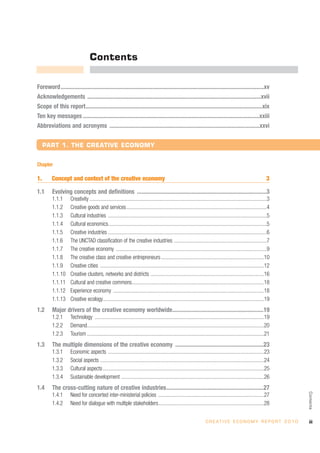
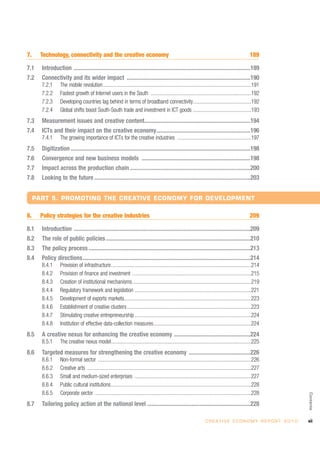
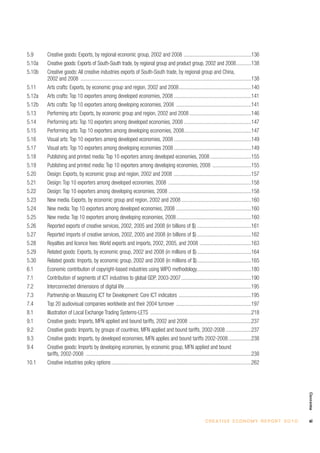
Contents
Contents
Foreword..........................................................................................................................................xv
Acknowledgements ......................................................................................................................xvii
Scope of this report........................................................................................................................xix
Ten key messages........................................................................................................................xxiii
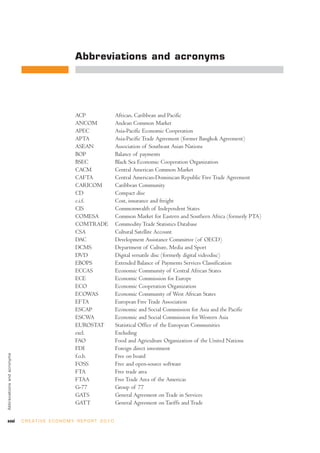
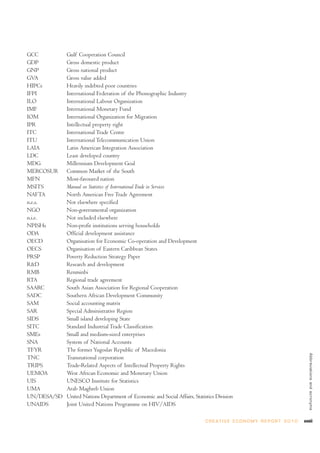
Abbreviations and acronyms ......................................................................................................xxvi
PART 1. THE CREATIVE ECONOMY
Chapter
1. Concept and context of the creative economy 3
1.1 Evolving concepts and definitions ........................................................................................3
1.1.1 Creativity ......................................................................................................................................3
1.1.2 Creative goods and services..........................................................................................................4
1.1.3 Cultural industries ........................................................................................................................5
1.1.4 Cultural economics........................................................................................................................5
1.1.5 Creative industries ........................................................................................................................6
1.1.6 The UNCTAD classification of the creative industries ......................................................................7
1.1.7 The creative economy ..................................................................................................................9
1.1.8 The creative class and creative entrepreneurs..............................................................................10
1.1.9 Creative cities ............................................................................................................................12
1.1.10 Creative clusters, networks and districts ......................................................................................16
1.1.11 Cultural and creative commons....................................................................................................18
1.1.12 Experience economy ..................................................................................................................18
1.1.13 Creative ecology..........................................................................................................................19
1.2 Major drivers of the creative economy worldwide..............................................................19
1.2.1 Technology ................................................................................................................................19
1.2.2 Demand......................................................................................................................................20
1.2.3 Tourism ......................................................................................................................................21
1.3 The multiple dimensions of the creative economy ............................................................23
1.3.1 Economic aspects ......................................................................................................................23
1.3.2 Social aspects ............................................................................................................................24
1.3.3 Cultural aspects..........................................................................................................................25
1.3.4 Sustainable development ............................................................................................................26
1.4 The cross-cutting nature of creative industries..................................................................27
1.4.1 Need for concerted inter-ministerial policies ................................................................................27
1.4.2 Need for dialogue with multiple stakeholders................................................................................28
iv C R E AT I V E E C O N O M Y R E P O R T 2 0 1 0
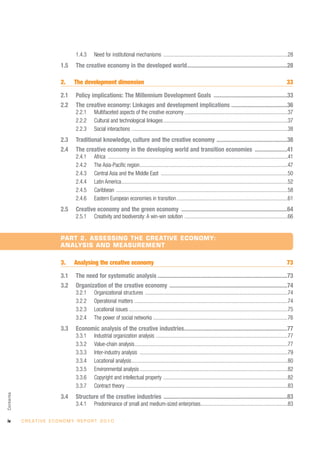
Contents
1.4.3 Need for institutional mechanisms ..............................................................................................28
1.5 The creative economy in the developed world....................................................................28
2. The development dimension 33
2.1 Policy implications: The Millennium Development Goals ..................................................33
2.2 The creative economy: Linkages and development implications ......................................36
2.2.1 Multifaceted aspects of the creative economy ..............................................................................37
2.2.2 Cultural and technological linkages..............................................................................................37
2.2.3 Social interactions ......................................................................................................................38
2.3 Traditional knowledge, culture and the creative economy ................................................38
2.4 The creative economy in the developing world and transition economies ......................41
2.4.1 Africa ........................................................................................................................................41
2.4.2 The Asia-Pacific region................................................................................................................47
2.4.3 Central Asia and the Middle East ................................................................................................50
2.4.4 Latin America..............................................................................................................................52
2.4.5 Caribbean ..................................................................................................................................58
2.4.6 Eastern European economies in transition....................................................................................61
2.5 Creative economy and the green economy ........................................................................64
2.5.1 Creativity and biodiversity: A win-win solution ..............................................................................66
PART 2. ASSESSING THE CREATIVE ECONOMY:
ANALYSIS AND MEASUREMENT
3. Analysing the creative economy 73
3.1 The need for systematic analysis ........................................................................................73
3.2 Organization of the creative economy ................................................................................74
3.2.1 Organizational structures ............................................................................................................74
3.2.2 Operational matters ....................................................................................................................74
3.2.3 Locational issues ........................................................................................................................75
3.2.4 The power of social networks ......................................................................................................76
3.3 Economic analysis of the creative industries......................................................................77
3.3.1 Industrial organization analysis ....................................................................................................77
3.3.2 Value-chain analysis....................................................................................................................77
3.3.3 Inter-industry analysis ................................................................................................................79
3.3.4 Locational analysis......................................................................................................................80
3.3.5 Environmental analysis................................................................................................................82
3.3.6 Copyright and intellectual property ..............................................................................................82
3.3.7 Contract theory ..........................................................................................................................83
3.4 Structure of the creative industries ....................................................................................83
3.4.1 Predominance of small and medium-sized enterprises..................................................................83
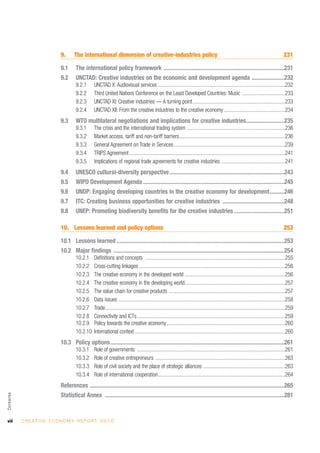
vC R E AT I V E E C O N O M Y R E P O R T 2 0 1 0
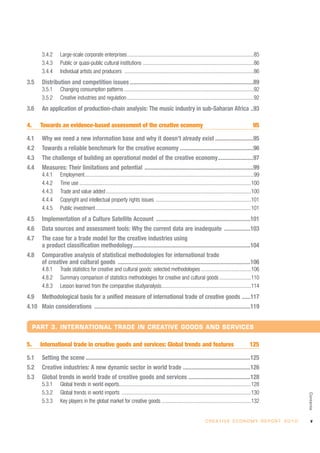
Contents
3.4.2 Large-scale corporate enterprises................................................................................................85
3.4.3 Public or quasi-public cultural institutions ....................................................................................86
3.4.4 Individual artists and producers ..................................................................................................86
3.5 Distribution and competition issues....................................................................................89
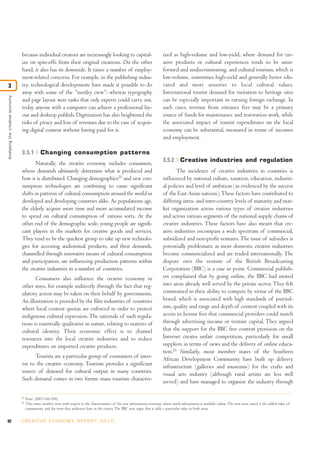
3.5.1 Changing consumption patterns ..................................................................................................92
3.5.2 Creative industries and regulation................................................................................................92
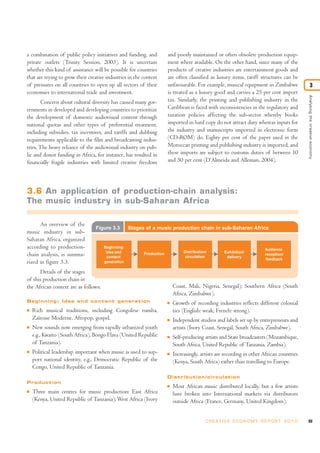
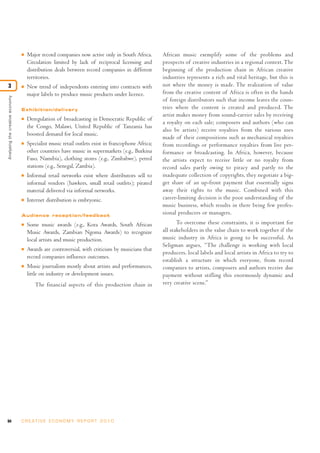
3.6 An application of production-chain analysis: The music industry in sub-Saharan Africa ..93
4. Towards an evidence-based assessment of the creative economy 95
4.1 Why we need a new information base and why it doesn’t already exist ..........................95
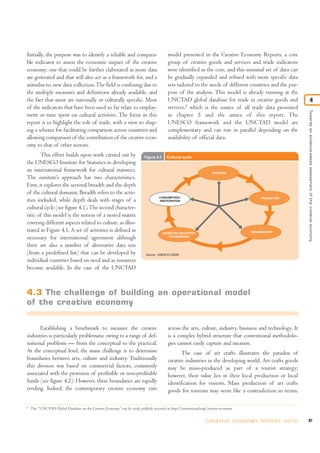
4.2 Towards a reliable benchmark for the creative economy ..................................................96
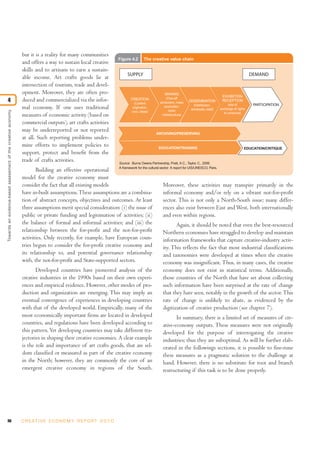
4.3 The challenge of building an operational model of the creative economy........................97
4.4 Measures: Their limitations and potential ..........................................................................99
4.4.1 Employment................................................................................................................................99
4.4.2 Time use ..................................................................................................................................100
4.4.3 Trade and value added..............................................................................................................100
4.4.4 Copyright and intellectual property rights issues ........................................................................101
4.4.5 Public investment......................................................................................................................101
4.5 Implementation of a Culture Satellite Account ................................................................101
4.6 Data sources and assessment tools: Why the current data are inadequate ..................103
4.7 The case for a trade model for the creative industries using
a product classification methodology................................................................................104
4.8 Comparative analysis of statistical methodologies for international trade
of creative and cultural goods ..........................................................................................106
4.8.1 Trade statistics for creative and cultural goods: selected methodologies ......................................106
4.8.2 Summary comparison of statistics methodologies for creative and cultural goods ........................110
4.8.3 Lesson learned from the comparative studyanalysis....................................................................114
4.9 Methodological basis for a unified measure of international trade of creative goods ......117
4.10 Main considerations ..........................................................................................................119
PART 3. INTERNATIONAL TRADE IN CREATIVE GOODS AND SERVICES
5. International trade in creative goods and services: Global trends and features 125
5.1 Setting the scene ................................................................................................................125
5.2 Creative industries: A new dynamic sector in world trade ..............................................126
5.3 Global trends in world trade of creative goods and services ..........................................128
5.3.1 Global trends in world exports....................................................................................................128
5.3.2 Global trends in world imports ..................................................................................................130
5.3.3 Key players in the global market for creative goods ....................................................................132
vi C R E AT I V E E C O N O M Y R E P O R T 2 0 1 0
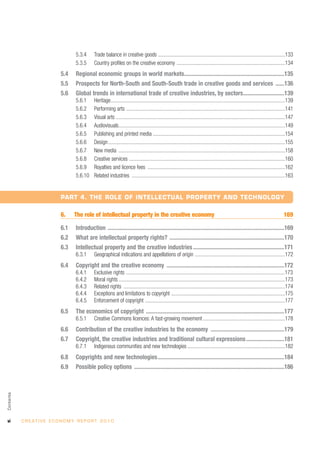
Contents
5.3.4 Trade balance in creative goods ................................................................................................133
5.3.5 Country profiles on the creative economy ..................................................................................134
5.4 Regional economic groups in world markets....................................................................135
5.5 Prospects for North-South and South-South trade in creative goods and services ......136
5.6 Global trends in international trade of creative industries, by sectors............................139
5.6.1 Heritage....................................................................................................................................139
5.6.2 Performing arts ........................................................................................................................141
5.6.3 Visual arts ................................................................................................................................147
5.6.4 Audiovisuals..............................................................................................................................149
5.6.5 Publishing and printed media ....................................................................................................154
5.6.6 Design......................................................................................................................................155
5.6.7 New media ..............................................................................................................................158
5.6.8 Creative services ......................................................................................................................160
5.6.9 Royalties and licence fees ........................................................................................................162
5.6.10 Related industries ....................................................................................................................163
PART 4. THE ROLE OF INTELLECTUAL PROPERTY AND TECHNOLOGY
6. The role of intellectual property in the creative economy 169
6.1 Introduction ........................................................................................................................169
6.2 What are intellectual property rights? ..............................................................................170
6.3 Intellectual property and the creative industries..............................................................171
6.3.1 Geographical indications and appellations of origin ....................................................................172
6.4 Copyright and the creative economy ................................................................................172
6.4.1 Exclusive rights ........................................................................................................................173
6.4.2 Moral rights..............................................................................................................................173
6.4.3 Related rights ..........................................................................................................................174
6.4.4 Exceptions and limitations to copyright ......................................................................................175
6.4.5 Enforcement of copyright ..........................................................................................................177
6.5 The economics of copyright ..............................................................................................177
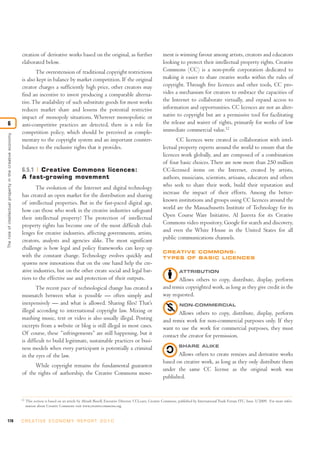
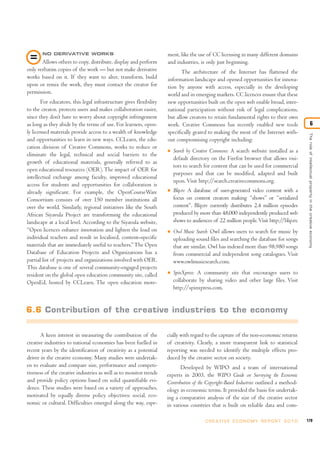
6.5.1 Creative Commons licences: A fast-growing movement ..............................................................178
6.6 Contribution of the creative industries to the economy ..................................................179
6.7 Copyright, the creative industries and traditional cultural expressions..........................181
6.7.1 Indigenous communities and new technologies ..........................................................................182
6.8 Copyrights and new technologies......................................................................................184
6.9 Possible policy options ......................................................................................................186
7. Technology, connectivity and the creative economy 189
7.1 Introduction ........................................................................................................................189
7.2 Connectivity and its wider impact ....................................................................................190
7.2.1 The mobile revolution................................................................................................................191
7.2.2 Fastest growth of Internet users in the South ............................................................................192
7.2.3 Developing countries lag behind in terms of broadband connectivity............................................192
7.2.4 Global shifts boost South-South trade and investment in ICT goods ............................................193
7.3 Measurement issues and creative content........................................................................194
7.4 ICTs and their impact on the creative economy................................................................196
7.4.1 The growing importance of ICTs for the creative industries ........................................................197
7.5 Digitization ..........................................................................................................................198
7.6 Convergence and new business models ..........................................................................198
7.7 Impact across the production chain..................................................................................200
7.8 Looking to the future ..........................................................................................................203
PART 5. PROMOTING THE CREATIVE ECONOMY FOR DEVELOPMENT
8. Policy strategies for the creative industries 209
8.1 Introduction ........................................................................................................................209
8.2 The role of public policies ..................................................................................................210
8.3 The policy process..............................................................................................................213
8.4 Policy directions..................................................................................................................214
8.4.1 Provision of infrastructure..........................................................................................................214
8.4.2 Provision of finance and investment ..........................................................................................215
8.4.3 Creation of institutional mechanisms..........................................................................................219
8.4.4 Regulatory framework and legislation ........................................................................................221
8.4.5 Development of exports markets................................................................................................223
8.4.6 Establishment of creative clusters..............................................................................................223
8.4.7 Stimulating creative entrepreneurship ........................................................................................224
8.4.8 Institution of effective data-collection measures..........................................................................224
8.5 A creative nexus for enhancing the creative economy ....................................................224
8.5.1 The creative nexus model..........................................................................................................225
8.6 Targeted measures for strengthening the creative economy ..........................................226
8.6.1 Non-formal sector ....................................................................................................................226
8.6.2 Creative arts ............................................................................................................................227
8.6.3 Small and medium-sized enterprises ........................................................................................227
8.6.4 Public cultural institutions..........................................................................................................228
8.6.5 Corporate sector ......................................................................................................................228
8.7 Tailoring policy action at the national level ......................................................................228
viiC R E AT I V E E C O N O M Y R E P O R T 2 0 1 0
Contents
viii C R E AT I V E E C O N O M Y R E P O R T 2 0 1 0
Contents
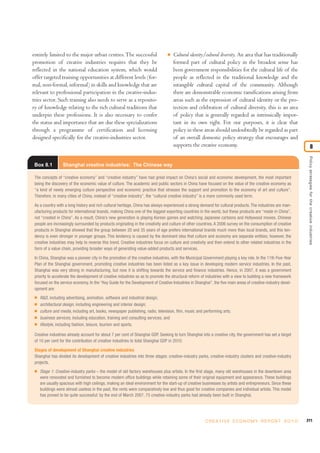
9. The international dimension of creative-industries policy 231
9.1 The international policy framework ..................................................................................231
9.2 UNCTAD: Creative industries on the economic and development agenda ......................232
9.2.1 UNCTAD X: Audiovisual services ................................................................................................232
9.2.2 Third United Nations Conference on the Least Developed Countries: Music ................................233
9.2.3 UNCTAD XI: Creative industries — A turning point......................................................................233
9.2.4 UNCTAD XII: From the creative industries to the creative economy ..............................................234
9.3 WTO multilateral negotiations and implications for creative industries..........................235
9.3.1 The crisis and the international trading system ..........................................................................236
9.3.2 Market access, tariff and non-tariff barriers................................................................................236
9.3.3 General Agreement on Trade in Services....................................................................................239
9.3.4 TRIPS Agreement......................................................................................................................241
9.3.5 Implications of regional trade agreements for creative industries ................................................241
9.4 UNESCO cultural-diversity perspective..............................................................................243
9.5 WIPO Development Agenda ................................................................................................245
9.6 UNDP: Engaging developing countries in the creative economy for development..........246
9.7 ITC: Creating business opportunities for creative industries ..........................................248
9.8 UNEP: Promoting biodiversity benefits for the creative industries ..................................251
10. Lessons learned and policy options 253
10.1 Lessons learned ..................................................................................................................253
10.2 Major findings ....................................................................................................................254
10.2.1 Definitions and concepts ..........................................................................................................255
10.2.2 Cross-cutting linkages ..............................................................................................................256
10.2.3 The creative economy in the developed world ............................................................................256
10.2.4 The creative economy in the developing world............................................................................257
10.2.5 The value chain for creative products ........................................................................................257
10.2.6 Data issues ..............................................................................................................................258
10.2.7 Trade........................................................................................................................................259
10.2.8 Connectivity and ICTs................................................................................................................259
10.2.9 Policy towards the creative economy..........................................................................................260
10.2.10 International context..................................................................................................................260
10.3 Policy options......................................................................................................................261
10.3.1 Role of governments ................................................................................................................261
10.3.2 Role of creative entrepreneurs ..................................................................................................263
10.3.3 Role of civil society and the place of strategic alliances ..............................................................263
10.3.4 Role of international cooperation................................................................................................264
References ....................................................................................................................................265
Statistical Annex ..........................................................................................................................281
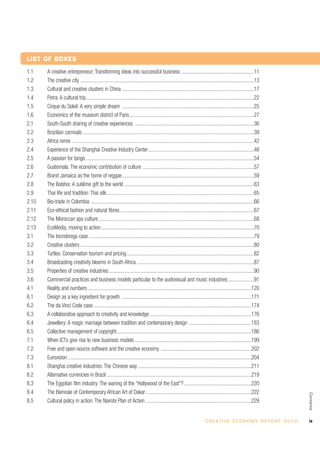
LIST OF BOXES
1.1 A creative entrepreneur: Transforming ideas into successful business ........................................................11
1.2 The creative city ......................................................................................................................................13
1.3 Cultural and creative clusters in China ......................................................................................................17
1.4 Petra: A cultural trip..................................................................................................................................22
1.5 Cirque du Soleil: A very simple dream ......................................................................................................25
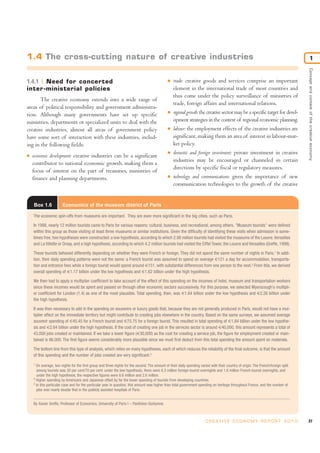
1.6 Economics of the museum district of Paris................................................................................................27
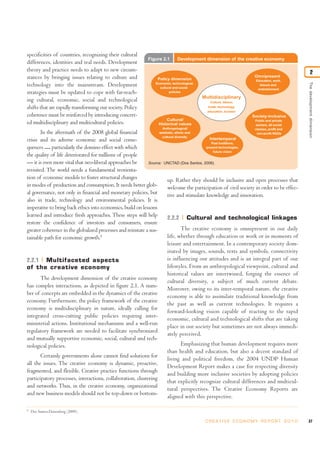
2.1 South-South sharing of creative experiences ............................................................................................36
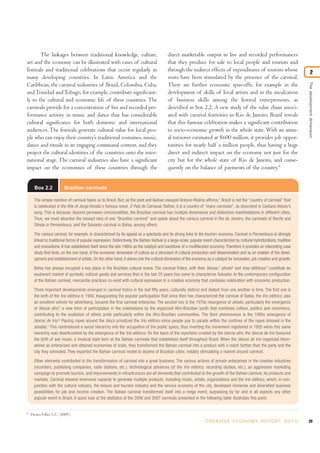
2.2 Brazilian carnivals ....................................................................................................................................39
2.3 Africa remix ............................................................................................................................................42
2.4 Experience of the Shanghai Creative Industry Center..................................................................................48
2.5 A passion for tango..................................................................................................................................54
2.6 Guatemala: The economic contribution of culture ......................................................................................57
2.7 Brand Jamaica as the home of reggae......................................................................................................59
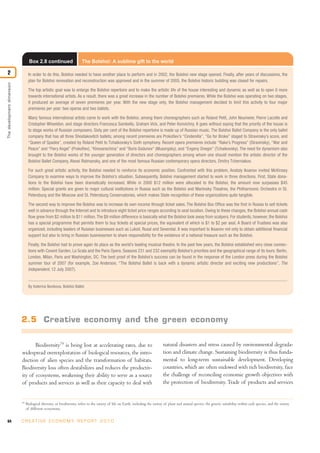
2.8 The Bolshoi: A sublime gift to the world ....................................................................................................63
2.9 Thai life and tradition: Thai silk..................................................................................................................65
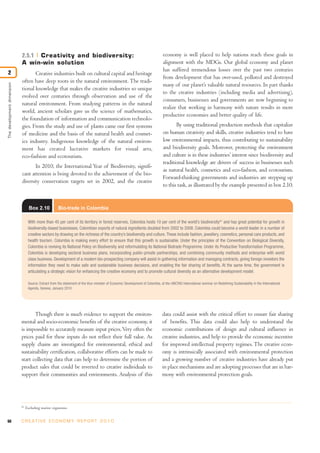
2.10 Bio-trade in Colombia ..............................................................................................................................66
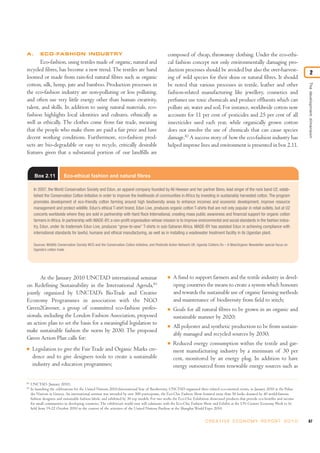
2.11 Eco-ethical fashion and natural fibres........................................................................................................67
2.12 The Moroccan spa culture ........................................................................................................................68
2.13 EcoMedia, moving to action......................................................................................................................70
3.1 The tecnobrega case................................................................................................................................79
3.2 Creative clusters ......................................................................................................................................80
3.3 Turtles: Conservation tourism and pricing ..................................................................................................82
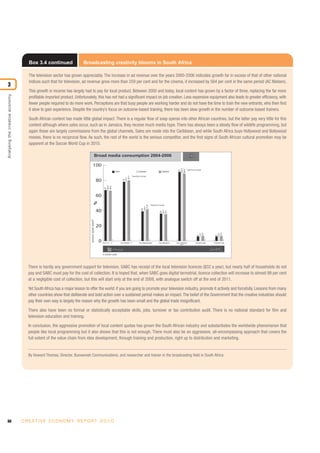
3.4 Broadcasting creativity blooms in South Africa ..........................................................................................87
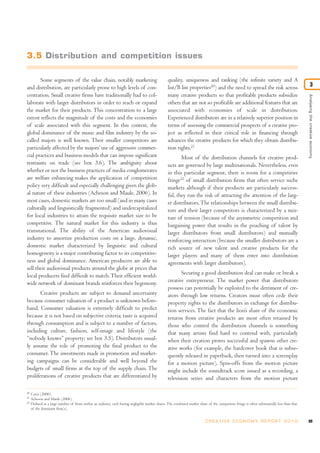
3.5 Properties of creative industries ................................................................................................................90
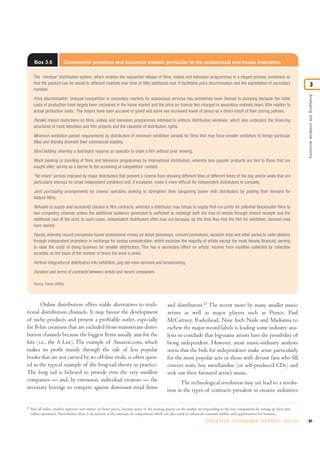
3.6 Commercial practices and business models particular to the audiovisual and music industries....................91
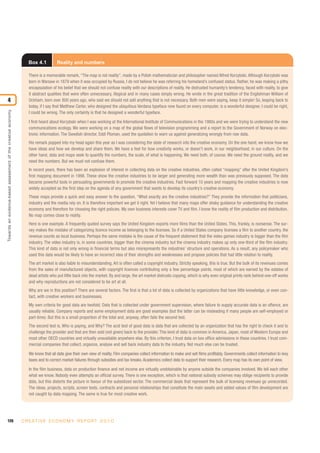
4.1 Reality and numbers ..............................................................................................................................120
6.1 Design as a key ingredient for growth ....................................................................................................171
6.2 The da Vinci Code case..........................................................................................................................174
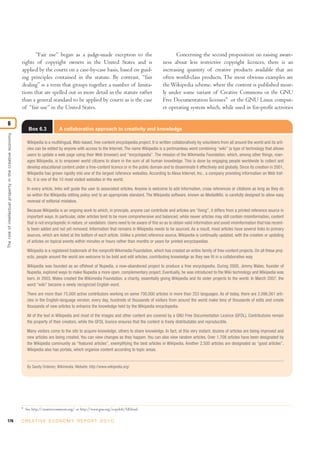
6.3 A collaborative approach to creativity and knowledge ..............................................................................176
6.4 Jewellery: A magic marriage between tradition and contemporary design ................................................183
6.5 Collective management of copyright........................................................................................................186
7.1 When ICTs give rise to new business models ..........................................................................................199
7.2 Free and open-source software and the creative economy ......................................................................202
7.3 Eurovision..............................................................................................................................................204
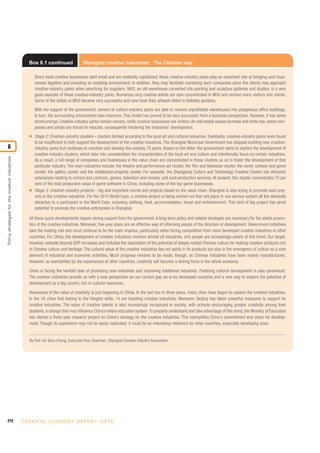
8.1 Shanghai creative industries: The Chinese way........................................................................................211
8.2 Alternative currencies in Brazil................................................................................................................219
8.3 The Egyptian film industry: The waning of the “Hollywood of the East”?....................................................220
8.4 The Biennale of Contemporary African Art of Dakar..................................................................................222
8.5 Cultural policy in action: The Nairobi Plan of Action..................................................................................229
ixC R E AT I V E E C O N O M Y R E P O R T 2 0 1 0
Contents
x C R E AT I V E E C O N O M Y R E P O R T 2 0 1 0
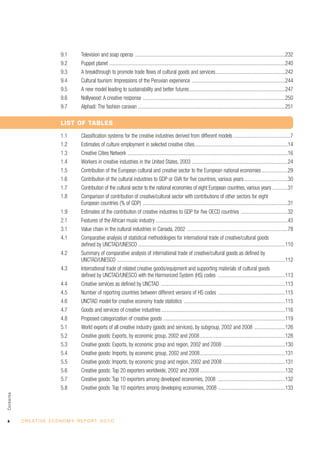
9.1 Television and soap operas ....................................................................................................................232
9.2 Puppet planet ........................................................................................................................................240
9.3 A breakthrough to promote trade flows of cultural goods and services......................................................242
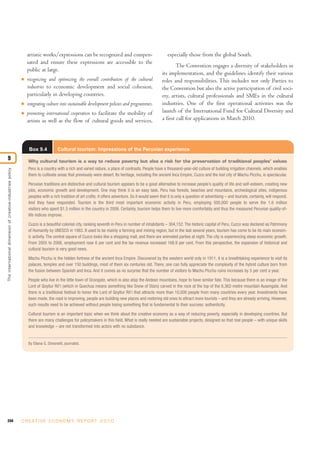
9.4 Cultural tourism: Impressions of the Peruvian experience ........................................................................244
9.5 A new model leading to sustainability and better futures..........................................................................247
9.6 Nollywood: A creative response ..............................................................................................................250
9.7 Alphadi: The fashion caravan ..................................................................................................................251
LIST OF TABLES
1.1 Classification systems for the creative industries derived from different models ............................................7
1.2 Estimates of culture employment in selected creative cities........................................................................14
1.3 Creative Cities Network ............................................................................................................................16
1.4 Workers in creative industries in the United States, 2003 ..........................................................................24
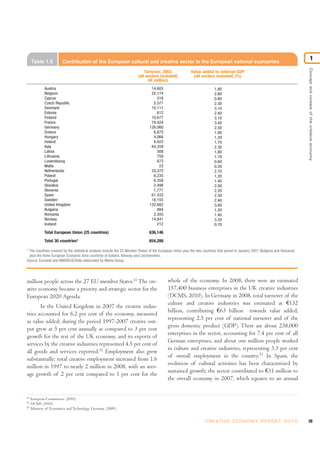
1.5 Contribution of the European cultural and creative sector to the European national economies ....................29
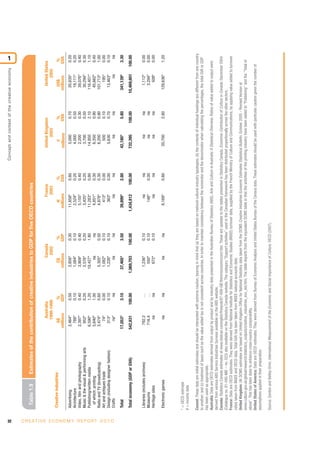
1.6 Contribution of the cultural industries to GDP or GVA for five countries, various years..................................30
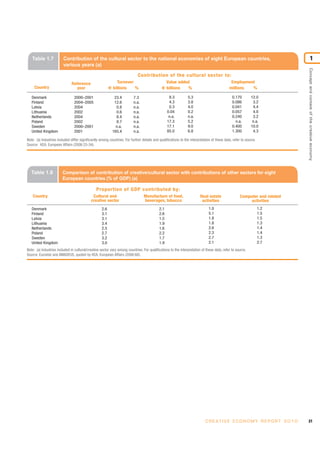
1.7 Contribution of the cultural sector to the national economies of eight European countries, various years ............31
1.8 Comparison of contribution of creative/cultural sector with contributions of other sectors for eight
European countries (% of GDP) ................................................................................................................31
1.9 Estimates of the contribution of creative industries to GDP for five OECD countries ....................................32
2.1 Features of the African music industry ......................................................................................................43
3.1 Value chain in the cultural industries in Canada, 2002 ..............................................................................78
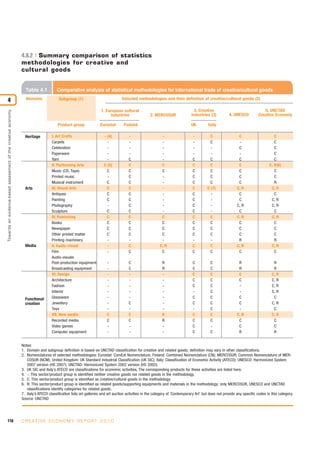
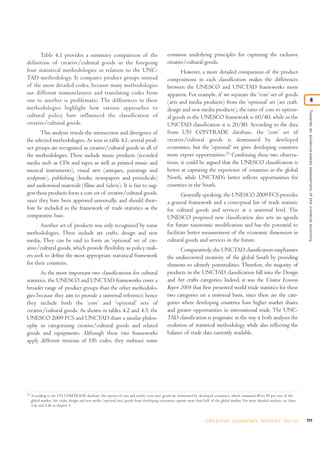
4.1 Comparative analysis of statistical methodologies for international trade of creative/cultural goods
defined by UNCTAD/UNESCO..................................................................................................................110
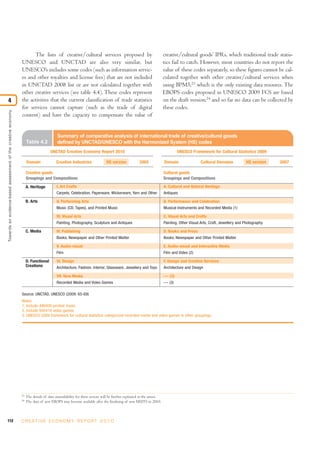
4.2 Summary of comparative analysis of international trade of creative/cultural goods as defined by
UNCTAD/UNESCO ..................................................................................................................................112
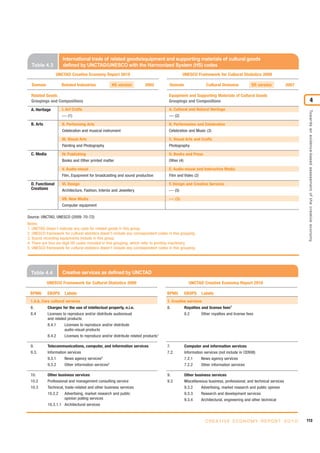
4.3 International trade of related creative goods/equipment and supporting materials of cultural goods
defined by UNCTAD/UNESCO with the Harmonized System (HS) codes ....................................................113
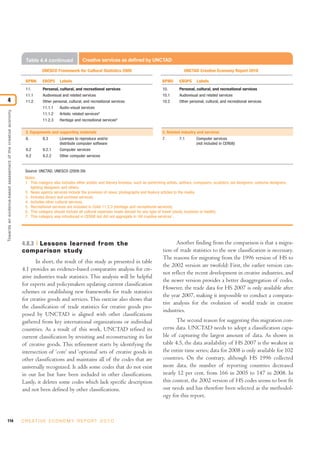
4.4 Creative services as defined by UNCTAD ................................................................................................113
4.5 Number of reporting countries between different versions of HS codes ....................................................115
4.6 UNCTAD model for creative economy trade statistics ..............................................................................115
4.7 Goods and services of creative industries................................................................................................116
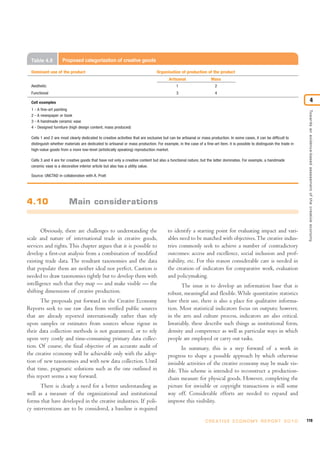
4.8 Proposed categorization of creative goods ..............................................................................................119
5.1 World exports of all creative industry (goods and services), by subgroup, 2002 and 2008 ........................126
5.2 Creative goods: Exports, by economic group, 2002 and 2008..................................................................128
5.3 Creative goods: Exports, by economic group and region, 2002 and 2008 ................................................130
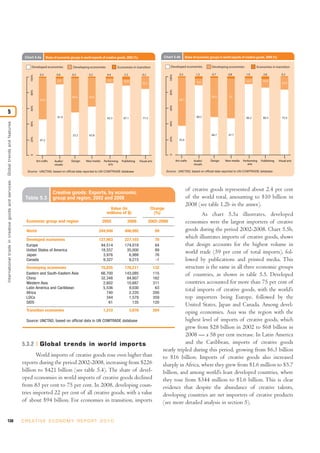
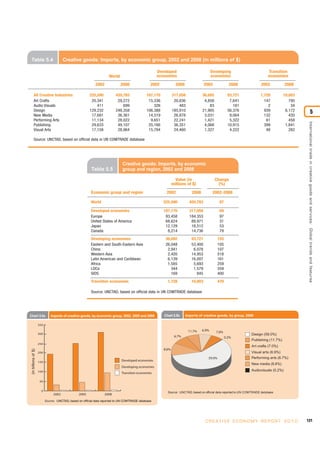
5.4 Creative goods: Imports, by economic group, 2002 and 2008..................................................................131
5.5 Creative goods: Imports, by economic group and region, 2002 and 2008 ................................................131
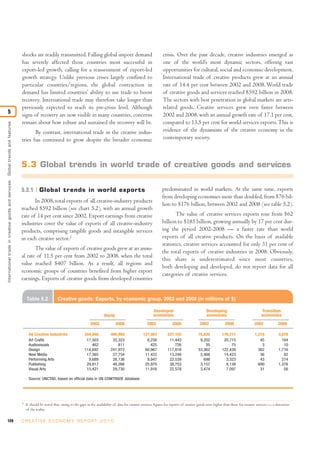
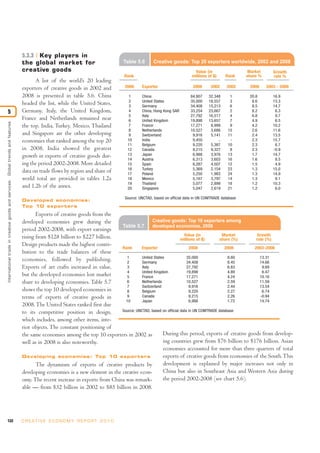
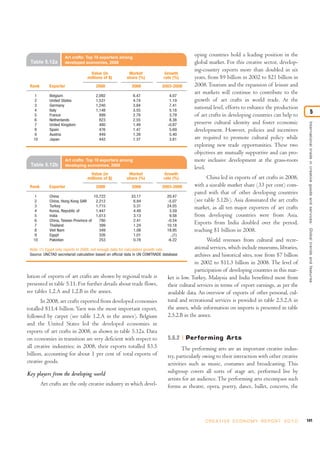
5.6 Creative goods: Top 20 exporters worldwide, 2002 and 2008..................................................................132
5.7 Creative goods: Top 10 exporters among developed economies, 2008 ....................................................132
5.8 Creative goods: Top 10 exporters among developing economies, 2008 ....................................................133
Contents
xiC R E AT I V E E C O N O M Y R E P O R T 2 0 1 0
Overview
5.9 Creative goods: Exports, by regional economic group, 2002 and 2008 ....................................................136
5.10a Creative goods: Exports of South-South trade, by regional group and product group, 2002 and 2008............138
5.10b Creative goods: All creative industries exports of South-South trade, by regional group and China,
2002 and 2008 ....................................................................................................................................138
5.11 Arts crafts: Exports, by economic group and region, 2002 and 2008........................................................140
5.12a Arts crafts: Top 10 exporters among developed economies, 2008 ............................................................141
5.12b Arts crafts: Top 10 exporters among developing economies, 2008 ..........................................................141
5.13 Performing arts: Exports, by economic group and region, 2002 and 2008................................................146
5.14 Performing arts: Top 10 exporters among developed economies, 2008 ....................................................147
5.15 Performing arts: Top 10 exporters among developing economies, 2008....................................................147
5.16 Visual arts: Top 10 exporters among developed economies, 2008............................................................149
5.17 Visual arts: Top 10 exporters among developing economies 2008............................................................149
5.18 Publishing and printed media: Top 10 exporters among developed economies, 2008................................155
5.19 Publishing and printed media: Top 10 exporters among developing economies, 2008 ..............................155
5.20 Design: Exports, by economic group and region, 2002 and 2008 ............................................................157
5.21 Design: Top 10 exporters among developed economies, 2008 ................................................................158
5.22 Design: Top 10 exporters among developing economies, 2008 ................................................................158
5.23 New media. Exports, by economic group and region, 2002 and 2008 ......................................................160
5.24 New media: Top 10 exporters among developed economies, 2008 ..........................................................160
5.25 New media: Top 10 exporters among developing economies, 2008..........................................................160
5.26 Reported exports of creative services, 2002, 2005 and 2008 (in billions of $) ..........................................161
5.27 Reported imports of creative services, 2002, 2005 and 2008 (in billions of $)..........................................162
5.28 Royalties and licence fees: World exports and imports, 2002, 2005, and 2008 ........................................163
5.29 Related goods: Exports, by economic group, 2002 and 2008 (in millions of $)..........................................164
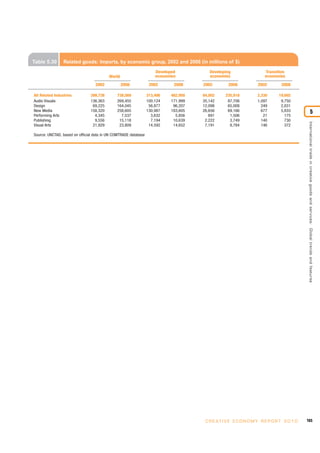
5.30 Related goods: Imports, by economic group, 2002 and 2008 (in millions of $)..........................................165
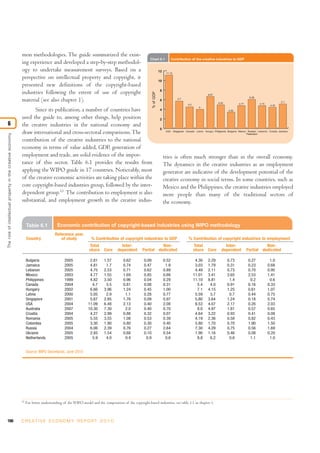
6.1 Economic contribution of copyright-based industries using WIPO methodology..........................................180
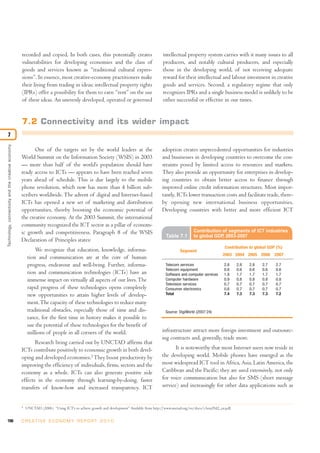
7.1 Contribution of segments of ICT industries to global GDP, 2003-2007......................................................190
7.2 Interconnected dimensions of digital life..................................................................................................195
7.3 Partnership on Measuring ICT for Development: Core ICT indicators ........................................................195
7.4 Top 20 audiovisual companies worldwide and their 2004 turnover ..........................................................197
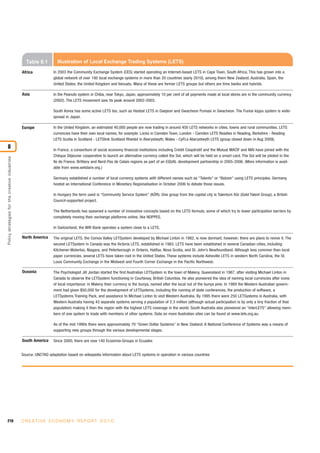
8.1 Illustration of Local Exchange Trading Systems-LETS ..............................................................................218
9.1 Creative goods: Imports, MFN applied and bound tariffs, 2002 and 2008 ................................................237
9.2 Creative goods: Imports, by groups of countries, MFN applied and bound tariffs, 2002-2008....................237
9.3 Creative goods: Imports, by developed economies, MFN applies and bound tariffs 2002-2008..................238
9.4 Creative goods: Imports by developing economies, by economic group, MFN applied and bound
tariffs, 2002-2008 ................................................................................................................................238
10.1 Creative industries policy options ............................................................................................................262
Contents
xii C R E AT I V E E C O N O M Y R E P O R T 2 0 1 0
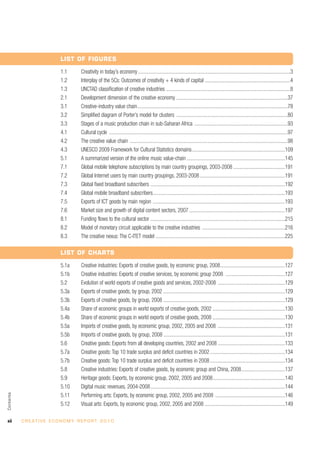
LIST OF FIGURES
1.1 Creativity in today’s economy......................................................................................................................3
1.2 Interplay of the 5Cs: Outcomes of creativity + 4 kinds of capital ..................................................................4
1.3 UNCTAD classification of creative industries ................................................................................................8
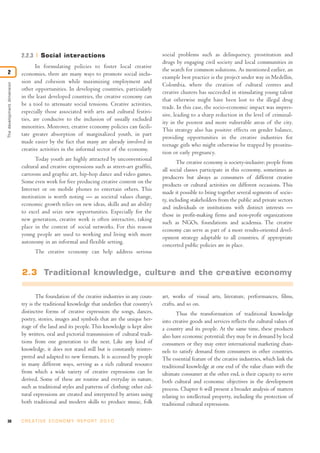
2.1 Development dimension of the creative economy ......................................................................................37
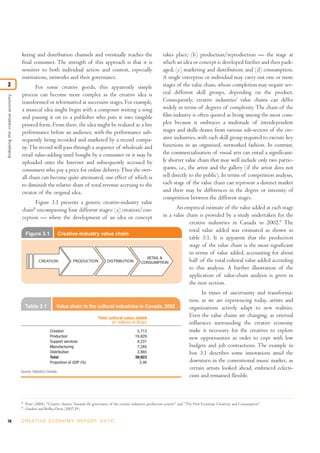
3.1 Creative-industry value chain....................................................................................................................78
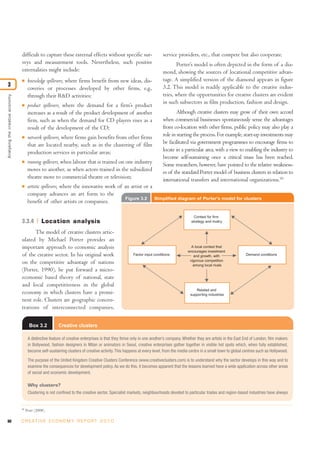
3.2 Simplified diagram of Porter’s model for clusters ......................................................................................80
3.3 Stages of a music production chain in sub-Saharan Africa ........................................................................93
4.1 Cultural cycle ..........................................................................................................................................97
4.2 The creative value chain ..........................................................................................................................98
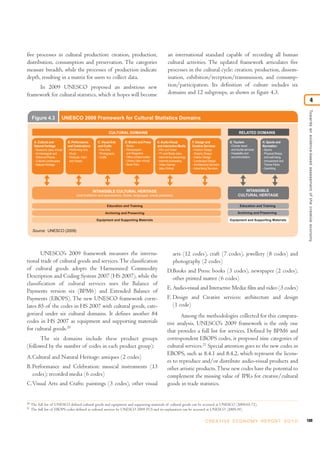
4.3 UNESCO 2009 Framework for Cultural Statistics domains........................................................................109
5.1 A summarized version of the online music value-chain ............................................................................145
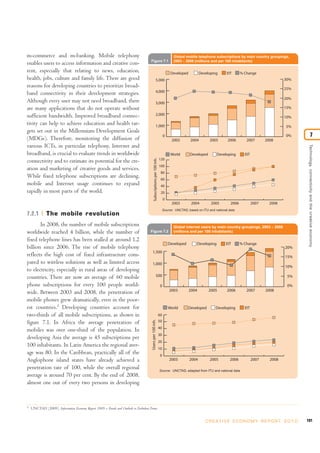
7.1 Global mobile telephone subscriptions by main country groupings, 2003-2008 ........................................191
7.2 Global Internet users by main country groupings, 2003-2008..................................................................191
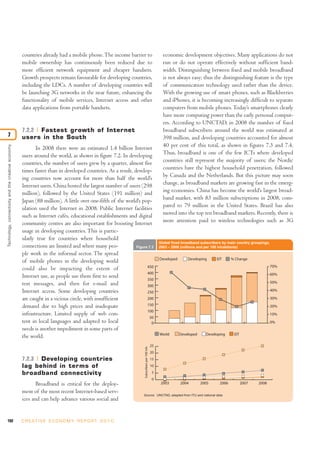
7.3 Global fixed broadband subscribers ........................................................................................................192
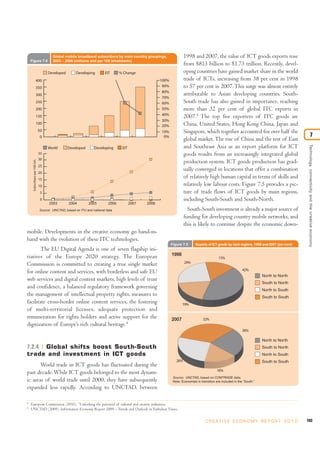
7.4 Global mobile broadband subscribers......................................................................................................193
7.5 Exports of ICT goods by main region ......................................................................................................193
7.6 Market size and growth of digital content sectors, 2007 ..........................................................................197
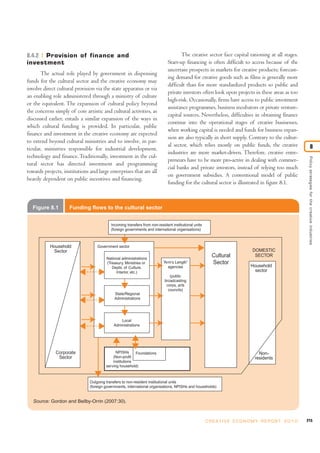
8.1 Funding flows to the cultural sector ........................................................................................................215
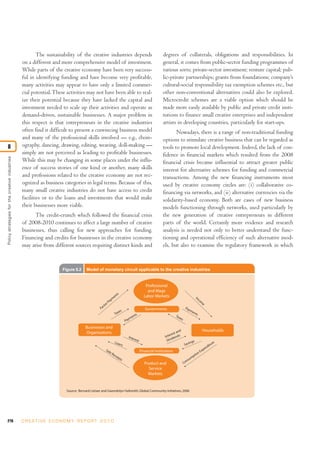
8.2 Model of monetary circuit applicable to the creative industries ................................................................216
8.3 The creative nexus: The C-ITET model ....................................................................................................225
LIST OF CHARTS
5.1a Creative industries: Exports of creative goods, by economic group, 2008..................................................127
5.1b Creative industries: Exports of creative services, by economic group 2008 ..............................................127
5.2 Evolution of world exports of creative goods and services, 2002-2008 ....................................................129
5.3a Exports of creative goods, by group, 2002 ..............................................................................................129
5.3b Exports of creative goods, by group, 2008 ..............................................................................................129
5.4a Share of economic groups in world exports of creative goods, 2002 ........................................................130
5.4b Share of economic groups in world exports of creative goods, 2008 ........................................................130
5.5a Imports of creative goods, by economic group, 2002, 2005 and 2008 ....................................................131
5.5b Imports of creative goods, by group, 2008 ..............................................................................................131
5.6 Creative goods: Exports from all developing countries, 2002 and 2008 ....................................................133
5.7a Creative goods: Top 10 trade surplus and deficit countries in 2002..........................................................134
5.7b Creative goods: Top 10 trade surplus and deficit countries in 2008..........................................................134
5.8 Creative industries: Exports of creative goods, by economic group and China, 2008..................................137
5.9 Heritage goods: Exports, by economic group, 2002, 2005 and 2008........................................................140
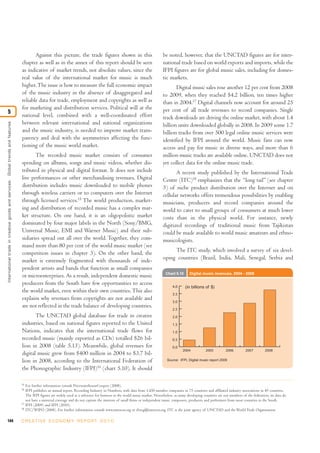
5.10 Digital music revenues, 2004-2008........................................................................................................144
5.11 Performing arts: Exports, by economic group, 2002, 2005 and 2008 ......................................................146
5.12 Visual arts: Exports, by economic group, 2002, 2005 and 2008 ..............................................................149
Contents
5.13 Audiovisuals: Exports, by economic group, 2002, 2005 and 2008............................................................153
5.14 Publishing and printed media: Exports, by economic group, 2002, 2005 and 2008 ..................................155
5.15 Design: Exports, by economic group, 2002, 2005 and 2008....................................................................157
5.16 New media: Exports, by economic group, 2002, 2005 and 2008 ............................................................159
5.17 Creative services: Exports, by economic group, 2008 ..............................................................................161
5.18a Creative services: Top 10 exporters of personal, cultural and recreational service among
developed economies, 2008 ..................................................................................................................162
5.18b Creative services: Top 10 exporters of personal, cultural and recreational service among
developing economies, 2008..................................................................................................................162
5.19 Royalties and licence fees: World exports and imports, 2002, 2005, and 2008 ........................................163
5.20 Related goods: Evolution of world exports, 2002 and 2008......................................................................164
6.1 Contribution of the creative industries to GDP..........................................................................................180
6.2 Contribution of groups of copyright-based industries to total of creative industries ....................................181
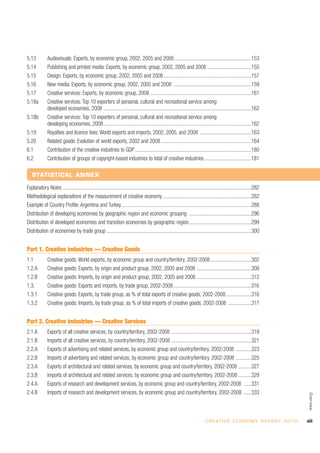
STATISTICAL ANNEX
Explanatory Notes ..................................................................................................................................................282
Methodological explanations of the measurement of creative economy ....................................................................282
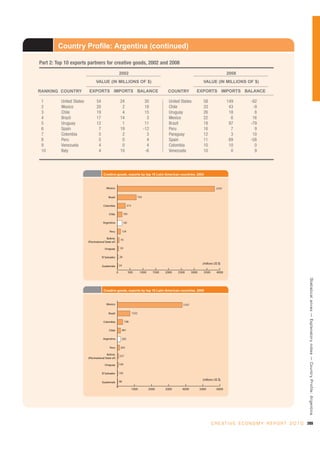
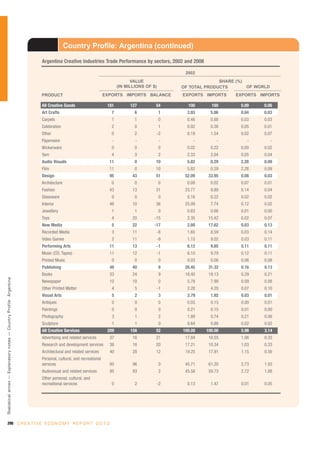
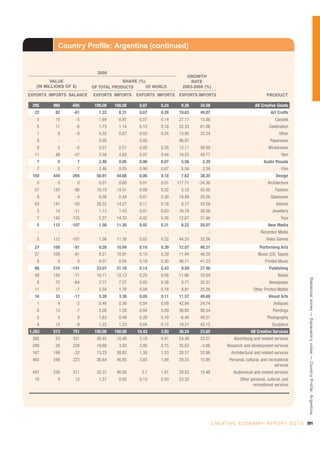
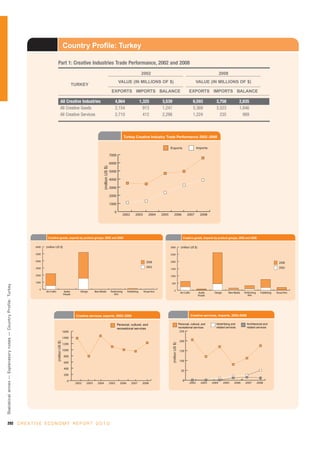
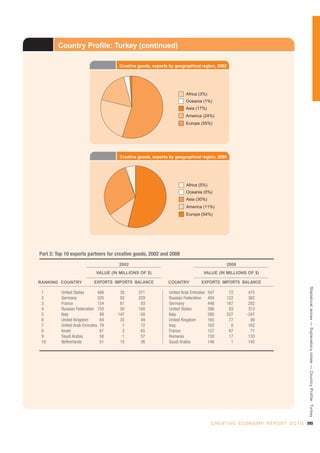
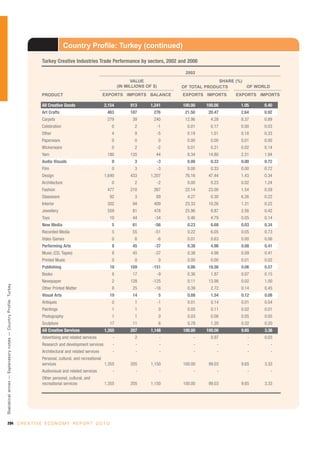
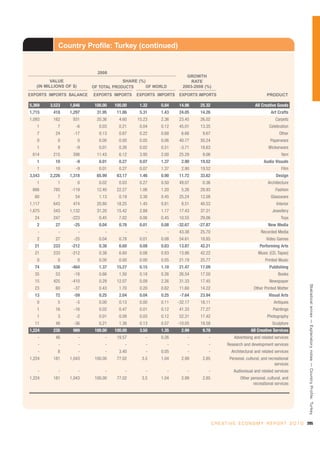
Example of Country Profile: Argentina and Turkey ....................................................................................................288
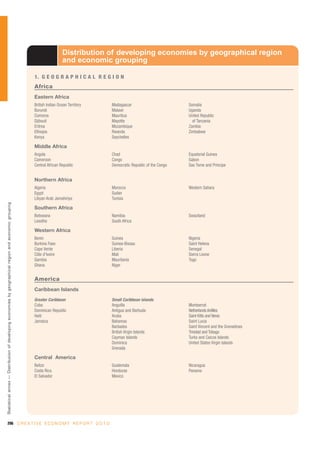
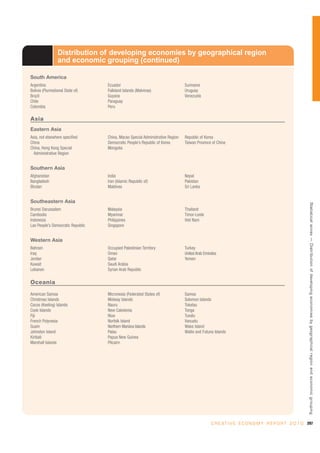
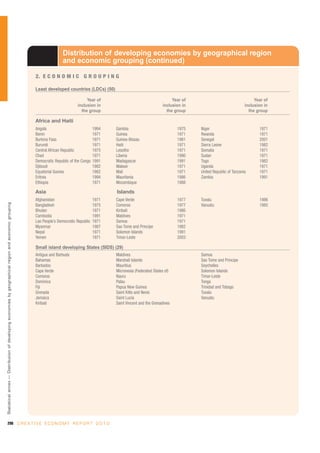
Distribution of developing economies by geographic region and economic grouping ................................................296
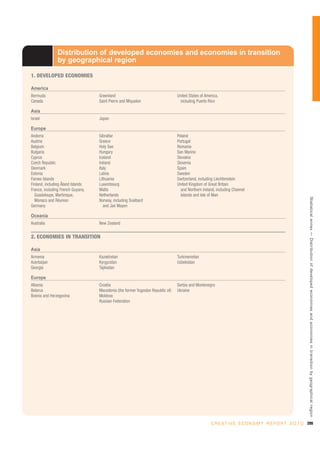
Distribution of developed economies and transition economies by geographic region................................................299
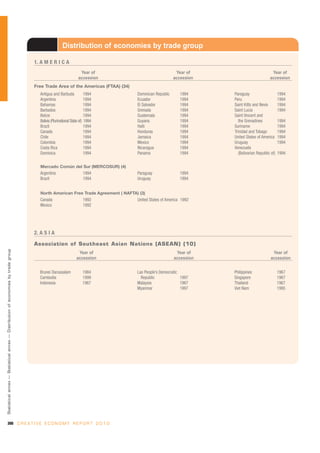
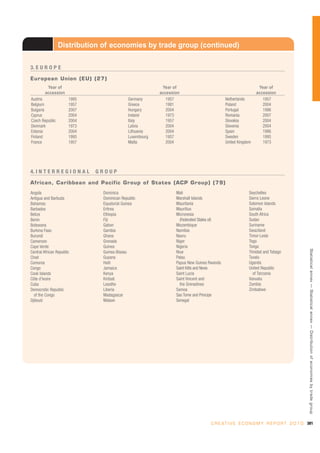
Distribution of economies by trade group ................................................................................................................300
Part 1. Creative industries — Creative Goods
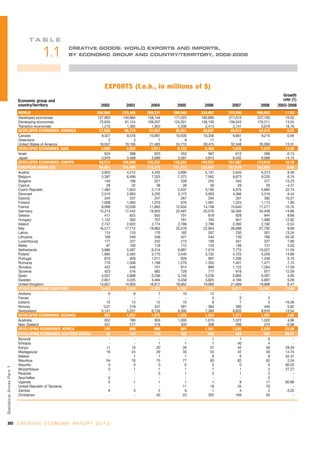
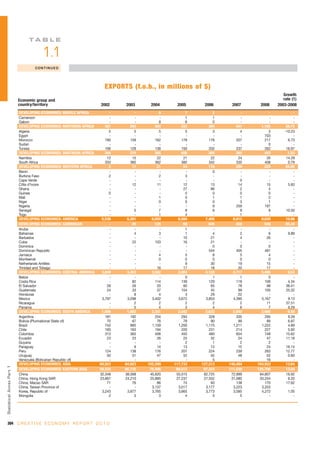
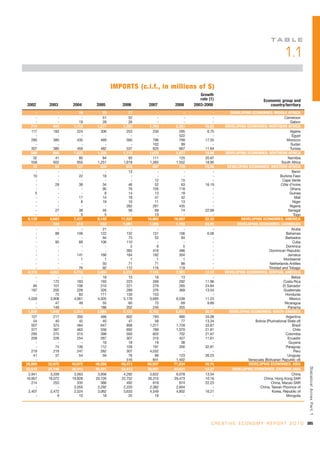
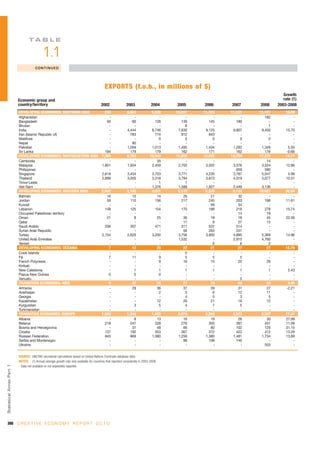
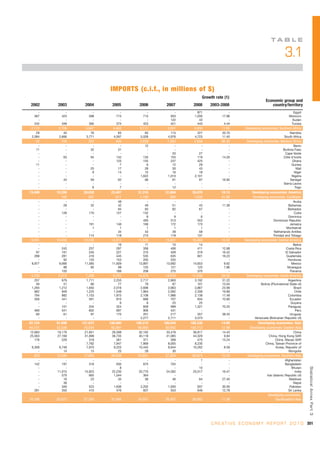
1.1 Creative goods: World exports, by economic group and country/territory, 2002-2008................................302
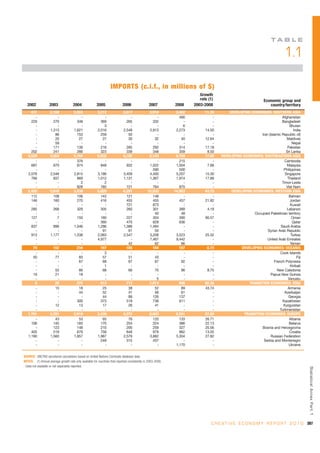
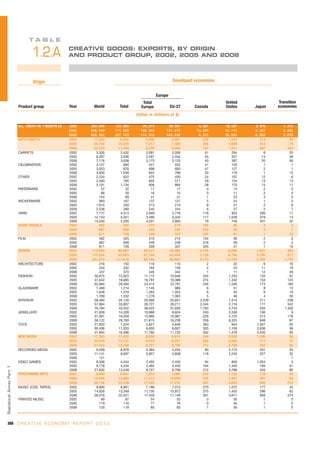
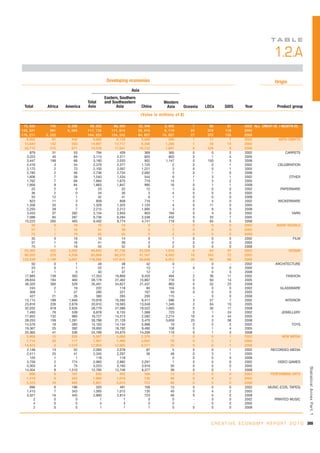
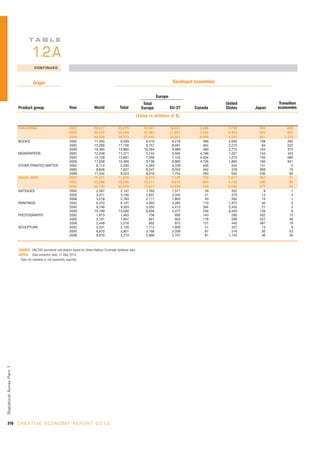
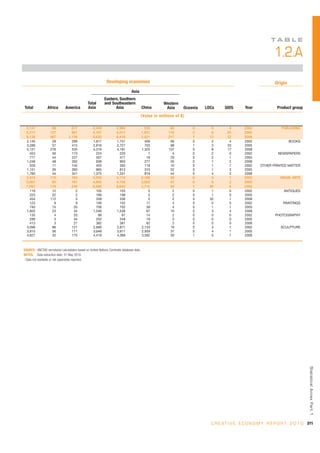
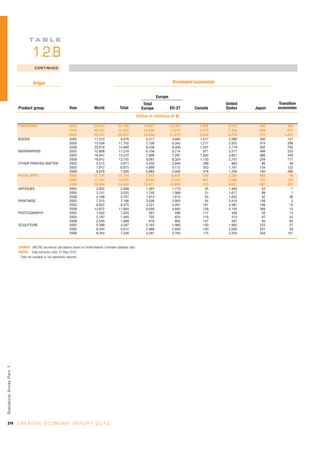
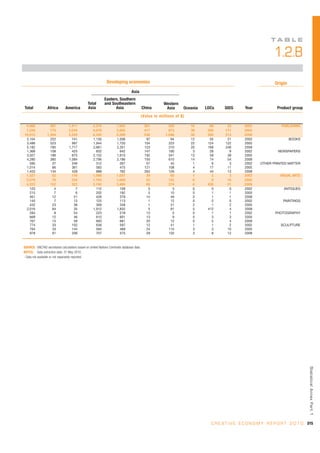
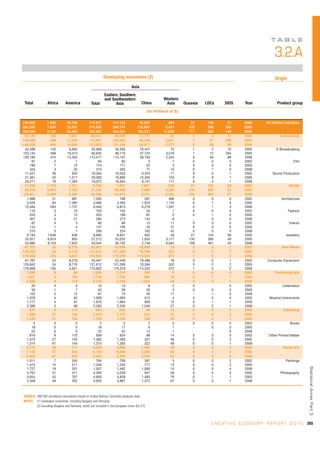
1.2.A Creative goods: Exports, by origin and product group, 2002, 2005 and 2008 ..........................................308
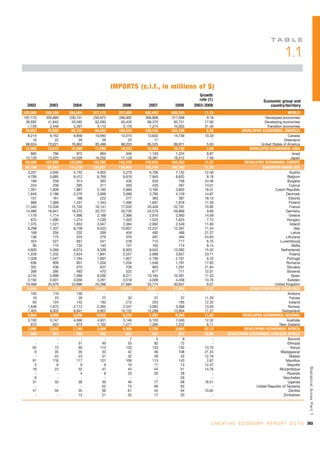
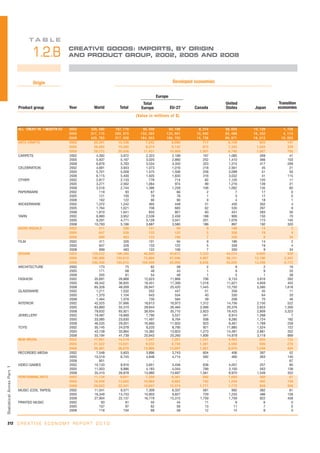
1.2.B Creative goods: Imports, by origin and product group, 2002, 2005 and 2008 ..........................................312
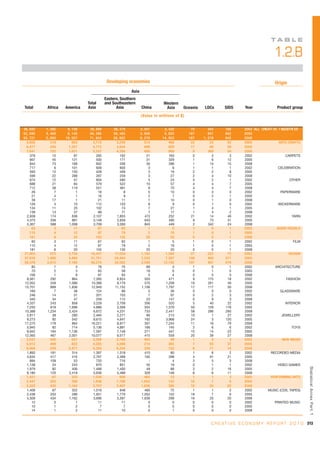
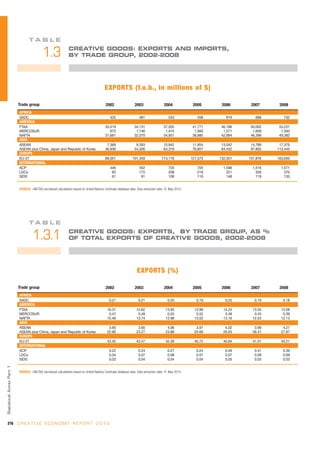
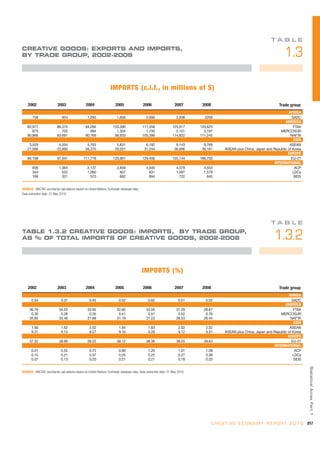
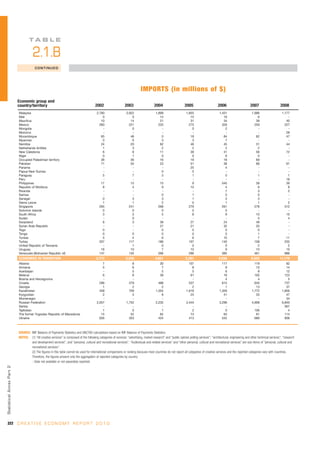
1.3. Creative goods: Exports and imports, by trade group, 2002-2008............................................................316
1.3.1 Creative goods: Exports, by trade group, as % of total exports of creative goods, 2002-2008....................316
1.3.2 Creative goods: Imports, by trade group, as % of total imports of creative goods, 2002-2008 ..................317
Part 2. Creative industries — Creative Services
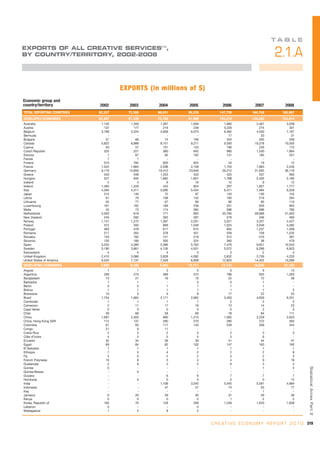
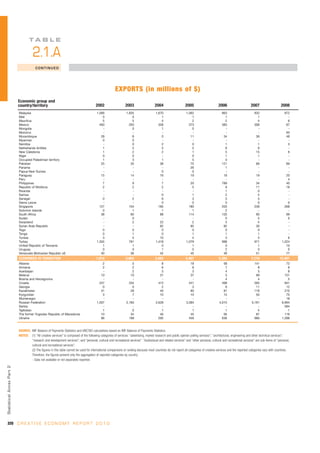
2.1.A Exports of all creative services, by country/territory, 2002-2008 ..............................................................319
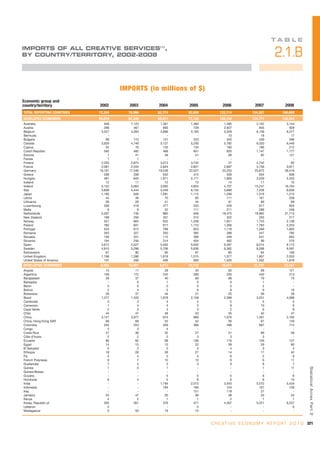
2.1.B Imports of all creative services, by country/territory, 2002-2008 ..............................................................321
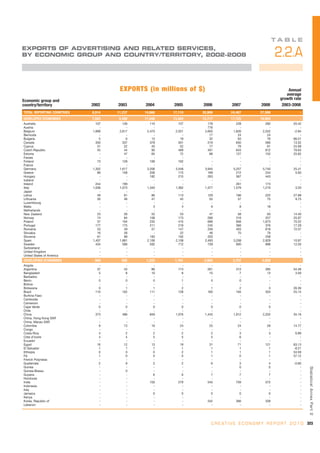
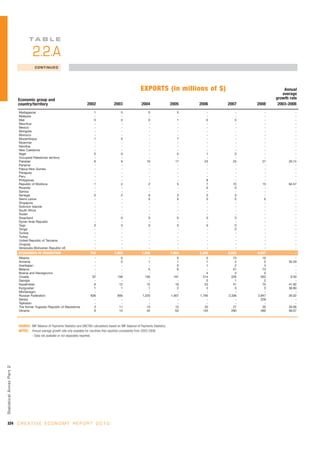
2.2.A Exports of advertising and related services, by economic group and country/territory, 2002-2008 ............323
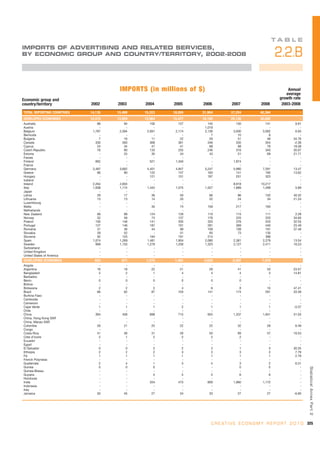
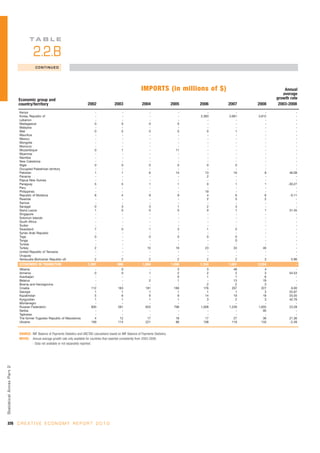
2.2.B Imports of advertising and related services, by economic group and country/territory, 2002-2008 ............325
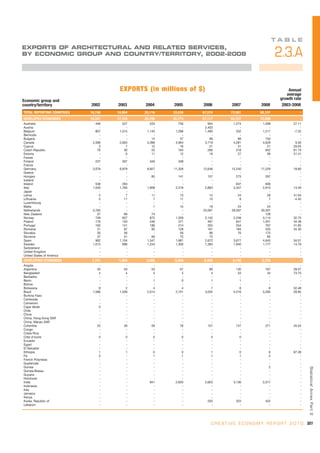
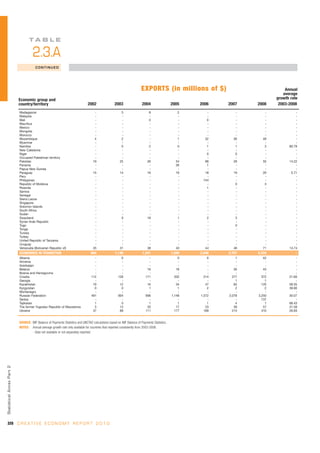
2.3.A Exports of architectural and related services, by economic group and country/territory, 2002-2008 ..........327
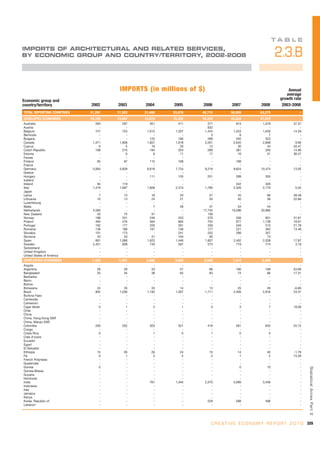
2.3.B Imports of architectural and related services, by economic group and country/territory, 2002-2008 ..........329
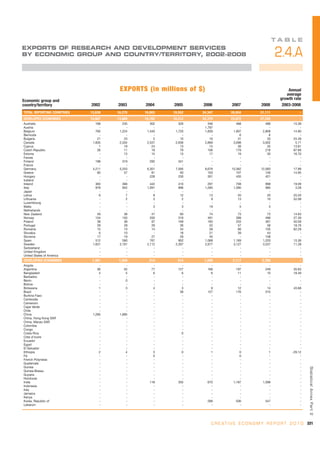
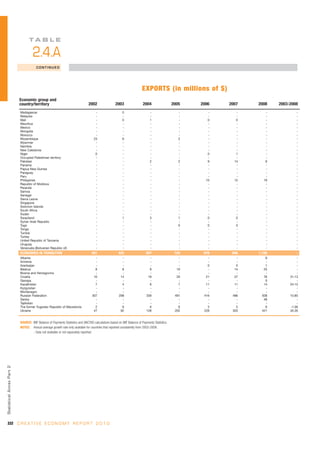
2.4.A Exports of research and development services, by economic group and country/territory, 2002-2008 ......331
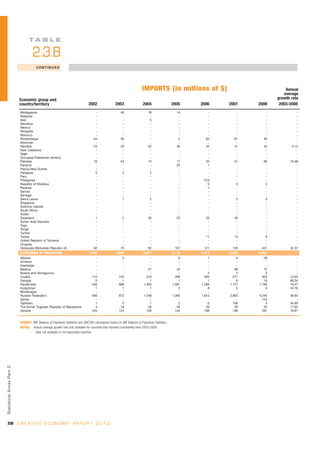
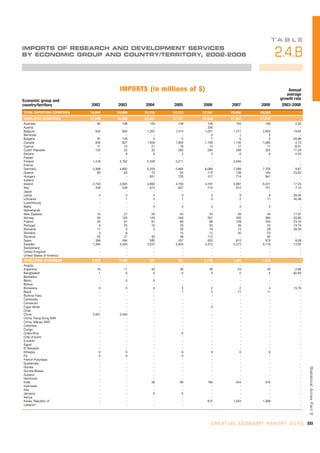
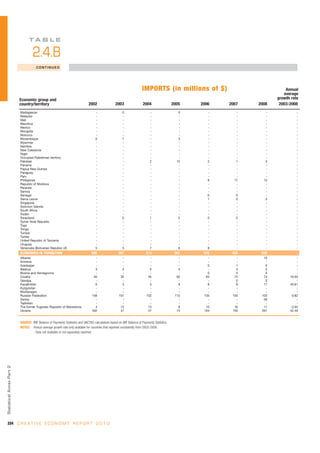
2.4.B Imports of research and development services, by economic group and country/territory, 2002-2008 ......333
xiiiC R E AT I V E E C O N O M Y R E P O R T 2 0 1 0
Overview
xiv C R E AT I V E E C O N O M Y R E P O R T 2 0 1 0
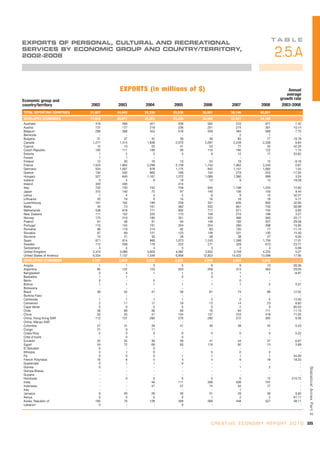
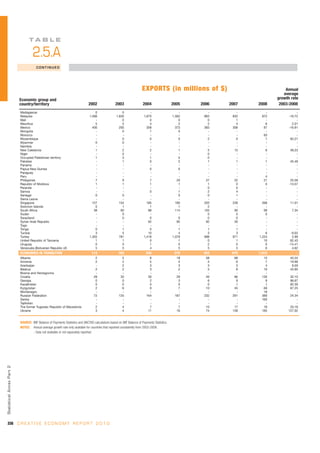
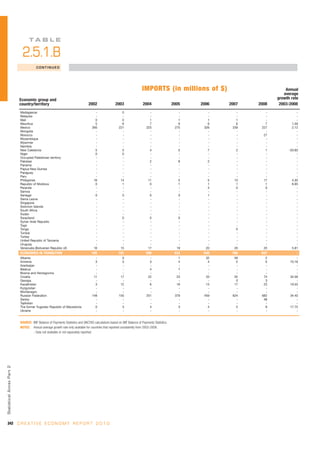
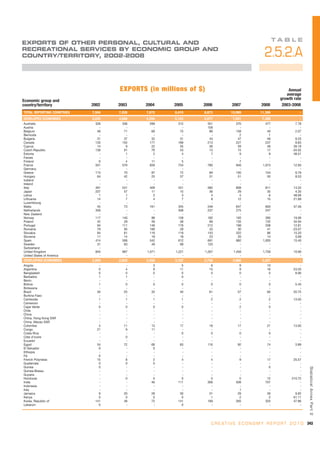
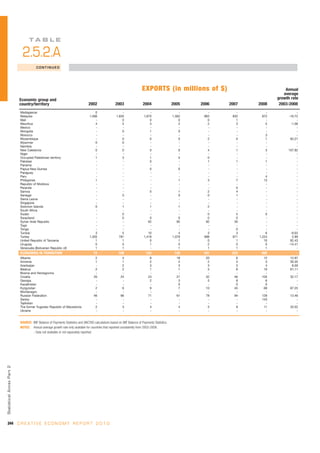
2.5.A Exports of personal, cultural and recreational services, by economic group and country/territory,
2002-2008............................................................................................................................................335
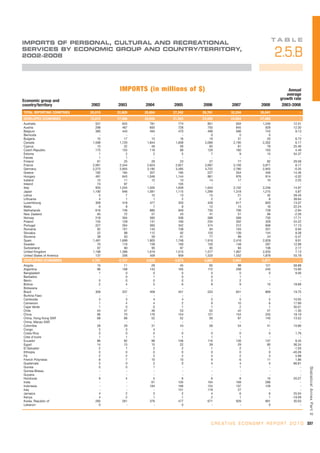
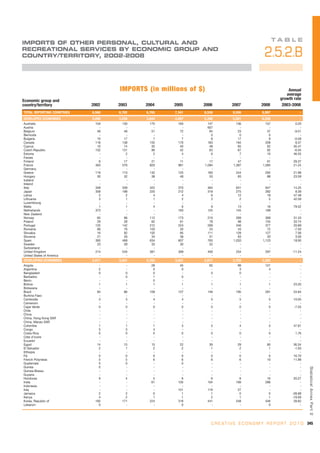
2.5.B Imports of personal, cultural and recreational services, by economic group and country/territory,
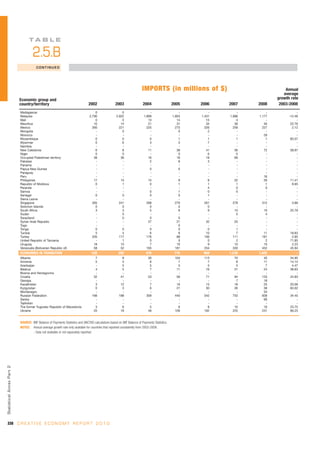
2002-2008............................................................................................................................................337
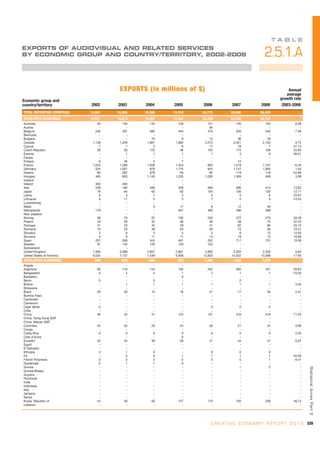
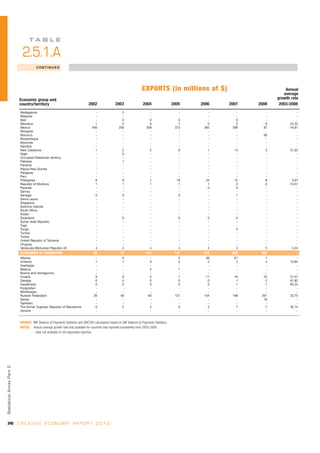
2.5.1.A Exports of audiovisual and related services, by economic group and country/territory, 2002-2008 ............339
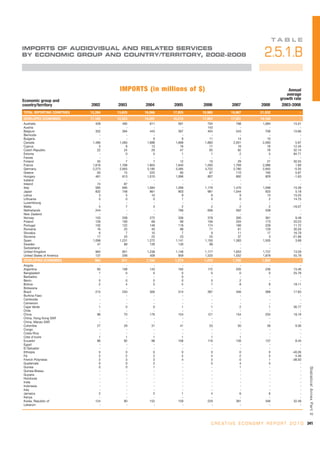
2.5.1.B Imports of audiovisual and related services, by economic group and country/territory, 2002-2008 ............341
2.5.2.A Exports of other personal, cultural and recreational services, by economic group
and country/territory, 2002-2008............................................................................................................343
2.5.2.B Imports of other personal, cultural and recreational services, by economic group
and country/territory, 2002-2008............................................................................................................345
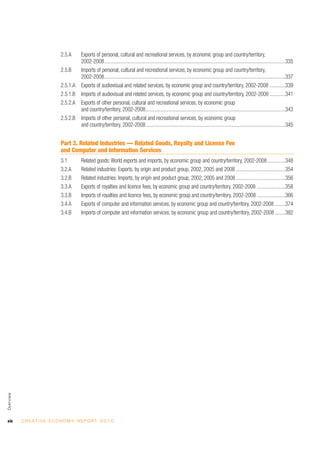
Part 3. Related Industries — Related Goods, Royalty and License Fee
and Computer and Information Services
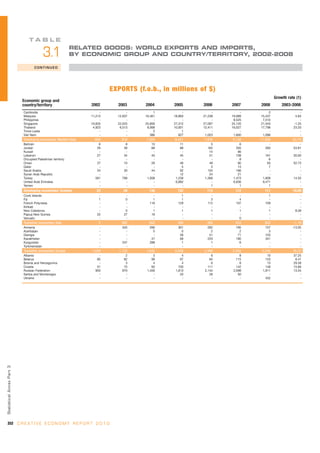
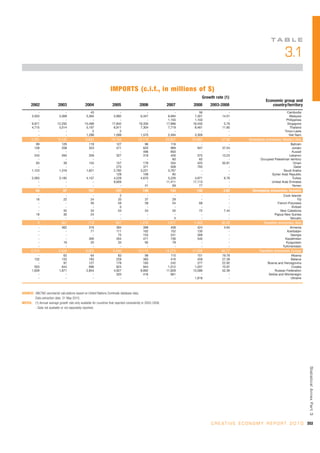
3.1 Related goods: World exports and imports, by economic group and country/territory, 2002-2008..............348
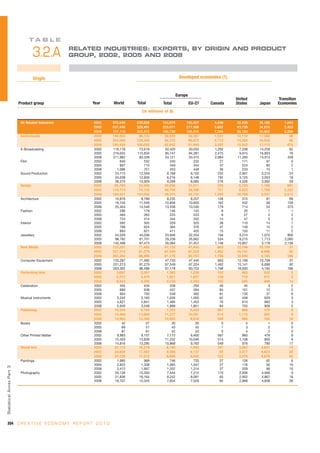
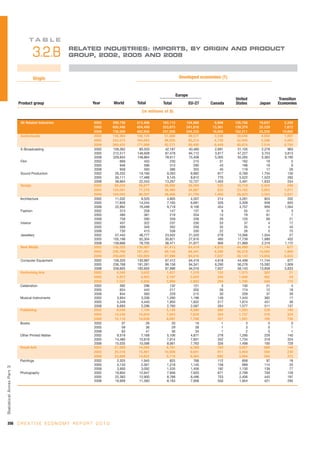
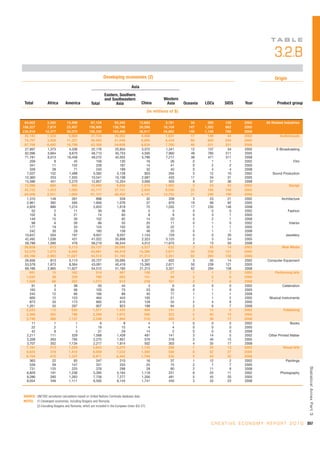
3.2.A Related industries: Exports, by origin and product group, 2002, 2005 and 2008 ......................................354
3.2.B Related industries: Imports, by origin and product group, 2002, 2005 and 2008 ......................................356
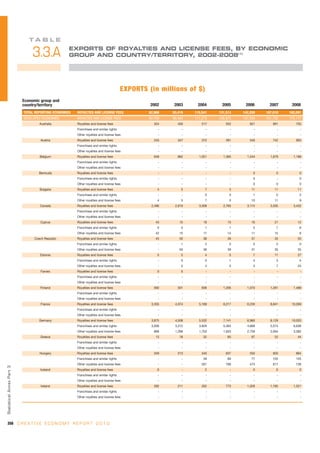
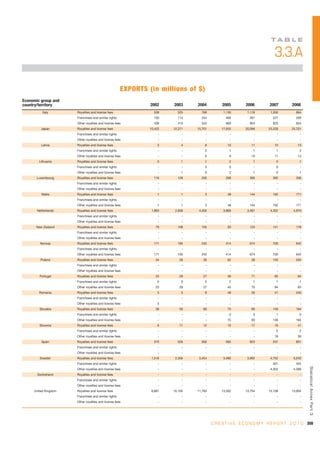
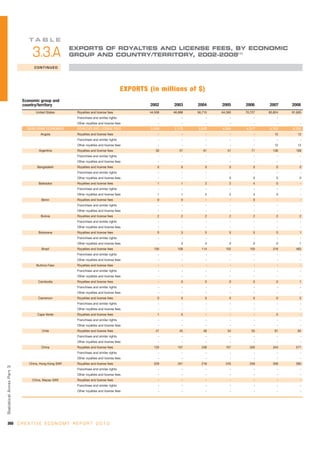
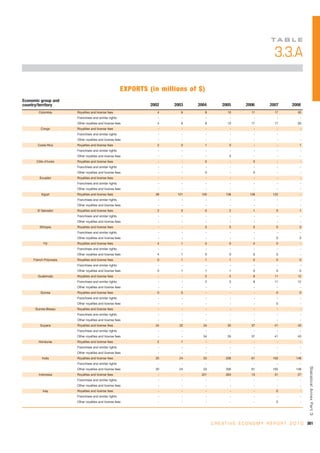
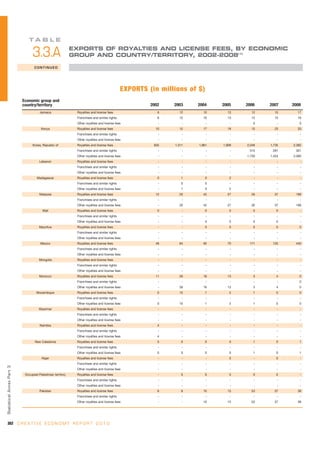
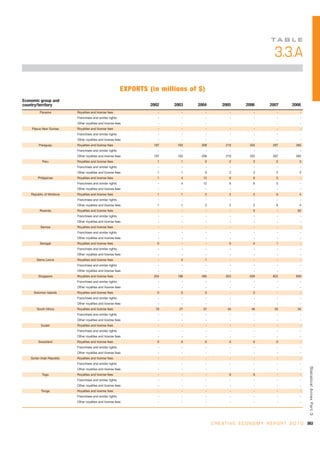
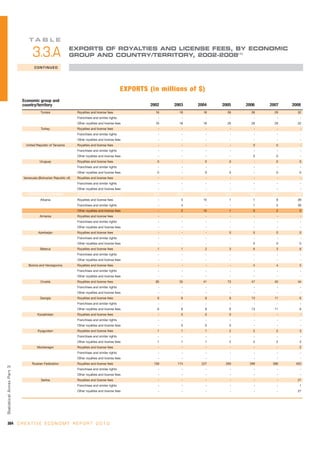
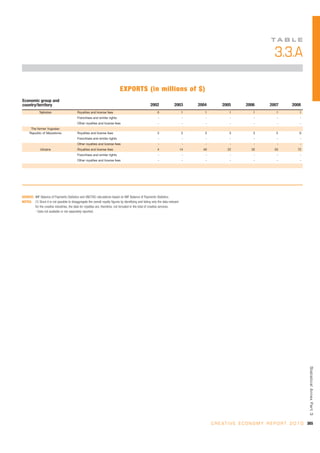
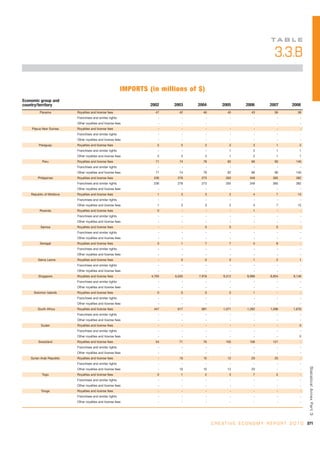
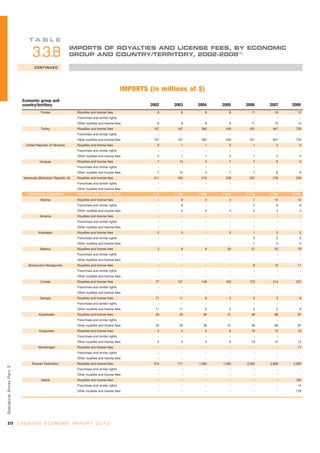
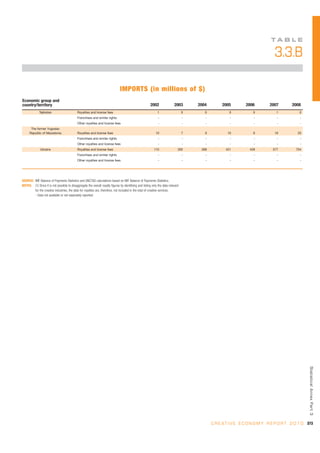
3.3.A Exports of royalties and licence fees, by economic group and country/territory, 2002-2008 ......................358
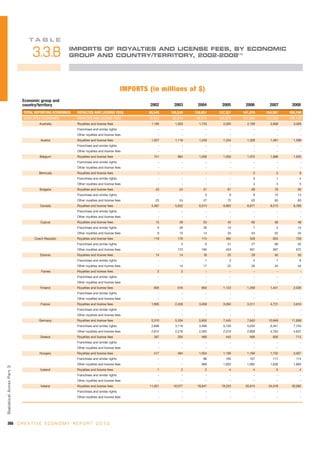
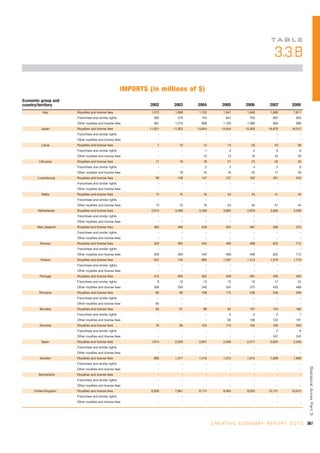
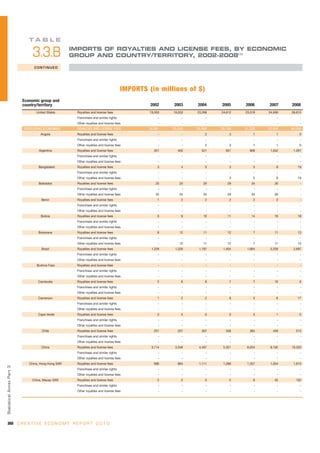
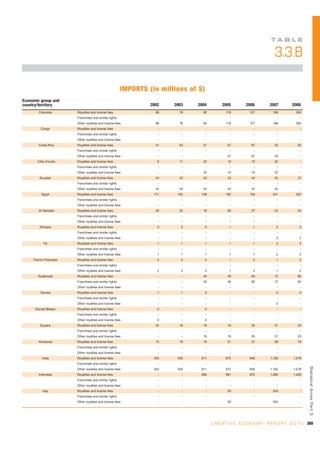
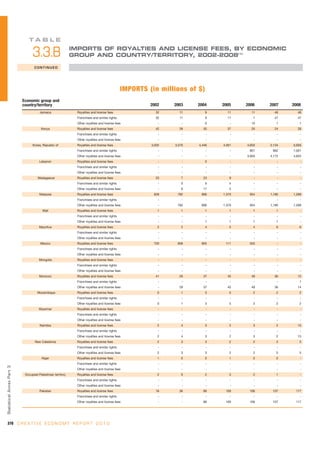
3.3.B Imports of royalties and licence fees, by economic group and country/territory, 2002-2008 ......................366
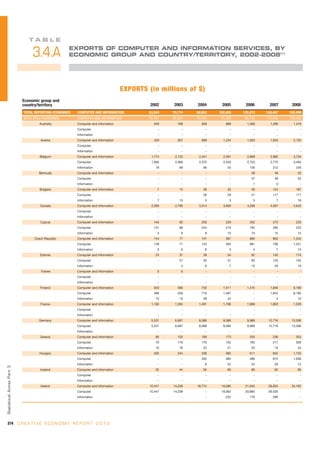
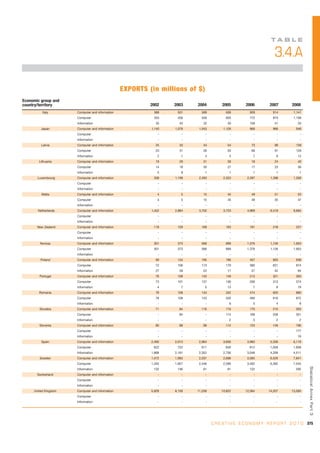
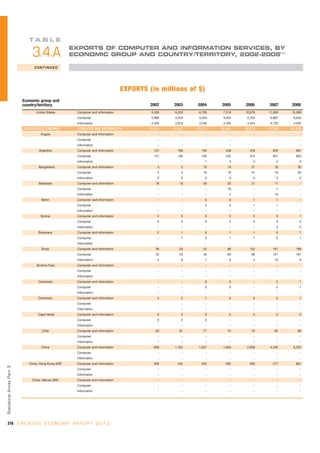
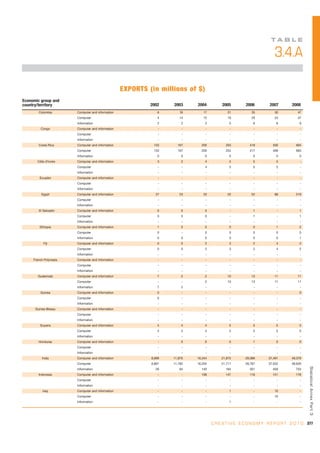
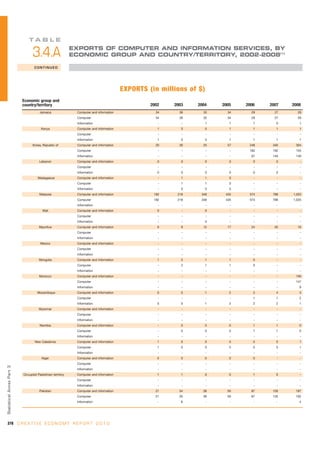
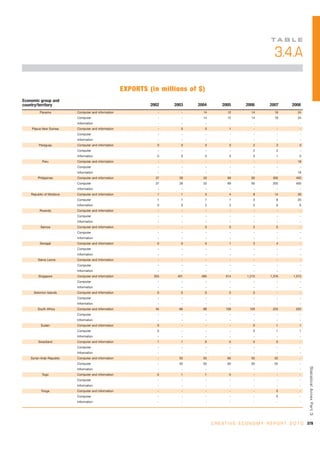
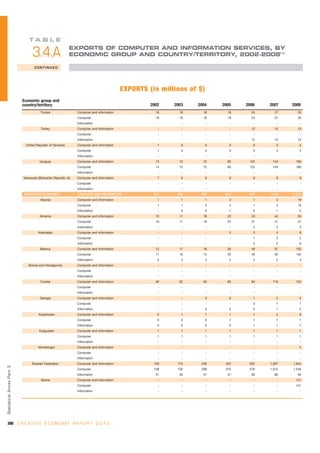
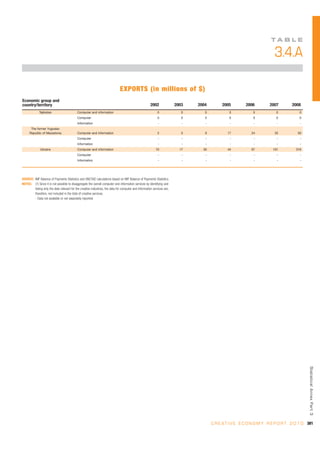
3.4.A Exports of computer and information services, by economic group and country/territory, 2002-2008 ........374
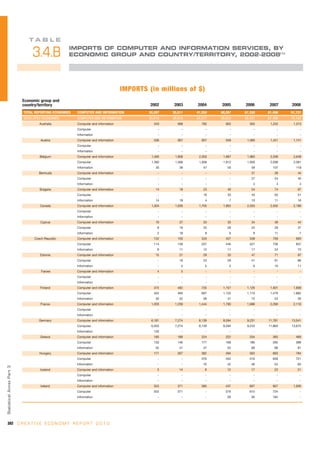
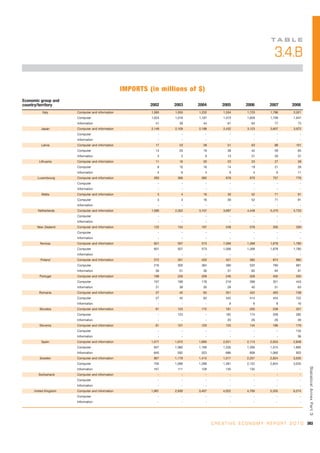
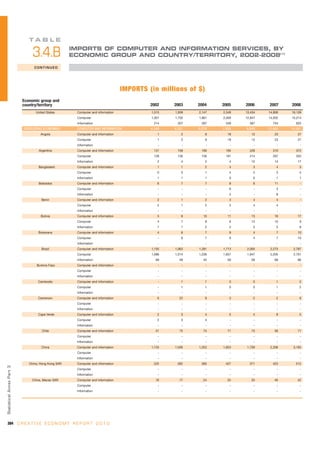
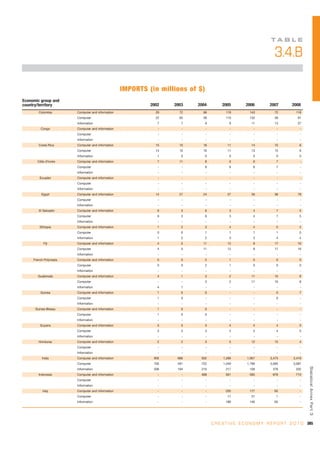
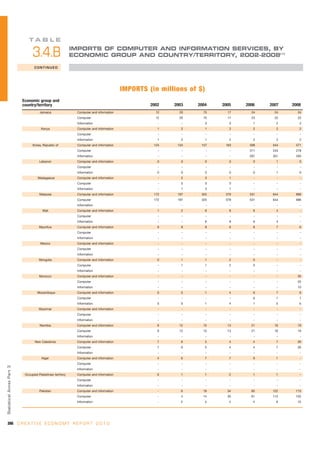
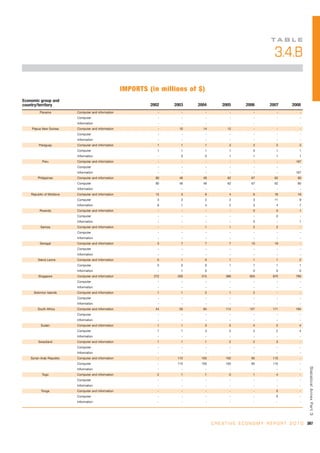
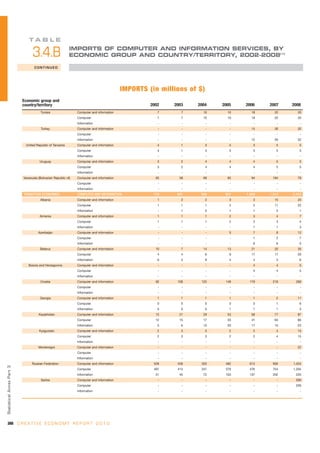
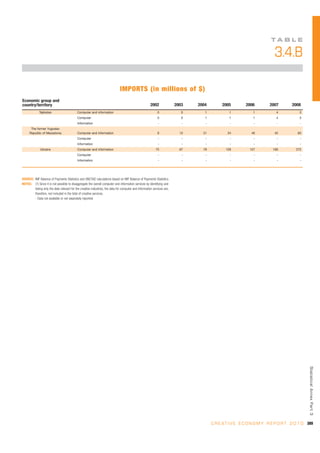
3.4.B Imports of computer and information services, by economic group and country/territory, 2002-2008 ........382
Overview
xvC R E AT I V E E C O N O M Y R E P O R T 2 0 1 0
Foreword
The United Nations published its first
Creative Economy Report in early 2008, at a
time when the world economy had been under-
going a period of expansion. The report
concluded that the creative industries were
among the most dynamic sectors of the world
economy and offered new, high growth oppor-
tunities for developing countries.The report has
been widely used by policy makers, development
practitioners, and researchers alike.
Since the report was written, the world
economy has been through turbulent times.
Virtually all regions and countries were affected
by the global recession and progress towards the
Millennium Development Goals was put at risk.
Even now, the global economy is fragile.
This report builds on the earlier analysis
of its predecessor, with new and improved data,
showing how creativity, knowledge, culture, and
technology can be drivers of job creation, inno-
vation, and social inclusion. It suggests that
world trade in creative goods and services
remained relatively robust at a time when overall
levels of international trade fell. It analyzes the
rapid growth in the creative economy sectors
across the South and the growing share of
creative sector trade which is coming from the
South. By exploring the factors behind this
growth and the potential for further expansion
of the sector the report provides useful input
into the ongoing policy debate on feasible
development options.
Times of crisis offer opportunities to
look at new options, approaches, and strategic
directions. This report argues that while the
creative economy’s growth is not in itself a
panacea, it does potentially offer more resilient,
inclusive, and environmentally viable paths to
recovery. Even if there is no one-size-fits-all pre-
scription, the report outlines how governments
can play a catalytic role by putting in place the
policies, regulations, and institutions needed to
strengthen their creative economies.
Overall, the creative economy sectors can
contribute a lot to growth and prosperity,
especially for developing countries seeking to
diversify their economies and build resilience to
future economic crisis.We commend this report
to all who are looking for innovative and
sustainable development strategies.
Foreword
Supachai Panitchpakdi Helen Clark
Secretary-General Administrator
United Nations Conference United Nations Development Programme
on Trade and Development
xvi C R E AT I V E E C O N O M Y R E P O R T 2 0 1 0
xviiC R E AT I V E E C O N O M Y R E P O R T 2 0 1 0
Acknowledgements
Acknowledgements
The Creative Economy Report series is the
result of a partnership between UNCTAD
and the UNDP Special Unit for South-South
Cooperation. These policy-oriented reports
are the main output of the technical
cooperation project “Strengthening the
Creative Economy for Development”, a joint
endeavour coordinated by Edna dos Santos-
Duisenberg, Chief, UNCTAD Creative
Economy Programme, and Francisco
Simplicio, Chief, Division for Knowledge
Management and Operations of the UNDP
Special Unit for South-South Cooperation.
The partnership expresses its sincere
gratitude to Yiping Zhou, Director, UNDP
Special Unit for South-South Cooperation,
for his deep support to this initiative.Without
his vision and commitment, this work would
not have materialized.
The Creative Economy Reports present the
United Nations system-wide perspective on
this innovative topic, as an example of multi-
agency cooperation working as “One UN”
and with one voice. In preparing the 2010
edition, UNCTAD built upon previous con-
tributions made for the Creative Economy Report
2008 by five relevant United Nations bodies:
the United Nations Conference on Trade
and Development (UNCTAD), the United
Nations Development Programme (UNDP)
Special Unit for South-South Cooperation, the
United Nations Educational Scientific and
Cultural Organization (UNESCO), theWorld
Intellectual Property Organization (WIPO)
and the InternationalTrade Centre (ITC).
The research and policy-oriented
analysis presented in the two issues of the
Creative Economy Report were carried out
under the overall guidance of Edna dos
Santos-Duisenberg, the main co-writer of
these reports. The Creative Economy Report 2010
was prepared by a small but extremely devot-
ed team of the UNCTAD Creative Economy
Programme, composed of Sudip Ranjan
Basu, Cheng Shang Li (consultant), Sharon
Khan (consultant), Carolina Quintana and
Julia Costa Souto (intern). Our special thanks
go to the Head of the Development Statistics
and Information Branch, Henri Laurencin,
and his team, composed of David Cristallo,
Yumiko Mochizuki, Sanja Blazevi, Yoann
Chaine, Ildephose Mbabazizimana and Sonia
Blachier. Comments were received from Mina
Mashayekhi and Victor Ognivtsev, colleagues
within the UNCTAD Division on
International Trade. Our gratitude to Prof.
Andrew C. Pratt for his academic reflections.
In addition to facilitating the policy
debate, the committed team of the UNDP
Special Unit for South-South Cooperation
helped to make this publication possible. As
part of the team of the UNDP Special Unit
for South-South Cooperation, text was edited
by Christopher Reardon, with assistance by
Elizabeth Smith, and Jennifer Bergamini was
responsible for the design and layout of the
publication. Administrative and secretarial
support was provided by Clisse Medeiros
Ramos Perret at UNCTAD, Lourdes
Hermosura-Chang at the UNDP Special
Unit for South-South Cooperation, with
additional support for communications
provided by Michelle Siqueira.
The partnership extends its apprecia-
tion to colleagues at the collaborating organi-
zations who provided updated inputs for the
xviii C R E AT I V E E C O N O M Y R E P O R T 2 0 1 0
Creative Economy Report 2010: Georges Poussin
at UNESCO; as well as Dimiter Gantchev,
Wend Wendland and Brigitte Vezina
at WIPO.
The Partnership expresses its sincere
gratitude to all those who kindly accepted our
invitation to contribute with signed articles
featuring concrete cases and/or their experi-
ences in the creative economy as illustrated in
the boxes throughout the report. These
articles helped to bring pragmatism to the
policy-oriented analysis of this report and
evidence for some of the empirical arguments.
The Creative Economy Report 2008 and the
Creative Economy Report 2010 were both
financed by the UNDP Special Unit for
South-South Cooperation.
Acknowledgements
xixC R E AT I V E E C O N O M Y R E P O R T 2 0 1 0
Scopeofthisreport
The Creative Economy Report 2010 —
Creative economy: A feasible development option is the
second policy-oriented report to present the
United Nations perspective on this innovative
topic. The creative economy has become a
topical issue of the international economic
and development agenda during this decade,
calling for informed policy responses in both
developed and developing countries.
Adequately nurtured, creativity fuels culture,
infuses a human-centred development and
constitutes the key ingredient for job creation,
innovation and trade while contributing to
social inclusion, cultural diversity and environ-
mental sustainability.
This report builds upon the findings
and recommendations put forward by the first
Creative Economy Report 2008 — The challenge of
assessing the creative economy: Towards informed policy-
making, but goes a step further by deepening
the analysis and bringing new insights on the
impact of recent developments on the creative
economy. Evidence from this report confirms
an important lesson from the economic crisis,
namely that the market, contrary to conven-
tional wisdom, does not have a near-miracu-
lous capacity to address socio-economic
imbalances. Thus, policies and actions to
foster development should be rooted in a
balanced role for policy interventions and the
market. In this context, the debate around the
development dimension of the creative econo-
my gained momentum in search of a new
development model better adapted to the new
realities of the contemporary society. The
Creative Economy Report 2010 attempts to
respond to this call by identifying trends,
strengths and weaknesses as well as challenges
and opportunities to be addressed, bearing in
mind that it is important to reconcile national
strategies with global international processes.
The first Creative Economy Report contin-
ues to attract growing interest on the part of
governments, researchers and practitioners. It
has helped harmonize views, stimulate more
research and policy debate and refine the
concept and its application.The popularity of
the publication was also due to the fact that it
is publicly accessible via the Internet at no
cost (www.unctad.org/creative-economy and
http://ssc.undp.org/creative_economy). Today,
the Creative Economy Report 2008 tops a Google
search on this subject. As of the end of July
2010, the report has been consulted more
than 52,000 times via the Internet, and has
been linked to from 1,080 websites all over the
world. Indications are that the report has had a
positive impact on creative industries profes-
sionals, artists and public opinion; the last two
years has seen a worldwide increase in the
amount of research and the number of con-
ferences and publications on the topic of the
creative economy. The Creative Economy Report
2008 has been the subject of debates by net-
works of academic and educational circles, has
been adopted by a number of universities as a
major reference for graduate-level courses,
stimulating the revision of academic curricula
for higher education in fields related to the
arts and the creative economy.1
Moreover,
an increasing number of governments, in
developing and developed countries alike, are
identifying the creative industries as a priority
sector in their national development strategies.
Scope of this report
1
The Creative Economy Report 2008 revisited: The Dutch being unnoticed, by the Research Group Arts and Economics, Utrecht School of Arts,
Utrecht University, Netherlands, June 2009.
xx C R E AT I V E E C O N O M Y R E P O R T 2 0 1 0
These have been the key motivations guiding
this new publication.
Obviously, there is a need for better
understanding of the dynamics of the creative
economy in our globalized world. A more
holistic approach to development is needed. It
is time to take a step back from the global and
look more deeply at the local, identifying
specificities and identities of countries and
recognizing their cultural and economical dif-
ferences in order to capture their real needs
and surrounding environment. It seems cru-
cial to explore the linkages between creative
capacities, trade, investment and technology,
and see how this can translate into a vibrant
creative economy able to contribute to eco-
nomic prosperity and poverty reduction.
The Creative Economy Report 2010 incor-
porates new reflections, additional research
and more in-depth analysis of the key issues.
It captures economic, cultural, social and
technological developments that took place at
global level over the last two years, in particu-
lar the consequences of the financial crisis and
environmental degradation. Throughout the
report, the analysis, charts and tables have
been updated with more recent statistics and
information, including more timely trade
analysis showing the growing share of creative
industries products in world markets during
the period 2002-2008, and the state of play
up to 2010.
In fact, there are a number of novelties
in the Creative Economy Report 2010, reflecting
new realities. The most important is that the
world economy faced the most severe reces-
sion in 70 years in 2008-2009, which serious-
ly undermined growth, employment and qual-
ity of life. The crisis pointed to the limita-
tions of mainstream economic policies, giving
clear signs of the need for profound econom-
ic and financial reforms, new approaches to
development strategies and better balance
between the roles of the market and govern-
ment. New development paths are needed to
reorient policies towards more equitable,
sustainable and inclusive growth strategies
able to accelerate socio-economic growth, cre-
ate jobs and raise living standards. Against this
background, the creative economy is a feasible
development option.
The world has changed. The crisis
provoked a reality check calling for a more
effective global governance system in which
emerging countries are no longer outsiders. As
global demand sharply contracted in the most
advanced countries, the fast-growing develop-
ing nations performed relatively better, surviv-
ing the crisis with less damage. South-South
regional trade and investments have been vital
to mitigating the effects of the global reces-
sion. While the traditional manufacturing
industries were seriously hit, the more knowl-
edge-based creative sectors were more resilient
to external shocks. In 2008, despite the 12
per cent decline in global trade, world trade of
creative goods and services continued its
expansion, reaching $592 billion and reflect-
ing an annual growth rate of 14 per cent dur-
ing the period 2002-2008. This reconfirms
that the creative industries have been one of
the most dynamic sectors of the world econ-
omy throughout this decade.
The current economic recovery remains
fragile, despite the mitigating policies.
Recovery cannot depend solely on increasing
demand in industrialized nations. Developing
countries should continue enhancing their
creative capacities and progressively look for
new market opportunities in the South, where
demand is growing.The Creative Economy Report
2010 provides evidence that South-South
trade in creative products and South-South
investments in digital technologies are gradu-
ally increasing but have the potential to
expand even faster if supported by enhanced
South-South cooperation. Developing coun-
tries are therefore encouraged to include cre-
ative goods in their lists of products as they
conduct their negotiations under the Global
System of Trade Preferences.
Scopeofthisreport
Chapter 1 explores evolving concepts
such as creative ecology, creative commons,
collaborative creation, experience economy
and soft innovation and expands the analysis
of the major drivers and multiple dimensions
of the creative economy. Chapter 2 introduces
a thoughtful reflection on the linkages
between the creative economy and the green
economy, capturing ongoing policy debates
on the implications of losses in biodiversity
and how creativity and biodiversity are a win-
win solution to promote sustainable develop-
ment and economic recovery. Moreover, it
presents an overview of recent developments
related to the creative economy in developing
countries and economies in transition.
Chapter 3 analyses the organizational struc-
ture of the creative economy, highlighting the
power of social networks and their influence
in the distribution of digitized creative con-
tent through more flexible business models.
Chapter 4 features a comprehensive comparative
analysis of current methodologies to collect,
analyse and disseminate economic indicators
and statistics for the creative industries, taking
into account new models for cultural statistics
and ongoing work carried out by internation-
al organizations and individual countries in
this regard. It also presents a refined method-
ology developed by UNCTAD proposing
better tools to gradually improve the compa-
rability and reliability of trade statistics for
the creative industries; it is a work in progress
aimed at improving market transparency.
Chapter 5 deals with the international
trade of creative goods and services. It shows
a recent picture of global trends for world and
regional trade flows of creative products cov-
ering the period 2002-2008. An in-depth
trade analysis is presented for the North-
South and South-South trade of creative
products, with a special focus on the potential
for further expansion of South-South trade,
and how the demand for creative products has
been contributing to economic recovery.
Advances were made in the UNCTAD
methodology to process and analyse trade
statistics, enabling countries to generate their
own country profiles on the trade perform-
ance of their creative industries, as is illustrat-
ed in the statistical annex.2
Chapter 6 reflects
ongoing work undertaken by WIPO at the
secretariat and at the intergovernmental levels.
It also analyses sensitive areas related to the
current controversial debates about the pros
and cons of protection or the sharing of
copyrights, and the new trend towards public
domain and new open sources for the
distribution of intellectual property rights,
including a section on the evolution of
creative commons.
In chapter 7 the focus is on the growing
role of technology and connectivity in the
creative economy. It starts by examining the
impact of the economic crisis on digital tech-
nologies, and presenting a fresh view on how
the diffusion of information and communica-
tion technology (ICT), and in particular the
mobile revolution, is bringing progress for
developing countries.The report presents evi-
dence that digital technologies and ICT-
enabled services are stimulating the creation
and marketing of digitized creative products
through new business models, and that this
convergence and digitization is helping cre-
ative products from developing countries to
reach global markets. Chapter 8 emphasizes
the importance of tailor-made national poli-
cies for strengthening the creative economy
for development gains. The report proposes
policy directions for the provision of financ-
ing and investment for the creative industries,
recalling that most governments have public
deficits and new financing options should be
explored. As illustration, the concepts of a
solidarity-based economy and the use of
alternative currencies for transactions in the
creative economy are presented as alternative
ways to promote creative entrepreneurship,
particularly in the post-crisis period. The
xxiC R E AT I V E E C O N O M Y R E P O R T 2 0 1 0
Scopeofthisreport
2
Accordingly, the UNCTAD Global Database on the Creative Economy has also been updated and can be accessed at
www.unctad.org/creative-programme.
xxii C R E AT I V E E C O N O M Y R E P O R T 2 0 1 0
report reviews how networking and collabora-
tion has made creative individuals and groups
more proactive in shaping solutions for rein-
vigorating the creative economy. It points out
that appropriate institutional mechanisms and
regulatory frameworks should be in place as a
prerequisite for the optimal functioning of
the “creative nexus” which aims to attract
investors and creative business, stimulate the
use of new technologies and articulate trade
promotion strategies for both the domestic
and global markets. Clustering and the cre-
ative nexus are essential to fostering creative
innovation.
Chapter 9 presents an overview of
current developments in global processes and
their impact for the formulation of multilater-
al, regional and national policies in areas of
relevance for the creative economy. The report
observes that the adverse effects of the finan-
cial and economic crisis will make it nearly
impossible for the poorest countries to achieve
the Millennium Development Goals, in partic-
ular the target of halving extreme poverty by
2015. The report sheds light on the state of
intergovernmental debates and multilateral
negotiations and their repercussions for the
creative economy up to 2010. It analyses, for
example, the causes of the prolonged stalemate
in the negotiations of theWTO Doha Round
in the aftermath of the 2008-2009 crisis. A
section on market access and tariff barriers
presents a pioneering analysis demonstrating
that trade expansion for creative goods has
been hampered by the high level of tariffs, an
issue developing countries may wish to address
through negotiations under the Global System
of Trade Preferences. The chapter also gives a
brief review of progress made up to 2010
under the implementation of the UNESCO
Convention on the Protection and Promotion
of Diversity of Cultural Expressions and its
implications for the creative economy in devel-
oping countries. Finally, it reviews new moves
and steps taken by the international communi-
ty in the context of the implementation of the
WIPO Development Agenda.
In conclusion, chapter 10 highlights the
lessons learned and proposes specific policy
options for enhancing the creative economy in
the light of current developments. It notes
how policymaking at the level of communities
and municipalities seems to be increasingly
effective in articulating results as compared to
national strategies, due to the complexity of
integrating inter-ministerial and cross-cutting
policy actions. Moreover, it observes how the
growing impact of digital convergence and the
power of social networks has brought a new
dynamic to the creative process locally and
globally, remixing the traditional with con-
temporary cultural and creative expressions.
The ten key messages of this policy-
oriented study are highlighted. The Creative
Economy Report 2010 brings evidence that the
creative economy is indeed a feasible option to
advance development in line with the
far-reaching transformation of our society.
The time has come to promote creativity and
innovation and shape a more holistic develop-
ment strategy able to foster an inclusive and
sustainable economic recovery.
Scopeofthisreport
This policy-oriented report examines a
number of issues relating to the creative econ-
omy and its development dimension. Instead
of presenting an overview of the full report, a
summary of the 10 key messages is presented
at the initial part of the report to provide a
synthesis of the main findings and policy
recommendations. The intention is to present
a quick glance at the key issues, and facilitate
informed, results-oriented policymaking.
I. In 2008, the eruption of the world
financial and economic crisis provoked a drop
in global demand and a contraction of 12 per
cent in international trade. However, world
exports of creative goods and services contin-
ued to grow, reaching $592 billion in 2008
— more than double their 2002 level, indicat-
ing an annual growth rate of 14 per cent over
six consecutive years. This is a confirmation
that the creative industries hold great potential
for developing countries that seek to diversify
their economies and leapfrog into one of the
most dynamic sectors of the world economy.
II. The world economy has been receiv-
ing a boost from the increase in South-South
trade.The South’s exports of creative goods to
the world reached $176 billion in 2008,
accounting for 43 per cent of total
creative industries trade with an annual
growth rate of 13.5 per cent during the 2002-
2008 period. This indicates a robust
dynamism and developing countries’ fast-
growing market share in world markets for
creative industries. South-South trade of cre-
ative goods amounted to nearly $60 billion, an
astonishing growth rate of 20 per cent over
the period. The trend is also confirmed in the
case of creative services, whose share of
South-South trade grew to $21 billion in
2008 from $7.8 billion in 2002. In the light
of this positive evolution, developing coun-
tries are highly encouraged to include creative
goods in their list of products and to con-
clude negotiations under the Global System of
Trade Preferences in order to give even more
impetus to the expansion of South-South
trade in this promising area.
III. A right mix of public policies and
strategic choices are essential for harnessing
the socio-economic potential of the creative
economy for development gains. For develop-
ing countries, the starting point is to enhance
creative capacities and identify creative sectors
with greater potential through articulated
cross-cutting policies. Efforts should be
oriented towards the functioning of a
“creative nexus” able to attract investors, build
creative entrepreneurial capacities, offer better
access and infrastructure to modern ICT
technologies in order to benefit from global
digital convergence, and optimize the trade
potential of their creative products in both
domestic and international markets. A posi-
tive spillover effect will certainly be reflected
in higher levels of employment generation,
increased opportunities for strengthening
innovation capabilities and a high quality of
cultural and social life in those countries.
IV. Policy strategies to foster the
development of the creative economy must
recognize its multidisciplinary nature — its
economic, social, cultural, technological and
environmental linkages. Key elements in any
package to shape a long-term strategy for the
creative economy should involve concerted
inter-ministerial actions to ensure that nation-
al institutions, a regulatory framework and
financing mechanisms are in place to support
xxiiiC R E AT I V E E C O N O M Y R E P O R T 2 0 1 0
TenKeyMessages
Ten key messages
xxiv C R E AT I V E E C O N O M Y R E P O R T 2 0 1 0
the strengthening of the creative and related
industries.
V. A major challenge for shaping poli-
cies for the creative economy is related to
intellectual property rights: how to measure
the value of intellectual property, how to
redistribute profits and how to regulate these
activities. The evolution of multimedia creat-
ed an open market for the distribution and
sharing of digitized creative content, and the
debate about the protection or sharing of
IPRs became highly complex, involving
governments, artists, creators and business.
The time has come for governments to review
the limitations of current IPR regimes and
adapt them to new realities by ensuring a
competitive environment in the context of
multilateral discourse.
VI. The creative economy cuts across
the arts, business and connectivity, driving
innovation and new business models.The dig-
ital era unlocked marketing and distribution
channels for music, digital animation, films,
news, advertising, etc., thereby expanding the
economic benefits of the creative economy.
The mobile revolution is changing the lives of
millions of people in the developing world. In
2009 over 4 billion mobile phones were in
use, 75 per cent of them in the South. In
2008 more than one-fifth of the world’s pop-
ulation used the Internet, and the number of
users in the South grew five times faster than
in the North. However, developing countries
are lagging in terms of broadband connectiv-
ity. For the creative industries, this is a con-
straint because many applications to stimulate
creative production and e-business do not run
without sufficient bandwidth. Therefore,
national and regional investment efforts
should be guided, in collaboration with inter-
national agencies, towards better infrastruc-
ture for broadband in the South.
VII.The creative economy is both frag-
mented and society-inclusive. It functions
through interlocking and flexible networks of
production and service systems spanning the
entire value chain. Today it is strongly influ-
enced by the growing role of social networks.
These new tools, such as blogs, forums and
wikis, facilitate connectivity and collaboration
among creative people, products and places.
Pragmatic policymaking requires a better
understanding of who the stakeholders are in
the creative economy, how they relate to one
another and how the creative sector relates to
other sectors of the economy. Policies and ini-
tiatives should be specific rather than generic,
and preferably not top-down or bottom-up
but allowing for ownership and for partner-
ships involving stakeholders from the public
and private sector, artists and civil society.
Schemes that are more inclusive and flexible
will facilitate effective and innovative measures
to revitalize the creative economy.
VIII. Policies for the creative economy
have to respond not only to economic needs
but also to special demands from local com-
munities related to education, cultural identi-
ty, social inequalities and environmental con-
cerns. An increasing number of municipalities
all over the world are using the concept of
creative cities to formulate urban development
strategies for reinvigorating growth with a
focus on culture and creative activities. The
main principles can be adapted for rural areas
and disadvantaged communities as a tool
to generate jobs, particularly for youth,
empower creative women and promote social
inclusion in line with the achievement of
the Millennium Development Goals.
Municipalities are therefore acting faster and
more astutely than the spheres of federal
government, which can be more constrained
by power issues and bureaucracy. Ideally,
target plans of action for the creative econo-
my should be shaped at all levels, from
the community to the municipality to the
national level, independent of order. It is
important, however, to reconcile cultural and
social objectives with instruments of trade,
technology and tourism.
TenKeyMessages
IX. In the aftermath of the crisis, the
firmness of the market for creative products is
a sign that many people in the world are eager
for culture, social events, entertainment and
leisure. They are devoting a higher share of
their income to memorable life experiences
that are associated with status, style, brands
and differentiation; this phenomenon, a sym-
bol of the way of life in much of contempo-
rary society, is rooted in the creative economy.
Evidence suggests that even during the global
recession people continued to go to cinemas
and museums, listen to music, watch videos
andTV shows, play video games, etc. Even in
times of crisis, creative products continue to
thrive as an integral part of our lives. This
explains why some creative sectors appear
more resilient to economic downturns and
can contribute to a more sustainable and
inclusive economic recovery.
X. Each country is different, each
market is special and each creative product has
its specific touch and splendour. Nonetheless,
every country might be able to identify key
creative industries that have not yet been
exploited to their full potential so as to reap
developmental benefits. There is no one-size-
fits-all prescription; each country should for-
mulate a feasible strategy to foster its creative
economy, based on its own strengths, weak-
ness and realities. The time for action is now.
xxvC R E AT I V E E C O N O M Y R E P O R T 2 0 1 0
TenKeyMessages
xxvi C R E AT I V E E C O N O M Y R E P O R T 2 0 1 0
Abbreviationsandacronyms
Abbreviations and acronyms
ACP African, Caribbean and Pacific
ANCOM Andean Common Market
APEC Asia-Pacific Economic Cooperation
APTA Asia-Pacific Trade Agreement (former Bangkok Agreement)
ASEAN Association of Southeast Asian Nations
BOP Balance of payments
BSEC Black Sea Economic Cooperation Organization
CACM Central American Common Market
CAFTA Central American-Dominican Republic Free Trade Agreement
CARICOM Caribbean Community
CD Compact disc
c.i.f. Cost, insurance and freight
CIS Commonwealth of Independent States
COMESA Common Market for Eastern and Southern Africa (formerly PTA)
COMTRADE Commodity Trade Statistics Database
CSA Cultural Satellite Account
DAC Development Assistance Committee (of OECD)
DCMS Department of Culture, Media and Sport
DVD Digital versatile disc (formerly digital videodisc)
EBOPS Extended Balance of Payments Services Classification
ECCAS Economic Community of Central African States
ECE Economic Commission for Europe
ECO Economic Cooperation Organization
ECOWAS Economic Community of West African States
EFTA European Free Trade Association
ESCAP Economic and Social Commission for Asia and the Pacific
ESCWA Economic and Social Commission for Western Asia
EUROSTAT Statistical Office of the European Communities
excl. Excluding
FAO Food and Agriculture Organization of the United Nations
FDI Foreign direct investment
f.o.b. Free on board
FOSS Free and open-source software
FTA Free trade area
FTAA Free Trade Area of the Americas
G-77 Group of 77
GATS General Agreement on Trade in Services
GATT General Agreement on Tariffs and Trade
GCC Gulf Cooperation Council
GDP Gross domestic product
GNP Gross national product
GVA Gross value added
HIPCs Heavily indebted poor countries
IFPI International Federation of the Phonographic Industry
ILO International Labour Organization
IMF International Monetary Fund
IOM International Organization for Migration
IPR Intellectual property right
ITC International Trade Centre
ITU International Telecommunication Union
LAIA Latin American Integration Association
LDC Least developed country
MDG Millennium Development Goal
MERCOSUR Common Market of the South
MFN Most-favoured nation
MSITS Manual on Statistics of International Trade in Services
NAFTA North American Free Trade Agreement
n.e.s. Not elsewhere specified
NGO Non-governmental organization
n.i.e. Not included elsewhere
NPISHs Non-profit institutions serving households
ODA Official development assistance
OECD Organisation for Economic Co-operation and Development
OECS Organisation of Eastern Caribbean States
PRSP Poverty Reduction Strategy Paper
R&D Research and development
RMB Renminbi
RTA Regional trade agreement
SAARC South Asian Association for Regional Cooperation
SADC Southern African Development Community
SAM Social accounting matrix
SAR Special Administrative Region
SIDS Small island developing State
SITC Standard Industrial Trade Classification
SMEs Small and medium-sized enterprises
SNA System of National Accounts
TFYR The former Yugoslav Republic of Macedonia
TNC Transnational corporation
TRIPS Trade-Related Aspects of Intellectual Property Rights
UEMOA West African Economic and Monetary Union
UIS UNESCO Institute for Statistics
UMA Arab Maghreb Union
UN/DESA/SD United Nations Department of Economic and Social Affairs, Statistics Division
UNAIDS Joint United Nations Programme on HIV/AIDS
xxviiC R E AT I V E E C O N O M Y R E P O R T 2 0 1 0
Abbreviationsandacronyms
xxviii C R E AT I V E E C O N O M Y R E P O R T 2 0 1 0
UNCTAD United Nations Conference on Trade and Development
UNDP United Nations Development Programme
UNESCO United Nations Educational, Scientific and Cultural Organization
UNHCR United Nations High Commissioner for Refugees
UNICEF United Nations Children’s Fund
UNWTO United Nations World Tourism Organization
USSR Union of Soviet Socialist Republics
VCR Video cassette recorder
WFP World Food Programme
WHO World Health Organization
WIPO World Intellectual Property Organization
WMO World Meteorological Organization
WSIS World Summit on the Information Society
WTO World Trade Organization
Abbreviationsandacronyms
The Creative Economy 1
PART
2 C R E AT I V E E C O N O M Y R E P O R T 2 0 1 0
Fundamental to an understanding of the creative
economy — what it comprises and how it functions in the
economies of both developed and developing countries —
are the concepts of “cultural industries”and “creative indus-
tries”. Much debate surrounds these terms. This chapter
provides an overview of the development of the concepts of
“creativity” throughout this decade leading to what became
known as the “creative economy”. Our intention is not to
reach a final consensus about concepts, but to understand its
evolution. It also considers the emergence of the associated
concepts of “creative class”, “creative cities”, “creative clus-
ters”, as well as the most recent innovative notions relating to
the “experience economy” “creative commons”and “creative
ecology”. The major drivers of the growth of the creative
economy and its multiple dimensions are examined in the
light of recent developments including the world economic
crisis. This chapter also provides evidence on the economic
contribution of the creative industries to the economies of
various advanced countries.
1.1.1 Creativity
There is no simple definition of “creativi-
ty”that encompasses all the various dimensions of
this phenomenon. Indeed, in the field of psychol-
ogy, where individual creativity has been most
widely studied, there is no agreement as to
whether creativity is an attribute of people or a
process by which original ideas are generated.
Nevertheless, the characteristics of creativity in
different areas of human endeavour can at least be
articulated. For example, it can be suggested that:
I artistic creativity involves imagination and a
capacity to generate original ideas and novel
ways of interpreting the world, expressed in
text, sound and image;
I scientific creativity involves curiosity and a willingness to
experiment and make new connections in problem-
solving; and
I economic creativity is a dynamic process leading towards
innovation in technology, business practices, marketing,
etc., and is closely linked to gaining competitive advan-
tages in the economy.
All of the above involve technological creativity to
greater or lesser extent and are interrelated, as shown in
figure 1.1. Regardless of the way in which creativity is inter-
preted, there is no doubt that, by definition, it is a key
element in defining the scope of the creative industries and
the creative economy.
Another approach is to consider creativity as a meas-
urable social process. From the economic point of view,
however, a relationship between creativity and socio-
economic development is not apparent, particularly the
3C R E AT I V E E C O N O M Y R E P O R T 2 0 1 0
Conceptandcontextofthecreativeeconomy
1
CHAPTER
1Concept and context of the
creative economy
1.1 Evolving concepts and definitions
Figure 1.1 Creativity in today’s economy
Scientific
creativity
Economic
creativity
Technological
creativity
Cultural
creativity
Source: KEA European Affairs (2006:42).
4 C R E AT I V E E C O N O M Y R E P O R T 2 0 1 0
extent to which creativity contributes to economic growth. In
this case, it is important to measure not only economic out-
comes of creativity but also the cycle of creative activity
through the interplay of four forms of capital — social cul-
tural, human, and structural or institutional — as the deter-
minants of the growth of creativity: the creative capital.The
accumulated effects of these determinants are the “outcomes
of creativity”. This is the framework of the creativity index,
also known as the 5 Cs model.1
There are debates about a
possible establishment of a European Creativity Index to be
applied to the countries of the European Union; the proposal
builds upon existing indices and suggests a model with 32
culture-related indicators grouped in five pillars of creativi-
ty: human capital, technology, the institutional environment,
the social environment, openness and diversity. The goal of
such an index would be to highlight the potential of includ-
ing culture-based indicators in existing frameworks related to
creativity, innovation and socio-economic development with
a view to assessing the creative performance of EU member
states and facilitating policymaking.
Creativity can also be defined as the process by which
ideas are generated, connected and transformed into things
that are valued.2
In other words, creativity is the use of ideas
to produce new ideas. In this conceptual debate it should be
pointed out that creativity is not the same as innovation.
Originality means creating something from nothing or
reworking something that already exists. Nowadays the con-
cept of innovation has been enlarged beyond a functional,
scientific or technological nature to also reflect aesthetic or
artistic changes. Recent studies point to the distinction
between “soft” and technological innovation but recognize
that they are interrelated.3
There are high rates of soft inno-
vation in the creative industries, particularly in music, books,
arts, fashion, film and video games. The focus is mainly on
new products or services rather than processes.
1.1.2 Creative goods and services
The scope of the creative economy is determined by
the extent of the creative industries. Defining “creative
industries”, however, is a matter of considerable inconsisten-
cy and disagreement in the academic literature and in policy-
making circles, especially in relation to the parallel concept
of “cultural industries”. Sometimes a distinction is made
between the creative and the cultural industries; sometimes
the two terms are used interchangeably. A sensible way to
proceed is to begin by defining the goods and services that
these industries produce.
The concept of “cultural products” can be articulated
if the notion of “culture” is accepted whether in its anthro-
pological or its functional sense. It might be argued, for exam-
ple, that cultural goods and services such as artwork, musical
performances, literature, film and television programmes, and
video games share the following characteristics:
I their production requires some input of human creativity;
I they are vehicles for symbolic messages to those who con-
sume them, i.e., they are more than simply utilitarian inso-
far as they additionally serve some larger, communicative
purpose; and
I they contain, at least potentially, some intellectual property
that is attributable to the individual or group producing the
good or service.
An alternative or additional definition of “cultural
goods and services” derives from a consideration of the type
of value that they embody or generate.That is, it can be sug-
gested that these goods and services have cultural value in
Conceptandcontextofthecreativeeconomy
1
Figure 1.2
Interplay of the 5Cs:
Outcomes of creativity + 4 capitals
Human capital
Cultural
capital
Source: A Study on Creativity Index, 2005.
Structural or
institutional
capital
Social capital
Manifestations
of creativity
(outputs and
outcomes)
1
This model was developed by a research team at the Centre for Cultural Policy Research, University of Hong Kong, led by Prof. Desmond Hui. See A Study on Creativity Index (2005).
http://www.hab.gov.hk/en/publications_and_press_releases/reports.htm.
2
BRA/Research, “Boston's Creative Economy”. Available from http://unitus.org/FULL/BostonCreativeEconomy.pdf.
3
Stoneman (2010).
addition to whatever commercial value they may possess and
that this cultural value may not be fully measurable in mon-
etary terms. In other words, cultural activities of various
sorts and the goods and services that they produce are valued
— both by those who make them and by those who con-
sume them — for social and cultural reasons that are likely
to complement or transcend a purely economic valuation.
These reasons might include aesthetic considerations or the
contribution of the activities to community understanding
of cultural identity. If such cultural value can be identified,
it may serve as an observable characteristic by which to
distinguish cultural goods and services as compared with
different types of commodities.
Defined in either or both of these ways, “cultural
goods and services” can be seen as a subset of a wider cate-
gory that can be called “creative goods and services”, whose
production requires some reasonably significant level of cre-
ativity. Thus the “creative” category extends beyond cultural
goods and services as defined above to include products such
as fashion and software.These latter can be seen as essential-
ly commercial products, but their production does involve
some level of creativity. This distinction provides a basis for
differentiating between cultural and creative industries, as is
discussed in the following sections.
1.1.3 Cultural industries
The term “culture industry” appeared in the post-war
period as a radical critique of mass entertainment by mem-
bers of the Frankfurt school led by Theodor Adorno and
Max Horkheimer, followed subsequently by writers such as
Herbert Marcuse.4
At that time, “culture industry” was a
concept intended to shock; culture and industry were argued
to be opposites and the term was used in polemics against the
limitations of modern cultural life. It continued to be used as
an expression of contempt for the popular newspapers,
movies, magazines and music that distracted the masses.5
In the present day, there remain different interpreta-
tions of culture as an industry. For some, the notion of
“cultural industries” evokes dichotomies such as elite versus
mass culture, high versus popular culture, and fine arts ver-
sus commercial entertainment. More generally, however, the
proposition that the cultural industries are simply those
industries that produce cultural goods and services, typically
defined along the lines outlined above, has gained greater
acceptance.
In UNESCO, for example, the cultural industries are
regarded as those industries that “combine the creation,
production and commercialization of contents which are
intangible and cultural in nature. These contents are typical-
ly protected by copyright and they can take the form of
goods or services”. An important aspect of the cultural
industries, according to UNESCO, is that they are “central
in promoting and maintaining cultural diversity and in
ensuring democratic access to culture”.6
This two-fold
nature — combining the cultural and the economic — gives
the cultural industries a distinctive profile.
Similarly, in France, the “cultural industries” have
recently been defined as a set of economic activities that com-
bine the functions of conception, creation and production of
culture with more industrial functions in the large-scale man-
ufacture and commercialization of cultural products.7
Such
a definition seems to initiate a process leading towards a
broader interpretation of the cultural industries than that
implied by traditional notions of the “cultural sector”.
1.1.4 Cultural economics
Many politicians and academics, particularly in
Europe and Latin America, use the concept of “cultural eco-
nomics” or the term “economy of culture” when dealing
with the economic aspects of cultural policy. Moreover,
many artists and intellectuals feel uncomfortable with the
emphasis given to market aspects in the debate on the cre-
ative industries and hence the creative economy. “Cultural
economics” is the application of economic analysis to all of
the creative and performing arts, the heritage and cultural
industries, whether publicly or privately owned. It is con-
cerned with the economic organization of the cultural sector
and with the behaviour of producers, consumers and govern-
ments in this sector. The subject includes a range of
approaches, mainstream and radical, neoclassical, welfare
economics, public policy and institutional economics.8
While the theoretical and economic analysis in this report
5C R E AT I V E E C O N O M Y R E P O R T 2 0 1 0
Conceptandcontextofthecreativeeconomy
1
4
Adorno and Horkheimer (1947), Marcuse (1991).
5
Carey (1992).
6
See http://portal.unesco.org/culture/en/ev.php-URL_ID=34603&URL_DO=DO_TOPIC&URL_SECTION=201.html
7
Département des études, de la prospective et des statistiques (2006:7).
8
According to the definition by the Journal of Cultural Economics, an academic quarterly periodical published in cooperation with the Association of Cultural Economics International.
6 C R E AT I V E E C O N O M Y R E P O R T 2 0 1 0
takes into account the principles of cultural economics as a
discipline, the purpose is to better understand the dynamics of
creativity and its overall interactions with the world economy,
including its multidisciplinary dimension in which cultural
policies interact with technological and trade policies.
1.1.5 Creative industries
Usage of the term “creative industries” varies among
countries. It is of relatively recent origin, emerging in
Australia in 1994 with the launching of the report, Creative
Nation. It gained wider exposure in 1997, when policymakers
at the United Kingdom’s Department of Culture, Media and
Sport set up the Creative Industries Task Force. It is note-
worthy that the designation “creative industries” that has
developed since then has broadened the scope of cultural
industries beyond the arts and has marked a shift in approach
to potential commercial activities that until recently were
regarded purely or predominantly in non-economic terms.9
A number of different models have been put forward in
recent years as a means of providing a systematic understand-
ing of the structural characteristics of the creative industries.
The following paragraphs review four of these models, high-
lighting the different classification systems that they imply for
the creative economy. Each model has a particular rationale,
depending on underlying assumptions about the purpose and
mode of operation of the industries. Each one leads to a
somewhat different basis for classification into “core” and
“peripheral”industries within the creative economy, emphasiz-
ing once again the difficulties in defining the “creative sector”
that were discussed earlier.The four models are as follows:
I UK DCMS model. This model derives from the impetus in
the late 1990s in the United Kingdom to reposition the
British economy as an economy driven by creativity and
innovation in a globally competitive world. “Creative
industries” are defined as those requiring creativity, skill
and talent, with potential for wealth and job creation
through the exploitation of their intellectual property
(DCMS, 2001).Virtually all of the 13 industries included
in the DCMS classification could be seen as “cultural” in
the terms defined earlier; however, the Government of the
United Kingdom has preferred to use the term “creative”
industries to describe this grouping, apparently to sidestep
possible high-culture connotations of the word “cultural”.
I Symbolic texts model.This model is typical of the approach to
the cultural industries arising from the critical-cultural-
studies tradition as it exists in Europe and especially the
United Kingdom (Hesmondhalgh, 2002). This approach
sees the “high” or “serious” arts as the province of the
social and political establishment and therefore focuses
attention instead on popular culture. The processes by
which the culture of a society is formed and transmitted
are portrayed in this model via the industrial production,
dissemination and consumption of symbolic texts or mes-
sages, which are conveyed by means of various media such
as film, broadcasting and the press.
I Concentric circles model. This model is based on the proposi-
tion that it is the cultural value of cultural goods that gives
these industries their most distinguishing characteristic.
Thus the more pronounced the cultural content of a
particular good or service, the stronger is the claim for
inclusion of the industry producing it (Throsby, 2001).
The model asserts that creative ideas originate in the core
creative arts in the form of sound, text and image and that
these ideas and influences diffuse outwards through a
series of layers or “concentric circles”, with the propor-
tion of cultural to commercial content decreasing as one
moves further outwards from the centre. This model has
been the basis for classifying the creative industries in
Europe in the recent study prepared for the European
Commission (KEA European Affairs, 2006).
I WIPO copyright model. This model is based on industries
involved directly or indirectly in the creation, manufacture,
production, broadcast and distribution of copyrighted
works (World Intellectual Property Organization, 2003).
The focus is thus on intellectual property as the embodi-
ment of the creativity that has gone into the making of
the goods and services included in the classification. A dis-
tinction is made between industries that actually produce
the intellectual property and those that are necessary to
convey the goods and services to the consumer. A further
group of “partial” copyright industries comprises those
where intellectual property is only a minor part of their
operation (see chapter 6).
Table 1.1 summarizes the industries included in each
model.The UK DCMS model makes no distinction between
the industries included, but the other three designate a group
of “core” industries, i.e., those whose inclusion is central to
the definition adopted in each case. It is apparent that the
contents of the core differ markedly among these three mod-
els; for example, the creative arts, which are the epicentre of
Conceptandcontextofthecreativeeconomy
1
9
UNCTAD, Creative Industries and Development (document TD(XI)/BP/13, June 2004).
the concentric circles model, are regarded as peripheral in the
symbolic texts construction.
There is no “right” or “wrong” model of the creative
industries, simply different ways of interpreting the structur-
al characteristics of creative production.The attractiveness of
the various models may therefore be different, depending on
the analytical purpose. From the viewpoint of statistical data
collection, however, a standardized set of definitions and a
common classification system are needed as a basis for
designing a workable framework for dealing with the creative
industries within the larger standard industrial classification
systems that apply across the whole economy.
1.1.6 The UNCTAD classification
of the creative industries
A significant landmark in embracing the concept of
the “creative industries” was the UNCTAD XI Ministerial
Conference in 2004. At this conference, the topic of creative
industries was introduced into the international economic
and development agenda, drawing upon recommendations
made by a High-level Panel on Creative Industries and
Development. This topic is further elaborated in chapter 9.
The UNCTAD approach to the creative industries
relies on enlarging the concept of “creativity” from activities
having a strong artistic component to “any economic activi-
ty producing symbolic products with a heavy reliance on
intellectual property and for as wide a market as possible”10
(UNCTAD, 2004). UNCTAD makes a distinction between
“upstream activities” (traditional cultural activities such as
performing arts or visual arts) and “downstream activities”
(much closer to the market, such as advertising, publishing
or media-related activities) and argues that the second group
derives its commercial value from low reproduction costs and
easy transfer to other economic domains. From this perspec-
tive, cultural industries make up a subset of the creative
industries.
Creative industries are vast in scope, dealing with the
interplay of various sectors.These creative sectors range from
activities rooted in traditional knowledge and cultural her-
itage such as art crafts, and cultural festivities, to more tech-
nology and services-oriented subgroups such as audiovisuals
and the new media. The UNCTAD classification of creative
industries is divided into four broad groups: heritage, arts,
media and functional creations. These groups are in turn
divided into nine subgroups, as presented in figure 1.3.
The rationale behind this classification is the fact that
most countries and institutions include various industries
under the heading “creative industries”, but very few try to
7C R E AT I V E E C O N O M Y R E P O R T 2 0 1 0
Conceptandcontextofthecreativeeconomy
1
Table 1.1 Classification systems for the creative industries derived from different models
1. UK DCMS model
Advertising
Architecture
Art and antiques market
Crafts
Design
Fashion
Film and video
Music
Performing arts
Publishing
Software
Television and radio
Video and computer games
2. Symbolic texts model
Core cultural industries
Advertising
Film
Internet
Music
Publishing
Television and radio
Video and computer games
Peripheral cultural industries
Creative arts
Borderline cultural industries
Consumer electronics
Fashion
Software
Sport
3. Concentric circles model
Core creative arts
Literature
Music
Performing arts
Visual arts
Other core cultural industries
Film
Museums and libraries
Wider cultural industries
Heritage services
Publishing
Sound recording
Television and radio
Video and computer games
Related industries
Advertising
Architecture
Design
Fashion
4. WIPO copyright model
Core copyright industries
Advertising
Collecting societies
Film and video
Music
Performing arts
Publishing
Software
Television and radio
Visual and graphic art
Interdependent copyright industries
Blank recording material
Consumer electronics
Musical instruments
Paper
Photocopiers, photographic equipment
Partial copyright industries
Architecture
Clothing, footwear
Design
Fashion
Household goods
Toys
10
Ibid.
8 C R E AT I V E E C O N O M Y R E P O R T 2 0 1 0
classify these industries in domains, groups or categories. Yet
doing so would facilitate an understanding of the cross-sec-
toral interactions as well as of the broad picture. This classi-
fication could also be used to provide consistency in quanti-
tative and qualitative analysis. It should be noted that all trade
statistics presented in this report are based on this classifica-
tion. According to this classification, the creative industries
comprise four large groups, taking into account their distinct
characteristics. These groups, which are heritage, arts, media
and functional creations, are described in figure 1.3.
I Heritage. Cultural heritage is identified as the origin of all
forms of arts and the soul of cultural and creative indus-
tries. It is the starting point of this classification. It is
heritage that brings together cultural aspects from the
historical, anthropological, ethnic, aesthetic and societal
viewpoints, influences creativity and is the origin of a
number of heritage goods and services as well as cultural
activities. This group is therefore divided into two
subgroups:
– Traditional cultural expressions: art crafts, festivals and cele-
brations; and
– Cultural sites: archaeological sites, museums, libraries,
exhibitions, etc.
I Arts. This group includes creative industries based purely
on art and culture. Artwork is inspired by heritage, iden-
tity values and symbolic meaning. This group is divided
into two large subgroups:
– Visual arts: painting, sculpture, photography and
antiques; and
– Performing arts: live music, theatre, dance, opera, circus,
puppetry, etc.
I Media.This group covers two subgroups of media that pro-
duce creative content with the purpose of communicating
with large audiences (“new media” is classified separately):
– Publishing and printed media: books, press and other publica-
tions; and
– Audiovisuals: film, television, radio
and other broadcasting.
I Functional creations.This group com-
prises more demand-driven and
services-oriented industries creat-
ing goods and services with func-
tional purposes. It is divided into
the following subgroups:
– Design: interior, graphic, fashion,
jewellery, toys;
– New media: architectural, advertis-
ing, cultural and recreational,
creative research and develop-
ment (R&D), digital and other
related creative services.
Conceptandcontextofthecreativeeconomy
1
Figure 1.3 UNCTAD classification of creative industries
Source: UNCTAD
Heritage
Arts
Media
Functional
creations
Creative industries
Performing arts
Live music, theatre, dance,
opera, circus, puppetry, etc.
Audiovisuals
Film, television, radio,
other broadcasting
Cultural sites
Archaeological sites,
museums, libraries,
exhibitions, etc.
Traditional
cultural expressions
Art crafts, festivals
and celebrations
Visual arts
Paintings, sculptures,
photography and antiques
Publishing and
printed media
Books, press and
other publications
Design
Interior, graphic,
fashion, jewellery and toys
New media
Software, video games,
digitized creative content
Creative services
Architectural, advertising,
creative R&D, cultural
& recreational
UNCTAD definition of the creative industries
The creative industries:
I are the cycles of creation, production and distribution of goods and
services that use creativity and intellectual capital as primary inputs;
I constitute a set of knowledge-based activities, focused on but not
limited to arts, potentially generating revenues from trade and intel-
lectual property rights;
I comprise tangible products and intangible intellectual or artistic
services with creative content, economic value and market objectives;
I stand at the crossroads of the artisan, services and industrial sectors;
and
I constitute a new dynamic sector in world trade.
– Creative services: architectural, advertising, cultural and
recreational, creative research and development (R&D),
digital and other related creative services.
There is an ongoing debate about whether science and
R&D are components of the creative economy, and whether
creative experimentation activities can be considered R&D.
Recent empirical research has begun to analyse the interac-
tions between research, science and the dynamics of the
creative economy. In UNCTAD’s approach, creativity and
knowledge are embedded in scientific creations in the same
way as in artistic creations. In order to nurture the creative
economy, it recommends that governments regularly assess
the conditions for technology acquisition and upgrading and
implement and review their science, technology and innova-
tion policies, including information and communications
technologies (ICTs) and their implications for development.
Lately, the term Science 2.0 and Expansion of Science
(S2ES) has been used with different meanings. It is usually
related to Web 2.0-enabled scientific activities, but it has
also been related to the expansion of science by means of
new concepts and theories, or new modes of producing
knowledge.11
UNESCO approached this matter in the context of
increased cooperation between science and industry as well
as between the public and private sectors in the promotion
of scientific research for long-term goals, prior to the dis-
course about the creative economy, in the context of the
World Conference on Science in 1999. As pointed out in the
Declaration, the two sectors should work in close collabora-
tion and in a complementary manner. However, from review-
ing follow-up activities, it seems that scientists from the
public and private sectors have not yet articulated this coop-
eration even if the private sector is a direct beneficiary of sci-
entific innovation and science education and an increasing
proportion of funds for creative-industry-related scientific
research are financed by the private sector.
Sport and its role in the creative economy are also
debatable. Some classifications of creative industries include
sport. In most cases, this is because ministries of culture are
also in charge of sport matters. This is also justified by the
fact that sport is an important source of revenue and gener-
ates positive externalities in various other sectors of the
economy. Another practical and methodological reason is
that in national accounts, sport is aggregated with recre-
ational services. From the conceptual viewpoint adopted by
the present report, sport is associated more with training,
rules and competition rather than with creativity. Therefore,
sport is not included in the UNCTAD classification of
“creative industries”.
1.1.7 The creative economy
Regardless of how the creative industries are defined
and classified, there is no disagreement that they lay at the
centre of what can be labelled in broader terms the “creative
economy”.The term “creative economy” appeared in 2001 in
John Howkins’ book about the relationship between creativi-
ty and economics.12
For Howkins, “creativity is not new and
neither is economics, but what is new is the nature and the
extent of the relationship between them and how they com-
bine to create extraordinary value and wealth”. Howkins’ use
of the term “creative economy” is broad, covering 15 creative
industries extending from arts to the wider fields of science
and technology. According to his estimates, in the year 2000,
the creative economy was worth $2.2 trillion worldwide, and
it was growing at 5 per cent annually. For Howkins, there are
two kinds of creativity: the kind that relates to people’s fulfil-
ment as individuals and the kind that generates a product.
The first one is a universal characteristic of humanity and is
found in all societies and cultures. The second is stronger in
industrial societies, which put a higher value on novelty, on
science and technological innovation, and on intellectual
property rights.
There is no unique definition of the “creative econo-
my”. It is a subjective concept that has been shaped through-
out this decade. There is, however, growing convergence on a
core group of creative industries and their overall interactions
both in individual countries and at the international level.
This report adopts the UNCTAD definition of the “creative
economy”, which is summarized in the following box.13
For countries in the developing world, recognition of the
development dimension of the creative industries and hence of
9C R E AT I V E E C O N O M Y R E P O R T 2 0 1 0
Conceptandcontextofthecreativeeconomy
1
11
The World Multiconference on Systemics, Cybernetics and Informatics, held in July 2010 in Orlando, Florida (United States of America), addressed issues related to the second-
order cybernetics and the systems approach.
12
Howkins (2001).
13
Reference made to the definition by the UNCTAD Creative Economy and Industries Programme, 2006.
10 C R E AT I V E E C O N O M Y R E P O R T 2 0 1 0
the creative economy has been more recent. The São Paulo
Consensus arising from UNCTAD XI was a decisive step in
this regard. Subsequently, UNCTAD enlarged the focus of its
policy-oriented analysis, emphasizing four key objectives in its
approach to the creative economy:
I To reconcile national cultural objectives with technological
and international trade policies;
I To analyse and deal with the asymmetries inhibiting the
growth of creative industries in developing countries;
I To reinforce the so-called “creative nexus” between invest-
ment, technology, entrepreneurship and trade; and
I To identify innovative policy responses for enhancing the
creative economy for development gains.
Other initiatives that have furthered the role of the cre-
ative economy in development include a symposium held in
Nagaur, India, in 2005, organized by UNESCO.The sympo-
sium focused on the role of cultural industries in develop-
ment, with particular emphasis on the importance of local
artistic and cultural activity as a means for economic empow-
erment and poverty alleviation.The recommendations of this
event, known as the Jodhpur Initiatives, put forward a series
of strategies for data collection and industry development for
implementation in various Asian countries.
At the same time at UNESCO headquarters, work
was proceeding on the preparation of a cultural diversity
convention whose provisions would specifically recognize the
contribution that cultural industries make to economic and
cultural development in both industrialized and developing
countries. The resulting Convention on the Protection and
Promotion of the Diversity of Cultural Expressions was
adopted by the General Conference of UNESCO in
October 2005 and entered into force in March 2007 (see
chapter 9).14
Thus it can be seen that the concept of the “creative
economy” has evolved along several paths over the last ten
years. It has emerged as a means of focusing attention on the
role of creativity as a force in contemporary economic life,
embodying the proposition that economic and cultural
development are not separate or unrelated phenomena but
part of a larger process of sustainable development in which
both economic and cultural growth can occur hand in hand.
In particular, the idea of the creative economy in the devel-
oping world draws attention to the significant creative assets
and rich cultural resources that exist in all developing coun-
tries.The creative industries that use these resources not only
enable countries to tell their own stories and to project their
own unique cultural identities to themselves and to the world
but they also provide these countries with a source of eco-
nomic growth, employment creation and increased participa-
tion in the global economy. At the same time, the creative
economy promotes social inclusion, cultural diversity and
human development.
1.1.8 The creative class and creative
entrepreneurs
A broad interpretation of creativity also underlies
Richard Florida’s descriptions of the emerging “creative
class” in society, a cohort of professional, scientific and artis-
tic workers whose presence generates economic, social and
cultural dynamism, especially in urban areas.15
More specif-
ically, the creative class includes people in science and engi-
neering, architecture and design, education, arts, music and
entertainment whose economic function is to create new
Conceptandcontextofthecreativeeconomy
1
14
See also chapter 8.
15
Florida (2002).
UNCTAD definition of the creative economy
The “creative economy” is an evolving concept based on
creative assets potentially generating economic growth
and development.
I It can foster income generation, job creation and export earnings
while promoting social inclusion, cultural diversity and human
development.
I It embraces economic, cultural and social aspects interacting with
technology, intellectual property and tourism objectives.
I It is a set of knowledge-based economic activities with a development
dimension and cross-cutting linkages at macro and micro levels to
the overall economy.
I It is a feasible development option calling for innovative, multi-
disciplinary policy responses and interministerial action.
I At the heart of the creative economy are the creative industries.
ideas, new technology or new creative content. According to
Florida: “Creativity is not intelligence. Creativity involves the
ability to synthesize. It is a matter of sifting through data,
perceptions and materials to come up with something new
and useful”. In his approach, the creative class also includes
a broader group of creative professionals in business, finance
and law. Whether they are artists or engineers, musicians or
computer scientists, writers or entrepreneurs, these workers
share a common creative ethos that values creativity, individ-
uality, difference and merit. In sum, they are people who add
economic value through creativity.The values of the creative
class are individuality, meritocracy, diversity and openness.
Florida estimated that at the beginning of the 21st
century, the creative class represented almost one-third of the
workforce in the United States of America and that the cre-
ative sector accounted for nearly half of all wage and salary
income in this country, about $1.7 trillion, as much as the
manufacturing and service sectors combined.16
In his
second book,17
Florida points out that we are entering the
creative age, as the rise of creativity is the prime factor of our
economy. He presents his “3 Ts theory” for economic
growth: technology, talent and tolerance. His theory differs
from conventional theory since he argues that talent drives
growth, and he goes a step further by adding the thirdT, tol-
erance, which is needed to attract human capital. Criticisms
have been raised about Florida’s work, including that the
range of occupational categories to define the creative class
is too broad. Nevertheless, it is recognized that he has con-
tributed to advancing a public discourse about the emerging
creative economy.
Along these lines, the notion of “creative entrepre-
neurs” is also gaining ground to characterize successful and
talented, entrepreneurial people who are able to transform
ideas into creative products or services for society (see box
1.1).The terminology is actually derived from the concept of
“cultural entrepreneurship”as it deals with strategy formation,
organizational design and leadership in a cultural context.
Entrepreneurship in this sense is described as a new way of
thinking, a new attitude: looking for opportunities within the
environment of a cultural organization, regarding the cultural
mission as the starting point. According to Haggort,18
after
the rise and development of arts management, cultural entre-
preneurship became a leading organizational philosophy for
the 21st
century. Creative businesses are also more active in
promoting innovations.
11C R E AT I V E E C O N O M Y R E P O R T 2 0 1 0
Conceptandcontextofthecreativeeconomy
1
16
Florida (2004).
17
Florida (2005), The Flight of the Creative Class.
18
Hagoort (2007).
Box 1.1 A creative entrepreneur: Transforming ideas into successful business
In the last 20 years, intellectual property has become increasingly important to businesses, and personal computers started appearing on every desk-
top, employees morphed into knowledge workers, companies began to focus on knowledge management and key information was stored in knowledge
bases connected – in theory – via knowledge networks. The result was the knowledge economy, a phenomenon that has transformed the business of
business and helped entire emerging economies to compete globally.
In this context, however, most of the “knowledge” on which the knowledge economy is built is actually just information – data, facts and basic business
intelligence. As management guru Tom Davenport once said, “Knowledge is information combined with experience, context, interpretation, and reflec-
tion”. It is the knowledge derived from information that gives you a competitive edge. Many of us now live in an “information democracy” – if you have
access to a personal computer (PC) and the Internet, you can tap into almost all the information that is publicly available worldwide. Advanced software
and Web services can help trace, slice and dice the information in ways that were impossible a decade ago.
The emergence of low-cost PCs gave rise to a powerful network that has transformed opportunities for learning and communicating. The magical thing
about this network is not just that it collapses distance and makes everyone your neighbour. It also dramatically increases the number of brilliant minds
we can have working together – and this scales up the rate of innovation to a staggering degree.
As more and more of the world's information, commerce and communications moves to digital form, it will open the door to a new world of connected
experiences that link our interests and our communities into a seamless whole that extends across home, work, school and play. Already, a new gener-
ation of technology is transforming expectations for how we will conduct business, communicate, access entertainment and much more. Increasingly,
people envision a world of anywhere access – a world in which the information, the communities and the content that they value are available instantly
and easily no matter where they are.
12 C R E AT I V E E C O N O M Y R E P O R T 2 0 1 0
Conceptandcontextofthecreativeeconomy
1
19
Landry (2000: xiii).
1.1.9 Creative cities
The idea of a creative economy has also been applied
specifically to the economy of cities, leading to the emer-
gence of the concept of a “creative city”.This term describes
an urban complex where cultural activities of various sorts
are an integral component of the city’s economic and social
functioning. Such cities tend to be built upon a strong social
and cultural infrastructure, to have relatively high concentra-
tions of creative employment, and to be attractive to inward
investment because of their well-established cultural facili-
ties. Charles Landry, in his seminal work on the concept of
the creative city, argues that cities have one crucial resource:
their people. Creativity is replacing location, natural
resources and market access as a principal key to urban
dynamism. Landry points out that, “Today many of the
world’s cities face periods of transition largely brought about
by the vigour of renewed globalization. These transitions
vary from region to region. In areas such as Asia, cities are
growing while in others, such as Europe, old industries are
disappearing and the value added in cities is created less
through what is manufactured and more through intellectu-
al capital applied to products, processes and services”.19
Creative cities use their creative potential in various
ways. Some function as nodes for generating cultural experi-
ences for inhabitants and visitors through the presentation of
their cultural heritage assets or through their cultural activi-
ties in the performing and visual arts. Some, such as
Bayreuth, Edinburgh or Salzburg, use festivals that shape the
identity of the whole city. Others look to broader cultural
and media industries to provide employment and incomes
and to act as centres for urban and regional growth. In other
cases, a more pervasive role for culture in the creative city
rests on the capacity of the arts and culture to foster urban
liveability, social cohesion and cultural identity. The contri-
bution of the creative sector to the economic vitality of cities
can be measured in terms of the direct contribution of the
sector to output, value added, incomes and employment and
further through the indirect and induced effects caused, for
example, by the expenditures of tourists visiting the city to
experience its cultural attractions. In addition, cities with an
active cultural life can attract inward investment in other
industries seeking to locate in centres that will provide an
enjoyable, stimulating environment for employees.
Box 1.1 continued A creative entrepreneur: Transforming ideas into successful business
William (Bill) H. Gates is chairman of Microsoft Corporation, one of the biggest companies in software services and business solutions in the world. When
Microsoft began in 1975, Mr. Gates and Paul Allen, co-founder of Microsoft, immediately recognized the implications of the microprocessor and its poten-
tial to revolutionize the information and communication technology. In 1981, I.B.M. selected the fledgling company to be the main supplier of operating
systems for its first PC – Microsoft's first big step towards defining the software standards of the PC industry. Its Windows operating systems and Office
productivity programmes are the dominant PC software. Microsoft had revenues of $51.12 billion for the fiscal year ending June 2007 and employs more
than 78,000 people in 105 countries and regions.
In addition, Mr. Gates founded Corbis, which is developing one of the world's largest resources of visual arts information – a comprehensive digital archive
of art and photography from public and private collections around the globe. He and his wife, Melinda, have endowed a foundation to support philan-
thropic initiatives in the areas of global health and education.
Sources: http://www.microsoft.com/presspass/exec/billg/books/default.mspx
http://www.gatesfoundation.org/MediaCenter/Speeches/Co-ChairSpeeches/BillgSpeeches/BGSpeechHarvard-070607.htm
http://topics.nytimes.com/top/reference/timestopics/people/g/bill_gates/index.html?inline=nyt-per
By Carolina Quintana, UNCTAD secretariat.
13C R E AT I V E E C O N O M Y R E P O R T 2 0 1 0
Conceptandcontextofthecreativeeconomy
1Box 1.2 The creative city
The notion of “creativity” has moved centre-stage given the dramatic shifts in global terms of trade, the operating dynamics of the economy, the rise of
the talent agenda and the repositioning of cities worldwide. Everyone is now in the creativity game. Creativity has become a mantra of our age, endowed
almost exclusively with positive virtues. At my last count, over 60 cities worldwide called themselves “creative city” from Creative Manchester to Bristol
and, of course, Creative London in Britain.And ditto Canada:Toronto with its Culture Plan for the Creative City; Vancouver and the Creative City Task Force
and Ottawa’s plan to be a creative city. In Australia we find the Brisbane Creative City strategy; there is Creative Auckland. In the United States, there is
creative Cincinnati, creative Tampa Bay and the welter of creative regions such as creative New England. Partners for Livable Communities in Washington,
D.C., launched a Creative Cities Initiative in 2001; Osaka set up a Graduate School for Creative Cities in 2003 and launched a Japanese Creative Cities
Network in 2005; and since 2004, there has been Yokohama: Creative City. Even UNESCO, through its Global Alliance for Cultural Diversity, launched
its Creative Cities Network in 2004, crowning Edinburgh as the first member for its literary creativity, and since then, over a dozen have followed.
To simplify, there are four ways in which the term “creative city” has been used.
The creative city as arts and cultural infrastructure
Indeed, on closer examination, most of the strategies and plans are in fact concerned with strengthening the arts and cultural fabric, such as support for
the arts and artists and the institutional infrastructure to match.
The creative city as the creative economy
Increasingly, there is a focus on fostering the creative industries or creative economy, which is seen as a platform for developing the economy and even
the city. At its core there are three main domains: the arts and cultural heritage, the media and entertainment industries, and the creative business-to-
business services. The latter sphere is perhaps the most important since it can add value to every product or service. Design, advertising and entertain-
ment in particular act as drivers of innovation in the broader economy and shape the so-called “experience economy”.
The creative city as synonymous with a strong creative class
Richard Florida, who introduced the term “creative class”, makes an important conceptual shift by focusing on the creative role of people in the “cre-
ative age”. He argues that the economy is moving from a corporate-centred system to a people-driven one and companies now move to people and not
people to jobs, and cities need a people climate as well as a business climate.
Florida develops indicators to measure the attributes of places that attract and retain the creative class, which in turn attracts companies. Artists con-
stitute one group at the core of this class, as are creative economy people and importantly, scientists, so the city with a strong creative class is broader
than the first two definitions. Cities are locked in competition to attract, keep or grow their own creative classes, and the factors that contribute to this,
such as good air connections, research capacity, venture capital investment, and clusters of producers, are all well known in the widely copied “Silicon
Somewhere” model.
The cities that are succeeding in the new economy are also the most diverse, tolerant and bohemian places. Cities that are investing heavily in high
technology futures but that also are not providing a broad mix of cultural experiences will fall behind in the longer term. The central concern raises in
The Rise of the Creative Class1
is the “quality of place”, captured by inquiring: What’s there? Who’s there? and What’s going on?
The creative city as a place that fosters a culture of creativity
The three definitions described above are helpful, but this is not what the “creative city” is exclusively concerned with.The “creative city” notion is broad-
er than that of the “creative economy” and “creative class”. It sees the city is an integrated system of multiple organizations and an amalgam of cul-
tures in the public, private and community sectors. It claims that in a period of dramatic change, the disparate bodies in a city need to each become
more inventive and work together to address the challenges; otherwise, they will go backwards.
The Creative City2
argues that “Cities have one crucial resource – their people. Human cleverness, desires, motivations, imagination and creativity are
replacing location, natural resources and market access as urban resources. The creativity of those who live in and run cities will determine future
success. As cities became large and complex enough to present problems of urban management so they became laboratories that developed the solu-
tions – technological, conceptual and social – to the problems of growth”.
The idea of the “creative city” emerged in the late 1980s. It was a response to the fact that globally, cities had been struggling and restructuring as
global terms of trade shifted to the East and elsewhere. When the “creative city” notion was more publicly introduced in the early 1990s, the philosophy
was that there is always more potential in any place than any of us would think at first sight, even though very few cities, perhaps London, Tokyo, New
York or Amsterdam, are comprehensively creative. It posits that conditions need to be created for people to think, plan and act with imagination in
harnessing opportunities ranging from addressing homelessness to creating wealth or getting artists to unsettle conventional attitudes. The concept is
that ordinary people can make the extraordinary happen and that if everyone were just 5 per cent more imaginative about what they did, the impact
would be dramatic.
A good example of a creative city is London; the creative
industries comprise the second biggest sector in the London
economy. Between 1995 and 2001, London’s creative indus-
tries grew faster than any other major industry except financial
and business services and accounted for between 20 and 25
per cent of job growth in the city over this period.20
Table 1.2
provides some indicators regarding the creative workforce in
some major creative cities in recent years.
14 C R E AT I V E E C O N O M Y R E P O R T 2 0 1 0
Conceptandcontextofthecreativeeconomy
1
Table 1.2 Estimates of culture employment in selected creative cities
City
London
Montreal
New York
Paris (Ile-de-France)
Source: John C. Gordon and Helen Beilby-Orrin, International Measurement of the Economic and Social Importance of Culture, Organisation for Economic Co-operation
and Development (OECD), 2007.
Reference year
2002
2003
2002
2003
City population (000s) City population as %
of national population
7,371
2,371
8,107
11,130
12.4
7.4
2.8
18.5
City culture
employment (000s)
525
98
309
113
City culture employ-
ment as % of national
culture employment
23.8
16.4
8.9
45.4
Box 1.2 continued The creative city
In the “creative city”, it is not only artists and those involved in the creative economy who are creative. Creativity can come from anyone who address-
es issues in an inventive way, be it a social worker, a business person, an engineer, a scientist or a public servant. In the urban context, interestingly, it
is combined teams that, with different insights, generate the most interesting ideas and projects. This implies that the “creative city” is a place that is
imaginative comprehensively. It has a creative bureaucracy, creative individuals, organizations, schools, universities and much more. By encouraging cre-
ativity and legitimizing the use of imagination within the public, private and community spheres, the idea bank of possibilities and potential solutions to
any urban problem will be broadened.
The “creative city” requires infrastructures beyond the hardware – buildings, roads or sewage. Creative infrastructure is a combination of the hard and
the soft, including, too, the mental infrastructure, the way a city approaches opportunities and problems, the atmosphere and the enabling devices that
it fosters through its incentives and regulatory structures. The soft infrastructure needs to include: a highly skilled and flexible labour force; dynamic
thinkers, creators and implementers; being able to give maverick personalities space; strong communication linkages internally and with the external
world; and an overall culture of entrepreneurship whether this is applied to social or economic ends. This establishes a creative rub as the imaginative
city stands on the cusp of a dynamic and tense equilibrium.
Being creative as an individual or organization is relatively easy, yet to be creative as a city is a different proposition, given the amalgam of cultures and
interests involved. This usually implies taking measured risks, widespread leadership, a sense of going somewhere, being determined but not determin-
istic and, crucially, being strategically principled and tactically flexible. To maximize this requires a change in mindset, perception, ambition and will, and
an understanding of the city’s networking capacity and its cultural depth and richness. This transformation has a strong impact on organizational cul-
ture. It requires thousands of changes in mindset, creating the conditions for people to become agents of change rather than victims of change, seeing
transformation as a lived experience, not a one-off event. It requires bureaucracies that are themselves creative.
The built environment – the stage, the setting, the container – is crucial for establishing a milieu. Essentially, the city is seen as a complex adaptive system
where a more holistic approach creates “systemic creativity” and where creativity is leveraged in the entire community. This milieu creates the mood of the
city, the atmosphere and its culture.
1
Florida (2002).
2
Landry (2000).
By Charles Landry, who wrote The Creative City: A Toolkit for Urban Innovators in 2000 and more recently The Art of City-Making in 2006.
20
Data from GLA Economics, quoted in The Work Foundation (2007:48).
15C R E AT I V E E C O N O M Y R E P O R T 2 0 1 0
Conceptandcontextofthecreativeeconomy
1
21
Further information about the application process is available from http://www.unesco.org/culture/en/creativecities.
Established in 2004, the UNESCO Creative Cities
Network reflects a changing perception of culture and its
role in society and as part of the economy. The idea for the
network was based on the observation that while many cities
around the world realize that the creative industries are
beginning to play a much greater role in their local economic
and social development schemes, they do not see clearly how
to harness this potential or how to engage the appropriate
actors in this development.
The main objective of the network is, therefore, to
facilitate the development of cultural clusters around the
world to exchange know-how, experiences and best practices
as a means of promoting local economic and social develop-
ment through creative industries. In order to better target the
development needs of specific sub-sectors within the cultural
industries, the Creative Cities Network devised seven themat-
ic networks, and cities can choose one field on which to focus
their efforts. Cities with established creative pedigrees in the
fields of literature, cinema, music, folk art, design, informa-
tion technology/media arts or gastronomy can apply to join
the network. Cities are encouraged to consider their candida-
ture in fields that have the greatest potential for economic
and social development.
In the current post-industrial era, there is an increasing
economic role for cities and towns in the formulation of
local development strategies. Over the last few years, a grow-
ing number of cities in all parts of the world have been using
the “creative cities” concept to revitalize socio-economic
growth by encouraging creative capacities and attracting
creative workers.The Creative Cities Network allows for syn-
ergy and a comprehensive exchange of ideas with a view to
meeting the needs of creative stakeholders across public,
private and civil society sectors. This platform helps cities
take stock of their cultural industry strengths and needs in a
collaborative context that promotes greater communication
and cohesion on a local level. The network is open to all
cities that meet the requirements set by UNESCO and
particularly encourages cities that are not capitals, but that
have historic and cultural resources and a link to one of the
thematic networks.21
Montreal is a case study for design-integrated processes
and the kind of development of cultural districts that can
also be found in other parts of the world. The notion of
“design” is fully integrated as part of the city’s urban plan-
ning strategy. In Montreal, design is not only about generat-
ing wealth but also about improving the quality of people’s
lives. The Canadian authorities invited designers and archi-
tects to redefine a new aesthetic/functionality of open
spaces and to reinvent and redevelop neglected parts of
Montreal in order to make these more attractive to the citi-
zens. The “Design Commerce Montreal” project invited
designers and architects to work on the look and feel
of shopping areas by redesigning numerous shops and
restaurants.
The city of Popayan, Colombia, was appointed as the
first UNESCO City of Gastronomy and it provides quite a
different model for development. It has made extraordinary
strides in formalizing its informal gastronomy industry. By
facilitating access to space and other facilities, imposing
mandatory hygiene regulations and publishing widely circu-
lated restaurant and food surveys that include even the small-
est food stands, Popayan has invigorated its economy and
provided jobs and income to many people. This conscious
support of the creative industries is giving individuals,
families and communities in Popayan the opportunity to
celebrate their distinctive recipes, rituals and ingredients
together in an international context — and in the process,
discover a new openness to the world.
The Creative Cities Network started out by focusing
on the fine arts and core cultural industries such as literature,
music and folk art and on the need to build on a proven track
record within one of the cultural themes or disciplines.
However, the difficulties in demonstrating measurable
economic results may have led to a more economics-based
interpretation of this requirement. As a result, the focus has
shifted from fine arts and tradition and their upgrading or
adornment effect on a city to a more innovative (design) and
market-driven (gastronomy) approach of developing creative
industries within the cityscape (see table 1.3).
16 C R E AT I V E E C O N O M Y R E P O R T 2 0 1 0
Conceptandcontextofthecreativeeconomy
1
1.1.10 Creative clusters, networks
and districts
The growth of creative production within an urban
context derives partly from the existence of agglomeration
externalities, the beneficial spillovers that accrue to firms
from proximity to one another. It is not only in cities that
such effects can be realized. In principle, groups of creative
businesses might grow up in any location if the conditions
for development of a creative cluster exist. The tendency of
firms involved in music, film, visual arts, fashion and design
to converge in distinctive clusters reflects the economic, social
and cultural interactions that develop between firms and that
become essential to their survival and growth. As Allen Scott
argues (Scott, 2005), “By clustering together, firms are able
to economize on their spatial inter-linkages, to reap the mul-
tiple advantages of spatially concentrated labour markets, to
tap into the abundant information flows and innovative
potentials that are present wherever many different special-
ized but complementary producers are congregated, and so
on.”
As Michael Porter has argued (Porter, 1990), the pro-
duction of creative goods and services under these circum-
stances can be shown to enhance efficiency and productivity
growth and promote sustainable development.22
In an urban
context, this has been observed in traditional centres of
cultural production and creative activity such as London, Los
Angeles, New York and Paris and, more recently, in the
metropolitan surroundings of Bombay, Hong Kong, Mexico
City, Seoul and Shanghai.
It is not only in the major centres that such cultural
districts arise, however. In many parts of the world, similar
processes are resulting in local concentrations of cultural
production that both provide economic empowerment for
the community and reflect the traditional knowledge, skills
and cultural traditions of the people. Some examples of such
production drawn from the developing world are cited by
Santagata (2006):
I In Sigchos, Ecuador, a number of artisans produce pot-
tery, woven goods and clothing reproducing old forms,
designs and traditional colours.
I In Aleppo, Syrian Arab Republic, micro- and small firms
gathered in small areas of the town produce green olive soap
according to a 3,000-year-old tradition. The technology
employed is ancient, the product highly standardized.
Santagata argues that cultural districts such as these
may be able to establish collective intellectual property rights
over the distinctive qualities of their particular output. Such
rights, which may, for example, be exercised in the form of
trademarks, can act as a safeguard against illegal copying as
well as a stimulus to new business investment and the main-
tenance of quality standards (see chapter 6).
22
Further discussion of the Porter model of creative clusters is in chapter 3.
Table 1.3 Creative Cities Network
City
Edinburgh United Kingdom UNESCO City of Literature
Iowa City United States UNESCO City of Literature
Melbourne Australia UNESCO City of Literature
Bologna Italy UNESCO City of Music
Ghent Belgium UNESCO City of Music
Glasgow United Kingdom UNESCO City of Music
Seville Spain UNESCO City of Music
Berlin Germany UNESCO City of Design
Buenos Aires Argentina UNESCO City of Design
Kobe Japan UNESCO City of Design
Montreal Canada UNESCO City of Design
Nagoya Japan UNESCO City of Design
Shenzhen China UNESCO City of Design
Shanghai China UNESCO City of Design
Aswan Egypt UNESCO City of Crafts and Folk Art
Kanazawa Japan UNESCO City of Crafts and Folk Art
Santa Fe United States UNESCO City of Crafts and Folk Art
Chengdu China UNESCO City of Gastronomy
Popayan Colombia UNESCO City of Gastronomy
Lyon France UNESCO City of Media Arts
Bradford United Kingdom UNESCO City of Film
Country Theme
Source: UNESCO Secretariat, June 2010
UNESCO Creative Cities Network
17C R E AT I V E E C O N O M Y R E P O R T 2 0 1 0
Conceptandcontextofthecreativeeconomy
1
Box 1.3 Cultural and creative clusters in China
The importance of the creative economy in East Asia and particularly in the Hong Kong Special Administrative Region (SAR) of China and mainland China
is reflected in the mushrooming of creative hubs and clusters in the region. In most cases, these are conversions of run-down and vacant factories that
used to house activities of the manufacturing industries that either died off or have been relocated to another district or city. The majority of these con-
versions are initiated by the government, implemented either wholly by the government or in some form of public-private partnership. We will examine
here the situations in Hong Kong SAR and Beijing.
As a policy directive, the Hong Kong SAR Government first employed the term “creative industries” in its Policy Address of 2003. A mapping exercise was
carried out, resulting in the report, Baseline Study of Hong Kong’s Creative Industries (Central Policy Unit and the Centre for Cultural Policy Research
(CCPR) of the University of Hong Kong, 2003). Subsequent annual Policy Addresses reinforced this initial interest with concrete measures until January
2005, when it was elaborated as the priority work of the then Chief Executive, Tung Chee Wah, for his remaining term of office.1
The Home Affairs Bureau
(HAB) of the Hong Kong SAR Government also produced a creativity index in the same year (HAB & CCPR, 2005).
I Jockey Club Creative Arts Centre – Hong Kong SAR
The Jockey Club Creative Arts Centre project is the first of its kind initiated by the Government and supported by a few institutions, including a seed
donation of HK$70 million from the Jockey Club for the renovation of a vacant factory building into a creative arts centre.2
The seven-storey factory, with
a gross floor area of about 8,000 sq m, is located in a very old district of public housing called Shek Kip Mei. The designer is to consider how to convert
and transform the factory spaces into studios and other communal spaces for the tenants, who would be artists and entrepreneurs in the creative indus-
tries. The Creative Arts Centre represents on a very small scale the ambitions of what the Government would like to do in a much bigger urban context:
the West Kowloon Cultural District, 40 hectares of reclaimed land on the west side of Kowloon Peninsula facing Victoria Harbour.3
I West Kowloon Cultural District – Hong Kong SAR
The West Kowloon Cultural District project was conceived at the end of the 1990s. An international idea competition was held in 2001 and the scheme
of United Kingdom architect Norman Foster to cover the majority of the site with a glass canopy was chosen as the winner. Based on this concept, a
design brief was drawn up as an Invitation for Proposals from developers in 2003. The basic requirements were: (a) the plot ratio of development should
be about 1.8, giving about 700,000 sq m of gross floor area (but most submissions in the end exceeded this guideline, some even by as much as two
times); (b) 30 per cent of the site should be used for art and cultural facilities, including four museums, four concert and performing venues, an outdoor
grand theatre with other art and gallery spaces; (c) the remaining area could be developed into retail, office and residential units; and (d) the developer
would have to build and operate this project for a period of 30 years before handing it back to the Government. In addition, there were two binding
requirements: the project had to include the canopy and it was to be awarded in a single tender.
Despite all the criticisms of the West Kowloon Cultural District project, it did bring about a brief renaissance of arts and culture in Hong Kong: develop-
ers suddenly became very interested in organizing art and cultural events such as sponsoring the Pavarotti concert and the musical, “Phantom of the
Opera”. World-class cultural institutions such as the Pompidou Centre and the Guggenheim Museum were both eager to have their branch museums in
the West Kowloon Cultural District. Arts and culture became useful tools even for branding of other real estate projects.
I Daishanzi Art District (Factory 798) – Beijing
Since 2002, the Daishanzi Art District has been developed from the old Bauhaus-style Factory 798 (which produced electronic equipment for the
military) designed by East German architects in the 1950s.4
The complex occupied a huge area of about 500,000 sq m but became obsolete under the
economic reform at the end of the 1980s. In the early 1990s, while most of the sub-factories were vacant with 60 per cent of the total work force laid
off, avant-garde artists began renting spaces in the complex, which gradually attracted a clustering of art and publishing companies as anchor tenants.
With successful exhibitions and events such as the First Beijing Biennale in 2003 and the Daishanzi International Art Festival in 2004, the artists and
community managed to persuade the authority to keep the district as an artistic and creative hub.
I Dahuan (Great Circle) – Beijing
The 40 hectares of land for the development of the West Kowloon Cultural District is tiny compared with the plan to develop a cultural and creative indus-
try park on the outskirts of Beijing near the Daishanzi area. The project is within the biggest and also the richest administrative district of the city,
Chaoyang District, which commissioned the author to do a strategic study for cultural and creative industries.5
The project is located in an area called
Dahuan (or the Great Circle), which has been developed into a great cultural district, including the Chinese Film Museum, which opened in early 2006.
1
http://www.rthk.org.hk/special/ce_policy2005/.
2
http://net3.hkbu.edu.hk/~jccac/.
3
http://www.hab.gov.hk/wkcd/.
4
See http://en.wikipedia.org/wiki/798_Art_Zone.
5
See Desmond Hui (2006), “From cultural to creative industries: Strategies for Chaoyang District, Beijing”, International Journal of Cultural Studies, 9:317-331.
By Prof. Desmond Hui, Director, Centre for Cultural Policy Research, University of Hong Kong.
18 C R E AT I V E E C O N O M Y R E P O R T 2 0 1 0
1.1.11 Cultural and creative commons
There are a multiplicity of applications of the
Commons theory, and despite the lack of agreement on a
definition, the concept has been increasingly used on values
that relate to culture. A cultural commons is found when a
group of people share an identity, as in the case of language,
customs and styles as well as rites and traditions. It is locat-
ed in time and space, either physical or virtual, and shared by
a socially cohesive community.23
As a system of intellectual
resources available in a geographical or virtual area, a cultur-
al commons is the evolution of the more traditional cultur-
al district or cluster.Whether an image of a city, a local lan-
guage or an artistic movement, a cultural commons is recog-
nized in living cultures as the oral and intangible heritage of
humanity. Living cultures are constantly changing. However,
those who work against the local culture, particularly in pur-
suit of financial enrichment, can pose a challenge to the con-
cept of cultural commons, and in certain cases become an
economic and a socio-political threat to the status quo. Such
is the case in some African rural areas that are remote from
the centre of political and economic power and thus cut off
from the main market opportunities.24
This suggests a need
to further explore the relationship between cultural com-
mons and cultural districts on both the theoretical and prac-
tical levels.
In the digital world, the concept of creative commons
continues to gain ground with the growing importance of
mobile phones, emails, blogs and highly collaborative Web
applications. Social networks and communities of users
interact on virtual platforms, opening up new frontiers in
information sharing, property rights and other fields related
to the globalization of virtual networks and processes. From
the economic and legal point of view, the debate over regu-
lating these new value creation channels, points to a need to
revisit issues related to the distribution of rights and respon-
sibilities. It is likely to require a shift of focus from a tradi-
tional property rights approach to a long-term perspective in
which benefits are generated by collective action and by cre-
ativity sharing.25
This issue is further examined in chapter 6.
The recent trend towards “creativity in collaboration”
rests on the notion that creativity is essentially a social
process, not only involving individuals, but also a specific
socio-cultural domain of knowledge and a field. As per
Csikszentmihalyi’s systems model of creativity, the domain is
a constituent factor in creativity,26
although it is important
to keep in mind that domains change. Thus, collaboration
with others seems to be the rule in creative process, since
every creative idea builds on previous ideas of others. In this
context, it could be argued that important developments in
the arts are possible because of intensive cooperation or co-
creation, as is the case in theatre, film, ballet, jazz improvisa-
tion and new media.27
In chapter 6, issues related to creative
collaboration is further elaborated.
1.1.12 Experience economy
The term “the experience economy” appeared in 1999
in the title of a book by B. Joseph Pine II and James H.
Gilmore.28
A similar idea was explored in another 1999
book entitled The Dream Society, by Rolf Jensen from the
Copenhagen Institute for Futures Studies in Denmark. The
concept builds on the idea that in the near future, people
would be willing to allocate high percentages of their salaries
in order to have amazing life experiences. Their desire for
emotional experiences would be linked to the consumption
of creative products and services that should be highly
specified and differentiated, as compared to a simple com-
modity business. Having gotten its start in the Scandinavian
countries, the concept is gradually being more widely assim-
ilated, as evidenced by the growing sense that creative
businesses must orchestrate memorable events for their
customers.The enriching experience would in turn be associ-
ated with a customized lifestyle, status and the use of certain
brands. This approach recognizes the difference between the
pleasure and experience of going to an opera hall for a
performance versus listening to an opera CD at home. It
appreciates and capitalizes on the fact that when people go to
a restaurant, they go not just for the food, but for the multifac-
eted experience of enjoying an evening in a charming atmos-
phere, with good wine, company, conversation, music, etc.
From the economic perspective, the experience econo-
my could be seen as a natural progression in the value-added
Conceptandcontextofthecreativeeconomy
1
23
Several research papers were debated at the first international workshop on cultural commons, organized by the Silvia Santagata Research Centre in collaboration
with the University of Turin, Italy, in January 2010.
24
Bocchino and Murpheree (2010).
25
Carbone and Trimarchi (2010).
26
Csikszentmihalyi (1999).
27
Oostwoud Wijdenes (2009).
28
Pine and Gilmore (1999).
chain of the creative economy. Much of the “luxury indus-
try”fashion, cosmetics, spa care, etc. could also be categorized
as “an experience business” in that it charges customers for
the feeling they get by engaging in it, or for the benefits they
receive from spending time in an activity. The experience
economy is one in which businesses can make fine differenti-
ations according to cultural diversity, aesthetics, memories
and imagination. This also applies to tourism, arts and cul-
ture, including music, the performing arts, cultural festivals
among other activities related to the creative economy. The
potential of the experience economy can be seen in the
growth of new media and social networking, in which pro-
ducers and consumers not only interact but co-create by expe-
riencing and exchanging knowledge, know-how and skills.
1.1.13 Creative ecology
A fresh approach known as creative ecology reflects
the ongoing thinking of creativity-led concepts. It aims to
stimulate creativity by exploring the local environment, pro-
moting ecological literacy and greater awareness on the role
of the arts within society, while contributing to the develop-
ment of more sustainable communities.29
In his 2009 book
entitled Creative Ecologies, J. Howkins30
examines the relation-
ship between organisms and their environment. Observing
that several different species live together in an ecosystem, he
emphasizes that creativity depends on a mix of four ecolog-
ical conditions: diversity, change, learning and adaptation.
He describes the right place and the right habitat for hatch-
ing ideas and asserts that the best way to learn is to work
with people who are better and wiser than oneself.The argu-
ment draws on new ecological principles to show why some
ideas prosper, or result in a new ecology of ideas, and others
fall by the wayside. In Howkins’ view, creative ecology is a
niche where diverse individuals express themselves in a sys-
temic and adaptive way, using ideas to produce ideas; others
support this endeavour even if they don’t understand it.
The major drivers responsible for the extraordinary
growth in the creative industries worldwide can be found in
both technology and economics.The technological transfor-
mations in communications brought about by the digital
revolution and the economic environment within which this
revolution has taken place have combined to create the con-
ditions for this growth. Some of the most significant drivers
of growth in the creative economy are considered in more
detail in sections 1.2.1 to 1.2.3.
1.2.1 Technology
Many new knowledge chains lead from high science to
high tech, as fundamental research is translated through sev-
eral steps into marketable products and services.This kind of
technological product and process innovation is a constant in
the creative economy, where research and development meth-
ods are diverse and differ from those used in science, in both
scale and time. Despite the fact that academic and creative
research can be conducted to mutual benefit, current govern-
ment mechanisms do not necessarily support creative
research practices and collaborative projects. Fortunately, a
growing number of countries are building platforms to stim-
ulate innovative projects that involve science and creativity
and incorporate open-source technology. Many use
meetings, websites, training and awards to create a strong
community, and involve collaborations between knowledge
institutions, creative organizations in the application domain
and civil society. For instance, in the Netherlands an ICT
innovation platform31
supported by the Ministry of
Economic Affairs and the Ministry of Education, Culture
and Science has been working with the information, commu-
nication and media industry to implement a strategic
research agenda for the creative industries. Initiatives such as
the Dutch “Living Labs” simulates creative outcomes in
which technology, interactivity and communication help to
make creativity visible and test concepts in real-life settings.
The convergence of multimedia and telecommunication
19C R E AT I V E E C O N O M Y R E P O R T 2 0 1 0
Conceptandcontextofthecreativeeconomy
1
1.2 Major drivers of the creative economy worldwide
29
Reference made to a creative ecology project developed to encourage learning by J. Aldridge, a visual artist involved in arts education.
30
Howkins (2009).
31
IIP/Create is a Dutch foundation that brings together knowledge institutes, companies, non-profit institutions, creatives, platforms, sponsors and users. More information is available
from http://iipcreate.com.
20 C R E AT I V E E C O N O M Y R E P O R T 2 0 1 0
technologies has led to an integration of the means by which cre-
ative content is produced, distributed and consumed.This in turn
has fostered new forms of artistic and creative expression. At the
same time, the deregulation of media and telecommunication
industries andthe privatization of state-ownedenterprises in these
spheres have opened the way for massive growth in private-sector
investment, with consequent effects on output and employment
across the board. A number of countries have seized the opportu-
nities provided by these developments.To illustrate, the Republic
of Korea has ridden a wave of growth driven by its harnessing of
content creation to the new technologies in video games, anima-
tion and other audiovisual services. As a result, Korean television
programming exports, for example, tripled in value (from $12.7
million to $37.5 million) from 1999 to 2003.32
Digital technology has brought about enormous growth in
the range of media through which creative content is conveyed to
consumers, such as video-on-demand, music podcasting, stream-
ing, computer games and the provision of television services via
cable, satellite and the Internet. Overall, the number of distribu-
tion channels and platforms has continued to grow, generating an
increasingdemandforcreativecontent.Itisthetaskof thecreative
industries, wherever they are located, to supply this content in a
way that is culturally expressive and economically profitable.
Underlying these developments has been a more general
trend in economic policymaking towards a broadening of the
concept of “innovation” from one concerned only with science
andtechnologyintoamorewide-reachingappreciationof therole
of creativity in the economy. Opening up the idea of creativity as
a driving force in the knowledge economy pushes the creative
industries into the spotlight as a primary source of the skilled
workforce that can produce creative ideas and make innovation
happen across a wide range of activities from business entrepre-
neurship to imaginative new social programmes.
More recently, research published by the National
Endowment for Science,Technology and the Arts in the United
Kingdom has found that current policy distorts the economy by
supporting innovation of a technological and functional nature,
and neglecting “soft innovation”.33
According to Paul Stoneman,
soft innovation reflects changes of an aesthetic nature and prod-
uct differentiation, such as new books, films, plays and video
gamesinmarketsthatexhibitregularnovelty.Suchinnovationscan
also encompass a new line of clothing, the design of furniture or
a new advertising campaign.This broadens the OECD definition
of innovation, which emphasizes technological product and
process innovation.34
The point is that markets rely on changes in
aesthetics more than on changes in technology. In the creative
industries, there are very high rates of soft innovation. In the
United Kingdom, for example, about half of the titles in theTop
40 album chart change each month, and bestselling video games
spend on average less than three weeks at the No.1 position. Book
publishing is worth almost £2.8 billion. Each year the British
economy sees the release of some 200,000 book titles, 33,000
music albums and around 830 new video games, the latter worth
£1.5 billion. Given the commercial benefit of soft innovation to
the overall economy, it seems logical to extend policies such as tax
incentives, public finance and labour market interventions to stim-
ulate the creative economy.
1.2.2 Demand
An increase in the demand for creative products has
also been a significant driver of the creative economy’s
growth. Several factors lie behind this demand push. First,
rising real incomes in industrialized countries have boosted
demand for income-elastic products, including creative
goods and services. Moreover, the real prices of some of
these products, as well as the prices of the means for their
mediated consumption, have fallen as technology advances,
leading to further upward pressure on demand. Maintaining
the demand for video games, for example, requires not only
a steady stream of new titles, but also newer and cheaper ver-
sions of gaming consoles. Other examples of demand-side
interactions between soft and functional innovations include
DVD and MP3 players, which in part depend on the quali-
ty of films and music.
Changing patterns of cultural consumption also drive
the growth of the creative economy. Again it is the spread of
new communication technologies that lies behind the trans-
formation. New generations of consumers on all continents
are using the Internet, mobile telephones and digital media
in ways that not only expand their range of cultural experi-
ences but also transform them from passive recipients of cul-
tural messages into co-creators of cultural content.The sense
of empowerment brought about by these developments and
the process of redefining cultural identities are likely to con-
tinue as significant influences on the growth of the creative
industries in the future.
Conceptandcontextofthecreativeeconomy
1
32
Shim (2006:28).
33
Stoneman (2009).
34
OECD (2006), Oslo Manual.
The emergence of consumers as creators or co-creators of
creative products has stimulated an enormous amount of
cultural interaction and interchange. Examples of firms that
have been able to involve consumers in the co-production of
their good or service are those in the fields of open-source
software and peer-produced information (see chapter 7).
Demographics is another element positively influenc-
ing the demand for creative goods and services. According to
the United Nations, world population in 2005 was estimat-
ed at around 6.5 billion people and is expected to grow to
more than 9 billion by 2050.35
What’s more, an increase in
life expectancy worldwide has resulted in an aging popula-
tion, many of whom are retirees with more leisure time and
the means to consume cultural activities, creative products
and tourism. In summary, the demand profile of consumers
of creative goods and services grows each year by assimilat-
ing new groups of users, from the youngest to the oldest
generations.
1.2.3 Tourism
Worldwide growth in tourism continues, fueling the
growth of industries selling creative goods and cultural serv-
ices in the tourist market. Globally, tourism is a $3-billion-
a-day business from which countries at all levels of develop-
ment can potentially benefit. It is the main source of foreign
exchange for one-third of developing countries and one-half
of least developed countries, where it accounts for up to 40
per cent of GDP.36
In 2008, international tourist arrivals
reached 922 million, with tourism receipts rising to $944
billion. According to the World Tourism Organization, in
2009 the level of tourism fell to 880 million arrivals due to
the world financial crisis, but the tourism sector returned to
growth in the last quarter of 2009 due to fiscal, monetary
and marketing support measures implemented in some 70
countries to stimulate the economy and restore growth. The
recovery is expected to continue in 2010 and endure over the
longer term with 4 per cent annual growth in international
arrivals projected through 2020, when it should reach 1.6
billion people.37
A vibrant national tourism sector can serve to diversify
the economy and generate social and environmental benefits,
but this does not happen automatically. In many developing
countries with a sizeable tourism industry, large-scale mass
tourism poses a growing threat to the preservation of cultural
and environmental resources. Effective policies and actions
should be in place to maximize the beneficial development
impact of tourism and its deep linkages with the creative
economy.
Tourists are main consumers of recreational and cultur-
al services as well as a variety of creative products such as crafts
and music. Concerted inter-ministerial policies are essential
for building linkages to ensure that the creative industries are
able to capture a greater share of tourists’ expenditures in the
country.The country should also have a strong base of creative
businesses that are able to supply goods and services of good
quality and sufficient quantity in order to respond positively
to the demand from the tourism sector.
The cultural sector contributes to tourism through the
demand for visits to cultural heritage sites, festivals, museums
and galleries as well as music, dance, theatre, opera perform-
ances, etc. More generally, the cultural ambience and tradi-
tions of different locations can be an attraction for tourists,
especially for those classified as “cultural tourists” who are
more discriminating and culturally aware than the so-called
mass tourists.
Cultural tourism centred on heritage sites has become
a rapidly growing industry in many countries over the last
several decades, supported among other things by the
UNESCO World Heritage List. The list currently includes
890 properties of cultural and natural heritage that the
World Heritage Committee considers as having outstanding
universal value. These include 689 cultural, 176 natural and
25 mixed properties in 141 States. As of June 2010, 187
State Parties had ratified the World Heritage Convention.38
A visit to any of the major heritage sites in Asia clearly
demonstrates the increasing number of visitors from China,
Japan, Malaysia and the Republic of Korea. It is predicted
that there will be over 200 million middle-class
21C R E AT I V E E C O N O M Y R E P O R T 2 0 1 0
Conceptandcontextofthecreativeeconomy
1
35
United Nations Department of Economic and Social Affairs (2007).
36
UNCTAD (2010), “The contribution of tourism to trade and development”.
37
United Nations World Tourism Organization (2009).
38
More information available from http://whc.unesco.org/en/list.
22 C R E AT I V E E C O N O M Y R E P O R T 2 0 1 0
Chinese within five years, and many will join the ranks of
international tourism. The wealthy middle class in India is
equally mobile, regarding travel as a source of education and
recreation, even as religious tourism and pilgrimage travel are
major sources of activity. Discount airline travel in all parts
of the world is now a reality and an additional factor in the
continuous expansion of tourism in the next few years. This
points to a growing world market for creative industries
products.
In recent years, however, there has been a shift in the
approach to cultural tourism. UNESCO is urging govern-
ments to better balance tourism with protection, fearful that
some of the most beautiful and important cultural and nat-
ural sites are being harmed by throngs of visitors.
International organizations such as the United Nations
World Tourism Organization and UNCTAD have been
actively promoting a shift in the attitude of governments
towards the formulation of tourism policy, focusing on the
concept that tourism policy should be both culturally and
environmentally friendly and benefit local people.
Conceptandcontextofthecreativeeconomy
1
Box 1.4 Petra: A cultural trip
A visit to Petra can be more than simply a tour of a dazzling archeological site. It may turn into a full dive into the 2,000-year-old culture of the ancient
Jordanian tribes and a trip to times when the region was an important junction for the trade routes that linked China, India and southern Arabia with
Egypt, the Syrian Arab Republic, Greece and Rome.
Though it was “rediscovered” by Western eyes in 1812, the grand debut of Petra on the global-tourism stage took place in 1985 when it was declared
a UNESCO World Heritage site. The giant carved red mountains and vast mausoleums provide an awe-inspiring experience. The environment is enriched
by the presence of artisans from the town of Wadi Musa and a nearby Bedouin settlement who sell handicrafts and jewellery inspired by local tastes.
Evening activities include a candlelight visit to the entrance of Petra, when old stories are told while tea is served beneath the moon. Alternatively, a gas-
tronomy class where tourists learn by cooking and then dining on local delicacies offers another inspiring cultural experience.
Things could be rosier, though.The UNESCO report, Cultural Landscapes: the Challenges of Conservation, stated, in 2002, that in order to arrest the crumbling of the
stone, ancient techniques would have to be reintroduced. Petra required the reconstruction of the entire ecosystem that existed when the city was built, comprising
a system of canals, terraced overhangs and cultivated gardens in an area close to Petra, the wadi Al Mataha.The most immediate threat to be addressed, however,
was presented by the increasing flow of tourists, with all the potential pernicious consequences to the already fragile infrastructure and the local traditions.
The Petra Regional Planning Council, a cross-sectoral entity chaired by the Minister of Tourism and Antiquities and comprising governmental and non-
governmental representatives, was set up in 1995 by the Jordanian authorities, funded by 25 per cent of the revenues from the Petra entrance fee. In
1997, a project executed by the Ministry of Tourism and Antiquities and supported by a $44 million loan from the World Bank was taken forward. Under the
project, the need for physical upgrading and management capacities at the archeological sites was addressed and roads and urban infrastructures in their
vicinity were improved. In addition, services were provided to communities living next to the tourist attractions.
The Jordan National Tourism Strategy 2004-2010 estimates that tourism receipts in the country will skyrocket from around $807 million in 2003 to $1,840
million in 2010 and the number of tourism-supported jobs will more than double in the same period. Part of this increase has roots in festival and cultural events,
photography and film productions.The importance of the latter led to the creation, in 2003, of the Royal Film Commission of Jordan, since it was recognized that
films can “produce a huge positive impact on the tourism industry by helping to position and market the country”. In the past, the stunning Jordanian natural land-
scapes,of which Petra is paramount,were the stage for a number of films,such as “Lawrence of Arabia”(1962) and “Indiana Jones and the Last Crusade”(1989).
Indeed, the touristic potential of Jordan is still to be explored. According to the United Nations World Tourism Organization, the country received nearly
3 billion visitors in 2005, representing a growth of 4.7 per cent over that of the previous year but no more than a 7.6 per cent market share in the Middle
East. The forecasts are matched by those of the International Monetary Fund (IMF) issues paper, Jordan: Selected Issues and Statistical Appendix (IMF
Country Report No. 04/121, May 2004), which projects an average of 8 per cent annual growth in tourism in the whole of Jordan between 2007 and 2009.
By Ana Carla Fonseca Reis, Garimpo de Solucoes, economia, cultura & desenvolvimiento.
23C R E AT I V E E C O N O M Y R E P O R T 2 0 1 0
Conceptandcontextofthecreativeeconomy
1
The creative economy is not monolithic, but it has a mul-
titude of dimensions and it contributes to economic, social, cul-
tural and for a sustainable development in a number of ways.
1.3.1 Economic aspects
The creative economy is deeply rooted in national
economies. By producing economic and employment benefits in
related services and manufacturing sectors, it promotes economic
diversification, revenues, trade and innovation. It also helps to
revive declining urban areas, to open up and develop remote
rural areas, and to promote the conservation of countries’ envi-
ronmental endowments and cultural heritages.
From the economic perspective, the creative economy has
been growing at a faster pace than the rest of the economy in a
number of countries. Although roughly estimated to account
for nearly 8 per cent of the annual turnover of the global econ-
omy in 2000,39
the contribution of the creative economy to the
global economy is still difficult to accurately assess in 2010.
There are a number of different approaches and classifications
to delimit the creative sector, as well as its direct and indirect
spin-offs at country and world levels.The typical way to meas-
ure an industry’s contribution to the national economy is to
measure its value added, including its share of labour and
capital.The sum of the value added of all industries is equal to
the gross domestic product, the standard measure of the size of
national economies. However, the value added by individual cre-
ative industries is not generally available from government
sources. This lack of standard classifications and official data
makes it difficult to estimate the creative economy’s contribution
to world output.
For this reason, despite certain gaps, international trade
remains the only key indicator to measure the economic impact of
the creative economy at a universal level. According to UNCTAD,
world trade in creative industries products continues to increase,
even during the financial crisis of 2008 which led to a 2 per cent
decline in world economic growth (GDP) in 2009.Virtually all
regions and countries were affected by the economic downturn
including the emerging developing countries that had enjoyed
robust growth in the period 2000-2007. Fortunately, the
global recession has not turned into a prolonged depression as
initially feared. However, the poverty gap within and between
countries increased and global unemployment reached 212
million in 2009.
In the years leading up to the economic downturn, namely
2002-2008, trade in goods and services from the creative indus-
tries grew on average 14 per cent annually, even after taking into
account the sharp contraction of world demand and interna-
tional trade in the final months of 2008.40
There are indications
that world trade has bottomed out in 2009 and some rebound
is under way in 2010. As the decline in international trade
involved all economic sectors, it is still premature to draw a def-
inite picture regarding its adverse impact on the creative econo-
my. For instance, world exports of visual arts doubled in six
years, reaching $29.7 billion in 2008. The same trend was
noticed for exports of audiovisual services, which amounted to
$13.7 billion in 2002 and reached $26.4 billion in 2008 (see
chapter 5), although much of the trade in audiovisual products
occurs in the form of rights transactions as the means for buy-
ing and selling creative content, for which data is unavailable.
These impressive figures are still highly underestimated
and cannot capture the more vibrant reality of the global mar-
kets of creative industries, especially in the case of Southern
countries, due to limitations in statistical data and methodolo-
gies41
that obscure the revenues from the trade of copyrights42
and for some key services sectors. Indeed, these represent the
lion’s share of key creative industries such as the music and film
industries, TV and radio broadcasting, performing arts, and
trade in digitized creative content. Just to give an idea of the
magnitude of the creative economy and its overall economic
impact, a recent study43
forecast that the global entertainment
and media industry alone will be injecting around $2.2 trillion
in the world economy in 2012.
39
Howkins (2001).
40
UNCTAD (2010), Successful trade and development strategies for mitigating the impact of the global economic and financial crises.
41
An analysis of the current statistical methodologies and its deficiencies is presented in chapter 4.
42
For more details on the analysis of intellectual property issues, see chapters 4 and 6.
43
PricewaterhouseCoopers (2008).
1.3 The multiple dimensions of the creative economy
24 C R E AT I V E E C O N O M Y R E P O R T 2 0 1 0
Conceptandcontextofthecreativeeconomy
1 1.3.2 Social aspects
A major social impact of the creative industries is their
contribution to employment. Creative industries are both
knowledge intensive, requiring specific skills and high-level
qualifications of their workforce, and labour intensive, especial-
ly those with a high concentration of creative inputs, as occurs,
for example, in theatre or film production.The contribution of
the creative industries to employment is usually significant; typ-
ically, they account for around 2 to 8 per cent of the workforce
in the economy, again depending on the scope of the sector.
The job-creation potential of these industries can be important
in policy terms. For example, strategies aimed at redeveloping
depressed industrial regions in a number of countries have
looked to the establishment of creative industries as an effective
way to boost employment. Furthermore, it is sometimes noted
that the quality of jobs generated by the creative economy may
provide greater levels of employee satisfaction than more routine
occupations because of the commitment and sense of cultural
involvementengenderedamongparticipantsinacreativeendeavour.
In the United States, for example, the creative industries
accounted for about 2.5 per cent of total employment in 2003,
with numbers being spread across the whole range of industries.
By 2007, according to a recent study,44
the creative industries
defined as core copyright industries employed 5.5 million work-
ers representing 4 per cent of total U.S employment.The largest
concentration of creative workers occurred among independent
artists, writers and performers and in the publishing industry.
Details are given in table 1.4.
Another important social aspect of the creative industries
relates to their role in fostering social inclusion. At the grass-
roots level, the creative economy includes cultural activities that
can be important in linking social groups in communities and
contributing to social cohesion. Communities that are plagued
by social tensions and conflicts of various sorts can often be
brought together through shared participation in cultural ritu-
als. Initiatives such as community arts programmes build social
capital by boosting the ability and motivation of people to
become engaged in community life and inculcating skills that
can be usefully employed in local creative industries.
Furthermore, creative activity can be shown to be important for
individual health and psychological well-being.
As many women work in the production of art crafts,
fashion-related areas and the organization of cultural activities,
the creative economy can also play a catalytic role in promoting
gender balance in the creative workforce, particularly in devel-
oping countries. It can also facilitate greater absorption into the
formal national economies of some categories of generally mar-
ginalized talented workers involved in creative activities who are
usually relegated to the informal sector of the economy.
In addition, the creative economy has important relation-
ships with the educational systems in both developed and
developing countries. In schools, the role of the arts in forming
children’s social attitudes and behaviours is well recognized. In
adult education, many possibilities exist for using education in
culture and the arts to enhance understanding of society and its
functions.There is a two-way relationship between the education
system and the creative industries. On the one hand, education
and training institutions are responsible for turning out individ-
uals with the skills and motivation to join the creative workforce.
On the other hand, the creative industries provide the necessary
artistic and cultural inputs into the education system to facilitate
students’ education in the society in which they live and, in the
longer term, to build a more culturally aware population.
Table 1.4 Workers in creative industries in the
United States, 2003
Creative industries
Advertising
Applied design
Architecture
Broadcasting
Film and video
Music production
Performing arts
Publishing
Visual arts
Other (a)
Total – creative industries
Total – all industries
No. of
workers (000)
429
428
296
320
142
41
159
700
122
611
3,250
132,047
Proportion of
workforce (%)
0.3
0.3
0.2
0.2
0.1
0.0
0.1
0.5
0.1
0.5
2.5
100.0
Note: (a) Includes independent artists, writers and performers in creative industries.
Source: United States Census Bureau, quoted in the OECD study (2007:46).
44
Siwek (2009).
Box 1.5 Cirque du Soleil: A very simple dream
Cirque du Soleil is an international company from Quebec dedicated to the creation, production and distribution of artistic works. Founded by Guy
Laliberté in 1984, it began with a group of 73 young artists and creative entrepreneurs with a shared spirit of offering its creators the freedom to dream
the wildest dreams and make them come true. Today, the business has over 3,800 employees worldwide, including close to 1,000 artists, represents
over 40 nationalities, and speaks 25 different languages. Cirque du Soleil's touring shows have made nearly 250 stops in over 100 cities around the
world and more than 70 million spectators have seen a Cirque du Soleil show since 1984.
Cirque du Soleil is primarily a creative content provider for a wide variety of unique projects. The organization’s mission is to invoke the imagination, pro-
voke the senses and evoke the emotions of people throughout the world. Cirque du Soleil is a generator of new experiences, a laboratory and platform
for creators. It is constantly researching new artistic avenues and innovating within the organization. In 2007, Cirque du Soleil presented 15 different
shows around the world. The heart of its activity remains creating live shows and presenting them under big tops, in theatres or in arenas. Since 1984,
close to 200 creators from the four corners of the globe have contributed their talents to this end.
Cirque du Soleil wants above all to take its place in society as a good citizen, with all the duties and responsibilities that go with citizenship. Since 1989,
it has elected to give 1 per cent of its annual turnover to social and cultural programmes as a concrete expression of citizenship that goes beyond its
business markets. Circus arts also offer young people the chance to open up, express themselves and use their marginalized status as a tool to make
new links with a society that often excludes them. This is how Cirque du Soleil has developed its international expertise and leadership in social circus.
Cirque du Monde is one of the greatest sources of pride for Cirque du Soleil. Set in motion in 1995, this programme is now operating in association with
partners in social and cultural action such as Oxfam International and Jeunesse du Monde to assist young people in more than 80 communities in more
than 20 countries throughout the world.
Cirque du Soleil also remains an active member of the artistic community. It supports artists and artistic institutions in various ways and is involved in
many cultural organizations. The company offers financial support to innovative projects created by emerging artists and artistic companies.
By Charles Beraud, Office of the Senior Vice President of Marketing, Cirque du Soleil.
25C R E AT I V E E C O N O M Y R E P O R T 2 0 1 0
Conceptandcontextofthecreativeeconomy
1
1.3.3 Cultural aspects
Whether the term “culture” is interpreted in an
anthropological sense to mean the shared values and tradi-
tions that identify a community or a nation and bind it
together, or in a more functional sense to mean the practice
of the arts, the creative economy clearly has profound cul-
tural implications. Perhaps these effects are best summa-
rized by the proposition that cultural activities give rise to
both economic and cultural value; it is the latter that pro-
vides the distinctive contribution that these products make
to individuals, to the economy and to society. From a poli-
cy perspective, the generation of cultural value alongside
economic value from the operation of the creative industries
is relevant because it serves the cultural objectives of socie-
ty, which stand alongside the economic objectives of a gov-
ernment and are reflected in the broad reach of its cultural
policy.The cultural value of identity is especially important,
whether understood at the level of a nation, region, city,
town or community.
Diversity is a cultural dimension of the creative econ-
omy that became more prominent in recent years. As
processes of globalization continue, the value of cultural
diversity has been more sharply defined and the role of the
creative industries in promoting it has been more clearly
understood.The Universal Declaration on Cultural Diversity
adopted by UNESCO in 2001 sees diversity as being embod-
ied in the “uniqueness and plurality” of the identities of var-
ious societies and groups, a common heritage of humankind.
Since culture itself is intrinsic to the realization of human
aspirations, it is argued that cultural diversity will be an
important factor in promoting economic, social and cultural
development. These sentiments were in turn given substance
in the Convention on the Protection and Promotion of the
Diversity of Cultural Expressions which specifically identifies
the cultural industries as essential to the achievement of the
benefits of cultural diversity in developed and developing
countries alike.
In 2009, the UNESCO World Report “Investing in
Cultural Diversity and Intercultural Dialogue”45
analysed the
nature and manifestation of cultural diversity in relation to
globalization, intercultural dialogue, human rights and
45
More information available from http://www.unesco.org/en/world-reports/cultural-diversity.
26 C R E AT I V E E C O N O M Y R E P O R T 2 0 1 0
democratic governance. The report emphasizes that cultural
diversity is a key dimension for sustainable development and
peace, and examines four areas that significantly influences
the evolution of cultural diversity: languages, education, com-
munication and cultural content, as well as creativity and the
marketplace. The objective was to propose a coherent vision
of cultural diversity by clarifying how it can become benefi-
cial to the action of the international community.
1.3.4 Sustainable development
The creative industries also contribute to sustainable
development. It is becoming increasingly recognized that the
concept of “sustainability” has a larger scope beyond simply
its application to the environment.The tangible and intangible
cultural capital of a community, a nation or a region of the
world is something that must be preserved for future genera-
tions just as natural resources and ecosystems need to be safe-
guarded to ensure continuation of human life on the planet.
Cultural sustainability implies a development process
that maintains all types of cultural assets, from minority lan-
guages and traditional rituals to artworks, artefacts and her-
itage buildings and sites. It is the creative industries jointly
coordinated with cultural policies that provide the strategies
to get hold of the investments to develop and promote the
cultural industry in a sustainable way. The creative industries
participate directly into sustainable development. The
notion of “cultural sustainable development” implies some
concepts.46
I intergenerational equity: development must take a long-term
view and not compromise the capacities of future genera-
tions to access cultural resources and meet their cultural
needs; this requires particular concern for protecting and
enhancing a nation’s tangible and intangible cultural capital.
I intragenerational equity: development must provide equity in access
to cultural production, participation and enjoyment to all mem-
bers of the community on a fair and non-discriminatory basis;
in particular, attention must be paid to the poorest members of
society to ensure that development is consistent with the objec-
tives of poverty alleviation.
I importance of diversity: just as sustainable development
requires the protection of biodiversity, so also should
account be taken of the value of cultural diversity to the
processes of economic, social and cultural development.
I precautionary principle: when facing decisions with irreversible
consequences, such as the destruction of cultural heritage
or extinction of valued cultural practices, a risk-averse
position must be adopted.
I Interconnectedness: economic, social, cultural and environmental
systems should not be seen in isolation; rather, a holistic
approach is required, i.e. one that recognizes interconnect-
edness, particularly between economic and cultural
development.
The contributions that artistic and cultural produc-
tion, dissemination and participation make to economic
empowerment, cultural enrichment and social cohesion in
the community, in order to promote major social progress,
are the main reasons to support the principles of cultural
sustainable development.
The primary input for creative activities is creativity, a
natural resource in abundance in the world. The creative
industries production is usually less dependent on heavy
industrial infrastructure and can be easily compatible with
rules and objectives that aim at environmental protection and
preservation.
For ethical trade to be sustainable, producers are advised
to focus on innovation, and not only to seek out low-cost solu-
tions. More support is needed for sustainability-related
finance, scaling up social entrepreneurship.47
The creative
industries offer a vast platform to this ethical business.
There is a recent trend towards ethical consumerism.
Both producers and consumers of creative products increas-
ingly question the true cultural, economic and environmen-
tal value of what they create, buy and sell. In this spirit,
UNCTAD has been spreading the message that creativity
and biodiversity are well matched and should be seen as a
win-win solution to promote responsible use of the world’s
biodiversity, while promoting the development dimension of
the creative economy.48
This topic is further elaborated
in chapter 2.
46
Throsby (2008).
47
International Trade Centre (2009).
48
UNCTAD (April 2010), Creative Economy E-newsletter.
Conceptandcontextofthecreativeeconomy
1
1.4.1 Need for concerted
inter-ministerial policies
The creative economy extends into a wide range of
areas of political responsibility and government administra-
tion. Although many governments have set up specific
ministries, departments or specialized units to deal with the
creative industries, almost all areas of government policy
have some sort of interaction with these industries, includ-
ing in the following fields:
I economic development: creative industries can be a significant
contributor to national economic growth, making them a
focus of interest on the part of treasuries, ministries of
finance and planning departments.
I trade: creative goods and services comprise an important
element in the international trade of most countries and
thus come under the policy surveillance of ministries of
trade, foreign affairs and international relations.
I regional growth: the creative sector may be a specific target for devel-
opment strategies in the context of regional economic planning.
I labour: the employment effects of the creative industries are
significant, making them an area of interest in labour-mar-
ket policy.
I domestic and foreign investment: private investment in creative
industries may be encouraged or channeled in certain
directions by specific fiscal or regulatory measures.
I technology and communications: given the importance of new
communication technologies to the growth of the creative
27C R E AT I V E E C O N O M Y R E P O R T 2 0 1 0
Conceptandcontextofthecreativeeconomy
11.4 The cross-cutting nature of creative industries
Box 1.6 Economics of the museum district of Paris
The economic spin-offs from museums are important. They are even more significant in the big cities, such as Paris.
In 1998, nearly 12 million tourists came to Paris for various reasons: cultural, business, and recreational, among others. "Museum tourists" were defined
within this group as those visiting at least three museums or similar institutions. Given the difficulty of identifying these visits when admission is some-
times free, two hypotheses were constructed: a low hypothesis, according to which 2.98 million tourists had visited the museums of the Louvre,Versailles
and La Villette or Orsay, and a high hypothesis, according to which 4.2 million tourists had visited the Eiffel Tower, the Louvre and Versailles (Greffe, 1999).
These tourists behaved differently depending on whether they were French or foreign. They did not spend the same number of nights in Paris.1
In addi-
tion, their daily spending patterns were not the same: a French tourist was assumed to spend on average €121 a day for accommodation, transporta-
tion and entrance fees while a foreign tourist would spend around €151, with substantial differences from one person to the next.2
From this, we derived
overall spending of €1.17 billion under the low hypothesis and €1.62 billion under the high hypothesis.
We then had to apply a multiplier coefficient to take account of the effect of this spending on the incomes of hotel, museum and transportation workers
since these incomes would be spent and passed on through other economic sectors successively. For this purpose, we selected Myerscough’s multipli-
er coefficient for London (1.4) as one of the most plausible. Total spending, then, was €1.64 billion under the low hypothesis and €2.26 billion under
the high hypothesis.
It was then necessary to add in the spending on souvenirs or luxury goods that, because they are not generally produced in Paris, would not have a mul-
tiplier effect on the immediate territory but might contribute to creating jobs elsewhere in the country. Based on the same surveys, we assumed average
souvenir spending of €45.45 for a French tourist and €75.75 for a foreign tourist. This resulted in total spending of €1.84 billion under the low hypothe-
sis and €2.64 billion under the high hypothesis. If the cost of creating one job in the services sector is around €40,000, this amount represents a total of
43,000 jobs created or maintained. If we take a lower figure (€30,000) as the cost for creating a service job, the figure for employment created or main-
tained is 86,000. The first figure seems considerably more plausible since we must first deduct from this total spending the amount spent on materials.
The bottom line from this type of analysis, which relies on many hypotheses, each of which reduces the reliability of the final outcome, is that the amount
of this spending and the number of jobs created are very significant.3
1
On average, two nights for the first group and three nights for the second. The amount of their daily spending varied with their country of origin. The French/foreign split
among tourists was 30 per cent/70 per cent: under the low hypothesis, there were 6.3 million foreign-tourist overnights and 1.8 million French-tourist overnights, and
under the high hypothesis, the respective figures were 8.6 million and 2.6 million.
2
Higher spending by Americans and Japanese offset by far the lower spending of tourists from developing countries.
3
In this particular case and for the particular year in question, this amount was higher than total government spending on heritage throughout France, and the number of
jobs was nearly double that in the publicly assisted hospitals of Paris.
By Xavier Greffe, Professor of Economics, University of Paris I – Panthéon-Sorbonne.
28 C R E AT I V E E C O N O M Y R E P O R T 2 0 1 0
sector, the regulation (or deregulation) of telephone servic-
es, the Internet, broadband, satellite communications, etc.,
all have important implications for the creative industries.
I culture: the core functions of the creative arts are frequently
supported by governments in pursuit of both economic
and cultural objectives.
I tourism: in a number of countries, there is a close associa-
tion between the creative industries — particularly the
performing and visual arts and the provision of heritage
services — and the contribution of tourism to the eco-
nomic viability of towns, cities and regions.
I social affairs: policies dealing with poverty alleviation, social
tensions among minorities, youth and gender issues can be
tackled through the creative economy.
I education: vocational training for the workforce of the cre-
ative industries is a matter of increasing interest as the
industries expand and evolve.The more general aspects of
arts in education are also relevant, as discussed earlier.
1.4.2 Need for dialogue
with multiple stakeholders
In addition to the cross-cutting nature of political and
administrative responsibilities, there is also a similar multi-
plicity of levels of involvement if one looks at the various
sectors of the economy with which the creative industries are
engaged. Individuals and organizations involved in cultural
activities and active in the creative economy operate in the
following areas:
I the public sector (public cultural institutions such as
museums, galleries, public service broadcasting organiza-
tions, etc.);
I the for-profit private sector (a wide range of commercial
operations in all fields of culture and creative production
and distribution);
I the non-profit sector (theatre and dance companies, festivals,
orchestras and other music ensembles, craft cooperatives,
etc., some of which may receive government financial incen-
tives); and
I civil society (advocacy non-governmental organizations
(NGOs), foundations, academia, artistic and creator’s
professional associations, sectoral organizations, etc.).
1.4.3 Need for institutional mechanisms
The multidimensionality and cross-cutting nature of
the creative industries mean that there is an inevitable ten-
dency for policy strategies to become fragmented. If this
leads to the application of piecemeal measures, there may be
a danger that the policy strategies are contradictory in their
impact. It is clear that an integrated approach towards
enhancing the creative industries and hence the creative
economy is needed in policymaking.This approach requires
effective institutional mechanisms for coordination of poli-
cies across the various agencies with responsibilities in this
area. This topic is further analysed in chapter 8.
Conceptandcontextofthecreativeeconomy
1
1.5 The creative economy in the developed world
There is no doubt that, whether viewed from a global
or a national perspective, the creative economy — however
it is defined — is growing, and growing rapidly. Data for the
broadest conceptualization of the creative economy show
that in OECD countries it has been growing at an annual
rate more than twice that of the service industries overall
and more than four times that of manufacturing.49
For the
creative sector more narrowly defined, statistics on output
growth in a number of countries over the past 5, 10 or 15
years show a similar pattern.
In many advanced economies, the creative economy is
now recognized as a leading sector in generating economic
growth, employment and trade. In Europe, the creative econ-
omy generated a turnover of €654 billion in 2003, increas-
ing 12 per cent faster than the overall economy, as shown in
table 1.5.50
Employment in the European cultural sector
generally grows faster than elsewhere in the economy. At
present, it is estimated that the cultural and creative indus-
tries contribute to around 2.6 per cent of the total GDP of
the European Union, providing quality jobs to around 5
49
Howkins (2001:xvi).
50
KEA (2006).
million people across the 27 EU member States.51
The cre-
ative economy became a priority and strategic sector for the
European 2020 Agenda.
In the United Kingdom in 2007 the creative indus-
tries accounted for 6.2 per cent of the economy, measured
as value added; during the period 1997-2007 creative out-
put grew at 5 per cent annually as compared to 3 per cent
growth for the rest of the UK economy, and its exports of
services by the creative industries represented 4.5 per cent of
all goods and services exported.52
Employment also grew
substantially; total creative employment increased from 1.6
million in 1997 to nearly 2 million in 2008, with an aver-
age growth of 2 per cent compared to 1 per cent for the
whole of the economy. In 2008, there were an estimated
157,400 business enterprises in the UK creative industries
(DCMS, 2010). In Germany in 2008, total turnover of the
culture and creative industries was estimated at €132
billion, contributing €63 billion towards value added,
representing 2.5 per cent of national turnover and of the
gross domestic product (GDP). There are about 238,000
enterprises in the sector, accounting for 7.4 per cent of all
German enterprises, and about one million people worked
in culture and creative industries, representing 3.3 per cent
of overall employment in the country.53
In Spain, the
evolution of cultural activities has been characterized by
sustained growth; the sector contributed to €31 million to
the overall economy in 2007, which equates to an annual
29C R E AT I V E E C O N O M Y R E P O R T 2 0 1 0
Conceptandcontextofthecreativeeconomy
1Table 1.5 Contribution of the European cultural and creative sector to the European national economies
Austria
Belgium
Cyprus
Czech Republic
Denmark
Estonia
Finland
France
Germany
Greece
Hungary
Ireland
Italy
Latvia
Lithuania
Luxembourg
Malta
Netherlands
Poland
Portugal
Slovakia
Slovenia
Spain
Sweden
United Kingdom
Bulgaria
Romania
Norway
Iceland
Total European Union (25 countries)
Total 30 countries*
Turnover, 2003
(all sectors included)
(€ million)
14,603
22,174
318
5,577
10,111
612
10,677
79,424
126,060
6,875
4,066
6,922
84,359
508
759
673
23
33,372
6,235
6,358
2,498
1,771
61,333
18,155
132,682
884
2,205
14,841
212
636,146
654,288
Value added to national GDP
(all sectors included) (%)
1.80
2.60
0.80
2.30
3.10
2.40
3.10
3.40
2.50
1.00
1.20
1.70
2.30
1.80
1.70
0.60
0.20
2.70
1.20
1.40
2.00
2.20
2.30
2.40
3.00
1.20
1.40
3.20
0.70
* The countries covered by the statistical analysis include the 25 Member States of the European Union plus the two countries that joined in January 2007 (Bulgaria and Romania)
plus the three European Economic Area countries of Iceland, Norway and Liechtenstein.
Source: Eurostat and AMADEUS/Data elaborated by Media Group.
51
European Commission (2010).
52
DCMS (2010).
53
Ministry of Economics and Technology, Germany (2009).
30 C R E AT I V E E C O N O M Y R E P O R T 2 0 1 0
growth of 6.7 per cent. The creation and production phas-
es represents 55 per cent of total cultural activities.54
For Italy, as stated by the President of the Italian
Republic, “one of the strengths of our country [is] the cul-
ture of creativity. And in this new expression of Italian cre-
ativity we find the resurgent vigour of a tradition, heritage
and sensibility to which we must devote much more atten-
tion”.55
The cultural and creative industries accounted for
over 9 per cent of the Italian GDP and employed over 2.5
million people in 2004.56
Denmark is another example
where the creative economy accounted for 5.3 per cent of
GDP, providing 12 per cent of total jobs and 16 per cent of
exports, and in Sweden, in the early 2000s the cultural sec-
tor accounted for 9 per cent of value added and 10 per cent
of total employment, as show in table 1.7.57
For the
Netherlands, the creative sector is characterised by an
increasing number of small enterprises and freelancers; in
the city of Amsterdam during the period 2006-2009, the
number of people working in the creative industries
increased 6.6 per cent.58
The creative industries contribute to output, value
added, income and the balance of payments.Typically, these
industries have contributed somewhere between 2 and 6 per
cent of GDP, depending on the definitions used. In 2007,
the creative industries accounted for 6.4 per cent of the U.S.
economy, generating foreign sales and exports in the order
of $125.6 billion, one of the larger exporting sectors in the
American economy.59
In Canada, the cultural sector provid-
ed 3.5 per cent of GDP and almost 6 per cent of the
growth in value added (GVA). In Australia, the growth in
the creative economy has been strong for nearly two decades,
with an annual average growth of 5.8 per cent. In 2007-
2008 the Australian creative economy was worth $31
billion (Australian dollars), making a real contribution to
the nation’s economic performance and flexibility, employ-
ing about 5 per cent of the workforce, and generating about
7 per cent of national earnings.60
This chapter has been concerned primarily with the
evolution of concepts involved in any consideration of the
creative economy. This final section turns from concepts to
practice and considers some more detailed empirical evi-
dence for some of the propositions discussed earlier.
Some representative data are shown in tables 1.6 to
1.8. Table 1.6 shows the contribution of the cultural indus-
tries to GDP or GVA for five countries in various years.
Table 1.7 indicates the contribution of the cultural sectors
of eight European countries to the economy. It should be
noted that in four of the eight countries shown, the creative
industries contributed more than 5 per cent of GVA, and in
two countries, they contributed 10 per cent or more of
employment. Comparisons with other sectors of the
economies of developed countries are shown in table 1.8
and table 1.9.
Conceptandcontextofthecreativeeconomy
1
54
Ministry of Culture of Spain (2009).
55
Giorgio Napolitano, 31 December 2007, quoted in Santagata (2009).
56
Santagata (2009).
57
On the basis of Eurostat and AMADEUS databank, as reported by KEA, European Affairs in 2006.
58
Monitor Creative Industries (2008).
59
Siwek (2009).
60
ARC Centre of Excellence for Creative Industries and Innovation (2010).
Table 1.6 Contribution of the cultural industries (a) to GDP or GVA for five countries, various years (b)
Notes: (a) Industries included: Advertising; architecture; video, film, photography; music, visual arts, performing arts; publishing, print media; broadcast media; art and antiques
trade; design, including fashion design.
(b) For qualifications to the interpretation of these data, refer to source.
Source: Gordon and Beilby-Orrin, International Measurement of the Economic and Social Importance of Culture, OECD (2007:54).
Country
Australia
Canada
France
United Kingdom
United States
Reference year
$A
$Can
€
£
$US
Currency Aggregate measured
GDP
GDP
GVA
GVA
GVA
1998–99
2002
2003
2003
2002
Value (millions)
Contribution of cultural industries
17,053
37,465
39,899
42,180
341,139
% of GDP/GVA
3.1
3.5
2.8
5.8
3.3
31C R E AT I V E E C O N O M Y R E P O R T 2 0 1 0
Conceptandcontextofthecreativeeconomy
1Table 1.7 Contribution of the cultural sector to the national economies of eight European countries,
various years (a)
Note: (a) Industries included differ significantly among countries. For further details and qualifications to the interpretation of these data, refer to source.
Source: KEA, European Affairs (2006:33-34).
Country
Turnover Value added Employment
€ billions € billions millions% % %
Denmark
Finland
Latvia
Lithuania
Netherlands
Poland
Sweden
United Kingdom
Reference
year
23.4
12.6
0.8
0.6
8.4
8.7
n.a.
165.4
7.3
n.a.
n.a.
n.a.
n.a.
n.a.
n.a.
n.a.
8.3
4.3
0.3
0.04
n.a.
17.3
17.1
85.0
5.3
3.8
4.0
0.2
n.a.
5.2
9.0
6.8
0.170
0.086
0.041
0.057
0.240
n.a.
0.400
1.300
12.0
3.2
4.4
4.0
3.2
n.a.
10.0
4.3
2000–2001
2004–2005
2004
2002
2004
2002
2000–2001
2001
Contribution of the cultural sector to:
Table 1.8 Comparison of contribution of creative/cultural sector with contributions of other sectors for eight
European countries (% of GDP) (a)
Note: (a) Industries included in cultural/creative sector vary among countries. For qualifications to the interpretation of these data, refer to source.
Source: Eurostat and AMADEUS, quoted by KEA, European Affairs (2006:68).
Country Manufacture of food,
beverages, tobacco
Real estate
activities
Computer and related
activities
Denmark
Finland
Latvia
Lithuania
Netherlands
Poland
Sweden
United Kingdom
2.6
3.1
3.1
3.4
2.5
2.7
3.2
3.0
2.1
2.6
1.5
1.9
1.6
2.2
1.7
1.9
1.0
5.1
1.8
1.8
2.6
2.3
2.7
2.1
1.2
1.5
1.5
1.3
1.4
1.4
1.3
2.7
Cultural and
creative sector
Proportion of GDP contributed by:
32 C R E AT I V E E C O N O M Y R E P O R T 2 0 1 0
Conceptandcontextofthecreativeeconomy
1
Table1.9EstimatesofthecontributionofcreativeindustriestoGDPforfiveOECDcountries
CreativeindustriesCreativeindustriesA$
millions
%
GDP
C$
millions
%
GDP
€
millions
%
GVA
£
millions
%
GVA
US$
millions
%
GVA
1998-1999
Australia
2002
Canada
2003
France
2003
UnitedKingdom
2002
UnitedStates
Advertising
Architecture
Video,filmandphotography
Music&thevisual&performingarts
Publishing/writtenmedia
ofwhich:printing
RadioandTV(broadcasting)
Artandantiquestrade
Design(includingdesignerfashion)
Crafts
Total
Totaleconomy(GDPorGVA)
Libraries(includesarchives)
Museums
Heritagesites
Electronicgames
2,464*
788*
2,397*
952*
6,590*
5,640*
3,474*
74*
313*
na*
17,053*
542,831
792.2
716.4
na
na
0.50
0.10
0.40
0.20
1.20
1.00
0.60
0.00
0.10
na
3.10
100.00
…
…
na
na
2,856*
1,084*
3,909*
2,576*
19,427*
na
5,305*
1,082*
1,226*
na
37,465*
1,069,703
1,236*
550*
672*
na
0.30
0.10
0.40
0.20
1.80
na
0.50
0.10
0.10
na
3.50
100.00
0.10
0.10
0.10
na
11,858*
2,524*
5,155*
3,425*
11,283*
4,851*
4,878*
413*
363*
na
39,899*
1,434,812
na
148*
na
8,169*
0.80
0.20
0.40
0.20
0.80
0.30
0.30
0.00
0.00
na
2.80
100.00
na
0.00
na
0.60
5,000
4,000
2,200
3,700
14,950
6,350
6,200
500
5,630
na
42,180*
732,395
na
na
na
20,700
0.70
0.50
0.30
0.50
2.10
0.90
0.90
0.10
0.70
na
5.80
100.00
na
na
na
2.80
20,835*
19,111*
39,076*
30,294*
116,451*
45,662*
101,713*
195*
13,463*
na
341,139*
10,469,601
1,112*
3,294*
508*
129,636*
0.20
0.20
0.40
0.30
1.10
0.40
1.00
0.00
0.10
na
3.30
100.00
0.00
0.00
0.00
1.20
*=OECDestimate
#=incomedata
Caveat:Thesedataareinitialestimatesandshouldbeinterpretedwithextremecaution,bearinginmindthat(a)theyarebasedonnationalculturalindustrytypologies;(b)thecontentsofindividualheadingsaredifferentfromonecountry
toanother;and(c)treatmentoftaxessuchasthevalueaddedtaxisnotconsistentacrosscountries.Inordertomaintainconsistencybetweenthenumeratorandthedenominatorwhencalculatingthepercentages,thetotalGVAorGDP
hasbeenusedasappropriate.
Australia:DataareOECDestimatesderivedfromoutputbyproductandbyindustrydatapresentedintheAustralianBureauofStatistics(ABS),ArtsandCultureinAustralia:AStatisticalOverview.Ratiosofvalueaddedtooutputwere
derivedfromvariousABSServiceIndustriesSurveysavailableontheABSwebsite.
Canada:StatisticsCanadaestimatesatwww.statcan.ca/english/freepub/87-008-GIE/them/economiccont.htm.TheseareupdatestothetablespresentedinStatisticsCanada,EconomicContributionofCultureinCanada,December2004
(Catalogueno.81-595-MIE–no.023)alsoavailableontheStatisticsCanadawebsite.Thecategory“Supportactivities”usedintheCanadianframeworkhasbeendistributedproportionallyacrosstheothersectors.
France:DataareOECDestimates.TheywerederivedfromNationalInstituteforStatisticsandEconomicStudies(INSEE)turnoverdata,suppliedbytheFrenchMinistryofCultureandCommunications,byapplyingvalueaddedtoturnover
ratiostakenfromINSEEandOECDdata.TotalGVAhasbeentakenfromINSEEnationalaccountsdata.
UnitedKingdom:UKDCMSestimatesarebasedonUnitedKingdomOfficeforNationalStatisticsdatatakenfromtheDCMSCreativeIndustriesEconomicEstimatesStatisticalBulletin,October2005-RevisedVersionat
www.culture.gov.uk/global/research/statistics_outputs/creative_industries_eco_est.htm.ThetabledepartsfromtheequivalentDCMStableinthattheactivitiesoftheprintingindustryhavebeenaddedto"Publishing"andthe"Totalof
above".Thishasbeendonetoenhancecross-countrycomparability.
UnitedStatesofAmerica:DataareOECDestimates.TheywerederivedfromBureauofEconomicAnalysisandUnitedStatesBureauoftheCensusdata.Theseestimatesshouldbeusedwithparticularcautiongiventhenumberof
assumptionsappliedintheirpreparation.
Source:GordonandBeilby-Orrin,InternationalMeasurementoftheEconomicandSocialImportanceofCulture,OECD(2007).
The MDGs express the international community’s
commitment to the global development agenda. There are
eight goals with specific targets to be reached by 2015,
namely to: (1) eradicate extreme poverty and hunger; (2)
achieve universal primary education; (3) promote gender
equality and empower women; (4) reduce child mortality;
(5) improve maternal health; (6) combat HIV/AIDS,
malaria and other diseases; (7) ensure environmental sus-
tainability; and (8) develop a global partnership for devel-
opment.
For a number of developing countries progress in attain-
ing the MDGs has been slow and was further aggravated
by the devastating impact of the 2008 world financial cri-
sis on the global economy. The crisis was especially devas-
tating in least developed countries (LDCs) that were
already affected by the food crisis and are less able to
absorb external shocks. By 2010, although many develop-
ing countries had made some progress in reducing poverty,
the poorest countries are likely to fail to eradicate extreme
poverty and hunger within the next five years without a sig-
nificant improvement in their economic situation and
more targeted development policies that are supported by
international cooperation. As the majority of developing
countries, in particular the LDCs, have a large proportion
of youth and women who need better access to education
and jobs, the creative economy should be seen as a work-
able means to poverty alleviation and environmental
sustainability.
The MDGs address development challenges as an
inherent part of the global economy and the life of soci-
33C R E AT I V E E C O N O M Y R E P O R T 2 0 1 0
Thedevelopmentdimension
2
CHAPTER
2 The development dimension
2.1 Policy implications: The Millennium Development Goals
Most of the attention in the debate about the cre-
ative economy around the world has been paid to devel-
oped economies, where creative industries are well estab-
lished and where participation in global markets for cre-
ative products is strong. In developing economies, howev-
er, the situation is more nuanced. Asian countries, led by
China, are experiencing rapid growth in creative capacities
and in recent years have been benefiting from the compet-
itiveness of their creative products in world markets. In
other areas of the developing world, national strategies to
enhance the creative economy are gradually being put in
place but more time is needed for the poorest countries to
reinforce their policy and institutional frameworks in order
to take best advantage of their creative talents to foster
socio-economic development. It is more widely recog-
nized that developing countries have a vast deposit of
intangible cultural heritage and traditional cultural expres-
sions that could be better nurtured. This chapter reviews
the development dimensions of the creative economy,
looking at the economic and cultural linkages, social inter-
actions and environmental considerations. Policy implica-
tions in the light of impact of the world economic down-
turn and its impact for poverty reduction and sustainable
development are discussed. The chapter also presents an
overview of recent developments regarding the creative
economy in regions of the developing world.
The analysis is presented in the context of the
Millennium Development Goals (MDGs) since they rep-
resent the international policy environment within which
national strategies for advancing the creative economy in
developing countries are being implemented. Chapter 9
will further elaborate on the multilateral processes and
ongoing policy action under implementation by United
Nations bodies and the international community pursuant
to the Millennium Declaration.
34 C R E AT I V E E C O N O M Y R E P O R T 2 0 1 0
eties.The goals encompass the holistic approach to develop-
ment echoed in concepts such as the “human development
index”, “liveable societies” and “gross national happiness”.
The full realization of these goals necessitates innovative and
cross-sectoral approaches to development that incorporate
cultural, social and environmental aspects.
The creative sectors of developing economies have sig-
nificant potential to contribute towards the achievement of
at least the following six specific components of the MDGs:
I Poverty eradication and reduction of inequality. The manifestations
of a people’s culture — customs, rituals, artefacts, music
and so on — permeate the daily lives of men, women and
children and constitute a significant element in providing
for their happiness and well-being. Any strategy that uses
culture as a means of economic development and empow-
erment has the capacity to reach out to all members of a
community and to affect their lives in some way regardless
of their socio-economic status. It follows that sustainable
development of the creative industries at the local level,
especially if it targets the arts, creative activities and the
growth of small business, will be capable of making an
important contribution to poverty eradication and the
reduction of inequality.
Contrary to more traditional, larger-scale industrial devel-
opment, the business unit in the creative-industries sector is
typically quite small, often comprising family businesses.
This means that the product originates in many diverse
units while the production is mostly on a small scale. In this
respect, the creative industries are particularly suited to help
community regeneration and the sustainability of traditional
societies.The creative industries not only offer the possibility
of income generation but they also provide opportunities for
employment that are easier to reconcile with family and com-
munity obligations. The smaller business unit is also more
closely affiliated to the informal economy and to the private-
sector investment potential that are found in the poorer
segments of the economy. It will therefore provide a more
effective vehicle for targeted economic development initiatives
whose focus is poverty eradication.
I Gender equality. The creative process provides many oppor-
tunities for women to participate in creative activity that
yields both economic and cultural rewards. Therefore,
development strategies should include pro-poor projects
for enhancing creative capacities, particularly in areas such
as handicrafts (basket weavers, potters, wood carvers, etc.)
and fashion (leather workers, clothing, jewellers, jute and
silk weavers, embroiderers, etc). This can benefit a large
number of female artisans by helping them take charge of
their lives and generate income for their families and com-
munities, particularly in rural areas. A successful case in
this regard is the Aarong Project in Bangladesh, which was
developed by the Bangladesh Rural Advancement
Committee in association with Oxfam, the non-
governmental organization. The project provides tens of
thousands of people, particularly rural women, with a
livelihood in the creative industries.1
I Sustainable development strategies. In order to ensure a sustain-
able and inclusive development path for developing coun-
tries, culture and environment must be mainstreamed in
development policies. Cultural erosion is a big concern.
Many modes of life, languages and forms of cultural
expression are gradually being lost in different parts of the
world. Biodiversity is also being lost at accelerating rates,
due to the widespread overexploitation of biological
resources, which carry a tremendous cost to our econom-
ic, social and cultural livelihoods. Today, millions of peo-
ple depend on biodiversity for food, medicines, income,
jobs, fuels and cloths, as well as for cultural and spiritual
needs. Biodiversity is not only essential for agriculture and
pharmaceuticals but also for the creative industries, in par-
ticular art crafts, fashion, accessories and interior design
creative products.2
In recent years, a positive trend towards
ethical consumerism has been emerging and should be fur-
ther promoted. Awareness should be raised, and policies
should be in place to promote the right balance between
the sustainable use and the conservation of biodiversity,
while nurturing the creative economy in the developing
world. One of the main attributes of the creative econo-
my is that it can generate substantial economic rewards,
yielding large cultural, ecosystem and biodiversity payoffs.
It stimulates creativity and civic environmental engage-
ment, thus promoting the benefits of both cultural diver-
sity and biodiversity.
I Global partnerships for development. International cooperation is
a key component in assisting developing countries to meet
Thedevelopmentdimension
2
1
Rogers (2009).
2
UNCTAD (April 2010).
3
Statement made by UNCTAD, Chief of Creative Economy Programme, at UNESCO First Session of the Conference of Parties to the Convention on the Protection and
Promotion of the Diversity of Cultural Expressions, Paris, June 2007.
Thedevelopmentdimension
2
the MDG targets, and the creative economy can be a tool
to forge all kinds of partnerships.The international com-
munity should respond to the efforts of Southern coun-
tries to enhance their local creative capacities and preserve
their cultural diversity. Effective mechanisms should be
put in place to help those countries improve the competi-
tiveness of their cultural products and activities so they
can benefit from market opportunities and accelerate
socio-economic growth. Initiatives to facilitate cultural
exchanges as well as better access to global markets are
greatly needed. Global partnerships could improve devel-
oping countries’ cultural production and trade prospects
through concrete initiatives to: (a) facilitate wider access
to the global market of cultural activities and creative
goods and services; (b) facilitate the mobility of artists
from the developing world into the major markets, allow-
ing artists, performers and cultural professionals preferen-
tial treatment; (c) promote capacity-building programmes
to improve business skills, cultural entrepreneurship and
better understanding of intellectual property rights; (d)
facilitate the transfer of new information and communi-
cation technologies and other tools for the creation and
distribution of digitalized creative content; (e) facilitate
access to financing and attract investors, including
schemes for co-productions, joint ventures and investment
agreements.3
North-South and South-South partnerships
should prioritize national reforms to support the creative
industries in the Southern countries through technical
cooperation projects. Special attention should be given to
building capacity in such areas as upgrading
creative talent and skills, streamlining supply chains and
promoting trade opportunities, particularly in the least
developed countries, which are the world’s 50 poorest
nations.4
I Strategies for the social inclusion of youth. The arts and other cul-
tural activities have proven to be successful means of
engaging in productive work young people who might
otherwise be unemployed and perhaps at risk of antisocial
conduct. Creative work can provide a sense of purpose in
otherwise seemingly futile lives, and engagement in artistic
production of various sorts can raise self-esteem and
social awareness. In this respect, fostering locally based
creative industries may provide income-generation oppor-
tunities for young people from rural areas and help to dis-
courage the drift to the cities that so often contributes to
the problem of marginalized youth. Recently, creative
economy strategies have been used successfully by local
authorities and NGOs to provide education and job
opportunities to thousands of teenagers who are econom-
ically and socially excluded and therefore exposed to delin-
quency. A remarkable example is in Medellin, Colombia,
where creative centres and libraries were constructed to
provide youth in the most vulnerable parts of the city
space for cultural education and socio-cultural activities.
These efforts to help youth discover and develop their
creative talents have resulted in a significant drop in crim-
inality, homicides and drug traffic. (Box 2.1 describes
another successful case.)
I Spreading access to new communications. The development of the
creative economy is strongly associated with new informa-
tion and communication technologies (ICTs). As the cre-
ative industries expand, there are greater capabilities for
using ICT tools not just to communicate but also more
widely to promote creativity, networking and access to the
real and virtual worlds. Fostering the creative industries is
consistent with the MDG target of making the benefits of
new technologies, especially ICTs, more generally available
in the developing world.
An example of how development strategies can con-
tribute to the achievement of MDGs is provided by the
Creative Industry Development Framework in the Gauteng
province of South Africa. This framework makes explicit
the contribution of the creative industries to social develop-
ment goals such as community participation in cultural
activities; regional integration across Africa; poverty allevia-
tion, particularly in previously disadvantaged communities
and among the youth; and public-private partnerships in
community-based cultural programmes such as indigenous
dance and music, carnivals and festivals.
35C R E AT I V E E C O N O M Y R E P O R T 2 0 1 0
4
Fifty countries are designated by the United Nations as least developed countries (LDCs). These are the poorest countries in the world in terms of income, human assets and
economic vulnerability. There are 32 LDCs in Africa, 8 in Asia and 11 islands. For further information see UNCTAD’s “The Least Developed Countries Report – 2009”
(UNCTAD/LDC/2009).
36 C R E AT I V E E C O N O M Y R E P O R T 2 0 1 0
Thedevelopmentdimension
2
Box 2.1 South-South sharing of creative experiences
At the 2006 Pan-African Dance Festival held in Kigali, Rwanda, the UNDP Special Unit for South-South Cooperation sponsored the International
Conference on Creative Economy for Development. The objective was “to promote the effective use of creativity as a source of wealth, a means of gen-
erating employment and a significant factor in poverty reduction”.
During the conference, two African NGOs, Maison des Jeunes de Kimisagara (MJK) from Rwanda and the Lake Victoria and Nyansa Creative Arts
Association (LAVINCA) from Kisumu, Kenya, were invited to participate in a partnership with a Brazilian NGO,Ação Comunitária do Brasil do Rio de Janeiro
(ACB/RJ). Its purpose was to develop a pilot initiative based on the creative-economy principle of sharing experiences in order to influence practice.
Three artists from the National Ballet of Rwanda and two artists from LAVINCA in Kenya spent 15 days in Rio de Janeiro with Ação Comunitária do Brasil
sharing experiences in the areas of dance, music, fashion and style. In November 2006 the three groups organized an art exhibit at the World Cultural
Forum and the International Conference on Creative Economy for Development in Rio de Janeiro. It showcased some of the more than 300 creative items
that the Kenyans and Brazilian artists had produced in collaboration using tie-dye, batik and silk screening techniques. They also shared their pilot expe-
rience at the World Social Forum in Nairobi in January 2007.
In 2009, building on the success of these initial experiences, the UNDP Special Unit for South-South Cooperation, together with ACB/RJ and LAVINCA,
created a project called “Creative Start-up Businesses for Kenya’s Youth”. It consisted of:
I A design and marketing workshop to provide creative economy practitioners with feedback on the design, marketability, functionality and sales poten-
tial of their creations.
I A curatorship exercise in which participants selected a range of works by young artists and artisans in Kisumu, Kenya, for inclusion in a marketing
catalogue.
I The sharing of experiences between experts from LAVINCA and ACB/RJ, including a training on ACB/RJ’s methods to improve the livelihoods of
talented youth and adults from underprivileged backgrounds by developing creative enterprises.
The visually striking catalogue showcases the talent of young Kenyan artists and artisans with the aim of connecting them to local, national and inter-
national markets. The catalogue also illustrates how South-South cooperation can be a powerful tool for scaling up ideas and practices that lead to alter-
native ways of generating income and promoting social justice. Having deepened its technical expertise in partnership with ACB/RJ, LAVINCA continues
its work to empower talented individuals to develop better livelihoods in Kisumu, Kenya.The catalogue,“Creative Start-up Businesses for Kenya’s Youth”,
can be downloaded at: www.acb.acbrj.org.br.
By: Marilia Pastuk, Sociologist, Principal Executive of ACB/RJ.
2.2 The creative economy: Linkages and development implications
The approach advocated in this report differs from, yet
complements that of “culture and development”. The cre-
ative economy perspective stresses the direct economic
impact of cultural and creative production for markets and
social life, not simply its indirect effects on, for example,
tourism. In view of this broader emphasis, care is needed
when dealing with policy objectives and evaluation. It must
be recognized that policies involving culture and the creative
economy may have different types of outcomes; some may
even include competing priorities. Thus, it is important that
policy objectives be clear and not overly ambitious in their
claims so that they can be fairly evaluated.
Economic imbalances and social inequalities remain
formidable challenges in a globalizing world despite the tech-
nological advances and the prosperity that characterized
world economic growth from 2000 to 2007. A number of
developing economies have grown, but not fast enough to
narrow the absolute per capita income gap. Poverty remains
the main issue to be tackled not only in the least developed
countries but also in many middle-income countries and
economies in transition. How can these long-lasting chal-
lenges be overcome effectively?
Development models strictly based on conventional
economic theories have failed to redress these asymmetries.
The time has come to go beyond economics and look for a
holistic approach that takes into account the realities and
Thedevelopmentdimension
2
37C R E AT I V E E C O N O M Y R E P O R T 2 0 1 0
specificities of countries, recognizing their cultural
differences, identities and real needs. Development
theory and practice needs to adapt to new circum-
stances by bringing issues relating to culture and
technology into the mainstream. Development
strategies must be updated to cope with far-reach-
ing cultural, economic, social and technological
shifts that are rapidly transforming our society. Policy
coherence must be reinforced by introducing concert-
ed multidisciplinary and multicultural policies.
In the aftermath of the 2008 global financial
crisis and its adverse economic and social conse-
quences — particularly the domino effect with which
the quality of life deteriorated for millions of people
— it is even more vital that neo-liberal approaches be
revisited. The world needs a fundamental reorienta-
tion of economic models to foster structural changes
in modes of production and consumption. It needs better glob-
al governance, not only in financial and monetary policies, but
also in trade, technology and environmental policies. It is
imperative to bring back ethics into economics, build on lessons
learned and introduce fresh approaches. These steps will help
restore the confidence of investors and consumers, ensure
greater coherence in the globalized processes and reinstate a sus-
tainable path for economic growth.5
2.2.1 Multifaceted aspects
of the creative economy
The development dimension of the creative economy
has complex interactions, as depicted in figure 2.1. A num-
ber of concepts are embedded in the dynamics of the creative
economy. Furthermore, the policy framework of the creative
economy is multidisciplinary in nature, ideally calling for
integrated cross-cutting public policies requiring inter-
ministerial actions. Institutional mechanisms and a well-run
regulatory framework are needed to facilitate synchronized
and mutually supportive economic, social, cultural and tech-
nological policies.
Certainly governments alone cannot find solutions for
all the issues. The creative economy is dynamic, proactive,
fragmented, and flexible. Creative practice functions through
participatory processes, interactions, collaboration, clustering
and networks. Thus, in the creative economy, organizational
and new business models should not be top-down or bottom-
up. Rather they should be inclusive and open processes that
welcome the participation of civil society in order to be effec-
tive and stimulate knowledge and innovation.
2.2.2 Cultural and technological linkages
The creative economy is omnipresent in our daily
life, whether through education or work or in moments of
leisure and entertainment. In a contemporary society dom-
inated by images, sounds, texts and symbols, connectivity
is influencing our attitudes and is an integral part of our
lifestyles. From an anthropological viewpoint, cultural and
historical values are intertwined, forging the essence of
cultural diversity, a subject of much current debate.
Moreover, owing to its inter-temporal nature, the creative
economy is able to assimilate traditional knowledge from
the past as well as current technologies. It requires a
forward-looking vision capable of reacting to the rapid
economic, cultural and technological shifts that are taking
place in our society but sometimes are not always immedi-
ately perceived.
Emphasizing that human development requires more
than health and education, but also a decent standard of
living and political freedom, the 2004 UNDP Human
Development Report makes a case for respecting diversity
and building more inclusive societies by adopting policies
that explicitly recognize cultural differences and multicul-
tural perspectives. The Creative Economy Reports are
aligned with this perspective.
Figure 2.1 Development dimension of the creative economy
Source: UNCTAD (Dos Santos, 2006).
Policy dimension
Economic, technological,
cultural and social
policies
Cultural/
Historical values
Anthropological/
aesthetic, ethnic and
cultural diversity
Intertemporal
Past traditions,
present technologies,
future vision
Omnipresent
Education, work,
leisure and
entertainment
Society-inclusive
Public and private
sectors, all social
classes, profit and
non-profit NGOs
Multidisciplinary
Culture, labour,
trade, technology,
education, tourism
5
Dos Santos-Duisenberg (2009).
38 C R E AT I V E E C O N O M Y R E P O R T 2 0 1 0
2.2.3 Social interactions
In formulating policies to foster local creative
economies, there are many ways to promote social inclu-
sion and cohesion while maximizing employment and
other opportunities. In developing countries, particularly
in the least developed countries, the creative economy can
be a tool to attenuate social tensions. Creative activities,
especially those associated with arts and cultural festivi-
ties, are conducive to the inclusion of usually excluded
minorities. Moreover, creative economy policies can facili-
tate greater absorption of marginalized youth, in part
made easier by the fact that many are already involved in
creative activities in the informal sector of the economy.
Today youth are highly attracted by unconventional
cultural and creative expressions such as street-art graffiti,
cartoons and graphic art, hip-hop dance and video games.
Some even work for free producing creative content on the
Internet or on mobile phones to entertain others. This
motivation is worth noting — as societal values change,
economic growth relies on new ideas, skills and an ability
to excel and seize new opportunities. Especially for the
new generation, creative work is often interactive, taking
place in the context of social networks. For this reason
young people are used to working and living with more
autonomy in an informal and flexible setting.
The creative economy can help address serious
social problems such as delinquency, prostitution and
drugs by engaging civil society and local communities in
the search for common solutions. As mentioned earlier, an
example best practice is the project under way in Medellin,
Colombia, where the creation of cultural centres and
creative clusters has succeeded in stimulating young talent
that otherwise might have been lost to the illegal drug
trade. In this case, the socio-economic impact was impres-
sive, leading to a sharp reduction in the level of criminal-
ity in the poorest and more vulnerable areas of the city.
This strategy also has positive effects on gender balance,
providing opportunities in the creative industries for
teenage girls who might otherwise be trapped by prostitu-
tion or early pregnancy.
The creative economy is society-inclusive: people from
all social classes participate in this economy, sometimes as
producers but always as consumers of different creative
products or cultural activities on different occasions. This
made it possible to bring together several segments of socie-
ty, including stakeholders from the public and private sectors
and individuals or institutions with distinct interests —
those in profit-making firms and non-profit organizations
such as NGOs, foundations and academia. The creative
economy can serve as part of a more results-oriented devel-
opment strategy adaptable to all countries, if appropriate
concerted public policies are in place.
Thedevelopmentdimension
2
2.3 Traditional knowledge, culture and the creative economy
The foundation of the creative industries in any coun-
try is the traditional knowledge that underlies that country’s
distinctive forms of creative expression: the songs, dances,
poetry, stories, images and symbols that are the unique her-
itage of the land and its people.This knowledge is kept alive
by written, oral and pictorial transmission of cultural tradi-
tions from one generation to the next. Like any kind of
knowledge, it does not stand still but is constantly reinter-
preted and adapted to new formats. It is accessed by people
in many different ways, serving as a rich cultural resource
from which a wide variety of creative expressions can be
derived. Some of these are routine and everyday in nature,
such as traditional styles and patterns of clothing; other cul-
tural expressions are created and interpreted by artists using
both traditional and modern skills to produce music, folk
art, works of visual arts, literature, performances, films,
crafts, and so on.
Thus the transformation of traditional knowledge
into creative goods and services reflects the cultural values of
a country and its people. At the same time, these products
also have economic potential; they may be in demand by local
consumers or they may enter international marketing chan-
nels to satisfy demand from consumers in other countries.
The essential feature of the creative industries, which link the
traditional knowledge at one end of the value chain with the
ultimate consumer at the other end, is their capacity to serve
both cultural and economic objectives in the development
process. Chapter 6 will present a broader analysis of matters
relating to intellectual property, including the protection of
traditional cultural expressions.
Thedevelopmentdimension
2
39C R E AT I V E E C O N O M Y R E P O R T 2 0 1 0
The linkages between traditional knowledge, culture,
art and the economy can be illustrated with cases of cultural
festivals and traditional celebrations that occur regularly in
many developing countries. In Latin America and the
Caribbean, the carnival industries of Brazil, Colombia, Cuba,
andTrinidad andTobago, for example, contribute significant-
ly to the cultural and economic life of these countries. The
carnivals provide for a concentration of live and recorded per-
formance activity in music and dance that has considerable
cultural significance for both domestic and international
audiences. The festivals generate cultural value for local peo-
ple who can enjoy their country’s traditional costumes, music,
dance and rituals in an engaging communal context, and they
project the cultural identities of the countries onto the inter-
national stage. The carnival industries also have a significant
impact on the economies of these countries through the
direct marketable output in live and recorded performances
that they produce for sale to local people and tourists and
through the indirect effects of expenditures of tourists whose
visits have been stimulated by the presence of the carnival.
There are further economic spin-offs, for example in the
development of skills of local artists and in the inculcation
of business skills among the festival entrepreneurs, as
described in box 2.2. A new study of the value chain associ-
ated with carnival festivities in Rio de Janeiro, Brazil reveals
that this famous celebration makes a significant contribution
to socio-economic growth in the whole state. With an annu-
al turnover estimated at $600 million, it provides job oppor-
tunities for nearly half a million people, thus having a huge
direct and indirect impact on the economy not just for the
city but for the whole state of Rio de Janeiro, and conse-
quently on the balance of payments of the country.6
Box 2.2 Brazilian carnivals
The simple mention of carnival takes us to Brazil. But, as the poet and Bahian essayist Antonio Risério affirms,1
Brazil is not the “country of carnival” that
is celebrated in the title of Jorge Amado`s famous novel, O País do Carnaval. Rather, it is a country of “many carnivals”, as described in Caetano Veloso’s
song. This is because, beyond pervasive commonalities, the Brazilian carnival has multiple dimensions and distinctive manifestations in different cities.
Thus, we must abandon the inexact idea of one “Brazilian carnival” and speak about the carioca carnival in Rio de Janeiro, the carnivals of Recife and
Olinda in Pernambuco, and the Salvador carnival in Bahia, among others.
The carioca carnival, for example, is characterized by its appeal as a spectacle and its strong links to the tourism economy. Carnival in Pernambuco is strongly
linked to traditional forms of popular expression. Distinctively, the Bahian festival is a large-scale, popular event characterized by cultural hybridizations, tradition
and innovations. It has established itself since the late 1980s as the catalyst and backbone of a multifaceted economy.Therefore it provides an interesting case
study that hints, on the one hand, of the economic dimension of culture as a stimulant of cultural production and dissemination and as an enabler of the devel-
opment and establishment of artists. On the other hand, it delves into the cultural dimension of the economy as a catalyst for innovation, job creation and growth.
Bahia has always occupied a key place in the Brazilian cultural scene. The carnival frolics, with their blocos,2
afoxés3
and trios elétricos,4
constitute an
exuberant market of symbolic cultural goods and services that in the last 25 years has come to characterize Salvador. In the contemporary configuration
of the Bahian carnival, mercantile practices co-exist with cultural expression in a creative economy that combines celebration with economic production.
Three important developments emerged in carnival frolics in the last fifty years, culturally distinct and distant from one another in time. The first one is
the birth of the trio elétrico in 1950. Inaugurating the popular participation that since then has characterized the carnival of Bahia, the trio elétrico, also
an excellent vehicle for advertising, became the first carnival enterprise. The second one is the 1970s resurgence of afoxés, particularly the emergence
of blocos afro,5
a new form of participation in the celebrations by the organized Afro-Brazilian youth that combines culture, politics and commerce,
contributing to the exaltation of ethnic pride particularly within the Afro-Brazilian communities. The third phenomenon is the 1980s emergence of
blocos de trio.6
Placing ropes around the bloco privatized the trio elétrico since people pay to parade within the confines of the ropes dressed in the
abadás.7
This reintroduced a social hierarchy into the occupation of the public space, thus inverting the movement registered in 1950 when this same
hierarchy was disarticulated by the emergence of the trio elétrico. On the basis of the repertoire created by the blocos afro, the blocos de trio favoured
the birth of axé music, a musical style born at the Bahian carnivals that established itself throughout Brazil. When the blocos de trio organized them-
selves as enterprises and attained economies of scale, they transformed the Bahian carnival into a product with a reach further than the party and the
city they animated. They exported the Bahian carnival model to dozens of Brazilian cities, notably stimulating a market around carnival.
Other elements contributed to the transformation of carnival into a great business. The various actions of private enterprises in the creative industries
(recorders, publishing companies, radio stations, etc.), technological advances (of the trio elétrico, recording studios, etc.), an aggressive marketing
campaign to promote tourism, and improvements in infrastructure are all elements that contributed to the growth of the Bahian carnival, its products and
markets. Carnival showed enormous capacity to generate multiple products, including music, artists, organizations and the trio elétrico, which, in con-
junction with the cultural industry, the leisure and tourism industry and the service economy of the city, developed immense and diversified business
possibilities for job and income creation. The Bahian carnival transformed itself into a mega event, surpassing by far and in all aspects any other
popular event in Brazil. A quick look at the statistics of the 2006 and 2007 carnivals presented in the following table illustrates this point.
6
Prestes Filho, L.C. (2009).
40 C R E AT I V E E C O N O M Y R E P O R T 2 0 1 0
Thedevelopmentdimension
2
Box 2.2 continued Brazilian carnivals
As the magnitude of the figures above suggests, carnival demands led to a radical change in the way the Government and the private sector plan, manage,
support infrastructure and equipment, and supply services to ensure carnival’s success. Re-conceived as a strategic business by various public and private
actors, the reconfigured Bahian carnival acquired great social and economic importance, expanding business opportunities for an array of productive agents.
In effect, the transformation of carnival into an economic phenomenon engendered many lucrative activities. The blocos de carnival, the biggest symbol
of the carnival business, have evolved from simple playful clubs to profitable companies by capitalizing on the organizational and technological
innovations acquired during the last 25 years of carnival celebrations. Today there are over 200 blocos, the largest employing as many as 2,000 people
as musicians, dancers, waiters, drivers, security, electricians, carpenters, etc. and contracting third-party services for the construction of trios elétricos,
the making of abadás, production of instruments, etc. The business portfolio of blocos includes countless activities linked to the production and
commercialization of symbolic cultural products, such as the sale of abadás; sponsorships for the parade and other year-round, nation-wide shows;
commercialization of food and drinks during the parade; business partnerships with singers and bands;8
and franchises of the bloco’s trademark.
The activities of the tourism economy (accommodation, transport, tour operation, gourmet, etc.) and of the cultural and leisure industry (show business,
phonographic arts, publishing, radio broadcasting, etc.) benefit from the economic dimension of carnival. Street commerce is also invigorated. The
baianas de acarajé, street vendors of all kinds of products, collectors of recyclable materials, car security guards, all thrive under the carnival economy,
with seasonal workers in such categories numbering around 25,000 people in 2006.9
More could be elaborated on how the boom of the creative economy of carnival unleashed opportunities for people to escape poverty and on its diverse impacts,
particularly on Salvador’s social fabric. In the Bahian context of high levels of inequity and social exclusion, a regulatory role remains to be played in the
multiplication and social distribution of the opportunities arising from the commercialization of carnival, particularly since carnival is, in essence, a cultural
phenomenon. This poses a twofold challenge: safeguarding the symbolic, cultural meaning of this party for the soul of the city and its people so as to ensure
the participatory, popular spirit of the Bahian carnival while at the same time unleashing, leveraging and capitalizing on the business that it represents.
1
Risério, Antônio, Carnaval: As cores da mudança. Afro-Ásia, Salvador, Centro de Estudos Afro-Orientais da Universidade Federal da Bahia, no.16, pp.90-106, September 1995.
2
The blocos are the groups of people who parade while singing and dancing. The origin of the blocos precedes the emergence of the carnival itself. Their probable
ancestors were the groups of masked performers known as cucumbis, formed by black slaves who participated in the festivities of the entrudo in colonial society.
Such groups paraded singing and dancing to the sound of their musical instruments, mainly satirizing the dominant white society.
3
The afoxés are old carnival groups of the Afro-Brazilian communities explicitly linked with candomblé, an Afro-Brazilian religion.
4
The trio elétrico, created by Bahians Dodô and Osmar in the 1950 carnival, is a platform, mounted on a truck equipped with giant speakers, on which musicians perform;
people follow the trucks singing and dancing.
5
The blocos afro that parade to the sound of great bands mainly composed of percussion instruments have been a symbol of the Bahian carnival since the 1970s.
Among the most famous is the internationally known Olodum.
6
The blocos de trio, a creation of the Bahian middle class, are characterized by their use of a trio elétrico inside the roped-off area.
7
The abadá is a fancy costume used by the participants in the blocos.
8
Intricately associated with the growth of the blocos is the artistic success achieved by the singers and musical groups who now occupy a leading place in the mercantile
space of the carnival. Many simple bloco singers have entered the market with their own blocos, or have become co-owners of already existing blocos, or have set up their
trios elétricos. Many have become great stars, creating their own producers, recording studios and publishing companies for the distribution of hundreds of thousands of
records, and take part in the so-called “extemporaneous” carnivals, that is, festivities that are not organized exactly forty days before Easter as the Christian calendar
requires but at any and all times during the year.
9
Emtursa, ibid.
Prof. Paulo Miguez, Universidade Federal do Recôncavo da Bahia.
Indicators of the Bahian carnival, 2007
Indicator Statistic
Duration 6 days
Estimated audience 900,000 people
Occupied urban space 25 km of streets/squares, 30,000 sq m of other spaces
Number of carnival groups 227 groups
Artists involved 11,750 people
Casual employment 131,000 jobs (97,000 from the private sector
and 34,000 from the public sector)
Number of tourists 360,307 people (national); 96,401 (foreign)
Hotel occupancy 100%
Accredited press 2,531 professionals
Income generated by tourists $94 million
Income turnover $168 million
Public income from taxation $3.2 million
Private income $95 million
Public expenses $27 million
Source: Emtursa, Relatório, 2006; Infocultura 2007.
Thedevelopmentdimension
2
41C R E AT I V E E C O N O M Y R E P O R T 2 0 1 0
2.4 The creative economy in the developing world
and transition economies
This section provides an overview of recent develop-
ments with impact on the creative economy in developing
countries and economies in transition, on the basis of available
information at the UNCTAD secretariat. It highlights market
trends, relevant events at national and regional levels, and some
policy interventions adopted to enhance the creative economy.
2.4.1 Africa
The creative industries in Africa are generally fragment-
ed. As a consequence, the cycle of production, marketing and
distribution is not coherent. Despite the profusion of talent
on the continent as well as the richness of cultural tradition
and heritage, there has been limited commercialization of
African cultural and artistic creations in both the domestic
and foreign markets.
This situation is problematic as it could lead to the
gradual impoverishment of the cultural heritage of African
countries. In the absence of a secured decent income, it is not
surprising that talented people are less attracted by a career as
an artist, musician, filmmaker or craft worker and that the
leakage of talent from developing economies is severe.
Without development of the industries that support this tal-
ent in these economies, there is every reason to assume that
this trend will continue. The International Labour
Organization (ILO) study on crafts and visual arts described
how visual artists see themselves, with international recogni-
tion being the ultimate mark of success. Artists from south-
ern Africa are keen to work abroad and “do not validate their
own context as much as their perceived idea of working
conditions abroad”.7
In the poorest countries, the majority of cultural
production takes place in the informal economy and can typ-
ically be the only form of income-generation for entire com-
munities.8
Even in more sophisticated markets, it is difficult
to break out of the informality into the established industry.
The value chain is not yet sophisticated (primary inputs
combined to produce outputs sold directly to consumers);
however, this does not translate into an industry where all
aspects of the value chain are present.
At the same time, it must be noted that established
music industries in the developed world are facing a high level
of uncertainty. The existing value chain model based on
income generation through Intellectual Property Rights (IPR)
is under intense pressure. The impact of social media net-
working and digital downloads on IPR is not yet fully under-
stood and business models are still evolving. There are plenty
of opportunities for developing countries to formulate new
approaches that recognize, and capitalize on, the value that is
being created through the existing local music industries that
are currently operating informally. One such approach is
outlined in theTecnobrega case in box 3.1.
In many African countries, for instance Nigeria, music
plays an important part in daily life, rituals and commemora-
tions, but the formal production and circulation of recorded
music products is extremely limited. Not all economic hubs
have strong, economically viable, legal production and con-
sumption of cultural products. While Dakar, Senegal, Cairo,
Egypt and areas of South Africa such as Gauteng province or
the cities of CapeTown and Durban, are hubs for production
and consumption of a range of cultural goods and services,
other strong economic hubs such as Botswana have a dearth
of cultural production. Yet countries such as Mali,
Mozambique, Rwanda or Zambia have significant production
and consumption of cultural products such as music, dance,
crafts and visual arts.
In regard to the music industry specifically, the focus
is largely on live performance rather than on either record-
ings or the protection of content through well-functioning
IPR systems. Unfortunately, in these circumstances, creative
talent often gets attracted overseas. It is not only that there
is often little recognition locally compared to the interna-
tional star status that some African artists receive (for exam-
ple, the internationally renowned Mozambican artist,
Malangatana, the South African contemporary dancer,
Robyn Orlin, or Youssou N’Dour of Senegal). Also, artists
7
ILO (2003).
8
Refers to a comment made by the Zambian Director of Cultural Services (housed in the Department of Social Development) about a community in the south of the country that
used the straw to produce brooms, baskets for shopping and display, Lusaka, 2001.
42 C R E AT I V E E C O N O M Y R E P O R T 2 0 1 0
predominately rely on income from performances rather than
copyrights, and there is a dearth of venues with the capacity to
support an artist’s growth beyond their immediate communi-
ties. Without a stronger framework to support a local music
industry, artists will continue to seek opportunities in devel-
oped markets. One of the policies available to developing
countries that would result in strengthened local markets is the
promotion of better use of public spaces for performances.
In an attempt to classify the music industry within
African countries, research prepared for the UNESCO
Global Alliance for Cultural Diversity developed a taxonomy
based on stages of development of the music industry from
“countries with emerging or previously established music
industries” to “countries with embryonic music industries”
and “countries where music production and consumption are
undertaken on a craft-like scale”. An established industry is
one firmly based on a value chain comprising a recording
industry with players at each stage. A live-performance indus-
try with a vibrant live-music culture has performing artists,
managers and agents, promoters, roadies, sound and lighting
engineers, equipment rental and management as well as suit-
able venues.These two parts of the industry are served by an
effective and supportive regulatory environment.
The study as presented in table 2.1 indicates that only
seven countries in Africa have established performance indus-
tries and only two have an established recording industry.
Most of the rest are embryonic, and in 30 per cent of all
countries in sub-Saharan Africa, there is little evidence of a
formal music industry.The table reveals that it is the live per-
formance of music that is driving the music industry in
Thedevelopmentdimension
2
Box 2.3 Africa Remix: Africa speaking loudly, brightly and colourfully
“Africa Remix: Contemporary Art of a Continent” is the first exhibition to provide a comprehensive overview of present-day artistic activities on the African
continent and in the diaspora. It features artists from countries across the African continent, from Algeria to South Africa, as well as from African artists
now living in Europe and North America. All the work has been created within the last 10 years and includes painting, sculpture, installation, photography,
film, drawing, design and video.The exhibition provides an entry point into modern African creativity, dispelling oft-held perceptions of a continent focused
on the past, stuck in ritual and tradition, and engulfed by poverty, disease and war.
Curated by Cameroon-born, Paris-based curator, writer and critic Simon Njami, the exhibition was launched in 2004 at the museum kunst palast in
Dusseldorf, Germany, where it was considered to be the largest exhibition of contemporary African visual art ever held in Europe. It subsequently
travelled to the Hayward Gallery in London, the Pompidou Centre in Paris, the Mori Art Museum in Tokyo and the Moderna Museet in Stockholm and, more
recently, the Johannesburg Art Gallery in Gauteng, South Africa.
Njami’s intention with the exhibition is to address the historical imbalances and inaccurate portrayal of the image of Africa that have been so prevalent
in the past and to present an exhibition focusing exclusively on Africa by an African curator and now, most recently, to present it to African audiences. The
artists represent themselves rather than their countries.
Africa Remix explores important contemporary themes relevant to Africa’s heritage and cultural diversity: of city and land (the contrasting experiences of urban
and rural life),identity and history (including issues of tradition and modernity and the relationship of the individual to the community) and body and soul (encom-
passing religion, spirituality, emotion and sexuality). It powerfully acknowledges the vastness and diversity that are Africa and the wealth of her stories. Current
global relationships, however, dictate that many of the interactions of each African country with the continent are brokered by Northern centres of global influ-
ence. The current showing of the exhibition in the economic engine room of South Africa is set against the backdrop of a changing reality as the population of
continental Africans in Gauteng grows rapidly. New connections are being made as communications and banking groups set up intercontinental partnerships
and students move between academic institutions for research and study purposes. Foodstuffs are imported daily from West Africa into our urban markets.
The exhibition is not without its critics, however, particularly its emphasis on contemporary art rather than heritage and folk art. As Jonathan Jones of
The Guardian1
says, Africa Remix “uses ‘contemporary art’ in the way it is generally used, to mean art aware of modernism and its aftermath. But who
defines ‘contemporary art’, and why should it matter more than, say, ‘tribal’ or popular art from Africa? And why should African art have to fit a sterile and
middle-class western idea of the culturally pertinent?”
Perhaps this is precisely the point.Africa Remix represents anAfrica that is vibrant,urban and modern,not only rural,voiceless and technologically backward.It is indeed
a ground-breaking exhibition offering audiences not only a visual explosion of African imagery but also an opportunity to engage with its meanings and theory through
sponsored seminars, guided walkabouts and a catalogue showcasing festivals, journals, institutions and movements that have shaped culture on the continent.
1
Jonathan Jones, “Africa Calling”, The Guardian, Wednesday, 9 February 2005. Available at: http://remixtheory.net/?p=116 .
By Avril Joffe, Director, CAJ (Culture, Arts and Jobs).
Thedevelopmentdimension
2
sub-Saharan African countries. More importantly, in more
than 35 per cent of these countries, there is a music industry;
however, only two are classified in the “established recording
industry” category: South Africa and Zimbabwe.9
43C R E AT I V E E C O N O M Y R E P O R T 2 0 1 0
9
UNESCO (2004).
10
Sithole (2000).
Table 2.1 Features of the African music industry
Congo
Democratic Republic
of the Congo
Kenya
Mali
Senegal
South Africa
United Republic
of Tanzania
Botswana
Burkina Faso
Cameroon
Equatorial Guinea
Gambia
Guinea Bissau
Ivory Coast
Madagascar
Zambia
Zimbabwe
Benin
Cape Verde
Central African Republic
Ghana
Mauritius
Mozambique
Namibia
Uganda
Angola
Gabon
Malawi
Niger
Seychelles
Swaziland
Togo
Burundi
Chad
Djibouti
Eritrea
Ethiopia
Lesotho
Liberia
Mauritania
Rwanda
Sierra Leone
Somalia
Sudan
16%
South Africa
Zimbabwe
3%
9%
24%
Cameroon
Cape Verde
Ivory Coast
Kenya
Madagascar
Mali
Mauritius
Senegal
United Republic
of Tanzania
Zambia
26%
26%
17%
Benin
Botswana
Burkina Faso
Central African Republic
Congo
Democratic Republic
of the Congo
Equatorial Guinea
Ghana
Guinea Bissau
Malawi
Mozambique
Namibia
Uganda
27%
22%
16%
Gabon
Gambia
Niger
Seychelles
Togo
11%
14%
27%
Angola
Burundi
Chad
Djibouti
Eritrea
Ethiopia
Lesotho
Liberia
Mauritania
Rwanda
Sierra Leone
Somalia
Sudan
Swaziland
32%
30%
RecordingindustryPerformanceindustry
Established
industry
Emerging/ previously
established industry
Embryonic industry Craft-like scale Unclear evidence
of industry
Total
Total
Average
The past ten years have seen the development of cultur-
al policy around the continent and the inclusion of cultural
issues in continental and regional forums such as the
Southern African Development Community (SADC). Many
countries lack an explicit cultural policy as well as the institu-
tions or infrastructure to deliver on policy objectives. In addi-
tion, there is a disparity in the location of culture as a port-
folio within government. Policy focus is primarily on heritage
and preservation in response to historical factors and nation-
al identity while there is limited attention to contemporary
culture, which tends to be left up to arts councils, with little
attention paid to creative industries at a policy level. Indeed,
these are common problems in most developing countries.
Nevertheless, certain countries in Africa have begun to
recognize the potential of the cultural sector and the creative
economy to alleviate poverty and create jobs and are becom-
ing more committed to supporting these sectors. At a
Ministerial Conference held in Mozambique in 2000 on the
role and place of culture on the regional integration agenda,
Member States of SADC agreed to “take decisive steps
toward the promotion of cultural industries as a way of
exploiting their capabilities to alleviate poverty, generate
employment and contribute to economic growth”.10
There is as yet no integrated coordinated framework
for African cultural policy; as a consequence, the potential of
the cultural market in Africa is not realized. To do so would
44 C R E AT I V E E C O N O M Y R E P O R T 2 0 1 0
require coherent multidisciplinary policies, determination in
their implementation, financial and human resources devoted
to the creative industries and an environment conducive to
information and communication technologies (ICTs) and
intellectual property rights. The African Cultural Common
Market is intended to be the framework for the reorganiza-
tion and restructuring of the African cultural spaces and mar-
ket.The African Union established the Economic, Social and
Cultural Council in March 2005, with full establishment of
the African Economic Community expected to take place in
2025, aiming at strengthening the linkages between cultural,
economic and social policies.
On the other hand, the cultural sector and the creative
industries are gradually becoming an instrument for the
achievement of broader development goals and are able to
receive funding. Four African countries — Ghana, Mali,
Nigeria and Senegal — integrated culture into their Poverty
Reduction Strategy Papers (PRSPs) as “major axes”,11
high-
lighting the contribution that the cultural sector can make to
poverty reduction.
In the case of Ghana, at the first PRSP emphasis was
placed on the development and promotion of the music and
film industries. More recently in 2009-2010 the creative
community has been proactively working on its successor, the
Ghana Poverty Reduction Strategy II, putting emphasis on
the creative industries as potential sources for employment
generation, wealth creation and skill development. The gov-
ernment is committed to promoting research into existing
policies, and reviewing the legal framework for the cultural
sector with the aim of expanding opportunities for specialists
in the creative industries to acquire entrepreneurial knowledge
and resources. Creative industries became one of the indica-
tors for production and employment in the GPRS-II, focus-
ing on creating opportunities for distribution, exhibitions of
creative products (visual arts, crafts, fashion, etc.) and the
promotion of live performances nationally and international-
ly.This policy development has encouraged the private sector
and other stakeholders to initiate target programs. Progress
made so far indicates that the cultural sector attracted sub-
stantial donor support in 2008 for various activities identi-
fied under the GPRS-II. Since 2007, UNCTAD has been
interacting with the government, the creative community and
the localWorld Bank office to strengthen the creative econo-
my in Ghana as a feasible development option.
The PRSP for Mali links culture with religion, social
harmony and security as a major focus for the country’s
poverty reduction efforts.This is in recognition of the poten-
tial of Malian culture in promoting traditional and religious
values with a view to creating a climate of social harmony and
security. In recognition of the tremendous potential of
Nollywood, the home video film industry of Nigeria (see box
9.4), the Nigerian PRSP identifies culture as a priority pover-
ty reduction strategy. Senegal also recognized the potential
value of crafts to the national economy and included it as one
of its principal poverty reduction strategies.
In 2006, the Second Meeting of the African,
Caribbean and Pacific (ACP) Ministers of Culture gathered
ministers from 79 States from the ACP regions, and sent a
clear political message reflected in the adopted resolutions
emphasizing that cultural policies are essential components
for the development strategies of ACP States and that cultur-
al diversity is a factor of social cohesion and stability at the
national and international levels.The ministers reaffirmed the
relevance of the Dakar Declaration for the promotion of
ACP cultures and their cultural industries. In this regard, a
multi-agency project proposal for “Strengthening the
Creative Industries in Five Selected ACP Countries through
Employment and Trade” was approved in 2007. The project
is under implementation by ILO, UNCTAD and UNESCO
with funds from the European Commission and institutional
support from the ACP secretariat. The beneficiary countries
for this pilot project are: Fiji, Mozambique, Senegal,Trinidad
and Tobago, and Zambia.12
In 2009, the European
Commission convened a policy-oriented international collo-
quium “Culture and creativity as vectors of development” in
the context of the EU-ACP policy. About 800 participants
gathered in Brussels, including not only government officials
but also members of the creative and artistic community with
the aim of advancing cooperation on culture and creative
industries, including through negotiations for Economic
Partnerships Agreements.13
In April 2008, UNCTAD launched its Creative Africa
Initiative during its Ministerial Conference UNCTAD XII
held in Accra, Ghana, with the objective to promote African
creative industries through partnerships, ownership and inter-
national cooperation. Some African governments, especially
Ghana and Nigeria, committed to move ahead the Creative
Africa concept and to put in place a strategy for enhancing
Thedevelopmentdimension
2
11
Sagnia (2006).
12
UNCTAD (December 2006).
13
UNCTAD (June 2009).
Thedevelopmentdimension
2
their creative economies. Some recent developments taking
place in Africa in the area of creative economy include:
Egypt: In June 2010, the Cairo Forum on Cultural
Heritage and Economic Development was convened by the
government in association with the Union for the
Mediterranean and other partners, with a focus on handicrafts
as a tool for sustainability. The event debated the impact of
cultural heritage, art crafts to promote jobs and economic sus-
tainability, and was concluded by the signing of the Cairo
Document in which the signatories committed to elaborate
policies for the promotion of, investment in and development
of crafts in the Mediterranean area. Participating countries
engaged to allocate resources to facilitate the documentation,
protection, development, education, training and internation-
al marketing for traditional art crafts. Issues relating to
protection of intellectual property and related rights, and
more generally enhancement and implementation of interna-
tional standard-setting instruments and legal tools, were also
addressed.
Ghana: Artists and stakeholders have come together to
form the Foundation for Creative Industries with the aim to
promote the economic viability of cultural institutions and
practitioners. The foundation is helping to revive traditions,
develop local creative capacities, and gain access to global
markets while supporting government efforts to reduce
poverty through job creation within the creative industries.
The Ministry of Trade is considering the establishment of
an Accra Creative Industries Centre, as recommended by
UNCTAD, as an outlet for small and medium-sized creative
industries. A national forum is envisaged to provide for a dia-
logue between government and artists on a possible strategy
to speed up the development of Ghana’s creative industries.
The Foundation for the Creative Industries,13
is also collab-
orating with the mayor of Accra to showcase and sensitize
local and international stakeholders and potential founders
about Ghana’s creative industry, through the Accra Cultural
Capital / African Creative Cities project. The purpose is to
expand local and international audiences for cultural activities
and art events, form partnerships to improve and promote
creativity and innovation and assist in developing the careers
and talents of art professionals in the city.
Morocco:The Ali Zaoua Foundation is a recent initia-
tive that aims to offer concrete and direct job opportunities
for young people through the creation of a school for careers
in the cinema and audiovisual sector for young children in a
poor neighbourhood of Casablanca. On the same site as the
school, there will be facilities for constructing scenery and
shooting movies, documentaries, sitcoms and other shows.
Actors of the movies will be the children of the neighbour-
hood. Images pour tous (images for everybody) is another proj-
ect to create cinemas for people living in poor neighbour-
hoods at the periphery of Casablanca. In those areas a large
number of people are illiterate; for them images constitute
one of the only means of learning. There is a great demand
for movies in those areas and no (or very poor) cinemas.The
price of the tickets will be adapted to the purchasing power
of the population. (See also the section on the film industry
in chapter 5.)
Mozambique: A High-level Policy Dialogue on
Creative Industries held in Maputo, Mozambique, in June
2009 discussed and validated the final draft of the policy-
oriented study prepared by UNCTAD, “Strengthening the
creative industries for development in Mozambique”,15
as one
of its main contributions to the multi-agency pilot project.
The report identifies needs and priorities and recommends a
plan of action to foster employment, creative capacities, trade
and the linkages between culture and development.The study
presents a policy review of the situation of the creative indus-
tries in Mozambique, and makes recommendations for
concrete initiatives and policy interventions including a mech-
anism to facilitate inter-ministerial actions and a concerted
strategy to nurture the creative economy.
The EU-Africa Campus on Cultural Cooperation was
held in June 2009 in Maputo, Mozambique, as an important
initiative supported by the Spanish Agency for International
Cooperation for Development, the Ministry of Culture of
Mozambique and the City of Maputo.The event was jointly
organized by the InterArts Foundation and the Observatory
of Cultural Policies for Africa, and provided a forum where
cultural agents from Africa and Europe reflected, shared
knowledge and experiences and explored ways for cultural
cooperation. UNCTAD coordinated and chaired two work-
shops on sharing experiences in the area of the creative
economy, presenting successful stories and proposing
45C R E AT I V E E C O N O M Y R E P O R T 2 0 1 0
14
For further details, contact Associate Director, Institute for Music and Development at www.imdghanaonline.org and www.ghanaculturalfunds.org.
15
This study will be available from UNCTAD’s portal: http://www.unctad.org/creative-programme. Reference UNCTAD/DITC/TAB/2009/1 (series 2, 2010).
16
InterArts foundation was created in 1995 in Barcelona, as a private agency with international projection, with the goal of providing advice on the design of cultural policies,
and contributing to the processes of development through the cultural sector. More information is available from http://www.interarts.net/en/.
46 C R E AT I V E E C O N O M Y R E P O R T 2 0 1 0
concrete initiatives for greater cooperation between
Europeans and Africans, particularly in the area of cultural
education and the use of new digital and environmental-related
technologies in the area of design.
Nigeria: The Vice President of Nigeria launched the
Nigerian Chapter of Creative Africa in Abuja in November
2008. Creative Africa brought a new momentum to sensitize
governments and the international community about the
potential of the creative economy to accelerate development
in the continent. Gradually, other African countries are artic-
ulating policies to realize the potential of their creative
economies. Moreover, the Second Session of the African
Union Conference of Ministers of Culture held in Algiers in
October 2008 took steps towards the effective implementa-
tion of the African Cultural Policy Framework. There is a
growing recognition in Africa of the importance of the cul-
tural sector and the creative industries as the new complemen-
tary avenues for promoting social and economic development.
Senegal: UNCTAD has been interacting mainly with
the Ministry of Youth with the purpose to support the cre-
ation of a Creative Economy Centre as a platform to provide
technical assistance and capacity-building activities for young
talents and facilitate networking and partnerships to enhanc-
ing the creative industries. UNCTAD is also collaborating
with a project to archive ethnographic music recordings and
promote the export potential of Senegalese music — both
traditional and modern — in global markets through online
sales of digitized music. Cooperation with the Dakar
Biennale of Arts and the École des Sables are also part of a
plan of action to further promote African contemporary
visual arts and dance, areas in which Senegal has competence
and competitive advantages and deserves international
support to reach out global markets.
South Africa: The fourth World Summit on Arts and
Culture was held in South Africa in September 2009 under
the theme Meeting of Cultures: Making meaning through the
Arts. The event provided for a range of international net-
working initiatives to support arts practice in Africa and
internationally.The Summit, co-hosted by the National Arts
Council of South Africa and the International Federation of
Arts Councils and Culture Agencies, attracted 450 delegates
from 70 countries, including 31 African countries. The
Summit strongly reinforced the value of international
networking between leaders in arts and cultural policymaking,
funding and networking.17
The Fifth World Summit on Arts
and Culture will be hosted by the Australian Council in 2011.
In July 2009, UNCTAD was invited by the African Arts
Institute, the National Arts Council of South Africa and the
ARTerial Network to address a seminar held in Johannesburg
by presenting the findings of the Creative Economy Report
2008, and share views on the prospects for the creative econ-
omy to advance development in South Africa.
Zambia: A High-level Policy Dialogue on Creative
Industries was held in Lusaka, Zambia, in July 2009. This
multi-stakeholder meeting was convened to present and vali-
date the final draft of the national study prepared by UNC-
TAD entitled “Strengthening the creative industries for devel-
opment in Zambia”, which proposes a strategy to boost the
socio-economic potential of the creative economy in the
country.18
In the scope of the project, UNCTAD is focus-
ing on the economic aspects offering policy advice, technical
assistance and capacity-building activities intended to
enhance public policies, creative capacities, trade and invest-
ment in the creative industries. ILO is working to promote
employment, decent work and entrepreneurship in the
creative sector. UNESCO is setting standards with a view to
reinforcing the linkages between culture and development.
Zimbabwe: At the 2010 Harare International Festival of
the Arts, the Commonwealth Foundation19
and Arterial
Network20
announced a strategic alliance to work together to
help develop African cultural policy.The two organizations are
joining forces to assist African governments and civil society
networks in developing, monitoring and evaluating national
cultural policies and their implementation. The lack of strong
and supportive policy environments for culture has been iden-
tified as a challenge in many Commonwealth countries, 19 of
which are in Africa.21
Over the next six months, the Cultural
Policy Task Group will develop a generic cultural policy, and
then Arterial Network will dialogue with policymakers on the
implementation of the policy proposals in different African
countries. The policy development process will be comple-
mented by regular seminars throughout the continent on key
Thedevelopmentdimension
2
17
More information is available from http://www.ifacca.org/announcements/2009/09/25/4th-world-summit-arts-and-culture-concludes-today/.
18
This study will be available from UNCTAD’s portal: http://www.unctad.org/creative-programme. Reference UNCTAD/DITC/TAB/2009/1 (series 1, 2010).
19
More than two billion people in 54 countries across six continents from Antigua to Zambia can count themselves as citizens of the Commonwealth. More information is available
from http://www.commonwealthfoundation.com.
20
The Arterial Network is a civil society organization that uses the arts to advance development, eradicate poverty and strengthen democracy in Africa. More information is available
from http://www.arterialnetwork.org.
21
More information is available from http://www.zimbojam.com/culture/388-african-cultural-policy-pact-announced-in-harare.html.
Thedevelopmentdimension
2
cultural themes in order to inform the public and mobilize the
arts community around these themes.
2.4.2 The Asia-Pacific region
In the Asia-Pacific region, the creative industries have
been an important element in the development of mature
economies such as Japan and the Republic of Korea, as well
as of fast-growing economies such as Singapore and
Malaysia. Many city authorities in China, Japan, the Republic
of Korea and Singapore have formulated economic invest-
ment policies based on creativity and creative enterprise as a
strategy for economic growth and competitive advantage. In
most Asian countries the concept of creative economy asso-
ciated with cultural industries gradually is being absorbed and
reflected in national economic development strategies. Many
countries in the region started to analyse the potential of
their creative industries for job creation, revenue and trade.
While both the crafts industries and cultural tourism
centred on heritage sites attracted some attention and are bet-
ter recognized for their potential for income-generation, they
remain isolated activities. In general, these industries are the
focus of individual projects driven either by entrepreneurs or
as part of development projects funded by the government,
external international assistance or NGOs. Over the years,
projects have been designed, for example, on the basis of the
potential of harnessing the craft industries as a motor for
economic development among the poorer segments of the
population. Often, however, these economic activities fail to
maintain the economic growth foreseen in the projects as
soon as external support stops either because of constraints
in terms of infrastructure or inadequate funding. It is gradu-
ally being understood, therefore, that a comprehensive devel-
opment strategy is needed to realize the potential of these
industries for economic development and poverty alleviation
in Asia. This is the motivation behind such programmes as
the Jodhpur and the Paro Initiatives promoted by UNESCO.
Regionally, one can divide the Asia-Pacific region into
different groups according to how importantly the concept
and activities of creative industries figure in the economy.
Several major Asia-Pacific economies, including China, India,
Indonesia, Malaysia, Philippines, Republic of Korea,
Singapore,Thailand andViet Nam have much activity related
to the creative economy as well as a strategic interest in cre-
ative-industry development, though it may not be expressed
in these terms.
China: The “cultural creative industries” started
booming in China during this decade. As indicated in chap-
ter 5, China became a leading player in the world market for
creative goods throughout the period from 2000 to 2008,
due to the richness of its cultural diversity and its ability to
produce a good mix of traditional and high-tech creative
products. A clear sign of the government’s intent to fully
explore the potential of China’s cultural creative industries as
a development strategy was its inclusion in the 11th
Five-Year
Plan. Moreover, China has had the fastest economic growth
in the world for more than 30 years, and technology has been
paramount in its “catching-up” strategy.22
Obviously, these
conditions, particularly the combination of investment, tech-
nology and creativity, have been conducive to harnessing the
creative economy in the country.
Another important feature of China’s modernization
drive and the success of its creative industries results from
multidisciplinary policies in which ministers of commerce,
culture, science and technology, information and education
work in a concerted manner.The creative industries have been
identified as one of the pillars of China’s future economic
development.23
Structural reforms recognizing the growing
role of culture and creativity for economic development have
been articulated with a view to enhancing creative industries,
particularly those generating high-growth, value-added goods
and services. In this respect, China is a concrete example of
how cross-cutting policies should be integrated in order to
enhance the overall impact of the creative economy for devel-
opment gains. Recently, innovative financing arrangements,
including new private partnership, have been an engine for the
dynamism of its technology-intensive creative industries.24
An important shift in policy orientation from “made in
China” towards “created in China” is already noticeable.
China was able to mitigate the impact of the economic
crisis of 2008-2009 with a fiscal stimulus and other measures
to accelerate economic restructuring towards a more balanced,
sustainable and environmentally friendly growth model.
Substantial investments were mobilized for deeper structural
47C R E AT I V E E C O N O M Y R E P O R T 2 0 1 0
22
Keynote address by E. Dos Santos (Chief, Creative Economy and Industries Programme, UNCTAD), on the interface between technology and culture at the Tenth China
International High-Tech Expo (CHITEC), Beijing, May 2007.
23
Opening speech by the Minister of Culture of China, First China Beijing International Cultural and Creative Industry Forum & Expo, Beijing, December 2006.
24
Address by E. Dos Santos, UNCTAD, at the Creative Industry Development Forum, Beijing, May 2007.
48 C R E AT I V E E C O N O M Y R E P O R T 2 0 1 0
reforms, in particular to support SMEs and employment assis-
tance. Investment, technology, enterprise and trade continue
to be paramount to the good performance of China’s creative
economy and the competitiveness of its creative products.
This “creative nexus” has been in place to stimulate the con-
tinuous fast growth of the creative industries since 2003. In
July 2009, the government published a plan to “Revitalize the
Cultural Industries” and asked the central and local govern-
ments to take a multidimensional approach to develop the
creative industries. Apparently, the financial crisis had a minor
impact on the Chinese creative economy, but most creative
enterprises, especially SMEs, find it difficult to obtain credit.
In this context, the UNDP Special Unit for South-South
Cooperation in collaboration with the Chinese authorities
launched in September 2009 a platform at the Shanghai
United Assets and Equity Exchanges for transactions of equi-
ty, technology and financing options for SMEs from
Southern countries. This includes tools for project bidding
and partner matching, which can also be used for the creative
industries.25
In April 2010 the Ministry of Culture convened
a meeting with financial institutions to encourage financial
support for China’s emerging cultural creative industries.The
idea is to develop financial products suitable to expand
financing for the creative industries; credit is expected to be
extended to viable and profitable companies in order to
finance supply chains and promote mergers.The government
is building a public service platform to boost investment in
the creative industries, and a new database will contain details
of investment projects. A strategic partnership was set up
involving the Bank of China and the Export-Import Bank to
finance projects. Special funds will support animation,
movies,TV and publishing.26
Thedevelopmentdimension
2
Box 2.4 Experience of the Shanghai Creative Industry Center
An illustration of the application of a creative-industry development policy in an urban setting is provided by Shanghai, where the Shanghai Municipal
Government has clearly stated that the development of creative industries would be one of key industries in economic transition and city development dur-
ing the 12th Five-Year Plan period (2010-2015). According to the Shanghai Creative Industry Center, 6,110 companies from 30 countries had entered one
of the 80 creative industry parks (2.5 million square meters) around the city, creating job opportunities for more than 80,000 people. In 2009, the creative
industries of Shanghai realized an increase of 114.9 billion yuan in turnover, nearly 17.6 per cent higher than that of the previous year. In 2009, the total
turnover of the creative industries accounted for 7.7 per cent of the GDP of the city (see table below).
Contribution of creative industries to the City of Shanghai
2005 2009 2005 2009
Total 197.57 390.06 54.94 114.90
R&D/design 89.28 206.90 22.09 56.70
Architectural design 37.16 46.34 9.87 15.77
Arts and media 12.84 12.97 4.94 5.46
Consulting and planning 41.03 94.23 13.68 29.07
Fashion consumption 17.26 29.62 2.36 7.91
Output
(in billions of RMB)
Added value
(in billions of RMB)
Shanghai’s cultural industry authority issued a series of policies and guidelines to encourage non-public investments. The further opening of the cultural
market has driven up the enthusiasm of private investors. By the end of last year, 186 institutions owned business licenses for broadcasting and TV pro-
gram production, with 159 privately-owned; 85 business arts performance troupes, with 43 privately owned; and 157 performance agencies, with 78 per
cent privately-run. The private-based economy has played a major role in entertainment sites such as net-cafés and other Internet services.
The establishment of a public cultural system has played an important role in boosting the city’s cultural industry, which has been enhanced by govern-
ment sourcing to the development of the industry. The acceleration of the establishment of community cultural activity centres, cultural information sta-
tions, museums and libraries has created more jobs and has driven up the demand for books, audio products, movies and Internet services. According to
a Shanghai Municipal Government Press Conference Memo of 20 September 2006, the public-welfare cultural protection and equipment services, cultur-
al activities of the public, cultural research and community services registered revenues of 2.35 billion Yuan, with the added value of 1.24 billion Yuan,
covering four per cent of the whole cultural service sector.
By Dr. Pan Jin, Deputy Secretary-General, Shanghai Creative Industry Center
25
UNCTAD (September 2009).
26
More information is available from www.cnci.gov.cn, China’s official website for cultural creative industries.
Thedevelopmentdimension
2
India: The country has a remarkable cultural diversity
and strategies focus on the services-oriented and technology-
intensive creative industries such as digital and software servic-
es and audiovisual services, in particular the film industry.
Apparently, the concept of the creative economy is not yet well
integrated into national strategies. India is the world’s largest
film producer, and the film industry provides employment to
some 5 million people. India’s support to the film industry
rests on the action of three institutes at the federal level, and
some states have also developed support measures with an
emphasis on training in film directing.27
Moreover, the
National Film Development Corporation supports small-
budget productions as well as loans for the construction of
cinemas. However, fiscal measures are the main mechanism of
state intervention, while tax exemptions to lower production
costs, cuts in customs duties on film equipment, and an export
incentive system are the main instruments of public policies.
Bollywood, the colloquial term for Hindi movies made
in Mumbai, dominates the Indian national market, but
regional film-producing states have their own growing mar-
kets.The film industry is fragmented but has been restructur-
ing. Filmmaking, distribution and exhibition are now increas-
ingly controlled by a smaller number of companies merging
to form bigger companies.28
Traditionally, Indian films have
been produced mainly for domestic markets national films
comprise 90 per cent of the Indian market. Thanks to the
Indian diaspora, Indian films are gaining greater penetration
in world markets, particularly as video-films for home and
TV audiences in developing countries, especially in Africa.
For the Indian film industry, 2008 was a difficult year due to
rising production costs resulting from higher pay packages for
the films’ stars, and lower revenues from box offices.
Indonesia: The creative industries contributed 4.7 per
cent of the national GDP in 2006 and grew by 7.3 per cent in
2008, able to absorb 3.7 million workers, equal to 4.7 per cent
of the total workforce, despite the fact that these industries are
still not yet properly mapped out.The focus on creative indus-
tries was spurred by the President, who instructed the Trade
Ministry to boost the creative industries. Indonesia’s fashion
industry has grown by 30 per cent, handicrafts by 23 per cent
and advertising by 18 per cent. Music is also a growing indus-
try, until now limited to the domestic market, but in the near
future will become the basis for exports. The Trade Ministry
is in the process of mapping these creative industries and has
already has complete data on furniture and handicrafts.29
Malaysia: The contribution of the creative industry to
the national economy is still low compared to other industries
like the tourism and other services. However the Government
of Malaysia is embarking in creative industries strategies
through five main areas: the provision of infrastructure facili-
ties, minimizing bureaucracy, developing the creative industry
through the Ministry of Culture, Art and Heritage, supporting
local producers in order to expand TV and radio production,
and efforts to reduce tax rates, ensure copyrights of their
producers and combat piracy.30
Republic of Korea: The creative industries have been
performing well, particularly those in technology-oriented
areas such as audiovisuals and new media (mainly films, ani-
mation and video games). Public policies on audiovisuals have
been instrumental not only in enhancing the creative sector
domestically but also in guiding international trade policies in
the context of World Trade Organization negotiations. The
Korean Broadcasting Commission plays an important role in
strengthening domestic production of works for television. In
addition, domestic demand is stimulated by the country’s
higher-than-average rate of ownership of audiovisual appli-
ances such as videocassette recorders and DVDs.
Singapore: Singapore has been putting much effort
into strengthening the intellectual property right laws and edu-
cating consumers. Besides updating the laws and enforcement
mechanisms, efforts have been made in the area of public
awareness. The HIP Alliance (HIP stands for Honour IP) is
a collaborative effort between government and industry that
encourages consumers to respect creativity and creation by
personally saying no to piracy. In 2006, it organized the
Singapore Biennale, the largest international contemporary
visual arts exhibition, which has served to promote Singapore
as an international centre for contemporary visual arts.
Following the success of the second exhibition in 2008,
which attracted over 500,000 visitors, the National Arts
Council has appointed the Singapore Art Museum to organ-
ize the third one in March 2011.31
49C R E AT I V E E C O N O M Y R E P O R T 2 0 1 0
27
Cocq (2006).
28
Rao (2006).
29
Sunario.
30
Presentation by Mohammed Bin Daud, Deputy Secretary General, Ministry of Culture, Arts and Heritage, Malaysia.
31
More information is available from http://singaporebiennale.org/.
50 C R E AT I V E E C O N O M Y R E P O R T 2 0 1 0
Thailand: The government has established a roadmap
for the development of Thailand’s creative economy. In
March 2009, UNCTAD assisted the Thai government to
convene a Policy Dialogue on the Creative Economy held in
Bangkok. In August 2009 the Creative Thailand policy was
launched and the National Creative Economy Committee
established. Later in the year the creative economy became a
priority sector at the Tenth National Economic and Social
Development Plan, emphasizing the importance of creativity
and innovation as the main element to bring about economic
stability on a sustainable basis.32
Thailand defined two main
objectives of its strategy: first, to developThailand into a cre-
ative industries hub of ASEAN, and second, to increase the
contribution of the creative industries from 12 to 20 per cent
of GDP by 2012. Moreover, the government is prepared to
set up the National Creative Economy Agency, a new organ-
ization under the Prime Minister’s Office, to handle the
mobilization of the creative economy on a full-cycle basis.33
The Ministry of Trade is organizing an important interna-
tional forum to be held in November 2010 with a focus on
the prospects for the creative economy for ASEAN countries.
UNCTAD was invited to be a co-organizer of the event.
Another group of Asian countries with less emphasis
on creative-industry development, but where craft industries,
furniture making and handloom industries have traditionally
been widespread secondary employment activities, includes,
Bangladesh, Bhutan, Cambodia, Lao People’s Democratic
Republic, Myanmar, Nepal and Pakistan. Despite the differ-
ences between the countries in this group, their creative
economies have certain common features, including the fact
that the majority of economic activities relating to the
creative industries are in the large urban centres.
Finally, there are countries where the creative industries
are practically unnoticed as part of the economy, especially in
the Pacific Islands. In these countries, creative industries exist
mostly in terms of more traditional cultural activities of com-
munity life.Throughout the Asia and Pacific region, however,
the cultural sphere is an area for the search of identity. This
search is a real need for many people of the region who
experience the onslaught of social change and increasing eco-
nomic insecurity. This is coupled with the different values
presented by cultural goods and services that incorporate old
and new, traditional and contemporary, global and local
aspects. In 2009, under the ACP-EU cooperation program,
UNCTAD, ILO and UNESCO launched a pilot project to
provide technical assistance aimed at enhancing the contribu-
tion of the creative industries to employment and trade in
Fiji. A stakeholders meeting brought together about 30
participants from the government, cultural institutions, artists
and creative entrepreneurs, resulting in a lively debate about
the expected impact of the project on national policies; a plan
of action is under consideration to be implemented in collab-
oration with the government, the Fiji Arts Council and other
relevant institutions.
The Asia Cultural Co-operation Forum is an impor-
tant annual event in Hong Kong. The forum is attended by
Ministers of Culture from Asia and creative entrepreneurs
from the Asian region with the purpose to enhance regional
connections through cultural cooperation and to exchange
views on recent developments. One such forum on the con-
cept of branding concluded that a successful cultural brand
will not only contribute to the long-term sales of products
and services, but can also improve a country’s overall image.
The Asian Cultural Ministers referred to collective efforts to
develop stronger government-to-government links across the
region to enhance the creative economy.
2.4.3 Central Asia and the Middle East
Certain countries of Central Asia, such as Mongolia,
are still adapting to the transition to a market economy, and
within this scenario the concept of “creative industries”is not
one that figures very prominently. This has partly to do with
the different traditions concerning intellectual property rights
and weak institutional support. While the cultural and artis-
tic traditions are very rich and diverse in the region and hold
considerable potential for commercial development, the core
cultural and handicraft industries in these countries are in
general part of the informal economy and are not yet
positioned as part of any creative economy. The nomadic
tradition in all of these countries is a particular aspect of the
potential development of creative industries. Nevertheless,
while there are big differences among the distinct parts of the
region, there are also some similarities inside certain groups
of countries, as presented below.
Thedevelopmentdimension
2
32
For further information see UNCTAD Creative Economy e-News, No. 9, June 2009.
33
Thai News Service, “Thailand Attaches Greater Importance to Creative Economy”, May 2010.
Thedevelopmentdimension
2
Abu Dhabi: For the United Arab Emirates, the creative
economy became a key sector to diversify the overall econo-
my. According to the Abu Dhabi Economic Vision 2030,34
the government intends to make quality media production in
Arabic-language content a vector for economic growth. Large
investments are being made particularly for the development
of new media. As part of the strategy to develop a favourable
environment for the creative industries, a governmental organ-
ization was set up in 2008 to cater to the film, broadcast, dig-
ital, gaming, publishing and music industries. Moreover, Abu
Dhabi is seeking to become a cultural centre within the
Middle East region, its $27 billion Saadiyat Island project
designed to house the Louvre Abu Dhabi and the
Guggenheim museum project, meant to preserve Gulf culture
while also embracing the arts and culture of theWest.
Dubai: The new media city complex in Dubai has
turned the United Arab Emirates into a centre for broadcast-
ing and publishing. Deeper into the desert, the massive pro-
duction city is growing into a sprawling movie and television
production zone, seeking to do for Dubai what Hollywood
did for Los Angeles. An innovation campus opened in 2009
with the support of the Dubai Culture and Arts centre aims
to support small businesses in the creative industries and pro-
mote dialogue among creative entrepreneurs. Creativity is
everywhere, from ergonomic flexible workspaces to such facil-
ities as a cinema/auditorium for lectures and screenings, a
library housing over a thousand books on cultural and cre-
ative topics, a small shop offering design objects, a brasserie
offering affordable and healthful food and a garden for much
needed breaks from work.35
A secure operational environ-
ment and incomparable logistical advantages have made
Dubai and the United Arab Emirates a preferred destination
for pre- and post-production activities of global television
and film companies. In addition, Dubai Studio City, a film
and broadcast industry cluster is attracting interest among
global filmmakers.The cluster is an all-encompassing destina-
tion offering facilities for design, visual effects and music
composition in addition to pre-built studios, sound stages,
training academies and a business centre.The state-of-the-art
infrastructure will eventually feature 14 fully equipped sound
stages, a 3.5 million square feet backlot for outdoor shooting,
commercial offices and post-production studios.36
Another
sign that creative industries are receiving growing considera-
tion in the region was the fact that Christie’s, the internation-
al auction house, held the first contemporary art auction in
the Middle East in Dubai few years ago. Contemporary
Arab, Iranian, Indian and Western art drew collectors from
all over the world, and the auction exceeded expectations
with $9.4 million in sales. From Arabic calligraphy to
American icon Andy Warhol, 190 works of contemporary
art went under the hammer in Dubai, the commercial hub
that had previously been better known for its glass skyscrap-
ers than its arts scene.
Iran: In the Islamic Republic of Iran, creative industries
such as publishing and film production have a long tradition.
Iranian films exhibit a strong cultural identity and audiences
have been increasing worldwide. Carpets remain one of the
most appreciated items of the Iranian culture in global
markets. UNCTAD figures show the Islamic Republic of
Iran as the third-largest carpet-exporting country, accounting
for nearly 15 per cent of world market share.
Lebanon: There is significant creative industry activity,
especially in Beirut. The city used to be a broadcasting centre
for the Arab world, with a pan-Arab market of some 280 mil-
lion people. It is the production (and post-production) centre
for television, as well as for films, and has regional advantages
in terms of film locations, creative writers, actors, directors,
and a continuing influx of technical graduates from Lebanese
universities as well as a comparative advantage in translators,
with many creative people in Beirut fluent in at least three lan-
guages. Important film festivals are organized in Beirut. Seven
Lebanese universities offer courses in film production or
audiovisual arts. Lebanon itself has seven active “licensed”TV
channels, as well as a small number of unlicensed ones. Most
of these are entertainment channels. Lebanon has around 12
production houses, producing commercials, music videos, and
corporate films as well as TV programmes, and several post-
production companies, including state-of the art animation
facilities. The average Lebanese household has two television
sets, with 65 per cent of Lebanese adults watching TV for 2
to 4 hours per day, and 82 per cent watching television news
on a daily basis. Almost 80 per cent of Lebanese households
have access to cable television.37
51C R E AT I V E E C O N O M Y R E P O R T 2 0 1 0
34
The Abu Dhabi Economic Vision 2030 aims to achieve effective economic transformation of Abu Dhabi Emirate’s economic base for the next two decades; it is a roadmap
for economic development of the emirate.
35
Smith, Lisa, “The Shelter: A Campus for Creative Industries in Dubai,” Core 77, 17 November 2009. http://www.core77.com/blog/business/the_shelter_a_campus_for_the_
creative_industries_in_dubai_15201.asp.
36
Business Intelligence Middle East. “Dubai looks to add ‘creative’ factor as destination for film production and broadcast industries,” May 24, 2009.
37
Hill, Stephen, “Creative Lebanon: A Framework for Future Prosperity,” British Council, March 2008. http://www.britishcouncil.org/lebanon-creative-lebanon-full-report.pdf.
52 C R E AT I V E E C O N O M Y R E P O R T 2 0 1 0
Turkey: Istanbul, the capital, is especially well known as
a rapidly developing metropolis that plays an important role as
a bridge between Europe and Asia. Government authorities in
Turkey are moving towards enhancing the socio-economic
impact of cultural life while enhancing creative industries not
only in the capital but also throughout the country.This deci-
sion is also motivated by the fact that Istanbul has been select-
ed to be the Cultural Capital of Europe in 2010.38
A series of
arts events and cultural festivals have been taking place during
this special year, and an important symposium, Creative Cities
and Industries in the 21st
Century, is scheduled for November
2010. UNCTAD is one of the co-organizers of the event,
which will be hosted by the Faculty of Arts and Design at
Istanbul University.The symposium will be a stepping stone in
setting up an institution to become an International Centre on
Creative Cities and Industries in Istanbul.
A WIPO study from 2004, Creative Industries in Arab
Countries,39
describes and explains the economic performance
of four key copyright-based industries — book publishing,
music sound recording, film production and software — in
five Arab States: Egypt, Jordan, Lebanon, Morocco and
Tunisia. The overall results of the study suggest that copy-
right-based industries in Arab States are substantially under-
developed and that there remains a great potential that should
be systematically mobilized. A more recent global study40
fore-
casts that the market for new digital media in the Middle East
will grow at double-digit rates per year over the next five years.
The region’s growth is expected to far outstrip the rest of the
world, which is expecting an average expansion rate of 6.6 per
cent.41
The demography of the Arab population, with 60 per
cent of the population below 25 years old, means a strong
interest for new digital media, making it a profitable industry
in the future.
2.4.4 Latin America
The engagement of Latin American countries in a cre-
ative economy agenda varies considerably on account of the
substantial differences in the supply and export capabilities of
the creative industries across countries and sectors in the
region.The number of governments in the region that are rec-
ognizing the socio-economic potential of the creative indus-
tries to foster development has increased considerably over
the last couple of years.The widespread dissemination of the
UN Creative Economy Report 2008, the implementation of the
UNESCO Convention on Cultural Diversity and the increas-
ing number of conferences and publications prepared by
national and regional institutions such as the Organization of
American States and MERCOSUR have helped deepen the
policy debate and attract the interest of public opinion and
civil society around the creative economy in Latin America.
The analysis of the creative economy in Latin America
is acquiring significance within regional cultural policies and
visibility in economic and social development strategies. A
series of studies that constitute a basis for the region’s devel-
opment of a creative economy received the encouragement of
international and regional organizations such as the Convenio
Andrés Bello, the Organization of American States, the
Organization of Ibero-American States for Education,
Science and Culture, as well as UNESCO, UNCTAD and
UNDP. The debate around the creative industries is evolving
throughout the region; the concept and terminology of “cul-
tural industries” and “cultural economy” prevails in Latin
America, although there is better understanding that cultural
policies are a key element for enhancing the creative economy.
Several countries are adapting the UNCTAD classification of
creative industries and its methodology to shape policy inter-
ventions. Countries with higher economic development such
as Argentina, Brazil, Chile, Colombia, Mexico and Uruguay
and some Central American countries are concentrating more
efforts in this area. Awareness of the socio-economic impor-
tance of the creative economy is gradually spreading in the
region. It is interesting to observe that policies are being
shaped more actively by cities and municipal authorities
rather than at the federal level.
MERCOSUR Cultural, a regional network of some
400 individuals and institutions, continues to work on
strengthening cultural information systems in Argentina,
Thedevelopmentdimension
2
38
In June 2007, the Istanbul Metropolitan Municipality hosted an international conference to discuss strategies for the “cultural cities” and their creative industries (see UNCTAD,
Creative Economy and Industries Newsletter, No. 6, September 2007).
39
This study by Najib Harabi incorporates five national case studies, giving a comparative account of the performance of the four copyright-based industries in these Arab States.
Using the Porter diamond model, the survey was conducted in the years 2002-2003.
40
PricewaterhouseCoopers, “Global Entertainment and Media Outlook Report, 2008-2012”.
41
MENAFN-Oxford Business Group, “Abu Dhabi: Creating Culture”, 28 March 2009.
Thedevelopmentdimension
2
Brazil, Chile, Colombia, Peru, Uruguay and Venezuela.
Argentina assumed the responsibility of centralizing and pro-
cessing the cultural information of each country, which
served as a basis for the 2009 publication, Nosotros y los Otros:
el comercio exterior de bienes culturales en América del Sur. The study
focuses on the international trade of cultural products in
South America, bringing together contributions from the
Ministries of Culture of the associated countries. The
purpose was to collect and analyse statistical data about the
cultural sector in the region, in order to facilitate the formu-
lation of cultural policies to support government efforts
towards regional integration. The study recognizes that it is
necessary to synchronize the political discourse with concrete
actions. It concluded that the trade balance of cultural prod-
ucts in South America has a big deficit in the order of $3.7
billion; total imports are practically double exports.
According to the study, among the seven countries, only
Brazil has a positive trade balance on cultural products.42
This
conclusion confirms the trade analysis of the Creative
Economy Reports.
Other studies measuring the impact of the creative
industries in Latin America reflect two factors: the gradual
availability of statistics and primary information and the
growing political will of governments to promote these ini-
tiatives. Statistical availability accounts for a two-way influ-
ence on the development of different methodologies for
measuring the activities of the cultural industries.Thus, when
more statistical information becomes available, more complex
methodologies can be designed, enabling a better diagnosis of
the cultural sector of the economy. Also, the countries that
started preparing for reporting under the satellite account on
culture have recognized culture as a full-fledged economic
sector, as happened with respect to tourism some time ago.
The range of the economic contribution of Latin American
cultural and creative industries varies considerably, reflecting
the cultural wealth of each country as well as the varying
availability of statistics and methodologies employed. Again,
efforts should be made to harmonize approaches to data col-
lection with a view to making the most efficient use of scarce
resources.
As regards concrete policy actions, in Latin America,
cultural production and activities have been predominantly
considered from the cultural rather than the economic per-
spective. The economics of culture, the terminology most
used by Ministries of Culture in the region, lies somewhere
between the public institutions in charge of culture and those
dealing with development issues, but joint efforts are uncom-
mon. The conceptual debate about the creative economy in
Latin America is progressing fast, influenced in part by the
Creative Economy Report 2008, which prompted policy and
research debates and drew the attention of other Ministries,
in particular Economic Development, Trade, Labour and
Planning in several countries.
Recently, the success of creative economy programmes
of developed countries, in particular the creative cities
approach, has been attracting the attention of policymakers
and cultural researchers, although there is some resistance to the
concept of the “creative economy”due to its emphasis on intel-
lectual property rights (IPRs). Arguments are twofold. First,
the suitability of IPRs for traditional and communitarian
knowledge is contested, and concerns arise regarding known
cases of bio-piracy and fears that a similar wave of foreign
appropriation of cultural knowledge may happen. Second, a
wide range of cultural goods, services and expressions, such as
traditional festivals, where IPRs are not applicable, produce a
huge socio-economic impact and sustain cultural diversity in
the region. Latin American countries exhibit different levels of
maturity and awareness of the potential of the creative econo-
my to foster development, and differences occur within individ-
ual countries. Several initiatives are being articulated at the
municipal level in a growing number of countries.Time seems
ripe to move from studies and debates towards more concrete
policy actions.
Argentina: Cultural industries have for many years
been the focus of many studies and growing interest in the
country. A newly issued study43
concluded that the contribu-
tion of culture to the national economy increased from 2.3
per cent in 2004 to 3.5 per cent in 2009. The Third
National Congress of Culture was held in September 2010
in San Juan, with nearly 5 thousand participants in atten-
dance, including government authorities, cultural promoters
and artists. A key outcome of the event was a call for the cre-
ation and implementation of a Federal Law for Culture and
the upgrading of the Secretary of Culture to the rank of a
53C R E AT I V E E C O N O M Y R E P O R T 2 0 1 0
42
The publication is available from http://sinca.cultura.gov.ar/sic/comercio/comercio_exterior_sm.pdf.
43
Hacer la cuenta, (2010) by Secreataria de Cultura dela Presidencia de la Nacion.
54 C R E AT I V E E C O N O M Y R E P O R T 2 0 1 0
Ministry. In 2008, three important policy actions and legisla-
tive decisions were taken: the law on intellectual property for
actors was revised, debates were initiated to modify the radio
broadcasting law, and the Federal Council of Public
Television was created.
In 2009 the Observatory of Cultural Industries of
Buenos Aires was renamed as the Creative Industries
Observatory44
with a broader orientation towards the creative
industries. The Creative Economy Report 2008 has been a refer-
ence for the work of the Observatory. According to its 2008
yearbook, the creative industries contributed to 9 per cent to
the city’s GDP, responsible for 9.5 per cent of jobs, including
more than 60,000 new jobs in the period 2003-2007. The
creative industries generated about $4.3 billion in value added
for Buenos Aires, comprising one of the city’s major econom-
ic activities. In 2008, 46 films were made in Argentina and 6
out 10 films and 8 out 10 advertising productions were
filmed in Buenos Aires, which has about 250 audiovisual pro-
ducers (film, television and advertising). In the publishing
industry, the annual growth of the sector in 2008 was nearly
5 per cent. About 70 per cent of the titles were printed in
Buenos Aires, which has the highest concentration of book-
stores in the country and probably of Latin America, and was
elected by UNESCO as the World Book Capital for 2011.
Buenos Aires, long considered a special case in the Latin
American design industry, was appointed the first UNESCO
City of Design.The contribution of design to national GDP
and to the foreign trade of Argentina is indisputable; between
2005 and 2007 the sector grew by 12 per cent annually and
generated export earnings of $700 million. The clothing,
leather and footwear industries generated in 2007 a turnover
of around $2.6 billion, accounting for 3 per cent of the over-
all economy and 2.5 per cent of total employment in the
Argentinean capital. The Metropolitan Design Centre of
Buenos Aires, a public institution that supports and promotes
design-related creative industries, seeks to encourage compet-
itiveness in national and international markets.45
UNCTAD
has been collaborating with the government, in particular
with the Ministry of Economic Development and the State
Secretary of Culture, to further promote the creative econo-
my in the country. Other cities in the country are also active-
ly promoting their creative economies. Rosario has included
on the city’s calendar the “Rosario Active,” an annual event
that is part of a strategy to stimulate creativity and creative
entrepreneurship in order to accelerate urban development.
Thedevelopmentdimension
2
44
Industrias Creativas de la Ciudad de Buenos Aires, Anuario 2008, Observatorio de Industrias Creativas, Gobierno de la Ciudad de Buenos Aires, Argentina.
45
See UNCTAD Creative Economy E-news N° 11, December 2009.
46
El Tango en la Economía de la Ciudad de Buenos Aires, Multimedia, Observatorio de Industrias Culturales de la Ciudad de Buenos Aires.
47
BBC Mundo, El Tango Patrimonio de la Humanidad.
Box 2.5 A passion for Tango
Tango has regained its vitality in the city of Buenos Aires with a considerable economic impact; it has tripled its income as a sector in the first years of
this century. It generates a direct income of about $135 million annually and an estimated three times that amount indirectly. It represents 4 per cent of
the total revenue generated by cultural industries in Buenos Aires.46
Direct activities include the organization of performances, CDs, classes and other
events or activities directly related to tango. The indirect activities are those related to support services. There is also increased demand by international
tourists for dinner shows and tango courses. In September 2009, UNESCO declared tango as an intangible cultural patrimony of humanity which “person-
ifies and encourages cultural diversity and dialogue”.47
An example of a successful creative business is “Señor Tango” a famous Argentinian tango spectacle that distils the magic and splendour of prestigious
musicians and dancers under the direction of Fernando Soler. The show gathers 40 artists for a performance in a large antique house in Buenos Aires.
The orchestra is directed by the maestro Ernesto Franco, who was Juan D’Arienzo’s first bandeonist during the golden age of Argentine tango. The spec-
tacle employs professionals to set up lights, sound and special effects as well as choreographers and costume professionals.A well-known chef and team
hosts, on average, 1,500 people per show. Since its inauguration in 1996, both the house and Mr. Soler have received several awards. The place was
declared of parliamentary interest by the honourable Chamber of Deputies of Argentina, of tourist interest by the Secretary of Tourism and of cultural inter-
est by the Legislative of the City of Buenos Aires. Señor Tango received the Bizz Award 2005 by the World Confederation of Businesses in the city of
Houston as the best Tango Musical, and Fernando Soler as creative entrepreneur. In 2008, Señor Tango was the host for the Latin Academy of Recording
Arts & Sciences, which gives out the Latin Grammy awards.
Source: Interview with Dr. Antonio B. Lucchese, Administrador Academia Nacional del Tango, and Ms. Carolina Mufolini, Institutional Relations, Senor Tañgo, November 2009, Buenos
Aires, Argentina. See http://www.senortango.com.ar/es/show.asp
Thedevelopmentdimension
2
55C R E AT I V E E C O N O M Y R E P O R T 2 0 1 0
48
Brazilian Institute of Geography and Statistics, “The Numbers of Culture in Brazil”, System of Cultural Information and Indicators, 2006.
49
From “The value chain of the creative industries in Brazil”, the Federation of Industries of the State of Rio de Janeiro, 2 November 2008.
50
Cultura y Tiempo Libre 2008, the National Council for Culture and Arts and the National Statistics Institute, Santiago, 2009.
Brazil: During this decade it has been widely recog-
nized that culture not only is an integral part of the country’s
development strategy, but also generates income, employment
and export earnings. In 2004 the Ministry of Culture
requested a nationwide mapping exercise to identify the size
of the cultural sector in the country; the initial survey collect-
ed data from more than 320,000 cultural enterprises, con-
cluding that the cultural industries were responsible for 1.6
million jobs, accounting for 5.7 per cent of the total enter-
prises and 4 per cent of the country’s workforce during 2003-
2005.48
However, the lack of national indicators about the
supply, demand and access to cultural goods and services was
a constraint for the formulation of target cultural policies at
national and municipal levels.Therefore, more comprehensive
studies about the cultural profile of 5,500 municipalities
were carried out in 2006-2007. Another study about the
value chain of the creative industries in Brazil published in
2008 revealed that the core 12 creative industries plus the
related industries and the supporting activities, account for
21 per cent (representing 7.6 million people) of the total for-
mal workers in the country, contributing to 16 per cent of
national GDP. For the State of Rio de Janeiro the concentra-
tion of creative workers is even greater accounting for 23 per
cent of the workforce, with higher salaries as compared with
the national average.49
More recently complementary studies
to identify parameters for a “Price index for culture”are being
undertaken with a view to rethink and more appropriate pub-
lic policies to support culture and the creative economy.
In 2008, the Ministry of Culture set up the General
Coordination for the Economy of Culture (GCEC), with the
purpose to articulate concerted multi-disciplinary policies
with other Ministries and relevant institutions at federal, state
and municipal levels. Several initiatives for enhancing the cre-
ative economy emerged, such as the Brazilian Music Fair,
which was held in 2007 and 2009 and promoted more than
35 shows and thousands of businesses involving about
250,000 people. In the area of visual arts, the government in
association with the Foundation Biennale of São Paulo and
the Brazilian Agency for the Promotion of Exports and
Investments put in place the programme “Brazil Contemporary
Art” to stimulate the participation of Brazilian plastic artists
in national and international contemporary arts events. The
GCEC also formulates policies in the areas of design, archi-
tecture, fashion, photography and art crafts. In association
with the Brazilian agency Service for Supporting Enterprises
(SEBRAE) a project is in the pipeline to provide capacity
building for creative entrepreneurs and support business to
improve the competitiveness of Brazilian creative products in
national and global markets. Another initiative was the
creation of the “Network of Public Agents of the Creative
Economy” bringing together representatives from the
secretaries of culture from 18 Brazilian States to design and
implement integrated policies to foster the creative economy.
The GCEC is associated with public universities and research
centres to support empirical and applied research in the area
of cultural economics; this work resulted in a Programme for
Urban Culture and Creative Cities, for which a pilot study is
under implementation in Acre, with a view to identify the
most dynamic creative industries in the cities, possibilities to
develop creative clusters with local cultural identity and to
implement a long-term strategy for enhancing local creative
economies. An Observatory for the Creative Economy as a
digital platform to facilitate debates, sharing of experiences
and access to information and documents about the creative
economy is being created. A number of other initiatives are
being shaped throughout the country promoted by authori-
ties at state and municipal levels.The State of Rio de Janeiro
is articulating the Programme Creative Rio to put in place a
plan of action to enhancing the creative economy.The city of
Sao Paulo is also shaping a strategy to improve the socio-
economic potential of the creative industries, that will have a
positive impact on other states and cities throughout the
country. Since 2003 UNCTAD has been collaborating with
the Brazilian government to assist on efforts to foster a robust
creative economy to accelerate development.
Chile: Chile has in place a system for annual assess-
ments of the impact of culture in the national economy, as
the basis for the implementation of the cultural satellite
account. The sixth annual Report of Culture and Leisure50
presents comprehensive data and analysis of the cultural sec-
tor. The report covers five dimensions: creation, heritage,
recreation, communication media and transversal indicators.
In 2008, the cultural sector in Chile contributed 1.3 per cent
of GDP and employed about 65,000 people in the areas of
56 C R E AT I V E E C O N O M Y R E P O R T 2 0 1 0
visual arts, art crafts, cinema and theatre, editorial, music,
communication media, heritage and sports.The yearbook is a
tool to assist in policy formulation which can be used for a
strategy for the creative economy. In June 2010, the National
Council for Culture and Arts convened an international sem-
inar around the topic “Creative Cities:The impact of culture
in the urban economy”. The aim was to engage in a dialogue
with all stakeholders from the public and private sector and
reflect on the role of cultural activities and artistic expressions
for the economic development of the cities, including the
reconstruction process of cities and regions dramatically
affected by the 2010 earthquake. Efforts are being made to
shape a development plan around the creative economy to
function in harmony with the transformations that are expe-
riencing urban cities. UNCTAD was invited to present the
United Nations perspective on this subject, and national and
international experts shared views on interesting experiences
which are taking place in cities such as Buenos Aires and
Mexico City.
Colombia: Since launching of its Economy and
Culture project, few years ago, Colombia took the first step in
developing a cultural satellite account by providing an analyt-
ical approach to the economic impact of cultural industries
and activities in the country.51
Though cultural heritage and
the film industry have been the subject of economic studies
and target policies in Colombia, the role of creative industries
in the country gained important recognition in 2005 when
Popayan was named the first UNESCO City of Gastronomy.
More recently Colombia has been looking into effective cre-
ative economy policies with positive impact on poverty reduc-
tion and social inclusion. As mentioned earlier, the experience
of the city of Medellin has been remarkable. Another initia-
tive of the Minister of Culture was to host an international
seminar in 2009 to debate the challenges, opportunities and
possible responses that culture and the creative economy
could bring to the economic crisis. The aim was to position
the creative economy in long-term strategies for sustainable
development. UNCTAD recalled that the economic crisis
undermined jobs, economic growth and social well-being,
and the creative industries could be a tool to facilitate eco-
nomic recovery if appropriate mechanisms are in place to
attract investors, find alternative private funding and stimulate
creative entrepreneurship and trade. The government also is
harmonizing creative industries policies for economic devel-
opment with biodiversity protection objectives.
Mexico: Several economic studies on specific cultural
sectors, cultural infrastructure and cultural industries were
prepared in Mexico, but they are not issued on a continuous
basis.The National Council for Culture and the Arts presents
a series of statistics — heritage, funding lines, festivals, cul-
tural consumption and production etc. — as part of the
Cultural Information System. The Cultural Infrastructure
Atlas provides information for the formulation of cultural
policies and programmes.52
Mexico’s ProMexico agency,
which stimulates investment and trade in the country, rated
the creative industries as its fifth strategic industry after aero-
space, agriculture, food and automotive. Fashion and decora-
tion are listed on the sixth position. Mexico has a large num-
ber of companies dedicated to providing cultural, audiovisu-
al and entertainment services. In 2006, the market for televi-
sion content distribution had a turnover of $167 billion, and
it is estimated that in 2011 it will reach $251 billion.
Advertising is also an important market worth $479 billion
in 2008, with a large proportion for television.The jewellery
industry has great potential; Mexico is the world’s third silver
producer and its exports in silver jewellery in 2007 amount-
ed to $100 million, and there are approximately 12,000 gift
and jewellery companies in the country. In the case of the
leather and footwear industries, exports surpass $500 million.
In 2008 about $3.7 billion were exported in articles for dec-
oration and furniture.53
Mexican cinema is embarking on a
good phase; during 2007-2008 tax incentives supported 77
movie projects, meaning that 70 movies were filmed in 2008,
the highest number in 17 years. Over the past two years, over
30,000 direct jobs have been created in film production
alone.54
More recently, the government announced the cre-
ation of a fund of $20 million to support the cinema and
audiovisual industry in Mexico.The digital industry will drive
the creativity and competitiveness of the country’s productive
sector as it moves from an economy with scarce use of infor-
mation technologies, to one where the use of ICTs will be
generalized in all economic, cultural and social activities.55
Also impressive is also been the plan to rehabilitate and revive
the historical and cultural centre of Mexico City.
Thedevelopmentdimension
2
51
A list of surveys and assessments of studies on cultural and creative industries in Latin America and the Caribbean is provided in the references.
52
Consejo Nacional para la Cultura y las Artes, Atlas de Infraestructura Cultural, 2003.
53
ProMexico Investment and Trade, http://www.promexico.gob.mx/wb/Promexico/creative_industries.
54
Federal Government of Mexico, “Mexico to Promote Cooperation for Development of Latin American Cinema”. Available from
http://www.presidencia.gob.mx/index.php?DNA=88&Contenido=39081&page=1&C=1.
55
Portal e-Mexico, e-economy, http://www.emexico.gob.mx/wb2/eMex/eMex_Conoce_eMexico.
Thedevelopmentdimension
2
57C R E AT I V E E C O N O M Y R E P O R T 2 0 1 0
56
La dinámica de la cultura en Venezuela y su contribución al PIB, Ministerio de Educación, Cultura y Deportes de Venezuela, CONAC, y Convenio Andrés Bello. Carlos Guzmán
Cárdenas, Yesenia Medina y Yolanda Quintero Aguilar, Edición del Convenio Andrés Bello, 2005.
Venezuela: The creation of the Ministry of Culture in
2005 was a sign of political will to consolidate a new cultur-
al institutional framework in the country. As a result, a plat-
form for strengthening the impact of culture on Venezuela’s
socio-economic development is taking shape.The study ema-
nating from the Project Economy & Culture CONAC–CAB
under the theme “The dynamic of culture in Venezuela and
its contribution to the PIB”56
provides a systematic under-
standing of the cultural industries in Venezuela analysing its
productive impact and trends in each cultural sector, its inter-
relations and the challenges posed by the information and
knowledge society. A conceptual framework of the economic
and cultural equation to promote the culture and the cultural
industries is being examined for implementation.
The creative economy also plays an important role for
the development of other countries in the region including in
Central America. Studies have been carried out in El Salvador
and Guatemala to identify the potential of the creative indus-
tries and cultural activities to accelerate development.
Box 2.6 Guatemala: The economic contribution of culture1
In recent years, research in the field of cultural economics has progressed so much that, today, there is little doubt about the importance of the economic
contribution generated by the economic agents or firms that are a part of it. Obviously, not all countries have realized it. Most notably, those countries
lacking economic resources to conduct these types of research have fallen behind in their analyses of cultural and creative industries. Such is the case for
countries in Central America which, until now, have not counted on such kinds of studies. It is striking and worrisome at the same time that none of the
Central American countries have national analyses of their cultural industries.
Recently, however, these countries have started to think of their cultural sector as a productive one with the ability to produce economic growth and econom-
ic development at the same time. The first study developed in Central America was in Guatemala, where the economic contribution of the cultural industries
reached 7.6 per cent of GDP.The annual average growth was 7.3 per cent for the years 2001-2005, a higher rate than that registered in the majority of other
sectors of the Guatemalan economy.The shadow economy (which includes illegal and informal activities) in Guatemala represented almost half of the nation-
al economic activities. When the contribution of the shadow economy is included, cultural industries were responsible for 9.02 per cent of GDP in 2005.
The study also found that the cultural sector employed 7.14 per cent of the labour force. When compared with the economic contribution (7.26 per cent),
we can conclude that the jobs created by the cultural industries were, on average, slightly more productive than the average jobs in the whole economy.
This may also be interpreted as indicating that the cultural industries were important contributors to the improvement of competitiveness of the Guatemalan
economy and its labour force.
Regarding international trade of goods and services, imports of cultural goods were higher than exports in 2004 (3.36 per cent and 2.12 per cent,
respectively), resulting in a trade deficit of 1.24 per cent for that year.
It is now clear that culture and creativity contribute to the economic growth and development of a country in addition to having intrinsic social and
aesthetic values. This is demonstrated by the relatively high contribution of cultural industries to GDP and the productivity of their workers. In other words,
cultural activities constitute their very own sector of economic activity.
The cultural industries add economic and social value to countries and individuals. They constitute a type of knowledge that translates into jobs and
abundance, consolidating creativity – their “raw material" – to promote innovation in production and sales processes. At the same time, they are central to
the promotion and maintenance of cultural diversity as well as in assuring democratic and cultural access.
Moreover, as noted earlier, cultural industries have the dual capacity to simultaneously generate economic growth and economic development. Countries
must take full advantage of the economic potential for growth and development provided by the comparative advantages of their cultural-economic
activities while respecting cultural identities and diversity.
1
Analysis by Ernesto Piedras Feria for the Ministry of Culture and Sports, Government of Guatemala, with funding from the Inter-American Development Bank, Guatemala, 2007.
By Ernesto Piedras Feria, economist, Instituto Tecnológico Autónomo de México (Mexico Autonomous Institute of Technology), and CEO, The Competitive Intelligence Unit.
58 C R E AT I V E E C O N O M Y R E P O R T 2 0 1 0
Thedevelopmentdimension
2
2.4.5 The Caribbean
Growing the creative industries was the theme of the
second annual development conference of the Organization
of the Eastern Caribbean States (OECS), held in 2008. Nine
OECS countries have experience with the creation and distri-
bution of music and film on the world stage. Hallmark exam-
ples include the singer Bob Marley, whose “One Love” has
long being an anthem of compelling international appeal, and
more recently, Rihanna, the first Barbadian to win a Grammy.
Attention should be devoted to finding mechanisms to mar-
shal the considerable creative talents and energies of the
region’s young people, in a structured and comprehensive
approach to growing these industries.57
Sustainable heritage
tourism generates important revenue for local communities
and also provides opportunities for creative expression and
social integration of culturally and ethnically diverse commu-
nities of the Caribbean countries. Heritage tourists are one of
the highest-yield tourism groups; they stay longer and spend
38 per cent more per day than traditional tourists.58
Therefore, efficient heritage tourism policies and infrastruc-
ture at regional level can be an important approach to attract
international travellers with special interest in heritage and the
arts of the Caribbean region. In the Eastern Caribbean States,
the linkages between tourism and creative industries should be
further reinforced. After a ministerial OECS conference in St.
Lucia in early 2007, which addressed a long-term vision,
UNCTAD and the OECS secretariat started exploring ways
to collaborate on efforts to enhance creative capacities in the
region, particularly in art crafts, visual arts and music festivals.
At the political level, the 2005 Ministerial Conference of the
Small Island Developing States in Mauritius also recognized
the importance of culture to accelerate development through
the implementation of the Mauritius Plan of Action. More
recently, the economic partnership agreement negotiated with
the European Union has the potential to open up more
opportunities for the Caribbean export of services, including
those from the creative industries (see chapter 9).
The Caribbean presents sharper contrasts on a country-
by-country basis than other regions. Over the past ten years,
Barbados, Jamaica, the Dominican Republic andTrinidad and
Tobago have been working to put in place a creative-economy
strategy and action plan, with a focus on music and cultural
festivals, engaging either the private sector and the govern-
ment. According to a recent study from the CARICOM
Secretariat, The Creative Sector in CARICOM: The Economic and
Trade Policy Dimensions, the creative industries have emerged as a
key growth sector in the Caribbean economy through its con-
tribution to GDP, exports and employment as well as through
its impact on destination and intellectual property branding.59
The report presents case studies, success stories, situational
analysis and recommendations to support the creative sector,
and concludes that trade in the creative sectors needs to move
beyond the goods sector to incorporate trade in the services
as well as in copyright and royalties.The Caribbean Copyright
Link60
is one of the success stories in the creative industries;
it helped expand royalty collections from $1.2 million in
1999 to $2.6 million in 2005.61
Salient recommendations
include: (i) improve government-industry relations; (ii) estab-
lish benchmarks, targets and policy measures to promote
employment generation, enterprise development, industrial
upgrading and export expansion; (iii) increase local and
regional content through legislation/regulation; (iv) develop
cultural industry associations; (v) improve access to finance,
credit and business support services; (vi) establish trade-
export facilitation centres; (vii) establish national and region-
al rights management centres; (viii) expand linkages between
creative industries, tourism and wider economy; and (ix)
develop Internet readiness and e-commerce platforms.
Barbados: The National Task Force on Cultural
Industries was one of the first to be established in the
Caribbean in 2002, comprising nine ministers and a number
of representatives from different sectors and institutions and
focusing on culture and development. As a result, Barbados’
Creative Economy: A Cultural Industries Development
Strategy was prepared in 2004. Since then, increasing atten-
tion has been devoted to the potential of the creative econo-
my as a development strategy for this small island developing
state.The forum, Promoting Creative Industries: ATrade and
Investment Strategy for the Caribbean, organized in 2006 by
the Caribbean Regional Negotiating Machinery with the sup-
port of the European Union Proinvest Project, was a further
step in this direction. In 2008, the Fourth Inter-American
57
Second OECS Annual Development Conference, St. Vincent and the Grenadines, 3-4 April 2008.
58
Dr. Keith Nurse, Director of the Centre Shridath Ramphal, University of the West Indies, Barbados.
59
Nurse, Keith, “The Creative Sector in CARICOM: The Economic and Trade Policy Dimensions,” University of the West Indies, Barbados. CARICOM Secretariat, Regional
Symposium on Services, Antigua & Barbuda, July 2009.
60
The Caribbean Copyright Link is a joint venture between four copyright management organizations: The Jamaica Association of Composers, Authors and Publishers Ltd. (JACAP);
Copyright Music Organization of Trinidad and Tobago (COTT); Copyright Society of Composers, Authors and Publishers Inc. (COSCAP, Barbados); and Eastern Caribbean
Copyright Organization for Music Rights Inc. (ECCO–St. Lucia).
61
See chapter in Nurse (2006).
Meeting of Ministers of Culture of the Americas was host-
ed and chaired by the Minister of Culture of Barbados,62
and
the Ministerial session adopted a declaration committing all
the 34 members of the Organization of American States to
increase their efforts to promote and support cultural and
creative industries activities as part of their national policies
for the promotion of sustainable economic growth. UNC-
TAD was invited to present the findings of the Creative
Economy Report 2008 for the Ministerial segment.
Dominican Republic: Dominican Republic is recog-
nized not only as a tourist destination but also as a cultural des-
tination for its tangible and intangible patrimony, gastronomy,
cultural industries and arts. The city of Santo Domingo was
selected the 2010 American Capital of Culture, a designation
created to promote inter-American integration in the cultural
field and to promote respect for national and regional diversi-
ty. A noteworthy initiative of the Ministry of Culture of the
Dominican Republic is the creation of a new penitentiary
model with an educational centre that provides inmates with a
Free School programme as well as classes in painting, theatre,
dance and art crafts.The General Attorney and the Minister of
Culture recently announced a strategic partnership to sustain
and develop the arts and culture in other centres of the coun-
try.63
The Ministry of Culture through the National Centre for
Art Crafts created the National Registration System for Art
Craft makers with the aim of identifying and supporting their
works through initiatives across the country.
Jamaica: Since the 2002 release of a study commis-
sioned by UNCTAD and WIPO64
on the importance of
music as an economic activity and source of income-genera-
tion and trade opportunities, the government has devoted
more and more attention to the strategic role of the creative
economy can play in fostering development in the country. A
key message conveyed in that report, applicable in principle to
the whole Caribbean region, was that the music industry
developed with little government assistance. A turning point
occurred when the National Industrial Policy recognized
music and entertainment as two key elements of the national
development strategy.This debate progressed further with the
2004 National Strategy and Action Plan to develop the
Jamaican music industry, an effort that brought together the
private sector, governments and international institutions.
59C R E AT I V E E C O N O M Y R E P O R T 2 0 1 0
62
For further information see UNCTAD Creative Economy Programme E-News No. 8, December 2008.
63
Observatorio, Órgano difusor del Ministerio de Cultura, Santo Domingo, Republica Dominicana, N° 21, Enero-Abril, 2010.
64
Witter (2002).
Box 2.7 Brand Jamaica as the home of reggae
Creativity represents one of Jamaica’s most distinguishable assets and competitive advantages as a country. Through its music, fashion, dance and cui-
sine Jamaican culture continues to influence and impact global pop culture as it has done since the introduction of Garveyism, Rastafari and reggae music.
Jamaica’s exploitation of this sector is vital if it is to realize development gains from international trade, as highlighted in the UNCTAD São Paulo Consensus.
The United Nations estimates that the creative industries are growing at a faster rate than the world economy in general. Yet there is still a critical lack
of empirical statistics on the contribution of Jamaican music or creative industries to national GDP. This has resulted in repeated undervaluation of this
sector in an array of studies, with estimates ranging from $1.5 billion to $1.7 billion in generated revenue.
Brand Jamaica is a business brand building campaign to expand the country’s profile from a primarily leisure destination, celebrated for its cultural icons
and athletes, to one where business plays an even greater role. Brand Jamaica has for the most part been an organic evolution driven by the country’s
creative entrepreneurs and their cultural products. A decade ago, the Government awakened to the potential of culture and creative industries as an
important economic strategy for national growth, signalled with the inclusion of music and entertainment as a strategic cluster group in the National
Industrial Policy in 1996. Responsibility for promotion of the sector was given to the country’s trade and investment facilitation agency, Jamaica
Promotions Corporation (JAMPRO). The agency, in partnership with the music industry, facilitated the development of the national Sounds of JamaicaTM
brand campaign launched at the Marché international de l’édition musicale (MIDEM), the world’s largest music industry trade fair, in 1997 in France. The
initiative galvanized the Jamaican music industry in an unprecedented demonstration of strategic cooperation. However, after a vibrant period of active
brand management and trade show participation between 1997 and 2000, the initiative lost momentum. Fragmentation of various aspects of Jamaica’s
creative industries across five ministries and at least six agencies without the benefit of a sector-driven master plan resulted in staggered duplication,
inertia and ongoing loss of wealth-generating opportunities. Additionally, Jamaica has a “hustler” reputation internationally, which negatively affects
market confidence in supply consistency, legal protection and business practices.
The global appeal and adoption of Jamaican music have spawned home-grown versions and artists within the genre from Germany’s Gentleman to United
States Grammy winner No Doubt, for example. The increasing availability of home-grown reggae and the rising cost of Jamaican versus home-grown
Thedevelopmentdimension
2
60 C R E AT I V E E C O N O M Y R E P O R T 2 0 1 0
Box 2.7 continued Brand Jamaica as the home of reggae
talent have begun to impact the demand for authentic Jamaican reggae, with festivals in major markets such as Germany and Japan successfully
producing reggae festivals without any Jamaican artists on the line-up. Product quality in terms of recorded and live music must be maintained at the
level of excellence established for Jamaican music internationally by Bob Marley and others in order for Jamaica to grow its market share of the international
Jamaican music industry.
Jamaica’s music represents the country’s most easily exportable creative-industry product and the one that has strengthened the brand internationally in
traditional markets as the foundation of Brand Jamaica. Emerging markets for Jamaica’s music, particularly in Asia and Latin America, hold great prom-
ise for a musical culture that has been embraced by a diverse range of cultural markets. Jamaica’s musical success in these markets opens the door for
the introduction of other creative products into the market. Jamaica and its culture are inextricably linked in the mind of the international market. Jamaica
as the culturally authentic home of reggae music and culture has the opportunity to guarantee its competitive advantage in the cultural market space once
it enables creative entrepreneurs to position themselves effectively in the international market with quality products.
Jamaica’s creative products are diverse and include finished audio video tangibles that are exported physically and digitally as well as facilities and services
consumed by foreigners visiting Jamaica to record in one of its state-of-the-art studios, collaborate with top artists, musicians and producers or shoot a
new music video against the flavoured texture of the diverse Jamaican landscape. Given the broad scope of creative industries, the JAMPRO 1996-1997
Marketing Plan for Music and Entertainment estimated that 15,000 persons were directly and indirectly employed in this sector. The impact of this
relatively small group on the Jamaican economy is, therefore, out of proportion to the group’s size. The products and services generated by the sector
contribute significantly to Jamaica’s capital wealth, public image and goodwill. In keeping with global trends, this generation of youth is empowered
creative mavericks developing their own labels, fashion brands and production houses and building a new creative economy for the future.
It is noteworthy that the creative sector has affected traditionally vulnerable groups as Jamaica’s cultural richness has for the most part been produced
by the poorer, marginalized class. The creative expression and folk heritage of the poor have evolved into a global phenomenon, with many examples of
young people raising themselves out of poverty through their talents and despite their lack of business experience. From the earliest period of Jamaica’s
music history, it was young people who fuelled the growth of this industry as performers, producers, promoters and agents. Early pioneers and legends
include labels Studio One and Treasure Isle and artists such as the Skatallites, Jimmy Cliff, Toots & the Maytals, Prince Buster, Alton Ellis, and Bob Marley
& The Wailers. Today, young people continue to fuel the legacy of creative wealth and empower themselves through their creative capital to bring about
individual and community growth. Traditionally, Jamaican music has been a very male-oriented industry with a few women performers such as Millie
Small or Marcia Griffiths and an even smaller number as managers, promoters and producers such as Sonia Pottinger. Over the last five to ten years,
however, women have become increasingly visible on the entertainment scene in Jamaica, with an unprecedented number of new female solo artists
arriving on the scene, female managers and promoters as well as women in the areas of legal and financial services, engineering and video production.
Historically, the fragmented distribution of Jamaican music and limited appreciation of the publishing value resulted in a unique Jamaican music busi-
ness model that relies heavily on revenue from live performances and special exclusive recordings called “dubplates” rather than depending on record
sales and publishing like creators in developed music markets. Most international showcasing of talent or distribution of catalogues was made possible
through artist deals or product licensing agreements with overseas distributors or labels and limited media exposure through a network of niche reggae
programmes worldwide, particularly on independent and college radio stations in Europe and North America. Jamaican music was internationally
established and has been maintained through this touring circuit strategy, making live performances the foundation of the Jamaican music business
model. Live performances also are slowly evolving into this role in the international music business as the rise in illegal file sharing and declining CD sales
are decreasing the industry’s reliance on revenues from record sales and publishing. Consequently, the substantial divide that existed between the
Jamaican and international business models is narrowing.
Overall, Jamaica’s creativity has earned it a place in the global arena despite the small size and inexperienced management of its creative industries. In
order for Jamaica and the Caribbean to survive in a globalized world, policymakers and stakeholders seeking economic growth and job creation must
position the creative industries as the cornerstone of any serious development strategy. The inherent entrepreneurial talent of Jamaicans has developed
and sustained the country’s creative product brands over the past fifty years without a proactive public policy, institutional infrastructure or formalized
venture funding. It is now time to unleash the full potential of Brand Jamaica by providing the creative industries with the required overarching support.
If properly managed, Brand Jamaica could foster joint venture projects and macro branding opportunities that would maximize the global appeal of the
country’s lifestyle brand and national identity.
Jamaica’s national brand identity has international consumer appeal and proven economic potential. The success of Jamaica in nationally and interna-
tionally marketing its cultural products demonstrates that Southern economies can expand into international markets by increasing brand awareness and
packaging a diverse product line built on their cultural production.
By Andrea M. Davis, Jamaica Arts Holdings/International Reggae Day.
Thedevelopmentdimension
2
Debates further evolved, and in 2006, the Prime Minister
announced that a new Cultural Industries Council would
replace the existing Entertainment Advisory Board, recognizing
that “cultural industries represent Jamaica’s natural competitive
advantage”.65
Today, creative industries accounts for 5.2 per
cent of Jamaica’s GDP, which is more than the country’s
traditional mining sector, and the film industry is also
contributing to socio-economic development. According to
Jamaica’s Film Commission, Jamaica facilitates 150 film pro-
jects annually, with associated foreign exchange inflows of
$14 million and direct employment for over 2,000 creative
professionals.66
This point is further elaborated in chapter 5.
Trinidad and Tobago: According to a recent UNDP
publication,67
the cultural products of Trinidad and Tobago
have been present in the global marketplace for almost a cen-
tury, and there are clear indications that the cultural goods
and services have great economic potential. Earnings from the
carnival industry alone accounted for about 5 per cent of
GDP in 2007.68
In December 2008, the ACP/EU financed
a multiagency pilot project to strengthen the creative indus-
tries through employment and trade. It was launched in
Trinidad and Tobago by UNCTAD, ILO and UNESCO
with the aim of assisting the government in defining a strate-
gy and implementing a plan of action for enhancing its
creative economy. In Trinidad and Tobago, as well as across
the Caribbean, the cultural sector has not lived up to its
potential due to the lack of an overarching policy framework.
As a result, the cultural industry’s links with other develop-
mental areas such as education, trade, urban growth, media
and community empowerment have not been fully exploited.
The UNDP program for the local music industry is aimed at
developing projects that address six core goals: (i) developing
better products, (ii) improving media reinforcement both
locally and internationally, (iii) increasing the modes of music
distribution, (iv) developing human capital, (v) promoting
research as the basis for decision-making and (vi) building
critical mass regarding the industry’s potential for growth. A
stakeholders meeting attended by over 40 participants includ-
ing high-level officials from relevant ministries, as well as
business and practitioners from the creative industries, initiat-
ed the process of consultations. Subsequently in April 2009,
a plan of action was submitted for official validation propos-
ing the establishment of a Creative Economy National
Committee, a process that is under consideration.
For the Caribbean region, music remains the focus of
creative-industry efforts, even if more recently, some
Caribbean States became attractive locations for film produc-
tion. Therefore, it is important to improve skills to provide
film support services and to establish film commissions to
promote the interest of nationals involved in the film industry.
In this regard, the Caribbean Travelling Film School was
launched with the financial support from the European Union
(European Development Fund) and the assistance of the ACP
Group of States, for a two-year comprehensive filmmaking
training program in two territories of the Caribbean. About
40 participants in each of the two territories will undergo a
10-month series of intensive workshops in all aspects of film-
making. The workshops comprise over 400 hours of training
both in classroom and on set, taught by eminent visiting lec-
turers and the founding partners of the school.This project is
not-for-profit venture, and was founded through a partnership
between companies from Barbados and Trinidad and Tobago.
Participation in the course is free for attendees, and the
program began in Barbados in August 2009.69
2.4.6 Eastern European economies
in transition
It is difficult to generalize about the state of the cre-
ative economy in economies in transition because each coun-
try has its own particular economic and cultural circum-
stances. Moreover, some of those countries are now members
of the European Union and are implementing new policy
directives. Nevertheless, these countries do share the common
problem of how to deal with cultural assets that were former-
ly state-owned and that are now in the domain of the private
sector. This applies to tangible as well as intangible cultural
heritage. Many historic buildings ranging from manor houses
to urban apartments have been handed back to private own-
ers who often have neither the resources nor the will to main-
tain them, let alone to renovate or restore them. Similarly,
many cultural organizations — theatres, galleries, literary
61C R E AT I V E E C O N O M Y R E P O R T 2 0 1 0
65
UNCTAD Creative Economy E-news, No. 2, March 2006.
66
Price and Martin (2009).
67
UNDP (2010).
68
Jagroopsingh (2007) asserts that the Trinidad carnival complex generates approximately TT$1 billion, of which the music sector plays a significant part. The government estimates
that it spent TT$120 million to stage the festival.
69
See http://caribbeantravellingfilmschool.com/?page_id=2.
Thedevelopmentdimension
2
62 C R E AT I V E E C O N O M Y R E P O R T 2 0 1 0
publishers, music ensembles, etc. — that were previously
state-financed have been forced to make their way in the pri-
vate marketplace, and many have not been able to survive the
transition. Artists and professionals from the creative indus-
tries, who were used to being full-time employees, now have
to compete and look for new but limited opportunities in the
private sector.
Some municipalities in Eastern Europe are now look-
ing to the cultural industries as an avenue to becoming “cre-
ative cities”. An example is St. Petersburg in the Russian
Federation. However, despite this city’s attraction as the loca-
tion of the Hermitage, one of the world’s finest art museums,
some problems remain. Over-reliance on a single organization
to entice tourism has tended to mask the lack of an appropri-
ate scheme for cultural activities in the city. The way forward
could be to introduce creative industries in city planning by
supporting small-scale cultural producers by setting-up cre-
ative clusters with suitable institutional support for the devel-
opment of culture-related SMEs.70
Lately, some Eastern
European countries have taken a more proactive approach to
enhancing culture and creative industries in their development
strategies.
Latvia: A definition of the creative industries was
included for the first time in the Guidelines for the State
Cultural Policy of Latvia for 2006-2015,71
and the study
“Creative Industries of Latvia”.72
Economically, the most
successful sectors are the publishing (literature and media)
and polygraph industry (37 per cent of the total turnover of
all creative industries in 2006) and advertising (27 per cent).
However, the priority fields identified by the Ministry of
Culture are design and audiovisual media because of their
export potential. The study Creative Industry Research, Update of
Statistics (2008) shows that the annual turnover of the indus-
tries and the number of employees in the creative industries
are constantly growing, totalling about 63,500 people in
2006, two-thirds of whom work in the capital, Riga.73
However, both the publishing and tourism industries antici-
pate large-scale bankruptcies74
due to the dramatic decline in
book sales during 2008-2009. The Ministry of Education
and Science and its subordinate institutions are responsible
for developing the creative industry, as is the Ministry of
Culture’s Policy Planning Department.
Moldova: Moldova’s entertainment business lags far
behind neighbouring countries, especially Russia and
Romania, and it is influenced by their entertainment markets.
The publicity market is developing fast, increasing each year
by 25 to 40 per cent. In 2006 the advertising/publicity busi-
ness accounted for more than $14 million in sales, with about
80 per cent of the funds brought into the country by foreign
agencies. A non-governmental organization, OWH TV
Studio, organizes workshops for young professionals in the
cinema sector as well as international documentary film festi-
vals and summer schools on film production with the partic-
ipation of international experts.75
Poland: According to the National Strategy for the
Development of Culture in 2004-2013, the value added by
creative industries reached €17.3 billion, or 5.2 per cent of
national GDP. The field of cinema took an important step
forward with the 2005 Cinematography Act, which created
the Polish Film Institute, which acts de facto as a non-depart-
mental public body. The act provides support up to 50 per
cent of the film budget — or up to 90 per cent in the case of
low-budget or artistic films.76
This brought a rapid increase
in the number of films produced in Poland and enticed for-
eign filmmakers to engage in co-productions or utilize film
services in Poland. As part of the process of reform of cul-
tural policy, the Ministry of Culture and National Heritage
organized the Congress of Polish Culture in Krakow in
September 2009, involving artists, academics and politicians
in a debate on the development of Polish culture. In prepara-
tion for the Congress, 15 research groups were commissioned
to prepare reports on various fields of culture, from financ-
ing to promotion of Polish culture abroad. The Ministry of
Culture and National Heritage is actively involved in the
preparations for the European Capital of Culture 2016, sev-
eral cities have declared their interest and the first stage of the
contest is the evaluation of candidate cities on the national
level, a process scheduled to be concluded in autumn 2010.
Romania: In recent years, Romania has become an
attractive location for films, videos and advertising produc-
tions. However, the local film industry has been hurt by the
dwindling number of cinemas in the country, from about
70
See O’Connor (2005:244-258) and UNCTAD Creative Economy and Industries Newsletter, No. 5, April 2007.
71
Cabinet Order No. 264, dated 18 April 2006.
72
Ministry of Culture, Republic of Latvia, Creative Industries in Latvia (BICEPS, 2007). See http://www.km.gov.lv.
73
Source: Creative Industry Research. Update of Statistics, 2008.
74
Compendium: Cultural Policies and Trends in Europe. “Culture industries: policies and programmes”. http://www.culturalpolicies.net/web/latvia.php?aid=426.
75
See http://www.culturalpolicies.net/web/moldova.
76
For more information see Polish Film Institute: http://www.pisf.pl/en.
Thedevelopmentdimension
2
4,600 in the 1990s to about 85 at present; as a result, nation-
al audience was 45 times lower in 2005 than in 1990. Despite
this negative trend, Romania has seen increased production of
long, medium and short films andTV serial films. According
to the European Cinema Yearbook, in 2006 Romania had one
screen for every 200,000 inhabitant. The nation’s advertising
market, however, is expanding. A national program imple-
mented from 2006 to 2009 sought to stimulate crafts pro-
duction, improve artisans’access to information, and promote
products obtained by simple technologies, mainly manually
manufactured using traditional technologies. It also sought
to stimulate domestic demand for such products as well as to
gain entry into new external markets, especially for traditional
products, and to increase the number of jobs by attracting
youth and women.77
Russia: The Russian government has been looking into
the creative industries as part of its effort to develop and mod-
ernize the country. The city of Moscow is undergoing an
impressive transformation, merging the old and the new and
supporting creative clusters that bring together public and pri-
vate investors. Emphasis is being given to the fields of design,
architecture and new media. A number of buildings construct-
ed in the nineteenth and twentieth centuries are being trans-
formed into cultural centres, art galleries, artist studios or
advertising agencies. Defunct factories are being renovated to
house clusters of artists, architects and designers. A good
example is the former Bakhmetevsky Bus Garage. Built in
1926, it has been fully renovated and reborn as the Garage
Centre for Contemporary Culture, now one of Moscow’s
leading venues for contemporary art shows. To support such
initiatives, the Strelka Institute for Media, Architecture and
Design is launching a postgraduate program for specialists in
the fields of design, architecture and new media.78
63C R E AT I V E E C O N O M Y R E P O R T 2 0 1 0
77
Associations such as Professional Association of Folk Art Producers (ROMARTIZANA) or the National Association of Crafts Co-operation (UCECOM).
78
As reported by the Institute for Russia and Eastern Europe, in the context of its Creative Compass Project, whose aim is to enhance mutual understanding between European
countries by promoting multilateral cultural cooperation between EU countries and Russia, Ukraine and Belarus. Available from http://www.rusin.fi.
Box 2.8 The Bolshoi: A sublime gift to the world
The Bolshoi Theatre is one of the most famous cultural institutions not only in Russia but also around the world. However, this has not always been the case.
Bolshoi’s history goes back to March 1776 when the Russian Tsarina, Catherine the Great, granted Prince Urussov exclusive rights to organize performances
and masquerades in Moscow. In four years – by 1780 – Petrovsky Theatre was built for the company on the exact spot where the historic building of the
Bolshoi Theatre now stands, at the place that today we call Teatralnaya Square. Only after the big fire of 1805, when the building was ruined, and in order
to preserve the company was the decision taken for it to come under the Emperor’s theatres, which eventually included the Mariinsky (renamed the Kirov
Theatre for part of the twentieth century), Aleksandrinsky and Maly Theatres in St. Petersburg and Maly Theatre in Moscow. With the Russian capital located
in St. Petersburg, all major musical theatre events during the nineteenth century took place at the Mariinsky rather than at the Bolshoi.
After the October revolution of 1917, the capital was moved to Moscow and the situation drastically changed. All the best artists were invited to Moscow.
Prior to that time, Anatoly Lunacharsky, who was the Cultural Minister of the new Soviet Republic, had to win a major battle in order to convince author-
ities that ballet and opera were not a mere bourgeois form of distraction but rather a truly great art that expresses the national glory of Russian people
no less evidently than any economic, social or scientific achievements.
The importance of art as an ideological tool was understood quite rapidly by the communists and throughout the twentieth century, State support to the
Bolshoi was outstanding even in the most difficult times. Stalin himself was often a guest in the official box of the Bolshoi Theatre. Galina Ulanova, Marina
Semionova, Olga Lepeshinskaya, Maya Plisetskaya, Vladimir Vasiliev – these are only some of the names of legendary dancers who made the Bolshoi
Ballet synonymous with the highest standards in classical ballet. From the first Bolshoi international tour in 1956, the Western world was confronted with
a new face of Soviet Russia – talented, human, touching and expressive.
Today the Bolshoi Ballet Company comprises 220 dancers and is the largest classical ballet company in the world. It has faced some difficult times, how-
ever, particularly in the early 1990s after a decade of perestroika where the State for a while lost interest in the company; all former privileges were
erased, all former relations were broken. The company had to find its place in the new country and it took several years to do so. The situation was
aggravated owing to internal artistic crises. When Yury Grigorovich had to leave his post as chief choreographer after holding the post for 30 years, the
Bolshoi Ballet Company was torn apart by different creative forces and no interesting projects materialized for years.
In 2000, Anatoly Iksanov was appointed General Director of the Bolshoi Theater and had to meet several challenges. One of the main ones was the
renovation and reconstruction of the historic building of the company, which had been without any major renovation since 1856. The particular nature
of the Bolshoi is that opera, ballet, orchestra and building all form an outstanding cultural institution known in the world as the Bolshoi. Hence during
renovation, it was important not merely to reinforce basement and walls and to install new stage equipment but first of all to preserve a unique company.
Thedevelopmentdimension
2
64 C R E AT I V E E C O N O M Y R E P O R T 2 0 1 0
Biodiversity79
is being lost at accelerating rates, due to
widespread overexploitation of biological resources, the intro-
duction of alien species and the transformation of habitats.
Biodiversity loss often destabilizes and reduces the productiv-
ity of ecosystems, weakening their ability to serve as a source
of products and services as well as their capacity to deal with
natural disasters and stress caused by environmental degrada-
tion and climate change. Sustaining biodiversity is thus funda-
mental to long-term sustainable development. Developing
countries, which are often endowed with rich biodiversity, face
the challenge of reconciling economic growth objectives with
the protection of biodiversity. Trade of products and services
Box 2.8 continued The Bolshoi: A sublime gift to the world
In order to do this, Bolshoi needed to have another place to perform and in 2002, the Bolshoi new stage opened. Finally, after years of discussions, the
plan for Bolshoi renovation and reconstruction was approved and in the summer of 2005, the Bolshoi historic building was closed for repairs.
The top artistic goal was to enlarge the Bolshoi repertoire and to make the artistic life of the house interesting and dynamic as well as to open it more
towards international artists. As a result, there was a great increase in the number of Bolshoi premieres. While the Bolshoi was operating on two stages,
it produced an average of seven premieres per year. With the new stage only, the Bolshoi management decided to limit this activity to four major
premieres per year: two operas and two ballets.
Many famous international artists came to work with the Bolshoi, among them choreographers such as Roland Petit, John Neumeier, Pierre Lacotte and
Cristopher Wheeldon, and stage directors Francesca Sambello, Graham Vick, and Peter Konvichny. It goes without saying that the priority of the house is
to stage works of Russian composers. Sixty per cent of the Bolshoi repertoire is made up of Russian music. The Bolshoi Ballet Company is the only ballet
company that has all three Shostakovitch ballets; among recent premieres are Prokofiev’s “Cinderella”, “Go for Broke” staged to Stravinsky’s score, and
“Queen of Spades”, created by Roland Petit to Tchaikovsky’s Sixth symphony. Recent opera premieres include “Rake’s Progress” (Stravinsky), “War and
Peace” and “Fiery Angel” (Prokofiev), “Khovanschina” and “Boris Godunov” (Musorgsky), and “Evgeny Onegin” (Tchaikovsky). The need for dynamism also
brought to the Bolshoi works of the younger generation of directors and choreographers among whom one should mention the artistic director of the
Bolshoi Ballet Company, Alexei Ratmansky, and one of the most famous Russian contemporary opera directors, Dmitry Tcherniakov.
For such great artistic activity, the Bolshoi needed to reinforce its economic position. Confronted with this problem, Anatoly Iksanov invited McKinsey
Company to examine ways to improve the Bolshoi’s situation. Subsequently, Bolshoi management started to work in three directions. First, State dona-
tions to the Bolshoi have been dramatically increased. While in 2000 $12 million were allocated to the Bolshoi, the amount now surpasses $45
million. Special grants are given to major cultural institutions in Russia such as the Bolshoi and Mariinsky Theatres, the Philharmonic Orchestra in St.
Petersburg and the Moscow and St. Petersburg Conservatories, which makes State recognition of these organizations quite tangible.
The second way to improve the Bolshoi was to increase its own income through ticket sales. The Bolshoi Box Office was the first in Russia to sell tickets
well in advance through the Internet and to introduce eight ticket price ranges according to seat location. Owing to these changes, the Bolshoi annual cash
flow grew from $2 million to $11 million.The $9 million difference is basically what the Bolshoi took away from scalpers. For students, however, the Bolshoi
has a special programme that permits them to buy tickets at special prices, the equivalent of which is $1 to $2 per seat. A Board of Trustees was also
organized, including leaders of Russian businesses such as Lukoil, Rusal and Severstal. It was important to Iksanov not only to obtain additional financial
support but also to bring in Russian businessmen to share responsibility for the existence of a national treasure such as the Bolshoi.
Finally, the Bolshoi had to prove again its place as the world’s leading musical theatre. In the past few years, the Bolshoi established very close connec-
tions with Covent Garden, La Scala and the Paris Opera. Seasons 231 and 232 exemplify Bolshoi’s priorities and the geographical range of its tours: Berlin,
London, Milan, Paris and Washington, DC. The best proof of the Bolshoi’s success can be found in the response of the London press during the Bolshoi
summer tour of 2007 (for example, Zoe Anderson, “The Bolshoi Ballet is back with a dynamic artistic director and exciting new productions”, The
Independent, 12 July 2007).
By Katerina Novikova, Bolshoi Ballet.
2.5 Creative economy and the green economy
79
Biological diversity, or biodiversity, refers to the variety of life on Earth, including the variety of plant and animal species, the genetic variability within each species, and the variety
of different ecosystems.
Thedevelopmentdimension
2
derived from biodiversity, including those originating from the
creative industries, could be part of the solution to this
problem. Research shows that market interest and demand for
biodiversity products and services is growing, giving countries
rich in biodiversity a comparative advantage.80
The year 2010 is providing prime opportunities for the
promotion of biodiversity. The United Nations General
Assembly has declared 2010 as the International Year of
Biodiversity with the objective to increase awareness of the
importance of biodiversity by promoting actions at the local,
regional and international levels. Moreover, increased interest
in ethical consumerism has seen companies and consumers
question the true value of what they buy and sell. Recent
reports suggest that this trend is continuing, even during times
of economic hardship.Those creative businesses able to place
sustainable business practices at the centre of their business
thinking will be better positioned to succeed in the long term
enabling them to make a valuable contribution to the global
challenges presented by poverty and environmental degrada-
tion. In this context, the creative economy and the so-called
green economy can reinforce each other, since they share the
objective of promoting development that is more sustainable
and inclusive. Many creative industries are already offering
solutions to the environmental, social and economic problems
and are experiencing success. Examples include eco-friendly
fashion, including jewellery and accessories, handicrafts and
interior design products as well as biodiversity-driven sectors
such as natural health, cosmetics and the ecotourism industries
that work in harmony with nature. Because these industries
profit from healthy natural resources and culture-based creativ-
ity, they have a stake in protecting ecosystems, biodiversity and
traditional knowledge. Finally, many creative industry compa-
nies, including the digital industry, are leaders in terms of
lower energy and water use.
Thanks in part to the power of the media, another cre-
ative industry, consumers are becoming more conscious of the
environmental and social impact of their purchases. Businesses
are realizing that their success depends on responsible behav-
iour towards the environment and communities. Governments
are realizing that they need to support sustainable business in
order to protect the natural and cultural capital on which their
economies depend. Multilateral agencies currently have a sig-
nificant focus on promoting green economies and equitable
biodiversity-based business. International non-governmental
organizations have readily stepped in to assist governments
and businesses to achieve sustainability, biodiversity, poverty
reduction and global security goals.
Much of the world’s population depends on biodiverse
natural resources for their livelihoods. By investing in creative
industries governments can move more quickly towards
achieving biodiversity targets, as well as sustainability and
poverty reduction goals. International and national policy
efforts must ensure support for the creative economy, where
cultural, intellectual and artistic talents, as opposed to the
unsustainable use of non-renewable natural resources, are the
most valuable inputs to creative production. Attempts should
be made to encourage policymakers, the business community
and the civil society to embrace measures that safeguard bio-
diversity and forge a more sustainable and creative path for
economic recovery.
65C R E AT I V E E C O N O M Y R E P O R T 2 0 1 0
80
Since 1996, UNCTAD, through its BioTrade Initiative, has been working to promote trade and investment in biological resources to further sustainable development in line with the
objectives of the Convention on Biological Diversity.
Box 2.9 Thai life and tradition: Thai silk.
The people, kingdom and government of Thailand have capitalized on their culture, creativity and natural resources to nurture a silk yarn and woven
fabric industry that supports a fashion industry worth 17 per cent of the country’s GDP. With annual exports of more than $6 billion per year, textiles and
garments rank as one of the nation’s leading export industries.Thailand is among the largest garment exporters, with a 2 per cent share of the global export
market. The Thai people have developed a type of silk that is considered one of the finest fabrics in the world, with a unique production method originating
from traditional folk craft. Following ancestral methods, women in the northeast of Thailand reared silkworms fed on leaves of the mulberry tree, and spun
and dyed the thread. Every piece of hand woven Thai silk is a timeless, unique work of textile art. Although Empress Si Ling Chi of China is credited with
discovering silk, archaeologists have found silk 3,000 years old in the ruins of Baan Chiang,Thailand.Today, sustainability in the silk industry includes “peace
silk”, which allows the moth to emerge from the cocoon, and biodynamic farming that emphasizes the balance of soil, plants and animals as a
self-nourishing system.
Source: Thailand-Life.com.
Thedevelopmentdimension
2
66 C R E AT I V E E C O N O M Y R E P O R T 2 0 1 0
2.5.1 Creativity and biodiversity:
A win-win solution
Creative industries built on cultural capital and heritage
often have deep roots in the natural environment. The tradi-
tional knowledge that makes the creative industries so unique
evolved over centuries through observation and use of the
natural environment. From studying patterns in the natural
world, ancient scholars gave us the science of mathematics,
the foundation of information and communication technolo-
gies. From the study and use of plants came our first systems
of medicine and the basis of the natural health and cosmet-
ics industry. Indigenous knowledge of the natural environ-
ment has created lucrative markets for visual arts,
eco-fashion and ecotourism.
In 2010, the International Year of Biodiversity, signifi-
cant attention is being devoted to the achievement of the bio-
diversity conservation targets set in 2002, and the creative
economy is well placed to help nations reach these goals in
alignment with the MDGs. Our global economy and planet
has suffered tremendous losses over the past two centuries
from development that has over-used, polluted and destroyed
many of our planet’s valuable natural resources. In part thanks
to the creative industries (including media and advertising),
consumers, businesses and governments are now beginning to
realize that working in harmony with nature results in more
productive economies and better quality of life.
By using traditional production methods that capitalize
on human creativity and skills, creative industries tend to have
low environmental impacts, thus contributing to sustainability
and biodiversity goals. Moreover, protecting the environment
and culture is in these industries’ interest since biodiversity and
traditional knowledge are drivers of success in businesses such
as natural health, cosmetics and eco-fashion, and ecotourism.
Forward-thinking governments and industries are stepping up
to this task, as illustrated by the example presented in box 2.10.
Box 2.10 Bio-trade in Colombia
With more than 45 per cent of its territory in forest reserves, Colombia hosts 10 per cent of the world’s biodiversity81
and has great potential for growth in
biodiversity-based businesses. Colombian exports of natural ingredients doubled from 2002 to 2008. Colombia could become a world leader in a number of
creative sectors by drawing on the richness of the country’s biodiversity and culture.These include fashion, jewellery, cosmetics, personal care products, and
health tourism. Colombia is making every effort to ensure that this growth is sustainable. Under the principles of the Convention on Biological Diversity,
Colombia is revising its National Policy on Biodiversity and reformulating its National Biotrade Programme. Under its Productive Transformation Programme,
Colombia is developing sectoral business plans, incorporating public-private partnerships, and combining community methods and enterprise with world
class business. Development of a modern bio-prospecting company will assist in gathering information and managing contracts, giving foreign investors the
information they need to make safe and sustainable business decisions, and enabling the fair sharing of benefits. At the same time, the government is
articulating a strategic vision for enhancing the creative economy and to promote cultural diversity as an alternative development model.
Source: Extract from the statement of the Vice-minister of Economic Development of Colombia, at the UNCTAD International seminar on Redefining Sustainability in the International
Agenda, Geneva, January 2010
Though there is much evidence to support the environ-
mental and socio-economic benefits of the creative economy, it
is impossible to accurately measure input prices.Very often the
prices paid for these inputs do not reflect their full value. As
supply chains are investigated for environmental, ethical and
sustainability certification, collaborative efforts can be made to
start collecting data that can help to determine the portion of
product sales that could be reverted to creative individuals to
support their communities and environments. Analysis of this
data could assist with the critical effort to ensure fair sharing
of benefits. This data could also help to understand the
economic contributions of design and cultural influence in
creative industries, and help to provide the economic incentive
for improved intellectual property regimes. The creative econ-
omy is intrinsically associated with environmental protection
and a growing number of creative industries have already put
in place mechanisms and are adopting processes that are in har-
mony with environmental protection goals.
81
Excluding marine organisms.
Thedevelopmentdimension
2
At the January 2010 UNCTAD international seminar
on Redefining Sustainability in the International Agenda,83
jointly organized by UNCTAD’s BioTrade and Creative
Economy Programmes in association with the NGO
Green2Greener, a group of committed eco-fashion profes-
sionals, including the London Fashion Association, proposed
an action plan to set the basis for a meaningful legislation to
make sustainable fashion the norm by 2030. The proposed
Green Action Plan calls for:
I Legislation to give the FairTrade and Organic Marks cre-
dence and to give designers tools to create a sustainable
industry and education programmes;
I A fund to support farmers and the textile industry in devel-
oping countries the means to create a system which honours
and rewards the sustainable use of organic farming methods
and maintenance of biodiversity from field to stitch;
I Goals for all natural fibres to be grown in an organic and
sustainable manner by 2020;
I All polyester and synthetic production to be from sustain-
ably managed and recycled sources by 2030;
I Reduced energy consumption within the textile and gar-
ment manufacturing industry by a minimum of 30 per
cent, monitored by an energy plug. In addition to have
energy outsourced from renewable energy sources such as
A. ECO-FASHION INDUSTRY
Eco-fashion, using textiles made of organic, natural and
recycled fibres, has become a new trend.The textiles are hand
loomed or made from rain-fed natural fibres such as organic
cotton, silk, hemp, jute and bamboo. Production processes in
the eco-fashion industry are non-polluting or less polluting,
and often use very little energy other than human creativity,
talent, and skills. In addition to using natural materials, eco-
fashion highlights local identities and cultures, ethnically as
well as ethically. The clothes come from fair trade, meaning
that the people who make them are paid a fair price and have
decent working conditions. Furthermore, eco-fashion prod-
ucts are bio-degradable or easy to recycle, critically desirable
features given that a substantial portion of our landfills are
composed of cheap, throwaway clothing. Under the eco-ethi-
cal fashion concept not only environmentally damaging pro-
duction processes should be avoided but also the over-harvest-
ing of wild species for their skins or natural fibres. It should
be noted that various processes in textile, leather and other
fashion-related manufacturing like jewellery, cosmetics and
perfumes use toxic chemicals and produce effluents which can
pollute air, water and soil. For instance, worldwide cotton now
accounts for 11 per cent of pesticides and 25 per cent of all
insecticides used each year, while organically grown cotton
does not involve the use of chemicals that can cause species
damage.82
A success story of how the eco-fashion industry has
helped improve lives and environment is presented in box 2.11.
67C R E AT I V E E C O N O M Y R E P O R T 2 0 1 0
Box 2.11 Eco-ethical fashion and natural fibres
In 2007, the World Conservation Society and Edun, an apparel company founded by Ali Hewson and her partner Bono, lead singer of the rock band U2, estab-
lished the Conservation Cotton Initiative in order to improve the livelihoods of communities in Africa by investing in sustainably harvested cotton. The program
promotes development of eco-friendly cotton farming around high biodiversity areas to enhance incomes and economic development, improve resource
management and protect wildlife. Edun’s ethical T-shirt brand, Edun Live, produces organic cotton T-shirts that are not only popular in retail outlets, but at U2
concerts worldwide where they are sold in partnership with Hard Rock International, creating mass public awareness and financial support for organic cotton
farmers in Africa. In partnership with MADE-BY, a non-profit organisation whose mission is to improve environmental and social standards in the fashion indus-
try, Edun, under its trademark Edun Live, produces “grow-to-sew” T-shirts in sub-Saharan Africa. MADE-BY has assisted Edun in achieving compliance with
international standards for lawful, humane and ethical manufacturing, as well as in installing a wastewater treatment facility in its Ugandan plant.
Sources: Wildlife Conservation Society WCS and the Conservation Cotton Initiative, and Pesticide Action Network UK. Uganda Cottons On – A WearOrganic Newsletter special focus on
Uganda’s cotton trade
82
UNCTAD (January 2010).
83
In launching the celebrations for the United Nations 2010-International Year of Biodiversity, UNCTAD organized three related eco-oriented events, in January 2010 at the Palais
des Nations in Geneva. An international seminar was attended by over 500 participants, the Eco-Chic Fashion Show featured more than 50 looks donated by 40 world-famous
fashion designers and sustainable fashion labels, and exhibited by 30 top models. For two weeks the Eco-Chic Exhibition showcased products that provide eco-benefits and income
for small communities in developing countries. The exhibition’s world tour will culminate with the Eco-Chic Fashion Show and Exhibit at the UN Creative Economy Week to be
held from 19-22 October 2010 in the context of the activities of the United Nations Pavilion at the Shanghai World Expo 2010.
Thedevelopmentdimension
2
68 C R E AT I V E E C O N O M Y R E P O R T 2 0 1 0
solar roofing on factories to power back into the national
grid; and
I Investment in infrastructure for renewable energy sources
for the fashion-related industries to be enforceable within
the next 10-15 years.
The eco-fashion industry provides an opportunity for
developing countries to move up the economic ladder by using
their creative talents in concord with the best use of the nature.
Responsible business initiatives are needed by small and medium-
sized enterprises and multinational companies as well as strategic
alliances involving governments and local communities, but they
are not without obstacles.The aim of this UNCTAD initiative
was to inspire greater business and consumer engagement in bio-
diversity issues and create a platform to articulate strategies to
transform this engagement into concrete sustainable actions.84
B. ECOTOURISM
There is a need to further strengthen the intersectoral
linkages between the creative economy and the tourism sectors
not only to foster socio-economic growth but also to reduce
excessive revenue leakage from the South to the Northern
countries, as mentioned in chapter 1. Concerted policies
should be in place to bring together the ecotourism and the
creative economy objectives to promote the conservation of
environmental endowments and cultural heritages, while pro-
moting creative and cultural activities to revive local commu-
nities, particularly in remote rural areas. Ecotourism involves
environmentally responsible travel to relatively undisturbed
natural areas to enjoy and appreciate nature and culture,
including ethnic cuisines based on local natural ingredients. In
2006, the International Ecotourism Society reported that eco-
tourism/nature tourism was growing globally at a rate of
10-12 per cent per year, three times faster than the tourism
industry as a whole. Ecotourism promotes conservation and
provides for beneficially active socio-economic involvement of
local populations. As a development tool, ecotourism can
advance the three basic goals of the Convention on Biological
Diversity: 1) the conservation of biological and cultural diver-
sity; 2) the promotion of the sustainable use of biodiversity;
and, 3) the equitable sharing of benefits with local communi-
ties and indigenous people.85
The eco-spa industry offers a very good illustration of
the many benefits of ecotourism. Over the years, developing
countries such as India, Sri Lanka, Thailand, Vietnam as well
as Morocco and Tunisia have developed great expertise in the
spa industry, drawing on traditional knowledge in the areas of
medicine, health care and a healthy diet. Policies paid special
attention to linking their spa industries with local gastronomy.
The international Spa Industry Association reported in 2009
that the industry grew 18 per cent in 2008, to a value of $12.8
billion.The association’s sustainability statement embraces the
three pillars of sustainability: planet, people and prosperity,
and vows to conduct business in a way that sustains the life of
our planet and thus humanity.86
Intrinsic to eco-spas are natural health and beauty
products. These traditional knowledge-based industries are
well positioned to assist governments in their efforts to
achieve sustainable development and biodiversity conserva-
tion goals. The Export-Import Bank of India reported that
the global market for herbal products, which includes medi-
Box 2.12 The Moroccan spa culture
Based near North Africa’s tallest peak, Mount Toubkal, the Kasbah du Toubkal hotel spa in Imlil, Morocco, has gained numerous awards from the envi-
ronmental community including one for responsible tourism from the Moroccan government. Tourism is Morocco’s second largest industry and managed
to resist the global economic crisis that began in 2008. While tourism around the world declined on average by 4.3 per cent in 2009, Morocco’s Ministry
of Tourism and Handicraft reported that tourism increased by 6 per cent that same year.87
Morocco’s culture and environment remained a real attrac-
tion and value. For example, the Toubkal spa, surrounded by apple, cherry, and walnut groves, is run with the help of the local and eco-friendly Berber
community. Mules carry luggage, local plants refresh visitors, and wood-burning fires and candles light the night. Notably, the hotel adds a five per cent
per guest surcharge that has helped to fund a community hammam, irrigation systems, and a village telephone booth.
Source: Madhu Puri, World’s best ecospas: 10 remote spas that combine nature and nurture.
84
UNCTAD (January 20110).
85
United Nations Environment Programme (2010).
86
International Spa Association (2009).
87
Tourism Review (2010).
Thedevelopmentdimension
2
69C R E AT I V E E C O N O M Y R E P O R T 2 0 1 0
88
Export-Import Bank of India (2003).
89
American Council for an Energy-Efficient Economy (2008).
90
Air travel to eco-destinations remains a significant carbon emitter; however efforts to offset carbon emissions are increasing.
91
WWF Brasil (2010).
cines, health supplements, and herbal beauty and toiletry
products, was worth an estimated $62 billion.88
Many coun-
tries rich in biodiversity are gold mines to this industry;
national and international policies must ensure biodiversity
conservation and equitable trade in natural products. Many
businesses in this industry are supportive of such policies, as
their profitability depends on community partnerships not
only to produce but also to safeguard local natural ingredi-
ents. A growing number of companies under their socio-
environmentally corporate responsibility schemes are com-
mitted to upholding the highest environmental standards
throughout their supply chains by sourcing most of their raw
and base materials worldwide from small and large farms,
cooperatives and cultivation projects. Some are working with
communities, universities, governments and non-governmen-
tal partners, to ensure the sustainable harvest and organic
growth of its ingredients. Fair prices, long-term contracts,
and educational, ecological and social support ensure suc-
cessful business partnerships.
C. INFORMATION AND COMMUNICATION
TECHNOLOGIES
Of critical importance to the global climate and econ-
omy are information and communication technologies
(ICTs) that are proving to be net energy savers. In a report
released in February 2008, the American Council for an
Energy-Efficient Economy found that for every extra kilo-
watt-hour of electricity demanded by ICT, the U.S. economy
increased its overall energy savings by a factor of about 10.
The study emphasizes the growing role of ICT applications
in enabling new high-tech products and services, as well as
spurring new investment and new ways of delivering energy
services. Smart energy policies at the national, state and local
levels should maximize energy efficiency and promote the
adoption of ICT applications that can reduce energy con-
sumption and increase energy productivity in households,
businesses and industry.88
Energy efficiency
In addition to the ICT industry, eco-fashion and eco-
tourism,90
other creative-related industries are also engaged in
achieving energy and water efficiencies with business
methods that capitalize on human creative work instead of
electricity and through the use of green buildings and facili-
ties. The natural health and cosmetics industry in particular
realizes the impact of climate change on their business. For
example, Natura Cosmeticos launched its Carbon Neutral
project in 2007, adopting an energy reduction target of 33
per cent per kilogram of product. In December 2009 at the
15th Conference of the Parties of the United Nations
Framework Convention on Climate Change, Natura
Cosmeticos announced its participation in WWF’s Climate
Savers program, committing to reduce its operational emis-
sions by 10 per cent by 2012, with 2008 as the baseline.
Through a partnership between Natura Cosmeticos and
WWF-Brazil, the WWF Climate Savers program is inaugu-
rating its national branch in Brazil.91
D. THE POWER OF THE MEDIA
Over the past 10 years, there has been a real change
towards more conscious behaviour, mainly due to the influ-
ence from the media, including social media and the Internet.
From newspapers, magazines, and books to blockbuster
movies, blogs, and You Tube, the message that our global
environment is in peril because of abuse and destruction of
our natural resources has come across loud and clear.
Consumers are becoming better educated and seek out certi-
fied organic and environmentally sustainable products.
Businesses of every size, including multinational corpora-
tions, are realizing more and more that their success depends
on healthy environments and communities. Some companies
have made protection of the environment, biodiversity and
communities an integral part of their business models. Other
multinational companies are working with international
NGOs to help reduce their environmental impacts along the
supply chain and support the local communities on which
their business depends. Many other companies lend financial
or in-kind support to environmental organizations and proj-
ects. All of them advertise their environmental credentials to
persuade consumers to purchase their products. Advertising
does not have to be at the end of a company’s effort to earn
support among environmentally conscious consumers; it can
be the beginning. A concrete example of a creative media
company that is turning advertising dollars into environmen-
tal benefits is described below.
Thedevelopmentdimension
2
70 C R E AT I V E E C O N O M Y R E P O R T 2 0 1 0
Box 2.13 EcoMedia, moving to action
EcoMedia is an innovative media company based in New York that creates advertising and sponsorship opportunities that help fund critical environmental
programs through collaboration with corporate sponsors, local governments, environmental agencies and advocacy groups. EcoMedia gained
international recognition for its success in establishing effective public-private partnerships to create and initiate innovate ways to address urgent
environmental challenges.
EcoMedia, which has recently become a CBS company, has given some of the world’s most famous brands a way to meet their marketing and social
responsibility objectives while making a real positive change to the environment. With proceeds from advertising through television, radio, new media,
print, and outdoor signage, EcoMedia has raised funds for environmental projects in cities throughout the United States. For example, over $1 million
have been raised for the City of Long Beach, California, which has helped to green Long Beach Airport with an innovative solar installation and has
funded numerous environmental education, outreach and research projects. In another example, over $1 million have been raised for the City of Miami,
funding tree planting, greening buildings including Miami City Hall, installation of storm water filters throughout the city, and removal of abandoned boats
from the bay.
Source: EcoMedia, www.ecomediacbs.com
In summary, many creative industries and corporate
business are embracing innovative approaches and responsible
initiatives to preserve the environment. Incoherent policies,
restrictive regulations and a lack of information can serious-
ly hamper attempts to change the way business is done, by
both SMEs and large multinational companies. In order to
address these issues, the business community must be
brought into the heart of policy debates. Strategic alliances
with governments, academia, international institutions
and civil society play an important role to move ahead this
agenda through concrete initiatives.
Thedevelopmentdimension
2
Assessing the Creative Economy:
Analysis and Measurement 2
PART
72 C R E AT I V E E C O N O M Y R E P O R T 2 0 1 0
The formulation of policy strategies to foster the
development of the creative economy at the local, national
or international level cannot proceed in a vacuum. Three
requirements are critical to providing the sort of informa-
tion and analysis upon which sound policy can be based.
These are:
I a systematic understanding of the structure of the
creative economy, who the stakeholders are, how they
relate to one another, and how the creative sector relates
to other sectors of the economy;
I sound methods to analyse the functioning of the
creative economy and to assess the contribution it makes
to economic, social and cultural life; and
I comprehensive statistics to quantify the analytical meth-
ods and to provide a systematic basis for evaluation of
the contribution of the creative sector to output,
employment, trade and economic growth.
An evidence base is needed to understand the nature
of and potential impact for growth and change in the cre-
ative economy. Evidence comes in many forms, quantita-
tive and qualitative.This report relies on the collection and
analysis of quantitative data; in this sense, it echoes the
work done by a number of national agencies to map their
creative economy.1
However, while the great value of these
accounts lies in the fact that they present data within a nor-
mative framework that is directly comparable with other
sectors of the economy, this is also a particular weakness.
It is a weakness since it assumes, or at least presents the
reader with the impression, that the creative economy is
precisely the same as the rest of the economy. Likewise, the
gross value added, or export and import structure, is the
same, as is the nature of work. Given the ongoing debates
and research being carried out on the “new business mod-
els” and their impact on the organizational forms and
strategies of the creative industries, there is good evidence
for questioning such an assumption.
There is no option but to present the same quantita-
tive measures as are used for other industries; nevertheless,
caution is urged in their interpretation. This chapter will
highlight ways in which the creative industries seem to
adopt or to occupy different organizational forms and
business models. Accordingly, it is argued that this may
have an impact on policy formulation. As such, it will be
argued that quantitative data are necessary but insufficient
for an analysis of a new and emergent sector such as the
creative economy. Much more detailed work is required on
the institutional forms and organizational particularities of
the creative economy to engender confidence in policy pre-
scriptions. In sum, this raises the question that researchers
have been grappling with for a number of years, which is
whether the creative economy is the same as the rest of the
economy, if not why not, and in what ways is it different.
Moreover, additional lines of inquiry are whether generic
industrial policy is sufficient or a new formulation specific
to the creative economy will be required. It is our view that
a more nuanced understanding of the creative economy will
be achieved with the collation of qualitative assessment and
the analysis presented in this chapter. As a way of illustrat-
ing this point, this chapter will outline the particularities of
the creative economy and their implications for the selec-
tion of tools for analysis and appropriate indicators for
monitoring and evaluation.
This chapter is divided into three substantive parts.
The first deals with the question of conceptualizing and
describing the organization of the creative economy. The
second part reviews tools of economic analysis that may be
useful for the investigation of the creative economy.
Finally, in part three, the value-chain model is used as a
tool to facilitate analysis of the creative economy.
73C R E AT I V E E C O N O M Y R E P O R T 2 0 1 0
Analysingthecreativeeconomy
3
CHAPTER
3Analysing the creative economy
3.1 The need for systematic analysis
1
See, for example, DCMS (1998).
74 C R E AT I V E E C O N O M Y R E P O R T 2 0 1 0
A key question usually raised concerning the creative
economy is whether it is substantively the same as the rest of
the economy. There are two reasons for raising this issue.
First, traditionally, matters relating to culture and arts have
been dealt with as special cases, given their peculiar forms of
production and the specific characteristics of their markets.
Historically, cultural policy is considered as exceptional or a
field with special needs based upon a welfare-economics con-
ception of market failure balanced against cultural values.
Second, many have argued that the creative economy is suf-
ficiently different from the mainstream economy; therefore,
specific rather than generic policymaking might be appropri-
ate.This chapter develops this second line of argument.The
starting point is to identify how and why the creative econo-
my is different and in what ways it is necessary to do fine-
tuning with generic analyses and policies.
Thus, this section is subdivided into three parts cor-
responding to identifiable dimensions of the creative econo-
my that distinguish it as different or at least sufficiently
unusual to merit the development or refinement of conser-
vative analytical tools. Attention is drawn to three critical
aspects of the creative economy for policymaking. Initially,
the basic organizational structure of the creative economy is
examined, then the characteristics of its day-to-day opera-
tions, and finally some of the locational consequences.
In general, the creative economy is dealt with as a sin-
gle set of activities. Nevertheless, there are significant differ-
ences between individual creative industries associated with
markets, products, technologies and distribution systems. In
fact, the debate about “convergence” highlights this point,
seeking innovative possibilities to deal with these interac-
tions. For the purpose of this report, however, it is sufficient
to begin with a set of policies and analysis of the creative
economy in general. Clearly, there is scope for specific adap-
tation to particular industries and regulatory norms. The
point to be stressed is that the creative economy is both
internally coherent and sufficiently different from the “rest
of the economy” to merit separate attention. In many ways,
this conclusion is accepted since it retains the possibility of
formulating creative economy policies that both attend to
economic specificities while they may be open to incorporat-
ing special concerns that are critical to local and regional cul-
tural identity.
3.2.1 Organizational structures
The main characteristic of the creative economy is, in orga-
nizational terms, its “missing middle”.This refers to the fact
that there is a preponderance of a small number of very large
firms working internationally, counterbalanced by a very
large number of essentially local, micro enterprises, many of
which are simply single persons. Despite the common image,
the creative economy is not “one big machine” resonant of
“Hollywood” in the early 20th
century. There is very little
classical vertical integration of the kind most commonly
associated with transnational corporations in other sectors.
There is strong integration, horizontal and vertical, of parts
of the creative economy; however, this does not extend to the
microenterprises and individual creative entrepreneurs.
While a research scientist may work for a big pharmaceutical
laboratory, a musician is unlikely to be an employee of a
large music corporation such as Sony or EMI. The contrac-
tual relationship will exist, but it will be associated with the
distribution of the final product and a proportion of the
intellectual property rights. Accordingly, there are a consid-
erable number of artists working with large companies. A
key role is played by a small number of separate intermedi-
aries — usually referred to as agents — who broker deals
between “creatives” and corporations. As will be further
examined later in this chapter, the creative economy has
evolved in this way in order to manage the large amount of
risk involved in cultural business. This risk is not simply
linked to the nature of the creative product and audience
preparation, but it is also associated with the timing of
reaching markets.
3.2.2 Operational matters
In part, the organizational structure of the creative
economy is a response to the possibilities of massive
economies of scale through the mass production of creative
products. The case of a music CD illustrates this point.
Limited costs may be involved in the composition and
recording of content; however, the potential to sell a million
or more CDs within a short period can yield considerable
returns for all concerned. Profits increase with each addi-
tional sale because, aside from marginal distribution and
marketing costs, the initial investment is a one-off. Online
Analysingthecreativeeconomy
3
3.2 Organization of the creative economy
Analysingthecreativeeconomy
3
music sales carry even lower distribution costs, because there is
no physical product to ship or store, and thus have the poten-
tial for increases unit sales, higher profit margins, or both.
The possibilities of this style of production and its
repetition are the reason why the creative economy is organ-
ized predominantly around charts that rank top-selling
artists. Charts seek both to signal to consumers to buy and
to funnel consumption into a small range of alternatives
(thereby reducing waste and stockholding). However, chart-
driven markets are “winner takes all” in structure; profits are
concentrated among a small set of winners, while others are
lucky to cover their initial investment. Indeed, it is widely
recognized that as many as 80 per cent of films will fall into
this category; of course, it is the 20 per cent that make super
profits and thus subsidize the losses. The nature of the cre-
ative economy is such that, as Richard Caves notes later in
this chapter, nobody knows up front which products will be
successful and which will not.
Again, the creative economy has organized itself to
adapt to such circumstances.The risks can be offset if one has
a large enough portfolio and a sufficient turnover in any one
year so that losses can be borne until profits come through.
However, this makes it extremely difficult for individual artists
or smaller groups of artists to compete with such a model.
The situation is exacerbated by the strong control of access to
the market that a small number of distribution companies
have.While the risk limitation of conventional distributors is
understandable, it does have a limiting effect on the range of
creative products that tend towards the norm and towards
what worked before.With luck, a small producer may strike it
rich, but this is unlikely to be a sustainable model.
It is noteworthy that this fast turnover of products
requires continuous innovation to develop new products. It
also means that each product (a CD, for example) has a lim-
ited life and that it must be on the market in precisely the
right window that accords with local taste. This can mean
that several million dollars of development that has taken a
year or more to achieve by a hundred or more people may
turn on whether it reaches the market at precisely the right
time and whether the consumers like it. In computer games,
the window can be as narrow as 14 days; if the game does
not enter the chart within this time, it is withdrawn and a
loss is taken. This is a punishing innovation cycle compared
to that of most industries.
A further aspect of the rapid innovation cycle is the
micro-organizational form adopted by many in the creative
economy. The most popular form is not the classical firm
but the project. A project team may be formed from person-
nel within a firm or with an informal network. Members will
be selected to fit with the desired product. For a short time,
they work as one in intensive development; after the product
is completed, the project team disintegrates and participants
reforms as new teams. Thus firm life can appear to be very
short; however the resources and expertise are in the labour
pool. Film-making is characterized by this format. While in
some industries such as advertising project team members
may be continuously employed by a “holding company”, in
many other industries, all of the participants may be free-
lance of self-employed. Thus close attention is needed in
terms of local strategies, data collection and labour-market
analysis in the creative economy in these unique characteris-
tics are to be accurately captured and understood.
3.2.3 Locational issues
The organization and operational peculiarities of the
creative economy lead to a particular locational characteristic:
clustering. Although clustering, or at least co-location, occurs
in many industries, the particular nature of clustering is both
important and a defining characteristic of the creative econo-
my.Today, there are two prevalent perspectives on the types of
creative clusters: (1) a traditional one that focuses on how cre-
ative companies and branches clusters together with the ben-
efits from locating in the same place; and (2) an occupation-
al perspective that focuses on how creative individuals benefit
from choosing the same places to live and work.2
The fact
that creative clusters function as a unified whole calls for col-
laboration not only within the clusters but also across borders
between creative industries. A survey3
of employment pat-
terns in 2006 found six cities with creative clusters of more
than 300,000 employees: Barcelona, London, Los Angeles,
Milan, New York and Paris. It is not surprising that these
large cities developed a high degree of specialization in
specific creative industries.
In principle, much of what happens in the creative
economy can be transmitted in digital form. Hence, one
might expect there would be little spatial pull of particular
locations. However, as noted earlier, clustering is a solution
75C R E AT I V E E C O N O M Y R E P O R T 2 0 1 0
2
Danish Enterprise and Construction Authority (2010).
3
Monitor Group Cluster Database. More information available from http://www.compete.monitor.com.
76 C R E AT I V E E C O N O M Y R E P O R T 2 0 1 0
that enables the benefits of labour pooling and re-employment
of workers on new projects. Co-location and labour mobility
provide a further benefit in that knowledge and expertise are
constantly circulated and updated across firms and projects. In
many cases, the location in a consumption centre also facili-
tates a short circuit of production and consumption, allowing
new trends to be developed and tested. In these districts, there
is considerable informal exchange of information and ideas
among competitors, which serves them all by keeping them at
the leading edge of their industry.Thus, a key characteristic of
clusters is that they stimulate the innovation process.
Conversely, producers who are isolated from such settings are
at a considerable disadvantage as they may be slightly out of
touch or behind the times. As noted earlier, in winner-takes-all
markets, such failure is punished severely.
3.2.4 The power of social networks
The functioning of the creative economy is increasingly
influenced by the rapid expansion and growing importance
of social networking tools. More than 200 social network-
ing sites are active worldwide, oriented to various languages
and countries. A social network might take the form of a
chat room or a discussion forum or an e-shopping site with
embedded functions for rating, recommending and com-
menting on specific products.The power of a social network
grows with the number and nature of relationships and
interactions, as individual members share information, ideas
and influence. A social network may link groups of people
or friends from the physical world, or new acquaintances
from the virtual realm. It not only fosters peer-to-peer rela-
tionships among people, but also between an individual and
a product or brand (as when a Facebook user “likes” a par-
ticular novel, movie or handbag designer), or even between
several complementary products (as when Amazon recom-
mends several books based on a user’s previous purchases).
Social networking services use computer software to build
and verify online communities of people who share interests
and activities, or who are interested in exploring the interests
and activities of others.4
Surprisingly, 91 per cent of the
people who access the web from smartphones and other
mobile devices visit social networking sites, compared to 79
per cent of those who access the Internet from a desktop
computer (79 per cent). Apparently, mobile phones provide
a better — or at least more convenient — platform for social
networking than desktop computers.5
Globally, the three most popular social media tools are
Facebook, YouTube and Wikipedia. Humans now spend
more than 110 billion minutes each month on social net-
works and blog sites.This equates to 22 per cent of all time
spent online, or one in every four and half minutes. The
number of people visiting blogs and other social media sites
increased by 24 per cent over last year, and for the first time
ever, three-quarters of global consumers who go online now
visit such sites. The average visitor spends 66 per cent more
time on these sites than a year ago, almost 6 hours in April
2010 versus 3 hours, 31 minutes last year.6
Brazil has the
highest percentage (86 per cent) of Internet users visiting
social networks. The popularity of social networking in
Brazil is due to the Orkut phenomenon, which appeared
there in 2004; one year later, half of the Brazilian Internet
population visited the site to promote events or learn about
them.
Social networking tools have been embraced by the
film industry, where new releases increasingly entail creating
a community in Orkut, posting the trailer on YouTube, cre-
ating a Twitter page and blogging about the film.
Government agencies and political campaigns are also turn-
ing to social networking tools to update their constituencies
and stay attuned to public opinion. Educators, too, are using
social networks for learning and professional development.
In the physical world, a social group constructs knowl-
edge for its members and over time establishes a culture of
shared meaning. Similarly, online social networking empowers
users to produce information and construct knowledge for
peers by posting messages, blogging, sharing files and build-
ing websites. In these social and digital environments, with
high connectivity and demand-driven learning, there is a need
to rethink the vision of pedagogy so that learners are active
participants or co-producers rather than passive consumers of
content, and so that learning is a participatory, social process
supporting personal life goals, needs and creativity.
Analysingthecreativeeconomy
3
4
Social Network Services (2009).
5
Ruder Finn, “Social Networking Now More Popular on Mobile than Desktop” (18 February 2010), available from
http://www.readwriteweb.com/archives/social_networking_now_more_popular_on_mobile_than_desktop.php.
6
Nielsen Wire (15 June 2010), available from http://blog.nielsen.com/nielsenwire/online_mobile/social-media-accounts-for-22-percent-of-time-online.Nielsen Wire (15 June
2010), available from http://blog.nielsen.com/nielsenwire/online_mobile/social-media-accounts-for-22-percent-of-time-online.
Analysingthecreativeeconomy
3
Many creative enterprises use social network services
to offer their goods and services to wider audiences, in some
cases reaching global markets. By connecting people at low
cost, social networks can help creative entrepreneurs and
small businesses expand their business contacts and clients
as well as promote their brands. Indeed, brand networking
is an increasingly popular way to capitalize on social trends
as a marketing tool.7
These networks often act as a customer
relationship management tool for companies selling prod-
ucts and services. Companies can also use social networks
for advertising in the form of banners and text ads. Since
many businesses operate globally, social networks can make
it easier to keep in touch with contacts around the world.
Reciprocity, collaboration and transparency in communica-
tions are fundamental in the creative economy, and new
platforms such as blogs, forums and wikis are useful tools
for facilitating connectivity among creative people, products
and places.
77C R E AT I V E E C O N O M Y R E P O R T 2 0 1 0
3.3 Economic analysis of the creative industries
7
Frase & Dutra (2008).
The creative industries make a significant contribution
to national economies and at the global level. However, the
breadth of the concept and the varied perceptions about how
to define and delimit the creative economy make it difficult
to identify or agree upon reliable and comparable economic
indicators that capture its economic, cultural, social and
technological dimensions. A fresh look is needed to better
grasp the overall dynamics of this sector, which values cre-
ativity, experience, autonomy, diversity, flexibility, self-moti-
vation, collaboration and networking. Therefore, rather than
apply the same quantitative macro-economic indicators used
for traditional sectors, we need to invent more appropriate
tools, as noted earlier in this report. In theory, four groups of
economic indicators might eventually be applied, if data were
available, to assess the impact of the creative industries on
national economies:
I primary economic impact: measures direct contribution to the
economy, using GDP and employment figures;
I second economic impact: measures indirect quantifiable contri-
bution, as activities in the creative industries induce
spin-offs in other sectors (multiplier effect);
I tertiary economic impact: measures direct yet less quantifiable
contributions resulting from innovations in the creative
industries that spill over into other sectors;
I quaternary economic impact: measures indirect, non-quantifiable
contributions to quality of life, education and cultural
identity.
A number of methodological approaches may be
adopted in undertaking economic analysis of the creative
industries. The most common of these are basic industrial
organization analysis, value-chain analysis, inter-industry
analysis, locational analysis, copyright and intellectual
property, and contract theory.
3.3.1 Industrial organization analysis
The most basic form of economic analysis is to meas-
ure the standard economic variables for which data are rou-
tinely collected for all industries by statistical agencies: gross
value of production, value added, fixed capital formation, lev-
els of employment of different categories of labour, business
concentration and so on. This enables the structure, conduct
and performance analyses to be carried out according to the
traditional methods of industrial organization theory. Studies
of the economic contribution of creative industries may be of
value as a means of demonstrating, for example, that they are
not some minor economic backwater but account for a larger
proportion of GDP than the casual observer might have
imagined.
3.3.2 Value-chain analysis
One of the most straightforward and widely recog-
nized methods for analysing the structure and function of
the creative industries is value-chain analysis. In its simplest
form, the analytical model of the creative production chain
is one where the initial creative ideas are combined with other
inputs to produce a creative good or service that may then
pass through further value-adding stages until it enters mar-
78 C R E AT I V E E C O N O M Y R E P O R T 2 0 1 0
keting and distribution channels and eventually reaches the
final consumer. The strength of this approach is that it is
sensitive to both individual action and context, especially
institutions, networks and their governance.
For some creative goods, this apparently simple
process can become more complex as the creative idea is
transformed or reformatted at successive stages. For example,
a musical idea might begin with a composer writing a song
and passing it on to a publisher who puts it into tangible
printed form. From there, the idea might be realized as a live
performance before an audience, with the performance sub-
sequently being recorded and marketed by a record compa-
ny.The record will pass through a sequence of wholesale and
retail value-adding until bought by a consumer or it may be
uploaded onto the Internet and subsequently accessed by
consumers who pay a price for online delivery.Thus the over-
all chain can become quite attenuated, one effect of which is
to diminish the relative share of total revenue accruing to the
creator of the original idea.
Figure 3.1 presents a generic creative-industry value
chain8
encompassing four different stages: (a) creation/con-
ception — where the development of an idea or concept
takes place; (b) production/reproduction — the stage at
which an idea or concept is developed further and then pack-
aged; (c) marketing and distribution; and (d) consumption.
A single enterprise or individual may carry out one or more
stages of the value chain, whose completion may require sev-
eral different skill groups, depending on the product.
Consequently, creative industries’ value chains can differ
widely in terms of degrees of complexity. The chain of the
film industry is often quoted as being among the most com-
plex because it embraces a multitude of interdependent
stages and skills drawn from various sub-sectors of the cre-
ative industries, with each skill group required to execute key
functions in an organized, networked fashion. In contrast,
the commercialization of visual arts can entail a significant-
ly shorter value chain that may well include only two partic-
ipants, i.e., the artist and the gallery (if the artist does not
sell directly to the public). In terms of competition analysis,
each stage of the value chain can represent a distinct market
and there may be differences in the degree or intensity of
competition between the different stages.
An empirical estimate of the value added at each stage
in a value chain is provided by a study undertaken for the
creative industries in Canada in 2002.9
The
total value added was estimated as shown in
table 3.1. It is apparent that the production
stage of the value chain is the most significant
in terms of value added, accounting for about
half of the total cultural value added according
to this analysis. A further illustration of the
application of value-chain analysis is given in
the next section.
In times of uncertainty and transforma-
tion, as we are experiencing today, artists and
organizations actively adapt to new realities.
Even the value chains are changing, as external
influences surrounding the creative economy
make it necessary for the creatives to explore
new opportunities in order to cope with low
budgets and job contractions. The example in
box 3.1 describes some innovations amid the
downturn in the conventional music market, as
certain artists looked ahead, embraced eclecti-
cism and remained flexible.
Analysingthecreativeeconomy
3
8
Pratt (2004), “Creative clusters: Towards the governance of the creative industries production system?” and “The New Economy, Creativity and Consumption”.
9
Gordon and Beilby-Orrin (2007:39).
Figure 3.1 Creative-industry value chain
CREATION DISTRIBUTION
RETAIL &
CONSUMPTIONPRODUCTION
Total cultural value added
(in millions of $Can)
Creation 5,713
Production 19,829
Support services 4,231
Manufacturing 7,285
Distribution 2,865
Total 39,923
Proportion of GDP (%) 3.46
Source: Statistics Canada.
Table 3.1 Value chain in the cultural industries in Canada, 2002
Box 3.1 The Tecnobrega case
Tecnobrega, a music style that originated in the Pará State in northern Brazil, is revolutionizing the nation’s music market. The Paraense brega music mar-
ket is a dynamic sector of Belém’s economy: it moves parties, sound systems, artists, studios, DJs, party planners, party and concert houses, promotion
ventures and the sale of many related products. It provides livelihoods for a vast number of professionals and artists, as well as a source of revenue and
taxation for the local public sector.
Participants in the tecnobrega business often play multiple roles. A studio DJ, for example, can also be a street vendor or a sound system DJ. A band singer
might also be a producer or party planner. DJs and singers are also composers and CD producers, reporters or radio and television hosts. The relationship
between actors is not just monetary, but also highly social.
The tecnobrega market has developed an alternative model for producing and distributing compact discs operates in parallel to the formal industry model.
“The mapping of this business model allows us not only to understand this new structure, but mainly to think of the possibility of its replication,” writes
Lemos Ronaldo.“To this, four aspects merit consideration: the innovation with value, the ‘technology cultivation’, the promotion system based on the NARPs
(Non-Authorized Re-Producers), and the absence of payment to the individual who is only the composer”.
Copyrights are traded by how many times a song is played in radios within the city and also by the multiplication of CDs in the informal market. Making
ownership rights more flexible may result in greater feedback, in terms of promotions and contacts, than if they followed the formal rules of intellectual
property rights.
“Innovation is an important aspect of the bregueiro universe,” Ronaldo writes. “It talks about not only the incorporation of new technological apparatus,
but also the demonstration of the personal creativity of the artist.” Competition among the actors involved is fundamental, as it motivates them to seek out
new forms of action and problem solving.
Source: Lemos Ronaldo (2008). “The Tecnobrega Business Model Arising from Belém do Pará”, International Development Research Centre, Rio de Janeiro.
By Simon Evans, a cultural entrepreneur and founder of Creative Clusters Ltd.
Analysingthecreativeeconomy
3
79C R E AT I V E E C O N O M Y R E P O R T 2 0 1 0
3.3.3 Inter-industry analysis
One of the most long-standing techniques for study-
ing inter-industry relations is input-output analysis. Its
capacity to depict the ways in which output is produced and
distributed in the economy, and to capture the direct, indi-
rect and induced effects on industries, consumers and gov-
ernment of a range of external stimuli is well known. In
regard to the usefulness of input-output as a tool for eco-
nomic impact analysis in the arts and cultural industries, two
considerations stand out. The first is that few input-output
tables that have been constructed for whole economies or
parts thereof have contained a sufficiently detailed break-
down of the arts and cultural industries. Often the arts will
be included, if at all, under “recreation”, “leisure”, “other
services”, or some other categorization too broad to enable
meaningful analysis of the cultural sector. The second prob-
lem is common to all input-output studies, namely, the strin-
gent data requirements. Even input-output tables construct-
ed at a relatively high level of aggregation can be estimated
only after extensive data gathering, including the necessity of
some data collection from primary sources.The combination
of these two problems places a serious constraint on the
extent to which input-output analysis can be used for study-
ing economic impact in the creative sector.
Some close relatives of input-output analysis may be
somewhat easier to apply. For example, social accounting
matrices are not quite so demanding of data and yet enable
a similar sort of analysis of the inter-industry effects of eco-
nomic change. These matrices came into vogue during the
1970s and 1980s, especially at the World Bank, where they
were exhaustively investigated as a workable tool for develop-
ment planning. At that time, interest focused on the tradi-
tional sources of growth in developing countries — such as
agriculture, secondary industries and infrastructure. Now,
amid growing recognition of creative industries as a source of
economic growth in developing countries, social accounting
matrices may enjoy a revival of interest as a means towards
more rigorous analysis of the economic functions of these
industries — assuming that the necessary data can be found,
which is not yet the case.
One aspect of inter-industry relationships that may
not be fully picked up in the above-mentioned forms of
analysis is the existence of beneficial spillovers from the cre-
ative sector to other parts of the economy. Generally it is very
80 C R E AT I V E E C O N O M Y R E P O R T 2 0 1 0
difficult to capture these external effects without specific sur-
veys and measurement tools. Nevertheless, such positive
externalities might include:
I knowledge spillovers, where firms benefit from new ideas, dis-
coveries or processes developed by other firms, e.g.,
through their R&D activities;
I product spillovers, where the demand for a firm’s product
increases as a result of the product development of another
firm, such as when the demand for CD players rises as a
result of the development of the CD;
I network spillovers, where firms gain benefits from other firms
that are located nearby, such as in the clustering of film
production services in particular areas;
I training spillovers, when labour that is trained on one industry
moves to another, as when actors trained in the subsidized
theatre move to commercial theatre or television;
I artistic spillovers, where the innovative work of an artist or a
company advances an art form to the
benefit of other artists or companies.
3.3.4 Location analysis
The model of creative clusters artic-
ulated by Michael Porter provides an
important approach to economic analysis
of the creative sector. In his original work
on the competitive advantage of nations
(Porter, 1990), he put forward a micro-
economic based theory of national, state
and local competitiveness in the global
economy in which clusters have a promi-
nent role. Clusters are geographic concen-
trations of interconnected companies,
service providers, etc., that compete but also cooperate.
Porter’s model is often depicted in the form of a dia-
mond, showing the sources of locational competitive advan-
tage. A simplified version of the diamond appears in figure
3.2. This model is readily applicable to the creative indus-
tries, where the opportunities for creative clusters are evident
in such subsectors as film production, fashion and design.
Although creative clusters may grow of their own accord
when commercial businesses spontaneously sense the advantages
from co-location with other firms, public policy may also play a
role in starting the process. For example, start-up investments may
be facilitated via government programmes to encourage firms to
locate in a particular area, with a view to enabling the industry to
become self-sustaining once a critical mass has been reached.
Some researchers, however, have pointed to the relative weakness-
es of the standard Porter model of business clusters in relation to
international transfers and international organizations.10
Analysingthecreativeeconomy
3
Figure 3.2 Simplified diagram of Porter's model for clusters
Context for firm
strategy and rivalry
A local context that
encourages investment
and growth, with
vigorous competition
among local rivals
Related and
supporting industries
Factor input conditions Demand conditions
Box 3.2 Creative clusters
A distinctive feature of creative enterprises is that they thrive only in one another’s company. Whether they are artists in the East End of London, film makers
in Bollywood, fashion designers in Milan or animators in Seoul, creative enterprises gather together in visible hot spots which, when fully established,
become self-sustaining clusters of creative activity.This happens at every level, from the media centre in a small town to global centres such as Hollywood.
The purpose of the United Kingdom Creative Clusters Conference (www.creativeclusters.com) is to understand why the sector develops in this way and to
examine the consequences for development policy. As we do this, it becomes apparent that the lessons learned have a wide application across other areas
of social and economic development.
Why clusters?
Clustering is not confined to the creative sector. Specialist markets, neighbourhoods devoted to particular trades and region-based industries have always
10
Pratt (2008).
Analysingthecreativeeconomy
3
81C R E AT I V E E C O N O M Y R E P O R T 2 0 1 0
Box 3.2 continued Creative clusters
existed. Clusters develop naturally, often linked historically to a natural advantage, and they persist as long as it is in the interests of new enterprises to
join them. There is a substantial literature analysing clusters, from Alfred Marshall in 1920 to contemporary economists such as Michael Porter and
Michael Enright. Broadly, they agree that clusters confer competitive advantage on their constituents because:
I proximity sharpens competition and drives up standards;
I proximity encourages collaboration and diffusion of good practice between firms;
I a sophisticated local market can develop around a cluster, stimulating innovation and improving marketing;
I clusters can develop place-based branding, benefiting all firms in the cluster;
I proximity enables small companies to band together into alliances and networks, giving them some of the advantages of larger ones – for example,
by giving them better access to suppliers and resources;
I an infrastructure of specialized professional support services is encouraged to develop; and
I clusters become a focus and a magnet for outside investment.
Like coal and steel clusters, clusters of creative businesses may owe their original provenance to an accident of geography or climate: Hollywood, it is
said, is there because of the sunshine. There are, however, some special reasons why clustering occurs in the creative sector and why it is found right
down to the level of individual streets and buildings.
While creative people are highly mobile, the big producers and distribution companies on which they ultimately rely are not, so creative talent is drawn
to the places where distributors are located. Creative businesses need this pool of specialist labour to scale up to cope with big projects such as films
and games. In its turn, this talent pool of creative people and services encourages a discerning local market, which is essential for creative producers to
understand new trends and fashions, the engine of innovation in this sector. A sophisticated local market is a key component of a creative cluster:
creative clusters are clusters of both production and consumption.
Reputation is a critical and often overlooked factor. No matter how much intellectual property their past work has generated, the future prospects of a
creative enterprise are determined by its reputation. The best place to build and manage reputation is at the centre of the action, among discerning peers
and customers eager to spot new trends and talent. The reputation of the cluster itself is also important. Everyone associated with a successful cluster shares
in its reputation so new arrivals receive a free gift, a small boost to their kudos, just for turning up and joining in. In addition, once a place has a reputation
as being the centre for a particular specialism, it is hard for new places to displace it. A cluster’s reputation is the key indicator of its sustainability.
These are the factors that explain the peculiar dominance of places such as Hollywood, London and Paris in their respective creative sectors.
Business engagement
Many cluster programmes find it hard to win the support of existing businesses. Local firms may discourage “incomers” and tend to prefer closed
networks to open clusters. Larger firms may not take part at all or will use cluster programmes to consolidate their position. There may be a reluctance
to commercialize cultural products, particularly from creative enterprises used to the non-profit sector.
The root of the problem is that creative enterprises are in business not for economic development but for their own mixed cultural and business purposes,
so arguments couched in broad development terms will not win them round. Nevertheless, the engagement of creative people is essential to the success of
any cluster programme, and a key task for the cluster manager is to find the programmes and the language that will make allies of them.
Creative clusters are hard to develop (and perhaps harder to define), but the characteristic features of successful clusters are widely agreed:
I connectivity to the world: creative entrepreneurship thrives where local and global cultural forces interconnect;
I cultural diversity, free trade and free expression: openness and a through-flow of new people, new ideas and new products;
I production and consumption: the beginning and end of the supply network (maybe not the middle); and
I more than business: art, education, culture and tourism.
Finally, some exciting “big-picture” insights from Creative Clusters Conferences begin to show how policies for the creative industries are relevant to all
sectors of the global economy:
I places without strong creative clusters will lose their creative people and businesses to places that have them;
I locally rooted creative clusters are highly resilient to global competition;
I a key survival strategy for non-knowledge-based firms is to anchor themselves to local creative industries;
I building creative clusters requires that cultural and economic development come together and act in concert; and
I cultural diversity is an economic asset and a source of competitive advantage.
By Simon Evans, a cultural entrepreneur and founder of Creative Clusters Ltd.
82 C R E AT I V E E C O N O M Y R E P O R T 2 0 1 0
3.3.5 Environmental analysis
In addition to its socio-economic benefits, the creative
economy also has an impact on environmental and biodiver-
sity issues. It is difficult to measure the input prices of cre-
ativity and environment, which rarely reflect their full value.
As supply chains as investigated for environmental, ethical
and sustainability certification, collaborative efforts can be
made to collect data to help determine the portion of prod-
uct sales proceeds that go towards creative individuals and
their supporting communities and environments. As noted
in the previous chapter, analysis of this data could help to
ensure fair sharing of benefits. This data could also help to
build understanding of the economic contributions of
design and cultural influence in creative industries, and help
to provide the economic incentive for improved intellectual
property regimes.
The Creative Economy Report 2008 discussed significant
efforts to obtain this kind of information. But trees grow
from seeds, and initiatives like SEE Turtle’s conservation
pricing deserve attention as efforts are made to collect poli-
cy-relevant data in the ecotourism industry. Similar efforts
can be envisaged for the creative economy.
Analysingthecreativeeconomy
3
Box 3.3 Turtles: Conservation tourism and pricing
SEE Turtles is a non-profit ecotourism project currently operating in Mexico, Costa Rica, and Trinidad and Tobago. Going beyond the ecotourism mantra of
“leave only footprints”, SEE Turtles suggests that tourists should make a positive impact through conservation tourism — defined as travel that supports
efforts to protect endangered species through fees and donations and benefits local communities. It increases awareness and appreciation for
environmental and ecological concerns while delivering a much-needed sustainable source of revenue for conservation efforts and a viable economic
development alternative for local communities that have few other options for generating income.
SEE Turtles is the first to offer “conservation pricing”, where each tour price lists how much of the cost goes to conservation and local communities.
Conservation income pays for measures to protect nesting beaches, hire local residents, conduct scientific research, educate tourists and local residents,
and recruit volunteers. Communities benefit from direct and indirect spending at locally owned businesses near sea turtle hots pots. This income helps
residents value these creatures as an important resource to protect and inspires local support.
Source: UNCTAD adaptation from information available at www.seeturtles.org
3.3.6 Copyright and intellectual property
The relatively new concerns with the creative economy
have highlighted the fact that material goods may be separat-
ed from their symbolic, cultural or artistic values through cul-
tural production processes, notably via digitization. This is
not a new problem; it is one that intellectual property rights
(IPRs) and copyrights seek to address.What is new is the bal-
ance of value divided between the material and the virtual,
and the possibility of separating them. Previously, many IPRs
were regulated de facto via the regulation of physical goods in
which these rights were effectively locked up. Much of the
commercialization of the creative industries has involved the
innovation of new ways to lock up valuable IPRs in physical
or virtual containers (encryption is an example).The recogni-
tion that the intellectual property is where a large share of val-
ues lies has been reflected in the shift by large corporations to
include IPR and brand value on their balance sheets and to
present them as a core component of company valuations.
The challenge for researchers and policymakers as well
as those concerned directly with the creative economy is
threefold: how to measure the value of intellectual property,
how to redistribute profits, and how to regulate these activi-
ties. As will be further elaborated in chapter 4, the measure-
ment of intellectual property is very difficult using tools that
were developed mainly to capture the physical movement of
goods. Regulation and redistribution remain interrelated and
problematic. Poor or irregular distribution of earnings relat-
ed to IPR due mainly to institutional inadequacies under-
mines the legitimacy of a legal regime based on IPR.
Moreover, there are some structural challenges to pol-
icy and practice associated with uneven development. The
creative industries as a whole are characterized by first-mover
advantage and a winner-takes-all form. Thus, the developed
world is in a strategically very powerful position.
Furthermore, the legal resources and techniques elaborated in
the developed world do not mesh with more traditional
methods of attributing cultural and economic values. This
leads to the perfectly legal, but morally anomalous, position
of a company from a developed country that can use an
unregistered intellectual property in a developing country
Analysingthecreativeeconomy
3
and register it as its own in another country.The developing
country then has no legal claim to what it may regard is its
own intellectual property. It is for this reason that consider-
able assistance is needed to extend the logic of intellectual
property in the developing world and to sustain a viable sys-
tem for the collection and distribution of IPRs.
3.3.7 Contract theory
Complex creative industries such as film and television
production depend on the existence of contractual arrange-
ments at all stages in the value chain. Richard Caves’ book on
the creative industries (2000) identifies the peculiarities of
cultural production that cause contracts in the creative indus-
tries to be unlike those in other areas of the economy. Caves
proposes that creative activities are characterized by several
fundamental properties, beginning most importantly with the
uncertainty of demand, epitomized in the well-known
Hollywood aphorism, “nobody knows”.This property means
that at virtually no stage in the production sequence can the
project’s final outcome be predicted with any degree of assur-
ance: sleepers inexplicably turn into smash hits, and sure-fire
successes flop. Next comes what Caves labels the “art for art’s
sake” property, the fact that creative workers care passionate-
ly about the quality of their product and will therefore often
behave in ways that are contrary to the predictions of ration-
al market labour theory. Other characteristics of creative
products that he suggests include their infinite variety, the fact
that they require diverse and vertically differentiated skills,
and their durability, which enables them to yield rents over a
long period. These properties make it all but impossible to
write a complete contract at any stage of the game. So, in
response to the dual motivation of artistic and economic
incentives, the creative industries have evolved a variety of
means for organizing themselves and for doing deals that
serve the interests of all participants as effectively as possible.
Caves’ analysis relates to the creative sector of the United
States, but at present is also of relevance to most of the
developing world. As the creative industries continue to
expand and become more diversified in developing countries,
the importance of an effective contractual basis for their
operations is growing, as illustrated in boxes 3.4 and 3.5.
The general case for value-chain analysis can be consid-
ered compelling. However, work on the organization of cre-
ative production chains has pointed to the importance of
audience feedback and critique as well as market research on
the creative economy. Moreover, while value-chain approach-
es have sought to maximize economic value, production-chain
approaches have sought to stress the nature of the cultural
product as well as price.This is why we advocate production-
chain approaches. More sustainable cultural production sys-
tems have well-developed critical feedback mechanisms, and
less sustainable ones, little feedback.The development of this
“critical culture” often rests on a longer-term investment in
the funding of public arts and education as well as the pro-
motion and sustenance of a viable civil society; these latter
resources are commonly weaker in the developing world.
83C R E AT I V E E C O N O M Y R E P O R T 2 0 1 0
11
There are also significant differences within the creative economy in different industries in terms of employment norms, training and ownership.
12
See, for example, Kamara (2004); UK Trade & Investment (2005); KEA (2006); New Zealand Trade and Enterprise (2006); Higgs et al. (2007); and HKTDC (2002). Note that
the size measurements are relative, as what is small in one context might be considered medium-sized or perhaps large in another.
3.4 Structure of the creative industries
As a consequence of practice in the creative economy,11
the profile of the creative industries is distinctive although, in a
broad sense, the structure of the creative economy is much the
same for industrialized and developing countries alike, compris-
ing a productive sector, a distribution and marketing network,
and a body of consumers who demand creative output in its
various forms. However, there are likely to be differences
between countries in the relative importance of the different
components of the creative economy, depending particularly on
countries’ different stages of development.
3.4.1 Predominance of small and medium-
sized enterprises
Small and medium-sized enterprises (SMEs) — many of
which are micro or sole trader businesses — predominantly
populate the various stages of the supply chains of creative
products in many countries. Information from available stud-
ies confirms that this market structure is evident across both
developed and developing economies.12
Micro and small
enterprises are especially evident at the top of the supply
84 C R E AT I V E E C O N O M Y R E P O R T 2 0 1 0
chain (creation stage). The prevalence of individuals and
SMEs is not unexpected given the reliance of creative indus-
tries on creativity. There is a chronic oversupply of talent.
Indeed, UNCTAD (2004) states that creativity is deeply
embedded in every country’s cultural context so that all coun-
tries are assumed to have at their disposal an abundance of
raw creative talent and as such, the potential to grow creative
industries. At the level of the individual, talent is unique and
results in monopolistic competition13
based on a differentiat-
ed product (talent), which softens competition and lowers the
barriers to entry.14
In some countries, creative SMEs exist alongside and
compete against a few large vertically integrated firms, result-
ing in asymmetric competition. For example, in the United
Kingdom, particularly in software and computer games
industries and to a lesser extent in advertising and film, small
firms compete against significantly larger multinational firms.
Cutler & Company (2002) paints a similar picture for the
interactive games and advertising industries of Australia.
According to HKDC (2002), the Hong Kong Special
Administrative Region of China is the advertising capital of
Asia and the Asian hub from which many international adver-
tising, architecture, design, and art and antiques agencies run
their regional operations.
Creative industries are characterized by interlocking
and flexible networks of production and service systems
spanning the entire supply chain. Thus, notwithstanding the
asymmetric competition between the small and larger creative
firms, the available evidence suggests that smaller creative
firms do gain from the presence of larger firms in the indus-
try to the extent that these larger firms and multinationals are
an important source of commissions and capital whether
through subcontracting and outsourcing arrangements or
joint ventures.
Strategies for developing domestic creative industries
that are outward-looking and actively target FDI and export
markets in addition to local markets for creative products
appear to be a key feature of successful creative industries. In
this context, East Asian countries stand out. For example, the
Singapore strategy is aimed at establishing a reputation for
Singapore as the new creative hub for Asia. Among the list of
international creative industries, Singapore has succeeded in
attracting international film financing company RGM
Holdings and electronic games developer Koei from Japan. In
addition, 53 foreign media companies have set up regional
headquarters or hubs in the last four years. Similarly, the
industries of Hong Kong Special Administrative Region are
highly export-oriented given the small size of the local mar-
ket and have benefited from their spatial and cultural proxim-
ity to the huge market of mainland China. Likewise, the cre-
ative industries of the United States, which are very compet-
itive and have an established reputation, vigorously pursue
opportunities in export markets.
The prevalence of SMEs in the creative sector under-
lines the need for policymakers to address size-related con-
straints. SMEs in creative industries are susceptible to the
same constraints that afflict small enterprises in other areas of
the economy. Chief among these constraints is access to
finance to develop creative projects. The transformation of
creative ideas into goods or services is usually capital-intensive
and the cost of technological inputs or other professional
services can be significant for these industries. In short, access
to finance remains one of the key hurdles for creative entre-
preneurs looking to realize their creative ideas. As already
mentioned, larger enterprises are one source of finance to
SMEs. Creative SMEs do better in economies where the
financial sector is better adapted to financing them and where
creative industries are officially recognized. In this context,
SMEs in most developing countries are at a disadvantage, par-
ticularly since the concept of creative industries is still very
new and financial institutions are traditionally risk-averse.
Other challenges facing these enterprises include a lack
of business skills relating to marketing and financial manage-
ment, information asymmetries and resource constraints
affecting access to up-to-date technologies. In many develop-
ing countries, the support network of local industry partici-
pants providing complementary services is largely absent
when compared to more developed countries. Consequently,
the competitiveness and ability of developing countries to
grow recognizable industries in the creative sector are com-
promised. For instance, in many developing countries, it is
more common that the proprietor fulfils a number of organi-
zational roles — producer, agent, marketer and retailer (see,
for example, Ambert, 2003, and The Trinity Session, 2003).
This is significant because the level of specialization or avail-
ability of local, specialized participants along the supply
chain appears to be highly correlated with the competitiveness
Analysingthecreativeeconomy
3
13
Competition among many sellers whereby no one seller can influence its rivals directly and competitors’ products are differentiated even if by very small dissimilarities.
14
The requirement for prior investments in formal education represents a constraint to entry for certain creative professions, although this is probably less applicable to the cultural
subgroups of the creative industries.
Analysingthecreativeeconomy
3
85C R E AT I V E E C O N O M Y R E P O R T 2 0 1 0
of creative industries. On the whole, the supply chain of cre-
ative industries in many developing countries appears to
exhibit a number of gaps and fragmentation. In particular,
there is an absence of intermediaries who play an important
role as gatekeepers.
Gatekeepers often perform a critical role in creative
industries because there is a considerable amount of uncertain-
ty about whether or not a creative idea will be commercially
successful both at the early and later stages of the value chain.
The gatekeeper effectively picks the winners from losers. For
instance, galleries or art agents who interpret and promote
visual arts are gatekeepers and the tour operator performs a
comparable function where tourism15
is concerned. Similarly
in the audiovisual, book and computer games industries,
various intermediaries such as talent scouts, agents, editors,
recording studios and publishers function as gatekeepers and
can be critical to enhancing the marketability of talent and cre-
ativity in addition to securing distribution deals.
For example, there are numerous cases in the music
industry of South Africa where there remains a dearth of
entertainment lawyers despite the fact that the music industry
in this country is fairly well established. Consequently, artists
often opt to sell all their rights in exchange for a one-time
upfront payment.16
Some commentators criticize this prac-
tice, which they interpret as a choice to forego a regular and
steady flow of income in favour of a livelihood that is
dependent on a punishing schedule and the prolific release of
albums. An alternative interpretation is that this is, in fact, a
pragmatic approach in light of the fact that individual artists
are ill-equipped to manage their rights and doing so would in
any case be extremely complex and costly. Indeed, the advice
from WIPO would seem to support the latter interpreta-
tion.17
Further support for the latter interpretation can be
found in an oft-repeated complaint by the Caribbean music
industry that collection societies in developed countries fail to
capture airplay and live performance statistics for Caribbean
music played overseas while the Caribbean collects and dis-
tributes significant royalty payments abroad. This perceived
unfairness in treatment means that Caribbean artists receive
very little by way of royalty payments from outside the
Caribbean and it is further motivation for artists in develop-
ing countries to opt for one-off payment.
Many artists in developing countries, and most recently
also in developed countries, are turning to live performances as
the main source of their livelihood because this avenue allows
them to capture revenues directly. Madonna is the most recent
high-profile artist who has taken this route by swapping her
record label for an event promotion company. Indeed, Legros
(2006) states that creators may benefit from the distribution of
illegal copies in that even if they cannot appropriate the mone-
tary gains, they may be able to appropriate the reputation gains
(e.g., positive effects for live-performance audience numbers)
and as such tend to favour weaker copyright than would distrib-
utors.The move by the artist Prince to give away “free”18
copies
of his new album in collaboration with the London Daily Mail
newspaper in the lead-up to what turned out to be a very
successful series of live concerts is a case in point.
Notwithstanding the positive role played by gatekeep-
ers in creative industries, the fact that the supply of talent
typically far outstrips the number of gatekeepers in any one
industry is of concern because it accords the gatekeepers mar-
ket power that manifests as asymmetric bargaining power
between individual creators and gatekeepers. It also creates
points of congestion along the supply chain. This situation
has a profound influence on contract terms and can result in
low returns, particularly for creators who have not already
established a reputation for themselves.
3.4.2 Large-scale corporate enterprises
In the global economy, the largest producers of creative
goods and services measured in terms of value of output are
large commercial corporations, located particularly in the
audiovisual and publishing industries. Within national
economies, large corporate enterprises are found to a varying
extent in the cultural subgroups, their size depending on the
country’s stage of development. Sometimes they arise through
the growth of domestic firms producing creative goods, and
sometimes they occur as subsidiaries or branches of larger
transnational corporations.The business models in these sub-
15
Tourism is an important vehicle through which many creative products reach consumers.
16
High levels of piracy, in addition to general unfamiliarity with copyright systems and the considerable administrative workload and costs relating to administering copyright, provides
an additional incentive to many creators in developing countries to sell their rights in exchange for an upfront, one-time payment.
17
The WIPO guide on copyright and related rights for SMEs notes that one-off payments often add up to much greater profits for business than direct exploitation of copyright by
the author, creator or copyright owner.
18
The newspaper reportedly compensated him handsomely, so this case also exemplifies an alternative distribution system that bypasses mainstream distribution channels. There are
many other examples of musicians, with both large and small followings, who are testing the boundaries of the current system. One emblematic example is the band Radiohead,
which in 2007 offered its new album online for a voluntary contribution. This is clearly an important area for potential policy and institutional innovation.
86 C R E AT I V E E C O N O M Y R E P O R T 2 0 1 0
groups of the creative economy are different from those
applicable to the sorts of enterprises discussed earlier. For
example, large-scale commercial operations have more com-
plex value chains, more differentiated management structures,
and a larger labour force than firms at the smaller and simpler
end of the spectrum.
Large enterprises producing creative goods and services
are often involved in areas using new communication tech-
nologies with digital applications and supplying mass con-
sumer markets. Although the goods and services produced are
classifiable as cultural products, the motivations of the firms
are likely to be more profit-related than cultural in nature.
Furthermore, if the enterprises are subsidiaries of larger cor-
porations whose headquarters are located elsewhere, host
countries may lose some or all of any surplus earned if prof-
its are repatriated to the parent company.
In higher-income countries, the creative economy tends
to be more technologically advanced and service-oriented and
the creative industries tend to be dominated in financial terms
by large conglomerates. In many cases, these enterprises have
strong market power in important creative industries such as
digital services and software, media and entertainment, and
publishing and printing, which are dominated by global cor-
porations. The four major companies in software are all
United States-based, the largest being Microsoft with profits
in 2005 exceeding $8 billion. The biggest media, music,
entertainment and publishing companies on a world scale are
based in France, Germany, Japan and the United States, the
two largest beingTimeWarner andWalt Disney.19
3.4.3 Public or quasi-public cultural
institutions
A significant amount of the movable and immovable cul-
tural capital of any country is held in public or quasi-public
institutions such as museums, galleries, archives, monasteries,
shrines, historic buildings, heritage sites, etc. In addition, these
institutions are also often repositories of intangible cultural
capital, as in the case of heritage locations, for example, which
are inextricably bound up with their history and with the rit-
uals and customs with which they are associated.These insti-
tutions contribute cultural output primarily in the form of
services, consumed by both local people and visitors. With
regard to the latter, the tourism potential of some of these
institutions may be substantial. Hence, to the extent that they
attract international tourists, they may be able to make a sig-
nificant direct or indirect impact on the foreign exchange
earnings of the country.
3.4.4 Individual artists and producers
Creative workers of one sort or another — primarily
creative artists such as actors, dancers, musicians, sculptors,
painters and writers — are found at the originating end of
the value chain. They supply the raw creative material that
may be sold as finished product directly to consumers or,
more often, as inputs to the next stage in a given production
sequence.Whether in a developed or developing country, the
artistic content is often drawn from cultural forms and prac-
tices belonging to the country or to the local community.
Despite the high levels of skill that these practitioners typi-
cally have, their financial reward tends to be relatively low.
Nevertheless, the practice of the arts is likely to yield substan-
tial cultural value, and the non-market benefits that artists
generate need to be recognized and promulgated in policy
strategies towards the cultural sector.
What is the relative importance of these four groups of
producers in the productive sectors of the creative economies
of countries at different stages of development? In particular,
how does large-scale commercial cultural production relate to
the economies of countries in Africa and Latin America? If
experience from the industrialized world were applied, it
could be concluded that the large-scale, digitally oriented,
mass-consumption industries could be seen as the agent for
economic dynamism and structural transformation in the
developing world as well. Certainly, this has been true for
those developing countries already embarked on a rapid
growth path such as the emerging economies of Asia; their
development policy continues to provide a strong focus on
promoting commercial creative industries. For the majority of
the developing world, however, more widespread and more
Analysingthecreativeeconomy
3
19
Data from the Fortune and Forbes rankings, quoted in Anheier and Isar (2007:448).
Analysingthecreativeeconomy
3
far-reaching gains are likely to be found by concentrating
attention on fostering smaller-scale enterprise and encourag-
ing a more locally oriented process of linking economic and
cultural development.
Nevertheless, whatever the stage of development, in
ideal terms, all four groups discussed above need to be
accounted for in any creative-industry strategy. While it is
important to recognize that community-based development
may have better immediate prospects of achieving poverty
alleviation and other economic and social goals at the local
level than does a reliance on the “trickle-down” from larger-
scale commercial development occurring primarily in urban
centres, countries in a globalizing world cannot afford to
remain outside the knowledge economy. They thus need to
cultivate the creative industries that will facilitate access to the
benefits of the information age within the limits imposed by
their particular stage of development.
87C R E AT I V E E C O N O M Y R E P O R T 2 0 1 0
Box 3.4 Broadcasting creativity blooms in South Africa
Post-apartheid South Africa has seen television achieve its current state of unprecedented creativity in just over a decade through a series of contradictory
influences that makes it unique. The country has shaken off the bonds of national culturally specific media, and the modern media, including television, are
influenced by the pressures of diverse cultures and interests. They have given rise to highly creative and popular local content as well as a continuous
output of material of questionable cultural value. Two Oscars awarded to South Africans have at the same time propelled ambitions to the global markets,
seemingly unaware that international standards take time to develop.
Media seem divided between the commercially owned and profit-driven media, the public and government-owned media, and the community-owned media.
There is no community television yet in South Africa, mainly as it is vehemently opposed by the interests within community radio and community print media.
At first glance, South African television consists of the polar opposites of public and commercial television. However, the situation is not as simple as that.
The regulator, the Independent Communications Authority of South Africa (ICASA), dictates the percentages of local content, often specifying the genre
and time slot. Local content in general costs ten times imported foreign content. The local soap opera, “Generations”, costs about $24,650 for half an
hour compared to $2,300 for the same duration on imported “Bold and the Beautiful”, yet they both charge the same for a thirty-second spot ($8,300).
On this basis, “The Bold” makes twice as much in clear profit as the local “Generations”. Local content in this way needs to be cross-subsidized by
low-cost fare that is important to both commercial and public television.
There are now three broadcasters: SABC with three channels and the lion’s share of the market; one commercial free-to-air station, e.tv; and the
satellite broadcaster DStv, which broadcasts over 60 channels (a few of them locally produced) by subscription only. There are 9 million households with
television in South Africa. DStv has 1 million of them (at $63 a month). Its local channel, M-Net, combines with the local sport channel, SuperSport. Print
media, television and radio remain the main sources of information, as the Internet is still accessible to only 10 per cent of the population.
Commercial television accepts these local content quotas (and the higher cost of content) as the price it must pay for the operating licence. It appeals to
the creativity of writers, directors and producers to make local hit programmes that, despite their high cost, still make a profit, draw in large audiences
and develop channel loyalty.
Commercial television is also behind the mass purchase of international formats such as “Weakest Link” and “Big Brother”. Thus, while it encourages local
creativity, it also stifles it with imported formulaic stagnant programmes that tend at the same time to enforce the mediocrity that comes with globalized creativity.
On the other hand, the public broadcaster (SABC) has innate contradictions of its own. It has a stringent public service mandate, a local content quota of
80 per cent, and a mandate to pay for itself through commercial programmes. Naturally, it, too, wants to make a profit that provides for further capital
expenditure, so it rushes to buy the least expensive, imported hit programmes and also the sanitized formats that deliver higher income at lower risk.
However, it will also try to leverage popular appeal and the resultant income from popular local programmes.
Profitable local content, however, is not always possible for a public broadcaster mandated to produce educational and public information programming (a
programme on legal rights is hardly likely to attract the same revenue as a soap opera). The content of public television programmes has been largely orien-
tated towards the provisions of government priorities and constitutional mandates. Hence programme themes are closely related to “nation-building” from
HIV avoidance to gender equity and non-discrimination. Even local public soap operas have social intentions, and the global models for socially responsible
drama are closely followed.
88 C R E AT I V E E C O N O M Y R E P O R T 2 0 1 0
Analysingthecreativeeconomy
3
Box 3.4 continued Broadcasting creativity blooms in South Africa
The television sector has grown appreciably. The increase in ad revenue over the years 2000-2006 indicates growth far in excess of that of other national
indices such that for television, ad revenue grew more than 259 per cent and for the cinema, it increased by 564 per cent in the same period (AC Nielsen).
This growth in income has largely had to pay for local product. Between 2000 and today, local content has grown by a factor of three, replacing the far more
profitable imported product. Unfortunately, this has not had a significant impact on job creation. Less expensive equipment also leads to greater efficiency, with
fewer people required to do more work. Perceptions are that busy people are working harder and do not have the time to train the new entrants, who then find
it slow to gain experience. Despite the country’s focus on outcome-based training, there has been slow growth in the number of outcome-based trainers.
South African content has made little global impact. There is a regular flow of soap operas into other African countries, but the latter pay very little for this
content although where sales occur, such as in Jamaica, they receive much media hype. There has always been a steady flow of wildlife programming, but
again these are largely commissions from the global channels. Sales are made into the Caribbean, and while South Africa buys Hollywood and Bollywood
movies, there is no reciprocal flow. As such, the rest of the world is the serious competitor, and the first signs of South African cultural promotion may be
apparent at the Soccer World Cup in 2010.
© SAARF 2006
SOURCE:SAARFAMPS®
%
Broad media consumption 2004-2006
0
20
40
60
80
100
Any TV – Y Any Radio– Y Any Newspaper
2005RA2004 2006RA
67
66.9
66.2
78
78.1
79.7*
39
36
34.7
35.1
6
6
6.0
6.0
6.5
6.4
91
90.2
88.6*
40.0
41.6*
* Significant change
Any Mgazine Cinema p6w Internet p4wAny Outdoor
p7d
There is hardly any government support for television. SABC has receipt of the local television licences ($32 a year), but nearly half of households do not
pay and SABC must pay for the cost of collection. It is hoped that, when SABC goes digital terrestrial, licence collection will increase to almost 99 per cent
at a negligible cost of collection, but this will start only at the end of 2008, with analogue switch off at the end of 2011.
Yet South Africa has a major lesson to offer the world: if you are going to promote your television industry, promote it actively and forcefully. Lessons from many
other countries show that deliberate and bold action over a sustained period makes an impact.The belief of the Government that the creative industries should
pay their own way is largely the reason why the growth has been small and the global trade insignificant.
There also have been no formal or statistically acceptable skills, jobs, turnover or tax contribution audit. There is no national standard for film and
television education and training.
In conclusion, the aggressive promotion of local content quotas has grown the South African industry and substantiates the worldwide phenomenon that
people like local programming but it also shows that this is not enough. There must also be an aggressive, all-encompassing approach that covers the
full extent of the value chain from idea development, through training and production, right up to distribution and marketing.
By Howard Thomas, Director, Busvannah Communications, and researcher and trainer in the broadcasting field in South Africa
Analysingthecreativeeconomy
3
Some segments of the value chain, notably marketing
and distribution, are particularly prone to high levels of con-
centration. Small creative firms have traditionally had to col-
laborate with larger distributors in order to reach or expand
the market for their products. This concentration to a large
extent reflects the magnitude of the costs and the economies
of scale associated with this segment. In this context, the
global dominance of the music and film industry by the so-
called majors is well known. Their smaller competitors are
particularly affected by the majors’ use of aggressive commer-
cial practices and business models that can impose significant
restraints on trade (see box 3.6). The ambiguity about
whether or not the business practices of media conglomerates
are welfare enhancing makes the application of competition
policy very difficult and especially challenging given the glob-
al nature of these industries (Acheson and Maule, 2006). In
most cases, domestic markets are too small (and in many cases
culturally and linguistically fragmented) and undercapitalized
for local industries to attain the requisite market size to be
competitive. The natural market for this industry is thus
transnational. The ability of the American audiovisual
industry to amortize production costs on a large, dynamic,
domestic market characterized by linguistic and cultural
homogeneity is a major contributing factor to its competitive-
ness and global dominance. American producers are able to
sell their audiovisual products around the globe at prices that
local producers find difficult to match.Their efficient world-
wide network of dominant brands reinforces their hegemony.
Creative products are subject to demand uncertainty
because consumer valuation of a product is unknown before-
hand. Consumer valuation is extremely difficult to predict
because it is not based on subjective criteria; taste is acquired
through consumption and is subject to a number of factors,
including culture, fashion, self-image and lifestyle (the
“nobody knows” property; see box 3.5). Distributors usual-
ly assume the role of promoting the final product to the
consumer. The investments made in promotion and market-
ing campaigns can be considerable and well beyond the
budgets of small firms at the top of the supply chain. The
proliferations of creative products that are differentiated by
quality, uniqueness and ranking (the infinite variety and A
list/B list properties20
) and the need to spread the risk across
many creative products so that profitable products subsidize
others that are not so profitable are additional features that are
associated with economies of scale in distribution.
Experienced distributors are in a relatively superior position in
terms of assessing the commercial prospects of a creative pro-
ject as reflected in their critical role in financing through
advances the creative products for which they obtain distribu-
tion rights.21
Most of the distribution channels for creative prod-
ucts are governed by large multinationals. Nevertheless, even
in this particular segment, there is room for a competitive
fringe22
of small distribution firms that often service niche
markets although if their products are particularly success-
ful, they run the risk of attracting the attention of the larg-
er distributors.The relationships between the small distribu-
tors and their larger competitors is characterized by a mix-
ture of tension (because of the asymmetric competition and
bargaining power that results in the poaching of talent by
larger distributors from small distributors) and mutually
reinforcing interaction (because the smaller distributors are a
rich source of new talent and creative products for the
larger players and many of them enter into distribution
agreements with larger distributors).
Securing a good distribution deal can make or break a
creative entrepreneur. The market power that distributors
possess can potentially be exploited to the detriment of cre-
ators through low returns. Creators must often cede their
property rights to the distributors in exchange for distribu-
tion services. The fact that the lion’s share of the economic
returns from creative products are most often retained by
those who control the distribution channels is something
that many artists find hard to contend with, particularly
when their creation proves successful and spawns other cre-
ative works (for example, the hardcover book that is subse-
quently released in paperback, then turned into a screenplay
for a motion picture). Spin-offs from the motion picture
might include the soundtrack score issued as a recording, a
television series and characters from the motion picture
89C R E AT I V E E C O N O M Y R E P O R T 2 0 1 0
20
Caves (2000).
21
Acheson and Maule (2006).
22
Defined as a large number of firms within an industry, each having negligible market shares. The combined market share of the competitive fringe is often substantially less than that
of the dominant firm(s).
3.5 Distribution and competition issues
90 C R E AT I V E E C O N O M Y R E P O R T 2 0 1 0
issued as toys. Where the author has assigned the copyright
completely to the publisher for a one-time payment, his/her
participation in the profits is excluded from its embodiment
in the subsequent different forms. Moreover, rights to mod-
ify and adapt the creative work pass to the new right owner
as does the right to not distribute the work. The bargaining
power of artists early in their career is weak, whereas that of
consistently successful ones is very high (the A list/B list
property and winner-takes-all markets). Market intermedi-
aries tend to favour known artists with a track record, and
distribution firms, regardless of their nationality, distribute
creative products that have commercial appeal; otherwise
they could not stay in business.
Analysingthecreativeeconomy
3
23
See, for example, Fox News (2006), Taipei Times (2007) and The New York Times (2007).
Box 3.5 Properties of creative industries
Nobody knows: Demand uncertainty exists because consumer reactions to a product are neither known beforehand nor easily understood afterwards.
Art for art’s sake: Workers care about originality, technical professional skill, harmony, etc., of creative goods and are willing to settle for lower wages
than those offered by “humdrum” jobs.
Motley crew principle: For relatively complex creative products (e.g., films), the production requires diversely skilled inputs. Each skilled input must be
present and perform at some minimum level to produce a valuable outcome.
Infinite variety: Products are horizontally differentiated by quality and by uniqueness: each product is a distinct combination of inputs leading to infinite
variety options.
A list/B list: Skills are vertically differentiated. Artists are ranked on their skills, originality and proficiency in creative processes and/or products. Small
differences in skills and talent can yield huge differences in (financial) success generating hit-based, winner-takes-all markets.
Time flies: When coordinating complex projects with diversely skilled inputs, time is of the essence.
Ars longa: creative products have durability aspects that invoke copyright protection, allowing a creator or performer to collect rents.
Source: Caves (2000).
The advent of digitization and the Internet has brought
changes to the distribution landscape, perhaps the most signif-
icant being the introduction of new formats for product deliv-
ery to consumers. Whether or not these changes will alter the
levels of concentration and dilute the power of distributors in
favour of creators is not certain. The rise of the digital and
Internet economy does not alter the challenges of transforming
creative ideas into goods or services and introducing new genres
into the world market for creative goods and services. These
challenges mean that the complementary services provided by
marketers and distributor are still necessary.What is more, new
technologies have tended to inspire creative adaptation rather
than destruction (Acheson and Maule, 2006). In their research
into the impact of e-commerce on the structure of retail and
similar industries, Emre et al. (2006) find that greater e-com-
merce activity in the book and travel industries is associated
with losses for the smallest industry firms but no noticeable
negative impact and perhaps even a positive impact for the
largest firms. Overall, the current trend is towards greater con-
centration, including by way of vertical integration in distribu-
tion and retail as a response to increased competition. Box 3.6
illustrates the most common commercial practices for the mar-
keting and distribution of audiovisual products.
The distributor’s willingness to supply new Internet
retailers is constrained by their reliance on traditional outlets.
The distributors are hence not immune to pressure from
their traditional retail partners (Gallaugher, 2002). For
instance, it was widely reported in the United States in 2006
that Wal-Mart (the largest world retailer) and Target threat-
ened retaliation against studios that offered movies on iTunes
(Apple’s online store) because they were worried about their
own sales. It was said that Wal-Mart sent “cases and cases”
of DVDs back to Disney after the production company
announced that it would offer episodes of its hit shows,
“Lost” and “Desperate Housewives”, on iTunes. Wal-Mart
denied these claims and subsequently opened its own video
downloads store in 2007, essentially matching iTunes prices.
Distributors are concerned not only about disappointing
their traditional partners but also about the loss of revenues
where online retailers practice deep discounting.
Analysingthecreativeeconomy
3
91C R E AT I V E E C O N O M Y R E P O R T 2 0 1 0
24
Not all online retailers represent new entries (or lower prices) because many of the existing players on the market are responding to the new competition by setting up their own
online operations. Nevertheless, there is an increase in the intensity of competition, which can also result in enhanced consumer welfare and opportunities for business.
Box 3.6 Commercial practices and business models particular to the audiovisual and music industries
The “window” distribution system, which enables the sequential release of films, videos and television programmes in a staged process (windows) so
that the product can be resold to different markets over time at little additional cost. It facilitates price discrimination and the exploitation of secondary
markets.
Price discrimination. Unequal competition in secondary markets for audiovisual services has sometimes been likened to dumping because the initial
costs of production have largely been recovered in the home market and the price (or licence fee) charged in secondary markets bears little relation to
actual production costs. The majors have been accused of greed and some see increased levels of piracy as a direct result of their pricing policies.
Parallel import restrictions on films, videos and television programmes intended to enforce distribution windows, which also underpins the financing
structures of most television and film projects and the valuation of distribution rights.
Minimum exhibition period: requirements by distributors of minimum exhibition periods for films that may force smaller exhibitors to forego particular
titles and thereby diminish their commercial viability.
Blind bidding, whereby a distributor requires an operator to order a film without prior viewing.
Block booking or bundling of films and television programmes by international distributors, whereby less popular products are tied to those that are
sought after; serves as a barrier to the screening of competitors’ content.
“No share” periods imposed by major distributors that prevent a cinema from showing different titles at different times of the day and/or week that are
particularly onerous for small independent exhibitors and, if excessive, make it more difficult for independent distributors to compete.
Joint purchasing arrangements by cinema operators seeking to strengthen their bargaining power with distributors by pooling their demand for
feature films.
Refusals to supply and exclusivity clauses in film contracts, whereby a distributor may refuse to supply first-run prints for potential blockbuster films to
two competing cinemas unless the additional audience generated is sufficient to outweigh both the loss of rentals through shared receipts and the
additional cost of the print. In such cases, independent distributors often lose out because, by the time they hire the film for exhibition, demand may
have waned.
Payola, whereby record companies funnel promotional money (or ticket giveaways, concert promotions, vacation trips and other perks) to radio stations
through independent promoters in exchange for airplay consideration, which excludes the majority of artists except the most heavily financed, serving
to raise the costs of doing business for smaller distributors. This has a secondary effect on artists’ income from royalties collected by collection
societies on the basis of the number of times the work is aired.
Vertical integration of distributors into exhibition, pay-per-view services and broadcasting.
Duration and terms of contracts between artists and record companies.
Source: Caves (2000).
Online distribution offers viable alternatives to tradi-
tional distribution channels. It may favour the development
of niche products and present a profitable outlet, especially
for B-list creations that are excluded from mainstream distri-
bution channels because the biggest firms usually aim for the
hits (i.e., the A List). The example of Amazon.com, which
makes its profit mainly through the sale of less popular
books that are not carried by its off-line rivals, is often quot-
ed as the typical example of the long-tail theory in practice.
The long tail is believed to provide even the very smallest
companies — and, by extension, individual creators — the
necessary leverage to compete against dominant retail firms
and distributors.25
The recent move by many smaller music
artists as well as major players such as Prince, Paul
McCartney, Radiohead, Nine Inch Nails and Madonna to
eschew the major record labels is leading some industry ana-
lysts to conclude that big-name artists have the possibility of
being independent. However, most music-industry analysts
stress that the bids for independence make sense particularly
for the most popular acts or those with devout fans who fill
concert seats, buy merchandise (or self-produced CDs) and
seek out their favoured artist’s music.
The technological revolution may yet lead to a revolu-
tion in the types of contracts prevalent in creative industries
92 C R E AT I V E E C O N O M Y R E P O R T 2 0 1 0
because individual creators are increasingly looking to capital-
ize on spin-offs from their original creations. On the other
hand, it also has its downside. It raises a number of employ-
ment-related concerns. For example, in the publishing indus-
try, technological developments have made it possible to do
away with some of the “motley crew”: whereas typography
and page layout were tasks that only experts could carry out,
today anyone with a computer can achieve a professional lay-
out and desktop publish. Digitization has also heightened the
risks of piracy and loss of revenues due to the ease of acquir-
ing digital content without having paid for it.
3.5.1 Changing consumption patterns
Naturally, the creative economy includes consumers,
whose demands ultimately determine what is produced and
how it is distributed. Changing demographics25
and new con-
sumption technologies are combining to cause significant
shifts in patterns of cultural consumption around the world in
developed and developing countries alike. As populations age,
the elderly acquire more time and more accumulated income
to spend on cultural consumption of various sorts. At the
other end of the demographic scale, young people are signifi-
cant players in the markets for creative goods and services.
They tend to be the quickest group to take up new technolo-
gies for accessing audiovisual products, and their demands,
channelled through innovative means of cultural consumption
and participation, are influencing production patterns within
the creative industries in a number of countries.
Consumers also influence the creative economy in
other ways, for example indirectly through the fact that reg-
ulatory action may be taken on their behalf by governments.
An illustration is provided by the film industries of countries
where local content quotas are enforced in order to protect
indigenous cultural expression.The rationale of such regula-
tions is essentially qualitative in nature, relating to matters of
cultural identity. Their economic effect is to channel
resources into the local creative industries and to reduce
expenditures on imported creative products.
Tourists are a particular group of consumers of inter-
est to the creative economy. Tourism provides a significant
source of demand for cultural output in many countries.
Such demand comes in two forms: mass tourism character-
ized as high-volume and low-yield, where demand for cre-
ative products or cultural experiences tends to be unin-
formed and undiscriminating, and cultural tourism, which is
low-volume, sometimes high-yield and generally better edu-
cated and more sensitive to local cultural values.
International tourist demand for visitation to heritage sites
can be especially important in earning foreign exchange. In
such cases, revenue from entrance fees may be a primary
source of funds for maintenance and restoration work, while
the associated impact of tourist expenditures on the local
economy can be substantial, measured in terms of incomes
and employment.
3.5.2 Creative industries and regulation
The incidence of creative industries in countries is
influenced by national culture, taxation, education, industri-
al policies and level of ambition (as evidenced by the success
of the East Asian nations).These factors have contributed to
differing intra- and inter-country levels of maturity and mar-
ket organization across various types of creative industries
and across various segments of the national supply chains of
creative industries. These factors have also meant that cre-
ative industries encompass a wide spectrum of commercial,
subsidized and non-profit ventures.The issue of subsidies is
potentially problematic as more domestic creative industries
become commercialized and are traded internationally. The
dispute over the venture of the British Broadcasting
Corporation (BBC) is a case in point. Commercial publish-
ers complained that by going online, the BBC had moved
into areas already well served by the private sector. They felt
constrained in their ability to compete by virtue of the BBC
brand, which is associated with high standards of journal-
ism, quality and range and depth of content coupled with its
access to license fees that commercial providers could match
through advertising income or venture capital. They argued
that the support for the BBC free content provision on the
Internet creates unfair competition, particularly for small
suppliers in terms of news and the delivery of online educa-
tion.26
Similarly, most member states of the Southern
African Development Community have built up delivery
infrastructure (galleries and museums) for the crafts and
visual arts industry (although rural artists are less well
served) and have managed to organize the industry through
25
Pratt (2007:166-190).
26
This raises another issue with respect to the characteristics of the new information economy, where much information is available online. The new issue raised is the added value of
commentary and the trust that audiences have in the carrier. The BBC may argue that it adds a particular value in both areas.
Analysingthecreativeeconomy
3
a combination of public policy initiatives and funding, and
private outlets (Trinity Session, 2003). It is uncertain
whether this kind of assistance will be possible for countries
that are trying to grow their creative industries in the context
of pressures on all countries to open up all sectors of their
economies to international trade and investment.
Concern about cultural diversity has caused many gov-
ernments in developed and developing countries to prioritize
the development of domestic audiovisual content through
national quotas and other types of preferential treatment,
including subsidies, tax incentives, and tariffs and dubbing
requirements applicable to the film and broadcasting indus-
tries.The heavy reliance of the audiovisual industry on pub-
lic and donor funding in Africa, for instance, has resulted in
financially fragile industries with limited creative freedom
and poorly maintained or often obsolete production equip-
ment where available. On the other hand, since many of the
products of creative industries are entertainment goods and
are often classified as luxury items, tariff structures can be
unfavourable. For example, musical equipment in Zimbabwe
is treated as a luxury good and carries a 25 per cent import
tax. Similarly, the printing and publishing industry in the
Caribbean is faced with inconsistencies in the regulatory and
taxation policies affecting the sub-sector whereby books
imported in hard copy do not attract duty whereas inputs for
the industry and manuscripts imported in electronic form
(CD-ROM) do. Eighty per cent of the paper used in the
Moroccan printing and publishing industry is imported, and
these imports are subject to customs duties of between 10
and 50 per cent (D’Almeida and Alleman, 2004).
93C R E AT I V E E C O N O M Y R E P O R T 2 0 1 0
3.6 An application of production-chain analysis:
The music industry in sub-Saharan Africa
An overview of the
music industry in sub-
Saharan Africa, organized
according to production-
chain analysis, is summa-
rized in figure 3.3.
Details of the stages
of this production chain in
the African context are as follows:
Beginning: Idea and content generation
I Rich musical traditions, including Congolese rumba,
Zaïroise Moderne, Afropop, gospel.
I New sounds now emerging from rapidly urbanized youth
e.g., Kwaito (South Africa), Bongo Flava (United Republic
of Tanzania).
I Political leadership important when music is used to sup-
port national identity, e.g., Democratic Republic of the
Congo, United Republic of Tanzania.
Production
I Three main centres for music production: East Africa
(Kenya, United Republic of Tanzania);West Africa (Ivory
Coast, Mali, Nigeria, Senegal); Southern Africa (South
Africa, Zimbabwe).
I Growth of recording industries reflects different colonial
ties (English: weak; French: strong).
I Independent studios and labels set up by entrepreneurs and
artists (Ivory Coast, Senegal, South Africa, Zimbabwe).
I Self-producing artists and State broadcasters (Mozambique,
South Africa, United Republic of Tanzania, Zambia).
I Increasingly, artists are recording in other African countries
(Kenya, South Africa) rather than travelling to Europe.
Distribution/circulation
I Most African music distributed locally, but a few artists
have broken into International markets via distributors
outside Africa (France, Germany, United Kingdom).
Analysingthecreativeeconomy
3
Figure 3.3 Stages of a music production chain in sub-Saharan Africa
Beginning:
Idea and
content
generation
Production Distribution/
circulation
Exhibition/
delivery
Audience
reception/
feedback
94 C R E AT I V E E C O N O M Y R E P O R T 2 0 1 0
I Major record companies now active only in South Africa.
Circulation limited by lack of reciprocal licensing and
distribution deals between record companies in different
territories.
I New trend of independents entering into contracts with
major labels to produce music products under licence.
Exhibition/delivery
I Deregulation of broadcasting in Democratic Republic of
the Congo, Malawi, United Republic of Tanzania has
boosted demand for local music.
I Specialist music retail outlets exist in francophone Africa;
other countries have music in supermarkets (e.g., Burkina
Faso, Namibia), clothing stores (e.g., Zimbabwe), petrol
stations (e.g., Senegal, Zambia).
I Informal retail networks exist where distributors sell to
informal vendors (hawkers, small retail outlets); pirated
material delivered via informal networks.
I Internet distribution is embryonic.
Audience reception/feedback
I Some music awards (e.g., Kora Awards, South African
Music Awards, Zambian Ngoma Awards) to recognize
local artists and music production.
I Awards are controversial, with criticism by musicians that
record companies influence outcomes.
I Music journalism mostly about artists and performances,
little on industry or development issues.
The financial aspects of this production chain in
African music exemplify some of the problems and
prospects of creative industries in a regional context. The
beginning of the production chain in African creative
industries represents a rich and vital heritage, but this is
not where the money is made. The realization of value
from the creative content of Africa is often in the hands
of foreign distributors such that income leaves the coun-
tries where the content is created and produced. The
artist makes money from sound-carrier sales by receiving
a royalty on each sale; composers and authors (who can
also be artists) receive royalties from the various uses
made of their compositions such as mechanical royalties
from recordings or performance royalties from live per-
formance or broadcasting. In Africa, however, because
the artists expect to receive little or no royalty from
record sales partly owing to piracy and partly to the
inadequate collection of copyrights, they negotiate a big-
ger share of an up-front payment that essentially signs
away their rights to the music. Combined with this
career-limiting decision is the poor understanding of the
music business, which results in there being few profes-
sional producers or managers.
To overcome these constraints, it is important for
all stakeholders in the value chain to work together if the
music industry in Africa is going to be successful. As
Seligman argues, “The challenge is working with local
producers, local labels and local artists in Africa to try to
establish a structure in which everyone, from record
companies to artists, composers and authors receive due
payment without stifling this enormously dynamic and
very creative scene.”
Analysingthecreativeeconomy
3
An assessment of the current status of the creative
economy globally is a key requirement for countries of
both the developing and developed world. As shown in pre-
vious chapters, progress towards such a goal has been slow
and disjointed. At the same time, the creative economy is
growing and developing rapidly as well as becoming more
integrated internally and with other parts of the economy.
This chapter proposes a practical way for measuring activ-
ity in the creative economy that can be extended to all
United Nations Member States for the purpose of univer-
sal comparative analysis. At present, the only way to use a
benchmark for a comparative analysis for measuring the
contribution of the creative economy to the world econo-
my is to use official trade data.Therefore, the focus of this
chapter and the analysis in chapter 5 is on the internation-
al trade of creative industries products.
It is widely recognized that other measures (such as
employment and occupation1
) add considerable insights.
Nevertheless, the measurement of trade flows is a first step
toward developing a satisfactory set of analytical tools that
use quantitative and qualitative indicators as the basis for a
solid assessment of how the creative industries contribute
to the world economy, as well as to national economies of
both developing and developed countries.
The ideas and proposals put forward at this stage
reflect ongoing empirical research, but further investiga-
tions are required. The purpose of the Creative Economy
Report 2008 was to start a process to move ahead the debate
about the importance of mapping, and about how to
measure the impact of the creative industries at the nation-
al and global levels. UNCTAD has since proposed a
possible model applicable worldwide, which was tested
and used for the UNCTAD global database of trade sta-
tistics for creative goods and services, without incremental
cost for any country.The Creative Economy Report 2010 takes
this work a step further, with considerable improvements
in the quality and coverage of the creative industries trade
data presented in chapter 5 and in the annex.
In order to achieve this goal, UNCTAD makes a
comparative analysis of current methodologies used for
statistics for the creative industries, taking into account the
new 2009 UNESCO framework for cultural statistics, as
well as ongoing work by other international institutions
and individual countries in this regard. As a result, this
report proposes and presents complementary measures for
improving the collection of world trade statistics for the
creative industries. The creative economy is booming and
governments from developing countries need some analyt-
ical tools and comparative analysis, to support their efforts
to put in place the necessary national and international
policies to embark on this new and promising terrain.
For policymaking to be successful it must be seen as
a legitimate action based on generally accepted relevant
processes; this process has to be subject to scrutiny so that
its success or failure can be evaluated in a transparent
manner. In order to achieve both objectives, a sound base
of empirical understanding of the processes is needed.
Moreover, in order to propose changes, clear information
is required to identify appropriate indicators. This is the
meaning of the term “evidence-based policymaking”.
95C R E AT I V E E C O N O M Y R E P O R T 2 0 1 0
Towardsanevidence-basedassessmentofthecreativeeconomy
4
CHAPTER
4Towards an evidence-based
assessment of the creative economy
1
UNESCO (2009:39). “Cultural employment: Using the International Standard Classification of Occupations”.
4.1 Why we need a new information base and why it
doesn’t already exist
96 C R E AT I V E E C O N O M Y R E P O R T 2 0 1 0
Historically, the cultural sphere has lacked a tradition
of monitoring and evaluation, as well as the mechanisms to
carry out these activities. The allocation of resources in this
arena is seldom based on an analysis of cost-effectiveness
owing to concerns about making political or cultural judg-
ments as to the value of culture.Traditionally, cultural policy
has been a realm shaped by the provenance of funds, driven
by welfare-economics principles and advocacy, and seldom
required to be evaluated in economic terms. Or, as mentioned
earlier, culture was seen as a means of social development.
In recent years, there has been a tendency in most coun-
tries to consider the economic viability of cultural projects
alongside other objectives. As public funds have been largely
outsourced, contracted out or privatized, considerable atten-
tion has been paid to the potential economic impact of the
creative economy. If culture is to be taken seriously within such
a framework, its demand for funds needs to be presented in
the same way as those of health or education and subject to
monitoring to attest the efficiency in their use. In the absence
of such an institutional legacy allowing for the economic val-
uation/cost-accounting in the field of culture, it is difficult for
practitioners and policymakers to argue the case for resources.
Developing indicators in the field of culture and cre-
ativity is extremely problematic for a number of reasons.
Beyond the central issue of the “valuation” of culture,
another concern is the legitimation of public or private
spending on culture. A requirement is to demonstrate that
the resources are well managed and effectively used; certain-
ly it is very difficult to devise a reliable metric to capture such
issues. Second, the creative industries represent new forms of
economic, social and cultural activity; as such they are in a
constant process of change. It is therefore difficult to devise
appropriate measures of activity, especially if the activity
under investigation is itself novel and changing.
The use of new technologies and new business models
for the distribution of products (e.g., music) has created huge
problems for analysts in understanding what is being sold and
where the value lies. In such a context, old evaluation and
measurement techniques, developed with other industrial
processes in mind, can misapprehend activities and outputs.
This problem applies to all industries, but it is particularly
acute in the creative industries. Furthermore, knowledge of
the form and operation of the creative economy is relatively
scarce compared to that for more established industries. It is
often difficult to identify which variables are important, and
it is very common that data on such variables will not have
been collected previously.
Creative-economy researchers and policymakers are
thus caught in a difficult position, asserting the importance
of this activity but unable to prove or demonstrate it using
conventional means. In order to demonstrate the importance
of the creative economy and to legitimate expenditure, new
data must be collected. However, this task is costly, and sta-
tistical bodies are not yet devoting resources to these new
activities, particularly because they cannot be certain that it
will be useful. A number of isolated studies have, in various
ways, demonstrated that the creative economy exists, that it is
growing quickly and that it generates income and jobs. The
challenge to be faced is to develop a measure of, and an evi-
dence base for, the creative economy that can be deployed in
all countries and situations.
The challenge of the Creative Economy Reports is to
develop an economic indicator for measuring the contribution
of the creative economy to society and to the overall economy.
Clearly, this is an ambitious aspiration. First, it is fully accept-
ed that economic indicators are not appropriate for capturing
all creative-economy outputs and that the creative economy
has a profound impact both in other parts of the economy and
more broadly in society. Examples include the impact on indi-
vidual, local and national identity, the role of the creative
economy in community empowerment, and the role of culture
and creativity in social mobilization. Clearly, the measures that
are developed in this analysis will be partial as well as a signif-
icant underestimation of the true impact in other areas.
Hence, the intention is to stress the importance of an initial
economic evaluation of the creative industries in world trade,
even if it is not exhaustive.The real trade values in all terms is
certainly much greater, but cannot be captured at the moment
due to the current methodological limitations.
Towardsanevidence-basedassessmentofthecreativeeconomy
4
4.2 Towards a reliable benchmark for the creative economy
Initially, the purpose was to identify a reliable and compara-
ble indicator to assess the economic impact of the creative
economy; one that could be further elaborated as more data
are generated and that will also act as a framework for, and a
stimulus to, new data collection.The field is confusing due to
the multiple measures and definitions already available, and
the fact that most are nationally or culturally specific. Most
of the indicators that have been used so far relate to employ-
ment or time spent on cultural activities. The focus in this
report is to highlight the role of trade, with a view to shap-
ing a schema for facilitating comparison across countries and
allowing comparison of the contribution of the creative econ-
omy to that of other sectors.
This effort builds upon work carried out by
the UNESCO Institute for Statistics in developing
an international framework for cultural statistics.
The institute’s approach has two characteristics.
First, it explores the sectoral breadth and the depth
of the cultural domains. Breadth refers to the activ-
ities included, while depth deals with stages of a
cultural cycle (see figure 4.1).The second character-
istic of this model is the notion of a nested matrix
covering different aspects related to culture, as illus-
trated in Figure 4.1. A set of activities is defined as
necessary for international agreement although
there are also a number of alternative data sets
(from a predefined list) that can be developed by
individual countries based on need and as resources
become available. In the case of the UNCTAD
model presented in the Creative Economy Reports, a core
group of creative goods and services and trade indicators
were identified as the core, and this minimal set of data can
be gradually expanded and refined with more specific data
sets tailored to the needs of different countries and the pur-
pose of the analysis. This model is already running at the
UNCTAD global database for trade in creative goods and
services,2
which is the source of all trade data presented
in chapter 5 and the annex of this report. The
UNESCO framework and the UNCTAD model are
complementary and can run in parallel depending on the
availability of official data.
Establishing a benchmark to measure the creative
industries is particularly problematic owing to a range of def-
initional problems — from the conceptual to the practical.
At the conceptual level, the main challenge is to determine
boundaries between arts, culture and industry. Traditionally
this division was based on commercial factors, commonly
associated with the provision of profitable or non-profitable
funds (see figure 4.2). However, these boundaries are rapidly
eroding. Indeed, the contemporary creative economy cuts
across the arts, culture, industry, business and technology. It
is a complex hybrid structure that conventional methodolo-
gies cannot easily capture and measure.
The case of art crafts illustrates the paradox of
creative industries in the developing world. Art crafts goods
may be mass-produced as part of a tourist strategy;
however, their value lies in their local production or local
identification for visitors. Mass production of art crafts
goods for tourism may seem like a contradiction in terms,
97C R E AT I V E E C O N O M Y R E P O R T 2 0 1 0
Towardsanevidence-basedassessmentofthecreativeeconomy
4
4.3 The challenge of building an operational model
of the creative economy
Figure 4.1 Cultural cycle
Source: UNESCO (2009)
CREATION
PRODUCTION
DISSEMINATIONEXHIBITION / RECEPTION
TRANSMISSION
CONSUMPTION /
PARTICIPATION
2
The “UNCTAD Global Database on the Creative Economy” can be easily publicly accessed at http://www.unctad.org/creative-economy.
98 C R E AT I V E E C O N O M Y R E P O R T 2 0 1 0
but it is a reality for many communities
and offers a way to sustain local creative
skills and to artisans to earn a sustain-
able income. Art crafts goods lie at
intersection of tourism, trade and devel-
opment. Moreover, they are often pro-
duced and commercialized via the infor-
mal economy. If one uses traditional
measures of economic activity (based on
commercial outputs), art crafts activities
may be underreported or not reported
at all. Such reporting problems under-
mine efforts to implement policies to
support, protect and benefit from the
trade of crafts activities.
Building an effective operational
model for the creative economy must
consider the fact that all existing models
have in-built assumptions.These assumptions are a combina-
tion of abstract concepts, objectives and outcomes. At least
three assumptions merit special consideration: (i) the issue of
public or private funding and legitimation of activities; (ii)
the balance of formal and informal activities; and (iii) the
relationship between the for-profit and the not-for-profit
activities. Only recently, for example, have European coun-
tries begun to consider the for-profit creative economy and
its relationship to, and potential governance relationship
with, the not-for-profit and State-supported sectors.
Developed countries have pioneered analysis of the
creative industries in the 1990s based on their own experi-
ences and empirical evidence. However, other modes of pro-
duction and organization are emerging. This may imply an
eventual convergence of experiences in developing countries
with that of the developed world. Empirically, many of the
most economically important firms are located in developed
countries, and regulations have been developed according to
this pattern.Yet developing countries may take different tra-
jectories in shaping their creative economies. A clear example
is the role and importance of art crafts goods, that are sel-
dom classified or measured as part of the creative economy
in the North; however, they are commonly the core of an
emergent creative economy in regions of the South.
Moreover, these activities may transpire primarily in the
informal economy and/or rely on a vibrant not-for-profit
sector. This is not only a North-South issue; many differ-
ences also exist between East and West, both internationally
and even within regions.
Again, it should be noted that even the best-resourced
Northern economies have struggled to develop and maintain
information frameworks that capture creative-industry activ-
ity. This reflects the fact that most industrial classifications
and taxonomies were developed at times when the creative
economy was insignificant. Thus, in many cases, the creative
economy does not exist in statistical terms. Additionally,
those countries of the North that have set about collecting
such information have been surprised at the rate of change
that they have seen, notably in the growth of the sector.This
rate of change is unlikely to abate, as evidenced by the
digitization of creative production (see chapter 7).
In summary, there is a limited set of measures of cre-
ative-economy outputs. These measures were not originally
developed for the purpose of interrogating the creative
industries; thus they are suboptimal. As will be further elab-
orated in the followings sections, it is possible to fine-tune
these measures as a pragmatic solution to the challenge at
hand. However, there is no substitute for root and branch
restructuring if this task is to be done properly.
Towardsanevidence-basedassessmentofthecreativeeconomy
4
Figure 4.2 The creative value chain
SUPPLY
PARTICIPATION
EXHIBITION
RECEPTION
(site of
exchange of rights
to consume)
MAKING
(One-off
production, mass
production,
tools/
infrastructure)
CREATION
(Content
origination,
xxxx, ideas)
Source: Burns Owens Partnership, Pratt, A.C., Taylor, C., 2006.
A framework for the cultural sector: A report for UIS/UNESCO, Paris.
DISSEMINATION
(Distribution,
wholesale, retail)
ARCHIVING/PRESERVING
EDUCATION/TRAINING EDUCATION/CRITIQUE
DEMAND
There are four potential measures of activity in the
creative industries: employment, time use, trade and value
added, and copyright and intellectual property right.
However, these means are unevenly and inadequately applied
to benchmark the creative industries in either the developed
or developing world. Identifying a comprehensive data set
would be extremely costly and require organizational
resources that are unrealistic. Hence, our approach is
twofold: first, to try to identify at least one pragmatic
measure that can be used for the sector; and second, to help
stimulate further data collection and monitoring by public
agencies worldwide. In part, this latter task will require the
use of new survey instruments.
In this regard, the role of the relevant United Nations
organizations is essential — in particular UNCTAD,
UNESCO, WIPO and ILO, which are already working to
ensure that official data are collected and analysed for all
countries in the areas of their competence. It is important to
ensure equivalence and coherence among various internation-
al and national efforts in this endeavour. Some of this new
data can be collected by marginal extension of existing offi-
cial census and survey instruments, and it is important that
a clear, overarching aspiration be shared among various
organizations locally.
4.4.1 Employment
A recent method associated with the growth of the
creative economy has focused on ways to measure employ-
ment generated. This approach is hampered by a lack of
agreement of definitions of the sector. It is also hindered by
the rate of development; either the industries are new, or just
emerging, or they are unevenly concentrated in parts of the
world and hence are not an issue for some countries at the
moment. In some countries there is a separate labour market
survey, while in others this information is collected as part of
a general census. However, this broad category of “employ-
ment” is accepted and used in other areas of economic life;
thus benchmarking is possible.
Occupation
Perhaps the most popular measures of creative activity
have been derived from occupational analyses. Using classifi-
cations of occupation, people are categorized as creative
workers. One problem with this sort of measurement is that
people may have more than one job, the creative occupation
may pay less, and the creative occupation is often undercount-
ed. Second, occupational measures tend to underrepresent
jobs relating to the creative sector. Creative work involves gen-
uinely creative occupations as well as non-creative ones, so
machine operators might be seen as creative workers if they
are working a printing press but not a sheet metal press.
Industry/sector
Employment by industry has been used as an alterna-
tive to occupation in order to capture this interlinking of
activities that comprise creative output. Again, put aside the
conceptual definitions of creative activity, which attempt to
distinguish between direct cultural output (a performer/per-
formance), cultural facilitators (theatre ticket sales), and cre-
ators (script writer). Another problem with employment
data concerns the length of time worked — whether the job
is full time (according to national norms) or fractional.This
is particularly problematic because contract or project
employment is common in the creative economy. Finally,
there is the problem of contract and self-employment. This
can shade into informal work, or second jobs, or simply be
missed in census reporting as many cultural workers are in
micro enterprises or self-employed with a small turnover.
Commonly, the turnover for such entities is below that on
which data are collected. While it may legitimately be said
that individually these are insignificant components of the
economy, they are a significant part of the creative economy
and, as this sector grows, a more significant part of the
whole economy. Given the rate of growth, it is important to
monitor these changes.
Co-location/cluster
Co-location has become a popular topic in discussions
of local and regional economic development and regional
competition. Measures of employment can give some sense
of the degree of concentration of cultural employment; this
is clearly an important distributional question. However, an
important question with respect to all forms of clustering,
especially that of the creative economy, is the degree of inter-
99C R E AT I V E E C O N O M Y R E P O R T 2 0 1 0
Towardsanevidence-basedassessmentofthecreativeeconomy
4
4.4 Measures: Their limitations and potential
100 C R E AT I V E E C O N O M Y R E P O R T 2 0 1 0
action among the various firms and activities in the cluster.
Traditional analyses of industrial agglomeration seek to
measure inter-firm trade, but because such data are seldom
available physical co-location is often used as a proxy. In the
case of the creative economy, a cluster may be a function of
labour-market pooling and project work as well as a means
for circulating vital knowledge between producers and con-
sumers (see chapter 3).There is no reliable measure of these
sorts of interrelationships, even in developed countries, yet
these processes are clearly critical in economic growth and in
the more general success of the creative economy. Research
evidence suggests that this type of knowledge transfer and
critique, as well as interaction with audiences and consumers,
is disproportionately more important in the creative econo-
my than in other areas of economic life.
4.4.2 Time use
Perhaps the most established measure of creative activ-
ities is that provided by time-use surveys. Pioneered in
Australia, these surveys try to capture both economic and
non-economic activity by measuring the time that people
spend on particular activities.3
This has been a useful way of
uncovering informal and not-for profit or simply community
activity. However, such surveys are very labour intensive and
exist in few locations. A related set of measures focuses on
participation or attendance data.Traditionally, such data have
been used to monitor attendance at events organized or man-
aged by the public sector where entry is either free or heavily
subsidized. In some cases, they are used as a measure of pub-
lic service performance. In most cases, these data are not col-
lected since public expenditure is not evaluated in this man-
ner, particularly because participation is not measured for
many informal events. Finally, commercial ventures may be
more interested in the box office takings than in attendance
numbers, and they may also be commercially sensitive. In
recent years, as services are increasingly delivered by digital
means, such monitoring has become easier, but it is still at a
very early stage. A more sophisticated sort of survey will not
only collect such data but also relate them to more general
demographic data.
4.4.3 Trade and value added
Physical trade
The measurement of trade in relation to the creative
economy is problematic in practice, as addressed in chapter 5.
The existing sources of data have been developed to capture
the transfer of physical goods, whereas recent growth of the
creative economy has been expanding increasing “dematerial-
ization” of trade.4
For historic reasons, parallel tools have
been developed to capture both physical and financial trade
flows; while far from perfect, they provide a significant insight
into transfers. The case of the creative economy is not so
clear. Much of the value in the creative economy inheres in
the trade of physical products that hold relatively low value as
materials but contain their real value in intellectual property.
Conventional trade measures focus on the flow of material
goods, registering either their weight or free-on-board (FOB)
price. It is impossible to disentangle the IPR value from such
data or even to recognize it. Moreover, digitization is increas-
ingly facilitating the transfer and trade in IPRs online, a
means not monitored. For these reasons trade in the creative
economy is relatively invisible; we are left looking for traces or
shadows of IPRs. Moreover, with rapid technological change,
the relationships between goods and value shift week by week.
Another traditional measure used to evaluate econom-
ic activity is output, or turnover, usually represented as gross
value added. This is an important measure when examining
the performance of regional and local economies or evaluat-
ing the performance of particular linkages in a production or
value chain. Constructing such an account requires a great
deal of data, however, and there is some doubt as to whether
such an account is reliable for the creative economy.
A significant proportion of the creative economy does
not register in trade or economic statistics for two other rea-
sons. First, much of the activity takes place in the informal
economy. Arguably, this issue is more acute in the developing
world, where art crafts and visual arts are produced under
such conditions. This data problem is well known more gen-
erally, and there is no simple way to resolve it. Furthermore,
in the case of the creative economy, many cultural activities
are carried out on a voluntary or recreational basis but
Towardsanevidence-basedassessmentofthecreativeeconomy
4
3
For example, the 2006 Australian Time Use Survey, Australian Bureau of Statistics.
4
Bhagwati (1984).
become a source of revenues as they support the formal and
traded economy. Artists either migrate between the formal
and informal economy, voluntary and employed, or they hold
two or more jobs. While the non-cultural job may provide
more income, the cultural one may be more important to
them. Analyses of artists in Australia have identified this
complex pattern, which has not been replicated in the devel-
oping world, but available evidence suggests that it might
become more pronounced.
4.4.4 Copyright and intellectual property
rights issues
The WIPO secretariat has been developing a new
methodology and data sets for measuring the impact of copy-
right-based creative industries on national economies in terms
of employment and contribution to GDP. Surveys and stud-
ies have been carried out in a growing number of countries
(see chapter 6). The WIPO methodology is based on indus-
trial taxonomies (International Standard Industrial
Classification, or ISIC) and thus is limited in scope. Its main
drawback is being expensive, as it relies on a well-developed
and sophisticated collection and analysis infrastructure, which
rarely is available in developing countries. Moreover, it rests
on the acceptance and implementation of theWTO rules on
intellectual property, and in this sense, the WIPO model
serves more as a regulatory and monitoring tool.To a certain
extent, this objective limits its applicability in developing
countries that lack the institutional, financial and human
resources for managing and implementing an IPR regime.
It is important to emphasize that the data on trade of
creative services and the WIPO data are essentially measuring
different things; both should be read as an indication of a scale
of magnitude and trends rather than as definitive figures.
However, the creative economy is important for developed and
developing countries, and extra efforts need to be made to
develop a universal measurement system. A pre-condition for
this system should be to offer real figures to be used for world-
wide comparative analysis. It is essential that such a system be
feasible and affordable to all South countries, including the
least developed countries, as a reliable evidence-base prerequi-
site for sound policymaking and multilateral decisions.
4.4.5 Public investment
Much cultural activity is funded by public resources or man-
aged by not-for-profit agencies. Conventional market indica-
tors are not so good at describing this activity. Moreover,
there are many different reporting conventions for public
and not-for-profit bodies such that data are not systematical-
ly classified and collated. The few attempts at simply collat-
ing public spending on arts and culture are helpful but
potentially misleading. As Schuster notes in his critique,5
simply knowing how much money is available in any given
year does not tell how effective the spending is or what the
outcome is. A more subtle analysis that is indicative of State
institutions and their modes of operation is required to dis-
cern such an outcome.
101C R E AT I V E E C O N O M Y R E P O R T 2 0 1 0
Towardsanevidence-basedassessmentofthecreativeeconomy
4
5
Schuster (1985 1987) and Arts Council of England (1998).
4.5 Implementation of a Culture Satellite Account
The Culture Satellite Account (CSA) is a coherent and
systematic accounting framework that presents economic infor-
mation on culture and offers a base for public and private deci-
sion-making, policy design and evaluation, and general purpos-
es of the economics of culture.The CSA is a satellite account
to the System of National Accounts (SNA), which was creat-
ed in 1993 by the United Nations in collaboration with such
institutions as the International Monetary Fund, the
Organisation for Economic Co-operation and Development,
the Statistical Office of the European Communities and the
World Bank. It is currently adopted by most countries. This
link between the CSA and the SNA is justified by the charac-
teristics of the system: (a) it consists of an exhaustive account-
ing framework, useful for the economic measurement of the
vast majority of cultural products and activities; (b) it is effi-
cient and credible, as its concepts have been approved and suc-
cessfully applied to many countries at lower costs once they
refer to one methodological set; and (c) it avoids the use of
concepts and definitions presenting incompatibilities across
countries or sectors.
102 C R E AT I V E E C O N O M Y R E P O R T 2 0 1 0
The main objectives of the CSA are to:
I Select the practices and products of the cultural sectors
and create definitions and classifications following the
SNA concepts and framework;
I Define the mechanisms of generation and interchange of
the cultural products and integrate this analysis into the
existing macroeconomic frameworks with no prejudice to
their specificities (e.g., not all cultural activities are regis-
tered in production processes holding economic value);
I Demarcate the international trade flows affecting cultural
products, given their potential impact not only on the
economy but also on the preservation of cultural identities;
I Delimit the total cultural expenses by object, nature, ben-
eficiary: goods and services directly benefiting households;
consumption of assets such as the original artworks used
in production processes of cultural products; direct pub-
lic expenses in cultural management, etc.;
I Explore the different funding processes of the cultural
consumption. The public funding, for instance, can take
place through subsidies or transfers to activities developed
by the private sector; via the direct production of goods
and services by government entities; by simply acquiring
and donating cultural and creative assets for the good of
the community, etc.;
I Offer pertinent information on the basic social character-
istics relating to cultural production and its organization,
following a producer-driven categorization by size, type,
employment in the cultural field and its characteristics,
etc.; and
I Provide information on the uses, consumption and indi-
cators, enabling a categorization of offer and demand of
cultural products (non-monetary quantities and classifica-
tion by content), and relate them to the economic vari-
ables of this framework.
The CSA, besides providing monetary information on
the generation and use of cultural products and services, can
offer non-monetary data, such as the number of works pro-
duced or the number of people involved in a performance. It
encompasses social dimensions, disaggregating data by social
and educational levels. Indeed, the CSA does not offer an
additional set of information but a coherent framework for
the search for weaknesses and gaps in the existing informa-
tion systems. Given that information normally comes from
different sources and is presented in various ways, the CSA
can reconcile data, relate them to other economic sectors and
disaggregate them by geographic area. In short, the analysis
of the CSA can also be of use to those conducting mapping
exercises on the economic measurement of cultural activities
since it presents a coherent set of concepts, definitions and
categories and reconciles different sources of statistics.
This report acknowledges the quality work carried out
by Convenio Andrés Bello,6
which developed tools to assist
its Latin American member countries to implement a CSA
in the region, a process started in 2003. Colombia took the
first steps to develop its satellite account, and the initial
results were published in 2007. Brazil and Chile have also
undertaken preliminary measurements. MERCOSUR
Cultural initiated an exercise for a regional economic meas-
urement for the generation of reliable, consistent and com-
parable information on issues relating to cultural economics
and the creative economy. Convenio Andrés Bello published
a methodological manual in 2008, which was made available
to all countries in the region.The aim was to offer a method-
ology with a rigorous technical background that is applica-
ble and serves as an instrument for cultural policies.
Nevertheless, despite of all this valuable work, world-
wide adoption of the CSA may take a number of years since
it is a long, expensive process. Many developing countries,
particularly the least developed ones, will face enormous
human and financial resource constraints as they seek to map
their creative industries and then move on towards imple-
menting a satellite account. It is precisely because of these
constraints that the Creative Economy Reports have been
putting forward the UNCTAD model with a focus on trade.
The main advantage is that trade statistics are already nation-
ally reported regularly worldwide, requiring only a marginal
additional cost to improve their level of disaggregation as
well as the quality and coverage of reporting procedures at
the national level. At this stage, this seems a more feasible
approach, even if the two processes — the CSA and our
trade-based model — are mutually supportive and can move
in parallel in countries able to afford them.
Towardsanevidence-basedassessmentofthecreativeeconomy
4
6
Convenio Andrés Bello is an international intergovernmental organization comprising Bolivia, Colombia, Chile, Cuba, Ecuador, Mexico, Panama, Paraguay, Peru, Spain and
Venezuela. Its main objective is to integrate the educational, scientific and cultural fields in Latin America.
103C R E AT I V E E C O N O M Y R E P O R T 2 0 1 0
Towardsanevidence-basedassessmentofthecreativeeconomy
4
There are two interrelated problems with developing a
trade-based model for evaluating the creative industries: defi-
nitions and data availability. The question of definition is
challenging: what is, or are, the creative industries? The topic
has generated much debate in recent years and notions of the
“cultural industries”, “creative industries”, “experience econ-
omy” and “creative class” have been circulating. Undoubtedly,
the United Kingdom definition of the “creative industries”
was very influential. More recently, debates have evolved
around the notion of a “value chain”. Readers can refer to a
rich semantic and ideological debate about the usability of the
labels “cultural” and “creative” and whether it is “industry”,
“industries” or “sector”. In this report, the terms “creative
economy” and “creative industries” are adopted.
The essence of such a definition relates to that of the
production chain. It challenges normative views on two
counts. First, the notion of “individualism and elite exclusiv-
ity”that is commonly related to the romantic tradition of the
artist or creator is operationalized by measurement of, or
support for, lone artists and not collectives or support serv-
ices (without which they could not function). Second is the
idea that art or culture has an intrinsic and eternal meaning
such that it is “pre-interpreted”. Counter to this is the need
for critique and debate and the interrelated development of
artists, audiences and markets.
Contemporary definitions of the “creative economy”
have come to express a whole sphere, or field, of production
(and consumption) that includes not only artists but also man-
ufacturers and exhibitors. Therefore, the definition is based on
a concept of cultural production. In fact, such a concept under-
pins traditional manufacture. Thus, when it is operationalized
as a measure of employment or trade, one includes raw materi-
als manufacture, distribution and construction of finished arti-
cles.Traditional creative industries such as print and publishing
share such a heritage. In standard industrial classifications or
trade data, it is possible to find a great deal of information on
the process of writing, production and circulation of books. As
with all “new” processes, however, the creative sector suffers,
whereas for new manufacturing activities that entail a new mate-
rial, such as printed circuit boards, it is easy and straightforward
to extend classifications on the basis of process or goods.
The service sector in general suffers from poor measure-
ment and reporting because the understanding of the process
and the definitions are inadequate. New services have generally
been added as new “industries”. Although mainstream econo-
mists have regarded services as dependent on manufacturing,
less effort has been expended on their measurement and con-
ceptualization. Accordingly, the industrial classifications pro-
vide less detail than is needed, which generates some problems.
In many advanced economies, the services sector is larger and is
growing at a faster rate than the manufacturing sector. However,
classifications include a multitude of categories that are increas-
ingly empty of data and a small number of categories that are
only crudely described.This is a general problem. Arguably, the
very notion of services separate from manufacture is an artefact
of industrial organization in recent years rather than a substan-
tial economic fact. The two are clearly interrelated and to a
much greater extent than indicated in the classifications.
All of the issues facing the service sector can be repeat-
ed in the case of the creative industries.Thus, by definition, the
numbers on the creative economy as measured by convention-
al means are small.When more detailed or more complex clas-
sifications have been used, researchers and politicians have been
astonished to discover that the creative economy is not only a
big player in the world economy but is one with very dynamic
growth. In fact, it is bigger that many traditional industries.
Even so, efforts to obtain convincing evidence have been slow
and at times controversial.
Such a conceptual and scientific shift has yet to occur
evenly across the globe. Arguably, this debate has been obscured
by the rise of instrumental usages of culture. As noted in chap-
ter 3, culture can be a way of leveraging other development
through encouragement to participate and inclusion. In fact, as
countries have become more used to the instrumental uses of
culture, funding for idealist or aspirational forms has fallen off.
This provoked a tension between publicly funded and privately
funded culture as a result of concerns that monetary values are
overriding cultural values.This report recognizes that both val-
ues are important. However, the key point is to examine what
resources are required to develop and expand creative production
(in its widest sense) in a particular situation.Thus, the notion of
the “creative production chain” very broadly cuts across such
distorting dualisms as market/State, production/consumption,
formal/informal and services/manufacture.
4.6 Data sources and assessment tools: Why the current
data are inadequate
104 C R E AT I V E E C O N O M Y R E P O R T 2 0 1 0
Thus far, the discussion of the creative industries and
its definitions has focused on such measures as employment
and value added or size and structure.What has not been sys-
tematically addressed is the question of trade flows. Trade
presents a new level of difficulty, but it does make a useful
starting point. In a sector that is international, such a dimen-
sion is important. Moreover, in terms of assessing the impact
on development (positive or negative), it is important to
know the balance of trade in creative-industry products.
Finally, the development of new intellectual property regimes
needs to be assessed against their potential impact on trade.
An approach taken by some governments has been to
use data specially collected on the trade in “invisibles”— that
is, pure services where remuneration is for a service rendered.8
The problem is that these data are very poorly documented
and disaggregated in national accounts. (The technical
aspects of the construction of taxonomies and the collection
of trade data with particular reference to culture and the cre-
ative industries are discussed later in this chapter.)
Furthermore, as business involving these activities may or may
not rely upon a dual flow of earnings derived from physical
product and intellectual property, remuneration for services
rendered or product leased is very difficult to capture. Finally,
although useful in principle, the level of disaggregation of
statistics such as those of the Extended Balance of Payments
Services (EBOPS) classification is insufficient to produce the
definition and precision required.
Thus, while there is little alternative to using a product
classification, doing so has its limitations. For example, it is
going to underreport the effort of the self-employed electron-
ic artist, although it may capture the labour of self-employed
artisans better. Essentially, the central product classification
(CPC) does not focus on the shapers or designers of compos-
ite products (plays, music, writing, etc.).
The approach taken starts by defining the creative
industries on the basis of final products (artists’ paintings,
hand-blown glass). Moreover, marginal or composite cate-
gories are excluded to avoid over counting. This might be
particularly relevant in the computing sector. For example,
one cannot include personal computer output in computer
games since doing so would result in an overestimate of the
dedicated-games usage; however, it will result in a significant
undercounting of the impact of the trade in computer games.
One must add a caveat: in contradistinction to the
normative approach of industrial or product classification,
the creative economy may have some overlapping (and hence,
in whole economy terms, double counting) elements with
definitions that have different bases. This should not invali-
date the adoption of a definition on the basis of the “final
use” of goods or services; one must simply be careful with
the use of elements of product classification to make sure
that it is appropriate. A similar protocol is adopted in the
case of satellite accounts.
Finally, it should be added that what many regard as
the core of creative activity — the creation of intellectual
property (rights) — is not directly measured for the simple
reason that IPRs are increasingly disembedded from materi-
al products. In the past, IPRs were rolled up in the material
products, but increasingly these elements can be separated
and, in fact, duplicated. A design can be used on a mug or a
tee shirt or a book, for example. Moreover, the system of
collection of IPRs, royalties, is dependent upon a range of
local particularities concerning collecting societies as well as
national ratification of relevant conventions. This system
also depends on where an artist has registered his/her rights
and whether the artist’s income flows from that place and is
identified as such. This may seem a very individual and
unique circumstance, but one of the characteristics of the
creative economy is the extreme wealth that may be held in a
few hands.9
It is important to recognize that there is a considerable
gap in the availability of statistics relating to the creative
economy.The objective of the Creative Economy Reports is
to address this problem and take steps to solve it. Before
describing the steps taken to collate the data presented in
chapter 5, it is useful to discuss why there is such a gap.
Towardsanevidence-basedassessmentofthecreativeeconomy
4
7
This section builds upon the empirical research towards a methodological basis to measure the economic impact of the creative economy carried out by Prof. Andrew C. Pratt and
his valuable inputs to this report.
8
International Financial Services (2007).
9
For further discussion of these issues, see Burns Owens Partnership et al. (2006) and Roodhouse (2000).
4.7 The case for a trade model for the creative industries
using a product classification methodology7
The early development of industrial statistics and cen-
suses of economic activity were undertaken in the early twen-
tieth century. Not surprisingly, the classifications adopted by
statisticians at that time reflected the dominant industrial
structure in Northern Europe and North America and
industrial production practices. This period preceded the
time when extensive, mechanized mass production (Fordism)
became widespread, and the taxonomies that were developed
reflected the emphasis on primary resources and manufac-
ture; little attention was paid to services. Effective statistical
collection requires stability in taxonomies and categories
used for collection and analysis. In addition, international
correspondence tables have been developed for such classifi-
cations. Accordingly, change in classifications takes place
very slowly and is resisted.
The nature and structure of most economies has
changed over the last century. Some classifications detail
areas of economic activity that now play only a minor part
in contemporary society, while areas that are critical to cur-
rent economic growth may be ignored. A general example is
the service sector and, more specifically, the creative econo-
my. Second, economic change has occurred quickly, particu-
larly with respect to areas based on technological change.
Again, the creative economy is in the vanguard. It is for these
reasons that the creative economy is invisible when one looks
at national statistical tables. For instance, industry output
and sales data suggest that the computer games industry is
now as important as the film industry, but if one looks for
information in national statistics it will not appear. Changes
are being made to taxonomies, and industrial classifications
are being revised as quickly as possible. Nevertheless, owing
to their historically low profile, these areas are considered a
low priority.
This is not to suggest that no information is available.
Clearly, older creative industries such as cinematography are
better represented; however, the coverage is still partial. It is
possible to collect and then classify survey information on
participants in the creative economy. However, much creative
economy activity is shifting to the virtual field of online
transactions. This shift presents a substantial problem for
trade data, as only physical goods enter the audit, so com-
pletely new methods of reporting and surveying will be
required to capture this activity. Again, it is a problem shared
with many service industries, but perhaps it is more critical
for the creative economy.
In recent years, many agencies and governments have
sought to collect data on the creative economy.
Unfortunately, these approaches have been predominantly
opportunistic in the sense that such measures reflect the
structure of national databases rather than a systematic basis
for comparison. In any case, they have played a significant
role in promoting the case for, and the significance of, the
creative economy. What is needed now is a more systematic
approach. Some independent data are available on the cre-
ative economy, but much of the data does not fit the current
purpose.The reasons are related to the previous formulation
of cultural and creative economy policy, which was framed
by public welfare economics and operated on a subsidy, or
grant-in-aid, model. Under such systems there is little call
for economic evaluation, as the emphasis is usually on the
fulfilment of service criteria rather than economic output.
Thus, there is neither a culture nor a tradition of collecting
or using such data about the creative economy.
The Creative Economy Reports argue that it is possi-
ble to use existing taxonomies of trade to partially describe
the dynamics of the creative economy. This by definition
resulted in an underestimate of world trade of creative
industries. Yet UNCTAD made a start in 2008 by creating
the basis for a systematic collection and trade analysis of
data on the creative economy, highlighting critical areas.
Now, in 2010, a further step is being taken by revisiting and
sharpening the list of creative goods, providing expanded
data for creative services and deepening the trade analysis
with a greater focus on its South-South dimension.
Recent debates and studies have yielded divergent
views over terminology as well as greater convergence about
the concept and definition of the “creative economy”. In
part, this is evidence of a political struggle that the cultural
field has been experiencing, reflecting the desire of States to
govern their economies in different ways. Shifts in modes of
governance have placed economic evaluation of all activities
and value for money at centre stage.
What then are the objectives of such an exercise? First,
there is a need to organize data collection and collation along
common lines with agreed core concepts. Even if this does
not necessarily result in one single definition, the UNESCO
Institute for Statistics suggests that a flexible definition or
framework be adopted.This means that there is a core set of
activities alongside an optional set defined but not required
by all nations. In this way, data collection can be efficient,
105C R E AT I V E E C O N O M Y R E P O R T 2 0 1 0
Towardsanevidence-basedassessmentofthecreativeeconomy
4
106 C R E AT I V E E C O N O M Y R E P O R T 2 0 1 0
related to need and comparable. Second, with the definition
of a core framework, it is possible to identify not only exist-
ing information on a comparable basis but also common
gaps. These gaps are useful for developing the case for, and
agreement about, the collection of new information. Third,
with such a framework, it is possible to immediately move
towards a situation where comparable data can be bench-
marked. Against this background, a foundation for data
analysis, policy formulation and future evaluation is in place.
Towardsanevidence-basedassessmentofthecreativeeconomy
4
10
This comparative analysis is part of the work in progress at the UNCTAD secretariat and greatly benefited from valuable contribution from Cheng Shang Li.
11
Eurostat (2007).
12
Convenio Andrés Bello (2008).
13
UNESCO-UIS (2009).
4.8 Comparative analysis of statistical methodologies
for international trade of creative and cultural goods10
The next section of this chapter introduces case stud-
ies of four distinct methodologies for trade statistics for
creative industries. It also offers a comparative analysis aimed
at identifying divergences and convergences of definitions
and sharpening the current UNCTAD methodology.
Furthermore, it describes the basis of UNCTAD methodol-
ogy and uses it to process existing trade data.
Since publication of the Creative Economy Report 2008,
and advances in measuring trade data in the creative indus-
tries, a growing number of countries have begun using the
UNCTAD classification and many governments have sought
greater cooperation with UNCTAD to assist in classifying
their creative industries. Because the current methodologies
all have visible limitations, there is a need for regular revisions
and updates in order to response to new requirements.
The current exercise of revising the UNCTAD model
for creative industry trade statistics takes into account, and
complements, the work carried out and adopted by relevant
international organizations. For example, Eurostat published
a pocketbook for cultural statistics in 200711
; Convenio
Andrés Bello proposed a classification of cultural goods for
MERCOSUR countries in 200812
; and UNESCO launched
the new framework for culture statistics in 200913
. Besides
these important references, UNCTAD has also contacted
some countries’ governmental statistics departments and col-
lected feedback and comments. It is thus possible to obtain a
clearer idea about the role of creative products in interna-
tional trade.
UNCTAD is fully aware of that there is no single def-
inition and classification of creative industries, or a single
receipt that applies to all countries; there is a multiplicity of
approaches and certainly there is no consensus model. In this
context, international comparison remains highly problemat-
ic because of the limitation of methodologies and the gaps
in the statistics tools for quantitative and qualitative analysis.
The intention, therefore, is to conduct an evidence-
based comparative analysis of classifications for trade of
creative and cultural goods in a global context. In doing so, we
seek not only to refine the UNCTAD taxonomy of creative
goods but also to present a pragmatic methodological tool for
developing countries with varying capacities to organize their
framework for cultural statistics. There are different types of
cultural statistics, such as activities, occupation, trade goods
and service, expenditure, and time use and participation. The
UNCTAD model focuses on statistics methodologies for
trade goods and services; hopefully in the near future it will
also cover trade in digitized creative products.
4.8.1 Trade statistics for creative
and cultural goods: Selected
methodologies
Four different approaches to the statistical classification
of international trade in creative and cultural goods are exam-
ined below. The first three operate at the country or regional
level, while the fourth is at the international level. These
methodologies have influenced several countries in developing
their creative/cultural industries; they are representative not
only of different ways to classify culture statistics, but also of
various policy approaches to creative/cultural industries.
The first statistical methodology comes from Eurostat
and reflects the European practice of cultural policy with a
focus on products for core cultural activities such as publish-
ing. The second, from MERCOSUR, presents a South
American perspective of cultural industries; it borrows from
the European approach but goes a step further to distinguish
cultural goods and related goods according to a product’s
function in the cycle of cultural production. It is the only
one to incorporate a developing countries perspective. The
third methodology reflects the United Kingdom’s approach
to creative industries and uses a broader definition of cultural
industries. The fourth approach described below is
UNESCO’s latest framework for cultural statistics; it aims to
cover all human cultural activities and builds on the most
common international system for statistical classification. A
table at the end of this section provides a brief comparison
of these different methodologies.
European cultural industries methodology
European countries have long shown an interest in col-
lecting data to measure the economic performance of cultur-
al industries and in developing a framework for cultural sta-
tistics. France, in the 1980s, was one of the first countries to
establish a solid cultural statistics framework. However, the
lack of cultural statistics at the EU level spurred the estab-
lishment of the Leadership Group on Cultural Statistics
(LEG-Culture) in 1997.
LEG-Culture identified eight related cultural and artis-
tic domains (artistic and monumental heritage, archives,
libraries, books and press, visual arts, architecture, performing
arts and audiovisual/multimedia) that perform six functions:
conservation, creation, production, dissemination, trade and
training. In 2002, LEG-Culture built on the UNESCO
Framework for Cultural Statistics by creating a European
counterpart.The EU’s approach to international trade of cul-
tural goods builds on the 2005 UNESCO Convention on
the Protection and Promotion of the Diversity of Cultural
Expressions. In 2007, Eurostat published a ‘pocketbook of
cultural statistics’ that identified seven principal categories of
cultural goods traded in Europe14
:
I Books
I Newspapers and periodicals
I CDs and DVDs
I Works of art
I Collectors’ pieces
I Antiques
I Musical instruments
The guide incorporates the ComExt Nomenclature
(2006) for trade statistics of cultural goods15
at the country
level. Most EU member countries have followed LEG-
Culture’s example and adopted a similar classification for
trade statistics.16
The ComExt Nomenclature accords with
the Combined Nomenclature, one of the most generally
accepted classifications among European countries for
collecting trade data for cultural goods.
MERCOSUR’s cultural industries
methodology
The classification of cultural statistics is a new prac-
tice in South America. The methodology proposed by
Convenio Andrés Bello provides countries there with a prag-
matic tool to measure the flow of cultural goods. This clas-
sification distinguishes three types of goods, according to
their place in the production cycle:
I Characteristic goods are those typical goods and services from
the cultural field that manifest the creation, expression,
interpretation, conservation and transmission of symbolic
content (for example, a CD, film or book).
I Related goods are interdependent products that serve as
inputs and capital for the production of characteristic
products (for example, printing paper, video cassettes or
microphones).
I Auxiliary goods include marketing, distribution and related
products that enable end users to consume culture (for
example, television sets, music players or video projectors).
Combining this classification with the three core cul-
tural industries — phonograph, publishing and audiovisual
— produces a new matrix17
with nine categories of cultur-
al goods:
1. Characteristic goods of audiovisual industry (e.g., film)
2. Auxiliary goods of audiovisual industry (e.g., television,
cameras)
3. Characteristic goods of publishing industry of periodicals
107C R E AT I V E E C O N O M Y R E P O R T 2 0 1 0
Towardsanevidence-basedassessmentofthecreativeeconomy
4
14
The full list of cultural goods defined by Eurostat is available in Eurostat (2007:175-176).
15
ComExt nomenclature is the classification used in the ComExt database, which is a harmonized statistical database for trade in goods both between EU member states and outside the EU.
16
Most European countries have broader scope of cultural goods for trade statistics compared with EU version. Besides the seven major cultural goods defined by Eurostat, the
definition of ‘cultural goods’ also derives from the definition of cultural activities and varies among European countries. For example, Finland’s classification includes traditional
crafts such as handwoven tapestries and goldwork as well as audiovisual post-production and broadcasting equipment.
17
MERCOSUR (2008).
108 C R E AT I V E E C O N O M Y R E P O R T 2 0 1 0
(e.g., newspaper and periodicals)
4. Characteristic goods of publishing industry of books
(e.g., books and other printing matters)
5. Auxiliary goods of recording industry (e.g., sound record-
ing devices)
6. Related goods of phonographic industry (e.g., music player)
7. Characteristic goods of audiovisual and phonographic
industry (e.g., CD, cassette tape)
8. Auxiliary goods of audiovisual and phonographic indus-
try (e.g., microphone, sound recording media)
9. Related goods of audiovisual and phonographic industry
(e.g., broadcasting and receiving equipments of radio and
television)
This methodology clearly inherits from the DNA of
European classification but with a narrower focus on the three
core cultural industries, which are phonograph, publishing
and audiovisual industries. The major difference is that
Convenio Andrés Bello’s version distinguishes cultural goods
into three types according to their function in the cycle of
cultural production.The description of codes applied to this
classification lies in the Common Nomenclature of MER-
COSUR, which corresponds completely with the Combined
Nomenclature used by European countries.
United Kingdom’s statistical methodology
for creative industries
It is hard to say which countries first used the term
‘creative industries’, but the United Kingdom’s classification,
defined in the 1998 and 2001 mapping documents by the
Department for Culture, Media and Sport (DCMS),
absolutely influenced the majority of countries in developing
their cultural statistics classification in the past decade. The
first published classification describing the creative industries
came from DCMS and identified the following 11 sub-
industries:
I Video, Film and Photography
I Music and the Visual and Performing arts
I Architecture
I Publishing
I Computer games, software, electronic publishing
I Craft
I Radio and TV
I Advertising
I Design
I Designer fashion
I Art/antiques trade
Trade statistics for these 11 creative industries are col-
lected using the United Kingdom Standard Industrial
Classification (UK SIC). In 2004, DCMS produced a more
comprehensive framework known as DCMS Evidence
Toolkit (DET), and adopted UK SIC 2003 as the basis for
this new framework. This classification was used to estimate
the economic contribution of creative industries18
and the
statistical figures are reported annually in the Creative
Industries Economic Estimates (CIEE) publication. Because
the UK SIC is a classification of activities, and provides no
official list of codes for creative goods, the CIEE only report
the export value of ‘services’.
One advantage of this methodology is that it is broad-
er in scope19
than the European cultural industries’ approach.
It includes some categories, such as advertising, designer
fashion and computer games, that were not previously iden-
tified as cultural activities. This classification has also
sparked controversy because it measures industrial activities,
rather than trade flow, and much of the data reflects things
other than creative activity. For example, UK SIC includes
many clothing-manufacturing codes in the “designer fash-
ion” category, but its current structure cannot separate these
non-creative activities. To remedy this situation, and obtain
more accurate data, the DCMS is working on a new set of
standards for measuring the creative industries.
UNESCO framework for cultural statistics
UNESCO developed its first Framework for Cultural
Statistics (FCS) in 1986, and has subsequently influenced
many countries as they have developed strategies for collect-
ing cultural statistics. Its original framework defined nine cat-
egories of cultural activities: cultural heritage, printed matter
and literature, music, performing arts, audio media, audiovi-
sual media, socio-cultural activities, sports and games, and
environment and nature.The 1986 framework also described
Towardsanevidence-basedassessmentofthecreativeeconomy
4
18
The craft and design sectors are excluded because there is no official data. For details, see Annex B in CIEE 2010 technical notes, available from
http://webarchive.nationalarchives.gov.uk/+/http://www.culture.gov.uk/reference_library/publications/6622.aspx.
19
One of the broadest definitions of creative industries is from Italy and includes toys, furniture, marble works etc. A full list of Italian creative industries is available from
http://ec.europa.eu/culture/our-policy-development/doc/it_white_paper_creativity2009.pdf.
five processes in cultural production: creation, production,
distribution, consumption and preservation. The categories
measure breadth, while the processes of production indicate
depth, resulting in a matrix for users to collect data.
In 2009 UNESCO proposed an ambitious new
framework for cultural statistics, which it hopes will become
an international standard capable of recording all human
cultural activities. The updated framework articulates five
processes in the cultural cycle: creation, production, dissem-
ination, exhibition/reception/transmission, and consump-
tion/participation. Its definition of culture includes six
domains and 12 subgroups, as shown in figure 4.3.
109C R E AT I V E E C O N O M Y R E P O R T 2 0 1 0
Towardsanevidence-basedassessmentofthecreativeeconomy
4
20
The full list of UNESCO defined cultural goods and equipment and supporting materials of cultural goods can be accessed at UNESCO (2009:65-72).
21
The full list of EBOPS codes defined as cultural services by UNESCO 2009 FCS and its explanation can be accessed at UNESCO (2009:39).
Figure 4.3 UNESCO 2009 Framework for Cultural Statistics Domains
Source: UNESCO (2009)
A. Cultural and
Natural Heritage
- Museums (also virtual)
- Archeological and
Historical Places
- Cultural Landscapes
- Natural Heritage
D. Books and Press
- Books
- Newspapers
and Magazine
- Other printed matter
- Library (also virtual)
- Book Fairs
F. Design and
Creative Services
- Fashion Design
- Graphic Design
- Interior Design
- Landscape Design
- Architectural Services
- Advertising Services
H. Sports and
Recreation
- Sports
- Physical fitness
and well being
- Amusement and
Theme Parks
- Gambling
G. Tourism
- Charter travel
and tourist services
- Hospitality and
accommodation
E. Audio-Visual
and Interactive Media
- Film and Video
- TV and Radio (also
Internet live streaming)
- Internet podcasting
- Video Games
(also Online)
C. Visual Arts
and Crafts
- Fine Arts
- Photography
- Crafts
B. Performance
and Celebrations
- Performing Arts
- Music
- Festivals, Fairs
and Feasts
INTANGIBLE CULTURAL HERITAGE
(oral traditions and expressions, rituals, languages, social practices)
CULTURAL DOMAINS RELATED DOMAINS
INTANGIBLE
CULTURAL HERITAGE
Education and Training Education and Training
Archiving and Preserving
Equipment and Supporting Materials
Archiving and Preserving
Equipment and Supporting Materials
UNESCO’s 2009 framework measures the interna-
tional trade of cultural goods and services.The classification
of cultural goods adopts the Harmonised Commodity
Description and Coding System 2007 (HS 2007), while the
classification of cultural services uses the Balance of
Payments version six (BPM6) and Extended Balance of
Payments (EBOPS). The new UNESCO framework corre-
lates 85 of the codes in HS 2007 with cultural goods, cate-
gorized under six cultural domains. It defines another 84
codes in HS 2007 as equipment and supporting materials
for cultural goods.20
The six domains include these product groups
(followed by the number of codes in each product group):
A.Cultural and Natural Heritage: antiques (2 codes)
B. Performance and Celebration: musical instruments (13
codes); recorded media (6 codes)
C.Visual Arts and Crafts: paintings (3 codes), other visual
arts (12 codes), craft (7 codes), jewellery (8 codes) and
photography (2 codes)
D.Books and Press: books (3 codes), newspaper (2 codes),
other printed matter (6 codes)
E.Audio-visual and Interactive Media: film and video (3 codes)
F. Design and Creative services: architecture and design
(1 code)
Among the methodologies collected for this compara-
tive analysis, UNESCO’s 2009 framework is the only one
that provides a full list for services. Defined by BPM6 and
correspondent EBOPS codes, it proposed nine categories of
cultural services.21
Special attention goes to the new codes in
EBOPS, such as 8.4.1 and 8.4.2, which represent the licens-
es to reproduce and/or distribute audio-visual products and
other artistic products.These new codes have the potential to
complement the missing value of IPRs for creative/cultural
goods in trade statistics.
110 C R E AT I V E E C O N O M Y R E P O R T 2 0 1 0
4.8.2 Summary comparison of statistics
methodologies for creative and
cultural goods
Towardsanevidence-basedassessmentofthecreativeeconomy
4
Table 4.1 Comparative analysis of statistical methodologies for international trade of creative/cultural goods
Heritage
Arts
Media
Functional
creation
I. Art Crafts - (4) - - - C C C
Carpets - - - - C - C
Celebration - - - - - C C
Paperware - - - - - - C
Yarn - C - C C C C
II. Performing Arts C (5) C C C C C C, R(6)
Music (CD, Tape) C C C C C C C
Printed music - C - C C C C
Musical instrument C C - C C C R
III. Visual Arts C C - C C (7) C, R C, R
Antiques C C - C - C C
Painting C C - C - C C, R
Photography - C - C - C, R C, R
Sculpture C C - C - C C
IV. Publishing C C C C C C, R C, R
Books C C C C C C C
Newspaper C C C C C C C
Other printed matter C C C C C C C
Printing machinery - - - - - R R
V. Audio-visual - C C, R C C C, R C, R
Film - C C C C C C
Audio-visuals
Post-production equipment - C R C C R R
Broadcasting equipment - C R C C R R
VI. Design - - - C C C C, R
Architecture - - - C C C C, R
Fashion - - - C C - C, R
Interior - - - - C - C, R
Glassware - - - C C C C
Jewellery - C - C C C C, R
Toys - - - - C - C
VII. New media C C R C C C, R C, R
Recorded media C C R C C C C
Video games - - - C - C C
Computer equipment - - - C C R R
Selected methodologies and their definition of creative/cultural goods (2)
1. European cultural
industries
EurostatProduct group Finland UK Italy
2. MERCOSUR
3. Creative
industries (3) 4. UNESCO
5. UNCTAD
Creative Economy
Domains Subgroup (1)
Notes:
1. Domain and subgroup definition is based on UNCTAD classification for creative and related goods; definition may vary in other classifications.
2. Nomenclatures of selected methodologies: Eurostat: ComExt Nomenclature; Finland: Combined Nomenclature (CN); MERCOSUR: Common Nomenclature of MER-
COSUR (NCM); United Kingdom: UK Standard Industrial Classification (UK SIC); Italy: Classification of Economic Activity (ATECO); UNESCO: Harmonized System
2007 version (HS 2007); UNCTAD: Harmonized System 2002 version (HS 2002).
3. UK SIC and Italy’s ATECO are classifications for economic activities, The corresponding products for these activities are listed here.
4. -: This sector/product group is identified neither creative goods nor related goods in the methodology.
5. C: This sector/product group is identified as creative/cultural goods in the methodology.
6. R: This sector/product group is identified as related goods/supporting equipments and materials in the methodology; only MERCOSUR, UNESCO and UNCTAD
classifications identify categories for related goods.
7. Italy’s ATECO classification lists art galleries and art auction activities in the category of ‘Contemporary Art’ but does not provide any specific codes in this category.
Source: UNCTAD
111C R E AT I V E E C O N O M Y R E P O R T 2 0 1 0
Towardsanevidence-basedassessmentofthecreativeeconomy
4
Table 4.1 provides a summary comparison of the
definition of creative/cultural goods in the foregoing
four statistical methodologies in relation to the UNC-
TAD methodology. It compares product groups instead
of the most detailed codes, because many methodologies
use different nomenclatures and translating codes from
one to another is problematic. The differences in these
methodologies highlight how various approaches to
cultural policy have influenced the classification of
creative/cultural goods.
This analysis reveals the intersection and divergence of
the selected methodologies. As seen in table 4.1, several prod-
uct groups are recognized as creative/cultural goods in all of
the methodologies. These include music products (recorded
media such as CDs and tapes as well as printed music and
musical instruments), visual arts (antiques, paintings and
sculpture), publishing (books, newspapers and periodicals)
and audiovisual materials (films and videos). It is fair to sug-
gest these products form a core set of creative/cultural goods,
since they have been approved universally, and should there-
fore be included in the framework of trade statistics as the
comparative base.
Another set of products was only recognized by some
methodologies. These include art crafts, design and new
media. They can be said to form an ‘optional’ set of cre-
ative/cultural goods, which provide flexibility as policy mak-
ers seek to define the most appropriate statistical framework
for their countries.
As the most important two classifications for cultural
statistics, the UNESCO and UNCTAD frameworks cover a
broader range of product groups than the other methodolo-
gies because they aim to provide a universal reference; hence
they include both the ‘core’ and ‘optional’ sets of
creative/cultural goods. As shown in tables 4.2 and 4.3, the
UNESCO 2009 FCS and UNCTAD share a similar philos-
ophy in categorizing creative/cultural goods and related
goods and equipments. Although these two frameworks
apply different versions of HS codes, they embrace some
common underlying principles for capturing the exclusive
creative/cultural goods.
However, a more detailed comparison of the product
compositions in each classification makes the differences
between the UNESCO and UNCTAD frameworks more
apparent. For example, if we separate the ‘core’ set of goods
(arts and media products) from the ‘optional’ set (art craft,
design and new media products), the ratio of core to option-
al goods in the UNESCO framework is 60/40, while in the
UNCTAD classification it is 20/80. According to the data
from UN CONTRADE database, the ‘core’ set of
creative/cultural goods is dominated by developed
economies, but the ‘optional’ set gives developing countries
more export opportunities.22
Combining these two observa-
tions, it could be argued that the UNESCO classification is
better at capturing the experience of countries in the global
North, while UNCTAD’s better reflects opportunities for
countries in the South.
Generally speaking, the UNESCO 2009 FCS provides
a general framework and a conceptual list of trade statistic
for cultural goods and services at a universal level. The
UNESCO proposed new classification also sets an agenda
for future taxonomic modification and has the potential to
facilitate better measurement of the economic dimension in
cultural goods and services in the future.
Comparatively, the UNCTAD classification emphasizes
the undiscovered creativity of the global South by providing
elements to identify potentialities. Therefore, the majority of
products in the UNCTAD classification fall into the Design
and Art crafts categories. Indeed, it was the Creative Economy
Report 2008 that first presented world trade statistics for these
two categories on a universal basis, since these are the cate-
gories where developing countries have higher market shares
and greater opportunities in international trade. The UNC-
TAD classification is pragmatic in the way it both analyses the
evolution of statistical methodology while also reflecting the
balance of trade data currently available.
22
According to the UN COMTRADE database, the exports of arts and media (core sets) goods are dominated by developed economies, which command 80 to 90 per cent of the
global market. Art crafts, design and new media (optional sets) goods from developing economies capture more than half of the global market. For more detailed analysis, see chart
5.4a and 5.4b in chapter 5.
112 C R E AT I V E E C O N O M Y R E P O R T 2 0 1 0
The lists of creative/cultural services proposed by
UNESCO and UNCTAD are also very similar, but
UNESCO’s includes some codes (such as information servic-
es and other royalties and license fees) that are not included
in UNCTAD 2008 list or are not calculated together with
other creative services (see table 4.4). These codes represent
the activities that the current classification of trade statistics
for services cannot capture (such as the trade of digital
content) and have the capacity to compensate the value of
creative/cultural goods’ IPRs, which traditional trade statis-
tics fail to catch. However, most countries do not report the
value of these codes separately, so these figures cannot be cal-
culated together with other creative/cultural services when
using BPM5,23
which is the only existing data resource. The
EBOPS codes proposed in UNESCO 2009 FCS are based
on the draft version,24
and so far no data can be collected by
these codes.
23
The details of data unavailability for these sectors will be further explained in the annex.
24
The data of new EBOPS may become available after the finalizing of new MSITS in 2010.
Towardsanevidence-basedassessmentofthecreativeeconomy
4
Table 4.2
Summary of comparative analysis of international trade of creative/cultural goods
defined by UNCTAD/UNESCO with the Harmonized System (HS) codes
A. Heritage
B. Arts
C. Media
D. Functional
Creations
I. Art Crafts A. Cultural and Natural Heritage
Carpets, Celebration, Paperware, Wickerware, Yarn and Other Antiques
II. Performing Arts B. Performance and Celebration
Music (CD, Tapes), and Printed Music Musical Instruments and Recorded Media (1)
III. Visual Arts C. Visual Arts and Crafts
Painting, Photography, Sculpture and Antiques Painting, Other Visual Arts, Craft, Jewellery and Photography
IV. Publishing D. Books and Press
Books, Newspaper and Other Printed Matter Books, Newspaper and Other Printed Matter
V. Audio-visual E. Audio-visual and Interactive Media
Film Film and Video (2)
VI. Design F. Design and Creative Services
Architecture, Fashion, Interior, Glassware, Jewellery and Toys Architecture and Design
VII. New Media --- (3)
Recorded Media and Video Games --- (3)
UNESCO Framework for Cultural Statistics 2009
Creative Industries 2002HS versionDomain Cultural Domains 2007HS versionDomain
UNCTAD Creative Economy Report 2010
Source: UNCTAD, UNESCO (2009: 65-69)
Notes:
1. Include 490400 printed music
2. Include 950410 video games
3. UNESCO 2009 framework for cultural statistics categorized recorded media and video games in other groupings.
Creative goods Cultural goods
Groupings and Compositions Groupings and Compositions
113C R E AT I V E E C O N O M Y R E P O R T 2 0 1 0
Towardsanevidence-basedassessmentofthecreativeeconomy
4
Table 4.3
International trade of related goods/equipment and supporting materials of cultural goods
defined by UNCTAD/UNESCO with the Harmonized System (HS) codes
A. Heritage
B. Arts
C. Media
D. Functional
Creations
I. Art Crafts A. Cultural and Natural Heritage
--- (1) --- (2)
II. Performing Arts B. Performance and Celebration
Celebration and musical instrument Celebration and Music (3)
III. Visual Arts C. Visual Arts and Crafts
Painting and Photography Photography
IV. Publishing D. Books and Press
Books and Other printed matter Other (4)
V. Audio-visual E. Audio-visual and Interactive Media
Film, Equipment for broadcasting and sound production Film and Video (2)
VI. Design F. Design and Creative Services
Architecture, Fashion, Interior and Jewellery --- (5)
VII. New Media --- (3)
Computer equipment
UNESCO Framework for Cultural Statistics 2009
Related Industries 2002HS versionDomain Cultural Domains 2007HS versionDomain
UNCTAD Creative Economy Report 2010
Source: UNCTAD, UNESCO (2009: 70-72)
Notes:
1. UNCTAD doesn’t indicate any code for related goods in this group.
2. UNESCO framework for cultural statistics doesn’t include any correspondent codes in this grouping.
3. Sound recording equipments include in this group.
4. There are four six-digit HS codes included in this grouping, which refer to printing machinery.
5. UNESCO framework for cultural statistics doesn’t include any correspondent codes in this grouping.
Related Goods Equipment and Supporting Materials of Cultural Goods
Groupings and Compositions Groupings and Compositions
Table 4.4 Creative services as defined by UNCTAD
1.A.b. Core cultural services
8. Charges for the use of intellectual property, n.i.e.
8.4 Licenses to reproduce and/or distribute audiovisual
and related products
8.4.1 Licenses to reproduce and/or distribute
audio-visual products
8.4.2 Licenses to reproduce and/or distribute related products1
9. Telecommunications, computer, and information services
9.3. Information services
9.3.1 News agency services2
9.3.2 Other information services3
10. Other business services
10.2 Professional and management consulting service
10.3 Technical, trade-related and other business services
10.2.2 Advertising, market research and public
opinion polling services
10.3.1.1 Architectural services
UNCTAD Creative Economy Report 2010
EBOPS LabelsBPM6
UNESCO Framework for Cultural Statistics 2009
EBOPS LabelsBPM5
1. Creative services
8. Royalties and license fees7
8.2 Other royalties and license fees
7. Computer and information services
7.2. Information services (not include in CER08)
7.2.1 News agency services
7.2.2 Other information services
9. Other business services
9.3 Miscellaneous business, professional, and technical services
9.3.2 Advertising, market research and public opinion
9.3.3 Research and development services
9.3.4 Architectural, engineering and other technical
114 C R E AT I V E E C O N O M Y R E P O R T 2 0 1 0
4.8.3 Lessons learned from the
comparison study
In short, the result of this study as presented in table
4.1 provides an evidence-based comparative analysis for cre-
ative industries trade statistics. This analysis will be helpful
for experts and policymakers updating current classification
schemes or establishing new frameworks for trade statistics
for creative goods and services. This exercise also shows that
the classification of trade statistics for creative goods pro-
posed by UNCTAD is aligned with other classifications
gathered from key international organizations or individual
countries. As a result of this work, UNCTAD refined its
current classification by revisiting and reconstructing its list
of creative goods. This refinement starts by identifying the
intersection of ‘core’ and ‘optional’ sets of creative goods in
other classifications and maintains all of the codes that are
universally recognized. It adds some codes that do not exist
in our list but have been included in other classifications.
Lastly, it deletes some codes which lack specific description
and not been defined by other classifications.
Another finding from the comparison is that a migra-
tion of trade statistics to the new classification is necessary.
The reasons for migrating from the 1996 version of HS to
the 2002 version are twofold: First, the earlier version can-
not reflect the recent development in creative industries, and
the newer version provides a better disaggregation of codes.
However, the trade data for HS 2007 is only available after
the year 2007, making it impossible to conduct a compara-
tive analysis for the evolution of world trade in creative
industries.
The second reason for suggesting this migration con-
cerns data. UNCTAD needs to adopt a classification capa-
ble of capturing the largest amount of data. As shown in
table 4.5, the data availability of HS 2007 is the weakest in
the entire time series; data for 2008 is only available for 102
countries. On the contrary, although HS 1996 collected
more data, the number of reporting countries decreased
nearly 12 per cent, from 166 in 2005 to 147 in 2008. In
this context, the 2002 version of HS codes seems to best fit
our needs and has therefore been selected as the methodol-
ogy for this report.
Towardsanevidence-basedassessmentofthecreativeeconomy
4
Table 4.4 continued Creative services as defined by UNCTAD
11. Personal, cultural, and recreational services
11.1 Audiovisual and related services
11.2 Other personal, cultural, and recreational services
11.1.1 Audio-visual services
11.1.2 Artistic related services4
11.2.3 Heritage and recreational services5
2. Equipments and supporting materials
8. 8.3 Licenses to reproduce and/or
distribute computer software
9.2 9.2.1 Computer services
9.2 9.2.2 Other computer services
UNCTAD Creative Economy Report 2010
EBOPS LabelsBPM6
UNESCO Framework for Cultural Statistics 2009
EBOPS LabelsBPM5
10. Personal, cultural, and recreational services
10.1 Audiovisual and related services
10.2 Other personal, cultural, and recreational services
2. Related industry and services
7. 7.1 Computer services
(not included in CER08)
Source: UNCTAD, UNESCO (2009:39)
Notes:
1. This category also includes other artistic and literary licenses, such as performing artists, authors, composers, sculptors, set designers, costume designers,
lighting designers and others.
2. News agency services include the provision of news, photographs and feature articles to the media.
3. Includes library and archives services.
4. Includes other cultural services.
5. Recreational services are included in Code 11.2.3 (heritage and recreational services).
6. This category should include all cultural expenses made abroad for any type of travel (study, business or health).
7. This category was introduced in CER08 but did not aggregate in ‘All creative services’.
UNCTAD model for creative economy
trade statistics
By summarizing the findings of this compar-
ison study, UNCTAD proposes its revised and
more appropriated structure for creative economy
trade statistics in table 4.6.
I The framework consists of two parts: (1) creative
industries, which includes all creative goods and
creative services, and (2) related industries, which
includes all related goods, computer and infor-
mation services and royalties and license fees.
I Data for international trade of creative goods
and related goods were extracted from the UN-
COMTRADE database using the Harmonized
System (HS) classification, version 2002.
I Total codes of creative goods after refinement: all
creative goods, 211 codes; art crafts, 60 codes;
audiovisuals, 2 codes; design, 102 codes; new
media, 8 codes; performing arts, 7 codes;
publishing, 15 codes; visual arts, 17 codes.
I Total codes of related goods after refinement: all
related goods, 170 codes; audiovisuals, 42 codes;
design, 35 codes; new media, 5 codes; perform-
ing arts, 28 codes; publishing, 11 codes; visual
arts, 49 codes.
I Data on creative services were extracted from the
IMF Balance of Payments Statistics using BPM5
and EBOPS codes.
I The categories of services that will be included in all creative
services are: advertising, market research and public opinion
services, architectural, engineering and other technical servic-
es, research and development services and personal, cultural
and recreational services. Audio visual services and other cul-
tural and recreational services are sub-groups of personal,
cultural and recreational services.
I Trade data for related creative goods are presented only as
complementary information but are not included in the
totals of creative goods. The related industries constitute
a relevant tool for the analysis of current and future
demand, since they are fully dependent on creative content
for their own existence. However, these industries do
not meet the definition criteria adopted by UNCTAD for
creative goods.
115C R E AT I V E E C O N O M Y R E P O R T 2 0 1 0
Towardsanevidence-basedassessmentofthecreativeeconomy
4
Table 4.5 Number of reporting countries using various versions of HS codes
Reporting Year 2008 2007 2006 2005 2004 2003 2002 2001 2000
HS 2007 102 111 - - - - - - -
HS 2002 138 144 144 142 129 110 92 - -
HS 1996 147 157 163 166 163 162 158 154 144
Source: UN COMTRADE database
Number
of reporting
countries
Table 4.6
UNCTAD model for creative economy
trade statistics
1. Creative industries – all creative goods and creative services
Domain Subgroup
Heritage Art crafts goods
Other personal, cultural and recreational services
Arts Performing arts goods
Visual arts goods
Media Publishing goods
Audio visual goods
Audio visuals and related services
Functional creation Design goods
New media goods
Advertising, market research and public opinion services
Research and development services
Architectural, engineering and other technical services
Personal, cultural and recreational services
2. Related industries – all related goods and computer services
Domain Subgroup
Arts Related performing arts goods
Related visual arts goods
Media Related publishing goods
Related audio visual goods
Functional creation Related design goods
Related new media goods
Computer and information services
Royalties and license fees
Source: UNCTAD
116 C R E AT I V E E C O N O M Y R E P O R T 2 0 1 0
I The same rationale applies to figures for royalties. Although
they are shown, these figures are not included in the total
for creative services, due to the inability to disaggregate the
portion of the value related to creative industries.
I Due to shortcomings in the methodology and data
unavailability, the other royalties and license fees and
information services are presented in the annex as Part 3
for the purpose of market transparency.Table 4.7 summa-
rizes the current situation of data availability for creative
goods and services.
Towardsanevidence-basedassessmentofthecreativeeconomy
4
Table 4.7 Goods and services of creative industries
Creative goods Creative services Creative services
Domain Subgroup (available data) aggregated (data currently unavailable)
Heritage Traditional cultural Art crafts goods
expressions
Cultural sites Other personal, cultural and Cultural & recreational
recreational services services
Arts Visual arts Antiques, painting, Photography services,
sculpture; photography, Painting & sculpture: services of
others: collages and authors, composers, sculptors
similar decorative material and other artists except
performing artists.
Performing arts Performing arts services
Music Recorded laser discs and recorded Music: Sound recording services;
magnetic tapes, and manuscript music reproduction services of recorded
media, on a fee or contract basis.
Media Publishing and Books, newspapers and other Publishing service and
printed media printed matter News agency services
Audiovisuals Cinematographic film: Audiovisual and related Film: includes production services;
- 35mm or more in width services distribution services;
- other widths post-production services;
and other related services
Radio & television: broadcasting
services; audio post-production
services; radio programme production
services; audiovisual production
support services;
Functional New media Recorded media for sound/image Business and creative software,
creations and video games. digitalized creative content.
Design Interior, fashion, toys, graphic Interior: interior design services;
and jewellery: other specific design services.
Creative services Advertising, market research Advertising services: planning,
and public opinion services; creating services and trade fair
and exhibition organization services
architectural, engineering Architectural services: architectural
and other technical services; advisory pre-design and design,
other architecture-related services
research and development services;
personal, cultural and
recreational services
Against this background, chapter 5 presents in detail
the information that can be collated on the trade of creative
goods and services. It is important to caution end-users of
this data that they do not provide a final figure on the value
of global trade in creative industries goods due to the reasons
elaborated above. Nevertheless, they give a good indication
of the overall trends, the order of magnitude of the trade in
creative goods and services and major trade flows.
Our approach was to use caution and err on the side of
under-definition and exclusion rather than over-inclusion of
variables.The analysis does not estimate the value of categories
that are a mixture of creative and non-creative goods. In fact,
where there is uncertainty about the robustness of a category
in reporting only creative industries, it is omitted. It is neces-
sary to proceed on the basis of verifiable facts (not estimates)
obtained from official available national sources that are based
on a sound methodology and figures that are reported to the
United Nations by national sources.Therefore, the findings of
this report are at the lower end of valuations; without doubt,
the actual figures will be considerably higher.
In principle, the methodology deployed is simple and
additive.Trade statistics were broken down in their classifica-
tion to the smallest unit of analysis (usually referred to using
four- or five-digit codes); then such units are included or
excluded from a definitive list of creative industries. Clearly,
some activities associated with creative production are not
classified or described in data sources or they are described
but carried out informally and have not actually been cap-
tured in any data collected. These data will continue to be
invisible and go uncounted in the present schema.
Recognizing that intellectual property is often an
important element of creative products, an attempt is made
to find corresponding data. However, the only available data
are on overall royalties, and they are collected using a differ-
ent taxonomy. Ideally, some way of relating these data could
be developed as the coverage of the work of WIPO increas-
es. In addition, specific data on copyrights for the creative
industries are not available. As a consequence, data on intel-
lectual property data and on physical trade are not simply
additive; it is certain that most intellectual property transac-
tions have been missed owing to non-availability of data.
Copyright data depend on a locally functioning system for
the regulation, collection and distribution of IPRs. However,
this system is not complete in the developed world and is
partial at best in many areas of the developing world. Hence,
the developing world is likely to be under-represented in
these data.25
Trade information is fundamentally measured through
the physical auditing of imports and exports of goods across
national borders.These goods are measured either by weight,
volume or value. The reporting of the services sector is
carried out on a different basis. The most detailed data are
collected with respect to financial, trade-related foreign
exchange flows self-reported by central banks (but not disag-
gregated by product). Knowledge of the trade in services in
general and creative goods in particular provides evidence
that these figures tell only a little of what is needed to inform
policy-oriented analysis. For example, the weight or number
of CDs traded is an inferior indicator for policymaking
because it does not inform the value of intellectual property
associated with what is basically a small disc of plastic.
Moreover, it is possible that one recording of a song could
be exported (in a passenger’s suitcase) and then reproduced
in a second country under local licence or distributed as an
MP3 file. No financial flows returning to the country of
origin are either recorded or visible.Thus, the value of music
to international trade is difficult to ascertain. For some
products, the transfer of mass, volume and value can act as a
proxy for value, but for most, it does not. Hence it is precisely
because creative goods are worth more than their functional
value that the anomaly is so serious. For example, how can two
pieces of furniture — chairs, for instance — be fully account-
ed for when both contain similar volumes of material and are
therefore the same weight of goods, but one is an exclusive
“designer” chair which has considerable aesthetic and retail
value, and the other is a mass-produced office chair?
The fundamental taxonomy of trade statistics is based
on the type of materials used. This presents those interested
117C R E AT I V E E C O N O M Y R E P O R T 2 0 1 0
Towardsanevidence-basedassessmentofthecreativeeconomy
4
4.9 Methodological basis for a unified measure
of international trade of creative goods
25
For example, the International Federation of the Phonographic Industry, an international trade body for music companies (http://www.ifpi.org), does not collect data in many countries,
as reliable data are not available.
118 C R E AT I V E E C O N O M Y R E P O R T 2 0 1 0
in statistics for the creative economy with a problem. Only a
small number of materials are “cultural or creative” by defini-
tion, that is, used exclusively for a cultural purpose. Diamonds,
for example, can be used in jewellery and as a cutting edge for
tools. Qualities of materials are unevenly captured in the cur-
rent Harmonized System (HS) classification.This is largely a
historical issue that refers more to the patterns of trade when
such taxonomies were first devised, in short, when trade was
dominated by manufactured goods and commodities (see HS
5206 for an example of the fine distinctions made between
different yarns used in clothing). A classification based on the
amount of plastic used in the production of a classical music
and a pop music CD, for example, would inform us only of
the raw materials incorporated into the products. Even a meas-
ure of the wholesale price of the CDs reveals nothing of the
copyrights associated with the products.
Clearly, there is no way to express the “real” value of a
song or a story. It might be suggested that one could track the
royalty payments. However, this again is difficult. First, such
tracking relies upon a sophisticated and well-functioning col-
lecting society (the organization that acts as an intermediary
between artist and users). Manufacturers and distributors
return a particular percentage on sales of products (books
and records, for example) to the collecting society, as do
broadcasters, and any public users of music. Then royalty
owners receive a proportion of returns. In theory, it would be
possible to track such “micro-payments” in an online system.
However, this is not a current reality.
The aim, therefore, is to develop a pragmatic way for-
ward within the confines of the current data sets that would
tell us something about the creative economy, summarized in
table 4.8. Creative products are clearly a subset of all prod-
ucts. So, beyond this matrix lie all other products, where
usage is wholly functional. Our proposal is that products
could be subject to two criteria. The first criterion would be
whether they are primarily the subject of artistic or artisanal
production, or of mass production. In reality, products will
lie on a continuum; however, for classificatory purposes, it is
necessary to create a division. This criterion is indicative of
the degree of creative labour content of each item produced.
The assumption is that creative labour content is high in
goods of higher creative content and significance.
The second criterion would be to represent the typical
use of the product, ranging from an artistic decorative arte-
fact or ornament, termed “aesthetic”, through designer
products, to those that are mainly functional (beyond this
will lie all other products that are primarily functional).
Again, this should be seen as a continuum with, in practice,
usages being proportionately more one use or another. For
example, a “designer” chair is functional but it is aesthetical-
ly valued as well. In such a case, the assumption is that the
more aesthetic use is likely to represent more creative value.
In the absence of an ideal or precise taxonomy and
database, it can be proposed the combination of these two
criteria so as to offer some useful and pragmatic distinctions.
The two extremes might be mass-produced functional usage
(cell 4) and artisanal and aesthetic usage (cell 1). In between,
it could be distinguished the art crafts designer goods from
those that are mass-produced but with a premium on
“design” (or creative input).
Attempts should be made to separate out the aesthet-
ically specific goods from those that are more functional, and
from those that are only functional (non-creative goods).
However, there are a number of “grey areas” that are associ-
ated with shifting cultural practice. For instance, interior-
design products comprise a very difficult category. However,
some of these products might be distinguished from the
more or less functional ones by the degree to which their
value rests on aesthetics (cell 2).
The same sort of distinction is even more difficult
to make with respect to clothing. Traditionally, high
fashion/haute couture is distinguished from prêt-à-
porter/ready to wear or even basic production. As indicated in
the proposed classification below, there is a possibility of sep-
arating out designer one-offs and designer styled goods.
However, in practice, in the case of clothing, only “luxury
goods” such as fur, cashmere or silk as markers can be identi-
fied.To avoid distorting the data, at the initial stage, it is bet-
ter to exclude textiles from the fashion category since they are
too difficult to distinguish.
This is clearly not a perfect system of classification: it
is offered as an indicator to simply under-representing the
creative sector by including only items that fall into cell 1.26
The benefit of the taxonomy presented in table 4.8 is that it
offers a more indicative picture of the extent of the creative
economy. Moreover, cells 2 through 4 are indicative of the
site of discussion of future taxonomies and data collection,
if they are to begin to represent the creative products accu-
rately rather than what happens at present where the existing
taxonomies effectively render the creative economy invisible.
Towardsanevidence-basedassessmentofthecreativeeconomy
4
26
Any product or artefact, whether mass/artisanal or aesthetic/functional, can be commodified (sold or traded) or be considered as beyond such valuation. Where a particular product
lies in this commodification domain is always an empirical fact that needs to be investigated, and it will change through time and place.
Obviously, there are challenges to understanding the
scale and nature of international trade in creative goods,
services and rights. This chapter argues that it is possible to
develop a first-cut analysis from a combination of modified
existing trade data. The resultant taxonomies and the data
that populate them are neither ideal nor perfect. Caution is
needed to draw taxonomies tightly but to develop them with
intelligence such that they map — and make visible — the
shifting dimensions of creative production.
The proposals put forward in the Creative Economy
Reports seek to use raw data from verified public sources
that are already reported internationally rather than rely
upon samples or estimates from sources whose rigour in
their data collection methods is not guaranteed, or to rely
upon very costly and time-consuming primary data collec-
tion. Of course, the final objective of an accurate audit of
the creative economy will be achievable only with the adop-
tion of new taxonomies and with new data collection. Until
that time, pragmatic solutions such as the one outlined in
this report seems a way forward.
There is clearly a need for a better understanding as
well as a measure of the organizational and institutional
forms that have developed in the creative industries. If poli-
cy interventions are to be considered, a baseline is required
to identify a starting point for evaluating impact and vari-
ables need to be matched with objectives.The creative indus-
tries commonly seek to achieve a number of contradictory
outcomes: access and excellence, social inclusion and prof-
itability, etc. For this reason considerable care is needed in
the creation of indicators for comparative work, evaluation
and policymaking.
The issue is to develop an information base that is
robust, meaningful and flexible. While quantitative statistics
have their use, there is also a place for qualitative informa-
tion. Most statistical indicators focus on outputs; however,
in the arts and culture process, indicators are also critical.
Invariably, these describe such things as institutional form,
density and competence as well as particular ways in which
people are employed or carry out tasks.
In summary, this is a step forward of a work in
progress to shape a possible approach by which otherwise
invisible activities of the creative economy may be made vis-
ible. This scheme is intended to reconstruct a production-
chain measure for physical goods. However, completing the
picture for invisible or copyright transactions is still some
way off. Considerable efforts are needed to expand and
improve this visibility.
119C R E AT I V E E C O N O M Y R E P O R T 2 0 1 0
Towardsanevidence-basedassessmentofthecreativeeconomy
4
4.10 Main considerations
Table 4.8 Proposed categorization of creative goods
Dominant use of the product Organisation of production of the product
Artisanal Mass
Aesthetic 1 2
Functional 3 4
Cell examples
1 - A fine-art painting
2 - A newspaper or book
3 - A handmade ceramic vase
4 - Designed furniture (high design content, mass produced)
Cells 1 and 2 are most clearly dedicated to creative activities that are exclusive but can be artisanal or mass production. In some cases, it can be difficult to
distinguish whether materials are dedicated to artisanal or mass production. For example, in the case of a fine-art item, it is possible to distinguish the trade in
high-value goods from a more low-level (artistically speaking) reproduction market.
Cells 3 and 4 are for creative goods that have not only a creative content but also a functional nature, but the latter dominates. For example, a handmade
ceramic vase is a decorative interior article but also has a utility value.
Source: UNCTAD in collaboration with A. Pratt
120 C R E AT I V E E C O N O M Y R E P O R T 2 0 1 0
Towardsanevidence-basedassessmentofthecreativeeconomy
4
Box 4.1 Reality and numbers
There is a memorable remark, “The map is not reality”, made by a Polish mathematician and philosopher named Alfred Korzybski. Although Korzybski was
born in Warsaw in 1879 when it was occupied by Russia, I do not believe he was referring his homeland’s confused status. Rather, he was making a pithy
encapsulation of his belief that we should not confuse reality with our descriptions of reality. He distrusted humanity’s tendency, faced with reality, to give
it abstract qualities that were often unnecessary, illogical and in many cases simply wrong. He wrote in the great tradition of the Englishman William of
Ockham, born over 800 years ago, who said we should not add anything that is not necessary. Both men were saying, keep it simple! So, leaping back to
today, if I say that Matthew Carter, who designed the ubiquitous Verdana typeface now found on every computer, is a wonderful designer, I could be right,
I could be wrong. The only certainty is that he designed a wonderful typeface.
I first heard about Korzybski when I was working at the International Institute of Communications in the 1980s and we were trying to understand the new
communications ecology. We were working on a map of the global flows of television programming and a report to the Government of Norway on elec-
tronic information. The Swedish director, Eddi Ploman, used the quotation to warn us against generalizing wrongly from raw data.
His remark popped into my head again this year as I was considering the state of research into the creative economy. On the one hand, we know how we
have ideas and how we develop and share them. We have a feel for how creativity works, or doesn't work, in our neighborhood, in our culture. On the
other hand, data and maps seek to quantify the numbers, the scale, of what is happening. We need both, of course. We need the ground reality, and we
need the numbers. But we must not confuse them.
In recent years, there has been an explosion of interest in collecting data on the creative industries, often called “mapping” after the United Kingdom’s
first mapping document in 1998. These show the creative industries to be larger and generating more wealth than was previously supposed. The data
became powerful tools in persuading governments to promote the creative industries. Fast forward 10 years and mapping the creative industries is now
widely accepted as the first step on the agenda of any government that wants to develop its country’s creative economy.
These maps provide a quick and easy answer to the question, “What exactly are the creative industries?” They provide the information that politicians,
industry and the media rely on. It is therefore important we get it right. Yet I believe that many maps offer shaky guidance for understanding the creative
economy and therefore for choosing the right policies. My own business interests cover TV and film. I know the reality of film production and distribution.
No map comes close to reality.
Here is one example. A frequently quoted survey says the United Kingdom exports more films than the United States. This, frankly, is nonsense. The sur-
vey makes the mistake of categorizing licence income as belonging to the licensee. So if a United States company licenses a film to another country, the
revenue counts as local business. Perhaps the same mistake is the cause of the frequent statement that the video games industry is bigger than the film
industry. The video industry is, in some countries, bigger than the cinema industry but the cinema industry makes up only one-third of the film industry.
This kind of data is not only wrong in financial terms but also misrepresents the industries’ structure and operations. As a result, any policymaker who
used this data would be likely to have an incorrect idea of their strengths and weaknesses and propose policies that had little relation to reality.
The art market is also liable to misunderstanding. Art is often called a copyright industry. Strictly speaking, this is true. But the bulk of its revenues comes
from the sales of manufactured objects, with copyright licences contributing only a few percentage points, most of which are earned by the estates of
dead artists who put little back into the market. By and large, the art market distrusts copying, which is why even original prints rank behind one-off works
and why reproductions are not considered to be art at all.
Why are we in this position? There are several factors. The first is that a lot of data is collected by organizations that have little knowledge, or even con-
tact, with creative workers and businesses.
My own criteria for good data are twofold. Data that is collected under government supervision, where failure to supply accurate data is an offence, are
usually reliable. Company reports and some employment data are good examples (but the latter can be misleading if many people are self-employed or
part-time). But this is a small proportion of the total and, anyway, often fails the second test.
The second test is, Who is paying, and Why? The acid test of good data is data that are collected by an organization that has the right to check it and to
challenge the provider and that are then sold (not given) back to the provider. This kind of data is common in America, Japan, most of Western Europe and
most other OECD countries and virtually unavailable anywhere else. By this criterion, I trust data on box office admissions in these countries. I trust com-
mercial companies that collect, organize, analyse and sell back industry data to the industry. Not much else can be trusted.
We know that all data give their own view of reality. Film companies collect information to make and sell films profitably. Governments collect information to levy
taxes and to correct market failures through subsidies and tax breaks. Academics collect data to support their research. Every map has its own point of view.
In the film business, data on production finance and net income are virtually unobtainable by anyone outside the companies involved. We tell each other
what we know. Nobody even attempts an official survey. There is one exception, which is that national subsidy schemes may oblige recipients to provide
data, but this distorts the picture in favour of the subsidized sector. The commercial deals that represent the bulk of licensing revenues go unrecorded.
The ideas, projects, scripts, screen tests, contracts and personal relationships that constitute the main assets and added values of film development are
not caught by data mapping. The same is true for most creative work.
121C R E AT I V E E C O N O M Y R E P O R T 2 0 1 0
Towardsanevidence-basedassessmentofthecreativeeconomy
4
Box 4.1 continued Reality and numbers
The reliance on industry data itself is coming into question. There is increasing recognition that many creative workers do not work in creative industries.
In Australia, the United Kingdom, the United states, the proportion of creative workers outside the creative industries is over 50 per cent. There is anyway
increasing doubt whether “industry” is the right way to describe what is happening. The term captures what happens when big companies make lots of
identical copies (music, film, High Street fashion, etc). But it does not capture people making one-off expressions of an individual aesthetic (art, architec-
ture, craft, etc.).
There are other factors. Trade data are especially weak. Ideas flow easily across borders, especially with the Internet and inexpensive travel. Creative
workers are nomads. Customs data do not begin to account for everything that is happening and may be so partial that they distort reality. Finally, most
data, whether compiled by government or business, lag behind reality. Too often, the categories are out-of-date. This is especially true for business mod-
els that depend upon digital technology. Too many policymakers try to plan for the future by doing what Marshall McLuhan described as “driving ahead
by looking in the rear-view mirror”. What then, is the answer? We will always need maps, because we need to navigate. How do we get a better map?
A way forward
My research at ITR suggests a way forward.We need to rethink the reality of creativity and the creative economy.We need new coordinates and a new compass.
The new coordinates must take account of the environment in which people have ideas in their ordinary (or extraordinary) lives. I call this the “creative
ecology”. An effective ecology provides the habitat where an organism can live and flourish. A creative ecology is one where all people have the freedom
to pursue their own ideas and where markets allow them to exchange ideas. Its main characteristics are soft infrastructure, social networks and social
markets. We are developing parameters to measure this ecology.
Then, we need to relate this creative ecology to global economic developments since the 1950s, and especially since the Internet really took off in the
mid-1990s. The rise of the creative economy is part of the restructuring and reshaping of the global economy. There is a tendency for work on the cre-
ative economy to be isolated from general economic analysis. We need to bring the two maps together.
It follows, I believe, that we need to give proper weight to both commercial and other activities. There is a tendency for policymakers and researchers to
put most emphasis on activities that are not sustainable or not profitable, on the reasonable grounds that profitable businesses can look after themselves
within the framework of competition policy. It may also be true that many policymakers in this area have more experience of the public arts sector than
of the commercial world. There is a danger that the creative economy becomes biased towards non-profit work. This would be profoundly limiting.
We need maps not only to tell us the size of a creative industry but how creativity and innovation play a role in the wider economy. In my view, the United
States and many European countries are now mass creative economies. By this I mean that any primary, manufacturing or service sector in these
countries that is not creative is uncompetitive and unsustainable. The good news for all countries is that this requires a new approach to both culture and
business. We need new theories and new practices, new ways of working.
For the past three years, I have been mapping the “creative divide” alongside the pioneering work by the International Telecommunication Union on the
“digital divide”. The creative divide shows why, say, a person in the South who is as creative as a person from the North is prevented from taking part in
the global creative economy. In this, the United Nations surely has a major role to play. It can draw on the best of advice across a wide range of disciplines
and agencies. It can set standards and share information. In the same way as UNCTAD strives to enable developing countries to join the international trading
system, so we now need to ensure that developing countries can join in the global creative economy. This would be a natural and much welcome initiative.
By John Howkins, author of Creative Economy (London, 2001); Chairman, UNCTAD XI High-level Panel on Creative Industries and Development (São Paulo, 2004);
Chairman, Tornado Productions Ltd, a London-based web casting company; and director of Equator Group plc, Television Investments Ltd, EveryIdea Ltd and World
Learning Network Ltd.
122 C R E AT I V E E C O N O M Y R E P O R T 2 0 1 0
Towardsanevidence-basedassessmentofthecreativeeconomy
4
International Trade in
Creative Goods and Services 3
PART
124 C R E AT I V E E C O N O M Y R E P O R T 2 0 1 0
Global and regional trade flows of creative goods and
services encompass trade transactions with complex inter-
actions among culture, economics and technology.
Likewise, trade is framed within the rules and practices of
the world trading system.This framework includes the uni-
versally accepted multilateral rules governing trade among
members of the WTO and other legal provisions for free
trade agreements, custom unions and economic partnership
agreements.Trade rules for the creative industry may also be
influenced by other legal instruments, such as the
UNESCO Convention on Cultural Diversity, at the regional
level as well as by specific agreements dealing with cultural
trade exchanges and intellectual property rights regimes.
With the emergence of the creative economy and its
growing contribution to world trade, issues relating to the
interface between international trade policies and national
cultural objectives are gaining prominence in the econom-
ic development agenda. The current round of multilateral
trade negotiations aimed at further trade liberalization
remained inconclusive so far in 2010. The global financial
and economic crisis has heightened tensions between trade
and development policies, making it clear that the multi-
lateral trading system needs careful reassessment bearing in
mind the imperatives of the MDGs. Poorly coordinated
trade, financial and monetary policies have made develop-
ing countries more vulnerable, often leading to protection-
ist measures on behalf of domestic markets and industries
hit by the crisis.The Doha Round was expected to redress
these imbalances, but the multilateral negotiations are
shifting away from a development agenda.
Against this background, chapter 5 presents a pic-
ture of international trade flows of creative goods and serv-
ices in global markets for the period 2002-2008. UNC-
TAD complemented and enriched this trade analysis with
evidence showing the possible variation of tariffs escalation
applied in major markets for international trade of creative
goods, which are examined in chapter 9 in the section cov-
ering issues related to the multilateral trading system. The
analysis can assist developing countries in formulating trade
policies and negotiating tariff cuts for market access with
their trade partners. In summary, the purpose of this chap-
ter is to identify the main features inherent to each creative
industry and to assist developing countries in assessing the
actual and potential economic impact of their creative
industries for trade and development gains.
The trade analysis presented here builds upon the
first global comparative analysis in the Creative Economy
Report 2008. Over the last two years, efforts have been
made to improve the quality and coverage of the initial sta-
tistical data, and factual information on market develop-
ments for each creative industry has been expanded.
Nevertheless, visible gaps remain due to the lack of a more
appropriate methodology to collect and report the wide
range of quantitative and qualitative data, as described in
chapter 4. Attention is drawn not only to what the figures
show, but also to what they are not yet able to capture.
Although imperfect, the trade data give an indication of
market trends and major trade flows, showing the key play-
ers for each category of creative industries. This work
makes a contribution towards improving market trans-
parency. However, much more needs to be done at the
national and international levels to provide better tools to
assist governments in policy formulation and provide a
clear understanding of the dynamics of the creative prod-
ucts in world markets for the creative community.
A key issue in approaching trade features is to exam-
ine how creative industries generate value from cross-bor-
der trade and what the backward and forward linkages are
in the value chain of each creative-industry subgroup so as
to properly assess its impact for both the exporting and
125C R E AT I V E E C O N O M Y R E P O R T 2 0 1 0
Internationaltradeincreativegoodsandservices:Globaltrendsandfeatures
5
CHAPTER
5 International trade in creative goods
and services: Global trends and features
5.1 Setting the scene
126 C R E AT I V E E C O N O M Y R E P O R T 2 0 1 0
importing countries. It is not yet possible to undertake more
refined input and output analysis to evaluate forward and
backward spillovers.
The creative industries have been generating increased
revenue from the production, trade and distribution of their
goods and services as well as from the collection of
copyrights associated with their use. Trade and IPR flows
originate from international transactions among two or more
countries and from intra-firm transactions between transna-
tional corporations, which are becoming a major driver of
world trade linkages. Trade flows of creative products
include the revenues of export and import operations for
goods and services produced by the creative industries. The
salient features and the global trade flows of creative goods
and services are examined in the following sections.
Internationaltradeincreativegoodsandservices:Globaltrendsandfeatures
5
5.2 Creative industries: A new dynamic sector in world trade
Table 5.1 World exports of all creative industry (goods and services), by subgroup, 2002 and 2008
Subgroup
All creative industries (3)
267,175 100.00 - 592,079 100.00 - 14.4
All creative goods (4)
204,948 76.71 3.52 406,992 68.74 2.73 11.5
All creative services (5)
62,227 23.29 3.79 185,087 31.26 4.80 17.1
Heritage 25,007 9.36 - 43,629 7.37 - -
Art crafts goods 17,503 6.55 0.30 32,323 5.46 0.22 8.7
Other personal, cultural
and recreational services 7,504 2.81 0.46 11,306 1.91 0.29 7.3
Arts 25,109 9.40 - 55,867 9.44 - -
Visual arts goods 15,421 5.77 0.27 29,730 5.02 0.20 12.8
Performing arts goods 9,689 3.63 0.17 26,136 4.41 0.18 17.8
Media 43,960 16.45 - 75,503 12.75 - -
Publishing goods 29,817 11.16 0.51 48,266 8.15 0.32 7.3
Audiovisual goods 462 0.17 0.01 811 0.14 0.01 7.2
Audiovisual and
related services 13,681 5.12 0.83 26,426 4.46 0.69 11.0
Functional creations 194,283 72.72 - 454,813 76.82 - -
Design goods 114,692 42.93 1.97 241,972 40.87 1.62 12.5
New media goods 17,365 6.50 0.30 27,754 4.69 0.19 8.9
Advertising and related services 8,914 3.34 0.54 27,999 4.73 0.73 18.4
Architecture and related services 18,746 7.02 1.14 85,157 14.38 2.21 20.9
Research and development services 12,639 4.73 0.77 31,111 5.25 0.81 14.8
Personal, cultural and recreational
services 21,927 8.21 1.34 40,821 6.89 1.06 10.4
Notes: (1)
Reported official figures for creative goods based on 92 reporting countries in 2002 and 138 countries in 2008; creative services based on 102 reporting
countries in 2002 and 125 countries in 2008. (2)
This column shows the percentage of creative goods in total world merchandise trade, and percentage of
creative services in total world trade in services, respectively. (3)
All Creative Industries is composed of All Creative Goods and All Creative Services. (4)
All
Creative Goods is composed of art crafts goods, visual arts goods, performing arts goods, publishing goods, audiovisual goods, new media goods, and
design goods. (5)
All Creative Services is composed of advertising, market research and public opinion polling services; architectural, engineering and other
technical services; research and development services; and personal, cultural and recreational services. Audiovisual and related services and other cultural
and recreational services are sub-items of personal, cultural and recreational services. For definitions, please refer to Chapter 4.
Source: UNCTAD Secretariat calculation based on official data in UN COMTRADE database
Value (in
millions of $)
As % of
all creative
industries
As % of total
world export (2)
Value (in
millions of $)
As % of
all creative
industries
As % of total
world export (2)
Growth
rate (%)
2002 (1)
2008 (1)
2003-2008
127C R E AT I V E E C O N O M Y R E P O R T 2 0 1 0
5
The global market for traded goods and services of the
creative industries has enjoyed an unprecedented dynamism
in recent years.The value of world exports of creative-indus-
try goods and services reached $592 billion in 2008, up
from $267 billion in 2002, according to UNCTAD. During
this same period, the creative industries gained shares in glob-
al markets, growing at an annual rate of 14 per cent. This
upward trend is likely to continue, given the positive
prospects for global demand even in turbulent times.
Exports of creative goods accounted for the vast
majority of world trade of creative industries. By 2008 they
reached $407 billion, nearly twice as high as the $205 billion
in 2002 (see table 5.1) and representing an average annual
growth rate 11.5 per cent. Exports of creative services
increased by 17 per cent annually, rising from $62 billion in
2002 to $185 billion in 2008, although this also reflects the
growing number of reporting countries, as explained earlier.
In any case, trade in creative services grew faster than trade in
creative goods (see explanatory notes in the annex).
The world trade figures for creative industries provide
clear evidence that creative industries constitute a new
dynamic sector in world trade. The magnitude and the
potential of the global market for creative-industry products
are vast and have only recently been recognized. The creative
economy in general and the creative industries in particular
are indeed opening up new opportunities for developing
countries to leapfrog into high-growth sectors of the world
economy and increase their participation in global trade.The
creative industries are already driving trade and development
gains in a growing number of countries, in both developed
and developing countries, particularly in Asia.
While developed countries continue to lead both
export and import flows, developing countries have increased
their share in world markets for creative products year after
year and their exports have risen faster than those from devel-
oped countries. Exports of creative goods from developing
economies accounted for 37 per cent of world exports of
creative goods in 2002 and reached 43 per cent in 2008.
This significant growth reflects the remarkable increase in
production and trade of creative goods in China, which
remained as the world’s leading exporting country of creative
goods in 2008 with an impressive 20 per cent market share.
Exports of creative services from developing countries
account for 11 per cent, while developed countries exports
reached 83 per cent of world exports of creative services in
2008 (see chart 5.1a and chart 5.1b).
In 2008, the global economic downturn undermined
opportunities in many countries for jobs, growth and eco-
nomic and social well-being. With falling global import
demand, world trade declined by 12 per cent. Export sectors
continue to play important role in the development process
through productivity growth, income and employment cre-
ation and technology diffusion.The contribution of exports
to GDP in developing countries increased from 26 per cent
in 1990 to 44 per cent in 2008, revealing the increasing
openness of their economies.1
During global economic
upturns trade openness allows countries to secure gains from
trade, but in global economic downturns negative external
Chart 5.1a
Creative industries: Exports of creative goods,
by economic group, 2008
Developed economies
Source: UNCTAD, based on official data reported to UN COMTRADE database
Developing economies
Transition economies
43%56%
1%
Chart 5.1b
Creative industries: Exports of creative services,
by economic group, 2008
Source: UNCTAD, based on IMF balance of payment statistics.
83%
11%
6%
Developed economies
Developing economies
Economies in transition
1
UNCTAD (2009). Evolution of the international trading system and of international trade from a development perspective: Impact of the crises.
Internationaltradeincreativegoodsandservices:Globaltrendsandfeatures
128 C R E AT I V E E C O N O M Y R E P O R T 2 0 1 0
Internationaltradeincreativegoodsandservices:Globaltrendsandfeatures
5
shocks are readily transmitted. Falling global import demand
has severely affected those countries most successful in
export-led growth, calling for a reassessment of export-led
growth strategy. Unlike previous crises largely confined to
particular countries/regions, the global contraction in
demand has limited countries’ ability to use trade to boost
recovery. International trade may therefore take longer than
previously expected to reach its pre-crisis level. Although
signs of recovery are now visible in many countries, concerns
remain about how robust and sustained the recovery will be.
By contrast, international trade in the creative indus-
tries has continued to grow despite the broader economic
crisis. Over the past decade, creative industries emerged as
one of the world’s most dynamic sectors, offering vast
opportunities for cultural, social and economic development.
International trade of creative products grew at an annual
rate of 14.4 per cent between 2002 and 2008. World trade
of creative goods and services reached $592 billion in 2008.
The sectors with best penetration in global markets are arts-
related goods. Creative services grew even faster between
2002 and 2008, with an annual growth rate of 17.1 per cent,
compared to 13.5 per cent for world services exports.This is
evidence of the dynamism of the creative economy in the
contemporary society.
5.3 Global trends in world trade of creative goods and services
5.3.1 Global trends in world exports
In 2008, total exports of all creative-industry products
reached $592 billion (see chart 5.2), with an annual growth
rate of 14 per cent since 2002. Export earnings from creative
industries cover the value of exports of all creative-industry
products, comprising tangible goods and intangible services
in each creative sector.2
The value of exports of creative goods grew at an annu-
al rate of 11.5 per cent from 2002 to 2008, when the total
value reached $407 billion. As a result, all regions and
economic groups of countries benefited from higher export
earnings. Exports of creative goods from developed countries
predominated in world markets. At the same time, exports
from developing economies more than doubled, from $76 bil-
lion to $176 billion, between 2002 and 2008 (see table 5.2).
The value of creative services exports rose from $62
billion to $185 billion, growing annually by 17 per cent dur-
ing the period 2002-2008 — a faster rate than world
exports of all creative products. On the basis of available
statistics, creative services accounted for only 31 per cent of
the total exports of creative industries in 2008. Obviously,
this share is underestimated since most countries,
both developing and developed, do not report data for all
categories of creative services.
2
It should be noted that, owing to the gaps in the availability of data for creative services, figures for exports of creative goods were higher than those for creative services — a distortion
of the reality.
Table 5.2 Creative goods: Exports, by economic group, 2002 and 2008 (in millions of $)
All Creative Industries 204,948 406,992 127,903 227,103 75,835 176,211 1,210 3,678
Art Crafts 17,503 32,323 8,256 11,443 9,202 20,715 45 164
Audiovisuals 462 811 425 726 35 75 3 10
Design 114,692 241,972 60,967 117,816 53,362 122,439 362 1,716
New Media 17,365 27,754 11,422 13,248 5,908 14,423 36 82
Performing Arts 9,689 26,136 8,947 22,539 698 3,323 43 274
Publishing 29,817 48,266 25,970 38,753 3,157 8,138 690 1,376
Visual Arts 15,421 29,730 11,916 22,578 3,474 7,097 31 56
Source: UNCTAD, based on official data in UN COMTRADE database
2002 2008
World
Developed
economies
Developing
economies
Transition
economies
2002 2008 2002 2008 2002 2008
129C R E AT I V E E C O N O M Y R E P O R T 2 0 1 0
Internationaltradeincreativegoodsandservices:Globaltrendsandfeatures
5
The structure of exports of goods from creative
industries, by economic group, is also presented in table 5.2
(chart 5.3a and chart 5.3b). The predominance of devel-
oped economies in world trade of creative goods is notice-
able (chart 5.4a and chart 5.4b). In 2008, their share in
total exports of creative goods was about 90 per cent for
music and audiovisuals, around 80 per cent for publish-
ing/printed media, 75 per cent for visual arts, and about 50
per cent for new media and design. This
trend is highly relevant for market analy-
sis. The trade data clearly show the
importance of creative industries for
both developed and developing
economies. Furthermore, they mirror the
fact that the high-growth sectors of cre-
ative industries with higher value added,
such as audiovisuals and new media, are
exported mainly by advanced economies.
For developing economies, art
crafts constitutes the most important
group of creative products, accounting for
65 per cent of their share in the world
market for creative-industry goods (see
chart 5.4a and chart 5.4b). Design and
new media also have great potential;
exports from developing economies have
been increasing and each of these sectors
responded to more than 50 per cent of
the demand from global markets in 2008.
This upward trend in exports of creative
goods from developing economies is due mainly to substan-
tial increases in the design subgroup, where exports rose from
$53.4 billion in 2002 to $122.4 billion in 2008, reflecting
mainly the growth in China (see table 1.2a in the annex).The
economies in transition play a marginal role in world markets
of creative goods and services, accounting for less than 1 per
cent of market share over the period under review, according
to available figures (see table 5.3).
Chart 5.2 Evolution of world exports of creative goods and services, 2002 and 2008
Source: UNCTAD, based on official data reported to UN COMTRADE database
2008
2002
(in billions of $)
All creative
industries
All creative
goods
Design
goods
All creative
services
Publishing
goods
Heritage goods
& services
New media
goods
Visual arts
goods
Performing arts
goods
Audio/visual
goods
0 100 200 300 400 500 600 700
Chart 5.3a Exports of creative goods, by group, 2002
Art crafts (8.5%)
Source: UNCTAD, based on official data reported to UN COMTRADE database
Audiovisuals (0.2%)
Design (56.0%)
Performing arts (4.7%)
New media (8.5%)
Publishing (14.5%)
Visual arts (7.5%)
Source: UNCTAD, based on official data reported to UN COMTRADE database
Art crafts (7.9%)
Audiovisuals (0.2%)
Design (59.5%)
Performing Arts (6.4%)
New media (6.8%)
Publishing (11.9%)
Visual arts (7.3%)
Chart 5.3b
Source: UNCTAD, based on official data reported to UN COMTRADE database
Exports of creative goods, by group, 2008
130 C R E AT I V E E C O N O M Y R E P O R T 2 0 1 0
5.3.2 Global trends in world imports
World imports of creative goods rose even higher than
exports during the period 2002-2008, increasing from $226
billion to $421 billion (see table 5.4). The share of devel-
oped economies in world imports of creative goods declined
from 83 per cent to 75 per cent. In 2008, developing coun-
tries imported 22 per cent of all creative goods, with a value
of about $94 billion. For economies in transition, imports
of creative goods represented about 2.4 per cent
of the world total, amounting to $10 billion in
2008 (see table 1.2b in the annex).
As chart 5.5a illustrates, developed
economies were the largest importers of creative
goods during the period 2002-2008. Chart 5.5b,
which illustrates imports of creative goods, shows
that design accounts for the highest volume in
world trade (59 per cent of total imports), fol-
lowed by publications and printed media. This
structure is the same in all three economic groups
of countries, as shown in table 5.5. Developed
countries accounted for more than 75 per cent of
total imports of creative goods, with the world’s
top importers being Europe, followed by the
United States, Japan and Canada. Among devel-
oping economies, Asia was the region with the
highest level of imports of creative goods, which
grew from $28 billion in 2002 to $68 billion in
2008 — a 58 per cent increase. In Latin America
and the Caribbean, imports of creative goods
nearly tripled during this period, growing from $6.3 billion
to $16 billion. Imports of creative goods also increased
sharply in Africa, where they grew from $1.6 million to $5.7
billion, and among world’s least developed countries, where
they rose from $344 million to $1.6 billion. This is clear
evidence that despite the abundance of creative talents,
developing countries are net importers of creative products
(see more detailed analysis in section 5).
Internationaltradeincreativegoodsandservices:Globaltrendsandfeatures
5
Art crafts Audio/
visuals
Design New media Performing
arts
Publishing Visual arts
Developed economies Developing economies Economies in transition
Chart 5.4a Share of economic groups in world exports of creative goods, 2002 (%)
020%40%60%80%100%
52.6
7.5
46.5 34.0
22.5
10.9
87.1
65.853.2
91.9 77.3
0.3 0.6 0.3 0.2 2.3
7.2
92.3
0.4 0.2
47.2
Source: UNCTAD, based on official data reported to UN COMTRADE database
Art crafts Audio/
visuals
Design New media Performing
arts
Publishing Visual arts
Developed economies Developing economies Economies in transition
Chart 5.4b Share of economic groups in world exports of creative goods, 2008 (%)
020%40%60%80%100%
64.1
9.3
50.6 52
23.9
16.9
80.3
47.748.7
89.5 75.9
0.5 1.2 0.7 0.8 2.8
12.7
86.2
1.0 0.2
35.4
Source: UNCTAD, based on official data reported to UN COMTRADE database
Table 5.3
Creative goods: Exports, by economic
group and region, 2002 and 2008
World 204,948 406,992 99
Developed economies 127,903 227,103 78
Europe 94,514 174,018 84
United States of America 18,557 35,000 89
Japan 3,976 6,988 76
Canada 9,327 9,215 -1
Developing economies 75,835 176,211 132
Eastern and South-Eastern Asia 66,700 143,085 115
China 32,348 84,807 162
Western Asia 2,602 10,687 311
Latin America and Caribbean 5,536 9,030 63
Africa 740 2,220 200
LDCs 344 1,579 359
SIDS 61 135 120
Transition economies 1,210 3,678 204
Source: UNCTAD, based on official data in UN COMTRADE database
Value (in
millions of $)
Change
(%)
2002 2008 2002-2008Economic group and region
131C R E AT I V E E C O N O M Y R E P O R T 2 0 1 0
Internationaltradeincreativegoodsandservices:Globaltrendsandfeatures
5
Chart 5.5a Imports of creative goods, by economic group, 2002, 2005 and 2008
Developing economies
Developed economies
Transition economies
2002 2005 2008
Source: UNCTAD, based on official data reported to UN COMTRADE database
0
50
100
150
200
250
300
350
(inbillionsof$)
Chart 5.5b Imports of creative goods, by group, 2008
Design (59.0%)
Publishing (11.7%)
11.7%
Art crafts (7.0%)
7.0%
Visual arts (6.9%)
6.9%
Performing arts (6.7%)
6.7%
New media (8.6%)
8.6%
Audiovisuals (0.2%)
0.2%
Source: UNCTAD, based on official data reported to UN COMTRADE database
59.0%
Table 5.4 Creative goods: Imports, by economic group, 2002 and 2008 (in millions of $)
All Creative Industries 225,590 420,783 187,170 317,058 36,692 93,721 1,728 10,003
Art Crafts 20,341 29,272 15,336 20,836 4,858 7,641 147 795
Audio Visuals 411 699 326 483 83 181 2 34
Design 129,232 248,358 106,388 185,810 21,905 56,376 939 6,172
New Media 17,681 36,361 14,519 26,878 3,031 9,064 132 420
Performing Arts 11,134 28,022 9,651 22,241 1,421 5,322 61 458
Publishing 29,633 49,107 25,166 36,351 4,068 10,915 399 1,841
Visual Arts 17,158 28,964 15,784 24,460 1,327 4,222 48 282
Source: UNCTAD, based on official data in UN COMTRADE database
2002 2008
World
Developed
economies
Developing
economies
Transition
economies
2002 2008 2002 2008 2002 2008
Table 5.5
Creative goods: Imports, by economic
group and region, 2002 and 2008
World 225,590 420,783 87
Developed economies 187,170 317,058 69
Europe 93,458 184,353 97
United States of America 68,624 89,971 31
Japan 12,129 18,512 53
Canada 8,214 14,736 79
Developing economies 36,692 93,721 155
Eastern and South-Eastern Asia 26,048 53,400 105
China 2,941 6,078 107
Western Asia 2,420 14,953 518
Latin American and Caribbean 6,139 16,007 161
Africa 1,585 5,693 259
LDCs 344 1,579 359
SIDS 169 845 400
Transition economies 1,728 10,003 479
Source: UNCTAD, based on official data in UN COMTRADE database
Value (in
millions of $)
Change
(%)
2002 2008 2002-2008Economic group and region
132 C R E AT I V E E C O N O M Y R E P O R T 2 0 1 0
5.3.3 Key players in
the global market for
creative goods
A list of the world’s 20 leading
exporters of creative goods in 2002 and
2008 is presented in table 5.6. China
headed the list, while the United States,
Germany, Italy, the United Kingdom,
France and Netherlands remained near
the top. India, Turkey, Mexico, Thailand
and Singapore are the other developing
economies that ranked among the top 20
in 2008. India showed the greatest
growth in exports of creative goods dur-
ing the period 2002-2008. More detailed
data on trade flows by region and share of
world total are provided in tables 1.2a
and 1.2b of the annex.
Developed economies:
Top 10 exporters
Exports of creative goods from the
developed economies grew during the
period 2002-2008, with export earnings
rising from $128 billion to $227 billion.
Design products made the highest contri-
bution to the trade balances of these
economies, followed by publishing.
Exports of art crafts increased in value,
but the developed economies lost market
share to developing economies. Table 5.7
shows the top 10 developed economies in
terms of exports of creative goods in
2008.The United States ranked first due
to its competitive position in design,
which includes, among other items, inte-
rior objects. The constant positioning of
the same economies among the top 10 exporters in 2002 as
well as in 2008 is also noteworthy.
Developing economies: Top 10 exporters
The dynamism of exports of creative products by
developing economies is a new element in the creative econ-
omy.The recent increase in exports from China was remark-
able — from $32 billion in 2002 to $85 billion in 2008.
During this period, exports of creative goods from develop-
ing countries grew from $76 billion to $176 billion. Asian
economies accounted for more than three quarters of total
exports of creative goods from economies of the South.This
development is explained by major increases not only in
China but also in Southeast Asia and Western Asia during
the period 2002-2008 (see chart 5.6).
Internationaltradeincreativegoodsandservices:Globaltrendsandfeatures
5
Table 5.6 Creative goods: Top 20 exporters worldwide, 2002 and 2008
2008 Exporter 2008 2002 2002 2008 2003 - 2008
1 China 84,807 32,348 1 20.8 16.9
2 United States 35,000 18,557 3 8.6 13.3
3 Germany 34,408 15,213 6 8.5 14.7
4 China, Hong Kong SAR 33,254 23,667 2 8.2 6.3
5 Italy 27,792 16,517 4 6.8 9.7
6 United Kingdom 19,898 13,657 7 4.9 6.5
7 France 17,271 8,999 9 4.2 10.2
8 Netherlands 10,527 3,686 15 2.6 11.6
9 Switzerland 9,916 5,141 11 2.4 13.5
10 India 9,450 .. - 2.3 15.7
11 Belgium 9,220 5,387 10 2.3 6.7
12 Canada 9,215 9,327 8 2.3 -0.9
13 Japan 6,988 3,976 13 1.7 14.7
14 Austria 6,313 3,603 16 1.6 8.5
15 Spain 6,287 4,507 12 1.5 4.9
16 Turkey 5,369 2,154 23 1.3 15.0
17 Poland 5,250 1,983 24 1.3 14.9
18 Mexico 5,167 3,797 14 1.3 9.1
19 Thailand 5,077 2,899 18 1.2 10.3
20 Singapore 5,047 2,619 21 1.2 6.0
Source: UNCTAD, based on official data in UN COMTRADE database
Value (in
millions of $)Rank Rank
Market
share %
Growth
rate %
Table 5.7
Creative goods: Top 10 exporters among
developed economies, 2008
1 United States 35,000 8.60 13.31
2 Germany 34,408 8.45 14.66
3 Italy 27,792 6.83 9.69
4 United Kingdom 19,898 4.89 6.47
5 France 17,271 4.24 10.16
6 Netherlands 10,527 2.59 11.59
7 Switzerland 9,916 2.44 13.54
8 Belgium 9,220 2.27 6.74
9 Canada 9,215 2.26 -0.94
10 Japan 6,988 1.72 14.74
Source: UNCTAD, based on official data in UN COMTRADE database
Value (in
millions of $)
Market
share (%)
2008 2008
Growth
rate (%)
2003-2008Rank Exporter
133C R E AT I V E E C O N O M Y R E P O R T 2 0 1 0
In Latin America and the Caribbean, exports of cre-
ative goods almost doubled, from approximately $5.5 billion
to $9 billion, although the level of exports from the region
remains comparatively low given the potential of its creative
industries. Only Mexico figures among the top 20 exporters.
The region’s other major exporters are Brazil, Colombia and
Argentina. In the Caribbean, total exports of all creative
goods amounted to $57 million in 2008. The Dominican
Republic was the largest exporter in the region, followed by
Barbados and Trinidad and Tobago.
Africa contributed marginally (0.6 per cent in
2008) to world exports of creative goods even
though African exports of creative goods increased
from $740 million to $2.2 billion during the period
2002-2008. Egypt was the largest African exporter,
followed by South Africa, Tunisia, Morocco and
Mauritius. Egypt for the first time reported a consid-
erable amount of exports of creative goods in 2008.
Indeed, the weak presence of Africa in global mar-
kets reflects not only the limited supply capacity on
the continent but also the fact that the great majori-
ty of creative and cultural production in Africa takes
place in the informal sector, where statistics are hard
to come by.
Very limited data are available for the world’s least
developed countries (LDCs). However, existing data
from the few reporting LDCs demonstrate the
overwhelming importance of creative indus-
tries in countries such as Cambodia, Mali,
Senegal and the United Republic of Tanzania.
The same observation is valid for the small
island developing States (SIDS).
The list of major exporters from develop-
ing economies is led by China, also the world’s
leading exporting country. It should be noted,
however, that 9 of the top 10 exporters of
creative goods among developing economies
are in Asia, as shown in table 5.8. Mexico is the
only other nation to make the list, occupying
fifth place. For the moment, African creative
products are very under-represented in world
markets despite the great potential of the
creative economy for the continent.3
5.3.4 Trade balance in creative goods
Comparing the export and import statistics for indi-
vidual countries can indicate whether a country has trade
surplus or deficit. For creative goods, China has posted high-
est trade surplus, which increased from $29 billion in 2002
to $79 billion in 2008 due to a dramatic surge in exports.
The United States, conversely, registered a massive trade
Internationaltradeincreativegoodsandservices:Globaltrendsandfeatures
5
3
The existing statistical records of some developing countries need substantial improvement; data collection needs to be systematic, and comparable nomenclatures and standard sta-
tistical codes need to be used. Otherwise, the difficulties in assessing the participation of developing countries in world trade of creative industry products will remain.
Chart 5.6
Creative goods: Exports from all developing
economies, 2002 and 2008
All
developing
economies
Asia
America
Africa
Source: UNCTAD, based on official data reported to UN COMTRADE database
2008
2002
(in billion of $)
0 50 100 150 200
Table 5.8
Creative goods: Top 10 exporters among
developing economies, 2008
1 China 84,807 20.84 16.92
2 China, Hong Kong SAR 33,254 8.17 6.33
3 India 9,450 2.32 15.70
4 Turkey 5,369 1.32 14.96
5 Mexico 5,167 1.27 9.13
6 Thailand 5,077 1.25 10.31
7 Singapore 5,047 1.24 5.99
8 United Arab Emirates 4,760 1.17 44.77
9 Korea, Republic of 4,272 1.05 1.05
10 Malaysia 3,524 0.87 12.86
Source: UNCTAD, based on official data in UN COMTRADE database
Value (in
millions of $)
Market
share (%)
2008 2008
Growth
rate (%)
2003-2008Rank Exporter
deficit of $55 billion in 2008. This
result corresponds to the global discus-
sion that China’s share of trade deficit
in the United States is the largest
among all other group of economies.
By 2008 the number of Asian
exporters in the top 10 surplus coun-
tries climbed from five to seven, with
India and Viet Nam becoming impor-
tant players in this industry. Among the
developed countries, Italy had the sec-
ond-largest surplus in creative goods,
though its surplus was five times lower
than China’s in 2008. Germany, which
ranked third, has also increased its share
of exports in the world market, with
$7.5 billion in 2008.
No countries in Latin America or
Africa made the list of top 10 surplus
countries. In summary, with the excep-
tion of Asia, where many countries are
net exporters, other developing regions,
in particular Africa, the Pacific, the
Caribbean and Latin America, have
been consuming more and more
imported creative products (see chart
5.7a and chart 5.7b).
5.3.5 Country profiles
on the creative economy
An integral part of this report is
its statistical annex, which provides a
comprehensive picture of world trade
data for creative goods and services.
The annex derives from the UNCTAD
Global Database on the Creative
Economy, which provides analytical
tools to enable individual countries to
134 C R E AT I V E E C O N O M Y R E P O R T 2 0 1 0
5
Internationaltradeincreativegoodsandservices:Globaltrendsandfeatures
Chart 5.7a Creative goods: Top 10 trade surplus and deficit countries in 2002
-60 -40 -20 0 20 40
0.75
0.84
1.11
1.16
1.24
1.37
2.13
6.71
10.22
29.41
-0.63
-50.07
-8.15
-5.81
-2.54
-2.34
-2.26
-1.35
-0.91
-0.76
United States
Japan
United Kingdom
Australia
France
Switzerland
Norway
Netherlands
Greece
Saudi Arabia
Poland
Korea,Republic of
Canada
Malaysia
Turkey
Ireland
Thailand
China,Hong Kong SAR
Italy
China
Source: UNCTAD, based on official data reported to UN COMTRADE database
(in billions of $)
Chart 5.7b Creative goods: Top 10 trade surplus and deficit countries in 2008
-80 -60 -40 -20
0
20 40 60 80 100
1.41
1.85
2.27
2.52
3.10
3.78
7.18
7.54
15.20
78.73
-3.57
-54.97
-11.52
-10.95
-6.02
-5.52
-5.52
-4.68
-4.20
-3.99
United States
Japan
United Kingdom
Australia
Canada
France
United Arab Emirates
Spain
Switzerland
Russian Federation
Poland
Turkey
Viet Nam
Malaysia
Thailand
China,Hong Kong,SAR
India
Germany
Italy
China
Source: UNCTAD, based on official data reported to UN COMTRADE database
(in billions of $)
Europe led exports of creative-industry products dur-
ing the period 2002-2008. As shown in table 5.9, the 27-
member European Union is the leading regional economic
grouping in exports of creative goods, dominating the mar-
ket with about 40 per cent of world exports. However, this
increase also reflects the growing number of countries in the
European Union. Conversely, fewer countries are now
grouped as economies in transition, one of the reasons for
their very low level of exports. European Union exports of
both creative goods and creative services increased marked-
ly during the period 2002-2008. Its exports of creative
goods rose from $89 billion in 2002 to $163 billion in
2008. For data on trade flows by trade groups, see tables
1.3 in the annex.
Asia became the second largest exporting region in
2002, when the total value of its exports of creative goods
surpassed the total exports of creative goods from North
America, according to reported figures. As mentioned earli-
er, the main reason for this is the impressive growth of
exports of creative goods from China, which reached $85
billion in 2008. Moreover, exports of creative goods from
the 10 countries of the Association of Southeast Asian
Nations (ASEAN) rose from $7.3 billion in 2002 to $17.3
billion in 2008. For the so-called ASEAN+3 (ASEAN plus
China, Japan and the Republic of Korea), total exports of
creative goods reached $113.4 billion in 2008 (see table 1.3
in the annex). In other regions in Asia, including Western
and Eastern Asia, production and exports of creative
products also increased sharply from 2002 to 2008.
In Latin America and the Caribbean, the perform-
ance of creative industries also improved but less rapidly.
Exports of creative goods from the 34 countries that
actively participate in the Free Trade Area of the Americas
(FTAA) increased from $33 billion in 2002 to $53 billion
in 2008. Of this latter amount, $49 billion represented the
exports from the three countries that belong to the North
American Free Trade Agreement (NAFTA): Canada,
Mexico and the United States. On the other hand, the four
MERCOSUR countries (Argentina, Brazil, Paraguay and
Uruguay) have a small share in the world trade of creative
goods despite the gradual increases; together they exported
$1.6 billion of creative goods in 2008.The other countries
of the region have a very small share in world trade of
creative-industry products.
In summary, the potential of creative industries in
Latin America and the Caribbean has not yet been fully
explored. The economies of the ACP Group — which
encompasses the 79 countries of Africa, the Caribbean and
the Pacific — are not yet benefiting from the huge potential
of their creative industries. Despite their rich cultural assets,
their share in world markets remains extremely small.
Nevertheless, exports of creative goods increased from $446
million in 2002 to $1.6 billion in 2008.The same situation
applies for the group of 49 LDCs (whose exports reached
$1.6 billion in 2008) and the SIDS (whose exports reached
$135 million in 2008). (Most of the LDCs and SIDS are
also members of the ACP Group). Undoubtedly, further
efforts should be made to enhance creative capacities for
trade and development gains in all these countries.
135C R E AT I V E E C O N O M Y R E P O R T 2 0 1 0
Internationaltradeincreativegoodsandservices:Globaltrendsandfeatures
5
5.4 Regional economic groups in world markets
profile their trade performance in the area of the creative
industries. The database provides an opportunity for policy-
makers and researchers to extract trade information to gener-
ate detailed product and country-level information for eco-
nomic analysis.
As an illustration, the annex presents country profiles
for two countries (Argentina and Turkey) from different
geographical regions, showing their trade performance for
both creative goods and services. These country profiles
cover the period 2002-2008 and compare all creative sec-
tors to better understand how their trade performance has
evolved. The first part of each country profile summarizes
trade balance and with a detailed disaggregation of product
groups. The second part presents a comparative analysis of
trade data for creative goods, positioning each country in its
regional context.
136 C R E AT I V E E C O N O M Y R E P O R T 2 0 1 0
Internationaltradeincreativegoodsandservices:Globaltrendsandfeatures
5
5.5 Prospects for North-South and South-South trade
in creative goods and services
Table 5.9
Creative goods: Exports, by regional
economic group, 2002 and 2008
America
FTAA 33,419 53,231 17.6
NAFTA 31,681 49,382 13.72
MERCOSUR 973 1,593 1.87
Asia
ASEAN (10) 7,369 17,379 5.56
ASEAN+3 46,936 113,445 23.21
Africa
SADC 425 732 0.65
Europe
EU (27) 89,051 163,650 38.87
International
ACP 446 1,571 1.65
LDCs 344 1,579 0.31
SIDS 61 135 0.17
Source: UNCTAD, based on official data in UN COMTRADE database
Value (in
millions of $)
Market
share (%)
2002 2008 2008Regional economic group
South-South trade constitutes a vibrant avenue for
future trade growth. The South’s exports to the rest of the
world have increased significantly, from $76 billion in 2002
to $176 billion in 2008, accounting for about 43 per cent of
total creative industries trade. More importantly, exports of
creative goods increased by 13.5 per cent annually, even faster
than the world average during this period. This clearly indi-
cates a growing dynamism and rising market share of devel-
oping countries.
In recent years, UNCTAD trade analysis has provided
evidence of new market opportunities in the South. The
region’s emerging trading and economic dynamism has creat-
ed a new set of relationships among North and South
economies. Between 2002 and 2008, the South’s exports of
all goods to the world rose from $1.4 trillion dollars to $6.1
trillion dollars. South exports to the South, increased from
$828 billion to $3 trillion during this period. Exports from
South to South have increased faster than exports from
South to North, revealing further opportunities for develop-
ing countries to engage in trading relationships with one
another.
South-South trade of creative goods reached nearly
$60 billion in 2008, tripling in six years. This represents an
astonishing rate of 20 per cent annually, while South exports
to the North has been growing at an impressive, but relatively
slower, annual rate of 10.5 per cent.
Given its nature and duration, the current economic
recession stands to influence global markets for creative
industries in the long term, especially the dynamics of South-
South trade. Early signs suggest that trade of creative goods
and services is increasingly associated with our current
lifestyle and is therefore more resilient in the crisis. As noted
earlier, creative industries have been among the most dynam-
ic sectors in world trade throughout this decade. Countries in
the global South play an increasingly important role in the
new trade of creative products.
Exports of creative goods from one developed econo-
my to another showed a slight decline in market share from
82.5 per cent in 2002 to 77 per cent in 2008, while their
share in developing economies increased to 18 per cent in
2008. In value terms, earnings from exports from developed
to developing economies increased from $19 billion to $41
billion during this period.
The predominance of developed economies in the
world trade of creative goods is noteworthy. In 2008, their
share in total exports of creative goods was about 90 per
cent for music and audiovisual products, about 80 per cent
for publishing and printed media, 76 per cent for visual arts
and about 50 per cent for new media and design. Design
products accounted for the largest share of exports from
developed to developing economies, followed by publishing
and performing arts. The export value and market share of
visual arts and new media from developed to developing
economies increased during this period.
For developing countries, art crafts are the most
important creative goods, accounting for 65 per cent of
these countries’ share in the world market for creative indus-
tries. Design and new media also have great potential;
exports from developing economies have been growing and
accounted for nearly 50 per cent of the world demand in
2008.This report stresses the need to improve market trans-
parency, particularly in the area of audiovisuals and new
media. It also examines opportunities to promote North-
South as well as South-South trade.
Developing countries accounted for 43 per cent of
world trade of creative goods in 2008, but if China is
excluded this share drops to 22 per cent (see chart 5.8).
Exports of creative services grew significantly between 2002
and 2008, tripling from $62 billion to $185 billion.
The most dynamic sectors were architecture and adver-
tising services, while cultural and recreational services
and audiovisuals grew by at an annual rate of 10 per
cent. South-South trade of creative services reiterates
this positive trend, growing from $7.8 billion to $21
billion.
In particular, the total exports of creative goods
from South to the world grew from $76 billion to $176
billion during the 2002-2008 period. The disaggregat-
ed data indicate that the exports from South to South
economies have increased markedly from $18 billion to
$60 billion, while exports to Northern markets grew
from $56 billion in 2005 to $110 billion in 2008.
Design products account for about $40 billion of
South-South trade, about 66 per cent of the total South-
South trade in creative industries in 2008, followed by art
crafts, new media and publishing. Developed economies are
still the primary destination for developing economies’
goods, with a share of more than 60 per cent in 2008.
Design, new media and art crafts account for about 90 per
cent in 2008. The trade links between developing and tran-
sition economies have not yet taken off substantially.
Within the regions of developing economies, Asia —
and China in particular — is leading the growth of creative
industry products. Asia contributed about 82 per cent of
South-South exports of creative goods in 2008, followed by
the Latin America with 11 per cent and Africa with about 7
per cent. Again, design products contributed much of this
growth, followed by art crafts. Design also accounts for the
largest share of Latin American and African exports of
creative products. China continues to lead this process and
remained the world’s largest producer and exporter of cre-
ative goods in 2008. Efforts are being made to focus on a
“created in China” strategy. Some developing countries,
mainly in Asia, are benefiting from the dynamism of the
global trade of creative products by tailoring policies to
enhance their creative industries and the competitiveness of
their products in world markets (table 5.10a).
This evidence strengthens the initial trade analysis pre-
sented in the Creative Economy Report 2008. The global market
for creative industries is highly dynamic yet poorly under-
stood, especially in the case of South economies due to lim-
itations in statistical methodologies. Although the rapid
growth of creative industries has been concentrated in Asia,
137C R E AT I V E E C O N O M Y R E P O R T 2 0 1 0
Internationaltradeincreativegoodsandservices:Globaltrendsandfeatures
5
Chart 5.8
Creative industries: Exports of creative goods,
by economic group and China, 2008
Developed economies
Source: UNCTAD based on official data reported to UN COMTRADE database
Developing economies
Transition Economies
China
21%
22%56%
43%
1%
Rest of developing economies
138 C R E AT I V E E C O N O M Y R E P O R T 2 0 1 0
all developing regions have increased their participation in
the world trade of creative goods (table 5.10b).
The dynamic trade in creative goods and services
described in this section confirms the promising prospects
for increased regional trade flows among countries in all
regions. North-South trade is expanding in traditional cre-
ative areas as well as new areas related to digitalization,
including new media. A study by UNESCO4
on cultural
exchanges confirms that regional trade agreements (RTAs),
free trade agreements (FTAs) and economic unions are stim-
ulating trade and investment in audiovisual products among
their member countries.
In North-South trade, numerous bilateral agreements
as well as the Central American Free Trade Agreement are
reinforcing this trend. Such agreements help account for the
sharp increase in imports of creative industry products, espe-
cially television and radio programmes, films, books and edu-
cational materials, including educational software. With the
consolidation of FTAs and RTAs, new forms of coproduc-
tion are emerging in the field of film and television, including
joint ventures in both the South-South and the North-South
spheres. Creative services such as architectural services consti-
tute one of the best examples of joint ventures.
Further grounds for trade liberalization can be found
in the Economic Partnership Agreement between the
European Union and the ACP States; the FTA with others
countries, including the Euro-Mediterranean countries; and
the European Union bilateral treaties with other countries.
These agreements provide stronger grounds for trade liberal-
ization thanWTO agreements do through the application of
Article XXIV of the General Agreement on Tariffs and
Internationaltradeincreativegoodsandservices:Globaltrendsandfeatures
5
Table 5.10a Creative goods: Exports of South-South trade, by regional group and product group, 2002 and 2008
All Creative Industries 14,665 48,851 81.22 81.45 2,332 6,731 12.91 11.22 990 4,265 5.48 7.11
Art Crafts 2,322 6,809 77.91 73.89 366 1,173 12.27 12.72 252 1,224 8.44 13.28
Audio Visuals 7 30 26.78 50.91 18 18 72.53 29.70 0 11 0.67 19.17
Design 9,513 32,765 82.72 83.17 1,388 4,029 12.07 10.23 576 2,490 5.01 6.32
New Media 1,407 3,806 95.95 91.83 47 318 3.21 7.66 12 21 0.79 0.50
Performing Arts 219 1,653 83.11 86.82 41 184 15.44 9.64 4 66 1.40 3.48
Publishing 800 2,382 62.12 67.63 382 804 29.67 22.83 103 331 8.03 9.39
Visual Arts 397 1,405 74.71 80.95 90 207 17.01 11.90 43 122 8.16 7.05
Source: UNCTAD, based on official data reported to UN COMTRADE database
2002 2008
Value ( in
millions of $)
Asia America Africa
2002 2008
Market
share (%)
2002 2008
Value ( in
millions of $)
2002 2008
Market
share (%)
2002 2008
Value ( in
millions of $)
2002 2008
Market
share (%)
Table 5.10b
Creative goods: all creative industries exports of South-South trade,
by regional group and China, 2002 and 2008
All developing economies 14,665 48,851 100.00 100.00 2,332 6731 100.00 100.00 990 4,265 100.00 100.00
Africa 41 332 0.28 0.68 5 19 0.21 0.28 123 511 12.42 11.98
America 53 85 0.36 0.17 762 2,113 32.68 31.39 11 116 1.11 2.72
Asia 14,570 48,421 99.35 99.12 1,565 4,599 67.11 68.33 855 3,638 86.36 85.30
China 7,319 19,928 49.91 40.79 732 3,345 31.39 49.70 388 2,235 39.19 52.40
Source: UNCTAD, based on official data reported to UN COMTRADE database
2002 2008
Value ( in
millions of $)
Asia America Africa
2002 2008
Market
share (%)
2002 2008
Value ( in
millions of $)
2002 2008
Market
share (%)
2002 2008
Value ( in
millions of $)
2002 2008
Market
share (%)
4
UNESCO (2006), Trends in Audiovisual Markets: Regional Perspectives from the South.
Trade (GATT) and Article V of the General Agreement on
Trade in Services (GATS).
The growth in South-South trade of creative goods
has tripled in just six years, now accounting for 15 per cent
of world trade of creative goods. Developing countries
would therefore do well to conclude their negotiations under
the Global System of Trade Preferences to spur further
expansion of South-South trade in this promising area.
Despite this impressive gains already seen, particularly in
Asia, the other developing regions are not achieving the full
potential of their creative economies to foster development.
A combination of domestic policy weaknesses and global
systemic biases are the main obstacles.5
139
C R E AT I V E E C O N O M Y R E P O R T 2 0 1 0
Internationaltradeincreativegoodsandservices:Globaltrendsandfeatures
5
5.6 Global trends in international trade of creative
industries, by sectors
5
The key creative industries are the music and film industries, TV and radio broadcasting, performing arts, and trade of digitalized creative content. For a sense of the magnitude of
the creative economy and its overall economic impact, see PricewaterhouseCoopers (2008), which forecasts that the global entertainment and media industry alone will inject around
$2.2 trillion in the world economy in 2012.
The structure of world exports of creative goods and
services by subgroup in 2002 and 2008 is presented in table
5.1. The components of this table will be referred to under
each group to widen the scope of the overall analysis. The
order of the groups follows the UNCTAD definition of cre-
ative industries as described in chapter 1, starting with the
more traditional groups led by heritage and arts, followed by
the more technology-intensive sectors of audiovisuals, pub-
lishing and design and then the services-oriented groups of
new media and functional creations.
5.6.1 Heritage
Features
Cultural heritage comprises the vestiges of our society.
Heritage sites are relics of ancient civilizations, over the
years considered as cultural patrimony of mankind and the
heritage of nations. In addition to their cultural and historic
value, such unique endowments contribute to reinforcing
our identities and broadening our education. Heritage sites
are the main attractions in cultural tourism all over the
world. For some countries, these sites are major sources of
revenue, albeit usually not reported as cultural services of
the creative economy.
Heritage is also embedded in the traditional cultural
expressions of human creativity, manifested in cultural cele-
brations, festivals and folklore. In different parts of the
world, native peoples and communities are keeping alive, and
sometimes reviving and rescuing, old traditions by reproduc-
ing ancient crafts, using their original designs. Through tra-
ditional knowledge, many indigenous communities are keep-
ing alive remnants of ancient civilizations, such as the Mayas
in Guatemala and the Incas in Bolivia and Peru. For these
populations, the production and sale of handicrafts based on
traditional designs and raw materials are sometimes the only
source of revenue.
As shown in table 5.1, the heritage domain comprises
tangible and intangible goods and services. A carpet is an
example of heritage goods, while heritage services cover the
cultural and recreational services that are associated with his-
torical monuments, archaeological sites, museum, libraries
and archives. Traditional cultural festivities are culturally
important creative activities for developing countries, partic-
ularly when associated with tourism, even if data on these
festivities are usually not collected worldwide.
The carnival in Brazil is a good illustration of the eco-
nomic importance of traditional celebrations (see box 2.2 in
chapter 2).The evolution of exports from the heritage goods
and services is shown in chart 5.9. This is the only group of
creative industries in which developing countries have a
strong participation in world markets due to the importance
of the production and trade of art crafts.
140 C R E AT I V E E C O N O M Y R E P O R T 2 0 1 0
Defining and classifying art crafts is a complex
exercise.6
Art crafts have distinctive features and they can be
utilitarian, aesthetic, artistic, creative, culturally attached,
decorative, functional, traditional, and religiously and social-
ly symbolic.7
The value chain in art crafts production is intri-
cate due to the lack of formalized policies and often infor-
mal workings; as a result, the classification of items is very
subjective. There is seldom a clear distinction between arti-
san handmade work and machine-made production.
Moreover, in some cases, it is difficult to identify significant
differences between art crafts and visual arts or design. In
this situation, this report is presenting first-hand figures for
international trade in art crafts.
In our view, it would make little sense to analyse the
creative economy from the development perspective without
giving due attention to art crafts, which are among the most
traditional expressions of creativity and certainly the most
important creative industry for many developing countries.
Our aim is to furnish some evidence of the importance of
an essential economic activity that is often disregarded and
disconnected from public policies. The art crafts constitute
a genuine creative industry that should be supported and
enhanced, particularly in the most disadvantaged
communities. The production and international
trade of art crafts are vectors for job creation and
export earnings, and therefore are feasible tools for
poverty alleviation, the promotion of cultural diver-
sity and the transfer of community-based skills.
These are initial steps in an area that requires fur-
ther research, analysis and policy interventions.
International trade
Art crafts
International trade in art crafts totalled
$32 billion in 2008. The global market for art
crafts is expanding and clearly is not negligible;
world exports increased 8.7 per cent, from $17.5
billion to $32 billion, during the period 2002-
2008. Art crafts are the most important creative
industry for export earnings in developing coun-
tries, and a major one for developed countries as
well. Asia and Europe are the main exporting
regions for art crafts.
Art crafts products with greatest penetration in
world markets include carpets, celebration items, yarn prod-
ucts and wickerwork. It is noteworthy that among the ten
leading exporting economies, there are only four developing
economies.Worldwide, China is the leading exporter of arti-
san products, with a strong product diversification.The evo-
Internationaltradeincreativegoodsandservices:Globaltrendsandfeatures
5
Table 5.11
Art crafts: Exports, by economic group
and region, 2002 and 2008
World 17,503 32,323 85
Developed economies 8,256 11,443 39
Europe 6,206 9,220 49
United States of America 1,443 1,531 6
Japan 313 442 41
Canada 238 187 -21
Developing economies 9,202 20,715 125
Eastern and South-Eastern Asia 8,079 16,200 101
China 3,569 10,722 200
Western Asia 560 1,887 237
Latin America and Caribbean 430 671 56
Africa 91 515 468
LDCs 23 369 1,504
SIDS 7 9 23
Transition economies 45 164 264
Source: UNCTAD, based on official data in UN COMTRADE database
Value (in
millions of $)
Change
(%)
2002 2008 2002-2008Economic group and region
Chart 5.9
Heritage goods: Exports, by economic
group, 2002, 2005 and 2008
2002 2005 2008
(inbillionsof$)
Developed
economies
Developing
economies
Transition
economies
Source: UNCTAD Database, based on official data reported to
UN COMTRADE database
0
5
10
15
20
25
6
Terminology adopted by ITC and UNESCO defines artisan products as those produced by artisans either completely by hand or with the help of hand tools or even mechanical
means as long as the direct manual contribution of the artisan remains the most substantial component of the finished product. Artisan products can be classified in several cate-
gories, the six main ones being basket/wicker/vegetable fibre works; leather; metal; pottery; textiles; and wood.
7
ILO (2003). Promoting the Culture Sector through Job Creation and Small Enterprise Development in SADC Countries.
lution of exports of art crafts are shown by regional trade is
presented in table 5.11. For further details about trade flows,
see tables 1.2.A and 1.2.B in the annex.
In 2008, art crafts exported from developed economies
totalled $11.4 billion. Yarn was the most important export,
followed by carpet (see table 1.2.A in the annex). Belgium
and the United States led the developed economies in
exports of art crafts in 2008, as shown in table 5.12a. Data
on economies in transition are very deficient with respect to
all creative industries; in 2008, their exports totalled $3.5
billion, accounting for about 1 per cent of total exports of
creative goods.
Key players from the developing world
Art crafts are the only creative industry in which devel-
oping countries hold a leading position in the
global market. For this creative sector, develop-
ing-country exports more than doubled in six
years, from $9 billion in 2002 to $21 billion in
2008.Tourism and the expansion of leisure and
art markets will continue to contribute to the
growth of art crafts in world trade. At the
national level, efforts to enhance the production
of art crafts in developing countries can help to
preserve cultural identity and foster economic
development. However, policies and incentives
are required to promote cultural policy while
exploring new trade opportunities. These two
objectives are mutually supportive and can pro-
mote inclusive development at the grass-roots
level.
China led in exports of art crafts in 2008,
with a sizeable market share (33 per cent) com-
pared with that of other developing countries
(see table 5.12b). Asia dominated the art crafts
market, as all ten major exporters of art crafts
from developing countries were from Asia.
Exports from India doubled over the period,
reaching $1 billion in 2008.
World revenues from cultural and recre-
ational services, which include museums, libraries,
archives and historical sites, rose from $7 billion
in 2002 to $11.3 billion in 2008. The level of
participation of developing countries in this mar-
ket is low. Turkey, Malaysia and India benefitted most from
their cultural services in terms of export earnings, as per the
available data. An overview of exports of other personal, cul-
tural and recreational services is provided in table 2.5.2.A in
the annex, while information on imports is presented in table
2.5.2.B in the annex.
5.6.2 Performing Arts
The performing arts are an important creative indus-
try, particularly owing to their interaction with other creative
activities such as music, costumes and broadcasting. This
subgroup covers all sorts of stage art, performed live by
artists for an audience.The performing arts encompass such
forms as theatre, opera, poetry, dance, ballet, concerts, the
141C R E AT I V E E C O N O M Y R E P O R T 2 0 1 0
Internationaltradeincreativegoodsandservices:Globaltrendsandfeatures
5
Table 5.12a
Art crafts: Top 10 exporters among
developed economies, 2008
1 Belgium 2,092 6.47 4.07
2 United States 1,531 4.74 1.19
3 Germany 1,240 3.84 7.41
4 Italy 1,148 3.55 5.18
5 France 899 2.78 3.79
6 Netherlands 823 2.55 8.38
7 United Kingdom 480 1.49 -0.87
8 Spain 476 1.47 5.69
9 Austria 449 1.39 5.40
10 Japan 442 1.37 3.81
Value (in
millions of $)
Market
share (%)
2008 2008
Growth
rate (%)
2003-2008Rank Exporter
Table 5.12b
Art crafts: Top 10 exporters among
developing economies, 2008
1 China 10,722 33.17 20.47
2 China, Hong Kong SAR 2,212 6.84 -5.07
3 Turkey 1,715 5.31 24.05
4 Korea, Republic of 1,447 4.48 3.59
5 India 1,013 3.13 9.58
6 China, Taiwan Province of 780 2.41 -0.54
7 Thailand 399 1.24 10.18
8 Viet Nam 349 1.08 18.95
9 Egypt 326 1.01 ..(1)
10 Pakistan 253 0.78 -6.22
Note: (1) Egypt only reports in 2008, not enough data for calculation growth rate.
Source: UNCTAD secretariat calculation based on official data in UN COMTRADE database
Value (in
millions of $)
Market
share (%)
2008 2008
Growth
rate (%)
2003-2008Rank Exporter
142 C R E AT I V E E C O N O M Y R E P O R T 2 0 1 0
circus and puppetry; they are usually presented for cultural,
educational, entertainment and business purposes. The sec-
tor includes everything from solo performances by individ-
ual artists to large-scale theatrical productions by commer-
cial, non-profit or hybrid organizations.
The world market for performing arts generates an
estimated $40 billion in box office revenues.8
The largest
markets are the United States, the United Kingdom and
France. In this report it is not possible to provide a compre-
hensive analysis of the economic impact of performing arts,
owing to the lack of data for the commercial flows of per-
forming services in domestic and global markets. Income
from performing arts derives from box-office revenues,
national and international touring, performance royalties
and taxation, for which data are seldom collected or report-
ed nationally; consequently, it is impossible to conduct a
global comparative analysis. Performing arts are a special
case, since their products are expressed as an intangible or
immaterial service, unlike other creative industries where fig-
ures for tangible goods (such as a piece of sculpture in the
case of visual arts) serve as the basis for a quantitative analy-
sis. In developing countries, few countries collect national
data on cultural performances and activities as part of the
reporting for their satellite account for culture.
Performing arts generally reside within the non-profit
sector, which relies heavily on subsidization of activities and
operations. In most developed countries, the performing arts
benefit from government grants or subsidies and funding
from foundations, other non-profit organizations and cor-
porations. For instance, the European Parliament allocated
€1.5 million in 2007 for a project to facilitate the mobility
of EU artists, following the European Year on Workers’
Mobility in 2006.9
Europe is increasingly producing regula-
tions regarding the live performance sector. At the same time,
performing arts organizations are focusing on their own con-
cerns and challenges, in particular the financing of their
artistic missions, extension of copyright term for performers
and recordings, employment and social security as well as
taxation.10
In developing countries, despite the high degree of
artistic excellence and the activism of several professional
organizations, the situation is completely different. When
such funds exist they are very limited. Income for the per-
forming arts sector is generated primarily through earned
income since few mechanisms exist to fund operating or pro-
gramming expenses through corporate, foundation or
government grants or subsidies.11
Therefore the focus in the
case of the performing arts is on the artist as the provider of
performing services, and there are critical issues relating to
labour-market conditions and mobility that need to be
addressed at both the national and international levels.
The employment conditions of artists are often pre-
carious. Artists’ contractual obligations usually are project-
based, and periods of unemployment between engagements
are a normal feature of their working lives. Most performing
artists work on an irregular, part-time or self-employed
basis, with limited coverage for medical and pension
schemes, particularly in developing countries.This is an area
requiring public policies at the national level. The ILO, in
collaboration with UNESCO and other international organ-
izations, is developing an international framework of all
occupational categories of the cultural sector. The aim is to
assist governments to have the necessary information about
the labour aspects of their creative industries as a tool to
facilitate policy formulation for improving employment con-
ditions and job creation in the sector.
Internationally, the mobility of artists is an issue
under negotiations at theWTO Doha Round in the context
of the GATS agreement for liberalization of trade in servic-
es. Issues related to the “free movement of natural persons”
and the policy debate about the four modes of supplying
services are particularly relevant for artists, performers, cho-
reographers, musicians, etc. (see chapter 9).The internation-
al community should find and agree upon solutions to pro-
vide opportunities to enable those working in performing
arts to have greater access to international markets so that
they will be able to offer and export their creative and cul-
tural services worldwide.12
International touring of performing artists and
groups has a dual role. From the cultural perspective, it helps
to promote cultural exchange and cultural diversity.
Economically, it not only generates revenue for the perform-
ers, which translates into foreign earnings for their countries,
but it also induces positive spin-offs and financial benefits
for the hosting cities. Thanks to the wider policy debate
about the importance of the creative economy in revitalizing
Internationaltradeincreativegoodsandservices:Globaltrendsandfeatures
5
8
PricewaterhouseCoopers (2005).
9
European Commission (2007).
10
Performing Arts Employers Associations League Europe (2008).
11
Nurse et al. (2007).
12
Issues relating to WTO multilateral negotiations are further elaborated in chapter 9.
socio-economic growth, performing artists are becoming
more eloquent in asserting their labour rights and demand-
ing better employment conditions. On the other hand, gov-
ernments seem more open for a dialogue and more willing to
adopt policy instruments to improve the social and econom-
ic situation of creative professionals — both artists and
technicians — working in the performing sector. Matters
related to intellectual property, in particular the extension of
copyright term for performers, tax regulations and permit
application procedures are key issues that need to be effec-
tively tackled. One of the success stories featured in chapter
1 (see box 1.5) concerns a performing arts organization that
reinvented a traditional art form, the circus.
Music
Features
Music is one of the central creative industries, with
great cultural and economic value in all societies. Everywhere
in the world, music is the universal idiom to give expression
to our feelings and aspirations. Sharing a musical experience,
whether domestically or internationally, is an act that goes
beyond established boundaries and transcends existing
divides. For centuries, composers, singers and musicians have
been carrying their local musical traditions across geograph-
ical borders, contributing to the fusion of music styles
among many cultures even if the lyrics remain an expression
of cultural diversity mirroring local realities. Music is an
essential instrument of intercultural dialogue.
Today, thanks to technological advances, local music
can reach global audiences almost instantaneously. Digital
technologies are also changing the way music is created, pro-
duced, reproduced, commercialized and consumed in
national and global markets. The trade in music has become
very closely linked to the use of new digital tools such as
Internet peer-to-peer networks, mobile telephones and MP3
players. As a consequence, the world market for music has
adapted to changing business models emerging from new
forms of production, marketing and distribution of music
goods and services (see chapters 3 and 7).
Music is not only a form of cultural expression and a
source of entertainment, but also a dynamic industry in
global trade and big business in the world economy, respon-
sible for millions of jobs and income-generation worldwide.
Trade figures for physical goods alone, such as sales of CDs
and tapes, cannot capture the huge contribution of the music
industry to the economies of many countries. The value
chain and the market structure of the music industry are very
complex. The size of international markets eludes analysis
because statistics and economic indicators are incomplete.
The absence of figures for copyright revenues and the obscu-
rity of intra-firm financial transactions of the large transna-
tional conglomerates, usually vertically and horizontally inte-
grated, which dominate the production, distribution and
copyrights of music products, are missing links for any
sound analysis of the world music industry.
Music is part of the performing arts subgroup of cre-
ative industries when considered in terms of live perform-
ances and concerts. However, it may also be included as part
of the broader area of audiovisuals when dealing with the
creation of sound records and compositions. Music can also
be classified under the new-media subgroup when music
goods and services are traded virtually as creative content in
digitalized form. For these reasons, music is featured sepa-
rately in this report for the purpose of trade and statistical
analysis.
The music industry faces a difficult paradox: while
more and more music is being consumed worldwide, partic-
ularly by youth, the earnings received by songwriters, produc-
ers and performers have been declining. This situation
reflects two key issues: (a) the lacunae in the current regimes
of IPRs, and (b) the need for songwriters and the singers to
retain greater control over their music and make better use of
all ICT tools for accessing global markets.The music indus-
try faces a number of challenges in tackling these issues.The
first is to call for the enforcement of development-oriented
copyright legislation by governments and international
treaties. The second is to develop a commercially viable and
legitimate alternative to the illegal but free downloading of
copyrighted content. Indeed, a piece of written music can be
protected by copyright and related rights at each stage of its
life, and the composition can be protected for the compos-
er’s lifetime plus seventy years. In practice, however, a pub-
lisher offers to buy the rights of a piece of music and seeks
to exploit it by means of recordings.13
As UNCTAD analy-
sis has indicated, “Despite some early success in several for-
pay music download portals, the creative and business power
of the Internet will be greatly advanced when artists, indus-
try and audiences master how to better commercialize
peer-to-peer (P2P) file sharing” and online distribution.14
143C R E AT I V E E C O N O M Y R E P O R T 2 0 1 0
Internationaltradeincreativegoodsandservices:Globaltrendsandfeatures
5
13
This straightforward explanation is shared by Howkins (2001:100). This report further elaborates on issues relating to intellectual property rights in chapter 6.
14
UNCTAD (2004:61-94), E-Commerce and Development Report 2004, contains a comprehensive analysis of this matter.
Against this picture, the trade figures shown in this
chapter as well as in the annex of this report should be seen
as indicative of market trends, not absolute values, since the
real value of the international market for music is much
higher.The issue is how to measure the full economic impact
of the music industry in the absence of disaggregated and
reliable data for trade, employment and copyrights as well as
for marketing and distribution services. Political will at the
national level, combined with a well-coordinated effort
between relevant international and national organizations
and the music industry, is needed to improve market trans-
parency and deal with the asymmetries affecting the func-
tioning of the music world market.
The recorded music market consists of consumer
spending on albums, songs and music videos, whether dis-
tributed in physical and digital format. It does not include
live performances or other merchandising revenues. Digital
distribution includes music downloaded to mobile phones
through wireless carriers or to computers over the Internet
through licensed services.15
The world production, market-
ing and distribution of recorded music has a complex mar-
ket structure. On one hand, it is an oligopolistic market
dominated by four major labels in the North (Sony/BMG,
Universal Music, EMI and Warner Music) and their sub-
sidiaries spread out all over the world. Together, they com-
mand more than 80 per cent of the world music market (see
competition issues in chapter 3). On the other hand, the
market is extremely fragmented with thousands of inde-
pendent artists and bands that function as small companies
or microenterprises. As a result, independent domestic music
producers from the South have few opportunities to access
the world market, even within their own countries.This also
explains why revenues from copyrights are not available and
are not reflected in the trade balance of developing countries.
The UNCTAD global database for trade in creative
industries, based on national figures reported to the United
Nations, indicates that the international trade flows for
recorded music (mainly exported as CDs) totalled $26 bil-
lion in 2008 (table 5.13). Meanwhile, global revenues for
digital music grew from $400 million in 2004 to $3.7 bil-
lion in 2008, according to the International Federation of
the Phonographic Industry (IFPI)16
(chart 5.10). It should
be noted, however, that the UNCTAD figures are for inter-
national trade based on world exports and imports, while the
IFPI figures are for global music sales, including for domes-
tic markets.
Digital music sales rose another 12 per cent from 2008
to 2009, when they reached $4.2 billion, ten times higher
than in 2004.17
Digital channels now account for around 25
per cent of all trade revenues to record companies. Single
track downloads are driving the online market, with about 1.4
billion units downloaded globally in 2008. In 2009 some 1.7
billion tracks from over 500 legal online music services were
identified by IFPI around the world. Music fans can now
access and pay for music in diverse ways, and more than 6
million music tracks are available online. UNCTAD does not
yet collect data for the online music trade.
A recent study published by the International Trade
Centre (ITC)18
emphasizes that the “long tail” (see chapter
3) of niche product distribution over the Internet and on
cellular networks offers tremendous possibilities by enabling
musicians, producers and record companies around the
world to cater to small groups of consumers at much lower
costs than in the physical world. For instance, newly
digitized recordings of traditional music from Tajikistan
could be made available to world music amateurs and ethno-
musicologists.
The ITC study, which involved a survey of six devel-
oping countries (Brazil, India, Mali, Senegal, Serbia and
144 C R E AT I V E E C O N O M Y R E P O R T 2 0 1 0
Internationaltradeincreativegoodsandservices:Globaltrendsandfeatures
5
Chart 5.10 Digital music revenues, 2004 - 2008
(in billions of $)
2004 2005 2006 2007 2008
Source: IFPI, Digital music report 2009
0.0
0.5
1.0
1.5
2.0
2.5
3.0
3.5
4.0
15
For further information consult PricewaterhouseCoopers (2008).
16
IFPI publishes an annual report, Recording Industry in Numbers, with data from 1,450 member companies in 75 countries and affiliated industry associations in 49 countries.
The IFPI figures are widely used as a reference for business in the world music market. Nevertheless, as many developing countries are not members of the federation, its data do
not have a universal coverage and do not capture the interests of small firms or independent music composers, producers and performers from most countries in the South.
17
IFPI (2009) and IFPI (2010).
18
ITC/WIPO (2008). For further information consult www.intracen.org or ifcreg@intracen.org. ITC is the joint agency of UNCTAD and the World Trade Organization.
Tajikistan), underscores the promise that
mobile technologies hold at both the national
and regional levels. The study showcases best
practices with an emphasis on support activities
that can be undertaken by governments and
trade-support institutions. The study confirms
the potential of mobile distribution channels
for the local music industry. The Internet pro-
vides an exceptional opportunity for producers
of creative content, such as music and film pro-
ductions, to offer their products to Internet
users from all over the world in the form of
digital files. It also emphasizes that whatever
the technological options considered, with the
support of organizations such as ITC, creative
entrepreneurs from developing countries
involved with the music industry have yet to
establish a new marketing network, online and offline.There
are three principal ways to distribute music to a large num-
ber of potential consumers on the Internet:
I contract with a digital distributor;
I sign a direct agreement with an online service; and
I create one’s own downloading platform.
International trade
The available data show that world exports of record-
ed music tripled from $9.6 billion in 2002 to $26 billion in
2008. This spectacular increase — 17.8 per cent average
annual growth — represents the fastest acceleration among
all creative industries exports. Compact discs are the main
physical good used for trade analysis of recorded music; they
now represent more than 99 per cent of world music exports
(see tables 1.2.A and 1.2.B in the annex).
International trade in music continues to be dominat-
ed by developed economies. As a group, these economies
accounted for about 90 per cent of total exports of record-
ed music (mainly CDs) over the period under review. Their
exports increased sharply from $9 billion in 2002 to $22.5
billion in 2008. Similarly, imports by developed economies
tripled, following the same trend, reaching $22 billion in
2008. Developed countries’ exports and imports of music
CDs accounted for about 80 to 90 per cent of world trade
in music goods. Among the top 10 developed economies,
the market share remained mostly unchanged since 2002
(table 5.14). This demonstrates that the majority of music
created in the South is recorded, and exported, by recording
companies in the North.
Key players in global markets
World trade in music is driven by developed
economies. As shown in table 5.14 and chart 5.11, the five
top exporters collectively command about 60 per cent of
global markets. Germany predominates with a market share
of 21 per cent, followed by the United States, the
Netherlands, Austria, Ireland and United Kingdom. All of
the top players benefited from market growth in the period
2002-2008, particularly Germany, which reinforced its lead
with a growth rate of 23 per cent.What these figures do not
show is the oligopolistic market structure of the world pro-
duction and distribution of music.This structure is dominat-
ed by four vertically integrated conglomerates that together
and through their subsidiaries retain nearly 80 per cent of the
world market for recorded music. This situation inhibits
music production by independent local producers in develop-
ing countries. However, downloading music from the Internet
is gradually transforming this picture, as indicated earlier.
Despite the low level of participation of developing
economies in the world trade of recorded music, their
exports increased to $3.3 billion in 2008 from 2002 to
2008. Economies in transition had $274 million in exports
of recorded music and $458 million in imports in 2008.
Developing economies and economies in transition are both
net importers of recorded music, primarily because the
music is created, recorded and commercialized by transna-
145C R E AT I V E E C O N O M Y R E P O R T 2 0 1 0
Internationaltradeincreativegoodsandservices:Globaltrendsandfeatures
5
Figure 5.1 A summarized version of the online music value-chain
Source: ITC Digital content: Trade in Sounds
Consumers
Online
Music
Service
Website of
the Production
Company
Aggregator
Production Company
tional companies. As a result, developing countries import
not only foreign music but also their own music.
Asia is the developing region with better, although
small, penetration in global markets for music, reflecting
increases in exports, particularly from China and India. India
increased its exports from a very low level, reaching $69 mil-
lion in exports of recorded music in 2008. Regulatory
frameworks in China and India are less con-
ducive for penetration by the major conglomer-
ates, and therefore have independent domestic
music production. Singapore and the Republic
of Korea have improved their export perform-
ance between 2002 and 2008.
Surprisingly, Latin America and the
Caribbean are practically absent from world mar-
kets for recorded music despite the great appeal
of their music worldwide. Mexico is the region’s
leading exporter, while Argentina is a small play-
er. Brazil is an important music producer, with a
large domestic market but with a relative timid
contribution of music exports on its trade bal-
ance, despite the fact that its famous music is
played worldwide.This is a typical case of struc-
tural problems of marketing and distribution,
similar to those that hamper foreign exchange
earnings from reggae and calypso music in the
Caribbean (table 5.15).
The case of Latin America and the
Caribbean illustrates the difficulties that develop-
ing countries face in their efforts to benefit from
the earnings of their own music. As stated earli-
er, the key factors are the market structure and
the dominant position of the major conglomer-
ates and their business practices. Three aspects
stand out: (a) intra-firm trade between headquar-
ters and subsidiaries, where transfer pricing may
result in underestimation of trade figures; (b) the
origin of the cultural or creative content (most of
the music is recorded in studios abroad, where it
is published and from where it will be distributed
to world markets, the international sales of the
final product are declared elsewhere); and (c)
copyrights are collected by the publisher in the
country where the music is produced. As a result,
export earnings from world sales as well as rev-
enues from royalties and copyrights are retained
abroad instead of reverting to the homeland of the singer-
songwriter in developing countries.
African countries are absent from table 5.15, partly
because the big conglomerates have a weak presence on the
continent. Music production in Africa is largely independ-
ent, informal, small in scale and domestically oriented,
146 C R E AT I V E E C O N O M Y R E P O R T 2 0 1 0
Internationaltradeincreativegoodsandservices:Globaltrendsandfeatures
5
Chart 5.11
Performing arts: Exports, by economic group,
2002, 2005 and 2008
(inbillionsof$)
2002 2005 2008
0
5
10
15
20
25
Developed
economies
Developing
economies
Transition
economies
Source: UNCTAD, based on official data reported to UN COMTRADE database
Table 5.13
Performing arts: Exports, by economic
group and region, 2002 and 2008
World 9,689 26,136 170
Developed economies 8,947 22,539 152
Europe 7,253 17,505 141
United States of America 1,102 3,642 230
Japan 178 940 429
Canada 270 302 12
Developing economies 698 3,323 376
Eastern and Southeastern Asia 492 2,746 459
China 168 723 330
Western Asia 13 46 265
Latin America and Caribbean 187 446 139
Africa 6 16 163
LDCs 1 20 1900
SIDS - - 17
Transition economies 43 274 531
Source: UNCTAD, based on official data in UN COMTRADE database
Value (in
millions of $)
Change
(%)
2002 2008 2002-2008Economic group and region
147C R E AT I V E E C O N O M Y R E P O R T 2 0 1 0
Internationaltradeincreativegoodsandservices:Globaltrendsandfeatures
5
except in South Africa. Recently steps have
been taken to improve the structure of the
music industry, mainly through private initia-
tives by African music stars such as Youssou
N’Dour in Senegal and Salif Keita in Mali as
well as by professional associations.
Government intervention is needed to support
these efforts, enact supportive fiscal regula-
tions and mechanisms for microcredit for
independent artists and reinforce IPR regimes
in a more favourable manner.
5.6.3 Visual arts
Features
In the visual arts, value inheres in the
exclusivity and originality of an artwork. The
more rare it is, the more value it is likely to have.
Sales are highly personalized, and products are
created with a uniqueness that makes works of
art hardly comparable. Consequently, each piece
has its own value, which can vary over time,
making each transaction a unique deal.
Art markets operate differently in devel-
oped and developing economies. Auction sales
are predominant in developed economies and
uncommon in the developing world. While
most sales in major markets take place in gal-
leries and museums, artwork in developing
economies is typically traded informally in flea
markets targeting tourists. Owing to the limited number of
formalized structures, appropriate legislation and social safe-
ty nets, few artists from developing countries are able to sur-
vive as full-time artists. Awareness of artist’s rights is usually
limited. Moreover, most artists are vulnerable and unprepared
for negotiating with curators, collectors, dealers and buyers.19
Contemporary art from developing economies is
receiving increasing attention in world markets. There is also
renewed interest in original art rooted in indigenous tradi-
tional knowledge. New Internet-based delivery networks
offer new opportunities for international exposure of visual
arts from the South. Furthermore, international expositions
and trade fairs such as the biennales of Cairo, Dakar, Havana
and São Paulo have become part of the international art cal-
endar and are contributing to the promotion of artwork
within regions and internationally.
The visual arts category of creative industries comprises
antiques, painting, sculpture and photography as well as the
“other visual arts”, a loose category consisting of engravings,
carvings, lithographs, collages and other ornaments. The cat-
egorization of the products in this subgroup is more precise,
but due to tax regulations and trade secrets reported figures
do not always correspond to final deals. Some exports of
visual art and antiques are restricted or prohibited by govern-
ments to preserve cultural identity, national heritage or the
environment, including wildlife, as in the case of the embar-
go in many countries of exports of artworks made of ivory.
In the field of visual arts, there are controversial issues
regarding the application of intellectual property rights for
Table 5.14
Performing arts: Top 10 exporters among
developed economies, 2008
1 Germany 5,651 21.62 23.16
2 United States 3,642 13.93 23.17
3 Netherlands 2,138 8.18 17.29
4 Austria 1,600 6.12 4.34
5 Ireland 1,569 6.00 15.38
6 United Kingdom 1,562 5.98 6.36
7 Sweden 1,115 4.27 20.42
8 Japan 940 3.60 38.48
9 France 934 3.57 8.78
10 Czech Republic 670 2.56 58.81
Source: UNCTAD, based on official data in UN COMTRADE database
Value (in
millions of $)
Market
share (%)
2008 2008
Growth
rate (%)
2003-2008Rank Exporter
Table 5.15
Performing arts: Top 10 exporters among
developing economies, 2008
1 Singapore 1,084 4.15 84.37
2 China 723 2.77 36.65
3 China, Hong Kong SAR 634 2.43 31.37
4 Mexico 361 1.38 1.10
5 China, Taiwan Province of 155 0.59 -14.04
6 Korea, Republic of 110 0.42 17.90
7 India 69 0.26 -0.75
8 Argentina 27 0.10 12.07
9 United Arab Emirates 24 0.09 -7.09
10 Turkey 21 0.08 13.87
Source: UNCTAD, based on official data in UN COMTRADE database
Value (in
millions of $)
Market
share (%)
2008 2008
Growth
rate (%)
2003-2008Rank Exporter
19
ILO (2003). Promoting the Culture Sector through Job Creation and Small Enterprise Development in SADC Countries.
148 C R E AT I V E E C O N O M Y R E P O R T 2 0 1 0
the resale of original art works in public auctions. Some
argue that the Berne Convention for the Protection of
Literary and Artistic Works should be reviewed, so that
painters, sculptors and their heirs can draw royalties when
their work is sold. Within the European Union a debate has
arisen about whether EU directives on the resale rights of
living or dead contemporary artists approved in 2001 should
be amended — and if so, whether any new legislation should
protect the interests of the artists and their heirs or those of
commercial dealers and buyers.20
International trade
The real art market is a multi-billion dollar business
characterized by lack of transparency, fierce competition and
potential for tremendous commercial gain. The largest pub-
lic marketplace are the auction houses, which rarely disclose
terms of sales such as reserve prices or commission agree-
ments and which routinely withhold the identities of some
sellers and nearly all buyers. For instance, auctioneers’ com-
missions can reach up to 20 per cent on each end of the win-
ning bid, far greater than the standard fees for buying or sell-
ing stocks.21
Transparency is even more rare at art galleries,
where private sales rely heavily on insider information passed
among dealers and favoured collectors. Gallery sales are sel-
dom reported publicly, making it difficult to estimate a
work’s ultimate rate of return. Moreover, the art world is
lightly regulated, and no licenses are required to open
a gallery.
The largest markets for fine and contemporary arts are
New York, London, Geneva/Basel, Berlin, Paris and Hong
Kong. For the reasons stated above, the trade analysis pre-
sented in this report is partial and unable to entirely reflect
the huge economic contribution of the global market of
visual arts to the world economy. For instance, according to
a study published in 2010 by Arts Economics, the British art
market in 2009 directly supported about 60,000 jobs, and
an additional 66,000 indirect jobs, generating $11.7 billion
in art sales and substantial tax revenues. In developing coun-
tries, the visual arts sector is led by individual initiatives and
entrepreneurship with minimal intervention of governments,
unwritten rules and predominance of informal norms and
business practices; in most cases the sector is unregulated and
undocumented. Because most art sales take place in galleries,
framing stores or even flea markets, these intermediaries tend
to benefit more than the artists, whose income is unpre-
dictable. Few contemporary artists from the South receive
invitations from international biennales. The visual arts sec-
tor also suffers from a shortage of art galleries and insuffi-
cient economic and infrastructural support.
Global art markets have soared in recent years. World
trade in visual arts jumped from $15 billion in 2002 to $30
billion in 2008, driven by sales of both contemporary art
and antiques.This translates to an average annual growth rate
of 12.8 per cent and accounts for 5 per cent of total exports
of creative goods.
The export value of paintings increased from $6.3 bil-
lion in 2002 to $15 billion 2008. Second was sculpture,
both traditional ornamental articles and three-dimensional
works of contemporary art, whose exports reached $9 bil-
lion in 2008 — half of it originating in developing
economies. The market for antiques grew from $2.2 billion
in 2002 to $3.2 billion in 2008, when developed economies
commanded 86 per cent of the global market. Photography
exports climbed to $2.5 billion in 2008, with developing
economies increasing their share from 8 per cent in 2002 to
17 per cent. These official data are certainly underestimated
since they fail to capture the informal sales of paintings that
take place in flea markets for tourists in developing coun-
tries. For detailed data on the trade flows of visual-arts prod-
ucts, see tables 1.2.A and 1.2.B of the annex.
Key players in global markets
Developed economies continued to dominate the mar-
ket for visual arts, and their market share remained relatively
stable at around 77 per cent during the period 2002-2008.
Antiques were the main item exported and imported. With
regard to paintings, developed economies were net importers
of works from developing economies.The key players in the
global market for arts were the United States and the United
Kingdom, which together accounted for 47 per cent of inter-
national sales, as shown in table 5.16. London and NewYork
are major hubs for artwork transactions, followed by Paris,
Berlin, Geneva and Tokyo. These cities are typical examples
of the spillovers of the creative economy, where cultural and
trade objectives are intertwined to reinvigorate socio-eco-
nomic growth. Moreover, they encompass the concept of
“creative cities” as elaborated in chapter 1.
For developing economies, the situation is more
nuanced. While their total exports of visual arts increased
20
Betts (2010).
21
Crow (2008).
Internationaltradeincreativegoodsandservices:Globaltrendsandfeatures
5
from $3.5 billion in 2002 to $7 billion in
2008, representing a market share of 24 per
cent, these numbers reflect only a partial reality
since the increase took place entirely in Asia,
and mainly in China. Other countries and
regions of the developing world have negligible
participation in global markets for visual arts.
For instance, the world’s 49 poorest, or least
developed, countries collectively exported only
$426 million in visual arts in 2008, up from $2
million in 2002. The SIDS exported about $6
million in 2008. Among the major exporters
from the South are China, Korea, and
Singapore. India demonstrated the greatest
dynamism; its exports of visual arts are much
higher than other countries during the period
2002-2008, as shown in table 5.17 (also see
tables 1.2.A and 1.2.B in the annex).
5.6.4 Audiovisuals
Features
Like many creative industries, the audio-
visual field — which includes include motion
picture, television, radio and other forms of
broadcasting — lacks clear definitions. With
the introduction of new ITC tools and the
emergence of the new media and connectivity,
definitions have become even more problemat-
ic. As cultural and creative content are mixed
together, it is hard to say whether a digitized
cartoon film represents an audiovisual product
or a form of new media. Audiovisuals are one
of the most complex, politically sensitive and
underestimated subgroups among the creative
industries, as well as one of the engines of the
creative economy.
The audiovisual industry has important
public policy ramifications and poses difficult
challenges for governments, particularly in
developing countries, due to its economic pecu-
liarities, structural problems and low levels of
investment. Many countries in the South need
to establish or strengthen their regulatory
frameworks to encourage high-quality audiovi-
sual production. This may require incentives
149C R E AT I V E E C O N O M Y R E P O R T 2 0 1 0
Internationaltradeincreativegoodsandservices:Globaltrendsandfeatures
5
Table 5.16 Visual arts: Top 10 exporters among developed economies, 2008
1 United States 8,558 28.78 23.41
2 United Kingdom 5,431 18.27 7.20
3 France 1,769 5.95 12.72
4 Switzerland 1,678 5.64 14.33
5 Germany 1,405 4.73 9.41
6 Japan 677 2.28 7.91
7 Italy 522 1.76 8.84
8 Canada 508 1.71 6.90
9 Netherlands 392 1.32 15.91
10 Belgium 365 1.23 7.60
Source: UNCTAD, based on official data in UN COMTRADE database
Value (in
millions of $)
Market
share (%)
2008 2008
Growth
rate (%)
2003-2008Rank Exporter
Table 5.17 Visual arts: Top 10 exporters among developing economies, 2008
1 China 3,715 12.50 8.70
2 Korea, Republic of 890 2.99 53.49
3 China, Hong Kong SAR 769 2.59 3.91
4 Singapore 399 1.34 45.84
5 India 343 1.15 0.70
6 China, Taiwan Province of 204 0.69 20.53
7 Thailand 95 0.32 1.28
8 South Africa 93 0.31 22.00
9 Dominican Republic 87 0.29 657.91
10 Viet Nam 81 0.27 34.02
Source: UNCTAD, based on official data in UN COMTRADE database
Value (in
millions of $)
Market
share (%)
2008 2008
Growth
rate (%)
2003-2008Rank Exporter
Chart 5.12
Visual arts: Exports, by economic group,
2002, 2005 and 2008
(inbillionsof$)
2002 2005 2008
0
5
10
15
20
25
Developed
economies
Developing
economies
Transition
economies
Source: UNCTAD based on official data reported to UN COMTRADE database
150 C R E AT I V E E C O N O M Y R E P O R T 2 0 1 0
and support mechanisms to compensate for the lack of
domestic facilities and venture capital. For developing coun-
tries, the key issue is the limited supply capacity of audiovisu-
als and the difficulty of accessing global distribution channels.
Data for audiovisuals are scarce and do not show their
real contribution to global trade and the world economy.
Regulatory regimes, market structure, specificities of each
audiovisual product, diversity of business operations, different
forms of marketing and distribution, and market access are
among the issues to be examined for a comprehensive analysis
of market trends in audiovisuals.22
This goes beyond our pur-
pose in this study, which is to take stock of the current situa-
tion and propose possible action to improve the global picture.
Nevertheless, the figures shown in this report indicate
some trends that are useful for the formulation of both
cultural and international trade policy. It is hoped that the
limitations in data for audiovisuals will point towards the
need to improve the quality and coverage of statistics on
trade in services for the sake of market transparency since
they are an essential tool for policy formulation.
Film industry
In the absence of key global indicators, it is difficult
to draw a complete picture of the economic impact of the
world film industry. However, prevailing trends are evident in
the production, distribution and box office admissions for
certain regions or countries. Although fewer people are going
to the cinema, increased sales of DVDs and growing interest
in watching films on demand on TV and the Internet mean
that more films are being seen. Revenue for the film industry
derives from box-office sales domestically and abroad, as well
as from music rights, television and satellite rights, video and
Internet rights, merchandising, CD and DVD rentals, and
copyrights for reproduction. Intellectual property right
(IPR) issues are thus crucial for the earnings of the film
industry. The making, distribution and exhibition of films
continues to be dominated by a small number of vertically
integrated groups, and about 80 per cent of all films shown
worldwide are Hollywood productions.
This dominance inhibits the expansion of film indus-
tries in developing countries and limits their role in the
global market. Some of these nations are trying to enact leg-
islation and set incentives to stimulate national production,
but they claim the need for policy space to act under the
scope of the WTO rules.23
Nevertheless, film production is
increasing in developing countries, led by India, Nigeria and
China. Multiplexes, cinemas with more than three screens,
are now pushing aside smaller theatres in the South, except
in Africa, where cheaper admission prices have led to a
proliferation of “video theatres”.24
Recent years have brought an increase in the produc-
tion of digital films, which allows for economies of scale by
making it easier to distribute films at global level without
making physical copies. This yields savings for film produc-
ers, particularly in developing countries, but exhibition costs
are higher because adapting conventional cinemas involves
the costly acquisition and maintenance of digital projectors
and other equipment and services. Digital distribution is
independent from the equipment with which the film is
made (super 16mm, 35 mm, mini DV, HD). What matters
is that the master tapes are made in high resolution.25
Digital
films can be distributed in three ways: as removable discs,
over specialized networks and by satellite. The number of
digital screens is growing rapidly in developed countries, but
more slowly in the South. In 2008 the United States had
nearly 5,500 digital screens, representing about 65 per cent
of world total, while there were about 1,000 digital screens
in the European Union region, about 800 in China and 100
digital screens in Latin America.
The impact of the economic crisis on the world film
industry varied from country to country. In the United States,
according to a survey made by the National Association of
Theatre Owners, cinema attendance grew by 5 per cent and
box office receipts rose by nearly 9 per cent during the first
quarter of 2009, when the crisis peaked. A similar trend was
observed in five out of the last seven recessions in the American
economy, suggesting that people go to the cinema for consola-
tion during difficult times. However, the number of feature
film releases dropped to 520. Even so, international box office
receipts for American films reached a record high of $18.2 bil-
lion in 2008.26
In Europe, the situation was more nuanced with
box office receipts and DVD rentals varying from one country
to another. Film production in the European Union increased
to 1,145 feature films, and attendance reached 924 million in
2008. Moreover, some 240 video-on-demand services offered
films inside the European Union.27
Internationaltradeincreativegoodsandservices:Globaltrendsandfeatures
5
22
For a comprehensive analysis, see Trends in Audiovisual Markets: Regional Perspectives from the South.
23
Chapter 9 addresses issues relating to WTO multilateral negotiations.
24
Analysis of UNESCO International Survey on Feature Film Statistics, based on data obtained from 101 countries for the years 2005-2006. UNESCO Institute for Statistics (April 2009).
25
González (2008).
26
According to reports from the Motion Pictures Association of America, available from http://www.mpaa.org.
India remains the world largest film producer, releas-
ing about 1,100 films annually in more than 25 local lan-
guages, mainly for the domestic market. Film revenues there
increased 12 per cent in 2008 due to the growth in multiplex
screens.28
China currently produces about 400 films annually
but funding remains a bottleneck. 2008 marked the sixth
consecutive year in which box office grew by more than 20
per cent. With more screens, more sophisticated marketing
by local distributors and strict distribution regulations,
Chinese films has 60 per cent market share at the national
level. Co-productions involving mainland China and Hong
Kong are also growing.29
Another important film producer
in developing Asia is the Republic of Korea, which produced
113 films in 2008 in response to both growing interest in
Korean movies overseas and government policies that
support film animation.
Latin America is experiencing a revival of film produc-
tion, particularly in Argentina, Brazil and Mexico, but
domestic films continue struggle for screen space. Domestic
films rarely chart in the top 10, and their market share lags
at the national and international levels. Nevertheless, encour-
aged by policy incentives, Argentina produced 85 films,
Brazil 82 and Mexico 70 films in 2008, and more digital
screens are gradually becoming operational in the region.30
Greater regional integration through MERCOSUR, partic-
ularly around cultural policies in the region, is having a pos-
itive effect on the film industry. Independent production and
distribution figures prominently in MERCOSUR’s efforts
to consolidate cultural, social and economic integration in
Latin America.31
The Caribbean has become a more popular location
for shooting American and European movies, creating sup-
porting jobs, injecting foreign currency and helping to revi-
talize local economies. In the long run, however, this may
inhibit productions by local film-makers, who have little
access to financing and modern infrastructure and are unable
to compete at home with foreign producers. Jamaica, for
example, signed a treaty for film co-production with the
United Kingdom in 2007.32
In principle it is a win-win
situation, with British film producers benefiting from tax
breaks, funding and support, and the free movement of pro-
duction equipment, and Jamaicans gaining opportunities for
professional and technical training, possibilities for shooting
and editing facilities, better understanding of distribution
channels, and tax revenues from foreign film investment.
However, a recent study33
suggests that such treaties can
undermine local film industries, in part by tying up resources
in foreign productions. Co-production treaties therefore
should not be seen as a substitute for comprehensive nation-
al policies to enhance local creative industries.
The struggle to preserve African roots, identities and
languages are well captured in the relatively small but quali-
tatively rich iconography of African films.34
At present, the
film industry on the continent follows two distinct models.
One, led by South Africa and Egypt, is structured along con-
ventional film industry lines. Indeed, Egypt is the centre of
film-making for the entire Arab world. It produces about 40
films a year and had an 85 per cent market share in its
domestic market in 2008. The other model comes from
Nigeria. Called Nollywood, it is a low-budget, high-volume
industry supported by video sales. It is a creative response to
satisfy the cultural needs of modern Africa (see box 9.4 in
chapter 9). Nigeria produces more than 1,000 films annual-
ly, which are distributed on DVD, VHS and TV across all
Africa. Ghana and Kenya are following the Nigerian model
for their local productions, while Morocco is producing
about 10 films per year and intends to become a centre for
international and national productions by 2017.35
The Middle East is becoming a major player in the
film industry. According to Screen Digest, the region’s box
office revenues from the film industry increased 13 per cent
in 2008, with the strongest growth seen in the United Arab
Emirates, mainly due to the growth of multiplex cinemas. In
2008 Abu Dhabi launched a multimedia park with a film
production and post-production facilities, and the Dubai
International Film Festival introduced a film market focus-
ing on Arabic, Asian and African films. Dubai-based Gulf
Film is the leading distributor and exhibitor in the region.
151C R E AT I V E E C O N O M Y R E P O R T 2 0 1 0
Internationaltradeincreativegoodsandservices:Globaltrendsandfeatures
5
27
European Audiovisual Observatory (2009).
28
Sources: Screen Digest, Screenindia.
29
Sources: CMM Intelligence, Screen Digest and Screen International.
30
Sources: Fundación del Nuevo Cine Latinoamericano, ANCIN and Screen International.
31
Maleiros (2007).
32
UNCTAD (2007). Creative Economy e-News.
33
Price and Martin (2009).
34
Dos Santos-Duisenberg (2007)
35
Sources: European Audiovisual Observatory, African Film and TV Yearbook and Directory, Egypt Film.
152 C R E AT I V E E C O N O M Y R E P O R T 2 0 1 0
Other key cinema circuits include Kuwait National Cinema
Company and Bahrain Qatar Cinema Company.36
One constraint developing countries face is that going
to the cinema is a relatively costly form of leisure. Compared
with GDP per capita, cinema admission costs are three times
higher in China and Thailand than in Europe. Many resi-
dents are thus excluded from watching films and, combined
with the low number of venues, this limits the industry’s
growth potential in developing countries.37
Television and radio
Television and radio broadcasting are among the most
popular creative industries. Both are in a phase of technolog-
ical shifts from the analogue to the digital system and from
terrestrial to satellite and cable stations cable stations. This
transformation has been taking place on a global scale, even
in the LDCs. Furthermore, many developing countries under
WTO obligations liberalized their telecommunications
industry in the 1990s, opening the television market to fierce
competition with foreign broadcasters and compromising
the local production of creative content. Advances in digital
technologies led to higher penetration rates of VCRs and
DVD, although the situation varies inside countries and
regions. Penetration of cable television throughout the devel-
oping world has brought challenges and opportunities. On
the positive side, it expands choices for consumers, facilitat-
ing access to world news and stimulating local business activ-
ities. Conversely, it reduces the space for cultural diversity
owing to foreign programming that emphasizes dominant
societies in the North. In the long term this may adversely
impact education and cultural life, particularly among small
communities in remote areas of the developing world. The
key issue regarding the shift towards digital TV concerns
economic and cultural interests more than purely technolog-
ical ones.
Copyrights, trademarks, advertising, subscriptions,
sponsorships and viewer licenses are the sources of income
for television and radio. In developing countries, advertising
revenues remain the main source of television financing, rep-
resenting on average 65 per cent of private resources. Over
the last five years, however, resources from subscriptions
increased, particularly in Asia. This trend reflects the grow-
ing importance of multi-channel pay television (via cable,
satellite, or microwave distribution system) in the South,
often to the detriment of local channels. Although the tele-
vision market in many countries continues to be structured
around dominant monopolies or duopolies (public, private
or mixed), the free single channel television retains a high
level of concentration and a clear presence of public sector
involvement.38
Growing competition and increased trade in TV for-
mats has created tensions and disputes regarding plagiarism
and unauthorized copying of television formats, such as
those used for game shows, reality shows and talent shows.
Programmes using these formats are often reworked for dif-
ferent markets using local parties.To address these issues, the
WIPO Arbitration and Mediation Centre began providing
alternative dispute resolution and mediation services in 2010
to help format owners, producers and broadcasters resolve
their disputes.39
The impact of the economic crisis on television and
radio has been mixed. In some cases demand was stimulated,
particularly for programming consumed at home, like televi-
sion and radio broadcasting, music and video games.
According to the European Audiovisual Observatory, which
is affiliated with the 12 main European television groups,
which in turn operate 534 television channels worldwide,
private television channels weathered the crisis better in 2009
than in 2008. After net losses of €1.2 billion in 2008, net
trade yielded a profit of €1.5 billion in 2009.40
The diversi-
fication of activities certainly helped, asTV groups that were
more dependent on advertising found themselves more
vulnerable during the downturn.
Annual global television revenues were estimated at
roughly $195 billion a few years ago.41
As disaggregated data
for television and radio services are not officially reported, it
is impossible for UNCTAD to get trade data regarding this
important market. Most developing countries are net
importers of television creative content. There are, however,
some success stories, such as Televisa in Mexico and TV
Globo in Brazil, which are major exporters of television pro-
grammes — mainly soap operas — to world markets (see
box 9.1 in chapter 9).
Internationaltradeincreativegoodsandservices:Globaltrendsandfeatures
5
36
Sources: European Audiovisual Observatory, Dubai International Film Festival, Screen Digest.
37
UNESCO (2006). The Audiovisual Markets in Developing Countries: Statistical assessment centred on 11 countries.
38
Ibid.
39
WIPO (2010).
40
European Commission (2010). “Private European television channels weathered the crisis better in 2009 than in 2008”.
41
Howkins (2001).
Radio
Despite recent changes in lifestyle, radio remains a
major communication tool, mainly due to its extremely
broad coverage, which can reach very remote geographical
zones. In general radio has high rates of local production,
and advertising is its main source of income. In most coun-
tries, radio laws require broadcasters to maintain a minimal
domestic production to ensure that daily programmes covers
local news and national music. Recently initiatives have
sought to strengthen community radio stations and involve
them in societal and civic processes, such as ethnic affirma-
tion, gender equity and grass-roots advocacy for youth, par-
ticularly in Latin America. In most countries, audiovisuals
law regulates the functioning of the radio industry; usually
stations are granted authorization to operate for ten years,
renewable automatically for the same period; holders must
typically be national citizens, and participation of foreigners
is often limited.42
In Africa, radio is by far the most developed form of
media. The number of commercial and community stations
continues to increase, despite such recurrent problems as lack
of training, obsolete equipment, low level of domestic pro-
ductions, high level of imported programmes, financial con-
straints linked to fiscal obligations and the absence of a clear
legal framework. Moreover, despite the use of satellite
broadcasting, in some cases the radio stations have limited
geographic coverage.43
To a certain extent, the shift towards
digital radio poses similar problems as for television.
Therefore, it is important to put in place a comprehen-
sive plan for enhancing the creative economy, including
the development of radio.
International trade
International trade in audiovisuals tripled during
the period 2002-2008. Exports of audiovisual goods
and services increased from $14.1 billion to $27.2 bil-
lion, growing on average by 9 per cent annually. However,
audiovisuals accounted for just 4.6 per cent of total
exports of creative-industry products in 2008. Most of
this trade was for audiovisual services, which accounted
for $26.4 billion, while audiovisual goods totalled only
$811 million. Developed economies dominated the mar-
ket, retaining nearly 90 per cent of world exports for
audiovisuals. The United States was the leading exporter
of audiovisual services in 2008, when its exports exceeded
$13.6 billion. The United Kingdom, France and Canada
were the other major players. Hungary emerged as the fifth
major exporter of audiovisual services in 2008. On the other
hand, developing economies lost market share in audiovisual
exports during the period 2002-2008.
Exports of audiovisual services from developing
economies totalled only $1.37 billion in 2008. Argentina
was the main exporter, followed by China and the Republic
of Korea.The Russian Federation was the largest exporter of
these services from the economies in transition (tables
2.5.1.A and 2.5.1.B in the annex). This overall trend is
indicative of the world market for audiovisuals, even if the
magnitude of the reported data (amounting to $27 billion)
does not reflect the real size of the global market.
Audiovisuals constitute a large and dynamic subgroup that
will remain one of the pillars of the creative economy.
The situation was similar for audiovisual goods, with
exports nearly doubling, from $462 million in 2002 to $811
million in 2008 — an annual growth rate of 7.2 per cent
(see chart 5.13). Developed countries had 89.5 per cent of
the world market share, compared to 9.2 per cent for
developing countries and 1.2 per cent for the economies in
transition. Exports of audiovisual goods from developed
countries totalled $706 million in 2008, while those from
developing countries grew to $75 million.
153C R E AT I V E E C O N O M Y R E P O R T 2 0 1 0
Internationaltradeincreativegoodsandservices:Globaltrendsandfeatures
5
42
UNESCO (2006), Trends in Audiovisual Markets: Regional Perspectives from the South.
43
Ibid.
Chart 5.13
Audiovisuals: Exports, by economic group,
2002, 2005 and 2008
(inmillionsof$)
2002 2005 2008
0
100
200
300
400
500
600
700
800
Developed
economies
Developing
economies
Transition
economies
Source: UNCTAD based on official data reported to UN COMTRADE database
154 C R E AT I V E E C O N O M Y R E P O R T 2 0 1 0
Key players in the global market
For the reasons mentioned earlier, it is not helpful to
present the list of the key players in the world market for
audiovisuals since it would give an erroneous picture of the
global market.The figures reported are few and relatively low,
even from countries with advanced systems for collecting sta-
tistical data. (For details, see in particular tables 2.5.1.A and
2.5.1.B for audiovisual services as well as the tables for creative
goods provided in the annex 1.2.A and 1.2.B).
India, Mexico, the Republic of Korea, Thailand and
Argentina are the main exporters of audiovisual goods from
the South. India has diversified both its products and the tar-
get markets, the same strategy adopted by Mexico, Argentina
and Thailand, while the Republic of Korea aims to diversify
its markets and Singapore is the most diversified in terms of
export products.
5.6.5 Publishing and printed media
Features
The intellectual assets and the creativity driving the
publishing and printed media are broadly expressed in the
form of literary production translated into all kinds of
books (novels, poetry, educational, professional, etc.) and the
printed media translated into all kinds of news circulated as
newspapers, magazines, etc. Publishing and printed media
still constitutes an important subgroup of the creative indus-
tries from both the cultural and the economic point of view.
Technologically, however, the publishing and media
industries face new challenges due to the growing trend
towards electronic publishing. The explosion of distributive
media and the shrinking distance between the author and the
consumer provides an opportunity for new market entrants.
In the case of publishing, the introduction of 13-digit ISBN
numbers several years ago made it possible to track products
through each stage of the value chain. Efficient services now
monitor the retail sale of books, making it easier to analyse
market information for retailers, publishes and the media.44
Regionally publishers and even authors conduct their own
distribution by visiting the respective markets, with larger
bookstores in most cases serving as national distributors.
Nevertheless, growing sales suggest that electronic and
printed media can coexist. Retail bookshops are becoming
more attractive to readers at the same time that they are better
equipped for online sales. Most important is the fact that the
annual number of new book titles is not decreasing.The news-
paper industry is reacting in its own way in different parts of
the world to the shifts in the printed media industry brought
about by new technologies. In Europe, where news coverage is
more global than local, and where affordable broadband
Internet has the world’s greatest penetration,45
circulation of
printed newspapers is declining. In developing economies,
however, where news is more locally focused and Internet
access is more costly, the circulation of printed daily newspa-
pers does not appear to be affected as greatly by electronic
publishing. Another important aspect is that print media are
nourished by advertising revenues and these two creative
industries are interdependent and mutually supportive. It is
important to remember that the publishing and printed media
industries are responsible for many jobs, including those of
very influential writers, editors and journalists willing to help
shape public opinion and adapt to this changing situation.
In this scenario, the analysis presented in this report is
based on physical goods only. E-commerce or trade of digi-
talized creative content such as books, journals and newspa-
pers is not captured in the figures shown owing to the
unavailability of data.
International trade
The global market for internationally traded goods
from the publishing and printed media industries totalled
$48 billion in 2008, compared to $30 billion in 2002.
These creative industries had an annual growth rate of 7.3
per cent during this period and accounted for 8.15 per cent
of total trade of all creative goods in 2008. The most trad-
ed creative product from this group was books, whose
exports increased from $11 billion in 2002 to $19 billion in
2008. Global sales of printed newspapers grew from $12.2
billion to $17.5 billion during this period. Finally, exports of
“other printed materials” nearly doubled from $6 billion to
$11 billion. This group includes catalogues, brochures,
advertising material, posters, calendars, maps and greeting
cards (tables 1.2.A and 1.2.B in the annex).
Developed economies dominated the world market for
publishing and printed media exports, accounting for 80 per
cent of world exports in 2008. European exports rose to
$27.5 billion in this year. Eight of the top ten exporters were
European countries. Germany and the United States ranked
Internationaltradeincreativegoodsandservices:Globaltrendsandfeatures
5
44
For further information visit http://www.bookscan.com.
45
UNCTAD (2006). Information Economy Report 2006: The Development Perspective.
first and second, exporting nearly $11.5 billion
of publishing and printed media materials
annually; each country held a 24 per cent share
of the world market for exports of creative
goods (table 5.18 and chart 5.14).
Developing countries, despite their slight
participation in world markets, showed great
dynamism during the period 2002-2008. Their
exports increased from $3.2 billion to $8.1 bil-
lion. As a result, their share in global markets
reached nearly 17 per cent, owing mainly to the
rise in exports from China. Books gained the
greatest market share, increasing from $2.1 bil-
lion in 2002 to $5.1 billion in 2008. Similar
positive trends were observed for other printed
materials as well as for newspapers. Table 5.19
shows the 10 leading exporters among develop-
ing economies. Economies in transition export-
ed $1.4 billion and imported $1.8 billion in
publishing materials and printed media in 2008.
The rapid expansion of this creative
industry in China over the period 2002-2008
was remarkable. With an annual growth rate of
8.7 per cent, Chinese exports of publishing
material and printed media sharply increased
from $535 million to $2.4 billion, although
trade data cannot distinguish creative products
“made” in China from those “created” in China.
Positive developments also took place in most
developing countries. Asia and Latin America
had a presence in world markets. For trade
flows, see tables 1.2.A and 1.2.B in the annex.
5.6.6 Design
Features
Design deals with the creation of forms
and the appearance of products. Creative design
is expressed in several ways: through the creation
of decorative luxury items such as jewellery, by
the uniqueness of a functional service such as
the architectural design of a building, or as util-
itarian mass-produced goods such as an interior
object. Design products are usually aesthetic
functional creations based on concepts and
specifications. Again, the definition of design
155C R E AT I V E E C O N O M Y R E P O R T 2 0 1 0
Internationaltradeincreativegoodsandservices:Globaltrendsandfeatures
5
Table 5.18
Publishing and printed media: Top 10 exporters
among developed economies, 2008
1 Germany 6,331 13.12 8.20
2 United States 5,293 10.97 6.18
3 Canada 4,898 10.15 -1.28
4 United Kingdom 4,245 8.79 3.48
5 France 2,655 5.50 5.56
6 Italy 2,044 4.24 6.38
7 Belgium 1,878 3.89 7.67
8 Sweden 1,554 3.22 5.52
9 Netherlands 1,511 3.13 9.62
10 Spain 1,450 3.00 4.06
Source: UNCTAD, based on official data in UN COMTRADE database
Value (in
millions of $)
Market
share (%)
2008 2008
Growth
rate (%)
2003-2008Rank Exporter
Table 5.19
Publishing and printed media: Top 10 exporters
among developing economies, 2008
1 China 2,421 5.02 8.70
2 China, Hong Kong SAR 1,989 4.12 3.91
3 Singapore 713 1.48 45.84
4 Korea, Republic of 605 1.25 53.49
5 Mexico 433 0.90 -8.60
6 Malaysia 231 0.48 12.22
7 Colombia 224 0.46 -16.58
8 Nigeria 195 0.41 274.90
9 India 192 0.40 0.70
10 Chile 184 0.38 13.19
Source: UNCTAD, based on official data in UN COMTRADE database
Value (in
millions of $)
Market
share (%)
2008 2008
Growth
rate (%)
2003-2008Rank Exporter
Chart 5.14
Publishing and printed media: Exports, by economic
group, 2002, 2005 and 2008
(inbillionsof$)
2002 2005 2008
0
5
10
15
20
25
30
35
40
45
Developed
economies
Developing
economies
Transition
economies
Source: UNCTAD based on official data reported to UN COMTRADE database
156 C R E AT I V E E C O N O M Y R E P O R T 2 0 1 0
enters into the debate of IPRs. For many, design is an input
into all manufacturing processes and cannot be separated
from any final physical product. Others, such as the
Industrial Design Society of America, define “design” as
“the creation and development of concepts and specifica-
tions that optimize the functions, and value the appearance
of products and systems for the mutual benefit of users and
manufacturers”.46
Without arguing the merits of different approaches,
design fits into the “functional creations” category of the
UNCTAD definition of creative industries. It is the result of
creativity expressed as a knowledge-based economic activity,
which produces goods or services with creative content, cul-
tural and economic value and market objectives. As such, the
design industry is part of the creative economy given that it
cuts across the artisan, manufacturing and services compo-
nents of the value chain, interacting with technology and
qualifying for IPRs (see chapter 1). As an artistic work,
design is associated with copyrights and specifically with
“design rights” although the delimitation between the artistic
expression and the industrial manufacturing is not evident.
Certainly, without design, most goods and services would not
exist or would fail to be differentiated in the marketplace.
As the 2010 World Design Capital, Seoul, Korea,
organized a summit in February 2010 where municipal lead-
ers from a number of cities could demonstrate the impact of
design on the competitiveness of cities in the 21st
century, as
well as the importance of design policies for urban develop-
ment and business. More than 30 cities around the world
signed the “Seoul Design Declaration”, which recognizes
design as a core competency and an asset to cities. Seoul also
created a platform to showcase cities that have capitalized on
design to reinvent the urban fabric of their cities.
Current statistical classifications47
do not allow a clear
identification of those functional products with higher cre-
ative content in the design value-added chain. Therefore, in
carrying out the statistical analyses, an effort was made to
select those products with a presumably high design input.
At this stage, it is not possible to isolate the design input
from the final product. Thus, the export figures reflect the
total value of the final products, not the design content. To
a certain extent, this explains the predominance of high fig-
ures under the design subgroup of creative industries.
Design products include goods only.The analysis con-
tained in this report is based on trade data for architecture
(original drawings for architectural plans), interior objects,
jewellery, toys, glassware and fashion, as indicated in table
1.2.A and table1.2.B in the annex. Industrial design is not
covered, and architectural services are treated under “func-
tional creative services”. All of the items included under
“fashion” are accessories; clothing and footwear are not
included owing to the impossibility of differentiating design
creations from mass-production goods, as explained earlier.
Furthermore, as for all creative industries, the lack of data
for copyrights, trademarks, brands, etc. makes it difficult to
assess the overall economic impact of each subgroup of
creative industries on national economies.
Fashion is a creative industry deserving special atten-
tion, given its trade potential. The global fashion industry is
expanding; it goes beyond “haute couture”, which is distinct
from the prêt-à-porter (ready to wear) and the trendy design
wear. The fashion industry now includes a wide range of
products, including perfume, jewellery and accessories such
as scarves, purses and belts. A unique, handmade fashion cre-
ation is distinct from industrial-scale production. Therefore,
fashion design products should be protected by copyrights
or trademarks before entering into highly competitive
domestic or international markets. Indeed it is the brand or
label attesting to the creative content and novelty of prod-
ucts that ensures value added and higher revenues for the
stylists. These and other intricacies of the global fashion
industry need to be better understood in order for the fash-
ion industry to be enhanced in developing countries.48
The originality of ethnic textiles, combined with the
diversity of works by fashion designers from developing coun-
tries, is conquering world markets. The organization of
fashion weeks in developing countries like Brazil, China, India,
Jamaica and South Africa contributes to the promotion of the
work of designers and stylists and to the circulation of fash-
ion models from the South through the world. In this respect,
developing economies are called upon to better explore trade
opportunities in world markets in light of the liberalized
markets for textiles and clothing that emerged following the
expiration of the Multi-Fibre Agreement in 2005.49
Internationaltradeincreativegoodsandservices:Globaltrendsandfeatures
5
46
For further information, consult the websites of the Industrial Designers Association of America, the American Institute of Graphic Arts and the Design Council, London.
47
he international statistical classification used for the trade data presented in this report is the Harmonized System 2002. For further explanation, see the explanatory notes in the annex.
48
A comprehensive analysis of the fashion industry in the Caribbean is presented in Nurse (2006).
49
International trade of fashion goods and services is ruled by multilateral and regional agreements. Issues relating to the removal of trade obstacles such as rules of origin, preferential
treatment, safeguards and import quotas are negotiated within the WTO and are crucial instruments for access of products from developing countries to world markets.
The aim of this report is to sensitize policymakers to the
positive economic and social spillovers of these usually neglect-
ed creative industries. In the absence of data for marketing and
brands, and owing to the difficulty in distinguishing between a
fashion creation and the more popular mass-production man-
ufacturing, only trade data for accessories are included
in the fashion subsector.The trade figures presented in
this report for the design industry are based on a revised
list of products made by UNCTAD.Therefore, figures
are slightly different from those shown in the first
report,50
as we have sought to improve the accuracy and
comparability of data for trade of creative design
goods.
International trade
This assessment of global trade in design goods
has shown impressive results. Design was found to be
the leading subgroup in the world market for creative
goods.World exports of design goods nearly doubled
from $115 billion to $242 billion from 2002 to
2008, with an annual growth rate of 12.5 per cent
(see chart 5.15 and table 5.20). The share of design
products in total exports of creative goods remained
stable at about 41 per cent in 2008.The inclusion of
design as a creative industry has completely changed
the position of key players in the world market for
creative goods and services. China and Italy became
leading exporters of creative-industry products
thanks to their competitive position in the production
and trade of design goods and services.
Design appears to be the largest contributor to
trade of creative industries, partly because it is the sec-
tor with the best reported statistics. It encompasses
six main groups of goods, including interior design,
graphics, fashion accessories, jewellery and toys. For
services, the main item is architectural services, which
will be featured under “creative services”.
Key players in global markets
During the years under review, exports of
design products from developed economies and their
share in world markets indicated contrasting trends.
While the value of exports of design products
increased from $61 billion in 2002 to $118 billion in 2008,
the market penetration of their products decreased from
53.2 per cent to 48.7 per cent. Italy maintained its position
as leading exporter, with 9.76 per cent of world market share
thanks to its renowned role in the fields of interior design,
157C R E AT I V E E C O N O M Y R E P O R T 2 0 1 0
Internationaltradeincreativegoodsandservices:Globaltrendsandfeatures
5
Chart 5.15
Design: Exports, by economic group,
2002, 2005 and 2008
(inbillionsof$)
2002 2005 2008
0
20
40
60
80
100
120
140
Developed
economies
Developing
economies
Transition
economies
Source: UNCTAD based on official data reported to UN COMTRADE database
Table 5.20
Design: Exports, by economic group and region,
2002 and 2008
World 114,692 241,972 111
Developed economies 60,967 117,816 93
Europe 49,221 98,164 99
United States of America 6,280 12,150 93
Japan 1,521 3,783 149
Canada 3,104 2,773 -11
Developing economies 53,362 122,439 129
Eastern and South-Eastern Asia 47,534 98,851 108
China 23,529 58,848 150
Western Asia 1,916 8,452 341
Latin America and Caribbean 3,292 5,007 52
Africa 422 1,140 170
LDCs 222 467
SIDS 47 96 102
Transition economies 362 1,716 374
Source: UNCTAD, based on official data in UN COMTRADE database
Value (in
millions of $)
Change
(%)
2002 2008 2002-2008Economic group and region
50
When UNCTAD revisited its list of selected creative goods, two elements were considered for the new selection of design goods. First, it adopted the statistical codes from the
2002 revision of the Harmonized System, instead of the 1996 version. Second, it undertook a comparative analysis with the list of codes used by other institutions and national
sources. As a result, the number of selected design products was reduced from 139 in 2005 to 102 codes in 2008. Thus, the coverage of products shown in this report for the
period 2002-2008 is different from the figures presented in the Creative Economy Report 2008 for the period 1996-2005.
fashion and architectural services. Germany,
the United States and France followed, with all
three economies capturing more than 16 per
cent of the world market (see table 5.21).
Design is the third-largest creative sub-
group for developing countries, after art crafts
and new media.The total value of their exports
of design products increased considerably, from
$53 billion to $122 billion, as did their share in
world markets. Exports of design goods from
the economies in transition totalled $1.7 billion
in 2008, representing less than 1 per cent of
world exports of creative goods.
The leading exporter of design goods
among developing economies is China, where
the scale of production is very high. From the
trade perspective, design is the most important
creative industry for China. India also increased
its exports of design products by 18.6 per cent,
achieving 3.2 per cent of market share of
design goods in 2008 (table 5.22).
5.6.7 New Media
New media is the newest group among
the creative industries and the one that is
expanding fastest. It results from the rapid
advances in ICTs that started in the 1990s to
shape a global information infrastructure and
gave emergence to the so-called information
society. Today, in the era of the creative economy, where real
and virtual worlds co-exist, collaboration and networking are
pointing to new ways of life; the new media has been push-
ing this novel chain of knowledge and innovation.
In the creative economy, the new media industry plays
two complementary roles:
a) It is a creative product itself, expressed through digital
forms of creative content such as software, cartoons and
interactive products like video games.
b)It is an enabler of connectivity used as a tool for market-
ing and distribution of other creative products such as
music, films, books and news, or creative services such as
advertising and architectural services (see chapter 7).
People of all ages are spending more time online, con-
suming and co-creating content and new-media products.
Clearly individual consumers are becoming more proactive.
This behaviour stimulates creativity, while improving inter-
active digital skills through participation in online games and
social networks. As a result, the new-media sector is boom-
ing in all parts of the world, opening up new venues for col-
laborative creations, particularly in the areas of multiplayer
games, videos, cartoons and multimedia content.
It is not yet possible to capture the real dynamism of
new media as a driving force of the creative economy. There
are two reasons for this: first, the novelty embedded in the
continuous updating of technologies used in producing and
consuming creative content; and second, the lack of a univer-
sally agreed-upon system for collecting data on digital cre-
158 C R E AT I V E E C O N O M Y R E P O R T 2 0 1 0
Internationaltradeincreativegoodsandservices:Globaltrendsandfeatures
5
Table 5.21 Design: Top 10 exporters among developed economies, 2008
1 Italy 23,618 9.76 10.35
2 Germany 16,129 6.67 16.71
3 United States 12,150 5.02 14.25
4 France 10,871 4.49 13.11
5 United Kingdom 7,448 3.08 10.93
6 Switzerland 6,938 2.87 16.09
7 Belgium 4,339 1.79 8.72
8 Poland 3,855 1.59 13.72
9 Japan 3,783 1.56 17.21
10 Netherlands 3,773 1.56 13.91
Source: UNCTAD, based on official data in UN COMTRADE database
Value (in
millions of $)
Market
share (%)
2008 2008
Growth
rate (%)
2003-2008Rank Exporter
Table 5.22
Design: Top 10 exporters among
developing economies, 2008
1 China 58,848 24.32 15.45
2 China, Hong Kong SAR 23,874 9.87 5.01
3 India 7,759 3.21 18.57
4 Thailand 4,474 1.85 10.80
5 United Arab Emirates 4,464 1.84 49.80
6 Turkey 3,543 1.46 11.72
7 Malaysia 3,186 1.32 12.87
8 Viet Nam 2,687 1.11 23.44
9 Mexico 2,535 1.05 1.40
10 Singapore 2,392 0.99 16.21
Source: UNCTAD, based on official data in UN COMTRADE database
Value (in
millions of $)
Market
share (%)
2008 2008
Growth
rate (%)
2003-2008Rank Exporter
ative content. Issues relating to measurement of ICT tools,
in particular how to collect accurate, useful and comparable
ICT statistics, are addressed in chapter 7 of this report.51
Again, figures presented for new media are extremely
underestimated for the reasons explained earlier. Still, they
can contribute to a better understanding of current trends.
In the UNCTAD classification of creative industries, new
media includes a wide range of creative content such as soft-
ware, video games, cartoons and other digital products. The
figures shown clearly reveal shortcomings in the level of dis-
aggregation of statistical classification codes since they cover
only digital records and video games. Furthermore, the sub-
group comprises several relatively new creative services, such
as Web-related services, for which data are non-existent
(see also the general explanatory notes in the annex).
As an enabler, the subgroup new media is the real
expression of connectivity and as such is highly dependent
on the accessibility of equipment such as computers, mobile
telephones, digital televisions and MP3s, as discussed in
chapter 7. The third part of the annex presents additional
quantitative data on trade in related industries. Tables 3.1,
3.2 and 3.3 were prepared with the aim of providing empir-
ical evidence of the magnitude of world trade of supporting
equipment for the creative industries.
International trade
The global market for new-media goods grew
very rapidly during the period 2002-2008, with an
annual growth rate of 8.9 per cent. World exports
increased from $17 billion to $28 billion (table 5.23
and chart 5.16). Video games were a very dynamic
group, as exports more than tripled from $8 billion
to $27 billion. (For details on exports by major
countries, see tables 1.2.A and 1.2.B in the annex.)
Key players in global markets
Developed economies led exports of new-
media goods over the period 2002-2008. Their
exports increased slightly, reaching $13 billion in
2008, but their share in world markets for these goods
declined sharply, from 6.5 per cent to 4.7 per cent
(see table 5.24).While their exports of digital record-
ings remained relatively unchanged, they faced grow-
ing competition from developing economies as
regards video games. Europe supplied a third of global market
demand, and its exports were more diversified in terms of tar-
get markets. The major exporter, however, was the United
States. In Europe, the countries with greater participation in
the global markets for new-media products were Germany,
the Netherlands, Austria and the United Kingdom (see
table 5.24).
In developing economies, there were contrasting trends
in exports of new-media goods. Asia had a dominant position
in the global market for these goods.Total exports from devel-
oping economies in 2008 reached $14 billion, up from about
$6 billion in 2002. This resulted in a substantial increase in
their share in world markets, from 34 per cent to 52 per cent.
In the case of video games, the upturn was even more
accentuated, rising from 45 per cent to 52 per cent. This
development reflected the remarkable increase in Chinese
exports. The exports of new media products from China
reached $8.4 billion in 2008, or about 30 per cent of global
demand.Video games constituted the most important exported
and imported item in Asia.
Mexico is the only country not in Asia to make the
top-ten list of exporters among developing economies.
Other Latin American economies were very marginal
exporters. Africa, the LDCs and the SIDS were not active
participants in world markets. Economies in transition had a
159C R E AT I V E E C O N O M Y R E P O R T 2 0 1 0
Internationaltradeincreativegoodsandservices:Globaltrendsandfeatures
5
51
UNCTAD is a member of the Partnership on Measuring ICT for Development, together with 10 other international institutions. The partnership’s key objective is to close the ICT
data gap by collecting data and maintaining a database on the ICT sector and on business uses of ICTs. More information is available from http://measuring-ict.unctad.org.
Chart 5.16
New Media: Exports, by economic group,
2002, 2005 and 2008
(inbillionsof$)
2002 2005 2008
0
2
4
6
8
10
12
14
16
Developed
economies
Developing
economies
Transition
economies
Source: UNCTAD based on official data reported to UN COMTRADE database
very small participation in world trade,
accounting for less than 1 per cent of total
exports of new-media goods. It should be
pointed out, however, that this dark picture is
probably further aggravated by the lack of data
from these developing regions (table 5.25).
5.6.8 Creative Services
Features
The global economic crisis had serious
implications for the service sectors. Services
are a key component in the dynamics of the
creative economy, playing a growing role in all
creative industries sectors. Certain services
regarded as necessities, such telecommunica-
tions and energy services, were less affected;
however, income-sensitive sectors like tourism
and cultural and recreational services have suf-
fered from the global economic downturn.
Developing countries are recovering faster,
although there are significant inter-country
differences.
World services exports from 2000 to 2008
grew at an average annual rate of 13.5 per cent,
reaching $3.9 trillion. Creative services are grow-
ing faster than more conventional sectors, and
exports of creative services tripled in value from
$62 billion in 2002 to $185 billion in 2008.
The sectors with greatest dynamism were archi-
tecture and advertising services, while cultural
and recreational services and audiovisuals grew
by an annual rate of 10 per cent during this peri-
od. Meanwhile, South-South trade of creative
services grew from 7.8 billion to $21 billion.
To facilitate analysis of certain demand-
driven functional creations, UNCTAD intro-
duced into its definition of creative industries
the subgroup of “functional creative services”,
which covers services that intersect with more
than one subgroup; advertising is a case in
point. The inclusion of creative-oriented
research and development services is another.
These services fit into the broader scope of the
creative economy and are closely associated with
scientific creations and technological innova-
160 C R E AT I V E E C O N O M Y R E P O R T 2 0 1 0
Internationaltradeincreativegoodsandservices:Globaltrendsandfeatures
5
Table 5.23
New media: Exports, by economic group
and region, 2002 and 2008
World 17,365 27,754 60
Developed economies 11,422 13,248 16
Europe 6,856 8,727 27
United States of America 3,028 3,786 25
Japan 1,206 345 -71
Canada 184 212 15
Developing economies 5,908 14,423 144
Eastern and South-Eastern Asia 5,060 12,817 153
China 2,378 8,377 252
Western Asia 7 39 500
Latin America and Caribbean 826 1,510 83
Africa 15 9 -36
LDCs 8 11 37
SIDS 1 1 63
Transition economies 36 82 128
Source: UNCTAD, based on official data in UN COMTRADE database
Value (in
millions of $)
Change
(%)
2002 2008 2002-2008Economic group and region
Table 5.24
New media: Top 10 exporters among
developed economies, 2008
1 United States 3,786 13.64 5.43
2 Germany 3,640 13.11 13.15
3 Netherlands 1,889 6.81 -1.68
4 Austria 908 3.27 16.45
5 United Kingdom 686 2.47 -8.45
6 Japan 345 1.24 2.40
7 Czech Republic 325 1.17 39.43
8 Canada 212 0.76 -1.41
9 Spain 197 0.71 -6.40
10 Denmark 182 0.66 16.70
Source: UNCTAD, based on official data in UN COMTRADE database
Value (in
millions of $)
Market
share (%)
2008 2008
Growth
rate (%)
2003-2008Rank Exporter
Table 5.25
New media: Top 10 exporters among
developing economies, 2008
1 China 8,377 30.18 25.64
2 China, Hong Kong SAR 3,773 13.59 29.70
3 Mexico 1,496 5.39 99.09
4 Singapore 368 1.33 -31.59
5 China, Taiwan Province of 193 0.70 22.13
6 India 47 0.17 -7.85
7 China, Macao SAR 40 0.15 184.51
8 United Arab Emirates 37 0.13 -11.11
9 Malaysia 31 0.11 20.80
10 Korea, Republic of 26 0.09 -37.10
Source: UNCTAD, based on official data in UN COMTRADE database
Value (in
millions of $)
Market
share (%)
2008 2008
Growth
rate (%)
2003-2008Rank Exporter
tions.The rationale for including these services is that
the creative economy is rooted in the overall interac-
tions between economics, culture and technology and,
therefore, that the creative economy is centred on, but
not restricted to, arts and culture.
Audiovisual services comprise motion picture
projection services, motion picture and video
production and distribution services, radio and tel-
evision services and transmission services. This
creative sector is sensitive and relevant owing to its
social, economic and cultural influence as a vehicle
of expression of cultural identities, especially the
radio and television services. This importance is
also reflected at the multilateral level; many coun-
tries feel compelled to protect the audiovisual
sector and are reluctant to conduct negotiations or
take on specific liberalization commitments within
the framework of WTO.
International trade
Reported exports of creative services increased
sharply, with an annual growth rate of 17.1 per cent from
2002 to 2008. Developed economies accounted for 83 per
cent of total exports of creative services in 2008, while
developing economies had an 11 per cent market share and
the economies in transition had 6 per cent of the world total,
as shown in chart 5.17. Among all creative services, architec-
tural as well as personal, cultural and recreational services
were the most traded creative services in world markets in
2008. Both had remarkable increases in exports from about
$18.7 billion in 2002 to about $85.2 billion in 2008 for
architectural services and $21.9 billion to $40.4 billion for
personal, cultural and recreational services respectively (see
table 5.26).
The United States maintained its position as lead-
ing exporter of personal, cultural and recreational services in
2008, followed by the United Kingdom, Canada, France and
Spain; it accounted for 50 per cent of exports in 2008 (chart
5.18a). Among developing countries, Turkey, Malaysia and
India are the top performers in 2008 (chart 5.18b).
Imports of creative services increased from $72.3
billion in 2002 to $168.7 billion in 2008. Architectural and
design services ranked first, with imports increasing from
$21.3 billion to $63.3 billion, representing 37.5 per cent of
total imports of creative services. Imports of advertising and
market-related services increased from $14.1 billion to
$40.4 billion, or 24 per cent of imports of creative services
in 2008.
Imports of personal, cultural and recreational services
increased from $20 billion to $35 billion, accounting for
nearly 20 per cent of total imports of these services in 2008.
These were followed by research and development, whose
import value rose from $16.9 billion to $29.9 billion, or 18
per cent of imports of creative services. Finally, audiovisual
161C R E AT I V E E C O N O M Y R E P O R T 2 0 1 0
Internationaltradeincreativegoodsandservices:Globaltrendsandfeatures
5
Chart 5.17
Creative industries: Exports of creative services,
by economic group, 2008
Source: UNCTAD, based on IMF balance of payment statistics.
83%
11%
6%
Developed economies
Developing economies
Economies in transition
Table 5.26 Reported exports of creative services, 2002, 2005 and 2008 (in billions of $)
2002 62.2 8.9 18.7 12.6 21.9 13.7 7.5
2005 99.2 17.1 33.0 19.5 29.5 19.3 8.4
2008 185.1 27.9 85.2 31.1 40.8 26.4 11.3
Source: UNCTAD based on IMF balance of payments statistics.
All creative
services
Advertising
and related
Architectural
and related
Research &
Development
Personal
cultural and
recreational
Audio
Visual
Other
cultural
162 C R E AT I V E E C O N O M Y R E P O R T 2 0 1 0
services increased from $12.3 billion to $21.9
billion, accounting for 13 per cent of total
imports of creative services in 2008.
5.6.9. Royalties and licence fees
As addressed in other chapters, copyrights
are the most important IPR instrument for the
creative industries as they provide protection for
authorship of paintings, sculptures, music, novels,
architecture, etc. However, official figures for
copyrights are not available.52
According to
WIPO, statistical limitations and deficiencies in
data collection have made it impossible to date to
compile universal data on copyrights from the
creative industries.
Royalty payments and license fees are asso-
ciated with the use of intellectual property for
production and consumption of goods and serv-
ices — for instance, licensing services for the right
to use entertainment, computer software, or other
non-financial intangible assets.
Despite data limitations mentioned earlier,
this report includes world figures for royalties,
which are shown in table 5.28 as well as in tables
3.3.A and 3.3.B in the annex.This is complemen-
tary information provided to complete the overall
picture, based on available national data on cre-
ative industries at the world level. Our intention is
to emphasize the need to start collecting data on
copyright earnings. Since it is not possible to dis-
aggregate the overall royalty figures by identifying
and listing only the data relevant for the creative
Chart 5.18a
Creative services: Top 10 exporters of personal, cultural and recreational services
among developed economies, 2008
0 2 4 6 8 10 12 14 16
Source: UNCTAD, based on IMF balance of payment
(in billions of $)
Netherlands
Luxembourg
Hungary
Germany
Italy
Spain
France
Canada
United Kingdom
United States
Chart 5.18b
Creative services: Top 10 exporters of personal, cultural and recreational services
among developing economies, 2008
0 200 400 600 800 1000 1200 1400
Source: UNCTAD, based on IMF balance of payment
(in millions of $)
South Africa
Chile
China,Hong Kong SAR
Singapore
China
Argentina
Korea,Republic of
India
Malaysia
Turkey
Table 5.27 Reported imports of creative services, 2002, 2005 and 2008 (in billions of $)
2002 72.3 14.1 21.3 16.9 20.0 12.3 6.5
2005 92.6 18.1 25.1 22.2 27.2 17.9 7.3
2008 168.7 40.4 63.3 29.9 35.0 21.9 10.0
Source: UNCTAD based on IMF balance of payments statistics.
All creative
services
Advertising
and related
Architectural
and related
Research &
Development
Personal
cultural and
recreational
Audio
Visual
Other
cultural
Internationaltradeincreativegoodsandservices:Globaltrendsandfeatures
5
52
The International Confederation of Societies of Authors and Composers (CISAC) compiles data for 210 management societies with which it is affiliated in 109 countries.
Data cover only amounts raised by licensing activities of these societies in their national territories; thus income from international exchanges is not included.
industries, the data for royalties are, therefore, not included
in the total of creative services. The purpose is to avoid any
misinterpretations of overall revenues from creative services.
Another consideration in the analysis of the eco-
nomic impact of creative industries is the direct relation-
ship between the trade figures for the creative industries
and trends in domestic and foreign investments in the cre-
ative sector. In this regard, the UNCTAD World Investment
Report 2006 emphasizes that creative activity-related ICT
sectors were the most important destinations for FDI
worldwide, including in the context of North-South and
South-South trade.
Revenues associated with receipts of intellectual prop-
erty rights (IPR) more than doubled between 2002 and 2008.
Royalty revenues rose from $83 billion to $182 billion. A
similar trend is shown for imports, which increased from $91
billion to $185 billion during this same period (chart 5.19).
5.6.10 Related industries
There is no single definition of “creative industries”,
but there are different approaches to classifying them
depending on the purpose of the analysis, as discussed in
chapter 1. ForWIPO,53
the focus is on intellectual property,
and thus creative industries are divided into four groups
relating to intellectual property: “core”, “interdependent”,
“partial” and “non-dedicated”. For UNESCO, emphasis is
placed on the cultural products, which are classified as
“core” or “related” cultural products. In the case of
UNCTAD, the approach is more trade-oriented,
and the focus is on creative goods and creative serv-
ices. Therefore, the related industries are treated
apart, as an additional economic indicator that is
driven by the creative industries.
There are two types of related industries: some
serve as inputs in the creation process (e.g., paint for
a painting), while others provide supporting equip-
ment needed for the consumption or distribution of
creative content (e.g., television sets for television
broadcasting). As they are part of a much broader
set of manufacturing, chemical and electronics sec-
tors, they are not included in the totals of creative
industries. Our concern is to avoid distortion and
over-accounting in the trend analysis of creative
goods and services. Trade of related industries is
presented as an important indicator to identify
trends in the future demand for creative goods and services.
Following the path of the world market for creative
industries,54
trade in goods from the related industries also
showed a remarkable annual growth rate of 10 per cent in
the period 2002-2008. The greatest growth was in related
industries linked to the field of new media, where exports
jumped from $133 billion to $263 billion, and then audio-
visuals, where exports grew from $141 billion to $249 bil-
lion during this period, reflecting technological advances
(tables 3.2.A and 3.2.B in the annex).
World exports reached $727 billion in 2008, up from
$376 billion in 2002 (table 5.29 and chart 5.20).The spec-
tacular growth of exports from developing economies in this
area — from $134 billion to $400 billion — is noteworthy.
This means that developing economies have a slightly larger
share than developed economies. Moreover, the fast growth
163C R E AT I V E E C O N O M Y R E P O R T 2 0 1 0
Internationaltradeincreativegoodsandservices:Globaltrendsandfeatures
5
Chart 5.19
Royalties and licence fees: World exports
and imports, 2002, 2005 and 2008
Exports
Imports
2002 2005 2008
Source: UNCTAD, based on IMF balance of payment statistics.
(inbillionsof$)
0
20
40
60
80
100
120
140
160
180
200
53
The WIPO model of copyright-based creative industries identifies four categories: “core”, “interdependent”, “partial” and “non-dedicated” industries. The UNESCO approach to
cultural industries includes “core cultural goods”, “related cultural services” and “related cultural products”.
54
See also the general explanatory notes in the annex.
Table 5.28
Royalties and licence fees: World exports
and imports, 2002, 2005 and 2008
Exports 83.0 131.5 182.1
Imports 90.5 137.3 185.2
Source: UNCTAD based on IMF balance of payments statistics.
Value (in billions of $)
2002 2005 2008
164 C R E AT I V E E C O N O M Y R E P O R T 2 0 1 0
of exports from developing
economies of goods of related
industries was much more
evenly distributed among all
regions, including Africa and
the Caribbean (tables 3.1, 3.2
A and 3.2.B in the annex for
the trade flows). World
imports reached $739 billion
in 2008 as compared to $400
billion in 2002 (table 5.30).
The greatest growth was in
related industries linked to the
field of new media, audiovisu-
als and design. However,
developed economies import
more than 65 per cent of
global imports of related
industries goods.
It is interesting to note
that exports of related goods
from the developing economies
grew at an annual rate of 16 per cent, compared to 12 per cent
for transition economies and 4.5 per cent for developed
economies during the 2002-2008 period. This shows that
goods of the related industries have a huge market.
This is also evidence of the catching-up strategies
being pursued in a number of developing economies to
increase their production and exports of value-added
products. An even more positive conclusion is that the
growth of the related industries, which includes supporting
equipment such as computers, cameras, and television and
broadcasting equipment, points to a continuous dynamic
growth in demand for creative-industry goods and services
— and therefore to the growing importance of the creative
economy worldwide.
Internationaltradeincreativegoodsandservices:Globaltrendsandfeatures
5
Chart 5.20 Related goods: Evolution of world exports, 2002 and 2008
Source: UNCTAD, based on official data reported to UN COMTRADE database
2008
2002
(in millions of $)
0 100 200 300 400 500 600 700 800
Performing arts
Publishing
Visual arts
Design
Audiovisuals
New media
All related industries
Table 5.29 Related goods: Exports, by economic group, 2002 and 2008 (in millions of $)
All Related Industries 375,845 727,116 239,820 324,272 134,982 399,588 1,043 3,256
Audio Visuals 140,932 249,428 86,720 100,020 54,126 148,938 86 470
Design 65,793 169,521 53,508 103,056 11,394 63,951 891 2,513
New Media 133,287 263,302 71,482 86,498 61,767 176,608 37 196
Performing Arts 3,697 6,843 2,597 4,340 1,096 2,488 5 14
Publishing 10,025 14,903 9,194 13,346 821 1,539 9 18
Visual Arts 22,112 23,120 16,319 17,012 5,779 6,063 15 45
Source: UNCTAD, based on official data in UN COMTRADE database
2002 2008
World
Developed
economies
Developing
economies
Transition
economies
2002 2008 2002 2008 2002 2008
165C R E AT I V E E C O N O M Y R E P O R T 2 0 1 0
Internationaltradeincreativegoodsandservices:Globaltrendsandfeatures
5
Table 5.30 Related goods: Imports, by economic group, 2002 and 2008 (in millions of $)
All Related Industries 399,738 738,569 313,406 482,958 84,002 235,918 2,330 19,692
Audio Visuals 136,363 269,455 100,124 171,999 35,142 87,706 1,097 9,750
Design 69,225 164,045 56,877 96,207 12,098 65,008 249 2,831
New Media 158,320 258,605 130,987 183,605 26,656 69,166 677 5,833
Performing Arts 4,345 7,537 3,632 5,856 691 1,506 21 175
Publishing 9,556 15,118 7,194 10,639 2,222 3,749 140 730
Visual Arts 21,929 23,809 14,592 14,652 7,191 8,784 146 372
Source: UNCTAD, based on official data in UN COMTRADE database
2002 2008
World
Developed
economies
Developing
economies
Transition
economies
2002 2008 2002 2008 2002 2008
166 C R E AT I V E E C O N O M Y R E P O R T 2 0 1 0
Internationaltradeincreativegoodsandservices:Globaltrendsandfeatures
5
The Role of Intellectual
Property and Technology 4
PART
168 C R E AT I V E E C O N O M Y R E P O R T 2 0 1 0
This chapter is concerned with intellectual property
rights (IPRs) and the creative economy. This field clearly
presents difficult challenges to governments, artists and
creators as well as to analysts and agencies. There are sen-
sitive areas and different approaches to addressing IPR
issues. Most of the content and analysis presented in this
chapter reflect the ongoing work and contributions of the
World Intellectual Property Organization (WIPO) secre-
tariat. Nevertheless, other perspectives have also been
introduced to advance reflection on alternative ways to
tackle contending IPR issues, taking due account of the
perspective of developing countries.
It is widely recognized that any analysis of the
creative economy must consider the role of intellectual
property, which is a key ingredient for the development of
the creative industries in all countries. Intellectual proper-
ty law is a major policy tool and part of the regulatory
framework around the creative industries. If properly man-
aged, it can be a source of revenue for both developed and
developing countries.
Common practice has been to measure and regulate
the physical movement of goods; this is what trade flows are.
Increasingly, other dimensions of products and ideas have
also been traded in the form of licences, royalties and copy-
rights. This trade reflects a licence to use rather than have
possession of an object.The notion of “intellectual rights”
has a long history and an established regulatory system. In
the past when such rights were embedded, locked into or in
some way integral to the physical good, rights could be reg-
ulated as an adjunct to physical trade. Where it could not,
special procedures were put in place: a licence to extract oil,
a tax on volume of a material extracted, etc. However, with
digitization, it is possible to totally separate the physical and
intellectual rights. This led to a crisis with respect to both
regulation and business models (see chapter 7).
The aim of this chapter is to analyse how IPRs are
particularly important to the creative economy and the ways
in which current modes of regulation and measurement are
insufficient to allow a proper evaluation of the economic
impact on IPRs on the trade balance of individual coun-
tries. Of course, the creative industries are not alone in this
problematic. For some time, most economists have sought
to measure the trade in “invisibles”, but in general terms,
these measures are better adapted to the first generation of
the knowledge economy, associated with a trade in licenses
linked to the physical goods. Arguably, we have already
entered the creative-economy era associated with virtual
goods and rights. Accordingly, the tools currently used for
capturing income flows generated by the creative industries
and translated into copyrights are partial or inadequate, and
new ones need to be devised. In part, chapter 5 offers a
pragmatic way forward that marries the trade in tangible
goods and intangible services, but a key component —
international flows of copyrights — is missing in order to
present the real picture of the creative economy.
This chapter also reviews recent attempts made by
WIPO to map the copyright-related industries in selected
countries with a view to identifying broader economic and
social indicators, in particular the share of creative sectors
in national economies. However, little progress has been
made in capturing international flows of copyrights and
measuring the trade balance of countries in revenues from
intellectual property. There is a significant challenge to be
faced in measuring and understanding this important new
flow of goods and services circulating in the creative econ-
omy, and it is not only statisticians and policymakers who
are interested in this issue. The main challenge to be
addressed is related to the new forms of property rights
and the ways of trading them in current business models.
Entirely new business forms are emerging as new entities
169C R E AT I V E E C O N O M Y R E P O R T 2 0 1 0
Theroleofintellectualpropertyinthecreativeeconomy
6
CHAPTER
6The role of intellectual property
in the creative economy
6.1 Introduction
170 C R E AT I V E E C O N O M Y R E P O R T 2 0 1 0
or entirely restructured structures.Thus the insight provided
here will be useful to those hoping to enter the creative econ-
omy, as well as to those already participating in it. This
analysis could help deepen the understanding of policymak-
ers and regulators. See also chapters 5 and 7.
A number of international and United Nations organ-
izations deal with intellectual property issues. Notably,
WIPO, a specialized agency of the United Nations, is
mandated to develop a balanced and accessible international
intellectual property system throughout the world through
cooperation among States and in collaboration with other
international organizations. An important part of its mission
is promoting the creation, dissemination, use and protection
of works of the human mind for economic, cultural and
social progress. The efforts of WIPO are inscribed in its
mandate to create better conditions and opportunities for
international trade, development and growth in the creative
economy.
UNCTAD is implementing a transfer of technology
and IPR work programme and pays particular attention to
the interface among international policies in the area of tech-
nology transfer, intellectual property and investment.
Through its research activities on information technology
for development, UNCTAD has on several occasions
addressed open-source and open-access issues. In the context
of the WTO, the Agreement on Trade-Related Aspects of
Intellectual Property Rights (TRIPS) indicates minimum
standards for many forms of intellectual property regulation
and introduces intellectual property issues into the interna-
tional trading system.
Intellectual property regimes are the legal rights that
result from intellectual activity in the industrial, scientific,
literary and artistic fields.They aim to safeguard creators and
other producers of intellectual goods and services by granting
them certain time-limited rights to control the use made of
those productions.These rights do not apply to the physical
object in which the creation may be embodied, but instead to
the intellectual creation as such. IPRs can take the form of
copyrights or geographical indications and appellations of
origin, topics that will be elaborated later, but IPRs can also
be applied as follows:
I Patent: an exclusive right granted for an invention that has
an element of novelty and utility. In a practical sense, the
existence of the patent system constitutes an important
incentive for inventive, innovative and creative activity.
Patent rights run for a limited length of time, generally up
to 20 years, as long as the maintenance fees are paid;
I Industrial design: the appearance or aesthetic aspect of the
whole or part of a product that may consist, in particular,
of the lines, contours, colours, patterns, shape, surface,
texture of materials of the product itself.To be protected,
a design must appeal to the eye. Industrial designs are
applied to products of industry and handicraft, such as
jewellery, architectural structures or textile designs. The
owner is assured an exclusive right against unauthorized
copying or imitation usually up to a maximum of 15 to
25 years;
I Trademark: may be one or a combination of words, letters
and numerals. It may consist of drawings, symbols, three-
dimensional signs such as the shape and packaging of
goods, music or vocal sounds, fragrances, or colours used
as distinguishing features. A trademark ensures the exclu-
sive right to use it to identify goods or services, or to
authorize another to use it in return for payment.
Trademarks must be distinctive, but nowadays almost
anything can be a trademark.
The aim of the intellectual property system is to encour-
age the creative activity of local artists and businesses and sup-
port the transformation of this activity into products that reach
the market, both local and global. Supporting domestic cre-
ators and entrepreneurs engaged in the creation, production,
marketing, broadcast or distribution of creative works is a key
step towards cultural vitality and economic prosperity.The role
of intellectual property is affirmed not only in international
property conventions but also in key instruments in other pol-
icy areas, such as the Convention on the Protection and
Promotion of the Diversity of Cultural Expressions, which
recognizes “the importance of intellectual property rights in
sustaining those involved in cultural creativity”.1
Theroleofintellectualpropertyinthecreativeeconomy
6
1
Preamble to the Convention on the Protection and Promotion of the Diversity of Cultural Expressions (2005), available online at http://portal.unesco.org/en/ev.php-
URL_ID=31038&URL_DO=DO_TOPIC&URL_SECTION=201.html#AUTHORITATIVE.
6.2 What are intellectual property rights?
171C R E AT I V E E C O N O M Y R E P O R T 2 0 1 0
Theroleofintellectualpropertyinthecreativeeconomy
6
2
WIPO (2003). Guide on Surveying the Economic Contribution of the Copyright-Based Industries. See chapter 1 for the comparison of the models used in the WIPO report.
Box 6.1 Design as a key ingredient for growth
In his youth, Ingvar Kamprad began buying and selling a variety of items and reinvesting the profits.While he was still a teenager, he founded what would
eventually become the multi-billion-dollar interior design company, IKEA, which has 104,000 employees worldwide. In 1947, his introduction of furniture
into the company product line met with such success that in 1951, he dropped all other product lines and focused on furniture. The design process
always starts with the price tag. Kamprad’s vision “to create a better everyday life for many people” has guided the company, spurring creativity by forc-
ing it to always strive towards new, ground-breaking design solutions.The aim is to produce well-designed yet functional products accessible to as many
people as possible while encouraging innovation.
The company also has a long history of working with talented, internationally recognized designers. In the 1960s, for example, it was helped by famous
designer, Taipo Wirkkala, a recognized glass artist whose works can be viewed at the Metropolitan Museum of Art in New York. The tradition of these col-
laborations has continued to give customers the chance to decorate their homes with something a little more special. At the same time, it helps artists
to reach a wider audience through the remarkable influence and large target group of the company. The encouragement of design innovation has not
only proved successful in terms of economic revenues but it has led to widespread recognition through several design awards, such as the Excellent
Swedish Design Award and the internationally prestigious “red dot for highest design quality”.
With a strong concept that is characterized by Swedish values, Scandinavian design, a healthy environment, cost-conciousness and informality, the com-
pany not only helps to put Sweden on the map but it also uses its origin as an engine to reach its own goals since it is not tailor-made policy programmes
that explain the company’s success but rather, general conditions that enabled the company to grow. Professor Richard Florida, author of The Rise of the
Creative Class, places Sweden at the top of his list for a global creativity index.
By Tobias Nielsén -Lena Rune, QNB Volante.
6.3 Intellectual property and the creative industries
There are different approaches to identifying which are
the creative industries, depending on the criteria chosen. The
WIPO perspective stresses the relationship between creativity
and intellectual property protection, most notably copyright.
Creative industries are involved directly or indirectly in the
commercial exploitation of intellectual property-based goods
and services, i.e., mainly cultural, information and entertain-
ment goods. Intangible capital and intellectual property
protection play a fundamental role in these industries.
From the WIPO perspective, the creative industries
may be divided into four groups according to the degree of
use of copyright material.2
The most important are “core
industries”, which are generally regarded as synonymous with
copyright industries. The core is made up of industries that
produce and distribute works that are protectable under
copyright or related rights: film and video, music, perform-
ing arts, publishing, software and database, television and
radio, advertising, copyright collecting societies, and visual
and graphic art, including photography. The core industries
are wholly engaged in the creation, production and manufac-
turing, performance, broadcast, communication and exhibi-
tion, or distribution and sales of protected works.
A second group, the “interdependent industries”,
comprises those industries that are engaged in the produc-
tion, manufacture and sale of equipment whose function is
to facilitate the creation, production or use of works and
other protected subject matter. The interdependent indus-
tries comprise such economic activities as manufacture,
wholesale and retail of television sets, radios, CD players,
DVD players, electronic games equipment, computers, musi-
cal instruments, blank recording material, paper, photo-
copiers, and photographic and cinematographic instruments.
A further group, the “partial industries”, includes those in
which a portion of the activities is related to works and other
protected subject matter. They comprise architecture, appar-
el, textiles and footwear, interior design, household goods,
china and glass, furniture, jewellery and coins, crafts, wall
coverings and carpets, toys and games, and museums. The
last category comprises the “non-dedicated industries” in
which a portion of the activities is related to facilitating
172 C R E AT I V E E C O N O M Y R E P O R T 2 0 1 0
broadcast, communication, distribution or sales of works
and whose activities have not been included in the core
industries.They include general wholesale and retailing, gen-
eral transportation, and telephony and the Internet. In order
to fully capture the multiple effects that are produced by
copyright on the various economic activities, the WIPO
approach includes all four of the above-mentioned groups in
any comprehensive survey of the creative sector.
The creative industries encompass the narrower con-
cept of the “cultural” industries, which are regarded as those
that produce products that have culturally significant content
that is reproduced on an industrial scale (a term often used
in relation to mass media production). The creative indus-
tries broaden the field of the cultural industries to add all
cultural or artistic production, whether live or produced as
an individual unit and traditionally used in relation to live
performances, cultural heritage and similar “high-art”
activities. They also include, in addition to the “cultural”
industries, all those industries that contribute indirectly to
the production, sale, performance, distribution, etc. of
protected work.
Creative industries have firmly established themselves
as a vital component of our societies and they increasingly
contribute to the development of national economies.
Research has provided solid evidence of their growing
importance, and national decision-makers and opinion lead-
ers are more and more aware of the economic importance of
these industries.While contributing to cultural diversity and
the enhancement of social values, these industries are also
generating wealth, creating jobs and promoting trade.3
While the term “intellectual property right” is widely
used, as examined earlier, it should be pointed out that it is
a general term for a number of rights: patents, industrial
designs, trademarks, geographical indications and appella-
tions of origin, and copyrights. It is the latter two that are of
most relevance to the creative industries although all intellec-
tual property concerns apply to the creative economy.
6.3.1 Geographical indications
and appellations of origin
A geographical indication is a sign used on goods that
have a specific geographical origin (a village or town, a region
or a country) and that possess qualities or a reputation that
are due to that place of origin, including local human fac-
tors, such as specific manufacturing skills and traditions. For
example, “Switzerland” or “Swiss” is perceived as a geo-
graphical indication in many countries for watches.
“Bohemia Crystal” indicates that the product is made in
Bohemia, Czech Republic, according to the region’s artistic
tradition. An appellation of origin is the geographical name
of a country, region or locality used to designate a product
that originates there and that has qualities and characteristics
that are due exclusively or essentially to the geographical
environment, including human factors.
The significance of geographical appellation is that it
has a linkage to the cultural milieu of production and ways
of life. First, geographical appellation does recognize and
hence legitimate a significance of a cultural tradition and
provide ways to protect it from misuse or simply copying.
Second, it provides a means of branding products for sale as
well as places for tourists to visit. The French region of
Champagne is another good example. Therefore, geographi-
cal appellation is an area deserving greater attention from
developing countries in their efforts to further promote and
protect their traditional knowledge and expertise.
Copyright is the area of intellectual property law that
provides protection to original works of authorship, such as
paintings, sculpture, music, novels, poems, plays, architec-
ture, dance, instruction manuals, technical documentation
and software. Copyright laws give statutory expression to the
economic and moral rights of creators in their creations and
the rights of the public in the access to those creations.They
also aim to promote, as a deliberate act of government policy,
creativity and the dissemination and application of its results
and encourage fair trading as a means by which to contribute
to economic and social development.
The concept of “copyright and related rights” is
Theroleofintellectualpropertyinthecreativeeconomy
6
3
For data, see WIPO (2006), National Studies on Assessing the Economic Contribution of the Copyright-Based Industries, and the WIPO website: http://www.wipo.int/ip-development/en/
creative_industry/economic_contribution.html.
6.4 Copyright and the creative economy
173C R E AT I V E E C O N O M Y R E P O R T 2 0 1 0
Theroleofintellectualpropertyinthecreativeeconomy
6
4
According to the Bern Convention, literary and artistic works are protected without any formalities by the contracting parties. If a creator is a national or resident of a country party
to that Convention (or a member of the WTO), or has published the work initially in one of the member countries, his/her copyright will be automatically protected in all the
other countries that are party to the Convention. Other major legal instruments include the International Convention for the Protection of Performers, Producers of Phonograms
and Broadcasting Organizations (at the time of drafting this report, there were 86 parties to the Rome Convention, as it is commonly known), the Agreement on Trade-Related
Aspects of Intellectual Property Rights (commonly known as the TRIPS Agreement; at drafting time, there were 151 WTO members, all of which are parties to the TRIPS
Agreement), and the WIPO Copyright Treaty (WCT) of 1996 and the WIPO Performances and Phonograms Treaty (WPPT) of 1996 (at drafting time, there were 64 contracting
parties to the WCT and 62 to the WPPT).
5
For a thorough analysis of the economics of copyright, see Landes and Posner (1989:325, 325-333, 344-353).
6
If a creative product is produced under a “work [made] for hire” contract — which is common in the music and publishing industries — the contractor or employer is considered
the legal author. In this case, the creator of the work may or may not be publicly credited for the work (attribution) and this has no effect on the ownership status. For example,
news journals may attribute news articles as written by their staff but will retain the ownership and, from a copyright perspective, the authorship of the articles. In such cases, even
though the commercial component of the copyright is detached from the real creators, countries that are signatories of the Bern Convention recognize certain non-commercial moral
rights that are inalienable under work-for-hire contracts.
7
For example, in India, the term is 60 years after the creator’s death; in the European Union and the United States, 70 years; and in Mexico, 100 years. Copyright laws of a wide
range of countries can be consulted in the Collection of Laws for Electronic Access (CLEA) database of WIPO at http://www.wipo.int/clea/en/index.jsp.
defined in national legislation.The basic concepts in nation-
al law are, however, largely consistent with the provisions of
international instruments. The most important of these is
the Bern Convention for the Protection of Literary and
ArtisticWorks; at the time of drafting this report, there were
163 contracting parties to the Convention.4
The economic necessity for copyright legislation aris-
es from the need to provide an incentive and a reward for the
commercial production and dissemination of creative works.
Copyright supports creativity by giving individuals — and
the creative industries in which they are involved — incen-
tives to invest time, efforts and money in creating, producing
and distributing works. In principle, copyright assures the
ownership of a tradable right that can be used to secure a
financial return on their investment.5
Certain legal philoso-
phies consider copyright law as originating from the ever-
increasing need of society to consume products of creative
industries and see copyright as the tool to bring the largest
number of quality products to market where consumers will
ultimately judge their merit. Others seek the legitimacy of
copyright in order to gain respect for works of the human
mind and rely on the moral principle that individuals should
be rewarded for their creative labour and contribution to cul-
tural diversity.
6.4.1 Exclusive rights
Copyright consists of a system of rights given to
creators in their literary and artistic works at the moment of
creation provided they are not under contract that specifies
otherwise.6
These rights are tradable and may be sold to other
individuals and firms. Creators and ultimately their heirs, or
rights owners, hold the exclusive rights to use or license
others to use the work on agreed terms. The holder of the
copyright of a work can prohibit or authorize, for example:
I its reproductions in various forms, such as printed publi-
cation or a CD;
I its public performance, as in a play or musical work;
I its broadcasting, including by radio, television or satellite;
I its translation into other languages or its adaptation, such
as the adaptation of a novel into a screenplay.
These economic rights have a time limit, according to
the relevant WIPO treaties, of 50 years after the creator’s
death. National law may establish longer time limits.7
This
limit enables both creators and their heirs to benefit finan-
cially for a reasonable period. Once the copyright term has
expired, works fall into the public domain.
Copyright provides exclusivity only over the form of
expression of an idea but not to the idea itself. The creativi-
ty protected by copyright law is creativity in the choice and
arrangement of words, musical notes, colours, shapes and so
on. For example, it is the way in which an artisan has cre-
atively executed the idea of creating a tea set or the way a
photographer has taken a picture of a specific subject that is
copyrightable, not the idea itself. Copyright law protects the
owner of rights in artistic works against those who “copy”,
i.e., those who take and use the form in which the original
work was expressed by the author. Ideas, processes, proce-
dures, methods of operation and facts by themselves may be
freely taken and applied or used, subject, of course, to other
types of limitations.
6.4.2 Moral rights
Copyright protection also includes moral rights, which
involve the right to claim authorship of a work and the right
to oppose changes to it that could harm the creator’s reputa-
tion. Moral rights correspond to the interests of creators in
being identified as the originators of a particular work, and
the ability to control the conditions that surround its dis-
174 C R E AT I V E E C O N O M Y R E P O R T 2 0 1 0
semination, be it from the very decision to go public to the
safekeeping of authenticity, thus addressing both economic
and cultural dimensions. Moral rights are inalienable from
the authors and cannot be transferred to third parties under
commercial contracts.8
6.4.3 Related rights
Many creative works protected by copyright require
mass distribution, communication and financial investment
for their dissemination (for example, publications, sound
recordings and films); hence, creators often sell or license the
copyrights to their works to individuals or companies best
able to market the works in return for payment. These pay-
ments are often made dependent on the actual use of the
work and are then referred to as “royalties”. In chapter 5 and
the annex of this report, statistics related to trade of royal-
ties are presented as an indication of the magnitude of the
trade flows. The market of royalties has been expanding
quickly, from $83 billion in 2002 to $182 billion in 2008.
However, this data covers all royalties, of which creative
industries are just a part. As the data is not disaggregated, it
is not included in the world trade of creative industries.This
is a crucial area that requires more work in order to measure
and evaluate the full contribution of the creative industries
to the world economy. WIPO is examining possibilities for
improving its data collection system, so hopefully in the near
future we will be able to discern a clearer picture of the earn-
ings from royalties originating from the creative industries.
In principle, works of the mind are created in order to
be disseminated to a wider audience. This generally cannot
be done by an author alone, since it requires financial invest-
ment by intermediaries that have the necessary production
and reproduction infrastructure, access to retailers and dis-
tribution networks and professional competencies — such as
management, marketing and public relations — that the
author may not possess. A play needs to be represented on
stage; a song needs to be performed by artists, reproduced in
the form of CDs or broadcast by means of radio facilities.
All persons who make use of literary, artistic or scientific
works in order to make them publicly accessible to others
require their own protection against the unauthorized use of
their contributions in the process of communicating the
work to the public. The field of rights related to copyright
Theroleofintellectualpropertyinthecreativeeconomy
6
8
While the Bern Convention is “moral rights” friendly, the United States does not recognize it.
Box 6.2 The Da Vinci Code case
A copyright infringement case was brought against the publishers of The Da Vinci Code by Michael Baigent and Richard Leigh, two of the authors of a
1982 non-fiction work, The Holy Blood and The Holy Grail. According to an article in the June 2006 issue of WIPO Magazine, “At the centre of the dis-
pute was a ‘hypothesis’ presented in The Holy Blood and The Holy Grail” according to which “references to the Grail in early manuscripts were disguised
references not to the chalice, but rather to holy blood or Sang real, i.e. to the bloodline of Jesus Christ, and to the belief that this bloodline … had
continued and merged with the French Merovingian dynasty”.
The plaintiffs “claimed copyright in the literary work and alleged that Dan Brown”, author of The Da Vinci Code, “had copied the way in which they had
made the sequence of connections of the facts of the merging of the bloodlines. Since there was little copying of the actual text of The Holy Blood and
The Holy Grail, the claim was that there had been non-literal copying of a substantial part of their literary work”.
The Holy Blood and The Holy Grail “is comprised largely of historical facts which are unprotectable ideas. Baigent and Leigh based their case, therefore,
on the claim that Brown had taken a substantial part of the ‘manner’ in which they had expressed those ideas, as opposed to taking the ideas themselves”.
“The court held that, while the evidence was clear that Dan Brown and his primary researcher (his wife) had drawn on The Holy Blood and The Holy Grail
to a greater extent than Brown had acknowledged, this did not mean that he had infringed copyright in the book. Rather, they had used The Holy Blood
and The Holy Grail, and other books, to provide general background material for the writing of The Da Vinci Code”.
“The significance of the case for copyright law relates to the fact that the lawyers acting for Baigent and Leigh attempted to make – and lost – an argu-
ment that there can be non-literal copying of a work of literature. The non-literal argument has previously been successfully used, usually in the case of
computer programs or recipes or knitting patterns.”
Source: Dr. Uma Suthersanen, “Copyright in the Courts: The Da Vinci Code”, WIPO Magazine, June 2006, available at:
http://www.wipo.int/wipo_magazine/en/2006/03/article_0004.html. See Michael Baigent and Richard Leigh v. The Random House Group Limited Neutral Citation
Number: [2006] EWHC 719 (Ch), available at: http://www.binarylaw.co.uk/2006/04/smithy_code.htm.
has developed rapidly over the last 50 years. These related
rights grew up around copyrighted works and provide similar
rights, although often more limited and of shorter duration.
From theWIPO perspective, they provide protection to those
who assist intellectual creators to communicate their message
and to disseminate their works to the public at large. Others
argue that this is an unfair practice, since the real authors of
the artistic creation are somehow compelled to sell their
rights to publishers and distributors for insignificant amount,
because they have no other choice.
Recent technological developments have dramatically
transformed the way in which related rights operate. With
regard to the rights of performers, the performance of actors
or musicians, which a century ago ended with the play or
concert in which they performed, may now be fixed on a
variety of mechanisms, including radio, television, satellite
transmission and the Internet. What earlier was a localized
and immediate phase of a performance in a hall before a lim-
ited audience became an increasingly permanent manifesta-
tion capable of unlimited and repeated reproduction and use
before an equally unlimited audience that went beyond
national borders. The development of broadcasting and
television had similar effects.
Likewise, the increasing technological development of
phonograms, mainly through the rapid proliferation of dig-
ital and Internet-based media, has resulted in producers of
phonograms and broadcasting organizations calling for bet-
ter and greater protection for their produced content as well
as against retransmission of their own programmes by other
similar organizations. In response, there have been sugges-
tions by both media industry insiders as well as consumer
protection groups that the current business model of the
recording, film and broadcast industries, which requires ever
greater content control and legal remedy, is out of step with
the realities of the nature and usage of Internet and digital
technologies.
6.4.4 Exceptions and limitations
to copyright
Developing countries need to have access to products
of creative industries as they seek to bring education to all,
facilitate research, improve competitiveness, protect their cul-
tural expressions and reduce poverty. There are two
approaches to this problem. The first is to encourage access:
certain acts normally restricted by copyright may, in circum-
stances specified in the law, be carried out without the
authorization of the copyright owner, for the benefit of soci-
ety. The second is that developing economies need to raise
awareness of the existence and potential of content that,
while not in the public domain, is copyrighted but made
available under alternative and often less restrictive licences
such as those proposed by the Creative Commons principles
and the free and open-source technology communities.
Concerning the first proposition, exceptions and limi-
tations embedded in the traditional copyright system are
part of the delicate balancing process between the needs of
creators and creative businesses, and the interest of their
users, society and the public in access to information and
knowledge. The challenge is to achieve the right balance
between the incentive to copyright owners to commercialize
the product and the copyright-based restrictions placed on
the use of protected works.
There are two basic types of limitations: free uses and
non-voluntary licences. Free uses are acts of exploitation of
works that may be carried out without authorization and
without an obligation to compensate the owner of rights for
the use. For instance, under most national copyright laws, it
is permissible to reproduce a work exclusively for the person-
al and private use of the person who makes the reproduction,
provided that this person has already acquired a user licence
by buying the media (a CD or DVD) or agreeing to terms
and conditions when purchasing a content file from an
online supplier, or to make quotations from a protected
work, provided that the source of the quotation, including
the name of the author, is mentioned and that the extent of
the quotation is compatible with fair practice. Exceptions
often include permission for private non-commercial use,
quotation, parody, news reporting, and certain educational
and research uses. Non-voluntary licences enable acts of
exploitation to be carried out without authorization but with
the obligation to compensate the owner of rights.
In most countries, national legislation codifies excep-
tions and limitations with great specificity. It generally des-
ignates a restrictive set of limitations, specific permitted uses
identified and enumerated in detailed rules. Some countries,
however, particularly in the common-law tradition, recognize
more open-ended concepts of “fair use” and “fair dealing”.
175C R E AT I V E E C O N O M Y R E P O R T 2 0 1 0
Theroleofintellectualpropertyinthecreativeeconomy
6
Box 6.3 A collaborative approach to creativity and knowledge
176 C R E AT I V E E C O N O M Y R E P O R T 2 0 1 0
“Fair use” began as a judge-made exception to the
rights of copyright owners in the United States and is
applied by the courts on a case-by-case basis, based on guid-
ing principles contained in the statute. By contrast, “fair
dealing” is a term that groups together a number of limita-
tions that are spelled out in more detail in the statute rather
than a general standard to be applied by courts as is the case
of “fair use” in the United States.
Concerning the second proposition on raising aware-
ness about less restrictive copyright licences, there is an
increasing quantity of creative products available that are
often world-class products. The most obvious examples are
theWikipedia scheme, where the content is published most-
ly under some variant of Creative Commons or the GNU
Free Documentation licenses9
or the GNU Linux comput-
er operating system which, while used in for-profit activities
Theroleofintellectualpropertyinthecreativeeconomy
6
9
See http://creativecommons.org/ or http://www.gnu.org/copyleft/fdl.html.
Wikipedia is a multilingual, Web-based, free-content encyclopedia project. It is written collaboratively by volunteers from all around the world and its arti-
cles can be edited by anyone with access to the Internet. The name Wikipedia is a portmanteau word combining “wiki” (a type of technology that allows
users to update a web page using their Web browser) and “encyclopedia”. The mission of the Wikimedia Foundation, which, among other things, man-
ages Wikipedia, is to empower world citizens to share in the sum of all human knowledge. This is done by engaging people worldwide to collect and
develop educational content under a free-content licence or in the public domain and to disseminate it effectively and globally. Since its creation in 2001,
Wikipedia has grown rapidly into one of the largest reference websites. According to Alexa Internet, Inc., a company providing information on Web traf-
fic, it is one of the 10 most visited websites in the world.
In every article, links will guide the user to associated articles. Anyone is welcome to add information, cross references or citations as long as they do
so within the Wikipedia editing policy and to an appropriate standard. The Wikipedia software, known as MediaWiki, is carefully designed to allow easy
reversal of editorial mistakes.
Because Wikipedia is an ongoing work to which, in principle, anyone can contribute and articles are “living”, it differs from a printed reference source in
important ways. In particular, older articles tend to be more comprehensive and balanced, while newer articles may still contain misinformation, content
that is not encyclopedic in nature, or vandalism. Users need to be aware of this so as to obtain valid information and avoid misinformation that has recent-
ly been added and not yet removed. Information that remains in Wikipedia needs to be sourced. As a result, most articles have several links to primary
sources, which are listed at the bottom of each article. Unlike a printed reference source, Wikipedia is continually updated, with the creation or updating
of articles on topical events within minutes or hours rather than months or years for printed encyclopedias.
Wikipedia is a registered trademark of the nonprofit Wikimedia Foundation, which has created an entire family of free-content projects. On all these proj-
ects, people around the world are welcome to be bold and edit articles, contributing knowledge as they see fit in a collaborative way.
Wikipedia was founded as an offshoot of Nupedia, a now-abandoned project to produce a free encyclopedia. During 2000, Jimmy Wales, founder of
Nupedia, explored ways to make Nupedia a more open, complementary project. Eventually, he was introduced to the Wiki technology and Wikipedia was
born. In 2003, Wales created the Wikimedia Foundation, a charity, essentially giving Wikipedia and its sister projects to the world. In March 2007, the
word “wiki” became a newly recognized English word.
There are more than 75,000 active contributors working on some 700,000 articles in more than 253 languages. As of today, there are 2,096,561 arti-
cles in the English-language version; every day, hundreds of thousands of visitors from around the world make tens of thousands of edits and create
thousands of new articles to enhance the knowledge held by the Wikipedia encyclopedia.
All of the text in Wikipedia and most of the images and other content are covered by a GNU Free Documentation Licence (GFDL). Contributions remain
the property of their creators, while the GFDL licence ensures that the content is freely distributable and reproducible.
Many visitors come to the site to acquire knowledge, others to share knowledge. In fact, at this very instant, dozens of articles are being improved and
new articles are being created. You can view changes as they happen. You can also view random articles. Over 1,708 articles have been designated by
the Wikipedia community as “featured articles”, exemplifying the best articles in Wikipedia. Another 2,500 articles are designated as “good articles”.
Wikipedia also has portals, which organize content according to topic areas.
By Sandy Ordonez, Wikimedia. Website: http://www.wikipedia.org/
and made commercially available by the likes of IBM or
Novell, is available under the GNU General Public
License.10
National copyright legislation is obliged to
enforce and respect the licence conditions as declared in
these and other open public licenses, and recent cases have
upheld the rights of the copyright owners distributing works
under alternative free and/or open licences.11
6.4.5 Enforcement of copyright
The acquisition of copyrights is of little economic
value if these rights cannot be enforced effectively.The cred-
ibility of the system depends to a considerable extent on the
enforceability of the rights it confers. Well-functioning
enforcement mechanisms are the best means to limit the
number of violations of copyrights and to ensure that rights
holders and society as a whole can reap the benefits from the
intellectual property system. However, this is another area in
which more transparency is required. One of the main com-
plaints from artists and creators in developing countries is
the lack of data related to the real rights transactions. A
number of questions have no simple answers: What are the
values of rights transferred inside corporations from the
consuming to the producing country?Who benefits from it?
In most cases, the rights holders are not the authors.Thus it
is imperative to ensure that creators really benefit from the
earnings of their work. If the real problems could be solved,
this would encourage better enforcement in developing
countries. Therefore, the key issue is not only enforcement
but also the ambiguities of the current IPR regime, which
deserve to be carefully addressed by governments.
In considering the protection and enforcement of
copyright and related rights, piracy appears as one of the
central issues. All kinds of works are at risk of unauthorized
use. Music, books, videos, DVDs and even craft design are
copied illegally.WIPO argues that in developing economies,
as a result of the flooding of markets with cheap “copyright-
free” foreign products, domestic creators and producers lose
their competitiveness, which in turn endangers cultural diver-
sity and national identity. This is a huge challenge in many
countries, and the argument is that countries where piracy is
rampant may forego opportunities for growth and develop-
ment on several levels, both tangible and intangible, since it
destabilizes the local creative industries and undermines the
efforts of creative entrepreneurs and businesses. Inadequate
enforcement of copyright limits incentives to develop
creative products, especially for small and medium-sized
enterprises. Other critiques point to the need to review the
current IPR legislation to address the root of the issue, not
just the consequences.
Copyrighted works, like other intangible goods, suffer
from what economists call the public goods problem: they
are non-rivalries and non-excludable goods. This means that
their use by one person does not reduce their usefulness for
other persons; thus an unlimited number of people may con-
sume the work without using it up. In addition, while the
cost of creating copyright goods is often high, the cost of
reproducing them is low.This leads to an economic disincen-
tive to commercialize new works.
The limited monopoly granted by copyright laws pro-
vides copyright owners with the legal entitlement to exclude
others from enjoying the copyrighted work. In the case of
traditional copyright where the terms and conditions are not
specified beyond the designation “Copyright [date]”, “©”
or eventually “All rights reserved”, anyone else who wants to
use the work needs to seek permission from the owner. Yet
while these rights may be exclusive, they are not absolute and
some national IPR legislation provides limitations and
exceptions to help to keep the copyright system balanced to
avoid the costs of an overly extensive set of rights. These
so-called “fair-use” rights indicate a permissible degree of
copying, in part or in full, within the family or household
circle, for creating backups in the production of comic and
satirical material, and for the purpose of study and academ-
ic research. Creative Commons licences refers to a set of
liberal copyright licences, often referred to as “copyleft”,
that instruct the users of the work as to which conditions
(none, some, any/all) govern copying, attribution and the
177C R E AT I V E E C O N O M Y R E P O R T 2 0 1 0
Theroleofintellectualpropertyinthecreativeeconomy
6
10
http://www.gnu.org/copyleft/gpl.html.
11
See http://gpl-violations.org/about.html.
6.5 The economics of copyright
178 C R E AT I V E E C O N O M Y R E P O R T 2 0 1 0
creation of derivative works based on the original, as further
elaborated below.
The overextension of traditional copyright restrictions
is also kept in balance by market competition. If the original
creator charges a sufficiently high price, other creators may
find an incentive to invest producing a comparable alterna-
tive.The availability of such substitute goods for most works
reduces market share and lessens the potential restrictive
impact of monopoly situations. Wherever monopolistic or
anti-competitive practices are detected, there is a role for
competition policy, which should be perceived as comple-
mentary to the copyright system and an important counter-
balance to the exclusive rights that it provides.
6.5.1 Creative Commons licences:
A fast-growing movement
The evolution of the Internet and digital technology
has created an open market for the distribution and sharing
of intellectual properties. But in the fast-paced digital age,
how can those who work in the creative industries safeguard
their intellectual property? The protection of intellectual
property rights has become one of the most difficult chal-
lenges for creative industries, affecting governments, artists,
creators, analysts and agencies alike. The most significant
challenge is how legal and policy frameworks can keep up
with the constant change. Technology evolves quickly and
spawns new innovations that on the one hand help the cre-
ative industries, but on the other create social and legal bar-
riers to the effective use and protection of their outputs.
The recent pace of technological change has created a
mismatch between what is possible — often simply and
inexpensively — and what is allowed. Sharing files? That’s
illegal according to international copyright law. Mixing or
mashing music, text or video is also usually illegal. Posting
excerpts from a website or blog is still illegal in most cases.
Of course, these “infringements” are still happening, but it
is difficult to build legitimate, sustainable practices or busi-
ness models when every participant is potentially a criminal
in the eyes of the law.
While copyright remains the fundamental guarantor
of the rights of authorship, the Creative Commons move-
ment is winning favour among artists, creators and educators
looking to protect their intellectual property rights. Creative
Commons (CC) is a non-profit corporation dedicated to
making it easier to share creative works within the rules of
copyright. Through free licences and other tools, CC pro-
vides a mechanism for creators to embrace the capacities of
the Internet to collaborate virtually, and expand access to
information and opportunities. CC licences are not an alter-
native to copyright but are a permissive tool for facilitating
the release and waiver of rights, primarily for works of low
immediate commercial value.12
CC licences were created in collaboration with intel-
lectual property experts around the world to ensure that the
licences work globally, and are composed of a combination
of four basic choices. There are now more than 250 million
CC-licensed items on the Internet, created by artists,
authors, musicians, scientists, artisans, educators and others
who seek to share their work, build their reputation and
increase the impact of their efforts. Among the better-
known institutions and groups using CC licences around the
world are the Massachusetts Institute of Technology for its
Open Course Ware Initiative, Al Jazeera for its Creative
Commons video repository, Google for search and discovery,
and even the White House in the United States for all
public communications channels.
CREATIVE COMMONS:
TYPES OF BASIC LICENCES
ATTRIBUTION
Allows others to copy, distribute, display, perform
and remix copyrighted work, as long as they give credit in the
way requested.
NON-COMMERCIAL
Allows others to copy, distribute, display, perform
and remix work for non-commercial purposes only. If they
want to use the work for commercial purposes, they must
contact the creator for permission.
SHARE ALIKE
Allows others to create remixes and derivative works
based on creative work, as long as they only distribute them
under the same CC license as the original work was
published.
Theroleofintellectualpropertyinthecreativeeconomy
6
12
This section is based on an article by Ahrash Bissell, Executive Director, CCLearn, Creative Commons, published by International Trade Forum ITC, Issue 3/2009. For more infor-
mation about Creative Commons visit www.creativecommons.org.
NO DERIVATIVE WORKS
Allows others to copy, distribute, display and perform
only verbatim copies of the work — but not make derivative
works based on it. If they want to alter, transform, build
upon or remix the work, they must contact the creator for
permission.
For educators, this legal infrastructure gives flexibility
to the creator, protects users and makes collaboration easier,
since they don’t have to worry about copyright infringement
as long as they abide by the terms of use. For learners, open-
ly licensed materials provide access to a wealth of knowledge
and opportunities to learn in new ways. CCLearn, the edu-
cation division of Creative Commons, works to reduce or
eliminate the legal, technical and social barriers to the
growth of educational materials, generally referred to as
open educational resources (OER).The impact of OER for
intellectual exchange among faculty, improved educational
access for students and opportunities for collaboration is
already significant. For example, the OpenCourseWare
Consortium consists of over 150 member institutions all
over the world. Similarly, regional initiatives like the South
African Siyavula Project are transforming the educational
landscape at a local level. According to the Siyavula website,
“Open licences enhance innovation and lighten the load on
individual teachers and result in localised, content–specific
materials that are immediately useful to teachers.”The Open
Database of Education Projects and Organizations has a
partial list of projects and organizations involved with OER.
This database is one of several community-engaged projects
resident on the global open education community site, called
OpenEd, hosted by CCLearn. The open education move-
ment, like the use of CC licensing in many different domains
and industries, is only just beginning.
The architecture of the Internet has flattened the
information landscape and opened opportunities for innova-
tion by anyone with access, especially in the developing
world and in emerging markets. CC licences ensure that these
new opportunities built on the open web enable broad, inter-
national participation without risk of legal complications,
but allow creators to retain fundamental rights to their own
work. Creative Commons has recently enabled new tools
specifically geared to making the most of the Internet with-
out compromising copyright including:
I Search by Creative Commons: A search website installed as a
default directory on the Firefox browser that allows visi-
tors to search for content that can be used for commercial
purposes and that can be modified, adapted and built
upon. Visit http://search.creativecommons.org.
I Blip.tv: A database of user-generated video content with a
focus on content creators making “shows” or “serialized
content”. Blip.tv currently distributes 2.4 million episodes
produced by more than 48,000 independently produced web
shows to audiences of 22 million people.Visit http://blip.tv.
I Owl Music Search: Owl allows users to search for music by
uploading sound files and searching the database for songs
that are similar. Owl has indexed more than 98,980 songs
from commercial and independent song catalogues. Visit
www.owlmusicsearch.com.
I SpinXpress: A community site that encourages users to
collaborate by sharing video and other large files. Visit
http://spinxpress.com.
179C R E AT I V E E C O N O M Y R E P O R T 2 0 1 0
Theroleofintellectualpropertyinthecreativeeconomy
6
6.6 Contribution of the creative industries to the economy
A keen interest in measuring the contribution of the
creative industries to national economies has been fuelled in
recent years by the identification of creativity as a potential
driver in the creative economy. Many studies were undertak-
en to evaluate and compare size, performance and competi-
tiveness of the creative industries as well as to monitor trends
and provide policy options based on solid quantifiable evi-
dence. These studies were based on a variety of approaches,
motivated by equally diverse policy objectives: social, eco-
nomic or cultural. Difficulties emerged along the way, espe-
cially with regard to the capture of the non-economic returns
of creativity. Clearly, a more transparent link to statistical
reporting was needed to identify the multiple effects pro-
duced by the creative sector on society.
Developed by WIPO and a team of international
experts in 2003, the WIPO Guide on Surveying the Economic
Contribution of the Copyright-Based Industries outlined a method-
ology in economic terms. It provided the basis for undertak-
ing a comparative analysis of the size of the creative sector
in various countries that is built on reliable data and com-
180 C R E AT I V E E C O N O M Y R E P O R T 2 0 1 0
mon methodologies. The guide summarized the exist-
ing experience and developed a step-by-step methodol-
ogy to undertake measurement surveys. Based on a
perspective on intellectual property and copyright, it
presented new definitions of the copyright-based
industries following the extent of use of copyright
material (see also chapter 1).
Since its publication, a number of countries have
used the guide to, among other things, help position
the creative industries in the national economy and
draw international and cross-sectoral comparisons.The
contribution of the creative industries to the national
economy in terms of value added, GDP, generation of
employment and trade, are solid evidence of the impor-
tance of this sector. Table 6.1 provides the results from
applying the WIPO guide in 17 countries. Noticeably, most
of the creative economic activities are taking place within the
core copyright-based industries group, followed by the inter-
dependent group.13
The contribution to employment is also
substantial, and employment growth in the creative indus-
tries is often much stronger than in the overall economy.
The dynamics in the creative industries as an employment
generator are indicative of the development potential of the
creative economy in social terms. In some countries, such as
Mexico and the Philippines, the creative industries employed
more people than many of the traditional sectors of
the economy.
Theroleofintellectualpropertyinthecreativeeconomy
6
13
For better understanding of the WIPO model and the composition of the copyright-based industries, see table 1.1 in chapter 1.
Chart 6.1 Contribution of the creative industries to GDP
0
2
4
6
8
10
12
%ofGDP
Hungry Philippines Bulgaria MexicoSingapore Russian
Federation
LatviaCanadaUSA
11.12
5.7
4.5
4
6.67
4.92
3.42
4.77
6.06
4.75
4.42
5.1
Lebanon Croatia Jamaica
Table 6.1 Economic contribution of copyright-based industries using WIPO methodology
Country
Reference year
of study
Total
share Core
Inter-
dependent Partial
Non-
dedicated
% Contribution of copyright industries to GDP % Contribution of copyright industries to employment
Total
share Core
Inter-
dependent Partial
Non-
dedicated
Bulgaria 2005 2.81 1.57 0.62 0.09 0.52 4.30 2.29 0.73 0.27 1.0
Jamaica 2005 4.81 1.7 0.74 0.47 1.9 3.03 1.79 0.31 0.23 0.68
Lebanon 2005 4.75 2.53 0.71 0.62 0.89 4.49 2.11 0.73 0.70 0.95
Mexico 2003 4.77 1.55 1.69 0.85 0.68 11.01 3.41 3.65 2.53 1.41
Philippines 1999 4.82 3.50 0.96 0.04 0.29 11.10 8.81 1.4 0.2 0.6
Canada 2004 4.7 3.5 0.81 0.08 0.31 5.4 4.0 0.91 0.16 0.33
Hungary 2002 6.66 3.96 1.24 0.45 1.00 7.1 4.15 1.25 0.61 1.07
Latvia 2000 5.05 2.9 1.1 0.28 0.77 5.59 3.7 0.7 0.44 0.75
Singapore 2001 5.67 2.85 1.76 0.09 0.97 5.80 3.64 1.24 0.18 0.74
USA 2004 11.09 6.48 2.13 0.40 2.08 8.53 4.07 2.17 0.26 2.03
Australia 2007 10.30 7.30 2.0 0.40 0.70 8.0 4.97 1.81 0.57 0.65
Croatia 2004 4.27 2.99 0.88 0.32 0.07 4.64 3.22 0.93 0.41 0.08
Romania 2005 5.55 3.55 1.08 0.53 0.39 4.19 2.36 0.58 0.82 0.43
Colombia 2005 3.30 1.90 0.80 0.30 0.40 5.80 1.70 0.70 1.90 1.50
Russia 2004 6.06 2.39 0.76 0.27 2.64 7.30 4.29 0.75 0.56 1.69
Ukraine 2005 2.85 1.54 0.68 0.10 0.54 1.90 1.16 0.46 0.08 0.20
Netherlands 2005 5.9 4.0 0.4 0.9 0.6 8.8 6.2 0.6 1.1 1.0
Source: WIPO Secretariat, June 2010
181C R E AT I V E E C O N O M Y R E P O R T 2 0 1 0
Theroleofintellectualpropertyinthecreativeeconomy
6
In 2006, WIPO published National Studies on Assessing the
Economic Contribution of the Copyright-Based Industries, which pre-
sented the results of the first national studies carried out on
the basis of the methodology in the WIPO guide on
Surveying the Economic Contribution of the Copyright-Based Industries.
Interest in continuing this research has grown, and to date
more than 24 surveys have been carried out. The practical
experience derived from using the guide is employed to
adjust its application to specific country situations. It also
opens the door for policy interventions by providing robust
data that are comparable across countries and sectors.
Traditional music, designs, performances, symbols and
other creative expressions of traditional cultures communi-
cate beliefs and values, embody skills and know-how, reflect
the history of a community and define its cultural identity.
These traditional cultural expressions are valuable cultural
assets of the indigenous and local communities who main-
tain, practice and develop them. Traditional cultural expres-
sions can also be economic assets: they are creations and
innovations that can, if so desired, be traded or licensed for
income generation and economic development. They may
also serve as an inspiration to other creators and innovators,
who can adapt the traditional expressions and derive new
creations and innovations from them. Traditional cultural
expressions and other elements of intangible cultural her-
itage is therefore a mainspring of creativity as they are in a
permanent cumulative process of adaptation and re-creation.
Cultural products deeply rooted in the heritage of
developing countries have often crossed borders and estab-
lished significant market niches in industrialized countries
but unfortunately they rarely benefit the countries of origin
adequately. Developing countries should respond by leverag-
ing their rich cultural heritage and creating and trading in
new, distinctive and locally rooted cultural goods and servic-
es. Developing countries should put in place strategies and
act to encourage and reward creativity by their own nation-
als, drawing from their traditional cultures and heritage.
Traditional cultural expressions are also cultural assets.
However, cultural heritage is not only there to be leveraged
as an economic resource. In this socially, culturally and tech-
nologically connected world, it is increasingly recognized
that culture is not a mere commodity and that heritage as
such is worthy of safeguarding and protecting. Intellectual
property tools can help prevent misappropriation and misuse
of creativity, including traditional creativity.The relationship
between intellectual property and traditional cultural expres-
sions, and the cognate area of “traditional knowledge”, rais-
es complex legal, cultural, political and conceptual issues.14
The conventional intellectual property system has
been identified by some as not only inadequate to compre-
hensively and appropriately protect traditional cultural
expressions but also as positively harmful in at least two
directions. First, intellectual property rules exclude many tra-
ditional cultural expressions from protection, consigning
them to an unprotected “public domain”. Second, follow-on
innovations and creations derived from traditional cultural
expressions receive protection as “new” intellectual property,
giving the holders of the IPRs the exclusive right to deter-
mine the conditions under which third parties (including the
traditional cultural expression-holding communities them-
selves) may use and benefit from the intellectual property. As
a result, many call for new, sui generis (“special”) systems to
protect traditional cultural expressions, and several countries
have already put in place national sui generis laws and meas-
ures, such as Ghana, New Zealand, Panama and Peru.
14
See, generally, WIPO, “Consolidated Analysis of the Legal Protection of Traditional Cultural Expressions/Expressions of Folklore”, WIPO Publication No. 785.
Chart 6.2
Contribution of groups of copyright-based industries
to total of creative industries
16.9%
7.5%
22.2%
53.3%
Core
Partial
Non-dedicated
Interdependent
6.7 Copyright, the creative industries and traditional
cultural expressions
182 C R E AT I V E E C O N O M Y R E P O R T 2 0 1 0
The relationship between intellectual property and
traditional cultural expressions is nuanced and complex. For
instance, contemporary expressions of traditional cultures
are protected by conventional copyright15
and performances
of traditional cultural expressions are protected.16
Certification trademarks and labels of authenticity have been
used successfully by indigenous communities in Canada, Fiji,
New Zealand, Panama and Tonga to curb the sale of fake
traditional creative arts. Further, some argue that the creative
use by third parties of “public domain” traditional cultural
expressions sustains creativity and revitalizes, preserves and
promotes traditional cultures.
While there are diverse views on these questions, there
is wide consensus that traditional cultural expressions
embody innovation and creativity and should not be misap-
propriated and misused. The challenge, then, is to identify
gaps in the protection offered by current systems and con-
struct balanced and workable measures to fill these gaps in
accordance with the aspirations of indigenous and local
communities and the broader public interest. However, what
precisely is a “traditional” cultural expression? When is use
of a traditional cultural expression legitimate cross-cultural
borrowing and when is it “misappropriation”? What are the
appropriate role, contours and shape of the “public
domain”?Who should benefit from the protection of tradi-
tional cultural expressions? Since much creativity is deriva-
tive, are many traditional cultural expressions not the result
of centuries of cultural intermingling, making it difficult if
not impossible to identify single community “owners”? For
how long should any protection be granted? What public-
policy goals are to be achieved through granting intellectual
property-like protection to traditional cultural expressions?
6.7.1 Indigenous communities
and new technologies
Digital technologies and computer networks — espe-
cially the Internet — offer unprecedented opportunities for
the promotion, preservation, revitalization and protection of
intangible cultural heritage. Expressions of traditional
creativity and innovation can serve as springboards for new
cultural expression, especially in the digital world. Digitized
traditional music, designs and art can reach new audiences in
niche markets for distinctive, diverse and “local” cultural
goods and services and, in so doing, promote community
and rural economic and cultural development. However, the
digitization and dissemination of traditional cultural expres-
sions can lead to their misappropriation and misuse. In some
cases, safeguarding efforts have unwittingly led to the unau-
thorized disclosure or commercial exploitation of culturally
sensitive materials.
As a result, indigenous organizations, museums and
archives, and researchers (such as ethnomusicologists) have
called for guidance on which intellectual property issues and
options arise during recording and digitization initiatives. In
response, the WIPO Creative Heritage Project17
is develop-
ing best practices and guidelines for managing intellectual
property issues when recording, digitizing and disseminating
intangible cultural heritage. These best practices and guide-
lines will assist communities and cultural institutions to
manage intellectual property options so as to both preserve
their cultural heritage and protect it against misappropria-
tion and misuse. For example, copyright and related rights
can provide protection for performances, recordings, compi-
lations and contemporary interpretations of traditional cul-
tural expressions.Trademarks and other forms of protection
for distinctive signs and indications can also be useful.
Making traditional cultural expressions publicly avail-
able does not necessarily place them in the “public domain”;
by creating and exercising IPRs in new digital recordings,
protection of the cultural expressions can be enhanced. The
decision as to whether or not to use new technologies and
intellectual property tools to participate in the information
economy is tied to the overall cultural and economic goals
of the tradition-bearers themselves, on which only they
can decide.
Theroleofintellectualpropertyinthecreativeeconomy
6
15
WIPO (2003), Minding Culture: Case Studies on Intellectual Property and Traditional Cultural Expressions.
16
By the WIPO Performances and Phonograms Treaty, 1996.
17
See http://www.wipo.int/tk/en/folklore/culturalheritage/index.html.
183C R E AT I V E E C O N O M Y R E P O R T 2 0 1 0
Theroleofintellectualpropertyinthecreativeeconomy
6
Box 6.4 Jewellery: A magic marriage between tradition and contemporary design
Diamonds, emeralds, aquamarines, amethysts, topazes, tourmalines, rubies, sapphires and many more inspiring beauties are some of the hundreds of
colourful precious and semi-precious stones abundant in countries such as Brazil, Ghana, India, the Lao People’s Democratic Republic and South Africa.
Exported for a long time simply as raw materials for top foreign designers. Now, however, developing countries are perceiving jewellery as a perfect
match between tradition and high value-added activity.
The first facet of this market comprises traditional cultural expressions, defined by WIPO as “productions consisting of characteristic elements of the tra-
ditional artistic heritage developed and maintained by a community … or by individuals reflecting the traditional artistic expectations of such a commu-
nity, in particular … tangible expressions, such as: …jewelry”.1
Indeed, jewels have always been intrinsic to the everyday life of traditional communi-
ties. Works of art with religious and other symbolic meanings, jewels play an important role in maintaining traditions. Andean jewellery, for instance, has
its roots in pre-Hispanic times. In Africa, ornaments made of precious stones are believed to have a talismanic power. Indian jewellery is found in most
traditional representations as sacred ornaments and takes on regional nuances.
Old gemstone markets are also a rich part of the cultural and economic life in a range of countries. A paramount example is the gem market in the heart
of the old Thai city of Chantaburi, a paradise for ruby and sapphire trade since the middle of the nineteenth century and a magnet for tourists. The
Ghanaian tradition in jewel-making, dating back to the fifth century BC, has been passed down through the generations to craftsmen and craftswomen
using techniques such as granulation, lost wax casting, filigree and chasing and is now evident in the local industry of over 1,000 indigenous artisans
based in cities such as Accra and Kumasi.
Over the centuries, precious stones were considered the proper ornaments for kings, queens and religious chiefs on all continents, with the power to
protect and cure their holders. The multitude of meanings of jewellery has shaped civilizations down the ages, as reported by Pliny the Elder in the last
chapter of his Natural History, written in 77AD. In describing their uses, he referred to famous artists and their creations and to Roman architectural styles
and technology.
For thousands of years, traditional jewellery remained unchanged. Recently, however, producers of precious stones are approaching the jewellery mar-
ket differently, expressing traditions through contemporary design. Trade and trends at a global level have favoured fashion as a fundamental sales driv-
er, and jewellery manufacturers are rushing to adjust their product designs to cater to this segment while keeping a foot in their cultural roots. In Ghana,
artisans combine traditional cultural influences such as traditional Ashanti and Fanti styles with contemporary design, turning old and rare glass beads
along with brass, horn, gold and silver pieces into wearable jewellery.
The market potential has not remained unobserved by the business world or governments. Tanishq, India's largest jewellery brand and part of the gigan-
tic Tata Group, announced in 2007 the opening of its new 3,500 sq ft store in Koramangala, Bangalore. Tanishq specializes in creating contemporary
products inspired by India's rich heritage. The H. Stern Brazilian chain, created in the 1950s, nowadays employs 3,000 people and appears in the arti-
cles and photographs of the most respected fashion magazines in the world. Its creations are strongly based on design in a dialogue with architecture,
fashion, music and the arts in general. The 42,000 sq ft headquarters in Rio de Janeiro is the largest space built for jewellery production and trade in
the world. In Ghana, the industry is supported by training colleges and university courses such as the Jewellery College located at the Weija Industrial
and Commercial Estates in Accra and the Metal Products Department of the Kwame Nkrumah University of Science and Technology, which graduates
skilled artisans each year. The Government of Ghana has a number of programmes to boost investment and productivity in the jewellery sector through
the Ministry of Trade and Industry, the Ghana Export Promotion Council and the Ghana Investment Promotion Centre. These activities have resulted in a
significant rise in the domestic production and sale of jewellery in the country.
1
Intellectual property and traditional cultural expressions/folklore, WIPO Booklet No. 1, p. 6. Available at: http://www.wipo.int/freepublications/en/tk/913/wipo_pub_913.pdf.
By Ana Carla Fonseca Reis, Garimpo de Solucoes, economia, cultura & desenvolvimento and Avril Joffe, Director, CAJ: culture, arts and jobs.
The WIPO Creative Heritage Project also provides
associated information technology support for the record-
ing, digitization and dissemination of cultural materials by
indigenous communities if they so decide. The WIPO
Creative Heritage Digital Gateway, an online portal on the
WIPO website, provides samples of the recordings made by
communities with WIPO assistance and facilitates access to
websites established by them. WIPO has, for example,
worked with an indigenous Maasai community in Laikipia,
Kenya, to assist it in recording, digitizing and commercializ-
ing elements of its intangible heritage and managing IP
rights in accordance with the community’s overall goals and
aspirations. This project also works directly with museums,
archives and other cultural institutions in developing coun-
tries to assist them to digitize and disseminate their collec-
tions and manage IP issues while doing so. In particular,
WIPO is developing resources for the strategic management
of IP rights and interests by cultural institutions, so as to
184 C R E AT I V E E C O N O M Y R E P O R T 2 0 1 0
both preserve and protect cultural heritage. Examples of
such resources include surveys on practical experiences with
IP in the archival practices of institutions and of indigenous
and local communities;18
a searchable database of codes,
policies and practices;19
and a draft publication on IP man-
agement for museums, archives and libraries, tentatively enti-
tled “Intellectual Property and the Safeguarding of
Traditional Cultures: Legal Issues and Practical Options for
Museums, Libraries and Archives”.20
In parallel to this capacity-building work, negotiations
on the protection of traditional cultural expressions (TCE)
are taking place internationally at WIPO within the
Intergovernmental Committee on Intellectual Property and
Genetic Resources,Traditional Knowledge and Folklore (the
IGC).21
Draft provisions for the sui generis protection of
TCEs are currently in negotiation. The provisions seek,
among other things, to respond to the needs of safeguarding
and the specific IP aspects of registering and documenting
TCEs. For example, the draft states that measures to protect
TCEs would not apply to the making of recordings and
other reproductions of TCEs for the purpose of their inclu-
sion in an archive or inventory for non-commercial cultural
heritage safeguarding purposes.
In September 2009, WIPO member states renewed
the mandate of the IGC, adopting a clearly defined work
plan and terms of reference to guide the Committee’s work
over the next two years. They agreed the IGC would under-
take negotiations with the objective of reaching agreement
on a text of an international legal instrument (or instru-
ments) that would ensure the effective protection of genetic
resources, traditional knowledge and cultural expressions. In
July 2010, experts from WIPO member states reached an
agreement on an international legal instrument to ensure the
effective protection of traditional knowledge, traditional cul-
tural expressions and genetic resources. Their work focused
on what is considered to be the most mature of the three
subjects, namely TCEs. This broke new ground in talks
about traditional cultural expressions; although the experts
have no mandate to take decisions or adopt any text, their
work contributes to the evolution of the negotiations.22
This
topic is also addressed in chapter 9.
Theroleofintellectualpropertyinthecreativeeconomy
6
6.8 Copyrights and new technologies
The purpose of the two 1996 WIPO treaties (the
WIPO Copyright Treaty and the WIPO Performances and
Phonograms Treaty23
) was to update and supplement the
major existingWIPO treaties on copyright and related rights
primarily in order to respond to developments in technology
and in the marketplace. Since the Bern and Rome
Conventions were adopted or last revised more than a quar-
ter century ago, new types of works, new markets and new
methods of use and dissemination have evolved. Among
other things, these two WIPO treaties each address the chal-
lenges posed by today’s digital technologies, in particular the
dissemination of protected material over digital networks
such as the Internet. For this reason, they have sometimes
been referred to as the “Internet treaties”.
Both treaties provide the legal rationale for copyright
owners to be adequately and effectively protected in the dig-
ital environment when their works and sound recordings are
disseminated through new digital technologies and commu-
nication systems. They also create new online rights. For
instance, Article 8 of theWIPO CopyrightTreaty provides a
right of communication to the public, “including the mak-
ing available to the public of their works in such a way that
members of the public may access these works from a place
and at a time individually chosen by them”. In addition,
Article 6(1) of the Treaty provides an exclusive right to
authorize the making available to the public of originals and
copies of works through sale or other transfer of ownership,
that is, an exclusive right of distribution. Such a right, surviv-
18
Surveys are available at www.wipo.int/tk/en/folklore/culturalheritage/surveys.html.
19
The database may be accessed at www.wipo.int/tk/en/folklore/creative_heritage/index.html.
20
Forthcoming, 2010.
21
For more information about the IGC see http://www.wipo.int/tk/en/igc.
22
See: WIPO News & Events, “Experts Break New Ground in Traditional Cultural Expression Talks”, PR/2010/652, July 2010.
23
A number of countries have enacted the provisions of the two treaties in their national legislation. Copyright laws of a wide range of countries are accessible through WIPO’s CLEA
database, available at: http://www.wipo.int/clea/en/index.jsp.
185C R E AT I V E E C O N O M Y R E P O R T 2 0 1 0
Theroleofintellectualpropertyinthecreativeeconomy
6
ing at least until the first sale of copies, is a powerful tool in
the fight against piracy because it makes it possible for the
officials in charge of enforcement to seize illegal copies
where they find them in the marketplace, in addition to hav-
ing to track down the person responsible for the act of
reproduction, who often will not be the person offering the
copies for sale to the public.
To maintain a fair balance of interests between the
owners of rights and the general public, the treaties further
clarify that countries have reasonable flexibility in establish-
ing exceptions or limitations to rights in the digital environ-
ment. Countries may, in appropriate circumstances, grant
exceptions for uses deemed to be in the public interest, such
as for non-profit educational and research purposes. There
are some issues to be dealt with in the context of theWIPO
Development Agenda.
According to the WIPO treaties, countries are
required to provide not only the rights described above but
also two types of technological adjuncts to the rights.These
are intended to ensure that right owners can effectively use
technology to protect their rights and to license their works
online. The first, known as the “anti-circumvention” provi-
sion, tackles the problem of “hacking”: it requires countries
to provide adequate legal protection and effective remedies
against the circumvention of technological measures (such as
encryption). The second type of technological adjunct safe-
guards the reliability and integrity of the online marketplace
by requiring countries to prohibit the deliberate alteration or
deletion of electronic “rights management information”,
that is, information usually in the form of metadata that may
accompany any protected digital material and that identifies
the creator or other owner of the work, performers, rights,
and the terms and conditions for its use.
From a policy perspective, “anti-circumvention” and
“rights management” technologies pose an important prob-
lem: content distributors are free to provide public-domain
content in media that have “anti-circumvention” and
“rights management” technologies in order to improve or
enhance revenue streams. However, if the underlying con-
tent is public domain, hacking these technologies to right-
fully access the content (in order to reuse, create derivative
works, redistribute, etc.) becomes a copyright offence.Thus
they may be seen as tools to reintroduce public-domain con-
tent into the domain of proprietary copyright under tradi-
tional restrictive licence. Such an extension does absolutely
nothing for new talent and provides no incentives to current
or future creators.
Additional problems relate to the notion that “anti-
circumvention” and “rights management” technologies can
be used to decrease the scope of “fair use”. Clearly, making
private copies for use in one’s own household, while being an
“exception and limitation” to copyright as discussed in part
6.4.4, becomes an unauthorized activity if the content is
protected with “anti-circumvention” and “rights manage-
ment” technologies.
Critics of the current legislation argue that citizens’
rights of fair use have been eroded. Another point is that
many works of art are now produced collectively, particular-
ly in the area of digital media. Because it is based on individ-
uality, copyright cannot adequately address this new context.
In analysing the pros and cons of the legal and economic
perspective, another approach is that the power of disposal
should be distributed more widely among the numerous cul-
tural entrepreneurs, as a way to reduce the dominant force of
conglomerates control too much of the market.24
At present there is considerable debate around the
principles of public domain. Some assert that public domain
plays a capital role in the fields of education, science, cultur-
al heritage and public sector information. In this sense, it is
understood as the massive flow of information that is free
from the barriers to access or reuse usually associated with
copyright protection, either because it is free from any copy-
right protection or because the right holders have decided to
remove these barriers. Therefore, as this material is available
and its reproduction costs are close to zero, it becomes the
raw material from which new knowledge is derived and new
cultural works are created.25
C R E AT I V E E C O N O M Y R E P O R T 2 0 1 0
24
Joost Smiers & Mariekevan Schijndel (2009), “Imagine there is no copyright and no cultural conglomerates too”. Amsterdam, Institute of Network Cultures, Issue N° 4, 2009.
Available from www.networkcultures.org.
25
See The Public Domain Manifesto at www.communia-project.eu or www.publicdomainmanifesto.org.
186 C R E AT I V E E C O N O M Y R E P O R T 2 0 1 0
Theroleofintellectualpropertyinthecreativeeconomy
6
C R E AT I V E E C O N O M Y R E P O R T 2 0 1 0
The analysis in this chapter underscores the idea that
an efficient and fair international intellectual property sys-
tem is in the interest of creators, creative industries and con-
sumers in all countries, and the level of its implementation
is often the subject of discussions in free trade agreements.
IPRs are territorial, which means that they are protected only
in the country or region where protection has been applied
for and obtained. Protecting intellectual property in export
markets is crucial if a creator is to enjoy the same benefits of
protection abroad as are enjoyed in the domestic market.
From the WIPO perspective, adherence to interna-
tional instruments allows developing countries to have equal
access to the markets of other member nations, and to
ensure that their local creators’ works are protected abroad.
It allows the creation of a domestic creative-industry infra-
structure that competes with foreign products.This helps to
establish credibility in the global community.
Intellectual property provides incentives to creators
and entrepreneurs in the form of a tradable economic asset
— a copyright — that is instrumental for investing in the
development, production and distribution of goods and
services, in a market economy, that are largely based on
human creativity. This in turn helps increase access to, and
enhances the enjoyment of, culture, knowledge and enter-
tainment all over the world. Ideally, under this system of
rights, rights owners are assured that their works can be dis-
seminated without fear of unauthorized use of their creative
and intellectual products. In practice, viable enforcement is
often a more critical issue than legal acknowledgement.
Increasing awareness of the contribution and potential of
the creative sector for development is a major task.
Protecting copyright is a public-policy goal of countries
seeking sustained growth in the creative economy. The rich,
intangible cultural heritage of many indigenous and
local communities and developing countries is a source of
creativity that should be tapped for the direct benefit of
these communities and countries.
According to WIPO, the inefficiency of intellectual
property legislation and enforcement systems imperils the
economic growth to which the creative industries contribute.
Enforcement is as important as the education and awareness.
Countries that wish to see their creative industries prosper
must take a strong stance for the promotion of the full
spectrum of copyrights and their licences, for the best way
to expand the creative economy is to implement a balanced
copyright framework that realizes their development poten-
Box 6.5 Collective management of copyright
“How is it possible to ensure that an individual musician is remunerated each time his song is played on the radio?
Or a writer whenever his play is performed? How can the copyright and related rights of such creators be managed
efficiently so as to enable them to concentrate on their creative activity while receiving the economic reward due to
them?
“From Artist to Audience, a WIPO booklet produced in cooperation with the International Confederation of Societies
of Authors [and Composers] (CISAC) and the International Federation of Reproduction Rights Organisations (IFRRO),
aims to answer some of these questions by exploring one way in which the copyright and related rights system
works, namely through the collective management of rights.”
“From Artist to Audience (Publication No. 922) is available in PDF in English or French on the WIPO Free Publications
website: www.wipo.int/freepublications/en/”
Source: Excerpt from “From Artist to Audience — Collective Management of Copyright”, WIPO Magazine, January 2007. Available at:
http://www.wipo.int/wipo_magazine/en/2007/01/article_0004.html .
6.9 Possible policy options
187C R E AT I V E E C O N O M Y R E P O R T 2 0 1 0
Theroleofintellectualpropertyinthecreativeeconomy
6
tial. The right balance should be found by providing a spec-
trum of choices for creators and entrepreneurs on the one
hand while enabling access to creative and intellectual
content and the socio-economic and cultural benefits that
such access provides on the other.
Other views remind us that developing countries
among themselves are quite diverse with respect to their
social and economic environment and capabilities, and the
impact of copyright varies according to their socio-economic
circumstances.Therefore, a tailored approach could take into
account the diverse needs and capacities of developing coun-
tries, particularly the least developed countries, and ensure
that action is consistent with national objectives and
development goals.
In theory, all countries shape laws to fit their needs.
However, while most developed countries have, in the past,
moulded their copyright regimes to suit their particular eco-
nomic, social and technological situations, developing coun-
tries today have relatively less policy space available under the
current international regime — although they should better
explore the flexibilities of theTRIPS Agreement. Given this
limitation and the concurrent need that intellectual property
law must allow and even promote choice, and recognizing
that there is no one-size-fits-all model, some alternatives
should be considered, for instance, to develop and use copy-
righted and other intellectual works that fall into the “some
rights reserved” and “free/open” categories, in between the
extremes of the “public domain” and “all rights reserved”
works. This does not mean that traditional copyright works
or the public domain should be disfavoured but that they
may provide nuanced economic options to authors, innova-
tors and entrepreneurs, be they individuals, organizations
or firms.
In this sense, intellectual property can offer a range of
tools that can address, in a complementary way, both
economic and cultural concerns, reinforcing links between
cultural values and cultural valuables. Using the full spec-
trum of rights options, the copyright system can serve to
adequately balance the incentives and rewards to creators
with the issue of access in a way that truly promotes creativ-
ity without entering into contradiction with international
intellectual property conventions.
C R E AT I V E E C O N O M Y R E P O R T 2 0 1 0
188 C R E AT I V E E C O N O M Y R E P O R T 2 0 1 0
Theroleofintellectualpropertyinthecreativeeconomy
6
C R E AT I V E E C O N O M Y R E P O R T 2 0 1 0
The aim of this chapter is to examine issues relating
to the interface between technology, culture and econom-
ics, highlighting the ways in which information and
communication technologies (ICTs) have brought about
profound lifestyle changes and invigorated the creative
economy. In recent decades, ICTs have proven to be a
tremendous accelerator of economic and social progress.
At this writing, it is still premature to draw defini-
tive conclusions about the long-term implications of the
global financial and economic crisis on the digital-related
creative industries. Despite signs of economic recovery in
some regions, uncertainties remain regarding the appropri-
ate policy interventions needed to mitigate key structural
problems at the international and national levels, and sev-
eral countries need recapitalization. Some parts of the
ICT industry have been affected by weak household
expenditures, while trade in ICT-enabled services appears
to be among the most resilient areas of the world econo-
my. The mobile telephony sector in developing countries
has a good chance of weathering the storm. For example,
in 2009, subscriber growth remained strong in the two
largest developing country mobile markets, China and
India. Given the strong correlation between ICTs and the
production and consumption of digital creative products,
together the creative and digital sectors can help to support
the path to recovery and promote better governance.
The speed at which connectivity has been diffused
around the world in recent years has exceeded expectations.
More than half of the world’s people now have access to
such technologies, especially to mobile telephones, which
became much more than just tools for talking. The intro-
duction of “triple play” services (telephone, Internet and
television) over an Internet Protocol-based platform
became a reality in a number of high-income countries.
Meanwhile, some of the poorest countries are pioneering
new forms of mobile usage for banking transactions.1
Still, the digital divide remains a challenge, and wide gaps
remain in ICT infrastructure and access to knowledge.
This chapter focuses on the implications of ICTs
for the creative economy, and creative production in partic-
ular.The impact of ICTs on this part of the economy has
grown recently as digitization and convergence have gener-
ated new opportunities for innovation and new business
models. As distribution costs fall, the potential for
increased demand comes into play. Certainly, the issue of
copyright regimes remains a challenge in this context. In
principle, digitization presents no problems for copyright;
historically, rights have been regulated via the control of
physical goods and, more recently, via various forms of
encryption. “Pure” digitization requires the development
of secure, solely digital control of copyright. Indeed, over
the past ten years, this transition from physical to digital
storage has been far from easy to manage for even the most
technically, legally and electronically advanced countries
and corporations in the world. Not surprisingly, it has
proven very difficult for those in the developing world.
The essence of the challenge goes beyond the con-
siderable problems of copyright; many creative-economy
“products” are potentially digitized and thus subject to
entirely new business models and need novel regulatory
regimes. Even those that have their basis in a physical
product, such as a craft object, may be subject to copying
unless registered as intellectual property. Likewise, in the
case of music, dance or theatre, these products can be
189C R E AT I V E E C O N O M Y R E P O R T 2 0 1 0
Technology,connectivityandthecreativeeconomy
7
CHAPTER
7Technology, connectivity
and the creative economy
7.1 Introduction
1
UNCTAD (2009). Information Economy Report 2009 – Trends and Outlook in Turbulent Times.
recorded and copied. In both cases, this potentially creates
vulnerabilities for developing economies and the class of
goods and services known as “traditional cultural expres-
sions”. In essence, most creative-economy practitioners make
their living from trading in ideas; intellectual property rights
(IPRs) offer a possibility for them to earn “rent” on the use
of these ideas. An unevenly developed, operated or governed
intellectual property system carries with it many issues to all
producers, and notably cultural producers, and especially
those in the developing world, of not receiving adequate
reward for their intellectual and labour investment in creative
goods and services. Second, a regulatory regime that only
recognizes IPRs and a single business model is unlikely to be
either successful or effective in our times.
190 C R E AT I V E E C O N O M Y R E P O R T 2 0 1 0
Technology,connectivityandthecreativeeconomy
7
2
UNCTAD (2006). “Using ICT’s to achieve growth and development” Available from http://www.unctad.org/en/docs/c3em29d2_en.pdf.
7.2 Connectivity and its wider impact
One of the targets set by the world leaders at the
World Summit on the Information Society (WSIS) in 2003
— more than half of the world’s population should have
ready access to ICTs — appears to have been reached seven
years ahead of schedule. This is due largely to the mobile
phone revolution, which now has more than 4 billion sub-
scribers worldwide.The advent of digital and Internet-based
ICTs has opened a new set of marketing and distribution
opportunities, thereby boosting the economic potential of
the creative economy. At the 2003 Summit, the international
community recognized the ICT sector as a pillar of econom-
ic growth and competitiveness. Paragraph 8 of the WSIS
Declaration of Principles states:
We recognize that education, knowledge, informa-
tion and communication are at the core of human
progress, endeavour and well-being. Further, informa-
tion and communication technologies (ICTs) have an
immense impact on virtually all aspects of our lives.The
rapid progress of these technologies opens completely
new opportunities to attain higher levels of develop-
ment.The capacity of these technologies to reduce many
traditional obstacles, especially those of time and dis-
tance, for the first time in history makes it possible to
use the potential of these technologies for the benefit of
millions of people in all corners of the world.
Research being carried out by UNCTAD affirms that
ICTs contribute positively to economic growth in both devel-
oping and developed economies.2
They boost productivity by
improving the efficiency of individuals, firms, sectors and the
economy as a whole. ICTs can also generate positive side
effects in the economy through learning-by-doing, faster
transfers of know-how and increased transparency. ICT
adoption creates unprecedented opportunities for industries
and businesses in developing countries to overcome the con-
straints posed by limited access to resources and markets.
They also provide an opportunity for enterprises in develop-
ing countries to obtain better access to finance through
improved online credit information structures. Most impor-
tantly, ICTs lower transaction costs and facilitate trade, there-
by opening new international business opportunities.
Developing countries with better and more efficient ICT
infrastructure attract more foreign investment and outsourc-
ing contracts and, generally, trade more.
It is noteworthy that most Internet users now reside in
the developing world. Mobile phones have emerged as the
most widespread ICT tool in Africa, Asia, Latin America, the
Caribbean and the Pacific; they are used extensively, not only
for voice communication but also for SMS (short message
service) and increasingly for other data applications such as
Table 7.1
Contribution of segments of ICT industries
to global GDP, 2003-2007
Segment
2003 2004 2005 2006 2007
2.8
0.6
1.8
0.9
0.7
0.6
7.4
2.8
0.6
1.7
0.8
0.7
0.7
7.3
2.8
0.6
1.7
0.8
0.7
0.7
7.3
2.7
0.6
1.7
0.8
0.7
0.7
7.3
2.7
0.6
1.7
0.8
0.7
0.7
7.2
Contribution to global GDP (%)
Telecom services
Telecom equipment
Software and computer services
Computer hardware
Television services
Consumer electronics
Total
Source: DigiWorld (2007:24)
m-commerce and m-banking. Mobile telephony
enables users to access information and creative con-
tent, especially that relating to news, education,
health, jobs, culture and family life. There are good
reasons for developing countries to prioritize broad-
band connectivity in their development strategies.
Although every user may not need broadband, there
are many applications that do not operate without
sufficient bandwidth. Improved broadband connec-
tivity can help to achieve education and health tar-
gets set out in the Millennium Development Goals
(MDGs). Therefore, monitoring the diffusion of
various ICTs, in particular telephony, Internet and
broadband, is crucial to evaluate trends in worldwide
connectivity and to estimate its potential for the cre-
ation and marketing of creative goods and services.
While fixed telephone subscriptions are declining,
mobile and Internet usage continues to expand
rapidly in most parts of the world.
7.2.1 The mobile revolution
In 2008, the number of mobile subscriptions
worldwide reached 4 billion, while the number of
fixed telephone lines has been stalled at around 1.2
billion since 2006. The rise of mobile telephony
reflects the high cost of fixed infrastructure com-
pared to wireless solutions as well as limited access
to electricity, especially in rural areas of developing
countries. There are now an average of 60 mobile
phone subscriptions for every 100 people world-
wide. Between 2003 and 2008, the penetration of
mobile phones grew dramatically, even in the poor-
est countries.3
Developing countries account for
two-thirds of all mobile subscriptions, as shown in
figure 7.1. In Africa the average penetration of
mobiles was over one-third of the population. In
developing Asia the average is 45 subscriptions per
100 inhabitants. In Latin America the regional aver-
age was 80. In the Caribbean, practically all of the
Anglophone island states have already achieved a
penetration rate of 100, while the overall regional
average is around 70 per cent. By the end of 2008,
almost one out of every two persons in developing
191C R E AT I V E E C O N O M Y R E P O R T 2 0 1 0
Technology,connectivityandthecreativeeconomy
7
3
UNCTAD (2009). Information Economy Report 2009 – Trends and Outlook in Turbulent Times.
Figure 7.1
Global mobile telephone subscriptions by main country groupings,
2003 – 2008 (millions and per 100 inhabitants)
0
1,000
2,000
3,000
4,000
5,000
0%
5%
10%
15%
20%
25%
30%
2003 2004 2005 2006 2007 2008
2003 2004 2005 2006 2007 2008
Developed Developing EIT % Change
World Developed Developing EIT
0
20
40
60
80
100
120
Source: UNCTAD, based on ITU and national data
Subscriptionsper100inh.
Global internet users by main country groupings, 2003 – 2008
(millions and per 100 inhabitants)
0
500
1,000
1,500
0%
5%
10%
15%
20%
2003 2004 2005 2006 2007 2008
2003 2004 2005 2006 2007 2008
Developed Developing EIT % Change
World Developed Developing EIT
0
10
20
30
40
50
60
Source: UNCTAD, adapted from ITU and national data
Figure 7.2
Usersper100inh.
countries already had a mobile phone.The income barrier to
mobile ownership has continuously been reduced due to
more efficient network equipment and cheaper handsets.
Growth prospects remain favourable for developing countries,
including the LDCs. A number of developing countries will
be launching 3G networks in the near future, enhancing the
functionality of mobile services, Internet access and other
data applications from portable handsets.
7.2.2 Fastest growth of Internet
users in the South
In 2008 there were an estimated 1.4 billion Internet
users around the world, as shown in figure 7.2. In developing
countries, the number of users grew by a quarter, almost five
times faster than in developed countries. As a result, develop-
ing countries now account for more than half the world’s
Internet users. China hosted the largest number of users (298
million), followed by the United States (191 million) and
Japan (88 million). A little over one-fifth of the world’s pop-
ulation used the Internet in 2008. Public Internet facilities
such as Internet cafés, educational establishments and digital
community centres are also important for boosting Internet
usage in developing countries. This is partic-
ularly true for countries where household
connections are limited and where many peo-
ple work in the informal sector. The spread
of mobile phones in the developing world
could also be impacting the extent of
Internet use, as people use them first to send
text messages, and then for e-mail and
Internet access. Some developing countries
are caught in a vicious circle, with insufficient
demand due to high prices and inadequate
infrastructure. Limited supply of web con-
tent in local languages and adapted to local
needs is another impediment in some parts of
the world.
7.2.3 Developing countries
lag behind in terms of
broadband connectivity
Broadband is critical for the deploy-
ment of the most recent Internet-based serv-
ices and can help advance various social and
economic development objectives. Many applications do not
run or do not operate effectively without sufficient band-
width. Distinguishing between fixed and mobile broadband
is not always easy; thus the distinguishing feature is the type
of communication technology used rather than the device.
With the growing use of smart phones, such as Blackberries
and iPhones, it is becoming increasingly difficult to separate
computers from mobile phones.Today’s smartphones clearly
have more computing power than the early personal comput-
ers. According to UNCTAD, in 2008 the number of fixed
broadband subscribers around the world was estimated at
398 million, and developing countries accounted for almost
40 per cent of this total, as shown in figures 7.3 and 7.4.
Thus, broadband is one of the few ICTs where developed
countries still represent the majority of users; the Nordic
countries have the highest household penetration, followed
by Canada and the Netherlands. But this picture may soon
change, as broadband markets are growing fast in the emerg-
ing economies. China has become the world’s largest broad-
band market, with 83 million subscriptions in 2008, com-
pared to 79 million in the United States. Brazil has also
moved into the top ten broadband markets. Recently, there is
more attention paid to wireless technologies such as 3G
192 C R E AT I V E E C O N O M Y R E P O R T 2 0 1 0
Technology,connectivityandthecreativeeconomy
7
Figure 7.3
Global fixed broadband subscribers by main country groupings,
2003 – 2008 (millions and per 100 inhabitants)
2003 2004 2005 2006 2007 2008
Developed Developing EIT % Change
World Developed Developing EIT
0
5
10
15
20
25
Source: UNCTAD, adapted from ITU and national data
0
50
100
150
200
250
300
350
400
450
0%
10%
20%
30%
40%
50%
60%
70%
Subscribersper100inh.
193C R E AT I V E E C O N O M Y R E P O R T 2 0 1 0
Technology,connectivityandthecreativeeconomy
7
mobile. Developments in the creative economy go hand-in-
hand with the evolution of these ITC technologies.
The EU Digital Agenda is one of seven flagship ini-
tiatives of the Europe 2020 strategy. The European
Commission is committed to creating a true single market
for online content and services, with borderless and safe EU
web services and digital content markets, high levels of trust
and confidence, a balanced regulatory framework governing
the management of intellectual property rights, measures to
facilitate cross-border online content services, the fostering
of multi-territorial licenses, adequate protection and
remuneration for rights holders and active support for the
digitization of Europe’s rich cultural heritage.4
7.2.4 Global shifts boost South-South
trade and investment in ICT goods
World trade in ICT goods has fluctuated during the
past decade.While ICT goods belonged to the most dynam-
ic areas of world trade until 2000, they have subsequently
expanded less rapidly. According to UNCTAD, between
1998 and 2007, the value of ICT goods exports rose
from $813 billion to $1.73 trillion. Recently, devel-
oping countries have gained market share in the world
trade of ICTs, increasing from 38 per cent in 1998
to 57 per cent in 2007.This surge was almost entirely
attributable to Asian developing countries. South-
South trade has also gained in importance, reaching
more than 32 per cent of global ITC exports in
2007.5
The top five exporters of ITC goods are
China, United States, Hong Kong China, Japan and
Singapore, which together accounted for over half the
global market.The rise of China and the rest of East
and Southeast Asia as an export platform for ICT
goods results from an increasingly integrated global
production system. ICT goods production has grad-
ually converged in locations that offer a combination
of relatively high human capital in terms of skills and
relatively low labour costs. Figure 7.5 provides a pic-
ture of trade flows of ICT goods by main regions,
including South-South and South-North.
South-South investment is already a major source of
funding for developing country mobile networks, and
this is likely to continue despite the economic down-
4
European Commission (2010). “Unlocking the potential of cultural and creative industries.
5
UNCTAD (2009). Information Economy Report 2009 – Trends and Outlook in Turbulent Times.
Figure 7.4
Global mobile broadband subscribers by main country groupings,
2003 – 2008 (millions and per 100 inhabitants)
2003 2004 2005 2006 2007 2008
Developed Developing EIT % Change
World Developed Developing EIT
0
5
10
15
20
25
30
35
Source: UNCTAD, based on ITU and national data
0
50
100
150
200
250
300
350
400
0%
20%
10%
40%
30%
50%
60%
70%
80%
90%
100%
Subscribersper100inh.
Figure 7.5 Exports of ICT goods by main regions,1998 and 2007 (per cent)
North to North
South to North
North to South
South to South
North to North
South to North
North to South
South to South
Source: UNCTAD, based on COMTRADE data.
Note: Economies in transition are included in the “South.”
1998
2007
42%
19%
24%
15%
26%
16%
26%
32%
194 C R E AT I V E E C O N O M Y R E P O R T 2 0 1 0
Technology,connectivityandthecreativeeconomy
7
6
UNCTAD and the UN Statistics Division jointly prepared the “Manual for the Production of Statistics on the Information Economy – 2009 revised edition”
(UNCTAD/SDTE/ECB/2007/REV.1), available from www.measuring-ict.unctad.org.
turn. Large investors from developing countries announced
that their fundamentals remained strong, that demand
remains robust and that they do not envision much negative
impact from the crisis in their operating regions. Some local
companies in developing countries could profit from the
hesitancy of foreign investors. There is of course a risk that
project financing and aid could become less accessible as
global liquidity has been contracting. Certainly, the financial
crisis affected various segments of the ICT market in differ-
ent ways. In terms of infrastructure, mobile telephony may
be best equipped to weather the economic crisis due to its
high growth and the established players in most countries.
Mobile telephony has become the most important
mode of telecommunication in developing countries.
Internet access has become a reality for many businesses and
public institutions as well as for individuals with higher lev-
els of education and income. Even for the vast majority of
low-income populations, mobile telephony is likely to be
their most relevant communication technology. Much like
the Internet, mobile telephony helps to create business
opportunities, enables efficient sharing of information and
knowledge, and empowers households and communities
with information. Many developing countries are quickly
catching up or even surpassing developed countries, since
mobile connectivity sidesteps some of the major obstacles to
other types of connectivity, such as the costly and time-con-
suming deployment of fixed-line infrastructure owing to
the remoteness of underdeveloped areas. In Africa, mobile
phones have proven so successful that in many cases they
have replaced fixed lines. Given the increasing penetration
of mobile phones in the developing regions, the role of
ICTs in fostering the creative economy will relate to
information access and data sharing as well as to new
multimedia creations.
This positive impact of ICTs on developing countries
is counterbalanced by a number of factors besides physical
access that contribute to the disparities with developing
countries. Apart from the appropriateness of the products,
their costs and the regulatory framework governing ICTs,
there is an important knowledge gap in the skills required to
understand, absorb and act on the information available on
the Internet. The low level of formal education among the
lower-income populations in many countries in Africa, Asia
and Latin America is an absolute barrier to ICT use and
adoption. This problem relates to: (a) education, since tech-
nical skills as well as basic literacy (linguistic, numeric and
computer) are needed for people to benefit from ICTs; (b)
language, since the dominance of English on the Internet is
a problem for many populations in developing countries; and
(c) human resources, since ICT professionals and technicians
are highly sought after in the developed world, leaving a
dearth of these skills in the developing countries.
7.3 Measurement issues and creative content
The difficulty of capturing indicators for ICTs is one
factor that complicates measurement of the creative econo-
my. Besides the lack of data availability, collected data are not
always comparable across countries, and certain specificities
apply. Demand for ICT statistics keeps growing as more
countries seek to design, monitor or review national policies
to maximize the advantages of information technologies.
Moreover, strategies for the creative economy require con-
certed policies to induce creativity and innovation as well as
to assist creators to reach global markets, and for these
purposes ICTs tools are essential. At the international level,
comparable ICT indicators are critical in making cross-
country comparisons of ICT development, monitoring the
global digital divide and establishing relevant benchmarks.To
reflect the evolving nature of many ICTs, the core list of
ICT international indicators was revised in 2008.6
E-business refers to the use of ICT to facilitate
business processes. Creative entrepreneurs can use ICT to
communicate with suppliers and clients; to manage finance,
human resources and materials; and to purchase and sell
creative goods and services online. Electronic transactions or
e-commerce is a form of Internet use that has seen strong
growth in many countries. However, there is still untapped
potential due to the low level of ICT used by small and
microenterprises in developing countries. E-commerce is at
the core of the statistical measurement of e-business, but it
195C R E AT I V E E C O N O M Y R E P O R T 2 0 1 0
Technology,connectivityandthecreativeeconomy
7
presents specific difficulties in collecting data because it is
hard to distinguish Internet electronic commerce from elec-
tronic commerce conducted over other networks. To start
measuring the information society, a taxonomy is needed
that provides indicators for tracking the progress of ICTs in
a staggered process, first by measuring e-readiness, then the
intensity of ICT usage and, finally, the impact and out-
comes of ICT on business organizations, the creative
economy and the economy as a whole. ICT indicators
understandably reflect some of the issues concerning
measurement of the creative economy.Though a few indi-
cators are easily mapped, such as those relating to infra-
structure and access, other, more complex ones remain
largely unavailable. Underlying this issue are four inter-
connected dimensions of the information society: digital
enablers, digital communications, digital content and dig-
ital transactions. These aspects of digital life and related
technologies and services are shown in table 7.2.
The most common ICT indicators can be grouped
into four sets, following the methodology developed by
the Partnership on Measuring ICT for Development.7
The vast majority of these parameters refer to the avail-
ability of infrastructure and access to ICTs and the use of
ICTs for individuals and businesses. Broadband expan-
sion, for instance, is seminal to boosting the development
of knowledge-sharing in the creative economy, and the num-
bers of employees using computers reveal not only access to
computers but also computer literacy. The last row, digital
transactions, adds an economic perspective to the data set.
These undeniably useful indicators are the first step towards
a more complex analysis of ICTs.
7
The partnership brings together experts from ITU, UNCTAD, UNESCO, the Economic Commission for Africa, the Economic Commission for Latin America and the Caribbean,
the Economic and Social Commission for Asia and the Pacific (ESCAP), the Economic and Social Commission for Western Asia, EUROSTAT, OECD and the World Bank.
Source: Adapted from the International Telecommunication Union, digital.life,
ITU Internet Report 2006.
Table 7.2
Interconnected dimensions of digital life: Enablers,
communications, content and transactions
Dimension
Digital enablers
Digital communications
Digital content
Digital transactions
Technology and/or service
Mobile broadband
Fixed broadband
Portable Internet
Voice
Messaging
Social networking
Global knowledge web
Sights and sounds
Adult content and gambling
Online gambling
User-generated content
Content-aware services
Digital homes
Contactless payment systems
Mobile payments
Table 7.3 Partnership on Measuring ICT for Development: Core ICT indicators
Infrastructure and access
Access to, and use of, ICT by
households and individuals
Basic core
Fixed telephone lines per 100 inhabitants
Mobile cellular subscribers per 100 inhabitants
Computers per 100 inhabitants
Internet subscribers per 100 inhabitants
Broadband Internet subscribers per 100 inhabitants
International Internet bandwidth per inhabitant
Percentage of population covered by mobile cellular telephony
Internet access tariffs (20 hours per month), in $, and as a percentage of per capita income
Mobile cellular tariffs (100 minutes of use per month), in $, and as a percentage of per capita income
Percentage of localities with public Internet access centres by number of inhabitants
Extended core
Radio sets/100 inhabitants
Television sets/100 inhabitants
Basic core
Proportion of households with a radio
Proportion of households with a TV
Proportion of households with a fixed line telephone
Proportion of households with a mobile cellular telephone
Proportion of households with a computer
Proportion of individuals who used a computer (from any location) in the last 12 months
Proportion of households with Internet access at home
Individuals who used the Internet in the last 12 months
Location of the individual use of the internet in the last 12 months
Internet activities undertaken by individuals in the last 12 months
The general impact of ICTs has been well reviewed;
however, the specifics of this debate — how ICTs may have
a variable impact on some activities and not others — has
been less well examined. It is our hypothesis that ICT devel-
opment will have a disproportionate impact on the creative
economy. The reasons for this impact relate to the specific
potential for transformation of the creative-economy pro-
duction processes, and in the value chain that will be
analysed in a subsequent section.
ICTs have enormous power to leverage the develop-
ment of new links in the value chain in virtually all creative
industries, albeit at different levels. The key concept under-
pinning these changes is “digital convergence”, which can be
of three types: technological convergence (a shift in patterns
of ownership of media, such as film, television, music and
games), media convergence8
(allowing users to consume dif-
ferent media at the same time using a single personal com-
puter) and access convergence (all production and distribu-
tion of media and services are being reengineered to work on
a distributed network platform; i.e., everything is becoming
available or doable on the Internet).
Digital convergence and its manifestation through
increasingly interlinked and interoperable online technolo-
gies are driven by consumers and by suppliers. A report
published by ITU states that “the market environment
increasingly resembles a digital ‘ecosystem’ in which compa-
nies must cooperate to provide jointly provisioned services at
the same time as they compete for resources and for markets.
Equally, customers become suppliers and suppliers become
customers in evolving relationships of bewildering complex-
ity”.9
From mobile content on demand to online art
auctions, the new features of the value chain emerge at a very
fast pace.
The spillover effects of these shifts in developing
countries seem to be quite limited though, owing mainly to
the fact that generalized ICT access and use remain lower
than in developed countries. Compounding the problem is
196 C R E AT I V E E C O N O M Y R E P O R T 2 0 1 0
Technology,connectivityandthecreativeeconomy
7
Source: UNCTAD, Information Economy Report 2006: The Development Perspective, pp. 154-156. Available at: http://www.unctad.org/en/docs/sdteecb20061_en.pdf.
Table 7.3 continued Partnership on Measuring ICT for Development: Core ICT indicators
Use of ICT by businesses
ICT sector and trade in ICT goods
Extended core
Proportion of individuals with use of a mobile telephone
Proportion of households with access to the Internet by type of access
Frequency of individual access to the Internet in the last 12 months (from any location)
Basic core
Proportion of businesses using computers
Proportion of employees using computers
Proportion of businesses using the Internet
Proportion of employees using the Internet
Proportion of businesses with a Web presence
Proportion of businesses with an intranet
Proportion of businesses receiving orders over the Internet
Proportion of businesses placing orders over the Internet
Extended core
Proportion of businesses using the Internet by type of access
Proportion of businesses with a Local Area Network (LAN)
Proportion of businesses with an extranet
Proportion of businesses using the Internet by type of activity
Proportion of total business sector workforce involved in the ICT sector
Value added in the ICT sector (as a percentage of total business-sector value added)
ICT goods imports as a percentage of total imports
ICT goods exports as a percentage of total exports
7.4 ICTs and their impact on the creative economy
8
Jenkins (2006).
9
ITU (2006).
the fact that major media and content producers are large
multinational companies from developed countries, and it
follows that this is where most of the value-added activities
are generated. The top 20 companies in the audiovisual and
video-game industries are all based in Europe, Japan or the
United States — the same group responsible for
most of the exports of selected creative goods
and services. It bears mentioning that 17 of the
20 leading audiovisual enterprises worldwide are
mainly or partly active in broadcasting, thus ben-
efiting twice from technological convergence and
making profits in both markets.
7.4.1 The growing importance
of ICTs for the creative
industries
People with broadband access use the
Internet more often and more intensively.
Broadband drives online shopping, education,
use of government services, downloading music
and other forms of digital content, and video
telephony. Broadband is essential to support
new creative industries which can help stimulate domestic
industry and employment. Furthermore, digital inclusion is
increasingly measured, not by computer or Internet access,
but by technological fluency and multimedia content cre-
ation.10
What is most important is people’s ability to make
use of those technologies for producing creative work.Today,
almost everyone can be a “prosumer”, a combination of
producer and consumer of interactive creative content.
In this changing environment it is important to understand
how infrastructure and access are being used. Indicators such
as online purchases and sales allow a comparative analysis of
the performance of digital markets vis-à-vis traditional chan-
nels. In the case of the creative industries, for example,
Internet music sales showed a consistent increase in share
across markets. In 2008, the digital music business interna-
tionally grew by around 25 per cent, and digital platforms
now account for around 20 per cent of recorded music sales,
up from 15 per cent in 2007. The recorded music industry
generates a greater proportion of its revenues through digi-
tal sales than the film, magazine and newspaper industries
combined. Downloads of single music tracks were 24 per
cent higher in 2008, reaching 1.4 billion units globally, and
this continues to drive the online market.11
The dynamic growth of creative industries oriented
towards digital content is outlined in the OECD
Information Technologies Report 2008, which covers user-
197C R E AT I V E E C O N O M Y R E P O R T 2 0 1 0
Technology,connectivityandthecreativeeconomy
7
10
Warschauer (2003).
11
International Federation of the Phonographic Industry (2009).
Table 7.4
Top 20 audiovisual companies
worldwide and their 2004 turnover
Walt Disney
Viacom
Time Warner
Sony
Vivendi Universal
News Corporation
NBC Universal
The DirecTV Group Inc.
Bertelsmann
Liberty Media Corp.
BBC (Group)
ARD
NHK
Blockbuster Inc.
Nintendo
Mediaset
RAI
ITV PLC
TFI
France Televisions
Company
United States
United States
United States
Japan
France
Australia
United States
United States
Germany
United States
United Kingdom
Germany
Japan
United States
Japan
Italy
Italy
United Kingdom
France
France
Country
1
2
3
4
5
6
7
8
9
10
11
12
13
14
15
16
17
18
19
20
Rank
Source: KEA, European Affairs (2006), The Economy of Culture in Europe
with figures from the European Audiovisual Observatory.
Figure 7.6
Market size and growth of digital content sectors, 2007
USD billion (left scale): percentage year-on-year growth (right scale)
Offline revenues Online revenues Online revenues growth
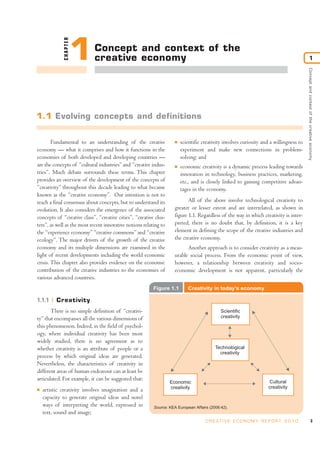
Statlink: http://dx.doi.org/10.1787/476155357582
0
20
40
60
80
100
120
0%
20%
10%
40%
30%
50%
60%
70%
80%
90%
100%
Advertising Computer/ Music Film/Video
Video Games
Advertising total revenue
USD 445 billion
Film and video online
revenue growth: >100%
Online
share:17%
Online
share:7.5%
Online
share:16%
Online
share:<1%
198 C R E AT I V E E C O N O M Y R E P O R T 2 0 1 0
Technology,connectivityandthecreativeeconomy
7
12
Pratt (2004). “Creative Clusters: Towards the Governance of the Creative Industries Production System”. Pratt (2000).
13
The merger of Time Warner and AOL was the first and best publicized of these mergers.
created content; online computer and video games; film,
video and music; and online advertising. An increasing share
of revenues for the content industry derives from products
delivered via the Internet, but with marked differences across
sectors. Advertising is the largest online market, with rev-
enues of more than $30 billion in 2007 and annual growth
of 30 per cent. Online revenues are around one-sixth of the
total for computer and video games and music, and they are
growing fastest for films, albeit from low levels (see figure 7.6).
The development of user-created content has been rapid.
Video and social networking sites are leading the development,
and virtual worlds have become a major hub of activity.
7.5 Digitization
Until recently, the mode of transmission and storage
of information on the creative economy was analogue. ICTs,
however, allow a new form of recording of information: dig-
itization. Digitization is significantly different in two ways.
First, previously separate forms (sound, images, texts) now
have the same basic format and are thus readily integrated
into one medium, often using the same editing techniques
and similar software. Additionally, integration, when based
on the same platform, enables a field of convergent media.
This has both artistic business possibilities and represents a
significant field of potential innovation. Second, the
common digital basis of information allows it to be easily
communicated and transferred with no degradation of the
original in subsequent copies.This has huge implications for
the distribution and copying of digital works (as well as dig-
ital transformation of analogue works). The digital format
means that new ways of editing and integrating media, pre-
viously unimagined, can be achieved. Again, this has opened
up the possibility of altogether new art forms as well as the
transformation of existing ones.
The economic implications of ICTs generally have
been discussed in the context of debates about the “new
economy”. It is claimed that cost-free reproduction and
distribution, and perfect copies, create a new mode of
economics that differs from the old one based on physical
distribution and manufacture. Second, as indicated earlier,
there is the possibility of novel products. Some authors have
hypothesized that the use of ICTs will remove the need for
face-to-face interactions, and the co-location that follows
might minimize transport costs. This has been referred to as
“the death of distance”. These totally new spatial implica-
tions have been challenged on the basis that the production
of intellectual property still involves labour and the transfor-
mation of intellectual property. As such there may still be
specific co-location effects associated with embodied skill
and expertise in labour markets and in physically embodied
knowledge exchange. In fact, evidence points to a renewed
importance of place in the digital age (namely, creative clus-
ters).12
While there is potential for the developing world,
there is also the threat that divisions of opportunity may be
further hardened.To answer this question fully, we need more
analysis of the nature of changes in creative-economy pro-
duction and the particular character of the transformation of
production and value chains.
7.6 Convergence and new business models
Because much of the output of the creative economy
can potentially be digitized, we are likely to see an even
greater impact and transformation in business transactions.
This transformation is also producing new business models,
market structures and governance. New business models are
made possible at the simplest level by the closer integration of
separate product lines (books, films and music, for example).
Of course, the media already display a striking concentration
of ownership and power. Most major media organizations
aspire to be “convergent organizations”13
that trade and use
199C R E AT I V E E C O N O M Y R E P O R T 2 0 1 0
Technology,connectivityandthecreativeeconomy
7
IPR rights that may be “re-purposed” (or reused) from one
medium to another (for example, a cartoon character in a
computer game, a film, a book, a toy or on a piece of cloth-
ing).This multiplies the possibilities of exploitation of intel-
lectual property from a single investment in addition to the
traditional monopoly profits possible in the medium.
Digitization creates a number of new possibilities for
distribution. With analogue distribution systems, reproduc-
tion leads to degradation of the product; hence it is less than
the original and declines further with the number reproduced.
With digital formats, reproduction is free of degradation and
incurs no extra cost per item. This opens up the possibilities
for infinite expansion of markets and reduces or eliminates
the need to warehouse or store products. One dilemma that
creative producers face is how to deal with the uncertainties of
demand and the need to maximize economies of scale by con-
centrating production in as few items as possible so as to
reduce stockholding and excess production costs.These func-
tions must commonly be combined with the physical transfer
and exchange of goods, i.e., distribution. For obvious reasons,
distributors seek to manage their stock by restricting choice to
the best sellers. Many mechanisms are used to achieve this, but
charts are a common way to organize and focus consumers. In
a digital age, however, it is potentially possible for producers
and consumers to be in direct contact, thereby bypassing the
control of the gatekeepers of the distribution system, which
are economically powerful.
Because stockholding costs are minimal for digital prod-
ucts, maximum choice is available; this is called the “long tail”
hypothesis. In the long term, however, the potential for
monopoly profits are reduced, hence posing a threat to the cur-
rent media structure but opening up significant possibilities for
small producers. Under a system of direct micro-payments, for
example, profits may be spread thinly and hence little tradi-
tional benefit from the creative economy will be realized.
Clearly, this is a huge area for future debate. New business
models are emerging to exploit these new possibilities (e.g.,
with respect to music) and it has been suggested that there may
be a variety of models — e.g., free music — offering possibil-
ities for making money from different aspects of the business.
The real issue is the challenge that these activities (which are
not understood or regulated) pose to governance and to how
intellectual property is to be used and regulated, since this
requires an enormous investment in infrastructure.
Increased access to information gives global breadth
and depth to the mapping of suppliers, buyers and outsourc-
ing possibilities. Therefore, ICTs may play a major role in
this transformation process, reducing costs, improving pro-
ductivity in the value chain and making companies more vis-
ible in the global market. This contribution is more evident
in those creative industries depending on technology at their
very core (software, games, multimedia content). However,
even in the more traditional, less technology-driven indus-
tries such as handicrafts, ICTs open new ranges of trade for
services previously not traded, inaugurating distribution
channels and generating innovative production forms.
Box 7.1 When ICTs give rise to new business models
For every action, there is an equal and opposite reaction. ICTs and the creative economy seem to form the perfect ground for the validity of Newton’s
third law. The more concentrated the audiovisual and music markets become in the hands of a few transnational conglomerates, the more alternative
business models emerge. Back in 2000, the music sector was revolutionized by peer-to-peer file-sharing programmes such as KaZaA and Napster, which
by 2001 had conquered no less than 3.5 million users.
As creativity seems to reinvent itself, a similar business model was created with Skype. Sold to eBay for $2 billion in 2005, it is now being applied to
Joost Internet TV, with a promise to disrupt the oligopoly of the television industry.
By the same token, a myriad of open-source initiatives mushroom in other creative-economy markets, presenting more humble turnovers but provoking
a shift in mindset on all continents. In Mexico, Tortillería Editorial is an association of authors, professionals and beginners who decided they would not
have much control over their books if they were to follow the usual publishing-house circuit. As a reaction, they created a mix of database, software and
site where they share their books and writings, allowing any user to generate, print and sell them. In 2007, it reached more than 4,000 texts and hun-
dreds of authors.
In Brazil, where internet use is comparatively high, Web 2.0 is facilitating the spread of open-source software. Overmundo, a Government-funded proj-
ect, was commissioned to ensure the alternative cultural coverage, mainly outside the São Paulo-Rio de Janeiro axis. Incorporating strong community
participation, users are responsible for its content and design. Overmundo has become a globally recognized cultural database of Brazilian culture with
more than 700,000 references via Google. Not surprisingly, it won the Prix Arts Electronica International Competition for CyberArts in 2007.
200 C R E AT I V E E C O N O M Y R E P O R T 2 0 1 0
Technology,connectivityandthecreativeeconomy
7
Finally, the possibility of delivering services online
rather than through a physical presence allows developing
countries to benefit from their comparative advantage in
some labour-intensive services that make use of ICTs.There
are various ways in which governments can promote greater
use of ICTs by companies, especially SMEs, that lag in terms
of ICT uptake. SMEs represent the backbone of the creative
sector and employ a large majority of creative workers in
both developed and developing countries. Despite recent
progress in the area of connectivity, there are still many bot-
tlenecks that prevent creative entrepreneurs and small firms
from using ICTs efficiently.Their use is often limited by low
levels of ICT literacy, slow connection speeds, lack of local
content and high costs of use. Moreover, in rural areas of
many developing countries, even basic connectivity remains a
challenge.
7.7 Impact across the production chain
The use of ICTs can potentially have significant
impact on all steps of the production chain: conception, pro-
duction, distribution, access to audiences, and engagement in
feedback from the audience/market.The specificities are dif-
ferent for each production activity in the creative economy.
The aim of this section is to provide some illustrative exam-
ples of impact across the production chain. New ways of
making money or developing audiences are possible with dig-
itization and new business models, but the future direction is
uncertain. All cultural producers face potential instability in
the years ahead as well as huge potential growth.The new sys-
tems could undermine what have become, in the last 50 years
or so, the normal ways to organize, say, music or film produc-
tion and distribution. Understandably, those corporations
that currently occupy key positions in such a system will seek
to defend the “old ways”.
Recent shifts in the music industry illustrate the chal-
lenges that creative producers are likely to face in adopting
new ways of doing business. The old model of the music
industry has production and distribution at the centre, with
the objective of promoting and selling huge numbers of a
small range of music. This channels monopoly profits into
music companies and ensures very high intellectual property
returns (for a small number of bands). This process reduces
stockholding costs and increases profitability although it is
risky when it is unclear whether a hit is likely to be achieved
from any one recording (although marketing can influence
this situation enormously). This is why in music, as in film,
companies expect a large percentage of failure to be discount-
ed by a small number of super successes. Thus, in this sys-
tem, intellectual property is a key means by which artists can
make money through recording and by which music compa-
nies can target their production, distribution and sales as
much as possible.
This model is based on a world of physical products;
the new model is based on virtual products where storage
costs of digital files are practically zero and a potentially infi-
nite range of music can be available to the consumer. In fact,
the role of the music companies to promote and focus con-
sumers could be bypassed altogether if artists were to sell
directly to their audience. Of course, by exploiting the “long
tail” of products, any one artist is likely to make small
returns from intellectual property and the same is true for the
music companies. For the latter, the old economics of the
extra administrative costs of managing a large number of
artists and the costs of recording, etc. will be an incentive to
create a “short tail” or limited range of products. In such a
situation, it may be logical for artists to focus on activities
that make money, that is, live performances and the merchan-
dising opportunities that these afford. In this way, they can
earn a modest income. Moreover, since they are not relying
primarily on income from intellectual property, it is logical
that they reduce the price of their product, or give it away, in
order to generate demand and attendance at concerts. Of
course, they would still want to copyright the work to sell it
directly to the public.
This example is instructive in that it shows how the
significance of intellectual property may change from its role
as income generator to one of simple protection and moral
right under different conditions of production. The balance
of power might shift from large companies to independent
201C R E AT I V E E C O N O M Y R E P O R T 2 0 1 0
Technology,connectivityandthecreativeeconomy
7
producers; in short, the business model is turned upside
down: in the past, the T-shirt was seen as the extra element
or souvenir of a concert whereas now it may be the major
income stream. While this is an example of an actual situa-
tion, it does not mean that this is the necessary or general
future of the music industry or any other industry; it simply
demonstrates the complex and destabilizing possibilities of
ICTs field of culture and the creative industries.
A step-by-step exploration of the production chain
reveals other areas of potential transformation. Initial con-
ception is more difficult in the sense that many new digital
applications require knowledge and access to computing
resources and skills. Beyond this, however, the barriers are
low. With a simple video camera and editing software, a
modest film can be produced in the home; the same applies
to most digital forms. Moreover, these “one-offs”’ can be
easily and exactly manufactured, replicated and distributed,
with minimal costs, directly from the producer (without the
need for intermediaries).
Perhaps the most striking example of the potential of
new production is the development and use of free and
open-source software (FOSS).14
Created through a process
of sharing knowledge through exchanging source code —
the instruction set behind a computer program — FOSS
programs are today provided and maintained by a range of
ICT experts ranging from individuals to corporate giants,
such as Sun Microsystems or IBM. FOSS programs can have
a particular significance for developing countries as well as
for shaping our understanding of creative processes and
endeavours. There is a large range of innovative FOSS soft-
ware that enables the owner of a basic personal computer to
engage in what was, until recently, possible only with studio-
quality production.
Traditionally, distribution and exchange were special-
ized, expensive and exclusive services that had strong
gatekeepers in the form of publishing and distribution com-
panies to protect profitability. As has been discussed, it is
technically possible to bypass such systems altogether, or
construct alternative or parallel systems, or develop
multi-stranded versions of the old systems. The particular
resolution of this distribution issue has a profound impact
on the cultural sector and the sustainability of creative
industries.With some justification, it has been said that com-
mercial distribution narrows choices and focuses on the
commercial exploitation of products; the old business model
forces production in this direction. Perhaps, however, we are
at a branching point where a range of distribution systems
might be entertained as possibilities, some closer to the old
narrow system, and some closer to the “free for all”.Without
doubt, the challenge for the creative economy will be to
actively engage with this debate. Otherwise, the financial
power and the pressure of the risk-averse “old model” may
create a future for creative production that is as narrow as, or
even narrower as compared with what is presently in use.
Critically, the possibilities for greater engagement for
the developing world lie in there being a wider range of cul-
ture available and for sale. There is a balance, however. If
there are no monopoly profits, then the super profits that
buoy the creative economy will not exist. Thus, in this peri-
od of growing consumption, a step change must be effected
to achieve some modest redistribution. Arguably, this change
is a complex cocktail of regulation and governance; it will
not be achieved by the total clampdown on piracy or via a
global cultural commons.
This raises the issue of the governance of transition
between the existing models. At present, countries that have
poorly developed intellectual property regimes are vulnerable
to theft, not simply local theft but international theft and
then copyrighting by third parties.This is legal but immoral.
One possibility, among the options available, is to incorpo-
rate traditional cultural expressions (TCEs) under copyright
law, not by statute but through common practice.There have
been a number of initiatives established to create digital
archives of dance, music, oral narrative, etc.While these may
not have the same formal recognition as registering copy-
right, they are a first protective step that could be done at a
low cost. Moreover, such collections would also have intrin-
sic value to both local and international communities.While
free for locals to use, such an archive might charge outsiders
for use, providing a form of revenue and legal protection.
14
UNCTAD (2004). E-commerce and Development Report 2004.
202 C R E AT I V E E C O N O M Y R E P O R T 2 0 1 0
Technology,connectivityandthecreativeeconomy
7
Box 7.2 Free and open-source software and the creative economy
The development of the creative economy relies to a certain extent on digital information and communication technologies (ICTs) that have, on their own,
been widely recognized as important pillars for economic and social development, most recently within the WSIS process and its outcomes.1
While access
to network infrastructures and hardware technologies is fundamental, it is also insufficient.Access to software and the knowledge needed to understand,
adapt and use it is critical if digital technologies are to achieve a positive development effect. Specifically addressing the issue of software helps to refo-
cus policy and development thinking towards the human element. After all, software is the interface between cold digital hardware and the impulses of
creative and innovative individuals. The development and production of software itself are a fundamentally creative and conceptual effort of problem-
solving and design.
Free and open-source software (FOSS) is software that does everything that other software does. It is used for writing text, email, Internet browsing,
spreadsheets, statistics and data management, etc. There are many programmes that can be used in music and audiovisual production. The opposite of
FOSS is proprietary software. Proprietary software, through copyright law and end-user licences, forbids users to copy, redistribute or alter the software
and permits use only as narrowly specified within its particular licence.
What is FOSS?
FOSS is different from proprietary or closed-source software in three important ways, which are interlinked and interdependent.
1. FOSS has distinct copyright statement and end-user licences. FOSS licences permit users to copy and redistribute the software without restrictions.
The most popular licence, the so-called General Public License (GPL), imposes a unique restriction: all copies, regardless of how much the software
has been altered, must also use the GPL and thus permit perpetual unrestricted copying.
2. FOSS licences require that authors of a particular software programme make the source code publicly available.The source code is the software writ-
ten out as ordinary text in a programming language. Access to the source code allows anyone to copy or technically alter the performance and fea-
tures of a programme. It also allows young computer scientists to learn how a world-class software programme is designed and developed.
3. Finally, FOSS generates important positive economic externalities. It reduces cost redundancies in redeveloping similar software, in particular when
this is procured by public bodies or government. It reduces the risk of being locked in by a vendor selling a proprietary software product and seek-
ing monopoly rents. FOSS also reduces the risk of vendor failure, whereby the producer of a proprietary software ceases to do business but does not
release into public domain the source code of the software, making it unserviceable in the future and impossible to upgrade and follow advances
made in the other computer hardware and software. It reduces market imperfections and promotes greater competition among ICT service compa-
nies that can, using FOSS, compete on quality of service and competence since it is not possible to charge rents from copyright monopolies – these
simply do not exist for FOSS. Finally, FOSS permits “looking under the hood” and allows better and faster technological capacity development in ICT
and computer science.
There is nothing in any FOSS licence that forbids anyone to sell any FOSS programme. However, many companies that market FOSS programmes actu-
ally sell only the service component while the licence is free. In general, in the software business, the service component accounts for more than half of
the revenues of most software companies anyway. Thus, providing FOSS on a commercial basis does not represent a significant shift in the business
model for the ICT industry.
Any software, FOSS or proprietary, can be commercial. Commercial means “available on the market and used in a commercial, for-profit environment”.
Proprietary software companies will sometimes try to distinguish their software as “commercial” as opposed to “FOSS”. This is a marketing strategy
meant to convince buyers that there is a “commercial” grade or quality that is lacking in FOSS. Nothing could be further from the truth: the most robust
and technically advanced software programmes as used by Yahoo.com, Google.com, NASA, many ministries of defence (including the Pentagon), aca-
demic and research institutions (the European Organization for Nuclear Research known as CERN and Massachusetts Institute of Technology), and ICT
industry behemoths such as IBM or Sun Microsystems are FOSS.
Importance for developing economies
The advantages for developing economies in developing and using FOSS are big and important.
1. FOSS reduces dependency on expensive and imported proprietary technology and the accompanying ICT consultancy services that are often tied up
with various non-disclosure agreements.
2. FOSS, through its open code and public licences, promotes knowledge-sharing, technology transfer and unrestricted cooperation in knowledge and
technology development and use.
3. FOSS enables the development of local human capacity and home-grown ICT service industries that can become more than merely fronting busi-
nesses selling imported technology.
4. FOSS is economically more efficient because of the positive economic externalities that it generates as described in the previous point.
5. As the main cost involved for using any software is the service component and because FOSS allows local computer experts to learn to work with
and service FOSS programmes, FOSS is more affordable than non-pirated – i.e., legal – proprietary software alternatives for the vast majority of devel-
oping economies.
The emergent theme of this chapter is that the effects
of the adoption and use of the ICTs are likely to be ampli-
fied in their impact on the creative economy. The precise
impact is complex, varying by industry and by the organiza-
tion and means of incorporating and using ICTs in creative
production. Critically, this change opens up a window of
opportunity to develop new production and distribution
systems that might promote a real expansion of democracy
and diversity in cultural productions, and to create new and
interesting business models and opportunities. In contrast
to this is the historical and vested interest of the media
industries dominated by powerful players. It is clear that a
203C R E AT I V E E C O N O M Y R E P O R T 2 0 1 0
Technology,connectivityandthecreativeeconomy
7
Box 7.2 continued Free and open-source software and the creative economy
6. FOSS is fully intellectual property-regime compliant: it needs and uses copyright to maintain and promote its openness. While its spirit is anti-restric-
tive, it does not confront current intellectual property from a formal, technical or legal perspective. Countries, institutions, businesses and individuals
that switch from using pirated software to FOSS work to fulfil their obligations as designated by WIPO and WTO/TRIPS conventions and agreements
7. FOSS promotes good governance: It means that public data will be kept in public data-formats and managed by software the source code of which
can be inspected and verified by independent bodies. This is immensely important in applications such as taxation, voting or military and defence
use.
8. FOSS promotes the use of open standards and this improves interoperability among different software programmes, thereby reducing the costs when
these need to be made to work together – such as merging databases or establishing common project or financial management systems.
9. FOSS allows easy localization. Any FOSS programme can be translated and altered to suit the linguistic, cultural, commercial and regulatory needs
and requirements of any location, all without having to seek permission from the original authors or exchanging terms and conditions while using
(expensive) legal intermediaries and consultants.
10.Many experts feel that FOSS is more secure, more reliable and more stable than proprietary software. While the debate is inconclusive, what is sure
is that FOSS problems can be fixed locally by local experts.
The international community should promote the idea that government policy bodies need to be aware of FOSS and include it in their ICT and e-strate-
gy programmes, in e-governance activities and in procurement policies. More importantly, it should promote the notion that when Governments choose
a particular technology, the decision to select FOSS or a proprietary (or mixed) solution is an important policy issue and not a purely technical, practical
or cost consideration.
Because FOSS generates important and positive economic externalities, software choice – and technology choice in general – should not be relegated
to oversimplifications and assessments along the lines of “what works” (even though FOSS actually works better most of the time) or how costs com-
pare from an accounting perspective. Accounting “analyses”, often referred to as “total cost of ownership” or TCO calculations, are notorious for ignor-
ing local economic conditions as well as positive externalities, such as the development of local human capital through FOSS use. Therefore, while the
decision to use FOSS initially is often understood to be a technology-awareness issue, it finally becomes an important policy issue.
FOSS and LDCs
While ethical principles, skills development, compliance with international copyright conventions and national law, public-data governance and better
security are often cited as key reasons for adopting a positive policy stance towards FOSS use, for LDCs, cost issues can be a primary concern. While in
developed market economies proprietary licence fees may constitute as little as 5 to 10 per cent of total costs of running a computer resource – with
administration, maintenance, integration and support, and hardware representing the rest – in low-income economies, licences may represent the bulk
of total costs. This is owing to the fact that aside from hardware and licences, all other costs are essential, non-tradable, labour-intensive services and
these demand correspondingly low wages in LDCs. While hardware costs are manageable to some extent through bulk purchasing from original equip-
ment manufacturers, using thin-client technologies2
or recycling outdated hardware from developed market economies, FOSS offers an opportunity to
avoid paying licence fees altogether.
1
See: http://www.itu.int/wsis/index.html .
2
A thin client is a minimal, stripped-down computer and software combination that depends primarily on a powerful central server for data processing and memory and
therefore serves mainly as an input-and-output device between the user and the central server.
By: Dimo Calowski, UNCTAD, E-Commerce Branch.
7.8 Looking into the future
204 C R E AT I V E E C O N O M Y R E P O R T 2 0 1 0
business-as-usual agenda may deliver pronounced increases
in inequality, access and range of cultural offerings.The real
challenge will be to develop new forms of governance in the
creative economy that will support and encourage the posi-
tive and minimize the negative effects.
The creative industries are clearly well placed to bene-
fit enormously from the development of ICTs. However,
there are a number of challenges that will need to be careful-
ly managed. First, the creative economy often lacks profes-
sionals in financing and accounting that would enable it to
secure funding from financial institutions. Second, SMEs
normally face legal uncertainties relating to cross-boarder e-
commerce and the need to keep up to date on the dynamics
of e-commerce legislation.15
Third, investment and commer-
cial banks are not always prepared to value intangible assets.
This is a veritable lose-lose situation as companies find it
hard to prove the financial potential of their creative prod-
ucts and services and investment and financial institutions do
not increase their portfolio of clients. Smaller creative com-
panies must then refer to a mix of internal and external
financing sources. A recent Canadian study revealed that
approximately 57 per cent of cultural SMEs have sought
debt financing during the last two years, 80 per cent of
which were successful in obtaining debt capital from finan-
cial institutions. However, the research data do not explain
whether cultural SMEs succeeded in obtaining the entire
amount of capital that they had requested or whether the
capital was obtained at favourable rates. A clue that such was
not the case, however, is provided by the fact many cultural
SMEs (and 42 per cent of those receiving debt funding) use
personal savings to operate their businesses.16
As pointed out earlier, the digital divide is narrowing
but still exists; the development of inexpensive computing
services and of open-source software is very important as a
stepping stone in closing the gap. However, another digital
divide is opening up, one that may have even greater conse-
quences than the first. It is the investment-intensive universal
broadband.The example of countries such as the Republic of
Korea is notable in that such investment has driven and
expanded the market as well as the innovative use of ICTs.
This is one of the main advantages in ICT applications and
a way to engage the public. Given the increasing importance
of a closer interaction between producers and consumers as
well as the growing interactive and educational learning
Technology,connectivityandthecreativeeconomy
7
Box 7.3 Eurovision
Geneva-based Eurovision is not only the home of the world's most popular musical talent show, the Eurovision Song Contest; for almost 50 years, it has
also offered a distribution platform to Europe’s public broadcasters for an exchange of news items. Since October 1958, Europe’s public broadcasters
have provided one another with coverage of news events in their countries on a reciprocal basis. The added value of the Eurovision News Exchanges
was already clear during the first experimental news exchange, when Pope Pius XII fell ill. When he passed away two days later, the editor of the Dutch
television news bulletin made history by asking for “the dead Pope live”, and Eurovision arranged for a live broadcast from the Vatican.
Today, the Eurovision News Exchanges handle over 42,000 news items per year, using two satellite channels for both news reports and extensive live
coverage of events. Eurovision News Exchange items cover wide-ranging topics from the worlds of politics, culture, science, business, religion and sports.
United Nations agencies began offering items to the Eurovision News Exchanges in the mid-1970s. Today, content provided by FAO in Rome, ILO, IOM,
UNCTAD, UNHCR, UNICEF, UNTV,WFP,WHO,WIPO and WMO as well as the International Atomic Energy Agency in Vienna, the International Criminal Tribunal
for the Former Yugoslavia in the Hague, and others adds additional breadth to the Eurovision News Exchanges and helps more than 100 national and
international broadcasters fill their daily news bulletins. United Nations videos, particularly concerning unfolding humanitarian crises, provide broadcast-
ers with essential material from regions of the world where press access may be limited and about conflicts in their earliest stages.
Video material from the United Nations is also distributed outside of the News Exchanges via Eurovision’s World Feed Service, which began in 2005. Live
coverage of the 62nd General Assembly in September 2007 was distributed to more than 300 broadcasters worldwide. This cooperation between
Eurovision and the United Nations is only the most recent in a fruitful partnership that dates back more than 30 years and puts United Nations material
in front of editors in major TV newsrooms around the world. Additional information about Eurovision is available online at: www.eurovision.net.
By Laura Downhower, Eurovision.
15
Ibid.
16
Nordicity Group Ltd (2004).
patterns developed by ICTs, rich societies are becoming more
closely bound together in a virtuous interaction both online
and off. This will be one of the major challenges to the
democratization of cultural development in the coming years.
There are also a number of pressing challenges with
respect to intellectual property.The development of archives
is essential for building reflective and critical knowledge of
art and cultural forms, and to develop adequate education
systems. For a variety of reasons, one of the institutional
weaknesses of many developing economies concerns cultur-
al communication and critique. The use of ICTs to develop
a wider public discourse on art and culture could be a mar-
vellous dividend for the digital age.
205C R E AT I V E E C O N O M Y R E P O R T 2 0 1 0
Technology,connectivityandthecreativeeconomy
7
206 C R E AT I V E E C O N O M Y R E P O R T 2 0 1 0
Technology,connectivityandthecreativeeconomy
7
Promoting the Creative
Economy for Development 5
PART
208 C R E AT I V E E C O N O M Y R E P O R T 2 0 1 0
Knowledge and creativity are becoming powerful
drivers of economic growth in the contemporary globaliz-
ing world. They have profound implications for trade and
development. Together with technology, they open up a
huge potential for developing countries to develop new
areas of wealth and employment creation consistent with
new trends in the global economy. For such countries to
realize this potential, it is necessary to carefully formulate
specific policies for enhancing creative capacities through
strategic actions to be taken by governments at local,
national and regional levels, while exploring possibilities for
international cooperation and strategic alliances.
A wide range of measures is available to governments
at all levels to stimulate the creative economy; to reinforce
the connections between social, cultural and environmental
aspects of its functioning; and to promote the achievement
of sustainability through linking economic and cultural
development. The policy arena within which government
action dealing with the creative economy falls is the broad
area of creative-industries policy. Traditionally in many
countries, this area of policy concern has been known as
“cultural policy”. Yet the scope and coverage of the term
“cultural policy” differ from country to country. For some
countries, especially in the industrialized world, cultural pol-
icy simply comprises policy towards the creative arts. Such
countries support the arts through measures such as subsi-
dies to artists and performing companies; tax concessions
for donations to the arts; assistance to education and train-
ing in music, drama, the visual arts and so on; and the oper-
ation of public cultural institutions such as museums and
galleries. For other countries, particularly in the developing
world, cultural policy has tended to connote principally pol-
icy towards cultural heritage. In these cases, the policy task is
seen as one of preserving or protecting both tangible and
intangible cultural heritage, where the sites, artefacts and tra-
ditions involved are vulnerable to exploitation and possible
loss through deterioration or disappearance.
Lately the notion of “cultural policy” has broadened
to has broadened to emcompass creativity and the creative
industries. This expansion parallels the widening of the
scope of the creative economy from the traditional cultural
industries, as discussed earlier in this report. In Europe, for
example, policy interventions in support of the cultural
industries began in the 1920s and were reaffirmed in the
Treaty of Rome (1957) and the Maastricht Treaty (1992),
which progressively defined the support for culture in the
countries of the European Union. Originally such support
was directed towards traditional art forms, but as the market
economy has grown and diversified, the scope has widened
continually to embrace the audiovisual industries, publish-
ing, the media and so on. The Europeans have stressed the
importance of the cultural content of the output of these
industries. Public expenditure on culture in the European
Union has continued to expand, with countries such as
France and Germany committing more than €8 billion to
culture in the early years of the twenty-first century, with
total public expenditure on culture across the enlarged
European Union now totalling approximately €50 billion
(KEA 2006:125).
In line with the cross-cutting and multidimensional
nature of the creative economy, creative-industry policy in
its broader interpretation embraces aspects of a number of
other areas of economic and social policy. Perhaps most
importantly, consideration of the creative economy
becomes a key element of industrial policy, whereby indus-
trial development strategies can exploit the potential
dynamism of the creative industries in generating growth in
output, exports and employment. A positive outlook for
209C R E AT I V E E C O N O M Y R E P O R T 2 0 1 0
Policystrategiesforthecreativeindustries
8
CHAPTER8 Policy strategies for the creative
industries
8.1 Introduction
210 C R E AT I V E E C O N O M Y R E P O R T 2 0 1 0
industrial policy in which creativity and innovation are
important drivers of growth is well suited to the conditions
of globalization and structural change. For developing coun-
tries in particular, a refocusing of industry policy along these
lines can begin to open up many of the exciting possibilities
for growing the creative economy that have been outlined in
this report.
Another major area of economic policy for which the
creative economy has significant implications is, of course,
trade policy. Trade in products such as audiovisual services
has had significant impact on the cultural sectors of coun-
tries in the developed and developing worlds alike, and hence
on the formation of cultural policy. For many countries, the
traditional concepts of cultural policy have expanded to
incorporate the promotion of cultural exports and the
protection of vulnerable domestic creative industries.
Other areas of economic and social policy with linkages to
the creative economy include: tourism; urban and regional
development (especially the “creative city” area); cultural
rights and cultural diversity; education and training; and
copyright and intellectual property. If the widened scope for
policy towards the creative economy is to be entertained, it
will require significant collaboration between the various
ministries and bureaucratic departments. Only by such coop-
eration will the full development potential of the creative
economy be realized.
It is important to bear in mind the international con-
text within which policymaking takes place. Multilateral
processes are the essence of international policies and the
driving force to move forward the international economic
and development agenda. These processes will be discussed
in the next chapter.
The economic role of government is conventionally
taken to comprise public interventions to promote:
I efficient resource allocation in the economy;
I full employment, price stability and external balance; and
I equitable distribution of income and wealth.
With regard to domestic policy towards the creative
economy, the rationale for involvement of the public sector
can be described under several areas of intervention, as fol-
lows:
I Market failure (public goods). The cultural sector in general
and the creative arts in particular are normally regarded as
a source of diffused community benefits that have the
characteristics of non-rival and non-excludable public
goods. A particular public benefit of relevance here is the
social cohesion that can be expected to flow from cultur-
al activities and creative production within communities.
I Market failure (imperfect competition). If industries become
concentrated to such an extent that competition breaks
down, government intervention may be warranted to
restore competitive conditions. A specific case of this in
the creative economies of developing countries may arise
if global corporations producing cultural products are in
a position to monopolize local markets to the exclusion of
locally produced cultural expressions.
I Market failure (research and development). The involvement of
government in promoting R&D is justified on the
grounds that beneficial externalities might be produced
and/or that the public sector may be in a better position
than private companies to assume the sorts of risk
involved, with the prospect of sharing in the payoff from
successful discoveries. In the case of the creative economy,
governments can and do facilitate R&D investments in
creative product development for either or both of these
reasons and may undertake strategic investments in the
creative sector with the hope of “picking winners”.
I Education and training. Governments have particular respon-
sibilities in the areas of education, training, certification
and licensing. Significant strides have been made in the
developing world towards achieving universal literacy and
ensuring access to education opportunities that are both
relevant and of high quality. The resources available for
specific training programmes are, however, often very
limited. For the time being, training and education
opportunities relating to the creative industries are almost
Policystrategiesforthecreativeindustries
8
8.2 The role of public policies
entirely limited to the major urban centres.The successful
promotion of creative industries requires that they be
reflected in the national education system, which would
offer targeted training opportunities at different levels (for-
mal, non-formal, informal) in skills and knowledge that are
relevant to professional participation in the creative-indus-
tries sector. Such training also needs to serve as a reposito-
ry of knowledge relating to the rich cultural traditions that
underpin these professions. It is also necessary to confer
the status and importance that are due these specializations
through a programme of certification and licensing
designed specifically for the creative-industries sector.
I Cultural identity/cultural diversity. An area that has traditionally
formed part of cultural policy in the broadest sense has
been government responsibilities for the cultural life of the
people as reflected in the traditional knowledge and the
intangible cultural capital of the community. Although
there are demonstrable economic ramifications arising from
areas such as the expression of cultural identity or the pro-
tection and celebration of cultural diversity, this is an area
of policy that is generally regarded as intrinsically impor-
tant in its own right. For our purposes, it is clear that
policy in these areas should undoubtedly be regarded as part
of an overall domestic policy strategy that encourages and
supports the creative economy.
211C R E AT I V E E C O N O M Y R E P O R T 2 0 1 0
Policystrategiesforthecreativeindustries
8
Box 8.1 Shanghai creative industries: The Chinese way
The concepts of “creative economy” and “creative industry” have had great impact on China’s social and economic development, the most important
being the discovery of the economic value of culture. The academic and public sectors in China have focused on the value of the creative economy as
“a kind of newly emerging culture perspective and economic practice that stresses the support and promotion to the economy of art and culture”.
Therefore, in many cities of China, instead of “creative industry”, the “cultural creative industry” is a more commonly used term.
As a country with a long history and rich cultural heritage, China has always experienced a strong demand for cultural products. The industries are man-
ufacturing products for international brands, making China one of the biggest exporting countries in the world, but these products are “made in China”,
not “created in China”. As a result, China’s new generation is playing Korean games and watching Japanese cartoons and Hollywood movies. Chinese
people are increasingly surrounded by products originating in the creativity and culture of other countries. A 2006 survey on the consumption of creative
products in Shanghai showed that the group between 20 and 35 years of age prefers international brands much more than local brands, and this ten-
dency is even stronger in younger groups. This tendency is caused by the dominant idea that culture and economy are separate entities; however, the
creative industries may help to reverse this trend. Creative industries focus on culture and creativity and then extend to other related industries in the
form of a value chain, providing broader ways of generating value-added products and services.
In China, Shanghai was a pioneer city in the promotion of the creative industries, with the Municipal Government playing a key role. In the 11th Five-Year
Plan of the Shanghai government, promoting creative industries has been listed as a key issue in developing modern service industries. In the past,
Shanghai was very strong in manufacturing, but now it is shifting towards the service and finance industries. Hence, in 2007, it was a government
priority to accelerate the development of creative industries so as to promote the structural reform of industries with a view to building a new framework
focused on the service economy. In the “Key Guide for the Development of Creative Industries in Shanghai”, the five main areas of creative-industry devel-
opment are:
I R&D, including advertising, animation, software and industrial design;
I architectural design, including engineering and interior design;
I culture and media, including art, books, newspaper publishing, radio, television, film, music and performing arts;
I business services, including education, training and consulting services; and
I lifestyle, including fashion, leisure, tourism and sports.
Creative industries already account for about 7 per cent of Shanghai GDP. Seeking to turn Shanghai into a creative city, the government has set a target
of 10 per cent for the contribution of creative industries to total Shanghai GDP in 2010.
Stages of development of Shanghai creative industries
Shanghai has divided its development of creative industries into three stages: creative-industry parks, creative-industry clusters and creative-industry
projects.
I Stage 1: Creative-industry parks – the model of old factory warehouses plus artists. In the first stage, many old warehouses in the downtown area
were renovated and furnished to become modern office buildings while retaining some of their original equipment and appearance. These buildings
are usually spacious with high ceilings, making an ideal environment for the start-up of creative businesses by artists and entrepreneurs. Since these
buildings were almost useless in the past, the rents were comparatively low and thus good for creative companies and individual artists. This model
has proved to be quite successful: by the end of March 2007, 75 creative-industry parks had already been built in Shanghai.
212 C R E AT I V E E C O N O M Y R E P O R T 2 0 1 0
Policystrategiesforthecreativeindustries
8
Box 8.1 continued Shanghai creative industries: The Chinese way
Since most creative businesses start small and are modestly capitalized, these creative-industry parks play an important role at bringing such busi-
nesses together and providing an enabling environment. In addition, they may facilitate marketing such companies since the clients may approach
creative-industry parks when searching for suppliers. M50, an old warehouse converted into painting and sculpture galleries and studios, is a very
good example of these creative-industry parks. Numerous very creative artists are now concentrated in M50 and receive many visitors and clients.
Some of the artists at M50 became very successful and now have their artwork listed in Sotheby auctions.
With the support of the government, owners of culture-industry parks are able to convert unprofitable warehouses into prosperous office buildings.
In turn, the surrounding environment also improves. This model has proved to be very successful from a business perspective. However, it has some
shortcomings. Creative-industry parks remain owners, while creative businesses are renters.As real estate values increase and rents rise, some com-
panies and artists are forced to relocate, consequently hindering the industries’ development.
I Stage 2: Creative-industry clusters – clusters formed according to the local art and cultural resources. Eventually, creative-industry parks were found
to be insufficient to fully support the development of the creative industries. The Shanghai Municipal Government has stopped building new creative-
industry parks but continues to maintain and develop the existing 75 parks. Based on the latter, the government starts to explore the development of
creative-industry clusters, which take into consideration the characteristics of the local art and culture and intentionally focus on certain industries.
As a result, a full range of companies and businesses in the value chain are concentrated in these clusters so as to foster the development of that
particular industry. The main industries include: the theatre and performance-art cluster, the film and television cluster, the comic cartoon and game
cluster, the gallery cluster and the intellectual-property cluster. For example, the Zhangjiang Culture and Technology Creative Cluster has attracted
enterprises relating to comics and cartoons, games, television and movies, and post-production services. At present, this cluster concentrates 70 per
cent of the total production value of game software in China, including some of the top game businesses.
I Stage 3: Creative-industry projects – big and important events and projects based on the value chain. Shanghai is also trying to promote such proj-
ects in the creative industries. For the 2010 World Expo, a creative project is being carried out that will place in one service system all the elements
attractive to a participant in the World Expo, including clothing, food, accommodation, travel and entertainment. This kind of big project has great
potential to promote the creative enterprises in Shanghai.
All these quick developments require strong support from the government. A long-term policy and related strategies are necessary for the stable promo-
tion of the creative industries. Moreover, five-year plans are an effective way of informing people of the direction of development. Government initiatives
take the leading role and must continue to be the main impetus, particularly when facing competition from more developed creative industries in other
countries. For China, the development of creative industries involves almost all industries, and people are increasingly aware of this trend. Our target,
however, extends beyond GDP increases and includes the exploration of the potential of deeply-rooted Chinese culture for making creative products rich
in Chinese culture and heritage. The cultural value of the creative industries lies not solely in its products but also in the emergence of culture as a core
element of industrial and economic activities. Much progress remains to be made, though, as Chinese industries have been mainly manufacturers.
However, as exemplified by the experiences of other countries, creativity will become a driving force in the whole economy.
China is facing the twofold task of promoting new industries and improving traditional industries. Fostering cultural development is also paramount.
The creative industries provide us with a new perspective on our current gap vis-à-vis developed countries and a new way to explore the potential of
development as a big country rich in cultural resources.
Awareness of the value of creativity is just beginning in China. In the last two to three years, many cities have begun to explore the creative industries.
In the 16 cities that belong to the Yangtze delta, 14 are boosting creative industries. Moreover, Beijing has taken powerful measures to support its
creative industries. The value of creative talents is also increasingly recognized in society, with schools encouraging greater creativity among their
students, a change that may influence China’s entire education system.To properly understand and take advantage of this trend, the Ministry of Education
has started a three-year research project on China’s strategy for the creative industries. This exemplifies China’s commitment and vision for develop-
ment. Though its experience may not be easily replicated, it could be an interesting reference for other countries, especially developing ones.
By Prof. He Shou Chang, Executive Vice Chairman, Shanghai Creative Industry Association.
The process of formulating and implementing public
policies often entails the following sequence:
I Specification of objectives.This first step is critical in specifying
clearly which outcomes policy is designed to achieve.
Generally, multiple objectives are involved, and the neces-
sity of some trade-off between them might be anticipat-
ed. For example, the standard goals of macroeconomic
policy may require that some balance be sought between
levels of growth, inflation, unemployment, external bal-
ance, etc. In some cases, however, synergy between objec-
tives may be possible. With regard to the creative econo-
my, for instance, a linking of the goals of economic and
cultural development can readily be imagined whereby
growth in cultural production can yield both economic
and cultural benefits.
I Choice of instruments. The guiding principle in the allocation
of policy instruments to tasks is the so-called assignment
problem, whereby the most effective and efficient policy
measure or package of measures is aligned with the objec-
tive or objectives that they are expected to achieve. The
standard array of policy instruments available for use in
supporting the creative economy includes: fiscal measures
(subsidies, tax concessions, investment allowances, business
start-ups); regulation (copyright, local content quotas,
planning laws, regulations on foreign direct investments);
trade-related measures (import quotas, etc.); education and
training (direct or subsidized provisions of services); pro-
vision of information and market development services;
international cooperation (cultural exchange, cultural
diplomacy); and social security and welfare policy (includ-
ing measures to protect cultural diversity). The usefulness
of particular instruments is discussed in more detail later
in this chapter.
I Implementation, monitoring and evaluation. The implementation
of cultural policy requires appropriate measures to gather
the data necessary for monitoring whether or not the
required objectives are being achieved, what the benefits
and costs of intervention have been, and whether there
have been any untoward or unexpected side-effects, either
positive or negative.The process of monitoring and evalu-
ation is normally seen as part of a feedback loop whereby
the assessment of the effectiveness of policy measures can
be used to inform the further development and refinement
of policy formulation and implementation.
The above sequence of the policy process is relevant
generally to the dynamics of government action in regard to
the creative economies of developed and developing countries
alike. Some further considerations to be borne in mind, par-
ticularly in the developing-country context, are the following:
I There is a need in the developing world to create a frame-
work of objectives, shared values and measurable outcomes;
define the roles and responsibilities of all role players; and
consolidate the role of government as a facilitator and coor-
dinator of the creative sector and its development.
I Much of the policy implemented in the developing world
has used models from developed countries in its design.
The current challenge is to ensure that policy embraces
values relevant to the developing countries themselves,
incorporating indigenous knowledge systems and local
experiences into the policy, institutional and programming
environment.
I A critical challenge for policy in the arts, culture and heritage
sectors of developing countries is the lack of articulation
between cultural policy and other priorities, and the degree
to which a concern for culture and cultural diversity is
embedded in development agendas.
I One of the most significant challenges to the creative sec-
tor in developing countries is the implementation of good
governance principles across the sector as well as the
improvement of the relationships between producers,
distributors, creative workers, employers and retailers.
213C R E AT I V E E C O N O M Y R E P O R T 2 0 1 0
Policystrategiesforthecreativeindustries
8
8.3 The policy process
Critical areas where developing countries need new
policy initiatives in order to boost their creative economies
include the provision of infrastructure, the provision of
finance and investment, the creation of institutional mecha-
nisms, an appropriate regulatory framework, the develop-
ment of export markets, the establishment of creative
clusters and a mechanism for effective data-collection meas-
ures and analysis.
8.4.1 Provision of infrastructure
It is a fundamental function of government to create
and maintain the conditions under which the economic,
social and cultural life of the citizens can prosper. This
responsibility takes shape through the ways in which the
public sector provides both tangible and intangible infra-
structure. Given the predominance of the market economy as
the basic form of economic organization in the world today,
the types of infrastructure required are those institutions
that enable markets to function effectively but at the same
time to protect and promote the public interest. As
UNCTAD puts it in The Least Developed Countries Report 2004:
In implementing post-liberal development strategies,
public policies in LDCs should use market-supporting
mechanisms aimed at market creation, market develop-
ment and market acceleration. These policies must not
simply provide the right price incentives, but also create
the right institutions and the infrastructure necessary
for a modern market economy to function properly
(UNCTAD, 2004:xi-xii).
The infrastructure needs of the emerging creative
economies of developing countries arise at all points in the
value chain from initial creative production (which may be
undertaken on a small scale at the local level or on a larger
scale in towns and cities) right through to marketing and
retailing. As with any other industry, the creative industries
need affordable access to appropriate space in which to work
and to live, transportation, and distribution facilities. The
dispersed but interdependent nature of creativity in the cre-
ative-industry sector may make the provision of these basic
infrastructure needs more costly and complicated than for
the development of more traditional heavy and light indus-
try. The overlap with the private infrastructure needs of the
employees and the small scale of the needs for the individual
industry may, on the other hand, balance this cost. The pro-
motion of creative clusters is one way to overcome this cost
but it may not carry the social and cultural advantages of
lodging creative industries within existing communities.
Moreover, the problem of lack of infrastructure relates par-
ticularly to gaps in the supply chain for inputs into creative
processes, inadequacy of distribution networks for effective
marketing of products, and lack of institutional support
mechanisms.
One infrastructure requirement particular to the
creative industries is the need for access to information and
communication technology (ICT). Access to information
needed to boost business development is in many regions of
the world still far from universal and will never be so with-
out conscious public sector efforts to expand access.There is
no doubt, however, that access to ICT, in terms of identifi-
cation of market opportunities, training, innovations,
networking and sales, is a significant factor in the develop-
ment of the viability of small business units. Access to ICT
provides a link between education and commerce and assists
in turning knowledge into marketable products. Facilitating
the movement of workers is another key issue for the devel-
opment of creative industries, especially in those industries
that entail a collective creative process (see chapter 7).
Like any other industry, creative industries are only
truly sustainable if they contribute to building the asset
resource base. This they can do only through the integrity
and authenticity of their products. In the longer run, the cre-
ative industries depend on the vitality and strength of the
cultural sector and the investments in cultural capital
(knowledge and heritage). The sustainability of the creative
industries therefore depends on the safeguarding of cultural
capital and the development of the cultural asset resource
base. Hence, comprehensive cultural asset management is a
prerequisite for sustained growth in the creative-industries
sector and, in a wider perspective, for sustainable economic
development and vibrant community life. It is therefore
necessary to maintain the principle that cultural assets are
intergenerational capital and that their viability may legiti-
mately be sustained by public investment.
214 C R E AT I V E E C O N O M Y R E P O R T 2 0 1 0
Policystrategiesforthecreativeindustries
8
8.4 Policy directions
215C R E AT I V E E C O N O M Y R E P O R T 2 0 1 0
Policystrategiesforthecreativeindustries
8
8.4.2 Provision of finance and
investment
The actual role played by government in dispensing
funds for the cultural sector and the creative economy may
involve direct cultural provision via the state apparatus or via
an enabling role administered through a ministry of culture
or the equivalent. The expansion of cultural policy beyond
the concerns simply of core artistic and cultural activities, as
discussed earlier, entails a similar expansion of the ways in
which cultural funding is provided. In particular, public
finance and investment in the creative economy are expected
to extend beyond cultural ministries and to involve, in par-
ticular, ministries responsible for industrial development,
technology and finance. Traditionally, investment in the cul-
tural sector has directed investment and programming
towards projects, institutions and large enterprises that are all
heavily dependent on public incentives and financing.
The creative sector face capital rationing at all stages.
Start-up financing is often difficult to access because of the
uncertain prospects in markets for creative products; forecast-
ing demand for creative goods such as films is generally more
difficult than for more standardized products so public and
private investors often look upon projects in these areas as too
high-risk. Occasionally, firms have access to public investment
assistance programmes, business incubators or private venture-
capital sources. Nevertheless, difficulties in obtaining finance
continue into the operational stages of creative businesses,
when working capital is needed and funds for business expan-
sion are also typically in short supply. Contrary to the cultur-
al sector, which relies mostly on public funds, the creative
industries are more market-driven. Therefore, creative entre-
preneurs have to be more pro-active in dealing with commer-
cial banks and private investors, instead of relying too much
on government subsidies. A conventional model of public
funding for the cultural sector is illustrated in figure 8.1.
Figure 8.1 Funding flows to the cultural sector
Source: Gordon and Beilby-Orrin (2007:30).
Corporate
Sector
Household
Sector
Cultural
Sector
DOMESTIC
SECTOR
“Arm’s Length”
agencies
(public
broadcasting
corps, arts
councils)
National administrations
(Treasury, Ministries or
Depts. of Culture,
Interior, etc.)
Local
Administrations
Government sector
Incoming transfers from non-resident institutional units
(foreign governments and international organisations)
Outgoing transfers to non-resident institutional units
(foreign governments, international organisations, NPISHs and households)
NPISHs
(Non-profit
institutions
serving household)
State/Regional
Administrations
Household
sector
Non-
residents
Foundations
216 C R E AT I V E E C O N O M Y R E P O R T 2 0 1 0
Policystrategiesforthecreativeindustries
8
The sustainability of the creative industries depends
on a different and more comprehensive model of investment.
While parts of the creative economy have been very success-
ful in identifying funding and have become very profitable,
many activities may appear to have only a limited commer-
cial potential.These activities may not have been able to real-
ize their potential because they have lacked the capital and
investment needed to scale up their activities and operate as
demand-driven, sustainable businesses. A major problem in
this respect is that entrepreneurs in the creative industries
often find it difficult to present a convincing business model
and many of the professional skills involved — e.g., chore-
ography, dancing, drawing, editing, weaving, doll-making —
simply are not perceived as leading to profitable businesses.
While this may be changing in some places under the influ-
ence of success stories of one kind or another, many skills
and professions related to the creative economy are not rec-
ognized as business categories in legal terms. Because of this,
many small creative industries do not have access to credit
facilities or to the loans and investments that would make
their businesses more viable.
The credit-crunch which followed the financial crisis
of 2008-2010 continues to affect a large number of creative
businesses, thus calling for new approaches for funding.
Financing and credits for businesses in the creative economy
may arise from different sources requiring distinct kinds and
degrees of collaterals, obligations and responsibilities. In
general, it comes from public-sector funding programmes of
various sorts; private-sector investment; venture capital; pub-
lic-private partnerships; grants from foundations; company’s
cultural-social responsibility tax exemption schemes etc., but
other non-conventional alternatives could also be explored.
Microcredit schemes are a viable option which should be
made more easily available by public and private credit insti-
tutions to finance small creative enterprises and independent
artists in developing countries, particularly for start-ups.
Nowadays, there is a range of non-traditional funding
options to stimulate creative business that can be regarded as
tools to promote local development. Indeed, the lack of con-
fidence in financial markets which resulted from the 2008
financial crisis became influential to attract greater public
interest for alternative schemes for funding and commercial
transactions. Among the new financing instruments most
used by creative economy circles are: (i) collaborative co-
financing via networks, and (ii) alternative currencies via the
solidarity-based economy. Both are cases of new business
models functioning through networks, used particularly by
the new generation of creative entrepreneurs in different
parts of the world. Certainly more evidence and research
analysis is needed not only to better understand the func-
tioning and operational efficiency of such alternative mod-
els, but also to examine the regulatory framework in which
Figure 8.2 Model of monetary circuit applicable to the creative industries
Professional
and Wage
Labor Markets
Product and
Service
Markets
Governments PaymentsTaxes
Incom
e
Taxes
Factor Paym
ents
Payments
Financial Institutions
Households
Businesses and
Organizations
InterestLoans
Consumption Expenditure
Savings
Interest and
Dividends
Sale Receipts
Source: Bernard Lietaer and Gwendolyn Hallsmith,Global Community Initiatives,2006
217C R E AT I V E E C O N O M Y R E P O R T 2 0 1 0
Policystrategiesforthecreativeindustries
8
they operate and to evaluate the short and long-term mone-
tary implications of these alternative models, in particular
their interactions with the conventional banking system and
the overall economy. Nevertheless, it is important to be
aware of their existence and why and how they are fast pro-
liferating.The scheme presented in figure 8.2 is an indication
of a monetary circuit more oriented towards the needs of
creative business in local communities, involving key stake-
holders: wage-earning workers, self-employed workers and
liberal professionals; families; companies; governments,
financial institutions, organizations of the civil society; and
markets of products and e-services.
Solidarity-based economy
What became known as the solidarity-based economy
is a non-conventional model to deal with economic activi-
ties on the basis of alternative currencies.To a certain extent
these social-related business models go in line with the need
to rethink the functioning of the world economy in an
innovative and creative manner.The use of social currencies
is receiving more attention in a number of countries not
only from the developing world; indeed alternative curren-
cies are legally in circulation in more than 35 countries (see
table 8.1). In practice, they are systems created and
administered by social groups to execute payments,
exchanges or transmission of obligations among the mem-
bers of a community, with the aim to make local economies
self-sustaining.This model is being applied in the context of
the creative economy particularly by the young generation
and in poor communities. It is neither public nor private, but
a kind of a hybrid human-centred scheme applied for certain
economic activities inside a pre-determined geographic area.
The main principles driving the solidarity-based economy
are: social justice, solidarity, cooperation, self management,
concern for the environment and responsibility for the next
generations. The solidarity-based economy functions within
networks using a range of alternative currencies for trade and
commercial exchanges.
Social or alternative currency refers to any currency
used as a complement to the dominant national currency
systems, responding to both commercial and social objec-
tives. They can be created by an individual, corporation or
organization, and even by national, state or local govern-
ments; in most cases they arise naturally as people begin to
use a certain commodity or a creative product or service as a
currency. Mutual credit is a form of alternative currency, and
thus any form of lending that does not go through the bank-
ing system can be considered a form of alternative currency.
When used in combination with or when designed to work
in combination with national currencies they can be referred
to as a complementary currency, but can only be used with-
in a closed circuit, therefore limited to a certain community
or region. Barters comprise another type of commercial
transaction, an exchange system which trades items without
the use of any currency.
Another alternative scheme gaining traction in recent
years is the Local ExchangeTrading Systems (LETS), a spe-
cial form of barter which trades points for items. One point
stands for one hour of work. Often there are issues related
to paying tax. Some alternative currencies are considered tax-
exempt, but most of them are fully taxed as if they were
national currency, with the caveat that the tax must be paid
in the national currency.The legality and tax-status of alter-
native currencies varies widely from country to country;
some systems in use in some countries would be illegal in
others. Various approaches are being proposed to link Local
ExchangeTrading Systems in communities around the world.
The Ripple monetary system has been proposed as a virtual
system to connect the diverse LETS systems. LETS are char-
acterized by a level of innovation, and many new networks
choose to experiment with the system’s mechanics. Local
exchange trading systems now exist in many countries and are
used in the creative economy.Table 8.1 provides background
information of its worldwide application, and Box 8.1
provides an interesting example of how alternative currencies
are being used in a developing country.
218 C R E AT I V E E C O N O M Y R E P O R T 2 0 1 0
Policystrategiesforthecreativeindustries
8
North America
Oceania
South America
Source: UNCTAD adaptation based on wikepedia information about LETS systems in operation in various countries
Table 8.1 Illustration of Local Exchange Trading Systems (LETS)
In 2003 the Community Exchange System (CES) started operating an Internet-based LETS in Cape Town, South Africa. This has grown into a
global network of over 180 local exchange systems in more than 20 countries (early 2010), among them New Zealand, Australia, Spain, the
United States, the United Kingdom and Vanuatu. Many of these are former LETS groups but others are time banks and hybrids.
In the Peanuts system in Chiba, near Tokyo, Japan, approximately 10 per cent of all payments made at local stores are in the community currency
(2002). The LETS movement saw its peak around 2002-2003.
South Korea has some active LETS too, such as Hanbat LETS in Daejeon and Gwacheon Pumasi in Gwacheon. The Fureai kippu system is wide-
spread in Japan.
In the United Kingdom, an estimated 40,000 people are now trading in around 450 LETS networks in cities, towns and rural communities. LETS
currencies have their own local names, for example: Locks in Camden Town, London - Camden LETS Readies in Reading, Berkshire - Reading
LETS Scotia in Scotland - LETSlink Scotland Rheidol in Aberystwyth, Wales - CyFLe Aberystwyth LETS (group closed down in Aug 2009).
In France, a consortium of social economy financial institutions including Crédit Coopératif and the Mutual MACIF and MAI have joined with the
Chèque Déjeuner cooperative to launch an alternative currency called the Sol, which will be held on a smart card. The Sol will be piloted in the
Ile de France, Brittany and Nord-Pas de Calais regions as part of an EQUAL development partnership in 2005-2006. (More information is avail-
able from www.selidaire.org.)
Germany established a number of local currency systems with different names such as “Talents” or “Batzen” using LETS principles. Germany
hosted an International Conference in Monetary Regionalisation in October 2006 to debate those issues.
In Hungary the term used is “Community Service System” (KÖR). One group from the capital city is Talentum Kör (Gold Talent Group), a British
Council-supported project.
The Netherlands has spawned a number of innovative concepts based on the LETS formula, some of which try to lower participation barriers by
completely moving their exchange platforms online, like NOPPES.
In Switzerland, the WIR Bank operates a system close to a LETS.
The original LETS, the Comox Valley LETSystem developed by Michael Linton in 1982, is now dormant, however; there are plans to revive it. The
second LETSystem in Canada was the Victoria LETS, established in 1983. LETS have been established in several Canadian cities, including
Kitchener-Waterloo, Niagara, and Peterborough in Ontario, Halifax, Nova Scotia, and St. John’s Newfoundland. Although less common than local
paper currencies, several LETS have taken root in the United States. These systems include Asheville LETS in western North Carolina, the St.
Louis Community Exchange in the Midwest and Fourth Corner Exchange in the Pacific Northwest.
The Psychologist Jill Jordan started the first Australian LETSystem in the town of Maleny, Queensland in 1987, after visiting Michael Linton in
Canada to observe the LETSystem functioning in Courtenay, British Columbia. He also pioneered the idea of naming local currencies after icons
of local importance: in Maleny their currency is the bunya, named after the local nut of the bunya pine. In 1989 the Western Australian govern-
ment had given $50,000 for the development of LETSystems, including the running of state conferences, the production of software, a
LETSystems Training Pack, and assistance to Michael Linton to visit Western Australia. By 1995 there were 250 LETSystems in Australia, with
Western Australia having 43 separate systems serving a population of 2.3 million (although actual participation is by only a tiny fraction of that
population) making it then the region with the highest LETS coverage in the world. South Australia also pioneered an “InterLETS” allowing mem-
bers of one system to trade with members of other systems. Data on more Australian sites can be found at www.lets.org.au.
As of the mid 1990s there were approximately 70 “Green Dollar Systems” in New Zealand. A National Conference of Systems was a means of
supporting new groups through the various developmental stages.
Since 2000, there are now 140 Ecosimia-Groups in Ecuador.
Africa
Asia
Europe
219C R E AT I V E E C O N O M Y R E P O R T 2 0 1 0
Policystrategiesforthecreativeindustries
8
8.4.3 Creation of institutional mechanisms
In a large majority of developing countries, there are a
number of institutional weaknesses hampering the perform-
ance of the creative economy. Among the major constraints
are: (i) the inadequate integration of cultural objectives into
the economic, technological and social policies; (ii) inade-
quate dissemination of policies, legislation and regulations
related to culture and the creative economy, to enhance bet-
ter understanding of their cultural and economic value to all
relevant stakeholders; (iii) poor institutional capacity to
articulate, implement, monitor and evaluate policies, strate-
gies, programmes and projects, contributing to weak delivery;
(iv) lack of linkages and networking among institutions; and
(v) excessive dependence on the government by cultural and
creative practitioners.
Against this scenario, there is a need for a workable and
flexible institutional mechanism to facilitate the elaboration
and implementation of a plan of action based on a long-term
strategy for enhancing the creative economy. It is advisable to
introduce a mechanism to facilitate concerted cross-cutting
policies. The establishment of an Inter-ministerial Steering
Committee on Creative Economy could be envisaged, as a
standing body to play a key role in shaping public policies
involving government officials from all the relevant ministries.
Such a committee would also establish a regular dialogue (at
least twice a year) with key professional associations and insti-
tutions of the creative sector in order to allow greater owner-
ship in the process and better respond to the demands and
expectations of the creative professionals. A step further could
be envisaged by establishing a Creative Economy Centre, as a
platform to facilitate networking and partnerships, share
experiences, collect and disseminate information, studies and
policies, and facilitate interactions between creative business,
private sector and academia.The centre would be the meeting
point for creative practitioners, where seminars and capacity-
building activities could also be held, as stimulus for creativity
and innovation. A centre or several centres could be set up at
national, municipal or regional levels.
The problem of weak institutions extends also to the
regulatory environment within which the creative economy
functions. As elaborated below, institutions are also needed
to support a sound legal framework like the collecting
Box 8.2 Alternative Currencies in Brazil
Palma, Maracanã, Castanha, Cocal, Guará, Girassol, Pirapire, Tupi. The list of various names includes more than 40 local currencies that circulate in
Brazilian neighbourhoods and small towns where there are community banks, created to strengthen the economy in needy communities. The worth of
the local currency is identical to the real, the official currency of Brazil, but it is more valuable than the real because businesses give discounts for pur-
chases made with this alternative money. The use of the currency is simple: the local residents can trade the real for the local currency in a community
bank and use it in regional businesses. If it is necessary to buy something with a real outside of the community where the bank is active, then a person
can do the exchange in reverse. The objective of the local currency is to have the currency circulate in the local community. The practice increases sales
and generates more jobs in those areas.
Banco Palmas is a pioneer in this area. It was the first community bank created in Brazil, founded in 1998. Two years later it brought out the currency
of the same name, the palmas. The communitarian experience yielded such positive results that in 2005 the Network of Community Banks in Brazil was
created. Today, there are some 50 community banks across the country.
The real can be used outside of the community, generating wealth in other areas, whereas the local currency has the power to generate prosperity in
the neighbourhood. It is recommended that the local bills be distinct in appearance from the real. The other provision is that the local currency is
not worth more than official Brazilian currency and that for each unit issued there is a real in the community bank. This measure aims to control the
economy: if the alternative currencies are worth more or if more are printed than the official currency, it can destabilize the economy of the country. The
alternative banks report how much local currency is in circulation to the Central Bank.
The community itself profits from the earnings, which is different from what happens with the large banks where the money of the customers is used for
financial transactions. “The community bank does not serve the speculation market. It just serves to generate wealth locally. This is economic democracy,”
says an official at the Bank of Palmas.
Source: UNCTAD adaptation of an article by Mariana Sanches e Inácio Aguiar; available at www.revistaepoca.com.br
220 C R E AT I V E E C O N O M Y R E P O R T 2 0 1 0
societies for copyrights management; to attract investments
and promote exports, an Investment and Export Promotion
Agency; to implement competition policies, a Competition
Authority, etc. Equally important are the sectoral and profes-
sional institutions within the various sectors, such as the
national film agency and association of musicians. Usually
the associative structures in place are quite weak and need to
be reinforced, in order to be able to promote effective
changes in the creative sectors.
Policystrategiesforthecreativeindustries
8
Box 8.3 The Egyptian film industry: The waning of the “Hollywood of the East”?
Egypt has a long and proud tradition of moviemaking dating back to the late nineteenth century when projections were shown in cafés. The first feature
films to be produced were romantic movies intended for the urban middle class while the first full-length silent feature and the first made with an
entirely Egyptian crew was “Leila”, produced and co-directed by Azira Amira with Turkish director Orfi Bengo in 1927.1
Since then, the Egyptian movie
industry has become the most important in the Arab world. More than 75 per cent of the 4,000 short and feature-length films made in Arabic–
speaking countries since 1908 have been Egyptian.2
At its peak, the film industry of Egypt produced some 60 to 70 feature films a year.3
By the late
1990s, however, the industry managed to produce only 15.4
The film industry was boosted by the creation of Studio Misr in 1935, becoming “the nucleus of a genuine film industry as part of 20 or more enterprises
by Talaat Harb meant to contribute to the Egyptianisation of the economy”.5
Studio Misr grew to be one of Egypt’s largest production companies, Egypt’s
equivalent of Hollywood, and continued to play a prominent role for more than three decades.
The internationally successful films of the 1950s, including musicals and comedies, became classics while their stars became screen legends and their
producers were internationally acclaimed. Filmmakers produced serious films; Youssef Chahine, for example, won accolades and awards throughout his
long career such as the golden anniversary award at the fiftieth Cannes Film Festival in 1997 for lifetime achievement. He also was the only Egyptian
director honoured by the Berlin, Cannes and Venice film festivals.6
The film industry did not fare well during the time of Gamal Abdel Nasser. Attendance at movie theatres as well as actual film theatres declined dramat-
ically with the nationalization of radio and television industries in the early 1960s. Film theaters in the period 1955-1975 declined from more than 350
to fewer than 250 while at the same time, imported foreign films flooded the market.7
The losses incurred by the State film organization saw the grad-
ual halting of film production by the early 1970s. The financing from oil-rich Gulf countries of films for television (1980s) and satellite production (1990s),
accompanied as it was by the tightening of censorship requirements covering sex, politics and religion, exacerbated the decline of the film industry. Many
film critics point to the current power of censors to limit artistic creation and freedom of expression, particularly with respect to criticism of religion. In
addition, funded television shows benefited enormously from the Gulf petrodollars of the 1980s, also to the detriment of film, so that by the mid-1990s,
the Egyptian film industry was thought to be in a state of crisis, with the annual production of films falling to single digits.
At the same time, the last 10 years have seen a new group of Egyptian women film directors emerge such as Hala Khalil, whose “Ahla Al-Awquat” (“Best
of Times”, 2004) reflects on the reality of her generation of Egyptian women set in present-day Cairo.
While the Egyptian film industry is still the biggest in the Arab world, Egyptian filmmakers are concerned about many issues from the quality of film-
making, the standard of film courses at the High Cinema Institute, censorship, religious fundamentalism, level of production and technical standards in
Egyptian film-making to financing and the level of intellectual property protection. Prominent Egyptian director, Inas al-Deghedy, spoke to Guy Brown in
Cairo about the quality of film-making, financing and fundamentalism: “Poor quality movies are a reflection of economic difficulties. People are not look-
ing for movies that explore important issues; they are trying to escape the economic situation. That is why comedians dominate the industry at the
moment … There is no comparison between Egyptian and American or European movies. Production standards in American movies are far ahead of us;
European movies are not so far ahead, which is partly because they are also experiencing financing problems … Now the whole industry is based on
films that are self-financed. They do not have a good source of financing from Arab countries … Seventy-five per cent of revenues come from the
cinema, and 25 per cent from video and satellite. Revenues disappear into thin air because of inadequate intellectual property right protection, particu-
larly on the international scene … The Egyptian people are the true censors … Fundamentalists are creating a serious problem for the industry, because
they are wrapping new films up in red tape”.8
Today Egyptian cinema straddles both those films with high artistic quality attracting international attention and popular films, particularly those in the
comedy genre.
The core of Egypt’s flourishing film industry is based in Cairo, which hosts the world-class annual International Film Festival. Some films have success-
fully bridged the art/individual-popular divide, such as the 2003 “Sahar el Layali” (“Sleepless Nights”) and the 2006 “Imarat Yacoubian” (“The Yacoubian
Building”). The latter is based on a novel by dentist author Alaa El-Aswani, published in 2004 and “containing all that the majority of Egyptians talk about
in private”.9
This film with its depiction of homosexuality and other issues considered taboo as well as some newer releases indicates a film industry
that is increasingly willing to take risks. “Awkat Faragh”, for instance, is a social commentary on the decline of youth in Egypt and the sexual undertones
221C R E AT I V E E C O N O M Y R E P O R T 2 0 1 0
8.4.4 Regulatory framework and legislation
For the effective functioning of the creative economy,
it is essential to establish or reform the regulatory and insti-
tutional frameworks, in order that they will be conducive to
supporting the development of the creative industries.
Sound national regulations and institutional frameworks
adapted to countries’ conditions and capacities are
paramount to nurture the creative economy. There is a wide
range of complex issues that can only be dealt with through
effective and updated legislation.
– Intellectual property legislation: Effective and
modernized intellectual property regimes that protect the
originators’ interests and stimulate creation and innovation
are therefore a pre-requisite for access to global markets. A
balance needs to be struck, however, between strengthening
IPRs and strengthening the public domain. Ensuring that
this balance is established is essential to asset management
and wealth creation in the creative economy. Copyright sys-
tems need to be more transparent and fully accountable
regarding the management of IPRs. Even where collecting
societies do exist, their successful operation is sometimes
adversely affected by shortcomings of sister societies in other
countries. For example, a frequent complaint by musicians
from developing countries is the failure of collecting soci-
eties to capture airplay and live performance statistics for
their music played overseas. This perceived unfairness in
treatment means that artists from the South receive very lit-
tle in the way of copyrights payments from outside their
countries. Without a realistic copyright regime, creative
Policystrategiesforthecreativeindustries
8
Box 8.3 continued The Egyptian film industry: The waning of the “Hollywood of the East”?
in today’s society, and despite being controversial and produced on a low budget, the film went on to become successful.
The Egyptian film industry is again in a delicate position not only because of societal taboos and the rise of fundamentalism but more importantly also
because of how film is viewed both by the authorities and society more generally as being outside of culture and heritage. As Samir Farid points out,
“Arab countries, including Egypt, do not view their cinemas as part of their national heritage or an art worthy of government subsidy. Film is not taught
in colleges of fine arts and newspaper film reviews tend to be located on the entertainment pages, rather than in the arts and literature pages”.10
There
are no negative archives, cinematheques, video libraries or film museums and copyright protection is poor. As is the case with music in much of Africa,
Arab film production companies prefer up-front payment rather than waiting for possible future financial rewards, which leads to a lack of attention to
what happens to their originals and copies. As film critic, Mohamed El-Assiouty, laments, “…they are not in the least concerned with preserving their
originals and more often than not neglect to place a positive copy in the Egyptian National Film Centre (ENFC)’s store room”.11
The proposed Media Production City, a $200-million, 5,000-acre production venue with a development projection of 10 years will become the new
Egyptian equivalent of Hollywood. It will have 13 state-of-the-art sound stages, outdoor sets (from Pharaonic cityscapes and medieval Islamic backdrops
to Egyptian villages, modern Egyptian street scenes and agricultural settings), film processing laboratories, an open-air theatre, a training centre, admin-
istration offices and a hotel for actors, production personnel and visitors.12
However, it will ultimately be up to the artists – from scriptwriter to director
and producer – to ensure that Arab cinema remains creative and vibrant.
1
See http://www.powerofculture.nl/uk/specials/film/egypt.html
2
Samir Farid, “Lights, camera --- retrospection”, Al-Ahram Weekly, no. 462, 30 December 1999-5 January 2000. Available online at:
http://weekly.ahram.org.eg/1999/462/cinema.htm
3
Peter Warg (2007), “Egypt’s Hollywood mammoth film centre going up near Giza”, in New Middle East Magazine. Available online at: http://archives.obs-us.com/obs/ger-
man/books/mem/n01a08.htm
4
Guy Brown (2002), “The movie business in Egypt”, AME Info, 8 December 2002. Available online at: http://www.ameinfo.com/16692.html
5
Musri Saad El-Din (2007), “Plain talk”, Al-Ahram Weekly, no. 838, 29 March-4 April 2007. Available online at:
http://weekly.ahram.org.eg/2007/838/cu3.htm
6
Samir Farid (2006), “An Egyptian story”, Al-Ahram Weekly, no. 821, 23-29 November 2006. Available online at:
http://weekly.ahram.org.eg/2006/821/cu4.htm
7
Advameg, Inc. (2007), “Economics and Politics, Egypt”. Available online at
http://www.filmreference.com/encyclopedia/Criticism-Ideology/Egypt-ECONOMICS-AND-POLITICS.html
8
Quoted in Guy Brown (2002), ibid.
9
Samir Farid, “Seven”, Al-Ahram Weekly, no. 849, 14-20 June 2007. Available online at: http://weekly.ahram.org.eg/2007/849/cu4.htm
10
Samir Farid, “Lights, camera – retrospection”, ibid.
11
Mohamed El-Assiouty, “Forgotten memories”, Al-Ahram Weekly, no. 445, 2-8 September 1999. Available online at: http://weekly.ahram.org.eg/1999/445/cu5.htm
12
Peter Warg (2007), ibid.
By Avril Joffe, Director, CAJ (Culture, Arts and Jobs).
222 C R E AT I V E E C O N O M Y R E P O R T 2 0 1 0
Policystrategiesforthecreativeindustries
8
producers are unable to receive equitable payment for their
output and hence lack the financial incentive to continue in
production. Although many countries in the developing
world are making progress in establishing workable legislative
arrangements for dealing with intellectual property, there is
still a long way to go (see chapter 6).
– Fiscal regimes: In order to enhance the creative
industries it is important to review the current fiscal regime
and see what should be done in terms of fiscal treatment to
support creative activities.Very few countries have fiscal ben-
efits to encourage the creative industries, although usually
they grant fiscal and customs incentives for investors in the
tourism sector. Some countries have a sponsorship law but
usually they need revision (tax rebates should be linked to
specific conditions) or effective implementation to effectively
contribute to the growth of the creative industries. In some
cases, special decrees are need to define rules and criteria for
the commercialization of certain art works, antiques, to
avoid abuse and unscrupulous commerce and exports of pro-
tected creative and heritage goods. Effective audiovisuals and
broadcasting can greatly facilitate the development of the
film and TV industry, since the absence of a supportive
regulatory framework means serious difficulties for local
producers of creative content. Another issue is that in many
countries musical instruments and audiovisuals and media
equipments are considered luxury items, being heavily
imposed with import duty plus value added tax (VAT).
Governments are therefore encouraged to examine possibili-
ties to review fiscal policies, including possibilities for tax
exemptions, reductions on duties and levies on the import of
equipment used in creative enterprises, etc., by providing fis-
cal incentives to artists, cultural producers and the corporate
sector involved in the creative industries.
– Monetary and exchange rate policies: Governments
and central banks are encouraged to undertake supporting
policies for financial institutions in order to inject constant
flow financial resources to creative business activities. This
initiative could provide impetus to business that would
increase business profits and incomes earned from the cre-
ative activities. In the context of the current global financial
Box 8.4
The Biennale of Contemporary African Art of Dakar:
A contribution to economic and cultural development in Africa
For several years, Africa has proposed a variety of events for the promotion of different forms of artistic expression. The Biennale of Contemporary African
Art of Dakar undoubtedly makes a critical contribution to ensuring the promotion of artists and the diffusion of contemporary creative works within and
beyond the continent.
The Biennale of Contemporary African Art was born from the desire of the Government of Senegal to position Dakar as a place of encounters and cultural
exchange for the entire African continent. The event started as a Biennale of Arts and Literature in 1990, with literature occupying a predominant place.
Dak’Art was organized for the first time in 1992, and since then, the visual arts component has moved to the forefront. Nowadays, 289 artists from 34
African countries, with 16 representing the African Diaspora and 13 from the rest of the world participate. Among the countries with the highest rates of
participation in the Dak’Art exhibitions are Cameroon, the Democratic Republic of the Congo, Ivory Coast, Morocco, Nigeria, Senegal and South Africa.
Furthermore, in 1996, the Biennale started to incorporate the Salon of Design, which showcases the work of talented designers from Africa; 92 creators
were selected to represent 15 countries from the African continent during the period 1996-2006.
Dak’Art 2006 also was attended by 63 art critics, 25 specialized press agents, 19 African journalists, 32 representatives from galleries and museums,
13 organizers of 7 Biennales at the international level and a dozen art collectors.
Several important events are scheduled for 2008. The first one is Africa Now, an important programme under the initiative of the World Bank and in honour
of Africa. The second one is the first Foire d’art contemporain africain de Tenerife in Spain. In addition, the Biennale is associated with the UNCTAD
secretariat for the launching of the “Creative Africa” initiative during the UNCTAD XII Ministerial Conference to be held in April in Accra, Ghana. For the
occasion, an exhibition of African contemporary art will reveal the breadth of African talents in the field of visual arts, showing new approaches in art and
design and raising public awareness about contemporary creations in Africa. Creative Africa will feature the work of artists from 10 African countries
through paintings, sculptures and collages.
The economic spillovers of Dak’Art are linked mainly to the sales of important African art works. The event is also beneficial for several economic activities
such as international tourism, international transportation, local transport, the hospitality industry and other services. In brief, Dak’Art is an illustration of
the positive impact of international cultural manifestations for socio-economic development.
By Ousseynou Wade, Secretary-General of the Biennale of Contemporary African Art, Dakar, Senegal. Website: www.biennaledakar.org .
crisis, the active participation to influence monetary and for-
eign exchange market can improve the functioning of the
financial sector and institutions in supporting trade-related
activities in creative industries.
– Competition laws: Considering the oligopolistic
structure of several creative industries, particularly in the area
of music, media and audiovisuals, government should ensure
that competition policies and a Competition Authority are
in place to allow fair competition. Competition laws are
expected to regulate several areas of relevance to the creative
industries, such as abuse of dominant positions, agreements
between companies and concentrations that impede compe-
tition. Efforts should be made to strengthen the legal and
regulatory framework, including for the creation of creative
and cultural enterprises, including the registration of such
entities, and their constitutions.
– Labour and social laws: In most developing coun-
tries, the majority of artists and creative entrepreneurs are
still part of an informal and/or very fragmented sector.
Thus, they do not benefit from the usual rights and obliga-
tions covered by general labour regulations. Social and
economic security for art workers and creators is essential to
changing the traditional misperception that creative activities
are transitory or recreational activities or hobbies.
Comprehensive national legislation is required to regulate
occupational creative activities and their relationship with
employers in order to set up a social and economic security
scheme for these workers. It is widely recognized that
employment conditions for artists are often very precarious.
Artists’ contractual obligations are usually project-based,
with long periods of unemployment between engagements.
Most artists, particularly in the performing arts, work on an
irregular, part-time or self-employed basis, with limited or
inexistent coverage for pension and medical schemes. Where
it does not exist, it is highly recommended the drafting and
approval of a Law for Artists and Creators, taking into
account the specificities and vulnerabilities of this profes-
sional category.
8.4.5 Development of exports markets
In terms of export promotion, tailor-made export
strategies should be designed for the most competitive cre-
ative sectors. Development of brands, new markets, and new
products all these targets should be well articulated.
Specialists should be in charge of quality control for
exportable creative products in order to respond to the
requirements of major markets.Trade facilitation issues must
be addressed, including for example the slow clearance of
goods through ports and customs offices and the need to
simplify inspection and paperwork for exports. It is impor-
tant that creative industries be included in the national strat-
egy for export development.
There are noteworthy examples of domestic creative
industries that are outward-looking and that actively target
foreign direct investment and export markets in addition to
local markets for creative products. In this context, East Asian
countries stand out. For example, the Singapore strategy aims
to establish a reputation for Singapore as a new Asian creative
hub. Among the international creative industries that it has
succeeded in attracting are international film financing com-
pany RGM Holdings, electronic games developer Koei
Company, Ltd. from Japan, and automotive and product
design studio BMW Group Designworks USA. In addition,
53 foreign media companies have set up regional headquar-
ters or hubs there in the last five years. Similarly, the indus-
tries of Hong Kong SAR are highly export-oriented given the
small size of the local market and have benefited from their
spatial and cultural proximity to the huge market of mainland
China. Likewise, United States’ creative industries, which are
very competitive and have an established reputation, vigorously
pursue opportunities in export markets.
8.4.6 Establishment of creative clusters
Every creative industry has its own particular needs,
identity and modes of organization — the music industry or
the publishing industry, for example. From a policy perspec-
tive, however, a small-scale publisher is likely to have more
needs and problems in common with a small professional
music ensemble or a small pottery and weaving business than
it has with a larger-scale publisher, wherever these creative
professionals are located.Thus, although the performance of
creative individuals may differ from country to country, their
impact on the development of the creative industries is like-
ly to be optimized through national and regional coopera-
tion within a cluster strategy. As discussed earlier in this
report, clustering is a system to network independently func-
tioning units. It optimizes the individual unit’s function and
potential instead of exploiting them. A cluster brings togeth-
er individuals and groups that create products that compete
but must also cooperate within the broader context of the
creative industries. Clusters can develop naturally or be cre-
223C R E AT I V E E C O N O M Y R E P O R T 2 0 1 0
Policystrategiesforthecreativeindustries
8
224 C R E AT I V E E C O N O M Y R E P O R T 2 0 1 0
ated for a specific purpose; they may cover many or a few
industries; and they may contribute to development in a par-
ticular geographical location, as in the many creative-indus-
try parks established in recent years in cities such as
Barcelona, Spain, Rosario, Argentina and Shanghai, China.
The promotion of cluster development has proved to
be an efficient way of organizing the creative industries and
the non-formal sector. Cluster development contributes to
the creation of synergy both within and between different
sub-sectors of the creative industries. It also contributes to
the identification of needs of the sector and areas for policy
development, and helps to justify relatively large investments
that focus on the drivers (the infrastructure) needed to cre-
ate the necessary enabling environment for the promotion of
growth in the creative-industry sector.
8.4.7 Stimulating creative entrepreneurship
The management of creative businesses requires spe-
cific skills in both the entrepreneurial and the artistic or cul-
tural aspects of the business operation. In developing coun-
tries, skill-development programmes and vocational training
courses can address these difficulties, but progress tends to
be slow. Often, there is lack of understanding of the value
chain in the creative industries and the roles and responsibil-
ities of the players at each stage of the value chain. For
instance, African artists who have successfully penetrated
World Music and who have been recorded locally need inter-
mediaries to distribute their work internationally, so the
commercial value of their success is usually not retained
within their countries. This lack of understanding extends
not only to role-players within the industry but to the indus-
try and government, where commercial goals and objectives
of cultural policy collide over the purpose of the support
and where role-players see themselves in competition with
one another.
In enhancing capacities of creative entrepreneurs, sup-
port should also be extended to enable small and medium-
sized enterprises to become vibrant and contribute to the
economy. Indeed, providing capacity-building and adequate
training and exposure to creatives can have a multiplying
effect on creativity. Issues such as the preparation of sound
commercial business plans and the submission of applica-
tions to a micro-financing facility or commercial bank could
be decisive for many potentially successful creative projects.
8.4.8 Institution of effective data-collection
measures
The issue of the necessity of reliable statistics is ever-
present in all reports and discussions about the creative
industries and the creative economy. It is almost redundant
to say that effective and useful data collection is necessary
and an imperative for any type of assessment and policy for-
mulation. The problem of a lack of quantitative and quali-
tative data for the creative industries is a key impediment for
informed policymaking.
This report stresses the need for the adoption of a
methodology for the collection and analysis of universally
comparable and reliable data on creative industries that map-
ping studies rarely meet.The creative industries in the South
operate mainly in the informal sector, where the terrain is
usually uncharted and the infrastructure of the industries
remains opaque. There is no doubt that targeted investment
and policy can go a long way in realizing the growth poten-
tial of the creative industries, but unless the economic value
of these industries can be benchmarked and measured, few
concrete policy steps can be taken towards this goal. All
countries, but in particular the developing ones, should col-
lect reliable and consistent data on the creative economy in
order to formulate a comprehensive strategy and allocate
resources to develop the sector. An initial effort to identify
what data is collected, both quantitative and qualitative,
would give policymakers a useful overview.
Policystrategiesforthecreativeindustries
8
8.5 A creative nexus for enhancing the creative economy
Despite encouraging prospects for the growth of the
creative economy in the developing world, there are problems.
Many opportunities for value creation, employment expan-
sion, technological upgrading and market development in the
creative sector have gone unrealized. As described above,
developing countries face huge obstacles, such as lack of
investment and entrepreneurial skills, inadequate infrastruc-
ture, absence of appropriate financing mechanisms and weak
institutional and legal frameworks to support the growth of
the creative industries. As a result, access by Southern coun-
tries to the benefits of growth in the global creative econo-
my has been limited at best. Indeed, there is a danger that
when these countries are brought into international market
networks, they will be relegated to the lowest value-adding
stages in the value chain.
8.5.1 The creative nexus model
Against this background, the UNCTAD secretariat
has been shaping an economic model to assist developing
countries to optimize trade and development gains from the
creative economy. The basic premise is the recognition that
trade plays an increasing role in promoting socio-economic
growth, employment and development. Trade alone, howev-
er, is an insufficient condition for strengthening creative
capacities. The contribution of domestic and foreign direct
investment to capital formation is essential to induce tech-
nology-led, as well as soft innovation, artistic creativity and
technical inventiveness. In addition, creative entrepreneurship
can provide the basis for well-adapted and result-oriented
market strategies.
Furthermore, in order to positively influence export
performance while enhancing creative capacities, effective
cross-cutting mechanisms should aim at strengthening insti-
tutional and regulatory instruments, particularly to support
intellectual property regimes, competition law and fiscal
policies. Such a framework can facilitate the following: bet-
ter access to financing, including microcredit for independ-
ent creative workers and microenterprises; the formation of
creative clusters for sharing know-how and infrastructure
facilities; investment promotion and public-pr
Unctad creativeeconomy-afeasibledevelopmentoption-110517093009-phpapp01

Unctad creativeeconomy-afeasibledevelopmentoption-110517093009-phpapp01

  • 1.
    E M BA R G OThe contents of this Report must not be quoted or summarized in the print, broadcast or electronic media before 15 December 2010, 17:00 GMT
  • 2.
    Copyright © UnitedNations 2010 All rights reserved UNCTAD/DITC/TAB/2010/3 ISBN 978-0-9816619-0-2 Material in this publication may be freely quoted or reprinted as long as acknowledgement is provided with a reference to the source.A copy of the publication containing the quotation or reprint should be sent to the UNCTAD secretariat at: Palais des Nations, CH-1211 Geneva 10, Switzerland, and to the UNDP Special Unit for South-South Cooperation, 1 UN Plaza, New York, NY 10017 USA. This report is the fruit of a collaborative effort that was led by UNCTAD and the UNDP Special Unit for South-South Cooperation. The Creative Economy Report 2010 presents the United Nations system-wide perspective on this new topic, as an example of multi-agency cooperation working as “One UN”. The designations employed and the presentation of material in this publication do not imply the expression of any opinion whatsoever concerning the legal status of any country, territory, city or area, or concerning the delimitation of its frontiers or boundaries. The report is available in English only. The full report is currently available on the Internet at http://www.unctad.org/creative-economy.
  • 4.
    ii C RE AT I V E E C O N O M Y R E P O R T 2 0 1 0
  • 5.
    iiiC R EAT I V E E C O N O M Y R E P O R T 2 0 1 0 Contents Contents Foreword..........................................................................................................................................xv Acknowledgements ......................................................................................................................xvii Scope of this report........................................................................................................................xix Ten key messages........................................................................................................................xxiii Abbreviations and acronyms ......................................................................................................xxvi PART 1. THE CREATIVE ECONOMY Chapter 1. Concept and context of the creative economy 3 1.1 Evolving concepts and definitions ........................................................................................3 1.1.1 Creativity ......................................................................................................................................3 1.1.2 Creative goods and services..........................................................................................................4 1.1.3 Cultural industries ........................................................................................................................5 1.1.4 Cultural economics........................................................................................................................5 1.1.5 Creative industries ........................................................................................................................6 1.1.6 The UNCTAD classification of the creative industries ......................................................................7 1.1.7 The creative economy ..................................................................................................................9 1.1.8 The creative class and creative entrepreneurs..............................................................................10 1.1.9 Creative cities ............................................................................................................................12 1.1.10 Creative clusters, networks and districts ......................................................................................16 1.1.11 Cultural and creative commons....................................................................................................18 1.1.12 Experience economy ..................................................................................................................18 1.1.13 Creative ecology..........................................................................................................................19 1.2 Major drivers of the creative economy worldwide..............................................................19 1.2.1 Technology ................................................................................................................................19 1.2.2 Demand......................................................................................................................................20 1.2.3 Tourism ......................................................................................................................................21 1.3 The multiple dimensions of the creative economy ............................................................23 1.3.1 Economic aspects ......................................................................................................................23 1.3.2 Social aspects ............................................................................................................................24 1.3.3 Cultural aspects..........................................................................................................................25 1.3.4 Sustainable development ............................................................................................................26 1.4 The cross-cutting nature of creative industries..................................................................27 1.4.1 Need for concerted inter-ministerial policies ................................................................................27 1.4.2 Need for dialogue with multiple stakeholders................................................................................28
  • 6.
    iv C RE AT I V E E C O N O M Y R E P O R T 2 0 1 0 Contents 1.4.3 Need for institutional mechanisms ..............................................................................................28 1.5 The creative economy in the developed world....................................................................28 2. The development dimension 33 2.1 Policy implications: The Millennium Development Goals ..................................................33 2.2 The creative economy: Linkages and development implications ......................................36 2.2.1 Multifaceted aspects of the creative economy ..............................................................................37 2.2.2 Cultural and technological linkages..............................................................................................37 2.2.3 Social interactions ......................................................................................................................38 2.3 Traditional knowledge, culture and the creative economy ................................................38 2.4 The creative economy in the developing world and transition economies ......................41 2.4.1 Africa ........................................................................................................................................41 2.4.2 The Asia-Pacific region................................................................................................................47 2.4.3 Central Asia and the Middle East ................................................................................................50 2.4.4 Latin America..............................................................................................................................52 2.4.5 Caribbean ..................................................................................................................................58 2.4.6 Eastern European economies in transition....................................................................................61 2.5 Creative economy and the green economy ........................................................................64 2.5.1 Creativity and biodiversity: A win-win solution ..............................................................................66 PART 2. ASSESSING THE CREATIVE ECONOMY: ANALYSIS AND MEASUREMENT 3. Analysing the creative economy 73 3.1 The need for systematic analysis ........................................................................................73 3.2 Organization of the creative economy ................................................................................74 3.2.1 Organizational structures ............................................................................................................74 3.2.2 Operational matters ....................................................................................................................74 3.2.3 Locational issues ........................................................................................................................75 3.2.4 The power of social networks ......................................................................................................76 3.3 Economic analysis of the creative industries......................................................................77 3.3.1 Industrial organization analysis ....................................................................................................77 3.3.2 Value-chain analysis....................................................................................................................77 3.3.3 Inter-industry analysis ................................................................................................................79 3.3.4 Locational analysis......................................................................................................................80 3.3.5 Environmental analysis................................................................................................................82 3.3.6 Copyright and intellectual property ..............................................................................................82 3.3.7 Contract theory ..........................................................................................................................83 3.4 Structure of the creative industries ....................................................................................83 3.4.1 Predominance of small and medium-sized enterprises..................................................................83
  • 7.
    vC R EAT I V E E C O N O M Y R E P O R T 2 0 1 0 Contents 3.4.2 Large-scale corporate enterprises................................................................................................85 3.4.3 Public or quasi-public cultural institutions ....................................................................................86 3.4.4 Individual artists and producers ..................................................................................................86 3.5 Distribution and competition issues....................................................................................89 3.5.1 Changing consumption patterns ..................................................................................................92 3.5.2 Creative industries and regulation................................................................................................92 3.6 An application of production-chain analysis: The music industry in sub-Saharan Africa ..93 4. Towards an evidence-based assessment of the creative economy 95 4.1 Why we need a new information base and why it doesn’t already exist ..........................95 4.2 Towards a reliable benchmark for the creative economy ..................................................96 4.3 The challenge of building an operational model of the creative economy........................97 4.4 Measures: Their limitations and potential ..........................................................................99 4.4.1 Employment................................................................................................................................99 4.4.2 Time use ..................................................................................................................................100 4.4.3 Trade and value added..............................................................................................................100 4.4.4 Copyright and intellectual property rights issues ........................................................................101 4.4.5 Public investment......................................................................................................................101 4.5 Implementation of a Culture Satellite Account ................................................................101 4.6 Data sources and assessment tools: Why the current data are inadequate ..................103 4.7 The case for a trade model for the creative industries using a product classification methodology................................................................................104 4.8 Comparative analysis of statistical methodologies for international trade of creative and cultural goods ..........................................................................................106 4.8.1 Trade statistics for creative and cultural goods: selected methodologies ......................................106 4.8.2 Summary comparison of statistics methodologies for creative and cultural goods ........................110 4.8.3 Lesson learned from the comparative studyanalysis....................................................................114 4.9 Methodological basis for a unified measure of international trade of creative goods ......117 4.10 Main considerations ..........................................................................................................119 PART 3. INTERNATIONAL TRADE IN CREATIVE GOODS AND SERVICES 5. International trade in creative goods and services: Global trends and features 125 5.1 Setting the scene ................................................................................................................125 5.2 Creative industries: A new dynamic sector in world trade ..............................................126 5.3 Global trends in world trade of creative goods and services ..........................................128 5.3.1 Global trends in world exports....................................................................................................128 5.3.2 Global trends in world imports ..................................................................................................130 5.3.3 Key players in the global market for creative goods ....................................................................132
  • 8.
    vi C RE AT I V E E C O N O M Y R E P O R T 2 0 1 0 Contents 5.3.4 Trade balance in creative goods ................................................................................................133 5.3.5 Country profiles on the creative economy ..................................................................................134 5.4 Regional economic groups in world markets....................................................................135 5.5 Prospects for North-South and South-South trade in creative goods and services ......136 5.6 Global trends in international trade of creative industries, by sectors............................139 5.6.1 Heritage....................................................................................................................................139 5.6.2 Performing arts ........................................................................................................................141 5.6.3 Visual arts ................................................................................................................................147 5.6.4 Audiovisuals..............................................................................................................................149 5.6.5 Publishing and printed media ....................................................................................................154 5.6.6 Design......................................................................................................................................155 5.6.7 New media ..............................................................................................................................158 5.6.8 Creative services ......................................................................................................................160 5.6.9 Royalties and licence fees ........................................................................................................162 5.6.10 Related industries ....................................................................................................................163 PART 4. THE ROLE OF INTELLECTUAL PROPERTY AND TECHNOLOGY 6. The role of intellectual property in the creative economy 169 6.1 Introduction ........................................................................................................................169 6.2 What are intellectual property rights? ..............................................................................170 6.3 Intellectual property and the creative industries..............................................................171 6.3.1 Geographical indications and appellations of origin ....................................................................172 6.4 Copyright and the creative economy ................................................................................172 6.4.1 Exclusive rights ........................................................................................................................173 6.4.2 Moral rights..............................................................................................................................173 6.4.3 Related rights ..........................................................................................................................174 6.4.4 Exceptions and limitations to copyright ......................................................................................175 6.4.5 Enforcement of copyright ..........................................................................................................177 6.5 The economics of copyright ..............................................................................................177 6.5.1 Creative Commons licences: A fast-growing movement ..............................................................178 6.6 Contribution of the creative industries to the economy ..................................................179 6.7 Copyright, the creative industries and traditional cultural expressions..........................181 6.7.1 Indigenous communities and new technologies ..........................................................................182 6.8 Copyrights and new technologies......................................................................................184 6.9 Possible policy options ......................................................................................................186
  • 9.
    7. Technology, connectivityand the creative economy 189 7.1 Introduction ........................................................................................................................189 7.2 Connectivity and its wider impact ....................................................................................190 7.2.1 The mobile revolution................................................................................................................191 7.2.2 Fastest growth of Internet users in the South ............................................................................192 7.2.3 Developing countries lag behind in terms of broadband connectivity............................................192 7.2.4 Global shifts boost South-South trade and investment in ICT goods ............................................193 7.3 Measurement issues and creative content........................................................................194 7.4 ICTs and their impact on the creative economy................................................................196 7.4.1 The growing importance of ICTs for the creative industries ........................................................197 7.5 Digitization ..........................................................................................................................198 7.6 Convergence and new business models ..........................................................................198 7.7 Impact across the production chain..................................................................................200 7.8 Looking to the future ..........................................................................................................203 PART 5. PROMOTING THE CREATIVE ECONOMY FOR DEVELOPMENT 8. Policy strategies for the creative industries 209 8.1 Introduction ........................................................................................................................209 8.2 The role of public policies ..................................................................................................210 8.3 The policy process..............................................................................................................213 8.4 Policy directions..................................................................................................................214 8.4.1 Provision of infrastructure..........................................................................................................214 8.4.2 Provision of finance and investment ..........................................................................................215 8.4.3 Creation of institutional mechanisms..........................................................................................219 8.4.4 Regulatory framework and legislation ........................................................................................221 8.4.5 Development of exports markets................................................................................................223 8.4.6 Establishment of creative clusters..............................................................................................223 8.4.7 Stimulating creative entrepreneurship ........................................................................................224 8.4.8 Institution of effective data-collection measures..........................................................................224 8.5 A creative nexus for enhancing the creative economy ....................................................224 8.5.1 The creative nexus model..........................................................................................................225 8.6 Targeted measures for strengthening the creative economy ..........................................226 8.6.1 Non-formal sector ....................................................................................................................226 8.6.2 Creative arts ............................................................................................................................227 8.6.3 Small and medium-sized enterprises ........................................................................................227 8.6.4 Public cultural institutions..........................................................................................................228 8.6.5 Corporate sector ......................................................................................................................228 8.7 Tailoring policy action at the national level ......................................................................228 viiC R E AT I V E E C O N O M Y R E P O R T 2 0 1 0 Contents
  • 10.
    viii C RE AT I V E E C O N O M Y R E P O R T 2 0 1 0 Contents 9. The international dimension of creative-industries policy 231 9.1 The international policy framework ..................................................................................231 9.2 UNCTAD: Creative industries on the economic and development agenda ......................232 9.2.1 UNCTAD X: Audiovisual services ................................................................................................232 9.2.2 Third United Nations Conference on the Least Developed Countries: Music ................................233 9.2.3 UNCTAD XI: Creative industries — A turning point......................................................................233 9.2.4 UNCTAD XII: From the creative industries to the creative economy ..............................................234 9.3 WTO multilateral negotiations and implications for creative industries..........................235 9.3.1 The crisis and the international trading system ..........................................................................236 9.3.2 Market access, tariff and non-tariff barriers................................................................................236 9.3.3 General Agreement on Trade in Services....................................................................................239 9.3.4 TRIPS Agreement......................................................................................................................241 9.3.5 Implications of regional trade agreements for creative industries ................................................241 9.4 UNESCO cultural-diversity perspective..............................................................................243 9.5 WIPO Development Agenda ................................................................................................245 9.6 UNDP: Engaging developing countries in the creative economy for development..........246 9.7 ITC: Creating business opportunities for creative industries ..........................................248 9.8 UNEP: Promoting biodiversity benefits for the creative industries ..................................251 10. Lessons learned and policy options 253 10.1 Lessons learned ..................................................................................................................253 10.2 Major findings ....................................................................................................................254 10.2.1 Definitions and concepts ..........................................................................................................255 10.2.2 Cross-cutting linkages ..............................................................................................................256 10.2.3 The creative economy in the developed world ............................................................................256 10.2.4 The creative economy in the developing world............................................................................257 10.2.5 The value chain for creative products ........................................................................................257 10.2.6 Data issues ..............................................................................................................................258 10.2.7 Trade........................................................................................................................................259 10.2.8 Connectivity and ICTs................................................................................................................259 10.2.9 Policy towards the creative economy..........................................................................................260 10.2.10 International context..................................................................................................................260 10.3 Policy options......................................................................................................................261 10.3.1 Role of governments ................................................................................................................261 10.3.2 Role of creative entrepreneurs ..................................................................................................263 10.3.3 Role of civil society and the place of strategic alliances ..............................................................263 10.3.4 Role of international cooperation................................................................................................264 References ....................................................................................................................................265 Statistical Annex ..........................................................................................................................281
  • 11.
    LIST OF BOXES 1.1A creative entrepreneur: Transforming ideas into successful business ........................................................11 1.2 The creative city ......................................................................................................................................13 1.3 Cultural and creative clusters in China ......................................................................................................17 1.4 Petra: A cultural trip..................................................................................................................................22 1.5 Cirque du Soleil: A very simple dream ......................................................................................................25 1.6 Economics of the museum district of Paris................................................................................................27 2.1 South-South sharing of creative experiences ............................................................................................36 2.2 Brazilian carnivals ....................................................................................................................................39 2.3 Africa remix ............................................................................................................................................42 2.4 Experience of the Shanghai Creative Industry Center..................................................................................48 2.5 A passion for tango..................................................................................................................................54 2.6 Guatemala: The economic contribution of culture ......................................................................................57 2.7 Brand Jamaica as the home of reggae......................................................................................................59 2.8 The Bolshoi: A sublime gift to the world ....................................................................................................63 2.9 Thai life and tradition: Thai silk..................................................................................................................65 2.10 Bio-trade in Colombia ..............................................................................................................................66 2.11 Eco-ethical fashion and natural fibres........................................................................................................67 2.12 The Moroccan spa culture ........................................................................................................................68 2.13 EcoMedia, moving to action......................................................................................................................70 3.1 The tecnobrega case................................................................................................................................79 3.2 Creative clusters ......................................................................................................................................80 3.3 Turtles: Conservation tourism and pricing ..................................................................................................82 3.4 Broadcasting creativity blooms in South Africa ..........................................................................................87 3.5 Properties of creative industries ................................................................................................................90 3.6 Commercial practices and business models particular to the audiovisual and music industries....................91 4.1 Reality and numbers ..............................................................................................................................120 6.1 Design as a key ingredient for growth ....................................................................................................171 6.2 The da Vinci Code case..........................................................................................................................174 6.3 A collaborative approach to creativity and knowledge ..............................................................................176 6.4 Jewellery: A magic marriage between tradition and contemporary design ................................................183 6.5 Collective management of copyright........................................................................................................186 7.1 When ICTs give rise to new business models ..........................................................................................199 7.2 Free and open-source software and the creative economy ......................................................................202 7.3 Eurovision..............................................................................................................................................204 8.1 Shanghai creative industries: The Chinese way........................................................................................211 8.2 Alternative currencies in Brazil................................................................................................................219 8.3 The Egyptian film industry: The waning of the “Hollywood of the East”?....................................................220 8.4 The Biennale of Contemporary African Art of Dakar..................................................................................222 8.5 Cultural policy in action: The Nairobi Plan of Action..................................................................................229 ixC R E AT I V E E C O N O M Y R E P O R T 2 0 1 0 Contents
  • 12.
    x C RE AT I V E E C O N O M Y R E P O R T 2 0 1 0 9.1 Television and soap operas ....................................................................................................................232 9.2 Puppet planet ........................................................................................................................................240 9.3 A breakthrough to promote trade flows of cultural goods and services......................................................242 9.4 Cultural tourism: Impressions of the Peruvian experience ........................................................................244 9.5 A new model leading to sustainability and better futures..........................................................................247 9.6 Nollywood: A creative response ..............................................................................................................250 9.7 Alphadi: The fashion caravan ..................................................................................................................251 LIST OF TABLES 1.1 Classification systems for the creative industries derived from different models ............................................7 1.2 Estimates of culture employment in selected creative cities........................................................................14 1.3 Creative Cities Network ............................................................................................................................16 1.4 Workers in creative industries in the United States, 2003 ..........................................................................24 1.5 Contribution of the European cultural and creative sector to the European national economies ....................29 1.6 Contribution of the cultural industries to GDP or GVA for five countries, various years..................................30 1.7 Contribution of the cultural sector to the national economies of eight European countries, various years ............31 1.8 Comparison of contribution of creative/cultural sector with contributions of other sectors for eight European countries (% of GDP) ................................................................................................................31 1.9 Estimates of the contribution of creative industries to GDP for five OECD countries ....................................32 2.1 Features of the African music industry ......................................................................................................43 3.1 Value chain in the cultural industries in Canada, 2002 ..............................................................................78 4.1 Comparative analysis of statistical methodologies for international trade of creative/cultural goods defined by UNCTAD/UNESCO..................................................................................................................110 4.2 Summary of comparative analysis of international trade of creative/cultural goods as defined by UNCTAD/UNESCO ..................................................................................................................................112 4.3 International trade of related creative goods/equipment and supporting materials of cultural goods defined by UNCTAD/UNESCO with the Harmonized System (HS) codes ....................................................113 4.4 Creative services as defined by UNCTAD ................................................................................................113 4.5 Number of reporting countries between different versions of HS codes ....................................................115 4.6 UNCTAD model for creative economy trade statistics ..............................................................................115 4.7 Goods and services of creative industries................................................................................................116 4.8 Proposed categorization of creative goods ..............................................................................................119 5.1 World exports of all creative industry (goods and services), by subgroup, 2002 and 2008 ........................126 5.2 Creative goods: Exports, by economic group, 2002 and 2008..................................................................128 5.3 Creative goods: Exports, by economic group and region, 2002 and 2008 ................................................130 5.4 Creative goods: Imports, by economic group, 2002 and 2008..................................................................131 5.5 Creative goods: Imports, by economic group and region, 2002 and 2008 ................................................131 5.6 Creative goods: Top 20 exporters worldwide, 2002 and 2008..................................................................132 5.7 Creative goods: Top 10 exporters among developed economies, 2008 ....................................................132 5.8 Creative goods: Top 10 exporters among developing economies, 2008 ....................................................133 Contents
  • 13.
    xiC R EAT I V E E C O N O M Y R E P O R T 2 0 1 0 Overview 5.9 Creative goods: Exports, by regional economic group, 2002 and 2008 ....................................................136 5.10a Creative goods: Exports of South-South trade, by regional group and product group, 2002 and 2008............138 5.10b Creative goods: All creative industries exports of South-South trade, by regional group and China, 2002 and 2008 ....................................................................................................................................138 5.11 Arts crafts: Exports, by economic group and region, 2002 and 2008........................................................140 5.12a Arts crafts: Top 10 exporters among developed economies, 2008 ............................................................141 5.12b Arts crafts: Top 10 exporters among developing economies, 2008 ..........................................................141 5.13 Performing arts: Exports, by economic group and region, 2002 and 2008................................................146 5.14 Performing arts: Top 10 exporters among developed economies, 2008 ....................................................147 5.15 Performing arts: Top 10 exporters among developing economies, 2008....................................................147 5.16 Visual arts: Top 10 exporters among developed economies, 2008............................................................149 5.17 Visual arts: Top 10 exporters among developing economies 2008............................................................149 5.18 Publishing and printed media: Top 10 exporters among developed economies, 2008................................155 5.19 Publishing and printed media: Top 10 exporters among developing economies, 2008 ..............................155 5.20 Design: Exports, by economic group and region, 2002 and 2008 ............................................................157 5.21 Design: Top 10 exporters among developed economies, 2008 ................................................................158 5.22 Design: Top 10 exporters among developing economies, 2008 ................................................................158 5.23 New media. Exports, by economic group and region, 2002 and 2008 ......................................................160 5.24 New media: Top 10 exporters among developed economies, 2008 ..........................................................160 5.25 New media: Top 10 exporters among developing economies, 2008..........................................................160 5.26 Reported exports of creative services, 2002, 2005 and 2008 (in billions of $) ..........................................161 5.27 Reported imports of creative services, 2002, 2005 and 2008 (in billions of $)..........................................162 5.28 Royalties and licence fees: World exports and imports, 2002, 2005, and 2008 ........................................163 5.29 Related goods: Exports, by economic group, 2002 and 2008 (in millions of $)..........................................164 5.30 Related goods: Imports, by economic group, 2002 and 2008 (in millions of $)..........................................165 6.1 Economic contribution of copyright-based industries using WIPO methodology..........................................180 7.1 Contribution of segments of ICT industries to global GDP, 2003-2007......................................................190 7.2 Interconnected dimensions of digital life..................................................................................................195 7.3 Partnership on Measuring ICT for Development: Core ICT indicators ........................................................195 7.4 Top 20 audiovisual companies worldwide and their 2004 turnover ..........................................................197 8.1 Illustration of Local Exchange Trading Systems-LETS ..............................................................................218 9.1 Creative goods: Imports, MFN applied and bound tariffs, 2002 and 2008 ................................................237 9.2 Creative goods: Imports, by groups of countries, MFN applied and bound tariffs, 2002-2008....................237 9.3 Creative goods: Imports, by developed economies, MFN applies and bound tariffs 2002-2008..................238 9.4 Creative goods: Imports by developing economies, by economic group, MFN applied and bound tariffs, 2002-2008 ................................................................................................................................238 10.1 Creative industries policy options ............................................................................................................262 Contents
  • 14.
    xii C RE AT I V E E C O N O M Y R E P O R T 2 0 1 0 LIST OF FIGURES 1.1 Creativity in today’s economy......................................................................................................................3 1.2 Interplay of the 5Cs: Outcomes of creativity + 4 kinds of capital ..................................................................4 1.3 UNCTAD classification of creative industries ................................................................................................8 2.1 Development dimension of the creative economy ......................................................................................37 3.1 Creative-industry value chain....................................................................................................................78 3.2 Simplified diagram of Porter’s model for clusters ......................................................................................80 3.3 Stages of a music production chain in sub-Saharan Africa ........................................................................93 4.1 Cultural cycle ..........................................................................................................................................97 4.2 The creative value chain ..........................................................................................................................98 4.3 UNESCO 2009 Framework for Cultural Statistics domains........................................................................109 5.1 A summarized version of the online music value-chain ............................................................................145 7.1 Global mobile telephone subscriptions by main country groupings, 2003-2008 ........................................191 7.2 Global Internet users by main country groupings, 2003-2008..................................................................191 7.3 Global fixed broadband subscribers ........................................................................................................192 7.4 Global mobile broadband subscribers......................................................................................................193 7.5 Exports of ICT goods by main region ......................................................................................................193 7.6 Market size and growth of digital content sectors, 2007 ..........................................................................197 8.1 Funding flows to the cultural sector ........................................................................................................215 8.2 Model of monetary circuit applicable to the creative industries ................................................................216 8.3 The creative nexus: The C-ITET model ....................................................................................................225 LIST OF CHARTS 5.1a Creative industries: Exports of creative goods, by economic group, 2008..................................................127 5.1b Creative industries: Exports of creative services, by economic group 2008 ..............................................127 5.2 Evolution of world exports of creative goods and services, 2002-2008 ....................................................129 5.3a Exports of creative goods, by group, 2002 ..............................................................................................129 5.3b Exports of creative goods, by group, 2008 ..............................................................................................129 5.4a Share of economic groups in world exports of creative goods, 2002 ........................................................130 5.4b Share of economic groups in world exports of creative goods, 2008 ........................................................130 5.5a Imports of creative goods, by economic group, 2002, 2005 and 2008 ....................................................131 5.5b Imports of creative goods, by group, 2008 ..............................................................................................131 5.6 Creative goods: Exports from all developing countries, 2002 and 2008 ....................................................133 5.7a Creative goods: Top 10 trade surplus and deficit countries in 2002..........................................................134 5.7b Creative goods: Top 10 trade surplus and deficit countries in 2008..........................................................134 5.8 Creative industries: Exports of creative goods, by economic group and China, 2008..................................137 5.9 Heritage goods: Exports, by economic group, 2002, 2005 and 2008........................................................140 5.10 Digital music revenues, 2004-2008........................................................................................................144 5.11 Performing arts: Exports, by economic group, 2002, 2005 and 2008 ......................................................146 5.12 Visual arts: Exports, by economic group, 2002, 2005 and 2008 ..............................................................149 Contents
  • 15.
    5.13 Audiovisuals: Exports,by economic group, 2002, 2005 and 2008............................................................153 5.14 Publishing and printed media: Exports, by economic group, 2002, 2005 and 2008 ..................................155 5.15 Design: Exports, by economic group, 2002, 2005 and 2008....................................................................157 5.16 New media: Exports, by economic group, 2002, 2005 and 2008 ............................................................159 5.17 Creative services: Exports, by economic group, 2008 ..............................................................................161 5.18a Creative services: Top 10 exporters of personal, cultural and recreational service among developed economies, 2008 ..................................................................................................................162 5.18b Creative services: Top 10 exporters of personal, cultural and recreational service among developing economies, 2008..................................................................................................................162 5.19 Royalties and licence fees: World exports and imports, 2002, 2005, and 2008 ........................................163 5.20 Related goods: Evolution of world exports, 2002 and 2008......................................................................164 6.1 Contribution of the creative industries to GDP..........................................................................................180 6.2 Contribution of groups of copyright-based industries to total of creative industries ....................................181 STATISTICAL ANNEX Explanatory Notes ..................................................................................................................................................282 Methodological explanations of the measurement of creative economy ....................................................................282 Example of Country Profile: Argentina and Turkey ....................................................................................................288 Distribution of developing economies by geographic region and economic grouping ................................................296 Distribution of developed economies and transition economies by geographic region................................................299 Distribution of economies by trade group ................................................................................................................300 Part 1. Creative industries — Creative Goods 1.1 Creative goods: World exports, by economic group and country/territory, 2002-2008................................302 1.2.A Creative goods: Exports, by origin and product group, 2002, 2005 and 2008 ..........................................308 1.2.B Creative goods: Imports, by origin and product group, 2002, 2005 and 2008 ..........................................312 1.3. Creative goods: Exports and imports, by trade group, 2002-2008............................................................316 1.3.1 Creative goods: Exports, by trade group, as % of total exports of creative goods, 2002-2008....................316 1.3.2 Creative goods: Imports, by trade group, as % of total imports of creative goods, 2002-2008 ..................317 Part 2. Creative industries — Creative Services 2.1.A Exports of all creative services, by country/territory, 2002-2008 ..............................................................319 2.1.B Imports of all creative services, by country/territory, 2002-2008 ..............................................................321 2.2.A Exports of advertising and related services, by economic group and country/territory, 2002-2008 ............323 2.2.B Imports of advertising and related services, by economic group and country/territory, 2002-2008 ............325 2.3.A Exports of architectural and related services, by economic group and country/territory, 2002-2008 ..........327 2.3.B Imports of architectural and related services, by economic group and country/territory, 2002-2008 ..........329 2.4.A Exports of research and development services, by economic group and country/territory, 2002-2008 ......331 2.4.B Imports of research and development services, by economic group and country/territory, 2002-2008 ......333 xiiiC R E AT I V E E C O N O M Y R E P O R T 2 0 1 0 Overview
  • 16.
    xiv C RE AT I V E E C O N O M Y R E P O R T 2 0 1 0 2.5.A Exports of personal, cultural and recreational services, by economic group and country/territory, 2002-2008............................................................................................................................................335 2.5.B Imports of personal, cultural and recreational services, by economic group and country/territory, 2002-2008............................................................................................................................................337 2.5.1.A Exports of audiovisual and related services, by economic group and country/territory, 2002-2008 ............339 2.5.1.B Imports of audiovisual and related services, by economic group and country/territory, 2002-2008 ............341 2.5.2.A Exports of other personal, cultural and recreational services, by economic group and country/territory, 2002-2008............................................................................................................343 2.5.2.B Imports of other personal, cultural and recreational services, by economic group and country/territory, 2002-2008............................................................................................................345 Part 3. Related Industries — Related Goods, Royalty and License Fee and Computer and Information Services 3.1 Related goods: World exports and imports, by economic group and country/territory, 2002-2008..............348 3.2.A Related industries: Exports, by origin and product group, 2002, 2005 and 2008 ......................................354 3.2.B Related industries: Imports, by origin and product group, 2002, 2005 and 2008 ......................................356 3.3.A Exports of royalties and licence fees, by economic group and country/territory, 2002-2008 ......................358 3.3.B Imports of royalties and licence fees, by economic group and country/territory, 2002-2008 ......................366 3.4.A Exports of computer and information services, by economic group and country/territory, 2002-2008 ........374 3.4.B Imports of computer and information services, by economic group and country/territory, 2002-2008 ........382 Overview
  • 17.
    xvC R EAT I V E E C O N O M Y R E P O R T 2 0 1 0 Foreword The United Nations published its first Creative Economy Report in early 2008, at a time when the world economy had been under- going a period of expansion. The report concluded that the creative industries were among the most dynamic sectors of the world economy and offered new, high growth oppor- tunities for developing countries.The report has been widely used by policy makers, development practitioners, and researchers alike. Since the report was written, the world economy has been through turbulent times. Virtually all regions and countries were affected by the global recession and progress towards the Millennium Development Goals was put at risk. Even now, the global economy is fragile. This report builds on the earlier analysis of its predecessor, with new and improved data, showing how creativity, knowledge, culture, and technology can be drivers of job creation, inno- vation, and social inclusion. It suggests that world trade in creative goods and services remained relatively robust at a time when overall levels of international trade fell. It analyzes the rapid growth in the creative economy sectors across the South and the growing share of creative sector trade which is coming from the South. By exploring the factors behind this growth and the potential for further expansion of the sector the report provides useful input into the ongoing policy debate on feasible development options. Times of crisis offer opportunities to look at new options, approaches, and strategic directions. This report argues that while the creative economy’s growth is not in itself a panacea, it does potentially offer more resilient, inclusive, and environmentally viable paths to recovery. Even if there is no one-size-fits-all pre- scription, the report outlines how governments can play a catalytic role by putting in place the policies, regulations, and institutions needed to strengthen their creative economies. Overall, the creative economy sectors can contribute a lot to growth and prosperity, especially for developing countries seeking to diversify their economies and build resilience to future economic crisis.We commend this report to all who are looking for innovative and sustainable development strategies. Foreword Supachai Panitchpakdi Helen Clark Secretary-General Administrator United Nations Conference United Nations Development Programme on Trade and Development
  • 18.
    xvi C RE AT I V E E C O N O M Y R E P O R T 2 0 1 0
  • 19.
    xviiC R EAT I V E E C O N O M Y R E P O R T 2 0 1 0 Acknowledgements Acknowledgements The Creative Economy Report series is the result of a partnership between UNCTAD and the UNDP Special Unit for South-South Cooperation. These policy-oriented reports are the main output of the technical cooperation project “Strengthening the Creative Economy for Development”, a joint endeavour coordinated by Edna dos Santos- Duisenberg, Chief, UNCTAD Creative Economy Programme, and Francisco Simplicio, Chief, Division for Knowledge Management and Operations of the UNDP Special Unit for South-South Cooperation. The partnership expresses its sincere gratitude to Yiping Zhou, Director, UNDP Special Unit for South-South Cooperation, for his deep support to this initiative.Without his vision and commitment, this work would not have materialized. The Creative Economy Reports present the United Nations system-wide perspective on this innovative topic, as an example of multi- agency cooperation working as “One UN” and with one voice. In preparing the 2010 edition, UNCTAD built upon previous con- tributions made for the Creative Economy Report 2008 by five relevant United Nations bodies: the United Nations Conference on Trade and Development (UNCTAD), the United Nations Development Programme (UNDP) Special Unit for South-South Cooperation, the United Nations Educational Scientific and Cultural Organization (UNESCO), theWorld Intellectual Property Organization (WIPO) and the InternationalTrade Centre (ITC). The research and policy-oriented analysis presented in the two issues of the Creative Economy Report were carried out under the overall guidance of Edna dos Santos-Duisenberg, the main co-writer of these reports. The Creative Economy Report 2010 was prepared by a small but extremely devot- ed team of the UNCTAD Creative Economy Programme, composed of Sudip Ranjan Basu, Cheng Shang Li (consultant), Sharon Khan (consultant), Carolina Quintana and Julia Costa Souto (intern). Our special thanks go to the Head of the Development Statistics and Information Branch, Henri Laurencin, and his team, composed of David Cristallo, Yumiko Mochizuki, Sanja Blazevi, Yoann Chaine, Ildephose Mbabazizimana and Sonia Blachier. Comments were received from Mina Mashayekhi and Victor Ognivtsev, colleagues within the UNCTAD Division on International Trade. Our gratitude to Prof. Andrew C. Pratt for his academic reflections. In addition to facilitating the policy debate, the committed team of the UNDP Special Unit for South-South Cooperation helped to make this publication possible. As part of the team of the UNDP Special Unit for South-South Cooperation, text was edited by Christopher Reardon, with assistance by Elizabeth Smith, and Jennifer Bergamini was responsible for the design and layout of the publication. Administrative and secretarial support was provided by Clisse Medeiros Ramos Perret at UNCTAD, Lourdes Hermosura-Chang at the UNDP Special Unit for South-South Cooperation, with additional support for communications provided by Michelle Siqueira. The partnership extends its apprecia- tion to colleagues at the collaborating organi- zations who provided updated inputs for the
  • 20.
    xviii C RE AT I V E E C O N O M Y R E P O R T 2 0 1 0 Creative Economy Report 2010: Georges Poussin at UNESCO; as well as Dimiter Gantchev, Wend Wendland and Brigitte Vezina at WIPO. The Partnership expresses its sincere gratitude to all those who kindly accepted our invitation to contribute with signed articles featuring concrete cases and/or their experi- ences in the creative economy as illustrated in the boxes throughout the report. These articles helped to bring pragmatism to the policy-oriented analysis of this report and evidence for some of the empirical arguments. The Creative Economy Report 2008 and the Creative Economy Report 2010 were both financed by the UNDP Special Unit for South-South Cooperation. Acknowledgements
  • 21.
    xixC R EAT I V E E C O N O M Y R E P O R T 2 0 1 0 Scopeofthisreport The Creative Economy Report 2010 — Creative economy: A feasible development option is the second policy-oriented report to present the United Nations perspective on this innovative topic. The creative economy has become a topical issue of the international economic and development agenda during this decade, calling for informed policy responses in both developed and developing countries. Adequately nurtured, creativity fuels culture, infuses a human-centred development and constitutes the key ingredient for job creation, innovation and trade while contributing to social inclusion, cultural diversity and environ- mental sustainability. This report builds upon the findings and recommendations put forward by the first Creative Economy Report 2008 — The challenge of assessing the creative economy: Towards informed policy- making, but goes a step further by deepening the analysis and bringing new insights on the impact of recent developments on the creative economy. Evidence from this report confirms an important lesson from the economic crisis, namely that the market, contrary to conven- tional wisdom, does not have a near-miracu- lous capacity to address socio-economic imbalances. Thus, policies and actions to foster development should be rooted in a balanced role for policy interventions and the market. In this context, the debate around the development dimension of the creative econo- my gained momentum in search of a new development model better adapted to the new realities of the contemporary society. The Creative Economy Report 2010 attempts to respond to this call by identifying trends, strengths and weaknesses as well as challenges and opportunities to be addressed, bearing in mind that it is important to reconcile national strategies with global international processes. The first Creative Economy Report contin- ues to attract growing interest on the part of governments, researchers and practitioners. It has helped harmonize views, stimulate more research and policy debate and refine the concept and its application.The popularity of the publication was also due to the fact that it is publicly accessible via the Internet at no cost (www.unctad.org/creative-economy and http://ssc.undp.org/creative_economy). Today, the Creative Economy Report 2008 tops a Google search on this subject. As of the end of July 2010, the report has been consulted more than 52,000 times via the Internet, and has been linked to from 1,080 websites all over the world. Indications are that the report has had a positive impact on creative industries profes- sionals, artists and public opinion; the last two years has seen a worldwide increase in the amount of research and the number of con- ferences and publications on the topic of the creative economy. The Creative Economy Report 2008 has been the subject of debates by net- works of academic and educational circles, has been adopted by a number of universities as a major reference for graduate-level courses, stimulating the revision of academic curricula for higher education in fields related to the arts and the creative economy.1 Moreover, an increasing number of governments, in developing and developed countries alike, are identifying the creative industries as a priority sector in their national development strategies. Scope of this report 1 The Creative Economy Report 2008 revisited: The Dutch being unnoticed, by the Research Group Arts and Economics, Utrecht School of Arts, Utrecht University, Netherlands, June 2009.
  • 22.
    xx C RE AT I V E E C O N O M Y R E P O R T 2 0 1 0 These have been the key motivations guiding this new publication. Obviously, there is a need for better understanding of the dynamics of the creative economy in our globalized world. A more holistic approach to development is needed. It is time to take a step back from the global and look more deeply at the local, identifying specificities and identities of countries and recognizing their cultural and economical dif- ferences in order to capture their real needs and surrounding environment. It seems cru- cial to explore the linkages between creative capacities, trade, investment and technology, and see how this can translate into a vibrant creative economy able to contribute to eco- nomic prosperity and poverty reduction. The Creative Economy Report 2010 incor- porates new reflections, additional research and more in-depth analysis of the key issues. It captures economic, cultural, social and technological developments that took place at global level over the last two years, in particu- lar the consequences of the financial crisis and environmental degradation. Throughout the report, the analysis, charts and tables have been updated with more recent statistics and information, including more timely trade analysis showing the growing share of creative industries products in world markets during the period 2002-2008, and the state of play up to 2010. In fact, there are a number of novelties in the Creative Economy Report 2010, reflecting new realities. The most important is that the world economy faced the most severe reces- sion in 70 years in 2008-2009, which serious- ly undermined growth, employment and qual- ity of life. The crisis pointed to the limita- tions of mainstream economic policies, giving clear signs of the need for profound econom- ic and financial reforms, new approaches to development strategies and better balance between the roles of the market and govern- ment. New development paths are needed to reorient policies towards more equitable, sustainable and inclusive growth strategies able to accelerate socio-economic growth, cre- ate jobs and raise living standards. Against this background, the creative economy is a feasible development option. The world has changed. The crisis provoked a reality check calling for a more effective global governance system in which emerging countries are no longer outsiders. As global demand sharply contracted in the most advanced countries, the fast-growing develop- ing nations performed relatively better, surviv- ing the crisis with less damage. South-South regional trade and investments have been vital to mitigating the effects of the global reces- sion. While the traditional manufacturing industries were seriously hit, the more knowl- edge-based creative sectors were more resilient to external shocks. In 2008, despite the 12 per cent decline in global trade, world trade of creative goods and services continued its expansion, reaching $592 billion and reflect- ing an annual growth rate of 14 per cent dur- ing the period 2002-2008. This reconfirms that the creative industries have been one of the most dynamic sectors of the world econ- omy throughout this decade. The current economic recovery remains fragile, despite the mitigating policies. Recovery cannot depend solely on increasing demand in industrialized nations. Developing countries should continue enhancing their creative capacities and progressively look for new market opportunities in the South, where demand is growing.The Creative Economy Report 2010 provides evidence that South-South trade in creative products and South-South investments in digital technologies are gradu- ally increasing but have the potential to expand even faster if supported by enhanced South-South cooperation. Developing coun- tries are therefore encouraged to include cre- ative goods in their lists of products as they conduct their negotiations under the Global System of Trade Preferences. Scopeofthisreport
  • 23.
    Chapter 1 exploresevolving concepts such as creative ecology, creative commons, collaborative creation, experience economy and soft innovation and expands the analysis of the major drivers and multiple dimensions of the creative economy. Chapter 2 introduces a thoughtful reflection on the linkages between the creative economy and the green economy, capturing ongoing policy debates on the implications of losses in biodiversity and how creativity and biodiversity are a win- win solution to promote sustainable develop- ment and economic recovery. Moreover, it presents an overview of recent developments related to the creative economy in developing countries and economies in transition. Chapter 3 analyses the organizational struc- ture of the creative economy, highlighting the power of social networks and their influence in the distribution of digitized creative con- tent through more flexible business models. Chapter 4 features a comprehensive comparative analysis of current methodologies to collect, analyse and disseminate economic indicators and statistics for the creative industries, taking into account new models for cultural statistics and ongoing work carried out by internation- al organizations and individual countries in this regard. It also presents a refined method- ology developed by UNCTAD proposing better tools to gradually improve the compa- rability and reliability of trade statistics for the creative industries; it is a work in progress aimed at improving market transparency. Chapter 5 deals with the international trade of creative goods and services. It shows a recent picture of global trends for world and regional trade flows of creative products cov- ering the period 2002-2008. An in-depth trade analysis is presented for the North- South and South-South trade of creative products, with a special focus on the potential for further expansion of South-South trade, and how the demand for creative products has been contributing to economic recovery. Advances were made in the UNCTAD methodology to process and analyse trade statistics, enabling countries to generate their own country profiles on the trade perform- ance of their creative industries, as is illustrat- ed in the statistical annex.2 Chapter 6 reflects ongoing work undertaken by WIPO at the secretariat and at the intergovernmental levels. It also analyses sensitive areas related to the current controversial debates about the pros and cons of protection or the sharing of copyrights, and the new trend towards public domain and new open sources for the distribution of intellectual property rights, including a section on the evolution of creative commons. In chapter 7 the focus is on the growing role of technology and connectivity in the creative economy. It starts by examining the impact of the economic crisis on digital tech- nologies, and presenting a fresh view on how the diffusion of information and communica- tion technology (ICT), and in particular the mobile revolution, is bringing progress for developing countries.The report presents evi- dence that digital technologies and ICT- enabled services are stimulating the creation and marketing of digitized creative products through new business models, and that this convergence and digitization is helping cre- ative products from developing countries to reach global markets. Chapter 8 emphasizes the importance of tailor-made national poli- cies for strengthening the creative economy for development gains. The report proposes policy directions for the provision of financ- ing and investment for the creative industries, recalling that most governments have public deficits and new financing options should be explored. As illustration, the concepts of a solidarity-based economy and the use of alternative currencies for transactions in the creative economy are presented as alternative ways to promote creative entrepreneurship, particularly in the post-crisis period. The xxiC R E AT I V E E C O N O M Y R E P O R T 2 0 1 0 Scopeofthisreport 2 Accordingly, the UNCTAD Global Database on the Creative Economy has also been updated and can be accessed at www.unctad.org/creative-programme.
  • 24.
    xxii C RE AT I V E E C O N O M Y R E P O R T 2 0 1 0 report reviews how networking and collabora- tion has made creative individuals and groups more proactive in shaping solutions for rein- vigorating the creative economy. It points out that appropriate institutional mechanisms and regulatory frameworks should be in place as a prerequisite for the optimal functioning of the “creative nexus” which aims to attract investors and creative business, stimulate the use of new technologies and articulate trade promotion strategies for both the domestic and global markets. Clustering and the cre- ative nexus are essential to fostering creative innovation. Chapter 9 presents an overview of current developments in global processes and their impact for the formulation of multilater- al, regional and national policies in areas of relevance for the creative economy. The report observes that the adverse effects of the finan- cial and economic crisis will make it nearly impossible for the poorest countries to achieve the Millennium Development Goals, in partic- ular the target of halving extreme poverty by 2015. The report sheds light on the state of intergovernmental debates and multilateral negotiations and their repercussions for the creative economy up to 2010. It analyses, for example, the causes of the prolonged stalemate in the negotiations of theWTO Doha Round in the aftermath of the 2008-2009 crisis. A section on market access and tariff barriers presents a pioneering analysis demonstrating that trade expansion for creative goods has been hampered by the high level of tariffs, an issue developing countries may wish to address through negotiations under the Global System of Trade Preferences. The chapter also gives a brief review of progress made up to 2010 under the implementation of the UNESCO Convention on the Protection and Promotion of Diversity of Cultural Expressions and its implications for the creative economy in devel- oping countries. Finally, it reviews new moves and steps taken by the international communi- ty in the context of the implementation of the WIPO Development Agenda. In conclusion, chapter 10 highlights the lessons learned and proposes specific policy options for enhancing the creative economy in the light of current developments. It notes how policymaking at the level of communities and municipalities seems to be increasingly effective in articulating results as compared to national strategies, due to the complexity of integrating inter-ministerial and cross-cutting policy actions. Moreover, it observes how the growing impact of digital convergence and the power of social networks has brought a new dynamic to the creative process locally and globally, remixing the traditional with con- temporary cultural and creative expressions. The ten key messages of this policy- oriented study are highlighted. The Creative Economy Report 2010 brings evidence that the creative economy is indeed a feasible option to advance development in line with the far-reaching transformation of our society. The time has come to promote creativity and innovation and shape a more holistic develop- ment strategy able to foster an inclusive and sustainable economic recovery. Scopeofthisreport
  • 25.
    This policy-oriented reportexamines a number of issues relating to the creative econ- omy and its development dimension. Instead of presenting an overview of the full report, a summary of the 10 key messages is presented at the initial part of the report to provide a synthesis of the main findings and policy recommendations. The intention is to present a quick glance at the key issues, and facilitate informed, results-oriented policymaking. I. In 2008, the eruption of the world financial and economic crisis provoked a drop in global demand and a contraction of 12 per cent in international trade. However, world exports of creative goods and services contin- ued to grow, reaching $592 billion in 2008 — more than double their 2002 level, indicat- ing an annual growth rate of 14 per cent over six consecutive years. This is a confirmation that the creative industries hold great potential for developing countries that seek to diversify their economies and leapfrog into one of the most dynamic sectors of the world economy. II. The world economy has been receiv- ing a boost from the increase in South-South trade.The South’s exports of creative goods to the world reached $176 billion in 2008, accounting for 43 per cent of total creative industries trade with an annual growth rate of 13.5 per cent during the 2002- 2008 period. This indicates a robust dynamism and developing countries’ fast- growing market share in world markets for creative industries. South-South trade of cre- ative goods amounted to nearly $60 billion, an astonishing growth rate of 20 per cent over the period. The trend is also confirmed in the case of creative services, whose share of South-South trade grew to $21 billion in 2008 from $7.8 billion in 2002. In the light of this positive evolution, developing coun- tries are highly encouraged to include creative goods in their list of products and to con- clude negotiations under the Global System of Trade Preferences in order to give even more impetus to the expansion of South-South trade in this promising area. III. A right mix of public policies and strategic choices are essential for harnessing the socio-economic potential of the creative economy for development gains. For develop- ing countries, the starting point is to enhance creative capacities and identify creative sectors with greater potential through articulated cross-cutting policies. Efforts should be oriented towards the functioning of a “creative nexus” able to attract investors, build creative entrepreneurial capacities, offer better access and infrastructure to modern ICT technologies in order to benefit from global digital convergence, and optimize the trade potential of their creative products in both domestic and international markets. A posi- tive spillover effect will certainly be reflected in higher levels of employment generation, increased opportunities for strengthening innovation capabilities and a high quality of cultural and social life in those countries. IV. Policy strategies to foster the development of the creative economy must recognize its multidisciplinary nature — its economic, social, cultural, technological and environmental linkages. Key elements in any package to shape a long-term strategy for the creative economy should involve concerted inter-ministerial actions to ensure that nation- al institutions, a regulatory framework and financing mechanisms are in place to support xxiiiC R E AT I V E E C O N O M Y R E P O R T 2 0 1 0 TenKeyMessages Ten key messages
  • 26.
    xxiv C RE AT I V E E C O N O M Y R E P O R T 2 0 1 0 the strengthening of the creative and related industries. V. A major challenge for shaping poli- cies for the creative economy is related to intellectual property rights: how to measure the value of intellectual property, how to redistribute profits and how to regulate these activities. The evolution of multimedia creat- ed an open market for the distribution and sharing of digitized creative content, and the debate about the protection or sharing of IPRs became highly complex, involving governments, artists, creators and business. The time has come for governments to review the limitations of current IPR regimes and adapt them to new realities by ensuring a competitive environment in the context of multilateral discourse. VI. The creative economy cuts across the arts, business and connectivity, driving innovation and new business models.The dig- ital era unlocked marketing and distribution channels for music, digital animation, films, news, advertising, etc., thereby expanding the economic benefits of the creative economy. The mobile revolution is changing the lives of millions of people in the developing world. In 2009 over 4 billion mobile phones were in use, 75 per cent of them in the South. In 2008 more than one-fifth of the world’s pop- ulation used the Internet, and the number of users in the South grew five times faster than in the North. However, developing countries are lagging in terms of broadband connectiv- ity. For the creative industries, this is a con- straint because many applications to stimulate creative production and e-business do not run without sufficient bandwidth. Therefore, national and regional investment efforts should be guided, in collaboration with inter- national agencies, towards better infrastruc- ture for broadband in the South. VII.The creative economy is both frag- mented and society-inclusive. It functions through interlocking and flexible networks of production and service systems spanning the entire value chain. Today it is strongly influ- enced by the growing role of social networks. These new tools, such as blogs, forums and wikis, facilitate connectivity and collaboration among creative people, products and places. Pragmatic policymaking requires a better understanding of who the stakeholders are in the creative economy, how they relate to one another and how the creative sector relates to other sectors of the economy. Policies and ini- tiatives should be specific rather than generic, and preferably not top-down or bottom-up but allowing for ownership and for partner- ships involving stakeholders from the public and private sector, artists and civil society. Schemes that are more inclusive and flexible will facilitate effective and innovative measures to revitalize the creative economy. VIII. Policies for the creative economy have to respond not only to economic needs but also to special demands from local com- munities related to education, cultural identi- ty, social inequalities and environmental con- cerns. An increasing number of municipalities all over the world are using the concept of creative cities to formulate urban development strategies for reinvigorating growth with a focus on culture and creative activities. The main principles can be adapted for rural areas and disadvantaged communities as a tool to generate jobs, particularly for youth, empower creative women and promote social inclusion in line with the achievement of the Millennium Development Goals. Municipalities are therefore acting faster and more astutely than the spheres of federal government, which can be more constrained by power issues and bureaucracy. Ideally, target plans of action for the creative econo- my should be shaped at all levels, from the community to the municipality to the national level, independent of order. It is important, however, to reconcile cultural and social objectives with instruments of trade, technology and tourism. TenKeyMessages
  • 27.
    IX. In theaftermath of the crisis, the firmness of the market for creative products is a sign that many people in the world are eager for culture, social events, entertainment and leisure. They are devoting a higher share of their income to memorable life experiences that are associated with status, style, brands and differentiation; this phenomenon, a sym- bol of the way of life in much of contempo- rary society, is rooted in the creative economy. Evidence suggests that even during the global recession people continued to go to cinemas and museums, listen to music, watch videos andTV shows, play video games, etc. Even in times of crisis, creative products continue to thrive as an integral part of our lives. This explains why some creative sectors appear more resilient to economic downturns and can contribute to a more sustainable and inclusive economic recovery. X. Each country is different, each market is special and each creative product has its specific touch and splendour. Nonetheless, every country might be able to identify key creative industries that have not yet been exploited to their full potential so as to reap developmental benefits. There is no one-size- fits-all prescription; each country should for- mulate a feasible strategy to foster its creative economy, based on its own strengths, weak- ness and realities. The time for action is now. xxvC R E AT I V E E C O N O M Y R E P O R T 2 0 1 0 TenKeyMessages
  • 28.
    xxvi C RE AT I V E E C O N O M Y R E P O R T 2 0 1 0 Abbreviationsandacronyms Abbreviations and acronyms ACP African, Caribbean and Pacific ANCOM Andean Common Market APEC Asia-Pacific Economic Cooperation APTA Asia-Pacific Trade Agreement (former Bangkok Agreement) ASEAN Association of Southeast Asian Nations BOP Balance of payments BSEC Black Sea Economic Cooperation Organization CACM Central American Common Market CAFTA Central American-Dominican Republic Free Trade Agreement CARICOM Caribbean Community CD Compact disc c.i.f. Cost, insurance and freight CIS Commonwealth of Independent States COMESA Common Market for Eastern and Southern Africa (formerly PTA) COMTRADE Commodity Trade Statistics Database CSA Cultural Satellite Account DAC Development Assistance Committee (of OECD) DCMS Department of Culture, Media and Sport DVD Digital versatile disc (formerly digital videodisc) EBOPS Extended Balance of Payments Services Classification ECCAS Economic Community of Central African States ECE Economic Commission for Europe ECO Economic Cooperation Organization ECOWAS Economic Community of West African States EFTA European Free Trade Association ESCAP Economic and Social Commission for Asia and the Pacific ESCWA Economic and Social Commission for Western Asia EUROSTAT Statistical Office of the European Communities excl. Excluding FAO Food and Agriculture Organization of the United Nations FDI Foreign direct investment f.o.b. Free on board FOSS Free and open-source software FTA Free trade area FTAA Free Trade Area of the Americas G-77 Group of 77 GATS General Agreement on Trade in Services GATT General Agreement on Tariffs and Trade
  • 29.
    GCC Gulf CooperationCouncil GDP Gross domestic product GNP Gross national product GVA Gross value added HIPCs Heavily indebted poor countries IFPI International Federation of the Phonographic Industry ILO International Labour Organization IMF International Monetary Fund IOM International Organization for Migration IPR Intellectual property right ITC International Trade Centre ITU International Telecommunication Union LAIA Latin American Integration Association LDC Least developed country MDG Millennium Development Goal MERCOSUR Common Market of the South MFN Most-favoured nation MSITS Manual on Statistics of International Trade in Services NAFTA North American Free Trade Agreement n.e.s. Not elsewhere specified NGO Non-governmental organization n.i.e. Not included elsewhere NPISHs Non-profit institutions serving households ODA Official development assistance OECD Organisation for Economic Co-operation and Development OECS Organisation of Eastern Caribbean States PRSP Poverty Reduction Strategy Paper R&D Research and development RMB Renminbi RTA Regional trade agreement SAARC South Asian Association for Regional Cooperation SADC Southern African Development Community SAM Social accounting matrix SAR Special Administrative Region SIDS Small island developing State SITC Standard Industrial Trade Classification SMEs Small and medium-sized enterprises SNA System of National Accounts TFYR The former Yugoslav Republic of Macedonia TNC Transnational corporation TRIPS Trade-Related Aspects of Intellectual Property Rights UEMOA West African Economic and Monetary Union UIS UNESCO Institute for Statistics UMA Arab Maghreb Union UN/DESA/SD United Nations Department of Economic and Social Affairs, Statistics Division UNAIDS Joint United Nations Programme on HIV/AIDS xxviiC R E AT I V E E C O N O M Y R E P O R T 2 0 1 0 Abbreviationsandacronyms
  • 30.
    xxviii C RE AT I V E E C O N O M Y R E P O R T 2 0 1 0 UNCTAD United Nations Conference on Trade and Development UNDP United Nations Development Programme UNESCO United Nations Educational, Scientific and Cultural Organization UNHCR United Nations High Commissioner for Refugees UNICEF United Nations Children’s Fund UNWTO United Nations World Tourism Organization USSR Union of Soviet Socialist Republics VCR Video cassette recorder WFP World Food Programme WHO World Health Organization WIPO World Intellectual Property Organization WMO World Meteorological Organization WSIS World Summit on the Information Society WTO World Trade Organization Abbreviationsandacronyms
  • 31.
  • 32.
    2 C RE AT I V E E C O N O M Y R E P O R T 2 0 1 0
  • 33.
    Fundamental to anunderstanding of the creative economy — what it comprises and how it functions in the economies of both developed and developing countries — are the concepts of “cultural industries”and “creative indus- tries”. Much debate surrounds these terms. This chapter provides an overview of the development of the concepts of “creativity” throughout this decade leading to what became known as the “creative economy”. Our intention is not to reach a final consensus about concepts, but to understand its evolution. It also considers the emergence of the associated concepts of “creative class”, “creative cities”, “creative clus- ters”, as well as the most recent innovative notions relating to the “experience economy” “creative commons”and “creative ecology”. The major drivers of the growth of the creative economy and its multiple dimensions are examined in the light of recent developments including the world economic crisis. This chapter also provides evidence on the economic contribution of the creative industries to the economies of various advanced countries. 1.1.1 Creativity There is no simple definition of “creativi- ty”that encompasses all the various dimensions of this phenomenon. Indeed, in the field of psychol- ogy, where individual creativity has been most widely studied, there is no agreement as to whether creativity is an attribute of people or a process by which original ideas are generated. Nevertheless, the characteristics of creativity in different areas of human endeavour can at least be articulated. For example, it can be suggested that: I artistic creativity involves imagination and a capacity to generate original ideas and novel ways of interpreting the world, expressed in text, sound and image; I scientific creativity involves curiosity and a willingness to experiment and make new connections in problem- solving; and I economic creativity is a dynamic process leading towards innovation in technology, business practices, marketing, etc., and is closely linked to gaining competitive advan- tages in the economy. All of the above involve technological creativity to greater or lesser extent and are interrelated, as shown in figure 1.1. Regardless of the way in which creativity is inter- preted, there is no doubt that, by definition, it is a key element in defining the scope of the creative industries and the creative economy. Another approach is to consider creativity as a meas- urable social process. From the economic point of view, however, a relationship between creativity and socio- economic development is not apparent, particularly the 3C R E AT I V E E C O N O M Y R E P O R T 2 0 1 0 Conceptandcontextofthecreativeeconomy 1 CHAPTER 1Concept and context of the creative economy 1.1 Evolving concepts and definitions Figure 1.1 Creativity in today’s economy Scientific creativity Economic creativity Technological creativity Cultural creativity Source: KEA European Affairs (2006:42).
  • 34.
    4 C RE AT I V E E C O N O M Y R E P O R T 2 0 1 0 extent to which creativity contributes to economic growth. In this case, it is important to measure not only economic out- comes of creativity but also the cycle of creative activity through the interplay of four forms of capital — social cul- tural, human, and structural or institutional — as the deter- minants of the growth of creativity: the creative capital.The accumulated effects of these determinants are the “outcomes of creativity”. This is the framework of the creativity index, also known as the 5 Cs model.1 There are debates about a possible establishment of a European Creativity Index to be applied to the countries of the European Union; the proposal builds upon existing indices and suggests a model with 32 culture-related indicators grouped in five pillars of creativi- ty: human capital, technology, the institutional environment, the social environment, openness and diversity. The goal of such an index would be to highlight the potential of includ- ing culture-based indicators in existing frameworks related to creativity, innovation and socio-economic development with a view to assessing the creative performance of EU member states and facilitating policymaking. Creativity can also be defined as the process by which ideas are generated, connected and transformed into things that are valued.2 In other words, creativity is the use of ideas to produce new ideas. In this conceptual debate it should be pointed out that creativity is not the same as innovation. Originality means creating something from nothing or reworking something that already exists. Nowadays the con- cept of innovation has been enlarged beyond a functional, scientific or technological nature to also reflect aesthetic or artistic changes. Recent studies point to the distinction between “soft” and technological innovation but recognize that they are interrelated.3 There are high rates of soft inno- vation in the creative industries, particularly in music, books, arts, fashion, film and video games. The focus is mainly on new products or services rather than processes. 1.1.2 Creative goods and services The scope of the creative economy is determined by the extent of the creative industries. Defining “creative industries”, however, is a matter of considerable inconsisten- cy and disagreement in the academic literature and in policy- making circles, especially in relation to the parallel concept of “cultural industries”. Sometimes a distinction is made between the creative and the cultural industries; sometimes the two terms are used interchangeably. A sensible way to proceed is to begin by defining the goods and services that these industries produce. The concept of “cultural products” can be articulated if the notion of “culture” is accepted whether in its anthro- pological or its functional sense. It might be argued, for exam- ple, that cultural goods and services such as artwork, musical performances, literature, film and television programmes, and video games share the following characteristics: I their production requires some input of human creativity; I they are vehicles for symbolic messages to those who con- sume them, i.e., they are more than simply utilitarian inso- far as they additionally serve some larger, communicative purpose; and I they contain, at least potentially, some intellectual property that is attributable to the individual or group producing the good or service. An alternative or additional definition of “cultural goods and services” derives from a consideration of the type of value that they embody or generate.That is, it can be sug- gested that these goods and services have cultural value in Conceptandcontextofthecreativeeconomy 1 Figure 1.2 Interplay of the 5Cs: Outcomes of creativity + 4 capitals Human capital Cultural capital Source: A Study on Creativity Index, 2005. Structural or institutional capital Social capital Manifestations of creativity (outputs and outcomes) 1 This model was developed by a research team at the Centre for Cultural Policy Research, University of Hong Kong, led by Prof. Desmond Hui. See A Study on Creativity Index (2005). http://www.hab.gov.hk/en/publications_and_press_releases/reports.htm. 2 BRA/Research, “Boston's Creative Economy”. Available from http://unitus.org/FULL/BostonCreativeEconomy.pdf. 3 Stoneman (2010).
  • 35.
    addition to whatevercommercial value they may possess and that this cultural value may not be fully measurable in mon- etary terms. In other words, cultural activities of various sorts and the goods and services that they produce are valued — both by those who make them and by those who con- sume them — for social and cultural reasons that are likely to complement or transcend a purely economic valuation. These reasons might include aesthetic considerations or the contribution of the activities to community understanding of cultural identity. If such cultural value can be identified, it may serve as an observable characteristic by which to distinguish cultural goods and services as compared with different types of commodities. Defined in either or both of these ways, “cultural goods and services” can be seen as a subset of a wider cate- gory that can be called “creative goods and services”, whose production requires some reasonably significant level of cre- ativity. Thus the “creative” category extends beyond cultural goods and services as defined above to include products such as fashion and software.These latter can be seen as essential- ly commercial products, but their production does involve some level of creativity. This distinction provides a basis for differentiating between cultural and creative industries, as is discussed in the following sections. 1.1.3 Cultural industries The term “culture industry” appeared in the post-war period as a radical critique of mass entertainment by mem- bers of the Frankfurt school led by Theodor Adorno and Max Horkheimer, followed subsequently by writers such as Herbert Marcuse.4 At that time, “culture industry” was a concept intended to shock; culture and industry were argued to be opposites and the term was used in polemics against the limitations of modern cultural life. It continued to be used as an expression of contempt for the popular newspapers, movies, magazines and music that distracted the masses.5 In the present day, there remain different interpreta- tions of culture as an industry. For some, the notion of “cultural industries” evokes dichotomies such as elite versus mass culture, high versus popular culture, and fine arts ver- sus commercial entertainment. More generally, however, the proposition that the cultural industries are simply those industries that produce cultural goods and services, typically defined along the lines outlined above, has gained greater acceptance. In UNESCO, for example, the cultural industries are regarded as those industries that “combine the creation, production and commercialization of contents which are intangible and cultural in nature. These contents are typical- ly protected by copyright and they can take the form of goods or services”. An important aspect of the cultural industries, according to UNESCO, is that they are “central in promoting and maintaining cultural diversity and in ensuring democratic access to culture”.6 This two-fold nature — combining the cultural and the economic — gives the cultural industries a distinctive profile. Similarly, in France, the “cultural industries” have recently been defined as a set of economic activities that com- bine the functions of conception, creation and production of culture with more industrial functions in the large-scale man- ufacture and commercialization of cultural products.7 Such a definition seems to initiate a process leading towards a broader interpretation of the cultural industries than that implied by traditional notions of the “cultural sector”. 1.1.4 Cultural economics Many politicians and academics, particularly in Europe and Latin America, use the concept of “cultural eco- nomics” or the term “economy of culture” when dealing with the economic aspects of cultural policy. Moreover, many artists and intellectuals feel uncomfortable with the emphasis given to market aspects in the debate on the cre- ative industries and hence the creative economy. “Cultural economics” is the application of economic analysis to all of the creative and performing arts, the heritage and cultural industries, whether publicly or privately owned. It is con- cerned with the economic organization of the cultural sector and with the behaviour of producers, consumers and govern- ments in this sector. The subject includes a range of approaches, mainstream and radical, neoclassical, welfare economics, public policy and institutional economics.8 While the theoretical and economic analysis in this report 5C R E AT I V E E C O N O M Y R E P O R T 2 0 1 0 Conceptandcontextofthecreativeeconomy 1 4 Adorno and Horkheimer (1947), Marcuse (1991). 5 Carey (1992). 6 See http://portal.unesco.org/culture/en/ev.php-URL_ID=34603&URL_DO=DO_TOPIC&URL_SECTION=201.html 7 Département des études, de la prospective et des statistiques (2006:7). 8 According to the definition by the Journal of Cultural Economics, an academic quarterly periodical published in cooperation with the Association of Cultural Economics International.
  • 36.
    6 C RE AT I V E E C O N O M Y R E P O R T 2 0 1 0 takes into account the principles of cultural economics as a discipline, the purpose is to better understand the dynamics of creativity and its overall interactions with the world economy, including its multidisciplinary dimension in which cultural policies interact with technological and trade policies. 1.1.5 Creative industries Usage of the term “creative industries” varies among countries. It is of relatively recent origin, emerging in Australia in 1994 with the launching of the report, Creative Nation. It gained wider exposure in 1997, when policymakers at the United Kingdom’s Department of Culture, Media and Sport set up the Creative Industries Task Force. It is note- worthy that the designation “creative industries” that has developed since then has broadened the scope of cultural industries beyond the arts and has marked a shift in approach to potential commercial activities that until recently were regarded purely or predominantly in non-economic terms.9 A number of different models have been put forward in recent years as a means of providing a systematic understand- ing of the structural characteristics of the creative industries. The following paragraphs review four of these models, high- lighting the different classification systems that they imply for the creative economy. Each model has a particular rationale, depending on underlying assumptions about the purpose and mode of operation of the industries. Each one leads to a somewhat different basis for classification into “core” and “peripheral”industries within the creative economy, emphasiz- ing once again the difficulties in defining the “creative sector” that were discussed earlier.The four models are as follows: I UK DCMS model. This model derives from the impetus in the late 1990s in the United Kingdom to reposition the British economy as an economy driven by creativity and innovation in a globally competitive world. “Creative industries” are defined as those requiring creativity, skill and talent, with potential for wealth and job creation through the exploitation of their intellectual property (DCMS, 2001).Virtually all of the 13 industries included in the DCMS classification could be seen as “cultural” in the terms defined earlier; however, the Government of the United Kingdom has preferred to use the term “creative” industries to describe this grouping, apparently to sidestep possible high-culture connotations of the word “cultural”. I Symbolic texts model.This model is typical of the approach to the cultural industries arising from the critical-cultural- studies tradition as it exists in Europe and especially the United Kingdom (Hesmondhalgh, 2002). This approach sees the “high” or “serious” arts as the province of the social and political establishment and therefore focuses attention instead on popular culture. The processes by which the culture of a society is formed and transmitted are portrayed in this model via the industrial production, dissemination and consumption of symbolic texts or mes- sages, which are conveyed by means of various media such as film, broadcasting and the press. I Concentric circles model. This model is based on the proposi- tion that it is the cultural value of cultural goods that gives these industries their most distinguishing characteristic. Thus the more pronounced the cultural content of a particular good or service, the stronger is the claim for inclusion of the industry producing it (Throsby, 2001). The model asserts that creative ideas originate in the core creative arts in the form of sound, text and image and that these ideas and influences diffuse outwards through a series of layers or “concentric circles”, with the propor- tion of cultural to commercial content decreasing as one moves further outwards from the centre. This model has been the basis for classifying the creative industries in Europe in the recent study prepared for the European Commission (KEA European Affairs, 2006). I WIPO copyright model. This model is based on industries involved directly or indirectly in the creation, manufacture, production, broadcast and distribution of copyrighted works (World Intellectual Property Organization, 2003). The focus is thus on intellectual property as the embodi- ment of the creativity that has gone into the making of the goods and services included in the classification. A dis- tinction is made between industries that actually produce the intellectual property and those that are necessary to convey the goods and services to the consumer. A further group of “partial” copyright industries comprises those where intellectual property is only a minor part of their operation (see chapter 6). Table 1.1 summarizes the industries included in each model.The UK DCMS model makes no distinction between the industries included, but the other three designate a group of “core” industries, i.e., those whose inclusion is central to the definition adopted in each case. It is apparent that the contents of the core differ markedly among these three mod- els; for example, the creative arts, which are the epicentre of Conceptandcontextofthecreativeeconomy 1 9 UNCTAD, Creative Industries and Development (document TD(XI)/BP/13, June 2004).
  • 37.
    the concentric circlesmodel, are regarded as peripheral in the symbolic texts construction. There is no “right” or “wrong” model of the creative industries, simply different ways of interpreting the structur- al characteristics of creative production.The attractiveness of the various models may therefore be different, depending on the analytical purpose. From the viewpoint of statistical data collection, however, a standardized set of definitions and a common classification system are needed as a basis for designing a workable framework for dealing with the creative industries within the larger standard industrial classification systems that apply across the whole economy. 1.1.6 The UNCTAD classification of the creative industries A significant landmark in embracing the concept of the “creative industries” was the UNCTAD XI Ministerial Conference in 2004. At this conference, the topic of creative industries was introduced into the international economic and development agenda, drawing upon recommendations made by a High-level Panel on Creative Industries and Development. This topic is further elaborated in chapter 9. The UNCTAD approach to the creative industries relies on enlarging the concept of “creativity” from activities having a strong artistic component to “any economic activi- ty producing symbolic products with a heavy reliance on intellectual property and for as wide a market as possible”10 (UNCTAD, 2004). UNCTAD makes a distinction between “upstream activities” (traditional cultural activities such as performing arts or visual arts) and “downstream activities” (much closer to the market, such as advertising, publishing or media-related activities) and argues that the second group derives its commercial value from low reproduction costs and easy transfer to other economic domains. From this perspec- tive, cultural industries make up a subset of the creative industries. Creative industries are vast in scope, dealing with the interplay of various sectors.These creative sectors range from activities rooted in traditional knowledge and cultural her- itage such as art crafts, and cultural festivities, to more tech- nology and services-oriented subgroups such as audiovisuals and the new media. The UNCTAD classification of creative industries is divided into four broad groups: heritage, arts, media and functional creations. These groups are in turn divided into nine subgroups, as presented in figure 1.3. The rationale behind this classification is the fact that most countries and institutions include various industries under the heading “creative industries”, but very few try to 7C R E AT I V E E C O N O M Y R E P O R T 2 0 1 0 Conceptandcontextofthecreativeeconomy 1 Table 1.1 Classification systems for the creative industries derived from different models 1. UK DCMS model Advertising Architecture Art and antiques market Crafts Design Fashion Film and video Music Performing arts Publishing Software Television and radio Video and computer games 2. Symbolic texts model Core cultural industries Advertising Film Internet Music Publishing Television and radio Video and computer games Peripheral cultural industries Creative arts Borderline cultural industries Consumer electronics Fashion Software Sport 3. Concentric circles model Core creative arts Literature Music Performing arts Visual arts Other core cultural industries Film Museums and libraries Wider cultural industries Heritage services Publishing Sound recording Television and radio Video and computer games Related industries Advertising Architecture Design Fashion 4. WIPO copyright model Core copyright industries Advertising Collecting societies Film and video Music Performing arts Publishing Software Television and radio Visual and graphic art Interdependent copyright industries Blank recording material Consumer electronics Musical instruments Paper Photocopiers, photographic equipment Partial copyright industries Architecture Clothing, footwear Design Fashion Household goods Toys 10 Ibid.
  • 38.
    8 C RE AT I V E E C O N O M Y R E P O R T 2 0 1 0 classify these industries in domains, groups or categories. Yet doing so would facilitate an understanding of the cross-sec- toral interactions as well as of the broad picture. This classi- fication could also be used to provide consistency in quanti- tative and qualitative analysis. It should be noted that all trade statistics presented in this report are based on this classifica- tion. According to this classification, the creative industries comprise four large groups, taking into account their distinct characteristics. These groups, which are heritage, arts, media and functional creations, are described in figure 1.3. I Heritage. Cultural heritage is identified as the origin of all forms of arts and the soul of cultural and creative indus- tries. It is the starting point of this classification. It is heritage that brings together cultural aspects from the historical, anthropological, ethnic, aesthetic and societal viewpoints, influences creativity and is the origin of a number of heritage goods and services as well as cultural activities. This group is therefore divided into two subgroups: – Traditional cultural expressions: art crafts, festivals and cele- brations; and – Cultural sites: archaeological sites, museums, libraries, exhibitions, etc. I Arts. This group includes creative industries based purely on art and culture. Artwork is inspired by heritage, iden- tity values and symbolic meaning. This group is divided into two large subgroups: – Visual arts: painting, sculpture, photography and antiques; and – Performing arts: live music, theatre, dance, opera, circus, puppetry, etc. I Media.This group covers two subgroups of media that pro- duce creative content with the purpose of communicating with large audiences (“new media” is classified separately): – Publishing and printed media: books, press and other publica- tions; and – Audiovisuals: film, television, radio and other broadcasting. I Functional creations.This group com- prises more demand-driven and services-oriented industries creat- ing goods and services with func- tional purposes. It is divided into the following subgroups: – Design: interior, graphic, fashion, jewellery, toys; – New media: architectural, advertis- ing, cultural and recreational, creative research and develop- ment (R&D), digital and other related creative services. Conceptandcontextofthecreativeeconomy 1 Figure 1.3 UNCTAD classification of creative industries Source: UNCTAD Heritage Arts Media Functional creations Creative industries Performing arts Live music, theatre, dance, opera, circus, puppetry, etc. Audiovisuals Film, television, radio, other broadcasting Cultural sites Archaeological sites, museums, libraries, exhibitions, etc. Traditional cultural expressions Art crafts, festivals and celebrations Visual arts Paintings, sculptures, photography and antiques Publishing and printed media Books, press and other publications Design Interior, graphic, fashion, jewellery and toys New media Software, video games, digitized creative content Creative services Architectural, advertising, creative R&D, cultural & recreational UNCTAD definition of the creative industries The creative industries: I are the cycles of creation, production and distribution of goods and services that use creativity and intellectual capital as primary inputs; I constitute a set of knowledge-based activities, focused on but not limited to arts, potentially generating revenues from trade and intel- lectual property rights; I comprise tangible products and intangible intellectual or artistic services with creative content, economic value and market objectives; I stand at the crossroads of the artisan, services and industrial sectors; and I constitute a new dynamic sector in world trade.
  • 39.
    – Creative services:architectural, advertising, cultural and recreational, creative research and development (R&D), digital and other related creative services. There is an ongoing debate about whether science and R&D are components of the creative economy, and whether creative experimentation activities can be considered R&D. Recent empirical research has begun to analyse the interac- tions between research, science and the dynamics of the creative economy. In UNCTAD’s approach, creativity and knowledge are embedded in scientific creations in the same way as in artistic creations. In order to nurture the creative economy, it recommends that governments regularly assess the conditions for technology acquisition and upgrading and implement and review their science, technology and innova- tion policies, including information and communications technologies (ICTs) and their implications for development. Lately, the term Science 2.0 and Expansion of Science (S2ES) has been used with different meanings. It is usually related to Web 2.0-enabled scientific activities, but it has also been related to the expansion of science by means of new concepts and theories, or new modes of producing knowledge.11 UNESCO approached this matter in the context of increased cooperation between science and industry as well as between the public and private sectors in the promotion of scientific research for long-term goals, prior to the dis- course about the creative economy, in the context of the World Conference on Science in 1999. As pointed out in the Declaration, the two sectors should work in close collabora- tion and in a complementary manner. However, from review- ing follow-up activities, it seems that scientists from the public and private sectors have not yet articulated this coop- eration even if the private sector is a direct beneficiary of sci- entific innovation and science education and an increasing proportion of funds for creative-industry-related scientific research are financed by the private sector. Sport and its role in the creative economy are also debatable. Some classifications of creative industries include sport. In most cases, this is because ministries of culture are also in charge of sport matters. This is also justified by the fact that sport is an important source of revenue and gener- ates positive externalities in various other sectors of the economy. Another practical and methodological reason is that in national accounts, sport is aggregated with recre- ational services. From the conceptual viewpoint adopted by the present report, sport is associated more with training, rules and competition rather than with creativity. Therefore, sport is not included in the UNCTAD classification of “creative industries”. 1.1.7 The creative economy Regardless of how the creative industries are defined and classified, there is no disagreement that they lay at the centre of what can be labelled in broader terms the “creative economy”.The term “creative economy” appeared in 2001 in John Howkins’ book about the relationship between creativi- ty and economics.12 For Howkins, “creativity is not new and neither is economics, but what is new is the nature and the extent of the relationship between them and how they com- bine to create extraordinary value and wealth”. Howkins’ use of the term “creative economy” is broad, covering 15 creative industries extending from arts to the wider fields of science and technology. According to his estimates, in the year 2000, the creative economy was worth $2.2 trillion worldwide, and it was growing at 5 per cent annually. For Howkins, there are two kinds of creativity: the kind that relates to people’s fulfil- ment as individuals and the kind that generates a product. The first one is a universal characteristic of humanity and is found in all societies and cultures. The second is stronger in industrial societies, which put a higher value on novelty, on science and technological innovation, and on intellectual property rights. There is no unique definition of the “creative econo- my”. It is a subjective concept that has been shaped through- out this decade. There is, however, growing convergence on a core group of creative industries and their overall interactions both in individual countries and at the international level. This report adopts the UNCTAD definition of the “creative economy”, which is summarized in the following box.13 For countries in the developing world, recognition of the development dimension of the creative industries and hence of 9C R E AT I V E E C O N O M Y R E P O R T 2 0 1 0 Conceptandcontextofthecreativeeconomy 1 11 The World Multiconference on Systemics, Cybernetics and Informatics, held in July 2010 in Orlando, Florida (United States of America), addressed issues related to the second- order cybernetics and the systems approach. 12 Howkins (2001). 13 Reference made to the definition by the UNCTAD Creative Economy and Industries Programme, 2006.
  • 40.
    10 C RE AT I V E E C O N O M Y R E P O R T 2 0 1 0 the creative economy has been more recent. The São Paulo Consensus arising from UNCTAD XI was a decisive step in this regard. Subsequently, UNCTAD enlarged the focus of its policy-oriented analysis, emphasizing four key objectives in its approach to the creative economy: I To reconcile national cultural objectives with technological and international trade policies; I To analyse and deal with the asymmetries inhibiting the growth of creative industries in developing countries; I To reinforce the so-called “creative nexus” between invest- ment, technology, entrepreneurship and trade; and I To identify innovative policy responses for enhancing the creative economy for development gains. Other initiatives that have furthered the role of the cre- ative economy in development include a symposium held in Nagaur, India, in 2005, organized by UNESCO.The sympo- sium focused on the role of cultural industries in develop- ment, with particular emphasis on the importance of local artistic and cultural activity as a means for economic empow- erment and poverty alleviation.The recommendations of this event, known as the Jodhpur Initiatives, put forward a series of strategies for data collection and industry development for implementation in various Asian countries. At the same time at UNESCO headquarters, work was proceeding on the preparation of a cultural diversity convention whose provisions would specifically recognize the contribution that cultural industries make to economic and cultural development in both industrialized and developing countries. The resulting Convention on the Protection and Promotion of the Diversity of Cultural Expressions was adopted by the General Conference of UNESCO in October 2005 and entered into force in March 2007 (see chapter 9).14 Thus it can be seen that the concept of the “creative economy” has evolved along several paths over the last ten years. It has emerged as a means of focusing attention on the role of creativity as a force in contemporary economic life, embodying the proposition that economic and cultural development are not separate or unrelated phenomena but part of a larger process of sustainable development in which both economic and cultural growth can occur hand in hand. In particular, the idea of the creative economy in the devel- oping world draws attention to the significant creative assets and rich cultural resources that exist in all developing coun- tries.The creative industries that use these resources not only enable countries to tell their own stories and to project their own unique cultural identities to themselves and to the world but they also provide these countries with a source of eco- nomic growth, employment creation and increased participa- tion in the global economy. At the same time, the creative economy promotes social inclusion, cultural diversity and human development. 1.1.8 The creative class and creative entrepreneurs A broad interpretation of creativity also underlies Richard Florida’s descriptions of the emerging “creative class” in society, a cohort of professional, scientific and artis- tic workers whose presence generates economic, social and cultural dynamism, especially in urban areas.15 More specif- ically, the creative class includes people in science and engi- neering, architecture and design, education, arts, music and entertainment whose economic function is to create new Conceptandcontextofthecreativeeconomy 1 14 See also chapter 8. 15 Florida (2002). UNCTAD definition of the creative economy The “creative economy” is an evolving concept based on creative assets potentially generating economic growth and development. I It can foster income generation, job creation and export earnings while promoting social inclusion, cultural diversity and human development. I It embraces economic, cultural and social aspects interacting with technology, intellectual property and tourism objectives. I It is a set of knowledge-based economic activities with a development dimension and cross-cutting linkages at macro and micro levels to the overall economy. I It is a feasible development option calling for innovative, multi- disciplinary policy responses and interministerial action. I At the heart of the creative economy are the creative industries.
  • 41.
    ideas, new technologyor new creative content. According to Florida: “Creativity is not intelligence. Creativity involves the ability to synthesize. It is a matter of sifting through data, perceptions and materials to come up with something new and useful”. In his approach, the creative class also includes a broader group of creative professionals in business, finance and law. Whether they are artists or engineers, musicians or computer scientists, writers or entrepreneurs, these workers share a common creative ethos that values creativity, individ- uality, difference and merit. In sum, they are people who add economic value through creativity.The values of the creative class are individuality, meritocracy, diversity and openness. Florida estimated that at the beginning of the 21st century, the creative class represented almost one-third of the workforce in the United States of America and that the cre- ative sector accounted for nearly half of all wage and salary income in this country, about $1.7 trillion, as much as the manufacturing and service sectors combined.16 In his second book,17 Florida points out that we are entering the creative age, as the rise of creativity is the prime factor of our economy. He presents his “3 Ts theory” for economic growth: technology, talent and tolerance. His theory differs from conventional theory since he argues that talent drives growth, and he goes a step further by adding the thirdT, tol- erance, which is needed to attract human capital. Criticisms have been raised about Florida’s work, including that the range of occupational categories to define the creative class is too broad. Nevertheless, it is recognized that he has con- tributed to advancing a public discourse about the emerging creative economy. Along these lines, the notion of “creative entrepre- neurs” is also gaining ground to characterize successful and talented, entrepreneurial people who are able to transform ideas into creative products or services for society (see box 1.1).The terminology is actually derived from the concept of “cultural entrepreneurship”as it deals with strategy formation, organizational design and leadership in a cultural context. Entrepreneurship in this sense is described as a new way of thinking, a new attitude: looking for opportunities within the environment of a cultural organization, regarding the cultural mission as the starting point. According to Haggort,18 after the rise and development of arts management, cultural entre- preneurship became a leading organizational philosophy for the 21st century. Creative businesses are also more active in promoting innovations. 11C R E AT I V E E C O N O M Y R E P O R T 2 0 1 0 Conceptandcontextofthecreativeeconomy 1 16 Florida (2004). 17 Florida (2005), The Flight of the Creative Class. 18 Hagoort (2007). Box 1.1 A creative entrepreneur: Transforming ideas into successful business In the last 20 years, intellectual property has become increasingly important to businesses, and personal computers started appearing on every desk- top, employees morphed into knowledge workers, companies began to focus on knowledge management and key information was stored in knowledge bases connected – in theory – via knowledge networks. The result was the knowledge economy, a phenomenon that has transformed the business of business and helped entire emerging economies to compete globally. In this context, however, most of the “knowledge” on which the knowledge economy is built is actually just information – data, facts and basic business intelligence. As management guru Tom Davenport once said, “Knowledge is information combined with experience, context, interpretation, and reflec- tion”. It is the knowledge derived from information that gives you a competitive edge. Many of us now live in an “information democracy” – if you have access to a personal computer (PC) and the Internet, you can tap into almost all the information that is publicly available worldwide. Advanced software and Web services can help trace, slice and dice the information in ways that were impossible a decade ago. The emergence of low-cost PCs gave rise to a powerful network that has transformed opportunities for learning and communicating. The magical thing about this network is not just that it collapses distance and makes everyone your neighbour. It also dramatically increases the number of brilliant minds we can have working together – and this scales up the rate of innovation to a staggering degree. As more and more of the world's information, commerce and communications moves to digital form, it will open the door to a new world of connected experiences that link our interests and our communities into a seamless whole that extends across home, work, school and play. Already, a new gener- ation of technology is transforming expectations for how we will conduct business, communicate, access entertainment and much more. Increasingly, people envision a world of anywhere access – a world in which the information, the communities and the content that they value are available instantly and easily no matter where they are.
  • 42.
    12 C RE AT I V E E C O N O M Y R E P O R T 2 0 1 0 Conceptandcontextofthecreativeeconomy 1 19 Landry (2000: xiii). 1.1.9 Creative cities The idea of a creative economy has also been applied specifically to the economy of cities, leading to the emer- gence of the concept of a “creative city”.This term describes an urban complex where cultural activities of various sorts are an integral component of the city’s economic and social functioning. Such cities tend to be built upon a strong social and cultural infrastructure, to have relatively high concentra- tions of creative employment, and to be attractive to inward investment because of their well-established cultural facili- ties. Charles Landry, in his seminal work on the concept of the creative city, argues that cities have one crucial resource: their people. Creativity is replacing location, natural resources and market access as a principal key to urban dynamism. Landry points out that, “Today many of the world’s cities face periods of transition largely brought about by the vigour of renewed globalization. These transitions vary from region to region. In areas such as Asia, cities are growing while in others, such as Europe, old industries are disappearing and the value added in cities is created less through what is manufactured and more through intellectu- al capital applied to products, processes and services”.19 Creative cities use their creative potential in various ways. Some function as nodes for generating cultural experi- ences for inhabitants and visitors through the presentation of their cultural heritage assets or through their cultural activi- ties in the performing and visual arts. Some, such as Bayreuth, Edinburgh or Salzburg, use festivals that shape the identity of the whole city. Others look to broader cultural and media industries to provide employment and incomes and to act as centres for urban and regional growth. In other cases, a more pervasive role for culture in the creative city rests on the capacity of the arts and culture to foster urban liveability, social cohesion and cultural identity. The contri- bution of the creative sector to the economic vitality of cities can be measured in terms of the direct contribution of the sector to output, value added, incomes and employment and further through the indirect and induced effects caused, for example, by the expenditures of tourists visiting the city to experience its cultural attractions. In addition, cities with an active cultural life can attract inward investment in other industries seeking to locate in centres that will provide an enjoyable, stimulating environment for employees. Box 1.1 continued A creative entrepreneur: Transforming ideas into successful business William (Bill) H. Gates is chairman of Microsoft Corporation, one of the biggest companies in software services and business solutions in the world. When Microsoft began in 1975, Mr. Gates and Paul Allen, co-founder of Microsoft, immediately recognized the implications of the microprocessor and its poten- tial to revolutionize the information and communication technology. In 1981, I.B.M. selected the fledgling company to be the main supplier of operating systems for its first PC – Microsoft's first big step towards defining the software standards of the PC industry. Its Windows operating systems and Office productivity programmes are the dominant PC software. Microsoft had revenues of $51.12 billion for the fiscal year ending June 2007 and employs more than 78,000 people in 105 countries and regions. In addition, Mr. Gates founded Corbis, which is developing one of the world's largest resources of visual arts information – a comprehensive digital archive of art and photography from public and private collections around the globe. He and his wife, Melinda, have endowed a foundation to support philan- thropic initiatives in the areas of global health and education. Sources: http://www.microsoft.com/presspass/exec/billg/books/default.mspx http://www.gatesfoundation.org/MediaCenter/Speeches/Co-ChairSpeeches/BillgSpeeches/BGSpeechHarvard-070607.htm http://topics.nytimes.com/top/reference/timestopics/people/g/bill_gates/index.html?inline=nyt-per By Carolina Quintana, UNCTAD secretariat.
  • 43.
    13C R EAT I V E E C O N O M Y R E P O R T 2 0 1 0 Conceptandcontextofthecreativeeconomy 1Box 1.2 The creative city The notion of “creativity” has moved centre-stage given the dramatic shifts in global terms of trade, the operating dynamics of the economy, the rise of the talent agenda and the repositioning of cities worldwide. Everyone is now in the creativity game. Creativity has become a mantra of our age, endowed almost exclusively with positive virtues. At my last count, over 60 cities worldwide called themselves “creative city” from Creative Manchester to Bristol and, of course, Creative London in Britain.And ditto Canada:Toronto with its Culture Plan for the Creative City; Vancouver and the Creative City Task Force and Ottawa’s plan to be a creative city. In Australia we find the Brisbane Creative City strategy; there is Creative Auckland. In the United States, there is creative Cincinnati, creative Tampa Bay and the welter of creative regions such as creative New England. Partners for Livable Communities in Washington, D.C., launched a Creative Cities Initiative in 2001; Osaka set up a Graduate School for Creative Cities in 2003 and launched a Japanese Creative Cities Network in 2005; and since 2004, there has been Yokohama: Creative City. Even UNESCO, through its Global Alliance for Cultural Diversity, launched its Creative Cities Network in 2004, crowning Edinburgh as the first member for its literary creativity, and since then, over a dozen have followed. To simplify, there are four ways in which the term “creative city” has been used. The creative city as arts and cultural infrastructure Indeed, on closer examination, most of the strategies and plans are in fact concerned with strengthening the arts and cultural fabric, such as support for the arts and artists and the institutional infrastructure to match. The creative city as the creative economy Increasingly, there is a focus on fostering the creative industries or creative economy, which is seen as a platform for developing the economy and even the city. At its core there are three main domains: the arts and cultural heritage, the media and entertainment industries, and the creative business-to- business services. The latter sphere is perhaps the most important since it can add value to every product or service. Design, advertising and entertain- ment in particular act as drivers of innovation in the broader economy and shape the so-called “experience economy”. The creative city as synonymous with a strong creative class Richard Florida, who introduced the term “creative class”, makes an important conceptual shift by focusing on the creative role of people in the “cre- ative age”. He argues that the economy is moving from a corporate-centred system to a people-driven one and companies now move to people and not people to jobs, and cities need a people climate as well as a business climate. Florida develops indicators to measure the attributes of places that attract and retain the creative class, which in turn attracts companies. Artists con- stitute one group at the core of this class, as are creative economy people and importantly, scientists, so the city with a strong creative class is broader than the first two definitions. Cities are locked in competition to attract, keep or grow their own creative classes, and the factors that contribute to this, such as good air connections, research capacity, venture capital investment, and clusters of producers, are all well known in the widely copied “Silicon Somewhere” model. The cities that are succeeding in the new economy are also the most diverse, tolerant and bohemian places. Cities that are investing heavily in high technology futures but that also are not providing a broad mix of cultural experiences will fall behind in the longer term. The central concern raises in The Rise of the Creative Class1 is the “quality of place”, captured by inquiring: What’s there? Who’s there? and What’s going on? The creative city as a place that fosters a culture of creativity The three definitions described above are helpful, but this is not what the “creative city” is exclusively concerned with.The “creative city” notion is broad- er than that of the “creative economy” and “creative class”. It sees the city is an integrated system of multiple organizations and an amalgam of cul- tures in the public, private and community sectors. It claims that in a period of dramatic change, the disparate bodies in a city need to each become more inventive and work together to address the challenges; otherwise, they will go backwards. The Creative City2 argues that “Cities have one crucial resource – their people. Human cleverness, desires, motivations, imagination and creativity are replacing location, natural resources and market access as urban resources. The creativity of those who live in and run cities will determine future success. As cities became large and complex enough to present problems of urban management so they became laboratories that developed the solu- tions – technological, conceptual and social – to the problems of growth”. The idea of the “creative city” emerged in the late 1980s. It was a response to the fact that globally, cities had been struggling and restructuring as global terms of trade shifted to the East and elsewhere. When the “creative city” notion was more publicly introduced in the early 1990s, the philosophy was that there is always more potential in any place than any of us would think at first sight, even though very few cities, perhaps London, Tokyo, New York or Amsterdam, are comprehensively creative. It posits that conditions need to be created for people to think, plan and act with imagination in harnessing opportunities ranging from addressing homelessness to creating wealth or getting artists to unsettle conventional attitudes. The concept is that ordinary people can make the extraordinary happen and that if everyone were just 5 per cent more imaginative about what they did, the impact would be dramatic.
  • 44.
    A good exampleof a creative city is London; the creative industries comprise the second biggest sector in the London economy. Between 1995 and 2001, London’s creative indus- tries grew faster than any other major industry except financial and business services and accounted for between 20 and 25 per cent of job growth in the city over this period.20 Table 1.2 provides some indicators regarding the creative workforce in some major creative cities in recent years. 14 C R E AT I V E E C O N O M Y R E P O R T 2 0 1 0 Conceptandcontextofthecreativeeconomy 1 Table 1.2 Estimates of culture employment in selected creative cities City London Montreal New York Paris (Ile-de-France) Source: John C. Gordon and Helen Beilby-Orrin, International Measurement of the Economic and Social Importance of Culture, Organisation for Economic Co-operation and Development (OECD), 2007. Reference year 2002 2003 2002 2003 City population (000s) City population as % of national population 7,371 2,371 8,107 11,130 12.4 7.4 2.8 18.5 City culture employment (000s) 525 98 309 113 City culture employ- ment as % of national culture employment 23.8 16.4 8.9 45.4 Box 1.2 continued The creative city In the “creative city”, it is not only artists and those involved in the creative economy who are creative. Creativity can come from anyone who address- es issues in an inventive way, be it a social worker, a business person, an engineer, a scientist or a public servant. In the urban context, interestingly, it is combined teams that, with different insights, generate the most interesting ideas and projects. This implies that the “creative city” is a place that is imaginative comprehensively. It has a creative bureaucracy, creative individuals, organizations, schools, universities and much more. By encouraging cre- ativity and legitimizing the use of imagination within the public, private and community spheres, the idea bank of possibilities and potential solutions to any urban problem will be broadened. The “creative city” requires infrastructures beyond the hardware – buildings, roads or sewage. Creative infrastructure is a combination of the hard and the soft, including, too, the mental infrastructure, the way a city approaches opportunities and problems, the atmosphere and the enabling devices that it fosters through its incentives and regulatory structures. The soft infrastructure needs to include: a highly skilled and flexible labour force; dynamic thinkers, creators and implementers; being able to give maverick personalities space; strong communication linkages internally and with the external world; and an overall culture of entrepreneurship whether this is applied to social or economic ends. This establishes a creative rub as the imaginative city stands on the cusp of a dynamic and tense equilibrium. Being creative as an individual or organization is relatively easy, yet to be creative as a city is a different proposition, given the amalgam of cultures and interests involved. This usually implies taking measured risks, widespread leadership, a sense of going somewhere, being determined but not determin- istic and, crucially, being strategically principled and tactically flexible. To maximize this requires a change in mindset, perception, ambition and will, and an understanding of the city’s networking capacity and its cultural depth and richness. This transformation has a strong impact on organizational cul- ture. It requires thousands of changes in mindset, creating the conditions for people to become agents of change rather than victims of change, seeing transformation as a lived experience, not a one-off event. It requires bureaucracies that are themselves creative. The built environment – the stage, the setting, the container – is crucial for establishing a milieu. Essentially, the city is seen as a complex adaptive system where a more holistic approach creates “systemic creativity” and where creativity is leveraged in the entire community. This milieu creates the mood of the city, the atmosphere and its culture. 1 Florida (2002). 2 Landry (2000). By Charles Landry, who wrote The Creative City: A Toolkit for Urban Innovators in 2000 and more recently The Art of City-Making in 2006. 20 Data from GLA Economics, quoted in The Work Foundation (2007:48).
  • 45.
    15C R EAT I V E E C O N O M Y R E P O R T 2 0 1 0 Conceptandcontextofthecreativeeconomy 1 21 Further information about the application process is available from http://www.unesco.org/culture/en/creativecities. Established in 2004, the UNESCO Creative Cities Network reflects a changing perception of culture and its role in society and as part of the economy. The idea for the network was based on the observation that while many cities around the world realize that the creative industries are beginning to play a much greater role in their local economic and social development schemes, they do not see clearly how to harness this potential or how to engage the appropriate actors in this development. The main objective of the network is, therefore, to facilitate the development of cultural clusters around the world to exchange know-how, experiences and best practices as a means of promoting local economic and social develop- ment through creative industries. In order to better target the development needs of specific sub-sectors within the cultural industries, the Creative Cities Network devised seven themat- ic networks, and cities can choose one field on which to focus their efforts. Cities with established creative pedigrees in the fields of literature, cinema, music, folk art, design, informa- tion technology/media arts or gastronomy can apply to join the network. Cities are encouraged to consider their candida- ture in fields that have the greatest potential for economic and social development. In the current post-industrial era, there is an increasing economic role for cities and towns in the formulation of local development strategies. Over the last few years, a grow- ing number of cities in all parts of the world have been using the “creative cities” concept to revitalize socio-economic growth by encouraging creative capacities and attracting creative workers.The Creative Cities Network allows for syn- ergy and a comprehensive exchange of ideas with a view to meeting the needs of creative stakeholders across public, private and civil society sectors. This platform helps cities take stock of their cultural industry strengths and needs in a collaborative context that promotes greater communication and cohesion on a local level. The network is open to all cities that meet the requirements set by UNESCO and particularly encourages cities that are not capitals, but that have historic and cultural resources and a link to one of the thematic networks.21 Montreal is a case study for design-integrated processes and the kind of development of cultural districts that can also be found in other parts of the world. The notion of “design” is fully integrated as part of the city’s urban plan- ning strategy. In Montreal, design is not only about generat- ing wealth but also about improving the quality of people’s lives. The Canadian authorities invited designers and archi- tects to redefine a new aesthetic/functionality of open spaces and to reinvent and redevelop neglected parts of Montreal in order to make these more attractive to the citi- zens. The “Design Commerce Montreal” project invited designers and architects to work on the look and feel of shopping areas by redesigning numerous shops and restaurants. The city of Popayan, Colombia, was appointed as the first UNESCO City of Gastronomy and it provides quite a different model for development. It has made extraordinary strides in formalizing its informal gastronomy industry. By facilitating access to space and other facilities, imposing mandatory hygiene regulations and publishing widely circu- lated restaurant and food surveys that include even the small- est food stands, Popayan has invigorated its economy and provided jobs and income to many people. This conscious support of the creative industries is giving individuals, families and communities in Popayan the opportunity to celebrate their distinctive recipes, rituals and ingredients together in an international context — and in the process, discover a new openness to the world. The Creative Cities Network started out by focusing on the fine arts and core cultural industries such as literature, music and folk art and on the need to build on a proven track record within one of the cultural themes or disciplines. However, the difficulties in demonstrating measurable economic results may have led to a more economics-based interpretation of this requirement. As a result, the focus has shifted from fine arts and tradition and their upgrading or adornment effect on a city to a more innovative (design) and market-driven (gastronomy) approach of developing creative industries within the cityscape (see table 1.3).
  • 46.
    16 C RE AT I V E E C O N O M Y R E P O R T 2 0 1 0 Conceptandcontextofthecreativeeconomy 1 1.1.10 Creative clusters, networks and districts The growth of creative production within an urban context derives partly from the existence of agglomeration externalities, the beneficial spillovers that accrue to firms from proximity to one another. It is not only in cities that such effects can be realized. In principle, groups of creative businesses might grow up in any location if the conditions for development of a creative cluster exist. The tendency of firms involved in music, film, visual arts, fashion and design to converge in distinctive clusters reflects the economic, social and cultural interactions that develop between firms and that become essential to their survival and growth. As Allen Scott argues (Scott, 2005), “By clustering together, firms are able to economize on their spatial inter-linkages, to reap the mul- tiple advantages of spatially concentrated labour markets, to tap into the abundant information flows and innovative potentials that are present wherever many different special- ized but complementary producers are congregated, and so on.” As Michael Porter has argued (Porter, 1990), the pro- duction of creative goods and services under these circum- stances can be shown to enhance efficiency and productivity growth and promote sustainable development.22 In an urban context, this has been observed in traditional centres of cultural production and creative activity such as London, Los Angeles, New York and Paris and, more recently, in the metropolitan surroundings of Bombay, Hong Kong, Mexico City, Seoul and Shanghai. It is not only in the major centres that such cultural districts arise, however. In many parts of the world, similar processes are resulting in local concentrations of cultural production that both provide economic empowerment for the community and reflect the traditional knowledge, skills and cultural traditions of the people. Some examples of such production drawn from the developing world are cited by Santagata (2006): I In Sigchos, Ecuador, a number of artisans produce pot- tery, woven goods and clothing reproducing old forms, designs and traditional colours. I In Aleppo, Syrian Arab Republic, micro- and small firms gathered in small areas of the town produce green olive soap according to a 3,000-year-old tradition. The technology employed is ancient, the product highly standardized. Santagata argues that cultural districts such as these may be able to establish collective intellectual property rights over the distinctive qualities of their particular output. Such rights, which may, for example, be exercised in the form of trademarks, can act as a safeguard against illegal copying as well as a stimulus to new business investment and the main- tenance of quality standards (see chapter 6). 22 Further discussion of the Porter model of creative clusters is in chapter 3. Table 1.3 Creative Cities Network City Edinburgh United Kingdom UNESCO City of Literature Iowa City United States UNESCO City of Literature Melbourne Australia UNESCO City of Literature Bologna Italy UNESCO City of Music Ghent Belgium UNESCO City of Music Glasgow United Kingdom UNESCO City of Music Seville Spain UNESCO City of Music Berlin Germany UNESCO City of Design Buenos Aires Argentina UNESCO City of Design Kobe Japan UNESCO City of Design Montreal Canada UNESCO City of Design Nagoya Japan UNESCO City of Design Shenzhen China UNESCO City of Design Shanghai China UNESCO City of Design Aswan Egypt UNESCO City of Crafts and Folk Art Kanazawa Japan UNESCO City of Crafts and Folk Art Santa Fe United States UNESCO City of Crafts and Folk Art Chengdu China UNESCO City of Gastronomy Popayan Colombia UNESCO City of Gastronomy Lyon France UNESCO City of Media Arts Bradford United Kingdom UNESCO City of Film Country Theme Source: UNESCO Secretariat, June 2010 UNESCO Creative Cities Network
  • 47.
    17C R EAT I V E E C O N O M Y R E P O R T 2 0 1 0 Conceptandcontextofthecreativeeconomy 1 Box 1.3 Cultural and creative clusters in China The importance of the creative economy in East Asia and particularly in the Hong Kong Special Administrative Region (SAR) of China and mainland China is reflected in the mushrooming of creative hubs and clusters in the region. In most cases, these are conversions of run-down and vacant factories that used to house activities of the manufacturing industries that either died off or have been relocated to another district or city. The majority of these con- versions are initiated by the government, implemented either wholly by the government or in some form of public-private partnership. We will examine here the situations in Hong Kong SAR and Beijing. As a policy directive, the Hong Kong SAR Government first employed the term “creative industries” in its Policy Address of 2003. A mapping exercise was carried out, resulting in the report, Baseline Study of Hong Kong’s Creative Industries (Central Policy Unit and the Centre for Cultural Policy Research (CCPR) of the University of Hong Kong, 2003). Subsequent annual Policy Addresses reinforced this initial interest with concrete measures until January 2005, when it was elaborated as the priority work of the then Chief Executive, Tung Chee Wah, for his remaining term of office.1 The Home Affairs Bureau (HAB) of the Hong Kong SAR Government also produced a creativity index in the same year (HAB & CCPR, 2005). I Jockey Club Creative Arts Centre – Hong Kong SAR The Jockey Club Creative Arts Centre project is the first of its kind initiated by the Government and supported by a few institutions, including a seed donation of HK$70 million from the Jockey Club for the renovation of a vacant factory building into a creative arts centre.2 The seven-storey factory, with a gross floor area of about 8,000 sq m, is located in a very old district of public housing called Shek Kip Mei. The designer is to consider how to convert and transform the factory spaces into studios and other communal spaces for the tenants, who would be artists and entrepreneurs in the creative indus- tries. The Creative Arts Centre represents on a very small scale the ambitions of what the Government would like to do in a much bigger urban context: the West Kowloon Cultural District, 40 hectares of reclaimed land on the west side of Kowloon Peninsula facing Victoria Harbour.3 I West Kowloon Cultural District – Hong Kong SAR The West Kowloon Cultural District project was conceived at the end of the 1990s. An international idea competition was held in 2001 and the scheme of United Kingdom architect Norman Foster to cover the majority of the site with a glass canopy was chosen as the winner. Based on this concept, a design brief was drawn up as an Invitation for Proposals from developers in 2003. The basic requirements were: (a) the plot ratio of development should be about 1.8, giving about 700,000 sq m of gross floor area (but most submissions in the end exceeded this guideline, some even by as much as two times); (b) 30 per cent of the site should be used for art and cultural facilities, including four museums, four concert and performing venues, an outdoor grand theatre with other art and gallery spaces; (c) the remaining area could be developed into retail, office and residential units; and (d) the developer would have to build and operate this project for a period of 30 years before handing it back to the Government. In addition, there were two binding requirements: the project had to include the canopy and it was to be awarded in a single tender. Despite all the criticisms of the West Kowloon Cultural District project, it did bring about a brief renaissance of arts and culture in Hong Kong: develop- ers suddenly became very interested in organizing art and cultural events such as sponsoring the Pavarotti concert and the musical, “Phantom of the Opera”. World-class cultural institutions such as the Pompidou Centre and the Guggenheim Museum were both eager to have their branch museums in the West Kowloon Cultural District. Arts and culture became useful tools even for branding of other real estate projects. I Daishanzi Art District (Factory 798) – Beijing Since 2002, the Daishanzi Art District has been developed from the old Bauhaus-style Factory 798 (which produced electronic equipment for the military) designed by East German architects in the 1950s.4 The complex occupied a huge area of about 500,000 sq m but became obsolete under the economic reform at the end of the 1980s. In the early 1990s, while most of the sub-factories were vacant with 60 per cent of the total work force laid off, avant-garde artists began renting spaces in the complex, which gradually attracted a clustering of art and publishing companies as anchor tenants. With successful exhibitions and events such as the First Beijing Biennale in 2003 and the Daishanzi International Art Festival in 2004, the artists and community managed to persuade the authority to keep the district as an artistic and creative hub. I Dahuan (Great Circle) – Beijing The 40 hectares of land for the development of the West Kowloon Cultural District is tiny compared with the plan to develop a cultural and creative indus- try park on the outskirts of Beijing near the Daishanzi area. The project is within the biggest and also the richest administrative district of the city, Chaoyang District, which commissioned the author to do a strategic study for cultural and creative industries.5 The project is located in an area called Dahuan (or the Great Circle), which has been developed into a great cultural district, including the Chinese Film Museum, which opened in early 2006. 1 http://www.rthk.org.hk/special/ce_policy2005/. 2 http://net3.hkbu.edu.hk/~jccac/. 3 http://www.hab.gov.hk/wkcd/. 4 See http://en.wikipedia.org/wiki/798_Art_Zone. 5 See Desmond Hui (2006), “From cultural to creative industries: Strategies for Chaoyang District, Beijing”, International Journal of Cultural Studies, 9:317-331. By Prof. Desmond Hui, Director, Centre for Cultural Policy Research, University of Hong Kong.
  • 48.
    18 C RE AT I V E E C O N O M Y R E P O R T 2 0 1 0 1.1.11 Cultural and creative commons There are a multiplicity of applications of the Commons theory, and despite the lack of agreement on a definition, the concept has been increasingly used on values that relate to culture. A cultural commons is found when a group of people share an identity, as in the case of language, customs and styles as well as rites and traditions. It is locat- ed in time and space, either physical or virtual, and shared by a socially cohesive community.23 As a system of intellectual resources available in a geographical or virtual area, a cultur- al commons is the evolution of the more traditional cultur- al district or cluster.Whether an image of a city, a local lan- guage or an artistic movement, a cultural commons is recog- nized in living cultures as the oral and intangible heritage of humanity. Living cultures are constantly changing. However, those who work against the local culture, particularly in pur- suit of financial enrichment, can pose a challenge to the con- cept of cultural commons, and in certain cases become an economic and a socio-political threat to the status quo. Such is the case in some African rural areas that are remote from the centre of political and economic power and thus cut off from the main market opportunities.24 This suggests a need to further explore the relationship between cultural com- mons and cultural districts on both the theoretical and prac- tical levels. In the digital world, the concept of creative commons continues to gain ground with the growing importance of mobile phones, emails, blogs and highly collaborative Web applications. Social networks and communities of users interact on virtual platforms, opening up new frontiers in information sharing, property rights and other fields related to the globalization of virtual networks and processes. From the economic and legal point of view, the debate over regu- lating these new value creation channels, points to a need to revisit issues related to the distribution of rights and respon- sibilities. It is likely to require a shift of focus from a tradi- tional property rights approach to a long-term perspective in which benefits are generated by collective action and by cre- ativity sharing.25 This issue is further examined in chapter 6. The recent trend towards “creativity in collaboration” rests on the notion that creativity is essentially a social process, not only involving individuals, but also a specific socio-cultural domain of knowledge and a field. As per Csikszentmihalyi’s systems model of creativity, the domain is a constituent factor in creativity,26 although it is important to keep in mind that domains change. Thus, collaboration with others seems to be the rule in creative process, since every creative idea builds on previous ideas of others. In this context, it could be argued that important developments in the arts are possible because of intensive cooperation or co- creation, as is the case in theatre, film, ballet, jazz improvisa- tion and new media.27 In chapter 6, issues related to creative collaboration is further elaborated. 1.1.12 Experience economy The term “the experience economy” appeared in 1999 in the title of a book by B. Joseph Pine II and James H. Gilmore.28 A similar idea was explored in another 1999 book entitled The Dream Society, by Rolf Jensen from the Copenhagen Institute for Futures Studies in Denmark. The concept builds on the idea that in the near future, people would be willing to allocate high percentages of their salaries in order to have amazing life experiences. Their desire for emotional experiences would be linked to the consumption of creative products and services that should be highly specified and differentiated, as compared to a simple com- modity business. Having gotten its start in the Scandinavian countries, the concept is gradually being more widely assim- ilated, as evidenced by the growing sense that creative businesses must orchestrate memorable events for their customers.The enriching experience would in turn be associ- ated with a customized lifestyle, status and the use of certain brands. This approach recognizes the difference between the pleasure and experience of going to an opera hall for a performance versus listening to an opera CD at home. It appreciates and capitalizes on the fact that when people go to a restaurant, they go not just for the food, but for the multifac- eted experience of enjoying an evening in a charming atmos- phere, with good wine, company, conversation, music, etc. From the economic perspective, the experience econo- my could be seen as a natural progression in the value-added Conceptandcontextofthecreativeeconomy 1 23 Several research papers were debated at the first international workshop on cultural commons, organized by the Silvia Santagata Research Centre in collaboration with the University of Turin, Italy, in January 2010. 24 Bocchino and Murpheree (2010). 25 Carbone and Trimarchi (2010). 26 Csikszentmihalyi (1999). 27 Oostwoud Wijdenes (2009). 28 Pine and Gilmore (1999).
  • 49.
    chain of thecreative economy. Much of the “luxury indus- try”fashion, cosmetics, spa care, etc. could also be categorized as “an experience business” in that it charges customers for the feeling they get by engaging in it, or for the benefits they receive from spending time in an activity. The experience economy is one in which businesses can make fine differenti- ations according to cultural diversity, aesthetics, memories and imagination. This also applies to tourism, arts and cul- ture, including music, the performing arts, cultural festivals among other activities related to the creative economy. The potential of the experience economy can be seen in the growth of new media and social networking, in which pro- ducers and consumers not only interact but co-create by expe- riencing and exchanging knowledge, know-how and skills. 1.1.13 Creative ecology A fresh approach known as creative ecology reflects the ongoing thinking of creativity-led concepts. It aims to stimulate creativity by exploring the local environment, pro- moting ecological literacy and greater awareness on the role of the arts within society, while contributing to the develop- ment of more sustainable communities.29 In his 2009 book entitled Creative Ecologies, J. Howkins30 examines the relation- ship between organisms and their environment. Observing that several different species live together in an ecosystem, he emphasizes that creativity depends on a mix of four ecolog- ical conditions: diversity, change, learning and adaptation. He describes the right place and the right habitat for hatch- ing ideas and asserts that the best way to learn is to work with people who are better and wiser than oneself.The argu- ment draws on new ecological principles to show why some ideas prosper, or result in a new ecology of ideas, and others fall by the wayside. In Howkins’ view, creative ecology is a niche where diverse individuals express themselves in a sys- temic and adaptive way, using ideas to produce ideas; others support this endeavour even if they don’t understand it. The major drivers responsible for the extraordinary growth in the creative industries worldwide can be found in both technology and economics.The technological transfor- mations in communications brought about by the digital revolution and the economic environment within which this revolution has taken place have combined to create the con- ditions for this growth. Some of the most significant drivers of growth in the creative economy are considered in more detail in sections 1.2.1 to 1.2.3. 1.2.1 Technology Many new knowledge chains lead from high science to high tech, as fundamental research is translated through sev- eral steps into marketable products and services.This kind of technological product and process innovation is a constant in the creative economy, where research and development meth- ods are diverse and differ from those used in science, in both scale and time. Despite the fact that academic and creative research can be conducted to mutual benefit, current govern- ment mechanisms do not necessarily support creative research practices and collaborative projects. Fortunately, a growing number of countries are building platforms to stim- ulate innovative projects that involve science and creativity and incorporate open-source technology. Many use meetings, websites, training and awards to create a strong community, and involve collaborations between knowledge institutions, creative organizations in the application domain and civil society. For instance, in the Netherlands an ICT innovation platform31 supported by the Ministry of Economic Affairs and the Ministry of Education, Culture and Science has been working with the information, commu- nication and media industry to implement a strategic research agenda for the creative industries. Initiatives such as the Dutch “Living Labs” simulates creative outcomes in which technology, interactivity and communication help to make creativity visible and test concepts in real-life settings. The convergence of multimedia and telecommunication 19C R E AT I V E E C O N O M Y R E P O R T 2 0 1 0 Conceptandcontextofthecreativeeconomy 1 1.2 Major drivers of the creative economy worldwide 29 Reference made to a creative ecology project developed to encourage learning by J. Aldridge, a visual artist involved in arts education. 30 Howkins (2009). 31 IIP/Create is a Dutch foundation that brings together knowledge institutes, companies, non-profit institutions, creatives, platforms, sponsors and users. More information is available from http://iipcreate.com.
  • 50.
    20 C RE AT I V E E C O N O M Y R E P O R T 2 0 1 0 technologies has led to an integration of the means by which cre- ative content is produced, distributed and consumed.This in turn has fostered new forms of artistic and creative expression. At the same time, the deregulation of media and telecommunication industries andthe privatization of state-ownedenterprises in these spheres have opened the way for massive growth in private-sector investment, with consequent effects on output and employment across the board. A number of countries have seized the opportu- nities provided by these developments.To illustrate, the Republic of Korea has ridden a wave of growth driven by its harnessing of content creation to the new technologies in video games, anima- tion and other audiovisual services. As a result, Korean television programming exports, for example, tripled in value (from $12.7 million to $37.5 million) from 1999 to 2003.32 Digital technology has brought about enormous growth in the range of media through which creative content is conveyed to consumers, such as video-on-demand, music podcasting, stream- ing, computer games and the provision of television services via cable, satellite and the Internet. Overall, the number of distribu- tion channels and platforms has continued to grow, generating an increasingdemandforcreativecontent.Itisthetaskof thecreative industries, wherever they are located, to supply this content in a way that is culturally expressive and economically profitable. Underlying these developments has been a more general trend in economic policymaking towards a broadening of the concept of “innovation” from one concerned only with science andtechnologyintoamorewide-reachingappreciationof therole of creativity in the economy. Opening up the idea of creativity as a driving force in the knowledge economy pushes the creative industries into the spotlight as a primary source of the skilled workforce that can produce creative ideas and make innovation happen across a wide range of activities from business entrepre- neurship to imaginative new social programmes. More recently, research published by the National Endowment for Science,Technology and the Arts in the United Kingdom has found that current policy distorts the economy by supporting innovation of a technological and functional nature, and neglecting “soft innovation”.33 According to Paul Stoneman, soft innovation reflects changes of an aesthetic nature and prod- uct differentiation, such as new books, films, plays and video gamesinmarketsthatexhibitregularnovelty.Suchinnovationscan also encompass a new line of clothing, the design of furniture or a new advertising campaign.This broadens the OECD definition of innovation, which emphasizes technological product and process innovation.34 The point is that markets rely on changes in aesthetics more than on changes in technology. In the creative industries, there are very high rates of soft innovation. In the United Kingdom, for example, about half of the titles in theTop 40 album chart change each month, and bestselling video games spend on average less than three weeks at the No.1 position. Book publishing is worth almost £2.8 billion. Each year the British economy sees the release of some 200,000 book titles, 33,000 music albums and around 830 new video games, the latter worth £1.5 billion. Given the commercial benefit of soft innovation to the overall economy, it seems logical to extend policies such as tax incentives, public finance and labour market interventions to stim- ulate the creative economy. 1.2.2 Demand An increase in the demand for creative products has also been a significant driver of the creative economy’s growth. Several factors lie behind this demand push. First, rising real incomes in industrialized countries have boosted demand for income-elastic products, including creative goods and services. Moreover, the real prices of some of these products, as well as the prices of the means for their mediated consumption, have fallen as technology advances, leading to further upward pressure on demand. Maintaining the demand for video games, for example, requires not only a steady stream of new titles, but also newer and cheaper ver- sions of gaming consoles. Other examples of demand-side interactions between soft and functional innovations include DVD and MP3 players, which in part depend on the quali- ty of films and music. Changing patterns of cultural consumption also drive the growth of the creative economy. Again it is the spread of new communication technologies that lies behind the trans- formation. New generations of consumers on all continents are using the Internet, mobile telephones and digital media in ways that not only expand their range of cultural experi- ences but also transform them from passive recipients of cul- tural messages into co-creators of cultural content.The sense of empowerment brought about by these developments and the process of redefining cultural identities are likely to con- tinue as significant influences on the growth of the creative industries in the future. Conceptandcontextofthecreativeeconomy 1 32 Shim (2006:28). 33 Stoneman (2009). 34 OECD (2006), Oslo Manual.
  • 51.
    The emergence ofconsumers as creators or co-creators of creative products has stimulated an enormous amount of cultural interaction and interchange. Examples of firms that have been able to involve consumers in the co-production of their good or service are those in the fields of open-source software and peer-produced information (see chapter 7). Demographics is another element positively influenc- ing the demand for creative goods and services. According to the United Nations, world population in 2005 was estimat- ed at around 6.5 billion people and is expected to grow to more than 9 billion by 2050.35 What’s more, an increase in life expectancy worldwide has resulted in an aging popula- tion, many of whom are retirees with more leisure time and the means to consume cultural activities, creative products and tourism. In summary, the demand profile of consumers of creative goods and services grows each year by assimilat- ing new groups of users, from the youngest to the oldest generations. 1.2.3 Tourism Worldwide growth in tourism continues, fueling the growth of industries selling creative goods and cultural serv- ices in the tourist market. Globally, tourism is a $3-billion- a-day business from which countries at all levels of develop- ment can potentially benefit. It is the main source of foreign exchange for one-third of developing countries and one-half of least developed countries, where it accounts for up to 40 per cent of GDP.36 In 2008, international tourist arrivals reached 922 million, with tourism receipts rising to $944 billion. According to the World Tourism Organization, in 2009 the level of tourism fell to 880 million arrivals due to the world financial crisis, but the tourism sector returned to growth in the last quarter of 2009 due to fiscal, monetary and marketing support measures implemented in some 70 countries to stimulate the economy and restore growth. The recovery is expected to continue in 2010 and endure over the longer term with 4 per cent annual growth in international arrivals projected through 2020, when it should reach 1.6 billion people.37 A vibrant national tourism sector can serve to diversify the economy and generate social and environmental benefits, but this does not happen automatically. In many developing countries with a sizeable tourism industry, large-scale mass tourism poses a growing threat to the preservation of cultural and environmental resources. Effective policies and actions should be in place to maximize the beneficial development impact of tourism and its deep linkages with the creative economy. Tourists are main consumers of recreational and cultur- al services as well as a variety of creative products such as crafts and music. Concerted inter-ministerial policies are essential for building linkages to ensure that the creative industries are able to capture a greater share of tourists’ expenditures in the country.The country should also have a strong base of creative businesses that are able to supply goods and services of good quality and sufficient quantity in order to respond positively to the demand from the tourism sector. The cultural sector contributes to tourism through the demand for visits to cultural heritage sites, festivals, museums and galleries as well as music, dance, theatre, opera perform- ances, etc. More generally, the cultural ambience and tradi- tions of different locations can be an attraction for tourists, especially for those classified as “cultural tourists” who are more discriminating and culturally aware than the so-called mass tourists. Cultural tourism centred on heritage sites has become a rapidly growing industry in many countries over the last several decades, supported among other things by the UNESCO World Heritage List. The list currently includes 890 properties of cultural and natural heritage that the World Heritage Committee considers as having outstanding universal value. These include 689 cultural, 176 natural and 25 mixed properties in 141 States. As of June 2010, 187 State Parties had ratified the World Heritage Convention.38 A visit to any of the major heritage sites in Asia clearly demonstrates the increasing number of visitors from China, Japan, Malaysia and the Republic of Korea. It is predicted that there will be over 200 million middle-class 21C R E AT I V E E C O N O M Y R E P O R T 2 0 1 0 Conceptandcontextofthecreativeeconomy 1 35 United Nations Department of Economic and Social Affairs (2007). 36 UNCTAD (2010), “The contribution of tourism to trade and development”. 37 United Nations World Tourism Organization (2009). 38 More information available from http://whc.unesco.org/en/list.
  • 52.
    22 C RE AT I V E E C O N O M Y R E P O R T 2 0 1 0 Chinese within five years, and many will join the ranks of international tourism. The wealthy middle class in India is equally mobile, regarding travel as a source of education and recreation, even as religious tourism and pilgrimage travel are major sources of activity. Discount airline travel in all parts of the world is now a reality and an additional factor in the continuous expansion of tourism in the next few years. This points to a growing world market for creative industries products. In recent years, however, there has been a shift in the approach to cultural tourism. UNESCO is urging govern- ments to better balance tourism with protection, fearful that some of the most beautiful and important cultural and nat- ural sites are being harmed by throngs of visitors. International organizations such as the United Nations World Tourism Organization and UNCTAD have been actively promoting a shift in the attitude of governments towards the formulation of tourism policy, focusing on the concept that tourism policy should be both culturally and environmentally friendly and benefit local people. Conceptandcontextofthecreativeeconomy 1 Box 1.4 Petra: A cultural trip A visit to Petra can be more than simply a tour of a dazzling archeological site. It may turn into a full dive into the 2,000-year-old culture of the ancient Jordanian tribes and a trip to times when the region was an important junction for the trade routes that linked China, India and southern Arabia with Egypt, the Syrian Arab Republic, Greece and Rome. Though it was “rediscovered” by Western eyes in 1812, the grand debut of Petra on the global-tourism stage took place in 1985 when it was declared a UNESCO World Heritage site. The giant carved red mountains and vast mausoleums provide an awe-inspiring experience. The environment is enriched by the presence of artisans from the town of Wadi Musa and a nearby Bedouin settlement who sell handicrafts and jewellery inspired by local tastes. Evening activities include a candlelight visit to the entrance of Petra, when old stories are told while tea is served beneath the moon. Alternatively, a gas- tronomy class where tourists learn by cooking and then dining on local delicacies offers another inspiring cultural experience. Things could be rosier, though.The UNESCO report, Cultural Landscapes: the Challenges of Conservation, stated, in 2002, that in order to arrest the crumbling of the stone, ancient techniques would have to be reintroduced. Petra required the reconstruction of the entire ecosystem that existed when the city was built, comprising a system of canals, terraced overhangs and cultivated gardens in an area close to Petra, the wadi Al Mataha.The most immediate threat to be addressed, however, was presented by the increasing flow of tourists, with all the potential pernicious consequences to the already fragile infrastructure and the local traditions. The Petra Regional Planning Council, a cross-sectoral entity chaired by the Minister of Tourism and Antiquities and comprising governmental and non- governmental representatives, was set up in 1995 by the Jordanian authorities, funded by 25 per cent of the revenues from the Petra entrance fee. In 1997, a project executed by the Ministry of Tourism and Antiquities and supported by a $44 million loan from the World Bank was taken forward. Under the project, the need for physical upgrading and management capacities at the archeological sites was addressed and roads and urban infrastructures in their vicinity were improved. In addition, services were provided to communities living next to the tourist attractions. The Jordan National Tourism Strategy 2004-2010 estimates that tourism receipts in the country will skyrocket from around $807 million in 2003 to $1,840 million in 2010 and the number of tourism-supported jobs will more than double in the same period. Part of this increase has roots in festival and cultural events, photography and film productions.The importance of the latter led to the creation, in 2003, of the Royal Film Commission of Jordan, since it was recognized that films can “produce a huge positive impact on the tourism industry by helping to position and market the country”. In the past, the stunning Jordanian natural land- scapes,of which Petra is paramount,were the stage for a number of films,such as “Lawrence of Arabia”(1962) and “Indiana Jones and the Last Crusade”(1989). Indeed, the touristic potential of Jordan is still to be explored. According to the United Nations World Tourism Organization, the country received nearly 3 billion visitors in 2005, representing a growth of 4.7 per cent over that of the previous year but no more than a 7.6 per cent market share in the Middle East. The forecasts are matched by those of the International Monetary Fund (IMF) issues paper, Jordan: Selected Issues and Statistical Appendix (IMF Country Report No. 04/121, May 2004), which projects an average of 8 per cent annual growth in tourism in the whole of Jordan between 2007 and 2009. By Ana Carla Fonseca Reis, Garimpo de Solucoes, economia, cultura & desenvolvimiento.
  • 53.
    23C R EAT I V E E C O N O M Y R E P O R T 2 0 1 0 Conceptandcontextofthecreativeeconomy 1 The creative economy is not monolithic, but it has a mul- titude of dimensions and it contributes to economic, social, cul- tural and for a sustainable development in a number of ways. 1.3.1 Economic aspects The creative economy is deeply rooted in national economies. By producing economic and employment benefits in related services and manufacturing sectors, it promotes economic diversification, revenues, trade and innovation. It also helps to revive declining urban areas, to open up and develop remote rural areas, and to promote the conservation of countries’ envi- ronmental endowments and cultural heritages. From the economic perspective, the creative economy has been growing at a faster pace than the rest of the economy in a number of countries. Although roughly estimated to account for nearly 8 per cent of the annual turnover of the global econ- omy in 2000,39 the contribution of the creative economy to the global economy is still difficult to accurately assess in 2010. There are a number of different approaches and classifications to delimit the creative sector, as well as its direct and indirect spin-offs at country and world levels.The typical way to meas- ure an industry’s contribution to the national economy is to measure its value added, including its share of labour and capital.The sum of the value added of all industries is equal to the gross domestic product, the standard measure of the size of national economies. However, the value added by individual cre- ative industries is not generally available from government sources. This lack of standard classifications and official data makes it difficult to estimate the creative economy’s contribution to world output. For this reason, despite certain gaps, international trade remains the only key indicator to measure the economic impact of the creative economy at a universal level. According to UNCTAD, world trade in creative industries products continues to increase, even during the financial crisis of 2008 which led to a 2 per cent decline in world economic growth (GDP) in 2009.Virtually all regions and countries were affected by the economic downturn including the emerging developing countries that had enjoyed robust growth in the period 2000-2007. Fortunately, the global recession has not turned into a prolonged depression as initially feared. However, the poverty gap within and between countries increased and global unemployment reached 212 million in 2009. In the years leading up to the economic downturn, namely 2002-2008, trade in goods and services from the creative indus- tries grew on average 14 per cent annually, even after taking into account the sharp contraction of world demand and interna- tional trade in the final months of 2008.40 There are indications that world trade has bottomed out in 2009 and some rebound is under way in 2010. As the decline in international trade involved all economic sectors, it is still premature to draw a def- inite picture regarding its adverse impact on the creative econo- my. For instance, world exports of visual arts doubled in six years, reaching $29.7 billion in 2008. The same trend was noticed for exports of audiovisual services, which amounted to $13.7 billion in 2002 and reached $26.4 billion in 2008 (see chapter 5), although much of the trade in audiovisual products occurs in the form of rights transactions as the means for buy- ing and selling creative content, for which data is unavailable. These impressive figures are still highly underestimated and cannot capture the more vibrant reality of the global mar- kets of creative industries, especially in the case of Southern countries, due to limitations in statistical data and methodolo- gies41 that obscure the revenues from the trade of copyrights42 and for some key services sectors. Indeed, these represent the lion’s share of key creative industries such as the music and film industries, TV and radio broadcasting, performing arts, and trade in digitized creative content. Just to give an idea of the magnitude of the creative economy and its overall economic impact, a recent study43 forecast that the global entertainment and media industry alone will be injecting around $2.2 trillion in the world economy in 2012. 39 Howkins (2001). 40 UNCTAD (2010), Successful trade and development strategies for mitigating the impact of the global economic and financial crises. 41 An analysis of the current statistical methodologies and its deficiencies is presented in chapter 4. 42 For more details on the analysis of intellectual property issues, see chapters 4 and 6. 43 PricewaterhouseCoopers (2008). 1.3 The multiple dimensions of the creative economy
  • 54.
    24 C RE AT I V E E C O N O M Y R E P O R T 2 0 1 0 Conceptandcontextofthecreativeeconomy 1 1.3.2 Social aspects A major social impact of the creative industries is their contribution to employment. Creative industries are both knowledge intensive, requiring specific skills and high-level qualifications of their workforce, and labour intensive, especial- ly those with a high concentration of creative inputs, as occurs, for example, in theatre or film production.The contribution of the creative industries to employment is usually significant; typ- ically, they account for around 2 to 8 per cent of the workforce in the economy, again depending on the scope of the sector. The job-creation potential of these industries can be important in policy terms. For example, strategies aimed at redeveloping depressed industrial regions in a number of countries have looked to the establishment of creative industries as an effective way to boost employment. Furthermore, it is sometimes noted that the quality of jobs generated by the creative economy may provide greater levels of employee satisfaction than more routine occupations because of the commitment and sense of cultural involvementengenderedamongparticipantsinacreativeendeavour. In the United States, for example, the creative industries accounted for about 2.5 per cent of total employment in 2003, with numbers being spread across the whole range of industries. By 2007, according to a recent study,44 the creative industries defined as core copyright industries employed 5.5 million work- ers representing 4 per cent of total U.S employment.The largest concentration of creative workers occurred among independent artists, writers and performers and in the publishing industry. Details are given in table 1.4. Another important social aspect of the creative industries relates to their role in fostering social inclusion. At the grass- roots level, the creative economy includes cultural activities that can be important in linking social groups in communities and contributing to social cohesion. Communities that are plagued by social tensions and conflicts of various sorts can often be brought together through shared participation in cultural ritu- als. Initiatives such as community arts programmes build social capital by boosting the ability and motivation of people to become engaged in community life and inculcating skills that can be usefully employed in local creative industries. Furthermore, creative activity can be shown to be important for individual health and psychological well-being. As many women work in the production of art crafts, fashion-related areas and the organization of cultural activities, the creative economy can also play a catalytic role in promoting gender balance in the creative workforce, particularly in devel- oping countries. It can also facilitate greater absorption into the formal national economies of some categories of generally mar- ginalized talented workers involved in creative activities who are usually relegated to the informal sector of the economy. In addition, the creative economy has important relation- ships with the educational systems in both developed and developing countries. In schools, the role of the arts in forming children’s social attitudes and behaviours is well recognized. In adult education, many possibilities exist for using education in culture and the arts to enhance understanding of society and its functions.There is a two-way relationship between the education system and the creative industries. On the one hand, education and training institutions are responsible for turning out individ- uals with the skills and motivation to join the creative workforce. On the other hand, the creative industries provide the necessary artistic and cultural inputs into the education system to facilitate students’ education in the society in which they live and, in the longer term, to build a more culturally aware population. Table 1.4 Workers in creative industries in the United States, 2003 Creative industries Advertising Applied design Architecture Broadcasting Film and video Music production Performing arts Publishing Visual arts Other (a) Total – creative industries Total – all industries No. of workers (000) 429 428 296 320 142 41 159 700 122 611 3,250 132,047 Proportion of workforce (%) 0.3 0.3 0.2 0.2 0.1 0.0 0.1 0.5 0.1 0.5 2.5 100.0 Note: (a) Includes independent artists, writers and performers in creative industries. Source: United States Census Bureau, quoted in the OECD study (2007:46). 44 Siwek (2009).
  • 55.
    Box 1.5 Cirquedu Soleil: A very simple dream Cirque du Soleil is an international company from Quebec dedicated to the creation, production and distribution of artistic works. Founded by Guy Laliberté in 1984, it began with a group of 73 young artists and creative entrepreneurs with a shared spirit of offering its creators the freedom to dream the wildest dreams and make them come true. Today, the business has over 3,800 employees worldwide, including close to 1,000 artists, represents over 40 nationalities, and speaks 25 different languages. Cirque du Soleil's touring shows have made nearly 250 stops in over 100 cities around the world and more than 70 million spectators have seen a Cirque du Soleil show since 1984. Cirque du Soleil is primarily a creative content provider for a wide variety of unique projects. The organization’s mission is to invoke the imagination, pro- voke the senses and evoke the emotions of people throughout the world. Cirque du Soleil is a generator of new experiences, a laboratory and platform for creators. It is constantly researching new artistic avenues and innovating within the organization. In 2007, Cirque du Soleil presented 15 different shows around the world. The heart of its activity remains creating live shows and presenting them under big tops, in theatres or in arenas. Since 1984, close to 200 creators from the four corners of the globe have contributed their talents to this end. Cirque du Soleil wants above all to take its place in society as a good citizen, with all the duties and responsibilities that go with citizenship. Since 1989, it has elected to give 1 per cent of its annual turnover to social and cultural programmes as a concrete expression of citizenship that goes beyond its business markets. Circus arts also offer young people the chance to open up, express themselves and use their marginalized status as a tool to make new links with a society that often excludes them. This is how Cirque du Soleil has developed its international expertise and leadership in social circus. Cirque du Monde is one of the greatest sources of pride for Cirque du Soleil. Set in motion in 1995, this programme is now operating in association with partners in social and cultural action such as Oxfam International and Jeunesse du Monde to assist young people in more than 80 communities in more than 20 countries throughout the world. Cirque du Soleil also remains an active member of the artistic community. It supports artists and artistic institutions in various ways and is involved in many cultural organizations. The company offers financial support to innovative projects created by emerging artists and artistic companies. By Charles Beraud, Office of the Senior Vice President of Marketing, Cirque du Soleil. 25C R E AT I V E E C O N O M Y R E P O R T 2 0 1 0 Conceptandcontextofthecreativeeconomy 1 1.3.3 Cultural aspects Whether the term “culture” is interpreted in an anthropological sense to mean the shared values and tradi- tions that identify a community or a nation and bind it together, or in a more functional sense to mean the practice of the arts, the creative economy clearly has profound cul- tural implications. Perhaps these effects are best summa- rized by the proposition that cultural activities give rise to both economic and cultural value; it is the latter that pro- vides the distinctive contribution that these products make to individuals, to the economy and to society. From a poli- cy perspective, the generation of cultural value alongside economic value from the operation of the creative industries is relevant because it serves the cultural objectives of socie- ty, which stand alongside the economic objectives of a gov- ernment and are reflected in the broad reach of its cultural policy.The cultural value of identity is especially important, whether understood at the level of a nation, region, city, town or community. Diversity is a cultural dimension of the creative econ- omy that became more prominent in recent years. As processes of globalization continue, the value of cultural diversity has been more sharply defined and the role of the creative industries in promoting it has been more clearly understood.The Universal Declaration on Cultural Diversity adopted by UNESCO in 2001 sees diversity as being embod- ied in the “uniqueness and plurality” of the identities of var- ious societies and groups, a common heritage of humankind. Since culture itself is intrinsic to the realization of human aspirations, it is argued that cultural diversity will be an important factor in promoting economic, social and cultural development. These sentiments were in turn given substance in the Convention on the Protection and Promotion of the Diversity of Cultural Expressions which specifically identifies the cultural industries as essential to the achievement of the benefits of cultural diversity in developed and developing countries alike. In 2009, the UNESCO World Report “Investing in Cultural Diversity and Intercultural Dialogue”45 analysed the nature and manifestation of cultural diversity in relation to globalization, intercultural dialogue, human rights and 45 More information available from http://www.unesco.org/en/world-reports/cultural-diversity.
  • 56.
    26 C RE AT I V E E C O N O M Y R E P O R T 2 0 1 0 democratic governance. The report emphasizes that cultural diversity is a key dimension for sustainable development and peace, and examines four areas that significantly influences the evolution of cultural diversity: languages, education, com- munication and cultural content, as well as creativity and the marketplace. The objective was to propose a coherent vision of cultural diversity by clarifying how it can become benefi- cial to the action of the international community. 1.3.4 Sustainable development The creative industries also contribute to sustainable development. It is becoming increasingly recognized that the concept of “sustainability” has a larger scope beyond simply its application to the environment.The tangible and intangible cultural capital of a community, a nation or a region of the world is something that must be preserved for future genera- tions just as natural resources and ecosystems need to be safe- guarded to ensure continuation of human life on the planet. Cultural sustainability implies a development process that maintains all types of cultural assets, from minority lan- guages and traditional rituals to artworks, artefacts and her- itage buildings and sites. It is the creative industries jointly coordinated with cultural policies that provide the strategies to get hold of the investments to develop and promote the cultural industry in a sustainable way. The creative industries participate directly into sustainable development. The notion of “cultural sustainable development” implies some concepts.46 I intergenerational equity: development must take a long-term view and not compromise the capacities of future genera- tions to access cultural resources and meet their cultural needs; this requires particular concern for protecting and enhancing a nation’s tangible and intangible cultural capital. I intragenerational equity: development must provide equity in access to cultural production, participation and enjoyment to all mem- bers of the community on a fair and non-discriminatory basis; in particular, attention must be paid to the poorest members of society to ensure that development is consistent with the objec- tives of poverty alleviation. I importance of diversity: just as sustainable development requires the protection of biodiversity, so also should account be taken of the value of cultural diversity to the processes of economic, social and cultural development. I precautionary principle: when facing decisions with irreversible consequences, such as the destruction of cultural heritage or extinction of valued cultural practices, a risk-averse position must be adopted. I Interconnectedness: economic, social, cultural and environmental systems should not be seen in isolation; rather, a holistic approach is required, i.e. one that recognizes interconnect- edness, particularly between economic and cultural development. The contributions that artistic and cultural produc- tion, dissemination and participation make to economic empowerment, cultural enrichment and social cohesion in the community, in order to promote major social progress, are the main reasons to support the principles of cultural sustainable development. The primary input for creative activities is creativity, a natural resource in abundance in the world. The creative industries production is usually less dependent on heavy industrial infrastructure and can be easily compatible with rules and objectives that aim at environmental protection and preservation. For ethical trade to be sustainable, producers are advised to focus on innovation, and not only to seek out low-cost solu- tions. More support is needed for sustainability-related finance, scaling up social entrepreneurship.47 The creative industries offer a vast platform to this ethical business. There is a recent trend towards ethical consumerism. Both producers and consumers of creative products increas- ingly question the true cultural, economic and environmen- tal value of what they create, buy and sell. In this spirit, UNCTAD has been spreading the message that creativity and biodiversity are well matched and should be seen as a win-win solution to promote responsible use of the world’s biodiversity, while promoting the development dimension of the creative economy.48 This topic is further elaborated in chapter 2. 46 Throsby (2008). 47 International Trade Centre (2009). 48 UNCTAD (April 2010), Creative Economy E-newsletter. Conceptandcontextofthecreativeeconomy 1
  • 57.
    1.4.1 Need forconcerted inter-ministerial policies The creative economy extends into a wide range of areas of political responsibility and government administra- tion. Although many governments have set up specific ministries, departments or specialized units to deal with the creative industries, almost all areas of government policy have some sort of interaction with these industries, includ- ing in the following fields: I economic development: creative industries can be a significant contributor to national economic growth, making them a focus of interest on the part of treasuries, ministries of finance and planning departments. I trade: creative goods and services comprise an important element in the international trade of most countries and thus come under the policy surveillance of ministries of trade, foreign affairs and international relations. I regional growth: the creative sector may be a specific target for devel- opment strategies in the context of regional economic planning. I labour: the employment effects of the creative industries are significant, making them an area of interest in labour-mar- ket policy. I domestic and foreign investment: private investment in creative industries may be encouraged or channeled in certain directions by specific fiscal or regulatory measures. I technology and communications: given the importance of new communication technologies to the growth of the creative 27C R E AT I V E E C O N O M Y R E P O R T 2 0 1 0 Conceptandcontextofthecreativeeconomy 11.4 The cross-cutting nature of creative industries Box 1.6 Economics of the museum district of Paris The economic spin-offs from museums are important. They are even more significant in the big cities, such as Paris. In 1998, nearly 12 million tourists came to Paris for various reasons: cultural, business, and recreational, among others. "Museum tourists" were defined within this group as those visiting at least three museums or similar institutions. Given the difficulty of identifying these visits when admission is some- times free, two hypotheses were constructed: a low hypothesis, according to which 2.98 million tourists had visited the museums of the Louvre,Versailles and La Villette or Orsay, and a high hypothesis, according to which 4.2 million tourists had visited the Eiffel Tower, the Louvre and Versailles (Greffe, 1999). These tourists behaved differently depending on whether they were French or foreign. They did not spend the same number of nights in Paris.1 In addi- tion, their daily spending patterns were not the same: a French tourist was assumed to spend on average €121 a day for accommodation, transporta- tion and entrance fees while a foreign tourist would spend around €151, with substantial differences from one person to the next.2 From this, we derived overall spending of €1.17 billion under the low hypothesis and €1.62 billion under the high hypothesis. We then had to apply a multiplier coefficient to take account of the effect of this spending on the incomes of hotel, museum and transportation workers since these incomes would be spent and passed on through other economic sectors successively. For this purpose, we selected Myerscough’s multipli- er coefficient for London (1.4) as one of the most plausible. Total spending, then, was €1.64 billion under the low hypothesis and €2.26 billion under the high hypothesis. It was then necessary to add in the spending on souvenirs or luxury goods that, because they are not generally produced in Paris, would not have a mul- tiplier effect on the immediate territory but might contribute to creating jobs elsewhere in the country. Based on the same surveys, we assumed average souvenir spending of €45.45 for a French tourist and €75.75 for a foreign tourist. This resulted in total spending of €1.84 billion under the low hypothe- sis and €2.64 billion under the high hypothesis. If the cost of creating one job in the services sector is around €40,000, this amount represents a total of 43,000 jobs created or maintained. If we take a lower figure (€30,000) as the cost for creating a service job, the figure for employment created or main- tained is 86,000. The first figure seems considerably more plausible since we must first deduct from this total spending the amount spent on materials. The bottom line from this type of analysis, which relies on many hypotheses, each of which reduces the reliability of the final outcome, is that the amount of this spending and the number of jobs created are very significant.3 1 On average, two nights for the first group and three nights for the second. The amount of their daily spending varied with their country of origin. The French/foreign split among tourists was 30 per cent/70 per cent: under the low hypothesis, there were 6.3 million foreign-tourist overnights and 1.8 million French-tourist overnights, and under the high hypothesis, the respective figures were 8.6 million and 2.6 million. 2 Higher spending by Americans and Japanese offset by far the lower spending of tourists from developing countries. 3 In this particular case and for the particular year in question, this amount was higher than total government spending on heritage throughout France, and the number of jobs was nearly double that in the publicly assisted hospitals of Paris. By Xavier Greffe, Professor of Economics, University of Paris I – Panthéon-Sorbonne.
  • 58.
    28 C RE AT I V E E C O N O M Y R E P O R T 2 0 1 0 sector, the regulation (or deregulation) of telephone servic- es, the Internet, broadband, satellite communications, etc., all have important implications for the creative industries. I culture: the core functions of the creative arts are frequently supported by governments in pursuit of both economic and cultural objectives. I tourism: in a number of countries, there is a close associa- tion between the creative industries — particularly the performing and visual arts and the provision of heritage services — and the contribution of tourism to the eco- nomic viability of towns, cities and regions. I social affairs: policies dealing with poverty alleviation, social tensions among minorities, youth and gender issues can be tackled through the creative economy. I education: vocational training for the workforce of the cre- ative industries is a matter of increasing interest as the industries expand and evolve.The more general aspects of arts in education are also relevant, as discussed earlier. 1.4.2 Need for dialogue with multiple stakeholders In addition to the cross-cutting nature of political and administrative responsibilities, there is also a similar multi- plicity of levels of involvement if one looks at the various sectors of the economy with which the creative industries are engaged. Individuals and organizations involved in cultural activities and active in the creative economy operate in the following areas: I the public sector (public cultural institutions such as museums, galleries, public service broadcasting organiza- tions, etc.); I the for-profit private sector (a wide range of commercial operations in all fields of culture and creative production and distribution); I the non-profit sector (theatre and dance companies, festivals, orchestras and other music ensembles, craft cooperatives, etc., some of which may receive government financial incen- tives); and I civil society (advocacy non-governmental organizations (NGOs), foundations, academia, artistic and creator’s professional associations, sectoral organizations, etc.). 1.4.3 Need for institutional mechanisms The multidimensionality and cross-cutting nature of the creative industries mean that there is an inevitable ten- dency for policy strategies to become fragmented. If this leads to the application of piecemeal measures, there may be a danger that the policy strategies are contradictory in their impact. It is clear that an integrated approach towards enhancing the creative industries and hence the creative economy is needed in policymaking.This approach requires effective institutional mechanisms for coordination of poli- cies across the various agencies with responsibilities in this area. This topic is further analysed in chapter 8. Conceptandcontextofthecreativeeconomy 1 1.5 The creative economy in the developed world There is no doubt that, whether viewed from a global or a national perspective, the creative economy — however it is defined — is growing, and growing rapidly. Data for the broadest conceptualization of the creative economy show that in OECD countries it has been growing at an annual rate more than twice that of the service industries overall and more than four times that of manufacturing.49 For the creative sector more narrowly defined, statistics on output growth in a number of countries over the past 5, 10 or 15 years show a similar pattern. In many advanced economies, the creative economy is now recognized as a leading sector in generating economic growth, employment and trade. In Europe, the creative econ- omy generated a turnover of €654 billion in 2003, increas- ing 12 per cent faster than the overall economy, as shown in table 1.5.50 Employment in the European cultural sector generally grows faster than elsewhere in the economy. At present, it is estimated that the cultural and creative indus- tries contribute to around 2.6 per cent of the total GDP of the European Union, providing quality jobs to around 5 49 Howkins (2001:xvi). 50 KEA (2006).
  • 59.
    million people acrossthe 27 EU member States.51 The cre- ative economy became a priority and strategic sector for the European 2020 Agenda. In the United Kingdom in 2007 the creative indus- tries accounted for 6.2 per cent of the economy, measured as value added; during the period 1997-2007 creative out- put grew at 5 per cent annually as compared to 3 per cent growth for the rest of the UK economy, and its exports of services by the creative industries represented 4.5 per cent of all goods and services exported.52 Employment also grew substantially; total creative employment increased from 1.6 million in 1997 to nearly 2 million in 2008, with an aver- age growth of 2 per cent compared to 1 per cent for the whole of the economy. In 2008, there were an estimated 157,400 business enterprises in the UK creative industries (DCMS, 2010). In Germany in 2008, total turnover of the culture and creative industries was estimated at €132 billion, contributing €63 billion towards value added, representing 2.5 per cent of national turnover and of the gross domestic product (GDP). There are about 238,000 enterprises in the sector, accounting for 7.4 per cent of all German enterprises, and about one million people worked in culture and creative industries, representing 3.3 per cent of overall employment in the country.53 In Spain, the evolution of cultural activities has been characterized by sustained growth; the sector contributed to €31 million to the overall economy in 2007, which equates to an annual 29C R E AT I V E E C O N O M Y R E P O R T 2 0 1 0 Conceptandcontextofthecreativeeconomy 1Table 1.5 Contribution of the European cultural and creative sector to the European national economies Austria Belgium Cyprus Czech Republic Denmark Estonia Finland France Germany Greece Hungary Ireland Italy Latvia Lithuania Luxembourg Malta Netherlands Poland Portugal Slovakia Slovenia Spain Sweden United Kingdom Bulgaria Romania Norway Iceland Total European Union (25 countries) Total 30 countries* Turnover, 2003 (all sectors included) (€ million) 14,603 22,174 318 5,577 10,111 612 10,677 79,424 126,060 6,875 4,066 6,922 84,359 508 759 673 23 33,372 6,235 6,358 2,498 1,771 61,333 18,155 132,682 884 2,205 14,841 212 636,146 654,288 Value added to national GDP (all sectors included) (%) 1.80 2.60 0.80 2.30 3.10 2.40 3.10 3.40 2.50 1.00 1.20 1.70 2.30 1.80 1.70 0.60 0.20 2.70 1.20 1.40 2.00 2.20 2.30 2.40 3.00 1.20 1.40 3.20 0.70 * The countries covered by the statistical analysis include the 25 Member States of the European Union plus the two countries that joined in January 2007 (Bulgaria and Romania) plus the three European Economic Area countries of Iceland, Norway and Liechtenstein. Source: Eurostat and AMADEUS/Data elaborated by Media Group. 51 European Commission (2010). 52 DCMS (2010). 53 Ministry of Economics and Technology, Germany (2009).
  • 60.
    30 C RE AT I V E E C O N O M Y R E P O R T 2 0 1 0 growth of 6.7 per cent. The creation and production phas- es represents 55 per cent of total cultural activities.54 For Italy, as stated by the President of the Italian Republic, “one of the strengths of our country [is] the cul- ture of creativity. And in this new expression of Italian cre- ativity we find the resurgent vigour of a tradition, heritage and sensibility to which we must devote much more atten- tion”.55 The cultural and creative industries accounted for over 9 per cent of the Italian GDP and employed over 2.5 million people in 2004.56 Denmark is another example where the creative economy accounted for 5.3 per cent of GDP, providing 12 per cent of total jobs and 16 per cent of exports, and in Sweden, in the early 2000s the cultural sec- tor accounted for 9 per cent of value added and 10 per cent of total employment, as show in table 1.7.57 For the Netherlands, the creative sector is characterised by an increasing number of small enterprises and freelancers; in the city of Amsterdam during the period 2006-2009, the number of people working in the creative industries increased 6.6 per cent.58 The creative industries contribute to output, value added, income and the balance of payments.Typically, these industries have contributed somewhere between 2 and 6 per cent of GDP, depending on the definitions used. In 2007, the creative industries accounted for 6.4 per cent of the U.S. economy, generating foreign sales and exports in the order of $125.6 billion, one of the larger exporting sectors in the American economy.59 In Canada, the cultural sector provid- ed 3.5 per cent of GDP and almost 6 per cent of the growth in value added (GVA). In Australia, the growth in the creative economy has been strong for nearly two decades, with an annual average growth of 5.8 per cent. In 2007- 2008 the Australian creative economy was worth $31 billion (Australian dollars), making a real contribution to the nation’s economic performance and flexibility, employ- ing about 5 per cent of the workforce, and generating about 7 per cent of national earnings.60 This chapter has been concerned primarily with the evolution of concepts involved in any consideration of the creative economy. This final section turns from concepts to practice and considers some more detailed empirical evi- dence for some of the propositions discussed earlier. Some representative data are shown in tables 1.6 to 1.8. Table 1.6 shows the contribution of the cultural indus- tries to GDP or GVA for five countries in various years. Table 1.7 indicates the contribution of the cultural sectors of eight European countries to the economy. It should be noted that in four of the eight countries shown, the creative industries contributed more than 5 per cent of GVA, and in two countries, they contributed 10 per cent or more of employment. Comparisons with other sectors of the economies of developed countries are shown in table 1.8 and table 1.9. Conceptandcontextofthecreativeeconomy 1 54 Ministry of Culture of Spain (2009). 55 Giorgio Napolitano, 31 December 2007, quoted in Santagata (2009). 56 Santagata (2009). 57 On the basis of Eurostat and AMADEUS databank, as reported by KEA, European Affairs in 2006. 58 Monitor Creative Industries (2008). 59 Siwek (2009). 60 ARC Centre of Excellence for Creative Industries and Innovation (2010). Table 1.6 Contribution of the cultural industries (a) to GDP or GVA for five countries, various years (b) Notes: (a) Industries included: Advertising; architecture; video, film, photography; music, visual arts, performing arts; publishing, print media; broadcast media; art and antiques trade; design, including fashion design. (b) For qualifications to the interpretation of these data, refer to source. Source: Gordon and Beilby-Orrin, International Measurement of the Economic and Social Importance of Culture, OECD (2007:54). Country Australia Canada France United Kingdom United States Reference year $A $Can € £ $US Currency Aggregate measured GDP GDP GVA GVA GVA 1998–99 2002 2003 2003 2002 Value (millions) Contribution of cultural industries 17,053 37,465 39,899 42,180 341,139 % of GDP/GVA 3.1 3.5 2.8 5.8 3.3
  • 61.
    31C R EAT I V E E C O N O M Y R E P O R T 2 0 1 0 Conceptandcontextofthecreativeeconomy 1Table 1.7 Contribution of the cultural sector to the national economies of eight European countries, various years (a) Note: (a) Industries included differ significantly among countries. For further details and qualifications to the interpretation of these data, refer to source. Source: KEA, European Affairs (2006:33-34). Country Turnover Value added Employment € billions € billions millions% % % Denmark Finland Latvia Lithuania Netherlands Poland Sweden United Kingdom Reference year 23.4 12.6 0.8 0.6 8.4 8.7 n.a. 165.4 7.3 n.a. n.a. n.a. n.a. n.a. n.a. n.a. 8.3 4.3 0.3 0.04 n.a. 17.3 17.1 85.0 5.3 3.8 4.0 0.2 n.a. 5.2 9.0 6.8 0.170 0.086 0.041 0.057 0.240 n.a. 0.400 1.300 12.0 3.2 4.4 4.0 3.2 n.a. 10.0 4.3 2000–2001 2004–2005 2004 2002 2004 2002 2000–2001 2001 Contribution of the cultural sector to: Table 1.8 Comparison of contribution of creative/cultural sector with contributions of other sectors for eight European countries (% of GDP) (a) Note: (a) Industries included in cultural/creative sector vary among countries. For qualifications to the interpretation of these data, refer to source. Source: Eurostat and AMADEUS, quoted by KEA, European Affairs (2006:68). Country Manufacture of food, beverages, tobacco Real estate activities Computer and related activities Denmark Finland Latvia Lithuania Netherlands Poland Sweden United Kingdom 2.6 3.1 3.1 3.4 2.5 2.7 3.2 3.0 2.1 2.6 1.5 1.9 1.6 2.2 1.7 1.9 1.0 5.1 1.8 1.8 2.6 2.3 2.7 2.1 1.2 1.5 1.5 1.3 1.4 1.4 1.3 2.7 Cultural and creative sector Proportion of GDP contributed by:
  • 62.
    32 C RE AT I V E E C O N O M Y R E P O R T 2 0 1 0 Conceptandcontextofthecreativeeconomy 1 Table1.9EstimatesofthecontributionofcreativeindustriestoGDPforfiveOECDcountries CreativeindustriesCreativeindustriesA$ millions % GDP C$ millions % GDP € millions % GVA £ millions % GVA US$ millions % GVA 1998-1999 Australia 2002 Canada 2003 France 2003 UnitedKingdom 2002 UnitedStates Advertising Architecture Video,filmandphotography Music&thevisual&performingarts Publishing/writtenmedia ofwhich:printing RadioandTV(broadcasting) Artandantiquestrade Design(includingdesignerfashion) Crafts Total Totaleconomy(GDPorGVA) Libraries(includesarchives) Museums Heritagesites Electronicgames 2,464* 788* 2,397* 952* 6,590* 5,640* 3,474* 74* 313* na* 17,053* 542,831 792.2 716.4 na na 0.50 0.10 0.40 0.20 1.20 1.00 0.60 0.00 0.10 na 3.10 100.00 … … na na 2,856* 1,084* 3,909* 2,576* 19,427* na 5,305* 1,082* 1,226* na 37,465* 1,069,703 1,236* 550* 672* na 0.30 0.10 0.40 0.20 1.80 na 0.50 0.10 0.10 na 3.50 100.00 0.10 0.10 0.10 na 11,858* 2,524* 5,155* 3,425* 11,283* 4,851* 4,878* 413* 363* na 39,899* 1,434,812 na 148* na 8,169* 0.80 0.20 0.40 0.20 0.80 0.30 0.30 0.00 0.00 na 2.80 100.00 na 0.00 na 0.60 5,000 4,000 2,200 3,700 14,950 6,350 6,200 500 5,630 na 42,180* 732,395 na na na 20,700 0.70 0.50 0.30 0.50 2.10 0.90 0.90 0.10 0.70 na 5.80 100.00 na na na 2.80 20,835* 19,111* 39,076* 30,294* 116,451* 45,662* 101,713* 195* 13,463* na 341,139* 10,469,601 1,112* 3,294* 508* 129,636* 0.20 0.20 0.40 0.30 1.10 0.40 1.00 0.00 0.10 na 3.30 100.00 0.00 0.00 0.00 1.20 *=OECDestimate #=incomedata Caveat:Thesedataareinitialestimatesandshouldbeinterpretedwithextremecaution,bearinginmindthat(a)theyarebasedonnationalculturalindustrytypologies;(b)thecontentsofindividualheadingsaredifferentfromonecountry toanother;and(c)treatmentoftaxessuchasthevalueaddedtaxisnotconsistentacrosscountries.Inordertomaintainconsistencybetweenthenumeratorandthedenominatorwhencalculatingthepercentages,thetotalGVAorGDP hasbeenusedasappropriate. Australia:DataareOECDestimatesderivedfromoutputbyproductandbyindustrydatapresentedintheAustralianBureauofStatistics(ABS),ArtsandCultureinAustralia:AStatisticalOverview.Ratiosofvalueaddedtooutputwere derivedfromvariousABSServiceIndustriesSurveysavailableontheABSwebsite. Canada:StatisticsCanadaestimatesatwww.statcan.ca/english/freepub/87-008-GIE/them/economiccont.htm.TheseareupdatestothetablespresentedinStatisticsCanada,EconomicContributionofCultureinCanada,December2004 (Catalogueno.81-595-MIE–no.023)alsoavailableontheStatisticsCanadawebsite.Thecategory“Supportactivities”usedintheCanadianframeworkhasbeendistributedproportionallyacrosstheothersectors. France:DataareOECDestimates.TheywerederivedfromNationalInstituteforStatisticsandEconomicStudies(INSEE)turnoverdata,suppliedbytheFrenchMinistryofCultureandCommunications,byapplyingvalueaddedtoturnover ratiostakenfromINSEEandOECDdata.TotalGVAhasbeentakenfromINSEEnationalaccountsdata. UnitedKingdom:UKDCMSestimatesarebasedonUnitedKingdomOfficeforNationalStatisticsdatatakenfromtheDCMSCreativeIndustriesEconomicEstimatesStatisticalBulletin,October2005-RevisedVersionat www.culture.gov.uk/global/research/statistics_outputs/creative_industries_eco_est.htm.ThetabledepartsfromtheequivalentDCMStableinthattheactivitiesoftheprintingindustryhavebeenaddedto"Publishing"andthe"Totalof above".Thishasbeendonetoenhancecross-countrycomparability. UnitedStatesofAmerica:DataareOECDestimates.TheywerederivedfromBureauofEconomicAnalysisandUnitedStatesBureauoftheCensusdata.Theseestimatesshouldbeusedwithparticularcautiongiventhenumberof assumptionsappliedintheirpreparation. Source:GordonandBeilby-Orrin,InternationalMeasurementoftheEconomicandSocialImportanceofCulture,OECD(2007).
  • 63.
    The MDGs expressthe international community’s commitment to the global development agenda. There are eight goals with specific targets to be reached by 2015, namely to: (1) eradicate extreme poverty and hunger; (2) achieve universal primary education; (3) promote gender equality and empower women; (4) reduce child mortality; (5) improve maternal health; (6) combat HIV/AIDS, malaria and other diseases; (7) ensure environmental sus- tainability; and (8) develop a global partnership for devel- opment. For a number of developing countries progress in attain- ing the MDGs has been slow and was further aggravated by the devastating impact of the 2008 world financial cri- sis on the global economy. The crisis was especially devas- tating in least developed countries (LDCs) that were already affected by the food crisis and are less able to absorb external shocks. By 2010, although many develop- ing countries had made some progress in reducing poverty, the poorest countries are likely to fail to eradicate extreme poverty and hunger within the next five years without a sig- nificant improvement in their economic situation and more targeted development policies that are supported by international cooperation. As the majority of developing countries, in particular the LDCs, have a large proportion of youth and women who need better access to education and jobs, the creative economy should be seen as a work- able means to poverty alleviation and environmental sustainability. The MDGs address development challenges as an inherent part of the global economy and the life of soci- 33C R E AT I V E E C O N O M Y R E P O R T 2 0 1 0 Thedevelopmentdimension 2 CHAPTER 2 The development dimension 2.1 Policy implications: The Millennium Development Goals Most of the attention in the debate about the cre- ative economy around the world has been paid to devel- oped economies, where creative industries are well estab- lished and where participation in global markets for cre- ative products is strong. In developing economies, howev- er, the situation is more nuanced. Asian countries, led by China, are experiencing rapid growth in creative capacities and in recent years have been benefiting from the compet- itiveness of their creative products in world markets. In other areas of the developing world, national strategies to enhance the creative economy are gradually being put in place but more time is needed for the poorest countries to reinforce their policy and institutional frameworks in order to take best advantage of their creative talents to foster socio-economic development. It is more widely recog- nized that developing countries have a vast deposit of intangible cultural heritage and traditional cultural expres- sions that could be better nurtured. This chapter reviews the development dimensions of the creative economy, looking at the economic and cultural linkages, social inter- actions and environmental considerations. Policy implica- tions in the light of impact of the world economic down- turn and its impact for poverty reduction and sustainable development are discussed. The chapter also presents an overview of recent developments regarding the creative economy in regions of the developing world. The analysis is presented in the context of the Millennium Development Goals (MDGs) since they rep- resent the international policy environment within which national strategies for advancing the creative economy in developing countries are being implemented. Chapter 9 will further elaborate on the multilateral processes and ongoing policy action under implementation by United Nations bodies and the international community pursuant to the Millennium Declaration.
  • 64.
    34 C RE AT I V E E C O N O M Y R E P O R T 2 0 1 0 eties.The goals encompass the holistic approach to develop- ment echoed in concepts such as the “human development index”, “liveable societies” and “gross national happiness”. The full realization of these goals necessitates innovative and cross-sectoral approaches to development that incorporate cultural, social and environmental aspects. The creative sectors of developing economies have sig- nificant potential to contribute towards the achievement of at least the following six specific components of the MDGs: I Poverty eradication and reduction of inequality. The manifestations of a people’s culture — customs, rituals, artefacts, music and so on — permeate the daily lives of men, women and children and constitute a significant element in providing for their happiness and well-being. Any strategy that uses culture as a means of economic development and empow- erment has the capacity to reach out to all members of a community and to affect their lives in some way regardless of their socio-economic status. It follows that sustainable development of the creative industries at the local level, especially if it targets the arts, creative activities and the growth of small business, will be capable of making an important contribution to poverty eradication and the reduction of inequality. Contrary to more traditional, larger-scale industrial devel- opment, the business unit in the creative-industries sector is typically quite small, often comprising family businesses. This means that the product originates in many diverse units while the production is mostly on a small scale. In this respect, the creative industries are particularly suited to help community regeneration and the sustainability of traditional societies.The creative industries not only offer the possibility of income generation but they also provide opportunities for employment that are easier to reconcile with family and com- munity obligations. The smaller business unit is also more closely affiliated to the informal economy and to the private- sector investment potential that are found in the poorer segments of the economy. It will therefore provide a more effective vehicle for targeted economic development initiatives whose focus is poverty eradication. I Gender equality. The creative process provides many oppor- tunities for women to participate in creative activity that yields both economic and cultural rewards. Therefore, development strategies should include pro-poor projects for enhancing creative capacities, particularly in areas such as handicrafts (basket weavers, potters, wood carvers, etc.) and fashion (leather workers, clothing, jewellers, jute and silk weavers, embroiderers, etc). This can benefit a large number of female artisans by helping them take charge of their lives and generate income for their families and com- munities, particularly in rural areas. A successful case in this regard is the Aarong Project in Bangladesh, which was developed by the Bangladesh Rural Advancement Committee in association with Oxfam, the non- governmental organization. The project provides tens of thousands of people, particularly rural women, with a livelihood in the creative industries.1 I Sustainable development strategies. In order to ensure a sustain- able and inclusive development path for developing coun- tries, culture and environment must be mainstreamed in development policies. Cultural erosion is a big concern. Many modes of life, languages and forms of cultural expression are gradually being lost in different parts of the world. Biodiversity is also being lost at accelerating rates, due to the widespread overexploitation of biological resources, which carry a tremendous cost to our econom- ic, social and cultural livelihoods. Today, millions of peo- ple depend on biodiversity for food, medicines, income, jobs, fuels and cloths, as well as for cultural and spiritual needs. Biodiversity is not only essential for agriculture and pharmaceuticals but also for the creative industries, in par- ticular art crafts, fashion, accessories and interior design creative products.2 In recent years, a positive trend towards ethical consumerism has been emerging and should be fur- ther promoted. Awareness should be raised, and policies should be in place to promote the right balance between the sustainable use and the conservation of biodiversity, while nurturing the creative economy in the developing world. One of the main attributes of the creative econo- my is that it can generate substantial economic rewards, yielding large cultural, ecosystem and biodiversity payoffs. It stimulates creativity and civic environmental engage- ment, thus promoting the benefits of both cultural diver- sity and biodiversity. I Global partnerships for development. International cooperation is a key component in assisting developing countries to meet Thedevelopmentdimension 2 1 Rogers (2009). 2 UNCTAD (April 2010). 3 Statement made by UNCTAD, Chief of Creative Economy Programme, at UNESCO First Session of the Conference of Parties to the Convention on the Protection and Promotion of the Diversity of Cultural Expressions, Paris, June 2007.
  • 65.
    Thedevelopmentdimension 2 the MDG targets,and the creative economy can be a tool to forge all kinds of partnerships.The international com- munity should respond to the efforts of Southern coun- tries to enhance their local creative capacities and preserve their cultural diversity. Effective mechanisms should be put in place to help those countries improve the competi- tiveness of their cultural products and activities so they can benefit from market opportunities and accelerate socio-economic growth. Initiatives to facilitate cultural exchanges as well as better access to global markets are greatly needed. Global partnerships could improve devel- oping countries’ cultural production and trade prospects through concrete initiatives to: (a) facilitate wider access to the global market of cultural activities and creative goods and services; (b) facilitate the mobility of artists from the developing world into the major markets, allow- ing artists, performers and cultural professionals preferen- tial treatment; (c) promote capacity-building programmes to improve business skills, cultural entrepreneurship and better understanding of intellectual property rights; (d) facilitate the transfer of new information and communi- cation technologies and other tools for the creation and distribution of digitalized creative content; (e) facilitate access to financing and attract investors, including schemes for co-productions, joint ventures and investment agreements.3 North-South and South-South partnerships should prioritize national reforms to support the creative industries in the Southern countries through technical cooperation projects. Special attention should be given to building capacity in such areas as upgrading creative talent and skills, streamlining supply chains and promoting trade opportunities, particularly in the least developed countries, which are the world’s 50 poorest nations.4 I Strategies for the social inclusion of youth. The arts and other cul- tural activities have proven to be successful means of engaging in productive work young people who might otherwise be unemployed and perhaps at risk of antisocial conduct. Creative work can provide a sense of purpose in otherwise seemingly futile lives, and engagement in artistic production of various sorts can raise self-esteem and social awareness. In this respect, fostering locally based creative industries may provide income-generation oppor- tunities for young people from rural areas and help to dis- courage the drift to the cities that so often contributes to the problem of marginalized youth. Recently, creative economy strategies have been used successfully by local authorities and NGOs to provide education and job opportunities to thousands of teenagers who are econom- ically and socially excluded and therefore exposed to delin- quency. A remarkable example is in Medellin, Colombia, where creative centres and libraries were constructed to provide youth in the most vulnerable parts of the city space for cultural education and socio-cultural activities. These efforts to help youth discover and develop their creative talents have resulted in a significant drop in crim- inality, homicides and drug traffic. (Box 2.1 describes another successful case.) I Spreading access to new communications. The development of the creative economy is strongly associated with new informa- tion and communication technologies (ICTs). As the cre- ative industries expand, there are greater capabilities for using ICT tools not just to communicate but also more widely to promote creativity, networking and access to the real and virtual worlds. Fostering the creative industries is consistent with the MDG target of making the benefits of new technologies, especially ICTs, more generally available in the developing world. An example of how development strategies can con- tribute to the achievement of MDGs is provided by the Creative Industry Development Framework in the Gauteng province of South Africa. This framework makes explicit the contribution of the creative industries to social develop- ment goals such as community participation in cultural activities; regional integration across Africa; poverty allevia- tion, particularly in previously disadvantaged communities and among the youth; and public-private partnerships in community-based cultural programmes such as indigenous dance and music, carnivals and festivals. 35C R E AT I V E E C O N O M Y R E P O R T 2 0 1 0 4 Fifty countries are designated by the United Nations as least developed countries (LDCs). These are the poorest countries in the world in terms of income, human assets and economic vulnerability. There are 32 LDCs in Africa, 8 in Asia and 11 islands. For further information see UNCTAD’s “The Least Developed Countries Report – 2009” (UNCTAD/LDC/2009).
  • 66.
    36 C RE AT I V E E C O N O M Y R E P O R T 2 0 1 0 Thedevelopmentdimension 2 Box 2.1 South-South sharing of creative experiences At the 2006 Pan-African Dance Festival held in Kigali, Rwanda, the UNDP Special Unit for South-South Cooperation sponsored the International Conference on Creative Economy for Development. The objective was “to promote the effective use of creativity as a source of wealth, a means of gen- erating employment and a significant factor in poverty reduction”. During the conference, two African NGOs, Maison des Jeunes de Kimisagara (MJK) from Rwanda and the Lake Victoria and Nyansa Creative Arts Association (LAVINCA) from Kisumu, Kenya, were invited to participate in a partnership with a Brazilian NGO,Ação Comunitária do Brasil do Rio de Janeiro (ACB/RJ). Its purpose was to develop a pilot initiative based on the creative-economy principle of sharing experiences in order to influence practice. Three artists from the National Ballet of Rwanda and two artists from LAVINCA in Kenya spent 15 days in Rio de Janeiro with Ação Comunitária do Brasil sharing experiences in the areas of dance, music, fashion and style. In November 2006 the three groups organized an art exhibit at the World Cultural Forum and the International Conference on Creative Economy for Development in Rio de Janeiro. It showcased some of the more than 300 creative items that the Kenyans and Brazilian artists had produced in collaboration using tie-dye, batik and silk screening techniques. They also shared their pilot expe- rience at the World Social Forum in Nairobi in January 2007. In 2009, building on the success of these initial experiences, the UNDP Special Unit for South-South Cooperation, together with ACB/RJ and LAVINCA, created a project called “Creative Start-up Businesses for Kenya’s Youth”. It consisted of: I A design and marketing workshop to provide creative economy practitioners with feedback on the design, marketability, functionality and sales poten- tial of their creations. I A curatorship exercise in which participants selected a range of works by young artists and artisans in Kisumu, Kenya, for inclusion in a marketing catalogue. I The sharing of experiences between experts from LAVINCA and ACB/RJ, including a training on ACB/RJ’s methods to improve the livelihoods of talented youth and adults from underprivileged backgrounds by developing creative enterprises. The visually striking catalogue showcases the talent of young Kenyan artists and artisans with the aim of connecting them to local, national and inter- national markets. The catalogue also illustrates how South-South cooperation can be a powerful tool for scaling up ideas and practices that lead to alter- native ways of generating income and promoting social justice. Having deepened its technical expertise in partnership with ACB/RJ, LAVINCA continues its work to empower talented individuals to develop better livelihoods in Kisumu, Kenya.The catalogue,“Creative Start-up Businesses for Kenya’s Youth”, can be downloaded at: www.acb.acbrj.org.br. By: Marilia Pastuk, Sociologist, Principal Executive of ACB/RJ. 2.2 The creative economy: Linkages and development implications The approach advocated in this report differs from, yet complements that of “culture and development”. The cre- ative economy perspective stresses the direct economic impact of cultural and creative production for markets and social life, not simply its indirect effects on, for example, tourism. In view of this broader emphasis, care is needed when dealing with policy objectives and evaluation. It must be recognized that policies involving culture and the creative economy may have different types of outcomes; some may even include competing priorities. Thus, it is important that policy objectives be clear and not overly ambitious in their claims so that they can be fairly evaluated. Economic imbalances and social inequalities remain formidable challenges in a globalizing world despite the tech- nological advances and the prosperity that characterized world economic growth from 2000 to 2007. A number of developing economies have grown, but not fast enough to narrow the absolute per capita income gap. Poverty remains the main issue to be tackled not only in the least developed countries but also in many middle-income countries and economies in transition. How can these long-lasting chal- lenges be overcome effectively? Development models strictly based on conventional economic theories have failed to redress these asymmetries. The time has come to go beyond economics and look for a holistic approach that takes into account the realities and
  • 67.
    Thedevelopmentdimension 2 37C R EAT I V E E C O N O M Y R E P O R T 2 0 1 0 specificities of countries, recognizing their cultural differences, identities and real needs. Development theory and practice needs to adapt to new circum- stances by bringing issues relating to culture and technology into the mainstream. Development strategies must be updated to cope with far-reach- ing cultural, economic, social and technological shifts that are rapidly transforming our society. Policy coherence must be reinforced by introducing concert- ed multidisciplinary and multicultural policies. In the aftermath of the 2008 global financial crisis and its adverse economic and social conse- quences — particularly the domino effect with which the quality of life deteriorated for millions of people — it is even more vital that neo-liberal approaches be revisited. The world needs a fundamental reorienta- tion of economic models to foster structural changes in modes of production and consumption. It needs better glob- al governance, not only in financial and monetary policies, but also in trade, technology and environmental policies. It is imperative to bring back ethics into economics, build on lessons learned and introduce fresh approaches. These steps will help restore the confidence of investors and consumers, ensure greater coherence in the globalized processes and reinstate a sus- tainable path for economic growth.5 2.2.1 Multifaceted aspects of the creative economy The development dimension of the creative economy has complex interactions, as depicted in figure 2.1. A num- ber of concepts are embedded in the dynamics of the creative economy. Furthermore, the policy framework of the creative economy is multidisciplinary in nature, ideally calling for integrated cross-cutting public policies requiring inter- ministerial actions. Institutional mechanisms and a well-run regulatory framework are needed to facilitate synchronized and mutually supportive economic, social, cultural and tech- nological policies. Certainly governments alone cannot find solutions for all the issues. The creative economy is dynamic, proactive, fragmented, and flexible. Creative practice functions through participatory processes, interactions, collaboration, clustering and networks. Thus, in the creative economy, organizational and new business models should not be top-down or bottom- up. Rather they should be inclusive and open processes that welcome the participation of civil society in order to be effec- tive and stimulate knowledge and innovation. 2.2.2 Cultural and technological linkages The creative economy is omnipresent in our daily life, whether through education or work or in moments of leisure and entertainment. In a contemporary society dom- inated by images, sounds, texts and symbols, connectivity is influencing our attitudes and is an integral part of our lifestyles. From an anthropological viewpoint, cultural and historical values are intertwined, forging the essence of cultural diversity, a subject of much current debate. Moreover, owing to its inter-temporal nature, the creative economy is able to assimilate traditional knowledge from the past as well as current technologies. It requires a forward-looking vision capable of reacting to the rapid economic, cultural and technological shifts that are taking place in our society but sometimes are not always immedi- ately perceived. Emphasizing that human development requires more than health and education, but also a decent standard of living and political freedom, the 2004 UNDP Human Development Report makes a case for respecting diversity and building more inclusive societies by adopting policies that explicitly recognize cultural differences and multicul- tural perspectives. The Creative Economy Reports are aligned with this perspective. Figure 2.1 Development dimension of the creative economy Source: UNCTAD (Dos Santos, 2006). Policy dimension Economic, technological, cultural and social policies Cultural/ Historical values Anthropological/ aesthetic, ethnic and cultural diversity Intertemporal Past traditions, present technologies, future vision Omnipresent Education, work, leisure and entertainment Society-inclusive Public and private sectors, all social classes, profit and non-profit NGOs Multidisciplinary Culture, labour, trade, technology, education, tourism 5 Dos Santos-Duisenberg (2009).
  • 68.
    38 C RE AT I V E E C O N O M Y R E P O R T 2 0 1 0 2.2.3 Social interactions In formulating policies to foster local creative economies, there are many ways to promote social inclu- sion and cohesion while maximizing employment and other opportunities. In developing countries, particularly in the least developed countries, the creative economy can be a tool to attenuate social tensions. Creative activities, especially those associated with arts and cultural festivi- ties, are conducive to the inclusion of usually excluded minorities. Moreover, creative economy policies can facili- tate greater absorption of marginalized youth, in part made easier by the fact that many are already involved in creative activities in the informal sector of the economy. Today youth are highly attracted by unconventional cultural and creative expressions such as street-art graffiti, cartoons and graphic art, hip-hop dance and video games. Some even work for free producing creative content on the Internet or on mobile phones to entertain others. This motivation is worth noting — as societal values change, economic growth relies on new ideas, skills and an ability to excel and seize new opportunities. Especially for the new generation, creative work is often interactive, taking place in the context of social networks. For this reason young people are used to working and living with more autonomy in an informal and flexible setting. The creative economy can help address serious social problems such as delinquency, prostitution and drugs by engaging civil society and local communities in the search for common solutions. As mentioned earlier, an example best practice is the project under way in Medellin, Colombia, where the creation of cultural centres and creative clusters has succeeded in stimulating young talent that otherwise might have been lost to the illegal drug trade. In this case, the socio-economic impact was impres- sive, leading to a sharp reduction in the level of criminal- ity in the poorest and more vulnerable areas of the city. This strategy also has positive effects on gender balance, providing opportunities in the creative industries for teenage girls who might otherwise be trapped by prostitu- tion or early pregnancy. The creative economy is society-inclusive: people from all social classes participate in this economy, sometimes as producers but always as consumers of different creative products or cultural activities on different occasions. This made it possible to bring together several segments of socie- ty, including stakeholders from the public and private sectors and individuals or institutions with distinct interests — those in profit-making firms and non-profit organizations such as NGOs, foundations and academia. The creative economy can serve as part of a more results-oriented devel- opment strategy adaptable to all countries, if appropriate concerted public policies are in place. Thedevelopmentdimension 2 2.3 Traditional knowledge, culture and the creative economy The foundation of the creative industries in any coun- try is the traditional knowledge that underlies that country’s distinctive forms of creative expression: the songs, dances, poetry, stories, images and symbols that are the unique her- itage of the land and its people.This knowledge is kept alive by written, oral and pictorial transmission of cultural tradi- tions from one generation to the next. Like any kind of knowledge, it does not stand still but is constantly reinter- preted and adapted to new formats. It is accessed by people in many different ways, serving as a rich cultural resource from which a wide variety of creative expressions can be derived. Some of these are routine and everyday in nature, such as traditional styles and patterns of clothing; other cul- tural expressions are created and interpreted by artists using both traditional and modern skills to produce music, folk art, works of visual arts, literature, performances, films, crafts, and so on. Thus the transformation of traditional knowledge into creative goods and services reflects the cultural values of a country and its people. At the same time, these products also have economic potential; they may be in demand by local consumers or they may enter international marketing chan- nels to satisfy demand from consumers in other countries. The essential feature of the creative industries, which link the traditional knowledge at one end of the value chain with the ultimate consumer at the other end, is their capacity to serve both cultural and economic objectives in the development process. Chapter 6 will present a broader analysis of matters relating to intellectual property, including the protection of traditional cultural expressions.
  • 69.
    Thedevelopmentdimension 2 39C R EAT I V E E C O N O M Y R E P O R T 2 0 1 0 The linkages between traditional knowledge, culture, art and the economy can be illustrated with cases of cultural festivals and traditional celebrations that occur regularly in many developing countries. In Latin America and the Caribbean, the carnival industries of Brazil, Colombia, Cuba, andTrinidad andTobago, for example, contribute significant- ly to the cultural and economic life of these countries. The carnivals provide for a concentration of live and recorded per- formance activity in music and dance that has considerable cultural significance for both domestic and international audiences. The festivals generate cultural value for local peo- ple who can enjoy their country’s traditional costumes, music, dance and rituals in an engaging communal context, and they project the cultural identities of the countries onto the inter- national stage. The carnival industries also have a significant impact on the economies of these countries through the direct marketable output in live and recorded performances that they produce for sale to local people and tourists and through the indirect effects of expenditures of tourists whose visits have been stimulated by the presence of the carnival. There are further economic spin-offs, for example in the development of skills of local artists and in the inculcation of business skills among the festival entrepreneurs, as described in box 2.2. A new study of the value chain associ- ated with carnival festivities in Rio de Janeiro, Brazil reveals that this famous celebration makes a significant contribution to socio-economic growth in the whole state. With an annu- al turnover estimated at $600 million, it provides job oppor- tunities for nearly half a million people, thus having a huge direct and indirect impact on the economy not just for the city but for the whole state of Rio de Janeiro, and conse- quently on the balance of payments of the country.6 Box 2.2 Brazilian carnivals The simple mention of carnival takes us to Brazil. But, as the poet and Bahian essayist Antonio Risério affirms,1 Brazil is not the “country of carnival” that is celebrated in the title of Jorge Amado`s famous novel, O País do Carnaval. Rather, it is a country of “many carnivals”, as described in Caetano Veloso’s song. This is because, beyond pervasive commonalities, the Brazilian carnival has multiple dimensions and distinctive manifestations in different cities. Thus, we must abandon the inexact idea of one “Brazilian carnival” and speak about the carioca carnival in Rio de Janeiro, the carnivals of Recife and Olinda in Pernambuco, and the Salvador carnival in Bahia, among others. The carioca carnival, for example, is characterized by its appeal as a spectacle and its strong links to the tourism economy. Carnival in Pernambuco is strongly linked to traditional forms of popular expression. Distinctively, the Bahian festival is a large-scale, popular event characterized by cultural hybridizations, tradition and innovations. It has established itself since the late 1980s as the catalyst and backbone of a multifaceted economy.Therefore it provides an interesting case study that hints, on the one hand, of the economic dimension of culture as a stimulant of cultural production and dissemination and as an enabler of the devel- opment and establishment of artists. On the other hand, it delves into the cultural dimension of the economy as a catalyst for innovation, job creation and growth. Bahia has always occupied a key place in the Brazilian cultural scene. The carnival frolics, with their blocos,2 afoxés3 and trios elétricos,4 constitute an exuberant market of symbolic cultural goods and services that in the last 25 years has come to characterize Salvador. In the contemporary configuration of the Bahian carnival, mercantile practices co-exist with cultural expression in a creative economy that combines celebration with economic production. Three important developments emerged in carnival frolics in the last fifty years, culturally distinct and distant from one another in time. The first one is the birth of the trio elétrico in 1950. Inaugurating the popular participation that since then has characterized the carnival of Bahia, the trio elétrico, also an excellent vehicle for advertising, became the first carnival enterprise. The second one is the 1970s resurgence of afoxés, particularly the emergence of blocos afro,5 a new form of participation in the celebrations by the organized Afro-Brazilian youth that combines culture, politics and commerce, contributing to the exaltation of ethnic pride particularly within the Afro-Brazilian communities. The third phenomenon is the 1980s emergence of blocos de trio.6 Placing ropes around the bloco privatized the trio elétrico since people pay to parade within the confines of the ropes dressed in the abadás.7 This reintroduced a social hierarchy into the occupation of the public space, thus inverting the movement registered in 1950 when this same hierarchy was disarticulated by the emergence of the trio elétrico. On the basis of the repertoire created by the blocos afro, the blocos de trio favoured the birth of axé music, a musical style born at the Bahian carnivals that established itself throughout Brazil. When the blocos de trio organized them- selves as enterprises and attained economies of scale, they transformed the Bahian carnival into a product with a reach further than the party and the city they animated. They exported the Bahian carnival model to dozens of Brazilian cities, notably stimulating a market around carnival. Other elements contributed to the transformation of carnival into a great business. The various actions of private enterprises in the creative industries (recorders, publishing companies, radio stations, etc.), technological advances (of the trio elétrico, recording studios, etc.), an aggressive marketing campaign to promote tourism, and improvements in infrastructure are all elements that contributed to the growth of the Bahian carnival, its products and markets. Carnival showed enormous capacity to generate multiple products, including music, artists, organizations and the trio elétrico, which, in con- junction with the cultural industry, the leisure and tourism industry and the service economy of the city, developed immense and diversified business possibilities for job and income creation. The Bahian carnival transformed itself into a mega event, surpassing by far and in all aspects any other popular event in Brazil. A quick look at the statistics of the 2006 and 2007 carnivals presented in the following table illustrates this point. 6 Prestes Filho, L.C. (2009).
  • 70.
    40 C RE AT I V E E C O N O M Y R E P O R T 2 0 1 0 Thedevelopmentdimension 2 Box 2.2 continued Brazilian carnivals As the magnitude of the figures above suggests, carnival demands led to a radical change in the way the Government and the private sector plan, manage, support infrastructure and equipment, and supply services to ensure carnival’s success. Re-conceived as a strategic business by various public and private actors, the reconfigured Bahian carnival acquired great social and economic importance, expanding business opportunities for an array of productive agents. In effect, the transformation of carnival into an economic phenomenon engendered many lucrative activities. The blocos de carnival, the biggest symbol of the carnival business, have evolved from simple playful clubs to profitable companies by capitalizing on the organizational and technological innovations acquired during the last 25 years of carnival celebrations. Today there are over 200 blocos, the largest employing as many as 2,000 people as musicians, dancers, waiters, drivers, security, electricians, carpenters, etc. and contracting third-party services for the construction of trios elétricos, the making of abadás, production of instruments, etc. The business portfolio of blocos includes countless activities linked to the production and commercialization of symbolic cultural products, such as the sale of abadás; sponsorships for the parade and other year-round, nation-wide shows; commercialization of food and drinks during the parade; business partnerships with singers and bands;8 and franchises of the bloco’s trademark. The activities of the tourism economy (accommodation, transport, tour operation, gourmet, etc.) and of the cultural and leisure industry (show business, phonographic arts, publishing, radio broadcasting, etc.) benefit from the economic dimension of carnival. Street commerce is also invigorated. The baianas de acarajé, street vendors of all kinds of products, collectors of recyclable materials, car security guards, all thrive under the carnival economy, with seasonal workers in such categories numbering around 25,000 people in 2006.9 More could be elaborated on how the boom of the creative economy of carnival unleashed opportunities for people to escape poverty and on its diverse impacts, particularly on Salvador’s social fabric. In the Bahian context of high levels of inequity and social exclusion, a regulatory role remains to be played in the multiplication and social distribution of the opportunities arising from the commercialization of carnival, particularly since carnival is, in essence, a cultural phenomenon. This poses a twofold challenge: safeguarding the symbolic, cultural meaning of this party for the soul of the city and its people so as to ensure the participatory, popular spirit of the Bahian carnival while at the same time unleashing, leveraging and capitalizing on the business that it represents. 1 Risério, Antônio, Carnaval: As cores da mudança. Afro-Ásia, Salvador, Centro de Estudos Afro-Orientais da Universidade Federal da Bahia, no.16, pp.90-106, September 1995. 2 The blocos are the groups of people who parade while singing and dancing. The origin of the blocos precedes the emergence of the carnival itself. Their probable ancestors were the groups of masked performers known as cucumbis, formed by black slaves who participated in the festivities of the entrudo in colonial society. Such groups paraded singing and dancing to the sound of their musical instruments, mainly satirizing the dominant white society. 3 The afoxés are old carnival groups of the Afro-Brazilian communities explicitly linked with candomblé, an Afro-Brazilian religion. 4 The trio elétrico, created by Bahians Dodô and Osmar in the 1950 carnival, is a platform, mounted on a truck equipped with giant speakers, on which musicians perform; people follow the trucks singing and dancing. 5 The blocos afro that parade to the sound of great bands mainly composed of percussion instruments have been a symbol of the Bahian carnival since the 1970s. Among the most famous is the internationally known Olodum. 6 The blocos de trio, a creation of the Bahian middle class, are characterized by their use of a trio elétrico inside the roped-off area. 7 The abadá is a fancy costume used by the participants in the blocos. 8 Intricately associated with the growth of the blocos is the artistic success achieved by the singers and musical groups who now occupy a leading place in the mercantile space of the carnival. Many simple bloco singers have entered the market with their own blocos, or have become co-owners of already existing blocos, or have set up their trios elétricos. Many have become great stars, creating their own producers, recording studios and publishing companies for the distribution of hundreds of thousands of records, and take part in the so-called “extemporaneous” carnivals, that is, festivities that are not organized exactly forty days before Easter as the Christian calendar requires but at any and all times during the year. 9 Emtursa, ibid. Prof. Paulo Miguez, Universidade Federal do Recôncavo da Bahia. Indicators of the Bahian carnival, 2007 Indicator Statistic Duration 6 days Estimated audience 900,000 people Occupied urban space 25 km of streets/squares, 30,000 sq m of other spaces Number of carnival groups 227 groups Artists involved 11,750 people Casual employment 131,000 jobs (97,000 from the private sector and 34,000 from the public sector) Number of tourists 360,307 people (national); 96,401 (foreign) Hotel occupancy 100% Accredited press 2,531 professionals Income generated by tourists $94 million Income turnover $168 million Public income from taxation $3.2 million Private income $95 million Public expenses $27 million Source: Emtursa, Relatório, 2006; Infocultura 2007.
  • 71.
    Thedevelopmentdimension 2 41C R EAT I V E E C O N O M Y R E P O R T 2 0 1 0 2.4 The creative economy in the developing world and transition economies This section provides an overview of recent develop- ments with impact on the creative economy in developing countries and economies in transition, on the basis of available information at the UNCTAD secretariat. It highlights market trends, relevant events at national and regional levels, and some policy interventions adopted to enhance the creative economy. 2.4.1 Africa The creative industries in Africa are generally fragment- ed. As a consequence, the cycle of production, marketing and distribution is not coherent. Despite the profusion of talent on the continent as well as the richness of cultural tradition and heritage, there has been limited commercialization of African cultural and artistic creations in both the domestic and foreign markets. This situation is problematic as it could lead to the gradual impoverishment of the cultural heritage of African countries. In the absence of a secured decent income, it is not surprising that talented people are less attracted by a career as an artist, musician, filmmaker or craft worker and that the leakage of talent from developing economies is severe. Without development of the industries that support this tal- ent in these economies, there is every reason to assume that this trend will continue. The International Labour Organization (ILO) study on crafts and visual arts described how visual artists see themselves, with international recogni- tion being the ultimate mark of success. Artists from south- ern Africa are keen to work abroad and “do not validate their own context as much as their perceived idea of working conditions abroad”.7 In the poorest countries, the majority of cultural production takes place in the informal economy and can typ- ically be the only form of income-generation for entire com- munities.8 Even in more sophisticated markets, it is difficult to break out of the informality into the established industry. The value chain is not yet sophisticated (primary inputs combined to produce outputs sold directly to consumers); however, this does not translate into an industry where all aspects of the value chain are present. At the same time, it must be noted that established music industries in the developed world are facing a high level of uncertainty. The existing value chain model based on income generation through Intellectual Property Rights (IPR) is under intense pressure. The impact of social media net- working and digital downloads on IPR is not yet fully under- stood and business models are still evolving. There are plenty of opportunities for developing countries to formulate new approaches that recognize, and capitalize on, the value that is being created through the existing local music industries that are currently operating informally. One such approach is outlined in theTecnobrega case in box 3.1. In many African countries, for instance Nigeria, music plays an important part in daily life, rituals and commemora- tions, but the formal production and circulation of recorded music products is extremely limited. Not all economic hubs have strong, economically viable, legal production and con- sumption of cultural products. While Dakar, Senegal, Cairo, Egypt and areas of South Africa such as Gauteng province or the cities of CapeTown and Durban, are hubs for production and consumption of a range of cultural goods and services, other strong economic hubs such as Botswana have a dearth of cultural production. Yet countries such as Mali, Mozambique, Rwanda or Zambia have significant production and consumption of cultural products such as music, dance, crafts and visual arts. In regard to the music industry specifically, the focus is largely on live performance rather than on either record- ings or the protection of content through well-functioning IPR systems. Unfortunately, in these circumstances, creative talent often gets attracted overseas. It is not only that there is often little recognition locally compared to the interna- tional star status that some African artists receive (for exam- ple, the internationally renowned Mozambican artist, Malangatana, the South African contemporary dancer, Robyn Orlin, or Youssou N’Dour of Senegal). Also, artists 7 ILO (2003). 8 Refers to a comment made by the Zambian Director of Cultural Services (housed in the Department of Social Development) about a community in the south of the country that used the straw to produce brooms, baskets for shopping and display, Lusaka, 2001.
  • 72.
    42 C RE AT I V E E C O N O M Y R E P O R T 2 0 1 0 predominately rely on income from performances rather than copyrights, and there is a dearth of venues with the capacity to support an artist’s growth beyond their immediate communi- ties. Without a stronger framework to support a local music industry, artists will continue to seek opportunities in devel- oped markets. One of the policies available to developing countries that would result in strengthened local markets is the promotion of better use of public spaces for performances. In an attempt to classify the music industry within African countries, research prepared for the UNESCO Global Alliance for Cultural Diversity developed a taxonomy based on stages of development of the music industry from “countries with emerging or previously established music industries” to “countries with embryonic music industries” and “countries where music production and consumption are undertaken on a craft-like scale”. An established industry is one firmly based on a value chain comprising a recording industry with players at each stage. A live-performance indus- try with a vibrant live-music culture has performing artists, managers and agents, promoters, roadies, sound and lighting engineers, equipment rental and management as well as suit- able venues.These two parts of the industry are served by an effective and supportive regulatory environment. The study as presented in table 2.1 indicates that only seven countries in Africa have established performance indus- tries and only two have an established recording industry. Most of the rest are embryonic, and in 30 per cent of all countries in sub-Saharan Africa, there is little evidence of a formal music industry.The table reveals that it is the live per- formance of music that is driving the music industry in Thedevelopmentdimension 2 Box 2.3 Africa Remix: Africa speaking loudly, brightly and colourfully “Africa Remix: Contemporary Art of a Continent” is the first exhibition to provide a comprehensive overview of present-day artistic activities on the African continent and in the diaspora. It features artists from countries across the African continent, from Algeria to South Africa, as well as from African artists now living in Europe and North America. All the work has been created within the last 10 years and includes painting, sculpture, installation, photography, film, drawing, design and video.The exhibition provides an entry point into modern African creativity, dispelling oft-held perceptions of a continent focused on the past, stuck in ritual and tradition, and engulfed by poverty, disease and war. Curated by Cameroon-born, Paris-based curator, writer and critic Simon Njami, the exhibition was launched in 2004 at the museum kunst palast in Dusseldorf, Germany, where it was considered to be the largest exhibition of contemporary African visual art ever held in Europe. It subsequently travelled to the Hayward Gallery in London, the Pompidou Centre in Paris, the Mori Art Museum in Tokyo and the Moderna Museet in Stockholm and, more recently, the Johannesburg Art Gallery in Gauteng, South Africa. Njami’s intention with the exhibition is to address the historical imbalances and inaccurate portrayal of the image of Africa that have been so prevalent in the past and to present an exhibition focusing exclusively on Africa by an African curator and now, most recently, to present it to African audiences. The artists represent themselves rather than their countries. Africa Remix explores important contemporary themes relevant to Africa’s heritage and cultural diversity: of city and land (the contrasting experiences of urban and rural life),identity and history (including issues of tradition and modernity and the relationship of the individual to the community) and body and soul (encom- passing religion, spirituality, emotion and sexuality). It powerfully acknowledges the vastness and diversity that are Africa and the wealth of her stories. Current global relationships, however, dictate that many of the interactions of each African country with the continent are brokered by Northern centres of global influ- ence. The current showing of the exhibition in the economic engine room of South Africa is set against the backdrop of a changing reality as the population of continental Africans in Gauteng grows rapidly. New connections are being made as communications and banking groups set up intercontinental partnerships and students move between academic institutions for research and study purposes. Foodstuffs are imported daily from West Africa into our urban markets. The exhibition is not without its critics, however, particularly its emphasis on contemporary art rather than heritage and folk art. As Jonathan Jones of The Guardian1 says, Africa Remix “uses ‘contemporary art’ in the way it is generally used, to mean art aware of modernism and its aftermath. But who defines ‘contemporary art’, and why should it matter more than, say, ‘tribal’ or popular art from Africa? And why should African art have to fit a sterile and middle-class western idea of the culturally pertinent?” Perhaps this is precisely the point.Africa Remix represents anAfrica that is vibrant,urban and modern,not only rural,voiceless and technologically backward.It is indeed a ground-breaking exhibition offering audiences not only a visual explosion of African imagery but also an opportunity to engage with its meanings and theory through sponsored seminars, guided walkabouts and a catalogue showcasing festivals, journals, institutions and movements that have shaped culture on the continent. 1 Jonathan Jones, “Africa Calling”, The Guardian, Wednesday, 9 February 2005. Available at: http://remixtheory.net/?p=116 . By Avril Joffe, Director, CAJ (Culture, Arts and Jobs).
  • 73.
    Thedevelopmentdimension 2 sub-Saharan African countries.More importantly, in more than 35 per cent of these countries, there is a music industry; however, only two are classified in the “established recording industry” category: South Africa and Zimbabwe.9 43C R E AT I V E E C O N O M Y R E P O R T 2 0 1 0 9 UNESCO (2004). 10 Sithole (2000). Table 2.1 Features of the African music industry Congo Democratic Republic of the Congo Kenya Mali Senegal South Africa United Republic of Tanzania Botswana Burkina Faso Cameroon Equatorial Guinea Gambia Guinea Bissau Ivory Coast Madagascar Zambia Zimbabwe Benin Cape Verde Central African Republic Ghana Mauritius Mozambique Namibia Uganda Angola Gabon Malawi Niger Seychelles Swaziland Togo Burundi Chad Djibouti Eritrea Ethiopia Lesotho Liberia Mauritania Rwanda Sierra Leone Somalia Sudan 16% South Africa Zimbabwe 3% 9% 24% Cameroon Cape Verde Ivory Coast Kenya Madagascar Mali Mauritius Senegal United Republic of Tanzania Zambia 26% 26% 17% Benin Botswana Burkina Faso Central African Republic Congo Democratic Republic of the Congo Equatorial Guinea Ghana Guinea Bissau Malawi Mozambique Namibia Uganda 27% 22% 16% Gabon Gambia Niger Seychelles Togo 11% 14% 27% Angola Burundi Chad Djibouti Eritrea Ethiopia Lesotho Liberia Mauritania Rwanda Sierra Leone Somalia Sudan Swaziland 32% 30% RecordingindustryPerformanceindustry Established industry Emerging/ previously established industry Embryonic industry Craft-like scale Unclear evidence of industry Total Total Average The past ten years have seen the development of cultur- al policy around the continent and the inclusion of cultural issues in continental and regional forums such as the Southern African Development Community (SADC). Many countries lack an explicit cultural policy as well as the institu- tions or infrastructure to deliver on policy objectives. In addi- tion, there is a disparity in the location of culture as a port- folio within government. Policy focus is primarily on heritage and preservation in response to historical factors and nation- al identity while there is limited attention to contemporary culture, which tends to be left up to arts councils, with little attention paid to creative industries at a policy level. Indeed, these are common problems in most developing countries. Nevertheless, certain countries in Africa have begun to recognize the potential of the cultural sector and the creative economy to alleviate poverty and create jobs and are becom- ing more committed to supporting these sectors. At a Ministerial Conference held in Mozambique in 2000 on the role and place of culture on the regional integration agenda, Member States of SADC agreed to “take decisive steps toward the promotion of cultural industries as a way of exploiting their capabilities to alleviate poverty, generate employment and contribute to economic growth”.10 There is as yet no integrated coordinated framework for African cultural policy; as a consequence, the potential of the cultural market in Africa is not realized. To do so would
  • 74.
    44 C RE AT I V E E C O N O M Y R E P O R T 2 0 1 0 require coherent multidisciplinary policies, determination in their implementation, financial and human resources devoted to the creative industries and an environment conducive to information and communication technologies (ICTs) and intellectual property rights. The African Cultural Common Market is intended to be the framework for the reorganiza- tion and restructuring of the African cultural spaces and mar- ket.The African Union established the Economic, Social and Cultural Council in March 2005, with full establishment of the African Economic Community expected to take place in 2025, aiming at strengthening the linkages between cultural, economic and social policies. On the other hand, the cultural sector and the creative industries are gradually becoming an instrument for the achievement of broader development goals and are able to receive funding. Four African countries — Ghana, Mali, Nigeria and Senegal — integrated culture into their Poverty Reduction Strategy Papers (PRSPs) as “major axes”,11 high- lighting the contribution that the cultural sector can make to poverty reduction. In the case of Ghana, at the first PRSP emphasis was placed on the development and promotion of the music and film industries. More recently in 2009-2010 the creative community has been proactively working on its successor, the Ghana Poverty Reduction Strategy II, putting emphasis on the creative industries as potential sources for employment generation, wealth creation and skill development. The gov- ernment is committed to promoting research into existing policies, and reviewing the legal framework for the cultural sector with the aim of expanding opportunities for specialists in the creative industries to acquire entrepreneurial knowledge and resources. Creative industries became one of the indica- tors for production and employment in the GPRS-II, focus- ing on creating opportunities for distribution, exhibitions of creative products (visual arts, crafts, fashion, etc.) and the promotion of live performances nationally and international- ly.This policy development has encouraged the private sector and other stakeholders to initiate target programs. Progress made so far indicates that the cultural sector attracted sub- stantial donor support in 2008 for various activities identi- fied under the GPRS-II. Since 2007, UNCTAD has been interacting with the government, the creative community and the localWorld Bank office to strengthen the creative econo- my in Ghana as a feasible development option. The PRSP for Mali links culture with religion, social harmony and security as a major focus for the country’s poverty reduction efforts.This is in recognition of the poten- tial of Malian culture in promoting traditional and religious values with a view to creating a climate of social harmony and security. In recognition of the tremendous potential of Nollywood, the home video film industry of Nigeria (see box 9.4), the Nigerian PRSP identifies culture as a priority pover- ty reduction strategy. Senegal also recognized the potential value of crafts to the national economy and included it as one of its principal poverty reduction strategies. In 2006, the Second Meeting of the African, Caribbean and Pacific (ACP) Ministers of Culture gathered ministers from 79 States from the ACP regions, and sent a clear political message reflected in the adopted resolutions emphasizing that cultural policies are essential components for the development strategies of ACP States and that cultur- al diversity is a factor of social cohesion and stability at the national and international levels.The ministers reaffirmed the relevance of the Dakar Declaration for the promotion of ACP cultures and their cultural industries. In this regard, a multi-agency project proposal for “Strengthening the Creative Industries in Five Selected ACP Countries through Employment and Trade” was approved in 2007. The project is under implementation by ILO, UNCTAD and UNESCO with funds from the European Commission and institutional support from the ACP secretariat. The beneficiary countries for this pilot project are: Fiji, Mozambique, Senegal,Trinidad and Tobago, and Zambia.12 In 2009, the European Commission convened a policy-oriented international collo- quium “Culture and creativity as vectors of development” in the context of the EU-ACP policy. About 800 participants gathered in Brussels, including not only government officials but also members of the creative and artistic community with the aim of advancing cooperation on culture and creative industries, including through negotiations for Economic Partnerships Agreements.13 In April 2008, UNCTAD launched its Creative Africa Initiative during its Ministerial Conference UNCTAD XII held in Accra, Ghana, with the objective to promote African creative industries through partnerships, ownership and inter- national cooperation. Some African governments, especially Ghana and Nigeria, committed to move ahead the Creative Africa concept and to put in place a strategy for enhancing Thedevelopmentdimension 2 11 Sagnia (2006). 12 UNCTAD (December 2006). 13 UNCTAD (June 2009).
  • 75.
    Thedevelopmentdimension 2 their creative economies.Some recent developments taking place in Africa in the area of creative economy include: Egypt: In June 2010, the Cairo Forum on Cultural Heritage and Economic Development was convened by the government in association with the Union for the Mediterranean and other partners, with a focus on handicrafts as a tool for sustainability. The event debated the impact of cultural heritage, art crafts to promote jobs and economic sus- tainability, and was concluded by the signing of the Cairo Document in which the signatories committed to elaborate policies for the promotion of, investment in and development of crafts in the Mediterranean area. Participating countries engaged to allocate resources to facilitate the documentation, protection, development, education, training and internation- al marketing for traditional art crafts. Issues relating to protection of intellectual property and related rights, and more generally enhancement and implementation of interna- tional standard-setting instruments and legal tools, were also addressed. Ghana: Artists and stakeholders have come together to form the Foundation for Creative Industries with the aim to promote the economic viability of cultural institutions and practitioners. The foundation is helping to revive traditions, develop local creative capacities, and gain access to global markets while supporting government efforts to reduce poverty through job creation within the creative industries. The Ministry of Trade is considering the establishment of an Accra Creative Industries Centre, as recommended by UNCTAD, as an outlet for small and medium-sized creative industries. A national forum is envisaged to provide for a dia- logue between government and artists on a possible strategy to speed up the development of Ghana’s creative industries. The Foundation for the Creative Industries,13 is also collab- orating with the mayor of Accra to showcase and sensitize local and international stakeholders and potential founders about Ghana’s creative industry, through the Accra Cultural Capital / African Creative Cities project. The purpose is to expand local and international audiences for cultural activities and art events, form partnerships to improve and promote creativity and innovation and assist in developing the careers and talents of art professionals in the city. Morocco:The Ali Zaoua Foundation is a recent initia- tive that aims to offer concrete and direct job opportunities for young people through the creation of a school for careers in the cinema and audiovisual sector for young children in a poor neighbourhood of Casablanca. On the same site as the school, there will be facilities for constructing scenery and shooting movies, documentaries, sitcoms and other shows. Actors of the movies will be the children of the neighbour- hood. Images pour tous (images for everybody) is another proj- ect to create cinemas for people living in poor neighbour- hoods at the periphery of Casablanca. In those areas a large number of people are illiterate; for them images constitute one of the only means of learning. There is a great demand for movies in those areas and no (or very poor) cinemas.The price of the tickets will be adapted to the purchasing power of the population. (See also the section on the film industry in chapter 5.) Mozambique: A High-level Policy Dialogue on Creative Industries held in Maputo, Mozambique, in June 2009 discussed and validated the final draft of the policy- oriented study prepared by UNCTAD, “Strengthening the creative industries for development in Mozambique”,15 as one of its main contributions to the multi-agency pilot project. The report identifies needs and priorities and recommends a plan of action to foster employment, creative capacities, trade and the linkages between culture and development.The study presents a policy review of the situation of the creative indus- tries in Mozambique, and makes recommendations for concrete initiatives and policy interventions including a mech- anism to facilitate inter-ministerial actions and a concerted strategy to nurture the creative economy. The EU-Africa Campus on Cultural Cooperation was held in June 2009 in Maputo, Mozambique, as an important initiative supported by the Spanish Agency for International Cooperation for Development, the Ministry of Culture of Mozambique and the City of Maputo.The event was jointly organized by the InterArts Foundation and the Observatory of Cultural Policies for Africa, and provided a forum where cultural agents from Africa and Europe reflected, shared knowledge and experiences and explored ways for cultural cooperation. UNCTAD coordinated and chaired two work- shops on sharing experiences in the area of the creative economy, presenting successful stories and proposing 45C R E AT I V E E C O N O M Y R E P O R T 2 0 1 0 14 For further details, contact Associate Director, Institute for Music and Development at www.imdghanaonline.org and www.ghanaculturalfunds.org. 15 This study will be available from UNCTAD’s portal: http://www.unctad.org/creative-programme. Reference UNCTAD/DITC/TAB/2009/1 (series 2, 2010). 16 InterArts foundation was created in 1995 in Barcelona, as a private agency with international projection, with the goal of providing advice on the design of cultural policies, and contributing to the processes of development through the cultural sector. More information is available from http://www.interarts.net/en/.
  • 76.
    46 C RE AT I V E E C O N O M Y R E P O R T 2 0 1 0 concrete initiatives for greater cooperation between Europeans and Africans, particularly in the area of cultural education and the use of new digital and environmental-related technologies in the area of design. Nigeria: The Vice President of Nigeria launched the Nigerian Chapter of Creative Africa in Abuja in November 2008. Creative Africa brought a new momentum to sensitize governments and the international community about the potential of the creative economy to accelerate development in the continent. Gradually, other African countries are artic- ulating policies to realize the potential of their creative economies. Moreover, the Second Session of the African Union Conference of Ministers of Culture held in Algiers in October 2008 took steps towards the effective implementa- tion of the African Cultural Policy Framework. There is a growing recognition in Africa of the importance of the cul- tural sector and the creative industries as the new complemen- tary avenues for promoting social and economic development. Senegal: UNCTAD has been interacting mainly with the Ministry of Youth with the purpose to support the cre- ation of a Creative Economy Centre as a platform to provide technical assistance and capacity-building activities for young talents and facilitate networking and partnerships to enhanc- ing the creative industries. UNCTAD is also collaborating with a project to archive ethnographic music recordings and promote the export potential of Senegalese music — both traditional and modern — in global markets through online sales of digitized music. Cooperation with the Dakar Biennale of Arts and the École des Sables are also part of a plan of action to further promote African contemporary visual arts and dance, areas in which Senegal has competence and competitive advantages and deserves international support to reach out global markets. South Africa: The fourth World Summit on Arts and Culture was held in South Africa in September 2009 under the theme Meeting of Cultures: Making meaning through the Arts. The event provided for a range of international net- working initiatives to support arts practice in Africa and internationally.The Summit, co-hosted by the National Arts Council of South Africa and the International Federation of Arts Councils and Culture Agencies, attracted 450 delegates from 70 countries, including 31 African countries. The Summit strongly reinforced the value of international networking between leaders in arts and cultural policymaking, funding and networking.17 The Fifth World Summit on Arts and Culture will be hosted by the Australian Council in 2011. In July 2009, UNCTAD was invited by the African Arts Institute, the National Arts Council of South Africa and the ARTerial Network to address a seminar held in Johannesburg by presenting the findings of the Creative Economy Report 2008, and share views on the prospects for the creative econ- omy to advance development in South Africa. Zambia: A High-level Policy Dialogue on Creative Industries was held in Lusaka, Zambia, in July 2009. This multi-stakeholder meeting was convened to present and vali- date the final draft of the national study prepared by UNC- TAD entitled “Strengthening the creative industries for devel- opment in Zambia”, which proposes a strategy to boost the socio-economic potential of the creative economy in the country.18 In the scope of the project, UNCTAD is focus- ing on the economic aspects offering policy advice, technical assistance and capacity-building activities intended to enhance public policies, creative capacities, trade and invest- ment in the creative industries. ILO is working to promote employment, decent work and entrepreneurship in the creative sector. UNESCO is setting standards with a view to reinforcing the linkages between culture and development. Zimbabwe: At the 2010 Harare International Festival of the Arts, the Commonwealth Foundation19 and Arterial Network20 announced a strategic alliance to work together to help develop African cultural policy.The two organizations are joining forces to assist African governments and civil society networks in developing, monitoring and evaluating national cultural policies and their implementation. The lack of strong and supportive policy environments for culture has been iden- tified as a challenge in many Commonwealth countries, 19 of which are in Africa.21 Over the next six months, the Cultural Policy Task Group will develop a generic cultural policy, and then Arterial Network will dialogue with policymakers on the implementation of the policy proposals in different African countries. The policy development process will be comple- mented by regular seminars throughout the continent on key Thedevelopmentdimension 2 17 More information is available from http://www.ifacca.org/announcements/2009/09/25/4th-world-summit-arts-and-culture-concludes-today/. 18 This study will be available from UNCTAD’s portal: http://www.unctad.org/creative-programme. Reference UNCTAD/DITC/TAB/2009/1 (series 1, 2010). 19 More than two billion people in 54 countries across six continents from Antigua to Zambia can count themselves as citizens of the Commonwealth. More information is available from http://www.commonwealthfoundation.com. 20 The Arterial Network is a civil society organization that uses the arts to advance development, eradicate poverty and strengthen democracy in Africa. More information is available from http://www.arterialnetwork.org. 21 More information is available from http://www.zimbojam.com/culture/388-african-cultural-policy-pact-announced-in-harare.html.
  • 77.
    Thedevelopmentdimension 2 cultural themes inorder to inform the public and mobilize the arts community around these themes. 2.4.2 The Asia-Pacific region In the Asia-Pacific region, the creative industries have been an important element in the development of mature economies such as Japan and the Republic of Korea, as well as of fast-growing economies such as Singapore and Malaysia. Many city authorities in China, Japan, the Republic of Korea and Singapore have formulated economic invest- ment policies based on creativity and creative enterprise as a strategy for economic growth and competitive advantage. In most Asian countries the concept of creative economy asso- ciated with cultural industries gradually is being absorbed and reflected in national economic development strategies. Many countries in the region started to analyse the potential of their creative industries for job creation, revenue and trade. While both the crafts industries and cultural tourism centred on heritage sites attracted some attention and are bet- ter recognized for their potential for income-generation, they remain isolated activities. In general, these industries are the focus of individual projects driven either by entrepreneurs or as part of development projects funded by the government, external international assistance or NGOs. Over the years, projects have been designed, for example, on the basis of the potential of harnessing the craft industries as a motor for economic development among the poorer segments of the population. Often, however, these economic activities fail to maintain the economic growth foreseen in the projects as soon as external support stops either because of constraints in terms of infrastructure or inadequate funding. It is gradu- ally being understood, therefore, that a comprehensive devel- opment strategy is needed to realize the potential of these industries for economic development and poverty alleviation in Asia. This is the motivation behind such programmes as the Jodhpur and the Paro Initiatives promoted by UNESCO. Regionally, one can divide the Asia-Pacific region into different groups according to how importantly the concept and activities of creative industries figure in the economy. Several major Asia-Pacific economies, including China, India, Indonesia, Malaysia, Philippines, Republic of Korea, Singapore,Thailand andViet Nam have much activity related to the creative economy as well as a strategic interest in cre- ative-industry development, though it may not be expressed in these terms. China: The “cultural creative industries” started booming in China during this decade. As indicated in chap- ter 5, China became a leading player in the world market for creative goods throughout the period from 2000 to 2008, due to the richness of its cultural diversity and its ability to produce a good mix of traditional and high-tech creative products. A clear sign of the government’s intent to fully explore the potential of China’s cultural creative industries as a development strategy was its inclusion in the 11th Five-Year Plan. Moreover, China has had the fastest economic growth in the world for more than 30 years, and technology has been paramount in its “catching-up” strategy.22 Obviously, these conditions, particularly the combination of investment, tech- nology and creativity, have been conducive to harnessing the creative economy in the country. Another important feature of China’s modernization drive and the success of its creative industries results from multidisciplinary policies in which ministers of commerce, culture, science and technology, information and education work in a concerted manner.The creative industries have been identified as one of the pillars of China’s future economic development.23 Structural reforms recognizing the growing role of culture and creativity for economic development have been articulated with a view to enhancing creative industries, particularly those generating high-growth, value-added goods and services. In this respect, China is a concrete example of how cross-cutting policies should be integrated in order to enhance the overall impact of the creative economy for devel- opment gains. Recently, innovative financing arrangements, including new private partnership, have been an engine for the dynamism of its technology-intensive creative industries.24 An important shift in policy orientation from “made in China” towards “created in China” is already noticeable. China was able to mitigate the impact of the economic crisis of 2008-2009 with a fiscal stimulus and other measures to accelerate economic restructuring towards a more balanced, sustainable and environmentally friendly growth model. Substantial investments were mobilized for deeper structural 47C R E AT I V E E C O N O M Y R E P O R T 2 0 1 0 22 Keynote address by E. Dos Santos (Chief, Creative Economy and Industries Programme, UNCTAD), on the interface between technology and culture at the Tenth China International High-Tech Expo (CHITEC), Beijing, May 2007. 23 Opening speech by the Minister of Culture of China, First China Beijing International Cultural and Creative Industry Forum & Expo, Beijing, December 2006. 24 Address by E. Dos Santos, UNCTAD, at the Creative Industry Development Forum, Beijing, May 2007.
  • 78.
    48 C RE AT I V E E C O N O M Y R E P O R T 2 0 1 0 reforms, in particular to support SMEs and employment assis- tance. Investment, technology, enterprise and trade continue to be paramount to the good performance of China’s creative economy and the competitiveness of its creative products. This “creative nexus” has been in place to stimulate the con- tinuous fast growth of the creative industries since 2003. In July 2009, the government published a plan to “Revitalize the Cultural Industries” and asked the central and local govern- ments to take a multidimensional approach to develop the creative industries. Apparently, the financial crisis had a minor impact on the Chinese creative economy, but most creative enterprises, especially SMEs, find it difficult to obtain credit. In this context, the UNDP Special Unit for South-South Cooperation in collaboration with the Chinese authorities launched in September 2009 a platform at the Shanghai United Assets and Equity Exchanges for transactions of equi- ty, technology and financing options for SMEs from Southern countries. This includes tools for project bidding and partner matching, which can also be used for the creative industries.25 In April 2010 the Ministry of Culture convened a meeting with financial institutions to encourage financial support for China’s emerging cultural creative industries.The idea is to develop financial products suitable to expand financing for the creative industries; credit is expected to be extended to viable and profitable companies in order to finance supply chains and promote mergers.The government is building a public service platform to boost investment in the creative industries, and a new database will contain details of investment projects. A strategic partnership was set up involving the Bank of China and the Export-Import Bank to finance projects. Special funds will support animation, movies,TV and publishing.26 Thedevelopmentdimension 2 Box 2.4 Experience of the Shanghai Creative Industry Center An illustration of the application of a creative-industry development policy in an urban setting is provided by Shanghai, where the Shanghai Municipal Government has clearly stated that the development of creative industries would be one of key industries in economic transition and city development dur- ing the 12th Five-Year Plan period (2010-2015). According to the Shanghai Creative Industry Center, 6,110 companies from 30 countries had entered one of the 80 creative industry parks (2.5 million square meters) around the city, creating job opportunities for more than 80,000 people. In 2009, the creative industries of Shanghai realized an increase of 114.9 billion yuan in turnover, nearly 17.6 per cent higher than that of the previous year. In 2009, the total turnover of the creative industries accounted for 7.7 per cent of the GDP of the city (see table below). Contribution of creative industries to the City of Shanghai 2005 2009 2005 2009 Total 197.57 390.06 54.94 114.90 R&D/design 89.28 206.90 22.09 56.70 Architectural design 37.16 46.34 9.87 15.77 Arts and media 12.84 12.97 4.94 5.46 Consulting and planning 41.03 94.23 13.68 29.07 Fashion consumption 17.26 29.62 2.36 7.91 Output (in billions of RMB) Added value (in billions of RMB) Shanghai’s cultural industry authority issued a series of policies and guidelines to encourage non-public investments. The further opening of the cultural market has driven up the enthusiasm of private investors. By the end of last year, 186 institutions owned business licenses for broadcasting and TV pro- gram production, with 159 privately-owned; 85 business arts performance troupes, with 43 privately owned; and 157 performance agencies, with 78 per cent privately-run. The private-based economy has played a major role in entertainment sites such as net-cafés and other Internet services. The establishment of a public cultural system has played an important role in boosting the city’s cultural industry, which has been enhanced by govern- ment sourcing to the development of the industry. The acceleration of the establishment of community cultural activity centres, cultural information sta- tions, museums and libraries has created more jobs and has driven up the demand for books, audio products, movies and Internet services. According to a Shanghai Municipal Government Press Conference Memo of 20 September 2006, the public-welfare cultural protection and equipment services, cultur- al activities of the public, cultural research and community services registered revenues of 2.35 billion Yuan, with the added value of 1.24 billion Yuan, covering four per cent of the whole cultural service sector. By Dr. Pan Jin, Deputy Secretary-General, Shanghai Creative Industry Center 25 UNCTAD (September 2009). 26 More information is available from www.cnci.gov.cn, China’s official website for cultural creative industries.
  • 79.
    Thedevelopmentdimension 2 India: The countryhas a remarkable cultural diversity and strategies focus on the services-oriented and technology- intensive creative industries such as digital and software servic- es and audiovisual services, in particular the film industry. Apparently, the concept of the creative economy is not yet well integrated into national strategies. India is the world’s largest film producer, and the film industry provides employment to some 5 million people. India’s support to the film industry rests on the action of three institutes at the federal level, and some states have also developed support measures with an emphasis on training in film directing.27 Moreover, the National Film Development Corporation supports small- budget productions as well as loans for the construction of cinemas. However, fiscal measures are the main mechanism of state intervention, while tax exemptions to lower production costs, cuts in customs duties on film equipment, and an export incentive system are the main instruments of public policies. Bollywood, the colloquial term for Hindi movies made in Mumbai, dominates the Indian national market, but regional film-producing states have their own growing mar- kets.The film industry is fragmented but has been restructur- ing. Filmmaking, distribution and exhibition are now increas- ingly controlled by a smaller number of companies merging to form bigger companies.28 Traditionally, Indian films have been produced mainly for domestic markets national films comprise 90 per cent of the Indian market. Thanks to the Indian diaspora, Indian films are gaining greater penetration in world markets, particularly as video-films for home and TV audiences in developing countries, especially in Africa. For the Indian film industry, 2008 was a difficult year due to rising production costs resulting from higher pay packages for the films’ stars, and lower revenues from box offices. Indonesia: The creative industries contributed 4.7 per cent of the national GDP in 2006 and grew by 7.3 per cent in 2008, able to absorb 3.7 million workers, equal to 4.7 per cent of the total workforce, despite the fact that these industries are still not yet properly mapped out.The focus on creative indus- tries was spurred by the President, who instructed the Trade Ministry to boost the creative industries. Indonesia’s fashion industry has grown by 30 per cent, handicrafts by 23 per cent and advertising by 18 per cent. Music is also a growing indus- try, until now limited to the domestic market, but in the near future will become the basis for exports. The Trade Ministry is in the process of mapping these creative industries and has already has complete data on furniture and handicrafts.29 Malaysia: The contribution of the creative industry to the national economy is still low compared to other industries like the tourism and other services. However the Government of Malaysia is embarking in creative industries strategies through five main areas: the provision of infrastructure facili- ties, minimizing bureaucracy, developing the creative industry through the Ministry of Culture, Art and Heritage, supporting local producers in order to expand TV and radio production, and efforts to reduce tax rates, ensure copyrights of their producers and combat piracy.30 Republic of Korea: The creative industries have been performing well, particularly those in technology-oriented areas such as audiovisuals and new media (mainly films, ani- mation and video games). Public policies on audiovisuals have been instrumental not only in enhancing the creative sector domestically but also in guiding international trade policies in the context of World Trade Organization negotiations. The Korean Broadcasting Commission plays an important role in strengthening domestic production of works for television. In addition, domestic demand is stimulated by the country’s higher-than-average rate of ownership of audiovisual appli- ances such as videocassette recorders and DVDs. Singapore: Singapore has been putting much effort into strengthening the intellectual property right laws and edu- cating consumers. Besides updating the laws and enforcement mechanisms, efforts have been made in the area of public awareness. The HIP Alliance (HIP stands for Honour IP) is a collaborative effort between government and industry that encourages consumers to respect creativity and creation by personally saying no to piracy. In 2006, it organized the Singapore Biennale, the largest international contemporary visual arts exhibition, which has served to promote Singapore as an international centre for contemporary visual arts. Following the success of the second exhibition in 2008, which attracted over 500,000 visitors, the National Arts Council has appointed the Singapore Art Museum to organ- ize the third one in March 2011.31 49C R E AT I V E E C O N O M Y R E P O R T 2 0 1 0 27 Cocq (2006). 28 Rao (2006). 29 Sunario. 30 Presentation by Mohammed Bin Daud, Deputy Secretary General, Ministry of Culture, Arts and Heritage, Malaysia. 31 More information is available from http://singaporebiennale.org/.
  • 80.
    50 C RE AT I V E E C O N O M Y R E P O R T 2 0 1 0 Thailand: The government has established a roadmap for the development of Thailand’s creative economy. In March 2009, UNCTAD assisted the Thai government to convene a Policy Dialogue on the Creative Economy held in Bangkok. In August 2009 the Creative Thailand policy was launched and the National Creative Economy Committee established. Later in the year the creative economy became a priority sector at the Tenth National Economic and Social Development Plan, emphasizing the importance of creativity and innovation as the main element to bring about economic stability on a sustainable basis.32 Thailand defined two main objectives of its strategy: first, to developThailand into a cre- ative industries hub of ASEAN, and second, to increase the contribution of the creative industries from 12 to 20 per cent of GDP by 2012. Moreover, the government is prepared to set up the National Creative Economy Agency, a new organ- ization under the Prime Minister’s Office, to handle the mobilization of the creative economy on a full-cycle basis.33 The Ministry of Trade is organizing an important interna- tional forum to be held in November 2010 with a focus on the prospects for the creative economy for ASEAN countries. UNCTAD was invited to be a co-organizer of the event. Another group of Asian countries with less emphasis on creative-industry development, but where craft industries, furniture making and handloom industries have traditionally been widespread secondary employment activities, includes, Bangladesh, Bhutan, Cambodia, Lao People’s Democratic Republic, Myanmar, Nepal and Pakistan. Despite the differ- ences between the countries in this group, their creative economies have certain common features, including the fact that the majority of economic activities relating to the creative industries are in the large urban centres. Finally, there are countries where the creative industries are practically unnoticed as part of the economy, especially in the Pacific Islands. In these countries, creative industries exist mostly in terms of more traditional cultural activities of com- munity life.Throughout the Asia and Pacific region, however, the cultural sphere is an area for the search of identity. This search is a real need for many people of the region who experience the onslaught of social change and increasing eco- nomic insecurity. This is coupled with the different values presented by cultural goods and services that incorporate old and new, traditional and contemporary, global and local aspects. In 2009, under the ACP-EU cooperation program, UNCTAD, ILO and UNESCO launched a pilot project to provide technical assistance aimed at enhancing the contribu- tion of the creative industries to employment and trade in Fiji. A stakeholders meeting brought together about 30 participants from the government, cultural institutions, artists and creative entrepreneurs, resulting in a lively debate about the expected impact of the project on national policies; a plan of action is under consideration to be implemented in collab- oration with the government, the Fiji Arts Council and other relevant institutions. The Asia Cultural Co-operation Forum is an impor- tant annual event in Hong Kong. The forum is attended by Ministers of Culture from Asia and creative entrepreneurs from the Asian region with the purpose to enhance regional connections through cultural cooperation and to exchange views on recent developments. One such forum on the con- cept of branding concluded that a successful cultural brand will not only contribute to the long-term sales of products and services, but can also improve a country’s overall image. The Asian Cultural Ministers referred to collective efforts to develop stronger government-to-government links across the region to enhance the creative economy. 2.4.3 Central Asia and the Middle East Certain countries of Central Asia, such as Mongolia, are still adapting to the transition to a market economy, and within this scenario the concept of “creative industries”is not one that figures very prominently. This has partly to do with the different traditions concerning intellectual property rights and weak institutional support. While the cultural and artis- tic traditions are very rich and diverse in the region and hold considerable potential for commercial development, the core cultural and handicraft industries in these countries are in general part of the informal economy and are not yet positioned as part of any creative economy. The nomadic tradition in all of these countries is a particular aspect of the potential development of creative industries. Nevertheless, while there are big differences among the distinct parts of the region, there are also some similarities inside certain groups of countries, as presented below. Thedevelopmentdimension 2 32 For further information see UNCTAD Creative Economy e-News, No. 9, June 2009. 33 Thai News Service, “Thailand Attaches Greater Importance to Creative Economy”, May 2010.
  • 81.
    Thedevelopmentdimension 2 Abu Dhabi: Forthe United Arab Emirates, the creative economy became a key sector to diversify the overall econo- my. According to the Abu Dhabi Economic Vision 2030,34 the government intends to make quality media production in Arabic-language content a vector for economic growth. Large investments are being made particularly for the development of new media. As part of the strategy to develop a favourable environment for the creative industries, a governmental organ- ization was set up in 2008 to cater to the film, broadcast, dig- ital, gaming, publishing and music industries. Moreover, Abu Dhabi is seeking to become a cultural centre within the Middle East region, its $27 billion Saadiyat Island project designed to house the Louvre Abu Dhabi and the Guggenheim museum project, meant to preserve Gulf culture while also embracing the arts and culture of theWest. Dubai: The new media city complex in Dubai has turned the United Arab Emirates into a centre for broadcast- ing and publishing. Deeper into the desert, the massive pro- duction city is growing into a sprawling movie and television production zone, seeking to do for Dubai what Hollywood did for Los Angeles. An innovation campus opened in 2009 with the support of the Dubai Culture and Arts centre aims to support small businesses in the creative industries and pro- mote dialogue among creative entrepreneurs. Creativity is everywhere, from ergonomic flexible workspaces to such facil- ities as a cinema/auditorium for lectures and screenings, a library housing over a thousand books on cultural and cre- ative topics, a small shop offering design objects, a brasserie offering affordable and healthful food and a garden for much needed breaks from work.35 A secure operational environ- ment and incomparable logistical advantages have made Dubai and the United Arab Emirates a preferred destination for pre- and post-production activities of global television and film companies. In addition, Dubai Studio City, a film and broadcast industry cluster is attracting interest among global filmmakers.The cluster is an all-encompassing destina- tion offering facilities for design, visual effects and music composition in addition to pre-built studios, sound stages, training academies and a business centre.The state-of-the-art infrastructure will eventually feature 14 fully equipped sound stages, a 3.5 million square feet backlot for outdoor shooting, commercial offices and post-production studios.36 Another sign that creative industries are receiving growing considera- tion in the region was the fact that Christie’s, the internation- al auction house, held the first contemporary art auction in the Middle East in Dubai few years ago. Contemporary Arab, Iranian, Indian and Western art drew collectors from all over the world, and the auction exceeded expectations with $9.4 million in sales. From Arabic calligraphy to American icon Andy Warhol, 190 works of contemporary art went under the hammer in Dubai, the commercial hub that had previously been better known for its glass skyscrap- ers than its arts scene. Iran: In the Islamic Republic of Iran, creative industries such as publishing and film production have a long tradition. Iranian films exhibit a strong cultural identity and audiences have been increasing worldwide. Carpets remain one of the most appreciated items of the Iranian culture in global markets. UNCTAD figures show the Islamic Republic of Iran as the third-largest carpet-exporting country, accounting for nearly 15 per cent of world market share. Lebanon: There is significant creative industry activity, especially in Beirut. The city used to be a broadcasting centre for the Arab world, with a pan-Arab market of some 280 mil- lion people. It is the production (and post-production) centre for television, as well as for films, and has regional advantages in terms of film locations, creative writers, actors, directors, and a continuing influx of technical graduates from Lebanese universities as well as a comparative advantage in translators, with many creative people in Beirut fluent in at least three lan- guages. Important film festivals are organized in Beirut. Seven Lebanese universities offer courses in film production or audiovisual arts. Lebanon itself has seven active “licensed”TV channels, as well as a small number of unlicensed ones. Most of these are entertainment channels. Lebanon has around 12 production houses, producing commercials, music videos, and corporate films as well as TV programmes, and several post- production companies, including state-of the art animation facilities. The average Lebanese household has two television sets, with 65 per cent of Lebanese adults watching TV for 2 to 4 hours per day, and 82 per cent watching television news on a daily basis. Almost 80 per cent of Lebanese households have access to cable television.37 51C R E AT I V E E C O N O M Y R E P O R T 2 0 1 0 34 The Abu Dhabi Economic Vision 2030 aims to achieve effective economic transformation of Abu Dhabi Emirate’s economic base for the next two decades; it is a roadmap for economic development of the emirate. 35 Smith, Lisa, “The Shelter: A Campus for Creative Industries in Dubai,” Core 77, 17 November 2009. http://www.core77.com/blog/business/the_shelter_a_campus_for_the_ creative_industries_in_dubai_15201.asp. 36 Business Intelligence Middle East. “Dubai looks to add ‘creative’ factor as destination for film production and broadcast industries,” May 24, 2009. 37 Hill, Stephen, “Creative Lebanon: A Framework for Future Prosperity,” British Council, March 2008. http://www.britishcouncil.org/lebanon-creative-lebanon-full-report.pdf.
  • 82.
    52 C RE AT I V E E C O N O M Y R E P O R T 2 0 1 0 Turkey: Istanbul, the capital, is especially well known as a rapidly developing metropolis that plays an important role as a bridge between Europe and Asia. Government authorities in Turkey are moving towards enhancing the socio-economic impact of cultural life while enhancing creative industries not only in the capital but also throughout the country.This deci- sion is also motivated by the fact that Istanbul has been select- ed to be the Cultural Capital of Europe in 2010.38 A series of arts events and cultural festivals have been taking place during this special year, and an important symposium, Creative Cities and Industries in the 21st Century, is scheduled for November 2010. UNCTAD is one of the co-organizers of the event, which will be hosted by the Faculty of Arts and Design at Istanbul University.The symposium will be a stepping stone in setting up an institution to become an International Centre on Creative Cities and Industries in Istanbul. A WIPO study from 2004, Creative Industries in Arab Countries,39 describes and explains the economic performance of four key copyright-based industries — book publishing, music sound recording, film production and software — in five Arab States: Egypt, Jordan, Lebanon, Morocco and Tunisia. The overall results of the study suggest that copy- right-based industries in Arab States are substantially under- developed and that there remains a great potential that should be systematically mobilized. A more recent global study40 fore- casts that the market for new digital media in the Middle East will grow at double-digit rates per year over the next five years. The region’s growth is expected to far outstrip the rest of the world, which is expecting an average expansion rate of 6.6 per cent.41 The demography of the Arab population, with 60 per cent of the population below 25 years old, means a strong interest for new digital media, making it a profitable industry in the future. 2.4.4 Latin America The engagement of Latin American countries in a cre- ative economy agenda varies considerably on account of the substantial differences in the supply and export capabilities of the creative industries across countries and sectors in the region.The number of governments in the region that are rec- ognizing the socio-economic potential of the creative indus- tries to foster development has increased considerably over the last couple of years.The widespread dissemination of the UN Creative Economy Report 2008, the implementation of the UNESCO Convention on Cultural Diversity and the increas- ing number of conferences and publications prepared by national and regional institutions such as the Organization of American States and MERCOSUR have helped deepen the policy debate and attract the interest of public opinion and civil society around the creative economy in Latin America. The analysis of the creative economy in Latin America is acquiring significance within regional cultural policies and visibility in economic and social development strategies. A series of studies that constitute a basis for the region’s devel- opment of a creative economy received the encouragement of international and regional organizations such as the Convenio Andrés Bello, the Organization of American States, the Organization of Ibero-American States for Education, Science and Culture, as well as UNESCO, UNCTAD and UNDP. The debate around the creative industries is evolving throughout the region; the concept and terminology of “cul- tural industries” and “cultural economy” prevails in Latin America, although there is better understanding that cultural policies are a key element for enhancing the creative economy. Several countries are adapting the UNCTAD classification of creative industries and its methodology to shape policy inter- ventions. Countries with higher economic development such as Argentina, Brazil, Chile, Colombia, Mexico and Uruguay and some Central American countries are concentrating more efforts in this area. Awareness of the socio-economic impor- tance of the creative economy is gradually spreading in the region. It is interesting to observe that policies are being shaped more actively by cities and municipal authorities rather than at the federal level. MERCOSUR Cultural, a regional network of some 400 individuals and institutions, continues to work on strengthening cultural information systems in Argentina, Thedevelopmentdimension 2 38 In June 2007, the Istanbul Metropolitan Municipality hosted an international conference to discuss strategies for the “cultural cities” and their creative industries (see UNCTAD, Creative Economy and Industries Newsletter, No. 6, September 2007). 39 This study by Najib Harabi incorporates five national case studies, giving a comparative account of the performance of the four copyright-based industries in these Arab States. Using the Porter diamond model, the survey was conducted in the years 2002-2003. 40 PricewaterhouseCoopers, “Global Entertainment and Media Outlook Report, 2008-2012”. 41 MENAFN-Oxford Business Group, “Abu Dhabi: Creating Culture”, 28 March 2009.
  • 83.
    Thedevelopmentdimension 2 Brazil, Chile, Colombia,Peru, Uruguay and Venezuela. Argentina assumed the responsibility of centralizing and pro- cessing the cultural information of each country, which served as a basis for the 2009 publication, Nosotros y los Otros: el comercio exterior de bienes culturales en América del Sur. The study focuses on the international trade of cultural products in South America, bringing together contributions from the Ministries of Culture of the associated countries. The purpose was to collect and analyse statistical data about the cultural sector in the region, in order to facilitate the formu- lation of cultural policies to support government efforts towards regional integration. The study recognizes that it is necessary to synchronize the political discourse with concrete actions. It concluded that the trade balance of cultural prod- ucts in South America has a big deficit in the order of $3.7 billion; total imports are practically double exports. According to the study, among the seven countries, only Brazil has a positive trade balance on cultural products.42 This conclusion confirms the trade analysis of the Creative Economy Reports. Other studies measuring the impact of the creative industries in Latin America reflect two factors: the gradual availability of statistics and primary information and the growing political will of governments to promote these ini- tiatives. Statistical availability accounts for a two-way influ- ence on the development of different methodologies for measuring the activities of the cultural industries.Thus, when more statistical information becomes available, more complex methodologies can be designed, enabling a better diagnosis of the cultural sector of the economy. Also, the countries that started preparing for reporting under the satellite account on culture have recognized culture as a full-fledged economic sector, as happened with respect to tourism some time ago. The range of the economic contribution of Latin American cultural and creative industries varies considerably, reflecting the cultural wealth of each country as well as the varying availability of statistics and methodologies employed. Again, efforts should be made to harmonize approaches to data col- lection with a view to making the most efficient use of scarce resources. As regards concrete policy actions, in Latin America, cultural production and activities have been predominantly considered from the cultural rather than the economic per- spective. The economics of culture, the terminology most used by Ministries of Culture in the region, lies somewhere between the public institutions in charge of culture and those dealing with development issues, but joint efforts are uncom- mon. The conceptual debate about the creative economy in Latin America is progressing fast, influenced in part by the Creative Economy Report 2008, which prompted policy and research debates and drew the attention of other Ministries, in particular Economic Development, Trade, Labour and Planning in several countries. Recently, the success of creative economy programmes of developed countries, in particular the creative cities approach, has been attracting the attention of policymakers and cultural researchers, although there is some resistance to the concept of the “creative economy”due to its emphasis on intel- lectual property rights (IPRs). Arguments are twofold. First, the suitability of IPRs for traditional and communitarian knowledge is contested, and concerns arise regarding known cases of bio-piracy and fears that a similar wave of foreign appropriation of cultural knowledge may happen. Second, a wide range of cultural goods, services and expressions, such as traditional festivals, where IPRs are not applicable, produce a huge socio-economic impact and sustain cultural diversity in the region. Latin American countries exhibit different levels of maturity and awareness of the potential of the creative econo- my to foster development, and differences occur within individ- ual countries. Several initiatives are being articulated at the municipal level in a growing number of countries.Time seems ripe to move from studies and debates towards more concrete policy actions. Argentina: Cultural industries have for many years been the focus of many studies and growing interest in the country. A newly issued study43 concluded that the contribu- tion of culture to the national economy increased from 2.3 per cent in 2004 to 3.5 per cent in 2009. The Third National Congress of Culture was held in September 2010 in San Juan, with nearly 5 thousand participants in atten- dance, including government authorities, cultural promoters and artists. A key outcome of the event was a call for the cre- ation and implementation of a Federal Law for Culture and the upgrading of the Secretary of Culture to the rank of a 53C R E AT I V E E C O N O M Y R E P O R T 2 0 1 0 42 The publication is available from http://sinca.cultura.gov.ar/sic/comercio/comercio_exterior_sm.pdf. 43 Hacer la cuenta, (2010) by Secreataria de Cultura dela Presidencia de la Nacion.
  • 84.
    54 C RE AT I V E E C O N O M Y R E P O R T 2 0 1 0 Ministry. In 2008, three important policy actions and legisla- tive decisions were taken: the law on intellectual property for actors was revised, debates were initiated to modify the radio broadcasting law, and the Federal Council of Public Television was created. In 2009 the Observatory of Cultural Industries of Buenos Aires was renamed as the Creative Industries Observatory44 with a broader orientation towards the creative industries. The Creative Economy Report 2008 has been a refer- ence for the work of the Observatory. According to its 2008 yearbook, the creative industries contributed to 9 per cent to the city’s GDP, responsible for 9.5 per cent of jobs, including more than 60,000 new jobs in the period 2003-2007. The creative industries generated about $4.3 billion in value added for Buenos Aires, comprising one of the city’s major econom- ic activities. In 2008, 46 films were made in Argentina and 6 out 10 films and 8 out 10 advertising productions were filmed in Buenos Aires, which has about 250 audiovisual pro- ducers (film, television and advertising). In the publishing industry, the annual growth of the sector in 2008 was nearly 5 per cent. About 70 per cent of the titles were printed in Buenos Aires, which has the highest concentration of book- stores in the country and probably of Latin America, and was elected by UNESCO as the World Book Capital for 2011. Buenos Aires, long considered a special case in the Latin American design industry, was appointed the first UNESCO City of Design.The contribution of design to national GDP and to the foreign trade of Argentina is indisputable; between 2005 and 2007 the sector grew by 12 per cent annually and generated export earnings of $700 million. The clothing, leather and footwear industries generated in 2007 a turnover of around $2.6 billion, accounting for 3 per cent of the over- all economy and 2.5 per cent of total employment in the Argentinean capital. The Metropolitan Design Centre of Buenos Aires, a public institution that supports and promotes design-related creative industries, seeks to encourage compet- itiveness in national and international markets.45 UNCTAD has been collaborating with the government, in particular with the Ministry of Economic Development and the State Secretary of Culture, to further promote the creative econo- my in the country. Other cities in the country are also active- ly promoting their creative economies. Rosario has included on the city’s calendar the “Rosario Active,” an annual event that is part of a strategy to stimulate creativity and creative entrepreneurship in order to accelerate urban development. Thedevelopmentdimension 2 44 Industrias Creativas de la Ciudad de Buenos Aires, Anuario 2008, Observatorio de Industrias Creativas, Gobierno de la Ciudad de Buenos Aires, Argentina. 45 See UNCTAD Creative Economy E-news N° 11, December 2009. 46 El Tango en la Economía de la Ciudad de Buenos Aires, Multimedia, Observatorio de Industrias Culturales de la Ciudad de Buenos Aires. 47 BBC Mundo, El Tango Patrimonio de la Humanidad. Box 2.5 A passion for Tango Tango has regained its vitality in the city of Buenos Aires with a considerable economic impact; it has tripled its income as a sector in the first years of this century. It generates a direct income of about $135 million annually and an estimated three times that amount indirectly. It represents 4 per cent of the total revenue generated by cultural industries in Buenos Aires.46 Direct activities include the organization of performances, CDs, classes and other events or activities directly related to tango. The indirect activities are those related to support services. There is also increased demand by international tourists for dinner shows and tango courses. In September 2009, UNESCO declared tango as an intangible cultural patrimony of humanity which “person- ifies and encourages cultural diversity and dialogue”.47 An example of a successful creative business is “Señor Tango” a famous Argentinian tango spectacle that distils the magic and splendour of prestigious musicians and dancers under the direction of Fernando Soler. The show gathers 40 artists for a performance in a large antique house in Buenos Aires. The orchestra is directed by the maestro Ernesto Franco, who was Juan D’Arienzo’s first bandeonist during the golden age of Argentine tango. The spec- tacle employs professionals to set up lights, sound and special effects as well as choreographers and costume professionals.A well-known chef and team hosts, on average, 1,500 people per show. Since its inauguration in 1996, both the house and Mr. Soler have received several awards. The place was declared of parliamentary interest by the honourable Chamber of Deputies of Argentina, of tourist interest by the Secretary of Tourism and of cultural inter- est by the Legislative of the City of Buenos Aires. Señor Tango received the Bizz Award 2005 by the World Confederation of Businesses in the city of Houston as the best Tango Musical, and Fernando Soler as creative entrepreneur. In 2008, Señor Tango was the host for the Latin Academy of Recording Arts & Sciences, which gives out the Latin Grammy awards. Source: Interview with Dr. Antonio B. Lucchese, Administrador Academia Nacional del Tango, and Ms. Carolina Mufolini, Institutional Relations, Senor Tañgo, November 2009, Buenos Aires, Argentina. See http://www.senortango.com.ar/es/show.asp
  • 85.
    Thedevelopmentdimension 2 55C R EAT I V E E C O N O M Y R E P O R T 2 0 1 0 48 Brazilian Institute of Geography and Statistics, “The Numbers of Culture in Brazil”, System of Cultural Information and Indicators, 2006. 49 From “The value chain of the creative industries in Brazil”, the Federation of Industries of the State of Rio de Janeiro, 2 November 2008. 50 Cultura y Tiempo Libre 2008, the National Council for Culture and Arts and the National Statistics Institute, Santiago, 2009. Brazil: During this decade it has been widely recog- nized that culture not only is an integral part of the country’s development strategy, but also generates income, employment and export earnings. In 2004 the Ministry of Culture requested a nationwide mapping exercise to identify the size of the cultural sector in the country; the initial survey collect- ed data from more than 320,000 cultural enterprises, con- cluding that the cultural industries were responsible for 1.6 million jobs, accounting for 5.7 per cent of the total enter- prises and 4 per cent of the country’s workforce during 2003- 2005.48 However, the lack of national indicators about the supply, demand and access to cultural goods and services was a constraint for the formulation of target cultural policies at national and municipal levels.Therefore, more comprehensive studies about the cultural profile of 5,500 municipalities were carried out in 2006-2007. Another study about the value chain of the creative industries in Brazil published in 2008 revealed that the core 12 creative industries plus the related industries and the supporting activities, account for 21 per cent (representing 7.6 million people) of the total for- mal workers in the country, contributing to 16 per cent of national GDP. For the State of Rio de Janeiro the concentra- tion of creative workers is even greater accounting for 23 per cent of the workforce, with higher salaries as compared with the national average.49 More recently complementary studies to identify parameters for a “Price index for culture”are being undertaken with a view to rethink and more appropriate pub- lic policies to support culture and the creative economy. In 2008, the Ministry of Culture set up the General Coordination for the Economy of Culture (GCEC), with the purpose to articulate concerted multi-disciplinary policies with other Ministries and relevant institutions at federal, state and municipal levels. Several initiatives for enhancing the cre- ative economy emerged, such as the Brazilian Music Fair, which was held in 2007 and 2009 and promoted more than 35 shows and thousands of businesses involving about 250,000 people. In the area of visual arts, the government in association with the Foundation Biennale of São Paulo and the Brazilian Agency for the Promotion of Exports and Investments put in place the programme “Brazil Contemporary Art” to stimulate the participation of Brazilian plastic artists in national and international contemporary arts events. The GCEC also formulates policies in the areas of design, archi- tecture, fashion, photography and art crafts. In association with the Brazilian agency Service for Supporting Enterprises (SEBRAE) a project is in the pipeline to provide capacity building for creative entrepreneurs and support business to improve the competitiveness of Brazilian creative products in national and global markets. Another initiative was the creation of the “Network of Public Agents of the Creative Economy” bringing together representatives from the secretaries of culture from 18 Brazilian States to design and implement integrated policies to foster the creative economy. The GCEC is associated with public universities and research centres to support empirical and applied research in the area of cultural economics; this work resulted in a Programme for Urban Culture and Creative Cities, for which a pilot study is under implementation in Acre, with a view to identify the most dynamic creative industries in the cities, possibilities to develop creative clusters with local cultural identity and to implement a long-term strategy for enhancing local creative economies. An Observatory for the Creative Economy as a digital platform to facilitate debates, sharing of experiences and access to information and documents about the creative economy is being created. A number of other initiatives are being shaped throughout the country promoted by authori- ties at state and municipal levels.The State of Rio de Janeiro is articulating the Programme Creative Rio to put in place a plan of action to enhancing the creative economy.The city of Sao Paulo is also shaping a strategy to improve the socio- economic potential of the creative industries, that will have a positive impact on other states and cities throughout the country. Since 2003 UNCTAD has been collaborating with the Brazilian government to assist on efforts to foster a robust creative economy to accelerate development. Chile: Chile has in place a system for annual assess- ments of the impact of culture in the national economy, as the basis for the implementation of the cultural satellite account. The sixth annual Report of Culture and Leisure50 presents comprehensive data and analysis of the cultural sec- tor. The report covers five dimensions: creation, heritage, recreation, communication media and transversal indicators. In 2008, the cultural sector in Chile contributed 1.3 per cent of GDP and employed about 65,000 people in the areas of
  • 86.
    56 C RE AT I V E E C O N O M Y R E P O R T 2 0 1 0 visual arts, art crafts, cinema and theatre, editorial, music, communication media, heritage and sports.The yearbook is a tool to assist in policy formulation which can be used for a strategy for the creative economy. In June 2010, the National Council for Culture and Arts convened an international sem- inar around the topic “Creative Cities:The impact of culture in the urban economy”. The aim was to engage in a dialogue with all stakeholders from the public and private sector and reflect on the role of cultural activities and artistic expressions for the economic development of the cities, including the reconstruction process of cities and regions dramatically affected by the 2010 earthquake. Efforts are being made to shape a development plan around the creative economy to function in harmony with the transformations that are expe- riencing urban cities. UNCTAD was invited to present the United Nations perspective on this subject, and national and international experts shared views on interesting experiences which are taking place in cities such as Buenos Aires and Mexico City. Colombia: Since launching of its Economy and Culture project, few years ago, Colombia took the first step in developing a cultural satellite account by providing an analyt- ical approach to the economic impact of cultural industries and activities in the country.51 Though cultural heritage and the film industry have been the subject of economic studies and target policies in Colombia, the role of creative industries in the country gained important recognition in 2005 when Popayan was named the first UNESCO City of Gastronomy. More recently Colombia has been looking into effective cre- ative economy policies with positive impact on poverty reduc- tion and social inclusion. As mentioned earlier, the experience of the city of Medellin has been remarkable. Another initia- tive of the Minister of Culture was to host an international seminar in 2009 to debate the challenges, opportunities and possible responses that culture and the creative economy could bring to the economic crisis. The aim was to position the creative economy in long-term strategies for sustainable development. UNCTAD recalled that the economic crisis undermined jobs, economic growth and social well-being, and the creative industries could be a tool to facilitate eco- nomic recovery if appropriate mechanisms are in place to attract investors, find alternative private funding and stimulate creative entrepreneurship and trade. The government also is harmonizing creative industries policies for economic devel- opment with biodiversity protection objectives. Mexico: Several economic studies on specific cultural sectors, cultural infrastructure and cultural industries were prepared in Mexico, but they are not issued on a continuous basis.The National Council for Culture and the Arts presents a series of statistics — heritage, funding lines, festivals, cul- tural consumption and production etc. — as part of the Cultural Information System. The Cultural Infrastructure Atlas provides information for the formulation of cultural policies and programmes.52 Mexico’s ProMexico agency, which stimulates investment and trade in the country, rated the creative industries as its fifth strategic industry after aero- space, agriculture, food and automotive. Fashion and decora- tion are listed on the sixth position. Mexico has a large num- ber of companies dedicated to providing cultural, audiovisu- al and entertainment services. In 2006, the market for televi- sion content distribution had a turnover of $167 billion, and it is estimated that in 2011 it will reach $251 billion. Advertising is also an important market worth $479 billion in 2008, with a large proportion for television.The jewellery industry has great potential; Mexico is the world’s third silver producer and its exports in silver jewellery in 2007 amount- ed to $100 million, and there are approximately 12,000 gift and jewellery companies in the country. In the case of the leather and footwear industries, exports surpass $500 million. In 2008 about $3.7 billion were exported in articles for dec- oration and furniture.53 Mexican cinema is embarking on a good phase; during 2007-2008 tax incentives supported 77 movie projects, meaning that 70 movies were filmed in 2008, the highest number in 17 years. Over the past two years, over 30,000 direct jobs have been created in film production alone.54 More recently, the government announced the cre- ation of a fund of $20 million to support the cinema and audiovisual industry in Mexico.The digital industry will drive the creativity and competitiveness of the country’s productive sector as it moves from an economy with scarce use of infor- mation technologies, to one where the use of ICTs will be generalized in all economic, cultural and social activities.55 Also impressive is also been the plan to rehabilitate and revive the historical and cultural centre of Mexico City. Thedevelopmentdimension 2 51 A list of surveys and assessments of studies on cultural and creative industries in Latin America and the Caribbean is provided in the references. 52 Consejo Nacional para la Cultura y las Artes, Atlas de Infraestructura Cultural, 2003. 53 ProMexico Investment and Trade, http://www.promexico.gob.mx/wb/Promexico/creative_industries. 54 Federal Government of Mexico, “Mexico to Promote Cooperation for Development of Latin American Cinema”. Available from http://www.presidencia.gob.mx/index.php?DNA=88&Contenido=39081&page=1&C=1. 55 Portal e-Mexico, e-economy, http://www.emexico.gob.mx/wb2/eMex/eMex_Conoce_eMexico.
  • 87.
    Thedevelopmentdimension 2 57C R EAT I V E E C O N O M Y R E P O R T 2 0 1 0 56 La dinámica de la cultura en Venezuela y su contribución al PIB, Ministerio de Educación, Cultura y Deportes de Venezuela, CONAC, y Convenio Andrés Bello. Carlos Guzmán Cárdenas, Yesenia Medina y Yolanda Quintero Aguilar, Edición del Convenio Andrés Bello, 2005. Venezuela: The creation of the Ministry of Culture in 2005 was a sign of political will to consolidate a new cultur- al institutional framework in the country. As a result, a plat- form for strengthening the impact of culture on Venezuela’s socio-economic development is taking shape.The study ema- nating from the Project Economy & Culture CONAC–CAB under the theme “The dynamic of culture in Venezuela and its contribution to the PIB”56 provides a systematic under- standing of the cultural industries in Venezuela analysing its productive impact and trends in each cultural sector, its inter- relations and the challenges posed by the information and knowledge society. A conceptual framework of the economic and cultural equation to promote the culture and the cultural industries is being examined for implementation. The creative economy also plays an important role for the development of other countries in the region including in Central America. Studies have been carried out in El Salvador and Guatemala to identify the potential of the creative indus- tries and cultural activities to accelerate development. Box 2.6 Guatemala: The economic contribution of culture1 In recent years, research in the field of cultural economics has progressed so much that, today, there is little doubt about the importance of the economic contribution generated by the economic agents or firms that are a part of it. Obviously, not all countries have realized it. Most notably, those countries lacking economic resources to conduct these types of research have fallen behind in their analyses of cultural and creative industries. Such is the case for countries in Central America which, until now, have not counted on such kinds of studies. It is striking and worrisome at the same time that none of the Central American countries have national analyses of their cultural industries. Recently, however, these countries have started to think of their cultural sector as a productive one with the ability to produce economic growth and econom- ic development at the same time. The first study developed in Central America was in Guatemala, where the economic contribution of the cultural industries reached 7.6 per cent of GDP.The annual average growth was 7.3 per cent for the years 2001-2005, a higher rate than that registered in the majority of other sectors of the Guatemalan economy.The shadow economy (which includes illegal and informal activities) in Guatemala represented almost half of the nation- al economic activities. When the contribution of the shadow economy is included, cultural industries were responsible for 9.02 per cent of GDP in 2005. The study also found that the cultural sector employed 7.14 per cent of the labour force. When compared with the economic contribution (7.26 per cent), we can conclude that the jobs created by the cultural industries were, on average, slightly more productive than the average jobs in the whole economy. This may also be interpreted as indicating that the cultural industries were important contributors to the improvement of competitiveness of the Guatemalan economy and its labour force. Regarding international trade of goods and services, imports of cultural goods were higher than exports in 2004 (3.36 per cent and 2.12 per cent, respectively), resulting in a trade deficit of 1.24 per cent for that year. It is now clear that culture and creativity contribute to the economic growth and development of a country in addition to having intrinsic social and aesthetic values. This is demonstrated by the relatively high contribution of cultural industries to GDP and the productivity of their workers. In other words, cultural activities constitute their very own sector of economic activity. The cultural industries add economic and social value to countries and individuals. They constitute a type of knowledge that translates into jobs and abundance, consolidating creativity – their “raw material" – to promote innovation in production and sales processes. At the same time, they are central to the promotion and maintenance of cultural diversity as well as in assuring democratic and cultural access. Moreover, as noted earlier, cultural industries have the dual capacity to simultaneously generate economic growth and economic development. Countries must take full advantage of the economic potential for growth and development provided by the comparative advantages of their cultural-economic activities while respecting cultural identities and diversity. 1 Analysis by Ernesto Piedras Feria for the Ministry of Culture and Sports, Government of Guatemala, with funding from the Inter-American Development Bank, Guatemala, 2007. By Ernesto Piedras Feria, economist, Instituto Tecnológico Autónomo de México (Mexico Autonomous Institute of Technology), and CEO, The Competitive Intelligence Unit.
  • 88.
    58 C RE AT I V E E C O N O M Y R E P O R T 2 0 1 0 Thedevelopmentdimension 2 2.4.5 The Caribbean Growing the creative industries was the theme of the second annual development conference of the Organization of the Eastern Caribbean States (OECS), held in 2008. Nine OECS countries have experience with the creation and distri- bution of music and film on the world stage. Hallmark exam- ples include the singer Bob Marley, whose “One Love” has long being an anthem of compelling international appeal, and more recently, Rihanna, the first Barbadian to win a Grammy. Attention should be devoted to finding mechanisms to mar- shal the considerable creative talents and energies of the region’s young people, in a structured and comprehensive approach to growing these industries.57 Sustainable heritage tourism generates important revenue for local communities and also provides opportunities for creative expression and social integration of culturally and ethnically diverse commu- nities of the Caribbean countries. Heritage tourists are one of the highest-yield tourism groups; they stay longer and spend 38 per cent more per day than traditional tourists.58 Therefore, efficient heritage tourism policies and infrastruc- ture at regional level can be an important approach to attract international travellers with special interest in heritage and the arts of the Caribbean region. In the Eastern Caribbean States, the linkages between tourism and creative industries should be further reinforced. After a ministerial OECS conference in St. Lucia in early 2007, which addressed a long-term vision, UNCTAD and the OECS secretariat started exploring ways to collaborate on efforts to enhance creative capacities in the region, particularly in art crafts, visual arts and music festivals. At the political level, the 2005 Ministerial Conference of the Small Island Developing States in Mauritius also recognized the importance of culture to accelerate development through the implementation of the Mauritius Plan of Action. More recently, the economic partnership agreement negotiated with the European Union has the potential to open up more opportunities for the Caribbean export of services, including those from the creative industries (see chapter 9). The Caribbean presents sharper contrasts on a country- by-country basis than other regions. Over the past ten years, Barbados, Jamaica, the Dominican Republic andTrinidad and Tobago have been working to put in place a creative-economy strategy and action plan, with a focus on music and cultural festivals, engaging either the private sector and the govern- ment. According to a recent study from the CARICOM Secretariat, The Creative Sector in CARICOM: The Economic and Trade Policy Dimensions, the creative industries have emerged as a key growth sector in the Caribbean economy through its con- tribution to GDP, exports and employment as well as through its impact on destination and intellectual property branding.59 The report presents case studies, success stories, situational analysis and recommendations to support the creative sector, and concludes that trade in the creative sectors needs to move beyond the goods sector to incorporate trade in the services as well as in copyright and royalties.The Caribbean Copyright Link60 is one of the success stories in the creative industries; it helped expand royalty collections from $1.2 million in 1999 to $2.6 million in 2005.61 Salient recommendations include: (i) improve government-industry relations; (ii) estab- lish benchmarks, targets and policy measures to promote employment generation, enterprise development, industrial upgrading and export expansion; (iii) increase local and regional content through legislation/regulation; (iv) develop cultural industry associations; (v) improve access to finance, credit and business support services; (vi) establish trade- export facilitation centres; (vii) establish national and region- al rights management centres; (viii) expand linkages between creative industries, tourism and wider economy; and (ix) develop Internet readiness and e-commerce platforms. Barbados: The National Task Force on Cultural Industries was one of the first to be established in the Caribbean in 2002, comprising nine ministers and a number of representatives from different sectors and institutions and focusing on culture and development. As a result, Barbados’ Creative Economy: A Cultural Industries Development Strategy was prepared in 2004. Since then, increasing atten- tion has been devoted to the potential of the creative econo- my as a development strategy for this small island developing state.The forum, Promoting Creative Industries: ATrade and Investment Strategy for the Caribbean, organized in 2006 by the Caribbean Regional Negotiating Machinery with the sup- port of the European Union Proinvest Project, was a further step in this direction. In 2008, the Fourth Inter-American 57 Second OECS Annual Development Conference, St. Vincent and the Grenadines, 3-4 April 2008. 58 Dr. Keith Nurse, Director of the Centre Shridath Ramphal, University of the West Indies, Barbados. 59 Nurse, Keith, “The Creative Sector in CARICOM: The Economic and Trade Policy Dimensions,” University of the West Indies, Barbados. CARICOM Secretariat, Regional Symposium on Services, Antigua & Barbuda, July 2009. 60 The Caribbean Copyright Link is a joint venture between four copyright management organizations: The Jamaica Association of Composers, Authors and Publishers Ltd. (JACAP); Copyright Music Organization of Trinidad and Tobago (COTT); Copyright Society of Composers, Authors and Publishers Inc. (COSCAP, Barbados); and Eastern Caribbean Copyright Organization for Music Rights Inc. (ECCO–St. Lucia). 61 See chapter in Nurse (2006).
  • 89.
    Meeting of Ministersof Culture of the Americas was host- ed and chaired by the Minister of Culture of Barbados,62 and the Ministerial session adopted a declaration committing all the 34 members of the Organization of American States to increase their efforts to promote and support cultural and creative industries activities as part of their national policies for the promotion of sustainable economic growth. UNC- TAD was invited to present the findings of the Creative Economy Report 2008 for the Ministerial segment. Dominican Republic: Dominican Republic is recog- nized not only as a tourist destination but also as a cultural des- tination for its tangible and intangible patrimony, gastronomy, cultural industries and arts. The city of Santo Domingo was selected the 2010 American Capital of Culture, a designation created to promote inter-American integration in the cultural field and to promote respect for national and regional diversi- ty. A noteworthy initiative of the Ministry of Culture of the Dominican Republic is the creation of a new penitentiary model with an educational centre that provides inmates with a Free School programme as well as classes in painting, theatre, dance and art crafts.The General Attorney and the Minister of Culture recently announced a strategic partnership to sustain and develop the arts and culture in other centres of the coun- try.63 The Ministry of Culture through the National Centre for Art Crafts created the National Registration System for Art Craft makers with the aim of identifying and supporting their works through initiatives across the country. Jamaica: Since the 2002 release of a study commis- sioned by UNCTAD and WIPO64 on the importance of music as an economic activity and source of income-genera- tion and trade opportunities, the government has devoted more and more attention to the strategic role of the creative economy can play in fostering development in the country. A key message conveyed in that report, applicable in principle to the whole Caribbean region, was that the music industry developed with little government assistance. A turning point occurred when the National Industrial Policy recognized music and entertainment as two key elements of the national development strategy.This debate progressed further with the 2004 National Strategy and Action Plan to develop the Jamaican music industry, an effort that brought together the private sector, governments and international institutions. 59C R E AT I V E E C O N O M Y R E P O R T 2 0 1 0 62 For further information see UNCTAD Creative Economy Programme E-News No. 8, December 2008. 63 Observatorio, Órgano difusor del Ministerio de Cultura, Santo Domingo, Republica Dominicana, N° 21, Enero-Abril, 2010. 64 Witter (2002). Box 2.7 Brand Jamaica as the home of reggae Creativity represents one of Jamaica’s most distinguishable assets and competitive advantages as a country. Through its music, fashion, dance and cui- sine Jamaican culture continues to influence and impact global pop culture as it has done since the introduction of Garveyism, Rastafari and reggae music. Jamaica’s exploitation of this sector is vital if it is to realize development gains from international trade, as highlighted in the UNCTAD São Paulo Consensus. The United Nations estimates that the creative industries are growing at a faster rate than the world economy in general. Yet there is still a critical lack of empirical statistics on the contribution of Jamaican music or creative industries to national GDP. This has resulted in repeated undervaluation of this sector in an array of studies, with estimates ranging from $1.5 billion to $1.7 billion in generated revenue. Brand Jamaica is a business brand building campaign to expand the country’s profile from a primarily leisure destination, celebrated for its cultural icons and athletes, to one where business plays an even greater role. Brand Jamaica has for the most part been an organic evolution driven by the country’s creative entrepreneurs and their cultural products. A decade ago, the Government awakened to the potential of culture and creative industries as an important economic strategy for national growth, signalled with the inclusion of music and entertainment as a strategic cluster group in the National Industrial Policy in 1996. Responsibility for promotion of the sector was given to the country’s trade and investment facilitation agency, Jamaica Promotions Corporation (JAMPRO). The agency, in partnership with the music industry, facilitated the development of the national Sounds of JamaicaTM brand campaign launched at the Marché international de l’édition musicale (MIDEM), the world’s largest music industry trade fair, in 1997 in France. The initiative galvanized the Jamaican music industry in an unprecedented demonstration of strategic cooperation. However, after a vibrant period of active brand management and trade show participation between 1997 and 2000, the initiative lost momentum. Fragmentation of various aspects of Jamaica’s creative industries across five ministries and at least six agencies without the benefit of a sector-driven master plan resulted in staggered duplication, inertia and ongoing loss of wealth-generating opportunities. Additionally, Jamaica has a “hustler” reputation internationally, which negatively affects market confidence in supply consistency, legal protection and business practices. The global appeal and adoption of Jamaican music have spawned home-grown versions and artists within the genre from Germany’s Gentleman to United States Grammy winner No Doubt, for example. The increasing availability of home-grown reggae and the rising cost of Jamaican versus home-grown Thedevelopmentdimension 2
  • 90.
    60 C RE AT I V E E C O N O M Y R E P O R T 2 0 1 0 Box 2.7 continued Brand Jamaica as the home of reggae talent have begun to impact the demand for authentic Jamaican reggae, with festivals in major markets such as Germany and Japan successfully producing reggae festivals without any Jamaican artists on the line-up. Product quality in terms of recorded and live music must be maintained at the level of excellence established for Jamaican music internationally by Bob Marley and others in order for Jamaica to grow its market share of the international Jamaican music industry. Jamaica’s music represents the country’s most easily exportable creative-industry product and the one that has strengthened the brand internationally in traditional markets as the foundation of Brand Jamaica. Emerging markets for Jamaica’s music, particularly in Asia and Latin America, hold great prom- ise for a musical culture that has been embraced by a diverse range of cultural markets. Jamaica’s musical success in these markets opens the door for the introduction of other creative products into the market. Jamaica and its culture are inextricably linked in the mind of the international market. Jamaica as the culturally authentic home of reggae music and culture has the opportunity to guarantee its competitive advantage in the cultural market space once it enables creative entrepreneurs to position themselves effectively in the international market with quality products. Jamaica’s creative products are diverse and include finished audio video tangibles that are exported physically and digitally as well as facilities and services consumed by foreigners visiting Jamaica to record in one of its state-of-the-art studios, collaborate with top artists, musicians and producers or shoot a new music video against the flavoured texture of the diverse Jamaican landscape. Given the broad scope of creative industries, the JAMPRO 1996-1997 Marketing Plan for Music and Entertainment estimated that 15,000 persons were directly and indirectly employed in this sector. The impact of this relatively small group on the Jamaican economy is, therefore, out of proportion to the group’s size. The products and services generated by the sector contribute significantly to Jamaica’s capital wealth, public image and goodwill. In keeping with global trends, this generation of youth is empowered creative mavericks developing their own labels, fashion brands and production houses and building a new creative economy for the future. It is noteworthy that the creative sector has affected traditionally vulnerable groups as Jamaica’s cultural richness has for the most part been produced by the poorer, marginalized class. The creative expression and folk heritage of the poor have evolved into a global phenomenon, with many examples of young people raising themselves out of poverty through their talents and despite their lack of business experience. From the earliest period of Jamaica’s music history, it was young people who fuelled the growth of this industry as performers, producers, promoters and agents. Early pioneers and legends include labels Studio One and Treasure Isle and artists such as the Skatallites, Jimmy Cliff, Toots & the Maytals, Prince Buster, Alton Ellis, and Bob Marley & The Wailers. Today, young people continue to fuel the legacy of creative wealth and empower themselves through their creative capital to bring about individual and community growth. Traditionally, Jamaican music has been a very male-oriented industry with a few women performers such as Millie Small or Marcia Griffiths and an even smaller number as managers, promoters and producers such as Sonia Pottinger. Over the last five to ten years, however, women have become increasingly visible on the entertainment scene in Jamaica, with an unprecedented number of new female solo artists arriving on the scene, female managers and promoters as well as women in the areas of legal and financial services, engineering and video production. Historically, the fragmented distribution of Jamaican music and limited appreciation of the publishing value resulted in a unique Jamaican music busi- ness model that relies heavily on revenue from live performances and special exclusive recordings called “dubplates” rather than depending on record sales and publishing like creators in developed music markets. Most international showcasing of talent or distribution of catalogues was made possible through artist deals or product licensing agreements with overseas distributors or labels and limited media exposure through a network of niche reggae programmes worldwide, particularly on independent and college radio stations in Europe and North America. Jamaican music was internationally established and has been maintained through this touring circuit strategy, making live performances the foundation of the Jamaican music business model. Live performances also are slowly evolving into this role in the international music business as the rise in illegal file sharing and declining CD sales are decreasing the industry’s reliance on revenues from record sales and publishing. Consequently, the substantial divide that existed between the Jamaican and international business models is narrowing. Overall, Jamaica’s creativity has earned it a place in the global arena despite the small size and inexperienced management of its creative industries. In order for Jamaica and the Caribbean to survive in a globalized world, policymakers and stakeholders seeking economic growth and job creation must position the creative industries as the cornerstone of any serious development strategy. The inherent entrepreneurial talent of Jamaicans has developed and sustained the country’s creative product brands over the past fifty years without a proactive public policy, institutional infrastructure or formalized venture funding. It is now time to unleash the full potential of Brand Jamaica by providing the creative industries with the required overarching support. If properly managed, Brand Jamaica could foster joint venture projects and macro branding opportunities that would maximize the global appeal of the country’s lifestyle brand and national identity. Jamaica’s national brand identity has international consumer appeal and proven economic potential. The success of Jamaica in nationally and interna- tionally marketing its cultural products demonstrates that Southern economies can expand into international markets by increasing brand awareness and packaging a diverse product line built on their cultural production. By Andrea M. Davis, Jamaica Arts Holdings/International Reggae Day. Thedevelopmentdimension 2
  • 91.
    Debates further evolved,and in 2006, the Prime Minister announced that a new Cultural Industries Council would replace the existing Entertainment Advisory Board, recognizing that “cultural industries represent Jamaica’s natural competitive advantage”.65 Today, creative industries accounts for 5.2 per cent of Jamaica’s GDP, which is more than the country’s traditional mining sector, and the film industry is also contributing to socio-economic development. According to Jamaica’s Film Commission, Jamaica facilitates 150 film pro- jects annually, with associated foreign exchange inflows of $14 million and direct employment for over 2,000 creative professionals.66 This point is further elaborated in chapter 5. Trinidad and Tobago: According to a recent UNDP publication,67 the cultural products of Trinidad and Tobago have been present in the global marketplace for almost a cen- tury, and there are clear indications that the cultural goods and services have great economic potential. Earnings from the carnival industry alone accounted for about 5 per cent of GDP in 2007.68 In December 2008, the ACP/EU financed a multiagency pilot project to strengthen the creative indus- tries through employment and trade. It was launched in Trinidad and Tobago by UNCTAD, ILO and UNESCO with the aim of assisting the government in defining a strate- gy and implementing a plan of action for enhancing its creative economy. In Trinidad and Tobago, as well as across the Caribbean, the cultural sector has not lived up to its potential due to the lack of an overarching policy framework. As a result, the cultural industry’s links with other develop- mental areas such as education, trade, urban growth, media and community empowerment have not been fully exploited. The UNDP program for the local music industry is aimed at developing projects that address six core goals: (i) developing better products, (ii) improving media reinforcement both locally and internationally, (iii) increasing the modes of music distribution, (iv) developing human capital, (v) promoting research as the basis for decision-making and (vi) building critical mass regarding the industry’s potential for growth. A stakeholders meeting attended by over 40 participants includ- ing high-level officials from relevant ministries, as well as business and practitioners from the creative industries, initiat- ed the process of consultations. Subsequently in April 2009, a plan of action was submitted for official validation propos- ing the establishment of a Creative Economy National Committee, a process that is under consideration. For the Caribbean region, music remains the focus of creative-industry efforts, even if more recently, some Caribbean States became attractive locations for film produc- tion. Therefore, it is important to improve skills to provide film support services and to establish film commissions to promote the interest of nationals involved in the film industry. In this regard, the Caribbean Travelling Film School was launched with the financial support from the European Union (European Development Fund) and the assistance of the ACP Group of States, for a two-year comprehensive filmmaking training program in two territories of the Caribbean. About 40 participants in each of the two territories will undergo a 10-month series of intensive workshops in all aspects of film- making. The workshops comprise over 400 hours of training both in classroom and on set, taught by eminent visiting lec- turers and the founding partners of the school.This project is not-for-profit venture, and was founded through a partnership between companies from Barbados and Trinidad and Tobago. Participation in the course is free for attendees, and the program began in Barbados in August 2009.69 2.4.6 Eastern European economies in transition It is difficult to generalize about the state of the cre- ative economy in economies in transition because each coun- try has its own particular economic and cultural circum- stances. Moreover, some of those countries are now members of the European Union and are implementing new policy directives. Nevertheless, these countries do share the common problem of how to deal with cultural assets that were former- ly state-owned and that are now in the domain of the private sector. This applies to tangible as well as intangible cultural heritage. Many historic buildings ranging from manor houses to urban apartments have been handed back to private own- ers who often have neither the resources nor the will to main- tain them, let alone to renovate or restore them. Similarly, many cultural organizations — theatres, galleries, literary 61C R E AT I V E E C O N O M Y R E P O R T 2 0 1 0 65 UNCTAD Creative Economy E-news, No. 2, March 2006. 66 Price and Martin (2009). 67 UNDP (2010). 68 Jagroopsingh (2007) asserts that the Trinidad carnival complex generates approximately TT$1 billion, of which the music sector plays a significant part. The government estimates that it spent TT$120 million to stage the festival. 69 See http://caribbeantravellingfilmschool.com/?page_id=2. Thedevelopmentdimension 2
  • 92.
    62 C RE AT I V E E C O N O M Y R E P O R T 2 0 1 0 publishers, music ensembles, etc. — that were previously state-financed have been forced to make their way in the pri- vate marketplace, and many have not been able to survive the transition. Artists and professionals from the creative indus- tries, who were used to being full-time employees, now have to compete and look for new but limited opportunities in the private sector. Some municipalities in Eastern Europe are now look- ing to the cultural industries as an avenue to becoming “cre- ative cities”. An example is St. Petersburg in the Russian Federation. However, despite this city’s attraction as the loca- tion of the Hermitage, one of the world’s finest art museums, some problems remain. Over-reliance on a single organization to entice tourism has tended to mask the lack of an appropri- ate scheme for cultural activities in the city. The way forward could be to introduce creative industries in city planning by supporting small-scale cultural producers by setting-up cre- ative clusters with suitable institutional support for the devel- opment of culture-related SMEs.70 Lately, some Eastern European countries have taken a more proactive approach to enhancing culture and creative industries in their development strategies. Latvia: A definition of the creative industries was included for the first time in the Guidelines for the State Cultural Policy of Latvia for 2006-2015,71 and the study “Creative Industries of Latvia”.72 Economically, the most successful sectors are the publishing (literature and media) and polygraph industry (37 per cent of the total turnover of all creative industries in 2006) and advertising (27 per cent). However, the priority fields identified by the Ministry of Culture are design and audiovisual media because of their export potential. The study Creative Industry Research, Update of Statistics (2008) shows that the annual turnover of the indus- tries and the number of employees in the creative industries are constantly growing, totalling about 63,500 people in 2006, two-thirds of whom work in the capital, Riga.73 However, both the publishing and tourism industries antici- pate large-scale bankruptcies74 due to the dramatic decline in book sales during 2008-2009. The Ministry of Education and Science and its subordinate institutions are responsible for developing the creative industry, as is the Ministry of Culture’s Policy Planning Department. Moldova: Moldova’s entertainment business lags far behind neighbouring countries, especially Russia and Romania, and it is influenced by their entertainment markets. The publicity market is developing fast, increasing each year by 25 to 40 per cent. In 2006 the advertising/publicity busi- ness accounted for more than $14 million in sales, with about 80 per cent of the funds brought into the country by foreign agencies. A non-governmental organization, OWH TV Studio, organizes workshops for young professionals in the cinema sector as well as international documentary film festi- vals and summer schools on film production with the partic- ipation of international experts.75 Poland: According to the National Strategy for the Development of Culture in 2004-2013, the value added by creative industries reached €17.3 billion, or 5.2 per cent of national GDP. The field of cinema took an important step forward with the 2005 Cinematography Act, which created the Polish Film Institute, which acts de facto as a non-depart- mental public body. The act provides support up to 50 per cent of the film budget — or up to 90 per cent in the case of low-budget or artistic films.76 This brought a rapid increase in the number of films produced in Poland and enticed for- eign filmmakers to engage in co-productions or utilize film services in Poland. As part of the process of reform of cul- tural policy, the Ministry of Culture and National Heritage organized the Congress of Polish Culture in Krakow in September 2009, involving artists, academics and politicians in a debate on the development of Polish culture. In prepara- tion for the Congress, 15 research groups were commissioned to prepare reports on various fields of culture, from financ- ing to promotion of Polish culture abroad. The Ministry of Culture and National Heritage is actively involved in the preparations for the European Capital of Culture 2016, sev- eral cities have declared their interest and the first stage of the contest is the evaluation of candidate cities on the national level, a process scheduled to be concluded in autumn 2010. Romania: In recent years, Romania has become an attractive location for films, videos and advertising produc- tions. However, the local film industry has been hurt by the dwindling number of cinemas in the country, from about 70 See O’Connor (2005:244-258) and UNCTAD Creative Economy and Industries Newsletter, No. 5, April 2007. 71 Cabinet Order No. 264, dated 18 April 2006. 72 Ministry of Culture, Republic of Latvia, Creative Industries in Latvia (BICEPS, 2007). See http://www.km.gov.lv. 73 Source: Creative Industry Research. Update of Statistics, 2008. 74 Compendium: Cultural Policies and Trends in Europe. “Culture industries: policies and programmes”. http://www.culturalpolicies.net/web/latvia.php?aid=426. 75 See http://www.culturalpolicies.net/web/moldova. 76 For more information see Polish Film Institute: http://www.pisf.pl/en. Thedevelopmentdimension 2
  • 93.
    4,600 in the1990s to about 85 at present; as a result, nation- al audience was 45 times lower in 2005 than in 1990. Despite this negative trend, Romania has seen increased production of long, medium and short films andTV serial films. According to the European Cinema Yearbook, in 2006 Romania had one screen for every 200,000 inhabitant. The nation’s advertising market, however, is expanding. A national program imple- mented from 2006 to 2009 sought to stimulate crafts pro- duction, improve artisans’access to information, and promote products obtained by simple technologies, mainly manually manufactured using traditional technologies. It also sought to stimulate domestic demand for such products as well as to gain entry into new external markets, especially for traditional products, and to increase the number of jobs by attracting youth and women.77 Russia: The Russian government has been looking into the creative industries as part of its effort to develop and mod- ernize the country. The city of Moscow is undergoing an impressive transformation, merging the old and the new and supporting creative clusters that bring together public and pri- vate investors. Emphasis is being given to the fields of design, architecture and new media. A number of buildings construct- ed in the nineteenth and twentieth centuries are being trans- formed into cultural centres, art galleries, artist studios or advertising agencies. Defunct factories are being renovated to house clusters of artists, architects and designers. A good example is the former Bakhmetevsky Bus Garage. Built in 1926, it has been fully renovated and reborn as the Garage Centre for Contemporary Culture, now one of Moscow’s leading venues for contemporary art shows. To support such initiatives, the Strelka Institute for Media, Architecture and Design is launching a postgraduate program for specialists in the fields of design, architecture and new media.78 63C R E AT I V E E C O N O M Y R E P O R T 2 0 1 0 77 Associations such as Professional Association of Folk Art Producers (ROMARTIZANA) or the National Association of Crafts Co-operation (UCECOM). 78 As reported by the Institute for Russia and Eastern Europe, in the context of its Creative Compass Project, whose aim is to enhance mutual understanding between European countries by promoting multilateral cultural cooperation between EU countries and Russia, Ukraine and Belarus. Available from http://www.rusin.fi. Box 2.8 The Bolshoi: A sublime gift to the world The Bolshoi Theatre is one of the most famous cultural institutions not only in Russia but also around the world. However, this has not always been the case. Bolshoi’s history goes back to March 1776 when the Russian Tsarina, Catherine the Great, granted Prince Urussov exclusive rights to organize performances and masquerades in Moscow. In four years – by 1780 – Petrovsky Theatre was built for the company on the exact spot where the historic building of the Bolshoi Theatre now stands, at the place that today we call Teatralnaya Square. Only after the big fire of 1805, when the building was ruined, and in order to preserve the company was the decision taken for it to come under the Emperor’s theatres, which eventually included the Mariinsky (renamed the Kirov Theatre for part of the twentieth century), Aleksandrinsky and Maly Theatres in St. Petersburg and Maly Theatre in Moscow. With the Russian capital located in St. Petersburg, all major musical theatre events during the nineteenth century took place at the Mariinsky rather than at the Bolshoi. After the October revolution of 1917, the capital was moved to Moscow and the situation drastically changed. All the best artists were invited to Moscow. Prior to that time, Anatoly Lunacharsky, who was the Cultural Minister of the new Soviet Republic, had to win a major battle in order to convince author- ities that ballet and opera were not a mere bourgeois form of distraction but rather a truly great art that expresses the national glory of Russian people no less evidently than any economic, social or scientific achievements. The importance of art as an ideological tool was understood quite rapidly by the communists and throughout the twentieth century, State support to the Bolshoi was outstanding even in the most difficult times. Stalin himself was often a guest in the official box of the Bolshoi Theatre. Galina Ulanova, Marina Semionova, Olga Lepeshinskaya, Maya Plisetskaya, Vladimir Vasiliev – these are only some of the names of legendary dancers who made the Bolshoi Ballet synonymous with the highest standards in classical ballet. From the first Bolshoi international tour in 1956, the Western world was confronted with a new face of Soviet Russia – talented, human, touching and expressive. Today the Bolshoi Ballet Company comprises 220 dancers and is the largest classical ballet company in the world. It has faced some difficult times, how- ever, particularly in the early 1990s after a decade of perestroika where the State for a while lost interest in the company; all former privileges were erased, all former relations were broken. The company had to find its place in the new country and it took several years to do so. The situation was aggravated owing to internal artistic crises. When Yury Grigorovich had to leave his post as chief choreographer after holding the post for 30 years, the Bolshoi Ballet Company was torn apart by different creative forces and no interesting projects materialized for years. In 2000, Anatoly Iksanov was appointed General Director of the Bolshoi Theater and had to meet several challenges. One of the main ones was the renovation and reconstruction of the historic building of the company, which had been without any major renovation since 1856. The particular nature of the Bolshoi is that opera, ballet, orchestra and building all form an outstanding cultural institution known in the world as the Bolshoi. Hence during renovation, it was important not merely to reinforce basement and walls and to install new stage equipment but first of all to preserve a unique company. Thedevelopmentdimension 2
  • 94.
    64 C RE AT I V E E C O N O M Y R E P O R T 2 0 1 0 Biodiversity79 is being lost at accelerating rates, due to widespread overexploitation of biological resources, the intro- duction of alien species and the transformation of habitats. Biodiversity loss often destabilizes and reduces the productiv- ity of ecosystems, weakening their ability to serve as a source of products and services as well as their capacity to deal with natural disasters and stress caused by environmental degrada- tion and climate change. Sustaining biodiversity is thus funda- mental to long-term sustainable development. Developing countries, which are often endowed with rich biodiversity, face the challenge of reconciling economic growth objectives with the protection of biodiversity. Trade of products and services Box 2.8 continued The Bolshoi: A sublime gift to the world In order to do this, Bolshoi needed to have another place to perform and in 2002, the Bolshoi new stage opened. Finally, after years of discussions, the plan for Bolshoi renovation and reconstruction was approved and in the summer of 2005, the Bolshoi historic building was closed for repairs. The top artistic goal was to enlarge the Bolshoi repertoire and to make the artistic life of the house interesting and dynamic as well as to open it more towards international artists. As a result, there was a great increase in the number of Bolshoi premieres. While the Bolshoi was operating on two stages, it produced an average of seven premieres per year. With the new stage only, the Bolshoi management decided to limit this activity to four major premieres per year: two operas and two ballets. Many famous international artists came to work with the Bolshoi, among them choreographers such as Roland Petit, John Neumeier, Pierre Lacotte and Cristopher Wheeldon, and stage directors Francesca Sambello, Graham Vick, and Peter Konvichny. It goes without saying that the priority of the house is to stage works of Russian composers. Sixty per cent of the Bolshoi repertoire is made up of Russian music. The Bolshoi Ballet Company is the only ballet company that has all three Shostakovitch ballets; among recent premieres are Prokofiev’s “Cinderella”, “Go for Broke” staged to Stravinsky’s score, and “Queen of Spades”, created by Roland Petit to Tchaikovsky’s Sixth symphony. Recent opera premieres include “Rake’s Progress” (Stravinsky), “War and Peace” and “Fiery Angel” (Prokofiev), “Khovanschina” and “Boris Godunov” (Musorgsky), and “Evgeny Onegin” (Tchaikovsky). The need for dynamism also brought to the Bolshoi works of the younger generation of directors and choreographers among whom one should mention the artistic director of the Bolshoi Ballet Company, Alexei Ratmansky, and one of the most famous Russian contemporary opera directors, Dmitry Tcherniakov. For such great artistic activity, the Bolshoi needed to reinforce its economic position. Confronted with this problem, Anatoly Iksanov invited McKinsey Company to examine ways to improve the Bolshoi’s situation. Subsequently, Bolshoi management started to work in three directions. First, State dona- tions to the Bolshoi have been dramatically increased. While in 2000 $12 million were allocated to the Bolshoi, the amount now surpasses $45 million. Special grants are given to major cultural institutions in Russia such as the Bolshoi and Mariinsky Theatres, the Philharmonic Orchestra in St. Petersburg and the Moscow and St. Petersburg Conservatories, which makes State recognition of these organizations quite tangible. The second way to improve the Bolshoi was to increase its own income through ticket sales. The Bolshoi Box Office was the first in Russia to sell tickets well in advance through the Internet and to introduce eight ticket price ranges according to seat location. Owing to these changes, the Bolshoi annual cash flow grew from $2 million to $11 million.The $9 million difference is basically what the Bolshoi took away from scalpers. For students, however, the Bolshoi has a special programme that permits them to buy tickets at special prices, the equivalent of which is $1 to $2 per seat. A Board of Trustees was also organized, including leaders of Russian businesses such as Lukoil, Rusal and Severstal. It was important to Iksanov not only to obtain additional financial support but also to bring in Russian businessmen to share responsibility for the existence of a national treasure such as the Bolshoi. Finally, the Bolshoi had to prove again its place as the world’s leading musical theatre. In the past few years, the Bolshoi established very close connec- tions with Covent Garden, La Scala and the Paris Opera. Seasons 231 and 232 exemplify Bolshoi’s priorities and the geographical range of its tours: Berlin, London, Milan, Paris and Washington, DC. The best proof of the Bolshoi’s success can be found in the response of the London press during the Bolshoi summer tour of 2007 (for example, Zoe Anderson, “The Bolshoi Ballet is back with a dynamic artistic director and exciting new productions”, The Independent, 12 July 2007). By Katerina Novikova, Bolshoi Ballet. 2.5 Creative economy and the green economy 79 Biological diversity, or biodiversity, refers to the variety of life on Earth, including the variety of plant and animal species, the genetic variability within each species, and the variety of different ecosystems. Thedevelopmentdimension 2
  • 95.
    derived from biodiversity,including those originating from the creative industries, could be part of the solution to this problem. Research shows that market interest and demand for biodiversity products and services is growing, giving countries rich in biodiversity a comparative advantage.80 The year 2010 is providing prime opportunities for the promotion of biodiversity. The United Nations General Assembly has declared 2010 as the International Year of Biodiversity with the objective to increase awareness of the importance of biodiversity by promoting actions at the local, regional and international levels. Moreover, increased interest in ethical consumerism has seen companies and consumers question the true value of what they buy and sell. Recent reports suggest that this trend is continuing, even during times of economic hardship.Those creative businesses able to place sustainable business practices at the centre of their business thinking will be better positioned to succeed in the long term enabling them to make a valuable contribution to the global challenges presented by poverty and environmental degrada- tion. In this context, the creative economy and the so-called green economy can reinforce each other, since they share the objective of promoting development that is more sustainable and inclusive. Many creative industries are already offering solutions to the environmental, social and economic problems and are experiencing success. Examples include eco-friendly fashion, including jewellery and accessories, handicrafts and interior design products as well as biodiversity-driven sectors such as natural health, cosmetics and the ecotourism industries that work in harmony with nature. Because these industries profit from healthy natural resources and culture-based creativ- ity, they have a stake in protecting ecosystems, biodiversity and traditional knowledge. Finally, many creative industry compa- nies, including the digital industry, are leaders in terms of lower energy and water use. Thanks in part to the power of the media, another cre- ative industry, consumers are becoming more conscious of the environmental and social impact of their purchases. Businesses are realizing that their success depends on responsible behav- iour towards the environment and communities. Governments are realizing that they need to support sustainable business in order to protect the natural and cultural capital on which their economies depend. Multilateral agencies currently have a sig- nificant focus on promoting green economies and equitable biodiversity-based business. International non-governmental organizations have readily stepped in to assist governments and businesses to achieve sustainability, biodiversity, poverty reduction and global security goals. Much of the world’s population depends on biodiverse natural resources for their livelihoods. By investing in creative industries governments can move more quickly towards achieving biodiversity targets, as well as sustainability and poverty reduction goals. International and national policy efforts must ensure support for the creative economy, where cultural, intellectual and artistic talents, as opposed to the unsustainable use of non-renewable natural resources, are the most valuable inputs to creative production. Attempts should be made to encourage policymakers, the business community and the civil society to embrace measures that safeguard bio- diversity and forge a more sustainable and creative path for economic recovery. 65C R E AT I V E E C O N O M Y R E P O R T 2 0 1 0 80 Since 1996, UNCTAD, through its BioTrade Initiative, has been working to promote trade and investment in biological resources to further sustainable development in line with the objectives of the Convention on Biological Diversity. Box 2.9 Thai life and tradition: Thai silk. The people, kingdom and government of Thailand have capitalized on their culture, creativity and natural resources to nurture a silk yarn and woven fabric industry that supports a fashion industry worth 17 per cent of the country’s GDP. With annual exports of more than $6 billion per year, textiles and garments rank as one of the nation’s leading export industries.Thailand is among the largest garment exporters, with a 2 per cent share of the global export market. The Thai people have developed a type of silk that is considered one of the finest fabrics in the world, with a unique production method originating from traditional folk craft. Following ancestral methods, women in the northeast of Thailand reared silkworms fed on leaves of the mulberry tree, and spun and dyed the thread. Every piece of hand woven Thai silk is a timeless, unique work of textile art. Although Empress Si Ling Chi of China is credited with discovering silk, archaeologists have found silk 3,000 years old in the ruins of Baan Chiang,Thailand.Today, sustainability in the silk industry includes “peace silk”, which allows the moth to emerge from the cocoon, and biodynamic farming that emphasizes the balance of soil, plants and animals as a self-nourishing system. Source: Thailand-Life.com. Thedevelopmentdimension 2
  • 96.
    66 C RE AT I V E E C O N O M Y R E P O R T 2 0 1 0 2.5.1 Creativity and biodiversity: A win-win solution Creative industries built on cultural capital and heritage often have deep roots in the natural environment. The tradi- tional knowledge that makes the creative industries so unique evolved over centuries through observation and use of the natural environment. From studying patterns in the natural world, ancient scholars gave us the science of mathematics, the foundation of information and communication technolo- gies. From the study and use of plants came our first systems of medicine and the basis of the natural health and cosmet- ics industry. Indigenous knowledge of the natural environ- ment has created lucrative markets for visual arts, eco-fashion and ecotourism. In 2010, the International Year of Biodiversity, signifi- cant attention is being devoted to the achievement of the bio- diversity conservation targets set in 2002, and the creative economy is well placed to help nations reach these goals in alignment with the MDGs. Our global economy and planet has suffered tremendous losses over the past two centuries from development that has over-used, polluted and destroyed many of our planet’s valuable natural resources. In part thanks to the creative industries (including media and advertising), consumers, businesses and governments are now beginning to realize that working in harmony with nature results in more productive economies and better quality of life. By using traditional production methods that capitalize on human creativity and skills, creative industries tend to have low environmental impacts, thus contributing to sustainability and biodiversity goals. Moreover, protecting the environment and culture is in these industries’ interest since biodiversity and traditional knowledge are drivers of success in businesses such as natural health, cosmetics and eco-fashion, and ecotourism. Forward-thinking governments and industries are stepping up to this task, as illustrated by the example presented in box 2.10. Box 2.10 Bio-trade in Colombia With more than 45 per cent of its territory in forest reserves, Colombia hosts 10 per cent of the world’s biodiversity81 and has great potential for growth in biodiversity-based businesses. Colombian exports of natural ingredients doubled from 2002 to 2008. Colombia could become a world leader in a number of creative sectors by drawing on the richness of the country’s biodiversity and culture.These include fashion, jewellery, cosmetics, personal care products, and health tourism. Colombia is making every effort to ensure that this growth is sustainable. Under the principles of the Convention on Biological Diversity, Colombia is revising its National Policy on Biodiversity and reformulating its National Biotrade Programme. Under its Productive Transformation Programme, Colombia is developing sectoral business plans, incorporating public-private partnerships, and combining community methods and enterprise with world class business. Development of a modern bio-prospecting company will assist in gathering information and managing contracts, giving foreign investors the information they need to make safe and sustainable business decisions, and enabling the fair sharing of benefits. At the same time, the government is articulating a strategic vision for enhancing the creative economy and to promote cultural diversity as an alternative development model. Source: Extract from the statement of the Vice-minister of Economic Development of Colombia, at the UNCTAD International seminar on Redefining Sustainability in the International Agenda, Geneva, January 2010 Though there is much evidence to support the environ- mental and socio-economic benefits of the creative economy, it is impossible to accurately measure input prices.Very often the prices paid for these inputs do not reflect their full value. As supply chains are investigated for environmental, ethical and sustainability certification, collaborative efforts can be made to start collecting data that can help to determine the portion of product sales that could be reverted to creative individuals to support their communities and environments. Analysis of this data could assist with the critical effort to ensure fair sharing of benefits. This data could also help to understand the economic contributions of design and cultural influence in creative industries, and help to provide the economic incentive for improved intellectual property regimes. The creative econ- omy is intrinsically associated with environmental protection and a growing number of creative industries have already put in place mechanisms and are adopting processes that are in har- mony with environmental protection goals. 81 Excluding marine organisms. Thedevelopmentdimension 2
  • 97.
    At the January2010 UNCTAD international seminar on Redefining Sustainability in the International Agenda,83 jointly organized by UNCTAD’s BioTrade and Creative Economy Programmes in association with the NGO Green2Greener, a group of committed eco-fashion profes- sionals, including the London Fashion Association, proposed an action plan to set the basis for a meaningful legislation to make sustainable fashion the norm by 2030. The proposed Green Action Plan calls for: I Legislation to give the FairTrade and Organic Marks cre- dence and to give designers tools to create a sustainable industry and education programmes; I A fund to support farmers and the textile industry in devel- oping countries the means to create a system which honours and rewards the sustainable use of organic farming methods and maintenance of biodiversity from field to stitch; I Goals for all natural fibres to be grown in an organic and sustainable manner by 2020; I All polyester and synthetic production to be from sustain- ably managed and recycled sources by 2030; I Reduced energy consumption within the textile and gar- ment manufacturing industry by a minimum of 30 per cent, monitored by an energy plug. In addition to have energy outsourced from renewable energy sources such as A. ECO-FASHION INDUSTRY Eco-fashion, using textiles made of organic, natural and recycled fibres, has become a new trend.The textiles are hand loomed or made from rain-fed natural fibres such as organic cotton, silk, hemp, jute and bamboo. Production processes in the eco-fashion industry are non-polluting or less polluting, and often use very little energy other than human creativity, talent, and skills. In addition to using natural materials, eco- fashion highlights local identities and cultures, ethnically as well as ethically. The clothes come from fair trade, meaning that the people who make them are paid a fair price and have decent working conditions. Furthermore, eco-fashion prod- ucts are bio-degradable or easy to recycle, critically desirable features given that a substantial portion of our landfills are composed of cheap, throwaway clothing. Under the eco-ethi- cal fashion concept not only environmentally damaging pro- duction processes should be avoided but also the over-harvest- ing of wild species for their skins or natural fibres. It should be noted that various processes in textile, leather and other fashion-related manufacturing like jewellery, cosmetics and perfumes use toxic chemicals and produce effluents which can pollute air, water and soil. For instance, worldwide cotton now accounts for 11 per cent of pesticides and 25 per cent of all insecticides used each year, while organically grown cotton does not involve the use of chemicals that can cause species damage.82 A success story of how the eco-fashion industry has helped improve lives and environment is presented in box 2.11. 67C R E AT I V E E C O N O M Y R E P O R T 2 0 1 0 Box 2.11 Eco-ethical fashion and natural fibres In 2007, the World Conservation Society and Edun, an apparel company founded by Ali Hewson and her partner Bono, lead singer of the rock band U2, estab- lished the Conservation Cotton Initiative in order to improve the livelihoods of communities in Africa by investing in sustainably harvested cotton. The program promotes development of eco-friendly cotton farming around high biodiversity areas to enhance incomes and economic development, improve resource management and protect wildlife. Edun’s ethical T-shirt brand, Edun Live, produces organic cotton T-shirts that are not only popular in retail outlets, but at U2 concerts worldwide where they are sold in partnership with Hard Rock International, creating mass public awareness and financial support for organic cotton farmers in Africa. In partnership with MADE-BY, a non-profit organisation whose mission is to improve environmental and social standards in the fashion indus- try, Edun, under its trademark Edun Live, produces “grow-to-sew” T-shirts in sub-Saharan Africa. MADE-BY has assisted Edun in achieving compliance with international standards for lawful, humane and ethical manufacturing, as well as in installing a wastewater treatment facility in its Ugandan plant. Sources: Wildlife Conservation Society WCS and the Conservation Cotton Initiative, and Pesticide Action Network UK. Uganda Cottons On – A WearOrganic Newsletter special focus on Uganda’s cotton trade 82 UNCTAD (January 2010). 83 In launching the celebrations for the United Nations 2010-International Year of Biodiversity, UNCTAD organized three related eco-oriented events, in January 2010 at the Palais des Nations in Geneva. An international seminar was attended by over 500 participants, the Eco-Chic Fashion Show featured more than 50 looks donated by 40 world-famous fashion designers and sustainable fashion labels, and exhibited by 30 top models. For two weeks the Eco-Chic Exhibition showcased products that provide eco-benefits and income for small communities in developing countries. The exhibition’s world tour will culminate with the Eco-Chic Fashion Show and Exhibit at the UN Creative Economy Week to be held from 19-22 October 2010 in the context of the activities of the United Nations Pavilion at the Shanghai World Expo 2010. Thedevelopmentdimension 2
  • 98.
    68 C RE AT I V E E C O N O M Y R E P O R T 2 0 1 0 solar roofing on factories to power back into the national grid; and I Investment in infrastructure for renewable energy sources for the fashion-related industries to be enforceable within the next 10-15 years. The eco-fashion industry provides an opportunity for developing countries to move up the economic ladder by using their creative talents in concord with the best use of the nature. Responsible business initiatives are needed by small and medium- sized enterprises and multinational companies as well as strategic alliances involving governments and local communities, but they are not without obstacles.The aim of this UNCTAD initiative was to inspire greater business and consumer engagement in bio- diversity issues and create a platform to articulate strategies to transform this engagement into concrete sustainable actions.84 B. ECOTOURISM There is a need to further strengthen the intersectoral linkages between the creative economy and the tourism sectors not only to foster socio-economic growth but also to reduce excessive revenue leakage from the South to the Northern countries, as mentioned in chapter 1. Concerted policies should be in place to bring together the ecotourism and the creative economy objectives to promote the conservation of environmental endowments and cultural heritages, while pro- moting creative and cultural activities to revive local commu- nities, particularly in remote rural areas. Ecotourism involves environmentally responsible travel to relatively undisturbed natural areas to enjoy and appreciate nature and culture, including ethnic cuisines based on local natural ingredients. In 2006, the International Ecotourism Society reported that eco- tourism/nature tourism was growing globally at a rate of 10-12 per cent per year, three times faster than the tourism industry as a whole. Ecotourism promotes conservation and provides for beneficially active socio-economic involvement of local populations. As a development tool, ecotourism can advance the three basic goals of the Convention on Biological Diversity: 1) the conservation of biological and cultural diver- sity; 2) the promotion of the sustainable use of biodiversity; and, 3) the equitable sharing of benefits with local communi- ties and indigenous people.85 The eco-spa industry offers a very good illustration of the many benefits of ecotourism. Over the years, developing countries such as India, Sri Lanka, Thailand, Vietnam as well as Morocco and Tunisia have developed great expertise in the spa industry, drawing on traditional knowledge in the areas of medicine, health care and a healthy diet. Policies paid special attention to linking their spa industries with local gastronomy. The international Spa Industry Association reported in 2009 that the industry grew 18 per cent in 2008, to a value of $12.8 billion.The association’s sustainability statement embraces the three pillars of sustainability: planet, people and prosperity, and vows to conduct business in a way that sustains the life of our planet and thus humanity.86 Intrinsic to eco-spas are natural health and beauty products. These traditional knowledge-based industries are well positioned to assist governments in their efforts to achieve sustainable development and biodiversity conserva- tion goals. The Export-Import Bank of India reported that the global market for herbal products, which includes medi- Box 2.12 The Moroccan spa culture Based near North Africa’s tallest peak, Mount Toubkal, the Kasbah du Toubkal hotel spa in Imlil, Morocco, has gained numerous awards from the envi- ronmental community including one for responsible tourism from the Moroccan government. Tourism is Morocco’s second largest industry and managed to resist the global economic crisis that began in 2008. While tourism around the world declined on average by 4.3 per cent in 2009, Morocco’s Ministry of Tourism and Handicraft reported that tourism increased by 6 per cent that same year.87 Morocco’s culture and environment remained a real attrac- tion and value. For example, the Toubkal spa, surrounded by apple, cherry, and walnut groves, is run with the help of the local and eco-friendly Berber community. Mules carry luggage, local plants refresh visitors, and wood-burning fires and candles light the night. Notably, the hotel adds a five per cent per guest surcharge that has helped to fund a community hammam, irrigation systems, and a village telephone booth. Source: Madhu Puri, World’s best ecospas: 10 remote spas that combine nature and nurture. 84 UNCTAD (January 20110). 85 United Nations Environment Programme (2010). 86 International Spa Association (2009). 87 Tourism Review (2010). Thedevelopmentdimension 2
  • 99.
    69C R EAT I V E E C O N O M Y R E P O R T 2 0 1 0 88 Export-Import Bank of India (2003). 89 American Council for an Energy-Efficient Economy (2008). 90 Air travel to eco-destinations remains a significant carbon emitter; however efforts to offset carbon emissions are increasing. 91 WWF Brasil (2010). cines, health supplements, and herbal beauty and toiletry products, was worth an estimated $62 billion.88 Many coun- tries rich in biodiversity are gold mines to this industry; national and international policies must ensure biodiversity conservation and equitable trade in natural products. Many businesses in this industry are supportive of such policies, as their profitability depends on community partnerships not only to produce but also to safeguard local natural ingredi- ents. A growing number of companies under their socio- environmentally corporate responsibility schemes are com- mitted to upholding the highest environmental standards throughout their supply chains by sourcing most of their raw and base materials worldwide from small and large farms, cooperatives and cultivation projects. Some are working with communities, universities, governments and non-governmen- tal partners, to ensure the sustainable harvest and organic growth of its ingredients. Fair prices, long-term contracts, and educational, ecological and social support ensure suc- cessful business partnerships. C. INFORMATION AND COMMUNICATION TECHNOLOGIES Of critical importance to the global climate and econ- omy are information and communication technologies (ICTs) that are proving to be net energy savers. In a report released in February 2008, the American Council for an Energy-Efficient Economy found that for every extra kilo- watt-hour of electricity demanded by ICT, the U.S. economy increased its overall energy savings by a factor of about 10. The study emphasizes the growing role of ICT applications in enabling new high-tech products and services, as well as spurring new investment and new ways of delivering energy services. Smart energy policies at the national, state and local levels should maximize energy efficiency and promote the adoption of ICT applications that can reduce energy con- sumption and increase energy productivity in households, businesses and industry.88 Energy efficiency In addition to the ICT industry, eco-fashion and eco- tourism,90 other creative-related industries are also engaged in achieving energy and water efficiencies with business methods that capitalize on human creative work instead of electricity and through the use of green buildings and facili- ties. The natural health and cosmetics industry in particular realizes the impact of climate change on their business. For example, Natura Cosmeticos launched its Carbon Neutral project in 2007, adopting an energy reduction target of 33 per cent per kilogram of product. In December 2009 at the 15th Conference of the Parties of the United Nations Framework Convention on Climate Change, Natura Cosmeticos announced its participation in WWF’s Climate Savers program, committing to reduce its operational emis- sions by 10 per cent by 2012, with 2008 as the baseline. Through a partnership between Natura Cosmeticos and WWF-Brazil, the WWF Climate Savers program is inaugu- rating its national branch in Brazil.91 D. THE POWER OF THE MEDIA Over the past 10 years, there has been a real change towards more conscious behaviour, mainly due to the influ- ence from the media, including social media and the Internet. From newspapers, magazines, and books to blockbuster movies, blogs, and You Tube, the message that our global environment is in peril because of abuse and destruction of our natural resources has come across loud and clear. Consumers are becoming better educated and seek out certi- fied organic and environmentally sustainable products. Businesses of every size, including multinational corpora- tions, are realizing more and more that their success depends on healthy environments and communities. Some companies have made protection of the environment, biodiversity and communities an integral part of their business models. Other multinational companies are working with international NGOs to help reduce their environmental impacts along the supply chain and support the local communities on which their business depends. Many other companies lend financial or in-kind support to environmental organizations and proj- ects. All of them advertise their environmental credentials to persuade consumers to purchase their products. Advertising does not have to be at the end of a company’s effort to earn support among environmentally conscious consumers; it can be the beginning. A concrete example of a creative media company that is turning advertising dollars into environmen- tal benefits is described below. Thedevelopmentdimension 2
  • 100.
    70 C RE AT I V E E C O N O M Y R E P O R T 2 0 1 0 Box 2.13 EcoMedia, moving to action EcoMedia is an innovative media company based in New York that creates advertising and sponsorship opportunities that help fund critical environmental programs through collaboration with corporate sponsors, local governments, environmental agencies and advocacy groups. EcoMedia gained international recognition for its success in establishing effective public-private partnerships to create and initiate innovate ways to address urgent environmental challenges. EcoMedia, which has recently become a CBS company, has given some of the world’s most famous brands a way to meet their marketing and social responsibility objectives while making a real positive change to the environment. With proceeds from advertising through television, radio, new media, print, and outdoor signage, EcoMedia has raised funds for environmental projects in cities throughout the United States. For example, over $1 million have been raised for the City of Long Beach, California, which has helped to green Long Beach Airport with an innovative solar installation and has funded numerous environmental education, outreach and research projects. In another example, over $1 million have been raised for the City of Miami, funding tree planting, greening buildings including Miami City Hall, installation of storm water filters throughout the city, and removal of abandoned boats from the bay. Source: EcoMedia, www.ecomediacbs.com In summary, many creative industries and corporate business are embracing innovative approaches and responsible initiatives to preserve the environment. Incoherent policies, restrictive regulations and a lack of information can serious- ly hamper attempts to change the way business is done, by both SMEs and large multinational companies. In order to address these issues, the business community must be brought into the heart of policy debates. Strategic alliances with governments, academia, international institutions and civil society play an important role to move ahead this agenda through concrete initiatives. Thedevelopmentdimension 2
  • 101.
    Assessing the CreativeEconomy: Analysis and Measurement 2 PART
  • 102.
    72 C RE AT I V E E C O N O M Y R E P O R T 2 0 1 0
  • 103.
    The formulation ofpolicy strategies to foster the development of the creative economy at the local, national or international level cannot proceed in a vacuum. Three requirements are critical to providing the sort of informa- tion and analysis upon which sound policy can be based. These are: I a systematic understanding of the structure of the creative economy, who the stakeholders are, how they relate to one another, and how the creative sector relates to other sectors of the economy; I sound methods to analyse the functioning of the creative economy and to assess the contribution it makes to economic, social and cultural life; and I comprehensive statistics to quantify the analytical meth- ods and to provide a systematic basis for evaluation of the contribution of the creative sector to output, employment, trade and economic growth. An evidence base is needed to understand the nature of and potential impact for growth and change in the cre- ative economy. Evidence comes in many forms, quantita- tive and qualitative.This report relies on the collection and analysis of quantitative data; in this sense, it echoes the work done by a number of national agencies to map their creative economy.1 However, while the great value of these accounts lies in the fact that they present data within a nor- mative framework that is directly comparable with other sectors of the economy, this is also a particular weakness. It is a weakness since it assumes, or at least presents the reader with the impression, that the creative economy is precisely the same as the rest of the economy. Likewise, the gross value added, or export and import structure, is the same, as is the nature of work. Given the ongoing debates and research being carried out on the “new business mod- els” and their impact on the organizational forms and strategies of the creative industries, there is good evidence for questioning such an assumption. There is no option but to present the same quantita- tive measures as are used for other industries; nevertheless, caution is urged in their interpretation. This chapter will highlight ways in which the creative industries seem to adopt or to occupy different organizational forms and business models. Accordingly, it is argued that this may have an impact on policy formulation. As such, it will be argued that quantitative data are necessary but insufficient for an analysis of a new and emergent sector such as the creative economy. Much more detailed work is required on the institutional forms and organizational particularities of the creative economy to engender confidence in policy pre- scriptions. In sum, this raises the question that researchers have been grappling with for a number of years, which is whether the creative economy is the same as the rest of the economy, if not why not, and in what ways is it different. Moreover, additional lines of inquiry are whether generic industrial policy is sufficient or a new formulation specific to the creative economy will be required. It is our view that a more nuanced understanding of the creative economy will be achieved with the collation of qualitative assessment and the analysis presented in this chapter. As a way of illustrat- ing this point, this chapter will outline the particularities of the creative economy and their implications for the selec- tion of tools for analysis and appropriate indicators for monitoring and evaluation. This chapter is divided into three substantive parts. The first deals with the question of conceptualizing and describing the organization of the creative economy. The second part reviews tools of economic analysis that may be useful for the investigation of the creative economy. Finally, in part three, the value-chain model is used as a tool to facilitate analysis of the creative economy. 73C R E AT I V E E C O N O M Y R E P O R T 2 0 1 0 Analysingthecreativeeconomy 3 CHAPTER 3Analysing the creative economy 3.1 The need for systematic analysis 1 See, for example, DCMS (1998).
  • 104.
    74 C RE AT I V E E C O N O M Y R E P O R T 2 0 1 0 A key question usually raised concerning the creative economy is whether it is substantively the same as the rest of the economy. There are two reasons for raising this issue. First, traditionally, matters relating to culture and arts have been dealt with as special cases, given their peculiar forms of production and the specific characteristics of their markets. Historically, cultural policy is considered as exceptional or a field with special needs based upon a welfare-economics con- ception of market failure balanced against cultural values. Second, many have argued that the creative economy is suf- ficiently different from the mainstream economy; therefore, specific rather than generic policymaking might be appropri- ate.This chapter develops this second line of argument.The starting point is to identify how and why the creative econo- my is different and in what ways it is necessary to do fine- tuning with generic analyses and policies. Thus, this section is subdivided into three parts cor- responding to identifiable dimensions of the creative econo- my that distinguish it as different or at least sufficiently unusual to merit the development or refinement of conser- vative analytical tools. Attention is drawn to three critical aspects of the creative economy for policymaking. Initially, the basic organizational structure of the creative economy is examined, then the characteristics of its day-to-day opera- tions, and finally some of the locational consequences. In general, the creative economy is dealt with as a sin- gle set of activities. Nevertheless, there are significant differ- ences between individual creative industries associated with markets, products, technologies and distribution systems. In fact, the debate about “convergence” highlights this point, seeking innovative possibilities to deal with these interac- tions. For the purpose of this report, however, it is sufficient to begin with a set of policies and analysis of the creative economy in general. Clearly, there is scope for specific adap- tation to particular industries and regulatory norms. The point to be stressed is that the creative economy is both internally coherent and sufficiently different from the “rest of the economy” to merit separate attention. In many ways, this conclusion is accepted since it retains the possibility of formulating creative economy policies that both attend to economic specificities while they may be open to incorporat- ing special concerns that are critical to local and regional cul- tural identity. 3.2.1 Organizational structures The main characteristic of the creative economy is, in orga- nizational terms, its “missing middle”.This refers to the fact that there is a preponderance of a small number of very large firms working internationally, counterbalanced by a very large number of essentially local, micro enterprises, many of which are simply single persons. Despite the common image, the creative economy is not “one big machine” resonant of “Hollywood” in the early 20th century. There is very little classical vertical integration of the kind most commonly associated with transnational corporations in other sectors. There is strong integration, horizontal and vertical, of parts of the creative economy; however, this does not extend to the microenterprises and individual creative entrepreneurs. While a research scientist may work for a big pharmaceutical laboratory, a musician is unlikely to be an employee of a large music corporation such as Sony or EMI. The contrac- tual relationship will exist, but it will be associated with the distribution of the final product and a proportion of the intellectual property rights. Accordingly, there are a consid- erable number of artists working with large companies. A key role is played by a small number of separate intermedi- aries — usually referred to as agents — who broker deals between “creatives” and corporations. As will be further examined later in this chapter, the creative economy has evolved in this way in order to manage the large amount of risk involved in cultural business. This risk is not simply linked to the nature of the creative product and audience preparation, but it is also associated with the timing of reaching markets. 3.2.2 Operational matters In part, the organizational structure of the creative economy is a response to the possibilities of massive economies of scale through the mass production of creative products. The case of a music CD illustrates this point. Limited costs may be involved in the composition and recording of content; however, the potential to sell a million or more CDs within a short period can yield considerable returns for all concerned. Profits increase with each addi- tional sale because, aside from marginal distribution and marketing costs, the initial investment is a one-off. Online Analysingthecreativeeconomy 3 3.2 Organization of the creative economy
  • 105.
    Analysingthecreativeeconomy 3 music sales carryeven lower distribution costs, because there is no physical product to ship or store, and thus have the poten- tial for increases unit sales, higher profit margins, or both. The possibilities of this style of production and its repetition are the reason why the creative economy is organ- ized predominantly around charts that rank top-selling artists. Charts seek both to signal to consumers to buy and to funnel consumption into a small range of alternatives (thereby reducing waste and stockholding). However, chart- driven markets are “winner takes all” in structure; profits are concentrated among a small set of winners, while others are lucky to cover their initial investment. Indeed, it is widely recognized that as many as 80 per cent of films will fall into this category; of course, it is the 20 per cent that make super profits and thus subsidize the losses. The nature of the cre- ative economy is such that, as Richard Caves notes later in this chapter, nobody knows up front which products will be successful and which will not. Again, the creative economy has organized itself to adapt to such circumstances.The risks can be offset if one has a large enough portfolio and a sufficient turnover in any one year so that losses can be borne until profits come through. However, this makes it extremely difficult for individual artists or smaller groups of artists to compete with such a model. The situation is exacerbated by the strong control of access to the market that a small number of distribution companies have.While the risk limitation of conventional distributors is understandable, it does have a limiting effect on the range of creative products that tend towards the norm and towards what worked before.With luck, a small producer may strike it rich, but this is unlikely to be a sustainable model. It is noteworthy that this fast turnover of products requires continuous innovation to develop new products. It also means that each product (a CD, for example) has a lim- ited life and that it must be on the market in precisely the right window that accords with local taste. This can mean that several million dollars of development that has taken a year or more to achieve by a hundred or more people may turn on whether it reaches the market at precisely the right time and whether the consumers like it. In computer games, the window can be as narrow as 14 days; if the game does not enter the chart within this time, it is withdrawn and a loss is taken. This is a punishing innovation cycle compared to that of most industries. A further aspect of the rapid innovation cycle is the micro-organizational form adopted by many in the creative economy. The most popular form is not the classical firm but the project. A project team may be formed from person- nel within a firm or with an informal network. Members will be selected to fit with the desired product. For a short time, they work as one in intensive development; after the product is completed, the project team disintegrates and participants reforms as new teams. Thus firm life can appear to be very short; however the resources and expertise are in the labour pool. Film-making is characterized by this format. While in some industries such as advertising project team members may be continuously employed by a “holding company”, in many other industries, all of the participants may be free- lance of self-employed. Thus close attention is needed in terms of local strategies, data collection and labour-market analysis in the creative economy in these unique characteris- tics are to be accurately captured and understood. 3.2.3 Locational issues The organization and operational peculiarities of the creative economy lead to a particular locational characteristic: clustering. Although clustering, or at least co-location, occurs in many industries, the particular nature of clustering is both important and a defining characteristic of the creative econo- my.Today, there are two prevalent perspectives on the types of creative clusters: (1) a traditional one that focuses on how cre- ative companies and branches clusters together with the ben- efits from locating in the same place; and (2) an occupation- al perspective that focuses on how creative individuals benefit from choosing the same places to live and work.2 The fact that creative clusters function as a unified whole calls for col- laboration not only within the clusters but also across borders between creative industries. A survey3 of employment pat- terns in 2006 found six cities with creative clusters of more than 300,000 employees: Barcelona, London, Los Angeles, Milan, New York and Paris. It is not surprising that these large cities developed a high degree of specialization in specific creative industries. In principle, much of what happens in the creative economy can be transmitted in digital form. Hence, one might expect there would be little spatial pull of particular locations. However, as noted earlier, clustering is a solution 75C R E AT I V E E C O N O M Y R E P O R T 2 0 1 0 2 Danish Enterprise and Construction Authority (2010). 3 Monitor Group Cluster Database. More information available from http://www.compete.monitor.com.
  • 106.
    76 C RE AT I V E E C O N O M Y R E P O R T 2 0 1 0 that enables the benefits of labour pooling and re-employment of workers on new projects. Co-location and labour mobility provide a further benefit in that knowledge and expertise are constantly circulated and updated across firms and projects. In many cases, the location in a consumption centre also facili- tates a short circuit of production and consumption, allowing new trends to be developed and tested. In these districts, there is considerable informal exchange of information and ideas among competitors, which serves them all by keeping them at the leading edge of their industry.Thus, a key characteristic of clusters is that they stimulate the innovation process. Conversely, producers who are isolated from such settings are at a considerable disadvantage as they may be slightly out of touch or behind the times. As noted earlier, in winner-takes-all markets, such failure is punished severely. 3.2.4 The power of social networks The functioning of the creative economy is increasingly influenced by the rapid expansion and growing importance of social networking tools. More than 200 social network- ing sites are active worldwide, oriented to various languages and countries. A social network might take the form of a chat room or a discussion forum or an e-shopping site with embedded functions for rating, recommending and com- menting on specific products.The power of a social network grows with the number and nature of relationships and interactions, as individual members share information, ideas and influence. A social network may link groups of people or friends from the physical world, or new acquaintances from the virtual realm. It not only fosters peer-to-peer rela- tionships among people, but also between an individual and a product or brand (as when a Facebook user “likes” a par- ticular novel, movie or handbag designer), or even between several complementary products (as when Amazon recom- mends several books based on a user’s previous purchases). Social networking services use computer software to build and verify online communities of people who share interests and activities, or who are interested in exploring the interests and activities of others.4 Surprisingly, 91 per cent of the people who access the web from smartphones and other mobile devices visit social networking sites, compared to 79 per cent of those who access the Internet from a desktop computer (79 per cent). Apparently, mobile phones provide a better — or at least more convenient — platform for social networking than desktop computers.5 Globally, the three most popular social media tools are Facebook, YouTube and Wikipedia. Humans now spend more than 110 billion minutes each month on social net- works and blog sites.This equates to 22 per cent of all time spent online, or one in every four and half minutes. The number of people visiting blogs and other social media sites increased by 24 per cent over last year, and for the first time ever, three-quarters of global consumers who go online now visit such sites. The average visitor spends 66 per cent more time on these sites than a year ago, almost 6 hours in April 2010 versus 3 hours, 31 minutes last year.6 Brazil has the highest percentage (86 per cent) of Internet users visiting social networks. The popularity of social networking in Brazil is due to the Orkut phenomenon, which appeared there in 2004; one year later, half of the Brazilian Internet population visited the site to promote events or learn about them. Social networking tools have been embraced by the film industry, where new releases increasingly entail creating a community in Orkut, posting the trailer on YouTube, cre- ating a Twitter page and blogging about the film. Government agencies and political campaigns are also turn- ing to social networking tools to update their constituencies and stay attuned to public opinion. Educators, too, are using social networks for learning and professional development. In the physical world, a social group constructs knowl- edge for its members and over time establishes a culture of shared meaning. Similarly, online social networking empowers users to produce information and construct knowledge for peers by posting messages, blogging, sharing files and build- ing websites. In these social and digital environments, with high connectivity and demand-driven learning, there is a need to rethink the vision of pedagogy so that learners are active participants or co-producers rather than passive consumers of content, and so that learning is a participatory, social process supporting personal life goals, needs and creativity. Analysingthecreativeeconomy 3 4 Social Network Services (2009). 5 Ruder Finn, “Social Networking Now More Popular on Mobile than Desktop” (18 February 2010), available from http://www.readwriteweb.com/archives/social_networking_now_more_popular_on_mobile_than_desktop.php. 6 Nielsen Wire (15 June 2010), available from http://blog.nielsen.com/nielsenwire/online_mobile/social-media-accounts-for-22-percent-of-time-online.Nielsen Wire (15 June 2010), available from http://blog.nielsen.com/nielsenwire/online_mobile/social-media-accounts-for-22-percent-of-time-online.
  • 107.
    Analysingthecreativeeconomy 3 Many creative enterprisesuse social network services to offer their goods and services to wider audiences, in some cases reaching global markets. By connecting people at low cost, social networks can help creative entrepreneurs and small businesses expand their business contacts and clients as well as promote their brands. Indeed, brand networking is an increasingly popular way to capitalize on social trends as a marketing tool.7 These networks often act as a customer relationship management tool for companies selling prod- ucts and services. Companies can also use social networks for advertising in the form of banners and text ads. Since many businesses operate globally, social networks can make it easier to keep in touch with contacts around the world. Reciprocity, collaboration and transparency in communica- tions are fundamental in the creative economy, and new platforms such as blogs, forums and wikis are useful tools for facilitating connectivity among creative people, products and places. 77C R E AT I V E E C O N O M Y R E P O R T 2 0 1 0 3.3 Economic analysis of the creative industries 7 Frase & Dutra (2008). The creative industries make a significant contribution to national economies and at the global level. However, the breadth of the concept and the varied perceptions about how to define and delimit the creative economy make it difficult to identify or agree upon reliable and comparable economic indicators that capture its economic, cultural, social and technological dimensions. A fresh look is needed to better grasp the overall dynamics of this sector, which values cre- ativity, experience, autonomy, diversity, flexibility, self-moti- vation, collaboration and networking. Therefore, rather than apply the same quantitative macro-economic indicators used for traditional sectors, we need to invent more appropriate tools, as noted earlier in this report. In theory, four groups of economic indicators might eventually be applied, if data were available, to assess the impact of the creative industries on national economies: I primary economic impact: measures direct contribution to the economy, using GDP and employment figures; I second economic impact: measures indirect quantifiable contri- bution, as activities in the creative industries induce spin-offs in other sectors (multiplier effect); I tertiary economic impact: measures direct yet less quantifiable contributions resulting from innovations in the creative industries that spill over into other sectors; I quaternary economic impact: measures indirect, non-quantifiable contributions to quality of life, education and cultural identity. A number of methodological approaches may be adopted in undertaking economic analysis of the creative industries. The most common of these are basic industrial organization analysis, value-chain analysis, inter-industry analysis, locational analysis, copyright and intellectual property, and contract theory. 3.3.1 Industrial organization analysis The most basic form of economic analysis is to meas- ure the standard economic variables for which data are rou- tinely collected for all industries by statistical agencies: gross value of production, value added, fixed capital formation, lev- els of employment of different categories of labour, business concentration and so on. This enables the structure, conduct and performance analyses to be carried out according to the traditional methods of industrial organization theory. Studies of the economic contribution of creative industries may be of value as a means of demonstrating, for example, that they are not some minor economic backwater but account for a larger proportion of GDP than the casual observer might have imagined. 3.3.2 Value-chain analysis One of the most straightforward and widely recog- nized methods for analysing the structure and function of the creative industries is value-chain analysis. In its simplest form, the analytical model of the creative production chain is one where the initial creative ideas are combined with other inputs to produce a creative good or service that may then pass through further value-adding stages until it enters mar-
  • 108.
    78 C RE AT I V E E C O N O M Y R E P O R T 2 0 1 0 keting and distribution channels and eventually reaches the final consumer. The strength of this approach is that it is sensitive to both individual action and context, especially institutions, networks and their governance. For some creative goods, this apparently simple process can become more complex as the creative idea is transformed or reformatted at successive stages. For example, a musical idea might begin with a composer writing a song and passing it on to a publisher who puts it into tangible printed form. From there, the idea might be realized as a live performance before an audience, with the performance sub- sequently being recorded and marketed by a record compa- ny.The record will pass through a sequence of wholesale and retail value-adding until bought by a consumer or it may be uploaded onto the Internet and subsequently accessed by consumers who pay a price for online delivery.Thus the over- all chain can become quite attenuated, one effect of which is to diminish the relative share of total revenue accruing to the creator of the original idea. Figure 3.1 presents a generic creative-industry value chain8 encompassing four different stages: (a) creation/con- ception — where the development of an idea or concept takes place; (b) production/reproduction — the stage at which an idea or concept is developed further and then pack- aged; (c) marketing and distribution; and (d) consumption. A single enterprise or individual may carry out one or more stages of the value chain, whose completion may require sev- eral different skill groups, depending on the product. Consequently, creative industries’ value chains can differ widely in terms of degrees of complexity. The chain of the film industry is often quoted as being among the most com- plex because it embraces a multitude of interdependent stages and skills drawn from various sub-sectors of the cre- ative industries, with each skill group required to execute key functions in an organized, networked fashion. In contrast, the commercialization of visual arts can entail a significant- ly shorter value chain that may well include only two partic- ipants, i.e., the artist and the gallery (if the artist does not sell directly to the public). In terms of competition analysis, each stage of the value chain can represent a distinct market and there may be differences in the degree or intensity of competition between the different stages. An empirical estimate of the value added at each stage in a value chain is provided by a study undertaken for the creative industries in Canada in 2002.9 The total value added was estimated as shown in table 3.1. It is apparent that the production stage of the value chain is the most significant in terms of value added, accounting for about half of the total cultural value added according to this analysis. A further illustration of the application of value-chain analysis is given in the next section. In times of uncertainty and transforma- tion, as we are experiencing today, artists and organizations actively adapt to new realities. Even the value chains are changing, as external influences surrounding the creative economy make it necessary for the creatives to explore new opportunities in order to cope with low budgets and job contractions. The example in box 3.1 describes some innovations amid the downturn in the conventional music market, as certain artists looked ahead, embraced eclecti- cism and remained flexible. Analysingthecreativeeconomy 3 8 Pratt (2004), “Creative clusters: Towards the governance of the creative industries production system?” and “The New Economy, Creativity and Consumption”. 9 Gordon and Beilby-Orrin (2007:39). Figure 3.1 Creative-industry value chain CREATION DISTRIBUTION RETAIL & CONSUMPTIONPRODUCTION Total cultural value added (in millions of $Can) Creation 5,713 Production 19,829 Support services 4,231 Manufacturing 7,285 Distribution 2,865 Total 39,923 Proportion of GDP (%) 3.46 Source: Statistics Canada. Table 3.1 Value chain in the cultural industries in Canada, 2002
  • 109.
    Box 3.1 TheTecnobrega case Tecnobrega, a music style that originated in the Pará State in northern Brazil, is revolutionizing the nation’s music market. The Paraense brega music mar- ket is a dynamic sector of Belém’s economy: it moves parties, sound systems, artists, studios, DJs, party planners, party and concert houses, promotion ventures and the sale of many related products. It provides livelihoods for a vast number of professionals and artists, as well as a source of revenue and taxation for the local public sector. Participants in the tecnobrega business often play multiple roles. A studio DJ, for example, can also be a street vendor or a sound system DJ. A band singer might also be a producer or party planner. DJs and singers are also composers and CD producers, reporters or radio and television hosts. The relationship between actors is not just monetary, but also highly social. The tecnobrega market has developed an alternative model for producing and distributing compact discs operates in parallel to the formal industry model. “The mapping of this business model allows us not only to understand this new structure, but mainly to think of the possibility of its replication,” writes Lemos Ronaldo.“To this, four aspects merit consideration: the innovation with value, the ‘technology cultivation’, the promotion system based on the NARPs (Non-Authorized Re-Producers), and the absence of payment to the individual who is only the composer”. Copyrights are traded by how many times a song is played in radios within the city and also by the multiplication of CDs in the informal market. Making ownership rights more flexible may result in greater feedback, in terms of promotions and contacts, than if they followed the formal rules of intellectual property rights. “Innovation is an important aspect of the bregueiro universe,” Ronaldo writes. “It talks about not only the incorporation of new technological apparatus, but also the demonstration of the personal creativity of the artist.” Competition among the actors involved is fundamental, as it motivates them to seek out new forms of action and problem solving. Source: Lemos Ronaldo (2008). “The Tecnobrega Business Model Arising from Belém do Pará”, International Development Research Centre, Rio de Janeiro. By Simon Evans, a cultural entrepreneur and founder of Creative Clusters Ltd. Analysingthecreativeeconomy 3 79C R E AT I V E E C O N O M Y R E P O R T 2 0 1 0 3.3.3 Inter-industry analysis One of the most long-standing techniques for study- ing inter-industry relations is input-output analysis. Its capacity to depict the ways in which output is produced and distributed in the economy, and to capture the direct, indi- rect and induced effects on industries, consumers and gov- ernment of a range of external stimuli is well known. In regard to the usefulness of input-output as a tool for eco- nomic impact analysis in the arts and cultural industries, two considerations stand out. The first is that few input-output tables that have been constructed for whole economies or parts thereof have contained a sufficiently detailed break- down of the arts and cultural industries. Often the arts will be included, if at all, under “recreation”, “leisure”, “other services”, or some other categorization too broad to enable meaningful analysis of the cultural sector. The second prob- lem is common to all input-output studies, namely, the strin- gent data requirements. Even input-output tables construct- ed at a relatively high level of aggregation can be estimated only after extensive data gathering, including the necessity of some data collection from primary sources.The combination of these two problems places a serious constraint on the extent to which input-output analysis can be used for study- ing economic impact in the creative sector. Some close relatives of input-output analysis may be somewhat easier to apply. For example, social accounting matrices are not quite so demanding of data and yet enable a similar sort of analysis of the inter-industry effects of eco- nomic change. These matrices came into vogue during the 1970s and 1980s, especially at the World Bank, where they were exhaustively investigated as a workable tool for develop- ment planning. At that time, interest focused on the tradi- tional sources of growth in developing countries — such as agriculture, secondary industries and infrastructure. Now, amid growing recognition of creative industries as a source of economic growth in developing countries, social accounting matrices may enjoy a revival of interest as a means towards more rigorous analysis of the economic functions of these industries — assuming that the necessary data can be found, which is not yet the case. One aspect of inter-industry relationships that may not be fully picked up in the above-mentioned forms of analysis is the existence of beneficial spillovers from the cre- ative sector to other parts of the economy. Generally it is very
  • 110.
    80 C RE AT I V E E C O N O M Y R E P O R T 2 0 1 0 difficult to capture these external effects without specific sur- veys and measurement tools. Nevertheless, such positive externalities might include: I knowledge spillovers, where firms benefit from new ideas, dis- coveries or processes developed by other firms, e.g., through their R&D activities; I product spillovers, where the demand for a firm’s product increases as a result of the product development of another firm, such as when the demand for CD players rises as a result of the development of the CD; I network spillovers, where firms gain benefits from other firms that are located nearby, such as in the clustering of film production services in particular areas; I training spillovers, when labour that is trained on one industry moves to another, as when actors trained in the subsidized theatre move to commercial theatre or television; I artistic spillovers, where the innovative work of an artist or a company advances an art form to the benefit of other artists or companies. 3.3.4 Location analysis The model of creative clusters artic- ulated by Michael Porter provides an important approach to economic analysis of the creative sector. In his original work on the competitive advantage of nations (Porter, 1990), he put forward a micro- economic based theory of national, state and local competitiveness in the global economy in which clusters have a promi- nent role. Clusters are geographic concen- trations of interconnected companies, service providers, etc., that compete but also cooperate. Porter’s model is often depicted in the form of a dia- mond, showing the sources of locational competitive advan- tage. A simplified version of the diamond appears in figure 3.2. This model is readily applicable to the creative indus- tries, where the opportunities for creative clusters are evident in such subsectors as film production, fashion and design. Although creative clusters may grow of their own accord when commercial businesses spontaneously sense the advantages from co-location with other firms, public policy may also play a role in starting the process. For example, start-up investments may be facilitated via government programmes to encourage firms to locate in a particular area, with a view to enabling the industry to become self-sustaining once a critical mass has been reached. Some researchers, however, have pointed to the relative weakness- es of the standard Porter model of business clusters in relation to international transfers and international organizations.10 Analysingthecreativeeconomy 3 Figure 3.2 Simplified diagram of Porter's model for clusters Context for firm strategy and rivalry A local context that encourages investment and growth, with vigorous competition among local rivals Related and supporting industries Factor input conditions Demand conditions Box 3.2 Creative clusters A distinctive feature of creative enterprises is that they thrive only in one another’s company. Whether they are artists in the East End of London, film makers in Bollywood, fashion designers in Milan or animators in Seoul, creative enterprises gather together in visible hot spots which, when fully established, become self-sustaining clusters of creative activity.This happens at every level, from the media centre in a small town to global centres such as Hollywood. The purpose of the United Kingdom Creative Clusters Conference (www.creativeclusters.com) is to understand why the sector develops in this way and to examine the consequences for development policy. As we do this, it becomes apparent that the lessons learned have a wide application across other areas of social and economic development. Why clusters? Clustering is not confined to the creative sector. Specialist markets, neighbourhoods devoted to particular trades and region-based industries have always 10 Pratt (2008).
  • 111.
    Analysingthecreativeeconomy 3 81C R EAT I V E E C O N O M Y R E P O R T 2 0 1 0 Box 3.2 continued Creative clusters existed. Clusters develop naturally, often linked historically to a natural advantage, and they persist as long as it is in the interests of new enterprises to join them. There is a substantial literature analysing clusters, from Alfred Marshall in 1920 to contemporary economists such as Michael Porter and Michael Enright. Broadly, they agree that clusters confer competitive advantage on their constituents because: I proximity sharpens competition and drives up standards; I proximity encourages collaboration and diffusion of good practice between firms; I a sophisticated local market can develop around a cluster, stimulating innovation and improving marketing; I clusters can develop place-based branding, benefiting all firms in the cluster; I proximity enables small companies to band together into alliances and networks, giving them some of the advantages of larger ones – for example, by giving them better access to suppliers and resources; I an infrastructure of specialized professional support services is encouraged to develop; and I clusters become a focus and a magnet for outside investment. Like coal and steel clusters, clusters of creative businesses may owe their original provenance to an accident of geography or climate: Hollywood, it is said, is there because of the sunshine. There are, however, some special reasons why clustering occurs in the creative sector and why it is found right down to the level of individual streets and buildings. While creative people are highly mobile, the big producers and distribution companies on which they ultimately rely are not, so creative talent is drawn to the places where distributors are located. Creative businesses need this pool of specialist labour to scale up to cope with big projects such as films and games. In its turn, this talent pool of creative people and services encourages a discerning local market, which is essential for creative producers to understand new trends and fashions, the engine of innovation in this sector. A sophisticated local market is a key component of a creative cluster: creative clusters are clusters of both production and consumption. Reputation is a critical and often overlooked factor. No matter how much intellectual property their past work has generated, the future prospects of a creative enterprise are determined by its reputation. The best place to build and manage reputation is at the centre of the action, among discerning peers and customers eager to spot new trends and talent. The reputation of the cluster itself is also important. Everyone associated with a successful cluster shares in its reputation so new arrivals receive a free gift, a small boost to their kudos, just for turning up and joining in. In addition, once a place has a reputation as being the centre for a particular specialism, it is hard for new places to displace it. A cluster’s reputation is the key indicator of its sustainability. These are the factors that explain the peculiar dominance of places such as Hollywood, London and Paris in their respective creative sectors. Business engagement Many cluster programmes find it hard to win the support of existing businesses. Local firms may discourage “incomers” and tend to prefer closed networks to open clusters. Larger firms may not take part at all or will use cluster programmes to consolidate their position. There may be a reluctance to commercialize cultural products, particularly from creative enterprises used to the non-profit sector. The root of the problem is that creative enterprises are in business not for economic development but for their own mixed cultural and business purposes, so arguments couched in broad development terms will not win them round. Nevertheless, the engagement of creative people is essential to the success of any cluster programme, and a key task for the cluster manager is to find the programmes and the language that will make allies of them. Creative clusters are hard to develop (and perhaps harder to define), but the characteristic features of successful clusters are widely agreed: I connectivity to the world: creative entrepreneurship thrives where local and global cultural forces interconnect; I cultural diversity, free trade and free expression: openness and a through-flow of new people, new ideas and new products; I production and consumption: the beginning and end of the supply network (maybe not the middle); and I more than business: art, education, culture and tourism. Finally, some exciting “big-picture” insights from Creative Clusters Conferences begin to show how policies for the creative industries are relevant to all sectors of the global economy: I places without strong creative clusters will lose their creative people and businesses to places that have them; I locally rooted creative clusters are highly resilient to global competition; I a key survival strategy for non-knowledge-based firms is to anchor themselves to local creative industries; I building creative clusters requires that cultural and economic development come together and act in concert; and I cultural diversity is an economic asset and a source of competitive advantage. By Simon Evans, a cultural entrepreneur and founder of Creative Clusters Ltd.
  • 112.
    82 C RE AT I V E E C O N O M Y R E P O R T 2 0 1 0 3.3.5 Environmental analysis In addition to its socio-economic benefits, the creative economy also has an impact on environmental and biodiver- sity issues. It is difficult to measure the input prices of cre- ativity and environment, which rarely reflect their full value. As supply chains as investigated for environmental, ethical and sustainability certification, collaborative efforts can be made to collect data to help determine the portion of prod- uct sales proceeds that go towards creative individuals and their supporting communities and environments. As noted in the previous chapter, analysis of this data could help to ensure fair sharing of benefits. This data could also help to build understanding of the economic contributions of design and cultural influence in creative industries, and help to provide the economic incentive for improved intellectual property regimes. The Creative Economy Report 2008 discussed significant efforts to obtain this kind of information. But trees grow from seeds, and initiatives like SEE Turtle’s conservation pricing deserve attention as efforts are made to collect poli- cy-relevant data in the ecotourism industry. Similar efforts can be envisaged for the creative economy. Analysingthecreativeeconomy 3 Box 3.3 Turtles: Conservation tourism and pricing SEE Turtles is a non-profit ecotourism project currently operating in Mexico, Costa Rica, and Trinidad and Tobago. Going beyond the ecotourism mantra of “leave only footprints”, SEE Turtles suggests that tourists should make a positive impact through conservation tourism — defined as travel that supports efforts to protect endangered species through fees and donations and benefits local communities. It increases awareness and appreciation for environmental and ecological concerns while delivering a much-needed sustainable source of revenue for conservation efforts and a viable economic development alternative for local communities that have few other options for generating income. SEE Turtles is the first to offer “conservation pricing”, where each tour price lists how much of the cost goes to conservation and local communities. Conservation income pays for measures to protect nesting beaches, hire local residents, conduct scientific research, educate tourists and local residents, and recruit volunteers. Communities benefit from direct and indirect spending at locally owned businesses near sea turtle hots pots. This income helps residents value these creatures as an important resource to protect and inspires local support. Source: UNCTAD adaptation from information available at www.seeturtles.org 3.3.6 Copyright and intellectual property The relatively new concerns with the creative economy have highlighted the fact that material goods may be separat- ed from their symbolic, cultural or artistic values through cul- tural production processes, notably via digitization. This is not a new problem; it is one that intellectual property rights (IPRs) and copyrights seek to address.What is new is the bal- ance of value divided between the material and the virtual, and the possibility of separating them. Previously, many IPRs were regulated de facto via the regulation of physical goods in which these rights were effectively locked up. Much of the commercialization of the creative industries has involved the innovation of new ways to lock up valuable IPRs in physical or virtual containers (encryption is an example).The recogni- tion that the intellectual property is where a large share of val- ues lies has been reflected in the shift by large corporations to include IPR and brand value on their balance sheets and to present them as a core component of company valuations. The challenge for researchers and policymakers as well as those concerned directly with the creative economy is threefold: how to measure the value of intellectual property, how to redistribute profits, and how to regulate these activi- ties. As will be further elaborated in chapter 4, the measure- ment of intellectual property is very difficult using tools that were developed mainly to capture the physical movement of goods. Regulation and redistribution remain interrelated and problematic. Poor or irregular distribution of earnings relat- ed to IPR due mainly to institutional inadequacies under- mines the legitimacy of a legal regime based on IPR. Moreover, there are some structural challenges to pol- icy and practice associated with uneven development. The creative industries as a whole are characterized by first-mover advantage and a winner-takes-all form. Thus, the developed world is in a strategically very powerful position. Furthermore, the legal resources and techniques elaborated in the developed world do not mesh with more traditional methods of attributing cultural and economic values. This leads to the perfectly legal, but morally anomalous, position of a company from a developed country that can use an unregistered intellectual property in a developing country
  • 113.
    Analysingthecreativeeconomy 3 and register itas its own in another country.The developing country then has no legal claim to what it may regard is its own intellectual property. It is for this reason that consider- able assistance is needed to extend the logic of intellectual property in the developing world and to sustain a viable sys- tem for the collection and distribution of IPRs. 3.3.7 Contract theory Complex creative industries such as film and television production depend on the existence of contractual arrange- ments at all stages in the value chain. Richard Caves’ book on the creative industries (2000) identifies the peculiarities of cultural production that cause contracts in the creative indus- tries to be unlike those in other areas of the economy. Caves proposes that creative activities are characterized by several fundamental properties, beginning most importantly with the uncertainty of demand, epitomized in the well-known Hollywood aphorism, “nobody knows”.This property means that at virtually no stage in the production sequence can the project’s final outcome be predicted with any degree of assur- ance: sleepers inexplicably turn into smash hits, and sure-fire successes flop. Next comes what Caves labels the “art for art’s sake” property, the fact that creative workers care passionate- ly about the quality of their product and will therefore often behave in ways that are contrary to the predictions of ration- al market labour theory. Other characteristics of creative products that he suggests include their infinite variety, the fact that they require diverse and vertically differentiated skills, and their durability, which enables them to yield rents over a long period. These properties make it all but impossible to write a complete contract at any stage of the game. So, in response to the dual motivation of artistic and economic incentives, the creative industries have evolved a variety of means for organizing themselves and for doing deals that serve the interests of all participants as effectively as possible. Caves’ analysis relates to the creative sector of the United States, but at present is also of relevance to most of the developing world. As the creative industries continue to expand and become more diversified in developing countries, the importance of an effective contractual basis for their operations is growing, as illustrated in boxes 3.4 and 3.5. The general case for value-chain analysis can be consid- ered compelling. However, work on the organization of cre- ative production chains has pointed to the importance of audience feedback and critique as well as market research on the creative economy. Moreover, while value-chain approach- es have sought to maximize economic value, production-chain approaches have sought to stress the nature of the cultural product as well as price.This is why we advocate production- chain approaches. More sustainable cultural production sys- tems have well-developed critical feedback mechanisms, and less sustainable ones, little feedback.The development of this “critical culture” often rests on a longer-term investment in the funding of public arts and education as well as the pro- motion and sustenance of a viable civil society; these latter resources are commonly weaker in the developing world. 83C R E AT I V E E C O N O M Y R E P O R T 2 0 1 0 11 There are also significant differences within the creative economy in different industries in terms of employment norms, training and ownership. 12 See, for example, Kamara (2004); UK Trade & Investment (2005); KEA (2006); New Zealand Trade and Enterprise (2006); Higgs et al. (2007); and HKTDC (2002). Note that the size measurements are relative, as what is small in one context might be considered medium-sized or perhaps large in another. 3.4 Structure of the creative industries As a consequence of practice in the creative economy,11 the profile of the creative industries is distinctive although, in a broad sense, the structure of the creative economy is much the same for industrialized and developing countries alike, compris- ing a productive sector, a distribution and marketing network, and a body of consumers who demand creative output in its various forms. However, there are likely to be differences between countries in the relative importance of the different components of the creative economy, depending particularly on countries’ different stages of development. 3.4.1 Predominance of small and medium- sized enterprises Small and medium-sized enterprises (SMEs) — many of which are micro or sole trader businesses — predominantly populate the various stages of the supply chains of creative products in many countries. Information from available stud- ies confirms that this market structure is evident across both developed and developing economies.12 Micro and small enterprises are especially evident at the top of the supply
  • 114.
    84 C RE AT I V E E C O N O M Y R E P O R T 2 0 1 0 chain (creation stage). The prevalence of individuals and SMEs is not unexpected given the reliance of creative indus- tries on creativity. There is a chronic oversupply of talent. Indeed, UNCTAD (2004) states that creativity is deeply embedded in every country’s cultural context so that all coun- tries are assumed to have at their disposal an abundance of raw creative talent and as such, the potential to grow creative industries. At the level of the individual, talent is unique and results in monopolistic competition13 based on a differentiat- ed product (talent), which softens competition and lowers the barriers to entry.14 In some countries, creative SMEs exist alongside and compete against a few large vertically integrated firms, result- ing in asymmetric competition. For example, in the United Kingdom, particularly in software and computer games industries and to a lesser extent in advertising and film, small firms compete against significantly larger multinational firms. Cutler & Company (2002) paints a similar picture for the interactive games and advertising industries of Australia. According to HKDC (2002), the Hong Kong Special Administrative Region of China is the advertising capital of Asia and the Asian hub from which many international adver- tising, architecture, design, and art and antiques agencies run their regional operations. Creative industries are characterized by interlocking and flexible networks of production and service systems spanning the entire supply chain. Thus, notwithstanding the asymmetric competition between the small and larger creative firms, the available evidence suggests that smaller creative firms do gain from the presence of larger firms in the indus- try to the extent that these larger firms and multinationals are an important source of commissions and capital whether through subcontracting and outsourcing arrangements or joint ventures. Strategies for developing domestic creative industries that are outward-looking and actively target FDI and export markets in addition to local markets for creative products appear to be a key feature of successful creative industries. In this context, East Asian countries stand out. For example, the Singapore strategy is aimed at establishing a reputation for Singapore as the new creative hub for Asia. Among the list of international creative industries, Singapore has succeeded in attracting international film financing company RGM Holdings and electronic games developer Koei from Japan. In addition, 53 foreign media companies have set up regional headquarters or hubs in the last four years. Similarly, the industries of Hong Kong Special Administrative Region are highly export-oriented given the small size of the local mar- ket and have benefited from their spatial and cultural proxim- ity to the huge market of mainland China. Likewise, the cre- ative industries of the United States, which are very compet- itive and have an established reputation, vigorously pursue opportunities in export markets. The prevalence of SMEs in the creative sector under- lines the need for policymakers to address size-related con- straints. SMEs in creative industries are susceptible to the same constraints that afflict small enterprises in other areas of the economy. Chief among these constraints is access to finance to develop creative projects. The transformation of creative ideas into goods or services is usually capital-intensive and the cost of technological inputs or other professional services can be significant for these industries. In short, access to finance remains one of the key hurdles for creative entre- preneurs looking to realize their creative ideas. As already mentioned, larger enterprises are one source of finance to SMEs. Creative SMEs do better in economies where the financial sector is better adapted to financing them and where creative industries are officially recognized. In this context, SMEs in most developing countries are at a disadvantage, par- ticularly since the concept of creative industries is still very new and financial institutions are traditionally risk-averse. Other challenges facing these enterprises include a lack of business skills relating to marketing and financial manage- ment, information asymmetries and resource constraints affecting access to up-to-date technologies. In many develop- ing countries, the support network of local industry partici- pants providing complementary services is largely absent when compared to more developed countries. Consequently, the competitiveness and ability of developing countries to grow recognizable industries in the creative sector are com- promised. For instance, in many developing countries, it is more common that the proprietor fulfils a number of organi- zational roles — producer, agent, marketer and retailer (see, for example, Ambert, 2003, and The Trinity Session, 2003). This is significant because the level of specialization or avail- ability of local, specialized participants along the supply chain appears to be highly correlated with the competitiveness Analysingthecreativeeconomy 3 13 Competition among many sellers whereby no one seller can influence its rivals directly and competitors’ products are differentiated even if by very small dissimilarities. 14 The requirement for prior investments in formal education represents a constraint to entry for certain creative professions, although this is probably less applicable to the cultural subgroups of the creative industries.
  • 115.
    Analysingthecreativeeconomy 3 85C R EAT I V E E C O N O M Y R E P O R T 2 0 1 0 of creative industries. On the whole, the supply chain of cre- ative industries in many developing countries appears to exhibit a number of gaps and fragmentation. In particular, there is an absence of intermediaries who play an important role as gatekeepers. Gatekeepers often perform a critical role in creative industries because there is a considerable amount of uncertain- ty about whether or not a creative idea will be commercially successful both at the early and later stages of the value chain. The gatekeeper effectively picks the winners from losers. For instance, galleries or art agents who interpret and promote visual arts are gatekeepers and the tour operator performs a comparable function where tourism15 is concerned. Similarly in the audiovisual, book and computer games industries, various intermediaries such as talent scouts, agents, editors, recording studios and publishers function as gatekeepers and can be critical to enhancing the marketability of talent and cre- ativity in addition to securing distribution deals. For example, there are numerous cases in the music industry of South Africa where there remains a dearth of entertainment lawyers despite the fact that the music industry in this country is fairly well established. Consequently, artists often opt to sell all their rights in exchange for a one-time upfront payment.16 Some commentators criticize this prac- tice, which they interpret as a choice to forego a regular and steady flow of income in favour of a livelihood that is dependent on a punishing schedule and the prolific release of albums. An alternative interpretation is that this is, in fact, a pragmatic approach in light of the fact that individual artists are ill-equipped to manage their rights and doing so would in any case be extremely complex and costly. Indeed, the advice from WIPO would seem to support the latter interpreta- tion.17 Further support for the latter interpretation can be found in an oft-repeated complaint by the Caribbean music industry that collection societies in developed countries fail to capture airplay and live performance statistics for Caribbean music played overseas while the Caribbean collects and dis- tributes significant royalty payments abroad. This perceived unfairness in treatment means that Caribbean artists receive very little by way of royalty payments from outside the Caribbean and it is further motivation for artists in develop- ing countries to opt for one-off payment. Many artists in developing countries, and most recently also in developed countries, are turning to live performances as the main source of their livelihood because this avenue allows them to capture revenues directly. Madonna is the most recent high-profile artist who has taken this route by swapping her record label for an event promotion company. Indeed, Legros (2006) states that creators may benefit from the distribution of illegal copies in that even if they cannot appropriate the mone- tary gains, they may be able to appropriate the reputation gains (e.g., positive effects for live-performance audience numbers) and as such tend to favour weaker copyright than would distrib- utors.The move by the artist Prince to give away “free”18 copies of his new album in collaboration with the London Daily Mail newspaper in the lead-up to what turned out to be a very successful series of live concerts is a case in point. Notwithstanding the positive role played by gatekeep- ers in creative industries, the fact that the supply of talent typically far outstrips the number of gatekeepers in any one industry is of concern because it accords the gatekeepers mar- ket power that manifests as asymmetric bargaining power between individual creators and gatekeepers. It also creates points of congestion along the supply chain. This situation has a profound influence on contract terms and can result in low returns, particularly for creators who have not already established a reputation for themselves. 3.4.2 Large-scale corporate enterprises In the global economy, the largest producers of creative goods and services measured in terms of value of output are large commercial corporations, located particularly in the audiovisual and publishing industries. Within national economies, large corporate enterprises are found to a varying extent in the cultural subgroups, their size depending on the country’s stage of development. Sometimes they arise through the growth of domestic firms producing creative goods, and sometimes they occur as subsidiaries or branches of larger transnational corporations.The business models in these sub- 15 Tourism is an important vehicle through which many creative products reach consumers. 16 High levels of piracy, in addition to general unfamiliarity with copyright systems and the considerable administrative workload and costs relating to administering copyright, provides an additional incentive to many creators in developing countries to sell their rights in exchange for an upfront, one-time payment. 17 The WIPO guide on copyright and related rights for SMEs notes that one-off payments often add up to much greater profits for business than direct exploitation of copyright by the author, creator or copyright owner. 18 The newspaper reportedly compensated him handsomely, so this case also exemplifies an alternative distribution system that bypasses mainstream distribution channels. There are many other examples of musicians, with both large and small followings, who are testing the boundaries of the current system. One emblematic example is the band Radiohead, which in 2007 offered its new album online for a voluntary contribution. This is clearly an important area for potential policy and institutional innovation.
  • 116.
    86 C RE AT I V E E C O N O M Y R E P O R T 2 0 1 0 groups of the creative economy are different from those applicable to the sorts of enterprises discussed earlier. For example, large-scale commercial operations have more com- plex value chains, more differentiated management structures, and a larger labour force than firms at the smaller and simpler end of the spectrum. Large enterprises producing creative goods and services are often involved in areas using new communication tech- nologies with digital applications and supplying mass con- sumer markets. Although the goods and services produced are classifiable as cultural products, the motivations of the firms are likely to be more profit-related than cultural in nature. Furthermore, if the enterprises are subsidiaries of larger cor- porations whose headquarters are located elsewhere, host countries may lose some or all of any surplus earned if prof- its are repatriated to the parent company. In higher-income countries, the creative economy tends to be more technologically advanced and service-oriented and the creative industries tend to be dominated in financial terms by large conglomerates. In many cases, these enterprises have strong market power in important creative industries such as digital services and software, media and entertainment, and publishing and printing, which are dominated by global cor- porations. The four major companies in software are all United States-based, the largest being Microsoft with profits in 2005 exceeding $8 billion. The biggest media, music, entertainment and publishing companies on a world scale are based in France, Germany, Japan and the United States, the two largest beingTimeWarner andWalt Disney.19 3.4.3 Public or quasi-public cultural institutions A significant amount of the movable and immovable cul- tural capital of any country is held in public or quasi-public institutions such as museums, galleries, archives, monasteries, shrines, historic buildings, heritage sites, etc. In addition, these institutions are also often repositories of intangible cultural capital, as in the case of heritage locations, for example, which are inextricably bound up with their history and with the rit- uals and customs with which they are associated.These insti- tutions contribute cultural output primarily in the form of services, consumed by both local people and visitors. With regard to the latter, the tourism potential of some of these institutions may be substantial. Hence, to the extent that they attract international tourists, they may be able to make a sig- nificant direct or indirect impact on the foreign exchange earnings of the country. 3.4.4 Individual artists and producers Creative workers of one sort or another — primarily creative artists such as actors, dancers, musicians, sculptors, painters and writers — are found at the originating end of the value chain. They supply the raw creative material that may be sold as finished product directly to consumers or, more often, as inputs to the next stage in a given production sequence.Whether in a developed or developing country, the artistic content is often drawn from cultural forms and prac- tices belonging to the country or to the local community. Despite the high levels of skill that these practitioners typi- cally have, their financial reward tends to be relatively low. Nevertheless, the practice of the arts is likely to yield substan- tial cultural value, and the non-market benefits that artists generate need to be recognized and promulgated in policy strategies towards the cultural sector. What is the relative importance of these four groups of producers in the productive sectors of the creative economies of countries at different stages of development? In particular, how does large-scale commercial cultural production relate to the economies of countries in Africa and Latin America? If experience from the industrialized world were applied, it could be concluded that the large-scale, digitally oriented, mass-consumption industries could be seen as the agent for economic dynamism and structural transformation in the developing world as well. Certainly, this has been true for those developing countries already embarked on a rapid growth path such as the emerging economies of Asia; their development policy continues to provide a strong focus on promoting commercial creative industries. For the majority of the developing world, however, more widespread and more Analysingthecreativeeconomy 3 19 Data from the Fortune and Forbes rankings, quoted in Anheier and Isar (2007:448).
  • 117.
    Analysingthecreativeeconomy 3 far-reaching gains arelikely to be found by concentrating attention on fostering smaller-scale enterprise and encourag- ing a more locally oriented process of linking economic and cultural development. Nevertheless, whatever the stage of development, in ideal terms, all four groups discussed above need to be accounted for in any creative-industry strategy. While it is important to recognize that community-based development may have better immediate prospects of achieving poverty alleviation and other economic and social goals at the local level than does a reliance on the “trickle-down” from larger- scale commercial development occurring primarily in urban centres, countries in a globalizing world cannot afford to remain outside the knowledge economy. They thus need to cultivate the creative industries that will facilitate access to the benefits of the information age within the limits imposed by their particular stage of development. 87C R E AT I V E E C O N O M Y R E P O R T 2 0 1 0 Box 3.4 Broadcasting creativity blooms in South Africa Post-apartheid South Africa has seen television achieve its current state of unprecedented creativity in just over a decade through a series of contradictory influences that makes it unique. The country has shaken off the bonds of national culturally specific media, and the modern media, including television, are influenced by the pressures of diverse cultures and interests. They have given rise to highly creative and popular local content as well as a continuous output of material of questionable cultural value. Two Oscars awarded to South Africans have at the same time propelled ambitions to the global markets, seemingly unaware that international standards take time to develop. Media seem divided between the commercially owned and profit-driven media, the public and government-owned media, and the community-owned media. There is no community television yet in South Africa, mainly as it is vehemently opposed by the interests within community radio and community print media. At first glance, South African television consists of the polar opposites of public and commercial television. However, the situation is not as simple as that. The regulator, the Independent Communications Authority of South Africa (ICASA), dictates the percentages of local content, often specifying the genre and time slot. Local content in general costs ten times imported foreign content. The local soap opera, “Generations”, costs about $24,650 for half an hour compared to $2,300 for the same duration on imported “Bold and the Beautiful”, yet they both charge the same for a thirty-second spot ($8,300). On this basis, “The Bold” makes twice as much in clear profit as the local “Generations”. Local content in this way needs to be cross-subsidized by low-cost fare that is important to both commercial and public television. There are now three broadcasters: SABC with three channels and the lion’s share of the market; one commercial free-to-air station, e.tv; and the satellite broadcaster DStv, which broadcasts over 60 channels (a few of them locally produced) by subscription only. There are 9 million households with television in South Africa. DStv has 1 million of them (at $63 a month). Its local channel, M-Net, combines with the local sport channel, SuperSport. Print media, television and radio remain the main sources of information, as the Internet is still accessible to only 10 per cent of the population. Commercial television accepts these local content quotas (and the higher cost of content) as the price it must pay for the operating licence. It appeals to the creativity of writers, directors and producers to make local hit programmes that, despite their high cost, still make a profit, draw in large audiences and develop channel loyalty. Commercial television is also behind the mass purchase of international formats such as “Weakest Link” and “Big Brother”. Thus, while it encourages local creativity, it also stifles it with imported formulaic stagnant programmes that tend at the same time to enforce the mediocrity that comes with globalized creativity. On the other hand, the public broadcaster (SABC) has innate contradictions of its own. It has a stringent public service mandate, a local content quota of 80 per cent, and a mandate to pay for itself through commercial programmes. Naturally, it, too, wants to make a profit that provides for further capital expenditure, so it rushes to buy the least expensive, imported hit programmes and also the sanitized formats that deliver higher income at lower risk. However, it will also try to leverage popular appeal and the resultant income from popular local programmes. Profitable local content, however, is not always possible for a public broadcaster mandated to produce educational and public information programming (a programme on legal rights is hardly likely to attract the same revenue as a soap opera). The content of public television programmes has been largely orien- tated towards the provisions of government priorities and constitutional mandates. Hence programme themes are closely related to “nation-building” from HIV avoidance to gender equity and non-discrimination. Even local public soap operas have social intentions, and the global models for socially responsible drama are closely followed.
  • 118.
    88 C RE AT I V E E C O N O M Y R E P O R T 2 0 1 0 Analysingthecreativeeconomy 3 Box 3.4 continued Broadcasting creativity blooms in South Africa The television sector has grown appreciably. The increase in ad revenue over the years 2000-2006 indicates growth far in excess of that of other national indices such that for television, ad revenue grew more than 259 per cent and for the cinema, it increased by 564 per cent in the same period (AC Nielsen). This growth in income has largely had to pay for local product. Between 2000 and today, local content has grown by a factor of three, replacing the far more profitable imported product. Unfortunately, this has not had a significant impact on job creation. Less expensive equipment also leads to greater efficiency, with fewer people required to do more work. Perceptions are that busy people are working harder and do not have the time to train the new entrants, who then find it slow to gain experience. Despite the country’s focus on outcome-based training, there has been slow growth in the number of outcome-based trainers. South African content has made little global impact. There is a regular flow of soap operas into other African countries, but the latter pay very little for this content although where sales occur, such as in Jamaica, they receive much media hype. There has always been a steady flow of wildlife programming, but again these are largely commissions from the global channels. Sales are made into the Caribbean, and while South Africa buys Hollywood and Bollywood movies, there is no reciprocal flow. As such, the rest of the world is the serious competitor, and the first signs of South African cultural promotion may be apparent at the Soccer World Cup in 2010. © SAARF 2006 SOURCE:SAARFAMPS® % Broad media consumption 2004-2006 0 20 40 60 80 100 Any TV – Y Any Radio– Y Any Newspaper 2005RA2004 2006RA 67 66.9 66.2 78 78.1 79.7* 39 36 34.7 35.1 6 6 6.0 6.0 6.5 6.4 91 90.2 88.6* 40.0 41.6* * Significant change * Significant change * Significant change Any Mgazine Cinema p6w Internet p4wAny Outdoor p7d There is hardly any government support for television. SABC has receipt of the local television licences ($32 a year), but nearly half of households do not pay and SABC must pay for the cost of collection. It is hoped that, when SABC goes digital terrestrial, licence collection will increase to almost 99 per cent at a negligible cost of collection, but this will start only at the end of 2008, with analogue switch off at the end of 2011. Yet South Africa has a major lesson to offer the world: if you are going to promote your television industry, promote it actively and forcefully. Lessons from many other countries show that deliberate and bold action over a sustained period makes an impact.The belief of the Government that the creative industries should pay their own way is largely the reason why the growth has been small and the global trade insignificant. There also have been no formal or statistically acceptable skills, jobs, turnover or tax contribution audit. There is no national standard for film and television education and training. In conclusion, the aggressive promotion of local content quotas has grown the South African industry and substantiates the worldwide phenomenon that people like local programming but it also shows that this is not enough. There must also be an aggressive, all-encompassing approach that covers the full extent of the value chain from idea development, through training and production, right up to distribution and marketing. By Howard Thomas, Director, Busvannah Communications, and researcher and trainer in the broadcasting field in South Africa
  • 119.
    Analysingthecreativeeconomy 3 Some segments ofthe value chain, notably marketing and distribution, are particularly prone to high levels of con- centration. Small creative firms have traditionally had to col- laborate with larger distributors in order to reach or expand the market for their products. This concentration to a large extent reflects the magnitude of the costs and the economies of scale associated with this segment. In this context, the global dominance of the music and film industry by the so- called majors is well known. Their smaller competitors are particularly affected by the majors’ use of aggressive commer- cial practices and business models that can impose significant restraints on trade (see box 3.6). The ambiguity about whether or not the business practices of media conglomerates are welfare enhancing makes the application of competition policy very difficult and especially challenging given the glob- al nature of these industries (Acheson and Maule, 2006). In most cases, domestic markets are too small (and in many cases culturally and linguistically fragmented) and undercapitalized for local industries to attain the requisite market size to be competitive. The natural market for this industry is thus transnational. The ability of the American audiovisual industry to amortize production costs on a large, dynamic, domestic market characterized by linguistic and cultural homogeneity is a major contributing factor to its competitive- ness and global dominance. American producers are able to sell their audiovisual products around the globe at prices that local producers find difficult to match.Their efficient world- wide network of dominant brands reinforces their hegemony. Creative products are subject to demand uncertainty because consumer valuation of a product is unknown before- hand. Consumer valuation is extremely difficult to predict because it is not based on subjective criteria; taste is acquired through consumption and is subject to a number of factors, including culture, fashion, self-image and lifestyle (the “nobody knows” property; see box 3.5). Distributors usual- ly assume the role of promoting the final product to the consumer. The investments made in promotion and market- ing campaigns can be considerable and well beyond the budgets of small firms at the top of the supply chain. The proliferations of creative products that are differentiated by quality, uniqueness and ranking (the infinite variety and A list/B list properties20 ) and the need to spread the risk across many creative products so that profitable products subsidize others that are not so profitable are additional features that are associated with economies of scale in distribution. Experienced distributors are in a relatively superior position in terms of assessing the commercial prospects of a creative pro- ject as reflected in their critical role in financing through advances the creative products for which they obtain distribu- tion rights.21 Most of the distribution channels for creative prod- ucts are governed by large multinationals. Nevertheless, even in this particular segment, there is room for a competitive fringe22 of small distribution firms that often service niche markets although if their products are particularly success- ful, they run the risk of attracting the attention of the larg- er distributors.The relationships between the small distribu- tors and their larger competitors is characterized by a mix- ture of tension (because of the asymmetric competition and bargaining power that results in the poaching of talent by larger distributors from small distributors) and mutually reinforcing interaction (because the smaller distributors are a rich source of new talent and creative products for the larger players and many of them enter into distribution agreements with larger distributors). Securing a good distribution deal can make or break a creative entrepreneur. The market power that distributors possess can potentially be exploited to the detriment of cre- ators through low returns. Creators must often cede their property rights to the distributors in exchange for distribu- tion services. The fact that the lion’s share of the economic returns from creative products are most often retained by those who control the distribution channels is something that many artists find hard to contend with, particularly when their creation proves successful and spawns other cre- ative works (for example, the hardcover book that is subse- quently released in paperback, then turned into a screenplay for a motion picture). Spin-offs from the motion picture might include the soundtrack score issued as a recording, a television series and characters from the motion picture 89C R E AT I V E E C O N O M Y R E P O R T 2 0 1 0 20 Caves (2000). 21 Acheson and Maule (2006). 22 Defined as a large number of firms within an industry, each having negligible market shares. The combined market share of the competitive fringe is often substantially less than that of the dominant firm(s). 3.5 Distribution and competition issues
  • 120.
    90 C RE AT I V E E C O N O M Y R E P O R T 2 0 1 0 issued as toys. Where the author has assigned the copyright completely to the publisher for a one-time payment, his/her participation in the profits is excluded from its embodiment in the subsequent different forms. Moreover, rights to mod- ify and adapt the creative work pass to the new right owner as does the right to not distribute the work. The bargaining power of artists early in their career is weak, whereas that of consistently successful ones is very high (the A list/B list property and winner-takes-all markets). Market intermedi- aries tend to favour known artists with a track record, and distribution firms, regardless of their nationality, distribute creative products that have commercial appeal; otherwise they could not stay in business. Analysingthecreativeeconomy 3 23 See, for example, Fox News (2006), Taipei Times (2007) and The New York Times (2007). Box 3.5 Properties of creative industries Nobody knows: Demand uncertainty exists because consumer reactions to a product are neither known beforehand nor easily understood afterwards. Art for art’s sake: Workers care about originality, technical professional skill, harmony, etc., of creative goods and are willing to settle for lower wages than those offered by “humdrum” jobs. Motley crew principle: For relatively complex creative products (e.g., films), the production requires diversely skilled inputs. Each skilled input must be present and perform at some minimum level to produce a valuable outcome. Infinite variety: Products are horizontally differentiated by quality and by uniqueness: each product is a distinct combination of inputs leading to infinite variety options. A list/B list: Skills are vertically differentiated. Artists are ranked on their skills, originality and proficiency in creative processes and/or products. Small differences in skills and talent can yield huge differences in (financial) success generating hit-based, winner-takes-all markets. Time flies: When coordinating complex projects with diversely skilled inputs, time is of the essence. Ars longa: creative products have durability aspects that invoke copyright protection, allowing a creator or performer to collect rents. Source: Caves (2000). The advent of digitization and the Internet has brought changes to the distribution landscape, perhaps the most signif- icant being the introduction of new formats for product deliv- ery to consumers. Whether or not these changes will alter the levels of concentration and dilute the power of distributors in favour of creators is not certain. The rise of the digital and Internet economy does not alter the challenges of transforming creative ideas into goods or services and introducing new genres into the world market for creative goods and services. These challenges mean that the complementary services provided by marketers and distributor are still necessary.What is more, new technologies have tended to inspire creative adaptation rather than destruction (Acheson and Maule, 2006). In their research into the impact of e-commerce on the structure of retail and similar industries, Emre et al. (2006) find that greater e-com- merce activity in the book and travel industries is associated with losses for the smallest industry firms but no noticeable negative impact and perhaps even a positive impact for the largest firms. Overall, the current trend is towards greater con- centration, including by way of vertical integration in distribu- tion and retail as a response to increased competition. Box 3.6 illustrates the most common commercial practices for the mar- keting and distribution of audiovisual products. The distributor’s willingness to supply new Internet retailers is constrained by their reliance on traditional outlets. The distributors are hence not immune to pressure from their traditional retail partners (Gallaugher, 2002). For instance, it was widely reported in the United States in 2006 that Wal-Mart (the largest world retailer) and Target threat- ened retaliation against studios that offered movies on iTunes (Apple’s online store) because they were worried about their own sales. It was said that Wal-Mart sent “cases and cases” of DVDs back to Disney after the production company announced that it would offer episodes of its hit shows, “Lost” and “Desperate Housewives”, on iTunes. Wal-Mart denied these claims and subsequently opened its own video downloads store in 2007, essentially matching iTunes prices. Distributors are concerned not only about disappointing their traditional partners but also about the loss of revenues where online retailers practice deep discounting.
  • 121.
    Analysingthecreativeeconomy 3 91C R EAT I V E E C O N O M Y R E P O R T 2 0 1 0 24 Not all online retailers represent new entries (or lower prices) because many of the existing players on the market are responding to the new competition by setting up their own online operations. Nevertheless, there is an increase in the intensity of competition, which can also result in enhanced consumer welfare and opportunities for business. Box 3.6 Commercial practices and business models particular to the audiovisual and music industries The “window” distribution system, which enables the sequential release of films, videos and television programmes in a staged process (windows) so that the product can be resold to different markets over time at little additional cost. It facilitates price discrimination and the exploitation of secondary markets. Price discrimination. Unequal competition in secondary markets for audiovisual services has sometimes been likened to dumping because the initial costs of production have largely been recovered in the home market and the price (or licence fee) charged in secondary markets bears little relation to actual production costs. The majors have been accused of greed and some see increased levels of piracy as a direct result of their pricing policies. Parallel import restrictions on films, videos and television programmes intended to enforce distribution windows, which also underpins the financing structures of most television and film projects and the valuation of distribution rights. Minimum exhibition period: requirements by distributors of minimum exhibition periods for films that may force smaller exhibitors to forego particular titles and thereby diminish their commercial viability. Blind bidding, whereby a distributor requires an operator to order a film without prior viewing. Block booking or bundling of films and television programmes by international distributors, whereby less popular products are tied to those that are sought after; serves as a barrier to the screening of competitors’ content. “No share” periods imposed by major distributors that prevent a cinema from showing different titles at different times of the day and/or week that are particularly onerous for small independent exhibitors and, if excessive, make it more difficult for independent distributors to compete. Joint purchasing arrangements by cinema operators seeking to strengthen their bargaining power with distributors by pooling their demand for feature films. Refusals to supply and exclusivity clauses in film contracts, whereby a distributor may refuse to supply first-run prints for potential blockbuster films to two competing cinemas unless the additional audience generated is sufficient to outweigh both the loss of rentals through shared receipts and the additional cost of the print. In such cases, independent distributors often lose out because, by the time they hire the film for exhibition, demand may have waned. Payola, whereby record companies funnel promotional money (or ticket giveaways, concert promotions, vacation trips and other perks) to radio stations through independent promoters in exchange for airplay consideration, which excludes the majority of artists except the most heavily financed, serving to raise the costs of doing business for smaller distributors. This has a secondary effect on artists’ income from royalties collected by collection societies on the basis of the number of times the work is aired. Vertical integration of distributors into exhibition, pay-per-view services and broadcasting. Duration and terms of contracts between artists and record companies. Source: Caves (2000). Online distribution offers viable alternatives to tradi- tional distribution channels. It may favour the development of niche products and present a profitable outlet, especially for B-list creations that are excluded from mainstream distri- bution channels because the biggest firms usually aim for the hits (i.e., the A List). The example of Amazon.com, which makes its profit mainly through the sale of less popular books that are not carried by its off-line rivals, is often quot- ed as the typical example of the long-tail theory in practice. The long tail is believed to provide even the very smallest companies — and, by extension, individual creators — the necessary leverage to compete against dominant retail firms and distributors.25 The recent move by many smaller music artists as well as major players such as Prince, Paul McCartney, Radiohead, Nine Inch Nails and Madonna to eschew the major record labels is leading some industry ana- lysts to conclude that big-name artists have the possibility of being independent. However, most music-industry analysts stress that the bids for independence make sense particularly for the most popular acts or those with devout fans who fill concert seats, buy merchandise (or self-produced CDs) and seek out their favoured artist’s music. The technological revolution may yet lead to a revolu- tion in the types of contracts prevalent in creative industries
  • 122.
    92 C RE AT I V E E C O N O M Y R E P O R T 2 0 1 0 because individual creators are increasingly looking to capital- ize on spin-offs from their original creations. On the other hand, it also has its downside. It raises a number of employ- ment-related concerns. For example, in the publishing indus- try, technological developments have made it possible to do away with some of the “motley crew”: whereas typography and page layout were tasks that only experts could carry out, today anyone with a computer can achieve a professional lay- out and desktop publish. Digitization has also heightened the risks of piracy and loss of revenues due to the ease of acquir- ing digital content without having paid for it. 3.5.1 Changing consumption patterns Naturally, the creative economy includes consumers, whose demands ultimately determine what is produced and how it is distributed. Changing demographics25 and new con- sumption technologies are combining to cause significant shifts in patterns of cultural consumption around the world in developed and developing countries alike. As populations age, the elderly acquire more time and more accumulated income to spend on cultural consumption of various sorts. At the other end of the demographic scale, young people are signifi- cant players in the markets for creative goods and services. They tend to be the quickest group to take up new technolo- gies for accessing audiovisual products, and their demands, channelled through innovative means of cultural consumption and participation, are influencing production patterns within the creative industries in a number of countries. Consumers also influence the creative economy in other ways, for example indirectly through the fact that reg- ulatory action may be taken on their behalf by governments. An illustration is provided by the film industries of countries where local content quotas are enforced in order to protect indigenous cultural expression.The rationale of such regula- tions is essentially qualitative in nature, relating to matters of cultural identity. Their economic effect is to channel resources into the local creative industries and to reduce expenditures on imported creative products. Tourists are a particular group of consumers of inter- est to the creative economy. Tourism provides a significant source of demand for cultural output in many countries. Such demand comes in two forms: mass tourism character- ized as high-volume and low-yield, where demand for cre- ative products or cultural experiences tends to be unin- formed and undiscriminating, and cultural tourism, which is low-volume, sometimes high-yield and generally better edu- cated and more sensitive to local cultural values. International tourist demand for visitation to heritage sites can be especially important in earning foreign exchange. In such cases, revenue from entrance fees may be a primary source of funds for maintenance and restoration work, while the associated impact of tourist expenditures on the local economy can be substantial, measured in terms of incomes and employment. 3.5.2 Creative industries and regulation The incidence of creative industries in countries is influenced by national culture, taxation, education, industri- al policies and level of ambition (as evidenced by the success of the East Asian nations).These factors have contributed to differing intra- and inter-country levels of maturity and mar- ket organization across various types of creative industries and across various segments of the national supply chains of creative industries. These factors have also meant that cre- ative industries encompass a wide spectrum of commercial, subsidized and non-profit ventures.The issue of subsidies is potentially problematic as more domestic creative industries become commercialized and are traded internationally. The dispute over the venture of the British Broadcasting Corporation (BBC) is a case in point. Commercial publish- ers complained that by going online, the BBC had moved into areas already well served by the private sector. They felt constrained in their ability to compete by virtue of the BBC brand, which is associated with high standards of journal- ism, quality and range and depth of content coupled with its access to license fees that commercial providers could match through advertising income or venture capital. They argued that the support for the BBC free content provision on the Internet creates unfair competition, particularly for small suppliers in terms of news and the delivery of online educa- tion.26 Similarly, most member states of the Southern African Development Community have built up delivery infrastructure (galleries and museums) for the crafts and visual arts industry (although rural artists are less well served) and have managed to organize the industry through 25 Pratt (2007:166-190). 26 This raises another issue with respect to the characteristics of the new information economy, where much information is available online. The new issue raised is the added value of commentary and the trust that audiences have in the carrier. The BBC may argue that it adds a particular value in both areas. Analysingthecreativeeconomy 3
  • 123.
    a combination ofpublic policy initiatives and funding, and private outlets (Trinity Session, 2003). It is uncertain whether this kind of assistance will be possible for countries that are trying to grow their creative industries in the context of pressures on all countries to open up all sectors of their economies to international trade and investment. Concern about cultural diversity has caused many gov- ernments in developed and developing countries to prioritize the development of domestic audiovisual content through national quotas and other types of preferential treatment, including subsidies, tax incentives, and tariffs and dubbing requirements applicable to the film and broadcasting indus- tries.The heavy reliance of the audiovisual industry on pub- lic and donor funding in Africa, for instance, has resulted in financially fragile industries with limited creative freedom and poorly maintained or often obsolete production equip- ment where available. On the other hand, since many of the products of creative industries are entertainment goods and are often classified as luxury items, tariff structures can be unfavourable. For example, musical equipment in Zimbabwe is treated as a luxury good and carries a 25 per cent import tax. Similarly, the printing and publishing industry in the Caribbean is faced with inconsistencies in the regulatory and taxation policies affecting the sub-sector whereby books imported in hard copy do not attract duty whereas inputs for the industry and manuscripts imported in electronic form (CD-ROM) do. Eighty per cent of the paper used in the Moroccan printing and publishing industry is imported, and these imports are subject to customs duties of between 10 and 50 per cent (D’Almeida and Alleman, 2004). 93C R E AT I V E E C O N O M Y R E P O R T 2 0 1 0 3.6 An application of production-chain analysis: The music industry in sub-Saharan Africa An overview of the music industry in sub- Saharan Africa, organized according to production- chain analysis, is summa- rized in figure 3.3. Details of the stages of this production chain in the African context are as follows: Beginning: Idea and content generation I Rich musical traditions, including Congolese rumba, Zaïroise Moderne, Afropop, gospel. I New sounds now emerging from rapidly urbanized youth e.g., Kwaito (South Africa), Bongo Flava (United Republic of Tanzania). I Political leadership important when music is used to sup- port national identity, e.g., Democratic Republic of the Congo, United Republic of Tanzania. Production I Three main centres for music production: East Africa (Kenya, United Republic of Tanzania);West Africa (Ivory Coast, Mali, Nigeria, Senegal); Southern Africa (South Africa, Zimbabwe). I Growth of recording industries reflects different colonial ties (English: weak; French: strong). I Independent studios and labels set up by entrepreneurs and artists (Ivory Coast, Senegal, South Africa, Zimbabwe). I Self-producing artists and State broadcasters (Mozambique, South Africa, United Republic of Tanzania, Zambia). I Increasingly, artists are recording in other African countries (Kenya, South Africa) rather than travelling to Europe. Distribution/circulation I Most African music distributed locally, but a few artists have broken into International markets via distributors outside Africa (France, Germany, United Kingdom). Analysingthecreativeeconomy 3 Figure 3.3 Stages of a music production chain in sub-Saharan Africa Beginning: Idea and content generation Production Distribution/ circulation Exhibition/ delivery Audience reception/ feedback
  • 124.
    94 C RE AT I V E E C O N O M Y R E P O R T 2 0 1 0 I Major record companies now active only in South Africa. Circulation limited by lack of reciprocal licensing and distribution deals between record companies in different territories. I New trend of independents entering into contracts with major labels to produce music products under licence. Exhibition/delivery I Deregulation of broadcasting in Democratic Republic of the Congo, Malawi, United Republic of Tanzania has boosted demand for local music. I Specialist music retail outlets exist in francophone Africa; other countries have music in supermarkets (e.g., Burkina Faso, Namibia), clothing stores (e.g., Zimbabwe), petrol stations (e.g., Senegal, Zambia). I Informal retail networks exist where distributors sell to informal vendors (hawkers, small retail outlets); pirated material delivered via informal networks. I Internet distribution is embryonic. Audience reception/feedback I Some music awards (e.g., Kora Awards, South African Music Awards, Zambian Ngoma Awards) to recognize local artists and music production. I Awards are controversial, with criticism by musicians that record companies influence outcomes. I Music journalism mostly about artists and performances, little on industry or development issues. The financial aspects of this production chain in African music exemplify some of the problems and prospects of creative industries in a regional context. The beginning of the production chain in African creative industries represents a rich and vital heritage, but this is not where the money is made. The realization of value from the creative content of Africa is often in the hands of foreign distributors such that income leaves the coun- tries where the content is created and produced. The artist makes money from sound-carrier sales by receiving a royalty on each sale; composers and authors (who can also be artists) receive royalties from the various uses made of their compositions such as mechanical royalties from recordings or performance royalties from live per- formance or broadcasting. In Africa, however, because the artists expect to receive little or no royalty from record sales partly owing to piracy and partly to the inadequate collection of copyrights, they negotiate a big- ger share of an up-front payment that essentially signs away their rights to the music. Combined with this career-limiting decision is the poor understanding of the music business, which results in there being few profes- sional producers or managers. To overcome these constraints, it is important for all stakeholders in the value chain to work together if the music industry in Africa is going to be successful. As Seligman argues, “The challenge is working with local producers, local labels and local artists in Africa to try to establish a structure in which everyone, from record companies to artists, composers and authors receive due payment without stifling this enormously dynamic and very creative scene.” Analysingthecreativeeconomy 3
  • 125.
    An assessment ofthe current status of the creative economy globally is a key requirement for countries of both the developing and developed world. As shown in pre- vious chapters, progress towards such a goal has been slow and disjointed. At the same time, the creative economy is growing and developing rapidly as well as becoming more integrated internally and with other parts of the economy. This chapter proposes a practical way for measuring activ- ity in the creative economy that can be extended to all United Nations Member States for the purpose of univer- sal comparative analysis. At present, the only way to use a benchmark for a comparative analysis for measuring the contribution of the creative economy to the world econo- my is to use official trade data.Therefore, the focus of this chapter and the analysis in chapter 5 is on the internation- al trade of creative industries products. It is widely recognized that other measures (such as employment and occupation1 ) add considerable insights. Nevertheless, the measurement of trade flows is a first step toward developing a satisfactory set of analytical tools that use quantitative and qualitative indicators as the basis for a solid assessment of how the creative industries contribute to the world economy, as well as to national economies of both developing and developed countries. The ideas and proposals put forward at this stage reflect ongoing empirical research, but further investiga- tions are required. The purpose of the Creative Economy Report 2008 was to start a process to move ahead the debate about the importance of mapping, and about how to measure the impact of the creative industries at the nation- al and global levels. UNCTAD has since proposed a possible model applicable worldwide, which was tested and used for the UNCTAD global database of trade sta- tistics for creative goods and services, without incremental cost for any country.The Creative Economy Report 2010 takes this work a step further, with considerable improvements in the quality and coverage of the creative industries trade data presented in chapter 5 and in the annex. In order to achieve this goal, UNCTAD makes a comparative analysis of current methodologies used for statistics for the creative industries, taking into account the new 2009 UNESCO framework for cultural statistics, as well as ongoing work by other international institutions and individual countries in this regard. As a result, this report proposes and presents complementary measures for improving the collection of world trade statistics for the creative industries. The creative economy is booming and governments from developing countries need some analyt- ical tools and comparative analysis, to support their efforts to put in place the necessary national and international policies to embark on this new and promising terrain. For policymaking to be successful it must be seen as a legitimate action based on generally accepted relevant processes; this process has to be subject to scrutiny so that its success or failure can be evaluated in a transparent manner. In order to achieve both objectives, a sound base of empirical understanding of the processes is needed. Moreover, in order to propose changes, clear information is required to identify appropriate indicators. This is the meaning of the term “evidence-based policymaking”. 95C R E AT I V E E C O N O M Y R E P O R T 2 0 1 0 Towardsanevidence-basedassessmentofthecreativeeconomy 4 CHAPTER 4Towards an evidence-based assessment of the creative economy 1 UNESCO (2009:39). “Cultural employment: Using the International Standard Classification of Occupations”. 4.1 Why we need a new information base and why it doesn’t already exist
  • 126.
    96 C RE AT I V E E C O N O M Y R E P O R T 2 0 1 0 Historically, the cultural sphere has lacked a tradition of monitoring and evaluation, as well as the mechanisms to carry out these activities. The allocation of resources in this arena is seldom based on an analysis of cost-effectiveness owing to concerns about making political or cultural judg- ments as to the value of culture.Traditionally, cultural policy has been a realm shaped by the provenance of funds, driven by welfare-economics principles and advocacy, and seldom required to be evaluated in economic terms. Or, as mentioned earlier, culture was seen as a means of social development. In recent years, there has been a tendency in most coun- tries to consider the economic viability of cultural projects alongside other objectives. As public funds have been largely outsourced, contracted out or privatized, considerable atten- tion has been paid to the potential economic impact of the creative economy. If culture is to be taken seriously within such a framework, its demand for funds needs to be presented in the same way as those of health or education and subject to monitoring to attest the efficiency in their use. In the absence of such an institutional legacy allowing for the economic val- uation/cost-accounting in the field of culture, it is difficult for practitioners and policymakers to argue the case for resources. Developing indicators in the field of culture and cre- ativity is extremely problematic for a number of reasons. Beyond the central issue of the “valuation” of culture, another concern is the legitimation of public or private spending on culture. A requirement is to demonstrate that the resources are well managed and effectively used; certain- ly it is very difficult to devise a reliable metric to capture such issues. Second, the creative industries represent new forms of economic, social and cultural activity; as such they are in a constant process of change. It is therefore difficult to devise appropriate measures of activity, especially if the activity under investigation is itself novel and changing. The use of new technologies and new business models for the distribution of products (e.g., music) has created huge problems for analysts in understanding what is being sold and where the value lies. In such a context, old evaluation and measurement techniques, developed with other industrial processes in mind, can misapprehend activities and outputs. This problem applies to all industries, but it is particularly acute in the creative industries. Furthermore, knowledge of the form and operation of the creative economy is relatively scarce compared to that for more established industries. It is often difficult to identify which variables are important, and it is very common that data on such variables will not have been collected previously. Creative-economy researchers and policymakers are thus caught in a difficult position, asserting the importance of this activity but unable to prove or demonstrate it using conventional means. In order to demonstrate the importance of the creative economy and to legitimate expenditure, new data must be collected. However, this task is costly, and sta- tistical bodies are not yet devoting resources to these new activities, particularly because they cannot be certain that it will be useful. A number of isolated studies have, in various ways, demonstrated that the creative economy exists, that it is growing quickly and that it generates income and jobs. The challenge to be faced is to develop a measure of, and an evi- dence base for, the creative economy that can be deployed in all countries and situations. The challenge of the Creative Economy Reports is to develop an economic indicator for measuring the contribution of the creative economy to society and to the overall economy. Clearly, this is an ambitious aspiration. First, it is fully accept- ed that economic indicators are not appropriate for capturing all creative-economy outputs and that the creative economy has a profound impact both in other parts of the economy and more broadly in society. Examples include the impact on indi- vidual, local and national identity, the role of the creative economy in community empowerment, and the role of culture and creativity in social mobilization. Clearly, the measures that are developed in this analysis will be partial as well as a signif- icant underestimation of the true impact in other areas. Hence, the intention is to stress the importance of an initial economic evaluation of the creative industries in world trade, even if it is not exhaustive.The real trade values in all terms is certainly much greater, but cannot be captured at the moment due to the current methodological limitations. Towardsanevidence-basedassessmentofthecreativeeconomy 4 4.2 Towards a reliable benchmark for the creative economy
  • 127.
    Initially, the purposewas to identify a reliable and compara- ble indicator to assess the economic impact of the creative economy; one that could be further elaborated as more data are generated and that will also act as a framework for, and a stimulus to, new data collection.The field is confusing due to the multiple measures and definitions already available, and the fact that most are nationally or culturally specific. Most of the indicators that have been used so far relate to employ- ment or time spent on cultural activities. The focus in this report is to highlight the role of trade, with a view to shap- ing a schema for facilitating comparison across countries and allowing comparison of the contribution of the creative econ- omy to that of other sectors. This effort builds upon work carried out by the UNESCO Institute for Statistics in developing an international framework for cultural statistics. The institute’s approach has two characteristics. First, it explores the sectoral breadth and the depth of the cultural domains. Breadth refers to the activ- ities included, while depth deals with stages of a cultural cycle (see figure 4.1).The second character- istic of this model is the notion of a nested matrix covering different aspects related to culture, as illus- trated in Figure 4.1. A set of activities is defined as necessary for international agreement although there are also a number of alternative data sets (from a predefined list) that can be developed by individual countries based on need and as resources become available. In the case of the UNCTAD model presented in the Creative Economy Reports, a core group of creative goods and services and trade indicators were identified as the core, and this minimal set of data can be gradually expanded and refined with more specific data sets tailored to the needs of different countries and the pur- pose of the analysis. This model is already running at the UNCTAD global database for trade in creative goods and services,2 which is the source of all trade data presented in chapter 5 and the annex of this report. The UNESCO framework and the UNCTAD model are complementary and can run in parallel depending on the availability of official data. Establishing a benchmark to measure the creative industries is particularly problematic owing to a range of def- initional problems — from the conceptual to the practical. At the conceptual level, the main challenge is to determine boundaries between arts, culture and industry. Traditionally this division was based on commercial factors, commonly associated with the provision of profitable or non-profitable funds (see figure 4.2). However, these boundaries are rapidly eroding. Indeed, the contemporary creative economy cuts across the arts, culture, industry, business and technology. It is a complex hybrid structure that conventional methodolo- gies cannot easily capture and measure. The case of art crafts illustrates the paradox of creative industries in the developing world. Art crafts goods may be mass-produced as part of a tourist strategy; however, their value lies in their local production or local identification for visitors. Mass production of art crafts goods for tourism may seem like a contradiction in terms, 97C R E AT I V E E C O N O M Y R E P O R T 2 0 1 0 Towardsanevidence-basedassessmentofthecreativeeconomy 4 4.3 The challenge of building an operational model of the creative economy Figure 4.1 Cultural cycle Source: UNESCO (2009) CREATION PRODUCTION DISSEMINATIONEXHIBITION / RECEPTION TRANSMISSION CONSUMPTION / PARTICIPATION 2 The “UNCTAD Global Database on the Creative Economy” can be easily publicly accessed at http://www.unctad.org/creative-economy.
  • 128.
    98 C RE AT I V E E C O N O M Y R E P O R T 2 0 1 0 but it is a reality for many communities and offers a way to sustain local creative skills and to artisans to earn a sustain- able income. Art crafts goods lie at intersection of tourism, trade and devel- opment. Moreover, they are often pro- duced and commercialized via the infor- mal economy. If one uses traditional measures of economic activity (based on commercial outputs), art crafts activities may be underreported or not reported at all. Such reporting problems under- mine efforts to implement policies to support, protect and benefit from the trade of crafts activities. Building an effective operational model for the creative economy must consider the fact that all existing models have in-built assumptions.These assumptions are a combina- tion of abstract concepts, objectives and outcomes. At least three assumptions merit special consideration: (i) the issue of public or private funding and legitimation of activities; (ii) the balance of formal and informal activities; and (iii) the relationship between the for-profit and the not-for-profit activities. Only recently, for example, have European coun- tries begun to consider the for-profit creative economy and its relationship to, and potential governance relationship with, the not-for-profit and State-supported sectors. Developed countries have pioneered analysis of the creative industries in the 1990s based on their own experi- ences and empirical evidence. However, other modes of pro- duction and organization are emerging. This may imply an eventual convergence of experiences in developing countries with that of the developed world. Empirically, many of the most economically important firms are located in developed countries, and regulations have been developed according to this pattern.Yet developing countries may take different tra- jectories in shaping their creative economies. A clear example is the role and importance of art crafts goods, that are sel- dom classified or measured as part of the creative economy in the North; however, they are commonly the core of an emergent creative economy in regions of the South. Moreover, these activities may transpire primarily in the informal economy and/or rely on a vibrant not-for-profit sector. This is not only a North-South issue; many differ- ences also exist between East and West, both internationally and even within regions. Again, it should be noted that even the best-resourced Northern economies have struggled to develop and maintain information frameworks that capture creative-industry activ- ity. This reflects the fact that most industrial classifications and taxonomies were developed at times when the creative economy was insignificant. Thus, in many cases, the creative economy does not exist in statistical terms. Additionally, those countries of the North that have set about collecting such information have been surprised at the rate of change that they have seen, notably in the growth of the sector.This rate of change is unlikely to abate, as evidenced by the digitization of creative production (see chapter 7). In summary, there is a limited set of measures of cre- ative-economy outputs. These measures were not originally developed for the purpose of interrogating the creative industries; thus they are suboptimal. As will be further elab- orated in the followings sections, it is possible to fine-tune these measures as a pragmatic solution to the challenge at hand. However, there is no substitute for root and branch restructuring if this task is to be done properly. Towardsanevidence-basedassessmentofthecreativeeconomy 4 Figure 4.2 The creative value chain SUPPLY PARTICIPATION EXHIBITION RECEPTION (site of exchange of rights to consume) MAKING (One-off production, mass production, tools/ infrastructure) CREATION (Content origination, xxxx, ideas) Source: Burns Owens Partnership, Pratt, A.C., Taylor, C., 2006. A framework for the cultural sector: A report for UIS/UNESCO, Paris. DISSEMINATION (Distribution, wholesale, retail) ARCHIVING/PRESERVING EDUCATION/TRAINING EDUCATION/CRITIQUE DEMAND
  • 129.
    There are fourpotential measures of activity in the creative industries: employment, time use, trade and value added, and copyright and intellectual property right. However, these means are unevenly and inadequately applied to benchmark the creative industries in either the developed or developing world. Identifying a comprehensive data set would be extremely costly and require organizational resources that are unrealistic. Hence, our approach is twofold: first, to try to identify at least one pragmatic measure that can be used for the sector; and second, to help stimulate further data collection and monitoring by public agencies worldwide. In part, this latter task will require the use of new survey instruments. In this regard, the role of the relevant United Nations organizations is essential — in particular UNCTAD, UNESCO, WIPO and ILO, which are already working to ensure that official data are collected and analysed for all countries in the areas of their competence. It is important to ensure equivalence and coherence among various internation- al and national efforts in this endeavour. Some of this new data can be collected by marginal extension of existing offi- cial census and survey instruments, and it is important that a clear, overarching aspiration be shared among various organizations locally. 4.4.1 Employment A recent method associated with the growth of the creative economy has focused on ways to measure employ- ment generated. This approach is hampered by a lack of agreement of definitions of the sector. It is also hindered by the rate of development; either the industries are new, or just emerging, or they are unevenly concentrated in parts of the world and hence are not an issue for some countries at the moment. In some countries there is a separate labour market survey, while in others this information is collected as part of a general census. However, this broad category of “employ- ment” is accepted and used in other areas of economic life; thus benchmarking is possible. Occupation Perhaps the most popular measures of creative activity have been derived from occupational analyses. Using classifi- cations of occupation, people are categorized as creative workers. One problem with this sort of measurement is that people may have more than one job, the creative occupation may pay less, and the creative occupation is often undercount- ed. Second, occupational measures tend to underrepresent jobs relating to the creative sector. Creative work involves gen- uinely creative occupations as well as non-creative ones, so machine operators might be seen as creative workers if they are working a printing press but not a sheet metal press. Industry/sector Employment by industry has been used as an alterna- tive to occupation in order to capture this interlinking of activities that comprise creative output. Again, put aside the conceptual definitions of creative activity, which attempt to distinguish between direct cultural output (a performer/per- formance), cultural facilitators (theatre ticket sales), and cre- ators (script writer). Another problem with employment data concerns the length of time worked — whether the job is full time (according to national norms) or fractional.This is particularly problematic because contract or project employment is common in the creative economy. Finally, there is the problem of contract and self-employment. This can shade into informal work, or second jobs, or simply be missed in census reporting as many cultural workers are in micro enterprises or self-employed with a small turnover. Commonly, the turnover for such entities is below that on which data are collected. While it may legitimately be said that individually these are insignificant components of the economy, they are a significant part of the creative economy and, as this sector grows, a more significant part of the whole economy. Given the rate of growth, it is important to monitor these changes. Co-location/cluster Co-location has become a popular topic in discussions of local and regional economic development and regional competition. Measures of employment can give some sense of the degree of concentration of cultural employment; this is clearly an important distributional question. However, an important question with respect to all forms of clustering, especially that of the creative economy, is the degree of inter- 99C R E AT I V E E C O N O M Y R E P O R T 2 0 1 0 Towardsanevidence-basedassessmentofthecreativeeconomy 4 4.4 Measures: Their limitations and potential
  • 130.
    100 C RE AT I V E E C O N O M Y R E P O R T 2 0 1 0 action among the various firms and activities in the cluster. Traditional analyses of industrial agglomeration seek to measure inter-firm trade, but because such data are seldom available physical co-location is often used as a proxy. In the case of the creative economy, a cluster may be a function of labour-market pooling and project work as well as a means for circulating vital knowledge between producers and con- sumers (see chapter 3).There is no reliable measure of these sorts of interrelationships, even in developed countries, yet these processes are clearly critical in economic growth and in the more general success of the creative economy. Research evidence suggests that this type of knowledge transfer and critique, as well as interaction with audiences and consumers, is disproportionately more important in the creative econo- my than in other areas of economic life. 4.4.2 Time use Perhaps the most established measure of creative activ- ities is that provided by time-use surveys. Pioneered in Australia, these surveys try to capture both economic and non-economic activity by measuring the time that people spend on particular activities.3 This has been a useful way of uncovering informal and not-for profit or simply community activity. However, such surveys are very labour intensive and exist in few locations. A related set of measures focuses on participation or attendance data.Traditionally, such data have been used to monitor attendance at events organized or man- aged by the public sector where entry is either free or heavily subsidized. In some cases, they are used as a measure of pub- lic service performance. In most cases, these data are not col- lected since public expenditure is not evaluated in this man- ner, particularly because participation is not measured for many informal events. Finally, commercial ventures may be more interested in the box office takings than in attendance numbers, and they may also be commercially sensitive. In recent years, as services are increasingly delivered by digital means, such monitoring has become easier, but it is still at a very early stage. A more sophisticated sort of survey will not only collect such data but also relate them to more general demographic data. 4.4.3 Trade and value added Physical trade The measurement of trade in relation to the creative economy is problematic in practice, as addressed in chapter 5. The existing sources of data have been developed to capture the transfer of physical goods, whereas recent growth of the creative economy has been expanding increasing “dematerial- ization” of trade.4 For historic reasons, parallel tools have been developed to capture both physical and financial trade flows; while far from perfect, they provide a significant insight into transfers. The case of the creative economy is not so clear. Much of the value in the creative economy inheres in the trade of physical products that hold relatively low value as materials but contain their real value in intellectual property. Conventional trade measures focus on the flow of material goods, registering either their weight or free-on-board (FOB) price. It is impossible to disentangle the IPR value from such data or even to recognize it. Moreover, digitization is increas- ingly facilitating the transfer and trade in IPRs online, a means not monitored. For these reasons trade in the creative economy is relatively invisible; we are left looking for traces or shadows of IPRs. Moreover, with rapid technological change, the relationships between goods and value shift week by week. Another traditional measure used to evaluate econom- ic activity is output, or turnover, usually represented as gross value added. This is an important measure when examining the performance of regional and local economies or evaluat- ing the performance of particular linkages in a production or value chain. Constructing such an account requires a great deal of data, however, and there is some doubt as to whether such an account is reliable for the creative economy. A significant proportion of the creative economy does not register in trade or economic statistics for two other rea- sons. First, much of the activity takes place in the informal economy. Arguably, this issue is more acute in the developing world, where art crafts and visual arts are produced under such conditions. This data problem is well known more gen- erally, and there is no simple way to resolve it. Furthermore, in the case of the creative economy, many cultural activities are carried out on a voluntary or recreational basis but Towardsanevidence-basedassessmentofthecreativeeconomy 4 3 For example, the 2006 Australian Time Use Survey, Australian Bureau of Statistics. 4 Bhagwati (1984).
  • 131.
    become a sourceof revenues as they support the formal and traded economy. Artists either migrate between the formal and informal economy, voluntary and employed, or they hold two or more jobs. While the non-cultural job may provide more income, the cultural one may be more important to them. Analyses of artists in Australia have identified this complex pattern, which has not been replicated in the devel- oping world, but available evidence suggests that it might become more pronounced. 4.4.4 Copyright and intellectual property rights issues The WIPO secretariat has been developing a new methodology and data sets for measuring the impact of copy- right-based creative industries on national economies in terms of employment and contribution to GDP. Surveys and stud- ies have been carried out in a growing number of countries (see chapter 6). The WIPO methodology is based on indus- trial taxonomies (International Standard Industrial Classification, or ISIC) and thus is limited in scope. Its main drawback is being expensive, as it relies on a well-developed and sophisticated collection and analysis infrastructure, which rarely is available in developing countries. Moreover, it rests on the acceptance and implementation of theWTO rules on intellectual property, and in this sense, the WIPO model serves more as a regulatory and monitoring tool.To a certain extent, this objective limits its applicability in developing countries that lack the institutional, financial and human resources for managing and implementing an IPR regime. It is important to emphasize that the data on trade of creative services and the WIPO data are essentially measuring different things; both should be read as an indication of a scale of magnitude and trends rather than as definitive figures. However, the creative economy is important for developed and developing countries, and extra efforts need to be made to develop a universal measurement system. A pre-condition for this system should be to offer real figures to be used for world- wide comparative analysis. It is essential that such a system be feasible and affordable to all South countries, including the least developed countries, as a reliable evidence-base prerequi- site for sound policymaking and multilateral decisions. 4.4.5 Public investment Much cultural activity is funded by public resources or man- aged by not-for-profit agencies. Conventional market indica- tors are not so good at describing this activity. Moreover, there are many different reporting conventions for public and not-for-profit bodies such that data are not systematical- ly classified and collated. The few attempts at simply collat- ing public spending on arts and culture are helpful but potentially misleading. As Schuster notes in his critique,5 simply knowing how much money is available in any given year does not tell how effective the spending is or what the outcome is. A more subtle analysis that is indicative of State institutions and their modes of operation is required to dis- cern such an outcome. 101C R E AT I V E E C O N O M Y R E P O R T 2 0 1 0 Towardsanevidence-basedassessmentofthecreativeeconomy 4 5 Schuster (1985 1987) and Arts Council of England (1998). 4.5 Implementation of a Culture Satellite Account The Culture Satellite Account (CSA) is a coherent and systematic accounting framework that presents economic infor- mation on culture and offers a base for public and private deci- sion-making, policy design and evaluation, and general purpos- es of the economics of culture.The CSA is a satellite account to the System of National Accounts (SNA), which was creat- ed in 1993 by the United Nations in collaboration with such institutions as the International Monetary Fund, the Organisation for Economic Co-operation and Development, the Statistical Office of the European Communities and the World Bank. It is currently adopted by most countries. This link between the CSA and the SNA is justified by the charac- teristics of the system: (a) it consists of an exhaustive account- ing framework, useful for the economic measurement of the vast majority of cultural products and activities; (b) it is effi- cient and credible, as its concepts have been approved and suc- cessfully applied to many countries at lower costs once they refer to one methodological set; and (c) it avoids the use of concepts and definitions presenting incompatibilities across countries or sectors.
  • 132.
    102 C RE AT I V E E C O N O M Y R E P O R T 2 0 1 0 The main objectives of the CSA are to: I Select the practices and products of the cultural sectors and create definitions and classifications following the SNA concepts and framework; I Define the mechanisms of generation and interchange of the cultural products and integrate this analysis into the existing macroeconomic frameworks with no prejudice to their specificities (e.g., not all cultural activities are regis- tered in production processes holding economic value); I Demarcate the international trade flows affecting cultural products, given their potential impact not only on the economy but also on the preservation of cultural identities; I Delimit the total cultural expenses by object, nature, ben- eficiary: goods and services directly benefiting households; consumption of assets such as the original artworks used in production processes of cultural products; direct pub- lic expenses in cultural management, etc.; I Explore the different funding processes of the cultural consumption. The public funding, for instance, can take place through subsidies or transfers to activities developed by the private sector; via the direct production of goods and services by government entities; by simply acquiring and donating cultural and creative assets for the good of the community, etc.; I Offer pertinent information on the basic social character- istics relating to cultural production and its organization, following a producer-driven categorization by size, type, employment in the cultural field and its characteristics, etc.; and I Provide information on the uses, consumption and indi- cators, enabling a categorization of offer and demand of cultural products (non-monetary quantities and classifica- tion by content), and relate them to the economic vari- ables of this framework. The CSA, besides providing monetary information on the generation and use of cultural products and services, can offer non-monetary data, such as the number of works pro- duced or the number of people involved in a performance. It encompasses social dimensions, disaggregating data by social and educational levels. Indeed, the CSA does not offer an additional set of information but a coherent framework for the search for weaknesses and gaps in the existing informa- tion systems. Given that information normally comes from different sources and is presented in various ways, the CSA can reconcile data, relate them to other economic sectors and disaggregate them by geographic area. In short, the analysis of the CSA can also be of use to those conducting mapping exercises on the economic measurement of cultural activities since it presents a coherent set of concepts, definitions and categories and reconciles different sources of statistics. This report acknowledges the quality work carried out by Convenio Andrés Bello,6 which developed tools to assist its Latin American member countries to implement a CSA in the region, a process started in 2003. Colombia took the first steps to develop its satellite account, and the initial results were published in 2007. Brazil and Chile have also undertaken preliminary measurements. MERCOSUR Cultural initiated an exercise for a regional economic meas- urement for the generation of reliable, consistent and com- parable information on issues relating to cultural economics and the creative economy. Convenio Andrés Bello published a methodological manual in 2008, which was made available to all countries in the region.The aim was to offer a method- ology with a rigorous technical background that is applica- ble and serves as an instrument for cultural policies. Nevertheless, despite of all this valuable work, world- wide adoption of the CSA may take a number of years since it is a long, expensive process. Many developing countries, particularly the least developed ones, will face enormous human and financial resource constraints as they seek to map their creative industries and then move on towards imple- menting a satellite account. It is precisely because of these constraints that the Creative Economy Reports have been putting forward the UNCTAD model with a focus on trade. The main advantage is that trade statistics are already nation- ally reported regularly worldwide, requiring only a marginal additional cost to improve their level of disaggregation as well as the quality and coverage of reporting procedures at the national level. At this stage, this seems a more feasible approach, even if the two processes — the CSA and our trade-based model — are mutually supportive and can move in parallel in countries able to afford them. Towardsanevidence-basedassessmentofthecreativeeconomy 4 6 Convenio Andrés Bello is an international intergovernmental organization comprising Bolivia, Colombia, Chile, Cuba, Ecuador, Mexico, Panama, Paraguay, Peru, Spain and Venezuela. Its main objective is to integrate the educational, scientific and cultural fields in Latin America.
  • 133.
    103C R EAT I V E E C O N O M Y R E P O R T 2 0 1 0 Towardsanevidence-basedassessmentofthecreativeeconomy 4 There are two interrelated problems with developing a trade-based model for evaluating the creative industries: defi- nitions and data availability. The question of definition is challenging: what is, or are, the creative industries? The topic has generated much debate in recent years and notions of the “cultural industries”, “creative industries”, “experience econ- omy” and “creative class” have been circulating. Undoubtedly, the United Kingdom definition of the “creative industries” was very influential. More recently, debates have evolved around the notion of a “value chain”. Readers can refer to a rich semantic and ideological debate about the usability of the labels “cultural” and “creative” and whether it is “industry”, “industries” or “sector”. In this report, the terms “creative economy” and “creative industries” are adopted. The essence of such a definition relates to that of the production chain. It challenges normative views on two counts. First, the notion of “individualism and elite exclusiv- ity”that is commonly related to the romantic tradition of the artist or creator is operationalized by measurement of, or support for, lone artists and not collectives or support serv- ices (without which they could not function). Second is the idea that art or culture has an intrinsic and eternal meaning such that it is “pre-interpreted”. Counter to this is the need for critique and debate and the interrelated development of artists, audiences and markets. Contemporary definitions of the “creative economy” have come to express a whole sphere, or field, of production (and consumption) that includes not only artists but also man- ufacturers and exhibitors. Therefore, the definition is based on a concept of cultural production. In fact, such a concept under- pins traditional manufacture. Thus, when it is operationalized as a measure of employment or trade, one includes raw materi- als manufacture, distribution and construction of finished arti- cles.Traditional creative industries such as print and publishing share such a heritage. In standard industrial classifications or trade data, it is possible to find a great deal of information on the process of writing, production and circulation of books. As with all “new” processes, however, the creative sector suffers, whereas for new manufacturing activities that entail a new mate- rial, such as printed circuit boards, it is easy and straightforward to extend classifications on the basis of process or goods. The service sector in general suffers from poor measure- ment and reporting because the understanding of the process and the definitions are inadequate. New services have generally been added as new “industries”. Although mainstream econo- mists have regarded services as dependent on manufacturing, less effort has been expended on their measurement and con- ceptualization. Accordingly, the industrial classifications pro- vide less detail than is needed, which generates some problems. In many advanced economies, the services sector is larger and is growing at a faster rate than the manufacturing sector. However, classifications include a multitude of categories that are increas- ingly empty of data and a small number of categories that are only crudely described.This is a general problem. Arguably, the very notion of services separate from manufacture is an artefact of industrial organization in recent years rather than a substan- tial economic fact. The two are clearly interrelated and to a much greater extent than indicated in the classifications. All of the issues facing the service sector can be repeat- ed in the case of the creative industries.Thus, by definition, the numbers on the creative economy as measured by convention- al means are small.When more detailed or more complex clas- sifications have been used, researchers and politicians have been astonished to discover that the creative economy is not only a big player in the world economy but is one with very dynamic growth. In fact, it is bigger that many traditional industries. Even so, efforts to obtain convincing evidence have been slow and at times controversial. Such a conceptual and scientific shift has yet to occur evenly across the globe. Arguably, this debate has been obscured by the rise of instrumental usages of culture. As noted in chap- ter 3, culture can be a way of leveraging other development through encouragement to participate and inclusion. In fact, as countries have become more used to the instrumental uses of culture, funding for idealist or aspirational forms has fallen off. This provoked a tension between publicly funded and privately funded culture as a result of concerns that monetary values are overriding cultural values.This report recognizes that both val- ues are important. However, the key point is to examine what resources are required to develop and expand creative production (in its widest sense) in a particular situation.Thus, the notion of the “creative production chain” very broadly cuts across such distorting dualisms as market/State, production/consumption, formal/informal and services/manufacture. 4.6 Data sources and assessment tools: Why the current data are inadequate
  • 134.
    104 C RE AT I V E E C O N O M Y R E P O R T 2 0 1 0 Thus far, the discussion of the creative industries and its definitions has focused on such measures as employment and value added or size and structure.What has not been sys- tematically addressed is the question of trade flows. Trade presents a new level of difficulty, but it does make a useful starting point. In a sector that is international, such a dimen- sion is important. Moreover, in terms of assessing the impact on development (positive or negative), it is important to know the balance of trade in creative-industry products. Finally, the development of new intellectual property regimes needs to be assessed against their potential impact on trade. An approach taken by some governments has been to use data specially collected on the trade in “invisibles”— that is, pure services where remuneration is for a service rendered.8 The problem is that these data are very poorly documented and disaggregated in national accounts. (The technical aspects of the construction of taxonomies and the collection of trade data with particular reference to culture and the cre- ative industries are discussed later in this chapter.) Furthermore, as business involving these activities may or may not rely upon a dual flow of earnings derived from physical product and intellectual property, remuneration for services rendered or product leased is very difficult to capture. Finally, although useful in principle, the level of disaggregation of statistics such as those of the Extended Balance of Payments Services (EBOPS) classification is insufficient to produce the definition and precision required. Thus, while there is little alternative to using a product classification, doing so has its limitations. For example, it is going to underreport the effort of the self-employed electron- ic artist, although it may capture the labour of self-employed artisans better. Essentially, the central product classification (CPC) does not focus on the shapers or designers of compos- ite products (plays, music, writing, etc.). The approach taken starts by defining the creative industries on the basis of final products (artists’ paintings, hand-blown glass). Moreover, marginal or composite cate- gories are excluded to avoid over counting. This might be particularly relevant in the computing sector. For example, one cannot include personal computer output in computer games since doing so would result in an overestimate of the dedicated-games usage; however, it will result in a significant undercounting of the impact of the trade in computer games. One must add a caveat: in contradistinction to the normative approach of industrial or product classification, the creative economy may have some overlapping (and hence, in whole economy terms, double counting) elements with definitions that have different bases. This should not invali- date the adoption of a definition on the basis of the “final use” of goods or services; one must simply be careful with the use of elements of product classification to make sure that it is appropriate. A similar protocol is adopted in the case of satellite accounts. Finally, it should be added that what many regard as the core of creative activity — the creation of intellectual property (rights) — is not directly measured for the simple reason that IPRs are increasingly disembedded from materi- al products. In the past, IPRs were rolled up in the material products, but increasingly these elements can be separated and, in fact, duplicated. A design can be used on a mug or a tee shirt or a book, for example. Moreover, the system of collection of IPRs, royalties, is dependent upon a range of local particularities concerning collecting societies as well as national ratification of relevant conventions. This system also depends on where an artist has registered his/her rights and whether the artist’s income flows from that place and is identified as such. This may seem a very individual and unique circumstance, but one of the characteristics of the creative economy is the extreme wealth that may be held in a few hands.9 It is important to recognize that there is a considerable gap in the availability of statistics relating to the creative economy.The objective of the Creative Economy Reports is to address this problem and take steps to solve it. Before describing the steps taken to collate the data presented in chapter 5, it is useful to discuss why there is such a gap. Towardsanevidence-basedassessmentofthecreativeeconomy 4 7 This section builds upon the empirical research towards a methodological basis to measure the economic impact of the creative economy carried out by Prof. Andrew C. Pratt and his valuable inputs to this report. 8 International Financial Services (2007). 9 For further discussion of these issues, see Burns Owens Partnership et al. (2006) and Roodhouse (2000). 4.7 The case for a trade model for the creative industries using a product classification methodology7
  • 135.
    The early developmentof industrial statistics and cen- suses of economic activity were undertaken in the early twen- tieth century. Not surprisingly, the classifications adopted by statisticians at that time reflected the dominant industrial structure in Northern Europe and North America and industrial production practices. This period preceded the time when extensive, mechanized mass production (Fordism) became widespread, and the taxonomies that were developed reflected the emphasis on primary resources and manufac- ture; little attention was paid to services. Effective statistical collection requires stability in taxonomies and categories used for collection and analysis. In addition, international correspondence tables have been developed for such classifi- cations. Accordingly, change in classifications takes place very slowly and is resisted. The nature and structure of most economies has changed over the last century. Some classifications detail areas of economic activity that now play only a minor part in contemporary society, while areas that are critical to cur- rent economic growth may be ignored. A general example is the service sector and, more specifically, the creative econo- my. Second, economic change has occurred quickly, particu- larly with respect to areas based on technological change. Again, the creative economy is in the vanguard. It is for these reasons that the creative economy is invisible when one looks at national statistical tables. For instance, industry output and sales data suggest that the computer games industry is now as important as the film industry, but if one looks for information in national statistics it will not appear. Changes are being made to taxonomies, and industrial classifications are being revised as quickly as possible. Nevertheless, owing to their historically low profile, these areas are considered a low priority. This is not to suggest that no information is available. Clearly, older creative industries such as cinematography are better represented; however, the coverage is still partial. It is possible to collect and then classify survey information on participants in the creative economy. However, much creative economy activity is shifting to the virtual field of online transactions. This shift presents a substantial problem for trade data, as only physical goods enter the audit, so com- pletely new methods of reporting and surveying will be required to capture this activity. Again, it is a problem shared with many service industries, but perhaps it is more critical for the creative economy. In recent years, many agencies and governments have sought to collect data on the creative economy. Unfortunately, these approaches have been predominantly opportunistic in the sense that such measures reflect the structure of national databases rather than a systematic basis for comparison. In any case, they have played a significant role in promoting the case for, and the significance of, the creative economy. What is needed now is a more systematic approach. Some independent data are available on the cre- ative economy, but much of the data does not fit the current purpose.The reasons are related to the previous formulation of cultural and creative economy policy, which was framed by public welfare economics and operated on a subsidy, or grant-in-aid, model. Under such systems there is little call for economic evaluation, as the emphasis is usually on the fulfilment of service criteria rather than economic output. Thus, there is neither a culture nor a tradition of collecting or using such data about the creative economy. The Creative Economy Reports argue that it is possi- ble to use existing taxonomies of trade to partially describe the dynamics of the creative economy. This by definition resulted in an underestimate of world trade of creative industries. Yet UNCTAD made a start in 2008 by creating the basis for a systematic collection and trade analysis of data on the creative economy, highlighting critical areas. Now, in 2010, a further step is being taken by revisiting and sharpening the list of creative goods, providing expanded data for creative services and deepening the trade analysis with a greater focus on its South-South dimension. Recent debates and studies have yielded divergent views over terminology as well as greater convergence about the concept and definition of the “creative economy”. In part, this is evidence of a political struggle that the cultural field has been experiencing, reflecting the desire of States to govern their economies in different ways. Shifts in modes of governance have placed economic evaluation of all activities and value for money at centre stage. What then are the objectives of such an exercise? First, there is a need to organize data collection and collation along common lines with agreed core concepts. Even if this does not necessarily result in one single definition, the UNESCO Institute for Statistics suggests that a flexible definition or framework be adopted.This means that there is a core set of activities alongside an optional set defined but not required by all nations. In this way, data collection can be efficient, 105C R E AT I V E E C O N O M Y R E P O R T 2 0 1 0 Towardsanevidence-basedassessmentofthecreativeeconomy 4
  • 136.
    106 C RE AT I V E E C O N O M Y R E P O R T 2 0 1 0 related to need and comparable. Second, with the definition of a core framework, it is possible to identify not only exist- ing information on a comparable basis but also common gaps. These gaps are useful for developing the case for, and agreement about, the collection of new information. Third, with such a framework, it is possible to immediately move towards a situation where comparable data can be bench- marked. Against this background, a foundation for data analysis, policy formulation and future evaluation is in place. Towardsanevidence-basedassessmentofthecreativeeconomy 4 10 This comparative analysis is part of the work in progress at the UNCTAD secretariat and greatly benefited from valuable contribution from Cheng Shang Li. 11 Eurostat (2007). 12 Convenio Andrés Bello (2008). 13 UNESCO-UIS (2009). 4.8 Comparative analysis of statistical methodologies for international trade of creative and cultural goods10 The next section of this chapter introduces case stud- ies of four distinct methodologies for trade statistics for creative industries. It also offers a comparative analysis aimed at identifying divergences and convergences of definitions and sharpening the current UNCTAD methodology. Furthermore, it describes the basis of UNCTAD methodol- ogy and uses it to process existing trade data. Since publication of the Creative Economy Report 2008, and advances in measuring trade data in the creative indus- tries, a growing number of countries have begun using the UNCTAD classification and many governments have sought greater cooperation with UNCTAD to assist in classifying their creative industries. Because the current methodologies all have visible limitations, there is a need for regular revisions and updates in order to response to new requirements. The current exercise of revising the UNCTAD model for creative industry trade statistics takes into account, and complements, the work carried out and adopted by relevant international organizations. For example, Eurostat published a pocketbook for cultural statistics in 200711 ; Convenio Andrés Bello proposed a classification of cultural goods for MERCOSUR countries in 200812 ; and UNESCO launched the new framework for culture statistics in 200913 . Besides these important references, UNCTAD has also contacted some countries’ governmental statistics departments and col- lected feedback and comments. It is thus possible to obtain a clearer idea about the role of creative products in interna- tional trade. UNCTAD is fully aware of that there is no single def- inition and classification of creative industries, or a single receipt that applies to all countries; there is a multiplicity of approaches and certainly there is no consensus model. In this context, international comparison remains highly problemat- ic because of the limitation of methodologies and the gaps in the statistics tools for quantitative and qualitative analysis. The intention, therefore, is to conduct an evidence- based comparative analysis of classifications for trade of creative and cultural goods in a global context. In doing so, we seek not only to refine the UNCTAD taxonomy of creative goods but also to present a pragmatic methodological tool for developing countries with varying capacities to organize their framework for cultural statistics. There are different types of cultural statistics, such as activities, occupation, trade goods and service, expenditure, and time use and participation. The UNCTAD model focuses on statistics methodologies for trade goods and services; hopefully in the near future it will also cover trade in digitized creative products. 4.8.1 Trade statistics for creative and cultural goods: Selected methodologies Four different approaches to the statistical classification of international trade in creative and cultural goods are exam- ined below. The first three operate at the country or regional level, while the fourth is at the international level. These methodologies have influenced several countries in developing their creative/cultural industries; they are representative not only of different ways to classify culture statistics, but also of various policy approaches to creative/cultural industries. The first statistical methodology comes from Eurostat and reflects the European practice of cultural policy with a
  • 137.
    focus on productsfor core cultural activities such as publish- ing. The second, from MERCOSUR, presents a South American perspective of cultural industries; it borrows from the European approach but goes a step further to distinguish cultural goods and related goods according to a product’s function in the cycle of cultural production. It is the only one to incorporate a developing countries perspective. The third methodology reflects the United Kingdom’s approach to creative industries and uses a broader definition of cultural industries. The fourth approach described below is UNESCO’s latest framework for cultural statistics; it aims to cover all human cultural activities and builds on the most common international system for statistical classification. A table at the end of this section provides a brief comparison of these different methodologies. European cultural industries methodology European countries have long shown an interest in col- lecting data to measure the economic performance of cultur- al industries and in developing a framework for cultural sta- tistics. France, in the 1980s, was one of the first countries to establish a solid cultural statistics framework. However, the lack of cultural statistics at the EU level spurred the estab- lishment of the Leadership Group on Cultural Statistics (LEG-Culture) in 1997. LEG-Culture identified eight related cultural and artis- tic domains (artistic and monumental heritage, archives, libraries, books and press, visual arts, architecture, performing arts and audiovisual/multimedia) that perform six functions: conservation, creation, production, dissemination, trade and training. In 2002, LEG-Culture built on the UNESCO Framework for Cultural Statistics by creating a European counterpart.The EU’s approach to international trade of cul- tural goods builds on the 2005 UNESCO Convention on the Protection and Promotion of the Diversity of Cultural Expressions. In 2007, Eurostat published a ‘pocketbook of cultural statistics’ that identified seven principal categories of cultural goods traded in Europe14 : I Books I Newspapers and periodicals I CDs and DVDs I Works of art I Collectors’ pieces I Antiques I Musical instruments The guide incorporates the ComExt Nomenclature (2006) for trade statistics of cultural goods15 at the country level. Most EU member countries have followed LEG- Culture’s example and adopted a similar classification for trade statistics.16 The ComExt Nomenclature accords with the Combined Nomenclature, one of the most generally accepted classifications among European countries for collecting trade data for cultural goods. MERCOSUR’s cultural industries methodology The classification of cultural statistics is a new prac- tice in South America. The methodology proposed by Convenio Andrés Bello provides countries there with a prag- matic tool to measure the flow of cultural goods. This clas- sification distinguishes three types of goods, according to their place in the production cycle: I Characteristic goods are those typical goods and services from the cultural field that manifest the creation, expression, interpretation, conservation and transmission of symbolic content (for example, a CD, film or book). I Related goods are interdependent products that serve as inputs and capital for the production of characteristic products (for example, printing paper, video cassettes or microphones). I Auxiliary goods include marketing, distribution and related products that enable end users to consume culture (for example, television sets, music players or video projectors). Combining this classification with the three core cul- tural industries — phonograph, publishing and audiovisual — produces a new matrix17 with nine categories of cultur- al goods: 1. Characteristic goods of audiovisual industry (e.g., film) 2. Auxiliary goods of audiovisual industry (e.g., television, cameras) 3. Characteristic goods of publishing industry of periodicals 107C R E AT I V E E C O N O M Y R E P O R T 2 0 1 0 Towardsanevidence-basedassessmentofthecreativeeconomy 4 14 The full list of cultural goods defined by Eurostat is available in Eurostat (2007:175-176). 15 ComExt nomenclature is the classification used in the ComExt database, which is a harmonized statistical database for trade in goods both between EU member states and outside the EU. 16 Most European countries have broader scope of cultural goods for trade statistics compared with EU version. Besides the seven major cultural goods defined by Eurostat, the definition of ‘cultural goods’ also derives from the definition of cultural activities and varies among European countries. For example, Finland’s classification includes traditional crafts such as handwoven tapestries and goldwork as well as audiovisual post-production and broadcasting equipment. 17 MERCOSUR (2008).
  • 138.
    108 C RE AT I V E E C O N O M Y R E P O R T 2 0 1 0 (e.g., newspaper and periodicals) 4. Characteristic goods of publishing industry of books (e.g., books and other printing matters) 5. Auxiliary goods of recording industry (e.g., sound record- ing devices) 6. Related goods of phonographic industry (e.g., music player) 7. Characteristic goods of audiovisual and phonographic industry (e.g., CD, cassette tape) 8. Auxiliary goods of audiovisual and phonographic indus- try (e.g., microphone, sound recording media) 9. Related goods of audiovisual and phonographic industry (e.g., broadcasting and receiving equipments of radio and television) This methodology clearly inherits from the DNA of European classification but with a narrower focus on the three core cultural industries, which are phonograph, publishing and audiovisual industries. The major difference is that Convenio Andrés Bello’s version distinguishes cultural goods into three types according to their function in the cycle of cultural production.The description of codes applied to this classification lies in the Common Nomenclature of MER- COSUR, which corresponds completely with the Combined Nomenclature used by European countries. United Kingdom’s statistical methodology for creative industries It is hard to say which countries first used the term ‘creative industries’, but the United Kingdom’s classification, defined in the 1998 and 2001 mapping documents by the Department for Culture, Media and Sport (DCMS), absolutely influenced the majority of countries in developing their cultural statistics classification in the past decade. The first published classification describing the creative industries came from DCMS and identified the following 11 sub- industries: I Video, Film and Photography I Music and the Visual and Performing arts I Architecture I Publishing I Computer games, software, electronic publishing I Craft I Radio and TV I Advertising I Design I Designer fashion I Art/antiques trade Trade statistics for these 11 creative industries are col- lected using the United Kingdom Standard Industrial Classification (UK SIC). In 2004, DCMS produced a more comprehensive framework known as DCMS Evidence Toolkit (DET), and adopted UK SIC 2003 as the basis for this new framework. This classification was used to estimate the economic contribution of creative industries18 and the statistical figures are reported annually in the Creative Industries Economic Estimates (CIEE) publication. Because the UK SIC is a classification of activities, and provides no official list of codes for creative goods, the CIEE only report the export value of ‘services’. One advantage of this methodology is that it is broad- er in scope19 than the European cultural industries’ approach. It includes some categories, such as advertising, designer fashion and computer games, that were not previously iden- tified as cultural activities. This classification has also sparked controversy because it measures industrial activities, rather than trade flow, and much of the data reflects things other than creative activity. For example, UK SIC includes many clothing-manufacturing codes in the “designer fash- ion” category, but its current structure cannot separate these non-creative activities. To remedy this situation, and obtain more accurate data, the DCMS is working on a new set of standards for measuring the creative industries. UNESCO framework for cultural statistics UNESCO developed its first Framework for Cultural Statistics (FCS) in 1986, and has subsequently influenced many countries as they have developed strategies for collect- ing cultural statistics. Its original framework defined nine cat- egories of cultural activities: cultural heritage, printed matter and literature, music, performing arts, audio media, audiovi- sual media, socio-cultural activities, sports and games, and environment and nature.The 1986 framework also described Towardsanevidence-basedassessmentofthecreativeeconomy 4 18 The craft and design sectors are excluded because there is no official data. For details, see Annex B in CIEE 2010 technical notes, available from http://webarchive.nationalarchives.gov.uk/+/http://www.culture.gov.uk/reference_library/publications/6622.aspx. 19 One of the broadest definitions of creative industries is from Italy and includes toys, furniture, marble works etc. A full list of Italian creative industries is available from http://ec.europa.eu/culture/our-policy-development/doc/it_white_paper_creativity2009.pdf.
  • 139.
    five processes incultural production: creation, production, distribution, consumption and preservation. The categories measure breadth, while the processes of production indicate depth, resulting in a matrix for users to collect data. In 2009 UNESCO proposed an ambitious new framework for cultural statistics, which it hopes will become an international standard capable of recording all human cultural activities. The updated framework articulates five processes in the cultural cycle: creation, production, dissem- ination, exhibition/reception/transmission, and consump- tion/participation. Its definition of culture includes six domains and 12 subgroups, as shown in figure 4.3. 109C R E AT I V E E C O N O M Y R E P O R T 2 0 1 0 Towardsanevidence-basedassessmentofthecreativeeconomy 4 20 The full list of UNESCO defined cultural goods and equipment and supporting materials of cultural goods can be accessed at UNESCO (2009:65-72). 21 The full list of EBOPS codes defined as cultural services by UNESCO 2009 FCS and its explanation can be accessed at UNESCO (2009:39). Figure 4.3 UNESCO 2009 Framework for Cultural Statistics Domains Source: UNESCO (2009) A. Cultural and Natural Heritage - Museums (also virtual) - Archeological and Historical Places - Cultural Landscapes - Natural Heritage D. Books and Press - Books - Newspapers and Magazine - Other printed matter - Library (also virtual) - Book Fairs F. Design and Creative Services - Fashion Design - Graphic Design - Interior Design - Landscape Design - Architectural Services - Advertising Services H. Sports and Recreation - Sports - Physical fitness and well being - Amusement and Theme Parks - Gambling G. Tourism - Charter travel and tourist services - Hospitality and accommodation E. Audio-Visual and Interactive Media - Film and Video - TV and Radio (also Internet live streaming) - Internet podcasting - Video Games (also Online) C. Visual Arts and Crafts - Fine Arts - Photography - Crafts B. Performance and Celebrations - Performing Arts - Music - Festivals, Fairs and Feasts INTANGIBLE CULTURAL HERITAGE (oral traditions and expressions, rituals, languages, social practices) CULTURAL DOMAINS RELATED DOMAINS INTANGIBLE CULTURAL HERITAGE Education and Training Education and Training Archiving and Preserving Equipment and Supporting Materials Archiving and Preserving Equipment and Supporting Materials UNESCO’s 2009 framework measures the interna- tional trade of cultural goods and services.The classification of cultural goods adopts the Harmonised Commodity Description and Coding System 2007 (HS 2007), while the classification of cultural services uses the Balance of Payments version six (BPM6) and Extended Balance of Payments (EBOPS). The new UNESCO framework corre- lates 85 of the codes in HS 2007 with cultural goods, cate- gorized under six cultural domains. It defines another 84 codes in HS 2007 as equipment and supporting materials for cultural goods.20 The six domains include these product groups (followed by the number of codes in each product group): A.Cultural and Natural Heritage: antiques (2 codes) B. Performance and Celebration: musical instruments (13 codes); recorded media (6 codes) C.Visual Arts and Crafts: paintings (3 codes), other visual arts (12 codes), craft (7 codes), jewellery (8 codes) and photography (2 codes) D.Books and Press: books (3 codes), newspaper (2 codes), other printed matter (6 codes) E.Audio-visual and Interactive Media: film and video (3 codes) F. Design and Creative services: architecture and design (1 code) Among the methodologies collected for this compara- tive analysis, UNESCO’s 2009 framework is the only one that provides a full list for services. Defined by BPM6 and correspondent EBOPS codes, it proposed nine categories of cultural services.21 Special attention goes to the new codes in EBOPS, such as 8.4.1 and 8.4.2, which represent the licens- es to reproduce and/or distribute audio-visual products and other artistic products.These new codes have the potential to complement the missing value of IPRs for creative/cultural goods in trade statistics.
  • 140.
    110 C RE AT I V E E C O N O M Y R E P O R T 2 0 1 0 4.8.2 Summary comparison of statistics methodologies for creative and cultural goods Towardsanevidence-basedassessmentofthecreativeeconomy 4 Table 4.1 Comparative analysis of statistical methodologies for international trade of creative/cultural goods Heritage Arts Media Functional creation I. Art Crafts - (4) - - - C C C Carpets - - - - C - C Celebration - - - - - C C Paperware - - - - - - C Yarn - C - C C C C II. Performing Arts C (5) C C C C C C, R(6) Music (CD, Tape) C C C C C C C Printed music - C - C C C C Musical instrument C C - C C C R III. Visual Arts C C - C C (7) C, R C, R Antiques C C - C - C C Painting C C - C - C C, R Photography - C - C - C, R C, R Sculpture C C - C - C C IV. Publishing C C C C C C, R C, R Books C C C C C C C Newspaper C C C C C C C Other printed matter C C C C C C C Printing machinery - - - - - R R V. Audio-visual - C C, R C C C, R C, R Film - C C C C C C Audio-visuals Post-production equipment - C R C C R R Broadcasting equipment - C R C C R R VI. Design - - - C C C C, R Architecture - - - C C C C, R Fashion - - - C C - C, R Interior - - - - C - C, R Glassware - - - C C C C Jewellery - C - C C C C, R Toys - - - - C - C VII. New media C C R C C C, R C, R Recorded media C C R C C C C Video games - - - C - C C Computer equipment - - - C C R R Selected methodologies and their definition of creative/cultural goods (2) 1. European cultural industries EurostatProduct group Finland UK Italy 2. MERCOSUR 3. Creative industries (3) 4. UNESCO 5. UNCTAD Creative Economy Domains Subgroup (1) Notes: 1. Domain and subgroup definition is based on UNCTAD classification for creative and related goods; definition may vary in other classifications. 2. Nomenclatures of selected methodologies: Eurostat: ComExt Nomenclature; Finland: Combined Nomenclature (CN); MERCOSUR: Common Nomenclature of MER- COSUR (NCM); United Kingdom: UK Standard Industrial Classification (UK SIC); Italy: Classification of Economic Activity (ATECO); UNESCO: Harmonized System 2007 version (HS 2007); UNCTAD: Harmonized System 2002 version (HS 2002). 3. UK SIC and Italy’s ATECO are classifications for economic activities, The corresponding products for these activities are listed here. 4. -: This sector/product group is identified neither creative goods nor related goods in the methodology. 5. C: This sector/product group is identified as creative/cultural goods in the methodology. 6. R: This sector/product group is identified as related goods/supporting equipments and materials in the methodology; only MERCOSUR, UNESCO and UNCTAD classifications identify categories for related goods. 7. Italy’s ATECO classification lists art galleries and art auction activities in the category of ‘Contemporary Art’ but does not provide any specific codes in this category. Source: UNCTAD
  • 141.
    111C R EAT I V E E C O N O M Y R E P O R T 2 0 1 0 Towardsanevidence-basedassessmentofthecreativeeconomy 4 Table 4.1 provides a summary comparison of the definition of creative/cultural goods in the foregoing four statistical methodologies in relation to the UNC- TAD methodology. It compares product groups instead of the most detailed codes, because many methodologies use different nomenclatures and translating codes from one to another is problematic. The differences in these methodologies highlight how various approaches to cultural policy have influenced the classification of creative/cultural goods. This analysis reveals the intersection and divergence of the selected methodologies. As seen in table 4.1, several prod- uct groups are recognized as creative/cultural goods in all of the methodologies. These include music products (recorded media such as CDs and tapes as well as printed music and musical instruments), visual arts (antiques, paintings and sculpture), publishing (books, newspapers and periodicals) and audiovisual materials (films and videos). It is fair to sug- gest these products form a core set of creative/cultural goods, since they have been approved universally, and should there- fore be included in the framework of trade statistics as the comparative base. Another set of products was only recognized by some methodologies. These include art crafts, design and new media. They can be said to form an ‘optional’ set of cre- ative/cultural goods, which provide flexibility as policy mak- ers seek to define the most appropriate statistical framework for their countries. As the most important two classifications for cultural statistics, the UNESCO and UNCTAD frameworks cover a broader range of product groups than the other methodolo- gies because they aim to provide a universal reference; hence they include both the ‘core’ and ‘optional’ sets of creative/cultural goods. As shown in tables 4.2 and 4.3, the UNESCO 2009 FCS and UNCTAD share a similar philos- ophy in categorizing creative/cultural goods and related goods and equipments. Although these two frameworks apply different versions of HS codes, they embrace some common underlying principles for capturing the exclusive creative/cultural goods. However, a more detailed comparison of the product compositions in each classification makes the differences between the UNESCO and UNCTAD frameworks more apparent. For example, if we separate the ‘core’ set of goods (arts and media products) from the ‘optional’ set (art craft, design and new media products), the ratio of core to option- al goods in the UNESCO framework is 60/40, while in the UNCTAD classification it is 20/80. According to the data from UN CONTRADE database, the ‘core’ set of creative/cultural goods is dominated by developed economies, but the ‘optional’ set gives developing countries more export opportunities.22 Combining these two observa- tions, it could be argued that the UNESCO classification is better at capturing the experience of countries in the global North, while UNCTAD’s better reflects opportunities for countries in the South. Generally speaking, the UNESCO 2009 FCS provides a general framework and a conceptual list of trade statistic for cultural goods and services at a universal level. The UNESCO proposed new classification also sets an agenda for future taxonomic modification and has the potential to facilitate better measurement of the economic dimension in cultural goods and services in the future. Comparatively, the UNCTAD classification emphasizes the undiscovered creativity of the global South by providing elements to identify potentialities. Therefore, the majority of products in the UNCTAD classification fall into the Design and Art crafts categories. Indeed, it was the Creative Economy Report 2008 that first presented world trade statistics for these two categories on a universal basis, since these are the cate- gories where developing countries have higher market shares and greater opportunities in international trade. The UNC- TAD classification is pragmatic in the way it both analyses the evolution of statistical methodology while also reflecting the balance of trade data currently available. 22 According to the UN COMTRADE database, the exports of arts and media (core sets) goods are dominated by developed economies, which command 80 to 90 per cent of the global market. Art crafts, design and new media (optional sets) goods from developing economies capture more than half of the global market. For more detailed analysis, see chart 5.4a and 5.4b in chapter 5.
  • 142.
    112 C RE AT I V E E C O N O M Y R E P O R T 2 0 1 0 The lists of creative/cultural services proposed by UNESCO and UNCTAD are also very similar, but UNESCO’s includes some codes (such as information servic- es and other royalties and license fees) that are not included in UNCTAD 2008 list or are not calculated together with other creative services (see table 4.4). These codes represent the activities that the current classification of trade statistics for services cannot capture (such as the trade of digital content) and have the capacity to compensate the value of creative/cultural goods’ IPRs, which traditional trade statis- tics fail to catch. However, most countries do not report the value of these codes separately, so these figures cannot be cal- culated together with other creative/cultural services when using BPM5,23 which is the only existing data resource. The EBOPS codes proposed in UNESCO 2009 FCS are based on the draft version,24 and so far no data can be collected by these codes. 23 The details of data unavailability for these sectors will be further explained in the annex. 24 The data of new EBOPS may become available after the finalizing of new MSITS in 2010. Towardsanevidence-basedassessmentofthecreativeeconomy 4 Table 4.2 Summary of comparative analysis of international trade of creative/cultural goods defined by UNCTAD/UNESCO with the Harmonized System (HS) codes A. Heritage B. Arts C. Media D. Functional Creations I. Art Crafts A. Cultural and Natural Heritage Carpets, Celebration, Paperware, Wickerware, Yarn and Other Antiques II. Performing Arts B. Performance and Celebration Music (CD, Tapes), and Printed Music Musical Instruments and Recorded Media (1) III. Visual Arts C. Visual Arts and Crafts Painting, Photography, Sculpture and Antiques Painting, Other Visual Arts, Craft, Jewellery and Photography IV. Publishing D. Books and Press Books, Newspaper and Other Printed Matter Books, Newspaper and Other Printed Matter V. Audio-visual E. Audio-visual and Interactive Media Film Film and Video (2) VI. Design F. Design and Creative Services Architecture, Fashion, Interior, Glassware, Jewellery and Toys Architecture and Design VII. New Media --- (3) Recorded Media and Video Games --- (3) UNESCO Framework for Cultural Statistics 2009 Creative Industries 2002HS versionDomain Cultural Domains 2007HS versionDomain UNCTAD Creative Economy Report 2010 Source: UNCTAD, UNESCO (2009: 65-69) Notes: 1. Include 490400 printed music 2. Include 950410 video games 3. UNESCO 2009 framework for cultural statistics categorized recorded media and video games in other groupings. Creative goods Cultural goods Groupings and Compositions Groupings and Compositions
  • 143.
    113C R EAT I V E E C O N O M Y R E P O R T 2 0 1 0 Towardsanevidence-basedassessmentofthecreativeeconomy 4 Table 4.3 International trade of related goods/equipment and supporting materials of cultural goods defined by UNCTAD/UNESCO with the Harmonized System (HS) codes A. Heritage B. Arts C. Media D. Functional Creations I. Art Crafts A. Cultural and Natural Heritage --- (1) --- (2) II. Performing Arts B. Performance and Celebration Celebration and musical instrument Celebration and Music (3) III. Visual Arts C. Visual Arts and Crafts Painting and Photography Photography IV. Publishing D. Books and Press Books and Other printed matter Other (4) V. Audio-visual E. Audio-visual and Interactive Media Film, Equipment for broadcasting and sound production Film and Video (2) VI. Design F. Design and Creative Services Architecture, Fashion, Interior and Jewellery --- (5) VII. New Media --- (3) Computer equipment UNESCO Framework for Cultural Statistics 2009 Related Industries 2002HS versionDomain Cultural Domains 2007HS versionDomain UNCTAD Creative Economy Report 2010 Source: UNCTAD, UNESCO (2009: 70-72) Notes: 1. UNCTAD doesn’t indicate any code for related goods in this group. 2. UNESCO framework for cultural statistics doesn’t include any correspondent codes in this grouping. 3. Sound recording equipments include in this group. 4. There are four six-digit HS codes included in this grouping, which refer to printing machinery. 5. UNESCO framework for cultural statistics doesn’t include any correspondent codes in this grouping. Related Goods Equipment and Supporting Materials of Cultural Goods Groupings and Compositions Groupings and Compositions Table 4.4 Creative services as defined by UNCTAD 1.A.b. Core cultural services 8. Charges for the use of intellectual property, n.i.e. 8.4 Licenses to reproduce and/or distribute audiovisual and related products 8.4.1 Licenses to reproduce and/or distribute audio-visual products 8.4.2 Licenses to reproduce and/or distribute related products1 9. Telecommunications, computer, and information services 9.3. Information services 9.3.1 News agency services2 9.3.2 Other information services3 10. Other business services 10.2 Professional and management consulting service 10.3 Technical, trade-related and other business services 10.2.2 Advertising, market research and public opinion polling services 10.3.1.1 Architectural services UNCTAD Creative Economy Report 2010 EBOPS LabelsBPM6 UNESCO Framework for Cultural Statistics 2009 EBOPS LabelsBPM5 1. Creative services 8. Royalties and license fees7 8.2 Other royalties and license fees 7. Computer and information services 7.2. Information services (not include in CER08) 7.2.1 News agency services 7.2.2 Other information services 9. Other business services 9.3 Miscellaneous business, professional, and technical services 9.3.2 Advertising, market research and public opinion 9.3.3 Research and development services 9.3.4 Architectural, engineering and other technical
  • 144.
    114 C RE AT I V E E C O N O M Y R E P O R T 2 0 1 0 4.8.3 Lessons learned from the comparison study In short, the result of this study as presented in table 4.1 provides an evidence-based comparative analysis for cre- ative industries trade statistics. This analysis will be helpful for experts and policymakers updating current classification schemes or establishing new frameworks for trade statistics for creative goods and services. This exercise also shows that the classification of trade statistics for creative goods pro- posed by UNCTAD is aligned with other classifications gathered from key international organizations or individual countries. As a result of this work, UNCTAD refined its current classification by revisiting and reconstructing its list of creative goods. This refinement starts by identifying the intersection of ‘core’ and ‘optional’ sets of creative goods in other classifications and maintains all of the codes that are universally recognized. It adds some codes that do not exist in our list but have been included in other classifications. Lastly, it deletes some codes which lack specific description and not been defined by other classifications. Another finding from the comparison is that a migra- tion of trade statistics to the new classification is necessary. The reasons for migrating from the 1996 version of HS to the 2002 version are twofold: First, the earlier version can- not reflect the recent development in creative industries, and the newer version provides a better disaggregation of codes. However, the trade data for HS 2007 is only available after the year 2007, making it impossible to conduct a compara- tive analysis for the evolution of world trade in creative industries. The second reason for suggesting this migration con- cerns data. UNCTAD needs to adopt a classification capa- ble of capturing the largest amount of data. As shown in table 4.5, the data availability of HS 2007 is the weakest in the entire time series; data for 2008 is only available for 102 countries. On the contrary, although HS 1996 collected more data, the number of reporting countries decreased nearly 12 per cent, from 166 in 2005 to 147 in 2008. In this context, the 2002 version of HS codes seems to best fit our needs and has therefore been selected as the methodol- ogy for this report. Towardsanevidence-basedassessmentofthecreativeeconomy 4 Table 4.4 continued Creative services as defined by UNCTAD 11. Personal, cultural, and recreational services 11.1 Audiovisual and related services 11.2 Other personal, cultural, and recreational services 11.1.1 Audio-visual services 11.1.2 Artistic related services4 11.2.3 Heritage and recreational services5 2. Equipments and supporting materials 8. 8.3 Licenses to reproduce and/or distribute computer software 9.2 9.2.1 Computer services 9.2 9.2.2 Other computer services UNCTAD Creative Economy Report 2010 EBOPS LabelsBPM6 UNESCO Framework for Cultural Statistics 2009 EBOPS LabelsBPM5 10. Personal, cultural, and recreational services 10.1 Audiovisual and related services 10.2 Other personal, cultural, and recreational services 2. Related industry and services 7. 7.1 Computer services (not included in CER08) Source: UNCTAD, UNESCO (2009:39) Notes: 1. This category also includes other artistic and literary licenses, such as performing artists, authors, composers, sculptors, set designers, costume designers, lighting designers and others. 2. News agency services include the provision of news, photographs and feature articles to the media. 3. Includes library and archives services. 4. Includes other cultural services. 5. Recreational services are included in Code 11.2.3 (heritage and recreational services). 6. This category should include all cultural expenses made abroad for any type of travel (study, business or health). 7. This category was introduced in CER08 but did not aggregate in ‘All creative services’.
  • 145.
    UNCTAD model forcreative economy trade statistics By summarizing the findings of this compar- ison study, UNCTAD proposes its revised and more appropriated structure for creative economy trade statistics in table 4.6. I The framework consists of two parts: (1) creative industries, which includes all creative goods and creative services, and (2) related industries, which includes all related goods, computer and infor- mation services and royalties and license fees. I Data for international trade of creative goods and related goods were extracted from the UN- COMTRADE database using the Harmonized System (HS) classification, version 2002. I Total codes of creative goods after refinement: all creative goods, 211 codes; art crafts, 60 codes; audiovisuals, 2 codes; design, 102 codes; new media, 8 codes; performing arts, 7 codes; publishing, 15 codes; visual arts, 17 codes. I Total codes of related goods after refinement: all related goods, 170 codes; audiovisuals, 42 codes; design, 35 codes; new media, 5 codes; perform- ing arts, 28 codes; publishing, 11 codes; visual arts, 49 codes. I Data on creative services were extracted from the IMF Balance of Payments Statistics using BPM5 and EBOPS codes. I The categories of services that will be included in all creative services are: advertising, market research and public opinion services, architectural, engineering and other technical servic- es, research and development services and personal, cultural and recreational services. Audio visual services and other cul- tural and recreational services are sub-groups of personal, cultural and recreational services. I Trade data for related creative goods are presented only as complementary information but are not included in the totals of creative goods. The related industries constitute a relevant tool for the analysis of current and future demand, since they are fully dependent on creative content for their own existence. However, these industries do not meet the definition criteria adopted by UNCTAD for creative goods. 115C R E AT I V E E C O N O M Y R E P O R T 2 0 1 0 Towardsanevidence-basedassessmentofthecreativeeconomy 4 Table 4.5 Number of reporting countries using various versions of HS codes Reporting Year 2008 2007 2006 2005 2004 2003 2002 2001 2000 HS 2007 102 111 - - - - - - - HS 2002 138 144 144 142 129 110 92 - - HS 1996 147 157 163 166 163 162 158 154 144 Source: UN COMTRADE database Number of reporting countries Table 4.6 UNCTAD model for creative economy trade statistics 1. Creative industries – all creative goods and creative services Domain Subgroup Heritage Art crafts goods Other personal, cultural and recreational services Arts Performing arts goods Visual arts goods Media Publishing goods Audio visual goods Audio visuals and related services Functional creation Design goods New media goods Advertising, market research and public opinion services Research and development services Architectural, engineering and other technical services Personal, cultural and recreational services 2. Related industries – all related goods and computer services Domain Subgroup Arts Related performing arts goods Related visual arts goods Media Related publishing goods Related audio visual goods Functional creation Related design goods Related new media goods Computer and information services Royalties and license fees Source: UNCTAD
  • 146.
    116 C RE AT I V E E C O N O M Y R E P O R T 2 0 1 0 I The same rationale applies to figures for royalties. Although they are shown, these figures are not included in the total for creative services, due to the inability to disaggregate the portion of the value related to creative industries. I Due to shortcomings in the methodology and data unavailability, the other royalties and license fees and information services are presented in the annex as Part 3 for the purpose of market transparency.Table 4.7 summa- rizes the current situation of data availability for creative goods and services. Towardsanevidence-basedassessmentofthecreativeeconomy 4 Table 4.7 Goods and services of creative industries Creative goods Creative services Creative services Domain Subgroup (available data) aggregated (data currently unavailable) Heritage Traditional cultural Art crafts goods expressions Cultural sites Other personal, cultural and Cultural & recreational recreational services services Arts Visual arts Antiques, painting, Photography services, sculpture; photography, Painting & sculpture: services of others: collages and authors, composers, sculptors similar decorative material and other artists except performing artists. Performing arts Performing arts services Music Recorded laser discs and recorded Music: Sound recording services; magnetic tapes, and manuscript music reproduction services of recorded media, on a fee or contract basis. Media Publishing and Books, newspapers and other Publishing service and printed media printed matter News agency services Audiovisuals Cinematographic film: Audiovisual and related Film: includes production services; - 35mm or more in width services distribution services; - other widths post-production services; and other related services Radio & television: broadcasting services; audio post-production services; radio programme production services; audiovisual production support services; Functional New media Recorded media for sound/image Business and creative software, creations and video games. digitalized creative content. Design Interior, fashion, toys, graphic Interior: interior design services; and jewellery: other specific design services. Creative services Advertising, market research Advertising services: planning, and public opinion services; creating services and trade fair and exhibition organization services architectural, engineering Architectural services: architectural and other technical services; advisory pre-design and design, other architecture-related services research and development services; personal, cultural and recreational services
  • 147.
    Against this background,chapter 5 presents in detail the information that can be collated on the trade of creative goods and services. It is important to caution end-users of this data that they do not provide a final figure on the value of global trade in creative industries goods due to the reasons elaborated above. Nevertheless, they give a good indication of the overall trends, the order of magnitude of the trade in creative goods and services and major trade flows. Our approach was to use caution and err on the side of under-definition and exclusion rather than over-inclusion of variables.The analysis does not estimate the value of categories that are a mixture of creative and non-creative goods. In fact, where there is uncertainty about the robustness of a category in reporting only creative industries, it is omitted. It is neces- sary to proceed on the basis of verifiable facts (not estimates) obtained from official available national sources that are based on a sound methodology and figures that are reported to the United Nations by national sources.Therefore, the findings of this report are at the lower end of valuations; without doubt, the actual figures will be considerably higher. In principle, the methodology deployed is simple and additive.Trade statistics were broken down in their classifica- tion to the smallest unit of analysis (usually referred to using four- or five-digit codes); then such units are included or excluded from a definitive list of creative industries. Clearly, some activities associated with creative production are not classified or described in data sources or they are described but carried out informally and have not actually been cap- tured in any data collected. These data will continue to be invisible and go uncounted in the present schema. Recognizing that intellectual property is often an important element of creative products, an attempt is made to find corresponding data. However, the only available data are on overall royalties, and they are collected using a differ- ent taxonomy. Ideally, some way of relating these data could be developed as the coverage of the work of WIPO increas- es. In addition, specific data on copyrights for the creative industries are not available. As a consequence, data on intel- lectual property data and on physical trade are not simply additive; it is certain that most intellectual property transac- tions have been missed owing to non-availability of data. Copyright data depend on a locally functioning system for the regulation, collection and distribution of IPRs. However, this system is not complete in the developed world and is partial at best in many areas of the developing world. Hence, the developing world is likely to be under-represented in these data.25 Trade information is fundamentally measured through the physical auditing of imports and exports of goods across national borders.These goods are measured either by weight, volume or value. The reporting of the services sector is carried out on a different basis. The most detailed data are collected with respect to financial, trade-related foreign exchange flows self-reported by central banks (but not disag- gregated by product). Knowledge of the trade in services in general and creative goods in particular provides evidence that these figures tell only a little of what is needed to inform policy-oriented analysis. For example, the weight or number of CDs traded is an inferior indicator for policymaking because it does not inform the value of intellectual property associated with what is basically a small disc of plastic. Moreover, it is possible that one recording of a song could be exported (in a passenger’s suitcase) and then reproduced in a second country under local licence or distributed as an MP3 file. No financial flows returning to the country of origin are either recorded or visible.Thus, the value of music to international trade is difficult to ascertain. For some products, the transfer of mass, volume and value can act as a proxy for value, but for most, it does not. Hence it is precisely because creative goods are worth more than their functional value that the anomaly is so serious. For example, how can two pieces of furniture — chairs, for instance — be fully account- ed for when both contain similar volumes of material and are therefore the same weight of goods, but one is an exclusive “designer” chair which has considerable aesthetic and retail value, and the other is a mass-produced office chair? The fundamental taxonomy of trade statistics is based on the type of materials used. This presents those interested 117C R E AT I V E E C O N O M Y R E P O R T 2 0 1 0 Towardsanevidence-basedassessmentofthecreativeeconomy 4 4.9 Methodological basis for a unified measure of international trade of creative goods 25 For example, the International Federation of the Phonographic Industry, an international trade body for music companies (http://www.ifpi.org), does not collect data in many countries, as reliable data are not available.
  • 148.
    118 C RE AT I V E E C O N O M Y R E P O R T 2 0 1 0 in statistics for the creative economy with a problem. Only a small number of materials are “cultural or creative” by defini- tion, that is, used exclusively for a cultural purpose. Diamonds, for example, can be used in jewellery and as a cutting edge for tools. Qualities of materials are unevenly captured in the cur- rent Harmonized System (HS) classification.This is largely a historical issue that refers more to the patterns of trade when such taxonomies were first devised, in short, when trade was dominated by manufactured goods and commodities (see HS 5206 for an example of the fine distinctions made between different yarns used in clothing). A classification based on the amount of plastic used in the production of a classical music and a pop music CD, for example, would inform us only of the raw materials incorporated into the products. Even a meas- ure of the wholesale price of the CDs reveals nothing of the copyrights associated with the products. Clearly, there is no way to express the “real” value of a song or a story. It might be suggested that one could track the royalty payments. However, this again is difficult. First, such tracking relies upon a sophisticated and well-functioning col- lecting society (the organization that acts as an intermediary between artist and users). Manufacturers and distributors return a particular percentage on sales of products (books and records, for example) to the collecting society, as do broadcasters, and any public users of music. Then royalty owners receive a proportion of returns. In theory, it would be possible to track such “micro-payments” in an online system. However, this is not a current reality. The aim, therefore, is to develop a pragmatic way for- ward within the confines of the current data sets that would tell us something about the creative economy, summarized in table 4.8. Creative products are clearly a subset of all prod- ucts. So, beyond this matrix lie all other products, where usage is wholly functional. Our proposal is that products could be subject to two criteria. The first criterion would be whether they are primarily the subject of artistic or artisanal production, or of mass production. In reality, products will lie on a continuum; however, for classificatory purposes, it is necessary to create a division. This criterion is indicative of the degree of creative labour content of each item produced. The assumption is that creative labour content is high in goods of higher creative content and significance. The second criterion would be to represent the typical use of the product, ranging from an artistic decorative arte- fact or ornament, termed “aesthetic”, through designer products, to those that are mainly functional (beyond this will lie all other products that are primarily functional). Again, this should be seen as a continuum with, in practice, usages being proportionately more one use or another. For example, a “designer” chair is functional but it is aesthetical- ly valued as well. In such a case, the assumption is that the more aesthetic use is likely to represent more creative value. In the absence of an ideal or precise taxonomy and database, it can be proposed the combination of these two criteria so as to offer some useful and pragmatic distinctions. The two extremes might be mass-produced functional usage (cell 4) and artisanal and aesthetic usage (cell 1). In between, it could be distinguished the art crafts designer goods from those that are mass-produced but with a premium on “design” (or creative input). Attempts should be made to separate out the aesthet- ically specific goods from those that are more functional, and from those that are only functional (non-creative goods). However, there are a number of “grey areas” that are associ- ated with shifting cultural practice. For instance, interior- design products comprise a very difficult category. However, some of these products might be distinguished from the more or less functional ones by the degree to which their value rests on aesthetics (cell 2). The same sort of distinction is even more difficult to make with respect to clothing. Traditionally, high fashion/haute couture is distinguished from prêt-à- porter/ready to wear or even basic production. As indicated in the proposed classification below, there is a possibility of sep- arating out designer one-offs and designer styled goods. However, in practice, in the case of clothing, only “luxury goods” such as fur, cashmere or silk as markers can be identi- fied.To avoid distorting the data, at the initial stage, it is bet- ter to exclude textiles from the fashion category since they are too difficult to distinguish. This is clearly not a perfect system of classification: it is offered as an indicator to simply under-representing the creative sector by including only items that fall into cell 1.26 The benefit of the taxonomy presented in table 4.8 is that it offers a more indicative picture of the extent of the creative economy. Moreover, cells 2 through 4 are indicative of the site of discussion of future taxonomies and data collection, if they are to begin to represent the creative products accu- rately rather than what happens at present where the existing taxonomies effectively render the creative economy invisible. Towardsanevidence-basedassessmentofthecreativeeconomy 4 26 Any product or artefact, whether mass/artisanal or aesthetic/functional, can be commodified (sold or traded) or be considered as beyond such valuation. Where a particular product lies in this commodification domain is always an empirical fact that needs to be investigated, and it will change through time and place.
  • 149.
    Obviously, there arechallenges to understanding the scale and nature of international trade in creative goods, services and rights. This chapter argues that it is possible to develop a first-cut analysis from a combination of modified existing trade data. The resultant taxonomies and the data that populate them are neither ideal nor perfect. Caution is needed to draw taxonomies tightly but to develop them with intelligence such that they map — and make visible — the shifting dimensions of creative production. The proposals put forward in the Creative Economy Reports seek to use raw data from verified public sources that are already reported internationally rather than rely upon samples or estimates from sources whose rigour in their data collection methods is not guaranteed, or to rely upon very costly and time-consuming primary data collec- tion. Of course, the final objective of an accurate audit of the creative economy will be achievable only with the adop- tion of new taxonomies and with new data collection. Until that time, pragmatic solutions such as the one outlined in this report seems a way forward. There is clearly a need for a better understanding as well as a measure of the organizational and institutional forms that have developed in the creative industries. If poli- cy interventions are to be considered, a baseline is required to identify a starting point for evaluating impact and vari- ables need to be matched with objectives.The creative indus- tries commonly seek to achieve a number of contradictory outcomes: access and excellence, social inclusion and prof- itability, etc. For this reason considerable care is needed in the creation of indicators for comparative work, evaluation and policymaking. The issue is to develop an information base that is robust, meaningful and flexible. While quantitative statistics have their use, there is also a place for qualitative informa- tion. Most statistical indicators focus on outputs; however, in the arts and culture process, indicators are also critical. Invariably, these describe such things as institutional form, density and competence as well as particular ways in which people are employed or carry out tasks. In summary, this is a step forward of a work in progress to shape a possible approach by which otherwise invisible activities of the creative economy may be made vis- ible. This scheme is intended to reconstruct a production- chain measure for physical goods. However, completing the picture for invisible or copyright transactions is still some way off. Considerable efforts are needed to expand and improve this visibility. 119C R E AT I V E E C O N O M Y R E P O R T 2 0 1 0 Towardsanevidence-basedassessmentofthecreativeeconomy 4 4.10 Main considerations Table 4.8 Proposed categorization of creative goods Dominant use of the product Organisation of production of the product Artisanal Mass Aesthetic 1 2 Functional 3 4 Cell examples 1 - A fine-art painting 2 - A newspaper or book 3 - A handmade ceramic vase 4 - Designed furniture (high design content, mass produced) Cells 1 and 2 are most clearly dedicated to creative activities that are exclusive but can be artisanal or mass production. In some cases, it can be difficult to distinguish whether materials are dedicated to artisanal or mass production. For example, in the case of a fine-art item, it is possible to distinguish the trade in high-value goods from a more low-level (artistically speaking) reproduction market. Cells 3 and 4 are for creative goods that have not only a creative content but also a functional nature, but the latter dominates. For example, a handmade ceramic vase is a decorative interior article but also has a utility value. Source: UNCTAD in collaboration with A. Pratt
  • 150.
    120 C RE AT I V E E C O N O M Y R E P O R T 2 0 1 0 Towardsanevidence-basedassessmentofthecreativeeconomy 4 Box 4.1 Reality and numbers There is a memorable remark, “The map is not reality”, made by a Polish mathematician and philosopher named Alfred Korzybski. Although Korzybski was born in Warsaw in 1879 when it was occupied by Russia, I do not believe he was referring his homeland’s confused status. Rather, he was making a pithy encapsulation of his belief that we should not confuse reality with our descriptions of reality. He distrusted humanity’s tendency, faced with reality, to give it abstract qualities that were often unnecessary, illogical and in many cases simply wrong. He wrote in the great tradition of the Englishman William of Ockham, born over 800 years ago, who said we should not add anything that is not necessary. Both men were saying, keep it simple! So, leaping back to today, if I say that Matthew Carter, who designed the ubiquitous Verdana typeface now found on every computer, is a wonderful designer, I could be right, I could be wrong. The only certainty is that he designed a wonderful typeface. I first heard about Korzybski when I was working at the International Institute of Communications in the 1980s and we were trying to understand the new communications ecology. We were working on a map of the global flows of television programming and a report to the Government of Norway on elec- tronic information. The Swedish director, Eddi Ploman, used the quotation to warn us against generalizing wrongly from raw data. His remark popped into my head again this year as I was considering the state of research into the creative economy. On the one hand, we know how we have ideas and how we develop and share them. We have a feel for how creativity works, or doesn't work, in our neighborhood, in our culture. On the other hand, data and maps seek to quantify the numbers, the scale, of what is happening. We need both, of course. We need the ground reality, and we need the numbers. But we must not confuse them. In recent years, there has been an explosion of interest in collecting data on the creative industries, often called “mapping” after the United Kingdom’s first mapping document in 1998. These show the creative industries to be larger and generating more wealth than was previously supposed. The data became powerful tools in persuading governments to promote the creative industries. Fast forward 10 years and mapping the creative industries is now widely accepted as the first step on the agenda of any government that wants to develop its country’s creative economy. These maps provide a quick and easy answer to the question, “What exactly are the creative industries?” They provide the information that politicians, industry and the media rely on. It is therefore important we get it right. Yet I believe that many maps offer shaky guidance for understanding the creative economy and therefore for choosing the right policies. My own business interests cover TV and film. I know the reality of film production and distribution. No map comes close to reality. Here is one example. A frequently quoted survey says the United Kingdom exports more films than the United States. This, frankly, is nonsense. The sur- vey makes the mistake of categorizing licence income as belonging to the licensee. So if a United States company licenses a film to another country, the revenue counts as local business. Perhaps the same mistake is the cause of the frequent statement that the video games industry is bigger than the film industry. The video industry is, in some countries, bigger than the cinema industry but the cinema industry makes up only one-third of the film industry. This kind of data is not only wrong in financial terms but also misrepresents the industries’ structure and operations. As a result, any policymaker who used this data would be likely to have an incorrect idea of their strengths and weaknesses and propose policies that had little relation to reality. The art market is also liable to misunderstanding. Art is often called a copyright industry. Strictly speaking, this is true. But the bulk of its revenues comes from the sales of manufactured objects, with copyright licences contributing only a few percentage points, most of which are earned by the estates of dead artists who put little back into the market. By and large, the art market distrusts copying, which is why even original prints rank behind one-off works and why reproductions are not considered to be art at all. Why are we in this position? There are several factors. The first is that a lot of data is collected by organizations that have little knowledge, or even con- tact, with creative workers and businesses. My own criteria for good data are twofold. Data that is collected under government supervision, where failure to supply accurate data is an offence, are usually reliable. Company reports and some employment data are good examples (but the latter can be misleading if many people are self-employed or part-time). But this is a small proportion of the total and, anyway, often fails the second test. The second test is, Who is paying, and Why? The acid test of good data is data that are collected by an organization that has the right to check it and to challenge the provider and that are then sold (not given) back to the provider. This kind of data is common in America, Japan, most of Western Europe and most other OECD countries and virtually unavailable anywhere else. By this criterion, I trust data on box office admissions in these countries. I trust com- mercial companies that collect, organize, analyse and sell back industry data to the industry. Not much else can be trusted. We know that all data give their own view of reality. Film companies collect information to make and sell films profitably. Governments collect information to levy taxes and to correct market failures through subsidies and tax breaks. Academics collect data to support their research. Every map has its own point of view. In the film business, data on production finance and net income are virtually unobtainable by anyone outside the companies involved. We tell each other what we know. Nobody even attempts an official survey. There is one exception, which is that national subsidy schemes may oblige recipients to provide data, but this distorts the picture in favour of the subsidized sector. The commercial deals that represent the bulk of licensing revenues go unrecorded. The ideas, projects, scripts, screen tests, contracts and personal relationships that constitute the main assets and added values of film development are not caught by data mapping. The same is true for most creative work.
  • 151.
    121C R EAT I V E E C O N O M Y R E P O R T 2 0 1 0 Towardsanevidence-basedassessmentofthecreativeeconomy 4 Box 4.1 continued Reality and numbers The reliance on industry data itself is coming into question. There is increasing recognition that many creative workers do not work in creative industries. In Australia, the United Kingdom, the United states, the proportion of creative workers outside the creative industries is over 50 per cent. There is anyway increasing doubt whether “industry” is the right way to describe what is happening. The term captures what happens when big companies make lots of identical copies (music, film, High Street fashion, etc). But it does not capture people making one-off expressions of an individual aesthetic (art, architec- ture, craft, etc.). There are other factors. Trade data are especially weak. Ideas flow easily across borders, especially with the Internet and inexpensive travel. Creative workers are nomads. Customs data do not begin to account for everything that is happening and may be so partial that they distort reality. Finally, most data, whether compiled by government or business, lag behind reality. Too often, the categories are out-of-date. This is especially true for business mod- els that depend upon digital technology. Too many policymakers try to plan for the future by doing what Marshall McLuhan described as “driving ahead by looking in the rear-view mirror”. What then, is the answer? We will always need maps, because we need to navigate. How do we get a better map? A way forward My research at ITR suggests a way forward.We need to rethink the reality of creativity and the creative economy.We need new coordinates and a new compass. The new coordinates must take account of the environment in which people have ideas in their ordinary (or extraordinary) lives. I call this the “creative ecology”. An effective ecology provides the habitat where an organism can live and flourish. A creative ecology is one where all people have the freedom to pursue their own ideas and where markets allow them to exchange ideas. Its main characteristics are soft infrastructure, social networks and social markets. We are developing parameters to measure this ecology. Then, we need to relate this creative ecology to global economic developments since the 1950s, and especially since the Internet really took off in the mid-1990s. The rise of the creative economy is part of the restructuring and reshaping of the global economy. There is a tendency for work on the cre- ative economy to be isolated from general economic analysis. We need to bring the two maps together. It follows, I believe, that we need to give proper weight to both commercial and other activities. There is a tendency for policymakers and researchers to put most emphasis on activities that are not sustainable or not profitable, on the reasonable grounds that profitable businesses can look after themselves within the framework of competition policy. It may also be true that many policymakers in this area have more experience of the public arts sector than of the commercial world. There is a danger that the creative economy becomes biased towards non-profit work. This would be profoundly limiting. We need maps not only to tell us the size of a creative industry but how creativity and innovation play a role in the wider economy. In my view, the United States and many European countries are now mass creative economies. By this I mean that any primary, manufacturing or service sector in these countries that is not creative is uncompetitive and unsustainable. The good news for all countries is that this requires a new approach to both culture and business. We need new theories and new practices, new ways of working. For the past three years, I have been mapping the “creative divide” alongside the pioneering work by the International Telecommunication Union on the “digital divide”. The creative divide shows why, say, a person in the South who is as creative as a person from the North is prevented from taking part in the global creative economy. In this, the United Nations surely has a major role to play. It can draw on the best of advice across a wide range of disciplines and agencies. It can set standards and share information. In the same way as UNCTAD strives to enable developing countries to join the international trading system, so we now need to ensure that developing countries can join in the global creative economy. This would be a natural and much welcome initiative. By John Howkins, author of Creative Economy (London, 2001); Chairman, UNCTAD XI High-level Panel on Creative Industries and Development (São Paulo, 2004); Chairman, Tornado Productions Ltd, a London-based web casting company; and director of Equator Group plc, Television Investments Ltd, EveryIdea Ltd and World Learning Network Ltd.
  • 152.
    122 C RE AT I V E E C O N O M Y R E P O R T 2 0 1 0 Towardsanevidence-basedassessmentofthecreativeeconomy 4
  • 153.
    International Trade in CreativeGoods and Services 3 PART
  • 154.
    124 C RE AT I V E E C O N O M Y R E P O R T 2 0 1 0
  • 155.
    Global and regionaltrade flows of creative goods and services encompass trade transactions with complex inter- actions among culture, economics and technology. Likewise, trade is framed within the rules and practices of the world trading system.This framework includes the uni- versally accepted multilateral rules governing trade among members of the WTO and other legal provisions for free trade agreements, custom unions and economic partnership agreements.Trade rules for the creative industry may also be influenced by other legal instruments, such as the UNESCO Convention on Cultural Diversity, at the regional level as well as by specific agreements dealing with cultural trade exchanges and intellectual property rights regimes. With the emergence of the creative economy and its growing contribution to world trade, issues relating to the interface between international trade policies and national cultural objectives are gaining prominence in the econom- ic development agenda. The current round of multilateral trade negotiations aimed at further trade liberalization remained inconclusive so far in 2010. The global financial and economic crisis has heightened tensions between trade and development policies, making it clear that the multi- lateral trading system needs careful reassessment bearing in mind the imperatives of the MDGs. Poorly coordinated trade, financial and monetary policies have made develop- ing countries more vulnerable, often leading to protection- ist measures on behalf of domestic markets and industries hit by the crisis.The Doha Round was expected to redress these imbalances, but the multilateral negotiations are shifting away from a development agenda. Against this background, chapter 5 presents a pic- ture of international trade flows of creative goods and serv- ices in global markets for the period 2002-2008. UNC- TAD complemented and enriched this trade analysis with evidence showing the possible variation of tariffs escalation applied in major markets for international trade of creative goods, which are examined in chapter 9 in the section cov- ering issues related to the multilateral trading system. The analysis can assist developing countries in formulating trade policies and negotiating tariff cuts for market access with their trade partners. In summary, the purpose of this chap- ter is to identify the main features inherent to each creative industry and to assist developing countries in assessing the actual and potential economic impact of their creative industries for trade and development gains. The trade analysis presented here builds upon the first global comparative analysis in the Creative Economy Report 2008. Over the last two years, efforts have been made to improve the quality and coverage of the initial sta- tistical data, and factual information on market develop- ments for each creative industry has been expanded. Nevertheless, visible gaps remain due to the lack of a more appropriate methodology to collect and report the wide range of quantitative and qualitative data, as described in chapter 4. Attention is drawn not only to what the figures show, but also to what they are not yet able to capture. Although imperfect, the trade data give an indication of market trends and major trade flows, showing the key play- ers for each category of creative industries. This work makes a contribution towards improving market trans- parency. However, much more needs to be done at the national and international levels to provide better tools to assist governments in policy formulation and provide a clear understanding of the dynamics of the creative prod- ucts in world markets for the creative community. A key issue in approaching trade features is to exam- ine how creative industries generate value from cross-bor- der trade and what the backward and forward linkages are in the value chain of each creative-industry subgroup so as to properly assess its impact for both the exporting and 125C R E AT I V E E C O N O M Y R E P O R T 2 0 1 0 Internationaltradeincreativegoodsandservices:Globaltrendsandfeatures 5 CHAPTER 5 International trade in creative goods and services: Global trends and features 5.1 Setting the scene
  • 156.
    126 C RE AT I V E E C O N O M Y R E P O R T 2 0 1 0 importing countries. It is not yet possible to undertake more refined input and output analysis to evaluate forward and backward spillovers. The creative industries have been generating increased revenue from the production, trade and distribution of their goods and services as well as from the collection of copyrights associated with their use. Trade and IPR flows originate from international transactions among two or more countries and from intra-firm transactions between transna- tional corporations, which are becoming a major driver of world trade linkages. Trade flows of creative products include the revenues of export and import operations for goods and services produced by the creative industries. The salient features and the global trade flows of creative goods and services are examined in the following sections. Internationaltradeincreativegoodsandservices:Globaltrendsandfeatures 5 5.2 Creative industries: A new dynamic sector in world trade Table 5.1 World exports of all creative industry (goods and services), by subgroup, 2002 and 2008 Subgroup All creative industries (3) 267,175 100.00 - 592,079 100.00 - 14.4 All creative goods (4) 204,948 76.71 3.52 406,992 68.74 2.73 11.5 All creative services (5) 62,227 23.29 3.79 185,087 31.26 4.80 17.1 Heritage 25,007 9.36 - 43,629 7.37 - - Art crafts goods 17,503 6.55 0.30 32,323 5.46 0.22 8.7 Other personal, cultural and recreational services 7,504 2.81 0.46 11,306 1.91 0.29 7.3 Arts 25,109 9.40 - 55,867 9.44 - - Visual arts goods 15,421 5.77 0.27 29,730 5.02 0.20 12.8 Performing arts goods 9,689 3.63 0.17 26,136 4.41 0.18 17.8 Media 43,960 16.45 - 75,503 12.75 - - Publishing goods 29,817 11.16 0.51 48,266 8.15 0.32 7.3 Audiovisual goods 462 0.17 0.01 811 0.14 0.01 7.2 Audiovisual and related services 13,681 5.12 0.83 26,426 4.46 0.69 11.0 Functional creations 194,283 72.72 - 454,813 76.82 - - Design goods 114,692 42.93 1.97 241,972 40.87 1.62 12.5 New media goods 17,365 6.50 0.30 27,754 4.69 0.19 8.9 Advertising and related services 8,914 3.34 0.54 27,999 4.73 0.73 18.4 Architecture and related services 18,746 7.02 1.14 85,157 14.38 2.21 20.9 Research and development services 12,639 4.73 0.77 31,111 5.25 0.81 14.8 Personal, cultural and recreational services 21,927 8.21 1.34 40,821 6.89 1.06 10.4 Notes: (1) Reported official figures for creative goods based on 92 reporting countries in 2002 and 138 countries in 2008; creative services based on 102 reporting countries in 2002 and 125 countries in 2008. (2) This column shows the percentage of creative goods in total world merchandise trade, and percentage of creative services in total world trade in services, respectively. (3) All Creative Industries is composed of All Creative Goods and All Creative Services. (4) All Creative Goods is composed of art crafts goods, visual arts goods, performing arts goods, publishing goods, audiovisual goods, new media goods, and design goods. (5) All Creative Services is composed of advertising, market research and public opinion polling services; architectural, engineering and other technical services; research and development services; and personal, cultural and recreational services. Audiovisual and related services and other cultural and recreational services are sub-items of personal, cultural and recreational services. For definitions, please refer to Chapter 4. Source: UNCTAD Secretariat calculation based on official data in UN COMTRADE database Value (in millions of $) As % of all creative industries As % of total world export (2) Value (in millions of $) As % of all creative industries As % of total world export (2) Growth rate (%) 2002 (1) 2008 (1) 2003-2008
  • 157.
    127C R EAT I V E E C O N O M Y R E P O R T 2 0 1 0 5 The global market for traded goods and services of the creative industries has enjoyed an unprecedented dynamism in recent years.The value of world exports of creative-indus- try goods and services reached $592 billion in 2008, up from $267 billion in 2002, according to UNCTAD. During this same period, the creative industries gained shares in glob- al markets, growing at an annual rate of 14 per cent. This upward trend is likely to continue, given the positive prospects for global demand even in turbulent times. Exports of creative goods accounted for the vast majority of world trade of creative industries. By 2008 they reached $407 billion, nearly twice as high as the $205 billion in 2002 (see table 5.1) and representing an average annual growth rate 11.5 per cent. Exports of creative services increased by 17 per cent annually, rising from $62 billion in 2002 to $185 billion in 2008, although this also reflects the growing number of reporting countries, as explained earlier. In any case, trade in creative services grew faster than trade in creative goods (see explanatory notes in the annex). The world trade figures for creative industries provide clear evidence that creative industries constitute a new dynamic sector in world trade. The magnitude and the potential of the global market for creative-industry products are vast and have only recently been recognized. The creative economy in general and the creative industries in particular are indeed opening up new opportunities for developing countries to leapfrog into high-growth sectors of the world economy and increase their participation in global trade.The creative industries are already driving trade and development gains in a growing number of countries, in both developed and developing countries, particularly in Asia. While developed countries continue to lead both export and import flows, developing countries have increased their share in world markets for creative products year after year and their exports have risen faster than those from devel- oped countries. Exports of creative goods from developing economies accounted for 37 per cent of world exports of creative goods in 2002 and reached 43 per cent in 2008. This significant growth reflects the remarkable increase in production and trade of creative goods in China, which remained as the world’s leading exporting country of creative goods in 2008 with an impressive 20 per cent market share. Exports of creative services from developing countries account for 11 per cent, while developed countries exports reached 83 per cent of world exports of creative services in 2008 (see chart 5.1a and chart 5.1b). In 2008, the global economic downturn undermined opportunities in many countries for jobs, growth and eco- nomic and social well-being. With falling global import demand, world trade declined by 12 per cent. Export sectors continue to play important role in the development process through productivity growth, income and employment cre- ation and technology diffusion.The contribution of exports to GDP in developing countries increased from 26 per cent in 1990 to 44 per cent in 2008, revealing the increasing openness of their economies.1 During global economic upturns trade openness allows countries to secure gains from trade, but in global economic downturns negative external Chart 5.1a Creative industries: Exports of creative goods, by economic group, 2008 Developed economies Source: UNCTAD, based on official data reported to UN COMTRADE database Developing economies Transition economies 43%56% 1% Chart 5.1b Creative industries: Exports of creative services, by economic group, 2008 Source: UNCTAD, based on IMF balance of payment statistics. 83% 11% 6% Developed economies Developing economies Economies in transition 1 UNCTAD (2009). Evolution of the international trading system and of international trade from a development perspective: Impact of the crises. Internationaltradeincreativegoodsandservices:Globaltrendsandfeatures
  • 158.
    128 C RE AT I V E E C O N O M Y R E P O R T 2 0 1 0 Internationaltradeincreativegoodsandservices:Globaltrendsandfeatures 5 shocks are readily transmitted. Falling global import demand has severely affected those countries most successful in export-led growth, calling for a reassessment of export-led growth strategy. Unlike previous crises largely confined to particular countries/regions, the global contraction in demand has limited countries’ ability to use trade to boost recovery. International trade may therefore take longer than previously expected to reach its pre-crisis level. Although signs of recovery are now visible in many countries, concerns remain about how robust and sustained the recovery will be. By contrast, international trade in the creative indus- tries has continued to grow despite the broader economic crisis. Over the past decade, creative industries emerged as one of the world’s most dynamic sectors, offering vast opportunities for cultural, social and economic development. International trade of creative products grew at an annual rate of 14.4 per cent between 2002 and 2008. World trade of creative goods and services reached $592 billion in 2008. The sectors with best penetration in global markets are arts- related goods. Creative services grew even faster between 2002 and 2008, with an annual growth rate of 17.1 per cent, compared to 13.5 per cent for world services exports.This is evidence of the dynamism of the creative economy in the contemporary society. 5.3 Global trends in world trade of creative goods and services 5.3.1 Global trends in world exports In 2008, total exports of all creative-industry products reached $592 billion (see chart 5.2), with an annual growth rate of 14 per cent since 2002. Export earnings from creative industries cover the value of exports of all creative-industry products, comprising tangible goods and intangible services in each creative sector.2 The value of exports of creative goods grew at an annu- al rate of 11.5 per cent from 2002 to 2008, when the total value reached $407 billion. As a result, all regions and economic groups of countries benefited from higher export earnings. Exports of creative goods from developed countries predominated in world markets. At the same time, exports from developing economies more than doubled, from $76 bil- lion to $176 billion, between 2002 and 2008 (see table 5.2). The value of creative services exports rose from $62 billion to $185 billion, growing annually by 17 per cent dur- ing the period 2002-2008 — a faster rate than world exports of all creative products. On the basis of available statistics, creative services accounted for only 31 per cent of the total exports of creative industries in 2008. Obviously, this share is underestimated since most countries, both developing and developed, do not report data for all categories of creative services. 2 It should be noted that, owing to the gaps in the availability of data for creative services, figures for exports of creative goods were higher than those for creative services — a distortion of the reality. Table 5.2 Creative goods: Exports, by economic group, 2002 and 2008 (in millions of $) All Creative Industries 204,948 406,992 127,903 227,103 75,835 176,211 1,210 3,678 Art Crafts 17,503 32,323 8,256 11,443 9,202 20,715 45 164 Audiovisuals 462 811 425 726 35 75 3 10 Design 114,692 241,972 60,967 117,816 53,362 122,439 362 1,716 New Media 17,365 27,754 11,422 13,248 5,908 14,423 36 82 Performing Arts 9,689 26,136 8,947 22,539 698 3,323 43 274 Publishing 29,817 48,266 25,970 38,753 3,157 8,138 690 1,376 Visual Arts 15,421 29,730 11,916 22,578 3,474 7,097 31 56 Source: UNCTAD, based on official data in UN COMTRADE database 2002 2008 World Developed economies Developing economies Transition economies 2002 2008 2002 2008 2002 2008
  • 159.
    129C R EAT I V E E C O N O M Y R E P O R T 2 0 1 0 Internationaltradeincreativegoodsandservices:Globaltrendsandfeatures 5 The structure of exports of goods from creative industries, by economic group, is also presented in table 5.2 (chart 5.3a and chart 5.3b). The predominance of devel- oped economies in world trade of creative goods is notice- able (chart 5.4a and chart 5.4b). In 2008, their share in total exports of creative goods was about 90 per cent for music and audiovisuals, around 80 per cent for publish- ing/printed media, 75 per cent for visual arts, and about 50 per cent for new media and design. This trend is highly relevant for market analy- sis. The trade data clearly show the importance of creative industries for both developed and developing economies. Furthermore, they mirror the fact that the high-growth sectors of cre- ative industries with higher value added, such as audiovisuals and new media, are exported mainly by advanced economies. For developing economies, art crafts constitutes the most important group of creative products, accounting for 65 per cent of their share in the world market for creative-industry goods (see chart 5.4a and chart 5.4b). Design and new media also have great potential; exports from developing economies have been increasing and each of these sectors responded to more than 50 per cent of the demand from global markets in 2008. This upward trend in exports of creative goods from developing economies is due mainly to substan- tial increases in the design subgroup, where exports rose from $53.4 billion in 2002 to $122.4 billion in 2008, reflecting mainly the growth in China (see table 1.2a in the annex).The economies in transition play a marginal role in world markets of creative goods and services, accounting for less than 1 per cent of market share over the period under review, according to available figures (see table 5.3). Chart 5.2 Evolution of world exports of creative goods and services, 2002 and 2008 Source: UNCTAD, based on official data reported to UN COMTRADE database 2008 2002 (in billions of $) All creative industries All creative goods Design goods All creative services Publishing goods Heritage goods & services New media goods Visual arts goods Performing arts goods Audio/visual goods 0 100 200 300 400 500 600 700 Chart 5.3a Exports of creative goods, by group, 2002 Art crafts (8.5%) Source: UNCTAD, based on official data reported to UN COMTRADE database Audiovisuals (0.2%) Design (56.0%) Performing arts (4.7%) New media (8.5%) Publishing (14.5%) Visual arts (7.5%) Source: UNCTAD, based on official data reported to UN COMTRADE database Art crafts (7.9%) Audiovisuals (0.2%) Design (59.5%) Performing Arts (6.4%) New media (6.8%) Publishing (11.9%) Visual arts (7.3%) Chart 5.3b Source: UNCTAD, based on official data reported to UN COMTRADE database Exports of creative goods, by group, 2008
  • 160.
    130 C RE AT I V E E C O N O M Y R E P O R T 2 0 1 0 5.3.2 Global trends in world imports World imports of creative goods rose even higher than exports during the period 2002-2008, increasing from $226 billion to $421 billion (see table 5.4). The share of devel- oped economies in world imports of creative goods declined from 83 per cent to 75 per cent. In 2008, developing coun- tries imported 22 per cent of all creative goods, with a value of about $94 billion. For economies in transition, imports of creative goods represented about 2.4 per cent of the world total, amounting to $10 billion in 2008 (see table 1.2b in the annex). As chart 5.5a illustrates, developed economies were the largest importers of creative goods during the period 2002-2008. Chart 5.5b, which illustrates imports of creative goods, shows that design accounts for the highest volume in world trade (59 per cent of total imports), fol- lowed by publications and printed media. This structure is the same in all three economic groups of countries, as shown in table 5.5. Developed countries accounted for more than 75 per cent of total imports of creative goods, with the world’s top importers being Europe, followed by the United States, Japan and Canada. Among devel- oping economies, Asia was the region with the highest level of imports of creative goods, which grew from $28 billion in 2002 to $68 billion in 2008 — a 58 per cent increase. In Latin America and the Caribbean, imports of creative goods nearly tripled during this period, growing from $6.3 billion to $16 billion. Imports of creative goods also increased sharply in Africa, where they grew from $1.6 million to $5.7 billion, and among world’s least developed countries, where they rose from $344 million to $1.6 billion. This is clear evidence that despite the abundance of creative talents, developing countries are net importers of creative products (see more detailed analysis in section 5). Internationaltradeincreativegoodsandservices:Globaltrendsandfeatures 5 Art crafts Audio/ visuals Design New media Performing arts Publishing Visual arts Developed economies Developing economies Economies in transition Chart 5.4a Share of economic groups in world exports of creative goods, 2002 (%) 020%40%60%80%100% 52.6 7.5 46.5 34.0 22.5 10.9 87.1 65.853.2 91.9 77.3 0.3 0.6 0.3 0.2 2.3 7.2 92.3 0.4 0.2 47.2 Source: UNCTAD, based on official data reported to UN COMTRADE database Art crafts Audio/ visuals Design New media Performing arts Publishing Visual arts Developed economies Developing economies Economies in transition Chart 5.4b Share of economic groups in world exports of creative goods, 2008 (%) 020%40%60%80%100% 64.1 9.3 50.6 52 23.9 16.9 80.3 47.748.7 89.5 75.9 0.5 1.2 0.7 0.8 2.8 12.7 86.2 1.0 0.2 35.4 Source: UNCTAD, based on official data reported to UN COMTRADE database Table 5.3 Creative goods: Exports, by economic group and region, 2002 and 2008 World 204,948 406,992 99 Developed economies 127,903 227,103 78 Europe 94,514 174,018 84 United States of America 18,557 35,000 89 Japan 3,976 6,988 76 Canada 9,327 9,215 -1 Developing economies 75,835 176,211 132 Eastern and South-Eastern Asia 66,700 143,085 115 China 32,348 84,807 162 Western Asia 2,602 10,687 311 Latin America and Caribbean 5,536 9,030 63 Africa 740 2,220 200 LDCs 344 1,579 359 SIDS 61 135 120 Transition economies 1,210 3,678 204 Source: UNCTAD, based on official data in UN COMTRADE database Value (in millions of $) Change (%) 2002 2008 2002-2008Economic group and region
  • 161.
    131C R EAT I V E E C O N O M Y R E P O R T 2 0 1 0 Internationaltradeincreativegoodsandservices:Globaltrendsandfeatures 5 Chart 5.5a Imports of creative goods, by economic group, 2002, 2005 and 2008 Developing economies Developed economies Transition economies 2002 2005 2008 Source: UNCTAD, based on official data reported to UN COMTRADE database 0 50 100 150 200 250 300 350 (inbillionsof$) Chart 5.5b Imports of creative goods, by group, 2008 Design (59.0%) Publishing (11.7%) 11.7% Art crafts (7.0%) 7.0% Visual arts (6.9%) 6.9% Performing arts (6.7%) 6.7% New media (8.6%) 8.6% Audiovisuals (0.2%) 0.2% Source: UNCTAD, based on official data reported to UN COMTRADE database 59.0% Table 5.4 Creative goods: Imports, by economic group, 2002 and 2008 (in millions of $) All Creative Industries 225,590 420,783 187,170 317,058 36,692 93,721 1,728 10,003 Art Crafts 20,341 29,272 15,336 20,836 4,858 7,641 147 795 Audio Visuals 411 699 326 483 83 181 2 34 Design 129,232 248,358 106,388 185,810 21,905 56,376 939 6,172 New Media 17,681 36,361 14,519 26,878 3,031 9,064 132 420 Performing Arts 11,134 28,022 9,651 22,241 1,421 5,322 61 458 Publishing 29,633 49,107 25,166 36,351 4,068 10,915 399 1,841 Visual Arts 17,158 28,964 15,784 24,460 1,327 4,222 48 282 Source: UNCTAD, based on official data in UN COMTRADE database 2002 2008 World Developed economies Developing economies Transition economies 2002 2008 2002 2008 2002 2008 Table 5.5 Creative goods: Imports, by economic group and region, 2002 and 2008 World 225,590 420,783 87 Developed economies 187,170 317,058 69 Europe 93,458 184,353 97 United States of America 68,624 89,971 31 Japan 12,129 18,512 53 Canada 8,214 14,736 79 Developing economies 36,692 93,721 155 Eastern and South-Eastern Asia 26,048 53,400 105 China 2,941 6,078 107 Western Asia 2,420 14,953 518 Latin American and Caribbean 6,139 16,007 161 Africa 1,585 5,693 259 LDCs 344 1,579 359 SIDS 169 845 400 Transition economies 1,728 10,003 479 Source: UNCTAD, based on official data in UN COMTRADE database Value (in millions of $) Change (%) 2002 2008 2002-2008Economic group and region
  • 162.
    132 C RE AT I V E E C O N O M Y R E P O R T 2 0 1 0 5.3.3 Key players in the global market for creative goods A list of the world’s 20 leading exporters of creative goods in 2002 and 2008 is presented in table 5.6. China headed the list, while the United States, Germany, Italy, the United Kingdom, France and Netherlands remained near the top. India, Turkey, Mexico, Thailand and Singapore are the other developing economies that ranked among the top 20 in 2008. India showed the greatest growth in exports of creative goods dur- ing the period 2002-2008. More detailed data on trade flows by region and share of world total are provided in tables 1.2a and 1.2b of the annex. Developed economies: Top 10 exporters Exports of creative goods from the developed economies grew during the period 2002-2008, with export earnings rising from $128 billion to $227 billion. Design products made the highest contri- bution to the trade balances of these economies, followed by publishing. Exports of art crafts increased in value, but the developed economies lost market share to developing economies. Table 5.7 shows the top 10 developed economies in terms of exports of creative goods in 2008.The United States ranked first due to its competitive position in design, which includes, among other items, inte- rior objects. The constant positioning of the same economies among the top 10 exporters in 2002 as well as in 2008 is also noteworthy. Developing economies: Top 10 exporters The dynamism of exports of creative products by developing economies is a new element in the creative econ- omy.The recent increase in exports from China was remark- able — from $32 billion in 2002 to $85 billion in 2008. During this period, exports of creative goods from develop- ing countries grew from $76 billion to $176 billion. Asian economies accounted for more than three quarters of total exports of creative goods from economies of the South.This development is explained by major increases not only in China but also in Southeast Asia and Western Asia during the period 2002-2008 (see chart 5.6). Internationaltradeincreativegoodsandservices:Globaltrendsandfeatures 5 Table 5.6 Creative goods: Top 20 exporters worldwide, 2002 and 2008 2008 Exporter 2008 2002 2002 2008 2003 - 2008 1 China 84,807 32,348 1 20.8 16.9 2 United States 35,000 18,557 3 8.6 13.3 3 Germany 34,408 15,213 6 8.5 14.7 4 China, Hong Kong SAR 33,254 23,667 2 8.2 6.3 5 Italy 27,792 16,517 4 6.8 9.7 6 United Kingdom 19,898 13,657 7 4.9 6.5 7 France 17,271 8,999 9 4.2 10.2 8 Netherlands 10,527 3,686 15 2.6 11.6 9 Switzerland 9,916 5,141 11 2.4 13.5 10 India 9,450 .. - 2.3 15.7 11 Belgium 9,220 5,387 10 2.3 6.7 12 Canada 9,215 9,327 8 2.3 -0.9 13 Japan 6,988 3,976 13 1.7 14.7 14 Austria 6,313 3,603 16 1.6 8.5 15 Spain 6,287 4,507 12 1.5 4.9 16 Turkey 5,369 2,154 23 1.3 15.0 17 Poland 5,250 1,983 24 1.3 14.9 18 Mexico 5,167 3,797 14 1.3 9.1 19 Thailand 5,077 2,899 18 1.2 10.3 20 Singapore 5,047 2,619 21 1.2 6.0 Source: UNCTAD, based on official data in UN COMTRADE database Value (in millions of $)Rank Rank Market share % Growth rate % Table 5.7 Creative goods: Top 10 exporters among developed economies, 2008 1 United States 35,000 8.60 13.31 2 Germany 34,408 8.45 14.66 3 Italy 27,792 6.83 9.69 4 United Kingdom 19,898 4.89 6.47 5 France 17,271 4.24 10.16 6 Netherlands 10,527 2.59 11.59 7 Switzerland 9,916 2.44 13.54 8 Belgium 9,220 2.27 6.74 9 Canada 9,215 2.26 -0.94 10 Japan 6,988 1.72 14.74 Source: UNCTAD, based on official data in UN COMTRADE database Value (in millions of $) Market share (%) 2008 2008 Growth rate (%) 2003-2008Rank Exporter
  • 163.
    133C R EAT I V E E C O N O M Y R E P O R T 2 0 1 0 In Latin America and the Caribbean, exports of cre- ative goods almost doubled, from approximately $5.5 billion to $9 billion, although the level of exports from the region remains comparatively low given the potential of its creative industries. Only Mexico figures among the top 20 exporters. The region’s other major exporters are Brazil, Colombia and Argentina. In the Caribbean, total exports of all creative goods amounted to $57 million in 2008. The Dominican Republic was the largest exporter in the region, followed by Barbados and Trinidad and Tobago. Africa contributed marginally (0.6 per cent in 2008) to world exports of creative goods even though African exports of creative goods increased from $740 million to $2.2 billion during the period 2002-2008. Egypt was the largest African exporter, followed by South Africa, Tunisia, Morocco and Mauritius. Egypt for the first time reported a consid- erable amount of exports of creative goods in 2008. Indeed, the weak presence of Africa in global mar- kets reflects not only the limited supply capacity on the continent but also the fact that the great majori- ty of creative and cultural production in Africa takes place in the informal sector, where statistics are hard to come by. Very limited data are available for the world’s least developed countries (LDCs). However, existing data from the few reporting LDCs demonstrate the overwhelming importance of creative indus- tries in countries such as Cambodia, Mali, Senegal and the United Republic of Tanzania. The same observation is valid for the small island developing States (SIDS). The list of major exporters from develop- ing economies is led by China, also the world’s leading exporting country. It should be noted, however, that 9 of the top 10 exporters of creative goods among developing economies are in Asia, as shown in table 5.8. Mexico is the only other nation to make the list, occupying fifth place. For the moment, African creative products are very under-represented in world markets despite the great potential of the creative economy for the continent.3 5.3.4 Trade balance in creative goods Comparing the export and import statistics for indi- vidual countries can indicate whether a country has trade surplus or deficit. For creative goods, China has posted high- est trade surplus, which increased from $29 billion in 2002 to $79 billion in 2008 due to a dramatic surge in exports. The United States, conversely, registered a massive trade Internationaltradeincreativegoodsandservices:Globaltrendsandfeatures 5 3 The existing statistical records of some developing countries need substantial improvement; data collection needs to be systematic, and comparable nomenclatures and standard sta- tistical codes need to be used. Otherwise, the difficulties in assessing the participation of developing countries in world trade of creative industry products will remain. Chart 5.6 Creative goods: Exports from all developing economies, 2002 and 2008 All developing economies Asia America Africa Source: UNCTAD, based on official data reported to UN COMTRADE database 2008 2002 (in billion of $) 0 50 100 150 200 Table 5.8 Creative goods: Top 10 exporters among developing economies, 2008 1 China 84,807 20.84 16.92 2 China, Hong Kong SAR 33,254 8.17 6.33 3 India 9,450 2.32 15.70 4 Turkey 5,369 1.32 14.96 5 Mexico 5,167 1.27 9.13 6 Thailand 5,077 1.25 10.31 7 Singapore 5,047 1.24 5.99 8 United Arab Emirates 4,760 1.17 44.77 9 Korea, Republic of 4,272 1.05 1.05 10 Malaysia 3,524 0.87 12.86 Source: UNCTAD, based on official data in UN COMTRADE database Value (in millions of $) Market share (%) 2008 2008 Growth rate (%) 2003-2008Rank Exporter
  • 164.
    deficit of $55billion in 2008. This result corresponds to the global discus- sion that China’s share of trade deficit in the United States is the largest among all other group of economies. By 2008 the number of Asian exporters in the top 10 surplus coun- tries climbed from five to seven, with India and Viet Nam becoming impor- tant players in this industry. Among the developed countries, Italy had the sec- ond-largest surplus in creative goods, though its surplus was five times lower than China’s in 2008. Germany, which ranked third, has also increased its share of exports in the world market, with $7.5 billion in 2008. No countries in Latin America or Africa made the list of top 10 surplus countries. In summary, with the excep- tion of Asia, where many countries are net exporters, other developing regions, in particular Africa, the Pacific, the Caribbean and Latin America, have been consuming more and more imported creative products (see chart 5.7a and chart 5.7b). 5.3.5 Country profiles on the creative economy An integral part of this report is its statistical annex, which provides a comprehensive picture of world trade data for creative goods and services. The annex derives from the UNCTAD Global Database on the Creative Economy, which provides analytical tools to enable individual countries to 134 C R E AT I V E E C O N O M Y R E P O R T 2 0 1 0 5 Internationaltradeincreativegoodsandservices:Globaltrendsandfeatures Chart 5.7a Creative goods: Top 10 trade surplus and deficit countries in 2002 -60 -40 -20 0 20 40 0.75 0.84 1.11 1.16 1.24 1.37 2.13 6.71 10.22 29.41 -0.63 -50.07 -8.15 -5.81 -2.54 -2.34 -2.26 -1.35 -0.91 -0.76 United States Japan United Kingdom Australia France Switzerland Norway Netherlands Greece Saudi Arabia Poland Korea,Republic of Canada Malaysia Turkey Ireland Thailand China,Hong Kong SAR Italy China Source: UNCTAD, based on official data reported to UN COMTRADE database (in billions of $) Chart 5.7b Creative goods: Top 10 trade surplus and deficit countries in 2008 -80 -60 -40 -20 0 20 40 60 80 100 1.41 1.85 2.27 2.52 3.10 3.78 7.18 7.54 15.20 78.73 -3.57 -54.97 -11.52 -10.95 -6.02 -5.52 -5.52 -4.68 -4.20 -3.99 United States Japan United Kingdom Australia Canada France United Arab Emirates Spain Switzerland Russian Federation Poland Turkey Viet Nam Malaysia Thailand China,Hong Kong,SAR India Germany Italy China Source: UNCTAD, based on official data reported to UN COMTRADE database (in billions of $)
  • 165.
    Europe led exportsof creative-industry products dur- ing the period 2002-2008. As shown in table 5.9, the 27- member European Union is the leading regional economic grouping in exports of creative goods, dominating the mar- ket with about 40 per cent of world exports. However, this increase also reflects the growing number of countries in the European Union. Conversely, fewer countries are now grouped as economies in transition, one of the reasons for their very low level of exports. European Union exports of both creative goods and creative services increased marked- ly during the period 2002-2008. Its exports of creative goods rose from $89 billion in 2002 to $163 billion in 2008. For data on trade flows by trade groups, see tables 1.3 in the annex. Asia became the second largest exporting region in 2002, when the total value of its exports of creative goods surpassed the total exports of creative goods from North America, according to reported figures. As mentioned earli- er, the main reason for this is the impressive growth of exports of creative goods from China, which reached $85 billion in 2008. Moreover, exports of creative goods from the 10 countries of the Association of Southeast Asian Nations (ASEAN) rose from $7.3 billion in 2002 to $17.3 billion in 2008. For the so-called ASEAN+3 (ASEAN plus China, Japan and the Republic of Korea), total exports of creative goods reached $113.4 billion in 2008 (see table 1.3 in the annex). In other regions in Asia, including Western and Eastern Asia, production and exports of creative products also increased sharply from 2002 to 2008. In Latin America and the Caribbean, the perform- ance of creative industries also improved but less rapidly. Exports of creative goods from the 34 countries that actively participate in the Free Trade Area of the Americas (FTAA) increased from $33 billion in 2002 to $53 billion in 2008. Of this latter amount, $49 billion represented the exports from the three countries that belong to the North American Free Trade Agreement (NAFTA): Canada, Mexico and the United States. On the other hand, the four MERCOSUR countries (Argentina, Brazil, Paraguay and Uruguay) have a small share in the world trade of creative goods despite the gradual increases; together they exported $1.6 billion of creative goods in 2008.The other countries of the region have a very small share in world trade of creative-industry products. In summary, the potential of creative industries in Latin America and the Caribbean has not yet been fully explored. The economies of the ACP Group — which encompasses the 79 countries of Africa, the Caribbean and the Pacific — are not yet benefiting from the huge potential of their creative industries. Despite their rich cultural assets, their share in world markets remains extremely small. Nevertheless, exports of creative goods increased from $446 million in 2002 to $1.6 billion in 2008.The same situation applies for the group of 49 LDCs (whose exports reached $1.6 billion in 2008) and the SIDS (whose exports reached $135 million in 2008). (Most of the LDCs and SIDS are also members of the ACP Group). Undoubtedly, further efforts should be made to enhance creative capacities for trade and development gains in all these countries. 135C R E AT I V E E C O N O M Y R E P O R T 2 0 1 0 Internationaltradeincreativegoodsandservices:Globaltrendsandfeatures 5 5.4 Regional economic groups in world markets profile their trade performance in the area of the creative industries. The database provides an opportunity for policy- makers and researchers to extract trade information to gener- ate detailed product and country-level information for eco- nomic analysis. As an illustration, the annex presents country profiles for two countries (Argentina and Turkey) from different geographical regions, showing their trade performance for both creative goods and services. These country profiles cover the period 2002-2008 and compare all creative sec- tors to better understand how their trade performance has evolved. The first part of each country profile summarizes trade balance and with a detailed disaggregation of product groups. The second part presents a comparative analysis of trade data for creative goods, positioning each country in its regional context.
  • 166.
    136 C RE AT I V E E C O N O M Y R E P O R T 2 0 1 0 Internationaltradeincreativegoodsandservices:Globaltrendsandfeatures 5 5.5 Prospects for North-South and South-South trade in creative goods and services Table 5.9 Creative goods: Exports, by regional economic group, 2002 and 2008 America FTAA 33,419 53,231 17.6 NAFTA 31,681 49,382 13.72 MERCOSUR 973 1,593 1.87 Asia ASEAN (10) 7,369 17,379 5.56 ASEAN+3 46,936 113,445 23.21 Africa SADC 425 732 0.65 Europe EU (27) 89,051 163,650 38.87 International ACP 446 1,571 1.65 LDCs 344 1,579 0.31 SIDS 61 135 0.17 Source: UNCTAD, based on official data in UN COMTRADE database Value (in millions of $) Market share (%) 2002 2008 2008Regional economic group South-South trade constitutes a vibrant avenue for future trade growth. The South’s exports to the rest of the world have increased significantly, from $76 billion in 2002 to $176 billion in 2008, accounting for about 43 per cent of total creative industries trade. More importantly, exports of creative goods increased by 13.5 per cent annually, even faster than the world average during this period. This clearly indi- cates a growing dynamism and rising market share of devel- oping countries. In recent years, UNCTAD trade analysis has provided evidence of new market opportunities in the South. The region’s emerging trading and economic dynamism has creat- ed a new set of relationships among North and South economies. Between 2002 and 2008, the South’s exports of all goods to the world rose from $1.4 trillion dollars to $6.1 trillion dollars. South exports to the South, increased from $828 billion to $3 trillion during this period. Exports from South to South have increased faster than exports from South to North, revealing further opportunities for develop- ing countries to engage in trading relationships with one another. South-South trade of creative goods reached nearly $60 billion in 2008, tripling in six years. This represents an astonishing rate of 20 per cent annually, while South exports to the North has been growing at an impressive, but relatively slower, annual rate of 10.5 per cent. Given its nature and duration, the current economic recession stands to influence global markets for creative industries in the long term, especially the dynamics of South- South trade. Early signs suggest that trade of creative goods and services is increasingly associated with our current lifestyle and is therefore more resilient in the crisis. As noted earlier, creative industries have been among the most dynam- ic sectors in world trade throughout this decade. Countries in the global South play an increasingly important role in the new trade of creative products. Exports of creative goods from one developed econo- my to another showed a slight decline in market share from
  • 167.
    82.5 per centin 2002 to 77 per cent in 2008, while their share in developing economies increased to 18 per cent in 2008. In value terms, earnings from exports from developed to developing economies increased from $19 billion to $41 billion during this period. The predominance of developed economies in the world trade of creative goods is noteworthy. In 2008, their share in total exports of creative goods was about 90 per cent for music and audiovisual products, about 80 per cent for publishing and printed media, 76 per cent for visual arts and about 50 per cent for new media and design. Design products accounted for the largest share of exports from developed to developing economies, followed by publishing and performing arts. The export value and market share of visual arts and new media from developed to developing economies increased during this period. For developing countries, art crafts are the most important creative goods, accounting for 65 per cent of these countries’ share in the world market for creative indus- tries. Design and new media also have great potential; exports from developing economies have been growing and accounted for nearly 50 per cent of the world demand in 2008.This report stresses the need to improve market trans- parency, particularly in the area of audiovisuals and new media. It also examines opportunities to promote North- South as well as South-South trade. Developing countries accounted for 43 per cent of world trade of creative goods in 2008, but if China is excluded this share drops to 22 per cent (see chart 5.8). Exports of creative services grew significantly between 2002 and 2008, tripling from $62 billion to $185 billion. The most dynamic sectors were architecture and adver- tising services, while cultural and recreational services and audiovisuals grew by at an annual rate of 10 per cent. South-South trade of creative services reiterates this positive trend, growing from $7.8 billion to $21 billion. In particular, the total exports of creative goods from South to the world grew from $76 billion to $176 billion during the 2002-2008 period. The disaggregat- ed data indicate that the exports from South to South economies have increased markedly from $18 billion to $60 billion, while exports to Northern markets grew from $56 billion in 2005 to $110 billion in 2008. Design products account for about $40 billion of South-South trade, about 66 per cent of the total South- South trade in creative industries in 2008, followed by art crafts, new media and publishing. Developed economies are still the primary destination for developing economies’ goods, with a share of more than 60 per cent in 2008. Design, new media and art crafts account for about 90 per cent in 2008. The trade links between developing and tran- sition economies have not yet taken off substantially. Within the regions of developing economies, Asia — and China in particular — is leading the growth of creative industry products. Asia contributed about 82 per cent of South-South exports of creative goods in 2008, followed by the Latin America with 11 per cent and Africa with about 7 per cent. Again, design products contributed much of this growth, followed by art crafts. Design also accounts for the largest share of Latin American and African exports of creative products. China continues to lead this process and remained the world’s largest producer and exporter of cre- ative goods in 2008. Efforts are being made to focus on a “created in China” strategy. Some developing countries, mainly in Asia, are benefiting from the dynamism of the global trade of creative products by tailoring policies to enhance their creative industries and the competitiveness of their products in world markets (table 5.10a). This evidence strengthens the initial trade analysis pre- sented in the Creative Economy Report 2008. The global market for creative industries is highly dynamic yet poorly under- stood, especially in the case of South economies due to lim- itations in statistical methodologies. Although the rapid growth of creative industries has been concentrated in Asia, 137C R E AT I V E E C O N O M Y R E P O R T 2 0 1 0 Internationaltradeincreativegoodsandservices:Globaltrendsandfeatures 5 Chart 5.8 Creative industries: Exports of creative goods, by economic group and China, 2008 Developed economies Source: UNCTAD based on official data reported to UN COMTRADE database Developing economies Transition Economies China 21% 22%56% 43% 1% Rest of developing economies
  • 168.
    138 C RE AT I V E E C O N O M Y R E P O R T 2 0 1 0 all developing regions have increased their participation in the world trade of creative goods (table 5.10b). The dynamic trade in creative goods and services described in this section confirms the promising prospects for increased regional trade flows among countries in all regions. North-South trade is expanding in traditional cre- ative areas as well as new areas related to digitalization, including new media. A study by UNESCO4 on cultural exchanges confirms that regional trade agreements (RTAs), free trade agreements (FTAs) and economic unions are stim- ulating trade and investment in audiovisual products among their member countries. In North-South trade, numerous bilateral agreements as well as the Central American Free Trade Agreement are reinforcing this trend. Such agreements help account for the sharp increase in imports of creative industry products, espe- cially television and radio programmes, films, books and edu- cational materials, including educational software. With the consolidation of FTAs and RTAs, new forms of coproduc- tion are emerging in the field of film and television, including joint ventures in both the South-South and the North-South spheres. Creative services such as architectural services consti- tute one of the best examples of joint ventures. Further grounds for trade liberalization can be found in the Economic Partnership Agreement between the European Union and the ACP States; the FTA with others countries, including the Euro-Mediterranean countries; and the European Union bilateral treaties with other countries. These agreements provide stronger grounds for trade liberal- ization thanWTO agreements do through the application of Article XXIV of the General Agreement on Tariffs and Internationaltradeincreativegoodsandservices:Globaltrendsandfeatures 5 Table 5.10a Creative goods: Exports of South-South trade, by regional group and product group, 2002 and 2008 All Creative Industries 14,665 48,851 81.22 81.45 2,332 6,731 12.91 11.22 990 4,265 5.48 7.11 Art Crafts 2,322 6,809 77.91 73.89 366 1,173 12.27 12.72 252 1,224 8.44 13.28 Audio Visuals 7 30 26.78 50.91 18 18 72.53 29.70 0 11 0.67 19.17 Design 9,513 32,765 82.72 83.17 1,388 4,029 12.07 10.23 576 2,490 5.01 6.32 New Media 1,407 3,806 95.95 91.83 47 318 3.21 7.66 12 21 0.79 0.50 Performing Arts 219 1,653 83.11 86.82 41 184 15.44 9.64 4 66 1.40 3.48 Publishing 800 2,382 62.12 67.63 382 804 29.67 22.83 103 331 8.03 9.39 Visual Arts 397 1,405 74.71 80.95 90 207 17.01 11.90 43 122 8.16 7.05 Source: UNCTAD, based on official data reported to UN COMTRADE database 2002 2008 Value ( in millions of $) Asia America Africa 2002 2008 Market share (%) 2002 2008 Value ( in millions of $) 2002 2008 Market share (%) 2002 2008 Value ( in millions of $) 2002 2008 Market share (%) Table 5.10b Creative goods: all creative industries exports of South-South trade, by regional group and China, 2002 and 2008 All developing economies 14,665 48,851 100.00 100.00 2,332 6731 100.00 100.00 990 4,265 100.00 100.00 Africa 41 332 0.28 0.68 5 19 0.21 0.28 123 511 12.42 11.98 America 53 85 0.36 0.17 762 2,113 32.68 31.39 11 116 1.11 2.72 Asia 14,570 48,421 99.35 99.12 1,565 4,599 67.11 68.33 855 3,638 86.36 85.30 China 7,319 19,928 49.91 40.79 732 3,345 31.39 49.70 388 2,235 39.19 52.40 Source: UNCTAD, based on official data reported to UN COMTRADE database 2002 2008 Value ( in millions of $) Asia America Africa 2002 2008 Market share (%) 2002 2008 Value ( in millions of $) 2002 2008 Market share (%) 2002 2008 Value ( in millions of $) 2002 2008 Market share (%) 4 UNESCO (2006), Trends in Audiovisual Markets: Regional Perspectives from the South.
  • 169.
    Trade (GATT) andArticle V of the General Agreement on Trade in Services (GATS). The growth in South-South trade of creative goods has tripled in just six years, now accounting for 15 per cent of world trade of creative goods. Developing countries would therefore do well to conclude their negotiations under the Global System of Trade Preferences to spur further expansion of South-South trade in this promising area. Despite this impressive gains already seen, particularly in Asia, the other developing regions are not achieving the full potential of their creative economies to foster development. A combination of domestic policy weaknesses and global systemic biases are the main obstacles.5 139 C R E AT I V E E C O N O M Y R E P O R T 2 0 1 0 Internationaltradeincreativegoodsandservices:Globaltrendsandfeatures 5 5.6 Global trends in international trade of creative industries, by sectors 5 The key creative industries are the music and film industries, TV and radio broadcasting, performing arts, and trade of digitalized creative content. For a sense of the magnitude of the creative economy and its overall economic impact, see PricewaterhouseCoopers (2008), which forecasts that the global entertainment and media industry alone will inject around $2.2 trillion in the world economy in 2012. The structure of world exports of creative goods and services by subgroup in 2002 and 2008 is presented in table 5.1. The components of this table will be referred to under each group to widen the scope of the overall analysis. The order of the groups follows the UNCTAD definition of cre- ative industries as described in chapter 1, starting with the more traditional groups led by heritage and arts, followed by the more technology-intensive sectors of audiovisuals, pub- lishing and design and then the services-oriented groups of new media and functional creations. 5.6.1 Heritage Features Cultural heritage comprises the vestiges of our society. Heritage sites are relics of ancient civilizations, over the years considered as cultural patrimony of mankind and the heritage of nations. In addition to their cultural and historic value, such unique endowments contribute to reinforcing our identities and broadening our education. Heritage sites are the main attractions in cultural tourism all over the world. For some countries, these sites are major sources of revenue, albeit usually not reported as cultural services of the creative economy. Heritage is also embedded in the traditional cultural expressions of human creativity, manifested in cultural cele- brations, festivals and folklore. In different parts of the world, native peoples and communities are keeping alive, and sometimes reviving and rescuing, old traditions by reproduc- ing ancient crafts, using their original designs. Through tra- ditional knowledge, many indigenous communities are keep- ing alive remnants of ancient civilizations, such as the Mayas in Guatemala and the Incas in Bolivia and Peru. For these populations, the production and sale of handicrafts based on traditional designs and raw materials are sometimes the only source of revenue. As shown in table 5.1, the heritage domain comprises tangible and intangible goods and services. A carpet is an example of heritage goods, while heritage services cover the cultural and recreational services that are associated with his- torical monuments, archaeological sites, museum, libraries and archives. Traditional cultural festivities are culturally important creative activities for developing countries, partic- ularly when associated with tourism, even if data on these festivities are usually not collected worldwide. The carnival in Brazil is a good illustration of the eco- nomic importance of traditional celebrations (see box 2.2 in chapter 2).The evolution of exports from the heritage goods and services is shown in chart 5.9. This is the only group of creative industries in which developing countries have a strong participation in world markets due to the importance of the production and trade of art crafts.
  • 170.
    140 C RE AT I V E E C O N O M Y R E P O R T 2 0 1 0 Defining and classifying art crafts is a complex exercise.6 Art crafts have distinctive features and they can be utilitarian, aesthetic, artistic, creative, culturally attached, decorative, functional, traditional, and religiously and social- ly symbolic.7 The value chain in art crafts production is intri- cate due to the lack of formalized policies and often infor- mal workings; as a result, the classification of items is very subjective. There is seldom a clear distinction between arti- san handmade work and machine-made production. Moreover, in some cases, it is difficult to identify significant differences between art crafts and visual arts or design. In this situation, this report is presenting first-hand figures for international trade in art crafts. In our view, it would make little sense to analyse the creative economy from the development perspective without giving due attention to art crafts, which are among the most traditional expressions of creativity and certainly the most important creative industry for many developing countries. Our aim is to furnish some evidence of the importance of an essential economic activity that is often disregarded and disconnected from public policies. The art crafts constitute a genuine creative industry that should be supported and enhanced, particularly in the most disadvantaged communities. The production and international trade of art crafts are vectors for job creation and export earnings, and therefore are feasible tools for poverty alleviation, the promotion of cultural diver- sity and the transfer of community-based skills. These are initial steps in an area that requires fur- ther research, analysis and policy interventions. International trade Art crafts International trade in art crafts totalled $32 billion in 2008. The global market for art crafts is expanding and clearly is not negligible; world exports increased 8.7 per cent, from $17.5 billion to $32 billion, during the period 2002- 2008. Art crafts are the most important creative industry for export earnings in developing coun- tries, and a major one for developed countries as well. Asia and Europe are the main exporting regions for art crafts. Art crafts products with greatest penetration in world markets include carpets, celebration items, yarn prod- ucts and wickerwork. It is noteworthy that among the ten leading exporting economies, there are only four developing economies.Worldwide, China is the leading exporter of arti- san products, with a strong product diversification.The evo- Internationaltradeincreativegoodsandservices:Globaltrendsandfeatures 5 Table 5.11 Art crafts: Exports, by economic group and region, 2002 and 2008 World 17,503 32,323 85 Developed economies 8,256 11,443 39 Europe 6,206 9,220 49 United States of America 1,443 1,531 6 Japan 313 442 41 Canada 238 187 -21 Developing economies 9,202 20,715 125 Eastern and South-Eastern Asia 8,079 16,200 101 China 3,569 10,722 200 Western Asia 560 1,887 237 Latin America and Caribbean 430 671 56 Africa 91 515 468 LDCs 23 369 1,504 SIDS 7 9 23 Transition economies 45 164 264 Source: UNCTAD, based on official data in UN COMTRADE database Value (in millions of $) Change (%) 2002 2008 2002-2008Economic group and region Chart 5.9 Heritage goods: Exports, by economic group, 2002, 2005 and 2008 2002 2005 2008 (inbillionsof$) Developed economies Developing economies Transition economies Source: UNCTAD Database, based on official data reported to UN COMTRADE database 0 5 10 15 20 25 6 Terminology adopted by ITC and UNESCO defines artisan products as those produced by artisans either completely by hand or with the help of hand tools or even mechanical means as long as the direct manual contribution of the artisan remains the most substantial component of the finished product. Artisan products can be classified in several cate- gories, the six main ones being basket/wicker/vegetable fibre works; leather; metal; pottery; textiles; and wood. 7 ILO (2003). Promoting the Culture Sector through Job Creation and Small Enterprise Development in SADC Countries.
  • 171.
    lution of exportsof art crafts are shown by regional trade is presented in table 5.11. For further details about trade flows, see tables 1.2.A and 1.2.B in the annex. In 2008, art crafts exported from developed economies totalled $11.4 billion. Yarn was the most important export, followed by carpet (see table 1.2.A in the annex). Belgium and the United States led the developed economies in exports of art crafts in 2008, as shown in table 5.12a. Data on economies in transition are very deficient with respect to all creative industries; in 2008, their exports totalled $3.5 billion, accounting for about 1 per cent of total exports of creative goods. Key players from the developing world Art crafts are the only creative industry in which devel- oping countries hold a leading position in the global market. For this creative sector, develop- ing-country exports more than doubled in six years, from $9 billion in 2002 to $21 billion in 2008.Tourism and the expansion of leisure and art markets will continue to contribute to the growth of art crafts in world trade. At the national level, efforts to enhance the production of art crafts in developing countries can help to preserve cultural identity and foster economic development. However, policies and incentives are required to promote cultural policy while exploring new trade opportunities. These two objectives are mutually supportive and can pro- mote inclusive development at the grass-roots level. China led in exports of art crafts in 2008, with a sizeable market share (33 per cent) com- pared with that of other developing countries (see table 5.12b). Asia dominated the art crafts market, as all ten major exporters of art crafts from developing countries were from Asia. Exports from India doubled over the period, reaching $1 billion in 2008. World revenues from cultural and recre- ational services, which include museums, libraries, archives and historical sites, rose from $7 billion in 2002 to $11.3 billion in 2008. The level of participation of developing countries in this mar- ket is low. Turkey, Malaysia and India benefitted most from their cultural services in terms of export earnings, as per the available data. An overview of exports of other personal, cul- tural and recreational services is provided in table 2.5.2.A in the annex, while information on imports is presented in table 2.5.2.B in the annex. 5.6.2 Performing Arts The performing arts are an important creative indus- try, particularly owing to their interaction with other creative activities such as music, costumes and broadcasting. This subgroup covers all sorts of stage art, performed live by artists for an audience.The performing arts encompass such forms as theatre, opera, poetry, dance, ballet, concerts, the 141C R E AT I V E E C O N O M Y R E P O R T 2 0 1 0 Internationaltradeincreativegoodsandservices:Globaltrendsandfeatures 5 Table 5.12a Art crafts: Top 10 exporters among developed economies, 2008 1 Belgium 2,092 6.47 4.07 2 United States 1,531 4.74 1.19 3 Germany 1,240 3.84 7.41 4 Italy 1,148 3.55 5.18 5 France 899 2.78 3.79 6 Netherlands 823 2.55 8.38 7 United Kingdom 480 1.49 -0.87 8 Spain 476 1.47 5.69 9 Austria 449 1.39 5.40 10 Japan 442 1.37 3.81 Value (in millions of $) Market share (%) 2008 2008 Growth rate (%) 2003-2008Rank Exporter Table 5.12b Art crafts: Top 10 exporters among developing economies, 2008 1 China 10,722 33.17 20.47 2 China, Hong Kong SAR 2,212 6.84 -5.07 3 Turkey 1,715 5.31 24.05 4 Korea, Republic of 1,447 4.48 3.59 5 India 1,013 3.13 9.58 6 China, Taiwan Province of 780 2.41 -0.54 7 Thailand 399 1.24 10.18 8 Viet Nam 349 1.08 18.95 9 Egypt 326 1.01 ..(1) 10 Pakistan 253 0.78 -6.22 Note: (1) Egypt only reports in 2008, not enough data for calculation growth rate. Source: UNCTAD secretariat calculation based on official data in UN COMTRADE database Value (in millions of $) Market share (%) 2008 2008 Growth rate (%) 2003-2008Rank Exporter
  • 172.
    142 C RE AT I V E E C O N O M Y R E P O R T 2 0 1 0 circus and puppetry; they are usually presented for cultural, educational, entertainment and business purposes. The sec- tor includes everything from solo performances by individ- ual artists to large-scale theatrical productions by commer- cial, non-profit or hybrid organizations. The world market for performing arts generates an estimated $40 billion in box office revenues.8 The largest markets are the United States, the United Kingdom and France. In this report it is not possible to provide a compre- hensive analysis of the economic impact of performing arts, owing to the lack of data for the commercial flows of per- forming services in domestic and global markets. Income from performing arts derives from box-office revenues, national and international touring, performance royalties and taxation, for which data are seldom collected or report- ed nationally; consequently, it is impossible to conduct a global comparative analysis. Performing arts are a special case, since their products are expressed as an intangible or immaterial service, unlike other creative industries where fig- ures for tangible goods (such as a piece of sculpture in the case of visual arts) serve as the basis for a quantitative analy- sis. In developing countries, few countries collect national data on cultural performances and activities as part of the reporting for their satellite account for culture. Performing arts generally reside within the non-profit sector, which relies heavily on subsidization of activities and operations. In most developed countries, the performing arts benefit from government grants or subsidies and funding from foundations, other non-profit organizations and cor- porations. For instance, the European Parliament allocated €1.5 million in 2007 for a project to facilitate the mobility of EU artists, following the European Year on Workers’ Mobility in 2006.9 Europe is increasingly producing regula- tions regarding the live performance sector. At the same time, performing arts organizations are focusing on their own con- cerns and challenges, in particular the financing of their artistic missions, extension of copyright term for performers and recordings, employment and social security as well as taxation.10 In developing countries, despite the high degree of artistic excellence and the activism of several professional organizations, the situation is completely different. When such funds exist they are very limited. Income for the per- forming arts sector is generated primarily through earned income since few mechanisms exist to fund operating or pro- gramming expenses through corporate, foundation or government grants or subsidies.11 Therefore the focus in the case of the performing arts is on the artist as the provider of performing services, and there are critical issues relating to labour-market conditions and mobility that need to be addressed at both the national and international levels. The employment conditions of artists are often pre- carious. Artists’ contractual obligations usually are project- based, and periods of unemployment between engagements are a normal feature of their working lives. Most performing artists work on an irregular, part-time or self-employed basis, with limited coverage for medical and pension schemes, particularly in developing countries.This is an area requiring public policies at the national level. The ILO, in collaboration with UNESCO and other international organ- izations, is developing an international framework of all occupational categories of the cultural sector. The aim is to assist governments to have the necessary information about the labour aspects of their creative industries as a tool to facilitate policy formulation for improving employment con- ditions and job creation in the sector. Internationally, the mobility of artists is an issue under negotiations at theWTO Doha Round in the context of the GATS agreement for liberalization of trade in servic- es. Issues related to the “free movement of natural persons” and the policy debate about the four modes of supplying services are particularly relevant for artists, performers, cho- reographers, musicians, etc. (see chapter 9).The internation- al community should find and agree upon solutions to pro- vide opportunities to enable those working in performing arts to have greater access to international markets so that they will be able to offer and export their creative and cul- tural services worldwide.12 International touring of performing artists and groups has a dual role. From the cultural perspective, it helps to promote cultural exchange and cultural diversity. Economically, it not only generates revenue for the perform- ers, which translates into foreign earnings for their countries, but it also induces positive spin-offs and financial benefits for the hosting cities. Thanks to the wider policy debate about the importance of the creative economy in revitalizing Internationaltradeincreativegoodsandservices:Globaltrendsandfeatures 5 8 PricewaterhouseCoopers (2005). 9 European Commission (2007). 10 Performing Arts Employers Associations League Europe (2008). 11 Nurse et al. (2007). 12 Issues relating to WTO multilateral negotiations are further elaborated in chapter 9.
  • 173.
    socio-economic growth, performingartists are becoming more eloquent in asserting their labour rights and demand- ing better employment conditions. On the other hand, gov- ernments seem more open for a dialogue and more willing to adopt policy instruments to improve the social and econom- ic situation of creative professionals — both artists and technicians — working in the performing sector. Matters related to intellectual property, in particular the extension of copyright term for performers, tax regulations and permit application procedures are key issues that need to be effec- tively tackled. One of the success stories featured in chapter 1 (see box 1.5) concerns a performing arts organization that reinvented a traditional art form, the circus. Music Features Music is one of the central creative industries, with great cultural and economic value in all societies. Everywhere in the world, music is the universal idiom to give expression to our feelings and aspirations. Sharing a musical experience, whether domestically or internationally, is an act that goes beyond established boundaries and transcends existing divides. For centuries, composers, singers and musicians have been carrying their local musical traditions across geograph- ical borders, contributing to the fusion of music styles among many cultures even if the lyrics remain an expression of cultural diversity mirroring local realities. Music is an essential instrument of intercultural dialogue. Today, thanks to technological advances, local music can reach global audiences almost instantaneously. Digital technologies are also changing the way music is created, pro- duced, reproduced, commercialized and consumed in national and global markets. The trade in music has become very closely linked to the use of new digital tools such as Internet peer-to-peer networks, mobile telephones and MP3 players. As a consequence, the world market for music has adapted to changing business models emerging from new forms of production, marketing and distribution of music goods and services (see chapters 3 and 7). Music is not only a form of cultural expression and a source of entertainment, but also a dynamic industry in global trade and big business in the world economy, respon- sible for millions of jobs and income-generation worldwide. Trade figures for physical goods alone, such as sales of CDs and tapes, cannot capture the huge contribution of the music industry to the economies of many countries. The value chain and the market structure of the music industry are very complex. The size of international markets eludes analysis because statistics and economic indicators are incomplete. The absence of figures for copyright revenues and the obscu- rity of intra-firm financial transactions of the large transna- tional conglomerates, usually vertically and horizontally inte- grated, which dominate the production, distribution and copyrights of music products, are missing links for any sound analysis of the world music industry. Music is part of the performing arts subgroup of cre- ative industries when considered in terms of live perform- ances and concerts. However, it may also be included as part of the broader area of audiovisuals when dealing with the creation of sound records and compositions. Music can also be classified under the new-media subgroup when music goods and services are traded virtually as creative content in digitalized form. For these reasons, music is featured sepa- rately in this report for the purpose of trade and statistical analysis. The music industry faces a difficult paradox: while more and more music is being consumed worldwide, partic- ularly by youth, the earnings received by songwriters, produc- ers and performers have been declining. This situation reflects two key issues: (a) the lacunae in the current regimes of IPRs, and (b) the need for songwriters and the singers to retain greater control over their music and make better use of all ICT tools for accessing global markets.The music indus- try faces a number of challenges in tackling these issues.The first is to call for the enforcement of development-oriented copyright legislation by governments and international treaties. The second is to develop a commercially viable and legitimate alternative to the illegal but free downloading of copyrighted content. Indeed, a piece of written music can be protected by copyright and related rights at each stage of its life, and the composition can be protected for the compos- er’s lifetime plus seventy years. In practice, however, a pub- lisher offers to buy the rights of a piece of music and seeks to exploit it by means of recordings.13 As UNCTAD analy- sis has indicated, “Despite some early success in several for- pay music download portals, the creative and business power of the Internet will be greatly advanced when artists, indus- try and audiences master how to better commercialize peer-to-peer (P2P) file sharing” and online distribution.14 143C R E AT I V E E C O N O M Y R E P O R T 2 0 1 0 Internationaltradeincreativegoodsandservices:Globaltrendsandfeatures 5 13 This straightforward explanation is shared by Howkins (2001:100). This report further elaborates on issues relating to intellectual property rights in chapter 6. 14 UNCTAD (2004:61-94), E-Commerce and Development Report 2004, contains a comprehensive analysis of this matter.
  • 174.
    Against this picture,the trade figures shown in this chapter as well as in the annex of this report should be seen as indicative of market trends, not absolute values, since the real value of the international market for music is much higher.The issue is how to measure the full economic impact of the music industry in the absence of disaggregated and reliable data for trade, employment and copyrights as well as for marketing and distribution services. Political will at the national level, combined with a well-coordinated effort between relevant international and national organizations and the music industry, is needed to improve market trans- parency and deal with the asymmetries affecting the func- tioning of the music world market. The recorded music market consists of consumer spending on albums, songs and music videos, whether dis- tributed in physical and digital format. It does not include live performances or other merchandising revenues. Digital distribution includes music downloaded to mobile phones through wireless carriers or to computers over the Internet through licensed services.15 The world production, market- ing and distribution of recorded music has a complex mar- ket structure. On one hand, it is an oligopolistic market dominated by four major labels in the North (Sony/BMG, Universal Music, EMI and Warner Music) and their sub- sidiaries spread out all over the world. Together, they com- mand more than 80 per cent of the world music market (see competition issues in chapter 3). On the other hand, the market is extremely fragmented with thousands of inde- pendent artists and bands that function as small companies or microenterprises. As a result, independent domestic music producers from the South have few opportunities to access the world market, even within their own countries.This also explains why revenues from copyrights are not available and are not reflected in the trade balance of developing countries. The UNCTAD global database for trade in creative industries, based on national figures reported to the United Nations, indicates that the international trade flows for recorded music (mainly exported as CDs) totalled $26 bil- lion in 2008 (table 5.13). Meanwhile, global revenues for digital music grew from $400 million in 2004 to $3.7 bil- lion in 2008, according to the International Federation of the Phonographic Industry (IFPI)16 (chart 5.10). It should be noted, however, that the UNCTAD figures are for inter- national trade based on world exports and imports, while the IFPI figures are for global music sales, including for domes- tic markets. Digital music sales rose another 12 per cent from 2008 to 2009, when they reached $4.2 billion, ten times higher than in 2004.17 Digital channels now account for around 25 per cent of all trade revenues to record companies. Single track downloads are driving the online market, with about 1.4 billion units downloaded globally in 2008. In 2009 some 1.7 billion tracks from over 500 legal online music services were identified by IFPI around the world. Music fans can now access and pay for music in diverse ways, and more than 6 million music tracks are available online. UNCTAD does not yet collect data for the online music trade. A recent study published by the International Trade Centre (ITC)18 emphasizes that the “long tail” (see chapter 3) of niche product distribution over the Internet and on cellular networks offers tremendous possibilities by enabling musicians, producers and record companies around the world to cater to small groups of consumers at much lower costs than in the physical world. For instance, newly digitized recordings of traditional music from Tajikistan could be made available to world music amateurs and ethno- musicologists. The ITC study, which involved a survey of six devel- oping countries (Brazil, India, Mali, Senegal, Serbia and 144 C R E AT I V E E C O N O M Y R E P O R T 2 0 1 0 Internationaltradeincreativegoodsandservices:Globaltrendsandfeatures 5 Chart 5.10 Digital music revenues, 2004 - 2008 (in billions of $) 2004 2005 2006 2007 2008 Source: IFPI, Digital music report 2009 0.0 0.5 1.0 1.5 2.0 2.5 3.0 3.5 4.0 15 For further information consult PricewaterhouseCoopers (2008). 16 IFPI publishes an annual report, Recording Industry in Numbers, with data from 1,450 member companies in 75 countries and affiliated industry associations in 49 countries. The IFPI figures are widely used as a reference for business in the world music market. Nevertheless, as many developing countries are not members of the federation, its data do not have a universal coverage and do not capture the interests of small firms or independent music composers, producers and performers from most countries in the South. 17 IFPI (2009) and IFPI (2010). 18 ITC/WIPO (2008). For further information consult www.intracen.org or ifcreg@intracen.org. ITC is the joint agency of UNCTAD and the World Trade Organization.
  • 175.
    Tajikistan), underscores thepromise that mobile technologies hold at both the national and regional levels. The study showcases best practices with an emphasis on support activities that can be undertaken by governments and trade-support institutions. The study confirms the potential of mobile distribution channels for the local music industry. The Internet pro- vides an exceptional opportunity for producers of creative content, such as music and film pro- ductions, to offer their products to Internet users from all over the world in the form of digital files. It also emphasizes that whatever the technological options considered, with the support of organizations such as ITC, creative entrepreneurs from developing countries involved with the music industry have yet to establish a new marketing network, online and offline.There are three principal ways to distribute music to a large num- ber of potential consumers on the Internet: I contract with a digital distributor; I sign a direct agreement with an online service; and I create one’s own downloading platform. International trade The available data show that world exports of record- ed music tripled from $9.6 billion in 2002 to $26 billion in 2008. This spectacular increase — 17.8 per cent average annual growth — represents the fastest acceleration among all creative industries exports. Compact discs are the main physical good used for trade analysis of recorded music; they now represent more than 99 per cent of world music exports (see tables 1.2.A and 1.2.B in the annex). International trade in music continues to be dominat- ed by developed economies. As a group, these economies accounted for about 90 per cent of total exports of record- ed music (mainly CDs) over the period under review. Their exports increased sharply from $9 billion in 2002 to $22.5 billion in 2008. Similarly, imports by developed economies tripled, following the same trend, reaching $22 billion in 2008. Developed countries’ exports and imports of music CDs accounted for about 80 to 90 per cent of world trade in music goods. Among the top 10 developed economies, the market share remained mostly unchanged since 2002 (table 5.14). This demonstrates that the majority of music created in the South is recorded, and exported, by recording companies in the North. Key players in global markets World trade in music is driven by developed economies. As shown in table 5.14 and chart 5.11, the five top exporters collectively command about 60 per cent of global markets. Germany predominates with a market share of 21 per cent, followed by the United States, the Netherlands, Austria, Ireland and United Kingdom. All of the top players benefited from market growth in the period 2002-2008, particularly Germany, which reinforced its lead with a growth rate of 23 per cent.What these figures do not show is the oligopolistic market structure of the world pro- duction and distribution of music.This structure is dominat- ed by four vertically integrated conglomerates that together and through their subsidiaries retain nearly 80 per cent of the world market for recorded music. This situation inhibits music production by independent local producers in develop- ing countries. However, downloading music from the Internet is gradually transforming this picture, as indicated earlier. Despite the low level of participation of developing economies in the world trade of recorded music, their exports increased to $3.3 billion in 2008 from 2002 to 2008. Economies in transition had $274 million in exports of recorded music and $458 million in imports in 2008. Developing economies and economies in transition are both net importers of recorded music, primarily because the music is created, recorded and commercialized by transna- 145C R E AT I V E E C O N O M Y R E P O R T 2 0 1 0 Internationaltradeincreativegoodsandservices:Globaltrendsandfeatures 5 Figure 5.1 A summarized version of the online music value-chain Source: ITC Digital content: Trade in Sounds Consumers Online Music Service Website of the Production Company Aggregator Production Company
  • 176.
    tional companies. Asa result, developing countries import not only foreign music but also their own music. Asia is the developing region with better, although small, penetration in global markets for music, reflecting increases in exports, particularly from China and India. India increased its exports from a very low level, reaching $69 mil- lion in exports of recorded music in 2008. Regulatory frameworks in China and India are less con- ducive for penetration by the major conglomer- ates, and therefore have independent domestic music production. Singapore and the Republic of Korea have improved their export perform- ance between 2002 and 2008. Surprisingly, Latin America and the Caribbean are practically absent from world mar- kets for recorded music despite the great appeal of their music worldwide. Mexico is the region’s leading exporter, while Argentina is a small play- er. Brazil is an important music producer, with a large domestic market but with a relative timid contribution of music exports on its trade bal- ance, despite the fact that its famous music is played worldwide.This is a typical case of struc- tural problems of marketing and distribution, similar to those that hamper foreign exchange earnings from reggae and calypso music in the Caribbean (table 5.15). The case of Latin America and the Caribbean illustrates the difficulties that develop- ing countries face in their efforts to benefit from the earnings of their own music. As stated earli- er, the key factors are the market structure and the dominant position of the major conglomer- ates and their business practices. Three aspects stand out: (a) intra-firm trade between headquar- ters and subsidiaries, where transfer pricing may result in underestimation of trade figures; (b) the origin of the cultural or creative content (most of the music is recorded in studios abroad, where it is published and from where it will be distributed to world markets, the international sales of the final product are declared elsewhere); and (c) copyrights are collected by the publisher in the country where the music is produced. As a result, export earnings from world sales as well as rev- enues from royalties and copyrights are retained abroad instead of reverting to the homeland of the singer- songwriter in developing countries. African countries are absent from table 5.15, partly because the big conglomerates have a weak presence on the continent. Music production in Africa is largely independ- ent, informal, small in scale and domestically oriented, 146 C R E AT I V E E C O N O M Y R E P O R T 2 0 1 0 Internationaltradeincreativegoodsandservices:Globaltrendsandfeatures 5 Chart 5.11 Performing arts: Exports, by economic group, 2002, 2005 and 2008 (inbillionsof$) 2002 2005 2008 0 5 10 15 20 25 Developed economies Developing economies Transition economies Source: UNCTAD, based on official data reported to UN COMTRADE database Table 5.13 Performing arts: Exports, by economic group and region, 2002 and 2008 World 9,689 26,136 170 Developed economies 8,947 22,539 152 Europe 7,253 17,505 141 United States of America 1,102 3,642 230 Japan 178 940 429 Canada 270 302 12 Developing economies 698 3,323 376 Eastern and Southeastern Asia 492 2,746 459 China 168 723 330 Western Asia 13 46 265 Latin America and Caribbean 187 446 139 Africa 6 16 163 LDCs 1 20 1900 SIDS - - 17 Transition economies 43 274 531 Source: UNCTAD, based on official data in UN COMTRADE database Value (in millions of $) Change (%) 2002 2008 2002-2008Economic group and region
  • 177.
    147C R EAT I V E E C O N O M Y R E P O R T 2 0 1 0 Internationaltradeincreativegoodsandservices:Globaltrendsandfeatures 5 except in South Africa. Recently steps have been taken to improve the structure of the music industry, mainly through private initia- tives by African music stars such as Youssou N’Dour in Senegal and Salif Keita in Mali as well as by professional associations. Government intervention is needed to support these efforts, enact supportive fiscal regula- tions and mechanisms for microcredit for independent artists and reinforce IPR regimes in a more favourable manner. 5.6.3 Visual arts Features In the visual arts, value inheres in the exclusivity and originality of an artwork. The more rare it is, the more value it is likely to have. Sales are highly personalized, and products are created with a uniqueness that makes works of art hardly comparable. Consequently, each piece has its own value, which can vary over time, making each transaction a unique deal. Art markets operate differently in devel- oped and developing economies. Auction sales are predominant in developed economies and uncommon in the developing world. While most sales in major markets take place in gal- leries and museums, artwork in developing economies is typically traded informally in flea markets targeting tourists. Owing to the limited number of formalized structures, appropriate legislation and social safe- ty nets, few artists from developing countries are able to sur- vive as full-time artists. Awareness of artist’s rights is usually limited. Moreover, most artists are vulnerable and unprepared for negotiating with curators, collectors, dealers and buyers.19 Contemporary art from developing economies is receiving increasing attention in world markets. There is also renewed interest in original art rooted in indigenous tradi- tional knowledge. New Internet-based delivery networks offer new opportunities for international exposure of visual arts from the South. Furthermore, international expositions and trade fairs such as the biennales of Cairo, Dakar, Havana and São Paulo have become part of the international art cal- endar and are contributing to the promotion of artwork within regions and internationally. The visual arts category of creative industries comprises antiques, painting, sculpture and photography as well as the “other visual arts”, a loose category consisting of engravings, carvings, lithographs, collages and other ornaments. The cat- egorization of the products in this subgroup is more precise, but due to tax regulations and trade secrets reported figures do not always correspond to final deals. Some exports of visual art and antiques are restricted or prohibited by govern- ments to preserve cultural identity, national heritage or the environment, including wildlife, as in the case of the embar- go in many countries of exports of artworks made of ivory. In the field of visual arts, there are controversial issues regarding the application of intellectual property rights for Table 5.14 Performing arts: Top 10 exporters among developed economies, 2008 1 Germany 5,651 21.62 23.16 2 United States 3,642 13.93 23.17 3 Netherlands 2,138 8.18 17.29 4 Austria 1,600 6.12 4.34 5 Ireland 1,569 6.00 15.38 6 United Kingdom 1,562 5.98 6.36 7 Sweden 1,115 4.27 20.42 8 Japan 940 3.60 38.48 9 France 934 3.57 8.78 10 Czech Republic 670 2.56 58.81 Source: UNCTAD, based on official data in UN COMTRADE database Value (in millions of $) Market share (%) 2008 2008 Growth rate (%) 2003-2008Rank Exporter Table 5.15 Performing arts: Top 10 exporters among developing economies, 2008 1 Singapore 1,084 4.15 84.37 2 China 723 2.77 36.65 3 China, Hong Kong SAR 634 2.43 31.37 4 Mexico 361 1.38 1.10 5 China, Taiwan Province of 155 0.59 -14.04 6 Korea, Republic of 110 0.42 17.90 7 India 69 0.26 -0.75 8 Argentina 27 0.10 12.07 9 United Arab Emirates 24 0.09 -7.09 10 Turkey 21 0.08 13.87 Source: UNCTAD, based on official data in UN COMTRADE database Value (in millions of $) Market share (%) 2008 2008 Growth rate (%) 2003-2008Rank Exporter 19 ILO (2003). Promoting the Culture Sector through Job Creation and Small Enterprise Development in SADC Countries.
  • 178.
    148 C RE AT I V E E C O N O M Y R E P O R T 2 0 1 0 the resale of original art works in public auctions. Some argue that the Berne Convention for the Protection of Literary and Artistic Works should be reviewed, so that painters, sculptors and their heirs can draw royalties when their work is sold. Within the European Union a debate has arisen about whether EU directives on the resale rights of living or dead contemporary artists approved in 2001 should be amended — and if so, whether any new legislation should protect the interests of the artists and their heirs or those of commercial dealers and buyers.20 International trade The real art market is a multi-billion dollar business characterized by lack of transparency, fierce competition and potential for tremendous commercial gain. The largest pub- lic marketplace are the auction houses, which rarely disclose terms of sales such as reserve prices or commission agree- ments and which routinely withhold the identities of some sellers and nearly all buyers. For instance, auctioneers’ com- missions can reach up to 20 per cent on each end of the win- ning bid, far greater than the standard fees for buying or sell- ing stocks.21 Transparency is even more rare at art galleries, where private sales rely heavily on insider information passed among dealers and favoured collectors. Gallery sales are sel- dom reported publicly, making it difficult to estimate a work’s ultimate rate of return. Moreover, the art world is lightly regulated, and no licenses are required to open a gallery. The largest markets for fine and contemporary arts are New York, London, Geneva/Basel, Berlin, Paris and Hong Kong. For the reasons stated above, the trade analysis pre- sented in this report is partial and unable to entirely reflect the huge economic contribution of the global market of visual arts to the world economy. For instance, according to a study published in 2010 by Arts Economics, the British art market in 2009 directly supported about 60,000 jobs, and an additional 66,000 indirect jobs, generating $11.7 billion in art sales and substantial tax revenues. In developing coun- tries, the visual arts sector is led by individual initiatives and entrepreneurship with minimal intervention of governments, unwritten rules and predominance of informal norms and business practices; in most cases the sector is unregulated and undocumented. Because most art sales take place in galleries, framing stores or even flea markets, these intermediaries tend to benefit more than the artists, whose income is unpre- dictable. Few contemporary artists from the South receive invitations from international biennales. The visual arts sec- tor also suffers from a shortage of art galleries and insuffi- cient economic and infrastructural support. Global art markets have soared in recent years. World trade in visual arts jumped from $15 billion in 2002 to $30 billion in 2008, driven by sales of both contemporary art and antiques.This translates to an average annual growth rate of 12.8 per cent and accounts for 5 per cent of total exports of creative goods. The export value of paintings increased from $6.3 bil- lion in 2002 to $15 billion 2008. Second was sculpture, both traditional ornamental articles and three-dimensional works of contemporary art, whose exports reached $9 bil- lion in 2008 — half of it originating in developing economies. The market for antiques grew from $2.2 billion in 2002 to $3.2 billion in 2008, when developed economies commanded 86 per cent of the global market. Photography exports climbed to $2.5 billion in 2008, with developing economies increasing their share from 8 per cent in 2002 to 17 per cent. These official data are certainly underestimated since they fail to capture the informal sales of paintings that take place in flea markets for tourists in developing coun- tries. For detailed data on the trade flows of visual-arts prod- ucts, see tables 1.2.A and 1.2.B of the annex. Key players in global markets Developed economies continued to dominate the mar- ket for visual arts, and their market share remained relatively stable at around 77 per cent during the period 2002-2008. Antiques were the main item exported and imported. With regard to paintings, developed economies were net importers of works from developing economies.The key players in the global market for arts were the United States and the United Kingdom, which together accounted for 47 per cent of inter- national sales, as shown in table 5.16. London and NewYork are major hubs for artwork transactions, followed by Paris, Berlin, Geneva and Tokyo. These cities are typical examples of the spillovers of the creative economy, where cultural and trade objectives are intertwined to reinvigorate socio-eco- nomic growth. Moreover, they encompass the concept of “creative cities” as elaborated in chapter 1. For developing economies, the situation is more nuanced. While their total exports of visual arts increased 20 Betts (2010). 21 Crow (2008). Internationaltradeincreativegoodsandservices:Globaltrendsandfeatures 5
  • 179.
    from $3.5 billionin 2002 to $7 billion in 2008, representing a market share of 24 per cent, these numbers reflect only a partial reality since the increase took place entirely in Asia, and mainly in China. Other countries and regions of the developing world have negligible participation in global markets for visual arts. For instance, the world’s 49 poorest, or least developed, countries collectively exported only $426 million in visual arts in 2008, up from $2 million in 2002. The SIDS exported about $6 million in 2008. Among the major exporters from the South are China, Korea, and Singapore. India demonstrated the greatest dynamism; its exports of visual arts are much higher than other countries during the period 2002-2008, as shown in table 5.17 (also see tables 1.2.A and 1.2.B in the annex). 5.6.4 Audiovisuals Features Like many creative industries, the audio- visual field — which includes include motion picture, television, radio and other forms of broadcasting — lacks clear definitions. With the introduction of new ITC tools and the emergence of the new media and connectivity, definitions have become even more problemat- ic. As cultural and creative content are mixed together, it is hard to say whether a digitized cartoon film represents an audiovisual product or a form of new media. Audiovisuals are one of the most complex, politically sensitive and underestimated subgroups among the creative industries, as well as one of the engines of the creative economy. The audiovisual industry has important public policy ramifications and poses difficult challenges for governments, particularly in developing countries, due to its economic pecu- liarities, structural problems and low levels of investment. Many countries in the South need to establish or strengthen their regulatory frameworks to encourage high-quality audiovi- sual production. This may require incentives 149C R E AT I V E E C O N O M Y R E P O R T 2 0 1 0 Internationaltradeincreativegoodsandservices:Globaltrendsandfeatures 5 Table 5.16 Visual arts: Top 10 exporters among developed economies, 2008 1 United States 8,558 28.78 23.41 2 United Kingdom 5,431 18.27 7.20 3 France 1,769 5.95 12.72 4 Switzerland 1,678 5.64 14.33 5 Germany 1,405 4.73 9.41 6 Japan 677 2.28 7.91 7 Italy 522 1.76 8.84 8 Canada 508 1.71 6.90 9 Netherlands 392 1.32 15.91 10 Belgium 365 1.23 7.60 Source: UNCTAD, based on official data in UN COMTRADE database Value (in millions of $) Market share (%) 2008 2008 Growth rate (%) 2003-2008Rank Exporter Table 5.17 Visual arts: Top 10 exporters among developing economies, 2008 1 China 3,715 12.50 8.70 2 Korea, Republic of 890 2.99 53.49 3 China, Hong Kong SAR 769 2.59 3.91 4 Singapore 399 1.34 45.84 5 India 343 1.15 0.70 6 China, Taiwan Province of 204 0.69 20.53 7 Thailand 95 0.32 1.28 8 South Africa 93 0.31 22.00 9 Dominican Republic 87 0.29 657.91 10 Viet Nam 81 0.27 34.02 Source: UNCTAD, based on official data in UN COMTRADE database Value (in millions of $) Market share (%) 2008 2008 Growth rate (%) 2003-2008Rank Exporter Chart 5.12 Visual arts: Exports, by economic group, 2002, 2005 and 2008 (inbillionsof$) 2002 2005 2008 0 5 10 15 20 25 Developed economies Developing economies Transition economies Source: UNCTAD based on official data reported to UN COMTRADE database
  • 180.
    150 C RE AT I V E E C O N O M Y R E P O R T 2 0 1 0 and support mechanisms to compensate for the lack of domestic facilities and venture capital. For developing coun- tries, the key issue is the limited supply capacity of audiovisu- als and the difficulty of accessing global distribution channels. Data for audiovisuals are scarce and do not show their real contribution to global trade and the world economy. Regulatory regimes, market structure, specificities of each audiovisual product, diversity of business operations, different forms of marketing and distribution, and market access are among the issues to be examined for a comprehensive analysis of market trends in audiovisuals.22 This goes beyond our pur- pose in this study, which is to take stock of the current situa- tion and propose possible action to improve the global picture. Nevertheless, the figures shown in this report indicate some trends that are useful for the formulation of both cultural and international trade policy. It is hoped that the limitations in data for audiovisuals will point towards the need to improve the quality and coverage of statistics on trade in services for the sake of market transparency since they are an essential tool for policy formulation. Film industry In the absence of key global indicators, it is difficult to draw a complete picture of the economic impact of the world film industry. However, prevailing trends are evident in the production, distribution and box office admissions for certain regions or countries. Although fewer people are going to the cinema, increased sales of DVDs and growing interest in watching films on demand on TV and the Internet mean that more films are being seen. Revenue for the film industry derives from box-office sales domestically and abroad, as well as from music rights, television and satellite rights, video and Internet rights, merchandising, CD and DVD rentals, and copyrights for reproduction. Intellectual property right (IPR) issues are thus crucial for the earnings of the film industry. The making, distribution and exhibition of films continues to be dominated by a small number of vertically integrated groups, and about 80 per cent of all films shown worldwide are Hollywood productions. This dominance inhibits the expansion of film indus- tries in developing countries and limits their role in the global market. Some of these nations are trying to enact leg- islation and set incentives to stimulate national production, but they claim the need for policy space to act under the scope of the WTO rules.23 Nevertheless, film production is increasing in developing countries, led by India, Nigeria and China. Multiplexes, cinemas with more than three screens, are now pushing aside smaller theatres in the South, except in Africa, where cheaper admission prices have led to a proliferation of “video theatres”.24 Recent years have brought an increase in the produc- tion of digital films, which allows for economies of scale by making it easier to distribute films at global level without making physical copies. This yields savings for film produc- ers, particularly in developing countries, but exhibition costs are higher because adapting conventional cinemas involves the costly acquisition and maintenance of digital projectors and other equipment and services. Digital distribution is independent from the equipment with which the film is made (super 16mm, 35 mm, mini DV, HD). What matters is that the master tapes are made in high resolution.25 Digital films can be distributed in three ways: as removable discs, over specialized networks and by satellite. The number of digital screens is growing rapidly in developed countries, but more slowly in the South. In 2008 the United States had nearly 5,500 digital screens, representing about 65 per cent of world total, while there were about 1,000 digital screens in the European Union region, about 800 in China and 100 digital screens in Latin America. The impact of the economic crisis on the world film industry varied from country to country. In the United States, according to a survey made by the National Association of Theatre Owners, cinema attendance grew by 5 per cent and box office receipts rose by nearly 9 per cent during the first quarter of 2009, when the crisis peaked. A similar trend was observed in five out of the last seven recessions in the American economy, suggesting that people go to the cinema for consola- tion during difficult times. However, the number of feature film releases dropped to 520. Even so, international box office receipts for American films reached a record high of $18.2 bil- lion in 2008.26 In Europe, the situation was more nuanced with box office receipts and DVD rentals varying from one country to another. Film production in the European Union increased to 1,145 feature films, and attendance reached 924 million in 2008. Moreover, some 240 video-on-demand services offered films inside the European Union.27 Internationaltradeincreativegoodsandservices:Globaltrendsandfeatures 5 22 For a comprehensive analysis, see Trends in Audiovisual Markets: Regional Perspectives from the South. 23 Chapter 9 addresses issues relating to WTO multilateral negotiations. 24 Analysis of UNESCO International Survey on Feature Film Statistics, based on data obtained from 101 countries for the years 2005-2006. UNESCO Institute for Statistics (April 2009). 25 González (2008). 26 According to reports from the Motion Pictures Association of America, available from http://www.mpaa.org.
  • 181.
    India remains theworld largest film producer, releas- ing about 1,100 films annually in more than 25 local lan- guages, mainly for the domestic market. Film revenues there increased 12 per cent in 2008 due to the growth in multiplex screens.28 China currently produces about 400 films annually but funding remains a bottleneck. 2008 marked the sixth consecutive year in which box office grew by more than 20 per cent. With more screens, more sophisticated marketing by local distributors and strict distribution regulations, Chinese films has 60 per cent market share at the national level. Co-productions involving mainland China and Hong Kong are also growing.29 Another important film producer in developing Asia is the Republic of Korea, which produced 113 films in 2008 in response to both growing interest in Korean movies overseas and government policies that support film animation. Latin America is experiencing a revival of film produc- tion, particularly in Argentina, Brazil and Mexico, but domestic films continue struggle for screen space. Domestic films rarely chart in the top 10, and their market share lags at the national and international levels. Nevertheless, encour- aged by policy incentives, Argentina produced 85 films, Brazil 82 and Mexico 70 films in 2008, and more digital screens are gradually becoming operational in the region.30 Greater regional integration through MERCOSUR, partic- ularly around cultural policies in the region, is having a pos- itive effect on the film industry. Independent production and distribution figures prominently in MERCOSUR’s efforts to consolidate cultural, social and economic integration in Latin America.31 The Caribbean has become a more popular location for shooting American and European movies, creating sup- porting jobs, injecting foreign currency and helping to revi- talize local economies. In the long run, however, this may inhibit productions by local film-makers, who have little access to financing and modern infrastructure and are unable to compete at home with foreign producers. Jamaica, for example, signed a treaty for film co-production with the United Kingdom in 2007.32 In principle it is a win-win situation, with British film producers benefiting from tax breaks, funding and support, and the free movement of pro- duction equipment, and Jamaicans gaining opportunities for professional and technical training, possibilities for shooting and editing facilities, better understanding of distribution channels, and tax revenues from foreign film investment. However, a recent study33 suggests that such treaties can undermine local film industries, in part by tying up resources in foreign productions. Co-production treaties therefore should not be seen as a substitute for comprehensive nation- al policies to enhance local creative industries. The struggle to preserve African roots, identities and languages are well captured in the relatively small but quali- tatively rich iconography of African films.34 At present, the film industry on the continent follows two distinct models. One, led by South Africa and Egypt, is structured along con- ventional film industry lines. Indeed, Egypt is the centre of film-making for the entire Arab world. It produces about 40 films a year and had an 85 per cent market share in its domestic market in 2008. The other model comes from Nigeria. Called Nollywood, it is a low-budget, high-volume industry supported by video sales. It is a creative response to satisfy the cultural needs of modern Africa (see box 9.4 in chapter 9). Nigeria produces more than 1,000 films annual- ly, which are distributed on DVD, VHS and TV across all Africa. Ghana and Kenya are following the Nigerian model for their local productions, while Morocco is producing about 10 films per year and intends to become a centre for international and national productions by 2017.35 The Middle East is becoming a major player in the film industry. According to Screen Digest, the region’s box office revenues from the film industry increased 13 per cent in 2008, with the strongest growth seen in the United Arab Emirates, mainly due to the growth of multiplex cinemas. In 2008 Abu Dhabi launched a multimedia park with a film production and post-production facilities, and the Dubai International Film Festival introduced a film market focus- ing on Arabic, Asian and African films. Dubai-based Gulf Film is the leading distributor and exhibitor in the region. 151C R E AT I V E E C O N O M Y R E P O R T 2 0 1 0 Internationaltradeincreativegoodsandservices:Globaltrendsandfeatures 5 27 European Audiovisual Observatory (2009). 28 Sources: Screen Digest, Screenindia. 29 Sources: CMM Intelligence, Screen Digest and Screen International. 30 Sources: Fundación del Nuevo Cine Latinoamericano, ANCIN and Screen International. 31 Maleiros (2007). 32 UNCTAD (2007). Creative Economy e-News. 33 Price and Martin (2009). 34 Dos Santos-Duisenberg (2007) 35 Sources: European Audiovisual Observatory, African Film and TV Yearbook and Directory, Egypt Film.
  • 182.
    152 C RE AT I V E E C O N O M Y R E P O R T 2 0 1 0 Other key cinema circuits include Kuwait National Cinema Company and Bahrain Qatar Cinema Company.36 One constraint developing countries face is that going to the cinema is a relatively costly form of leisure. Compared with GDP per capita, cinema admission costs are three times higher in China and Thailand than in Europe. Many resi- dents are thus excluded from watching films and, combined with the low number of venues, this limits the industry’s growth potential in developing countries.37 Television and radio Television and radio broadcasting are among the most popular creative industries. Both are in a phase of technolog- ical shifts from the analogue to the digital system and from terrestrial to satellite and cable stations cable stations. This transformation has been taking place on a global scale, even in the LDCs. Furthermore, many developing countries under WTO obligations liberalized their telecommunications industry in the 1990s, opening the television market to fierce competition with foreign broadcasters and compromising the local production of creative content. Advances in digital technologies led to higher penetration rates of VCRs and DVD, although the situation varies inside countries and regions. Penetration of cable television throughout the devel- oping world has brought challenges and opportunities. On the positive side, it expands choices for consumers, facilitat- ing access to world news and stimulating local business activ- ities. Conversely, it reduces the space for cultural diversity owing to foreign programming that emphasizes dominant societies in the North. In the long term this may adversely impact education and cultural life, particularly among small communities in remote areas of the developing world. The key issue regarding the shift towards digital TV concerns economic and cultural interests more than purely technolog- ical ones. Copyrights, trademarks, advertising, subscriptions, sponsorships and viewer licenses are the sources of income for television and radio. In developing countries, advertising revenues remain the main source of television financing, rep- resenting on average 65 per cent of private resources. Over the last five years, however, resources from subscriptions increased, particularly in Asia. This trend reflects the grow- ing importance of multi-channel pay television (via cable, satellite, or microwave distribution system) in the South, often to the detriment of local channels. Although the tele- vision market in many countries continues to be structured around dominant monopolies or duopolies (public, private or mixed), the free single channel television retains a high level of concentration and a clear presence of public sector involvement.38 Growing competition and increased trade in TV for- mats has created tensions and disputes regarding plagiarism and unauthorized copying of television formats, such as those used for game shows, reality shows and talent shows. Programmes using these formats are often reworked for dif- ferent markets using local parties.To address these issues, the WIPO Arbitration and Mediation Centre began providing alternative dispute resolution and mediation services in 2010 to help format owners, producers and broadcasters resolve their disputes.39 The impact of the economic crisis on television and radio has been mixed. In some cases demand was stimulated, particularly for programming consumed at home, like televi- sion and radio broadcasting, music and video games. According to the European Audiovisual Observatory, which is affiliated with the 12 main European television groups, which in turn operate 534 television channels worldwide, private television channels weathered the crisis better in 2009 than in 2008. After net losses of €1.2 billion in 2008, net trade yielded a profit of €1.5 billion in 2009.40 The diversi- fication of activities certainly helped, asTV groups that were more dependent on advertising found themselves more vulnerable during the downturn. Annual global television revenues were estimated at roughly $195 billion a few years ago.41 As disaggregated data for television and radio services are not officially reported, it is impossible for UNCTAD to get trade data regarding this important market. Most developing countries are net importers of television creative content. There are, however, some success stories, such as Televisa in Mexico and TV Globo in Brazil, which are major exporters of television pro- grammes — mainly soap operas — to world markets (see box 9.1 in chapter 9). Internationaltradeincreativegoodsandservices:Globaltrendsandfeatures 5 36 Sources: European Audiovisual Observatory, Dubai International Film Festival, Screen Digest. 37 UNESCO (2006). The Audiovisual Markets in Developing Countries: Statistical assessment centred on 11 countries. 38 Ibid. 39 WIPO (2010). 40 European Commission (2010). “Private European television channels weathered the crisis better in 2009 than in 2008”. 41 Howkins (2001).
  • 183.
    Radio Despite recent changesin lifestyle, radio remains a major communication tool, mainly due to its extremely broad coverage, which can reach very remote geographical zones. In general radio has high rates of local production, and advertising is its main source of income. In most coun- tries, radio laws require broadcasters to maintain a minimal domestic production to ensure that daily programmes covers local news and national music. Recently initiatives have sought to strengthen community radio stations and involve them in societal and civic processes, such as ethnic affirma- tion, gender equity and grass-roots advocacy for youth, par- ticularly in Latin America. In most countries, audiovisuals law regulates the functioning of the radio industry; usually stations are granted authorization to operate for ten years, renewable automatically for the same period; holders must typically be national citizens, and participation of foreigners is often limited.42 In Africa, radio is by far the most developed form of media. The number of commercial and community stations continues to increase, despite such recurrent problems as lack of training, obsolete equipment, low level of domestic pro- ductions, high level of imported programmes, financial con- straints linked to fiscal obligations and the absence of a clear legal framework. Moreover, despite the use of satellite broadcasting, in some cases the radio stations have limited geographic coverage.43 To a certain extent, the shift towards digital radio poses similar problems as for television. Therefore, it is important to put in place a comprehen- sive plan for enhancing the creative economy, including the development of radio. International trade International trade in audiovisuals tripled during the period 2002-2008. Exports of audiovisual goods and services increased from $14.1 billion to $27.2 bil- lion, growing on average by 9 per cent annually. However, audiovisuals accounted for just 4.6 per cent of total exports of creative-industry products in 2008. Most of this trade was for audiovisual services, which accounted for $26.4 billion, while audiovisual goods totalled only $811 million. Developed economies dominated the mar- ket, retaining nearly 90 per cent of world exports for audiovisuals. The United States was the leading exporter of audiovisual services in 2008, when its exports exceeded $13.6 billion. The United Kingdom, France and Canada were the other major players. Hungary emerged as the fifth major exporter of audiovisual services in 2008. On the other hand, developing economies lost market share in audiovisual exports during the period 2002-2008. Exports of audiovisual services from developing economies totalled only $1.37 billion in 2008. Argentina was the main exporter, followed by China and the Republic of Korea.The Russian Federation was the largest exporter of these services from the economies in transition (tables 2.5.1.A and 2.5.1.B in the annex). This overall trend is indicative of the world market for audiovisuals, even if the magnitude of the reported data (amounting to $27 billion) does not reflect the real size of the global market. Audiovisuals constitute a large and dynamic subgroup that will remain one of the pillars of the creative economy. The situation was similar for audiovisual goods, with exports nearly doubling, from $462 million in 2002 to $811 million in 2008 — an annual growth rate of 7.2 per cent (see chart 5.13). Developed countries had 89.5 per cent of the world market share, compared to 9.2 per cent for developing countries and 1.2 per cent for the economies in transition. Exports of audiovisual goods from developed countries totalled $706 million in 2008, while those from developing countries grew to $75 million. 153C R E AT I V E E C O N O M Y R E P O R T 2 0 1 0 Internationaltradeincreativegoodsandservices:Globaltrendsandfeatures 5 42 UNESCO (2006), Trends in Audiovisual Markets: Regional Perspectives from the South. 43 Ibid. Chart 5.13 Audiovisuals: Exports, by economic group, 2002, 2005 and 2008 (inmillionsof$) 2002 2005 2008 0 100 200 300 400 500 600 700 800 Developed economies Developing economies Transition economies Source: UNCTAD based on official data reported to UN COMTRADE database
  • 184.
    154 C RE AT I V E E C O N O M Y R E P O R T 2 0 1 0 Key players in the global market For the reasons mentioned earlier, it is not helpful to present the list of the key players in the world market for audiovisuals since it would give an erroneous picture of the global market.The figures reported are few and relatively low, even from countries with advanced systems for collecting sta- tistical data. (For details, see in particular tables 2.5.1.A and 2.5.1.B for audiovisual services as well as the tables for creative goods provided in the annex 1.2.A and 1.2.B). India, Mexico, the Republic of Korea, Thailand and Argentina are the main exporters of audiovisual goods from the South. India has diversified both its products and the tar- get markets, the same strategy adopted by Mexico, Argentina and Thailand, while the Republic of Korea aims to diversify its markets and Singapore is the most diversified in terms of export products. 5.6.5 Publishing and printed media Features The intellectual assets and the creativity driving the publishing and printed media are broadly expressed in the form of literary production translated into all kinds of books (novels, poetry, educational, professional, etc.) and the printed media translated into all kinds of news circulated as newspapers, magazines, etc. Publishing and printed media still constitutes an important subgroup of the creative indus- tries from both the cultural and the economic point of view. Technologically, however, the publishing and media industries face new challenges due to the growing trend towards electronic publishing. The explosion of distributive media and the shrinking distance between the author and the consumer provides an opportunity for new market entrants. In the case of publishing, the introduction of 13-digit ISBN numbers several years ago made it possible to track products through each stage of the value chain. Efficient services now monitor the retail sale of books, making it easier to analyse market information for retailers, publishes and the media.44 Regionally publishers and even authors conduct their own distribution by visiting the respective markets, with larger bookstores in most cases serving as national distributors. Nevertheless, growing sales suggest that electronic and printed media can coexist. Retail bookshops are becoming more attractive to readers at the same time that they are better equipped for online sales. Most important is the fact that the annual number of new book titles is not decreasing.The news- paper industry is reacting in its own way in different parts of the world to the shifts in the printed media industry brought about by new technologies. In Europe, where news coverage is more global than local, and where affordable broadband Internet has the world’s greatest penetration,45 circulation of printed newspapers is declining. In developing economies, however, where news is more locally focused and Internet access is more costly, the circulation of printed daily newspa- pers does not appear to be affected as greatly by electronic publishing. Another important aspect is that print media are nourished by advertising revenues and these two creative industries are interdependent and mutually supportive. It is important to remember that the publishing and printed media industries are responsible for many jobs, including those of very influential writers, editors and journalists willing to help shape public opinion and adapt to this changing situation. In this scenario, the analysis presented in this report is based on physical goods only. E-commerce or trade of digi- talized creative content such as books, journals and newspa- pers is not captured in the figures shown owing to the unavailability of data. International trade The global market for internationally traded goods from the publishing and printed media industries totalled $48 billion in 2008, compared to $30 billion in 2002. These creative industries had an annual growth rate of 7.3 per cent during this period and accounted for 8.15 per cent of total trade of all creative goods in 2008. The most trad- ed creative product from this group was books, whose exports increased from $11 billion in 2002 to $19 billion in 2008. Global sales of printed newspapers grew from $12.2 billion to $17.5 billion during this period. Finally, exports of “other printed materials” nearly doubled from $6 billion to $11 billion. This group includes catalogues, brochures, advertising material, posters, calendars, maps and greeting cards (tables 1.2.A and 1.2.B in the annex). Developed economies dominated the world market for publishing and printed media exports, accounting for 80 per cent of world exports in 2008. European exports rose to $27.5 billion in this year. Eight of the top ten exporters were European countries. Germany and the United States ranked Internationaltradeincreativegoodsandservices:Globaltrendsandfeatures 5 44 For further information visit http://www.bookscan.com. 45 UNCTAD (2006). Information Economy Report 2006: The Development Perspective.
  • 185.
    first and second,exporting nearly $11.5 billion of publishing and printed media materials annually; each country held a 24 per cent share of the world market for exports of creative goods (table 5.18 and chart 5.14). Developing countries, despite their slight participation in world markets, showed great dynamism during the period 2002-2008. Their exports increased from $3.2 billion to $8.1 bil- lion. As a result, their share in global markets reached nearly 17 per cent, owing mainly to the rise in exports from China. Books gained the greatest market share, increasing from $2.1 bil- lion in 2002 to $5.1 billion in 2008. Similar positive trends were observed for other printed materials as well as for newspapers. Table 5.19 shows the 10 leading exporters among develop- ing economies. Economies in transition export- ed $1.4 billion and imported $1.8 billion in publishing materials and printed media in 2008. The rapid expansion of this creative industry in China over the period 2002-2008 was remarkable. With an annual growth rate of 8.7 per cent, Chinese exports of publishing material and printed media sharply increased from $535 million to $2.4 billion, although trade data cannot distinguish creative products “made” in China from those “created” in China. Positive developments also took place in most developing countries. Asia and Latin America had a presence in world markets. For trade flows, see tables 1.2.A and 1.2.B in the annex. 5.6.6 Design Features Design deals with the creation of forms and the appearance of products. Creative design is expressed in several ways: through the creation of decorative luxury items such as jewellery, by the uniqueness of a functional service such as the architectural design of a building, or as util- itarian mass-produced goods such as an interior object. Design products are usually aesthetic functional creations based on concepts and specifications. Again, the definition of design 155C R E AT I V E E C O N O M Y R E P O R T 2 0 1 0 Internationaltradeincreativegoodsandservices:Globaltrendsandfeatures 5 Table 5.18 Publishing and printed media: Top 10 exporters among developed economies, 2008 1 Germany 6,331 13.12 8.20 2 United States 5,293 10.97 6.18 3 Canada 4,898 10.15 -1.28 4 United Kingdom 4,245 8.79 3.48 5 France 2,655 5.50 5.56 6 Italy 2,044 4.24 6.38 7 Belgium 1,878 3.89 7.67 8 Sweden 1,554 3.22 5.52 9 Netherlands 1,511 3.13 9.62 10 Spain 1,450 3.00 4.06 Source: UNCTAD, based on official data in UN COMTRADE database Value (in millions of $) Market share (%) 2008 2008 Growth rate (%) 2003-2008Rank Exporter Table 5.19 Publishing and printed media: Top 10 exporters among developing economies, 2008 1 China 2,421 5.02 8.70 2 China, Hong Kong SAR 1,989 4.12 3.91 3 Singapore 713 1.48 45.84 4 Korea, Republic of 605 1.25 53.49 5 Mexico 433 0.90 -8.60 6 Malaysia 231 0.48 12.22 7 Colombia 224 0.46 -16.58 8 Nigeria 195 0.41 274.90 9 India 192 0.40 0.70 10 Chile 184 0.38 13.19 Source: UNCTAD, based on official data in UN COMTRADE database Value (in millions of $) Market share (%) 2008 2008 Growth rate (%) 2003-2008Rank Exporter Chart 5.14 Publishing and printed media: Exports, by economic group, 2002, 2005 and 2008 (inbillionsof$) 2002 2005 2008 0 5 10 15 20 25 30 35 40 45 Developed economies Developing economies Transition economies Source: UNCTAD based on official data reported to UN COMTRADE database
  • 186.
    156 C RE AT I V E E C O N O M Y R E P O R T 2 0 1 0 enters into the debate of IPRs. For many, design is an input into all manufacturing processes and cannot be separated from any final physical product. Others, such as the Industrial Design Society of America, define “design” as “the creation and development of concepts and specifica- tions that optimize the functions, and value the appearance of products and systems for the mutual benefit of users and manufacturers”.46 Without arguing the merits of different approaches, design fits into the “functional creations” category of the UNCTAD definition of creative industries. It is the result of creativity expressed as a knowledge-based economic activity, which produces goods or services with creative content, cul- tural and economic value and market objectives. As such, the design industry is part of the creative economy given that it cuts across the artisan, manufacturing and services compo- nents of the value chain, interacting with technology and qualifying for IPRs (see chapter 1). As an artistic work, design is associated with copyrights and specifically with “design rights” although the delimitation between the artistic expression and the industrial manufacturing is not evident. Certainly, without design, most goods and services would not exist or would fail to be differentiated in the marketplace. As the 2010 World Design Capital, Seoul, Korea, organized a summit in February 2010 where municipal lead- ers from a number of cities could demonstrate the impact of design on the competitiveness of cities in the 21st century, as well as the importance of design policies for urban develop- ment and business. More than 30 cities around the world signed the “Seoul Design Declaration”, which recognizes design as a core competency and an asset to cities. Seoul also created a platform to showcase cities that have capitalized on design to reinvent the urban fabric of their cities. Current statistical classifications47 do not allow a clear identification of those functional products with higher cre- ative content in the design value-added chain. Therefore, in carrying out the statistical analyses, an effort was made to select those products with a presumably high design input. At this stage, it is not possible to isolate the design input from the final product. Thus, the export figures reflect the total value of the final products, not the design content. To a certain extent, this explains the predominance of high fig- ures under the design subgroup of creative industries. Design products include goods only.The analysis con- tained in this report is based on trade data for architecture (original drawings for architectural plans), interior objects, jewellery, toys, glassware and fashion, as indicated in table 1.2.A and table1.2.B in the annex. Industrial design is not covered, and architectural services are treated under “func- tional creative services”. All of the items included under “fashion” are accessories; clothing and footwear are not included owing to the impossibility of differentiating design creations from mass-production goods, as explained earlier. Furthermore, as for all creative industries, the lack of data for copyrights, trademarks, brands, etc. makes it difficult to assess the overall economic impact of each subgroup of creative industries on national economies. Fashion is a creative industry deserving special atten- tion, given its trade potential. The global fashion industry is expanding; it goes beyond “haute couture”, which is distinct from the prêt-à-porter (ready to wear) and the trendy design wear. The fashion industry now includes a wide range of products, including perfume, jewellery and accessories such as scarves, purses and belts. A unique, handmade fashion cre- ation is distinct from industrial-scale production. Therefore, fashion design products should be protected by copyrights or trademarks before entering into highly competitive domestic or international markets. Indeed it is the brand or label attesting to the creative content and novelty of prod- ucts that ensures value added and higher revenues for the stylists. These and other intricacies of the global fashion industry need to be better understood in order for the fash- ion industry to be enhanced in developing countries.48 The originality of ethnic textiles, combined with the diversity of works by fashion designers from developing coun- tries, is conquering world markets. The organization of fashion weeks in developing countries like Brazil, China, India, Jamaica and South Africa contributes to the promotion of the work of designers and stylists and to the circulation of fash- ion models from the South through the world. In this respect, developing economies are called upon to better explore trade opportunities in world markets in light of the liberalized markets for textiles and clothing that emerged following the expiration of the Multi-Fibre Agreement in 2005.49 Internationaltradeincreativegoodsandservices:Globaltrendsandfeatures 5 46 For further information, consult the websites of the Industrial Designers Association of America, the American Institute of Graphic Arts and the Design Council, London. 47 he international statistical classification used for the trade data presented in this report is the Harmonized System 2002. For further explanation, see the explanatory notes in the annex. 48 A comprehensive analysis of the fashion industry in the Caribbean is presented in Nurse (2006). 49 International trade of fashion goods and services is ruled by multilateral and regional agreements. Issues relating to the removal of trade obstacles such as rules of origin, preferential treatment, safeguards and import quotas are negotiated within the WTO and are crucial instruments for access of products from developing countries to world markets.
  • 187.
    The aim ofthis report is to sensitize policymakers to the positive economic and social spillovers of these usually neglect- ed creative industries. In the absence of data for marketing and brands, and owing to the difficulty in distinguishing between a fashion creation and the more popular mass-production man- ufacturing, only trade data for accessories are included in the fashion subsector.The trade figures presented in this report for the design industry are based on a revised list of products made by UNCTAD.Therefore, figures are slightly different from those shown in the first report,50 as we have sought to improve the accuracy and comparability of data for trade of creative design goods. International trade This assessment of global trade in design goods has shown impressive results. Design was found to be the leading subgroup in the world market for creative goods.World exports of design goods nearly doubled from $115 billion to $242 billion from 2002 to 2008, with an annual growth rate of 12.5 per cent (see chart 5.15 and table 5.20). The share of design products in total exports of creative goods remained stable at about 41 per cent in 2008.The inclusion of design as a creative industry has completely changed the position of key players in the world market for creative goods and services. China and Italy became leading exporters of creative-industry products thanks to their competitive position in the production and trade of design goods and services. Design appears to be the largest contributor to trade of creative industries, partly because it is the sec- tor with the best reported statistics. It encompasses six main groups of goods, including interior design, graphics, fashion accessories, jewellery and toys. For services, the main item is architectural services, which will be featured under “creative services”. Key players in global markets During the years under review, exports of design products from developed economies and their share in world markets indicated contrasting trends. While the value of exports of design products increased from $61 billion in 2002 to $118 billion in 2008, the market penetration of their products decreased from 53.2 per cent to 48.7 per cent. Italy maintained its position as leading exporter, with 9.76 per cent of world market share thanks to its renowned role in the fields of interior design, 157C R E AT I V E E C O N O M Y R E P O R T 2 0 1 0 Internationaltradeincreativegoodsandservices:Globaltrendsandfeatures 5 Chart 5.15 Design: Exports, by economic group, 2002, 2005 and 2008 (inbillionsof$) 2002 2005 2008 0 20 40 60 80 100 120 140 Developed economies Developing economies Transition economies Source: UNCTAD based on official data reported to UN COMTRADE database Table 5.20 Design: Exports, by economic group and region, 2002 and 2008 World 114,692 241,972 111 Developed economies 60,967 117,816 93 Europe 49,221 98,164 99 United States of America 6,280 12,150 93 Japan 1,521 3,783 149 Canada 3,104 2,773 -11 Developing economies 53,362 122,439 129 Eastern and South-Eastern Asia 47,534 98,851 108 China 23,529 58,848 150 Western Asia 1,916 8,452 341 Latin America and Caribbean 3,292 5,007 52 Africa 422 1,140 170 LDCs 222 467 SIDS 47 96 102 Transition economies 362 1,716 374 Source: UNCTAD, based on official data in UN COMTRADE database Value (in millions of $) Change (%) 2002 2008 2002-2008Economic group and region 50 When UNCTAD revisited its list of selected creative goods, two elements were considered for the new selection of design goods. First, it adopted the statistical codes from the 2002 revision of the Harmonized System, instead of the 1996 version. Second, it undertook a comparative analysis with the list of codes used by other institutions and national sources. As a result, the number of selected design products was reduced from 139 in 2005 to 102 codes in 2008. Thus, the coverage of products shown in this report for the period 2002-2008 is different from the figures presented in the Creative Economy Report 2008 for the period 1996-2005.
  • 188.
    fashion and architecturalservices. Germany, the United States and France followed, with all three economies capturing more than 16 per cent of the world market (see table 5.21). Design is the third-largest creative sub- group for developing countries, after art crafts and new media.The total value of their exports of design products increased considerably, from $53 billion to $122 billion, as did their share in world markets. Exports of design goods from the economies in transition totalled $1.7 billion in 2008, representing less than 1 per cent of world exports of creative goods. The leading exporter of design goods among developing economies is China, where the scale of production is very high. From the trade perspective, design is the most important creative industry for China. India also increased its exports of design products by 18.6 per cent, achieving 3.2 per cent of market share of design goods in 2008 (table 5.22). 5.6.7 New Media New media is the newest group among the creative industries and the one that is expanding fastest. It results from the rapid advances in ICTs that started in the 1990s to shape a global information infrastructure and gave emergence to the so-called information society. Today, in the era of the creative economy, where real and virtual worlds co-exist, collaboration and networking are pointing to new ways of life; the new media has been push- ing this novel chain of knowledge and innovation. In the creative economy, the new media industry plays two complementary roles: a) It is a creative product itself, expressed through digital forms of creative content such as software, cartoons and interactive products like video games. b)It is an enabler of connectivity used as a tool for market- ing and distribution of other creative products such as music, films, books and news, or creative services such as advertising and architectural services (see chapter 7). People of all ages are spending more time online, con- suming and co-creating content and new-media products. Clearly individual consumers are becoming more proactive. This behaviour stimulates creativity, while improving inter- active digital skills through participation in online games and social networks. As a result, the new-media sector is boom- ing in all parts of the world, opening up new venues for col- laborative creations, particularly in the areas of multiplayer games, videos, cartoons and multimedia content. It is not yet possible to capture the real dynamism of new media as a driving force of the creative economy. There are two reasons for this: first, the novelty embedded in the continuous updating of technologies used in producing and consuming creative content; and second, the lack of a univer- sally agreed-upon system for collecting data on digital cre- 158 C R E AT I V E E C O N O M Y R E P O R T 2 0 1 0 Internationaltradeincreativegoodsandservices:Globaltrendsandfeatures 5 Table 5.21 Design: Top 10 exporters among developed economies, 2008 1 Italy 23,618 9.76 10.35 2 Germany 16,129 6.67 16.71 3 United States 12,150 5.02 14.25 4 France 10,871 4.49 13.11 5 United Kingdom 7,448 3.08 10.93 6 Switzerland 6,938 2.87 16.09 7 Belgium 4,339 1.79 8.72 8 Poland 3,855 1.59 13.72 9 Japan 3,783 1.56 17.21 10 Netherlands 3,773 1.56 13.91 Source: UNCTAD, based on official data in UN COMTRADE database Value (in millions of $) Market share (%) 2008 2008 Growth rate (%) 2003-2008Rank Exporter Table 5.22 Design: Top 10 exporters among developing economies, 2008 1 China 58,848 24.32 15.45 2 China, Hong Kong SAR 23,874 9.87 5.01 3 India 7,759 3.21 18.57 4 Thailand 4,474 1.85 10.80 5 United Arab Emirates 4,464 1.84 49.80 6 Turkey 3,543 1.46 11.72 7 Malaysia 3,186 1.32 12.87 8 Viet Nam 2,687 1.11 23.44 9 Mexico 2,535 1.05 1.40 10 Singapore 2,392 0.99 16.21 Source: UNCTAD, based on official data in UN COMTRADE database Value (in millions of $) Market share (%) 2008 2008 Growth rate (%) 2003-2008Rank Exporter
  • 189.
    ative content. Issuesrelating to measurement of ICT tools, in particular how to collect accurate, useful and comparable ICT statistics, are addressed in chapter 7 of this report.51 Again, figures presented for new media are extremely underestimated for the reasons explained earlier. Still, they can contribute to a better understanding of current trends. In the UNCTAD classification of creative industries, new media includes a wide range of creative content such as soft- ware, video games, cartoons and other digital products. The figures shown clearly reveal shortcomings in the level of dis- aggregation of statistical classification codes since they cover only digital records and video games. Furthermore, the sub- group comprises several relatively new creative services, such as Web-related services, for which data are non-existent (see also the general explanatory notes in the annex). As an enabler, the subgroup new media is the real expression of connectivity and as such is highly dependent on the accessibility of equipment such as computers, mobile telephones, digital televisions and MP3s, as discussed in chapter 7. The third part of the annex presents additional quantitative data on trade in related industries. Tables 3.1, 3.2 and 3.3 were prepared with the aim of providing empir- ical evidence of the magnitude of world trade of supporting equipment for the creative industries. International trade The global market for new-media goods grew very rapidly during the period 2002-2008, with an annual growth rate of 8.9 per cent. World exports increased from $17 billion to $28 billion (table 5.23 and chart 5.16). Video games were a very dynamic group, as exports more than tripled from $8 billion to $27 billion. (For details on exports by major countries, see tables 1.2.A and 1.2.B in the annex.) Key players in global markets Developed economies led exports of new- media goods over the period 2002-2008. Their exports increased slightly, reaching $13 billion in 2008, but their share in world markets for these goods declined sharply, from 6.5 per cent to 4.7 per cent (see table 5.24).While their exports of digital record- ings remained relatively unchanged, they faced grow- ing competition from developing economies as regards video games. Europe supplied a third of global market demand, and its exports were more diversified in terms of tar- get markets. The major exporter, however, was the United States. In Europe, the countries with greater participation in the global markets for new-media products were Germany, the Netherlands, Austria and the United Kingdom (see table 5.24). In developing economies, there were contrasting trends in exports of new-media goods. Asia had a dominant position in the global market for these goods.Total exports from devel- oping economies in 2008 reached $14 billion, up from about $6 billion in 2002. This resulted in a substantial increase in their share in world markets, from 34 per cent to 52 per cent. In the case of video games, the upturn was even more accentuated, rising from 45 per cent to 52 per cent. This development reflected the remarkable increase in Chinese exports. The exports of new media products from China reached $8.4 billion in 2008, or about 30 per cent of global demand.Video games constituted the most important exported and imported item in Asia. Mexico is the only country not in Asia to make the top-ten list of exporters among developing economies. Other Latin American economies were very marginal exporters. Africa, the LDCs and the SIDS were not active participants in world markets. Economies in transition had a 159C R E AT I V E E C O N O M Y R E P O R T 2 0 1 0 Internationaltradeincreativegoodsandservices:Globaltrendsandfeatures 5 51 UNCTAD is a member of the Partnership on Measuring ICT for Development, together with 10 other international institutions. The partnership’s key objective is to close the ICT data gap by collecting data and maintaining a database on the ICT sector and on business uses of ICTs. More information is available from http://measuring-ict.unctad.org. Chart 5.16 New Media: Exports, by economic group, 2002, 2005 and 2008 (inbillionsof$) 2002 2005 2008 0 2 4 6 8 10 12 14 16 Developed economies Developing economies Transition economies Source: UNCTAD based on official data reported to UN COMTRADE database
  • 190.
    very small participationin world trade, accounting for less than 1 per cent of total exports of new-media goods. It should be pointed out, however, that this dark picture is probably further aggravated by the lack of data from these developing regions (table 5.25). 5.6.8 Creative Services Features The global economic crisis had serious implications for the service sectors. Services are a key component in the dynamics of the creative economy, playing a growing role in all creative industries sectors. Certain services regarded as necessities, such telecommunica- tions and energy services, were less affected; however, income-sensitive sectors like tourism and cultural and recreational services have suf- fered from the global economic downturn. Developing countries are recovering faster, although there are significant inter-country differences. World services exports from 2000 to 2008 grew at an average annual rate of 13.5 per cent, reaching $3.9 trillion. Creative services are grow- ing faster than more conventional sectors, and exports of creative services tripled in value from $62 billion in 2002 to $185 billion in 2008. The sectors with greatest dynamism were archi- tecture and advertising services, while cultural and recreational services and audiovisuals grew by an annual rate of 10 per cent during this peri- od. Meanwhile, South-South trade of creative services grew from 7.8 billion to $21 billion. To facilitate analysis of certain demand- driven functional creations, UNCTAD intro- duced into its definition of creative industries the subgroup of “functional creative services”, which covers services that intersect with more than one subgroup; advertising is a case in point. The inclusion of creative-oriented research and development services is another. These services fit into the broader scope of the creative economy and are closely associated with scientific creations and technological innova- 160 C R E AT I V E E C O N O M Y R E P O R T 2 0 1 0 Internationaltradeincreativegoodsandservices:Globaltrendsandfeatures 5 Table 5.23 New media: Exports, by economic group and region, 2002 and 2008 World 17,365 27,754 60 Developed economies 11,422 13,248 16 Europe 6,856 8,727 27 United States of America 3,028 3,786 25 Japan 1,206 345 -71 Canada 184 212 15 Developing economies 5,908 14,423 144 Eastern and South-Eastern Asia 5,060 12,817 153 China 2,378 8,377 252 Western Asia 7 39 500 Latin America and Caribbean 826 1,510 83 Africa 15 9 -36 LDCs 8 11 37 SIDS 1 1 63 Transition economies 36 82 128 Source: UNCTAD, based on official data in UN COMTRADE database Value (in millions of $) Change (%) 2002 2008 2002-2008Economic group and region Table 5.24 New media: Top 10 exporters among developed economies, 2008 1 United States 3,786 13.64 5.43 2 Germany 3,640 13.11 13.15 3 Netherlands 1,889 6.81 -1.68 4 Austria 908 3.27 16.45 5 United Kingdom 686 2.47 -8.45 6 Japan 345 1.24 2.40 7 Czech Republic 325 1.17 39.43 8 Canada 212 0.76 -1.41 9 Spain 197 0.71 -6.40 10 Denmark 182 0.66 16.70 Source: UNCTAD, based on official data in UN COMTRADE database Value (in millions of $) Market share (%) 2008 2008 Growth rate (%) 2003-2008Rank Exporter Table 5.25 New media: Top 10 exporters among developing economies, 2008 1 China 8,377 30.18 25.64 2 China, Hong Kong SAR 3,773 13.59 29.70 3 Mexico 1,496 5.39 99.09 4 Singapore 368 1.33 -31.59 5 China, Taiwan Province of 193 0.70 22.13 6 India 47 0.17 -7.85 7 China, Macao SAR 40 0.15 184.51 8 United Arab Emirates 37 0.13 -11.11 9 Malaysia 31 0.11 20.80 10 Korea, Republic of 26 0.09 -37.10 Source: UNCTAD, based on official data in UN COMTRADE database Value (in millions of $) Market share (%) 2008 2008 Growth rate (%) 2003-2008Rank Exporter
  • 191.
    tions.The rationale forincluding these services is that the creative economy is rooted in the overall interac- tions between economics, culture and technology and, therefore, that the creative economy is centred on, but not restricted to, arts and culture. Audiovisual services comprise motion picture projection services, motion picture and video production and distribution services, radio and tel- evision services and transmission services. This creative sector is sensitive and relevant owing to its social, economic and cultural influence as a vehicle of expression of cultural identities, especially the radio and television services. This importance is also reflected at the multilateral level; many coun- tries feel compelled to protect the audiovisual sector and are reluctant to conduct negotiations or take on specific liberalization commitments within the framework of WTO. International trade Reported exports of creative services increased sharply, with an annual growth rate of 17.1 per cent from 2002 to 2008. Developed economies accounted for 83 per cent of total exports of creative services in 2008, while developing economies had an 11 per cent market share and the economies in transition had 6 per cent of the world total, as shown in chart 5.17. Among all creative services, architec- tural as well as personal, cultural and recreational services were the most traded creative services in world markets in 2008. Both had remarkable increases in exports from about $18.7 billion in 2002 to about $85.2 billion in 2008 for architectural services and $21.9 billion to $40.4 billion for personal, cultural and recreational services respectively (see table 5.26). The United States maintained its position as lead- ing exporter of personal, cultural and recreational services in 2008, followed by the United Kingdom, Canada, France and Spain; it accounted for 50 per cent of exports in 2008 (chart 5.18a). Among developing countries, Turkey, Malaysia and India are the top performers in 2008 (chart 5.18b). Imports of creative services increased from $72.3 billion in 2002 to $168.7 billion in 2008. Architectural and design services ranked first, with imports increasing from $21.3 billion to $63.3 billion, representing 37.5 per cent of total imports of creative services. Imports of advertising and market-related services increased from $14.1 billion to $40.4 billion, or 24 per cent of imports of creative services in 2008. Imports of personal, cultural and recreational services increased from $20 billion to $35 billion, accounting for nearly 20 per cent of total imports of these services in 2008. These were followed by research and development, whose import value rose from $16.9 billion to $29.9 billion, or 18 per cent of imports of creative services. Finally, audiovisual 161C R E AT I V E E C O N O M Y R E P O R T 2 0 1 0 Internationaltradeincreativegoodsandservices:Globaltrendsandfeatures 5 Chart 5.17 Creative industries: Exports of creative services, by economic group, 2008 Source: UNCTAD, based on IMF balance of payment statistics. 83% 11% 6% Developed economies Developing economies Economies in transition Table 5.26 Reported exports of creative services, 2002, 2005 and 2008 (in billions of $) 2002 62.2 8.9 18.7 12.6 21.9 13.7 7.5 2005 99.2 17.1 33.0 19.5 29.5 19.3 8.4 2008 185.1 27.9 85.2 31.1 40.8 26.4 11.3 Source: UNCTAD based on IMF balance of payments statistics. All creative services Advertising and related Architectural and related Research & Development Personal cultural and recreational Audio Visual Other cultural
  • 192.
    162 C RE AT I V E E C O N O M Y R E P O R T 2 0 1 0 services increased from $12.3 billion to $21.9 billion, accounting for 13 per cent of total imports of creative services in 2008. 5.6.9. Royalties and licence fees As addressed in other chapters, copyrights are the most important IPR instrument for the creative industries as they provide protection for authorship of paintings, sculptures, music, novels, architecture, etc. However, official figures for copyrights are not available.52 According to WIPO, statistical limitations and deficiencies in data collection have made it impossible to date to compile universal data on copyrights from the creative industries. Royalty payments and license fees are asso- ciated with the use of intellectual property for production and consumption of goods and serv- ices — for instance, licensing services for the right to use entertainment, computer software, or other non-financial intangible assets. Despite data limitations mentioned earlier, this report includes world figures for royalties, which are shown in table 5.28 as well as in tables 3.3.A and 3.3.B in the annex.This is complemen- tary information provided to complete the overall picture, based on available national data on cre- ative industries at the world level. Our intention is to emphasize the need to start collecting data on copyright earnings. Since it is not possible to dis- aggregate the overall royalty figures by identifying and listing only the data relevant for the creative Chart 5.18a Creative services: Top 10 exporters of personal, cultural and recreational services among developed economies, 2008 0 2 4 6 8 10 12 14 16 Source: UNCTAD, based on IMF balance of payment (in billions of $) Netherlands Luxembourg Hungary Germany Italy Spain France Canada United Kingdom United States Chart 5.18b Creative services: Top 10 exporters of personal, cultural and recreational services among developing economies, 2008 0 200 400 600 800 1000 1200 1400 Source: UNCTAD, based on IMF balance of payment (in millions of $) South Africa Chile China,Hong Kong SAR Singapore China Argentina Korea,Republic of India Malaysia Turkey Table 5.27 Reported imports of creative services, 2002, 2005 and 2008 (in billions of $) 2002 72.3 14.1 21.3 16.9 20.0 12.3 6.5 2005 92.6 18.1 25.1 22.2 27.2 17.9 7.3 2008 168.7 40.4 63.3 29.9 35.0 21.9 10.0 Source: UNCTAD based on IMF balance of payments statistics. All creative services Advertising and related Architectural and related Research & Development Personal cultural and recreational Audio Visual Other cultural Internationaltradeincreativegoodsandservices:Globaltrendsandfeatures 5 52 The International Confederation of Societies of Authors and Composers (CISAC) compiles data for 210 management societies with which it is affiliated in 109 countries. Data cover only amounts raised by licensing activities of these societies in their national territories; thus income from international exchanges is not included.
  • 193.
    industries, the datafor royalties are, therefore, not included in the total of creative services. The purpose is to avoid any misinterpretations of overall revenues from creative services. Another consideration in the analysis of the eco- nomic impact of creative industries is the direct relation- ship between the trade figures for the creative industries and trends in domestic and foreign investments in the cre- ative sector. In this regard, the UNCTAD World Investment Report 2006 emphasizes that creative activity-related ICT sectors were the most important destinations for FDI worldwide, including in the context of North-South and South-South trade. Revenues associated with receipts of intellectual prop- erty rights (IPR) more than doubled between 2002 and 2008. Royalty revenues rose from $83 billion to $182 billion. A similar trend is shown for imports, which increased from $91 billion to $185 billion during this same period (chart 5.19). 5.6.10 Related industries There is no single definition of “creative industries”, but there are different approaches to classifying them depending on the purpose of the analysis, as discussed in chapter 1. ForWIPO,53 the focus is on intellectual property, and thus creative industries are divided into four groups relating to intellectual property: “core”, “interdependent”, “partial” and “non-dedicated”. For UNESCO, emphasis is placed on the cultural products, which are classified as “core” or “related” cultural products. In the case of UNCTAD, the approach is more trade-oriented, and the focus is on creative goods and creative serv- ices. Therefore, the related industries are treated apart, as an additional economic indicator that is driven by the creative industries. There are two types of related industries: some serve as inputs in the creation process (e.g., paint for a painting), while others provide supporting equip- ment needed for the consumption or distribution of creative content (e.g., television sets for television broadcasting). As they are part of a much broader set of manufacturing, chemical and electronics sec- tors, they are not included in the totals of creative industries. Our concern is to avoid distortion and over-accounting in the trend analysis of creative goods and services. Trade of related industries is presented as an important indicator to identify trends in the future demand for creative goods and services. Following the path of the world market for creative industries,54 trade in goods from the related industries also showed a remarkable annual growth rate of 10 per cent in the period 2002-2008. The greatest growth was in related industries linked to the field of new media, where exports jumped from $133 billion to $263 billion, and then audio- visuals, where exports grew from $141 billion to $249 bil- lion during this period, reflecting technological advances (tables 3.2.A and 3.2.B in the annex). World exports reached $727 billion in 2008, up from $376 billion in 2002 (table 5.29 and chart 5.20).The spec- tacular growth of exports from developing economies in this area — from $134 billion to $400 billion — is noteworthy. This means that developing economies have a slightly larger share than developed economies. Moreover, the fast growth 163C R E AT I V E E C O N O M Y R E P O R T 2 0 1 0 Internationaltradeincreativegoodsandservices:Globaltrendsandfeatures 5 Chart 5.19 Royalties and licence fees: World exports and imports, 2002, 2005 and 2008 Exports Imports 2002 2005 2008 Source: UNCTAD, based on IMF balance of payment statistics. (inbillionsof$) 0 20 40 60 80 100 120 140 160 180 200 53 The WIPO model of copyright-based creative industries identifies four categories: “core”, “interdependent”, “partial” and “non-dedicated” industries. The UNESCO approach to cultural industries includes “core cultural goods”, “related cultural services” and “related cultural products”. 54 See also the general explanatory notes in the annex. Table 5.28 Royalties and licence fees: World exports and imports, 2002, 2005 and 2008 Exports 83.0 131.5 182.1 Imports 90.5 137.3 185.2 Source: UNCTAD based on IMF balance of payments statistics. Value (in billions of $) 2002 2005 2008
  • 194.
    164 C RE AT I V E E C O N O M Y R E P O R T 2 0 1 0 of exports from developing economies of goods of related industries was much more evenly distributed among all regions, including Africa and the Caribbean (tables 3.1, 3.2 A and 3.2.B in the annex for the trade flows). World imports reached $739 billion in 2008 as compared to $400 billion in 2002 (table 5.30). The greatest growth was in related industries linked to the field of new media, audiovisu- als and design. However, developed economies import more than 65 per cent of global imports of related industries goods. It is interesting to note that exports of related goods from the developing economies grew at an annual rate of 16 per cent, compared to 12 per cent for transition economies and 4.5 per cent for developed economies during the 2002-2008 period. This shows that goods of the related industries have a huge market. This is also evidence of the catching-up strategies being pursued in a number of developing economies to increase their production and exports of value-added products. An even more positive conclusion is that the growth of the related industries, which includes supporting equipment such as computers, cameras, and television and broadcasting equipment, points to a continuous dynamic growth in demand for creative-industry goods and services — and therefore to the growing importance of the creative economy worldwide. Internationaltradeincreativegoodsandservices:Globaltrendsandfeatures 5 Chart 5.20 Related goods: Evolution of world exports, 2002 and 2008 Source: UNCTAD, based on official data reported to UN COMTRADE database 2008 2002 (in millions of $) 0 100 200 300 400 500 600 700 800 Performing arts Publishing Visual arts Design Audiovisuals New media All related industries Table 5.29 Related goods: Exports, by economic group, 2002 and 2008 (in millions of $) All Related Industries 375,845 727,116 239,820 324,272 134,982 399,588 1,043 3,256 Audio Visuals 140,932 249,428 86,720 100,020 54,126 148,938 86 470 Design 65,793 169,521 53,508 103,056 11,394 63,951 891 2,513 New Media 133,287 263,302 71,482 86,498 61,767 176,608 37 196 Performing Arts 3,697 6,843 2,597 4,340 1,096 2,488 5 14 Publishing 10,025 14,903 9,194 13,346 821 1,539 9 18 Visual Arts 22,112 23,120 16,319 17,012 5,779 6,063 15 45 Source: UNCTAD, based on official data in UN COMTRADE database 2002 2008 World Developed economies Developing economies Transition economies 2002 2008 2002 2008 2002 2008
  • 195.
    165C R EAT I V E E C O N O M Y R E P O R T 2 0 1 0 Internationaltradeincreativegoodsandservices:Globaltrendsandfeatures 5 Table 5.30 Related goods: Imports, by economic group, 2002 and 2008 (in millions of $) All Related Industries 399,738 738,569 313,406 482,958 84,002 235,918 2,330 19,692 Audio Visuals 136,363 269,455 100,124 171,999 35,142 87,706 1,097 9,750 Design 69,225 164,045 56,877 96,207 12,098 65,008 249 2,831 New Media 158,320 258,605 130,987 183,605 26,656 69,166 677 5,833 Performing Arts 4,345 7,537 3,632 5,856 691 1,506 21 175 Publishing 9,556 15,118 7,194 10,639 2,222 3,749 140 730 Visual Arts 21,929 23,809 14,592 14,652 7,191 8,784 146 372 Source: UNCTAD, based on official data in UN COMTRADE database 2002 2008 World Developed economies Developing economies Transition economies 2002 2008 2002 2008 2002 2008
  • 196.
    166 C RE AT I V E E C O N O M Y R E P O R T 2 0 1 0 Internationaltradeincreativegoodsandservices:Globaltrendsandfeatures 5
  • 197.
    The Role ofIntellectual Property and Technology 4 PART
  • 198.
    168 C RE AT I V E E C O N O M Y R E P O R T 2 0 1 0
  • 199.
    This chapter isconcerned with intellectual property rights (IPRs) and the creative economy. This field clearly presents difficult challenges to governments, artists and creators as well as to analysts and agencies. There are sen- sitive areas and different approaches to addressing IPR issues. Most of the content and analysis presented in this chapter reflect the ongoing work and contributions of the World Intellectual Property Organization (WIPO) secre- tariat. Nevertheless, other perspectives have also been introduced to advance reflection on alternative ways to tackle contending IPR issues, taking due account of the perspective of developing countries. It is widely recognized that any analysis of the creative economy must consider the role of intellectual property, which is a key ingredient for the development of the creative industries in all countries. Intellectual proper- ty law is a major policy tool and part of the regulatory framework around the creative industries. If properly man- aged, it can be a source of revenue for both developed and developing countries. Common practice has been to measure and regulate the physical movement of goods; this is what trade flows are. Increasingly, other dimensions of products and ideas have also been traded in the form of licences, royalties and copy- rights. This trade reflects a licence to use rather than have possession of an object.The notion of “intellectual rights” has a long history and an established regulatory system. In the past when such rights were embedded, locked into or in some way integral to the physical good, rights could be reg- ulated as an adjunct to physical trade. Where it could not, special procedures were put in place: a licence to extract oil, a tax on volume of a material extracted, etc. However, with digitization, it is possible to totally separate the physical and intellectual rights. This led to a crisis with respect to both regulation and business models (see chapter 7). The aim of this chapter is to analyse how IPRs are particularly important to the creative economy and the ways in which current modes of regulation and measurement are insufficient to allow a proper evaluation of the economic impact on IPRs on the trade balance of individual coun- tries. Of course, the creative industries are not alone in this problematic. For some time, most economists have sought to measure the trade in “invisibles”, but in general terms, these measures are better adapted to the first generation of the knowledge economy, associated with a trade in licenses linked to the physical goods. Arguably, we have already entered the creative-economy era associated with virtual goods and rights. Accordingly, the tools currently used for capturing income flows generated by the creative industries and translated into copyrights are partial or inadequate, and new ones need to be devised. In part, chapter 5 offers a pragmatic way forward that marries the trade in tangible goods and intangible services, but a key component — international flows of copyrights — is missing in order to present the real picture of the creative economy. This chapter also reviews recent attempts made by WIPO to map the copyright-related industries in selected countries with a view to identifying broader economic and social indicators, in particular the share of creative sectors in national economies. However, little progress has been made in capturing international flows of copyrights and measuring the trade balance of countries in revenues from intellectual property. There is a significant challenge to be faced in measuring and understanding this important new flow of goods and services circulating in the creative econ- omy, and it is not only statisticians and policymakers who are interested in this issue. The main challenge to be addressed is related to the new forms of property rights and the ways of trading them in current business models. Entirely new business forms are emerging as new entities 169C R E AT I V E E C O N O M Y R E P O R T 2 0 1 0 Theroleofintellectualpropertyinthecreativeeconomy 6 CHAPTER 6The role of intellectual property in the creative economy 6.1 Introduction
  • 200.
    170 C RE AT I V E E C O N O M Y R E P O R T 2 0 1 0 or entirely restructured structures.Thus the insight provided here will be useful to those hoping to enter the creative econ- omy, as well as to those already participating in it. This analysis could help deepen the understanding of policymak- ers and regulators. See also chapters 5 and 7. A number of international and United Nations organ- izations deal with intellectual property issues. Notably, WIPO, a specialized agency of the United Nations, is mandated to develop a balanced and accessible international intellectual property system throughout the world through cooperation among States and in collaboration with other international organizations. An important part of its mission is promoting the creation, dissemination, use and protection of works of the human mind for economic, cultural and social progress. The efforts of WIPO are inscribed in its mandate to create better conditions and opportunities for international trade, development and growth in the creative economy. UNCTAD is implementing a transfer of technology and IPR work programme and pays particular attention to the interface among international policies in the area of tech- nology transfer, intellectual property and investment. Through its research activities on information technology for development, UNCTAD has on several occasions addressed open-source and open-access issues. In the context of the WTO, the Agreement on Trade-Related Aspects of Intellectual Property Rights (TRIPS) indicates minimum standards for many forms of intellectual property regulation and introduces intellectual property issues into the interna- tional trading system. Intellectual property regimes are the legal rights that result from intellectual activity in the industrial, scientific, literary and artistic fields.They aim to safeguard creators and other producers of intellectual goods and services by granting them certain time-limited rights to control the use made of those productions.These rights do not apply to the physical object in which the creation may be embodied, but instead to the intellectual creation as such. IPRs can take the form of copyrights or geographical indications and appellations of origin, topics that will be elaborated later, but IPRs can also be applied as follows: I Patent: an exclusive right granted for an invention that has an element of novelty and utility. In a practical sense, the existence of the patent system constitutes an important incentive for inventive, innovative and creative activity. Patent rights run for a limited length of time, generally up to 20 years, as long as the maintenance fees are paid; I Industrial design: the appearance or aesthetic aspect of the whole or part of a product that may consist, in particular, of the lines, contours, colours, patterns, shape, surface, texture of materials of the product itself.To be protected, a design must appeal to the eye. Industrial designs are applied to products of industry and handicraft, such as jewellery, architectural structures or textile designs. The owner is assured an exclusive right against unauthorized copying or imitation usually up to a maximum of 15 to 25 years; I Trademark: may be one or a combination of words, letters and numerals. It may consist of drawings, symbols, three- dimensional signs such as the shape and packaging of goods, music or vocal sounds, fragrances, or colours used as distinguishing features. A trademark ensures the exclu- sive right to use it to identify goods or services, or to authorize another to use it in return for payment. Trademarks must be distinctive, but nowadays almost anything can be a trademark. The aim of the intellectual property system is to encour- age the creative activity of local artists and businesses and sup- port the transformation of this activity into products that reach the market, both local and global. Supporting domestic cre- ators and entrepreneurs engaged in the creation, production, marketing, broadcast or distribution of creative works is a key step towards cultural vitality and economic prosperity.The role of intellectual property is affirmed not only in international property conventions but also in key instruments in other pol- icy areas, such as the Convention on the Protection and Promotion of the Diversity of Cultural Expressions, which recognizes “the importance of intellectual property rights in sustaining those involved in cultural creativity”.1 Theroleofintellectualpropertyinthecreativeeconomy 6 1 Preamble to the Convention on the Protection and Promotion of the Diversity of Cultural Expressions (2005), available online at http://portal.unesco.org/en/ev.php- URL_ID=31038&URL_DO=DO_TOPIC&URL_SECTION=201.html#AUTHORITATIVE. 6.2 What are intellectual property rights?
  • 201.
    171C R EAT I V E E C O N O M Y R E P O R T 2 0 1 0 Theroleofintellectualpropertyinthecreativeeconomy 6 2 WIPO (2003). Guide on Surveying the Economic Contribution of the Copyright-Based Industries. See chapter 1 for the comparison of the models used in the WIPO report. Box 6.1 Design as a key ingredient for growth In his youth, Ingvar Kamprad began buying and selling a variety of items and reinvesting the profits.While he was still a teenager, he founded what would eventually become the multi-billion-dollar interior design company, IKEA, which has 104,000 employees worldwide. In 1947, his introduction of furniture into the company product line met with such success that in 1951, he dropped all other product lines and focused on furniture. The design process always starts with the price tag. Kamprad’s vision “to create a better everyday life for many people” has guided the company, spurring creativity by forc- ing it to always strive towards new, ground-breaking design solutions.The aim is to produce well-designed yet functional products accessible to as many people as possible while encouraging innovation. The company also has a long history of working with talented, internationally recognized designers. In the 1960s, for example, it was helped by famous designer, Taipo Wirkkala, a recognized glass artist whose works can be viewed at the Metropolitan Museum of Art in New York. The tradition of these col- laborations has continued to give customers the chance to decorate their homes with something a little more special. At the same time, it helps artists to reach a wider audience through the remarkable influence and large target group of the company. The encouragement of design innovation has not only proved successful in terms of economic revenues but it has led to widespread recognition through several design awards, such as the Excellent Swedish Design Award and the internationally prestigious “red dot for highest design quality”. With a strong concept that is characterized by Swedish values, Scandinavian design, a healthy environment, cost-conciousness and informality, the com- pany not only helps to put Sweden on the map but it also uses its origin as an engine to reach its own goals since it is not tailor-made policy programmes that explain the company’s success but rather, general conditions that enabled the company to grow. Professor Richard Florida, author of The Rise of the Creative Class, places Sweden at the top of his list for a global creativity index. By Tobias Nielsén -Lena Rune, QNB Volante. 6.3 Intellectual property and the creative industries There are different approaches to identifying which are the creative industries, depending on the criteria chosen. The WIPO perspective stresses the relationship between creativity and intellectual property protection, most notably copyright. Creative industries are involved directly or indirectly in the commercial exploitation of intellectual property-based goods and services, i.e., mainly cultural, information and entertain- ment goods. Intangible capital and intellectual property protection play a fundamental role in these industries. From the WIPO perspective, the creative industries may be divided into four groups according to the degree of use of copyright material.2 The most important are “core industries”, which are generally regarded as synonymous with copyright industries. The core is made up of industries that produce and distribute works that are protectable under copyright or related rights: film and video, music, perform- ing arts, publishing, software and database, television and radio, advertising, copyright collecting societies, and visual and graphic art, including photography. The core industries are wholly engaged in the creation, production and manufac- turing, performance, broadcast, communication and exhibi- tion, or distribution and sales of protected works. A second group, the “interdependent industries”, comprises those industries that are engaged in the produc- tion, manufacture and sale of equipment whose function is to facilitate the creation, production or use of works and other protected subject matter. The interdependent indus- tries comprise such economic activities as manufacture, wholesale and retail of television sets, radios, CD players, DVD players, electronic games equipment, computers, musi- cal instruments, blank recording material, paper, photo- copiers, and photographic and cinematographic instruments. A further group, the “partial industries”, includes those in which a portion of the activities is related to works and other protected subject matter. They comprise architecture, appar- el, textiles and footwear, interior design, household goods, china and glass, furniture, jewellery and coins, crafts, wall coverings and carpets, toys and games, and museums. The last category comprises the “non-dedicated industries” in which a portion of the activities is related to facilitating
  • 202.
    172 C RE AT I V E E C O N O M Y R E P O R T 2 0 1 0 broadcast, communication, distribution or sales of works and whose activities have not been included in the core industries.They include general wholesale and retailing, gen- eral transportation, and telephony and the Internet. In order to fully capture the multiple effects that are produced by copyright on the various economic activities, the WIPO approach includes all four of the above-mentioned groups in any comprehensive survey of the creative sector. The creative industries encompass the narrower con- cept of the “cultural” industries, which are regarded as those that produce products that have culturally significant content that is reproduced on an industrial scale (a term often used in relation to mass media production). The creative indus- tries broaden the field of the cultural industries to add all cultural or artistic production, whether live or produced as an individual unit and traditionally used in relation to live performances, cultural heritage and similar “high-art” activities. They also include, in addition to the “cultural” industries, all those industries that contribute indirectly to the production, sale, performance, distribution, etc. of protected work. Creative industries have firmly established themselves as a vital component of our societies and they increasingly contribute to the development of national economies. Research has provided solid evidence of their growing importance, and national decision-makers and opinion lead- ers are more and more aware of the economic importance of these industries.While contributing to cultural diversity and the enhancement of social values, these industries are also generating wealth, creating jobs and promoting trade.3 While the term “intellectual property right” is widely used, as examined earlier, it should be pointed out that it is a general term for a number of rights: patents, industrial designs, trademarks, geographical indications and appella- tions of origin, and copyrights. It is the latter two that are of most relevance to the creative industries although all intellec- tual property concerns apply to the creative economy. 6.3.1 Geographical indications and appellations of origin A geographical indication is a sign used on goods that have a specific geographical origin (a village or town, a region or a country) and that possess qualities or a reputation that are due to that place of origin, including local human fac- tors, such as specific manufacturing skills and traditions. For example, “Switzerland” or “Swiss” is perceived as a geo- graphical indication in many countries for watches. “Bohemia Crystal” indicates that the product is made in Bohemia, Czech Republic, according to the region’s artistic tradition. An appellation of origin is the geographical name of a country, region or locality used to designate a product that originates there and that has qualities and characteristics that are due exclusively or essentially to the geographical environment, including human factors. The significance of geographical appellation is that it has a linkage to the cultural milieu of production and ways of life. First, geographical appellation does recognize and hence legitimate a significance of a cultural tradition and provide ways to protect it from misuse or simply copying. Second, it provides a means of branding products for sale as well as places for tourists to visit. The French region of Champagne is another good example. Therefore, geographi- cal appellation is an area deserving greater attention from developing countries in their efforts to further promote and protect their traditional knowledge and expertise. Copyright is the area of intellectual property law that provides protection to original works of authorship, such as paintings, sculpture, music, novels, poems, plays, architec- ture, dance, instruction manuals, technical documentation and software. Copyright laws give statutory expression to the economic and moral rights of creators in their creations and the rights of the public in the access to those creations.They also aim to promote, as a deliberate act of government policy, creativity and the dissemination and application of its results and encourage fair trading as a means by which to contribute to economic and social development. The concept of “copyright and related rights” is Theroleofintellectualpropertyinthecreativeeconomy 6 3 For data, see WIPO (2006), National Studies on Assessing the Economic Contribution of the Copyright-Based Industries, and the WIPO website: http://www.wipo.int/ip-development/en/ creative_industry/economic_contribution.html. 6.4 Copyright and the creative economy
  • 203.
    173C R EAT I V E E C O N O M Y R E P O R T 2 0 1 0 Theroleofintellectualpropertyinthecreativeeconomy 6 4 According to the Bern Convention, literary and artistic works are protected without any formalities by the contracting parties. If a creator is a national or resident of a country party to that Convention (or a member of the WTO), or has published the work initially in one of the member countries, his/her copyright will be automatically protected in all the other countries that are party to the Convention. Other major legal instruments include the International Convention for the Protection of Performers, Producers of Phonograms and Broadcasting Organizations (at the time of drafting this report, there were 86 parties to the Rome Convention, as it is commonly known), the Agreement on Trade-Related Aspects of Intellectual Property Rights (commonly known as the TRIPS Agreement; at drafting time, there were 151 WTO members, all of which are parties to the TRIPS Agreement), and the WIPO Copyright Treaty (WCT) of 1996 and the WIPO Performances and Phonograms Treaty (WPPT) of 1996 (at drafting time, there were 64 contracting parties to the WCT and 62 to the WPPT). 5 For a thorough analysis of the economics of copyright, see Landes and Posner (1989:325, 325-333, 344-353). 6 If a creative product is produced under a “work [made] for hire” contract — which is common in the music and publishing industries — the contractor or employer is considered the legal author. In this case, the creator of the work may or may not be publicly credited for the work (attribution) and this has no effect on the ownership status. For example, news journals may attribute news articles as written by their staff but will retain the ownership and, from a copyright perspective, the authorship of the articles. In such cases, even though the commercial component of the copyright is detached from the real creators, countries that are signatories of the Bern Convention recognize certain non-commercial moral rights that are inalienable under work-for-hire contracts. 7 For example, in India, the term is 60 years after the creator’s death; in the European Union and the United States, 70 years; and in Mexico, 100 years. Copyright laws of a wide range of countries can be consulted in the Collection of Laws for Electronic Access (CLEA) database of WIPO at http://www.wipo.int/clea/en/index.jsp. defined in national legislation.The basic concepts in nation- al law are, however, largely consistent with the provisions of international instruments. The most important of these is the Bern Convention for the Protection of Literary and ArtisticWorks; at the time of drafting this report, there were 163 contracting parties to the Convention.4 The economic necessity for copyright legislation aris- es from the need to provide an incentive and a reward for the commercial production and dissemination of creative works. Copyright supports creativity by giving individuals — and the creative industries in which they are involved — incen- tives to invest time, efforts and money in creating, producing and distributing works. In principle, copyright assures the ownership of a tradable right that can be used to secure a financial return on their investment.5 Certain legal philoso- phies consider copyright law as originating from the ever- increasing need of society to consume products of creative industries and see copyright as the tool to bring the largest number of quality products to market where consumers will ultimately judge their merit. Others seek the legitimacy of copyright in order to gain respect for works of the human mind and rely on the moral principle that individuals should be rewarded for their creative labour and contribution to cul- tural diversity. 6.4.1 Exclusive rights Copyright consists of a system of rights given to creators in their literary and artistic works at the moment of creation provided they are not under contract that specifies otherwise.6 These rights are tradable and may be sold to other individuals and firms. Creators and ultimately their heirs, or rights owners, hold the exclusive rights to use or license others to use the work on agreed terms. The holder of the copyright of a work can prohibit or authorize, for example: I its reproductions in various forms, such as printed publi- cation or a CD; I its public performance, as in a play or musical work; I its broadcasting, including by radio, television or satellite; I its translation into other languages or its adaptation, such as the adaptation of a novel into a screenplay. These economic rights have a time limit, according to the relevant WIPO treaties, of 50 years after the creator’s death. National law may establish longer time limits.7 This limit enables both creators and their heirs to benefit finan- cially for a reasonable period. Once the copyright term has expired, works fall into the public domain. Copyright provides exclusivity only over the form of expression of an idea but not to the idea itself. The creativi- ty protected by copyright law is creativity in the choice and arrangement of words, musical notes, colours, shapes and so on. For example, it is the way in which an artisan has cre- atively executed the idea of creating a tea set or the way a photographer has taken a picture of a specific subject that is copyrightable, not the idea itself. Copyright law protects the owner of rights in artistic works against those who “copy”, i.e., those who take and use the form in which the original work was expressed by the author. Ideas, processes, proce- dures, methods of operation and facts by themselves may be freely taken and applied or used, subject, of course, to other types of limitations. 6.4.2 Moral rights Copyright protection also includes moral rights, which involve the right to claim authorship of a work and the right to oppose changes to it that could harm the creator’s reputa- tion. Moral rights correspond to the interests of creators in being identified as the originators of a particular work, and the ability to control the conditions that surround its dis-
  • 204.
    174 C RE AT I V E E C O N O M Y R E P O R T 2 0 1 0 semination, be it from the very decision to go public to the safekeeping of authenticity, thus addressing both economic and cultural dimensions. Moral rights are inalienable from the authors and cannot be transferred to third parties under commercial contracts.8 6.4.3 Related rights Many creative works protected by copyright require mass distribution, communication and financial investment for their dissemination (for example, publications, sound recordings and films); hence, creators often sell or license the copyrights to their works to individuals or companies best able to market the works in return for payment. These pay- ments are often made dependent on the actual use of the work and are then referred to as “royalties”. In chapter 5 and the annex of this report, statistics related to trade of royal- ties are presented as an indication of the magnitude of the trade flows. The market of royalties has been expanding quickly, from $83 billion in 2002 to $182 billion in 2008. However, this data covers all royalties, of which creative industries are just a part. As the data is not disaggregated, it is not included in the world trade of creative industries.This is a crucial area that requires more work in order to measure and evaluate the full contribution of the creative industries to the world economy. WIPO is examining possibilities for improving its data collection system, so hopefully in the near future we will be able to discern a clearer picture of the earn- ings from royalties originating from the creative industries. In principle, works of the mind are created in order to be disseminated to a wider audience. This generally cannot be done by an author alone, since it requires financial invest- ment by intermediaries that have the necessary production and reproduction infrastructure, access to retailers and dis- tribution networks and professional competencies — such as management, marketing and public relations — that the author may not possess. A play needs to be represented on stage; a song needs to be performed by artists, reproduced in the form of CDs or broadcast by means of radio facilities. All persons who make use of literary, artistic or scientific works in order to make them publicly accessible to others require their own protection against the unauthorized use of their contributions in the process of communicating the work to the public. The field of rights related to copyright Theroleofintellectualpropertyinthecreativeeconomy 6 8 While the Bern Convention is “moral rights” friendly, the United States does not recognize it. Box 6.2 The Da Vinci Code case A copyright infringement case was brought against the publishers of The Da Vinci Code by Michael Baigent and Richard Leigh, two of the authors of a 1982 non-fiction work, The Holy Blood and The Holy Grail. According to an article in the June 2006 issue of WIPO Magazine, “At the centre of the dis- pute was a ‘hypothesis’ presented in The Holy Blood and The Holy Grail” according to which “references to the Grail in early manuscripts were disguised references not to the chalice, but rather to holy blood or Sang real, i.e. to the bloodline of Jesus Christ, and to the belief that this bloodline … had continued and merged with the French Merovingian dynasty”. The plaintiffs “claimed copyright in the literary work and alleged that Dan Brown”, author of The Da Vinci Code, “had copied the way in which they had made the sequence of connections of the facts of the merging of the bloodlines. Since there was little copying of the actual text of The Holy Blood and The Holy Grail, the claim was that there had been non-literal copying of a substantial part of their literary work”. The Holy Blood and The Holy Grail “is comprised largely of historical facts which are unprotectable ideas. Baigent and Leigh based their case, therefore, on the claim that Brown had taken a substantial part of the ‘manner’ in which they had expressed those ideas, as opposed to taking the ideas themselves”. “The court held that, while the evidence was clear that Dan Brown and his primary researcher (his wife) had drawn on The Holy Blood and The Holy Grail to a greater extent than Brown had acknowledged, this did not mean that he had infringed copyright in the book. Rather, they had used The Holy Blood and The Holy Grail, and other books, to provide general background material for the writing of The Da Vinci Code”. “The significance of the case for copyright law relates to the fact that the lawyers acting for Baigent and Leigh attempted to make – and lost – an argu- ment that there can be non-literal copying of a work of literature. The non-literal argument has previously been successfully used, usually in the case of computer programs or recipes or knitting patterns.” Source: Dr. Uma Suthersanen, “Copyright in the Courts: The Da Vinci Code”, WIPO Magazine, June 2006, available at: http://www.wipo.int/wipo_magazine/en/2006/03/article_0004.html. See Michael Baigent and Richard Leigh v. The Random House Group Limited Neutral Citation Number: [2006] EWHC 719 (Ch), available at: http://www.binarylaw.co.uk/2006/04/smithy_code.htm.
  • 205.
    has developed rapidlyover the last 50 years. These related rights grew up around copyrighted works and provide similar rights, although often more limited and of shorter duration. From theWIPO perspective, they provide protection to those who assist intellectual creators to communicate their message and to disseminate their works to the public at large. Others argue that this is an unfair practice, since the real authors of the artistic creation are somehow compelled to sell their rights to publishers and distributors for insignificant amount, because they have no other choice. Recent technological developments have dramatically transformed the way in which related rights operate. With regard to the rights of performers, the performance of actors or musicians, which a century ago ended with the play or concert in which they performed, may now be fixed on a variety of mechanisms, including radio, television, satellite transmission and the Internet. What earlier was a localized and immediate phase of a performance in a hall before a lim- ited audience became an increasingly permanent manifesta- tion capable of unlimited and repeated reproduction and use before an equally unlimited audience that went beyond national borders. The development of broadcasting and television had similar effects. Likewise, the increasing technological development of phonograms, mainly through the rapid proliferation of dig- ital and Internet-based media, has resulted in producers of phonograms and broadcasting organizations calling for bet- ter and greater protection for their produced content as well as against retransmission of their own programmes by other similar organizations. In response, there have been sugges- tions by both media industry insiders as well as consumer protection groups that the current business model of the recording, film and broadcast industries, which requires ever greater content control and legal remedy, is out of step with the realities of the nature and usage of Internet and digital technologies. 6.4.4 Exceptions and limitations to copyright Developing countries need to have access to products of creative industries as they seek to bring education to all, facilitate research, improve competitiveness, protect their cul- tural expressions and reduce poverty. There are two approaches to this problem. The first is to encourage access: certain acts normally restricted by copyright may, in circum- stances specified in the law, be carried out without the authorization of the copyright owner, for the benefit of soci- ety. The second is that developing economies need to raise awareness of the existence and potential of content that, while not in the public domain, is copyrighted but made available under alternative and often less restrictive licences such as those proposed by the Creative Commons principles and the free and open-source technology communities. Concerning the first proposition, exceptions and limi- tations embedded in the traditional copyright system are part of the delicate balancing process between the needs of creators and creative businesses, and the interest of their users, society and the public in access to information and knowledge. The challenge is to achieve the right balance between the incentive to copyright owners to commercialize the product and the copyright-based restrictions placed on the use of protected works. There are two basic types of limitations: free uses and non-voluntary licences. Free uses are acts of exploitation of works that may be carried out without authorization and without an obligation to compensate the owner of rights for the use. For instance, under most national copyright laws, it is permissible to reproduce a work exclusively for the person- al and private use of the person who makes the reproduction, provided that this person has already acquired a user licence by buying the media (a CD or DVD) or agreeing to terms and conditions when purchasing a content file from an online supplier, or to make quotations from a protected work, provided that the source of the quotation, including the name of the author, is mentioned and that the extent of the quotation is compatible with fair practice. Exceptions often include permission for private non-commercial use, quotation, parody, news reporting, and certain educational and research uses. Non-voluntary licences enable acts of exploitation to be carried out without authorization but with the obligation to compensate the owner of rights. In most countries, national legislation codifies excep- tions and limitations with great specificity. It generally des- ignates a restrictive set of limitations, specific permitted uses identified and enumerated in detailed rules. Some countries, however, particularly in the common-law tradition, recognize more open-ended concepts of “fair use” and “fair dealing”. 175C R E AT I V E E C O N O M Y R E P O R T 2 0 1 0 Theroleofintellectualpropertyinthecreativeeconomy 6
  • 206.
    Box 6.3 Acollaborative approach to creativity and knowledge 176 C R E AT I V E E C O N O M Y R E P O R T 2 0 1 0 “Fair use” began as a judge-made exception to the rights of copyright owners in the United States and is applied by the courts on a case-by-case basis, based on guid- ing principles contained in the statute. By contrast, “fair dealing” is a term that groups together a number of limita- tions that are spelled out in more detail in the statute rather than a general standard to be applied by courts as is the case of “fair use” in the United States. Concerning the second proposition on raising aware- ness about less restrictive copyright licences, there is an increasing quantity of creative products available that are often world-class products. The most obvious examples are theWikipedia scheme, where the content is published most- ly under some variant of Creative Commons or the GNU Free Documentation licenses9 or the GNU Linux comput- er operating system which, while used in for-profit activities Theroleofintellectualpropertyinthecreativeeconomy 6 9 See http://creativecommons.org/ or http://www.gnu.org/copyleft/fdl.html. Wikipedia is a multilingual, Web-based, free-content encyclopedia project. It is written collaboratively by volunteers from all around the world and its arti- cles can be edited by anyone with access to the Internet. The name Wikipedia is a portmanteau word combining “wiki” (a type of technology that allows users to update a web page using their Web browser) and “encyclopedia”. The mission of the Wikimedia Foundation, which, among other things, man- ages Wikipedia, is to empower world citizens to share in the sum of all human knowledge. This is done by engaging people worldwide to collect and develop educational content under a free-content licence or in the public domain and to disseminate it effectively and globally. Since its creation in 2001, Wikipedia has grown rapidly into one of the largest reference websites. According to Alexa Internet, Inc., a company providing information on Web traf- fic, it is one of the 10 most visited websites in the world. In every article, links will guide the user to associated articles. Anyone is welcome to add information, cross references or citations as long as they do so within the Wikipedia editing policy and to an appropriate standard. The Wikipedia software, known as MediaWiki, is carefully designed to allow easy reversal of editorial mistakes. Because Wikipedia is an ongoing work to which, in principle, anyone can contribute and articles are “living”, it differs from a printed reference source in important ways. In particular, older articles tend to be more comprehensive and balanced, while newer articles may still contain misinformation, content that is not encyclopedic in nature, or vandalism. Users need to be aware of this so as to obtain valid information and avoid misinformation that has recent- ly been added and not yet removed. Information that remains in Wikipedia needs to be sourced. As a result, most articles have several links to primary sources, which are listed at the bottom of each article. Unlike a printed reference source, Wikipedia is continually updated, with the creation or updating of articles on topical events within minutes or hours rather than months or years for printed encyclopedias. Wikipedia is a registered trademark of the nonprofit Wikimedia Foundation, which has created an entire family of free-content projects. On all these proj- ects, people around the world are welcome to be bold and edit articles, contributing knowledge as they see fit in a collaborative way. Wikipedia was founded as an offshoot of Nupedia, a now-abandoned project to produce a free encyclopedia. During 2000, Jimmy Wales, founder of Nupedia, explored ways to make Nupedia a more open, complementary project. Eventually, he was introduced to the Wiki technology and Wikipedia was born. In 2003, Wales created the Wikimedia Foundation, a charity, essentially giving Wikipedia and its sister projects to the world. In March 2007, the word “wiki” became a newly recognized English word. There are more than 75,000 active contributors working on some 700,000 articles in more than 253 languages. As of today, there are 2,096,561 arti- cles in the English-language version; every day, hundreds of thousands of visitors from around the world make tens of thousands of edits and create thousands of new articles to enhance the knowledge held by the Wikipedia encyclopedia. All of the text in Wikipedia and most of the images and other content are covered by a GNU Free Documentation Licence (GFDL). Contributions remain the property of their creators, while the GFDL licence ensures that the content is freely distributable and reproducible. Many visitors come to the site to acquire knowledge, others to share knowledge. In fact, at this very instant, dozens of articles are being improved and new articles are being created. You can view changes as they happen. You can also view random articles. Over 1,708 articles have been designated by the Wikipedia community as “featured articles”, exemplifying the best articles in Wikipedia. Another 2,500 articles are designated as “good articles”. Wikipedia also has portals, which organize content according to topic areas. By Sandy Ordonez, Wikimedia. Website: http://www.wikipedia.org/
  • 207.
    and made commerciallyavailable by the likes of IBM or Novell, is available under the GNU General Public License.10 National copyright legislation is obliged to enforce and respect the licence conditions as declared in these and other open public licenses, and recent cases have upheld the rights of the copyright owners distributing works under alternative free and/or open licences.11 6.4.5 Enforcement of copyright The acquisition of copyrights is of little economic value if these rights cannot be enforced effectively.The cred- ibility of the system depends to a considerable extent on the enforceability of the rights it confers. Well-functioning enforcement mechanisms are the best means to limit the number of violations of copyrights and to ensure that rights holders and society as a whole can reap the benefits from the intellectual property system. However, this is another area in which more transparency is required. One of the main com- plaints from artists and creators in developing countries is the lack of data related to the real rights transactions. A number of questions have no simple answers: What are the values of rights transferred inside corporations from the consuming to the producing country?Who benefits from it? In most cases, the rights holders are not the authors.Thus it is imperative to ensure that creators really benefit from the earnings of their work. If the real problems could be solved, this would encourage better enforcement in developing countries. Therefore, the key issue is not only enforcement but also the ambiguities of the current IPR regime, which deserve to be carefully addressed by governments. In considering the protection and enforcement of copyright and related rights, piracy appears as one of the central issues. All kinds of works are at risk of unauthorized use. Music, books, videos, DVDs and even craft design are copied illegally.WIPO argues that in developing economies, as a result of the flooding of markets with cheap “copyright- free” foreign products, domestic creators and producers lose their competitiveness, which in turn endangers cultural diver- sity and national identity. This is a huge challenge in many countries, and the argument is that countries where piracy is rampant may forego opportunities for growth and develop- ment on several levels, both tangible and intangible, since it destabilizes the local creative industries and undermines the efforts of creative entrepreneurs and businesses. Inadequate enforcement of copyright limits incentives to develop creative products, especially for small and medium-sized enterprises. Other critiques point to the need to review the current IPR legislation to address the root of the issue, not just the consequences. Copyrighted works, like other intangible goods, suffer from what economists call the public goods problem: they are non-rivalries and non-excludable goods. This means that their use by one person does not reduce their usefulness for other persons; thus an unlimited number of people may con- sume the work without using it up. In addition, while the cost of creating copyright goods is often high, the cost of reproducing them is low.This leads to an economic disincen- tive to commercialize new works. The limited monopoly granted by copyright laws pro- vides copyright owners with the legal entitlement to exclude others from enjoying the copyrighted work. In the case of traditional copyright where the terms and conditions are not specified beyond the designation “Copyright [date]”, “©” or eventually “All rights reserved”, anyone else who wants to use the work needs to seek permission from the owner. Yet while these rights may be exclusive, they are not absolute and some national IPR legislation provides limitations and exceptions to help to keep the copyright system balanced to avoid the costs of an overly extensive set of rights. These so-called “fair-use” rights indicate a permissible degree of copying, in part or in full, within the family or household circle, for creating backups in the production of comic and satirical material, and for the purpose of study and academ- ic research. Creative Commons licences refers to a set of liberal copyright licences, often referred to as “copyleft”, that instruct the users of the work as to which conditions (none, some, any/all) govern copying, attribution and the 177C R E AT I V E E C O N O M Y R E P O R T 2 0 1 0 Theroleofintellectualpropertyinthecreativeeconomy 6 10 http://www.gnu.org/copyleft/gpl.html. 11 See http://gpl-violations.org/about.html. 6.5 The economics of copyright
  • 208.
    178 C RE AT I V E E C O N O M Y R E P O R T 2 0 1 0 creation of derivative works based on the original, as further elaborated below. The overextension of traditional copyright restrictions is also kept in balance by market competition. If the original creator charges a sufficiently high price, other creators may find an incentive to invest producing a comparable alterna- tive.The availability of such substitute goods for most works reduces market share and lessens the potential restrictive impact of monopoly situations. Wherever monopolistic or anti-competitive practices are detected, there is a role for competition policy, which should be perceived as comple- mentary to the copyright system and an important counter- balance to the exclusive rights that it provides. 6.5.1 Creative Commons licences: A fast-growing movement The evolution of the Internet and digital technology has created an open market for the distribution and sharing of intellectual properties. But in the fast-paced digital age, how can those who work in the creative industries safeguard their intellectual property? The protection of intellectual property rights has become one of the most difficult chal- lenges for creative industries, affecting governments, artists, creators, analysts and agencies alike. The most significant challenge is how legal and policy frameworks can keep up with the constant change. Technology evolves quickly and spawns new innovations that on the one hand help the cre- ative industries, but on the other create social and legal bar- riers to the effective use and protection of their outputs. The recent pace of technological change has created a mismatch between what is possible — often simply and inexpensively — and what is allowed. Sharing files? That’s illegal according to international copyright law. Mixing or mashing music, text or video is also usually illegal. Posting excerpts from a website or blog is still illegal in most cases. Of course, these “infringements” are still happening, but it is difficult to build legitimate, sustainable practices or busi- ness models when every participant is potentially a criminal in the eyes of the law. While copyright remains the fundamental guarantor of the rights of authorship, the Creative Commons move- ment is winning favour among artists, creators and educators looking to protect their intellectual property rights. Creative Commons (CC) is a non-profit corporation dedicated to making it easier to share creative works within the rules of copyright. Through free licences and other tools, CC pro- vides a mechanism for creators to embrace the capacities of the Internet to collaborate virtually, and expand access to information and opportunities. CC licences are not an alter- native to copyright but are a permissive tool for facilitating the release and waiver of rights, primarily for works of low immediate commercial value.12 CC licences were created in collaboration with intel- lectual property experts around the world to ensure that the licences work globally, and are composed of a combination of four basic choices. There are now more than 250 million CC-licensed items on the Internet, created by artists, authors, musicians, scientists, artisans, educators and others who seek to share their work, build their reputation and increase the impact of their efforts. Among the better- known institutions and groups using CC licences around the world are the Massachusetts Institute of Technology for its Open Course Ware Initiative, Al Jazeera for its Creative Commons video repository, Google for search and discovery, and even the White House in the United States for all public communications channels. CREATIVE COMMONS: TYPES OF BASIC LICENCES ATTRIBUTION Allows others to copy, distribute, display, perform and remix copyrighted work, as long as they give credit in the way requested. NON-COMMERCIAL Allows others to copy, distribute, display, perform and remix work for non-commercial purposes only. If they want to use the work for commercial purposes, they must contact the creator for permission. SHARE ALIKE Allows others to create remixes and derivative works based on creative work, as long as they only distribute them under the same CC license as the original work was published. Theroleofintellectualpropertyinthecreativeeconomy 6 12 This section is based on an article by Ahrash Bissell, Executive Director, CCLearn, Creative Commons, published by International Trade Forum ITC, Issue 3/2009. For more infor- mation about Creative Commons visit www.creativecommons.org.
  • 209.
    NO DERIVATIVE WORKS Allowsothers to copy, distribute, display and perform only verbatim copies of the work — but not make derivative works based on it. If they want to alter, transform, build upon or remix the work, they must contact the creator for permission. For educators, this legal infrastructure gives flexibility to the creator, protects users and makes collaboration easier, since they don’t have to worry about copyright infringement as long as they abide by the terms of use. For learners, open- ly licensed materials provide access to a wealth of knowledge and opportunities to learn in new ways. CCLearn, the edu- cation division of Creative Commons, works to reduce or eliminate the legal, technical and social barriers to the growth of educational materials, generally referred to as open educational resources (OER).The impact of OER for intellectual exchange among faculty, improved educational access for students and opportunities for collaboration is already significant. For example, the OpenCourseWare Consortium consists of over 150 member institutions all over the world. Similarly, regional initiatives like the South African Siyavula Project are transforming the educational landscape at a local level. According to the Siyavula website, “Open licences enhance innovation and lighten the load on individual teachers and result in localised, content–specific materials that are immediately useful to teachers.”The Open Database of Education Projects and Organizations has a partial list of projects and organizations involved with OER. This database is one of several community-engaged projects resident on the global open education community site, called OpenEd, hosted by CCLearn. The open education move- ment, like the use of CC licensing in many different domains and industries, is only just beginning. The architecture of the Internet has flattened the information landscape and opened opportunities for innova- tion by anyone with access, especially in the developing world and in emerging markets. CC licences ensure that these new opportunities built on the open web enable broad, inter- national participation without risk of legal complications, but allow creators to retain fundamental rights to their own work. Creative Commons has recently enabled new tools specifically geared to making the most of the Internet with- out compromising copyright including: I Search by Creative Commons: A search website installed as a default directory on the Firefox browser that allows visi- tors to search for content that can be used for commercial purposes and that can be modified, adapted and built upon. Visit http://search.creativecommons.org. I Blip.tv: A database of user-generated video content with a focus on content creators making “shows” or “serialized content”. Blip.tv currently distributes 2.4 million episodes produced by more than 48,000 independently produced web shows to audiences of 22 million people.Visit http://blip.tv. I Owl Music Search: Owl allows users to search for music by uploading sound files and searching the database for songs that are similar. Owl has indexed more than 98,980 songs from commercial and independent song catalogues. Visit www.owlmusicsearch.com. I SpinXpress: A community site that encourages users to collaborate by sharing video and other large files. Visit http://spinxpress.com. 179C R E AT I V E E C O N O M Y R E P O R T 2 0 1 0 Theroleofintellectualpropertyinthecreativeeconomy 6 6.6 Contribution of the creative industries to the economy A keen interest in measuring the contribution of the creative industries to national economies has been fuelled in recent years by the identification of creativity as a potential driver in the creative economy. Many studies were undertak- en to evaluate and compare size, performance and competi- tiveness of the creative industries as well as to monitor trends and provide policy options based on solid quantifiable evi- dence. These studies were based on a variety of approaches, motivated by equally diverse policy objectives: social, eco- nomic or cultural. Difficulties emerged along the way, espe- cially with regard to the capture of the non-economic returns of creativity. Clearly, a more transparent link to statistical reporting was needed to identify the multiple effects pro- duced by the creative sector on society. Developed by WIPO and a team of international experts in 2003, the WIPO Guide on Surveying the Economic Contribution of the Copyright-Based Industries outlined a method- ology in economic terms. It provided the basis for undertak- ing a comparative analysis of the size of the creative sector in various countries that is built on reliable data and com-
  • 210.
    180 C RE AT I V E E C O N O M Y R E P O R T 2 0 1 0 mon methodologies. The guide summarized the exist- ing experience and developed a step-by-step methodol- ogy to undertake measurement surveys. Based on a perspective on intellectual property and copyright, it presented new definitions of the copyright-based industries following the extent of use of copyright material (see also chapter 1). Since its publication, a number of countries have used the guide to, among other things, help position the creative industries in the national economy and draw international and cross-sectoral comparisons.The contribution of the creative industries to the national economy in terms of value added, GDP, generation of employment and trade, are solid evidence of the impor- tance of this sector. Table 6.1 provides the results from applying the WIPO guide in 17 countries. Noticeably, most of the creative economic activities are taking place within the core copyright-based industries group, followed by the inter- dependent group.13 The contribution to employment is also substantial, and employment growth in the creative indus- tries is often much stronger than in the overall economy. The dynamics in the creative industries as an employment generator are indicative of the development potential of the creative economy in social terms. In some countries, such as Mexico and the Philippines, the creative industries employed more people than many of the traditional sectors of the economy. Theroleofintellectualpropertyinthecreativeeconomy 6 13 For better understanding of the WIPO model and the composition of the copyright-based industries, see table 1.1 in chapter 1. Chart 6.1 Contribution of the creative industries to GDP 0 2 4 6 8 10 12 %ofGDP Hungry Philippines Bulgaria MexicoSingapore Russian Federation LatviaCanadaUSA 11.12 5.7 4.5 4 6.67 4.92 3.42 4.77 6.06 4.75 4.42 5.1 Lebanon Croatia Jamaica Table 6.1 Economic contribution of copyright-based industries using WIPO methodology Country Reference year of study Total share Core Inter- dependent Partial Non- dedicated % Contribution of copyright industries to GDP % Contribution of copyright industries to employment Total share Core Inter- dependent Partial Non- dedicated Bulgaria 2005 2.81 1.57 0.62 0.09 0.52 4.30 2.29 0.73 0.27 1.0 Jamaica 2005 4.81 1.7 0.74 0.47 1.9 3.03 1.79 0.31 0.23 0.68 Lebanon 2005 4.75 2.53 0.71 0.62 0.89 4.49 2.11 0.73 0.70 0.95 Mexico 2003 4.77 1.55 1.69 0.85 0.68 11.01 3.41 3.65 2.53 1.41 Philippines 1999 4.82 3.50 0.96 0.04 0.29 11.10 8.81 1.4 0.2 0.6 Canada 2004 4.7 3.5 0.81 0.08 0.31 5.4 4.0 0.91 0.16 0.33 Hungary 2002 6.66 3.96 1.24 0.45 1.00 7.1 4.15 1.25 0.61 1.07 Latvia 2000 5.05 2.9 1.1 0.28 0.77 5.59 3.7 0.7 0.44 0.75 Singapore 2001 5.67 2.85 1.76 0.09 0.97 5.80 3.64 1.24 0.18 0.74 USA 2004 11.09 6.48 2.13 0.40 2.08 8.53 4.07 2.17 0.26 2.03 Australia 2007 10.30 7.30 2.0 0.40 0.70 8.0 4.97 1.81 0.57 0.65 Croatia 2004 4.27 2.99 0.88 0.32 0.07 4.64 3.22 0.93 0.41 0.08 Romania 2005 5.55 3.55 1.08 0.53 0.39 4.19 2.36 0.58 0.82 0.43 Colombia 2005 3.30 1.90 0.80 0.30 0.40 5.80 1.70 0.70 1.90 1.50 Russia 2004 6.06 2.39 0.76 0.27 2.64 7.30 4.29 0.75 0.56 1.69 Ukraine 2005 2.85 1.54 0.68 0.10 0.54 1.90 1.16 0.46 0.08 0.20 Netherlands 2005 5.9 4.0 0.4 0.9 0.6 8.8 6.2 0.6 1.1 1.0 Source: WIPO Secretariat, June 2010
  • 211.
    181C R EAT I V E E C O N O M Y R E P O R T 2 0 1 0 Theroleofintellectualpropertyinthecreativeeconomy 6 In 2006, WIPO published National Studies on Assessing the Economic Contribution of the Copyright-Based Industries, which pre- sented the results of the first national studies carried out on the basis of the methodology in the WIPO guide on Surveying the Economic Contribution of the Copyright-Based Industries. Interest in continuing this research has grown, and to date more than 24 surveys have been carried out. The practical experience derived from using the guide is employed to adjust its application to specific country situations. It also opens the door for policy interventions by providing robust data that are comparable across countries and sectors. Traditional music, designs, performances, symbols and other creative expressions of traditional cultures communi- cate beliefs and values, embody skills and know-how, reflect the history of a community and define its cultural identity. These traditional cultural expressions are valuable cultural assets of the indigenous and local communities who main- tain, practice and develop them. Traditional cultural expres- sions can also be economic assets: they are creations and innovations that can, if so desired, be traded or licensed for income generation and economic development. They may also serve as an inspiration to other creators and innovators, who can adapt the traditional expressions and derive new creations and innovations from them. Traditional cultural expressions and other elements of intangible cultural her- itage is therefore a mainspring of creativity as they are in a permanent cumulative process of adaptation and re-creation. Cultural products deeply rooted in the heritage of developing countries have often crossed borders and estab- lished significant market niches in industrialized countries but unfortunately they rarely benefit the countries of origin adequately. Developing countries should respond by leverag- ing their rich cultural heritage and creating and trading in new, distinctive and locally rooted cultural goods and servic- es. Developing countries should put in place strategies and act to encourage and reward creativity by their own nation- als, drawing from their traditional cultures and heritage. Traditional cultural expressions are also cultural assets. However, cultural heritage is not only there to be leveraged as an economic resource. In this socially, culturally and tech- nologically connected world, it is increasingly recognized that culture is not a mere commodity and that heritage as such is worthy of safeguarding and protecting. Intellectual property tools can help prevent misappropriation and misuse of creativity, including traditional creativity.The relationship between intellectual property and traditional cultural expres- sions, and the cognate area of “traditional knowledge”, rais- es complex legal, cultural, political and conceptual issues.14 The conventional intellectual property system has been identified by some as not only inadequate to compre- hensively and appropriately protect traditional cultural expressions but also as positively harmful in at least two directions. First, intellectual property rules exclude many tra- ditional cultural expressions from protection, consigning them to an unprotected “public domain”. Second, follow-on innovations and creations derived from traditional cultural expressions receive protection as “new” intellectual property, giving the holders of the IPRs the exclusive right to deter- mine the conditions under which third parties (including the traditional cultural expression-holding communities them- selves) may use and benefit from the intellectual property. As a result, many call for new, sui generis (“special”) systems to protect traditional cultural expressions, and several countries have already put in place national sui generis laws and meas- ures, such as Ghana, New Zealand, Panama and Peru. 14 See, generally, WIPO, “Consolidated Analysis of the Legal Protection of Traditional Cultural Expressions/Expressions of Folklore”, WIPO Publication No. 785. Chart 6.2 Contribution of groups of copyright-based industries to total of creative industries 16.9% 7.5% 22.2% 53.3% Core Partial Non-dedicated Interdependent 6.7 Copyright, the creative industries and traditional cultural expressions
  • 212.
    182 C RE AT I V E E C O N O M Y R E P O R T 2 0 1 0 The relationship between intellectual property and traditional cultural expressions is nuanced and complex. For instance, contemporary expressions of traditional cultures are protected by conventional copyright15 and performances of traditional cultural expressions are protected.16 Certification trademarks and labels of authenticity have been used successfully by indigenous communities in Canada, Fiji, New Zealand, Panama and Tonga to curb the sale of fake traditional creative arts. Further, some argue that the creative use by third parties of “public domain” traditional cultural expressions sustains creativity and revitalizes, preserves and promotes traditional cultures. While there are diverse views on these questions, there is wide consensus that traditional cultural expressions embody innovation and creativity and should not be misap- propriated and misused. The challenge, then, is to identify gaps in the protection offered by current systems and con- struct balanced and workable measures to fill these gaps in accordance with the aspirations of indigenous and local communities and the broader public interest. However, what precisely is a “traditional” cultural expression? When is use of a traditional cultural expression legitimate cross-cultural borrowing and when is it “misappropriation”? What are the appropriate role, contours and shape of the “public domain”?Who should benefit from the protection of tradi- tional cultural expressions? Since much creativity is deriva- tive, are many traditional cultural expressions not the result of centuries of cultural intermingling, making it difficult if not impossible to identify single community “owners”? For how long should any protection be granted? What public- policy goals are to be achieved through granting intellectual property-like protection to traditional cultural expressions? 6.7.1 Indigenous communities and new technologies Digital technologies and computer networks — espe- cially the Internet — offer unprecedented opportunities for the promotion, preservation, revitalization and protection of intangible cultural heritage. Expressions of traditional creativity and innovation can serve as springboards for new cultural expression, especially in the digital world. Digitized traditional music, designs and art can reach new audiences in niche markets for distinctive, diverse and “local” cultural goods and services and, in so doing, promote community and rural economic and cultural development. However, the digitization and dissemination of traditional cultural expres- sions can lead to their misappropriation and misuse. In some cases, safeguarding efforts have unwittingly led to the unau- thorized disclosure or commercial exploitation of culturally sensitive materials. As a result, indigenous organizations, museums and archives, and researchers (such as ethnomusicologists) have called for guidance on which intellectual property issues and options arise during recording and digitization initiatives. In response, the WIPO Creative Heritage Project17 is develop- ing best practices and guidelines for managing intellectual property issues when recording, digitizing and disseminating intangible cultural heritage. These best practices and guide- lines will assist communities and cultural institutions to manage intellectual property options so as to both preserve their cultural heritage and protect it against misappropria- tion and misuse. For example, copyright and related rights can provide protection for performances, recordings, compi- lations and contemporary interpretations of traditional cul- tural expressions.Trademarks and other forms of protection for distinctive signs and indications can also be useful. Making traditional cultural expressions publicly avail- able does not necessarily place them in the “public domain”; by creating and exercising IPRs in new digital recordings, protection of the cultural expressions can be enhanced. The decision as to whether or not to use new technologies and intellectual property tools to participate in the information economy is tied to the overall cultural and economic goals of the tradition-bearers themselves, on which only they can decide. Theroleofintellectualpropertyinthecreativeeconomy 6 15 WIPO (2003), Minding Culture: Case Studies on Intellectual Property and Traditional Cultural Expressions. 16 By the WIPO Performances and Phonograms Treaty, 1996. 17 See http://www.wipo.int/tk/en/folklore/culturalheritage/index.html.
  • 213.
    183C R EAT I V E E C O N O M Y R E P O R T 2 0 1 0 Theroleofintellectualpropertyinthecreativeeconomy 6 Box 6.4 Jewellery: A magic marriage between tradition and contemporary design Diamonds, emeralds, aquamarines, amethysts, topazes, tourmalines, rubies, sapphires and many more inspiring beauties are some of the hundreds of colourful precious and semi-precious stones abundant in countries such as Brazil, Ghana, India, the Lao People’s Democratic Republic and South Africa. Exported for a long time simply as raw materials for top foreign designers. Now, however, developing countries are perceiving jewellery as a perfect match between tradition and high value-added activity. The first facet of this market comprises traditional cultural expressions, defined by WIPO as “productions consisting of characteristic elements of the tra- ditional artistic heritage developed and maintained by a community … or by individuals reflecting the traditional artistic expectations of such a commu- nity, in particular … tangible expressions, such as: …jewelry”.1 Indeed, jewels have always been intrinsic to the everyday life of traditional communi- ties. Works of art with religious and other symbolic meanings, jewels play an important role in maintaining traditions. Andean jewellery, for instance, has its roots in pre-Hispanic times. In Africa, ornaments made of precious stones are believed to have a talismanic power. Indian jewellery is found in most traditional representations as sacred ornaments and takes on regional nuances. Old gemstone markets are also a rich part of the cultural and economic life in a range of countries. A paramount example is the gem market in the heart of the old Thai city of Chantaburi, a paradise for ruby and sapphire trade since the middle of the nineteenth century and a magnet for tourists. The Ghanaian tradition in jewel-making, dating back to the fifth century BC, has been passed down through the generations to craftsmen and craftswomen using techniques such as granulation, lost wax casting, filigree and chasing and is now evident in the local industry of over 1,000 indigenous artisans based in cities such as Accra and Kumasi. Over the centuries, precious stones were considered the proper ornaments for kings, queens and religious chiefs on all continents, with the power to protect and cure their holders. The multitude of meanings of jewellery has shaped civilizations down the ages, as reported by Pliny the Elder in the last chapter of his Natural History, written in 77AD. In describing their uses, he referred to famous artists and their creations and to Roman architectural styles and technology. For thousands of years, traditional jewellery remained unchanged. Recently, however, producers of precious stones are approaching the jewellery mar- ket differently, expressing traditions through contemporary design. Trade and trends at a global level have favoured fashion as a fundamental sales driv- er, and jewellery manufacturers are rushing to adjust their product designs to cater to this segment while keeping a foot in their cultural roots. In Ghana, artisans combine traditional cultural influences such as traditional Ashanti and Fanti styles with contemporary design, turning old and rare glass beads along with brass, horn, gold and silver pieces into wearable jewellery. The market potential has not remained unobserved by the business world or governments. Tanishq, India's largest jewellery brand and part of the gigan- tic Tata Group, announced in 2007 the opening of its new 3,500 sq ft store in Koramangala, Bangalore. Tanishq specializes in creating contemporary products inspired by India's rich heritage. The H. Stern Brazilian chain, created in the 1950s, nowadays employs 3,000 people and appears in the arti- cles and photographs of the most respected fashion magazines in the world. Its creations are strongly based on design in a dialogue with architecture, fashion, music and the arts in general. The 42,000 sq ft headquarters in Rio de Janeiro is the largest space built for jewellery production and trade in the world. In Ghana, the industry is supported by training colleges and university courses such as the Jewellery College located at the Weija Industrial and Commercial Estates in Accra and the Metal Products Department of the Kwame Nkrumah University of Science and Technology, which graduates skilled artisans each year. The Government of Ghana has a number of programmes to boost investment and productivity in the jewellery sector through the Ministry of Trade and Industry, the Ghana Export Promotion Council and the Ghana Investment Promotion Centre. These activities have resulted in a significant rise in the domestic production and sale of jewellery in the country. 1 Intellectual property and traditional cultural expressions/folklore, WIPO Booklet No. 1, p. 6. Available at: http://www.wipo.int/freepublications/en/tk/913/wipo_pub_913.pdf. By Ana Carla Fonseca Reis, Garimpo de Solucoes, economia, cultura & desenvolvimento and Avril Joffe, Director, CAJ: culture, arts and jobs. The WIPO Creative Heritage Project also provides associated information technology support for the record- ing, digitization and dissemination of cultural materials by indigenous communities if they so decide. The WIPO Creative Heritage Digital Gateway, an online portal on the WIPO website, provides samples of the recordings made by communities with WIPO assistance and facilitates access to websites established by them. WIPO has, for example, worked with an indigenous Maasai community in Laikipia, Kenya, to assist it in recording, digitizing and commercializ- ing elements of its intangible heritage and managing IP rights in accordance with the community’s overall goals and aspirations. This project also works directly with museums, archives and other cultural institutions in developing coun- tries to assist them to digitize and disseminate their collec- tions and manage IP issues while doing so. In particular, WIPO is developing resources for the strategic management of IP rights and interests by cultural institutions, so as to
  • 214.
    184 C RE AT I V E E C O N O M Y R E P O R T 2 0 1 0 both preserve and protect cultural heritage. Examples of such resources include surveys on practical experiences with IP in the archival practices of institutions and of indigenous and local communities;18 a searchable database of codes, policies and practices;19 and a draft publication on IP man- agement for museums, archives and libraries, tentatively enti- tled “Intellectual Property and the Safeguarding of Traditional Cultures: Legal Issues and Practical Options for Museums, Libraries and Archives”.20 In parallel to this capacity-building work, negotiations on the protection of traditional cultural expressions (TCE) are taking place internationally at WIPO within the Intergovernmental Committee on Intellectual Property and Genetic Resources,Traditional Knowledge and Folklore (the IGC).21 Draft provisions for the sui generis protection of TCEs are currently in negotiation. The provisions seek, among other things, to respond to the needs of safeguarding and the specific IP aspects of registering and documenting TCEs. For example, the draft states that measures to protect TCEs would not apply to the making of recordings and other reproductions of TCEs for the purpose of their inclu- sion in an archive or inventory for non-commercial cultural heritage safeguarding purposes. In September 2009, WIPO member states renewed the mandate of the IGC, adopting a clearly defined work plan and terms of reference to guide the Committee’s work over the next two years. They agreed the IGC would under- take negotiations with the objective of reaching agreement on a text of an international legal instrument (or instru- ments) that would ensure the effective protection of genetic resources, traditional knowledge and cultural expressions. In July 2010, experts from WIPO member states reached an agreement on an international legal instrument to ensure the effective protection of traditional knowledge, traditional cul- tural expressions and genetic resources. Their work focused on what is considered to be the most mature of the three subjects, namely TCEs. This broke new ground in talks about traditional cultural expressions; although the experts have no mandate to take decisions or adopt any text, their work contributes to the evolution of the negotiations.22 This topic is also addressed in chapter 9. Theroleofintellectualpropertyinthecreativeeconomy 6 6.8 Copyrights and new technologies The purpose of the two 1996 WIPO treaties (the WIPO Copyright Treaty and the WIPO Performances and Phonograms Treaty23 ) was to update and supplement the major existingWIPO treaties on copyright and related rights primarily in order to respond to developments in technology and in the marketplace. Since the Bern and Rome Conventions were adopted or last revised more than a quar- ter century ago, new types of works, new markets and new methods of use and dissemination have evolved. Among other things, these two WIPO treaties each address the chal- lenges posed by today’s digital technologies, in particular the dissemination of protected material over digital networks such as the Internet. For this reason, they have sometimes been referred to as the “Internet treaties”. Both treaties provide the legal rationale for copyright owners to be adequately and effectively protected in the dig- ital environment when their works and sound recordings are disseminated through new digital technologies and commu- nication systems. They also create new online rights. For instance, Article 8 of theWIPO CopyrightTreaty provides a right of communication to the public, “including the mak- ing available to the public of their works in such a way that members of the public may access these works from a place and at a time individually chosen by them”. In addition, Article 6(1) of the Treaty provides an exclusive right to authorize the making available to the public of originals and copies of works through sale or other transfer of ownership, that is, an exclusive right of distribution. Such a right, surviv- 18 Surveys are available at www.wipo.int/tk/en/folklore/culturalheritage/surveys.html. 19 The database may be accessed at www.wipo.int/tk/en/folklore/creative_heritage/index.html. 20 Forthcoming, 2010. 21 For more information about the IGC see http://www.wipo.int/tk/en/igc. 22 See: WIPO News & Events, “Experts Break New Ground in Traditional Cultural Expression Talks”, PR/2010/652, July 2010. 23 A number of countries have enacted the provisions of the two treaties in their national legislation. Copyright laws of a wide range of countries are accessible through WIPO’s CLEA database, available at: http://www.wipo.int/clea/en/index.jsp.
  • 215.
    185C R EAT I V E E C O N O M Y R E P O R T 2 0 1 0 Theroleofintellectualpropertyinthecreativeeconomy 6 ing at least until the first sale of copies, is a powerful tool in the fight against piracy because it makes it possible for the officials in charge of enforcement to seize illegal copies where they find them in the marketplace, in addition to hav- ing to track down the person responsible for the act of reproduction, who often will not be the person offering the copies for sale to the public. To maintain a fair balance of interests between the owners of rights and the general public, the treaties further clarify that countries have reasonable flexibility in establish- ing exceptions or limitations to rights in the digital environ- ment. Countries may, in appropriate circumstances, grant exceptions for uses deemed to be in the public interest, such as for non-profit educational and research purposes. There are some issues to be dealt with in the context of theWIPO Development Agenda. According to the WIPO treaties, countries are required to provide not only the rights described above but also two types of technological adjuncts to the rights.These are intended to ensure that right owners can effectively use technology to protect their rights and to license their works online. The first, known as the “anti-circumvention” provi- sion, tackles the problem of “hacking”: it requires countries to provide adequate legal protection and effective remedies against the circumvention of technological measures (such as encryption). The second type of technological adjunct safe- guards the reliability and integrity of the online marketplace by requiring countries to prohibit the deliberate alteration or deletion of electronic “rights management information”, that is, information usually in the form of metadata that may accompany any protected digital material and that identifies the creator or other owner of the work, performers, rights, and the terms and conditions for its use. From a policy perspective, “anti-circumvention” and “rights management” technologies pose an important prob- lem: content distributors are free to provide public-domain content in media that have “anti-circumvention” and “rights management” technologies in order to improve or enhance revenue streams. However, if the underlying con- tent is public domain, hacking these technologies to right- fully access the content (in order to reuse, create derivative works, redistribute, etc.) becomes a copyright offence.Thus they may be seen as tools to reintroduce public-domain con- tent into the domain of proprietary copyright under tradi- tional restrictive licence. Such an extension does absolutely nothing for new talent and provides no incentives to current or future creators. Additional problems relate to the notion that “anti- circumvention” and “rights management” technologies can be used to decrease the scope of “fair use”. Clearly, making private copies for use in one’s own household, while being an “exception and limitation” to copyright as discussed in part 6.4.4, becomes an unauthorized activity if the content is protected with “anti-circumvention” and “rights manage- ment” technologies. Critics of the current legislation argue that citizens’ rights of fair use have been eroded. Another point is that many works of art are now produced collectively, particular- ly in the area of digital media. Because it is based on individ- uality, copyright cannot adequately address this new context. In analysing the pros and cons of the legal and economic perspective, another approach is that the power of disposal should be distributed more widely among the numerous cul- tural entrepreneurs, as a way to reduce the dominant force of conglomerates control too much of the market.24 At present there is considerable debate around the principles of public domain. Some assert that public domain plays a capital role in the fields of education, science, cultur- al heritage and public sector information. In this sense, it is understood as the massive flow of information that is free from the barriers to access or reuse usually associated with copyright protection, either because it is free from any copy- right protection or because the right holders have decided to remove these barriers. Therefore, as this material is available and its reproduction costs are close to zero, it becomes the raw material from which new knowledge is derived and new cultural works are created.25 C R E AT I V E E C O N O M Y R E P O R T 2 0 1 0 24 Joost Smiers & Mariekevan Schijndel (2009), “Imagine there is no copyright and no cultural conglomerates too”. Amsterdam, Institute of Network Cultures, Issue N° 4, 2009. Available from www.networkcultures.org. 25 See The Public Domain Manifesto at www.communia-project.eu or www.publicdomainmanifesto.org.
  • 216.
    186 C RE AT I V E E C O N O M Y R E P O R T 2 0 1 0 Theroleofintellectualpropertyinthecreativeeconomy 6 C R E AT I V E E C O N O M Y R E P O R T 2 0 1 0 The analysis in this chapter underscores the idea that an efficient and fair international intellectual property sys- tem is in the interest of creators, creative industries and con- sumers in all countries, and the level of its implementation is often the subject of discussions in free trade agreements. IPRs are territorial, which means that they are protected only in the country or region where protection has been applied for and obtained. Protecting intellectual property in export markets is crucial if a creator is to enjoy the same benefits of protection abroad as are enjoyed in the domestic market. From the WIPO perspective, adherence to interna- tional instruments allows developing countries to have equal access to the markets of other member nations, and to ensure that their local creators’ works are protected abroad. It allows the creation of a domestic creative-industry infra- structure that competes with foreign products.This helps to establish credibility in the global community. Intellectual property provides incentives to creators and entrepreneurs in the form of a tradable economic asset — a copyright — that is instrumental for investing in the development, production and distribution of goods and services, in a market economy, that are largely based on human creativity. This in turn helps increase access to, and enhances the enjoyment of, culture, knowledge and enter- tainment all over the world. Ideally, under this system of rights, rights owners are assured that their works can be dis- seminated without fear of unauthorized use of their creative and intellectual products. In practice, viable enforcement is often a more critical issue than legal acknowledgement. Increasing awareness of the contribution and potential of the creative sector for development is a major task. Protecting copyright is a public-policy goal of countries seeking sustained growth in the creative economy. The rich, intangible cultural heritage of many indigenous and local communities and developing countries is a source of creativity that should be tapped for the direct benefit of these communities and countries. According to WIPO, the inefficiency of intellectual property legislation and enforcement systems imperils the economic growth to which the creative industries contribute. Enforcement is as important as the education and awareness. Countries that wish to see their creative industries prosper must take a strong stance for the promotion of the full spectrum of copyrights and their licences, for the best way to expand the creative economy is to implement a balanced copyright framework that realizes their development poten- Box 6.5 Collective management of copyright “How is it possible to ensure that an individual musician is remunerated each time his song is played on the radio? Or a writer whenever his play is performed? How can the copyright and related rights of such creators be managed efficiently so as to enable them to concentrate on their creative activity while receiving the economic reward due to them? “From Artist to Audience, a WIPO booklet produced in cooperation with the International Confederation of Societies of Authors [and Composers] (CISAC) and the International Federation of Reproduction Rights Organisations (IFRRO), aims to answer some of these questions by exploring one way in which the copyright and related rights system works, namely through the collective management of rights.” “From Artist to Audience (Publication No. 922) is available in PDF in English or French on the WIPO Free Publications website: www.wipo.int/freepublications/en/” Source: Excerpt from “From Artist to Audience — Collective Management of Copyright”, WIPO Magazine, January 2007. Available at: http://www.wipo.int/wipo_magazine/en/2007/01/article_0004.html . 6.9 Possible policy options
  • 217.
    187C R EAT I V E E C O N O M Y R E P O R T 2 0 1 0 Theroleofintellectualpropertyinthecreativeeconomy 6 tial. The right balance should be found by providing a spec- trum of choices for creators and entrepreneurs on the one hand while enabling access to creative and intellectual content and the socio-economic and cultural benefits that such access provides on the other. Other views remind us that developing countries among themselves are quite diverse with respect to their social and economic environment and capabilities, and the impact of copyright varies according to their socio-economic circumstances.Therefore, a tailored approach could take into account the diverse needs and capacities of developing coun- tries, particularly the least developed countries, and ensure that action is consistent with national objectives and development goals. In theory, all countries shape laws to fit their needs. However, while most developed countries have, in the past, moulded their copyright regimes to suit their particular eco- nomic, social and technological situations, developing coun- tries today have relatively less policy space available under the current international regime — although they should better explore the flexibilities of theTRIPS Agreement. Given this limitation and the concurrent need that intellectual property law must allow and even promote choice, and recognizing that there is no one-size-fits-all model, some alternatives should be considered, for instance, to develop and use copy- righted and other intellectual works that fall into the “some rights reserved” and “free/open” categories, in between the extremes of the “public domain” and “all rights reserved” works. This does not mean that traditional copyright works or the public domain should be disfavoured but that they may provide nuanced economic options to authors, innova- tors and entrepreneurs, be they individuals, organizations or firms. In this sense, intellectual property can offer a range of tools that can address, in a complementary way, both economic and cultural concerns, reinforcing links between cultural values and cultural valuables. Using the full spec- trum of rights options, the copyright system can serve to adequately balance the incentives and rewards to creators with the issue of access in a way that truly promotes creativ- ity without entering into contradiction with international intellectual property conventions. C R E AT I V E E C O N O M Y R E P O R T 2 0 1 0
  • 218.
    188 C RE AT I V E E C O N O M Y R E P O R T 2 0 1 0 Theroleofintellectualpropertyinthecreativeeconomy 6 C R E AT I V E E C O N O M Y R E P O R T 2 0 1 0
  • 219.
    The aim ofthis chapter is to examine issues relating to the interface between technology, culture and econom- ics, highlighting the ways in which information and communication technologies (ICTs) have brought about profound lifestyle changes and invigorated the creative economy. In recent decades, ICTs have proven to be a tremendous accelerator of economic and social progress. At this writing, it is still premature to draw defini- tive conclusions about the long-term implications of the global financial and economic crisis on the digital-related creative industries. Despite signs of economic recovery in some regions, uncertainties remain regarding the appropri- ate policy interventions needed to mitigate key structural problems at the international and national levels, and sev- eral countries need recapitalization. Some parts of the ICT industry have been affected by weak household expenditures, while trade in ICT-enabled services appears to be among the most resilient areas of the world econo- my. The mobile telephony sector in developing countries has a good chance of weathering the storm. For example, in 2009, subscriber growth remained strong in the two largest developing country mobile markets, China and India. Given the strong correlation between ICTs and the production and consumption of digital creative products, together the creative and digital sectors can help to support the path to recovery and promote better governance. The speed at which connectivity has been diffused around the world in recent years has exceeded expectations. More than half of the world’s people now have access to such technologies, especially to mobile telephones, which became much more than just tools for talking. The intro- duction of “triple play” services (telephone, Internet and television) over an Internet Protocol-based platform became a reality in a number of high-income countries. Meanwhile, some of the poorest countries are pioneering new forms of mobile usage for banking transactions.1 Still, the digital divide remains a challenge, and wide gaps remain in ICT infrastructure and access to knowledge. This chapter focuses on the implications of ICTs for the creative economy, and creative production in partic- ular.The impact of ICTs on this part of the economy has grown recently as digitization and convergence have gener- ated new opportunities for innovation and new business models. As distribution costs fall, the potential for increased demand comes into play. Certainly, the issue of copyright regimes remains a challenge in this context. In principle, digitization presents no problems for copyright; historically, rights have been regulated via the control of physical goods and, more recently, via various forms of encryption. “Pure” digitization requires the development of secure, solely digital control of copyright. Indeed, over the past ten years, this transition from physical to digital storage has been far from easy to manage for even the most technically, legally and electronically advanced countries and corporations in the world. Not surprisingly, it has proven very difficult for those in the developing world. The essence of the challenge goes beyond the con- siderable problems of copyright; many creative-economy “products” are potentially digitized and thus subject to entirely new business models and need novel regulatory regimes. Even those that have their basis in a physical product, such as a craft object, may be subject to copying unless registered as intellectual property. Likewise, in the case of music, dance or theatre, these products can be 189C R E AT I V E E C O N O M Y R E P O R T 2 0 1 0 Technology,connectivityandthecreativeeconomy 7 CHAPTER 7Technology, connectivity and the creative economy 7.1 Introduction 1 UNCTAD (2009). Information Economy Report 2009 – Trends and Outlook in Turbulent Times.
  • 220.
    recorded and copied.In both cases, this potentially creates vulnerabilities for developing economies and the class of goods and services known as “traditional cultural expres- sions”. In essence, most creative-economy practitioners make their living from trading in ideas; intellectual property rights (IPRs) offer a possibility for them to earn “rent” on the use of these ideas. An unevenly developed, operated or governed intellectual property system carries with it many issues to all producers, and notably cultural producers, and especially those in the developing world, of not receiving adequate reward for their intellectual and labour investment in creative goods and services. Second, a regulatory regime that only recognizes IPRs and a single business model is unlikely to be either successful or effective in our times. 190 C R E AT I V E E C O N O M Y R E P O R T 2 0 1 0 Technology,connectivityandthecreativeeconomy 7 2 UNCTAD (2006). “Using ICT’s to achieve growth and development” Available from http://www.unctad.org/en/docs/c3em29d2_en.pdf. 7.2 Connectivity and its wider impact One of the targets set by the world leaders at the World Summit on the Information Society (WSIS) in 2003 — more than half of the world’s population should have ready access to ICTs — appears to have been reached seven years ahead of schedule. This is due largely to the mobile phone revolution, which now has more than 4 billion sub- scribers worldwide.The advent of digital and Internet-based ICTs has opened a new set of marketing and distribution opportunities, thereby boosting the economic potential of the creative economy. At the 2003 Summit, the international community recognized the ICT sector as a pillar of econom- ic growth and competitiveness. Paragraph 8 of the WSIS Declaration of Principles states: We recognize that education, knowledge, informa- tion and communication are at the core of human progress, endeavour and well-being. Further, informa- tion and communication technologies (ICTs) have an immense impact on virtually all aspects of our lives.The rapid progress of these technologies opens completely new opportunities to attain higher levels of develop- ment.The capacity of these technologies to reduce many traditional obstacles, especially those of time and dis- tance, for the first time in history makes it possible to use the potential of these technologies for the benefit of millions of people in all corners of the world. Research being carried out by UNCTAD affirms that ICTs contribute positively to economic growth in both devel- oping and developed economies.2 They boost productivity by improving the efficiency of individuals, firms, sectors and the economy as a whole. ICTs can also generate positive side effects in the economy through learning-by-doing, faster transfers of know-how and increased transparency. ICT adoption creates unprecedented opportunities for industries and businesses in developing countries to overcome the con- straints posed by limited access to resources and markets. They also provide an opportunity for enterprises in develop- ing countries to obtain better access to finance through improved online credit information structures. Most impor- tantly, ICTs lower transaction costs and facilitate trade, there- by opening new international business opportunities. Developing countries with better and more efficient ICT infrastructure attract more foreign investment and outsourc- ing contracts and, generally, trade more. It is noteworthy that most Internet users now reside in the developing world. Mobile phones have emerged as the most widespread ICT tool in Africa, Asia, Latin America, the Caribbean and the Pacific; they are used extensively, not only for voice communication but also for SMS (short message service) and increasingly for other data applications such as Table 7.1 Contribution of segments of ICT industries to global GDP, 2003-2007 Segment 2003 2004 2005 2006 2007 2.8 0.6 1.8 0.9 0.7 0.6 7.4 2.8 0.6 1.7 0.8 0.7 0.7 7.3 2.8 0.6 1.7 0.8 0.7 0.7 7.3 2.7 0.6 1.7 0.8 0.7 0.7 7.3 2.7 0.6 1.7 0.8 0.7 0.7 7.2 Contribution to global GDP (%) Telecom services Telecom equipment Software and computer services Computer hardware Television services Consumer electronics Total Source: DigiWorld (2007:24)
  • 221.
    m-commerce and m-banking.Mobile telephony enables users to access information and creative con- tent, especially that relating to news, education, health, jobs, culture and family life. There are good reasons for developing countries to prioritize broad- band connectivity in their development strategies. Although every user may not need broadband, there are many applications that do not operate without sufficient bandwidth. Improved broadband connec- tivity can help to achieve education and health tar- gets set out in the Millennium Development Goals (MDGs). Therefore, monitoring the diffusion of various ICTs, in particular telephony, Internet and broadband, is crucial to evaluate trends in worldwide connectivity and to estimate its potential for the cre- ation and marketing of creative goods and services. While fixed telephone subscriptions are declining, mobile and Internet usage continues to expand rapidly in most parts of the world. 7.2.1 The mobile revolution In 2008, the number of mobile subscriptions worldwide reached 4 billion, while the number of fixed telephone lines has been stalled at around 1.2 billion since 2006. The rise of mobile telephony reflects the high cost of fixed infrastructure com- pared to wireless solutions as well as limited access to electricity, especially in rural areas of developing countries. There are now an average of 60 mobile phone subscriptions for every 100 people world- wide. Between 2003 and 2008, the penetration of mobile phones grew dramatically, even in the poor- est countries.3 Developing countries account for two-thirds of all mobile subscriptions, as shown in figure 7.1. In Africa the average penetration of mobiles was over one-third of the population. In developing Asia the average is 45 subscriptions per 100 inhabitants. In Latin America the regional aver- age was 80. In the Caribbean, practically all of the Anglophone island states have already achieved a penetration rate of 100, while the overall regional average is around 70 per cent. By the end of 2008, almost one out of every two persons in developing 191C R E AT I V E E C O N O M Y R E P O R T 2 0 1 0 Technology,connectivityandthecreativeeconomy 7 3 UNCTAD (2009). Information Economy Report 2009 – Trends and Outlook in Turbulent Times. Figure 7.1 Global mobile telephone subscriptions by main country groupings, 2003 – 2008 (millions and per 100 inhabitants) 0 1,000 2,000 3,000 4,000 5,000 0% 5% 10% 15% 20% 25% 30% 2003 2004 2005 2006 2007 2008 2003 2004 2005 2006 2007 2008 Developed Developing EIT % Change World Developed Developing EIT 0 20 40 60 80 100 120 Source: UNCTAD, based on ITU and national data Subscriptionsper100inh. Global internet users by main country groupings, 2003 – 2008 (millions and per 100 inhabitants) 0 500 1,000 1,500 0% 5% 10% 15% 20% 2003 2004 2005 2006 2007 2008 2003 2004 2005 2006 2007 2008 Developed Developing EIT % Change World Developed Developing EIT 0 10 20 30 40 50 60 Source: UNCTAD, adapted from ITU and national data Figure 7.2 Usersper100inh.
  • 222.
    countries already hada mobile phone.The income barrier to mobile ownership has continuously been reduced due to more efficient network equipment and cheaper handsets. Growth prospects remain favourable for developing countries, including the LDCs. A number of developing countries will be launching 3G networks in the near future, enhancing the functionality of mobile services, Internet access and other data applications from portable handsets. 7.2.2 Fastest growth of Internet users in the South In 2008 there were an estimated 1.4 billion Internet users around the world, as shown in figure 7.2. In developing countries, the number of users grew by a quarter, almost five times faster than in developed countries. As a result, develop- ing countries now account for more than half the world’s Internet users. China hosted the largest number of users (298 million), followed by the United States (191 million) and Japan (88 million). A little over one-fifth of the world’s pop- ulation used the Internet in 2008. Public Internet facilities such as Internet cafés, educational establishments and digital community centres are also important for boosting Internet usage in developing countries. This is partic- ularly true for countries where household connections are limited and where many peo- ple work in the informal sector. The spread of mobile phones in the developing world could also be impacting the extent of Internet use, as people use them first to send text messages, and then for e-mail and Internet access. Some developing countries are caught in a vicious circle, with insufficient demand due to high prices and inadequate infrastructure. Limited supply of web con- tent in local languages and adapted to local needs is another impediment in some parts of the world. 7.2.3 Developing countries lag behind in terms of broadband connectivity Broadband is critical for the deploy- ment of the most recent Internet-based serv- ices and can help advance various social and economic development objectives. Many applications do not run or do not operate effectively without sufficient band- width. Distinguishing between fixed and mobile broadband is not always easy; thus the distinguishing feature is the type of communication technology used rather than the device. With the growing use of smart phones, such as Blackberries and iPhones, it is becoming increasingly difficult to separate computers from mobile phones.Today’s smartphones clearly have more computing power than the early personal comput- ers. According to UNCTAD, in 2008 the number of fixed broadband subscribers around the world was estimated at 398 million, and developing countries accounted for almost 40 per cent of this total, as shown in figures 7.3 and 7.4. Thus, broadband is one of the few ICTs where developed countries still represent the majority of users; the Nordic countries have the highest household penetration, followed by Canada and the Netherlands. But this picture may soon change, as broadband markets are growing fast in the emerg- ing economies. China has become the world’s largest broad- band market, with 83 million subscriptions in 2008, com- pared to 79 million in the United States. Brazil has also moved into the top ten broadband markets. Recently, there is more attention paid to wireless technologies such as 3G 192 C R E AT I V E E C O N O M Y R E P O R T 2 0 1 0 Technology,connectivityandthecreativeeconomy 7 Figure 7.3 Global fixed broadband subscribers by main country groupings, 2003 – 2008 (millions and per 100 inhabitants) 2003 2004 2005 2006 2007 2008 Developed Developing EIT % Change World Developed Developing EIT 0 5 10 15 20 25 Source: UNCTAD, adapted from ITU and national data 0 50 100 150 200 250 300 350 400 450 0% 10% 20% 30% 40% 50% 60% 70% Subscribersper100inh.
  • 223.
    193C R EAT I V E E C O N O M Y R E P O R T 2 0 1 0 Technology,connectivityandthecreativeeconomy 7 mobile. Developments in the creative economy go hand-in- hand with the evolution of these ITC technologies. The EU Digital Agenda is one of seven flagship ini- tiatives of the Europe 2020 strategy. The European Commission is committed to creating a true single market for online content and services, with borderless and safe EU web services and digital content markets, high levels of trust and confidence, a balanced regulatory framework governing the management of intellectual property rights, measures to facilitate cross-border online content services, the fostering of multi-territorial licenses, adequate protection and remuneration for rights holders and active support for the digitization of Europe’s rich cultural heritage.4 7.2.4 Global shifts boost South-South trade and investment in ICT goods World trade in ICT goods has fluctuated during the past decade.While ICT goods belonged to the most dynam- ic areas of world trade until 2000, they have subsequently expanded less rapidly. According to UNCTAD, between 1998 and 2007, the value of ICT goods exports rose from $813 billion to $1.73 trillion. Recently, devel- oping countries have gained market share in the world trade of ICTs, increasing from 38 per cent in 1998 to 57 per cent in 2007.This surge was almost entirely attributable to Asian developing countries. South- South trade has also gained in importance, reaching more than 32 per cent of global ITC exports in 2007.5 The top five exporters of ITC goods are China, United States, Hong Kong China, Japan and Singapore, which together accounted for over half the global market.The rise of China and the rest of East and Southeast Asia as an export platform for ICT goods results from an increasingly integrated global production system. ICT goods production has grad- ually converged in locations that offer a combination of relatively high human capital in terms of skills and relatively low labour costs. Figure 7.5 provides a pic- ture of trade flows of ICT goods by main regions, including South-South and South-North. South-South investment is already a major source of funding for developing country mobile networks, and this is likely to continue despite the economic down- 4 European Commission (2010). “Unlocking the potential of cultural and creative industries. 5 UNCTAD (2009). Information Economy Report 2009 – Trends and Outlook in Turbulent Times. Figure 7.4 Global mobile broadband subscribers by main country groupings, 2003 – 2008 (millions and per 100 inhabitants) 2003 2004 2005 2006 2007 2008 Developed Developing EIT % Change World Developed Developing EIT 0 5 10 15 20 25 30 35 Source: UNCTAD, based on ITU and national data 0 50 100 150 200 250 300 350 400 0% 20% 10% 40% 30% 50% 60% 70% 80% 90% 100% Subscribersper100inh. Figure 7.5 Exports of ICT goods by main regions,1998 and 2007 (per cent) North to North South to North North to South South to South North to North South to North North to South South to South Source: UNCTAD, based on COMTRADE data. Note: Economies in transition are included in the “South.” 1998 2007 42% 19% 24% 15% 26% 16% 26% 32%
  • 224.
    194 C RE AT I V E E C O N O M Y R E P O R T 2 0 1 0 Technology,connectivityandthecreativeeconomy 7 6 UNCTAD and the UN Statistics Division jointly prepared the “Manual for the Production of Statistics on the Information Economy – 2009 revised edition” (UNCTAD/SDTE/ECB/2007/REV.1), available from www.measuring-ict.unctad.org. turn. Large investors from developing countries announced that their fundamentals remained strong, that demand remains robust and that they do not envision much negative impact from the crisis in their operating regions. Some local companies in developing countries could profit from the hesitancy of foreign investors. There is of course a risk that project financing and aid could become less accessible as global liquidity has been contracting. Certainly, the financial crisis affected various segments of the ICT market in differ- ent ways. In terms of infrastructure, mobile telephony may be best equipped to weather the economic crisis due to its high growth and the established players in most countries. Mobile telephony has become the most important mode of telecommunication in developing countries. Internet access has become a reality for many businesses and public institutions as well as for individuals with higher lev- els of education and income. Even for the vast majority of low-income populations, mobile telephony is likely to be their most relevant communication technology. Much like the Internet, mobile telephony helps to create business opportunities, enables efficient sharing of information and knowledge, and empowers households and communities with information. Many developing countries are quickly catching up or even surpassing developed countries, since mobile connectivity sidesteps some of the major obstacles to other types of connectivity, such as the costly and time-con- suming deployment of fixed-line infrastructure owing to the remoteness of underdeveloped areas. In Africa, mobile phones have proven so successful that in many cases they have replaced fixed lines. Given the increasing penetration of mobile phones in the developing regions, the role of ICTs in fostering the creative economy will relate to information access and data sharing as well as to new multimedia creations. This positive impact of ICTs on developing countries is counterbalanced by a number of factors besides physical access that contribute to the disparities with developing countries. Apart from the appropriateness of the products, their costs and the regulatory framework governing ICTs, there is an important knowledge gap in the skills required to understand, absorb and act on the information available on the Internet. The low level of formal education among the lower-income populations in many countries in Africa, Asia and Latin America is an absolute barrier to ICT use and adoption. This problem relates to: (a) education, since tech- nical skills as well as basic literacy (linguistic, numeric and computer) are needed for people to benefit from ICTs; (b) language, since the dominance of English on the Internet is a problem for many populations in developing countries; and (c) human resources, since ICT professionals and technicians are highly sought after in the developed world, leaving a dearth of these skills in the developing countries. 7.3 Measurement issues and creative content The difficulty of capturing indicators for ICTs is one factor that complicates measurement of the creative econo- my. Besides the lack of data availability, collected data are not always comparable across countries, and certain specificities apply. Demand for ICT statistics keeps growing as more countries seek to design, monitor or review national policies to maximize the advantages of information technologies. Moreover, strategies for the creative economy require con- certed policies to induce creativity and innovation as well as to assist creators to reach global markets, and for these purposes ICTs tools are essential. At the international level, comparable ICT indicators are critical in making cross- country comparisons of ICT development, monitoring the global digital divide and establishing relevant benchmarks.To reflect the evolving nature of many ICTs, the core list of ICT international indicators was revised in 2008.6 E-business refers to the use of ICT to facilitate business processes. Creative entrepreneurs can use ICT to communicate with suppliers and clients; to manage finance, human resources and materials; and to purchase and sell creative goods and services online. Electronic transactions or e-commerce is a form of Internet use that has seen strong growth in many countries. However, there is still untapped potential due to the low level of ICT used by small and microenterprises in developing countries. E-commerce is at the core of the statistical measurement of e-business, but it
  • 225.
    195C R EAT I V E E C O N O M Y R E P O R T 2 0 1 0 Technology,connectivityandthecreativeeconomy 7 presents specific difficulties in collecting data because it is hard to distinguish Internet electronic commerce from elec- tronic commerce conducted over other networks. To start measuring the information society, a taxonomy is needed that provides indicators for tracking the progress of ICTs in a staggered process, first by measuring e-readiness, then the intensity of ICT usage and, finally, the impact and out- comes of ICT on business organizations, the creative economy and the economy as a whole. ICT indicators understandably reflect some of the issues concerning measurement of the creative economy.Though a few indi- cators are easily mapped, such as those relating to infra- structure and access, other, more complex ones remain largely unavailable. Underlying this issue are four inter- connected dimensions of the information society: digital enablers, digital communications, digital content and dig- ital transactions. These aspects of digital life and related technologies and services are shown in table 7.2. The most common ICT indicators can be grouped into four sets, following the methodology developed by the Partnership on Measuring ICT for Development.7 The vast majority of these parameters refer to the avail- ability of infrastructure and access to ICTs and the use of ICTs for individuals and businesses. Broadband expan- sion, for instance, is seminal to boosting the development of knowledge-sharing in the creative economy, and the num- bers of employees using computers reveal not only access to computers but also computer literacy. The last row, digital transactions, adds an economic perspective to the data set. These undeniably useful indicators are the first step towards a more complex analysis of ICTs. 7 The partnership brings together experts from ITU, UNCTAD, UNESCO, the Economic Commission for Africa, the Economic Commission for Latin America and the Caribbean, the Economic and Social Commission for Asia and the Pacific (ESCAP), the Economic and Social Commission for Western Asia, EUROSTAT, OECD and the World Bank. Source: Adapted from the International Telecommunication Union, digital.life, ITU Internet Report 2006. Table 7.2 Interconnected dimensions of digital life: Enablers, communications, content and transactions Dimension Digital enablers Digital communications Digital content Digital transactions Technology and/or service Mobile broadband Fixed broadband Portable Internet Voice Messaging Social networking Global knowledge web Sights and sounds Adult content and gambling Online gambling User-generated content Content-aware services Digital homes Contactless payment systems Mobile payments Table 7.3 Partnership on Measuring ICT for Development: Core ICT indicators Infrastructure and access Access to, and use of, ICT by households and individuals Basic core Fixed telephone lines per 100 inhabitants Mobile cellular subscribers per 100 inhabitants Computers per 100 inhabitants Internet subscribers per 100 inhabitants Broadband Internet subscribers per 100 inhabitants International Internet bandwidth per inhabitant Percentage of population covered by mobile cellular telephony Internet access tariffs (20 hours per month), in $, and as a percentage of per capita income Mobile cellular tariffs (100 minutes of use per month), in $, and as a percentage of per capita income Percentage of localities with public Internet access centres by number of inhabitants Extended core Radio sets/100 inhabitants Television sets/100 inhabitants Basic core Proportion of households with a radio Proportion of households with a TV Proportion of households with a fixed line telephone Proportion of households with a mobile cellular telephone Proportion of households with a computer Proportion of individuals who used a computer (from any location) in the last 12 months Proportion of households with Internet access at home Individuals who used the Internet in the last 12 months Location of the individual use of the internet in the last 12 months Internet activities undertaken by individuals in the last 12 months
  • 226.
    The general impactof ICTs has been well reviewed; however, the specifics of this debate — how ICTs may have a variable impact on some activities and not others — has been less well examined. It is our hypothesis that ICT devel- opment will have a disproportionate impact on the creative economy. The reasons for this impact relate to the specific potential for transformation of the creative-economy pro- duction processes, and in the value chain that will be analysed in a subsequent section. ICTs have enormous power to leverage the develop- ment of new links in the value chain in virtually all creative industries, albeit at different levels. The key concept under- pinning these changes is “digital convergence”, which can be of three types: technological convergence (a shift in patterns of ownership of media, such as film, television, music and games), media convergence8 (allowing users to consume dif- ferent media at the same time using a single personal com- puter) and access convergence (all production and distribu- tion of media and services are being reengineered to work on a distributed network platform; i.e., everything is becoming available or doable on the Internet). Digital convergence and its manifestation through increasingly interlinked and interoperable online technolo- gies are driven by consumers and by suppliers. A report published by ITU states that “the market environment increasingly resembles a digital ‘ecosystem’ in which compa- nies must cooperate to provide jointly provisioned services at the same time as they compete for resources and for markets. Equally, customers become suppliers and suppliers become customers in evolving relationships of bewildering complex- ity”.9 From mobile content on demand to online art auctions, the new features of the value chain emerge at a very fast pace. The spillover effects of these shifts in developing countries seem to be quite limited though, owing mainly to the fact that generalized ICT access and use remain lower than in developed countries. Compounding the problem is 196 C R E AT I V E E C O N O M Y R E P O R T 2 0 1 0 Technology,connectivityandthecreativeeconomy 7 Source: UNCTAD, Information Economy Report 2006: The Development Perspective, pp. 154-156. Available at: http://www.unctad.org/en/docs/sdteecb20061_en.pdf. Table 7.3 continued Partnership on Measuring ICT for Development: Core ICT indicators Use of ICT by businesses ICT sector and trade in ICT goods Extended core Proportion of individuals with use of a mobile telephone Proportion of households with access to the Internet by type of access Frequency of individual access to the Internet in the last 12 months (from any location) Basic core Proportion of businesses using computers Proportion of employees using computers Proportion of businesses using the Internet Proportion of employees using the Internet Proportion of businesses with a Web presence Proportion of businesses with an intranet Proportion of businesses receiving orders over the Internet Proportion of businesses placing orders over the Internet Extended core Proportion of businesses using the Internet by type of access Proportion of businesses with a Local Area Network (LAN) Proportion of businesses with an extranet Proportion of businesses using the Internet by type of activity Proportion of total business sector workforce involved in the ICT sector Value added in the ICT sector (as a percentage of total business-sector value added) ICT goods imports as a percentage of total imports ICT goods exports as a percentage of total exports 7.4 ICTs and their impact on the creative economy 8 Jenkins (2006). 9 ITU (2006).
  • 227.
    the fact thatmajor media and content producers are large multinational companies from developed countries, and it follows that this is where most of the value-added activities are generated. The top 20 companies in the audiovisual and video-game industries are all based in Europe, Japan or the United States — the same group responsible for most of the exports of selected creative goods and services. It bears mentioning that 17 of the 20 leading audiovisual enterprises worldwide are mainly or partly active in broadcasting, thus ben- efiting twice from technological convergence and making profits in both markets. 7.4.1 The growing importance of ICTs for the creative industries People with broadband access use the Internet more often and more intensively. Broadband drives online shopping, education, use of government services, downloading music and other forms of digital content, and video telephony. Broadband is essential to support new creative industries which can help stimulate domestic industry and employment. Furthermore, digital inclusion is increasingly measured, not by computer or Internet access, but by technological fluency and multimedia content cre- ation.10 What is most important is people’s ability to make use of those technologies for producing creative work.Today, almost everyone can be a “prosumer”, a combination of producer and consumer of interactive creative content. In this changing environment it is important to understand how infrastructure and access are being used. Indicators such as online purchases and sales allow a comparative analysis of the performance of digital markets vis-à-vis traditional chan- nels. In the case of the creative industries, for example, Internet music sales showed a consistent increase in share across markets. In 2008, the digital music business interna- tionally grew by around 25 per cent, and digital platforms now account for around 20 per cent of recorded music sales, up from 15 per cent in 2007. The recorded music industry generates a greater proportion of its revenues through digi- tal sales than the film, magazine and newspaper industries combined. Downloads of single music tracks were 24 per cent higher in 2008, reaching 1.4 billion units globally, and this continues to drive the online market.11 The dynamic growth of creative industries oriented towards digital content is outlined in the OECD Information Technologies Report 2008, which covers user- 197C R E AT I V E E C O N O M Y R E P O R T 2 0 1 0 Technology,connectivityandthecreativeeconomy 7 10 Warschauer (2003). 11 International Federation of the Phonographic Industry (2009). Table 7.4 Top 20 audiovisual companies worldwide and their 2004 turnover Walt Disney Viacom Time Warner Sony Vivendi Universal News Corporation NBC Universal The DirecTV Group Inc. Bertelsmann Liberty Media Corp. BBC (Group) ARD NHK Blockbuster Inc. Nintendo Mediaset RAI ITV PLC TFI France Televisions Company United States United States United States Japan France Australia United States United States Germany United States United Kingdom Germany Japan United States Japan Italy Italy United Kingdom France France Country 1 2 3 4 5 6 7 8 9 10 11 12 13 14 15 16 17 18 19 20 Rank Source: KEA, European Affairs (2006), The Economy of Culture in Europe with figures from the European Audiovisual Observatory. Figure 7.6 Market size and growth of digital content sectors, 2007 USD billion (left scale): percentage year-on-year growth (right scale) Offline revenues Online revenues Online revenues growth Statlink: http://dx.doi.org/10.1787/476155357582 0 20 40 60 80 100 120 0% 20% 10% 40% 30% 50% 60% 70% 80% 90% 100% Advertising Computer/ Music Film/Video Video Games Advertising total revenue USD 445 billion Film and video online revenue growth: >100% Online share:17% Online share:7.5% Online share:16% Online share:<1%
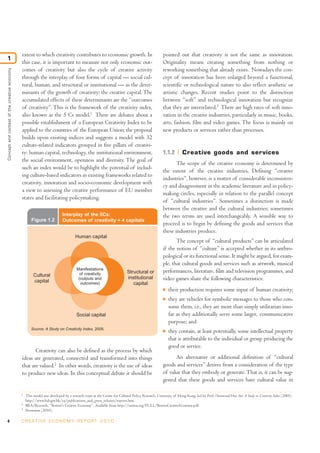
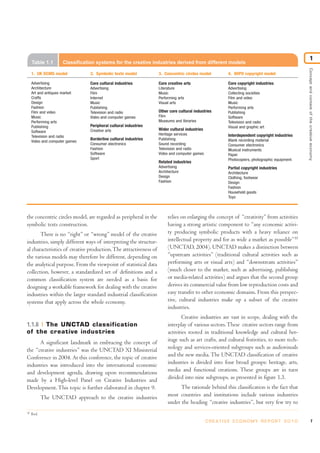
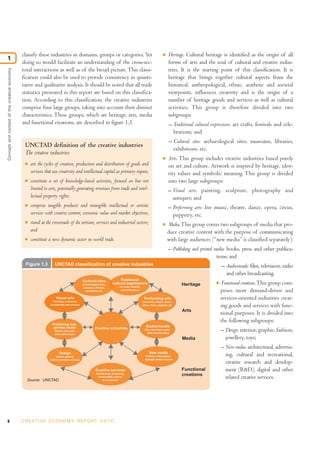
  • 228.
    198 C RE AT I V E E C O N O M Y R E P O R T 2 0 1 0 Technology,connectivityandthecreativeeconomy 7 12 Pratt (2004). “Creative Clusters: Towards the Governance of the Creative Industries Production System”. Pratt (2000). 13 The merger of Time Warner and AOL was the first and best publicized of these mergers. created content; online computer and video games; film, video and music; and online advertising. An increasing share of revenues for the content industry derives from products delivered via the Internet, but with marked differences across sectors. Advertising is the largest online market, with rev- enues of more than $30 billion in 2007 and annual growth of 30 per cent. Online revenues are around one-sixth of the total for computer and video games and music, and they are growing fastest for films, albeit from low levels (see figure 7.6). The development of user-created content has been rapid. Video and social networking sites are leading the development, and virtual worlds have become a major hub of activity. 7.5 Digitization Until recently, the mode of transmission and storage of information on the creative economy was analogue. ICTs, however, allow a new form of recording of information: dig- itization. Digitization is significantly different in two ways. First, previously separate forms (sound, images, texts) now have the same basic format and are thus readily integrated into one medium, often using the same editing techniques and similar software. Additionally, integration, when based on the same platform, enables a field of convergent media. This has both artistic business possibilities and represents a significant field of potential innovation. Second, the common digital basis of information allows it to be easily communicated and transferred with no degradation of the original in subsequent copies.This has huge implications for the distribution and copying of digital works (as well as dig- ital transformation of analogue works). The digital format means that new ways of editing and integrating media, pre- viously unimagined, can be achieved. Again, this has opened up the possibility of altogether new art forms as well as the transformation of existing ones. The economic implications of ICTs generally have been discussed in the context of debates about the “new economy”. It is claimed that cost-free reproduction and distribution, and perfect copies, create a new mode of economics that differs from the old one based on physical distribution and manufacture. Second, as indicated earlier, there is the possibility of novel products. Some authors have hypothesized that the use of ICTs will remove the need for face-to-face interactions, and the co-location that follows might minimize transport costs. This has been referred to as “the death of distance”. These totally new spatial implica- tions have been challenged on the basis that the production of intellectual property still involves labour and the transfor- mation of intellectual property. As such there may still be specific co-location effects associated with embodied skill and expertise in labour markets and in physically embodied knowledge exchange. In fact, evidence points to a renewed importance of place in the digital age (namely, creative clus- ters).12 While there is potential for the developing world, there is also the threat that divisions of opportunity may be further hardened.To answer this question fully, we need more analysis of the nature of changes in creative-economy pro- duction and the particular character of the transformation of production and value chains. 7.6 Convergence and new business models Because much of the output of the creative economy can potentially be digitized, we are likely to see an even greater impact and transformation in business transactions. This transformation is also producing new business models, market structures and governance. New business models are made possible at the simplest level by the closer integration of separate product lines (books, films and music, for example). Of course, the media already display a striking concentration of ownership and power. Most major media organizations aspire to be “convergent organizations”13 that trade and use
  • 229.
    199C R EAT I V E E C O N O M Y R E P O R T 2 0 1 0 Technology,connectivityandthecreativeeconomy 7 IPR rights that may be “re-purposed” (or reused) from one medium to another (for example, a cartoon character in a computer game, a film, a book, a toy or on a piece of cloth- ing).This multiplies the possibilities of exploitation of intel- lectual property from a single investment in addition to the traditional monopoly profits possible in the medium. Digitization creates a number of new possibilities for distribution. With analogue distribution systems, reproduc- tion leads to degradation of the product; hence it is less than the original and declines further with the number reproduced. With digital formats, reproduction is free of degradation and incurs no extra cost per item. This opens up the possibilities for infinite expansion of markets and reduces or eliminates the need to warehouse or store products. One dilemma that creative producers face is how to deal with the uncertainties of demand and the need to maximize economies of scale by con- centrating production in as few items as possible so as to reduce stockholding and excess production costs.These func- tions must commonly be combined with the physical transfer and exchange of goods, i.e., distribution. For obvious reasons, distributors seek to manage their stock by restricting choice to the best sellers. Many mechanisms are used to achieve this, but charts are a common way to organize and focus consumers. In a digital age, however, it is potentially possible for producers and consumers to be in direct contact, thereby bypassing the control of the gatekeepers of the distribution system, which are economically powerful. Because stockholding costs are minimal for digital prod- ucts, maximum choice is available; this is called the “long tail” hypothesis. In the long term, however, the potential for monopoly profits are reduced, hence posing a threat to the cur- rent media structure but opening up significant possibilities for small producers. Under a system of direct micro-payments, for example, profits may be spread thinly and hence little tradi- tional benefit from the creative economy will be realized. Clearly, this is a huge area for future debate. New business models are emerging to exploit these new possibilities (e.g., with respect to music) and it has been suggested that there may be a variety of models — e.g., free music — offering possibil- ities for making money from different aspects of the business. The real issue is the challenge that these activities (which are not understood or regulated) pose to governance and to how intellectual property is to be used and regulated, since this requires an enormous investment in infrastructure. Increased access to information gives global breadth and depth to the mapping of suppliers, buyers and outsourc- ing possibilities. Therefore, ICTs may play a major role in this transformation process, reducing costs, improving pro- ductivity in the value chain and making companies more vis- ible in the global market. This contribution is more evident in those creative industries depending on technology at their very core (software, games, multimedia content). However, even in the more traditional, less technology-driven indus- tries such as handicrafts, ICTs open new ranges of trade for services previously not traded, inaugurating distribution channels and generating innovative production forms. Box 7.1 When ICTs give rise to new business models For every action, there is an equal and opposite reaction. ICTs and the creative economy seem to form the perfect ground for the validity of Newton’s third law. The more concentrated the audiovisual and music markets become in the hands of a few transnational conglomerates, the more alternative business models emerge. Back in 2000, the music sector was revolutionized by peer-to-peer file-sharing programmes such as KaZaA and Napster, which by 2001 had conquered no less than 3.5 million users. As creativity seems to reinvent itself, a similar business model was created with Skype. Sold to eBay for $2 billion in 2005, it is now being applied to Joost Internet TV, with a promise to disrupt the oligopoly of the television industry. By the same token, a myriad of open-source initiatives mushroom in other creative-economy markets, presenting more humble turnovers but provoking a shift in mindset on all continents. In Mexico, Tortillería Editorial is an association of authors, professionals and beginners who decided they would not have much control over their books if they were to follow the usual publishing-house circuit. As a reaction, they created a mix of database, software and site where they share their books and writings, allowing any user to generate, print and sell them. In 2007, it reached more than 4,000 texts and hun- dreds of authors. In Brazil, where internet use is comparatively high, Web 2.0 is facilitating the spread of open-source software. Overmundo, a Government-funded proj- ect, was commissioned to ensure the alternative cultural coverage, mainly outside the São Paulo-Rio de Janeiro axis. Incorporating strong community participation, users are responsible for its content and design. Overmundo has become a globally recognized cultural database of Brazilian culture with more than 700,000 references via Google. Not surprisingly, it won the Prix Arts Electronica International Competition for CyberArts in 2007.
  • 230.
    200 C RE AT I V E E C O N O M Y R E P O R T 2 0 1 0 Technology,connectivityandthecreativeeconomy 7 Finally, the possibility of delivering services online rather than through a physical presence allows developing countries to benefit from their comparative advantage in some labour-intensive services that make use of ICTs.There are various ways in which governments can promote greater use of ICTs by companies, especially SMEs, that lag in terms of ICT uptake. SMEs represent the backbone of the creative sector and employ a large majority of creative workers in both developed and developing countries. Despite recent progress in the area of connectivity, there are still many bot- tlenecks that prevent creative entrepreneurs and small firms from using ICTs efficiently.Their use is often limited by low levels of ICT literacy, slow connection speeds, lack of local content and high costs of use. Moreover, in rural areas of many developing countries, even basic connectivity remains a challenge. 7.7 Impact across the production chain The use of ICTs can potentially have significant impact on all steps of the production chain: conception, pro- duction, distribution, access to audiences, and engagement in feedback from the audience/market.The specificities are dif- ferent for each production activity in the creative economy. The aim of this section is to provide some illustrative exam- ples of impact across the production chain. New ways of making money or developing audiences are possible with dig- itization and new business models, but the future direction is uncertain. All cultural producers face potential instability in the years ahead as well as huge potential growth.The new sys- tems could undermine what have become, in the last 50 years or so, the normal ways to organize, say, music or film produc- tion and distribution. Understandably, those corporations that currently occupy key positions in such a system will seek to defend the “old ways”. Recent shifts in the music industry illustrate the chal- lenges that creative producers are likely to face in adopting new ways of doing business. The old model of the music industry has production and distribution at the centre, with the objective of promoting and selling huge numbers of a small range of music. This channels monopoly profits into music companies and ensures very high intellectual property returns (for a small number of bands). This process reduces stockholding costs and increases profitability although it is risky when it is unclear whether a hit is likely to be achieved from any one recording (although marketing can influence this situation enormously). This is why in music, as in film, companies expect a large percentage of failure to be discount- ed by a small number of super successes. Thus, in this sys- tem, intellectual property is a key means by which artists can make money through recording and by which music compa- nies can target their production, distribution and sales as much as possible. This model is based on a world of physical products; the new model is based on virtual products where storage costs of digital files are practically zero and a potentially infi- nite range of music can be available to the consumer. In fact, the role of the music companies to promote and focus con- sumers could be bypassed altogether if artists were to sell directly to their audience. Of course, by exploiting the “long tail” of products, any one artist is likely to make small returns from intellectual property and the same is true for the music companies. For the latter, the old economics of the extra administrative costs of managing a large number of artists and the costs of recording, etc. will be an incentive to create a “short tail” or limited range of products. In such a situation, it may be logical for artists to focus on activities that make money, that is, live performances and the merchan- dising opportunities that these afford. In this way, they can earn a modest income. Moreover, since they are not relying primarily on income from intellectual property, it is logical that they reduce the price of their product, or give it away, in order to generate demand and attendance at concerts. Of course, they would still want to copyright the work to sell it directly to the public. This example is instructive in that it shows how the significance of intellectual property may change from its role as income generator to one of simple protection and moral right under different conditions of production. The balance of power might shift from large companies to independent
  • 231.
    201C R EAT I V E E C O N O M Y R E P O R T 2 0 1 0 Technology,connectivityandthecreativeeconomy 7 producers; in short, the business model is turned upside down: in the past, the T-shirt was seen as the extra element or souvenir of a concert whereas now it may be the major income stream. While this is an example of an actual situa- tion, it does not mean that this is the necessary or general future of the music industry or any other industry; it simply demonstrates the complex and destabilizing possibilities of ICTs field of culture and the creative industries. A step-by-step exploration of the production chain reveals other areas of potential transformation. Initial con- ception is more difficult in the sense that many new digital applications require knowledge and access to computing resources and skills. Beyond this, however, the barriers are low. With a simple video camera and editing software, a modest film can be produced in the home; the same applies to most digital forms. Moreover, these “one-offs”’ can be easily and exactly manufactured, replicated and distributed, with minimal costs, directly from the producer (without the need for intermediaries). Perhaps the most striking example of the potential of new production is the development and use of free and open-source software (FOSS).14 Created through a process of sharing knowledge through exchanging source code — the instruction set behind a computer program — FOSS programs are today provided and maintained by a range of ICT experts ranging from individuals to corporate giants, such as Sun Microsystems or IBM. FOSS programs can have a particular significance for developing countries as well as for shaping our understanding of creative processes and endeavours. There is a large range of innovative FOSS soft- ware that enables the owner of a basic personal computer to engage in what was, until recently, possible only with studio- quality production. Traditionally, distribution and exchange were special- ized, expensive and exclusive services that had strong gatekeepers in the form of publishing and distribution com- panies to protect profitability. As has been discussed, it is technically possible to bypass such systems altogether, or construct alternative or parallel systems, or develop multi-stranded versions of the old systems. The particular resolution of this distribution issue has a profound impact on the cultural sector and the sustainability of creative industries.With some justification, it has been said that com- mercial distribution narrows choices and focuses on the commercial exploitation of products; the old business model forces production in this direction. Perhaps, however, we are at a branching point where a range of distribution systems might be entertained as possibilities, some closer to the old narrow system, and some closer to the “free for all”.Without doubt, the challenge for the creative economy will be to actively engage with this debate. Otherwise, the financial power and the pressure of the risk-averse “old model” may create a future for creative production that is as narrow as, or even narrower as compared with what is presently in use. Critically, the possibilities for greater engagement for the developing world lie in there being a wider range of cul- ture available and for sale. There is a balance, however. If there are no monopoly profits, then the super profits that buoy the creative economy will not exist. Thus, in this peri- od of growing consumption, a step change must be effected to achieve some modest redistribution. Arguably, this change is a complex cocktail of regulation and governance; it will not be achieved by the total clampdown on piracy or via a global cultural commons. This raises the issue of the governance of transition between the existing models. At present, countries that have poorly developed intellectual property regimes are vulnerable to theft, not simply local theft but international theft and then copyrighting by third parties.This is legal but immoral. One possibility, among the options available, is to incorpo- rate traditional cultural expressions (TCEs) under copyright law, not by statute but through common practice.There have been a number of initiatives established to create digital archives of dance, music, oral narrative, etc.While these may not have the same formal recognition as registering copy- right, they are a first protective step that could be done at a low cost. Moreover, such collections would also have intrin- sic value to both local and international communities.While free for locals to use, such an archive might charge outsiders for use, providing a form of revenue and legal protection. 14 UNCTAD (2004). E-commerce and Development Report 2004.
  • 232.
    202 C RE AT I V E E C O N O M Y R E P O R T 2 0 1 0 Technology,connectivityandthecreativeeconomy 7 Box 7.2 Free and open-source software and the creative economy The development of the creative economy relies to a certain extent on digital information and communication technologies (ICTs) that have, on their own, been widely recognized as important pillars for economic and social development, most recently within the WSIS process and its outcomes.1 While access to network infrastructures and hardware technologies is fundamental, it is also insufficient.Access to software and the knowledge needed to understand, adapt and use it is critical if digital technologies are to achieve a positive development effect. Specifically addressing the issue of software helps to refo- cus policy and development thinking towards the human element. After all, software is the interface between cold digital hardware and the impulses of creative and innovative individuals. The development and production of software itself are a fundamentally creative and conceptual effort of problem- solving and design. Free and open-source software (FOSS) is software that does everything that other software does. It is used for writing text, email, Internet browsing, spreadsheets, statistics and data management, etc. There are many programmes that can be used in music and audiovisual production. The opposite of FOSS is proprietary software. Proprietary software, through copyright law and end-user licences, forbids users to copy, redistribute or alter the software and permits use only as narrowly specified within its particular licence. What is FOSS? FOSS is different from proprietary or closed-source software in three important ways, which are interlinked and interdependent. 1. FOSS has distinct copyright statement and end-user licences. FOSS licences permit users to copy and redistribute the software without restrictions. The most popular licence, the so-called General Public License (GPL), imposes a unique restriction: all copies, regardless of how much the software has been altered, must also use the GPL and thus permit perpetual unrestricted copying. 2. FOSS licences require that authors of a particular software programme make the source code publicly available.The source code is the software writ- ten out as ordinary text in a programming language. Access to the source code allows anyone to copy or technically alter the performance and fea- tures of a programme. It also allows young computer scientists to learn how a world-class software programme is designed and developed. 3. Finally, FOSS generates important positive economic externalities. It reduces cost redundancies in redeveloping similar software, in particular when this is procured by public bodies or government. It reduces the risk of being locked in by a vendor selling a proprietary software product and seek- ing monopoly rents. FOSS also reduces the risk of vendor failure, whereby the producer of a proprietary software ceases to do business but does not release into public domain the source code of the software, making it unserviceable in the future and impossible to upgrade and follow advances made in the other computer hardware and software. It reduces market imperfections and promotes greater competition among ICT service compa- nies that can, using FOSS, compete on quality of service and competence since it is not possible to charge rents from copyright monopolies – these simply do not exist for FOSS. Finally, FOSS permits “looking under the hood” and allows better and faster technological capacity development in ICT and computer science. There is nothing in any FOSS licence that forbids anyone to sell any FOSS programme. However, many companies that market FOSS programmes actu- ally sell only the service component while the licence is free. In general, in the software business, the service component accounts for more than half of the revenues of most software companies anyway. Thus, providing FOSS on a commercial basis does not represent a significant shift in the business model for the ICT industry. Any software, FOSS or proprietary, can be commercial. Commercial means “available on the market and used in a commercial, for-profit environment”. Proprietary software companies will sometimes try to distinguish their software as “commercial” as opposed to “FOSS”. This is a marketing strategy meant to convince buyers that there is a “commercial” grade or quality that is lacking in FOSS. Nothing could be further from the truth: the most robust and technically advanced software programmes as used by Yahoo.com, Google.com, NASA, many ministries of defence (including the Pentagon), aca- demic and research institutions (the European Organization for Nuclear Research known as CERN and Massachusetts Institute of Technology), and ICT industry behemoths such as IBM or Sun Microsystems are FOSS. Importance for developing economies The advantages for developing economies in developing and using FOSS are big and important. 1. FOSS reduces dependency on expensive and imported proprietary technology and the accompanying ICT consultancy services that are often tied up with various non-disclosure agreements. 2. FOSS, through its open code and public licences, promotes knowledge-sharing, technology transfer and unrestricted cooperation in knowledge and technology development and use. 3. FOSS enables the development of local human capacity and home-grown ICT service industries that can become more than merely fronting busi- nesses selling imported technology. 4. FOSS is economically more efficient because of the positive economic externalities that it generates as described in the previous point. 5. As the main cost involved for using any software is the service component and because FOSS allows local computer experts to learn to work with and service FOSS programmes, FOSS is more affordable than non-pirated – i.e., legal – proprietary software alternatives for the vast majority of devel- oping economies.
  • 233.
    The emergent themeof this chapter is that the effects of the adoption and use of the ICTs are likely to be ampli- fied in their impact on the creative economy. The precise impact is complex, varying by industry and by the organiza- tion and means of incorporating and using ICTs in creative production. Critically, this change opens up a window of opportunity to develop new production and distribution systems that might promote a real expansion of democracy and diversity in cultural productions, and to create new and interesting business models and opportunities. In contrast to this is the historical and vested interest of the media industries dominated by powerful players. It is clear that a 203C R E AT I V E E C O N O M Y R E P O R T 2 0 1 0 Technology,connectivityandthecreativeeconomy 7 Box 7.2 continued Free and open-source software and the creative economy 6. FOSS is fully intellectual property-regime compliant: it needs and uses copyright to maintain and promote its openness. While its spirit is anti-restric- tive, it does not confront current intellectual property from a formal, technical or legal perspective. Countries, institutions, businesses and individuals that switch from using pirated software to FOSS work to fulfil their obligations as designated by WIPO and WTO/TRIPS conventions and agreements 7. FOSS promotes good governance: It means that public data will be kept in public data-formats and managed by software the source code of which can be inspected and verified by independent bodies. This is immensely important in applications such as taxation, voting or military and defence use. 8. FOSS promotes the use of open standards and this improves interoperability among different software programmes, thereby reducing the costs when these need to be made to work together – such as merging databases or establishing common project or financial management systems. 9. FOSS allows easy localization. Any FOSS programme can be translated and altered to suit the linguistic, cultural, commercial and regulatory needs and requirements of any location, all without having to seek permission from the original authors or exchanging terms and conditions while using (expensive) legal intermediaries and consultants. 10.Many experts feel that FOSS is more secure, more reliable and more stable than proprietary software. While the debate is inconclusive, what is sure is that FOSS problems can be fixed locally by local experts. The international community should promote the idea that government policy bodies need to be aware of FOSS and include it in their ICT and e-strate- gy programmes, in e-governance activities and in procurement policies. More importantly, it should promote the notion that when Governments choose a particular technology, the decision to select FOSS or a proprietary (or mixed) solution is an important policy issue and not a purely technical, practical or cost consideration. Because FOSS generates important and positive economic externalities, software choice – and technology choice in general – should not be relegated to oversimplifications and assessments along the lines of “what works” (even though FOSS actually works better most of the time) or how costs com- pare from an accounting perspective. Accounting “analyses”, often referred to as “total cost of ownership” or TCO calculations, are notorious for ignor- ing local economic conditions as well as positive externalities, such as the development of local human capital through FOSS use. Therefore, while the decision to use FOSS initially is often understood to be a technology-awareness issue, it finally becomes an important policy issue. FOSS and LDCs While ethical principles, skills development, compliance with international copyright conventions and national law, public-data governance and better security are often cited as key reasons for adopting a positive policy stance towards FOSS use, for LDCs, cost issues can be a primary concern. While in developed market economies proprietary licence fees may constitute as little as 5 to 10 per cent of total costs of running a computer resource – with administration, maintenance, integration and support, and hardware representing the rest – in low-income economies, licences may represent the bulk of total costs. This is owing to the fact that aside from hardware and licences, all other costs are essential, non-tradable, labour-intensive services and these demand correspondingly low wages in LDCs. While hardware costs are manageable to some extent through bulk purchasing from original equip- ment manufacturers, using thin-client technologies2 or recycling outdated hardware from developed market economies, FOSS offers an opportunity to avoid paying licence fees altogether. 1 See: http://www.itu.int/wsis/index.html . 2 A thin client is a minimal, stripped-down computer and software combination that depends primarily on a powerful central server for data processing and memory and therefore serves mainly as an input-and-output device between the user and the central server. By: Dimo Calowski, UNCTAD, E-Commerce Branch. 7.8 Looking into the future
  • 234.
    204 C RE AT I V E E C O N O M Y R E P O R T 2 0 1 0 business-as-usual agenda may deliver pronounced increases in inequality, access and range of cultural offerings.The real challenge will be to develop new forms of governance in the creative economy that will support and encourage the posi- tive and minimize the negative effects. The creative industries are clearly well placed to bene- fit enormously from the development of ICTs. However, there are a number of challenges that will need to be careful- ly managed. First, the creative economy often lacks profes- sionals in financing and accounting that would enable it to secure funding from financial institutions. Second, SMEs normally face legal uncertainties relating to cross-boarder e- commerce and the need to keep up to date on the dynamics of e-commerce legislation.15 Third, investment and commer- cial banks are not always prepared to value intangible assets. This is a veritable lose-lose situation as companies find it hard to prove the financial potential of their creative prod- ucts and services and investment and financial institutions do not increase their portfolio of clients. Smaller creative com- panies must then refer to a mix of internal and external financing sources. A recent Canadian study revealed that approximately 57 per cent of cultural SMEs have sought debt financing during the last two years, 80 per cent of which were successful in obtaining debt capital from finan- cial institutions. However, the research data do not explain whether cultural SMEs succeeded in obtaining the entire amount of capital that they had requested or whether the capital was obtained at favourable rates. A clue that such was not the case, however, is provided by the fact many cultural SMEs (and 42 per cent of those receiving debt funding) use personal savings to operate their businesses.16 As pointed out earlier, the digital divide is narrowing but still exists; the development of inexpensive computing services and of open-source software is very important as a stepping stone in closing the gap. However, another digital divide is opening up, one that may have even greater conse- quences than the first. It is the investment-intensive universal broadband.The example of countries such as the Republic of Korea is notable in that such investment has driven and expanded the market as well as the innovative use of ICTs. This is one of the main advantages in ICT applications and a way to engage the public. Given the increasing importance of a closer interaction between producers and consumers as well as the growing interactive and educational learning Technology,connectivityandthecreativeeconomy 7 Box 7.3 Eurovision Geneva-based Eurovision is not only the home of the world's most popular musical talent show, the Eurovision Song Contest; for almost 50 years, it has also offered a distribution platform to Europe’s public broadcasters for an exchange of news items. Since October 1958, Europe’s public broadcasters have provided one another with coverage of news events in their countries on a reciprocal basis. The added value of the Eurovision News Exchanges was already clear during the first experimental news exchange, when Pope Pius XII fell ill. When he passed away two days later, the editor of the Dutch television news bulletin made history by asking for “the dead Pope live”, and Eurovision arranged for a live broadcast from the Vatican. Today, the Eurovision News Exchanges handle over 42,000 news items per year, using two satellite channels for both news reports and extensive live coverage of events. Eurovision News Exchange items cover wide-ranging topics from the worlds of politics, culture, science, business, religion and sports. United Nations agencies began offering items to the Eurovision News Exchanges in the mid-1970s. Today, content provided by FAO in Rome, ILO, IOM, UNCTAD, UNHCR, UNICEF, UNTV,WFP,WHO,WIPO and WMO as well as the International Atomic Energy Agency in Vienna, the International Criminal Tribunal for the Former Yugoslavia in the Hague, and others adds additional breadth to the Eurovision News Exchanges and helps more than 100 national and international broadcasters fill their daily news bulletins. United Nations videos, particularly concerning unfolding humanitarian crises, provide broadcast- ers with essential material from regions of the world where press access may be limited and about conflicts in their earliest stages. Video material from the United Nations is also distributed outside of the News Exchanges via Eurovision’s World Feed Service, which began in 2005. Live coverage of the 62nd General Assembly in September 2007 was distributed to more than 300 broadcasters worldwide. This cooperation between Eurovision and the United Nations is only the most recent in a fruitful partnership that dates back more than 30 years and puts United Nations material in front of editors in major TV newsrooms around the world. Additional information about Eurovision is available online at: www.eurovision.net. By Laura Downhower, Eurovision. 15 Ibid. 16 Nordicity Group Ltd (2004).
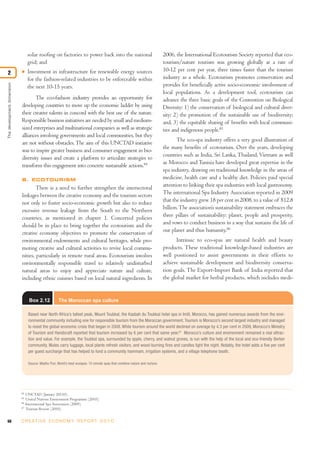
  • 235.
    patterns developed byICTs, rich societies are becoming more closely bound together in a virtuous interaction both online and off. This will be one of the major challenges to the democratization of cultural development in the coming years. There are also a number of pressing challenges with respect to intellectual property.The development of archives is essential for building reflective and critical knowledge of art and cultural forms, and to develop adequate education systems. For a variety of reasons, one of the institutional weaknesses of many developing economies concerns cultur- al communication and critique. The use of ICTs to develop a wider public discourse on art and culture could be a mar- vellous dividend for the digital age. 205C R E AT I V E E C O N O M Y R E P O R T 2 0 1 0 Technology,connectivityandthecreativeeconomy 7
  • 236.
    206 C RE AT I V E E C O N O M Y R E P O R T 2 0 1 0 Technology,connectivityandthecreativeeconomy 7
  • 237.
    Promoting the Creative Economyfor Development 5 PART
  • 238.
    208 C RE AT I V E E C O N O M Y R E P O R T 2 0 1 0
  • 239.
    Knowledge and creativityare becoming powerful drivers of economic growth in the contemporary globaliz- ing world. They have profound implications for trade and development. Together with technology, they open up a huge potential for developing countries to develop new areas of wealth and employment creation consistent with new trends in the global economy. For such countries to realize this potential, it is necessary to carefully formulate specific policies for enhancing creative capacities through strategic actions to be taken by governments at local, national and regional levels, while exploring possibilities for international cooperation and strategic alliances. A wide range of measures is available to governments at all levels to stimulate the creative economy; to reinforce the connections between social, cultural and environmental aspects of its functioning; and to promote the achievement of sustainability through linking economic and cultural development. The policy arena within which government action dealing with the creative economy falls is the broad area of creative-industries policy. Traditionally in many countries, this area of policy concern has been known as “cultural policy”. Yet the scope and coverage of the term “cultural policy” differ from country to country. For some countries, especially in the industrialized world, cultural pol- icy simply comprises policy towards the creative arts. Such countries support the arts through measures such as subsi- dies to artists and performing companies; tax concessions for donations to the arts; assistance to education and train- ing in music, drama, the visual arts and so on; and the oper- ation of public cultural institutions such as museums and galleries. For other countries, particularly in the developing world, cultural policy has tended to connote principally pol- icy towards cultural heritage. In these cases, the policy task is seen as one of preserving or protecting both tangible and intangible cultural heritage, where the sites, artefacts and tra- ditions involved are vulnerable to exploitation and possible loss through deterioration or disappearance. Lately the notion of “cultural policy” has broadened to has broadened to emcompass creativity and the creative industries. This expansion parallels the widening of the scope of the creative economy from the traditional cultural industries, as discussed earlier in this report. In Europe, for example, policy interventions in support of the cultural industries began in the 1920s and were reaffirmed in the Treaty of Rome (1957) and the Maastricht Treaty (1992), which progressively defined the support for culture in the countries of the European Union. Originally such support was directed towards traditional art forms, but as the market economy has grown and diversified, the scope has widened continually to embrace the audiovisual industries, publish- ing, the media and so on. The Europeans have stressed the importance of the cultural content of the output of these industries. Public expenditure on culture in the European Union has continued to expand, with countries such as France and Germany committing more than €8 billion to culture in the early years of the twenty-first century, with total public expenditure on culture across the enlarged European Union now totalling approximately €50 billion (KEA 2006:125). In line with the cross-cutting and multidimensional nature of the creative economy, creative-industry policy in its broader interpretation embraces aspects of a number of other areas of economic and social policy. Perhaps most importantly, consideration of the creative economy becomes a key element of industrial policy, whereby indus- trial development strategies can exploit the potential dynamism of the creative industries in generating growth in output, exports and employment. A positive outlook for 209C R E AT I V E E C O N O M Y R E P O R T 2 0 1 0 Policystrategiesforthecreativeindustries 8 CHAPTER8 Policy strategies for the creative industries 8.1 Introduction
  • 240.
    210 C RE AT I V E E C O N O M Y R E P O R T 2 0 1 0 industrial policy in which creativity and innovation are important drivers of growth is well suited to the conditions of globalization and structural change. For developing coun- tries in particular, a refocusing of industry policy along these lines can begin to open up many of the exciting possibilities for growing the creative economy that have been outlined in this report. Another major area of economic policy for which the creative economy has significant implications is, of course, trade policy. Trade in products such as audiovisual services has had significant impact on the cultural sectors of coun- tries in the developed and developing worlds alike, and hence on the formation of cultural policy. For many countries, the traditional concepts of cultural policy have expanded to incorporate the promotion of cultural exports and the protection of vulnerable domestic creative industries. Other areas of economic and social policy with linkages to the creative economy include: tourism; urban and regional development (especially the “creative city” area); cultural rights and cultural diversity; education and training; and copyright and intellectual property. If the widened scope for policy towards the creative economy is to be entertained, it will require significant collaboration between the various ministries and bureaucratic departments. Only by such coop- eration will the full development potential of the creative economy be realized. It is important to bear in mind the international con- text within which policymaking takes place. Multilateral processes are the essence of international policies and the driving force to move forward the international economic and development agenda. These processes will be discussed in the next chapter. The economic role of government is conventionally taken to comprise public interventions to promote: I efficient resource allocation in the economy; I full employment, price stability and external balance; and I equitable distribution of income and wealth. With regard to domestic policy towards the creative economy, the rationale for involvement of the public sector can be described under several areas of intervention, as fol- lows: I Market failure (public goods). The cultural sector in general and the creative arts in particular are normally regarded as a source of diffused community benefits that have the characteristics of non-rival and non-excludable public goods. A particular public benefit of relevance here is the social cohesion that can be expected to flow from cultur- al activities and creative production within communities. I Market failure (imperfect competition). If industries become concentrated to such an extent that competition breaks down, government intervention may be warranted to restore competitive conditions. A specific case of this in the creative economies of developing countries may arise if global corporations producing cultural products are in a position to monopolize local markets to the exclusion of locally produced cultural expressions. I Market failure (research and development). The involvement of government in promoting R&D is justified on the grounds that beneficial externalities might be produced and/or that the public sector may be in a better position than private companies to assume the sorts of risk involved, with the prospect of sharing in the payoff from successful discoveries. In the case of the creative economy, governments can and do facilitate R&D investments in creative product development for either or both of these reasons and may undertake strategic investments in the creative sector with the hope of “picking winners”. I Education and training. Governments have particular respon- sibilities in the areas of education, training, certification and licensing. Significant strides have been made in the developing world towards achieving universal literacy and ensuring access to education opportunities that are both relevant and of high quality. The resources available for specific training programmes are, however, often very limited. For the time being, training and education opportunities relating to the creative industries are almost Policystrategiesforthecreativeindustries 8 8.2 The role of public policies
  • 241.
    entirely limited tothe major urban centres.The successful promotion of creative industries requires that they be reflected in the national education system, which would offer targeted training opportunities at different levels (for- mal, non-formal, informal) in skills and knowledge that are relevant to professional participation in the creative-indus- tries sector. Such training also needs to serve as a reposito- ry of knowledge relating to the rich cultural traditions that underpin these professions. It is also necessary to confer the status and importance that are due these specializations through a programme of certification and licensing designed specifically for the creative-industries sector. I Cultural identity/cultural diversity. An area that has traditionally formed part of cultural policy in the broadest sense has been government responsibilities for the cultural life of the people as reflected in the traditional knowledge and the intangible cultural capital of the community. Although there are demonstrable economic ramifications arising from areas such as the expression of cultural identity or the pro- tection and celebration of cultural diversity, this is an area of policy that is generally regarded as intrinsically impor- tant in its own right. For our purposes, it is clear that policy in these areas should undoubtedly be regarded as part of an overall domestic policy strategy that encourages and supports the creative economy. 211C R E AT I V E E C O N O M Y R E P O R T 2 0 1 0 Policystrategiesforthecreativeindustries 8 Box 8.1 Shanghai creative industries: The Chinese way The concepts of “creative economy” and “creative industry” have had great impact on China’s social and economic development, the most important being the discovery of the economic value of culture. The academic and public sectors in China have focused on the value of the creative economy as “a kind of newly emerging culture perspective and economic practice that stresses the support and promotion to the economy of art and culture”. Therefore, in many cities of China, instead of “creative industry”, the “cultural creative industry” is a more commonly used term. As a country with a long history and rich cultural heritage, China has always experienced a strong demand for cultural products. The industries are man- ufacturing products for international brands, making China one of the biggest exporting countries in the world, but these products are “made in China”, not “created in China”. As a result, China’s new generation is playing Korean games and watching Japanese cartoons and Hollywood movies. Chinese people are increasingly surrounded by products originating in the creativity and culture of other countries. A 2006 survey on the consumption of creative products in Shanghai showed that the group between 20 and 35 years of age prefers international brands much more than local brands, and this ten- dency is even stronger in younger groups. This tendency is caused by the dominant idea that culture and economy are separate entities; however, the creative industries may help to reverse this trend. Creative industries focus on culture and creativity and then extend to other related industries in the form of a value chain, providing broader ways of generating value-added products and services. In China, Shanghai was a pioneer city in the promotion of the creative industries, with the Municipal Government playing a key role. In the 11th Five-Year Plan of the Shanghai government, promoting creative industries has been listed as a key issue in developing modern service industries. In the past, Shanghai was very strong in manufacturing, but now it is shifting towards the service and finance industries. Hence, in 2007, it was a government priority to accelerate the development of creative industries so as to promote the structural reform of industries with a view to building a new framework focused on the service economy. In the “Key Guide for the Development of Creative Industries in Shanghai”, the five main areas of creative-industry devel- opment are: I R&D, including advertising, animation, software and industrial design; I architectural design, including engineering and interior design; I culture and media, including art, books, newspaper publishing, radio, television, film, music and performing arts; I business services, including education, training and consulting services; and I lifestyle, including fashion, leisure, tourism and sports. Creative industries already account for about 7 per cent of Shanghai GDP. Seeking to turn Shanghai into a creative city, the government has set a target of 10 per cent for the contribution of creative industries to total Shanghai GDP in 2010. Stages of development of Shanghai creative industries Shanghai has divided its development of creative industries into three stages: creative-industry parks, creative-industry clusters and creative-industry projects. I Stage 1: Creative-industry parks – the model of old factory warehouses plus artists. In the first stage, many old warehouses in the downtown area were renovated and furnished to become modern office buildings while retaining some of their original equipment and appearance. These buildings are usually spacious with high ceilings, making an ideal environment for the start-up of creative businesses by artists and entrepreneurs. Since these buildings were almost useless in the past, the rents were comparatively low and thus good for creative companies and individual artists. This model has proved to be quite successful: by the end of March 2007, 75 creative-industry parks had already been built in Shanghai.
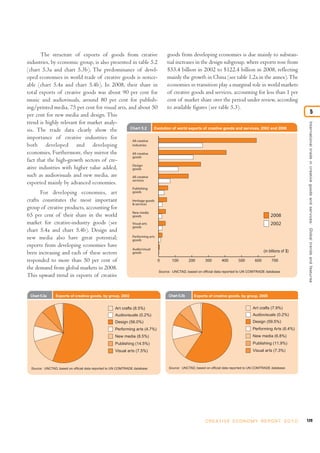
  • 242.
    212 C RE AT I V E E C O N O M Y R E P O R T 2 0 1 0 Policystrategiesforthecreativeindustries 8 Box 8.1 continued Shanghai creative industries: The Chinese way Since most creative businesses start small and are modestly capitalized, these creative-industry parks play an important role at bringing such busi- nesses together and providing an enabling environment. In addition, they may facilitate marketing such companies since the clients may approach creative-industry parks when searching for suppliers. M50, an old warehouse converted into painting and sculpture galleries and studios, is a very good example of these creative-industry parks. Numerous very creative artists are now concentrated in M50 and receive many visitors and clients. Some of the artists at M50 became very successful and now have their artwork listed in Sotheby auctions. With the support of the government, owners of culture-industry parks are able to convert unprofitable warehouses into prosperous office buildings. In turn, the surrounding environment also improves. This model has proved to be very successful from a business perspective. However, it has some shortcomings. Creative-industry parks remain owners, while creative businesses are renters.As real estate values increase and rents rise, some com- panies and artists are forced to relocate, consequently hindering the industries’ development. I Stage 2: Creative-industry clusters – clusters formed according to the local art and cultural resources. Eventually, creative-industry parks were found to be insufficient to fully support the development of the creative industries. The Shanghai Municipal Government has stopped building new creative- industry parks but continues to maintain and develop the existing 75 parks. Based on the latter, the government starts to explore the development of creative-industry clusters, which take into consideration the characteristics of the local art and culture and intentionally focus on certain industries. As a result, a full range of companies and businesses in the value chain are concentrated in these clusters so as to foster the development of that particular industry. The main industries include: the theatre and performance-art cluster, the film and television cluster, the comic cartoon and game cluster, the gallery cluster and the intellectual-property cluster. For example, the Zhangjiang Culture and Technology Creative Cluster has attracted enterprises relating to comics and cartoons, games, television and movies, and post-production services. At present, this cluster concentrates 70 per cent of the total production value of game software in China, including some of the top game businesses. I Stage 3: Creative-industry projects – big and important events and projects based on the value chain. Shanghai is also trying to promote such proj- ects in the creative industries. For the 2010 World Expo, a creative project is being carried out that will place in one service system all the elements attractive to a participant in the World Expo, including clothing, food, accommodation, travel and entertainment. This kind of big project has great potential to promote the creative enterprises in Shanghai. All these quick developments require strong support from the government. A long-term policy and related strategies are necessary for the stable promo- tion of the creative industries. Moreover, five-year plans are an effective way of informing people of the direction of development. Government initiatives take the leading role and must continue to be the main impetus, particularly when facing competition from more developed creative industries in other countries. For China, the development of creative industries involves almost all industries, and people are increasingly aware of this trend. Our target, however, extends beyond GDP increases and includes the exploration of the potential of deeply-rooted Chinese culture for making creative products rich in Chinese culture and heritage. The cultural value of the creative industries lies not solely in its products but also in the emergence of culture as a core element of industrial and economic activities. Much progress remains to be made, though, as Chinese industries have been mainly manufacturers. However, as exemplified by the experiences of other countries, creativity will become a driving force in the whole economy. China is facing the twofold task of promoting new industries and improving traditional industries. Fostering cultural development is also paramount. The creative industries provide us with a new perspective on our current gap vis-à-vis developed countries and a new way to explore the potential of development as a big country rich in cultural resources. Awareness of the value of creativity is just beginning in China. In the last two to three years, many cities have begun to explore the creative industries. In the 16 cities that belong to the Yangtze delta, 14 are boosting creative industries. Moreover, Beijing has taken powerful measures to support its creative industries. The value of creative talents is also increasingly recognized in society, with schools encouraging greater creativity among their students, a change that may influence China’s entire education system.To properly understand and take advantage of this trend, the Ministry of Education has started a three-year research project on China’s strategy for the creative industries. This exemplifies China’s commitment and vision for develop- ment. Though its experience may not be easily replicated, it could be an interesting reference for other countries, especially developing ones. By Prof. He Shou Chang, Executive Vice Chairman, Shanghai Creative Industry Association.
  • 243.
    The process offormulating and implementing public policies often entails the following sequence: I Specification of objectives.This first step is critical in specifying clearly which outcomes policy is designed to achieve. Generally, multiple objectives are involved, and the neces- sity of some trade-off between them might be anticipat- ed. For example, the standard goals of macroeconomic policy may require that some balance be sought between levels of growth, inflation, unemployment, external bal- ance, etc. In some cases, however, synergy between objec- tives may be possible. With regard to the creative econo- my, for instance, a linking of the goals of economic and cultural development can readily be imagined whereby growth in cultural production can yield both economic and cultural benefits. I Choice of instruments. The guiding principle in the allocation of policy instruments to tasks is the so-called assignment problem, whereby the most effective and efficient policy measure or package of measures is aligned with the objec- tive or objectives that they are expected to achieve. The standard array of policy instruments available for use in supporting the creative economy includes: fiscal measures (subsidies, tax concessions, investment allowances, business start-ups); regulation (copyright, local content quotas, planning laws, regulations on foreign direct investments); trade-related measures (import quotas, etc.); education and training (direct or subsidized provisions of services); pro- vision of information and market development services; international cooperation (cultural exchange, cultural diplomacy); and social security and welfare policy (includ- ing measures to protect cultural diversity). The usefulness of particular instruments is discussed in more detail later in this chapter. I Implementation, monitoring and evaluation. The implementation of cultural policy requires appropriate measures to gather the data necessary for monitoring whether or not the required objectives are being achieved, what the benefits and costs of intervention have been, and whether there have been any untoward or unexpected side-effects, either positive or negative.The process of monitoring and evalu- ation is normally seen as part of a feedback loop whereby the assessment of the effectiveness of policy measures can be used to inform the further development and refinement of policy formulation and implementation. The above sequence of the policy process is relevant generally to the dynamics of government action in regard to the creative economies of developed and developing countries alike. Some further considerations to be borne in mind, par- ticularly in the developing-country context, are the following: I There is a need in the developing world to create a frame- work of objectives, shared values and measurable outcomes; define the roles and responsibilities of all role players; and consolidate the role of government as a facilitator and coor- dinator of the creative sector and its development. I Much of the policy implemented in the developing world has used models from developed countries in its design. The current challenge is to ensure that policy embraces values relevant to the developing countries themselves, incorporating indigenous knowledge systems and local experiences into the policy, institutional and programming environment. I A critical challenge for policy in the arts, culture and heritage sectors of developing countries is the lack of articulation between cultural policy and other priorities, and the degree to which a concern for culture and cultural diversity is embedded in development agendas. I One of the most significant challenges to the creative sec- tor in developing countries is the implementation of good governance principles across the sector as well as the improvement of the relationships between producers, distributors, creative workers, employers and retailers. 213C R E AT I V E E C O N O M Y R E P O R T 2 0 1 0 Policystrategiesforthecreativeindustries 8 8.3 The policy process
  • 244.
    Critical areas wheredeveloping countries need new policy initiatives in order to boost their creative economies include the provision of infrastructure, the provision of finance and investment, the creation of institutional mecha- nisms, an appropriate regulatory framework, the develop- ment of export markets, the establishment of creative clusters and a mechanism for effective data-collection meas- ures and analysis. 8.4.1 Provision of infrastructure It is a fundamental function of government to create and maintain the conditions under which the economic, social and cultural life of the citizens can prosper. This responsibility takes shape through the ways in which the public sector provides both tangible and intangible infra- structure. Given the predominance of the market economy as the basic form of economic organization in the world today, the types of infrastructure required are those institutions that enable markets to function effectively but at the same time to protect and promote the public interest. As UNCTAD puts it in The Least Developed Countries Report 2004: In implementing post-liberal development strategies, public policies in LDCs should use market-supporting mechanisms aimed at market creation, market develop- ment and market acceleration. These policies must not simply provide the right price incentives, but also create the right institutions and the infrastructure necessary for a modern market economy to function properly (UNCTAD, 2004:xi-xii). The infrastructure needs of the emerging creative economies of developing countries arise at all points in the value chain from initial creative production (which may be undertaken on a small scale at the local level or on a larger scale in towns and cities) right through to marketing and retailing. As with any other industry, the creative industries need affordable access to appropriate space in which to work and to live, transportation, and distribution facilities. The dispersed but interdependent nature of creativity in the cre- ative-industry sector may make the provision of these basic infrastructure needs more costly and complicated than for the development of more traditional heavy and light indus- try. The overlap with the private infrastructure needs of the employees and the small scale of the needs for the individual industry may, on the other hand, balance this cost. The pro- motion of creative clusters is one way to overcome this cost but it may not carry the social and cultural advantages of lodging creative industries within existing communities. Moreover, the problem of lack of infrastructure relates par- ticularly to gaps in the supply chain for inputs into creative processes, inadequacy of distribution networks for effective marketing of products, and lack of institutional support mechanisms. One infrastructure requirement particular to the creative industries is the need for access to information and communication technology (ICT). Access to information needed to boost business development is in many regions of the world still far from universal and will never be so with- out conscious public sector efforts to expand access.There is no doubt, however, that access to ICT, in terms of identifi- cation of market opportunities, training, innovations, networking and sales, is a significant factor in the develop- ment of the viability of small business units. Access to ICT provides a link between education and commerce and assists in turning knowledge into marketable products. Facilitating the movement of workers is another key issue for the devel- opment of creative industries, especially in those industries that entail a collective creative process (see chapter 7). Like any other industry, creative industries are only truly sustainable if they contribute to building the asset resource base. This they can do only through the integrity and authenticity of their products. In the longer run, the cre- ative industries depend on the vitality and strength of the cultural sector and the investments in cultural capital (knowledge and heritage). The sustainability of the creative industries therefore depends on the safeguarding of cultural capital and the development of the cultural asset resource base. Hence, comprehensive cultural asset management is a prerequisite for sustained growth in the creative-industries sector and, in a wider perspective, for sustainable economic development and vibrant community life. It is therefore necessary to maintain the principle that cultural assets are intergenerational capital and that their viability may legiti- mately be sustained by public investment. 214 C R E AT I V E E C O N O M Y R E P O R T 2 0 1 0 Policystrategiesforthecreativeindustries 8 8.4 Policy directions
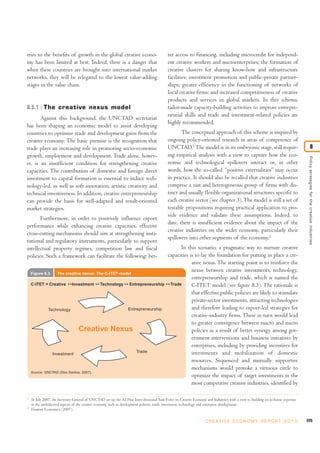
  • 245.
    215C R EAT I V E E C O N O M Y R E P O R T 2 0 1 0 Policystrategiesforthecreativeindustries 8 8.4.2 Provision of finance and investment The actual role played by government in dispensing funds for the cultural sector and the creative economy may involve direct cultural provision via the state apparatus or via an enabling role administered through a ministry of culture or the equivalent. The expansion of cultural policy beyond the concerns simply of core artistic and cultural activities, as discussed earlier, entails a similar expansion of the ways in which cultural funding is provided. In particular, public finance and investment in the creative economy are expected to extend beyond cultural ministries and to involve, in par- ticular, ministries responsible for industrial development, technology and finance. Traditionally, investment in the cul- tural sector has directed investment and programming towards projects, institutions and large enterprises that are all heavily dependent on public incentives and financing. The creative sector face capital rationing at all stages. Start-up financing is often difficult to access because of the uncertain prospects in markets for creative products; forecast- ing demand for creative goods such as films is generally more difficult than for more standardized products so public and private investors often look upon projects in these areas as too high-risk. Occasionally, firms have access to public investment assistance programmes, business incubators or private venture- capital sources. Nevertheless, difficulties in obtaining finance continue into the operational stages of creative businesses, when working capital is needed and funds for business expan- sion are also typically in short supply. Contrary to the cultur- al sector, which relies mostly on public funds, the creative industries are more market-driven. Therefore, creative entre- preneurs have to be more pro-active in dealing with commer- cial banks and private investors, instead of relying too much on government subsidies. A conventional model of public funding for the cultural sector is illustrated in figure 8.1. Figure 8.1 Funding flows to the cultural sector Source: Gordon and Beilby-Orrin (2007:30). Corporate Sector Household Sector Cultural Sector DOMESTIC SECTOR “Arm’s Length” agencies (public broadcasting corps, arts councils) National administrations (Treasury, Ministries or Depts. of Culture, Interior, etc.) Local Administrations Government sector Incoming transfers from non-resident institutional units (foreign governments and international organisations) Outgoing transfers to non-resident institutional units (foreign governments, international organisations, NPISHs and households) NPISHs (Non-profit institutions serving household) State/Regional Administrations Household sector Non- residents Foundations
  • 246.
    216 C RE AT I V E E C O N O M Y R E P O R T 2 0 1 0 Policystrategiesforthecreativeindustries 8 The sustainability of the creative industries depends on a different and more comprehensive model of investment. While parts of the creative economy have been very success- ful in identifying funding and have become very profitable, many activities may appear to have only a limited commer- cial potential.These activities may not have been able to real- ize their potential because they have lacked the capital and investment needed to scale up their activities and operate as demand-driven, sustainable businesses. A major problem in this respect is that entrepreneurs in the creative industries often find it difficult to present a convincing business model and many of the professional skills involved — e.g., chore- ography, dancing, drawing, editing, weaving, doll-making — simply are not perceived as leading to profitable businesses. While this may be changing in some places under the influ- ence of success stories of one kind or another, many skills and professions related to the creative economy are not rec- ognized as business categories in legal terms. Because of this, many small creative industries do not have access to credit facilities or to the loans and investments that would make their businesses more viable. The credit-crunch which followed the financial crisis of 2008-2010 continues to affect a large number of creative businesses, thus calling for new approaches for funding. Financing and credits for businesses in the creative economy may arise from different sources requiring distinct kinds and degrees of collaterals, obligations and responsibilities. In general, it comes from public-sector funding programmes of various sorts; private-sector investment; venture capital; pub- lic-private partnerships; grants from foundations; company’s cultural-social responsibility tax exemption schemes etc., but other non-conventional alternatives could also be explored. Microcredit schemes are a viable option which should be made more easily available by public and private credit insti- tutions to finance small creative enterprises and independent artists in developing countries, particularly for start-ups. Nowadays, there is a range of non-traditional funding options to stimulate creative business that can be regarded as tools to promote local development. Indeed, the lack of con- fidence in financial markets which resulted from the 2008 financial crisis became influential to attract greater public interest for alternative schemes for funding and commercial transactions. Among the new financing instruments most used by creative economy circles are: (i) collaborative co- financing via networks, and (ii) alternative currencies via the solidarity-based economy. Both are cases of new business models functioning through networks, used particularly by the new generation of creative entrepreneurs in different parts of the world. Certainly more evidence and research analysis is needed not only to better understand the func- tioning and operational efficiency of such alternative mod- els, but also to examine the regulatory framework in which Figure 8.2 Model of monetary circuit applicable to the creative industries Professional and Wage Labor Markets Product and Service Markets Governments PaymentsTaxes Incom e Taxes Factor Paym ents Payments Financial Institutions Households Businesses and Organizations InterestLoans Consumption Expenditure Savings Interest and Dividends Sale Receipts Source: Bernard Lietaer and Gwendolyn Hallsmith,Global Community Initiatives,2006
  • 247.
    217C R EAT I V E E C O N O M Y R E P O R T 2 0 1 0 Policystrategiesforthecreativeindustries 8 they operate and to evaluate the short and long-term mone- tary implications of these alternative models, in particular their interactions with the conventional banking system and the overall economy. Nevertheless, it is important to be aware of their existence and why and how they are fast pro- liferating.The scheme presented in figure 8.2 is an indication of a monetary circuit more oriented towards the needs of creative business in local communities, involving key stake- holders: wage-earning workers, self-employed workers and liberal professionals; families; companies; governments, financial institutions, organizations of the civil society; and markets of products and e-services. Solidarity-based economy What became known as the solidarity-based economy is a non-conventional model to deal with economic activi- ties on the basis of alternative currencies.To a certain extent these social-related business models go in line with the need to rethink the functioning of the world economy in an innovative and creative manner.The use of social currencies is receiving more attention in a number of countries not only from the developing world; indeed alternative curren- cies are legally in circulation in more than 35 countries (see table 8.1). In practice, they are systems created and administered by social groups to execute payments, exchanges or transmission of obligations among the mem- bers of a community, with the aim to make local economies self-sustaining.This model is being applied in the context of the creative economy particularly by the young generation and in poor communities. It is neither public nor private, but a kind of a hybrid human-centred scheme applied for certain economic activities inside a pre-determined geographic area. The main principles driving the solidarity-based economy are: social justice, solidarity, cooperation, self management, concern for the environment and responsibility for the next generations. The solidarity-based economy functions within networks using a range of alternative currencies for trade and commercial exchanges. Social or alternative currency refers to any currency used as a complement to the dominant national currency systems, responding to both commercial and social objec- tives. They can be created by an individual, corporation or organization, and even by national, state or local govern- ments; in most cases they arise naturally as people begin to use a certain commodity or a creative product or service as a currency. Mutual credit is a form of alternative currency, and thus any form of lending that does not go through the bank- ing system can be considered a form of alternative currency. When used in combination with or when designed to work in combination with national currencies they can be referred to as a complementary currency, but can only be used with- in a closed circuit, therefore limited to a certain community or region. Barters comprise another type of commercial transaction, an exchange system which trades items without the use of any currency. Another alternative scheme gaining traction in recent years is the Local ExchangeTrading Systems (LETS), a spe- cial form of barter which trades points for items. One point stands for one hour of work. Often there are issues related to paying tax. Some alternative currencies are considered tax- exempt, but most of them are fully taxed as if they were national currency, with the caveat that the tax must be paid in the national currency.The legality and tax-status of alter- native currencies varies widely from country to country; some systems in use in some countries would be illegal in others. Various approaches are being proposed to link Local ExchangeTrading Systems in communities around the world. The Ripple monetary system has been proposed as a virtual system to connect the diverse LETS systems. LETS are char- acterized by a level of innovation, and many new networks choose to experiment with the system’s mechanics. Local exchange trading systems now exist in many countries and are used in the creative economy.Table 8.1 provides background information of its worldwide application, and Box 8.1 provides an interesting example of how alternative currencies are being used in a developing country.
  • 248.
    218 C RE AT I V E E C O N O M Y R E P O R T 2 0 1 0 Policystrategiesforthecreativeindustries 8 North America Oceania South America Source: UNCTAD adaptation based on wikepedia information about LETS systems in operation in various countries Table 8.1 Illustration of Local Exchange Trading Systems (LETS) In 2003 the Community Exchange System (CES) started operating an Internet-based LETS in Cape Town, South Africa. This has grown into a global network of over 180 local exchange systems in more than 20 countries (early 2010), among them New Zealand, Australia, Spain, the United States, the United Kingdom and Vanuatu. Many of these are former LETS groups but others are time banks and hybrids. In the Peanuts system in Chiba, near Tokyo, Japan, approximately 10 per cent of all payments made at local stores are in the community currency (2002). The LETS movement saw its peak around 2002-2003. South Korea has some active LETS too, such as Hanbat LETS in Daejeon and Gwacheon Pumasi in Gwacheon. The Fureai kippu system is wide- spread in Japan. In the United Kingdom, an estimated 40,000 people are now trading in around 450 LETS networks in cities, towns and rural communities. LETS currencies have their own local names, for example: Locks in Camden Town, London - Camden LETS Readies in Reading, Berkshire - Reading LETS Scotia in Scotland - LETSlink Scotland Rheidol in Aberystwyth, Wales - CyFLe Aberystwyth LETS (group closed down in Aug 2009). In France, a consortium of social economy financial institutions including Crédit Coopératif and the Mutual MACIF and MAI have joined with the Chèque Déjeuner cooperative to launch an alternative currency called the Sol, which will be held on a smart card. The Sol will be piloted in the Ile de France, Brittany and Nord-Pas de Calais regions as part of an EQUAL development partnership in 2005-2006. (More information is avail- able from www.selidaire.org.) Germany established a number of local currency systems with different names such as “Talents” or “Batzen” using LETS principles. Germany hosted an International Conference in Monetary Regionalisation in October 2006 to debate those issues. In Hungary the term used is “Community Service System” (KÖR). One group from the capital city is Talentum Kör (Gold Talent Group), a British Council-supported project. The Netherlands has spawned a number of innovative concepts based on the LETS formula, some of which try to lower participation barriers by completely moving their exchange platforms online, like NOPPES. In Switzerland, the WIR Bank operates a system close to a LETS. The original LETS, the Comox Valley LETSystem developed by Michael Linton in 1982, is now dormant, however; there are plans to revive it. The second LETSystem in Canada was the Victoria LETS, established in 1983. LETS have been established in several Canadian cities, including Kitchener-Waterloo, Niagara, and Peterborough in Ontario, Halifax, Nova Scotia, and St. John’s Newfoundland. Although less common than local paper currencies, several LETS have taken root in the United States. These systems include Asheville LETS in western North Carolina, the St. Louis Community Exchange in the Midwest and Fourth Corner Exchange in the Pacific Northwest. The Psychologist Jill Jordan started the first Australian LETSystem in the town of Maleny, Queensland in 1987, after visiting Michael Linton in Canada to observe the LETSystem functioning in Courtenay, British Columbia. He also pioneered the idea of naming local currencies after icons of local importance: in Maleny their currency is the bunya, named after the local nut of the bunya pine. In 1989 the Western Australian govern- ment had given $50,000 for the development of LETSystems, including the running of state conferences, the production of software, a LETSystems Training Pack, and assistance to Michael Linton to visit Western Australia. By 1995 there were 250 LETSystems in Australia, with Western Australia having 43 separate systems serving a population of 2.3 million (although actual participation is by only a tiny fraction of that population) making it then the region with the highest LETS coverage in the world. South Australia also pioneered an “InterLETS” allowing mem- bers of one system to trade with members of other systems. Data on more Australian sites can be found at www.lets.org.au. As of the mid 1990s there were approximately 70 “Green Dollar Systems” in New Zealand. A National Conference of Systems was a means of supporting new groups through the various developmental stages. Since 2000, there are now 140 Ecosimia-Groups in Ecuador. Africa Asia Europe
  • 249.
    219C R EAT I V E E C O N O M Y R E P O R T 2 0 1 0 Policystrategiesforthecreativeindustries 8 8.4.3 Creation of institutional mechanisms In a large majority of developing countries, there are a number of institutional weaknesses hampering the perform- ance of the creative economy. Among the major constraints are: (i) the inadequate integration of cultural objectives into the economic, technological and social policies; (ii) inade- quate dissemination of policies, legislation and regulations related to culture and the creative economy, to enhance bet- ter understanding of their cultural and economic value to all relevant stakeholders; (iii) poor institutional capacity to articulate, implement, monitor and evaluate policies, strate- gies, programmes and projects, contributing to weak delivery; (iv) lack of linkages and networking among institutions; and (v) excessive dependence on the government by cultural and creative practitioners. Against this scenario, there is a need for a workable and flexible institutional mechanism to facilitate the elaboration and implementation of a plan of action based on a long-term strategy for enhancing the creative economy. It is advisable to introduce a mechanism to facilitate concerted cross-cutting policies. The establishment of an Inter-ministerial Steering Committee on Creative Economy could be envisaged, as a standing body to play a key role in shaping public policies involving government officials from all the relevant ministries. Such a committee would also establish a regular dialogue (at least twice a year) with key professional associations and insti- tutions of the creative sector in order to allow greater owner- ship in the process and better respond to the demands and expectations of the creative professionals. A step further could be envisaged by establishing a Creative Economy Centre, as a platform to facilitate networking and partnerships, share experiences, collect and disseminate information, studies and policies, and facilitate interactions between creative business, private sector and academia.The centre would be the meeting point for creative practitioners, where seminars and capacity- building activities could also be held, as stimulus for creativity and innovation. A centre or several centres could be set up at national, municipal or regional levels. The problem of weak institutions extends also to the regulatory environment within which the creative economy functions. As elaborated below, institutions are also needed to support a sound legal framework like the collecting Box 8.2 Alternative Currencies in Brazil Palma, Maracanã, Castanha, Cocal, Guará, Girassol, Pirapire, Tupi. The list of various names includes more than 40 local currencies that circulate in Brazilian neighbourhoods and small towns where there are community banks, created to strengthen the economy in needy communities. The worth of the local currency is identical to the real, the official currency of Brazil, but it is more valuable than the real because businesses give discounts for pur- chases made with this alternative money. The use of the currency is simple: the local residents can trade the real for the local currency in a community bank and use it in regional businesses. If it is necessary to buy something with a real outside of the community where the bank is active, then a person can do the exchange in reverse. The objective of the local currency is to have the currency circulate in the local community. The practice increases sales and generates more jobs in those areas. Banco Palmas is a pioneer in this area. It was the first community bank created in Brazil, founded in 1998. Two years later it brought out the currency of the same name, the palmas. The communitarian experience yielded such positive results that in 2005 the Network of Community Banks in Brazil was created. Today, there are some 50 community banks across the country. The real can be used outside of the community, generating wealth in other areas, whereas the local currency has the power to generate prosperity in the neighbourhood. It is recommended that the local bills be distinct in appearance from the real. The other provision is that the local currency is not worth more than official Brazilian currency and that for each unit issued there is a real in the community bank. This measure aims to control the economy: if the alternative currencies are worth more or if more are printed than the official currency, it can destabilize the economy of the country. The alternative banks report how much local currency is in circulation to the Central Bank. The community itself profits from the earnings, which is different from what happens with the large banks where the money of the customers is used for financial transactions. “The community bank does not serve the speculation market. It just serves to generate wealth locally. This is economic democracy,” says an official at the Bank of Palmas. Source: UNCTAD adaptation of an article by Mariana Sanches e Inácio Aguiar; available at www.revistaepoca.com.br
  • 250.
    220 C RE AT I V E E C O N O M Y R E P O R T 2 0 1 0 societies for copyrights management; to attract investments and promote exports, an Investment and Export Promotion Agency; to implement competition policies, a Competition Authority, etc. Equally important are the sectoral and profes- sional institutions within the various sectors, such as the national film agency and association of musicians. Usually the associative structures in place are quite weak and need to be reinforced, in order to be able to promote effective changes in the creative sectors. Policystrategiesforthecreativeindustries 8 Box 8.3 The Egyptian film industry: The waning of the “Hollywood of the East”? Egypt has a long and proud tradition of moviemaking dating back to the late nineteenth century when projections were shown in cafés. The first feature films to be produced were romantic movies intended for the urban middle class while the first full-length silent feature and the first made with an entirely Egyptian crew was “Leila”, produced and co-directed by Azira Amira with Turkish director Orfi Bengo in 1927.1 Since then, the Egyptian movie industry has become the most important in the Arab world. More than 75 per cent of the 4,000 short and feature-length films made in Arabic– speaking countries since 1908 have been Egyptian.2 At its peak, the film industry of Egypt produced some 60 to 70 feature films a year.3 By the late 1990s, however, the industry managed to produce only 15.4 The film industry was boosted by the creation of Studio Misr in 1935, becoming “the nucleus of a genuine film industry as part of 20 or more enterprises by Talaat Harb meant to contribute to the Egyptianisation of the economy”.5 Studio Misr grew to be one of Egypt’s largest production companies, Egypt’s equivalent of Hollywood, and continued to play a prominent role for more than three decades. The internationally successful films of the 1950s, including musicals and comedies, became classics while their stars became screen legends and their producers were internationally acclaimed. Filmmakers produced serious films; Youssef Chahine, for example, won accolades and awards throughout his long career such as the golden anniversary award at the fiftieth Cannes Film Festival in 1997 for lifetime achievement. He also was the only Egyptian director honoured by the Berlin, Cannes and Venice film festivals.6 The film industry did not fare well during the time of Gamal Abdel Nasser. Attendance at movie theatres as well as actual film theatres declined dramat- ically with the nationalization of radio and television industries in the early 1960s. Film theaters in the period 1955-1975 declined from more than 350 to fewer than 250 while at the same time, imported foreign films flooded the market.7 The losses incurred by the State film organization saw the grad- ual halting of film production by the early 1970s. The financing from oil-rich Gulf countries of films for television (1980s) and satellite production (1990s), accompanied as it was by the tightening of censorship requirements covering sex, politics and religion, exacerbated the decline of the film industry. Many film critics point to the current power of censors to limit artistic creation and freedom of expression, particularly with respect to criticism of religion. In addition, funded television shows benefited enormously from the Gulf petrodollars of the 1980s, also to the detriment of film, so that by the mid-1990s, the Egyptian film industry was thought to be in a state of crisis, with the annual production of films falling to single digits. At the same time, the last 10 years have seen a new group of Egyptian women film directors emerge such as Hala Khalil, whose “Ahla Al-Awquat” (“Best of Times”, 2004) reflects on the reality of her generation of Egyptian women set in present-day Cairo. While the Egyptian film industry is still the biggest in the Arab world, Egyptian filmmakers are concerned about many issues from the quality of film- making, the standard of film courses at the High Cinema Institute, censorship, religious fundamentalism, level of production and technical standards in Egyptian film-making to financing and the level of intellectual property protection. Prominent Egyptian director, Inas al-Deghedy, spoke to Guy Brown in Cairo about the quality of film-making, financing and fundamentalism: “Poor quality movies are a reflection of economic difficulties. People are not look- ing for movies that explore important issues; they are trying to escape the economic situation. That is why comedians dominate the industry at the moment … There is no comparison between Egyptian and American or European movies. Production standards in American movies are far ahead of us; European movies are not so far ahead, which is partly because they are also experiencing financing problems … Now the whole industry is based on films that are self-financed. They do not have a good source of financing from Arab countries … Seventy-five per cent of revenues come from the cinema, and 25 per cent from video and satellite. Revenues disappear into thin air because of inadequate intellectual property right protection, particu- larly on the international scene … The Egyptian people are the true censors … Fundamentalists are creating a serious problem for the industry, because they are wrapping new films up in red tape”.8 Today Egyptian cinema straddles both those films with high artistic quality attracting international attention and popular films, particularly those in the comedy genre. The core of Egypt’s flourishing film industry is based in Cairo, which hosts the world-class annual International Film Festival. Some films have success- fully bridged the art/individual-popular divide, such as the 2003 “Sahar el Layali” (“Sleepless Nights”) and the 2006 “Imarat Yacoubian” (“The Yacoubian Building”). The latter is based on a novel by dentist author Alaa El-Aswani, published in 2004 and “containing all that the majority of Egyptians talk about in private”.9 This film with its depiction of homosexuality and other issues considered taboo as well as some newer releases indicates a film industry that is increasingly willing to take risks. “Awkat Faragh”, for instance, is a social commentary on the decline of youth in Egypt and the sexual undertones
  • 251.
    221C R EAT I V E E C O N O M Y R E P O R T 2 0 1 0 8.4.4 Regulatory framework and legislation For the effective functioning of the creative economy, it is essential to establish or reform the regulatory and insti- tutional frameworks, in order that they will be conducive to supporting the development of the creative industries. Sound national regulations and institutional frameworks adapted to countries’ conditions and capacities are paramount to nurture the creative economy. There is a wide range of complex issues that can only be dealt with through effective and updated legislation. – Intellectual property legislation: Effective and modernized intellectual property regimes that protect the originators’ interests and stimulate creation and innovation are therefore a pre-requisite for access to global markets. A balance needs to be struck, however, between strengthening IPRs and strengthening the public domain. Ensuring that this balance is established is essential to asset management and wealth creation in the creative economy. Copyright sys- tems need to be more transparent and fully accountable regarding the management of IPRs. Even where collecting societies do exist, their successful operation is sometimes adversely affected by shortcomings of sister societies in other countries. For example, a frequent complaint by musicians from developing countries is the failure of collecting soci- eties to capture airplay and live performance statistics for their music played overseas. This perceived unfairness in treatment means that artists from the South receive very lit- tle in the way of copyrights payments from outside their countries. Without a realistic copyright regime, creative Policystrategiesforthecreativeindustries 8 Box 8.3 continued The Egyptian film industry: The waning of the “Hollywood of the East”? in today’s society, and despite being controversial and produced on a low budget, the film went on to become successful. The Egyptian film industry is again in a delicate position not only because of societal taboos and the rise of fundamentalism but more importantly also because of how film is viewed both by the authorities and society more generally as being outside of culture and heritage. As Samir Farid points out, “Arab countries, including Egypt, do not view their cinemas as part of their national heritage or an art worthy of government subsidy. Film is not taught in colleges of fine arts and newspaper film reviews tend to be located on the entertainment pages, rather than in the arts and literature pages”.10 There are no negative archives, cinematheques, video libraries or film museums and copyright protection is poor. As is the case with music in much of Africa, Arab film production companies prefer up-front payment rather than waiting for possible future financial rewards, which leads to a lack of attention to what happens to their originals and copies. As film critic, Mohamed El-Assiouty, laments, “…they are not in the least concerned with preserving their originals and more often than not neglect to place a positive copy in the Egyptian National Film Centre (ENFC)’s store room”.11 The proposed Media Production City, a $200-million, 5,000-acre production venue with a development projection of 10 years will become the new Egyptian equivalent of Hollywood. It will have 13 state-of-the-art sound stages, outdoor sets (from Pharaonic cityscapes and medieval Islamic backdrops to Egyptian villages, modern Egyptian street scenes and agricultural settings), film processing laboratories, an open-air theatre, a training centre, admin- istration offices and a hotel for actors, production personnel and visitors.12 However, it will ultimately be up to the artists – from scriptwriter to director and producer – to ensure that Arab cinema remains creative and vibrant. 1 See http://www.powerofculture.nl/uk/specials/film/egypt.html 2 Samir Farid, “Lights, camera --- retrospection”, Al-Ahram Weekly, no. 462, 30 December 1999-5 January 2000. Available online at: http://weekly.ahram.org.eg/1999/462/cinema.htm 3 Peter Warg (2007), “Egypt’s Hollywood mammoth film centre going up near Giza”, in New Middle East Magazine. Available online at: http://archives.obs-us.com/obs/ger- man/books/mem/n01a08.htm 4 Guy Brown (2002), “The movie business in Egypt”, AME Info, 8 December 2002. Available online at: http://www.ameinfo.com/16692.html 5 Musri Saad El-Din (2007), “Plain talk”, Al-Ahram Weekly, no. 838, 29 March-4 April 2007. Available online at: http://weekly.ahram.org.eg/2007/838/cu3.htm 6 Samir Farid (2006), “An Egyptian story”, Al-Ahram Weekly, no. 821, 23-29 November 2006. Available online at: http://weekly.ahram.org.eg/2006/821/cu4.htm 7 Advameg, Inc. (2007), “Economics and Politics, Egypt”. Available online at http://www.filmreference.com/encyclopedia/Criticism-Ideology/Egypt-ECONOMICS-AND-POLITICS.html 8 Quoted in Guy Brown (2002), ibid. 9 Samir Farid, “Seven”, Al-Ahram Weekly, no. 849, 14-20 June 2007. Available online at: http://weekly.ahram.org.eg/2007/849/cu4.htm 10 Samir Farid, “Lights, camera – retrospection”, ibid. 11 Mohamed El-Assiouty, “Forgotten memories”, Al-Ahram Weekly, no. 445, 2-8 September 1999. Available online at: http://weekly.ahram.org.eg/1999/445/cu5.htm 12 Peter Warg (2007), ibid. By Avril Joffe, Director, CAJ (Culture, Arts and Jobs).
  • 252.
    222 C RE AT I V E E C O N O M Y R E P O R T 2 0 1 0 Policystrategiesforthecreativeindustries 8 producers are unable to receive equitable payment for their output and hence lack the financial incentive to continue in production. Although many countries in the developing world are making progress in establishing workable legislative arrangements for dealing with intellectual property, there is still a long way to go (see chapter 6). – Fiscal regimes: In order to enhance the creative industries it is important to review the current fiscal regime and see what should be done in terms of fiscal treatment to support creative activities.Very few countries have fiscal ben- efits to encourage the creative industries, although usually they grant fiscal and customs incentives for investors in the tourism sector. Some countries have a sponsorship law but usually they need revision (tax rebates should be linked to specific conditions) or effective implementation to effectively contribute to the growth of the creative industries. In some cases, special decrees are need to define rules and criteria for the commercialization of certain art works, antiques, to avoid abuse and unscrupulous commerce and exports of pro- tected creative and heritage goods. Effective audiovisuals and broadcasting can greatly facilitate the development of the film and TV industry, since the absence of a supportive regulatory framework means serious difficulties for local producers of creative content. Another issue is that in many countries musical instruments and audiovisuals and media equipments are considered luxury items, being heavily imposed with import duty plus value added tax (VAT). Governments are therefore encouraged to examine possibili- ties to review fiscal policies, including possibilities for tax exemptions, reductions on duties and levies on the import of equipment used in creative enterprises, etc., by providing fis- cal incentives to artists, cultural producers and the corporate sector involved in the creative industries. – Monetary and exchange rate policies: Governments and central banks are encouraged to undertake supporting policies for financial institutions in order to inject constant flow financial resources to creative business activities. This initiative could provide impetus to business that would increase business profits and incomes earned from the cre- ative activities. In the context of the current global financial Box 8.4 The Biennale of Contemporary African Art of Dakar: A contribution to economic and cultural development in Africa For several years, Africa has proposed a variety of events for the promotion of different forms of artistic expression. The Biennale of Contemporary African Art of Dakar undoubtedly makes a critical contribution to ensuring the promotion of artists and the diffusion of contemporary creative works within and beyond the continent. The Biennale of Contemporary African Art was born from the desire of the Government of Senegal to position Dakar as a place of encounters and cultural exchange for the entire African continent. The event started as a Biennale of Arts and Literature in 1990, with literature occupying a predominant place. Dak’Art was organized for the first time in 1992, and since then, the visual arts component has moved to the forefront. Nowadays, 289 artists from 34 African countries, with 16 representing the African Diaspora and 13 from the rest of the world participate. Among the countries with the highest rates of participation in the Dak’Art exhibitions are Cameroon, the Democratic Republic of the Congo, Ivory Coast, Morocco, Nigeria, Senegal and South Africa. Furthermore, in 1996, the Biennale started to incorporate the Salon of Design, which showcases the work of talented designers from Africa; 92 creators were selected to represent 15 countries from the African continent during the period 1996-2006. Dak’Art 2006 also was attended by 63 art critics, 25 specialized press agents, 19 African journalists, 32 representatives from galleries and museums, 13 organizers of 7 Biennales at the international level and a dozen art collectors. Several important events are scheduled for 2008. The first one is Africa Now, an important programme under the initiative of the World Bank and in honour of Africa. The second one is the first Foire d’art contemporain africain de Tenerife in Spain. In addition, the Biennale is associated with the UNCTAD secretariat for the launching of the “Creative Africa” initiative during the UNCTAD XII Ministerial Conference to be held in April in Accra, Ghana. For the occasion, an exhibition of African contemporary art will reveal the breadth of African talents in the field of visual arts, showing new approaches in art and design and raising public awareness about contemporary creations in Africa. Creative Africa will feature the work of artists from 10 African countries through paintings, sculptures and collages. The economic spillovers of Dak’Art are linked mainly to the sales of important African art works. The event is also beneficial for several economic activities such as international tourism, international transportation, local transport, the hospitality industry and other services. In brief, Dak’Art is an illustration of the positive impact of international cultural manifestations for socio-economic development. By Ousseynou Wade, Secretary-General of the Biennale of Contemporary African Art, Dakar, Senegal. Website: www.biennaledakar.org .
  • 253.
    crisis, the activeparticipation to influence monetary and for- eign exchange market can improve the functioning of the financial sector and institutions in supporting trade-related activities in creative industries. – Competition laws: Considering the oligopolistic structure of several creative industries, particularly in the area of music, media and audiovisuals, government should ensure that competition policies and a Competition Authority are in place to allow fair competition. Competition laws are expected to regulate several areas of relevance to the creative industries, such as abuse of dominant positions, agreements between companies and concentrations that impede compe- tition. Efforts should be made to strengthen the legal and regulatory framework, including for the creation of creative and cultural enterprises, including the registration of such entities, and their constitutions. – Labour and social laws: In most developing coun- tries, the majority of artists and creative entrepreneurs are still part of an informal and/or very fragmented sector. Thus, they do not benefit from the usual rights and obliga- tions covered by general labour regulations. Social and economic security for art workers and creators is essential to changing the traditional misperception that creative activities are transitory or recreational activities or hobbies. Comprehensive national legislation is required to regulate occupational creative activities and their relationship with employers in order to set up a social and economic security scheme for these workers. It is widely recognized that employment conditions for artists are often very precarious. Artists’ contractual obligations are usually project-based, with long periods of unemployment between engagements. Most artists, particularly in the performing arts, work on an irregular, part-time or self-employed basis, with limited or inexistent coverage for pension and medical schemes. Where it does not exist, it is highly recommended the drafting and approval of a Law for Artists and Creators, taking into account the specificities and vulnerabilities of this profes- sional category. 8.4.5 Development of exports markets In terms of export promotion, tailor-made export strategies should be designed for the most competitive cre- ative sectors. Development of brands, new markets, and new products all these targets should be well articulated. Specialists should be in charge of quality control for exportable creative products in order to respond to the requirements of major markets.Trade facilitation issues must be addressed, including for example the slow clearance of goods through ports and customs offices and the need to simplify inspection and paperwork for exports. It is impor- tant that creative industries be included in the national strat- egy for export development. There are noteworthy examples of domestic creative industries that are outward-looking and that actively target foreign direct investment and export markets in addition to local markets for creative products. In this context, East Asian countries stand out. For example, the Singapore strategy aims to establish a reputation for Singapore as a new Asian creative hub. Among the international creative industries that it has succeeded in attracting are international film financing com- pany RGM Holdings, electronic games developer Koei Company, Ltd. from Japan, and automotive and product design studio BMW Group Designworks USA. In addition, 53 foreign media companies have set up regional headquar- ters or hubs there in the last five years. Similarly, the indus- tries of Hong Kong SAR are highly export-oriented given the small size of the local market and have benefited from their spatial and cultural proximity to the huge market of mainland China. Likewise, United States’ creative industries, which are very competitive and have an established reputation, vigorously pursue opportunities in export markets. 8.4.6 Establishment of creative clusters Every creative industry has its own particular needs, identity and modes of organization — the music industry or the publishing industry, for example. From a policy perspec- tive, however, a small-scale publisher is likely to have more needs and problems in common with a small professional music ensemble or a small pottery and weaving business than it has with a larger-scale publisher, wherever these creative professionals are located.Thus, although the performance of creative individuals may differ from country to country, their impact on the development of the creative industries is like- ly to be optimized through national and regional coopera- tion within a cluster strategy. As discussed earlier in this report, clustering is a system to network independently func- tioning units. It optimizes the individual unit’s function and potential instead of exploiting them. A cluster brings togeth- er individuals and groups that create products that compete but must also cooperate within the broader context of the creative industries. Clusters can develop naturally or be cre- 223C R E AT I V E E C O N O M Y R E P O R T 2 0 1 0 Policystrategiesforthecreativeindustries 8
  • 254.
    224 C RE AT I V E E C O N O M Y R E P O R T 2 0 1 0 ated for a specific purpose; they may cover many or a few industries; and they may contribute to development in a par- ticular geographical location, as in the many creative-indus- try parks established in recent years in cities such as Barcelona, Spain, Rosario, Argentina and Shanghai, China. The promotion of cluster development has proved to be an efficient way of organizing the creative industries and the non-formal sector. Cluster development contributes to the creation of synergy both within and between different sub-sectors of the creative industries. It also contributes to the identification of needs of the sector and areas for policy development, and helps to justify relatively large investments that focus on the drivers (the infrastructure) needed to cre- ate the necessary enabling environment for the promotion of growth in the creative-industry sector. 8.4.7 Stimulating creative entrepreneurship The management of creative businesses requires spe- cific skills in both the entrepreneurial and the artistic or cul- tural aspects of the business operation. In developing coun- tries, skill-development programmes and vocational training courses can address these difficulties, but progress tends to be slow. Often, there is lack of understanding of the value chain in the creative industries and the roles and responsibil- ities of the players at each stage of the value chain. For instance, African artists who have successfully penetrated World Music and who have been recorded locally need inter- mediaries to distribute their work internationally, so the commercial value of their success is usually not retained within their countries. This lack of understanding extends not only to role-players within the industry but to the indus- try and government, where commercial goals and objectives of cultural policy collide over the purpose of the support and where role-players see themselves in competition with one another. In enhancing capacities of creative entrepreneurs, sup- port should also be extended to enable small and medium- sized enterprises to become vibrant and contribute to the economy. Indeed, providing capacity-building and adequate training and exposure to creatives can have a multiplying effect on creativity. Issues such as the preparation of sound commercial business plans and the submission of applica- tions to a micro-financing facility or commercial bank could be decisive for many potentially successful creative projects. 8.4.8 Institution of effective data-collection measures The issue of the necessity of reliable statistics is ever- present in all reports and discussions about the creative industries and the creative economy. It is almost redundant to say that effective and useful data collection is necessary and an imperative for any type of assessment and policy for- mulation. The problem of a lack of quantitative and quali- tative data for the creative industries is a key impediment for informed policymaking. This report stresses the need for the adoption of a methodology for the collection and analysis of universally comparable and reliable data on creative industries that map- ping studies rarely meet.The creative industries in the South operate mainly in the informal sector, where the terrain is usually uncharted and the infrastructure of the industries remains opaque. There is no doubt that targeted investment and policy can go a long way in realizing the growth poten- tial of the creative industries, but unless the economic value of these industries can be benchmarked and measured, few concrete policy steps can be taken towards this goal. All countries, but in particular the developing ones, should col- lect reliable and consistent data on the creative economy in order to formulate a comprehensive strategy and allocate resources to develop the sector. An initial effort to identify what data is collected, both quantitative and qualitative, would give policymakers a useful overview. Policystrategiesforthecreativeindustries 8 8.5 A creative nexus for enhancing the creative economy Despite encouraging prospects for the growth of the creative economy in the developing world, there are problems. Many opportunities for value creation, employment expan- sion, technological upgrading and market development in the creative sector have gone unrealized. As described above, developing countries face huge obstacles, such as lack of investment and entrepreneurial skills, inadequate infrastruc- ture, absence of appropriate financing mechanisms and weak institutional and legal frameworks to support the growth of the creative industries. As a result, access by Southern coun-
  • 255.
    tries to thebenefits of growth in the global creative econo- my has been limited at best. Indeed, there is a danger that when these countries are brought into international market networks, they will be relegated to the lowest value-adding stages in the value chain. 8.5.1 The creative nexus model Against this background, the UNCTAD secretariat has been shaping an economic model to assist developing countries to optimize trade and development gains from the creative economy. The basic premise is the recognition that trade plays an increasing role in promoting socio-economic growth, employment and development. Trade alone, howev- er, is an insufficient condition for strengthening creative capacities. The contribution of domestic and foreign direct investment to capital formation is essential to induce tech- nology-led, as well as soft innovation, artistic creativity and technical inventiveness. In addition, creative entrepreneurship can provide the basis for well-adapted and result-oriented market strategies. Furthermore, in order to positively influence export performance while enhancing creative capacities, effective cross-cutting mechanisms should aim at strengthening insti- tutional and regulatory instruments, particularly to support intellectual property regimes, competition law and fiscal policies. Such a framework can facilitate the following: bet- ter access to financing, including microcredit for independ- ent creative workers and microenterprises; the formation of creative clusters for sharing know-how and infrastructure facilities; investment promotion and public-pr