



www.cenatic.es
Report on the International Status
of Open Source Software 2010
National Open Source
Software Observatory
Created by:
The CENATIC Team. National Open Source Competency Centre. National Open Source
Software Observatory (ONSFA).
Penteo ICT Analyst
With the collaboration of the CENATIC Board of Trustees:
the Ministry of Industry, Tourism and Trade, through Red.es, the Regional Government
of Extremadura, the Regional Government of Andalusia, the Principality of Asturias, the
Regional Government of Aragón, the Regional Government of Cantabria, the Regional
Government of Catalonia, the Regional Government of the Balearic Islands and the Basque
Government, as well as the Atos Origin, Bull, Telefónica and Gpex companies.
Published:
©2010 Cenatic
C/. Vistahermosa, 1 - 3ª Planta
06200 Almendralejo (Badajoz)
Some rights reserved.
Legal Deposit: BA-329-2010
ISBN-13: 978-84-693-2425-7
Layout and Production: Línea 4 Comunicación. www.linea4.eu
This work is distributed under a Creative Commons - Attribution
3.0 Spain license.
To see a copy of this license, please visit:
http://creativecommons.org/licenses/by/3.0/es/
This report is available from the CENATIC website:
http://www.cenatic.es
Pictures: INGRAM Publishing / Purestock
(Royalty-free Pictures by Subscription)
UK Office. c/o. Ingram Publishing, 26-28 Hammersmith Grove
London W6 7BA. UK
The opinions expressed in this publication are those of the
different authors of the texts included and do not necessarily
reflect the opinion of CENATIC.
Table of Contents
1. Executive summary ..........................................................................
1.1 An overview of the degree of OSS development around
the world .....................................................................................
1.2 The contribution of the Community model to the
development and evolution of OSS .........................................
2. An overview of the level of OSS development around
the world ............................................................................................
2.1 Degree of OSS advancement in technological categories ...
3. Models / Typologies of OSS ecosystems .......................................
4. State of affairs for OSS by region.....................................................
4.1 Europe .........................................................................................
4.1.1 Germany .............................................................................
4.1.2 France .................................................................................
4.1.3 Spain ...................................................................................
4.1.4 Italy .....................................................................................
4.1.5. Norway ...............................................................................
4.1.6 United Kingdom ..................................................................
4.1.7 Finland ................................................................................
4.1.8 Denmark .............................................................................
4.1.9 Holland ................................................................................
11
12
16
19
28
31
37
41
44
48
51
55
57
59
61
63
64
66
66
71
74
77
80
82
84
85
88
90
93
95
97
98
101
103
105
109
110
112
112
117
119
119
119
120
4.2 North America .......................................................................
4.2.1 United States ..............................................................
4.2.2 Canada ..........................................................................
4.3 Latin America ........................................................................
4.3.1 Brazil ..............................................................................
4.3.2 Argentina ........................................................................
4.3.3 Mexico ...........................................................................
4.3.4 Venezuela ......................................................................
4.4 Asia ........................................................................................
4.4.1 India ...............................................................................
4.4.2 China .............................................................................
4.4.3 South Korea .................................................................
4.4.4 Japan .............................................................................
4.5 Oceania ..................................................................................
4.5.1 Australia .........................................................................
4.5.2 New Zealand ..............................................................
4.6 Africa ......................................................................................
4.6.1 South Africa ...................................................................
5. Methodology, execution team and panel of experts ...............
5.1 Methodology ..........................................................................
5.2 Execution team ......................................................................
5.3 Panel of experts .....................................................................
6. Bibliography .................................................................................
6.1 Public Sector ..........................................................................
6.1.1 Introduction ...................................................................
6.1.2 North America ................................................................
6.1.3 Latin America ................................................................
Report on the International Status
of Open Source Software6.
6.1.4 Europe...............................................................................
6.1.5 Africa ................................................................................
6.1.6 Asia ..................................................................................
6.1.7 Oceania-Australia .............................................................
6.2 Private Sector ...........................................................................
6.2.1 Introduction .......................................................................
6.2.2 North America ....................................................................
6.2.3 Latin America ..................................................................
6.2.4 Europe ..............................................................................
6.2.5 Africa ................................................................................
6.2.6 Asia ...................................................................................
6.2.7 Oceania-Australia .............................................................
6.3 Universities and RD Centres ..................................................
6.3.1 Introduction .......................................................................
6.3.2 North America ....................................................................
6.3.3 Latin America .....................................................................
6.3.4 Europe ...............................................................................
6.3.5 Africa .................................................................................
6.3.6 Asia ...................................................................................
6.3.7 Oceania-Australia .............................................................
6.4 OSS Communities........................................................................
6.4.1 Introduction .......................................................................
6.4.2 North America ....................................................................
6.4.3 Latin America .....................................................................
6.4.4 Europe ...............................................................................
6.4.5 Africa ..................................................................................
6.4.6 Asia ....................................................................................
6.4.7 Oceania-Australia ..............................................................
6.5 Technologies ..............................................................................
6.6 Legal ............................................................................................
6.7 Information Society ....................................................................
7. Appendices ..................................................................................
7.1 Questionnaire for the private sector .....................................
7.2 Questionnaire for the public sector ......................................
7.3 Questionnaire for universities ...............................................
7.4 Questionnaire for communities .............................................
121
125
126
127
128
128
129
130
130
132
132
134
134
134
134
134
135
135
135
136
136
136
136
137
137
138
138
139
139
141
142
145
146
147
149
151
Report on the International Status
of Open Source Software 7.
Prologue
Information and communication technologies, hereafter ICTs, play a key role as a basic element of competitiveness, promoters of innovation and key
factors in the knowledge society. Nowadays, more than half of the increase in productivity in Europe is generated by ICTs, not only in terms of the
investment they represent, but also as an agent directly involved in improving the efficiency of the remaining economic sectors.
ICTs will continue to be a driving force in our economies in the future. We are still at an early stage in the exploitation of all the possibilities they currently
offer, but we can already glimpse some elements that will become opportunities for growth. One of these elements is the extraordinary generalization of
ICTs, which makes them accessible to any user, rather than being limited to experts. As a result, users can simultaneously benefit from them and play
an active role in them. Moreover, there is the already-existing trend of exploiting the potential of cloud computing and social networks, as well as the
application of collective intelligence provided by crowdsourcing, a term coined by Jeff Howe in 2006, according to which collective mass participation in
development projects generates better ideas and more innovative products.
Finally, these developments will be characterised by interoperability. This will allow systems and applications to form a transparent service network over
which knowledge can easily spread and be used in ways that are still difficult for us to foresee.
Interoperability, crowdsourcing, collective intelligence, generalisation, cloud computing and social networks... All these concepts are closely related to
collective construction, the distinguishing feature of Open Source Software, that results in development sharing among companies, administrations
and citizens all over the world, as well as transparency, efficiency and technological independence. The impact of Open Source Software on our
society continues to grow, and it is one of the values of the Network Society. Open technologies are already part of the technological reality for citizens,
companies and the public administration, as their benefits have led to them being chosen as a result of conscious and thorough selection processes.
The CENATIC Foundation, in keeping with its objective of raising awareness about open source technologies, regularly releases research reports that
study the different aspects of open source software. The ultimate aim of these reports is to boost the competitiveness of the Spanish business sector
by providing information about the business opportunities offered by these technologies and identifying international projects that can be implemented
and applied to Spanish society.
The report we present here analyses the International Status of Open Source Software, enabling us to put the current situation in Spain in context based
on the knowledge of technology trends around the world, the promotion and use of open technologies in the Spanish Private and Public sectors, and
the contribution of Spanish Communities of Developers and Universities to important initiatives on an international scale.
It is, in conclusion, a thorough overview of the international context of open source software, creating a starting point for the identification of new
business opportunities for Spanish companies, and new fields of study for CENATIC to continue promoting the use and development of open source
software in Spain.
Francisco Ros Perán
Secretary of State for Telecommunications and the Information Society
President of CENATIC Board of Trustees
Introduction to the Report
Within the framework of CENATIC's regular publications for the dissemination and promotion of open source software in Spain, we present this report,
The International Status of Open Source Software, which offers an overview of the open source software situation in different geographical areas
around the world.
The objective of this report is to understand the role played by open source software in the Information and Communications Technologies sector around
the world, and to highlight its economic and social impact, on both advanced economies and emerging countries, by analysing the ecosystems that
foster the development of open source software: the Public sector, the Private sector, Universities and Communities of Developers.
The result of this analysis is the identification of the factors that account for the differences in maturity and penetration of open source software in the
different geographical regions. Among these factors, we must highlight the key role of Public Administrations in promoting open source software, both
by developing policies to promote and encourage its use and by becoming a key user of this software, as happens in those European countries most
advanced in the use and development of free technologies. Other factors that explain the different maturity levels among countries are the level of
education and the access their citizens have to the information society. In this regard, as a result of its high level of technical training, India shows a high
level of open source software development, despite the limited access the general population has to the information society.
Each geographical area has been characterized according to the level of maturity shown by the most relevant countries in the region, and this level has
been established through a detailed analysis of the elements of each country's ecosystem. North America, Western Europe and Australia stand out as
the most advanced regions, whereas the whole of Asia, Latin America and Africa show a lower level of development. Aside from these two groups, worth
mentioning is the special position held by several of the most advanced Asian countries such as Japan, Korea, China and India, as well as Brazil in Latin
America and South Africa in Africa, which stand out when compared to the rest of the countries in their region.
The analysis of the different initiatives taking place in these countries has also allowed us to observe the evolution of the operational model for the
communities of developers inherent in open source software.
At the CENATIC Foundation, we hope that this report will contribute to the dissemination of the main initiatives implemented worldwide for the
development of open source software. These initiatives will assist the different economic agents in finding new opportunities for the development of
open source software in Spain.
Miguel Jaque Barbero
Managing Director of CENATIC
01.
Report on the International Status
of Open Source Software 11.
01.Executive summary
Report on the International Status
of Open Source Software12.
1.1. Overview of the extent of Open
Source Software development
around the world.
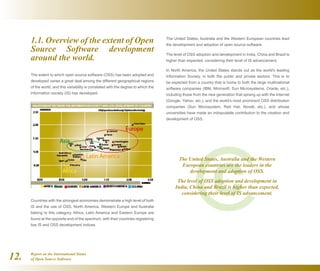
The extent to which open source software (OSS) has been adopted and
developed varies a great deal among the different geographical regions
of the world, and this variability is correlated with the degree to which the
information society (IS) has developed.
Countries with the strongest economies demonstrate a high level of both
IS and the use of OSS. North America, Western Europe and Australia
belong to this category. Africa, Latin America and Eastern Europe are
found at the opposite end of the spectrum, with their countries registering
low IS and OSS development indices.
The United States, Australia and the Western European countries lead
the development and adoption of open source software.
The level of OSS adoption and development in India, China and Brazil is
higher than expected, considering their level of IS advancement.
In North America, the United States stands out as the world's leading
Information Society, in both the public and private sectors. This is to
be expected from a country that is home to both the large multinational
software companies (IBM, Microsoft, Sun Microsystems, Oracle, etc.),
including those from the new generation that sprang up with the Internet
(Google, Yahoo, etc.), and the world's most prominent OSS distribution
companies (Sun Microsystem, Red Hat, Novell, etc.), and whose
universities have made an indisputable contribution to the creation and
development of OSS.
The United States, Australia and the Western
European countries are the leaders in the
development and adoption of OSS.
The level of OSS adoption and development in
India, China and Brazil is higher than expected,
considering their level of IS advancement.
Report on the International Status
of Open Source Software 13.
In the public sector, Europe has experienced greater penetration.
Germany, France and Spain lead Europe in the adoption of OSS.
Government support for OSS adoption has been key, although
different instruments have been used to implement policies. The
German Government has launched policies promoting and supporting
OSS, and the French Government has centralised the promotion of
OSS implementation within the Administration and public companies.
Meanwhile, the adoption of policies promoting open source software
in Spain has largely been the responsibility of the Autonomous
Communities, which have developed initiatives in this area, working
under a clear policy framework established by the Ministry of Industry,
Tourism and Trade and by the Ministry of the Presidency.
Surprisingly, more advanced Information Society countries such as the
Nordic countries, the United Kingdom and the Netherlands show a lower
degree of OSS development. The key difference appears to be the lack
of support given to open source software in the early stages by their
respective governments. Recent legislation and policies promoting the
adoption of open standards and OSS enacted by these countries over
the last few years will undoubtedly make it possible for them to close the
gap with the leading countries.
We must also consider the supporting and harmonising role of the
European institutions, which are contributing to the promotion of the
Information and Communications Technologies (ICTs) sector, and within
this area, to the promotion of OSS, as one of the key driving forces in the
European sector. Similarly, under the Seventh Framework Programme
for Research and Technological Development, the European Union
finances technology-related projects that result in OSS developments,
involving various firms and universities from different countries, each
contributing different skills1
.
1  Chapter 4 provides a brief description of the most important OSS projects within this
framework programme, with an emphasis on the universities and companies participating.
Report on the International Status
of Open Source Software14.
China, Japan and Korea all have languages that pose an important
barrier to the visibility of their communities abroad, isolating them from
the rest of the world. To overcome this isolation, the three countries have
formed an alliance to develop a version of Linux for the Asian market,
Asianux, with the result that OSS projects are centred around Linux.
The Brazilian Government has managed to foster the development of
open source software in all areas of its ecosystem.
In Latin America, Brazil stands out from the rest of the countries in the
region due to the greater extent to which it has adopted and developed
OSS, with levels comparable to countries such as India and China. This
is in spite of the fact that its IS level is similar to that of other large Latin
American countries, such as Argentina, Mexico and Chile. The reason
can be found in the support the government has managed to provide
in all areas of the OSS ecosystem: the publication of regulations, mass
migrations in public sector agencies and companies, OSS product
development (goods and services) at the public universities and the
creation of a collaborative portal for Community players.
The Brazilian Government has managed
to foster the development of OSS in all
areas of the ecosystem.
In the Pacific region, Australia stands out as one of the countries with
the highest degree of open source software adoption in the world,
thanks to its active communities of OSS developers who participate in
international projects. The universities also play a very important role in
both training qualified ICT personnel and participating in OSS projects.
The Australian business sector spends a significant part of its RD
budget on OSS projects, which results in the country having a large
subsector of open source software companies within the ICT sector
and in the presence of OSS centres of excellence in the country. This
is accompanied by a policy of support by the government, which has
encouraged the adoption of OSS by the Public Sector.
The combination of these four factors establishes Australia as the
paradigm for OSS development in a country, thanks to a clear balance
between the four forces: Government, Universities, the Private Business
Sector and Communities.
In Asia, we find four countries that are leading the world in open source
software, namely India, China, Japan and South Korea, although with
very heterogeneous levels of advancement in terms of the Information
Society. India is the most atypical country, because in spite of its low
IS level, it has attained a significant level of OSS development, largely
thanks to the educational level of its population and its involvement in
programming forAmerican and European companies. OSS development
in China is tightly controlled by the Government, to the point that the
main OSS supplier, Red Flag Linux, is partially state-owned.
In Japan and South Korea, the electronics sector has been one of the
driving forces behind the development of OSS applications, but it is not
the only one. The Korean Government has particularly promoted OSS
as a means of boosting and dynamising the country's ICT sector. The
presence of a local leading open source software distributor has favoured
the adoption of OSS by companies in the private sector, contributing to
the growth and maturity of the ICT sector.
Report on the International Status
of Open Source Software 15.
Greater user awareness regarding the use of 100% legal software will
permit higher rates of open source software use in the future. The lack
of supportive policies from Governments and the absence of distributors
able to provide the necessary support are the key factors explaining the
lower rate of OSS development in Latin America.
Finally, Africa trails the world in the development of Open Source
Software and the Information Society, lacking even the minimal means
necessary for developing OSS. To this we can add the inexistence of
public promotion policies and the high rate of illegitimate software use.
Therefore, it is not surprising that only South Africa reaches a value that
is anywhere near the worldwide average for the OSS index. Undoubtedly,
its economic level, which is clearly superior to the rest of the countries
on the continent, along with support from the government and non-
governmental organisations, such as the Shuttleworth Foundation,
explain South Africa's world ranking in terms of OSS.
This leads us to the observation that countries with a higher level of
OSS development and adoption, such as the United States, Australia,
Germany, France, Spain and Brazil, each demonstrate high levels of
development in all parts of the ecosystem: the Government, Universities,
Companies and the Community of Developers.
Report on the International Status
of Open Source Software16.
1. Subscription to service-based products: the distribution of software
packages with related maintenance services.
2. Value-added services, based on the knowledge generated by
the community.
3. Software “as a service”: the client accesses and uses the software
remotely, with no need to install it on his own computer. He pays only for
his use of the software.
4. Hybrid model: the client has access to certain OSS-licensed software
and receives extra features under another license.
5. Cross-selling. Another way to market OSS, along with the rest of the
product portfolio.
The community model of OSS development is a global model, with
collaboration from players in different countries.
The open source software development model is a globalising model in
which players use the Internet to take part in projects in a cooperative
environment, regardless of the nationality of the player or the project, and
there are no differences between geographical areas, either in terms of
the workings of the communities or the associated business models.
1.2. The contribution of the
Community model to OSS
Development and its evolution.
Since Richard Stallman began the GNU project in 1983, the open source
software development model has evolved towards new forms of cooperation
revolving around the basic concept of a community of developers.
Most Linux distributions are, to a greater or lesser extent, developed and
led by their communities of developers and users. In some cases, they
are led and financed completely by the community, as with Debian GNU/
Linux, while others rely upon commercial distribution and a version of a
community, as we see in the example of RedHat with Fedora or SuSE
with OpenSuSE.
There are OSS communities whose members are small, medium or
large companies, public administrations, universities and research
centres and technology centres. They all share the principle that open
source software is an effective strategy for improving the processes of
technology research, development and innovation, making it possible to
establish viable business models and win-win relationships that promote
collaboration.
This evolution has led to the creation of three types of communities:
ad-hoc communities that come together for specific projects; foundation
communities for large projects that require the formalisation of the
community's policies; and communities backed by companies, either
individually or through a consortium of several companies, often from
different sectors, formed for one specific, common project.
Based on this model of knowledge generation, five business models
have been established:
The community model of OSS development
is a global model, with collaboration from
players in different countries.
Report on the International Status
of Open Source Software 17.
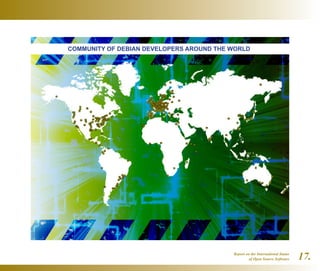
COMMUNITY OF DEBIAN DEVELOPERS AROUND THE WORLD
02.
Report on the International Status
of Open Source Software 19.
02.Overview of the extent
of Open Source Software
development around
the world
Report on the International Status
of Open Source Software20.
Overview of the extent of Open
Source Software development
around the world
This chapter presents an overview of the current Open Source Software
(OSS) situation around the world, based on the extent to which users
(companies, Public Administrations or individuals) use OSS and the
level of development reached by the sector, taking into account the
support provided through the policies of the Public Administrations and
the existence of companies that market OSS products.
The degree of use and development must be put into context by
examining the maturity of the Information Society (IS) in the countries
that form the different geographical regions, since this will help to explain
the different levels of OSS development.
An Information Society is one in which the creation, distribution and
processing of information constitutes an important part of cultural and
economic activities; it is seen as the successor to the industrial society.
Information Societies emerge as the result of the implementation of
Information and Communications Technologies (ICT) in a community. The
effectiveness of this technology, which affects such basic elements of a
person as speech, memory and learning, in many senses modifies the way
in which many activities taking place in modern society can be performed.
According to the study by MERIT-UNISYS, “Study on the effect of
the development of the information society of European public bodies
making their own software available as open source,” which is based
on the study of experiences surrounding the implementation of OSS
in various Public Administrations in Europe, these initiatives have
affected the IS in different ways. The greatest impact is evident when the
decision to use open source software is not based on purely technical or
practical reasons, but instead is the result of a clear strategy that aims
to affect the development of the IS, such as in the case of Extremadura
or Andalusia, in Spain.
As a result, the overview of the extent of OSS development around the
world presents country rankings on the basis of their maturity in terms
of both the open source software itself, and the Information Society.
Considering both dimensions enables us to adequately evaluate
the current state of each country and determine its starting point for
exploiting the benefits of OSS.
To determine the ranking of each country with regard to these factors,
two indices have been created from specific variables that measure
not only the degree of advancement of the IS, but also the degree of
development of each country in the use of OSS. Each country's score on
the index is the result of weighting the deviation from the mean for each
variable, using specific weights assigned to each variable1
. In both cases,
economic, technological, social, educational and political variables
have been considered to create an index which takes into account the
influence of these areas on both IS and OSS development. The use of
indices allows for an objective comparison among countries.
Looking only at the score obtained by each country for the open source
software index, three groups emerge: Advanced Countries, Less-
advanced Countries and Developing Countries. Among the countries
in the first group are the United States, Germany, France and Spain,
with scores that are clearly above average, leading the advancement
and development of OSS. In the second group are countries such as
Austria, Slovenia and Poland, with around average scores for the use
and development of OSS. Finally, the last group contains countries such
as Romania, the Ukraine, Greece and Chile, which have clearly below
average scores, accompanied by low usage and development of open
source software.
1  A detailed explanation of the methodology used to create the Open Source Software and
Information Society indices can be found in the appendices.
Report on the International Status
of Open Source Software 21.
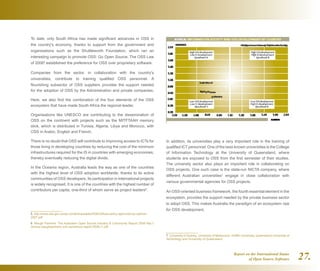
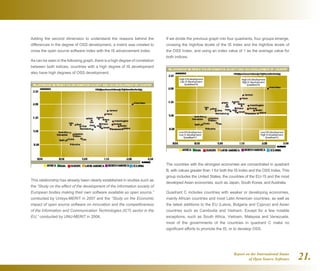
Adding the second dimension to understand the reasons behind the
differences in the degree of OSS development, a matrix was created to
cross the open source software index with the IS advancement index.
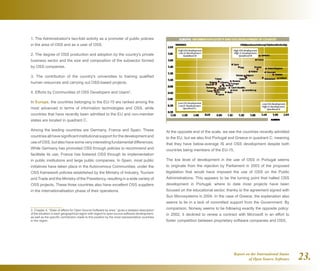
As can be seen in the following graph, there is a high degree of correlation
between both indices; countries with a high degree of IS development
also have high degrees of OSS development.
This relationship has already been clearly established in studies such as
the “Study on the effect of the development of the information society of
European bodies making their own software available as open source,”
conducted by Unisys-MERIT in 2007 and the “Study on the Economic
impact of open source software on innovation and the competitiveness
of the Information and Communication Technologies (ICT) sector in the
EU,” conducted by UNU-MERIT in 2006.
If we divide the previous graph into four quadrants, four groups emerge,
crossing the high/low levels of the IS Index and the high/low levels of
the OSS Index, and using an index value of 1 as the average value for
both indices.
The countries with the strongest economies are concentrated in quadrant
B, with values greater than 1 for both the IS Index and the OSS Index. This
group includes the United States, the countries of the EU-15 and the most
developed Asian economies, such as Japan, South Korea, and Australia.
Quadrant C includes countries with weaker or developing economies,
mainly African countries and most Latin American countries, as well as
the latest additions to the EU (Latvia, Bulgaria and Cyprus) and Asian
countries such as Cambodia and Vietnam. Except for a few notable
exceptions, such as South Africa, Vietnam, Malaysia and Venezuela,
most of the governments of the countries in quadrant C make no
significant efforts to promote the IS, or to develop OSS.
Report on the International Status
of Open Source Software22.
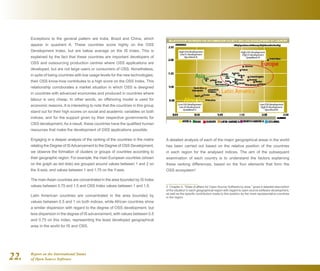
Exceptions to the general pattern are India, Brazil and China, which
appear in quadrant A. These countries score highly on the OSS
Development Index, but are below average on the IS Index. This is
explained by the fact that these countries are important developers of
OSS and outsourcing production centres where OSS applications are
developed, but are not large users or consumers of OSS. Nonetheless,
in spite of being countries with low usage levels for the new technologies,
their OSS know-how contributes to a high score on the OSS Index. This
relationship corroborates a market situation in which OSS is designed
in countries with advanced economies and produced in countries where
labour is very cheap. In other words, an offshoring model is used for
economic reasons. It is interesting to note that the countries in this group
stand out for their high scores on social and academic variables on both
indices, and for the support given by their respective governments for
OSS development. As a result, these countries have the qualified human
resources that make the development of OSS applications possible.
Engaging in a deeper analysis of the ranking of the countries in the matrix
relating the Degree of ISAdvancement to the Degree of OSS Development,
we observe the formation of clusters or groups of countries according to
their geographic region. For example, the main European countries (shown
on the graph as red dots) are grouped around values between 1 and 2 on
the X-axis, and values between 1 and 1.75 on the Y-axis.
The mainAsian countries are concentrated in the area bounded by IS Index
values between 0.75 and 1.5 and OSS Index values between 1 and 1.5.
Latin American countries are concentrated in the area bounded by
values between 0.5 and 1 on both indices, while African countries show
a similar dispersion with regard to the degree of OSS development, but
less dispersion in the degree of IS advancement, with values between 0.5
and 0.75 on this index, representing the least developed geographical
area in the world for IS and OSS.
A detailed analysis of each of the major geographical areas in the world
has been carried out based on the relative position of the countries
in each region for the analysed indices. The aim of the subsequent
examination of each country is to understand the factors explaining
these ranking differences, based on the four elements that form the
OSS ecosystem2
:
2  Chapter 4, “State of affairs for Open Source Software by area,” gives a detailed description
of the situation in each geographical region with regard to open source software development,
as well as the specific contribution made to this position by the most representative countries
in the region.
Report on the International Status
of Open Source Software 23.
1. The Administration's two-fold activity as a promoter of public policies
in the area of OSS and as a user of OSS.
2. The degree of OSS production and adoption by the country's private
business sector and the size and composition of the subsector formed
by OSS companies.
3. The contribution of the country's universities to training qualified
human resources and carrying out OSS-based projects.
4. Efforts by Communities of OSS Developers and Users3
.
In Europe, the countries belonging to the EU-15 are ranked among the
most advanced in terms of information technologies and OSS, while
countries that have recently been admitted to the EU and non-member
states are located in quadrant C.
Among the leading countries are Germany, France and Spain. These
countries all have significant institutional support for the development and
use of OSS, but also have some very interesting fundamental differences.
While Germany has promoted OSS through policies to recommend and
facilitate its use, France has fostered OSS through its implementation
in public institutions and large public companies. In Spain, most public
initiatives have taken place in the Autonomous Communities, under the
OSS framework policies established by the Ministry of Industry, Tourism
and Trade and the Ministry of the Presidency, resulting in a wide variety of
OSS projects. These three countries also have excellent OSS suppliers
in the internationalisation phase of their operations.
3  Chapter 4, “State of affairs for Open Source Software by area,” gives a detailed description
of the situation in each geographical region with regard to open source software development,
as well as the specific contribution made to this position by the most representative countries
in the region.	
At the opposite end of the scale, we see the countries recently admitted
to the EU, but we also find Portugal and Greece in quadrant C, meaning
that they have below-average IS and OSS development despite both
countries being members of the EU-15.
The low level of development in the use of OSS in Portugal seems
to originate from the rejection by Parliament in 2003 of the proposed
legislation that would have imposed the use of OSS on the Public
Administrations. This appears to be the turning point that halted OSS
development in Portugal, where to date most projects have been
focused on the educational sector, thanks to the agreement signed with
Sun Microsystems in 2004. In the case of Greece, the explanation also
seems to lie in a lack of committed support from the Government. By
comparison, Norway seems to be following exactly the opposite policy:
in 2002, it declined to renew a contract with Microsoft in an effort to
foster competition between proprietary software companies and OSS.
Report on the International Status
of Open Source Software24.
Between the leading group and the countries in quadrant C, we can
identify at least two other groups of countries, based on their OSS Index
level. Not far from the top group are Italy, the United Kingdom and the
Nordic countries. The small difference between them and the leaders is
mainly explained by the Administration's delay in implementing policies
supporting OSS, as compared to the countries in the first group.
Both groups share numerous communities of qualified developers who
are contributing to OSS projects and the development of the ICT sector
in Europe.
The most prestigious universities in these countries are collaborating
with the main companies in the European ICT sector on research
projects developing OSS. Many of these projects are financed by the
European Union, within the framework of policies promoting the ICT
sector in the European Union.
The following group of European countries, all found in quadrant B of the IS/
OSS matrix, consists of Holland, Switzerland, Belgium, Ireland and Estonia.
They demonstrate a lower degree of OSS adoption and development.
IntheNorthAmericanregion,wefinddifferentlevelsofOSSdevelopment:
while the U.S. is the leader in OSS, Canada has not fully exploited its
potential. Although the Federal Government has not enacted clear,
decisive policies supporting OSS in either country, in the U.S., different
states have been active in promoting it, such as in the case of projects
stemming from Law 2892 in Oregon and Law 1579 in Texas.
What has really positioned the United States as world leader in OSS
development has been its private and social initiatives. Both the Free
Software Foundation and the Open Source Initiative originated in the U.S.
American universities have been the birthplace of many OSS projects.
In the Asian region, large, consolidated economies such as Japan and
Korea stand out, as do developing nations such as India and China.
India is one of the most advanced developing countries in terms of
OSS. The high level of training has created a very developed software
industry in the country, where European and American companies
subcontract development. On the one hand, India has abundant
talent: it turns out 200,000 engineers, 300,000 technicians and over
3 million university graduates each year. Added to these figures are
the many students who travel to the United States at some point in
their university career to complete their training. On the other hand,
labour costs are much lower than in most developed countries,
where salary costs are on average 4 times greater for the same task.
Report on the International Status
of Open Source Software 25.
However, even though a great quantity of OSS is developed in the
country, the implementation level is not as high as it should be. This is
due in part to the government not wanting to create a conflict of interests
with the proprietary software companies that provide a great deal of
work to local industry.
Japan, Korea and China signed a collaboration agreement to develop
and support OSS, which has enabled the development of a standardised
version of Linux, adapted for the Asian market. The three countries face
a language barrier that makes it difficult for them to collaborate with the
international community, leading to their lack of visibility. The community
model is fundamental for localisation, and in this sense OSS makes a
special contribution to bringing the IS closer and making it available to
non-English speaking people, especially those from countries that do
not use the Latin alphabet.
However, the development model in these countries is different. The
Chinese Government has made a firm commitment to this model, with
activity planned and orchestrated by the state. To provide an example,
the main supplier, Red Flag Linux, is partially state-owned, and is used
by the government in its implementations.
In Japan, the electronics sector enthusiastically promotes OSS
development. Most products in this industry require the inclusion of
embedded OSS systems. However, advancement in the adoption of OSS
by the business sector seems to be slowed by the lack of suppliers.
For several years, Korea was very active in supporting OSS, and after a
few years of inactivity it has recently resumed its activities. One of the latest
government initiatives has been the creation of an international contest for
developers, in which the leading supplier Haansoft participates.
As shown on the graph, the highest ranked country in Latin America is
Brazil. Brazil has become the leading country in Latin America in terms of
OSS development, and it also fits the‎ paradigm of an ecosystem formed
by four balanced elements: the Government, the private business sector,
universities and the community of developers.
The government promotes its development and use, operating in all
areas of the ecosystem through numerous regulations, such as Law
4/2008, on the process through which the Administration contracts IT
services, and by mass migrations in the public sector, coordinated by
specialised committees and included in annual plans (currently, the
Strategic Plan from the Federal Government's Open Source Software
Committee, CISL 2009).
Another Brazilian initiative has been the creation of a Public Software
Portal to generate collaboration between users and developers and
the Centre for the Diffusion of Technology and Knowledge (CDTC),
promoted by the National Institute of Information Technology (ITI).
India accounts for 70%
of outsourced IT
services worldwide.
Report on the International Status
of Open Source Software26.
In 1999, the university centre UNIVATES, in southern Brazil, decided
to develop its own academic administration system, called SAGU,
using OSS tools. SAGU enabled UNIVATES to save almost €140,000
in license fees and nearly €48,000 in server and equipment updates.
As a result, UNIVATES offered to let its IT team form a separate entity
from the university, called SOLIS, as it was already developing solutions
for regional industrial and economic problems that went far beyond its
original functions. SOLIS currently has 51 employees developing OSS-
based solutions for local industries and universities in Brazil. It charges
for its services and provides its products under a GPL license.
On the second tier are countries like Argentina, Mexico, Venezuela,
Peru and Chile. Generally speaking, greater user awareness regarding
the use of 100% legal software will permit higher rates of open source
software use in the future. Among these countries, the first three are the
most active and have come the furthest in terms of OSS development,
although only the Government of Venezuela has come out in favour of
OSS, as opposed to proprietary software. In 2004, the “Yellow Book
of Open Source Software: the use and development of OSS in Public
Administration” was published. The government also published Decree
3390, which establishes the mandate for the Administration to migrate to
OSS over a two-year period.
In Argentina, Ututo was developed, which is the country's first Linux
distribution to be recognised by the Open Source Software Foundation.
Ututo plays an important and symbolic role in Latin America4
, in spite of
the central Government's lack of support. In Mexico, civil servants are
able to choose the solution that best meets their needs, but the lack of
suppliers is slowing down the rate of OSS adoption in the country.
Africa is still starting to take its first steps in the adoption and development
of OSS, and governments in the respective countries still have not made
a clear commitment in this regard. Nonetheless, it should be pointed
out that greater awareness concerning legal software use would enable
greater OSS development.
Tunisia and South Africa are the two countries with the greatest
knowledge about OSS, and some official policies promoting it. Morocco
is exploring the possibility of developing this type of policies.
The OSS community on the continent is very fragmented, and the
most common projects are local adaptations. A good example of this
is translate.org.za, a South African project for the local adaptation of
several OSS initiatives to the country's 11 official languages. In this
manner, OSS contributes to overcoming the English barrier, bringing the
IS to people in developing countries.
4  El software libre y las perspectivas para el desarrollo en América Latina y el Caribe [Open
source software and the prospects for development in Latin America and the Caribbean]
http://www.mentores.net/Portals/2/mentores_net_sabemos_software_libre.pdf
Report on the International Status
of Open Source Software 27.
In addition, its universities play a very important role in the training of
qualified ICT personnel. One of the best-known universities is the College
of Information Technology at the University of Queensland, where
students are exposed to OSS from the first semester of their studies.
The university sector also plays an important role in collaborating on
OSS projects. One such case is the state-run NICTA company, where
different Australian universities7
engage in close collaboration with
various governmental agencies for OSS projects.
An OSS-oriented business framework, the fourth essential element in the
ecosystem, provides the support needed by the private business sector
to adopt OSS. This makes Australia the paradigm of an ecosystem ripe
for OSS development.
7  University of Sydney, University of Melbourne, Griffith University, Queensland University of
Technology and University of Queensland
To date, only South Africa has made significant advances in OSS in
the country's economy, thanks to support from the government and
organisations such as the Shuttleworth Foundation, which ran an
interesting campaign to promote OSS: Go Open Source. The OSS Law
of 20065
established the preference for OSS over proprietary software.
Companies from the sector, in collaboration with the country's
universities, contribute to training qualified OSS personnel. A
flourishing subsector of OSS suppliers provides the support needed
for the adoption of OSS by the Administration and private companies.
Here, we also find the combination of the four elements of the OSS
ecosystem that have made South Africa the regional leader.
Organisations like UNESCO are contributing to the dissemination of
OSS on the continent with projects such as the MITFTAAH memory
stick, which is distributed in Tunisia, Algeria, Libya and Morocco, with
OSS in Arabic, English and French.
There is no doubt that OSS will contribute to improving access to ICTs for
those living in developing countries by reducing the cost of the minimum
infrastructures required for the IS in countries with emerging economies,
thereby eventually reducing the digital divide.
In the Oceania region, Australia leads the way as one of the countries
with the highest level of OSS adoption worldwide, thanks to its active
communities of OSS developers. Its participation in international projects
is widely recognised. It is one of the countries with the highest number of
contributors per capita, one-third of whom serve as project leaders6
.
5  http://www.oss.gov.za/wp-content/uploads/2009/03/foss-policy-approved-by-cabinet-
2007.pdf
6  Waugh Partners. The Australian Open Source Industry  Community Report 2008 http://
census.waughpartners.com.au/census-report-2008-r1.pdf
Report on the International Status
of Open Source Software28.
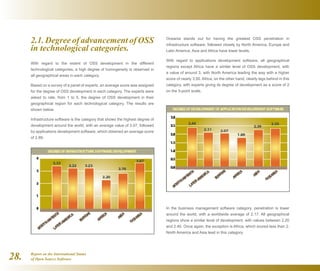
2.1. Degree of advancement of OSS
in technological categories.
With regard to the extent of OSS development in the different
technological categories, a high degree of homogeneity is observed in
all geographical areas in each category.
Based on a survey of a panel of experts, an average score was assigned
for the degree of OSS development in each category. The experts were
asked to rate, from 1 to 5, the degree of OSS development in their
geographical region for each technological category. The results are
shown below.
Infrastructure software is the category that shows the highest degree of
development around the world, with an average value of 3.07, followed
by applications development software, which obtained an average score
of 2.89.
Oceania stands out for having the greatest OSS penetration in
infrastructure software, followed closely by North America, Europe and
Latin America. Asia and Africa have lower levels.
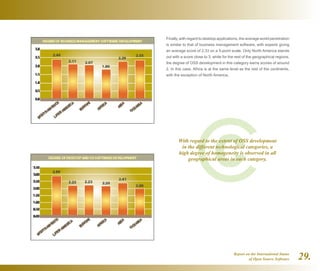
With regard to applications development software, all geographical
regions except Africa have a similar level of OSS development, with
a value of around 3, with North America leading the way with a higher
score of nearly 3.50. Africa, on the other hand, clearly lags behind in this
category, with experts giving its degree of development as a score of 2
on the 5-point scale.
In the business management software category, penetration is lower
around the world, with a worldwide average of 2.17. All geographical
regions show a similar level of development, with values between 2.20
and 2.40. Once again, the exception is Africa, which scored less than 2.
North America and Asia lead in this category.
Report on the International Status
of Open Source Software 29.
Finally, with regard to desktop applications, the average world penetration
is similar to that of business management software, with experts giving
an average score of 2.33 on a 5-point scale. Only North America stands
out with a score close to 3, while for the rest of the geographical regions,
the degree of OSS development in this category earns scores of around
2. In this case, Africa is at the same level as the rest of the continents,
with the exception of North America.
With regard to the extent of OSS development
in the different technological categories, a
high degree of homogeneity is observed in all
geographical areas in each category.
03.
Report on the International Status
of Open Source Software 31.
03.Models / Typologies
of Open Source Software
ecosystems
Report on the International Status
of Open Source Software32.
Models/TypologiesofOpenSource
Software ecosystems
Considering this study from a worldwide perspective, we proposed
an examination of the types of business models in existence in the
area of Open Source Software (OSS). Our aim was to understand the
characteristics of the different models and their key success factors, and
eventually the differences by geographical region.
To start with, we considered the OSS development model that became
popular thanks to the GNU project which is part of the free software
movement, begun in 1983 by Richard Stallman, with the objective
of creating an operating system similar to and compatible with UNIX
and the POSIX standards. He also established the Open Software
Foundation (OSF) in 1985, which developed the General Public License
(GPL) to provide a legal framework for the free diffusion of the software
generated. This permitted the project to be developed very quickly by
many people, by means of a community of developers that joined forces
to improve the initial product, the source code of which was accessible
to members of the community.
By the early 90s, there was enough software available to create a complete
operating system. The core was still lacking, however. In 1991, in Helsinki,
Linus Torvalds began a project that would later become core Linux, capable
of running BASH and the compiler known as the GNU Compiler Collection.
The GPL for Linux was adopted in January 1992. This licensing model
facilitates what is known as the bazaar development model1
, based on the
exchange of information and work by community members.
1  See “The Cathedral and the Bazaar,” Eric S. Raymond, September 11, 2000.	
http://catb.org/~esr/writings/cathedral-bazaar/cathedral-bazaar/index.html
This model currently permits:
The creation of groups of developers on a worldwide scale, in•	
different time zones and different geographical regions, who share
knowledge and code.
High-quality developments and innovations that otherwise only•	
large corporations could afford, due to the cost they represent.
Shorter timescales for launching new products on the market.•	
Access to low-cost solutions, upon which many of today's successful•	
companies are based.
Scalability; OSS allows capacity to be increased to meet•	
growing demand.
According to Rishab Ghosh in his study “The Economic Impact of
FLOSS”2
, version 2.2 of Debian GNU/Linux, launched in 2001, contains
55 million lines of code, of which core Linux occupies only 6%. If Debian
had been developed by a private company, the estimated commitment
would have been 14,005 persons/year, and the estimated project would
have taken 6.04 years to complete with a team of 2,318 developers, at
a development cost of €1,294,110,796.
Eric Raymond characterised the differences between the software
development models by dividing them into two types: “cathedral and
bazaar.”3
Accordingly, the development of proprietary software is
likened to the building of a cathedral (enormous, closed, slow), while the
development of open source software is like a bazaar (flexible, open to
new ideas, fast and very independent).
2  http://robertoallende.com/tecnologia/eventos/rishab-ghosh-el-impacto-economico-del-
software
3  See “The Cathedral and the Bazaar,” Eric S. Raymond, September 11, 2000.http://catb.
org/~esr/writings/cathedral-bazaar/cathedral-bazaar/index.html
Report on the International Status
of Open Source Software 33.
OSS is developed through a model that combines the advantages of
scientific research; namely, altruism, collaboration, communitarianism
and meritocracy; with the so-called good economic practices, such as
free market competition, for example.
The community forms an extensive ecosystem, where all players have a
place and participate in the community, each contributing improvements
to the project based on their perspectives and interests.
The ecosystems that exist around a community are formed by the Public
Administration, universities, developers, OSS suppliers, integrators,
hardware companies, users and clients.
The variety of players involved has resulted in two phenomena that
contribute two fundamental values to the model. The first is that OSS
is based on user-centred development, as opposed to supplier-centred
development, the principle behind which is to make the user or end
client a participant in the development, from tasks such as error reports
to collaboration by means of functionality routing sheets. The second
phenomenon is “coopetition4
, in which potential competitors collaborate
in the same community on the specific project being developed by the
community. They cease to compete and enter into collaboration with one
another so that both may obtain benefits.
4  Cooperation and Competition
According to Gartner5
, there are four different types of communities:
“Ad-hoc” communities, which emerge from concrete, specific projects•	
that meet niche needs, for example, “Three Guys” at SourceForge.
Foundation communities, from which projects evolve that grow•	
to such an extent that it becomes necessary to formalise the
governance of the community. Examples include Debian, Ubuntu,
Apache Foundation, Gnome, KDE, etc.
“Business consortium” communities that emerge when their members•	
participate in the OSS development philosophy and are also interested
in maintaining commercial relationships. One clear example is Eclipse,
in which IBM, Oracle, SAP, Motorola and Nokia (among others)
participate6
; another is Genivi, which involves participation from BMW,
GM, PEUGEOT, CITROËN, Windriver, Intel, etc.,7
.
“Sole supplier” communities, where a single company controls•	
the project development, but encourages the participation of a
“subcommunity” to perform certain types of services, such as local
adaptation, “add-ons,” etc. Examples of this type of community are
MySQL and SugarCRM.
In the study by the International Development Research Centre8
, it
is argued that the greatest advantage that OSS suppliers have is the
community that surrounds them. This community becomes a growing
market, a source of innovation, a method for improving and escalating
products, a place to try out new ideas and versions, and a source of
5  How Open Source is changing the shape of IT www.gartner.com
6  The strategic members of the community are Actuate, brox, Cloudsmith, CA, Genuitec,
IBM, Innoopract, itemis, Motorola, Nokia, Obeo, Oracle, SAP, Sonatype and Sopera. There
are also approximately 170 other companies that participate.
7  http://www.genivi.org/
8  El software libre y las perspectivas para el desarrollo en América Latina y el Caribe [Open
source software and the prospects for development in Latin America and the Caribbean]
http://www.mentores.net/Portals/2/mentores_net_sabemos_software_libre.pdf
The development model based on
communities provides a vision that
is user-focused, as opposed to
supplier-focused.
Report on the International Status
of Open Source Software34.
qualified human resources. Many companies are set up as a result of
the spaces created by OSS communities and continue to maintain a
close relationship with them (assuming leadership roles in user groups,
organising events, collaborating financially and working on non-profit
projects). The people who form the companies and the new human
resources that are incorporated often know each other and recognise
each other's merits due to their roles in the community and their
contributions to development. Some companies, like Open Intelligence
in Mexico, operate as intermediaries between developers who lack a
high commercial profile and clients who need their services, providing
the infrastructure to facilitate full-time work for the developers.
One opportunity perceived by companies is the capacity to form alliances
on a local, national and international level. Some see certifications as an
opportunity to market their products, guaranteeing a standard of quality.
One example is Argentina's Opensa, which in its day formed alliances
with players from different sectors to seek out fair business ventures of
benefit to both parties. In a general sense, competition and collaboration
are two elements that always come into play when trying to do business
within the community.
Companies look for appropriate partners for distribution, hardware
manufacturers that use OSS, integrators that sell OSS services, etc.
Currently, there are different business models, some of which have
already proven to be profitable, while others are still very new.
The different business models can be classified into five groups:
Subscription to service-based products•	
Value-added services•	
Software as a service (SaaS)•	
Hybrid model•	
Cross-selling•	
Companies in the sector can, and usually do, operate more than one
business model simultaneously and adapt to market demands, meeting
the needs of the clients in each case.
In the first model, the client pays a subscription to receive a series of
related services, such as support, maintenance, etc. One example of
this very successful model is SpikeSource. This company distributes,
integrates, manages and provides related support services, for which
it charges a subscription fee. SpikeSource works with major OSS
suppliers, including Apache, MySQL, etc.
The OSS sector seeks partners and
alliances based on “coopetition” as a
model for improvement and evolution.
Report on the International Status
of Open Source Software 35.
The second model is one in which the company provides OSS-related
value-added services. This covers a wide range of services, from
consulting to integration. These companies actively participate in
different communities, acquiring vast knowledge and skills that allow
them to market their know-how in the field of OSS.
The third model is new. Software as a service consists of a service
through which clients remotely access applications over the Internet.
Clients only pay rent for the services they use.
The hybrid model merges elements of proprietary software with those
of OSS. In this case, clients have access to specific software under a
free license. However, when they decide to increase its functionalities,
want extensions or improvements, etc., these improvements are then
distributed under another license.
Finally, the business model we refer to as cross-selling covers a very
heterogeneous group of activities, from companies whose business
model is based on OSS, such as Google and Collax, to companies that
use OSS embedded in the hardware (decoders, “boxes”9
, etc.) they sell,
to OEM suppliers10
or the mobile telephone sector.
Clients in the embedded OSS market are the manufacturers of various
devices, such as mobile telephones or decoders. This is a B2B market,
where the end customer has no knowledge that he is using OSS. The
advantage of OSS use in this market is cost reduction and the possibility
for the manufacturer to customise the software. With regard to OSS
for mobile phones, it is not yet a question of generating income, rather
a war for positioning, for dominating the operating system in the
terminals, which will potentially generate significant income along the
value chain in this business.
9  Such as Netezza or Collax, for example.
10  Original Equipment Manufacturers
Neither the secondary sources consulted nor the telephone interviews with
experts identified any significant differences in either the communities or
business models by geographical region. The OSS development model is a
model that globalises, where players take part in different projects over the
Internet, regardless of the nationality of either the player or the project.
It could be said that OSS development is perfectly framed within the
global IS model of the 21st century, built from the Internet and with
the possibilities for interaction and cooperation at a global level that it
provides. The Internet is clearly an essential medium for the development
of these communities, enabling spontaneous participation in areas of
global interest. The advantage of the OSS development model lies in its
universalising factor, with the international community collaborating on
and enriching projects, but at the same time being capable of generating
local adaptations.
The OSS development model is one of
enrichment, where the globalisation of
the system allows for the simultaneous
collaboration of an international
community and a local community,
with the local community championing
its differences.
04.
Report on the International Status
of Open Source Software 37.
04.State of the art
for Open Source
Software by region
Report on the International Status
of Open Source Software38.
State of affairs for Open Source Software
by region
The Information and Communications Technologies (ICT) sector is
becoming increasingly important in the economy of all countries,
representing approximately 10% of GDP in most developed countries
and accounting for more than half of their economic growth forecasts.
Software constitutes one of the main elements in the role played by
the ICTs in the economy, and the structure, competitiveness and
performance of the ICT industry may be greatly affected by Open
Source Software (OSS). According to UNU-MERIT, OSS may represent
a potential saving of 36% in RD investments in software, which would
mean greater profits or a more efficient use of this capital in other lines
of innovation.
OSS is experiencing significant development in our Information Society
(IS). Many examples exist of technological implementations based on
OSS. Administrations, universities, companies and organisations of all
types around the world are opting for OSS products.
OSS has obtained a significant share of several markets, such as web
servers, server operating systems, desktop operating systems, web
browsers, databases, e-mail and other ICT infrastructure systems.
These market shares are higher in Europe than in the United States
(with Asia in third place), and they have grown significantly over the last
five years.
In the public sector, Europe has greater penetration, although Asia
and Latin America may soon catch up. In the private sector and at an
international level, OSS adoption is led by medium and large companies.
While the United States leads in terms of large OSS-related companies,
the greater individual contribution from Europe has resulted in a growing
number of success stories from small and medium-sized European
companies in the field of OSS. Europe is the leading region in terms
of collaboration among OSS developers, followed by North America.
Asia and Latin America are faced with a great disadvantage because of
language barriers, but they may be experiencing an increase in activity
in the local communities. OSS has been implemented for quite some
time in universities and RD centres around the world. The availability of
source code, cost savings, its adaptability, independence from suppliers,
and its robustness and security are some of the advantages that free
technologies offer over private software in this area.
OSS may represent a potential saving
of 36% in RD investment in software,
which would mean greater profits or a
more efficient use of this capital in
other lines of innovation.
Report on the International Status
of Open Source Software 39.
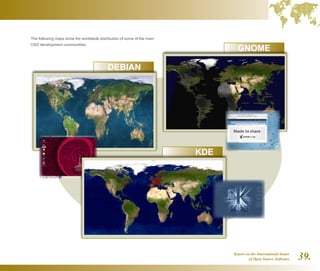
The following maps show the worldwide distribution of some of the main
OSS development communities: 				
DEBIAN
GNOME
KDE
Report on the International Status
of Open Source Software40.
Most Linux distributions are, to a greater or lesser extent, developed and
led by their communities of developers and users. In some cases, they
are led and financed completely by the community, as with Debian GNU/
Linux, while others rely upon commercial distribution and a version of a
community, as we see in the example of RedHat with Fedora or SuSE
with OpenSuSE.
There are OSS communities whose members include small, medium
or large companies, public administrations, universities and research
centres and technology centres. They all share the principle that OSS is
an effective strategy for improving the processes of technology research,
development and innovation, making it possible to establish viable
business models and win-win relationships that promote collaboration.
OSS has a great future ahead of it. There are several reasons to promote
and support OSS:
Financial reasons (it is cheaper, has lower development costs, reduces•	
development time, enables local ICT company development, etc.)
Culturalreasons(itfostersandmeetsthedemandsofmulticulturalism•	
and the presence and needs of minority languages and cultures.)
Technological reasons (it is more flexible and user-oriented, involves•	
the end user in the development, is more advanced, more stable,
more secure, etc.)
According to Mark Shuttleworth of Ubuntu, software distributions will be
universal in the future, but will leave room for customisation, whether
cultural (according to different languages or cultures), sector-based (for
the educational or industrial sectors), or professional (distributions for
physicians, architects or teachers, etc.).
Everything would seem to indicate that this adoption process will
accelerate over the next few years. In spite of this, however, the level of
adoption in each country, the approaches of the different governments,
the commitment by private companies, society's participation in
communities and university-based research will vary significantly,
according to geographical region.
This chapter provides an in-depth analysis of the degree of OSS
maturity in each geographical region, and the current status of the main
countries that significantly contribute to the state of affairs for OSS use
and development by geographical region.
Report on the International Status
of Open Source Software 41.
4.1. EUROPE
The difference among European countries in terms of OSS development is
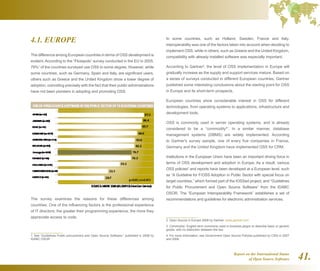
evident. According to the “Flosspols” survey conducted in the EU in 2005,
79%1
of the countries surveyed use OSS to some degree. However, while
some countries, such as Germany, Spain and Italy, are significant users,
others such as Greece and the United Kingdom show a lower degree of
adoption, coinciding precisely with the fact that their public administrations
have not been pioneers in adopting and promoting OSS.
The survey examines the reasons for these differences among
countries. One of the influencing factors is the professional experience
of IT directors: the greater their programming experience, the more they
appreciate access to code.
1  See “Guidelines Public procurement and Open Source Software,” published in 2008 by
IDABC OSOR
In some countries, such as Holland, Sweden, France and Italy,
interoperability was one of the factors taken into account when deciding to
implement OSS, while in others, such as Greece and the United Kingdom,
compatibility with already installed software was especially important.
According to Gartner2
, the level of OSS implementation in Europe will
gradually increase as the supply and support services mature. Based on
a series of surveys conducted in different European countries, Gartner
published some interesting conclusions about the starting point for OSS
in Europe and its short-term prospects.
European countries show considerable interest in OSS for different
technologies, from operating systems to applications, infrastructure and
development tools.
OSS is commonly used in server operating systems, and is already
considered to be a “commodity3
”. In a similar manner, database
management systems (DBMS) are widely implemented. According
to Gartner's survey sample, one of every five companies in France,
Germany and the United Kingdom have implemented OSS for CRM.
Institutions in the European Union have been an important driving force in
terms of OSS development and adoption in Europe. As a result, various
OSS policies4
and reports have been developed at a European level, such
as “A Guideline for F/OSS Adoption in Public Sector with special focus on
target countries,” which formed part of the tOSSad project, and “Guidelines
for Public Procurement and Open Source Software” from the IDABC
OSOR. The “European Interoperability Framework” establishes a set of
recommendations and guidelines for electronic administration services.
2  Open Source in Europe 2008 by Gartner. www.gartner.com
3  Commodity: English term commonly used in business jargon to describe basic or generic
goods, with no distinction between the two.
4  For more information, see Government Open Source Policies published by CSIS in 2007
and 2008.
Report on the International Status
of Open Source Software42.
The “eEurope: An Information Society for All” document recommended
that, during 2001, the European Commission and the Member States
promote the use of OSS in the public sector and best practices in
electronic administration by means of an experience exchange (IST
and IDA programmes). The IDA Programme's study on the use of open
source programs in the Public Sector analyses different aspects related
to OSS use by the Public Administrations.
Especially relevant for the promotion of OSS in Europe is the report
issued by the European Commission, Pooling Open Source Software,
which pointed out the potential savings derived from sharing open
license software in the electronic administration and recommended the
creation of a public sector OSS repository.
In 2003, the European Commission issued the document Encouraging
goodpracticeintheuseofopensourcesoftwareinpublicadministrations,
which focused on the development of OSS competence centres at a
national and regional level to facilitate the exchange of information about
the opportunities and risks associated with OSS.
This same year, it also published the “Open Source Migration Guidelines,”
which highlighted the main reasons for and benefits of migration to OSS for
the PublicAdministrations. These recommendations from the community's
IDA programme are intended for use by information technology managers
and professionals in the Public Administrations, with the goal being to
help them decide whether they should undertake migration to OSS and to
describe how to proceed with this migration, if appropriate.
On a practical level, worthy of mention is OSS adoption by EU institutions
through projects such as the implementation of OSS in Eurostat. The
lack of interoperability in data exchanges among the different countries
led to the launch of the SDMX Open Data Interchange (SODI) project
in 2005. As part of this project, a series of tools were developed and
published under an EUPL license5
.
In its role determining the development policies at a European level,
the European Union has worked to promote the information society in
Europe, as well as the development of the ICT sector. When establishing
ICT development directives in Europe, important studies show the
fundamental role that may be played by OSS. In their article The Rain
Forest and the Rock Garden: The Economic Impacts of Open Source,
Forge and Simon6
reflect on the need to promote OSS in Europe, in
order to create a solid software industry.
The report on the economic impact of OSS, commissioned by the
European Commission,7
also lends support to the great importance of
OSS in the development of the ICT sector in Europe, and highlights this
by estimating that OSS-related activities generate a turnover of around
5  For more information, see http://www.osor.eu/case_studies/eurostat-standards-and-open-
source-software-for-data-interoperability
6  Published in The Journal of Policy, Regulation and Strategy for Telecommunications,
Information, and Media 8, No. 3 (2006)
7  European Commission’s Directorate General for Enterprise and Industry. “FLOSS impact:
a study about the economic impact of OSS.”
Report on the International Status
of Open Source Software 43.
€263,000m in the European Union, which will result in an estimated
contribution of 4% to the community's GDP in the year 2010.
Europehasanimportantcommunityofdevelopershelpingthisinstitutional
push for OSS development to come to fruition. The aforementioned
report from the European Commission estimates that 565,000 jobs in
the European Union are linked to OSS-related activities, making Europe
the leading region in terms of the number of active OSS developers and
the number of global OSS project leaders. According to Alfresco8
, the
size of the OSS community in Europe may be as much as 2.5 times the
size of the OSS developer community in the United States.
However,thefragmentationoftheuniversitiesandthelackofcoordination
of academic efforts is one of Europe's weaknesses when it comes to
its universities making a greater contribution to the development of
the ICT sector. The creation of the European Institute of Technology
and Innovation is intended to alleviate the effects associated with this
academic fragmentation and to strengthen the role of universities
in innovation. One exception to this is the OpenSPARC CMT (Chip
Multithreading Technology) project launched by SUN Microsystems
and Europractice, involving 650 European universities and research
institutes in 38 countries, to foster innovation in processor design and
promote the development of a high-tech industry in Europe.
The Framework Programmes for Research and Technological
Development begun by the European Union have contributed to the
participation of the universities in open source projects. One such
example is the SHARE project, founded as part of the ICT agenda of the
Seventh Framework Programme (FP7) to improve the competitiveness
of the European embedded systems industry through OSS sharing. The
University of Bologna and Madrid Polytechnic University participate in this
project, as do companies such as Siemens, SESM scarl and Ciaotech.
8  Alfresco: The Open Source Barometer, 3rd Edition.
Other OSS-based projects of seminal importance for Europe carried out
within the scope of the Seventh Framework Programme for Research
and Technological Development are RESERVOIR, P2P-NEXT and
ASPIRE. What stands out in these projects is the contribution of
prestigious European universities and their close collaboration with
large companies in the sector. Worth mentioning is the involvement of
the University of Delft in Holland, University College London and the
University of Lancaster in the United Kingdom, the University of Aalborg
in Denmark, Complutense University of Madrid and the Barcelona Media
Foundation-Universitat Pompeu Fabra in Spain, the University of Lugano
(l’Universita Della Svizzera italiana) in Switzerland, the University of
Bologna and the University of Messina in Italy and Bucharest Polytechnic
University in Romania, among others.
Report on the International Status
of Open Source Software44.
Also noteworthy is the OSAmI-Commons project, part of the Eureka-
ITEA2 project financed by PROFIT, which has benefited from the
participation of leading European businesses, research institutes
and universities. Its goal is to develop the base platform for ambient
intelligence applications. OSAmI-Commons intends to establish a
common open code infrastructure oriented toward dynamic services,
which will be capable of autoconfiguration in different cooperative
environments involving Software-Intensive Systems. The platform will
be validated by demonstrators in the areas of energy, health, public
services, education and software development. Public and private
organisations from Germany, Finland, France and Turkey also participate
in the project consortium, under Spanish direction.
Like the Public Administration, large European companies are also
adopting OSS as part of their business process management. Airbus
is one such company. It uses Eclipse-based OSS in development tools
when creating critical business systems. We find other examples of OSS
use in large European companies such as EDF (France) and Deutsche
Bank (Germany), among others.
According to a study by Forrester9
, the type of service that European
companies look for in an OSS supplier is advice on the selection of
operational software and services, while American companies are more
interested in the suppliers certifying the OSS.
On the following pages, we shall describe the contribution made by the
main European countries to the development and adoption of OSS in
Europe, highlighting the role of the Public Administration and the degree
of development in the private business sector based on the development
and marketing of OSS. We shall also analyse the contributions of
universities and the Community to the level of OSS in each country.
9  Open Source Software’s Expanding Role in the Enterprise http://www1.unisys.com:8081/
eprise/main/admin/corporate/doc/Forrester_research-open_source_buying_behaviors.pdf
The main OSS projects carried out over the last decade will be presented
in order to determine the extent of OSS adoption in each country. The
process followed by each country to reach its current degree of OSS
adoption conditions both its current position and its possible development
over the next few years.
4.1.1. Germany
Public Sector
Germany is one of the leading countries in terms of implementation10
,
with the German Government for years being one of the most active in
promoting the development of this type of software, along with the French
10  “Office suite: When it comes to content, it comes from Microsoft Office. However,
users in Germany and France are twice as likely to use OpenOffice than in the US or UK.
Microsoft Office 66%, OpenOffice 24%,” and “We believe that in Europe, government is
driving adoption, with leading exponents being France and Germany” in The Open Source
Barometer by Alfresco, published in November 2008. http://www.alfresco.com/community/
barometer/files/wp-osb-III.pdf
In 2009, the German government
decided to allocate €500m to the “Open
Source And Green It” programme.
Report on the International Status
of Open Source Software 45.
and Spanish Governments11
. As early as 2000, the German Government
showed public support for OSS as the base model for the information era
in Europe12
, with the aim of reducing costs and improving security.
The German Federal Government has carried out a series of specific
initiatives to inform about the advantages and disadvantages of OSS.
One of these initiatives has been the creation of the KBSt, an agency
advising on and coordinating Information Technologies for the federal
Government. This agency publishes reports, documents and press
articles about OSS in the FederalAdministration13
. Reports from the KBSt
are intended to provide an overview of IT best practices, developments
and experiences coming from the federal authorities. One of the most
important reports is “Letter No. 2/2000 Open Source Software in the
Federal Administration” about OSS in the Public Administration14
.
At a later date, in November 2001, the Bundestag approved a resolution
promoting the use of OSS as a means of ensuring competition to the
proprietary companies dominating the sector, stressing its advantages15
and portraying it as an opportunity for the European software sector.
That same year, the BMWi, the Federal Department of Economy and
Technology, published an open source software guide for small and
medium-sized companies entitled Open Source Software, A guide for
11  A 2000 research study by Paul Jones about the contribution of Linux concludes that the
group making the second greatest contribution consisted of Germans. Matthew Aslett, June
2008. http://blogs.the451group.com/opensource/2008/06/26/open-source-tour-of-europe-
germany/
12  “I am convinced that open source development can form the European base model in
the information age,” declared German Secretary of State Siegmar Mosdorf from the Federal
Ministry of the Economy and Technology during LinuxTag 2000. http://www.internetnews.
com/bus-news/article.php/408271
13  http://linux.kbst.bund.de
14  Open Source Software in the Federal Administration http://www.bit.bund.de/nn_1333080/
BIT/DE/Shared/Publikationen/OSS/KBSt-Brief-nr-2-2000__engl,templateId=raw,property=p
ublicationFile.pdf/KBSt-Brief-nr-2-2000_engl.pdf
15  Article in the Michigan Telecommunications and Technology Law Review, “Government
Preferences for Promoting Open-Source Software: A Solution in Search of a Problem
Sent: Thu Jan 14 17:35:02 2010h. http://www.mttlr.org/volnine/evans.pdf
small and medium enterprises.”16
At the same time, the Court of Auditors
published a report in which it declared that OSS provides functionalities
comparable to those of proprietary software and recommended the
use of OSS in the Federal Administration, estimating savings of around
€100m17
.
In 2002, the German Federal Ministry of the Interior signed an agreement
with IBM and SuSe, according to which government agencies would
receive discounts for implementing Linux18
. With this agreement, the
German Government moved from a recommendation-based support for
OSS to explicit support, coordinating tools for obtaining tangible benefits
for public agencies that implemented Linux. One year later, more than
500 government agencies had already benefited from the agreement19
.
16  Study into the use of Open Source Software in the Public Sector del 2001. http://www.
osor.eu/idabc-studies/expert-docs/oss-fact-sheet
17  To read more about policies and reports published by the German Administration, see
“Government Open Source Policies,” published by the CSIS in 2007 and 2008.
18  BBC News article http://news.bbc.co.uk/2/hi/business/2023127.stm
19  Infoworld news article http://www.infoworld.com/t/platforms/over-500-german-
government-agencies-using-open-source-429
Report on the International Status
of Open Source Software46.
In 2003, the government published a guide for migration to OSS for
Federal Agencies and Public Administrations20
.
By creating BerliOS, an OSS competence centre, the government
provided a support structure and a way of mediating between
the different players in the OSS sector. BerliOS maintains a web
portal with documentation and a database of distributors, products,
applications, downloads, etc. In this sense, BerliOS provides
the opportunity for OSS developers and companies to introduce
themselves to a wider public, enabling new projects to be set up.
Until 2003, the German Government was very active in promoting the
use and implementation of OSS. However, this firm support slowed until
2007, when action in favour of OSS was once again observed.
In the public sector21
, examples of OSS projects are quite varied: The
Federal Ministry of Finance, the German Aerospace Centre, the Federal
Ministry of Foreign Affairs22
, the German public company Deutsche
Bahn, the Monopoly Commission, Air Traffic Control, the German
Federal Institute of Geoscience and Natural Resources, etc.
One of the best-known cases of OSS migration is that of the city of
Munich. In May 2003, the city announced its plans to migrate 14,000
PublicAdministrationcomputersovertoLinuxandotherOSSapplications
20  Updated in 2005 and 2008 (Migration Guide 3.0) http://ec.europa.eu/idabc/en/
document/7675/499%20
21  http://www.osor.eu/news? http://ec.europa.eu/idabc/en/document/2204/470%20http://
ec.europa.eu/idabc/en/document/4396/470%20
http://ec.europa.eu/idabc/en/document/3411/499%20
“Software Livre na Europa” [Open Source Software in Europe], published in 2005 by
SoftwareLivre@AP.
“Guidelines Public procurement and Open Source Software,” published in 2008 by IDABC
OSOR
22  In October 2007, the Foreign Office expressed its support for the OpenDocument format,
while in 2008 it described the adoption of OOXML as inappropriate.
through an agreement with IBM and SuSe (the LiMux project23
).
Despite Microsoft making a special offer, with a cost lower than that
estimated for the migration to OSS, it was decided to implement OSS
as opposed to proprietary software because it provided a greater level
of independence24
. The migration process eventually began in 2006, to
attain greater independence, increase the security level and achieve
savings in the IT area. Finally, the Linux migration was performed by
two local suppliers, Softcon and Gonicus. Novell participated in the
migration from NetWare to Open Enterprise Server25
. A budget of €35m
was allocated, 38% of which is to train the Administration´s staff26
.
There are other examples of OSS implementation at a local or
regional level, such as those in Schwäbisch Hall, Mannheim, North
Rhine Westphalia, Lower Saxony, Heidenheim, Berlin, Treuchtlingen,
Osterburg, Stuttgart, Frisia, Friesland, Freiburg, Nordrhein-Westfalen
and the German Alliance of Cities and Communes.
Private sector
According to a survey conducted by Actuate in 200927
, 60.6% of the
companies in the private sector said that they were already using OSS,
4.1% were in the process of implementation, and only 8.1% had no
plans for adoption.
23  Similar projects are underway in Holland, with OpenAmsterdam, in Vienna, with Wienux,
and in Saragossa, with AZLinux.
24  Declarations made by Otto Schily, German Interior Minister, in June 2003: “We raise the
level of IT security by avoiding monocultures; we lower the dependency on single software
vendors; and we reach costs savings in software and operation costs.” Report “Open Source
software: Perspectives for development,” by Paul Dravis.
25  Matthew Aslett, June 2008. http://blogs.the451group.com/opensource/2008/06/26/open-
source-tour-of-europe-germany/
26  For more information, see the study “Software Libre para el Desarrollo del Tercer Mundo”
[Open Source Software for Third World Development] by Jesús Javier Estepa Nieto and
http://www.osor.eu/case_studies/docs/IDABC.OSOR.casestudy.LiMux.pdf
27  Actuate: http://www.actuate.com/download/OpenSourceSurvey/oss2009.pdf
Report on the International Status
of Open Source Software 47.
According to a survey conducted by Actuate in 2008, the most commonly
used technologies are Linux Operating Systems (55%),Apache (52.1%),
Tomcat (44.3%), MySQL (35.7%), Mozilla (34.3%), PHP (33.6%) and
Eclipse (30.7%). Of particular interest is the penetration of Apache,
Tomcat, JBoss and especially Eclipse with respect to the previous year
in companies in the financial sector.
OneofthemainLinuxdistributorsisSuSeLinux.Whileintherestofthecountries,
Red Hat Enterprise Linux is used twice as much as SuSe, in Germany, SuSe
Linux is used four times more than Red Hat Enterprise Linux28
.
The German market includes international OSS suppliers with operations
in Europe and the United States. Particularly relevant are Open-
Xchange, formerly known as Netline, which provides products based
on OSS technologies and recently transferred its headquarters to New
York, and sCredativ, which is in the process of European expansion.
Another success story is Collax, which has also entered the United
States market thanks to Collax Business Server, providing an alternative
to Microsoft Business Server for SMEs. The success of its positioning
stems from the concept behind its Simply Linux strategy, reducing
the number of applications to the tools that SMEs need the most. The
Synerpy company actively competes in OSS through its open source
ERP offer for companies of up to 500 employees, representing a serious
alternative to the conventional licensing model.
Universities
The contribution of universities to OSS appears mainly linked to
cooperative projects between the business world and universities. One
example is the Opencirrus project, sponsored by HP, Intel and Yahoo,
28  According to Matthew Aslett, June 2008. http://blogs.the451group.com/
opensource/2008/06/26/open-source-tour-of-europe-germany/
to create a test bank for designing and managing data centres in cloud-
computing. The project involves the University of Illinois in Urbana-
Champaign, the Technological Institute of Karlsruhe in Germany and the
Infocomm Development Authority of Singapore.
The Polytechnic University of Hannover has recently developed an OSS-
based application for use in the rehabilitation of athletes. The use of db4o
and the Java platform have been one of the keys to the project, which has
been helped by the familiarity of students with Java language.
Communities
As is to be expected from one of the most advanced countries in the
use of OSS, Germany boasts an extensive community of developers.
Especially active in Germany are the SUSE, Debian, KDE and
OpenSolaris communities.
Several organisations attest to the existence of a vast community, such
as “The German Unix User Group”, an organisation of developers,
security experts and network administrators; and Linux-Verband, whose
mission is to expand the use of OSS and open standards in Germany.
Report on the International Status
of Open Source Software48.
The BerliOS project mentioned earlier provides documentation and
general information about the OSS community and its projects. It
represents the ideal platform for developers to find projects of interest
to them.
4.1.2. France
Public Sector
With regard to OSS, since 2001, the Agency for Administration
Development (ADAE)29
has promoted the use of open standards and
Linux in French Administrations, with this being considered in 90% of
public tenders.
Taking into consideration the number of OSS-related policies, the number
of projects and suppliers, and the number of departments in the French
Administration that have adopted OSS, France is, along with Germany
and Spain, one of the countries with the greatest level of OSS adoption.
29  “EuroLinux Alliance: French Govt. Agency to Enforce Open Standards and
Promote Open Source/Free software,” November 21, 2001 http://linuxtoday.com/
developer/2001112102120PRLL
United Nations Conference on Trade and Development, “E-Commerce and Development
Report 2003,” Chapter 4: Free and open-source software:
Implications for ICT policy and development. Pages 114-9. http://www.unctad.org/en/docs/
ecdr2003ch4_en.pdf
ATICA - http://www.atica.pm.gouv.fr/
In 1999, the French Parliament considered a proposal to reinforce the use
of OSS in the PublicAdministrations. The project, known as Project Lafitte,
Trégouet and Cabanel, was not carried out in the end. A similar proposal
was launched the following year by Congressmen Le Déaut, Paul and
Cohen. They presented a proposal for Law 117, to increase the use of the
Internet and OSS in the Administration, which was also rejected.
Following these unsuccessful efforts, in 2001, the French ATICA
(currently the ADAE) announced that it was going to promote the use of
open standards and OSS for electronic administration applications30
.
In 2002, the Administration´s policies moved toward clear support for
OSS, as is reflected by the publication of the guide “Guide de choix et
d’usage des licences de logiciels libres pour les administrations31
[Guide
to the selection and use of open source software by the administrations]”,
the goal of which was to facilitate the selection and use of OSS by
the Public Administrations. During this same year, the General Plan
Commission published an analysis32
on the French software industry,
in which it recommended that the Public Administrations promote the
development of open standards and OSS. In 2002, the network of public
hospitals in Paris migrated to Linux to reduce maintenance costs and as
an instrument to homogenise its systems.
Among the activities conducted over the last few years, especially
noteworthy are the declarations made in 2007 by the Ministry of Defence,
in which it came out in favour of OSS projects, both those developed
internally and those subcontracted.
30  News article published on CNN.com http://archives.cnn.com/2001/TECH/industry/11/27/
french.open.source.idg/
31  “Guía para la selección y el uso de las licencias de software libre por la Administración
Pública” [Guide for the selection and use of open source software licenses by the Public
Administration]
32  International Trade Administration, U.S. Department of Commerce, “European OSS
Policy Initiatives”
Report on the International Status
of Open Source Software 49.
These policies have been accompanied by the adoption of Linux by
the Public Administrations. In the year 2000, the Ministry of Culture
and Communications replaced proprietary software with Linux on some
servers. In two years, 50 of the 300 planned servers were migrated.
In 2004, Paris studied the possibility of carrying out a migration similar
to that of Munich. That same year, the government distributed AGORA,
its OSS content manager, in order to standardise its websites33
, and
the Ministry of Equipment and Transportation selected the Mandrakesoft
company to migrate 1,500 servers to Linux between 2003 and 2005.
During the same year, the Ministry of Defence34
contracted five suppliers
to create a variation of Linux with a high level of security. In addition,
the Family Assistance Agency migrated to Red Hat and JonAS, and the
Ministry of Foreign Affairs implemented an application and a platform for
web development in OSS.
In October 2004, approval was given for France's Atomic Energy
Commission and China's Ministry of Science and Technology to
collaborate in the development of OSS-based software35
.
In 2005, the Ministry of Agriculture and Fishing migrated 500 Windows
NT servers to Mandriva, and in 2007 it migrated 400 more. In addition,
the Revenue and Customs Agency implemented JBoss as part of the
Copernic project.
There is no doubt that for many of these implementations, cost savings
were the driving force behind the change and the adoption of OSS. In
2001, the Gendarmerie Nationale began to introduce OSS. In 2005,
80,000 computers were migrated to OpenOffice, with expected savings
of €2m. Furthermore, since then it has been mandatory for all Customs
33  “eGovernment in France,” European Union Open Source Observatory, June 2005, http://
ec.europa.eu/idabc/servlets/Doc?id=21009
34  http://www.osor.eu/news?
35  “France to collaborate with China on Linux,” DesktopLinux.com, October 2004, http://
www.desktoplinux.com/news/NS3169048255.html
Administration documents to be produced with ODF. Later, in 2008, the
decision was made to migrate all new workstations to Ubuntu36
.
An important milestone in OSS development in France was the project
to develop the region around Paris as a Centre of Excellence for
OSS Development. Called “Paris, Capitale du Libre,” it began at the
end of 2006. The objective of this project is to develop the information
technologies industry, which had suffered greatly from the flight of
companies to low-cost locations. The OSS market in France grew by
around 80% in 200737
.
Institutional support for OSS continued, as demonstrated by the
representative project in 2007 that began with the migration of 1,154
French parliament computers to Ubuntu, Firefox, OpenOffice, Mozilla
Thunderbird, etc. and servers to Apache and Mambo Content Manager.
During 2008, the Ministry of Education reached an agreement with
Mandriva to apply a 60% discount over the next four years to the
adoption of Linux by teaching staff and other administrative personnel
in 250 French schools and universities. In addition, 2,500 servers were
migrated to Linux and the Ministry of Culture and Communications
implemented OpenOffice, replacing Microsoft Office.
In 2008, a commission headed by JacquesAttali38
came to the conclusion
that OSS, broadband and IT security are very important factors for
development. Furthermore, since the private software development
companies are mainly American, the document proposes adopting OSS
formats to generate a greater number of information technology and
communications companies in France. OSS is more economical, may
36  See http://www.osor.eu/case_studies/towards-the-freedom-of-the-operating-system-the-
french-gendarmerie-goes-for-ubuntu
37  Report from the Consulting Firm PAC (Pierre Audoin Consultants) in “Software Libre para
el Desarrollo del Tercer Mundo” [Open Source Software for Third World Development] by
Jesús Javier Estepa Nieto, 2007
38  http://www.liberationdelacroissance.fr/files/rapports/rapportCLCF.pdf
Report on the International Status
of Open Source Software50.
be developed anywhere around the world and enables companies to
achieve greater innovation. In 2008, Nicolas Sarkozy recommended that
France increase its use of OSS and argued that tax incentives should be
considered as a way of stimulating OSS development.
There are also abundant examples of OSS implementation at a local
level (Arles, Grand Nancy, Lille, Val d’Oise, Marseille, Brest, Grenoble,
Lyon, Rennes, etc.). Additional support for OSS development came about
when a new OSS working group was set up within the “system@tic Paris-
Region” competitiveness group. The aim of this group is to facilitate the
creation of an ecosystem in the Paris area, in which SMEs and large
companies, developers and universities all collaborate. Different projects
are being carried out within the framework of this group.
Private sector
In the private sector, there are examples of large companies that base
their key business processes on OSS-based tools. One such example is
the implementation of MySQLin the retailers Franprix and Leader Price to
manage their supply chain data and their product distribution platforms.
Another example is Agence France-Presse, which has adopted an OSS-
based management system, as have public companies like SNCF, La
Poste and Gaz de France39
.
In the automotive sector, Peugeot and Citroën have installed Linux in
nearly 20,000 workstations, and EMI Music France uses eZ Publish.
According to the Actuate survey, in 200940
, 67% of the companies
said that they were already using OSS, 1.1% were in the process of
implementing it and only 6.7% had no plans for adoption.
According to a survey conducted by Actuate in 200841
, the most commonly
used technologies are Linux (30%), Apache (30%), Eclipse (25%), Tomcat
(25%), MySQL(24.3%), PHP (19.3%) and Mozilla (16.4%). The penetration
of Eclipse in France is greater than in Germany, the United Kingdom and
the United States. However, the use of JBoss is noticeably low.
In terms of niche market suppliers, of particular interest is the OW2
consortium, an initiative by Bull and INRIA. It is the largest not-for-
profit middleware consortium in the world and is the result of merging
ObjectWeb and Orientware42
. The European members of the OW2
consortium are France Telecom, Bull, Thales and Inria. The consortium's
main projects are Bonita, the eXo platform, JonAS and SpagoBI.
39  See other Nuxeo clients at http://www.nuxeo.com/en/customers/
40  Actuate: http://www.actuate.com/download/OpenSourceSurvey/oss2009.pdf
41  Actuate: Annual Open Source Survey http://www.actuate.com/OpenSourceSurvey2008
42  For more information, see http://orientware.objectweb.org/xwiki/bin/view/Main/Members
In France, 67% of companies are using
OSS.
Report on the International Status
of Open Source Software 51.
Universities
Among the ecosystems created around “system@tic Paris-Region” is
the Codex project, in which Innovimax, Inria Grenoble, Inria Lille, Inria
Saclay, François Rabelais University, Denis Diderot University and the
University of Paris Sud collaborate; and the Couverture project, in which
Adacore, Open Wide, Telecom Paristech and Pierre et Marie Curie
University collaborate43
.
An important project resulting from a purely university-based initiative
is the ESUP-Portail consortium, originally formed by 15 French
universities, and ultimately including 80 universities, to create the digital
education portal that enables information exchange among educational
teams, students and families. The final objective is to establish a large
community and ensure technological coherence and convergence in
order to accelerate OSS use in French secondary education.
Communities
The importance achieved by OSS in French society, both in the public
and the private sector, can only have been attained through a solid,
active community of OSS developers within the country. OW2, Mandriva,
Alfresco, Drupal and FUSE are important communities in France.
The importance of OSS in the French ICT sector is demonstrated by
the fact that since July 2004, France has had its own OSS license,
43  For more details, see http://www.systematic-paris-region.org/fr/logiciel/t_5_Projets.html
CeCILL44
. It is compatible with both French law and the GNU GPL and
was approved by the Free Software Foundation. CeCILL-B is similar to
the BSD license, while CeCILL-C is more comparable to LGPL. This fact,
along with the firm support for OSS shown by the French Administration,
constitutes a solid base for continuing OSS development in France in
the future.
4.1.3. Spain
Public Sector
In Spain, more and more Public Administrations, companies, universities
and users are turning to OSS in order to reduce costs during the current
economic crisis. Spain is “among the most active countries in the EU
in terms of OSS adoption, since many of the open code initiatives are
being widely accepted in both the public and private sectors. In 2009,
in its report “Worldwide Open Source Activity and Growth,” RedHat
pointed out the fact that Spain is the second ranked country in the world
in OSS activity, trailing only France and surpassing Germany and other
countries that have traditionally been very strong in this area.
In Spain, most OSS projects in the administration have been carried
out at the Autonomous Administration level, although the National
Administration has also been responsible for initiatives and policies with
a national impact and for implementing important OSS projects.
44  For more information, see http://www.cecill.info/index.en.html
Report on the International Status
of Open Source Software52.
In the 2003 document “Criterios de seguridad, normalización y
conservación de las aplicaciones utilizadas para el ejercicio de
potestades” [Security, standardisation and conservation criteria for
applications used for exercising powers]45
, the recommendation made
was to use OSS whenever possible, as long as it meets the required
needs. The Ministry of Public Administrations later published a guide
with recommendations for adopting OSS in the Public Administrations.
In 2005, the guide “Software libre: Propuesta de recomendaciones a la
Administración General del Estado sobre utilización del software libre y
de fuentes abiertas [Open source software: Proposed recommendations
to the General State Administration on the use of free and open source
software]46
” was published, written by the National Government's OSS
Group,createdbytheHigherITCouncilforthePromotionoftheElectronic
Administration, with the aim of formulating a set of recommendations
regarding the use of OSS by the National Administration.
In July 2006, at the request of the Ministry of Industry, Tourism and
Trade, the Council of Ministers approved the creation of CENATIC, the
National Open Source Competency Centre. CENATIC is the Spanish
Government's only strategic project promoting awareness and use of
OSS in all areas of society.
In 2006, the Spanish Parliament unanimously agreed upon a resolution
urging the government to actively promote OSS47
and its use in the
Administration.
In 2008, the Ministry of Finance recommended the use of open standards
when exchanging information48
, and that same year, a Parliamentary
commission approved the “Law Regulating Electronic Access by
45  The latest version is dated June 2004 http://www.csi.map.es/csi/pg5c10.htm
46  For more details, see http://www.csae.map.es/csi/pg5s44.htm
47  http://ec.europa.eu/idabc/en/document/6468/5934%20
48  http://www.osor.eu/news/es-finance-ministry-recommends-open-standards
Citizens to the Public Administration” (Laecap), which ensures the right
of Spanish citizens to use whatever software they wish to communicate
electronically with the government49
.
The Schmitz Study covers several initiatives in the Spanish public
sector50
with regard to the implementation of Linux and other OSS
applications in the Senate, the Nuclear Security Council, the Ministry of
Internal Affairs and the Ministry of Justice51
.
Among the projects undertaken by the National Administration in the
area of OSS, of particular interest are the Virtual MAP of the Ministry of
Public Administrations, which implemented Linux on 220 servers, and
the Agrega project52
, promoted by the Ministry of Industry, Tourism and
Trade and by the Ministry of Education.
Among the regional initiatives, the projects carried out in Extremadura
and Andalusia are especially noteworthy, although there are also
important initiatives to implement OSS in other regions, such as Castile
La Mancha, Catalonia, the Community of Valencia, Aragón, Asturias,
Cantabria, the Balearic Islands, Madrid and Galicia.
In 2002, the most famous OSS implementation project, gnuLinEx53
began in Extremadura, the objective being to ensure IT access for
all citizens and to set up a regional intranet. Linex is a GNU/Linux
distribution designed for use in the Administration and in schools. Later,
in December 2004, Linux was chosen as the operating system for the
Extremaduran Health System54
. One of the latest projects underway in
49  http://www.osor.eu/news/es-congress-commission-forces-public-it-to-accept
50  For more details on OSS in the Public Administrations, see “Software de Fuentes Abiertas
para el desarrollo de la Administración Pública española” [Open Source Software for the
development of Spanish Public Administrations] (2008) from the National Open Source
Software Observatory and the “Libro Blanco del Software Libre en España (II)” [White Paper
on Open Source Software in Spain (II)], by the Regional Government of Andalusia.
51  “Study into the use of Open Source Software in the Public Sector,” published in 2001 by
the European Commission
52  For more details, see http://www.proyectoagrega.es/default/Inicio
53  For more details, see http://ec.europa.eu/idabc/en/document/1637/470%20
54  For more details, see http://ec.europa.eu/idabc/en/document/4002/505%20
Report on the International Status
of Open Source Software 53.
the region is Sextante, a geographical information system (GIS) set up
to meet the needs of the region's forestry department55
.
Guadalinex was created as a software distribution intended to ensure
compliance with Decree 72/2003, in which the Regional Government of
Andalusia opted for OSS as an instrument to promote the Knowledge
Society in Andalusia. Guadalinex56
is an adaptation of Ubuntu for use in
schools, libraries and public Internet centres. The G-Forja repository was
also created. In 2008, the Regional Government of Andalusia selected
Alfresco as its content management application57
.
In 2003, the Regional Government of Valencia's Department of
Infrastructures and Transport issued a call for tenders for the
development of geographic information management software (GIS),
referred to as Gvsig. The project is co-financed with European funds
and will be released under a GPL license. It is available on its website
for both users and developers. The project has crossed national
barriers and an increasing number of magazines, websites, universities
and organisations are touting its existence. LliureX58
was created
in 2004. The objective of this project by the Regional Government of
Valencia's Department of Culture, Education and Sport is to introduce
new information and communications technologies based on OSS into
Valencia's educational system.
Other Linux distributions in Spain are: MAX, created by the Community
of Madrid's Department of Education in 2002; AugustuX, by Aragón in
2003; MoLinux, from the Regional Government of Castile-La Mancha;
LinuxGLOBAL from the Regional Government of Cantabria in 2004;
Linkat, from the Regional Government of Catalonia's Department of
Education in 2006; and recently, Asturix in Asturias.
55  For more details, see http://www.osor.eu/case_studies/sextante-a-geographic-
information-system-for-the-spanish-region-of-extremadura
56  http://www.osor.eu/case_studies/andalusia-floss-as-a-tool-for-the-information/?searchte
rm=guadalinex
57  http://www.computing.es/Noticias/200804240009/Andalucia-apuesta-por-Alfresco-
como-solucion-ECM-corporativa.aspx
58  For more details, see http://ec.europa.eu/idabc/en/document/3341/505%20
Galicia launched its Forxa repository in 2007. Also noteworthy is the
Trisquel GNU/Linux distribution, a project that began in 2004, under the
auspices of the University of Vigo. Its main objective is the production
of an operating system that is totally free, easy to use, comprehensive
and with good language support. Current versions include translations
into Galician, English, Spanish, Catalan and Basque; the next version
will also include Chinese, French, Hindi and Portuguese. The Galician
OSS Mancomún portal (Open Source Software Service and Reference
Centre) was launched in 200859
.
Private sector
Among the most important Spanish suppliers are Openbravo,
specialising in ERP and with offices in Barcelona and Pamplona; the
Seville company BitRock, with offices in the United States; Octality,
which recently announced an EMEA agreement with Silicon Graphics;
Telefónica Research and Development, with more than 60 OSS projects;
and Telvent, the first Spanish company to be listed on the prestigious
NASDAQ market.
59  For more details, see http://www.osor.eu/case-studies-and-idabc-studies/case_studies/
docs/IDABC.OSOR.casestudy.mancomun.17.pdf
Spain leads the European countries in terms
of legislation that promotes Open Source
Software use.
Report on the International Status
of Open Source Software54.
The ASOLIF National Federation of Open Source Software Companies
has more than 150 affiliated companies and 8 regional associations,
constituting the main private organisation dedicated to defending and
promoting the interests of OSS business organisations.
Among the private initiatives, of particular interest is the Morfeo project,
which includes players from all fields. Morfeo is a project led by Telefónica
RD,createdinanOSSenvironmentandfocusedonfacilitatingtechnology
transfer among companies, generating social and collaborative networks
among them, and serving as a support for new SMEs. It is a community
that constitutes an ecosystem. Recognising that a single company cannot
lead innovation processes by itself, the Morfeo Community acts as an
incubator for RDI projects involving administrations, companies (SMEs
and large corporations), technology centres and clusters, universities and
research centres, as well as prominent users. Its success stems from the
free licensing of the technology it develops.
Among its projects is EzWeb, a standard, open Web platform that
enables users to build their own work environments by selecting,
configuring, combining and interconnecting available applications to
create a new application that may be distributed. The members of EzWeb
are TID (Telefónica Research and Development), the CTIC Foundation
(Information and Communications Technology Centre), INTERCOM,
CodeSyntax, ITI (IT Technology Institute), Yaco, Gesimde, Alimerka,
Treelogic, UPM (Madrid Polytechnic University), IMDEA(Madrid Institute
of Advanced Studies), CENATIC and Integrasys.
Universities
Besides the participation of universities in the Morfeo project, there have
been other significant university contributions made to the development of
OSS in Spain. The Open University of Catalonia (Universitat Oberta de
Catalunya)beganitsfirstInternationalMastersprogramme60
inOpenSource
60  http://www.uoc.edu/portal/english/la_universitat/sala_de_premsa/noticies/2006/
noticia_005.html
Software in 2003. In addition, King Juan Carlos University collaborates in an
Open Source Software Masters with Caixanova61
. Similarly, the University
of Extremadura offers a Masters in open source software62
.
In the field of education, the SILU (Free University IT System) project
was run by the Open Source Software Office (OSL) at the University of
Las Palmas de Gran Canaria (ULPGC). It consists of a live CD with a
whole series of programs of particular interest to university students.
23,000 copies of this CD were published and distributed to all students
registered at ULPGC in 2004. A CD with OSS was also prepared for use
with operating systems belonging to the Windows family, thus facilitating
the first contact for users with OSS63
.
In addition, the Linux user group at Carlos III University is seen as a
good training ground for OSS project collaborators64
.
Among the projects financed by the European Union under the Seventh
Framework Programme for Research andTechnological Development, the
Complutense University of Madrid participates in the RESERVOIR project
to develop an architecture that allows the deployment of an infrastructure
built on open standards and new technologies for distributing services
based on cloud computing. The infrastructure will permit the dynamic
reassigning of virtual spaces to underlying physical resources to allow for
the efficient use of resources and the provision of services to users as they
need them.Also participating in this project are University College London,
the University of Lugano (USI) and the University of Messina (UniMe) in
the field of education; and in the field of business, important corporations
in the world of Information and Communications Technologies, such as
IBM, Thales, SAP and Sun Microsystems.
61  www.mastersoftwarelibre.com
62  http://www.unex.es/eweb/msl/
63  Libro Blanco del Software Libre en España (II) [White Paper on Open Source Software in
Spain (II)] http://creativecommons.org/licenses/by-nc-nd/2.1/es/legalcode.es
64  http://observatorio.cenatic.es/index.php?option=com_contentview=articleid=432:g
rupo-de-usuarios-de-linux-de-la-universidad-carlos-iii-de-madrid-gul-uc3m-comparte-su-
trabajo-con-el-onsfacatid=50:entrevistasItemid=86
Report on the International Status
of Open Source Software 55.
Communities
In Spain, there are many OSS community members with extensive
experience in project leadership65
.
Among the most active communities in Spain are the Gnome, KDE, Ubuntu
and Debian communities. GUL-uc3m is an association comprised mainly
of students that seeks to promote OSS at universities, focusing mainly on
students, but without neglecting university institutions. The main objectives
of the Spanish Java community are the diffusion of Java technologies in
Spanish and the promotion of OSS around these technologies.
GNOME Hispano is an association integrated within the GNOME
Foundation whose purpose is to promote the use and maintenance of the
GNOME desktop environment in Spanish. The KDE Spain community
promotes the use of OSS, and specifically, the KDE desktop.
65  Matthew Aslett, at http://blogs.the451group.com/opensource/2008/06/27/open-source-
tour-of-europe-spain/
4.1.4. Italy
Public Sector
Until the year 2000, the Italian Government carried out practically no
initiatives to support OSS. Until then, initiatives could be found in schools
and in towns in certain regions, such as Trentino, in Tuscany. Following
a proposal from Senator Millio, the Italian Senate studied an amendment
to the financing law that ultimately resulted in a recommendation for
OSS use66
.
In 2002, the Commission for OSS Use was created by the Public
Administration to study OSS adoption67
. The Commission suggested that
OSS use should be considered for electronic administration projects,
as observed in the European Commission during the Fifth and Sixth
Framework Programmes. Finally, the procedure was included in public
tenders, and OSS use in the directive of 18 December 2003, referred to
as Legge Stanca.
During 2002, OSS became a hot topic of debate in the Italian Government.
This culminated in 2004 with the creation of a CNIPA (National Centre
for Information Technologies in the Public Administration) working group,
which published a document68
with instructions on how to comply with
the directive. The Italian OSS Observatory69
was also created.
In 2007, Italy launched an OSS repository for Public Administrations,
called theASC or theAmbiente di Sviluppo Cooperativo70
, as a means for
66  15 December 2000, Ref. 9.4885.564 http://www.interlex.it/pa/emendam.htm
67  http://robertogaloppini.net/2006/12/22/italian-government-funds-to-sustain-open-source-
innovation/
68  http://www.cnipa.gov.it/site/_files/Rapporto%20conclusivo_OSS.pdf
69  http://www.osspa.cnipa.it/home/index.php?option=com_contenttask=viewid=14Item
id=30
70  http://robertogaloppini.net/2007/05/16/open-source-government-italy-launches-its-forge/
Report on the International Status
of Open Source Software56.
co-developing open code applications with other Public Administrations,
developers, research institutes, etc. However, as of 2009, it only housed
around a dozen projects71
.
The problem is that Italy is divided into 20 regions, each of which is currently
free to establish its own laws, including those related to ICTs. Many of the
regions have their own laws related to the public purchase of software and
the adoption of open standards and OSS. This makes it difficult for there to
be a clear policy on adopting this type of software in Italy.
According to statistics provided by the Italian Observatory, in 2006, 72%
of the Public Administrations used OSS, while in 2007, this increased to
80%. Among the most important advantages of its adoption, 68% of the
Public Administrations surveyed mentioned financial reasons.
In 2007, the Ministry of Reform and Innovation in the Public Administration
announced the creation of a second OSS Commission to establish a
public OSS purchasing guide, which was finally published in May 200872
.
With regard to implementation projects in the Public Administration, the
greatest success stories include the Ministry of Justice73
, the Ministry of
Economy and Finance74
, the Court of Auditors and the National Institute
of Design and the Mint75
.
71  http://robertogaloppini.net/2009/02/09/open-source-governance-state-of-the-art-and-
lesson-learnt-in-italy-part-i/
72  http://www.innovazione.gov.it/ministro/salastampa/notizie/1022.htm
73  http://www.allbusiness.com/technology/software-services-applications-
information/10525398-1.html
74  http://customers.redhat.com/2008/06/10/italian-ministry-of-economics-and-finance-
powers-mission-critical-applications-with-red-hat-solutions/
75  http://www.redhat.com/about/news/prarchive/2008/corte_dei_conti.html
In July 2007, the Italian Parliament's IT department presented a
plan for the migration of 200 servers over to Linux and more than
3,500 workstations to OpenOffice. This migration will take place over
approximately two years76
.
At a regional level, there are OSS projects in Cremona77
, Foggia78
,
Rome, Tuscany, Emilia Romagna, Genoa, Bologna, Bolzano, Savona
and Umbria79
.
Private sector
The Italian market has reached an important stage of maturity with
regard to the adoption of corporate business solutions, especially in the
areas of web servers, databases, operating systems and security.
The extent of OSS adoption in the Italian business sector is significantly
higherinlargecompanies,witha38%penetrationintheuseofOSSoperating
systems, and lower among SMEs (10% in the segment of companies with
less than 50 employees)80
. The main reasons given by companies for
adopting OSS are the cost and the options for customisation.
In Italy, the number of OSS suppliers is gradually increasing. Prominent
companies include SpagoBI, specialising in Business Intelligence, and
service companies, such as Sourcesense. In the mobile phone software
sector, the American company Funambol maintains its RD centre in Pavia.
76  http://www.osor.eu/news/it-parliament-to-switch-to-gnu-linux-and-open
77  http://www.osor.eu/case_studies?
78  http://www.linux.com/archive/articles/45714
79  http://www.osor.eu/news?
80  Alessandro De Rossi, Vladi Finotto, Antonio Picerni. “Doing Business with Open Source:
An analysis of Italian OSS Firms.”
Report on the International Status
of Open Source Software 57.
Universities
In the university sector, since 2008, the University of Perugia has offered
a Masters in OSS81
. The University of Bologna is a particularly active
participant in research and development projects involving collaboration
with companies. Among other projects, we might mention the SIRIA
project, which led to the development of the GIS platform for archiving
and managing archaeological information, which permits simultaneous
access by several people to the same information over the Internet. The
code has been released under a GPLv3 license.
The University of Bologna participates, along with the Universities
of Milan and Trento, in the initiative for the development of the OW2
Consortium's Business Intelligence platform.
Equally important is the participation of the University of Laguno (USI)
and the University of Messina (UniMe) in project RESERVOIR.
Communities
Several organisations are dedicated to promoting OSS in Italy, such as
the Italian Linux Society, which promotes GNU/Linux and OSS in Italy,
and the Italian Free Software Foundation. The Orvieto user group also
promotes the use of Linux and the philosophy behind the GNU Project.
In the commercial environment, active communities in Italy are the Linux,
PostgreSQL, Plone, Mozilla and Sugar CRM communities.
81  http://www.osor.eu/news/it-university-starts-open-source-master-course
4.1.5. Norway
Public Sector
In 2001, the public company Statskonsult wrote a report recommending
the use of OSS in the public sector and in education82
. One year later, the
Norwegian Government decided not to renew a contract with Microsoft to
foster competition among software companies and, in particular, OSS83
.
In 2004, an independent advisory group also recommended that
the government create pilot initiatives to stimulate OSS development in
the country84
.
In 2007, the Norwegian Government decided that all documentation
produced should be in ODF for editable documents, PDF when it was
desirable to preserve the characteristics of the original document and
HTML when it was public information on the Internet85
.
ThegovernmentcreatedtheNorwegianOSSCompetenceCentre,Friprog,
to advise the Ministry of the Administration and Government Reform. This
centre provides advice on the use of OSS in both the public and private
sectors, and also participates in the creation of OSS policies86
.
82  Statskonsult, “Open-source software,” August 2001, http://www.statskonsult.no/publik/
rapporter/2001/2001-07eng.pdf
83  Wired News, “Norway Says No Way to Microsoft,” July 16, 2002 http://www.wired.com/
news/business/0,1367,53898,00.html
84  “Software Policy for the Future,” The Norwegian Board of Technology, December 2004,
http://www.teknologiradet.no/files/english_summary_041223_copy.pdf.
85  “Norwegian Standards Council Recommends Mandatory use of ODF and PDF,” May 13,
2007 http://www.consortiuminfo.org/standardsblog/article.php?story=20070513180219689
86  http://www.osor.eu/case_studies/independent-advice-norways-friprog-competence-
centre
Report on the International Status
of Open Source Software58.
In 2008, the Norwegian Government allocated funds to stimulate
the use of OpenOffice in order to reduce its dependence on proprietary
software87
.
At the local level, the projects carried out in the cities of Oslo and Bergen
are especially noteworthy.
In 2003, the city of Oslo announced its intention to migrate all schools
to Linux, integrating it into the municipal administrative systems88
. One
year later, the city of Bergen decided to migrate its servers dedicated to
education and healthcare to SuSe Linux Enterprise89
.
Another example of successful OSS implementation in the Public
Administrations is the FriKomPort project. The Norwegian region of
Kongsberg launched an OSS-based portal to coordinate and manage
training. Other areas of the country expressed their interest, and finally
it was published with a GPL license.
87  http://www.msnbc.msn.com/id/27768462/
88  “Linux in Oslo high schools,” 2003 http://www.a42.com/node/399
89  “Norway’s second city embraces Linux,” ZDNet UK, June 15, 2004. http://news.zdnet.
co.uk/0,39020330,39157677,00.htm
The Skolelinux project began in 2001. Skolelinux is a Norwegian OSS
project specifically for schools. Skolelinux has been implemented in
more than 200 educational centres throughout Germany and Norway.
Private sector
Private sector adoption of OSS is average, and it is expected that OSS
penetration in this sector will increase.Asurvey conducted by TSN Gallup
for Sun’s MySQL in 200990
showed that 46% of Norwegian companies
use OSS in their organisations, a rate that matches the average for the
Nordic countries.
The main companies developing OSS in Norway are Redpill-Linpro,
Freecode, Ez Systems, Qt Software and Moava.
Universities
The Norwegian University of Science and Technology plays an important
role in projects involving OSS development. The University of Bergen
and the University of Oslo also make important contributions.
Communities
The Norway User Group and SkoleLinux are two of the most important
organisationspromotingOSSinNorway.TheOSSDevelopmentCommunity
in Norway makes a very valuable contribution, as the high cost of qualified
labour in this country encourages the reuse of available OSS.
Redpill-Linpro, Freecode, Ez Systems, Qt Software, Moava, Drupa
and Alfresco are the main communities of commercial OSS developers
in Norway.
90  TSN Gallup for Sun’s MySQL: Open Source Software Barometer 2009 Nordic and
Benelux Report.
46% of Norwegian companies use
OSS in their organisations.
Report on the International Status
of Open Source Software 59.
4.1.6. United Kingdom
Public Sector
In2003,ninegovernmentagenciestestedOSStomeasuretheeffectiveness
and the costs/benefits of systems based on open sources91
.
That same year, the e-Envoy Office and the British Department of Trade
and Industry (DTI) declared that the government's default position was
to adopt OSS licenses in accordance with the definition from the OSI
(Open Source Initiative) or other similar licenses92
. Later, based on
these experiences, the British Office of Government Commerce (OGC)
published a “Proof of Concept” report which concluded that OSS is a
viable, credible alternative to proprietary software and recommended
that the public sector consider development and migration to OSS93
.
In 2004, the OGC drew up a proposal, approved as the policy on OSS
use, in which the government specified that the selection of software in
91 Computer World, “Nine British government agencies to test open-source software,”
Todd R. Weiss, October 2003 http://www.computerworld.com/softwaretopics/os/linux/
story/0,10801,85896,00.html
	 OGC News Release, October 2003: http://www.ogc.gov.uk/application.
asp?app=press_release.aspprocess=full_recordid=1000030
	 Final report: “Government Open Source Software Trials,” October 2004 http://
www.ogc.gov.uk/index.asp?id=2190
92  International Trade Administration, U.S. Department of Commerce, “European OSS
Policy Initiatives.”
93  Office of Government Commerce, OSS Page http://www.ogc.gov.uk/index.asp?id=2190
Case Study: http://www.ogc.gov.uk/embedded_object.asp?docid=1000435
Final report: http://www.ogc.gov.uk/embedded_object.asp?docid=1002367
OSS Policy Document : http://www.govtalk.gov.uk/documents/oss_policy_version2.pdf
the Public Administrations must be based on the price-quality ratio of the
offer, with the British Government showing no preference for OSS94
.
In 2005, the government agreed to sponsor research at the National
Computing Centre into applications based on open source code for the
public sector95
.
In spite of the government-issued policies and reports, to date it has
remained quite neutral with regard to the use and promotion of OSS.
Only recently has a policy been presented that clearly promotes the use
of OSS96
. The most significant examples of OSS implementation in the
public sector are those by the city of Birmingham, Powys County, the
BBC and the National Health Service (NHS).
The city of Birmingham migrated 330 workstations in its libraries to
Openoffice, Gimp and Firefox97
.
The Powys County Council implemented a server with OSS in schools
to facilitate the access of all students in the county to the Internet
and e-mail. OSS had previously been installed on local council web
servers.
94  “Open Source Software Use within UK Government, Version 2,” e-Government Unit,
October 2004. http://www.govtalk.gov.uk/documents/oss_policy_version2.pdf
2002 Office of Government Commerce OSS Procurement Guide: http://www.ogc.gov.uk/
sdtoolkit/reference/ogc_library/procurement/OSSGuidance.pdf
Office of Government Commerce, Open Source Software page. http://www.ogc.gov.uk/
index.asp?id=2190
OSS Trials Final Report (October 2004): http://www.ogc.gov.uk/embedded_object.
asp?docid=1003914
95  Robert Jaques, “UK Government turns to open source,” VNUNET.com, June 20, 2005.
http://www.vnunet.com/vnunet/news/2138325/uk-government-turns-open-source
96  “The UK Government beefs up its open-source policy,” published by Gartner, 2008.
97  http://www.silicon.com/management/public-sector/2006/03/02/academy-builds-
business-case-for-linux-in-govt-39156889/
Report on the International Status
of Open Source Software60.
A group of programmers in the RD department at the BBC developed
a tapeless recording system for PCs using OSS, called Ingex, that takes
advantage of the benefits of cheap storage and high processing power.
They released it under a GPL license.
In 2004, the National Health Service (NHS) decided to migrate 5,000
computers to the Java Desktop System (JDS). It signed an agreement
with Sun Microsystems to carry out a pilot test98
. Later, at the end of
2005, it signed another agreement, this time with Novell99
, to implement
SuSe Linux Enterprise Server in order to save €83m over three years.
Private sector
The British private sector continues to be quite reticent with regard to
OSS use. In its report on the United Kingdom (June 2009), Survey
Interactive stated that 42% of the companies surveyed already used
OSS and 22% were considering it. The rate of OSS adoption by SMEs in
the United Kingdom was 34%, according to a survey conducted by TNS
Gallup for SUN’s MySQL in 2009100
.
In the financial sector, the adoption rate appears to be somewhat
higher. According to a 2008 Actuate survey101
, 46.7% of the companies
responded that they were already using OSS, 3.3 % were in the process
of implementing it and only 10% had no plans for adoption.
98  http://www.theregister.co.uk/2003/12/08/uk_nhs_trials_sun_linux/http://www.theregister.
co.uk/2003/12/08/uk_nhs_trials_sun_linux/
99  http://www.opensourceacademy.gov.uk/news_and_events/news/open-source-in-the-
nhs-a322-million-contract-awarded-to-novell
100  http://www.h-online.com/open/news/item/Survey-UK-SME-s-low-adoption-level-for-
open-source-812350.html
101  Actuate: Annual Open Source Survey http://www.actuate.com/OpenSourceSurvey2008
Universities
Universities in the United Kingdom participate very actively in the world of
OSS, making a very valuable contribution, with high levels of participation
by professors, researchers and students alike on numerous projects.
The Universities of Edinburgh, Glasgow and Aberdeen have important
OSS research programmes financed by outside funds. The University
of Edinburgh won the OSS Award in Scotland in 2008. One of the
greatest contributions from the University of Edinburgh to OSS has
been the development of “OGSA-DAI middleware,” which supports
the consolidation of massive databases from large-scale computing
resources in different locations. This software is used in e-science
projects worldwide.
The knowledge generated by research and the OSS-related capacity
of the professors involved in the research programmes is transmitted
to the students through its presence on the curriculum offered by the
IT faculties. On the other hand, where universities do not have these
externally-financed programmes, OSS courses tend to be minimal.
The University of Lincoln provides its students with the option to
participate in OSS development projects. The OSS Research Centre
coordinates the CODEX (Collaborative Development for the XO Laptop)
projects to create resources that permit students to develop applications
on their XO and SoMOSS laptop computers, focusing on instant
messaging software architecture. A clear success of these projects is
that the student-researchers greatly benefit from the interaction with the
OSS community, from whom they receive continuous support.
Report on the International Status
of Open Source Software 61.
Among the most important projects financed by the European Union
under FP7102
involving universities in the United Kingdom is the P2P
Next generation Peer-to-Peer Content Delivery Platform project,
involving a consortium of academic institutions and companies from
the sector aiming to develop a new open standard-based platform for
content exchange using the P2P paradigm, with a vision focused on
the user, regardless of place and time. The University of Lancaster and
the Kendra Foundation participate, along with other institutions from
the country, such as the BBC and Pioneer's Digital Design Centre, and
institutions from other countries, such as the European Broadcasting
Union, Markenfilm European Broadcasting Union and VTT's Technical
Research Centre in Finland.
The Moodle Programme at the British Open University (UKOU) has also
been successful, with more than 200,000 students and 7,000 professors.
Among the factors behind the project's success is the continuous
contribution made by the Moodle community to the implementation and
ongoing improvement of the platform. This project benefits from special
funding by the William and Flora Hewlett Foundation.
102  The European Union's Seventh Framework Programme for the Research and
Development of Information and Communication Technologies.
Communities
The Open Source Consortium is the organisation in charge of
promoting the use and implementation of OSS, especially in the public
administration. Red Hat, Ubuntu and Alfresco are some of the most
active communities in the United Kingdom.
JASIG is a consortium of academic and commercial institutions that
supports OSS projects for the education sector. JISC finances OSS
Watch, an observatory that provides independent advice on OSS use,
development and licensing. OSS Watch can help generate communities
for OSS-based projects.
4.1.7. Finland
Public Sector
In order to promote the use of OSS, the Finnish Government has
carried out a series of initiatives focused particularly on practices in
the Administration. Even though the government has not developed a
national policy for OSS, it has recommended its use for years now. In
2003, the Finance Ministry issued a report containing recommendations
regarding OSS use103
, which stressed the need to ensure access to
source code for customised developments and favoured the use of open
interfaces and standards. It suggested the use of OSS implemented in
the market as an alternative.
Thatsameyear,thecreationoftheAppliedLinuxInstitutewasannounced,
with collaboration from three public institutions: the Department of
Communications, the Institute of Adult Education at the University of
103  “Recommendation on the Openness of the Code and Interfaces of State Information
Systems,” Ministry of Finance working paper, October 2003. http://www.vm.fi/vm/en/04_
publications_and_documents/01_publications/04_public_management/20031015Recomm/
name.jsp
In 2007, the Finance Ministry migrated
to OpenOffice in 10,000 workstations.
Report on the International Status
of Open Source Software62.
Helsinki and the Department of Education in the city of Vantaa104
. Its
objective is to promote the use and development of OSS around the
world, particularly in developing countries.
The Centre for Open Software Solutions (COSS) was founded to
promote OSS in the public and private sectors105
.
An example of a mass migration is that of the Ministry of Finance, which
migrated 10,000 workstations to OpenOffice in 2007106
, and made the
“Open Office Portable-package” publicly available, this being a collection
of various OpenOffice templates and documents.
The government has been criticised107
for its lack of interest and support
for OSS, despite many towns demanding OSS solutions.
For example, the cities of Oulu, Tampere and Lahti are migrating to OSS
to increase interoperability and reduce costs. Furthermore, public tenders
are increasingly written in such a way that they include OSS suppliers.
Private sector
Since 1997, the University of Helsinki and the University of Turku have
conducted an annual survey measuring OSS use in Finland. The data
published in 2008 showed that 75% of private companies in Finland
use OSS (in 2000, this figure was only 13%)108
. In the opinion of the
104  Linux Journal, “Finland Works on an Applied Linux Institute.” Frederick Noronha,
September 2003. http://www.linuxjournal.com/article.php?sid=7110
105  COSS Competence Centre Finland: More than just five guys holding a torch http://www.
osor.eu/case_studies/docs/IDABC.OSOR.casestudy.COSS.pdf
106  http://www.osor.eu/news/fi-ministry-of-justice-migrates-to-openoffice
107  http://www.valimaki.com/org/open_source_municipalities.pdf
108  http://www.osor.eu/news/fi-companies-using-open-source-spurs-public-
administrationsSEnS
COSS109
, this trend is positively influencing the IT strategy of the Public
Administration110
. In a survey conducted by TNS Gallup for Sun’s
MySQL, Finland has the highest degree of OSS use among the Nordic
and Benelux countries, with 54% of large and medium companies using
it, as opposed to an average of 46% for the Nordic countries and 41%
for the Benelux countries111
.
Universities
There is a long tradition of collaboration between universities and private
companies in the area of OSS-based research and development.
Proof of this is FILOSI (Finnish Linux and Open Source Initiative), a
joint-venture between academic institutions and business organisations
to promote the research and development of open source technology
in Finland.
109  Fossbazaar's partner http://www.osor.eu/news/fi-open-source-resource-centre-joins-
linux-foundation-working-group
110  http://www.osor.eu/news/fi-companies-using-open-source-spurs-public-administrations
111  http://www.mysql.com/news-and-events/generate-article.php?id=2009_10
Report on the International Status
of Open Source Software 63.
Helsinki Technology University and the Helsinki Institute for Information
Sciences participate actively in one of the projects financed by
the European Union within the scope of the Seventh Framework
Programme, the PSIRP, to develop, implement and validate an Internet
architecture based on the “publish-subscribe” paradigm. The project
results will be implemented under a free license that will permit SMEs
to use them to develop their own applications. Nokia Siemens Networks
and Ericsson also participate in this project, as well as universities
and private companies from seven other countries, such as the
University of Economics and Business in Athens (Greece) and British
Telecommunications (United Kingdom).
Communities
The Debian and Ubuntu communities are especially active in Finland. In
terms of developers per million inhabitants, Finland has 3.93 developers
per million, as opposed to 0.7 in the United States, the largest community
in absolute terms112
. The Debian community has carried out important
initiatives focused on local adaptation, closely linked to OSS adoption
by local governments. The high level of activity of the local community of
Ubuntu users should also be mentioned. Most developers in the Debian
community also belong to the Ubuntu community.
4.1.8. Denmark
Public Sector
The Administration's involvement in using and promoting OSS has
evolved since October 2002, when the Ministry of Science, Technology
and Innovation published the conclusions drawn from the analysis
112  http://www.linux-magazine.com/Online/News/Where-In-the-World-Are-the-Most-
Debian-Developers
conducted by the Danish Technology Council, which recommended
that OSS compete with proprietary software on a level playing field.
Accordingly, it recommended carrying out OSS pilot projects.
In the same month, the Danish Technology Council published a report
suggesting that the Public Administration could save as much as €500m
over four years by using OSS. The report also concluded that OSS
should not be imposed as a general requirement.
In November 2002, the socialist members of the Danish Parliament
introduced a motion supporting an offensive competition strategy in
favour of OSS use and open standards. The motion failed to obtain the
necessary support within parliament and it has been reported that it will
not be reintroduced for a second vote.
In June 2003, the Danish Government adopted a software policy
to protect and encourage competitiveness, freedom of choice and
interoperability among different software suppliers. While this policy
does not refer to OSS use, a large number of OSS projects were begun
under its auspices.
In June 2007, the parliament gave approval for government agencies
to have ODF and Open XML. The parliament itself and a third party
will evaluate the pilot programme in 2009. This regulation is the
outcome of the Danish Technology Council's “Open Source Software in
e-Government” report, which recommended that the government play
an active role in promoting open standard formats as alternatives to
proprietary formats.
The result of this pilot project will mark a move towards consolidating
OSS in the Danish Public Administration, giving a decisive boost to OSS
in the country.
Report on the International Status
of Open Source Software64.
Private sector
The rate of OSS adoption by private companies is considerable, reaching
a penetration rate of 44%, a figure that slightly trails the average adoption
rate for the Nordic countries (46%), according to a survey conducted by
TSN Gallup for Sun’s MySQL113
.
The Nemhandel Initiative (NITA), a public project, has developed an
OSS application for the electronic exchange of business documents. The
intention behind this initiative is to stimulate its use by private companies,
thereby introducing OSS into the private sector. Commercial suppliers,
banks and network operators are also connecting their networks to the
NemHandel infrastructure, which will facilitate the expansion of its use
in the private sector.
Universities
The University of Aalborg participates in the European ASPIRE project
under the European Union's Seventh Framework Programme. This
university also participates in the OPEN (Open Pervasive Environments
for Migratory Interactive Services) project. This project is intended to
develop middleware that will allow interoperability among existing
technologies. Companies participating in this project are NEC, Vodafone
and SAP.
Communities
Dotsrc.org is a non-profit organisation founded in 1995 as part of Sun
Microsystems' SunSITE programme, in collaboration with Aalborg
University and the Danish Research Network. The organisation focuses
on hosting services for the OSS community.
The Ubuntu community is one of the most active in the country. The
Skåne Sjælland Linux User Group (SLUG) is probably the largest
community in the Nordic region, with nearly 5,000 members.
113  TSN Gallup for Sun’s MySQL: Open Source Software Barometer 2009 Nordic and
Benelux Report
4.1.9. Holland
Public Sector
In 2007, the Dutch Government decided that all its agencies will use OSS,
andthatallgovernmentorganisationsneedingtocontinueusingproprietary
softwareandformatsmustjustifythisuseandprepareaplanwithadeadline
for migration to open standards and OSS. From 2009, the regional and
local administrations will also be required to comply with this regulation.
Report on the International Status
of Open Source Software 65.
Important OSS-related decisions have been made over the last few years
at a government level. In the Public Administrations, it is now mandatory
to use open standards to exchange digital information. OSS is preferred
when acquiring software. With these goals, the national government's
NoiV programme is working to make this change possible.
In 2006, Amsterdam City Council commissioned a study on OSS use
in the Public Administration. This study indicated that the use of OSS
led to greater independence from suppliers, enabled better information
exchange and storage, and was free from financial and logistical risks.
This study led to two great advances, and as such was the cornerstone
for incorporating OSS into the Public Administration. Firstly, Amsterdam
City Council announced in December 2006 that it had allocated €300,000
of its budget to testing OSS in the Administration of two city districts in
2007. This pilot project consisted of replacing Microsoft Windows and
MSOffice with OSS in workstations.
The second great advance involved nine Dutch cities, among them
Haarlem, Groningen, Eindhoven and Nijmegen, which came together
to sign the so-called “Amsterdam’s manifesto for open software in
government.”114
In the case of Groningen, in 2008, its City Council decided not to renew
its licensing contract with Microsoft for the use of Microsoft Office, instead
promoting the migration of all its systems to OpenOffice suite. According
to City Council data, the community would save €300,000 in the first
year, and it is calculated that completing the migration to OpenOffice
would mean an investment of approximately €160,000, around half the
cost of renewing its licenses with Microsoft.
114  Amsterdam Manifesto in favour of Open Source Software in the Public Administration
Private sector
Holland does not have a significant level of OSS penetration in the
private sector compared to other European countries, such as the Nordic
countries. The lack of business management applications adapted to
the local market halts progress in the adoption of OSS by SMEs. Hippo
is the main OSS distributor in the Netherlands.
Universities
Universities in the Netherlands participate in several projects financed
by the European Union as part of the Seventh Framework Programme
for Research and Technological Development.
The University of Tilburg takes part in the project “Software Services
and Systems Network,” to establish an integrated, multidisciplinary
community of researchers to determine the conditions for the Internet of
the future, based on software services, while Delft Technical University
collaborates in the P2P project. It also takes part in the PETAMEDIA
project – Peer-to-Peer Tagged Media, which will use OSS for research
tests on the Tribler application.
Communities
The HollandOpen Foundation intends to be a platform for all OSS initiatives
and open standards in the Netherlands.Among its objectives is encouraging
the exchange of knowledge among the different local initiatives. Ubuntu
and Apache both have important communities in the Netherlands.
Report on the International Status
of Open Source Software66.
4.2. NORTH AMERICA
North America represented more than 30% of the ICT market worldwide
in 2007, although its modest growth (around 4% over the last two
years) reflects very sharp disparities from sector to sector. While
electronic products and the IT sector are still experiencing growth, the
telecommunications sector is showing a more modest increase. The
North American market leads in the software, consumer electronics
and audiovisual services sectors. The North American market is also
characterised by its particularly high ICT expenditures in RD, which
exceed those of Japan and Europe combined.
In the field of OSS, North America has led in initiating the movement.
There has been no firm commitment from the Public Administration in
either the USA or Canada to promote the adoption and development of
OSS, although different states in the USA have been active in promoting
open sources, for example with proposed Law 2892 in the state of
Oregon and Law 1579 in the state of Texas. In the United States, the
White House has already expressed its opinion on OSS and the adoption
of Drupal as CMS, and the Defence Department has issued a statement
clarifying the military position on OSS use.
Private initiative has been successful in creating business models through
the generation of OSS, such as Red Hat, Apache and Windriver, and the
great American software giants such as IBM and SunMicrosystems have
integrated community operations into their business models, recognising
the added value that the community provides to software development.
With regard to the North American conuntries, the United States is
considerably ahead of Canada, with the latter country constituting
a follower in the region, benefiting from the advances and the OSS
communities created in the United States.
The following section presents a detailed look at the current state of OSS
in two of the countries in the region: the United States and Canada.
4.2.1 United States
Public Sector
In order to analyse the main factors contributing to OSS adoption in
American society, we shall begin with government initiatives supporting
OSS. It should be pointed out that, in spite of the competences that the
states have in administrative and legislative matters, the first steps of an
informational nature are taken at the federal level.
Accordingly, in October 2000, the President of the ICT Advisory Council
(PITAC)115
wrote a report for the president, “Developing Open Source
Software to Advance High-End Computing,” where he recommended that
the Federal Government promote the development and use of OSS, ensure
that the rules of the game were the same for OSS as they are for proprietary
software in public tenders, and analyse existing OSS licenses.
Another report, “Developing an Open Source Option for NASA,”116
stated
that the use of OSS at NASA would lead to an improvement in software
development, strengthen collaboration and result in more efficient and
effective dissemination.
In 2001, the OSI (Open Source Institute) was founded with the mission
to promote the development and implementation of OSS in the
government at federal, state and local levels. The organisation acts as a
facilitator between the public and private sector. Even though it is closely
affiliated with the Defence Department, its interests apply to all sectors
of government. More than 1,000 persons are on its mailing list and it has
16 sponsors.
115  http://www.nitrd.gov/pubs/pitac/pres-oss-11sep00.pdf
116  http://www.nas.nasa.gov/News/Techreports/2003/PDF/nas-03-009.pdf
Report on the International Status
of Open Source Software 67.
The rules for OSS use at the DoD (Department of Defence) were approved
in 2003117
. The memorandum urges DoD agencies to use OSS whenever
it meets National Telecommunications Security and National Information
Systems Security requirements, as well as DoD regulations.
The OSS Public Sector Project also began in 2003, backed by
the Commonwealth of Massachusetts, in collaboration with the
Massachusetts Institute of Technology, to facilitate the reuse of software
developed by the public sector118
.
The following year, the Office of Management and Budget (OMB)
approved a memorandum requiring the purchase and maintenance costs
of software to be considered in public sector purchasing processes, in
addition to security and information privacy factors119
.
In 2003, the State of Oregon presented the proposal for Law 2892, which
requires state agencies to consider the use of OSS for all new software
acquisitions. Similarly, the State of Texas presented a proposal for Law
1579 that same year, with the same aim. In 2004, the State of California
approved the recommendation to implement OSS whenever possible in
state agencies120
, and the State of Hawaii approved the launch of a pilot
project to implement OSS in the Department of Education121
.
117  http://www.google.es/search?hl=essource=hpq=Open-source+software+gets+nod+f
rom+DODbtnG=Buscar+con+Googlemeta=aq=foq=rlz=1R2ADFA_esES336
118  http://ecitizen.mit.edu/opensource/index.html
119  “Software Acquisition,” M-04-16, July 1, 2004. Karen S. Evans and Robert A. Burton.
http://www.whitehouse.gov/omb/memoranda/fy04/m04-16.html
120  http://news.zdnet.com/2100-3513_22-137841.html
121  HB1739, Hawaii State Legislature, 2004: http://www.capitol.hawaii.gov/session2004/
status/HB1739.asp, http://www.capitol.hawaii.gov/session2004/bills/HB1739_HD1_.htm
An important landmark occurred in 2004, when for the first time in the
United States, a federal agency forming part of the Labour Department
released software under a GPL license122
. After this, several states123
joined forces in the Government Open Code Collaborative (GOCC),
creating a virtual space for voluntary collaboration between the public
sector and not-for-profit academic institutions. The objective was to
encourage the creation of a common repository of open code and best
practices developed by the public sector. At the moment of its greatest
activity, the GOCC had 20 members, but only played an active role in
the States of Massachusetts, Rhode Island and Texas. However, the
GOCC, has recently ceased to play an active role. The reasons124
given
for this are basically the lack of time on the part of its volunteer members
and the lack of dedicated resources.
In 2005, the State of Oregon125
approved a budget of €1.2m to create
the Open Technologies Business Centre (OTBC), intended to facilitate
the creation of OSS businesses. The Centre hosts the Open Source
Development Labs, a consortium of Linux companies.
That same year, the State of Massachusetts approved the mandatory
use of ODF. However, in 2007, it also included the Open XML format126
.
As examples of projects involving OSS, we might mention those carried
out by the US Department of Veterans Affairs, which has developed
122  http://www.linuxjournal.com/article/7622
123  KS, MA, MO, PA, RI, UT, VA, WV
124  http://www.uic.edu/htbin/cgiwrap/bin/ojs/index.php/fm/article/view/2313/2065
125  CNET news “Oregon angles for open-source businesses,” Stephen Shankland 2005.
http://news.com.com/Oregon+angles+for+open-source+businesses/2110-7344_3-5551502.
html
126  http://www.macworld.com/article/58721/2007/07/openxml. html and http://news.cnet.
com/Microsoft-document-formats-gain-Mass.-favor/2100-1013_3-6194542.html?tag=nefd.
top
Report on the International Status
of Open Source Software68.
an EHR (Electronic Health Record) system, the VistA127
(Digital Health
Record System), in order to improve the quality of the medical system
used by veterans. Different versions of VistA are already being used
in the Defence Department's Military Health System, in the Health
Department and the Native American Health Service in Alaska. Outside
the United States, this system has been implemented in the Mexican
Social Security Institute, the Cardiology Institute in Berlin and the
National Cancer Institute at the University of Cairo.
In February 2009, various companies and players in the sector wrote
a charter128
for President Obama, asking him to consider OSS, arguing
that it could reduce costs in the health sector, for example. Companies
that have already signed this include Collaborative Software Initiative,
Alfresco, Novell, OpenLogic, Red Hat, Unisys, Talend, MuleSource and
CSI, among others.
In January 2009, President Obama requested a report from the president
of Sun Microsystems, Scott McNealy. According to McNealy's report,
“The government should authorise the use of OSS products to improve
127  http://worldvista.org/AboutVistA
128  http://consideropensource.blogspot.com/2009/02/to-president-obama-please-consider-
open.html#comments
security, obtain better quality software, reduce costs and achieve greater
reliability — all the benefits represented by OSS.”129
In November 2009, the official US White House website migrated to Drupal,
an OSS-based content manager. After several months of planning, the
Obama administration decided to replace the proprietary system it was
using with the latest version of Drupal. The President had already declared
himself a “fan” of OSS even before being elected, supporting ODF open
formats 130
in 2007 when he used OSS during his campaign131
.
The government still has not taken a position in this regard132
, and the
proprietary software lobby is putting pressure on them. One example is
the Business Software Alliance, created in 1988 by private companies.
Private sector
According to a 2009 Actuate survey133
, 41% of the companies stated that
they were already using OSS, 5.6% were in the process of implementing it
and only 11.8% had no plans for adoption. The most commonly used OSS
technologies were Apache (43.2%), Tomcat (31.5%) and MySQL (30.7%).
The real driving force behind the launching and adoption of OSS in the
United States has been the appearance of OSS product and service
providers with a profitable, sustainable economic model.
One example is Red Hat, a distributor of OSS with support. Red Hat's
business model is based on a service subscription model, providing
maintenance and technical support for the OSS it markets. Novell is
129  http://news.cnet.com/8301-13505_3-10147920-16.html
130  http://www.eweek.com/c/a/Linux-and-Open-Source/Obama-Voices-Support-for-ODF/ y
http://blogs.the451group.com/opensource/2007/11/21/what-exactly-are-universally-
accessible-formats/
131  http://www.linuxjournal.com/content/obamas-secret-weapon-geeks-lots-them
132  http://blogs.the451group.com/opensource/2009/01/21/obama-administration-seeks-
advice-on-benefits-of-open-source/
133  Actuate: http://www.actuate.com/download/OpenSourceSurvey/oss2009.pdf
The election of Obama as president
of the United States has renewed
the debate on OSS.
Report on the International Status
of Open Source Software 69.
another OSS distributor. This American company entered the OSS
distribution business through the purchase of companies such as Ximian
and SuSE in 2003.
We can also report that large competitors in the Information Technology
Industry (IBM, ORACLE, HP, etc.) are entering the field of OSS. There
are also many OSS companies, such as Alfresco, Windriver, BlackDuck,
Ingres, Pentaho, Zenoss, Liferay and Navica, for example.
In 2009, a group of the largest technology companies worldwide,
including Google, Red Hat, Oracle, Novell, Canonical and AMD, as well
as associations, non-governmental organisations, the OSS community
and research entities, formed a group called OSFA (Open Source For
America). The group's aim is to explain the benefits of adopting OSS
in the administrations, thereby achieving a level playing field between
OSS and proprietary software in bidding processes. The group hopes
to obtain the federal certifications necessary to be able to participate in
all software and service tenders for US administrations, including high-
security computing projects.
The combination of increasing governmental, institutional and
educational support and the determined entry of major competitors from
the Information Technology industry in the field of OSS will undoubtedly
result in more widespread adoption of OSS in North American society.
Universities
Most OSS companies have sought involvement from universities in OSS
communities and projects, aware of the contribution they may make to
OSS in terms of knowledge.
Sun Microsystems is one of the suppliers that has carried out activities
with the academic community134
. An example of this is the OSUM (Open
Source University Meetup), a community where thousands of university
students and professors meet to form groups at different universities
around the world, where they share and disseminate OSS knowledge.
There are forums dedicated to technologies such as Java, OpenSolaris,
OpenSPARC, MySQL, NetBeans, GlassFish and OpenOffice; and on-
line courses, advice, webinars and on-line conferences with specialised
Sun Microsystem engineers are also organised.
The person who until 2007 was CEO of Open Source Development Labs
(ODSL) founded the Collaborative Software Initiative that same year. This
initiative is the result of his conviction that an opportunity exists to use
communities as a platform for developing OSS solutions.As a result, CSI sells
and provides support for solutions developed by teams using collaboration
toolssuchasCollabNet,withopenplatforms,thatarelesscostlyfortheirusers
to implement and maintain. In 2008, it launched TriSano, an application and
an OSS community for the health sector. This is a citizen-oriented monitoring
system for managing infectious diseases, which enables local, state and
federal authorities to track, control and prevent disease and death.
134  http://blogultura.com/tecnologia/osum/
Report on the International Status
of Open Source Software70.
The universities are also in the process of adopting OSS and providing
support for its development. We can see examples of universities that
support desktop Linux (Boston University, University of Indiana, MIT,
Princeton University, University of Washington, etc.) and universities that
offer Linux training courses (MIT, UCLA, University of Washington, etc.)135
.
MIT has carried out a complete study on whether Linux should be
extended throughout the entire university. Titled “IS Support of Linux
at the Desktop, it is based on user and institution interviews and its
conclusion is that “the MIT community is ready to embrace Linux as a
third desktop operating system.”As a result, the university is accelerating
its free Linux support, beginning with student laptops.
The OSS Laboratory at the University of Oregon (OSUOSL) supports
different communities and projects based on open sources and code,
such as Linux, Apache, Gnome and Mozilla, providing companies the
resource capacity they were previously unable to obtain, as well as fast,
secure services.
A few universities have conducted surveys of Linux use among staff and
students. At MIT, 22% of the students used Linux on their computers
in 2000; at New Mexico Tech, 20% of the teaching staff used Linux on
their work computers in 2002; at the University of North Carolina, 15% of
those responding to the survey in 2002 preferred Linux; at the University
of Maryland, 13% of survey respondents used Linux; at the University
of Texas, 8% of those surveyed used Linux in 2000; and at Harvard, 4%
of the students used Linux in 2001. Generally speaking, it seems that
Duke, Yale and MIT are leading the pack in terms of Linux use.
135  The case for Linux in Universities http://www.kegel.com/linux/edu/case.html
There is no doubt that the incorporation of universities into the world of
OSS will contribute to consolidating and extending the use of OSS in
American society, and their participation in OSS projects will enrich the
projects and accelerate OSS-based innovation.
Communities
Private institutional support has also played an important role,
complementinggovernmentsupport.TheOSA136
(OpenSolutionAlliance)
recently emerged as a private initiative to support OSS. Created in 2007,
its mission is to expand the OSS market through collaborative actions.
Among the companies who have joined this initiative are Black Duck,
Ingres, Jaspersoft, Unisys, Talend, SourceForge and OpenBravo.
The first initiative was the OSI (Open Source Initiative)137
, a not-for-profit
organisation founded in 1998 with the aim of promoting open code.
Currently, one of its best-known activities is maintaining the definition of
OSS and certifying licenses complying with this definition, creating a nexus
of confidence among developers, users, companies and governments.
Special mention should be made of FOSSBazaar.org, a community
in which a Linux Foundation working group facilitates communication
between OSS users and experts. This community was founded by the
following ICT companies and organisations: Linux Foundation, Coverity,
Google, Novell, Olliance Group, OpenLogic, DLA Piper, SourceForge
and HP. The community is led by HP, and its objective is the existence
of a site dedicated to best practices in OSS management in companies,
the development and implementation of processes creating OSS
policies in companies, and topics related to the selection, acquisition
and implementation of OSS in companies.
136  http://www.opensolutionsalliance.org/osa/history.html
137  http://www.opensource.org/
Report on the International Status
of Open Source Software 71.
The Free Software Foundation (FSF) is the main organisation supporting
the GNU project. The FSF's goals are to preserve, promote and protect
the free use, study, copying, modification and redistribution of software,
and to defend the rights of OSS users.
4.2.1. Canada
Public Sector
The Canadian Federal Government still has not taken sides with regard
to OSS. In spite of several examples of OSS adoption in the public sector,
there is no clear policy regarding its use or the promotion of OSS.
The government's first public initiative was carried out by the Public Works
and Government Services Commission (PWGSC), which organised the
OSS conference in Ottawa in 2002.
That same year, the government commissioned a study138
on
business opportunities in OSS for the Department of Information and
Communication Technologies, belonging to the Ministry of Industry,
the objective of which was to promote the competitiveness of ICT
suppliers.
In addition, the Infrastructure and Standards Council of the PWGSC
assessed the direct and indirect implications of OSS business models in
the government's IT investments.
138  “Open Source Software in Canada: Open Source Business Opportunities for Canada’s
Information and Communications Technology Sector: A Collaborative
Fact Finding Study,” by the e-Cology Corporation, September 2003, http://www.e-cology.ca/
canfloss/report/CANfloss_Report.pdf
In 2004, the Canadian Treasury Agency published a study139
in which
it recognised the importance of OSS and recommended a focus for its
promotion: ensuring that there are no barriers to acquiring OSS, supporting
OSS suppliers by allowing them to register at the Software Acquisition
Reference Centre (SARC) and ensuring that Canadian Government
workers are acquainted with the different software options.
Among the next steps taken were revising public purchasing practices to
ensure that OSS will be evaluated under equal conditions, developing a
guide on how to acquire and share OSS in the public sector, developing a
strategy with regard to property rights, and facilitating advice on licenses
and other legal matters.
Another report issued by the Canadian Treasury Council is the “Free
and Open Source Software Overview and Preliminary Guidelines for the
Government of Canada.”140
Both the Canadian Government's Ministry of Public Works and Services
and the Canadian Treasury Council recognised that OSS is used in
the public sector in several federal departments141
, an example being
the initiative in the city of Toronto, which migrated 450 workstations to
OSS in 2003142
. However, only recently do we see examples of clear
public commitment to the adoption and support of OSS in the Public
Administration. One of these examples is the approval by the City of
Vancouver of the “Open Data, Open Standards and Open Source”
proposal143
in 2009, which supported the adoption of open standards,
promoted the reuse of data and positioned OSS on equal terms with
proprietary software during contracting procedures144
.
139  http://www.tbs-sct.gc.ca/fap-paf/oss-ll/oss-ll-eng.asp
140  http://www.tbs-sct.gc.ca/fap-paf/oss-ll/foss-llo/foss-llotb-eng.asp
141  “Open Source Software in Canada: Open Source Business Opportunities for Canada’s
Information and Communications Technology Sector: A Collaborative
Fact Finding Study,” by the e-Cology Corporation, September 2003, http://www.e-cology.ca/
canfloss/report/CANfloss_Report.pdf
142  http://www.linuxtoday.com/infrastructure/2003072901826NWDTPB
143  http://vancouver.ca/ctyclerk/cclerk/20090519/documents/motionb2.pdf
144  http://www.itworldcanada.com/a/Daily-News/0c8fac07-b6bd-44ff-a37c-80f25ac5c44f.
html
Report on the International Status
of Open Source Software72.
Private sector
Canada is a country with potential to develop OSS.Two national industrial
associations, the Information Technologies and Communications
Association (ITAC) and the Canadian Advanced Technology Alliance
(CATA) came out in favour of OSS as a viable option to be considered
alongside proprietary software.
OSS use in Canada is in its early stages, as is shown by the fact that
the hybrid sales model is the most common, where companies adopt
proprietary software solutions that run on OSS platforms.
Business activity developing OSS in Canada is concentrated in large
cities like Vancouver, Calgary, Toronto, Ottawa and Montreal. Canadian
suppliers are mainly small companies and individual developers145
.
ThecompanyActiveState146
providessolutionsforcompaniesusingdynamic
languages, and specialises in Perl, Python, PHP, Ruby, etc.ActiveState has
partners such as Intel, Sun Microsystems, Oracle, and O’Reilly Media; they
claim to work for more than 70% of the Fortune 500 companies.
145  “Open Source Software in Canada: Open Source Business Opportunities for Canada’s
Information and Communications Technology Sector: A Collaborative
Fact Finding Study,” by the e-Cology Corporation, September 2003, http://www.e-cology.ca/
canfloss/report/CANfloss_Report.pdf
146  www.activestate.com
Universities
Among the most active sectors is education. There are several examples
of OSS development at Canadian universities and migrations in schools.
In 2003, the GULUS Linux user group at the University of Sherbrooke
launched EduLinux, a distribution for university use.
In British Columbia, several schools migrated to Linux in 2001, and a
consortium of schools in Quebec launched the MILLE (Model for OSS
infrastructure in education) project in 2003. This school-based project,
in collaboration with different public and private research organisations,
documents the best practices for OSS educational portals.
Communities
Initiatives exist at both a social and university level, and an Internet
search for collaborators in repositories and communities turns up
evidence that Canada is present147
.
Numerous OSS user groups and communities in Canada can be
named. For example, there are more than 35 Linux user groups in
10 Canadian provinces.
One of the most active Canadian OSS associations is CLUE148
(Canadian
Linux User’s Exchange), whose objective is to increase the use and
development of Linux, and of OSS in general, providing a meeting place
for users, developers and other players in the community, where they
can share resources, define standards, etc.
147  “Open Source Software in Canada: Open Source Business Opportunities for Canada’s
Information and Communications Technology Sector: A Collaborative
Fact Finding Study,” by the e-Cology Corporation, September 2003, http://www.e-cology.ca/
canfloss/report/CANfloss_Report.pdf
148  http://cluecan.ca/
Report on the International Status
of Open Source Software 73.
FACIL, the OSS association in Quebec, filed a lawsuit in 2008 against
the Quebec State Government, arguing that it was giving preferential
treatment to proprietary companies by buying products from these
companies instead of using OSS alternatives149
.
The FOSSLC association is a not-for-profit organisation dedicated to
OSS development, with the collaboration of both private companies and
universities (Alfresco, Eclipse, University of Toronto, etc.). Some of its
objectives are to provide and disseminate information about the nature and
benefits of OSS, promote open standards and interoperability, and serve as
a meeting point for interested communities, foundations and companies.
Other initiatives, such as GOSLING (Getting Open Source Logic Into
Governments), formed by citizen volunteers, are intended to informally
encourage OSS use in government.
149  http://www.osor.eu/news/quebec-government-sued-for-ignoring-open-source-
alternatives
Canada is a country with the potential
to develop OSS.
Report on the International Status
of Open Source Software74.
4.3. LATIN AMERICA
In Latin America, the development of the IS has come about largely
due to the penetration of the mobile phone. The countries that are the
heavyweights in terms of the number of mobile phone subscribers in the
region are Brazil, Mexico, Argentina, Colombia, Venezuela and Chile.
Currently, the profile of Internet users is changing as the result of a
large increase in the penetration of the Internet in the region. According
to CEPAL (Economic Commission for Latin America), in overall terms
in 2000, users were almost exclusively residents of large cities with
a medium to high purchasing power and of working age. There are
currently more and more users living in medium-sized cities, and use
is even beginning to spread to rural areas, to younger users and little
by little to lower socioeconomic classes. This change is due in large
part to the fact that the governments of these countries have committed
to promoting initiatives that facilitate ICT access for their citizens. In
this area, the creation of public access centres and Internet cafés has
become especially important. It is estimated that the number of these
government and private centres rose to 144,954 in 2006, providing
coverage to more than 360 million residents.
Atrend has been observed in several LatinAmerican countries (Ecuador,
Argentina, Cuba and Paraguay, as well as Venezuela and Brazil) towards
adopting OSS, especially with regard to the electronic administration.
An example of this trend is the Latin American Electronic Government
Charter signed in 2007, which spells out the principle of technological
fit, meaning that administrations must select the most appropriate
technologies to meet their needs. The use of open standards and OSS
is recommended for reasons of security and long-term sustainability. Of
all the countries, Brazil has been the leader in OSS implementation,
making it one of the most active Latin American countries in terms of
OSS use and production.
In 2003, the First Latin American and Caribbean Conference on Open
Source Software Development and Use was held. The final declaration
of this conference clearly shows the urgent need for different sectors to
begin considering OSS as an integral part of building the Information
and Knowledge Society, and as a priority when designing policies
for development150
. With high rates of illegitimate software use, OSS
continues to have a limited future for development.
Founded in 1990, the Association for Progress in Communication (APC)
is an non-governmental organisation and an international network of
civil organisations whose goal is for everyone to have access to a free
and open Internet. Their service offerings are based on OSS solutions,
many of which have been developed by the association itself.
150  Open source software and the prospects for development in Latin America and the
Caribbean http://www.mentores.net/Portals/2/mentores_net_sabemos_software_libre.pdf
Brazil has been the leading country
in OSS implementation, making it
one of the most active Latin American
countries in OSS use and production.
Report on the International Status
of Open Source Software 75.
In some countries, the user groups have become centres for diffusing
and organising events, debates and in-depth studies on the implications
of OSS use.Among noteworthy cases is the Linux user group in Uruguay,
Uylug, which along with UNESCO has organised regional conferences
on OSS to foster discussion on the topic at a national level. The Peruvian
OSS Association is also involved in organising training and information
events on a regional level, and it actively works with government agencies
to take part in defining policies and strategies regarding information and
communication technologies. Another interesting experience in Brazil is
that of the GNURIAS and LinuxChix groups and the “Software Livre
Mulheres” (Women in Open Source Software) Project, involving groups
of women OSS users and developers who set their own agenda and
engage in projects related to software development, dissemination,
education and digital inclusion in collaboration with other groups and the
OSS community as a whole151
.
Some studies have estimated that of the total number of Linux users
around the world, approximately 5% are concentrated in Latin American
countries, specifically in Brazil, Mexico, Chile and Argentina152
.
In Chile, OSS is being widely disseminated in schools through the public
Internet access network for schools (Enlaces), which implements
the Edulinex system. In this system, the workstations operate with
OpenOffice and the FireFox web browser153
.
151  Open source software and the prospects for development in Latin America and the
Caribbean http://www.mentores.net/Portals/2/mentores_net_sabemos_software_libre.pdf
152  Open source software and the prospects for development in Latin America and the
Caribbean http://www.mentores.net/Portals/2/mentores_net_sabemos_software_libre.pdf
153  http://www.theregister.co.uk/2005/02/10/south_america_open_source/
In Ecuador, the President of the Republic, Rafael Correa, through Decree
No. 1014 of 10 April, 2008, established the use of OSS in computers
and systems as public policy for agencies within the Central Public
Administration. The document also authorises the use of proprietary
software only when no OSS solution exists that meets the needs or
when the IT project has reached the point of no return.
Peru has also followed the mandatory route to introduce OSS within
the Administration. Peru's policies emphasise the idea of open as a
right of all citizens, as a way to provide citizens with access to public
information and to obtain high levels of security, for both the state and
its citizens. The proposed Law that has been published does not prohibit
the production or sale of proprietary software, nor does it require the use
of any specific software or come out in favour or against certain suppliers
(local or not). It also refrains from limiting software license types, but it
does establish that the code must be open154
.
154  http://www.theregister.co.uk/2005/02/10/south_america_open_source/
Report on the International Status
of Open Source Software76.
In January 2010, according to the Reuters agency in Havana, Cuban
companies began to use a variant of an OSS operating system (NOVA)
as an alternative to Windows. According to the Official Weekly Workers'
Bulletin, several state companies would adopt “Nova,” the Cuban
adaptation of Linux. According to official data, 80% of Cuban networks
and 20% of computers operate using open source architectures and
operating systems. Linux is also the operating system used by Cuban
Customs, as well as the Ministries of Higher Education and IT.
In the private sector, small, medium and large local companies have
adopted OSS solutions at different levels, from their use in servers to
some experiences with desktop applications. These experiences range
from the pharmaceutical industry in Brazil to casino machines in Uruguay
and numerous cases of small and medium-sized companies in Chile155
.
155  Open source software and the prospects for development in Latin America and the
Caribbean http://www.mentores.net/Portals/2/mentores_net_sabemos_software_libre.pdf
In addition, small and medium-sized companies have emerged that are
dedicated to providing OSS solutions through development, adaptation,
training and support services.
One of the more emblematic cases in business training is that of Ximian,
an OSS company. This project, which resulted in one of the most widely
used desktops for Linux, was led in Mexico. Ximian, previously known
as Helix Code, was acquired by Novell in 2003156
. Another Mexican
project with a significant impact on the OSS sector is GNOME, a desktop
environment for GNU/Linux, BSD and Solaris operating systems157
.
A noteworthy case is the Brazilian company Conectiva, which created a
distribution of Linux specifically aimed at the Brazilian market, and which
was acquired by Mandriva in 2005158
.
156  http://es.wikipedia.org/wiki/Ximian
157  http://es.wikipedia.org/wiki/GNOME
158  http://en.wikipedia.org/wiki/Conectiva
In Brazil and Venezuela, OSS use
in the Administration has been
implemented by decree.
Report on the International Status
of Open Source Software 77.
4.3.1. Brazil
Public Sector
In keeping with the guiding objective for the strategic planning of
technology, and specifically information technologies, namely “to
democratise and universalise access to information and knowledge
through the use of new technologies,” the Government of Brazil has
used and promoted OSS as a tool for achieving its aims and as a central
part of its planning strategy.
ForBrazil,OSSisakeypartofitsITstrategy,bothatagovernmentleveland
a software industry level. Gaining independence from the large software
companies is seen as an enormous opportunity for the development of
the local IT industry, considering the enormous human capital the country
has and the size of its market, which makes the creation of an ecosystem
apt for developing this type of technology feasible.
The Brazilian Government promotes development and use through
numerous regulations. In addition, it has created a series of bodies
that have assumed leadership roles in the area of OSS and have taken
charge of generating and coordinating actions aimed at discussing
and disseminating it, especially within the government and state
companies, such as SERPRO and EMBRAPA. In turn, there is strong
commitment and leadership by public companies in the development
and dissemination of OSS, especially through generating successful
cases that can be replicated in private environments (such as the case
of the Bank of Brazil) and through initiatives that allow the generation of
new business opportunities for private companies, such as the INPE159
.
The Presidential Decree of 3 April 2000 created an inter-ministerial
working group in Brazil whose objective is to propose policies to achieve
universal access to services, a government that is accessible to all, and
an advanced infrastructure.
Later, through the Decree of 18 October 2000, an Executive Committee
on Electronic Government (ECEG) was established, responsible for
formulating policies and coordinating actions to implement the electronic
administration in Brazil.
That same year, the ECEG presented the document “Electronic
Government Policy,” in which the main objectives were defined as
the digital inclusion of all citizens, cost reduction and the improved
management and quality of public services, among others.
The ECEG also established the e-PING architecture, “Interoperability
Standards for Electronic Government,” which defines a set of policies
regarding ICT use in the Administration. e-PING establishes that,
whenever possible, open standards shall be adopted and existing OSS
solutions shall be given preferential consideration.
159  http://www.serpro.gov.br/noticias-antigas/noticias-2004/20040511_08
Brazil considers Open Source Software as
an emblem of the Information Society.
Report on the International Status
of Open Source Software78.
In 2003, President Lula da Silva finalised the design of a policy
recommending the use of OSS instead of proprietary software in new
computers for ministries, state agencies and government companies,
making Brazil the leader in OSS implementation in Latin America. The
goal of the policy was for at least 80% of computers purchased during
2004 to have OSS systems installed.
The OSS Migration Technical Group (GT-Migra) wrote documentation
that formed the basis for implementing migration plans in governmental
agencies and organisations (Free Guide160
, Cluster Guide, Migration
Plan, Distribution Assessment Methodology, etc.).
The general guidelines for implementing and operating the electronic
administration161
indicatethat“OSSisastrategicresourceforimplementing
e-Government,” “OSS must be understood as a technological option for
the Federal Government. Wherever possible, its use must be promoted.
Therefore, priority must be given to solutions, programmes and services
based on open source software which promote the optimisation of
resources and investments in information technologies.
The unnumbered Decree of 29 October 2003 ordered the creation of
Technical Committees whose purpose, among others, is “to coordinate
and shape the implementation of OSS projects and actions. The
Technical Clearinghouse for the Implementation of OSS and that for
Digital Inclusion were created.
The Institute of Information Technology (ITI) has been charged with
coordinating the government's migration to OSS, running the Open Source
Software Brazil Project. One of the first initiatives of the ITI was to establish
a relationship between the government and the OSS community. In 2003,
members of the Brazilian OSS community were invited to participate with
government technicians in the creation of the Technical Committee's
160  http://www.governoeletronico.gov.br/anexos/versao-em-espanhol-do-guia-livre
161  http://www.governoeletronico.gov.br/o-gov.br/principios
Strategic Plan for OSS Implementation in the Federal Government.
Altogether, it includes 18 directives, 12 objectives and 29 priority actions
that form the set of guidelines for the migration process162
.
The Brazilian Government's migration strategy began in five ministries;
the Ministry of Cities, the Ministry of Culture, the Ministry of Mines and
Energy, the Ministry of Communications and the Ministry of Science
and Technology. These would serve as experience and as examples
for other public entities and companies, such as Radiobras (Brazilian
Communications Company), SERPRO (State Company for Federal
Government Information), DATAPREV (Social Prevision Data Company)
and the Bank of Brazil.
The Bank of Brazil is the largest financial institution in Latin America,
which means that it has high licensing costs. It considered carrying
out pilot tests with OSS technologies. The migration was carried out in
stages. It has migrated to OpenOffice, Linux, FreeMind, G3270, DIA,
PDFCreator, Mozilla Firefox, Apache/Tomcat, Moodle, DotProject, CVS/
SVN/Trac, PostgreSQL, Eclipse, etc.
Currently, the migration process is included in the CISL 2009 Planning
from the Strategic Committee on Open Source Software in the Federal
Government163
.
Regulation 4/2008 published by the SLTI/MP deals with Administration's
IT services contracting process. The process must identify different
solutions, taking into consideration the availability of solutions in other
Administrations, those existing on the Brazilian Public Software Portal,
market alternatives, the existence of OSS, etc.
162  http://www.softwarelivre.gov.br/planejamento-anteriores/copy_of_index_html/
163  http://www.softwarelivre.gov.br/planejamento-cisl-2009
Report on the International Status
of Open Source Software 79.
In 2007, the Brazilian Public Software Portal was created164
to generate
collaboration between users and developers, and it is currently the
leading space for sharing OSS technological solutions. In addition to
increasing the number of users, this portal has generated significant
commercial activity, with a growing number of service providers.
In the educational sector, Brazil has also implemented various initiatives
to promote and use OSS. The Centre for the Dissemination of Technology
andKnowledge(CDTK)promotestheuseofOSSthroughtrainingcourses.
This initiative is backed by the ITI, and has the support of the Ministry of
Culture, the University of Brasilia (UnB) and the IBM company.
The objective of the National Programme for Educational Technology
(ProInfo) is to promote the pedagogical use of IT. The computers that form
part of the programme have a distribution called Linux Educational 3.0, which
is based on Kubuntu 8.04. The programme has now taken its first steps
and at the end of last year it already had no less than 29,000 laboratories
installed, which enables it to serve no less than 36 million students.
Launched in 2003, the “Computers for Everyone” programme intends to
facilitate access by the citizens to a quality PC with a GNU/Linux operating
system and OSS applications. Another programme, “Computers for
Inclusion” provides recycled computers to support the dissemination of
community telecentres and the computerisation of public schools and
libraries. The computers are equipped with office packages and a GNU/
Linux operating system.
Private sector
Development companies in Brazil are funded through domestic capital (98%)
and are small in size, in terms of both turnover and the number of employees:
79% have an annual turnover of up to €200m (only 11% have an annual
turnover of over €1m) and 70% have a maximum of 9 employees165
.
164  http://www.softwarepublico.gov.br/O_que_e_o_SPB
165  Impact of Free and Open Source Software on the Software Industry in Brazil http://
observatorio.cenatic.es/index.php?option=com_rubberdocview=docid=11format=raw
According to a study166
published in 2008 by the Institute Without Borders,
the current situation in Brazil is one in which 73% of large companies
(with more than one thousand employees) use OSS. Most use it for
both web servers and critical mission application servers. With regard to
small companies, the percentage of OSS penetration is 31%.
Petrobrás, the largest Brazilian company and the company with the
greatest productivity worldwide in deep water petroleum exploration,
replaced its €8,000,000 supercomputer with a Linux-based cluster that
processes more information at a greater speed than the supercomputer.
Universities
Univates is a Brazilian state university working exclusively on free
technological platforms. In 1999, the university centre UNIVATES, in
southern Brazil, decided to develop its own academic administration
system, called SAGU, using OSS tools. Due to the success of the
product, the IT team at UNIVATES has developed other successful
OSS-based applications. UNIVATES offered the IT team the opportunity
to become a separate entity from the university.
SOLIS currently develops OSS-based solutions for local industries and
universities in Brazil. It charges for its services, and provides all its products
underaGPLlicense.Itsobjectiveistosupportlocalcompaniesandmakethem
more competitive, as well as to create new jobs for people in the sector.
Communities
The significant OSS activity in Brazil is naturally supported by heavy
activity in the country's OSS communities. Debian and Ubuntu are the
two most active communities, with local teams focusing their efforts on
translation into Portuguese. The GNU/Linux community also has several
user groups in Brazil, such as the Brazil GNU/Linux user group and the
Paraná Open Source Software Movement.
166  http://ciberprensa.com/brasil-adopta-el-software-open-source/
Report on the International Status
of Open Source Software80.
4.3.2. Argentina
Public Sector
In Argentina, the central government promotes policies that do not
favour either OSS or proprietary software. It establishes that proprietary
software will be used until the current contracts end, at which point new
contracts will be negotiated, either with proprietary software suppliers or
OSS suppliers, based on the criteria of quality versus price167
.
The ASLE (Open Source Software Environment in the State) institution
is in charge of tracking and collecting information on the different
OSS experiences in the public sector around the world. The Argentine
Government is keeping its options open, without leaning towards one
type of software or another, while awaiting successful experiences that
support the advisability of OSS use168
.
The two government agencies that coordinate IT policies and their
implementation, the National Information Technologies Office (ONTI)
and the National Information Office, announced in 2004 that they would
promote Linux in all Administration applications in order to reduce costs,
create employment and improve security169
.
167  http://www.uta.fi/hyper/julkaisut/b/mannila-2005.pdf
168  http://www.uta.fi/hyper/julkaisut/b/mannila-2005.pdf
169  Marko Mannila, “Free and Open Source Software: Approaches in Brazil and Argentina,”
June 2004, page 25.
http://www.globaledevelopment.org/papers/FOSSTAMPEREMANNILA.doc
Before 2008, when a law was proposed to make OSS use obligatory
in the Administration170
, several provinces had already enacted various
initiatives to promote the development and use of OSS.
In 2004, the Lower House of the Buenos Aires province approved a
resolution to migrate to OSS on all computers forming part of the
organisation's computer network171
.
That same year, the Paraná City Council decided to migrate to OSS as a
result of various problems with its proprietary software licenses172
.
By means of Decree 1800/07 from the Executive Provincial Government,
the Provincial Government of Misiones approved the Institutional Plan
for Adopting Open Standards for Office Files in the scope of the Public
Administration in the Province of Misiones173
, which establishes that
“any electronic office document created and issued by the organisations
falling within the scope of application of this Decree must be encoded in
a file format that meets the specifications established by standards ISO
26300 (ODF) and ISO 19005 (PDF/A).”
The City of Rosario is carrying out the transition to OSS use at the
desktop level, which it has called Project Munix. The project began
in 2004, and its success is ensured, thanks to the legal framework174
established for this purpose.
170  http://news.cnet.com/8301-13505_3-9918082-16.html
171  http://www.agencianova.com/nota.asp?n=2004_11_10id=18665id_tiponota=11
172  http://www.softwarelibre.cl/drupal//?q=node/485 and http://www.hcdparana.gov.ar/pdf/
Proyecto2006.pdf
173  http://www.misiones.gov.ar/egov/index.php?option=com_docmantask=doc_
downloadgid=7Itemid=27
174  Ordenance No. 7787/2004 http://www.rosario.gov.ar/normativa/ver/visualExterna.do?a
ccion=verNormativaidNormativa=34024 and Decree No. 2833/2005
http://www.rosario.gov.ar/normativa/ver/visualExterna.do?accion=verNormativaidNormativ
a=37700
Report on the International Status
of Open Source Software 81.
Private sector
According to the 2004 survey conducted by Argentina-based Trends
Consulting175
, 42% of Argentine companies use Linux and many of them
plan to implement OSS in new applications.
Many SMEs have been created that offer OSS products. The website for
the White Paper on open source software176
lists Argentine companies
that provide OSS services.
In 2008, the Argentine Chamber of Open Source Software Companies
(CadESoL)wasfounded.CadESOLcurrentlyconsistsofelevenOSSsuppliers.
Its activities focus on promoting the development of businesses with OSS
through collective actions: projects, research, promotion and development.
Universities
For several years now, the National University of La Plata has been
carrying out projects contributing to the adoption and dissemination of
OSS in Argentina. Its initiatives include distributing GNU/Linux Lihuen
and applying it in educational institutions at the primary, secondary
and university level. For the past 10 years, the university has been
successively incorporating OSS in collaboration with companies in
order to obtain hardware compatible with Linux. Similarly, the university
promotes social projects that enable students to carry out OSS-
related IT development tasks for welfare, educational and third sector
organisations that lack the funds for this.
175  http://www.theregister.co.uk/2005/02/10/south_america_open_source/
176  http://libroblanco.org.ar/
Entre Ríos National University and La Plata National University
collaborate in the initiative coordinated by the Telefónica Chair at
the University of Extremadura as part of the LULA project: Linux for
Latin American Universities, the objective of which is to create a Linux
distribution that compiles educational OSS applications used in Latin
American universities.
One example of business-university collaboration is the DOGO project,
carried out by the Openware company in collaboration with Rosario
University, for the development of open code-based security software
that would permit replacing current tools that require powerful hardware
by simplifying the network protection system.
Communities
Many OSS activists have organised themselves to promote OSS from
a technical as well as a social perspective. SOLAR (Association of
Open Source Software Users and Developers of Argentina), a public
association whose activities are primarily based in Buenos Aires, and
ASLE, both played an important role in developing Ututo.
Among the user groups and associations that support OSS use is
CaFeLug177
. The Federal Capital Open Source Software user group is
one of the largest groups in the country in terms of member numbers, and
is the driving force behind several initiatives that are already considered
regular gatherings in the community.
177  Voces libres de los campos digitales [Free voices from the digital fields] http://www.
sulabatsu.com/voces/Documentos/voces.pdf
Report on the International Status
of Open Source Software82.
LugRo is the GNU/Linux user group in Rosario. It is another historical
group in the local community. It operates in coordination with the
Association of New Technologies (ANT), which was established as an
NGO to manage OSS-related activities in the city of Rosario.
LugLi178
is the Open Source Software user group in Litoral. Most of its
members are from the provinces of Santa Fe and Entre Ríos, and they
communicate by means of a mailing list to question and comment on
matters related to the field of GNU/Linux. They have made substantial
contributions to the LuCAS project in terms of free documentation in
Spanish. Several members of this group also take part in projects like
Gleducar or organisations such as the Free Way Foundation.
In turn, the USLA, Argentine Users of Open Source Software, serves as
a platform to provide support to groups across the country that need it.
USLA is the successor to LugAr, one of the first user groups established
in Argentina in the 1990s.
178  http://www.lugli.org.ar/mediawiki/index.php/Portada
4.3.3. Mexico
Public Sector
In order to speed up development in the IT sector, the Secretary of the
Economy presented the Programme for the Development of the Software
Industry (PROSOFT) in 2002, with a 10-year plan (2003-2013)179
. Its
most important objective is to create the elements necessary to foster a
robust software industry in Mexico by means of regulation and providing
funds. Since its creation, it has maintained a continuous and equitable
dialogue with all those involved in the Mexican software industry,
including AMESOL (the Mexican Open Source Software Business
Association), a public NGO representing the business community in the
OSS industry.
AMESOL is an active promoter of open standards and free competition
amongallplayers.Nowadays,itcoverstheentireMexicansoftwareindustry
and has established clear, long-term growth-orientated objectives.
Significant OSS penetration can be found in the Public Administration,
both at a state and local level. The Government of Mexico City has
developed its own GNU/Linux distribution. This project, carried out
by the Subdirectorate of Information Systems for the Tlalpan District,
concerns a customised distribution for the government.180
According to a recent study published in 2009, “The Perception of Open
Source Software Use in the Public Sector in Mexico,” which included
a survey of nearly 350 civil servants, 74% stated that they were aware
179  In 2013, annual software production is expected to reach $5 billion USD ($15 billion
USD in annual sales, when adding in IT-related services) and it is recognised as the leading
Latin American country in terms of software development and digital contents in Spanish.
180  http://www.somoslibres.org/modules.php?name=Newsfile=articlesid=1217
Ututo, distributed by Linux Argentina,
plays an important and symbolic role in
Latin America.
Report on the International Status
of Open Source Software 83.
of OSS and 66% used it181
. Among the difficulties that they faced when
implementingOSS,thoseinterviewedmentionedsomerelatedtothelackof
knowledge or experience, poorly documented OSS tools and applications
and difficulties related to integration with proprietary software.
The Presidency of the Republic Internet System (SIP) is the entity
in charge of disseminating all topics related to the Presidency of the
Republic through electronic means, and it uses technology solutions
based on OSS182
. The SIP is a strong promoter of OSS at all levels of
government. It was precisely an initiative by SIP that was responsible
for the creation of the portal softwarelibre.gob.mx, which has been
dedicated to providing information and guidance on OSS-related topics
in government since 2005.
The two largest state companies in Mexico are linked to the energy
industry, and both state companies use OSS extensively. The PEMEX
subsidiary dedicated to exploration uses large Linux-based clusters for
seismic analysis. Meanwhile, the Federal Electricity Commission (CFE)
uses OSS on a daily basis in many of its activities.
Other institutions, such as the National Defence Ministry, the Senate,
the Ministry of the Environment and Natural Resources (Semarnat) and
the CFE already use different OSS programs183
.
181  Percepción del uso Software Libre en el Sector Público de México. [Perception of Open
Source Software Use in the Mexican Public Sector.] http://www.politicadigital.com.mx/pics/
pages/analisismodelos_base/Estudio_Software_Libre_en_el_Sector_Publico.pdf
182  http://www.software.net.mx/desarrolladores/minegocio/noticias/codigoabierto/
softwarelibre.htm
183  http://softwarelibre.fox.presidencia.gob.mx/?q=node/384
Private sector
According to Gilberto Romero184
, a business systems analyst for the
Select company, Linux has primarily been used as a platform for Intel
X86 servers and server applications. In the area of Internet portal
servers, the average adoption rate is between 12 and 15% per year. OSS
is penetrating in companies with between 250 and 1,000 employees,
who want to reduce their platform adoption costs and need servers or
systems that provide greater stability for their equipment.
The consultancy firm IDC reports that 60% of the companies in Mexico
and Latin America are in the stage of evaluating, implementing or adding
to the Linux operating system for servers, which represents 40% in terms
of workstations. In 2006, Linux use grew by 7.6% in Mexico, making it
the second largest Latin American market after Brazil.
According to information published by Select, in Mexico, 72% of servers
that are operating with Linux use versions downloaded from the Internet
by company staff, without contacting any other company to carry out
the implementation. Select indicates that in 2009, at least 39% of all
Mexican companies, including SMEs, will use OSS.
Universities
One example of OSS implementation in universities is that of the
Polytechnic University of Pachuca: 95% of the servers operate using
the CentOS operating system, and the other 5% use Debian185
.
Mexican universities also contribute to disseminating OSS through
programming courses, such as those offered by the University of
Cuautitlán Izcalli and the Autonomous University of Chiapas.
184  http://www.amesol.org.mx/index.php?option=com_contentview=articleid=165:mitos-
y-verdades-del-software-librecatid=77:noticias-de-la-industriaItemid=100
185  http://softwarelibre.fox.presidencia.gob.mx/?q=node/388
Report on the International Status
of Open Source Software84.
Communities
Among the Mexican communities, Debian, Ubuntu and Gnome are the
most active. The Mexican Mozilla community has worked on developing
add-ons to adapt the Firefox web browser to Mexican Spanish. Among
other communities that help promote OSS in the country are Unixméxico
and the Open Source Software Community of Mexico City.
5.3.4. Venezuela
Public Sector
In Venezuela, OSS was first introduced to the country in 2004 with the
publication of the “Libro Amarillo del Software Libre: Uso y Desarrollo del
SFA en la Administración [Yellow Book of Open Source Software: the
Use and Development of OSS in the Administration], which includes a
compendium of presentations and work undertaken, as well as the result of
panel discussions on topics related to OSS adoption in the Administration.
That same year, the government published Decree 3390 on OSS use in
the Administration, which contained the mandate for the Administration
to migrate to OSS within a period of two years. This was the starting point
for the execution, over several years, of a series of migration plans in
the Administration and a series of initiatives were carried out supporting
OSS, such as the registry of Institutional Plans for Migration to Open
Source Software in the Public Administration, the creation of the Open
Source Software Academy and the software factory,186
among others.
In July 2005, the Open Source Software Migration Plan was approved,
which established that the Federal PublicAdministration must give priority
to the use of OSS developed with open standards on its platforms. The
Guide for the Federal Public Administration's Open Source Software
Migration Plan was also published. The plan addresses four areas:
migration and standards, OSS awareness, training and fortifying the
software industry.
The INVESOL (Venezuelan Open Source Software Industry) portal is
an initiative by the CNTI (National Information Technologies Centre) that
brings together different players in OSS on the one hand, and the state's
demand in this area on the other. This tool is intended to promote the
exchange of OSS solutions and services.
The CANAIMA project is another initiative by the CNTI, in collaboration
with the Venezuela Open Source Software community, the Debian
community and other foundations. Various totally OSS-based tools
have been developed within the framework of this project, originally in
response to the office needs of end users in the Public Administration,
but also to the rest of the users by extension.
Private sector
The promotion of the adoption of OSS by the Venezuelan administration
has led to the emergence of an associated private sector providing
technical support to public entities during migration.
186  http://sistemas.fsl.fundacite-merida.gob.ve/
Venezuela, along with Brazil, is one of
the Latin American countries whose
government has made a firm commitment
to OSS.
Report on the International Status
of Open Source Software 85.
No data is available regarding the degree of OSS adoption in the private
sector, but OSS penetration in this sector will undoubtedly grow with
OSS adoption by the Public Administration.
Universities
In the context of national OSS promotion, it is no surprise to see the large
number and great diversity of OSS projects carried out in Venezuelan
universities with primarily state funding. One example is the project at the
Central Venezuelan University, financed by the Organic Law for Science,
Technology and Innovation (LOCTI): Parallel Computing Methods for
Process Optimisation and Simulation in the Energy Sectors.
Communities
The aim of the Open Source SoftwareAssociation of Venezuela (SOLVE)
is to provide a stable platform for participation and information exchange
in all OSS-related areas. It is formed by students, professors, civil
servants, members of NGOs, organised communities, representatives
from private companies and individuals. The goal of the Linux community
in Venezuela is to share information and experiences with regard to OSS
and Linux. In particular, it aims to support their dissemination and use.
4.4. ASIA
This region is characterised by disparities between the status of OSS in
the advanced countries (Japan and South Korea) and in the emerging
countries (China, India and others). Developing countries in Asia have
experienced significant growth in ICTs over the last few years, increasing
their consumption of certain ICT-related goods and services in the most
important urban areas.
India holds first place in software
and IT service exports worldwide, an
industry that will represent 11% of the
country's GDP in 2010.
Report on the International Status
of Open Source Software86.
The incipient incorporation of the developing countries into the IS has not
only stimulated growth in the region, it has also made it one of the main
sources of ICT goods and services for the rest of the world's markets.
The hardware and telecommunications equipment markets reach their
highest figures in the Asian-Pacific region. Examples are China, as the
main source of hardware, and India, as one of the leading sources of
software production. The revenue of other countries, such as Malaysia
and Vietnam, for ICT product exports is also increasing. This trend is
expected to continue and to accelerate over the next decade.
This economic growth, not only in the area of ICTs, but also in other
sectors of production, is leading to the economic development of
societies in the region, and the advancement of the IS along with it.
If we consider the largest Asian countries, their current work to advance
the use of their respective languages, together with the still low levels
of Internet penetration found in most countries in the region, means that
there is enormous future potential for these languages on the Internet.
This is the case for Chinese, with the population of China being more
than 1.3 billion, of whom only 184 million are Internet users. These
figures demonstrate the importance the country will have over the next
few years.
The countries with the highest incomes in the area were the first to
define and adopt policies with regard to ICTs, followed by the rest of the
countries in the region, who came to identify the ICT industry as key to
the economic development of the region.
In Asia, the correlation between the IS and OSS indices is not as strong
as it is in regions with more developed economies. This may be due to
the fact that these are low-income countries whose economies make
money by producing Information Technology and Communications
products, but whose citizens lack the financial capacity to consume
them en masse, with the exception of Japan and South Korea.
The level of OSS development in the region is not very homogenous,
and it is led by the countries that we have already mentioned as the
leaders in software and hardware production, namely India and China.
Different agreements in the region have fostered the advancement
of OSS. One such agreement is the CJK, between China, Japan and
Korea, to adapt OSS to local languages. Another noteworthy example
is the recently-created AOSSC (Asian OSS Centre) alliance, signed by
10 Asian countries/regions: China, Hong Kong, India, Indonesia, Japan,
Macau, Malaysia, the Philippines, Singapore and Thailand. The aim of
this alliance is to promote OSS adoption and development in Asia.
Most of the activities carried out by OSS communities in this region are
aimed at the local adaptation of OSS, made necessary by the need
to cater to the variety of languages in the region. The lack of English
proficiency in the region (except in India) is an important factor that limits
the contribution made by these countries to the global OSS community.
At the same time, these initiatives for local OSS adaptation by the
Report on the International Status
of Open Source Software 87.
community have an incalculable value, as they significantly contribute to
bringing the IS to local populations, especially in the case of languages
with alphabets using non-Latin characters.
The International OSS Network (IOSN) is an OSS Centre of Excellence
in the Asian-Pacific region that believes that developing countries can
improve their economic and social conditions by using accessible
software, such as solutions provided by OSS.
The role of governments in OSS adoption and promotion varies from
resolute interventionism in the case of China, where the only local OSS
distributor is a state company, to India's more liberal approach, with
opinion divided between the advantages that OSS promotion has for
its economy, and its dependence on the foreign multinational software
corporations established in the country, for whom the important Indian
software sector works (the so-called software factories). Intermediate
positions have been adopted by the governments of Japan and South
Korea, both of which have clear policies promoting OSS. In Japan the
aim is to reduce their dependence on multinational software companies,
while in South Korea it is to promote the national ICT sector and thereby
boost the economy.
In all countries within the region, universities make an important
contribution to regional OSS development, participating in collaborative
projects with major OSS companies such as Sun Microsystems, Red Hat
and IBM, but particularly by training qualified OSS professionals. Clear
examples are the Linux Hub Centre at Seoul University, in collaboration
with IBM, or the Institute for Open Technologies and Applications (IOTA),
a joint-venture between the state of West Bengal, Jadavpur University
(India), Sun Microsystems and Red Hat.
OSS penetration in the private sector is still not very high, but OSS has
already achieved an important position in South Korea, and to a lesser
degree in Japan, and it is expected to make great strides in China over
the medium-term.
In Korea, OSS implementation has been carried out primarily through the
Haansoft corporation, and OSS penetration is already quite significant
in the banking and hospitality sectors. The lack of support has slowed
down greater OSS penetration in the Japanese private sector, but some
OSS companies are consolidating their positions in the country, which
will help to make its use more widespread.
OSS is quickly becoming an essential part of the IT infrastructure in Asia.
According to Gartner, a firm of analysts, approximately 60% of state
agencies in Asia will be using OSS in their critical missions by 2010.
Report on the International Status
of Open Source Software88.
4.4.1. India
Public Sector
The government promotes OSS use through different initiatives, such as
the National Resource Centre for OSS (NRCFoss), whose activities focus
on training, repository creation and maintenance, local adaptation, policy
formulation and the promotion of OSS-related business initiatives187
.
The Linux India Initiative was launched by the government with the
primary objectives being to develop OSS resource centres and pilot
projects, support OSS local adaptation and carry out research studies.
187  See http://www.nrcfoss.org.in/index.php?option=com_contenttask=viewid=41Item
id=86
There is no unanimous opinion about the effort made by the government
to promote OSS.
One opinion188
is that the government does not provide enough official
support to OSS use and development in the country. The reason
for this is that it does not want to enter into conflict with interests in
the technology sector: the relatively neutral policies of the Indian
Government with regard to OSS are motivated by the desire to keep
American companies in the country189
, since the technology industry is
vital to the Indian economy190
.
Some opinions to the contrary believe that the Indian Government,
recognising the advantages OSS provides in a country like India, is
proactively promoting its development191
.
Private sector
India has been involved in OSS for many years, due to the inability of
Indian companies to invest in proprietary technologies. OSS was seen
as a way of avoiding licensing costs. The first to adopt OSS were Indian
technology companies, those providing software development services
to foreign companies, that had the internal technical resources to support
OSS environments.
Later, government agencies were the next to adopt OSS in workstations,
in order to avoid paying licensing charges. Various government
departments have adopted and are using OSS at both a national and
188  Madanmohan Rao states that the government's attitude toward OSS has been strongly
influenced by the Microsoft lobby.
189  Andrea DiMaio, analyst at Gartner.
190  The top 20 Indian IT service companies generated altogether $5.77 billion in exports
in 2004, according to CNET Networks Inc.http://news.cnet.com/India-Speaking-your-
language/2100-7344_3-5951942.html?tag=mncol;txt
191  According to François Bancilhon, the CEO of Mandriva, “The Indian Government has a
strong will to promote open source due to the potential to save costs and gain independence.
India has a (sic) strong software expertise and wants to have the ability to control its own
technology by being a partner, rather than a customer.”
Today, Bangalore Valley is as
competitive as the American Silicon
Valley in terms of providing a
technology development cluster.
Report on the International Status
of Open Source Software 89.
state level, although the large-scale implementations have been carried
out at a national level.192
Recently, this trend has slowly extended
towards end users in companies, due to the maturity of OSS, and this
has been strengthened by the presence of important open source
software companies in the country.
Nonetheless, OSS penetration over the short-term will be concentrated
mainly in server environments, where it is forecast to reach a market share
of 20.8% in 2011193
. The lack of strong support for OSS applications leads
us to believe that it will not achieve high development growth rates, even
though the greater presence and support from OSS companies will increase
its penetration. Some examples of OSS applications available are those
used for meteorological forecasts, surveillance and petroleum exploration.
In reality, India is one of the leading countries in the region, with
enormous potential and where companies such as Oracle, IBM, Red
Hat, Microsoft, Mandriva, Infosys, InfoAxon Technologies Ltd., etc. are
fighting for a place in the sector.
Universities
India has a considerable base of human resources with technical know-
how and a growing interest in OSS194
. In fact, the educational system
in technical fields is built around the Unix concepts. Most IT courses
base their training on Linux, and as a result, there is a large number of
engineers with this knowledge195
.
192  MadanmohanRao,ResearchDirectorattheAsianMediaInformationandCommunication
Centre, in statements made to CNET Networks Inc. 14 November 2005.
193  Gartner report “Open Source in India, 2008.” www.gartner.com
194  IONS-UNDP International Open Source Network country profiles. http://www.iosn.net/
south-asia/countries/india/wiki/
195  Approach Document for The Linux India Initiative by The Government of India.
http://atulchitnis.net/writings/oss_govt.pdf
Intense activity in the private software sector in the country has generated
the need for qualified manpower, trained in information technologies.
Indian universities have trained these qualified human resources for
the country. Its universities and technology institutes have renowned
international prestige for their high academic level in mathematics and
scientific courses.
Recently, large international projects from multinational software
companies have been increasingly including open source technologies,
which is creating a demand for qualified employees. Indian universities
have responded by providing training and participating in OSS projects,
often in coordination with multinational software companies.
A clear example of this is the Sun India University Program, which
achieves active participation on the part of hundreds of university
students in projects like OpenSolaris, NetBeans, Project GlassFish,
OpenPortal and Apache.
Academic and RDI sectors are also beginning to use popular OSS
tools in areas such as digital signal processing, design and drawing,
SIG, library management, academic course management, etc.
Report on the International Status
of Open Source Software90.
Financed by the Indian Government, the NRCFOSS projected was
launched in April 2005, with the mission to promote OSS in the country.
This project is being carried out jointly by a government RDI agency
called C-DAC (Centre for Advanced Computing) and the AU-KBC
Research Centre at Anna University in Chennai.
Communities
There is a network of more than eighty user groups, although not all are
of the same size or equally active. The largest groups are located in cities
such as Bangalore, Delhi, Mumbai, Kolkata, Chennai and Hyderabad,
although smaller user groups have also been created in smaller cities.
Several national networks are also in operation, such as the Linux India
Network or the Free Software Foundation-India.
Active communities in India include: BOSSGNU/Linux, Debian, Ubuntu,
IndLinux, focused on local adaptation projects; Anjuta, dedicated to the
IDE project; OpenOffice, producing local adaptations and improving
functionalities; and Fedora, centred on local adaptation activities.
Generally speaking, the projects carried out by OSS communities concern
initiatives related to programming language projects in local languages,
as well as local adaptation196
, educational and development projects.
At a non-governmental level, the Indian not-for-profit organisation,
Twincling, develops and promotes the use of OSS. In addition, the National
Resource Centre project created by the Indian Government's Department
of Information Technologies has an unofficial website maintained by Anna
University to facilitate activities associated with the project, and is one of
the academic centres promoting OSS training in India.
196  “Localizing free software for a free country” is the slogan of IndLinux, some of the largest
and most popular groups that have been extremely successful in their local adaptation
work.
It would seem that India, a country with low incomes, where a majority of
the population cannot afford to buy a computer, which would cost more
than their annual salary197
, where there are the skills and knowledge
necessary to modify source code, and where there is an unmet demand
for local adaptation by proprietary software suppliers, has the appropriate
characteristics for the population, companies and the government to
advocate OSS use.
4.4.2. China
Public Sector
OSS growth in China is based on the expansion of Development
Communities and use by the Administration. In China, OSS not only
receives important backing and promotion by the government, OSS
development is also planned and orchestrated at a governmental level.
OSS development and implementation is not dictated by the market,
rather by the government.
197  The per capita income in India is $474 USD, while the cost of a PC is $227 USD and
software, $250 USD, according to information provided by Javed Tapia in an interview at Red
Hat. http://www.redhat.com/magazine/015jan06/features/tapia/
In China, the OSS movement is
controlled by the government, not
by the market.
Report on the International Status
of Open Source Software 91.
The reasons why the Chinese Government seems interested in
implementing OSS in the country are not merely economic. The
boost generated in the local software industry, cultural and political
reasons198
, and specifically scepticism regarding proprietary software,
are determining factors behind the firm support for OSS given by the
Chinese Government.
Regulation by the Chinese Government requires all new computers to
be sold with preinstalled OSS and encourages the purchase of software
made in China to reduce dependence on intellectual property from
foreign countries. Massive projects have also been carried out for the
electronic administration. The Chinese Government promotes several
software standards at a state level. These standards give national
suppliers an opportunity to compete on equal terms in their market with
international suppliers.
The main Linux supplier in China is Red Flag Linux. Founded in 1999,
its second largest shareholder is the government. Red Flag Linux is the
company behind the Asianux project, along with Miracle Linux in Japan
and Haansoft in Korea, whose aim is to develop a standardised Linux for
use in Asia. The version Asianux 2.0 is currently on the market.
Red Flag Linux has been responsible for implementing OSS in
government, at local, provincial and national levels. Linux is used, for
example, by the National Ministry of Science, the Ministry of Statistics,
the Chinese Postal Service, the General Customs Office, the Chinese
AcademyofScience,theStateTobaccoMonopolyAdministration(STMA)
and the Digital Library project at universities. In fact, the government
announced that all government agencies must use only local software
by the year 2010199
.
198  News article published at CNET Networks Inc. Publication date: 14/11/2005. http://
news.cnet.com/China-Local-software-for-local-people/2100-7344_3-5951629.html
199  Gartner China Attempts to Block Foreign Software in Government.
Private sector
In spite of the fact that much has been made of the OSS phenomenon in
China200
, in reality it is still very young. In the Chinese software market,
OSS penetration is greater in the operating system and database
management segments than in the applications segment. OSS in China
means Linux. With a 30% market share201
, it is estimated that Linux
achieved a revenue of €14m in 2007.
China continues to be a good breeding ground for the adoption of OSS
technologies. Given that it is a developing country, it has practically
no constraints in terms of legacy systems, and it can adapt to new
technologies such as OSS. Lower ownership costs, the availability
of the necessary applications and open standards and development
processes are the main catalysts behind the growth of OSS in China.
200  An Internet search for “open source in China” on 4 September 2009 produced 88.8
million results; “open source in India,” 57.9 million results, “open source in United States,”
78.7 million results; “open source in Europe,” 44.3 million results.
201  Including that installed on servers, embedded software and installed in mobile phones.
Presentation by Apache's J. Aaron Farr in 2007. http://cubiclemuses.com/files/open_source_
in_china.pdf
Report on the International Status
of Open Source Software92.
The desire to reduce costs and improve security may convince some
companies to use OSS technologies. However, support and complexity
problems associated with OSS environments due to the lack of Chinese
characters are the main factors inhibiting its adoption. Nonetheless, it
should be stressed that greater awareness concerning legal software
use would enable greater OSS development.
Universities
Another fundamental pillar in the development and implementation of
OSS in China has been its educational system. Chinese universities
have opted for OSS for cost-related reasons, but also in order to employ
the large number of graduates with vast knowledge in software and
application development.
In2005,TheZhengjiandLinuxCentre(ZJLC)formedanalliancewithnearly
70 Chinese universities called the Leadership of Open-Source University
Promotion Alliance (LUPA). LUPA founded Lupaworld, a community
where members exchange ideas and share OSS-related knowledge. The
LUPA Foundation has resulted in more than 300 universities and schools
offering core courses in open code technologies. 1500 professionals have
obtained Linux operator or administrator certification.
The LUPA Foundation offers nine certifications, including qualifications
for software engineers. During the last month alone, it published 11
Linux textbooks in response to government demands to learn advanced
technologies.
A similar initiative, also in 2005, was the Guangdong Linux Centre,
which along with 27 universities created the Guangdong Leadership of
Open-Source University Promotion Alliance (GDLUPA). GDLUPA is very
involved in training university students as Linux programmers.
One of the main projects in which various universities are currently
involved is the local adaptation of many OSS programs from non-
Chinese speaking countries, such as Sakai. The expected trend is for
Chinese universities to collaborate with other universities worldwide to
jointly develop specific OSS for their sector.
China is considered to be one of the countries that will determine the
growth and potential of OSS202
, not only in Asia, but around the world203
.
Communities
OSS communities in the country still seem rather young204
. The OSS
development model in China may be different to that in other countries.
However, their lack of visibility may be due to language barriers. Another
reason given is that communication within the Chinese OSS community
may be different205
. It is interesting to note that in user groups such as
the Beijing Linux User Group (BLUG), over 50% of the members are
foreigners and the website is in English.
202  100,000 programmers graduate every year, the domestic software market in 2005
was $5.8 billion (17% higher than in 2004), there are 160 million Internet users (8% of the
population) and a Java developer costs $10 USD/hour. Presentation by Apache's J. Aaron
Farr in 2007. http://cubiclemuses.com/files/open_source_in_china.pdf
203  Presentation by Apache's J. Aaron Farr in 2007 http://cubiclemuses.com/files/open_
source_in_china.pdf
204  “China’s open source communities are relatively small and don’t have much influence.
There is a lack of big projects, few players, and little money,” (Hu Ke, CCID Analyst).
Presentation by Apache's J. Aaron Farr in 2007. http://cubiclemuses.com/files/open_source_
in_china.pdf
205  IONS-UNDP International Open Source Network country profiles http://www.iosn.net/
south-asia/countries/china/wiki/
China is referred to as one of the
countries that will determine the
growth and potential of OSS, not only
in Asia, but around the world.
Report on the International Status
of Open Source Software 93.
The initiatives and alliances in the field of OSS in China are very varied,
both at a national and a regional level, and representatives from large
ICT companies often participate in them.
The COPU (China OSS Promotion Union) describes itself on its website
as a voluntary, non-governmental social alliance between companies,
communities, universities, research organisations, clients, industrial
organisations and promotional and support agencies, with governmental
guidance. Created in 2004, its structure was later adjusted to include
a Think Tank that meets annually to reflect and provide advice to the
COPU. The experts include directors and founders of the main entities
in the sector206
. COPU's primary objectives are to promote Linux/OSS
development in China and to foster communication and cooperation in
OSS between China, Japan and Korea. In this sense, the CJK constitutes
a collaborative agreement between China, Japan and Korea. This group
works to develop and market a unified Linux platform for all of Asia, and
also concerns itself with OSS education and training.
4.4.3. South Korea
Public Sector
As early as in 2002, the government announced a migration project207
for 120,000 of its workstations (23% of all computers) from Microsoft to
the Korean Hancom Linux distribution208
, Linux Deluxe, in its ministries,
government agencies and universities. At that time, many government
agency and bank portals were using only proprietary systems209
.
206  Linux, Apache, MySQL, Ubuntu, FSF, IBM, SourceForge, Intel, JBoss, Mozilla, Red Hat,
Novel, SUN, Oracle, etc.
207  http://www.theregister.co.uk/2002/01/14/korea_migrates_120k_civil_servants/
208  Hancom is a company belonging to the Haansoft Group.
209  http://news.zdnet.co.uk/software/0,1000000121,39116799,00.htm
Once again in 2004, it announced the start of 1,000 Linux migration
projects210
inlocalgovernmentsaspartofageneralmigrationplan.In2006,
it announced a plan to begin several Linux migration pilot programmes in
different cities to set an example for the rest of the country211
.
According to some publications, Korea's continuing plans for migration
to Linux correspond to the long-term lack of support and compatibility
from Microsoft. For example, Microsoft decided to stop providing update
patches for the Windows 98 antivirus program, leaving many Koreans
without updates. Sector data indicates that nearly 13% of all PCs in
Korea use Windows 98, most of which belong to government agencies212
.
By opting for OSS, the government intends to reduce dependence on
proprietary software suppliers and strengthen the local industry.
Private sector
Haansoft is the leading company in the market. One of its subsidiaries,
Hancom Linux, Inc., has around 80% of the market share in word
processors and has had significant commercial success with its Linux
developments for embedded software and computer applications. Its
software operates in different languages, including English, French,
German, Greek, Russian, Spanish and Japanese213
. According to
declarations made in 2005 by Haansoft, then known as Hangul and
Computer214
, Korea was facing a unique market situation, with Unix
210  Korean IT News, “Local Autonomous Governments To Adopt Linux Operating
System,” by Yun Dae-won, February 2004. http://english.etnews.co.kr/news/detail_top.
html?id=200402230006art_grad=9
211  http://www.egov.vic.gov.au/index.php?env=-inlink/detail:m1159-1-1-8-s-0:l-687-1-1--
212  http://www.reallylinux.com/docs/linuxasiapac.shtml
213  http://ce.mdic.gov.br/SOFTWARE/Pais%20-%20Korea%20-%20The%20Status%20
of%20Open%20Source%20Software%20(OSS)%20na%20Korea.pdf
214  Hangul's word processor was the leading word processing package in Korea until the
end of the 90s. Microsoft tried to buy the company in 1999.
Report on the International Status
of Open Source Software94.
dominating in the public sector and Windows in the private215
. Since
then, Haansoft's Asianux has been able to gain ground on Unix in the
public sector, and on Microsoft in the private sector.
Another heavyweight in the sector is Linux Security Inc.216
, which won
tenders to supply Linux solutions to both the Korean and Chinese
governments.
The industry with the greatest OSS adoption ratio is the banking
sector. A well-known example was the implementation of the Internet
banking system by the Korean Federation of Community Credit
Cooperatives (KFCC). However, there have also been implementations
in other sectors, such as the South Korean airline Korean Air's revenue
management system, and various applications in hospitals, the National
Cancer Centre and Seoul National University.217
Universities
The Korean Ministry of Education launched the OSS-based NEIS
(National Educational Information System) project218
. The system is
intended to store data on all students, enabling schools to access and
share information on-line as part of the Korean educational system's
modernisation plan.
A large part of the effort in promoting OSS in Korea comes from the
universities, such as Seoul University219
, for example. Industry and the
government have reached various agreements to create local centres
of excellence to provide training. One example is IBM, which agreed
215  Jong Jin Baek, CEO of Haansoft
216  www.linuxsecurity.co.kr
217  http://ce.mdic.gov.br/SOFTWARE/Pais%20-%20Korea%20-%20The%20Status%20
of%20Open%20Source%20Software%20(OSS)%20na%20Korea.pdf
218  TechLearning, “Open Source in South Korea,” by Jeremy Mereness, October 2006.
http://www.techlearning.com/article/13976
219  http://www.reallylinux.com/docs/linuxasiapac.shtml
to create Linux centres to promote and provide training in OSS, such
as the Linux Hub Centre at Seoul National University. Another example
is the creation of a working group with the aim of standardising the
software and hardware sector, with participation from companies such
as Samsung Electronics, HanCom LINUX and Wow LINUX.220
Communities
The government also promotes initiatives involving the local adaptation
and standardisation of Linux in Korea, such as Booyo, a Linux
distribution for desktops and the leading Linux standard platform
in Korea. Collaborating in this project are the Seoul Electronic and
Telecommunications Research Institute (ETRI) and several local
companies, among them Samsung and Haansof221
.
The South Korean Software Industry Promotion Agency (KIPA) is a
member of the Linux Foundation. This agency signed an agreement in
2004 with Brazil's National Information Technology Institute (ITI) in order
to exchange information on experiences with OSS222
.
One of the latest initiatives by the Korean Government, specifically
by the Ministry of Knowledge and Economy (MKE), has been to hold
a worldwide contest for developers223
, the Open Source Software
Challenge 2009224
. This was organised by the KIPA, the Korean OSS
Association (KOSSA), and the Korea OSS Promotion Forum (KOPF).
Sponsors included Samsung, Black Duck, Haansoft and the Linux
Foundation, among others.
220  http://www.techlearning.com/story/showArticle.php?articleID=193006191
221  http://www.oss.or.kr/booyo/booyo_partner/index.htm
222  Software Livre.org, “Governo brasileiro assina acordo de cooperação com o governo
coreano,” [Brazilian Government signs a cooperative agreement with the Korean Government.
17 November 2004. http://www.softwarelivre.gov.br/noticias/coreia
223  http://ldn.linuxfoundation.org/blog-entry/korean-oss-contest-opens-doors-worldwide-
developers
224  http://ossproject.or.kr/international/
Report on the International Status
of Open Source Software 95.
4.4.4. Japan
Public Sector
In 2003, Japan signed a collaboration agreement232
with China and
Korea to develop and promote OSS and to replace proprietary operating
systems. It budgeted several million euros for this project. One year
later, it agreed to reduce software costs by using a Linux adaptation for
the Asian market, Asianux233
.
The Japanese hardware and computer industry, which includes large
companies such as Sony, Matsushita Electric Industrial, Mits, Mitsubishi
and NEC, has for some time been seeking an alternative to proprietary
software to reduce the sector's high dependency on proprietary
software providers. For this reason, initiatives like the one above are
enthusiastically welcomed by manufacturers. Similarly, there is a great
deal of interest by the Japanese Government in boosting local industry,
which is why they have carried out multiple initiatives to foster OSS
development and implementation in Japan.
In 2003, the government announced that it had accepted the proposal
by Fujitsu, IBM Japan and Oki Electric Industry Co. to use Linux to
manage the payroll and other types of personnel-related data for its
800,000 civil servants.234
Another government initiative was the agreement with a consortium of
hardware and software companies235
, among them Oracle, NEC, IBM,
HP, Hitachi and Dell, to develop Linux-based servers and computers to
be purchased by the Japanese Government.
232  http://www.builderau.com.au/news/soa/China-Korea-and-Japan-close-to-open-source-
deal/0,339028227,320278032,00.htm
233  http://news.zdnet.co.uk/software/0,1000000121,39150645,00.htm
234  http://www.crn.com/software/18823208;jsessionid=0ELRWVVCG4H4RQE1GHPCKH
WATMY32JVN
235  http://www.linuxworld.com/newsletters/linux/2007/0507linux2.html
With regard to the most important OSS projects without commercial
aims, efforts are focused on local adaptation activities. The most active
is the Korean Linux Documentation Project (KLDP)225
, a community
that develops and translates documents about Linux into Korean. It
began activity in 1996, and today it is the largest Linux community in
the country.
Linux user groups include the Linux Users Group226
, the Korea Local LUG
Association227
and Kyung Hee University Linux User Group228
. In 2008,
the Linux Foundation announced the opening of an office in Seoul229
.
The SFAl Portal230
has led to many diverse initiatives since 2001. One of
the first was to draw up a plan for the “Open Source Software Promotion
Working Group” as part of the effort to support local industry. The aim
was to create a plan to promote OSS (2002 to 2006) for the KIPA. Since
then, various activities and seminars have been carried out.
Due to the importance of the embedded system in Korea, there are
several Linux user organisations in this area, such as the private Korea
Embedded Linux Project organisation231
.
The Korean Linux Council was created in 2000 as a private sector
initiative, and now has more than 120 companies from the sector
participating. This initiative is partially financed by the government, and
in an effort to encourage OSS use it has created forums, conducted
seminars, published successful cases of Linux implementation and
organises the annual Linux Expo Korea.
225  http://kldp.org/
226  http://www.lug.or.kr/home/
227  http://www.lug.or.kr
228  http://mirror.khlug.org/
229  http://www.highbeam.com/doc/1G1-179753007.html
230  http://oss.or.kr/oss_eng/estabil_2007.php
231  www.kelp.or.kr/
Report on the International Status
of Open Source Software96.
Some official organisations are promoting OSS, such as the METI and
IPA. The Ministry of Economy, Trade and Industry (METI) has carried out
activities and initiatives in order to promote OSS in the country and it has
devoted a large annual budget to OSS development for operating systems,
middleware,developmenttoolsandinfrastructures.TheAdvancedIndustrial
Science and Technology Institute (AIST) conducts studies on OSS and
provides support for annual meetings on OSS in Asia.
Private sector
Nearly 75% of large companies, those with more than 2,000 employees,
use Linux on their servers, 45% use it on application servers and 25% in
OSS databases, such as MySQL and PostgreSQL236
.
Miracle Linux is the company that collaborates in theAsianux agreement.
According to its Chairman, Linux is implemented in different sectors
throughout Japan, such as the Administration, the banking sector,
production and distribution companies, etc.
OtherimportantcompaniesinthesectorarePlat’sHome237
,aleaderinJapan
that has its own SSD/Linux distribution and has developed a Linux-based
server (OpenMicroServer) capable of supporting extreme temperature
conditions; and Turbolinux, an OSS service provider since 1992.
In spite of the fact that the level of OSS adoption in Japan is still low,
Gartner expects the number of implementations to rise, led by large
companies with sufficiently large IT workforces238
.
Universities
The Information Technology Promotion Agency (IPA) is a governmental
research institute, and one of its working groups is the OSS Centre. It
is collaborating with the Linux Foundation to promote the development
of technology by supporting the use of open standards and OSS239
. The
collaborative agreement forms part of a mutual aid plan for the promotion
of open standards to accelerate OSS adoption in Asia.
236  Report: Open Source in Japan, 2008 www.gartner.com
237  http://www.plathome.com/
238  Report: Open Source in Japan, 2008 www.gartner.com
239  http://www.theinquirer.es/2007/10/02/la_fundacion_linux_se_asocia_con_el_gobierno_
japones.html
One interesting OSS project is the Secure Virtual Machine, developed for the
JapaneseGovernmentandinvolvingthecollaborationoftheNationalInformation
Security Centre (NISC), Tsukuba University, Tokyo Technology Institute, Keio
University, the Nara Institute of Science and Technology, the Toyota Technology
Institute, Fujitsu, NEC, Hitachi, NTT, NTT DATA and SoftEther.
Communities
Some private groups also promote OSS, such as the not-for-profit
association Open Source Group Japan, which was created in 2000 to
promote the development and use of OSS240
.Another is the Kansai Open
Forum, an open source community that organises an annual forum241
.
The Free Software Initiative of Japan, founded in 2002, is a Japanese
not-for-profit association to promote OSS.
There are several user groups, such as the Japan Linux Users Group242
,
Tokyo Linux Users243
and Linux Install Learning Osaka (LILO)244
; as well
as other types of groups, such as the TLEC (Tokyo Linux Entertainment
Community), Tokyo Debian User Group, Tokyo OpenSolaris Users
Group, YLUG (Yokohama Linux Users Group), Shibuya Perl Mongers245
,
Japan MySQL User Group, JBOSS, PostgreSQL, OpenOffice, Rubi and
OpenStandia. Nearly 40% of developers interact with the international
community, according to a survey of the Japanese community246
.
240  http://www.opensource.jp/en/
241  http://k-of.jp/
242  http://www.linux.or.jp
243  http://tlug.jp/
244  http://lilo.linux.or.jp/index.html.ja
245  http://shibuya.pm.org/
246  http://oss.mri.co.jp/floss-jp/short_summary_en.html
Report on the International Status
of Open Source Software 97.
4.5. OCEANIA
The global ranking of this region of the Pacific on our map, in terms of
the degree of advancement of the IS and OSS, reflects the result of its
special interaction with other geographic areas.
On the path between Asia and America in geographic terms, and with
a historic link to Europe (as members of the Commonwealth), Australia
and New Zealand are among the most advanced countries in the world
in terms of ICTs. Here, we see the highest percentages of Internet users
as well as strong advances in the use of mobile phones, which have
come to replace land lines, causing their use to gradually decline.
This situation has provided the right elements for the region to be one
of the greatest contributors to OSS development, with all the factors
that boost OSS coming together almost spontaneously: a government
that has established the foundations for OSS promotion, an educational
system that provides specific OSS training in its universities, a dynamic,
innovative private sector, open to the adoption of new technologies and
the creation of companies around OSS to provide product support, and
finally, communities of developers that make valuable contributions to
OSS worldwide, participating in both national and international projects,
thanks to a large degree to the excellent technical training received by
employees in the region.
In this part of the world, the four key factors show a balance of forces
that contribute to the continued, harmonious penetration of OSS in the
region's economy.
The following provides information on specific initiatives in each country
and the interaction of the four forces that determine the degree of OSS
development in the country.
Report on the International Status
of Open Source Software98.
4.5.1. Australia
Public Sector
In 2005, the Australian Government's Information Management Office
(AGIMO) approved a document stating that the different government
agencies must decide for themselves whether to use OSS, based on
standard criteria and the price-quality ratio247
. It also published an OSS
guide for the Public Administration248
which includes these criteria,
strengthening the Australian Government's position with regard to OSS.
Similarly, the AGIMO, among whose objectives is the promotion of best
practices in electronic administration, makes information on OSS available
to users on its website249
. At the end of 2007, the AGIMO organised the
247  http://www.finance.gov.au/e-government/better-practice-and-collaboration/
events/2007/docs/Ann_Steward.pdf
248  http://news.zdnet.co.uk/software/0,1000000121,39159783,00.htm “A Guide to Open
Source Software for Australian Government Agencies,” Australian Government Information
Management Office, 18 April 2005. http://www.finance.gov.au/publications/guide-to-open-
source-software/index.html
249  http://www.finance.gov.au/e-government/infrastructure/oss-resources.html
seminar “Open Source Software in the PublicAdministration: Innovation and
Lessons Learned, which dealt with license-related topics and showcased
examples of successful OSS implementation in the public sector250
.
At a regional level, the State of Victoria, the State of New South Wales
(where the ICT sector is especially important) and the Australian Capital
Territory are the areas with greatest government activity in OSS.
As part of its programme to promote OSS, in 2003, the State of
Victoria approved a subsidy of €50,000251
for the Open Source Victoria
consortium, made up of more than 80 companies. Later, in 2005, a
parliamentary committee recommended the use of OSS in electronic
voting machines252
.
In 2003, the Australian Capital Territory became the first jurisdiction to
issue a mandate according to which OSS must be considered as an
option when purchasing in the public sector253
.
In 2003, the State of New South Wales signed a contract with Sun
Microsystems, which gave government agencies access to a special
offer to purchase OSS254
. In 2005, it approved a list of accredited
companies specialising in OSS to facilitate the search for suppliers,
reducing the time and money agencies had to invest to find them. The
250  http://www.finance.gov.au/e-government/better-practice-and-collaboration/
events/2007/open-source-software-in-government.html
251  http://lists.linux.org.au/archives/linux-aus/2003-November/009371.html
252  Computer World, “Victorian government elects open source for e-democracy
platform,” by Michael Crawford, June 2005. http://www.computerworld.com.au/index.php/
id;1174965887;fp;16;fpid;0
253  http://www.computerworld.co.nz/news.nsf/UNID/54FB38BD414F3969CC256DF90012
3CCF?OpenDocument http://www.theage.com.au/articles/2003/12/10/1070732274118.html
A.C.T. Legislation Register, Government Procurement (Principles) Guideline Amendment Act
2003.
254  ZDNet Australia, “Sun shines on NSW government desktops,” by Andrew Colley,
October 2003 http://www.zdnet.com.au/newstech/os/story/0,2000048630,20280236,00.htm
Australia is one of the countries that stands
out for its OSS activity, particularly the
participation of its communities on both a
national and international level.
Report on the International Status
of Open Source Software 99.
selected companies are both multinational and small local companies
(CSC, Sol1, Starcom and System Integration Services)255
.
In accordance with these government criteria, various public agencies
have implemented OSS256
, such as the Judicial Commission of New
South Wales257
, the HealthInsite newsletter project258
, the National
Institute of Statistics259
for its National Data Network, and the Australian
Meteorology Office's VisAD project, in collaboration with the University
of Wisconsin, among others.
The NICTA is a centre of excellence created by the government in 2002
with the aim of carrying out research, marketing and training in the area of
ICTs, with collaboration from different Australian states and universities260
.
In 2009, the Centre launched OpenNICTA, a portal to promote software
developed by NICTA under open source licenses. In addition, this portal
promotes the benefits of collaboration, urging researchers to participate in
NICTA's research and ideas through an open platform.
ASK-OSS (The Australian Service for Knowledge of Open Source
Software), an academic initiative by the Department of Education,
Employment and Workplace Relations, provides OSS-related advice
255  NSW Legislative Council, excerpt on Open Source Software, April 2005. http://www.
parliament.nsw.gov.au/prod/parlment/hansart.nsf/V3Key/LC20050406027
NSW Contract Information  User Guides, Information Technology and Communications.
http://www.nswbuy.com.au/
256  Steve Alford, NOIE General Manager of Information Management Strategy and
Governance, Gartner Open Source Conference, 2 September 2003. In November 2002,
a report from Australia’s National Office for the Information Economy (NOIE) described
OSS use in different departments. http://www.zdnet.com.au/insight/software/soa/Australia-
sources-for-open-strategy/0,139023769,139161209,00.htm
257  http://www.finance.gov.au/e-government/better-practice-and-collaboration/
events/2007/docs/04-Sagi.pdf
258  http://www.finance.gov.au/e-government/better-practice-and-collaboration/
events/2007/docs/08_McInerney.pdf
259  http://www.finance.gov.au/e-government/better-practice-and-collaboration/
events/2007/docs/Bartley.pdf
260  University of Sydney, University of Melbourne, Griffith University, Queensland University
of Technology and University of Queensland.
and promotes the dissemination of OSS in the field of research and
higher education. ASK-OSS provides impartial, practical advice on
different types of OSS that may be of interest for research, as well as the
choice of appropriate licenses, the management of OSS development
projects and the development of OSS communities.
Private sector
In the private sector, theAustralian industry makes significant investments in
OSS research and development.According to a survey conducted by Waugh
Partners, 50% of the companies responding to the questionnaire reported
that 90% of their investments in RD are allocated to open sources.
Australian companies have been successful in exporting their OSS products
abroad. One example is the mobile phone operating system OKL4,
developed by Open Kernel Labs, which is used in more than 300 million
mobile phones and will soon be used in millions of digital decoders261
.
261  http://www.ok-labs.com/
The private sector in Australia has
made a firm commitment to OSS, as
is evident from a study showing that
50% of companies allocate 90% of their
investments in RD to OSS.
Report on the International Status
of Open Source Software100.
It is estimated that the OSS sector has an annual revenue of around €322m,
of which 50% corresponds to revenue directly related to open sources.
Besides the ICT sector, the main sectors using OSS in Australia are
the Public Administration, the defence, education and health sectors,
wholesale companies and Communications services, with education,
administration and defence being the areas showing the largest growth.
Universities
One of the best-known universities in the field of OSS is the IT faculty
at the University of Queensland, where students are exposed to OSS
from the first semester of their studies. This faculty uses OSS in its
training programme and many of its professors actively contribute to
OSS-related projects and development.
MoodlewascreatedbyMartinDougiamas,whowasaWebCTadministrator
at Curtin Technological University, in Australia. He based his design on the
ideas of constructivism in pedagogy, which states that knowledge is built
in the mind of the student, instead of being transmitted unchanged from
books or teaching, and cooperative learning. The first version of this tool
appeared on 20 August 2002. As of January 2010, it had a base of more
than 32 million registered users, distributed over 45,682 sites around the
world, and it has been translated into more than 81 languages.
Communities
According to a study published in 2008, based on surveys and interviews
with players in theAustralian OSS community, there is immense potential
for OSS in the Public Administration, companies and education262
.
262  Waugh Partners. The Australian Open Source Industry  Community Report 2008
http://census.waughpartners.com.au/census-report-2008-r1.pdf
Australia is home to both the Open Source Developers’ Club and the
Open Source Developers’ Conference. This group of developers holds
regular meetings and an annual conference in order to share knowledge
and concerns about the different OSS programming languages.
The OSS community in Australia contains a wide variety of nationalities,
with members from the United Kingdom, New Zealand, China and
Germany, although most areAustralian. It is a very active community and its
contribution to the international community is widely recognised. According
to a 2002 study by the Boston Consulting Group, Australia was one of the
countries with the largest number of contributors to the community per
capita, with nearly one third of these serving as project leaders263
.
Australian associations and user groups are numerous and very active.
For example, Linux Australia is an association bringing together the
different Linux user groups and the vast open source community in the
country. Among other activities, it organises the annual Conference of
Australian Linux Users (CALU)264
, an OSS conference recognised to be
one of the best in the world from a technical point of view.
Another important national association in the Australian OSS sector is
OSIA(Open Source IndustryAustralia). The aim of the OSIAis to promote
the OSS cause in Australia and to help its 150 members improve their
business success in this growing sector in the global ICT market.
263  Waugh Partners. The Australian Open Source Industry  Community Report 2008
http://census.waughpartners.com.au/census-report-2008-r1.pdf
264  inux.conf.au
Report on the International Status
of Open Source Software 101.
4.5.2. New Zealand
Public Sector
In 2003, the government approved a document requiring its different
agencies to decide for themselves whether they should use OSS, based
on standard criteria to determine if the software meets the needs of
the department and the price-quality ratio265
. It later carried out various
initiatives to promote OSS in New Zealand, including guides, global
supplier agreements, releasing code under open source licenses, etc.
The State Services Commission (SSC), in collaboration with the New
Zealand Open Source Society (NZOSS), drew up a guide to advise
government departments on evaluating and mitigating the legal risks
associated with OSS use266
.
265  http://www.e.govt.nz/policy/open-source
266  http://www.e.govt.nz/archive/policy/open-source/open-source-legal2/
In 2005, the government signed an agreement with Novell267
, giving
government agencies access to OSS at preferential prices. This
followed the success of the pilot project with SuSe and OpenOffice in
workstations carried out by the District Health Boards (DHB)268
.
Recently, the State Services Commission agreed to release the code for
the New Zealand Government's portal under a GPL license269
.
SomeimplementationshavebeencarriedoutinthePublicAdministration.
For example, several departments use Plone to manage their website
contents, such as Companies Office, a unit of the Ministry of Economic
Development and one of the government websites with the most traffic
in New Zealand.
Private sector
It is difficult to provide an estimate of the extent of OSS adoption in
the private sector, since no surveys have been published in this regard,
and private companies, unlike the public sector, do not publicise their
migrations to OSS.
Sector experts believe that the penetration is greater than we think: “For
each public organism that openly declares their OSS initiatives, there
is probably another private organisation that has subtly and silently
implemented OSS.”270
The country's entrepreneurship, in which almost 60% of companies are
small or newly created businesses, creates an ideal business foundation
for OSS adoption, in terms of both the desire for cost reduction and the
capacity to incorporate innovation in the organisation.
267  http://computerworld.co.nz/news.nsf/news/00A78590A3A229DBCC2570A40021DC61
268  http://softwarelibre.fox.presidencia.gob.mx/?q=node/36
269  http://computerworld.co.nz/news.nsf/tech/E53E8CAE4C30736DCC2574250031EAE7
270  Mark Rais, “The State of Linux: Substantial Growth in New Zealand.”
New Zealand's educational sector
is making a firm commitment to
OSS development.
Report on the International Status
of Open Source Software102.
This innovative and creative capacity on the part of companies in New
Zealand also serves as the ideal starting point for the emergence of
technology companies that operate in the OSS field, contributing to the
development and consolidation of OSS in the country.
In addition to the company Catalyst IT271
, specialising in developing
critical business systems, other New Zealand companies such as Open
Systems Specialist and Egressive also promote OSS products. Open
Systems Specialist272
defines itself as the leading independent supplier
in New Zealand, specialising in virtualisation, security and Monitoring.
Egressive Limited specialises in web applications built with Drupal, and
in providing consultancy services to facilitate migration to OSS.
Universities
The greatest commitment to OSS has come from the field of education.
There are numerous success stories, including the creation in 2008273
of a training centre (Open Source Learning Laboratory) financed by
the Tertiary Education Commission (TEC) and developed at eduforge.
org. There are some similarities with Google's Summer of Code, and
module-based training is provided on Perl, PHP, Python, MySQL, etc.,
while students work on OSS-based applications274
.
OSLOR (Open Source Learning Object Repository) is a project275
whose
aim is to create a single repository for the academic sector. It is an
initiative by the Waikato Technology Institute (Wintec).
Another initiative within the educational sector is the NZOSVLE (New
Zealand Open Source Virtual Learning Environment) project276
, which
271  http://catalyst.net.nz/
272  http://www.oss.co.nz/
273  http://computerworld.co.nz/news.nsf/tech/E53E8CAE4C30736DCC2574250031EAE7
274  http://eduforge.org/projects/osll/
275  http://www.elearning.ac.nz/index.php?page=oslorbuttonset=1
276  http://www.opensourcereporter.net/nzedu.html
benefits from collaboration with the New Zealand company Catalyst IT
on the EduForge.org platform and is financed by the Tertiary Education
Commission'se-LearningCollaborativeDevelopmentFund(eCDF)277
.The
project is an initiative from a consortium of twenty academic institutions,
and its objective is to develop academic OSS-based applications278
.
The eCDF is also financing the eXe project279
, promoted by CORE
Education, a not-for-profit academic research organisation. The aim of
the project is to develop OSS that facilitates the publication of academic
contents on the Internet for both professors and researchers.
277 http://www.tec.govt.nz/templates/standard.aspx?id=755
278  http://pcf4.dec.uwi.edu/viewpaper.php?id=81
279  http://exelearning.org/
Report on the International Status
of Open Source Software 103.
5.6. AFRICA
The economic situation on the African continent prevents the allocation of
sufficient resources to ICTdevelopment. ICTs are not given priority inAfrican
countries, as they still have to attend to the population's basic needs.
However, OSS can help the African continent make its presence felt in
the world of technology and information, become less dependent on first
world countries, and allow for local adaptation of existing software.
The OSS community on the African continent is very fragmented.
Minor efforts are being made in a scattered way, which is an obstacle
to advancement.
FOSSFA is an organisation created to organise and lead the OSS
movement in Africa, serving as a place to share all the initiatives across
the continent284
. With this objective in mind, one of the initiatives has
been the creation of a project database. Moreover, FOSSFA supports
the integration of OSS into national politics, and also coordinates and
promotes OSS initiatives and the local software industry.
The main OSS projects focus on local adaptation. One of the most active
communities in this matter is the South African translate.org.za. OSS is
thus contributing significantly to bringing IS closer to the population of
the African continent, overcoming the English language barrier in order
to use ICT tools.
Thanks to the organisations that provide OSS training on the continent,
there are more and more specialists in the market willing to support
existing initiatives. Standing out among these is FOSSREC, a training
project carried out by FOSSFA.
284  See http://www.fossfa.org and their action plan at http://www.wougnet.org/ICTpolicy/
docs/FOSSFA_ACTION_PLAN.rtf and http://www.fossfa.org/database/
Community
The NZOSS280
, a not-for-profit organisation whose objective is to promote
OSS use in New Zealand, launched the Public Sector Remix project in
August 2009 to demonstrate the viability of OSS in workstations in the
Public Administration281
. OSS will be used in national, regional and local
public agencies, and the results will also be evaluated.
Other associations in New Zealand are the Linux user groups, including
the New Zealand Linux Users Group282
, the New Zealand Zope and
Plone User Group283
, etc.
280  http://nzoss.org.nz/
281  http://computerworld.co.nz/news.nsf/tech/83C4710E299C3A1BCC257623001997DC
282  http://www.linux.net.nz
283  http://www.nzzug.org/
Report on the International Status
of Open Source Software104.
Public organisations such as UNESCO are contributing to the expansion
of OSS across Africa through projects such as the MIFTAAH memory
stick, already implemented in Algeria, Libya, Morocco and Tunisia. OSS
is provided in Arabic, English and French, with the academic institutions
providing the main focus for running the project.
SchoolNet Namibia is a volunteer organisation devoted to providing
Internet and computer access to every school in Namibia. The objective
of SchoolNet Namibia is to make open source technologies available
to all Namibian schools. Although it began as a support and training
organisation, its success in introducing computers and the Internet into
more than 200 schools since 2000 has led to SchoolNet becoming
actively involved in developing policies at a national level in Namibia.
Mali's ICT Agency (AGETIC), in collaboration with Schoolnet, promotes
OSS development in Mali, mainly in the education sector.
The AVOIR project is aimed at training and creating opportunities in
Africa through ICT. The AVOIR team offers on-line learning services, as
well as FOSS development and use services to the government and the
education and business sectors.
We can also find newly created OSS companies, such as Linux Solutions
in Uganda, PerfectSoft in Nigeria and CircuitsPackets in Kenya.
The following provides more detail about the position of OSS in South
Africa. The study of the initiatives carried out in this country by the
government and several non-governmental organisations, also in
coordination with private companies from the ICT sector, shows South
Africa to be the OSS leader and role model for the African continent,
although the socioeconomic starting point may be quite different for
each country.
There are different government policies on OSS, ranging from the non-
existent to those which do not promote OSS over proprietary software, and
finallytothosewhichpromotethistypeofsoftwareoverproprietarysoftware,
as in the case of the South African Government. Tunisia is also active in
OSS promotion, and Morocco is starting to consider the development of
policies promoting it. The Senegalese Ministry of Infrastructure, Transport
and Telecommunications is promoting OSS in order to develop the local
software industry. Moreover, the Senegalese Government is seriously
considering open standards in its future programmes.
The objective of the Ivory Coast's multimedia information system
(SimGouv) is to establish a link between the government and its citizens
through an open government platform. This OSS-based platform has
fostered the creativity of local talent. The OSS network in Ethiopia
(EFOSSNET) promotes OSS use, research and policies in the country.
Report on the International Status
of Open Source Software 105.
In 2003, the Department of Science and Technology (DST) sponsored
the creation of the Open Source Centre288
. The centre's objective is to
promote the use of OSS in the government and the education sector.
The OSS law of 2006289
includes various aspects that actively promote
and establish a preference for OSS over proprietary software: the
government will use OSS unless the equivalent proprietary software is
shown to be superior; migrations will be performed whenever equivalent
OSS exists; all new software developed for the government, both
internally and subcontracted, will be based on open standards and
open sources, and under an open source license whenever possible;
all content generated by the government will be open content, unless
a need is demonstrated to the contrary; and finally, the government will
promote the use of open standards and open content.
Private sector
With regard to the private sector, although proprietary software generates
significant income annually, South Africa has one of the most active OSS
communities on the continent, which has led to the creation of many small
and medium-sized local companies that offer OSS-based solutions.
One South African Linux distribution that had a successful period in the
market was the Ubuntu-based Impi Linux. In 2005, Mark Shuttleworth
purchased 65% of the company. In 2006, along with eight other
companies, Impi Linux was awarded the contract from the State
Information Technology Agency in South Africa. Recently, in 2009, the
distribution was withdrawn from the market290
.
288  http://www.infoworld.com/t/platforms/south-africa-taps-open-source-boost-local-it-572
289  http://www.oss.gov.za/wp-content/uploads/2009/03/foss-policy-approved-by-cabinet-
2007.pdf
290  http://www.tectonic.co.za/?p=4668
4.6.1 South Africa
Public Sector
As in many other countries, the government is the main ICT client in
South Africa. According to the State Information Technology Agency
(SITA), government purchases represent as much as 70% of overall ICT
spending in the country285
. €352m was spent on proprietary software
alone. With the objective of cutting ICT spending, the government
opened a debate on OSS.
In fact, South Africa was the first African country to develop policies
to promote the use of OSS in the country. The debate on the use of
open standards and OSS in the government began in 2001, and was
followed by the publication in 2002 of the report “Free/Libre  Open
Source Software and Open Standards in South Africa”286
. This report,
issued by the National Advisory Council on Innovation (NACI), suggests
the use of open standards as the basis for ICTs. The ultimate objective
is to promote interoperability and universal access to e-Government at
affordable costs, avoid restrictive licenses, minimise dependency on
specific suppliers and promote the local software industry.
The Government Information Technology Officers Council (GITOC) later
stated, in its report Using Open Source Software in the South African
Government287
, that OSS offers great educational and commercial
advantages, and therefore open standards are a must for software
development, and the use of OSS must be promoted by the government.
285  Vital Wave Consulting. South African Adoption of Open Source http://www.
vitalwaveconsulting.com/insights/South-African-Adoption-of-Open-Source.pdf
286  http://www.naci.org.za/pdfs/oss_v_1_0.pdf
287  http://portal.acm.org/citation.cfm?id=1456677
Report on the International Status
of Open Source Software106.
Mark Shuttleworth also owns the OSS company Canonical Ltd. The
most important project291
financed by the company is Ubuntu, a Linux
distribution based on Debian, and its derivatives Edubunto in education
and Kubunto, which combines Ubuntu and KDE. Its other projects
include Launchpad292
, TheOpenCD, an OSS collection for Windows that
is no longer active, but continues to be used, for example in Ubuntu293
and Bazaar294
, and a version control system or VCS. In 2009, Canonical
launched a new service, Ubuntu One, which permits file synchronisation,
storage and sharing with third parties.
Up Front Systems295
is another South African company working with
OSS. It was the first company to work in OSS with Zope, Plone and
Phyton in South Africa, and it has developed projects in the education,
construction, health and pharmacy sectors.
Obsidian Systems has been one of the first South African companies to
prepare candidates for the Red Hat certification, as Red Hat Certified
Engineers.ItworkswithseveralOSSproducts,suchasEnterpriseDB,JBoss,
MySQL, Red Hat, Strataus, Ubuntu, Untangle, Zimbra and Zmanda.
The existence of all these flourishing OSS companies leads us to
conclude that OSS is starting to penetrate significantly in the business
sector, especially because it is not only Linux distributions we are
talking about, but also OSS-based application servers and business
management solutions.
Efforts by the government and organisations like the Shuttleworth
Foundation in spreading the word on the advantages of OSS and in
promoting its adoption (the Go Open Source campaign) seem to have
291  http://www.canonical.com/projects
292  http://blog.launchpad.net/general/launchpad-is-now-open-source
293  http://theopencd.org/
294  http://bazaar-vcs.org/
295  http://www.upfrontsystems.co.za/
Report on the International Status
of Open Source Software 107.
yielded fruitful results in South Africa, creating promising prospects for
OSS in the country, and making South Africa the leader and role model
for the rest of the continent.
Universities
The OpenCourseWare (OCW) project by the University of the Western
Cape (UWC) in South Africa, allows students and professors open use
of the teaching and learning resources developed at UWC. The project
has a two-fold objective: to provide the university community with easy
access to the educational resources created by the institution itself, and
to allow the local and regional community to benefit from UWC's rich
knowledge base. The technical development of the on-line platform and
the necessary software took place in collaboration with the UWC OSS
Innovation Unit, as well as other collaborators all over the world.
The OCW project is driving through a programme to create a link to 14
other African universities. The project is called the African Virtual Open
Initiative and Resource (AVOIR), and is directed and financed by UWC.
Communities
The public sector is not the only sector promoting OSS; many other
organisations are working in this field. One example is Translateorg.za296
,
one of the main not-for-profit companies carrying out local adaptation
activities. It is currently working on the translation of GNOME, KDE,
OpenOffice.org, Firefox and Thunderbird into the 11 official languages
in South Africa.
296  http://translate.org.za/
The Shuttleworth Foundation is an organisation devoted to the promotion
of OSS. Among its projects is one to install computer networks in schools
in disadvantaged areas. This foundation, together with the South African
Canonical company, Hewlett Packard and the CSIR Meraka Institute,
launched the campaign Go Open Source. This campaign was active
from 2004 to 2006, with the objective of raising awareness about OSS
and achieving its adoption by users and SMEs.
05.
Report on the International Status
of Open Source Software 109.
05.Methodology,
Execution Team and
Panel of Experts
In order to get an overview of the state of affairs for Open Source Software (OSS)
around the world, a research study was carried out in all environments of the OSS
ecosystem in the large geographical areas and the main countries within each of
these. Namely, the study examined the initiatives carried out in the public sector
environment, including those related to promotion, legislation or any other area, such
as the use of OSS by the Public Administration. Similarly, it contains a description of
all the activities aimed at the development and use of OSS in the private sector, in the
communities of developers and in university and academic environments.
Report on the International Status
of Open Source Software110.
5.1. Methodology
Information was gathered through secondary sources and the most relevant
sources used can be found in the bibliography at the end of this document.
Footnotes have also been added that refer to on-line news items.
An on-line questionnaire answered by more than 70 OSS-related
professionals was also used as an additional source of information.
Finally, a series of interviews with OSS experts was conducted to obtain
a deeper insight about certain topics and geographical areas. We would
like to express our gratitude to them for their invaluable opinions and
the time and interest they have devoted to this project. Among the
contributors were professionals from the Dutch Antilles, Argentina,
Australia, Brazil, Cambodia, Canada, Chile, Ivory Coast, Denmark,
Spain, United States, France, Holland, India, Indonesia, Mauritius,
Israel, Italy, Japan, Laos, Malaysia, Mongolia, Nepal, Norway, Pakistan,
Portugal, United Kingdom, Czech Republic, Romania, South Africa, Sri
Lanka, Switzerland, Taiwan and Vietnam.
As for the environments, 62% belonged to the private sector, 19% to the
public sector, 7% to universities and 12% to OSS communities. A copy
of the questionnaire can be found at the end of the document.
Two indices were created to determine the countries with the highest
degree of OSS activity in each of the geographical regions: the IS Index
and the Open Source Software Index. The countries with the highest
OSS Index score were selected for each of the geographical regions. In
Africa, which shows hardly any OSS activity as compared to continents
such as North America or Europe, only South Africa was selected to
represent the continent.
Four dimensions have been used to calculate the IS Index: the
Economic, Social-Academic, Technological and Political dimensions.
Each has its own specific weight, and its score was calculated using
several variables.
The Economic dimension is made up of the following variables: GDP,
GDP growth, Per capita income, Employment rate, TMT Index, Industrial
RD investment, Monthly broadband subscriptions, ICT presence in
government offices and Innovative capacity.
The Social-Academic dimension includes the following variables:
Population, Access to digital content, University enrolment, Internet
access at school, University-industry research collaboration, On-line
service availability and the e-Participation Index.
The Technological dimension takes into consideration the following
variables: Internet penetration rate, Broadband penetration rate,
International bandwidth per user (in bit(s)), Mobile telephone penetration,
Internet hosts, Computers at home, Computer penetration, Internet at
home and Internet use for business.
Report on the International Status
of Open Source Software 111.
Finally, the Political dimension is made up of the following variables:
ICT-related laws, Quality of the competition among Internet service
providers, Priority given to ICTs by the government, Importance of
ICTs in the government's vision for the future, Success in government
promotion of ICTs, Purchase of latest-generation technology products
by the government and the e-Government Readiness Index.
All of the variables in each dimension have been assigned a specific
weight or weighting; with all the variables across all four dimensions
adding up to 100%.
Similarly, four dimensions have been used to elaborate the OSS Index:
the Economic, Social-Academic, Technological and Political dimensions.
Each of these dimensions has its own specific weight, and its score was
calculated using several different variables.
The Economic dimension is made up by the following variables: Degree
of OSS development and Degree of OSS implementation.
The Social and Academic dimension includes the following variables:
SocietalparticipationintheopensourcesoftwareCommunity,Opensource
software training, Linux users groups, Level of interest in open source
software, Availability of GNU/Linux distributions in the native language,
Availability of Mozilla in the native language, Level of knowledge of OSS
in the geographical area and Number of Linux users per capita.
The Technological dimension takes into consideration the following
variables: The penetration of open source software in infrastructure
software, Application development software, Business management
software and Desktop and operating system software.
Finally, the Political dimension is made up of the following variables:
Public sector purchasing policies promoting open source software,
policies that support open source software development and Software
non-piracy rate.
All of the variables in each dimension have been assigned a specific
weight or weighting; with all the variables across all four dimensions
adding up to 100%.
The values of each variable have been standardised and weighted for
the calculation of both indices.
In order to create a standardised measurement of values, these are
divided by the arithmetic mean of all the countries for that same variable.
Once the values have been standardised, they are weighted according
to the specific weight or assigned weighting for that variable. An index
is calculated for each country analysed, resulting from adding up the
standardised weighted values for each variable.
According to the calculated index, there are three groups of countries
whose positions are always relative to the rest of the countries to which
they are compared:
Advanced Countries: USA, Germany, France, Spain, Australia, Italy,
United Kingdom, Norway, Finland, Denmark, Brazil, India, Sweden,
China, South Korea, Estonia, Japan, Belgium, Canada, Ireland,
Switzerland, Holland and New Zealand.
Less-advanced countries: Austria, Slovenia, Poland, Thailand, South
Africa, Portugal, Malaysia, Bulgaria, Lithuania, Russia, Argentina,
Venezuela, Hungary, Vietnam, Peru, Slovakia, Mexico, Croatia, Pakistan,
Colombia and Czech Republic.
Developing Countries: Romania, Ukraine, Greece, Chile, Israel,
Luxembourg, Uruguay, Turkey, Latvia, Tunisia, Egypt, Malta, Morocco
and Cyprus.
Report on the International Status
of Open Source Software112.
5.2 Execution team
5.3 Panel of experts
CENATIC
Pop Ramsamy - Project Director
Ana Trejo Pulido - Research coordination
PENTEO ICT ANALYST
Pilar Pedrosa
Anabel Labarta
Valéry Bisbal
Name
Nnenna Nwakanma
Alexandre Tsang
Amit Caleechurn
Jaco Du Toit
Dwayne Bailey
Karl Fischer
Nico Elema
Name
Bill Robertson
Brendan Scott
Con Zymaris
Organisation
nnenna.org
Posterita
Fedora Project
UNESCO
Translate.org.za
Department of Science and Technology
GOV-OSS-RC
Organisation
De Bortoli Wines Pty Limited
Open Source Law
Cybersource
Country
Ivory Coast
Mauritius
Mauritius
Namibia
South Africa
South Africa
South Africa
Country
Australia
Australia
Australia
In AFRICA
In OCEANIA
Report on the International Status
of Open Source Software 113.
Name
Francisco Javier Sola
Frederick Noronha
Vineet Dahiya
Frederick Noronha
Krishnan CN
Sitohang Benhard
Masayuki Hatta
Anousak Souphavanh
Khairil Yusof
Nurhizam Safie Mohd Satar
Sharuzzaman Ahmat Raslan
Tan King Ing
L. Ariunaa
Subir Bahadur Pradhanang
Khurram Islam Khan
David Rigby
Karthiga Ratnam
Tzu-Chiang Liou
Jochen Nessel
Organisation
Open Institute
BytesForAll
InfoAxon Technologies Ltd.
BytesForAll
AU-KBC Research Centre
Center for Empowerment of OSS, ITB
The University of Tokyo
Laonux localization
Inigo Consulting
Asia e University
Open Source Community
MAMPU
Intec Co. Ltd.
FOSS Nepal Community
Open Source Resource Center
Free and Open Source Alliance
Lanka Software Foundation
Institute of Information Science, Academic Sinica
EdgeWorks Software Ltd.
Country
Cambodia
India
India
India
India
Indonesia
Japan
Laos
Malaysia
Malaysia
Malaysia
Malaysia
Mongolia
Nepal
Pakistan
Singapore
Sri Lanka
Taiwan
Vietnam
In ASIA
In EUROPE
Name
Gijs Hillenius
Jens Jakob Andersen
Alvaro López Ortega
Carlos Hergueta Garelly
Eduardo Serrano Belenguer
Francisco Angas Navasa
Organisation
OSOR
NITA
Octality, Cherokee Project, GNU
Red Hat Europe
Open Xarxes Coop. V.
IBM Europe
Country
European Union
Denmark
Spain
Spain
Spain
Spain
(Continues on the following page)
Report on the International Status
of Open Source Software114.
Name
Jesús Bermejo
Jordi Vilanova i Karlsson
Muriel Moscardini
Pau Contreras Trillo
Sharmila Wijeyakumar
Cedric Thomas
Jean Pierre Laisné
Miguel Valdes Faura
Herve Le Guyader
Arjen Kamphuis
Wouter Tebbens
Dirkjan Klip
Fabrice Mous
Alon Swartz
Paolo Predonzani
Stefano Celati
Giovanna Sissa
Anders Bjerkholt
Heidi Austlid Arnesen
Diogo Rebelo
Goncalo Salgado
Lucio Quintal
Anas Tawileh
Caroline Stewart
Gerry Gavigan
Filip Molcan
Doru ilasi
Lucian Savluc
Bruno von Rotz
David Krebs
Organisation
Telvent
Ferrero i Karlsson, SL
Fluendo
Oracle Europe
Pentaho
OW2 Consortium
Bull
BonitaSoft
HLG Expertise
Gendo
Free Knowledge Institute
Netherlands Open in Connection
Ictivity
TurnKey Linux
ManyDesigns srl
Bnova
Osservatorio Tecnologico per la Scuola
Moava AS
Friprog, the Norwegian Competence Centre
Dri
log
Madeira Tecnopolo, S.A.
International Development Research Centre
Jaspersoft
Open Source Consortium
OSS Alliance
Aplix
eLiberatica
accelIT GmbH
mimacom ag
Country
Spain
Spain
Spain
Spain
Spain
France
France
France
France
Holland
Holland
Holland
Holland
Israel
Italy
Italy
Italy
Norway
Norway
Portugal
Portugal
Portugal
United Kingdom
United Kingdom
United Kingdom
Czech Republic
Romania
Romania
Switzerland
Switzerland
Report on the International Status
of Open Source Software 115.
In LATIN AMERICA
in NORTH AMERICA
Name
Ace Suares
Bernardo Diego González
Gerardo Renzetti
Dario Rapisardi
Martín Olivera
Junior Alex Mulinari
Renato da Silveira Martini
Rubens Queiroz de Almeida
Leo Barrientos C.
Jens Hardings
Martin Levenson
Name
Andrew Ross
Dru Lavigne
Jeff Hobbs
Bernard Golden
Bryan Cheung
Deb Woods
Deborah Bryant
John M Weathersby
Matt Ray
Nick Carr
Phil Robb
Tanya Gupta
Organisation
Suares  Co
Open Computación S.A. / CADESOL
Morfeo Cono sur
The Gleau Inc.
SOLAR Software Libre Argentina
Solis
ITI
Universidade Estadual de Campinas
Open Sistemas Chile
Pontificia Universidad Católica de Chile
CETRATEC
Organisation
Free and Open Source Software Learning Centre
Open Source Business Resource (OSBR)
ActiveState Software
Navica
Liferay Inc
Ingres Corporation
OSU Open Source Lab
OSS Institute
Zenoss
Red Hat
Hewlett Packard
DC Technology Examiner
Country
Dutch Antilles
Argentina
Argentina
Argentina
Argentina
Brazil
Brazil
Brazil
Chile
Chile
Mexico
Country
Canada
Canada
Canada
United States
United States
United States
United States
United States
United States
United States
United States
United States
06.
Report on the International Status
of Open Source Software 117.
06.Bibliography
This section includes all the source documentation used for writing the report
International Status of Open Source Software (OSS).
Report on the International Status
of Open Source Software118.
The selected OSS-related documents refer to a specific geographical
region (North America, Latin America, Europe, Africa, Asia or Oceania-
Australia), to areas of interest (Public Sector, Private Sector, Universities
and RD Centres, OSS Communities, Technology, Law, etc.) or to both.
The main sources used for finding secondary sources have been the
Internet, market research reports from specialized firms such as Gartner,
Optaros or Forrester, on-line publications from official organisations
such as CENATIC and OSOR and documentation provided by all those
interviewed throughout the project.
References aredocumented and areaccompanied bynotessummarising
their content.
Two criteria have been used for organising the bibliography. The first
is the area of interest (Public Sector, Private Sector, Universities, RD
Centres and OSS Communities). Within each area, there has been a
geographical classification (North America, Latin America, Europe,
Africa, Asia and Oceania-Australia). Only the technology, law and
Information Society areas have not been sub-classified by geographical
area, as they are considered to be cross-border topics.
In cases where the documented publication does not apply to a specific
geographical region and deals with general topics worldwide, it has
been included in a subsection at the beginning of each chapter, referred
to as the Introduction.
The same document may be included in various sections if it deals with
various topics.
Report on the International Status
of Open Source Software 119.
6.1 Public Sector
	 6.1.1. Introduction
• Von Rotz, Bruno and Gynn, Dave. Optaros. Open source in the enterprise [On-line]. 2008.
http://files.optaros.com/Optaros%20White%20Paper%20-%20Open%20Source%20in%20the%20Enterprise%20_October%202008__EN.pdf
• Noonan, Douglas S. et al. Red Hat. Open Source Software Potential Index (OSPI) [On-line]. 2008.
http://www.redhat.com/about/where-is-open-source/activity/
• Di Maio, Andrea and Drakos, Nikos. Gartner. How Open Source is changing the shape of IT [On-line]. 2008.
www.gartner.com
• Weerawarana, Sanjiva and Weeratunga, Jivaka. SIDA (Swedish International Development Cooperation Agency). Open Source in Developing
Countries [On-line]. 2004.
http://www.sida.se/English/About-us/Sidas-Publications/
• Moon, Nathan W. et al. Center for Advanced Communications Policy at the Georgia Institute of Technology. Adoption and Use of Open Source
Software: Preliminary Literature Review [On-line]. 2008
http://www.redhat.com/about/where-is-open-source/activity/
	 6.1.2. North America
• Lewis, James A. et al. Center for Strategic and International Studies (CSIS). Government Open Source Policies [On-line]. 2007.
http://csis.org/files/media/csis/pubs/070820_open_source_policies.pdf
• Lewis, James A. et al. Center for Strategic and International Studies (CSIS). Government Open Source Policies [On-line]. 2008.
http://csis.org/files/media/csis/pubs/0807218_government_opensource_policies.pdf
• e-Cology. Corporation Open Source Business Opportunities for Canada’s Information and Communications Technology Sector. [On-line]. 2003.
http://www.ecology.ca/canfloss/report/CANfloss_Report.pdf
• Dravis, Paul. InfoDev (World Bank). Open source software: Perspectives for development [On-line]. 2003.
www.infodev.org/en/Document.21.pdf
Report on the International Status
of Open Source Software120.
	 6.1.3. Latin America
• Amesol, Política Digital and Ciento por Ciento Market Research. Percepción del uso Software Libre en el Sector Público de México [Perception of
Open Source Software Use in the Mexican Public Sector] [On-line]. 2009.
http://www.politicadigital.com.mx/pics/pages/analisismodelos_base/Estudio_Software_Libre_en_el_Sector_Publico.pdf
• Zúñiga, Lena. Bellanet International Secretariat, Latin America and the Caribbean. El software libre y las perspectivas para el desarrollo en América
Latina y el Caribe [Open source software and perspectives for development in Latin America and the Caribbean [On-line]. 2004.
http://www.mentores.net/Portals/2/mentores_net_sabemos_software_libre.pdf
• Estepa Nieto, Jesús Javier. University of Granada. Software Libre Para El Desarrollo Del Tercer Mundo [Open Source Software for Third World
Development] [On-line]. 2007.
http://observatorio.cenatic.es/index.php?option=com_contentview=articleid=13
• Ministerio de Ciencia y Tecnología del Gobierno de Venezuela [Venezuela Ministry of Science and Technology]. Plan Nacional de Migración a software
libre de la administración pública nacional [National Migration Plan to open source software in the federal public administration] [On-line]. 2005.
http://www.softwarelibre.gob.ve/documentos/PLANNACIONALDEMIGRACIONASWL230305.pdf
• Lewis, James A. et al. Center for Strategic and International Studies (CSIS). Government Open Source Policies [On-line]. 2007.
http://csis.org/files/media/csis/pubs/070820_open_source_policies.pdf
• Lewis, James A. et al. Center for Strategic and International Studies (CSIS). Government Open Source Policies [On-line]. 2008.
http://csis.org/files/media/csis/pubs/0807218_government_opensource_policies.pdf
• Dravis, Paul. InfoDev (World Bank). Open source software: Perspectives for development [On-line]. 2003.
www.infodev.org/en/Document.21.pdf
• Hoe, Nah Soo. UNESCO, APDIP, IOSN. Breaking Barriers: The Potential of Free and Open Source Software for Sustainable Human Development - A
Compilation of Case Studies from Across the World [On-line]. 2006.
http://www.apdip.net/publications/ict4d/BreakingBarriers.pdf
• Figueira Carlos. CNTI. Interview with Carlos Figueira, President of the CNTI in Venezuela [On-line]. 2009.
http://observatorio.cenatic.es/index.php?option=com_contentview=articleid=156:entrevista-a-carlos-figueira-presidente-del-centro-nacional-de-
tecnologias-de-la-informacion-de-venezuela-cnti-catid=50:entrevistasItemid=86
• Perl, Jens et al. Estrategia Digital. Análisis de Impacto Económico y Social [Analysis of Economic and Social Impact] [On-line]. 2009.
http://www.estrategiadigital.gob.cl/files/An%C3%A1lisis%20de%20Impacto%20Econ%C3%B3mico%20y%20Social.pdf
Report on the International Status
of Open Source Software 121.
• Perl, Jens. Pontificia Universidad Católica de Chile [Pontifical Catholic University of Chile]. Departamento de Ciencia de la Computación [Department
of Computer Science]. FLOSS Study [On-line]. 2008.
http://2008.encuentrolinux.cl/charlas/EstudioFLOSS-jhp.pdf
• Perl, Jens et al. Estrategia Digital. Uso de Software Libre en el Estado [The State's Use of Open Source Software] [On-line]. 2009.
http://www.estrategiadigital.gob.cl/node/386
• Evans, Ernesto. Estrategia Digital. Presentación de Resultados del Estudio de Uso de Software Libre en el Estado [Presentation of the Results of the
State Software Use Study][On-line]. 2009.
http://www.estrategiadigital.gob.cl/node/386
Mannila, Marko. Hyper MediaLab. Free and open-source software: Approaches in Brazil and Argentina [On-line]. 2005.
http://www.uta.fi/hyper/julkaisut/b/mannila-2005.pdf
	 6.1.4. Europe
• Jones, Teresa. Gartner. Open Source in Europe, 2008 [On-line]. 2008.
www.gartner.com
• Estepa Nieto, Jesús Javier. University of Granada. Software Libre Para El Desarrollo Del Tercer Mundo [Open Source Software for Third World
Development] [On-line]. 2007.
http://observatorio.cenatic.es/index.php?option=com_contentview=articleid=13
• Lewis, James A. et al. Center for Strategic and International Studies (CSIS). Government Open Source Policies [On-line]. 2007.
http://csis.org/files/media/csis/pubs/070820_open_source_policies.pdf
• Lewis, James A. et al. Center for Strategic and International Studies (CSIS). Government Open Source Policies [On-line]. 2008.
http://csis.org/files/media/csis/pubs/0807218_government_opensource_policies.pdf
• Dravis, Paul. InfoDev (World Bank). Open source software: Perspectives for development [On-line]. 2003.
www.infodev.org/en/Document.21.pdf
• Hoe, Nah Soo. UNESCO, APDIP, IOSN. Breaking Barriers: The Potential of Free and Open Source Software for Sustainable Human Development - A
Compilation of Case Studies from Across the World [On-line]. 2006.
http://www.apdip.net/publications/ict4d/BreakingBarriers.pdf
Report on the International Status
of Open Source Software122.
• Perl, Jens et al. Estrategia Digital. Uso de Software Libre en el Estado [The State's Use of Open Source Software] [On-line]. 2009.
http://www.estrategiadigital.gob.cl/node/386
• Välimäki, Mikko et al. Helsinki University of Technology and Helsinki Institute for Information. An Empirical Look at the Problems of Open Source
Adoption in Finnish Municipalities [On-line]. (s.a).
http://www.valimaki.com/org/open_source_municipalities.pdf
• City Council of Amsterdam. Open Amsterdam. [On-line]. 2007.
http://www.amsterdam.nl/gemeente/open_amsterdam?ActItmIdt=31460
• Beukers, Joost. ICTU (Dutch organisation for ICT and e-government). Programme for Open Standards and Open Source Software in Government
(OSSOS) [On-line]. 2002.
http://www.ictu.nl/download/OSOSS_English.pdf
• Ministry of Economic Affairs Holland. The Netherlands in Open Connection [On-line]. (s.a).
http://appz.ez.nl/publicaties/pdfs/07ET15.pdf
• Becta. Open Source Software in Schools A study of the spectrum of use and related ICT infrastructure costs [On-line]. 2005.
http://publications.becta.org.uk/display.cfm?cfid=2610352cftoken=2ee1413461d6407e-6526F293-BF95-65E8-A7056FC913930B00
• Abella, A et al. Junta de Extremadura [Regional Government of Extremadura]. Libro Blanco del Software Libre en España (II) [White Paper on Open
Source Software in Spain (II)] [On-line]. 2004.
http://creativecommons.org/licenses/by-nc-nd/2.1/es/legalcode.es
• Bérová, Dana Ministry of Informatics Open Source Software in the Czech Republic [On-line]. 2006.
http://ec.europa.eu/idabc/servlets/Doc?id=24855
• Forge, Simon. SCF Associates Ltd. Open source software: Importance for Europe [On-line]. 2004.
ftp://ftp.cordis.lu/pub/ist/docs/opensourcesoftware-report.pdf
• Austlid, Heidi Arneses. Norwegian OSS Competence Centre. La Directora de FRIPROG afirma que es muy importante enseñar a los organismos
públicos cómo reutilizar el Software de Fuente Abierta existente. [The Director of FRIPROG states that it is very important to teach public organisms
how to reuse existing Open Source Software] [On-line]. 2009.
http://observatorio.cenatic.es/index.php?option=com_contentview=articleid=184:heidi-arnesen-austlid-directora-de-friprog-afirma-que-
es-muy-importante-ensenar-a-los-organismos-publicos-como-reutilizar-el-software-de-fuente-abierta-existente-en-su-propio-beneficio-
catid=50:entrevistasItemid=86
Report on the International Status
of Open Source Software 123.
• SoftwareLivre@AP Software Livre na Europa [Open Source Software in Europe] [On-line]. 2005.
http://www.softwarelivre.citiap.gov.pt/sw_livre_europa/file.2005-07-07.5625530543
• Ghosh, Rishab Aiyer et al. IDABC OSOR. Guidelines Public procurement and Open Source Software [On-line]. 2008.
http://www.osor.eu/idabc-studies/OSS-procurement-guideline-public-draft-v1%201.pdf
• Ghosh, Rishab Aiyer et al. MERIT, University of Maastricht. Free/Libre and Open Source Software: Policy Support. Results and policy paper from
survey of government authorities [On-line]. 2005.
http://www.flosspols.org/deliverables/FLOSSPOLS-D03%20local%20governments%20survey%20reportFINAL.pdf
• Ghosh, Rishab Aiyer et al. Unisys-MERIT. Study on the effect on the development of the information society of European public bodies making their
own software available as open source [On-line]. 2007.
http://www.zeapartners.org/articles/PS-OSS%20Final%20report.pdf
• Aslett, Matthew. Blog the451group. Open source champions of Europe [On-line]. 2008.
http://blogs.the451group.com/opensource/2008/06/30/open-source-champions-of-europe/
• Ghosh, Rishab Aiyer et al. UNU-MERIT. Study on the: Economic impact of open source software on innovation and the competitiveness of the
Information and Communication Technologies (ICT) sector in the EU [On-line]. 2006.
http://ec.europa.eu/enterprise/ict/policy/doc/2006-11-20-flossimpact.pdf
• Plataformas para Sinergias entre AA.PP. Europeas [Platform for synergies between European Public Administrations]. El Software Libre en las
Administraciones Públicas Europeas: necesidades y soluciones [Open source software in European Public Administrations: needs and solutions [On-
line]. 2007.
http://gsyc.es/~jjamor/research/talks/20070419-Madrid-IDC-Linuxworld-summit.pdf
• Schmitz, Patrice-Emmanuel. IDA, Unisys. Study into the use of Open Source Software in the Public Sector [On-line]. 2001.
http://www.gvpontis.gva.es/fileadmin/conselleria/images/Documentacion/migracionSwAbierto/enlaces_interes/OSS_Parte2_UsoEnEuropa.pdf
• Reina, Daniel. UOC. El uso del software libre en las administraciones públicas de la UE [The use of open source software in public administrations
in the EU] [On-line]. 2005.
http://www.uoc.edu/in3/dt/esp/reina0705.html
• Bierhals, Gregor. IDABC and OSOR. COSS Competence Centre Finland: More than just five guys holding a torch [On-line]. 2009.
http://www.osor.eu/case_studies/docs/IDABC.OSOR.casestudy.COSS.pdf
• Bierhals, Gregor. IDABC and OSOR. Eurostat: Standards and open source software for data interoperability [On-line]. 2009.
http://www.osor.eu/case_studies/docs/IDABC.OSOR.casestudy.Eurostat.pdf
Report on the International Status
of Open Source Software124.
• Bierhals, Gregor. IDABC and OSOR. FriKomPort: Sharing code, costs, and benefits [On-line]. 2009.
http://www.osor.eu/case_studies/docs/IDABC.OSOR.casestudy.FriKomPort.pdf
• Bierhals, Gregor. IDABC and OSOR. Towards the freedom of the operating system: The French Gendarmerie goes for Ubuntu [On-line]. 2009.
http://www.osor.eu/case_studies/docs/IDABC.OSOR.casestudy.Gendarmerie.10.pdf
• Dwojak, Konrad. IDABC and OSOR. Katowice Municipality: saving public money with OpenOffice.org [On-line]. 2008.
http://www.osor.eu/case_studies/docs/IDABC.OSOR.case-study.Katowice.pdf
• Gerloff, Karsten IDABC and OSOR. Declaration of Independence: The LiMux Project in Munich [On-line]. 2009.
http://www.osor.eu/case_studies/docs/IDABC.OSOR.casestudy.LiMux.pdf
• Bierhals, Gregor. IDABC and OSOR. Breaking the mould: Grosseto develops the OpenPortalGuard eID system [On-line]. 2009.
http://www.osor.eu/case_studies/docs/IDABC.OSOR.casestudy.OpenPortalGuard.1.0.pdf
• Di Maio, Andrea. Gartner. The U.K. Government Beefs Up Its Open-Source Policy. [On-line]. 2008.
www.gartner.com
• Gerloff, Karsten. IDABC and OSOR. Rock solid: School servers in Powys County, Wales, UK [On-line]. 2008.
http://www.osor.eu/case_studies/docs/IDABC.OSOR.Case-study.Powys-county.UK.pdf
• Bierhals, Gregor. IDABC and OSOR. SEXTANTE: A geographic information system for the Spanish region of Extremadura [On-line]. 2009.
http://www.osor.eu/case_studies/docs/IDABC.OSOR.casestudy.SEXTANTE.pdf
• Bierhals, Gregor. IDABC and OSOR. Open source on the desktops of the Swiss Federal Court and Federal Administrative Court: Organisational
challenges [On-line]. 2009.
http://www.osor.eu/case_studies/open-source-on-the-desktops-of-the-swiss-federal-court-and-federal-administrative-court-organisational-challenges
• Bierhals, Gregor. IDABC and OSOR. VINGIS: Managing Hungary’s vineyards with Open Source [On-line]. 2009.
http://www.osor.eu/case_studies/docs/IDABC.OSOR.casestudy.VINGIS.pdf
• Dwojak, Konrad. IDABC and OSOR. Independent advice: Norway’s Friprog competence centre [On-line]. 2008.
http://www.osor.eu/case_studies/docs/IDABC-OSOR-casestudy-Friprog-Norway.pdf
• Gerloff, Karsten. IDABC and OSOR. Building networks: The Mancomún project in Galicia, Spain [On-line]. 2008.
http://www.osor.eu/case_studies/docs/IDABC.OSOR.casestudy.mancomun.17.pdf
Report on the International Status
of Open Source Software 125.
• Gerloff, Karsten. IDABC and OSOR. A hub for Open Source: the COKS centre in Slovenia [On-line]. 2008.
http://www.osor.eu/case_studies/docs/COKS.A-hub-for-Open-Source.pdf
• Gerloff, Karsten. IDABC and OSOR. Low-cost high tech: BBC tries out Open Source-based tapeless recording [On-line]. 2008.
http://www.osor.eu/case_studies/docs/bbc-tries-out-open-source-pdf
• Sowe, Sulayman K. IDABC and OSOR. A new kid on the block: The Turkish Pardus Linux Distribution [On-line]. 2008.
http://www.osor.eu/case_studies/docs/OSOR.CaseStudy.PardusGNULinux.pdf
	 6.1.5. Africa
• Estepa Nieto, Jesús Javier. University of Granada. Software Libre Para El Desarrollo Del Tercer Mundo [Open Source Software for Third World
Development] [On-line]. 2007.
http://observatorio.cenatic.es/index.php?option=com_contentview=articleid=13
• Lewis, James A. et al. Center for Strategic and International Studies (CSIS). Government Open Source Policies [On-line]. 2007.
http://csis.org/files/media/csis/pubs/070820_open_source_policies.pdf
• Lewis, James A. et al. Center for Strategic and International Studies (CSIS). Government Open Source Policies [On-line]. 2008.
http://csis.org/files/media/csis/pubs/0807218_government_opensource_policies.pdf
• Department of Public Service and Administration of South Africa. Policy on free and open source software use for South African Government [On-line].
2006.
http://www.gossrc.org/geographical/africa/south-africa-1/policy-on-free-and-open-source-software-use-for-south-african-government
• Dravis, Paul. InfoDev (World Bank). Open source software: Perspectives for development [On-line]. 2003.
www.infodev.org/en/Document.21.pdf
• Department of Public Service and Administration of South Africa. Minimum Interoperability Standards (MIOS) for Information Systems in Government
[On-line]. 2007.
http://www.i-gov.org/images/articles/4760/MIOS_V4.1_final.pdf
Hoe, Nah Soo. UNESCO, APDIP, IOSN. Breaking Barriers: The Potential of Free and Open Source Software for Sustainable Human Development - A
Compilation of Case Studies from Across the World [On-line]. 2006.
http://www.apdip.net/publications/ict4d/BreakingBarriers.pdf
Report on the International Status
of Open Source Software126.
• Information Technology Officers’ Council of South Africa. Using Open Source Software in the South African Government. A proposed strategy compiled
by the Government Information Technology Officers’ Council [On-line].2003.
www.osalliance.com/portfolio/ediscourse/oss_strategy_v3.pdf
• Vital Wave Consulting. South African Adoption of Open Source [On-line]. 2006.
http://www.vitalwaveconsulting.com/insights/South-African-Adoption-of-Open-Source.pdf
	 6.1.6. Asia
• Dr. Lee, Der-Tsai Institute of Information Science, Academia Sinica. Country Report from Taiwan on Open Source Software [On-line]. 2003.
http://www.iis.sinica.edu.tw/~dtlee/OSS_country_report_TWN_0305_03.ppt
• Lewis, James A. et al. Center for Strategic and International Studies (CSIS). Government Open Source Policies [On-line]. 2007.
http://csis.org/files/media/csis/pubs/070820_open_source_policies.pdf
• Lewis, James A. et al. Center for Strategic and International Studies (CSIS). Government Open Source Policies [On-line]. 2008.
http://csis.org/files/media/csis/pubs/0807218_government_opensource_policies.pdf
• Pan, Guohua y Bonk, Curtis J. MacEwan College (Canada) and Indiana University (USA). The Emergence of Open-Source Software in China [On-
line]. 2007.
http://www.eric.ed.gov/ERICDocs/data/ericdocs2sql/content_storage_01/0000019b/80/3e/3a/1d.pdf
• Estepa Nieto, Jesús Javier. University of Granada. Software Libre Para El Desarrollo Del Tercer Mundo [Open source Software for Third World
Development] [On-line]. 2007.
http://observatorio.cenatic.es/index.php?option=com_contentview=articleid=13
• Dravis, Paul. InfoDev (World Bank). Open source software: Perspectives for development [On-line]. 2003.
www.infodev.org/en/Document.21.pdf
• Hoe, Nah Soo. UNESCO, APDIP, IOSN. Breaking Barriers: The Potential of Free and Open Source Software for Sustainable Human Development - A
Compilation of Case Studies from Across the World [On-line]. 2006.
http://www.apdip.net/publications/ict4d/BreakingBarriers.pdf
• Koh, Kern. Korea OSS Promotion Forum. Open Source Software Perspective in Korea [On-line]. 2006.
http://www.ipa.go.jp/software/open/forum/north_asia/download/5thNEAForum/061122_K-3.pdf
Report on the International Status
of Open Source Software 127.
• Khansari, Mohammad. Centro de InvestigaciónAvanzada en Tecnologías de la Información y la Comunicación (AICTC) [Centre forAdvanced Research
on Information and Communication Technologies]. Dr. Mohammad Khansari, former Director of the National GNU/Linux Project in the Islamic Republic
of Iran shares his experience with CENATIC. [On-line]. 2009.
http://observatorio.cenatic.es/index.php?option=com_contentview=articleid=341:dr-mohammad-khansari-director-del-proyecto-nacional-de-
gnulinux-de-la-republica-islamica-de-iran-comparte-con-cenatic-su-experienciacatid=50:entrevistasItemid=86
• King Ing, Tan. Open Code Software Competence Centre in Malaysia. The Director of MAMPU (Malaysia) shares her intense activity to promote Open
Source Software with CENATIC. [On-line]. 2009.
http://observatorio.cenatic.es/index.php?option=com_contentview=articleid=322:la-directora-de-mampu-malasia-comparte-con-cenatic-su-intensa-
actividad-de-promocion-del-software-de-fuentes-abiertascatid=50:entrevistasItemid=86
• Huang, Hai Hong. Gartner. Open Source in China, 2008 [On-line]. 2008.
www.gartner.com
• Iyengar, Partha. Gartner. Open Source in India, 2008 [On-line]. 2008.
www.gartner.com
• Aoyama, Hiroko and Iijima, Kimihiko. Gartner. Open Source in Japan, 2008 [On-line]. 2008.
www.gartner.com
	 6.1.7. Oceania-Australia
• Lewis, James A. et al. Center for Strategic and International Studies (CSIS). Government Open Source Policies [On-line]. 2007.
http://csis.org/files/media/csis/pubs/070820_open_source_policies.pdf
• Lewis, James A. et al. Center for Strategic and International Studies (CSIS). Government Open Source Policies [On-line]. 2008.
http://csis.org/files/media/csis/pubs/0807218_government_opensource_policies.pdf
• Estepa Nieto, Jesús Javier. University of Granada. Software Libre Para El Desarrollo Del Tercer Mundo [Open Source Software for Third World
Development] [On-line]. 2007.
http://observatorio.cenatic.es/index.php?option=com_contentview=articleid=13
• Dravis, Paul. InfoDev (World Bank). Open source software: Perspectives for development [On-line]. 2003.
www.infodev.org/en/Document.21.pdf
Report on the International Status
of Open Source Software128.
6.2. Private Sector
	 6.2.1. Introduction
• Perl, Jens et al. Estrategia Digital. Manual de Uso de Software Libre [Manual for Open Source Software Use] [On-line].
http://www.estrategiadigital.gob.cl/node/386
• Skok, Michael. North Bridge Venture Partners. The Future of Open Source: Exploring the Investments, Innovations, Applications, Opportunities and
Threats [On-line]. 2008.
http://acquia.com/files/osbc2008nbvpsurvey.pdf
• Feinberg, Donald. Gartner. The Growing Maturity of Open-Source Database Management Systems [On-line]. 2008.
www.gartner.com
• Driver, Mark. Gartner. Predicts 2009: The Evolving Open-Source Software Model [On-line]. 2008.
www.gartner.com
• Myllärniemi, Jussi. COSS. Structures and operations of open source value networks [On-line]. 2007.
http://www.coss.fi/ossi
• Di Maio, Andrea and Drakos, Nikos. Gartner. How Open Source is changing the shape of IT [On-line]. 2008.
www.gartner.com
• McKendrick, Joe. IOUG (Independent Oracle Users Group). Open source in the enterprise [On-line]. 2007.
http://www.ioug.org/IOUG_Open_Source_07.pdf
• Infoworld. Open Source management: Trends, Requirements and Future Needs for the Open Source Enterprise [On-line]. (s.a).
http://www.infoworld.com/pdf/whitepaper/InfoWorld_Open_Source_Management.pdf
• Von Rotz, Bruno and Gynn, Dave. Optaros. Open source in the enterprise [On-line]. 2008.
http://files.optaros.com/Optaros%20White%20Paper%20-%20Open%20Source%20in%20the%20Enterprise%20_October%202008__EN.pdf
• Grandchamp, Steven. Open Logic - Linux Magazine. The Evolution of Open Source [On-line]. 2006.
http://go.openlogic.com/pages/start/download-white-papers/index.html?Campaign_Id=1301Activity_Id=2861rsc=EvolutionOfOpenSource.pdf
Report on the International Status
of Open Source Software 129.
• Shreves, Ric. Water  Stone. Open Source CMS Market Share [On-line]. 2008.
http://www.waterandstone.com/downloads/2008OpenSourceCMSMarketSurvey.pdf
• Gustafson, Paul and Koff, William. CSC Leading Edge Forum. Open Source: Open to business [On-line]. 2004.
http://www.csc.com/aboutus/leadingedgeforum/knowledgelibrary/uploads/1142_1.pdf [Consulta: 3 jun. 2009].
• Noonan, Douglas S. et al. Red Hat. Open Source Software Potential Index (OSPI) [On-line]. 2008.
http://www.redhat.com/about/where-is-open-source/activity/
• Moon, Nathan W. et al. Center for Advanced Communications Policy at the Georgia Institute of Technology. Adoption and Use of Open Source
Software: Preliminary Literature Review [On-line]. 2008.
http://www.redhat.com/about/where-is-open-source/activity/
	 6.2.2. North America
• e-Cology. Open Source Business Opportunities for Canada’s Information and Communications Technology Sector [On-line]. 2003.
http://www.e-cology.ca/canfloss/report/CANfloss_Report.pdf
• Actuate. Actuate: Annual Open Source Survey [On-line]. 2008.
http://www.actuate.com/OpenSourceSurvey2008
• Forrester. Open Source Software’s Expanding Role in the Enterprise [On-line]. 2007.
http://www1.unisys.com:8081/eprise/main/admin/corporate/doc/Forrester_research-open_source_buying_behaviors.pdf
• Actuate. Actuate: 07 Open Source Survey [On-line]. 2007.
http://www.actuate.com/info/os07survey/
• Think Tank 2007. Open Source Think Tank: The Future of Commercial Open Source [On-line]. 2007.
http://thinktank.olliancegroup.com/ostt2007report.pdf
• Walli, Stephen et al. Optaros. The Growth of Open Source Software in Organizations [On-line]. 2005.
http://ncpp.ru/e-commerce2/3.Training.course/Day.6.Various.applications/2.Readings/Optaros_Growth_of_OSS_090706.pdf
Report on the International Status
of Open Source Software130.
	 6.2.3. Latin America
• Zúñiga, Lena. Bellanet International Secretariat, Latin America and the Caribbean. El software libre y las perspectivas para el desarrollo en América
Latina y el Caribe [Open source software and perspectives for development in Latin America and the Caribbean [On-line]. 2004.
http://www.mentores.net/Portals/2/mentores_net_sabemos_software_libre.pdf
• Romero Lagos, José Luis. Linux Maya Honduras. La difusión del software libre en Honduras a través de Linux Maya [The diffusion of open source
software in Honduras through Linux Maya] [On-line]. 2009.
http://observatorio.cenatic.es/index.php?option=com_contentview=articleid=387:linux-maya-hondurascatid=50:entrevistasItemid=86
• Stefanuto, Giancarlo Nuti et al. Softex. Impacto de Software Libre y de Código Abierto en la Industria de Software de Brasil [Impact of Open Source
Software and Open Code on the Software Industry in Brazil] [On-line]. 2005.
http://observatorio.cenatic.es/index.php?option=com_rubberdocview=docid=11format=raw
• Mannila, Marko. Hyper MediaLab. Free and Open Source Software: Approaches in Brazil and Argentina [On-line]. 2005.
http://www.uta.fi/hyper/julkaisut/b/mannila-2005.pdf
	 6.2.4. Europe
• Actuate. Actuate: Annual Open Source Survey [On-line]. 2008.
http://www.actuate.com/OpenSourceSurvey2008
• Think Tank 2007. Open Source Think Tank: The Future of Commercial Open Source [On-line]. 2007.
http://thinktank.olliancegroup.com/ostt2007report.pdf
• Forrester. Open Source Software’s Expanding Role in the Enterprise [On-line]. 2007.
http://www1.unisys.com:8081/eprise/main/admin/corporate/doc/Forrester_research-open_source_buying_behaviors.pdf
• Baptista Diogo et al.Associação para a Promoção e Desenvolvimento da Sociedade da Informação (APDSI). Open source software: Que oportunidades
em Portugal? [Open Source Software: What are the opportunities in Portugal?] [On-line]. 2004.
http://www.softwarelivre.citiap.gov.pt/Documentacao/Folder.2004-05-06.4081126526/file.2004-09-24.3573853069
• Forrester. Open Source Paves The Way For The Next Generation Of Enterprise IT [On-line]. 2008.
https://fossbazaar.org/content/open-source-paves-way-next-generation-enterprise-it
Report on the International Status
of Open Source Software 131.
• Ghosh, Rishab Aiyer et al. UNU-MERIT. Study on the: Economic impact of open source software on innovation and the competitiveness of the
Information and Communication Technologies (ICT) sector in the EU [On-line]. 2006.
http://ec.europa.eu/enterprise/ict/policy/doc/2006-11-20-flossimpact.pdf
• Actuate. Actuate: 07 Open Source Survey [On-line]. 2007.
http://www.actuate.com/info/os07survey/
• Bierhals, Gregor. IDABC and OSOR. COSS Competence Centre Finland: More than just five guys holding a torch [On-line]. 2009.
http://www.osor.eu/case_studies/docs/IDABC.OSOR.casestudy.COSS.pdf
• Abella, A et al. Junta de Extremadura [Regional Government of Extremadura]. Libro Blanco del Software Libre en España (II) [White Paper on Open
Source Software in Spain (II)] [On-line]. 2004.
http://creativecommons.org/licenses/by-nc-nd/2.1/es/legalcode.es
• Arriba de, Alberto. Fornax Platform – Sculptor. Interview with Alberto de Arriba, Developer of the Fornax Platform – Sculptor [On-line]. 2009.
http://observatorio.cenatic.es/index.php?option=com_contentview=articleid=401:entrevista-con-alberto-de-arriba-desarrollador-de-fornax-platform-
sculptorcatid=50:entrevistasItemid=86
• INE. Porcentaje de uso de sistemas operativos de código abierto en las empresas por tamaño y sector de actividad 2007-2008 [Percentage of open
code operating system used in companies by size and activity sector 2007-2008 [On-line]. 2009.
http://observatorio.cenatic.es/index.php?option=com_contentview=articleid=136:porcentaje-de-uso-de-sistemas-operativos-de-codigo-abierto-en-
las-empresas-por-tamano-y-sector-de-actividad-2007-2008catid=19:empresasItemid=73
• Ramón Sánchez, Ramón. Iniciativa Focus. Iniciativa Focus comparte su experiencia participativa en la promoción del Conocimiento Libre y las
Tecnologías de FuentesAbiertas [Iniciativa Focus shares its experience participating in the promotion of Free Knowledge and Open Source Technologies]
[On-line]. 2009.
http://observatorio.cenatic.es/index.php?option=com_contentview=articleid=386:modelo-entrevistascatid=50:entrevistasItemid=86
• Valor, Profs. Josep et al. ebCenter, IESE, UPF. Criterios de adopción de las tecnologías de información y comunicación [Adoption criteria for information
and communications technologies] [On-line]. 2005.
http://www.iese.edu/research/pdfs/ESTUDIO-24.pdf
• INE. Porcentaje de uso del ordenador y uso o conocimiento del sistema operativo Linux, según ocupación principal [Percentage of computer use and
use or knowledge of the Linux operating system, by main occupation] [On-line]. 2007.
http://observatorio.cenatic.es/index.php?option=com_contentview=articleid=163:porcentaje-de-uso-del-ordenador-y-uso-o-conocimiento-del-
sistema-operativo-linux-segun-ocupacion-principal-2007catid=17:ciudadaniaItemid=73
Report on the International Status
of Open Source Software132.
• Luque, Rafael Penteo. ITC Analyst. ¿Puede Open Source ayudarme a salvar mi presupuesto TIC de crisis? [Can Open Source help me rescue my
crisis ICT budget?] [On-line]. 2008.
http://portal2.penteo.com/searchcenter/Paginas/Results.aspx?k=%C2%BFPuede%20Open%20Source%20ayudarme%20a%20salvar%20mi%20
presupuesto%20TIC%20de%20crisis%3Fs=Todos%20los%20sitios
• Airbus Open source and embedded software development for avionics [On-line]. 2008.
https://www.artemisia-association.org/downloads/SYLVIE_ROBERT_AC_2007.pdf
• Tebbens, Wouter. Free Knowledge Institute (FKI). Wouter Tebbens, President of the Free Knowledge Institute, introduces us to the current Open
Source Software situation in Holland [On-line]. 2009.
http://observatorio.cenatic.es/index.php?option=com_contentview=articleid=271:wouter-tebbens-presidente-de-free-knowledge-institute-nos-
acerca-a-la-realidad-holandesa-del-software-de-fuentes-abiertascatid=50:entrevistasItemid=86
• Forfás. Open Source Trends and Business Models [On-line]. 2006.
http://www.forfas.ie/publication/search.jsp?ft=/publications/2006/Title,759,en.php
• Quintal, Lucio Madeira. Tecnopolo. Interview with Lucio Quintal, Projects Director at Madeira Tecnopolo, Portugal. [On-line]. 2009.
http://observatorio.cenatic.es/index.php?option=com_contentview=articleid=318:entrevista-a-lucio-quintal-director-de-proyectos-de-madeira-
tecnopolo-portugalcatid=50:entrevistasItemid=86
• Mertz, Sharon A. and Wurster, Laurie F. Gartner. Open Source in Russia, 2008 [On-line]. 2008.
www.gartner.com
	 6.2.5. Africa
• Think Tank 2007. Open Source Think Tank: The Future of Commercial Open Source [On-line]. 2007.
http://thinktank.olliancegroup.com/ostt2007report.pdf
• Vital Wave Consulting. South African Adoption of Open Source [On-line]. 2006.
http://www.vitalwaveconsulting.com/insights/South-African-Adoption-of-Open-Source.pdf
	 6.2.6. Asia
• Dr. Lee, Der-Tsai Institute of Information Science, Academia Sinica. Country Report from Taiwan on Open Source Software [On-line]. 2003.
http://www.iis.sinica.edu.tw/~dtlee/OSS_country_report_TWN_0305_03.ppt
Report on the International Status
of Open Source Software 133.
• Pan, Guohua and Bonk, Curtis J. MacEwan College (Canada) and Indiana University (USA). The Emergence of Open-Source Software in China [On-
line]. 2007.
http://www.eric.ed.gov/ERICDocs/data/ericdocs2sql/content_storage_01/0000019b/80/3e/3a/1d.pdf
• Think Tank 2007. Open Source Think Tank: The Future of Commercial Open Source [On-line]. 2007.
http://thinktank.olliancegroup.com/ostt2007report.pdf
• Sola, Javier. KhmerOS from Cambodia's Open Institute. Javier Sola introduces the KhmerOS project to improve economic development options in
Cambodia [On-line]. 2009.
http://observatorio.cenatic.es/index.php?option=com_contentview=articleid=199:javier-sola-nos-careca-al-proyecto-khmeros-para-la-mejora-de-
las-posibilidades-de-desarrollo-economico-de-camboyacatid=50:entrevistasItemid=86
• Hong Kong Productivity Council. Open Source Software Adoption in Hong Kong [On-line]. 2004.
http://www.hkpc.org/html/eng/industry_survey/doc/OpenSource.pdf
• Ahmed, Jamil. Ankur ICT Development Foundation. If we are able to adapt Open Source Software to our language, this will increase the acceptance
of technology. [On-line]. 2009.
http://observatorio.cenatic.es/index.php?option=com_contentview=articleid=417:si-conseguimos-adaptar-el-software-de-fuentes-abiertas-a-
nuestro-idioma-aumentara-la-aceptacion-de-la-tecnologiacatid=50:entrevistasItemid=86
• King Ing, Tan. Open Code Software Competence Centre in Malaysia. The Director of MAMPU (Malaysia) shares her intense activity to promote Open
Source Software with CENATIC. [On-line]. 2009.
http://observatorio.cenatic.es/index.php?option=com_contentview=articleid=322:la-directora-de-mampu-malasia-comparte-con-cenatic-su-intensa-
actividad-de-promocion-del-software-de-fuentes-abiertascatid=50:entrevistasItemid=86
• Souphavanh, Anousak. Lao Open Source. The Chief Technology Advisor of the Lao Open Source project is interviewed by the ONSFA [On-line].
2009.
http://observatorio.cenatic.es/index.php?option=com_contentview=articleid=348:el-asesor-jefe-tecnologico-de-lao-open-source-se-entrevista-con-
el-onsfacatid=50:entrevistasItemid=86
• Huang, Hai Hong. Gartner. Open Source in China, 2008 [On-line]. 2008.
www.gartner.com
• Iyengar, Partha. Gartner. Open Source in India, 2008 [On-line]. 2008.
www.gartner.com
• Aoyama, Hiroko and Iijima, Kimihiko. Gartner. Open Source in Japan, 2008 [On-line]. 2008. 
www.gartner.com
Report on the International Status
of Open Source Software134.
	 6.2.7. Oceania-Australia
• Zymaris, Con. Open Source Victoria and Co-founder of the OSIA. Open Sources increase acceptance of interoperability standards in technology.
[On-line]. 2009.
http://observatorio.cenatic.es/index.php?option=com_contentview=articleid=406:las-fuentes-abiertas-aumentan-la-aceptacion-de-los-estandares-
interoperables-en-la-tecnologiacatid=50:entrevistasItemid=86
• Open Source Tasmania. Open Source Business Opportunities for Tasmania [On-line]. (s.a).
http://frost.dpiwe.tas.gov.au/cgi-bin/survey.cgi
• Waugh Partners. The Australian Open Source Industry  Community Report 2008 [On-line]. 2008.
census.waughpartners.com.au/census-report-2008-r1.pdf
6.3. Universities and RD Centres
	 6.3.1. Introduction
• Wheeler, Brad. Educase. Open Source 2007 How did This Happen? [On-line]. 2004.
http://net.educause.edu/ir/library/pdf/ERM0440.pdf
	 6.3.2. North America
• Kegel, Dan. Kegel. The case for Linux in Universities [On-line]. 2002.
http://www.kegel.com/linux/edu/case.html
	 6.3.3. Latin America
• Zúñiga, Lena. Bellanet International Secretariat, Latin America and the Caribbean. El software libre y las perspectivas para el desarrollo en América
Latina y el Caribe [Open source software and perspectives for development in Latin America and the Caribbean [On-line]. 2004.
http://www.mentores.net/Portals/2/mentores_net_sabemos_software_libre.pdf
Report on the International Status
of Open Source Software 135.
	 6.3.4. Europe
• A. Abella and M.A. Segovia. Libro Blanco del Software Libre en España (II) [White Paper on Open Source Software in Spain (II)] [On-line]. 2004.
http://www.libroblanco.com/document/II_libroblanco_del_software_libre.pdf
• Rodríguez Sevilla, Samuel. Linux user group at Carlos III University in Madrid. The Linux user group at the Carlos III University in Madrid (GUL-uc3m)
share their work with ONSFA. [On-line]. 2009.
http://observatorio.cenatic.es/index.php?option=com_contentview=articleid=432:grupo-de-usuarios-de-linux-de-la-universidad-carlos-iii-de-madrid-
gul-uc3m-comparte-su-trabajo-con-el-onsfacatid=50:entrevistasItemid=86
• Mertz, Sharon A. and Wurster, Laurie F. Gartner. Open Source in Russia, 2008 [On-line]. 2008.
www.gartner.com
	 6.3.5. Africa
• Inwent. FOSSFA and Inwent launching first regional course on Business and Open Source in Johannesburg [On-line]. 2009.
http://www.inwent.org/portal/internationale_zusammenarbeit/aktuelles/154633/index.php.en
• Vital Wave Consulting. South African Adoption of Open Source [On-line]. 2006.
http://www.vitalwaveconsulting.com/insights/South-African-Adoption-of-Open-Source.pdf
	 6.3.6. Asia
• Dr. Lee, Der-Tsai Institute of Information Science, Academia Sinica. Country Report from Taiwan on Open Source Software [On-line]. 2003.
http://www.iis.sinica.edu.tw/~dtlee/OSS_country_report_TWN_0305_03.ppt
• Koh, Kern. Korea OSS Promotion Forum. Open Source Software Perspective in Korea [On-line]. 2006.
http://www.ipa.go.jp/software/open/forum/north_asia/download/5thNEAForum/061122_K-3.pdf
• Huang, Hai Hong. Gartner. Open Source in China, 2008 [On-line]. 2008.
www.gartner.com
• Iyengar, Partha. Gartner. Open Source in India, 2008 [On-line]. 2008.
www.gartner.com
Report on the International Status
of Open Source Software136.
	 6.3.7. Oceania-Australia
• Waugh Partners. The Australian Open Source Industry  Community Report 2008 [On-line]. 2008.
http://census.waughpartners.com.au/census-report-2008-r1.pdf
6.4. OSS Communities
	 6.4.1. Introduction
• Di Maio, Andrea and Drakos, Nikos. Gartner. How Open Source is changing the shape of IT [On-line]. 2008.
www.gartner.com
• Helander, Nina et al. COSS. Open Source Software management framework [On-line]. 2007.
http://www.coss.fi/ossi
• Myllärniemi, Jussi. COSS. Structures and operations of open source value networks [On-line]. 2007.
http://www.coss.fi/ossi
• Von Rotz, Bruno and Gynn, Dave. Optaros. Open source in the enterprise [On-line]. 2008.
http://files.optaros.com/Optaros%20White%20Paper%20-%20Open%20Source%20in%20the%20Enterprise%20_October%202008__EN.pdf
• De Paoli, Stefano and D’Andrea, Vincenzo. University of Trento How artefacts rule web based communities [On-line]. (s.a).
http://opensource.mit.edu/papers/HowArtifactRuleWebBasedCommunities.pdf
• Driver, Mark. Gartner. Community Is the Key to Open Source Success [On-line]. 2008.
http://www.gartner.com/DisplayDocument?doc_cd=161442ref=g_rss
	 6.4.2. North America
• E-Cology. Open Source Business Opportunities for Canada’s Information and Communications Technology Sector [On-line]. 2003.
http://www.e-cology.ca/canfloss/report/CANfloss_Report.pdf
Report on the International Status
of Open Source Software 137.
	 6.4.3. Latin America
• Stefanuto, Giancarlo Nuti et al. Softex. Impacto de Software Libre y de Código Abierto en la Industria de Software de Brasil [Impact of Open Source
Software and Open Code on the Software Industry in Brazil] [On-line]. 2005.
http://observatorio.cenatic.es/index.php?option=com_rubberdocview=docid=11format=raw
• Ramírez, Andrés. Linux in Costa Rica. The Linux Costa Rica Community tells us about their experience with the open source software allende los
mares [On-line]. 2009.
http://observatorio.cenatic.es/index.php?option=com_contentview=articleid=379:la-comunidad-linux-costa-rica-nos-cuenta-su-experiencia-allende-
los-marescatid=50:entrevistasItemid=86
• Cárcamo Mejía, Marvin Eduardo. Linux Guatemala. The president of Guatelinux tells us about his community [On-line]. 2009.
http://observatorio.cenatic.es/index.php?option=com_contentview=articleid=384:marvincatid=50:entrevistasItemid=86
• Zúñiga, Lena. Centro Internacional de Investigaciones para el Desarrollo [International Development Research Centre]. Voces libres de los campos
digitales [Free voices in the digital fields] [On-line]. 2007.
http://www.sulabatsu.com/voces/Documentos/voces.pdf
	 6.4.4. Europe
• Ferrer Matoses, Pedro Juan. Comunidad Hispanohablante de OSGeo [Spanish-speaking OSGeo community]. The local chapter of the Spanish-
speaking OSGeo community shares its intense activity with the ONSFA. [On-line]. 2009.
http://observatorio.cenatic.es/index.php?option=com_contentview=articleid=433:el-capitulo-local-de-la-comunidad-hispanohablante-de-osgeo-
comparte-su-intensa-actividad-con-el-onsfacatid=50:entrevistasItemid=86
• Rodríguez Sevilla, Samuel. Linux user group at Carlos III University in Madrid. The Linux user group at the Carlos III University in Madrid (GUL-uc3m)
share their work with ONSFA. [On-line]. 2009.
http://observatorio.cenatic.es/index.php?option=com_contentview=articleid=432:grupo-de-usuarios-de-linux-de-la-universidad-carlos-iii-de-madrid-
gul-uc3m-comparte-su-trabajo-con-el-onsfacatid=50:entrevistasItemid=86
• Moratalla Moreno, Alfonso. Asociación de Linux Albacete [Linux Albacete Association]. The Albacete Linux Association shares its activities with the
ONSFA [On-line]. 2009.
http://observatorio.cenatic.es/index.php?option=com_contentview=articleid=380:la-asociacion-linux-albacete-comparte-con-el-onsfa-sus-actividad
escatid=50:entrevistasItemid=86
• Astals Cid, Albert. KDE España. KDE Spain participates in a series of interviews with the Open Source Software Community. [On-line]. 2009.
http://observatorio.cenatic.es/index.php?option=com_contentview=articleid=376:albert-astals-cid-presidente-de-kde-espana-inagura-la-serie-de-
entrevistas-con-la-comunidad-de-slcatid=50:entrevistasItemid=86
• Fuentes de la Cruz, Luis Miguel.Asociación de Usuarios de Linux de la Comunidad Valenciana (VALUX). Valencian Community Linux UsersAssociation
(VALUX) [On-line]. 2009.
Report on the International Status
of Open Source Software138.
http://observatorio.cenatic.es/index.php?option=com_contentview=articleid=434:asociacion-de-usuarios-de-linux-de-la-comunidad-valenciana-valu
xcatid=50:entrevistasItemid=86
• Rodríguez García, Pablo. Grupo de Amigos de Linux de Pontevedra. GALPon – Pontevedra Friends of Linux Group shares its experience in promoting
open source software [On-line]. 2009.
http://observatorio.cenatic.es/index.php?option=com_contentview=articleid=385:galpon-grupo-de-amigos-de-linux-de-pontevedracatid=50:entrev
istasItemid=86
• Otero Quintana, Abraham. JavaHispano. Interview with Abraham Otero, President of javaHispano [On-line]. 2009.
http://observatorio.cenatic.es/index.php?option=com_contentview=articleid=394:entrevista-con-abraham-otero-presidente-de-javahispano-
catid=50:entrevistasItemid=86
• Díaz Díaz, José Ángel. GNOME Hispano. GNOME Hispano, un lugar en la red donde el proyecto GNOME se acerca a los usuarios hispanohablantes
[GNOME Hispano, a place on the Internet that brings the GNOME project to Spanish-speaking users [On-line]. 2009.
http://observatorio.cenatic.es/index.php?option=com_contentview=articleid=378:gnome-hispano-un-lugar-en-la-red-donde-el-proyecto-gnome-se-
acerca-a-los-usuarios-hispanohablantes-catid=50:entrevistasItemid=86
	
	 6.4.5. Africa
• Vital Wave Consulting. South African Adoption of Open Source [On-line]. 2006.
http://www.vitalwaveconsulting.com/insights/South-African-Adoption-of-Open-Source.pdf
	 6.4.6. Asia
• Dr. Lee, Der-Tsai Institute of Information Science, Academia Sinica. Country Report from Taiwan on Open Source Software [On-line]. 2003.
http://www.iis.sinica.edu.tw/~dtlee/OSS_country_report_TWN_0305_03.ppt
• Koh, Kern. Korea OSS Promotion Forum. Open Source Software Perspective in Korea [On-line]. 2006.
http://www.ipa.go.jp/software/open/forum/north_asia/download/5thNEAForum/061122_K-3.pdf
• Huang, Hai Hong. Gartner. Open Source in China, 2008 [On-line]. 2008.
www.gartner.com
• Aoyama, Hiroko and Iijima, Kimihiko. Gartner. Open Source in Japan, 2008 [On-line]. 2008.
www.gartner.com
Report on the International Status
of Open Source Software 139.
	 6.4.7. Oceania-Australia
• Waugh Partners. The Australian Open Source Industry  Community Report 2008 [On-line]. 2008.
http://census.waughpartners.com.au/census-report-2008-r1.pdf
6.5. Technologies
• Forrester. Open Source Software’s Expanding Role in the Enterprise [On-line]. 2007.
http://www1.unisys.com:8081/eprise/main/admin/corporate/doc/Forrester_research-open_source_buying_behaviors.pdf
• Forrester. Open Source Paves The Way For The Next Generation Of Enterprise IT [On-line]. 2008.
https://fossbazaar.org/content/open-source-paves-way-next-generation-enterprise-it
• Maoz, Michael. Gartner. Open Source in the CRM Application Market, 2008 [On-line] 2008.
www.gartner.com
• Jones, Nick. Gartner. Open Source in Mobile Computing, 2008 [On-line]. 2008.
www.gartner.com
• Woods, Jeff. Gartner. Open Source in ERP, 2008 [On-line]. 2008.
www.gartner.com
• Leong, Lydia. Gartner. Open Source in Web Hosting, 2008 [On-line]. 2008.
www.gartner.com
• Desisto, Robert P. Gartner. Open Source in SaaS, 2008 [On-line]. 2008.
www.gartner.com
• Natis, Yefim V. Gartner. Open Source in the Application Server Market, 2008 [On-line]. 2008.
www.gartner.com
• Drobik, Alexander. Gartner. Open-Source Software in CRM, ERP and SCM Business Applications, 2008 [On-line]. 2008.
www.gartner.com
• Silver, Michael A. Gartner. Open Source on the Desktop, 2008 [On-line]. 2008.
www.gartner.com
Report on the International Status
of Open Source Software140.
• Weiss, George J. Gartner. Open-Source Software in the Server OS Market, 2008: The State of Linux [On-line]. 2008.
www.gartner.com
• Feinberg, Donald. Gartner. Open Source in Database Management Systems, 2008 [On-line]. 2008.
www.gartner.com
• Young, Greg. Gartner. Open Source in Security, 2008 [On-line]. 2008.
www.gartner.com
• Huang, Hai Hong. Gartner. Open Source in China, 2008 [On-line]. 2008.
www.gartner.com
• Iyengar, Partha. Gartner. Open Source in India, 2008 [On-line]. 2008.
www.gartner.com
• Mertz, Sharon A. and Wurster, Laurie F. Gartner. Open Source in Russia, 2008 [On-line]. 2008.
www.gartner.com
• Jones, Teresa. Gartner. Open Source in Europe, 2008 [On-line]. 2008.
www.gartner.com
• Aoyama, Hiroko and Iijima, Kimihiko. Gartner. Open Source in Japan, 2008 [On-line]. 2008.
www.gartner.com
• INE. Porcentaje de uso del ordenador y uso o conocimiento del sistema operativo Linux, según ocupación principal [Percentage of computer use and
use or knowledge of the Linux operating system, by main occupation] [On-line]. 2007.
http://observatorio.cenatic.es/index.php?option=com_contentview=articleid=163:porcentaje-de-uso-del-ordenador-y-uso-o-conocimiento-del-
sistema-operativo-linux-segun-ocupacion-principal-2007catid=17:ciudadaniaItemid=73
• Walli, Stephen et al. Optaros. The Growth of Open Source Software in Organizations [On-line]. 2005.
http://ncpp.ru/e commerce2/3.Training.course/Day.6.Various.applications/2.Readings/Optaros_Growth_of_OSS_090706.pdf
• Shreves, Ric. Water  Stone. Open Source CMS Market Share [On-line]. 2008.
http://www.waterandstone.com/downloads/2008OpenSourceCMSMarketSurvey.pdf
• INE. Porcentaje de uso de sistemas operativos de código abierto en las empresas por tamaño y sector de actividad 2007-2008 [Percentage of open
code operating system use in companies by size and activity sector 2007-2008 [On-line]. 2009.
Report on the International Status
of Open Source Software 141.
http://observatorio.cenatic.es/index.php?option=com_contentview=articleid=136:porcentaje-de-uso-de-sistemas-operativos-de-codigo-abierto-en-
las-empresas-por-tamano-y-sector-de-actividad-2007-2008catid=19:empresasItemid=73
• Pentaho. Open Source BI [On-line]. 2006.
http://www.bi-spain.com/articulo/69211/open-source-software-libre/otros/estudio-sobre-la-conveniencia-o-no-del-business-intelligence-open-source-
por-ventana-research
• Islabit. La mayoría de las supercomputadoras del mundo usan LINUX [Most supercomputers in the world use LINUX] [On-line]. 2009.
http://observatorio.cenatic.es/index.php?option=com_contentview=articleid=468:la-mayoria-de-las-supercomputadoras-del-mundo-usan-linuxcati
d=54:tecnologiaItemid=62
• Curto Díaz, Josep. ICNET Consulting. Adoption and Usage Survey: Open Source Business Intelligence and Reporting [On-line]. (s.a).
http://www.beyeresearch.com/study/10501
• McKendrick, Joe. IOUG (Independent Oracle Users Group). Open source in the enterprise [On-line]. 2007.
http://www.ioug.org/IOUG_Open_Source_07.pdf
• Di Maio, Andrea and Drakos, Nikos. Gartner. How Open Source is changing the shape of IT [On-line]. 2008.
www.gartner.com
6.6. Legal
• Walli, Stephen. Optaros. Open Source Legal Risk Management in the Enterprise, Version 1.2 [On-line]. 2006.
http://www.ncpp.ru/e-commerce2/3.Training.course/Day.6.Various.applications/2.Readings/Optaros_FOSS_Risk_Mgmt_SWalli_090706.pdf
• Stefanuto, Giancarlo Nuti et al. Softex. Impacto de Software Libre y de Código Abierto en la Industria de Software de Brasil [Impact of Open Source
Software and Open Code on the Software Industry in Brazil] [On-line]. 2005.
http://observatorio.cenatic.es/index.php?option=com_rubberdocview=docid=11format=raw
• Revilla, Francisco. Cybercurse. Estudio comparativo de las diferencias entre las licencias de los dos sistemas operativos más extendidos [Comparative
study of the differences between licenses for the two most used operating systems] [On-line]. 2009.
http://www.smh.com.au/articles/2003/04/24/1050777342086.html
• Walli, Stephen. Optaros. Understanding Free and Open Source Licenses, Version 2.1 [On-line]. 2006.
http://www.ncpp.ru/e-commerce2/3.Training.course/Day.6.Various.applications/2.Readings/Optaros_Und_FOSS_Lic_SWalli_Part%20II_090706.pdf
Report on the International Status
of Open Source Software142.
• Think Tank 2007. Open Source Think Tank: The Future of Commercial Open Source [On-line]. 2007.
http://thinktank.olliancegroup.com/ostt2007report.pdf
6.7. Information society
• Ghosh, Rishab Aiyer et al. Unisys-MERIT. Study on the effect on the development of the information society of European public bodies making their
own software available as open source [On-line]. 2007.
http://www.zeapartners.org/articles/PS-OSS%20Final%20report.pdf
• Eurostat. i2010 Benchmarking Framework [On-line]. 2005.
http://ec.europa.eu/information_society/eeurope/i2010/benchmarking/index_en.htm
• Commission of the European Communities. Benchmarking i2010: Progress and Fragmentation in the European Information Society [On-line]. 2008.
http://ec.europa.eu/information_society/eeurope/i2010/docs/annual_report/2008/sec_2008_470_Vol_1.pdf
• Commission of the European Communities i2010 - List of actions [On-line]. 2008.
http://ec.europa.eu/information_society/eeurope/i2010/docs/annual_report/2008/sec_2008_470_Vol_2.pdf
• Commission of the European Communities. ICT Country Profiles [On-line]. 2008.
http://ec.europa.eu/information_society/eeurope/i2010/docs/annual_report/2008/sec_2008_470_Vol_3.pdf
• UNDP (United Nations Development Programme). Report on Human Development [On-line]. 2001.
http://hdr.undp.org/en/media/HDR_2001_ES.pdf
• Dutta, Soumitra and Mia, Irene. The Global Information Technology Report 2008-2009 [On-line]. 2008.
http://www.insead.edu/v1/gitr/wef/main/fullreport/index.html
• United Nations. World Public Sector Report 2003: E-Government at the Crossroads [On-line]. 2003.
http://unpan1.un.org/intradoc/groups/public/documents/UN/UNPAN012733.pdf
• Economist Intelligence Unit. E-readiness rankings 2009: The usage imperative [On-line]. 2009.
http://graphics.eiu.com/pdf/E-readiness%20rankings.pdf
Report on the International Status
of Open Source Software 143.
• Morgan Stanley. Internet, Technology, Media  Telecom Global TMT Market Sizing: Emerging Markets Have Finally Emerged [On-line]. 2006.
http://www.morganstanley.com/institutional/techresearch/pdfs/tmt032306.pdf
• ITU, UNCTAD and KADO. The Digital Opportunity Index (DOI) [On-line]. 2007
http://www.itu.int/ITU-D/ict/doi/material/WISR07-chapter3.pdf
• Spanish Ministry of Industry, Tourism and Trade. Red.es. Observatorio. Propuesta de indicadores, criterios y técnicas de medición de la Sociedad de
la Información [Proposal for indicators, criteria and techniques for measuring the Information Society] [On-line]. 2007.
http://observatorio.red.es/documentos-publicados/articles/id/2146/jornada-sobre-indicadores-criterios-tecnicas-medicion-la-marzo-2007.html
• Spanish Ministry of Industry, Tourism and Trade. Tecnologías de la Información y las Comunicaciones en la empresa española [Information and
Communications Technologies in Spanish companies] [On-line]. 2009.
http://observatorio.red.es/empresas/articles/id/2493/tecnologias-la-informacion-las-comunicaciones-la-empresa-espanola.html
• Sebastián Cáceres. Observatorio de la Sociedad de la Información [Information Society Observatory]. Auna Fundación. Los países en vanguardia en
la sociedad de la información [Countries on the cutting-edge of the information society] [On-line]. (s.a).
http://www.fundacionorange.es/areas/28_observatorio/pdfs/vanguardia.pdf
• Eurostat. i2010 Annual Information Society Report 2007 [On-line]. 2007.
http://ec.europa.eu/information_society/eeurope/i2010/docs/annual_report/2007/i2010_ar_2007_en.pdf
07.
Report on the International Status
of Open Source Software 145.
07.Appendices
• Questionnaire for the PRIVATE SECTOR.
• Questionnaire for the PUBLIC SECTOR.
• Questionnaire for UNIVERSITIES.
• Questionnaire for COMMUNITIES.
Report on the International Status
of Open Source Software146.
7.1. Questionnaire for the private sector
1. How would you rate the level of familiarity with/awareness of open source software (OSS) in your country? (Please select
one of the following options: Very low, Low, Medium, High, Very high.)
2.1. How would you rate the level of OSS use by private companies in your country with regard to the following technologies?
Please explain your answers. (Please select one of the following options for each technology: Very low, Low, Medium, High, Very high.)
• 	 Software Infrastructure
• 	 Business Applications
• 	 Application Development
• 	 Operating systems and desktop applications
2.2. In your opinion, what are the trends for use going to be over the medium-term? (For the 4 technology groups mentioned
above: Software Infrastructure, Business Applications, Application Development, Operating systems and desktop applications.)
3. What have been the main benefits for private companies in your country as a result of adopting OSS?
4. What are the main barriers that prevent private companies in your country from adopting Open source software?
5. What are the 5 main private OSS development companies in your country?
6. What are the 5 main private companies in your country that market OSS?
7. Main OSS projects carried out by private companies in your country: (Please give a brief description of the projects and
indicate the main players in them.)
8. Main OSS Communities linked to private companies in your country.
9. Please give a brief description of the management method used by the OSS Community in your company.
Report on the International Status
of Open Source Software 147.
10. Are there any private or public associations in your country promoting the adoption of OSS? If so, please include
their name and main activities.
11. Considering the fact that OSS is not always distributed through traditional channels, what channels are used by
OSS companies to contact potential clients?
12. In your opinion, what are the main factors (political, economic, social, etc.) that promote OSS adoption by private
companies in your country?
7.2. Questionnaire for the public sector
1. How would you rate the level of familiarity with/awareness of open source software (OSS) in your country? (Please
select one of the following options: Very low, Low, Medium, High, Very high.)
2.1. How would you rate the level of OSS use by the public sector in your country with regard to the following
technologies? Please explain your answers. (Please select one of the following options for each technology: Very low, Low,
Medium, High, Very high.)
•	 Software Infrastructure
•	 Business Applications
•	 Application Development
•	 Operating systems and desktop applications
2.2. In your opinion, what are the trends for use going to be over the medium-term? (For the 4 technology
groups mentioned above: Software Infrastructure, Business Applications, Application Development, Operating systems and
desktop applications.)
3. What have been the main benefits for the public sector in your country as a result of adopting OSS?
4. What are the main barriers that prevent the public sector in your country from adopting OSS?
Report on the International Status
of Open Source Software148.
5. What are the main challenges and benefits for the public sector in your country with regard to activities promoting OSS?
6. What are the main consequences (positive and negative) of activities promoting OSS in the public sector in your country?
a.	 E-government services
b.	 the Economy
c.	 Information society
d.	 Community development
e.	 Other
7. Main policies or recommendations made by the public sector with regard to OSS use or public tenders (including
interoperability and open standards.)
8. Main OSS projects carried out by the public sector (either in-house or subcontracted developments.) (Please give a brief
description of the projects and indicate the main players in them.)
9. Main public or semi-public OSS organisations and the main projects carried out. (Please give a brief description of the
projects and indicate the main players involved.)
10. Have any initiatives been carried out combining the public sector and private OSS development companies in your
country? If so, please name them and briefly describe them.
11. Have any initiatives been carried out combining the public sector and universities in your country? If so, please name
them and briefly describe them.
12. Have any initiatives been carried out combining the public sector and OSS Communities in your country? If so, please
name them and briefly describe them.
13. In your opinion, what are the main factors (political, economic, social, etc.) that encourage the use of OSS by the public
sector in your country?
Report on the International Status
of Open Source Software 149.
7.3. Questionnaire for universities
1. How would you rate the level of familiarity with/awareness of open source software (OSS) in your country? (Please select
one of the following answers: Very low, Low, Medium, High, Very high.)
2.1. How would you rate the level of OSS use by universities in your country with regard to the following technologies? Please
explain your answers. (Please select one of the following options for each technology: Very low, Low, Medium, High, Very high.)
•	 Software Infrastructure
•	 Business Applications
•	 Application Development
•	 Operating systems and desktop applications
2.2. In your opinion, what are the trends for use going to be over the medium-term? (For the 4 technology groups mentioned
above: Software Infrastructure, Business Applications, Application Development, Operating systems and desktop applications.)
3. What have the main benefits been for universities in your country as a result of adopting OSS?
4. What are the main barriers that prevent universities in your country from adopting OSS?
5. In your opinion, what are the main contributions made by universities in your country to the adoption of OSS?
6. What are the main OSS projects carried out by universities in your country? (Please give a brief description of the projects
and indicate the main players involved.)
7. Please describe some examples of cooperation between universities and OSS development communities in terms of OSS.
8. Please describe some examples of cooperation between universities and private OSS companies in terms of OSS.
Report on the International Status
of Open Source Software150.
9. How would you rate the level of support received by universities in order to carry out OSS development projects? (Please
explain your answer.)
a. Very low
b. Low
c. Medium
d. High
e. Very high
10. What type of support do universities receive in order to carry out OSS development projects?
11. What are the main organisations that provide support to universities?
12. Are there any institutional policies regarding the contribution made by staff to OSS projects in your country? Please
explain any such policies.
13. What types of measures are taken by universities to promote participation in OSS development projects?
14. In your opinion, does the education available in your country allow for OSS development?
15. Does the existing training match the needs of the labour market?
Report on the International Status
of Open Source Software 151.
7.4. Questionnaire for communities
1. How would you rate the level of familiarity with/awareness of open source software (OSS) in your country? (Please select
one of the following options: Very low, Low, Medium, High, Very high.)
2.1. How would you rate the level of OSS use by private companies in your country with regard to the following technologies?
Please explain your answers. (Please select one of the following options for each technology: Very low, Low, Medium, High, Very high.)
•	 Software Infrastructure
•	 Business Applications
•	 Application Development
•	 Operating systems and desktop applications
2.2. In your opinion, what are the trends for use going to be over the medium-term? (For the 4 technology groups mentioned
above: Software Infrastructure, Business Applications, Application Development, Operating systems and desktop applications.)
3. How would you rate the level of development of OSS Communities in your country? (Please explain your answer.)
a. Very low
b. Low
c. Medium
d. High
e. Very high
Report on the International Status
of Open Source Software152.
4. How would you rate the level of support received by OSS Communities in order to carry out OSS development projects?
(Please explain your answer.)
a. Very low
b. Low
c. Medium
d. High
e. Very high
5. What type of support do OSS Communities receive in order to carry out OSS development projects?
6. What are the main organisations/bodies that provide support to OSS Communities?
7. What financial model is used by OSS Communities in your country? (Sources of income)
8. What are the main reasons for participating in an OSS Community?
9. What are the main OSS projects carried out by OSS Communities in your country? (Please give a brief description of the
projects and indicate the main players in them.)
10. Are there any clear trends regarding the type of projects carried out by OSS Communities in your country? Please briefly
describe the trends.
11. Please give a brief description of the management method used by your OSS Community.
12. Please name the main countries from which developers make contributions to your OSS Community.
13. What private companies are currently actively involved with OSS Communities in your country?
14. Please describe some examples of cooperation between universities and OSS Communities.
15. Please describe some examples of cooperation between private companies and OSS Communities.
Report on the International Status
of Open Source Software 153.
16. Please describe some examples of cooperation between the public sector and OSS Communities.
17. What have been the main benefits for private companies in your country as a result of adopting OSS? And for private users?
18. What are the main barriers that prevent private companies in your country from adopting open source software? And
for private users?
19. What are the 5 main private OSS development companies in your country?
20. In your opinion, what are the main factors (political, economic, social, etc.) that promote the adoption of OSS in your country?
Report on the International Status of Open Source Software 2010

Report on the International Status of Open Source Software 2010

  • 3.
    www.cenatic.es Report on theInternational Status of Open Source Software 2010 National Open Source Software Observatory
  • 4.
    Created by: The CENATICTeam. National Open Source Competency Centre. National Open Source Software Observatory (ONSFA). Penteo ICT Analyst With the collaboration of the CENATIC Board of Trustees: the Ministry of Industry, Tourism and Trade, through Red.es, the Regional Government of Extremadura, the Regional Government of Andalusia, the Principality of Asturias, the Regional Government of Aragón, the Regional Government of Cantabria, the Regional Government of Catalonia, the Regional Government of the Balearic Islands and the Basque Government, as well as the Atos Origin, Bull, Telefónica and Gpex companies. Published: ©2010 Cenatic C/. Vistahermosa, 1 - 3ª Planta 06200 Almendralejo (Badajoz) Some rights reserved. Legal Deposit: BA-329-2010 ISBN-13: 978-84-693-2425-7 Layout and Production: Línea 4 Comunicación. www.linea4.eu This work is distributed under a Creative Commons - Attribution 3.0 Spain license. To see a copy of this license, please visit: http://creativecommons.org/licenses/by/3.0/es/ This report is available from the CENATIC website: http://www.cenatic.es Pictures: INGRAM Publishing / Purestock (Royalty-free Pictures by Subscription) UK Office. c/o. Ingram Publishing, 26-28 Hammersmith Grove London W6 7BA. UK The opinions expressed in this publication are those of the different authors of the texts included and do not necessarily reflect the opinion of CENATIC.
  • 5.
    Table of Contents 1.Executive summary .......................................................................... 1.1 An overview of the degree of OSS development around the world ..................................................................................... 1.2 The contribution of the Community model to the development and evolution of OSS ......................................... 2. An overview of the level of OSS development around the world ............................................................................................ 2.1 Degree of OSS advancement in technological categories ... 3. Models / Typologies of OSS ecosystems ....................................... 4. State of affairs for OSS by region..................................................... 4.1 Europe ......................................................................................... 4.1.1 Germany ............................................................................. 4.1.2 France ................................................................................. 4.1.3 Spain ................................................................................... 4.1.4 Italy ..................................................................................... 4.1.5. Norway ............................................................................... 4.1.6 United Kingdom .................................................................. 4.1.7 Finland ................................................................................ 4.1.8 Denmark ............................................................................. 4.1.9 Holland ................................................................................ 11 12 16 19 28 31 37 41 44 48 51 55 57 59 61 63 64 66 66 71 74 77 80 82 84 85 88 90 93 95 97 98 101 103 105 109 110 112 112 117 119 119 119 120 4.2 North America ....................................................................... 4.2.1 United States .............................................................. 4.2.2 Canada .......................................................................... 4.3 Latin America ........................................................................ 4.3.1 Brazil .............................................................................. 4.3.2 Argentina ........................................................................ 4.3.3 Mexico ........................................................................... 4.3.4 Venezuela ...................................................................... 4.4 Asia ........................................................................................ 4.4.1 India ............................................................................... 4.4.2 China ............................................................................. 4.4.3 South Korea ................................................................. 4.4.4 Japan ............................................................................. 4.5 Oceania .................................................................................. 4.5.1 Australia ......................................................................... 4.5.2 New Zealand .............................................................. 4.6 Africa ...................................................................................... 4.6.1 South Africa ................................................................... 5. Methodology, execution team and panel of experts ............... 5.1 Methodology .......................................................................... 5.2 Execution team ...................................................................... 5.3 Panel of experts ..................................................................... 6. Bibliography ................................................................................. 6.1 Public Sector .......................................................................... 6.1.1 Introduction ................................................................... 6.1.2 North America ................................................................ 6.1.3 Latin America ................................................................
  • 6.
    Report on theInternational Status of Open Source Software6. 6.1.4 Europe............................................................................... 6.1.5 Africa ................................................................................ 6.1.6 Asia .................................................................................. 6.1.7 Oceania-Australia ............................................................. 6.2 Private Sector ........................................................................... 6.2.1 Introduction ....................................................................... 6.2.2 North America .................................................................... 6.2.3 Latin America .................................................................. 6.2.4 Europe .............................................................................. 6.2.5 Africa ................................................................................ 6.2.6 Asia ................................................................................... 6.2.7 Oceania-Australia ............................................................. 6.3 Universities and RD Centres .................................................. 6.3.1 Introduction ....................................................................... 6.3.2 North America .................................................................... 6.3.3 Latin America ..................................................................... 6.3.4 Europe ............................................................................... 6.3.5 Africa ................................................................................. 6.3.6 Asia ................................................................................... 6.3.7 Oceania-Australia ............................................................. 6.4 OSS Communities........................................................................ 6.4.1 Introduction ....................................................................... 6.4.2 North America .................................................................... 6.4.3 Latin America ..................................................................... 6.4.4 Europe ............................................................................... 6.4.5 Africa .................................................................................. 6.4.6 Asia .................................................................................... 6.4.7 Oceania-Australia .............................................................. 6.5 Technologies .............................................................................. 6.6 Legal ............................................................................................ 6.7 Information Society .................................................................... 7. Appendices .................................................................................. 7.1 Questionnaire for the private sector ..................................... 7.2 Questionnaire for the public sector ...................................... 7.3 Questionnaire for universities ............................................... 7.4 Questionnaire for communities ............................................. 121 125 126 127 128 128 129 130 130 132 132 134 134 134 134 134 135 135 135 136 136 136 136 137 137 138 138 139 139 141 142 145 146 147 149 151
  • 7.
    Report on theInternational Status of Open Source Software 7. Prologue Information and communication technologies, hereafter ICTs, play a key role as a basic element of competitiveness, promoters of innovation and key factors in the knowledge society. Nowadays, more than half of the increase in productivity in Europe is generated by ICTs, not only in terms of the investment they represent, but also as an agent directly involved in improving the efficiency of the remaining economic sectors. ICTs will continue to be a driving force in our economies in the future. We are still at an early stage in the exploitation of all the possibilities they currently offer, but we can already glimpse some elements that will become opportunities for growth. One of these elements is the extraordinary generalization of ICTs, which makes them accessible to any user, rather than being limited to experts. As a result, users can simultaneously benefit from them and play an active role in them. Moreover, there is the already-existing trend of exploiting the potential of cloud computing and social networks, as well as the application of collective intelligence provided by crowdsourcing, a term coined by Jeff Howe in 2006, according to which collective mass participation in development projects generates better ideas and more innovative products. Finally, these developments will be characterised by interoperability. This will allow systems and applications to form a transparent service network over which knowledge can easily spread and be used in ways that are still difficult for us to foresee. Interoperability, crowdsourcing, collective intelligence, generalisation, cloud computing and social networks... All these concepts are closely related to collective construction, the distinguishing feature of Open Source Software, that results in development sharing among companies, administrations and citizens all over the world, as well as transparency, efficiency and technological independence. The impact of Open Source Software on our society continues to grow, and it is one of the values of the Network Society. Open technologies are already part of the technological reality for citizens, companies and the public administration, as their benefits have led to them being chosen as a result of conscious and thorough selection processes. The CENATIC Foundation, in keeping with its objective of raising awareness about open source technologies, regularly releases research reports that study the different aspects of open source software. The ultimate aim of these reports is to boost the competitiveness of the Spanish business sector by providing information about the business opportunities offered by these technologies and identifying international projects that can be implemented and applied to Spanish society. The report we present here analyses the International Status of Open Source Software, enabling us to put the current situation in Spain in context based on the knowledge of technology trends around the world, the promotion and use of open technologies in the Spanish Private and Public sectors, and the contribution of Spanish Communities of Developers and Universities to important initiatives on an international scale. It is, in conclusion, a thorough overview of the international context of open source software, creating a starting point for the identification of new business opportunities for Spanish companies, and new fields of study for CENATIC to continue promoting the use and development of open source software in Spain. Francisco Ros Perán Secretary of State for Telecommunications and the Information Society President of CENATIC Board of Trustees
  • 9.
    Introduction to theReport Within the framework of CENATIC's regular publications for the dissemination and promotion of open source software in Spain, we present this report, The International Status of Open Source Software, which offers an overview of the open source software situation in different geographical areas around the world. The objective of this report is to understand the role played by open source software in the Information and Communications Technologies sector around the world, and to highlight its economic and social impact, on both advanced economies and emerging countries, by analysing the ecosystems that foster the development of open source software: the Public sector, the Private sector, Universities and Communities of Developers. The result of this analysis is the identification of the factors that account for the differences in maturity and penetration of open source software in the different geographical regions. Among these factors, we must highlight the key role of Public Administrations in promoting open source software, both by developing policies to promote and encourage its use and by becoming a key user of this software, as happens in those European countries most advanced in the use and development of free technologies. Other factors that explain the different maturity levels among countries are the level of education and the access their citizens have to the information society. In this regard, as a result of its high level of technical training, India shows a high level of open source software development, despite the limited access the general population has to the information society. Each geographical area has been characterized according to the level of maturity shown by the most relevant countries in the region, and this level has been established through a detailed analysis of the elements of each country's ecosystem. North America, Western Europe and Australia stand out as the most advanced regions, whereas the whole of Asia, Latin America and Africa show a lower level of development. Aside from these two groups, worth mentioning is the special position held by several of the most advanced Asian countries such as Japan, Korea, China and India, as well as Brazil in Latin America and South Africa in Africa, which stand out when compared to the rest of the countries in their region. The analysis of the different initiatives taking place in these countries has also allowed us to observe the evolution of the operational model for the communities of developers inherent in open source software. At the CENATIC Foundation, we hope that this report will contribute to the dissemination of the main initiatives implemented worldwide for the development of open source software. These initiatives will assist the different economic agents in finding new opportunities for the development of open source software in Spain. Miguel Jaque Barbero Managing Director of CENATIC
  • 10.
  • 11.
    Report on theInternational Status of Open Source Software 11. 01.Executive summary
  • 12.
    Report on theInternational Status of Open Source Software12. 1.1. Overview of the extent of Open Source Software development around the world. The extent to which open source software (OSS) has been adopted and developed varies a great deal among the different geographical regions of the world, and this variability is correlated with the degree to which the information society (IS) has developed. Countries with the strongest economies demonstrate a high level of both IS and the use of OSS. North America, Western Europe and Australia belong to this category. Africa, Latin America and Eastern Europe are found at the opposite end of the spectrum, with their countries registering low IS and OSS development indices. The United States, Australia and the Western European countries lead the development and adoption of open source software. The level of OSS adoption and development in India, China and Brazil is higher than expected, considering their level of IS advancement. In North America, the United States stands out as the world's leading Information Society, in both the public and private sectors. This is to be expected from a country that is home to both the large multinational software companies (IBM, Microsoft, Sun Microsystems, Oracle, etc.), including those from the new generation that sprang up with the Internet (Google, Yahoo, etc.), and the world's most prominent OSS distribution companies (Sun Microsystem, Red Hat, Novell, etc.), and whose universities have made an indisputable contribution to the creation and development of OSS. The United States, Australia and the Western European countries are the leaders in the development and adoption of OSS. The level of OSS adoption and development in India, China and Brazil is higher than expected, considering their level of IS advancement.
  • 13.
    Report on theInternational Status of Open Source Software 13. In the public sector, Europe has experienced greater penetration. Germany, France and Spain lead Europe in the adoption of OSS. Government support for OSS adoption has been key, although different instruments have been used to implement policies. The German Government has launched policies promoting and supporting OSS, and the French Government has centralised the promotion of OSS implementation within the Administration and public companies. Meanwhile, the adoption of policies promoting open source software in Spain has largely been the responsibility of the Autonomous Communities, which have developed initiatives in this area, working under a clear policy framework established by the Ministry of Industry, Tourism and Trade and by the Ministry of the Presidency. Surprisingly, more advanced Information Society countries such as the Nordic countries, the United Kingdom and the Netherlands show a lower degree of OSS development. The key difference appears to be the lack of support given to open source software in the early stages by their respective governments. Recent legislation and policies promoting the adoption of open standards and OSS enacted by these countries over the last few years will undoubtedly make it possible for them to close the gap with the leading countries. We must also consider the supporting and harmonising role of the European institutions, which are contributing to the promotion of the Information and Communications Technologies (ICTs) sector, and within this area, to the promotion of OSS, as one of the key driving forces in the European sector. Similarly, under the Seventh Framework Programme for Research and Technological Development, the European Union finances technology-related projects that result in OSS developments, involving various firms and universities from different countries, each contributing different skills1 . 1  Chapter 4 provides a brief description of the most important OSS projects within this framework programme, with an emphasis on the universities and companies participating.
  • 14.
    Report on theInternational Status of Open Source Software14. China, Japan and Korea all have languages that pose an important barrier to the visibility of their communities abroad, isolating them from the rest of the world. To overcome this isolation, the three countries have formed an alliance to develop a version of Linux for the Asian market, Asianux, with the result that OSS projects are centred around Linux. The Brazilian Government has managed to foster the development of open source software in all areas of its ecosystem. In Latin America, Brazil stands out from the rest of the countries in the region due to the greater extent to which it has adopted and developed OSS, with levels comparable to countries such as India and China. This is in spite of the fact that its IS level is similar to that of other large Latin American countries, such as Argentina, Mexico and Chile. The reason can be found in the support the government has managed to provide in all areas of the OSS ecosystem: the publication of regulations, mass migrations in public sector agencies and companies, OSS product development (goods and services) at the public universities and the creation of a collaborative portal for Community players. The Brazilian Government has managed to foster the development of OSS in all areas of the ecosystem. In the Pacific region, Australia stands out as one of the countries with the highest degree of open source software adoption in the world, thanks to its active communities of OSS developers who participate in international projects. The universities also play a very important role in both training qualified ICT personnel and participating in OSS projects. The Australian business sector spends a significant part of its RD budget on OSS projects, which results in the country having a large subsector of open source software companies within the ICT sector and in the presence of OSS centres of excellence in the country. This is accompanied by a policy of support by the government, which has encouraged the adoption of OSS by the Public Sector. The combination of these four factors establishes Australia as the paradigm for OSS development in a country, thanks to a clear balance between the four forces: Government, Universities, the Private Business Sector and Communities. In Asia, we find four countries that are leading the world in open source software, namely India, China, Japan and South Korea, although with very heterogeneous levels of advancement in terms of the Information Society. India is the most atypical country, because in spite of its low IS level, it has attained a significant level of OSS development, largely thanks to the educational level of its population and its involvement in programming forAmerican and European companies. OSS development in China is tightly controlled by the Government, to the point that the main OSS supplier, Red Flag Linux, is partially state-owned. In Japan and South Korea, the electronics sector has been one of the driving forces behind the development of OSS applications, but it is not the only one. The Korean Government has particularly promoted OSS as a means of boosting and dynamising the country's ICT sector. The presence of a local leading open source software distributor has favoured the adoption of OSS by companies in the private sector, contributing to the growth and maturity of the ICT sector.
  • 15.
    Report on theInternational Status of Open Source Software 15. Greater user awareness regarding the use of 100% legal software will permit higher rates of open source software use in the future. The lack of supportive policies from Governments and the absence of distributors able to provide the necessary support are the key factors explaining the lower rate of OSS development in Latin America. Finally, Africa trails the world in the development of Open Source Software and the Information Society, lacking even the minimal means necessary for developing OSS. To this we can add the inexistence of public promotion policies and the high rate of illegitimate software use. Therefore, it is not surprising that only South Africa reaches a value that is anywhere near the worldwide average for the OSS index. Undoubtedly, its economic level, which is clearly superior to the rest of the countries on the continent, along with support from the government and non- governmental organisations, such as the Shuttleworth Foundation, explain South Africa's world ranking in terms of OSS. This leads us to the observation that countries with a higher level of OSS development and adoption, such as the United States, Australia, Germany, France, Spain and Brazil, each demonstrate high levels of development in all parts of the ecosystem: the Government, Universities, Companies and the Community of Developers.
  • 16.
    Report on theInternational Status of Open Source Software16. 1. Subscription to service-based products: the distribution of software packages with related maintenance services. 2. Value-added services, based on the knowledge generated by the community. 3. Software “as a service”: the client accesses and uses the software remotely, with no need to install it on his own computer. He pays only for his use of the software. 4. Hybrid model: the client has access to certain OSS-licensed software and receives extra features under another license. 5. Cross-selling. Another way to market OSS, along with the rest of the product portfolio. The community model of OSS development is a global model, with collaboration from players in different countries. The open source software development model is a globalising model in which players use the Internet to take part in projects in a cooperative environment, regardless of the nationality of the player or the project, and there are no differences between geographical areas, either in terms of the workings of the communities or the associated business models. 1.2. The contribution of the Community model to OSS Development and its evolution. Since Richard Stallman began the GNU project in 1983, the open source software development model has evolved towards new forms of cooperation revolving around the basic concept of a community of developers. Most Linux distributions are, to a greater or lesser extent, developed and led by their communities of developers and users. In some cases, they are led and financed completely by the community, as with Debian GNU/ Linux, while others rely upon commercial distribution and a version of a community, as we see in the example of RedHat with Fedora or SuSE with OpenSuSE. There are OSS communities whose members are small, medium or large companies, public administrations, universities and research centres and technology centres. They all share the principle that open source software is an effective strategy for improving the processes of technology research, development and innovation, making it possible to establish viable business models and win-win relationships that promote collaboration. This evolution has led to the creation of three types of communities: ad-hoc communities that come together for specific projects; foundation communities for large projects that require the formalisation of the community's policies; and communities backed by companies, either individually or through a consortium of several companies, often from different sectors, formed for one specific, common project. Based on this model of knowledge generation, five business models have been established: The community model of OSS development is a global model, with collaboration from players in different countries.
  • 17.
    Report on theInternational Status of Open Source Software 17. COMMUNITY OF DEBIAN DEVELOPERS AROUND THE WORLD
  • 18.
  • 19.
    Report on theInternational Status of Open Source Software 19. 02.Overview of the extent of Open Source Software development around the world
  • 20.
    Report on theInternational Status of Open Source Software20. Overview of the extent of Open Source Software development around the world This chapter presents an overview of the current Open Source Software (OSS) situation around the world, based on the extent to which users (companies, Public Administrations or individuals) use OSS and the level of development reached by the sector, taking into account the support provided through the policies of the Public Administrations and the existence of companies that market OSS products. The degree of use and development must be put into context by examining the maturity of the Information Society (IS) in the countries that form the different geographical regions, since this will help to explain the different levels of OSS development. An Information Society is one in which the creation, distribution and processing of information constitutes an important part of cultural and economic activities; it is seen as the successor to the industrial society. Information Societies emerge as the result of the implementation of Information and Communications Technologies (ICT) in a community. The effectiveness of this technology, which affects such basic elements of a person as speech, memory and learning, in many senses modifies the way in which many activities taking place in modern society can be performed. According to the study by MERIT-UNISYS, “Study on the effect of the development of the information society of European public bodies making their own software available as open source,” which is based on the study of experiences surrounding the implementation of OSS in various Public Administrations in Europe, these initiatives have affected the IS in different ways. The greatest impact is evident when the decision to use open source software is not based on purely technical or practical reasons, but instead is the result of a clear strategy that aims to affect the development of the IS, such as in the case of Extremadura or Andalusia, in Spain. As a result, the overview of the extent of OSS development around the world presents country rankings on the basis of their maturity in terms of both the open source software itself, and the Information Society. Considering both dimensions enables us to adequately evaluate the current state of each country and determine its starting point for exploiting the benefits of OSS. To determine the ranking of each country with regard to these factors, two indices have been created from specific variables that measure not only the degree of advancement of the IS, but also the degree of development of each country in the use of OSS. Each country's score on the index is the result of weighting the deviation from the mean for each variable, using specific weights assigned to each variable1 . In both cases, economic, technological, social, educational and political variables have been considered to create an index which takes into account the influence of these areas on both IS and OSS development. The use of indices allows for an objective comparison among countries. Looking only at the score obtained by each country for the open source software index, three groups emerge: Advanced Countries, Less- advanced Countries and Developing Countries. Among the countries in the first group are the United States, Germany, France and Spain, with scores that are clearly above average, leading the advancement and development of OSS. In the second group are countries such as Austria, Slovenia and Poland, with around average scores for the use and development of OSS. Finally, the last group contains countries such as Romania, the Ukraine, Greece and Chile, which have clearly below average scores, accompanied by low usage and development of open source software. 1  A detailed explanation of the methodology used to create the Open Source Software and Information Society indices can be found in the appendices.
  • 21.
    Report on theInternational Status of Open Source Software 21. Adding the second dimension to understand the reasons behind the differences in the degree of OSS development, a matrix was created to cross the open source software index with the IS advancement index. As can be seen in the following graph, there is a high degree of correlation between both indices; countries with a high degree of IS development also have high degrees of OSS development. This relationship has already been clearly established in studies such as the “Study on the effect of the development of the information society of European bodies making their own software available as open source,” conducted by Unisys-MERIT in 2007 and the “Study on the Economic impact of open source software on innovation and the competitiveness of the Information and Communication Technologies (ICT) sector in the EU,” conducted by UNU-MERIT in 2006. If we divide the previous graph into four quadrants, four groups emerge, crossing the high/low levels of the IS Index and the high/low levels of the OSS Index, and using an index value of 1 as the average value for both indices. The countries with the strongest economies are concentrated in quadrant B, with values greater than 1 for both the IS Index and the OSS Index. This group includes the United States, the countries of the EU-15 and the most developed Asian economies, such as Japan, South Korea, and Australia. Quadrant C includes countries with weaker or developing economies, mainly African countries and most Latin American countries, as well as the latest additions to the EU (Latvia, Bulgaria and Cyprus) and Asian countries such as Cambodia and Vietnam. Except for a few notable exceptions, such as South Africa, Vietnam, Malaysia and Venezuela, most of the governments of the countries in quadrant C make no significant efforts to promote the IS, or to develop OSS.
  • 22.
    Report on theInternational Status of Open Source Software22. Exceptions to the general pattern are India, Brazil and China, which appear in quadrant A. These countries score highly on the OSS Development Index, but are below average on the IS Index. This is explained by the fact that these countries are important developers of OSS and outsourcing production centres where OSS applications are developed, but are not large users or consumers of OSS. Nonetheless, in spite of being countries with low usage levels for the new technologies, their OSS know-how contributes to a high score on the OSS Index. This relationship corroborates a market situation in which OSS is designed in countries with advanced economies and produced in countries where labour is very cheap. In other words, an offshoring model is used for economic reasons. It is interesting to note that the countries in this group stand out for their high scores on social and academic variables on both indices, and for the support given by their respective governments for OSS development. As a result, these countries have the qualified human resources that make the development of OSS applications possible. Engaging in a deeper analysis of the ranking of the countries in the matrix relating the Degree of ISAdvancement to the Degree of OSS Development, we observe the formation of clusters or groups of countries according to their geographic region. For example, the main European countries (shown on the graph as red dots) are grouped around values between 1 and 2 on the X-axis, and values between 1 and 1.75 on the Y-axis. The mainAsian countries are concentrated in the area bounded by IS Index values between 0.75 and 1.5 and OSS Index values between 1 and 1.5. Latin American countries are concentrated in the area bounded by values between 0.5 and 1 on both indices, while African countries show a similar dispersion with regard to the degree of OSS development, but less dispersion in the degree of IS advancement, with values between 0.5 and 0.75 on this index, representing the least developed geographical area in the world for IS and OSS. A detailed analysis of each of the major geographical areas in the world has been carried out based on the relative position of the countries in each region for the analysed indices. The aim of the subsequent examination of each country is to understand the factors explaining these ranking differences, based on the four elements that form the OSS ecosystem2 : 2  Chapter 4, “State of affairs for Open Source Software by area,” gives a detailed description of the situation in each geographical region with regard to open source software development, as well as the specific contribution made to this position by the most representative countries in the region.
  • 23.
    Report on theInternational Status of Open Source Software 23. 1. The Administration's two-fold activity as a promoter of public policies in the area of OSS and as a user of OSS. 2. The degree of OSS production and adoption by the country's private business sector and the size and composition of the subsector formed by OSS companies. 3. The contribution of the country's universities to training qualified human resources and carrying out OSS-based projects. 4. Efforts by Communities of OSS Developers and Users3 . In Europe, the countries belonging to the EU-15 are ranked among the most advanced in terms of information technologies and OSS, while countries that have recently been admitted to the EU and non-member states are located in quadrant C. Among the leading countries are Germany, France and Spain. These countries all have significant institutional support for the development and use of OSS, but also have some very interesting fundamental differences. While Germany has promoted OSS through policies to recommend and facilitate its use, France has fostered OSS through its implementation in public institutions and large public companies. In Spain, most public initiatives have taken place in the Autonomous Communities, under the OSS framework policies established by the Ministry of Industry, Tourism and Trade and the Ministry of the Presidency, resulting in a wide variety of OSS projects. These three countries also have excellent OSS suppliers in the internationalisation phase of their operations. 3  Chapter 4, “State of affairs for Open Source Software by area,” gives a detailed description of the situation in each geographical region with regard to open source software development, as well as the specific contribution made to this position by the most representative countries in the region. At the opposite end of the scale, we see the countries recently admitted to the EU, but we also find Portugal and Greece in quadrant C, meaning that they have below-average IS and OSS development despite both countries being members of the EU-15. The low level of development in the use of OSS in Portugal seems to originate from the rejection by Parliament in 2003 of the proposed legislation that would have imposed the use of OSS on the Public Administrations. This appears to be the turning point that halted OSS development in Portugal, where to date most projects have been focused on the educational sector, thanks to the agreement signed with Sun Microsystems in 2004. In the case of Greece, the explanation also seems to lie in a lack of committed support from the Government. By comparison, Norway seems to be following exactly the opposite policy: in 2002, it declined to renew a contract with Microsoft in an effort to foster competition between proprietary software companies and OSS.
  • 24.
    Report on theInternational Status of Open Source Software24. Between the leading group and the countries in quadrant C, we can identify at least two other groups of countries, based on their OSS Index level. Not far from the top group are Italy, the United Kingdom and the Nordic countries. The small difference between them and the leaders is mainly explained by the Administration's delay in implementing policies supporting OSS, as compared to the countries in the first group. Both groups share numerous communities of qualified developers who are contributing to OSS projects and the development of the ICT sector in Europe. The most prestigious universities in these countries are collaborating with the main companies in the European ICT sector on research projects developing OSS. Many of these projects are financed by the European Union, within the framework of policies promoting the ICT sector in the European Union. The following group of European countries, all found in quadrant B of the IS/ OSS matrix, consists of Holland, Switzerland, Belgium, Ireland and Estonia. They demonstrate a lower degree of OSS adoption and development. IntheNorthAmericanregion,wefinddifferentlevelsofOSSdevelopment: while the U.S. is the leader in OSS, Canada has not fully exploited its potential. Although the Federal Government has not enacted clear, decisive policies supporting OSS in either country, in the U.S., different states have been active in promoting it, such as in the case of projects stemming from Law 2892 in Oregon and Law 1579 in Texas. What has really positioned the United States as world leader in OSS development has been its private and social initiatives. Both the Free Software Foundation and the Open Source Initiative originated in the U.S. American universities have been the birthplace of many OSS projects. In the Asian region, large, consolidated economies such as Japan and Korea stand out, as do developing nations such as India and China. India is one of the most advanced developing countries in terms of OSS. The high level of training has created a very developed software industry in the country, where European and American companies subcontract development. On the one hand, India has abundant talent: it turns out 200,000 engineers, 300,000 technicians and over 3 million university graduates each year. Added to these figures are the many students who travel to the United States at some point in their university career to complete their training. On the other hand, labour costs are much lower than in most developed countries, where salary costs are on average 4 times greater for the same task.
  • 25.
    Report on theInternational Status of Open Source Software 25. However, even though a great quantity of OSS is developed in the country, the implementation level is not as high as it should be. This is due in part to the government not wanting to create a conflict of interests with the proprietary software companies that provide a great deal of work to local industry. Japan, Korea and China signed a collaboration agreement to develop and support OSS, which has enabled the development of a standardised version of Linux, adapted for the Asian market. The three countries face a language barrier that makes it difficult for them to collaborate with the international community, leading to their lack of visibility. The community model is fundamental for localisation, and in this sense OSS makes a special contribution to bringing the IS closer and making it available to non-English speaking people, especially those from countries that do not use the Latin alphabet. However, the development model in these countries is different. The Chinese Government has made a firm commitment to this model, with activity planned and orchestrated by the state. To provide an example, the main supplier, Red Flag Linux, is partially state-owned, and is used by the government in its implementations. In Japan, the electronics sector enthusiastically promotes OSS development. Most products in this industry require the inclusion of embedded OSS systems. However, advancement in the adoption of OSS by the business sector seems to be slowed by the lack of suppliers. For several years, Korea was very active in supporting OSS, and after a few years of inactivity it has recently resumed its activities. One of the latest government initiatives has been the creation of an international contest for developers, in which the leading supplier Haansoft participates. As shown on the graph, the highest ranked country in Latin America is Brazil. Brazil has become the leading country in Latin America in terms of OSS development, and it also fits the‎ paradigm of an ecosystem formed by four balanced elements: the Government, the private business sector, universities and the community of developers. The government promotes its development and use, operating in all areas of the ecosystem through numerous regulations, such as Law 4/2008, on the process through which the Administration contracts IT services, and by mass migrations in the public sector, coordinated by specialised committees and included in annual plans (currently, the Strategic Plan from the Federal Government's Open Source Software Committee, CISL 2009). Another Brazilian initiative has been the creation of a Public Software Portal to generate collaboration between users and developers and the Centre for the Diffusion of Technology and Knowledge (CDTC), promoted by the National Institute of Information Technology (ITI). India accounts for 70% of outsourced IT services worldwide.
  • 26.
    Report on theInternational Status of Open Source Software26. In 1999, the university centre UNIVATES, in southern Brazil, decided to develop its own academic administration system, called SAGU, using OSS tools. SAGU enabled UNIVATES to save almost €140,000 in license fees and nearly €48,000 in server and equipment updates. As a result, UNIVATES offered to let its IT team form a separate entity from the university, called SOLIS, as it was already developing solutions for regional industrial and economic problems that went far beyond its original functions. SOLIS currently has 51 employees developing OSS- based solutions for local industries and universities in Brazil. It charges for its services and provides its products under a GPL license. On the second tier are countries like Argentina, Mexico, Venezuela, Peru and Chile. Generally speaking, greater user awareness regarding the use of 100% legal software will permit higher rates of open source software use in the future. Among these countries, the first three are the most active and have come the furthest in terms of OSS development, although only the Government of Venezuela has come out in favour of OSS, as opposed to proprietary software. In 2004, the “Yellow Book of Open Source Software: the use and development of OSS in Public Administration” was published. The government also published Decree 3390, which establishes the mandate for the Administration to migrate to OSS over a two-year period. In Argentina, Ututo was developed, which is the country's first Linux distribution to be recognised by the Open Source Software Foundation. Ututo plays an important and symbolic role in Latin America4 , in spite of the central Government's lack of support. In Mexico, civil servants are able to choose the solution that best meets their needs, but the lack of suppliers is slowing down the rate of OSS adoption in the country. Africa is still starting to take its first steps in the adoption and development of OSS, and governments in the respective countries still have not made a clear commitment in this regard. Nonetheless, it should be pointed out that greater awareness concerning legal software use would enable greater OSS development. Tunisia and South Africa are the two countries with the greatest knowledge about OSS, and some official policies promoting it. Morocco is exploring the possibility of developing this type of policies. The OSS community on the continent is very fragmented, and the most common projects are local adaptations. A good example of this is translate.org.za, a South African project for the local adaptation of several OSS initiatives to the country's 11 official languages. In this manner, OSS contributes to overcoming the English barrier, bringing the IS to people in developing countries. 4  El software libre y las perspectivas para el desarrollo en América Latina y el Caribe [Open source software and the prospects for development in Latin America and the Caribbean] http://www.mentores.net/Portals/2/mentores_net_sabemos_software_libre.pdf
  • 27.
    Report on theInternational Status of Open Source Software 27. In addition, its universities play a very important role in the training of qualified ICT personnel. One of the best-known universities is the College of Information Technology at the University of Queensland, where students are exposed to OSS from the first semester of their studies. The university sector also plays an important role in collaborating on OSS projects. One such case is the state-run NICTA company, where different Australian universities7 engage in close collaboration with various governmental agencies for OSS projects. An OSS-oriented business framework, the fourth essential element in the ecosystem, provides the support needed by the private business sector to adopt OSS. This makes Australia the paradigm of an ecosystem ripe for OSS development. 7  University of Sydney, University of Melbourne, Griffith University, Queensland University of Technology and University of Queensland To date, only South Africa has made significant advances in OSS in the country's economy, thanks to support from the government and organisations such as the Shuttleworth Foundation, which ran an interesting campaign to promote OSS: Go Open Source. The OSS Law of 20065 established the preference for OSS over proprietary software. Companies from the sector, in collaboration with the country's universities, contribute to training qualified OSS personnel. A flourishing subsector of OSS suppliers provides the support needed for the adoption of OSS by the Administration and private companies. Here, we also find the combination of the four elements of the OSS ecosystem that have made South Africa the regional leader. Organisations like UNESCO are contributing to the dissemination of OSS on the continent with projects such as the MITFTAAH memory stick, which is distributed in Tunisia, Algeria, Libya and Morocco, with OSS in Arabic, English and French. There is no doubt that OSS will contribute to improving access to ICTs for those living in developing countries by reducing the cost of the minimum infrastructures required for the IS in countries with emerging economies, thereby eventually reducing the digital divide. In the Oceania region, Australia leads the way as one of the countries with the highest level of OSS adoption worldwide, thanks to its active communities of OSS developers. Its participation in international projects is widely recognised. It is one of the countries with the highest number of contributors per capita, one-third of whom serve as project leaders6 . 5  http://www.oss.gov.za/wp-content/uploads/2009/03/foss-policy-approved-by-cabinet- 2007.pdf 6  Waugh Partners. The Australian Open Source Industry Community Report 2008 http:// census.waughpartners.com.au/census-report-2008-r1.pdf
  • 28.
    Report on theInternational Status of Open Source Software28. 2.1. Degree of advancement of OSS in technological categories. With regard to the extent of OSS development in the different technological categories, a high degree of homogeneity is observed in all geographical areas in each category. Based on a survey of a panel of experts, an average score was assigned for the degree of OSS development in each category. The experts were asked to rate, from 1 to 5, the degree of OSS development in their geographical region for each technological category. The results are shown below. Infrastructure software is the category that shows the highest degree of development around the world, with an average value of 3.07, followed by applications development software, which obtained an average score of 2.89. Oceania stands out for having the greatest OSS penetration in infrastructure software, followed closely by North America, Europe and Latin America. Asia and Africa have lower levels. With regard to applications development software, all geographical regions except Africa have a similar level of OSS development, with a value of around 3, with North America leading the way with a higher score of nearly 3.50. Africa, on the other hand, clearly lags behind in this category, with experts giving its degree of development as a score of 2 on the 5-point scale. In the business management software category, penetration is lower around the world, with a worldwide average of 2.17. All geographical regions show a similar level of development, with values between 2.20 and 2.40. Once again, the exception is Africa, which scored less than 2. North America and Asia lead in this category.
  • 29.
    Report on theInternational Status of Open Source Software 29. Finally, with regard to desktop applications, the average world penetration is similar to that of business management software, with experts giving an average score of 2.33 on a 5-point scale. Only North America stands out with a score close to 3, while for the rest of the geographical regions, the degree of OSS development in this category earns scores of around 2. In this case, Africa is at the same level as the rest of the continents, with the exception of North America. With regard to the extent of OSS development in the different technological categories, a high degree of homogeneity is observed in all geographical areas in each category.
  • 30.
  • 31.
    Report on theInternational Status of Open Source Software 31. 03.Models / Typologies of Open Source Software ecosystems
  • 32.
    Report on theInternational Status of Open Source Software32. Models/TypologiesofOpenSource Software ecosystems Considering this study from a worldwide perspective, we proposed an examination of the types of business models in existence in the area of Open Source Software (OSS). Our aim was to understand the characteristics of the different models and their key success factors, and eventually the differences by geographical region. To start with, we considered the OSS development model that became popular thanks to the GNU project which is part of the free software movement, begun in 1983 by Richard Stallman, with the objective of creating an operating system similar to and compatible with UNIX and the POSIX standards. He also established the Open Software Foundation (OSF) in 1985, which developed the General Public License (GPL) to provide a legal framework for the free diffusion of the software generated. This permitted the project to be developed very quickly by many people, by means of a community of developers that joined forces to improve the initial product, the source code of which was accessible to members of the community. By the early 90s, there was enough software available to create a complete operating system. The core was still lacking, however. In 1991, in Helsinki, Linus Torvalds began a project that would later become core Linux, capable of running BASH and the compiler known as the GNU Compiler Collection. The GPL for Linux was adopted in January 1992. This licensing model facilitates what is known as the bazaar development model1 , based on the exchange of information and work by community members. 1  See “The Cathedral and the Bazaar,” Eric S. Raymond, September 11, 2000. http://catb.org/~esr/writings/cathedral-bazaar/cathedral-bazaar/index.html This model currently permits: The creation of groups of developers on a worldwide scale, in• different time zones and different geographical regions, who share knowledge and code. High-quality developments and innovations that otherwise only• large corporations could afford, due to the cost they represent. Shorter timescales for launching new products on the market.• Access to low-cost solutions, upon which many of today's successful• companies are based. Scalability; OSS allows capacity to be increased to meet• growing demand. According to Rishab Ghosh in his study “The Economic Impact of FLOSS”2 , version 2.2 of Debian GNU/Linux, launched in 2001, contains 55 million lines of code, of which core Linux occupies only 6%. If Debian had been developed by a private company, the estimated commitment would have been 14,005 persons/year, and the estimated project would have taken 6.04 years to complete with a team of 2,318 developers, at a development cost of €1,294,110,796. Eric Raymond characterised the differences between the software development models by dividing them into two types: “cathedral and bazaar.”3 Accordingly, the development of proprietary software is likened to the building of a cathedral (enormous, closed, slow), while the development of open source software is like a bazaar (flexible, open to new ideas, fast and very independent). 2  http://robertoallende.com/tecnologia/eventos/rishab-ghosh-el-impacto-economico-del- software 3  See “The Cathedral and the Bazaar,” Eric S. Raymond, September 11, 2000.http://catb. org/~esr/writings/cathedral-bazaar/cathedral-bazaar/index.html
  • 33.
    Report on theInternational Status of Open Source Software 33. OSS is developed through a model that combines the advantages of scientific research; namely, altruism, collaboration, communitarianism and meritocracy; with the so-called good economic practices, such as free market competition, for example. The community forms an extensive ecosystem, where all players have a place and participate in the community, each contributing improvements to the project based on their perspectives and interests. The ecosystems that exist around a community are formed by the Public Administration, universities, developers, OSS suppliers, integrators, hardware companies, users and clients. The variety of players involved has resulted in two phenomena that contribute two fundamental values to the model. The first is that OSS is based on user-centred development, as opposed to supplier-centred development, the principle behind which is to make the user or end client a participant in the development, from tasks such as error reports to collaboration by means of functionality routing sheets. The second phenomenon is “coopetition4 , in which potential competitors collaborate in the same community on the specific project being developed by the community. They cease to compete and enter into collaboration with one another so that both may obtain benefits. 4  Cooperation and Competition According to Gartner5 , there are four different types of communities: “Ad-hoc” communities, which emerge from concrete, specific projects• that meet niche needs, for example, “Three Guys” at SourceForge. Foundation communities, from which projects evolve that grow• to such an extent that it becomes necessary to formalise the governance of the community. Examples include Debian, Ubuntu, Apache Foundation, Gnome, KDE, etc. “Business consortium” communities that emerge when their members• participate in the OSS development philosophy and are also interested in maintaining commercial relationships. One clear example is Eclipse, in which IBM, Oracle, SAP, Motorola and Nokia (among others) participate6 ; another is Genivi, which involves participation from BMW, GM, PEUGEOT, CITROËN, Windriver, Intel, etc.,7 . “Sole supplier” communities, where a single company controls• the project development, but encourages the participation of a “subcommunity” to perform certain types of services, such as local adaptation, “add-ons,” etc. Examples of this type of community are MySQL and SugarCRM. In the study by the International Development Research Centre8 , it is argued that the greatest advantage that OSS suppliers have is the community that surrounds them. This community becomes a growing market, a source of innovation, a method for improving and escalating products, a place to try out new ideas and versions, and a source of 5  How Open Source is changing the shape of IT www.gartner.com 6  The strategic members of the community are Actuate, brox, Cloudsmith, CA, Genuitec, IBM, Innoopract, itemis, Motorola, Nokia, Obeo, Oracle, SAP, Sonatype and Sopera. There are also approximately 170 other companies that participate. 7  http://www.genivi.org/ 8  El software libre y las perspectivas para el desarrollo en América Latina y el Caribe [Open source software and the prospects for development in Latin America and the Caribbean] http://www.mentores.net/Portals/2/mentores_net_sabemos_software_libre.pdf The development model based on communities provides a vision that is user-focused, as opposed to supplier-focused.
  • 34.
    Report on theInternational Status of Open Source Software34. qualified human resources. Many companies are set up as a result of the spaces created by OSS communities and continue to maintain a close relationship with them (assuming leadership roles in user groups, organising events, collaborating financially and working on non-profit projects). The people who form the companies and the new human resources that are incorporated often know each other and recognise each other's merits due to their roles in the community and their contributions to development. Some companies, like Open Intelligence in Mexico, operate as intermediaries between developers who lack a high commercial profile and clients who need their services, providing the infrastructure to facilitate full-time work for the developers. One opportunity perceived by companies is the capacity to form alliances on a local, national and international level. Some see certifications as an opportunity to market their products, guaranteeing a standard of quality. One example is Argentina's Opensa, which in its day formed alliances with players from different sectors to seek out fair business ventures of benefit to both parties. In a general sense, competition and collaboration are two elements that always come into play when trying to do business within the community. Companies look for appropriate partners for distribution, hardware manufacturers that use OSS, integrators that sell OSS services, etc. Currently, there are different business models, some of which have already proven to be profitable, while others are still very new. The different business models can be classified into five groups: Subscription to service-based products• Value-added services• Software as a service (SaaS)• Hybrid model• Cross-selling• Companies in the sector can, and usually do, operate more than one business model simultaneously and adapt to market demands, meeting the needs of the clients in each case. In the first model, the client pays a subscription to receive a series of related services, such as support, maintenance, etc. One example of this very successful model is SpikeSource. This company distributes, integrates, manages and provides related support services, for which it charges a subscription fee. SpikeSource works with major OSS suppliers, including Apache, MySQL, etc. The OSS sector seeks partners and alliances based on “coopetition” as a model for improvement and evolution.
  • 35.
    Report on theInternational Status of Open Source Software 35. The second model is one in which the company provides OSS-related value-added services. This covers a wide range of services, from consulting to integration. These companies actively participate in different communities, acquiring vast knowledge and skills that allow them to market their know-how in the field of OSS. The third model is new. Software as a service consists of a service through which clients remotely access applications over the Internet. Clients only pay rent for the services they use. The hybrid model merges elements of proprietary software with those of OSS. In this case, clients have access to specific software under a free license. However, when they decide to increase its functionalities, want extensions or improvements, etc., these improvements are then distributed under another license. Finally, the business model we refer to as cross-selling covers a very heterogeneous group of activities, from companies whose business model is based on OSS, such as Google and Collax, to companies that use OSS embedded in the hardware (decoders, “boxes”9 , etc.) they sell, to OEM suppliers10 or the mobile telephone sector. Clients in the embedded OSS market are the manufacturers of various devices, such as mobile telephones or decoders. This is a B2B market, where the end customer has no knowledge that he is using OSS. The advantage of OSS use in this market is cost reduction and the possibility for the manufacturer to customise the software. With regard to OSS for mobile phones, it is not yet a question of generating income, rather a war for positioning, for dominating the operating system in the terminals, which will potentially generate significant income along the value chain in this business. 9  Such as Netezza or Collax, for example. 10  Original Equipment Manufacturers Neither the secondary sources consulted nor the telephone interviews with experts identified any significant differences in either the communities or business models by geographical region. The OSS development model is a model that globalises, where players take part in different projects over the Internet, regardless of the nationality of either the player or the project. It could be said that OSS development is perfectly framed within the global IS model of the 21st century, built from the Internet and with the possibilities for interaction and cooperation at a global level that it provides. The Internet is clearly an essential medium for the development of these communities, enabling spontaneous participation in areas of global interest. The advantage of the OSS development model lies in its universalising factor, with the international community collaborating on and enriching projects, but at the same time being capable of generating local adaptations. The OSS development model is one of enrichment, where the globalisation of the system allows for the simultaneous collaboration of an international community and a local community, with the local community championing its differences.
  • 36.
  • 37.
    Report on theInternational Status of Open Source Software 37. 04.State of the art for Open Source Software by region
  • 38.
    Report on theInternational Status of Open Source Software38. State of affairs for Open Source Software by region The Information and Communications Technologies (ICT) sector is becoming increasingly important in the economy of all countries, representing approximately 10% of GDP in most developed countries and accounting for more than half of their economic growth forecasts. Software constitutes one of the main elements in the role played by the ICTs in the economy, and the structure, competitiveness and performance of the ICT industry may be greatly affected by Open Source Software (OSS). According to UNU-MERIT, OSS may represent a potential saving of 36% in RD investments in software, which would mean greater profits or a more efficient use of this capital in other lines of innovation. OSS is experiencing significant development in our Information Society (IS). Many examples exist of technological implementations based on OSS. Administrations, universities, companies and organisations of all types around the world are opting for OSS products. OSS has obtained a significant share of several markets, such as web servers, server operating systems, desktop operating systems, web browsers, databases, e-mail and other ICT infrastructure systems. These market shares are higher in Europe than in the United States (with Asia in third place), and they have grown significantly over the last five years. In the public sector, Europe has greater penetration, although Asia and Latin America may soon catch up. In the private sector and at an international level, OSS adoption is led by medium and large companies. While the United States leads in terms of large OSS-related companies, the greater individual contribution from Europe has resulted in a growing number of success stories from small and medium-sized European companies in the field of OSS. Europe is the leading region in terms of collaboration among OSS developers, followed by North America. Asia and Latin America are faced with a great disadvantage because of language barriers, but they may be experiencing an increase in activity in the local communities. OSS has been implemented for quite some time in universities and RD centres around the world. The availability of source code, cost savings, its adaptability, independence from suppliers, and its robustness and security are some of the advantages that free technologies offer over private software in this area. OSS may represent a potential saving of 36% in RD investment in software, which would mean greater profits or a more efficient use of this capital in other lines of innovation.
  • 39.
    Report on theInternational Status of Open Source Software 39. The following maps show the worldwide distribution of some of the main OSS development communities: DEBIAN GNOME KDE
  • 40.
    Report on theInternational Status of Open Source Software40. Most Linux distributions are, to a greater or lesser extent, developed and led by their communities of developers and users. In some cases, they are led and financed completely by the community, as with Debian GNU/ Linux, while others rely upon commercial distribution and a version of a community, as we see in the example of RedHat with Fedora or SuSE with OpenSuSE. There are OSS communities whose members include small, medium or large companies, public administrations, universities and research centres and technology centres. They all share the principle that OSS is an effective strategy for improving the processes of technology research, development and innovation, making it possible to establish viable business models and win-win relationships that promote collaboration. OSS has a great future ahead of it. There are several reasons to promote and support OSS: Financial reasons (it is cheaper, has lower development costs, reduces• development time, enables local ICT company development, etc.) Culturalreasons(itfostersandmeetsthedemandsofmulticulturalism• and the presence and needs of minority languages and cultures.) Technological reasons (it is more flexible and user-oriented, involves• the end user in the development, is more advanced, more stable, more secure, etc.) According to Mark Shuttleworth of Ubuntu, software distributions will be universal in the future, but will leave room for customisation, whether cultural (according to different languages or cultures), sector-based (for the educational or industrial sectors), or professional (distributions for physicians, architects or teachers, etc.). Everything would seem to indicate that this adoption process will accelerate over the next few years. In spite of this, however, the level of adoption in each country, the approaches of the different governments, the commitment by private companies, society's participation in communities and university-based research will vary significantly, according to geographical region. This chapter provides an in-depth analysis of the degree of OSS maturity in each geographical region, and the current status of the main countries that significantly contribute to the state of affairs for OSS use and development by geographical region.
  • 41.
    Report on theInternational Status of Open Source Software 41. 4.1. EUROPE The difference among European countries in terms of OSS development is evident. According to the “Flosspols” survey conducted in the EU in 2005, 79%1 of the countries surveyed use OSS to some degree. However, while some countries, such as Germany, Spain and Italy, are significant users, others such as Greece and the United Kingdom show a lower degree of adoption, coinciding precisely with the fact that their public administrations have not been pioneers in adopting and promoting OSS. The survey examines the reasons for these differences among countries. One of the influencing factors is the professional experience of IT directors: the greater their programming experience, the more they appreciate access to code. 1  See “Guidelines Public procurement and Open Source Software,” published in 2008 by IDABC OSOR In some countries, such as Holland, Sweden, France and Italy, interoperability was one of the factors taken into account when deciding to implement OSS, while in others, such as Greece and the United Kingdom, compatibility with already installed software was especially important. According to Gartner2 , the level of OSS implementation in Europe will gradually increase as the supply and support services mature. Based on a series of surveys conducted in different European countries, Gartner published some interesting conclusions about the starting point for OSS in Europe and its short-term prospects. European countries show considerable interest in OSS for different technologies, from operating systems to applications, infrastructure and development tools. OSS is commonly used in server operating systems, and is already considered to be a “commodity3 ”. In a similar manner, database management systems (DBMS) are widely implemented. According to Gartner's survey sample, one of every five companies in France, Germany and the United Kingdom have implemented OSS for CRM. Institutions in the European Union have been an important driving force in terms of OSS development and adoption in Europe. As a result, various OSS policies4 and reports have been developed at a European level, such as “A Guideline for F/OSS Adoption in Public Sector with special focus on target countries,” which formed part of the tOSSad project, and “Guidelines for Public Procurement and Open Source Software” from the IDABC OSOR. The “European Interoperability Framework” establishes a set of recommendations and guidelines for electronic administration services. 2  Open Source in Europe 2008 by Gartner. www.gartner.com 3  Commodity: English term commonly used in business jargon to describe basic or generic goods, with no distinction between the two. 4  For more information, see Government Open Source Policies published by CSIS in 2007 and 2008.
  • 42.
    Report on theInternational Status of Open Source Software42. The “eEurope: An Information Society for All” document recommended that, during 2001, the European Commission and the Member States promote the use of OSS in the public sector and best practices in electronic administration by means of an experience exchange (IST and IDA programmes). The IDA Programme's study on the use of open source programs in the Public Sector analyses different aspects related to OSS use by the Public Administrations. Especially relevant for the promotion of OSS in Europe is the report issued by the European Commission, Pooling Open Source Software, which pointed out the potential savings derived from sharing open license software in the electronic administration and recommended the creation of a public sector OSS repository. In 2003, the European Commission issued the document Encouraging goodpracticeintheuseofopensourcesoftwareinpublicadministrations, which focused on the development of OSS competence centres at a national and regional level to facilitate the exchange of information about the opportunities and risks associated with OSS. This same year, it also published the “Open Source Migration Guidelines,” which highlighted the main reasons for and benefits of migration to OSS for the PublicAdministrations. These recommendations from the community's IDA programme are intended for use by information technology managers and professionals in the Public Administrations, with the goal being to help them decide whether they should undertake migration to OSS and to describe how to proceed with this migration, if appropriate. On a practical level, worthy of mention is OSS adoption by EU institutions through projects such as the implementation of OSS in Eurostat. The lack of interoperability in data exchanges among the different countries led to the launch of the SDMX Open Data Interchange (SODI) project in 2005. As part of this project, a series of tools were developed and published under an EUPL license5 . In its role determining the development policies at a European level, the European Union has worked to promote the information society in Europe, as well as the development of the ICT sector. When establishing ICT development directives in Europe, important studies show the fundamental role that may be played by OSS. In their article The Rain Forest and the Rock Garden: The Economic Impacts of Open Source, Forge and Simon6 reflect on the need to promote OSS in Europe, in order to create a solid software industry. The report on the economic impact of OSS, commissioned by the European Commission,7 also lends support to the great importance of OSS in the development of the ICT sector in Europe, and highlights this by estimating that OSS-related activities generate a turnover of around 5  For more information, see http://www.osor.eu/case_studies/eurostat-standards-and-open- source-software-for-data-interoperability 6  Published in The Journal of Policy, Regulation and Strategy for Telecommunications, Information, and Media 8, No. 3 (2006) 7  European Commission’s Directorate General for Enterprise and Industry. “FLOSS impact: a study about the economic impact of OSS.”
  • 43.
    Report on theInternational Status of Open Source Software 43. €263,000m in the European Union, which will result in an estimated contribution of 4% to the community's GDP in the year 2010. Europehasanimportantcommunityofdevelopershelpingthisinstitutional push for OSS development to come to fruition. The aforementioned report from the European Commission estimates that 565,000 jobs in the European Union are linked to OSS-related activities, making Europe the leading region in terms of the number of active OSS developers and the number of global OSS project leaders. According to Alfresco8 , the size of the OSS community in Europe may be as much as 2.5 times the size of the OSS developer community in the United States. However,thefragmentationoftheuniversitiesandthelackofcoordination of academic efforts is one of Europe's weaknesses when it comes to its universities making a greater contribution to the development of the ICT sector. The creation of the European Institute of Technology and Innovation is intended to alleviate the effects associated with this academic fragmentation and to strengthen the role of universities in innovation. One exception to this is the OpenSPARC CMT (Chip Multithreading Technology) project launched by SUN Microsystems and Europractice, involving 650 European universities and research institutes in 38 countries, to foster innovation in processor design and promote the development of a high-tech industry in Europe. The Framework Programmes for Research and Technological Development begun by the European Union have contributed to the participation of the universities in open source projects. One such example is the SHARE project, founded as part of the ICT agenda of the Seventh Framework Programme (FP7) to improve the competitiveness of the European embedded systems industry through OSS sharing. The University of Bologna and Madrid Polytechnic University participate in this project, as do companies such as Siemens, SESM scarl and Ciaotech. 8  Alfresco: The Open Source Barometer, 3rd Edition. Other OSS-based projects of seminal importance for Europe carried out within the scope of the Seventh Framework Programme for Research and Technological Development are RESERVOIR, P2P-NEXT and ASPIRE. What stands out in these projects is the contribution of prestigious European universities and their close collaboration with large companies in the sector. Worth mentioning is the involvement of the University of Delft in Holland, University College London and the University of Lancaster in the United Kingdom, the University of Aalborg in Denmark, Complutense University of Madrid and the Barcelona Media Foundation-Universitat Pompeu Fabra in Spain, the University of Lugano (l’Universita Della Svizzera italiana) in Switzerland, the University of Bologna and the University of Messina in Italy and Bucharest Polytechnic University in Romania, among others.
  • 44.
    Report on theInternational Status of Open Source Software44. Also noteworthy is the OSAmI-Commons project, part of the Eureka- ITEA2 project financed by PROFIT, which has benefited from the participation of leading European businesses, research institutes and universities. Its goal is to develop the base platform for ambient intelligence applications. OSAmI-Commons intends to establish a common open code infrastructure oriented toward dynamic services, which will be capable of autoconfiguration in different cooperative environments involving Software-Intensive Systems. The platform will be validated by demonstrators in the areas of energy, health, public services, education and software development. Public and private organisations from Germany, Finland, France and Turkey also participate in the project consortium, under Spanish direction. Like the Public Administration, large European companies are also adopting OSS as part of their business process management. Airbus is one such company. It uses Eclipse-based OSS in development tools when creating critical business systems. We find other examples of OSS use in large European companies such as EDF (France) and Deutsche Bank (Germany), among others. According to a study by Forrester9 , the type of service that European companies look for in an OSS supplier is advice on the selection of operational software and services, while American companies are more interested in the suppliers certifying the OSS. On the following pages, we shall describe the contribution made by the main European countries to the development and adoption of OSS in Europe, highlighting the role of the Public Administration and the degree of development in the private business sector based on the development and marketing of OSS. We shall also analyse the contributions of universities and the Community to the level of OSS in each country. 9  Open Source Software’s Expanding Role in the Enterprise http://www1.unisys.com:8081/ eprise/main/admin/corporate/doc/Forrester_research-open_source_buying_behaviors.pdf The main OSS projects carried out over the last decade will be presented in order to determine the extent of OSS adoption in each country. The process followed by each country to reach its current degree of OSS adoption conditions both its current position and its possible development over the next few years. 4.1.1. Germany Public Sector Germany is one of the leading countries in terms of implementation10 , with the German Government for years being one of the most active in promoting the development of this type of software, along with the French 10  “Office suite: When it comes to content, it comes from Microsoft Office. However, users in Germany and France are twice as likely to use OpenOffice than in the US or UK. Microsoft Office 66%, OpenOffice 24%,” and “We believe that in Europe, government is driving adoption, with leading exponents being France and Germany” in The Open Source Barometer by Alfresco, published in November 2008. http://www.alfresco.com/community/ barometer/files/wp-osb-III.pdf In 2009, the German government decided to allocate €500m to the “Open Source And Green It” programme.
  • 45.
    Report on theInternational Status of Open Source Software 45. and Spanish Governments11 . As early as 2000, the German Government showed public support for OSS as the base model for the information era in Europe12 , with the aim of reducing costs and improving security. The German Federal Government has carried out a series of specific initiatives to inform about the advantages and disadvantages of OSS. One of these initiatives has been the creation of the KBSt, an agency advising on and coordinating Information Technologies for the federal Government. This agency publishes reports, documents and press articles about OSS in the FederalAdministration13 . Reports from the KBSt are intended to provide an overview of IT best practices, developments and experiences coming from the federal authorities. One of the most important reports is “Letter No. 2/2000 Open Source Software in the Federal Administration” about OSS in the Public Administration14 . At a later date, in November 2001, the Bundestag approved a resolution promoting the use of OSS as a means of ensuring competition to the proprietary companies dominating the sector, stressing its advantages15 and portraying it as an opportunity for the European software sector. That same year, the BMWi, the Federal Department of Economy and Technology, published an open source software guide for small and medium-sized companies entitled Open Source Software, A guide for 11  A 2000 research study by Paul Jones about the contribution of Linux concludes that the group making the second greatest contribution consisted of Germans. Matthew Aslett, June 2008. http://blogs.the451group.com/opensource/2008/06/26/open-source-tour-of-europe- germany/ 12  “I am convinced that open source development can form the European base model in the information age,” declared German Secretary of State Siegmar Mosdorf from the Federal Ministry of the Economy and Technology during LinuxTag 2000. http://www.internetnews. com/bus-news/article.php/408271 13  http://linux.kbst.bund.de 14  Open Source Software in the Federal Administration http://www.bit.bund.de/nn_1333080/ BIT/DE/Shared/Publikationen/OSS/KBSt-Brief-nr-2-2000__engl,templateId=raw,property=p ublicationFile.pdf/KBSt-Brief-nr-2-2000_engl.pdf 15  Article in the Michigan Telecommunications and Technology Law Review, “Government Preferences for Promoting Open-Source Software: A Solution in Search of a Problem Sent: Thu Jan 14 17:35:02 2010h. http://www.mttlr.org/volnine/evans.pdf small and medium enterprises.”16 At the same time, the Court of Auditors published a report in which it declared that OSS provides functionalities comparable to those of proprietary software and recommended the use of OSS in the Federal Administration, estimating savings of around €100m17 . In 2002, the German Federal Ministry of the Interior signed an agreement with IBM and SuSe, according to which government agencies would receive discounts for implementing Linux18 . With this agreement, the German Government moved from a recommendation-based support for OSS to explicit support, coordinating tools for obtaining tangible benefits for public agencies that implemented Linux. One year later, more than 500 government agencies had already benefited from the agreement19 . 16  Study into the use of Open Source Software in the Public Sector del 2001. http://www. osor.eu/idabc-studies/expert-docs/oss-fact-sheet 17  To read more about policies and reports published by the German Administration, see “Government Open Source Policies,” published by the CSIS in 2007 and 2008. 18  BBC News article http://news.bbc.co.uk/2/hi/business/2023127.stm 19  Infoworld news article http://www.infoworld.com/t/platforms/over-500-german- government-agencies-using-open-source-429
  • 46.
    Report on theInternational Status of Open Source Software46. In 2003, the government published a guide for migration to OSS for Federal Agencies and Public Administrations20 . By creating BerliOS, an OSS competence centre, the government provided a support structure and a way of mediating between the different players in the OSS sector. BerliOS maintains a web portal with documentation and a database of distributors, products, applications, downloads, etc. In this sense, BerliOS provides the opportunity for OSS developers and companies to introduce themselves to a wider public, enabling new projects to be set up. Until 2003, the German Government was very active in promoting the use and implementation of OSS. However, this firm support slowed until 2007, when action in favour of OSS was once again observed. In the public sector21 , examples of OSS projects are quite varied: The Federal Ministry of Finance, the German Aerospace Centre, the Federal Ministry of Foreign Affairs22 , the German public company Deutsche Bahn, the Monopoly Commission, Air Traffic Control, the German Federal Institute of Geoscience and Natural Resources, etc. One of the best-known cases of OSS migration is that of the city of Munich. In May 2003, the city announced its plans to migrate 14,000 PublicAdministrationcomputersovertoLinuxandotherOSSapplications 20  Updated in 2005 and 2008 (Migration Guide 3.0) http://ec.europa.eu/idabc/en/ document/7675/499%20 21  http://www.osor.eu/news? http://ec.europa.eu/idabc/en/document/2204/470%20http:// ec.europa.eu/idabc/en/document/4396/470%20 http://ec.europa.eu/idabc/en/document/3411/499%20 “Software Livre na Europa” [Open Source Software in Europe], published in 2005 by SoftwareLivre@AP. “Guidelines Public procurement and Open Source Software,” published in 2008 by IDABC OSOR 22  In October 2007, the Foreign Office expressed its support for the OpenDocument format, while in 2008 it described the adoption of OOXML as inappropriate. through an agreement with IBM and SuSe (the LiMux project23 ). Despite Microsoft making a special offer, with a cost lower than that estimated for the migration to OSS, it was decided to implement OSS as opposed to proprietary software because it provided a greater level of independence24 . The migration process eventually began in 2006, to attain greater independence, increase the security level and achieve savings in the IT area. Finally, the Linux migration was performed by two local suppliers, Softcon and Gonicus. Novell participated in the migration from NetWare to Open Enterprise Server25 . A budget of €35m was allocated, 38% of which is to train the Administration´s staff26 . There are other examples of OSS implementation at a local or regional level, such as those in Schwäbisch Hall, Mannheim, North Rhine Westphalia, Lower Saxony, Heidenheim, Berlin, Treuchtlingen, Osterburg, Stuttgart, Frisia, Friesland, Freiburg, Nordrhein-Westfalen and the German Alliance of Cities and Communes. Private sector According to a survey conducted by Actuate in 200927 , 60.6% of the companies in the private sector said that they were already using OSS, 4.1% were in the process of implementation, and only 8.1% had no plans for adoption. 23  Similar projects are underway in Holland, with OpenAmsterdam, in Vienna, with Wienux, and in Saragossa, with AZLinux. 24  Declarations made by Otto Schily, German Interior Minister, in June 2003: “We raise the level of IT security by avoiding monocultures; we lower the dependency on single software vendors; and we reach costs savings in software and operation costs.” Report “Open Source software: Perspectives for development,” by Paul Dravis. 25  Matthew Aslett, June 2008. http://blogs.the451group.com/opensource/2008/06/26/open- source-tour-of-europe-germany/ 26  For more information, see the study “Software Libre para el Desarrollo del Tercer Mundo” [Open Source Software for Third World Development] by Jesús Javier Estepa Nieto and http://www.osor.eu/case_studies/docs/IDABC.OSOR.casestudy.LiMux.pdf 27  Actuate: http://www.actuate.com/download/OpenSourceSurvey/oss2009.pdf
  • 47.
    Report on theInternational Status of Open Source Software 47. According to a survey conducted by Actuate in 2008, the most commonly used technologies are Linux Operating Systems (55%),Apache (52.1%), Tomcat (44.3%), MySQL (35.7%), Mozilla (34.3%), PHP (33.6%) and Eclipse (30.7%). Of particular interest is the penetration of Apache, Tomcat, JBoss and especially Eclipse with respect to the previous year in companies in the financial sector. OneofthemainLinuxdistributorsisSuSeLinux.Whileintherestofthecountries, Red Hat Enterprise Linux is used twice as much as SuSe, in Germany, SuSe Linux is used four times more than Red Hat Enterprise Linux28 . The German market includes international OSS suppliers with operations in Europe and the United States. Particularly relevant are Open- Xchange, formerly known as Netline, which provides products based on OSS technologies and recently transferred its headquarters to New York, and sCredativ, which is in the process of European expansion. Another success story is Collax, which has also entered the United States market thanks to Collax Business Server, providing an alternative to Microsoft Business Server for SMEs. The success of its positioning stems from the concept behind its Simply Linux strategy, reducing the number of applications to the tools that SMEs need the most. The Synerpy company actively competes in OSS through its open source ERP offer for companies of up to 500 employees, representing a serious alternative to the conventional licensing model. Universities The contribution of universities to OSS appears mainly linked to cooperative projects between the business world and universities. One example is the Opencirrus project, sponsored by HP, Intel and Yahoo, 28  According to Matthew Aslett, June 2008. http://blogs.the451group.com/ opensource/2008/06/26/open-source-tour-of-europe-germany/ to create a test bank for designing and managing data centres in cloud- computing. The project involves the University of Illinois in Urbana- Champaign, the Technological Institute of Karlsruhe in Germany and the Infocomm Development Authority of Singapore. The Polytechnic University of Hannover has recently developed an OSS- based application for use in the rehabilitation of athletes. The use of db4o and the Java platform have been one of the keys to the project, which has been helped by the familiarity of students with Java language. Communities As is to be expected from one of the most advanced countries in the use of OSS, Germany boasts an extensive community of developers. Especially active in Germany are the SUSE, Debian, KDE and OpenSolaris communities. Several organisations attest to the existence of a vast community, such as “The German Unix User Group”, an organisation of developers, security experts and network administrators; and Linux-Verband, whose mission is to expand the use of OSS and open standards in Germany.
  • 48.
    Report on theInternational Status of Open Source Software48. The BerliOS project mentioned earlier provides documentation and general information about the OSS community and its projects. It represents the ideal platform for developers to find projects of interest to them. 4.1.2. France Public Sector With regard to OSS, since 2001, the Agency for Administration Development (ADAE)29 has promoted the use of open standards and Linux in French Administrations, with this being considered in 90% of public tenders. Taking into consideration the number of OSS-related policies, the number of projects and suppliers, and the number of departments in the French Administration that have adopted OSS, France is, along with Germany and Spain, one of the countries with the greatest level of OSS adoption. 29  “EuroLinux Alliance: French Govt. Agency to Enforce Open Standards and Promote Open Source/Free software,” November 21, 2001 http://linuxtoday.com/ developer/2001112102120PRLL United Nations Conference on Trade and Development, “E-Commerce and Development Report 2003,” Chapter 4: Free and open-source software: Implications for ICT policy and development. Pages 114-9. http://www.unctad.org/en/docs/ ecdr2003ch4_en.pdf ATICA - http://www.atica.pm.gouv.fr/ In 1999, the French Parliament considered a proposal to reinforce the use of OSS in the PublicAdministrations. The project, known as Project Lafitte, Trégouet and Cabanel, was not carried out in the end. A similar proposal was launched the following year by Congressmen Le Déaut, Paul and Cohen. They presented a proposal for Law 117, to increase the use of the Internet and OSS in the Administration, which was also rejected. Following these unsuccessful efforts, in 2001, the French ATICA (currently the ADAE) announced that it was going to promote the use of open standards and OSS for electronic administration applications30 . In 2002, the Administration´s policies moved toward clear support for OSS, as is reflected by the publication of the guide “Guide de choix et d’usage des licences de logiciels libres pour les administrations31 [Guide to the selection and use of open source software by the administrations]”, the goal of which was to facilitate the selection and use of OSS by the Public Administrations. During this same year, the General Plan Commission published an analysis32 on the French software industry, in which it recommended that the Public Administrations promote the development of open standards and OSS. In 2002, the network of public hospitals in Paris migrated to Linux to reduce maintenance costs and as an instrument to homogenise its systems. Among the activities conducted over the last few years, especially noteworthy are the declarations made in 2007 by the Ministry of Defence, in which it came out in favour of OSS projects, both those developed internally and those subcontracted. 30  News article published on CNN.com http://archives.cnn.com/2001/TECH/industry/11/27/ french.open.source.idg/ 31  “Guía para la selección y el uso de las licencias de software libre por la Administración Pública” [Guide for the selection and use of open source software licenses by the Public Administration] 32  International Trade Administration, U.S. Department of Commerce, “European OSS Policy Initiatives”
  • 49.
    Report on theInternational Status of Open Source Software 49. These policies have been accompanied by the adoption of Linux by the Public Administrations. In the year 2000, the Ministry of Culture and Communications replaced proprietary software with Linux on some servers. In two years, 50 of the 300 planned servers were migrated. In 2004, Paris studied the possibility of carrying out a migration similar to that of Munich. That same year, the government distributed AGORA, its OSS content manager, in order to standardise its websites33 , and the Ministry of Equipment and Transportation selected the Mandrakesoft company to migrate 1,500 servers to Linux between 2003 and 2005. During the same year, the Ministry of Defence34 contracted five suppliers to create a variation of Linux with a high level of security. In addition, the Family Assistance Agency migrated to Red Hat and JonAS, and the Ministry of Foreign Affairs implemented an application and a platform for web development in OSS. In October 2004, approval was given for France's Atomic Energy Commission and China's Ministry of Science and Technology to collaborate in the development of OSS-based software35 . In 2005, the Ministry of Agriculture and Fishing migrated 500 Windows NT servers to Mandriva, and in 2007 it migrated 400 more. In addition, the Revenue and Customs Agency implemented JBoss as part of the Copernic project. There is no doubt that for many of these implementations, cost savings were the driving force behind the change and the adoption of OSS. In 2001, the Gendarmerie Nationale began to introduce OSS. In 2005, 80,000 computers were migrated to OpenOffice, with expected savings of €2m. Furthermore, since then it has been mandatory for all Customs 33  “eGovernment in France,” European Union Open Source Observatory, June 2005, http:// ec.europa.eu/idabc/servlets/Doc?id=21009 34  http://www.osor.eu/news? 35  “France to collaborate with China on Linux,” DesktopLinux.com, October 2004, http:// www.desktoplinux.com/news/NS3169048255.html Administration documents to be produced with ODF. Later, in 2008, the decision was made to migrate all new workstations to Ubuntu36 . An important milestone in OSS development in France was the project to develop the region around Paris as a Centre of Excellence for OSS Development. Called “Paris, Capitale du Libre,” it began at the end of 2006. The objective of this project is to develop the information technologies industry, which had suffered greatly from the flight of companies to low-cost locations. The OSS market in France grew by around 80% in 200737 . Institutional support for OSS continued, as demonstrated by the representative project in 2007 that began with the migration of 1,154 French parliament computers to Ubuntu, Firefox, OpenOffice, Mozilla Thunderbird, etc. and servers to Apache and Mambo Content Manager. During 2008, the Ministry of Education reached an agreement with Mandriva to apply a 60% discount over the next four years to the adoption of Linux by teaching staff and other administrative personnel in 250 French schools and universities. In addition, 2,500 servers were migrated to Linux and the Ministry of Culture and Communications implemented OpenOffice, replacing Microsoft Office. In 2008, a commission headed by JacquesAttali38 came to the conclusion that OSS, broadband and IT security are very important factors for development. Furthermore, since the private software development companies are mainly American, the document proposes adopting OSS formats to generate a greater number of information technology and communications companies in France. OSS is more economical, may 36  See http://www.osor.eu/case_studies/towards-the-freedom-of-the-operating-system-the- french-gendarmerie-goes-for-ubuntu 37  Report from the Consulting Firm PAC (Pierre Audoin Consultants) in “Software Libre para el Desarrollo del Tercer Mundo” [Open Source Software for Third World Development] by Jesús Javier Estepa Nieto, 2007 38  http://www.liberationdelacroissance.fr/files/rapports/rapportCLCF.pdf
  • 50.
    Report on theInternational Status of Open Source Software50. be developed anywhere around the world and enables companies to achieve greater innovation. In 2008, Nicolas Sarkozy recommended that France increase its use of OSS and argued that tax incentives should be considered as a way of stimulating OSS development. There are also abundant examples of OSS implementation at a local level (Arles, Grand Nancy, Lille, Val d’Oise, Marseille, Brest, Grenoble, Lyon, Rennes, etc.). Additional support for OSS development came about when a new OSS working group was set up within the “system@tic Paris- Region” competitiveness group. The aim of this group is to facilitate the creation of an ecosystem in the Paris area, in which SMEs and large companies, developers and universities all collaborate. Different projects are being carried out within the framework of this group. Private sector In the private sector, there are examples of large companies that base their key business processes on OSS-based tools. One such example is the implementation of MySQLin the retailers Franprix and Leader Price to manage their supply chain data and their product distribution platforms. Another example is Agence France-Presse, which has adopted an OSS- based management system, as have public companies like SNCF, La Poste and Gaz de France39 . In the automotive sector, Peugeot and Citroën have installed Linux in nearly 20,000 workstations, and EMI Music France uses eZ Publish. According to the Actuate survey, in 200940 , 67% of the companies said that they were already using OSS, 1.1% were in the process of implementing it and only 6.7% had no plans for adoption. According to a survey conducted by Actuate in 200841 , the most commonly used technologies are Linux (30%), Apache (30%), Eclipse (25%), Tomcat (25%), MySQL(24.3%), PHP (19.3%) and Mozilla (16.4%). The penetration of Eclipse in France is greater than in Germany, the United Kingdom and the United States. However, the use of JBoss is noticeably low. In terms of niche market suppliers, of particular interest is the OW2 consortium, an initiative by Bull and INRIA. It is the largest not-for- profit middleware consortium in the world and is the result of merging ObjectWeb and Orientware42 . The European members of the OW2 consortium are France Telecom, Bull, Thales and Inria. The consortium's main projects are Bonita, the eXo platform, JonAS and SpagoBI. 39  See other Nuxeo clients at http://www.nuxeo.com/en/customers/ 40  Actuate: http://www.actuate.com/download/OpenSourceSurvey/oss2009.pdf 41  Actuate: Annual Open Source Survey http://www.actuate.com/OpenSourceSurvey2008 42  For more information, see http://orientware.objectweb.org/xwiki/bin/view/Main/Members In France, 67% of companies are using OSS.
  • 51.
    Report on theInternational Status of Open Source Software 51. Universities Among the ecosystems created around “system@tic Paris-Region” is the Codex project, in which Innovimax, Inria Grenoble, Inria Lille, Inria Saclay, François Rabelais University, Denis Diderot University and the University of Paris Sud collaborate; and the Couverture project, in which Adacore, Open Wide, Telecom Paristech and Pierre et Marie Curie University collaborate43 . An important project resulting from a purely university-based initiative is the ESUP-Portail consortium, originally formed by 15 French universities, and ultimately including 80 universities, to create the digital education portal that enables information exchange among educational teams, students and families. The final objective is to establish a large community and ensure technological coherence and convergence in order to accelerate OSS use in French secondary education. Communities The importance achieved by OSS in French society, both in the public and the private sector, can only have been attained through a solid, active community of OSS developers within the country. OW2, Mandriva, Alfresco, Drupal and FUSE are important communities in France. The importance of OSS in the French ICT sector is demonstrated by the fact that since July 2004, France has had its own OSS license, 43  For more details, see http://www.systematic-paris-region.org/fr/logiciel/t_5_Projets.html CeCILL44 . It is compatible with both French law and the GNU GPL and was approved by the Free Software Foundation. CeCILL-B is similar to the BSD license, while CeCILL-C is more comparable to LGPL. This fact, along with the firm support for OSS shown by the French Administration, constitutes a solid base for continuing OSS development in France in the future. 4.1.3. Spain Public Sector In Spain, more and more Public Administrations, companies, universities and users are turning to OSS in order to reduce costs during the current economic crisis. Spain is “among the most active countries in the EU in terms of OSS adoption, since many of the open code initiatives are being widely accepted in both the public and private sectors. In 2009, in its report “Worldwide Open Source Activity and Growth,” RedHat pointed out the fact that Spain is the second ranked country in the world in OSS activity, trailing only France and surpassing Germany and other countries that have traditionally been very strong in this area. In Spain, most OSS projects in the administration have been carried out at the Autonomous Administration level, although the National Administration has also been responsible for initiatives and policies with a national impact and for implementing important OSS projects. 44  For more information, see http://www.cecill.info/index.en.html
  • 52.
    Report on theInternational Status of Open Source Software52. In the 2003 document “Criterios de seguridad, normalización y conservación de las aplicaciones utilizadas para el ejercicio de potestades” [Security, standardisation and conservation criteria for applications used for exercising powers]45 , the recommendation made was to use OSS whenever possible, as long as it meets the required needs. The Ministry of Public Administrations later published a guide with recommendations for adopting OSS in the Public Administrations. In 2005, the guide “Software libre: Propuesta de recomendaciones a la Administración General del Estado sobre utilización del software libre y de fuentes abiertas [Open source software: Proposed recommendations to the General State Administration on the use of free and open source software]46 ” was published, written by the National Government's OSS Group,createdbytheHigherITCouncilforthePromotionoftheElectronic Administration, with the aim of formulating a set of recommendations regarding the use of OSS by the National Administration. In July 2006, at the request of the Ministry of Industry, Tourism and Trade, the Council of Ministers approved the creation of CENATIC, the National Open Source Competency Centre. CENATIC is the Spanish Government's only strategic project promoting awareness and use of OSS in all areas of society. In 2006, the Spanish Parliament unanimously agreed upon a resolution urging the government to actively promote OSS47 and its use in the Administration. In 2008, the Ministry of Finance recommended the use of open standards when exchanging information48 , and that same year, a Parliamentary commission approved the “Law Regulating Electronic Access by 45  The latest version is dated June 2004 http://www.csi.map.es/csi/pg5c10.htm 46  For more details, see http://www.csae.map.es/csi/pg5s44.htm 47  http://ec.europa.eu/idabc/en/document/6468/5934%20 48  http://www.osor.eu/news/es-finance-ministry-recommends-open-standards Citizens to the Public Administration” (Laecap), which ensures the right of Spanish citizens to use whatever software they wish to communicate electronically with the government49 . The Schmitz Study covers several initiatives in the Spanish public sector50 with regard to the implementation of Linux and other OSS applications in the Senate, the Nuclear Security Council, the Ministry of Internal Affairs and the Ministry of Justice51 . Among the projects undertaken by the National Administration in the area of OSS, of particular interest are the Virtual MAP of the Ministry of Public Administrations, which implemented Linux on 220 servers, and the Agrega project52 , promoted by the Ministry of Industry, Tourism and Trade and by the Ministry of Education. Among the regional initiatives, the projects carried out in Extremadura and Andalusia are especially noteworthy, although there are also important initiatives to implement OSS in other regions, such as Castile La Mancha, Catalonia, the Community of Valencia, Aragón, Asturias, Cantabria, the Balearic Islands, Madrid and Galicia. In 2002, the most famous OSS implementation project, gnuLinEx53 began in Extremadura, the objective being to ensure IT access for all citizens and to set up a regional intranet. Linex is a GNU/Linux distribution designed for use in the Administration and in schools. Later, in December 2004, Linux was chosen as the operating system for the Extremaduran Health System54 . One of the latest projects underway in 49  http://www.osor.eu/news/es-congress-commission-forces-public-it-to-accept 50  For more details on OSS in the Public Administrations, see “Software de Fuentes Abiertas para el desarrollo de la Administración Pública española” [Open Source Software for the development of Spanish Public Administrations] (2008) from the National Open Source Software Observatory and the “Libro Blanco del Software Libre en España (II)” [White Paper on Open Source Software in Spain (II)], by the Regional Government of Andalusia. 51  “Study into the use of Open Source Software in the Public Sector,” published in 2001 by the European Commission 52  For more details, see http://www.proyectoagrega.es/default/Inicio 53  For more details, see http://ec.europa.eu/idabc/en/document/1637/470%20 54  For more details, see http://ec.europa.eu/idabc/en/document/4002/505%20
  • 53.
    Report on theInternational Status of Open Source Software 53. the region is Sextante, a geographical information system (GIS) set up to meet the needs of the region's forestry department55 . Guadalinex was created as a software distribution intended to ensure compliance with Decree 72/2003, in which the Regional Government of Andalusia opted for OSS as an instrument to promote the Knowledge Society in Andalusia. Guadalinex56 is an adaptation of Ubuntu for use in schools, libraries and public Internet centres. The G-Forja repository was also created. In 2008, the Regional Government of Andalusia selected Alfresco as its content management application57 . In 2003, the Regional Government of Valencia's Department of Infrastructures and Transport issued a call for tenders for the development of geographic information management software (GIS), referred to as Gvsig. The project is co-financed with European funds and will be released under a GPL license. It is available on its website for both users and developers. The project has crossed national barriers and an increasing number of magazines, websites, universities and organisations are touting its existence. LliureX58 was created in 2004. The objective of this project by the Regional Government of Valencia's Department of Culture, Education and Sport is to introduce new information and communications technologies based on OSS into Valencia's educational system. Other Linux distributions in Spain are: MAX, created by the Community of Madrid's Department of Education in 2002; AugustuX, by Aragón in 2003; MoLinux, from the Regional Government of Castile-La Mancha; LinuxGLOBAL from the Regional Government of Cantabria in 2004; Linkat, from the Regional Government of Catalonia's Department of Education in 2006; and recently, Asturix in Asturias. 55  For more details, see http://www.osor.eu/case_studies/sextante-a-geographic- information-system-for-the-spanish-region-of-extremadura 56  http://www.osor.eu/case_studies/andalusia-floss-as-a-tool-for-the-information/?searchte rm=guadalinex 57  http://www.computing.es/Noticias/200804240009/Andalucia-apuesta-por-Alfresco- como-solucion-ECM-corporativa.aspx 58  For more details, see http://ec.europa.eu/idabc/en/document/3341/505%20 Galicia launched its Forxa repository in 2007. Also noteworthy is the Trisquel GNU/Linux distribution, a project that began in 2004, under the auspices of the University of Vigo. Its main objective is the production of an operating system that is totally free, easy to use, comprehensive and with good language support. Current versions include translations into Galician, English, Spanish, Catalan and Basque; the next version will also include Chinese, French, Hindi and Portuguese. The Galician OSS Mancomún portal (Open Source Software Service and Reference Centre) was launched in 200859 . Private sector Among the most important Spanish suppliers are Openbravo, specialising in ERP and with offices in Barcelona and Pamplona; the Seville company BitRock, with offices in the United States; Octality, which recently announced an EMEA agreement with Silicon Graphics; Telefónica Research and Development, with more than 60 OSS projects; and Telvent, the first Spanish company to be listed on the prestigious NASDAQ market. 59  For more details, see http://www.osor.eu/case-studies-and-idabc-studies/case_studies/ docs/IDABC.OSOR.casestudy.mancomun.17.pdf Spain leads the European countries in terms of legislation that promotes Open Source Software use.
  • 54.
    Report on theInternational Status of Open Source Software54. The ASOLIF National Federation of Open Source Software Companies has more than 150 affiliated companies and 8 regional associations, constituting the main private organisation dedicated to defending and promoting the interests of OSS business organisations. Among the private initiatives, of particular interest is the Morfeo project, which includes players from all fields. Morfeo is a project led by Telefónica RD,createdinanOSSenvironmentandfocusedonfacilitatingtechnology transfer among companies, generating social and collaborative networks among them, and serving as a support for new SMEs. It is a community that constitutes an ecosystem. Recognising that a single company cannot lead innovation processes by itself, the Morfeo Community acts as an incubator for RDI projects involving administrations, companies (SMEs and large corporations), technology centres and clusters, universities and research centres, as well as prominent users. Its success stems from the free licensing of the technology it develops. Among its projects is EzWeb, a standard, open Web platform that enables users to build their own work environments by selecting, configuring, combining and interconnecting available applications to create a new application that may be distributed. The members of EzWeb are TID (Telefónica Research and Development), the CTIC Foundation (Information and Communications Technology Centre), INTERCOM, CodeSyntax, ITI (IT Technology Institute), Yaco, Gesimde, Alimerka, Treelogic, UPM (Madrid Polytechnic University), IMDEA(Madrid Institute of Advanced Studies), CENATIC and Integrasys. Universities Besides the participation of universities in the Morfeo project, there have been other significant university contributions made to the development of OSS in Spain. The Open University of Catalonia (Universitat Oberta de Catalunya)beganitsfirstInternationalMastersprogramme60 inOpenSource 60  http://www.uoc.edu/portal/english/la_universitat/sala_de_premsa/noticies/2006/ noticia_005.html Software in 2003. In addition, King Juan Carlos University collaborates in an Open Source Software Masters with Caixanova61 . Similarly, the University of Extremadura offers a Masters in open source software62 . In the field of education, the SILU (Free University IT System) project was run by the Open Source Software Office (OSL) at the University of Las Palmas de Gran Canaria (ULPGC). It consists of a live CD with a whole series of programs of particular interest to university students. 23,000 copies of this CD were published and distributed to all students registered at ULPGC in 2004. A CD with OSS was also prepared for use with operating systems belonging to the Windows family, thus facilitating the first contact for users with OSS63 . In addition, the Linux user group at Carlos III University is seen as a good training ground for OSS project collaborators64 . Among the projects financed by the European Union under the Seventh Framework Programme for Research andTechnological Development, the Complutense University of Madrid participates in the RESERVOIR project to develop an architecture that allows the deployment of an infrastructure built on open standards and new technologies for distributing services based on cloud computing. The infrastructure will permit the dynamic reassigning of virtual spaces to underlying physical resources to allow for the efficient use of resources and the provision of services to users as they need them.Also participating in this project are University College London, the University of Lugano (USI) and the University of Messina (UniMe) in the field of education; and in the field of business, important corporations in the world of Information and Communications Technologies, such as IBM, Thales, SAP and Sun Microsystems. 61  www.mastersoftwarelibre.com 62  http://www.unex.es/eweb/msl/ 63  Libro Blanco del Software Libre en España (II) [White Paper on Open Source Software in Spain (II)] http://creativecommons.org/licenses/by-nc-nd/2.1/es/legalcode.es 64  http://observatorio.cenatic.es/index.php?option=com_contentview=articleid=432:g rupo-de-usuarios-de-linux-de-la-universidad-carlos-iii-de-madrid-gul-uc3m-comparte-su- trabajo-con-el-onsfacatid=50:entrevistasItemid=86
  • 55.
    Report on theInternational Status of Open Source Software 55. Communities In Spain, there are many OSS community members with extensive experience in project leadership65 . Among the most active communities in Spain are the Gnome, KDE, Ubuntu and Debian communities. GUL-uc3m is an association comprised mainly of students that seeks to promote OSS at universities, focusing mainly on students, but without neglecting university institutions. The main objectives of the Spanish Java community are the diffusion of Java technologies in Spanish and the promotion of OSS around these technologies. GNOME Hispano is an association integrated within the GNOME Foundation whose purpose is to promote the use and maintenance of the GNOME desktop environment in Spanish. The KDE Spain community promotes the use of OSS, and specifically, the KDE desktop. 65  Matthew Aslett, at http://blogs.the451group.com/opensource/2008/06/27/open-source- tour-of-europe-spain/ 4.1.4. Italy Public Sector Until the year 2000, the Italian Government carried out practically no initiatives to support OSS. Until then, initiatives could be found in schools and in towns in certain regions, such as Trentino, in Tuscany. Following a proposal from Senator Millio, the Italian Senate studied an amendment to the financing law that ultimately resulted in a recommendation for OSS use66 . In 2002, the Commission for OSS Use was created by the Public Administration to study OSS adoption67 . The Commission suggested that OSS use should be considered for electronic administration projects, as observed in the European Commission during the Fifth and Sixth Framework Programmes. Finally, the procedure was included in public tenders, and OSS use in the directive of 18 December 2003, referred to as Legge Stanca. During 2002, OSS became a hot topic of debate in the Italian Government. This culminated in 2004 with the creation of a CNIPA (National Centre for Information Technologies in the Public Administration) working group, which published a document68 with instructions on how to comply with the directive. The Italian OSS Observatory69 was also created. In 2007, Italy launched an OSS repository for Public Administrations, called theASC or theAmbiente di Sviluppo Cooperativo70 , as a means for 66  15 December 2000, Ref. 9.4885.564 http://www.interlex.it/pa/emendam.htm 67  http://robertogaloppini.net/2006/12/22/italian-government-funds-to-sustain-open-source- innovation/ 68  http://www.cnipa.gov.it/site/_files/Rapporto%20conclusivo_OSS.pdf 69  http://www.osspa.cnipa.it/home/index.php?option=com_contenttask=viewid=14Item id=30 70  http://robertogaloppini.net/2007/05/16/open-source-government-italy-launches-its-forge/
  • 56.
    Report on theInternational Status of Open Source Software56. co-developing open code applications with other Public Administrations, developers, research institutes, etc. However, as of 2009, it only housed around a dozen projects71 . The problem is that Italy is divided into 20 regions, each of which is currently free to establish its own laws, including those related to ICTs. Many of the regions have their own laws related to the public purchase of software and the adoption of open standards and OSS. This makes it difficult for there to be a clear policy on adopting this type of software in Italy. According to statistics provided by the Italian Observatory, in 2006, 72% of the Public Administrations used OSS, while in 2007, this increased to 80%. Among the most important advantages of its adoption, 68% of the Public Administrations surveyed mentioned financial reasons. In 2007, the Ministry of Reform and Innovation in the Public Administration announced the creation of a second OSS Commission to establish a public OSS purchasing guide, which was finally published in May 200872 . With regard to implementation projects in the Public Administration, the greatest success stories include the Ministry of Justice73 , the Ministry of Economy and Finance74 , the Court of Auditors and the National Institute of Design and the Mint75 . 71  http://robertogaloppini.net/2009/02/09/open-source-governance-state-of-the-art-and- lesson-learnt-in-italy-part-i/ 72  http://www.innovazione.gov.it/ministro/salastampa/notizie/1022.htm 73  http://www.allbusiness.com/technology/software-services-applications- information/10525398-1.html 74  http://customers.redhat.com/2008/06/10/italian-ministry-of-economics-and-finance- powers-mission-critical-applications-with-red-hat-solutions/ 75  http://www.redhat.com/about/news/prarchive/2008/corte_dei_conti.html In July 2007, the Italian Parliament's IT department presented a plan for the migration of 200 servers over to Linux and more than 3,500 workstations to OpenOffice. This migration will take place over approximately two years76 . At a regional level, there are OSS projects in Cremona77 , Foggia78 , Rome, Tuscany, Emilia Romagna, Genoa, Bologna, Bolzano, Savona and Umbria79 . Private sector The Italian market has reached an important stage of maturity with regard to the adoption of corporate business solutions, especially in the areas of web servers, databases, operating systems and security. The extent of OSS adoption in the Italian business sector is significantly higherinlargecompanies,witha38%penetrationintheuseofOSSoperating systems, and lower among SMEs (10% in the segment of companies with less than 50 employees)80 . The main reasons given by companies for adopting OSS are the cost and the options for customisation. In Italy, the number of OSS suppliers is gradually increasing. Prominent companies include SpagoBI, specialising in Business Intelligence, and service companies, such as Sourcesense. In the mobile phone software sector, the American company Funambol maintains its RD centre in Pavia. 76  http://www.osor.eu/news/it-parliament-to-switch-to-gnu-linux-and-open 77  http://www.osor.eu/case_studies? 78  http://www.linux.com/archive/articles/45714 79  http://www.osor.eu/news? 80  Alessandro De Rossi, Vladi Finotto, Antonio Picerni. “Doing Business with Open Source: An analysis of Italian OSS Firms.”
  • 57.
    Report on theInternational Status of Open Source Software 57. Universities In the university sector, since 2008, the University of Perugia has offered a Masters in OSS81 . The University of Bologna is a particularly active participant in research and development projects involving collaboration with companies. Among other projects, we might mention the SIRIA project, which led to the development of the GIS platform for archiving and managing archaeological information, which permits simultaneous access by several people to the same information over the Internet. The code has been released under a GPLv3 license. The University of Bologna participates, along with the Universities of Milan and Trento, in the initiative for the development of the OW2 Consortium's Business Intelligence platform. Equally important is the participation of the University of Laguno (USI) and the University of Messina (UniMe) in project RESERVOIR. Communities Several organisations are dedicated to promoting OSS in Italy, such as the Italian Linux Society, which promotes GNU/Linux and OSS in Italy, and the Italian Free Software Foundation. The Orvieto user group also promotes the use of Linux and the philosophy behind the GNU Project. In the commercial environment, active communities in Italy are the Linux, PostgreSQL, Plone, Mozilla and Sugar CRM communities. 81  http://www.osor.eu/news/it-university-starts-open-source-master-course 4.1.5. Norway Public Sector In 2001, the public company Statskonsult wrote a report recommending the use of OSS in the public sector and in education82 . One year later, the Norwegian Government decided not to renew a contract with Microsoft to foster competition among software companies and, in particular, OSS83 . In 2004, an independent advisory group also recommended that the government create pilot initiatives to stimulate OSS development in the country84 . In 2007, the Norwegian Government decided that all documentation produced should be in ODF for editable documents, PDF when it was desirable to preserve the characteristics of the original document and HTML when it was public information on the Internet85 . ThegovernmentcreatedtheNorwegianOSSCompetenceCentre,Friprog, to advise the Ministry of the Administration and Government Reform. This centre provides advice on the use of OSS in both the public and private sectors, and also participates in the creation of OSS policies86 . 82  Statskonsult, “Open-source software,” August 2001, http://www.statskonsult.no/publik/ rapporter/2001/2001-07eng.pdf 83  Wired News, “Norway Says No Way to Microsoft,” July 16, 2002 http://www.wired.com/ news/business/0,1367,53898,00.html 84  “Software Policy for the Future,” The Norwegian Board of Technology, December 2004, http://www.teknologiradet.no/files/english_summary_041223_copy.pdf. 85  “Norwegian Standards Council Recommends Mandatory use of ODF and PDF,” May 13, 2007 http://www.consortiuminfo.org/standardsblog/article.php?story=20070513180219689 86  http://www.osor.eu/case_studies/independent-advice-norways-friprog-competence- centre
  • 58.
    Report on theInternational Status of Open Source Software58. In 2008, the Norwegian Government allocated funds to stimulate the use of OpenOffice in order to reduce its dependence on proprietary software87 . At the local level, the projects carried out in the cities of Oslo and Bergen are especially noteworthy. In 2003, the city of Oslo announced its intention to migrate all schools to Linux, integrating it into the municipal administrative systems88 . One year later, the city of Bergen decided to migrate its servers dedicated to education and healthcare to SuSe Linux Enterprise89 . Another example of successful OSS implementation in the Public Administrations is the FriKomPort project. The Norwegian region of Kongsberg launched an OSS-based portal to coordinate and manage training. Other areas of the country expressed their interest, and finally it was published with a GPL license. 87  http://www.msnbc.msn.com/id/27768462/ 88  “Linux in Oslo high schools,” 2003 http://www.a42.com/node/399 89  “Norway’s second city embraces Linux,” ZDNet UK, June 15, 2004. http://news.zdnet. co.uk/0,39020330,39157677,00.htm The Skolelinux project began in 2001. Skolelinux is a Norwegian OSS project specifically for schools. Skolelinux has been implemented in more than 200 educational centres throughout Germany and Norway. Private sector Private sector adoption of OSS is average, and it is expected that OSS penetration in this sector will increase.Asurvey conducted by TSN Gallup for Sun’s MySQL in 200990 showed that 46% of Norwegian companies use OSS in their organisations, a rate that matches the average for the Nordic countries. The main companies developing OSS in Norway are Redpill-Linpro, Freecode, Ez Systems, Qt Software and Moava. Universities The Norwegian University of Science and Technology plays an important role in projects involving OSS development. The University of Bergen and the University of Oslo also make important contributions. Communities The Norway User Group and SkoleLinux are two of the most important organisationspromotingOSSinNorway.TheOSSDevelopmentCommunity in Norway makes a very valuable contribution, as the high cost of qualified labour in this country encourages the reuse of available OSS. Redpill-Linpro, Freecode, Ez Systems, Qt Software, Moava, Drupa and Alfresco are the main communities of commercial OSS developers in Norway. 90  TSN Gallup for Sun’s MySQL: Open Source Software Barometer 2009 Nordic and Benelux Report. 46% of Norwegian companies use OSS in their organisations.
  • 59.
    Report on theInternational Status of Open Source Software 59. 4.1.6. United Kingdom Public Sector In2003,ninegovernmentagenciestestedOSStomeasuretheeffectiveness and the costs/benefits of systems based on open sources91 . That same year, the e-Envoy Office and the British Department of Trade and Industry (DTI) declared that the government's default position was to adopt OSS licenses in accordance with the definition from the OSI (Open Source Initiative) or other similar licenses92 . Later, based on these experiences, the British Office of Government Commerce (OGC) published a “Proof of Concept” report which concluded that OSS is a viable, credible alternative to proprietary software and recommended that the public sector consider development and migration to OSS93 . In 2004, the OGC drew up a proposal, approved as the policy on OSS use, in which the government specified that the selection of software in 91 Computer World, “Nine British government agencies to test open-source software,” Todd R. Weiss, October 2003 http://www.computerworld.com/softwaretopics/os/linux/ story/0,10801,85896,00.html OGC News Release, October 2003: http://www.ogc.gov.uk/application. asp?app=press_release.aspprocess=full_recordid=1000030 Final report: “Government Open Source Software Trials,” October 2004 http:// www.ogc.gov.uk/index.asp?id=2190 92  International Trade Administration, U.S. Department of Commerce, “European OSS Policy Initiatives.” 93  Office of Government Commerce, OSS Page http://www.ogc.gov.uk/index.asp?id=2190 Case Study: http://www.ogc.gov.uk/embedded_object.asp?docid=1000435 Final report: http://www.ogc.gov.uk/embedded_object.asp?docid=1002367 OSS Policy Document : http://www.govtalk.gov.uk/documents/oss_policy_version2.pdf the Public Administrations must be based on the price-quality ratio of the offer, with the British Government showing no preference for OSS94 . In 2005, the government agreed to sponsor research at the National Computing Centre into applications based on open source code for the public sector95 . In spite of the government-issued policies and reports, to date it has remained quite neutral with regard to the use and promotion of OSS. Only recently has a policy been presented that clearly promotes the use of OSS96 . The most significant examples of OSS implementation in the public sector are those by the city of Birmingham, Powys County, the BBC and the National Health Service (NHS). The city of Birmingham migrated 330 workstations in its libraries to Openoffice, Gimp and Firefox97 . The Powys County Council implemented a server with OSS in schools to facilitate the access of all students in the county to the Internet and e-mail. OSS had previously been installed on local council web servers. 94  “Open Source Software Use within UK Government, Version 2,” e-Government Unit, October 2004. http://www.govtalk.gov.uk/documents/oss_policy_version2.pdf 2002 Office of Government Commerce OSS Procurement Guide: http://www.ogc.gov.uk/ sdtoolkit/reference/ogc_library/procurement/OSSGuidance.pdf Office of Government Commerce, Open Source Software page. http://www.ogc.gov.uk/ index.asp?id=2190 OSS Trials Final Report (October 2004): http://www.ogc.gov.uk/embedded_object. asp?docid=1003914 95  Robert Jaques, “UK Government turns to open source,” VNUNET.com, June 20, 2005. http://www.vnunet.com/vnunet/news/2138325/uk-government-turns-open-source 96  “The UK Government beefs up its open-source policy,” published by Gartner, 2008. 97  http://www.silicon.com/management/public-sector/2006/03/02/academy-builds- business-case-for-linux-in-govt-39156889/
  • 60.
    Report on theInternational Status of Open Source Software60. A group of programmers in the RD department at the BBC developed a tapeless recording system for PCs using OSS, called Ingex, that takes advantage of the benefits of cheap storage and high processing power. They released it under a GPL license. In 2004, the National Health Service (NHS) decided to migrate 5,000 computers to the Java Desktop System (JDS). It signed an agreement with Sun Microsystems to carry out a pilot test98 . Later, at the end of 2005, it signed another agreement, this time with Novell99 , to implement SuSe Linux Enterprise Server in order to save €83m over three years. Private sector The British private sector continues to be quite reticent with regard to OSS use. In its report on the United Kingdom (June 2009), Survey Interactive stated that 42% of the companies surveyed already used OSS and 22% were considering it. The rate of OSS adoption by SMEs in the United Kingdom was 34%, according to a survey conducted by TNS Gallup for SUN’s MySQL in 2009100 . In the financial sector, the adoption rate appears to be somewhat higher. According to a 2008 Actuate survey101 , 46.7% of the companies responded that they were already using OSS, 3.3 % were in the process of implementing it and only 10% had no plans for adoption. 98  http://www.theregister.co.uk/2003/12/08/uk_nhs_trials_sun_linux/http://www.theregister. co.uk/2003/12/08/uk_nhs_trials_sun_linux/ 99  http://www.opensourceacademy.gov.uk/news_and_events/news/open-source-in-the- nhs-a322-million-contract-awarded-to-novell 100  http://www.h-online.com/open/news/item/Survey-UK-SME-s-low-adoption-level-for- open-source-812350.html 101  Actuate: Annual Open Source Survey http://www.actuate.com/OpenSourceSurvey2008 Universities Universities in the United Kingdom participate very actively in the world of OSS, making a very valuable contribution, with high levels of participation by professors, researchers and students alike on numerous projects. The Universities of Edinburgh, Glasgow and Aberdeen have important OSS research programmes financed by outside funds. The University of Edinburgh won the OSS Award in Scotland in 2008. One of the greatest contributions from the University of Edinburgh to OSS has been the development of “OGSA-DAI middleware,” which supports the consolidation of massive databases from large-scale computing resources in different locations. This software is used in e-science projects worldwide. The knowledge generated by research and the OSS-related capacity of the professors involved in the research programmes is transmitted to the students through its presence on the curriculum offered by the IT faculties. On the other hand, where universities do not have these externally-financed programmes, OSS courses tend to be minimal. The University of Lincoln provides its students with the option to participate in OSS development projects. The OSS Research Centre coordinates the CODEX (Collaborative Development for the XO Laptop) projects to create resources that permit students to develop applications on their XO and SoMOSS laptop computers, focusing on instant messaging software architecture. A clear success of these projects is that the student-researchers greatly benefit from the interaction with the OSS community, from whom they receive continuous support.
  • 61.
    Report on theInternational Status of Open Source Software 61. Among the most important projects financed by the European Union under FP7102 involving universities in the United Kingdom is the P2P Next generation Peer-to-Peer Content Delivery Platform project, involving a consortium of academic institutions and companies from the sector aiming to develop a new open standard-based platform for content exchange using the P2P paradigm, with a vision focused on the user, regardless of place and time. The University of Lancaster and the Kendra Foundation participate, along with other institutions from the country, such as the BBC and Pioneer's Digital Design Centre, and institutions from other countries, such as the European Broadcasting Union, Markenfilm European Broadcasting Union and VTT's Technical Research Centre in Finland. The Moodle Programme at the British Open University (UKOU) has also been successful, with more than 200,000 students and 7,000 professors. Among the factors behind the project's success is the continuous contribution made by the Moodle community to the implementation and ongoing improvement of the platform. This project benefits from special funding by the William and Flora Hewlett Foundation. 102  The European Union's Seventh Framework Programme for the Research and Development of Information and Communication Technologies. Communities The Open Source Consortium is the organisation in charge of promoting the use and implementation of OSS, especially in the public administration. Red Hat, Ubuntu and Alfresco are some of the most active communities in the United Kingdom. JASIG is a consortium of academic and commercial institutions that supports OSS projects for the education sector. JISC finances OSS Watch, an observatory that provides independent advice on OSS use, development and licensing. OSS Watch can help generate communities for OSS-based projects. 4.1.7. Finland Public Sector In order to promote the use of OSS, the Finnish Government has carried out a series of initiatives focused particularly on practices in the Administration. Even though the government has not developed a national policy for OSS, it has recommended its use for years now. In 2003, the Finance Ministry issued a report containing recommendations regarding OSS use103 , which stressed the need to ensure access to source code for customised developments and favoured the use of open interfaces and standards. It suggested the use of OSS implemented in the market as an alternative. Thatsameyear,thecreationoftheAppliedLinuxInstitutewasannounced, with collaboration from three public institutions: the Department of Communications, the Institute of Adult Education at the University of 103  “Recommendation on the Openness of the Code and Interfaces of State Information Systems,” Ministry of Finance working paper, October 2003. http://www.vm.fi/vm/en/04_ publications_and_documents/01_publications/04_public_management/20031015Recomm/ name.jsp In 2007, the Finance Ministry migrated to OpenOffice in 10,000 workstations.
  • 62.
    Report on theInternational Status of Open Source Software62. Helsinki and the Department of Education in the city of Vantaa104 . Its objective is to promote the use and development of OSS around the world, particularly in developing countries. The Centre for Open Software Solutions (COSS) was founded to promote OSS in the public and private sectors105 . An example of a mass migration is that of the Ministry of Finance, which migrated 10,000 workstations to OpenOffice in 2007106 , and made the “Open Office Portable-package” publicly available, this being a collection of various OpenOffice templates and documents. The government has been criticised107 for its lack of interest and support for OSS, despite many towns demanding OSS solutions. For example, the cities of Oulu, Tampere and Lahti are migrating to OSS to increase interoperability and reduce costs. Furthermore, public tenders are increasingly written in such a way that they include OSS suppliers. Private sector Since 1997, the University of Helsinki and the University of Turku have conducted an annual survey measuring OSS use in Finland. The data published in 2008 showed that 75% of private companies in Finland use OSS (in 2000, this figure was only 13%)108 . In the opinion of the 104  Linux Journal, “Finland Works on an Applied Linux Institute.” Frederick Noronha, September 2003. http://www.linuxjournal.com/article.php?sid=7110 105  COSS Competence Centre Finland: More than just five guys holding a torch http://www. osor.eu/case_studies/docs/IDABC.OSOR.casestudy.COSS.pdf 106  http://www.osor.eu/news/fi-ministry-of-justice-migrates-to-openoffice 107  http://www.valimaki.com/org/open_source_municipalities.pdf 108  http://www.osor.eu/news/fi-companies-using-open-source-spurs-public- administrationsSEnS COSS109 , this trend is positively influencing the IT strategy of the Public Administration110 . In a survey conducted by TNS Gallup for Sun’s MySQL, Finland has the highest degree of OSS use among the Nordic and Benelux countries, with 54% of large and medium companies using it, as opposed to an average of 46% for the Nordic countries and 41% for the Benelux countries111 . Universities There is a long tradition of collaboration between universities and private companies in the area of OSS-based research and development. Proof of this is FILOSI (Finnish Linux and Open Source Initiative), a joint-venture between academic institutions and business organisations to promote the research and development of open source technology in Finland. 109  Fossbazaar's partner http://www.osor.eu/news/fi-open-source-resource-centre-joins- linux-foundation-working-group 110  http://www.osor.eu/news/fi-companies-using-open-source-spurs-public-administrations 111  http://www.mysql.com/news-and-events/generate-article.php?id=2009_10
  • 63.
    Report on theInternational Status of Open Source Software 63. Helsinki Technology University and the Helsinki Institute for Information Sciences participate actively in one of the projects financed by the European Union within the scope of the Seventh Framework Programme, the PSIRP, to develop, implement and validate an Internet architecture based on the “publish-subscribe” paradigm. The project results will be implemented under a free license that will permit SMEs to use them to develop their own applications. Nokia Siemens Networks and Ericsson also participate in this project, as well as universities and private companies from seven other countries, such as the University of Economics and Business in Athens (Greece) and British Telecommunications (United Kingdom). Communities The Debian and Ubuntu communities are especially active in Finland. In terms of developers per million inhabitants, Finland has 3.93 developers per million, as opposed to 0.7 in the United States, the largest community in absolute terms112 . The Debian community has carried out important initiatives focused on local adaptation, closely linked to OSS adoption by local governments. The high level of activity of the local community of Ubuntu users should also be mentioned. Most developers in the Debian community also belong to the Ubuntu community. 4.1.8. Denmark Public Sector The Administration's involvement in using and promoting OSS has evolved since October 2002, when the Ministry of Science, Technology and Innovation published the conclusions drawn from the analysis 112  http://www.linux-magazine.com/Online/News/Where-In-the-World-Are-the-Most- Debian-Developers conducted by the Danish Technology Council, which recommended that OSS compete with proprietary software on a level playing field. Accordingly, it recommended carrying out OSS pilot projects. In the same month, the Danish Technology Council published a report suggesting that the Public Administration could save as much as €500m over four years by using OSS. The report also concluded that OSS should not be imposed as a general requirement. In November 2002, the socialist members of the Danish Parliament introduced a motion supporting an offensive competition strategy in favour of OSS use and open standards. The motion failed to obtain the necessary support within parliament and it has been reported that it will not be reintroduced for a second vote. In June 2003, the Danish Government adopted a software policy to protect and encourage competitiveness, freedom of choice and interoperability among different software suppliers. While this policy does not refer to OSS use, a large number of OSS projects were begun under its auspices. In June 2007, the parliament gave approval for government agencies to have ODF and Open XML. The parliament itself and a third party will evaluate the pilot programme in 2009. This regulation is the outcome of the Danish Technology Council's “Open Source Software in e-Government” report, which recommended that the government play an active role in promoting open standard formats as alternatives to proprietary formats. The result of this pilot project will mark a move towards consolidating OSS in the Danish Public Administration, giving a decisive boost to OSS in the country.
  • 64.
    Report on theInternational Status of Open Source Software64. Private sector The rate of OSS adoption by private companies is considerable, reaching a penetration rate of 44%, a figure that slightly trails the average adoption rate for the Nordic countries (46%), according to a survey conducted by TSN Gallup for Sun’s MySQL113 . The Nemhandel Initiative (NITA), a public project, has developed an OSS application for the electronic exchange of business documents. The intention behind this initiative is to stimulate its use by private companies, thereby introducing OSS into the private sector. Commercial suppliers, banks and network operators are also connecting their networks to the NemHandel infrastructure, which will facilitate the expansion of its use in the private sector. Universities The University of Aalborg participates in the European ASPIRE project under the European Union's Seventh Framework Programme. This university also participates in the OPEN (Open Pervasive Environments for Migratory Interactive Services) project. This project is intended to develop middleware that will allow interoperability among existing technologies. Companies participating in this project are NEC, Vodafone and SAP. Communities Dotsrc.org is a non-profit organisation founded in 1995 as part of Sun Microsystems' SunSITE programme, in collaboration with Aalborg University and the Danish Research Network. The organisation focuses on hosting services for the OSS community. The Ubuntu community is one of the most active in the country. The Skåne Sjælland Linux User Group (SLUG) is probably the largest community in the Nordic region, with nearly 5,000 members. 113  TSN Gallup for Sun’s MySQL: Open Source Software Barometer 2009 Nordic and Benelux Report 4.1.9. Holland Public Sector In 2007, the Dutch Government decided that all its agencies will use OSS, andthatallgovernmentorganisationsneedingtocontinueusingproprietary softwareandformatsmustjustifythisuseandprepareaplanwithadeadline for migration to open standards and OSS. From 2009, the regional and local administrations will also be required to comply with this regulation.
  • 65.
    Report on theInternational Status of Open Source Software 65. Important OSS-related decisions have been made over the last few years at a government level. In the Public Administrations, it is now mandatory to use open standards to exchange digital information. OSS is preferred when acquiring software. With these goals, the national government's NoiV programme is working to make this change possible. In 2006, Amsterdam City Council commissioned a study on OSS use in the Public Administration. This study indicated that the use of OSS led to greater independence from suppliers, enabled better information exchange and storage, and was free from financial and logistical risks. This study led to two great advances, and as such was the cornerstone for incorporating OSS into the Public Administration. Firstly, Amsterdam City Council announced in December 2006 that it had allocated €300,000 of its budget to testing OSS in the Administration of two city districts in 2007. This pilot project consisted of replacing Microsoft Windows and MSOffice with OSS in workstations. The second great advance involved nine Dutch cities, among them Haarlem, Groningen, Eindhoven and Nijmegen, which came together to sign the so-called “Amsterdam’s manifesto for open software in government.”114 In the case of Groningen, in 2008, its City Council decided not to renew its licensing contract with Microsoft for the use of Microsoft Office, instead promoting the migration of all its systems to OpenOffice suite. According to City Council data, the community would save €300,000 in the first year, and it is calculated that completing the migration to OpenOffice would mean an investment of approximately €160,000, around half the cost of renewing its licenses with Microsoft. 114  Amsterdam Manifesto in favour of Open Source Software in the Public Administration Private sector Holland does not have a significant level of OSS penetration in the private sector compared to other European countries, such as the Nordic countries. The lack of business management applications adapted to the local market halts progress in the adoption of OSS by SMEs. Hippo is the main OSS distributor in the Netherlands. Universities Universities in the Netherlands participate in several projects financed by the European Union as part of the Seventh Framework Programme for Research and Technological Development. The University of Tilburg takes part in the project “Software Services and Systems Network,” to establish an integrated, multidisciplinary community of researchers to determine the conditions for the Internet of the future, based on software services, while Delft Technical University collaborates in the P2P project. It also takes part in the PETAMEDIA project – Peer-to-Peer Tagged Media, which will use OSS for research tests on the Tribler application. Communities The HollandOpen Foundation intends to be a platform for all OSS initiatives and open standards in the Netherlands.Among its objectives is encouraging the exchange of knowledge among the different local initiatives. Ubuntu and Apache both have important communities in the Netherlands.
  • 66.
    Report on theInternational Status of Open Source Software66. 4.2. NORTH AMERICA North America represented more than 30% of the ICT market worldwide in 2007, although its modest growth (around 4% over the last two years) reflects very sharp disparities from sector to sector. While electronic products and the IT sector are still experiencing growth, the telecommunications sector is showing a more modest increase. The North American market leads in the software, consumer electronics and audiovisual services sectors. The North American market is also characterised by its particularly high ICT expenditures in RD, which exceed those of Japan and Europe combined. In the field of OSS, North America has led in initiating the movement. There has been no firm commitment from the Public Administration in either the USA or Canada to promote the adoption and development of OSS, although different states in the USA have been active in promoting open sources, for example with proposed Law 2892 in the state of Oregon and Law 1579 in the state of Texas. In the United States, the White House has already expressed its opinion on OSS and the adoption of Drupal as CMS, and the Defence Department has issued a statement clarifying the military position on OSS use. Private initiative has been successful in creating business models through the generation of OSS, such as Red Hat, Apache and Windriver, and the great American software giants such as IBM and SunMicrosystems have integrated community operations into their business models, recognising the added value that the community provides to software development. With regard to the North American conuntries, the United States is considerably ahead of Canada, with the latter country constituting a follower in the region, benefiting from the advances and the OSS communities created in the United States. The following section presents a detailed look at the current state of OSS in two of the countries in the region: the United States and Canada. 4.2.1 United States Public Sector In order to analyse the main factors contributing to OSS adoption in American society, we shall begin with government initiatives supporting OSS. It should be pointed out that, in spite of the competences that the states have in administrative and legislative matters, the first steps of an informational nature are taken at the federal level. Accordingly, in October 2000, the President of the ICT Advisory Council (PITAC)115 wrote a report for the president, “Developing Open Source Software to Advance High-End Computing,” where he recommended that the Federal Government promote the development and use of OSS, ensure that the rules of the game were the same for OSS as they are for proprietary software in public tenders, and analyse existing OSS licenses. Another report, “Developing an Open Source Option for NASA,”116 stated that the use of OSS at NASA would lead to an improvement in software development, strengthen collaboration and result in more efficient and effective dissemination. In 2001, the OSI (Open Source Institute) was founded with the mission to promote the development and implementation of OSS in the government at federal, state and local levels. The organisation acts as a facilitator between the public and private sector. Even though it is closely affiliated with the Defence Department, its interests apply to all sectors of government. More than 1,000 persons are on its mailing list and it has 16 sponsors. 115  http://www.nitrd.gov/pubs/pitac/pres-oss-11sep00.pdf 116  http://www.nas.nasa.gov/News/Techreports/2003/PDF/nas-03-009.pdf
  • 67.
    Report on theInternational Status of Open Source Software 67. The rules for OSS use at the DoD (Department of Defence) were approved in 2003117 . The memorandum urges DoD agencies to use OSS whenever it meets National Telecommunications Security and National Information Systems Security requirements, as well as DoD regulations. The OSS Public Sector Project also began in 2003, backed by the Commonwealth of Massachusetts, in collaboration with the Massachusetts Institute of Technology, to facilitate the reuse of software developed by the public sector118 . The following year, the Office of Management and Budget (OMB) approved a memorandum requiring the purchase and maintenance costs of software to be considered in public sector purchasing processes, in addition to security and information privacy factors119 . In 2003, the State of Oregon presented the proposal for Law 2892, which requires state agencies to consider the use of OSS for all new software acquisitions. Similarly, the State of Texas presented a proposal for Law 1579 that same year, with the same aim. In 2004, the State of California approved the recommendation to implement OSS whenever possible in state agencies120 , and the State of Hawaii approved the launch of a pilot project to implement OSS in the Department of Education121 . 117  http://www.google.es/search?hl=essource=hpq=Open-source+software+gets+nod+f rom+DODbtnG=Buscar+con+Googlemeta=aq=foq=rlz=1R2ADFA_esES336 118  http://ecitizen.mit.edu/opensource/index.html 119  “Software Acquisition,” M-04-16, July 1, 2004. Karen S. Evans and Robert A. Burton. http://www.whitehouse.gov/omb/memoranda/fy04/m04-16.html 120  http://news.zdnet.com/2100-3513_22-137841.html 121  HB1739, Hawaii State Legislature, 2004: http://www.capitol.hawaii.gov/session2004/ status/HB1739.asp, http://www.capitol.hawaii.gov/session2004/bills/HB1739_HD1_.htm An important landmark occurred in 2004, when for the first time in the United States, a federal agency forming part of the Labour Department released software under a GPL license122 . After this, several states123 joined forces in the Government Open Code Collaborative (GOCC), creating a virtual space for voluntary collaboration between the public sector and not-for-profit academic institutions. The objective was to encourage the creation of a common repository of open code and best practices developed by the public sector. At the moment of its greatest activity, the GOCC had 20 members, but only played an active role in the States of Massachusetts, Rhode Island and Texas. However, the GOCC, has recently ceased to play an active role. The reasons124 given for this are basically the lack of time on the part of its volunteer members and the lack of dedicated resources. In 2005, the State of Oregon125 approved a budget of €1.2m to create the Open Technologies Business Centre (OTBC), intended to facilitate the creation of OSS businesses. The Centre hosts the Open Source Development Labs, a consortium of Linux companies. That same year, the State of Massachusetts approved the mandatory use of ODF. However, in 2007, it also included the Open XML format126 . As examples of projects involving OSS, we might mention those carried out by the US Department of Veterans Affairs, which has developed 122  http://www.linuxjournal.com/article/7622 123  KS, MA, MO, PA, RI, UT, VA, WV 124  http://www.uic.edu/htbin/cgiwrap/bin/ojs/index.php/fm/article/view/2313/2065 125  CNET news “Oregon angles for open-source businesses,” Stephen Shankland 2005. http://news.com.com/Oregon+angles+for+open-source+businesses/2110-7344_3-5551502. html 126  http://www.macworld.com/article/58721/2007/07/openxml. html and http://news.cnet. com/Microsoft-document-formats-gain-Mass.-favor/2100-1013_3-6194542.html?tag=nefd. top
  • 68.
    Report on theInternational Status of Open Source Software68. an EHR (Electronic Health Record) system, the VistA127 (Digital Health Record System), in order to improve the quality of the medical system used by veterans. Different versions of VistA are already being used in the Defence Department's Military Health System, in the Health Department and the Native American Health Service in Alaska. Outside the United States, this system has been implemented in the Mexican Social Security Institute, the Cardiology Institute in Berlin and the National Cancer Institute at the University of Cairo. In February 2009, various companies and players in the sector wrote a charter128 for President Obama, asking him to consider OSS, arguing that it could reduce costs in the health sector, for example. Companies that have already signed this include Collaborative Software Initiative, Alfresco, Novell, OpenLogic, Red Hat, Unisys, Talend, MuleSource and CSI, among others. In January 2009, President Obama requested a report from the president of Sun Microsystems, Scott McNealy. According to McNealy's report, “The government should authorise the use of OSS products to improve 127  http://worldvista.org/AboutVistA 128  http://consideropensource.blogspot.com/2009/02/to-president-obama-please-consider- open.html#comments security, obtain better quality software, reduce costs and achieve greater reliability — all the benefits represented by OSS.”129 In November 2009, the official US White House website migrated to Drupal, an OSS-based content manager. After several months of planning, the Obama administration decided to replace the proprietary system it was using with the latest version of Drupal. The President had already declared himself a “fan” of OSS even before being elected, supporting ODF open formats 130 in 2007 when he used OSS during his campaign131 . The government still has not taken a position in this regard132 , and the proprietary software lobby is putting pressure on them. One example is the Business Software Alliance, created in 1988 by private companies. Private sector According to a 2009 Actuate survey133 , 41% of the companies stated that they were already using OSS, 5.6% were in the process of implementing it and only 11.8% had no plans for adoption. The most commonly used OSS technologies were Apache (43.2%), Tomcat (31.5%) and MySQL (30.7%). The real driving force behind the launching and adoption of OSS in the United States has been the appearance of OSS product and service providers with a profitable, sustainable economic model. One example is Red Hat, a distributor of OSS with support. Red Hat's business model is based on a service subscription model, providing maintenance and technical support for the OSS it markets. Novell is 129  http://news.cnet.com/8301-13505_3-10147920-16.html 130  http://www.eweek.com/c/a/Linux-and-Open-Source/Obama-Voices-Support-for-ODF/ y http://blogs.the451group.com/opensource/2007/11/21/what-exactly-are-universally- accessible-formats/ 131  http://www.linuxjournal.com/content/obamas-secret-weapon-geeks-lots-them 132  http://blogs.the451group.com/opensource/2009/01/21/obama-administration-seeks- advice-on-benefits-of-open-source/ 133  Actuate: http://www.actuate.com/download/OpenSourceSurvey/oss2009.pdf The election of Obama as president of the United States has renewed the debate on OSS.
  • 69.
    Report on theInternational Status of Open Source Software 69. another OSS distributor. This American company entered the OSS distribution business through the purchase of companies such as Ximian and SuSE in 2003. We can also report that large competitors in the Information Technology Industry (IBM, ORACLE, HP, etc.) are entering the field of OSS. There are also many OSS companies, such as Alfresco, Windriver, BlackDuck, Ingres, Pentaho, Zenoss, Liferay and Navica, for example. In 2009, a group of the largest technology companies worldwide, including Google, Red Hat, Oracle, Novell, Canonical and AMD, as well as associations, non-governmental organisations, the OSS community and research entities, formed a group called OSFA (Open Source For America). The group's aim is to explain the benefits of adopting OSS in the administrations, thereby achieving a level playing field between OSS and proprietary software in bidding processes. The group hopes to obtain the federal certifications necessary to be able to participate in all software and service tenders for US administrations, including high- security computing projects. The combination of increasing governmental, institutional and educational support and the determined entry of major competitors from the Information Technology industry in the field of OSS will undoubtedly result in more widespread adoption of OSS in North American society. Universities Most OSS companies have sought involvement from universities in OSS communities and projects, aware of the contribution they may make to OSS in terms of knowledge. Sun Microsystems is one of the suppliers that has carried out activities with the academic community134 . An example of this is the OSUM (Open Source University Meetup), a community where thousands of university students and professors meet to form groups at different universities around the world, where they share and disseminate OSS knowledge. There are forums dedicated to technologies such as Java, OpenSolaris, OpenSPARC, MySQL, NetBeans, GlassFish and OpenOffice; and on- line courses, advice, webinars and on-line conferences with specialised Sun Microsystem engineers are also organised. The person who until 2007 was CEO of Open Source Development Labs (ODSL) founded the Collaborative Software Initiative that same year. This initiative is the result of his conviction that an opportunity exists to use communities as a platform for developing OSS solutions.As a result, CSI sells and provides support for solutions developed by teams using collaboration toolssuchasCollabNet,withopenplatforms,thatarelesscostlyfortheirusers to implement and maintain. In 2008, it launched TriSano, an application and an OSS community for the health sector. This is a citizen-oriented monitoring system for managing infectious diseases, which enables local, state and federal authorities to track, control and prevent disease and death. 134  http://blogultura.com/tecnologia/osum/
  • 70.
    Report on theInternational Status of Open Source Software70. The universities are also in the process of adopting OSS and providing support for its development. We can see examples of universities that support desktop Linux (Boston University, University of Indiana, MIT, Princeton University, University of Washington, etc.) and universities that offer Linux training courses (MIT, UCLA, University of Washington, etc.)135 . MIT has carried out a complete study on whether Linux should be extended throughout the entire university. Titled “IS Support of Linux at the Desktop, it is based on user and institution interviews and its conclusion is that “the MIT community is ready to embrace Linux as a third desktop operating system.”As a result, the university is accelerating its free Linux support, beginning with student laptops. The OSS Laboratory at the University of Oregon (OSUOSL) supports different communities and projects based on open sources and code, such as Linux, Apache, Gnome and Mozilla, providing companies the resource capacity they were previously unable to obtain, as well as fast, secure services. A few universities have conducted surveys of Linux use among staff and students. At MIT, 22% of the students used Linux on their computers in 2000; at New Mexico Tech, 20% of the teaching staff used Linux on their work computers in 2002; at the University of North Carolina, 15% of those responding to the survey in 2002 preferred Linux; at the University of Maryland, 13% of survey respondents used Linux; at the University of Texas, 8% of those surveyed used Linux in 2000; and at Harvard, 4% of the students used Linux in 2001. Generally speaking, it seems that Duke, Yale and MIT are leading the pack in terms of Linux use. 135  The case for Linux in Universities http://www.kegel.com/linux/edu/case.html There is no doubt that the incorporation of universities into the world of OSS will contribute to consolidating and extending the use of OSS in American society, and their participation in OSS projects will enrich the projects and accelerate OSS-based innovation. Communities Private institutional support has also played an important role, complementinggovernmentsupport.TheOSA136 (OpenSolutionAlliance) recently emerged as a private initiative to support OSS. Created in 2007, its mission is to expand the OSS market through collaborative actions. Among the companies who have joined this initiative are Black Duck, Ingres, Jaspersoft, Unisys, Talend, SourceForge and OpenBravo. The first initiative was the OSI (Open Source Initiative)137 , a not-for-profit organisation founded in 1998 with the aim of promoting open code. Currently, one of its best-known activities is maintaining the definition of OSS and certifying licenses complying with this definition, creating a nexus of confidence among developers, users, companies and governments. Special mention should be made of FOSSBazaar.org, a community in which a Linux Foundation working group facilitates communication between OSS users and experts. This community was founded by the following ICT companies and organisations: Linux Foundation, Coverity, Google, Novell, Olliance Group, OpenLogic, DLA Piper, SourceForge and HP. The community is led by HP, and its objective is the existence of a site dedicated to best practices in OSS management in companies, the development and implementation of processes creating OSS policies in companies, and topics related to the selection, acquisition and implementation of OSS in companies. 136  http://www.opensolutionsalliance.org/osa/history.html 137  http://www.opensource.org/
  • 71.
    Report on theInternational Status of Open Source Software 71. The Free Software Foundation (FSF) is the main organisation supporting the GNU project. The FSF's goals are to preserve, promote and protect the free use, study, copying, modification and redistribution of software, and to defend the rights of OSS users. 4.2.1. Canada Public Sector The Canadian Federal Government still has not taken sides with regard to OSS. In spite of several examples of OSS adoption in the public sector, there is no clear policy regarding its use or the promotion of OSS. The government's first public initiative was carried out by the Public Works and Government Services Commission (PWGSC), which organised the OSS conference in Ottawa in 2002. That same year, the government commissioned a study138 on business opportunities in OSS for the Department of Information and Communication Technologies, belonging to the Ministry of Industry, the objective of which was to promote the competitiveness of ICT suppliers. In addition, the Infrastructure and Standards Council of the PWGSC assessed the direct and indirect implications of OSS business models in the government's IT investments. 138  “Open Source Software in Canada: Open Source Business Opportunities for Canada’s Information and Communications Technology Sector: A Collaborative Fact Finding Study,” by the e-Cology Corporation, September 2003, http://www.e-cology.ca/ canfloss/report/CANfloss_Report.pdf In 2004, the Canadian Treasury Agency published a study139 in which it recognised the importance of OSS and recommended a focus for its promotion: ensuring that there are no barriers to acquiring OSS, supporting OSS suppliers by allowing them to register at the Software Acquisition Reference Centre (SARC) and ensuring that Canadian Government workers are acquainted with the different software options. Among the next steps taken were revising public purchasing practices to ensure that OSS will be evaluated under equal conditions, developing a guide on how to acquire and share OSS in the public sector, developing a strategy with regard to property rights, and facilitating advice on licenses and other legal matters. Another report issued by the Canadian Treasury Council is the “Free and Open Source Software Overview and Preliminary Guidelines for the Government of Canada.”140 Both the Canadian Government's Ministry of Public Works and Services and the Canadian Treasury Council recognised that OSS is used in the public sector in several federal departments141 , an example being the initiative in the city of Toronto, which migrated 450 workstations to OSS in 2003142 . However, only recently do we see examples of clear public commitment to the adoption and support of OSS in the Public Administration. One of these examples is the approval by the City of Vancouver of the “Open Data, Open Standards and Open Source” proposal143 in 2009, which supported the adoption of open standards, promoted the reuse of data and positioned OSS on equal terms with proprietary software during contracting procedures144 . 139  http://www.tbs-sct.gc.ca/fap-paf/oss-ll/oss-ll-eng.asp 140  http://www.tbs-sct.gc.ca/fap-paf/oss-ll/foss-llo/foss-llotb-eng.asp 141  “Open Source Software in Canada: Open Source Business Opportunities for Canada’s Information and Communications Technology Sector: A Collaborative Fact Finding Study,” by the e-Cology Corporation, September 2003, http://www.e-cology.ca/ canfloss/report/CANfloss_Report.pdf 142  http://www.linuxtoday.com/infrastructure/2003072901826NWDTPB 143  http://vancouver.ca/ctyclerk/cclerk/20090519/documents/motionb2.pdf 144  http://www.itworldcanada.com/a/Daily-News/0c8fac07-b6bd-44ff-a37c-80f25ac5c44f. html
  • 72.
    Report on theInternational Status of Open Source Software72. Private sector Canada is a country with potential to develop OSS.Two national industrial associations, the Information Technologies and Communications Association (ITAC) and the Canadian Advanced Technology Alliance (CATA) came out in favour of OSS as a viable option to be considered alongside proprietary software. OSS use in Canada is in its early stages, as is shown by the fact that the hybrid sales model is the most common, where companies adopt proprietary software solutions that run on OSS platforms. Business activity developing OSS in Canada is concentrated in large cities like Vancouver, Calgary, Toronto, Ottawa and Montreal. Canadian suppliers are mainly small companies and individual developers145 . ThecompanyActiveState146 providessolutionsforcompaniesusingdynamic languages, and specialises in Perl, Python, PHP, Ruby, etc.ActiveState has partners such as Intel, Sun Microsystems, Oracle, and O’Reilly Media; they claim to work for more than 70% of the Fortune 500 companies. 145  “Open Source Software in Canada: Open Source Business Opportunities for Canada’s Information and Communications Technology Sector: A Collaborative Fact Finding Study,” by the e-Cology Corporation, September 2003, http://www.e-cology.ca/ canfloss/report/CANfloss_Report.pdf 146  www.activestate.com Universities Among the most active sectors is education. There are several examples of OSS development at Canadian universities and migrations in schools. In 2003, the GULUS Linux user group at the University of Sherbrooke launched EduLinux, a distribution for university use. In British Columbia, several schools migrated to Linux in 2001, and a consortium of schools in Quebec launched the MILLE (Model for OSS infrastructure in education) project in 2003. This school-based project, in collaboration with different public and private research organisations, documents the best practices for OSS educational portals. Communities Initiatives exist at both a social and university level, and an Internet search for collaborators in repositories and communities turns up evidence that Canada is present147 . Numerous OSS user groups and communities in Canada can be named. For example, there are more than 35 Linux user groups in 10 Canadian provinces. One of the most active Canadian OSS associations is CLUE148 (Canadian Linux User’s Exchange), whose objective is to increase the use and development of Linux, and of OSS in general, providing a meeting place for users, developers and other players in the community, where they can share resources, define standards, etc. 147  “Open Source Software in Canada: Open Source Business Opportunities for Canada’s Information and Communications Technology Sector: A Collaborative Fact Finding Study,” by the e-Cology Corporation, September 2003, http://www.e-cology.ca/ canfloss/report/CANfloss_Report.pdf 148  http://cluecan.ca/
  • 73.
    Report on theInternational Status of Open Source Software 73. FACIL, the OSS association in Quebec, filed a lawsuit in 2008 against the Quebec State Government, arguing that it was giving preferential treatment to proprietary companies by buying products from these companies instead of using OSS alternatives149 . The FOSSLC association is a not-for-profit organisation dedicated to OSS development, with the collaboration of both private companies and universities (Alfresco, Eclipse, University of Toronto, etc.). Some of its objectives are to provide and disseminate information about the nature and benefits of OSS, promote open standards and interoperability, and serve as a meeting point for interested communities, foundations and companies. Other initiatives, such as GOSLING (Getting Open Source Logic Into Governments), formed by citizen volunteers, are intended to informally encourage OSS use in government. 149  http://www.osor.eu/news/quebec-government-sued-for-ignoring-open-source- alternatives Canada is a country with the potential to develop OSS.
  • 74.
    Report on theInternational Status of Open Source Software74. 4.3. LATIN AMERICA In Latin America, the development of the IS has come about largely due to the penetration of the mobile phone. The countries that are the heavyweights in terms of the number of mobile phone subscribers in the region are Brazil, Mexico, Argentina, Colombia, Venezuela and Chile. Currently, the profile of Internet users is changing as the result of a large increase in the penetration of the Internet in the region. According to CEPAL (Economic Commission for Latin America), in overall terms in 2000, users were almost exclusively residents of large cities with a medium to high purchasing power and of working age. There are currently more and more users living in medium-sized cities, and use is even beginning to spread to rural areas, to younger users and little by little to lower socioeconomic classes. This change is due in large part to the fact that the governments of these countries have committed to promoting initiatives that facilitate ICT access for their citizens. In this area, the creation of public access centres and Internet cafés has become especially important. It is estimated that the number of these government and private centres rose to 144,954 in 2006, providing coverage to more than 360 million residents. Atrend has been observed in several LatinAmerican countries (Ecuador, Argentina, Cuba and Paraguay, as well as Venezuela and Brazil) towards adopting OSS, especially with regard to the electronic administration. An example of this trend is the Latin American Electronic Government Charter signed in 2007, which spells out the principle of technological fit, meaning that administrations must select the most appropriate technologies to meet their needs. The use of open standards and OSS is recommended for reasons of security and long-term sustainability. Of all the countries, Brazil has been the leader in OSS implementation, making it one of the most active Latin American countries in terms of OSS use and production. In 2003, the First Latin American and Caribbean Conference on Open Source Software Development and Use was held. The final declaration of this conference clearly shows the urgent need for different sectors to begin considering OSS as an integral part of building the Information and Knowledge Society, and as a priority when designing policies for development150 . With high rates of illegitimate software use, OSS continues to have a limited future for development. Founded in 1990, the Association for Progress in Communication (APC) is an non-governmental organisation and an international network of civil organisations whose goal is for everyone to have access to a free and open Internet. Their service offerings are based on OSS solutions, many of which have been developed by the association itself. 150  Open source software and the prospects for development in Latin America and the Caribbean http://www.mentores.net/Portals/2/mentores_net_sabemos_software_libre.pdf Brazil has been the leading country in OSS implementation, making it one of the most active Latin American countries in OSS use and production.
  • 75.
    Report on theInternational Status of Open Source Software 75. In some countries, the user groups have become centres for diffusing and organising events, debates and in-depth studies on the implications of OSS use.Among noteworthy cases is the Linux user group in Uruguay, Uylug, which along with UNESCO has organised regional conferences on OSS to foster discussion on the topic at a national level. The Peruvian OSS Association is also involved in organising training and information events on a regional level, and it actively works with government agencies to take part in defining policies and strategies regarding information and communication technologies. Another interesting experience in Brazil is that of the GNURIAS and LinuxChix groups and the “Software Livre Mulheres” (Women in Open Source Software) Project, involving groups of women OSS users and developers who set their own agenda and engage in projects related to software development, dissemination, education and digital inclusion in collaboration with other groups and the OSS community as a whole151 . Some studies have estimated that of the total number of Linux users around the world, approximately 5% are concentrated in Latin American countries, specifically in Brazil, Mexico, Chile and Argentina152 . In Chile, OSS is being widely disseminated in schools through the public Internet access network for schools (Enlaces), which implements the Edulinex system. In this system, the workstations operate with OpenOffice and the FireFox web browser153 . 151  Open source software and the prospects for development in Latin America and the Caribbean http://www.mentores.net/Portals/2/mentores_net_sabemos_software_libre.pdf 152  Open source software and the prospects for development in Latin America and the Caribbean http://www.mentores.net/Portals/2/mentores_net_sabemos_software_libre.pdf 153  http://www.theregister.co.uk/2005/02/10/south_america_open_source/ In Ecuador, the President of the Republic, Rafael Correa, through Decree No. 1014 of 10 April, 2008, established the use of OSS in computers and systems as public policy for agencies within the Central Public Administration. The document also authorises the use of proprietary software only when no OSS solution exists that meets the needs or when the IT project has reached the point of no return. Peru has also followed the mandatory route to introduce OSS within the Administration. Peru's policies emphasise the idea of open as a right of all citizens, as a way to provide citizens with access to public information and to obtain high levels of security, for both the state and its citizens. The proposed Law that has been published does not prohibit the production or sale of proprietary software, nor does it require the use of any specific software or come out in favour or against certain suppliers (local or not). It also refrains from limiting software license types, but it does establish that the code must be open154 . 154  http://www.theregister.co.uk/2005/02/10/south_america_open_source/
  • 76.
    Report on theInternational Status of Open Source Software76. In January 2010, according to the Reuters agency in Havana, Cuban companies began to use a variant of an OSS operating system (NOVA) as an alternative to Windows. According to the Official Weekly Workers' Bulletin, several state companies would adopt “Nova,” the Cuban adaptation of Linux. According to official data, 80% of Cuban networks and 20% of computers operate using open source architectures and operating systems. Linux is also the operating system used by Cuban Customs, as well as the Ministries of Higher Education and IT. In the private sector, small, medium and large local companies have adopted OSS solutions at different levels, from their use in servers to some experiences with desktop applications. These experiences range from the pharmaceutical industry in Brazil to casino machines in Uruguay and numerous cases of small and medium-sized companies in Chile155 . 155  Open source software and the prospects for development in Latin America and the Caribbean http://www.mentores.net/Portals/2/mentores_net_sabemos_software_libre.pdf In addition, small and medium-sized companies have emerged that are dedicated to providing OSS solutions through development, adaptation, training and support services. One of the more emblematic cases in business training is that of Ximian, an OSS company. This project, which resulted in one of the most widely used desktops for Linux, was led in Mexico. Ximian, previously known as Helix Code, was acquired by Novell in 2003156 . Another Mexican project with a significant impact on the OSS sector is GNOME, a desktop environment for GNU/Linux, BSD and Solaris operating systems157 . A noteworthy case is the Brazilian company Conectiva, which created a distribution of Linux specifically aimed at the Brazilian market, and which was acquired by Mandriva in 2005158 . 156  http://es.wikipedia.org/wiki/Ximian 157  http://es.wikipedia.org/wiki/GNOME 158  http://en.wikipedia.org/wiki/Conectiva In Brazil and Venezuela, OSS use in the Administration has been implemented by decree.
  • 77.
    Report on theInternational Status of Open Source Software 77. 4.3.1. Brazil Public Sector In keeping with the guiding objective for the strategic planning of technology, and specifically information technologies, namely “to democratise and universalise access to information and knowledge through the use of new technologies,” the Government of Brazil has used and promoted OSS as a tool for achieving its aims and as a central part of its planning strategy. ForBrazil,OSSisakeypartofitsITstrategy,bothatagovernmentleveland a software industry level. Gaining independence from the large software companies is seen as an enormous opportunity for the development of the local IT industry, considering the enormous human capital the country has and the size of its market, which makes the creation of an ecosystem apt for developing this type of technology feasible. The Brazilian Government promotes development and use through numerous regulations. In addition, it has created a series of bodies that have assumed leadership roles in the area of OSS and have taken charge of generating and coordinating actions aimed at discussing and disseminating it, especially within the government and state companies, such as SERPRO and EMBRAPA. In turn, there is strong commitment and leadership by public companies in the development and dissemination of OSS, especially through generating successful cases that can be replicated in private environments (such as the case of the Bank of Brazil) and through initiatives that allow the generation of new business opportunities for private companies, such as the INPE159 . The Presidential Decree of 3 April 2000 created an inter-ministerial working group in Brazil whose objective is to propose policies to achieve universal access to services, a government that is accessible to all, and an advanced infrastructure. Later, through the Decree of 18 October 2000, an Executive Committee on Electronic Government (ECEG) was established, responsible for formulating policies and coordinating actions to implement the electronic administration in Brazil. That same year, the ECEG presented the document “Electronic Government Policy,” in which the main objectives were defined as the digital inclusion of all citizens, cost reduction and the improved management and quality of public services, among others. The ECEG also established the e-PING architecture, “Interoperability Standards for Electronic Government,” which defines a set of policies regarding ICT use in the Administration. e-PING establishes that, whenever possible, open standards shall be adopted and existing OSS solutions shall be given preferential consideration. 159  http://www.serpro.gov.br/noticias-antigas/noticias-2004/20040511_08 Brazil considers Open Source Software as an emblem of the Information Society.
  • 78.
    Report on theInternational Status of Open Source Software78. In 2003, President Lula da Silva finalised the design of a policy recommending the use of OSS instead of proprietary software in new computers for ministries, state agencies and government companies, making Brazil the leader in OSS implementation in Latin America. The goal of the policy was for at least 80% of computers purchased during 2004 to have OSS systems installed. The OSS Migration Technical Group (GT-Migra) wrote documentation that formed the basis for implementing migration plans in governmental agencies and organisations (Free Guide160 , Cluster Guide, Migration Plan, Distribution Assessment Methodology, etc.). The general guidelines for implementing and operating the electronic administration161 indicatethat“OSSisastrategicresourceforimplementing e-Government,” “OSS must be understood as a technological option for the Federal Government. Wherever possible, its use must be promoted. Therefore, priority must be given to solutions, programmes and services based on open source software which promote the optimisation of resources and investments in information technologies. The unnumbered Decree of 29 October 2003 ordered the creation of Technical Committees whose purpose, among others, is “to coordinate and shape the implementation of OSS projects and actions. The Technical Clearinghouse for the Implementation of OSS and that for Digital Inclusion were created. The Institute of Information Technology (ITI) has been charged with coordinating the government's migration to OSS, running the Open Source Software Brazil Project. One of the first initiatives of the ITI was to establish a relationship between the government and the OSS community. In 2003, members of the Brazilian OSS community were invited to participate with government technicians in the creation of the Technical Committee's 160  http://www.governoeletronico.gov.br/anexos/versao-em-espanhol-do-guia-livre 161  http://www.governoeletronico.gov.br/o-gov.br/principios Strategic Plan for OSS Implementation in the Federal Government. Altogether, it includes 18 directives, 12 objectives and 29 priority actions that form the set of guidelines for the migration process162 . The Brazilian Government's migration strategy began in five ministries; the Ministry of Cities, the Ministry of Culture, the Ministry of Mines and Energy, the Ministry of Communications and the Ministry of Science and Technology. These would serve as experience and as examples for other public entities and companies, such as Radiobras (Brazilian Communications Company), SERPRO (State Company for Federal Government Information), DATAPREV (Social Prevision Data Company) and the Bank of Brazil. The Bank of Brazil is the largest financial institution in Latin America, which means that it has high licensing costs. It considered carrying out pilot tests with OSS technologies. The migration was carried out in stages. It has migrated to OpenOffice, Linux, FreeMind, G3270, DIA, PDFCreator, Mozilla Firefox, Apache/Tomcat, Moodle, DotProject, CVS/ SVN/Trac, PostgreSQL, Eclipse, etc. Currently, the migration process is included in the CISL 2009 Planning from the Strategic Committee on Open Source Software in the Federal Government163 . Regulation 4/2008 published by the SLTI/MP deals with Administration's IT services contracting process. The process must identify different solutions, taking into consideration the availability of solutions in other Administrations, those existing on the Brazilian Public Software Portal, market alternatives, the existence of OSS, etc. 162  http://www.softwarelivre.gov.br/planejamento-anteriores/copy_of_index_html/ 163  http://www.softwarelivre.gov.br/planejamento-cisl-2009
  • 79.
    Report on theInternational Status of Open Source Software 79. In 2007, the Brazilian Public Software Portal was created164 to generate collaboration between users and developers, and it is currently the leading space for sharing OSS technological solutions. In addition to increasing the number of users, this portal has generated significant commercial activity, with a growing number of service providers. In the educational sector, Brazil has also implemented various initiatives to promote and use OSS. The Centre for the Dissemination of Technology andKnowledge(CDTK)promotestheuseofOSSthroughtrainingcourses. This initiative is backed by the ITI, and has the support of the Ministry of Culture, the University of Brasilia (UnB) and the IBM company. The objective of the National Programme for Educational Technology (ProInfo) is to promote the pedagogical use of IT. The computers that form part of the programme have a distribution called Linux Educational 3.0, which is based on Kubuntu 8.04. The programme has now taken its first steps and at the end of last year it already had no less than 29,000 laboratories installed, which enables it to serve no less than 36 million students. Launched in 2003, the “Computers for Everyone” programme intends to facilitate access by the citizens to a quality PC with a GNU/Linux operating system and OSS applications. Another programme, “Computers for Inclusion” provides recycled computers to support the dissemination of community telecentres and the computerisation of public schools and libraries. The computers are equipped with office packages and a GNU/ Linux operating system. Private sector Development companies in Brazil are funded through domestic capital (98%) and are small in size, in terms of both turnover and the number of employees: 79% have an annual turnover of up to €200m (only 11% have an annual turnover of over €1m) and 70% have a maximum of 9 employees165 . 164  http://www.softwarepublico.gov.br/O_que_e_o_SPB 165  Impact of Free and Open Source Software on the Software Industry in Brazil http:// observatorio.cenatic.es/index.php?option=com_rubberdocview=docid=11format=raw According to a study166 published in 2008 by the Institute Without Borders, the current situation in Brazil is one in which 73% of large companies (with more than one thousand employees) use OSS. Most use it for both web servers and critical mission application servers. With regard to small companies, the percentage of OSS penetration is 31%. Petrobrás, the largest Brazilian company and the company with the greatest productivity worldwide in deep water petroleum exploration, replaced its €8,000,000 supercomputer with a Linux-based cluster that processes more information at a greater speed than the supercomputer. Universities Univates is a Brazilian state university working exclusively on free technological platforms. In 1999, the university centre UNIVATES, in southern Brazil, decided to develop its own academic administration system, called SAGU, using OSS tools. Due to the success of the product, the IT team at UNIVATES has developed other successful OSS-based applications. UNIVATES offered the IT team the opportunity to become a separate entity from the university. SOLIS currently develops OSS-based solutions for local industries and universities in Brazil. It charges for its services, and provides all its products underaGPLlicense.Itsobjectiveistosupportlocalcompaniesandmakethem more competitive, as well as to create new jobs for people in the sector. Communities The significant OSS activity in Brazil is naturally supported by heavy activity in the country's OSS communities. Debian and Ubuntu are the two most active communities, with local teams focusing their efforts on translation into Portuguese. The GNU/Linux community also has several user groups in Brazil, such as the Brazil GNU/Linux user group and the Paraná Open Source Software Movement. 166  http://ciberprensa.com/brasil-adopta-el-software-open-source/
  • 80.
    Report on theInternational Status of Open Source Software80. 4.3.2. Argentina Public Sector In Argentina, the central government promotes policies that do not favour either OSS or proprietary software. It establishes that proprietary software will be used until the current contracts end, at which point new contracts will be negotiated, either with proprietary software suppliers or OSS suppliers, based on the criteria of quality versus price167 . The ASLE (Open Source Software Environment in the State) institution is in charge of tracking and collecting information on the different OSS experiences in the public sector around the world. The Argentine Government is keeping its options open, without leaning towards one type of software or another, while awaiting successful experiences that support the advisability of OSS use168 . The two government agencies that coordinate IT policies and their implementation, the National Information Technologies Office (ONTI) and the National Information Office, announced in 2004 that they would promote Linux in all Administration applications in order to reduce costs, create employment and improve security169 . 167  http://www.uta.fi/hyper/julkaisut/b/mannila-2005.pdf 168  http://www.uta.fi/hyper/julkaisut/b/mannila-2005.pdf 169  Marko Mannila, “Free and Open Source Software: Approaches in Brazil and Argentina,” June 2004, page 25. http://www.globaledevelopment.org/papers/FOSSTAMPEREMANNILA.doc Before 2008, when a law was proposed to make OSS use obligatory in the Administration170 , several provinces had already enacted various initiatives to promote the development and use of OSS. In 2004, the Lower House of the Buenos Aires province approved a resolution to migrate to OSS on all computers forming part of the organisation's computer network171 . That same year, the Paraná City Council decided to migrate to OSS as a result of various problems with its proprietary software licenses172 . By means of Decree 1800/07 from the Executive Provincial Government, the Provincial Government of Misiones approved the Institutional Plan for Adopting Open Standards for Office Files in the scope of the Public Administration in the Province of Misiones173 , which establishes that “any electronic office document created and issued by the organisations falling within the scope of application of this Decree must be encoded in a file format that meets the specifications established by standards ISO 26300 (ODF) and ISO 19005 (PDF/A).” The City of Rosario is carrying out the transition to OSS use at the desktop level, which it has called Project Munix. The project began in 2004, and its success is ensured, thanks to the legal framework174 established for this purpose. 170  http://news.cnet.com/8301-13505_3-9918082-16.html 171  http://www.agencianova.com/nota.asp?n=2004_11_10id=18665id_tiponota=11 172  http://www.softwarelibre.cl/drupal//?q=node/485 and http://www.hcdparana.gov.ar/pdf/ Proyecto2006.pdf 173  http://www.misiones.gov.ar/egov/index.php?option=com_docmantask=doc_ downloadgid=7Itemid=27 174  Ordenance No. 7787/2004 http://www.rosario.gov.ar/normativa/ver/visualExterna.do?a ccion=verNormativaidNormativa=34024 and Decree No. 2833/2005 http://www.rosario.gov.ar/normativa/ver/visualExterna.do?accion=verNormativaidNormativ a=37700
  • 81.
    Report on theInternational Status of Open Source Software 81. Private sector According to the 2004 survey conducted by Argentina-based Trends Consulting175 , 42% of Argentine companies use Linux and many of them plan to implement OSS in new applications. Many SMEs have been created that offer OSS products. The website for the White Paper on open source software176 lists Argentine companies that provide OSS services. In 2008, the Argentine Chamber of Open Source Software Companies (CadESoL)wasfounded.CadESOLcurrentlyconsistsofelevenOSSsuppliers. Its activities focus on promoting the development of businesses with OSS through collective actions: projects, research, promotion and development. Universities For several years now, the National University of La Plata has been carrying out projects contributing to the adoption and dissemination of OSS in Argentina. Its initiatives include distributing GNU/Linux Lihuen and applying it in educational institutions at the primary, secondary and university level. For the past 10 years, the university has been successively incorporating OSS in collaboration with companies in order to obtain hardware compatible with Linux. Similarly, the university promotes social projects that enable students to carry out OSS- related IT development tasks for welfare, educational and third sector organisations that lack the funds for this. 175  http://www.theregister.co.uk/2005/02/10/south_america_open_source/ 176  http://libroblanco.org.ar/ Entre Ríos National University and La Plata National University collaborate in the initiative coordinated by the Telefónica Chair at the University of Extremadura as part of the LULA project: Linux for Latin American Universities, the objective of which is to create a Linux distribution that compiles educational OSS applications used in Latin American universities. One example of business-university collaboration is the DOGO project, carried out by the Openware company in collaboration with Rosario University, for the development of open code-based security software that would permit replacing current tools that require powerful hardware by simplifying the network protection system. Communities Many OSS activists have organised themselves to promote OSS from a technical as well as a social perspective. SOLAR (Association of Open Source Software Users and Developers of Argentina), a public association whose activities are primarily based in Buenos Aires, and ASLE, both played an important role in developing Ututo. Among the user groups and associations that support OSS use is CaFeLug177 . The Federal Capital Open Source Software user group is one of the largest groups in the country in terms of member numbers, and is the driving force behind several initiatives that are already considered regular gatherings in the community. 177  Voces libres de los campos digitales [Free voices from the digital fields] http://www. sulabatsu.com/voces/Documentos/voces.pdf
  • 82.
    Report on theInternational Status of Open Source Software82. LugRo is the GNU/Linux user group in Rosario. It is another historical group in the local community. It operates in coordination with the Association of New Technologies (ANT), which was established as an NGO to manage OSS-related activities in the city of Rosario. LugLi178 is the Open Source Software user group in Litoral. Most of its members are from the provinces of Santa Fe and Entre Ríos, and they communicate by means of a mailing list to question and comment on matters related to the field of GNU/Linux. They have made substantial contributions to the LuCAS project in terms of free documentation in Spanish. Several members of this group also take part in projects like Gleducar or organisations such as the Free Way Foundation. In turn, the USLA, Argentine Users of Open Source Software, serves as a platform to provide support to groups across the country that need it. USLA is the successor to LugAr, one of the first user groups established in Argentina in the 1990s. 178  http://www.lugli.org.ar/mediawiki/index.php/Portada 4.3.3. Mexico Public Sector In order to speed up development in the IT sector, the Secretary of the Economy presented the Programme for the Development of the Software Industry (PROSOFT) in 2002, with a 10-year plan (2003-2013)179 . Its most important objective is to create the elements necessary to foster a robust software industry in Mexico by means of regulation and providing funds. Since its creation, it has maintained a continuous and equitable dialogue with all those involved in the Mexican software industry, including AMESOL (the Mexican Open Source Software Business Association), a public NGO representing the business community in the OSS industry. AMESOL is an active promoter of open standards and free competition amongallplayers.Nowadays,itcoverstheentireMexicansoftwareindustry and has established clear, long-term growth-orientated objectives. Significant OSS penetration can be found in the Public Administration, both at a state and local level. The Government of Mexico City has developed its own GNU/Linux distribution. This project, carried out by the Subdirectorate of Information Systems for the Tlalpan District, concerns a customised distribution for the government.180 According to a recent study published in 2009, “The Perception of Open Source Software Use in the Public Sector in Mexico,” which included a survey of nearly 350 civil servants, 74% stated that they were aware 179  In 2013, annual software production is expected to reach $5 billion USD ($15 billion USD in annual sales, when adding in IT-related services) and it is recognised as the leading Latin American country in terms of software development and digital contents in Spanish. 180  http://www.somoslibres.org/modules.php?name=Newsfile=articlesid=1217 Ututo, distributed by Linux Argentina, plays an important and symbolic role in Latin America.
  • 83.
    Report on theInternational Status of Open Source Software 83. of OSS and 66% used it181 . Among the difficulties that they faced when implementingOSS,thoseinterviewedmentionedsomerelatedtothelackof knowledge or experience, poorly documented OSS tools and applications and difficulties related to integration with proprietary software. The Presidency of the Republic Internet System (SIP) is the entity in charge of disseminating all topics related to the Presidency of the Republic through electronic means, and it uses technology solutions based on OSS182 . The SIP is a strong promoter of OSS at all levels of government. It was precisely an initiative by SIP that was responsible for the creation of the portal softwarelibre.gob.mx, which has been dedicated to providing information and guidance on OSS-related topics in government since 2005. The two largest state companies in Mexico are linked to the energy industry, and both state companies use OSS extensively. The PEMEX subsidiary dedicated to exploration uses large Linux-based clusters for seismic analysis. Meanwhile, the Federal Electricity Commission (CFE) uses OSS on a daily basis in many of its activities. Other institutions, such as the National Defence Ministry, the Senate, the Ministry of the Environment and Natural Resources (Semarnat) and the CFE already use different OSS programs183 . 181  Percepción del uso Software Libre en el Sector Público de México. [Perception of Open Source Software Use in the Mexican Public Sector.] http://www.politicadigital.com.mx/pics/ pages/analisismodelos_base/Estudio_Software_Libre_en_el_Sector_Publico.pdf 182  http://www.software.net.mx/desarrolladores/minegocio/noticias/codigoabierto/ softwarelibre.htm 183  http://softwarelibre.fox.presidencia.gob.mx/?q=node/384 Private sector According to Gilberto Romero184 , a business systems analyst for the Select company, Linux has primarily been used as a platform for Intel X86 servers and server applications. In the area of Internet portal servers, the average adoption rate is between 12 and 15% per year. OSS is penetrating in companies with between 250 and 1,000 employees, who want to reduce their platform adoption costs and need servers or systems that provide greater stability for their equipment. The consultancy firm IDC reports that 60% of the companies in Mexico and Latin America are in the stage of evaluating, implementing or adding to the Linux operating system for servers, which represents 40% in terms of workstations. In 2006, Linux use grew by 7.6% in Mexico, making it the second largest Latin American market after Brazil. According to information published by Select, in Mexico, 72% of servers that are operating with Linux use versions downloaded from the Internet by company staff, without contacting any other company to carry out the implementation. Select indicates that in 2009, at least 39% of all Mexican companies, including SMEs, will use OSS. Universities One example of OSS implementation in universities is that of the Polytechnic University of Pachuca: 95% of the servers operate using the CentOS operating system, and the other 5% use Debian185 . Mexican universities also contribute to disseminating OSS through programming courses, such as those offered by the University of Cuautitlán Izcalli and the Autonomous University of Chiapas. 184  http://www.amesol.org.mx/index.php?option=com_contentview=articleid=165:mitos- y-verdades-del-software-librecatid=77:noticias-de-la-industriaItemid=100 185  http://softwarelibre.fox.presidencia.gob.mx/?q=node/388
  • 84.
    Report on theInternational Status of Open Source Software84. Communities Among the Mexican communities, Debian, Ubuntu and Gnome are the most active. The Mexican Mozilla community has worked on developing add-ons to adapt the Firefox web browser to Mexican Spanish. Among other communities that help promote OSS in the country are Unixméxico and the Open Source Software Community of Mexico City. 5.3.4. Venezuela Public Sector In Venezuela, OSS was first introduced to the country in 2004 with the publication of the “Libro Amarillo del Software Libre: Uso y Desarrollo del SFA en la Administración [Yellow Book of Open Source Software: the Use and Development of OSS in the Administration], which includes a compendium of presentations and work undertaken, as well as the result of panel discussions on topics related to OSS adoption in the Administration. That same year, the government published Decree 3390 on OSS use in the Administration, which contained the mandate for the Administration to migrate to OSS within a period of two years. This was the starting point for the execution, over several years, of a series of migration plans in the Administration and a series of initiatives were carried out supporting OSS, such as the registry of Institutional Plans for Migration to Open Source Software in the Public Administration, the creation of the Open Source Software Academy and the software factory,186 among others. In July 2005, the Open Source Software Migration Plan was approved, which established that the Federal PublicAdministration must give priority to the use of OSS developed with open standards on its platforms. The Guide for the Federal Public Administration's Open Source Software Migration Plan was also published. The plan addresses four areas: migration and standards, OSS awareness, training and fortifying the software industry. The INVESOL (Venezuelan Open Source Software Industry) portal is an initiative by the CNTI (National Information Technologies Centre) that brings together different players in OSS on the one hand, and the state's demand in this area on the other. This tool is intended to promote the exchange of OSS solutions and services. The CANAIMA project is another initiative by the CNTI, in collaboration with the Venezuela Open Source Software community, the Debian community and other foundations. Various totally OSS-based tools have been developed within the framework of this project, originally in response to the office needs of end users in the Public Administration, but also to the rest of the users by extension. Private sector The promotion of the adoption of OSS by the Venezuelan administration has led to the emergence of an associated private sector providing technical support to public entities during migration. 186  http://sistemas.fsl.fundacite-merida.gob.ve/ Venezuela, along with Brazil, is one of the Latin American countries whose government has made a firm commitment to OSS.
  • 85.
    Report on theInternational Status of Open Source Software 85. No data is available regarding the degree of OSS adoption in the private sector, but OSS penetration in this sector will undoubtedly grow with OSS adoption by the Public Administration. Universities In the context of national OSS promotion, it is no surprise to see the large number and great diversity of OSS projects carried out in Venezuelan universities with primarily state funding. One example is the project at the Central Venezuelan University, financed by the Organic Law for Science, Technology and Innovation (LOCTI): Parallel Computing Methods for Process Optimisation and Simulation in the Energy Sectors. Communities The aim of the Open Source SoftwareAssociation of Venezuela (SOLVE) is to provide a stable platform for participation and information exchange in all OSS-related areas. It is formed by students, professors, civil servants, members of NGOs, organised communities, representatives from private companies and individuals. The goal of the Linux community in Venezuela is to share information and experiences with regard to OSS and Linux. In particular, it aims to support their dissemination and use. 4.4. ASIA This region is characterised by disparities between the status of OSS in the advanced countries (Japan and South Korea) and in the emerging countries (China, India and others). Developing countries in Asia have experienced significant growth in ICTs over the last few years, increasing their consumption of certain ICT-related goods and services in the most important urban areas. India holds first place in software and IT service exports worldwide, an industry that will represent 11% of the country's GDP in 2010.
  • 86.
    Report on theInternational Status of Open Source Software86. The incipient incorporation of the developing countries into the IS has not only stimulated growth in the region, it has also made it one of the main sources of ICT goods and services for the rest of the world's markets. The hardware and telecommunications equipment markets reach their highest figures in the Asian-Pacific region. Examples are China, as the main source of hardware, and India, as one of the leading sources of software production. The revenue of other countries, such as Malaysia and Vietnam, for ICT product exports is also increasing. This trend is expected to continue and to accelerate over the next decade. This economic growth, not only in the area of ICTs, but also in other sectors of production, is leading to the economic development of societies in the region, and the advancement of the IS along with it. If we consider the largest Asian countries, their current work to advance the use of their respective languages, together with the still low levels of Internet penetration found in most countries in the region, means that there is enormous future potential for these languages on the Internet. This is the case for Chinese, with the population of China being more than 1.3 billion, of whom only 184 million are Internet users. These figures demonstrate the importance the country will have over the next few years. The countries with the highest incomes in the area were the first to define and adopt policies with regard to ICTs, followed by the rest of the countries in the region, who came to identify the ICT industry as key to the economic development of the region. In Asia, the correlation between the IS and OSS indices is not as strong as it is in regions with more developed economies. This may be due to the fact that these are low-income countries whose economies make money by producing Information Technology and Communications products, but whose citizens lack the financial capacity to consume them en masse, with the exception of Japan and South Korea. The level of OSS development in the region is not very homogenous, and it is led by the countries that we have already mentioned as the leaders in software and hardware production, namely India and China. Different agreements in the region have fostered the advancement of OSS. One such agreement is the CJK, between China, Japan and Korea, to adapt OSS to local languages. Another noteworthy example is the recently-created AOSSC (Asian OSS Centre) alliance, signed by 10 Asian countries/regions: China, Hong Kong, India, Indonesia, Japan, Macau, Malaysia, the Philippines, Singapore and Thailand. The aim of this alliance is to promote OSS adoption and development in Asia. Most of the activities carried out by OSS communities in this region are aimed at the local adaptation of OSS, made necessary by the need to cater to the variety of languages in the region. The lack of English proficiency in the region (except in India) is an important factor that limits the contribution made by these countries to the global OSS community. At the same time, these initiatives for local OSS adaptation by the
  • 87.
    Report on theInternational Status of Open Source Software 87. community have an incalculable value, as they significantly contribute to bringing the IS to local populations, especially in the case of languages with alphabets using non-Latin characters. The International OSS Network (IOSN) is an OSS Centre of Excellence in the Asian-Pacific region that believes that developing countries can improve their economic and social conditions by using accessible software, such as solutions provided by OSS. The role of governments in OSS adoption and promotion varies from resolute interventionism in the case of China, where the only local OSS distributor is a state company, to India's more liberal approach, with opinion divided between the advantages that OSS promotion has for its economy, and its dependence on the foreign multinational software corporations established in the country, for whom the important Indian software sector works (the so-called software factories). Intermediate positions have been adopted by the governments of Japan and South Korea, both of which have clear policies promoting OSS. In Japan the aim is to reduce their dependence on multinational software companies, while in South Korea it is to promote the national ICT sector and thereby boost the economy. In all countries within the region, universities make an important contribution to regional OSS development, participating in collaborative projects with major OSS companies such as Sun Microsystems, Red Hat and IBM, but particularly by training qualified OSS professionals. Clear examples are the Linux Hub Centre at Seoul University, in collaboration with IBM, or the Institute for Open Technologies and Applications (IOTA), a joint-venture between the state of West Bengal, Jadavpur University (India), Sun Microsystems and Red Hat. OSS penetration in the private sector is still not very high, but OSS has already achieved an important position in South Korea, and to a lesser degree in Japan, and it is expected to make great strides in China over the medium-term. In Korea, OSS implementation has been carried out primarily through the Haansoft corporation, and OSS penetration is already quite significant in the banking and hospitality sectors. The lack of support has slowed down greater OSS penetration in the Japanese private sector, but some OSS companies are consolidating their positions in the country, which will help to make its use more widespread. OSS is quickly becoming an essential part of the IT infrastructure in Asia. According to Gartner, a firm of analysts, approximately 60% of state agencies in Asia will be using OSS in their critical missions by 2010.
  • 88.
    Report on theInternational Status of Open Source Software88. 4.4.1. India Public Sector The government promotes OSS use through different initiatives, such as the National Resource Centre for OSS (NRCFoss), whose activities focus on training, repository creation and maintenance, local adaptation, policy formulation and the promotion of OSS-related business initiatives187 . The Linux India Initiative was launched by the government with the primary objectives being to develop OSS resource centres and pilot projects, support OSS local adaptation and carry out research studies. 187  See http://www.nrcfoss.org.in/index.php?option=com_contenttask=viewid=41Item id=86 There is no unanimous opinion about the effort made by the government to promote OSS. One opinion188 is that the government does not provide enough official support to OSS use and development in the country. The reason for this is that it does not want to enter into conflict with interests in the technology sector: the relatively neutral policies of the Indian Government with regard to OSS are motivated by the desire to keep American companies in the country189 , since the technology industry is vital to the Indian economy190 . Some opinions to the contrary believe that the Indian Government, recognising the advantages OSS provides in a country like India, is proactively promoting its development191 . Private sector India has been involved in OSS for many years, due to the inability of Indian companies to invest in proprietary technologies. OSS was seen as a way of avoiding licensing costs. The first to adopt OSS were Indian technology companies, those providing software development services to foreign companies, that had the internal technical resources to support OSS environments. Later, government agencies were the next to adopt OSS in workstations, in order to avoid paying licensing charges. Various government departments have adopted and are using OSS at both a national and 188  Madanmohan Rao states that the government's attitude toward OSS has been strongly influenced by the Microsoft lobby. 189  Andrea DiMaio, analyst at Gartner. 190  The top 20 Indian IT service companies generated altogether $5.77 billion in exports in 2004, according to CNET Networks Inc.http://news.cnet.com/India-Speaking-your- language/2100-7344_3-5951942.html?tag=mncol;txt 191  According to François Bancilhon, the CEO of Mandriva, “The Indian Government has a strong will to promote open source due to the potential to save costs and gain independence. India has a (sic) strong software expertise and wants to have the ability to control its own technology by being a partner, rather than a customer.” Today, Bangalore Valley is as competitive as the American Silicon Valley in terms of providing a technology development cluster.
  • 89.
    Report on theInternational Status of Open Source Software 89. state level, although the large-scale implementations have been carried out at a national level.192 Recently, this trend has slowly extended towards end users in companies, due to the maturity of OSS, and this has been strengthened by the presence of important open source software companies in the country. Nonetheless, OSS penetration over the short-term will be concentrated mainly in server environments, where it is forecast to reach a market share of 20.8% in 2011193 . The lack of strong support for OSS applications leads us to believe that it will not achieve high development growth rates, even though the greater presence and support from OSS companies will increase its penetration. Some examples of OSS applications available are those used for meteorological forecasts, surveillance and petroleum exploration. In reality, India is one of the leading countries in the region, with enormous potential and where companies such as Oracle, IBM, Red Hat, Microsoft, Mandriva, Infosys, InfoAxon Technologies Ltd., etc. are fighting for a place in the sector. Universities India has a considerable base of human resources with technical know- how and a growing interest in OSS194 . In fact, the educational system in technical fields is built around the Unix concepts. Most IT courses base their training on Linux, and as a result, there is a large number of engineers with this knowledge195 . 192  MadanmohanRao,ResearchDirectorattheAsianMediaInformationandCommunication Centre, in statements made to CNET Networks Inc. 14 November 2005. 193  Gartner report “Open Source in India, 2008.” www.gartner.com 194  IONS-UNDP International Open Source Network country profiles. http://www.iosn.net/ south-asia/countries/india/wiki/ 195  Approach Document for The Linux India Initiative by The Government of India. http://atulchitnis.net/writings/oss_govt.pdf Intense activity in the private software sector in the country has generated the need for qualified manpower, trained in information technologies. Indian universities have trained these qualified human resources for the country. Its universities and technology institutes have renowned international prestige for their high academic level in mathematics and scientific courses. Recently, large international projects from multinational software companies have been increasingly including open source technologies, which is creating a demand for qualified employees. Indian universities have responded by providing training and participating in OSS projects, often in coordination with multinational software companies. A clear example of this is the Sun India University Program, which achieves active participation on the part of hundreds of university students in projects like OpenSolaris, NetBeans, Project GlassFish, OpenPortal and Apache. Academic and RDI sectors are also beginning to use popular OSS tools in areas such as digital signal processing, design and drawing, SIG, library management, academic course management, etc.
  • 90.
    Report on theInternational Status of Open Source Software90. Financed by the Indian Government, the NRCFOSS projected was launched in April 2005, with the mission to promote OSS in the country. This project is being carried out jointly by a government RDI agency called C-DAC (Centre for Advanced Computing) and the AU-KBC Research Centre at Anna University in Chennai. Communities There is a network of more than eighty user groups, although not all are of the same size or equally active. The largest groups are located in cities such as Bangalore, Delhi, Mumbai, Kolkata, Chennai and Hyderabad, although smaller user groups have also been created in smaller cities. Several national networks are also in operation, such as the Linux India Network or the Free Software Foundation-India. Active communities in India include: BOSSGNU/Linux, Debian, Ubuntu, IndLinux, focused on local adaptation projects; Anjuta, dedicated to the IDE project; OpenOffice, producing local adaptations and improving functionalities; and Fedora, centred on local adaptation activities. Generally speaking, the projects carried out by OSS communities concern initiatives related to programming language projects in local languages, as well as local adaptation196 , educational and development projects. At a non-governmental level, the Indian not-for-profit organisation, Twincling, develops and promotes the use of OSS. In addition, the National Resource Centre project created by the Indian Government's Department of Information Technologies has an unofficial website maintained by Anna University to facilitate activities associated with the project, and is one of the academic centres promoting OSS training in India. 196  “Localizing free software for a free country” is the slogan of IndLinux, some of the largest and most popular groups that have been extremely successful in their local adaptation work. It would seem that India, a country with low incomes, where a majority of the population cannot afford to buy a computer, which would cost more than their annual salary197 , where there are the skills and knowledge necessary to modify source code, and where there is an unmet demand for local adaptation by proprietary software suppliers, has the appropriate characteristics for the population, companies and the government to advocate OSS use. 4.4.2. China Public Sector OSS growth in China is based on the expansion of Development Communities and use by the Administration. In China, OSS not only receives important backing and promotion by the government, OSS development is also planned and orchestrated at a governmental level. OSS development and implementation is not dictated by the market, rather by the government. 197  The per capita income in India is $474 USD, while the cost of a PC is $227 USD and software, $250 USD, according to information provided by Javed Tapia in an interview at Red Hat. http://www.redhat.com/magazine/015jan06/features/tapia/ In China, the OSS movement is controlled by the government, not by the market.
  • 91.
    Report on theInternational Status of Open Source Software 91. The reasons why the Chinese Government seems interested in implementing OSS in the country are not merely economic. The boost generated in the local software industry, cultural and political reasons198 , and specifically scepticism regarding proprietary software, are determining factors behind the firm support for OSS given by the Chinese Government. Regulation by the Chinese Government requires all new computers to be sold with preinstalled OSS and encourages the purchase of software made in China to reduce dependence on intellectual property from foreign countries. Massive projects have also been carried out for the electronic administration. The Chinese Government promotes several software standards at a state level. These standards give national suppliers an opportunity to compete on equal terms in their market with international suppliers. The main Linux supplier in China is Red Flag Linux. Founded in 1999, its second largest shareholder is the government. Red Flag Linux is the company behind the Asianux project, along with Miracle Linux in Japan and Haansoft in Korea, whose aim is to develop a standardised Linux for use in Asia. The version Asianux 2.0 is currently on the market. Red Flag Linux has been responsible for implementing OSS in government, at local, provincial and national levels. Linux is used, for example, by the National Ministry of Science, the Ministry of Statistics, the Chinese Postal Service, the General Customs Office, the Chinese AcademyofScience,theStateTobaccoMonopolyAdministration(STMA) and the Digital Library project at universities. In fact, the government announced that all government agencies must use only local software by the year 2010199 . 198  News article published at CNET Networks Inc. Publication date: 14/11/2005. http:// news.cnet.com/China-Local-software-for-local-people/2100-7344_3-5951629.html 199  Gartner China Attempts to Block Foreign Software in Government. Private sector In spite of the fact that much has been made of the OSS phenomenon in China200 , in reality it is still very young. In the Chinese software market, OSS penetration is greater in the operating system and database management segments than in the applications segment. OSS in China means Linux. With a 30% market share201 , it is estimated that Linux achieved a revenue of €14m in 2007. China continues to be a good breeding ground for the adoption of OSS technologies. Given that it is a developing country, it has practically no constraints in terms of legacy systems, and it can adapt to new technologies such as OSS. Lower ownership costs, the availability of the necessary applications and open standards and development processes are the main catalysts behind the growth of OSS in China. 200  An Internet search for “open source in China” on 4 September 2009 produced 88.8 million results; “open source in India,” 57.9 million results, “open source in United States,” 78.7 million results; “open source in Europe,” 44.3 million results. 201  Including that installed on servers, embedded software and installed in mobile phones. Presentation by Apache's J. Aaron Farr in 2007. http://cubiclemuses.com/files/open_source_ in_china.pdf
  • 92.
    Report on theInternational Status of Open Source Software92. The desire to reduce costs and improve security may convince some companies to use OSS technologies. However, support and complexity problems associated with OSS environments due to the lack of Chinese characters are the main factors inhibiting its adoption. Nonetheless, it should be stressed that greater awareness concerning legal software use would enable greater OSS development. Universities Another fundamental pillar in the development and implementation of OSS in China has been its educational system. Chinese universities have opted for OSS for cost-related reasons, but also in order to employ the large number of graduates with vast knowledge in software and application development. In2005,TheZhengjiandLinuxCentre(ZJLC)formedanalliancewithnearly 70 Chinese universities called the Leadership of Open-Source University Promotion Alliance (LUPA). LUPA founded Lupaworld, a community where members exchange ideas and share OSS-related knowledge. The LUPA Foundation has resulted in more than 300 universities and schools offering core courses in open code technologies. 1500 professionals have obtained Linux operator or administrator certification. The LUPA Foundation offers nine certifications, including qualifications for software engineers. During the last month alone, it published 11 Linux textbooks in response to government demands to learn advanced technologies. A similar initiative, also in 2005, was the Guangdong Linux Centre, which along with 27 universities created the Guangdong Leadership of Open-Source University Promotion Alliance (GDLUPA). GDLUPA is very involved in training university students as Linux programmers. One of the main projects in which various universities are currently involved is the local adaptation of many OSS programs from non- Chinese speaking countries, such as Sakai. The expected trend is for Chinese universities to collaborate with other universities worldwide to jointly develop specific OSS for their sector. China is considered to be one of the countries that will determine the growth and potential of OSS202 , not only in Asia, but around the world203 . Communities OSS communities in the country still seem rather young204 . The OSS development model in China may be different to that in other countries. However, their lack of visibility may be due to language barriers. Another reason given is that communication within the Chinese OSS community may be different205 . It is interesting to note that in user groups such as the Beijing Linux User Group (BLUG), over 50% of the members are foreigners and the website is in English. 202  100,000 programmers graduate every year, the domestic software market in 2005 was $5.8 billion (17% higher than in 2004), there are 160 million Internet users (8% of the population) and a Java developer costs $10 USD/hour. Presentation by Apache's J. Aaron Farr in 2007. http://cubiclemuses.com/files/open_source_in_china.pdf 203  Presentation by Apache's J. Aaron Farr in 2007 http://cubiclemuses.com/files/open_ source_in_china.pdf 204  “China’s open source communities are relatively small and don’t have much influence. There is a lack of big projects, few players, and little money,” (Hu Ke, CCID Analyst). Presentation by Apache's J. Aaron Farr in 2007. http://cubiclemuses.com/files/open_source_ in_china.pdf 205  IONS-UNDP International Open Source Network country profiles http://www.iosn.net/ south-asia/countries/china/wiki/ China is referred to as one of the countries that will determine the growth and potential of OSS, not only in Asia, but around the world.
  • 93.
    Report on theInternational Status of Open Source Software 93. The initiatives and alliances in the field of OSS in China are very varied, both at a national and a regional level, and representatives from large ICT companies often participate in them. The COPU (China OSS Promotion Union) describes itself on its website as a voluntary, non-governmental social alliance between companies, communities, universities, research organisations, clients, industrial organisations and promotional and support agencies, with governmental guidance. Created in 2004, its structure was later adjusted to include a Think Tank that meets annually to reflect and provide advice to the COPU. The experts include directors and founders of the main entities in the sector206 . COPU's primary objectives are to promote Linux/OSS development in China and to foster communication and cooperation in OSS between China, Japan and Korea. In this sense, the CJK constitutes a collaborative agreement between China, Japan and Korea. This group works to develop and market a unified Linux platform for all of Asia, and also concerns itself with OSS education and training. 4.4.3. South Korea Public Sector As early as in 2002, the government announced a migration project207 for 120,000 of its workstations (23% of all computers) from Microsoft to the Korean Hancom Linux distribution208 , Linux Deluxe, in its ministries, government agencies and universities. At that time, many government agency and bank portals were using only proprietary systems209 . 206  Linux, Apache, MySQL, Ubuntu, FSF, IBM, SourceForge, Intel, JBoss, Mozilla, Red Hat, Novel, SUN, Oracle, etc. 207  http://www.theregister.co.uk/2002/01/14/korea_migrates_120k_civil_servants/ 208  Hancom is a company belonging to the Haansoft Group. 209  http://news.zdnet.co.uk/software/0,1000000121,39116799,00.htm Once again in 2004, it announced the start of 1,000 Linux migration projects210 inlocalgovernmentsaspartofageneralmigrationplan.In2006, it announced a plan to begin several Linux migration pilot programmes in different cities to set an example for the rest of the country211 . According to some publications, Korea's continuing plans for migration to Linux correspond to the long-term lack of support and compatibility from Microsoft. For example, Microsoft decided to stop providing update patches for the Windows 98 antivirus program, leaving many Koreans without updates. Sector data indicates that nearly 13% of all PCs in Korea use Windows 98, most of which belong to government agencies212 . By opting for OSS, the government intends to reduce dependence on proprietary software suppliers and strengthen the local industry. Private sector Haansoft is the leading company in the market. One of its subsidiaries, Hancom Linux, Inc., has around 80% of the market share in word processors and has had significant commercial success with its Linux developments for embedded software and computer applications. Its software operates in different languages, including English, French, German, Greek, Russian, Spanish and Japanese213 . According to declarations made in 2005 by Haansoft, then known as Hangul and Computer214 , Korea was facing a unique market situation, with Unix 210  Korean IT News, “Local Autonomous Governments To Adopt Linux Operating System,” by Yun Dae-won, February 2004. http://english.etnews.co.kr/news/detail_top. html?id=200402230006art_grad=9 211  http://www.egov.vic.gov.au/index.php?env=-inlink/detail:m1159-1-1-8-s-0:l-687-1-1-- 212  http://www.reallylinux.com/docs/linuxasiapac.shtml 213  http://ce.mdic.gov.br/SOFTWARE/Pais%20-%20Korea%20-%20The%20Status%20 of%20Open%20Source%20Software%20(OSS)%20na%20Korea.pdf 214  Hangul's word processor was the leading word processing package in Korea until the end of the 90s. Microsoft tried to buy the company in 1999.
  • 94.
    Report on theInternational Status of Open Source Software94. dominating in the public sector and Windows in the private215 . Since then, Haansoft's Asianux has been able to gain ground on Unix in the public sector, and on Microsoft in the private sector. Another heavyweight in the sector is Linux Security Inc.216 , which won tenders to supply Linux solutions to both the Korean and Chinese governments. The industry with the greatest OSS adoption ratio is the banking sector. A well-known example was the implementation of the Internet banking system by the Korean Federation of Community Credit Cooperatives (KFCC). However, there have also been implementations in other sectors, such as the South Korean airline Korean Air's revenue management system, and various applications in hospitals, the National Cancer Centre and Seoul National University.217 Universities The Korean Ministry of Education launched the OSS-based NEIS (National Educational Information System) project218 . The system is intended to store data on all students, enabling schools to access and share information on-line as part of the Korean educational system's modernisation plan. A large part of the effort in promoting OSS in Korea comes from the universities, such as Seoul University219 , for example. Industry and the government have reached various agreements to create local centres of excellence to provide training. One example is IBM, which agreed 215  Jong Jin Baek, CEO of Haansoft 216  www.linuxsecurity.co.kr 217  http://ce.mdic.gov.br/SOFTWARE/Pais%20-%20Korea%20-%20The%20Status%20 of%20Open%20Source%20Software%20(OSS)%20na%20Korea.pdf 218  TechLearning, “Open Source in South Korea,” by Jeremy Mereness, October 2006. http://www.techlearning.com/article/13976 219  http://www.reallylinux.com/docs/linuxasiapac.shtml to create Linux centres to promote and provide training in OSS, such as the Linux Hub Centre at Seoul National University. Another example is the creation of a working group with the aim of standardising the software and hardware sector, with participation from companies such as Samsung Electronics, HanCom LINUX and Wow LINUX.220 Communities The government also promotes initiatives involving the local adaptation and standardisation of Linux in Korea, such as Booyo, a Linux distribution for desktops and the leading Linux standard platform in Korea. Collaborating in this project are the Seoul Electronic and Telecommunications Research Institute (ETRI) and several local companies, among them Samsung and Haansof221 . The South Korean Software Industry Promotion Agency (KIPA) is a member of the Linux Foundation. This agency signed an agreement in 2004 with Brazil's National Information Technology Institute (ITI) in order to exchange information on experiences with OSS222 . One of the latest initiatives by the Korean Government, specifically by the Ministry of Knowledge and Economy (MKE), has been to hold a worldwide contest for developers223 , the Open Source Software Challenge 2009224 . This was organised by the KIPA, the Korean OSS Association (KOSSA), and the Korea OSS Promotion Forum (KOPF). Sponsors included Samsung, Black Duck, Haansoft and the Linux Foundation, among others. 220  http://www.techlearning.com/story/showArticle.php?articleID=193006191 221  http://www.oss.or.kr/booyo/booyo_partner/index.htm 222  Software Livre.org, “Governo brasileiro assina acordo de cooperação com o governo coreano,” [Brazilian Government signs a cooperative agreement with the Korean Government. 17 November 2004. http://www.softwarelivre.gov.br/noticias/coreia 223  http://ldn.linuxfoundation.org/blog-entry/korean-oss-contest-opens-doors-worldwide- developers 224  http://ossproject.or.kr/international/
  • 95.
    Report on theInternational Status of Open Source Software 95. 4.4.4. Japan Public Sector In 2003, Japan signed a collaboration agreement232 with China and Korea to develop and promote OSS and to replace proprietary operating systems. It budgeted several million euros for this project. One year later, it agreed to reduce software costs by using a Linux adaptation for the Asian market, Asianux233 . The Japanese hardware and computer industry, which includes large companies such as Sony, Matsushita Electric Industrial, Mits, Mitsubishi and NEC, has for some time been seeking an alternative to proprietary software to reduce the sector's high dependency on proprietary software providers. For this reason, initiatives like the one above are enthusiastically welcomed by manufacturers. Similarly, there is a great deal of interest by the Japanese Government in boosting local industry, which is why they have carried out multiple initiatives to foster OSS development and implementation in Japan. In 2003, the government announced that it had accepted the proposal by Fujitsu, IBM Japan and Oki Electric Industry Co. to use Linux to manage the payroll and other types of personnel-related data for its 800,000 civil servants.234 Another government initiative was the agreement with a consortium of hardware and software companies235 , among them Oracle, NEC, IBM, HP, Hitachi and Dell, to develop Linux-based servers and computers to be purchased by the Japanese Government. 232  http://www.builderau.com.au/news/soa/China-Korea-and-Japan-close-to-open-source- deal/0,339028227,320278032,00.htm 233  http://news.zdnet.co.uk/software/0,1000000121,39150645,00.htm 234  http://www.crn.com/software/18823208;jsessionid=0ELRWVVCG4H4RQE1GHPCKH WATMY32JVN 235  http://www.linuxworld.com/newsletters/linux/2007/0507linux2.html With regard to the most important OSS projects without commercial aims, efforts are focused on local adaptation activities. The most active is the Korean Linux Documentation Project (KLDP)225 , a community that develops and translates documents about Linux into Korean. It began activity in 1996, and today it is the largest Linux community in the country. Linux user groups include the Linux Users Group226 , the Korea Local LUG Association227 and Kyung Hee University Linux User Group228 . In 2008, the Linux Foundation announced the opening of an office in Seoul229 . The SFAl Portal230 has led to many diverse initiatives since 2001. One of the first was to draw up a plan for the “Open Source Software Promotion Working Group” as part of the effort to support local industry. The aim was to create a plan to promote OSS (2002 to 2006) for the KIPA. Since then, various activities and seminars have been carried out. Due to the importance of the embedded system in Korea, there are several Linux user organisations in this area, such as the private Korea Embedded Linux Project organisation231 . The Korean Linux Council was created in 2000 as a private sector initiative, and now has more than 120 companies from the sector participating. This initiative is partially financed by the government, and in an effort to encourage OSS use it has created forums, conducted seminars, published successful cases of Linux implementation and organises the annual Linux Expo Korea. 225  http://kldp.org/ 226  http://www.lug.or.kr/home/ 227  http://www.lug.or.kr 228  http://mirror.khlug.org/ 229  http://www.highbeam.com/doc/1G1-179753007.html 230  http://oss.or.kr/oss_eng/estabil_2007.php 231  www.kelp.or.kr/
  • 96.
    Report on theInternational Status of Open Source Software96. Some official organisations are promoting OSS, such as the METI and IPA. The Ministry of Economy, Trade and Industry (METI) has carried out activities and initiatives in order to promote OSS in the country and it has devoted a large annual budget to OSS development for operating systems, middleware,developmenttoolsandinfrastructures.TheAdvancedIndustrial Science and Technology Institute (AIST) conducts studies on OSS and provides support for annual meetings on OSS in Asia. Private sector Nearly 75% of large companies, those with more than 2,000 employees, use Linux on their servers, 45% use it on application servers and 25% in OSS databases, such as MySQL and PostgreSQL236 . Miracle Linux is the company that collaborates in theAsianux agreement. According to its Chairman, Linux is implemented in different sectors throughout Japan, such as the Administration, the banking sector, production and distribution companies, etc. OtherimportantcompaniesinthesectorarePlat’sHome237 ,aleaderinJapan that has its own SSD/Linux distribution and has developed a Linux-based server (OpenMicroServer) capable of supporting extreme temperature conditions; and Turbolinux, an OSS service provider since 1992. In spite of the fact that the level of OSS adoption in Japan is still low, Gartner expects the number of implementations to rise, led by large companies with sufficiently large IT workforces238 . Universities The Information Technology Promotion Agency (IPA) is a governmental research institute, and one of its working groups is the OSS Centre. It is collaborating with the Linux Foundation to promote the development of technology by supporting the use of open standards and OSS239 . The collaborative agreement forms part of a mutual aid plan for the promotion of open standards to accelerate OSS adoption in Asia. 236  Report: Open Source in Japan, 2008 www.gartner.com 237  http://www.plathome.com/ 238  Report: Open Source in Japan, 2008 www.gartner.com 239  http://www.theinquirer.es/2007/10/02/la_fundacion_linux_se_asocia_con_el_gobierno_ japones.html One interesting OSS project is the Secure Virtual Machine, developed for the JapaneseGovernmentandinvolvingthecollaborationoftheNationalInformation Security Centre (NISC), Tsukuba University, Tokyo Technology Institute, Keio University, the Nara Institute of Science and Technology, the Toyota Technology Institute, Fujitsu, NEC, Hitachi, NTT, NTT DATA and SoftEther. Communities Some private groups also promote OSS, such as the not-for-profit association Open Source Group Japan, which was created in 2000 to promote the development and use of OSS240 .Another is the Kansai Open Forum, an open source community that organises an annual forum241 . The Free Software Initiative of Japan, founded in 2002, is a Japanese not-for-profit association to promote OSS. There are several user groups, such as the Japan Linux Users Group242 , Tokyo Linux Users243 and Linux Install Learning Osaka (LILO)244 ; as well as other types of groups, such as the TLEC (Tokyo Linux Entertainment Community), Tokyo Debian User Group, Tokyo OpenSolaris Users Group, YLUG (Yokohama Linux Users Group), Shibuya Perl Mongers245 , Japan MySQL User Group, JBOSS, PostgreSQL, OpenOffice, Rubi and OpenStandia. Nearly 40% of developers interact with the international community, according to a survey of the Japanese community246 . 240  http://www.opensource.jp/en/ 241  http://k-of.jp/ 242  http://www.linux.or.jp 243  http://tlug.jp/ 244  http://lilo.linux.or.jp/index.html.ja 245  http://shibuya.pm.org/ 246  http://oss.mri.co.jp/floss-jp/short_summary_en.html
  • 97.
    Report on theInternational Status of Open Source Software 97. 4.5. OCEANIA The global ranking of this region of the Pacific on our map, in terms of the degree of advancement of the IS and OSS, reflects the result of its special interaction with other geographic areas. On the path between Asia and America in geographic terms, and with a historic link to Europe (as members of the Commonwealth), Australia and New Zealand are among the most advanced countries in the world in terms of ICTs. Here, we see the highest percentages of Internet users as well as strong advances in the use of mobile phones, which have come to replace land lines, causing their use to gradually decline. This situation has provided the right elements for the region to be one of the greatest contributors to OSS development, with all the factors that boost OSS coming together almost spontaneously: a government that has established the foundations for OSS promotion, an educational system that provides specific OSS training in its universities, a dynamic, innovative private sector, open to the adoption of new technologies and the creation of companies around OSS to provide product support, and finally, communities of developers that make valuable contributions to OSS worldwide, participating in both national and international projects, thanks to a large degree to the excellent technical training received by employees in the region. In this part of the world, the four key factors show a balance of forces that contribute to the continued, harmonious penetration of OSS in the region's economy. The following provides information on specific initiatives in each country and the interaction of the four forces that determine the degree of OSS development in the country.
  • 98.
    Report on theInternational Status of Open Source Software98. 4.5.1. Australia Public Sector In 2005, the Australian Government's Information Management Office (AGIMO) approved a document stating that the different government agencies must decide for themselves whether to use OSS, based on standard criteria and the price-quality ratio247 . It also published an OSS guide for the Public Administration248 which includes these criteria, strengthening the Australian Government's position with regard to OSS. Similarly, the AGIMO, among whose objectives is the promotion of best practices in electronic administration, makes information on OSS available to users on its website249 . At the end of 2007, the AGIMO organised the 247  http://www.finance.gov.au/e-government/better-practice-and-collaboration/ events/2007/docs/Ann_Steward.pdf 248  http://news.zdnet.co.uk/software/0,1000000121,39159783,00.htm “A Guide to Open Source Software for Australian Government Agencies,” Australian Government Information Management Office, 18 April 2005. http://www.finance.gov.au/publications/guide-to-open- source-software/index.html 249  http://www.finance.gov.au/e-government/infrastructure/oss-resources.html seminar “Open Source Software in the PublicAdministration: Innovation and Lessons Learned, which dealt with license-related topics and showcased examples of successful OSS implementation in the public sector250 . At a regional level, the State of Victoria, the State of New South Wales (where the ICT sector is especially important) and the Australian Capital Territory are the areas with greatest government activity in OSS. As part of its programme to promote OSS, in 2003, the State of Victoria approved a subsidy of €50,000251 for the Open Source Victoria consortium, made up of more than 80 companies. Later, in 2005, a parliamentary committee recommended the use of OSS in electronic voting machines252 . In 2003, the Australian Capital Territory became the first jurisdiction to issue a mandate according to which OSS must be considered as an option when purchasing in the public sector253 . In 2003, the State of New South Wales signed a contract with Sun Microsystems, which gave government agencies access to a special offer to purchase OSS254 . In 2005, it approved a list of accredited companies specialising in OSS to facilitate the search for suppliers, reducing the time and money agencies had to invest to find them. The 250  http://www.finance.gov.au/e-government/better-practice-and-collaboration/ events/2007/open-source-software-in-government.html 251  http://lists.linux.org.au/archives/linux-aus/2003-November/009371.html 252  Computer World, “Victorian government elects open source for e-democracy platform,” by Michael Crawford, June 2005. http://www.computerworld.com.au/index.php/ id;1174965887;fp;16;fpid;0 253  http://www.computerworld.co.nz/news.nsf/UNID/54FB38BD414F3969CC256DF90012 3CCF?OpenDocument http://www.theage.com.au/articles/2003/12/10/1070732274118.html A.C.T. Legislation Register, Government Procurement (Principles) Guideline Amendment Act 2003. 254  ZDNet Australia, “Sun shines on NSW government desktops,” by Andrew Colley, October 2003 http://www.zdnet.com.au/newstech/os/story/0,2000048630,20280236,00.htm Australia is one of the countries that stands out for its OSS activity, particularly the participation of its communities on both a national and international level.
  • 99.
    Report on theInternational Status of Open Source Software 99. selected companies are both multinational and small local companies (CSC, Sol1, Starcom and System Integration Services)255 . In accordance with these government criteria, various public agencies have implemented OSS256 , such as the Judicial Commission of New South Wales257 , the HealthInsite newsletter project258 , the National Institute of Statistics259 for its National Data Network, and the Australian Meteorology Office's VisAD project, in collaboration with the University of Wisconsin, among others. The NICTA is a centre of excellence created by the government in 2002 with the aim of carrying out research, marketing and training in the area of ICTs, with collaboration from different Australian states and universities260 . In 2009, the Centre launched OpenNICTA, a portal to promote software developed by NICTA under open source licenses. In addition, this portal promotes the benefits of collaboration, urging researchers to participate in NICTA's research and ideas through an open platform. ASK-OSS (The Australian Service for Knowledge of Open Source Software), an academic initiative by the Department of Education, Employment and Workplace Relations, provides OSS-related advice 255  NSW Legislative Council, excerpt on Open Source Software, April 2005. http://www. parliament.nsw.gov.au/prod/parlment/hansart.nsf/V3Key/LC20050406027 NSW Contract Information User Guides, Information Technology and Communications. http://www.nswbuy.com.au/ 256  Steve Alford, NOIE General Manager of Information Management Strategy and Governance, Gartner Open Source Conference, 2 September 2003. In November 2002, a report from Australia’s National Office for the Information Economy (NOIE) described OSS use in different departments. http://www.zdnet.com.au/insight/software/soa/Australia- sources-for-open-strategy/0,139023769,139161209,00.htm 257  http://www.finance.gov.au/e-government/better-practice-and-collaboration/ events/2007/docs/04-Sagi.pdf 258  http://www.finance.gov.au/e-government/better-practice-and-collaboration/ events/2007/docs/08_McInerney.pdf 259  http://www.finance.gov.au/e-government/better-practice-and-collaboration/ events/2007/docs/Bartley.pdf 260  University of Sydney, University of Melbourne, Griffith University, Queensland University of Technology and University of Queensland. and promotes the dissemination of OSS in the field of research and higher education. ASK-OSS provides impartial, practical advice on different types of OSS that may be of interest for research, as well as the choice of appropriate licenses, the management of OSS development projects and the development of OSS communities. Private sector In the private sector, theAustralian industry makes significant investments in OSS research and development.According to a survey conducted by Waugh Partners, 50% of the companies responding to the questionnaire reported that 90% of their investments in RD are allocated to open sources. Australian companies have been successful in exporting their OSS products abroad. One example is the mobile phone operating system OKL4, developed by Open Kernel Labs, which is used in more than 300 million mobile phones and will soon be used in millions of digital decoders261 . 261  http://www.ok-labs.com/ The private sector in Australia has made a firm commitment to OSS, as is evident from a study showing that 50% of companies allocate 90% of their investments in RD to OSS.
  • 100.
    Report on theInternational Status of Open Source Software100. It is estimated that the OSS sector has an annual revenue of around €322m, of which 50% corresponds to revenue directly related to open sources. Besides the ICT sector, the main sectors using OSS in Australia are the Public Administration, the defence, education and health sectors, wholesale companies and Communications services, with education, administration and defence being the areas showing the largest growth. Universities One of the best-known universities in the field of OSS is the IT faculty at the University of Queensland, where students are exposed to OSS from the first semester of their studies. This faculty uses OSS in its training programme and many of its professors actively contribute to OSS-related projects and development. MoodlewascreatedbyMartinDougiamas,whowasaWebCTadministrator at Curtin Technological University, in Australia. He based his design on the ideas of constructivism in pedagogy, which states that knowledge is built in the mind of the student, instead of being transmitted unchanged from books or teaching, and cooperative learning. The first version of this tool appeared on 20 August 2002. As of January 2010, it had a base of more than 32 million registered users, distributed over 45,682 sites around the world, and it has been translated into more than 81 languages. Communities According to a study published in 2008, based on surveys and interviews with players in theAustralian OSS community, there is immense potential for OSS in the Public Administration, companies and education262 . 262  Waugh Partners. The Australian Open Source Industry Community Report 2008 http://census.waughpartners.com.au/census-report-2008-r1.pdf Australia is home to both the Open Source Developers’ Club and the Open Source Developers’ Conference. This group of developers holds regular meetings and an annual conference in order to share knowledge and concerns about the different OSS programming languages. The OSS community in Australia contains a wide variety of nationalities, with members from the United Kingdom, New Zealand, China and Germany, although most areAustralian. It is a very active community and its contribution to the international community is widely recognised. According to a 2002 study by the Boston Consulting Group, Australia was one of the countries with the largest number of contributors to the community per capita, with nearly one third of these serving as project leaders263 . Australian associations and user groups are numerous and very active. For example, Linux Australia is an association bringing together the different Linux user groups and the vast open source community in the country. Among other activities, it organises the annual Conference of Australian Linux Users (CALU)264 , an OSS conference recognised to be one of the best in the world from a technical point of view. Another important national association in the Australian OSS sector is OSIA(Open Source IndustryAustralia). The aim of the OSIAis to promote the OSS cause in Australia and to help its 150 members improve their business success in this growing sector in the global ICT market. 263  Waugh Partners. The Australian Open Source Industry Community Report 2008 http://census.waughpartners.com.au/census-report-2008-r1.pdf 264  inux.conf.au
  • 101.
    Report on theInternational Status of Open Source Software 101. 4.5.2. New Zealand Public Sector In 2003, the government approved a document requiring its different agencies to decide for themselves whether they should use OSS, based on standard criteria to determine if the software meets the needs of the department and the price-quality ratio265 . It later carried out various initiatives to promote OSS in New Zealand, including guides, global supplier agreements, releasing code under open source licenses, etc. The State Services Commission (SSC), in collaboration with the New Zealand Open Source Society (NZOSS), drew up a guide to advise government departments on evaluating and mitigating the legal risks associated with OSS use266 . 265  http://www.e.govt.nz/policy/open-source 266  http://www.e.govt.nz/archive/policy/open-source/open-source-legal2/ In 2005, the government signed an agreement with Novell267 , giving government agencies access to OSS at preferential prices. This followed the success of the pilot project with SuSe and OpenOffice in workstations carried out by the District Health Boards (DHB)268 . Recently, the State Services Commission agreed to release the code for the New Zealand Government's portal under a GPL license269 . SomeimplementationshavebeencarriedoutinthePublicAdministration. For example, several departments use Plone to manage their website contents, such as Companies Office, a unit of the Ministry of Economic Development and one of the government websites with the most traffic in New Zealand. Private sector It is difficult to provide an estimate of the extent of OSS adoption in the private sector, since no surveys have been published in this regard, and private companies, unlike the public sector, do not publicise their migrations to OSS. Sector experts believe that the penetration is greater than we think: “For each public organism that openly declares their OSS initiatives, there is probably another private organisation that has subtly and silently implemented OSS.”270 The country's entrepreneurship, in which almost 60% of companies are small or newly created businesses, creates an ideal business foundation for OSS adoption, in terms of both the desire for cost reduction and the capacity to incorporate innovation in the organisation. 267  http://computerworld.co.nz/news.nsf/news/00A78590A3A229DBCC2570A40021DC61 268  http://softwarelibre.fox.presidencia.gob.mx/?q=node/36 269  http://computerworld.co.nz/news.nsf/tech/E53E8CAE4C30736DCC2574250031EAE7 270  Mark Rais, “The State of Linux: Substantial Growth in New Zealand.” New Zealand's educational sector is making a firm commitment to OSS development.
  • 102.
    Report on theInternational Status of Open Source Software102. This innovative and creative capacity on the part of companies in New Zealand also serves as the ideal starting point for the emergence of technology companies that operate in the OSS field, contributing to the development and consolidation of OSS in the country. In addition to the company Catalyst IT271 , specialising in developing critical business systems, other New Zealand companies such as Open Systems Specialist and Egressive also promote OSS products. Open Systems Specialist272 defines itself as the leading independent supplier in New Zealand, specialising in virtualisation, security and Monitoring. Egressive Limited specialises in web applications built with Drupal, and in providing consultancy services to facilitate migration to OSS. Universities The greatest commitment to OSS has come from the field of education. There are numerous success stories, including the creation in 2008273 of a training centre (Open Source Learning Laboratory) financed by the Tertiary Education Commission (TEC) and developed at eduforge. org. There are some similarities with Google's Summer of Code, and module-based training is provided on Perl, PHP, Python, MySQL, etc., while students work on OSS-based applications274 . OSLOR (Open Source Learning Object Repository) is a project275 whose aim is to create a single repository for the academic sector. It is an initiative by the Waikato Technology Institute (Wintec). Another initiative within the educational sector is the NZOSVLE (New Zealand Open Source Virtual Learning Environment) project276 , which 271  http://catalyst.net.nz/ 272  http://www.oss.co.nz/ 273  http://computerworld.co.nz/news.nsf/tech/E53E8CAE4C30736DCC2574250031EAE7 274  http://eduforge.org/projects/osll/ 275  http://www.elearning.ac.nz/index.php?page=oslorbuttonset=1 276  http://www.opensourcereporter.net/nzedu.html benefits from collaboration with the New Zealand company Catalyst IT on the EduForge.org platform and is financed by the Tertiary Education Commission'se-LearningCollaborativeDevelopmentFund(eCDF)277 .The project is an initiative from a consortium of twenty academic institutions, and its objective is to develop academic OSS-based applications278 . The eCDF is also financing the eXe project279 , promoted by CORE Education, a not-for-profit academic research organisation. The aim of the project is to develop OSS that facilitates the publication of academic contents on the Internet for both professors and researchers. 277 http://www.tec.govt.nz/templates/standard.aspx?id=755 278  http://pcf4.dec.uwi.edu/viewpaper.php?id=81 279  http://exelearning.org/
  • 103.
    Report on theInternational Status of Open Source Software 103. 5.6. AFRICA The economic situation on the African continent prevents the allocation of sufficient resources to ICTdevelopment. ICTs are not given priority inAfrican countries, as they still have to attend to the population's basic needs. However, OSS can help the African continent make its presence felt in the world of technology and information, become less dependent on first world countries, and allow for local adaptation of existing software. The OSS community on the African continent is very fragmented. Minor efforts are being made in a scattered way, which is an obstacle to advancement. FOSSFA is an organisation created to organise and lead the OSS movement in Africa, serving as a place to share all the initiatives across the continent284 . With this objective in mind, one of the initiatives has been the creation of a project database. Moreover, FOSSFA supports the integration of OSS into national politics, and also coordinates and promotes OSS initiatives and the local software industry. The main OSS projects focus on local adaptation. One of the most active communities in this matter is the South African translate.org.za. OSS is thus contributing significantly to bringing IS closer to the population of the African continent, overcoming the English language barrier in order to use ICT tools. Thanks to the organisations that provide OSS training on the continent, there are more and more specialists in the market willing to support existing initiatives. Standing out among these is FOSSREC, a training project carried out by FOSSFA. 284  See http://www.fossfa.org and their action plan at http://www.wougnet.org/ICTpolicy/ docs/FOSSFA_ACTION_PLAN.rtf and http://www.fossfa.org/database/ Community The NZOSS280 , a not-for-profit organisation whose objective is to promote OSS use in New Zealand, launched the Public Sector Remix project in August 2009 to demonstrate the viability of OSS in workstations in the Public Administration281 . OSS will be used in national, regional and local public agencies, and the results will also be evaluated. Other associations in New Zealand are the Linux user groups, including the New Zealand Linux Users Group282 , the New Zealand Zope and Plone User Group283 , etc. 280  http://nzoss.org.nz/ 281  http://computerworld.co.nz/news.nsf/tech/83C4710E299C3A1BCC257623001997DC 282  http://www.linux.net.nz 283  http://www.nzzug.org/
  • 104.
    Report on theInternational Status of Open Source Software104. Public organisations such as UNESCO are contributing to the expansion of OSS across Africa through projects such as the MIFTAAH memory stick, already implemented in Algeria, Libya, Morocco and Tunisia. OSS is provided in Arabic, English and French, with the academic institutions providing the main focus for running the project. SchoolNet Namibia is a volunteer organisation devoted to providing Internet and computer access to every school in Namibia. The objective of SchoolNet Namibia is to make open source technologies available to all Namibian schools. Although it began as a support and training organisation, its success in introducing computers and the Internet into more than 200 schools since 2000 has led to SchoolNet becoming actively involved in developing policies at a national level in Namibia. Mali's ICT Agency (AGETIC), in collaboration with Schoolnet, promotes OSS development in Mali, mainly in the education sector. The AVOIR project is aimed at training and creating opportunities in Africa through ICT. The AVOIR team offers on-line learning services, as well as FOSS development and use services to the government and the education and business sectors. We can also find newly created OSS companies, such as Linux Solutions in Uganda, PerfectSoft in Nigeria and CircuitsPackets in Kenya. The following provides more detail about the position of OSS in South Africa. The study of the initiatives carried out in this country by the government and several non-governmental organisations, also in coordination with private companies from the ICT sector, shows South Africa to be the OSS leader and role model for the African continent, although the socioeconomic starting point may be quite different for each country. There are different government policies on OSS, ranging from the non- existent to those which do not promote OSS over proprietary software, and finallytothosewhichpromotethistypeofsoftwareoverproprietarysoftware, as in the case of the South African Government. Tunisia is also active in OSS promotion, and Morocco is starting to consider the development of policies promoting it. The Senegalese Ministry of Infrastructure, Transport and Telecommunications is promoting OSS in order to develop the local software industry. Moreover, the Senegalese Government is seriously considering open standards in its future programmes. The objective of the Ivory Coast's multimedia information system (SimGouv) is to establish a link between the government and its citizens through an open government platform. This OSS-based platform has fostered the creativity of local talent. The OSS network in Ethiopia (EFOSSNET) promotes OSS use, research and policies in the country.
  • 105.
    Report on theInternational Status of Open Source Software 105. In 2003, the Department of Science and Technology (DST) sponsored the creation of the Open Source Centre288 . The centre's objective is to promote the use of OSS in the government and the education sector. The OSS law of 2006289 includes various aspects that actively promote and establish a preference for OSS over proprietary software: the government will use OSS unless the equivalent proprietary software is shown to be superior; migrations will be performed whenever equivalent OSS exists; all new software developed for the government, both internally and subcontracted, will be based on open standards and open sources, and under an open source license whenever possible; all content generated by the government will be open content, unless a need is demonstrated to the contrary; and finally, the government will promote the use of open standards and open content. Private sector With regard to the private sector, although proprietary software generates significant income annually, South Africa has one of the most active OSS communities on the continent, which has led to the creation of many small and medium-sized local companies that offer OSS-based solutions. One South African Linux distribution that had a successful period in the market was the Ubuntu-based Impi Linux. In 2005, Mark Shuttleworth purchased 65% of the company. In 2006, along with eight other companies, Impi Linux was awarded the contract from the State Information Technology Agency in South Africa. Recently, in 2009, the distribution was withdrawn from the market290 . 288  http://www.infoworld.com/t/platforms/south-africa-taps-open-source-boost-local-it-572 289  http://www.oss.gov.za/wp-content/uploads/2009/03/foss-policy-approved-by-cabinet- 2007.pdf 290  http://www.tectonic.co.za/?p=4668 4.6.1 South Africa Public Sector As in many other countries, the government is the main ICT client in South Africa. According to the State Information Technology Agency (SITA), government purchases represent as much as 70% of overall ICT spending in the country285 . €352m was spent on proprietary software alone. With the objective of cutting ICT spending, the government opened a debate on OSS. In fact, South Africa was the first African country to develop policies to promote the use of OSS in the country. The debate on the use of open standards and OSS in the government began in 2001, and was followed by the publication in 2002 of the report “Free/Libre Open Source Software and Open Standards in South Africa”286 . This report, issued by the National Advisory Council on Innovation (NACI), suggests the use of open standards as the basis for ICTs. The ultimate objective is to promote interoperability and universal access to e-Government at affordable costs, avoid restrictive licenses, minimise dependency on specific suppliers and promote the local software industry. The Government Information Technology Officers Council (GITOC) later stated, in its report Using Open Source Software in the South African Government287 , that OSS offers great educational and commercial advantages, and therefore open standards are a must for software development, and the use of OSS must be promoted by the government. 285  Vital Wave Consulting. South African Adoption of Open Source http://www. vitalwaveconsulting.com/insights/South-African-Adoption-of-Open-Source.pdf 286  http://www.naci.org.za/pdfs/oss_v_1_0.pdf 287  http://portal.acm.org/citation.cfm?id=1456677
  • 106.
    Report on theInternational Status of Open Source Software106. Mark Shuttleworth also owns the OSS company Canonical Ltd. The most important project291 financed by the company is Ubuntu, a Linux distribution based on Debian, and its derivatives Edubunto in education and Kubunto, which combines Ubuntu and KDE. Its other projects include Launchpad292 , TheOpenCD, an OSS collection for Windows that is no longer active, but continues to be used, for example in Ubuntu293 and Bazaar294 , and a version control system or VCS. In 2009, Canonical launched a new service, Ubuntu One, which permits file synchronisation, storage and sharing with third parties. Up Front Systems295 is another South African company working with OSS. It was the first company to work in OSS with Zope, Plone and Phyton in South Africa, and it has developed projects in the education, construction, health and pharmacy sectors. Obsidian Systems has been one of the first South African companies to prepare candidates for the Red Hat certification, as Red Hat Certified Engineers.ItworkswithseveralOSSproducts,suchasEnterpriseDB,JBoss, MySQL, Red Hat, Strataus, Ubuntu, Untangle, Zimbra and Zmanda. The existence of all these flourishing OSS companies leads us to conclude that OSS is starting to penetrate significantly in the business sector, especially because it is not only Linux distributions we are talking about, but also OSS-based application servers and business management solutions. Efforts by the government and organisations like the Shuttleworth Foundation in spreading the word on the advantages of OSS and in promoting its adoption (the Go Open Source campaign) seem to have 291  http://www.canonical.com/projects 292  http://blog.launchpad.net/general/launchpad-is-now-open-source 293  http://theopencd.org/ 294  http://bazaar-vcs.org/ 295  http://www.upfrontsystems.co.za/
  • 107.
    Report on theInternational Status of Open Source Software 107. yielded fruitful results in South Africa, creating promising prospects for OSS in the country, and making South Africa the leader and role model for the rest of the continent. Universities The OpenCourseWare (OCW) project by the University of the Western Cape (UWC) in South Africa, allows students and professors open use of the teaching and learning resources developed at UWC. The project has a two-fold objective: to provide the university community with easy access to the educational resources created by the institution itself, and to allow the local and regional community to benefit from UWC's rich knowledge base. The technical development of the on-line platform and the necessary software took place in collaboration with the UWC OSS Innovation Unit, as well as other collaborators all over the world. The OCW project is driving through a programme to create a link to 14 other African universities. The project is called the African Virtual Open Initiative and Resource (AVOIR), and is directed and financed by UWC. Communities The public sector is not the only sector promoting OSS; many other organisations are working in this field. One example is Translateorg.za296 , one of the main not-for-profit companies carrying out local adaptation activities. It is currently working on the translation of GNOME, KDE, OpenOffice.org, Firefox and Thunderbird into the 11 official languages in South Africa. 296  http://translate.org.za/ The Shuttleworth Foundation is an organisation devoted to the promotion of OSS. Among its projects is one to install computer networks in schools in disadvantaged areas. This foundation, together with the South African Canonical company, Hewlett Packard and the CSIR Meraka Institute, launched the campaign Go Open Source. This campaign was active from 2004 to 2006, with the objective of raising awareness about OSS and achieving its adoption by users and SMEs.
  • 108.
  • 109.
    Report on theInternational Status of Open Source Software 109. 05.Methodology, Execution Team and Panel of Experts In order to get an overview of the state of affairs for Open Source Software (OSS) around the world, a research study was carried out in all environments of the OSS ecosystem in the large geographical areas and the main countries within each of these. Namely, the study examined the initiatives carried out in the public sector environment, including those related to promotion, legislation or any other area, such as the use of OSS by the Public Administration. Similarly, it contains a description of all the activities aimed at the development and use of OSS in the private sector, in the communities of developers and in university and academic environments.
  • 110.
    Report on theInternational Status of Open Source Software110. 5.1. Methodology Information was gathered through secondary sources and the most relevant sources used can be found in the bibliography at the end of this document. Footnotes have also been added that refer to on-line news items. An on-line questionnaire answered by more than 70 OSS-related professionals was also used as an additional source of information. Finally, a series of interviews with OSS experts was conducted to obtain a deeper insight about certain topics and geographical areas. We would like to express our gratitude to them for their invaluable opinions and the time and interest they have devoted to this project. Among the contributors were professionals from the Dutch Antilles, Argentina, Australia, Brazil, Cambodia, Canada, Chile, Ivory Coast, Denmark, Spain, United States, France, Holland, India, Indonesia, Mauritius, Israel, Italy, Japan, Laos, Malaysia, Mongolia, Nepal, Norway, Pakistan, Portugal, United Kingdom, Czech Republic, Romania, South Africa, Sri Lanka, Switzerland, Taiwan and Vietnam. As for the environments, 62% belonged to the private sector, 19% to the public sector, 7% to universities and 12% to OSS communities. A copy of the questionnaire can be found at the end of the document. Two indices were created to determine the countries with the highest degree of OSS activity in each of the geographical regions: the IS Index and the Open Source Software Index. The countries with the highest OSS Index score were selected for each of the geographical regions. In Africa, which shows hardly any OSS activity as compared to continents such as North America or Europe, only South Africa was selected to represent the continent. Four dimensions have been used to calculate the IS Index: the Economic, Social-Academic, Technological and Political dimensions. Each has its own specific weight, and its score was calculated using several variables. The Economic dimension is made up of the following variables: GDP, GDP growth, Per capita income, Employment rate, TMT Index, Industrial RD investment, Monthly broadband subscriptions, ICT presence in government offices and Innovative capacity. The Social-Academic dimension includes the following variables: Population, Access to digital content, University enrolment, Internet access at school, University-industry research collaboration, On-line service availability and the e-Participation Index. The Technological dimension takes into consideration the following variables: Internet penetration rate, Broadband penetration rate, International bandwidth per user (in bit(s)), Mobile telephone penetration, Internet hosts, Computers at home, Computer penetration, Internet at home and Internet use for business.
  • 111.
    Report on theInternational Status of Open Source Software 111. Finally, the Political dimension is made up of the following variables: ICT-related laws, Quality of the competition among Internet service providers, Priority given to ICTs by the government, Importance of ICTs in the government's vision for the future, Success in government promotion of ICTs, Purchase of latest-generation technology products by the government and the e-Government Readiness Index. All of the variables in each dimension have been assigned a specific weight or weighting; with all the variables across all four dimensions adding up to 100%. Similarly, four dimensions have been used to elaborate the OSS Index: the Economic, Social-Academic, Technological and Political dimensions. Each of these dimensions has its own specific weight, and its score was calculated using several different variables. The Economic dimension is made up by the following variables: Degree of OSS development and Degree of OSS implementation. The Social and Academic dimension includes the following variables: SocietalparticipationintheopensourcesoftwareCommunity,Opensource software training, Linux users groups, Level of interest in open source software, Availability of GNU/Linux distributions in the native language, Availability of Mozilla in the native language, Level of knowledge of OSS in the geographical area and Number of Linux users per capita. The Technological dimension takes into consideration the following variables: The penetration of open source software in infrastructure software, Application development software, Business management software and Desktop and operating system software. Finally, the Political dimension is made up of the following variables: Public sector purchasing policies promoting open source software, policies that support open source software development and Software non-piracy rate. All of the variables in each dimension have been assigned a specific weight or weighting; with all the variables across all four dimensions adding up to 100%. The values of each variable have been standardised and weighted for the calculation of both indices. In order to create a standardised measurement of values, these are divided by the arithmetic mean of all the countries for that same variable. Once the values have been standardised, they are weighted according to the specific weight or assigned weighting for that variable. An index is calculated for each country analysed, resulting from adding up the standardised weighted values for each variable. According to the calculated index, there are three groups of countries whose positions are always relative to the rest of the countries to which they are compared: Advanced Countries: USA, Germany, France, Spain, Australia, Italy, United Kingdom, Norway, Finland, Denmark, Brazil, India, Sweden, China, South Korea, Estonia, Japan, Belgium, Canada, Ireland, Switzerland, Holland and New Zealand. Less-advanced countries: Austria, Slovenia, Poland, Thailand, South Africa, Portugal, Malaysia, Bulgaria, Lithuania, Russia, Argentina, Venezuela, Hungary, Vietnam, Peru, Slovakia, Mexico, Croatia, Pakistan, Colombia and Czech Republic. Developing Countries: Romania, Ukraine, Greece, Chile, Israel, Luxembourg, Uruguay, Turkey, Latvia, Tunisia, Egypt, Malta, Morocco and Cyprus.
  • 112.
    Report on theInternational Status of Open Source Software112. 5.2 Execution team 5.3 Panel of experts CENATIC Pop Ramsamy - Project Director Ana Trejo Pulido - Research coordination PENTEO ICT ANALYST Pilar Pedrosa Anabel Labarta Valéry Bisbal Name Nnenna Nwakanma Alexandre Tsang Amit Caleechurn Jaco Du Toit Dwayne Bailey Karl Fischer Nico Elema Name Bill Robertson Brendan Scott Con Zymaris Organisation nnenna.org Posterita Fedora Project UNESCO Translate.org.za Department of Science and Technology GOV-OSS-RC Organisation De Bortoli Wines Pty Limited Open Source Law Cybersource Country Ivory Coast Mauritius Mauritius Namibia South Africa South Africa South Africa Country Australia Australia Australia In AFRICA In OCEANIA
  • 113.
    Report on theInternational Status of Open Source Software 113. Name Francisco Javier Sola Frederick Noronha Vineet Dahiya Frederick Noronha Krishnan CN Sitohang Benhard Masayuki Hatta Anousak Souphavanh Khairil Yusof Nurhizam Safie Mohd Satar Sharuzzaman Ahmat Raslan Tan King Ing L. Ariunaa Subir Bahadur Pradhanang Khurram Islam Khan David Rigby Karthiga Ratnam Tzu-Chiang Liou Jochen Nessel Organisation Open Institute BytesForAll InfoAxon Technologies Ltd. BytesForAll AU-KBC Research Centre Center for Empowerment of OSS, ITB The University of Tokyo Laonux localization Inigo Consulting Asia e University Open Source Community MAMPU Intec Co. Ltd. FOSS Nepal Community Open Source Resource Center Free and Open Source Alliance Lanka Software Foundation Institute of Information Science, Academic Sinica EdgeWorks Software Ltd. Country Cambodia India India India India Indonesia Japan Laos Malaysia Malaysia Malaysia Malaysia Mongolia Nepal Pakistan Singapore Sri Lanka Taiwan Vietnam In ASIA In EUROPE Name Gijs Hillenius Jens Jakob Andersen Alvaro López Ortega Carlos Hergueta Garelly Eduardo Serrano Belenguer Francisco Angas Navasa Organisation OSOR NITA Octality, Cherokee Project, GNU Red Hat Europe Open Xarxes Coop. V. IBM Europe Country European Union Denmark Spain Spain Spain Spain (Continues on the following page)
  • 114.
    Report on theInternational Status of Open Source Software114. Name Jesús Bermejo Jordi Vilanova i Karlsson Muriel Moscardini Pau Contreras Trillo Sharmila Wijeyakumar Cedric Thomas Jean Pierre Laisné Miguel Valdes Faura Herve Le Guyader Arjen Kamphuis Wouter Tebbens Dirkjan Klip Fabrice Mous Alon Swartz Paolo Predonzani Stefano Celati Giovanna Sissa Anders Bjerkholt Heidi Austlid Arnesen Diogo Rebelo Goncalo Salgado Lucio Quintal Anas Tawileh Caroline Stewart Gerry Gavigan Filip Molcan Doru ilasi Lucian Savluc Bruno von Rotz David Krebs Organisation Telvent Ferrero i Karlsson, SL Fluendo Oracle Europe Pentaho OW2 Consortium Bull BonitaSoft HLG Expertise Gendo Free Knowledge Institute Netherlands Open in Connection Ictivity TurnKey Linux ManyDesigns srl Bnova Osservatorio Tecnologico per la Scuola Moava AS Friprog, the Norwegian Competence Centre Dri log Madeira Tecnopolo, S.A. International Development Research Centre Jaspersoft Open Source Consortium OSS Alliance Aplix eLiberatica accelIT GmbH mimacom ag Country Spain Spain Spain Spain Spain France France France France Holland Holland Holland Holland Israel Italy Italy Italy Norway Norway Portugal Portugal Portugal United Kingdom United Kingdom United Kingdom Czech Republic Romania Romania Switzerland Switzerland
  • 115.
    Report on theInternational Status of Open Source Software 115. In LATIN AMERICA in NORTH AMERICA Name Ace Suares Bernardo Diego González Gerardo Renzetti Dario Rapisardi Martín Olivera Junior Alex Mulinari Renato da Silveira Martini Rubens Queiroz de Almeida Leo Barrientos C. Jens Hardings Martin Levenson Name Andrew Ross Dru Lavigne Jeff Hobbs Bernard Golden Bryan Cheung Deb Woods Deborah Bryant John M Weathersby Matt Ray Nick Carr Phil Robb Tanya Gupta Organisation Suares Co Open Computación S.A. / CADESOL Morfeo Cono sur The Gleau Inc. SOLAR Software Libre Argentina Solis ITI Universidade Estadual de Campinas Open Sistemas Chile Pontificia Universidad Católica de Chile CETRATEC Organisation Free and Open Source Software Learning Centre Open Source Business Resource (OSBR) ActiveState Software Navica Liferay Inc Ingres Corporation OSU Open Source Lab OSS Institute Zenoss Red Hat Hewlett Packard DC Technology Examiner Country Dutch Antilles Argentina Argentina Argentina Argentina Brazil Brazil Brazil Chile Chile Mexico Country Canada Canada Canada United States United States United States United States United States United States United States United States United States
  • 116.
  • 117.
    Report on theInternational Status of Open Source Software 117. 06.Bibliography This section includes all the source documentation used for writing the report International Status of Open Source Software (OSS).
  • 118.
    Report on theInternational Status of Open Source Software118. The selected OSS-related documents refer to a specific geographical region (North America, Latin America, Europe, Africa, Asia or Oceania- Australia), to areas of interest (Public Sector, Private Sector, Universities and RD Centres, OSS Communities, Technology, Law, etc.) or to both. The main sources used for finding secondary sources have been the Internet, market research reports from specialized firms such as Gartner, Optaros or Forrester, on-line publications from official organisations such as CENATIC and OSOR and documentation provided by all those interviewed throughout the project. References aredocumented and areaccompanied bynotessummarising their content. Two criteria have been used for organising the bibliography. The first is the area of interest (Public Sector, Private Sector, Universities, RD Centres and OSS Communities). Within each area, there has been a geographical classification (North America, Latin America, Europe, Africa, Asia and Oceania-Australia). Only the technology, law and Information Society areas have not been sub-classified by geographical area, as they are considered to be cross-border topics. In cases where the documented publication does not apply to a specific geographical region and deals with general topics worldwide, it has been included in a subsection at the beginning of each chapter, referred to as the Introduction. The same document may be included in various sections if it deals with various topics.
  • 119.
    Report on theInternational Status of Open Source Software 119. 6.1 Public Sector 6.1.1. Introduction • Von Rotz, Bruno and Gynn, Dave. Optaros. Open source in the enterprise [On-line]. 2008. http://files.optaros.com/Optaros%20White%20Paper%20-%20Open%20Source%20in%20the%20Enterprise%20_October%202008__EN.pdf • Noonan, Douglas S. et al. Red Hat. Open Source Software Potential Index (OSPI) [On-line]. 2008. http://www.redhat.com/about/where-is-open-source/activity/ • Di Maio, Andrea and Drakos, Nikos. Gartner. How Open Source is changing the shape of IT [On-line]. 2008. www.gartner.com • Weerawarana, Sanjiva and Weeratunga, Jivaka. SIDA (Swedish International Development Cooperation Agency). Open Source in Developing Countries [On-line]. 2004. http://www.sida.se/English/About-us/Sidas-Publications/ • Moon, Nathan W. et al. Center for Advanced Communications Policy at the Georgia Institute of Technology. Adoption and Use of Open Source Software: Preliminary Literature Review [On-line]. 2008 http://www.redhat.com/about/where-is-open-source/activity/ 6.1.2. North America • Lewis, James A. et al. Center for Strategic and International Studies (CSIS). Government Open Source Policies [On-line]. 2007. http://csis.org/files/media/csis/pubs/070820_open_source_policies.pdf • Lewis, James A. et al. Center for Strategic and International Studies (CSIS). Government Open Source Policies [On-line]. 2008. http://csis.org/files/media/csis/pubs/0807218_government_opensource_policies.pdf • e-Cology. Corporation Open Source Business Opportunities for Canada’s Information and Communications Technology Sector. [On-line]. 2003. http://www.ecology.ca/canfloss/report/CANfloss_Report.pdf • Dravis, Paul. InfoDev (World Bank). Open source software: Perspectives for development [On-line]. 2003. www.infodev.org/en/Document.21.pdf
  • 120.
    Report on theInternational Status of Open Source Software120. 6.1.3. Latin America • Amesol, Política Digital and Ciento por Ciento Market Research. Percepción del uso Software Libre en el Sector Público de México [Perception of Open Source Software Use in the Mexican Public Sector] [On-line]. 2009. http://www.politicadigital.com.mx/pics/pages/analisismodelos_base/Estudio_Software_Libre_en_el_Sector_Publico.pdf • Zúñiga, Lena. Bellanet International Secretariat, Latin America and the Caribbean. El software libre y las perspectivas para el desarrollo en América Latina y el Caribe [Open source software and perspectives for development in Latin America and the Caribbean [On-line]. 2004. http://www.mentores.net/Portals/2/mentores_net_sabemos_software_libre.pdf • Estepa Nieto, Jesús Javier. University of Granada. Software Libre Para El Desarrollo Del Tercer Mundo [Open Source Software for Third World Development] [On-line]. 2007. http://observatorio.cenatic.es/index.php?option=com_contentview=articleid=13 • Ministerio de Ciencia y Tecnología del Gobierno de Venezuela [Venezuela Ministry of Science and Technology]. Plan Nacional de Migración a software libre de la administración pública nacional [National Migration Plan to open source software in the federal public administration] [On-line]. 2005. http://www.softwarelibre.gob.ve/documentos/PLANNACIONALDEMIGRACIONASWL230305.pdf • Lewis, James A. et al. Center for Strategic and International Studies (CSIS). Government Open Source Policies [On-line]. 2007. http://csis.org/files/media/csis/pubs/070820_open_source_policies.pdf • Lewis, James A. et al. Center for Strategic and International Studies (CSIS). Government Open Source Policies [On-line]. 2008. http://csis.org/files/media/csis/pubs/0807218_government_opensource_policies.pdf • Dravis, Paul. InfoDev (World Bank). Open source software: Perspectives for development [On-line]. 2003. www.infodev.org/en/Document.21.pdf • Hoe, Nah Soo. UNESCO, APDIP, IOSN. Breaking Barriers: The Potential of Free and Open Source Software for Sustainable Human Development - A Compilation of Case Studies from Across the World [On-line]. 2006. http://www.apdip.net/publications/ict4d/BreakingBarriers.pdf • Figueira Carlos. CNTI. Interview with Carlos Figueira, President of the CNTI in Venezuela [On-line]. 2009. http://observatorio.cenatic.es/index.php?option=com_contentview=articleid=156:entrevista-a-carlos-figueira-presidente-del-centro-nacional-de- tecnologias-de-la-informacion-de-venezuela-cnti-catid=50:entrevistasItemid=86 • Perl, Jens et al. Estrategia Digital. Análisis de Impacto Económico y Social [Analysis of Economic and Social Impact] [On-line]. 2009. http://www.estrategiadigital.gob.cl/files/An%C3%A1lisis%20de%20Impacto%20Econ%C3%B3mico%20y%20Social.pdf
  • 121.
    Report on theInternational Status of Open Source Software 121. • Perl, Jens. Pontificia Universidad Católica de Chile [Pontifical Catholic University of Chile]. Departamento de Ciencia de la Computación [Department of Computer Science]. FLOSS Study [On-line]. 2008. http://2008.encuentrolinux.cl/charlas/EstudioFLOSS-jhp.pdf • Perl, Jens et al. Estrategia Digital. Uso de Software Libre en el Estado [The State's Use of Open Source Software] [On-line]. 2009. http://www.estrategiadigital.gob.cl/node/386 • Evans, Ernesto. Estrategia Digital. Presentación de Resultados del Estudio de Uso de Software Libre en el Estado [Presentation of the Results of the State Software Use Study][On-line]. 2009. http://www.estrategiadigital.gob.cl/node/386 Mannila, Marko. Hyper MediaLab. Free and open-source software: Approaches in Brazil and Argentina [On-line]. 2005. http://www.uta.fi/hyper/julkaisut/b/mannila-2005.pdf 6.1.4. Europe • Jones, Teresa. Gartner. Open Source in Europe, 2008 [On-line]. 2008. www.gartner.com • Estepa Nieto, Jesús Javier. University of Granada. Software Libre Para El Desarrollo Del Tercer Mundo [Open Source Software for Third World Development] [On-line]. 2007. http://observatorio.cenatic.es/index.php?option=com_contentview=articleid=13 • Lewis, James A. et al. Center for Strategic and International Studies (CSIS). Government Open Source Policies [On-line]. 2007. http://csis.org/files/media/csis/pubs/070820_open_source_policies.pdf • Lewis, James A. et al. Center for Strategic and International Studies (CSIS). Government Open Source Policies [On-line]. 2008. http://csis.org/files/media/csis/pubs/0807218_government_opensource_policies.pdf • Dravis, Paul. InfoDev (World Bank). Open source software: Perspectives for development [On-line]. 2003. www.infodev.org/en/Document.21.pdf • Hoe, Nah Soo. UNESCO, APDIP, IOSN. Breaking Barriers: The Potential of Free and Open Source Software for Sustainable Human Development - A Compilation of Case Studies from Across the World [On-line]. 2006. http://www.apdip.net/publications/ict4d/BreakingBarriers.pdf
  • 122.
    Report on theInternational Status of Open Source Software122. • Perl, Jens et al. Estrategia Digital. Uso de Software Libre en el Estado [The State's Use of Open Source Software] [On-line]. 2009. http://www.estrategiadigital.gob.cl/node/386 • Välimäki, Mikko et al. Helsinki University of Technology and Helsinki Institute for Information. An Empirical Look at the Problems of Open Source Adoption in Finnish Municipalities [On-line]. (s.a). http://www.valimaki.com/org/open_source_municipalities.pdf • City Council of Amsterdam. Open Amsterdam. [On-line]. 2007. http://www.amsterdam.nl/gemeente/open_amsterdam?ActItmIdt=31460 • Beukers, Joost. ICTU (Dutch organisation for ICT and e-government). Programme for Open Standards and Open Source Software in Government (OSSOS) [On-line]. 2002. http://www.ictu.nl/download/OSOSS_English.pdf • Ministry of Economic Affairs Holland. The Netherlands in Open Connection [On-line]. (s.a). http://appz.ez.nl/publicaties/pdfs/07ET15.pdf • Becta. Open Source Software in Schools A study of the spectrum of use and related ICT infrastructure costs [On-line]. 2005. http://publications.becta.org.uk/display.cfm?cfid=2610352cftoken=2ee1413461d6407e-6526F293-BF95-65E8-A7056FC913930B00 • Abella, A et al. Junta de Extremadura [Regional Government of Extremadura]. Libro Blanco del Software Libre en España (II) [White Paper on Open Source Software in Spain (II)] [On-line]. 2004. http://creativecommons.org/licenses/by-nc-nd/2.1/es/legalcode.es • Bérová, Dana Ministry of Informatics Open Source Software in the Czech Republic [On-line]. 2006. http://ec.europa.eu/idabc/servlets/Doc?id=24855 • Forge, Simon. SCF Associates Ltd. Open source software: Importance for Europe [On-line]. 2004. ftp://ftp.cordis.lu/pub/ist/docs/opensourcesoftware-report.pdf • Austlid, Heidi Arneses. Norwegian OSS Competence Centre. La Directora de FRIPROG afirma que es muy importante enseñar a los organismos públicos cómo reutilizar el Software de Fuente Abierta existente. [The Director of FRIPROG states that it is very important to teach public organisms how to reuse existing Open Source Software] [On-line]. 2009. http://observatorio.cenatic.es/index.php?option=com_contentview=articleid=184:heidi-arnesen-austlid-directora-de-friprog-afirma-que- es-muy-importante-ensenar-a-los-organismos-publicos-como-reutilizar-el-software-de-fuente-abierta-existente-en-su-propio-beneficio- catid=50:entrevistasItemid=86
  • 123.
    Report on theInternational Status of Open Source Software 123. • SoftwareLivre@AP Software Livre na Europa [Open Source Software in Europe] [On-line]. 2005. http://www.softwarelivre.citiap.gov.pt/sw_livre_europa/file.2005-07-07.5625530543 • Ghosh, Rishab Aiyer et al. IDABC OSOR. Guidelines Public procurement and Open Source Software [On-line]. 2008. http://www.osor.eu/idabc-studies/OSS-procurement-guideline-public-draft-v1%201.pdf • Ghosh, Rishab Aiyer et al. MERIT, University of Maastricht. Free/Libre and Open Source Software: Policy Support. Results and policy paper from survey of government authorities [On-line]. 2005. http://www.flosspols.org/deliverables/FLOSSPOLS-D03%20local%20governments%20survey%20reportFINAL.pdf • Ghosh, Rishab Aiyer et al. Unisys-MERIT. Study on the effect on the development of the information society of European public bodies making their own software available as open source [On-line]. 2007. http://www.zeapartners.org/articles/PS-OSS%20Final%20report.pdf • Aslett, Matthew. Blog the451group. Open source champions of Europe [On-line]. 2008. http://blogs.the451group.com/opensource/2008/06/30/open-source-champions-of-europe/ • Ghosh, Rishab Aiyer et al. UNU-MERIT. Study on the: Economic impact of open source software on innovation and the competitiveness of the Information and Communication Technologies (ICT) sector in the EU [On-line]. 2006. http://ec.europa.eu/enterprise/ict/policy/doc/2006-11-20-flossimpact.pdf • Plataformas para Sinergias entre AA.PP. Europeas [Platform for synergies between European Public Administrations]. El Software Libre en las Administraciones Públicas Europeas: necesidades y soluciones [Open source software in European Public Administrations: needs and solutions [On- line]. 2007. http://gsyc.es/~jjamor/research/talks/20070419-Madrid-IDC-Linuxworld-summit.pdf • Schmitz, Patrice-Emmanuel. IDA, Unisys. Study into the use of Open Source Software in the Public Sector [On-line]. 2001. http://www.gvpontis.gva.es/fileadmin/conselleria/images/Documentacion/migracionSwAbierto/enlaces_interes/OSS_Parte2_UsoEnEuropa.pdf • Reina, Daniel. UOC. El uso del software libre en las administraciones públicas de la UE [The use of open source software in public administrations in the EU] [On-line]. 2005. http://www.uoc.edu/in3/dt/esp/reina0705.html • Bierhals, Gregor. IDABC and OSOR. COSS Competence Centre Finland: More than just five guys holding a torch [On-line]. 2009. http://www.osor.eu/case_studies/docs/IDABC.OSOR.casestudy.COSS.pdf • Bierhals, Gregor. IDABC and OSOR. Eurostat: Standards and open source software for data interoperability [On-line]. 2009. http://www.osor.eu/case_studies/docs/IDABC.OSOR.casestudy.Eurostat.pdf
  • 124.
    Report on theInternational Status of Open Source Software124. • Bierhals, Gregor. IDABC and OSOR. FriKomPort: Sharing code, costs, and benefits [On-line]. 2009. http://www.osor.eu/case_studies/docs/IDABC.OSOR.casestudy.FriKomPort.pdf • Bierhals, Gregor. IDABC and OSOR. Towards the freedom of the operating system: The French Gendarmerie goes for Ubuntu [On-line]. 2009. http://www.osor.eu/case_studies/docs/IDABC.OSOR.casestudy.Gendarmerie.10.pdf • Dwojak, Konrad. IDABC and OSOR. Katowice Municipality: saving public money with OpenOffice.org [On-line]. 2008. http://www.osor.eu/case_studies/docs/IDABC.OSOR.case-study.Katowice.pdf • Gerloff, Karsten IDABC and OSOR. Declaration of Independence: The LiMux Project in Munich [On-line]. 2009. http://www.osor.eu/case_studies/docs/IDABC.OSOR.casestudy.LiMux.pdf • Bierhals, Gregor. IDABC and OSOR. Breaking the mould: Grosseto develops the OpenPortalGuard eID system [On-line]. 2009. http://www.osor.eu/case_studies/docs/IDABC.OSOR.casestudy.OpenPortalGuard.1.0.pdf • Di Maio, Andrea. Gartner. The U.K. Government Beefs Up Its Open-Source Policy. [On-line]. 2008. www.gartner.com • Gerloff, Karsten. IDABC and OSOR. Rock solid: School servers in Powys County, Wales, UK [On-line]. 2008. http://www.osor.eu/case_studies/docs/IDABC.OSOR.Case-study.Powys-county.UK.pdf • Bierhals, Gregor. IDABC and OSOR. SEXTANTE: A geographic information system for the Spanish region of Extremadura [On-line]. 2009. http://www.osor.eu/case_studies/docs/IDABC.OSOR.casestudy.SEXTANTE.pdf • Bierhals, Gregor. IDABC and OSOR. Open source on the desktops of the Swiss Federal Court and Federal Administrative Court: Organisational challenges [On-line]. 2009. http://www.osor.eu/case_studies/open-source-on-the-desktops-of-the-swiss-federal-court-and-federal-administrative-court-organisational-challenges • Bierhals, Gregor. IDABC and OSOR. VINGIS: Managing Hungary’s vineyards with Open Source [On-line]. 2009. http://www.osor.eu/case_studies/docs/IDABC.OSOR.casestudy.VINGIS.pdf • Dwojak, Konrad. IDABC and OSOR. Independent advice: Norway’s Friprog competence centre [On-line]. 2008. http://www.osor.eu/case_studies/docs/IDABC-OSOR-casestudy-Friprog-Norway.pdf • Gerloff, Karsten. IDABC and OSOR. Building networks: The Mancomún project in Galicia, Spain [On-line]. 2008. http://www.osor.eu/case_studies/docs/IDABC.OSOR.casestudy.mancomun.17.pdf
  • 125.
    Report on theInternational Status of Open Source Software 125. • Gerloff, Karsten. IDABC and OSOR. A hub for Open Source: the COKS centre in Slovenia [On-line]. 2008. http://www.osor.eu/case_studies/docs/COKS.A-hub-for-Open-Source.pdf • Gerloff, Karsten. IDABC and OSOR. Low-cost high tech: BBC tries out Open Source-based tapeless recording [On-line]. 2008. http://www.osor.eu/case_studies/docs/bbc-tries-out-open-source-pdf • Sowe, Sulayman K. IDABC and OSOR. A new kid on the block: The Turkish Pardus Linux Distribution [On-line]. 2008. http://www.osor.eu/case_studies/docs/OSOR.CaseStudy.PardusGNULinux.pdf 6.1.5. Africa • Estepa Nieto, Jesús Javier. University of Granada. Software Libre Para El Desarrollo Del Tercer Mundo [Open Source Software for Third World Development] [On-line]. 2007. http://observatorio.cenatic.es/index.php?option=com_contentview=articleid=13 • Lewis, James A. et al. Center for Strategic and International Studies (CSIS). Government Open Source Policies [On-line]. 2007. http://csis.org/files/media/csis/pubs/070820_open_source_policies.pdf • Lewis, James A. et al. Center for Strategic and International Studies (CSIS). Government Open Source Policies [On-line]. 2008. http://csis.org/files/media/csis/pubs/0807218_government_opensource_policies.pdf • Department of Public Service and Administration of South Africa. Policy on free and open source software use for South African Government [On-line]. 2006. http://www.gossrc.org/geographical/africa/south-africa-1/policy-on-free-and-open-source-software-use-for-south-african-government • Dravis, Paul. InfoDev (World Bank). Open source software: Perspectives for development [On-line]. 2003. www.infodev.org/en/Document.21.pdf • Department of Public Service and Administration of South Africa. Minimum Interoperability Standards (MIOS) for Information Systems in Government [On-line]. 2007. http://www.i-gov.org/images/articles/4760/MIOS_V4.1_final.pdf Hoe, Nah Soo. UNESCO, APDIP, IOSN. Breaking Barriers: The Potential of Free and Open Source Software for Sustainable Human Development - A Compilation of Case Studies from Across the World [On-line]. 2006. http://www.apdip.net/publications/ict4d/BreakingBarriers.pdf
  • 126.
    Report on theInternational Status of Open Source Software126. • Information Technology Officers’ Council of South Africa. Using Open Source Software in the South African Government. A proposed strategy compiled by the Government Information Technology Officers’ Council [On-line].2003. www.osalliance.com/portfolio/ediscourse/oss_strategy_v3.pdf • Vital Wave Consulting. South African Adoption of Open Source [On-line]. 2006. http://www.vitalwaveconsulting.com/insights/South-African-Adoption-of-Open-Source.pdf 6.1.6. Asia • Dr. Lee, Der-Tsai Institute of Information Science, Academia Sinica. Country Report from Taiwan on Open Source Software [On-line]. 2003. http://www.iis.sinica.edu.tw/~dtlee/OSS_country_report_TWN_0305_03.ppt • Lewis, James A. et al. Center for Strategic and International Studies (CSIS). Government Open Source Policies [On-line]. 2007. http://csis.org/files/media/csis/pubs/070820_open_source_policies.pdf • Lewis, James A. et al. Center for Strategic and International Studies (CSIS). Government Open Source Policies [On-line]. 2008. http://csis.org/files/media/csis/pubs/0807218_government_opensource_policies.pdf • Pan, Guohua y Bonk, Curtis J. MacEwan College (Canada) and Indiana University (USA). The Emergence of Open-Source Software in China [On- line]. 2007. http://www.eric.ed.gov/ERICDocs/data/ericdocs2sql/content_storage_01/0000019b/80/3e/3a/1d.pdf • Estepa Nieto, Jesús Javier. University of Granada. Software Libre Para El Desarrollo Del Tercer Mundo [Open source Software for Third World Development] [On-line]. 2007. http://observatorio.cenatic.es/index.php?option=com_contentview=articleid=13 • Dravis, Paul. InfoDev (World Bank). Open source software: Perspectives for development [On-line]. 2003. www.infodev.org/en/Document.21.pdf • Hoe, Nah Soo. UNESCO, APDIP, IOSN. Breaking Barriers: The Potential of Free and Open Source Software for Sustainable Human Development - A Compilation of Case Studies from Across the World [On-line]. 2006. http://www.apdip.net/publications/ict4d/BreakingBarriers.pdf • Koh, Kern. Korea OSS Promotion Forum. Open Source Software Perspective in Korea [On-line]. 2006. http://www.ipa.go.jp/software/open/forum/north_asia/download/5thNEAForum/061122_K-3.pdf
  • 127.
    Report on theInternational Status of Open Source Software 127. • Khansari, Mohammad. Centro de InvestigaciónAvanzada en Tecnologías de la Información y la Comunicación (AICTC) [Centre forAdvanced Research on Information and Communication Technologies]. Dr. Mohammad Khansari, former Director of the National GNU/Linux Project in the Islamic Republic of Iran shares his experience with CENATIC. [On-line]. 2009. http://observatorio.cenatic.es/index.php?option=com_contentview=articleid=341:dr-mohammad-khansari-director-del-proyecto-nacional-de- gnulinux-de-la-republica-islamica-de-iran-comparte-con-cenatic-su-experienciacatid=50:entrevistasItemid=86 • King Ing, Tan. Open Code Software Competence Centre in Malaysia. The Director of MAMPU (Malaysia) shares her intense activity to promote Open Source Software with CENATIC. [On-line]. 2009. http://observatorio.cenatic.es/index.php?option=com_contentview=articleid=322:la-directora-de-mampu-malasia-comparte-con-cenatic-su-intensa- actividad-de-promocion-del-software-de-fuentes-abiertascatid=50:entrevistasItemid=86 • Huang, Hai Hong. Gartner. Open Source in China, 2008 [On-line]. 2008. www.gartner.com • Iyengar, Partha. Gartner. Open Source in India, 2008 [On-line]. 2008. www.gartner.com • Aoyama, Hiroko and Iijima, Kimihiko. Gartner. Open Source in Japan, 2008 [On-line]. 2008. www.gartner.com 6.1.7. Oceania-Australia • Lewis, James A. et al. Center for Strategic and International Studies (CSIS). Government Open Source Policies [On-line]. 2007. http://csis.org/files/media/csis/pubs/070820_open_source_policies.pdf • Lewis, James A. et al. Center for Strategic and International Studies (CSIS). Government Open Source Policies [On-line]. 2008. http://csis.org/files/media/csis/pubs/0807218_government_opensource_policies.pdf • Estepa Nieto, Jesús Javier. University of Granada. Software Libre Para El Desarrollo Del Tercer Mundo [Open Source Software for Third World Development] [On-line]. 2007. http://observatorio.cenatic.es/index.php?option=com_contentview=articleid=13 • Dravis, Paul. InfoDev (World Bank). Open source software: Perspectives for development [On-line]. 2003. www.infodev.org/en/Document.21.pdf
  • 128.
    Report on theInternational Status of Open Source Software128. 6.2. Private Sector 6.2.1. Introduction • Perl, Jens et al. Estrategia Digital. Manual de Uso de Software Libre [Manual for Open Source Software Use] [On-line]. http://www.estrategiadigital.gob.cl/node/386 • Skok, Michael. North Bridge Venture Partners. The Future of Open Source: Exploring the Investments, Innovations, Applications, Opportunities and Threats [On-line]. 2008. http://acquia.com/files/osbc2008nbvpsurvey.pdf • Feinberg, Donald. Gartner. The Growing Maturity of Open-Source Database Management Systems [On-line]. 2008. www.gartner.com • Driver, Mark. Gartner. Predicts 2009: The Evolving Open-Source Software Model [On-line]. 2008. www.gartner.com • Myllärniemi, Jussi. COSS. Structures and operations of open source value networks [On-line]. 2007. http://www.coss.fi/ossi • Di Maio, Andrea and Drakos, Nikos. Gartner. How Open Source is changing the shape of IT [On-line]. 2008. www.gartner.com • McKendrick, Joe. IOUG (Independent Oracle Users Group). Open source in the enterprise [On-line]. 2007. http://www.ioug.org/IOUG_Open_Source_07.pdf • Infoworld. Open Source management: Trends, Requirements and Future Needs for the Open Source Enterprise [On-line]. (s.a). http://www.infoworld.com/pdf/whitepaper/InfoWorld_Open_Source_Management.pdf • Von Rotz, Bruno and Gynn, Dave. Optaros. Open source in the enterprise [On-line]. 2008. http://files.optaros.com/Optaros%20White%20Paper%20-%20Open%20Source%20in%20the%20Enterprise%20_October%202008__EN.pdf • Grandchamp, Steven. Open Logic - Linux Magazine. The Evolution of Open Source [On-line]. 2006. http://go.openlogic.com/pages/start/download-white-papers/index.html?Campaign_Id=1301Activity_Id=2861rsc=EvolutionOfOpenSource.pdf
  • 129.
    Report on theInternational Status of Open Source Software 129. • Shreves, Ric. Water Stone. Open Source CMS Market Share [On-line]. 2008. http://www.waterandstone.com/downloads/2008OpenSourceCMSMarketSurvey.pdf • Gustafson, Paul and Koff, William. CSC Leading Edge Forum. Open Source: Open to business [On-line]. 2004. http://www.csc.com/aboutus/leadingedgeforum/knowledgelibrary/uploads/1142_1.pdf [Consulta: 3 jun. 2009]. • Noonan, Douglas S. et al. Red Hat. Open Source Software Potential Index (OSPI) [On-line]. 2008. http://www.redhat.com/about/where-is-open-source/activity/ • Moon, Nathan W. et al. Center for Advanced Communications Policy at the Georgia Institute of Technology. Adoption and Use of Open Source Software: Preliminary Literature Review [On-line]. 2008. http://www.redhat.com/about/where-is-open-source/activity/ 6.2.2. North America • e-Cology. Open Source Business Opportunities for Canada’s Information and Communications Technology Sector [On-line]. 2003. http://www.e-cology.ca/canfloss/report/CANfloss_Report.pdf • Actuate. Actuate: Annual Open Source Survey [On-line]. 2008. http://www.actuate.com/OpenSourceSurvey2008 • Forrester. Open Source Software’s Expanding Role in the Enterprise [On-line]. 2007. http://www1.unisys.com:8081/eprise/main/admin/corporate/doc/Forrester_research-open_source_buying_behaviors.pdf • Actuate. Actuate: 07 Open Source Survey [On-line]. 2007. http://www.actuate.com/info/os07survey/ • Think Tank 2007. Open Source Think Tank: The Future of Commercial Open Source [On-line]. 2007. http://thinktank.olliancegroup.com/ostt2007report.pdf • Walli, Stephen et al. Optaros. The Growth of Open Source Software in Organizations [On-line]. 2005. http://ncpp.ru/e-commerce2/3.Training.course/Day.6.Various.applications/2.Readings/Optaros_Growth_of_OSS_090706.pdf
  • 130.
    Report on theInternational Status of Open Source Software130. 6.2.3. Latin America • Zúñiga, Lena. Bellanet International Secretariat, Latin America and the Caribbean. El software libre y las perspectivas para el desarrollo en América Latina y el Caribe [Open source software and perspectives for development in Latin America and the Caribbean [On-line]. 2004. http://www.mentores.net/Portals/2/mentores_net_sabemos_software_libre.pdf • Romero Lagos, José Luis. Linux Maya Honduras. La difusión del software libre en Honduras a través de Linux Maya [The diffusion of open source software in Honduras through Linux Maya] [On-line]. 2009. http://observatorio.cenatic.es/index.php?option=com_contentview=articleid=387:linux-maya-hondurascatid=50:entrevistasItemid=86 • Stefanuto, Giancarlo Nuti et al. Softex. Impacto de Software Libre y de Código Abierto en la Industria de Software de Brasil [Impact of Open Source Software and Open Code on the Software Industry in Brazil] [On-line]. 2005. http://observatorio.cenatic.es/index.php?option=com_rubberdocview=docid=11format=raw • Mannila, Marko. Hyper MediaLab. Free and Open Source Software: Approaches in Brazil and Argentina [On-line]. 2005. http://www.uta.fi/hyper/julkaisut/b/mannila-2005.pdf 6.2.4. Europe • Actuate. Actuate: Annual Open Source Survey [On-line]. 2008. http://www.actuate.com/OpenSourceSurvey2008 • Think Tank 2007. Open Source Think Tank: The Future of Commercial Open Source [On-line]. 2007. http://thinktank.olliancegroup.com/ostt2007report.pdf • Forrester. Open Source Software’s Expanding Role in the Enterprise [On-line]. 2007. http://www1.unisys.com:8081/eprise/main/admin/corporate/doc/Forrester_research-open_source_buying_behaviors.pdf • Baptista Diogo et al.Associação para a Promoção e Desenvolvimento da Sociedade da Informação (APDSI). Open source software: Que oportunidades em Portugal? [Open Source Software: What are the opportunities in Portugal?] [On-line]. 2004. http://www.softwarelivre.citiap.gov.pt/Documentacao/Folder.2004-05-06.4081126526/file.2004-09-24.3573853069 • Forrester. Open Source Paves The Way For The Next Generation Of Enterprise IT [On-line]. 2008. https://fossbazaar.org/content/open-source-paves-way-next-generation-enterprise-it
  • 131.
    Report on theInternational Status of Open Source Software 131. • Ghosh, Rishab Aiyer et al. UNU-MERIT. Study on the: Economic impact of open source software on innovation and the competitiveness of the Information and Communication Technologies (ICT) sector in the EU [On-line]. 2006. http://ec.europa.eu/enterprise/ict/policy/doc/2006-11-20-flossimpact.pdf • Actuate. Actuate: 07 Open Source Survey [On-line]. 2007. http://www.actuate.com/info/os07survey/ • Bierhals, Gregor. IDABC and OSOR. COSS Competence Centre Finland: More than just five guys holding a torch [On-line]. 2009. http://www.osor.eu/case_studies/docs/IDABC.OSOR.casestudy.COSS.pdf • Abella, A et al. Junta de Extremadura [Regional Government of Extremadura]. Libro Blanco del Software Libre en España (II) [White Paper on Open Source Software in Spain (II)] [On-line]. 2004. http://creativecommons.org/licenses/by-nc-nd/2.1/es/legalcode.es • Arriba de, Alberto. Fornax Platform – Sculptor. Interview with Alberto de Arriba, Developer of the Fornax Platform – Sculptor [On-line]. 2009. http://observatorio.cenatic.es/index.php?option=com_contentview=articleid=401:entrevista-con-alberto-de-arriba-desarrollador-de-fornax-platform- sculptorcatid=50:entrevistasItemid=86 • INE. Porcentaje de uso de sistemas operativos de código abierto en las empresas por tamaño y sector de actividad 2007-2008 [Percentage of open code operating system used in companies by size and activity sector 2007-2008 [On-line]. 2009. http://observatorio.cenatic.es/index.php?option=com_contentview=articleid=136:porcentaje-de-uso-de-sistemas-operativos-de-codigo-abierto-en- las-empresas-por-tamano-y-sector-de-actividad-2007-2008catid=19:empresasItemid=73 • Ramón Sánchez, Ramón. Iniciativa Focus. Iniciativa Focus comparte su experiencia participativa en la promoción del Conocimiento Libre y las Tecnologías de FuentesAbiertas [Iniciativa Focus shares its experience participating in the promotion of Free Knowledge and Open Source Technologies] [On-line]. 2009. http://observatorio.cenatic.es/index.php?option=com_contentview=articleid=386:modelo-entrevistascatid=50:entrevistasItemid=86 • Valor, Profs. Josep et al. ebCenter, IESE, UPF. Criterios de adopción de las tecnologías de información y comunicación [Adoption criteria for information and communications technologies] [On-line]. 2005. http://www.iese.edu/research/pdfs/ESTUDIO-24.pdf • INE. Porcentaje de uso del ordenador y uso o conocimiento del sistema operativo Linux, según ocupación principal [Percentage of computer use and use or knowledge of the Linux operating system, by main occupation] [On-line]. 2007. http://observatorio.cenatic.es/index.php?option=com_contentview=articleid=163:porcentaje-de-uso-del-ordenador-y-uso-o-conocimiento-del- sistema-operativo-linux-segun-ocupacion-principal-2007catid=17:ciudadaniaItemid=73
  • 132.
    Report on theInternational Status of Open Source Software132. • Luque, Rafael Penteo. ITC Analyst. ¿Puede Open Source ayudarme a salvar mi presupuesto TIC de crisis? [Can Open Source help me rescue my crisis ICT budget?] [On-line]. 2008. http://portal2.penteo.com/searchcenter/Paginas/Results.aspx?k=%C2%BFPuede%20Open%20Source%20ayudarme%20a%20salvar%20mi%20 presupuesto%20TIC%20de%20crisis%3Fs=Todos%20los%20sitios • Airbus Open source and embedded software development for avionics [On-line]. 2008. https://www.artemisia-association.org/downloads/SYLVIE_ROBERT_AC_2007.pdf • Tebbens, Wouter. Free Knowledge Institute (FKI). Wouter Tebbens, President of the Free Knowledge Institute, introduces us to the current Open Source Software situation in Holland [On-line]. 2009. http://observatorio.cenatic.es/index.php?option=com_contentview=articleid=271:wouter-tebbens-presidente-de-free-knowledge-institute-nos- acerca-a-la-realidad-holandesa-del-software-de-fuentes-abiertascatid=50:entrevistasItemid=86 • Forfás. Open Source Trends and Business Models [On-line]. 2006. http://www.forfas.ie/publication/search.jsp?ft=/publications/2006/Title,759,en.php • Quintal, Lucio Madeira. Tecnopolo. Interview with Lucio Quintal, Projects Director at Madeira Tecnopolo, Portugal. [On-line]. 2009. http://observatorio.cenatic.es/index.php?option=com_contentview=articleid=318:entrevista-a-lucio-quintal-director-de-proyectos-de-madeira- tecnopolo-portugalcatid=50:entrevistasItemid=86 • Mertz, Sharon A. and Wurster, Laurie F. Gartner. Open Source in Russia, 2008 [On-line]. 2008. www.gartner.com 6.2.5. Africa • Think Tank 2007. Open Source Think Tank: The Future of Commercial Open Source [On-line]. 2007. http://thinktank.olliancegroup.com/ostt2007report.pdf • Vital Wave Consulting. South African Adoption of Open Source [On-line]. 2006. http://www.vitalwaveconsulting.com/insights/South-African-Adoption-of-Open-Source.pdf 6.2.6. Asia • Dr. Lee, Der-Tsai Institute of Information Science, Academia Sinica. Country Report from Taiwan on Open Source Software [On-line]. 2003. http://www.iis.sinica.edu.tw/~dtlee/OSS_country_report_TWN_0305_03.ppt
  • 133.
    Report on theInternational Status of Open Source Software 133. • Pan, Guohua and Bonk, Curtis J. MacEwan College (Canada) and Indiana University (USA). The Emergence of Open-Source Software in China [On- line]. 2007. http://www.eric.ed.gov/ERICDocs/data/ericdocs2sql/content_storage_01/0000019b/80/3e/3a/1d.pdf • Think Tank 2007. Open Source Think Tank: The Future of Commercial Open Source [On-line]. 2007. http://thinktank.olliancegroup.com/ostt2007report.pdf • Sola, Javier. KhmerOS from Cambodia's Open Institute. Javier Sola introduces the KhmerOS project to improve economic development options in Cambodia [On-line]. 2009. http://observatorio.cenatic.es/index.php?option=com_contentview=articleid=199:javier-sola-nos-careca-al-proyecto-khmeros-para-la-mejora-de- las-posibilidades-de-desarrollo-economico-de-camboyacatid=50:entrevistasItemid=86 • Hong Kong Productivity Council. Open Source Software Adoption in Hong Kong [On-line]. 2004. http://www.hkpc.org/html/eng/industry_survey/doc/OpenSource.pdf • Ahmed, Jamil. Ankur ICT Development Foundation. If we are able to adapt Open Source Software to our language, this will increase the acceptance of technology. [On-line]. 2009. http://observatorio.cenatic.es/index.php?option=com_contentview=articleid=417:si-conseguimos-adaptar-el-software-de-fuentes-abiertas-a- nuestro-idioma-aumentara-la-aceptacion-de-la-tecnologiacatid=50:entrevistasItemid=86 • King Ing, Tan. Open Code Software Competence Centre in Malaysia. The Director of MAMPU (Malaysia) shares her intense activity to promote Open Source Software with CENATIC. [On-line]. 2009. http://observatorio.cenatic.es/index.php?option=com_contentview=articleid=322:la-directora-de-mampu-malasia-comparte-con-cenatic-su-intensa- actividad-de-promocion-del-software-de-fuentes-abiertascatid=50:entrevistasItemid=86 • Souphavanh, Anousak. Lao Open Source. The Chief Technology Advisor of the Lao Open Source project is interviewed by the ONSFA [On-line]. 2009. http://observatorio.cenatic.es/index.php?option=com_contentview=articleid=348:el-asesor-jefe-tecnologico-de-lao-open-source-se-entrevista-con- el-onsfacatid=50:entrevistasItemid=86 • Huang, Hai Hong. Gartner. Open Source in China, 2008 [On-line]. 2008. www.gartner.com • Iyengar, Partha. Gartner. Open Source in India, 2008 [On-line]. 2008. www.gartner.com • Aoyama, Hiroko and Iijima, Kimihiko. Gartner. Open Source in Japan, 2008 [On-line]. 2008. www.gartner.com
  • 134.
    Report on theInternational Status of Open Source Software134. 6.2.7. Oceania-Australia • Zymaris, Con. Open Source Victoria and Co-founder of the OSIA. Open Sources increase acceptance of interoperability standards in technology. [On-line]. 2009. http://observatorio.cenatic.es/index.php?option=com_contentview=articleid=406:las-fuentes-abiertas-aumentan-la-aceptacion-de-los-estandares- interoperables-en-la-tecnologiacatid=50:entrevistasItemid=86 • Open Source Tasmania. Open Source Business Opportunities for Tasmania [On-line]. (s.a). http://frost.dpiwe.tas.gov.au/cgi-bin/survey.cgi • Waugh Partners. The Australian Open Source Industry Community Report 2008 [On-line]. 2008. census.waughpartners.com.au/census-report-2008-r1.pdf 6.3. Universities and RD Centres 6.3.1. Introduction • Wheeler, Brad. Educase. Open Source 2007 How did This Happen? [On-line]. 2004. http://net.educause.edu/ir/library/pdf/ERM0440.pdf 6.3.2. North America • Kegel, Dan. Kegel. The case for Linux in Universities [On-line]. 2002. http://www.kegel.com/linux/edu/case.html 6.3.3. Latin America • Zúñiga, Lena. Bellanet International Secretariat, Latin America and the Caribbean. El software libre y las perspectivas para el desarrollo en América Latina y el Caribe [Open source software and perspectives for development in Latin America and the Caribbean [On-line]. 2004. http://www.mentores.net/Portals/2/mentores_net_sabemos_software_libre.pdf
  • 135.
    Report on theInternational Status of Open Source Software 135. 6.3.4. Europe • A. Abella and M.A. Segovia. Libro Blanco del Software Libre en España (II) [White Paper on Open Source Software in Spain (II)] [On-line]. 2004. http://www.libroblanco.com/document/II_libroblanco_del_software_libre.pdf • Rodríguez Sevilla, Samuel. Linux user group at Carlos III University in Madrid. The Linux user group at the Carlos III University in Madrid (GUL-uc3m) share their work with ONSFA. [On-line]. 2009. http://observatorio.cenatic.es/index.php?option=com_contentview=articleid=432:grupo-de-usuarios-de-linux-de-la-universidad-carlos-iii-de-madrid- gul-uc3m-comparte-su-trabajo-con-el-onsfacatid=50:entrevistasItemid=86 • Mertz, Sharon A. and Wurster, Laurie F. Gartner. Open Source in Russia, 2008 [On-line]. 2008. www.gartner.com 6.3.5. Africa • Inwent. FOSSFA and Inwent launching first regional course on Business and Open Source in Johannesburg [On-line]. 2009. http://www.inwent.org/portal/internationale_zusammenarbeit/aktuelles/154633/index.php.en • Vital Wave Consulting. South African Adoption of Open Source [On-line]. 2006. http://www.vitalwaveconsulting.com/insights/South-African-Adoption-of-Open-Source.pdf 6.3.6. Asia • Dr. Lee, Der-Tsai Institute of Information Science, Academia Sinica. Country Report from Taiwan on Open Source Software [On-line]. 2003. http://www.iis.sinica.edu.tw/~dtlee/OSS_country_report_TWN_0305_03.ppt • Koh, Kern. Korea OSS Promotion Forum. Open Source Software Perspective in Korea [On-line]. 2006. http://www.ipa.go.jp/software/open/forum/north_asia/download/5thNEAForum/061122_K-3.pdf • Huang, Hai Hong. Gartner. Open Source in China, 2008 [On-line]. 2008. www.gartner.com • Iyengar, Partha. Gartner. Open Source in India, 2008 [On-line]. 2008. www.gartner.com
  • 136.
    Report on theInternational Status of Open Source Software136. 6.3.7. Oceania-Australia • Waugh Partners. The Australian Open Source Industry Community Report 2008 [On-line]. 2008. http://census.waughpartners.com.au/census-report-2008-r1.pdf 6.4. OSS Communities 6.4.1. Introduction • Di Maio, Andrea and Drakos, Nikos. Gartner. How Open Source is changing the shape of IT [On-line]. 2008. www.gartner.com • Helander, Nina et al. COSS. Open Source Software management framework [On-line]. 2007. http://www.coss.fi/ossi • Myllärniemi, Jussi. COSS. Structures and operations of open source value networks [On-line]. 2007. http://www.coss.fi/ossi • Von Rotz, Bruno and Gynn, Dave. Optaros. Open source in the enterprise [On-line]. 2008. http://files.optaros.com/Optaros%20White%20Paper%20-%20Open%20Source%20in%20the%20Enterprise%20_October%202008__EN.pdf • De Paoli, Stefano and D’Andrea, Vincenzo. University of Trento How artefacts rule web based communities [On-line]. (s.a). http://opensource.mit.edu/papers/HowArtifactRuleWebBasedCommunities.pdf • Driver, Mark. Gartner. Community Is the Key to Open Source Success [On-line]. 2008. http://www.gartner.com/DisplayDocument?doc_cd=161442ref=g_rss 6.4.2. North America • E-Cology. Open Source Business Opportunities for Canada’s Information and Communications Technology Sector [On-line]. 2003. http://www.e-cology.ca/canfloss/report/CANfloss_Report.pdf
  • 137.
    Report on theInternational Status of Open Source Software 137. 6.4.3. Latin America • Stefanuto, Giancarlo Nuti et al. Softex. Impacto de Software Libre y de Código Abierto en la Industria de Software de Brasil [Impact of Open Source Software and Open Code on the Software Industry in Brazil] [On-line]. 2005. http://observatorio.cenatic.es/index.php?option=com_rubberdocview=docid=11format=raw • Ramírez, Andrés. Linux in Costa Rica. The Linux Costa Rica Community tells us about their experience with the open source software allende los mares [On-line]. 2009. http://observatorio.cenatic.es/index.php?option=com_contentview=articleid=379:la-comunidad-linux-costa-rica-nos-cuenta-su-experiencia-allende- los-marescatid=50:entrevistasItemid=86 • Cárcamo Mejía, Marvin Eduardo. Linux Guatemala. The president of Guatelinux tells us about his community [On-line]. 2009. http://observatorio.cenatic.es/index.php?option=com_contentview=articleid=384:marvincatid=50:entrevistasItemid=86 • Zúñiga, Lena. Centro Internacional de Investigaciones para el Desarrollo [International Development Research Centre]. Voces libres de los campos digitales [Free voices in the digital fields] [On-line]. 2007. http://www.sulabatsu.com/voces/Documentos/voces.pdf 6.4.4. Europe • Ferrer Matoses, Pedro Juan. Comunidad Hispanohablante de OSGeo [Spanish-speaking OSGeo community]. The local chapter of the Spanish- speaking OSGeo community shares its intense activity with the ONSFA. [On-line]. 2009. http://observatorio.cenatic.es/index.php?option=com_contentview=articleid=433:el-capitulo-local-de-la-comunidad-hispanohablante-de-osgeo- comparte-su-intensa-actividad-con-el-onsfacatid=50:entrevistasItemid=86 • Rodríguez Sevilla, Samuel. Linux user group at Carlos III University in Madrid. The Linux user group at the Carlos III University in Madrid (GUL-uc3m) share their work with ONSFA. [On-line]. 2009. http://observatorio.cenatic.es/index.php?option=com_contentview=articleid=432:grupo-de-usuarios-de-linux-de-la-universidad-carlos-iii-de-madrid- gul-uc3m-comparte-su-trabajo-con-el-onsfacatid=50:entrevistasItemid=86 • Moratalla Moreno, Alfonso. Asociación de Linux Albacete [Linux Albacete Association]. The Albacete Linux Association shares its activities with the ONSFA [On-line]. 2009. http://observatorio.cenatic.es/index.php?option=com_contentview=articleid=380:la-asociacion-linux-albacete-comparte-con-el-onsfa-sus-actividad escatid=50:entrevistasItemid=86 • Astals Cid, Albert. KDE España. KDE Spain participates in a series of interviews with the Open Source Software Community. [On-line]. 2009. http://observatorio.cenatic.es/index.php?option=com_contentview=articleid=376:albert-astals-cid-presidente-de-kde-espana-inagura-la-serie-de- entrevistas-con-la-comunidad-de-slcatid=50:entrevistasItemid=86 • Fuentes de la Cruz, Luis Miguel.Asociación de Usuarios de Linux de la Comunidad Valenciana (VALUX). Valencian Community Linux UsersAssociation (VALUX) [On-line]. 2009.
  • 138.
    Report on theInternational Status of Open Source Software138. http://observatorio.cenatic.es/index.php?option=com_contentview=articleid=434:asociacion-de-usuarios-de-linux-de-la-comunidad-valenciana-valu xcatid=50:entrevistasItemid=86 • Rodríguez García, Pablo. Grupo de Amigos de Linux de Pontevedra. GALPon – Pontevedra Friends of Linux Group shares its experience in promoting open source software [On-line]. 2009. http://observatorio.cenatic.es/index.php?option=com_contentview=articleid=385:galpon-grupo-de-amigos-de-linux-de-pontevedracatid=50:entrev istasItemid=86 • Otero Quintana, Abraham. JavaHispano. Interview with Abraham Otero, President of javaHispano [On-line]. 2009. http://observatorio.cenatic.es/index.php?option=com_contentview=articleid=394:entrevista-con-abraham-otero-presidente-de-javahispano- catid=50:entrevistasItemid=86 • Díaz Díaz, José Ángel. GNOME Hispano. GNOME Hispano, un lugar en la red donde el proyecto GNOME se acerca a los usuarios hispanohablantes [GNOME Hispano, a place on the Internet that brings the GNOME project to Spanish-speaking users [On-line]. 2009. http://observatorio.cenatic.es/index.php?option=com_contentview=articleid=378:gnome-hispano-un-lugar-en-la-red-donde-el-proyecto-gnome-se- acerca-a-los-usuarios-hispanohablantes-catid=50:entrevistasItemid=86 6.4.5. Africa • Vital Wave Consulting. South African Adoption of Open Source [On-line]. 2006. http://www.vitalwaveconsulting.com/insights/South-African-Adoption-of-Open-Source.pdf 6.4.6. Asia • Dr. Lee, Der-Tsai Institute of Information Science, Academia Sinica. Country Report from Taiwan on Open Source Software [On-line]. 2003. http://www.iis.sinica.edu.tw/~dtlee/OSS_country_report_TWN_0305_03.ppt • Koh, Kern. Korea OSS Promotion Forum. Open Source Software Perspective in Korea [On-line]. 2006. http://www.ipa.go.jp/software/open/forum/north_asia/download/5thNEAForum/061122_K-3.pdf • Huang, Hai Hong. Gartner. Open Source in China, 2008 [On-line]. 2008. www.gartner.com • Aoyama, Hiroko and Iijima, Kimihiko. Gartner. Open Source in Japan, 2008 [On-line]. 2008. www.gartner.com
  • 139.
    Report on theInternational Status of Open Source Software 139. 6.4.7. Oceania-Australia • Waugh Partners. The Australian Open Source Industry Community Report 2008 [On-line]. 2008. http://census.waughpartners.com.au/census-report-2008-r1.pdf 6.5. Technologies • Forrester. Open Source Software’s Expanding Role in the Enterprise [On-line]. 2007. http://www1.unisys.com:8081/eprise/main/admin/corporate/doc/Forrester_research-open_source_buying_behaviors.pdf • Forrester. Open Source Paves The Way For The Next Generation Of Enterprise IT [On-line]. 2008. https://fossbazaar.org/content/open-source-paves-way-next-generation-enterprise-it • Maoz, Michael. Gartner. Open Source in the CRM Application Market, 2008 [On-line] 2008. www.gartner.com • Jones, Nick. Gartner. Open Source in Mobile Computing, 2008 [On-line]. 2008. www.gartner.com • Woods, Jeff. Gartner. Open Source in ERP, 2008 [On-line]. 2008. www.gartner.com • Leong, Lydia. Gartner. Open Source in Web Hosting, 2008 [On-line]. 2008. www.gartner.com • Desisto, Robert P. Gartner. Open Source in SaaS, 2008 [On-line]. 2008. www.gartner.com • Natis, Yefim V. Gartner. Open Source in the Application Server Market, 2008 [On-line]. 2008. www.gartner.com • Drobik, Alexander. Gartner. Open-Source Software in CRM, ERP and SCM Business Applications, 2008 [On-line]. 2008. www.gartner.com • Silver, Michael A. Gartner. Open Source on the Desktop, 2008 [On-line]. 2008. www.gartner.com
  • 140.
    Report on theInternational Status of Open Source Software140. • Weiss, George J. Gartner. Open-Source Software in the Server OS Market, 2008: The State of Linux [On-line]. 2008. www.gartner.com • Feinberg, Donald. Gartner. Open Source in Database Management Systems, 2008 [On-line]. 2008. www.gartner.com • Young, Greg. Gartner. Open Source in Security, 2008 [On-line]. 2008. www.gartner.com • Huang, Hai Hong. Gartner. Open Source in China, 2008 [On-line]. 2008. www.gartner.com • Iyengar, Partha. Gartner. Open Source in India, 2008 [On-line]. 2008. www.gartner.com • Mertz, Sharon A. and Wurster, Laurie F. Gartner. Open Source in Russia, 2008 [On-line]. 2008. www.gartner.com • Jones, Teresa. Gartner. Open Source in Europe, 2008 [On-line]. 2008. www.gartner.com • Aoyama, Hiroko and Iijima, Kimihiko. Gartner. Open Source in Japan, 2008 [On-line]. 2008. www.gartner.com • INE. Porcentaje de uso del ordenador y uso o conocimiento del sistema operativo Linux, según ocupación principal [Percentage of computer use and use or knowledge of the Linux operating system, by main occupation] [On-line]. 2007. http://observatorio.cenatic.es/index.php?option=com_contentview=articleid=163:porcentaje-de-uso-del-ordenador-y-uso-o-conocimiento-del- sistema-operativo-linux-segun-ocupacion-principal-2007catid=17:ciudadaniaItemid=73 • Walli, Stephen et al. Optaros. The Growth of Open Source Software in Organizations [On-line]. 2005. http://ncpp.ru/e commerce2/3.Training.course/Day.6.Various.applications/2.Readings/Optaros_Growth_of_OSS_090706.pdf • Shreves, Ric. Water Stone. Open Source CMS Market Share [On-line]. 2008. http://www.waterandstone.com/downloads/2008OpenSourceCMSMarketSurvey.pdf • INE. Porcentaje de uso de sistemas operativos de código abierto en las empresas por tamaño y sector de actividad 2007-2008 [Percentage of open code operating system use in companies by size and activity sector 2007-2008 [On-line]. 2009.
  • 141.
    Report on theInternational Status of Open Source Software 141. http://observatorio.cenatic.es/index.php?option=com_contentview=articleid=136:porcentaje-de-uso-de-sistemas-operativos-de-codigo-abierto-en- las-empresas-por-tamano-y-sector-de-actividad-2007-2008catid=19:empresasItemid=73 • Pentaho. Open Source BI [On-line]. 2006. http://www.bi-spain.com/articulo/69211/open-source-software-libre/otros/estudio-sobre-la-conveniencia-o-no-del-business-intelligence-open-source- por-ventana-research • Islabit. La mayoría de las supercomputadoras del mundo usan LINUX [Most supercomputers in the world use LINUX] [On-line]. 2009. http://observatorio.cenatic.es/index.php?option=com_contentview=articleid=468:la-mayoria-de-las-supercomputadoras-del-mundo-usan-linuxcati d=54:tecnologiaItemid=62 • Curto Díaz, Josep. ICNET Consulting. Adoption and Usage Survey: Open Source Business Intelligence and Reporting [On-line]. (s.a). http://www.beyeresearch.com/study/10501 • McKendrick, Joe. IOUG (Independent Oracle Users Group). Open source in the enterprise [On-line]. 2007. http://www.ioug.org/IOUG_Open_Source_07.pdf • Di Maio, Andrea and Drakos, Nikos. Gartner. How Open Source is changing the shape of IT [On-line]. 2008. www.gartner.com 6.6. Legal • Walli, Stephen. Optaros. Open Source Legal Risk Management in the Enterprise, Version 1.2 [On-line]. 2006. http://www.ncpp.ru/e-commerce2/3.Training.course/Day.6.Various.applications/2.Readings/Optaros_FOSS_Risk_Mgmt_SWalli_090706.pdf • Stefanuto, Giancarlo Nuti et al. Softex. Impacto de Software Libre y de Código Abierto en la Industria de Software de Brasil [Impact of Open Source Software and Open Code on the Software Industry in Brazil] [On-line]. 2005. http://observatorio.cenatic.es/index.php?option=com_rubberdocview=docid=11format=raw • Revilla, Francisco. Cybercurse. Estudio comparativo de las diferencias entre las licencias de los dos sistemas operativos más extendidos [Comparative study of the differences between licenses for the two most used operating systems] [On-line]. 2009. http://www.smh.com.au/articles/2003/04/24/1050777342086.html • Walli, Stephen. Optaros. Understanding Free and Open Source Licenses, Version 2.1 [On-line]. 2006. http://www.ncpp.ru/e-commerce2/3.Training.course/Day.6.Various.applications/2.Readings/Optaros_Und_FOSS_Lic_SWalli_Part%20II_090706.pdf
  • 142.
    Report on theInternational Status of Open Source Software142. • Think Tank 2007. Open Source Think Tank: The Future of Commercial Open Source [On-line]. 2007. http://thinktank.olliancegroup.com/ostt2007report.pdf 6.7. Information society • Ghosh, Rishab Aiyer et al. Unisys-MERIT. Study on the effect on the development of the information society of European public bodies making their own software available as open source [On-line]. 2007. http://www.zeapartners.org/articles/PS-OSS%20Final%20report.pdf • Eurostat. i2010 Benchmarking Framework [On-line]. 2005. http://ec.europa.eu/information_society/eeurope/i2010/benchmarking/index_en.htm • Commission of the European Communities. Benchmarking i2010: Progress and Fragmentation in the European Information Society [On-line]. 2008. http://ec.europa.eu/information_society/eeurope/i2010/docs/annual_report/2008/sec_2008_470_Vol_1.pdf • Commission of the European Communities i2010 - List of actions [On-line]. 2008. http://ec.europa.eu/information_society/eeurope/i2010/docs/annual_report/2008/sec_2008_470_Vol_2.pdf • Commission of the European Communities. ICT Country Profiles [On-line]. 2008. http://ec.europa.eu/information_society/eeurope/i2010/docs/annual_report/2008/sec_2008_470_Vol_3.pdf • UNDP (United Nations Development Programme). Report on Human Development [On-line]. 2001. http://hdr.undp.org/en/media/HDR_2001_ES.pdf • Dutta, Soumitra and Mia, Irene. The Global Information Technology Report 2008-2009 [On-line]. 2008. http://www.insead.edu/v1/gitr/wef/main/fullreport/index.html • United Nations. World Public Sector Report 2003: E-Government at the Crossroads [On-line]. 2003. http://unpan1.un.org/intradoc/groups/public/documents/UN/UNPAN012733.pdf • Economist Intelligence Unit. E-readiness rankings 2009: The usage imperative [On-line]. 2009. http://graphics.eiu.com/pdf/E-readiness%20rankings.pdf
  • 143.
    Report on theInternational Status of Open Source Software 143. • Morgan Stanley. Internet, Technology, Media Telecom Global TMT Market Sizing: Emerging Markets Have Finally Emerged [On-line]. 2006. http://www.morganstanley.com/institutional/techresearch/pdfs/tmt032306.pdf • ITU, UNCTAD and KADO. The Digital Opportunity Index (DOI) [On-line]. 2007 http://www.itu.int/ITU-D/ict/doi/material/WISR07-chapter3.pdf • Spanish Ministry of Industry, Tourism and Trade. Red.es. Observatorio. Propuesta de indicadores, criterios y técnicas de medición de la Sociedad de la Información [Proposal for indicators, criteria and techniques for measuring the Information Society] [On-line]. 2007. http://observatorio.red.es/documentos-publicados/articles/id/2146/jornada-sobre-indicadores-criterios-tecnicas-medicion-la-marzo-2007.html • Spanish Ministry of Industry, Tourism and Trade. Tecnologías de la Información y las Comunicaciones en la empresa española [Information and Communications Technologies in Spanish companies] [On-line]. 2009. http://observatorio.red.es/empresas/articles/id/2493/tecnologias-la-informacion-las-comunicaciones-la-empresa-espanola.html • Sebastián Cáceres. Observatorio de la Sociedad de la Información [Information Society Observatory]. Auna Fundación. Los países en vanguardia en la sociedad de la información [Countries on the cutting-edge of the information society] [On-line]. (s.a). http://www.fundacionorange.es/areas/28_observatorio/pdfs/vanguardia.pdf • Eurostat. i2010 Annual Information Society Report 2007 [On-line]. 2007. http://ec.europa.eu/information_society/eeurope/i2010/docs/annual_report/2007/i2010_ar_2007_en.pdf
  • 144.
  • 145.
    Report on theInternational Status of Open Source Software 145. 07.Appendices • Questionnaire for the PRIVATE SECTOR. • Questionnaire for the PUBLIC SECTOR. • Questionnaire for UNIVERSITIES. • Questionnaire for COMMUNITIES.
  • 146.
    Report on theInternational Status of Open Source Software146. 7.1. Questionnaire for the private sector 1. How would you rate the level of familiarity with/awareness of open source software (OSS) in your country? (Please select one of the following options: Very low, Low, Medium, High, Very high.) 2.1. How would you rate the level of OSS use by private companies in your country with regard to the following technologies? Please explain your answers. (Please select one of the following options for each technology: Very low, Low, Medium, High, Very high.) • Software Infrastructure • Business Applications • Application Development • Operating systems and desktop applications 2.2. In your opinion, what are the trends for use going to be over the medium-term? (For the 4 technology groups mentioned above: Software Infrastructure, Business Applications, Application Development, Operating systems and desktop applications.) 3. What have been the main benefits for private companies in your country as a result of adopting OSS? 4. What are the main barriers that prevent private companies in your country from adopting Open source software? 5. What are the 5 main private OSS development companies in your country? 6. What are the 5 main private companies in your country that market OSS? 7. Main OSS projects carried out by private companies in your country: (Please give a brief description of the projects and indicate the main players in them.) 8. Main OSS Communities linked to private companies in your country. 9. Please give a brief description of the management method used by the OSS Community in your company.
  • 147.
    Report on theInternational Status of Open Source Software 147. 10. Are there any private or public associations in your country promoting the adoption of OSS? If so, please include their name and main activities. 11. Considering the fact that OSS is not always distributed through traditional channels, what channels are used by OSS companies to contact potential clients? 12. In your opinion, what are the main factors (political, economic, social, etc.) that promote OSS adoption by private companies in your country? 7.2. Questionnaire for the public sector 1. How would you rate the level of familiarity with/awareness of open source software (OSS) in your country? (Please select one of the following options: Very low, Low, Medium, High, Very high.) 2.1. How would you rate the level of OSS use by the public sector in your country with regard to the following technologies? Please explain your answers. (Please select one of the following options for each technology: Very low, Low, Medium, High, Very high.) • Software Infrastructure • Business Applications • Application Development • Operating systems and desktop applications 2.2. In your opinion, what are the trends for use going to be over the medium-term? (For the 4 technology groups mentioned above: Software Infrastructure, Business Applications, Application Development, Operating systems and desktop applications.) 3. What have been the main benefits for the public sector in your country as a result of adopting OSS? 4. What are the main barriers that prevent the public sector in your country from adopting OSS?
  • 148.
    Report on theInternational Status of Open Source Software148. 5. What are the main challenges and benefits for the public sector in your country with regard to activities promoting OSS? 6. What are the main consequences (positive and negative) of activities promoting OSS in the public sector in your country? a. E-government services b. the Economy c. Information society d. Community development e. Other 7. Main policies or recommendations made by the public sector with regard to OSS use or public tenders (including interoperability and open standards.) 8. Main OSS projects carried out by the public sector (either in-house or subcontracted developments.) (Please give a brief description of the projects and indicate the main players in them.) 9. Main public or semi-public OSS organisations and the main projects carried out. (Please give a brief description of the projects and indicate the main players involved.) 10. Have any initiatives been carried out combining the public sector and private OSS development companies in your country? If so, please name them and briefly describe them. 11. Have any initiatives been carried out combining the public sector and universities in your country? If so, please name them and briefly describe them. 12. Have any initiatives been carried out combining the public sector and OSS Communities in your country? If so, please name them and briefly describe them. 13. In your opinion, what are the main factors (political, economic, social, etc.) that encourage the use of OSS by the public sector in your country?
  • 149.
    Report on theInternational Status of Open Source Software 149. 7.3. Questionnaire for universities 1. How would you rate the level of familiarity with/awareness of open source software (OSS) in your country? (Please select one of the following answers: Very low, Low, Medium, High, Very high.) 2.1. How would you rate the level of OSS use by universities in your country with regard to the following technologies? Please explain your answers. (Please select one of the following options for each technology: Very low, Low, Medium, High, Very high.) • Software Infrastructure • Business Applications • Application Development • Operating systems and desktop applications 2.2. In your opinion, what are the trends for use going to be over the medium-term? (For the 4 technology groups mentioned above: Software Infrastructure, Business Applications, Application Development, Operating systems and desktop applications.) 3. What have the main benefits been for universities in your country as a result of adopting OSS? 4. What are the main barriers that prevent universities in your country from adopting OSS? 5. In your opinion, what are the main contributions made by universities in your country to the adoption of OSS? 6. What are the main OSS projects carried out by universities in your country? (Please give a brief description of the projects and indicate the main players involved.) 7. Please describe some examples of cooperation between universities and OSS development communities in terms of OSS. 8. Please describe some examples of cooperation between universities and private OSS companies in terms of OSS.
  • 150.
    Report on theInternational Status of Open Source Software150. 9. How would you rate the level of support received by universities in order to carry out OSS development projects? (Please explain your answer.) a. Very low b. Low c. Medium d. High e. Very high 10. What type of support do universities receive in order to carry out OSS development projects? 11. What are the main organisations that provide support to universities? 12. Are there any institutional policies regarding the contribution made by staff to OSS projects in your country? Please explain any such policies. 13. What types of measures are taken by universities to promote participation in OSS development projects? 14. In your opinion, does the education available in your country allow for OSS development? 15. Does the existing training match the needs of the labour market?
  • 151.
    Report on theInternational Status of Open Source Software 151. 7.4. Questionnaire for communities 1. How would you rate the level of familiarity with/awareness of open source software (OSS) in your country? (Please select one of the following options: Very low, Low, Medium, High, Very high.) 2.1. How would you rate the level of OSS use by private companies in your country with regard to the following technologies? Please explain your answers. (Please select one of the following options for each technology: Very low, Low, Medium, High, Very high.) • Software Infrastructure • Business Applications • Application Development • Operating systems and desktop applications 2.2. In your opinion, what are the trends for use going to be over the medium-term? (For the 4 technology groups mentioned above: Software Infrastructure, Business Applications, Application Development, Operating systems and desktop applications.) 3. How would you rate the level of development of OSS Communities in your country? (Please explain your answer.) a. Very low b. Low c. Medium d. High e. Very high
  • 152.
    Report on theInternational Status of Open Source Software152. 4. How would you rate the level of support received by OSS Communities in order to carry out OSS development projects? (Please explain your answer.) a. Very low b. Low c. Medium d. High e. Very high 5. What type of support do OSS Communities receive in order to carry out OSS development projects? 6. What are the main organisations/bodies that provide support to OSS Communities? 7. What financial model is used by OSS Communities in your country? (Sources of income) 8. What are the main reasons for participating in an OSS Community? 9. What are the main OSS projects carried out by OSS Communities in your country? (Please give a brief description of the projects and indicate the main players in them.) 10. Are there any clear trends regarding the type of projects carried out by OSS Communities in your country? Please briefly describe the trends. 11. Please give a brief description of the management method used by your OSS Community. 12. Please name the main countries from which developers make contributions to your OSS Community. 13. What private companies are currently actively involved with OSS Communities in your country? 14. Please describe some examples of cooperation between universities and OSS Communities. 15. Please describe some examples of cooperation between private companies and OSS Communities.
  • 153.
    Report on theInternational Status of Open Source Software 153. 16. Please describe some examples of cooperation between the public sector and OSS Communities. 17. What have been the main benefits for private companies in your country as a result of adopting OSS? And for private users? 18. What are the main barriers that prevent private companies in your country from adopting open source software? And for private users? 19. What are the 5 main private OSS development companies in your country? 20. In your opinion, what are the main factors (political, economic, social, etc.) that promote the adoption of OSS in your country?