TOP 5 FACTS ABOUT
UNCERTAINTY
AVOIDANCE
By:
Hailey Meier
First of all… What is it?
In cross-cultural psychology, uncertainty avoidance is how cultures differ on the amount of tolerance they have
of unpredictability. When it comes to the tolerance of unpredictability, the areas which uncertainty avoidance
deals with the most are: technology, law, and religion. Uncertainty avoidance deals with a society’s tolerance for
uncertainty and ambiguity; it ultimately refers to man’s search for Truth. It indicates to what extent a culture
programs its members to feel either uncomfortable or comfortable in unstructured situations.
How do cultures
handle this?
Uncertainty avoiding cultures try to minimize the
possibility of such situations by strict laws and rules,
safety and security measures, and on the
philosophical and religious level by a belief in
absolute Truth
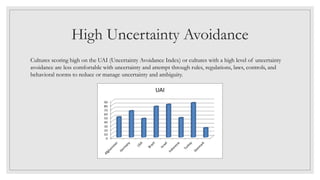
High Uncertainty Avoidance
Cultures scoring high on the UAI (Uncertainty Avoidance Index) or cultures with a high level of uncertainty
avoidance are less comfortable with uncertainty and attempt through rules, regulations, laws, controls, and
behavioral norms to reduce or manage uncertainty and ambiguity.
Low Uncertainty
Avoidance
Unlike high UA, those with a low level use
informality in interaction with others, they often
rely on informal norms and behaviors in most
matters.
Geert Hofstede
Cross cultural sociologist Geert Hofstede examined how values in
the workplace are influenced by culture. Through the research he
conducted in the 60s and 70s, Hofstede collected and analyzed data
from over 100,000 individuals from forty countries. Using these
results Hofstede developed a model of five key categories that
cultures can be measured against. One of the dimensions
was Uncertainty Avoidance.

Uncertainty Avoidance

  • 1.
    TOP 5 FACTSABOUT UNCERTAINTY AVOIDANCE By: Hailey Meier
  • 2.
    First of all…What is it? In cross-cultural psychology, uncertainty avoidance is how cultures differ on the amount of tolerance they have of unpredictability. When it comes to the tolerance of unpredictability, the areas which uncertainty avoidance deals with the most are: technology, law, and religion. Uncertainty avoidance deals with a society’s tolerance for uncertainty and ambiguity; it ultimately refers to man’s search for Truth. It indicates to what extent a culture programs its members to feel either uncomfortable or comfortable in unstructured situations.
  • 3.
    How do cultures handlethis? Uncertainty avoiding cultures try to minimize the possibility of such situations by strict laws and rules, safety and security measures, and on the philosophical and religious level by a belief in absolute Truth
  • 4.
    High Uncertainty Avoidance Culturesscoring high on the UAI (Uncertainty Avoidance Index) or cultures with a high level of uncertainty avoidance are less comfortable with uncertainty and attempt through rules, regulations, laws, controls, and behavioral norms to reduce or manage uncertainty and ambiguity.
  • 5.
    Low Uncertainty Avoidance Unlike highUA, those with a low level use informality in interaction with others, they often rely on informal norms and behaviors in most matters.
  • 6.
    Geert Hofstede Cross culturalsociologist Geert Hofstede examined how values in the workplace are influenced by culture. Through the research he conducted in the 60s and 70s, Hofstede collected and analyzed data from over 100,000 individuals from forty countries. Using these results Hofstede developed a model of five key categories that cultures can be measured against. One of the dimensions was Uncertainty Avoidance.