Computer Science @umbc.edu Department of Computer Science & Electrical Engineering University of Maryland, Baltimore County Baltimore, MD  21250 Fall 2006
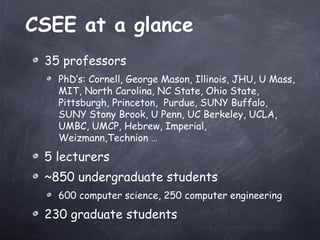
CSEE at a glance 35 professors PhD’s: Cornell, George Mason, Illinois, JHU, U Mass, MIT, North Carolina, NC State, Ohio State, Pittsburgh, Princeton,  Purdue, SUNY Buffalo,  SUNY Stony Brook, U Penn, UC Berkeley, UCLA,  UMBC, UMCP, Hebrew, Imperial, Weizmann,Technion … 5 lecturers ~850 undergraduate students 600 computer science, 250 computer engineering 230 graduate students
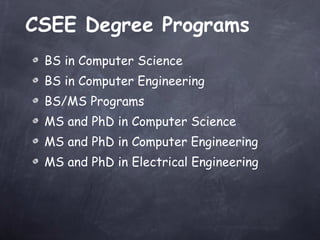
CSEE Degree Programs BS in Computer Science BS in Computer Engineering BS/MS Programs MS and PhD in Computer Science MS and PhD in Computer Engineering MS and PhD in Electrical Engineering
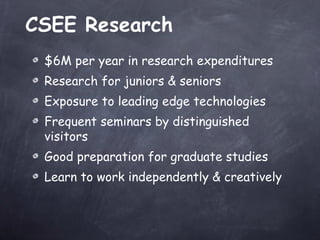
CSEE Research $6M per year in research expenditures Research for juniors & seniors Exposure to leading edge technologies Frequent seminars by distinguished visitors Good preparation for graduate studies Learn to work independently & creatively
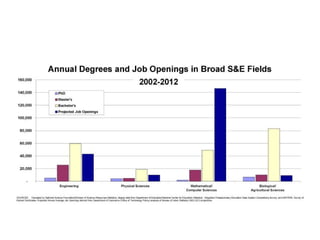
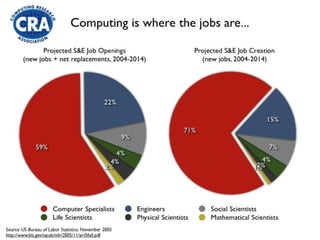
Why computer science? It’s a broad discipline Pick your mix of engineering, science, math and the arts It’s practical relatively strong job market [next slides] It’s important information technology is changing the world It’s interesting and fun
 
 
Why CS@UMBC? Fully accredited program Strong curriculum Excellent research faculty  First-rate computing facilities Large & diverse community at UMBC Other IT program options if a student’s goals or interests change E.g., Computer Engineering, Information Systems, Business Technology Administration, Bioinformatics, Interactive Entertainment (Visual Arts )
BS in Computer Science Technical and rigorous follows  IEEE & ACM guidelines. Combines theory and practice hardware, software, algorithms and theory Preparation for lifetime learning
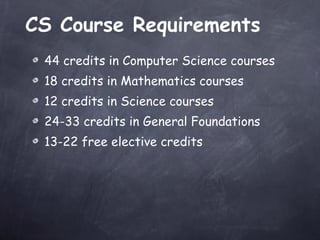
CS Course Requirements 44 credits in Computer Science courses  18 credits in Mathematics courses 12 credits in Science courses 24-33 credits in General Foundations 13-22 free elective credits
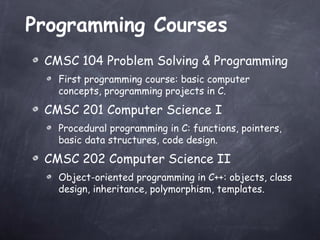
Programming Courses CMSC 104 Problem Solving & Programming First programming course: basic computer concepts, programming projects in C. CMSC 201 Computer Science I Procedural programming in C: functions, pointers, basic data structures, code design. CMSC 202 Computer Science II Object-oriented programming in C++: objects, class design, inheritance, polymorphism, templates.
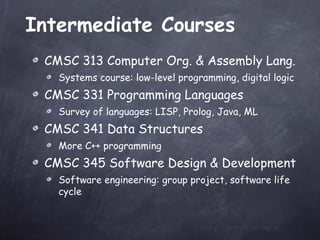
Intermediate Courses CMSC 313 Computer Org. & Assembly Lang. Systems course: low-level programming, digital logic CMSC 331 Programming Languages Survey of languages: LISP, Prolog, Java, ML CMSC 341 Data Structures More C++ programming CMSC 345 Software Design & Development Software engineering: group project, software life cycle
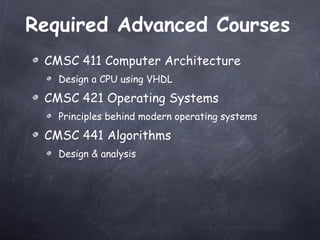
Required Advanced Courses CMSC 411 Computer Architecture Design a CPU using VHDL CMSC 421 Operating Systems Principles behind modern operating systems CMSC 441 Algorithms Design & analysis
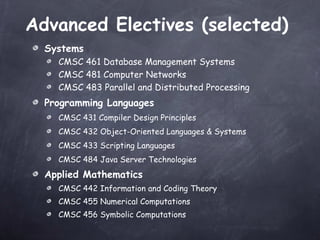
Advanced Electives (selected) Systems CMSC 461 Database Management Systems CMSC 481 Computer Networks CMSC 483 Parallel and Distributed Processing  Programming Languages CMSC 431 Compiler Design Principles  CMSC 432 Object-Oriented Languages & Systems CMSC 433 Scripting Languages CMSC 484 Java Server Technologies Applied Mathematics CMSC 442 Information and Coding Theory  CMSC 455 Numerical Computations CMSC 456 Symbolic Computations
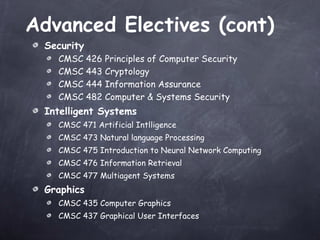
Advanced Electives (cont) Security CMSC 426 Principles of Computer Security CMSC 443 Cryptology  CMSC 444 Information Assurance  CMSC 482 Computer & Systems Security Intelligent Systems CMSC 471 Artificial Intlligence CMSC 473 Natural language Processing CMSC 475 Introduction to Neural Network Computing CMSC 476 Information Retrieval CMSC 477 Multiagent Systems Graphics CMSC 435 Computer Graphics  CMSC 437 Graphical User Interfaces
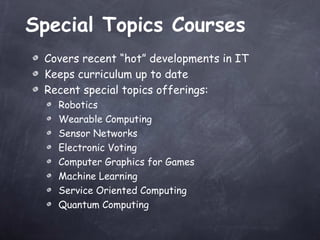
Special Topics Courses Covers recent “hot” developments in IT Keeps curriculum up to date Recent special topics offerings: Robotics Wearable Computing Sensor Networks Electronic Voting Computer Graphics for Games Machine Learning Service Oriented Computing Quantum Computing
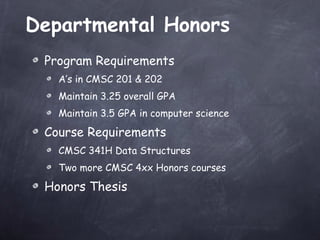
Departmental Honors Program Requirements A’s in CMSC 201 & 202 Maintain 3.25 overall GPA Maintain 3.5 GPA in computer science Course Requirements CMSC 341H Data Structures Two more CMSC 4xx Honors courses Honors Thesis
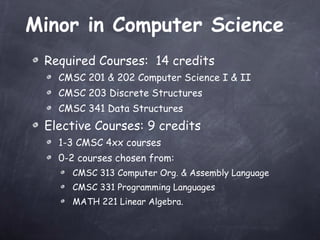
Minor in Computer Science Required Courses:  14 credits CMSC 201 & 202 Computer Science I & II CMSC 203 Discrete Structures CMSC 341 Data Structures Elective Courses: 9 credits 1-3 CMSC 4xx courses  0-2 courses chosen from: CMSC 313 Computer Org. & Assembly Language CMSC 331 Programming Languages MATH 221 Linear Algebra.
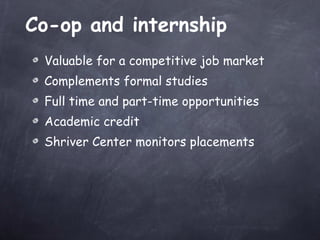
Co-op and internship Valuable for a competitive job market Complements formal studies Full time and part-time opportunities Academic credit Shriver Center monitors placements
For more information... College of Engineering Advisors Cathy Bielawski <bielawsk@umbc.edu> Bethany Spore <briege1@umbc.edu> Courtney Topolski <topolski@umbc.edu> CSEE Web pages  http://www.csee.umbc.edu/~ugrad
The End Questions?

UMBC undergraduate computer science program

  • 1.
    Computer Science @umbc.eduDepartment of Computer Science & Electrical Engineering University of Maryland, Baltimore County Baltimore, MD 21250 Fall 2006
  • 2.
    CSEE at aglance 35 professors PhD’s: Cornell, George Mason, Illinois, JHU, U Mass, MIT, North Carolina, NC State, Ohio State, Pittsburgh, Princeton, Purdue, SUNY Buffalo, SUNY Stony Brook, U Penn, UC Berkeley, UCLA, UMBC, UMCP, Hebrew, Imperial, Weizmann,Technion … 5 lecturers ~850 undergraduate students 600 computer science, 250 computer engineering 230 graduate students
  • 3.
    CSEE Degree ProgramsBS in Computer Science BS in Computer Engineering BS/MS Programs MS and PhD in Computer Science MS and PhD in Computer Engineering MS and PhD in Electrical Engineering
  • 4.
    CSEE Research $6Mper year in research expenditures Research for juniors & seniors Exposure to leading edge technologies Frequent seminars by distinguished visitors Good preparation for graduate studies Learn to work independently & creatively
  • 5.
    Why computer science?It’s a broad discipline Pick your mix of engineering, science, math and the arts It’s practical relatively strong job market [next slides] It’s important information technology is changing the world It’s interesting and fun
  • 6.
  • 7.
  • 8.
    Why CS@UMBC? Fullyaccredited program Strong curriculum Excellent research faculty First-rate computing facilities Large & diverse community at UMBC Other IT program options if a student’s goals or interests change E.g., Computer Engineering, Information Systems, Business Technology Administration, Bioinformatics, Interactive Entertainment (Visual Arts )
  • 9.
    BS in ComputerScience Technical and rigorous follows IEEE & ACM guidelines. Combines theory and practice hardware, software, algorithms and theory Preparation for lifetime learning
  • 10.
    CS Course Requirements44 credits in Computer Science courses 18 credits in Mathematics courses 12 credits in Science courses 24-33 credits in General Foundations 13-22 free elective credits
  • 11.
    Programming Courses CMSC104 Problem Solving & Programming First programming course: basic computer concepts, programming projects in C. CMSC 201 Computer Science I Procedural programming in C: functions, pointers, basic data structures, code design. CMSC 202 Computer Science II Object-oriented programming in C++: objects, class design, inheritance, polymorphism, templates.
  • 12.
    Intermediate Courses CMSC313 Computer Org. & Assembly Lang. Systems course: low-level programming, digital logic CMSC 331 Programming Languages Survey of languages: LISP, Prolog, Java, ML CMSC 341 Data Structures More C++ programming CMSC 345 Software Design & Development Software engineering: group project, software life cycle
  • 13.
    Required Advanced CoursesCMSC 411 Computer Architecture Design a CPU using VHDL CMSC 421 Operating Systems Principles behind modern operating systems CMSC 441 Algorithms Design & analysis
  • 14.
    Advanced Electives (selected)Systems CMSC 461 Database Management Systems CMSC 481 Computer Networks CMSC 483 Parallel and Distributed Processing Programming Languages CMSC 431 Compiler Design Principles CMSC 432 Object-Oriented Languages & Systems CMSC 433 Scripting Languages CMSC 484 Java Server Technologies Applied Mathematics CMSC 442 Information and Coding Theory CMSC 455 Numerical Computations CMSC 456 Symbolic Computations
  • 15.
    Advanced Electives (cont)Security CMSC 426 Principles of Computer Security CMSC 443 Cryptology CMSC 444 Information Assurance CMSC 482 Computer & Systems Security Intelligent Systems CMSC 471 Artificial Intlligence CMSC 473 Natural language Processing CMSC 475 Introduction to Neural Network Computing CMSC 476 Information Retrieval CMSC 477 Multiagent Systems Graphics CMSC 435 Computer Graphics CMSC 437 Graphical User Interfaces
  • 16.
    Special Topics CoursesCovers recent “hot” developments in IT Keeps curriculum up to date Recent special topics offerings: Robotics Wearable Computing Sensor Networks Electronic Voting Computer Graphics for Games Machine Learning Service Oriented Computing Quantum Computing
  • 17.
    Departmental Honors ProgramRequirements A’s in CMSC 201 & 202 Maintain 3.25 overall GPA Maintain 3.5 GPA in computer science Course Requirements CMSC 341H Data Structures Two more CMSC 4xx Honors courses Honors Thesis
  • 18.
    Minor in ComputerScience Required Courses: 14 credits CMSC 201 & 202 Computer Science I & II CMSC 203 Discrete Structures CMSC 341 Data Structures Elective Courses: 9 credits 1-3 CMSC 4xx courses 0-2 courses chosen from: CMSC 313 Computer Org. & Assembly Language CMSC 331 Programming Languages MATH 221 Linear Algebra.
  • 19.
    Co-op and internshipValuable for a competitive job market Complements formal studies Full time and part-time opportunities Academic credit Shriver Center monitors placements
  • 20.
    For more information...College of Engineering Advisors Cathy Bielawski <bielawsk@umbc.edu> Bethany Spore <briege1@umbc.edu> Courtney Topolski <topolski@umbc.edu> CSEE Web pages http://www.csee.umbc.edu/~ugrad
  • 21.