




presents


India’s first & largest initiative to connect urban & rural young India
The young travel the world
in search of what they need,
only to return home and find it.
All things must come to the soul from its roots,
from where it is planted.
Leave the city of your comfort,
Go into the wilderness of your intuition.

What you'll discover will be wonderful.
What you'll discover is yourself.
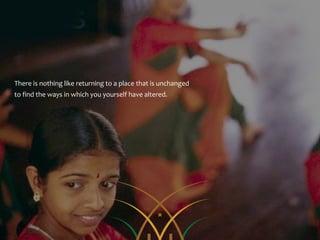
There is nothing like returning to a place that is unchanged
to find the ways in which you yourself have altered.
CONCEPT


INDIA’S FIRST EVER COMPETITION TO CAPTURE DESIGN SOLUTIONS FOR INDIA’S VILLAGES

•Open to engineering and architecture college students … traversing 6,45,000 villages.


•An unprecedented effort to thread India’s past and its future
AIM


Mera Gaon Mera Base wants every young Indian engineer and architect to trace their roots,
return to his/her village and design solutions…and tell us how they want to re-imagine their
villages.
BACKGROUND

THE VILLAGE AS THE BACKBONE OF INDIA

India has seen an unprecedented economic growth in the last few decades primarily because of
urban activities. But it would be short sighted to limit the definition of ‘developed India’ to its
urban centers and the term must necessarily include the development of the backbone of India-
its rural strength. Scattered throughout India are more than 6, 45,000 villages. These settlements
range from tiny hamlets of thatched huts to larger settlements of tile-roofed stone and brick
houses. It is in these villages that India's most basic occupation-agriculture-takes place, which
accomplishes the challenging task of feeding our nation. It is our firm belief that villages in India
should be evolving as one of our strengths and on par with urban India, if India is to aim for
sustained growth.
BACKGROUND

THE NEED FOR ENGINEERING AND ARCHITECTURE INTERVENTION IN VILLAGES

Mahatma Gandhi said “India lives in her villages.” Today our villages are languishing due to the
lack of - political will, availability of resources and most importantly abject neglect by the
intellectual capital of the country. Among the many problems faced by the village, we have
identified the lack of engineering and architecture initiatives to be a crucial one. From limited or
no access to design talent, technology and new and improved building methods, our villages are
being forced to remain as crumbling units of a derelict past. Therefore, there is a need to address
the problem and bridge the need for talent and the availability of the same.

The time has come for our engineering and architecture students to help in building better
villages which will not just improve portals for rural access but will also empower a growing India
and her talents.
CRITERIA

•   MERA VILLAGE
   Maximum of 2 paved/pucca roads through the village.
   No regulated municipal water supply/electricity.
   Nearest hospital/police station is more than 5km away.
   No high school.
   Atleast 50% of families are BPL (Below Poverty Level).
    Weightage will be given to the choice of village. It should not be an urban agglomeration or small town.

•   LOOK WITH YOUR EYES AND HEART
   Observe, listen to what the people have to say.
   Take photographs/make a documentary that describes the village, its people and problems.
    The documentation of how the issue/s are highlighted will be an important aspect.

•   ANALYSE
   Understand the issues facing the people.
   And what can make their lives better.

•   SOLVE
    Provide a solution to either one or multiple issues that you observe.
    The design solution will be carefully scrutinized for suitability and feasibility.
THE CHALLENGE

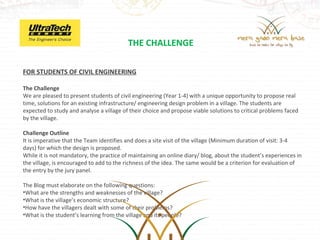
FOR STUDENTS OF CIVIL ENGINEERING

The Challenge
We are pleased to present students of civil engineering (Year 1-4) with a unique opportunity to propose real
time, solutions for an existing infrastructure/ engineering design problem in a village. The students are
expected to study and analyse a village of their choice and propose viable solutions to critical problems faced
by the village.

Challenge Outline
It is imperative that the Team identifies and does a site visit of the village (Minimum duration of visit: 3-4
days) for which the design is proposed.
While it is not mandatory, the practice of maintaining an online diary/ blog, about the student’s experiences in
the village, is encouraged to add to the richness of the idea. The same would be a criterion for evaluation of
the entry by the jury panel.

The Blog must elaborate on the following questions:
•What are the strengths and weaknesses of the village?
•What is the village’s economic structure?
•How have the villagers dealt with some of their problems?
•What is the student’s learning from the village and its people?
THE CHALLENGE

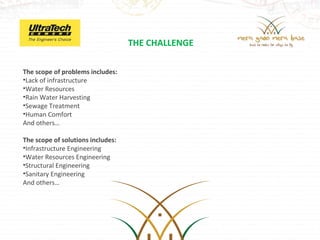
The scope of problems includes:
•Lack of infrastructure
•Water Resources
•Rain Water Harvesting
•Sewage Treatment
•Human Comfort
And others…

The scope of solutions includes:
•Infrastructure Engineering
•Water Resources Engineering
•Structural Engineering
•Sanitary Engineering
And others…
THE CHALLENGE

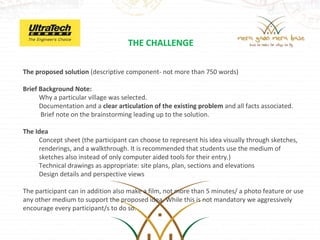
The proposed solution (descriptive component- not more than 750 words)

Brief Background Note:
      Why a particular village was selected.
      Documentation and a clear articulation of the existing problem and all facts associated.
       Brief note on the brainstorming leading up to the solution.
 
The Idea
      Concept sheet (the participant can choose to represent his idea visually through sketches, 
      renderings, and a walkthrough. It is recommended that students use the medium of 
      sketches also instead of only computer aided tools for their entry.)
      Technical drawings as appropriate: site plans, plan, sections and elevations
      Design details and perspective views
 
The participant can in addition also make a film, not more than 5 minutes/ a photo feature or use 
any other medium to support the proposed idea. While this is not mandatory we aggressively 
encourage every participant/s to do so.
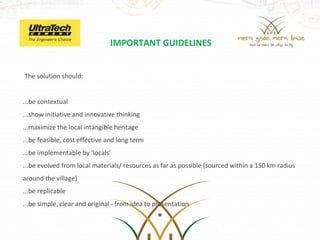
IMPORTANT GUIDELINES


 The solution should:


...be contextual 
...show initiative and innovative thinking
...maximize the local intangible heritage
...be feasible, cost effective and long term
...be implementable by ‘locals’
...be evolved from local materials/ resources as far as possible (sourced within a 150 km radius     
around the village)
...be replicable
...be simple, clear and original - from idea to presentation 
THE CHALLENGE


FOR STUDENTS OF ARCHITECTURE
 
The Challenge
We are pleased to present students (Year 1-5) with a unique opportunity to propose design solutions for an 
existing design problem in a village. The students are expected to study and analyse the village and propose 
viable solutions to critical problems faced by the village. 

Challenge Outline
It is imperative that the Team identifies and does a site visit of the village (Minimum duration of visit: 3-4
days) for which the design is proposed.
While it is not mandatory, the practice of maintaining an online diary/ blog, about the student’s experiences in 
the village, is encouraged to add to the richness of the idea. The same would be a criterion for evaluation of 
the entry by the jury panel.

The Blog must elaborate on the following questions:
•What are the strengths and weaknesses of the village?
•What is the village’s economic structure?
•How have the villagers dealt with some of their problems?
•What is the student’s learning from the village and its people?
THE CHALLENGE

The scope of problems includes:
•Lack of public infrastructure/ institutions
•Lack of community spaces
•Dying local heritage/ crafts
•Human Comfort
And others…

The scope of solutions includes:
•Public infrastructure/ institutions (Schools, Colleges, etc)
•Community spaces
•Entertainment/ Play areas
And others…
THE CHALLENGE

The proposed solution (descriptive component- not more than 750 words)

Brief Background Note:
• Why a particular village was selected.
• Documentation and a clear articulation of the existing problem and all facts associated.
•  Brief note on the brainstorming leading up to the solution.

The Idea
• Concept sheet (the participant can choose to represent his idea visually through sketches, 
  renderings, and a walkthrough. It is recommended that students use the medium of sketches 
  also instead of only computer aided tools for their entry.)
• Technical drawings as appropriate: site plans, plan, sections and elevations
• Design details and perspective views

The participant can in addition also make a film, not more than 5 minutes/ a photo feature or use 
any other medium to support the proposed idea. While this is not mandatory we aggressively 
encourage every participant/s to do so.
IMPORTANT GUIDELINES


 The solution should:


...be contextual 
...show initiative and innovative thinking
...maximize the local intangible heritage
...be feasible, cost effective and long term
...be implementable by ‘locals’
...be evolved from local materials/ resources as far as possible (sourced within a 150 km radius 
around the village)
...be replicable
...be simple, clear and original - from idea to presentation 
RESPONSES TO THE CONCEPT


“ What a remarkable idea!!
Can only wait for the response of young minds...well done "
                                                              -B. V. Doshi


"I thought the idea of a village will die with my generation.
I am so glad there is a body that will introduce the youngster to
embrace and reimagine his past. I wish the idea all the very best…
                                                        -Kamal Hadker
ELIGIBILITY

Are you:

•An architecture student from a college recognized by the Council of Architecture (COA)?
Or
•Engineering student from a degree college, recognized by the Indian Institute of Engineers?
•Like travelling new places and exploring unknown spaces?
•Are you intelligent, sharp and yet sensitive?
•Are you game to play the most challenging reality game of your life?

If the answer to all the above is YES, you are eligible to participate in Mera Gaon Mera Base.

•You can participate individually or in groups of 3, from the same college.
•You can send in a maximum of 3 entries per participant, if so desired, but each entry should be
for a different village.

The important thing is to GO, OBSERVE, UNDERSTAND AND IDEATE.
SCHEDULE


  Competition Launch |        15th August, 2012
 Submission Closes | 22nd November, 2012


            Register today Online
    Log on www.meragaonmerabase.com
     Post your comments/queries/compliments on

https://www.facebook.com/meragaonmerabase
THANK YOU


www.meragaonmerabase.com

Mera Gaon Mera Base

  • 1.
    presents India’s first &largest initiative to connect urban & rural young India
  • 2.
    The young travelthe world in search of what they need, only to return home and find it.
  • 3.
    All things mustcome to the soul from its roots, from where it is planted.
  • 4.
    Leave the cityof your comfort, Go into the wilderness of your intuition. What you'll discover will be wonderful. What you'll discover is yourself.
  • 5.
    There is nothinglike returning to a place that is unchanged to find the ways in which you yourself have altered.
  • 6.
    CONCEPT INDIA’S FIRST EVERCOMPETITION TO CAPTURE DESIGN SOLUTIONS FOR INDIA’S VILLAGES •Open to engineering and architecture college students … traversing 6,45,000 villages. •An unprecedented effort to thread India’s past and its future
  • 7.
    AIM Mera Gaon MeraBase wants every young Indian engineer and architect to trace their roots, return to his/her village and design solutions…and tell us how they want to re-imagine their villages.
  • 8.
    BACKGROUND THE VILLAGE ASTHE BACKBONE OF INDIA India has seen an unprecedented economic growth in the last few decades primarily because of urban activities. But it would be short sighted to limit the definition of ‘developed India’ to its urban centers and the term must necessarily include the development of the backbone of India- its rural strength. Scattered throughout India are more than 6, 45,000 villages. These settlements range from tiny hamlets of thatched huts to larger settlements of tile-roofed stone and brick houses. It is in these villages that India's most basic occupation-agriculture-takes place, which accomplishes the challenging task of feeding our nation. It is our firm belief that villages in India should be evolving as one of our strengths and on par with urban India, if India is to aim for sustained growth.
  • 9.
    BACKGROUND THE NEED FORENGINEERING AND ARCHITECTURE INTERVENTION IN VILLAGES Mahatma Gandhi said “India lives in her villages.” Today our villages are languishing due to the lack of - political will, availability of resources and most importantly abject neglect by the intellectual capital of the country. Among the many problems faced by the village, we have identified the lack of engineering and architecture initiatives to be a crucial one. From limited or no access to design talent, technology and new and improved building methods, our villages are being forced to remain as crumbling units of a derelict past. Therefore, there is a need to address the problem and bridge the need for talent and the availability of the same. The time has come for our engineering and architecture students to help in building better villages which will not just improve portals for rural access but will also empower a growing India and her talents.
  • 10.
    CRITERIA • MERA VILLAGE  Maximum of 2 paved/pucca roads through the village.  No regulated municipal water supply/electricity.  Nearest hospital/police station is more than 5km away.  No high school.  Atleast 50% of families are BPL (Below Poverty Level). Weightage will be given to the choice of village. It should not be an urban agglomeration or small town. • LOOK WITH YOUR EYES AND HEART  Observe, listen to what the people have to say.  Take photographs/make a documentary that describes the village, its people and problems. The documentation of how the issue/s are highlighted will be an important aspect. • ANALYSE  Understand the issues facing the people.  And what can make their lives better. • SOLVE Provide a solution to either one or multiple issues that you observe. The design solution will be carefully scrutinized for suitability and feasibility.
  • 11.
    THE CHALLENGE FOR STUDENTSOF CIVIL ENGINEERING The Challenge We are pleased to present students of civil engineering (Year 1-4) with a unique opportunity to propose real time, solutions for an existing infrastructure/ engineering design problem in a village. The students are expected to study and analyse a village of their choice and propose viable solutions to critical problems faced by the village. Challenge Outline It is imperative that the Team identifies and does a site visit of the village (Minimum duration of visit: 3-4 days) for which the design is proposed. While it is not mandatory, the practice of maintaining an online diary/ blog, about the student’s experiences in the village, is encouraged to add to the richness of the idea. The same would be a criterion for evaluation of the entry by the jury panel. The Blog must elaborate on the following questions: •What are the strengths and weaknesses of the village? •What is the village’s economic structure? •How have the villagers dealt with some of their problems? •What is the student’s learning from the village and its people?
  • 12.
    THE CHALLENGE The scopeof problems includes: •Lack of infrastructure •Water Resources •Rain Water Harvesting •Sewage Treatment •Human Comfort And others… The scope of solutions includes: •Infrastructure Engineering •Water Resources Engineering •Structural Engineering •Sanitary Engineering And others…
  • 13.
    THE CHALLENGE The proposedsolution (descriptive component- not more than 750 words) Brief Background Note: Why a particular village was selected. Documentation and a clear articulation of the existing problem and all facts associated.  Brief note on the brainstorming leading up to the solution.   The Idea Concept sheet (the participant can choose to represent his idea visually through sketches,  renderings, and a walkthrough. It is recommended that students use the medium of  sketches also instead of only computer aided tools for their entry.) Technical drawings as appropriate: site plans, plan, sections and elevations Design details and perspective views   The participant can in addition also make a film, not more than 5 minutes/ a photo feature or use  any other medium to support the proposed idea. While this is not mandatory we aggressively  encourage every participant/s to do so.
  • 14.
  • 15.
    THE CHALLENGE FOR STUDENTSOF ARCHITECTURE   The Challenge We are pleased to present students (Year 1-5) with a unique opportunity to propose design solutions for an  existing design problem in a village. The students are expected to study and analyse the village and propose  viable solutions to critical problems faced by the village.  Challenge Outline It is imperative that the Team identifies and does a site visit of the village (Minimum duration of visit: 3-4 days) for which the design is proposed. While it is not mandatory, the practice of maintaining an online diary/ blog, about the student’s experiences in  the village, is encouraged to add to the richness of the idea. The same would be a criterion for evaluation of  the entry by the jury panel. The Blog must elaborate on the following questions: •What are the strengths and weaknesses of the village? •What is the village’s economic structure? •How have the villagers dealt with some of their problems? •What is the student’s learning from the village and its people?
  • 16.
    THE CHALLENGE The scopeof problems includes: •Lack of public infrastructure/ institutions •Lack of community spaces •Dying local heritage/ crafts •Human Comfort And others… The scope of solutions includes: •Public infrastructure/ institutions (Schools, Colleges, etc) •Community spaces •Entertainment/ Play areas And others…
  • 17.
    THE CHALLENGE The proposedsolution (descriptive component- not more than 750 words) Brief Background Note: • Why a particular village was selected. • Documentation and a clear articulation of the existing problem and all facts associated. •  Brief note on the brainstorming leading up to the solution. The Idea • Concept sheet (the participant can choose to represent his idea visually through sketches,  renderings, and a walkthrough. It is recommended that students use the medium of sketches  also instead of only computer aided tools for their entry.) • Technical drawings as appropriate: site plans, plan, sections and elevations • Design details and perspective views The participant can in addition also make a film, not more than 5 minutes/ a photo feature or use  any other medium to support the proposed idea. While this is not mandatory we aggressively  encourage every participant/s to do so.
  • 18.
  • 19.
    RESPONSES TO THECONCEPT “ What a remarkable idea!! Can only wait for the response of young minds...well done " -B. V. Doshi "I thought the idea of a village will die with my generation. I am so glad there is a body that will introduce the youngster to embrace and reimagine his past. I wish the idea all the very best… -Kamal Hadker
  • 20.
    ELIGIBILITY Are you: •An architecturestudent from a college recognized by the Council of Architecture (COA)? Or •Engineering student from a degree college, recognized by the Indian Institute of Engineers? •Like travelling new places and exploring unknown spaces? •Are you intelligent, sharp and yet sensitive? •Are you game to play the most challenging reality game of your life? If the answer to all the above is YES, you are eligible to participate in Mera Gaon Mera Base. •You can participate individually or in groups of 3, from the same college. •You can send in a maximum of 3 entries per participant, if so desired, but each entry should be for a different village. The important thing is to GO, OBSERVE, UNDERSTAND AND IDEATE.
  • 21.
    SCHEDULE CompetitionLaunch | 15th August, 2012 Submission Closes | 22nd November, 2012 Register today Online Log on www.meragaonmerabase.com Post your comments/queries/compliments on https://www.facebook.com/meragaonmerabase
  • 22.