International symposium on
regional commuter railways

          Peter Field
      Transport for London
        United Kingdom


                             1
Presentation

•   Characteristics of the Greater London metropolitan region
•   Public Transport in London
•   The organisation of Public Transport in London
•   The Integration of public transportation and services
•   Fare structures, ridership characteristics, travel modal shares
•   Financing of the development and operations of London’s
    suburban railway system
•   Service characteristics of London’s suburban railway
•   London’s strategy to enhance the capacity of its suburban rail
    system and integrate it with the public transport system


                                                                      2
London is a world city and gateway to the UK

•   7.6m residents
•   4.7m people in employment                    Central Government

•   30 million visitors a year
•   27 million journeys per day including
    walking and cycling
•   Transport and land-use planning              Greater London Authority
    responsibilities divided between the three
    tiers of government
•   But clear direction – Mayor decides
    transport policy, TfL and Boroughs deliver
•   Elected London Mayor with large budget       London Boroughs
    (£80bn 2010-2017) argues region‟s impact
    on national economy


                                                                            3
Organisational and funding structures reflect a
   distinction between local transport and national
   networks

          MAYOR OF LONDON

                                          Grant
                                                      Franchised         Capital
                                                      Operations         Works
               Business Plan
               and Multimodal
                                                      Contract         Business
                  Strategy
Revenue                                               + subsidy        plan + £


           Directly Operate or Contract                       National Rail

                     Buses                          Train
                                                  operators      Infrastructure Owner
              London Underground
                 Trams and DLR
                Overground Rail
                      Taxis
                 River Transport
             Main Road Maintenance


                                                                                        4
London’s Daily Passenger Journeys
Mode                     Daily Journeys            Journey length

Car                      11 million                11.6   km
Bus                      5 million                  3.6   km
Underground              3 million                  7.8   km
Rail                     2 million                 25.0   km
DLR                      0.2 million                5.1   km
Walk                     6 million                  0.8   km
Cycle                    0.5 million                3.2   km

•   50% of rail passengers arriving in central London continue their
    journey using another TfL mode


                                                                       5
Public transport has a 40% mode share overall, up
ten points since 1993 at the expense of the car
                                     Overall rail share is
                                     8%, Underground is
                                     10%

                                     12m trips in outer
                                     London, just 25% on
                                     public transport

                                      1m trips to central
                                      London each
                                      morning, rail and
                                      Underground share
                                      is 80%


                                                             6
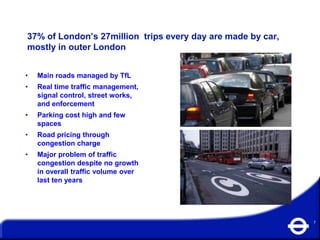
37% of London’s 27million trips every day are made by car,
mostly in outer London


•   Main roads managed by TfL
•   Real time traffic management,
    signal control, street works,
    and enforcement
•   Parking cost high and few
    spaces
•   Road pricing through
    congestion charge
•   Major problem of traffic
    congestion despite no growth
    in overall traffic volume over
    last ten years


                                                             7
London Buses


•   2.2 billion passengers per
    year
•   8000 buses
•   95% of population within
    400m of a stop
•   High frequency interval
    service
•   80% passenger growth since
    1993
•   Managed by TfL
•   Operated by contractors


                                 8
Integrated Fares & Ticketing

Pay before you board

Penalty fare £50

Zonal fares structure for all of London. Flat
fare on bus

Smartcard ‘Oyster’ valid on all Public
Transport

Few paper tickets – always higher cost

Oyster fare is always ‘best value’

Oyster holds both stored value and period
travel

Capped daily travel cost

Oyster moving to ‘back of house’ behind
mobile phone and contactless bank card


                                                9
London’s Rail Network

300 rail stations

270 metro stations

5 million passengers
a day

Mostly electric
multiple unit trains
and 4 aspect fixed
block signalling to
timetable

Underground trains
operate to frequency
service interval


                           10
London’s rail network is effective in bringing widely
                                                                     dispersed population to central London employment
Source: 2001 Census (and projections), GLA ‘Our London Our future’


                                                                               Projected Employment                   Projected Population Growth
                                                                                    (2001 – 2026)                             (2001 – 2026)


                                                                     •   Employment growth is concentrated in
                                                                                                                  • Population growth is expected to be more
                                                                         central London and inner Thames
                                                                                                                    evenly distributed – suggesting a continuing
                                                                         Gateway
                                                                                                                    need for radial commuter links
                                                                     •   Businesses operating in this area are
                                                                         critical to London‟s World City status


                                                                                                                                                              11
London’s multi modal transport model


Do Nothing                      Rail Strategy


2025/26                         2025/26


                                                    12
London’s Rail Strategy for 2025 moves towards a fully
  integrated rail system. It combines renewal of the existing
  network & strategic new infrastructure

                 Thameslink

Radial – fast                     North London
links into                            Line
London
                  Inner                                      East
                suburban                                    London
                 routes                                      Line       Crossrail

                              Circle Line
                  West
                 Londo
                 n Line
                                                                     GLA Boundary


                               Inner             Interchanges
                              London
                              Orbitals


                                                                                    13
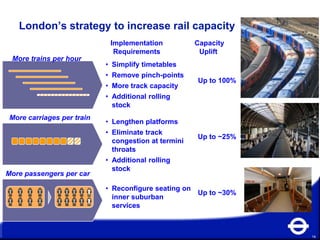
London’s strategy to increase rail capacity
                             Implementation           Capacity
                              Requirements             Uplift
 More trains per hour
                            • Simplify timetables
                            • Remove pinch-points
                                                      Up to 100%
                            • More track capacity
                            • Additional rolling
                              stock
 More carriages per train
                            • Lengthen platforms
                            • Eliminate track
                                                      Up to ~25%
                              congestion at termini
                              throats
                            • Additional rolling
                              stock
More passengers per car

                            • Reconfigure seating on
                                                     Up to ~30%
                              inner suburban
                              services


                                                                   14
As a result, rail enhancements will add about a quarter to
  London’s rail capacity by 2017
                                 Thameslink
    London Midland
                                 • 12-car max capability               West Anglia
    • Trains lengthened to 12-
                                 • 24 trains per hour through core     • 12-car capability
      car
                                                                       • Meet demand from expanded
                                                                         Stansted airport
Chiltern
• Train lengthening up to 7-               5                                         Great Eastern
  car                                              41          23                    • Additional outer
• Frequency improvements
                                                                                       services
                                                                              40     • New Crossrail services
Great Western                     8
• Train lengthening                            London Overground                            C2C
• Additional paths                             • Increased frequency            14          • 12-car capability
• New Crossrail services                       • New routes                                   on all routes
                   129                         • Longer trains           21                 • Longer trains
                                       8                170
                                                                                   High Speed 1
South-western                                                                      • Start domestic services
• 10-car inner suburban
  railway
                                                        10               South-eastern
                                                                         • 12-car inner suburban railway


                        Southern
                        • 10-car inner suburban railway

 Key: % increase in capacity           20
                                                                                                               15
Crossrail will increase the total ( all modes ) public
transport network capacity by a further 10%


  •New high capacity railway, enabling economic growth
  •TfL has a critical role to play as future operator of services (via a Concession)
  •24 trains per hour (peak) each direction through central London
  •Generates 30,000 extra jobs in central London, with GDP benefits of £36bn
  •Relieves congestion on rail and Tube lines
  •Brings 1.5m more passengers within 60 min commute of centre
The challenge to accommodate economic growth is
         striking with rail demand increasing up to 50% by 2025
                                                 Plans &                ‘Efficiency’ New
                Forecasts                                                                                  New railways
                                                proposals                measures railways
                                                                                                           • Crossrail 2
60%
                                                                                 £
                                                                                                           Technology, design,
                                                                                                             pricing
50%
                                                                                 †
                                                                                                           • ERTMS
                                                                                                           • Greater peak pricing
                                                                                                             differentials
40%
                                                                                                           • Metro-style end-to-
                                                                                                             end routes
30%                                                                                                        • High density trains,
                                                                                                             more standing space
                                                                                                           • Double-deck trains
20%
                                                                                                           Future “HLOS2”
10%                                                                                                        • More 12 car trains
                                                                                                             where there is
                                                                                                             already capability
                              Committed                                £ Tech &                            • Extending 12-car
          All modes:  Rail                                    Possible                                       capability
          boardings boardings capacity ie                       future
                                                                        pricing                    New
                                                                                                           • Some track work, e.g.
           increase 200625     „HLOS‟,                                                          tunnels
                                                              “HLOS2” † Vehicle                              West Anglia 4-
          200625              Crossrail,
                                                              capacity design                                tracking
                              Overground
Source: Demand projections from Group Planning, capacity estimates from DfT rolling stock plan                                       17
Conclusions

•   London‟s development in the last
    200 years hugely influenced by
    railways
•   It remains the key mode for
    access to the central area where
    London‟s world city functions are
    sited
•   TfL and central Government are
    spending large sums for enable
    railways to meet better London‟s
    transport challenges
•   Integration remains a key
    challenge to meeting our
    objectives

                                        Interchange Station
                                        Rail, Metro, Bus and Tram


                                                                    18
Questions?


             19
Symposium on International Experiences in the Development of Regional Commuter Rail Systems


        Session 2B


                          Mr. Field, Peter


                                                                                              20

Uk

  • 1.
    International symposium on regionalcommuter railways Peter Field Transport for London United Kingdom 1
  • 2.
    Presentation • Characteristics of the Greater London metropolitan region • Public Transport in London • The organisation of Public Transport in London • The Integration of public transportation and services • Fare structures, ridership characteristics, travel modal shares • Financing of the development and operations of London’s suburban railway system • Service characteristics of London’s suburban railway • London’s strategy to enhance the capacity of its suburban rail system and integrate it with the public transport system 2
  • 3.
    London is aworld city and gateway to the UK • 7.6m residents • 4.7m people in employment Central Government • 30 million visitors a year • 27 million journeys per day including walking and cycling • Transport and land-use planning Greater London Authority responsibilities divided between the three tiers of government • But clear direction – Mayor decides transport policy, TfL and Boroughs deliver • Elected London Mayor with large budget London Boroughs (£80bn 2010-2017) argues region‟s impact on national economy 3
  • 4.
    Organisational and fundingstructures reflect a distinction between local transport and national networks MAYOR OF LONDON Grant Franchised Capital Operations Works Business Plan and Multimodal Contract Business Strategy Revenue + subsidy plan + £ Directly Operate or Contract National Rail Buses Train operators Infrastructure Owner London Underground Trams and DLR Overground Rail Taxis River Transport Main Road Maintenance 4
  • 5.
    London’s Daily PassengerJourneys Mode Daily Journeys Journey length Car 11 million 11.6 km Bus 5 million 3.6 km Underground 3 million 7.8 km Rail 2 million 25.0 km DLR 0.2 million 5.1 km Walk 6 million 0.8 km Cycle 0.5 million 3.2 km • 50% of rail passengers arriving in central London continue their journey using another TfL mode 5
  • 6.
    Public transport hasa 40% mode share overall, up ten points since 1993 at the expense of the car Overall rail share is 8%, Underground is 10% 12m trips in outer London, just 25% on public transport 1m trips to central London each morning, rail and Underground share is 80% 6
  • 7.
    37% of London’s27million trips every day are made by car, mostly in outer London • Main roads managed by TfL • Real time traffic management, signal control, street works, and enforcement • Parking cost high and few spaces • Road pricing through congestion charge • Major problem of traffic congestion despite no growth in overall traffic volume over last ten years 7
  • 8.
    London Buses • 2.2 billion passengers per year • 8000 buses • 95% of population within 400m of a stop • High frequency interval service • 80% passenger growth since 1993 • Managed by TfL • Operated by contractors 8
  • 9.
    Integrated Fares &Ticketing Pay before you board Penalty fare £50 Zonal fares structure for all of London. Flat fare on bus Smartcard ‘Oyster’ valid on all Public Transport Few paper tickets – always higher cost Oyster fare is always ‘best value’ Oyster holds both stored value and period travel Capped daily travel cost Oyster moving to ‘back of house’ behind mobile phone and contactless bank card 9
  • 10.
    London’s Rail Network 300rail stations 270 metro stations 5 million passengers a day Mostly electric multiple unit trains and 4 aspect fixed block signalling to timetable Underground trains operate to frequency service interval 10
  • 11.
    London’s rail networkis effective in bringing widely dispersed population to central London employment Source: 2001 Census (and projections), GLA ‘Our London Our future’ Projected Employment Projected Population Growth (2001 – 2026) (2001 – 2026) • Employment growth is concentrated in • Population growth is expected to be more central London and inner Thames evenly distributed – suggesting a continuing Gateway need for radial commuter links • Businesses operating in this area are critical to London‟s World City status 11
  • 12.
    London’s multi modaltransport model Do Nothing Rail Strategy 2025/26 2025/26 12
  • 13.
    London’s Rail Strategyfor 2025 moves towards a fully integrated rail system. It combines renewal of the existing network & strategic new infrastructure Thameslink Radial – fast North London links into Line London Inner East suburban London routes Line Crossrail Circle Line West Londo n Line GLA Boundary Inner Interchanges London Orbitals 13
  • 14.
    London’s strategy toincrease rail capacity Implementation Capacity Requirements Uplift More trains per hour • Simplify timetables • Remove pinch-points Up to 100% • More track capacity • Additional rolling stock More carriages per train • Lengthen platforms • Eliminate track Up to ~25% congestion at termini throats • Additional rolling stock More passengers per car • Reconfigure seating on Up to ~30% inner suburban services 14
  • 15.
    As a result,rail enhancements will add about a quarter to London’s rail capacity by 2017 Thameslink London Midland • 12-car max capability West Anglia • Trains lengthened to 12- • 24 trains per hour through core • 12-car capability car • Meet demand from expanded Stansted airport Chiltern • Train lengthening up to 7- 5 Great Eastern car 41 23 • Additional outer • Frequency improvements services 40 • New Crossrail services Great Western 8 • Train lengthening London Overground C2C • Additional paths • Increased frequency 14 • 12-car capability • New Crossrail services • New routes on all routes 129 • Longer trains 21 • Longer trains 8 170 High Speed 1 South-western • Start domestic services • 10-car inner suburban railway 10 South-eastern • 12-car inner suburban railway Southern • 10-car inner suburban railway Key: % increase in capacity 20 15
  • 16.
    Crossrail will increasethe total ( all modes ) public transport network capacity by a further 10% •New high capacity railway, enabling economic growth •TfL has a critical role to play as future operator of services (via a Concession) •24 trains per hour (peak) each direction through central London •Generates 30,000 extra jobs in central London, with GDP benefits of £36bn •Relieves congestion on rail and Tube lines •Brings 1.5m more passengers within 60 min commute of centre
  • 17.
    The challenge toaccommodate economic growth is striking with rail demand increasing up to 50% by 2025 Plans & ‘Efficiency’ New Forecasts New railways proposals measures railways • Crossrail 2 60% £ Technology, design, pricing 50% † • ERTMS • Greater peak pricing differentials 40% • Metro-style end-to- end routes 30% • High density trains, more standing space • Double-deck trains 20% Future “HLOS2” 10% • More 12 car trains where there is already capability Committed £ Tech & • Extending 12-car All modes: Rail Possible capability boardings boardings capacity ie future pricing New • Some track work, e.g. increase 200625 „HLOS‟, tunnels “HLOS2” † Vehicle West Anglia 4- 200625 Crossrail, capacity design tracking Overground Source: Demand projections from Group Planning, capacity estimates from DfT rolling stock plan 17
  • 18.
    Conclusions • London‟s development in the last 200 years hugely influenced by railways • It remains the key mode for access to the central area where London‟s world city functions are sited • TfL and central Government are spending large sums for enable railways to meet better London‟s transport challenges • Integration remains a key challenge to meeting our objectives Interchange Station Rail, Metro, Bus and Tram 18
  • 19.
  • 20.
    Symposium on InternationalExperiences in the Development of Regional Commuter Rail Systems Session 2B Mr. Field, Peter 20