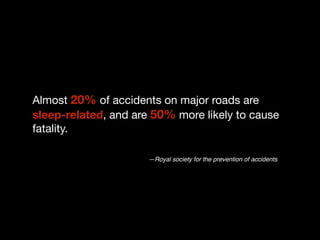
Almost 20% of accidents on major roads are 
sleep-related, and are 50% more likely to cause 
fatality. 
—Royal society for the prevention of accidents
High anger drivers are likely to drive faster and 
are twice as likely to crash. 
—Deffenbacher,2002
Design Practice Drive Happy 
Group 1 
: )
Agenda 
• Problem Situation 
• “The Big Idea” 
• Design Process 
• Demo 
• Extensions / Future Work
Agenda 
• Problem Situation 
• “The Big Idea” 
• Design Process 
• Demo 
• Extensions / Future Work
Problem Situation 
● Studies have shown emotions can affect driving 
performance and behaviour. 
! 
● Almost 20% of accidents on major roads are 
sleep-related, and are 50% more likely to cause 
fatality. 
! 
● Men under 30 have the highest risk of falling asleep 
at the wheel.
Literature Review 
• Jackson et al (2013): Drivers deprived of sleep for 24 
hours had significant cognitive impairment and more 
incidents whilst driving compared to awake drivers. 
! 
• Blazejewski et al (2012): Drowsy driving increases your 
chances of being involved in an accident almost as much 
as drunk driving. 
! 
• National Sleep Foundation (2005): 60% of American 
drivers admit to driving drowsy within the past year, also 
37% have fallen asleep at the wheel at least once (and 
13% of those admit to doing it at least once a month).
Literature Review 
! 
● Zillman (1971) : High anger drivers are more likely 
to be in an angry state when getting in the car and 
react badly to provocative events. 
! 
● Deffenbacher (2002) : High anger drivers are likely 
to drive faster and are twice as likely to crash. 
! 
● Underwood (1999) : Trait driving anger correlates 
with amount of traffic violations.
Agenda 
• Problem Situation 
• “The Big Idea” 
• Design Process 
• Demo 
• Extensions / Future Work
“The Big Idea”: Drive Happy 
! 
Part 1: 
Steering Wheel Cover with sensors to monitor 
! 
● Heart Rate 
● Pressure 
● Facial Expressions 
!
“The Big Idea”: Drive Happy 
! 
Part 2: 
Smartphone/Web App 
! 
● Map of local area with “happy” / “stressful” routes 
● User Statistics 
● Plug-in to Google Maps 
!
“The Big Idea”: Drive Happy 
! 
Part 3: 
Billboard at Petrol / Service Stations 
! 
● Map of local area with “happy” / “stressful” 
routes
Agenda 
• Problem Situation 
• “The Big Idea” 
• Design Process 
• Demo 
• Extensions / Future Work
Design Process: Initial Sketches
Design Process: Research 
Sleepiness 
! 
● 95% want to be made aware. 
! 
● 71% prefer light and audio 
feedback. 
! 
● 29% prefer audio feedback.
Design Process: Research 
Anger / Stress 
! 
● 24% want to be made aware. 
! 
● 69% prefer light, 6% prefer audio, 
25% prefer light and sound. 
! 
● Calming strategies: 56% prefer 
music or breathing exercises.
Design Process: Physical Prototype
Design Process: User Testing
Interfaces: Web app
Interfaces: Mobile app
Interfaces: Billboard Mockup
Agenda 
• Problem Situation 
• “The Big Idea” 
• Design Process 
• Demo 
• Extensions / Future Work
Scenario 1: Sleepy Driver
Scenario 2: Angry Driver
Agenda 
• Problem Situation 
• “The Big Idea” 
• Design Process 
• Demo 
• Extensions / Future Work
Further Work 
● Further user testing – in-car testing 
! 
● Higher fidelity prototypes - skin conductance 
! 
● In-app navigation / overlay to Google Maps 
! 
● Further research into security / privacy issues
Questions?
: )
References 
• Blazejewski, S., Girodet, P.-O., Orriols, L., Capelli, A., Moore, N. (2012); "Factors associated with serious 
traffic crashes: a prospective study in southwest France"; Archives of internal medicine, 2012, Vol. 
172(13), pp.1039-41! 
! 
• Deffenbacher J. L., Deffenbacher D. M., Lynch R.S., Richards T. L. (2003); "Anger, aggression, and risky 
behavior: a comparison of high and low anger drivers"; Behaviour Research and Therapy, 2003, Vol. 
41(6), pp.701-718! 
! 
• DePasquale, J. P., Geller, E. S., Clarke, S. W., Littleton, L. C. (2001); "Measuring road rage: development 
of the Propensity for Angry Driving Scale"; Journal of Safety Research, 2001, Vol.32(1), pp.1-16! 
! 
• Dukes, R. L., Clayton, S. L., Jenkins, L. T., Miller, T. L., Rodgers, S. E. (2001); "Effects of aggressive 
driving and driver characteristics on road rage"; The Social Science Journal, 2001, Vol.38(2), pp.323-331! 
! 
• Galovski, T. E., Blanchard, E. B. (2004); "Road rage: a domain for psychological intervention?"; 
Aggression and Violent Behavior, 2004, Vol.9(2), pp.105-127! 
! 
• Glenn Gunzelmann , L. Richard Moore Jr. , Dario D. Salvucci , Kevin A. Gluck (2010); “Sleep loss and 
driver performance: Quantitative predictions with zero free parameters”; Cognitive Systems Research 12 
(2011) 154–163
References 
! 
• Gulian E., Glendon A. I., Matthews G., Davies D. R., Debney L. M. (1990); "The stress of driving: A diary 
study"; Work & Stress: An International Journal of Work,Health & Organisations, 4:1, 7-16! 
! 
• Healey, J., Picard, R. (2000); "SmartCar: detecting driver stress"; Proceedings 15th International 
Conference on Pattern Recognition, Sept. 2000, Vol.4, pp.218-221! 
! 
• Jackson, M. L., Croft, R. J., Kennedy, G. A., Owens, K., Howard, M. E. (2013); "Cognitive components of 
simulated driving performance: Sleep loss effects and predictors"; Accident Analysis and Prevention, 2013, 
Vol.50, pp.438-444! 
! 
• Jeff Robbins(2010);”GPS Navigation...But What is it Doing To Us?”;IEEE International Symposium on 
Technology and Society! 
! 
• Krajewski, J., Golz, M., Schnieder, S., Schnupp, T., Heinze, C., Sommer, D. (2010); “Detecting Fatigue from 
Steering Behaviour Applying Continuous Wavelet Transform”; ACM 2010 ISBN: 978-1-60558-926-8/10/08! 
! 
• Michael Biermann, M., Hoppe,T., Dittmann,J., Vielhauer, C. (2008); “Vehicle Systems: Comfort & Security 
Enhancement of Face/Speech Fusion with Compensational Biometric Modalities”; ACM 
978-1-60558-058-6/08/9!
References 
• National Sleep Foundation (2005) "Sleep in America Poll, Summary of Findings”! 
! 
• Novaco, R., Stokols, D., Campbell, J., Stokols, J. (1979); "Transportation, Stress, and Community 
Psychology"; American Journal of Community Psychology, 1979, Vol.7(4), pp.361-380! 
! 
• The World Bank. (2013). The World Bank. Retrieved October 25, 2013, from The World Bank Web Site: 
http://data.worldbank.org/indicator/IS.VEH.NVEH.P3/countr ies/1W-GB?display=default! 
! 
• Underwood, G., Chapman, P., Wright, S., Crundall, D. (1999); "Anger While Driving”; Transportation 
Research Part F: Psychology and Behaviour, 1999, Vol.2(1), pp.55-68 ! 
! 
• Zillmann, D. (1971); "Excitation transfer in communication-mediated aggressive behavior"; Journal of 
Experimental Social Psychology, 1971, Vol.7(4), pp.419-434! 
! 
• Driver Fatigue and Road Accidents. (n.d.). The Royal Society for the Prevention of Accidents. Retrieved 
November 20, 2013 from the Royal Society for the Prevention of Accidents Web Site: http:// 
www.rospa.com/roadsafety/adviceandinformation/driving/driverfatigue/factsheet.aspx! 
! 
• Think Direct. (n.d); Retrieved November 20, 2013, from The Think Direct Web Site: http:// 
think.direct.gov.uk/fatigue.html

Drive Happy: Quantified self technology for driving

  • 1.
    Almost 20% ofaccidents on major roads are sleep-related, and are 50% more likely to cause fatality. —Royal society for the prevention of accidents
  • 2.
    High anger driversare likely to drive faster and are twice as likely to crash. —Deffenbacher,2002
  • 3.
    Design Practice DriveHappy Group 1 : )
  • 4.
    Agenda • ProblemSituation • “The Big Idea” • Design Process • Demo • Extensions / Future Work
  • 5.
    Agenda • ProblemSituation • “The Big Idea” • Design Process • Demo • Extensions / Future Work
  • 6.
    Problem Situation ●Studies have shown emotions can affect driving performance and behaviour. ! ● Almost 20% of accidents on major roads are sleep-related, and are 50% more likely to cause fatality. ! ● Men under 30 have the highest risk of falling asleep at the wheel.
  • 7.
    Literature Review •Jackson et al (2013): Drivers deprived of sleep for 24 hours had significant cognitive impairment and more incidents whilst driving compared to awake drivers. ! • Blazejewski et al (2012): Drowsy driving increases your chances of being involved in an accident almost as much as drunk driving. ! • National Sleep Foundation (2005): 60% of American drivers admit to driving drowsy within the past year, also 37% have fallen asleep at the wheel at least once (and 13% of those admit to doing it at least once a month).
  • 8.
    Literature Review ! ● Zillman (1971) : High anger drivers are more likely to be in an angry state when getting in the car and react badly to provocative events. ! ● Deffenbacher (2002) : High anger drivers are likely to drive faster and are twice as likely to crash. ! ● Underwood (1999) : Trait driving anger correlates with amount of traffic violations.
  • 9.
    Agenda • ProblemSituation • “The Big Idea” • Design Process • Demo • Extensions / Future Work
  • 10.
    “The Big Idea”:Drive Happy ! Part 1: Steering Wheel Cover with sensors to monitor ! ● Heart Rate ● Pressure ● Facial Expressions !
  • 11.
    “The Big Idea”:Drive Happy ! Part 2: Smartphone/Web App ! ● Map of local area with “happy” / “stressful” routes ● User Statistics ● Plug-in to Google Maps !
  • 12.
    “The Big Idea”:Drive Happy ! Part 3: Billboard at Petrol / Service Stations ! ● Map of local area with “happy” / “stressful” routes
  • 13.
    Agenda • ProblemSituation • “The Big Idea” • Design Process • Demo • Extensions / Future Work
  • 14.
  • 15.
  • 16.
    Design Process: Research Sleepiness ! ● 95% want to be made aware. ! ● 71% prefer light and audio feedback. ! ● 29% prefer audio feedback.
  • 17.
    Design Process: Research Anger / Stress ! ● 24% want to be made aware. ! ● 69% prefer light, 6% prefer audio, 25% prefer light and sound. ! ● Calming strategies: 56% prefer music or breathing exercises.
  • 18.
  • 19.
  • 20.
  • 21.
  • 22.
  • 23.
  • 24.
  • 25.
  • 26.
    Agenda • ProblemSituation • “The Big Idea” • Design Process • Demo • Extensions / Future Work
  • 27.
  • 33.
  • 37.
    Agenda • ProblemSituation • “The Big Idea” • Design Process • Demo • Extensions / Future Work
  • 38.
    Further Work ●Further user testing – in-car testing ! ● Higher fidelity prototypes - skin conductance ! ● In-app navigation / overlay to Google Maps ! ● Further research into security / privacy issues
  • 39.
  • 40.
  • 41.
    References • Blazejewski,S., Girodet, P.-O., Orriols, L., Capelli, A., Moore, N. (2012); "Factors associated with serious traffic crashes: a prospective study in southwest France"; Archives of internal medicine, 2012, Vol. 172(13), pp.1039-41! ! • Deffenbacher J. L., Deffenbacher D. M., Lynch R.S., Richards T. L. (2003); "Anger, aggression, and risky behavior: a comparison of high and low anger drivers"; Behaviour Research and Therapy, 2003, Vol. 41(6), pp.701-718! ! • DePasquale, J. P., Geller, E. S., Clarke, S. W., Littleton, L. C. (2001); "Measuring road rage: development of the Propensity for Angry Driving Scale"; Journal of Safety Research, 2001, Vol.32(1), pp.1-16! ! • Dukes, R. L., Clayton, S. L., Jenkins, L. T., Miller, T. L., Rodgers, S. E. (2001); "Effects of aggressive driving and driver characteristics on road rage"; The Social Science Journal, 2001, Vol.38(2), pp.323-331! ! • Galovski, T. E., Blanchard, E. B. (2004); "Road rage: a domain for psychological intervention?"; Aggression and Violent Behavior, 2004, Vol.9(2), pp.105-127! ! • Glenn Gunzelmann , L. Richard Moore Jr. , Dario D. Salvucci , Kevin A. Gluck (2010); “Sleep loss and driver performance: Quantitative predictions with zero free parameters”; Cognitive Systems Research 12 (2011) 154–163
  • 42.
    References ! •Gulian E., Glendon A. I., Matthews G., Davies D. R., Debney L. M. (1990); "The stress of driving: A diary study"; Work & Stress: An International Journal of Work,Health & Organisations, 4:1, 7-16! ! • Healey, J., Picard, R. (2000); "SmartCar: detecting driver stress"; Proceedings 15th International Conference on Pattern Recognition, Sept. 2000, Vol.4, pp.218-221! ! • Jackson, M. L., Croft, R. J., Kennedy, G. A., Owens, K., Howard, M. E. (2013); "Cognitive components of simulated driving performance: Sleep loss effects and predictors"; Accident Analysis and Prevention, 2013, Vol.50, pp.438-444! ! • Jeff Robbins(2010);”GPS Navigation...But What is it Doing To Us?”;IEEE International Symposium on Technology and Society! ! • Krajewski, J., Golz, M., Schnieder, S., Schnupp, T., Heinze, C., Sommer, D. (2010); “Detecting Fatigue from Steering Behaviour Applying Continuous Wavelet Transform”; ACM 2010 ISBN: 978-1-60558-926-8/10/08! ! • Michael Biermann, M., Hoppe,T., Dittmann,J., Vielhauer, C. (2008); “Vehicle Systems: Comfort & Security Enhancement of Face/Speech Fusion with Compensational Biometric Modalities”; ACM 978-1-60558-058-6/08/9!
  • 43.
    References • NationalSleep Foundation (2005) "Sleep in America Poll, Summary of Findings”! ! • Novaco, R., Stokols, D., Campbell, J., Stokols, J. (1979); "Transportation, Stress, and Community Psychology"; American Journal of Community Psychology, 1979, Vol.7(4), pp.361-380! ! • The World Bank. (2013). The World Bank. Retrieved October 25, 2013, from The World Bank Web Site: http://data.worldbank.org/indicator/IS.VEH.NVEH.P3/countr ies/1W-GB?display=default! ! • Underwood, G., Chapman, P., Wright, S., Crundall, D. (1999); "Anger While Driving”; Transportation Research Part F: Psychology and Behaviour, 1999, Vol.2(1), pp.55-68 ! ! • Zillmann, D. (1971); "Excitation transfer in communication-mediated aggressive behavior"; Journal of Experimental Social Psychology, 1971, Vol.7(4), pp.419-434! ! • Driver Fatigue and Road Accidents. (n.d.). The Royal Society for the Prevention of Accidents. Retrieved November 20, 2013 from the Royal Society for the Prevention of Accidents Web Site: http:// www.rospa.com/roadsafety/adviceandinformation/driving/driverfatigue/factsheet.aspx! ! • Think Direct. (n.d); Retrieved November 20, 2013, from The Think Direct Web Site: http:// think.direct.gov.uk/fatigue.html