Subject:-Mechanics of solids(2130003)
Branch:- Civil Engineering(3rd Sem.)
TYPES OF LOADS
INTRODUCTION
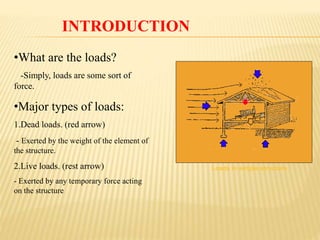
•What are the loads?
-Simply, loads are some sort of
force.
•Major types of loads:
1.Dead loads. (red arrow)
- Exerted by the weight of the element of
the structure.
2.Live loads. (rest arrow)
- Exerted by any temporary force acting
on the structure
Loads in simple structure
DEAD LOADS
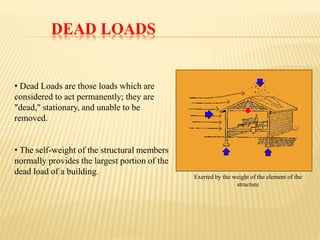
• Dead Loads are those loads which are
considered to act permanently; they are
"dead," stationary, and unable to be
removed.
• The self-weight of the structural members
normally provides the largest portion of the
dead load of a building.
Exerted by the weight of the element of the
structure
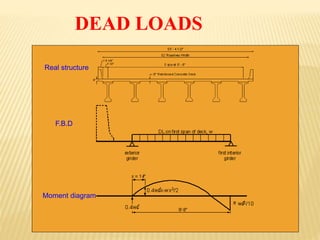
DEAD LOADS
Real structure
F.B.D
Moment diagram
• Live Loads are not permanent
and can change in magnitude.
•They include items found within
a building
LIVE LOADS
All the arrows indicate the live loads unless the
red one
LIVE LOADS
WIND LOAD:-
Wind load
• The wind's relatively large
projected areas can develop
substantial forces in the structure.
LIVE LOADS
A covered bridge destroyed by wind
WIND LOAD:
• Earthquake loads are another lateral
live load.
•They are very complex, uncertain, and
potentially more damaging than wind
loads.
LIVE LOADS
EARTHQUAKE LOADS:
Mass tends to remain in its original
position, deformation due to sudden
ground moving take place at the
base
LIVE LOADS
• Buildings have been demolished by the
earthquake loads, that happened because it
have not been designed to deal with these
loads. The earthquake was in Qamm in
Iran.
EARTHQUAKE LOADS:
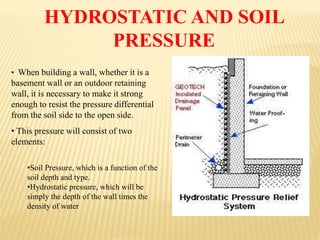
HYDROSTATIC AND SOIL
PRESSURE
• When building a wall, whether it is a
basement wall or an outdoor retaining
wall, it is necessary to make it strong
enough to resist the pressure differential
from the soil side to the open side.
• This pressure will consist of two
elements:
•Soil Pressure, which is a function of the
soil depth and type.
•Hydrostatic pressure, which will be
simply the depth of the wall times the
density of water
LOAD COMBINATION
• Designing steel or concrete
structures involves
considering combinations of
load; therefore, most
structural engineers are quite
familiar with assessing the
probability of various load
combinations.
• As an example, it is unlikely
that any bridge will need to
resist full design vehicle load,
design wind load, and the
structure's self-weight
simultaneously.
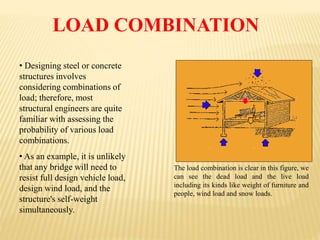
The load combination is clear in this figure, we
can see the dead load and the live load
including its kinds like weight of furniture and
people, wind load and snow loads.
POINT LOAD OR
CONCENTRATED LOAD
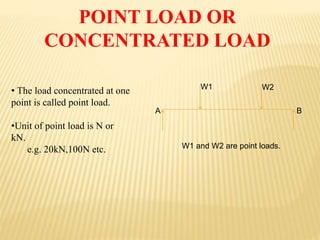
A B
W1 W2
• The load concentrated at one
point is called point load.
•Unit of point load is N or
kN.
e.g. 20kN,100N etc. W1 and W2 are point loads.
UNIFORMLY DISTRIBUTED LOAD
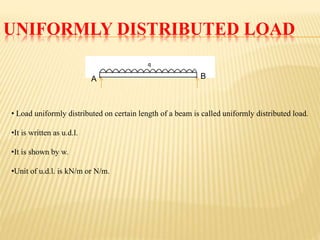
A B
• Load uniformly distributed on certain length of a beam is called uniformly distributed load.
•It is written as u.d.l.
•It is shown by w.
•Unit of u.d.l. is kN/m or N/m.
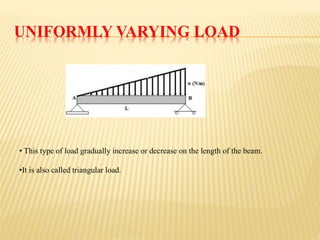
UNIFORMLY VARYING LOAD
• This type of load gradually increase or decrease on the length of the beam.
•It is also called triangular load.
REFERENCES
 Dr. R.P. Rethaliya’s reference book.
 Literatures of
typesofloads-180410052323.pdf

typesofloads-180410052323.pdf

  • 1.
    Subject:-Mechanics of solids(2130003) Branch:-Civil Engineering(3rd Sem.) TYPES OF LOADS
  • 2.
    INTRODUCTION •What are theloads? -Simply, loads are some sort of force. •Major types of loads: 1.Dead loads. (red arrow) - Exerted by the weight of the element of the structure. 2.Live loads. (rest arrow) - Exerted by any temporary force acting on the structure Loads in simple structure
  • 3.
    DEAD LOADS • DeadLoads are those loads which are considered to act permanently; they are "dead," stationary, and unable to be removed. • The self-weight of the structural members normally provides the largest portion of the dead load of a building. Exerted by the weight of the element of the structure
  • 4.
  • 5.
    • Live Loadsare not permanent and can change in magnitude. •They include items found within a building LIVE LOADS All the arrows indicate the live loads unless the red one
  • 6.
    LIVE LOADS WIND LOAD:- Windload • The wind's relatively large projected areas can develop substantial forces in the structure.
  • 7.
    LIVE LOADS A coveredbridge destroyed by wind WIND LOAD:
  • 8.
    • Earthquake loadsare another lateral live load. •They are very complex, uncertain, and potentially more damaging than wind loads. LIVE LOADS EARTHQUAKE LOADS: Mass tends to remain in its original position, deformation due to sudden ground moving take place at the base
  • 9.
    LIVE LOADS • Buildingshave been demolished by the earthquake loads, that happened because it have not been designed to deal with these loads. The earthquake was in Qamm in Iran. EARTHQUAKE LOADS:
  • 10.
    HYDROSTATIC AND SOIL PRESSURE •When building a wall, whether it is a basement wall or an outdoor retaining wall, it is necessary to make it strong enough to resist the pressure differential from the soil side to the open side. • This pressure will consist of two elements: •Soil Pressure, which is a function of the soil depth and type. •Hydrostatic pressure, which will be simply the depth of the wall times the density of water
  • 11.
    LOAD COMBINATION • Designingsteel or concrete structures involves considering combinations of load; therefore, most structural engineers are quite familiar with assessing the probability of various load combinations. • As an example, it is unlikely that any bridge will need to resist full design vehicle load, design wind load, and the structure's self-weight simultaneously. The load combination is clear in this figure, we can see the dead load and the live load including its kinds like weight of furniture and people, wind load and snow loads.
  • 12.
    POINT LOAD OR CONCENTRATEDLOAD A B W1 W2 • The load concentrated at one point is called point load. •Unit of point load is N or kN. e.g. 20kN,100N etc. W1 and W2 are point loads.
  • 13.
    UNIFORMLY DISTRIBUTED LOAD AB • Load uniformly distributed on certain length of a beam is called uniformly distributed load. •It is written as u.d.l. •It is shown by w. •Unit of u.d.l. is kN/m or N/m.
  • 14.
    UNIFORMLY VARYING LOAD •This type of load gradually increase or decrease on the length of the beam. •It is also called triangular load.
  • 15.
    REFERENCES  Dr. R.P.Rethaliya’s reference book.  Literatures of