M.Sc Clinical Embryology
Subject: Histology
By – Prachi Naik
Muscular tissue
• In human, all the body cells have a property of the contractility to some
extent. The property of contractility is well developed in muscular tissue.
• The cells of muscular tissue are called Myocytes. As the myocytes are
elongated or spindle shaped, they are also called muscle fibers.
• The plasma membrane of a skeletal muscle fiber is called
the sarcolemma.
• The striated appearance of skeletal muscle tissue is a result of
repeating bands of the proteins actin and myosin that are present
along the length of myofibrils.
• Dark A bands and light I bands repeat along myofibrils, and the
alignment of myofibrils in the cell causes the entire cell to appear
striated or banded.
Muscle Tissue
Types of Muscular Tissue
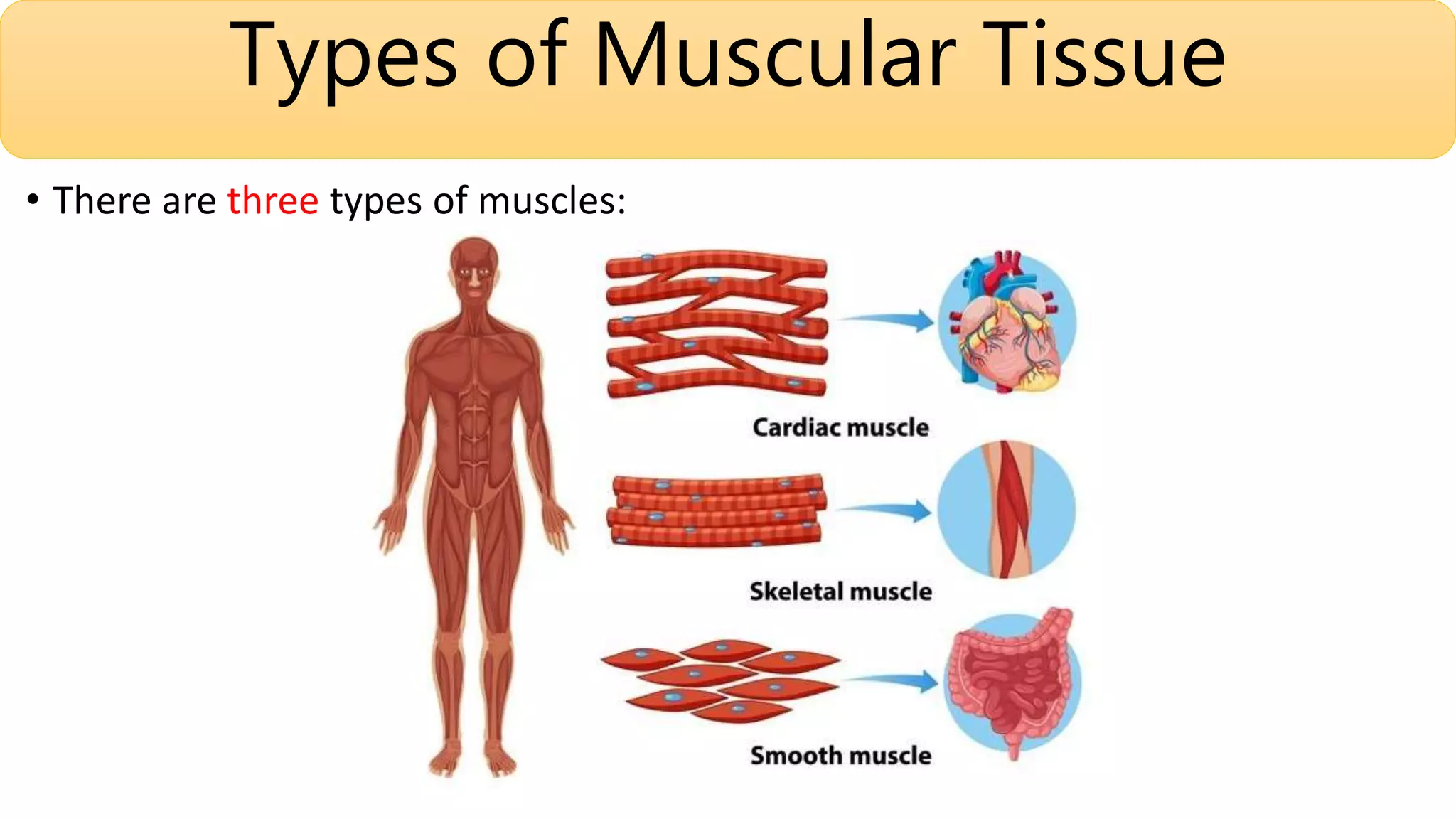
• There are three types of muscles:
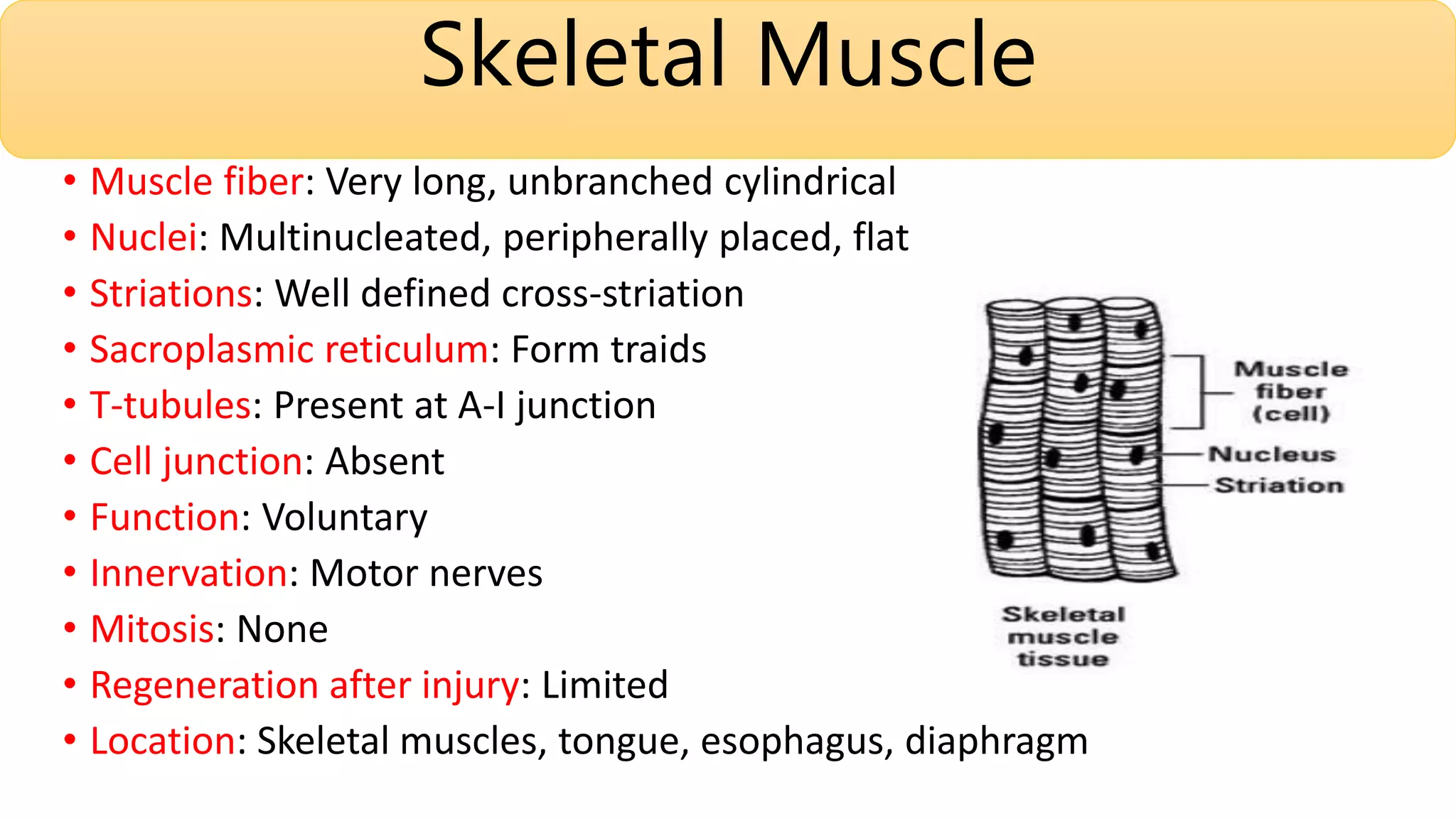
• Muscle fiber: Very long, unbranched cylindrical
• Nuclei: Multinucleated, peripherally placed, flat
• Striations: Well defined cross-striation
• Sacroplasmic reticulum: Form traids
• T-tubules: Present at A-I junction
• Cell junction: Absent
• Function: Voluntary
• Innervation: Motor nerves
• Mitosis: None
• Regeneration after injury: Limited
• Location: Skeletal muscles, tongue, esophagus, diaphragm
Skeletal Muscle
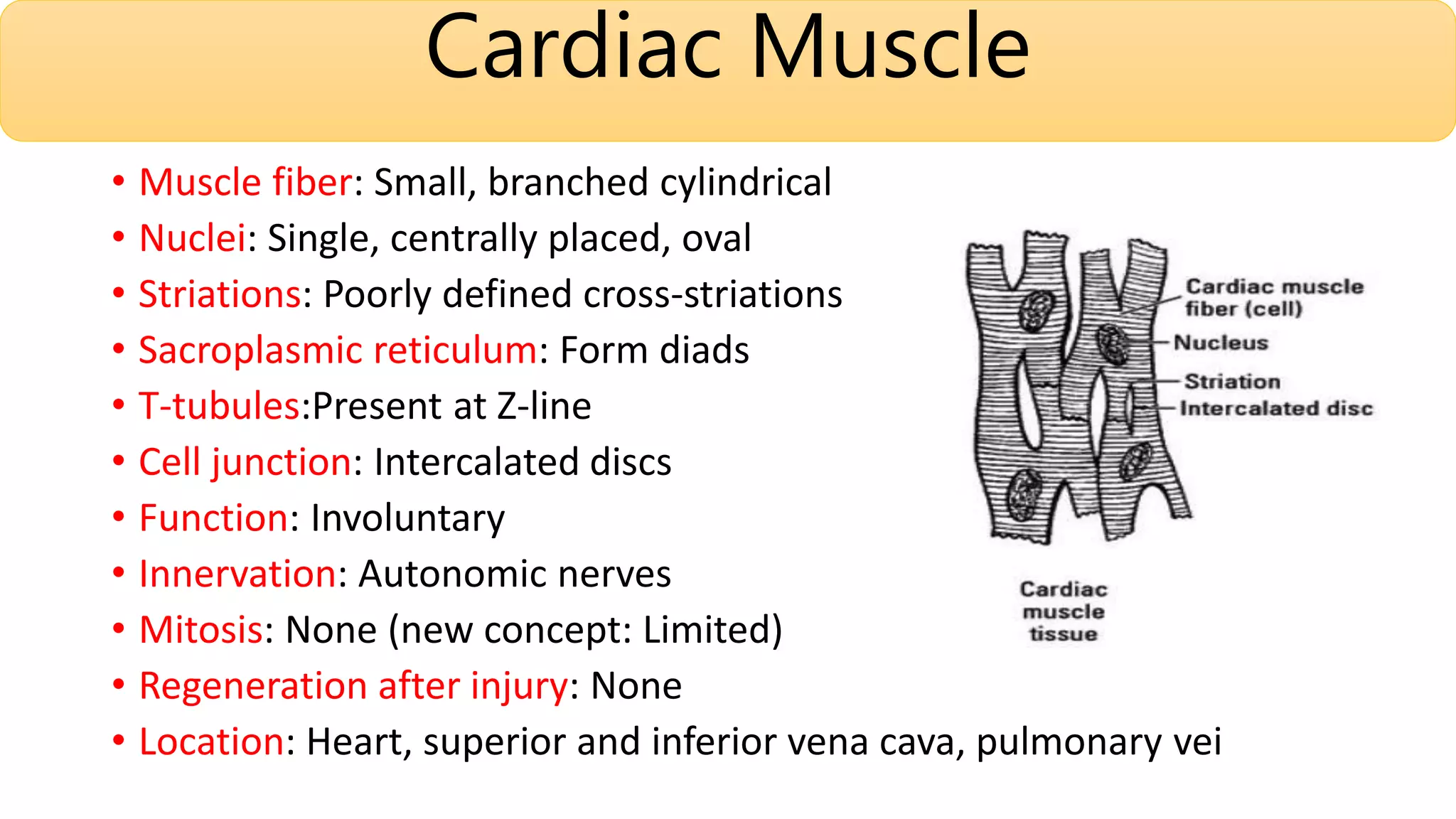
• Muscle fiber: Small, branched cylindrical
• Nuclei: Single, centrally placed, oval
• Striations: Poorly defined cross-striations
• Sacroplasmic reticulum: Form diads
• T-tubules:Present at Z-line
• Cell junction: Intercalated discs
• Function: Involuntary
• Innervation: Autonomic nerves
• Mitosis: None (new concept: Limited)
• Regeneration after injury: None
• Location: Heart, superior and inferior vena cava, pulmonary vei
Cardiac Muscle
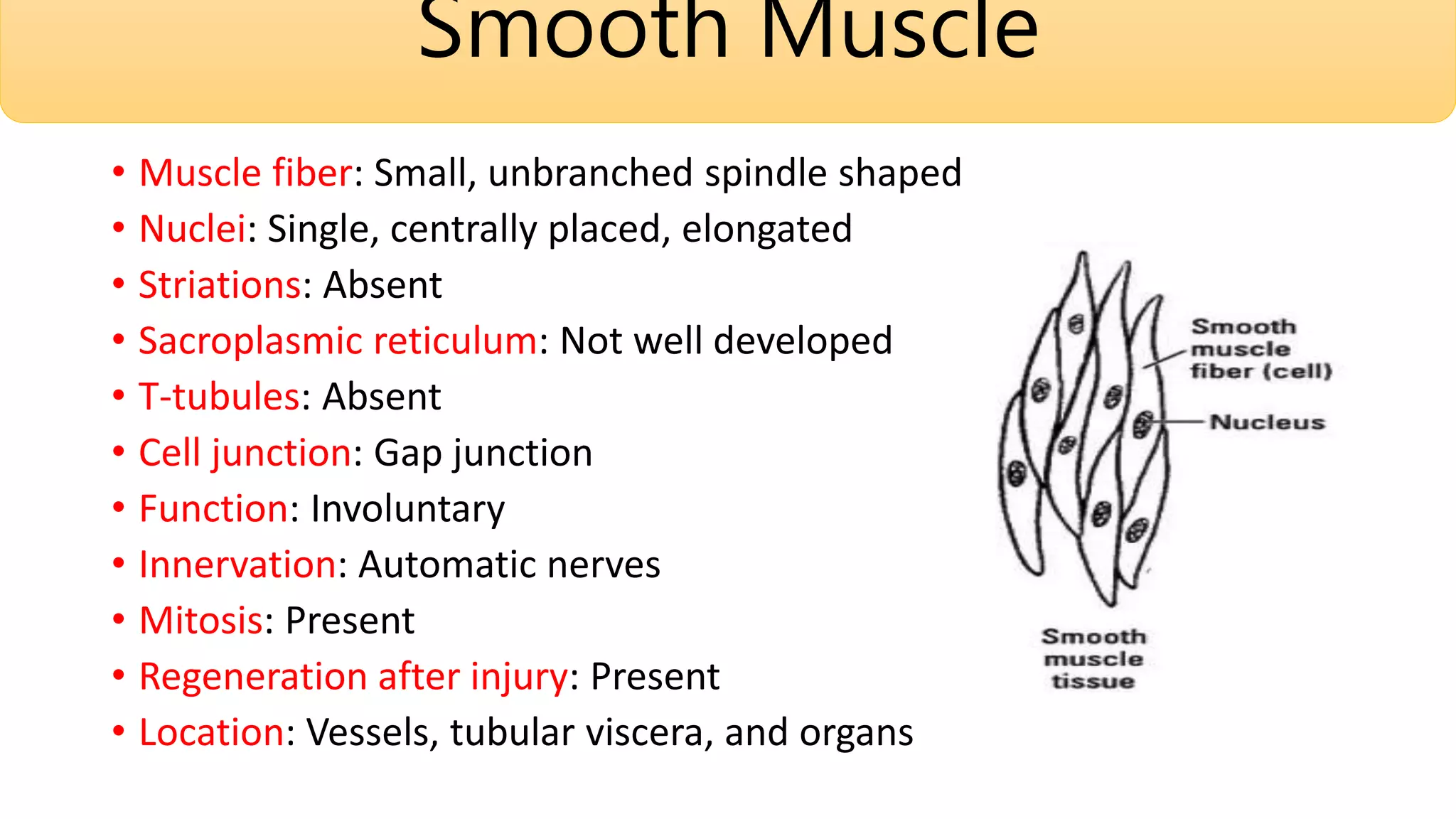
• Muscle fiber: Small, unbranched spindle shaped
• Nuclei: Single, centrally placed, elongated
• Striations: Absent
• Sacroplasmic reticulum: Not well developed
• T-tubules: Absent
• Cell junction: Gap junction
• Function: Involuntary
• Innervation: Automatic nerves
• Mitosis: Present
• Regeneration after injury: Present
• Location: Vessels, tubular viscera, and organs
Smooth Muscle
Summary
Thank You

types of muscles.pptx

  • 1.
    M.Sc Clinical Embryology Subject:Histology By – Prachi Naik Muscular tissue
  • 2.
    • In human,all the body cells have a property of the contractility to some extent. The property of contractility is well developed in muscular tissue. • The cells of muscular tissue are called Myocytes. As the myocytes are elongated or spindle shaped, they are also called muscle fibers. • The plasma membrane of a skeletal muscle fiber is called the sarcolemma. • The striated appearance of skeletal muscle tissue is a result of repeating bands of the proteins actin and myosin that are present along the length of myofibrils. • Dark A bands and light I bands repeat along myofibrils, and the alignment of myofibrils in the cell causes the entire cell to appear striated or banded. Muscle Tissue
  • 6.
    Types of MuscularTissue • There are three types of muscles:
  • 7.
    • Muscle fiber:Very long, unbranched cylindrical • Nuclei: Multinucleated, peripherally placed, flat • Striations: Well defined cross-striation • Sacroplasmic reticulum: Form traids • T-tubules: Present at A-I junction • Cell junction: Absent • Function: Voluntary • Innervation: Motor nerves • Mitosis: None • Regeneration after injury: Limited • Location: Skeletal muscles, tongue, esophagus, diaphragm Skeletal Muscle
  • 9.
    • Muscle fiber:Small, branched cylindrical • Nuclei: Single, centrally placed, oval • Striations: Poorly defined cross-striations • Sacroplasmic reticulum: Form diads • T-tubules:Present at Z-line • Cell junction: Intercalated discs • Function: Involuntary • Innervation: Autonomic nerves • Mitosis: None (new concept: Limited) • Regeneration after injury: None • Location: Heart, superior and inferior vena cava, pulmonary vei Cardiac Muscle
  • 11.
    • Muscle fiber:Small, unbranched spindle shaped • Nuclei: Single, centrally placed, elongated • Striations: Absent • Sacroplasmic reticulum: Not well developed • T-tubules: Absent • Cell junction: Gap junction • Function: Involuntary • Innervation: Automatic nerves • Mitosis: Present • Regeneration after injury: Present • Location: Vessels, tubular viscera, and organs Smooth Muscle
  • 13.
  • 14.