Advantages of Costing
• (I)Cost Determination
• (ii) Helping in Cost Reduction
• (iii) Product Profitability Analysis
• (iv) Provide information relevant for decision making
• (v) Determination of Selling price
• (vi) Cost Control and Variance Analysis
• (vii) Cost Comparison and Benchmarking
• (viii) Compliances with statutoryrequirements
• (ix) Identification of lacunae
• (x) Helpful in strategic decision making
• (xi) Helpful in solving linear programming problems
r
:
(
a
)
F
i
x
e
d
C
o
s
t
(
b
)
V
a
r
i
a
b
l
e
Disadvantages of Costing
• (i) It may be expensive to set a proper cost accounting system
• (ii) Reconciliation is required to verify the results of both financial
• accounts and cost accounts.
• (iii) The same data are recorded for both cost accounting and
• financial reporting purpose. Hence duplication work is carried
• out.
• (iv) Cost accounting system is not a complete solution itself to
• control costs but its efficacy depends on its usage.
Classification of Cost
• (i) By Nature or element : (a) Material Cost (b) Labour Cost and
• (c) Other Expenses
• (ii) By Functions : (a) Prime Cost (b) Factory/ Works Cost (c)
• Cost of Production (d) Cost of Goods Sold (e) Cost of Sales.
• (iii) By Behaviour : (a) Fixed Cost (b) Variable Cost and (c) Semi-
• variable Cost.
• (iv) By Controllability : (a) Controllable and (b) Uncontrollable.
• (v) By Normality : (a) Normal and (b) Abnormal.
• (vi) By Managerial decision making
• Marginal cost
• Differential cost
• Imputed cost
• Product cost
• Period cost
• Opportunity cost
• Sunk cost
• Discretionary cost
• Explicit cost
• Implicit cost
• Out of pocket cost
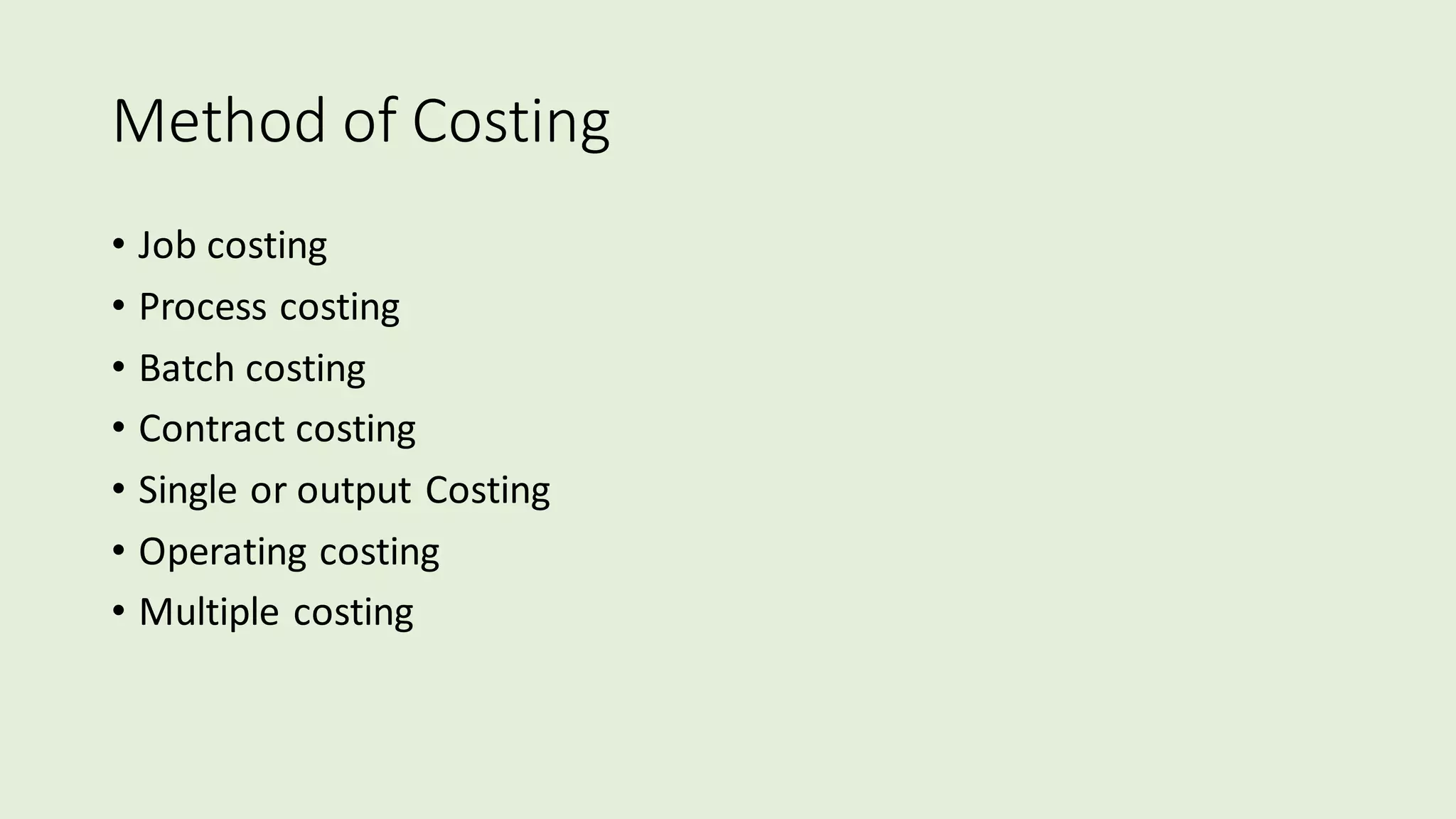
Method of Costing
• Job costing
• Process costing
• Batch costing
• Contract costing
• Single or output Costing
• Operating costing
• Multiple costing
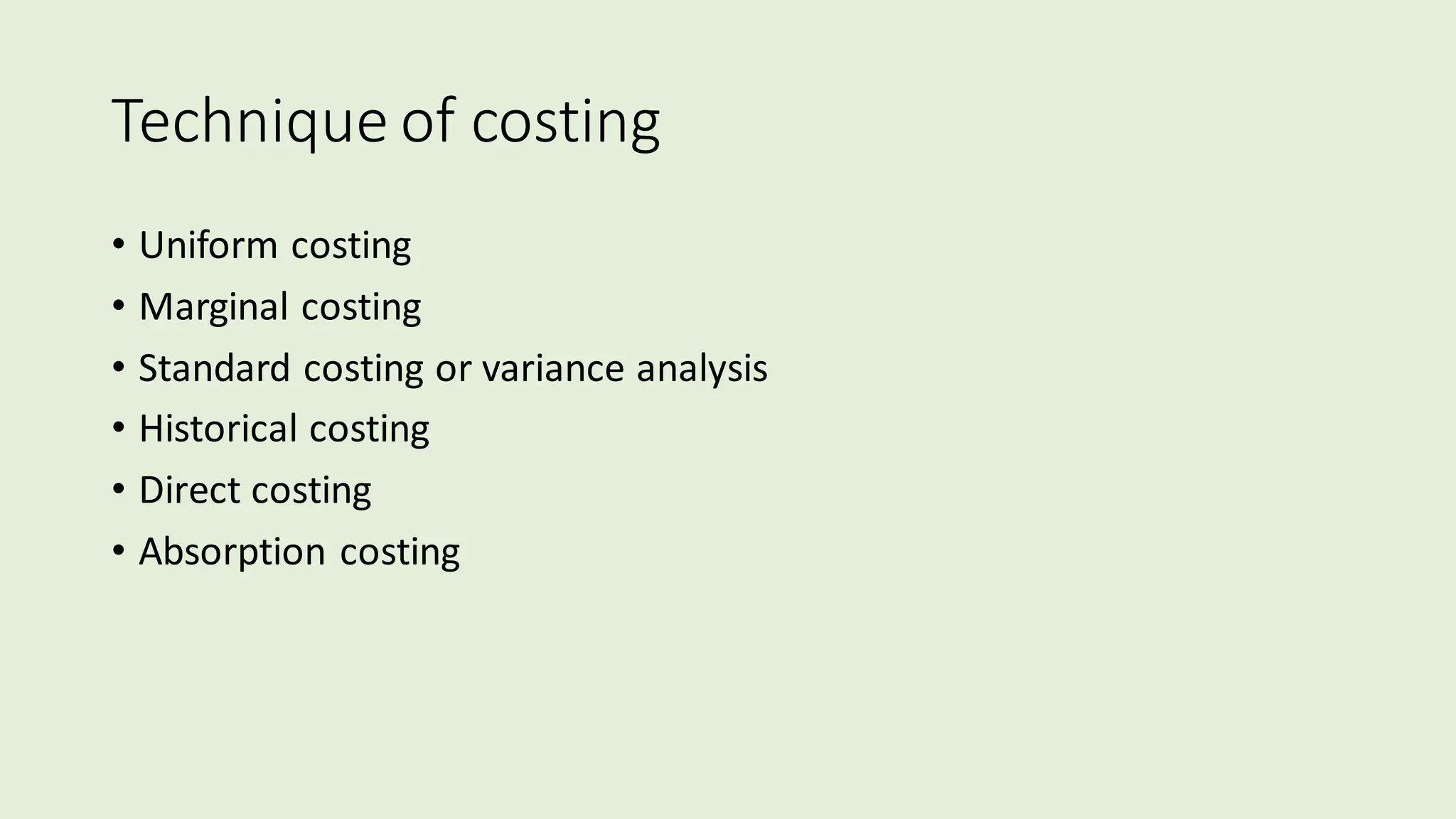
Technique of costing
• Uniform costing
• Marginal costing
• Standard costing or variance analysis
• Historical costing
• Direct costing
• Absorption costing

types methods and techniques of costing.pdf

  • 1.
    Advantages of Costing •(I)Cost Determination • (ii) Helping in Cost Reduction • (iii) Product Profitability Analysis • (iv) Provide information relevant for decision making • (v) Determination of Selling price • (vi) Cost Control and Variance Analysis • (vii) Cost Comparison and Benchmarking • (viii) Compliances with statutoryrequirements • (ix) Identification of lacunae • (x) Helpful in strategic decision making • (xi) Helpful in solving linear programming problems r : ( a ) F i x e d C o s t ( b ) V a r i a b l e
  • 2.
    Disadvantages of Costing •(i) It may be expensive to set a proper cost accounting system • (ii) Reconciliation is required to verify the results of both financial • accounts and cost accounts. • (iii) The same data are recorded for both cost accounting and • financial reporting purpose. Hence duplication work is carried • out. • (iv) Cost accounting system is not a complete solution itself to • control costs but its efficacy depends on its usage.
  • 3.
    Classification of Cost •(i) By Nature or element : (a) Material Cost (b) Labour Cost and • (c) Other Expenses • (ii) By Functions : (a) Prime Cost (b) Factory/ Works Cost (c) • Cost of Production (d) Cost of Goods Sold (e) Cost of Sales. • (iii) By Behaviour : (a) Fixed Cost (b) Variable Cost and (c) Semi- • variable Cost. • (iv) By Controllability : (a) Controllable and (b) Uncontrollable. • (v) By Normality : (a) Normal and (b) Abnormal. • (vi) By Managerial decision making
  • 4.
    • Marginal cost •Differential cost • Imputed cost • Product cost • Period cost • Opportunity cost • Sunk cost • Discretionary cost • Explicit cost • Implicit cost • Out of pocket cost
  • 5.
    Method of Costing •Job costing • Process costing • Batch costing • Contract costing • Single or output Costing • Operating costing • Multiple costing
  • 6.
    Technique of costing •Uniform costing • Marginal costing • Standard costing or variance analysis • Historical costing • Direct costing • Absorption costing