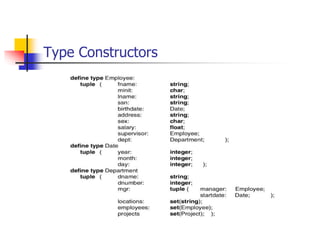
Type Constructors
Krishnakanth. G
17001D5112
1st M.Tech (CS)
Object Identity, Object Structure, and
Type Constructors (1)
 Unique Identity:
 Property required of an OID is that it be immutable.
Object Identity, Object Structure, and
Type Constructors (2)
 Type Constructors
Three most basic constructors
 Atom
 Tuple
 Set
Commonly used constructors
 List
 Bag
 Array
Object Identity, Object Structure, and
Type Constructors (3)
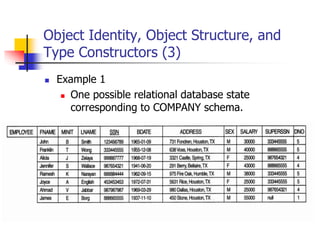
 Example 1
 One possible relational database state
corresponding to COMPANY schema.
Object Identity, Object Structure, and
Type Constructors (4)
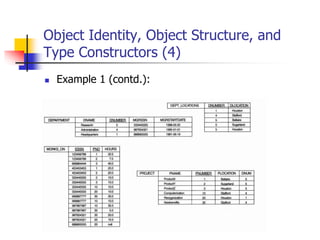
 Example 1 (contd.):
Object Identity, Object Structure, and
Type Constructors (5)
 Example 1 (contd.)
Object Identity, Object Structure, and
Type Constructors (6)
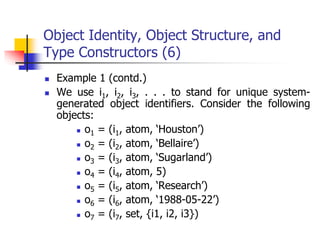
 Example 1 (contd.)
 We use i1, i2, i3, . . . to stand for unique system-
generated object identifiers. Consider the following
objects:
 o1 = (i1, atom, ‘Houston’)
 o2 = (i2, atom, ‘Bellaire’)
 o3 = (i3, atom, ‘Sugarland’)
 o4 = (i4, atom, 5)
 o5 = (i5, atom, ‘Research’)
 o6 = (i6, atom, ‘1988-05-22’)
 o7 = (i7, set, {i1, i2, i3})
Object Identity, Object Structure, and
Type Constructors (7)
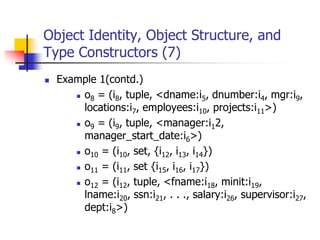
 Example 1(contd.)
 o8 = (i8, tuple, <dname:i5, dnumber:i4, mgr:i9,
locations:i7, employees:i10, projects:i11>)
 o9 = (i9, tuple, <manager:i12,
manager_start_date:i6>)
 o10 = (i10, set, {i12, i13, i14})
 o11 = (i11, set {i15, i16, i17})
 o12 = (i12, tuple, <fname:i18, minit:i19,
lname:i20, ssn:i21, . . ., salary:i26, supervisor:i27,
dept:i8>)
Object Identity, Object Structure, and
Type Constructors (8)
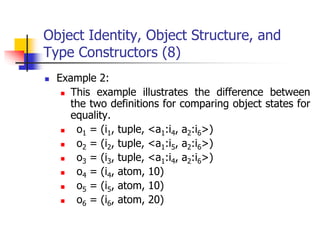
 Example 2:
 This example illustrates the difference between
the two definitions for comparing object states for
equality.
 o1 = (i1, tuple, <a1:i4, a2:i6>)
 o2 = (i2, tuple, <a1:i5, a2:i6>)
 o3 = (i3, tuple, <a1:i4, a2:i6>)
 o4 = (i4, atom, 10)
 o5 = (i5, atom, 10)
 o6 = (i6, atom, 20)
Object Identity, Object Structure, and
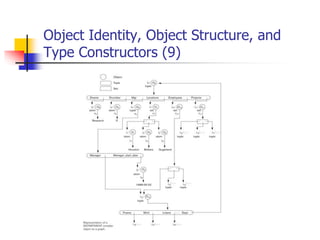
Type Constructors (9)
Type Constructors
Type constructor

Type constructor

  • 1.
  • 2.
    Object Identity, ObjectStructure, and Type Constructors (1)  Unique Identity:  Property required of an OID is that it be immutable.
  • 3.
    Object Identity, ObjectStructure, and Type Constructors (2)  Type Constructors Three most basic constructors  Atom  Tuple  Set Commonly used constructors  List  Bag  Array
  • 4.
    Object Identity, ObjectStructure, and Type Constructors (3)  Example 1  One possible relational database state corresponding to COMPANY schema.
  • 5.
    Object Identity, ObjectStructure, and Type Constructors (4)  Example 1 (contd.):
  • 6.
    Object Identity, ObjectStructure, and Type Constructors (5)  Example 1 (contd.)
  • 7.
    Object Identity, ObjectStructure, and Type Constructors (6)  Example 1 (contd.)  We use i1, i2, i3, . . . to stand for unique system- generated object identifiers. Consider the following objects:  o1 = (i1, atom, ‘Houston’)  o2 = (i2, atom, ‘Bellaire’)  o3 = (i3, atom, ‘Sugarland’)  o4 = (i4, atom, 5)  o5 = (i5, atom, ‘Research’)  o6 = (i6, atom, ‘1988-05-22’)  o7 = (i7, set, {i1, i2, i3})
  • 8.
    Object Identity, ObjectStructure, and Type Constructors (7)  Example 1(contd.)  o8 = (i8, tuple, <dname:i5, dnumber:i4, mgr:i9, locations:i7, employees:i10, projects:i11>)  o9 = (i9, tuple, <manager:i12, manager_start_date:i6>)  o10 = (i10, set, {i12, i13, i14})  o11 = (i11, set {i15, i16, i17})  o12 = (i12, tuple, <fname:i18, minit:i19, lname:i20, ssn:i21, . . ., salary:i26, supervisor:i27, dept:i8>)
  • 9.
    Object Identity, ObjectStructure, and Type Constructors (8)  Example 2:  This example illustrates the difference between the two definitions for comparing object states for equality.  o1 = (i1, tuple, <a1:i4, a2:i6>)  o2 = (i2, tuple, <a1:i5, a2:i6>)  o3 = (i3, tuple, <a1:i4, a2:i6>)  o4 = (i4, atom, 10)  o5 = (i5, atom, 10)  o6 = (i6, atom, 20)
  • 10.
    Object Identity, ObjectStructure, and Type Constructors (9)
  • 11.