DEVELOPMENT OF STRONG AND SERVICEABLE DETAILS FOR PRECAST, PRETENSIONED BENT CAPS
PROJECT OVERVIEW SHEAR AND MOMENT DEMANDS
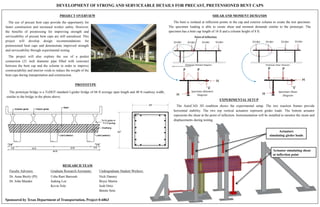
The bent is isolated at inflection points in the cap and exterior column to create the test specimen.
The specimen loading is able to create shear and moment demands similar to the prototype. The
specimen has a bent cap length of 16 ft and a column height of 8 ft.
RESEARCH TEAM
Faculty Advisors: Graduate Research Assistants: Undergraduate Student Workers:
Dr. Anna Birely (PI) Usha Rani Barooah Nick Danney
Dr. John Mander Judong Lee Bryce Martin
Kevin Yole Josh Ortiz
Benito Soto
Sponsored by Texas Department of Transportation, Project 0-6863
PROTOTYPE
The prototype bridge is a TxDOT standard I-girder bridge of 66 ft average span length and 40 ft roadway width,
similar to the bridge in the photo above.
Actuator simulating shear
at inflection point
Actuators
simulating girder loads
The use of precast bent caps provide the opportunity for
faster construction and increased worker safety. However,
the benefits of prestressing for improving strength and
serviceability of precast bent caps are still unrealized. This
project will develop design recommendations for
pretensioned bent caps and demonstrate improved strength
and serviceability through experimental testing.
The project will also explore the use of a pocket
connection (21 inch diameter pipe filled with concrete)
between the bent cap and the column in order to improve
constructability and interior voids to reduce the weight of the
bent caps during transportation and construction.
The AutoCAD 3D rendition shows the experimental setup. The two reaction frames provide
horizontal stability. The two top vertical actuators represent girder loads. The bottom actuator
represents the shear at the point of inflection. Instrumentation will be installed to monitor the strain and
displacements during testing.
EXPERIMENTAL SETUP
Pocket Connection
Bent cap
Column
Corrugated Pipe
Pocket
Dowel bars
Test Matrix
Specimen Description
1: RCS-16-12 Reinforced concrete for
comparison
2: PSS-16-12 Design for prototype
bridge
3: PSS-16-24 Less shear
reinforcement
4: PSV-16-12 Hollow cross-section for
reduced weight
5 T.B.D.
6 T.B.D.
Void Section
Solid Section
In the lab now!
Plan view with misalignment
• A pocket is a large void formed in the
bent cap by a corrugated pipe.
• The pocket in the bent cap fits over 6-#11
dowel bars extending from the column.
• Once the bent cap is in place, the void is
filled with concrete to complete the
connection.
• Pipe acts as confinement and shear
reinforcement for joint shear demands.
• Large diameter of the pocket
accommodates accidental misalignment
of columns.
Placing cap on column
Filling Pocket with Concrete
The specimen is painted to assist
in identifying cracks. The pocket
concrete is painted blue.

TxDOT Bent Cap Research

  • 1.
    DEVELOPMENT OF STRONGAND SERVICEABLE DETAILS FOR PRECAST, PRETENSIONED BENT CAPS PROJECT OVERVIEW SHEAR AND MOMENT DEMANDS The bent is isolated at inflection points in the cap and exterior column to create the test specimen. The specimen loading is able to create shear and moment demands similar to the prototype. The specimen has a bent cap length of 16 ft and a column height of 8 ft. RESEARCH TEAM Faculty Advisors: Graduate Research Assistants: Undergraduate Student Workers: Dr. Anna Birely (PI) Usha Rani Barooah Nick Danney Dr. John Mander Judong Lee Bryce Martin Kevin Yole Josh Ortiz Benito Soto Sponsored by Texas Department of Transportation, Project 0-6863 PROTOTYPE The prototype bridge is a TxDOT standard I-girder bridge of 66 ft average span length and 40 ft roadway width, similar to the bridge in the photo above. Actuator simulating shear at inflection point Actuators simulating girder loads The use of precast bent caps provide the opportunity for faster construction and increased worker safety. However, the benefits of prestressing for improving strength and serviceability of precast bent caps are still unrealized. This project will develop design recommendations for pretensioned bent caps and demonstrate improved strength and serviceability through experimental testing. The project will also explore the use of a pocket connection (21 inch diameter pipe filled with concrete) between the bent cap and the column in order to improve constructability and interior voids to reduce the weight of the bent caps during transportation and construction. The AutoCAD 3D rendition shows the experimental setup. The two reaction frames provide horizontal stability. The two top vertical actuators represent girder loads. The bottom actuator represents the shear at the point of inflection. Instrumentation will be installed to monitor the strain and displacements during testing. EXPERIMENTAL SETUP
  • 2.
    Pocket Connection Bent cap Column CorrugatedPipe Pocket Dowel bars Test Matrix Specimen Description 1: RCS-16-12 Reinforced concrete for comparison 2: PSS-16-12 Design for prototype bridge 3: PSS-16-24 Less shear reinforcement 4: PSV-16-12 Hollow cross-section for reduced weight 5 T.B.D. 6 T.B.D. Void Section Solid Section In the lab now! Plan view with misalignment • A pocket is a large void formed in the bent cap by a corrugated pipe. • The pocket in the bent cap fits over 6-#11 dowel bars extending from the column. • Once the bent cap is in place, the void is filled with concrete to complete the connection. • Pipe acts as confinement and shear reinforcement for joint shear demands. • Large diameter of the pocket accommodates accidental misalignment of columns. Placing cap on column Filling Pocket with Concrete The specimen is painted to assist in identifying cracks. The pocket concrete is painted blue.